University of Alabama
Software Engineering Group
Department of Computer Science
Eugene Syriani
• “A Tool for Multi-Paradigm Modeling”
• Successor of good old AToM3
• Web-based, runs on the cloud
• http://syriani.cs.ua.edu/atompm/atompm.htm
• Demo: http://www.youtube.com/watch?v=iBbdpmpwn6M
2
E. Syriani, H. Vangheluwe, R. Mannadiar, C. Hansen, S. Van Mierlo and H. Ergin. AToMPM: A
Web-based Modeling Environment. MODELS'13 Demonstrations, , CEUR, Miami FL, USA, 2013.
• Research framework from which you can generate domain-specific
modeling web-based tools that run on the cloud
• Open-source framework for designing DSML environments, performing
model transformations, and manipulating and managing models
• Runs completely over the web: OS, platform, device independent
• Follows the MPM philosophy of “modeling everything explicitly, at the
right level of abstraction(s), using the most appropriate formalism(s)
and process(es)”
– Completely modeled by itself
3
• Modeling in the cloud
• Graphical vs. Textual Modeling
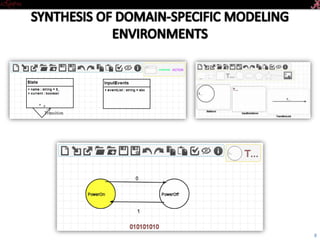
• Synthesis of Domain-Specific Modeling Environments
• Model Transformation, Code Generation and Debugging
• Process Modeling
• Collaborative Modeling
• Modeled Plugin Framework
4
• Thin client: all you need is an SVG-compliant web browser
• Nothing is stored on the client
• User files, models, all artifacts are saved in the cloud
• Multi-user system
– User access control at custom level of granularity
 Package
 Model
 Model element
5
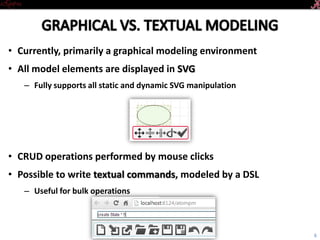
• Currently, primarily a graphical modeling environment
• All model elements are displayed in SVG
– Fully supports all static and dynamic SVG manipulation
• CRUD operations performed by mouse clicks
• Possible to write textual commands, modeled by a DSL
– Useful for bulk operations
6
• Automatically supported
• Default language is a simplified UML class diagram
– Any modeling language can be used to define meta-models, as long as
there is a transformation defined mapping that meta-modeling language to
the default language
• Static constraints can be expressed on top of the abstract syntax
model using a textual DSL or via the Javascript API
• Multiple concrete syntax can be assigned to the same abstract
syntax
– Custom views per user preference
• Concrete syntax language is itself meta-modeled to represent
geometric shapes
7
8
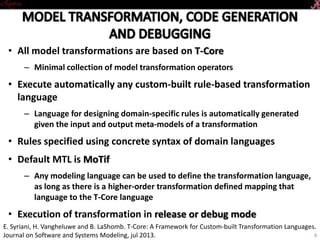
• All model transformations are based on T-Core
– Minimal collection of model transformation operators
• Execute automatically any custom-built rule-based transformation
language
– Language for designing domain-specific rules is automatically generated
given the input and output meta-models of a transformation
• Rules specified using concrete syntax of domain languages
• Default MTL is MoTif
– Any modeling language can be used to define the transformation language,
as long as there is a higher-order transformation defined mapping that
language to the T-Core language
• Execution of transformation in release or debug mode
9
E. Syriani, H. Vangheluwe and B. LaShomb. T-Core: A Framework for Custom-built Transformation Languages.
Journal on Software and Systems Modeling, jul 2013.
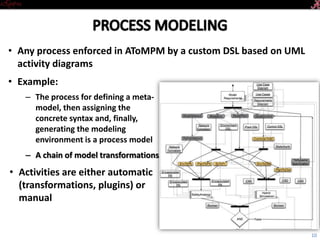
• Any process enforced in AToMPM by a custom DSL based on UML
activity diagrams
• Example:
10
– The process for defining a meta-
model, then assigning the
concrete syntax and, finally,
generating the modeling
environment is a process model
– A chain of model transformations
• Activities are either automatic
(transformations, plugins) or
manual
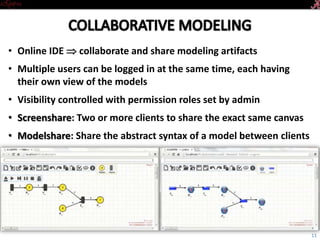
• Online IDE  collaborate and share modeling artifacts
• Multiple users can be logged in at the same time, each having
their own view of the models
• Visibility controlled with permission roles set by admin
• Screenshare: Two or more clients to share the exact same canvas
• Modelshare: Share the abstract syntax of a model between clients
11
12
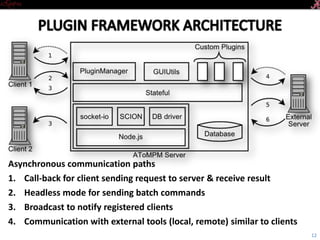
Asynchronous communication paths
1. Call-back for client sending request to server & receive result
2. Headless mode for sending batch commands
3. Broadcast to notify registered clients
4. Communication with external tools (local, remote) similar to clients
• Defined as models
– Statecharts + Javascript code
 Can wrap any other programming language, DLL, COM, etc.
– Operate on models through ArkM3 API
• Deployment specified as a custom UML component diagram
• Explicitly model of plugins and their deployment
13

AToMPM - Features

  • 1.
    University of Alabama SoftwareEngineering Group Department of Computer Science Eugene Syriani
  • 2.
    • “A Toolfor Multi-Paradigm Modeling” • Successor of good old AToM3 • Web-based, runs on the cloud • http://syriani.cs.ua.edu/atompm/atompm.htm • Demo: http://www.youtube.com/watch?v=iBbdpmpwn6M 2 E. Syriani, H. Vangheluwe, R. Mannadiar, C. Hansen, S. Van Mierlo and H. Ergin. AToMPM: A Web-based Modeling Environment. MODELS'13 Demonstrations, , CEUR, Miami FL, USA, 2013.
  • 3.
    • Research frameworkfrom which you can generate domain-specific modeling web-based tools that run on the cloud • Open-source framework for designing DSML environments, performing model transformations, and manipulating and managing models • Runs completely over the web: OS, platform, device independent • Follows the MPM philosophy of “modeling everything explicitly, at the right level of abstraction(s), using the most appropriate formalism(s) and process(es)” – Completely modeled by itself 3
  • 4.
    • Modeling inthe cloud • Graphical vs. Textual Modeling • Synthesis of Domain-Specific Modeling Environments • Model Transformation, Code Generation and Debugging • Process Modeling • Collaborative Modeling • Modeled Plugin Framework 4
  • 5.
    • Thin client:all you need is an SVG-compliant web browser • Nothing is stored on the client • User files, models, all artifacts are saved in the cloud • Multi-user system – User access control at custom level of granularity  Package  Model  Model element 5
  • 6.
    • Currently, primarilya graphical modeling environment • All model elements are displayed in SVG – Fully supports all static and dynamic SVG manipulation • CRUD operations performed by mouse clicks • Possible to write textual commands, modeled by a DSL – Useful for bulk operations 6
  • 7.
    • Automatically supported •Default language is a simplified UML class diagram – Any modeling language can be used to define meta-models, as long as there is a transformation defined mapping that meta-modeling language to the default language • Static constraints can be expressed on top of the abstract syntax model using a textual DSL or via the Javascript API • Multiple concrete syntax can be assigned to the same abstract syntax – Custom views per user preference • Concrete syntax language is itself meta-modeled to represent geometric shapes 7
  • 8.
  • 9.
    • All modeltransformations are based on T-Core – Minimal collection of model transformation operators • Execute automatically any custom-built rule-based transformation language – Language for designing domain-specific rules is automatically generated given the input and output meta-models of a transformation • Rules specified using concrete syntax of domain languages • Default MTL is MoTif – Any modeling language can be used to define the transformation language, as long as there is a higher-order transformation defined mapping that language to the T-Core language • Execution of transformation in release or debug mode 9 E. Syriani, H. Vangheluwe and B. LaShomb. T-Core: A Framework for Custom-built Transformation Languages. Journal on Software and Systems Modeling, jul 2013.
  • 10.
    • Any processenforced in AToMPM by a custom DSL based on UML activity diagrams • Example: 10 – The process for defining a meta- model, then assigning the concrete syntax and, finally, generating the modeling environment is a process model – A chain of model transformations • Activities are either automatic (transformations, plugins) or manual
  • 11.
    • Online IDE collaborate and share modeling artifacts • Multiple users can be logged in at the same time, each having their own view of the models • Visibility controlled with permission roles set by admin • Screenshare: Two or more clients to share the exact same canvas • Modelshare: Share the abstract syntax of a model between clients 11
  • 12.
    12 Asynchronous communication paths 1.Call-back for client sending request to server & receive result 2. Headless mode for sending batch commands 3. Broadcast to notify registered clients 4. Communication with external tools (local, remote) similar to clients
  • 13.
    • Defined asmodels – Statecharts + Javascript code  Can wrap any other programming language, DLL, COM, etc. – Operate on models through ArkM3 API • Deployment specified as a custom UML component diagram • Explicitly model of plugins and their deployment 13