INSTITUTE FORWISCONSIN’S  FUTUREwww.wisconsinsfuture.orgFighting for Wisconsin FamiliesSummer 2010
Big Banks Crashed the EconomyBig banks brought down the economy by inflating the housing market, making risky loans and betting against their own investments – with our pension moneyInvestors bundled thousands of risky mortgages, then divided them into loan ‘slices’ claiming they were a mix of strong and risky mortgages.These financial tricks put the whole economy in jeopardy. Federal regulators failed to intervene. The mortgage bubble burst and the recession ‘officially’ began in December 2007.
The Great Recession spread like an oil slick$15 trillion in personal wealth was gone 	Pension funds and other investments lost $50,000 for every    man, woman and child in America $6 trillion in housing value disappearedEqual to the value of every house in every state on the Atlantic coast from Maine to FloridaUnemployment topped 10% (15 million people)As if every man in America aged 50-59 lost his job 40 million people in poverty—the most since 1960Equivalent to the total population in the thirty largest US citiesSources: US Census Bureau, US Bureau of Labor Statistics; US Bureau of Economic Analysis
State and local budgets collapseddue to lost revenues and increased needsProperty taxes fell, as property values declinedSales taxes dropped, with fewer items purchasedIncome taxes plunged, with job losses and wage cutsCorporate taxes slumped, as business contractedThe fiscal crisis in state and local governments is the worst in US history
$800 billion Recovery Act for 2009-2010Stop the job lossHelp people in crisisSupport business growthIncrease public   investment on roads and energyPrevent devastating cuts to education and public servicesStimulate private spending –    Tax cuts, Cash for Clunkers,     Unemployment Benefits
  Recovery Act helped end job lossRecovery Act funds kept job losses from getting worse.Federal aid helped keep state and local governments from collapsing.But job growth and economic recovery are still fragile.
The Recovery Act prevented a full-fledged depression in America,                 using millions of economic sandbags to hold communities togetherMore Unemployment InsuranceBusinessLoansRoad RepairBusesandTrains$$ forPoliceTaxCutsRiver Clean UpImproveAirportsEnergySavings  RehabHealth CareAid forElderlyFunds for TeachersHousing for DisabledSchoolLoansFood StampsFarm AidMedicalResearchSchool RehabCash for ClunkersVeteran AidChildProtectionFunds for DAs
Recovery Act funds helped Wisconsin manage its severe economic problemsAs the recession deepened, Wisconsin faced:A multi-billion dollar budget deficit
Soaring unemployment
Rising demand for state and local social servicesFederal dollars helped patch the budget, create jobs and preserve critical servicesWisconsin’s unemployment rateis slowly coming down
Wisconsin Recovery Act Funding 2009-2010:$11 billionEnergy  5%Transportation  6%Medical care 7% Schools 9%Sources: www.recovery.gov; projects.propublica.org/recovery/; www.recovery.wisconsin.gov/
The Recovery Act helped Wisconsin familiesGave almost every employee a $500 tax break in 2009 and 2010Saved 59,000 jobsSupported health care for  1.3 million elderly, disabled   and low-income familiesProvided $153 million in   support for laid off workers
Huge state deficits will plague US for several yearsMore federal aid needed to keep states functioningSource: Center on Budget and Policy Priorities
The stimulus money for states is almost gone and communities are heading                                                     for a funding cliff in 2011-2013Wisconsin faces a $5 billion deficit for 2011-2013, which means reduced investments in cities, counties and schools.The state has almost no added revenue sources for the next budget cycle. This could short circuit recent economic growth.
Some people don’t think we should invest in public structures—Be careful what you wish for
Public structures will disappear …unless we fight for themIn Colorado Springs, every third streetlight is dark. Buses nolonger run at night or on weekends.The police helicopters are for sale on the Internet. The city is dumping firefighting jobs, a vice team, burglary investigators, beat cops—dozens of police and fire positions will go unfilled. Parks workers removed trash cans, replacing them with signs urging users to  pack out their own litter.Neighbors are encouraged to bring their own lawn mowers to local green spaces…Water cutbacks mean most parks will be brown turf by July; the flower and fertilizer budget is zero. City recreation centers, indoor and outdoor pools, and a handful of museums closed March 31. The city won't pay for any street paving …. Sources: Denver Post, CNN, CBS News, 5280 Denver’s Magazine
What’s in it for private sector workers?$700 million for road building and construction, boosting production of materials and equipmentAirport Improvement Program   			     $23,637,434     Broadband Infrastructure Build-out	  	     $22,978,367      Build America Bonds				     $97,367,700    University of Wisconsin System  	 	       $5,106,373    State Broadband Development Grant Program 	       $1,717,684    State Highway, Local Road and Bridge Program    $519,226,021    Transit Capital Assistance			     $20,130,095    WI Army National Guard				       $6,370,000					      Total: $696,533,674
Why should public sector workers care?Clearing the roads of snow, providing health care or ensuring public safety, public sector union members provide vital services to make communities work.BUT states are facing an estimated $260 billion shortfall in 2011-2012, which would mean the loss of nearly a million public and private sector jobs.
Why is this important for senior citizens ?
Why does this matter to our families? Without more federal aid, Wisconsin schoolswill lose over 2,000teachers and staffFederal funds are needed to maintain school programs for children with disabilitiesFederal funds are vital to keep day care programs operating
Those opposed to more federal stimulus aid claim the US can’t afford a bigger deficitUS debt is the same percentage of the national economy as it was in 1950.It is large, but it is sustainable until the economy fully recovers.US debt tripled under ReaganDebt critics forget recent history;Conservative hero ran budget deficitsSource: www.usgovernmentspending.com
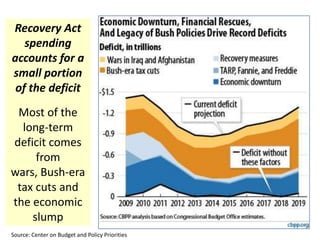
Recovery Act spending accounts for a small portion of the deficitMost of the long-term deficit comes from wars, Bush-era tax cuts and the economic slumpSource: Center on Budget and Policy Priorities
We can’t afford a double-dip recessionToo many economic indicators are weakBorrowing now, to support state and local governments and stimulate the economy,   is the best way to prevent another recession and  its destructive effects.We don’t want the fragile economic recovery……to collapse back into another recession.2011

Iwf recovery act_7_01_2010

  • 1.
    INSTITUTE FORWISCONSIN’S FUTUREwww.wisconsinsfuture.orgFighting for Wisconsin FamiliesSummer 2010
  • 2.
    Big Banks Crashedthe EconomyBig banks brought down the economy by inflating the housing market, making risky loans and betting against their own investments – with our pension moneyInvestors bundled thousands of risky mortgages, then divided them into loan ‘slices’ claiming they were a mix of strong and risky mortgages.These financial tricks put the whole economy in jeopardy. Federal regulators failed to intervene. The mortgage bubble burst and the recession ‘officially’ began in December 2007.
  • 3.
    The Great Recessionspread like an oil slick$15 trillion in personal wealth was gone Pension funds and other investments lost $50,000 for every man, woman and child in America $6 trillion in housing value disappearedEqual to the value of every house in every state on the Atlantic coast from Maine to FloridaUnemployment topped 10% (15 million people)As if every man in America aged 50-59 lost his job 40 million people in poverty—the most since 1960Equivalent to the total population in the thirty largest US citiesSources: US Census Bureau, US Bureau of Labor Statistics; US Bureau of Economic Analysis
  • 4.
    State and localbudgets collapseddue to lost revenues and increased needsProperty taxes fell, as property values declinedSales taxes dropped, with fewer items purchasedIncome taxes plunged, with job losses and wage cutsCorporate taxes slumped, as business contractedThe fiscal crisis in state and local governments is the worst in US history
  • 5.
    $800 billion RecoveryAct for 2009-2010Stop the job lossHelp people in crisisSupport business growthIncrease public investment on roads and energyPrevent devastating cuts to education and public servicesStimulate private spending – Tax cuts, Cash for Clunkers, Unemployment Benefits
  • 7.
    RecoveryAct helped end job lossRecovery Act funds kept job losses from getting worse.Federal aid helped keep state and local governments from collapsing.But job growth and economic recovery are still fragile.
  • 8.
    The Recovery Actprevented a full-fledged depression in America, using millions of economic sandbags to hold communities togetherMore Unemployment InsuranceBusinessLoansRoad RepairBusesandTrains$$ forPoliceTaxCutsRiver Clean UpImproveAirportsEnergySavings RehabHealth CareAid forElderlyFunds for TeachersHousing for DisabledSchoolLoansFood StampsFarm AidMedicalResearchSchool RehabCash for ClunkersVeteran AidChildProtectionFunds for DAs
  • 9.
    Recovery Act fundshelped Wisconsin manage its severe economic problemsAs the recession deepened, Wisconsin faced:A multi-billion dollar budget deficit
  • 10.
  • 11.
    Rising demand forstate and local social servicesFederal dollars helped patch the budget, create jobs and preserve critical servicesWisconsin’s unemployment rateis slowly coming down
  • 12.
    Wisconsin Recovery ActFunding 2009-2010:$11 billionEnergy 5%Transportation 6%Medical care 7% Schools 9%Sources: www.recovery.gov; projects.propublica.org/recovery/; www.recovery.wisconsin.gov/
  • 13.
    The Recovery Acthelped Wisconsin familiesGave almost every employee a $500 tax break in 2009 and 2010Saved 59,000 jobsSupported health care for 1.3 million elderly, disabled and low-income familiesProvided $153 million in support for laid off workers
  • 14.
    Huge state deficitswill plague US for several yearsMore federal aid needed to keep states functioningSource: Center on Budget and Policy Priorities
  • 15.
    The stimulus moneyfor states is almost gone and communities are heading for a funding cliff in 2011-2013Wisconsin faces a $5 billion deficit for 2011-2013, which means reduced investments in cities, counties and schools.The state has almost no added revenue sources for the next budget cycle. This could short circuit recent economic growth.
  • 16.
    Some people don’tthink we should invest in public structures—Be careful what you wish for
  • 17.
    Public structures willdisappear …unless we fight for themIn Colorado Springs, every third streetlight is dark. Buses nolonger run at night or on weekends.The police helicopters are for sale on the Internet. The city is dumping firefighting jobs, a vice team, burglary investigators, beat cops—dozens of police and fire positions will go unfilled. Parks workers removed trash cans, replacing them with signs urging users to pack out their own litter.Neighbors are encouraged to bring their own lawn mowers to local green spaces…Water cutbacks mean most parks will be brown turf by July; the flower and fertilizer budget is zero. City recreation centers, indoor and outdoor pools, and a handful of museums closed March 31. The city won't pay for any street paving …. Sources: Denver Post, CNN, CBS News, 5280 Denver’s Magazine
  • 18.
    What’s in itfor private sector workers?$700 million for road building and construction, boosting production of materials and equipmentAirport Improvement Program $23,637,434 Broadband Infrastructure Build-out $22,978,367 Build America Bonds $97,367,700 University of Wisconsin System $5,106,373 State Broadband Development Grant Program $1,717,684 State Highway, Local Road and Bridge Program $519,226,021 Transit Capital Assistance $20,130,095 WI Army National Guard $6,370,000 Total: $696,533,674
  • 19.
    Why should publicsector workers care?Clearing the roads of snow, providing health care or ensuring public safety, public sector union members provide vital services to make communities work.BUT states are facing an estimated $260 billion shortfall in 2011-2012, which would mean the loss of nearly a million public and private sector jobs.
  • 20.
    Why is thisimportant for senior citizens ?
  • 21.
    Why does thismatter to our families? Without more federal aid, Wisconsin schoolswill lose over 2,000teachers and staffFederal funds are needed to maintain school programs for children with disabilitiesFederal funds are vital to keep day care programs operating
  • 22.
    Those opposed tomore federal stimulus aid claim the US can’t afford a bigger deficitUS debt is the same percentage of the national economy as it was in 1950.It is large, but it is sustainable until the economy fully recovers.US debt tripled under ReaganDebt critics forget recent history;Conservative hero ran budget deficitsSource: www.usgovernmentspending.com
  • 23.
    Recovery Act spendingaccounts for a small portion of the deficitMost of the long-term deficit comes from wars, Bush-era tax cuts and the economic slumpSource: Center on Budget and Policy Priorities
  • 24.
    We can’t afforda double-dip recessionToo many economic indicators are weakBorrowing now, to support state and local governments and stimulate the economy, is the best way to prevent another recession and its destructive effects.We don’t want the fragile economic recovery……to collapse back into another recession.2011

Editor's Notes

  • #3 It is important to remember how the recession started and what it did to all of us. Investment bankers triggered the great recession playing mortgage monopoly with our investments and pension money. The game exploded and we are all paying the price.
  • #5 The recession hit the private and public sectors. When people lose their jobs – they don’t pay income tax.When the job market is tanking, people stop buying anything but necessities and sales tax revenue drops like a rock. When the real estate bubble burst – property tax revenue goes down. When these revenues shrink – state and local government lose the capacity to pay for crucial services.
  • #8 The Recovery Act/stimulus stopped the job loss from getting worse. Looking at this chart, you can see the job loss numbers growing from 2007 to the beginning of 2009. After the recovery Act in February 2009, the job loss rate starts to get smaller and we are beginning to see hiring in mid-2010.
  • #11 The Recovery Act is bringing Wisconsin $11 billion during the two year period – 2009-2010. A huge portion of that is through tax cuts to individuals and families. Many people didn’t notice this because the money was spread throughout the two years by reducing the federal payroll taxes. This was designed to increase spending. The child deduction amount went up as did credits for college, conservation and major purchases- homes, cars, etc