Dan Janosec – Portland General Electric
February 9th, 2021
Driving Change
Fund Background
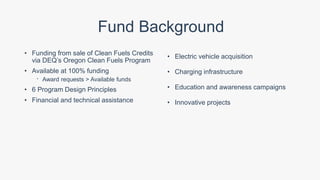
• Funding from sale of Clean Fuels Credits
via DEQ’s Oregon Clean Fuels Program
• Available at 100% funding
 Award requests > Available funds
• 6 Program Design Principles
• Financial and technical assistance
• Electric vehicle acquisition
• Charging infrastructure
• Education and awareness campaigns
• Innovative projects
Program Design Principles
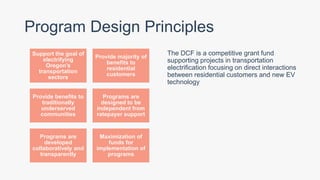
The DCF is a competitive grant fund
supporting projects in transportation
electrification focusing on direct interactions
between residential customers and new EV
technology
Support the goal of
electrifying
Oregon’s
transportation
sectors
Provide majority of
benefits to
residential
customers
Provide benefits to
traditionally
underserved
communities
Programs are
designed to be
independent from
ratepayer support
Programs are
developed
collaboratively and
transparently
Maximization of
funds for
implementation of
programs
Collaboration and Communication
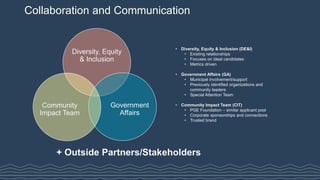
• Diversity, Equity & Inclusion (DE&I)
• Existing relationships
• Focuses on ideal candidates
• Metrics driven
• Government Affairs (GA)
• Municipal involvement/support
• Previously identified organizations and
community leaders
• Special Attention Team
• Community Impact Team (CIT)
• PGE Foundation – similar applicant pool
• Corporate sponsorships and connections
• Trusted brand
+ Outside Partners/Stakeholders
Diversity, Equity
& Inclusion
Government
Affairs
Community
Impact Team
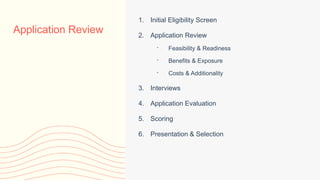
Application Review
1. Initial Eligibility Screen
2. Application Review
 Feasibility & Readiness
 Benefits & Exposure
 Costs & Additionality
3. Interviews
4. Application Evaluation
5. Scoring
6. Presentation & Selection
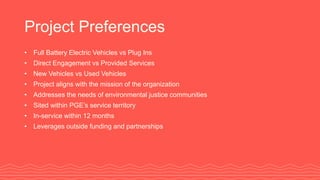
Project Preferences
• Full Battery Electric Vehicles vs Plug Ins
• Direct Engagement vs Provided Services
• New Vehicles vs Used Vehicles
• Project aligns with the mission of the organization
• Addresses the needs of environmental justice communities
• Sited within PGE’s service territory
• In-service within 12 months
• Leverages outside funding and partnerships
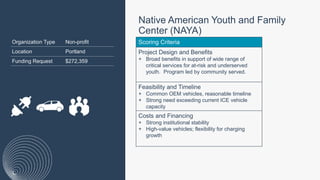
Native American Youth and Family
Center (NAYA)
Scoring Criteria
Project Design and Benefits
+ Broad benefits in support of wide range of
critical services for at-risk and underserved
youth. Program led by community served.
Feasibility and Timeline
+ Common OEM vehicles, reasonable timeline
+ Strong need exceeding current ICE vehicle
capacity
Costs and Financing
+ Strong institutional stability
+ High-value vehicles; flexibility for charging
growth
Organization Type Non-profit
Location Portland
Funding Request $272,359
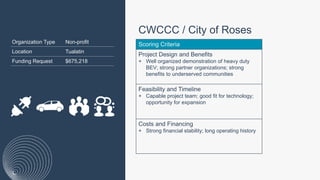
CWCCC / City of Roses
Scoring Criteria
Project Design and Benefits
+ Well organized demonstration of heavy duty
BEV; strong partner organizations; strong
benefits to underserved communities
Feasibility and Timeline
+ Capable project team; good fit for technology;
opportunity for expansion
Costs and Financing
+ Strong financial stability; long operating history
Organization Type Non-profit
Location Tualatin
Funding Request $675,218

Driving Change by Dan Janosec

  • 1.
    Dan Janosec –Portland General Electric February 9th, 2021 Driving Change
  • 2.
    Fund Background • Fundingfrom sale of Clean Fuels Credits via DEQ’s Oregon Clean Fuels Program • Available at 100% funding  Award requests > Available funds • 6 Program Design Principles • Financial and technical assistance • Electric vehicle acquisition • Charging infrastructure • Education and awareness campaigns • Innovative projects
  • 3.
    Program Design Principles TheDCF is a competitive grant fund supporting projects in transportation electrification focusing on direct interactions between residential customers and new EV technology Support the goal of electrifying Oregon’s transportation sectors Provide majority of benefits to residential customers Provide benefits to traditionally underserved communities Programs are designed to be independent from ratepayer support Programs are developed collaboratively and transparently Maximization of funds for implementation of programs
  • 4.
    Collaboration and Communication •Diversity, Equity & Inclusion (DE&I) • Existing relationships • Focuses on ideal candidates • Metrics driven • Government Affairs (GA) • Municipal involvement/support • Previously identified organizations and community leaders • Special Attention Team • Community Impact Team (CIT) • PGE Foundation – similar applicant pool • Corporate sponsorships and connections • Trusted brand + Outside Partners/Stakeholders Diversity, Equity & Inclusion Government Affairs Community Impact Team
  • 5.
    Application Review 1. InitialEligibility Screen 2. Application Review  Feasibility & Readiness  Benefits & Exposure  Costs & Additionality 3. Interviews 4. Application Evaluation 5. Scoring 6. Presentation & Selection
  • 6.
    Project Preferences • FullBattery Electric Vehicles vs Plug Ins • Direct Engagement vs Provided Services • New Vehicles vs Used Vehicles • Project aligns with the mission of the organization • Addresses the needs of environmental justice communities • Sited within PGE’s service territory • In-service within 12 months • Leverages outside funding and partnerships
  • 7.
    Native American Youthand Family Center (NAYA) Scoring Criteria Project Design and Benefits + Broad benefits in support of wide range of critical services for at-risk and underserved youth. Program led by community served. Feasibility and Timeline + Common OEM vehicles, reasonable timeline + Strong need exceeding current ICE vehicle capacity Costs and Financing + Strong institutional stability + High-value vehicles; flexibility for charging growth Organization Type Non-profit Location Portland Funding Request $272,359
  • 8.
    CWCCC / Cityof Roses Scoring Criteria Project Design and Benefits + Well organized demonstration of heavy duty BEV; strong partner organizations; strong benefits to underserved communities Feasibility and Timeline + Capable project team; good fit for technology; opportunity for expansion Costs and Financing + Strong financial stability; long operating history Organization Type Non-profit Location Tualatin Funding Request $675,218

Editor's Notes

  • #3 Transportation is the single biggest source of GHG emissions in Oregon – and it’s growing Projects must advance transportation electrification in Oregon and provide a community benefit. $2.25 million available in 2021 and 2022 Broad definition of vehicle
  • #6 In 2019, 64 applicants, 11 deemed ineligible, 38 brought to selection, 16 selected. In 2020, 39 applicants, 0 deemed ineligible, 26 brought to selection, 12 selected.
  • #7  (HB4067) Environmental Justice definition: equal protection from environmental and health hazards and meaningful public participation in decisions that affect the environment in which people live, work, learn, practice spirituality, and play. Communities include: communities of color, communities experiencing lower incomes, tribal communities, rural communities, frontier communities, and other communities traditionally under-represented in public processes and adversely harmed by environmental and health hazards, including but not limited to seniors, youth, and persons with disabilities. Needs to serve a majority PGE customers 12 months is ideal but looking for maximum value/impact (especially with COVID-19) 3 key areas: Project Design and Benefits, Feasibility and Timeline, Costs and Financing Eligible costs: Capital equipment, engineering/designing/permitting, new or upgraded electrical service, forecasted maintenance, network subscriptions Technical requirements: Vehicles must be capable of charging from the electric grid Charging infrastructure must be enabled for demand response and networked Underserved defined as: low-income individuals, communities of color, immigrants, communities with limited access to transportation Women and girls, veterans, senior citizens, people with disabilities, LGBTQ+ community, multi-family housing units