1Eleanor—Jayne Browne | Typography Teaching Notes | Layouts: Double Page Spreads And The Grid
Page layout is the area of graphic
design that deals in the arrangement
of visual elements on a page/s. It
involves organisational principles of
“composition” to achieve specific
communication objectives (goals).
High—level page layout involves
deciding on the overall arrangement
of text and images, and sometimes
on the size or shape of the medium
—paper (printing) or website (fixed,
relative, etc.) and includes factors
such as what the document authors/
editors wish to communicate and/or
emphasise. Low—level pagination
is a more mechanical process and
adheres to fixed parameters such as
text areas, choice of typefaces, type
size or text alignment.
Since the introduction of personal
computers and desktop publishing,
page layout skills have expanded to
electronic media, for example E—
books/magazines or PDF documents
where “static” web pages now mirror
paper documents, with the addition
of elements such as multi—media
animation and interactivity. Page
layout for interactive media overlaps
with interface design and user
experience design and an interactive
“page” is known as a graphical user
interface (GUI).
Usually appearing in books or
magazines, very simply a double—
page spread is one/an article, or a
set of images/photographs, etc. that
covers 2 pages opposite each other.
Double page spreads are more than
just bigger spaces— they present a
chance to “talk” to readers without
distraction, and to create a unique
world. The wide rectangular space
is an opportunity to tell a story with
a strong fantasy or aspirational
element.
Grids and templates are page
layout patterns used in multiple—
page publications (both printed and
online). A grid is a set of guidelines,
visible only in the design process
and invisible to the end—user.
Layouts
Double Page Spreads And The Grid
Mechanical Dolls double—page spreads,
Tim Walker, Vogue Italia October 2011
Mobile Design Container, Marta Gawin
Grids help to align repeating elements
on a page, for example page numbers
or chapter titles. A page layout may
or may not stay within guidelines,
depending on how much repetition
or variety the design style calls for;
and grids are flexible.
Lorem ipsum dolor sit
amet, consectetur adip
iscing elit.
Lorem ipsum dolor sit amet, consectetur adipiscing
elitsed do eiusmod tempor incididunt ut labore et dol
oremagna aliqua.
Ut enim ad minim veniam, quis nostrud exercitation
ullamco laboris nisi ut aiquip ex ea commodo consequa
t. Lorem ipsum dolor sit amet, consectetur adipiscin
g elitsed do eiusmod tempor incididunt ut labore et d
oloremagna aliqua.
Lorem ipsum dolor sit
Consecter
2Eleanor—Jayne Browne | Typography Teaching Notes | Layouts: Double Page Spreads And The Grid
A layout has 4 basic components—
visuals: images, illustrations, charts,
photographs, etc.
text: words, titles, numbers, etc.
scale: varying sizes (images, text) and
composition: arrangement.
The layout dimensions (size) should
be dictated by what it is being used
for; for example a namecard is usually
small whereas a poster should be
at least A1. Layout size also informs
decision—making such as quantity of
images, their sizes, which ones take
prominence and scale and contrast
of type sizes such as titles, subtitles,
body text or page numbers. All these
elements help to convey a specific
mood.
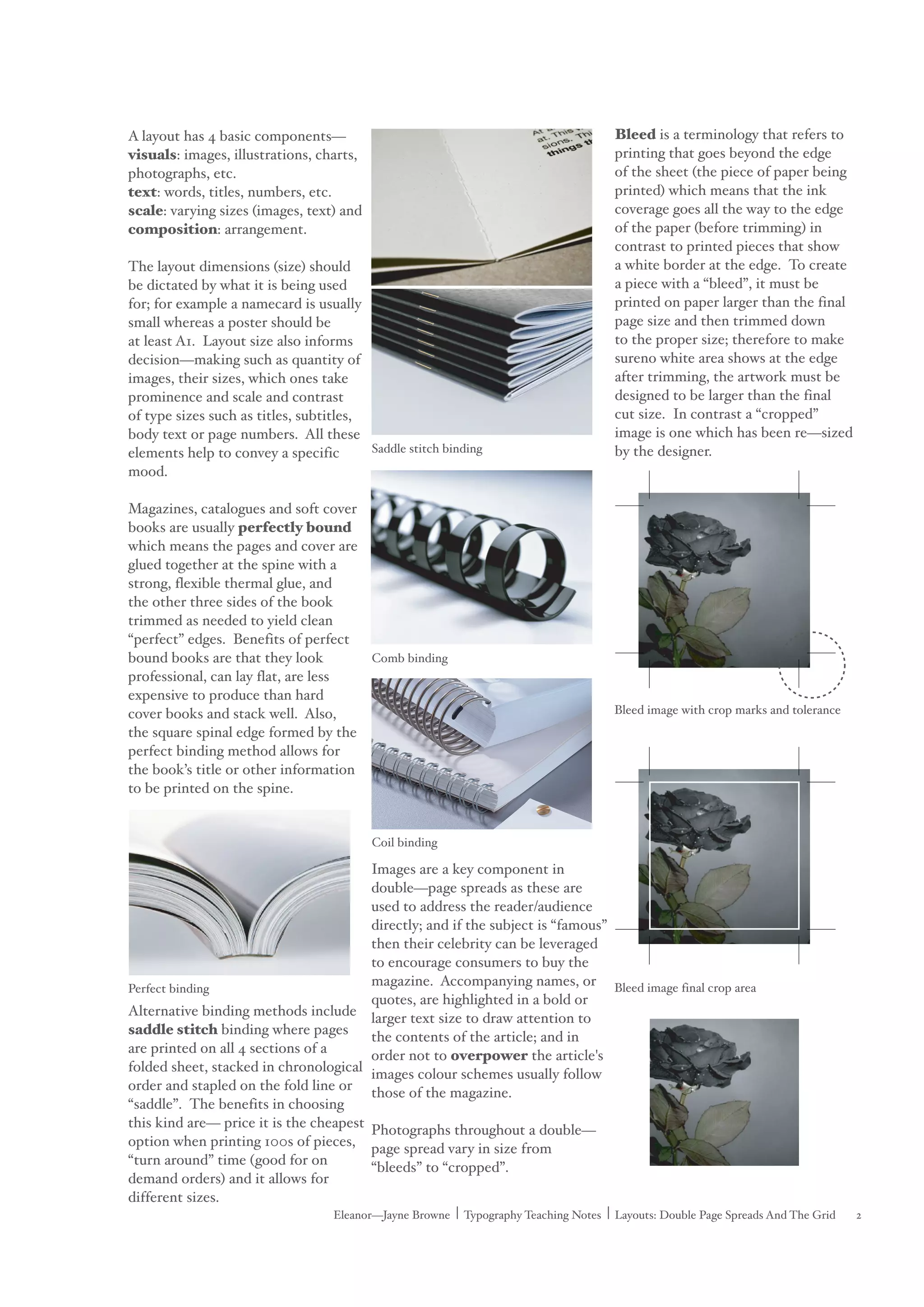
Magazines, catalogues and soft cover
books are usually perfectly bound
which means the pages and cover are
glued together at the spine with a
strong, flexible thermal glue, and
the other three sides of the book
trimmed as needed to yield clean
“perfect” edges. Benefits of perfect
bound books are that they look
professional, can lay flat, are less
expensive to produce than hard
cover books and stack well. Also,
the square spinal edge formed by the
perfect binding method allows for
the book’s title or other information
to be printed on the spine.
Alternative binding methods include
saddle stitch binding where pages
are printed on all 4 sections of a
folded sheet, stacked in chronological
order and stapled on the fold line or
“saddle”. The benefits in choosing
this kind are— price it is the cheapest
option when printing 100s of pieces,
“turn around” time (good for on
demand orders) and it allows for
different sizes.
Images are a key component in
double—page spreads as these are
used to address the reader/audience
directly; and if the subject is “famous”
then their celebrity can be leveraged
to encourage consumers to buy the
magazine. Accompanying names, or
quotes, are highlighted in a bold or
larger text size to draw attention to
the contents of the article; and in
order not to overpower the article's
images colour schemes usually follow
those of the magazine.
Photographs throughout a double—
page spread vary in size from
“bleeds” to “cropped”.
Perfect binding
Bleed image with crop marks and tolerance
Bleed image final crop area
Saddle stitch binding
Comb binding
Coil binding
Bleed is a terminology that refers to
printing that goes beyond the edge
of the sheet (the piece of paper being
printed) which means that the ink
coverage goes all the way to the edge
of the paper (before trimming) in
contrast to printed pieces that show
a white border at the edge. To create
a piece with a “bleed”, it must be
printed on paper larger than the final
page size and then trimmed down
to the proper size; therefore to make
sureno white area shows at the edge
after trimming, the artwork must be
designed to be larger than the final
cut size. In contrast a “cropped”
image is one which has been re—sized
by the designer.
4Eleanor—Jayne Browne | Typography Teaching Notes | Layouts: Double Page Spreads And The Grid
3—P A N E L G AT E F O L D
“ Z ” F O L D
3—P A N E L RO L L F O L D
4—P A N E L
A C C O R D I O N F O L D
H A L F F O L D
V E RT I C A L H A L F F O L D
T R I F O L D
3—P A N E L A C C O R D I O N F O L D
RO L L F O L D
D O U B L E G AT E F O L D
F R E N C H F O L D
Q UA RT E R F O L D
M A P F O L D
http://www.pinterest.com/thedsignlounge/
typographylayouts/
http://www.pinterest.com/thedsignlounge/
techniqueswatercolour/
5Eleanor—Jayne Browne | Typography Teaching Notes | Layouts: Double Page Spreads And The Grid
https://www.pinterest.com/thedsignlounge/
exhibition-design-11-styling-and-photography/

Guide To (Editorial) Layouts And Double—Page Spreads

  • 1.
    1Eleanor—Jayne Browne |Typography Teaching Notes | Layouts: Double Page Spreads And The Grid Page layout is the area of graphic design that deals in the arrangement of visual elements on a page/s. It involves organisational principles of “composition” to achieve specific communication objectives (goals). High—level page layout involves deciding on the overall arrangement of text and images, and sometimes on the size or shape of the medium —paper (printing) or website (fixed, relative, etc.) and includes factors such as what the document authors/ editors wish to communicate and/or emphasise. Low—level pagination is a more mechanical process and adheres to fixed parameters such as text areas, choice of typefaces, type size or text alignment. Since the introduction of personal computers and desktop publishing, page layout skills have expanded to electronic media, for example E— books/magazines or PDF documents where “static” web pages now mirror paper documents, with the addition of elements such as multi—media animation and interactivity. Page layout for interactive media overlaps with interface design and user experience design and an interactive “page” is known as a graphical user interface (GUI). Usually appearing in books or magazines, very simply a double— page spread is one/an article, or a set of images/photographs, etc. that covers 2 pages opposite each other. Double page spreads are more than just bigger spaces— they present a chance to “talk” to readers without distraction, and to create a unique world. The wide rectangular space is an opportunity to tell a story with a strong fantasy or aspirational element. Grids and templates are page layout patterns used in multiple— page publications (both printed and online). A grid is a set of guidelines, visible only in the design process and invisible to the end—user. Layouts Double Page Spreads And The Grid Mechanical Dolls double—page spreads, Tim Walker, Vogue Italia October 2011 Mobile Design Container, Marta Gawin Grids help to align repeating elements on a page, for example page numbers or chapter titles. A page layout may or may not stay within guidelines, depending on how much repetition or variety the design style calls for; and grids are flexible. Lorem ipsum dolor sit amet, consectetur adip iscing elit. Lorem ipsum dolor sit amet, consectetur adipiscing elitsed do eiusmod tempor incididunt ut labore et dol oremagna aliqua. Ut enim ad minim veniam, quis nostrud exercitation ullamco laboris nisi ut aiquip ex ea commodo consequa t. Lorem ipsum dolor sit amet, consectetur adipiscin g elitsed do eiusmod tempor incididunt ut labore et d oloremagna aliqua. Lorem ipsum dolor sit Consecter
  • 2.
    2Eleanor—Jayne Browne |Typography Teaching Notes | Layouts: Double Page Spreads And The Grid A layout has 4 basic components— visuals: images, illustrations, charts, photographs, etc. text: words, titles, numbers, etc. scale: varying sizes (images, text) and composition: arrangement. The layout dimensions (size) should be dictated by what it is being used for; for example a namecard is usually small whereas a poster should be at least A1. Layout size also informs decision—making such as quantity of images, their sizes, which ones take prominence and scale and contrast of type sizes such as titles, subtitles, body text or page numbers. All these elements help to convey a specific mood. Magazines, catalogues and soft cover books are usually perfectly bound which means the pages and cover are glued together at the spine with a strong, flexible thermal glue, and the other three sides of the book trimmed as needed to yield clean “perfect” edges. Benefits of perfect bound books are that they look professional, can lay flat, are less expensive to produce than hard cover books and stack well. Also, the square spinal edge formed by the perfect binding method allows for the book’s title or other information to be printed on the spine. Alternative binding methods include saddle stitch binding where pages are printed on all 4 sections of a folded sheet, stacked in chronological order and stapled on the fold line or “saddle”. The benefits in choosing this kind are— price it is the cheapest option when printing 100s of pieces, “turn around” time (good for on demand orders) and it allows for different sizes. Images are a key component in double—page spreads as these are used to address the reader/audience directly; and if the subject is “famous” then their celebrity can be leveraged to encourage consumers to buy the magazine. Accompanying names, or quotes, are highlighted in a bold or larger text size to draw attention to the contents of the article; and in order not to overpower the article's images colour schemes usually follow those of the magazine. Photographs throughout a double— page spread vary in size from “bleeds” to “cropped”. Perfect binding Bleed image with crop marks and tolerance Bleed image final crop area Saddle stitch binding Comb binding Coil binding Bleed is a terminology that refers to printing that goes beyond the edge of the sheet (the piece of paper being printed) which means that the ink coverage goes all the way to the edge of the paper (before trimming) in contrast to printed pieces that show a white border at the edge. To create a piece with a “bleed”, it must be printed on paper larger than the final page size and then trimmed down to the proper size; therefore to make sureno white area shows at the edge after trimming, the artwork must be designed to be larger than the final cut size. In contrast a “cropped” image is one which has been re—sized by the designer.
  • 4.
    4Eleanor—Jayne Browne |Typography Teaching Notes | Layouts: Double Page Spreads And The Grid 3—P A N E L G AT E F O L D “ Z ” F O L D 3—P A N E L RO L L F O L D 4—P A N E L A C C O R D I O N F O L D H A L F F O L D V E RT I C A L H A L F F O L D T R I F O L D 3—P A N E L A C C O R D I O N F O L D RO L L F O L D D O U B L E G AT E F O L D F R E N C H F O L D Q UA RT E R F O L D M A P F O L D
  • 5.
    http://www.pinterest.com/thedsignlounge/ typographylayouts/ http://www.pinterest.com/thedsignlounge/ techniqueswatercolour/ 5Eleanor—Jayne Browne |Typography Teaching Notes | Layouts: Double Page Spreads And The Grid https://www.pinterest.com/thedsignlounge/ exhibition-design-11-styling-and-photography/