Introduction to Free and Open Source Software (FOSS) By Dong B. Calmada PANACeA FOSS Training 3 February 2010 Bangkok, Thailand Licensed under a Creative Commons Attribution-Noncommercial-Share Alike 3.0 Unported License.
Outline Learning Objectives
FOSS Defined
Brief Background of FOSS
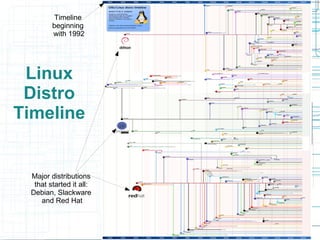
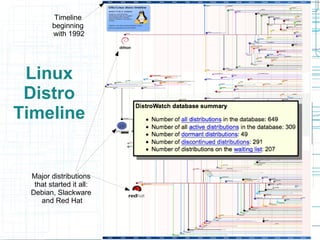
Linux Distributions Timeline
Some Benefits of FOSS
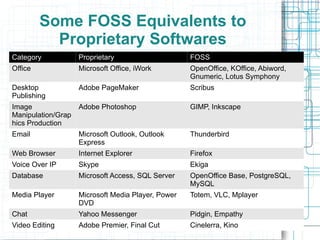
Some Equivalents to Proprietary Softwares/Applications
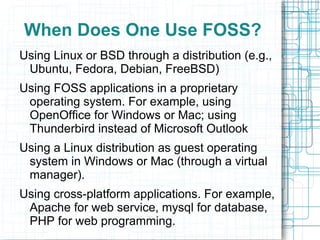
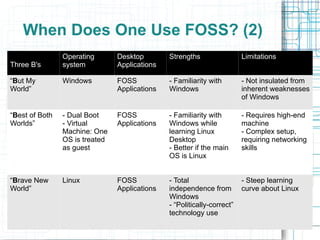
When Does One Use FOSS?
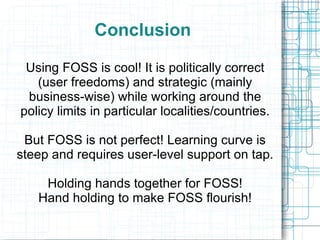
Conclusion
Objectives For participants to: Explain what FOSS means.
Understand a brief history of FOSS.
Appreciate some of the benefits of FOSS.
Know FOSS equivalents to proprietary softwares/applications
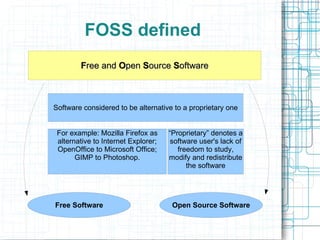
FOSS defined
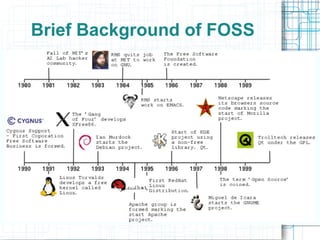
Brief Background of FOSS
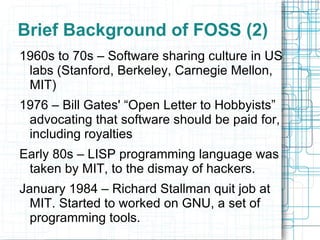
Brief Background of FOSS (2) 1960s to 70s – Software sharing culture in US labs (Stanford, Berkeley, Carnegie Mellon, MIT)
1976 – Bill Gates' “Open Letter to Hobbyists” advocating that software should be paid for, including royalties
Early 80s – LISP programming language was taken by MIT, to the dismay of hackers.
January 1984 – Richard Stallman quit job at MIT. Started to worked on GNU, a set of programming tools.
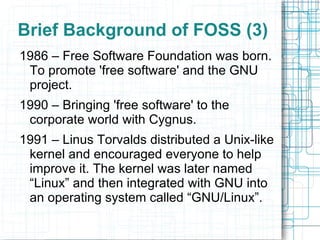
Brief Background of FOSS (3) 1986 – Free Software Foundation was born. To promote 'free software' and the GNU project.
1990 – Bringing 'free software' to the corporate world with Cygnus.
1991 – Linus Torvalds distributed a Unix-like kernel and encouraged everyone to help improve it. The kernel was later named “Linux” and then integrated with GNU into an operating system called “GNU/Linux”.
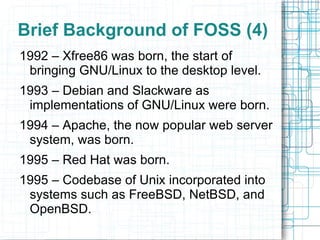
Brief Background of FOSS (4) 1992 – Xfree86 was born, the start of bringing GNU/Linux to the desktop level.

Introduction to Free and Open Source Software (FOSS)