Title II –
CONTRACTSCONTRACTS
Civil Code of the Philippines
(R.A. 386)
CONTRACTS AND SPECIFICATIONS
2
CHAPTER 1
GENERAL PROVISIONS
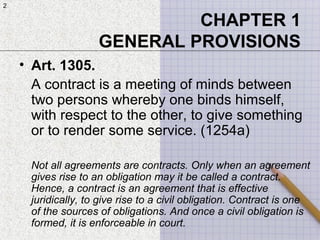
• Art. 1305.
A contract is a meeting of minds between
two persons whereby one binds himself,
with respect to the other, to give something
or to render some service. (1254a)
Not all agreements are contracts. Only when an agreement
gives rise to an obligation may it be called a contract.
Hence, a contract is an agreement that is effective
juridically, to give rise to a civil obligation. Contract is one
of the sources of obligations. And once a civil obligation is
formed, it is enforceable in court.
2
3
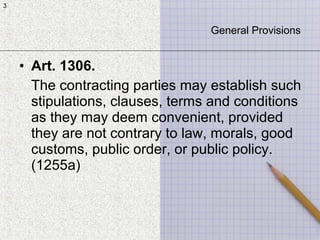
• Art. 1306.
The contracting parties may establish such
stipulations, clauses, terms and conditions
as they may deem convenient, provided
they are not contrary to law, morals, good
customs, public order, or public policy.
(1255a)
3
General Provisions
4
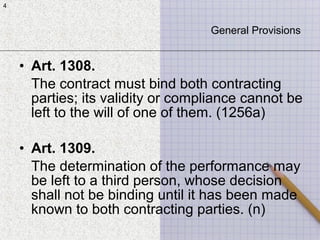
• Art. 1308.
The contract must bind both contracting
parties; its validity or compliance cannot be
left to the will of one of them. (1256a)
• Art. 1309.
The determination of the performance may
be left to a third person, whose decision
shall not be binding until it has been made
known to both contracting parties. (n)
4
General Provisions
5
• Art. 1311.
Contracts take effect only between the
parties, their assigns and heirs, except in
case where the rights and obligations
arising from the contract are not
transmissible by their nature, or by
stipulation or by provision of law. The heir
is not liable beyond the value of the
property he received from the decedent.
5
General Provisions
6
If a contract should contain some
stipulation in favor of a third person, he
may demand its fulfillment provided he
communicated his acceptance to the
obligor before its revocation. A mere
incidental benefit or interest of a person is
not sufficient. The contracting parties
must have clearly and deliberately
conferred a favor upon a third person.
(1257a)
6
General Provisions
7
7
General Provisions
• Art. 1313.
Creditors are protected in cases of
contracts intended to defraud them. (n)
• Art. 1314.
Any third person who induces another to
violate his contract shall be liable for
damages to the other contracting party. (n)
8
• Art. 1315.
Contracts are perfected by mere consent,
and from that moment the parties are bound
not only to the fulfillment of what has been
expressly stipulated but also to all the
consequences which, according to their
nature, may be in keeping with good faith,
usage and law. (1258)
8
General Provisions
9
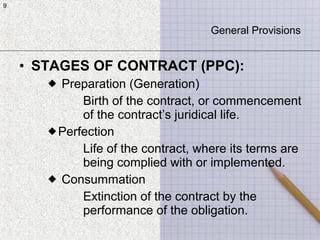
• STAGES OF CONTRACT (PPC):
 Preparation (Generation)
Birth of the contract, or commencement
of the contract’s juridical life.
Perfection
Life of the contract, where its terms are
being complied with or implemented.
 Consummation
Extinction of the contract by the
performance of the obligation.
9
General Provisions
10
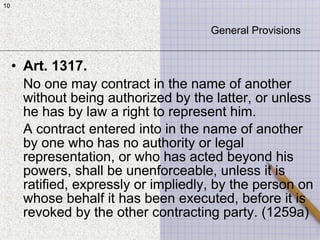
• Art. 1317.
No one may contract in the name of another
without being authorized by the latter, or unless
he has by law a right to represent him.
A contract entered into in the name of another
by one who has no authority or legal
representation, or who has acted beyond his
powers, shall be unenforceable, unless it is
ratified, expressly or impliedly, by the person on
whose behalf it has been executed, before it is
revoked by the other contracting party. (1259a)
10
General Provisions
11
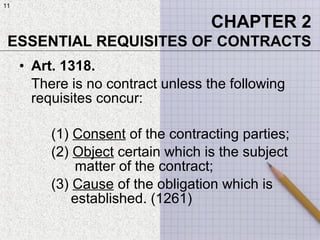
• Art. 1318.
There is no contract unless the following
requisites concur:
(1) Consent of the contracting parties;
(2) Object certain which is the subject
matter of the contract;
(3) Cause of the obligation which is
established. (1261)
CHAPTER 2
ESSENTIAL REQUISITES OF CONTRACTS
11
12
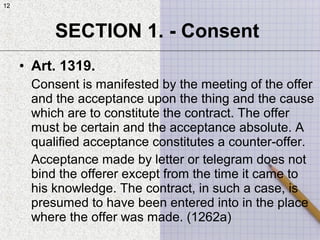
• Art. 1319.
Consent is manifested by the meeting of the offer
and the acceptance upon the thing and the cause
which are to constitute the contract. The offer
must be certain and the acceptance absolute. A
qualified acceptance constitutes a counter-offer.
Acceptance made by letter or telegram does not
bind the offerer except from the time it came to
his knowledge. The contract, in such a case, is
presumed to have been entered into in the place
where the offer was made. (1262a)
SECTION 1. - Consent
12
13
• Art. 1320.
An acceptance may be express or implied.
(n)
• Art. 1321.
The person making the offer may fix the
time, place, and manner of acceptance, all
of which must be complied with. (n)
13
Consent
14
• Art. 1322.
An offer made through an agent is
accepted from the time acceptance is
communicated to him. (n)
• Art. 1323.
An offer becomes ineffective upon the
death, civil interdiction, insanity, or
insolvency of either party before
acceptance is conveyed. (n)
14
Offer
15
• Art. 1325.
Unless it appears otherwise, business
advertisements of things for sale are not
definite offers, but mere invitations to
make an offer. (n)
15
Offer
16
• Art. 1326.
Advertisements for bidders are simply
invitations to make proposals, and the
advertiser is not bound to accept the
highest or lowest bidder, unless the
contrary appears. (n)
16
Offer
17
• Art. 1327.
The following cannot give consent to a
contract:
(1) Unemancipated minors;
(2) Insane or demented persons, and
deaf-mutes who do not know how to
write. (1263a)
17
Consent to Contract
18
• Art. 1328.
Contracts entered into during a lucid
interval are valid. Contracts agreed to in a
state of drunkenness or during a hypnotic
spell are voidable. (n)
18
19
• Art. 1330.
A contract where consent is given through
mistake, violence, intimidation, undue
influence, or fraud is voidable. (1265a)
19
20
• Art. 1332.
When one of the parties is unable to read,
or if the contract is in a language not
understood by him, and mistake or fraud
is alleged, the person enforcing the
contract must show that the terms thereof
have been fully explained to the former.
(n)
20
21
• Art. 1333.
There is no mistake if the party alleging it
knew the doubt, contingency or risk
affecting the object of the contract. (n)
21
22
• Art. 1335.
There is violence when in order to wrest
consent, serious or irresistible force is
employed.
There is intimidation when one of the
contracting parties is compelled by a
reasonable and well-grounded fear of an
imminent and grave evil upon his person
or property, or upon the person or property
of his spouse, descendants or
ascendants, to give his consent.
22
23
To determine the degree of intimidation,
the age, sex and condition of the person
shall be borne in mind.
A threat to enforce one's claim through
competent authority, if the claim is just or
legal, does not vitiate consent. (1267a)
23
24
• Art. 1336.
Violence or intimidation shall annul the
obligation, although it may have been
employed by a third person who did not
take part in the contract. (1268)
24
25
• Art. 1337.
There is undue influence when a person takes
improper advantage of his power over the will of
another, depriving the latter of a reasonable
freedom of choice. The following circumstances
shall be considered: the confidential, family,
spiritual and other relations between the parties,
or the fact that the person alleged to have been
unduly influenced was suffering from mental
weakness, or was ignorant or in financial
distress. (n)
25
26
• Art. 1338.
There is fraud when, through insidious
words or machinations of one of the
contracting parties, the other is induced to
enter into a contract which, without them,
he would not have agreed to. (1269)
26
27
• Art. 1339.
Failure to disclose facts, when there is a
duty to reveal them, as when the parties
are bound by confidential relations,
constitutes fraud. (n)
27
28
• Art. 1341.
A mere expression of an opinion does not
signify fraud, unless made by an expert
and the other party has relied on the
former's special knowledge. (n)
28
29
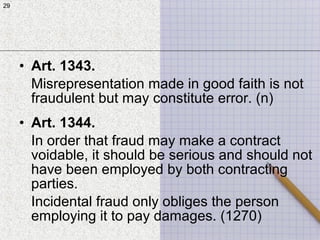
• Art. 1343.
Misrepresentation made in good faith is not
fraudulent but may constitute error. (n)
• Art. 1344.
In order that fraud may make a contract
voidable, it should be serious and should not
have been employed by both contracting
parties.
Incidental fraud only obliges the person
employing it to pay damages. (1270)
29
30
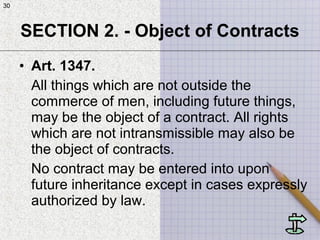
• Art. 1347.
All things which are not outside the
commerce of men, including future things,
may be the object of a contract. All rights
which are not intransmissible may also be
the object of contracts.
No contract may be entered into upon
future inheritance except in cases expressly
authorized by law.
SECTION 2. - Object of Contracts
30
31
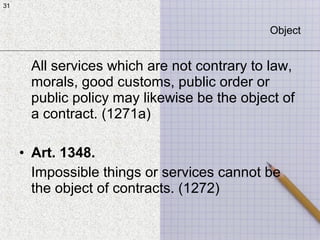
All services which are not contrary to law,
morals, good customs, public order or
public policy may likewise be the object of
a contract. (1271a)
• Art. 1348.
Impossible things or services cannot be
the object of contracts. (1272)
31
Object
32
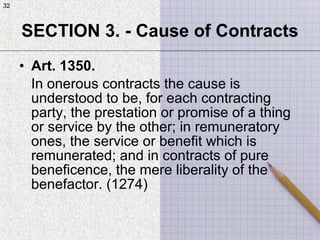
• Art. 1350.
In onerous contracts the cause is
understood to be, for each contracting
party, the prestation or promise of a thing
or service by the other; in remuneratory
ones, the service or benefit which is
remunerated; and in contracts of pure
beneficence, the mere liberality of the
benefactor. (1274)
SECTION 3. - Cause of Contracts
32
33
• Art. 1352.
Contracts without cause, or with unlawful
cause, produce no effect whatever. The
cause is unlawful if it is contrary to law,
morals, good customs, public order or
public policy. (1275a)
33
Cause
34
• Art. 1353.
The statement of a false cause in contracts
shall render them void, if it should not be
proved that they were founded upon
another cause which is true and lawful.
(1276)
34
Cause
35
• Art. 1356.
Contracts shall be obligatory, in whatever form
they may have been entered into, provided all
the essential requisites for their validity are
present. However, when the law requires that a
contract be in some form in order that it may be
valid or enforceable, or that a contract be
proved in a certain way, that requirement is
absolute and indispensable. In such cases, the
right of the parties stated in the following article
cannot be exercised. (1278a)
CHAPTER 3
FORM OF CONTRACTS
35
36
• Art. 1357.
If the law requires a document or other
special form, as in the acts and contracts
enumerated in the following article, the
contracting parties may compel each other
to observe that form, once the contract
has been perfected. This right may be
exercised simultaneously with the action
upon the contract. (1279a)
36
Form of Contracts
37
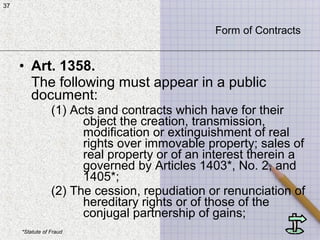
• Art. 1358.
The following must appear in a public
document:
(1) Acts and contracts which have for their
object the creation, transmission,
modification or extinguishment of real
rights over immovable property; sales of
real property or of an interest therein a
governed by Articles 1403*, No. 2, and
1405*;
(2) The cession, repudiation or renunciation of
hereditary rights or of those of the
conjugal partnership of gains;
*Statute of Fraud
37
Form of Contracts
38
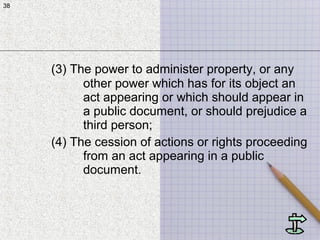
(3) The power to administer property, or any
other power which has for its object an
act appearing or which should appear in
a public document, or should prejudice a
third person;
(4) The cession of actions or rights proceeding
from an act appearing in a public
document.
38
39
All other contracts where the amount
involved exceeds five hundred pesos
must appear in writing, even a private
one. But sales of goods, chattels or
things in action are governed by Articles,
1403, No. 2 and 1405. (1280a)
39
40
• Art. 1359.
When, there having been a meeting of the
minds of the parties to a contract, their true
intention is not expressed in the instrument
purporting to embody the agreement, by
reason of mistake, fraud, inequitable
conduct or accident, one of the parties may
ask for the reformation of the instrument to
the end that such true intention may be
expressed.
CHAPTER 4
REFORMATION OF INSTRUMENTS (n)
40
41
If mistake, fraud, inequitable conduct, or
accident has prevented a meeting of the
minds of the parties, the proper remedy is
not reformation of the instrument but
annulment of the contract.
41
42
• Art. 1362.
If one party was mistaken and the other
acted fraudulently or inequitably in such a
way that the instrument does not show their
true intention, the former may ask for the
reformation of the instrument.
42
Reformation of Instruments
43
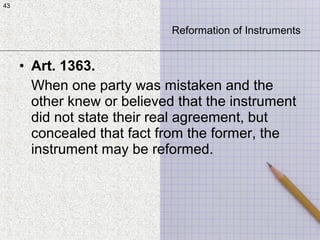
• Art. 1363.
When one party was mistaken and the
other knew or believed that the instrument
did not state their real agreement, but
concealed that fact from the former, the
instrument may be reformed.
43
Reformation of Instruments
44
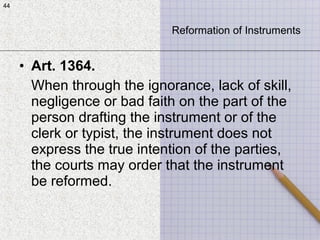
• Art. 1364.
When through the ignorance, lack of skill,
negligence or bad faith on the part of the
person drafting the instrument or of the
clerk or typist, the instrument does not
express the true intention of the parties,
the courts may order that the instrument
be reformed.
44
Reformation of Instruments
45
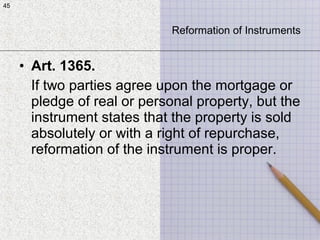
• Art. 1365.
If two parties agree upon the mortgage or
pledge of real or personal property, but the
instrument states that the property is sold
absolutely or with a right of repurchase,
reformation of the instrument is proper.
45
Reformation of Instruments
46
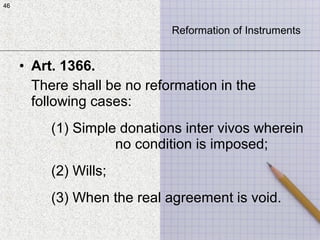
• Art. 1366.
There shall be no reformation in the
following cases:
(1) Simple donations inter vivos wherein
no condition is imposed;
(2) Wills;
(3) When the real agreement is void.
46
Reformation of Instruments
47
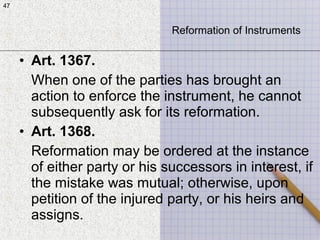
• Art. 1367.
When one of the parties has brought an
action to enforce the instrument, he cannot
subsequently ask for its reformation.
• Art. 1368.
Reformation may be ordered at the instance
of either party or his successors in interest, if
the mistake was mutual; otherwise, upon
petition of the injured party, or his heirs and
assigns.
47
Reformation of Instruments
48
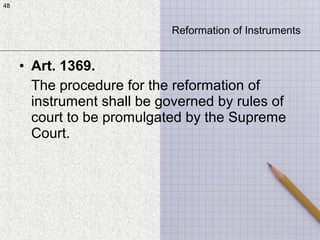
• Art. 1369.
The procedure for the reformation of
instrument shall be governed by rules of
court to be promulgated by the Supreme
Court.
48
Reformation of Instruments
49
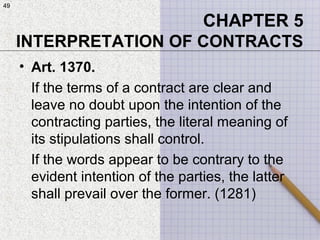
• Art. 1370.
If the terms of a contract are clear and
leave no doubt upon the intention of the
contracting parties, the literal meaning of
its stipulations shall control.
If the words appear to be contrary to the
evident intention of the parties, the latter
shall prevail over the former. (1281)
CHAPTER 5
INTERPRETATION OF CONTRACTS
49
50
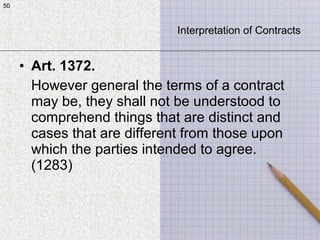
• Art. 1372.
However general the terms of a contract
may be, they shall not be understood to
comprehend things that are distinct and
cases that are different from those upon
which the parties intended to agree.
(1283)
50
Interpretation of Contracts
51
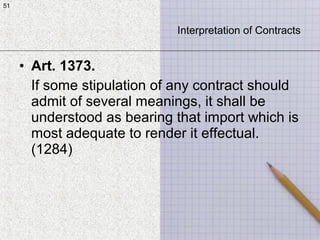
• Art. 1373.
If some stipulation of any contract should
admit of several meanings, it shall be
understood as bearing that import which is
most adequate to render it effectual.
(1284)
51
Interpretation of Contracts
52
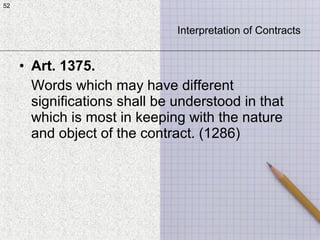
• Art. 1375.
Words which may have different
significations shall be understood in that
which is most in keeping with the nature
and object of the contract. (1286)
52
Interpretation of Contracts
53
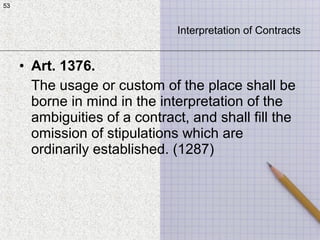
• Art. 1376.
The usage or custom of the place shall be
borne in mind in the interpretation of the
ambiguities of a contract, and shall fill the
omission of stipulations which are
ordinarily established. (1287)
53
Interpretation of Contracts
54
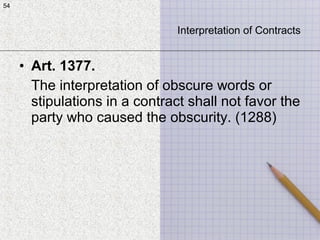
• Art. 1377.
The interpretation of obscure words or
stipulations in a contract shall not favor the
party who caused the obscurity. (1288)
54
Interpretation of Contracts
55
Contracts which may be invalidated:
• RESCISSIBLE CONTRACTS
• VOIDABLE CONTRACTS
• UNENFORCEABLE CONTRACTS
• VOID / INEXISTENT CONTRACTS
55
DEFECTIVE CONTRACTS
56
• RESCISSIBLE CONTRACT
All the essential elements or requisites
of a contract exist and the contract is valid,
but by reason of injury or damage to third
persons, such as creditors, the contract
may be rescinded.
The rescissible contract is, therefore,
valid until rescinded by a competent court.
56
Defective Contracts
57
• VOIDABLE CONTRACT
Voidable contract is valid until
annulled. It cannot however, be annulled if
there has been ratification.
57
Defective Contracts
58
• UNENFORCEABLE CONTRACT
Unenforceable contract cannot be used
upon or enforced unless ratified, hence
they have in a sense the effect of a valid
contract. It may be called validable
contract.
58
Defective Contracts
59
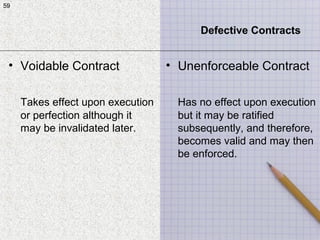
Defective Contracts
• Voidable Contract
Takes effect upon execution
or perfection although it
may be invalidated later.
• Unenforceable Contract
Has no effect upon execution
but it may be ratified
subsequently, and therefore,
becomes valid and may then
be enforced.
59
60
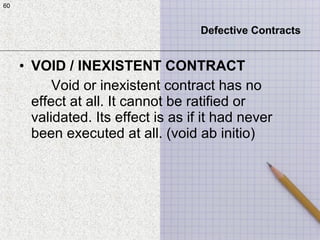
• VOID / INEXISTENT CONTRACT
Void or inexistent contract has no
effect at all. It cannot be ratified or
validated. Its effect is as if it had never
been executed at all. (void ab initio)
60
Defective Contracts
61
E N D
61

5.civil code contracts.new

  • 1.
    Title II – CONTRACTSCONTRACTS CivilCode of the Philippines (R.A. 386) CONTRACTS AND SPECIFICATIONS
  • 2.
    2 CHAPTER 1 GENERAL PROVISIONS •Art. 1305. A contract is a meeting of minds between two persons whereby one binds himself, with respect to the other, to give something or to render some service. (1254a) Not all agreements are contracts. Only when an agreement gives rise to an obligation may it be called a contract. Hence, a contract is an agreement that is effective juridically, to give rise to a civil obligation. Contract is one of the sources of obligations. And once a civil obligation is formed, it is enforceable in court. 2
  • 3.
    3 • Art. 1306. Thecontracting parties may establish such stipulations, clauses, terms and conditions as they may deem convenient, provided they are not contrary to law, morals, good customs, public order, or public policy. (1255a) 3 General Provisions
  • 4.
    4 • Art. 1308. Thecontract must bind both contracting parties; its validity or compliance cannot be left to the will of one of them. (1256a) • Art. 1309. The determination of the performance may be left to a third person, whose decision shall not be binding until it has been made known to both contracting parties. (n) 4 General Provisions
  • 5.
    5 • Art. 1311. Contractstake effect only between the parties, their assigns and heirs, except in case where the rights and obligations arising from the contract are not transmissible by their nature, or by stipulation or by provision of law. The heir is not liable beyond the value of the property he received from the decedent. 5 General Provisions
  • 6.
    6 If a contractshould contain some stipulation in favor of a third person, he may demand its fulfillment provided he communicated his acceptance to the obligor before its revocation. A mere incidental benefit or interest of a person is not sufficient. The contracting parties must have clearly and deliberately conferred a favor upon a third person. (1257a) 6 General Provisions
  • 7.
    7 7 General Provisions • Art.1313. Creditors are protected in cases of contracts intended to defraud them. (n) • Art. 1314. Any third person who induces another to violate his contract shall be liable for damages to the other contracting party. (n)
  • 8.
    8 • Art. 1315. Contractsare perfected by mere consent, and from that moment the parties are bound not only to the fulfillment of what has been expressly stipulated but also to all the consequences which, according to their nature, may be in keeping with good faith, usage and law. (1258) 8 General Provisions
  • 9.
    9 • STAGES OFCONTRACT (PPC):  Preparation (Generation) Birth of the contract, or commencement of the contract’s juridical life. Perfection Life of the contract, where its terms are being complied with or implemented.  Consummation Extinction of the contract by the performance of the obligation. 9 General Provisions
  • 10.
    10 • Art. 1317. Noone may contract in the name of another without being authorized by the latter, or unless he has by law a right to represent him. A contract entered into in the name of another by one who has no authority or legal representation, or who has acted beyond his powers, shall be unenforceable, unless it is ratified, expressly or impliedly, by the person on whose behalf it has been executed, before it is revoked by the other contracting party. (1259a) 10 General Provisions
  • 11.
    11 • Art. 1318. Thereis no contract unless the following requisites concur: (1) Consent of the contracting parties; (2) Object certain which is the subject matter of the contract; (3) Cause of the obligation which is established. (1261) CHAPTER 2 ESSENTIAL REQUISITES OF CONTRACTS 11
  • 12.
    12 • Art. 1319. Consentis manifested by the meeting of the offer and the acceptance upon the thing and the cause which are to constitute the contract. The offer must be certain and the acceptance absolute. A qualified acceptance constitutes a counter-offer. Acceptance made by letter or telegram does not bind the offerer except from the time it came to his knowledge. The contract, in such a case, is presumed to have been entered into in the place where the offer was made. (1262a) SECTION 1. - Consent 12
  • 13.
    13 • Art. 1320. Anacceptance may be express or implied. (n) • Art. 1321. The person making the offer may fix the time, place, and manner of acceptance, all of which must be complied with. (n) 13 Consent
  • 14.
    14 • Art. 1322. Anoffer made through an agent is accepted from the time acceptance is communicated to him. (n) • Art. 1323. An offer becomes ineffective upon the death, civil interdiction, insanity, or insolvency of either party before acceptance is conveyed. (n) 14 Offer
  • 15.
    15 • Art. 1325. Unlessit appears otherwise, business advertisements of things for sale are not definite offers, but mere invitations to make an offer. (n) 15 Offer
  • 16.
    16 • Art. 1326. Advertisementsfor bidders are simply invitations to make proposals, and the advertiser is not bound to accept the highest or lowest bidder, unless the contrary appears. (n) 16 Offer
  • 17.
    17 • Art. 1327. Thefollowing cannot give consent to a contract: (1) Unemancipated minors; (2) Insane or demented persons, and deaf-mutes who do not know how to write. (1263a) 17 Consent to Contract
  • 18.
    18 • Art. 1328. Contractsentered into during a lucid interval are valid. Contracts agreed to in a state of drunkenness or during a hypnotic spell are voidable. (n) 18
  • 19.
    19 • Art. 1330. Acontract where consent is given through mistake, violence, intimidation, undue influence, or fraud is voidable. (1265a) 19
  • 20.
    20 • Art. 1332. Whenone of the parties is unable to read, or if the contract is in a language not understood by him, and mistake or fraud is alleged, the person enforcing the contract must show that the terms thereof have been fully explained to the former. (n) 20
  • 21.
    21 • Art. 1333. Thereis no mistake if the party alleging it knew the doubt, contingency or risk affecting the object of the contract. (n) 21
  • 22.
    22 • Art. 1335. Thereis violence when in order to wrest consent, serious or irresistible force is employed. There is intimidation when one of the contracting parties is compelled by a reasonable and well-grounded fear of an imminent and grave evil upon his person or property, or upon the person or property of his spouse, descendants or ascendants, to give his consent. 22
  • 23.
    23 To determine thedegree of intimidation, the age, sex and condition of the person shall be borne in mind. A threat to enforce one's claim through competent authority, if the claim is just or legal, does not vitiate consent. (1267a) 23
  • 24.
    24 • Art. 1336. Violenceor intimidation shall annul the obligation, although it may have been employed by a third person who did not take part in the contract. (1268) 24
  • 25.
    25 • Art. 1337. Thereis undue influence when a person takes improper advantage of his power over the will of another, depriving the latter of a reasonable freedom of choice. The following circumstances shall be considered: the confidential, family, spiritual and other relations between the parties, or the fact that the person alleged to have been unduly influenced was suffering from mental weakness, or was ignorant or in financial distress. (n) 25
  • 26.
    26 • Art. 1338. Thereis fraud when, through insidious words or machinations of one of the contracting parties, the other is induced to enter into a contract which, without them, he would not have agreed to. (1269) 26
  • 27.
    27 • Art. 1339. Failureto disclose facts, when there is a duty to reveal them, as when the parties are bound by confidential relations, constitutes fraud. (n) 27
  • 28.
    28 • Art. 1341. Amere expression of an opinion does not signify fraud, unless made by an expert and the other party has relied on the former's special knowledge. (n) 28
  • 29.
    29 • Art. 1343. Misrepresentationmade in good faith is not fraudulent but may constitute error. (n) • Art. 1344. In order that fraud may make a contract voidable, it should be serious and should not have been employed by both contracting parties. Incidental fraud only obliges the person employing it to pay damages. (1270) 29
  • 30.
    30 • Art. 1347. Allthings which are not outside the commerce of men, including future things, may be the object of a contract. All rights which are not intransmissible may also be the object of contracts. No contract may be entered into upon future inheritance except in cases expressly authorized by law. SECTION 2. - Object of Contracts 30
  • 31.
    31 All services whichare not contrary to law, morals, good customs, public order or public policy may likewise be the object of a contract. (1271a) • Art. 1348. Impossible things or services cannot be the object of contracts. (1272) 31 Object
  • 32.
    32 • Art. 1350. Inonerous contracts the cause is understood to be, for each contracting party, the prestation or promise of a thing or service by the other; in remuneratory ones, the service or benefit which is remunerated; and in contracts of pure beneficence, the mere liberality of the benefactor. (1274) SECTION 3. - Cause of Contracts 32
  • 33.
    33 • Art. 1352. Contractswithout cause, or with unlawful cause, produce no effect whatever. The cause is unlawful if it is contrary to law, morals, good customs, public order or public policy. (1275a) 33 Cause
  • 34.
    34 • Art. 1353. Thestatement of a false cause in contracts shall render them void, if it should not be proved that they were founded upon another cause which is true and lawful. (1276) 34 Cause
  • 35.
    35 • Art. 1356. Contractsshall be obligatory, in whatever form they may have been entered into, provided all the essential requisites for their validity are present. However, when the law requires that a contract be in some form in order that it may be valid or enforceable, or that a contract be proved in a certain way, that requirement is absolute and indispensable. In such cases, the right of the parties stated in the following article cannot be exercised. (1278a) CHAPTER 3 FORM OF CONTRACTS 35
  • 36.
    36 • Art. 1357. Ifthe law requires a document or other special form, as in the acts and contracts enumerated in the following article, the contracting parties may compel each other to observe that form, once the contract has been perfected. This right may be exercised simultaneously with the action upon the contract. (1279a) 36 Form of Contracts
  • 37.
    37 • Art. 1358. Thefollowing must appear in a public document: (1) Acts and contracts which have for their object the creation, transmission, modification or extinguishment of real rights over immovable property; sales of real property or of an interest therein a governed by Articles 1403*, No. 2, and 1405*; (2) The cession, repudiation or renunciation of hereditary rights or of those of the conjugal partnership of gains; *Statute of Fraud 37 Form of Contracts
  • 38.
    38 (3) The powerto administer property, or any other power which has for its object an act appearing or which should appear in a public document, or should prejudice a third person; (4) The cession of actions or rights proceeding from an act appearing in a public document. 38
  • 39.
    39 All other contractswhere the amount involved exceeds five hundred pesos must appear in writing, even a private one. But sales of goods, chattels or things in action are governed by Articles, 1403, No. 2 and 1405. (1280a) 39
  • 40.
    40 • Art. 1359. When,there having been a meeting of the minds of the parties to a contract, their true intention is not expressed in the instrument purporting to embody the agreement, by reason of mistake, fraud, inequitable conduct or accident, one of the parties may ask for the reformation of the instrument to the end that such true intention may be expressed. CHAPTER 4 REFORMATION OF INSTRUMENTS (n) 40
  • 41.
    41 If mistake, fraud,inequitable conduct, or accident has prevented a meeting of the minds of the parties, the proper remedy is not reformation of the instrument but annulment of the contract. 41
  • 42.
    42 • Art. 1362. Ifone party was mistaken and the other acted fraudulently or inequitably in such a way that the instrument does not show their true intention, the former may ask for the reformation of the instrument. 42 Reformation of Instruments
  • 43.
    43 • Art. 1363. Whenone party was mistaken and the other knew or believed that the instrument did not state their real agreement, but concealed that fact from the former, the instrument may be reformed. 43 Reformation of Instruments
  • 44.
    44 • Art. 1364. Whenthrough the ignorance, lack of skill, negligence or bad faith on the part of the person drafting the instrument or of the clerk or typist, the instrument does not express the true intention of the parties, the courts may order that the instrument be reformed. 44 Reformation of Instruments
  • 45.
    45 • Art. 1365. Iftwo parties agree upon the mortgage or pledge of real or personal property, but the instrument states that the property is sold absolutely or with a right of repurchase, reformation of the instrument is proper. 45 Reformation of Instruments
  • 46.
    46 • Art. 1366. Thereshall be no reformation in the following cases: (1) Simple donations inter vivos wherein no condition is imposed; (2) Wills; (3) When the real agreement is void. 46 Reformation of Instruments
  • 47.
    47 • Art. 1367. Whenone of the parties has brought an action to enforce the instrument, he cannot subsequently ask for its reformation. • Art. 1368. Reformation may be ordered at the instance of either party or his successors in interest, if the mistake was mutual; otherwise, upon petition of the injured party, or his heirs and assigns. 47 Reformation of Instruments
  • 48.
    48 • Art. 1369. Theprocedure for the reformation of instrument shall be governed by rules of court to be promulgated by the Supreme Court. 48 Reformation of Instruments
  • 49.
    49 • Art. 1370. Ifthe terms of a contract are clear and leave no doubt upon the intention of the contracting parties, the literal meaning of its stipulations shall control. If the words appear to be contrary to the evident intention of the parties, the latter shall prevail over the former. (1281) CHAPTER 5 INTERPRETATION OF CONTRACTS 49
  • 50.
    50 • Art. 1372. Howevergeneral the terms of a contract may be, they shall not be understood to comprehend things that are distinct and cases that are different from those upon which the parties intended to agree. (1283) 50 Interpretation of Contracts
  • 51.
    51 • Art. 1373. Ifsome stipulation of any contract should admit of several meanings, it shall be understood as bearing that import which is most adequate to render it effectual. (1284) 51 Interpretation of Contracts
  • 52.
    52 • Art. 1375. Wordswhich may have different significations shall be understood in that which is most in keeping with the nature and object of the contract. (1286) 52 Interpretation of Contracts
  • 53.
    53 • Art. 1376. Theusage or custom of the place shall be borne in mind in the interpretation of the ambiguities of a contract, and shall fill the omission of stipulations which are ordinarily established. (1287) 53 Interpretation of Contracts
  • 54.
    54 • Art. 1377. Theinterpretation of obscure words or stipulations in a contract shall not favor the party who caused the obscurity. (1288) 54 Interpretation of Contracts
  • 55.
    55 Contracts which maybe invalidated: • RESCISSIBLE CONTRACTS • VOIDABLE CONTRACTS • UNENFORCEABLE CONTRACTS • VOID / INEXISTENT CONTRACTS 55 DEFECTIVE CONTRACTS
  • 56.
    56 • RESCISSIBLE CONTRACT Allthe essential elements or requisites of a contract exist and the contract is valid, but by reason of injury or damage to third persons, such as creditors, the contract may be rescinded. The rescissible contract is, therefore, valid until rescinded by a competent court. 56 Defective Contracts
  • 57.
    57 • VOIDABLE CONTRACT Voidablecontract is valid until annulled. It cannot however, be annulled if there has been ratification. 57 Defective Contracts
  • 58.
    58 • UNENFORCEABLE CONTRACT Unenforceablecontract cannot be used upon or enforced unless ratified, hence they have in a sense the effect of a valid contract. It may be called validable contract. 58 Defective Contracts
  • 59.
    59 Defective Contracts • VoidableContract Takes effect upon execution or perfection although it may be invalidated later. • Unenforceable Contract Has no effect upon execution but it may be ratified subsequently, and therefore, becomes valid and may then be enforced. 59
  • 60.
    60 • VOID /INEXISTENT CONTRACT Void or inexistent contract has no effect at all. It cannot be ratified or validated. Its effect is as if it had never been executed at all. (void ab initio) 60 Defective Contracts
  • 61.