Page 1 of 11
The New Buyer Productivity Hive:
How Business Networks Support
Innovative Ecosystem Solutions
Transcript of a discussion on how ecosystems built from business networks like the SAP
Ariba Network are incubating innovative third-party collaboration to spawn new buyer
and seller services.
Listen to the podcast. Find it on iTunes. Download the transcript.
Sponsor: SAP Ariba.
Dana Gardner: Hi, this is Dana Gardner, Principal Analyst at Interarbor Solutions, and
you’re listening to BriefingsDirect. Our next intelligent enterprise discussion explores
new opportunities for innovation and value creation inside of business-to-business (B2B)
ecosystems.
We’ll explore how business and technology platforms have evolved, and why third-party
businesses and modern analytics solutions are newly joining forces to create new
breeds of digital commerce benefits.
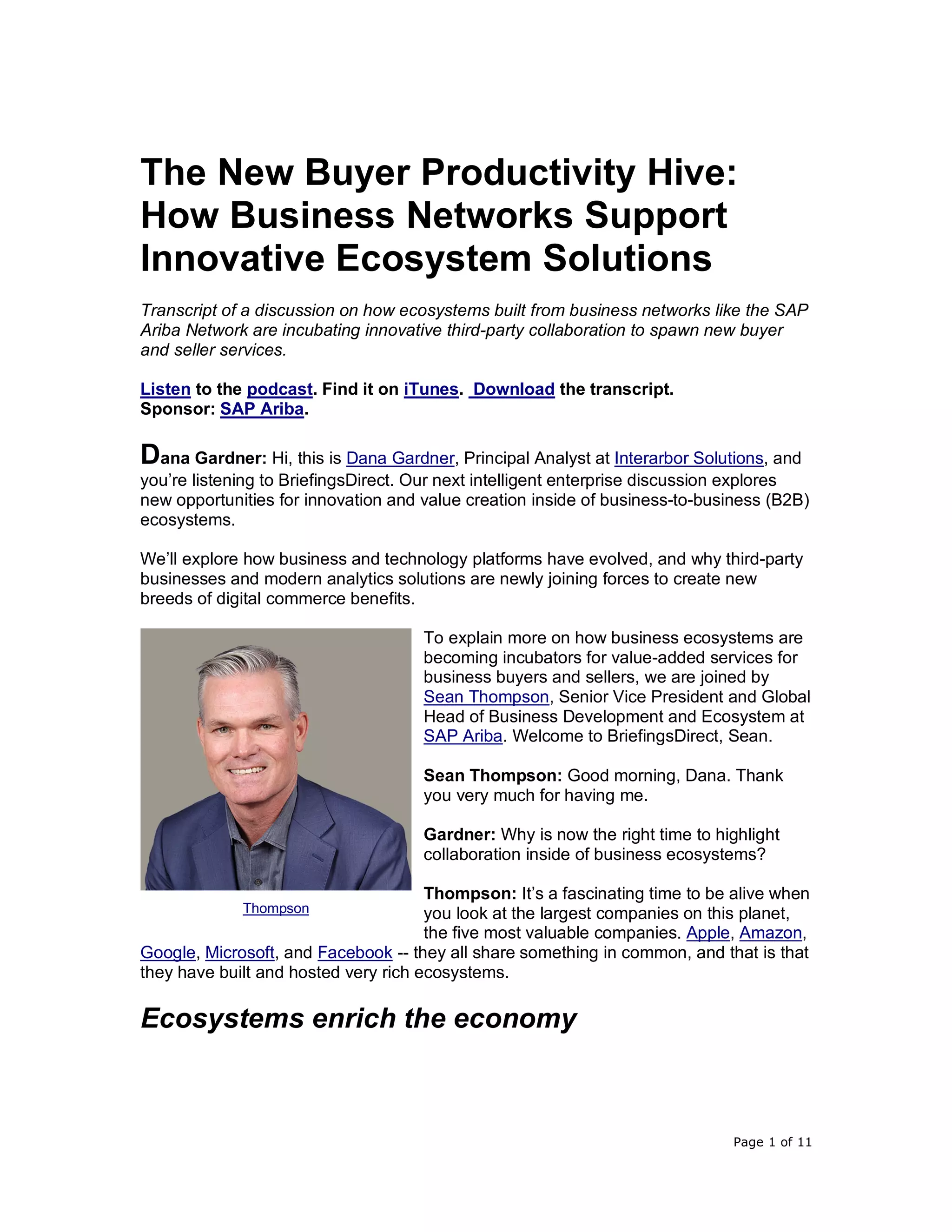
To explain more on how business ecosystems are
becoming incubators for value-added services for
business buyers and sellers, we are joined by
Sean Thompson, Senior Vice President and Global
Head of Business Development and Ecosystem at
SAP Ariba. Welcome to BriefingsDirect, Sean.
Sean Thompson: Good morning, Dana. Thank
you very much for having me.
Gardner: Why is now the right time to highlight
collaboration inside of business ecosystems?
Thompson: It’s a fascinating time to be alive when
you look at the largest companies on this planet,
the five most valuable companies. Apple, Amazon,
Google, Microsoft, and Facebook -- they all share something in common, and that is that
they have built and hosted very rich ecosystems.
Ecosystems enrich the economy
Thompson
Page 2 of 11
These platforms represent wonderful economics for the companies themselves. But the
members of the ecosystems also ultimately enjoy a very profitable place to do business.
This includes the end-users profiting from the network effect that Facebook provides in
terms of keeping in touch with friends, etc., as well as the advertisers who get value from
the specific targeting of Facebook users based on end-user interests and values.
So, it’s an interesting time to look at where these companies have taken us in the overall
economy. It’s also an indication for other parts of the technology world that ecosystems
in the cloud era are becoming more important. In the cloud era, you have multitenancy
where you have the hosts of these applications, like SAP Ariba, using multitenant
platforms. No longer are these applications delivered on-premise.
Now, it’s a cloud application enjoyed by more than 3.5 million organizations around the
world. It’s hosted by SAP Ariba in the cloud. As a result, you have a wonderful
ecosystem that evolves around a particular audience to which you can provide new
value. For us, at SAP Ariba, the opportunity is to have an open mindset, much like the
companies that I mentioned.
It is a very interesting time because
business ecosystems now matter
more than ever in the technology
world, and it’s mainly due to cloud
computing.
Gardner: These platforms create escalating value. Everybody involved is a winner, and
the more they play, the more winnings there are for all. The participation grows the pie,
builds a virtuous adoption cycle.
Is that how you view business ecosystems, as an ongoing value-added creation
mechanism? How do you define a business ecosystem, and how is that different from
five years ago?
Thompson: I say this to folks that I work with everyday -- not only inside of SAP Ariba,
but also to members of our partner community, our ecosystem – “We are privileged in
that not every company can talk about an ecosystem, mainly because you have to have
relevance in order for such an ecosystem to develop.”
I wrote an article recently wherein I was reminded of growing up in Montana. I’m a big fly
fisherman. I grew up with a fly rod in my hand. It didn’t dawn on me until later in my
professional life that I used to talk about ecosystems as a kid. We used to talk about the
various bug hatches that would happen and how that would make the trout go crazy.
I was taught by my dad about the certain ecosystems that supported different bugs and
the different life that the trout feed on. In order to have an ecosystem -- whether it was
fly-fishing as a kid in the natural environment or business ecosystems built today in the
It is a very interesting time because
business ecosystems now matter more
than ever in the technology world, and
it’s mainly due to cloud computing.
Page 3 of 11
cloud -- it starts with relevance. Do you have relevance, much like Microsoft had
relevance back in the personal computer (PC) era?
Power of relevance
Apple created the PC era, but Microsoft decided to license the PC operating system
(OS) to many and thus became relevant to all the third-party app developers. The Mac
was closed. The strategy that Apple had in the beginning was to control this closed
environment. That led to a wonderful user experience. But it didn’t lead to a place where
third-party developers could build applications and get them sold.
Windows and a Windows-compatible PC environment created a profitable place that had
relevance. More PC manufacturers used Windows as a standard, third-party app
developers could build and sell the applications through a much broader distribution
network, and that then was Microsoft’s relevance in the early days of the PC.
Other ecosystems have to have relevance, too. There have to be the right conditions for
third parties to be attracted, and ultimately -- in the business world -- it’s all about if you
will profit. Can I enjoy a profitable existence by joining the ecosystem?
At SAP Ariba, I always say, we are privileged because we do have relevance.
Salesforce.com also had relevance in its early days when it distributed its customer
resource management (CRM) app widely and efficiently. They pioneered the notion of
only needing a username, a password, and credit card to distribute and consume a CRM
app. Once that Sales Force Automation app was widely distributed, all of a sudden you
had an ecosystem that began to pay attention because of the relevancy that Salesforce
had. It was able to turn the relevancy of the app into an ecosystem that was based on a
platform, and they introduced Force.com and the AppExchange for the third parties to
extend the value of the applications and the platform.
It’s very similar to what we have here at SAP Ariba. The relevance in the ecosystem is
supported by market relevance from the network. So it’s a fascinating time.
Gardner: What exactly is the relevance with the SAP Ariba platform? You’re in an
auspicious place -- between buyers and sellers at the massive scale that the cloud
allows. And increasingly the currency now is data, analytics, and insights.
Global ERP efficiency
Thompson: It’s very simple. I first got to know Ariba professionally back in the 1990s. I
was at Deloitte, where I was one of those classic re-engineering consultants in the mid-
90s. Then during the Y2K era, companies were getting rid of the old mainframes
because they thought the code would fail when the calendar turned over to the year
Page 4 of 11
2000. That was a wonderful perfect storm in the industry and led to the first major wave
of consuming enterprise resource planning (ERP) technology and software.
Ariba was born out of that same era, with an eye toward procurement and helping the
procurement organization within companies better manage spend.
ERP was about making spend more efficient, too, and making the organization more
efficient overall. It was not just about reducing waste inherent within the silos of an
organization. It was also about the waste in how companies spent money, managed
suppliers, and managed spend against contracts that they had with those suppliers.
And so, Ariba -- not unlike Salesforce and other business applications that became
relevant -- was the first to focus on the buyer, in particular the buyer within the
procurement organization. The focus was on using a software application to help
companies make better decisions around who they are sourcing from, their supply chain,
and driving end-users to buy based on contracts that can be negotiated. It became an
end-to-end way of thinking about your source-to-settle process. That was very much an
application-led approach that SAP Ariba has had for the better part of 20 years.
When SAP bought Ariba in 2012, it included Ariba naturally within the portfolio of the
largest ERP provider, SAP. But instead of thinking of it as a separate application, now
Ariba is within SAP, enabling what we call the intelligent enterprise. The focus remains
on making the enterprise more intelligent.
Pioneers in the cloud
SAP Ariba was also one of the first to pioneer moving from an on-premises world into
the cloud. And by doing so, Ariba created a business network. It was very early in
pioneering the concept of a network where -- by delighting the buyer and the
procurement organization – that organization also brought in their suppliers with them.
Ariba early on had the concept of, “Let’s create a network where it’s not just one-to-one
between a buyer and a supplier. Rather let’s think about it as a network -- as a
marketplace -- where suppliers can make connections with many buyers.”
And so, very early on, SAP Ariba created a business network. That network today is
made up 3.5 million buyers and sellers doing $2.2 trillion annually in commerce through
the Ariba Network.
Now, as you pointed out, the currency is
all about data. Because we are in the
cloud, a network, and multitenant, our
data model is structured in such a way
that is far better than in an on-premises
world. We now live within a cloud
environment with a consistent data
Because we are in the cloud, a
network, and multitenant, our data
model is structured in such a way
that is far better than in an on-
premises world.
Page 5 of 11
structure. Everybody is operating within the same environment, with the same code
base. So now the data we have within SAP Ariba -- within that digital commerce data set
-- becomes incredibly valuable to third parties. They can think about how they can
enhance that value.
As an example, we are working with banks today that are very interested in using data to
inform new underwriting models. A supplier will soon be able to log-in to the SAP Ariba
Network and see that there are banks offering them loans based on data available in the
network. It informs about new loans at better rates because of the data value that the
SAP Ariba Network provides. The notion of an ecosystem is now extending to very
interesting places like banking, with financial service providers being part of a business
network and ecosystem.
We are going beyond the traditional old applications -- what we used to call independent
software vendors (ISVs). We’re now bringing in service providers and data services
providers. It’s very interesting to see the variety of different business models joining
today’s ecosystems.
Gardner: Another catalyst to the power and value of the network and the platform is that
many of these third parties are digital organizations. They’re sharing their value and
adding value as pure services so that the integration pain points have been slashed. It’s
much easier for a collaborative solution to come together.
Can you provide any other examples, Sean, of how third parties enter into a platform-
network ecosystem and add value through digital transformation and innovation?
Relationships rule
Thompson: Yes. When you look back at my career, 25 years ago, I met SAP for the
first time when I was with Deloitte. And Deloitte is still a very strong partner of SAP, a
very strong player within the technology industry as a systems integrator (SI) and
consulting organization.
We have enjoyed relationships with Deloitte, Accenture, IBM, Capgemini, and many
other organizations. Today they play a role -- as they did in the past -- of delivering value
to the end customer by providing expertise, human capital, and intellectual property that
is inherent in their many methodologies -- change management methodologies,
business process change methodologies. And there’s still a valuable role for these
professional services organizations, consultants, and SIs today.
But their role has evolved, and it’s a fascinating evolution. It’s no longer customizing on-
premises software. Back in the day, when I was at Deloitte, we made a lot of money by
helping companies adopt an application like an SAP or an Oracle ERP and customizing
it. But you ended up customizing for one and building a single-family home, if you will,
that was isolated. You ended up forking the code, if you will, so that you had a very
Page 6 of 11
difficult time upgrading because you customized the code so much that you then fell
behind.
Now, on cloud, the SI is no longer customizing on-premises, it’s now configuring cloud
environments. That configuring of cloud environments allows for not only the customer to
never be left behind -- a wonderful value for the industry in general -- but it also allows
the SI to play a new role.
That role is now a hybrid of both
consulting and of helping companies to
understand how to adopt and change their
multicloud processes to become more
efficient. The SIs are also becoming [cloud
service providers] themselves because –
what they used to do in customizing on-
premises -- they’re now building
extensions to clouds and among clouds.
They can create extensions of a solution like SAP Ariba for certain industries, like oil and
gas, for example. You will see SAP continue to evolve its relationships with these
service providers so that those services companies begin to look more like hybrid
business models -- where they enjoy some intellectual property and extensions to cloud
environments, as well as monetizing their methodologies as they have in the past.
This is a fascinating evolution that’s profitable for those companies because they go
from a transactional business model -- where they have to sell one client at a time and
one implementation at a time -- to monetizing based on a subscription model, much like
we in the ISV world have done.
There are many other examples of new and interesting ways within the SAP Ariba
ecosystem and network of buyers and suppliers where third-party ecosystem
participants gather additional data about suppliers -- and sometimes about buyers. For
example, in helping both suppliers and buyers manage their risk better in terms of
financial risk, for supply chain disruption, and if you want to ensure there isn’t slave labor
in your supply chain, or if there is sufficient diversity in your supply chain.
The supplier risk category for us is very important. It requires an ecosystem of provider
data that enriches the supplier profile. And that can then become an enhancement to the
overall value of the business network.
We are now able to reach out and offer ways in which third parties can contribute their
intellectual property -- be it a methodology, data, analytics, or financial services. And
that’s why it’s a really exciting time to be in the environment we are today.
Gardner: This network effect certainly relates to solution sets like financial services and
risk management. You mentioned also that it pertains to such vertical industries like oil
and gas, pharmaceutical, life sciences, and finance. Does it also extend to geographies
The SIs are also become [cloud
service providers] themselves
because – what they used to do in
customizing on-premises – they’re
now building extensions to clouds
and among clouds.
Page 7 of 11
and a localization-solution benefit? Does it also pertain to going downstream for small- to
medium-sized businesses (SMBs) that might not have been able to afford or
accommodate this high-level collaboration?
Reach around the world
Thompson: Absolutely, and it’s a great question. I remember the first wave of ERP and
it marked a major consumption of technology to improve business. And that led to a
tremendous amount of productivity gains that we’ve enjoyed through the growth of the
world economy. Business productivity through technology investment has led to a
tremendous amount of growth in the economy.
Now, you ask, “Does this extend?” And that’s what’s so fascinating about cloud and
when you combine cloud with the concept of ecosystem -- because everybody enjoys a
benefit from that.
As an example, you mentioned localization. Within SAP Ariba, we are all about
intelligent business commerce, and how can we make business commerce more
efficient all around the world. That’s what we are about.
In some countries, business commerce involves the good old-fashioned invoicing,
orders, and taxation tasks. At Ariba, we don’t want to solve all of that so-called last mile
of the tax data and process needed in for invoices in, say, Mexico.
We want to work with members of the ecosystem that do that. An example is Thomson
Reuters, whose business is in part about managing a database of local tax data that is
relevant to what’s needed in these different geographies.
By having one relationship with a
large provider of that data and being
able to distribute that data to the end
users -- which are companies in
places like Mexico and Korea that
need a solution – means they are
going to be compliant with the local
authorities and regulations thanks to
up-to-date tax data.
That’s an example of an extremely efficient way for us to distribute to the globe based on
cloud and an ecosystem from within which Thomson Reuters provides that localized and
accurate tax data.
Support for all sizes
By having one relationship with a large
provider of that data and being able to
distribute that data to the end users –
which are companies in Mexico and
Korea that need a solution – means they
are going to be compliant with the local
authorities and regulations.
Page 8 of 11
You also asked about SMBs. Prior to being at SAP Ariba, I was part of an SMB support
organization with the portfolio of Business ByDesign and Business One, which are
smaller ERP applications designed for SMBs. And one of them, Business ByDesign, is a
cloud-based offering.
In the past, the things that large companies were able to do were often too expensive for
SMBs. That’s because they required on-premises data centers, with servers, software
consultants, and all of the things that large enterprises could afford to drive innovation in
the pre-cloud world. This was all just too expensive for SMBs.
Now the distribution model is represented by cloud and the multitenant nature of these
solutions that allow for configuration -- as opposed to costly and brittle customization.
They now have an easy upgrade path and all the wonderful benefits of the cloud model.
And when you combine that with a business solutions ecosystem then you can fully
support SMBs.
For example, within SAP Ariba, we have an SMB consulting organization focused on
helping midsize companies adopt solutions in an agile way, so that it’s not a big bang.
It’s not an expensive consulting service, instead it’s prescriptive in terms of how you
should begin small and grow in terms of adopting cloud solutions.
Such an SMB mindset has enabled us to take the
same SAP Ariba advantage of no code, to just
preconfigure it, and start small. As we like to say at
SAP Ariba, it’s a T-shirt size implementation: small,
medium, and large.
That’s an example of how the SMB business segment really benefits from this era of
cloud and ecosystem that drives efficiency for all of us.
Gardner: Given that the value of any business network and ecosystem increases with
the number of participants – including buyers, sellers, and third-party service providers --
what should they be thinking to get in the best position to take advantage of these new
trends, Sean? What should you be thinking in order to begin leveraging and exploiting
this overall ecosystem approach and its benefits?
Thompson: I’m about to get on an airplane to go to South Korea. In some of these
geographies where we do business, the majority of businesses are SMBs.
And I am still shocked that some of these companies have not prioritized technology
adoption. I’m still surprised that there are a lot of industries, and a lot of companies in
different segments, that are still very much analog. They are doing business the way
they’ve been doing business for many years, and they have been resistant to change
because their cottage industry has allowed them to maintain, if you will, Excel
spreadsheet approaches to business and process.
We like to say it’s a T-
shirt size implementation:
small, medium, and large.
Page 9 of 11
I spent a decade of my life at Microsoft, and when we looked at the different ways Excel
was used we were fascinated by the fact that Excel in many ways was used as a
business system. Oftentimes, that was very precarious because you can’t manage a
business on Excel. But I still see that within companies today.
The number one thing that every business owner
needs to understand is that we are in an
exponential time of transformation. What was
linear in terms of how we expect transformation is
now in an exponential phase. Disruption of
industries is happening in real time and rapidly. If
you’re not prioritizing and investing in technology -
- and not thinking of your business as a
technology business -- then you will get left behind.
Never underestimate the impact that technology can have to drive topline growth. But
technology also preserves the option value for your company in the future because
disruption is happening. It’s exponential and cloud is driving that.
Get professional advice
You also have to appreciate the value of getting good advice. There are good
companies that are looking to help. We have many of those within our ecosystem, such
as providers of assistance like the large SIs as well as midsize companies focused on
helping SMBs.
As I mentioned before, I grew up fly fishing. But anybody that comes to me and says,
“Hey, I’d love to go learn how to fly fish.” I say, “Start with hiring a professional guide.
Spend a day on a river with a professional guide because they will show you how to do
things.” I honestly think that that same advice applies to the professional guide who can
help you understand how to consume cloud software services.
And that professional guide fee is not going to be as much as it was in the past. So I
would say get professional help to start.
Gardner: I’d like to close out with a look to the future. It seems that for third-party
organizations that want to find a home in an ecosystem that there’s never been a better
time for them to innovate, and find new business models, new ways of collaborating.
You mentioned risk management and financial improvements and efficiency. What are
some of the other areas for new business models within ecosystems? Where are we
going to see some new and innovative business models cropping up, especially within
the SAP Ariba network ecosystem?
Thompson: You mentioned it earlier in the conversation. The future is about data. The
future is about insights that we gather from the data.
If you’re not prioritizing and
investing in technology –
and not thinking of your
business as a technology
business – then you will
get left behind.
Page 10 of 11
I started a company in the natural language processing world. I spent five years of my
life understanding how to drive a new type of user experience by using voice. It’s about
natural language and understanding how to drive domain-specific knowledge of what
people want through a natural user interface.
I’ve played on the edge of where we are in terms of artificial intelligence within that
natural language processing. But we’re still fiddling in many respects. We still fiddle in
the business software arena, talking about chatbots, talking about natural user
interfaces.
We’re still early in a very interesting future. We’re still very early in understanding how to
gather insights from data. At SAP Ariba we have a treasure trove of data from $2.1
trillion in commerce among 3.5 million members in the Ariba Network.
The future is data driven
There are so many data insights available on contracts and supplier profiles alone. So
the future is about being able to harvest insights from that data. It’s now very exciting to
be able to leverage the right infrastructure like the S/4 HANA data platform.
But we have a lot of work to do still to clean data and ensure the structure, privacy, and
security of the data. The future certainly is bright. It will be magical in how we will be able
to be proactive in making recommendations based on understanding all the data.
Buyers will be proactively alerted that something is going on in the supply chain. We will
be able to predict and be a prescriptive in the way the business operates. So it is a
fascinating future that we have ahead of us. It’s very exciting to be a part of it.
Gardner: I’m afraid we’ll have to leave it there. You’ve been listening to a sponsored
BriefingsDirect discussion on new opportunities for innovation and value creation among
business ecosystem participants. And we’ve learned how business ecosystems are
incubating new levels of buyer and seller value-added services.
So a big thank you to our guest, Sean Thompson, Senior Vice President and Global
Head of Business Development and Ecosystem at SAP Ariba. Thank you, sir.
Thompson: Thanks, Dana.
Gardner: And thank you as well to our audience for joining this BriefingsDirect digital
business innovation discussion. I’m Dana Gardner, Principal Analyst at Interarbor
Solutions, your host throughout this series of SAP Ariba-sponsored BriefingsDirect
discussions. Thanks again for listening, and do come back next time.
Listen to the podcast. Find it on iTunes. Download the transcript.
Sponsor: SAP Ariba.
Page 11 of 11
Transcript of a discussion on how ecosystems built from business networks like the SAP
Ariba Network are incubating innovative third-party collaboration to spawn new buyer
and seller services. Copyright Interarbor Solutions, LLC, 2005-2018. All rights reserved.
You may also be interested in:
• How data analytics-rich business networks help close the digital transformation
gap
• SAP Ariba's chief data scientist on how ML and dynamic processes build an
intelligent enterprise
• SAP Ariba’s President Barry Padgett on building the intelligent enterprise
• GDPR forces rekindling of people-centric approach to marketing and business
• Balancing costs with conscience--How new tools help any business build ethical
and sustainable supply chains
• Envisioning procurement technology and techniques in 2025: The future looks
bright
• Bridging the educational divide - How business networks level the playing field
for those most in need
• Diversity spend: When doing good leads to doing well

The New Buyer Productivity Hive: How Business Networks Support Innovative Ecosystem Solutions

  • 1.
    Page 1 of11 The New Buyer Productivity Hive: How Business Networks Support Innovative Ecosystem Solutions Transcript of a discussion on how ecosystems built from business networks like the SAP Ariba Network are incubating innovative third-party collaboration to spawn new buyer and seller services. Listen to the podcast. Find it on iTunes. Download the transcript. Sponsor: SAP Ariba. Dana Gardner: Hi, this is Dana Gardner, Principal Analyst at Interarbor Solutions, and you’re listening to BriefingsDirect. Our next intelligent enterprise discussion explores new opportunities for innovation and value creation inside of business-to-business (B2B) ecosystems. We’ll explore how business and technology platforms have evolved, and why third-party businesses and modern analytics solutions are newly joining forces to create new breeds of digital commerce benefits. To explain more on how business ecosystems are becoming incubators for value-added services for business buyers and sellers, we are joined by Sean Thompson, Senior Vice President and Global Head of Business Development and Ecosystem at SAP Ariba. Welcome to BriefingsDirect, Sean. Sean Thompson: Good morning, Dana. Thank you very much for having me. Gardner: Why is now the right time to highlight collaboration inside of business ecosystems? Thompson: It’s a fascinating time to be alive when you look at the largest companies on this planet, the five most valuable companies. Apple, Amazon, Google, Microsoft, and Facebook -- they all share something in common, and that is that they have built and hosted very rich ecosystems. Ecosystems enrich the economy Thompson
  • 2.
    Page 2 of11 These platforms represent wonderful economics for the companies themselves. But the members of the ecosystems also ultimately enjoy a very profitable place to do business. This includes the end-users profiting from the network effect that Facebook provides in terms of keeping in touch with friends, etc., as well as the advertisers who get value from the specific targeting of Facebook users based on end-user interests and values. So, it’s an interesting time to look at where these companies have taken us in the overall economy. It’s also an indication for other parts of the technology world that ecosystems in the cloud era are becoming more important. In the cloud era, you have multitenancy where you have the hosts of these applications, like SAP Ariba, using multitenant platforms. No longer are these applications delivered on-premise. Now, it’s a cloud application enjoyed by more than 3.5 million organizations around the world. It’s hosted by SAP Ariba in the cloud. As a result, you have a wonderful ecosystem that evolves around a particular audience to which you can provide new value. For us, at SAP Ariba, the opportunity is to have an open mindset, much like the companies that I mentioned. It is a very interesting time because business ecosystems now matter more than ever in the technology world, and it’s mainly due to cloud computing. Gardner: These platforms create escalating value. Everybody involved is a winner, and the more they play, the more winnings there are for all. The participation grows the pie, builds a virtuous adoption cycle. Is that how you view business ecosystems, as an ongoing value-added creation mechanism? How do you define a business ecosystem, and how is that different from five years ago? Thompson: I say this to folks that I work with everyday -- not only inside of SAP Ariba, but also to members of our partner community, our ecosystem – “We are privileged in that not every company can talk about an ecosystem, mainly because you have to have relevance in order for such an ecosystem to develop.” I wrote an article recently wherein I was reminded of growing up in Montana. I’m a big fly fisherman. I grew up with a fly rod in my hand. It didn’t dawn on me until later in my professional life that I used to talk about ecosystems as a kid. We used to talk about the various bug hatches that would happen and how that would make the trout go crazy. I was taught by my dad about the certain ecosystems that supported different bugs and the different life that the trout feed on. In order to have an ecosystem -- whether it was fly-fishing as a kid in the natural environment or business ecosystems built today in the It is a very interesting time because business ecosystems now matter more than ever in the technology world, and it’s mainly due to cloud computing.
  • 3.
    Page 3 of11 cloud -- it starts with relevance. Do you have relevance, much like Microsoft had relevance back in the personal computer (PC) era? Power of relevance Apple created the PC era, but Microsoft decided to license the PC operating system (OS) to many and thus became relevant to all the third-party app developers. The Mac was closed. The strategy that Apple had in the beginning was to control this closed environment. That led to a wonderful user experience. But it didn’t lead to a place where third-party developers could build applications and get them sold. Windows and a Windows-compatible PC environment created a profitable place that had relevance. More PC manufacturers used Windows as a standard, third-party app developers could build and sell the applications through a much broader distribution network, and that then was Microsoft’s relevance in the early days of the PC. Other ecosystems have to have relevance, too. There have to be the right conditions for third parties to be attracted, and ultimately -- in the business world -- it’s all about if you will profit. Can I enjoy a profitable existence by joining the ecosystem? At SAP Ariba, I always say, we are privileged because we do have relevance. Salesforce.com also had relevance in its early days when it distributed its customer resource management (CRM) app widely and efficiently. They pioneered the notion of only needing a username, a password, and credit card to distribute and consume a CRM app. Once that Sales Force Automation app was widely distributed, all of a sudden you had an ecosystem that began to pay attention because of the relevancy that Salesforce had. It was able to turn the relevancy of the app into an ecosystem that was based on a platform, and they introduced Force.com and the AppExchange for the third parties to extend the value of the applications and the platform. It’s very similar to what we have here at SAP Ariba. The relevance in the ecosystem is supported by market relevance from the network. So it’s a fascinating time. Gardner: What exactly is the relevance with the SAP Ariba platform? You’re in an auspicious place -- between buyers and sellers at the massive scale that the cloud allows. And increasingly the currency now is data, analytics, and insights. Global ERP efficiency Thompson: It’s very simple. I first got to know Ariba professionally back in the 1990s. I was at Deloitte, where I was one of those classic re-engineering consultants in the mid- 90s. Then during the Y2K era, companies were getting rid of the old mainframes because they thought the code would fail when the calendar turned over to the year
  • 4.
    Page 4 of11 2000. That was a wonderful perfect storm in the industry and led to the first major wave of consuming enterprise resource planning (ERP) technology and software. Ariba was born out of that same era, with an eye toward procurement and helping the procurement organization within companies better manage spend. ERP was about making spend more efficient, too, and making the organization more efficient overall. It was not just about reducing waste inherent within the silos of an organization. It was also about the waste in how companies spent money, managed suppliers, and managed spend against contracts that they had with those suppliers. And so, Ariba -- not unlike Salesforce and other business applications that became relevant -- was the first to focus on the buyer, in particular the buyer within the procurement organization. The focus was on using a software application to help companies make better decisions around who they are sourcing from, their supply chain, and driving end-users to buy based on contracts that can be negotiated. It became an end-to-end way of thinking about your source-to-settle process. That was very much an application-led approach that SAP Ariba has had for the better part of 20 years. When SAP bought Ariba in 2012, it included Ariba naturally within the portfolio of the largest ERP provider, SAP. But instead of thinking of it as a separate application, now Ariba is within SAP, enabling what we call the intelligent enterprise. The focus remains on making the enterprise more intelligent. Pioneers in the cloud SAP Ariba was also one of the first to pioneer moving from an on-premises world into the cloud. And by doing so, Ariba created a business network. It was very early in pioneering the concept of a network where -- by delighting the buyer and the procurement organization – that organization also brought in their suppliers with them. Ariba early on had the concept of, “Let’s create a network where it’s not just one-to-one between a buyer and a supplier. Rather let’s think about it as a network -- as a marketplace -- where suppliers can make connections with many buyers.” And so, very early on, SAP Ariba created a business network. That network today is made up 3.5 million buyers and sellers doing $2.2 trillion annually in commerce through the Ariba Network. Now, as you pointed out, the currency is all about data. Because we are in the cloud, a network, and multitenant, our data model is structured in such a way that is far better than in an on-premises world. We now live within a cloud environment with a consistent data Because we are in the cloud, a network, and multitenant, our data model is structured in such a way that is far better than in an on- premises world.
  • 5.
    Page 5 of11 structure. Everybody is operating within the same environment, with the same code base. So now the data we have within SAP Ariba -- within that digital commerce data set -- becomes incredibly valuable to third parties. They can think about how they can enhance that value. As an example, we are working with banks today that are very interested in using data to inform new underwriting models. A supplier will soon be able to log-in to the SAP Ariba Network and see that there are banks offering them loans based on data available in the network. It informs about new loans at better rates because of the data value that the SAP Ariba Network provides. The notion of an ecosystem is now extending to very interesting places like banking, with financial service providers being part of a business network and ecosystem. We are going beyond the traditional old applications -- what we used to call independent software vendors (ISVs). We’re now bringing in service providers and data services providers. It’s very interesting to see the variety of different business models joining today’s ecosystems. Gardner: Another catalyst to the power and value of the network and the platform is that many of these third parties are digital organizations. They’re sharing their value and adding value as pure services so that the integration pain points have been slashed. It’s much easier for a collaborative solution to come together. Can you provide any other examples, Sean, of how third parties enter into a platform- network ecosystem and add value through digital transformation and innovation? Relationships rule Thompson: Yes. When you look back at my career, 25 years ago, I met SAP for the first time when I was with Deloitte. And Deloitte is still a very strong partner of SAP, a very strong player within the technology industry as a systems integrator (SI) and consulting organization. We have enjoyed relationships with Deloitte, Accenture, IBM, Capgemini, and many other organizations. Today they play a role -- as they did in the past -- of delivering value to the end customer by providing expertise, human capital, and intellectual property that is inherent in their many methodologies -- change management methodologies, business process change methodologies. And there’s still a valuable role for these professional services organizations, consultants, and SIs today. But their role has evolved, and it’s a fascinating evolution. It’s no longer customizing on- premises software. Back in the day, when I was at Deloitte, we made a lot of money by helping companies adopt an application like an SAP or an Oracle ERP and customizing it. But you ended up customizing for one and building a single-family home, if you will, that was isolated. You ended up forking the code, if you will, so that you had a very
  • 6.
    Page 6 of11 difficult time upgrading because you customized the code so much that you then fell behind. Now, on cloud, the SI is no longer customizing on-premises, it’s now configuring cloud environments. That configuring of cloud environments allows for not only the customer to never be left behind -- a wonderful value for the industry in general -- but it also allows the SI to play a new role. That role is now a hybrid of both consulting and of helping companies to understand how to adopt and change their multicloud processes to become more efficient. The SIs are also becoming [cloud service providers] themselves because – what they used to do in customizing on- premises -- they’re now building extensions to clouds and among clouds. They can create extensions of a solution like SAP Ariba for certain industries, like oil and gas, for example. You will see SAP continue to evolve its relationships with these service providers so that those services companies begin to look more like hybrid business models -- where they enjoy some intellectual property and extensions to cloud environments, as well as monetizing their methodologies as they have in the past. This is a fascinating evolution that’s profitable for those companies because they go from a transactional business model -- where they have to sell one client at a time and one implementation at a time -- to monetizing based on a subscription model, much like we in the ISV world have done. There are many other examples of new and interesting ways within the SAP Ariba ecosystem and network of buyers and suppliers where third-party ecosystem participants gather additional data about suppliers -- and sometimes about buyers. For example, in helping both suppliers and buyers manage their risk better in terms of financial risk, for supply chain disruption, and if you want to ensure there isn’t slave labor in your supply chain, or if there is sufficient diversity in your supply chain. The supplier risk category for us is very important. It requires an ecosystem of provider data that enriches the supplier profile. And that can then become an enhancement to the overall value of the business network. We are now able to reach out and offer ways in which third parties can contribute their intellectual property -- be it a methodology, data, analytics, or financial services. And that’s why it’s a really exciting time to be in the environment we are today. Gardner: This network effect certainly relates to solution sets like financial services and risk management. You mentioned also that it pertains to such vertical industries like oil and gas, pharmaceutical, life sciences, and finance. Does it also extend to geographies The SIs are also become [cloud service providers] themselves because – what they used to do in customizing on-premises – they’re now building extensions to clouds and among clouds.
  • 7.
    Page 7 of11 and a localization-solution benefit? Does it also pertain to going downstream for small- to medium-sized businesses (SMBs) that might not have been able to afford or accommodate this high-level collaboration? Reach around the world Thompson: Absolutely, and it’s a great question. I remember the first wave of ERP and it marked a major consumption of technology to improve business. And that led to a tremendous amount of productivity gains that we’ve enjoyed through the growth of the world economy. Business productivity through technology investment has led to a tremendous amount of growth in the economy. Now, you ask, “Does this extend?” And that’s what’s so fascinating about cloud and when you combine cloud with the concept of ecosystem -- because everybody enjoys a benefit from that. As an example, you mentioned localization. Within SAP Ariba, we are all about intelligent business commerce, and how can we make business commerce more efficient all around the world. That’s what we are about. In some countries, business commerce involves the good old-fashioned invoicing, orders, and taxation tasks. At Ariba, we don’t want to solve all of that so-called last mile of the tax data and process needed in for invoices in, say, Mexico. We want to work with members of the ecosystem that do that. An example is Thomson Reuters, whose business is in part about managing a database of local tax data that is relevant to what’s needed in these different geographies. By having one relationship with a large provider of that data and being able to distribute that data to the end users -- which are companies in places like Mexico and Korea that need a solution – means they are going to be compliant with the local authorities and regulations thanks to up-to-date tax data. That’s an example of an extremely efficient way for us to distribute to the globe based on cloud and an ecosystem from within which Thomson Reuters provides that localized and accurate tax data. Support for all sizes By having one relationship with a large provider of that data and being able to distribute that data to the end users – which are companies in Mexico and Korea that need a solution – means they are going to be compliant with the local authorities and regulations.
  • 8.
    Page 8 of11 You also asked about SMBs. Prior to being at SAP Ariba, I was part of an SMB support organization with the portfolio of Business ByDesign and Business One, which are smaller ERP applications designed for SMBs. And one of them, Business ByDesign, is a cloud-based offering. In the past, the things that large companies were able to do were often too expensive for SMBs. That’s because they required on-premises data centers, with servers, software consultants, and all of the things that large enterprises could afford to drive innovation in the pre-cloud world. This was all just too expensive for SMBs. Now the distribution model is represented by cloud and the multitenant nature of these solutions that allow for configuration -- as opposed to costly and brittle customization. They now have an easy upgrade path and all the wonderful benefits of the cloud model. And when you combine that with a business solutions ecosystem then you can fully support SMBs. For example, within SAP Ariba, we have an SMB consulting organization focused on helping midsize companies adopt solutions in an agile way, so that it’s not a big bang. It’s not an expensive consulting service, instead it’s prescriptive in terms of how you should begin small and grow in terms of adopting cloud solutions. Such an SMB mindset has enabled us to take the same SAP Ariba advantage of no code, to just preconfigure it, and start small. As we like to say at SAP Ariba, it’s a T-shirt size implementation: small, medium, and large. That’s an example of how the SMB business segment really benefits from this era of cloud and ecosystem that drives efficiency for all of us. Gardner: Given that the value of any business network and ecosystem increases with the number of participants – including buyers, sellers, and third-party service providers -- what should they be thinking to get in the best position to take advantage of these new trends, Sean? What should you be thinking in order to begin leveraging and exploiting this overall ecosystem approach and its benefits? Thompson: I’m about to get on an airplane to go to South Korea. In some of these geographies where we do business, the majority of businesses are SMBs. And I am still shocked that some of these companies have not prioritized technology adoption. I’m still surprised that there are a lot of industries, and a lot of companies in different segments, that are still very much analog. They are doing business the way they’ve been doing business for many years, and they have been resistant to change because their cottage industry has allowed them to maintain, if you will, Excel spreadsheet approaches to business and process. We like to say it’s a T- shirt size implementation: small, medium, and large.
  • 9.
    Page 9 of11 I spent a decade of my life at Microsoft, and when we looked at the different ways Excel was used we were fascinated by the fact that Excel in many ways was used as a business system. Oftentimes, that was very precarious because you can’t manage a business on Excel. But I still see that within companies today. The number one thing that every business owner needs to understand is that we are in an exponential time of transformation. What was linear in terms of how we expect transformation is now in an exponential phase. Disruption of industries is happening in real time and rapidly. If you’re not prioritizing and investing in technology - - and not thinking of your business as a technology business -- then you will get left behind. Never underestimate the impact that technology can have to drive topline growth. But technology also preserves the option value for your company in the future because disruption is happening. It’s exponential and cloud is driving that. Get professional advice You also have to appreciate the value of getting good advice. There are good companies that are looking to help. We have many of those within our ecosystem, such as providers of assistance like the large SIs as well as midsize companies focused on helping SMBs. As I mentioned before, I grew up fly fishing. But anybody that comes to me and says, “Hey, I’d love to go learn how to fly fish.” I say, “Start with hiring a professional guide. Spend a day on a river with a professional guide because they will show you how to do things.” I honestly think that that same advice applies to the professional guide who can help you understand how to consume cloud software services. And that professional guide fee is not going to be as much as it was in the past. So I would say get professional help to start. Gardner: I’d like to close out with a look to the future. It seems that for third-party organizations that want to find a home in an ecosystem that there’s never been a better time for them to innovate, and find new business models, new ways of collaborating. You mentioned risk management and financial improvements and efficiency. What are some of the other areas for new business models within ecosystems? Where are we going to see some new and innovative business models cropping up, especially within the SAP Ariba network ecosystem? Thompson: You mentioned it earlier in the conversation. The future is about data. The future is about insights that we gather from the data. If you’re not prioritizing and investing in technology – and not thinking of your business as a technology business – then you will get left behind.
  • 10.
    Page 10 of11 I started a company in the natural language processing world. I spent five years of my life understanding how to drive a new type of user experience by using voice. It’s about natural language and understanding how to drive domain-specific knowledge of what people want through a natural user interface. I’ve played on the edge of where we are in terms of artificial intelligence within that natural language processing. But we’re still fiddling in many respects. We still fiddle in the business software arena, talking about chatbots, talking about natural user interfaces. We’re still early in a very interesting future. We’re still very early in understanding how to gather insights from data. At SAP Ariba we have a treasure trove of data from $2.1 trillion in commerce among 3.5 million members in the Ariba Network. The future is data driven There are so many data insights available on contracts and supplier profiles alone. So the future is about being able to harvest insights from that data. It’s now very exciting to be able to leverage the right infrastructure like the S/4 HANA data platform. But we have a lot of work to do still to clean data and ensure the structure, privacy, and security of the data. The future certainly is bright. It will be magical in how we will be able to be proactive in making recommendations based on understanding all the data. Buyers will be proactively alerted that something is going on in the supply chain. We will be able to predict and be a prescriptive in the way the business operates. So it is a fascinating future that we have ahead of us. It’s very exciting to be a part of it. Gardner: I’m afraid we’ll have to leave it there. You’ve been listening to a sponsored BriefingsDirect discussion on new opportunities for innovation and value creation among business ecosystem participants. And we’ve learned how business ecosystems are incubating new levels of buyer and seller value-added services. So a big thank you to our guest, Sean Thompson, Senior Vice President and Global Head of Business Development and Ecosystem at SAP Ariba. Thank you, sir. Thompson: Thanks, Dana. Gardner: And thank you as well to our audience for joining this BriefingsDirect digital business innovation discussion. I’m Dana Gardner, Principal Analyst at Interarbor Solutions, your host throughout this series of SAP Ariba-sponsored BriefingsDirect discussions. Thanks again for listening, and do come back next time. Listen to the podcast. Find it on iTunes. Download the transcript. Sponsor: SAP Ariba.
  • 11.
    Page 11 of11 Transcript of a discussion on how ecosystems built from business networks like the SAP Ariba Network are incubating innovative third-party collaboration to spawn new buyer and seller services. Copyright Interarbor Solutions, LLC, 2005-2018. All rights reserved. You may also be interested in: • How data analytics-rich business networks help close the digital transformation gap • SAP Ariba's chief data scientist on how ML and dynamic processes build an intelligent enterprise • SAP Ariba’s President Barry Padgett on building the intelligent enterprise • GDPR forces rekindling of people-centric approach to marketing and business • Balancing costs with conscience--How new tools help any business build ethical and sustainable supply chains • Envisioning procurement technology and techniques in 2025: The future looks bright • Bridging the educational divide - How business networks level the playing field for those most in need • Diversity spend: When doing good leads to doing well