The Big

B.A.N.G.S.
    Adjectives
       that
   PRECEDE
        the
      Noun
       they
 Describe / Modify
It’s more than just a theory…


                It’s the LAW!


Find out how and why
Qui?

• Think about a family member or classmate
  that you know well.
• How would you describe this person?
• Intelligent, young, kind, handsome or
  pretty, tall or short???
une description
• C’est une fille ou un garçon?

• Il / Elle a quel âge?

• Comment est-il / est-elle?

• Donnez 7-10 adjectifs français pour décrire cette
  personne:
   1.                          6.
   2.                          7.
   3.                          8.
   4.                          9.
   5.                          10.

   *Make sure to use the correct gender of adjectives to avoid insult
     and embarrassment*
écrire
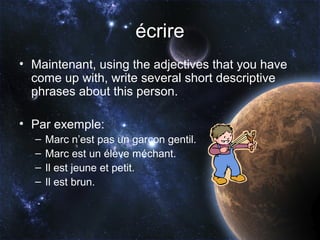
• Maintenant, using the adjectives that you have
  come up with, write several short descriptive
  phrases about this person.

• Par exemple:
  –   Marc n’est pas un garçon gentil.
  –   Marc est un élève méchant.
  –   Il est jeune et petit.
  –   Il est brun.
un adjectif normal
• When you wrote these short phrases, where did
  you put the adjective that described the person?

• Before or after the noun? Where do most
  adjectives go in French? Circle the correct
  phrase for each set:

  une fille intelligente / une intelligente fille
  un homme anglais / un anglais homme
  la voiture violette / la violette voiture
  le livre intéressant / le intéressant livre
  mes voisines chinoises / mes chinoises voisines
un adjectif normal
• So, where to most adjectives go in terms
  of the word that they are describing?
• Behind it, of course!
• You should have circled the phrase on the
  left side of the / mark for each exercise.
• Is this adjective placement similar to
  English?
• NOPE!
• Sounds simple, enough, right? Nothing
  you didn’t already know.
Mais…
 • Just when you thought it was safe to nail down a
   solid grammatical rule in the French language…
 • Nine (and sometimes more!) exceptions rear
   their ugly heads! Oui! There are basically nine
   adjectives that precede the noun they modify!


Disclaimer: There are other adjectives that precede the noun in addition to the
adjectives we are discussing today, but we’ll save that study for French III – IV.
the nature of the beasts
• To make things easier, let’s just focus on the nine
  little monsters that surfaced on the last slide.
• Fortunately, these monsters are easily tackled
  and placed into categories, which makes
  identification much simpler.
• The grammar police have come up with a special
  acronym to assist regular civilians.
• This acronym is best known as…
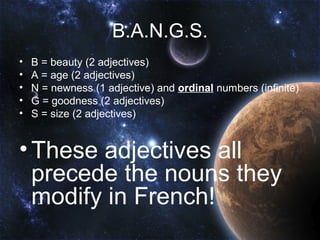
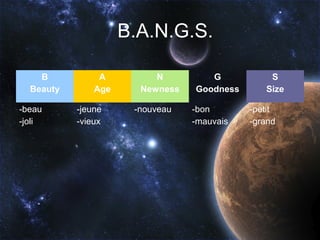
B.A.N.G.S.
•   B = beauty (2 adjectives)
•   A = age (2 adjectives)
•   N = newness (1 adjective) and ordinal numbers (infinite)
•   G = goodness (2 adjectives)
•   S = size (2 adjectives)


• These adjectives all
  precede the nouns they
  modify in French!
B.A.N.G.S.
• BANGS = adjectives that precede the noun that
  they are describing.
• Actually, you already know most of them! In
  your study packet, list the adjectives that you
  think might fit under each category. Remember,
  there are 9 total.
• To keep it simple, just list the masculine singular
  forms.
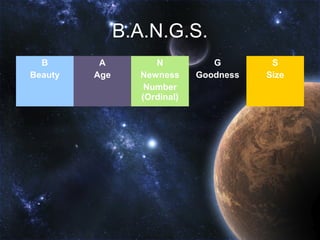
B.A.N.G.S.
  B       A         N           G        S
Beauty   Age     Newness     Goodness   Size
                  Number
                 (Ordinal)
B.A.N.G.S.

    B           A         N         G           S
  Beauty       Age     Newness   Goodness      Size

-beau      -jeune     -nouveau   -bon       -petit
-joli      -vieux                -mauvais   -grand
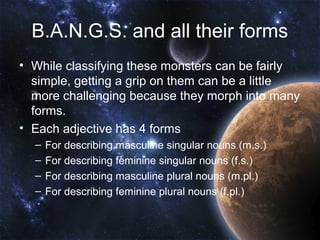
B.A.N.G.S. and all their forms
• While classifying these monsters can be fairly
  simple, getting a grip on them can be a little
  more challenging because they morph into many
  forms.
• Each adjective has 4 forms
  –   For describing masculine singular nouns (m.s.)
  –   For describing feminine singular nouns (f.s.)
  –   For describing masculine plural nouns (m.pl.)
  –   For describing feminine plural nouns (f.pl.)
Mastering the Forms
• In your packet we have many adjectives that
  follow different rules for agreement with their
  nouns.
• We will complete the first one of each category
  together and you will complete the rest of the
  packet.
The Tricksters
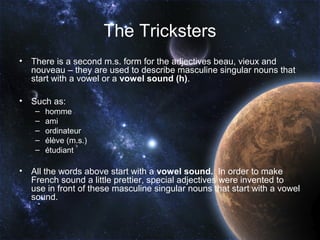
•   There is a second m.s. form for the adjectives beau, vieux and
    nouveau – they are used to describe masculine singular nouns that
    start with a vowel or a vowel sound (h).

•   Such as:
     –   homme
     –   ami
     –   ordinateur
     –   élève (m.s.)
     –   étudiant

•   All the words above start with a vowel sound. In order to make
    French sound a little prettier, special adjectives were invented to
    use in front of these masculine singular nouns that start with a vowel
    sound.
The Tricksters
• Voici des exemples:
       [bell]                [vee-yay]             [nooh-vell]
  Beautiful/handsome
                                Old                    New
    (good-looking)

    Un bel homme          Un vieil homme        Un nouvel homme

    Un bel étudiant       Un vieil étudiant     Un nouvel étudiant

      Un bel ami            Un vieil ami          Un nouvel ami

   Un bel ordinateur     Un vieil ordianteur   Un nouvel ordinateur
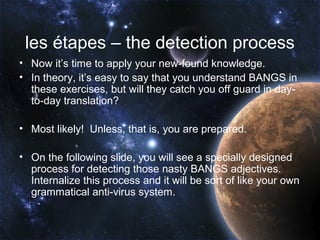
les étapes – the detection process
• Now it’s time to apply your new-found knowledge.
• In theory, it’s easy to say that you understand BANGS in
  these exercises, but will they catch you off guard in day-
  to-day translation?

• Most likely! Unless, that is, you are prepared.

• On the following slide, you will see a specially designed
  process for detecting those nasty BANGS adjectives.
  Internalize this process and it will be sort of like your own
  grammatical anti-virus system.
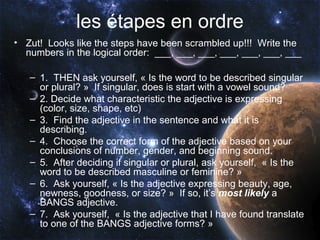
les étapes en ordre
• Zut! Looks like the steps have been scrambled up!!! Write the
  numbers in the logical order: ___, ___, ___, ___, ___, ___, ___

   – 1. THEN ask yourself, « Is the word to be described singular
     or plural? » If singular, does is start with a vowel sound?
   – 2. Decide what characteristic the adjective is expressing
     (color, size, shape, etc)
   – 3. Find the adjective in the sentence and what it is
     describing.
   – 4. Choose the correct form of the adjective based on your
     conclusions of number, gender, and beginning sound.
   – 5. After deciding if singular or plural, ask yourself, « Is the
     word to be described masculine or feminine? »
   – 6. Ask yourself, « Is the adjective expressing beauty, age,
     newness, goodness, or size? » If so, it’s most likely a
     BANGS adjective.
   – 7. Ask yourself, « Is the adjective that I have found translate
     to one of the BANGS adjective forms? »
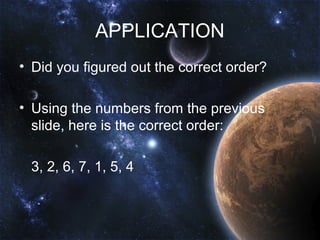
APPLICATION
• Did you figured out the correct order?

• Using the numbers from the previous
  slide, here is the correct order:

 3, 2, 6, 7, 1, 5, 4
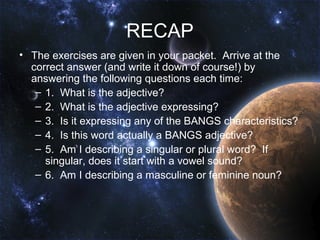
RECAP
• The exercises are given in your packet. Arrive at the
  correct answer (and write it down of course!) by
  answering the following questions each time:
   – 1. What is the adjective?
   – 2. What is the adjective expressing?
   – 3. Is it expressing any of the BANGS characteristics?
   – 4. Is this word actually a BANGS adjective?
   – 5. Am I describing a singular or plural word? If
     singular, does it start with a vowel sound?
   – 6. Am I describing a masculine or feminine noun?
PRATIQUEZ!
• Try these exercises (for the adjectives that you are
  unfamiliar with, be sure to read the topmost portion
  of the page to help you out.)
• http://www.laits.utexas.edu/tex/gr/adj3.html

• If you don’t know what a French word means, use
  context clues to help you or use a French / English
  dictionary.
BE CAREFUL OUT THERE
In the World of French Adjectives!


          ~ fin ~

French 2 bangs theory - chapitre 7

  • 1.
    The Big B.A.N.G.S. Adjectives that PRECEDE the Noun they Describe / Modify
  • 2.
    It’s more thanjust a theory… It’s the LAW! Find out how and why
  • 3.
    Qui? • Think abouta family member or classmate that you know well. • How would you describe this person? • Intelligent, young, kind, handsome or pretty, tall or short???
  • 4.
    une description • C’estune fille ou un garçon? • Il / Elle a quel âge? • Comment est-il / est-elle? • Donnez 7-10 adjectifs français pour décrire cette personne: 1. 6. 2. 7. 3. 8. 4. 9. 5. 10. *Make sure to use the correct gender of adjectives to avoid insult and embarrassment*
  • 5.
    écrire • Maintenant, usingthe adjectives that you have come up with, write several short descriptive phrases about this person. • Par exemple: – Marc n’est pas un garçon gentil. – Marc est un élève méchant. – Il est jeune et petit. – Il est brun.
  • 6.
    un adjectif normal •When you wrote these short phrases, where did you put the adjective that described the person? • Before or after the noun? Where do most adjectives go in French? Circle the correct phrase for each set: une fille intelligente / une intelligente fille un homme anglais / un anglais homme la voiture violette / la violette voiture le livre intéressant / le intéressant livre mes voisines chinoises / mes chinoises voisines
  • 7.
    un adjectif normal •So, where to most adjectives go in terms of the word that they are describing? • Behind it, of course! • You should have circled the phrase on the left side of the / mark for each exercise. • Is this adjective placement similar to English? • NOPE! • Sounds simple, enough, right? Nothing you didn’t already know.
  • 8.
    Mais… • Justwhen you thought it was safe to nail down a solid grammatical rule in the French language… • Nine (and sometimes more!) exceptions rear their ugly heads! Oui! There are basically nine adjectives that precede the noun they modify! Disclaimer: There are other adjectives that precede the noun in addition to the adjectives we are discussing today, but we’ll save that study for French III – IV.
  • 9.
    the nature ofthe beasts • To make things easier, let’s just focus on the nine little monsters that surfaced on the last slide. • Fortunately, these monsters are easily tackled and placed into categories, which makes identification much simpler. • The grammar police have come up with a special acronym to assist regular civilians. • This acronym is best known as…
  • 10.
    B.A.N.G.S. • B = beauty (2 adjectives) • A = age (2 adjectives) • N = newness (1 adjective) and ordinal numbers (infinite) • G = goodness (2 adjectives) • S = size (2 adjectives) • These adjectives all precede the nouns they modify in French!
  • 11.
    B.A.N.G.S. • BANGS =adjectives that precede the noun that they are describing. • Actually, you already know most of them! In your study packet, list the adjectives that you think might fit under each category. Remember, there are 9 total. • To keep it simple, just list the masculine singular forms.
  • 12.
    B.A.N.G.S. B A N G S Beauty Age Newness Goodness Size Number (Ordinal)
  • 13.
    B.A.N.G.S. B A N G S Beauty Age Newness Goodness Size -beau -jeune -nouveau -bon -petit -joli -vieux -mauvais -grand
  • 14.
    B.A.N.G.S. and alltheir forms • While classifying these monsters can be fairly simple, getting a grip on them can be a little more challenging because they morph into many forms. • Each adjective has 4 forms – For describing masculine singular nouns (m.s.) – For describing feminine singular nouns (f.s.) – For describing masculine plural nouns (m.pl.) – For describing feminine plural nouns (f.pl.)
  • 15.
    Mastering the Forms •In your packet we have many adjectives that follow different rules for agreement with their nouns. • We will complete the first one of each category together and you will complete the rest of the packet.
  • 16.
    The Tricksters • There is a second m.s. form for the adjectives beau, vieux and nouveau – they are used to describe masculine singular nouns that start with a vowel or a vowel sound (h). • Such as: – homme – ami – ordinateur – élève (m.s.) – étudiant • All the words above start with a vowel sound. In order to make French sound a little prettier, special adjectives were invented to use in front of these masculine singular nouns that start with a vowel sound.
  • 17.
    The Tricksters • Voicides exemples: [bell] [vee-yay] [nooh-vell] Beautiful/handsome Old New (good-looking) Un bel homme Un vieil homme Un nouvel homme Un bel étudiant Un vieil étudiant Un nouvel étudiant Un bel ami Un vieil ami Un nouvel ami Un bel ordinateur Un vieil ordianteur Un nouvel ordinateur
  • 18.
    les étapes –the detection process • Now it’s time to apply your new-found knowledge. • In theory, it’s easy to say that you understand BANGS in these exercises, but will they catch you off guard in day- to-day translation? • Most likely! Unless, that is, you are prepared. • On the following slide, you will see a specially designed process for detecting those nasty BANGS adjectives. Internalize this process and it will be sort of like your own grammatical anti-virus system.
  • 19.
    les étapes enordre • Zut! Looks like the steps have been scrambled up!!! Write the numbers in the logical order: ___, ___, ___, ___, ___, ___, ___ – 1. THEN ask yourself, « Is the word to be described singular or plural? » If singular, does is start with a vowel sound? – 2. Decide what characteristic the adjective is expressing (color, size, shape, etc) – 3. Find the adjective in the sentence and what it is describing. – 4. Choose the correct form of the adjective based on your conclusions of number, gender, and beginning sound. – 5. After deciding if singular or plural, ask yourself, « Is the word to be described masculine or feminine? » – 6. Ask yourself, « Is the adjective expressing beauty, age, newness, goodness, or size? » If so, it’s most likely a BANGS adjective. – 7. Ask yourself, « Is the adjective that I have found translate to one of the BANGS adjective forms? »
  • 20.
    APPLICATION • Did youfigured out the correct order? • Using the numbers from the previous slide, here is the correct order: 3, 2, 6, 7, 1, 5, 4
  • 21.
    RECAP • The exercisesare given in your packet. Arrive at the correct answer (and write it down of course!) by answering the following questions each time: – 1. What is the adjective? – 2. What is the adjective expressing? – 3. Is it expressing any of the BANGS characteristics? – 4. Is this word actually a BANGS adjective? – 5. Am I describing a singular or plural word? If singular, does it start with a vowel sound? – 6. Am I describing a masculine or feminine noun?
  • 22.
    PRATIQUEZ! • Try theseexercises (for the adjectives that you are unfamiliar with, be sure to read the topmost portion of the page to help you out.) • http://www.laits.utexas.edu/tex/gr/adj3.html • If you don’t know what a French word means, use context clues to help you or use a French / English dictionary.
  • 23.
    BE CAREFUL OUTTHERE In the World of French Adjectives! ~ fin ~