AR(HiTECTURAL RECORD MAY 1976 
. BUILDING TYP(S STUDY ® 488 
., '·'• ' 
- ~--~ ~ 1 
just overctwo yéar~ ago, in. theJpril 'l974 issue, ARCHITECTU~AL RECORD announced 
th~ formation ofthe non-profit lnternational Aré:hitectu1·al Foundation for the p.ur- 
. pose of '~organizing an 'interriatiqnal ' design COmpetition for the urban envi/Ofl­~ 
entóf deVeloping countries."That prqject, conceived by the staffs of RECORD and 
L'Architecture d'Aujourd'hui, is intended to focus the attention of architects and 
planners around the' world ·on the accelerátiiíg urban crisis in developing coun­tries, 
to encourage thedevelopn1entof thoughtful prototypical designs for housing 
and community development, and to make the results of this effort known · 
throughout the world . In the hope thatthe resu lts of the design' competition do 
"help make a world where hope makes sense," we present this issue to architécts, 
planners, iriterr.tational aid and lending agencies, and government officials around 
the world-on behalf of more :than a billion people who live in urban slums. · 
1 HUMAN 
SETTlEMENTS 
.--·· 
... an issue c:oncentrating on one of the urgent problerns of our time, with the winning designs in 
The lnternational Design CmnpetitiO"~ for the Urban .Environrnent of Developing Countries . 
¡ 
lnthe developing countries around the world, millions of families haye moved from the country­side 
to the cities in hope of jobs, education, and a better standard of li ving-and instead have 
found only a different k,i;~d of deprivation. N.owhere are the global problems of excessive popula­tion 
. growth, unemployment, environmental decay, al.ienation, and urban squalür,;· more clearly 
focused than in the urbansiums that have resu!ted. This . unpreceJent~d transition from rural to 
urban societies has vast national and global repercussions-social, economic,, and pójitical. 
As sen ior editor (and competition .juror) Mildred Schmertz points out in her article beginning 
overleaf, there is new hope and new direction in efforts to help the urban poor. Her article-and 
the phcito essay on page 100 by noted social scientist Aprodicid Laquian---{]escribes and evaluates 
the principal strategies by which the devejoping countries are seeking to improve squatter settle­ments- 
and focuses on the great promise of new strategies which combine sensitive and mínimum 
governmental intervention with squatter community self-help. • 
These new strategies were the basis for the cpmpetition program~eveloped with the assist­ance 
and enthusiastic súpport of the f?hilippine govérnment, which agreed to build the winning 
designas a prototype in a plann~d redevelopment in Manila for 140,000 squatters. The competi­tion 
si te and it,s people~the framework for the competition-is described on page 106. 
The competition, clearly the most sign ificant design competition of its kind ever held, also 
proved to be one of the largest. An astonishing 2,531 registrations- from 68 countries-were 
~eceived ; and 476 submissions were judged by a distinguished international jury (see page. 112). 
The winning designs-and a number of unpremiated entries-are shown beginnin'g on page '114. 
Finally, beginning on page· 156, is· a sumhlation that indudes an anthology of comments by 
world l<;aders in the struggle·to improve the cond itions of the world's urban poor, the report of 
'the jury, and an analysis by the editors of the significant achieverrients of the competition and 
s'~eculation on its possible impac;:t on the futuré ~~ urban development around the world. 
' ~-· · As we wrote in our first ed itorial on the competition two years ago: "We are not so naive 
asto believe that arc'hitecture is the solution to all the problems ofthe world; that good planning 
and design is a s'ubstitute for joqs that don't exist, or -food that does not exist or is too dear. But 
housin'g and a sense of community are basic human needs-and that is the part of the problern 
tllat we [the RECORD staff and architects everywhr:re] know most about and can best do something 
ab~ut. So let us try .. : . ' ~ · . . · . .· . .., . 
This issue is the result of two years of trying by literal! y thousands of people. '-V1. W 
ARCH iTECTL!RA.L RECORD ,VIay 7976 95 
1,
· from slum to community, from despair to hope: 
Upgrading the slum and squatter settlements 
that are spreading as a blight 
in and around the sprawling and fast~growing cities 
of the developing world 
~/ fi' 
fi· 
·t-'' 
'· ~: 
~-. 
increase in spite of the ~.ass i ve en1ígrations ·ter the citíes. {:. 
1 
In lhe developing nationst masses of humanity are moving from iso­lated 
rura l vill ages to intermediate towns and smaller cities on their 
way lo the big rnetropolitan centers. They swarn'l into SeotJI, · Bonibay, 
Mexico City and Sao Paolo, which havé populations of over S.¿;nillion. 
Cities oí over 4 million such as Manila, Hong Kong, )akarta, Delhi and · 
Cairo are still absorbing an incessant flow. ·Bangkok, Calcutta, 
Madras, Karachi and Tehrari have now reached populaticms of more 
than 3 million. Citiés of 2 million and more such as'Lima, Bogotá, 
Buenos Aires, Santiago, Caracas, lstanbul, SingapÓre and Taipei a;e 
hosts to an evér-growing numbé• of unwanted migrants: In many of 
these cities, squatters corriprise at least orie-half of the 'populatlon. In. 
Calcutúi, jakarta, Lirna, and Baghdad they add up to more than one~ 
halL In the words of social scientist Aprodicio A. Laquian (who has 
COITlributed a photo essay to this issue beginning ()n page 1 00): "These 
poorest of the urban poor live in dilapidated .settlements that cling 
precariously to hillsides; line srnelly canals; block roadsides; or crowd 
inner-city al leys. In their tattered misery, they mock the aspirations 61 
all those who yearn to make their cities sophisticated and mocle'rn. 
They serve as an all too visible reminder of the econom ic 'and soCial 
injustices that sti ll plague 6ur society." 
as urban areas. As .a res·uit, the riumbers of rural people continue to· Jl·;;} 
·The amount of work i'rÍ agriculture available to lhe individual is ' !' . 
.decreasing, however, largely betaUse of this ihcréase in nurnbers, but : ;, 
princ 
more 
nitie• 
~ 
1 
1 ¡ 
1 
¡ . 
Furthermore, these. human beings are unwelcomé because th,ey 
build shacks on urban land to which they have no legal right and for 
which there is little or no. infrastructure of public ~erv ices. The con- · 
struction bY,- the publ ic sectqr of such a conventio.ríal urbán nétwork­which 
should include roads, a public transportation system, piped 
water, storm water and san itary sewers, waste colle¿tion ancl dispos~l, 
ancl electricity-is considered lo be too heavy a burclen' upon the fi­nancia! 
resources of the expandi~g cities of the cleveloping world,. ' 
In the next thirty years; the world's population will reach the 6.5 
billion mark, nearly double the number of people alive today. By the 
year 2000,3.5 billion people .will have become urban,living in cities 
of over 20,000 inhabitants. In the clevelopiríg countries where río sig­nifican! 
decline in population growth is expected, the number. of. ur­banized 
people will grow from 464.3 million in 1970 to 1 A37 billion 
in .the year 2000. Today's largest cities-Calcutta, Bombay, )akarta, 
Mexico City, Buenos Aires and others will becorne urban mega' 
regions of over 10 million each. 
Choosing urban squalor-over rural misery:. 
the escape from village life 
Why does the rural peasant cÓme to the city? In response to its opp~r­tunities 
for growth for him and for his family. For many such ~en ahd 
women, it is no longer possible to lead a tolerable lifé and provicle for 
their children's future in the environinent in which their famil ies have 
lived for generations. Pover.ty is a worsening problem, because of di­minishecl 
availability of land and overpopulation. The rural environ­rnent 
itself is becoming so overpopulated that the peasant family can 
no. longer function as it did in the past. lmprovernenls iri health ca re· 
and sanital ion ha ve dt•amatically reduced death rates iri rural as well 
96 ARCI-IITEC f URAL RECORD May 1976 
also because of the gradiml mechanization' offarming and the in)c . 
, provecl yields brought about by modern methcids of agronomy. Where' 
there has been land reform, the peasant has usually not been granted 
a sufficient number of acres to be able .to bequeath a significan! · 
an10unt of farmlancl to ea eh of his sons, who are then forced to make 
the ir way to the city. In Southeast Asia, hovv only l~ per cent urban, 
the migration of ónly one out of six such sons will (i ssliming thé cur­ren 
birth rate) clouble the natural growth rate of the city to which he 
moves for a better future. 
Rural people are frequently displacedbydevelopme,nt-'--the con­structiori 
of roads, clams (which flood settled areas) and industrial ánd 
éommercial ceriters. lf the peasant owns his land and se lis it toa devel- . 
Oper, the Slllll he teceives is usually hOt sufficier~t for him lo acquire 
land ofsimilar agricultura! quality. Many use the money as a stake .in · 
the city to tide thern over until they find a job. 
In Muslim. indonesia, a peásant who has so!cl his land rnay spen~J. 
the entire su m paid him for a once-in-a-l ifetime trip to Mecca. Afte; . 
returning home a hero to his féllm• w6rshippers of Allah, he rnigrates 
to·}~karta or Bandung-poor in everything but spiril. 
.The rural migrant who makes it to th~ city 
· fÍghts to stay there . 
Although the squatter 01' slum dweller endures great harcJships in his · 
aclopted éity, he will not return to the country .. of his t)Wf1 volition, nor 
cioes he submit to being sent back against his will by the government. 
lf t he city cloes manage to deport hirn tq. a rural are a, he soon 111akes 
his way back. í fa vela songfrom BraziybyZé Keti expresses his spirit: 
1 may be arrested, 1 may be hit; 
1 may not even ha ve something to eat 
But 1 wón't change m y opinion 
hvon't ever move from . this hi/1. 
lf there is no. vvater /'// dig myself a we/1 
.ff there is no meai, 1'11 buy a bone 
. And put it in the sourr-/llget on, 1'1/ get on: 
They ca;, say what they like 
1-/ere 1 don't ha veto pay rent 
lf 1 die tomorinw moming, /'m very near ¡J,e sky! 
. . -¡. .·-.y 
. . . ¡ ·, 
According to stud ies conducted in six Philippine cities by Laquian '"'d 
his tea m of researchers; under a research grant from the Southeast Asia .. 
Development Advisory ·,GrOup of the Asia Society, New York, the . 
squatting process is clifficult to reverse: His· team, from i.he lntemá-­tional 
Development Research Centre in o'ltawa, found that most uf 
those iníerviewed prefer thei1· present ·urbbn life to their rural past, 
•:". 
J ..• 
í ,·,, 
l 
' ¡;. 
' . , ..1< 
• ¡, • 
' ,.'. ,;::'- 
-~ ''?. 
: !:' 
1 
~. : 
),'' 
,,._. 
"" 
in th 
neigl 
red u' 
e rabi 
servi 
illeg; 
as th< 
tion 1 
tiCiílS 
cent 
ve y el 
lstan' 
squa 
norrl' 
tose 
farm. 
betw 
the e 
. in 1st 
Slun1 
a farr 
Laqu 
adve1 
harsl-their 
i!lld ~ 
r:argc 
or W( 
the s 
get k 
notfc 
squat 
lutun 
hil115( 
m ociE' 
' and n 
and 1- 
feelin 
work 
with i1 
shack 
; l ~'~~--·~---:-..----------=-===~-,.,;.....~"'===="o=""""' ~~. ..... -..-.-~ .......,..,..~..,,...,.;..,,..,....,....,.,.,.... ,.,_.-... ..., _---.. a-·-..., . ____ .,,.,, __ ?ftl.l!l. .. WIWIIIII:MIIII_IIIII.Íiltill.-_~¡.j-¡,j~~;~
:ant 
áke 
>an, 
:ur­' 
he 
c.nd 
.fter · 
ites 
his 
nor 
!nt. 
k es 
rit: 
nd 
beca.use of better economic conditions in the city. Jobs are 
available, in comes are 'higher, and better educational opportu­ 
·nities improve the job prosp6cts for their children. 
Laquian's Philippine respondents appear to appreciate their lives 
squatter community. The urban squatter's friends, relatives and 
are there, the communities are close to their places of work 
transportation costs and time, and th~y have invested consid­erable 
tjme ancl money in their dwellings and communityfacilities ancl 
services. Of great significance to them, of course, is the fact that as 
illegal occupants they pay little or no rent ortaxes and such amenities 
as they have are cheap. Laquian's figures support histhesis that rei()~Ca­tion 
techniques will ll9tWork unlessthe new arei.)S offer better coñdi­tions 
than those the migrant has already gained . 
. JYith support íro1Tr the lnternatiÓnal Oevelop~ent Research 
Centre, . eight'teams of res~archers coordinated by Laquian al so sur- 
. veyecl squatter settlements in Banclurig, s'eoul, Caracas, Kuala Lumpur, 
1.1stanbul, Lirna, Manila arel La:gos_:cities where the rate of growth of 
squaners and slum clwellers is reveáled to be tv;:o or three times the . 
noánal growth rates for ,other city dwellers. The researchers wanted 
to see if these settled, n'ow:urban migrants preferred the .. city to the 
farm. Asked .if they wer~ willing to retun; home, the "no's" ranged 
between 70.7 pei'cent a~cl 81.9 per cent. To the question of whether 
the city was better for th~ir children, 88.9 per ce r1t of the respondents 
. in lstanbul answered ;,yes." 
Slums of hope: the typical squatter is 
a family man; courageous and optimistic 
Laquian's researches in the Philippines reveal the squatter to be an 
· advérturous táker of risks, leaving his rural home to try his luck in a 
harsh metropolis which does not want him. Says Laquian: ' 'Calling on 
th e i rn~t i ve resourcefu)ness and surv.ival instincts, most of the squatters 
and slum clwellers gel by. Even an .unskilled p~rson can work as a 
cargo loacler ora tricycle driver. His wife can wash clothes,.ro ll cigars, 
or work as a hawker and vendor. Cheap housing can be obtainecl in 
the slums and squatter areas. Ancl 'the city is so fascinating one can 
get lost in its whirl. Most importan' of all, the city pro~icles hope-ií 
not for the squatters and slum dwe l l~rs, at least for their ch ilcl ren." The 
~quatter is a farnily man willing to rnake sacr ifi d~s for. his ch il clren's 
future, about which he is optimistic·. Although unskilled or semi-skilled 
·.hihlself, he sees them in professionál ormanagerial positions, .or more 
rnoclestly in coo1merce, teaéhing ancl skilled labgr. 
He forms close ties with his own community of relatives, friencls 
and neighbors. This strong community fee ling is rooted in his rural past 
ancl has become essential to his urban existence. Sttch wiclely sharecl 
feelings ha ve led to the clevelopment of cornmunity organizations that 
,work to improve lile in the squatter settlements. 
The squatter is indepenclent andself"sufficient He doeshis best, 
'within .hisj!"verely lirnitecl financia! means, to improve his ~qu¡¡tter 
· sha~ck ancl the neighborhood of which it is a pan. He hopes for even-tual 
ownership, or at least secure tenure in the lancl upon which he 
has built and to which he claims a right 
Although his wife ancl ch ilclren also work, the family income is 
.exceedingly low (in the Philippines it averages 371.43 pesos a rnonth 
or $53.06 U.s'.). Nonetheless, he finds the lile it buys acceptable by 
comparison to his former rural existence. 
Bec;ause the non-taxpaying squatter is illegally based, ancl be­cause 
his numbers overwhelrn the city's public services, he does not 
ha ve equal áccess With Other citize[lS to roacls, public transport, pipe(.:! 
water and drains anclmust clepencl upon himself for such services. As 
a result, he has learned to expect little frorn the "government and to 
view it cynically. On the other hancl, the means exist by which his 
~oice can be heard within the· larger political and aclministrative 
arenas. The .cornmunity organization to which he belongs has mem­bers 
with access to politicians ancl government officials at varying 
levels ofthe hierarchy. His cynicism, therefore, is mitigatecl by his own . 
experience of some degree of political effectiveness. 
, Slums of despair: npt all squatters 
fit an optimistic profile 
All sqllatter settlements have their share of social ills, but some slums 
are worse than others. Not all slum dwellers possess the characteristics 
ot' the migránts just described. Crim inals, fugitives, mental deficients, 
alcohol ics, drug acldicts, pimps, prostitutes, soc ial outcasts· and the 
inclolent are founcl in every slum. More common are those who are 
unemployed or underemployecl and have become adjusted to poverty, 
or for whom, as in Calcutta, it is simply inescapable. (In Calcutta1 600,- 
000 people have no houses at all and live on .the city's pavernents.) 
In the worl cl's worst slums such as those of India ancl Africa, many 
people are.slowly starving. They are apathetic, hostile, and suspicious. 
Me¡¡ns have been found, however, to motívate even such people as 
these towarcl self-help in terms of making their own physica l improve­ments~ 
paving their lanes, ·in stalling electric lighting and new water 
taps; and cleanliness~cleaning their drains, disposing of fecal rnatter, 
whitewashing their houses. 
Squatters and sluh1 clwellers, whatever their personal charac­teristics, 
occupy urban villages which are an ever-expancling danger 
ancl threat to' the host city. Because of flimsy .construction, they are a 
fire hazard to the entire metropolis. Poor sahitation makes them a. 
health hazard (or everyone, spreading the risk of amoebic dysentery 
and other ,communicable diseases to rich and poor alike. s' lu n1s have 
the potential.formob violence; crime, political revolution and other 
forms of social d~ i sruption. 
Gove.rnments in·theThircl World are becoming more aware of the 
threat to the economié ancl poli tical surviva l of their cities, and the 
danger to the human species posed by the spreading malignancy of 
squatter settleme·nts. These governments are beginning to realize that 
the problems posed by urban squatter settlements are symptoms of 
rural-urban imbalance at a scale that is regional and nation~l ; The 
ARCHITECTURAL ~ECORD May 1976 97
problem ís larger than the question of how to go aboutprovicling better 
housing and living standards for rural-urbi:m migrants. What needs to 
be asked, the developing wo;ld now is beginning to see, iswhat the 
present and fu tu re roles of these people shoulcl be in the economic and 
social life of their country. People shoulcl be counted as a resource. 
What work should they be doing ancl where? What solutions are being 
tried? How wel l do they work? -·· 
Attempts to transform dying rura! vi::ages. _ . 
into vital economic centers have not solved the problem ... 
By improving the living standards of rural people, the governments of 
the Third World hope to persuade them to stay in theit villages or )il . 
the smaller towns ancl cities to which they ha ve. alreacly migratecl . .Sc i­entific 
methocls to increase crop yielcls have beerí in itiat~d . Better san i­tation 
and water supply and improved health services and education 
are being tríed . So far, however, these efforts have not significantly 
slemmed the f low of migrants to the big cities. 
Large estates have been clivided among the former tenant farmer:s 
in the hope that land ownership will keep them In the couniry. Large 
lancl holdings have also been national ized and turnecl into coopera~ 
tives in which the peasants ~hare in the administration and profits. 
Stuclies, including those of Laqui an, Kave begun to sholv; however, 
that land refonn is not keepíng the younger rural people at home. 
lmproved agricultura! rnethods decrease lhe need for their labors, and 
new. affluénce and rising expectations increase lheir demarid for the 
kínd of education that can only be founcl in the cities. Furtherrnore; 
as already noted, the number of acres acquired by individual famil_ies 
through and reformare too few to provicle a useful inheritance to the 
second generation .. 
. lt should be aclded that young people are clrawn to the cities be­cause 
they find them exciting and attractive. Buckminster Fuller thinks 
that rural villagers might be persuaded to stay in their villages. if they 
could be transported to "the bright lights" on weekends, 
Attempls lo discourage the migrant-from staying in the city 
by the "entry permit" approach have not heen successful 
Sonte cities in the developing wodd are making deliberate efforts to 
return the migrants to their rural villages. )akarta has instituted severa! 
policies lo reverse the flow of rural peope, As reported by l aquian: 
Every rnigrant who arrives must regi ster wilh the ci ty government and 
apply for i3 "short vis it carel ." To get the car·d, he niust deposit with 
the city twice the cost of his return fare back to his native vill age. He 
is allowed six months to find a job and a house. lf he is _th is fortunate, 
his deposit is returned to him minus admini stration costs and he is 
allowecl to buy a )akarta citizenship carel. lf he fa ils to fincl work and 
shelter in hall ayear, he gets a one-way ticket horneanclthe govern­rnent 
keeps the rest of his deposit: 
Th is harsh systern, however, is far from foólproof. Faked cards arid 
papers can be iJought, encouraging widespread corruption on lhe part 
J 
98 ARCHITECTURAL RECORD Mav 1976 . 
• 1 
L 
¡ 
tg 
' -~> . , seen- 
. .,. ' with 
¡<: - and < 
of selle rs ancl users. In spile of official claims· to the cdntrary, countl~ss: .. 
. nurnbers of illegal migrants and their families nJanage to stay and cke ~­out 
a marginal living in the city, lt is difficu lf for ,:estricted entr'y tech-;~';j 
niques to succeed because people want to be where the jobs, educa- i 
tion arid opportunity are, and onée there manage to stay. ·· 
Migrants do no! want lo move to 
"frontier sités," "growth poles". and "new citfes" 
At the. Wors t, governments uprool seHled squatiers áñd send thern out ·.; 
of the city to reniote frontíer si tes without employment opportunities, ·;: 
public services of any.kind, or transporlation to the city. Most squalters 
who are forcibly relocated to these area.s rnanage to find their way:. :_ 
' back to the city as soon as possible. 
Somegovernments ericourage urbansquatters to move to growth .; 
poles or new cities. Rural people are al so directed to these si tes lo keep ., 
thern from moving to .the rnelropol is. This is a more integraled ap- · 
proach to· planning in which economic growth, job . opportu.nities,· 
public sen,ices, rnarket-demands and populatio,n movements are seen 
_as interreiated factors. Sophisticated urbar;izalion strategies are used ,_ 
such as the provision 6f free larid, tax abalernent, and public invest- : 
ment in infrastructure to attract industrial entrepreneurs to these pre­se) 
ected growth poles. New towns and cities such as Cuidad Guayana 
in Venezuela are being built fn conju,nction with industrial estates: .. 
Alt:hough these efforls have had some sutcess, tlwir effectiveness 
has been limitéd by the facr that businessmen in a market econorny 
prefer to loé:a te close to the public ser•ices, s,killed labor and markels 
of the larger citiés. Therefore, the development of these growth poles 
has been slow, and in m;my cases too slow to justify the large public 
inveslment iri their infrastructure. Furthermore, the developrneril of in- · 
dustrial estates asmagnets for the growth of i1ew cities has been lim­ited 
t() the few developing countries, ~(,eh as Venezuela, which·can 
afford, the large capitalization they (~quire. Another· minus for the 
grbwlh-pole. slr:ategy is the fact lhal the new industrial cilies are not 
· labo.r-intens ive to the degree that lhe overpopulated developing coun· ·:· 
, tries require. These industries tend toemploy small nun1bers of highJ; 
skilled indivicluals, rather lhari 'ihe low-skilled; poorly eclucated rur:~l 
.rnigrant who needs a job. · 
One more limítatjon to the growth-pole approach is the scarcity . 
of uncleveloped land. Third Worlcl countries will e'ientually run out­as 
has already occurred in many Asían natiolls. As available land de­creases, 
the major_urban centers will tontinue t0 be magnets of tre- ·. 
mendous force. 
.Dealing with reality: 
accommodating the migrants where they want to be 
In spite of all the stratt~gies and programs to make them stay ,in the 
country, return to the country, or.move to smaller urban centers, the_ 
migrants keep on torr1ing tó the ever-growing rnega-regíons. _Most 
cities provide their squatters and sluri1 dwellers with lirÍiited water, 
not b 
cent i 
pero 
i 
housi 
help'' 
Daga 
thc Ir 
housi 
ernm 
jointl 
hope 
-squi1 
essay 
for g• 
Thé < 
shoul 
invol 
time 
grow 
posa l 
and s 
lo be 
lile s 
neéd: 
He e:
eke 
ech­uca- 
<eep 
ap~ 
:ti es, 
se en 
tsed, 
•est­pre­; 
a na 
ness 
::Jmy 
·kets 
o les 
tblic 
fin­lim-can 
the 
not 
)Un- . 
shly 
ural 
·city 
.Jt~ 
de­tre-the 
the 
.1os( 
lter1 
Many approaches have been tried to sol ve the problems 
of the urban squatter: Develop rural areas, 
prohibitentry to the city, build new "growth poles." 
. But rnigra~ts want to be in the city.........:.so the best approach 
seerns to be to accornrnoaate thern in the city 
with a combination o(sensitive governrnent interventÍOT} 
and cornrnunity self-help. 
. 1 ' 
' 
1 
sanitation and health service,:¡; if only to protectthe urbawpopulation 
as a whole from disease an91 plague. 
Beca use the cost is so high, only governments with lárge eco­nomic 
resources such as Venezuela ha ve attempted large-scale, low­cost 
housing programs-which have not usually worked (see La­quian's 
photo essay overleaf for an assessment-of these programs). For 
. most squatter ancl slurn families the rents in this type of housing, even 
though subsidized, are too high.'Too often the apartments go to n9t-so­poor 
péople with politica l connections. Those who can afiord bribes 
.getapartments. Poor faC(lilies doublea.nd triple up in the new ap~rt­ments, 
reducing the rent per family but introducing to the new settle­ments 
the overcrowded conditions that they left.A study'made by the 
World Bank, the lnternational Development Association, and the ln­ternational 
Finance Corporation found that the cheapest form of low­cost 
housing provided by the governments of the cities studied could 
, not b~ afforded by 55 per cent of the people·in Mexico City, 35 per 
cent' in Hong Kong, 68 per cent in .Nairobi; 47 per cent in Bogotá, 64 
per cent in Ahmedabad and 63 per cent in Madras. 
_The most promising alternatfve to ·government-built low-cost 
h()using is the "sites and ·services" approach combined with "selí­hel[ 
ron th~ part of thé squatter. By this method, the government m ay 
pul ip water lines with commun·al taps, electri city, a minimum sewage 
and drainage system, and tlíe begiiinings of a road network. The World 
. Bank has funded si tes and services projects in Senegal; Indonesia, and 
in Zambia, and is considering them in other places including the 
Dagat-Dagatan resettlement area in Metropolitan Manila, the site of 
the lnternational Architectural Foundation cornpetition. 
Suppliedvith the basic infrastructure, the'squatter builds his own 
house out of whatever rnaterials he can firid or can buy through gov­ernment 
credit. The i1eighborhood community of which he is a part 
jointly builds recreation areas and simple comml)nity buildings. The 
hope is that given security of tenure and increasing prosperity, the 
·squatters will steadily improve their settlements as Laquian's photo 
essay demonstrates. · 
The design problem is to create a framework 
for government intervention combined with self-help . 
The architect-urban ist qualified to engage in human settlement work · 
should be an expert at .working. with the community; increasing its 
involvement with the planning proéess. ldeally, he should live for a 
time in the settlement to gai~ the 'best insights and ideas about its 
growth. In addition to making desigri, site planning and technical pro­posals, 
he should be able to help devise the financia!, administrative 
anélsocial arrangements required to shape the growth of the sett.lement 
to better meet the migrants needs. 
. As part of this work, the professional ry¡ust actas a liaison between 
the siUm dwellers and the government, interpreting. the squatters' 
needs to the authorities, while acting ás a catalyst for positive change. 
He can help them in their fight for .tenwre and in their battles against 
slum clearance and relocation. He can help establish the degree to 
: which the squatters can help themselves, technically and financially, 
'·and the point at •,•hich government aiq is requiréd. In turn, he helps 
'the government establ ish the necessary forms of a id . 
The role óf the architect-urbanist is to help determine what the 
publicly financed infrastructure should be, the form it should take, 
how it should be integrated with the particular site and the surround­ing 
urban areas, and to what extent .it should be constru,cted by self­help. 
The government sites and services initiative; ·if p;.operly coi1- 
, ceived, can establish the net-vork for growth of a squatter comrnunity 
· with a strong poten.tial for transforming itself. 
. · 'fhe first-prize-winning design for the IAF Competition, won. by 
lan Athfield of New Zealand (pages 114-123), was premiated in large 
_part for a brilliant new concept within the "sites and services/self­help:' 
framework. He propases that the government-subsidized infra­structure 
for the Dagat-Dagatan settlement in Metropolitan Manila 
should include, in addition to the conventional sites and services, a 
. new element-a continuous linear buildi·ng surround ing each 500- 
family barangay, which would serve as a work place for the commu­nity, 
Portions of this so-called "working periphery" could be leased 
· to small, non-polluting, lab~r- intensive industries to provide jobs so 
desperátely needed by the underemployed of the barangay. The rest 
of the ~vork space would be used for profit-making industries which 
the squatters would·set up for themselves. 
In addition to proposing that the government íinance the basic 
si tes and services and the incremental structure that is to becorne the 
working periphery, Athfield urges that the government lend· money to 
. the residents to build their housing units. Once the barangay commu­nity 
is established, however, all administration, renta! collection and 
financia! managemeht would be organized at that level. A community 
development bank would be established in each barangay, which 
would undertake the administration and repayment of the government 
loans until the barangay was self-sufficient. The bank's steering com- 
. mitteé would include representatives of the industrial users, the mi­grant 
·community aríd government technical advisers. 
In his winning propasa! Athfield points outthat the inhabitants will 
need technical as well as financia! help·as individuals and as a com­munity. 
He envisions himself and his teamworking closely with them, 
becoming acquainted with their problems and difficulties as well. as 
their aspirations and needs. He sees his role as helping to resol ve such 
problems as boundary disputes in the siting of houses, while giving 
practica! advice on simple erection procedures and techniques. Ath­field 
believes that this direct work with the people is the primary task 
of migran! community design. 
Athfield's proposal should be carefu lly studied by everyone .. con­cerned 
with the design of cities. lts implementation by the Govern­ment 
of the. Philippines will be a genuine advance toward the solution 
ofthe world-wide prob!em of building truly human settlements. 
-MildredF Schmertz 
ARCHITECTURAL RECORD May 1976 99
"With improved understanding of the 
urbanization processes involved, it becomes_ clear 
that a con1bination of governrnent intervention 
and community self -he!p offers the most hope ... " 
... a photo essay by Dr. Aprodicio A. laquian 
Photos b)' Aprodício A t aquian, Clyde .Sanger. and Ne;J/ McKee.of the !nt~mational De·elopment Research Centre
,_ 
Many squatters and sl.um dw~Uers 
leave picturesqu~ villages 
_arid neat hom~s to-move to the citY. 
Some are pushedóut by rural poverty 
-,-but most .are attracted 
by what the city offers . 
. . . jobs, education.for their children, 
new opportunities, and e_ntertainment and 
excitement. What the migrant needs 
is a toehold into urban life-and this happens ,. 
when heiinds shelter, a job, anda 
socia/.lífe in a commúnity of fellow migrants 
. who bringwith thein thewarmth and pride 
of a rural village. 
A strong reason for urban migration is 
rural poverty A cluster of huts in a 
minihmdio in Mexico where a family usual/y 
tills less than a hectare (2.5 -acres) of /and 
shows the_ poverty .of rural people. Each year, 
. ·tho_us¡¡nds of campesinos move to cities, 
· éoritributing to_ the primacy of Mexico City. 
A migrant's toehold may be a squatter shanty, 
· such as these makeshift dwe/lings bui!t 
by invading "parachutists" inMexico City.· 
lt may be a hillside of adobe shantiés, 
shown ¡¡t far left, in Bogotá, Colombia. 
An interesting phenomenon in lbadan, 
Nigeria, are the many "Brazilian" houses 
built by returnedslaves and migrants. These 
large fiouses are internally subdivided 
-into renta/ units, T/]is particular house . 
has more_than,tw.o dozen farr¡i/ies whp share 
commori baÍhrqom and-kitchen faci/iiie~- '-' 
Dr. Laquian is assoóate direCtor, Social Sciences and ·· 
r:tuman Rest~lUrces, _ of ' th~ lntern3-tional Developrnent R~ 
search Centre of Ottawa. B~rn in a village and raised in a 
Manila slum, he gr~duated from the University of the PhiliQ­píñes 
in Manila in public administration/ and receivetf his 
doctorate in political science from the Massach~setts inS:ti­tute 
of Technology. He is the author of many imponint p~b~ 
tications on housing for the poor and, rural ITlígr~t!on, and 
has conducted two majar field studies in deveiÓ.piAg coun' . 
tries on patterns of migration and housíng for fherural and 
urban poor. 
ARCHITECTURAL RECORD May 197_6 - 101
Planners have often allocated sites 
for low-cost housing for squatters, 
and then have been surprised 
when the poor have refused to stay 
in such sites. The reason 
is that there are natural dynamics 
in the process of urban settlement 
... that we are only 'beginning lo understand. 
For example, most migrants in Latín America 
usúally fine/ homes in inner-city slums, where 
-----despite high densities and poor services­the 
people find a gateway to interpersonal 
relationships. Closeness to jobs and amenities 
is a consideration te!'Jlpered by availability 
. of /and. As time passes and the economic 
and social position of a migránt improves, 
he also changes his lbcation in the city. 
Programs thatclo n~t take this mobility pattem 
into corisideration wi/1 most /ike/y fail · 
because they usecriteria~such as 
lhe availability of public'land or the desire 
to ·improve the esthetics ;o{poor areas­different 
from thó~e pereeived qy squatters. 
·. :...1..!'· . 
In the teeming inner-eity slums 
callee/ corralon~s, ~uch as the one in 
Bogotá, Colombia shown in the photo at right, 
recent migrants join relatives and friends. 
Migrants ' stay on undesirable 
si tes, hoping thát public authorities will not 
notice their invásiorí of public or 
prívate larids. These huts in Klong Toey, 
Thailand, are built on stilts atop a marshy 
and frequently flooded /ancf, 
Covemments oflen forcefully evict 
inner-city squatters, pus!iing them lo si tes 
on the city periphery, such as these 
gecekonclus outside lstanbul (right). 
Planners, of course, would like. to stem lhe 
tide of migrants. They hope they wi/1 
be able todo this by improving 
the economic and social conditions in 
intermediare cities and towns such as the one 
in Colombia shown below. But ihey do not 
ha ve enoughattractions to rural people, 
whocon,tinue to move to the largest cities.
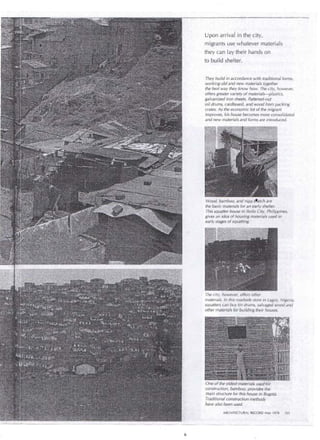
U pon arrivar in the city, 
migrants use whatever materials 
they can !ay their hands on 
to build shelter. 
· They build in accordance with traditional forms, 
working old and new materials together 
the best way they know how. The éity, however, 
offers greater variety of materials-plastics, 
ga/vanized iron sheets, flattened-out 
··oil drums, cardboard, and wood frorh packing 
era tes. As the economic lot of the migrant 
improves, his house becomes more consolidated 
and new materials and forms are introduced. 
Wood, bamboo, and nipa tl'fatch are 
the basic materials for an early shelter. 
This squatter house in 1/oi/o City, Philippines, 
gives an idea of hot,Jsirg materials used in 
early stages of squátting. · · 
The city, however,. offers other 
materials. In this roadside store in Lagos, Nigeria, 
squatters can buy tin drums, ·salvaged wood and 
other materials for building their houses. 
One of'the oldest materials used .for 
construction, bamboo, provides the 
main structure for this hol.Jse in Bogotá. 
Traditional construction methods 
ha ve al so been used. 
ARCHITECTURAL RECOR¡;>· May 19(6 .103
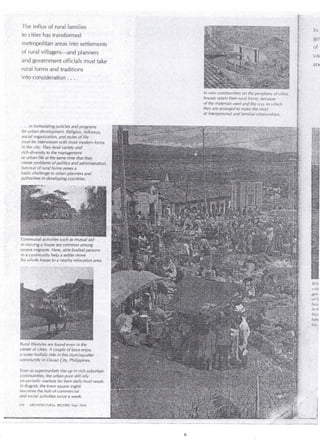
The influx of rural families 
to cities has transformed 
metropol itan are as i nto settlements 
of rural villagers-and plahners 
and government officials must take 
ri..tral forms and traditions 
into consideration .. 
. . . in formulaiing policies and programs 
for urbim develópn1ent. Re/igion, folkways, 
· social organization, and styles of!ife 
must be in'tenvoven with more modern forms 
in the city. They lend varíety and 
rich diversitY to the tnanagemént 
or urban life at the same time that they 
create problems of po/itics and administratioh. 
Survi1a/ óf rural forms poses. a . · 
. basic chal!enge to urban planners .and · 
authoritíes indeveloping counlries. ' · 
in moving ;1 house are éommon among 
recent migrants. Here, 'able"bodied persons 
in a con1hwni(y hefp a sei:tfer move 
his whole hduse to a nearby relbcation area. 
Rurallifestyles are found even in the 
center of cítíes. A couple of boys enjoy 
a water buffalo ríde in .this slum/squatter 
community·i¡;/ Davao City, Philippines. 
E ven as supermarkets rise up in rich suburban 
communities, the urban poor sti/1 re/y 
on periodic markets for their daily food needs. 
In Bogotá, the town square (right) 
becomés the hvb of commercial 
and .social activities twice a week. 
104 ARCHITECTURAL RECORD Ma}-"1976 
In new communities on the periphery ofcities) 
houses reta in their ru!'a/ forms, because 
of the materiais used and the way in -,..N eh 
they are ai'ranged to make the most 
of interpersonal and fam ilia/ relationships . 
In 
go· 
of 
va< 
tri ti 
gov 
off< 
hou 
in ti 
fed 
, hén 
' his ·
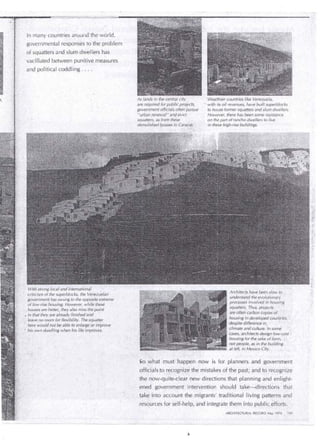
· In many countries around the world, 
governmental responses to the problem 
of squatters and slum dwellers has 
· vacillated between punitive measures 
and política! coddling ... 
With strongiocal and internationa{ 
criticism of the superblocks, the Venez~e/an 
government has swung to the opposite extreme 
of low-rise housing. However, · while these 
. houses are better, they.a/so missthe.point 
• in that they are already finishedand 
. /ea ve no room for f/exibility. The sqÜatter . · he re would not be able to enlarge or irríprove 
' his own dwelling when his life improves. 
As lands in the central city 
. are required for public projects, 
government officials often pursue 
"urban renewal''and evict 
.. squatte;s, ·as from these . 
demolished f¡ouses in Caracas. · 
'Wealthier countries like ,Venezuela, 
·: with its oil revenues, ha ve builtsuperblocks 
to house former squatters and slum dwellers. 
However, there has been sorne resistance 
on the part of rancho dwellers to 1 ive 
in these high-rise buildings: 
Architects.'have been s/ow to 
unders'tand the evolutionary 
processes involved inhoi.Jsing 
squatters. Thus, projects 
are often carbon copies o/ 
housing in deve!oped éountries, · 
despite difference in, 
climate and culture. In sorne 
cases, architects design low-cost 
housing for the sake of form, · 
npt peop/e, as in the building 
at left, in Mexico City. 
~o what must happen EIOW is for planners and government 
officials to recognize tlie mistakes of the past; and to recognize 
the now-quite-clear new directions that planning and enlight­ened 
governm~nt inúúvention should take-directions that 
take into account the migrants' traditional living pat:terns and 
· _resoürces for self~help; and integrate theminto publicefforts. · 
ARCHITECTURAL' RECORD May 7976 .lOS
. . 
Manila beca~e the focus of -the .lnternational Design Con1petition 
because its problems are prototypical, and because plans 
were underway to relocate over 100,000 squatters . from a slum 
in its Tondo Foreshore to a nearby-resettlement ' s~te 
. -Dagat-Dagatan-which needed to be planned 
Metropolitan Manila has been growing rapidly since the end of World 
War 11. lt has over 4.4 mi ilion people, or 12 per cent of the total popu­lation 
of the nation, and this 12 per cent produces over 25 per cent 
of the gross national product of the Philippines. 
The larger Manila Bay Metropolitan Region has almos! one-fourth 
of the national popul~tion qr '8.6 mi ilion people; in an area of 18,051 
square kilometers (6,967 sqúare miles). This is a large land area with 
a relaüvely low population .dehsity, but presént projections indicate 
that this low density won't last__.:.arid that the:Region's population nía y 
range anywhere between 17.8 million and 24 millioh by the end of . 
the century. _Philippine plaríriers who are studyillg growth and land­us~ 
problems at the nationaf sea le are proposing .that, to offsét this · 
forecast growth, new urb~n 'centers should be develbped thrcil.ighout · 
the islands from Luzon to Mindanao. But nó government policies have 
yet substantially reduced the attractiveness of the Metropolitan Region 
to the rural migrant. · 
Manila suffers al! the :usual bad effects of random, haphazard 
growth; including overcrowding of the districts inhabited by th~ poor 
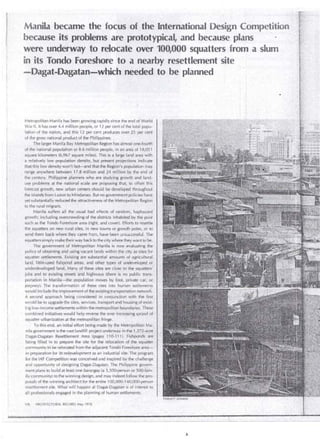
such as the Tondo Foréshore area (right, and cover). Efforts to resettle 
thé squatters on neyv rural sites, in new towns or growtb poles, o; tÓ 
send them back where they came !ro:.,,, have been unsüccessful. The 
squatters sirnply rnake their way back to the city wheie theywant tó be. 
The government of Metropolitan Manila is now evaluating the : 
poli cy of obtaining and usihg vacant lands within the .city as s.ites for 
squatter séttJ€únénts. Existing are substantial amounts of :agritultúr¡otl 
land, littl~~~s~d fishpónd areas, and oth~t types of undevelopéd or. 
underdevé loped. land, Ma~y of these si tes are close·tothe squatiers' . 
jobs· and to existing ~treets and. highways (there .is _no publii: traris­portation 
in Manila;--""the population m oves by foot, prívate car;. or. · 
jeepney): The transfórmation of these sites into human settlements 
would indude the improvement of the existing transportation .network. 
A. second approach being considered in conjuncticin with the first . 
would be to upgradethe sites, ser.vices, transport a~d hm.lsingof éxist~ 
ing low-income settlements within the metrópolitan boundarie,s: These· . 
combined initiative.s would help reverse the ever increasing sprawl of 
squatter urbanization at the metropolitan fringe. . ' 
To this end, an initial effort being made by the Metro'politan Má~,. 
ni la government is the vast landfill project und~irway in the 1 ,Ú.2-acre,:, 
Dagat-Dagatan Resettlement · Area (pages · 11 0-111). FishÍ)(J'~ds · áre: · 
being filled in to prepare the site for the relocation of the :squatier' 
community to be relocated from the adjacent Tondo Foreshore. area­in 
preparation for its redevelopment as an industrial si te. Thé progral')l 
for the IAF Competition was conceived and inspiréd by the challenge . 
and opportunity of designing DagatcOagatan , The Philippine govern­ment 
· plaris to bu i Id at least one barangay (a 3 ,500-personor ·5oo,fam" . 
ily cornmunity) to the winning design, and may indeed .f?llow the pro~ 
posals of the winning architect for the entire 1 00,000-140;ciOO~pefson 
resettlement si te. What will happen at Dagat-Dagatan is of interest to 
al! professionals engaged in the pl anning of human settlements:. 
106 ARCHITECTURAL RECORD.May 1976
··: 
n 
'! 
T 
.. 
The existing squatter slurn 
~the Tondo Foreshore 
on Manila Bay~ 
has a population of 
169,710 on only 455 acres 
This silted, marshy land is-with a 
po¡:iulation of 373 per acre--one 
·of the most congested in the 
country (see cover). Compared 
with other districts within Metro­politan 
Manila, it has more disc 
ease, crime, children per famil y, 
and deaths per 1 ,000 persons. The 
Tondo has fewer hgspital beds, 
less schoolroom spaie per pupil, 
fewer street lights, fewer police­men, 
and more property loss due 
to fire and typhoón. The Tondo 
consumes less water and has 50 
per cent .less of its garbage col­lected 
than the city average. lts 
sewage disposal system is lar 
below the standards of other dis­tricts. 
There are fewer buses and 
jeepneys avai lable to the squat­ters, 
and less park and recreation 
area per person than anywhere 
else in the rest of the city. · 
Jhe Tondo Foreshore area 
was or iginally reclaimed fróm the 
sea to be developed as an indus- · 
tria! si te, b.ut during the long del ay 
· befare the government was ready 
to commence construction, the 
. squatters too k . over. (Throughout 
. the Third World, al! vacant sites 
and public lands attract squatters.) 
Through strong community 
organization, the Tondo squatters 
have developed a degree of politi­cal 
power, and have been difficult 
to dislodge. To help salve this 
problem, the adjacent (and more 
than h.vice as large) Dagat-Daga­tan 
site is being planned to re" 
house them. 
When the Tondo area is fi­nally 
dev~loped for further indus­trial 
uses, it will be a major source 
of jobs for the squatters who 
desperately need them . The area 
wi)l not become entirely indus­trial, 
however, since plans provide 
for at least 9,000 people to remain 
on the si te. This is in line with the 
government's policy to upgrade 
· existing settleinents within the 
metropolitan limits. ' 
ARCHITECTURAL RECORD Mav 1976 ·: 107 
--·- - ~~~~~--
In spite of its squalor, 
the people of the Tondo 
want to live there or near there-,­forjobs, 
education, and a better future 
for themselves andtheir children 
The people ofthe Tondo live clase 
to the piers where the men earn 
their 1 ivir)g as.laborers arid steve­dore:;. 
They are al so el ose to trans­port 
terminals and opén markets 
where thiy find work in helping ' 
load and unload fresh produce. In 
addition to ,their own·shacks, the 
area in which they live contains 
industries such as slaughterT 
houses, glass plar:1ts; and heavy 
· · equipment .depots. lt is a poor 
place for human beings to live­a, 
nd the shift to nearby Dagat­Dagatan 
should be a welcome 
one for the squatters lucky enough 
to be moved, provided they are 
given land tenure .. The Tondo it­self 
is being Jeveioped· furth2;· as 
· an indústriaÍ site-as planned by 
the Tondo Redevelopment Au­thority- 
but will 'still retain about 
9,000 families. · 
The squatters Óf the Tondo, 
like those elsewhere in the Philip­pines 
and many parts of the devel­oping 
world, fit a profile devel­oped 
by social scientist Aprodicio 
. A. Laquian ('pages 100-1 05) and 
.outlined in his report "Siums and 
Squatters in Six. Philippine Cities." 
In his words: "Squatters and slum 
dwellers consider their present lile 
l:ietter than their former situation. 
They see economic and other op­portunities 
in the city and are un­. 
willing to lea ve their present com­munities. 
The break with the rural 
place of origin seems to be rela­tively 
· final. Most squatters and 
slum. dwellers make the move to 
the city .when they are f'!lalure 
and, often,~arried. In the 'case of 
the rl)arriiid mig~ants, the head of 
the family usually goes to ihe city 
first, blit the number of families 
who move as a group is also high. 
These facts supp~rt · the irre- 
. versible ·nature -of rural-urban mi­gration. 
'~The migration chain play~ 
· an importart . part Relatives and 
.d riepds who precedethe migrants 
help them make the decision to 
move and settle down in the city. 
In this way, the adjustment of the 
migrahts to lile in the city be­comes 
éasier. 
·"Most squatters and slum 
dwellers have a low leve! of edu­cation, 
.lack technic;:al, and profes­sional 
skills, and find/ employment 
only in unskilled or semi-skilled 
jobs. Their aspirations for them­selves 
. and their children, how­ever, 
are high: Owrership of 
home and land is a primary moti­vation. 
"The incomes of squatters 
and slum dwellers are low. Living 
in slum and squatter areas helps 
make ~nds meet. Other family 
members besides the father work. 
Squatters firid the slum conditions 
acceptable as compared to their 
former condition of lile in the rural 
areás.' Although they see living 
conditions as hard, they seem to 
accept them, and consider thern 
temporary." 
The photographs of T ando 
lile (left) show squatters and their 
children .at leisure (1 and 4); 
women washing clothes in water 
seeping from ruptured pipes (2); 
children at a co'mmon water tap 
(3); residents "cottage-manufacc 
turing" picture frames (5); chil ­dren 
ata small open-air store (6) . 
Density within the residential 
areas of the T onda ranges from 
1 O to 14 70 persons per acre. 
T ando has a very young pop­ulation. 
Of the total members of 
17,418 households, one-half are 
below 19 ye¡¡rs . old. Those be­tween 
the ages of 20 to 39 com­prise 
29.6 per cent, while 12.1 7 
per cent are between 40 to 59 
years old. The median age was 
found to be 17.3 years, which is 
lower than for the Metrbpolitan 
Manila are a (19 years), and that of 
the entire country (17.9l. The 
•average. number. of diildren per 
family is five . 
. ARCi-liTEC!Ui<AL RECORD Mav 1976 . 109
11 0 ARCHITECTURAL RECORD May 7976
Dagat-Dagatan-the site 
of the competition~ 
will become a riew-town-.in-town 
instead ofa remate, 
underserviced, resettlementarea 
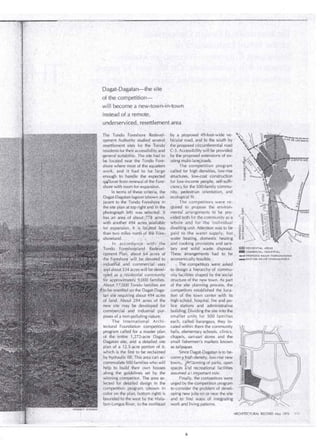
The Tondo Foreshore Redevelc by a proposed 49-footcwide ve­opment 
Authority studied severa! hicular road, an,d to the south ·by 
resettlement sites for Hie Tondo the proposed circuhiferential road 
residents for theiraccessibility and C-3. Accessibility »'¡¡¡be provided 
·general suitability. The si te had to by the proposed extensions of ex­be 
located near the Tondo Fore- istingmulti-lane;,roads. 
shore where mbst of the squatters The competition program 
work, and it had to be large called for high densities, low-rise 
· enough to ·handle the expected structures, low-cost ·construction 
.. spjllover from rene..yal of the Fore- for low-.income people, self-suffi-shore 
with roomfor expansion. ciencyfor the 500-family commu-ln 
terms of. these criteria, . the nity, pedestrian orientation, and 
Dagat-Dagatan lagoon (shown ad- ·ecological fit. 
jacent to the Tondo Foreshore in The competitors were re­the 
site plan attop right arid in the quired to propose the environ­photograph 
left) was selected. lt mental arrangements · to be pro- 
. has an area of about 778 acres, .vided both for the community as a 
with another 494 acr~s available ;wbole.and for the individual 
for expansi~n. , lt is .. !oéated less .. dwell ing u ni t. Attention was to be • 
than tvvo miles no.rth of the Fóre-. · paid to the water supply, hot 
shoreland. • . water heating, domestic heating ' 
1 n accordance with- .t!Íe ·, and cookingprovisions and sani­Tondo 
'Foresho~eland ~edevelc • li!ry and sol id . waste disposal. 
· opment Plan, about ,64 acres of These arrangements had to. be 
the Foreshore will be de'oted' to ecoriomicallyJeasible. 
• indust~ al . and comrilercial. uses ' The competitor.s were askecl 
,j ncl about334 acres will be devel- t() clesign a hierarchy·0f commú­. 
:· oped as a re5iclential connnunity nity(acilities shaped by the 5oeiai 
for approximately 9,000 families.· structure of the new town. As part 
About 17,000 Tondo families are of the site planning process, the' 
-lto be resettled on the Dagat-Daga- competitors establ ished the loca­tan 
sit~ requiring about 494 acres · tion of the town center with its 
of land. About 284 acres of the . high schóol, hospital, fire and po­new 
site · may be developed .for !ice stations and adrriinistrative 
comn1ereial and industrial pur- building. Dividing thesite into the 
poses of a non~polluting ni)ture. smaller units for 500 families 
The lnternation:il Archi- e¡¡ch, called barangays, they lo­tectural 
Foundation éompetition cated within them the community 
program called for a master plan halls, elementary schools, clinics, 
of the entire 1 ,272-acre Dagat- chapels, sari-sari stores and the 
Daga tan site, arid a· detailed si te small fishermen's markets known 
plan of a 12.5-acre portian of.it; as ta/ipapas . 
. which is the first to be reclai.med Since Dagat-Qagata,n is to be­. 
~ by hydraullc fill. This area ca1í ac- comP:<t. ~igh-density, low-risé riew 
commodate SÓO families who will town;., Jrle,r::anning of parks, open 
help to build their own houses spaces lf.,p recreational facilities 
along. the guiclelines set by the assumed a irr¡portant role. 
winning cornpetitor. The area se- Fif)ally, the con1petitors were 
.lected · fo.r cletailed design ·.in the urged by the competition program 
· competition program (shown in to consicler the problem of devel­c6loron. 
the plan, bottom ~ight) is opirig new jol:ísón or near the si te 
bounded to the' west by the Mala- ' and to .. find ways of integrating 
· bon:Longos River, to the northeast . work¡;¡nd living patterns. 
~ RESIOE NTJAL AREAS 
~ COMMERCIAL-INDUSTRM L 
-- PROPOSEO MAJOR THOROUGH.FARES 
__.EXJST.ING MAJOR tHOROUG-tifARES 
ARCHITECTURAL RECORD Ma~ 1976
The lnternational Design Competition 
for the Urban Environment of .. 
Developing Countries ~ focused ,~n Manila­attracted 
476 submissions. On t~ next 42 pages, 
as chosen by a distinguished international jury, are ... 
112 ARCHITECTURAL RECORD Ma)' 1976 
The jury re laxes (top left) after the 
winner is announced. The jurors 
were Balkrishna Doshi, Eric · 
Lyons. Mildred Schmertz, MoshE' 
Safd._ie, W· i~lli m Whitfield, Ge1i" . 
erar .Gá. cio V. ·Tobias, and . 
Takama c. Yosizaka. ·At lefl, ór.' 
Aprc:.!t io Laquian, jllry ad~isor; . 
IAF ' president Blake 1-!Ughes; and . 
Teresita Vicera, resiclent o( the 
Tondo ancl advisor to the jury. At 
righ.t, the professional advisors: 
Michael Seelig, Fritz Gutheim, 
· Anhur Erickson of Gutheim/See­lig/ 
Erickson. 
i . 
.. 
! 
In 
REC 
tio1 
tio1 
sta< 
eh;: 
in t 
·¡n s 
an 
thel 
and 
to _, 
wor 
·' . -· The 
was 
The 
(IAF 
lecti 
the 1 
en a 
ITAl 
tio·n~ 
u ty, 
help 
in a 
plan 
!ion 
petit 
[Jine 
for t: 
who 
genE 
com 
Stud 
Dev· 
' Arts, 
RECC 
tin e 
Ceo 
f !r; 
c iate 
,~N 
&G1 
abov
E WIN~NING DESIGNS 1 eL  
1 
' 
1 
In his editorial announcing ·the cornpetiti.on, back in April 1974, 
RECo'RD publisher Blake Huihes quoted Charles Abrams: "The solu­tions 
to the problems of urbanization may be the key to an interna­tional 
rapprochell)ent~and evento a lasting peace .... The main ob­stacle 
is, of course, the dearth of talent and knowledge for r:neeting the 
' challenges of urbanizatign."_There are, of course, many majar efforts 
i1i ihe world community to alleviate the condition of the poor trapped 
in slums around most of the world's majar-cities. But, as we said in 
· an earlier editorial:. "lt is fair to argue that with few exceptions ... 
' there has been-little opportunity for architects as a group to participate, 
· and thus lit¡le opportunity for governments and concerned inclividuals 
to see the possible contribution of the thinking ancl talent of the 
' world's aréhitects. Thús the campetition." 
:.rhe competition~frórn conception to completion~ 
. was ·a three-year project involving hundreds of people 
The formation of the non-profit lnternational Architectural Founclation 
(IAF) to hold the ·conipet.ition was an_nounced in RECORD and L'Archi­tecture 
d'Aujourd'hui in April 1974: But i~ the development stage of 
-the IAF, Blake Hughes~its president-was greatly assisted by Ms. Hel- 
- ena Benitez; then director of the PreparatoryPianning Group for HAB- 
_ ITAT and now presiden! of the Governing Council of the United Na­, 
ti()ns Environment Programme (UNEP);· and by Eri,c Carlson, then dep­uty 
director of the PPG. Ms. Benitez was not only enthusiastic a:nd 
helpful_ in setti'ng the goals of the competition, but was instrumental 
_in arrarlging for the enormous coopera:tion of Philippine architects, 
planners, and governníent bfficials during the writing of the competi­tion 
program; in_making arrangements for a commitmentof the com- 
-_ peiition site in Manila; and in obtaining a special grantfrom the Philip­p[ 
negovernment to help cover the costs of the competition. 
· The publisher and-staff of'REC.ORQ ·Luidertook to raise the money 
for the IAF, and it is appropri¡lteto name here~with thanks from al'l 
who worked on the competition and .will benefit from the thinking it - 
· generated-the organizations and individuals whose grants made the 
competition possible: Sponsors are: Graham Foundation for Advanced 
Studies in the FineArts, and Johns-Mánville. Patrons are: lriternational 
· · Development Research Centre (Canada),. National Endowment for the 
and .The Rockefeller Foundalion. Donors are• ARCHITECTURAL 
RECORD; The Architects Coliaborative; The Asia Foundátio~; The Aus­tin 
Company; The F9rd Foundation; Hyatt lnternational Corporation; 
, · · P. MeNear, jr. Foundation; Owens-Corning Fiberglas Cor­poraiion; 
PPG Industries Foundation; and Skidmare, Owings & Mer­rill.' 
Contributors are L'Architecture d'Aujourd'hui; the staff of RECORD; 
W. R. Bonsal Company; Building lndustry Development Servic:_es; CP 
Dalton-Dalton Little Newport; Arthur Sworn Goldman & Asso­lnc.; 
Ir. E: Hendrik Grolle; RAIC; Gruzen and Partners; Harrison 
Abramovitz; Hellmuth, Obata: & Kassabaum, lnc.; Smith,.Hinchman 
G.ry!ls Associates lnc.; and S tone:, Marraccl~i & Patterson. As n~ted 
· ihere was a grant from The Government of the Philippines. . 
1/(/1  
As professional -aclvisors for the competition-conducted under 
the ru!es of thé Union lnternatiOI1iile des Architectes-IAF retained 
Gutheim/Seelig/Erickson, a consortium fonned to do international 
planning, design, and development by . Frederick' (fritz) Gutheim, 
noted. planner and author; Michael Seelig, architect, planner, and 
teacher; and distinguished Canadian architect Arthur Erickson. The 
program they developed for the competitio·n was a model of its kind; 
and their conduct of t11e · judging efficient and impec,cable. (Gut­heim/ 
Seelig/Erickson is also responsible.for the developr'nent and de­sign 
of the exhibition based on the-competition design~ to be shown 
atthe Vancouver Art Galfery duringtheUN's HABITATConference.) 
Architects were invited to .register for the cornpetition 
in March 1975; the judging took place in February .1976 
In response to an invitation published in· RECORD, other professional 
niagazines, anda bulletin of the U lA, 2531 registrations fróm 68 coun­tries 
were received. 476 completed submissions were received and 
presented to the jury, which met in February in Vancouver. Only alter 
five days of study and debate did the jury a:nriounce its judgments and 
relax (see photo top left) as Arthur Erickson opened "the sealed enve­lopes" 
w ith- the names .of the winners, The judges were (see photos) 
Balkrishna 'ooshi, lndián architect .a:nd planner, Honorary Fellow of the AlA, dean of the Centre for Envirorímental Planning and T echnol­ogy, 
Ahmedabad, and frequent lecturer at U.S. universities; Eric Ly,ons, 
.chairman of the jury, presiden! of the. Royal lnstitute of British Archi­tects, 
Honorary Fellow of AlA, knciwn especially for his award~win­ning 
workin housing and his prqmotion pf the concept of.architectura l 
.competitions; Mildred Schmertz, AlA, arthitect, RECORD senior editor, 
,and author; .Moshe Safdie, lsraeli-born Canadian architect with offices 
inbcith countries, a broad international practice, perhaps best kn0w'n 
. for hi~ " Habitat" housing in Montreal and in Puerto Rico; William ' 
Whitfield (alternate jurar), who practices in London, is active in RIBA, · 
and is a membero(the Royal Fine Art Commission; General Gauden­cio 
V. Tobías, who is acting general manager ofthe National Housing 
Authority of the Philippines, executive vice presiden! of the National 
Housing Corporation, a1id chairman of the Housing and Urban Devel­opment 
Team,:Office_ of the Presiden!; and Takamasa Yosizaka (alter­nate 
jurar) architect, teacher and one-time dean at Waseda U niversity, . 
Tolwo: and past-preside_nt of the An::hitectural_ lnstitute of Japan. 
Al so shown ih the ·'photos, at boit9"'m left, ·are Dr .. Aprodicio La" 
-quian, so,cial stientist who advised the jurors and supplied the photo , 
essay on page 1 00; Bl¡¡ke Hughes, president of IAF and publisher of 
RECORD; and Teresita Vicera, a residen! arid barangay leader in the 
'Tondo Foreshore, and ·an advisor to the jury. 
The ·first-prize .winner won an award of $35;000 (pl us the -wm­mission 
to complete the. prototype design in accordance with -philip-_ 
pine law); the second award was $15,000; the third award wás $10,- 
000; and four oíher entr~nts were awarded $1 000 e~ch · for· sp~cial 
. menticins. Their prerniatecl clesigns are shown beginning overleaf. 
ARCHITECTURAL RECORD Ma¡; 1976 113 1> 
~' ; 
·T
~--:_)j,;;J.r-;""l 
p-r0~<J¡;):r-1 
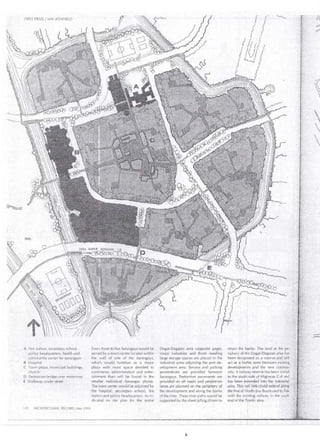
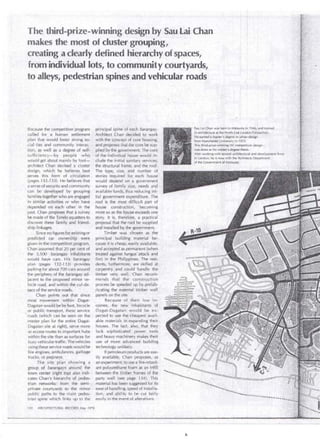
The first-prize-winning design by lan Atllfield . . ( LA -~~-0·'·-''c 
of Ne".f ;-?~aland proposes_f_9r é~rh "barangar, a new 0kf~(tof workJJI . 
>=,;)- {;,._ _ /' ..~. -..· · .• ._E..-.-._a~~ dA... 7 Q_.~---~,_,--Y.../-'-~~1...-~ . . ' Uv--r~e,.....-.~-;· --·'---?-:.~..;? _7~ ~~- (l.,_ . 
- a penphery of hnear bulld1ngs LC~u.__. d~sugneo for a comb1nahon 
.. _'--.A:_ ._ ..._-.'X......,...-"-. 8 
otc6tt~fe, light, añd non-pOíf~tiilg~eJ 
industries vy!th community ga~d~ns on top 
r ~--··.&:.-----  . ..:.> .... l--1 /- r:-~ , i /?'' , , ......, , . · 1 ·-:---¡-- ,... 1 ~ ...f" QD 
-~-·- L•. -L:/__.[L-L' ;.··. '- vV./---J_/..~ (?'~•..._.,.(..A._..{_¿..¡_.;,_~I.....-!.-: ..... ~ ~~ 4='--"'L.!t.J-'..~ 
The jury awarded first prize to lan 
Athfield, a young Ne'f~ Zro0 lanrL 
. !!'r'GcérOJO · 
arch1tect, for. a tourageous pro-posa! 
tlli:lt makes .the workplace of 
the community the majar control~ 
lingelement of the design. This 'in­troduction 
of job-generating space 
is a truly new concept a~d repre­sents 
a genuine advance in · the 
physical planning for human set­tlements. 
This work space should 
significantly help the lnhabitants 
of the Dagat-Dagatan b.arangays 
to transform themselves intó a 
self-sufficient community. 
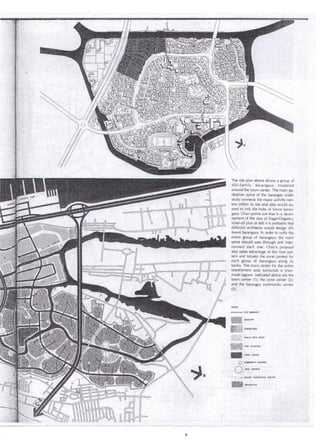
Accord ing to Athfield, this 
working perjphery (see site plan 
and sections right and overleaf) 
would be the first part of each 
community to be built. lt would 
· be a significant addition to the 
customary installation of sites and 
services - the goyernment-sup­plied 
infrastructure bf roads, sew.­ers, 
piped water and electricity. 
· ~he pepple movi:1~ g?}?a,gat­Dagatan 
vvould help eréd"' this 
working periphery in increments 
as ~eeded. A particular ' area 
within each working periphery 
would be reserved for a building 
cooperative ruh by the loca l resi­dents. 
This cooperative would ini- 
. tially control.thesupply-,. manufac­ture 
ancl use of building materials 
for the barangay. Households pos­sessing 
existing building materi­als, 
in the form./ of their prese,1]t 
shanties, coulcl trade these in at 
the cooperative, which would ar­range 
tlie recyding of such mate­rials. 
The cooperative, by li'miting 
the range and variety of the build­iilg 
rnaterials to be mqcle avail- . 
able, could help achleve a consis­tency 
and upity in the design and 
a¡:ipearance of the housing units. 
As the cofnmunity develops, 
the roie of the building cÓopera­tive 
cóuld bmaden to include the 
provision of cither building e l e~ 
ments, and td supply a market 
beyond the initial comrnunity, 
114 ARCHITECTURAL RECORD May 1976 
thus increasing the number of jobs where individuals coulcl be 
available. 'Sp'ace within the work-!. trained in alternative energy· and 
ing periphery would also be recycling techniques. liidividual 
leased to private.light indústries,: industries ancl households would 
thus bringing even more jobs· to be ' encouraged by a small pay" 
the barai?gays: ment to send all their wastes to the 
Athfield proposed that the' energy cénter. As awarenéss aiid 
families of any person obtaining 'understanding of the waste and 
employment In the working pe~ energy systems clevelops; familie5 · 
riphery would have priofity in ob- would be encouraged a lid assistecl 
taining a house si te in the baran-, td cliwelop their own conservation 
gay. He has calculated that beJ andenergy plants. 
tween 300 ¡md 400 people could , Each energy centerwould be. 
be employed for every 10,000 ' looked after by a caretaker. Wind­square 
meters (1 07,600 square : milis for the energy centers' would 
feet) of working space surrouncl~ ~l2>cated ori the roof oftÍle woi·k­ing 
each .bara;1gay. Given apprdx" ing perimeters adjo!n.ingJ:ommu­imately 
188,300 square feet o.f . nity'"'gardens also located there. 
working perimeter, between 550 ,, The gardens and energy centers 
and 700 persons of'thé SQO fami ~ would be a .strikingly visible ex­líes 
living in each par¡uigay would 'pression o(tle --éoope1·ative 
have j,obs within walking distance • achieitements'of the community. 
of their homes. AthfieÍd points out. The working perimeter will · 
that the place of work and the serve as a ?trong physical ..!?,g.uGcf:. 
home should be closely assoc -~Y for e,ach barangay. As Athfield 
ciated to récluce the time and cost r(Jóln!~ .. <OLi't within the. Philippines 
of commuting to.work, but justas 'tiléiAiaiÍhas been a strong element 
irnportantly, to encourage cooper• of design definition as well as se~ 
ation within the .community itself:· curity..from the begirining of the 
The working peripherywould · · Spanish influence. The perimeter 
2!so contain 5eV¡>ral community structures ' around each barangay 
energy centers (pages 120-1 21) .will help shape lively streets bec 
from which thé conservation of tween · thenl. These streets will 
energy could be .d'irectécl and . have the qlliJ,Iity of the pedestrian 
l~n Athfield (front and 
éenler) founded Athfield 
. Architects in 1968: 
(leflto :igh() MoyraTodd, 
Wal Edwards, Graerne Bouche, 
.Ddri Báird and lan -Dick-son. 
Absent is Ti m Nees. 
B'ónÍ in Christchurch, 
New Ze~land in 1940, ' 
Athfield ·earned his ', 
Diploma of Ardiitecture 
frorn .Auckland School of 
/rch•tecture in 1963. 
A profile of Athfield and 
his work i? on pages 42-43. 
-- - - --~~---------- 
passageways of pre-automobile" : 
age cities ancl towns-'-'alive with 
workshops, : small sto1'es, markets 
ancl food star1eJs. 
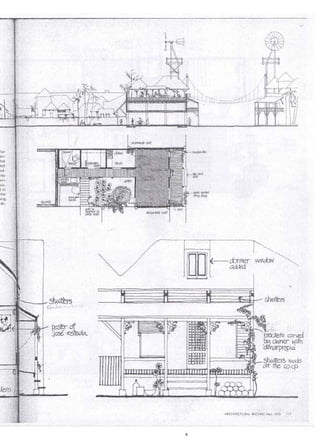
Athfielcl's house cfes ignsdetti- · 
onstrate, .in the opinion o! the jury, 
" his sensitiyity to the cu lture ancl 
life style of.the comrnunity and its ' 
'asp iratlons." Occupying individ­ual 
siies, iwhich would average 55 
squar~ n¡etersJ?~1'. scjuare. f~~t) ,, : 
each, the d1véltiñgs can be 1bVilt'.l0 ·. 
by the fesidents ihemselves ·:at 
1 '· ' . ' 
their present state of competence 
as craftsri1e1i; witlií11 the- tr¡¡¡di­tioni 
rural Shiidii;g"vernacular of 
the Ph ilippines (pages 116-12'1)., · 
Athfield urges that the si te$ be .· 
leased to 'thé newinhabitants with · 
eventual rights of ownership. His . 
deeply a ii~Jsi'e and .· expressive 
drawings show how the bara_rígay. · 
houses cou lcl look alter the farni~'i 
l~? . l;ave beet1secure in thern foi ·: 
aVhile. As length .of lenure; effort' · 
and investment increase, gardens·.·. 
and trees are planteo. 'The houses . 
expand to in elude small verandás; " 
kitchen and laundry e.quipment is 
improved; better 'furnishings are < 
purchased; potted plants apiJear 
and pictures clecorate the wa}ls. 
Doon< window frames and shut-· · 
ters/ made at the.builcling materi: 
als :coopera ti ve and. purchaséd in 
stages by the niigrant as he graclu- · · 
;.:!!y beE:omes .able to afford · 
t)lem-.-:.coritribute to the. so!idity · 
ánd permanence"of his house. As 
' his, family grows and his ~ eco- .. 
nomic positi()n iriiproves,, the . in-'- 
habitant's house grows to éxpress 
his owri and his f~1r1ily'~ expand­. 
ing'needs and rising aspirations. 
In his submission, Athfielcf 
proposes that his winning desigri · . 
team work with each f<~mliY to 
gíve advice on boundary situa:. 
tions, erection procedures an.d 
building techniques. He sees this 
di'rect work with the community 
as the principal ancl most chal­lenging 
task 61 the desi~n tea¡n.
- ~~--- - - ---- - - 
·¡ / 
j' 
;::~'¡!'l¡~¡:;~~-~~~~~~~~~~~nr8r~~ 
u::::C::------:f!"':¡4~ 
The sections (above) ~ snow the rela­tionships 
between the working periph­ery 
and the houses and other commu­nity 
buildings. ShowrÍ on top of the lin­ear 
ooundary structuré are the com­munity 
garders. Adjacent to the mar­ket 
place (M) are a nursery school, ele­mentary 
schciol and health clinic. lndi­catecl 
on the plan are sari-sari stores 
(5), energ' centers, and a church (C). 
Four puroks (subdi visions of the baran­gay) 
each have a basketball court as a 
center. The number of housing sites· 
per puro'krange from 121 to 138, to­taling 
484. Automobiles and jeepneys 
are garaged under terraces which abut 
the ins ide walls of the working periph~ 
ery. Footbridges span the motorways. 
/
··F JRST PRIZE 1 IAN ATHFIELD 
116 ARC~iiTECTURAL RECORO 1976 
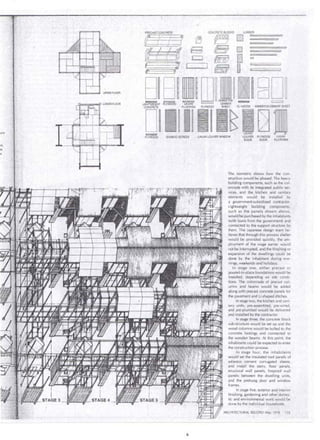
Athfield propases that the coconut 
palm be utilized to provide the piin· 
cipal building elements. ltis· in abun­dan! 
sLipply ¡,. the Philippines arid will 
continue to be so in the foreseeable fu­ture. 
The timbér tan be us~d in its nat­ural 
state if dried and preserved: Jis by­products 
include the . prcicluction of 
charcoal, chip-based ·cement. blocks, 
particle bciard, .insulation fiber c'ement 
board, furniture and jolnery: The win­ning 
clesign recommends that the 
house units be bui li oi timber Ira me for 
VeV1k 
resistance to earthquakes. Athfield cernen! ins.ulatioh .in party walls fór 
points out that timber frame con- -sound insulation lias "also been Tecom~ . 
struction is within the craft skills of the .. rriended. Athfield strongly urges that 
Tondo Foreshore squatter. Roofs aricl the vocabulary of malerials be limilEed 
walls would be panels óf plaster made to the coconut paln1 and its by··prod, 
with. é:oéonut sawdust, sand and ce- ucts to give an.underlying 
meritove.r expanded metal mesh. (See to the barangay,c 'Furthe,rmore, 
details page'120). These panels vou ld sistently . employing these 
.. be fire -resistanL and · would provide •. the resicientswould become skilled 
good insulation against the Manila · .. the ir Lise .. Purt hasecl 
heat. This material l~nd s iÍselfto addi- cost could he me! by 
tions ancl alteratións without skilled , a~ avérage of .371.43 pesos a.montlv 
techniques. The use of toconuí líber' or $53.06 in u.s. cloll ~is.· 
'1
.... _ . 
6~~ts car~ · 
.~ ONrff. V{lth 
a'VvarpmpLc 
~----~~ .~5~ffi~ 
ot tf0 cocp 
i _ •".:. :. 
ARCHITECTURAL RECORD May 1976 '117
(' 
FII<ST i' RIZE 1 IAN tTHFIELD 
wo.lkw~ 
/ 
cowwwAvUt0 . ¡ 
Y~frtdgercádr · 
pnvy ClVld ener9~ . '· 
1DNer of adot5e bY'/c/(,:, 
. CooPERATloN AMONg FoUR. NEIG-HBoURS 
118 ARCHITECTURAL RECORD lvlay 1976
BA~Iv UNIT WITH LEANTo 
~~~~------g~!lt:'r 
~ ~~f+-'-----'tt"- pl1sJl·c ~plúA 
of santa V i.V:o 
.Iu.:Js wOliSlbp 
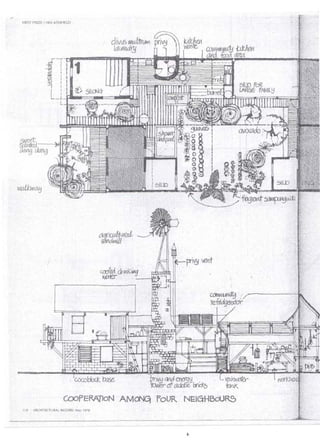
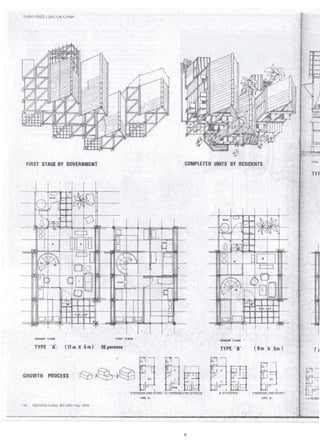
The plan (left top) shows tour lots of they would appear alter the families 
592 square feet each, combining in a had lived in them long enough to bu ild 
.cluster of houses for four families. The verandas, to plarit trees and gardens, 
combined elevation-section (left bot- and to ácquire simple domestic ar- 
"tom) shows tw0 of the houses. Th.c ticles and furn ishings. The squatters of 
fbur families share the privy and the Tondo Fóreshore keep pígs and 
laundry, the compost pile, a commu- chickens for additional income and 
nity kitchen; relrigerator, and food hope to continue to do so when they 
area, the agricultu ra! wind,.;,i ll and the move to Dagat-Dagatan. The three 
cooled water· tan k. Each family has a plans · and comb.ined elevation-sec- . 
si long, or space below the first floor at tions' (ab9ve) show va riations of the 
ground level; anda si/id, or living and . basic house unit, including an ex­sleeping 
space on the first or second ample of how the house can abut the 
f loor. Athfie ld has drawn the houses as inside wall of the working periphery. 
ARCHITECTlJRAL RECORD May 1976 119 ·
FIRST PRIZE 1 II N ATHFIELD r- 
=p / 
- - . 
~1 
-~;~.-~~-- 1 _ _1 _ _ li~1frr~ 
ALTERNA.TIVE 1.COfiNCr 6!1-STEMó 
{11i><l t<lg ¡¡11J._ IIV<U.<ó--71 
b~j OWW:í 
inS!Jot/01<.- ~~ (~~~!ffrrJ. 
WALL CORNEÍZ DETAlL . BdJNDAR:l WALL JUNCTION 
'':·· 
UTlliZATION oF Ccx::oNLJT L<XrS 
CoP.NER FILE 
lYPIGL CoN5TRUcrloN DEfAILS 
120 ARCHITECTURAL RECORD Mav 1976. 
1 
' 1 
Although Athfield cont~¡ds~ thai it can­riot 
fairly be suggested' "tilat a family 
on a wage of 300 pesÓs a month purify 
its water, cook with charcoal · and 
compost its waste, while an industry 
.uses all the .energy and water it wariÍ:s 
and discharges its .waste untreated into 
the adjoining river," his design soiU- . 
tion, nonetheless, contain~ · excellent 
proposals for .wasle dispos.al. and ·the . 
development· of alternative energy 
sources .within the barangay. Each 
community. of 500 · .fami lies . wduld 
have several .. small tommuriity. energy 
centers (section and plans opposite 
page top), ·which wóuid contain toi­lets, 
showers, .a communal laundry, a 
solar heal'ing element and a waste di s­posa! 
plant witli a compost unit from 
whicll methane gas would be. ex­tracted. 
The barangay working periph­ery 
woüld I10Use larger energy.centers· 
(above and right). Construction cletails 
flefl) are for the basic structures. 
D
UPPEI' LEVEL 
/ 
/ 
1! 
;¡¡:;¡;;:¡; ---= f"<ff3__ 
 . L. 
D . O . l~ 
o 
' i 
1 i 
ARCHI"T~~;fURAL RECORD~1ay i976 121 
~?: 
()(O'J . 
_,,.,.~" 
mJt 
gaitb,;;
FIRST PRIZE /IAN ATHFIELO 
PARK 
A Fire station; secondary school, 
poli ce headquarlers, heálth and . 
community center for barangays 
B Hospital 
C Town plaza, municipal buildings, 
church 
O Pedestrian bridge o'{er motorway 
E Walkway under street 
122 ARCHITECTURAL RECORD May 1976 
Every three tó five 'barangays wóuld be 
served by a lown center located within 
the wail of one · of the barangays, 
which would fuMction as a major 
plaza with more space devoted to 
commerce, administration · and ente'r­taínment 
than wifl be .found in the 
smaller individual barangay plaZas. 
The town ceriter would be adjoined by 
the hospital, sec::ondary. schodl, ·tire 
slalion and police headquarters. As in­dicated 
. on the pl"n for. the entire 
Dagat-Dagatan area (opposite pagel, 
n1ájoi industries and those ~eeding 
large storage spac~s are plaéed in the 
industrial zone adjoinihg the port de­velbpnient 
area. Service and parking 
penetratiohs are provicled betweer1 
barangjys. Pedestrian pavements are 
provided on al! roads and ped~·stri an 
Janes ·are planned on the periphery of 
tlie development and along the banks 
of the river. These river paths would be 
supported by the sheet piling driven to 
retaln the banks. The land at the pe-. 
riphery of the OagatcDagatatl area has . 
been designated as a reserve ar)d ~viU 
act as á buffer zone betweeri existiirg 
develoj:iments . and the new corn.mu: 
nity'. A railway reserve has been zoned ,;' 
to the sóuth si de of Highway C-4 and •. ;;_;' 
hás been e>¡tended into the industr ial ,,;;,·;· 
aiea. This raillinkci:iu ld extend along ' ·_; 
the Jine of N'orth Bay Boulevard to link: ''} 
with the existirig railway in the soulh · 
en el of th<¡ T pnclo are a.
The second.;.prize-winningdesign by Takagi Design Associates 
of Tokyo proposes the ·use of ·colonnades to help shape : 
the pedestrian paths and other op~n spaces 
of the barangay, providing an order within which 
the individual houses can multiply in a modular patter~ 
. . ! i 
The japanese teaiTl's proposal an­swers 
a key question they asked 
themselves: whether public or prí­vate 
space, or both in combina­tion, 
should receive the most eme 
phasis in their design for Dagat­Dagatan. 
Japanese cities are pric 
vatecspace oriented-gardens and 
courtyards areenclosed within the 
house ·and car eful l ytended~ 
while aileys, streets and géneral 
open space are . neglected. B ut' 
even in those countrie·s which­unlike 
Japan-have é:ities 'of. great 
civic beauty, the publicspaces of 
low-income communiües are 
oflen dilapidated and Ígnored. ,. 
Architects Takagi, Hayakawa 
and Takahashi decided · to give 
equal emphasis to .the. achieve­rnent 
of the highest practiCa:! ('ll­vironmental 
standard at both the 
sea le of the neighborhood ancl the 
scale of the house. To this encl 
they devised a colon nade, which 
they believe woulcl actas a citta­lyst 
for the gradual enrichment of 
the pub! icly shared physical envir­onment 
of the settlement as im­provements 
in the economic sta­tus 
nd 1 
with the peclestrian paths and 
other open spaces of the barangay 
and helping to shape them, woulcl 
be the major social; structural and .:·: 
visual element of the community 
infrastructure. lt would be a space 
maker, the first stage in the build­ing 
program, ancl the founclation 
fcir the inhabitants' self-help. 
· just as governry¡ents bu ilcl 
roads ancl inclividuals :buy~ 6n their 
mNn the automobiles thatare clriv­en 
on . them, the government of 
Metropolitan Manila would subsi­clize 
and construct the colon nades 
<'lnd · integratecl public services 
(roa.cls, water supply, electricity, 
clraitiage); and each inhabitant 
would pay for and hei.P constrlict 
his private .,dtelling, which con­nects 
to ·this infrastructure. 
124 ARC HITECTURAL RECORD May 1976 
Mikiro Takagi (left), born in Tokyo in 1941, received a degree in architecture · 
frbrn Waseda University in T ok)~O. He-/eceived a mastér1S degree 
from the School of Art ánd ArchHécture of. Y ale .t.Jniversity, 
and worked for architects Paul Rüdolph and Ed.vrtrd L. Barnes in New York. 
Kut)ihiko Hayakawa (middle), al so born in T pkyo in 194_ 1., ,...,,a·s: a dassmate 
of Takagi's at Waseda Universiiy and at.Yal·e.J-Ie worked for Moshe Safdie 
in Montreal. Keiichiro Takahaslii (rightl: born. in S higa i11 1950, graduated 
from the Department of Architectu;e of the Professional School in Shiga. 
·ir· . . . J4 · · 
t ~ • • ' 
~.,,,,-,-r~· -T· _¡¡¡¿ti. ~ __ J__ ~ "·" ~- 1 
l ' l ¡ 
1 
1 ' 
' 1 
---J-.-- · - - -~---.,.-- 
'' '' ' 1 
' 1 
: ¡ 
s~Il ~j_ _ -~rla., -~~~~~::, .¡;. . e
PRECAST. CONCRETE 
~le="=· ='=)=· =t:· =' =-:;j(l 
t:t=t=1 
~1 . ~ 
te=--------------- 
-PLYWOOD BAMBOO SCREEN 
CONCRETE BLOCKS 
~ DO~ 
#t:=J?) 
fffff} 
f&#J · 
.LAUAN LOUVER WINDOW 
LAUAN 
LOUVER PL YWOOD LAUAN 
DOOR DOOR PLATFORM 
The isometric shows .. how the con­struction 
woud be· phased. The heavy 
building components, such as the co ­onnade 
with its integrated public seh 
vices, and the kitchen and sa nit?ry 
eements would be installed by 
a governinent-subsidized contractor. 
Lightweight . building components, 
su.ch as the panes shown above, 
would be purchased by the inhabitants 
(with loans froril the government) a'nd 
conne·cted to the support structure by 
them . The Japanese design team be­lieves 
th at through this process shelter 
would be provided . quickly, the em­ployment 
of the wage earner vyould 
not·be .interrupted, and the finishing or 
expimsion ol the dwellings cou ld be 
done by the inhabitant during eve­nings, 
weekerids and hol idays. 
In stage one, either precast or 
poured-in-place foundations would be 
installed, deperiding on site condi­tions. 
The co onnade of precast col, 
umns and beams would be. added 
along with precast concrete panels for 
the pavement and U-shaped ditches· . 
. In stage two, the kitchen and sani­tary 
units, pre-assembled, pre-wired, 
and pre-plumbed woud be delivered 
and installed by the con tractor. 
In stage three, the concrete block 
sub-structure would be .set up and the 
wood columns woud be bolted to the 
concrete footings · and connected to 
the wooden beams. At this point, the 
inhabitants co,u ld be expected to enter 
the construction process. 
In stage four, the inhabitants 
wo~d set the insulated roof panes of 
asbestos cement corrugated sheets, . 
and insta the stairs, floor panes, . · 
structural wa1 panels, fireproof wa1 
· panels bétween the dwelling units, 
and the prehung · door and window 
Ir ames. 
In stage five, ·exterior and .interiÓr 
finishing, gardening and oth e;·domes­tic 
and environmenta work.would be 
done by the individual h'ousehods. 
A~Cii iT ECTURAL RE<OORD May 1916. • 125
SECOND PRIZE 1 TAKI1GI OESIGN ASSOCIATES 
126 ARCHITECTURAL RECORDMay 1976 
1 COMMU~fTY- CENTER . . 
2 LIG!'T .INol!STilY WORKSHO~ 
3 ELEMENTÁRY SCHOOL> 
4 HEAL l'H . 'éLIMIC " 
~ , =L ÁND STÓRE 
7 . NURSERY SCHOOL· 
8 SARI-SARI STORE 
9 ·· WoAKSHOPS 
10 FISH MARKET 
11 . CO!.ONMAOE ,' , 
12 ALL~Y ·. .. , ,· 
13. CAMAL-SIOE •PARK 
14 PLAY · G!jouNo, BASI<ET-BALL COURT 
' 15 PARKING 
i 
{. 
.. 
Each barangay would ha ve al its C:en­ter 
a workshop for light industrv which 
would employ some people of the 
~eighborhoocL A factory producing 
prefab building· components for the. 
entire resettlerilE'nt site would be par( 
of the Dagat-Dagatan town center, 
thus providing more job opponur1ities. 
The en tire si te has bcen la id out on an 
8.7 foot grid The front yards, back­vards 
, alleys, streets, · boulevards and 
open spaces are all básed upon this 
urban module. The dwelling module is 
2.9 feet. Since the url:ian module is a 
rnultiple of this¡ the two networks can , 
be integrated. All open spao~s have a '­specific 
use (for' exa.mple, as basketball 
courts) sinée the Takagi tearn believes 
that open : space withoul a specific 
function ;; likely to be misused . The 
neighborhood street, shaded on either 
side by, its colonn¡¡des and with no ai.J- ' 
tomobile traffic, ,will betorne a linear 
playground.
1- 
h 
e 
g 
r, 
'· 
is 
is 
a 
11 
~S 
ic 
1€ 
.;r 
J- 
.,., :.,., 
., , :"1 :1., 
:1:1:'1:1 · :"1 
SrAGE 1 
STAGE 2 
• DE.~IDENTIAL AREA 
" .. ENTER 
. ~ TOWNE CRCIÁL 'A.REA ~COMM · REA 
' llllll INDUSTRIAL ~PEN SPACES 
mll PARKS ANO 
ARCHIT~cTURAL RECO RD ·May '.,1 97(j
----------- ·~·- '. 
SECONO PRIZE 1 TiKAG I OESIGN ASSOCIATES 
__ .... -] 
k 
1 1 1 1 ¡ 1! 1 1 1 1 1 - 1 1 ' '1 11 1 1 1 1 1 J 1 1 11111 1 lll 11 
~ -~ L h ... 
-.'.--1 1· . J 
... <tf )'-! 
p §[}g u_,g .... 
.r-mm • . . , rn:rnr- nm~ ' ~ 
1 -r .. · ,_..; 
' f..J 
1 ~- -1 
-:-.. "' fD < .. ......J:l 1 ~~}jl t'"... i ¡- ' ~- l'- t(l ~-i!Ji ~"-iJ ~- 1 '-~ .J ~ ..... 
-~ ~ .;; • .. 
~ • 
_,;¡, ~ [,.(,:~ ..¡, ~ ~- 1:-. y ·i:;rl- ,r ~~ 
)o 
~ 
r.. r~ l ¡ ¡ 1 1 11 l 1 i 1 J ¡ 1 !1 
~~Ji r~ ca;J . 1'1 1'-lh 1' 
- . . ; '..:.. ., . :1• ~ ~ ÍP lff¡¡ t::>¡::;::: .----. 
... .n:mr. -- . Q :mil ·t: r~ imn. . ! ¡;=¡ 
• 
F ~ ~- v ~ ,. ' .. - . tUlllU __ IJ.¡Jij' 
~· ~ FH .. J · .. 1 r ~; L F 
r nr rrlll'lllll nrr1 111 ' ' 1 1111 . 1 1 11111 11111 11- 
OWER . UPPER 
LOOR FLOOR ,..IIIÍiillli
The standard lot is .. 26 ~ 6 by 26.6 feet 
and the dwel/ing ~nit pl~n .· is cruci ­form 
.' Thi;; shape gives.each rogm un it 
cross ventilation '· Each dwelling unit 
has a front and b~ckyard . The fronf 
yard is an intermediate zone between 
the public space of the alley, where 
• people wi 11 spend a fot of'ti;.r,c, ¡¡nd the 
private space oí thedwelling; ;:¡nd can 
accommodate a;·variety · of outdoor 
. funétions "(he bilGkyard wi:Julp be a 
commori sp¡¡ce shared by .four dwell­ing 
u~its, ' ánd fynctioQ ' as <J. more pri­vate 
,butdoor.sp¡¡ce for, veget¡¡ble gar­dening 
a11d · chickeri '; raising. The 
grÓund leve! is a m~dti : use space, ~nd 
the second floor .. is Íor sleeping. 
The Japanese team gave the conserva­tion 
of water a very high priority. Lo­cated 
at modular points along the 
alleysare combined kitchen and sani ­tary 
. uriits (above) with a rain catcher 
. suspended from a trame on top. A 
compi:lst privy toilet system has· been 
: proposed to save water and to secure 
human waste as ferti!izer for agricul­tura! 
uses . .Because it is necessary to 
prov.iqe alternatives to the use of wood 
and 0 il as'fuel, the use of methanegas 
is also récommended. In each dwell­ing 
u~it, this ~lean-burniñg gas woulq 
.be produced naturally by the de~ ay of . 
animal and human waste .and .v.egeta­ble 
matter in the absence of air .. 
ARCHITECTURA~REC ORD May 7976 .. 129
- . . . 
The third-prize-winning design by Sau lai Chan 
makes the most of cluster grouping, , · . 
_creating a clearly defined hierar(:hy ~fspaces, 
fróm individuallots, to community courtyar~s, 
to alleys; pedestrian spines and vehicular roads 
Because the competition program principal spine 'of each barangaY, 
. called for a human settlernent Architect Chari ·. dei::ided to work 
plan that .vou ld foster strong so- with the concept of core housing, 
cial ties and cornmunity interac - and propases ihat ihe <:ore be supe 
tion, as we/1 as a degree of self- plied by the goverhrnent. The core 
suffi cie nc y~by people who . of the individual hpuse would inc 
would get about rnainly by foot- · elude the lnitial sahitary services, 
archi tect Chan devised a cluster the structural frarne; and the roof. · 
clesign, which he believes best · The iype; size; and nUnlber of 
serves this forrn of circulation .. stories requirecl for., each h_ouse . 
(pages 132-i33). He believes that. would depend on a government 
' a sen se ofsecurity and comrnunity . survey of family size, needs arid 
can be · developed by . grouping availablefunds, thus reducing_in i­families 
tcigetherwho are engaged tia/ government expenditure. The 
in simi lar activities or who . have roof is the most difficult part of 
· depended on each other in the house constructibn, becoming 
past. Chan proposesthat a survey more so as the house exceeds one 
be made of the Tondo squatters to story. lt is, theiefóre, a practicai 
discover these family and friend- proposal that the roof be supplied_ 
· ship linkages. , · · and installed by the gov~riment. 
Since no figures fm existing or Tirnbe_r was cho$en as. _the 
predicted car ownership were principal building . material · be~ .• 
given in the competition prograrn, cause it is cheap, easily.ávailable, 
Chan assurried .that 20 per ce,nt of and accepted as permanent (when · 
the 3,500 barangay inhabitants treated against fungus' attack and 
would haye cars. His barangay fire) in the Philippines, The resj­plan 
(pages 132-133) provides dents, flllthermore, are skilled at 
parking for about 700 cars around carpentry and could hándle tbe 
the periphery of the barangay ad- timber very weiL . Chan recom­jacent 
to the proposed minor ve- mends that the· construction 
hiele road, and within the cui-de- process be speeded up by .prefabc 
sacs of the service r~ads. · ricating the · e~enial timber wall 
Chan points out th<jt since panels Ón the si te. . .. . 
most movement within Dagat- Because of their low in~ . 
Daga tan would be by foot, bicyele comes, . the new ~-inhabitánts of 
· or public ·transport, these· ser.vice Dagat-Dagatan' Vtould be ex- 
·. roads (which can be seen o.n the _· pected to use the cheapest av¡¡il- · 
master plan for the entire Dagat- able rnaterials in .expanding their::, 
Daga tan si te at right), serve more houses. The fact, al so, 'that . they 
as access routes to impo.rtant hubs lack sophisticated ·, power tools 
within the site than as surfaces for and heavy rnathinery makes their 
bus y vehicular traffic. The vehicles use of more advanced building 
us ing these service roads would be technology unlikely. 
fire engines, arnbu_lances, garbage lf petroleumproduds are eas-trucks, 
or jeepneys: ily available, Chan propases, as 
· The s iie plan showing a anexperiment,to.usea fire-retard- · 
group of barangays. aroúnd the ant polyurethane foahi as an infill 
town center (ríght top) aiso iridi- between the timberfrarnes of .the 
ca tes Chan's hierarchy o( pedes- . party wa'll (see pag~ l3·Ú. This . 
trian networks: from the semic, material has been suggested for its 
prívate courtyards tO the minor -~ ease of ha!ldling, spe~d of installa­public 
paths to ihe main pedes- tion, and abi/ity to be cut faiily 
trian spine which links up to the· easily in the _event of alterations. 
130 ARCHITECTURAL RECORD May 1976 
~~~--- ~-- 
,· .. ·~-: .. 
Sau .. La i Chan was ~rn in Malcwsia i~ l946;,and tl"aine~l 
~n _arChitecture.at the Nor11l-East LondoÍl rOIYtechnic. . 
e: Héearned a mciSter's .de8ree io .Urban design · 
· · f~m_n Ma~chester Universily in 1975. 
Th-is_ thi.rd-prize-winning IAF .competilion design 
·.-' Wa~ done as his ma~ter~s - degree thesis. · 
' ·-Aftef working with severa! arc hitectural and development firms 
· !n LOndon, he is' now wit!1 the Architects Department , 
'ot the-Governmeñt of Malaysi,a. ·
~- . 
The site plan above shows a group of 
SÓO-family barangays clustered 
around the town center. Jhe _main pe­destrian 
spine of the barangay under 
stu.dy connects the majar activity cen­ 
·ters within its site and also would ex­tend 
to link the hubs of future baran­gays. 
Chan points out that in a devel­opment 
of the size of Dagat-Dagatan, 
(over-all plan at left) it is probable that 
d-ifferent architects would design dif­ferent 
barangays. In arder to unify the 
entire group of barangays, the main 
sp.ine should pass through and. inter­connect 
each one. Chan's propasa! 
also t¡¡kes advantage of the river pat­tern 
and !acates the zone <:enters for 
each group of barangays along its 
banks. The town center for the entire 
resettlement area surrounds a man­made 
lagoon. lndicated above are the 
town center (1 ); the zone i:enter (2); 
and the barangay community center 
(3). 
lHif NO 
""""'""'"' SITE BOUNDAR'f 
.~ ~ INOUSTRY 
~f~tm · ACRICULTURE 
Pll8liC OPEN- SPACE 
·-~c.~f"d;"t'j;i,9' TRH - PLAN_TING 
•..(!,..;:.r-/.:~ . 
--~ TilWN . Cu.YRE 
o. ~DMMUNITV CENTRES 
·o :', ZONECENTRES 
., .. :y ' MAJOR PEDES.TAIAN ADUlES 
••, RESLOUIT IAI 
,._,
1 ELEMENT ARY SCHOOL 
. 2 COMMUNITY HALL, HEALTH CENTRE 
3 SHOPS, STORES 
4 CHAPEL . . ... 
5 NURSERY; ÜJCAL SHOP 
6 COMMUNAL WATER TAP; LAUNÓRY; WORK~HOP 
132 ARCHITECTURAL RECORD. May 1976
. Chan points · out ·that the courtyard . 
concept conforms to the . a·ccepÍed 
prai::tice of 1 d fam iiies sharing a coin­inunal 
tap. The proposed courtyards 
vary in size fro.m 1 Oto 30 families. Not 
· only would th.e larger courtyards have 
more water taps, but they would seive · 
. as ·lawndry · a;eas, or .contain simple 
workshops powered by windmills. The 
co'urtyards are interconnected :by 
minar pedestrÍan routes 13 to 16 feet 
wide. The ·ho0ses are designed so that 
their front entrances fa ce these paths. 
Chan hopes ' that these circulation 
areqs might bewell taken careof since 
the inhabitahfs' hous<')s face them. As 
the barangay.plan (left) and the isome­tric 
inc)icate,· the .houses are staggered 
.for variety· and identity. The main pe­destri~ 
n spine ineande.rs across the en­tire 
barangay, ' l)ugging the river bank 
and ·oq:asíon?lly punctuated by . the 
maj~r activitY cente~_s : In the barangay, 
the community center is positioned 
near the junction where ·the main 
spine changes axis and where .the vis­ual 
character of the barangay changes 
from b~ing (ight, enclosed and inte­rior- 
li.ke to · being . loase, opefl, and 
river~~riented.-Recreational a·nd social 
acti ~ities ar~. centered. arourid the bas­ketball 
c~urts. · The compact groupihg 
o( the houses around these basketball 
courts. and courtyards, combined with 
their separation from veh icular traffic, 
should help to create a tranquil envi­ronment 
for both family and social !ife. 
To the. sáuth of the si te is the proposed 
majar expressway C-3. Chan propases 
that a combi'ned pedestrian and cy­cling 
path should be accommodated 
within.the boundaries of the proposed 
road. Trees shou ld be planted on artifi­cial 
earth barriers along the entire 
length of the si te bordering the road, to 
screen the sight.and sound of cars.
., 
THIRD PRIZE 1 SiU LAI CHAN 
FIRST STAGE BY GOVERNMENT COMPLETED UNITS BY ·RESIDENJS · 
; ~ J 
--+I--HI--+-4r---lt=f'=,± :F . J . 
r.¡_,l.--tllb-..1...: front y rd 
·DI. · 111 ~ 
1 
GROUNO flOOR 
.. D ~-------¡¡ rb :. ¡.L- 
1' J ' 
FIR·ST FlOOR 
TYPE 'A'. ( 11 m X 5 m) 10 persons 
GROWTH PROCESS (:A . ~ ·o·,·L,_ Eb'-)~-)t:::j:j - -~fí~ '.' 
3 PERSONS (ONE S~TORY) 5-7 PERSONS {iWO STORIES) 
TVPE . A· 
134 ARCHIHCTURAL RECORD -~V!ay1976 
¡ 
: GROUND~ .FlOÓR ' l 
' TYPE ~B' 
8-10 PERSONS 
,. ·.' 
·. ~ 
( 9m . X 5m) 
3 PERSONS (ONE STORY) · 
¡yp¡ B 
TYP 
7 J
LONG SECTI0r4 
CJI~ '' 
111 11 
~7 [ 
• .. 
FIRST FLOOR 
7 persons 
,f · 6-? PER$0NS 
SOLAR PANELS 
' 
. The initial structural frame of timber 
would be attached to concrete . foot­ings; 
reducing foundation costs .. The 
houses are lifted offthe ground at 
various desired heights as ·a protection 
against floods . froní the Longos River 
and to adjust to different si te gradients; 
Raising the house one-story.from the 
ground is a traditional form of tropical 
construction as well, which helps to 
cool the interiors of buildings by al­lowing 
the air to flow beneath the 
. structure. For· éasy . coristruction and 
economy, thé initial roof.fram!s are to· 
be prefab trusses. 
~ tlMBER ROOF TRÚSS STRAPPED . 
'· OOWN TO STRUCTURAL FRAME ; 
FIRE RETARDENT 
POLYURETHANE FOAM 
12MM ASBESTOS LINING 
· ON TIMBER .FRAME 
DETAii.S 
r- J ~~ 
j1_ ___ __j1_ 
PARTY WALL ­CONSTRUCTION 
" RAIN WATER STORAGE TANK 
, BENEATH DINING AREA . . 
. (CONCRETE OA DISUSEb METAL PRUMs) 
hot . ·water . and drinking . suppln
This_ honorable mention scheme by 
San Francisco architects Holl, Tanner and Cropper 
organizes the competition .site with 
a simple series of arcades--"a line that 
defines public and private spaces" 
This design shares with the win­ning 
scherne by lan Athfield - the 
impulse to add sorne special ele" 
rnent of infrastructure to the usual 
site planning and se rvices_ Here 
that special elernent is a long ar­cade 
(below) that wends its way 
through the site and is capable of 
delailed development by the in­habitants 
of the barangay (as is 
projected from left to right in the 
drawing below)_ Here, in contrast 
tó the first-prize design, the basic ­organizational 
structure js through 
the center: of the si te -rather than 
1. INITIAL CONSTRUCTION-around 
its edges-"-a spine that, ac­cording 
to the architects, defines 
public and private:spaces Impor­tan 
tó this scherne as well is the 
notion of "fan;ily_- tenure"-th-e 
- possession of individu¡J.I parcéls_of 
land by relocatéd inhabitanis, so 
that the energy and comii1itment 
required to develop, them b,eyond 
the bare essentials provided in the 
design can be stirnulated by the 
-certainty of permanent posses: 
sion, The arcade-or paseo--pro-vides 
the unifying socio-commei'­tial 
fulcrum for this investrnent 
LOT. UNES, UTILITY MAINS (STUBS FOR ALL UNITS) -­COMMUNITY 
BUILDINGS: WASH HOUSES, EDUCATION 
CENTERS, COMMUNITY WATER SOURCES 
í . ]' ', 1 
2. EARL Y RELOCATION _0F EXISTING COMMUNITIES l 
TEM PORARY PRIVA TE LA TRINES IN GARDENS 
1 ' 1 
3- ELECTRICITY CONNECTEO 1 1 
1 
4_ WASTEDIGESTERS INSTÁLLED- 
5_ WATER & WASTEWATER LIN,ES éONNECTED 
1 1: 
·1 
- 1 
1 
1 
Steven M. Holl, james L. Tanner_ahd j0hn Cropper fortned 
themselves irito a team to develop their submission-in a rented 
room in San Francisco. Hall ·va~ educated at th~ University 
of Washington and is currently in reseai-ch at the Architectural 
Association in London;.Tanner was educated at·the University of 
Houston and has worked for firms there and in San Francisc~; 
Cropper was educated in England and practices in San Francisco_ 
1 
:--s- -_--- 
1 - 
1 . 
_1 ' -, lA:· 
,:; ' 
1 ' 
1 -: 
1 
1 1 - - ' 
-- -- - J.. - -¡- - - - L - . - 
b'(::'d PU8LICSPACE 
t== FIRE-RATED WALL­c: 
«?í'~j WASTE DIGESTER 
1 
_¡ ___ _ o _¡ T L_ __ !JT~ 
1 1 
' 1 1 ------- ~- -- -- ~-- ¡- ~-¡ 
1 
136 :ARCHITECTURAL RECORD May 1976
The section on the left shows the .basic 
· structure of the tilt-up concrete arcade; 
together with the provisions for utili­ties 
underground.·along the center of 
the paseo. Sari-sari · stores can be 
added at ground level underneath the 
arcade, and housing can be added at 
will . above-providing what the de­signers 
see· as the "vital ity of mixing 
res idences over shops." The ,utilities 
system is designed to be a simple 
.one-with electric; water and waste 
·mains buried in plastic pipes. lnitially, 
residents would use community water 
sources in semi-publ ic access courts;., 
later, when individual d-,vel ling units 
have been ·provided with their own 
water .supply, these community 
sources would beco me publ ic drink­ing 
fountains: .: lnitially, too, sewage 
would be disposed of in temporary pr.i­vate 
la tr ines; eventually, though, aero­bi<;'' 
waste digesters would replace 
them so that there would be no wáter­borne 
sewage. This would avoid the 
problem of contam 1 nated flood 
waters, and would make it possible to 
combine the waste water with the 
storm sewer. The drawing on the right 
shows the fully deve loped .arcade. 
ARCHITECTUR_AL RECORD May 1976· 137 .. ·
138 ARC HITECTURAL RECORD Mav 1976 
The drawing on the eft shows one part 
óf the cbn~petition· site with only the 
. basic ihfrastructure in place~the ar' 
éade and the lot lines. The lower. 
drawing shows the site fully devel­oped, 
with almost all of the lots built 
upon and the paseo arid the purok 
square · rernaining free. as organiza' 
tional loci. The dra;wing on the i ight 
.shows the entire barangay sit·e, with 
the barangay square, or lown center, 
in the upper left-hand portian. Pairs of 
purok squares, organized ar:ound sari­. 
sari stores and playing grolitldS, are al 
either e'nd ;or the site, as are wash 
h'?uses for la'undry and baths. These are 
designed to1 have a simpl e flatplale 
solar colle¿tor system with a lar.ge 
storage' ta r1k. As the community 
evolves, ho/ water could be provided 
as we1 0;1 <1n individual farnily basis by 
a sim ilar principie·. The public spaces , 
are arranged fn the plan for changing 
uses. The barangay square, for · in~ 
stance, which· rnight ' be a qu iet en­. 
trance space on a Sunday morning, 
may·al so· be occupied by a f ish market 
on SatLirday afiernoon . The p.tlrok 
squares .proyice spaces for neighbor­hoód 
meetii1gs as· well as sports; and 
they are ·arranged to maxi,;,ize the feec 
ing of space ;.,hile allowing · féit. the : : 
overlapping community uses. '' ' 
The location of the · barahgay 
square i.s detennihed by the circula: 
. tion loop connection to the express­way: 
and the juncture of the two rivers 
· · (drawi!Jg below opposite). 
': ,.'
• ~ 1 
~ PU!IUC SP.o.CE . ki"'""""'"' ,· J', ADJUSTA.ilLELOT tftiES ' 
'}" : ~ . VEG~T,o.BLiGAAOE•H•REA 
·;@ CCMt~Utftl'( fAC it.ll~S 
PIJiiOil SOUAREC: SPORIS. SARI•S.O.RI STOAE$ 
BAR,O,NG ... YSOUAR! . 
PASEO,'AACAOE 
FII~[APARK 
!. DOCI<S 
& WASHHOUSE:lAUNOAY.UOTBAl HS 
1 r-JASERYSCHOOUNUTRiliONCEIHER 
ll COMMIJNITYWATUISOIJ'ICE • 
{UNE SIZEO FOA AU UNITS) 
f. CHAPEL 
IO. ELEI.1ENT " RYSCH00.2YoUII.fLS 
11. HfAlTWCUNJC 
: ::: ::AP:I<tG A. YICO!.u.tUHITYCE>H ER 
13- ~S. SAfll·SAl'II STORES 
1' lONE!lVI.UG41¡fE0UC.>.TIOH ~TEA 
1$ POUCE OtJTPOST 
i&. P.o..Rl<ING 
17. GATEWII.V'OPEI«<Q 
1: ADMINISTRA TION BUILDING 
2. POLICE HEADOUARTEAS 
HOSPITAL 
4. MAAKET 
5. COMMERCIAL 
. -S. UGHT INDUSTRY 
7. F~ES TAT LON 
8. HIGH SCHOOL 
9. 'SPORTS FIELO 
10. VIEWING MOUND 
11 ZONE MANAGEO FARI.1!1NOUSTRY PLOT 
12. EXISTING PRIVA TE INOUSTRY 
CJ -COMMUNrTY STRUCTURES 
PEDEsTAIAN/StÓCLEIOPEN SPACE 
1 
,f'ARKS 
JWElllNG + VEGET ABLE GAAOENS 
ARCHITECTURAL RECORD May 1976 139
This honorable mention 
b}"' .Robert F. Olwell andjim Fóng 
proposes an unusually ord~red site plan 
with ·a hierarchy of public ar11enities 
that ultimately focus on · th~ adjacent river 
The jury admired the over-all clar­ity 
of this design and the straight­forward 
simplicity of the individ­ual 
dwelling units. In the design, 
neighborhoods are meant to ac­commodate 
groups · of famiiies 
with diff;rent preferences, and 
each neighborhood would contain 
a center that shelters the common 
water source. This structure would 
in turn become the frame' for the 
neighborhood social life~raw­ing 
water, washing; lending ch il ­clren 
ancl general social ititerac­tion. 
Open space with play­grounds 
.would also be provided. , 
'I nte rna! pedestrian paths' link 
the individual hou ses in e'ach 
!le ighborhood . to the neighbor­hoocl 
center; major pedestrianand 
bike paths then link the neighbor­hoods 
with each other and with the 
barangay center. 
The barangay center is lo- 
140 · ARÜilTE(TURAL RECORD May 1976 
cated alongthe river(~iteplan op­posite) 
and . Hverside. valkways .• 
connect it to .otherbaraf1gay 
ters sim ilarly locafed .· The batane 
gaycenter hasa chapel,ácommuy 
nity building with á i)ealth, cli~i'c::· 
and an elementary school, and · 
shops and basketball.éourts cll!s> 
tered aroúnd the la;gé pláza, The · 
plaza is clesigned to accommodilte 
the traditional local market~the 
taíipapa-as weil as specialbaranc 
gay celebrations. 
The architects of this scheme 
argue that it allows the illhabitants 
to improve their ·surú)urídings ,by 
"significantbut small st~ps"<that' · 
begin with the individual hguse 
and progress to the neighborhdód 
and then to the wholé commúhity,' 
honoring the longcexistir,g social ' 
customs that are shared; the pl~il 
does not depend in' any way on 
proprietary technical systems. 
.. 
r , architectural. and 
nee~ing firm .Reid and TariCs : 
""'Ju"'""' Olwell,-educated ' 
,, at~ th~. UniVersit); of y~táShi1i8ton 
,and MIT, ~as worked with , 
Harw-ell-Hamilton Harfis, and 
)oseph Esheriek:Fong 0as born 
·--
~~' . .'"'~·~· ) 
ARCHITE, CTURf L RECORD NI;W 1976 1'41
HONORAGLE MENTION 1 ROBERT F. OLWELL ANO JI/vi FONG 
Typical Unit 
Rental Unit - 
GROUND FLOOR 
Typical Unit 
Sl1op 
. 142 ARCHITECTURAL RECORD May 1976 
•'.-': 
U~PER FLOOR 
·.:__ 4.9M 
Typical · Unit 
Rental Unit 
Place For Hot 
_Jl-1 4 9 M 
1 
T~pical Unit 
¡ S~ op .•. :o i 1 "2 3 4 5 
~ 
1
Entresuelo 
Reinforced 
· Conérete Block 
Dash cCoated _Reintorced 
Concrete 'Block . 
& Fire Wall. 
Shear Wall ' lfl!ork Shop 
The plan of the house is based 
on the traditional nipa hut. The 
front entrance opens into the 
more public room, and the pri­vate 
family spaces are. in the 
rear, with the entrance frorh the 
• 
1 bac~ard into the kitchen i The 
1 toilet, which uses untreated 
water, is in the back in a natu- 
' rally ventilaied siructure, which 
is part of the rear garden wal L 
The bath house, with a drain · 
, only, is adjacent, as is a place 
·-•. 'for the storage of fresh water, 
. which is brought in frorri the 
ríeighborhood water source. 
The basic structure lénds it- · 
self to team building, with con­' 
·ventional concrete block divid- 
. ing walls and wood framing; · 
-galvanized corrugateéhron pro­vides 
ihe roof. 
-TypiCE!I ÍJnit 
Renta! Unit 
- FRONT ELEVAiiON 
10 cm Fiberboard 
hi.sulation Pad 
' ' ¡' ' ~ ' 
. Typical 
- Sti9p ' 
Beams 
Bamboo Supports For 
Roof .lnsulation 
·sala 
Shop Area 
ARCHITECTURAL RECORD May ,1976 143 
--- --- ~~-"----
An honorable mention by a team .of Mexican architects 
headed by Hector Giron de la· Peña . 
makes a "human habitat''· by developing 
a structural system with local materials 
for meeting specific conditions 
This design focuses in on the common facilities ke a ¡)la~:.. 
problem of deslgning , individual ground, a· laundry, llvater ,supply_, 
dwellings-a problem which the and sewage disposal: The neigh'­architects 
see as havingto.do with , borhoods inturn groiJp together to ' 
the local . characteristics of · .the' form the barangay);lhich has so~ · 
site. Thus the units. have raised cial facilitiéslike a.school, stores, 
floors (to avoid flooding) andtheir a medica! dirlic arid sports f~cllic 
basit structural unit is a triangle __ t!cs (see ·site plan cpposite). · 
(to resist earthquakes). In additior1, The.architei:ts seethe success 
wind can pass freely thtough them of the individual dwelling units as · 
(in the event oLa typhoon): The depending-upOf! three factors: ·1) 
houses are framed in simply tri- adeqwate .sheltér,- 2) good locaJ i­angulated 
sections of wood, and zation (meaning adequate job opé 
covered with local ly ~wail able portunities and urb.an ameríities 
materials (see drawings below and nearby), and 3) security of ten~ 
below opposite). Eath house has ancy. In achieving the latter. goal 
an area of about 38 square meters they "do not pr¿pose private own~ 
(41 o square feet), and houses are ership, but instead 'a long-lease 
bliilt éontiguous to ea'ch other, so systern for individual ten~nts, with 
that pairs of neighbors can. begin transference of the lease lirnited 
by erecting party walls and then by the leasing authority . .They 
move on to the . construttion of argue that prívate ownership is an : 
their own interior living spaces. unstablé solution for l ow~iricome 
Groups. of. '12 to 14 houses people because ofthe temptation 
forrn a neigh~lor ~ood, arid this has to sell in an ern~rgency.' 
Hector Giron de la Pefia is 
a Mexican-born architect who 
has studíed ·and prac'ticed 
there and in Europe. He now 
teaches at the Universidad 
Nacional Autónoma de Mexito. 
GirOn de la Peiia'was the 
head of a tea m for this 
Cotnpetition. entry; 
it also included Rau! Santana 
Romero, arC:hitect and erigineef, 
and Mario Rebolledo Zarate, 
architect. . 
144 ARCHITECTURAL RECOR[) May 1976 . ..
A . COMMUNITY CENTER (BARANGiiY) 
8 · ElEMENt AAY SCHOOL 
C CHAPEL 
D HEALTH CLINIC 
E MULTIPUAPOSE COVER AND SHOPS 
F PLAVGROUNDS-GREEN AAEA 
G PUROK CENTER ' . 
H VEHICLES 
1 · SAF!I-SAAI STQAES 
J COMMUNITY PARCELS . . 
K PATIOS WITH COMMUNITY WATER SOURCES 
L PRINCIPAL PEDESTRIAN AND CYCLE ROUTES 
M FISHING ANO RIYER AREAS 
N TALIPAPA-MARKET 
ARCH iTECTURAL RECORD May1976 145 ~. 
--~~--------~~~--~~--------~--~--~~~~----------------~----------~~----~-------- ·
Honorable mention by a tea m of · 
japanese designers, led ·by , 
Akira Kuryu, • develops an inexpensive 
and efficient building system 
based on a concrete block module 
and using the "workable group approach'; 
Tf1e architects of this design ássert 
· that the most effective way .to . 
make a self~help scheme work is · 
to rnaxiniize both the use and the 
efficlency of labor and materials; . 
todo this, they propasé a cornpact 
design based on a "wo.rkablé 
group" of self-helpers. Their sur" 
vey of Tondo residents incli cated 
that the average farnily has clase 
relationships with about 20 other 
families. Alsci, research indicated 
that in se lf-help construction proj­ects 
a single foreman can super­vise 
the construction of from 1 O to 
25 houses. Thus a basic grouping : 
of frorn 1.6 to 20 houses was , de­cicled 
on, and a system of modular 
concrete blocks was developed, 
using locally availabie rnaterlals 
stored in bulk within the ba~angay. 
Climatic conditions:aré ta.ken 
into consicleration.by the grouping 
of the houses to reduce ihe num­ber 
of walls bn which sunlight 
·fa li s, and b/ using the loca l cus­tom 
of a masonry grouncl floor 
(which stays cool during the day) 
and a wood-framed upper floor 
for the bedroorns (whicb C:ool 
down quickly in Íhe eveni ng). 
Maxirnum i.Jse is. rnade of the pre­va 
iling winds ando( sea bréezes 
in the placernent of the groups of · 
housés, .and every house has a 
patio, as shown in the plan on the 
opposite page. 
. ' 
The team .. known as· the Akira i<wyu 
Studio S¡iace. Media consists of · · 
tfrom left.tb rigHt and top to 
bottom).Akiia Kuryu; Akihiko 
Hamada, Hiroshi Miyazaki, Jun 
Matsui, Takeshi Aqy;igi, SusurilU 
Masuda, John D. Lanib and 
Kazynobu Kakita. 
' 
[ 
1 
· The drawings above sh6,;; thé basic 
modular tonérete bi'bck. (top) and the 
mold ' with ;vhich it tiin bé . made. 
Below (and froril left tq right ~ndtop. io 
l:íottom) are the vaiious i.Jsés ~to which 
it t an biopui: aj a st~~d~ra l wal.l, a 
¡:lat1o, wall, a~ ,;, ope;l~ng ·fo1; P.1Pes1. a 
vindow, paving; signs; a_bench, '¡i(ant-.. 
ers, garbage cans, wáter' fountairí s, bí­cycle 
racks and ext~r¡or floocjlightili g.
the seéond:floors 
,, . . of 'wood 
they .would thus ,cool 
· iCkÍy ¡¡t nighf. Hie 
floors ar" · masJe of the 
lar .:oncrete·blp.cks, 
tend to stay cool dÚring 
day. . 
, The , dr~wings on the right 
(from top toboitom) , asec~ 
¡hroúgh a typic~ 1 house, the 
o~ plan, .. and · the 
. plari.
A.mongthe . 
non~prerniated · 
entries there is an 
instt•uctive ·. variety of 
clear and useful ·d eSign .itleas .• .. 
There was a generally high leve! of thought and execution thatwent 
into rnany of the cornpetition subrnissions, but it was inevitable,. of . 
course, that many plans that represented fine ideas (a!id a lotof work) 
would not win. Ail this good effort, nonetheless,wa5' not in va in. Somé. 
of the yoi.mger architects who ente red found that, ih a'dditionto sh~rp­eriing 
their own skills, they had through th.eir workdeveloped a majo( .· 
addition to their fledgl ing Jirm's · portfolio. Others . haye already Úsed 
the ideas generated in their: competition entries to seéure contraci5for 
work in countries other.than the Ph ilippimis, Most iniporiant ohill is 
the fact that ideas are wh~t the competitionwás finallyall ábout¡ even 
vhen they did not precise! y fit the jury's particular expectátioris; ihese 
ideas cin still have hroad applicatiorí to thé prohle¡¡.;of housillg he 
póor everywhére. . .· ... · ·. . 
Afterthe jüdging in!ancouver, RECORD editors Of1ciJding Mi id red 
Schmertz who was a mehÍber of the jury) sele.tted a series of partic0, 
lar! y clear ideas that were the essence of severa l. noncpremiated de· 
· signs. these are showri on thé following eight .pages: ·while every de­sign 
is not shown infu ll, tne c~ntra l ideas are. lri general, théyfall ihto 
two categories: constrúctión technologies (Which are showh fifst), and 
·community planning, thefqrmer were intended to provide .soh1eper­mallent 
framework Jor the inhabihmts' lhdiviCÍuaiízed efforts. Ex' 
amples of the latter category are widely divergent~ranging frbm · 
groups of houses scattered. Íoo~eiy across the 5ite . to more forma l 
schemes where _land use is rigidly, sometí mes hlerarchkally, defined . 
. What «" of tlie schemes dn the following eight pages have in 
COiilmOn is this: they al! tend to recdgnize that thé preCise piahh ing 
of every detail is ndt just difficult but downrÍght iriappropriate in the • 
design of self-help hous ing. In one bf the followingschemes th.e de­signer 
deciiríed eve11 · t.o show tenta.tive el~vatiorís . fo,r his proposed : 
housing, arguing that the details could not be predi<:ted, and that only 
the over-all guidelines-or ideas-could. . .. . .. . ... . · 
Showing the folloWing collection of ceritriil design concepts is río! 
meani to dei1y the richness of secondary areás 6f cóncerri that the 
complete submissions. reflected. For instance, oríe se heme (page J 53) 
vvent into considerable detail describing the problems oÍ oWríership 
and of the concentration of labor required to erect individual hoUS?S· 
The designer prop()sed .to limit the ownership of houses to,actual resi­dents, 
and to limit the resale price to ihe amou'ht of eq'úítythe residents 
had accún1ulated. He also:próposed a labor bank for the parts of the 
construdion that would require rÍJany hands; individual builders 
cquld accumulate labor credii for their own houses .by worklng ·on 
other people's construction proJects. · .· · · 
Fortunately;such secondary ideás-arid indeed the priniary idéas 
of matiy otner Ímpórlallt submissions-wi!Í not reniairi permanent cas­ualiies 
toa monthly magá~ i ne's Íackof space. TheyWill be shown at. 
an exhibit sponsored by The lnternational Architettural Foundation .at . 
the Vancouver Art Gallery throughout HABITAT,: the UN Cohference 
on. Human Settléments, (rvhy 31 ,jut1e 11 ,·•i 976),-and then will be. the 
;ubject of an ARCHITECTURAL _RECORD bookto be publlshed . ~ext year. 
148 ARCHITEáURAL RECORDMay i97G 
WOOD 
~LOOR 
TYPICAL ELEMENT. 
CONé. FÜ>OR . 
,ROO SLEEVE & r:6l 
. COLUMN KEYSL!:f:J 
BEAM TIE LOOP 
. . ' SYMMETRICÁL . 
~AC~fl~L . CAGE : SiMILAR 
• . ~ CO ~ UMN & 
. A,NO, SEAM • 
POUREO CONc' 
. l'boTING 
I'OWND~TIONAPPL ICAfiON ·.· 
One on-site form (dráwii1g, . above) 
could. Cást the lJ-shaped an¡f',other 
cqncrete elemeríl> tosupport .a ¡com- 
. plete two-bay~width ,hous~ ~~ two 
· days. Thé typ~eál elements, 11~d , by 
·• gradé beams, can be used foj fo.unda- . 
· tióhs; and are groovedto r~¡t'eive, a va- ' 
riety of.infill. máteri~ls(sections shown 
. on far right). Matériál costs á re ~al ued · 
equal.to those. foi wóod construcition. 
. ' . i .1.. 
+ :f . ,_· 
~ 
+ r~~c:Ih~.·-_ ::-•·-~~~. · . - ~· .. 
. ._1¡, ,, 
·;.. : 
/endfrorne / Sur-Veyt: Exa:M::Jtion· 
1 1 
(
.. Exarnpl.e::tliesestrong 
·precast.concreteJrames 
· ,. •. . 1 
·• to.support tenantsÍ own 
con~truction, pro~osed 
qy a tea m headed lb y 
• 1 
, 'architect Gerald Jbnas 
TIE ROO 
Submitted by a New Yor)< City . to ·.be ·maneuvered to prepared 
team, that inc!uded an éngineer, · footings by teams of tenahts; there 
· this proposal-notsurprisingly-' · they would be as·sembled to form 
contained a. high.)evel of innova- rigid frames of Úp to tvvo-and-tive 
teChnical · input Addressing a-half-stories (drawing ·below) 
.the problem of the structural · connected to the .footings by tie 
SOUndneSS Qf tenants' OWf) C()n- . rods. (;rooved surfacés in the 
struction in an a,rea subjec(to ty- trames would allow an interlock-phocins; 
Gerald Jcinas, Hénry S te- inginfill of :,.;óoden floors and of 
phehs~n, J~ff "anderberg and Sil- ~a!ls oí any· ava ilablé . m¡¡terial; 
vian ·Marcus proposeci that each from concrete bloc~ to corrugated 
.homesteéldei pe Sljpplied with ·a metal to -woven barnboo. · One 
basic :Set óf 16 concrete l.J -shaped . wall and one plan k floor of con-c<: 
irnpqnents, plus .beams, 'planks cret~ -.yoyld provide braci11g. 
arid a concrete pracing panel. In the proposai,'the architects 
These .elements; financeq .by the · · emphasiÚid · fle~ibility. The pro­governm~ 
nt and d1st cin the sita, ¡:irietary strüctures ca[] be skewed 
_ wciuld be srn.alland ligh¡enough to adapt'to irregula,r lo¡lines. The 
CONNECTING 
?elt Help .lhfi 11 
only precision task is the leveling 
and spacing of footings. Upgrad­ing 
of the encloswre materi als can 
be accomplished in increments 
according tO the abilities.of the in­habitants, 
and qoes not require 
basic rebuilding. The architects 
also emphasized the long-term 
económies of . investment in per­rnanent 
re-usable parts, the short­terrn 
economies · of the labor-in­tensiva 
fabrication with erectior) 
of the parts by . residents, and the 
possibility of an on-going eco­~ 
omic benefít to the residents in 
having an ' oh-site industry fabri­ca 
te the concrete elements for 
otlier sites.
NON.--PREMIATEO ENTRIES conrinued 
Example: these concrete 
towers that partially 
support constrúction 
and house sanitation . 
faci 1i ties, proposed 
by Kiyoshi Seike ,. . 
japanese arch itect Kiyoshi Seike 
of the Tokyo lnstitute of Technol­ogy, 
pwposed that the · govern­ment 
furnisb each family with tvo 
in-place, precast-concrete "core. 
posts" which--"-wh ile. partiaiJy · 
sup.port ing owner-built con-· 
struction up . to two-and~a-half- · 
stories-h igh-vvould also i::onta.in 
a kitcherr and bath in the respecc 
tive structural elef1lents.: Co·n~ 
nected by grade bearns at the bot- 
. tom, the core posts:-sUpplied 
with wooden ribs bolted o~~ 
woul.d forrn an earthq~ake and 
storm-proofanchorfor the usüally 
rnorefragile construction attached. 
(large drawing below); they might 
. . 
As the barangay was fllling··with resi- , 
dents (photo, above}, ii would revéal a· 
landscape of both ·stark concrete-core 
to~ers, conta inin·g sanitary: fac ilities, 
and houses built by . residents .around . 
them. The precast towers would be in­stalled 
by a crane (drawing opposite, . 
top), travelirg over a linear ·.utility 
trench. Houses- althciugh subjéct to 
the availabiiity of materi<lls and · 
owners' des i res-are . S!Jggested .. to ·be 
in split- level forríi on e.ither side 61 .thé · 
cores, and iri groups of six aró.Lind a 
common utility connection. 
••• • • GAS PIPE 
- · - · - W.A TE A SUPPL Y 
--. ..... RECYCLED WATE~ SUPPLY 
••••• .WASTE "PIPE . 
"' oo;xn .SOiL P!PE 
150 ARC~IITECTURAL RECORD ,'-'f•Y 1976 
even . provide refuge under ex- While Seike has given a clear 
treme conditi on.s. Croups of six indi cation by his beautilul delin­houses 
vvouíd be loé:ated ·around a eations of the ariti c::ipated forms •' 
central. "energy point,!' yvhere the houses could take; he also ern ~ 
. their utility lines wou.ld connect phasizesflexibility and qwne;;.-par~ 
with the m a in utility lines located · ticipation i11 the · designo--fás he 
in a coveréd trerch (d iagrarn, bot- has in ¡he.over·all pl ¡¡n nirf . Shad­tom). 
This . arrangernent woula ing devices ar1d the potive él- ' 
generate an intermediate sized 50' . fects dn natur.¡¡lventilatior of the . ' 
cial unit of mutually dependent. separated pdsts-'-as well athat of 
. tarnil i e~ around the loÓse ly dé- the suggestéd split,level ari--a(lge­fined 
cp¡_rrtyards coritaini~gutility merit of rooms~were among llís ' 
connections. (see large ' dravving, techniqúes for _. cllmate control: ·' 
opposite page and site plan, Óver: AnJ hi5 sensitivedesuiption óf his 
leal) . . Such interdependénce design's intended socializing el' 
would be emphasized · by the .·fect bn thé residents of"the baraoc 
diréct relation of livin¡(rooins_tb· gay prov~s his strong life sty le 
CóUrtyards a11d shared functions.. COilCerns. ¡ 
1
. . 
. 
LEYBLI~4~ _· 
. ~"~ -~ 
: •.· 
. · .• :·=:·· 
1 
1 
1 1 ·¡ i - 1 
1 
1 
1 :. 
- Q ' o,~ 
·1 o: r.o .• 
' ,. :~ .. l • 
L .:¿ 
1 800x 4,500 x 1,500(depth) 
Excava ing by Power Shave 
¡:;::;:¿ - ~L._, - ----¡, ~~. !!l1 1 t---l~ 
. ~ 
o • ,o ';o. 
~f o. 
'.-; 
30cm in thi ckness 
.. o, 
• ? o 
0,0,•00 
·o, o. 
.o: 
. ··.·:··.. 
:·: 
' ' • 
., . o."a( ;• 
 ~)~·
NQN-f>REMIATED ENTR!ES continued · 
Neighborhood plans, 
can be generated both by 
the uti lity lines 
--and ahumane concern 
for small-scale spaces 
Continuing his sensitivity to téch- buildings are regarded as assets, 
nological and life style concerns which Would provide visÚ.al yai'i­alike 
(d isplayed 'in his prbpqsal for ety ¡¡nd accommodate differing 
the housing. units ·shciwn qn the communal funct ions-like basket~ 
last two pages) Kiyoshi Seike pro~ ball, · miukets ánd méeti ngl;'""": 
poses that e'ach barangay be la id w~ile still. á.llowing fai.rly direct 
out by· a comrnittee of residents. access to the center. The alleys 
But the . arrangement :of houses betweel} groups · of houses .woÚid 
would be loosely controlled by 'form eddies . in the main t~affit 
the nature of freely placed 1in ear ·flow lo~ quiet cornmunity activi­utility 
trench'es (see drawing, p·agé 'ti es like réading and talkihg. Ea eh 
150, bottom). The trenc.hesradiate barangaywóuld be surround!'!d by 
from a c;én.tral point between . .the a,communal vegetable garden bn 
. buildings of the comrnunity center · a to mmunity-definí~gearth berm . 
(sh¡:¡ded area in diagram,_ righ,t). (section, below): lt is plahned that 
The irregular. widths andwinding many goods (especially materiaJs · 
plans of thé S paces that wouldnat- . -apd equip[T1ént durjhg the .. con-. 
ur¡¡lly occu~ . between . rows cif . str.uction) "Yould ¡¡rrjve ~y water. 
,:In his presentatión to the jury, Seike. in' 
'i· cluded diagratns (righÍ); whiéh explain 
the desi;abilityoffreely formed public 
spaces.:· While each pathwáy leads to 
the community center, it is iust enough:', 
off o( a straight alignment to provide " 
. interest (diagrarii, top). Betause of the. 
irregular community sites,- constantly 
changing ·path . widths are bound tci . 
provide v.arying .spaces. The .bottdm .. ' 
'diagram ili'ustrates the passive areas in 
alleys. · 
ar
operYarea for.common 
Lt~es, as probóséd by 
árchitectlwao Ontima 
;¡:- '·. 
' 
Another Toky~ ~rchi tectproposed area would · plac~ a maximum 
a very differerit plan from that of nümber of houses clos.e to the res­Kiyoshi 
Seike on the opposite ident!( .own plots, and wide pe­page: 
lnste;>d ofdistributing open . ripheral walkwayswould also ac­space 
;>nd houses in a fairly loase · commóc:Jate ·emeigency vehicles. 
manner on almost al of the si te, Sew~ge treatment for the entire 
lwao Onwma prC)poses that the community coüld be processed 
houses be búilt in tightly-knit w ithin the open aréa anq the 
groups ofíour (see isometrit vi~w) effluenL percolated lnto the soil. 
with concrete kitchen,toilet wnits· Water supply for agriculture, toi­at 
the lot lines .and intersecting ' iets ' and washing · would come 
concrete party walls. M~ch of the fro¡n the river through 'open chan­remaining 
materials .. wow ld be • neis ar()u~d the common area. 
supplie.d by· the tenants. The re- Des pite the rather den,.se con- · 
sulting savings .ih _larid coverage struction that ·wowld occui, the 
would allow a large central com- scheme hasthe ap~eal o( provid­mon 
area for primarily ~gricultural ing· ~u'l urban character w ith its at­use. 
The elohgated shape of the tendánt h!erarchy of spaces. 
.. 
••••VEHICULAR 
TRAfF!C 
PATTERN 
The efongated shapes of the .common 
a;eas would conform to a group · of 
cominunities in a manner shown at the 
top of the page. The tightly knit house 
layout necessary to produce the ·open 
space is shown below . .Jts con­struction 
sequence can be seen in .the 
various stages. of progress i ~ the 
perspective drawing. The lc:>cation of 
the community center at théentrance 
from the majar roadway; the large 
central open · areá, and the small pri­vate 
yards of the houses define a very 
strictpattern of and use. 
ARCHITECTU~AI: RE¡::OR.D ,~Jay 7~16 •. 1.53 
¡ ·, .
Nüi'I-PREMIATED ENTRIES continued 
And one planning ·<'• 
proposal by architect 
Kum-Chew L ye 
proposed intensive 
use ofthe water 
that covered the site 
'i> 154 ARCHITECTÚRAL RECORD May .1-976 
Responding to the fact thatthe si te the construttiori si tes and later to 
had been covered with fish ponds, the houses (d rawi ngs below). In 
Kum-Chew Lye of the University sorne areás, tliese pipes would 
of Manitoba de;igned a plan that .support ternporary stru~tures for 
would lace the barahgays with a . markets and provide shade frorn ' 
systern of ri ver-fed hlain channels . the sun (drawing, rightl. BecáLise 
leading to navigable srnaller chane of the low elevation·of the land rec 
neis petWeen each rpw of hoiJses. quired to promote'a free flów of • 
These waterways woUid provide wáter, ea eh barangay woulcl have 
drainage and allow small boats· io a refuge rnound for saféty during . 
cjeliver . goods and pick up gi'll·: storrns. Lye ernphasizes the small - 
bage. S mal! concrete channels amount of fill tliat would be re- · 
'áround each house -(shaded rec- quired by · his scherne. He al so 
tangles ori the- plan, opposit~) points out that the high grourid 
would provide positive drainqge floqrs required -to raise lidng areas 
for gróund floors: Over eaclí ,.¡Jac aboVe flciod levels can be used for 
terway, ganged pipes woúld bri'ng residentiaÍ expar~sion a~d ihe .· 
potable water and utilities firstto ownérs' coinmercial enterpri5es. 
( 2) 
' i 1 j . 
L ye was one of rnany entrants 
wbo · etnphasized that, eve.n 
though their drawings ·suggested 
defrnite forrns for pver-al l plann ing 
·. and for li'ousesandutilities, the di­' 
vérsity aristng from det<iiled plan-, 
f1ing by the residents was not orily 
jnévitabfe but .desirable H is pro­totype 
.! hóuse· would have a 
pOLited ~o r1crete gr~und floor and 
concrete colurnns supportiilg ' a 
wood strudure ab6ve. sheathed in 
~orrugated galyanized roofing and 
·adjústable- vertical · louvers, in'~ 
~teád of walls. Cooking facilities 
would· be placed on :¡he second 
!~ve!, and washing .. and sanitar'y 
facilities on the first floor. 
The pJans at left 
various systems inclividually .fol~ 
an entire barangay. At the top; .· 
· the main waterways are shovvri 
with ·heavy lines, broken to in- · 
dicate bridge locations, and the 
llghter li.nes are the secondary 
carÍals (with stub leeders) be" 
tween rows of houses. The m id- 
. die plan shows elevated utilty: 
lines above the canals, and the 
bottom plan indicates the locac 
tion 6f walkways between the 
,éanals. In the plan (opposite) 
/ the systems come together be­tween 
the ·indicated ground­floor 
drains of the individual 
houses. Wide pedestrian streets 
alternate with the narrow utili­tarian 
rear yards. The typical , 
sanitary arrange1nent · for a 
house ·is shówn l~l ow. 
( 1) ope'tl dra i·njce c.Jn a l 
(2) precast conC rete d ra in a~e 
( 3 ) s"ept i e· tan k 
( 4 l sewer pire 
(5) dr inking wa ter 
(6 ) wash ina ;.·afer 
( 7) sub uti'lity li ne 
( 8) coo.l<i nq 
(9) washin9.ha·th and t o i l et
A RECORD staff análysis ·•ofthe tesults: 
The housing and commun~ty· design input was : ~xcelle~t,, 
but perhaps even more irnportanf was the thinkin~l ; 
about how much t~chnology is appropriat~, how tóJina~ce 
the projects, and the best ways to help motiv~te~ ~1epple· .. ~ . 
As car~fu l study of the foregoing pages will indicáte, the li:áding com" 
petitors in the IAF competition differed widely inthe degree of tech­nologital. 
sophistication .. proposed for the hbusing>At the extreme 'of 
zero téchnology, archite.cts Holl, Tann~r and_Cropp~r suggestthat th~  
new inhabitants of the Dagat-Qagatan resettiemeht areabuild tll!=ir 
dwell ings as best they can, as they always ha ve (p¡¡ges 136-139). The 
government would construct an arcade, which, accordingtCÍ t~e archfc · . 
tects, would be "essentially the construction of a line, defini[1g public · 
and priva te space ." Bey~nd this, the government would prCÍvide ,a 
1ninimum of utilitiesfor the biological lile of th.e human com~un ity. 
Amorm the competitorswho called for moderate use of the pro­cesses 
oí industrialization and prefabriéation for the .housing was the 
firstpr ize winner, lan Athfield (pages 1.14-123), who proposed that th~ · 
coconut palm become th~ basic .material for prefabricated panels and 
éhip-básed cement .blocks. Many coillpetitors, partitularly th~ )apa­nese1 
proposed high-technology solutions predicated .upon the as­sumption, 
that the.,G6vernment of the. Philippiríes would inv'est in the 
plants and equiprnent necéssary to manufacture the basic cornpo­nents. 
The second pfize scheine by Tagaki Design Associates most 
fully realized the potential of fhis approach. Alrriost no competitors 
proposed prefabricated; lightweight plasticcapsule~ as dwellirÍg Units . 
lt can be assumed that thearchitectural and plimning professions are 
now more aware 61 the drawba~ks of such an approach. 
The leading qJmpetitorspaiq careful attention to the problems oí 
' . ' / ·: ' -- -~ . . _ . .. ·- , . '·, ' ._ . . ··_. ' 
water suppl)(, waste manágement and energy conservation. Most pro-posed 
systems of water .. collediol'), solar heating panels, and the use 
ofcorwerters to transforni biologicálwastes into·metharie gasaf)d/cit 
fertilizer" The use . of gárb<;~ge iS fertilizer was also ~idely ret.om-~ 
mended. ,The competitofs ,showéd á great i_nterest in the use of wind­mills 
as an energy so.Lircé. . 
The competitior(program urged the compétitors to suggest ways 
in which the housing could be financed, and this.request drew a wide 
response .. Hector Giron de)<{ Peria believes thatthe limd should re­main 
. pui:¡li~ property and .be administered by the .municipality. lndi-· 
vid!Jál tenantswould be given 50-year leases, with ayear! y or monthly . 
payment which cou!d be dela);ed until the buildingpe~iod was com­plete. 
He ,is against prívate ownership of the. lar,1d which he cons.iders 
an unstable solutiofl for low~inéome people who.may'be forced to sell 
their property in the all-too-1 ikely event that they b.éccíme presseo for 
cash. Hé believes thatthe squatters should f.Orrn a coinmunity l~ousing 
associati on which.wciuld ,bé.legallyconstituted to borrow money Íor 
house c6nstrudion. This organization would ini:rease: collective re­spohsibilityand 
.minimize risk. Housing loans, in his opinion, 'shoúld 
not be givén directly to individuals. Monthly payments would be made 
by the inhabitants to their hóusing association, whose directors (from 
the community) would take into account the econoniic circumstances 
of each family and dispense the necessary penalties for non-paymént. 
Hon.o~able rnention winners ). Fong and R. F. Orwell, (pages 140- 
143), share with almostall of the other competitofs, anothér point of 
156 . ARCHITECTURAL RECORD 'May1976 
. view. They believe thát self owhershippf hÓuse and landby the iqhab­itant 
'  V,ould be goodjnsurance forthe success of the projectWJwther 
it is achieved by,Contributed labor;by rent.equity, ?r by sorne . . . · · 
: 'of subsidy, it is .the ~né elemeñf that . cángén"rate the pride, res pon­. 
· sibilityandihe upkéep which ' wili' mal~ . th~ ·project' á c;:redit t'o :it~ 
' . ovvñe~s; itscity and íts 'natión." .. .. . . ' 1 ·. ··. . . . •. . t 
· . · C::ompetitorlwao Oriuma (page 153), bélieves that the. inhabitant . 
· ~ustbe képt.from selling his valuable new iesidence to outside !ande' 
lords, He' pr()pose; that n6 ·owner with 'an ioutstanding mortgagé be 
allowéd io s.ell his pro~erty. He m ay, upon! leaving the 
CE;iv(:! ónly, the valué qeditedto him. No mortgage holder would h!= 
• allo.wed to obtai.n any formol refinancing or : s~cure any loan using his'. 
p~qperty ás collatér<1l. In his proposal, all land, utilities, public facili- . . ' . ' . ' .- - - ¡ ' " . 
ties, and other dev~.lopment costs wo.uld be initially governrnef)t fi-. 
·nanced. This public investrnéhfw6uld be' repaid by long-term, low-ii1: 
terest mortgages qbtained by the settlers. Those unable to pay install­ménts 
on their· mort~~ges would contribute ,the ir labor to the project 
The inhabitant would finance his own house through credits given for 
the va lue.of.his original property (assumipg he hada legal right to it), 
through the cortribution of. his own labor, and through savings .. ' 
A number of competitors have proposed that the relocatecl f<lrni ­lies_ 
simply be giventenure and notbe burdened with rnortgage pay~ 
ments thky. cannot, afford. Holl, Tanner and Cropper point out that 
"the ironitproblem of government rtlinimál housing is that the f.ami­lies 
that.are the most needy, the ones wifl1many small children, are 
. often exciUqedf~om the hous!ng beca use of in~bilityto meet m'"'<'~"" ' 
payr,nents. E ven wheri they are in occupancy the possibility'of eviction 
uriderrriines the family sense of security .and has the effect of reducing 
enth,rsiasm to invest energy in developing.the bÓuse." 
rYÍgst otthe leading competitors. assumeJ thauhe best vvay to help 
th,e inhabitanis to pay for their houses anclto improve their econornic 
life in ·general, was to incorporate labof intensive industries on 
resettlerilent site. Severa! proposed that the procluction ~~ building 
cornP,onentsJor the housing and cornmunity faci lities be one of these 
industries. Eventually these building product ma:nufacturing plaríts , 
could serve thé wider metropolitan area. lt was al so proposed that the 
inh~bitants incre~se their·agricultural activity, pmviding food for 
Manila region . . 
Finally and rnost importantly, in the best cornpetitors' design su(¡, 
missions, .the cult~re, tradition and basic human needs of the Phi lip­pÍne 
squatter were respected. Absent was the deplorable tendency 
attribute)ow status . to non-Western cultures ano life styles, ancl 
versely ·tÓ assign high prestige values to the high technology of 
developed world. Aqvanced technology, when proposed, was incor' 
porate¡:l for its us~fulness, rather than mere! y for its symbolic value. ·. ·. 
Perhaps the most significan! achievement of the IAF ~ompetition 
is the fact that Jor. once atter.tion has been paid to all ol thé 
and interrelated considerations which must be thought through.if 
céssful human settleh1ents are to be achieved.-~M.F.S.
.,, 
World .leaders in the struggle to improve 
conditions of human settlemelltaround the world. . . . ; . 1 
urge--in these 'comrnents-rnore planning 1 
and design input of the kind .generated 
by the lnternationa~ · Design Competition 
1 . . 
Barbara Ward, noted author 
and economist: 
worl<: The prestige óf " moderh/' 1 rnay well cut down enormously squatters whO-are obscene, 
often imported. rnaterials; · has·' on social costs sihce citi~ens 0ho the etdnomit circumstalices 
The fol/owing is excerpted · froni. 
tended iri many aréas to'reduce , careare the best guatdians ottlle· mak~ squatter settlements neces -· · 
." Human Settlements: Crisis and 
· the use of lot a résburtes arid tci séttlements in which they.live. Vi- sarythat are obstené .. ·' . . ' ~-· 
Opportunity," an unoffiéial report 
inhibit expe.riment .in loi::al ly prQ- • · qlence,· apathy, aimless déstrJc" · Though the dy~·amÍcs of. p'Óv· : · 
. published by. theMinisiry of St ate duced variants of roofs; .. piping. tion, a bus y policeforc(:'andover- erty ih the · Cities differ subsian~ · 
1 for Urban Affáirs, Ottawa, Carie 
ada. The report . is basrcd ón a 
rneeti!ig bf experts preparing foi: 
HABITAT. 
The environment in human settle­ments 
is deterniined· by a variety 
of factbrs'-social, funcJioral, spa­tial- 
but the most immediate, in­esc~ 
pable and profound · inf!u­ehces 
are social ihfluences exer­cised 
in the first instance in the 
home. Here th~ family survives as 
a biologica unit; with the hope of 
adequate income, diet,, shelter 
and privacy in accordance with 
the world's vast variety of dí mates 
and cultures. Here citiiéns re­ceive 
their first educatibn<;~l forma­tion. 
Here they learh-or do not 
learn~love¡; sécurity and the 
sen se of how . to ive .vith other 
human beings. The housé is the 
core, the central place, the starting 
point of al lile in human settle­ments, 
in short, df hulllan .. life it­self. 
The tragedy thatfollows from 
the world's record of blighted 
housing and decaying . slums is 
that it can deprive the citizen of 
the very foundations oí security 
andse1-respect. ' 
Al sodeties are in need of re" 
search for: new . ideas ahd · tech ­niques 
in such critica fields as 
more productive building technbl­ogy, 
the better use of materials 
and machinery, flexible and effi­cient 
means of mobilizing _savihgs 
for use in settlements, partiGularly 
tor low-cost housing. But the need 
for new concepts is mucli gi·eater 
in develojJing areas. Muth "adc 
vanced" techriolcigy_c_aiméd as it 
· is át capital-iritensive, labor-sav­ing 
methods__.:.is quite out of place 
in ecónomies in which a quarter 
of the labor force . m ay be out of 
158 ARCHITECTURAL RECOR.D May 1976 
floor surfaces and so (orih. Planc crówded penal iristitutións are al .. tially from those in the cdimÚy~· 
ners have al so t~1~ded .toneglett costs ~hich neéd n<it be :pa(d if side, the key to dealing wllli•then1 
the degree to which ilr.oup, savings ! citizens and their t~milies teel, in ~0th is fundá~eríiallv the .sanie. 
and cooperative schemes , tan bé 1 the jJrófouridest sen se, that tliey Whatis réquired are p9l icies ~nd > 
JSecÍ to intreáse invesÍníent in · are "athorhe.'' ac:':tiOns that will assist the póor to ~ · 
h::;0sing withcut ,.~_tourseto elab- inciease theii productivity: f':ri: :· 
orate, often jJrematLire, individ ual Robert 5. McNamara, marily, this calls· for measures tliai 
mortgages. An uncritical cJit of presideht, will re m ove· barr.iers to their earn,. 
high technology . and rroderriity' WorldBankGroup: .. · ing . opportuhities ·and improve 
has al so ofteh. limitéd the very The followjng is . an excerpt from their access to public servii::e~ 
great possibilities inherént ih se'lf- his Sep_tember 1/ · 1975 address to such as transport, educatioh; and 
help projects whith se.t people to the Boiird of Covernors of the . health. services . . Realistic housi.1ig,. 
work in settlements not only to World Bank. policies mus! be established a11d.;. 
build their own·homes1 láuridries, The :deprivation suffered by the firmiy implemented. . 
meeting halls, conimumll látrines · pocir is .nowhere more visible than . The fundamental consid- ' 
and bath housés, but also. to en- in the matter of housing. E ven the eration undtúlying sucha program •• . 
gage in ccilllníunaJ programs io most hardened ·.and Lmsentimental is the reassessmeilt of tfie role .óf 
clean ·up and refurriish the whcile . obse'rvér from the developed ihe cides in the developmerlt 
rundown city el)vironmenv ' wo'rld is shocked by the squalid. process. Urbah pOverty can .·be ' 
The activity is, in faet, part of · slums · and ramsháckle shanty- cured . nowhere in the . worlci 
a llluch wider iss.ue in the success- towns that ring the · peripheFy Of • t..inless cities .. are thought.of as · 
fui managerilent of settle- . everymajorcityinthedeveloping sorptive mecha11isins for · 
ments-the involvement of the countires ofthe world. ing productive emploYment . 
citizehs themselves. Such plan e But there is one thing worse those who need .and seek _it. In the - 
nihg often turris .. ciuUo be . pater- · than liVing in a slum ora squatter pást 25 years in the developirig 
nalism~wis~ leaders at the top settlement--'al')d that is having c'ountries,. sorne 200 to 300 mil~ 
telling the litile peopie at tlie bot- · one's sluin or settlement bu.1- ion i!íldividuals have benefited at • 
tom wfiat todo. But the wisddm is dozed aw~y by a goverriment least.fnarginally by migratión, and ..•. , .• .,,;,,,., ... , 
not alwáys so evident, whereas whith. has no shelter 'of any sort sin ce even at their. unacceptably 
the experience of actuallyliving ih wh~tever to . offer in· its pla~e. lo.W levels of _income they have . 
the settlements cari stirnulate the :· When-that happens=and it ha[J- beeh .more productively em/ 
rriost lively ideas ~about whát t<> do pens often-there remains orily ployed in the cities than . 
with and in them. CÓnsultátion the pavemen(itself·, or sorne rocky would ha ve · been had they re-· 
befare plans are made; a real .ef- hillside or parched plain; where mained in the rural areas, the na- " 
fort to secure a /o cal'injJut;caréto the poor can once again begin iO tionál econOmy itself has bene-see 
that technical ádvice .is avail" build out of. packing .crates ahd · fited ín theong run . .. 
able to the. cónárned citi:zens signboards . and scraps of sheet- This is nottú make. a case for 
and, laier ón, an equal efforttd in- metal a~dq3rdboard' a tiny hove wholes~ l~ mig/atiOri frdm the. 
vol ve peopie ih the irhpléinénta- in which to house their fa1nilies. rllraf area~ .. lt.is only to recognize . 
tion of plans they have. ap" Sql.Jatter settlements by defi- that poverty ' wiil persist in the 
proved-these make LIP the . és- nition.:-and by city .ordinance- tities uritil goverriinerlls deief- • 
sen ce of genuinely popular plan- are iliegal. E ven the word squatter mi he to increa,se their capacity ncil 
ning and can crea te a relationship itself is vaguely .obscene, .. as if simply to absorb the poor, bu t. td 
between citizens, their leaders somehow being penniless , promote their productiv,ity 
and the places in whicli they have landless; and horrieless w~re dé- viding the employment opportu,_ 
· to live which is stable, enjoyable liberate sins against the canohs ol nities, the infrastructure, ál')d. · 
and live!y. By the same token, .it proper etiquette. But it is not services necessary for that
• 1 
• 1 
. pose. We must identify/ policies 
·and actiohs to bring thi~1abóut. 
~¡', 
· as such. They should neither be 
looked down upon in regard to 
thelr standards, technical suffi- 
.• .- . 
.... "" . 
ha.ye the courage to squarely fa ce 
. this re~lity and to act accordingly? 
Enrique Peñalosa, dency,. or lack of infrastructure; ).W. MacNeÜI, 
Secretary-Gerr2ral nor as regards their differences Commissioner General 
· HABiTAT/United Nations ' with the organized city. Converse-~~ of HABIT AT for Canada; 
,i ::..<confen~~ce . ly, the ingenuity Ófthe inhabitants . At the HABITAT ccínference, one 
. ~· -: on Human .Settlements: need not be magnified nor their of thé mbstlmpprtant elements iri :;: i. .· unplam~ed urbanization is the spontaneity exaggerated. The pro, the search for. s'olutions to low"in­F't 
,-·¡ypical form of urban growth in fessiona:l ·bodies must recognize come urbaw settlements will be 
:--,-.-,.r: 
problems of whole communities, 
induding low-income families . 
Similar cbmpetitions to this one 
for Manila should be held in the 
other developing regions. 
The competition suggests that 
many universities and specialized 
faculties wciuld do well · to con­sider 
major modif>Ícations of their 
programs to take account or the 
pJ the Third World. lt:will probably and work with squatter settle- the sWdy ofmethúds for the pre­" 
human settlerilents" thrtJst. q,, :increase; as ~ill the pr?portion of merús ás they are. · -- ·· plannihgqfsquatter·settlements to 
'self-built shelter: This does not · lt i's in the impróvement of the · meet minirmiril needs. In nations Hel.ena Z. Benitez, president, 
· iliake professiónal planners . Ll ·n~ deslgn·and production ot the ele- With low average in comes and 111 Governing Cot.incil, · 
necessary. 'Quite the COI')trary: ments ·alid corriponents of shelter minimal purchasing power, it is Unitéd Nations Envirorm1ent 
.since they are able to uhderstand ' that the professional bodies can . possible to help people to create Programme;and president, 
}hé phenomenoh, in depth, plan- contribute positively. Tbis produc- .decent livablé cornmunities wlth Philippine Women's 
ners are alreagy badly needed in tibn must be geared to the eco- basic shelter, a sale water supply, University, Manila: 
. the roles of .i.nterpreter and Gita- noinic capacity óf ·the -population sanitary waste disposal, trans- The exhibit of the leading en tries 
· .lyst. Planners · can -explaih the .· botli"at the household and the na- portation,. and health arid educa- of the IAF competition will be an 
·squatter problerti and its real di- ticinai· leve!. ltis useless to intro- ... tion services. Such pre-planning outstanding contributiori'· to the 
. rnensions to .the a~,Jthoríties, witn a duce a technical .solution outside would represen! a m¡¡jor step for- Vancouver HABITAT scene. Un-viewto 
cónvincjng them .of the in- the limits of family income or the ward for millions of people. fortunately, the resources of all . 
vestment involved in these settle- traditions and aspirations of tfie i am therefore glad to wel- United Nations agencies· are now 
ments; of the lack .óf immédiaté cciuntry ~nd its people. come the IAF competition initia- · stretched thin, ánd there is little tci 
· housingal'térnati~edor the squat- . . . . tive iri the conscious design of spare for the more extensive efioi·t 
te.rs, and therefore of the J.G. van Putten,- ~hairman, squatter settlements. for broad human settlements im- 
. catastrophic cbnseque·nces of . Non-Gove~nmental provement which such a competi-demolition. 
·· · · Organization's committee for · C..EricCarlson, deputy director, tion inspires. 
PlannirÍg prófessionals cari , HA~ITAT; · Divisio'n of Financia! To augr'nent thé UN Habitat and 
persuad¿· .thé· authorities to pro- T.he IAF lntern¡¡tiónal Design and Technical Services, Human Settlements Fouhdation's 
vide thóse services and facilities Competitlon .has generated note- United Nations HA BIT AT and efforts,ne'w instruments should be 
which are technically;,financially,. worthy ideas about tfie use of ma, ·Human Settlements Foundation: created, perhaps involving much 
and ·adrpinistratively impossible .terials, the ~ppÍication of self~help The results, meanirig ahd ·impact, greater private sector partici' 
for .the ·squátters to fúrn ish them- · elements, the coriservation of nat- of the IAF . International Design pation. After all, human sett/e" 
. ]'. se lveswithciut help. ural resources and .the safeguard- Competition speak for themselves. ments irnprovement could be the . 
O~; Y> Plarine;s ·can also help the · ing of yaiLi¡¡ble commuhity é:har- For the whóle HABITAT exercise, world's ·greatest growth industry. 
i) · squatters in théir fight for security · acteristics: they provide a les son in partici- The need is urgent, beta use 
'L' ;of tenure in order to legalize the The coriipetition demon- pation~by having en listed the in- people can and must acquire· a 
5 ' settlemerits and relieve the squat- strates that májortechnical prob- . terest, supp6rt and sponsorship of stakeintheir habitat. . ' . . · 
;¡t,: • ters of the ahxiety of illegality. : léms can be sol ved. One can only the private seCtor for broad public . There should be more inter­, 
,,·.· ·. Finally, the professionals can be glad that the 17,000 families purposes, as well as by mobilizing hationa,l design competitions for · 
i~, persuade the authorities that, even that will be resettled on the Dagat~ the ehthusiasm, experience and environri1entally- balanced com- 
·f<:: for· squatter settlements, long-term Daga tan si te will be able to profit dedication· of thousands of con- mul')i.ties in . both the rural and :+·,, plans are possible and thiH the from this effort. However; technÍ- c~r~ed' professionals through~ut urban are as of developing coun,_ 
;1-:f'; go.vernments concerned should cal solutiohs are one· thing; the the world. Looking ahead, we can· tries. From these efforts will 
('~··organize relevant legal, adminis- possibility to apply therri on a see that future international design · .emerge demonstration projects''' 
~):> irative, · financia! and technical large scale; another. competitionswill ha ve real usefulc . ' reády for incorporation into ,lof']g- .. , té· rnechanisms instead of constantly A real solutiori of the squatter ness not only for th.e desigh of ¡ térm economic, social a;,d· en~ ·'. 
;~:/: being taken by surprise. problem cannot be brought abbut major natiélnal .and international : yirÓnm~ntal programs ba·~~d Úpcin 
[>;.:: '. ':. Squatter settlements are in- without taking into · consideration ' structures, ,..;_,hich 'has bei:!'n their. ;: · broádly conceived nationªl $trá'té-pl:: 
C~~p~rabl y part oí human settle- its economic and social context. role. in the past, b~tfor helpin.gtp: gies fo'r human settlernelits loca-.'" 
)':_me11ts and they must be accepted Will the HABITAT 'conference provide solutions tb tllf; basic , tion and development. . } : · 
·: ARC::HITECTURAL RECORD !vlay '1976 · 
• j .~
./ 
j . ., 
.·,,· ·.:.; .. 
. A"fioal ,.word: With·· thecorf1p~titiorfcornplete; 
1fha.taction could ·be .taken -tcffollow·.up? 
Tb~re are plenty of :.useful. alternatives .. 
Thé lmportant idea is that . 
the·. competition was · only a begint1ing ... 
The lnternat ional Architectural Foundatio~· has, from the beginnings of its planning for the design 
competition, had five niain goals: . ' 
';, 
Gqál. ·1. " Alert architects and planners to the gravity of the ácceJerátiilg úrbar¡ cris is in dé- · 1 
.ve lopif!g count1;ies." Afew p~o~e~sb~.~js h~ye, of cours~; l~h~ ~ee:q~eeply in.~olved in the p~obc . , . . 
lems ohhuman settlements. But 1t 1s our bope that theear!Jer wntrn,Q, IIJ RECQRD-:"and most espec1ally . , · 
~~ the. ~ttentlonof ms~r~r~hltects and plann: l's:lj ! " . ,:é~; · . . . . ·. '. ·. '. . li {r; . 
tions." .~Ú.rely th.at ista ·direct r'~sult ?~ ·:he competftioh. snotedeárlier,ov~r}SOO architec~s. in · ' i · { '/ 1! 
68 counlrres reg1stered for the compet1t~on; and t~e476entrants.fr~m 46 ~ountn~swho subtmtt~d . / 1 ¡ (! 
work clearly made an enormous comm1tment of time and effort 111 mcreasmg the1r personal ''fund . f 1 .¿::/ 
of talehfand expertise." While there was not spacé in .thls i~sue to publish ·' ~uch ofthis work · 1 
th is.. · issu.. . e·. ·~¡~a.s b..· ro. ug··.h. t..·t h.e .d.· es.peraie g.r av·:.) .!•. . Y .~-.~!.'.iit.h.· ~ m b· .·.'.• . e m.· .. ~ i~ urba.nsl.um. · samu·n.'d th. e. w~rld · . · . /¡ · · 
G?al2. '~lncreasethe.f.und of talent .and · .. R 1 e . ailable .for plann1ng human habrta~ ~~ /) /. 
. . • . ' •. .., . . . 1 
beyoncj the prer:niated designs, other work will _be shown in L'Afchitedure"'d'Aujourd'h'ui and · ¡ 
Nikkei Architectur~; a~d the bulk-of the workwill·be shown in ·~ book on the conipetitionplanned 
by the IAF for .publ1 catlof1 ea.rly next year. 1 
Goal 3; 'ulr1volve architects and planilers _In the design of a demcinstration project in a major j 
city·of ihe developihg ,wor!d." That is now the uníqué ánd massive responsibility of the competí- ' 
tion winner, Jan Athfiéld,· and his staff and ccinsultants; working with General. Tobias and other 
officials'of the Philippille government, and with the residents of theTondo Foreshore_who clearly 
stand ré~dyto. inakéthei r contribution of self-heÍp.: . ,. . . . 
 d)al ,4. ''Coritribute to the success of H-AB ITA T." Over 2000 delegatés.from 140 col.Jn­tries- 
piL~ tet hníé:i ans ~nd others from non-gcivernmental organízatíons-;will bé gathered in Van-couve/ 
in May ar1d J~n~ to formulate an internáti6nal strategy to guide effcirts in improvíng the 
conditi6ns of theurban poor aroundthe world, lt is oLirhopethatthis issue, and the exhibit of 
the ·prérn iated clesigns sponsored by the IAF át the ·yancoCve'r Art Gallery, w ill make a modest 
co ntributibn t~ that great and important meeting. . 
· · Cdal 5 . . "Ai::t as a cata lyst for fu.rhéf'cor1tribuiions by indiviclwáls; institutions1 organizations 
and govern memts to the:sol uÚbn of the pfóbierns of h~using anclt~~. ~rban poor." Jhere ¡;¡re severa! · 
early ci6 portÚnities for wmld leadersin ho~sirig ancl_ ipter.riati6rial >a id ' ~hd l ~hding to implement 
ne~ i·cl~as. The governors -of the World Bank-'méét in· actober to reteiyérecom;,eridations from 
. .. 
1 
'/ 
1 
HABITAT and deCide what action or revi~f6n Ófthei/ imoor_tárú progr?.,ms they might Qlake~- ~ 
perhap,sJhcl.lding a greater rolé i.n th~ r~d~v~lop~e~tbf dt_les in th~ deveiopirig wor!d.(most .of .. -' 
the .Bank's activity h ~s been in rural ar~as). :rbé. Jrite't~Ame~ican Deielobm'entBahk al~o might . 
choose_to impleménnecomh:!endations of HA BIT AT .;.jinduélirig th6se_ gener~téd by'the compefi­ti 
ori. Arid then.ther'e is~ !he:whole UNEP -effo~t, which might be e.nl~rged or rédirected by the'UN 
Gener.ai'Assen'lblyas a:, ~~s~Ítof HABITAT. indivídwfll:govemment ~fficiai$arouhd thewor,ld Jl!ight , 
see new directions fm.their.:prqgrams·of huinan: s~tttem~nt.J~the concepts a~d design icJéas geM- . 
e1·ated by the ~ofT1petiti6h. ·. < . . •. · • . ·.. ' . · ~ , :· . . . , ,, · · , . . 
, A( any rate, ~the _IAF cotnpetition h~sclearl y, 'g·enerated .. .sqme: impo~tant new '~pr:opo'sa l s. for. ...• 
self-hei'P, and a· host. 9f hew and thoughtful'and ·affordabl~ and ~cx:iai !y áccep_table 0áys-f6r go,v~ ·· .. 
''errírhe r1ts :to ·interven~ :onstructhÍelyi~ th~ !Lves d ,the 'poór d :'théfr.:coünJries·. ;Ánd so"""~iththe ;:· .• •... 
compet(tiein on ~hith ' si:frriany pe~ple laboreCr;o loh'gb:enlncÍ"ú~~wé be~in: "·' .·, .: •. : .. ·· ·.:.::.W.'W: -L~ ;. _,, 
j-60; ,· ARCHITECTURAL RECORD May 1976 
. ·'··

Architectural records

  • 1.
    AR(HiTECTURAL RECORD MAY1976 . BUILDING TYP(S STUDY ® 488 ., '·'• ' - ~--~ ~ 1 just overctwo yéar~ ago, in. theJpril 'l974 issue, ARCHITECTU~AL RECORD announced th~ formation ofthe non-profit lnternational Aré:hitectu1·al Foundation for the p.ur- . pose of '~organizing an 'interriatiqnal ' design COmpetition for the urban envi/Ofl­~ entóf deVeloping countries."That prqject, conceived by the staffs of RECORD and L'Architecture d'Aujourd'hui, is intended to focus the attention of architects and planners around the' world ·on the accelerátiiíg urban crisis in developing coun­tries, to encourage thedevelopn1entof thoughtful prototypical designs for housing and community development, and to make the results of this effort known · throughout the world . In the hope thatthe resu lts of the design' competition do "help make a world where hope makes sense," we present this issue to architécts, planners, iriterr.tational aid and lending agencies, and government officials around the world-on behalf of more :than a billion people who live in urban slums. · 1 HUMAN SETTlEMENTS .--·· ... an issue c:oncentrating on one of the urgent problerns of our time, with the winning designs in The lnternational Design CmnpetitiO"~ for the Urban .Environrnent of Developing Countries . ¡ lnthe developing countries around the world, millions of families haye moved from the country­side to the cities in hope of jobs, education, and a better standard of li ving-and instead have found only a different k,i;~d of deprivation. N.owhere are the global problems of excessive popula­tion . growth, unemployment, environmental decay, al.ienation, and urban squalür,;· more clearly focused than in the urbansiums that have resu!ted. This . unpreceJent~d transition from rural to urban societies has vast national and global repercussions-social, economic,, and pójitical. As sen ior editor (and competition .juror) Mildred Schmertz points out in her article beginning overleaf, there is new hope and new direction in efforts to help the urban poor. Her article-and the phcito essay on page 100 by noted social scientist Aprodicid Laquian---{]escribes and evaluates the principal strategies by which the devejoping countries are seeking to improve squatter settle­ments- and focuses on the great promise of new strategies which combine sensitive and mínimum governmental intervention with squatter community self-help. • These new strategies were the basis for the cpmpetition program~eveloped with the assist­ance and enthusiastic súpport of the f?hilippine govérnment, which agreed to build the winning designas a prototype in a plann~d redevelopment in Manila for 140,000 squatters. The competi­tion si te and it,s people~the framework for the competition-is described on page 106. The competition, clearly the most sign ificant design competition of its kind ever held, also proved to be one of the largest. An astonishing 2,531 registrations- from 68 countries-were ~eceived ; and 476 submissions were judged by a distinguished international jury (see page. 112). The winning designs-and a number of unpremiated entries-are shown beginnin'g on page '114. Finally, beginning on page· 156, is· a sumhlation that indudes an anthology of comments by world l<;aders in the struggle·to improve the cond itions of the world's urban poor, the report of 'the jury, and an analysis by the editors of the significant achieverrients of the competition and s'~eculation on its possible impac;:t on the futuré ~~ urban development around the world. ' ~-· · As we wrote in our first ed itorial on the competition two years ago: "We are not so naive asto believe that arc'hitecture is the solution to all the problems ofthe world; that good planning and design is a s'ubstitute for joqs that don't exist, or -food that does not exist or is too dear. But housin'g and a sense of community are basic human needs-and that is the part of the problern tllat we [the RECORD staff and architects everywhr:re] know most about and can best do something ab~ut. So let us try .. : . ' ~ · . . · . .· . .., . This issue is the result of two years of trying by literal! y thousands of people. '-V1. W ARCH iTECTL!RA.L RECORD ,VIay 7976 95 1,
  • 2.
    · from slumto community, from despair to hope: Upgrading the slum and squatter settlements that are spreading as a blight in and around the sprawling and fast~growing cities of the developing world ~/ fi' fi· ·t-'' '· ~: ~-. increase in spite of the ~.ass i ve en1ígrations ·ter the citíes. {:. 1 In lhe developing nationst masses of humanity are moving from iso­lated rura l vill ages to intermediate towns and smaller cities on their way lo the big rnetropolitan centers. They swarn'l into SeotJI, · Bonibay, Mexico City and Sao Paolo, which havé populations of over S.¿;nillion. Cities oí over 4 million such as Manila, Hong Kong, )akarta, Delhi and · Cairo are still absorbing an incessant flow. ·Bangkok, Calcutta, Madras, Karachi and Tehrari have now reached populaticms of more than 3 million. Citiés of 2 million and more such as'Lima, Bogotá, Buenos Aires, Santiago, Caracas, lstanbul, SingapÓre and Taipei a;e hosts to an evér-growing numbé• of unwanted migrants: In many of these cities, squatters corriprise at least orie-half of the 'populatlon. In. Calcutúi, jakarta, Lirna, and Baghdad they add up to more than one~ halL In the words of social scientist Aprodicio A. Laquian (who has COITlributed a photo essay to this issue beginning ()n page 1 00): "These poorest of the urban poor live in dilapidated .settlements that cling precariously to hillsides; line srnelly canals; block roadsides; or crowd inner-city al leys. In their tattered misery, they mock the aspirations 61 all those who yearn to make their cities sophisticated and mocle'rn. They serve as an all too visible reminder of the econom ic 'and soCial injustices that sti ll plague 6ur society." as urban areas. As .a res·uit, the riumbers of rural people continue to· Jl·;;} ·The amount of work i'rÍ agriculture available to lhe individual is ' !' . .decreasing, however, largely betaUse of this ihcréase in nurnbers, but : ;, princ more nitie• ~ 1 1 ¡ 1 ¡ . Furthermore, these. human beings are unwelcomé because th,ey build shacks on urban land to which they have no legal right and for which there is little or no. infrastructure of public ~erv ices. The con- · struction bY,- the publ ic sectqr of such a conventio.ríal urbán nétwork­which should include roads, a public transportation system, piped water, storm water and san itary sewers, waste colle¿tion ancl dispos~l, ancl electricity-is considered lo be too heavy a burclen' upon the fi­nancia! resources of the expandi~g cities of the cleveloping world,. ' In the next thirty years; the world's population will reach the 6.5 billion mark, nearly double the number of people alive today. By the year 2000,3.5 billion people .will have become urban,living in cities of over 20,000 inhabitants. In the clevelopiríg countries where río sig­nifican! decline in population growth is expected, the number. of. ur­banized people will grow from 464.3 million in 1970 to 1 A37 billion in .the year 2000. Today's largest cities-Calcutta, Bombay, )akarta, Mexico City, Buenos Aires and others will becorne urban mega' regions of over 10 million each. Choosing urban squalor-over rural misery:. the escape from village life Why does the rural peasant cÓme to the city? In response to its opp~r­tunities for growth for him and for his family. For many such ~en ahd women, it is no longer possible to lead a tolerable lifé and provicle for their children's future in the environinent in which their famil ies have lived for generations. Pover.ty is a worsening problem, because of di­minishecl availability of land and overpopulation. The rural environ­rnent itself is becoming so overpopulated that the peasant family can no. longer function as it did in the past. lmprovernenls iri health ca re· and sanital ion ha ve dt•amatically reduced death rates iri rural as well 96 ARCI-IITEC f URAL RECORD May 1976 also because of the gradiml mechanization' offarming and the in)c . , provecl yields brought about by modern methcids of agronomy. Where' there has been land reform, the peasant has usually not been granted a sufficient number of acres to be able .to bequeath a significan! · an10unt of farmlancl to ea eh of his sons, who are then forced to make the ir way to the city. In Southeast Asia, hovv only l~ per cent urban, the migration of ónly one out of six such sons will (i ssliming thé cur­ren birth rate) clouble the natural growth rate of the city to which he moves for a better future. Rural people are frequently displacedbydevelopme,nt-'--the con­structiori of roads, clams (which flood settled areas) and industrial ánd éommercial ceriters. lf the peasant owns his land and se lis it toa devel- . Oper, the Slllll he teceives is usually hOt sufficier~t for him lo acquire land ofsimilar agricultura! quality. Many use the money as a stake .in · the city to tide thern over until they find a job. In Muslim. indonesia, a peásant who has so!cl his land rnay spen~J. the entire su m paid him for a once-in-a-l ifetime trip to Mecca. Afte; . returning home a hero to his féllm• w6rshippers of Allah, he rnigrates to·}~karta or Bandung-poor in everything but spiril. .The rural migrant who makes it to th~ city · fÍghts to stay there . Although the squatter 01' slum dweller endures great harcJships in his · aclopted éity, he will not return to the country .. of his t)Wf1 volition, nor cioes he submit to being sent back against his will by the government. lf t he city cloes manage to deport hirn tq. a rural are a, he soon 111akes his way back. í fa vela songfrom BraziybyZé Keti expresses his spirit: 1 may be arrested, 1 may be hit; 1 may not even ha ve something to eat But 1 wón't change m y opinion hvon't ever move from . this hi/1. lf there is no. vvater /'// dig myself a we/1 .ff there is no meai, 1'11 buy a bone . And put it in the sourr-/llget on, 1'1/ get on: They ca;, say what they like 1-/ere 1 don't ha veto pay rent lf 1 die tomorinw moming, /'m very near ¡J,e sky! . . -¡. .·-.y . . . ¡ ·, According to stud ies conducted in six Philippine cities by Laquian '"'d his tea m of researchers; under a research grant from the Southeast Asia .. Development Advisory ·,GrOup of the Asia Society, New York, the . squatting process is clifficult to reverse: His· team, from i.he lntemá-­tional Development Research Centre in o'ltawa, found that most uf those iníerviewed prefer thei1· present ·urbbn life to their rural past, •:". J ..• í ,·,, l ' ¡;. ' . , ..1< • ¡, • ' ,.'. ,;::'- -~ ''?. : !:' 1 ~. : ),'' ,,._. "" in th neigl red u' e rabi servi illeg; as th< tion 1 tiCiílS cent ve y el lstan' squa norrl' tose farm. betw the e . in 1st Slun1 a farr Laqu adve1 harsl-their i!lld ~ r:argc or W( the s get k notfc squat lutun hil115( m ociE' ' and n and 1- feelin work with i1 shack ; l ~'~~--·~---:-..----------=-===~-,.,;.....~"'===="o=""""' ~~. ..... -..-.-~ .......,..,..~..,,...,.;..,,..,....,....,.,.,.... ,.,_.-... ..., _---.. a-·-..., . ____ .,,.,, __ ?ftl.l!l. .. WIWIIIII:MIIII_IIIII.Íiltill.-_~¡.j-¡,j~~;~
  • 3.
    :ant áke >an, :ur­' he c.nd .fter · ites his nor !nt. k es rit: nd beca.use of better economic conditions in the city. Jobs are available, in comes are 'higher, and better educational opportu­ ·nities improve the job prosp6cts for their children. Laquian's Philippine respondents appear to appreciate their lives squatter community. The urban squatter's friends, relatives and are there, the communities are close to their places of work transportation costs and time, and th~y have invested consid­erable tjme ancl money in their dwellings and communityfacilities ancl services. Of great significance to them, of course, is the fact that as illegal occupants they pay little or no rent ortaxes and such amenities as they have are cheap. Laquian's figures support histhesis that rei()~Ca­tion techniques will ll9tWork unlessthe new arei.)S offer better coñdi­tions than those the migrant has already gained . . JYith support íro1Tr the lnternatiÓnal Oevelop~ent Research Centre, . eight'teams of res~archers coordinated by Laquian al so sur- . veyecl squatter settlements in Banclurig, s'eoul, Caracas, Kuala Lumpur, 1.1stanbul, Lirna, Manila arel La:gos_:cities where the rate of growth of squaners and slum clwellers is reveáled to be tv;:o or three times the . noánal growth rates for ,other city dwellers. The researchers wanted to see if these settled, n'ow:urban migrants preferred the .. city to the farm. Asked .if they wer~ willing to retun; home, the "no's" ranged between 70.7 pei'cent a~cl 81.9 per cent. To the question of whether the city was better for th~ir children, 88.9 per ce r1t of the respondents . in lstanbul answered ;,yes." Slums of hope: the typical squatter is a family man; courageous and optimistic Laquian's researches in the Philippines reveal the squatter to be an · advérturous táker of risks, leaving his rural home to try his luck in a harsh metropolis which does not want him. Says Laquian: ' 'Calling on th e i rn~t i ve resourcefu)ness and surv.ival instincts, most of the squatters and slum clwellers gel by. Even an .unskilled p~rson can work as a cargo loacler ora tricycle driver. His wife can wash clothes,.ro ll cigars, or work as a hawker and vendor. Cheap housing can be obtainecl in the slums and squatter areas. Ancl 'the city is so fascinating one can get lost in its whirl. Most importan' of all, the city pro~icles hope-ií not for the squatters and slum dwe l l~rs, at least for their ch ilcl ren." The ~quatter is a farnily man willing to rnake sacr ifi d~s for. his ch il clren's future, about which he is optimistic·. Although unskilled or semi-skilled ·.hihlself, he sees them in professionál ormanagerial positions, .or more rnoclestly in coo1merce, teaéhing ancl skilled labgr. He forms close ties with his own community of relatives, friencls and neighbors. This strong community fee ling is rooted in his rural past ancl has become essential to his urban existence. Sttch wiclely sharecl feelings ha ve led to the clevelopment of cornmunity organizations that ,work to improve lile in the squatter settlements. The squatter is indepenclent andself"sufficient He doeshis best, 'within .hisj!"verely lirnitecl financia! means, to improve his ~qu¡¡tter · sha~ck ancl the neighborhood of which it is a pan. He hopes for even-tual ownership, or at least secure tenure in the lancl upon which he has built and to which he claims a right Although his wife ancl ch ilclren also work, the family income is .exceedingly low (in the Philippines it averages 371.43 pesos a rnonth or $53.06 U.s'.). Nonetheless, he finds the lile it buys acceptable by comparison to his former rural existence. Bec;ause the non-taxpaying squatter is illegally based, ancl be­cause his numbers overwhelrn the city's public services, he does not ha ve equal áccess With Other citize[lS to roacls, public transport, pipe(.:! water and drains anclmust clepencl upon himself for such services. As a result, he has learned to expect little frorn the "government and to view it cynically. On the other hancl, the means exist by which his ~oice can be heard within the· larger political and aclministrative arenas. The .cornmunity organization to which he belongs has mem­bers with access to politicians ancl government officials at varying levels ofthe hierarchy. His cynicism, therefore, is mitigatecl by his own . experience of some degree of political effectiveness. , Slums of despair: npt all squatters fit an optimistic profile All sqllatter settlements have their share of social ills, but some slums are worse than others. Not all slum dwellers possess the characteristics ot' the migránts just described. Crim inals, fugitives, mental deficients, alcohol ics, drug acldicts, pimps, prostitutes, soc ial outcasts· and the inclolent are founcl in every slum. More common are those who are unemployed or underemployecl and have become adjusted to poverty, or for whom, as in Calcutta, it is simply inescapable. (In Calcutta1 600,- 000 people have no houses at all and live on .the city's pavernents.) In the worl cl's worst slums such as those of India ancl Africa, many people are.slowly starving. They are apathetic, hostile, and suspicious. Me¡¡ns have been found, however, to motívate even such people as these towarcl self-help in terms of making their own physica l improve­ments~ paving their lanes, ·in stalling electric lighting and new water taps; and cleanliness~cleaning their drains, disposing of fecal rnatter, whitewashing their houses. Squatters and sluh1 clwellers, whatever their personal charac­teristics, occupy urban villages which are an ever-expancling danger ancl threat to' the host city. Because of flimsy .construction, they are a fire hazard to the entire metropolis. Poor sahitation makes them a. health hazard (or everyone, spreading the risk of amoebic dysentery and other ,communicable diseases to rich and poor alike. s' lu n1s have the potential.formob violence; crime, political revolution and other forms of social d~ i sruption. Gove.rnments in·theThircl World are becoming more aware of the threat to the economié ancl poli tical surviva l of their cities, and the danger to the human species posed by the spreading malignancy of squatter settleme·nts. These governments are beginning to realize that the problems posed by urban squatter settlements are symptoms of rural-urban imbalance at a scale that is regional and nation~l ; The ARCHITECTURAL ~ECORD May 1976 97
  • 4.
    problem ís largerthan the question of how to go aboutprovicling better housing and living standards for rural-urbi:m migrants. What needs to be asked, the developing wo;ld now is beginning to see, iswhat the present and fu tu re roles of these people shoulcl be in the economic and social life of their country. People shoulcl be counted as a resource. What work should they be doing ancl where? What solutions are being tried? How wel l do they work? -·· Attempts to transform dying rura! vi::ages. _ . into vital economic centers have not solved the problem ... By improving the living standards of rural people, the governments of the Third World hope to persuade them to stay in theit villages or )il . the smaller towns ancl cities to which they ha ve. alreacly migratecl . .Sc i­entific methocls to increase crop yielcls have beerí in itiat~d . Better san i­tation and water supply and improved health services and education are being tríed . So far, however, these efforts have not significantly slemmed the f low of migrants to the big cities. Large estates have been clivided among the former tenant farmer:s in the hope that land ownership will keep them In the couniry. Large lancl holdings have also been national ized and turnecl into coopera~ tives in which the peasants ~hare in the administration and profits. Stuclies, including those of Laqui an, Kave begun to sholv; however, that land refonn is not keepíng the younger rural people at home. lmproved agricultura! rnethods decrease lhe need for their labors, and new. affluénce and rising expectations increase lheir demarid for the kínd of education that can only be founcl in the cities. Furtherrnore; as already noted, the number of acres acquired by individual famil_ies through and reformare too few to provicle a useful inheritance to the second generation .. . lt should be aclded that young people are clrawn to the cities be­cause they find them exciting and attractive. Buckminster Fuller thinks that rural villagers might be persuaded to stay in their villages. if they could be transported to "the bright lights" on weekends, Attempls lo discourage the migrant-from staying in the city by the "entry permit" approach have not heen successful Sonte cities in the developing wodd are making deliberate efforts to return the migrants to their rural villages. )akarta has instituted severa! policies lo reverse the flow of rural peope, As reported by l aquian: Every rnigrant who arrives must regi ster wilh the ci ty government and apply for i3 "short vis it carel ." To get the car·d, he niust deposit with the city twice the cost of his return fare back to his native vill age. He is allowed six months to find a job and a house. lf he is _th is fortunate, his deposit is returned to him minus admini stration costs and he is allowecl to buy a )akarta citizenship carel. lf he fa ils to fincl work and shelter in hall ayear, he gets a one-way ticket horneanclthe govern­rnent keeps the rest of his deposit: Th is harsh systern, however, is far from foólproof. Faked cards arid papers can be iJought, encouraging widespread corruption on lhe part J 98 ARCHITECTURAL RECORD Mav 1976 . • 1 L ¡ tg ' -~> . , seen- . .,. ' with ¡<: - and < of selle rs ancl users. In spile of official claims· to the cdntrary, countl~ss: .. . nurnbers of illegal migrants and their families nJanage to stay and cke ~­out a marginal living in the city, lt is difficu lf for ,:estricted entr'y tech-;~';j niques to succeed because people want to be where the jobs, educa- i tion arid opportunity are, and onée there manage to stay. ·· Migrants do no! want lo move to "frontier sités," "growth poles". and "new citfes" At the. Wors t, governments uprool seHled squatiers áñd send thern out ·.; of the city to reniote frontíer si tes without employment opportunities, ·;: public services of any.kind, or transporlation to the city. Most squalters who are forcibly relocated to these area.s rnanage to find their way:. :_ ' back to the city as soon as possible. Somegovernments ericourage urbansquatters to move to growth .; poles or new cities. Rural people are al so directed to these si tes lo keep ., thern from moving to .the rnelropol is. This is a more integraled ap- · proach to· planning in which economic growth, job . opportu.nities,· public sen,ices, rnarket-demands and populatio,n movements are seen _as interreiated factors. Sophisticated urbar;izalion strategies are used ,_ such as the provision 6f free larid, tax abalernent, and public invest- : ment in infrastructure to attract industrial entrepreneurs to these pre­se) ected growth poles. New towns and cities such as Cuidad Guayana in Venezuela are being built fn conju,nction with industrial estates: .. Alt:hough these efforls have had some sutcess, tlwir effectiveness has been limitéd by the facr that businessmen in a market econorny prefer to loé:a te close to the public ser•ices, s,killed labor and markels of the larger citiés. Therefore, the development of these growth poles has been slow, and in m;my cases too slow to justify the large public inveslment iri their infrastructure. Furthermore, the developrneril of in- · dustrial estates asmagnets for the growth of i1ew cities has been lim­ited t() the few developing countries, ~(,eh as Venezuela, which·can afford, the large capitalization they (~quire. Another· minus for the grbwlh-pole. slr:ategy is the fact lhal the new industrial cilies are not · labo.r-intens ive to the degree that lhe overpopulated developing coun· ·:· , tries require. These industries tend toemploy small nun1bers of highJ; skilled indivicluals, rather lhari 'ihe low-skilled; poorly eclucated rur:~l .rnigrant who needs a job. · One more limítatjon to the growth-pole approach is the scarcity . of uncleveloped land. Third Worlcl countries will e'ientually run out­as has already occurred in many Asían natiolls. As available land de­creases, the major_urban centers will tontinue t0 be magnets of tre- ·. mendous force. .Dealing with reality: accommodating the migrants where they want to be In spite of all the stratt~gies and programs to make them stay ,in the country, return to the country, or.move to smaller urban centers, the_ migrants keep on torr1ing tó the ever-growing rnega-regíons. _Most cities provide their squatters and sluri1 dwellers with lirÍiited water, not b cent i pero i housi help'' Daga thc Ir housi ernm jointl hope -squi1 essay for g• Thé < shoul invol time grow posa l and s lo be lile s neéd: He e:
  • 5.
    eke ech­uca- <eep ap~ :ti es, se en tsed, •est­pre­; a na ness ::Jmy ·kets o les tblic fin­lim-can the not )Un- . shly ural ·city .Jt~ de­tre-the the .1os( lter1 Many approaches have been tried to sol ve the problems of the urban squatter: Develop rural areas, prohibitentry to the city, build new "growth poles." . But rnigra~ts want to be in the city.........:.so the best approach seerns to be to accornrnoaate thern in the city with a combination o(sensitive governrnent interventÍOT} and cornrnunity self-help. . 1 ' ' 1 sanitation and health service,:¡; if only to protectthe urbawpopulation as a whole from disease an91 plague. Beca use the cost is so high, only governments with lárge eco­nomic resources such as Venezuela ha ve attempted large-scale, low­cost housing programs-which have not usually worked (see La­quian's photo essay overleaf for an assessment-of these programs). For . most squatter ancl slurn families the rents in this type of housing, even though subsidized, are too high.'Too often the apartments go to n9t-so­poor péople with politica l connections. Those who can afiord bribes .getapartments. Poor faC(lilies doublea.nd triple up in the new ap~rt­ments, reducing the rent per family but introducing to the new settle­ments the overcrowded conditions that they left.A study'made by the World Bank, the lnternational Development Association, and the ln­ternational Finance Corporation found that the cheapest form of low­cost housing provided by the governments of the cities studied could , not b~ afforded by 55 per cent of the people·in Mexico City, 35 per cent' in Hong Kong, 68 per cent in .Nairobi; 47 per cent in Bogotá, 64 per cent in Ahmedabad and 63 per cent in Madras. _The most promising alternatfve to ·government-built low-cost h()using is the "sites and ·services" approach combined with "selí­hel[ ron th~ part of thé squatter. By this method, the government m ay pul ip water lines with commun·al taps, electri city, a minimum sewage and drainage system, and tlíe begiiinings of a road network. The World . Bank has funded si tes and services projects in Senegal; Indonesia, and in Zambia, and is considering them in other places including the Dagat-Dagatan resettlement area in Metropolitan Manila, the site of the lnternational Architectural Foundation cornpetition. Suppliedvith the basic infrastructure, the'squatter builds his own house out of whatever rnaterials he can firid or can buy through gov­ernment credit. The i1eighborhood community of which he is a part jointly builds recreation areas and simple comml)nity buildings. The hope is that given security of tenure and increasing prosperity, the ·squatters will steadily improve their settlements as Laquian's photo essay demonstrates. · The design problem is to create a framework for government intervention combined with self-help . The architect-urban ist qualified to engage in human settlement work · should be an expert at .working. with the community; increasing its involvement with the planning proéess. ldeally, he should live for a time in the settlement to gai~ the 'best insights and ideas about its growth. In addition to making desigri, site planning and technical pro­posals, he should be able to help devise the financia!, administrative anélsocial arrangements required to shape the growth of the sett.lement to better meet the migrants needs. . As part of this work, the professional ry¡ust actas a liaison between the siUm dwellers and the government, interpreting. the squatters' needs to the authorities, while acting ás a catalyst for positive change. He can help them in their fight for .tenwre and in their battles against slum clearance and relocation. He can help establish the degree to : which the squatters can help themselves, technically and financially, '·and the point at •,•hich government aiq is requiréd. In turn, he helps 'the government establ ish the necessary forms of a id . The role óf the architect-urbanist is to help determine what the publicly financed infrastructure should be, the form it should take, how it should be integrated with the particular site and the surround­ing urban areas, and to what extent .it should be constru,cted by self­help. The government sites and services initiative; ·if p;.operly coi1- , ceived, can establish the net-vork for growth of a squatter comrnunity · with a strong poten.tial for transforming itself. . · 'fhe first-prize-winning design for the IAF Competition, won. by lan Athfield of New Zealand (pages 114-123), was premiated in large _part for a brilliant new concept within the "sites and services/self­help:' framework. He propases that the government-subsidized infra­structure for the Dagat-Dagatan settlement in Metropolitan Manila should include, in addition to the conventional sites and services, a . new element-a continuous linear buildi·ng surround ing each 500- family barangay, which would serve as a work place for the commu­nity, Portions of this so-called "working periphery" could be leased · to small, non-polluting, lab~r- intensive industries to provide jobs so desperátely needed by the underemployed of the barangay. The rest of the ~vork space would be used for profit-making industries which the squatters would·set up for themselves. In addition to proposing that the government íinance the basic si tes and services and the incremental structure that is to becorne the working periphery, Athfield urges that the government lend· money to . the residents to build their housing units. Once the barangay commu­nity is established, however, all administration, renta! collection and financia! managemeht would be organized at that level. A community development bank would be established in each barangay, which would undertake the administration and repayment of the government loans until the barangay was self-sufficient. The bank's steering com- . mitteé would include representatives of the industrial users, the mi­grant ·community aríd government technical advisers. In his winning propasa! Athfield points outthat the inhabitants will need technical as well as financia! help·as individuals and as a com­munity. He envisions himself and his teamworking closely with them, becoming acquainted with their problems and difficulties as well. as their aspirations and needs. He sees his role as helping to resol ve such problems as boundary disputes in the siting of houses, while giving practica! advice on simple erection procedures and techniques. Ath­field believes that this direct work with the people is the primary task of migran! community design. Athfield's proposal should be carefu lly studied by everyone .. con­cerned with the design of cities. lts implementation by the Govern­ment of the. Philippines will be a genuine advance toward the solution ofthe world-wide prob!em of building truly human settlements. -MildredF Schmertz ARCHITECTURAL RECORD May 1976 99
  • 6.
    "With improved understandingof the urbanization processes involved, it becomes_ clear that a con1bination of governrnent intervention and community self -he!p offers the most hope ... " ... a photo essay by Dr. Aprodicio A. laquian Photos b)' Aprodício A t aquian, Clyde .Sanger. and Ne;J/ McKee.of the !nt~mational De·elopment Research Centre
  • 7.
    ,_ Many squattersand sl.um dw~Uers leave picturesqu~ villages _arid neat hom~s to-move to the citY. Some are pushedóut by rural poverty -,-but most .are attracted by what the city offers . . . . jobs, education.for their children, new opportunities, and e_ntertainment and excitement. What the migrant needs is a toehold into urban life-and this happens ,. when heiinds shelter, a job, anda socia/.lífe in a commúnity of fellow migrants . who bringwith thein thewarmth and pride of a rural village. A strong reason for urban migration is rural poverty A cluster of huts in a minihmdio in Mexico where a family usual/y tills less than a hectare (2.5 -acres) of /and shows the_ poverty .of rural people. Each year, . ·tho_us¡¡nds of campesinos move to cities, · éoritributing to_ the primacy of Mexico City. A migrant's toehold may be a squatter shanty, · such as these makeshift dwe/lings bui!t by invading "parachutists" inMexico City.· lt may be a hillside of adobe shantiés, shown ¡¡t far left, in Bogotá, Colombia. An interesting phenomenon in lbadan, Nigeria, are the many "Brazilian" houses built by returnedslaves and migrants. These large fiouses are internally subdivided -into renta/ units, T/]is particular house . has more_than,tw.o dozen farr¡i/ies whp share commori baÍhrqom and-kitchen faci/iiie~- '-' Dr. Laquian is assoóate direCtor, Social Sciences and ·· r:tuman Rest~lUrces, _ of ' th~ lntern3-tional Developrnent R~ search Centre of Ottawa. B~rn in a village and raised in a Manila slum, he gr~duated from the University of the PhiliQ­píñes in Manila in public administration/ and receivetf his doctorate in political science from the Massach~setts inS:ti­tute of Technology. He is the author of many imponint p~b~ tications on housing for the poor and, rural ITlígr~t!on, and has conducted two majar field studies in deveiÓ.piAg coun' . tries on patterns of migration and housíng for fherural and urban poor. ARCHITECTURAL RECORD May 197_6 - 101
  • 8.
    Planners have oftenallocated sites for low-cost housing for squatters, and then have been surprised when the poor have refused to stay in such sites. The reason is that there are natural dynamics in the process of urban settlement ... that we are only 'beginning lo understand. For example, most migrants in Latín America usúally fine/ homes in inner-city slums, where -----despite high densities and poor services­the people find a gateway to interpersonal relationships. Closeness to jobs and amenities is a consideration te!'Jlpered by availability . of /and. As time passes and the economic and social position of a migránt improves, he also changes his lbcation in the city. Programs thatclo n~t take this mobility pattem into corisideration wi/1 most /ike/y fail · because they usecriteria~such as lhe availability of public'land or the desire to ·improve the esthetics ;o{poor areas­different from thó~e pereeived qy squatters. ·. :...1..!'· . In the teeming inner-eity slums callee/ corralon~s, ~uch as the one in Bogotá, Colombia shown in the photo at right, recent migrants join relatives and friends. Migrants ' stay on undesirable si tes, hoping thát public authorities will not notice their invásiorí of public or prívate larids. These huts in Klong Toey, Thailand, are built on stilts atop a marshy and frequently flooded /ancf, Covemments oflen forcefully evict inner-city squatters, pus!iing them lo si tes on the city periphery, such as these gecekonclus outside lstanbul (right). Planners, of course, would like. to stem lhe tide of migrants. They hope they wi/1 be able todo this by improving the economic and social conditions in intermediare cities and towns such as the one in Colombia shown below. But ihey do not ha ve enoughattractions to rural people, whocon,tinue to move to the largest cities.
  • 9.
    U pon arrivarin the city, migrants use whatever materials they can !ay their hands on to build shelter. · They build in accordance with traditional forms, working old and new materials together the best way they know how. The éity, however, offers greater variety of materials-plastics, ga/vanized iron sheets, flattened-out ··oil drums, cardboard, and wood frorh packing era tes. As the economic lot of the migrant improves, his house becomes more consolidated and new materials and forms are introduced. Wood, bamboo, and nipa tl'fatch are the basic materials for an early shelter. This squatter house in 1/oi/o City, Philippines, gives an idea of hot,Jsirg materials used in early stages of squátting. · · The city, however,. offers other materials. In this roadside store in Lagos, Nigeria, squatters can buy tin drums, ·salvaged wood and other materials for building their houses. One of'the oldest materials used .for construction, bamboo, provides the main structure for this hol.Jse in Bogotá. Traditional construction methods ha ve al so been used. ARCHITECTURAL RECOR¡;>· May 19(6 .103
  • 10.
    The influx ofrural families to cities has transformed metropol itan are as i nto settlements of rural villagers-and plahners and government officials must take ri..tral forms and traditions into consideration .. . . . in formulaiing policies and programs for urbim develópn1ent. Re/igion, folkways, · social organization, and styles of!ife must be in'tenvoven with more modern forms in the city. They lend varíety and rich diversitY to the tnanagemént or urban life at the same time that they create problems of po/itics and administratioh. Survi1a/ óf rural forms poses. a . · . basic chal!enge to urban planners .and · authoritíes indeveloping counlries. ' · in moving ;1 house are éommon among recent migrants. Here, 'able"bodied persons in a con1hwni(y hefp a sei:tfer move his whole hduse to a nearby relbcation area. Rurallifestyles are found even in the center of cítíes. A couple of boys enjoy a water buffalo ríde in .this slum/squatter community·i¡;/ Davao City, Philippines. E ven as supermarkets rise up in rich suburban communities, the urban poor sti/1 re/y on periodic markets for their daily food needs. In Bogotá, the town square (right) becomés the hvb of commercial and .social activities twice a week. 104 ARCHITECTURAL RECORD Ma}-"1976 In new communities on the periphery ofcities) houses reta in their ru!'a/ forms, because of the materiais used and the way in -,..N eh they are ai'ranged to make the most of interpersonal and fam ilia/ relationships . In go· of va< tri ti gov off< hou in ti fed , hén ' his ·
  • 11.
    · In manycountries around the world, governmental responses to the problem of squatters and slum dwellers has · vacillated between punitive measures and política! coddling ... With strongiocal and internationa{ criticism of the superblocks, the Venez~e/an government has swung to the opposite extreme of low-rise housing. However, · while these . houses are better, they.a/so missthe.point • in that they are already finishedand . /ea ve no room for f/exibility. The sqÜatter . · he re would not be able to enlarge or irríprove ' his own dwelling when his life improves. As lands in the central city . are required for public projects, government officials often pursue "urban renewal''and evict .. squatte;s, ·as from these . demolished f¡ouses in Caracas. · 'Wealthier countries like ,Venezuela, ·: with its oil revenues, ha ve builtsuperblocks to house former squatters and slum dwellers. However, there has been sorne resistance on the part of rancho dwellers to 1 ive in these high-rise buildings: Architects.'have been s/ow to unders'tand the evolutionary processes involved inhoi.Jsing squatters. Thus, projects are often carbon copies o/ housing in deve!oped éountries, · despite difference in, climate and culture. In sorne cases, architects design low-cost housing for the sake of form, · npt peop/e, as in the building at left, in Mexico City. ~o what must happen EIOW is for planners and government officials to recognize tlie mistakes of the past; and to recognize the now-quite-clear new directions that planning and enlight­ened governm~nt inúúvention should take-directions that take into account the migrants' traditional living pat:terns and · _resoürces for self~help; and integrate theminto publicefforts. · ARCHITECTURAL' RECORD May 7976 .lOS
  • 12.
    . . Manilabeca~e the focus of -the .lnternational Design Con1petition because its problems are prototypical, and because plans were underway to relocate over 100,000 squatters . from a slum in its Tondo Foreshore to a nearby-resettlement ' s~te . -Dagat-Dagatan-which needed to be planned Metropolitan Manila has been growing rapidly since the end of World War 11. lt has over 4.4 mi ilion people, or 12 per cent of the total popu­lation of the nation, and this 12 per cent produces over 25 per cent of the gross national product of the Philippines. The larger Manila Bay Metropolitan Region has almos! one-fourth of the national popul~tion qr '8.6 mi ilion people; in an area of 18,051 square kilometers (6,967 sqúare miles). This is a large land area with a relaüvely low population .dehsity, but presént projections indicate that this low density won't last__.:.arid that the:Region's population nía y range anywhere between 17.8 million and 24 millioh by the end of . the century. _Philippine plaríriers who are studyillg growth and land­us~ problems at the nationaf sea le are proposing .that, to offsét this · forecast growth, new urb~n 'centers should be develbped thrcil.ighout · the islands from Luzon to Mindanao. But nó government policies have yet substantially reduced the attractiveness of the Metropolitan Region to the rural migrant. · Manila suffers al! the :usual bad effects of random, haphazard growth; including overcrowding of the districts inhabited by th~ poor such as the Tondo Foréshore area (right, and cover). Efforts to resettle thé squatters on neyv rural sites, in new towns or growtb poles, o; tÓ send them back where they came !ro:.,,, have been unsüccessful. The squatters sirnply rnake their way back to the city wheie theywant tó be. The government of Metropolitan Manila is now evaluating the : poli cy of obtaining and usihg vacant lands within the .city as s.ites for squatter séttJ€únénts. Existing are substantial amounts of :agritultúr¡otl land, littl~~~s~d fishpónd areas, and oth~t types of undevelopéd or. underdevé loped. land, Ma~y of these si tes are close·tothe squatiers' . jobs· and to existing ~treets and. highways (there .is _no publii: traris­portation in Manila;--""the population m oves by foot, prívate car;. or. · jeepney): The transfórmation of these sites into human settlements would indude the improvement of the existing transportation .network. A. second approach being considered in conjuncticin with the first . would be to upgradethe sites, ser.vices, transport a~d hm.lsingof éxist~ ing low-income settlements within the metrópolitan boundarie,s: These· . combined initiative.s would help reverse the ever increasing sprawl of squatter urbanization at the metropolitan fringe. . ' To this end, an initial effort being made by the Metro'politan Má~,. ni la government is the vast landfill project und~irway in the 1 ,Ú.2-acre,:, Dagat-Dagatan Resettlement · Area (pages · 11 0-111). FishÍ)(J'~ds · áre: · being filled in to prepare the site for the relocation of the :squatier' community to be relocated from the adjacent Tondo Foreshore. area­in preparation for its redevelopment as an industrial si te. Thé progral')l for the IAF Competition was conceived and inspiréd by the challenge . and opportunity of designing DagatcOagatan , The Philippine govern­ment · plaris to bu i Id at least one barangay (a 3 ,500-personor ·5oo,fam" . ily cornmunity) to the winning design, and may indeed .f?llow the pro~ posals of the winning architect for the entire 1 00,000-140;ciOO~pefson resettlement si te. What will happen at Dagat-Dagatan is of interest to al! professionals engaged in the pl anning of human settlements:. 106 ARCHITECTURAL RECORD.May 1976
  • 13.
    ··: n '! T .. The existing squatter slurn ~the Tondo Foreshore on Manila Bay~ has a population of 169,710 on only 455 acres This silted, marshy land is-with a po¡:iulation of 373 per acre--one ·of the most congested in the country (see cover). Compared with other districts within Metro­politan Manila, it has more disc ease, crime, children per famil y, and deaths per 1 ,000 persons. The Tondo has fewer hgspital beds, less schoolroom spaie per pupil, fewer street lights, fewer police­men, and more property loss due to fire and typhoón. The Tondo consumes less water and has 50 per cent .less of its garbage col­lected than the city average. lts sewage disposal system is lar below the standards of other dis­tricts. There are fewer buses and jeepneys avai lable to the squat­ters, and less park and recreation area per person than anywhere else in the rest of the city. · Jhe Tondo Foreshore area was or iginally reclaimed fróm the sea to be developed as an indus- · tria! si te, b.ut during the long del ay · befare the government was ready to commence construction, the . squatters too k . over. (Throughout . the Third World, al! vacant sites and public lands attract squatters.) Through strong community organization, the Tondo squatters have developed a degree of politi­cal power, and have been difficult to dislodge. To help salve this problem, the adjacent (and more than h.vice as large) Dagat-Daga­tan site is being planned to re" house them. When the Tondo area is fi­nally dev~loped for further indus­trial uses, it will be a major source of jobs for the squatters who desperately need them . The area wi)l not become entirely indus­trial, however, since plans provide for at least 9,000 people to remain on the si te. This is in line with the government's policy to upgrade · existing settleinents within the metropolitan limits. ' ARCHITECTURAL RECORD Mav 1976 ·: 107 --·- - ~~~~~--
  • 15.
    In spite ofits squalor, the people of the Tondo want to live there or near there-,­forjobs, education, and a better future for themselves andtheir children The people ofthe Tondo live clase to the piers where the men earn their 1 ivir)g as.laborers arid steve­dore:;. They are al so el ose to trans­port terminals and opén markets where thiy find work in helping ' load and unload fresh produce. In addition to ,their own·shacks, the area in which they live contains industries such as slaughterT houses, glass plar:1ts; and heavy · · equipment .depots. lt is a poor place for human beings to live­a, nd the shift to nearby Dagat­Dagatan should be a welcome one for the squatters lucky enough to be moved, provided they are given land tenure .. The Tondo it­self is being Jeveioped· furth2;· as · an indústriaÍ site-as planned by the Tondo Redevelopment Au­thority- but will 'still retain about 9,000 families. · The squatters Óf the Tondo, like those elsewhere in the Philip­pines and many parts of the devel­oping world, fit a profile devel­oped by social scientist Aprodicio . A. Laquian ('pages 100-1 05) and .outlined in his report "Siums and Squatters in Six. Philippine Cities." In his words: "Squatters and slum dwellers consider their present lile l:ietter than their former situation. They see economic and other op­portunities in the city and are un­. willing to lea ve their present com­munities. The break with the rural place of origin seems to be rela­tively · final. Most squatters and slum. dwellers make the move to the city .when they are f'!lalure and, often,~arried. In the 'case of the rl)arriiid mig~ants, the head of the family usually goes to ihe city first, blit the number of families who move as a group is also high. These facts supp~rt · the irre- . versible ·nature -of rural-urban mi­gration. '~The migration chain play~ · an importart . part Relatives and .d riepds who precedethe migrants help them make the decision to move and settle down in the city. In this way, the adjustment of the migrahts to lile in the city be­comes éasier. ·"Most squatters and slum dwellers have a low leve! of edu­cation, .lack technic;:al, and profes­sional skills, and find/ employment only in unskilled or semi-skilled jobs. Their aspirations for them­selves . and their children, how­ever, are high: Owrership of home and land is a primary moti­vation. "The incomes of squatters and slum dwellers are low. Living in slum and squatter areas helps make ~nds meet. Other family members besides the father work. Squatters firid the slum conditions acceptable as compared to their former condition of lile in the rural areás.' Although they see living conditions as hard, they seem to accept them, and consider thern temporary." The photographs of T ando lile (left) show squatters and their children .at leisure (1 and 4); women washing clothes in water seeping from ruptured pipes (2); children at a co'mmon water tap (3); residents "cottage-manufacc turing" picture frames (5); chil ­dren ata small open-air store (6) . Density within the residential areas of the T onda ranges from 1 O to 14 70 persons per acre. T ando has a very young pop­ulation. Of the total members of 17,418 households, one-half are below 19 ye¡¡rs . old. Those be­tween the ages of 20 to 39 com­prise 29.6 per cent, while 12.1 7 per cent are between 40 to 59 years old. The median age was found to be 17.3 years, which is lower than for the Metrbpolitan Manila are a (19 years), and that of the entire country (17.9l. The •average. number. of diildren per family is five . . ARCi-liTEC!Ui<AL RECORD Mav 1976 . 109
  • 16.
    11 0 ARCHITECTURALRECORD May 7976
  • 17.
    Dagat-Dagatan-the site ofthe competition~ will become a riew-town-.in-town instead ofa remate, underserviced, resettlementarea The Tondo Foreshore Redevelc by a proposed 49-footcwide ve­opment Authority studied severa! hicular road, an,d to the south ·by resettlement sites for Hie Tondo the proposed circuhiferential road residents for theiraccessibility and C-3. Accessibility »'¡¡¡be provided ·general suitability. The si te had to by the proposed extensions of ex­be located near the Tondo Fore- istingmulti-lane;,roads. shore where mbst of the squatters The competition program work, and it had to be large called for high densities, low-rise · enough to ·handle the expected structures, low-cost ·construction .. spjllover from rene..yal of the Fore- for low-.income people, self-suffi-shore with roomfor expansion. ciencyfor the 500-family commu-ln terms of. these criteria, . the nity, pedestrian orientation, and Dagat-Dagatan lagoon (shown ad- ·ecological fit. jacent to the Tondo Foreshore in The competitors were re­the site plan attop right arid in the quired to propose the environ­photograph left) was selected. lt mental arrangements · to be pro- . has an area of about 778 acres, .vided both for the community as a with another 494 acr~s available ;wbole.and for the individual for expansi~n. , lt is .. !oéated less .. dwell ing u ni t. Attention was to be • than tvvo miles no.rth of the Fóre-. · paid to the water supply, hot shoreland. • . water heating, domestic heating ' 1 n accordance with- .t!Íe ·, and cookingprovisions and sani­Tondo 'Foresho~eland ~edevelc • li!ry and sol id . waste disposal. · opment Plan, about ,64 acres of These arrangements had to. be the Foreshore will be de'oted' to ecoriomicallyJeasible. • indust~ al . and comrilercial. uses ' The competitor.s were askecl ,j ncl about334 acres will be devel- t() clesign a hierarchy·0f commú­. :· oped as a re5iclential connnunity nity(acilities shaped by the 5oeiai for approximately 9,000 families.· structure of the new town. As part About 17,000 Tondo families are of the site planning process, the' -lto be resettled on the Dagat-Daga- competitors establ ished the loca­tan sit~ requiring about 494 acres · tion of the town center with its of land. About 284 acres of the . high schóol, hospital, fire and po­new site · may be developed .for !ice stations and adrriinistrative comn1ereial and industrial pur- building. Dividing thesite into the poses of a non~polluting ni)ture. smaller units for 500 families The lnternation:il Archi- e¡¡ch, called barangays, they lo­tectural Foundation éompetition cated within them the community program called for a master plan halls, elementary schools, clinics, of the entire 1 ,272-acre Dagat- chapels, sari-sari stores and the Daga tan site, arid a· detailed si te small fishermen's markets known plan of a 12.5-acre portian of.it; as ta/ipapas . . which is the first to be reclai.med Since Dagat-Qagata,n is to be­. ~ by hydraullc fill. This area ca1í ac- comP:<t. ~igh-density, low-risé riew commodate SÓO families who will town;., Jrle,r::anning of parks, open help to build their own houses spaces lf.,p recreational facilities along. the guiclelines set by the assumed a irr¡portant role. winning cornpetitor. The area se- Fif)ally, the con1petitors were .lected · fo.r cletailed design ·.in the urged by the competition program · competition program (shown in to consicler the problem of devel­c6loron. the plan, bottom ~ight) is opirig new jol:ísón or near the si te bounded to the' west by the Mala- ' and to .. find ways of integrating · bon:Longos River, to the northeast . work¡;¡nd living patterns. ~ RESIOE NTJAL AREAS ~ COMMERCIAL-INDUSTRM L -- PROPOSEO MAJOR THOROUGH.FARES __.EXJST.ING MAJOR tHOROUG-tifARES ARCHITECTURAL RECORD Ma~ 1976
  • 18.
    The lnternational DesignCompetition for the Urban Environment of .. Developing Countries ~ focused ,~n Manila­attracted 476 submissions. On t~ next 42 pages, as chosen by a distinguished international jury, are ... 112 ARCHITECTURAL RECORD Ma)' 1976 The jury re laxes (top left) after the winner is announced. The jurors were Balkrishna Doshi, Eric · Lyons. Mildred Schmertz, MoshE' Safd._ie, W· i~lli m Whitfield, Ge1i" . erar .Gá. cio V. ·Tobias, and . Takama c. Yosizaka. ·At lefl, ór.' Aprc:.!t io Laquian, jllry ad~isor; . IAF ' president Blake 1-!Ughes; and . Teresita Vicera, resiclent o( the Tondo ancl advisor to the jury. At righ.t, the professional advisors: Michael Seelig, Fritz Gutheim, · Anhur Erickson of Gutheim/See­lig/ Erickson. i . .. ! In REC tio1 tio1 sta< eh;: in t ·¡n s an thel and to _, wor ·' . -· The was The (IAF lecti the 1 en a ITAl tio·n~ u ty, help in a plan !ion petit [Jine for t: who genE com Stud Dev· ' Arts, RECC tin e Ceo f !r; c iate ,~N &G1 abov
  • 19.
    E WIN~NING DESIGNS1 eL 1 ' 1 In his editorial announcing ·the cornpetiti.on, back in April 1974, RECo'RD publisher Blake Huihes quoted Charles Abrams: "The solu­tions to the problems of urbanization may be the key to an interna­tional rapprochell)ent~and evento a lasting peace .... The main ob­stacle is, of course, the dearth of talent and knowledge for r:neeting the ' challenges of urbanizatign."_There are, of course, many majar efforts i1i ihe world community to alleviate the condition of the poor trapped in slums around most of the world's majar-cities. But, as we said in · an earlier editorial:. "lt is fair to argue that with few exceptions ... ' there has been-little opportunity for architects as a group to participate, · and thus lit¡le opportunity for governments and concerned inclividuals to see the possible contribution of the thinking ancl talent of the ' world's aréhitects. Thús the campetition." :.rhe competition~frórn conception to completion~ . was ·a three-year project involving hundreds of people The formation of the non-profit lnternational Architectural Founclation (IAF) to hold the ·conipet.ition was an_nounced in RECORD and L'Archi­tecture d'Aujourd'hui in April 1974: But i~ the development stage of -the IAF, Blake Hughes~its president-was greatly assisted by Ms. Hel- - ena Benitez; then director of the PreparatoryPianning Group for HAB- _ ITAT and now presiden! of the Governing Council of the United Na­, ti()ns Environment Programme (UNEP);· and by Eri,c Carlson, then dep­uty director of the PPG. Ms. Benitez was not only enthusiastic a:nd helpful_ in setti'ng the goals of the competition, but was instrumental _in arrarlging for the enormous coopera:tion of Philippine architects, planners, and governníent bfficials during the writing of the competi­tion program; in_making arrangements for a commitmentof the com- -_ peiition site in Manila; and in obtaining a special grantfrom the Philip­p[ negovernment to help cover the costs of the competition. · The publisher and-staff of'REC.ORQ ·Luidertook to raise the money for the IAF, and it is appropri¡lteto name here~with thanks from al'l who worked on the competition and .will benefit from the thinking it - · generated-the organizations and individuals whose grants made the competition possible: Sponsors are: Graham Foundation for Advanced Studies in the FineArts, and Johns-Mánville. Patrons are: lriternational · · Development Research Centre (Canada),. National Endowment for the and .The Rockefeller Foundalion. Donors are• ARCHITECTURAL RECORD; The Architects Coliaborative; The Asia Foundátio~; The Aus­tin Company; The F9rd Foundation; Hyatt lnternational Corporation; , · · P. MeNear, jr. Foundation; Owens-Corning Fiberglas Cor­poraiion; PPG Industries Foundation; and Skidmare, Owings & Mer­rill.' Contributors are L'Architecture d'Aujourd'hui; the staff of RECORD; W. R. Bonsal Company; Building lndustry Development Servic:_es; CP Dalton-Dalton Little Newport; Arthur Sworn Goldman & Asso­lnc.; Ir. E: Hendrik Grolle; RAIC; Gruzen and Partners; Harrison Abramovitz; Hellmuth, Obata: & Kassabaum, lnc.; Smith,.Hinchman G.ry!ls Associates lnc.; and S tone:, Marraccl~i & Patterson. As n~ted · ihere was a grant from The Government of the Philippines. . 1/(/1 As professional -aclvisors for the competition-conducted under the ru!es of thé Union lnternatiOI1iile des Architectes-IAF retained Gutheim/Seelig/Erickson, a consortium fonned to do international planning, design, and development by . Frederick' (fritz) Gutheim, noted. planner and author; Michael Seelig, architect, planner, and teacher; and distinguished Canadian architect Arthur Erickson. The program they developed for the competitio·n was a model of its kind; and their conduct of t11e · judging efficient and impec,cable. (Gut­heim/ Seelig/Erickson is also responsible.for the developr'nent and de­sign of the exhibition based on the-competition design~ to be shown atthe Vancouver Art Galfery duringtheUN's HABITATConference.) Architects were invited to .register for the cornpetition in March 1975; the judging took place in February .1976 In response to an invitation published in· RECORD, other professional niagazines, anda bulletin of the U lA, 2531 registrations fróm 68 coun­tries were received. 476 completed submissions were received and presented to the jury, which met in February in Vancouver. Only alter five days of study and debate did the jury a:nriounce its judgments and relax (see photo top left) as Arthur Erickson opened "the sealed enve­lopes" w ith- the names .of the winners, The judges were (see photos) Balkrishna 'ooshi, lndián architect .a:nd planner, Honorary Fellow of the AlA, dean of the Centre for Envirorímental Planning and T echnol­ogy, Ahmedabad, and frequent lecturer at U.S. universities; Eric Ly,ons, .chairman of the jury, presiden! of the. Royal lnstitute of British Archi­tects, Honorary Fellow of AlA, knciwn especially for his award~win­ning workin housing and his prqmotion pf the concept of.architectura l .competitions; Mildred Schmertz, AlA, arthitect, RECORD senior editor, ,and author; .Moshe Safdie, lsraeli-born Canadian architect with offices inbcith countries, a broad international practice, perhaps best kn0w'n . for hi~ " Habitat" housing in Montreal and in Puerto Rico; William ' Whitfield (alternate jurar), who practices in London, is active in RIBA, · and is a membero(the Royal Fine Art Commission; General Gauden­cio V. Tobías, who is acting general manager ofthe National Housing Authority of the Philippines, executive vice presiden! of the National Housing Corporation, a1id chairman of the Housing and Urban Devel­opment Team,:Office_ of the Presiden!; and Takamasa Yosizaka (alter­nate jurar) architect, teacher and one-time dean at Waseda U niversity, . Tolwo: and past-preside_nt of the An::hitectural_ lnstitute of Japan. Al so shown ih the ·'photos, at boit9"'m left, ·are Dr .. Aprodicio La" -quian, so,cial stientist who advised the jurors and supplied the photo , essay on page 1 00; Bl¡¡ke Hughes, president of IAF and publisher of RECORD; and Teresita Vicera, a residen! arid barangay leader in the 'Tondo Foreshore, and ·an advisor to the jury. The ·first-prize .winner won an award of $35;000 (pl us the -wm­mission to complete the. prototype design in accordance with -philip-_ pine law); the second award was $15,000; the third award wás $10,- 000; and four oíher entr~nts were awarded $1 000 e~ch · for· sp~cial . menticins. Their prerniatecl clesigns are shown beginning overleaf. ARCHITECTURAL RECORD Ma¡; 1976 113 1> ~' ; ·T
  • 20.
    ~--:_)j,;;J.r-;""l p-r0~<J¡;):r-1 Thefirst-prize-winning design by lan Atllfield . . ( LA -~~-0·'·-''c of Ne".f ;-?~aland proposes_f_9r é~rh "barangar, a new 0kf~(tof workJJI . >=,;)- {;,._ _ /' ..~. -..· · .• ._E..-.-._a~~ dA... 7 Q_.~---~,_,--Y.../-'-~~1...-~ . . ' Uv--r~e,.....-.~-;· --·'---?-:.~..;? _7~ ~~- (l.,_ . - a penphery of hnear bulld1ngs LC~u.__. d~sugneo for a comb1nahon .. _'--.A:_ ._ ..._-.'X......,...-"-. 8 otc6tt~fe, light, añd non-pOíf~tiilg~eJ industries vy!th community ga~d~ns on top r ~--··.&:.----- . ..:.> .... l--1 /- r:-~ , i /?'' , , ......, , . · 1 ·-:---¡-- ,... 1 ~ ...f" QD -~-·- L•. -L:/__.[L-L' ;.··. '- vV./---J_/..~ (?'~•..._.,.(..A._..{_¿..¡_.;,_~I.....-!.-: ..... ~ ~~ 4='--"'L.!t.J-'..~ The jury awarded first prize to lan Athfield, a young Ne'f~ Zro0 lanrL . !!'r'GcérOJO · arch1tect, for. a tourageous pro-posa! tlli:lt makes .the workplace of the community the majar control~ lingelement of the design. This 'in­troduction of job-generating space is a truly new concept a~d repre­sents a genuine advance in · the physical planning for human set­tlements. This work space should significantly help the lnhabitants of the Dagat-Dagatan b.arangays to transform themselves intó a self-sufficient community. Accord ing to Athfield, this working perjphery (see site plan and sections right and overleaf) would be the first part of each community to be built. lt would · be a significant addition to the customary installation of sites and services - the goyernment-sup­plied infrastructure bf roads, sew.­ers, piped water and electricity. · ~he pepple movi:1~ g?}?a,gat­Dagatan vvould help eréd"' this working periphery in increments as ~eeded. A particular ' area within each working periphery would be reserved for a building cooperative ruh by the loca l resi­dents. This cooperative would ini- . tially control.thesupply-,. manufac­ture ancl use of building materials for the barangay. Households pos­sessing existing building materi­als, in the form./ of their prese,1]t shanties, coulcl trade these in at the cooperative, which would ar­range tlie recyding of such mate­rials. The cooperative, by li'miting the range and variety of the build­iilg rnaterials to be mqcle avail- . able, could help achleve a consis­tency and upity in the design and a¡:ipearance of the housing units. As the cofnmunity develops, the roie of the building cÓopera­tive cóuld bmaden to include the provision of cither building e l e~ ments, and td supply a market beyond the initial comrnunity, 114 ARCHITECTURAL RECORD May 1976 thus increasing the number of jobs where individuals coulcl be available. 'Sp'ace within the work-!. trained in alternative energy· and ing periphery would also be recycling techniques. liidividual leased to private.light indústries,: industries ancl households would thus bringing even more jobs· to be ' encouraged by a small pay" the barai?gays: ment to send all their wastes to the Athfield proposed that the' energy cénter. As awarenéss aiid families of any person obtaining 'understanding of the waste and employment In the working pe~ energy systems clevelops; familie5 · riphery would have priofity in ob- would be encouraged a lid assistecl taining a house si te in the baran-, td cliwelop their own conservation gay. He has calculated that beJ andenergy plants. tween 300 ¡md 400 people could , Each energy centerwould be. be employed for every 10,000 ' looked after by a caretaker. Wind­square meters (1 07,600 square : milis for the energy centers' would feet) of working space surrouncl~ ~l2>cated ori the roof oftÍle woi·k­ing each .bara;1gay. Given apprdx" ing perimeters adjo!n.ingJ:ommu­imately 188,300 square feet o.f . nity'"'gardens also located there. working perimeter, between 550 ,, The gardens and energy centers and 700 persons of'thé SQO fami ~ would be a .strikingly visible ex­líes living in each par¡uigay would 'pression o(tle --éoope1·ative have j,obs within walking distance • achieitements'of the community. of their homes. AthfieÍd points out. The working perimeter will · that the place of work and the serve as a ?trong physical ..!?,g.uGcf:. home should be closely assoc -~Y for e,ach barangay. As Athfield ciated to récluce the time and cost r(Jóln!~ .. <OLi't within the. Philippines of commuting to.work, but justas 'tiléiAiaiÍhas been a strong element irnportantly, to encourage cooper• of design definition as well as se~ ation within the .community itself:· curity..from the begirining of the The working peripherywould · · Spanish influence. The perimeter 2!so contain 5eV¡>ral community structures ' around each barangay energy centers (pages 120-1 21) .will help shape lively streets bec from which thé conservation of tween · thenl. These streets will energy could be .d'irectécl and . have the qlliJ,Iity of the pedestrian l~n Athfield (front and éenler) founded Athfield . Architects in 1968: (leflto :igh() MoyraTodd, Wal Edwards, Graerne Bouche, .Ddri Báird and lan -Dick-son. Absent is Ti m Nees. B'ónÍ in Christchurch, New Ze~land in 1940, ' Athfield ·earned his ', Diploma of Ardiitecture frorn .Auckland School of /rch•tecture in 1963. A profile of Athfield and his work i? on pages 42-43. -- - - --~~---------- passageways of pre-automobile" : age cities ancl towns-'-'alive with workshops, : small sto1'es, markets ancl food star1eJs. Athfielcl's house cfes ignsdetti- · onstrate, .in the opinion o! the jury, " his sensitiyity to the cu lture ancl life style of.the comrnunity and its ' 'asp iratlons." Occupying individ­ual siies, iwhich would average 55 squar~ n¡etersJ?~1'. scjuare. f~~t) ,, : each, the d1véltiñgs can be 1bVilt'.l0 ·. by the fesidents ihemselves ·:at 1 '· ' . ' their present state of competence as craftsri1e1i; witlií11 the- tr¡¡¡di­tioni rural Shiidii;g"vernacular of the Ph ilippines (pages 116-12'1)., · Athfield urges that the si te$ be .· leased to 'thé newinhabitants with · eventual rights of ownership. His . deeply a ii~Jsi'e and .· expressive drawings show how the bara_rígay. · houses cou lcl look alter the farni~'i l~? . l;ave beet1secure in thern foi ·: aVhile. As length .of lenure; effort' · and investment increase, gardens·.·. and trees are planteo. 'The houses . expand to in elude small verandás; " kitchen and laundry e.quipment is improved; better 'furnishings are < purchased; potted plants apiJear and pictures clecorate the wa}ls. Doon< window frames and shut-· · ters/ made at the.builcling materi: als :coopera ti ve and. purchaséd in stages by the niigrant as he graclu- · · ;.:!!y beE:omes .able to afford · t)lem-.-:.coritribute to the. so!idity · ánd permanence"of his house. As ' his, family grows and his ~ eco- .. nomic positi()n iriiproves,, the . in-'- habitant's house grows to éxpress his owri and his f~1r1ily'~ expand­. ing'needs and rising aspirations. In his submission, Athfielcf proposes that his winning desigri · . team work with each f<~mliY to gíve advice on boundary situa:. tions, erection procedures an.d building techniques. He sees this di'rect work with the community as the principal ancl most chal­lenging task 61 the desi~n tea¡n.
  • 21.
    - ~~--- -- ---- - - ·¡ / j' ;::~'¡!'l¡~¡:;~~-~~~~~~~~~~~nr8r~~ u::::C::------:f!"':¡4~ The sections (above) ~ snow the rela­tionships between the working periph­ery and the houses and other commu­nity buildings. ShowrÍ on top of the lin­ear ooundary structuré are the com­munity garders. Adjacent to the mar­ket place (M) are a nursery school, ele­mentary schciol and health clinic. lndi­catecl on the plan are sari-sari stores (5), energ' centers, and a church (C). Four puroks (subdi visions of the baran­gay) each have a basketball court as a center. The number of housing sites· per puro'krange from 121 to 138, to­taling 484. Automobiles and jeepneys are garaged under terraces which abut the ins ide walls of the working periph~ ery. Footbridges span the motorways. /
  • 22.
    ··F JRST PRIZE1 IAN ATHFIELD 116 ARC~iiTECTURAL RECORO 1976 Athfield propases that the coconut palm be utilized to provide the piin· cipal building elements. ltis· in abun­dan! sLipply ¡,. the Philippines arid will continue to be so in the foreseeable fu­ture. The timbér tan be us~d in its nat­ural state if dried and preserved: Jis by­products include the . prcicluction of charcoal, chip-based ·cement. blocks, particle bciard, .insulation fiber c'ement board, furniture and jolnery: The win­ning clesign recommends that the house units be bui li oi timber Ira me for VeV1k resistance to earthquakes. Athfield cernen! ins.ulatioh .in party walls fór points out that timber frame con- -sound insulation lias "also been Tecom~ . struction is within the craft skills of the .. rriended. Athfield strongly urges that Tondo Foreshore squatter. Roofs aricl the vocabulary of malerials be limilEed walls would be panels óf plaster made to the coconut paln1 and its by··prod, with. é:oéonut sawdust, sand and ce- ucts to give an.underlying meritove.r expanded metal mesh. (See to the barangay,c 'Furthe,rmore, details page'120). These panels vou ld sistently . employing these .. be fire -resistanL and · would provide •. the resicientswould become skilled good insulation against the Manila · .. the ir Lise .. Purt hasecl heat. This material l~nd s iÍselfto addi- cost could he me! by tions ancl alteratións without skilled , a~ avérage of .371.43 pesos a.montlv techniques. The use of toconuí líber' or $53.06 in u.s. cloll ~is.· '1
  • 23.
    .... _ . 6~~ts car~ · .~ ONrff. V{lth a'VvarpmpLc ~----~~ .~5~ffi~ ot tf0 cocp i _ •".:. :. ARCHITECTURAL RECORD May 1976 '117
  • 24.
    (' FII<ST i'RIZE 1 IAN tTHFIELD wo.lkw~ / cowwwAvUt0 . ¡ Y~frtdgercádr · pnvy ClVld ener9~ . '· 1DNer of adot5e bY'/c/(,:, . CooPERATloN AMONg FoUR. NEIG-HBoURS 118 ARCHITECTURAL RECORD lvlay 1976
  • 25.
    BA~Iv UNIT WITHLEANTo ~~~~------g~!lt:'r ~ ~~f+-'-----'tt"- pl1sJl·c ~plúA of santa V i.V:o .Iu.:Js wOliSlbp The plan (left top) shows tour lots of they would appear alter the families 592 square feet each, combining in a had lived in them long enough to bu ild .cluster of houses for four families. The verandas, to plarit trees and gardens, combined elevation-section (left bot- and to ácquire simple domestic ar- "tom) shows tw0 of the houses. Th.c ticles and furn ishings. The squatters of fbur families share the privy and the Tondo Fóreshore keep pígs and laundry, the compost pile, a commu- chickens for additional income and nity kitchen; relrigerator, and food hope to continue to do so when they area, the agricultu ra! wind,.;,i ll and the move to Dagat-Dagatan. The three cooled water· tan k. Each family has a plans · and comb.ined elevation-sec- . si long, or space below the first floor at tions' (ab9ve) show va riations of the ground level; anda si/id, or living and . basic house unit, including an ex­sleeping space on the first or second ample of how the house can abut the f loor. Athfie ld has drawn the houses as inside wall of the working periphery. ARCHITECTlJRAL RECORD May 1976 119 ·
  • 26.
    FIRST PRIZE 1II N ATHFIELD r- =p / - - . ~1 -~;~.-~~-- 1 _ _1 _ _ li~1frr~ ALTERNA.TIVE 1.COfiNCr 6!1-STEMó {11i><l t<lg ¡¡11J._ IIV<U.<ó--71 b~j OWW:í inS!Jot/01<.- ~~ (~~~!ffrrJ. WALL CORNEÍZ DETAlL . BdJNDAR:l WALL JUNCTION '':·· UTlliZATION oF Ccx::oNLJT L<XrS CoP.NER FILE lYPIGL CoN5TRUcrloN DEfAILS 120 ARCHITECTURAL RECORD Mav 1976. 1 ' 1 Although Athfield cont~¡ds~ thai it can­riot fairly be suggested' "tilat a family on a wage of 300 pesÓs a month purify its water, cook with charcoal · and compost its waste, while an industry .uses all the .energy and water it wariÍ:s and discharges its .waste untreated into the adjoining river," his design soiU- . tion, nonetheless, contain~ · excellent proposals for .wasle dispos.al. and ·the . development· of alternative energy sources .within the barangay. Each community. of 500 · .fami lies . wduld have several .. small tommuriity. energy centers (section and plans opposite page top), ·which wóuid contain toi­lets, showers, .a communal laundry, a solar heal'ing element and a waste di s­posa! plant witli a compost unit from whicll methane gas would be. ex­tracted. The barangay working periph­ery woüld I10Use larger energy.centers· (above and right). Construction cletails flefl) are for the basic structures. D
  • 27.
    UPPEI' LEVEL / / 1! ;¡¡:;¡;;:¡; ---= f"<ff3__ . L. D . O . l~ o ' i 1 i ARCHI"T~~;fURAL RECORD~1ay i976 121 ~?: ()(O'J . _,,.,.~" mJt gaitb,;;
  • 28.
    FIRST PRIZE /IANATHFIELO PARK A Fire station; secondary school, poli ce headquarlers, heálth and . community center for barangays B Hospital C Town plaza, municipal buildings, church O Pedestrian bridge o'{er motorway E Walkway under street 122 ARCHITECTURAL RECORD May 1976 Every three tó five 'barangays wóuld be served by a lown center located within the wail of one · of the barangays, which would fuMction as a major plaza with more space devoted to commerce, administration · and ente'r­taínment than wifl be .found in the smaller individual barangay plaZas. The town ceriter would be adjoined by the hospital, sec::ondary. schodl, ·tire slalion and police headquarters. As in­dicated . on the pl"n for. the entire Dagat-Dagatan area (opposite pagel, n1ájoi industries and those ~eeding large storage spac~s are plaéed in the industrial zone adjoinihg the port de­velbpnient area. Service and parking penetratiohs are provicled betweer1 barangjys. Pedestrian pavements are provided on al! roads and ped~·stri an Janes ·are planned on the periphery of tlie development and along the banks of the river. These river paths would be supported by the sheet piling driven to retaln the banks. The land at the pe-. riphery of the OagatcDagatatl area has . been designated as a reserve ar)d ~viU act as á buffer zone betweeri existiirg develoj:iments . and the new corn.mu: nity'. A railway reserve has been zoned ,;' to the sóuth si de of Highway C-4 and •. ;;_;' hás been e>¡tended into the industr ial ,,;;,·;· aiea. This raillinkci:iu ld extend along ' ·_; the Jine of N'orth Bay Boulevard to link: ''} with the existirig railway in the soulh · en el of th<¡ T pnclo are a.
  • 30.
    The second.;.prize-winningdesign byTakagi Design Associates of Tokyo proposes the ·use of ·colonnades to help shape : the pedestrian paths and other op~n spaces of the barangay, providing an order within which the individual houses can multiply in a modular patter~ . . ! i The japanese teaiTl's proposal an­swers a key question they asked themselves: whether public or prí­vate space, or both in combina­tion, should receive the most eme phasis in their design for Dagat­Dagatan. Japanese cities are pric vatecspace oriented-gardens and courtyards areenclosed within the house ·and car eful l ytended~ while aileys, streets and géneral open space are . neglected. B ut' even in those countrie·s which­unlike Japan-have é:ities 'of. great civic beauty, the publicspaces of low-income communiües are oflen dilapidated and Ígnored. ,. Architects Takagi, Hayakawa and Takahashi decided · to give equal emphasis to .the. achieve­rnent of the highest practiCa:! ('ll­vironmental standard at both the sea le of the neighborhood ancl the scale of the house. To this encl they devised a colon nade, which they believe woulcl actas a citta­lyst for the gradual enrichment of the pub! icly shared physical envir­onment of the settlement as im­provements in the economic sta­tus nd 1 with the peclestrian paths and other open spaces of the barangay and helping to shape them, woulcl be the major social; structural and .:·: visual element of the community infrastructure. lt would be a space maker, the first stage in the build­ing program, ancl the founclation fcir the inhabitants' self-help. · just as governry¡ents bu ilcl roads ancl inclividuals :buy~ 6n their mNn the automobiles thatare clriv­en on . them, the government of Metropolitan Manila would subsi­clize and construct the colon nades <'lnd · integratecl public services (roa.cls, water supply, electricity, clraitiage); and each inhabitant would pay for and hei.P constrlict his private .,dtelling, which con­nects to ·this infrastructure. 124 ARC HITECTURAL RECORD May 1976 Mikiro Takagi (left), born in Tokyo in 1941, received a degree in architecture · frbrn Waseda University in T ok)~O. He-/eceived a mastér1S degree from the School of Art ánd ArchHécture of. Y ale .t.Jniversity, and worked for architects Paul Rüdolph and Ed.vrtrd L. Barnes in New York. Kut)ihiko Hayakawa (middle), al so born in T pkyo in 194_ 1., ,...,,a·s: a dassmate of Takagi's at Waseda Universiiy and at.Yal·e.J-Ie worked for Moshe Safdie in Montreal. Keiichiro Takahaslii (rightl: born. in S higa i11 1950, graduated from the Department of Architectu;e of the Professional School in Shiga. ·ir· . . . J4 · · t ~ • • ' ~.,,,,-,-r~· -T· _¡¡¡¿ti. ~ __ J__ ~ "·" ~- 1 l ' l ¡ 1 1 ' ' 1 ---J-.-- · - - -~---.,.-- '' '' ' 1 ' 1 : ¡ s~Il ~j_ _ -~rla., -~~~~~::, .¡;. . e
  • 31.
    PRECAST. CONCRETE ~le="=·='=)=· =t:· =' =-:;j(l t:t=t=1 ~1 . ~ te=--------------- -PLYWOOD BAMBOO SCREEN CONCRETE BLOCKS ~ DO~ #t:=J?) fffff} f&#J · .LAUAN LOUVER WINDOW LAUAN LOUVER PL YWOOD LAUAN DOOR DOOR PLATFORM The isometric shows .. how the con­struction woud be· phased. The heavy building components, such as the co ­onnade with its integrated public seh vices, and the kitchen and sa nit?ry eements would be installed by a governinent-subsidized contractor. Lightweight . building components, su.ch as the panes shown above, would be purchased by the inhabitants (with loans froril the government) a'nd conne·cted to the support structure by them . The Japanese design team be­lieves th at through this process shelter would be provided . quickly, the em­ployment of the wage earner vyould not·be .interrupted, and the finishing or expimsion ol the dwellings cou ld be done by the inhabitant during eve­nings, weekerids and hol idays. In stage one, either precast or poured-in-place foundations would be installed, deperiding on site condi­tions. The co onnade of precast col, umns and beams would be. added along with precast concrete panels for the pavement and U-shaped ditches· . . In stage two, the kitchen and sani­tary units, pre-assembled, pre-wired, and pre-plumbed woud be delivered and installed by the con tractor. In stage three, the concrete block sub-structure would be .set up and the wood columns woud be bolted to the concrete footings · and connected to the wooden beams. At this point, the inhabitants co,u ld be expected to enter the construction process. In stage four, the inhabitants wo~d set the insulated roof panes of asbestos cement corrugated sheets, . and insta the stairs, floor panes, . · structural wa1 panels, fireproof wa1 · panels bétween the dwelling units, and the prehung · door and window Ir ames. In stage five, ·exterior and .interiÓr finishing, gardening and oth e;·domes­tic and environmenta work.would be done by the individual h'ousehods. A~Cii iT ECTURAL RE<OORD May 1916. • 125
  • 32.
    SECOND PRIZE 1TAKI1GI OESIGN ASSOCIATES 126 ARCHITECTURAL RECORDMay 1976 1 COMMU~fTY- CENTER . . 2 LIG!'T .INol!STilY WORKSHO~ 3 ELEMENTÁRY SCHOOL> 4 HEAL l'H . 'éLIMIC " ~ , =L ÁND STÓRE 7 . NURSERY SCHOOL· 8 SARI-SARI STORE 9 ·· WoAKSHOPS 10 FISH MARKET 11 . CO!.ONMAOE ,' , 12 ALL~Y ·. .. , ,· 13. CAMAL-SIOE •PARK 14 PLAY · G!jouNo, BASI<ET-BALL COURT ' 15 PARKING i {. .. Each barangay would ha ve al its C:en­ter a workshop for light industrv which would employ some people of the ~eighborhoocL A factory producing prefab building· components for the. entire resettlerilE'nt site would be par( of the Dagat-Dagatan town center, thus providing more job opponur1ities. The en tire si te has bcen la id out on an 8.7 foot grid The front yards, back­vards , alleys, streets, · boulevards and open spaces are all básed upon this urban module. The dwelling module is 2.9 feet. Since the url:ian module is a rnultiple of this¡ the two networks can , be integrated. All open spao~s have a '­specific use (for' exa.mple, as basketball courts) sinée the Takagi tearn believes that open : space withoul a specific function ;; likely to be misused . The neighborhood street, shaded on either side by, its colonn¡¡des and with no ai.J- ' tomobile traffic, ,will betorne a linear playground.
  • 33.
    1- h e g r, '· is is a 11 ~S ic 1€ .;r J- .,., :.,., ., , :"1 :1., :1:1:'1:1 · :"1 SrAGE 1 STAGE 2 • DE.~IDENTIAL AREA " .. ENTER . ~ TOWNE CRCIÁL 'A.REA ~COMM · REA ' llllll INDUSTRIAL ~PEN SPACES mll PARKS ANO ARCHIT~cTURAL RECO RD ·May '.,1 97(j
  • 34.
    ----------- ·~·- '. SECONO PRIZE 1 TiKAG I OESIGN ASSOCIATES __ .... -] k 1 1 1 1 ¡ 1! 1 1 1 1 1 - 1 1 ' '1 11 1 1 1 1 1 J 1 1 11111 1 lll 11 ~ -~ L h ... -.'.--1 1· . J ... <tf )'-! p §[}g u_,g .... .r-mm • . . , rn:rnr- nm~ ' ~ 1 -r .. · ,_..; ' f..J 1 ~- -1 -:-.. "' fD < .. ......J:l 1 ~~}jl t'"... i ¡- ' ~- l'- t(l ~-i!Ji ~"-iJ ~- 1 '-~ .J ~ ..... -~ ~ .;; • .. ~ • _,;¡, ~ [,.(,:~ ..¡, ~ ~- 1:-. y ·i:;rl- ,r ~~ )o ~ r.. r~ l ¡ ¡ 1 1 11 l 1 i 1 J ¡ 1 !1 ~~Ji r~ ca;J . 1'1 1'-lh 1' - . . ; '..:.. ., . :1• ~ ~ ÍP lff¡¡ t::>¡::;::: .----. ... .n:mr. -- . Q :mil ·t: r~ imn. . ! ¡;=¡ • F ~ ~- v ~ ,. ' .. - . tUlllU __ IJ.¡Jij' ~· ~ FH .. J · .. 1 r ~; L F r nr rrlll'lllll nrr1 111 ' ' 1 1111 . 1 1 11111 11111 11- OWER . UPPER LOOR FLOOR ,..IIIÍiillli
  • 35.
    The standard lotis .. 26 ~ 6 by 26.6 feet and the dwel/ing ~nit pl~n .· is cruci ­form .' Thi;; shape gives.each rogm un it cross ventilation '· Each dwelling unit has a front and b~ckyard . The fronf yard is an intermediate zone between the public space of the alley, where • people wi 11 spend a fot of'ti;.r,c, ¡¡nd the private space oí thedwelling; ;:¡nd can accommodate a;·variety · of outdoor . funétions "(he bilGkyard wi:Julp be a commori sp¡¡ce shared by .four dwell­ing u~its, ' ánd fynctioQ ' as <J. more pri­vate ,butdoor.sp¡¡ce for, veget¡¡ble gar­dening a11d · chickeri '; raising. The grÓund leve! is a m~dti : use space, ~nd the second floor .. is Íor sleeping. The Japanese team gave the conserva­tion of water a very high priority. Lo­cated at modular points along the alleysare combined kitchen and sani ­tary . uriits (above) with a rain catcher . suspended from a trame on top. A compi:lst privy toilet system has· been : proposed to save water and to secure human waste as ferti!izer for agricul­tura! uses . .Because it is necessary to prov.iqe alternatives to the use of wood and 0 il as'fuel, the use of methanegas is also récommended. In each dwell­ing u~it, this ~lean-burniñg gas woulq .be produced naturally by the de~ ay of . animal and human waste .and .v.egeta­ble matter in the absence of air .. ARCHITECTURA~REC ORD May 7976 .. 129
  • 36.
    - . .. The third-prize-winning design by Sau lai Chan makes the most of cluster grouping, , · . _creating a clearly defined hierar(:hy ~fspaces, fróm individuallots, to community courtyar~s, to alleys; pedestrian spines and vehicular roads Because the competition program principal spine 'of each barangaY, . called for a human settlernent Architect Chari ·. dei::ided to work plan that .vou ld foster strong so- with the concept of core housing, cial ties and cornmunity interac - and propases ihat ihe <:ore be supe tion, as we/1 as a degree of self- plied by the goverhrnent. The core suffi cie nc y~by people who . of the individual hpuse would inc would get about rnainly by foot- · elude the lnitial sahitary services, archi tect Chan devised a cluster the structural frarne; and the roof. · clesign, which he believes best · The iype; size; and nUnlber of serves this forrn of circulation .. stories requirecl for., each h_ouse . (pages 132-i33). He believes that. would depend on a government ' a sen se ofsecurity and comrnunity . survey of family size, needs arid can be · developed by . grouping availablefunds, thus reducing_in i­families tcigetherwho are engaged tia/ government expenditure. The in simi lar activities or who . have roof is the most difficult part of · depended on each other in the house constructibn, becoming past. Chan proposesthat a survey more so as the house exceeds one be made of the Tondo squatters to story. lt is, theiefóre, a practicai discover these family and friend- proposal that the roof be supplied_ · ship linkages. , · · and installed by the gov~riment. Since no figures fm existing or Tirnbe_r was cho$en as. _the predicted car ownership were principal building . material · be~ .• given in the competition prograrn, cause it is cheap, easily.ávailable, Chan assurried .that 20 per ce,nt of and accepted as permanent (when · the 3,500 barangay inhabitants treated against fungus' attack and would haye cars. His barangay fire) in the Philippines, The resj­plan (pages 132-133) provides dents, flllthermore, are skilled at parking for about 700 cars around carpentry and could hándle tbe the periphery of the barangay ad- timber very weiL . Chan recom­jacent to the proposed minor ve- mends that the· construction hiele road, and within the cui-de- process be speeded up by .prefabc sacs of the service r~ads. · ricating the · e~enial timber wall Chan points out th<jt since panels Ón the si te. . .. . most movement within Dagat- Because of their low in~ . Daga tan would be by foot, bicyele comes, . the new ~-inhabitánts of · or public ·transport, these· ser.vice Dagat-Dagatan' Vtould be ex- ·. roads (which can be seen o.n the _· pected to use the cheapest av¡¡il- · master plan for the entire Dagat- able rnaterials in .expanding their::, Daga tan si te at right), serve more houses. The fact, al so, 'that . they as access routes to impo.rtant hubs lack sophisticated ·, power tools within the site than as surfaces for and heavy rnathinery makes their bus y vehicular traffic. The vehicles use of more advanced building us ing these service roads would be technology unlikely. fire engines, arnbu_lances, garbage lf petroleumproduds are eas-trucks, or jeepneys: ily available, Chan propases, as · The s iie plan showing a anexperiment,to.usea fire-retard- · group of barangays. aroúnd the ant polyurethane foahi as an infill town center (ríght top) aiso iridi- between the timberfrarnes of .the ca tes Chan's hierarchy o( pedes- . party wa'll (see pag~ l3·Ú. This . trian networks: from the semic, material has been suggested for its prívate courtyards tO the minor -~ ease of ha!ldling, spe~d of installa­public paths to ihe main pedes- tion, and abi/ity to be cut faiily trian spine which links up to the· easily in the _event of alterations. 130 ARCHITECTURAL RECORD May 1976 ~~~--- ~-- ,· .. ·~-: .. Sau .. La i Chan was ~rn in Malcwsia i~ l946;,and tl"aine~l ~n _arChitecture.at the Nor11l-East LondoÍl rOIYtechnic. . e: Héearned a mciSter's .de8ree io .Urban design · · · f~m_n Ma~chester Universily in 1975. Th-is_ thi.rd-prize-winning IAF .competilion design ·.-' Wa~ done as his ma~ter~s - degree thesis. · ' ·-Aftef working with severa! arc hitectural and development firms · !n LOndon, he is' now wit!1 the Architects Department , 'ot the-Governmeñt of Malaysi,a. ·
  • 37.
    ~- . Thesite plan above shows a group of SÓO-family barangays clustered around the town center. Jhe _main pe­destrian spine of the barangay under stu.dy connects the majar activity cen­ ·ters within its site and also would ex­tend to link the hubs of future baran­gays. Chan points out that in a devel­opment of the size of Dagat-Dagatan, (over-all plan at left) it is probable that d-ifferent architects would design dif­ferent barangays. In arder to unify the entire group of barangays, the main sp.ine should pass through and. inter­connect each one. Chan's propasa! also t¡¡kes advantage of the river pat­tern and !acates the zone <:enters for each group of barangays along its banks. The town center for the entire resettlement area surrounds a man­made lagoon. lndicated above are the town center (1 ); the zone i:enter (2); and the barangay community center (3). lHif NO """"'""'"' SITE BOUNDAR'f .~ ~ INOUSTRY ~f~tm · ACRICULTURE Pll8liC OPEN- SPACE ·-~c.~f"d;"t'j;i,9' TRH - PLAN_TING •..(!,..;:.r-/.:~ . --~ TilWN . Cu.YRE o. ~DMMUNITV CENTRES ·o :', ZONECENTRES ., .. :y ' MAJOR PEDES.TAIAN ADUlES ••, RESLOUIT IAI ,._,
  • 38.
    1 ELEMENT ARYSCHOOL . 2 COMMUNITY HALL, HEALTH CENTRE 3 SHOPS, STORES 4 CHAPEL . . ... 5 NURSERY; ÜJCAL SHOP 6 COMMUNAL WATER TAP; LAUNÓRY; WORK~HOP 132 ARCHITECTURAL RECORD. May 1976
  • 39.
    . Chan points· out ·that the courtyard . concept conforms to the . a·ccepÍed prai::tice of 1 d fam iiies sharing a coin­inunal tap. The proposed courtyards vary in size fro.m 1 Oto 30 families. Not · only would th.e larger courtyards have more water taps, but they would seive · . as ·lawndry · a;eas, or .contain simple workshops powered by windmills. The co'urtyards are interconnected :by minar pedestrÍan routes 13 to 16 feet wide. The ·ho0ses are designed so that their front entrances fa ce these paths. Chan hopes ' that these circulation areqs might bewell taken careof since the inhabitahfs' hous<')s face them. As the barangay.plan (left) and the isome­tric inc)icate,· the .houses are staggered .for variety· and identity. The main pe­destri~ n spine ineande.rs across the en­tire barangay, ' l)ugging the river bank and ·oq:asíon?lly punctuated by . the maj~r activitY cente~_s : In the barangay, the community center is positioned near the junction where ·the main spine changes axis and where .the vis­ual character of the barangay changes from b~ing (ight, enclosed and inte­rior- li.ke to · being . loase, opefl, and river~~riented.-Recreational a·nd social acti ~ities ar~. centered. arourid the bas­ketball c~urts. · The compact groupihg o( the houses around these basketball courts. and courtyards, combined with their separation from veh icular traffic, should help to create a tranquil envi­ronment for both family and social !ife. To the. sáuth of the si te is the proposed majar expressway C-3. Chan propases that a combi'ned pedestrian and cy­cling path should be accommodated within.the boundaries of the proposed road. Trees shou ld be planted on artifi­cial earth barriers along the entire length of the si te bordering the road, to screen the sight.and sound of cars.
  • 40.
    ., THIRD PRIZE1 SiU LAI CHAN FIRST STAGE BY GOVERNMENT COMPLETED UNITS BY ·RESIDENJS · ; ~ J --+I--HI--+-4r---lt=f'=,± :F . J . r.¡_,l.--tllb-..1...: front y rd ·DI. · 111 ~ 1 GROUNO flOOR .. D ~-------¡¡ rb :. ¡.L- 1' J ' FIR·ST FlOOR TYPE 'A'. ( 11 m X 5 m) 10 persons GROWTH PROCESS (:A . ~ ·o·,·L,_ Eb'-)~-)t:::j:j - -~fí~ '.' 3 PERSONS (ONE S~TORY) 5-7 PERSONS {iWO STORIES) TVPE . A· 134 ARCHIHCTURAL RECORD -~V!ay1976 ¡ : GROUND~ .FlOÓR ' l ' TYPE ~B' 8-10 PERSONS ,. ·.' ·. ~ ( 9m . X 5m) 3 PERSONS (ONE STORY) · ¡yp¡ B TYP 7 J
  • 41.
    LONG SECTI0r4 CJI~'' 111 11 ~7 [ • .. FIRST FLOOR 7 persons ,f · 6-? PER$0NS SOLAR PANELS ' . The initial structural frame of timber would be attached to concrete . foot­ings; reducing foundation costs .. The houses are lifted offthe ground at various desired heights as ·a protection against floods . froní the Longos River and to adjust to different si te gradients; Raising the house one-story.from the ground is a traditional form of tropical construction as well, which helps to cool the interiors of buildings by al­lowing the air to flow beneath the . structure. For· éasy . coristruction and economy, thé initial roof.fram!s are to· be prefab trusses. ~ tlMBER ROOF TRÚSS STRAPPED . '· OOWN TO STRUCTURAL FRAME ; FIRE RETARDENT POLYURETHANE FOAM 12MM ASBESTOS LINING · ON TIMBER .FRAME DETAii.S r- J ~~ j1_ ___ __j1_ PARTY WALL ­CONSTRUCTION " RAIN WATER STORAGE TANK , BENEATH DINING AREA . . . (CONCRETE OA DISUSEb METAL PRUMs) hot . ·water . and drinking . suppln
  • 42.
    This_ honorable mentionscheme by San Francisco architects Holl, Tanner and Cropper organizes the competition .site with a simple series of arcades--"a line that defines public and private spaces" This design shares with the win­ning scherne by lan Athfield - the impulse to add sorne special ele" rnent of infrastructure to the usual site planning and se rvices_ Here that special elernent is a long ar­cade (below) that wends its way through the site and is capable of delailed development by the in­habitants of the barangay (as is projected from left to right in the drawing below)_ Here, in contrast tó the first-prize design, the basic ­organizational structure js through the center: of the si te -rather than 1. INITIAL CONSTRUCTION-around its edges-"-a spine that, ac­cording to the architects, defines public and private:spaces Impor­tan tó this scherne as well is the notion of "fan;ily_- tenure"-th-e - possession of individu¡J.I parcéls_of land by relocatéd inhabitanis, so that the energy and comii1itment required to develop, them b,eyond the bare essentials provided in the design can be stirnulated by the -certainty of permanent posses: sion, The arcade-or paseo--pro-vides the unifying socio-commei'­tial fulcrum for this investrnent LOT. UNES, UTILITY MAINS (STUBS FOR ALL UNITS) -­COMMUNITY BUILDINGS: WASH HOUSES, EDUCATION CENTERS, COMMUNITY WATER SOURCES í . ]' ', 1 2. EARL Y RELOCATION _0F EXISTING COMMUNITIES l TEM PORARY PRIVA TE LA TRINES IN GARDENS 1 ' 1 3- ELECTRICITY CONNECTEO 1 1 1 4_ WASTEDIGESTERS INSTÁLLED- 5_ WATER & WASTEWATER LIN,ES éONNECTED 1 1: ·1 - 1 1 1 Steven M. Holl, james L. Tanner_ahd j0hn Cropper fortned themselves irito a team to develop their submission-in a rented room in San Francisco. Hall ·va~ educated at th~ University of Washington and is currently in reseai-ch at the Architectural Association in London;.Tanner was educated at·the University of Houston and has worked for firms there and in San Francisc~; Cropper was educated in England and practices in San Francisco_ 1 :--s- -_--- 1 - 1 . _1 ' -, lA:· ,:; ' 1 ' 1 -: 1 1 1 - - ' -- -- - J.. - -¡- - - - L - . - b'(::'d PU8LICSPACE t== FIRE-RATED WALL­c: «?í'~j WASTE DIGESTER 1 _¡ ___ _ o _¡ T L_ __ !JT~ 1 1 ' 1 1 ------- ~- -- -- ~-- ¡- ~-¡ 1 136 :ARCHITECTURAL RECORD May 1976
  • 43.
    The section onthe left shows the .basic · structure of the tilt-up concrete arcade; together with the provisions for utili­ties underground.·along the center of the paseo. Sari-sari · stores can be added at ground level underneath the arcade, and housing can be added at will . above-providing what the de­signers see· as the "vital ity of mixing res idences over shops." The ,utilities system is designed to be a simple .one-with electric; water and waste ·mains buried in plastic pipes. lnitially, residents would use community water sources in semi-publ ic access courts;., later, when individual d-,vel ling units have been ·provided with their own water .supply, these community sources would beco me publ ic drink­ing fountains: .: lnitially, too, sewage would be disposed of in temporary pr.i­vate la tr ines; eventually, though, aero­bi<;'' waste digesters would replace them so that there would be no wáter­borne sewage. This would avoid the problem of contam 1 nated flood waters, and would make it possible to combine the waste water with the storm sewer. The drawing on the right shows the fully deve loped .arcade. ARCHITECTUR_AL RECORD May 1976· 137 .. ·
  • 44.
    138 ARC HITECTURALRECORD Mav 1976 The drawing on the eft shows one part óf the cbn~petition· site with only the . basic ihfrastructure in place~the ar' éade and the lot lines. The lower. drawing shows the site fully devel­oped, with almost all of the lots built upon and the paseo arid the purok square · rernaining free. as organiza' tional loci. The dra;wing on the i ight .shows the entire barangay sit·e, with the barangay square, or lown center, in the upper left-hand portian. Pairs of purok squares, organized ar:ound sari­. sari stores and playing grolitldS, are al either e'nd ;or the site, as are wash h'?uses for la'undry and baths. These are designed to1 have a simpl e flatplale solar colle¿tor system with a lar.ge storage' ta r1k. As the community evolves, ho/ water could be provided as we1 0;1 <1n individual farnily basis by a sim ilar principie·. The public spaces , are arranged fn the plan for changing uses. The barangay square, for · in~ stance, which· rnight ' be a qu iet en­. trance space on a Sunday morning, may·al so· be occupied by a f ish market on SatLirday afiernoon . The p.tlrok squares .proyice spaces for neighbor­hoód meetii1gs as· well as sports; and they are ·arranged to maxi,;,ize the feec ing of space ;.,hile allowing · féit. the : : overlapping community uses. '' ' The location of the · barahgay square i.s detennihed by the circula: . tion loop connection to the express­way: and the juncture of the two rivers · · (drawi!Jg below opposite). ': ,.'
  • 45.
    • ~ 1 ~ PU!IUC SP.o.CE . ki"'""""'"' ,· J', ADJUSTA.ilLELOT tftiES ' '}" : ~ . VEG~T,o.BLiGAAOE•H•REA ·;@ CCMt~Utftl'( fAC it.ll~S PIJiiOil SOUAREC: SPORIS. SARI•S.O.RI STOAE$ BAR,O,NG ... YSOUAR! . PASEO,'AACAOE FII~[APARK !. DOCI<S & WASHHOUSE:lAUNOAY.UOTBAl HS 1 r-JASERYSCHOOUNUTRiliONCEIHER ll COMMIJNITYWATUISOIJ'ICE • {UNE SIZEO FOA AU UNITS) f. CHAPEL IO. ELEI.1ENT " RYSCH00.2YoUII.fLS 11. HfAlTWCUNJC : ::: ::AP:I<tG A. YICO!.u.tUHITYCE>H ER 13- ~S. SAfll·SAl'II STORES 1' lONE!lVI.UG41¡fE0UC.>.TIOH ~TEA 1$ POUCE OtJTPOST i&. P.o..Rl<ING 17. GATEWII.V'OPEI«<Q 1: ADMINISTRA TION BUILDING 2. POLICE HEADOUARTEAS HOSPITAL 4. MAAKET 5. COMMERCIAL . -S. UGHT INDUSTRY 7. F~ES TAT LON 8. HIGH SCHOOL 9. 'SPORTS FIELO 10. VIEWING MOUND 11 ZONE MANAGEO FARI.1!1NOUSTRY PLOT 12. EXISTING PRIVA TE INOUSTRY CJ -COMMUNrTY STRUCTURES PEDEsTAIAN/StÓCLEIOPEN SPACE 1 ,f'ARKS JWElllNG + VEGET ABLE GAAOENS ARCHITECTURAL RECORD May 1976 139
  • 46.
    This honorable mention b}"' .Robert F. Olwell andjim Fóng proposes an unusually ord~red site plan with ·a hierarchy of public ar11enities that ultimately focus on · th~ adjacent river The jury admired the over-all clar­ity of this design and the straight­forward simplicity of the individ­ual dwelling units. In the design, neighborhoods are meant to ac­commodate groups · of famiiies with diff;rent preferences, and each neighborhood would contain a center that shelters the common water source. This structure would in turn become the frame' for the neighborhood social life~raw­ing water, washing; lending ch il ­clren ancl general social ititerac­tion. Open space with play­grounds .would also be provided. , 'I nte rna! pedestrian paths' link the individual hou ses in e'ach !le ighborhood . to the neighbor­hoocl center; major pedestrianand bike paths then link the neighbor­hoods with each other and with the barangay center. The barangay center is lo- 140 · ARÜilTE(TURAL RECORD May 1976 cated alongthe river(~iteplan op­posite) and . Hverside. valkways .• connect it to .otherbaraf1gay ters sim ilarly locafed .· The batane gaycenter hasa chapel,ácommuy nity building with á i)ealth, cli~i'c::· and an elementary school, and · shops and basketball.éourts cll!s> tered aroúnd the la;gé pláza, The · plaza is clesigned to accommodilte the traditional local market~the taíipapa-as weil as specialbaranc gay celebrations. The architects of this scheme argue that it allows the illhabitants to improve their ·surú)urídings ,by "significantbut small st~ps"<that' · begin with the individual hguse and progress to the neighborhdód and then to the wholé commúhity,' honoring the longcexistir,g social ' customs that are shared; the pl~il does not depend in' any way on proprietary technical systems. .. r , architectural. and nee~ing firm .Reid and TariCs : ""'Ju"'""' Olwell,-educated ' ,, at~ th~. UniVersit); of y~táShi1i8ton ,and MIT, ~as worked with , Harw-ell-Hamilton Harfis, and )oseph Esheriek:Fong 0as born ·--
  • 47.
    ~~' . .'"'~·~·) ARCHITE, CTURf L RECORD NI;W 1976 1'41
  • 48.
    HONORAGLE MENTION 1ROBERT F. OLWELL ANO JI/vi FONG Typical Unit Rental Unit - GROUND FLOOR Typical Unit Sl1op . 142 ARCHITECTURAL RECORD May 1976 •'.-': U~PER FLOOR ·.:__ 4.9M Typical · Unit Rental Unit Place For Hot _Jl-1 4 9 M 1 T~pical Unit ¡ S~ op .•. :o i 1 "2 3 4 5 ~ 1
  • 49.
    Entresuelo Reinforced ·Conérete Block Dash cCoated _Reintorced Concrete 'Block . & Fire Wall. Shear Wall ' lfl!ork Shop The plan of the house is based on the traditional nipa hut. The front entrance opens into the more public room, and the pri­vate family spaces are. in the rear, with the entrance frorh the • 1 bac~ard into the kitchen i The 1 toilet, which uses untreated water, is in the back in a natu- ' rally ventilaied siructure, which is part of the rear garden wal L The bath house, with a drain · , only, is adjacent, as is a place ·-•. 'for the storage of fresh water, . which is brought in frorri the ríeighborhood water source. The basic structure lénds it- · self to team building, with con­' ·ventional concrete block divid- . ing walls and wood framing; · -galvanized corrugateéhron pro­vides ihe roof. -TypiCE!I ÍJnit Renta! Unit - FRONT ELEVAiiON 10 cm Fiberboard hi.sulation Pad ' ' ¡' ' ~ ' . Typical - Sti9p ' Beams Bamboo Supports For Roof .lnsulation ·sala Shop Area ARCHITECTURAL RECORD May ,1976 143 --- --- ~~-"----
  • 50.
    An honorable mentionby a team .of Mexican architects headed by Hector Giron de la· Peña . makes a "human habitat''· by developing a structural system with local materials for meeting specific conditions This design focuses in on the common facilities ke a ¡)la~:.. problem of deslgning , individual ground, a· laundry, llvater ,supply_, dwellings-a problem which the and sewage disposal: The neigh'­architects see as havingto.do with , borhoods inturn groiJp together to ' the local . characteristics of · .the' form the barangay);lhich has so~ · site. Thus the units. have raised cial facilitiéslike a.school, stores, floors (to avoid flooding) andtheir a medica! dirlic arid sports f~cllic basit structural unit is a triangle __ t!cs (see ·site plan cpposite). · (to resist earthquakes). In additior1, The.architei:ts seethe success wind can pass freely thtough them of the individual dwelling units as · (in the event oLa typhoon): The depending-upOf! three factors: ·1) houses are framed in simply tri- adeqwate .sheltér,- 2) good locaJ i­angulated sections of wood, and zation (meaning adequate job opé covered with local ly ~wail able portunities and urb.an ameríities materials (see drawings below and nearby), and 3) security of ten~ below opposite). Eath house has ancy. In achieving the latter. goal an area of about 38 square meters they "do not pr¿pose private own~ (41 o square feet), and houses are ership, but instead 'a long-lease bliilt éontiguous to ea'ch other, so systern for individual ten~nts, with that pairs of neighbors can. begin transference of the lease lirnited by erecting party walls and then by the leasing authority . .They move on to the . construttion of argue that prívate ownership is an : their own interior living spaces. unstablé solution for l ow~iricome Groups. of. '12 to 14 houses people because ofthe temptation forrn a neigh~lor ~ood, arid this has to sell in an ern~rgency.' Hector Giron de la Pefia is a Mexican-born architect who has studíed ·and prac'ticed there and in Europe. He now teaches at the Universidad Nacional Autónoma de Mexito. GirOn de la Peiia'was the head of a tea m for this Cotnpetition. entry; it also included Rau! Santana Romero, arC:hitect and erigineef, and Mario Rebolledo Zarate, architect. . 144 ARCHITECTURAL RECOR[) May 1976 . ..
  • 51.
    A . COMMUNITYCENTER (BARANGiiY) 8 · ElEMENt AAY SCHOOL C CHAPEL D HEALTH CLINIC E MULTIPUAPOSE COVER AND SHOPS F PLAVGROUNDS-GREEN AAEA G PUROK CENTER ' . H VEHICLES 1 · SAF!I-SAAI STQAES J COMMUNITY PARCELS . . K PATIOS WITH COMMUNITY WATER SOURCES L PRINCIPAL PEDESTRIAN AND CYCLE ROUTES M FISHING ANO RIYER AREAS N TALIPAPA-MARKET ARCH iTECTURAL RECORD May1976 145 ~. --~~--------~~~--~~--------~--~--~~~~----------------~----------~~----~-------- ·
  • 52.
    Honorable mention bya tea m of · japanese designers, led ·by , Akira Kuryu, • develops an inexpensive and efficient building system based on a concrete block module and using the "workable group approach'; Tf1e architects of this design ássert · that the most effective way .to . make a self~help scheme work is · to rnaxiniize both the use and the efficlency of labor and materials; . todo this, they propasé a cornpact design based on a "wo.rkablé group" of self-helpers. Their sur" vey of Tondo residents incli cated that the average farnily has clase relationships with about 20 other families. Alsci, research indicated that in se lf-help construction proj­ects a single foreman can super­vise the construction of from 1 O to 25 houses. Thus a basic grouping : of frorn 1.6 to 20 houses was , de­cicled on, and a system of modular concrete blocks was developed, using locally availabie rnaterlals stored in bulk within the ba~angay. Climatic conditions:aré ta.ken into consicleration.by the grouping of the houses to reduce ihe num­ber of walls bn which sunlight ·fa li s, and b/ using the loca l cus­tom of a masonry grouncl floor (which stays cool during the day) and a wood-framed upper floor for the bedroorns (whicb C:ool down quickly in Íhe eveni ng). Maxirnum i.Jse is. rnade of the pre­va iling winds ando( sea bréezes in the placernent of the groups of · housés, .and every house has a patio, as shown in the plan on the opposite page. . ' The team .. known as· the Akira i<wyu Studio S¡iace. Media consists of · · tfrom left.tb rigHt and top to bottom).Akiia Kuryu; Akihiko Hamada, Hiroshi Miyazaki, Jun Matsui, Takeshi Aqy;igi, SusurilU Masuda, John D. Lanib and Kazynobu Kakita. ' [ 1 · The drawings above sh6,;; thé basic modular tonérete bi'bck. (top) and the mold ' with ;vhich it tiin bé . made. Below (and froril left tq right ~ndtop. io l:íottom) are the vaiious i.Jsés ~to which it t an biopui: aj a st~~d~ra l wal.l, a ¡:lat1o, wall, a~ ,;, ope;l~ng ·fo1; P.1Pes1. a vindow, paving; signs; a_bench, '¡i(ant-.. ers, garbage cans, wáter' fountairí s, bí­cycle racks and ext~r¡or floocjlightili g.
  • 53.
    the seéond:floors ,,. . of 'wood they .would thus ,cool · iCkÍy ¡¡t nighf. Hie floors ar" · masJe of the lar .:oncrete·blp.cks, tend to stay cool dÚring day. . , The , dr~wings on the right (from top toboitom) , asec~ ¡hroúgh a typic~ 1 house, the o~ plan, .. and · the . plari.
  • 54.
    A.mongthe . non~prerniated· entries there is an instt•uctive ·. variety of clear and useful ·d eSign .itleas .• .. There was a generally high leve! of thought and execution thatwent into rnany of the cornpetition subrnissions, but it was inevitable,. of . course, that many plans that represented fine ideas (a!id a lotof work) would not win. Ail this good effort, nonetheless,wa5' not in va in. Somé. of the yoi.mger architects who ente red found that, ih a'dditionto sh~rp­eriing their own skills, they had through th.eir workdeveloped a majo( .· addition to their fledgl ing Jirm's · portfolio. Others . haye already Úsed the ideas generated in their: competition entries to seéure contraci5for work in countries other.than the Ph ilippimis, Most iniporiant ohill is the fact that ideas are wh~t the competitionwás finallyall ábout¡ even vhen they did not precise! y fit the jury's particular expectátioris; ihese ideas cin still have hroad applicatiorí to thé prohle¡¡.;of housillg he póor everywhére. . .· ... · ·. . Afterthe jüdging in!ancouver, RECORD editors Of1ciJding Mi id red Schmertz who was a mehÍber of the jury) sele.tted a series of partic0, lar! y clear ideas that were the essence of severa l. noncpremiated de· · signs. these are showri on thé following eight .pages: ·while every de­sign is not shown infu ll, tne c~ntra l ideas are. lri general, théyfall ihto two categories: constrúctión technologies (Which are showh fifst), and ·community planning, thefqrmer were intended to provide .soh1eper­mallent framework Jor the inhabihmts' lhdiviCÍuaiízed efforts. Ex' amples of the latter category are widely divergent~ranging frbm · groups of houses scattered. Íoo~eiy across the 5ite . to more forma l schemes where _land use is rigidly, sometí mes hlerarchkally, defined . . What «" of tlie schemes dn the following eight pages have in COiilmOn is this: they al! tend to recdgnize that thé preCise piahh ing of every detail is ndt just difficult but downrÍght iriappropriate in the • design of self-help hous ing. In one bf the followingschemes th.e de­signer deciiríed eve11 · t.o show tenta.tive el~vatiorís . fo,r his proposed : housing, arguing that the details could not be predi<:ted, and that only the over-all guidelines-or ideas-could. . .. . .. . ... . · Showing the folloWing collection of ceritriil design concepts is río! meani to dei1y the richness of secondary areás 6f cóncerri that the complete submissions. reflected. For instance, oríe se heme (page J 53) vvent into considerable detail describing the problems oÍ oWríership and of the concentration of labor required to erect individual hoUS?S· The designer prop()sed .to limit the ownership of houses to,actual resi­dents, and to limit the resale price to ihe amou'ht of eq'úítythe residents had accún1ulated. He also:próposed a labor bank for the parts of the construdion that would require rÍJany hands; individual builders cquld accumulate labor credii for their own houses .by worklng ·on other people's construction proJects. · .· · · Fortunately;such secondary ideás-arid indeed the priniary idéas of matiy otner Ímpórlallt submissions-wi!Í not reniairi permanent cas­ualiies toa monthly magá~ i ne's Íackof space. TheyWill be shown at. an exhibit sponsored by The lnternational Architettural Foundation .at . the Vancouver Art Gallery throughout HABITAT,: the UN Cohference on. Human Settléments, (rvhy 31 ,jut1e 11 ,·•i 976),-and then will be. the ;ubject of an ARCHITECTURAL _RECORD bookto be publlshed . ~ext year. 148 ARCHITEáURAL RECORDMay i97G WOOD ~LOOR TYPICAL ELEMENT. CONé. FÜ>OR . ,ROO SLEEVE & r:6l . COLUMN KEYSL!:f:J BEAM TIE LOOP . . ' SYMMETRICÁL . ~AC~fl~L . CAGE : SiMILAR • . ~ CO ~ UMN & . A,NO, SEAM • POUREO CONc' . l'boTING I'OWND~TIONAPPL ICAfiON ·.· One on-site form (dráwii1g, . above) could. Cást the lJ-shaped an¡f',other cqncrete elemeríl> tosupport .a ¡com- . plete two-bay~width ,hous~ ~~ two · days. Thé typ~eál elements, 11~d , by ·• gradé beams, can be used foj fo.unda- . · tióhs; and are groovedto r~¡t'eive, a va- ' riety of.infill. máteri~ls(sections shown . on far right). Matériál costs á re ~al ued · equal.to those. foi wóod construcition. . ' . i .1.. + :f . ,_· ~ + r~~c:Ih~.·-_ ::-•·-~~~. · . - ~· .. . ._1¡, ,, ·;.. : /endfrorne / Sur-Veyt: Exa:M::Jtion· 1 1 (
  • 55.
    .. Exarnpl.e::tliesestrong ·precast.concreteJrames · ,. •. . 1 ·• to.support tenantsÍ own con~truction, pro~osed qy a tea m headed lb y • 1 , 'architect Gerald Jbnas TIE ROO Submitted by a New Yor)< City . to ·.be ·maneuvered to prepared team, that inc!uded an éngineer, · footings by teams of tenahts; there · this proposal-notsurprisingly-' · they would be as·sembled to form contained a. high.)evel of innova- rigid frames of Úp to tvvo-and-tive teChnical · input Addressing a-half-stories (drawing ·below) .the problem of the structural · connected to the .footings by tie SOUndneSS Qf tenants' OWf) C()n- . rods. (;rooved surfacés in the struction in an a,rea subjec(to ty- trames would allow an interlock-phocins; Gerald Jcinas, Hénry S te- inginfill of :,.;óoden floors and of phehs~n, J~ff "anderberg and Sil- ~a!ls oí any· ava ilablé . m¡¡terial; vian ·Marcus proposeci that each from concrete bloc~ to corrugated .homesteéldei pe Sljpplied with ·a metal to -woven barnboo. · One basic :Set óf 16 concrete l.J -shaped . wall and one plan k floor of con-c<: irnpqnents, plus .beams, 'planks cret~ -.yoyld provide braci11g. arid a concrete pracing panel. In the proposai,'the architects These .elements; financeq .by the · · emphasiÚid · fle~ibility. The pro­governm~ nt and d1st cin the sita, ¡:irietary strüctures ca[] be skewed _ wciuld be srn.alland ligh¡enough to adapt'to irregula,r lo¡lines. The CONNECTING ?elt Help .lhfi 11 only precision task is the leveling and spacing of footings. Upgrad­ing of the encloswre materi als can be accomplished in increments according tO the abilities.of the in­habitants, and qoes not require basic rebuilding. The architects also emphasized the long-term económies of . investment in per­rnanent re-usable parts, the short­terrn economies · of the labor-in­tensiva fabrication with erectior) of the parts by . residents, and the possibility of an on-going eco­~ omic benefít to the residents in having an ' oh-site industry fabri­ca te the concrete elements for otlier sites.
  • 56.
    NON.--PREMIATEO ENTRIES conrinued Example: these concrete towers that partially support constrúction and house sanitation . faci 1i ties, proposed by Kiyoshi Seike ,. . japanese arch itect Kiyoshi Seike of the Tokyo lnstitute of Technol­ogy, pwposed that the · govern­ment furnisb each family with tvo in-place, precast-concrete "core. posts" which--"-wh ile. partiaiJy · sup.port ing owner-built con-· struction up . to two-and~a-half- · stories-h igh-vvould also i::onta.in a kitcherr and bath in the respecc tive structural elef1lents.: Co·n~ nected by grade bearns at the bot- . tom, the core posts:-sUpplied with wooden ribs bolted o~~ woul.d forrn an earthq~ake and storm-proofanchorfor the usüally rnorefragile construction attached. (large drawing below); they might . . As the barangay was fllling··with resi- , dents (photo, above}, ii would revéal a· landscape of both ·stark concrete-core to~ers, conta inin·g sanitary: fac ilities, and houses built by . residents .around . them. The precast towers would be in­stalled by a crane (drawing opposite, . top), travelirg over a linear ·.utility trench. Houses- althciugh subjéct to the availabiiity of materi<lls and · owners' des i res-are . S!Jggested .. to ·be in split- level forríi on e.ither side 61 .thé · cores, and iri groups of six aró.Lind a common utility connection. ••• • • GAS PIPE - · - · - W.A TE A SUPPL Y --. ..... RECYCLED WATE~ SUPPLY ••••• .WASTE "PIPE . "' oo;xn .SOiL P!PE 150 ARC~IITECTURAL RECORD ,'-'f•Y 1976 even . provide refuge under ex- While Seike has given a clear treme conditi on.s. Croups of six indi cation by his beautilul delin­houses vvouíd be loé:ated ·around a eations of the ariti c::ipated forms •' central. "energy point,!' yvhere the houses could take; he also ern ~ . their utility lines wou.ld connect phasizesflexibility and qwne;;.-par~ with the m a in utility lines located · ticipation i11 the · designo--fás he in a coveréd trerch (d iagrarn, bot- has in ¡he.over·all pl ¡¡n nirf . Shad­tom). This . arrangernent woula ing devices ar1d the potive él- ' generate an intermediate sized 50' . fects dn natur.¡¡lventilatior of the . ' cial unit of mutually dependent. separated pdsts-'-as well athat of . tarnil i e~ around the loÓse ly dé- the suggestéd split,level ari--a(lge­fined cp¡_rrtyards coritaini~gutility merit of rooms~were among llís ' connections. (see large ' dravving, techniqúes for _. cllmate control: ·' opposite page and site plan, Óver: AnJ hi5 sensitivedesuiption óf his leal) . . Such interdependénce design's intended socializing el' would be emphasized · by the .·fect bn thé residents of"the baraoc diréct relation of livin¡(rooins_tb· gay prov~s his strong life sty le CóUrtyards a11d shared functions.. COilCerns. ¡ 1
  • 57.
    . . . LEYBLI~4~ _· . ~"~ -~ : •.· . · .• :·=:·· 1 1 1 1 ·¡ i - 1 1 1 1 :. - Q ' o,~ ·1 o: r.o .• ' ,. :~ .. l • L .:¿ 1 800x 4,500 x 1,500(depth) Excava ing by Power Shave ¡:;::;:¿ - ~L._, - ----¡, ~~. !!l1 1 t---l~ . ~ o • ,o ';o. ~f o. '.-; 30cm in thi ckness .. o, • ? o 0,0,•00 ·o, o. .o: . ··.·:··.. :·: ' ' • ., . o."a( ;• ~)~·
  • 58.
    NQN-f>REMIATED ENTR!ES continued· Neighborhood plans, can be generated both by the uti lity lines --and ahumane concern for small-scale spaces Continuing his sensitivity to téch- buildings are regarded as assets, nological and life style concerns which Would provide visÚ.al yai'i­alike (d isplayed 'in his prbpqsal for ety ¡¡nd accommodate differing the housing. units ·shciwn qn the communal funct ions-like basket~ last two pages) Kiyoshi Seike pro~ ball, · miukets ánd méeti ngl;'""": poses that e'ach barangay be la id w~ile still. á.llowing fai.rly direct out by· a comrnittee of residents. access to the center. The alleys But the . arrangement :of houses betweel} groups · of houses .woÚid would be loosely controlled by 'form eddies . in the main t~affit the nature of freely placed 1in ear ·flow lo~ quiet cornmunity activi­utility trench'es (see drawing, p·agé 'ti es like réading and talkihg. Ea eh 150, bottom). The trenc.hesradiate barangaywóuld be surround!'!d by from a c;én.tral point between . .the a,communal vegetable garden bn . buildings of the comrnunity center · a to mmunity-definí~gearth berm . (sh¡:¡ded area in diagram,_ righ,t). (section, below): lt is plahned that The irregular. widths andwinding many goods (especially materiaJs · plans of thé S paces that wouldnat- . -apd equip[T1ént durjhg the .. con-. ur¡¡lly occu~ . between . rows cif . str.uction) "Yould ¡¡rrjve ~y water. ,:In his presentatión to the jury, Seike. in' 'i· cluded diagratns (righÍ); whiéh explain the desi;abilityoffreely formed public spaces.:· While each pathwáy leads to the community center, it is iust enough:', off o( a straight alignment to provide " . interest (diagrarii, top). Betause of the. irregular community sites,- constantly changing ·path . widths are bound tci . provide v.arying .spaces. The .bottdm .. ' 'diagram ili'ustrates the passive areas in alleys. · ar
  • 59.
    operYarea for.common Lt~es,as probóséd by árchitectlwao Ontima ;¡:- '·. ' Another Toky~ ~rchi tectproposed area would · plac~ a maximum a very differerit plan from that of nümber of houses clos.e to the res­Kiyoshi Seike on the opposite ident!( .own plots, and wide pe­page: lnste;>d ofdistributing open . ripheral walkwayswould also ac­space ;>nd houses in a fairly loase · commóc:Jate ·emeigency vehicles. manner on almost al of the si te, Sew~ge treatment for the entire lwao Onwma prC)poses that the community coüld be processed houses be búilt in tightly-knit w ithin the open aréa anq the groups ofíour (see isometrit vi~w) effluenL percolated lnto the soil. with concrete kitchen,toilet wnits· Water supply for agriculture, toi­at the lot lines .and intersecting ' iets ' and washing · would come concrete party walls. M~ch of the fro¡n the river through 'open chan­remaining materials .. wow ld be • neis ar()u~d the common area. supplie.d by· the tenants. The re- Des pite the rather den,.se con- · sulting savings .ih _larid coverage struction that ·wowld occui, the would allow a large central com- scheme hasthe ap~eal o( provid­mon area for primarily ~gricultural ing· ~u'l urban character w ith its at­use. The elohgated shape of the tendánt h!erarchy of spaces. .. ••••VEHICULAR TRAfF!C PATTERN The efongated shapes of the .common a;eas would conform to a group · of cominunities in a manner shown at the top of the page. The tightly knit house layout necessary to produce the ·open space is shown below . .Jts con­struction sequence can be seen in .the various stages. of progress i ~ the perspective drawing. The lc:>cation of the community center at théentrance from the majar roadway; the large central open · areá, and the small pri­vate yards of the houses define a very strictpattern of and use. ARCHITECTU~AI: RE¡::OR.D ,~Jay 7~16 •. 1.53 ¡ ·, .
  • 60.
    Nüi'I-PREMIATED ENTRIES continued And one planning ·<'• proposal by architect Kum-Chew L ye proposed intensive use ofthe water that covered the site 'i> 154 ARCHITECTÚRAL RECORD May .1-976 Responding to the fact thatthe si te the construttiori si tes and later to had been covered with fish ponds, the houses (d rawi ngs below). In Kum-Chew Lye of the University sorne areás, tliese pipes would of Manitoba de;igned a plan that .support ternporary stru~tures for would lace the barahgays with a . markets and provide shade frorn ' systern of ri ver-fed hlain channels . the sun (drawing, rightl. BecáLise leading to navigable srnaller chane of the low elevation·of the land rec neis petWeen each rpw of hoiJses. quired to promote'a free flów of • These waterways woUid provide wáter, ea eh barangay woulcl have drainage and allow small boats· io a refuge rnound for saféty during . cjeliver . goods and pick up gi'll·: storrns. Lye ernphasizes the small - bage. S mal! concrete channels amount of fill tliat would be re- · 'áround each house -(shaded rec- quired by · his scherne. He al so tangles ori the- plan, opposit~) points out that the high grourid would provide positive drainqge floqrs required -to raise lidng areas for gróund floors: Over eaclí ,.¡Jac aboVe flciod levels can be used for terway, ganged pipes woúld bri'ng residentiaÍ expar~sion a~d ihe .· potable water and utilities firstto ownérs' coinmercial enterpri5es. ( 2) ' i 1 j . L ye was one of rnany entrants wbo · etnphasized that, eve.n though their drawings ·suggested defrnite forrns for pver-al l plann ing ·. and for li'ousesandutilities, the di­' vérsity aristng from det<iiled plan-, f1ing by the residents was not orily jnévitabfe but .desirable H is pro­totype .! hóuse· would have a pOLited ~o r1crete gr~und floor and concrete colurnns supportiilg ' a wood strudure ab6ve. sheathed in ~orrugated galyanized roofing and ·adjústable- vertical · louvers, in'~ ~teád of walls. Cooking facilities would· be placed on :¡he second !~ve!, and washing .. and sanitar'y facilities on the first floor. The pJans at left various systems inclividually .fol~ an entire barangay. At the top; .· · the main waterways are shovvri with ·heavy lines, broken to in- · dicate bridge locations, and the llghter li.nes are the secondary carÍals (with stub leeders) be" tween rows of houses. The m id- . die plan shows elevated utilty: lines above the canals, and the bottom plan indicates the locac tion 6f walkways between the ,éanals. In the plan (opposite) / the systems come together be­tween the ·indicated ground­floor drains of the individual houses. Wide pedestrian streets alternate with the narrow utili­tarian rear yards. The typical , sanitary arrange1nent · for a house ·is shówn l~l ow. ( 1) ope'tl dra i·njce c.Jn a l (2) precast conC rete d ra in a~e ( 3 ) s"ept i e· tan k ( 4 l sewer pire (5) dr inking wa ter (6 ) wash ina ;.·afer ( 7) sub uti'lity li ne ( 8) coo.l<i nq (9) washin9.ha·th and t o i l et
  • 62.
    A RECORD staffanálysis ·•ofthe tesults: The housing and commun~ty· design input was : ~xcelle~t,, but perhaps even more irnportanf was the thinkin~l ; about how much t~chnology is appropriat~, how tóJina~ce the projects, and the best ways to help motiv~te~ ~1epple· .. ~ . As car~fu l study of the foregoing pages will indicáte, the li:áding com" petitors in the IAF competition differed widely inthe degree of tech­nologital. sophistication .. proposed for the hbusing>At the extreme 'of zero téchnology, archite.cts Holl, Tann~r and_Cropp~r suggestthat th~ new inhabitants of the Dagat-Qagatan resettiemeht areabuild tll!=ir dwell ings as best they can, as they always ha ve (p¡¡ges 136-139). The government would construct an arcade, which, accordingtCÍ t~e archfc · . tects, would be "essentially the construction of a line, defini[1g public · and priva te space ." Bey~nd this, the government would prCÍvide ,a 1ninimum of utilitiesfor the biological lile of th.e human com~un ity. Amorm the competitorswho called for moderate use of the pro­cesses oí industrialization and prefabriéation for the .housing was the firstpr ize winner, lan Athfield (pages 1.14-123), who proposed that th~ · coconut palm become th~ basic .material for prefabricated panels and éhip-básed cement .blocks. Many coillpetitors, partitularly th~ )apa­nese1 proposed high-technology solutions predicated .upon the as­sumption, that the.,G6vernment of the. Philippiríes would inv'est in the plants and equiprnent necéssary to manufacture the basic cornpo­nents. The second pfize scheine by Tagaki Design Associates most fully realized the potential of fhis approach. Alrriost no competitors proposed prefabricated; lightweight plasticcapsule~ as dwellirÍg Units . lt can be assumed that thearchitectural and plimning professions are now more aware 61 the drawba~ks of such an approach. The leading qJmpetitorspaiq careful attention to the problems oí ' . ' / ·: ' -- -~ . . _ . .. ·- , . '·, ' ._ . . ··_. ' water suppl)(, waste manágement and energy conservation. Most pro-posed systems of water .. collediol'), solar heating panels, and the use ofcorwerters to transforni biologicálwastes into·metharie gasaf)d/cit fertilizer" The use . of gárb<;~ge iS fertilizer was also ~idely ret.om-~ mended. ,The competitofs ,showéd á great i_nterest in the use of wind­mills as an energy so.Lircé. . The competitior(program urged the compétitors to suggest ways in which the housing could be financed, and this.request drew a wide response .. Hector Giron de)<{ Peria believes thatthe limd should re­main . pui:¡li~ property and .be administered by the .municipality. lndi-· vid!Jál tenantswould be given 50-year leases, with ayear! y or monthly . payment which cou!d be dela);ed until the buildingpe~iod was com­plete. He ,is against prívate ownership of the. lar,1d which he cons.iders an unstable solutiofl for low~inéome people who.may'be forced to sell their property in the all-too-1 ikely event that they b.éccíme presseo for cash. Hé believes thatthe squatters should f.Orrn a coinmunity l~ousing associati on which.wciuld ,bé.legallyconstituted to borrow money Íor house c6nstrudion. This organization would ini:rease: collective re­spohsibilityand .minimize risk. Housing loans, in his opinion, 'shoúld not be givén directly to individuals. Monthly payments would be made by the inhabitants to their hóusing association, whose directors (from the community) would take into account the econoniic circumstances of each family and dispense the necessary penalties for non-paymént. Hon.o~able rnention winners ). Fong and R. F. Orwell, (pages 140- 143), share with almostall of the other competitofs, anothér point of 156 . ARCHITECTURAL RECORD 'May1976 . view. They believe thát self owhershippf hÓuse and landby the iqhab­itant ' V,ould be goodjnsurance forthe success of the projectWJwther it is achieved by,Contributed labor;by rent.equity, ?r by sorne . . . · · : 'of subsidy, it is .the ~né elemeñf that . cángén"rate the pride, res pon­. · sibilityandihe upkéep which ' wili' mal~ . th~ ·project' á c;:redit t'o :it~ ' . ovvñe~s; itscity and íts 'natión." .. .. . . ' 1 ·. ··. . . . •. . t · . · C::ompetitorlwao Oriuma (page 153), bélieves that the. inhabitant . · ~ustbe képt.from selling his valuable new iesidence to outside !ande' lords, He' pr()pose; that n6 ·owner with 'an ioutstanding mortgagé be allowéd io s.ell his pro~erty. He m ay, upon! leaving the CE;iv(:! ónly, the valué qeditedto him. No mortgage holder would h!= • allo.wed to obtai.n any formol refinancing or : s~cure any loan using his'. p~qperty ás collatér<1l. In his proposal, all land, utilities, public facili- . . ' . ' . ' .- - - ¡ ' " . ties, and other dev~.lopment costs wo.uld be initially governrnef)t fi-. ·nanced. This public investrnéhfw6uld be' repaid by long-term, low-ii1: terest mortgages qbtained by the settlers. Those unable to pay install­ménts on their· mort~~ges would contribute ,the ir labor to the project The inhabitant would finance his own house through credits given for the va lue.of.his original property (assumipg he hada legal right to it), through the cortribution of. his own labor, and through savings .. ' A number of competitors have proposed that the relocatecl f<lrni ­lies_ simply be giventenure and notbe burdened with rnortgage pay~ ments thky. cannot, afford. Holl, Tanner and Cropper point out that "the ironitproblem of government rtlinimál housing is that the f.ami­lies that.are the most needy, the ones wifl1many small children, are . often exciUqedf~om the hous!ng beca use of in~bilityto meet m'"'<'~"" ' payr,nents. E ven wheri they are in occupancy the possibility'of eviction uriderrriines the family sense of security .and has the effect of reducing enth,rsiasm to invest energy in developing.the bÓuse." rYÍgst otthe leading competitors. assumeJ thauhe best vvay to help th,e inhabitanis to pay for their houses anclto improve their econornic life in ·general, was to incorporate labof intensive industries on resettlerilent site. Severa! proposed that the procluction ~~ building cornP,onentsJor the housing and cornmunity faci lities be one of these industries. Eventually these building product ma:nufacturing plaríts , could serve thé wider metropolitan area. lt was al so proposed that the inh~bitants incre~se their·agricultural activity, pmviding food for Manila region . . Finally and rnost importantly, in the best cornpetitors' design su(¡, missions, .the cult~re, tradition and basic human needs of the Phi lip­pÍne squatter were respected. Absent was the deplorable tendency attribute)ow status . to non-Western cultures ano life styles, ancl versely ·tÓ assign high prestige values to the high technology of developed world. Aqvanced technology, when proposed, was incor' porate¡:l for its us~fulness, rather than mere! y for its symbolic value. ·. ·. Perhaps the most significan! achievement of the IAF ~ompetition is the fact that Jor. once atter.tion has been paid to all ol thé and interrelated considerations which must be thought through.if céssful human settleh1ents are to be achieved.-~M.F.S.
  • 63.
    .,, World .leadersin the struggle to improve conditions of human settlemelltaround the world. . . . ; . 1 urge--in these 'comrnents-rnore planning 1 and design input of the kind .generated by the lnternationa~ · Design Competition 1 . . Barbara Ward, noted author and economist: worl<: The prestige óf " moderh/' 1 rnay well cut down enormously squatters whO-are obscene, often imported. rnaterials; · has·' on social costs sihce citi~ens 0ho the etdnomit circumstalices The fol/owing is excerpted · froni. tended iri many aréas to'reduce , careare the best guatdians ottlle· mak~ squatter settlements neces -· · ." Human Settlements: Crisis and · the use of lot a résburtes arid tci séttlements in which they.live. Vi- sarythat are obstené .. ·' . . ' ~-· Opportunity," an unoffiéial report inhibit expe.riment .in loi::al ly prQ- • · qlence,· apathy, aimless déstrJc" · Though the dy~·amÍcs of. p'Óv· : · . published by. theMinisiry of St ate duced variants of roofs; .. piping. tion, a bus y policeforc(:'andover- erty ih the · Cities differ subsian~ · 1 for Urban Affáirs, Ottawa, Carie ada. The report . is basrcd ón a rneeti!ig bf experts preparing foi: HABITAT. The environment in human settle­ments is deterniined· by a variety of factbrs'-social, funcJioral, spa­tial- but the most immediate, in­esc~ pable and profound · inf!u­ehces are social ihfluences exer­cised in the first instance in the home. Here th~ family survives as a biologica unit; with the hope of adequate income, diet,, shelter and privacy in accordance with the world's vast variety of dí mates and cultures. Here citiiéns re­ceive their first educatibn<;~l forma­tion. Here they learh-or do not learn~love¡; sécurity and the sen se of how . to ive .vith other human beings. The housé is the core, the central place, the starting point of al lile in human settle­ments, in short, df hulllan .. life it­self. The tragedy thatfollows from the world's record of blighted housing and decaying . slums is that it can deprive the citizen of the very foundations oí security andse1-respect. ' Al sodeties are in need of re" search for: new . ideas ahd · tech ­niques in such critica fields as more productive building technbl­ogy, the better use of materials and machinery, flexible and effi­cient means of mobilizing _savihgs for use in settlements, partiGularly tor low-cost housing. But the need for new concepts is mucli gi·eater in develojJing areas. Muth "adc vanced" techriolcigy_c_aiméd as it · is át capital-iritensive, labor-sav­ing methods__.:.is quite out of place in ecónomies in which a quarter of the labor force . m ay be out of 158 ARCHITECTURAL RECOR.D May 1976 floor surfaces and so (orih. Planc crówded penal iristitutións are al .. tially from those in the cdimÚy~· ners have al so t~1~ded .toneglett costs ~hich neéd n<it be :pa(d if side, the key to dealing wllli•then1 the degree to which ilr.oup, savings ! citizens and their t~milies teel, in ~0th is fundá~eríiallv the .sanie. and cooperative schemes , tan bé 1 the jJrófouridest sen se, that tliey Whatis réquired are p9l icies ~nd > JSecÍ to intreáse invesÍníent in · are "athorhe.'' ac:':tiOns that will assist the póor to ~ · h::;0sing withcut ,.~_tourseto elab- inciease theii productivity: f':ri: :· orate, often jJrematLire, individ ual Robert 5. McNamara, marily, this calls· for measures tliai mortgages. An uncritical cJit of presideht, will re m ove· barr.iers to their earn,. high technology . and rroderriity' WorldBankGroup: .. · ing . opportuhities ·and improve has al so ofteh. limitéd the very The followjng is . an excerpt from their access to public servii::e~ great possibilities inherént ih se'lf- his Sep_tember 1/ · 1975 address to such as transport, educatioh; and help projects whith se.t people to the Boiird of Covernors of the . health. services . . Realistic housi.1ig,. work in settlements not only to World Bank. policies mus! be established a11d.;. build their own·homes1 láuridries, The :deprivation suffered by the firmiy implemented. . meeting halls, conimumll látrines · pocir is .nowhere more visible than . The fundamental consid- ' and bath housés, but also. to en- in the matter of housing. E ven the eration undtúlying sucha program •• . gage in ccilllníunaJ programs io most hardened ·.and Lmsentimental is the reassessmeilt of tfie role .óf clean ·up and refurriish the whcile . obse'rvér from the developed ihe cides in the developmerlt rundown city el)vironmenv ' wo'rld is shocked by the squalid. process. Urbah pOverty can .·be ' The activity is, in faet, part of · slums · and ramsháckle shanty- cured . nowhere in the . worlci a llluch wider iss.ue in the success- towns that ring the · peripheFy Of • t..inless cities .. are thought.of as · fui managerilent of settle- . everymajorcityinthedeveloping sorptive mecha11isins for · ments-the involvement of the countires ofthe world. ing productive emploYment . citizehs themselves. Such plan e But there is one thing worse those who need .and seek _it. In the - nihg often turris .. ciuUo be . pater- · than liVing in a slum ora squatter pást 25 years in the developirig nalism~wis~ leaders at the top settlement--'al')d that is having c'ountries,. sorne 200 to 300 mil~ telling the litile peopie at tlie bot- · one's sluin or settlement bu.1- ion i!íldividuals have benefited at • tom wfiat todo. But the wisddm is dozed aw~y by a goverriment least.fnarginally by migratión, and ..•. , .• .,,;,,,., ... , not alwáys so evident, whereas whith. has no shelter 'of any sort sin ce even at their. unacceptably the experience of actuallyliving ih wh~tever to . offer in· its pla~e. lo.W levels of _income they have . the settlements cari stirnulate the :· When-that happens=and it ha[J- beeh .more productively em/ rriost lively ideas ~about whát t<> do pens often-there remains orily ployed in the cities than . with and in them. CÓnsultátion the pavemen(itself·, or sorne rocky would ha ve · been had they re-· befare plans are made; a real .ef- hillside or parched plain; where mained in the rural areas, the na- " fort to secure a /o cal'injJut;caréto the poor can once again begin iO tionál econOmy itself has bene-see that technical ádvice .is avail" build out of. packing .crates ahd · fited ín theong run . .. able to the. cónárned citi:zens signboards . and scraps of sheet- This is nottú make. a case for and, laier ón, an equal efforttd in- metal a~dq3rdboard' a tiny hove wholes~ l~ mig/atiOri frdm the. vol ve peopie ih the irhpléinénta- in which to house their fa1nilies. rllraf area~ .. lt.is only to recognize . tion of plans they have. ap" Sql.Jatter settlements by defi- that poverty ' wiil persist in the proved-these make LIP the . és- nition.:-and by city .ordinance- tities uritil goverriinerlls deief- • sen ce of genuinely popular plan- are iliegal. E ven the word squatter mi he to increa,se their capacity ncil ning and can crea te a relationship itself is vaguely .obscene, .. as if simply to absorb the poor, bu t. td between citizens, their leaders somehow being penniless , promote their productiv,ity and the places in whicli they have landless; and horrieless w~re dé- viding the employment opportu,_ · to live which is stable, enjoyable liberate sins against the canohs ol nities, the infrastructure, ál')d. · and live!y. By the same token, .it proper etiquette. But it is not services necessary for that
  • 64.
    • 1 •1 . pose. We must identify/ policies ·and actiohs to bring thi~1abóut. ~¡', · as such. They should neither be looked down upon in regard to thelr standards, technical suffi- .• .- . .... "" . ha.ye the courage to squarely fa ce . this re~lity and to act accordingly? Enrique Peñalosa, dency,. or lack of infrastructure; ).W. MacNeÜI, Secretary-Gerr2ral nor as regards their differences Commissioner General · HABiTAT/United Nations ' with the organized city. Converse-~~ of HABIT AT for Canada; ,i ::..<confen~~ce . ly, the ingenuity Ófthe inhabitants . At the HABITAT ccínference, one . ~· -: on Human .Settlements: need not be magnified nor their of thé mbstlmpprtant elements iri :;: i. .· unplam~ed urbanization is the spontaneity exaggerated. The pro, the search for. s'olutions to low"in­F't ,-·¡ypical form of urban growth in fessiona:l ·bodies must recognize come urbaw settlements will be :--,-.-,.r: problems of whole communities, induding low-income families . Similar cbmpetitions to this one for Manila should be held in the other developing regions. The competition suggests that many universities and specialized faculties wciuld do well · to con­sider major modif>Ícations of their programs to take account or the pJ the Third World. lt:will probably and work with squatter settle- the sWdy ofmethúds for the pre­" human settlerilents" thrtJst. q,, :increase; as ~ill the pr?portion of merús ás they are. · -- ·· plannihgqfsquatter·settlements to 'self-built shelter: This does not · lt i's in the impróvement of the · meet minirmiril needs. In nations Hel.ena Z. Benitez, president, · iliake professiónal planners . Ll ·n~ deslgn·and production ot the ele- With low average in comes and 111 Governing Cot.incil, · necessary. 'Quite the COI')trary: ments ·alid corriponents of shelter minimal purchasing power, it is Unitéd Nations Envirorm1ent .since they are able to uhderstand ' that the professional bodies can . possible to help people to create Programme;and president, }hé phenomenoh, in depth, plan- contribute positively. Tbis produc- .decent livablé cornmunities wlth Philippine Women's ners are alreagy badly needed in tibn must be geared to the eco- basic shelter, a sale water supply, University, Manila: . the roles of .i.nterpreter and Gita- noinic capacity óf ·the -population sanitary waste disposal, trans- The exhibit of the leading en tries · .lyst. Planners · can -explaih the .· botli"at the household and the na- portation,. and health arid educa- of the IAF competition will be an ·squatter problerti and its real di- ticinai· leve!. ltis useless to intro- ... tion services. Such pre-planning outstanding contributiori'· to the . rnensions to .the a~,Jthoríties, witn a duce a technical .solution outside would represen! a m¡¡jor step for- Vancouver HABITAT scene. Un-viewto cónvincjng them .of the in- the limits of family income or the ward for millions of people. fortunately, the resources of all . vestment involved in these settle- traditions and aspirations of tfie i am therefore glad to wel- United Nations agencies· are now ments; of the lack .óf immédiaté cciuntry ~nd its people. come the IAF competition initia- · stretched thin, ánd there is little tci · housingal'térnati~edor the squat- . . . . tive iri the conscious design of spare for the more extensive efioi·t te.rs, and therefore of the J.G. van Putten,- ~hairman, squatter settlements. for broad human settlements im- . catastrophic cbnseque·nces of . Non-Gove~nmental provement which such a competi-demolition. ·· · · Organization's committee for · C..EricCarlson, deputy director, tion inspires. PlannirÍg prófessionals cari , HA~ITAT; · Divisio'n of Financia! To augr'nent thé UN Habitat and persuad¿· .thé· authorities to pro- T.he IAF lntern¡¡tiónal Design and Technical Services, Human Settlements Fouhdation's vide thóse services and facilities Competitlon .has generated note- United Nations HA BIT AT and efforts,ne'w instruments should be which are technically;,financially,. worthy ideas about tfie use of ma, ·Human Settlements Foundation: created, perhaps involving much and ·adrpinistratively impossible .terials, the ~ppÍication of self~help The results, meanirig ahd ·impact, greater private sector partici' for .the ·squátters to fúrn ish them- · elements, the coriservation of nat- of the IAF . International Design pation. After all, human sett/e" . ]'. se lveswithciut help. ural resources and .the safeguard- Competition speak for themselves. ments irnprovement could be the . O~; Y> Plarine;s ·can also help the · ing of yaiLi¡¡ble commuhity é:har- For the whóle HABITAT exercise, world's ·greatest growth industry. i) · squatters in théir fight for security · acteristics: they provide a les son in partici- The need is urgent, beta use 'L' ;of tenure in order to legalize the The coriipetition demon- pation~by having en listed the in- people can and must acquire· a 5 ' settlemerits and relieve the squat- strates that májortechnical prob- . terest, supp6rt and sponsorship of stakeintheir habitat. . ' . . · ;¡t,: • ters of the ahxiety of illegality. : léms can be sol ved. One can only the private seCtor for broad public . There should be more inter­, ,,·.· ·. Finally, the professionals can be glad that the 17,000 families purposes, as well as by mobilizing hationa,l design competitions for · i~, persuade the authorities that, even that will be resettled on the Dagat~ the ehthusiasm, experience and environri1entally- balanced com- ·f<:: for· squatter settlements, long-term Daga tan si te will be able to profit dedication· of thousands of con- mul')i.ties in . both the rural and :+·,, plans are possible and thiH the from this effort. However; technÍ- c~r~ed' professionals through~ut urban are as of developing coun,_ ;1-:f'; go.vernments concerned should cal solutiohs are one· thing; the the world. Looking ahead, we can· tries. From these efforts will ('~··organize relevant legal, adminis- possibility to apply therri on a see that future international design · .emerge demonstration projects''' ~):> irative, · financia! and technical large scale; another. competitionswill ha ve real usefulc . ' reády for incorporation into ,lof']g- .. , té· rnechanisms instead of constantly A real solutiori of the squatter ness not only for th.e desigh of ¡ térm economic, social a;,d· en~ ·'. ;~:/: being taken by surprise. problem cannot be brought abbut major natiélnal .and international : yirÓnm~ntal programs ba·~~d Úpcin [>;.:: '. ':. Squatter settlements are in- without taking into · consideration ' structures, ,..;_,hich 'has bei:!'n their. ;: · broádly conceived nationªl $trá'té-pl:: C~~p~rabl y part oí human settle- its economic and social context. role. in the past, b~tfor helpin.gtp: gies fo'r human settlernelits loca-.'" )':_me11ts and they must be accepted Will the HABITAT 'conference provide solutions tb tllf; basic , tion and development. . } : · ·: ARC::HITECTURAL RECORD !vlay '1976 · • j .~
  • 65.
    ./ j .., .·,,· ·.:.; .. . A"fioal ,.word: With·· thecorf1p~titiorfcornplete; 1fha.taction could ·be .taken -tcffollow·.up? Tb~re are plenty of :.useful. alternatives .. Thé lmportant idea is that . the·. competition was · only a begint1ing ... The lnternat ional Architectural Foundatio~· has, from the beginnings of its planning for the design competition, had five niain goals: . ' ';, Gqál. ·1. " Alert architects and planners to the gravity of the ácceJerátiilg úrbar¡ cris is in dé- · 1 .ve lopif!g count1;ies." Afew p~o~e~sb~.~js h~ye, of cours~; l~h~ ~ee:q~eeply in.~olved in the p~obc . , . . lems ohhuman settlements. But 1t 1s our bope that theear!Jer wntrn,Q, IIJ RECQRD-:"and most espec1ally . , · ~~ the. ~ttentlonof ms~r~r~hltects and plann: l's:lj ! " . ,:é~; · . . . . ·. '. ·. '. . li {r; . tions." .~Ú.rely th.at ista ·direct r'~sult ?~ ·:he competftioh. snotedeárlier,ov~r}SOO architec~s. in · ' i · { '/ 1! 68 counlrres reg1stered for the compet1t~on; and t~e476entrants.fr~m 46 ~ountn~swho subtmtt~d . / 1 ¡ (! work clearly made an enormous comm1tment of time and effort 111 mcreasmg the1r personal ''fund . f 1 .¿::/ of talehfand expertise." While there was not spacé in .thls i~sue to publish ·' ~uch ofthis work · 1 th is.. · issu.. . e·. ·~¡~a.s b..· ro. ug··.h. t..·t h.e .d.· es.peraie g.r av·:.) .!•. . Y .~-.~!.'.iit.h.· ~ m b· .·.'.• . e m.· .. ~ i~ urba.nsl.um. · samu·n.'d th. e. w~rld · . · . /¡ · · G?al2. '~lncreasethe.f.und of talent .and · .. R 1 e . ailable .for plann1ng human habrta~ ~~ /) /. . . • . ' •. .., . . . 1 beyoncj the prer:niated designs, other work will _be shown in L'Afchitedure"'d'Aujourd'h'ui and · ¡ Nikkei Architectur~; a~d the bulk-of the workwill·be shown in ·~ book on the conipetitionplanned by the IAF for .publ1 catlof1 ea.rly next year. 1 Goal 3; 'ulr1volve architects and planilers _In the design of a demcinstration project in a major j city·of ihe developihg ,wor!d." That is now the uníqué ánd massive responsibility of the competí- ' tion winner, Jan Athfiéld,· and his staff and ccinsultants; working with General. Tobias and other officials'of the Philippille government, and with the residents of theTondo Foreshore_who clearly stand ré~dyto. inakéthei r contribution of self-heÍp.: . ,. . . . d)al ,4. ''Coritribute to the success of H-AB ITA T." Over 2000 delegatés.from 140 col.Jn­tries- piL~ tet hníé:i ans ~nd others from non-gcivernmental organízatíons-;will bé gathered in Van-couve/ in May ar1d J~n~ to formulate an internáti6nal strategy to guide effcirts in improvíng the conditi6ns of theurban poor aroundthe world, lt is oLirhopethatthis issue, and the exhibit of the ·prérn iated clesigns sponsored by the IAF át the ·yancoCve'r Art Gallery, w ill make a modest co ntributibn t~ that great and important meeting. . · · Cdal 5 . . "Ai::t as a cata lyst for fu.rhéf'cor1tribuiions by indiviclwáls; institutions1 organizations and govern memts to the:sol uÚbn of the pfóbierns of h~using anclt~~. ~rban poor." Jhere ¡;¡re severa! · early ci6 portÚnities for wmld leadersin ho~sirig ancl_ ipter.riati6rial >a id ' ~hd l ~hding to implement ne~ i·cl~as. The governors -of the World Bank-'méét in· actober to reteiyérecom;,eridations from . .. 1 '/ 1 HABITAT and deCide what action or revi~f6n Ófthei/ imoor_tárú progr?.,ms they might Qlake~- ~ perhap,sJhcl.lding a greater rolé i.n th~ r~d~v~lop~e~tbf dt_les in th~ deveiopirig wor!d.(most .of .. -' the .Bank's activity h ~s been in rural ar~as). :rbé. Jrite't~Ame~ican Deielobm'entBahk al~o might . choose_to impleménnecomh:!endations of HA BIT AT .;.jinduélirig th6se_ gener~téd by'the compefi­ti ori. Arid then.ther'e is~ !he:whole UNEP -effo~t, which might be e.nl~rged or rédirected by the'UN Gener.ai'Assen'lblyas a:, ~~s~Ítof HABITAT. indivídwfll:govemment ~fficiai$arouhd thewor,ld Jl!ight , see new directions fm.their.:prqgrams·of huinan: s~tttem~nt.J~the concepts a~d design icJéas geM- . e1·ated by the ~ofT1petiti6h. ·. < . . •. · • . ·.. ' . · ~ , :· . . . , ,, · · , . . , A( any rate, ~the _IAF cotnpetition h~sclearl y, 'g·enerated .. .sqme: impo~tant new '~pr:opo'sa l s. for. ...• self-hei'P, and a· host. 9f hew and thoughtful'and ·affordabl~ and ~cx:iai !y áccep_table 0áys-f6r go,v~ ·· .. ''errírhe r1ts :to ·interven~ :onstructhÍelyi~ th~ !Lves d ,the 'poór d :'théfr.:coünJries·. ;Ánd so"""~iththe ;:· .• •... compet(tiein on ~hith ' si:frriany pe~ple laboreCr;o loh'gb:enlncÍ"ú~~wé be~in: "·' .·, .: •. : .. ·· ·.:.::.W.'W: -L~ ;. _,, j-60; ,· ARCHITECTURAL RECORD May 1976 . ·'··