Wired for Sound: 
how using audio has changed my feedback forever 
Claire Beecroft, University Teacher 
ScHARR, University of Sheffield 
c.beecroft@shef.ac.uk 
@beakybeecroft 
http://tinyurl.com/sedafeedback Image by pahudson https://flic.kr/p/dur8r5 used via CC BY 2.0 https://creativecommons.org/licenses/by/2.0/
http://tinyurl.com/sedafeedback 
Image by pahudson https://flic.kr/p/dur8r5 used via CC BY 2.0 https://creativecommons.org/licenses/by/2.0/
Learning outcomes: 
● Mark assessed work more thoroughly, more quickly and more enjoyably 
● Identify key tools, including apps, that can enable greater use of voice input for 
feedback across a range of platforms and settings 
● Make reasoned choices about how and when to use audio feedback and voice input in 
their marking 
● Understand the limitations and benefits of using audio for feedback, including risks 
relating to data security 
Image by pahudson https://flic.kr/p/dur8r5 used via CC BY 2.0 https://creativecommons.org/licenses/by/2.0/
Why use audio? 
● I work with distance learners a lot 
● I want to communicate with them better, and more 
often 
● I want them to use/apply their feedback 
● I want them to understand their feedback 
● I want them to actually look at their feedback 
● It suits the kind of gal I am 
Image by pahudson https://flic.kr/p/dur8r5 used via CC BY 2.0 https://creativecommons.org/licenses/by/2.0/
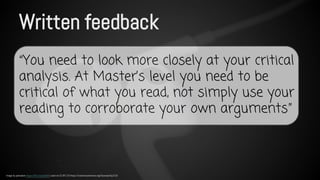
Written feedback 
“You need to look more closely at your critical 
analysis. At Master’s level you need to be 
critical of what you read, not simply use your 
reading to corroborate your own arguments” 
Image by pahudson https://flic.kr/p/dur8r5 used via CC BY 2.0 https://creativecommons.org/licenses/by/2.0/
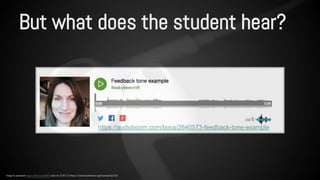
But what does the student hear? 
https://audioboom.com/boos/2640573-feedback-tone-example 
Image by pahudson https://flic.kr/p/dur8r5 used via CC BY 2.0 https://creativecommons.org/licenses/by/2.0/
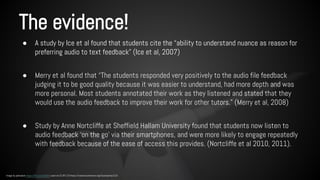
The evidence! 
● A study by Ice et al found that students cite the “ability to understand nuance as reason for 
preferring audio to text feedback” (Ice et al, 2007) 
● Merry et al found that “The students responded very positively to the audio file feedback 
judging it to be good quality because it was easier to understand, had more depth and was 
more personal. Most students annotated their work as they listened and stated that they 
would use the audio feedback to improve their work for other tutors.” (Merry et al, 2008) 
● Study by Anne Nortcliffe at Sheffield Hallam University found that students now listen to 
audio feedback ‘on the go’ via their smartphones, and were more likely to engage repeatedly 
with feedback because of the ease of access this provides. (Nortcliffe et al 2010, 2011). 
Image by pahudson https://flic.kr/p/dur8r5 used via CC BY 2.0 https://creativecommons.org/licenses/by/2.0/
Feedback on my feedback... 
“The voice comment was amazing and encouraging. 
Thank you so much.” 
“This is really amazing help you are giving me!” 
“Thanks for the audio feedback! Not had any before, 
makes a nice change” 
Image by pahudson https://flic.kr/p/dur8r5 used via CC BY 2.0 https://creativecommons.org/licenses/by/2.0/
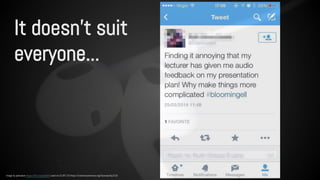
It doesn’t suit 
everyone... 
Image by pahudson https://flic.kr/p/dur8r5 used via CC BY 2.0 https://creativecommons.org/licenses/by/2.0/
How I ‘do’ audio 
● Turnitin 
● Voice Memo 
● Voice record HD 
● Audacity 
● Audioboo(m)! 
Image by pahudson https://flic.kr/p/dur8r5 used via CC BY 2.0 https://creativecommons.org/licenses/by/2.0/
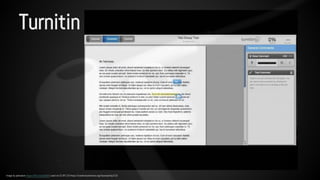
Turnitin 
Image by pahudson https://flic.kr/p/dur8r5 used via CC BY 2.0 https://creativecommons.org/licenses/by/2.0/
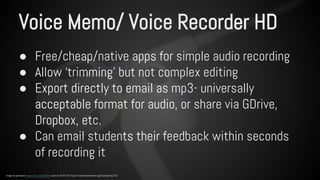
Voice Memo/ Voice Recorder HD 
● Free/cheap/native apps for simple audio recording 
● Allow ‘trimming’ but not complex editing 
● Export directly to email as mp3- universally 
acceptable format for audio, or share via GDrive, 
Dropbox, etc. 
● Can email students their feedback within seconds 
of recording it 
Image by pahudson https://flic.kr/p/dur8r5 used via CC BY 2.0 https://creativecommons.org/licenses/by/2.0/
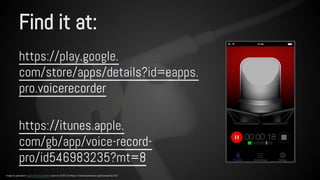
Find it at: 
https://play.google. 
com/store/apps/details?id=eapps. 
pro.voicerecorder 
https://itunes.apple. 
com/gb/app/voice-record-pro/ 
id546983235?mt=8 
Image by pahudson https://flic.kr/p/dur8r5 used via CC BY 2.0 https://creativecommons.org/licenses/by/2.0/
Audacity 
● Free audio editing software for PC, Mac and 
GNU/Linux 
● Bit of a learning curve.. 
● ...but allows more sophisticated editing and multiple 
export formats 
● Good for group feedback, longer feedback files 
Image by pahudson https://flic.kr/p/dur8r5 used via CC BY 2.0 https://creativecommons.org/licenses/by/2.0/
Find it at: 
http://audacity.sourceforge.net/ 
Image by pahudson https://flic.kr/p/dur8r5 used via CC BY 2.0 https://creativecommons.org/licenses/by/2.0/
Audioboo(m!) 
● Not for individualised feedback 
● Good for summarising a session 
● Is open/public, so needs to be general, no names 
named! 
● Is easy, fun, accessible, fast 
Image by pahudson https://flic.kr/p/dur8r5 used via CC BY 2.0 https://creativecommons.org/licenses/by/2.0/
Find it at: 
https://audioboom.com/ 
Image by pahudson https://flic.kr/p/dur8r5 used via CC BY 2.0 https://creativecommons.org/licenses/by/2.0/
Risks 
In pairs, discuss the possible risks of using audio.. 
Image by pahudson https://flic.kr/p/dur8r5 used via CC BY 2.0 https://creativecommons.org/licenses/by/2.0/
Should I offer audio feedback? 
● Will the students be able to access it? 
● What will it offer in addition to usual feedback? 
● Do I have the tools I need to create it and share it? 
● Am I happy that I understand the privacy and safety 
issues? 
● Do I have the time? 
● Am I in the right mood/frame of mind/sufficiently 
awake? 
Image by pahudson https://flic.kr/p/dur8r5 used via CC BY 2.0 https://creativecommons.org/licenses/by/2.0/
References 
Beecroft, C. (2014). ScHARR Information Resources Blog: Gig Review: audio feedback workshop at Sheffield Hallam 
University! Retrieved 11 November 2014, from http://scharrlibrary.blogspot.co.uk/2014/01/gig-review-audio-feedback-workshop- 
at.html 
Ice, P., Curtis, R., Phillips, P., & Wells, J. (2007). Using Asynchronous Audio Feedback to Enhance Teaching Presence 
and Students' Sense of Community.Journal of Asynchronous Learning Networks, 11(2), 3-25. 
Merry, S., & Orsmond, P. (2008). Students’ attitudes to and usage of academic feedback provided via audio files. 
Bioscience Education, (11). 
Middleton, A., & Nortcliffe, A. (2010). Audio feedback design: principles and emerging practice. International Journal of 
Continuing Engineering Education and Life Long Learning, 20(2), 208-223. 
Nortcliffe, A., & Middleton, A. (2011). Smartphone feedback: Using an iPhone to improve the distribution of audio 
feedback. International Journal of Electrical Engineering Education, 48(3), 280-293. 
Image by pahudson https://flic.kr/p/dur8r5 used via CC BY 2.0 https://creativecommons.org/licenses/by/2.0/

SEDA conference: wired for sound

  • 1.
    Wired for Sound: how using audio has changed my feedback forever Claire Beecroft, University Teacher ScHARR, University of Sheffield c.beecroft@shef.ac.uk @beakybeecroft http://tinyurl.com/sedafeedback Image by pahudson https://flic.kr/p/dur8r5 used via CC BY 2.0 https://creativecommons.org/licenses/by/2.0/
  • 2.
    http://tinyurl.com/sedafeedback Image bypahudson https://flic.kr/p/dur8r5 used via CC BY 2.0 https://creativecommons.org/licenses/by/2.0/
  • 3.
    Learning outcomes: ●Mark assessed work more thoroughly, more quickly and more enjoyably ● Identify key tools, including apps, that can enable greater use of voice input for feedback across a range of platforms and settings ● Make reasoned choices about how and when to use audio feedback and voice input in their marking ● Understand the limitations and benefits of using audio for feedback, including risks relating to data security Image by pahudson https://flic.kr/p/dur8r5 used via CC BY 2.0 https://creativecommons.org/licenses/by/2.0/
  • 4.
    Why use audio? ● I work with distance learners a lot ● I want to communicate with them better, and more often ● I want them to use/apply their feedback ● I want them to understand their feedback ● I want them to actually look at their feedback ● It suits the kind of gal I am Image by pahudson https://flic.kr/p/dur8r5 used via CC BY 2.0 https://creativecommons.org/licenses/by/2.0/
  • 5.
    Written feedback “Youneed to look more closely at your critical analysis. At Master’s level you need to be critical of what you read, not simply use your reading to corroborate your own arguments” Image by pahudson https://flic.kr/p/dur8r5 used via CC BY 2.0 https://creativecommons.org/licenses/by/2.0/
  • 6.
    But what doesthe student hear? https://audioboom.com/boos/2640573-feedback-tone-example Image by pahudson https://flic.kr/p/dur8r5 used via CC BY 2.0 https://creativecommons.org/licenses/by/2.0/
  • 7.
    The evidence! ●A study by Ice et al found that students cite the “ability to understand nuance as reason for preferring audio to text feedback” (Ice et al, 2007) ● Merry et al found that “The students responded very positively to the audio file feedback judging it to be good quality because it was easier to understand, had more depth and was more personal. Most students annotated their work as they listened and stated that they would use the audio feedback to improve their work for other tutors.” (Merry et al, 2008) ● Study by Anne Nortcliffe at Sheffield Hallam University found that students now listen to audio feedback ‘on the go’ via their smartphones, and were more likely to engage repeatedly with feedback because of the ease of access this provides. (Nortcliffe et al 2010, 2011). Image by pahudson https://flic.kr/p/dur8r5 used via CC BY 2.0 https://creativecommons.org/licenses/by/2.0/
  • 8.
    Feedback on myfeedback... “The voice comment was amazing and encouraging. Thank you so much.” “This is really amazing help you are giving me!” “Thanks for the audio feedback! Not had any before, makes a nice change” Image by pahudson https://flic.kr/p/dur8r5 used via CC BY 2.0 https://creativecommons.org/licenses/by/2.0/
  • 9.
    It doesn’t suit everyone... Image by pahudson https://flic.kr/p/dur8r5 used via CC BY 2.0 https://creativecommons.org/licenses/by/2.0/
  • 10.
    How I ‘do’audio ● Turnitin ● Voice Memo ● Voice record HD ● Audacity ● Audioboo(m)! Image by pahudson https://flic.kr/p/dur8r5 used via CC BY 2.0 https://creativecommons.org/licenses/by/2.0/
  • 11.
    Turnitin Image bypahudson https://flic.kr/p/dur8r5 used via CC BY 2.0 https://creativecommons.org/licenses/by/2.0/
  • 12.
    Voice Memo/ VoiceRecorder HD ● Free/cheap/native apps for simple audio recording ● Allow ‘trimming’ but not complex editing ● Export directly to email as mp3- universally acceptable format for audio, or share via GDrive, Dropbox, etc. ● Can email students their feedback within seconds of recording it Image by pahudson https://flic.kr/p/dur8r5 used via CC BY 2.0 https://creativecommons.org/licenses/by/2.0/
  • 13.
    Find it at: https://play.google. com/store/apps/details?id=eapps. pro.voicerecorder https://itunes.apple. com/gb/app/voice-record-pro/ id546983235?mt=8 Image by pahudson https://flic.kr/p/dur8r5 used via CC BY 2.0 https://creativecommons.org/licenses/by/2.0/
  • 14.
    Audacity ● Freeaudio editing software for PC, Mac and GNU/Linux ● Bit of a learning curve.. ● ...but allows more sophisticated editing and multiple export formats ● Good for group feedback, longer feedback files Image by pahudson https://flic.kr/p/dur8r5 used via CC BY 2.0 https://creativecommons.org/licenses/by/2.0/
  • 15.
    Find it at: http://audacity.sourceforge.net/ Image by pahudson https://flic.kr/p/dur8r5 used via CC BY 2.0 https://creativecommons.org/licenses/by/2.0/
  • 16.
    Audioboo(m!) ● Notfor individualised feedback ● Good for summarising a session ● Is open/public, so needs to be general, no names named! ● Is easy, fun, accessible, fast Image by pahudson https://flic.kr/p/dur8r5 used via CC BY 2.0 https://creativecommons.org/licenses/by/2.0/
  • 17.
    Find it at: https://audioboom.com/ Image by pahudson https://flic.kr/p/dur8r5 used via CC BY 2.0 https://creativecommons.org/licenses/by/2.0/
  • 18.
    Risks In pairs,discuss the possible risks of using audio.. Image by pahudson https://flic.kr/p/dur8r5 used via CC BY 2.0 https://creativecommons.org/licenses/by/2.0/
  • 19.
    Should I offeraudio feedback? ● Will the students be able to access it? ● What will it offer in addition to usual feedback? ● Do I have the tools I need to create it and share it? ● Am I happy that I understand the privacy and safety issues? ● Do I have the time? ● Am I in the right mood/frame of mind/sufficiently awake? Image by pahudson https://flic.kr/p/dur8r5 used via CC BY 2.0 https://creativecommons.org/licenses/by/2.0/
  • 20.
    References Beecroft, C.(2014). ScHARR Information Resources Blog: Gig Review: audio feedback workshop at Sheffield Hallam University! Retrieved 11 November 2014, from http://scharrlibrary.blogspot.co.uk/2014/01/gig-review-audio-feedback-workshop- at.html Ice, P., Curtis, R., Phillips, P., & Wells, J. (2007). Using Asynchronous Audio Feedback to Enhance Teaching Presence and Students' Sense of Community.Journal of Asynchronous Learning Networks, 11(2), 3-25. Merry, S., & Orsmond, P. (2008). Students’ attitudes to and usage of academic feedback provided via audio files. Bioscience Education, (11). Middleton, A., & Nortcliffe, A. (2010). Audio feedback design: principles and emerging practice. International Journal of Continuing Engineering Education and Life Long Learning, 20(2), 208-223. Nortcliffe, A., & Middleton, A. (2011). Smartphone feedback: Using an iPhone to improve the distribution of audio feedback. International Journal of Electrical Engineering Education, 48(3), 280-293. Image by pahudson https://flic.kr/p/dur8r5 used via CC BY 2.0 https://creativecommons.org/licenses/by/2.0/

Editor's Notes

  • #19 Student might share file online Privacy settings need to be right on some sites to ensure content is safe Don’t name names in feedback or use them in filenames Might annoy colleagues! Might create more demand for audio! Might distract from other feedback forms Working on a mobile device- what if you lost it? Disadvantaging non-native speakers Disadvantaging hearing-impaired Disadvantaging thoughs not so used to using technology