CICS Transaction Server for z/OS V4.1 Technical Overview Tom Grieve [email_address]
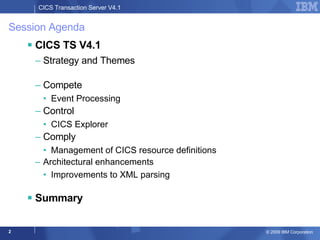
Session Agenda CICS TS V4.1 Strategy and Themes Compete Event Processing Control CICS Explorer Comply  Management of CICS resource definitions Architectural enhancements Improvements to XML parsing Summary
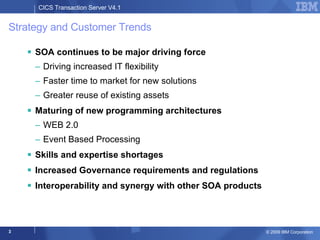
Strategy and Customer Trends SOA continues to be major driving force Driving increased IT flexibility Faster time to market for new solutions Greater reuse of existing assets Maturing of new programming architectures WEB 2.0 Event Based Processing Skills and expertise shortages Increased Governance requirements and regulations Interoperability and synergy with other SOA products
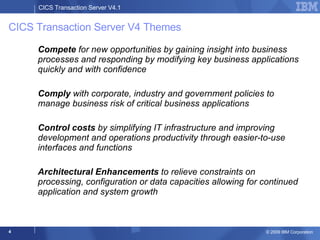
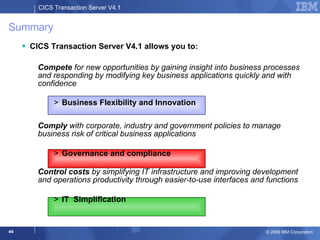
CICS Transaction Server V4 Themes Compete  for new opportunities by gaining insight into business processes and responding by modifying key business applications quickly and with confidence   Comply  with corporate, industry and government policies to manage business risk of critical business applications Control costs  by simplifying IT infrastructure and improving development and operations productivity through easier-to-use interfaces and functions  Architectural Enhancements  to relieve constraints on processing, configuration or data capacities allowing for continued application and system growth
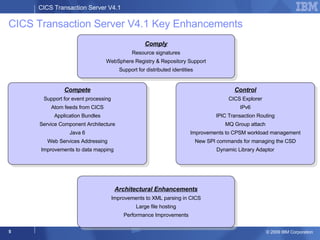
CICS Transaction Server V4.1 Key Enhancements Architectural Enhancements Improvements to XML parsing in CICS Large file hosting Performance Improvements Compete Support for event processing Atom feeds from CICS Application Bundles Service Component Architecture Java 6 Web Services Addressing Improvements to data mapping Control CICS Explorer IPv6 IPIC Transaction Routing MQ Group attach Improvements to CPSM workload management New SPI commands for managing the CSD Dynamic Library Adaptor Comply Resource signatures WebSphere Registry & Repository Support Support for distributed identities
Event Processing An event is something that happens that is relevant to the business “ simple ” event: meaningful in itself  Order placement, stock trade  “ complex  event processing”: detect and respond to patterns of events over time 3 orders from a customer in 2 days, suspicious pattern of ATM activity  “ Business Event Processing” extends event processing capabilities to business users CICS can be significant source of events Focus is on events relevant to the Line-of-Business CICS will emit single events Events emitted by CICS could  Drive another CICS transaction Be written to a WebSphere MQ queue  Be written to a temporary storage queue  Be input to a monitor or business manager’s dashboard e.g. WebSphere Business Monitor Be sent to a “complex event processing” engine such as WebSphere Business Events …
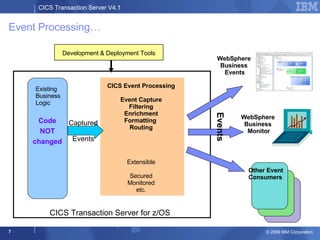
Event Processing… Existing Business Logic Captured Events CICS Event Processing Event Capture Filtering Enrichment Formatting  Routing Extensible Secured Monitored etc. Development & Deployment Tools WebSphere  Business  Monitor WebSphere  Business  Events Code NOT changed CICS Transaction Server for z/OS Other Event  Consumers Events
Event Processing Non-intrusive instrumentation of events No requirement to change existing business logic EXEC CICS SIGNAL EVENT for explicit instrumentation of events Tooling to create event specifications Event binding editor in CICS Explorer Deployed to CICS via event bindings in BUNDLE resources Specifies event and its payload, and how it can be detected/captured by CICS Specify event capture points as EXEC CICS command Filtering on command parameters and data Events dispatched to specified EP adapter for formatting and emission to event consumer CICS-supplied EP adapters Capability to write custom EP adapters
Atom feeds from CICS What is an Atom Feed? Protocol and XML format for content publishing Provide XML based feed of updated content Process is known as syndicating a feed Follow-on to Real Simple Syndication (RSS) Simple publish/subscribe implementation Polling model Based on http support  Described by two Internet Request for Comments The Atom Syndication Format Targeted at producing feeds RFC4287: (Dec 2005)  http://tools.ietf.org/html/rfc4287 The Atom Publishing Protocol  Targeted to creating and updating resources RFC5023: (Oct 2007)  http://tools.ietf.org/html/rfc5023
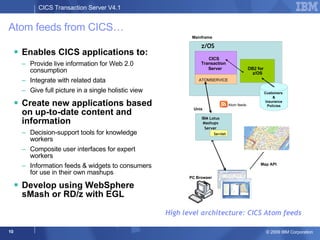
Atom feeds from CICS… Enables CICS applications to:  Provide live information for Web 2.0 consumption Integrate with related data Give full picture in a single holistic view  Create new applications based on up-to-date content and information Decision-support tools for knowledge workers Composite user interfaces for expert workers Information feeds & widgets to consumers for use in their own mashups Develop using WebSphere sMash or RD/z with EGL High level architecture: CICS Atom feeds PC  Browser Map API z/OS  CICS  Transaction  Server  DB2 for  z/OS ATOMSERVICE Customers  & Insurance Policies Mainframe Atom feeds IBM Lotus Mashups Server Unix Servlet
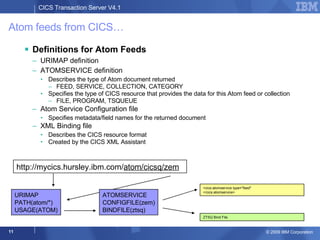
Atom feeds from CICS… Definitions for Atom Feeds URIMAP definition ATOMSERVICE definition Describes the type of Atom document returned FEED, SERVICE, COLLECTION, CATEGORY Specifies the type of CICS resource that provides the data for this Atom feed or collection FILE, PROGRAM, TSQUEUE Atom Service Configuration file Specifies  metadata/field names for the returned document XML Binding file Describes the CICS resource format Created by the CICS XML Assistant http://mycics.hursley.ibm.com/ atom/cicsq/zem URIMAP PATH(atom/*) USAGE(ATOM) ATOMSERVICE CONFIGFILE(zem) BINDFILE(ztsq) <cics:atomservice type=&quot;feed&quot; </cics:atomservice> ZTSQ Bind File
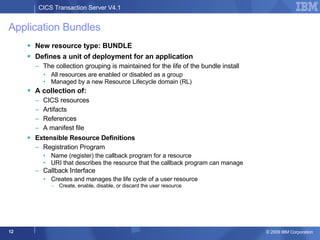
Application Bundles New resource type: BUNDLE Defines a unit of deployment for an application The collection grouping is maintained for the life of the bundle install All resources are enabled or disabled as a group Managed by a new Resource Lifecycle domain (RL) A collection of: CICS resources Artifacts References A manifest file Extensible Resource Definitions Registration Program Name (register) the callback program for a resource URI that describes the resource that the callback program can manage  Callback Interface Creates and manages the life cycle of a user resource  Create, enable, disable, or discard the user resource
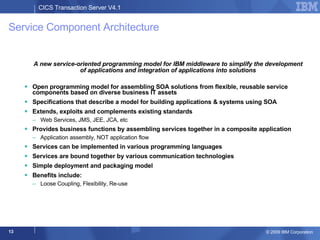
Service Component Architecture A new service-oriented programming model for IBM middleware to simplify the development of applications and integration of applications into solutions Open programming model for assembling SOA solutions from flexible, reusable service components based on diverse business IT assets Specifications that describe a model for building applications & systems using SOA Extends, exploits and complements existing standards Web Services, JMS, JEE, JCA, etc  Provides business functions by assembling services together in a composite application  Application assembly, NOT application flow  Services can be implemented in various programming languages Services are bound together by various communication technologies Simple deployment and packaging model  Benefits include: Loose Coupling,  Flexibility, Re-use
Service Component Architecture… Provide capability to easily develop flexible and reusable CICS application components Rapid assembly and deployment of new Services Express existing applications as re-usable components Separation of bindings from application code allows flexible infrastructure changes Reduce skills and effort required to view and manage business applications
Service Component Architecture… CICS SCA Infrastructure Types of services Channel based services Allow CICS LINKable assets to be defined as a component interface Channel and container support COMMAREA support Available to other CICS programs that use the INVOKE SERVICE command XML based services Available to CICS applications that use the INVOKE SERVICE command Available to business services on an external network Use SCDL to describe and deploy a composite RDz SCA tooling  Wizards for CICS Component and Composite creation  Composite editor  Wizard for Bundle creation/deployment  New EXEC CICS INVOKE SERVICE command INVOKE WEBSERVICE command now a synonym of INVOKE SERVICE
Java 6 Support for provided the IBM 31-bit SDK for z/OS Java Technology Edition, V6 Pre-requisite for CICS Web services and XML assistants, Java programs in CICS Compliant with the Java SDK 6 compatibility tests Can utilise System z Application Assist Processors (zAAPs) Support for Java 1.4.2 and Java 5 has been removed Java SDK 6 supports upward compatibility
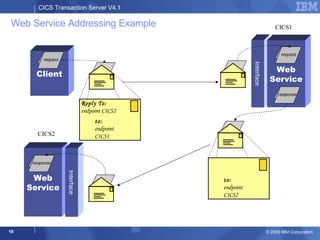
XML & Web Services CICS Web Services Addressing Defines transport neutral mechanisms to address Web Services Facilitates message transmission through networks Consists of a SOAP Header describing Endpoint Reference Uniquely identify the service requested Message addressing properties Convey information about message relationships Provide information on where messages are to be directed  WS-Addressing Specifications Recommended http://www.w3.org/TR/ws-addr-core/ http://www.w3.org/TR/ws-addr-soap/ http://www.w3.org/TR/ws-addr-metadata/ Submission  www.w3.org/Submission/ws-addressing
Web Service Addressing Example  CICS1 CICS2 Client Interface Web Service Reply To: endpoint CICS2 to: endpoint CICS1 request request response Web Service Interface response to: endpoint CICS2
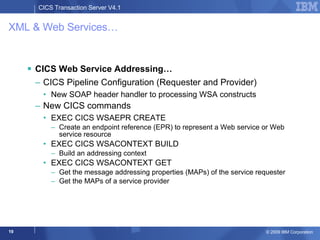
XML & Web Services… CICS Web Service Addressing… CICS Pipeline Configuration (Requester and Provider) New SOAP header handler to processing WSA constructs New CICS commands  EXEC CICS WSAEPR CREATE Create an endpoint reference (EPR) to represent a Web service or Web service resource EXEC CICS WSACONTEXT BUILD Build an addressing context EXEC CICS WSACONTEXT GET Get the message addressing properties (MAPs) of the service requester Get the MAPs of a service provider
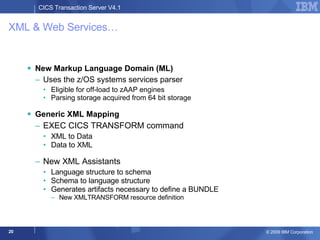
XML & Web Services… New Markup Language Domain (ML) Uses the z/OS systems services parser Eligible for off-load to zAAP engines Parsing storage acquired from 64 bit storage Generic XML Mapping EXEC CICS TRANSFORM command XML to Data Data to XML New XML Assistants  Language structure to schema Schema to language structure Generates artifacts necessary to define a BUNDLE New XMLTRANSFORM resource definition
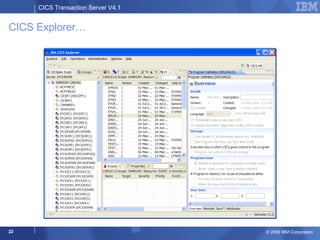
CICS Explorer Intuitive and common tooling for CICS architects, analysts, developers, administrators Quick and easy to install via Web browser Eclipse based, runs on Linux and Windows Fast, highly customizable and extensible CICS Explorer provides operations, workload, resource management and application deployment Rich set of views, tasks and editors Supports a single CICS region to large CICSplex  Supports CICS tools and the CICS Transaction Gateway Other IBM tools  Easy to link and perform tasks across products Unified resource representation and terminology Transfer skills, knowledge and best practice to new CICS technical staff Powerful, context-sensitive resource editors Show only applicable attributes and tabs Clear explanation of options and context help Parameter case sensitivity, length and relationship to other parameters handled by intelligent controls Instant feedback for errors Create your own dashboard to quickly perform common tasks Save your windows, views and filters
CICS Explorer…
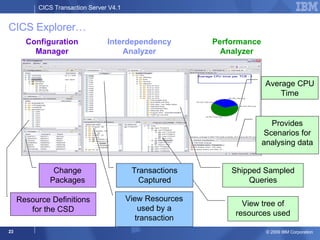
CICS Explorer… Interdependency Analyzer Configuration Manager Performance Analyzer Change Packages Resource Definitions for the CSD View Resources used by a transaction Shipped Sampled Queries View tree of resources used Transactions Captured Average CPU Time Provides Scenarios for analysing data
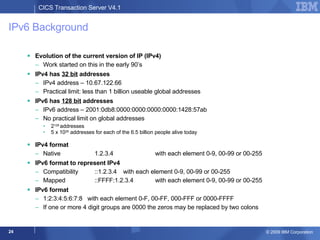
IPv6 Background Evolution of the current version of IP (IPv4) Work started on this in the early 90’s IPv4 has  32 bit  addresses IPv4 address – 10.67.122.66 Practical limit: less than 1 billion useable global addresses IPv6 has  128 bit  addresses IPv6 address – 2001:0db8:0000:0000:0000:0000:1428:57ab No practical limit on global addresses 2 128  addresses 5 x 10 28  addresses for each of the 6.5 billion people alive today IPv4 format Native   1.2.3.4  with each element 0-9, 00-99 or 00-255 IPv6 format to represent IPv4 Compatibility   ::1.2.3.4  with each element 0-9, 00-99 or 00-255 Mapped   ::FFFF:1.2.3.4  with each element 0-9, 00-99 or 00-255 IPv6 format 1:2:3:4:5:6:7:8  with each element 0-F, 00-FF, 000-FFF or 0000-FFFF If one or more 4 digit groups are 0000 the zeros may be replaced by two colons
CICS Support for IPv6 Allow for IPv4, IPv6 or host names in: Resource definitions Application Programming Interface Systems Programming Interface User Replaceable Modules Global User Exits Monitoring Records
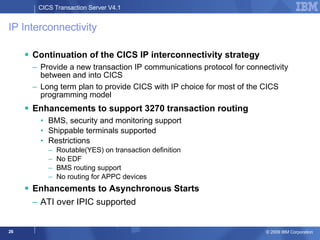
IP Interconnectivity  Continuation of the CICS IP interconnectivity strategy Provide a new transaction IP communications protocol for connectivity between and into CICS Long term plan to provide CICS with IP choice for most of the CICS programming model Enhancements to support 3270 transaction routing BMS, security and monitoring support Shippable terminals supported Restrictions Routable(YES) on transaction definition No EDF BMS routing support No routing for APPC devices Enhancements to Asynchronous Starts ATI over IPIC supported
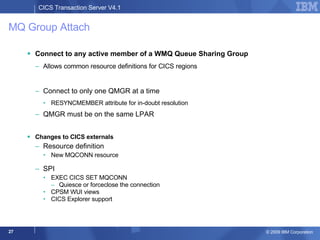
MQ Group Attach Connect to any active member of a WMQ Queue Sharing Group  Allows common resource definitions for CICS regions Connect to only one QMGR at a time RESYNCMEMBER attribute for in-doubt resolution QMGR must be on the same LPAR Changes to CICS externals Resource definition New MQCONN resource SPI  EXEC CICS SET MQCONN Quiesce or forceclose the connection CPSM WUI views CICS Explorer support
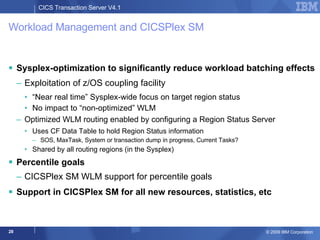
Workload Management and CICSPlex SM Sysplex-optimization to significantly reduce workload batching effects Exploitation of z/OS coupling facility “ Near real time” Sysplex-wide focus on target region status No impact to “non-optimized” WLM Optimized WLM routing enabled by configuring a Region Status Server Uses CF Data Table to hold Region Status information SOS, MaxTask, System or transaction dump in progress, Current Tasks? Shared by all routing regions (in the Sysplex) Percentile goals CICSPlex SM WLM support for percentile goals  Support in CICSPlex SM for all new resources, statistics, etc
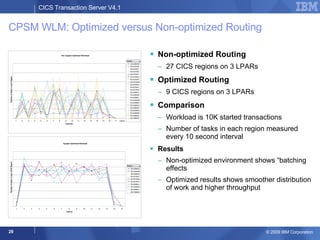
CPSM WLM: Optimized versus Non-optimized Routing Non-optimized Routing 27 CICS regions on 3 LPARs Optimized Routing 9 CICS regions on 3 LPARs Comparison Workload is 10K started transactions Number of tasks in each region measured every 10 second interval Results Non-optimized environment shows “batching effects Optimized results shows smoother distribution of work and higher throughput  Sysplex Optimized Workload 1 2 3 4 5 6 7 8 9 10 11 12 13 14 15 Interval Number of tasks in each CICS Region WLA266AA WLA266AB WLA266AC WLA276AT WLA276AU WLA276AV WLA286AJ WLA286AK WLA286AL WLT266AA Region Non Sysplex Optimized Workload 1 2 3 4 5 6 7 8 9 10 11 12 13 14 15 16 17 (blank) Intervals Number of tasks in each Region WLA266AB WLA276A0 WLA276A1 WLA276A2 WLA276AT WLA276AU WLA276AV WLA276AW WLA276AX WLA276AY WLA276AZ WLA286AJ WLA286AK WLA286AL WLA286AM WLA286AN WLA286AO WLA286AP WLA286AQ WLA286AR WLA286AS WLT266AA Region
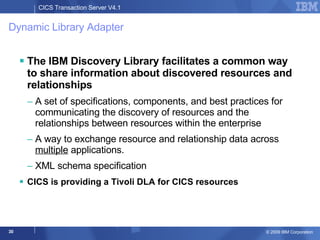
Dynamic Library Adapter The IBM Discovery Library facilitates a common way to share information about discovered resources and relationships A set of specifications, components, and best practices for communicating the discovery of resources and the relationships between resources within the enterprise  A way to exchange resource and relationship data across  multiple  applications. XML schema specification CICS is providing a Tivoli DLA for CICS resources
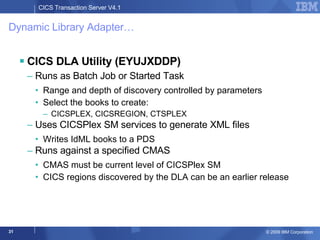
Dynamic Library Adapter… CICS DLA Utility (EYUJXDDP) Runs as Batch Job or Started Task Range and depth of discovery controlled by parameters Select the books to create:  CICSPLEX, CICSREGION, CTSPLEX Uses CICSPlex SM services to generate XML files  Writes IdML books to a PDS Runs against a specified CMAS CMAS must be current level of CICSPlex SM CICS regions discovered by the DLA can be an earlier release
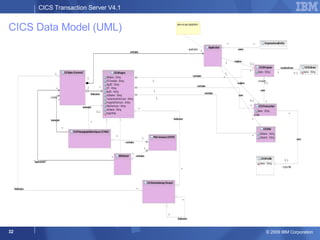
CICS Data Model (UML)
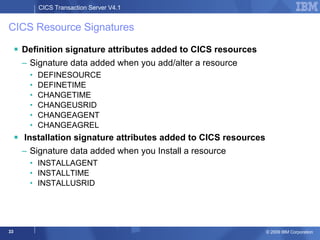
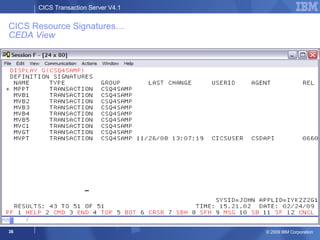
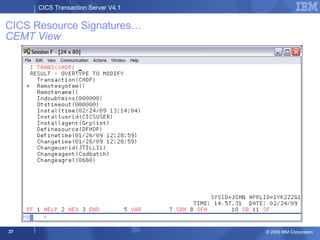
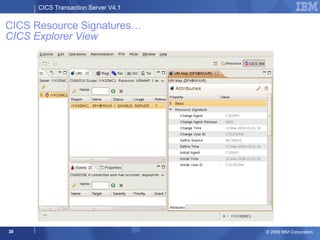
CICS Resource Signatures Definition signature attributes added to CICS resources Signature data added when you add/alter a resource  DEFINESOURCE DEFINETIME CHANGETIME CHANGEUSRID CHANGEAGENT CHANGEAGREL Installation signature attributes added to CICS resources Signature data added when you Install a resource  INSTALLAGENT INSTALLTIME INSTALLUSRID
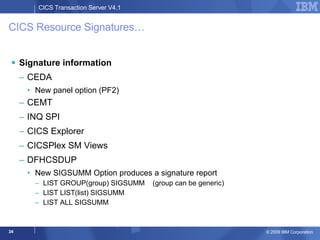
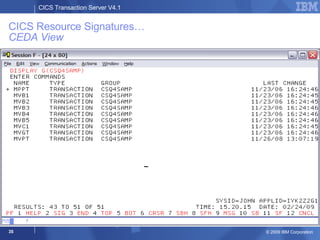
CICS Resource Signatures… Signature information CEDA New panel option (PF2) CEMT INQ SPI CICS Explorer CICSPlex SM Views DFHCSDUP New SIGSUMM Option produces a signature report LIST GROUP(group) SIGSUMM  (group can be generic) LIST LIST(list) SIGSUMM LIST ALL SIGSUMM
CICS Resource Signatures… CEDA View
CICS Resource Signatures… CEMT View
CICS Resource Signatures… CICS Explorer View
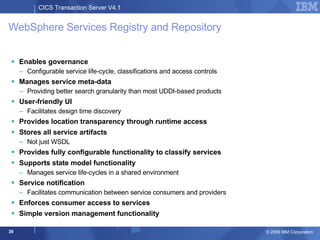
WebSphere Services Registry and Repository Enables governance  Configurable service life-cycle, classifications and access controls Manages service meta-data Providing better search granularity than most UDDI-based products User-friendly UI Facilitates design time discovery  Provides location transparency through runtime access Stores all service artifacts Not just WSDL Provides fully configurable functionality to classify services  Supports state model functionality Manages service life-cycles in a shared environment Service notification Facilitates communication between service consumers and providers Enforces consumer access to services Simple version management functionality
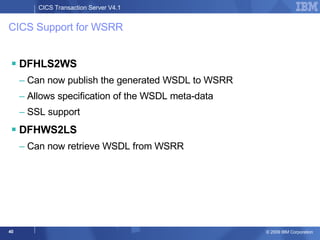
CICS Support for WSRR DFHLS2WS Can now publish the generated WSDL to WSRR Allows specification of the WSDL meta-data SSL support DFHWS2LS Can now retrieve WSDL from WSRR
Identity Context Propagation z/OS Identity Propagation initiative to provide asserted identity for end-to-end distributed security Logically tie together distributed end-user identities with z/OS userids Enhance the ability for z/OS applications to participate centrally in SOA solutions Function will require z/OS 1.11 ID Context Propagation allows an end user's identity to be propagated through to CICS  Currently, the end users' identity is lost before the request gets to CICS  Scenarios for ID context propagation  &quot;WAS-Local“ (WAS on same LPAR as CICS) Request made via JCA resource adapter and CICS TG over IPIC  &quot;WAS-remote&quot; (WAS on a different LPAR or non-z/OS system) Request made via JCA RA and CICS TG over IPIC Web Services request direct into CICS Inbound to CICS from WAS Inbound to CICS from DataPower …
Identity Context Propagation… Support for Inbound Web services, propagating on as Web Service provider Provides support for Web Services callers Support for Inbound over IP Interconnectivity (IPIC) Used by CICS TG when operating as a WebSphere connector Will require use of JCA resource adapter Sysplex Support CICS will propagate on over MRO and IPIC Connections only Additional items SPI and API to obtain IDID Remove need for USRDELAY timeout for ACEE refresh
Additional Enhancements New SPI for managing CSD definitions EXEC CICS CSD commands CICS monitoring improvements Transaction resource class data for DPL requests Additional data Web Services (Operation name, URIMAP, SOAP request/response length) Parsing data (number bytes parsed, CPU time for parsing) CMF Record compression is now the default Configurable VTAM Persistent Sessions Wild branch diagnostic improvements Supports Breaking Event Address Register (BEAR) in the TACB & DFHPEP COMMAREA Future Positioning JVM Server runtime environment Provides a mechanism for CICS to use the same JVM for multiple tasks concurrently New T8 TCB pool Architectural enhancement that is provided for CICS to perform system processing The JVM server is not available for use by Java applications
Summary CICS Transaction Server V4.1 allows you to: Compete  for new opportunities by gaining insight into business processes and responding by modifying key business applications quickly and with confidence   Business Flexibility and Innovation Comply  with corporate, industry and government policies to manage business risk of critical business applications Governance and compliance Control costs  by simplifying IT infrastructure and improving development and operations productivity through easier-to-use interfaces and functions  IT  Simplification

Cics Ts 4.1 Technical Overview

  • 1.
    CICS Transaction Serverfor z/OS V4.1 Technical Overview Tom Grieve [email_address]
  • 2.
    Session Agenda CICSTS V4.1 Strategy and Themes Compete Event Processing Control CICS Explorer Comply Management of CICS resource definitions Architectural enhancements Improvements to XML parsing Summary
  • 3.
    Strategy and CustomerTrends SOA continues to be major driving force Driving increased IT flexibility Faster time to market for new solutions Greater reuse of existing assets Maturing of new programming architectures WEB 2.0 Event Based Processing Skills and expertise shortages Increased Governance requirements and regulations Interoperability and synergy with other SOA products
  • 4.
    CICS Transaction ServerV4 Themes Compete for new opportunities by gaining insight into business processes and responding by modifying key business applications quickly and with confidence Comply with corporate, industry and government policies to manage business risk of critical business applications Control costs by simplifying IT infrastructure and improving development and operations productivity through easier-to-use interfaces and functions Architectural Enhancements to relieve constraints on processing, configuration or data capacities allowing for continued application and system growth
  • 5.
    CICS Transaction ServerV4.1 Key Enhancements Architectural Enhancements Improvements to XML parsing in CICS Large file hosting Performance Improvements Compete Support for event processing Atom feeds from CICS Application Bundles Service Component Architecture Java 6 Web Services Addressing Improvements to data mapping Control CICS Explorer IPv6 IPIC Transaction Routing MQ Group attach Improvements to CPSM workload management New SPI commands for managing the CSD Dynamic Library Adaptor Comply Resource signatures WebSphere Registry & Repository Support Support for distributed identities
  • 6.
    Event Processing Anevent is something that happens that is relevant to the business “ simple ” event: meaningful in itself Order placement, stock trade “ complex event processing”: detect and respond to patterns of events over time 3 orders from a customer in 2 days, suspicious pattern of ATM activity “ Business Event Processing” extends event processing capabilities to business users CICS can be significant source of events Focus is on events relevant to the Line-of-Business CICS will emit single events Events emitted by CICS could Drive another CICS transaction Be written to a WebSphere MQ queue Be written to a temporary storage queue Be input to a monitor or business manager’s dashboard e.g. WebSphere Business Monitor Be sent to a “complex event processing” engine such as WebSphere Business Events …
  • 7.
    Event Processing… ExistingBusiness Logic Captured Events CICS Event Processing Event Capture Filtering Enrichment Formatting Routing Extensible Secured Monitored etc. Development & Deployment Tools WebSphere Business Monitor WebSphere Business Events Code NOT changed CICS Transaction Server for z/OS Other Event Consumers Events
  • 8.
    Event Processing Non-intrusiveinstrumentation of events No requirement to change existing business logic EXEC CICS SIGNAL EVENT for explicit instrumentation of events Tooling to create event specifications Event binding editor in CICS Explorer Deployed to CICS via event bindings in BUNDLE resources Specifies event and its payload, and how it can be detected/captured by CICS Specify event capture points as EXEC CICS command Filtering on command parameters and data Events dispatched to specified EP adapter for formatting and emission to event consumer CICS-supplied EP adapters Capability to write custom EP adapters
  • 9.
    Atom feeds fromCICS What is an Atom Feed? Protocol and XML format for content publishing Provide XML based feed of updated content Process is known as syndicating a feed Follow-on to Real Simple Syndication (RSS) Simple publish/subscribe implementation Polling model Based on http support Described by two Internet Request for Comments The Atom Syndication Format Targeted at producing feeds RFC4287: (Dec 2005) http://tools.ietf.org/html/rfc4287 The Atom Publishing Protocol Targeted to creating and updating resources RFC5023: (Oct 2007) http://tools.ietf.org/html/rfc5023
  • 10.
    Atom feeds fromCICS… Enables CICS applications to: Provide live information for Web 2.0 consumption Integrate with related data Give full picture in a single holistic view Create new applications based on up-to-date content and information Decision-support tools for knowledge workers Composite user interfaces for expert workers Information feeds & widgets to consumers for use in their own mashups Develop using WebSphere sMash or RD/z with EGL High level architecture: CICS Atom feeds PC Browser Map API z/OS CICS Transaction Server DB2 for z/OS ATOMSERVICE Customers & Insurance Policies Mainframe Atom feeds IBM Lotus Mashups Server Unix Servlet
  • 11.
    Atom feeds fromCICS… Definitions for Atom Feeds URIMAP definition ATOMSERVICE definition Describes the type of Atom document returned FEED, SERVICE, COLLECTION, CATEGORY Specifies the type of CICS resource that provides the data for this Atom feed or collection FILE, PROGRAM, TSQUEUE Atom Service Configuration file Specifies metadata/field names for the returned document XML Binding file Describes the CICS resource format Created by the CICS XML Assistant http://mycics.hursley.ibm.com/ atom/cicsq/zem URIMAP PATH(atom/*) USAGE(ATOM) ATOMSERVICE CONFIGFILE(zem) BINDFILE(ztsq) <cics:atomservice type=&quot;feed&quot; </cics:atomservice> ZTSQ Bind File
  • 12.
    Application Bundles Newresource type: BUNDLE Defines a unit of deployment for an application The collection grouping is maintained for the life of the bundle install All resources are enabled or disabled as a group Managed by a new Resource Lifecycle domain (RL) A collection of: CICS resources Artifacts References A manifest file Extensible Resource Definitions Registration Program Name (register) the callback program for a resource URI that describes the resource that the callback program can manage Callback Interface Creates and manages the life cycle of a user resource Create, enable, disable, or discard the user resource
  • 13.
    Service Component ArchitectureA new service-oriented programming model for IBM middleware to simplify the development of applications and integration of applications into solutions Open programming model for assembling SOA solutions from flexible, reusable service components based on diverse business IT assets Specifications that describe a model for building applications & systems using SOA Extends, exploits and complements existing standards Web Services, JMS, JEE, JCA, etc Provides business functions by assembling services together in a composite application Application assembly, NOT application flow Services can be implemented in various programming languages Services are bound together by various communication technologies Simple deployment and packaging model Benefits include: Loose Coupling, Flexibility, Re-use
  • 14.
    Service Component Architecture…Provide capability to easily develop flexible and reusable CICS application components Rapid assembly and deployment of new Services Express existing applications as re-usable components Separation of bindings from application code allows flexible infrastructure changes Reduce skills and effort required to view and manage business applications
  • 15.
    Service Component Architecture…CICS SCA Infrastructure Types of services Channel based services Allow CICS LINKable assets to be defined as a component interface Channel and container support COMMAREA support Available to other CICS programs that use the INVOKE SERVICE command XML based services Available to CICS applications that use the INVOKE SERVICE command Available to business services on an external network Use SCDL to describe and deploy a composite RDz SCA tooling Wizards for CICS Component and Composite creation Composite editor Wizard for Bundle creation/deployment New EXEC CICS INVOKE SERVICE command INVOKE WEBSERVICE command now a synonym of INVOKE SERVICE
  • 16.
    Java 6 Supportfor provided the IBM 31-bit SDK for z/OS Java Technology Edition, V6 Pre-requisite for CICS Web services and XML assistants, Java programs in CICS Compliant with the Java SDK 6 compatibility tests Can utilise System z Application Assist Processors (zAAPs) Support for Java 1.4.2 and Java 5 has been removed Java SDK 6 supports upward compatibility
  • 17.
    XML & WebServices CICS Web Services Addressing Defines transport neutral mechanisms to address Web Services Facilitates message transmission through networks Consists of a SOAP Header describing Endpoint Reference Uniquely identify the service requested Message addressing properties Convey information about message relationships Provide information on where messages are to be directed WS-Addressing Specifications Recommended http://www.w3.org/TR/ws-addr-core/ http://www.w3.org/TR/ws-addr-soap/ http://www.w3.org/TR/ws-addr-metadata/ Submission www.w3.org/Submission/ws-addressing
  • 18.
    Web Service AddressingExample CICS1 CICS2 Client Interface Web Service Reply To: endpoint CICS2 to: endpoint CICS1 request request response Web Service Interface response to: endpoint CICS2
  • 19.
    XML & WebServices… CICS Web Service Addressing… CICS Pipeline Configuration (Requester and Provider) New SOAP header handler to processing WSA constructs New CICS commands EXEC CICS WSAEPR CREATE Create an endpoint reference (EPR) to represent a Web service or Web service resource EXEC CICS WSACONTEXT BUILD Build an addressing context EXEC CICS WSACONTEXT GET Get the message addressing properties (MAPs) of the service requester Get the MAPs of a service provider
  • 20.
    XML & WebServices… New Markup Language Domain (ML) Uses the z/OS systems services parser Eligible for off-load to zAAP engines Parsing storage acquired from 64 bit storage Generic XML Mapping EXEC CICS TRANSFORM command XML to Data Data to XML New XML Assistants Language structure to schema Schema to language structure Generates artifacts necessary to define a BUNDLE New XMLTRANSFORM resource definition
  • 21.
    CICS Explorer Intuitiveand common tooling for CICS architects, analysts, developers, administrators Quick and easy to install via Web browser Eclipse based, runs on Linux and Windows Fast, highly customizable and extensible CICS Explorer provides operations, workload, resource management and application deployment Rich set of views, tasks and editors Supports a single CICS region to large CICSplex Supports CICS tools and the CICS Transaction Gateway Other IBM tools Easy to link and perform tasks across products Unified resource representation and terminology Transfer skills, knowledge and best practice to new CICS technical staff Powerful, context-sensitive resource editors Show only applicable attributes and tabs Clear explanation of options and context help Parameter case sensitivity, length and relationship to other parameters handled by intelligent controls Instant feedback for errors Create your own dashboard to quickly perform common tasks Save your windows, views and filters
  • 22.
  • 23.
    CICS Explorer… InterdependencyAnalyzer Configuration Manager Performance Analyzer Change Packages Resource Definitions for the CSD View Resources used by a transaction Shipped Sampled Queries View tree of resources used Transactions Captured Average CPU Time Provides Scenarios for analysing data
  • 24.
    IPv6 Background Evolutionof the current version of IP (IPv4) Work started on this in the early 90’s IPv4 has 32 bit addresses IPv4 address – 10.67.122.66 Practical limit: less than 1 billion useable global addresses IPv6 has 128 bit addresses IPv6 address – 2001:0db8:0000:0000:0000:0000:1428:57ab No practical limit on global addresses 2 128 addresses 5 x 10 28 addresses for each of the 6.5 billion people alive today IPv4 format Native 1.2.3.4 with each element 0-9, 00-99 or 00-255 IPv6 format to represent IPv4 Compatibility ::1.2.3.4 with each element 0-9, 00-99 or 00-255 Mapped ::FFFF:1.2.3.4 with each element 0-9, 00-99 or 00-255 IPv6 format 1:2:3:4:5:6:7:8 with each element 0-F, 00-FF, 000-FFF or 0000-FFFF If one or more 4 digit groups are 0000 the zeros may be replaced by two colons
  • 25.
    CICS Support forIPv6 Allow for IPv4, IPv6 or host names in: Resource definitions Application Programming Interface Systems Programming Interface User Replaceable Modules Global User Exits Monitoring Records
  • 26.
    IP Interconnectivity Continuation of the CICS IP interconnectivity strategy Provide a new transaction IP communications protocol for connectivity between and into CICS Long term plan to provide CICS with IP choice for most of the CICS programming model Enhancements to support 3270 transaction routing BMS, security and monitoring support Shippable terminals supported Restrictions Routable(YES) on transaction definition No EDF BMS routing support No routing for APPC devices Enhancements to Asynchronous Starts ATI over IPIC supported
  • 27.
    MQ Group AttachConnect to any active member of a WMQ Queue Sharing Group Allows common resource definitions for CICS regions Connect to only one QMGR at a time RESYNCMEMBER attribute for in-doubt resolution QMGR must be on the same LPAR Changes to CICS externals Resource definition New MQCONN resource SPI EXEC CICS SET MQCONN Quiesce or forceclose the connection CPSM WUI views CICS Explorer support
  • 28.
    Workload Management andCICSPlex SM Sysplex-optimization to significantly reduce workload batching effects Exploitation of z/OS coupling facility “ Near real time” Sysplex-wide focus on target region status No impact to “non-optimized” WLM Optimized WLM routing enabled by configuring a Region Status Server Uses CF Data Table to hold Region Status information SOS, MaxTask, System or transaction dump in progress, Current Tasks? Shared by all routing regions (in the Sysplex) Percentile goals CICSPlex SM WLM support for percentile goals Support in CICSPlex SM for all new resources, statistics, etc
  • 29.
    CPSM WLM: Optimizedversus Non-optimized Routing Non-optimized Routing 27 CICS regions on 3 LPARs Optimized Routing 9 CICS regions on 3 LPARs Comparison Workload is 10K started transactions Number of tasks in each region measured every 10 second interval Results Non-optimized environment shows “batching effects Optimized results shows smoother distribution of work and higher throughput Sysplex Optimized Workload 1 2 3 4 5 6 7 8 9 10 11 12 13 14 15 Interval Number of tasks in each CICS Region WLA266AA WLA266AB WLA266AC WLA276AT WLA276AU WLA276AV WLA286AJ WLA286AK WLA286AL WLT266AA Region Non Sysplex Optimized Workload 1 2 3 4 5 6 7 8 9 10 11 12 13 14 15 16 17 (blank) Intervals Number of tasks in each Region WLA266AB WLA276A0 WLA276A1 WLA276A2 WLA276AT WLA276AU WLA276AV WLA276AW WLA276AX WLA276AY WLA276AZ WLA286AJ WLA286AK WLA286AL WLA286AM WLA286AN WLA286AO WLA286AP WLA286AQ WLA286AR WLA286AS WLT266AA Region
  • 30.
    Dynamic Library AdapterThe IBM Discovery Library facilitates a common way to share information about discovered resources and relationships A set of specifications, components, and best practices for communicating the discovery of resources and the relationships between resources within the enterprise A way to exchange resource and relationship data across multiple applications. XML schema specification CICS is providing a Tivoli DLA for CICS resources
  • 31.
    Dynamic Library Adapter…CICS DLA Utility (EYUJXDDP) Runs as Batch Job or Started Task Range and depth of discovery controlled by parameters Select the books to create: CICSPLEX, CICSREGION, CTSPLEX Uses CICSPlex SM services to generate XML files Writes IdML books to a PDS Runs against a specified CMAS CMAS must be current level of CICSPlex SM CICS regions discovered by the DLA can be an earlier release
  • 32.
  • 33.
    CICS Resource SignaturesDefinition signature attributes added to CICS resources Signature data added when you add/alter a resource DEFINESOURCE DEFINETIME CHANGETIME CHANGEUSRID CHANGEAGENT CHANGEAGREL Installation signature attributes added to CICS resources Signature data added when you Install a resource INSTALLAGENT INSTALLTIME INSTALLUSRID
  • 34.
    CICS Resource Signatures…Signature information CEDA New panel option (PF2) CEMT INQ SPI CICS Explorer CICSPlex SM Views DFHCSDUP New SIGSUMM Option produces a signature report LIST GROUP(group) SIGSUMM (group can be generic) LIST LIST(list) SIGSUMM LIST ALL SIGSUMM
  • 35.
  • 36.
  • 37.
  • 38.
    CICS Resource Signatures…CICS Explorer View
  • 39.
    WebSphere Services Registryand Repository Enables governance Configurable service life-cycle, classifications and access controls Manages service meta-data Providing better search granularity than most UDDI-based products User-friendly UI Facilitates design time discovery Provides location transparency through runtime access Stores all service artifacts Not just WSDL Provides fully configurable functionality to classify services Supports state model functionality Manages service life-cycles in a shared environment Service notification Facilitates communication between service consumers and providers Enforces consumer access to services Simple version management functionality
  • 40.
    CICS Support forWSRR DFHLS2WS Can now publish the generated WSDL to WSRR Allows specification of the WSDL meta-data SSL support DFHWS2LS Can now retrieve WSDL from WSRR
  • 41.
    Identity Context Propagationz/OS Identity Propagation initiative to provide asserted identity for end-to-end distributed security Logically tie together distributed end-user identities with z/OS userids Enhance the ability for z/OS applications to participate centrally in SOA solutions Function will require z/OS 1.11 ID Context Propagation allows an end user's identity to be propagated through to CICS Currently, the end users' identity is lost before the request gets to CICS Scenarios for ID context propagation &quot;WAS-Local“ (WAS on same LPAR as CICS) Request made via JCA resource adapter and CICS TG over IPIC &quot;WAS-remote&quot; (WAS on a different LPAR or non-z/OS system) Request made via JCA RA and CICS TG over IPIC Web Services request direct into CICS Inbound to CICS from WAS Inbound to CICS from DataPower …
  • 42.
    Identity Context Propagation…Support for Inbound Web services, propagating on as Web Service provider Provides support for Web Services callers Support for Inbound over IP Interconnectivity (IPIC) Used by CICS TG when operating as a WebSphere connector Will require use of JCA resource adapter Sysplex Support CICS will propagate on over MRO and IPIC Connections only Additional items SPI and API to obtain IDID Remove need for USRDELAY timeout for ACEE refresh
  • 43.
    Additional Enhancements NewSPI for managing CSD definitions EXEC CICS CSD commands CICS monitoring improvements Transaction resource class data for DPL requests Additional data Web Services (Operation name, URIMAP, SOAP request/response length) Parsing data (number bytes parsed, CPU time for parsing) CMF Record compression is now the default Configurable VTAM Persistent Sessions Wild branch diagnostic improvements Supports Breaking Event Address Register (BEAR) in the TACB & DFHPEP COMMAREA Future Positioning JVM Server runtime environment Provides a mechanism for CICS to use the same JVM for multiple tasks concurrently New T8 TCB pool Architectural enhancement that is provided for CICS to perform system processing The JVM server is not available for use by Java applications
  • 44.
    Summary CICS TransactionServer V4.1 allows you to: Compete for new opportunities by gaining insight into business processes and responding by modifying key business applications quickly and with confidence Business Flexibility and Innovation Comply with corporate, industry and government policies to manage business risk of critical business applications Governance and compliance Control costs by simplifying IT infrastructure and improving development and operations productivity through easier-to-use interfaces and functions IT Simplification