All rights reserved. ©2020All rights reserved. ©2020
Scalable High Efficiency Video
Coding based HTTP Adaptive
Streaming over QUIC
August 14th, 2020
ACM SIGCOMM EPIQ Workshop
Minh Nguyen, Hadi Amirpour, Christian Timmerer, Hermann Hellwagner
All rights reserved. ©2020
● Motivation
● Contributions
● Proposed method
● Evaluation and discussion
○ HTTP/3 over QUIC vs HTTP/2 over TCP
○ Proposed method vs state-of-the-art methods
● Conclusion and Future work
Agenda
All rights reserved. ©2020
2
All rights reserved. ©2020
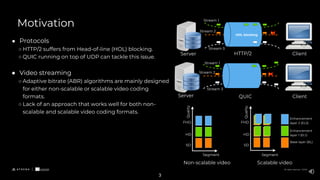
● Protocols
○ HTTP/2 suffers from Head-of-line (HOL) blocking.
○ QUIC running on top of UDP can tackle this issue.
● Video streaming
○ Adaptive bitrate (ABR) algorithms are mainly designed
for either non-scalable or scalable video coding
formats.
○ Lack of an approach that works well for both non-
scalable and scalable video coding formats.
Motivation
QUIC
Stream 1
Stream 2
Stream 3
Non-scalable video Scalable video
Quality
FHD
HD
SD
Quality
FHD
HD
SD
SegmentSegment
Enhancement
layer 1 (EL1)
Base layer (BL)
Enhancement
layer 2 (EL2)
Server Client
3
HTTP/2
Stream 1
Stream 2
Stream 3
HOL blocking
Server Client
All rights reserved. ©2020
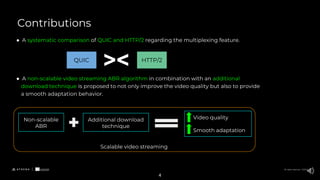
● A systematic comparison of QUIC and HTTP/2 regarding the multiplexing feature.
● A non-scalable video streaming ABR algorithm in combination with an additional
download technique is proposed to not only improve the video quality but also to provide
a smooth adaptation behavior.
Contributions
QUIC HTTP/2
><
Non-scalable
ABR
Additional download
technique
Video quality
Smooth adaptation
Scalable video streaming
4
All rights reserved. ©2020
Proposed method
● State-of-the-art ABR algorithms
○ Non-scalable based method: Aggressive ABR (AGG)
○ Scalable based method: Backfilling
● Proposed method for Scalable Video Streaming
○ Modified AGG + HTTP/2-Based Retransmission technique (H2BR)
○ Modified AGG
■ Choosing the number of layers for each segment based on the
network condition,
■ Downloading sequentially from low to high layers of each segment.
○ H2BR [PV’20]
■ Filling quality gaps in the buffer,
■ Downloading concurrently next layers and the additional layer with
priority and multiplexing features,
■ Terminating layers with termination feature.
Scalable based Backfilling
Modified non-scalable based
AGG
Modified non-scalable based
AGG + H2BR
5
All rights reserved. ©2020
Proposed method
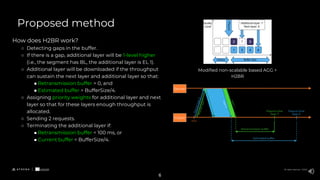
How does H2BR work?
○ Detecting gaps in the buffer.
○ If there is a gap, additional layer will be 1-level higher
(i.e., the segment has BL, the additional layer is EL 1).
○ Additional layer will be downloaded if the throughput
can sustain the next layer and additional layer so that:
■ Retransmission buffer > 0, and
■ Estimated buffer > BufferSize/4.
○ Assigning priority weights for additional layer and next
layer so that for these layers enough throughput is
allocated.
○ Sending 2 requests.
○ Terminating the additional layer if:
■ Retransmission buffer < 100 ms, or
■ Current buffer < BufferSize/4.
Modified non-scalable based AGG +
H2BR
6
All rights reserved. ©2020
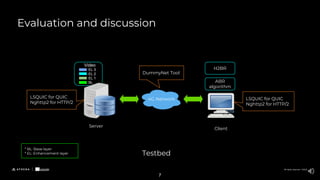
Evaluation and discussion
Server
Client
All rights reserved. ©2020
ABR
algorithm
H2BR
DummyNet Tool
4G NetworkLSQUIC for QUIC
Nghttp2 for HTTP/2
LSQUIC for QUIC
Nghttp2 for HTTP/2
Video
EL 3
EL 2
EL 1
BL
Testbed
* BL: Base layer
* EL: Enhancement layer
7
All rights reserved. ©2020
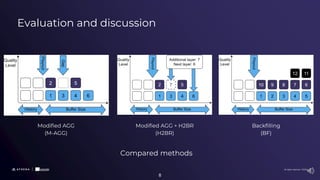
Evaluation and discussion
Modified AGG
(M-AGG)
Backfilling
(BF)
All rights reserved. ©2020
Modified AGG + H2BR
(H2BR)
Compared methods
8
All rights reserved. ©2020
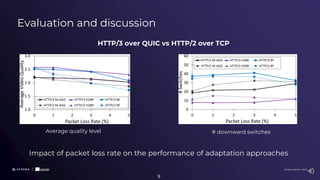
Evaluation and discussion
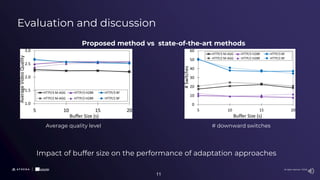
Impact of packet loss rate on the performance of adaptation approaches
All rights reserved. ©2020
Average quality level # downward switches
HTTP/3 over QUIC vs HTTP/2 over TCP
9
All rights reserved. ©2020
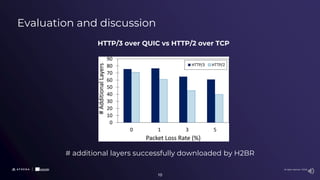
Evaluation and discussion
# additional layers successfully downloaded by H2BR
All rights reserved. ©2020
HTTP/3 over QUIC vs HTTP/2 over TCP
10
All rights reserved. ©2020
Evaluation and discussion
Average quality level # downward switches
Impact of buffer size on the performance of adaptation approaches
All rights reserved. ©2020
Proposed method vs state-of-the-art methods
11
All rights reserved. ©2020
Evaluation and discussion
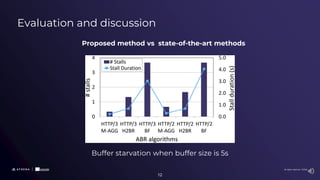
Buffer starvation when buffer size is 5s
All rights reserved. ©2020
Proposed method vs state-of-the-art methods
12
All rights reserved. ©2020
Conclusion and Future work
All rights reserved. ©2020
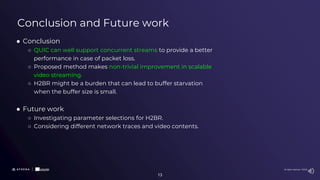
● Conclusion
○ QUIC can well support concurrent streams to provide a better
performance in case of packet loss.
○ Proposed method makes non-trivial improvement in scalable
video streaming.
○ H2BR might be a burden that can lead to buffer starvation
when the buffer size is small.
● Future work
○ Investigating parameter selections for H2BR.
○ Considering different network traces and video contents.
13
Thank you
All rights reserved. ©2020
14

Scalable High Efficiency Video Coding based HTTP Adaptive Streaming over QUIC Using Retransmission

  • 1.
    All rights reserved.©2020All rights reserved. ©2020 Scalable High Efficiency Video Coding based HTTP Adaptive Streaming over QUIC August 14th, 2020 ACM SIGCOMM EPIQ Workshop Minh Nguyen, Hadi Amirpour, Christian Timmerer, Hermann Hellwagner
  • 2.
    All rights reserved.©2020 ● Motivation ● Contributions ● Proposed method ● Evaluation and discussion ○ HTTP/3 over QUIC vs HTTP/2 over TCP ○ Proposed method vs state-of-the-art methods ● Conclusion and Future work Agenda All rights reserved. ©2020 2
  • 3.
    All rights reserved.©2020 ● Protocols ○ HTTP/2 suffers from Head-of-line (HOL) blocking. ○ QUIC running on top of UDP can tackle this issue. ● Video streaming ○ Adaptive bitrate (ABR) algorithms are mainly designed for either non-scalable or scalable video coding formats. ○ Lack of an approach that works well for both non- scalable and scalable video coding formats. Motivation QUIC Stream 1 Stream 2 Stream 3 Non-scalable video Scalable video Quality FHD HD SD Quality FHD HD SD SegmentSegment Enhancement layer 1 (EL1) Base layer (BL) Enhancement layer 2 (EL2) Server Client 3 HTTP/2 Stream 1 Stream 2 Stream 3 HOL blocking Server Client
  • 4.
    All rights reserved.©2020 ● A systematic comparison of QUIC and HTTP/2 regarding the multiplexing feature. ● A non-scalable video streaming ABR algorithm in combination with an additional download technique is proposed to not only improve the video quality but also to provide a smooth adaptation behavior. Contributions QUIC HTTP/2 >< Non-scalable ABR Additional download technique Video quality Smooth adaptation Scalable video streaming 4
  • 5.
    All rights reserved.©2020 Proposed method ● State-of-the-art ABR algorithms ○ Non-scalable based method: Aggressive ABR (AGG) ○ Scalable based method: Backfilling ● Proposed method for Scalable Video Streaming ○ Modified AGG + HTTP/2-Based Retransmission technique (H2BR) ○ Modified AGG ■ Choosing the number of layers for each segment based on the network condition, ■ Downloading sequentially from low to high layers of each segment. ○ H2BR [PV’20] ■ Filling quality gaps in the buffer, ■ Downloading concurrently next layers and the additional layer with priority and multiplexing features, ■ Terminating layers with termination feature. Scalable based Backfilling Modified non-scalable based AGG Modified non-scalable based AGG + H2BR 5
  • 6.
    All rights reserved.©2020 Proposed method How does H2BR work? ○ Detecting gaps in the buffer. ○ If there is a gap, additional layer will be 1-level higher (i.e., the segment has BL, the additional layer is EL 1). ○ Additional layer will be downloaded if the throughput can sustain the next layer and additional layer so that: ■ Retransmission buffer > 0, and ■ Estimated buffer > BufferSize/4. ○ Assigning priority weights for additional layer and next layer so that for these layers enough throughput is allocated. ○ Sending 2 requests. ○ Terminating the additional layer if: ■ Retransmission buffer < 100 ms, or ■ Current buffer < BufferSize/4. Modified non-scalable based AGG + H2BR 6
  • 7.
    All rights reserved.©2020 Evaluation and discussion Server Client All rights reserved. ©2020 ABR algorithm H2BR DummyNet Tool 4G NetworkLSQUIC for QUIC Nghttp2 for HTTP/2 LSQUIC for QUIC Nghttp2 for HTTP/2 Video EL 3 EL 2 EL 1 BL Testbed * BL: Base layer * EL: Enhancement layer 7
  • 8.
    All rights reserved.©2020 Evaluation and discussion Modified AGG (M-AGG) Backfilling (BF) All rights reserved. ©2020 Modified AGG + H2BR (H2BR) Compared methods 8
  • 9.
    All rights reserved.©2020 Evaluation and discussion Impact of packet loss rate on the performance of adaptation approaches All rights reserved. ©2020 Average quality level # downward switches HTTP/3 over QUIC vs HTTP/2 over TCP 9
  • 10.
    All rights reserved.©2020 Evaluation and discussion # additional layers successfully downloaded by H2BR All rights reserved. ©2020 HTTP/3 over QUIC vs HTTP/2 over TCP 10
  • 11.
    All rights reserved.©2020 Evaluation and discussion Average quality level # downward switches Impact of buffer size on the performance of adaptation approaches All rights reserved. ©2020 Proposed method vs state-of-the-art methods 11
  • 12.
    All rights reserved.©2020 Evaluation and discussion Buffer starvation when buffer size is 5s All rights reserved. ©2020 Proposed method vs state-of-the-art methods 12
  • 13.
    All rights reserved.©2020 Conclusion and Future work All rights reserved. ©2020 ● Conclusion ○ QUIC can well support concurrent streams to provide a better performance in case of packet loss. ○ Proposed method makes non-trivial improvement in scalable video streaming. ○ H2BR might be a burden that can lead to buffer starvation when the buffer size is small. ● Future work ○ Investigating parameter selections for H2BR. ○ Considering different network traces and video contents. 13
  • 14.
    Thank you All rightsreserved. ©2020 14