0
 Licensing Regime in Hong Kong
www.charltonslaw.com
The Hong Kong Licensing Regime
1
 The licensing and registration of persons operating in Hong Kong’s securities and
futures markets is dealt with in Part V of the Securities and Futures Ordinance (SFO)
which came into effect on 1 April 2003. The SFO is administered by the Securities
and Futures Commission (SFC).
 Part V of the SFO establishes a “single licence” regime whereby a person requires
only one licence or registration to conduct different types of regulated activities.
 The SFO prohibits any person from carrying on a business (or holding himself out as
carrying on a business) in a regulated activity unless an appropriate authorisation has
been granted or an exemption or exclusion applies.
Types Of Regulated Activities
2
 Currently, there are 10 types of “regulated activities” in Hong Kong :
o Type 1: dealing in securities
o Type 2: dealing in futures contracts
o Type 3: leveraged foreign exchange trading
o Type 4: advising on securities
o Type 5: advising on futures contracts
o Type 6: advising on corporate finance
o Type 7: providing automated trading services
o Type 8: securities margin financing
o Type 9: asset management
o Type 10: providing credit rating services
3
The Licensed Corporation
 For a corporation to be licensed to carry out regulated activities in Hong Kong, section
116(2) of the SFO requires that it has to be either a company incorporated in Hong
Kong or an overseas company registered under Part 16 of the Companies Ordinance
having a principal place of business in Hong Kong (i.e. branch company).
 In general, Hong Kong branch offices are subject to the same legal and tax
consequences as companies incorporated in Hong Kong.
 In particular, the tax rate applied to profits is the same for local and foreign
companies.
 The main reason for preferring a Hong Kong subsidiary over a branch is that the
subsidiary will be completely separate from its parent so that the parent will not be
liable for the debts of the subsidiary.
Exemptions From Licensing Requirements
4
 Under certain circumstances, a particular type of licence may not be required for
carrying out the relevant type of regulated activities.
 The major applicable exemptions include :
o incidental exemption
o margin financier exemption
o group company exemption
o dealing with professional investors exemption
Exemptions From Licensing Requirements
5
 Incidental exemption :
* Licensed for type 1 regulated activity and carry out certain other regulated activities
o If you are licensed for type 1 regulated activity (dealing in securities) and you wish
to carry out type 4 (advising on securities), type 6 (advising on corporate finance)
and/or type 9 (asset management) regulated activity, you do not need to be
licensed for types 4, 6 and 9 provided that these activities are carried out wholly
incidental to your securities dealing business.
o The exemption normally applies to stockbrokers who provide investment advice or
manage discretionary accounts for their securities clients.
Exemptions From Licensing Requirements (Cont’d)
6
 Incidental exemption : (cont’d)
* Licensed for type 2 regulated activity and carry out certain other regulated activities
o If you are licensed for type 2 regulated activity (dealing in futures contracts) and
you wish to carry out type 5 (advising on futures contracts) and/or type 9 (asset
management) regulated activity, you do not need to be licensed for types 5 and 9
provided that these activities are carried out wholly incidental to your futures
dealing business.
o The exemption normally applies to futures brokers who provide investment advice
or manage discretionary accounts for their futures clients.
Exemptions From Licensing Requirements (Cont’d)
7
 Incidental exemption : (cont’d)
* Licensed for type 9 regulated activity and carry out certain other regulated activities
o If you are licensed for type 9 regulated activity (asset management) and you wish
to carry out type 1 (dealing in securities), type 2 (dealing in futures contracts), type
4 (advising on securities) and/or type 5 (advising on futures contracts) regulated
activity, you do not need to be licensed for these regulated activities provided that
they are carried out solely for the purposes of your asset management business
(for types 4 and 5, such asset management business must involve the
management of a portfolio under a collective investment scheme).
o This exemption normally applies to fund managers who place trade orders to
dealers or provide investment advice/research reports in the course of managing
their clients’ portfolios of securities and/or futures contracts.
Exemptions From Licensing Requirements (Cont’d)
8
 Margin financier exemption :
o If you are licensed for type 1 regulated activity (dealing in securities), you do
not need to be separately licensed for type 8 regulated activity (securities
margin financing) to carry out securities margin financing activities for your
clients.
o However, you would need to satisfy a more stringent financial resources
requirement in terms of paid-up capital in order to do so.
o This exemption normally applies to stockbrokers who also provide margin
financing facilities to their securities clients.
Exemptions From Licensing Requirements (Cont’d)
9
 Group company exemption :
o You are not required to be licensed for type 4 (advising on securities), type 5 (advising
on futures contracts), type 6 (advising on corporate finance) or type 9 (asset
management) regulated activity if you provide the relevant advice or services solely to
your wholly owned subsidiaries, your holding company which holds all your issued
shares, or other wholly owned subsidiaries of that holding company.
 In relation to advisory activities
o The exemption should not be applied to a corporation advising its group company in
respect of that group company’s client assets. However, where the investment advice
and/or related research reports are provided to the group company for its own
consumption, notwithstanding that the group company may rely, in whole or in part, on
such advice/research reports to service its clients, the above exclusion will still apply if
the advice/research reports are issued to the clients by the group company in its own
name and that group company has assessed the corporation’s input before issuing
such advice/research reports.
Exemptions From Licensing Requirements (Cont’d)
 In relation to asset management activities
o The exemption is only applicable to a corporation providing asset management service to its
group company (on a wholly owned basis) in respect of that group company’s assets. It
should not be read as applying to the management of assets belonging to the group
company’s clients. Managing assets belonging to third parties would constitute “asset
management” and attract a licensing requirement.
10
Exemptions From Licensing Requirements (Cont’d)
11
 Dealing with professional investor exemption :
o You may not be required to be licensed for futures or securities dealing activity
if you act as principal and deal with “professional investors” only.
o “Professional investor” is specifically defined in Part 1 of Schedule 1 to the
SFO.
o However, definition of “professional investor” in the Securities and Futures
(Professional Investor) Rules does not apply in this exemption.
Capital Requirements
12
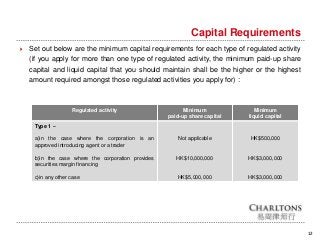
 Set out below are the minimum capital requirements for each type of regulated activity
(if you apply for more than one type of regulated activity, the minimum paid-up share
capital and liquid capital that you should maintain shall be the higher or the highest
amount required amongst those regulated activities you apply for) :
Regulated activity Minimum
paid-up share capital
Minimum
liquid capital
Type 1 –
a)in the case where the corporation is an
approved introducing agent or a trader
b)in the case where the corporation provides
securities margin financing
c)in any other case
Not applicable
HK$10,000,000
HK$5,000,000
HK$500,000
HK$3,000,000
HK$3,000,000
Capital Requirements (Cont’d)
13
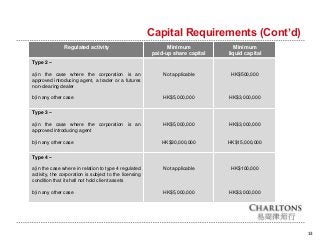
Regulated activity Minimum
paid-up share capital
Minimum
liquid capital
Type 2 –
a)in the case where the corporation is an
approved introducing agent, a trader or a futures
non-clearing dealer
b)in any other case
Not applicable
HK$5,000,000
HK$500,000
HK$3,000,000
Type 3 –
a)in the case where the corporation is an
approved introducing agent
b)in any other case
HK$5,000,000
HK$30,000,000
HK$3,000,000
HK$15,000,000
Type 4 –
a)in the case where in relation to type 4 regulated
activity, the corporation is subject to the licensing
condition that it shall not hold client assets
b)in any other case
Not applicable
HK$5,000,000
HK$100,000
HK$3,000,000
Capital Requirements (Cont’d)
14
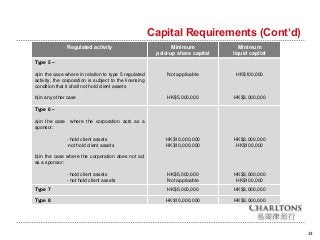
Regulated activity Minimum
paid-up share capital
Minimum
liquid capital
Type 5 –
a)in the case where in relation to type 5 regulated
activity, the corporation is subject to the licensing
condition that it shall not hold client assets
b)in any other case
Not applicable
HK$5,000,000
HK$100,000
HK$3,000,000
Type 6 –
a)in the case where the corporation acts as a
sponsor:
- hold client assets
-not hold client assets
b)in the case where the corporation does not act
as a sponsor:
- hold client assets
- not hold client assets
HK$10,000,000
HK$10,000,000
HK$5,000,000
Not applicable
HK$3,000,000
HK$100,000
HK$3,000,000
HK$100,000
Type 7 HK$5,000,000 HK$3,000,000
Type 8 HK$10,000,000 HK$3,000,000
Capital Requirements (Cont’d)
15
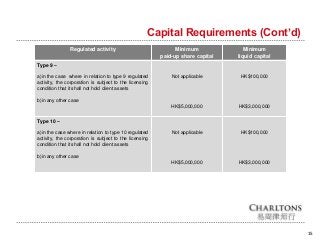
Regulated activity Minimum
paid-up share capital
Minimum
liquid capital
Type 9 –
a)in the case where in relation to type 9 regulated
activity, the corporation is subject to the licensing
condition that it shall not hold client assets
b)in any other case
Not applicable
HK$5,000,000
HK$100,000
HK$3,000,000
Type 10 –
a)in the case where in relation to type 10 regulated
activity, the corporation is subject to the licensing
condition that it shall not hold client assets
b)in any other case
Not applicable
HK$5,000,000
HK$100,000
HK$3,000,000
16
Licensed Persons
 Responsible officers (ROs):
o A licensed corporation is required to appoint two ROs who have been
approved by the SFC as ROs in relation to each of its regulated activities.
o The same individual, however, may be appointed to be an RO for more than
one regulated activity.
o At least one of the ROs must be an executive director (defined as a director
who actively participates in, or is responsible for directly supervising, the
business of a regulated activity for which a corporation is licensed).
o Every executive director of a licensed corporation must be approved by the
SFC as an RO in relation to the regulated activity in which he participates or
supervises.
17
Licensed Persons (Cont’d)
 Licensed representative :
o Any individual who carries on one or more regulated activities on behalf of a
licensed corporation is required to apply for approval as a “licensed
representative” accredited to that corporation.
o A licensed representative may be accredited to more than one licensed
corporation within the same group.
18
Competence Requirements
 Generally, proposed ROs must possess the appropriate ability, skills, knowledge and
experience to properly manage and supervise the corporation’s proposed regulated
activities and fulfill four basic elements.
 A proposed licensed representative should possess a basic understanding of the
market in which he is to work as well as the laws and regulatory requirements
applicable to the industry and he is expected to fulfill three basic elements.
19
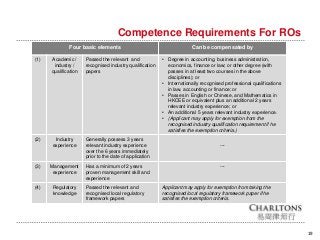
Competence Requirements For ROs
Four basic elements Can be compensated by
(1) Academic /
industry /
qualification
Passed the relevant and
recognised industry qualification
papers
• Degree in accounting, business administration,
economics, finance or law; or other degree (with
passes in at least two courses in the above
disciplines); or
• Internationally recognised professional qualifications
in law, accounting or finance; or
• Passes in English or Chinese, and Mathematics in
HKCEE or equivalent plus an additional 2 years
relevant industry experience; or
• An additional 5 years relevant industry experience.
• (Applicant may apply for exemption from the
recognised industry qualification requirement if he
satisfies the exemption criteria.)
(2) Industry
experience
Generally possess 3 years
relevant industry experience
over the 6 years immediately
prior to the date of application
---
(3) Management
experience
Has a minimum of 2 years
proven management skill and
experience
---
(4) Regulatory
knowledge
Passed the relevant and
recognised local regulatory
framework papers
Applicant may apply for exemption from taking the
recognised local regulatory framework paper if he
satisfies the exemption criteria.
20
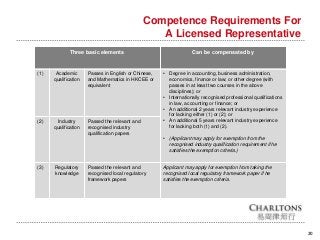
Competence Requirements For
A Licensed Representative
Three basic elements Can be compensated by
(1) Academic
qualification
Passes in English or Chinese,
and Mathematics in HKCEE or
equivalent
• Degree in accounting, business administration,
economics, finance or law; or other degree (with
passes in at least two courses in the above
disciplines); or
• Internationally recognised professional qualifications
in law, accounting or finance; or
• An additional 2 years relevant industry experience
for lacking either (1) or (2); or
• An additional 5 years relevant industry experience
for lacking both (1) and (2).
• (Applicant may apply for exemption from the
recognised industry qualification requirement if he
satisfies the exemption criteria.)
(2) Industry
qualification
Passed the relevant and
recognised industry
qualification papers
(3) Regulatory
knowledge
Passed the relevant and
recognised local regulatory
framework papers
Applicant may apply for exemption from taking the
recognised local regulatory framework paper if he
satisfies the exemption criteria.
21
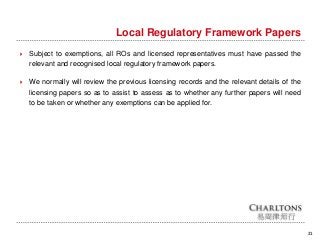
Local Regulatory Framework Papers
 Subject to exemptions, all ROs and licensed representatives must have passed the
relevant and recognised local regulatory framework papers.
 We normally will review the previous licensing records and the relevant details of the
licensing papers so as to assist to assess as to whether any further papers will need
to be taken or whether any exemptions can be applied for.
22
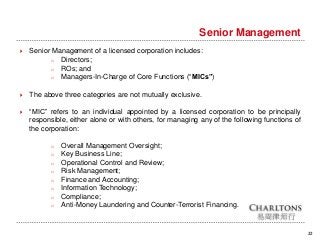
Senior Management
 Senior Management of a licensed corporation includes:
o Directors;
o ROs; and
o Managers-In-Charge of Core Functions (“MICs”)
 The above three categories are not mutually exclusive.
 “MIC” refers to an individual appointed by a licensed corporation to be principally
responsible, either alone or with others, for managing any of the following functions of
the corporation:
o Overall Management Oversight;
o Key Business Line;
o Operational Control and Review;
o Risk Management;
o Finance and Accounting;
o Information Technology;
o Compliance;
o Anti-Money Laundering and Counter-Terrorist Financing.
23
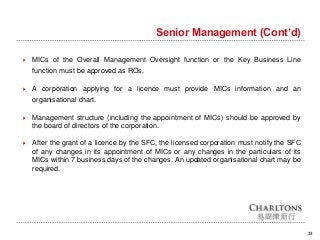
Senior Management (Cont’d)
 MICs of the Overall Management Oversight function or the Key Business Line
function must be approved as ROs.
 A corporation applying for a licence must provide MICs information and an
organisational chart.
 Management structure (including the appointment of MICs) should be approved by
the board of directors of the corporation.
 After the grant of a licence by the SFC, the licensed corporation must notify the SFC
of any changes in its appointment of MICs or any changes in the particulars of its
MICs within 7 business days of the changes. An updated organisational chart may be
required.
24
Business Structure
 As part of the licensing application, the SFC would require information on the
organisation and corporate structure of the applicant.
 We usually will review your organisation chart (including all corporations and
individuals and relevant percentage of holdings up to the ultimate beneficial
shareholders) so as to assist us to determine what forms would need to be filed with.
25
Office Premises
 Licensed corporations are required to have suitable office premises to conduct their
regulated activities.
 In assessing whether office premises are appropriate, the SFC will consider the
following:
o the security of the premises and whether there is a proper segregated office
area;
o whether essential office equipment and telecommunication systems are situated
in an area accessible only by the firm's personnel;
o whether the firm has taken sufficient actions/measures to avoid confusion to its
clients due to the co-existence of other firms in the same premises;
o whether confidential or non-public information and client privacy will be
sufficiently safeguarded against unauthorised access or leakage; and
o whether the premises are always accessible for visit by regulators.
26
Insurance
 The Securities and Futures (Insurance) Rules (“Rules”) set out the insurance
requirements and the Rules are applicable to all licensed corporations other than one
which is (i) not an exchange participant; and (ii) hold a licence subject to condition
that it shall not hold client’s assets.
 Section 4 of the Rules further provides that a licensed corporation governed by the
Rules shall take out and maintain insurance for that regulated activity where the SFC
has approved a master policy of insurance.
 Currently, there are two master policies of insurance respectively applicable to stock
exchange participants licensed for type 1 regulated activity and futures exchange
participants licensed for type 2 regulated activity.
27
Timing And SFC’s Performance Pledge
 The current performance pledge of the SFC for processing of licensing applications for
corporations is 15 weeks.
 The performance pledge for processing of licensing applications for representatives
and ROs are 8 weeks and 10 weeks respectively.
 The above timing does not include the amount of time required for preparation of the
materials.
 The duration required for preparation will depend on the preparedness and
responsiveness of the client and normally this would take approximately 2-4 weeks.
 The location of the client may have a factor on this timing.
28
LICENSING REQUIREMENTS FOR PRIVATE EQUITY
FIRMS
 On 7 January 2020, the SFC published a circular providing guidance on the
licensing obligations of private equity firms.
 Private equity funds are often established as limited partnerships whose general
partner is ultimately responsible for the private equity fund’s management and
control. Given the general partner’s role in managing the private equity fund, it will
generally need to be licensed for SFC Type 9 regulated activity (asset
management) if its activities in Hong Kong constitute asset management business
(as defined in the SFO).
 Individuals performing asset management activities in Hong Kong on behalf of the
general partner must also be licensed as representatives accredited to the
licensed general partner, and two individuals need to be approved as the general
partner’s responsible officers for its asset management business.
29
LICENSING REQUIREMENTS FOR PRIVATE EQUITY
FIRMS (Cont’d)
 However, a general partner will not need to be licensed if it delegates all its asset
management functions to another entity which holds a Type 9 licence or registration.
 In these circumstances, the unlicensed general partner must ensure that it does not
represent to any prospective investor that it manages a private equity fund in Hong
Kong because doing so would breach section 114 of the SFO, which prohibits any
unlicensed person from holding himself out as carrying on a business in a regulated
activity.
30
LICENSING REQUIREMENTS FOR FAMILY OFFICES
 On 7 January 2020, the SFC published a circular providing guidance on the
licensing obligations of family offices which intend to carry out asset management
or other services in Hong Kong.
 As the Hong Kong licensing regime under the SFO is activity-based, there is no
specific licensing regime for family offices. If the services provided by a family office
are regulated activities under the SFO, it must apply for an SFC licence to carry on
those activities, unless they are exempt or carved-out from the licensing regime.
 A family office is not required to be licensed with the SFC if its services do not
constitute any regulated activity or fall within an exemption or carve-out. Family
offices must however take care to ensure that they do not hold themselves out as
carrying on a business in a regulated activity, which is an offence under the SFO.
31
LICENSING REQUIREMENTS FOR FAMILY OFFICES
(Cont’d)
 If a company or family office is set up as a business to manage assets which include
securities or futures contracts, it will need to hold a licence for SFC Type 9 regulated
activity (asset management which is defined as real estate investment scheme
management and securities or futures contract management), unless an exemption
applies.
 The licensing implications of providing asset management services in Hong Kong do
not hinge on whether clients are families. Therefore, the relationships amongst the
beneficiaries of a family trust or between family members are not relevant in
determining whether an SFC licence is required.
 If a family office intends to provide other services such as acquiring financial assets
following instructions made by the family, it should review whether these services fall
within the definition of any of the other types of regulated activities such as SFC Type
1 regulated activity (dealing in securities), and whether it needs to be licensed for
such activities.
32
REFERENCE MATERIALS
 The SFC has issued various rules, codes and guidelines that are relevant to licensed
corporations. These include:
o Guidelines on Competence (of corporations and licensed individuals);
o Code of Conduct for Persons Licensed by or Registered with the SFC;
o Management, Supervision and Internal Control Guidelines for Persons
Licensed by or Registered with the SFC;
o Fund Manager Code of Conduct;
o Fit and Proper Guidelines; and
o Licensing Handbook.
33
Recent Licensing Experience
 We regularly assist and make submissions to the SFC on behalf of clients for
obtaining of licenses to carry out regulated activities in Hong Kong.
 Selected licensing work:
o advised a Swiss headquartered asset management firm in connection with an
application for a licence to carry on Types 4 and 9 regulated activities
o advised a Hong Kong asset management firm in connection with removal of
licensing conditions
o advised a Korea headquartered financial services firm in connection with an
application for a licence to carry on Types 1, 4 and 9 regulated activities
o advised a UK affiliated financial services firm in connection with an application
for a licence to carry on Type 1 regulated activity
o advised a US headquartered financial-services firm in connection with its
establishment of a Hong Kong subsidiary or branch for the set up of a futures
contracts dealing practice in Hong Kong and the establishment of its leveraged
foreign exchange business in Hong Kong
34
Recent Licensing Experience
 Selected licensing work (cont’d):
o advised on the approval for change of substantial shareholder and approval of
new nominated responsible officer of a fund management and securities
advisory firm following its acquisition by a Thai private banking group
o advised on the approval for change of substantial shareholders following the
global merger of our client, an independently-owned private capital investment
management firm, with a locally-based private investment group
o advised on the approval to carry out asset management and securities advisory
services in connection with a US-based group focusing on global energy and
investments funds, which we were also advising in connection with its Chapter
21 listing on the Hong Kong Stock Exchange
o advised on licensing obligations of overseas individual/corporation outside Hong
Kong introducing overseas potential investors outside Hong Kong to hedge
funds based in Hong Kong under Securities and Futures Ordinance
35
Recent Licensing Experience
 Selected licensing work (cont’d):
o advised a Hong Kong licensed corporation in relation to an application to the
Securities and Futures Commission for addition of Type 5 (advising on future
contracts) regulated activity
o advised a Hong Kong licensed corporation in relation to an application to the
Securities and Futures Commission for licences to carry out Type 1 Regulated
Activity (Approved Introducing Agent) and Type 4 Regulated Activity (Advising
on Securities), and to propose changes to the substantial shareholders of the
Company
o advised on the merger of Hong Kong offices of a Taiwanese financial services
and securities firm (which we assisted in setting up) with the Hong Kong
subsidiary of another listed Taiwanese financial group
36
Other Related Experience
 On an ongoing basis, we provide licensing compliance advice, such as :
o ongoing satisfaction of capital requirements and response to regulatory
enquiries; and
o notifications of changes to the licensing corporation and licensed persons.
 We also advise on non-contentious matters including :
o employment matters; and
o corporate governance.
 We have excellent links and networks with law firms both domestically and
internationally. Our associated firm Boase Cohen & Collins offers advice on
contentious matters such as tax matters, employment matters and commercial
disputes.
Charltons
 Charltons’ extensive experience in corporate finance makes us uniquely
qualified to provide a first class legal service
 Extensive initial public offering and listing experience
 Representative offices in Shanghai, Beijing and Yangon
 “Corporate Finance Law Firm of the Year in Hong Kong” awarded to
Charltons in the Corporate INTL Magazine Global Award 2014
 “Boutique Firm of the Year” / “Boutique Transactional Law Firm of the
Year” awarded to Charltons by Asian Legal Business for the years 2002, 2003,
2006, 2007, 2008, 2009, 2010, 2011, 2012, 2013, 2014, 2015, 2016 and 2017
 Hong Kong Best National Firm for Work-Life Balance by Euromoney
Legal Media Asia Women in Business Law Awards 2017
 “Hong Kong's Top Independent Law Firm” awarded to Charltons in the
Euromoney Legal Media Group Asia Women in Business Law Awards 2012
and 2013
 “Equity Market Deal of the Year” awarded to Charltons in 2011 by Asian
Legal Business for advising on the AIA IPO
37
Charltons
38
 Excellent links and networks with law firms worldwide
 “Asian Restructuring Deal of the Year” 2000 awarded to
Charltons by International Financial Law Review for their work with
Guangdong Investment Limited
 Finalist for China Law & Practice’s “Deal of the Year (M&A)” 2007
for their work on Zijin Mining Group Co Ltd.’s bid for Monterrico
Metals plc.
Practice Areas
39
 Capital markets
 Corporate and commercial
 Securities
 Mergers and acquisitions
 Investment funds: China and offshore
 Derivatives
 Restructuring
 Venture capital
 Investment
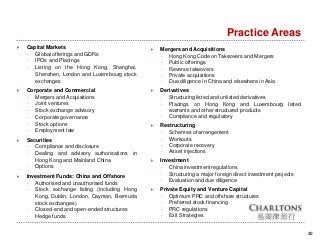
Practice Areas
40
 Mergers and Acquisitions
- Hong Kong Code on Takeovers and Mergers
- Public offerings
- Reverse takeovers
- Private acquisitions
- Due diligence in China and elsewhere in Asia
 Derivatives
- Structuring listed and unlisted derivatives
- Placings on Hong Kong and Luxembourg listed
warrants and other structured products
- Compliance and regulatory
 Restructuring
- Schemes of arrangement
- Workouts
- Corporate recovery
- Asset injections
 Investment
- China investment regulations
- Structuring a major foreign direct investment projects
- Evaluation and due diligence
 Private Equity and Venture Capital
- Optimum PRC and offshore structures
- Preferred stock financing
- PRC regulations
- Exit Strategies
 Capital Markets
- Global offerings and GDRs
- IPOs and Placings
- Listing on the Hong Kong, Shanghai,
Shenzhen, London and Luxembourg stock
exchanges
 Corporate and Commercial
- Mergers and Acquisitions
- Joint ventures
- Stock exchange advisory
- Corporate governance
- Stock options
- Employment law
 Securities
- Compliance and disclosure
- Dealing and advisory authorisations in
Hong Kong and Mainland China
- Options
 Investment Funds: China and Offshore
- Authorised and unauthorised funds
- Stock exchange listing (including Hong
Kong, Dublin, London, Cayman, Bermuda
stock exchanges)
- Closed-end and open-ended structures
- Hedge funds
The Charltons Team
41
The team is composed of individuals with the following knowledge and skills:
 A detailed knowledge of Hong Kong law and practice in relation to securities and
licensed corporations.
 Extensive experience of providing legal services for Hong Kong and overseas
clients, including corporate banks and licensed corporations.
 Extensive experience of communicating with the SFC including arranging and
attending with the SFC for new applicants.
 In depth knowledge of the relevant securities law, and relevant rules, codes and
guidelines issued by the SFC from time to time.
Team Profile : Julia Charlton
42
Julia Charlton – Partner
 Julia, LL.B (1st class Honours), A.K.C (Kings College,
London) was admitted as a solicitor in England &
Wales in 1985 and has practised as a solicitor in
Hong Kong since 1987.
 Julia is a Chairman, Planning and Lands Branch
Appeal Tribunal Panel and a member of the
Takeovers and Mergers Panel and the Takeovers
Appeal Committee of the SFC.
 Julia was named a “Leading Lawyer” by Asia Law &
Practice for the years 2002, 2003, and 2006 to 2019.
 Julia was named a “Leading Advisor” by Acquisition
International for 2013.
 Julia was also named the “Capital Markets Lawyer
of the Year – Hong Kong” in the Finance Monthly
Global Awards 2014.
 Julia has extensive experience in China work and is a
Mandarin speaker.
43
Contact Us
Hong Kong Office
Dominion Centre
12th Floor
43 – 59 Queen’s Road East
Hong Kong
Telephone:
Fax:
Email:
Website:
(852) 2905 7888
(852) 2854 9596
enquiries@charltonslaw.com
www.charltonslaw.com
44
Other Locations
China
Beijing Representative Office
3-1703, Vantone Centre
A6# Chaowai Avenue
Chaoyang District
Beijing
People's Republic of China
100020
Telephone: (86) 10 5907 3299
Facsimile: (86) 10 5907 3299
enquiries.beijing@charltonslaw.com
Shanghai Representative Office
Room 2006, 20th Floor
Fortune Times
1438 North Shanxi Road
Shanghai
People's Republic of China
200060
Telephone: (86) 21 6277 9899
Facsimile: (86) 21 6277 7899
enquiries.shanghai@charltonslaw.com
Myanmar
Yangon Office of Charltons Legal Consulting Ltd
161, 50th Street
Yangon
Myanmar
enquiries.myanmar@charltonslaw.com
In association with:
Networked with:

The licensing regime in Hong Kong

  • 1.
    0  Licensing Regimein Hong Kong www.charltonslaw.com
  • 2.
    The Hong KongLicensing Regime 1  The licensing and registration of persons operating in Hong Kong’s securities and futures markets is dealt with in Part V of the Securities and Futures Ordinance (SFO) which came into effect on 1 April 2003. The SFO is administered by the Securities and Futures Commission (SFC).  Part V of the SFO establishes a “single licence” regime whereby a person requires only one licence or registration to conduct different types of regulated activities.  The SFO prohibits any person from carrying on a business (or holding himself out as carrying on a business) in a regulated activity unless an appropriate authorisation has been granted or an exemption or exclusion applies.
  • 3.
    Types Of RegulatedActivities 2  Currently, there are 10 types of “regulated activities” in Hong Kong : o Type 1: dealing in securities o Type 2: dealing in futures contracts o Type 3: leveraged foreign exchange trading o Type 4: advising on securities o Type 5: advising on futures contracts o Type 6: advising on corporate finance o Type 7: providing automated trading services o Type 8: securities margin financing o Type 9: asset management o Type 10: providing credit rating services
  • 4.
    3 The Licensed Corporation For a corporation to be licensed to carry out regulated activities in Hong Kong, section 116(2) of the SFO requires that it has to be either a company incorporated in Hong Kong or an overseas company registered under Part 16 of the Companies Ordinance having a principal place of business in Hong Kong (i.e. branch company).  In general, Hong Kong branch offices are subject to the same legal and tax consequences as companies incorporated in Hong Kong.  In particular, the tax rate applied to profits is the same for local and foreign companies.  The main reason for preferring a Hong Kong subsidiary over a branch is that the subsidiary will be completely separate from its parent so that the parent will not be liable for the debts of the subsidiary.
  • 5.
    Exemptions From LicensingRequirements 4  Under certain circumstances, a particular type of licence may not be required for carrying out the relevant type of regulated activities.  The major applicable exemptions include : o incidental exemption o margin financier exemption o group company exemption o dealing with professional investors exemption
  • 6.
    Exemptions From LicensingRequirements 5  Incidental exemption : * Licensed for type 1 regulated activity and carry out certain other regulated activities o If you are licensed for type 1 regulated activity (dealing in securities) and you wish to carry out type 4 (advising on securities), type 6 (advising on corporate finance) and/or type 9 (asset management) regulated activity, you do not need to be licensed for types 4, 6 and 9 provided that these activities are carried out wholly incidental to your securities dealing business. o The exemption normally applies to stockbrokers who provide investment advice or manage discretionary accounts for their securities clients.
  • 7.
    Exemptions From LicensingRequirements (Cont’d) 6  Incidental exemption : (cont’d) * Licensed for type 2 regulated activity and carry out certain other regulated activities o If you are licensed for type 2 regulated activity (dealing in futures contracts) and you wish to carry out type 5 (advising on futures contracts) and/or type 9 (asset management) regulated activity, you do not need to be licensed for types 5 and 9 provided that these activities are carried out wholly incidental to your futures dealing business. o The exemption normally applies to futures brokers who provide investment advice or manage discretionary accounts for their futures clients.
  • 8.
    Exemptions From LicensingRequirements (Cont’d) 7  Incidental exemption : (cont’d) * Licensed for type 9 regulated activity and carry out certain other regulated activities o If you are licensed for type 9 regulated activity (asset management) and you wish to carry out type 1 (dealing in securities), type 2 (dealing in futures contracts), type 4 (advising on securities) and/or type 5 (advising on futures contracts) regulated activity, you do not need to be licensed for these regulated activities provided that they are carried out solely for the purposes of your asset management business (for types 4 and 5, such asset management business must involve the management of a portfolio under a collective investment scheme). o This exemption normally applies to fund managers who place trade orders to dealers or provide investment advice/research reports in the course of managing their clients’ portfolios of securities and/or futures contracts.
  • 9.
    Exemptions From LicensingRequirements (Cont’d) 8  Margin financier exemption : o If you are licensed for type 1 regulated activity (dealing in securities), you do not need to be separately licensed for type 8 regulated activity (securities margin financing) to carry out securities margin financing activities for your clients. o However, you would need to satisfy a more stringent financial resources requirement in terms of paid-up capital in order to do so. o This exemption normally applies to stockbrokers who also provide margin financing facilities to their securities clients.
  • 10.
    Exemptions From LicensingRequirements (Cont’d) 9  Group company exemption : o You are not required to be licensed for type 4 (advising on securities), type 5 (advising on futures contracts), type 6 (advising on corporate finance) or type 9 (asset management) regulated activity if you provide the relevant advice or services solely to your wholly owned subsidiaries, your holding company which holds all your issued shares, or other wholly owned subsidiaries of that holding company.  In relation to advisory activities o The exemption should not be applied to a corporation advising its group company in respect of that group company’s client assets. However, where the investment advice and/or related research reports are provided to the group company for its own consumption, notwithstanding that the group company may rely, in whole or in part, on such advice/research reports to service its clients, the above exclusion will still apply if the advice/research reports are issued to the clients by the group company in its own name and that group company has assessed the corporation’s input before issuing such advice/research reports.
  • 11.
    Exemptions From LicensingRequirements (Cont’d)  In relation to asset management activities o The exemption is only applicable to a corporation providing asset management service to its group company (on a wholly owned basis) in respect of that group company’s assets. It should not be read as applying to the management of assets belonging to the group company’s clients. Managing assets belonging to third parties would constitute “asset management” and attract a licensing requirement. 10
  • 12.
    Exemptions From LicensingRequirements (Cont’d) 11  Dealing with professional investor exemption : o You may not be required to be licensed for futures or securities dealing activity if you act as principal and deal with “professional investors” only. o “Professional investor” is specifically defined in Part 1 of Schedule 1 to the SFO. o However, definition of “professional investor” in the Securities and Futures (Professional Investor) Rules does not apply in this exemption.
  • 13.
    Capital Requirements 12  Setout below are the minimum capital requirements for each type of regulated activity (if you apply for more than one type of regulated activity, the minimum paid-up share capital and liquid capital that you should maintain shall be the higher or the highest amount required amongst those regulated activities you apply for) : Regulated activity Minimum paid-up share capital Minimum liquid capital Type 1 – a)in the case where the corporation is an approved introducing agent or a trader b)in the case where the corporation provides securities margin financing c)in any other case Not applicable HK$10,000,000 HK$5,000,000 HK$500,000 HK$3,000,000 HK$3,000,000
  • 14.
    Capital Requirements (Cont’d) 13 Regulatedactivity Minimum paid-up share capital Minimum liquid capital Type 2 – a)in the case where the corporation is an approved introducing agent, a trader or a futures non-clearing dealer b)in any other case Not applicable HK$5,000,000 HK$500,000 HK$3,000,000 Type 3 – a)in the case where the corporation is an approved introducing agent b)in any other case HK$5,000,000 HK$30,000,000 HK$3,000,000 HK$15,000,000 Type 4 – a)in the case where in relation to type 4 regulated activity, the corporation is subject to the licensing condition that it shall not hold client assets b)in any other case Not applicable HK$5,000,000 HK$100,000 HK$3,000,000
  • 15.
    Capital Requirements (Cont’d) 14 Regulatedactivity Minimum paid-up share capital Minimum liquid capital Type 5 – a)in the case where in relation to type 5 regulated activity, the corporation is subject to the licensing condition that it shall not hold client assets b)in any other case Not applicable HK$5,000,000 HK$100,000 HK$3,000,000 Type 6 – a)in the case where the corporation acts as a sponsor: - hold client assets -not hold client assets b)in the case where the corporation does not act as a sponsor: - hold client assets - not hold client assets HK$10,000,000 HK$10,000,000 HK$5,000,000 Not applicable HK$3,000,000 HK$100,000 HK$3,000,000 HK$100,000 Type 7 HK$5,000,000 HK$3,000,000 Type 8 HK$10,000,000 HK$3,000,000
  • 16.
    Capital Requirements (Cont’d) 15 Regulatedactivity Minimum paid-up share capital Minimum liquid capital Type 9 – a)in the case where in relation to type 9 regulated activity, the corporation is subject to the licensing condition that it shall not hold client assets b)in any other case Not applicable HK$5,000,000 HK$100,000 HK$3,000,000 Type 10 – a)in the case where in relation to type 10 regulated activity, the corporation is subject to the licensing condition that it shall not hold client assets b)in any other case Not applicable HK$5,000,000 HK$100,000 HK$3,000,000
  • 17.
    16 Licensed Persons  Responsibleofficers (ROs): o A licensed corporation is required to appoint two ROs who have been approved by the SFC as ROs in relation to each of its regulated activities. o The same individual, however, may be appointed to be an RO for more than one regulated activity. o At least one of the ROs must be an executive director (defined as a director who actively participates in, or is responsible for directly supervising, the business of a regulated activity for which a corporation is licensed). o Every executive director of a licensed corporation must be approved by the SFC as an RO in relation to the regulated activity in which he participates or supervises.
  • 18.
    17 Licensed Persons (Cont’d) Licensed representative : o Any individual who carries on one or more regulated activities on behalf of a licensed corporation is required to apply for approval as a “licensed representative” accredited to that corporation. o A licensed representative may be accredited to more than one licensed corporation within the same group.
  • 19.
    18 Competence Requirements  Generally,proposed ROs must possess the appropriate ability, skills, knowledge and experience to properly manage and supervise the corporation’s proposed regulated activities and fulfill four basic elements.  A proposed licensed representative should possess a basic understanding of the market in which he is to work as well as the laws and regulatory requirements applicable to the industry and he is expected to fulfill three basic elements.
  • 20.
    19 Competence Requirements ForROs Four basic elements Can be compensated by (1) Academic / industry / qualification Passed the relevant and recognised industry qualification papers • Degree in accounting, business administration, economics, finance or law; or other degree (with passes in at least two courses in the above disciplines); or • Internationally recognised professional qualifications in law, accounting or finance; or • Passes in English or Chinese, and Mathematics in HKCEE or equivalent plus an additional 2 years relevant industry experience; or • An additional 5 years relevant industry experience. • (Applicant may apply for exemption from the recognised industry qualification requirement if he satisfies the exemption criteria.) (2) Industry experience Generally possess 3 years relevant industry experience over the 6 years immediately prior to the date of application --- (3) Management experience Has a minimum of 2 years proven management skill and experience --- (4) Regulatory knowledge Passed the relevant and recognised local regulatory framework papers Applicant may apply for exemption from taking the recognised local regulatory framework paper if he satisfies the exemption criteria.
  • 21.
    20 Competence Requirements For ALicensed Representative Three basic elements Can be compensated by (1) Academic qualification Passes in English or Chinese, and Mathematics in HKCEE or equivalent • Degree in accounting, business administration, economics, finance or law; or other degree (with passes in at least two courses in the above disciplines); or • Internationally recognised professional qualifications in law, accounting or finance; or • An additional 2 years relevant industry experience for lacking either (1) or (2); or • An additional 5 years relevant industry experience for lacking both (1) and (2). • (Applicant may apply for exemption from the recognised industry qualification requirement if he satisfies the exemption criteria.) (2) Industry qualification Passed the relevant and recognised industry qualification papers (3) Regulatory knowledge Passed the relevant and recognised local regulatory framework papers Applicant may apply for exemption from taking the recognised local regulatory framework paper if he satisfies the exemption criteria.
  • 22.
    21 Local Regulatory FrameworkPapers  Subject to exemptions, all ROs and licensed representatives must have passed the relevant and recognised local regulatory framework papers.  We normally will review the previous licensing records and the relevant details of the licensing papers so as to assist to assess as to whether any further papers will need to be taken or whether any exemptions can be applied for.
  • 23.
    22 Senior Management  SeniorManagement of a licensed corporation includes: o Directors; o ROs; and o Managers-In-Charge of Core Functions (“MICs”)  The above three categories are not mutually exclusive.  “MIC” refers to an individual appointed by a licensed corporation to be principally responsible, either alone or with others, for managing any of the following functions of the corporation: o Overall Management Oversight; o Key Business Line; o Operational Control and Review; o Risk Management; o Finance and Accounting; o Information Technology; o Compliance; o Anti-Money Laundering and Counter-Terrorist Financing.
  • 24.
    23 Senior Management (Cont’d) MICs of the Overall Management Oversight function or the Key Business Line function must be approved as ROs.  A corporation applying for a licence must provide MICs information and an organisational chart.  Management structure (including the appointment of MICs) should be approved by the board of directors of the corporation.  After the grant of a licence by the SFC, the licensed corporation must notify the SFC of any changes in its appointment of MICs or any changes in the particulars of its MICs within 7 business days of the changes. An updated organisational chart may be required.
  • 25.
    24 Business Structure  Aspart of the licensing application, the SFC would require information on the organisation and corporate structure of the applicant.  We usually will review your organisation chart (including all corporations and individuals and relevant percentage of holdings up to the ultimate beneficial shareholders) so as to assist us to determine what forms would need to be filed with.
  • 26.
    25 Office Premises  Licensedcorporations are required to have suitable office premises to conduct their regulated activities.  In assessing whether office premises are appropriate, the SFC will consider the following: o the security of the premises and whether there is a proper segregated office area; o whether essential office equipment and telecommunication systems are situated in an area accessible only by the firm's personnel; o whether the firm has taken sufficient actions/measures to avoid confusion to its clients due to the co-existence of other firms in the same premises; o whether confidential or non-public information and client privacy will be sufficiently safeguarded against unauthorised access or leakage; and o whether the premises are always accessible for visit by regulators.
  • 27.
    26 Insurance  The Securitiesand Futures (Insurance) Rules (“Rules”) set out the insurance requirements and the Rules are applicable to all licensed corporations other than one which is (i) not an exchange participant; and (ii) hold a licence subject to condition that it shall not hold client’s assets.  Section 4 of the Rules further provides that a licensed corporation governed by the Rules shall take out and maintain insurance for that regulated activity where the SFC has approved a master policy of insurance.  Currently, there are two master policies of insurance respectively applicable to stock exchange participants licensed for type 1 regulated activity and futures exchange participants licensed for type 2 regulated activity.
  • 28.
    27 Timing And SFC’sPerformance Pledge  The current performance pledge of the SFC for processing of licensing applications for corporations is 15 weeks.  The performance pledge for processing of licensing applications for representatives and ROs are 8 weeks and 10 weeks respectively.  The above timing does not include the amount of time required for preparation of the materials.  The duration required for preparation will depend on the preparedness and responsiveness of the client and normally this would take approximately 2-4 weeks.  The location of the client may have a factor on this timing.
  • 29.
    28 LICENSING REQUIREMENTS FORPRIVATE EQUITY FIRMS  On 7 January 2020, the SFC published a circular providing guidance on the licensing obligations of private equity firms.  Private equity funds are often established as limited partnerships whose general partner is ultimately responsible for the private equity fund’s management and control. Given the general partner’s role in managing the private equity fund, it will generally need to be licensed for SFC Type 9 regulated activity (asset management) if its activities in Hong Kong constitute asset management business (as defined in the SFO).  Individuals performing asset management activities in Hong Kong on behalf of the general partner must also be licensed as representatives accredited to the licensed general partner, and two individuals need to be approved as the general partner’s responsible officers for its asset management business.
  • 30.
    29 LICENSING REQUIREMENTS FORPRIVATE EQUITY FIRMS (Cont’d)  However, a general partner will not need to be licensed if it delegates all its asset management functions to another entity which holds a Type 9 licence or registration.  In these circumstances, the unlicensed general partner must ensure that it does not represent to any prospective investor that it manages a private equity fund in Hong Kong because doing so would breach section 114 of the SFO, which prohibits any unlicensed person from holding himself out as carrying on a business in a regulated activity.
  • 31.
    30 LICENSING REQUIREMENTS FORFAMILY OFFICES  On 7 January 2020, the SFC published a circular providing guidance on the licensing obligations of family offices which intend to carry out asset management or other services in Hong Kong.  As the Hong Kong licensing regime under the SFO is activity-based, there is no specific licensing regime for family offices. If the services provided by a family office are regulated activities under the SFO, it must apply for an SFC licence to carry on those activities, unless they are exempt or carved-out from the licensing regime.  A family office is not required to be licensed with the SFC if its services do not constitute any regulated activity or fall within an exemption or carve-out. Family offices must however take care to ensure that they do not hold themselves out as carrying on a business in a regulated activity, which is an offence under the SFO.
  • 32.
    31 LICENSING REQUIREMENTS FORFAMILY OFFICES (Cont’d)  If a company or family office is set up as a business to manage assets which include securities or futures contracts, it will need to hold a licence for SFC Type 9 regulated activity (asset management which is defined as real estate investment scheme management and securities or futures contract management), unless an exemption applies.  The licensing implications of providing asset management services in Hong Kong do not hinge on whether clients are families. Therefore, the relationships amongst the beneficiaries of a family trust or between family members are not relevant in determining whether an SFC licence is required.  If a family office intends to provide other services such as acquiring financial assets following instructions made by the family, it should review whether these services fall within the definition of any of the other types of regulated activities such as SFC Type 1 regulated activity (dealing in securities), and whether it needs to be licensed for such activities.
  • 33.
    32 REFERENCE MATERIALS  TheSFC has issued various rules, codes and guidelines that are relevant to licensed corporations. These include: o Guidelines on Competence (of corporations and licensed individuals); o Code of Conduct for Persons Licensed by or Registered with the SFC; o Management, Supervision and Internal Control Guidelines for Persons Licensed by or Registered with the SFC; o Fund Manager Code of Conduct; o Fit and Proper Guidelines; and o Licensing Handbook.
  • 34.
    33 Recent Licensing Experience We regularly assist and make submissions to the SFC on behalf of clients for obtaining of licenses to carry out regulated activities in Hong Kong.  Selected licensing work: o advised a Swiss headquartered asset management firm in connection with an application for a licence to carry on Types 4 and 9 regulated activities o advised a Hong Kong asset management firm in connection with removal of licensing conditions o advised a Korea headquartered financial services firm in connection with an application for a licence to carry on Types 1, 4 and 9 regulated activities o advised a UK affiliated financial services firm in connection with an application for a licence to carry on Type 1 regulated activity o advised a US headquartered financial-services firm in connection with its establishment of a Hong Kong subsidiary or branch for the set up of a futures contracts dealing practice in Hong Kong and the establishment of its leveraged foreign exchange business in Hong Kong
  • 35.
    34 Recent Licensing Experience Selected licensing work (cont’d): o advised on the approval for change of substantial shareholder and approval of new nominated responsible officer of a fund management and securities advisory firm following its acquisition by a Thai private banking group o advised on the approval for change of substantial shareholders following the global merger of our client, an independently-owned private capital investment management firm, with a locally-based private investment group o advised on the approval to carry out asset management and securities advisory services in connection with a US-based group focusing on global energy and investments funds, which we were also advising in connection with its Chapter 21 listing on the Hong Kong Stock Exchange o advised on licensing obligations of overseas individual/corporation outside Hong Kong introducing overseas potential investors outside Hong Kong to hedge funds based in Hong Kong under Securities and Futures Ordinance
  • 36.
    35 Recent Licensing Experience Selected licensing work (cont’d): o advised a Hong Kong licensed corporation in relation to an application to the Securities and Futures Commission for addition of Type 5 (advising on future contracts) regulated activity o advised a Hong Kong licensed corporation in relation to an application to the Securities and Futures Commission for licences to carry out Type 1 Regulated Activity (Approved Introducing Agent) and Type 4 Regulated Activity (Advising on Securities), and to propose changes to the substantial shareholders of the Company o advised on the merger of Hong Kong offices of a Taiwanese financial services and securities firm (which we assisted in setting up) with the Hong Kong subsidiary of another listed Taiwanese financial group
  • 37.
    36 Other Related Experience On an ongoing basis, we provide licensing compliance advice, such as : o ongoing satisfaction of capital requirements and response to regulatory enquiries; and o notifications of changes to the licensing corporation and licensed persons.  We also advise on non-contentious matters including : o employment matters; and o corporate governance.  We have excellent links and networks with law firms both domestically and internationally. Our associated firm Boase Cohen & Collins offers advice on contentious matters such as tax matters, employment matters and commercial disputes.
  • 38.
    Charltons  Charltons’ extensiveexperience in corporate finance makes us uniquely qualified to provide a first class legal service  Extensive initial public offering and listing experience  Representative offices in Shanghai, Beijing and Yangon  “Corporate Finance Law Firm of the Year in Hong Kong” awarded to Charltons in the Corporate INTL Magazine Global Award 2014  “Boutique Firm of the Year” / “Boutique Transactional Law Firm of the Year” awarded to Charltons by Asian Legal Business for the years 2002, 2003, 2006, 2007, 2008, 2009, 2010, 2011, 2012, 2013, 2014, 2015, 2016 and 2017  Hong Kong Best National Firm for Work-Life Balance by Euromoney Legal Media Asia Women in Business Law Awards 2017  “Hong Kong's Top Independent Law Firm” awarded to Charltons in the Euromoney Legal Media Group Asia Women in Business Law Awards 2012 and 2013  “Equity Market Deal of the Year” awarded to Charltons in 2011 by Asian Legal Business for advising on the AIA IPO 37
  • 39.
    Charltons 38  Excellent linksand networks with law firms worldwide  “Asian Restructuring Deal of the Year” 2000 awarded to Charltons by International Financial Law Review for their work with Guangdong Investment Limited  Finalist for China Law & Practice’s “Deal of the Year (M&A)” 2007 for their work on Zijin Mining Group Co Ltd.’s bid for Monterrico Metals plc.
  • 40.
    Practice Areas 39  Capitalmarkets  Corporate and commercial  Securities  Mergers and acquisitions  Investment funds: China and offshore  Derivatives  Restructuring  Venture capital  Investment
  • 41.
    Practice Areas 40  Mergersand Acquisitions - Hong Kong Code on Takeovers and Mergers - Public offerings - Reverse takeovers - Private acquisitions - Due diligence in China and elsewhere in Asia  Derivatives - Structuring listed and unlisted derivatives - Placings on Hong Kong and Luxembourg listed warrants and other structured products - Compliance and regulatory  Restructuring - Schemes of arrangement - Workouts - Corporate recovery - Asset injections  Investment - China investment regulations - Structuring a major foreign direct investment projects - Evaluation and due diligence  Private Equity and Venture Capital - Optimum PRC and offshore structures - Preferred stock financing - PRC regulations - Exit Strategies  Capital Markets - Global offerings and GDRs - IPOs and Placings - Listing on the Hong Kong, Shanghai, Shenzhen, London and Luxembourg stock exchanges  Corporate and Commercial - Mergers and Acquisitions - Joint ventures - Stock exchange advisory - Corporate governance - Stock options - Employment law  Securities - Compliance and disclosure - Dealing and advisory authorisations in Hong Kong and Mainland China - Options  Investment Funds: China and Offshore - Authorised and unauthorised funds - Stock exchange listing (including Hong Kong, Dublin, London, Cayman, Bermuda stock exchanges) - Closed-end and open-ended structures - Hedge funds
  • 42.
    The Charltons Team 41 Theteam is composed of individuals with the following knowledge and skills:  A detailed knowledge of Hong Kong law and practice in relation to securities and licensed corporations.  Extensive experience of providing legal services for Hong Kong and overseas clients, including corporate banks and licensed corporations.  Extensive experience of communicating with the SFC including arranging and attending with the SFC for new applicants.  In depth knowledge of the relevant securities law, and relevant rules, codes and guidelines issued by the SFC from time to time.
  • 43.
    Team Profile :Julia Charlton 42 Julia Charlton – Partner  Julia, LL.B (1st class Honours), A.K.C (Kings College, London) was admitted as a solicitor in England & Wales in 1985 and has practised as a solicitor in Hong Kong since 1987.  Julia is a Chairman, Planning and Lands Branch Appeal Tribunal Panel and a member of the Takeovers and Mergers Panel and the Takeovers Appeal Committee of the SFC.  Julia was named a “Leading Lawyer” by Asia Law & Practice for the years 2002, 2003, and 2006 to 2019.  Julia was named a “Leading Advisor” by Acquisition International for 2013.  Julia was also named the “Capital Markets Lawyer of the Year – Hong Kong” in the Finance Monthly Global Awards 2014.  Julia has extensive experience in China work and is a Mandarin speaker.
  • 44.
    43 Contact Us Hong KongOffice Dominion Centre 12th Floor 43 – 59 Queen’s Road East Hong Kong Telephone: Fax: Email: Website: (852) 2905 7888 (852) 2854 9596 enquiries@charltonslaw.com www.charltonslaw.com
  • 45.
    44 Other Locations China Beijing RepresentativeOffice 3-1703, Vantone Centre A6# Chaowai Avenue Chaoyang District Beijing People's Republic of China 100020 Telephone: (86) 10 5907 3299 Facsimile: (86) 10 5907 3299 enquiries.beijing@charltonslaw.com Shanghai Representative Office Room 2006, 20th Floor Fortune Times 1438 North Shanxi Road Shanghai People's Republic of China 200060 Telephone: (86) 21 6277 9899 Facsimile: (86) 21 6277 7899 enquiries.shanghai@charltonslaw.com Myanmar Yangon Office of Charltons Legal Consulting Ltd 161, 50th Street Yangon Myanmar enquiries.myanmar@charltonslaw.com In association with: Networked with: