Considering	soil	C	information	in	
decision-making
Eike	Luedeling
World	Agroforestry	Centre	&	University	of	Bonn
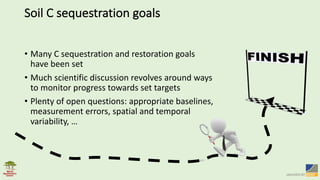
Soil	C	sequestration	goals
• Many	C	sequestration	and	restoration	goals	
have	been	set
• Much	scientific	discussion	revolves	around	ways	
to	monitor	progress	towards	set	targets
• Plenty	of	open	questions:	appropriate	baselines,	
measurement	errors,	spatial	and	temporal	
variability,	…
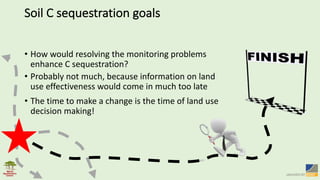
Soil	C	sequestration	goals
• Probably	not	much,	because	information	on	land	
use	effectiveness	would	come	in	much	too	late
• The	time	to	make	a	change	is	the	time	of	land	use	
decision	making!
• How	would	resolving	the	monitoring	problems	
enhance	C	sequestration?
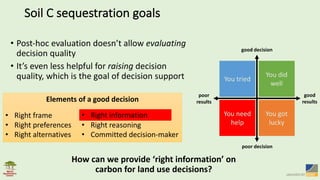
Elements	of	a	good	decision
Soil	C	sequestration	goals
• Post-hoc	evaluation	doesn’t	allow	evaluating
decision	quality
• It’s	even	less	helpful	for	raising decision	
quality,	which	is	the	goal	of	decision	support
How	can	we	provide	‘right	information’	on	
carbon	for	land	use	decisions?
• Right	frame
• Right	preferences
• Right	alternatives
• Right	information
• Right	reasoning
• Committed	decision-maker
• Right	information
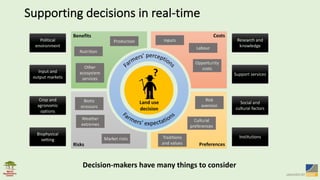
Supporting	decisions	in	real-time
Decision-makers	have	many	things	to	consider
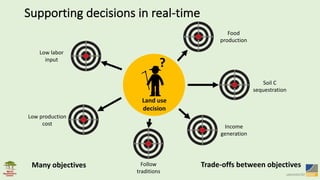
Supporting	decisions	in	real-time
Land	use
decision
?
Soil	C	
sequestration
Food	
production
Income	
generation
Follow	
traditions
Low	production	
cost
Low	labor	
input
Many	objectives Trade-offs	between	objectives
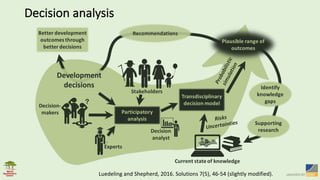
Decision	analysis
Luedeling	and	Shepherd,	2016.	Solutions	7(5),	46-54	(slightly	modified).
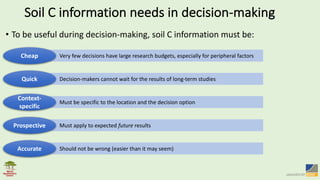
Very	few	decisions	have	large	research	budgets,	especially	for	peripheral	factors
Soil	C	information	needs	in	decision-making
• To	be	useful	during	decision-making,	soil	C	information	must	be:
Cheap
Decision-makers	cannot	wait	for	the	results	of	long-term	studiesQuick
Must	be	specific	to	the	location	and	the	decision	option
Context-
specific
Must	apply	to	expected	future resultsProspective
Should	not	be	wrong	(easier	than	it	may	seem)Accurate
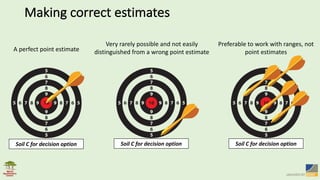
Making	correct	estimates
Soil	C	for	decision	option
Very	rarely	possible	and	not	easily	
distinguished	from	a	wrong	point	estimate
Soil	C	for	decision	option
A	perfect	point	estimate
Preferable	to	work	with	ranges,	not	
point	estimates
Soil	C	for	decision	option
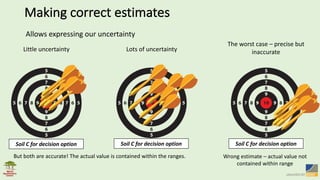
Making	correct	estimates
Soil	C	for	decision	option
Allows	expressing	our	uncertainty
Soil	C	for	decision	option
Little	uncertainty
The	worst	case	– precise	but	
inaccurate
Soil	C	for	decision	option
Lots	of	uncertainty
But	both	are	accurate!	The	actual	value	is	contained	within	the	ranges. Wrong	estimate	– actual	value	not	
contained	within	range
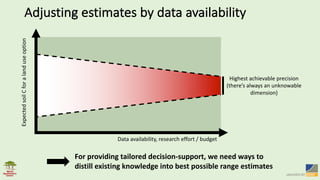
Adjusting	estimates	by	data	availability
Expected	soil	C	for	a	land	use	option
Data	availability,	research	effort	/	budget
Highest	achievable	precision	
(there’s	always	an	unknowable	
dimension)
For	providing	tailored	decision-support,	we	need	ways	to	
distill	existing	knowledge	into	best	possible	range	estimates
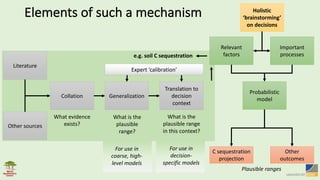
Elements	of	such	a	mechanism
Literature
Collation Generalization
Holistic	
‘brainstorming’	
on	decisions
Probabilistic	
model
Relevant	
factors
Expert	‘calibration’
C	sequestration	
projection
Important	
processes
Other	sources
What	evidence	
exists?
What	is	the	
plausible	
range?
Translation	to	
decision	
context
What	is	the	
plausible	range	
in	this	context?
Other	
outcomes
e.g.	soil	C	sequestration
For	use	in	
coarse,	high-
level	models
For	use	in	
decision-
specific	models
Plausible	ranges
Conclusions
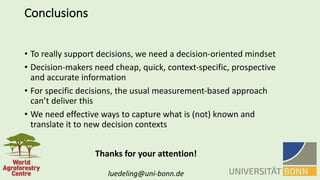
• To	really	support	decisions,	we	need	a	decision-oriented	mindset
• Decision-makers	need	cheap,	quick,	context-specific,	prospective	
and	accurate	information
• For	specific	decisions,	the	usual	measurement-based	approach	
can’t	deliver	this
• We	need	effective	ways	to	capture	what	is	(not)	known	and	
translate	it	to	new	decision	contexts
Thanks	for	your	attention!
luedeling@uni-bonn.de
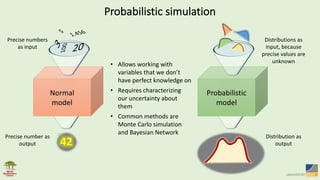
Probabilistic	simulation
Normal
model
Precise	numbers	
as	input
42
Precise	number	as	
output
Probabilistic
model
Distributions	as	
input,	because	
precise	values	are	
unknown
Distribution	as	
output
• Allows	working	with	
variables	that	we	don’t	
have	perfect	knowledge	on
• Requires	characterizing	
our	uncertainty	about	
them
• Common	methods	are	
Monte	Carlo	simulation	
and	Bayesian	Network
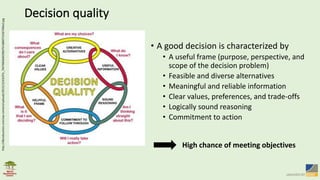
Decision	quality
• A	good	decision	is	characterized	by
• A	useful	frame	(purpose,	perspective,	and	
scope	of	the	decision	problem)
• Feasible	and	diverse	alternatives
• Meaningful	and	reliable	information
• Clear	values,	preferences,	and	trade-offs
• Logically	sound	reasoning
• Commitment	to	action
http://dbceducation.com/wp-content/uploads/2015/12/d3c97e_74476856d6296d7b7a8607155b7584a2.jpg
High	chance	of	meeting	objectives

Considering soil C information in decision-making