Abu Dhabi
Beijing
Berlin
Brussels
Dallas
Dubai
Frankfurt
Hong Kong
Johannesburg
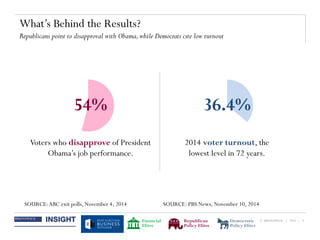
London
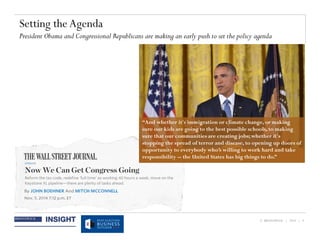
Milan
Munich
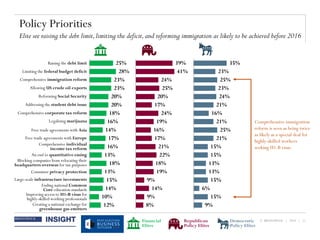
New York
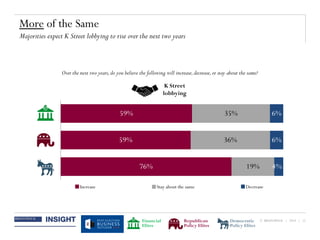
Paris
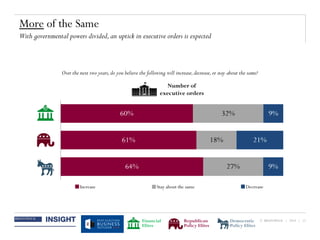
Rome
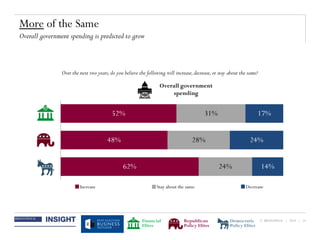
San Francisco
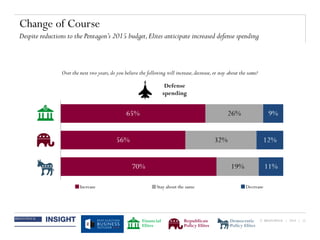
Sao Paulo
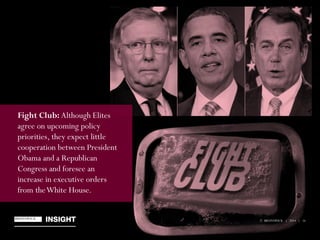
Shanghai
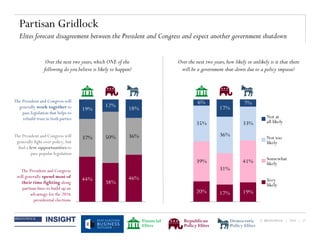
Singapore
Stockholm
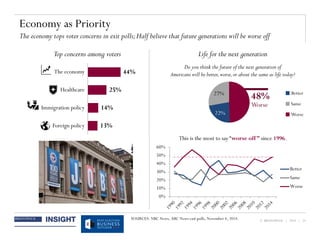
Vienna
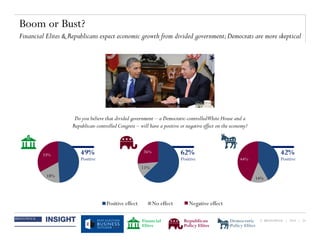
Washington, D.C.
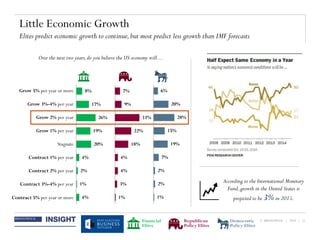
Political and Financial Elite Survey Results
November 2014
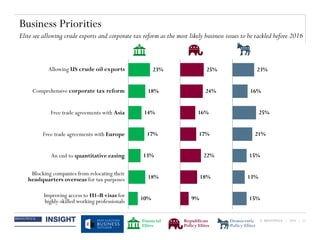
Abu Dhabi
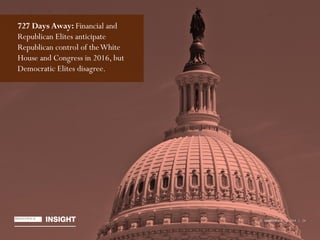
Beijing
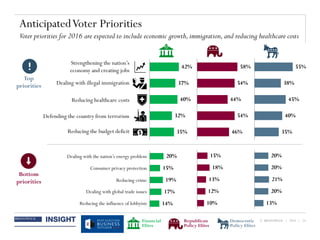
Berlin
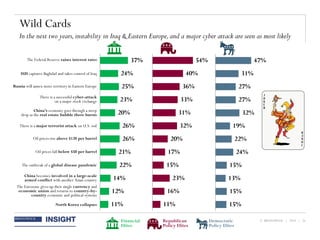
Brussels
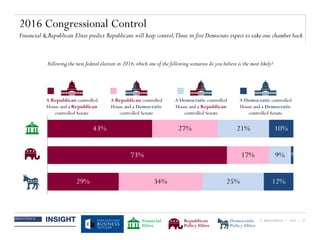
Dallas
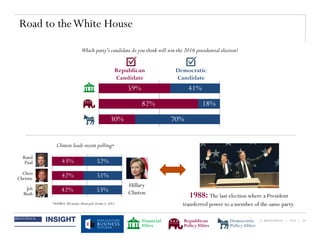
Dubai
Frankfurt
Hong Kong
Johannesburg
London
Milan
Munich
New York
Paris
Rome
San Francisco
Sao Paulo
Shanghai
Singapore
Stockholm
Vienna
Washington, D.C.
Š BRUNSWICK | 2014 | 1
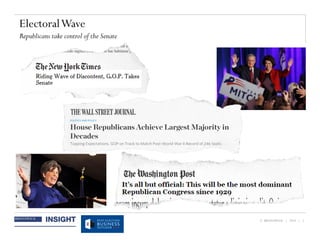
ElectoralWave
Republicans take control of the Senate
Š BRUNSWICK | 2014 | 2
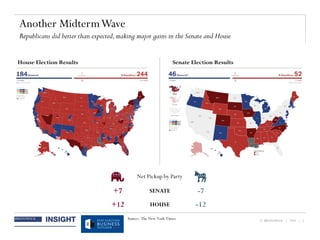
Another MidtermWave
Republicans did better than expected,making major gains in the Senate and House
House Election Results Senate Election Results
Source: The New York Times
Net Pickup by Party
SENATE+7 -7
HOUSE+12 -12
Š BRUNSWICK | 2014 | 3
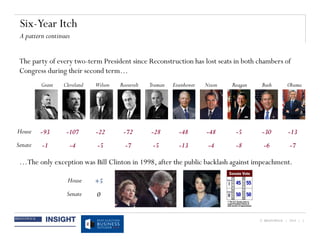
The party of every two-term President since Reconstruction has lost seats in both chambers of
Congress during their second term…
…The only exception was Bill Clinton in 1998, after the public backlash against impeachment.
Six-Year Itch
A pattern continues
Grant
House
Senate
Cleveland Wilson Roosevelt Truman Eisenhower Nixon Reagan Bush
-93
-1
-107
-4
-22
-5
-72
-7
-28
-5
-48
-13
-48
-4
-5
-8
-30
-6
House
Senate
+5
0
Obama
-13
-7
Š BRUNSWICK | 2014 | 4
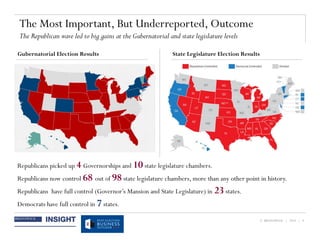
The Most Important, But Underreported, Outcome
The Republican wave led to big gains at the Gubernatorial and state legislature levels
Gubernatorial Election Results State Legislature Election Results
Republicans picked up 4 Governorships and 10state legislature chambers.
Republicans now control 68 out of 98 state legislature chambers, more than any other point in history.
Republicans have full control (Governor’s Mansion and State Legislature) in 23states.
Democrats have full control in 7 states.
Š BRUNSWICK | 2014 | 5
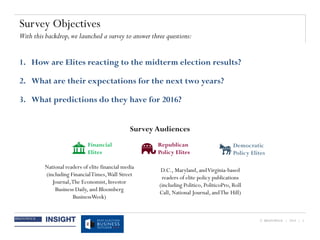
1. How are Elites reacting to the midterm election results?
2. What are their expectations for the next two years?
3. What predictions do they have for 2016?
Survey Objectives
With this backdrop,we launched a survey to answer three questions:
D.C., Maryland, andVirginia-based
readers of elite policy publications
(including Politico, PoliticoPro, Roll
Call, National Journal, andThe Hill)
National readers of elite financial media
(including FinancialTimes,Wall Street
Journal,The Economist, Investor
Business Daily, and Bloomberg
BusinessWeek)
Republican
Policy Elites
Democratic
Policy Elites
Financial
Elites
Survey Audiences
Š BRUNSWICK | 2014 | 6
Exceeding Expectations:
All audiences believe that the
Republicans did better than
expected in the midterm
elections.
Š BRUNSWICK | 2014 | 6
Š BRUNSWICK | 2014 | 7
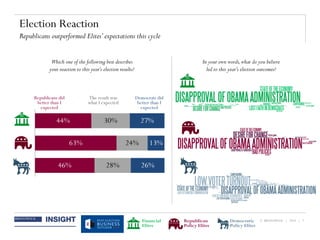
Election Reaction
Republicans outperformed Elites’expectations this cycle
Financial
Elites
Republican
Policy Elites
Democratic
Policy Elites
Republicans did
better than I
expected
The result was
what I expected
Democrats did
better than I
expected
In your own words,what do you believe
led to this year’s election outcomes?
Which one of the following best describes
your reaction to this year’s election results?
44%
63%
46%
30%
24%
28%
27%
13%
26%
Š BRUNSWICK | 2014 | 8
What’s Behind the Results?
Republicans point to disapproval with Obama,while Democrats cite low turnout
Financial
Elites
Republican
Policy Elites
Democratic
Policy Elites
54%
Voters who disapprove of President
Obama’s job performance.
SOURCE:ABC exit polls, November 4, 2014
36.4%
2014 voter turnout, the
lowest level in 72 years.
SOURCE: PBS News, November 10, 2014
Š BRUNSWICK | 2014 | 9
Setting the Agenda
President Obama and Congressional Republicans are making an early push to set the policy agenda
“And whether it's immigration or climate change, or making
sure our kids are going to the best possible schools, to making
sure that our communities are creating jobs; whether it's
stopping the spread of terror and disease, to opening up doors of
opportunity to everybody who’s willing to work hard and take
responsibility -- the United States has big things to do.”
Š BRUNSWICK | 2014 | 10
Policy Priorities: When thinking about
what is most likely to be achieved over the
next two years, raising the debt ceiling,
limiting the deficit, and reforming
immigration policies top the list.
Š BRUNSWICK | 2014 | 10
Š BRUNSWICK | 2014 | 11
Policy Priorities
Elite see raising the debt limit,limiting the deficit,and reforming immigration as likely to be achieved before 2016
Limiting the federal budget deficit
25%
28%
23%
23%
20%
20%
18%
16%
14%
17%
16%
13%
18%
13%
15%
14%
10%
12%
Raising the debt limit
Comprehensive immigration reform
Allowing US crude oil exports
Reforming Social Security
Addressing the student debt issue
Comprehensive corporate tax reform
Blocking companies from relocating their
headquarters overseas for tax purposes
Free trade agreements with Europe
Comprehensive individual
income tax reform
Legalizing marijuana
Large-scale infrastructure investments
Free trade agreements with Asia
Ending national Common
Core education standards
An end to quantitative easing
Consumer privacy protection
Creating a national exchange for
greenhouse gas emitters
Improving access to H1-B visas for
highly-skilled working professionals
39%
41%
24%
25%
20%
17%
24%
19%
16%
17%
21%
22%
18%
19%
9%
14%
9%
8%
35%
23%
25%
23%
24%
21%
16%
21%
25%
21%
15%
15%
13%
13%
15%
6%
15%
9%
Comprehensive immigration
reform is seen as being twice
as likely as a special deal for
highly-skilled workers
seeking H1-B visas.
Financial
Elites
Republican
Policy Elites
Democratic
Policy Elites
Š BRUNSWICK | 2014 | 12
K Street
lobbying
More of the Same
Majorities expect K Street lobbying to rise over the next two years
Over the next two years,do you believe the following will increase,decrease,or stay about the same?
59%
59%
76%
35%
36%
19%
6%
6%
4%
DecreaseStay about the sameIncrease
Financial
Elites
Republican
Policy Elites
Democratic
Policy Elites
Š BRUNSWICK | 2014 | 13
Number of
executive orders
More of the Same
With governmental powers divided,an uptick in executive orders is expected
Over the next two years,do you believe the following will increase,decrease,or stay about the same?
60%
61%
64%
32%
18%
27%
9%
21%
9%
DecreaseStay about the sameIncrease
Financial
Elites
Republican
Policy Elites
Democratic
Policy Elites
Š BRUNSWICK | 2014 | 14
Overall government
spending
More of the Same
Overall government spending is predicted to grow
Over the next two years,do you believe the following will increase,decrease,or stay about the same?
52%
48%
62%
31%
28%
24%
17%
24%
14%
DecreaseStay about the sameIncrease
Financial
Elites
Republican
Policy Elites
Democratic
Policy Elites
Š BRUNSWICK | 2014 | 15
Defense
spending
Change of Course
Despite reductions to the Pentagon’s 2015 budget,Elites anticipate increased defense spending
Over the next two years,do you believe the following will increase,decrease,or stay about the same?
65%
56%
70%
26%
32%
19%
9%
12%
11%
DecreaseStay about the sameIncrease
Financial
Elites
Republican
Policy Elites
Democratic
Policy Elites
Š BRUNSWICK | 2014 | 16
Fight Club: Although Elites
agree on upcoming policy
priorities, they expect little
cooperation between President
Obama and a Republican
Congress and foresee an
increase in executive orders
from theWhite House.
Š BRUNSWICK | 2014 | 16
Š BRUNSWICK | 2014 | 17
Partisan Gridlock
Elites forecast disagreement between the President and Congress and expect another government shutdown
Over the next two years,how likely or unlikely is it that there
will be a government shut-down due to a policy impasse?
Over the next two years,which ONE of the
following do you believe is likely to happen?
20% 17% 19%
39%
31%
41%
35%
36%
33%
6%
17%
7%
Very
likely
Somewhat
likely
Not too
likely
Not at
all likely
44% 38%
46%
37% 50% 36%
19%
12% 18%
The President and Congress will
generally work together to
pass legislation that helps to
rebuild trust in both parties
The President and Congress
will generally spend most of
their time fighting along
partisan lines to build up an
advantage for the 2016
presidential elections
The President and Congress will
generally fight over policy, but
find a few opportunities to
pass popular legislation
Financial
Elites
Republican
Policy Elites
Democratic
Policy Elites
Š BRUNSWICK | 2014 | 18
Business & Economic Impact:
Although Elites anticipate divided
government will have a positive
effect on the economy, all audiences
expect slow economic growth.
Š BRUNSWICK | 2014 | 18
Š BRUNSWICK | 2014 | 19
44%
25%
14%
13%
0%
10%
20%
30%
40%
50%
60%
Better
Same
Worse
Top concerns among voters
The economy
Healthcare
Immigration policy
Foreign policy
Life for the next generation
Do you think the future of the next generation of
Americans will be better,worse,or about the same as life today?
Worse
Same
Better
48%
Worse
SOURCES: NBC News, ABC News exit polls, November 4, 2014.
This is the most to say “worse off” since 1996.
22%
27%
Economy as Priority
The economy tops voter concerns in exit polls;Half believe that future generations will be worse off
Š BRUNSWICK | 2014 | 20
Boom or Bust?
Financial Elites & Republicans expect economic growth from divided government;Democrats are more skeptical
Positive effect Negative effectNo effect
62%
Positive
18%
33% 49%
Positive
14%
44%
42%
Positive
11%
26%
Do you believe that divided government – a Democratic-controlledWhite House and a
Republican-controlled Congress – will have a positive or negative effect on the economy?
Financial
Elites
Republican
Policy Elites
Democratic
Policy Elites
Š BRUNSWICK | 2014 | 21
Little Economic Growth
Elites predict economic growth to continue,but most predict less growth than IMF forecasts
Over the next two years,do you believe the US economy will…
According to the International Monetary
Fund,growth in the United States is
projected to be 3% in 2015.
8%
17%
26%
19%
20%
4%
2%
1%
4%
Grow 5% per year or more
Grow 3%-4% per year
Grow 2% per year
Grow 1% per year
Stagnate
Contract 1% per year
Contract 3%-4% per year
Contract 2% per year
Contract 5% per year or more
7%
9%
33%
22%
18%
4%
4%
3%
1%
6%
20%
28%
15%
19%
7%
2%
2%
1%
Financial
Elites
Republican
Policy Elites
Democratic
Policy Elites
Š BRUNSWICK | 2014 | 22
Mixed Signals
Though Elites see neither party becoming more hostile to business,M&A is expected to be more difficult
Thinking specifically about potential mergers and
acquisitions,over the next two years,do you believe the
Department of Justice will become more or less aggressive
in their attempts to block corporate mergers?
Do you believe that [Republicans/ Democrats] are
becoming more or less friendly toward large businesses?
Republicans Democrats
27%
65%
9%
31%
39%
30%
More friendly Less friendlyStay about the same
43% 46% 51%
43% 39%
38%
14% 15% 11%
Less aggressive
Stay about
the same
More aggressive
44%
46%
10%
27%
30%
43%
19%
71%
10%
39%
45%
16%
Financial
Elites
Republican
Policy Elites
Democratic
Policy Elites
Š BRUNSWICK | 2014 | 23
Business Priorities
Elite see allowing crude exports and corporate tax reform as the most likely business issues to be tackled before 2016
23%
18%
14%
17%
13%
18%
10%
Allowing US crude oil exports
Comprehensive corporate tax reform
Blocking companies from relocating their
headquarters overseas for tax purposes
Free trade agreements with Europe
Free trade agreements with Asia
An end to quantitative easing
25%
24%
16%
17%
22%
18%
9%
23%
16%
25%
21%
15%
13%
15%Improving access to H1-B visas for
highly-skilled working professionals
Financial
Elites
Republican
Policy Elites
Democratic
Policy Elites
Š BRUNSWICK | 2014 | 24
727 Days Away: Financial and
Republican Elites anticipate
Republican control of theWhite
House and Congress in 2016, but
Democratic Elites disagree.
Š BRUNSWICK | 2014 | 24
Š BRUNSWICK | 2014 | 25
Strengthening the nation’s
economy and creating jobs
AnticipatedVoter Priorities
Voter priorities for 2016 are expected to include economic growth,immigration,and reducing healthcare costs
Top
priorities
Bottom
priorities
42%
37%
40%
32%
35%Reducing the budget deficit
Defending the country from terrorism
Reducing healthcare costs
Dealing with illegal immigration
55%
38%
45%
40%
35%
58%
54%
44%
54%
46%
20%
15%
19%
17%
14%
Dealing with global trade issues
Reducing the influence of lobbyists
Dealing with the nation’s energy problem
Consumer privacy protection
Reducing crime
20%
20%
21%
20%
13%
15%
18%
13%
12%
10%
Financial
Elites
Republican
Policy Elites
Democratic
Policy Elites
Š BRUNSWICK | 2014 | 26
Wild Cards
In the next two years,instability in Iraq & Eastern Europe,and a major cyber attack are seen as most likely
37%
24%
25%
23%
20%
26%
26%
21%
22%
14%
12%
11%
Russia will annex more territory in Eastern Europe
China’s economy goes through a steep
drop as the real estate bubble there bursts
ISIS captures Baghdad and takes control of Iraq
Oil prices fall below $50 per barrel
The Federal Reserve raises interest rates
The outbreak of a global disease pandemic
North Korea collapses
54%
40%
36%
33%
31%
32%
20%
17%
15%
23%
16%
11%
47%
31%
27%
27%
32%
19%
22%
24%
15%
13%
15%
15%
Oil prices rise above $120 per barrel
There is a major terrorist attack on U.S. soil
There is a successful cyber-attack
on a major stock exchange
China becomes involved in a large-scale
armed conflict with another Asian country
The Eurozone gives up their single currency and
economic union and returns to country-by-
country economic and political systems
Financial
Elites
Republican
Policy Elites
Democratic
Policy Elites
Š BRUNSWICK | 2014 | 27
Following the next federal election in 2016,which one of the following scenarios do you believe is the most likely?
43%
73%
29%
27%
17%
34%
21%
9%
25%
10%
1%
12%
A Republican controlled
House and a Republican
controlled Senate
A Republican controlled
House and a Democratic
controlled Senate
A Democratic controlled
House and a Republican
controlled Senate
A Democratic controlled
House and a Democratic
controlled Senate
2016 Congressional Control
Financial & Republican Elites predict Republicans will keep control;Three in five Democrats expect to take one chamber back
Financial
Elites
Republican
Policy Elites
Democratic
Policy Elites
Š BRUNSWICK | 2014 | 28
Which party's candidate do you think will win the 2016 presidential election?
Republican
Candidate
Democratic
Candidate
59%
82%
30%
41%
18%
70%
Clinton leads recent polling*
43%
42%
42%
52%
51%
53%
Hillary
Clinton
Rand
Paul
Chris
Christie
Jeb
Bush
*SOURCE: McClatchy/Marist poll; October 4, 2014
1988: The last election where a President
transferred power to a member of the same party.
Road to theWhite House
Financial
Elites
Republican
Policy Elites
Democratic
Policy Elites
Š BRUNSWICK | 2014 | 29
About the Brunswick Group
Sparky Zivin
Director, Brunswick Insight
Washington, DC
P: +1.202.393.7337
E: SZivin@BrunswickGroup.com
For more information about how
Brunswick can help,please contact:
The Brunswick Group is an international corporate
communications partnership that helps businesses and other
organizations address critical communications challenges.
Brunswick is an international team of more than 600 people
based in 22 offices and 13 countries.
This research was conducted by Brunswick Insight, the research
and consulting arm of the Brunswick Group. Brunswick Insight
provides data-driven strategic communications counsel for
Fortune 500 companies, industry organizations, and non-profits.
Our team of experts has conducted research in more than 70
markets around the world and has expertise in corporate
reputation, issues management, narrative and message
development, and thought leadership.
Bob Moran
Partner, Brunswick Insight
Washington, DC
P: +1.202.393.7337
E: RMoran@BrunswickGroup.com
Š BRUNSWICK | 2014 | 30
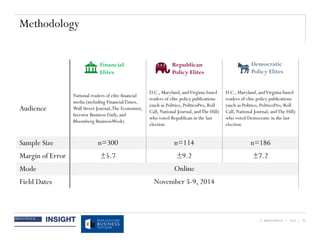
Methodology
Audience
National readers of elite financial
media (including FinancialTimes,
Wall Street Journal,The Economist,
Investor Business Daily, and
Bloomberg BusinessWeek)
D.C., Maryland, andVirginia-based
readers of elite policy publications
(such as Politico, PoliticoPro, Roll
Call, National Journal, andThe Hill)
who voted Republican in the last
election
D.C., Maryland, andVirginia-based
readers of elite policy publications
(such as Politico, PoliticoPro, Roll
Call, National Journal, andThe Hill)
who voted Democratic in the last
election
Sample Size n=300 n=114 n=186
Margin of Error Âą5.7 Âą9.2 Âą7.2
Mode Online
Field Dates November 5-9, 2014
Republican
Policy Elites
Democratic
Policy Elites
Financial
Elites

Post Election Business Outlook 2014

  • 1.
    Abu Dhabi Beijing Berlin Brussels Dallas Dubai Frankfurt Hong Kong Johannesburg London Milan Munich NewYork Paris Rome San Francisco Sao Paulo Shanghai Singapore Stockholm Vienna Washington, D.C. Political and Financial Elite Survey Results November 2014 Abu Dhabi Beijing Berlin Brussels Dallas Dubai Frankfurt Hong Kong Johannesburg London Milan Munich New York Paris Rome San Francisco Sao Paulo Shanghai Singapore Stockholm Vienna Washington, D.C.
  • 2.
    Š BRUNSWICK |2014 | 1 ElectoralWave Republicans take control of the Senate
  • 3.
    Š BRUNSWICK |2014 | 2 Another MidtermWave Republicans did better than expected,making major gains in the Senate and House House Election Results Senate Election Results Source: The New York Times Net Pickup by Party SENATE+7 -7 HOUSE+12 -12
  • 4.
    © BRUNSWICK |2014 | 3 The party of every two-term President since Reconstruction has lost seats in both chambers of Congress during their second term… …The only exception was Bill Clinton in 1998, after the public backlash against impeachment. Six-Year Itch A pattern continues Grant House Senate Cleveland Wilson Roosevelt Truman Eisenhower Nixon Reagan Bush -93 -1 -107 -4 -22 -5 -72 -7 -28 -5 -48 -13 -48 -4 -5 -8 -30 -6 House Senate +5 0 Obama -13 -7
  • 5.
    © BRUNSWICK |2014 | 4 The Most Important, But Underreported, Outcome The Republican wave led to big gains at the Gubernatorial and state legislature levels Gubernatorial Election Results State Legislature Election Results Republicans picked up 4 Governorships and 10state legislature chambers. Republicans now control 68 out of 98 state legislature chambers, more than any other point in history. Republicans have full control (Governor’s Mansion and State Legislature) in 23states. Democrats have full control in 7 states.
  • 6.
    Š BRUNSWICK |2014 | 5 1. How are Elites reacting to the midterm election results? 2. What are their expectations for the next two years? 3. What predictions do they have for 2016? Survey Objectives With this backdrop,we launched a survey to answer three questions: D.C., Maryland, andVirginia-based readers of elite policy publications (including Politico, PoliticoPro, Roll Call, National Journal, andThe Hill) National readers of elite financial media (including FinancialTimes,Wall Street Journal,The Economist, Investor Business Daily, and Bloomberg BusinessWeek) Republican Policy Elites Democratic Policy Elites Financial Elites Survey Audiences
  • 7.
    Š BRUNSWICK |2014 | 6 Exceeding Expectations: All audiences believe that the Republicans did better than expected in the midterm elections. Š BRUNSWICK | 2014 | 6
  • 8.
    © BRUNSWICK |2014 | 7 Election Reaction Republicans outperformed Elites’expectations this cycle Financial Elites Republican Policy Elites Democratic Policy Elites Republicans did better than I expected The result was what I expected Democrats did better than I expected In your own words,what do you believe led to this year’s election outcomes? Which one of the following best describes your reaction to this year’s election results? 44% 63% 46% 30% 24% 28% 27% 13% 26%
  • 9.
    © BRUNSWICK |2014 | 8 What’s Behind the Results? Republicans point to disapproval with Obama,while Democrats cite low turnout Financial Elites Republican Policy Elites Democratic Policy Elites 54% Voters who disapprove of President Obama’s job performance. SOURCE:ABC exit polls, November 4, 2014 36.4% 2014 voter turnout, the lowest level in 72 years. SOURCE: PBS News, November 10, 2014
  • 10.
    © BRUNSWICK |2014 | 9 Setting the Agenda President Obama and Congressional Republicans are making an early push to set the policy agenda “And whether it's immigration or climate change, or making sure our kids are going to the best possible schools, to making sure that our communities are creating jobs; whether it's stopping the spread of terror and disease, to opening up doors of opportunity to everybody who’s willing to work hard and take responsibility -- the United States has big things to do.”
  • 11.
    Š BRUNSWICK |2014 | 10 Policy Priorities: When thinking about what is most likely to be achieved over the next two years, raising the debt ceiling, limiting the deficit, and reforming immigration policies top the list. Š BRUNSWICK | 2014 | 10
  • 12.
    Š BRUNSWICK |2014 | 11 Policy Priorities Elite see raising the debt limit,limiting the deficit,and reforming immigration as likely to be achieved before 2016 Limiting the federal budget deficit 25% 28% 23% 23% 20% 20% 18% 16% 14% 17% 16% 13% 18% 13% 15% 14% 10% 12% Raising the debt limit Comprehensive immigration reform Allowing US crude oil exports Reforming Social Security Addressing the student debt issue Comprehensive corporate tax reform Blocking companies from relocating their headquarters overseas for tax purposes Free trade agreements with Europe Comprehensive individual income tax reform Legalizing marijuana Large-scale infrastructure investments Free trade agreements with Asia Ending national Common Core education standards An end to quantitative easing Consumer privacy protection Creating a national exchange for greenhouse gas emitters Improving access to H1-B visas for highly-skilled working professionals 39% 41% 24% 25% 20% 17% 24% 19% 16% 17% 21% 22% 18% 19% 9% 14% 9% 8% 35% 23% 25% 23% 24% 21% 16% 21% 25% 21% 15% 15% 13% 13% 15% 6% 15% 9% Comprehensive immigration reform is seen as being twice as likely as a special deal for highly-skilled workers seeking H1-B visas. Financial Elites Republican Policy Elites Democratic Policy Elites
  • 13.
    Š BRUNSWICK |2014 | 12 K Street lobbying More of the Same Majorities expect K Street lobbying to rise over the next two years Over the next two years,do you believe the following will increase,decrease,or stay about the same? 59% 59% 76% 35% 36% 19% 6% 6% 4% DecreaseStay about the sameIncrease Financial Elites Republican Policy Elites Democratic Policy Elites
  • 14.
    Š BRUNSWICK |2014 | 13 Number of executive orders More of the Same With governmental powers divided,an uptick in executive orders is expected Over the next two years,do you believe the following will increase,decrease,or stay about the same? 60% 61% 64% 32% 18% 27% 9% 21% 9% DecreaseStay about the sameIncrease Financial Elites Republican Policy Elites Democratic Policy Elites
  • 15.
    Š BRUNSWICK |2014 | 14 Overall government spending More of the Same Overall government spending is predicted to grow Over the next two years,do you believe the following will increase,decrease,or stay about the same? 52% 48% 62% 31% 28% 24% 17% 24% 14% DecreaseStay about the sameIncrease Financial Elites Republican Policy Elites Democratic Policy Elites
  • 16.
    © BRUNSWICK |2014 | 15 Defense spending Change of Course Despite reductions to the Pentagon’s 2015 budget,Elites anticipate increased defense spending Over the next two years,do you believe the following will increase,decrease,or stay about the same? 65% 56% 70% 26% 32% 19% 9% 12% 11% DecreaseStay about the sameIncrease Financial Elites Republican Policy Elites Democratic Policy Elites
  • 17.
    Š BRUNSWICK |2014 | 16 Fight Club: Although Elites agree on upcoming policy priorities, they expect little cooperation between President Obama and a Republican Congress and foresee an increase in executive orders from theWhite House. Š BRUNSWICK | 2014 | 16
  • 18.
    Š BRUNSWICK |2014 | 17 Partisan Gridlock Elites forecast disagreement between the President and Congress and expect another government shutdown Over the next two years,how likely or unlikely is it that there will be a government shut-down due to a policy impasse? Over the next two years,which ONE of the following do you believe is likely to happen? 20% 17% 19% 39% 31% 41% 35% 36% 33% 6% 17% 7% Very likely Somewhat likely Not too likely Not at all likely 44% 38% 46% 37% 50% 36% 19% 12% 18% The President and Congress will generally work together to pass legislation that helps to rebuild trust in both parties The President and Congress will generally spend most of their time fighting along partisan lines to build up an advantage for the 2016 presidential elections The President and Congress will generally fight over policy, but find a few opportunities to pass popular legislation Financial Elites Republican Policy Elites Democratic Policy Elites
  • 19.
    Š BRUNSWICK |2014 | 18 Business & Economic Impact: Although Elites anticipate divided government will have a positive effect on the economy, all audiences expect slow economic growth. Š BRUNSWICK | 2014 | 18
  • 20.
    © BRUNSWICK |2014 | 19 44% 25% 14% 13% 0% 10% 20% 30% 40% 50% 60% Better Same Worse Top concerns among voters The economy Healthcare Immigration policy Foreign policy Life for the next generation Do you think the future of the next generation of Americans will be better,worse,or about the same as life today? Worse Same Better 48% Worse SOURCES: NBC News, ABC News exit polls, November 4, 2014. This is the most to say “worse off” since 1996. 22% 27% Economy as Priority The economy tops voter concerns in exit polls;Half believe that future generations will be worse off
  • 21.
    © BRUNSWICK |2014 | 20 Boom or Bust? Financial Elites & Republicans expect economic growth from divided government;Democrats are more skeptical Positive effect Negative effectNo effect 62% Positive 18% 33% 49% Positive 14% 44% 42% Positive 11% 26% Do you believe that divided government – a Democratic-controlledWhite House and a Republican-controlled Congress – will have a positive or negative effect on the economy? Financial Elites Republican Policy Elites Democratic Policy Elites
  • 22.
    © BRUNSWICK |2014 | 21 Little Economic Growth Elites predict economic growth to continue,but most predict less growth than IMF forecasts Over the next two years,do you believe the US economy will… According to the International Monetary Fund,growth in the United States is projected to be 3% in 2015. 8% 17% 26% 19% 20% 4% 2% 1% 4% Grow 5% per year or more Grow 3%-4% per year Grow 2% per year Grow 1% per year Stagnate Contract 1% per year Contract 3%-4% per year Contract 2% per year Contract 5% per year or more 7% 9% 33% 22% 18% 4% 4% 3% 1% 6% 20% 28% 15% 19% 7% 2% 2% 1% Financial Elites Republican Policy Elites Democratic Policy Elites
  • 23.
    Š BRUNSWICK |2014 | 22 Mixed Signals Though Elites see neither party becoming more hostile to business,M&A is expected to be more difficult Thinking specifically about potential mergers and acquisitions,over the next two years,do you believe the Department of Justice will become more or less aggressive in their attempts to block corporate mergers? Do you believe that [Republicans/ Democrats] are becoming more or less friendly toward large businesses? Republicans Democrats 27% 65% 9% 31% 39% 30% More friendly Less friendlyStay about the same 43% 46% 51% 43% 39% 38% 14% 15% 11% Less aggressive Stay about the same More aggressive 44% 46% 10% 27% 30% 43% 19% 71% 10% 39% 45% 16% Financial Elites Republican Policy Elites Democratic Policy Elites
  • 24.
    Š BRUNSWICK |2014 | 23 Business Priorities Elite see allowing crude exports and corporate tax reform as the most likely business issues to be tackled before 2016 23% 18% 14% 17% 13% 18% 10% Allowing US crude oil exports Comprehensive corporate tax reform Blocking companies from relocating their headquarters overseas for tax purposes Free trade agreements with Europe Free trade agreements with Asia An end to quantitative easing 25% 24% 16% 17% 22% 18% 9% 23% 16% 25% 21% 15% 13% 15%Improving access to H1-B visas for highly-skilled working professionals Financial Elites Republican Policy Elites Democratic Policy Elites
  • 25.
    Š BRUNSWICK |2014 | 24 727 Days Away: Financial and Republican Elites anticipate Republican control of theWhite House and Congress in 2016, but Democratic Elites disagree. Š BRUNSWICK | 2014 | 24
  • 26.
    © BRUNSWICK |2014 | 25 Strengthening the nation’s economy and creating jobs AnticipatedVoter Priorities Voter priorities for 2016 are expected to include economic growth,immigration,and reducing healthcare costs Top priorities Bottom priorities 42% 37% 40% 32% 35%Reducing the budget deficit Defending the country from terrorism Reducing healthcare costs Dealing with illegal immigration 55% 38% 45% 40% 35% 58% 54% 44% 54% 46% 20% 15% 19% 17% 14% Dealing with global trade issues Reducing the influence of lobbyists Dealing with the nation’s energy problem Consumer privacy protection Reducing crime 20% 20% 21% 20% 13% 15% 18% 13% 12% 10% Financial Elites Republican Policy Elites Democratic Policy Elites
  • 27.
    © BRUNSWICK |2014 | 26 Wild Cards In the next two years,instability in Iraq & Eastern Europe,and a major cyber attack are seen as most likely 37% 24% 25% 23% 20% 26% 26% 21% 22% 14% 12% 11% Russia will annex more territory in Eastern Europe China’s economy goes through a steep drop as the real estate bubble there bursts ISIS captures Baghdad and takes control of Iraq Oil prices fall below $50 per barrel The Federal Reserve raises interest rates The outbreak of a global disease pandemic North Korea collapses 54% 40% 36% 33% 31% 32% 20% 17% 15% 23% 16% 11% 47% 31% 27% 27% 32% 19% 22% 24% 15% 13% 15% 15% Oil prices rise above $120 per barrel There is a major terrorist attack on U.S. soil There is a successful cyber-attack on a major stock exchange China becomes involved in a large-scale armed conflict with another Asian country The Eurozone gives up their single currency and economic union and returns to country-by- country economic and political systems Financial Elites Republican Policy Elites Democratic Policy Elites
  • 28.
    Š BRUNSWICK |2014 | 27 Following the next federal election in 2016,which one of the following scenarios do you believe is the most likely? 43% 73% 29% 27% 17% 34% 21% 9% 25% 10% 1% 12% A Republican controlled House and a Republican controlled Senate A Republican controlled House and a Democratic controlled Senate A Democratic controlled House and a Republican controlled Senate A Democratic controlled House and a Democratic controlled Senate 2016 Congressional Control Financial & Republican Elites predict Republicans will keep control;Three in five Democrats expect to take one chamber back Financial Elites Republican Policy Elites Democratic Policy Elites
  • 29.
    Š BRUNSWICK |2014 | 28 Which party's candidate do you think will win the 2016 presidential election? Republican Candidate Democratic Candidate 59% 82% 30% 41% 18% 70% Clinton leads recent polling* 43% 42% 42% 52% 51% 53% Hillary Clinton Rand Paul Chris Christie Jeb Bush *SOURCE: McClatchy/Marist poll; October 4, 2014 1988: The last election where a President transferred power to a member of the same party. Road to theWhite House Financial Elites Republican Policy Elites Democratic Policy Elites
  • 30.
    Š BRUNSWICK |2014 | 29 About the Brunswick Group Sparky Zivin Director, Brunswick Insight Washington, DC P: +1.202.393.7337 E: SZivin@BrunswickGroup.com For more information about how Brunswick can help,please contact: The Brunswick Group is an international corporate communications partnership that helps businesses and other organizations address critical communications challenges. Brunswick is an international team of more than 600 people based in 22 offices and 13 countries. This research was conducted by Brunswick Insight, the research and consulting arm of the Brunswick Group. Brunswick Insight provides data-driven strategic communications counsel for Fortune 500 companies, industry organizations, and non-profits. Our team of experts has conducted research in more than 70 markets around the world and has expertise in corporate reputation, issues management, narrative and message development, and thought leadership. Bob Moran Partner, Brunswick Insight Washington, DC P: +1.202.393.7337 E: RMoran@BrunswickGroup.com
  • 31.
    Š BRUNSWICK |2014 | 30 Methodology Audience National readers of elite financial media (including FinancialTimes, Wall Street Journal,The Economist, Investor Business Daily, and Bloomberg BusinessWeek) D.C., Maryland, andVirginia-based readers of elite policy publications (such as Politico, PoliticoPro, Roll Call, National Journal, andThe Hill) who voted Republican in the last election D.C., Maryland, andVirginia-based readers of elite policy publications (such as Politico, PoliticoPro, Roll Call, National Journal, andThe Hill) who voted Democratic in the last election Sample Size n=300 n=114 n=186 Margin of Error ¹5.7 ¹9.2 ¹7.2 Mode Online Field Dates November 5-9, 2014 Republican Policy Elites Democratic Policy Elites Financial Elites