CITING SOURCES
IN PRESENTATIONS
A Best Practices Guide from the Thrift Library
Always Cite
• It is necessary to give credit when it’s due, even
in presentations.
• Including a final “References” slide at the end of
your presentation is best.
• Use a source line at the bottom of the slide for
charts, graphics, video or audio.
• Use either a source line or in-text citations for
quoted or paraphrased text.
Citing an Image, Graph, or Chart
Source: Kaganer, E., et al. (2013) Media tablets for mobile learning.
Provide author (if available),
publication year, and title or
abbreviated title.
Quote or Paraphrased Text: Source Line
• According to a recent Pew Internet report, more
Americans are reading print books than e-books.
• “Overall, about half (52%) of readers only read a print
book, 4% only read an e-book, and just 2% only listened
to an audiobook. Nine percent of readers said they read
books in all three formats.”
Source: Zickuhr, K. & Rainie, L. (2014). E-Reading rises as device ownership
jumps.
A source line only works for text if all
the information is from the same
source. If there are multiple sources,
in-text citations are better.
Quote or Paraphrased Text: In-Text Citation
• According to a recent Pew Internet report, more
Americans are reading print books than e-books (Zickuhr,
2014).
• A 2011 study of iPad use for MBA students found that the
participants enjoyed the portability and accessibility of
having course materials on the iPad (Kaganer, 2013).
Think of how you would cite the text in a paper,
and then translate that to the presentation slide.
Citing an Embedded Video
• Source: PBS Newshour, 2013.
Provide the creator
and the year
copyrighted or
uploaded.
Citing Audio Files
Source: Layton, T. (1918). After you’ve gone.
You might say “Audio”
instead of “Source” if you
have additional media or
text on the slide.
Putting It All Together
“This story was inspired by a remark of Mark
Twain’s to the effect that it was a pity that the
best part of life came at the beginning and the
worst part at the end.”
- “The Curious Case of Benjamin Button”
Tales of the Jazz Age by F. Scott Fitzgerald,
1922
Image: Held, J., Jr. (1922). Cover of a 1922 edition of Tales of the Jazz Age.
Audio: Layton, T. (1918). After you’ve gone.
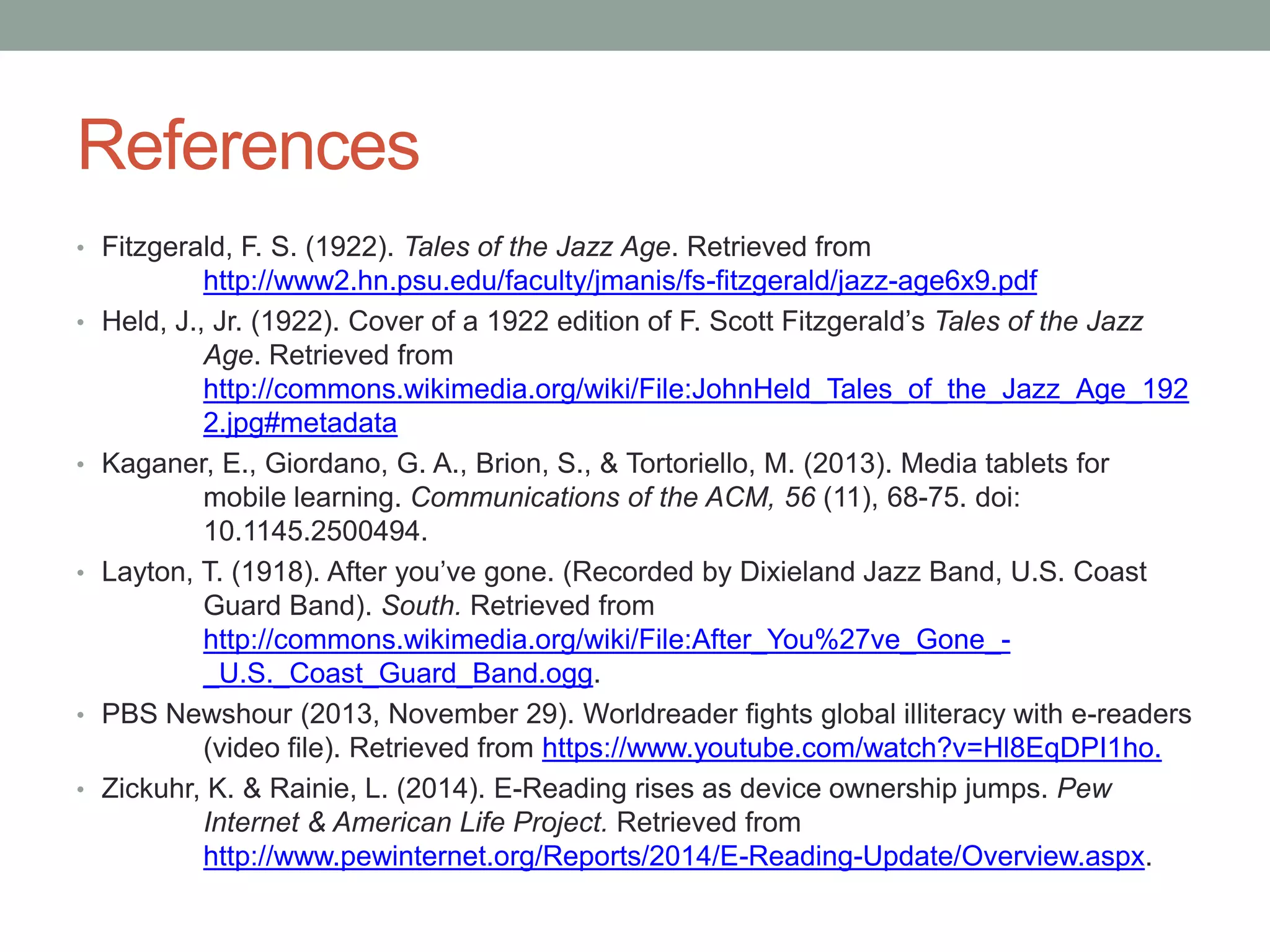
References
• Fitzgerald, F. S. (1922). Tales of the Jazz Age. Retrieved from
http://www2.hn.psu.edu/faculty/jmanis/fs-fitzgerald/jazz-age6x9.pdf
• Held, J., Jr. (1922). Cover of a 1922 edition of F. Scott Fitzgerald’s Tales of the Jazz
Age. Retrieved from
http://commons.wikimedia.org/wiki/File:JohnHeld_Tales_of_the_Jazz_Age_192
2.jpg#metadata
• Kaganer, E., Giordano, G. A., Brion, S., & Tortoriello, M. (2013). Media tablets for
mobile learning. Communications of the ACM, 56 (11), 68-75. doi:
10.1145.2500494.
• Layton, T. (1918). After you’ve gone. (Recorded by Dixieland Jazz Band, U.S. Coast
Guard Band). South. Retrieved from
http://commons.wikimedia.org/wiki/File:After_You%27ve_Gone_-
_U.S._Coast_Guard_Band.ogg.
• PBS Newshour (2013, November 29). Worldreader fights global illiteracy with e-readers
(video file). Retrieved from https://www.youtube.com/watch?v=Hl8EqDPI1ho.
• Zickuhr, K. & Rainie, L. (2014). E-Reading rises as device ownership jumps. Pew
Internet & American Life Project. Retrieved from
http://www.pewinternet.org/Reports/2014/E-Reading-Update/Overview.aspx.

Citing sources in presentations

  • 1.
    CITING SOURCES IN PRESENTATIONS ABest Practices Guide from the Thrift Library
  • 2.
    Always Cite • Itis necessary to give credit when it’s due, even in presentations. • Including a final “References” slide at the end of your presentation is best. • Use a source line at the bottom of the slide for charts, graphics, video or audio. • Use either a source line or in-text citations for quoted or paraphrased text.
  • 3.
    Citing an Image,Graph, or Chart Source: Kaganer, E., et al. (2013) Media tablets for mobile learning. Provide author (if available), publication year, and title or abbreviated title.
  • 4.
    Quote or ParaphrasedText: Source Line • According to a recent Pew Internet report, more Americans are reading print books than e-books. • “Overall, about half (52%) of readers only read a print book, 4% only read an e-book, and just 2% only listened to an audiobook. Nine percent of readers said they read books in all three formats.” Source: Zickuhr, K. & Rainie, L. (2014). E-Reading rises as device ownership jumps. A source line only works for text if all the information is from the same source. If there are multiple sources, in-text citations are better.
  • 5.
    Quote or ParaphrasedText: In-Text Citation • According to a recent Pew Internet report, more Americans are reading print books than e-books (Zickuhr, 2014). • A 2011 study of iPad use for MBA students found that the participants enjoyed the portability and accessibility of having course materials on the iPad (Kaganer, 2013). Think of how you would cite the text in a paper, and then translate that to the presentation slide.
  • 6.
    Citing an EmbeddedVideo • Source: PBS Newshour, 2013. Provide the creator and the year copyrighted or uploaded.
  • 7.
    Citing Audio Files Source:Layton, T. (1918). After you’ve gone. You might say “Audio” instead of “Source” if you have additional media or text on the slide.
  • 8.
    Putting It AllTogether “This story was inspired by a remark of Mark Twain’s to the effect that it was a pity that the best part of life came at the beginning and the worst part at the end.” - “The Curious Case of Benjamin Button” Tales of the Jazz Age by F. Scott Fitzgerald, 1922 Image: Held, J., Jr. (1922). Cover of a 1922 edition of Tales of the Jazz Age. Audio: Layton, T. (1918). After you’ve gone.
  • 9.
    References • Fitzgerald, F.S. (1922). Tales of the Jazz Age. Retrieved from http://www2.hn.psu.edu/faculty/jmanis/fs-fitzgerald/jazz-age6x9.pdf • Held, J., Jr. (1922). Cover of a 1922 edition of F. Scott Fitzgerald’s Tales of the Jazz Age. Retrieved from http://commons.wikimedia.org/wiki/File:JohnHeld_Tales_of_the_Jazz_Age_192 2.jpg#metadata • Kaganer, E., Giordano, G. A., Brion, S., & Tortoriello, M. (2013). Media tablets for mobile learning. Communications of the ACM, 56 (11), 68-75. doi: 10.1145.2500494. • Layton, T. (1918). After you’ve gone. (Recorded by Dixieland Jazz Band, U.S. Coast Guard Band). South. Retrieved from http://commons.wikimedia.org/wiki/File:After_You%27ve_Gone_- _U.S._Coast_Guard_Band.ogg. • PBS Newshour (2013, November 29). Worldreader fights global illiteracy with e-readers (video file). Retrieved from https://www.youtube.com/watch?v=Hl8EqDPI1ho. • Zickuhr, K. & Rainie, L. (2014). E-Reading rises as device ownership jumps. Pew Internet & American Life Project. Retrieved from http://www.pewinternet.org/Reports/2014/E-Reading-Update/Overview.aspx.