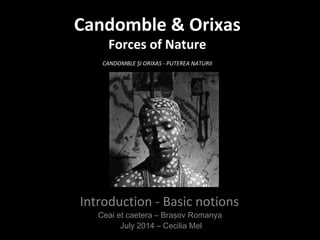
Candomble & Orixas
Forces of Nature
CANDOMBLE ȘI ORIXAS - PUTEREA NATURII
Introduction - Basic notions
Ceai et caetera – Braşov Romanya
July 2014 – Cecilia Mel
African origin of Candomble
• African people were brought to American continent to work as
slaves for Portuguese and Spanish colonies. In Brazil, most Africans
were coming from African west coast and mostly debarked in
Salvador de Bahia, to be taken to other lands.
• Main nations slavered were Ketu (Yoruba-Nago language), Bantu-
Angola (Kikongo lg.) and Jeje (Fon-Gen lg.) (Dahomey, Angola,
Congo, Ijexa, Oyo)
• Once in Brazilian territory, landlords would mix people form
different origins as a way to prevent them form organizing
themselves for insurrection and have discord among them. This
caused mixed african traditions in the New Land.
• Candomblé (possible ethymological meaning): 1. an Angolan
Atabaque / 2. Candonbidé= act of praising (fro sthm or sbd)
Syncretism and New expressions
• Mixed African populations caused a mixture of
traditions.
• In America, African people were banned from
performing their traditions. That is why started to
hide their customs under Christian-Catholic rites
(syncretism)
• Native American rites were also included when
Africans made contact with indians.
• Oral transition of traditions distorted the original
rites
AXE – Force of nature
• “Animist”: Nature has forces and energies. They live in its
natural elements. Vital and essential principles of all that
exists.
• Axe is dynamic: created, contained, transmitted and
destroyed and renewed.
• It may reside in any place, object or criature of nature.
• "Aché (Axé, Asé) is the magic force that moves all things in
the universe according to the African religions in Brazil. It
exists in all realms of nature and can be transmitted
through specific rituals. ” --p.6 Almeida, Bira(Mestre
Acordeon). Capoeira: A Brazilian Art Form. Berkeley,
California: North Atlantic Books, 1986. Print.
African characteristics in
Candomble
• There is no good&bad, no saint&evil. Dualities exist but they are
both sides of one same thing.
• Moral and justice are considered according to consequences, social
impacts, traditions and customs.
• There is one main Divinity, Olodumare. Too far from human
understanding. It is not worshiped directly.
• Orixas are bounds to nature and ancestry. They are worshiped as a
way to connect with environment, to community and to
Olodumare.
• There is a strict structure of traditions, customs, rituals, etc. to
perform religiosity and every-day life. All rites have an explanation.
• Importance of entangled traditions: oral transmitions, songs, music,
foods, clothing, etc
• Importance of hierarchy and social roles inside the community
(terreiro)
• In Brazil, religious organization and structure
was copying the African social structure as a
way to keep order among the slaves
themselves.
• Candomble hierarchies and roles come from a
political-religious-social structure.
Basic glossary – Important notions
• Terreiro: temple for Candomble practises.
• Ialorixa/Babalawo (Mae/Pae de santo): Priest
• Iniciated (Filho de santo): devotee under the guard of a
specific Orixa.  Iyawo: devotee who can receive an Orixa.
Different from Oga (male), Ekeji (female).
• Avamunha: “cleaning” aperture and salutation to begging a
religious session performed by the female initiated priests.
• Xire: order to salutate the Orixas during religious practise
• Jogo de buzios: oracle of cauries (buzios). Divination
• Ori: head, stone. Place where the orixa lives. Physical place
where the devotees refers to for spiritual performance.
Head in the body. Stone in the temple.
Drums and music
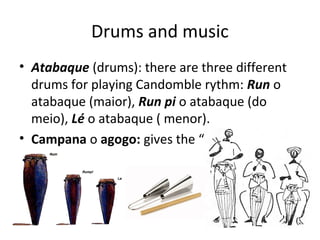
• Atabaque (drums): there are three different
drums for playing Candomble rythm: Run o
atabaque (maior), Run pi o atabaque (do
meio), Lé o atabaque ( menor).
• Campana o agogo: gives the “key” rythm
Offerings and other elements
Orixas:
-one aspect of manifestation of Olodumare
-a way to get closer to Olodumare
Divinities ruling different aspects of life
and nature
• Places, environments
• Human characters
• Works/jobs/activities
• Moments in life
• Parts of the body
• Relationships
• Prohibitions
Approached by
• Symbols
• Food
• Offering/oblation
• Song
• Dance
• Clothing, accessories
• Day of the week
ORI: Head XA: Guardian, the one who owns
“The guardian of the Head”
“The one that owns the head” “Owner of the head”
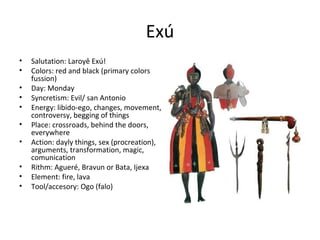
Exú
• Salutation: Laroyê Exú!
• Colors: red and black (primary colors
fussion)
• Day: Monday
• Syncretism: Evil/ san Antonio
• Energy: libido-ego, changes, movement,
controversy, begging of things
• Place: crossroads, behind the doors,
everywhere
• Action: dayly things, sex (procreation),
arguments, transformation, magic,
comunication
• Rithm: Agueré, Bravun or Bata, Ijexa
• Element: fire, lava
• Tool/accesory: Ogo (falo)
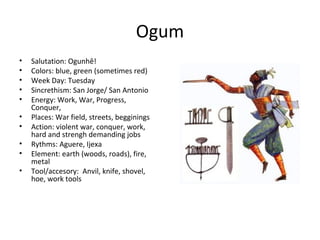
Ogum
• Salutation: Ogunhê!
• Colors: blue, green (sometimes red)
• Week Day: Tuesday
• Sincrethism: San Jorge/ San Antonio
• Energy: Work, War, Progress,
Conquer,
• Places: War field, streets, begginings
• Action: violent war, conquer, work,
hard and strengh demanding jobs
• Rythms: Aguere, Ijexa
• Element: earth (woods, roads), fire,
metal
• Tool/accesory: Anvil, knife, shovel,
hoe, work tools
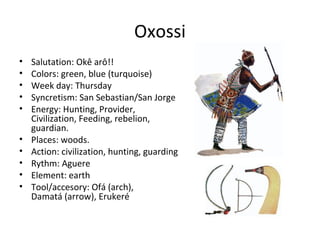
Oxossi
• Salutation: Okê arô!!
• Colors: green, blue (turquoise)
• Week day: Thursday
• Syncretism: San Sebastian/San Jorge
• Energy: Hunting, Provider,
Civilization, Feeding, rebelion,
guardian.
• Places: woods.
• Action: civilization, hunting, guarding
• Rythm: Aguere
• Element: earth
• Tool/accesory: Ofá (arch),
Damatá (arrow), Erukeré
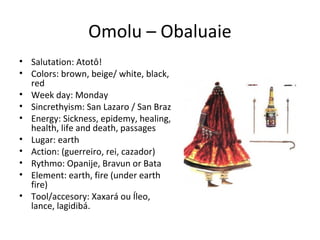
Omolu – Obaluaie
• Salutation: Atotô!
• Colors: brown, beige/ white, black,
red
• Week day: Monday
• Sincrethyism: San Lazaro / San Braz
• Energy: Sickness, epidemy, healing,
health, life and death, passages
• Lugar: earth
• Action: (guerreiro, rei, cazador)
• Rythmo: Opanije, Bravun or Bata
• Element: earth, fire (under earth
fire)
• Tool/accesory: Xaxará ou Íleo,
lance, lagidibá.
Xango
• Salutation: Kawo Kabiesilê!
• Colors: red and white, brown and
white
• Week day: Thursday
• Syncrethism: S. Jerônimo, S.
Pedro, S. João Batista, S. Judas
Tadeu
• Energy: virility, Justice, war,
pleasures
• Place: war
• Action: authority, justice, male
seduction, war
• Rythm: Aguere, Bravun or Bata,
Aluja
• Element: fire
• Tool/accesory: Oxes (double
axes), Edún-Àrá, xerê
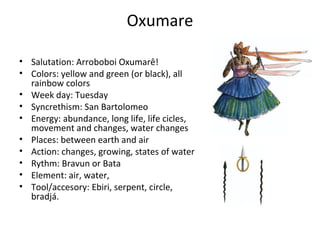
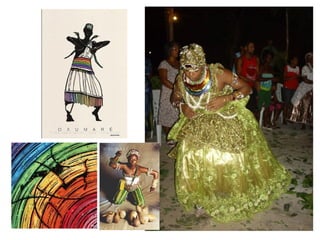
Oxumare
• Salutation: Arroboboi Oxumarê!
• Colors: yellow and green (or black), all
rainbow colors
• Week day: Tuesday
• Syncrethism: San Bartolomeo
• Energy: abundance, long life, life cicles,
movement and changes, water changes
• Places: between earth and air
• Action: changes, growing, states of water
• Rythm: Bravun or Bata
• Element: air, water,
• Tool/accesory: Ebiri, serpent, circle,
bradjá.
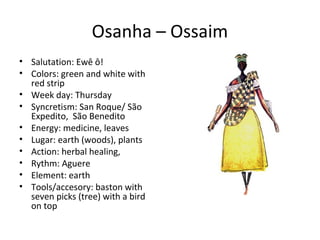
Osanha – Ossaim
• Salutation: Ewê ô!
• Colors: green and white with
red strip
• Week day: Thursday
• Syncretism: San Roque/ São
Expedito, São Benedito
• Energy: medicine, leaves
• Lugar: earth (woods), plants
• Action: herbal healing,
• Rythm: Aguere
• Element: earth
• Tools/accesory: baston with
seven picks (tree) with a bird
on top
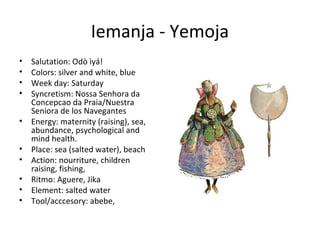
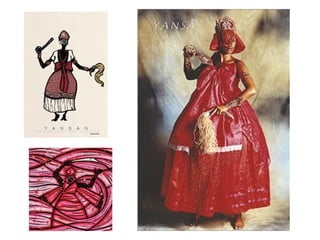
Iemanja - Yemoja
• Salutation: Odò ìyá!
• Colors: silver and white, blue
• Week day: Saturday
• Syncretism: Nossa Senhora da
Concepcao da Praia/Nuestra
Seniora de los Navegantes
• Energy: maternity (raising), sea,
abundance, psychological and
mind health.
• Place: sea (salted water), beach
• Action: nourriture, children
raising, fishing,
• Ritmo: Aguere, Jika
• Element: salted water
• Tool/acccesory: abebe,
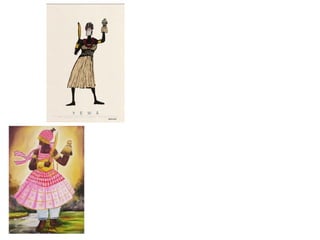
Iansa
• Salutation: Epahey Oyá!
• Colors: brown, red, cobre
• Week day: Wednesday
• Syncretism: Santa Barbara
• Energy: tempest, death,
female active sexuality, war
• Place: cemetery, everywhere
• Action: war, limit with the
dead,
• Rythm: Aguere, Jika, Ijexa, Ilu
• Element: fire, water, air (wind)
• Tool/accesory: sword,
Erukere, horn.
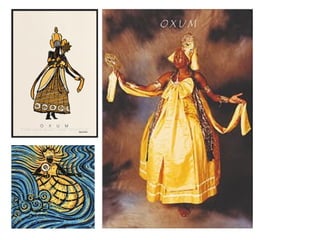
Oxum
• Salutation: Ora yê yê ô!
• Colors: yellow, golden
• Week day: Saturday
• Syncretism: Nossa Sra. da
Conceição, Nossa Sra. da Aparecida,
Nossa Sra. da Penha
• Energy: seduction, love, friendship,
abundance, maternity (conception),
passive female sexuality, beauty.
• Place: rives, waterfalls,
• Action: bathing
• Rythm: Aguere, Bravun or Bata,
Ijexa
• Elements: sweet water
• Tool/accesory: abebe, female
accesories
Logunede
• Salutation: Olorikim Logun! /
Logun ô akofá!
• Colors: yellow and blue,
turquoise, emerald green
• Week day: Thursday
• Syncretism: Santo Expedito/ San
Miguel Arcangel
• Energy: teen energy, abundance,
beauty
• Place: woods, rives, waterfalls,
• Action: hunting, cellebration
• Rythm: Ijexa
• Element: earth and water
• Tool/accesory: abebe, ofa,
erukere, scales
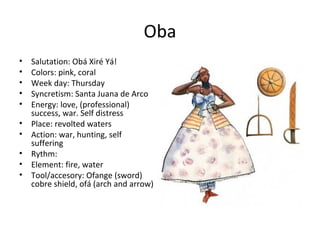
Oba
• Salutation: Obá Xiré Yá!
• Colors: pink, coral
• Week day: Thursday
• Syncretism: Santa Juana de Arco
• Energy: love, (professional)
success, war. Self distress
• Place: revolted waters
• Action: war, hunting, self
suffering
• Rythm:
• Element: fire, water
• Tool/accesory: Ofange (sword)
cobre shield, ofá (arch and arrow)
Ewa
• Salutation: Olorikim Logun!
• Colors: coral, red, pink
• Week day: Saturday
• Syncretism: Santa Lucia
• Energy: Beauty, forseeing (6th
sense), creativity, inocence
• Place: Woods, Pink sky and
stars, river waters and lakes
• Action:
• Rythm:
• Element:
• Tool/accessory: Ejô (cobra)
sword, Ofá (lance or arpoon)
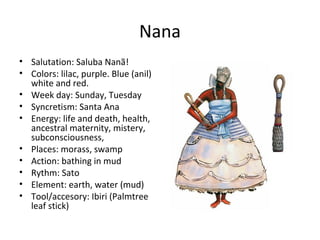
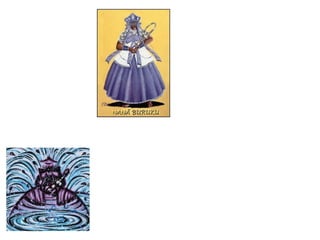
Nana
• Salutation: Saluba Nanã!
• Colors: lilac, purple. Blue (anil)
white and red.
• Week day: Sunday, Tuesday
• Syncretism: Santa Ana
• Energy: life and death, health,
ancestral maternity, mistery,
subconsciousness,
• Places: morass, swamp
• Action: bathing in mud
• Rythm: Sato
• Element: earth, water (mud)
• Tool/accesory: Ibiri (Palmtree
leaf stick)
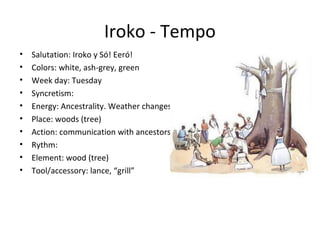
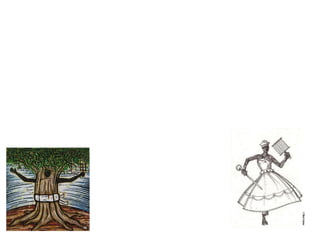
Iroko - Tempo
• Salutation: Iroko y Só! Eeró!
• Colors: white, ash-grey, green
• Week day: Tuesday
• Syncretism:
• Energy: Ancestrality. Weather changes.
• Place: woods (tree)
• Action: communication with ancestors
• Rythm:
• Element: wood (tree)
• Tool/accessory: lance, “grill”
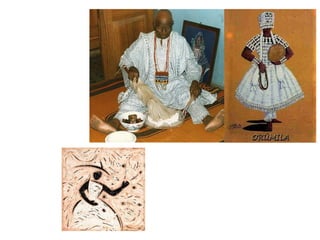
Orunmila (Ifa)
• Salutation:
• Colors: white
• Week day:
• Syncretism:
• Energy: oracle, clarividence, perseverance
• Place:
• Action: forseeing, to continue, perseverance, dreaming
• Rythm:
• Element: air
• Tool/accessory: ifa (oracle), iruke
Oxala Oxaguian Oxalufa
• Sautation: ÈPA BÀBÁ !
• Colors: White
• Week day: friday
• Syncretism: Jesus Christ
• Energy: mael procriation,
Criation, life and death.
• Place: atmosphere, sky
• Action: warrior for peace.
Aknowledgment
• Rythm: Bravun or Bata, Ijexa, Igbi
• Element: air, water
• Tool/accesory: Opajoro
(Oxaflufa), mase and shield
(Oxaguia)
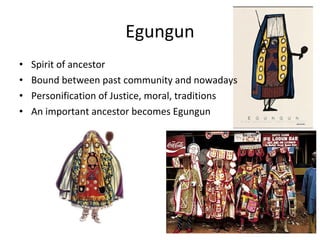
Egungun
• Spirit of ancestor
• Bound between past community and nowadays
• Personification of Justice, moral, traditions
• An important ancestor becomes Egungun
Axe!

Candomble & Orixas

  • 1.
    Candomble & Orixas Forcesof Nature CANDOMBLE ȘI ORIXAS - PUTEREA NATURII Introduction - Basic notions Ceai et caetera – Braşov Romanya July 2014 – Cecilia Mel
  • 2.
    African origin ofCandomble • African people were brought to American continent to work as slaves for Portuguese and Spanish colonies. In Brazil, most Africans were coming from African west coast and mostly debarked in Salvador de Bahia, to be taken to other lands. • Main nations slavered were Ketu (Yoruba-Nago language), Bantu- Angola (Kikongo lg.) and Jeje (Fon-Gen lg.) (Dahomey, Angola, Congo, Ijexa, Oyo) • Once in Brazilian territory, landlords would mix people form different origins as a way to prevent them form organizing themselves for insurrection and have discord among them. This caused mixed african traditions in the New Land. • Candomblé (possible ethymological meaning): 1. an Angolan Atabaque / 2. Candonbidé= act of praising (fro sthm or sbd)
  • 7.
    Syncretism and Newexpressions • Mixed African populations caused a mixture of traditions. • In America, African people were banned from performing their traditions. That is why started to hide their customs under Christian-Catholic rites (syncretism) • Native American rites were also included when Africans made contact with indians. • Oral transition of traditions distorted the original rites
  • 8.
    AXE – Forceof nature • “Animist”: Nature has forces and energies. They live in its natural elements. Vital and essential principles of all that exists. • Axe is dynamic: created, contained, transmitted and destroyed and renewed. • It may reside in any place, object or criature of nature. • "Aché (Axé, Asé) is the magic force that moves all things in the universe according to the African religions in Brazil. It exists in all realms of nature and can be transmitted through specific rituals. ” --p.6 Almeida, Bira(Mestre Acordeon). Capoeira: A Brazilian Art Form. Berkeley, California: North Atlantic Books, 1986. Print.
  • 9.
    African characteristics in Candomble •There is no good&bad, no saint&evil. Dualities exist but they are both sides of one same thing. • Moral and justice are considered according to consequences, social impacts, traditions and customs. • There is one main Divinity, Olodumare. Too far from human understanding. It is not worshiped directly. • Orixas are bounds to nature and ancestry. They are worshiped as a way to connect with environment, to community and to Olodumare. • There is a strict structure of traditions, customs, rituals, etc. to perform religiosity and every-day life. All rites have an explanation. • Importance of entangled traditions: oral transmitions, songs, music, foods, clothing, etc • Importance of hierarchy and social roles inside the community (terreiro)
  • 10.
    • In Brazil,religious organization and structure was copying the African social structure as a way to keep order among the slaves themselves. • Candomble hierarchies and roles come from a political-religious-social structure.
  • 11.
    Basic glossary –Important notions • Terreiro: temple for Candomble practises. • Ialorixa/Babalawo (Mae/Pae de santo): Priest • Iniciated (Filho de santo): devotee under the guard of a specific Orixa.  Iyawo: devotee who can receive an Orixa. Different from Oga (male), Ekeji (female). • Avamunha: “cleaning” aperture and salutation to begging a religious session performed by the female initiated priests. • Xire: order to salutate the Orixas during religious practise • Jogo de buzios: oracle of cauries (buzios). Divination • Ori: head, stone. Place where the orixa lives. Physical place where the devotees refers to for spiritual performance. Head in the body. Stone in the temple.
  • 14.
    Drums and music •Atabaque (drums): there are three different drums for playing Candomble rythm: Run o atabaque (maior), Run pi o atabaque (do meio), Lé o atabaque ( menor). • Campana o agogo: gives the “key” rythm
  • 15.
  • 16.
    Orixas: -one aspect ofmanifestation of Olodumare -a way to get closer to Olodumare Divinities ruling different aspects of life and nature • Places, environments • Human characters • Works/jobs/activities • Moments in life • Parts of the body • Relationships • Prohibitions Approached by • Symbols • Food • Offering/oblation • Song • Dance • Clothing, accessories • Day of the week ORI: Head XA: Guardian, the one who owns “The guardian of the Head” “The one that owns the head” “Owner of the head”
  • 17.
    Exú • Salutation: LaroyêExú! • Colors: red and black (primary colors fussion) • Day: Monday • Syncretism: Evil/ san Antonio • Energy: libido-ego, changes, movement, controversy, begging of things • Place: crossroads, behind the doors, everywhere • Action: dayly things, sex (procreation), arguments, transformation, magic, comunication • Rithm: Agueré, Bravun or Bata, Ijexa • Element: fire, lava • Tool/accesory: Ogo (falo)
  • 19.
    Ogum • Salutation: Ogunhê! •Colors: blue, green (sometimes red) • Week Day: Tuesday • Sincrethism: San Jorge/ San Antonio • Energy: Work, War, Progress, Conquer, • Places: War field, streets, begginings • Action: violent war, conquer, work, hard and strengh demanding jobs • Rythms: Aguere, Ijexa • Element: earth (woods, roads), fire, metal • Tool/accesory: Anvil, knife, shovel, hoe, work tools
  • 21.
    Oxossi • Salutation: Okêarô!! • Colors: green, blue (turquoise) • Week day: Thursday • Syncretism: San Sebastian/San Jorge • Energy: Hunting, Provider, Civilization, Feeding, rebelion, guardian. • Places: woods. • Action: civilization, hunting, guarding • Rythm: Aguere • Element: earth • Tool/accesory: Ofá (arch), Damatá (arrow), Erukeré
  • 23.
    Omolu – Obaluaie •Salutation: Atotô! • Colors: brown, beige/ white, black, red • Week day: Monday • Sincrethyism: San Lazaro / San Braz • Energy: Sickness, epidemy, healing, health, life and death, passages • Lugar: earth • Action: (guerreiro, rei, cazador) • Rythmo: Opanije, Bravun or Bata • Element: earth, fire (under earth fire) • Tool/accesory: Xaxará ou Íleo, lance, lagidibá.
  • 25.
    Xango • Salutation: KawoKabiesilê! • Colors: red and white, brown and white • Week day: Thursday • Syncrethism: S. Jerônimo, S. Pedro, S. João Batista, S. Judas Tadeu • Energy: virility, Justice, war, pleasures • Place: war • Action: authority, justice, male seduction, war • Rythm: Aguere, Bravun or Bata, Aluja • Element: fire • Tool/accesory: Oxes (double axes), Edún-Àrá, xerê
  • 27.
    Oxumare • Salutation: ArroboboiOxumarê! • Colors: yellow and green (or black), all rainbow colors • Week day: Tuesday • Syncrethism: San Bartolomeo • Energy: abundance, long life, life cicles, movement and changes, water changes • Places: between earth and air • Action: changes, growing, states of water • Rythm: Bravun or Bata • Element: air, water, • Tool/accesory: Ebiri, serpent, circle, bradjá.
  • 29.
    Osanha – Ossaim •Salutation: Ewê ô! • Colors: green and white with red strip • Week day: Thursday • Syncretism: San Roque/ São Expedito, São Benedito • Energy: medicine, leaves • Lugar: earth (woods), plants • Action: herbal healing, • Rythm: Aguere • Element: earth • Tools/accesory: baston with seven picks (tree) with a bird on top
  • 31.
    Iemanja - Yemoja •Salutation: Odò ìyá! • Colors: silver and white, blue • Week day: Saturday • Syncretism: Nossa Senhora da Concepcao da Praia/Nuestra Seniora de los Navegantes • Energy: maternity (raising), sea, abundance, psychological and mind health. • Place: sea (salted water), beach • Action: nourriture, children raising, fishing, • Ritmo: Aguere, Jika • Element: salted water • Tool/acccesory: abebe,
  • 33.
    Iansa • Salutation: EpaheyOyá! • Colors: brown, red, cobre • Week day: Wednesday • Syncretism: Santa Barbara • Energy: tempest, death, female active sexuality, war • Place: cemetery, everywhere • Action: war, limit with the dead, • Rythm: Aguere, Jika, Ijexa, Ilu • Element: fire, water, air (wind) • Tool/accesory: sword, Erukere, horn.
  • 35.
    Oxum • Salutation: Orayê yê ô! • Colors: yellow, golden • Week day: Saturday • Syncretism: Nossa Sra. da Conceição, Nossa Sra. da Aparecida, Nossa Sra. da Penha • Energy: seduction, love, friendship, abundance, maternity (conception), passive female sexuality, beauty. • Place: rives, waterfalls, • Action: bathing • Rythm: Aguere, Bravun or Bata, Ijexa • Elements: sweet water • Tool/accesory: abebe, female accesories
  • 37.
    Logunede • Salutation: OlorikimLogun! / Logun ô akofá! • Colors: yellow and blue, turquoise, emerald green • Week day: Thursday • Syncretism: Santo Expedito/ San Miguel Arcangel • Energy: teen energy, abundance, beauty • Place: woods, rives, waterfalls, • Action: hunting, cellebration • Rythm: Ijexa • Element: earth and water • Tool/accesory: abebe, ofa, erukere, scales
  • 39.
    Oba • Salutation: ObáXiré Yá! • Colors: pink, coral • Week day: Thursday • Syncretism: Santa Juana de Arco • Energy: love, (professional) success, war. Self distress • Place: revolted waters • Action: war, hunting, self suffering • Rythm: • Element: fire, water • Tool/accesory: Ofange (sword) cobre shield, ofá (arch and arrow)
  • 41.
    Ewa • Salutation: OlorikimLogun! • Colors: coral, red, pink • Week day: Saturday • Syncretism: Santa Lucia • Energy: Beauty, forseeing (6th sense), creativity, inocence • Place: Woods, Pink sky and stars, river waters and lakes • Action: • Rythm: • Element: • Tool/accessory: Ejô (cobra) sword, Ofá (lance or arpoon)
  • 43.
    Nana • Salutation: SalubaNanã! • Colors: lilac, purple. Blue (anil) white and red. • Week day: Sunday, Tuesday • Syncretism: Santa Ana • Energy: life and death, health, ancestral maternity, mistery, subconsciousness, • Places: morass, swamp • Action: bathing in mud • Rythm: Sato • Element: earth, water (mud) • Tool/accesory: Ibiri (Palmtree leaf stick)
  • 45.
    Iroko - Tempo •Salutation: Iroko y Só! Eeró! • Colors: white, ash-grey, green • Week day: Tuesday • Syncretism: • Energy: Ancestrality. Weather changes. • Place: woods (tree) • Action: communication with ancestors • Rythm: • Element: wood (tree) • Tool/accessory: lance, “grill”
  • 47.
    Orunmila (Ifa) • Salutation: •Colors: white • Week day: • Syncretism: • Energy: oracle, clarividence, perseverance • Place: • Action: forseeing, to continue, perseverance, dreaming • Rythm: • Element: air • Tool/accessory: ifa (oracle), iruke
  • 49.
    Oxala Oxaguian Oxalufa •Sautation: ÈPA BÀBÁ ! • Colors: White • Week day: friday • Syncretism: Jesus Christ • Energy: mael procriation, Criation, life and death. • Place: atmosphere, sky • Action: warrior for peace. Aknowledgment • Rythm: Bravun or Bata, Ijexa, Igbi • Element: air, water • Tool/accesory: Opajoro (Oxaflufa), mase and shield (Oxaguia)
  • 51.
    Egungun • Spirit ofancestor • Bound between past community and nowadays • Personification of Justice, moral, traditions • An important ancestor becomes Egungun
  • 52.