Contents

                                                                        Page Nos.
1.   The University                                                          1-2


2.   Course, Criteria for Admission and Entrance Examinations              3 - 30
     Courses of study                                               3
     Criteria for admission                                         4
     Reservation of seats SC/ST/OBC etc.                            6
     Weightage for distinction in sports / cultural activities      7
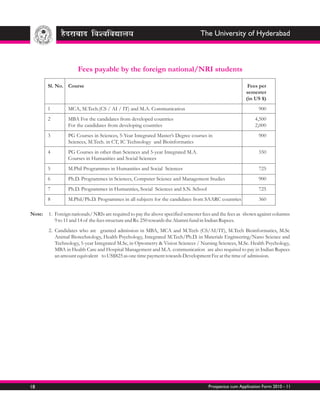
     Admission of Foreign Nationals                                 7
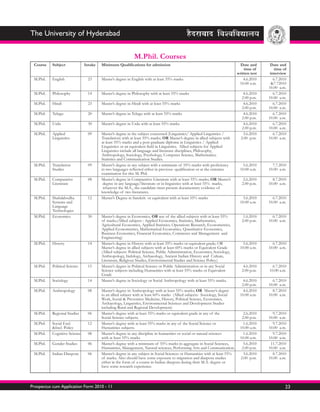
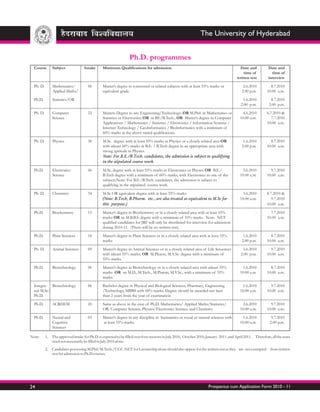
     Entrance Examinations                                          8
     Schedule for the notification of the Entrance results, etc.    9
     List of Institutions recognized as external centres           11
     Semester-wise Registration System                             13
     List of Examination Centres                                   15
     Fees Payable by Students                                      16
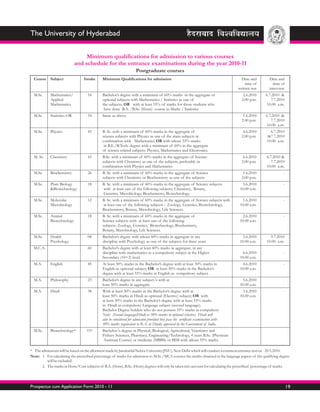
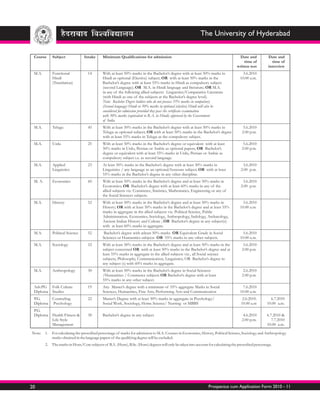
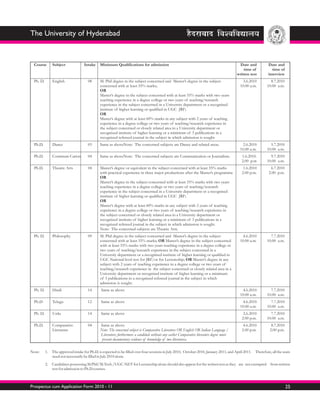
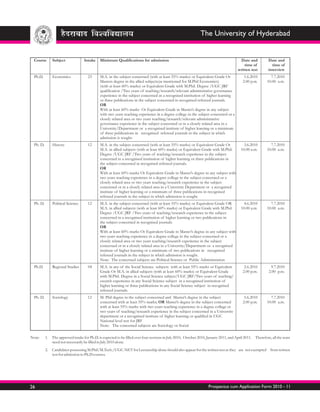
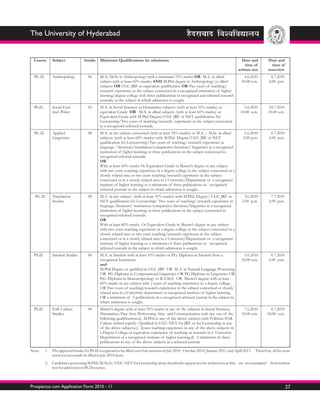
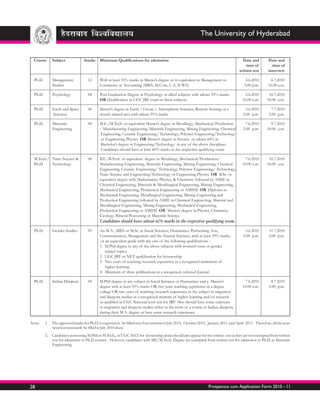
     Minimum qualifications for admission to various courses,      19
     intake and schedule for the entrance examinations


3.   Schools of Study                                                      31 - 93
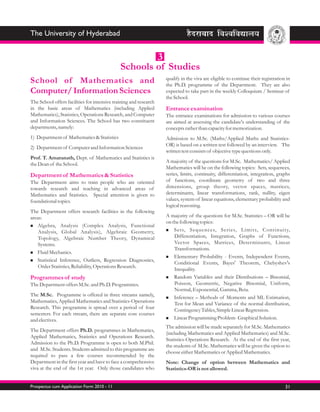
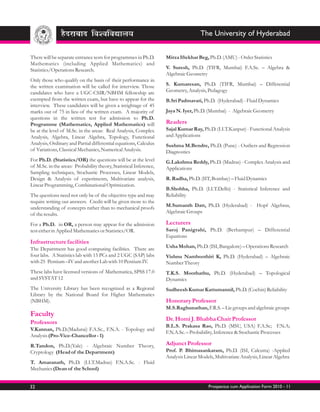
     Mathematics and Computer/Information Sciences                 31
     Physics                                                       37
     Chemistry                                                     41
     Life Sciences                                                 44
     Humanities                                                    53
     Social Sciences                                               65
     Sarojini Naidu School of Arts and Communication               78
     Management Studies                                            85
     Medical Sciences                                              89
     Engineering Sciences & Technology                             91
4.   Stand-alone Centres                                                    94 - 109
     Centre for Integrated Studies (CIS)                              94
     University Centre for Earth and Space Science (UCESS)            96
     Advanced Centre of Research in High Energy Materials (ACRHEM)    98
     Centre for Health Psychology                                    101
     Centre for Neural and Cognitive Sciences                        102
     Centre for Women’s Studies                                      103
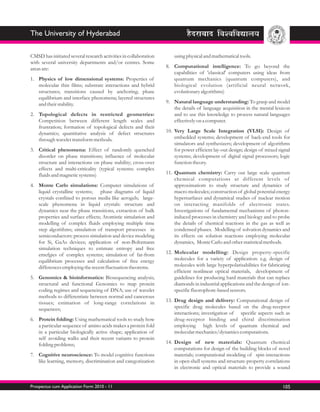
     Centre for Modeling Simulation & Design (CMSD)                  104
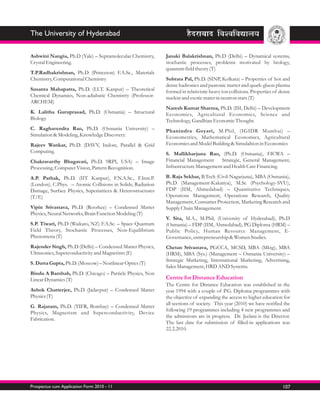
     Centre for Distance Education                                   107
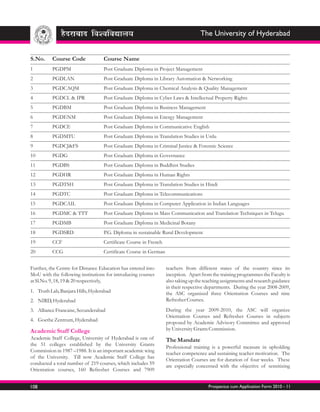
     Academic Staff College                                          108


5.   Academic and Students Services                                         110 - 114
     Indira Gandhi Memorial Library                                  110
     Central Instruments Laboratory                                  110
     Computer Centre                                                 110
     Health Care                                                     111
     Hostel Accommodation                                            111
     Students Welfare                                                112
     Discipline among students                                       112
     Games and Sports                                                112
     Financial Support                                               112
     Placement Guidance and Advisory Bureau                          114


6.   Teaching and Evaluation Regulations                                   115 - 128
     Medals for excellence in studies                                119
     Instructions for filling the Application Form/Basic Data Form   121
     Basic Data Form/Application Form                                         (i - iv)
     Academic Calendar 2010-11
     Contacts
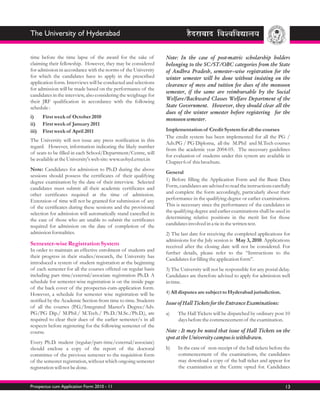
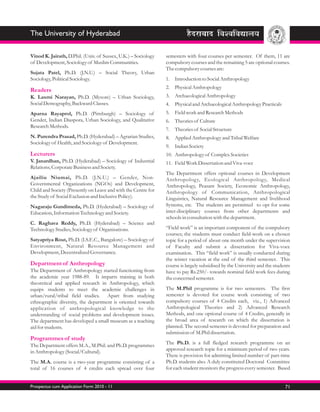
The University of Hyderabad


                                                               1
                                                          The University
The University of Hyderabad, a premier institution of             Departments / Centres of Study
postgraduate teaching and research in the country, was            The School of Mathematics and Computer /
established by an Act of Parliament (Act No. 39 of 1974) on       Information Sciences has the following Departments:
2nd October, 1974 as a Central University, wholly financed by
the University Grants Commission.                                 1.    Department of Mathematics & Statistics

The “objects of the University” as envisaged in the Act are:      2.    Department of Computer and Information Sciences

“to disseminate and advance knowledge by providing                The School of Life Sciences has the following Departments
instructional and research facilities in such branches of         and a Centre:
learning as it may deem fit and by the example of its             1.    Department of Biochemistry
corporate life, and, in particular, to make special               2.    Department of Plant Sciences
provisions for integrated courses in humanities and
                                                                  3.    Department of Animal Sciences
science in the educational programmes of the University
and to take appropriate measures for promoting inter-             4.    Department of Biotechnology
disciplinary studies and research in the University”.             5.    UoH DBT Centre for Research and Education
The University’s scenic, and serene campus is spread over a       The School of Humanities has the following Departments,
vast stretch of land measuring about 2,000 acres, 20 kms from     Centres, and a Cell :
the city of Hyderabad on the old Hyderabad-Bombay road.           1.   Department of English
Amidst the picturesque environment of the campus, several
buildings catering to the academic needs, support facilities      2.    Department of Philosophy
and residential requirements of the campus community have         3.    Department of Hindi
been constructed over the years. The University also has a city
                                                                  4.    Department of Telugu
campus ‘The Golden Threshold’ the residence of the late
Sarojini Naidu which was bequeathed to the University by her      5.    Department of Urdu
daughter, the late Padmaja Naidu.                                 6.    Centre for Applied Linguistics & Translation Studies
Schools of Study                                                  7.    Centre for Comparative Literature
1.     School of Mathematics and Computer /                       8.    Department of Sanskrit Studies
       Information Sciences
                                                                  9.    Centre for the Study of Foreign Languages
2.     School of Physics
                                                                  10.   English Language Teaching Cell
3.     School of Chemistry
                                                                  The School of Social Sciences has the following
4.     School of Life Sciences                                    Departments and Centres:
5.     School of Humanities                                       1.  Department of Economics
6.     School of Social Sciences                                  2.    Department of History
7.     Sarojini Naidu School of Arts and Communication            3.    Department of Political Science3
8.     School of Management Studies                               4.    Department of Sociology
9.     School of Medical SciencesSciences                         5.    Department of Anthropology
10.    School of Engineering Sciences and Technology              6.    Centre for Regional Studies
The Schools of Physics, Chemistry, Management Studies, and        7.    Centre for Folk Culture Studies
Engineering Sciences & Technology are single discipline
                                                                  8.    Centre for Social Exclusion and Inclusive Policy
schools and the others are multi-department schools.

Prospectus cum Application Form 2010 - 11                                                                                      1
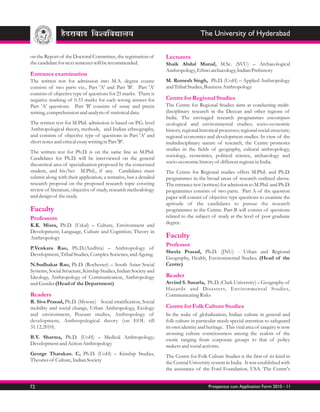
The University of Hyderabad


9.    Centre for the Study of Indian Diaspora                       5.    Centre for Neural and Cognitive Sciences
10.   Centre for Knowledge, Culture & Innovation Studies            6.    Centre for Women's Studies
11.   Centre for Gandhian Economic Thought                          7.    Centre for Buddhist Studies
12.   Centre for Human Rights                                       8.    Centre for Modelling Simulation and Design (CMSD)
The S.N. School of Arts and Communication has the                   All the Schools of the University, Departments and Centres
following Departments :                                             are located on the main campus in Gachibowli. Several of the
1.    Department of Dance                                           Schools and Departments of the University have obtained
                                                                    financial support from the University Grants Commission
2.    Department of Theatre Arts
                                                                    under the Special Assistance Programme and COSIST for
3.    Department of Fine Arts                                       excellence in teaching and research.
4.    Department of Communication                                   Over the years, the teaching and research programmes of the
                                                                    University have been firmly established. The students are
The School of Medical Sciences has the following Centre:
                                                                    selected through a nationwide entrance test. About 30% of
Centre for Physical Fitness and Sports Sciences                     the students are Ph.D. scholars and more than 32% of the
                                                                    students are women. Till 28.2.2010, over 17626 students of
Stand-alone Centres offering Academic                               the University had been awarded various degrees through
Programmes                                                          formal education, which consists of 1,506 Ph.Ds., 3,228
1.    Centre for Integrated Studies (CIS)                           M.Phils. 1,275 M.Techs. and 11,617 postgraduate Degrees
                                                                    and Diplomas. The Faculty of the University include 156
2.    University Centre for Earth and Space Sciences                Professors, 82 Readers and 112 Lecturers.
      (UCESS)
                                                                    The Faculty of the University have published widely and have
3.    Advanced Centre of Research in High Energy
                                                                    obtained research support from several funding agencies.
      Materials (ACRHEM)
                                                                    Several Faculty members have won national and international
4.    Centre for Health Psychology                                  awards and honours in recognition of their out-standing work
                                                                    in their respective fields.


                                                  About Hyderabad
                Founded by Quli Qutub Shah in 1591, this large metropolis is unique in its rich architectural
                glory and blend of diverse linguistic, religious and ethnic groups and is an ideal place indeed to
                locate a Central University. The weather for most part of the year is pleasant except for the
                months of April and May when the temperature is likely to go up to 40°C. The intellectual
                climate is vibrant. Hyderabad is home to nine major Universities and several research
                institutions, laboratories and libraries.


2                                                                                        Prospectus cum Application Form 2010 - 11
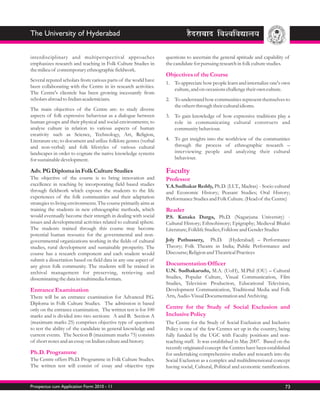
The University of Hyderabad


                                                 2
                                 Courses, Criteria for Admission
                                  and Entrance Examinations
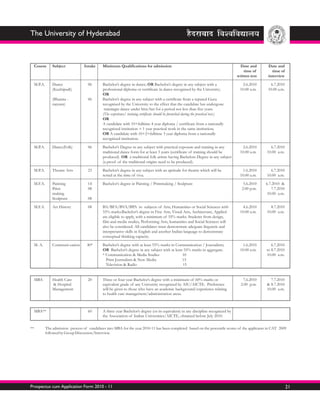
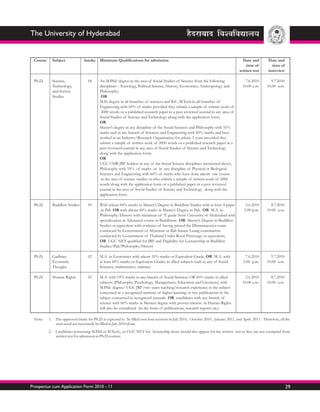
Courses Of Study                                                        M.A. courses                           (4 Semesters)
Admissions during 2010-11 are open for the                              English                                Applied Linguistics
following courses:                                                      Philosophy                             Economics
5-year Integrated M.A. / M.Sc. Courses                                  Hindi                                  History

I.M.Sc. Courses                          10 (Semesters)                 Functional Hindi (Translation)         Political Science

Mathematical Sciences                    Optometry & Vision             Telugu                                 Sociology
                                         Sciences                       Urdu                                   Anthropology
Physics
Chemical Sciences                        Nursing Sciences               Communication (Communication & Media Studies, Print Journalism &
                                                                        New Media, and Television & Radio)
Systems Biology                          Health Psychology

                                                                        M.P.A. Dance                                        (4 Semesters)
I.M.A. Courses in Humanities                      (10 Semesters)
                                                                        (Kuchipudi, Bharatanatyam, and Folk)
Languages: Hindi, Telugu and Urdu
                                                                        M.P.A.        Theatre Arts                          (6 Semesters)
LanguageScience
                                                                        M.F.A. Courses                                      (4 Semesters)
I.M.A. in Social Sciences                         (10 Semesters)
                                                                        Painting, Print Making and Sculpture
Postgraduate Courses
                                                                        Art History
M.Sc. courses                  (4 Semesters)
                                                                        Adv. P.G. Diploma Courses                     (2 Semesters)
Mathematics                    Plant Biology & Biotechnology
                                                                        Mineral Exploration (This course is offered in collaboration and
Applied Mathematics            Molecular Microbiology                   cooperation with National Geophysical Research Institute (NGRI), Atomic
                                                                        Minerals Directorate (AMD), National Remote Sensing Agency (NRSA),
Statistics-OR                  Animal Biotechnology                     and National Mineral Development Corporation (NMDC).
Physics                        Health Psychology
                                                                        Folk Culture studies
Chemistry                      Biotechnology*
                                                                        P.G. Diploma Courses                              (2 Semesters)
Biochemistry
                                                                        Counseling Psychology
* The admissions for M.Sc. Biotechnology course during the              Health Fitness and Life Style Management
year 2010-11 will be based on the allotment made by the
Jawaharlal Nehru University (JNU), New Delhi which will                 M.Tech. Courses                                   (4 Semesters)
conduct a common entrance test on 20.5.2010.
                                                                        Computer Science
M.C.A.                                             (6 Semesters)        Artificial Intelligence
M.B.A. Health Care and                             (4 Semesters)        Information Technology - (The course is offered in collaboration
Hospital Management                                                     with IDRBT, an Institute established by the Reserve Bank of India)

M.B.A. (4 semesters)* The selection process for admissions to this      Computational Techniques (CT) - (a post M.Sc (Physics) course
                                                                        offered by the School of Physics and the Department of Computer and
MBA course for the academic year 2010-11 has been completed based on    Information Sciences).
the percentile scores obtained in CAT 2009 followed by an Interview /
Group Discussion.                                                       Integrated Circuit Technology (I.C.T.)


Prospectus cum Application Form 2010 - 11                                                                                                    3
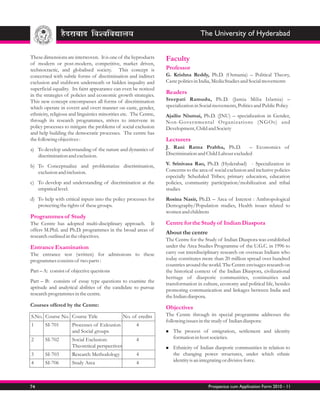
The University of Hyderabad


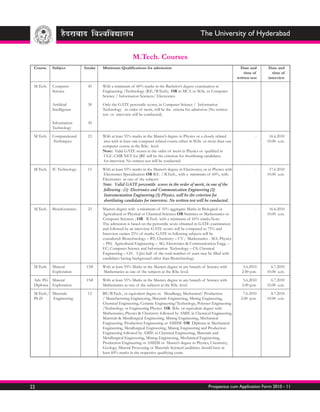
Bioinformatics - (The course is offered in collaboration with the         Science Technology and                Management Studies
Centre for DNA Fingerprinting and Diagnostics [CDFD], Hyderabad)           Society Studies
Mineral Exploration - (The course is offered in collaboration and         Human Rights                          Gandhian Economic -
cooperation with National Geophysical Research Institute (NGRI), Atomic                                           Thought
Minerals Directorate (AMD), National Remote Sensing Agency (NRSA),
and National Mineral Development Corporation (NMDC).                      Communication                         Gender Studies
                                                                          Dance                                 Psychology
M.Phil. Courses                     (2 Semesters)
                                                                          Theatre Arts                          Buddhist Studies
English                             Economics
Philosophy                          History                               Integrated M.Tech / Ph.D. (2 to 5 years)
Hindi                               Political Science                     Materials Engineering
Telugu                              Sociology                             Nano Science and Technology
Urdu                                Anthropology
                                                                          Integrated M.Sc./Ph.D. (2 to 5 years)
Applied Linguistics                 Regional Studies                      Biotechnology
Translation Studies                 Social Exclusion &
                                                                          Note: Candidates seeking admission to any of the Ph.D. programmes
Comparative Literature              Inclusive Policy                      listed above should note that it may not be possible to work under a
Shabdabodha Systems &               Indian Diaspora                       supervisor of her/his choice if the supervisor is already guiding more
Language Technologies                                                     students than the number prescribed by the respective Board of Studies of
                                                                          the Schools.
Cognitive Science                    Gender Studies
                                                                          Criteria For Admission
Ph.D. Programmes                     (2 to 5 years)                       1. The University offers facilities for Postgraduate, Advanced
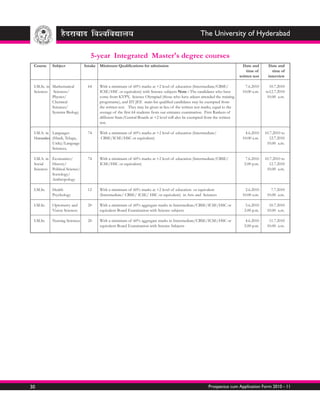
Mathematics                          Philosophy                           PG/PG Diploma, 5 -Year Integrated Master's Degree
Applied Mathematics                  Hindi                                Courses, and Research Studies in several major areas in
                                                                          Sciences, (including Medical Sciences, Engineering Sciences
Statistics                           Telugu                               & Technology), Humanities, Social Sciences, Performing
Operations Research (OR)             Urdu                                 Arts, Fine Arts, Communication and Management Studies.
Computer Science                     Applied Linguistics                  2. Admission to the University is open to all who fulfill the
Physics                              Translation Studies                  prescribed qualifications without any distinction of race,
Electronics Science                  Comparative Literature               caste, creed, language or sex. The selection is made strictly on
                                                                          the basis of merit at the entrance examination except the
Chemistry                            Sanskrit Studies                     admission into:
Biochemistry                         Economics
                                                                          M.Tech CS/AI/IT, which is based on only the GATE
Plant Sciences                       History                              percentile scores in Computer Science and Information
Animal Sciences                      Political Science                    Technology. (No written test or interview will be conducted)
Biotechnology                        Sociology                            Admission to M.Tech. I C Technology, Computational
ACRHEM                               Anthropology                         Techniques and Bioinformatics
Earth & Space Sciences               Regional Studies                     M.Tech. IC Technology: Shortlisitng of candidates for
Neural and Cognitive Sciences Folk Culture Studies                        interview is based on the GATE percentile scores in the order
                                                                          of merit, in one of the following subjects: (1) Electronics and
Materials Engineering                Social Exclusion &
                                      Inclusive Policy                    Communication Engineering (2) Instrumentation
                                                                          Engineering (3) Physics.
English                              Indian Diaspora
                                                                          M.Tech. Computational Techniques: Shortlisitng of
                                                                          candidates for interview is based on the GATE scores in the


4                                                                                                  Prospectus cum Application Form 2010 - 11
The University of Hyderabad


order of merit in Physics or being qualified in UGC-CSIR           submit the certificates of the qualifying degree examination.
NET for JRF.                                                       Such students will be given conditional admission up to
                                                                   31.8.2010 only. However, this facility will not be
M.Tech. Bioinformatics: Shortlisitng of candidates for
                                                                   extended to those who are taking regular or
interview is based on the percentile score obtained in GATE
in the following subjects: Biotechnology – BT; Chemistry –         supplementary or improvement examinations of the
CY; Mathematics - MA; Physics – PH; Agricultural                   qualifying degree after 31.07.2010 and awaiting the
Engineering – AG; Electronics & Communication Engg. –              results. In the event of the concerned students failing to (i)
EC; Computer Science and Information Technology – CS;              submit their result and certificates by 31.8.2010, and (ii) not
Chemical Engineering -CH. Upto half of the total number            passing the qualifying degree examination with the prescribed
of seats may be filled with candidates having background           percentage of marks, they will not be allowed to attend classes
other than Biotechnology.                                          any further and their conditional admission shall be cancelled
                                                                   forthwith. No request will be entertained for extension of
3. No student shall be eligible for admission to the               time to submit the certificates under any circumstances
Postgraduate Degree/Diploma Courses unless S/he has                beyond 31.8.2010.
successfully completed a three year Undergraduate Degree
through an examination conducted by a University/                  In case of non-submission of other certificates like Transfer
Autonomous College. However, as a transitory measure, a            Certificate, Migration Certificate and any other academic
candidate who has passed a two year degree course may also         certificate other than the qualifying degree examination
be considered for admission provided S/he has undergone a          certificates, students may be allowed time upto 30.9.2010,
further one year bridge course and passed the same.                failing which the Provisional admission of such candidates
                                                                   shall also be cancelled forthwith.
4. The minimum eligibility requirements for admission
to the above courses are given in a tabular form at the end        In the case of candidates admitted into Ph.D. programmes
of this chapter.                                                   under the result awaited category those who have completed
                                                                   all the formalities including the viva voce of their
The eligibility of candidates passing their qualifying
                                                                   M.Phil./M.Tech. courses before 31.7.2010 and are awaiting
examinations from Universities following the letter grading
                                                                   their results may be allowed to submit their M.Phil or M.Tech
system / CGPA will be determined on the basis of percentage
                                                                   results and certificates within a maximum period of one year
equivalent to the letter grade/ CGPA obtained by the
                                                                   from the date of their admission. During this period, they
candidates according to the conversion formula adopted by
                                                                   will not be paid any scholarship or fellowship. Once they
the University concerned. In the absence of any such
                                                                   submit the certificates, proving their eligibility for admission
formula, the decision of the University shall be final and
                                                                   into the Ph.D., their scholarship/fellowship will be paid with
binding on the candidates.
                                                                   retrospective effect from the date of their admission. If they
5. Candidates whose result of the qualifying degree                fail to submit the results and the certificates within one year,
examination is not declared may also apply for                     their admission shall stand cancelled forthwith.
admission.
Candidates who have completed all the formalities viz.,            6. All courses at the Master's Degree level, 5-Year
written the theory examinations, completed practical               Integrated Master's Degree, Advanced PG/PG
examinations, submitted Project reports, completed viva-           Diploma, M.Phil.; M.Tech.; Integrated M.Sc./Ph.D.
voce exams etc. and are waiting for the results of the             and M.Tech./Ph.D. are full time regular courses.
qualifying degree examination and those who are due to             For Ph.D. programmes, the candidates are encouraged to join
appear in the qualifying degree examination in the above           as regular students. However, for those who are not in a
stated aspects and expecting their results to be declared and      position to do research on full time basis, a limited provision
are getting their certificates before 31 July, 2010 will also be   exists for part time research. Facility is also available for
allowed to appear for the entrance test. The condition is that,    external registration to Ph.D. on regular basis at the
in case of their selection to a course in the University, they     recognized Centres of the University. The details are given in
should submit the certificates of the qualifying degree            subsequent paragraphs of this chapter.
examination and other earlier examinations positively at the
                                                                   Students admitted to the regular courses are not allowed
time of completion of the admission. In exceptional cases,
                                                                   to pursue any other course except part time evening
the University may give extension of time up to 31.8.2010 to
                                                                   Certificate/Diploma Course of a Professional nature


Prospectus cum Application Form 2010 - 11                                                                                        5
The University of Hyderabad


with prior permission of the School /Department                    is 10% lower than the cut off prescribed for admission for
/Centre concerned of the University. They are also not             General category candidates in any course. Candidates
allowed to take up any employment during the period of             claiming reservation under this category must enclose an
their studies in the University. Those employed, if selected       attested copy of the OBC (non-creamy layer) certificate
for admission, are required to submit at the time of               issued by a competent authority without which their claim will
completion of their admission, a “No Objection Certificate”        not be considered under OBC category.
besides orders from the competent authorities sanctioning
leave covering the entire duration of the course, failing which,   3 Reservation of seats for the physically challenged
the provisional selection for admission for such candidates        candidates:
will be cancelled.                                                 3% of seats on approved intake in each course are provided as
                                                                   supernumerary seats for the physically challenged candidates
Reservation of seats                                               having minimum degree of disability to the extent of 40%
1. Reservation of seats for SC and ST candidates:                  provided that their physical disability does not come in the
In accordance with the policy of the Government of India           way of pursuing the course. This is split into: 1% for visually
and the guidelines of the University Grants Commission, the        handicapped (VH), 1% for hearing impaired (HI) and 1% for
University has reserved 15% of seats in each course for            orthopedically handicapped (OH) candidates with a
candidates belonging to the Scheduled Castes and 7.5% for          provision of interchangeability. The minimum eligibility
those belonging to the Scheduled Tribes, with a provision for      requirements prescribed are relaxed in their cases as in the
inter changeability between these categories, wherever             cases of SC / ST candidates. The candidates under this
necessary. Candidates should submit along with the                 category should take the entrance examination for admission.
application a copy of the certificate of their caste/ tribe        Physically Challenged candidates are required to submit a
from a Revenue Officer not below the rank of Tahsildar             certificate from a Civil Surgeon of a Govt. Hospital indicating
/ Mandal Revenue Officer. Remedial courses in English              the extent of visual/physical disability and also the extent to
and other subjects are conducted for such students depending       which the disability hampers the candidate in pursuing
upon the actual need.                                              her/his studies.

Note: SC/ST candidates belonging to the State of                   The candidates under this category may have to undergo
Andhra Pradesh should submit an Integrated                         a fresh medical examination, if so prescribed by the
Community Certificate issued by the competent revenue              University, before being admitted.
authority.                                                         Visually challenged candidates appearing for the entrance
                                                                   examinations will be given extra time of 20 minutes for two
For admission to all Postgraduate Courses, viz., M.A., M.Sc.,
                                                                   hour papers and will also be allowed the use of a personal
M.C.A., M.F.A., M.P.A., Adv. P.G. Diploma; PG Diploma
                                                                   typewriter during the examination. The University will
Courses and 5-Year Integrated Master's Degree Courses, the
minimum eligibility condition for SC/ST candidates is “Pass”       provide scribes for such students.      They will not be
in the minimum qualifying examination.                             allowed to bring their own scribes.

For admission to M.Phil., M.Tech., and Ph.D. a relaxation of       4. Reservation of seats to the wards/dependants of
only 5% marks in the minimum eligibility condition is              Defence personnel
provided to SC/ST candidates.                                      Upto 5% of seats on the approved intake in each course are
                                                                   provided as supernumerary seats for the wards/dependants
2. Reservation of seats for OBC candidates                         of Defence Personnel. The candidates should enclose a copy
In accordance with the policy of the Govt. of India and the        of the certificate issued by a competent authority in support
guidelines of the University Grants Commission, 27% of the         of their claim without which their claim will not be
seats in each course are reserved for OBC (non-creamy layer        considered. The candidates under this category should take
category) candidates. There is no relaxation in minimum            the entrance examination for admission and fulfill all other
qualifications for admission and no concession in the cost of      requirements of admission.
Prospectus-cum-Application forms for OBCs. However,                5. Reservation of seats are provided to Kashmiri
there is a concession in the cut off marks in the entrance         migrants as per the norms of the Government of
examination (both written and interview put together) which        India/UGC.


6                                                                                       Prospectus cum Application Form 2010 - 11
The University of Hyderabad


6. Reservation of seats for candidates from the Union                Admission of foreign nationals:
Territories / North-Eastern States:                                  Foreign nationals will be admitted over and above the
One seat in each of the Departments/Centres in multi-                approved intake in each course up to a maximum of 15% of
departmental Schools of the University is reserved for the           the sanctioned seats in each course, depending upon the
nominees from the following States/Union Territories:                availability of adequate infrastructure. Foreign nationals
Tripura, Sikkim, Andaman & Nicobar Islands, Manipur,                 seeking admission through ICCR or other governmental
Mizoram, Nagaland, Arunachal Pradesh, Lakshadweep,                   agencies may apply to the University in the prescribed form
Dadra and Nagar Haveli. Further, in the event of non-                through the respective bodies. However, self supporting
availability of nominated candidates for a particular                foreign nationals may apply directly to the University for
department, other departments in the multi-departmental              admission in the prescribed form latest by 15th April, 2010
Schools may be permitted to admit up to two students                 for the July 2010 session. The University may consider
provided that the total number of nominated candidates in a          admission of foreign nationals 'in absentia', on the basis of
multi-departmental School shall not exceed the total number          their desire “to be considered in absentia” if they possess a
of departments/centres in the school. In the Schools having          valid foreign passport at the time of applying to the
no departments, there is a provision of a maximum of two             University, irrespective of from where they have passed the
nominated seats in each School.                                      qualifying examination, subject to the condition that they are
The nominations of the candidates belonging to the above             found suitable for admission by the Admission Committee of
Union Territories / States should reach the University               the concerned School / Department / Centre. Those who
through the respective UT / State Government by 31st May,            have passed the qualifying examination from Universities
                                                                     outside India should enclose with their application, copies of
2010. (The candidates should fulfill the minimum
                                                                     relevant certificates, marks sheets together with the English
eligibility requirements prescribed). Reservations are
                                                                     version of such copies duly attested, if they are in a different
made for candidates of all the above mentioned States and
                                                                     language.
Union Territories as a whole on the basis of the candidate's
performance in the qualifying degree, and the seats so filled        Foreign nationals seeking admission to the University will be
shall be over and above the approved intake (supernumerary           required to produce a medical certificate of fitness from a
seats) for the year.                                                 recognized hospital in their country.        Those offered
                                                                     admission may also be required to undergo a comprehensive
Note: Applications received directly from the candidates             medical examination as prescribed by the university.
without routing them through the respective Directorate              Proficiency in English is a pre-condition for admission of
of the Higher Education of the UT/NE state and                       foreign nationals. No foreign national will be admitted
nominations received after 31.5.2010 will not be                     without a student visa. Foreign nationals selected for Ph.D.
considered.                                                          programmes will be allowed to complete the admission
Weightage for distinction in sports/cultural                         only after obtaining a research visa from the Indian
                                                                     Embassy abroad. There is a different fee structure for
activities:
                                                                     foreign nationals, as indicated on subsequent pages of
With a view to encourage admission of candidates with an             this chapter. Accommodation in the University hostels may
excellent record in Sports and Cultural activities, the              be provided if available.
University provides a weightage of upto two marks in the
entrance examinations - two marks for distinctions achieved          Non-Resident Indians (NRIs): NRIs will also be
at national level and one mark for distinctions at the state level   considered for admission in different courses in accordance
(but not both), for admission to various Post-Graduate               with the rules in vogue. NRIs may apply directly to the
courses, and 5-year Integrated Master's Degree courses               University for admission in the prescribed form latest by
provided the candidates satisfy the prescribed qualifications        15th April 2010. They may be considered for admission, if
for admission. (Candidates seeking weightage for                     they are found suitable for admission by the Admission
distinctions in sports / cultural activities must furnish            Committee of the concerned School / Department / Centre
along with their applications, attested/Xerox copies of              in accordance with the rules. Candidates who take admission
certificate/s in support of their claim, failing which no            under this category shall pay the tuition and other fees as
weightage would be considered).                                      payable by foreign nationals.


Prospectus cum Application Form 2010 - 11                                                                                          7
The University of Hyderabad


Entrance Examinations                                              Mathematics - MA; Physics – PH; Agricultural Engineering –
1. The Entrance Examinations for various P.G. Degree               AG; Electronics & Communication Engg. – EC; Computer
Courses, other than those offered by the Sarojini Naidu            Science and Information Technology – CS; Chemical
School and M.Sc Mathematics, Statistics-OR, Physics,               Engineering – CH.
Chemistry and Health Psychology will consist of only a
                                                                   4. The question paper should be answered only in English
written test of 100 marks.
                                                                   except in the case of admission to language courses for which
2. The entrance examinations in the case of MPA, MFA, and          the question paper should be answered in the language
M.A. in Communication in the Sarojini Naidu School will            concerned.
consist of a written test and a practical test/interview. The
                                                                   The performance of the candidates in the written test in
weightage for the written test and practical test/interview will
                                                                   some of the courses as listed below is in objective or
be in the ratio of 60:40 for M.A. Communication and 50:50
                                                                   multiple choice questions and will be evaluated using the
for other courses in the S.N. School. Only such candidates
                                                                   OMR technology. The candidates will be required to mark
who are found successful in the written test will be called for
                                                                   the answers in the OMR Sheet with blue or black ball-
the practical test/interview at Hyderabad. The schedule for        point or sketch pen during the test. Necessary instructions
the written test, practical test/ interview for all the            will be given in the relevant question papers.
courses is given in a tabular form at the end of this
chapter.                                                           The question paper for the following subjects shall be
                                                                   answered on OMR Sheet:
3. The entrance examination for the 5-year integrated M.A.,
M.Sc. in different disciplines, M.Sc. Mathematics,                 5-year Integrated M.Sc. and M.A. in different disciplines:
Statistics-OR, Physics, Chemistry and Health                       M.Sc. - Mathematics/Applied Mathematics, Statistics-OR,
Psycholog y, M.Phil, Integrated M.Sc./Ph.D.                        Physics, Chemistry, Biochemistry, Plant Biology &
Biotechnoogy; M.Tech. / Ph.D. Materials Engineering,               Biotechnolog y, Molecular Microbiolog y, Animal
Nano Science and Technology and Ph.D. in different                 Biotechnology, Health Psychology; M.C.A., M.A. - Telugu,
subjects will consist of a written test and an interview (after    Economics; M.Phil. - Telugu, Economics; Integrated
qualifying in the former). The written test will carry 75 marks    M.Tech./Ph.D. - Materials Engineering, Nano Science and
and the interview 25 marks.                                        Technology; Ph.D. - Materials Engineering, Physics,
                                                                   Electronics Science, ACRHEM,          Biotechnology, Plant
Admissions in M.Tech Computer Science, Artificial                  Sciences, Animal Sciences, Economics; Integrated
Intelligence, and Information Technology, will be                  M.Sc./Ph.D. Biotechnology; PG Diploma in Counseling
granted only on the basis of GATE scores in Computer               Psychology and Health Fitness & Life Style Management.
Science and Information Technology.
                                                                   5. The written tests for all the courses will be held from 1st
Admission in M.Tech IC Technology is based on the                  to 7th June 2010 at 25 different Centres in the country, as
GATE scores in the order of merit in one of the following:         listed in this chapter.
1) Electronics and Communication Engineering, 2)                   6. The duration of the written test for all courses will be
Instrumentation Engineering and 3) Physics followed by an          two hours.
interview for the short listed candidates. There is no written
test for admission to this course.                                 7. A candidate is free to apply for admission to as many
                                                                   courses as S/he wishes after ensuring from the schedule
Admission in M.Tech. Computational Techniques is                   for the Entrance examination that there is no clash in the
based on the GATE scores in the order of merit in Physics or       subjects of his/her choice. The University has made the
being qualified in UGC-CSIR NET for JRF will be the                best possible efforts to avoid overlap in the schedule of
criterion for shortlisting candidates for interview. No written    examinations of related subjects to the extent possisble. The
test will be conducted.                                            candidates are advised to study the examination schedule
                                                                   carefully before deciding on their choice of subjects.
Admission in M.Tech. Bioinformatics is based on the
percentile score obtained in GATE examination and followed         8. Please read the following carefully:
by an interview. GATE in following subjects will be                The question paper for the entrance test for all courses
considered: Biotechnology – BT; Chemistry – CY ;                   (except for Ph.D. in some subjects - please see the Chapter on


8                                                                                       Prospectus cum Application Form 2010 - 11
The University of Hyderabad


'Schools of Study' for further details) shall consist of two                      examination immediately preceding the qualifying
parts - Part-'A' and Part- 'B'.                                                   degree examination.
Part-'A' of the question paper shall necessarily consist of                (d)    Fourth criterion: Marks obtained in the next lower
objective type questions preferably of one mark each for a                        public examination.
total of 25 marks. The marks obtained by the candidates in                 9. Interviews for candidates short-listed for admission to
Part 'A' will be used for resolving tie cases.                             M.Phil., M.Tech., and Ph.D. on the basis of written test and
All the Schools/Departments/Centres will follow negative                   those exempted from written test (on the basis of
marking for Part- 'A' of the question paper. There will be                 UGC/CSIR JRF(NBHM, in the case of Ph.D. for Maths,
negative marking of 0.33 mark for every wrong answer.                      ICMR/ ICAR/DBT Fellowship for Ph.D. in the School of
Those Schools/Departments/Centres, which may set the                       Life Sciences), and ICMR Fellowship for Ph.D. in the School
entire paper as “objective type”, may follow negative marking              of Social Sciences, RGNFs, 5-year Integrated M.A., M.Sc. in
for Part- 'B' of the question paper as well.                               different disciplines, Integrated M.Tech./Ph.D. Materials
                                                                           Engineering, Nano Sceince and Technology, Integrated
The following criteria shall be followed, in sequence to                   M.Sc./Ph.D. Biotechnology, M.Sc Mathematics, Statistics-
resolve ties, where candidates secure the same marks in the                OR, Physics, Chemistry, Health Psychology and the courses
written test :                                                             offered by the S.N. School are tentatively scheduled to be held
(a)   First criterion: Marks obtained in Part - A of the written test.     between 6th July to 12th July 2010, in the respective
(b)   Second criterion: Marks obtained by the candidates in                Schools/ Departments/ Centres. However, exact dates of
      the qualifying degree/other examination. If the final                the interview/practical test will be communicated to the
      result is not available, then the marks up to the 2nd year           short listed candidates.
      will be taken into account.                                          10. Candidates called for the entrance examinations (Both
                                                                           written and practical test / interview) will appear for the
(c)   Third criterion: Marks obtained in the degree
                                                                           examinations at their own expense.

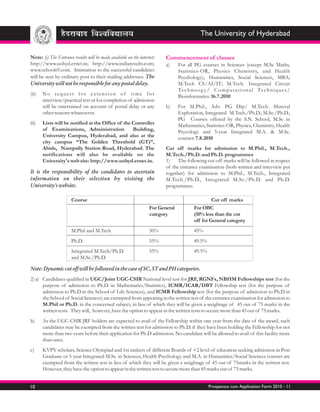
                         Schedule for notification of the entrance examination results etc.
 Particulars of the                              Adv. PG Dip. / PG Degree             Adv. PG Dip. / M.Tech. Mineral        M.Tech
 scheduled event                                  Courses in Sciences(except         Exploration , Ph.D, P.G. courses      CS/AI/IT
                                                 M.Sc in Maths, Statistics-OR,        of S.N. School, M.Sc. in Maths,
                                                   Physics, Chemistry and            Statistics-OR, Physics, Chemistry
                                                     Health Psycology),                and Health Psychology, 5-year
                                                   Humanities, and Social            Integrated M.A./ M.Sc. P.G. Dip.
                                                  Sciences; M.Tech. CT, IC             in Counseling Psychology and
                                                       Technology and                   Health Fitness and Life Style
                                                        Bioinformatics                          Management

Notification of short-listed candidates                        -                                     25.6.2010                    -
for interviews / practical tests

Notification of list of selected
candidates (Main & waiting lists)                              30.6.2010                             22.7.2010           22.5.2010

Last date for completion of admission                          15.7.2010                             7.8.2010            17.6.2010
by the Main-list candidates/candidates
called for counseling

Date for completion of admission                               17.7.2010                             9.8.2010                     -
by the wait-listed candidates

Closure of all admissions                                                        16.8.2010


Prospectus cum Application Form 2010 - 11                                                                                               9
The University of Hyderabad


Note: (i) The Entrance results will be made available on the internet:    Commencement of classes
http://www.uohyd.ernet.in; http://www.indiaresults.com;                   a)     For all PG courses in Sciences (except M.Sc Maths,
www.schools9.com. Intimation to the successful candidates                        Statistics-OR, Physics Chemistry, and Health
will be sent by ordinary post to their mailing addresses. The                    Psychology), Humanities, Social Sciences, MBA;
University will not be responsible for any postal delay.                         M.Tech CS/AI/IT; M.Tech. Integrated Circuit
                                                                                 Te c h n o o g y / C o m p u t a t i o n a l Te c h n i q u e s /
(ii)   No request for extension of time for                                      Bioinformatics: 16.7.2010
       interview/practical test or for completion of admission
       will be entertained on account of postal delay or any              b)     For M.Phil., Adv. PG Dip/ M.Tech. Mineral
       other reasons whatsoever.                                                 Exploration, Integrated M.Tech./Ph.D.; M.Sc./Ph.D.;
                                                                                 PG Courses offered by the S.N. School, M.Sc in
iii)   Lists will be notified at the Office of the Controller                    Mathematics, Statistics-OR, Physics, Chemistry, Health
       of Examinations, Administration             Building,                     Psycology and 5-year Integrated M.A. & M.Sc.
       University Campus, Hyderabad, and also at the                             courses: 7.8.2010
       city campus “The Golden Threshold (GT)”,
       Abids, Nampally Station Road, Hyderabad. The                       Cut off marks for admission to M.Phil., M.Tech.,
       notifications will also be available on the                        M.Tech./Ph.D. and Ph.D. programmes
       University's web site: http://www.uohyd.ernet.in.                  1)    The following cut-off marks will be followed in respect
                                                                          of the entrance examination (both written and interview put
It is the responsibility of the candidates to ascertain                   together) for admission to M.Phil., M.Tech., Integrated
information on their selection by visiting the                            M.Tech./Ph.D., Integrated M.Sc./Ph.D. and Ph.D.
University's website.                                                     programmes:

                       Course                                                                      Cut off marks
                                                                   For General            For OBC
                                                                   category               (10% less than the cut
                                                                                          off for General category
                       M.Phil and M.Tech                           50%                    45%
                       Ph.D.                                       55%                    49.5%
                       Integrated M.Tech/Ph.D.                     55%                    49.5%
                       and M.Sc./Ph.D.

Note: Dynamic cut off will be followed in the case of SC, ST and PH categories.
2) a) Candidates qualified in UGC/Joint UGC-CSIR National level test for JRF, RGNFs, NBHM Fellowships test (for the
      purpose of admission to Ph.D. in Mathematics/Statistics), ICMR/ICAR/DBT Fellowship test (for the purpose of
      admission to Ph.D in the School of Life Sciences), and ICMR Fellowship test (for the purpose of admission to Ph.D in
      the School of Social Sciences) are exempted from appearing in the written test of the entrance examination for admission to
      M.Phil or Ph.D. in the concerned subject, in lieu of which they will be given a weightage of 45 out of 75 marks in the
      written tests. They will, however, have the option to appear in the written tests to secure more than 45 out of 75 marks.
b)     As the UGC-CSIR JRF holders are expected to avail of the Fellowship within one year from the date of the award, such
       candidates may be exempted from the written test for admission to Ph.D. if they have been holding the Fellowship for not
       more than two years before their application for Ph.D admission. No candidate will be allowed to avail of this facility more
       than once.
c)     KVPY scholars, Science Olympiad and 1st rankers of different Boards of +2 level of education seeking admission in Post
       Graduate or 5-year Integrated M.Sc. in Sciences, Health Psychology and M.A. in Humanities/Social Sciences courses are
       exempted from the written test in lieu of which they will be given a weightage of 45 out of 75marks in the written test.
       However, they have the option to appear in the written test to secure more than 45 marks out of 75 marks.


10                                                                                                Prospectus cum Application Form 2010 - 11
The University of Hyderabad


Note: - (i) Candidates qualified in UGC-CSIR National level test for           the entrance examination as prescribed. This facility is
Lectureship alone and those who have qualified in GATE, wherever               limited to those working in the twin cities (Hyderabad and
these are prescribed as one of the eligible conditions for admission are not   Secunderabad) in respect of Science Schools (except
exempted from appearing in the written test for admission to                   Mathematics) and anywhere in Andhra Pradesh for the
M.Phil./Ph.D. Therefore such candidates should appear in the written           remaining Schools (except the Department of Computer and
test also.                                                                     Information Sciences). Part-time Registration to Ph.D in
                                                                               Computer Science is only for teacher candidates who are
(ii) Candidates possessing M.Phil./M.Tech. degree and                          teaching in UGC/AICTE approved Universities or P.G
seeking admission to the Ph.D. Programme for which they are                    colleges or Engineering Colleges within Andhra Pradesh.
otherwise eligible to apply, are also not exempted from
appearing in the written test of the entrance examination.                     4) External Registration to Ph.D.: The University also
Therefore, they must note that they have to take the written                   provides facility for admission to the Ph.D. under External
test also. However candidates possessing M.Tech degree and                     Registration category. The external candidate shall work at
seeking admission to the Ph.D. in Materials Engineering are                    the recognised institution. The admission procedure is the
exempted from the written test in lieu of which a weightage                    same as in the case of regular admissions to Ph.D. Candidates
of 45 marks will be given. They have to appear for the                         will be under joint supervision viz., one from the University
interview.                                                                     and the other from the recognised institution.

(iii) The GATE qualified candidates may be given some                          In the case of External Registration to Ph.D in
preference/weightage in the interview for admission to the                     Computer Science, the candidates who are working in the
concerned subject of study, as may be decided by the                           following Institutes in the twin cities alone are allowed to
concerned School/Department/Centre.                                            register under this category. Candidates who register under
                                                                               external registration should have a recognised guide
3) Part time registration to Ph.D.: Facilities exist to a                      (recognised by the University) from the parent organization
limited extent for part time registration for Ph.D.                            listed below, and also a guide from the Department of
Programmes. Persons engaged in teaching and research in                        Computer / Information Sciences.
reputed institutions of higher learning are eligible for
admission under this category, provided they fulfill the                       * NRSA *CMC *ADRIN *ANURAG *RCI *IDRBT *
minimum eligibility requirements and are found successful in                   NGRI * CDAC *ATC of TCS.

                                       List of Institutions recognized as External Centres
The following Institutions in the twin cities of Hyderabad and Secunderabad have been recognised by the University for external
registration to Ph.D. in the subjects indicated against them.

  S.No. Name of the Institution                                                    Subject/s of Research
  1        National Remote Sensing Agency                                          Computer Science, Physics, Earth & Space Sciences
  2        Computer Maintenance Corporation Ltd                                    Computer Science
  3        Defence Metallurgical Research Laboratory                               Physics
  4        Centre for Economic and Social Studies                                  Economics, Political Science,
                                                                                   Anthropology, and Regional Studies
  5        National Institute of Small Industry                                    Economics and Anthropology
           Extension Training
  6        Institute of Public Enterprise                                          Economics
  7        Advanced Data Processing Research Institute                             Computer Science
  8        Directorate of Rice Research                                            Life Sciences
  9        Directorate of Oil Seeds Research                                       Life Sciences
  10       Bhagwan Mahavir Medical Research Centre                                 Life Sciences


Prospectus cum Application Form 2010 - 11                                                                                                11
The University of Hyderabad


  11     Advanced Numerical Research and Analysis Group                Computer Science
         (ANURAG)
  12     Dr. Reddy's Research Foundation                               Chemistry and Life Sciences
  13     International Crops Research Institute for                    Life Sciences
         Semi Arid Tropics (ICRISAT)
  14     Research Centre Imarat (RCI)                                  Computer Science
  15     Centre for DNA Fingerprinting and                             Life Sciences
         Diagnostics (CDFD)
  16     National Institute of Rural Development (NIRD)                Economics, Political Science,
                                                                       Sociology, Anthropology, Regional Studies
  17     Institute for Development and Research                        Computer Science, Information Technology,
         in Banking Technology (IDRBT)                                 Management Studies
  18     Indian Institute of Chemical Technology                       Chemistry
  19     L.V. Prasad Eye Research Institute                            Biochemistry, Animal Science, and Communication
  20     Shantha Biotechnics                                           Animal Sciences
  21     Indian Immunologicals                                         Animal Sciences
  22     Administrative Staff College of India (ASCI)                  Management Studies
  23     Blue Peter Research Centre                                    Animal Sciences
  24     National Geophysical Research Institute (NGRI)                Computer Science, Artificial Intelligence,
                                                                       Physics, Chemistry and Earth & Space Sciences
  25     National Institute of Nutrition (NIN)                         Biochemistry
  26     International Advanced Research Centre for                    Engineering Sciences & Technology,
         Powder Metallurgy and New Materials (ARCI)                    ACRHEM and Physics
  27     Non-ferrous Materials Technology Development                  Engineering Sciences & Technology
         Centre(NFTDC)
  28     Institute of Life Sciences (ILS)                              and Life Sciences
  29     Centre for Development of Advanced Computing                  Computer/Information Sciences
         (CDAC)
  30     Advanced Technology Centre (ATC) of TCS                       Computer/InformationSciences, Life Sciences
  31     Bharat Biotech Foundation                                     Life Sciecnes

Associate Institution Status                                      1.    Indian Institute of Chemical Technology (IICT)
In order to boost partnerships for mutual benefit, the
                                                                  2.    L.V. Prasad Eye Research Institute (LVPEI)
University has granted Associate Institution Status to the
following Institutions. These Institutions are entitled to        3.    Institute of Life Sciences (ILS)
admit Ph.D. students based on their infrastructure and
logistics strictly complying with the guidelines approved by      6) Ph.D. admissions for October 2010, January 2011, and
the University in this regard and also complying with the other   April 2011 sessions
rules and regulations on admissions of the University which       After completion of the regular admissions in July, 2010,
will change from time to time.                                    vacant seats if any, in the Ph.D. programmes may be filled
                                                                  from among the JRF qualified candidates. CSIR JRFs may
                                                                  join an interested Faculty member of the University at any


12                                                                                     Prospectus cum Application Form 2010 - 11
The University of Hyderabad


time before the time lapse of the award for the sake of           Note: In the case of post-matric scholarship holders
claiming their fellowship. However, they may be considered        belonging to the SC/ST/OBC categories from the State
for admission in accordance with the norms of the University      of Andhra Pradesh, semester–wise registration for the
for which the candidates have to apply in the prescribed          winter semester will be done without insisting on the
application form. Interviews will be conducted and selections     clearance of mess and tuition fee dues of the monsoon
for admission will be made based on the performance of the
                                                                  semester, if the same are reimbursable by the Social
candidates in the interview, also considering the weightage for
their JRF qualification in accordance with the following          Welfare/Backward Classes Welfare Department of the
schedule :                                                        State Government. However, they should clear all the
                                                                  dues of the winter semester before registering for the
i)     First week of October 2010                                 monsoon semester.
ii)    First week of January 2011
iii)   First week of April 2011                                   Implementation of Credit System for all the courses
                                                                  The credit system has been implemented for all the PG /
The University will not issue any press notification in this
                                                                  Adv.PG / PG Diploma, all the M.Phil and M.Tech courses
regard. However, information indicating the likely number
                                                                  from the academic year 2004-05. The necessary guidelines
of seats to be filled in each School/Department/Centre, will
                                                                  for evaluation of students under this system are available in
be available at the University's web site: www.uohyd.ernet.in
                                                                  Chapter 6 of this brochure.
Note: Candidates for admission to Ph.D during the above
                                                                  General
sessions should possess the certificates of their qualifying
degree examination by the date of their interview. Selected       1) Before filling the Application Form and the Basic Data
candidates must submit all their academic certificates and        Form, candidates are advised to read the instructions carefully
other certificates required at the time of admission.             and complete the form accordingly, particularly about their
Extension of time will not be granted for submission of any       performance in the qualifying degree or earlier examinations.
of the certificates during these sessions and the provisional     This is necessary since the performance of the candidates in
selection for admission will automatically stand cancelled in     the qualifying degree and earlier examinations shall be used in
the case of those who are unable to submit the certificates       determining relative positions in the merit list for those
required for admission on the date of completion of the           candidates involved in a tie in the written test.
admission formalities.                                            2) The last date for receiving the completed applications for
                                                                  admissions for the July session is May 3, 2010. Applications
Semester-wise Registration System                                 received after the closing date will not be considered. For
In order to maintain an effective enrolment of students and
                                                                  further details, please refer to the “Instructions to the
their progress in their studies/research, the University has
                                                                  Candidates for filling the application form”.
introduced a system of student registration at the beginning
of each semester for all the courses offered on regular basis     3) The University will not be responsible for any postal delay.
including part time/external/associate registration Ph.D. A       Candidates are therefore advised to apply for admission well
schedule for semester-wise registration is on the inside page     in time.
of the back cover of the prospectus-cum-application form.
However, a schedule for semester wise registration will be        4) All disputes are subject to Hyderabad jurisdiction.
notified by the Academic Section from time to time. Students
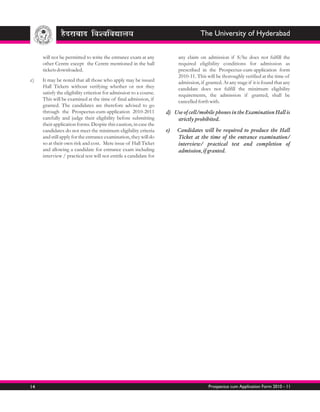
                                                                  Issue of Hall Tickets for the Entrance Examinations:
of all the courses (P.G./Integrated Master's Degree/Adv.
PG/PG Dip./ M.Phil./ M.Tech./ Ph.D./M.Sc./Ph.D.), are             a)    The Hall Tickets will be dispatched by ordinary post 10
required to clear their dues of the earlier semester/s in all           days before the commencement of the examination.
respects before registering for the following semester of the
course.                                                           Note : It may be noted that issue of Hall Tickets on the
                                                                  spot at the University campus is withdrawn.
Every Ph.D. student (regular/part-time/external/associate)
should enclose a copy of the report of the doctoral               b)    In the case of non-receipt of the hall tickets before the
committee of the previous semester to the requisition form              commencement of the examinations, the candidates
of the semester registration, without which ongoing semester            may download a copy of the hall ticket and appear for
registration will not be done.                                          the examination at the Centre opted for. Candidates


Prospectus cum Application Form 2010 - 11                                                                                     13
The University of Hyderabad


     will not be permitted to write the entrance exam at any             any claim on admission if S/he does not fulfill the
     other Centre except the Centre mentioned in the hall                required eligibility conditions for admission as
     tickets downloaded.                                                 prescribed in the Prospectus-cum-application form
                                                                         2010-11. This will be thoroughly verified at the time of
c)   It may be noted that all those who apply may be issued              admission, if granted. At any stage if it is found that any
     Hall Tickets without verifying whether or not they                  candidate does not fulfill the minimum eligibility
     satisfy the eligibility criterion for admission to a course.        requirements, the admission if granted, shall be
     This will be examined at the time of final admission, if            cancelled forth with.
     granted. The candidates are therefore advised to go
     through the Prospectus-cum-application 2010-2011               d) Use of cell/mobile phones in the Examination Hall is
     carefully and judge their eligibility before submitting            strictly prohibited.
     their application forms. Despite this caution, in case the
     candidates do not meet the minimum eligibility criteria        e)   Candidates will be required to produce the Hall
     and still apply for the entrance examination, they will do          Ticket at the time of the entrance examination/
     so at their own risk and cost. Mere issue of Hall Ticket            interview/ practical test and completion of
     and allowing a candidate for entrance exam including                admission, if granted.
     interview / practical test will not entitle a candidate for


14                                                                                      Prospectus cum Application Form 2010 - 11
The University of Hyderabad


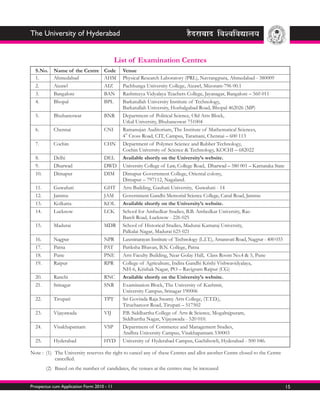
                                            List of Examination Centres
  S.No.    Name of the Centre       Code      Venue
  1.       Ahmedabad                AHM       Physical Research Laboratory (PRL), Navrangpura, Ahmedabad - 380009
  2.       Aizawl                   AIZ       Pachhunga University College, Aizawl, Mizoram-796 00.1
  3.       Bangalore                BAN       Rashtreeya Vidyalaya Teachers College, Jayanagar, Bangalore – 560 011
  4.       Bhopal                   BPL       Barkatullah University Institute of Technology,
                                              Barkatullah University, Hoshalgabad Road, Bhopal 462026 (MP)
  5.       Bhubaneswar              BNR       Department of Political Science, Old Arts Block,
                                              Utkal University, Bhubaneswar 751004
  6.       Chennai                  CNI       Ramanujan Auditorium, The Institute of Mathematical Sciences,
                                              4th Cross Road, CIT, Campus, Taramani, Chennai – 600 113
  7.       Cochin                   CHN       Department of Polymer Science and Rubber Technology,
                                              Cochin University of Science & Technology, KOCHI – 682022
  8.       Delhi                    DEL       Available shortly on the University’s website.
  9.       Dharwad                  DWD       University College of Law, College Road, Dharwad – 580 001 – Karnataka State
  10.      Dimapur                  DIM       Dimapur Government College, Oriental colony,
                                              Dimapur – 797112, Nagaland.
  11.      Guwahati                 GHT       Arts Building, Gauhati University, Guwahati - 14
  12.      Jammu                    JAM       Government Gandhi Memorial Science College, Canal Road, Jammu
  13.      Kolkatta                 KOL       Available shortly on the University’s website.
  14.      Lucknow                  LCK       School for Ambedkar Studies, B.B. Ambedkar University, Rae-
                                              Bareli Road, Lucknow - 226 025
  15.      Madurai                  MDR       School of Historical Studies, Madurai Kamaraj University,
                                              Palkalai Nagar, Madurai 625 021
  16.      Nagpur                   NPR       Laxminarayan Institute of Technology (L.I.T.), Amaravati Road, Nagpur - 400 033
  17.      Patna                    PAT       Pariksha Bhavan, B.N. College, Patna
  18.      Pune                     PNE       Arts Faculty Building, Near Golay Hall, Class Room No.4 & 5, Pune
  19.      Raipur                   RPR       College of Agriculture, Indira Gandhi Krishi Vishwavidyalaya,
                                              NH-6, Krishak Nagar, PO – Ravigram Raipur (CG)
  20.      Ranchi                   RNC       Available shortly on the University’s website.
  21.      Srinagar                 SNR       Examination Block, The University of Kashmir,
                                              University Campus, Srinagar 190006
  22.      Tirupati                 TPT       Sri Govinda Raja Swamy Arts College, (T.T.D.),
                                              Tiruchanoor Road, Tirupati – 517502
  23.      Vijayawada               VIJ       P.B. Siddhartha College of Arts & Science, Mogalrajpuram,
                                              Siddhartha Nagar, Vijayawada - 520 010.
  24.      Visakhapatnam            VSP       Department of Commerce and Management Studies,
                                              Andhra University Campus, Visakhapatnam 530003
  25.      Hyderabad                HYD       University of Hyderabad Campus, Gachibowli, Hyderabad - 500 046.

Note : (1) The University reserves the right to cancel any of these Centres and allot another Centre closed to the Centre
           cancelled.
        (2) Based on the number of candidates, the venues at the centres may be increased


Prospectus cum Application Form 2010 - 11                                                                                       15
The University of Hyderabad

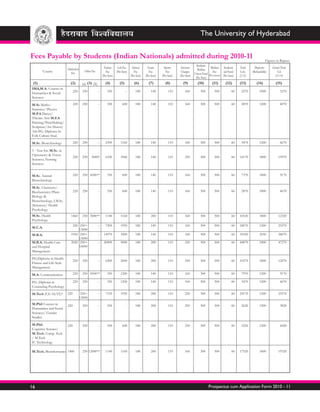
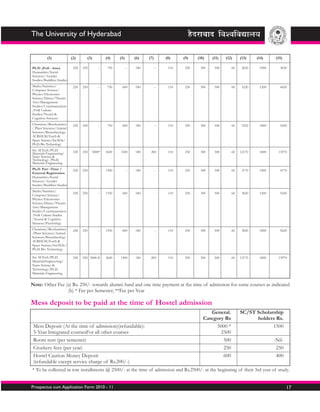
Fees Payable by Students (Indian Nationals) admitted during 2010-11                                                                                                                     Figures in Rupees
                                                                                                                                    Students
                         Admission                        Tuition     Lab Fee      Library      Exam        Sports     Internet                Medical Students       Total     Deposits     Grand Total
       Course                           Other Fee                                                                                   Welfare
                           Fee                              Fee      (Per Sem)       Fee         Fee         Fee       Charges                   Fee      aid Fund    Cols.   (Refundable)       Col
                                                                                                                                  Union Fund (Per annum)
                                                         (Per Sem)                (Per Sem)   (Per Sem)   (Per Sem)   (Per Sem)                          (Per Sem)   (2-12)                    (13-14)
                                                                                                                                   (Per Sem)
 (1)                       (2)        (a) (3) (b)          (4)         (5)           (6)        (7)         (8)         (9)         (10)        (11)       (12)      (13)        (14)          (15)
IMA,M.A. Courses in
                               220     250          --       350             --       180         140         110         160         300         500           60    2270         1000            3270
Humanities & Social
Sciences

M.Sc Maths/                    220     250          --       350         600          180         140         110         160         300         500           60    2870         1200            4070
Statistics/ Physics
M.P.A Dance/
Theatre Arts M.F.A
Painting/PrintMaking/
Sculpture/Art History
Adv.P.G. Diploma In
Folk Culture Stud.

M.Sc. Biotechnology            220     250          --     2390         1160          180         140         110         160         300         500           60    5470         1200            6670

5 - Year Int. M.Sc. in
Optometry & Vision
                               220     250   5000*         6100         1060          180         140         110         250         300         500           60   14170         1800          15970
Sciences, Nursing
Sciences


M.Sc. Animal                   220     250 4500**            350         600          180         140         110         160         300         500           60    7370         1800            9170
Biotechnology

M.Sc. Chemistry/
Biochemistry/Plant             220     250          --       350         600          180         140         110         160         300         500           60    2870         1800            4670
Biology &
Biotechnology, I.M.Sc.
(Sciences)/ Health
Psychology
M.Sc. Health               1460        250 5000**          1140         1160          180         200         110         160         300         500           60   10520         1800          12320
Psychology
                            220 250+                --     7200         1950          180         140         110         160         300         500           60   24070         1200          25270
M.C.A.
                                13000
M.B.A.                     1950 250+                --    14970         3900          180         140         110         160         300         500           60   35520         2550          38070
                                13000
M.B.A. Health Care         2020 250+                --    20000         5000          180         200         110         250         300         500           60   44870         2400          47270
and Hospital                    16000
Management

P.G.Diploma in Health
                               220     250          --     6200         2000          180         200         110         250         300         500           60   10270         1800          12070
Fitness and Life Style
Management

M.A. Communication             220     250 4500**            350        1200          180         140         110         160         300         500           60    7970         1200            9170

P.G. Diploma in                220     250          --       350        1200          180         140         110         160         300         500           60    3470         1200            4670
Counseling Psychology

M.Tech (CS/AI/IT)*       220          250+          --     7150         1950          180         200         110         250         300         500           60   24170         1200          25370
                                     13000
M.Phil Courses in        220          250           --       550             -        180         200         110         250         300         500           60    2620         1200            3820
Humanities and Social
Sciences/ Gender
Studies

M.Phil.                  220          250           --       550         600          180         200         110         250         300         500           60    3220         1200            4420
Cognitive Science/
M.Tech. Comp. Tech.
/ M.Tech
IC Technology

M.Tech. Bioinformatics 1460           250 12000**          1140         1160          180         200         110         160         300         500           60   17520         1800          19320


16                                                                                                                                           Prospectus cum Application Form 2010 - 11
The University of Hyderabad


          (1)              (2)      (3)         (4)    (5)        (6)   (7)        (8)    (9)    (10)   (11)   (12)    (13)    (14)     (15)

Ph.D. (Full - time)         220   250      --    750         --   180         --    110    250    300    500      60    2620    1000      3620
Humanities/Social
Sciences/ Gender
Studies/Buddhist Studies
Maths/Statistics/           220   250      --    750    600       180         --    110    250    300    500      60    3220    1200      4420
Computer Science/
Physics/Electronics
Science/Dance/Theatre
Arts/Management
Studies/Communication
/Folk Culture
Studies/Neural &
Cognitive Sciences
Chemistry/Biochemistry      220   250      --    750    600       180         --    110    250    300    500      60    3220    1800      5020
/ Plant Sciences/Animal
Sciences/Biotechnology
ACRHEM/Earth &
Space Science/Int.M.Sc/
Ph.D. Bio Technology
Int. M.Tech/Ph.D.           220   250   5000*   3600   1500       180    200        110    250    300    500      60   12170    1800     13970
Materials Engineering/
Nano Science &
Technology /Ph.D.
Materials Engineering
Ph.D. Part –Time /          220   250      --   1300         --   180         --    110    250    300    500      60    3170    1000      4170
External Registration
Humanities/Social
Sciences/ Gender
Studies/Buddhist Studies
Maths/Statistics/
                            220   250      --   1350    600       180         --    110    250    300    500      60    3820    1200      5020
Computer Science/
Physics/Electronics
Science/Dance/Theatre
Arts/Management
Studies/Communication
/Folk Culture Studies
/Neural & Cognitive
Sciences/Psychology
Chemistry/Biochemistry      220   250      --   1350    600       180         --    110    250    300    500      60    3820    1800      5620
/Plant Sciences/Animal
Sciences/Biotechnology
ACRHEM/Earth &
Space Science/Int.M.Sc/
Ph.D. Bio Technology

Int. M.Tech/Ph.D.           220   250 5000 #    3600   1500       180    200        110    250    300    500      60   12170    1800     13970
MaterialsEngineering/
Nano Science &
Technology/Ph.D.
Materials Engineering


Note: Other Fee (a) Rs. 250/- towards alumni fund and one time payment at the time of admission for some courses as indicated
                 (b) * Fee per Semester; **Fee per Year

Mess deposit to be paid at the time of Hostel admission
                                                                                                       General.        SC/ST Scholarship
                                                                                                    Category Rs              holders Rs.
 Mess Deposit (At the time of admission)(refundable):                                                    5000 *                     1500
 5-Year Integrated coursesFor all other courses                                                            2500
 Room rent (per semester)                                                                                   500                        -Nil-
 Crockery fees (per year)                                                                                   250                         250
 Hostel Caution Money Deposit                                                                               600                         400
 (refundable except service charge of Rs.200/-)
* To be collected in tow installments @ 2500/- at the time of admission and Rs.2500/- at the beginning of their 3rd year of study.


Prospectus cum Application Form 2010 - 11                                                                                                      17
The University of Hyderabad


                      Fees payable by the foreign national/NRI students

        Sl. No. Course                                                                                   Fees per
                                                                                                        semester
                                                                                                        (in US $)
        1        MCA, M.Tech.(CS / AI / IT) and M.A. Communication                                             900
        2        MBA For the candidates from developed countries                                             4,500
                 For the candidates from developing countries                                                2,000
        3        PG Courses in Sciences, 5-Year Integrated Master’s Degree courses in                          900
                 Sciences, M.Tech. in CT, IC Technology and Bioinformatics
        4        PG Courses in other than Sciences and 5-year Integrated M.A.                                  550
                 Courses in Humanities and Social Sciences
        5        M.Phil Programmes in Humanities and Social Sciences                                           725
        6        Ph.D. Programmes in Sciences, Computer Science and Management Studies                         900
        7        Ph.D. Programmes in Humanities, Social Sciences and S.N. School                               725
        8        M.Phil/Ph.D. Programmes in all subjects for the candidates from SAARC countries               360

Note:   1. Foreign nationals/ NRIs are required to pay the above specified semester fees and the fees as shown against columns
           9 to 11 and 14 of the fees structure and Rs. 250 towards the Alumni fund in Indian Rupees.
        2. Candidates who are granted admission in MBA, MCA and M.Tech (CS/AI/IT), M.Tech Bioinformatics, M.Sc
           Animal Biotechnology, Health Psychology, Integrated M.Tech/Ph.D. in Materials Engineering/Nano Science and
           Technology, 5-year Integrated M.Sc, in Optometry & Vision Sciences / Nursing Sciences, M.Sc. Health Psychology,
           MBA in Health Care and Hospital Management and M.A. communication are also required to pay in Indian Rupees
           an amount equivalent to US$825 as one time payment towards Development Fee at the time of admission.


18                                                                                    Prospectus cum Application Form 2010 - 11
The University of Hyderabad

                                 Minimum qualifications for admission to various courses
                            and schedule for the entrance examinations during the year 2010-11
                                                                    Postgraduate courses
  Course Subject                 Intake     Minimum Qualifications for admission                                                    Date and        Date and
                                                                                                                                       time of        time of
                                                                                                                                   written test     interview
  M.Sc.     Mathematics/           54       Bachelor’s degree with a minimum of 60% marks in the aggregate of                         2.6.2010    6.7.2010 &
            Applied                         optional subjects with Mathematics / Statistics as one of                                2.00 p.m.       7.7.2010
            Mathematics                     the subjects; OR with at least 55% of marks for those students who                                     10.00 a.m.
                                             have done B.A. /B.Sc. (Hons) course in Maths / Statistics
  M.Sc.     Statistics-OR          34       Same as above                                                                             1.6.2010    6.7.2010 &
                                                                                                                                     2.00 p.m.       7.7.2010
                                                                                                                                                   10.00 a.m.
  M.Sc.     Physics                45       B. Sc. with a minimum of 60% marks in the aggregate of                                    4.6.2010      6.7.2010
                                            science subjects with Physics as one of the main subjects in                             2.00 p.m.    &7.7.2010
                                            combination with Mathematics OR with atleast 55% marks                                                10.00 a.m.
                                             in B.E./B.Tech. degree with a minimum of 60% in the aggregate
                                            of science related subjects: Physics, Mathematics and Electronics.
  M. Sc.    Chemistry              45       B.Sc. with a minimum of 60% marks in the aggregate of Science                             6.6.2010    6.7.2010 &
                                            subjects with Chemistry as one of the subjects, preferably in                            2.00 p.m.       7.7.2010
                                            combination with Physics and Mathematics                                                              10.00 a.m.
  M.Sc.     Biochemistry           26       B. Sc. with a minimum of 60% marks in the aggregate of Science                            1.6.2010               -
                                            subjects with Chemistry or Biochemistry as one of the subjects                           2.00 p.m.
  M.Sc.     Plant Biology          18       B. Sc. with a minimum of 60% marks in the aggregate of Science subjects                   5.6.2010               -
            &Biotechnology                  with at least one of the following subjects: Chemistry, Botany,                         10.00 a.m.
                                            Genetics, Microbiology, Biochemistry, Biotechnology.
  M.Sc.     Molecular              12       B. Sc. with a minimum of 60% marks in the aggregate of Science subjects with              1.6.2010               -
            Microbiology                    at least one of the following subjects : Zoology, Genetics, Biotechnology,              10.00 a.m.
                                            Biochemistry, Botany, Microbiology, Life Sciences.
  M.Sc.     Animal                 18       B. Sc. with a minimum of 60% marks in the aggregate of                                    2.6.2010               -
            Biotechnology                   Science subjects with at least one of the following                                     10.00 a.m.
                                            subjects: Zoology, Genetics, Biotechnology, Biochemistry,
                                            Botany, Microbiology, Life Sciences.
  M.Sc.     Health                 08       Bachelor’s degree with atleast 60% marks in aggregate in any                              3.6.2010      9.7.2010
            Psychology                      discipline with Psychology as one of the subjects for three years                       10.00 a.m.    10.00 a.m.
  M.C.A.                           60       Bachelor’s degree with at least 60% marks in aggregate, in any
                                            discipline with mathematics as a compulsory subject at the Higher                         6.6.2010               -
                                            Secondary (10+2) level.                                                                 10.00 a.m.
  M.A.      English                45       At least 50% marks in the Bachelor’s degree with at least 50% marks in                    4.6.2010               -
                                            English as optional subject; OR at least 50% marks in the Bachelor’s                    10.00 a.m.
                                            degree with at least 55% marks in English as compulsory subject.
  M.A.      Philosophy             23       Bachelor’s degree in any subject/s with at                                                5.6.2010               -
                                            least 50% marks in aggregate.                                                           10.00 a.m.
  M.A.      Hindi                  38       With at least 50% marks in the Bachelor’s degree with at                                  3.6.2010               -
                                            least 50% marks in Hindi as optional (Elective) subject; OR with                        10.00 a.m.
                                            at least 50% marks in the Bachelor’s degree with at least 55% marks
                                            in Hindi as compulsory Language subject (second language).
                                            Bachelor Degree holders who do not possess 55% marks in compulsory
                                            Note: (Second language)Hindi or 50% marks in optional (elective) Hindi will
                                            also be considered for admission provided they pass the certificate examination with
                                            50% marks (equivalent to B.A. in Hindi) approved by the Government of India.
  M.Sc.     Biotechnology*         15*      Bachelor/s degree in Physical, Biological, Agricultural, Veterinary and
                                            Fishery Sciences, Pharmacy, Engineering/Technology, 4 years B.Sc. (Physician
                                            Assistant Course) or medicine (MBBS) or BDS with atleast 55% marks.

* The admissions will be based on the allotment made by Jawaharlal Nehru University(JNU), New Delhi which will conduct a common entrance test on 20.5.2010.
Note: 1. For calculating the prescribed percentage of marks for admission to M.Sc./MCA courses the marks obtained in the language papers of the qualifying degree
         will be excluded.
      2. The marks in Hons/Core subjects of B.A. (Hons), B.Sc. (Hons) degrees will only be taken into account for calculating the prescribed percentage of marks.


Prospectus cum Application Form 2010 - 11                                                                                                                        19
The University of Hyderabad

 Course      Subject              Intake      Minimum Qualifications for admission                                                   Date and           Date and
                                                                                                                                        time of           time of
                                                                                                                                    written test        interview
 M.A.        Functional             14        With at least 50% marks in the Bachelor’s degree with at least 50% marks in               3.6.2010
             Hindi                            Hindi as optional (Elective) subject; OR with at least 50% marks in the                 10.00 a.m.
             (Translation)                    Bachelor’s degree with at least 55% marks in Hindi as compulsory subject
                                              (second Language); OR M.A. in Hindi language and literature; OR M.A.
                                              in any of the following allied subjects: Linguistics/Comparative Literature
                                              (with Hindi as one of the subjects at the Bachelor’s degree level).
                                              Note: Bachelor Degree holders who do not possess 55% marks in compulsory
                                              (Second language) Hindi or 50% marks in optional (elective) Hindi will also be
                                              considered for admission provided they pass the certificate examination
                                              with 50% marks (equivalent to B.A. in Hindi) approved by the Government
                                              of India.
 M.A.        Telugu                 45        With at least 50% marks in the Bachelor’s degree with at least 50% marks in               5.6.2010
                                              Telugu as optional subject; OR with at least 50% marks in the Bachelor’s degree          2.00 p.m.
                                              with at least 55% marks in Telugu as the compulsory subject.
 M.A.        Urdu                   25        With at least 50% marks in the Bachelor’s degree or equivalent with at least              5.6.2010
                                              50% marks in Urdu, Persian or Arabic as optional papers; OR Bachelor’s                   2.00 p.m.
                                              degree or equivalent with at least 55% marks in Urdu, Persian or Arabic as
                                              compulsory subject i.e. as second language.
 M.A.        Applied                23        At least 50% marks in the Bachelor’s degree with at least 50% marks in                    3.6.2010
             Linguistics                      Linguistics / any language as an optional/honours subject; OR with at least              2.00 p.m.
                                              55% marks in the Bachelor’s degree in any other discipline.
 M. A.       Economics              60        With at least 50% marks in the Bachelor’s degree and at least 50% marks in                3.6.2010
                                              Economics; OR Bachelor’s degree with at least 60% marks in any of the                    2.00 p.m.
                                              allied subjects viz. Commerce, Statistics, Mathematics, Engineering or any of
                                              the Social Sciences subjects.
 M.A.        History                52        With at least 50% marks in the Bachelor’s degree and at least 50% marks in                3.6.2010
                                              History; OR with at least 50% marks in the Bachelor’s degree and at least 55%           10.00 a.m.
                                              marks in aggregate in the allied subjects viz. Political Science, Public
                                              Administration, Economics, Sociology, Anthropology, Indology, Archaeology,
                                              Ancient Indian History and Culture ; OR Bachelor’s degree in any subject(s)
                                              with at least 60% marks in aggregate.
 M.A.        Political Science      52         Bachelor’s degree with atleast 50% marks OR Equivalent Grade in Social                   5.6.2010
                                              Sciences or Humanities subjects OR 55% marks in any other subjects.                     10.00 a.m.
 M.A.        Sociology              52        With at least 50% marks in the Bachelor’s degree and at least 50% marks in the            5.6.2010
                                              subject concerned OR with at least 50% marks in the Bachelor’s degree and at             2.00 p.m.
                                              least 55% marks in aggregate in the allied subjects viz., all Social science
                                              subjects, Philosophy, Communication, Linguistics; OR Bachelor’s degree in
                                              any subject (s) with 60% marks in aggregate.
 M.A.        Anthropology           30        With at least 50% marks in the Bachelor’s degree in Social Sciences                       2.6.2010
                                              /Humanities / Commerce subjects OR Bachelor’s degree with at least                       2.00 p.m.
                                              55% marks in any other subject.
 Adv.PG Folk Culture                19        Any Master’s degree with a minimum of 55% aggregate Marks in Social                       7.6.2010
 Diploma Studies                              Sciences, Humanities, Fine Arts, Performing Arts and Communication                      10.00 a.m.
 P.G.    Counseling                 22        Master’s Degree with at least 50% marks in aggregate in Psychology/                       2.6.2010.        6.7.2010
 Diploma Psychology                           Social Work, Sociology, Home Science/ Nursing or MBBS                                    10.00 a.m       10.00 a.m.
 P.G.
 Diploma Health Fitness &           30        Bachelor’s degree in any subject                                                          4.6.2010       6.7.2010 &
         Life Style                                                                                                                    2.00 p.m.          7.7.2010
         Management                                                                                                                                    10.00 a.m.

Note:    1. For calculating the prescribed percentage of marks for admission to M.A. Courses in Economics, History, Political Science, Sociology and Anthropology
            marks obtained in the language papers of the qualifying degree will be excluded.
         2. The marks in Hons/Core subjects of B.A. (Hons), B.Sc. (Hons) degrees will only be taken into account for calculating the prescribed percentage.


20                                                                                                                Prospectus cum Application Form 2010 - 11
The University of Hyderabad


     Course       Subject            Intake     Minimum Qualifications for admission                                                     Date and       Date and
                                                                                                                                            time of       time of
                                                                                                                                        written test    interview

     M.P.A.       Dance                06       Bachelor’s degree in dance; OR Bachelor’s degree in any subject with a                     2.6.2010       6.7.2010
                  (Kuchipudi)                   professional diploma or certificate in dance recognised by the University;               10.00 a.m.     10.00 a.m.
                                                OR
                  (Bharata -           06       Bachelor’s degree in any subject with a certificate from a reputed Guru
                  natyam)                       recognised by the University to the effect that the candidate has undergone
                                                 trainingin dance under him/her for a period not less than five years.
                                                (The experience/ training certificate should be furnished during the practical test.)
                                                OR
                                                A candidate with 10+fulltime 4 year diploma / certificate from a nationally
                                                recognized institution + 1 year practical work in the same institution;
                                                OR A candidate with 10+2+fulltime 3 year diploma from a nationally
                                                recognized institution.

     M.P.A.       Dance(Folk)          06       Bachelor’s Degree in any subject with practical exposure and training in any               2.6.2010      6.7.2010
                                                traditional dance form for at least 3 years (certificate of training should be           10.00 a.m.    10.00 a.m.
                                                produced) OR a traditional folk artiste having Bachelors Degree in any subject
                                                (a proof of the traditional origins need to be produced).

     M.P.A.       Theatre Arts         23       Bachelor’s degree in any subject with an aptitude for theatre which will be                1.6.2010      6.7.2010
                                                tested at the time of viva.                                                              10.00 a.m.    10.00 a.m.

     M.F.A.       Painting             14       Bachelor’s degree in Painting / Printmaking / Sculpture                                     5.6.2010   6.7.2010 &
                  Print                08                                                                                                  2.00 p.m.      7.7.2010
                  making                                                                                                                                10.00 a.m.
                  Sculpture            08

     M.F.A.       Art History          08       BA/BFA/BVA/BPA in subjects of Arts, Humanities or Social Sciences with                     4.6.2010      8.7.2010
                                                55% marks.Bachelor’s degree in Fine Arts, Visual Arts, Architecture, Applied             10.00 a.m.    10.00 a.m.
                                                are eligible to apply, with a minimum of 55% marks. Students from design,
                                                film and media studies, Performing Arts, humanities and Social Sciences will
                                                also be considered. All candidates must demonstrate adequate linguistic and
                                                interpretative skills in English and another Indian language to demonstrate
                                                conceptual thinking capacity.

     M. A.        Communi-cation       40*      Bachelor’s degree with at least 55% marks in Communication / Journalism;                   1.6.2010       6.7.2010
                                                OR Bachelor’s degree in any subject with at least 55% marks in aggregate.                10.00 a.m.    to 8.7.2010
                                                * Communication & Media Studies                  10                                                    10.00 a.m.
                                                  Print Journalism & New Media                   15
                                                  Television & Radio                             15


     MBA          Health Care          20       Three or four year Bachelor’s degree with a minimum of 60% marks or                        7.6.2010      7.7.2010
                  & Hospital                    equivalent grade of any University recognized by AIU/AICTE. Preference                    2.00 p.m.    & 8.7.2010
                  Management                    will be given to those who have an academic background/experience relating                             10.00 a.m.
                                                to health care management/administration areas.


     MBA**                             60       A three year Bachelor’s degree (or its equivalent) in any discipline recognized by
                                                the Association of Indian Universities/AICTE, obtained before July 2010.

**            The admission process of candidates into MBA for the year 2010-11 has been completed based on the percentile scores of the applicants in CAT 2009
              followed by Group Discussion/Interview.


Prospectus cum Application Form 2010 - 11                                                                                                                            21
The University of Hyderabad


                                                       M.Tech. Courses
 Course    Subject          Intake   Minimum Qualifications for admission                                                 Date and      Date and
                                                                                                                             time of      time of
                                                                                                                         written test   interview

 M.Tech.   Computer          45      With a minimum of 60% marks in the Bachelor’s degree examination in                            -            -
           Science                   Engineering /Technology (B.E./B.Tech); OR in MCA or M.Sc. in Computer
                                     Science / Information Sciences/ Electronics.

           Artificial        30      Only the GATE percentile scores, in Computer Science / Information
           Intelligence              Technology in order of merit, will be the criteria for admission (No written
                                     test or interview will be conducted).

           Information       30
           Technology

 M.Tech.   Computational     23      With at least 55% marks in the Master’s degree in Physics or a closely related                 -    16.6.2010
           Techniques                 area with at least one computer related course either in M.Sc. or more than one                   10.00 a.m.
                                     computer course at the B.Sc. level.
                                     Note: Valid GATE scores in the order of merit in Physics or qualified in
                                      UGC-CSIR NET for JRF will be the criterion for shortlisting candidates
                                      for interview. No written test will be conducted.

 M.Tech.   IC Technology     15      With at least 55% marks in the Master’s degree in Electronics, or in Physics with              -    17.6.2010
                                     Electronics Specialisation OR B.E. / B.Tech., with a minimum of 60%, with                          10.00 a.m.
                                     Electronics as one of the subjects
                                     Note: Valid GATE percentile scores in the order of merit, in one of the
                                     following : (1) Electronics and Communication Engineering (2)
                                     Instrumentation Engineering (3) Physics, will be the criterion for
                                     shortlisting candidates for interview. No written test will be conducted.

 M.Tech.   Bioinformatics    23      Masters degree with a minimum of 55% aggregate Marks in Biological or                          -    16.6.2010
                                     Agricultural or Physical or Chemical Sciences OR Statistics or Mathematics or                      10.00 a.m.
                                     Computer Sciences ; OR B.Tech. with a minimum of 60% marks.Note:
                                     The admission is based on the percentile score obtained in GATE examination
                                     and followed by an interview. GATE scores will be computed to 75% and
                                     Interview carries 25% of marks. GATE in following subjects will be
                                     considered: Biotechnology – BT; Chemistry – CY ; Mathematics - MA; Physics
                                     – PH; Agricultural Engineering – AG; Electronics & Communication Engg. –
                                     EC; Computer Science and Information Technology – CS; Chemical
                                     Engineering – CH. Upto half of the total number of seats may be filled with
                                     candidates having background other than Biotechnology.

 M.Tech.   Mineral           15#     With at least 55% Marks in the Masters degree in any branch of Science with             5.6.2010     6.7.2010
           Exploration               Mathematics as one of the subjects at the B.Sc. level.                                 2.00 p.m.   10.00 a.m.

 Adv. PG Mineral             15#     With at least 55% Marks in the Masters degree in any branch of Science with             5.6.2010     6.7.2010
 Diploma Exploration                 Mathematics as one of the subjects at the B.Sc. level.                                 2.00 p.m.   10.00 a.m.

 M.Tech./ Materials          12      BE/B.Tech., or equivalent degree in Metallurgy, Mechanical/ Production                 7.6.2010      8.7.2010
 Ph.D     Engineering                / Manufacturing Engineering, Materials Engineering, Mining Engineering,               2.00 p.m.    10.00 a.m.
                                     Chemical Engineering, Ceramic Engineering/Technology, Polymer Engineering
                                     /Technology or Engineering Physics OR B.Sc. or equivalent degree with
                                     Mathematics, Physics & Chemistry followed by AMIE in Chemical Engineering,
                                     Materials & Metallurgical Engineering, Mining Engineering, Mechanical
                                     Engineering, Production Engineering or AMIIM OR Diploma in Mechanical
                                     Engineering, Metallurgical Engineering, Mining Engineering and Production
                                     Engineering followed by AMIE in Chemical Engineering, Materials and
                                     Metallurgical Engineering, Mining Engineering, Mechanical Engineering,
                                     Production Engineering or AMIIM or Master’s degree in Physics, Chemistry,
                                     Geology, Mineral Processing or Materials ScienceCandidates should have at
                                     least 60% marks in the respective qualifying exam.


22                                                                                                     Prospectus cum Application Form 2010 - 11
The University of Hyderabad


                                                            M.Phil. Courses
 Course    Subject             Intake   Minimum Qualifications for admission                                                 Date and       Date and
                                                                                                                                time of        time of
                                                                                                                            written test    interview
 M.Phil.   English              23      Master’s degree in English with at least 55% marks                                     4.6.2010       6.7.2010
                                                                                                                             10.00 a.m.      &7.72010
                                                                                                                                           10.00 a.m.
 M.Phil.   Philosophy           14      Master’s degree in Philosophy with at least 55% marks                                   4.6.2010      6.7.2010
                                                                                                                               2.00 p.m.   10.00 a.m.
 M.Phil.   Hindi                23      Master’s degree in Hindi with at least 55% marks                                        4.6.2010      6.7.2010
                                                                                                                               2.00 p.m.   10.00 a.m.
 M.Phil.   Telugu               20      Master’s degree in Telugu with at least 55% marks                                       4.6.2010      6.7.2010
                                                                                                                               2.00 p.m.   10.00 a.m.
 M.Phil.   Urdu                 30      Master’s degree in Urdu with at least 55% marks                                         4.6.2010      6.7.2010
                                                                                                                               2.00 p.m.   10.00 a.m.
 M.Phil.   Applied              09      Master’s degree in the subject concerned (Linguistics/ Applied Linguistics /            3.6.2010      6.7.2010
           Linguistics                  Translation) with at least 55% marks; OR Master’s degree in allied subjects with      2.00 p.m.    10.00 a.m.
                                        at least 55% marks and a post-graduate diploma in Linguistics / Applied
                                        Linguistics or an equivalent field in Linguistics. Allied subjects for Applied
                                        Linguistics include all language and literature disciplines, Philosophy,
                                        Anthropology, Sociology, Psychology, Computer Science, Mathematics,
                                        Statistics and Communication Studies.
 M.Phil.   Translation          09      Master’s degree in any subject with a minimum of 55% marks with proficiency            5.6.2010      7.7.2010
           Studies                      in two languages reflected either in previous qualification or at the entrance       10.00 a.m.    10.00 a.m.
                                        examination for this M. Phil.
 M.Phil.   Comparative          08      Master’s degree in Comparative Literature with at least 55% marks; OR Master’s          2.6.2010     8.7.2010
           Literature                    degree in any language/literature or in linguistics with at least 55% marks,          2.00 p.m.   10.00 a.m.
                                         whatever the M.A., the candidate must present documentary evidence of
                                        knowledge of two literatures.
 M.Phil.   Shabdabodha          12      Master’s Degree in Sanskrit or equivalent with at least 55% marks                      3.6.2010      6.7.2010
           Systems and                                                                                                       10.00 a.m.    10.00 a.m.
           Language
           Technologies
 M.Phil.   Economics            30      Master’s degree in Economics, OR any of the allied subjects with at least 55%           1.6.2010     6.7.2010
                                        of marks.(Allied subjects : Applied Economics, Statistics, Mathematics,                2.00 p.m.   10.00 a.m.
                                        Agricultural Economics, Applied Statistics, Operations Research, Econometrics,
                                        Applied Econometrics, Mathematical Economics, Quantitative Economics,
                                        Business Economics, Financial Economics, Commerce and Management and
                                        Engineering)
 M.Phil.   History              14      Master’s degree in History with at least 55% marks or equivalent grade; OR             5.6.2010      6.7.2010
                                        Master’s degree in allied subjects with at least 60% marks or Equivalent Grade       10.00 a.m.    10.00 a.m.
                                        (Allied subjects: Political Science, Public Administration, Economics, Sociology,
                                        Anthropology, Indology, Archaeology, Ancient Indian History and Culture,
                                        Literature, Religious Studies, Environmental Studies and Science Policy.)
 M.Phil.   Political Science    15      Master’s degree in Political Science or Public Administration or in any Social         4.6.2010      6.7.2010
                                        Science subjects including Humanities with at least 55% marks or Equivalent           2.00 p.m.    10.00 a.m.
                                        Grade
 M.Phil.   Sociology            14      Master’s degree in Sociology or Social Anthropology with at least 55% marks.           4.6.2010      6.7.2010
                                                                                                                              2.00 p.m.    10.00 a.m.
 M.Phil.   Anthropology         08      Master’s degree in Anthropology with at least 55% marks; OR Master’s degree            4.6.2010      8.7.2010
                                        in an allied subject with at least 60% marks (Allied subjects: Sociology, Social     10.00 a.m.    10.00 a.m.
                                        Work, Social & Preventive Medicine, History, Political Science, Economics,
                                        Archaeology, Linguistics, Environmental Sciences and Development Studies
                                        including Rural and Regional Development)
 M.Phil.   Regional Studies     06      Master’s degree with at least 55% marks or equivalent grade in any of the              2.6.2010      9.7.2010
                                        Social Science subjects.                                                              2.00 p.m.    10.00 a.m.
 M.Phil.   Social Excl.         12      Master’s degree with at least 55% marks in any of the Social Science or                1.6.2010      9.7.2010
           &Incl. Policy                Humanities subjects.                                                                 10.00 a.m.    10.00 a.m.
 M.Phil.   Cognitive Science    08      Master’s degree in any discipline in humanities or social or natural sciences          1.6.2010      9.7.2010
                                        with at least 55% marks.                                                             10.00 a.m.    10.00 a.m.
 M.Phil.   Gender Studies       06      Master’s degree with a minimum of 55% marks in aggregate in Social Sciences,           5.6.2010     11.7.2010
                                        Humanities, Management, Natural sciences, Performing Arts and Communication.          2.00 p.m.    10.00 a.m.
 M.Phil.   Indian Diaspora      06      Master’s degree in any subject in Social Sciences or Humanities with at least 55%      3.6.2010      8.7.2010
                                        of marks. Also should have some exposure to migration and diaspora studies           2.00 p.m.     10.00 a.m.
                                        either in the form of a course in Indian diaspora during their M.A. degree or
                                        have some research experience.


Prospectus cum Application Form 2010 - 11                                                                                                            23
The University of Hyderabad


                                                                 Ph.D. programmes
  Course       Subject              Intake      Minimum Qualifications for admission                                                    Date and           Date and
                                                                                                                                           time of           time of
                                                                                                                                       written test        interview

  Ph. D.       Mathematics/           06        Master’s degree in concerned or related subjects with at least 55% marks or                2.6.2010          8.7.2010
               Applied Maths/                   equivalent grade.                                                                         2.00 p.m.        10.00 a.m.

  Ph.D.        Statistics/OR                                                                                                               1.6.2010          8.7.2010
                                                                                                                                          2.00 p.m.         2.00 p.m.

  Ph. D.       Computer               22        Masters Degree in any Engineering/Technology; OR M.Phil. in Mathematics or                 4.6.2010        6.7.2010 &
               Science                          Statistics or Electronics; OR in BE/B.Tech.; OR Master’s degree in Computer              10.00 a.m.           7.7.2010
                                                Applications / Mathematics / Statistics / Electronics / Information Systems /                              10.00 a.m.
                                                Internet Technology / GeoInformatics / BioInformatics with a minimum of
                                                60% marks in the above stated qualifications

  Ph. D.       Physics                30        M.Sc. degree with at least 55% marks in Physics or a closely related area OR               1.6.2010          8.7.2010
                                                with atleast 60% marks in B.E. / B.Tech degree in an appropriate area with                2.00 p.m.        10.00 a.m.
                                                strong aptitude in Physics.
                                                Note: For B.E./B.Tech. candidates, the admission is subject to qualifying
                                                in the stipulated course work.

  Ph.D.        Electronics            06        M.Sc. degree with at least 55% marks in Electronics or Physics OR B.E./                    5.6.2010          9.7.2010
               Science                          B.Tech degree with a minimum of 60% marks, with Electronics as one of the                10.00 a.m.        10.00 a.m.
                                                subjects.Note: For B.E./B.Tech. candidates, the admission is subject to
                                                qualifying in the stipulated course work.

 Ph. D.        Chemistry              34        M.Sc OR equivalent degree with at least 55% marks                                          3.6.2010        8.7.2010 &
                                                (Note: B.Tech, B.Pharm. etc., are also treated as equivalent to M.Sc for                 10.00 a.m.           9.7.2010
                                                this purpose.)                                                                                             10.00 a.m.

 Ph.D.         Biochemistry           15        Master’s degree in Biochemistry or in a closely related area with at least 55%                     -         7.7.2010
                                                marks OR an M.B.B.S. degree with a minimum of 55% marks. Note: NET                                         10.00 a.m.
                                                qualified candidates for JRF will only be shortlisted for interview for admission
                                                during 2010-11. (There will be no written test).

 Ph.D.         Plant Sciences         18        Master’s degree in Plant Sciences or in a closely related area with at least 55%           1.6.2010          8.7.2010
                                                marks                                                                                     2.00 p.m.        10.00 a.m.

 Ph. D.        Animal Sciences        09        Master’s degree in Animal Sciences or in a closely related area of Life Scioences          3.6.2010          9.7.2010
                                                with atleast 55% marks; OR M.Pharm, M.V.Sc. degree with a minimum of                      2.00 p.m.        10.00 a.m.
                                                55% marks.

 Ph.D.         Biotechnology          06        Master’s degree in Biotechnology or in a closely related area with atleast 55%             1.6.2010          8.7.2010
                                                marks OR an M.D., M.Tech., M.Pharm, M.V.Sc., with a minimum of 55%                       10.00 a.m.        10.00 a.m.
                                                marks

 Integra- Biotechnology               06        Bachelor degree in Physical and Biological Sciences, Pharmacy, Engineering                 1.6.2010          9.7.2010
 ted M.Sc/                                      /Technology, MBBS with 60% marks. Degree should be awarded not later                     10.00 a.m.        10.00 a.m.
 Ph.D.                                          than 2 years from the year of examination

 Ph.D.         ACRHEM                 20        Same as above in the case of Ph.D. Mathematics/ Applied Maths/Statistics/                  2.6.2010          9.7.2010
                                                OR, Computer Science; Physics/Electronics Science; and Chemistry                         10.00 a.m.        10.00 a.m.

 Ph.D.         Neural and             03        Master’s degree in any discipline in humanities or social or natural sciences with         1.6.2010          9.7.2010
               Cognitive                        at least 55% marks.                                                                      10.00 a.m.         2.00 p.m.
               Sciences

Note:      1. The approved intake for Ph.D. is expected to be filled over four sessions in July 2010, October 2010, January 2011, and April 2011. Therefore, all the seats
              need not necessarily be filled in July 2010 alone.
           2. Candidates possessing M.Phil/M.Tech./UGC-NET for Lectureship alone should also appear for the written test as they are not exempted from written
              test for admission to Ph.D courses.


24                                                                                                                   Prospectus cum Application Form 2010 - 11
The University of Hyderabad


  Course       Subject              Intake    Minimum Qualifications for admission                                                          Date and       Date and
                                                                                                                                               time of       time of
                                                                                                                                           written test    interview
  Ph. D.       English                08      M. Phil degree in the subject concerned and Master’s degree in the subject                      3.6.2010       8.7.2010
                                              concerned with at least 55% marks;                                                            10.00 a.m.     10.00 a.m.
                                              OR
                                              Master’s degree in the subject concerned with at least 55% marks with two years
                                              teaching experience in a degree college or two years of teaching/research
                                              experience in the subject concerned in a University department or a recognised
                                              institute of higher learning or qualified in UGC JRF;
                                              OR
                                              Master’s degree with at least 60% marks in any subject with 2 years of teaching
                                              experience in a degree college or two years of teaching/research experience in
                                              the subject concerned or closely related area in a University department or
                                              recognized institute of higher learning or a minimum of 3 publications in a
                                              recognized refereed journal in the subject in which admission is sought.
  Ph.D.        Dance                  03      Same as aboveNote: The concerned subjects are Dance and related areas.                          2.6.2010       5.7.2010
                                                                                                                                            10.00 a.m.     10.00 a.m.
  Ph.D.        Communi-Cation         04      Same as aboveNote: The concerned subjects are Communication or Journalism.                     1.6.2010.       9.7.2010
                                                                                                                                             2.00 p.m      10.00 a.m.
  Ph.D.        Theatre Arts           04      Master’s degree or equivalent in the subject concerned with at least 55% marks                   1.6.2010      6.7.2010
                                              with practical experience in three major productions after the Master’s programme               2.00 p.m.     2.00 p.m.
                                              OR
                                              Master’s degree in the subject concerned with at least 55% marks with two years
                                              teaching experience in a degree college or two years of teaching/research
                                              experience in the subject concerned in a University department or a recognised
                                              institute of higher learning or qualified in UGC JRF;
                                              OR
                                              Master’s degree with at least 60% marks in any subject with 2 years of teaching
                                              experience in a degree college or two years of teaching/research experience in
                                              the subject concerned or closely related area in a University department or
                                              recognized institute of higher learning or a minimum of 3 publications in a
                                              recognized refereed journal in the subject in which admission is sought.
                                              Note: The concerned subjects are Theatre Arts.
  Ph. D.       Philosophy             09      M. Phil degree in the subject concerned and Master’s degree in the subject                      4.6.2010       7.7.2010
                                              concerned with at least 55% marks; OR Master’s degree in the subject concerned                10.00 a.m.     10.00 a.m.
                                              with at least 55% marks with two years teaching experience in a degree college or
                                              two years of teaching/research experience in the subject concerned in a
                                              University department or a recognised institute of higher learning or qualified in
                                              UGC National level test for JRF/or for Lectureship; OR Master’s degree in any
                                              subject with 2 years of teaching experience in a degree college or two years of
                                              teaching/research experience in the subject concerned or closely related area in a
                                              University department or recognised institute of higher learning or a minimum
                                              of 3 publications in a recognised refereed journal in the subject in which
                                              admission is sought.
  Ph. D.       Hindi                  14       Same as above                                                                                  4.6.2010       7.7.2010
                                                                                                                                            10.00 a.m.     10.00 a.m.
  Ph.D         Telugu                 12       Same as above                                                                                  4.6.2010       7.7.2010
                                                                                                                                            10.00 a.m.     10.00 a.m.
  Ph. D.       Urdu                   14       Same as above                                                                                   2.6.2010      7.7.2010
                                                                                                                                              2.00 p.m.    10.00 a.m.
  Ph.D.        Comparative            04      Same as above                                                                                    4.6.2010      8.7.2010
               Literature                     Note: The concerned subject is Comparative Literature OR English OR Indian Language /           2.00 p.m.     2.00 p.m.
                                              Literature; furthermore a candidate without any earlier Comparative literature degree must
                                               present documentary evidence of knowledge of two literatures.

Note:      1. The approved intake for Ph.D. is expected to be filled over four sessions in July 2010, October 2010, January 2011, and April 2011. Therefore, all the seats
              need not necessarily be filled in July 2010 alone.
           2. Candidates possessing M.Phil/M.Tech./UGC-NET for Lectureship alone should also appear for the written test as they are not exempted from written
              test for admission to Ph.D courses.


Prospectus cum Application Form 2010 - 11                                                                                                                               25
The University of Hyderabad


  Course       Subject              Intake    Minimum Qualifications for admission                                                       Date and          Date and
                                                                                                                                            time of          time of
                                                                                                                                        written test       interview
  Ph.D.        Economics              23      M.A. in the subject concerned (with at least 55% marks) or Equivalent Grade Or                1.6.2010         7.7.2010
                                              Masters degree in the allied subjects(as mentioned for M.Phil Economics)                     2.00 p.m.       10.00 a.m.
                                              (with at least 60% marks) or Equivalent Grade with M.Phil. Degree /UGC JRF
                                              qualification /Two years of teaching/research/relevant administrative governance
                                              experience in the subject concerned in a recognised institution of higher learning
                                              or three publications in the subject concerned in recognised refereed journals.
                                              OR
                                              With at least 60% marks Or Equivalent Grade in Master’s degree in any subject
                                              with two years teaching experience in a degree college in the subject concerned or a
                                              closely related area or two years teaching/research/relevant administrative
                                              governance experience in the subject concerned or in a closely related area in a
                                              University/Department or a recognised institute of higher learning or a minimum
                                              of three publications in recognised refereed journals in the subject in which
                                              admission is sought.
  Ph. D.       History                12      M.A. in the subject concerned (with at least 55% marks) or Equivalent Grade Or                3.6.2010         7.7.2010
                                              M.A. in allied subjects (with at least 60% marks) or Equivalent Grade with M.Phil.          10.00 a.m.       10.00 a.m.
                                              Degree /UGC JRF /Two years of teaching/research experience in the subject
                                              concerned in a recognised institution of higher learning or three publications in
                                              the subject concerned in recognised refereed journals.
                                              OR
                                              With at least 60% marks Or Equivalent Grade in Master’s degree in any subject with
                                              two years teaching experience in a degree college in the subject concerned or a
                                              closely related area or two years teaching/research experience in the subject
                                              concerned or in a closely related area in a University Department or a recognised
                                              institute of higher learning or a minimum of three publications in recognised
                                              refereed journals in the subject in which admission is sought.
  Ph. D.       Political Science      12      M.A. in the subject concerned (with at least 55% marks) or Equivalent Grade OR                4.6.2010         7.7.2010
                                              M.A. in allied subjects (with at least 60% marks) or Equivalent Grade with M.Phil.          10.00 a.m.       10.00 a.m.
                                              Degree /UGC JRF /Two years of teaching/research experience in the subject
                                              concerned in a recognised institution of higher learning or two publications in
                                              the subject concerned in recognised journals.
                                              OR
                                              With at least 60% marks Or Equivalent Grade in Master’s degree in any subject with
                                              two years teaching experience in a degree college in the subject concerned or a
                                              closely related area or two years teaching/research experience in the subject
                                              concerned or in a closely related area in a University/Department or a recognised
                                              institute of higher learning or a minimum of two publications in recognised
                                              refereed journals in the subject in which admission is sought.
                                              Note: The concerned subjects are Political Science or Public Administration
  Ph.D.        Regional Studies       04      M.A. in any of the Social Science subjects with at least 55% marks or Equivalent              2.6.2010         9.7.2010
                                              Grade Or M.A. in allied subjects (with at least 60% marks) or Equivalent Grade               2.00 p.m.        2.00 p.m.
                                              with M.Phil. Degree in a Social Science subject/UGC JRF/Two years of teaching/
                                              esearch experience in any Social Science subject in a recognised institution of
                                              higher learning or three publications in any Social Science subject in recognised
                                              refereed journals.
  Ph. D.       Sociology              12      M. Phil degree in the subject concerned and Master’s degree in the subject                    5.6.2010         7.7.2010
                                              concerned with at least 55% marks; OR Master’s degree in the subject concerned               2.00 p.m.       10.00 a.m.
                                              with at least 55% marks with two years teaching experience in a degree college or
                                              two years of teaching/research experience in the subject concerned in a University
                                              department or a recognised institute of higher learning or qualified in UGC
                                              National level test for JRF
                                              Note: The concerned subjects are Sociology or Social

Note:      1. The approved intake for Ph.D. is expected to be filled over four sessions in July 2010, October 2010, January 2011, and April 2011. Therefore, all the seats
              need not necessarily be filled in July 2010 alone.
           2. Candidates possessing M.Phil/M.Tech./UGC-NET for Lectureship alone should also appear for the written test as they are not exempted from written
              test for admission to Ph.D courses.


26                                                                                                                   Prospectus cum Application Form 2010 - 11
The University of Hyderabad


  Course       Subject              Intake    Minimum Qualifications for admission                                                       Date and          Date and
                                                                                                                                            time of          time of
                                                                                                                                        written test       interview
  Ph. D.       Anthropology           06      M.A./M.Sc in Anthropology with a minimum 55% marks OR M.A. in allied                          4.6.2010         8.7.2010
                                              subject with at least 60% marks; AND M.Phil degree in Anthropology or allied                10.00 a.m.        2.00 p.m.
                                              subjects OR UGC-JRF or equivalent qualification OR Two years of teaching/
                                              research experience in the subject concerned in a recognized institution of higher
                                              learning/degree college with three publications in recognized and referred research
                                              journals, in the subject in which admission is sought.
  Ph.D.        Social Excl.           03      M.A. in Social Sciences or Humanities subjects (with at least 55% marks) or                  5.6.2010         10.7.2010
               Incl. Policy                   equivalent Grade OR M.A. in allied subjects (with at least 60% marks) or                   10.00 a.m.        10.00 a.m.
                                              Equivalent Grade with M.Phil Degree/UGC JRF or NET qualification for
                                              Lectureship/Two years of teaching/research experience in the subject concerned
                                              in a recognized refereed journals.
  Ph. D.       Applied                08      M.A. in the subject concerned (with at least 55% marks) or M.A. / M.Sc. in allied             1.6.2010         6.7.2010
               Linguistics                    subjects (with at least 60% marks) with M.Phil. Degree/UGC JRF or NET                        2.00 p.m.        2.00 p.m.
                                              qualification for Lecturership/Two years of teaching/ research experience in
                                              language / literature/translation/comparative literature/ linguistics in a recognised
                                              institution of higher learning or three publications in the subject concerned in
                                              recognised refereed journals.
                                              OR
                                              With at least 60% marks Or Equivalent Grade in Master’s degree in any subject
                                              with two years teaching experience in a degree college in the subject concerned or a
                                              closely related area or two years teaching/research experience in the subject
                                              concerned or in a closely related area in a University/Department or a recognised
                                              institute of higher learning or a minimum of three publications in recognised
                                              refereed journals in the subject in which admission is sought.
  Ph. D.       Translation            08      M.A. in any subject (with at least 55% marks) with M.Phil. Degree/ UGC JRF or                3.6.2010          7.7.2010
               Studies                        NET qualification for Lectureship/ Two years of teaching/ research experience in            2.00 p.m.         2.00 p.m.
                                              language/literature/ translation/comparative literature/linguistics in a recognised
                                              institution of higher learning or three publications in the subject concerned in
                                              recognised refereed journals.
                                              OR
                                              With at least 60% marks Or Equivalent Grade in Master’s degree in any subject
                                              with two years teaching experience in a degree college in the subject concerned or a
                                              closely related area or two years teaching/research experience in the subject
                                              concerned or in a closely related area in a University/Department or a recognised
                                              institute of higher learning or a minimum of three publications in recognised
                                              refereed journals in the subject in which admission is sought.
  Ph.D.        Sanskrit Studies       06      M.A. in Sanskrit with at least 55% marks or P.G. Diploma in Sanskrit from a                   5.6.2010         6.7.2010
                                              recognized Institution                                                                      10.00 a.m.        2.00 p.m.
                                              and
                                              M.Phil Degree or qualified in UGC JRF OR M.A. in Natural Language Processing
                                              OR PG Diploma in Computational Linguistics OR PG Diploma in Linguistics OR
                                              P.G. Diploma in Manuscriptology or B.A.M.S. OR Master’s degree with at least
                                              60% marks in any subject with 2 years of teaching experience in a degree college,
                                              OR Two years of teaching/research experience in the subject concerned or closely
                                              related area in a University department or recognized institute of higher learning,
                                              OR a minimum of 3 publications in a recognized refereed journal in the subject in
                                              which admission is sought.
  Ph.D         Folk Culture           04      Master’s degree with at least 55% marks in any of the subjects in Social Sciences,            7.6.2010         6.7.2010
               Studies                        Humanities, Fine Arts, Performing Arts, and Communication with any one of the               10.00 a.m.       10.00 a.m.
                                              following qualifications:a) M.Phil in any of the above subjects with Folklore/Folk
                                              Culture related topicb) Qualified in UGC-NET for JRF or for Lectureship in any
                                              of the above subjects.c) 2years teaching experience in any of the above subjects in
                                              a Degree College or equivalent experience of teaching or research in a University
                                              Department or a recognized institute of higher learning.d) A minimum of three
                                              publications in any of the above subjects in a refereed journal.

Note:      1. The approved intake for Ph.D. is expected to be filled over four sessions in July 2010, October 2010, January 2011, and April 2011. Therefore, all the seats
              need not necessarily be filled in July 2010 alone.
           2. Candidates possessing M.Phil/M.Tech./UGC-NET for Lectureship alone should also appear for the written test as they are not exempted from written
              test for admission to Ph.D courses.


Prospectus cum Application Form 2010 - 11                                                                                                                               27
The University of Hyderabad


  Course      Subject              Intake    Minimum Qualifications for admission                                                        Date and         Date and
                                                                                                                                            time of         time of
                                                                                                                                        written test      interview

  Ph.D        Management             12      With at least 55% marks in Master’s degree or its equivalent in Management or                  4.6.2010        6.7.2010
              Studies                        Commerce or Accounting (MBA, M.Com, C.A, ICWA)                                                2.00 p.m.      10.00 a.m.

  Ph.D.       Psychology             04      Post Graduation Degree in Psychology or allied subjects with atleast 55% marks                 2.6.2010       10.7.2010
                                             OR Qualification in UGC JRF exam in these subjects.                                          10.00 a.m.      10.00 a.m.

  Ph.D.       Earth and Space        06      Master’s degree in Earth / Ocean / Atmospheric Sciences, Remote Sensing or a                  3.6.2010         7.7.2010
              Sciences                       closely related area with atleast 55% marks                                                  2.00 p.m.        2.00 p.m.

  Ph.D.       Materials              08      M.E./M.Tech. or equivalent Master’s degree in Metallurgy, Mechanical/Production               7.6.2010         9.7.2010
              Engineering                    / Manufacturing Engineering, Materials Engineering, Mining Engineering, Chemical             2.00 p.m.       10.00 a.m.
                                              Engineering, Ceramic Engineering/ Technology, Polymer Engineering/Technology
                                             or Engineering Physics OR Master’s degree in Science or atleast 60% in
                                             Bachelor’s degree in Engineering/Technology in any of the above disciplines
                                             Candidates should have at least 60% marks in the respective qualifying exam.

  M.Tech./ Nano Science &            08      B.E./B.Tech. or equivalent degree in Metallurgy, Mechanical/Production/                        7.6.2010       10.7.2010
  Ph.D.    Technology                        Manufacturing Engineering, Materials Engineering, Mining Engineering, Chemical               10.00 a.m.      10.00 a.m.
                                             Engineering, Ceramic Engineering/ Technology, Polymer Engineering/ Technology,
                                             Nano Science and Engineering/Technology or Engineering Physics OR B.Sc. or
                                             equivalent degree with Mathematics, Physics, & Chemistry followed by AMIE in
                                             Chemical Engineering, Materials & Metallurgical Engineering, Mining Engineering,
                                             Mechanical Engineering, Production Engineering or AMIIM OR Diploma in
                                             Mechanical Engineering, Metallurgical Engineering, Mining Engineering and
                                             Production Engineering followed by AMIE in Chemical Engineering, Material and
                                             Metallurgical Engineering, Mining Engineering, Mechanical Engineering,
                                             Production Engineering or AMIIM OR Master’s degree in Physics, Chemistry,
                                             Geology, Mineral Processing or Materials Science.
                                             Candidates should have atleast 60% marks in the respective qualifying exam.

 Ph.D.        Gender Studies         03      An M.A., MBA or M.Sc. in Social Sciences, Humanities, Performing Arts,                        3.6.2010        11.7.2010
                                             Communication, Management and the Natural Sciences, with at least 55% marks,                 2.00 p.m.        2.00 p.m.
                                              or an equivalent grade with any one of the following qualifications :
                                             1. M.Phil degree in any of the above subjects with women’s issue or gender
                                                 related topics.
                                             2. UGC JRF or NET qualification for lecturership
                                             3. Two years of teaching/research experience in a recognized institution of
                                                 higher learning
                                             4. Minimum of three publications in a recognized, refereed Journal.

 Ph.D.        Indian Diaspora        04      M.Phil degree in any subject in Social Sciences or Humanities and a Master’s                   7.6.2010        8.7.2010
                                             degree with at least 55% marks OR two years teaching experience in a degree                  10.00 a.m.       2.00 p.m.
                                             college OR two years of teaching/research experience in the subject in migration
                                             and diaspora studies in a recognized institute of higher learning and/or research
                                             or qualified in UGC National level test for JRF. Also should have some exposure
                                             to migration and diaspora studies either in the form of a course in Indian diaspora
                                             during their M.A. degree or have some research experience.

Note:     1. The approved intake for Ph.D. is expected to be filled over four sessions in July 2010, October 2010, January 2011, and April 2011. Therefore, all the seats
             need not necessarily be filled in July 2010 alone.
          2. Candidates possessing M.Phil or M.Tech,, or UGC-NET for lectureship alone should also appear for the written test as they are not exempted from written
             test for admission to Ph.D courses. However, candidates with ME/M.Tech. Degree are exempted from written test for admission to Ph.D. in Materials
             Engineering.


28                                                                                                                  Prospectus cum Application Form 2010 - 11
The University of Hyderabad


 Course     Subject             Intake    Minimum Qualifications for admission                                                     Date and          Date and
                                                                                                                                      time of          time of
                                                                                                                                  written test       interview

 Ph.D.      Science,              04      An M.Phil. degree in the area of Social Studies of Science from the following               7.6.2010        9.7.2010
            Technology,                   disciplines : Sociology, Political Science, History, Economics, Anthropology and          10.00 a.m.      10.00 a.m.
            and Society                   Philosophy;
            Studies                        OR
                                          M.Sc degree in all branches of sciences and B.E./B.Tech.in all branches of
                                          Engineering with 60% of marks provided they submit a sample of written work of
                                           2000 words or a published research paper in a peer reviewed journal in any area of
                                          Social Studies of Science and Technology along with the application form;
                                          OR
                                          Master’s degree in any discipline of the Social Sciences and Philosophy with 55%
                                          marks and in any branch of Sciences and Engineering with 60% marks and have
                                          worked in an Industry/Research Organisation for atleast 3 years provided they
                                          submit a sample of written work of 2000 words or a published research paper in a
                                          peer reviewed journal in any area of Social Studies of Science and Technology
                                          along with the application form;
                                          OR
                                          UGC CSIR JRF holders in any of the Social Science disciplines mentioned above,
                                          Philosophy with 55% of marks or in any discipline of Physical or Biological
                                          Sciences and Engineering with 60% of marks who have done atleast one course
                                           in the area of science studies or who submit a sample of written work of 2000
                                          words along with the application form or a published paper in a peer reviewed
                                          journal in the area of Social Studies of Science and Technology along with the
                                          application form.

 Ph.D.      Buddhist Studies      05      With atleast 60% marks in Master’s Degree in Buddhist Studies with at least 4 paper          2.6.2010       8.7.2010
                                           in Pali OR with alteast 60% marks in Master’s Degree in Pali; OR M.A. in                   2.00 p.m.     10.00 a.m.
                                          Philosophy/History with minimum of ‘A’ grade from University of Hyderabad with
                                          specialization in Advanced course in Buddhism; OR Master’s Degree in Buddhist
                                          Studies or equivalent with evidence of having passed the Dhammacariya exam
                                          conducted by Government of Myanmar or Bali Sanam Luang examination
                                          conducted by Government of Thailand Under Royal Patronage or equivalent;
                                          OR UGC NET qualified for JRF and Eligibility for Lecturership in Buddhist
                                          Studies/Pali/Philosophy/History

 Ph.D.      Gadhian               02      M.A. in Economics with atleast 55% marks or Equivalent Grade, OR M.A. with                  7.6.2010        9.7.2010
            Economic                      at least 60% marks or Equivalent Grades in allied subjects such as any of Social           2.00 p.m.      10.00 a.m.
            Thought                       Sciences, mathematics, statistics

 Ph.D.      Human Rights          02      M.A. with 55% marks in any branch of Social Sciences OR 60% marks in allied                 2.6.2010        8.7.2010
                                          subjects (Philosophy, Psychology, Management, Education and Literature) with              10.00 a.m.      10.00 a.m.
                                          M.Phil. degree/ UGC JRF/two years teaching/research experience in the subject
                                          concerned in a recognized institute of higher learning or two publications in the
                                          subject concerned in recognized journals OR candidates with any branch of
                                          science with 60% marks in Masters degree with proven interest in Human Rights
                                          will also be considered (in the form of publications, research reports etc.)

 Note:    1. The approved intake for Ph.D. is expected to be filled over four sessions in July 2010, October 2010, January 2011, and April 2011. Therefore, all the
             seats need not necessarily be filled in July 2010 alone.
          2. Candidates possessing M.Phil or M.Tech,, or UGC-NET for lectureship alone should also appear for the written test as they are not exempted from
             written test for admission to Ph.D courses.


Prospectus cum Application Form 2010 - 11                                                                                                                        29
The University of Hyderabad

                                  5-year Integrated Master's degree courses
 Course    Subject             Intake   Minimum Qualifications for admission                                                   Date and        Date and
                                                                                                                                  time of        time of
                                                                                                                              written test     interview

 I.M.Sc. in Mathematical        64      With a minimum of 60% marks at +2 level of education (Intermediate/CBSE/                 7.6.2010      10.7.2010
 Sciences Sciences/                     ICSE/HSC or equivalent) with Science subjects Note : The candidates who have           10.00 a.m.    to12.7.2010
            Physics/                    come from KVPY, Science Olympiad (those who have atleast attended the training                        10.00 a.m.
            Chemical                    progrmame), and IIT JEE main list qualified candidates may be exempted from
            Sciences/                   the written test. They may be given in lieu of the written test marks, equal to the
            Systems Biology             average of the first 64 students from our entrance examination. First Rankers of
                                        different State/Central Boards at +2 level will also be exempted from the written
                                        test.

 I.M.A. in Languages            74      With a minimum of 60% marks at +2 level of education (Intermediate/                      4.6.2010    10.7.2010 to
 Humanities (Hindi, Telugu,             CBSE/ICSE/HSC or equivalent)                                                           10.00 a.m.       12.7.2010
            Urdu)/Language                                                                                                                    10.00 a.m.
            Sciences,

 I.M.A. in Economics/           74      With a minimum of 60% marks at +2 level of education (Intermediate/CBSE/                  7.6.2010   10.7.2010 to
 Social    History/                     ICSE/HSC or equivalent)                                                                  2.00 p.m.      12.7.2010
 Sciences Political Science/                                                                                                                  10.00 a.m.
           Sociology/
           Anthropology

 I.M.Sc.   Health               12      With a minimum of 60% marks at +2 level of education or equivalent                       2.6.2010       7.7.2010
           Psychology                   (Intermediate/ CBSE/ ICSE/ HSC or equivalent) in Arts and Sciences                     10.00 a.m.     10.00 a.m.

 I.M.Sc.   Optometry and        20      With a minimum of 60% aggregate marks in Intermediate/CBSE/ICSE/HSC or                    5.6.2010     10.7.2010
           Vision Sciences              equivalent Board Examination with Science subjects                                       2.00 p.m.    10.00 a.m.

 I.M.Sc.   Nursing Sciences     20      With a minimum of 60% aggregate marks in Intermediate/CBSE/ICSE/HSC or                    4.6.2010     11.7.2010
                                        equivalent Board Examination with Science Subjects                                       2.00 p.m.    10.00 a.m.


30                                                                                                         Prospectus cum Application Form 2010 - 11
The University of Hyderabad


                                                      3
                                              Schools of Studies
                                                                   qualify in the viva are eligible to continue their registration in
School of Mathematics and                                          the Ph.D. programme of the Department. They are also
Computer/ Information Sciences                                     expected to take part in the weekly Colloquium / Seminar of
                                                                   the School.
The School offers facilities for intensive training and research
in the basic areas of Mathematics (including Applied               Entrance examination
Mathematics), Statistics, Operations Research, and Computer        The entrance examinations for admission to various courses
and Information Sciences. The School has two constituent           are aimed at assessing the candidate's understanding of the
departments, namely:                                               concepts rather than capacity for memorization.
1) Department of Mathematics & Statistics                          Admission to M.Sc. (Maths/Applied Maths and Statistics-
                                                                   OR) is based on a written test followed by an interview. The
2) Department of Computer and Information Sciences
                                                                   written test consists of objective type questions only.
Prof. T. Amaranath, Dept. of Mathematics and Statistics is
                                                                   A majority of the questions for M.Sc. Mathematics/ Applied
the Dean of the School.
                                                                   Mathematics will be on the following topics: Sets, sequences,
Department of Mathematics & Statistics                             series, limits, continuity, differentiation, integration, graphs
The Department aims to train people who are oriented               of functions, coordinate geometry of two and three
towards research and teaching in advanced areas of                 dimensions, group theory, vector spaces, matrices,
Mathematics and Statistics. Special attention is given to          determinants, linear transformations, rank, nullity, eigen
foundational topics.                                               values, system of linear equations, elementary probability and
                                                                   logical reasoning.
The Department offers research facilities in the following
areas:                                                             A majority of the questions for M.Sc. Statistics – OR will be
                                                                   on the following topics:
n  Algebra, Analysis (Complex Analysis, Functional
    Analysis, Global Analysis), Algebraic Geometry,                n   Sets, Sequences, Series, Limits, Continuity,
    Topology, Algebraic Number Theory, Dynamical                       Differentiation, Integration, Graphs of Functions,
    Systems.                                                           Vector Spaces, Matrices, Determinants, Linear
                                                                       Transformations.
n Mechanics.
   Fluid
                                                                   n   Elementary Probability - Events, Independent Events,
n  Statistical Inference, Outliers, Regression Diagnostics,
                                                                       Conditional Events, Bayes' Theorem, Chebyshev's
    Order Statistics, Reliability, Operations Research.
                                                                       Inequality.
Programmes of study                                                n   Random Variables and their Distributions – Binomial,
The Department offers M.Sc. and Ph.D. Programmes.                      Poisson, Geometric, Negative Binomial, Uniform,
                                                                       Normal, Exponential, Gamma, Beta.
The M.Sc. Programme is offered in three streams namely,            n   Inference – Methods of Moments and ML Estimation,
Mathematics, Applied Mathematics and Statistics-Operations             Test for Mean and Variance of the normal distribution,
Research. This programme is spread over a period of four               Contingency Tables, Simple Linear Regression.
semesters. For each stream, there are separate core courses
and electives.                                                     n   Linear Programming Problem- Graphical Solution.
                                                                   The admission will be made separately for M.Sc. Mathematics
The Department offers Ph.D. programmes in Mathematics,
                                                                   (including Mathematics and Applied Mathematics) and M.Sc.
Applied Mathematics, Statistics and Operations Research.
                                                                   Statistics-Operations Research. At the end of the first year,
Admission to the Ph.D. Programme is open to both M.Phil.
                                                                   the students of M.Sc. Mathematics will be given the option to
and M.Sc. Students. Students admitted to this programme are
                                                                   choose either Mathematics or Applied Mathematics.
required to pass a few courses recommended by the
Department in the first year and have to face a comprehensive      Note: Change of option between Mathematics and
viva at the end of the 1st year. Only those candidates who         Statistics-OR is not allowed.


Prospectus cum Application Form 2010 - 11                                                                                         31
The University of Hyderabad


There will be separate entrance tests for programmes in Ph.D.       Mirza Iftekhar Beg, Ph.D. (AMU) - Order Statistics
Mathematics (including Applied Mathematics) and
Statistics/Operations Research.                                     V. Suresh, Ph.D. (TIFR, Mumbai) F.A.Sc. – Algebra &
                                                                    Algebraic Geometry
Only those who qualify on the basis of their performance in
the written examination will be called for interview. Those         S. Kumaresan, Ph.D. (TIFR, Mumbai) – Differential
candidates who have a UGC-CSIR/NBHM fellowship are                  Geometry, Analysis, Pedagogy
exempted from the written exam, but have to appear for the          B.Sri Padmavati, Ph.D. (Hyderabad) - Fluid Dynamics
interview. These candidates will be given a weightage of 45
marks out of 75 in lieu of the written exam. A majority of          Jaya N. Iyer, Ph.D. (Mumbai) - Algebraic Geometry
questions in the written test for admission to Ph.D.
Programme (Mathematics, Applied Mathematics) will                   Readers
be at the level of M.Sc. in the areas: Real Analysis, Complex       Sajal Kumar Ray, Ph.D. (I.I.T.Kanpur) - Functional Analysis
Analysis, Algebra, Linear Algebra, Topology, Functional             and Applications
Analysis, Ordinary and Partial differential equations, Calculus     Sushma M.Bendre, Ph.D. (Pune) - Outliers and Regression
of Variations, Classical Mechanics, Numerical Analysis.             Diagnostics
For Ph.D. (Statistics/OR) the questions will be at the level        G.Lakshma Reddy, Ph.D. (Madras) - Complex Analysis and
of M.Sc. in the areas: Probability theory, Statistical Inference,   Applications
Sampling techniques, Stochastic Processes, Linear Models,
Design & Analysis of experiments, Multivariate analysis,            R. Radha, Ph.D. (IIT, Bombay) – Fluid Dynamics
Linear Programming, Combinational Optimization.
                                                                    B.Shobha, Ph.D. (I.I.T.Delhi) - Statistical Inference and
The questions need not only be of the objective type and may        Reliability
require writing out answers. Credit will be given more to the
understanding of concepts rather than to mechanical proofs          M.Sumanth Datt, Ph.D. (Hyderabad) - Hopf Algebras,
of the results.                                                     Algebraic Groups

For a Ph.D. in OR, a person may appear for the admission            Lecturers
test either in Applied Mathematics or Statistics/OR.                Saroj Panigrahi, Ph.D. (Berhampur) – Differential
                                                                    Equations
Infrastructure facilities
The Department has good computing facilities. There are             Usha Mohan, Ph.D. (ISI, Bangalore) – Operations Research
four labs. A Statistics lab with 15 PCs and 2 UGC (SAP) labs        Vishnu Namboothiri K, Ph.D. (Hyderabad) – Algebraic
with 25 Pentium –IV and another Lab with 10 Pentium IV.             Number Theory
These labs have licensed versions of Mathematica, SPSS 17.0         T.K.S. Moothathu, Ph.D. (Hyderabad) – Topological
and SYSTAT 12                                                       Dynamics
The University Library has been recognized as a Regional            Sudheesh Kumar Kattumannil, Ph.D. (Cochin) Reliability
Library by the National Board for Higher Mathematics
(NBHM).                                                             Honorary Professor
                                                                    M.S.Raghunathan, F.R.S. – Lie groups and algebraic groups
Faculty
                                                                    Dr. Homi J. Bhabha Chair Professor
Professors
                                                                    B.L.S. Prakasa Rao, Ph.D. (MSU, USA) F.A.Sc; F.N.A;
V.Kannan, Ph.D.(Madurai) F.A.Sc., F.N.A. - Topology and
                                                                    F.N.A.Sc. – Probability, Inference & Stochastic Processes
Analysis (Pro-Vice-Chancellor - 1)
R.Tandon, Ph.D.(Yale) - Algebraic Number Theory,                    Adjunct Professor
Cryptology (Head of the Department)                                 Prof. P. Bhimasankaram, Ph.D. (ISI, Calcutta) -Applied
                                                                    Analysis Linear Models, Multivariate Analysis, Linear Algebra
T. Amaranath, Ph.D. (I.I.T.Madras) F.N.A.Sc. - Fluid
Mechanics (Dean of the School)


32                                                                                      Prospectus cum Application Form 2010 - 11
The University of Hyderabad


Department of Computer and Information                            GATE fellowships may be considered for the eligible M.Tech
Sciences                                                          students by the UGC/AICTE as per their norms. In addition,
The Department of Computer and Information Sciences               financial assistance is available for all the students admitted to
offers high quality post-graduate teaching and research           various programmes. Conditions apply.
programmes in all major areas of Computing, Information           The quality of education in the department not only attracts
Science and Artificial Intelligence. The department has the       high calibre students from different parts of our country but
unique distinction of offering M.Tech. programmes in              also a good number of international students.
Artificial Intelligence, and in Information Technology with
specialisation in Banking Technology and Information              Programmes of Study
Security. The current research areas include Computer             The Department offers different programmes of study
Networks and Distributed Processing, Data Base                    leading to: M.C.A., M.Tech. (Computer Science), M.Tech.
Management Systems, Software Engineering, Computer and            (Artificial Intelligence), M.Tech. (Information Technology)
Network Security, Mobile Computing, Logic, Decision               with specialization in Banking Technology & Information
Support Systems, Enterprise Resource Planning, E-                 Security in collaboration with IDRBT and Ph.D. in
Commerce, Geographical Information Systems, Data                  Computer Science.
Warehousing and Data Mining, Bioinformatics, Artificial
Intelligence, Machine Learning, Cognition, Natural Language       In addition, the department also participates in the M.Tech.
Engineering, Speech Processing, Image Processing, Pattern         programme in Computational Techniques run by School of
Recognition, Vision, Parallel & Grid Computing. The               Physics, M.Tech. (Bio-Informatics) of School of Life
department has a very vibrant Ph.D programme with more            Sciences and 5-year Integrated M.A. and M.Sc., courses.
than 65 registered students as on date.                           In all the courses, classroom teaching is supplemented with
The Department maintains active contacts with both industry       seminars, term papers, minor projects and assignments.
and research labs and participates in developing state-of-art     The M.C.A. Programme aims to prepare graduates in all the
computing systems. Department of Science and Technology           major areas of computer science, relevant aspects of
(DST), Govt. of India has recognized the Department's             mathematics and management so that they can take up both
research contribution by funding it under FIST programme.         technical and managerial positions in industry. The training is
For strengthening research, it has initiated academic             rigorous and involves five semesters of course work and one
collaboration with United Nations University/International        semester of project work.
Institute of Software Technology, Macau and University of         M.Tech. (Computer Science) is a four-semester course
Trento, Italy. Recently, the Department has signed MoUs           including two semesters of course work and two semesters of
with NISG (National Institute for Smart Government), Anna         project work. This programme is meant for graduates in
University, IBM (ISTL), Sierra Atlantic and Altair                engineering disciplines and postgraduates in related sciences
Engineering to promote research and teaching programme in         and as such it includes both fundamental topics and advanced
Business Processes Re-engineering and Middleware                  topics for specialisation.
Technology.
                                                                  M.Tech. (Artificial Intelligence) is also a four-semester
The Department currently executes several research projects       course including two semesters of course work and two
(funded by MIT, UGC, ISRO, DRDO, MHA, DST, INCOIS                 semesters of project work. This programme is meant for
etc.) on Content-Based Image Retrieval, Natural Language          students already well equipped in computing sciences and as
and Speech Processing, Grid Computing, Neural Networks,           such imparts advanced training in all the major areas of
Formal Methods in Software Engineering, Business Process          artificial intelligence and other emerging technologies, such as
Re-engineering, Forensic Document Analysis, System                machine learning, data mining, etc.
Security and Grid Middleware etc. Ph.D. students may have
opportunity to work at University of Trento, Italy; National      M.Tech. (Information Technology) is a four-semester
University of Singapore; Freie University, Berlin etc. As the     programme including two semesters of course work and two
department always has a high priority for research, it strongly   semesters of project work meant for graduates in engineering
encourages fresh and brilliant students to participate in the     discipline and postgraduates in related sciences. This unique
above exciting research programmes as full-time Ph.D.             M.Tech. programme in Information Technology with
students.                                                         specialization in Banking Technology and Information


Prospectus cum Application Form 2010 - 11                                                                                        33
The University of Hyderabad


Security aims at imparting in-depth knowledge and state-of-       n GRE
                                                                  Both         and TOFEL scores are to be submitted at the
art expertise to the students through innovative learning           time of admission
supported by high calibre research and technology leadership
to create a pool of responsible and resourceful IT                Entrance examination
professionals, in particular, for the financial-banking sector.   Admission to the MCA programme is based on the written
                                                                  test conducted by the University. The written test consists of
The general information on admission of sponsored                 objective type questions in two parts. Part 'A' and Part 'B'.
candidates and Foreign nationals in M.Tech. is as                 Part 'A' deals with general mental ability (consisting of items
follows:                                                          on reasoning, analysis, comprehension and synthesis). Part
Sponsored candidates: Employees with a minimum 2 years            'B' deals with mathematical topics such as Sets, Relations,
of work experience in IT companies registered with STPI or        Integration, Differentiation, Analytical Geometry,
NASSCOM or Central Government Organisations can apply             Trigonometry, Vectors, Matrices, Determinants, Differential
for M.Tech. admission in CS/AI. For M.Tech. (IT) those            Equations, Elementary Probability and Statistics, Number
working in Banks/Financial institutions with a minimum of 3       Systems, Data Representation, Algorithms and Flowcharts.
years work experience will be considered. Candidates should       Admission to M.Tech. in Computer Science, Artificial
have requisite qualifications for admission. Sponsored            Intelligence and Information Technology courses is based on
candidates are required to appear in interview only. A            only the GATE scores in Computer Science and Information
candidate seeking admission in this category into M.Tech.         Technology. No written examination or any interview will
(CS/AI) must submit (along with application) the                  be conducted. GATE scores, in order of merit, will be the
organizations willingness to pay One Lakh Rupees per              basis for admission.
candidate (one time) to the development fund of the
department. Candidates are required to pay usual tuition and      Division of students between Computer Science, Artificial
other fees as prescribed by the University for other students.    Intelligence and Information Technology is based on the
                                                                  options they have exercised at the time of applying. Request
Foreign candidates: Foreign nationals and the Non                 for change of option will not be entertained. Fees structure
Resident Indians seeking admission in M.Tech. programme           for all the three streams of M.Tech. programme is uniform.
should have required qualification. Candidates should have
ability to communicate in English. In order to support this       The written test for admission to the Ph.D. programme will
ability, a good score in TOEFL is to be submitted at the time     have objective type questions, short answer questions,
of admission. In addition, students should submit a letter of     descriptive questions and technical comprehension. The
reference.                                                        written test covers the areas of Computer Organisation,
                                                                  Computer Programming, Discrete Mathematics, Data
Note: Sponsored and foreign candidates seeking                    Structures, Algorithms, Operating Systems, Database
admission in the M.Tech. (CS/AI/IT) programmes are                Management Systems, Graph Theory, Computer Networks,
exempted from the GATE qualification.                             Automata. The number of candidates called for interview is
The Ph.D. programme offered on full time, part time and           four times the available seats. Candidates must indicate their
external will be based on the approved norms of the               research interest. Foreign students are required to submit past
University. An idea about the areas of research can be            academic records, three reference letters, and statement of
obtained from the departmental objectives and faculty             purpose. They must have good ability to communicate in
profile. A few fellowships are provided by IDRBT for              English. In order to support the claim for admission into
selected research scholars admitted to the Ph.D. programme.       Ph.D. following guidelines are stipulated:
Conditions apply.                                                 Students
                                                                  n           residing in India have to appear for Interview,
Foreign candidates: Foreign nationals seeking admission in           otherwise
Ph.D. programme should have required qualification.               Both
                                                                  n        GRE and TOFEL scores are to be submitted at the
Candidates should have ability to communicate in English.            time of admission
Following are the guidelines for admission to Ph.D.
                                                                  At the time of interview, candidates must come prepared with
Students
n             residing in India have to appear for Interview,     a tentative research plan (a write-up of a maximum size of 4
     otherwise                                                    pages).


34                                                                                     Prospectus cum Application Form 2010 - 11
The University of Hyderabad


Course work for Ph.D. programme                                   Software such as 3D-Studio Max, Adobe Premiere, Dragon
The candidates admitted to Ph.D. programme in the                 Naturally speaking software, multi-lingual text, MS Windows
department will be governed by the following rules:               NT Back office, MS Visual Studio 6.0, MS Office 2000, Red
                                                                  Hat Linux etc. are available in the department. These acilities
1. All candidates admitted to Ph.D. in the department,            are also continually augmented through funded research
   whether full time, part time or external, are required to      projects as well as industrial consultancy projects. Apart from
   pass     the course work prescribed including                  the departmental facilities, there is also a well-equipped
   comprehensive viva within a period of 1 year from              University Computer Centre and state-of-the-art high
   the date of admission. Initial admission is provisional        performance computing facilities at CMSD.
   and subject to candidate passing the course work including
   comprehensive examination. In case a candidate is unable       Faculty
   to pass the course work comprehensive exam within 1
   year which may be extended for another spell of 1 year in      Professors
   exceptional cases, his/her admission stands automatically      Arun Kumar Pujari, Ph.D. (I.I.T.Kanpur) - Combinatorial
   cancelled.                                                     Algorithms, Data Mining, Logic and Reasoning. (on EOL as
                                                                  Vice-Chancellor, Sambalpur University)
2. The comprehensive exam will be a written examination
   and will consist of four papers (2 core papers and 2           Arun Agarwal, Ph.D. (I.I.T, Delhi) B.Tech. (I.I.T Delhi),
   elective papers), to be decided by the Doctoral                SMIEEE, FIETE, Image Processing, Computer Vision,
   Committees of the candidates concerned.                        Pattern Recognition and Neural Networks, Grid Computing.
                                                                  (Head of the Department).
3. Passing the comprehensive examination means passing
   each of the papers with a minimum of 50% marks.                Hrushikesha Mohanty, Ph.D. (I.I.T.Kharagpur) -
                                                                  Distributed Computing, Software Engineering, Business
4. Comprehensive exams will be conducted twice a year, ie.        Process Re-engineering, Mobile Computing. (on Sabbatical
   in January and July. All the four papers can be cleared in a   Leave)
   single sitting or can be cleared in two different sittings.
                                                                  P.N. Girija, Ph.D. (SVU) – Speech Synthesis, Speech
5. Supplementary examination will be conducted once in a          Rcognition, Spoken Dialog Systems, Human Computer
   year say before 20th of August every year. Students of the     Interaction, Intelligent Agents
   last year can take supplementary examination for the
   course he/she has failed.                                      K.Narayana Murthy, Ph.D. (Hyderabad) - Natural
                                                                  Language Engineering, Speech Technologies. (on EOL).
On successful completion of the four papers, the candidate
will be allowed to continue the registration for Ph.D.            Chakravarthy Bhagvati, Ph.D. (RPI, USA) - Image
                                                                  Processing, Computer Vision, Pattern Recognition.
Infrastructural facilities
                                                                  C. Raghavendra Rao, Ph.D. (Osmania University), -
The facilities at the Department include a variety of
                                                                  Simulation & Modeling, Knowledge Discovery.
computing machines such as SUN Workstations, High Speed
Pentium based Multi-Media Personal Computers with high            Bapi Raju Surampudi, Ph.D. (UTA, USA) - Neural
precision Graphics Cards, network support and cluster             Networks, Cognitive Modeling, Pattern Recognition.
systems; running Linux, Windows NT, Windows 98 etc., all
equipped with the latest software packages.         Image         Readers
Processing equipment such as flat-bed scanners, 20½ high -        P.R.K. Murti, Ph.D. (I.I.T.Kharagpur) M.B.A (KUL,
resolution monitors, CCD-Cameras, CD-writers, Lasers and          Belgium), L.L.M.- Decision Support Systems, e-commerce,
Deskjet Printers is also available to students.                   Finance & Legal Info Systems.
Under DST-FIST programme, the Department has set up               Atul Negi, Ph.D. (Hyderabad) M.S.(I.I.Sc., Bangalore) -
Software Engineering lab, Spoken Language Processing lab,         Pattern Recognition and its Applications, Computer
Network & Security Systems lab besides Embedded Systems           Networks.
Lab, Computer Vision and Image Processing Lab. It also
                                                                  Rajeev Wankar, Ph.D. (DAVV, Indore) – Parallel & Grid
hosts a resource Center for Telugu Language funded by
                                                                  Computing.
MCIT, Govt. of India.


Prospectus cum Application Form 2010 - 11                                                                                     35
The University of Hyderabad


S. Durga Bhavani, Ph.D. (University of Hyderabad) -            Computational Geometry.
Analysis of Algorithms, Fractal Geometry, Mathematical         N. Rukma Rekha, M.Tech (CSE), (Andhra University) –
Modeling                                                       Object Oriented Design with UML, Cryptography, Pervasive
Alok Singh, D.Phil. (University of Allahabad) -                Computing.
Combinatorial Optimization using Heuristic & Metaheuristic     Vineet C. P. Nair, Ph.D. (Griffith University, Australia) –
technciques                                                    Knowledge Representation and Reasoning, Multi-Agent
Siba Kumar Udgata, Ph.D. (Berhampur)            -   Mobile     Systems, Logics in Artificial Intelligence.
Computing, Networks and Architecture
                                                               Faculty of IDRBT
Lecturer (Senior scale)                                        V.N. Sastry, Ph.D. (IIT, Kharagpur), Networks, Multiple
T. Sobha Rani, M.Tech. (JNTU) - Bioinformatics, Machine        Criteria Optimization, Risk Modeling, Fuzzy Control.
Learning Techniques, Language Processors.                      V. Radha, Ph.D (University of Hyderabad), Computer
                                                               Applications, Multimedia, Databases and Internet.
Lecturers
Y.V. Subba Rao, M.Tech. (ISI, Kolkata) Cryoptography,          M.V. Sivakumaran, MBA (IGNOU), Customer
Theory of Computation, DBMS, Data Forensics.                   Relationship Management, Internet and Intranet Technology,
                                                               Total Branch Automation Packages.
Wilson Naik, M.Tech.(JNTU), Network Forensics, Systems
Security, Networking.                                          Mahil Carr, Ph.D. (University of Hong Kong), Software
                                                               Engineering, Programming Languages, Research
P. Anupama, M.S., (UMBC, USA), Networking, Systems
                                                               Methodology.
Security, Operating Systems. (on Study Leave)
                                                               M.V.N.K. Prasad, Ph.D. (B.H.U., Varanasi), Image
K. Swarupa Rani, MCA(SKU), M.Phil(CS) – Incremental
                                                               Processing and Security.
Mining, Time-Variant Databases
                                                               Vadlamani Ravi, Ph.D. (Osmania University), Fuzzy
M. Nagamani, MTech (CS) (JNTU, Hyderabad) - Speech
                                                               Optimization & Fuzzy Rule based classification models and
Processing, Information Retrieval, Intelligent tutoring
                                                               applications.
system, Cognitive psychology, Embeded Systems.
PSVS Sai Prasad, M.Tech (Sri Satya Sai University, Prasanthi   Visiting Professors
Nilayam) – Neural Networks, Speech Recognition, Unix           B.L. Deekshatulu, Ph.D. (IISc, Bangalore, Fellow IEEE) –
Internals                                                      Remote Sensing, Digital Image Processing & Pattern
                                                               Recognition
Rajendra Prasad Lal, M.Tech (Computer Applications, IIT-
Delhi) – Graph Algorithms, Mathematical Programming,


36                                                                                 Prospectus cum Application Form 2010 - 11
The University of Hyderabad

                                                                 M.Sc (Physics): This programme is of four semesters
School of Physics                                                duration. The first three semesters cover the fundamentals
The School of Physics is a centre of excellence for multi-       of the subject. The courses taken by all the students include
disciplinary and interfacial research and teaching in diverse    Classical Mechanics, Quantum Mechanics, Mathematical
fields ranging from nonosciences to cosmology, photonics to      Methods, Nuclear Physics, Introductory Particle Physics,
spintronics, quantum computing to complex systems and            Solid State Physics, Laser Physics, Computer Applications,
biology. The School has been selected by the UGC as the          Electronics, Electrodynamics, Statistical Mechanics, besides
Centre of Advanced Study (CAS) to strengthen its teaching        laboratory courses in Electronics, Solid State Physics, Digital
and research programmes. The School of Physics has been          Electronics, Lasers, Microwaves, Modern Physics and
chosen for level II funding under the FIST scheme of DST in      Nuclear Physics. There is a strong emphasis on problem
a nation wide competition. The DST recognized the School         solving and learning experimental techniques.
as one of the five founding centres in the country for the
                                                                 During the fourth semester, students may opt for one of the
Theoretical Physics Seminar Circuit (TPSC). The School has
                                                                 following specializations:
been recognized as the 'Centre for Excellence” by the Third
World Academy of Sciences, Trieste, Italy.                       a) Particle Physics and Field Theory
The School of Physics has developed high quality teaching        b) Condensed Matter Physics
programmes at the M.Sc., M.Tech. and Ph.D. levels with
student-teacher ratio highly favourable for individual           c) Laser Physics and Modern Optics
attention.                                                       In addition, a student can opt for a course of 100 maximum
The School has vigorous research programmes to train Ph.D.       marks among the current topics run in any inter-disciplinary
scholars and has achieved national and international recog-      subject/department of the University. Each student also has
nition in the areas of condensed matter physics, high energy     to do a project work of 6 credits in the fourth semester.
physics, non-linear optics, quantum optics and laser physics,    M.Tech. in Computational Techniques: This is a four
materials science, Nanosciences and electronics science. The     semester programme open to students with Master's degree
areas of research include high Tc superconductivity,             in Physics or related areas. The objective of this programme
magnetism, phase transitions, critical phenomena, glasses and    is to train physicists in modern areas of computational
ceramics, liquid crystals, thin films, ion-solid interactions,   techniques suitable for solving physics problems using
semiconductors and super lattices, nanostructured materials,     simulation methods. The first two semesters involve formal
low-dimensional systems, localization, percolation, molecular    instructions, while the third and fourth semesters are devoted
dynamics, neural networks, quantum field theory, quantum         to project work. The subjects covered include: numerical
chromo dynamics, CP violation, heavy quarks, non-linear          techniques, mathematical methods, computer organization,
dynamics, quantum computing, stochastic-quantization,            data structures, programming methodology, Monte Carlo
modern quantum optics including Femto second laser               techniques and molecular dynamics. The second semester
experiments and theory, VLSI and Signal processing,              offers four electives to be chosen from: evolutionary
ferroelectrics and microwave devices.                            computing, disorder, wavelet transforms, quantum
Prof. C. Bansal is the Dean of the School.                       computing, cellular automata, direct discrete methods, file
                                                                 structures, image processing, pattern recognition, speech
Programmes of Study                                              recognition, algorithms and computer graphics. This
The School offers Integrated M.Sc. (Physics), M.Sc. (Physics),   programme is being offered with the participation of the
M.Tech. in Computational Techniques, M.Tech. in IC               Department of Computer and Information Sciences of the
Technology, Ph.D. in Physics, and Ph.D. in Electronics           University.
Science.
Integrated M.Sc. (Physics): This programme is of five            The project work in the third and fourth semesters may be
years (10 semesters) duration. The courses taken by the          carried out in School of Physics or Department of Computer
students during the first six semesters are Mechanics and        and Information Sciences, or other recognised R & D centres
Properties of Matter, Kinetic Theory and Thermodynamics.         in Hyderabad.
Waves and Optics, Electromagnetic Theory and Modern              M.Tech. (I.C. Technology): This is a four semester
Physics, and Atomic / Molecular Physics. Emphasis is on          programme with two semesters of course work and two
tutorials and problem solving.

Prospectus cum Application Form 2010 - 11                                                                                    37
The University of Hyderabad


semesters of project work. The programme is designed to           subjects: Electronics and Communication Engineering,
impart broad based knowledge in Integrated Circuit                Instrumentation Engineering and Physics. Short listed
Technology. All cutting edge technology aspects involving         candidates will be called for interview.
design techniques, fabrication techniques, numerical
techniques required in the field of I.C. Technology will be       There will be two separate entrance examinations – one
covered. The curriculum involves theory courses covering          for Ph.D. (Physics) and another for Ph.D. (Electronics
semiconductor physics, digital systems design, special IC         Science).
design (such as DSP), rf/microwave IC's, IC fabrication           For admission to the Ph.D. in Physics, there will be a written
techniques, MEMS, nano-devices, integrated optics and             test and an interview. The material covered in the written test
computer simulation techniques. The curriculum also               will be based on the typical M.Sc. syllabi of Indian
includes laboratory courses covering all the above subjects.      Universities i.e., Classical Mechanics, Relativity,
In addition to existing Faculty, experts in this area from both   Thermodynamics and Statistical Mechanics, Electromagnetic
Govt. and private laboratories / industries will be               Theory, Quantum Mechanics, Modern Physics, Solid State
participating in this programme, both in teaching as well as in   Physics, Electronics, Complex Numbers and Integration,
the project work.                                                 Matrices, Calculus and Differential Equations.            The
Ph.D.: Admission to the Ph.D. programme is open to M.Sc,          examination will consist of objective type questions. The
M.Phil., and B.E./B.Tech. graduates. All students admitted        written test will be followed by an interview for the short
into the Ph.D programme are required to undergo course            listed candidates.
work. Satisfactory completion of course work with at least        For admission to Ph.D. in Electronics Science, the written
50% marks is a prerequisite for confirmation of Ph.D              test will be based on syllabi at M.Sc. and B.E./B.Tech. level
registration. This is a research programme with students          covering electronics and physics such as Basic Mathematics,
undertaking research under the supervision of a Faculty           Electromagnetic theory, Solid State Physics, Quantum
member, on a topic approved by the School. The student is         Mechanics, Optics, Heat & T her modynamics,
required to show satisfactory progress throughout the period      Semiconductor Devices, Circuits, Digital Electronics,
of research as well as fulfill other requirements prescribed by   microprocessors, microwaves, Control Systems, Signal
the School. The Ph.D. requirements include prescribed             Processing, Communications, Numerical Analysis, error
course work and submission of research results in the form        estimates, graphs, etc. The examination will consist of
of a thesis and defense of the thesis in a viva voce.             objective type questions. The written test will be followed by
                                                                  an interview for the short listed candidates.
Entrance examination
The test for M.Sc. (Physics) will mainly be in Physics            Infrastructural facilities
(mechanics, general properties of matter, kinematics, heat        Materials preparation and characterization facilities including
and thermodynamics, wave motion, electricity and                  Nanocluster deposition systems, pulsed laser deposition
magnetism, light, modern physics, electronics and                 system, Nano Indenter, C- V & I- V measurement system,
measurements) and mathematics (algebraic equations,               Wafer inspection microscope, Rheometer, Micro-Raman
differential and integral calculus including limits, vectors,     Spectrometer, Scanning Probe Microscope, crystal growth
matrices and determinants, elementary differential equations      equipment, cutting and surface polishing equipment, high
and elementary functions and their graphs). Short listed          vacuum coating machine, RF sputtering units, arc-melting
candidates from among those who qualify in the written test       furnace and RF induction furnace, temperature controlled
have to appear for an interview.                                  ovens, continuous flow cryostat and electronic equipment
For admission to M.Tech. in Computational Techniques,             for measurement of electrical and thermal transport
a valid GATE score in Physics would be taken as a qualifying      properties, facilities to investigate field cycling NMR
examination. Candidates would be called for interview based       spectrometer, pulsed NMR, simultaneous measurement of
on these scores and selections would be made based on the         electro optic and dielectric properties, vibrating sample
GATE score and interview. NET qualified candidates for            magnetometer, closed cycle helium refrigerator, INEL X-ray
JRF would also be eligible to appear for interview for            diffractometer with wide angle position sensitive detector,
admission to this course.                                         atomic force microscope, vector network analyzer are some
                                                                  of the facilities available. Laser spectroscopy using pulsed
For admission to M.Tech. in IC Technology, the eligibility        Nd-YAG high power helium-neon and nitrogen lasers, dye
criterion will be a valid GATE score in one of the following      laser and Femto second laser facilities, CW tunable Ar ion

38                                                                                     Prospectus cum Application Form 2010 - 11
The University of Hyderabad


laser, ESR, NMR, Mossbauer and laser Raman spectrometers          C.S. Sunandana, Ph.D. (I.I.T.Madras) -Condensed Matter
are also available. Varieties of EDA tools (complete VLSI         Physics (E)
tools from FPGA implementation, PCB layout design tools)
are also available. Microfabrication facilities, including mask   Rajender Singh, Ph.D. (Delhi) -Condensed Matter Physics,
aligner, scriber, wire bonder, profiler, spin coater, have        Ultrasonics, Superconductivity and Magnetism (E)
recently been set up. A liquid Helium plant has been              S. Dutta Gupta, Ph.D. (Moscow) -Nonlinear Optics (T)
commissioned. A Carl Lewis Scanning Electron Microscope
and X-ray reflectometry system is being set up. Physical          D. Narayana Rao, Ph.D. (I.I.T.Kanpur) -Non-linear Laser
Properties Measurement System & Magnetic Properties               Spectroscopy (E)
measurement system are available in the Centre for
                                                                  Bindu A Bambah, Ph.D. (Chicago) – Particle Physics, Non
Nanotechnology.
                                                                  Linear Dynamics (T)
Computer facilities                                               V. Seshubai, Ph.D. (I.I.T.Madras) -Condensed Matter
A number of PCs are networked through LAN with the                Physics, Magnetism and Superconductivity (E)
Computer Centre so that internet and E-Mail facilities are
directly accessible from laboratories and Faculty offices. The    Ashok Chatterjee, Ph.D. IACS, (Jadavpur) -Condensed
School attracts substantial funding from agencies such as         Matter Physics (T)
UGC, CSIR, DST, DAE, DRDO, ISRO and DOE for
                                                                  M. Siva Kumar, Ph.D. (Madras) -Quantum Field Theory (T)
research work. The school has a teaching laboratory with 15
terminals connected to a Pentium server.                          G. Rajaram, Ph.D. (TIFR, Bombay) -Condensed Matter
                                                                  Physics, Magnetism and Superconductivity,  Device
CMSD/HPCF computer facility is used for simulation work.
                                                                  Fabrication.

Faculty                                                           K.P.N. Murthy, Ph.D. (Hyderabad) Equilibrium and non-
Professors                                                        Equilibrium Statistical Physics, Monte Carlo Simulation (T)
A.P. Pathak, Ph.D.(I.I.T.Kanpur), F.N.A.Sc., F.Inst.P.            Readers
(London), C.Phys. -Atomic Collisions in Solids, Radiation
                                                                  P. Ananta Lakshmi, Ph.D. (Hyderabad) -Quantum Optics (T)
Damage, Surface Physics, Superlattices & Heterostructures
(T & E)                                                           Suneel Singh, Ph.D. (Hyderabad) -Quantum Optics (T)
S.N. Kaul, D.I.I.T., Ph.D. (I.I.T.Kharagpur), F.N.A., F.A.Sc.,    K.C. James Raju, Ph.D. (IIT, Madras) - Microwave
C.Phys., F.Inst. P (London) -Condensed Matter Physics,            Electronics, Feroelectric thin films, RF MEMS, Microwave
Phase Transitions, Magnetism, Critical and Re-entrant             materials and characterization techniques (E)
Phenomena (E)
                                                                  M. Ghanashyam Krishna, Ph.D. (IISc, Bangalore) –
V.S.S. Sastry, Ph.D.(I.I.Sc., Bangalore) -Condensed Matter        Nanostructured Materials, Thin Films and Sensors (E)
Physics, Magnetic Resonance, Computer Simulations (E)
                                                                  P.K. Suresh, Ph.D. (Cochin) - Cosmology (T)
A.K. Kapoor, Ph.D. (I.I.T.Kanpur) -Elementary Particles,
Quantum Field Theory, Path Integrals (T)                          Janaki Balakrishnan, Ph.D. (Delhi)– Dynamical systems,
                                                                  stochastic processes, problems motivated by biology,
Vipin Srivastava, Ph.D. (Roorkee) -Condensed Matter               quantum field theory (T)
Physics, Neural Networks, Brain Function Modeling (T)
                                                                  Nirmal K Viswanathan, Ph.D. (Hyderabad) – Photonics
C. Bansal, Ph.D. (TIFR, Bombay) - Condensed Matter                Devices – Fiber optic devices, Polymer optic devices –
Physics, Phase Transformations, Mossbauer Spectroscopy,           Optical interferometry (E)
Nanomaterials (E) (Dean of the School)
                                                                  Rukmani Mohanti, Ph.D. (Utkal)-High Energy Physics (T)
S.P. Tewari, Ph.D. (Delhi) - Quantum Optics, Nonlinear
Optics (T)                                                        Lecturers
                                                                  Samrat L. Sabat, Ph.D. (Berhampur) – Embedded Systems,
S. Chaturvedi, Ph.D. (Waikato, NZ) F.A.Sc. F.N.A.Sc. –            Digital Signal Processing (E & T)
Space Quantum Field Theory, Stochastic Processes, Non-
Equilibrium Phenomena (T).

Prospectus cum Application Form 2010 - 11                                                                                 39
The University of Hyderabad


Ashok Vudayagiri, Ph.D. (Hyderabad) – Quantum Optics,           Distinguished Faculty
Laser Cooling, Quantum Information (E)                          S.Chandrasekhar Chair Professor
Surajit Dhara, Ph.D. (RRI Bangalore)-Liquid Crystals) (E & T)   A.K. Bhatnagar, Ph.D. (Maryland) – Materials Science (E)
S. Srinath, Ph.D. (Hyderabad) – Condensed matter physics,       Honorary Professors
Magnetic nanostructures, Multilayers/thin films, Magnetic       Professor Horst Hahn, Director, Institute of
oxides, Multiferroics (E)                                       Nanotechnology, Karlsruhe, Germany
E.Harikumar, Ph.D. (Hyderabad) – Quantum field theory           Professor T.V. Ramakrishnan, FRS
and gravity (T)
S. Sanyal (IOP, Bhubaneswar) - Cosmology, Heavy – ion
Collisions (T)

Guest Faculty
P.A. Govindacharyulu, Ph.D. (I.I.Sc.) – Semiconductor
Device, Physics, IC Technologies. Professor, ECE Dept.,
Vasavi Engineering College, Hyderabad.


40                                                                                  Prospectus cum Application Form 2010 - 11
The University of Hyderabad

                                                                    courses in Instrumentation and Computer Applications,
School of Chemistry                                                 Mathematics for Chemists, Materials Chemistry, Biological
School of Chemistry is a dynamic centre for research in the         Chemistry and also project work by each student in the IV
frontier areas of chemical sciences. The emphasis at the            semester. The syllabus is upgraded continuously. The School
curricular level is to give a broad coverage of all branches of     also participates in the five year Integrated M.Sc. programme
chemistry in keeping with the interdisciplinary nature of the       run by the Centre for Integrated Studies.
subject today.
                                                                    The Ph.D. programme is entirely research-oriented in which
The M.Sc. degree course has no specialization; however              a student undertakes research under the guidance of the
students take elective courses and a research project in a          Faculty of the School in an area chosen by him/her and
chosen area in the IV semester. This gives students                 approved by the School. The specific research areas of the
completing the M.Sc. degree course freedom to take up               individual Faculty members are mentioned against their
research in a variety of specialized fields including those areas   names. Students admitted to the Ph.D. programme are
where Chemistry intersects with biology on the one hand and         required to undergo course work or take some remedial
with physics on the other. Within the mainstream, there is an       courses depending on their background and the demands of
emphasis on areas such as synthetic, supramolecular and             their research. Candidates who have passed the NET of the
materials chemistry, bioorganic and medicinal chemistry,            CSIR/UGC with a JRF qualification may join for research
computational chemistry and chemical physics, and a wide            with an interested member of the Faculty of the School at any
variety of subjects within the inorganic domain.                    time of the year for claiming the fellowship. However,
                                                                    admission will be considered as per the rules of the University
The School of Chemistry has made notable impact on the              four times in a year according to an approved schedule.
chemical research scene and is widely acclaimed at the
international and national levels. The School receives support      Financial Support
from a large number of research grants from funding                 M.Sc. and Ph.D. students who do not receive any other
agencies like DST and CSIR, international collaborative             financial support, will be provided scholarships by the
projects and industrial projects. The School has been               University.
identified by DST for support under the new FIST
programme at Level II. UGC has selected the School of               Infrastructure facilities
Chemistry as a Centre for Advanced Studies under Special            The School is well equipped with a wide range of
Assistance Programme effective from 1.4.2004.                       sophisticated analytical equipment such as infrared and UV-
                                                                    visible spectrometers, spectrofluorimeters, single photon
UGC has selected School of Chemistry to establish the UGC-
                                                                    counting spectrofluorimeter, GC-MS and LC-MS
Networking centre to facilitate short term visits for 50-60
                                                                    chromatographic systems, CHNS elemental analyzer,
researchers (research scholars and teachers) and students
                                                                    polarimeter, electrochemistry equipment, isothermal titration
(M.Sc. and B.Sc.) from other Universities. Further
                                                                    calorimeter, high sensitivity differential scanning calorimeter
information and details of the program can be obtained from
                                                                    laser flash photolysis setup, atomic force microscope and
the School website.
                                                                    dynamic light scattering apparatus, Confocal Raman
The School website can be reached at http://202.41.85.161/          Microscope and small and wide angle x-ray diffractometer.
or www.chemistry.uohyd.ernet.in                                     The NMR facility in the School consists of 200, 400 and 500
                                                                    MHz spectrometers. A single crystal X-ray diffractometer
Prof. D. Basavaiah is the Dean of the School.                       facility was established in 1997; it is now supplemented with
                                                                    two CCD detector based diffractometer. The School also uses
Programmes of study                                                 the facilities at the Central Instrumentation Laboratory, (X-
The School admits students to the M.Sc. and Ph.D.                   band ESR spectrometer, circular dichroism spectrometer,
Programmes                                                          powder X-ray diffractometer, scanning electron microscope,
The M.Sc. programme lasting four semesters comprises 3              differential scanning calorimeter, confocal microscope and
courses each in Organic, Inorganic, Physical and Theoretical        vibrating sample magnetometer) and Centre for
Chemistry, 2 laboratory courses each in Organic, Inorganic          Nanotechnology (transmission electron microscope, rapid
and Physical Chemistry and elective courses. The syllabus lays      thermal annealing and Scaning near field optical microscope).
emphasis on current developments in chemical science.               The School has ample computing facility consisting of a large
Some of the unique features of the programme are special            number of workstations and personal computers; the state-


Prospectus cum Application Form 2010 - 11                                                                                       41
The University of Hyderabad

of-the-art high performance computing facility available at        Ashwini Nangia, Ph.D. (Yale), F.A.Sc., F.N.A.Sc., F.N.A. –
the Centre for Modeling, Simulation and Design is also             Supramolecular Chemistry, Crystal Engineering, Cocrystals
extensively used by the School. The internet and email facility    and Polymorphism
provided by the University is effectively utilized by the School
for scientific correspondence work. Access to most of the          K.C. Kumara Swamy, Ph.D. (IISc, Bangalore) F.A.Sc.,
important journals is available online.                            F.N.A. - Organophosphorus Chemistry, Main Group
                                                                   Chemistry
Entrance Examinations                                              Anunay Samanta, Ph.D. (Jadavpur) F.A.Sc., F.N.A.Sc. F.N.A.
The written test for admission to the M.Sc. degree course          - Physical Chemistry, Photochemistry, Fluorescence
consists of objective type questions. Candidates are expected      Spectroscopy, Time-resolved Spectroscopy
to have sound knowledge of B.Sc. level general Chemistry
and basic Mathematics. The question paper for the test             Samudranil Pal, Ph.D. (Jadavpur) –                 Coordination and
consists of two parts. Part I carries 25 marks and Part II         Organometallic Chemistry
carries 75 marks. The paper consists of multiple choice
questions and negative marks are imposed for wrong                 Musti J. Swamy, Ph.D. (IISc, Bangalore) F.A.Sc., F.N.A.Sc. –
answers.                                                           Biophysical Chemistry

The written test for Ph.D. consists of two parts, Part I           Susanta Mahapatra, Ph.D. (IIT, Kanpur) – Theoretical
contains objective type questions and carries 25 marks. This       Chemical Dynamics, Non-adiabatic Chemistry (Professor –
part consists of multiple choice questions and negative marks      ACRHEM)
are imposed for wrong answers. Part II contains short answer       Abani K. Bhuyan, Ph.D. (Univ. of Pennsylvania) - NMR
questions and numerical problems and carries 50 marks. Part        Spectroscopy, Physics and Biology of Biological Molecules
II contains 30 questions (10 each from Organic, Inorganic          (Professor – ILS)
and Physical Chemistry) at the M.Sc. level; the candidate is
required to answer any 10 questions.                               Samar Kumar Das, Ph.D. (IIT, Kanpur), F.A.Sc. – Inorganic
                                                                   and Supramolecular Chemistry
For admission to M.Sc. and Ph.D., the short listed candidates
among those who qualify in the written test have to appear for     Readers
an interview.                                                      K. Lalitha Guruprasad, Ph.D. (Osmania) – Structural
                                                                   Biology
Faculty                                                            Tushar Jana, Ph.D. (Jadavpur) – Polymer Chemistry and
Professors                                                         Materials Science, Polymer Gels, Sensor Materials and Fuel
Kalidas Sen, Ph.D. (IIT, Kanpur) – Confined quantum                Cell
systems, Eigenspectral, information theoretical and
complexity studies                                                 D.B. Ramachary, Ph.D. (IISc, Bangalore) – Synthetic
                                                                   O r g a n i c C h e m i s t r y, E n g i n e e r i n g A s y m m e t r i c
Gautam R. Desiraju, Ph.D. (Illinois), F.A.Sc., F.N.A.Sc.,          Organocatalysis, Theoretical Aspects of Organocatalysis
F.N.A., F.T.W.A.S. – Structural Chemistry (On leave)               and engineering multi-catalysis cascade (MCC) reactions
M. Periasamy, Ph.D. (IISc, Bangalore), F.A.Sc., F.N.A.–            R. Nagarajan, Ph.D. (Madras) – Organic Chemistry:
Organic Chemistry, Organometallics and Chiral Reagents             Synthesis of Heterocycles and Catalytic Organic reactions
D. Basavaiah, Ph.D. (BHU) F.A.Sc., F.N.A. – Organic
Chemistry: The Baylis Hillman Chemistry, Chiral Catalysis          Lecturers
(Dean of the School)                                               Pradeepta Kumar Panda, Ph.D. (IISc, Bangalore) – Bio-
                                                                   Inorganic, Bio organic and supramolecular Chemistry:
M.V. Rajasekharan, Ph.D. (IIT, Madras) – Inorganic                 Synthesis and Exploration of Chemical, Biological and
Chemistry                                                          Material Aspects of Porphyrinoids.
M. Durga Prasad, Ph.D. (Calcutta) – Theoretical Chemistry:         Rangarajan Balamurugan, Ph.D. (IIT, Kanpur) – Synthetic
Quantum Dynamics and Many Body Theories                            Organic Chemistry, Development of Inhibitors for
T.P. Radhakrishnan, Ph.D. (Princeton) F.A.Sc., F.N.A. -            Biological Functions
Materials Chemistry, Computational Chemistry


42                                                                                          Prospectus cum Application Form 2010 - 11
The University of Hyderabad

K. Muralidharan, Ph.D. (IIT, Kanpur) – Synthetic Main      Akhil Kumar Sahoo, Ph.D. (NCL, Pune) – Organic
Group Chemistry and Polymers                               Chemistry, Material/Medicinal Chemistry, Organometallic
                                                           Chemistry
Viswanathan Baskar, Ph.D. (IIT, Kanpur) – Clusters: Main
group, Transition and Lanthanides                          R. Chandrasekhar, Ph.D. (Max-Planck) -        Materials
                                                           Chemistry
Ramu Sridhar, Ph.D. (IISc, Bangalore) – Synthetic
Carbohydrate Chemistry


Prospectus cum Application Form 2010 - 11                                                                      43
The University of Hyderabad

                                                                  specializations are indicated in parentheses:
School of Life Sciences
                                                                  1. Prof. Seyed E. Hasnain (Biochemistry)
The School of Life Sciences has been established with an          2. Prof. E.A. Siddiq (Plant Sciences)
emphasis on interdisciplinary teaching and research in            3. Prof. Rajender Kumar (Biochemistry)
modern biology.
                                                                  Special Assistance from U.G.C. and DST: The School has
The School consists of the following four departments:            been a recipient of UGC Special Assistance Programme since
1. Department of Biochemistry                                     1990. The Phase III of UGC-Special Assistance (DSA)
                                                                  operated during 2002-2007, with the following thrust areas
2. Department of Plant Sciences
                                                                  for teaching and research : 1. Animal Biotechnology; 2. Plant
3. Department of Animal Sciences                                  Biotechnology, and; 3. Molecular Biology & Neurochemistry.
4. Department of Biotechnology
                                                                  The School was granted assistance also under COSIST
Each of the four departments offers M.Sc. and Ph.D.               program of UGC for a duration of five years from 1999.
programmes of study. M.Sc Biotechnology and M.Tech                Three Departments of the School viz., Biochemistry (Level-
Bioinformatics courses offered by the Department of               I), Plant Sciences (Level-II) & Animal Sciences (Level-I) are
Biotechnology are organised with the participation of Faculty     supported by Department of Science and Technology under
of all the departments of the School as well as the School of     FIST programme.
Mathematics and Computer / Information Sciences and               UGC-SAP Centre for Advanced Studies
School of Chemistry. Under Distance Education mode, the
                                                                  The University Grants Commission has sanctioned the status
School participates in P.G. Diploma programme in
                                                                  of “Centre for Advanced Studies (UGC-SAP-CAS-I)” to
“Medicinal Botany”.
                                                                  the School of Life Sciences for a period of five years (2008-
UoH-DBT Centre for Research and Education in                      2013) with a financial outlay of Rs.128 lakhs. Prof.
Biology and Biotechnology (CREBB)                                 A.S.Raghavendra is the Programme Co-ordinator and Prof.
A UoH-DBT Centre for Research and Education in Biology            Manjula Sritharan is the Dy. Coordinator. The thrust areas
and Biotechnology (CREBB) has been established in the             identified under this programme are Bioresources, Novel
School of Life Sciences at a total cost of Rs.2656.80 lakhs.      Biomolecules and Functional Genomics. The School of Life
The Department of Biotechnology (CREBB) has                       Sciences would be receiving under this grant sophisticated
contributed Rs.1856.80 lakhs towards this project. This           equipment for research and also for the teaching labs for PG
Centre (CREBB) would be the nucleus of research and               and Ph.D. programmes. The grant would also have items of
teaching in diverse areas of Biology and Biotechnology. The       recurring expenses including the costs of consumables,
activities of this centre include teaching and training           travel, visiting fellows, seminars, books and journals, besides
programmes, while creating state-of-the-art research facilities   the contingency.
in the area of Biology and Biotechnology. The innovative
                                                                  Prof. M. Ramanadham, Dept. of Biochemistry is the Dean
component of this centre is to provide training opportunities
                                                                  of the School.
in Biology and Biotechnology to not only Ph.D students of
our University but also to the teachers and students working      Department of Biochemistry
at state-of-the-art labs for teaching M.Sc. and M.Tech.
                                                                  The Department of Biochemistry offers two highly
programmes, with the final goal of increasing significantly the
                                                                  competitive programmes: two year or four-semester M. Sc
number of M.Sc., Ph.D. and post-doctoral researchers over a
                                                                  Biochemistry, and Ph.D., by experienced Faculty who have
period of 5 years. The School of Life Sciences has also set up
                                                                  considerable research experience. The importance of
'state-of-the-art' facilities for Proteomics and Functional
                                                                  biochemical basis of the living organisms is emphasized and
Genomics including Microarray facilities, with a total cost of
                                                                  supported by meticulous training in experimental skills to
approximately Rs.6.00 crores. This facility complements very
                                                                  enable the students to pursue research in frontier areas of
well with the activities of the UoH-DBT Centre. Prof. A.S.
                                                                  Biology. At present, the Department carries out research in
Raghavendra is the Coordinator of UoH-DBT-CREEB
                                                                  the areas of Molecular Biology, Cancer Biology,
and Prof. S. Dayananda is the Deputy Coordinator.
                                                                  Neurobiology, Immunology, Molecular Biophysics,
Adjunct Professors                                                Bioenergetics, Protein Biochemistry, Infectious Diseases,
The following eminent scientists are appointed as Adjunct         Molecular Virology, Molecular Genetics and Drug Design
Professors in the School of Life Sciences and their               and Nanobiotechnology.


44                                                                                     Prospectus cum Application Form 2010 - 11
The University of Hyderabad


Programmes of Study                                                consists of 100 objective type questions of B.Sc standard.
1. M.Sc. Biochemistry: The course is offered to students           The questions are drawn from Bio-chemistry, Chemistry, and
with a B.Sc qualification (with 60% aggregate and with             other areas of Biology including Biophysics.
Chemistry or Biochemistry as one of the subjects) and is a
                                                                   Ph.D. admission in Biochemistry during the current year
four-semester programme that is evaluated based on credit
                                                                   (2010-11) will be confined to the candidates who are
system. A total of 12 theory courses (36 credits), four elective
                                                                   qualified in the NET examination for JRF conducted by
courses (8 credits), four practical courses (20 credits) and a
                                                                   CSIR/UGC DBT, or ICMR who are entitled for a fellowship.
project (8 credits) have to be completed successfully by the
                                                                   Such candidates are required to appear for an interview.
students in the four semesters.
                                                                   There is no written test.
The courses offered by the department during the four
semesters are as follows. Semester I: Intermediary                 Course work for Ph.D.
Metabolism-I, Biophysical Chemistry Genetics and                   There will be course work for Ph.D. scholars which is
Microbiology, and two laboratory courses viz., Computer            mandatory. The course work will comprise of theory sessions
Applications in Biology, and Basic Methodology and                 in Research Methodology, Scientific Writing and any two
Instrumentation. The courses of Genetics and Microbiology          electives offered by the four departments of the School of
are offered by the Department of Plant Sciences. Semester II:      Life Sciences. In addition, the candidates will be evaluated for
Intermediary Metabolism-II, Enzymology, Molecular                  seminar presentation and undergo lab course on bioanalytical
Biology-I, Structural Biology and a Lab course. Semester III:      techniques.
Basic Immunology, Molecular Biology-II, Bioenergetics and
Biomembranes, and two elective courses of 4 credits and a lab      Research Achievements
course of 5 credits. Semester IV: Nutritional and Clinical         The Departmental Faculty is engaged in highly active and
Biochemistry, two electives (2 credits each), lab course (3        productive research in several frontier areas of modern
credits) and a Project work of 8 credits. The Department           biology. You may visit the University website to know their
offers elective courses such as Endocrine biochemistry,            research work. The Faculty conducts their research with
Biostatistics, Neurochemistry, Molecular Virology, Genomics        funding from several National and International funding
and Proteomics (III semester) and Immunochemistry,                 agencies in the form of research-grants. In recognition of the
Protein Phosphorylation and Signal Transduction,                   research accomplishments, the UGC has sanctioned
Microbiology, Genetic Disorders, Protein-DNA Interactions          previously a Special Assistance Programme (DSA Phase III
(IV Semester). The project work in the fourth semester has to      2002-2007) and COSIST. The Department has also been
be carried out under the supervision of a Faculty member.          supported by a grant from the Department of Science and
                                                                   Technology for Infrastructure facilities under the 'FIST'
2. Ph.D. Biochemistry: Students admitted to Ph.D                   programme. In addition the School of Life Sciences (all
programme have to carry out course work of 16 credits for          departments) got a DBT research grant to establish several
one semester and should pass the examination with at least         model teaching laboratories.
50% marks. The courses are: Research Methodology (4
credits), Scientific Writing (1 credit), Seminar (1 credit) and    Infrastructural facilities
two optional courses (4 credits) offered by any Department         In addition to the Central Instrumentation facility at the
of the School Life Sciences and a Laboratory Course of 6           University level and Proteomics and Genomic platforms at
credits. Each credit is 25 marks. The students carry out their     the School of Life Sciences, the Department has tissue
work under the supervision of a Faculty member and are             culture facilities, several modern equipment such as ultra
periodically advised by the doctoral committee and have to         centrifuges, high speed centrifuges, spectrophotometers,
actively participate in journal clubs, research work seminars      spectroflourometers, HPLC, liquid scintillation counter, PCR
and submit monthly progress reports of research work. The          machines, deep freezers, gel documentation system,
scholar presents the research work in a comprehensive              phosphorimager, etc. The Faculty have been continuously
seminar before the submission of the thesis. Award of Ph.D         upgrading their individual laboratory facilities by obtaining
is based on the reports of three examiners and performance         the latest equipment required for their independent research
in the Viva-voce examination.                                      work.

Entrance Examination
1. M.Sc Biochemistry entrance examination question paper


Prospectus cum Application Form 2010 - 11                                                                                       45
The University of Hyderabad


Faculty                                                       Bramanandam Manavathi, Ph.D. (SKU) – Signal
                                                              Transduction, and Molecular and Cellular Oncology.
Professors
T.Suryanarayana, Ph.D. (BHU) - Molecular Biology:             Joint Faculty
Ribosome Structure and Function, Structural and Functional
aspects of DNA Protein interactions.                          Professor
                                                              Anand K. Kondapi, Ph.D. (Andhra) - Molecular Biology,
C.K.Mitra, Ph.D. (TIFR) - Electrochemistry of Immobilized
                                                              D r u g D e ve l o p m e n t a n d D e l ive r y, F u n c t i o n a l
Enzymes (Biosensors), Studies on Protein and Nucleic Acid
                                                              Characterization of DNA Topoisomerases in Oncogenesis,
Sequences (Bioinformatics) and Nanobiotechnology.
                                                              HIV infection, Neurotoxicity and Brain Aging (Head,
M. Ramanadham, Ph.D. (Osmania)-Cellular Immunology:           Department of Biotechnology).
Mechanism of B-Lymphocyte Activation, Studies on
Multiple Myeloma and Immunotoxicity of Nanoparticles          Department of Plant Sciences
(Dean, School of Life Sciences) (Coordinator of the           The Department has been supported under UGC Centre for
School of Medical Sciences and Head I/c, Centre for           Advanced Studies in Life Sciences, the DST-Funds for
Physical Fitness and Sports Sciences).                        Infrastructure in Science and Technology (FIST) Level-II and
                                                              DBT under UoH-DBT-CREBB programme. The
K.V.A.Ramaiah, Ph.D. (JNU) FNASc., FAS – AP - Gene            foundations for the rapid growth of the Department in the
Expression, Protein Synthesis and Regulation in Eukaryotes,   last fifteen years have been laid with its philosophy to provide
Protein Phosphorylation, ER Stress and Apoptosis. (Head,      a well-balanced training to the students in modern Plant
Department of Biochemistry , School Coordinator,              Sciences & Microbiology to enable them to choose careers in
Systems Biology, CIS).                                        both advanced teaching and high quality research. The
O.H.Setty, Ph.D. (Delhi) - Bioenergetics, Clinical            Department offers two master's programmes i.e., Plant
Biochemistry, Role of Free radicals in Diseases and           Biology & Biotechnology, and Molecular Microbiology, and
Antioxidant Properties of Plant Extracts.                     an independent Ph.D. programme.

N. Siva Kumar, Ph.D. (Mysore) FAS-AP – Protein                The Department has set up State-of-the-art laboratories for
Biochemistry, Cell and Molecular Biology, Glycobiology,       M.Sc. teaching with the DBT support. Under DST-FIST II,
Structure Function Relationships of Plant and Animal          the Department procured Electrophoretic equipment for
Lectins, Evolution of Mannose 6-Phosphate Receptors and       DGGE, French Press, Fermentor, Incubator Shaker,
Lysosomal Enzyme Targeting Proteins                           Advanced Gel Documentation System, real time-PCR, PAM
                                                              Fluorimeter etc. to stregthen teaching and research activities
Readers                                                       of the Department, while few more are being added.
Mrinal Kanti Bhattacharyya, Ph.D. (TIFR) – DNA -
                                                              All national and international funding agencies like DBT,
Repair, and Recombination, Gene-silencing, Telomere
                                                              MNES, CSIR, DST, INSA, UGC, NATP-ICAR, DAE,
Biology, Parasite Functional Genomics and Epigenomics.
                                                              DOD, IAR, MoE, AP-Netherlands Biotechnology
Naresh Babu V Sepuri, Ph.D. (UH) – Mitochondrial              Programme, Humboldt Foundation, International Atomic
Biogenesis and Disease, Protein and tRNA Import into          Energy Agency, Rockefeller Foundation, Volkswagen
Mitochondria and Role of Mitochondria in Cancer Cells.        Foundation, USDA, Indo-French Centre for Promotion of
                                                              Advanced Research, the European Union, Third World
Krishnaveni Mishra, Ph.D. (JNU) – Functional
                                                              Academy of Sciences are supporting the research activities of
Organization of the Eukaryotic Nucleus, Telomere Biology,
                                                              the Department.
Epigenetics and Gene Silencing.
Lecturers                                                     The individual research laboratories are well equipped, apart
                                                              from the availability of major equipment in central facilities
S. Rajagopal, Ph.D. (SVU) – Structural Biology, Protein
                                                              of the Department, sister Departments in the School, and
Biochemistry, Proteomics and Site-directed Mutagenesis.
                                                              also at Central Instrumentation Lab of the University. The
Sharmishta Banerjee, Ph.D. (UH) –Molecular Biology and        Faculty from the Department of Plant Sciences have the track
Immunology, Molecular Pathogenesis of Mycobacterium           record of consciously publishing in journals of repute like
tuberculosis and HIV Coinfections.                            Nature, Plant Physiology, Trends in Plant Sciences, Plant Cell


46                                                                                   Prospectus cum Application Form 2010 - 11
The University of Hyderabad

and Environment, Molecular Breeding, TAG, MGG,                     research under the guidance of a Faculty member. The
Phytopathology, Molecular Plant Microbe Interactions, Plant        scholar presents the research work in a comprehensive
Molecualr Biology, Plant Cell Physiology, BBRC, Molecular          seminar before the submission of the thesis and faces an oral
Genetics and Genomics, International Journal of Systematic         examination in defence of the thesis. The average time
and Evolutionary Microbiology, Phytochemistry etc.                 required for Ph.D. is about 4 years.
The Department is supported by DST-FIST programme                  Entrance Examination
at level-II.                                                       4. M.Sc. Plant Biology & Biotechnology entrance
                                                                   examination question paper consists of 100 objective type
Programmes of Study
                                                                   questions of B.Sc. standard and all are to be answered.
1. M.Sc. Plant Biology & Biotechnology: The course is a
                                                                   Broadly, the question paper will consist of 40 questions in
four semester programme that is evaluated based on credit
                                                                   Botany, 20 questions each in Biochemistry/Chemistry,
system. A total of 11 core courses, four elective courses, three
                                                                   Microbiology and Genetics. Negative marking is
practical courses and a project have to be completed
                                                                   applicable for wrong answers.
successfully by the students in the four semesters.
                                                                   5. M.Sc. Molecular Microbiology entrance examination
Course Content                                                     question paper consists of 100 objective type questions of
Cell & Molecular Biology * Macromolecular Structure &              B.Sc. standard and all are to be answered. Broadly, the
Function * Genetics * Microbiology * Environmental                 question paper will consist of 25 questions each in Botany,
Biotechnology * Molecular Biology & Genetic Engineering *          Zoology, Biochemistry/Chemistry, and Genetics/
Molecular Plant Pathology * Plant Biochemistry * In vitro          Microbiology. Negative marking is applicable for wrong
Plant Biology * Genomics & Proteomics * Plant Physiology *         answers.
Plant Systematics * Viral Pathogenesis * Natural Plant
Products * Phytotechnologies * Plant Developmental                 6. Ph.D. Plant Sciences admission will be based on an
Biology * Plant Biotechnology * Biodiversity * Medicinal           entrance examination and an interview conducted by the
Botany * Phytomedicine * Microbial Technology                      Department. The question paper will consist of 75 objective
                                                                   type questions of M.Sc. standard and all to be answered.
2. M.Sc. Molecular Microbiology: The course is a four              Broadly, the questions will be from the areas of Plant Biology,
semester programme that is evaluated based on credit system.       General Biology, Microbiology, Molecular Biology, Genetics
A total of 11 core courses, four elective courses, three           and Biochemistry. Negative marking is applicable for
practical courses and a project have to be completed               wrong answers. The ICMR, DBT, ICAR, CSIR-UGC JRF
successfully by the students in the four semesters.                candidates can directly appear for interview without taking
                                                                   the entrance examination as per the guidelines of the
Course Content                                                     University.
Cell & Molecular Biology * Macromolecular Structure &
Function * Genetics * Microbiology * Molecular Biology &           Course work for Ph.D.
Genetic Engineering * Molecular Plant Pathology * Microbial        There will be course work for Ph.D. scholars that is
Physiology & Biochemistry * Enzymology * Molecular                 mandatory from the academic year 2010-11. The course
Virology * Genomics & Proteomics * Bioprocess                      work will comprise of theory sessions in Research
Engineering & Technology * Viral Pathogenesis * Microbial          Methodology, Scientific Writing and any two electives offered
Genetics * Basic Immunology * Antibiotics & Chemotherapy           by the four departments of the School of Life Sciences. In
* Microbial Metabolomics * Microbial Ecology * Microbial           addition, the candidates will be evaluated for seminar
Technology * Prokaryotic Systematics.                              presentation and undergo lab course on bioanalytical
3. Ph.D. Plant Sciences: The Ph.D. programme requires a            techniques.
minimum of 2 years pursuance from the date of                      Infrastructural facilities
confirmation of admission. At the end of I semester, the
                                                                   The Faculty and students of the Department have access to a
Ph.D. students would take examination for four theory and
                                                                   range of sophisticated equipment dealing with diverse
one lab courses (Scientific Writing, Research Methodology,
                                                                   research topics. These include Ultra-centrifuge, High Speed
Seminar, Optional and Bio-Analytical Techniques) for a total
                                                                   Centrifuge, Infra-red gas analyzer, Atomic Absorption
of 16 credits. The requirement for the award of Ph.D.
                                                                   Spectrophotometer, HPLC, lyophilizer, PCR machine, UV-
includes the submission of a thesis on an approved topic of


Prospectus cum Application Form 2010 - 11                                                                                      47
The University of Hyderabad


VIS-NIR spectrophoto-meter, Liquid scintillation counter,       Readers
Laser scanner, Gel documentation system, Transilluminators,     G. Padmaja, Ph.D. (Osmania) – Plant Genetics, Plant Tissue
Inverted Microscope, electroporator, internet, green house      Culture and Genetic transformation
and Amersham DNA sequencer (megabase), Fluorescence
Microscope, Imaging system/Microarray reader etc. Further       Sarada Devi, T. Ph.D. (UH) – Molecular basis for
the facilities developed under UoH-DBT Centre for Teaching      Phytomedicine – Prevention of Human Cardio Vascular
and Research in Biology and Biotechnology are also              Inflammation
accessible. The Department is adding more infrastructural
                                                                K. Gopinath, Ph.D. (SVU) – Plant Molecular Virology,
facilities under the newly granted FIST Level II programme.
                                                                Trafficking & Viral Vectors
University's Central facilities include Confocal Microscope,
                                                                Ragiba Makandar, Ph.D. (IARI) – Plant Molecular
Scanning Electron Microscope, Peptide Sequencer etc. In
                                                                Genetics, Host-Pathogen Interactions, Functional Genomics
addition, the individual Faculty members have their own well
                                                                & Genetic Engineering
equipped laboratories, computers and access to internet.
                                                                Lecturers
Faculty                                                         K.P.M.S.V. Padmasree, Ph.D. (UH) - Plant Physiology,
Professors                                                      Biochemistry and Molecular Biology
A. Ramachandra Reddy, Ph.D. (Osmania) FASc. -                   J.S.S. Prakash, Ph.D. (Hamdard University) – Molecular
Genetics, Plant Molecular Biology, Genomics (on EOL as          Biology of Cyanobacteria, Functional Genomics, Molecular
Vice-Chancellor, Yogi Vemana University, Kadapa)                Mechanisms of Abiotic Stress Response
R.P. Sharma, Ph.D. (JNU) – Plant Molecular Physiology and       Irfan A. Ghazi, Ph.D. (Hamdard University) – Functional
Developmental Biology                                           Genomics, Disease Resistance in Rice, Medicinal Plants
A.S. Raghavendra, Ph.D. (SVU), FNA, FASc, FNASc,                Y. Sreelakshmi, Ph.D. (UH) – Functional Genomics, Plant
FNAAS, FTWAS, JC Bose Fellow – Photosynthesis, Signal           development
Transduction, Medicinal Plants & Plant Biochemistry: Plant
Molecular Physiology                                            Department of Animal Sciences
                                                                The Department of Animal Sciences came into existence in
M.N.V. Prasad, Ph.D. (Lucknow), FLS (London), FNIE,
                                                                March 1993 as a part of academic and administrative
D.Sc. (h.c.; Colombo) – Environmental Biotechnology, Plant
                                                                restructuring of School of Life Sciences. The department has
Ecophysiology, Heavy Metal Stress in Plants, Bioresource
                                                                been supported by the Department of Science and
Technology, Medicinal Plants
                                                                Technology under Funds for Infrastructure in Science and
P.B. Kirti, Ph.D. (Andhra), FNAAS – Plant Molecular             Technology (FIST) programme. The department offers
Biology, Plant Genetic Engineering                              M.Sc. course in Animal Biotechnology and possesses reputed
                                                                faculty and strong infrastructure to conduct research and
Appa Rao Podile, Ph.D. (SPU), FNASc, FAP-AS, FPSI–              train talented young brains in frontier areas of Biology and
Molecular Plant Microbe Interactions                            Biotechnology.
Attipalli R. Reddy, Ph.D. (SVU), FAP-AS – Climate Change        Currently 50 students have enrolled for Ph.D. course and
and Photosynthesis, Oxidative Stress in Crop Plants, Biofuels   working in the research programmes funded by various
(Head of the Deparatment)                                       National (DST, DBT, DRDO, CSIR, ICMR, UGC) and
Kottapalli Seshagirirao, M. Phil.. & Ph.D., F.R.A.S. – Plant    International funding agencies and Biotech Industries. In
Systematics, Biodiversity & Conservation, Protein               recognition of the department's contribution to the
Biochemistry, Glycobiology, Botanical Sanskrit, Telugu &        biotechnology research the premier biotech industry, the
Latin, Indian Medicine, Medicinal & Pharmaceutical Botany.      Shantha Biotechnics, Hyderabad offers every year Shantha
                                                                Research Fellowship to one Ph.D. student.
Ch. Venkata Ramana, Ph.D. (Osmania) – Diversity and
Metabolomics of Anoxygenic Phototrophic Bacteria                Programmes of Study
                                                                The Department offers a four-semester M.Sc. course and
                                                                Ph.D. program.


48                                                                                  Prospectus cum Application Form 2010 - 11
The University of Hyderabad

M.Sc. Animal Biotechnology: The course is a four                    biology, biochemistry, physiology, parasitology, neurobiology,
semester program that is evaluated based on credit system. A        cell biology, endocrinology, reproductive biology,
total of 11 core courses, 4 elective courses, 3 practical courses   developmental biology, microbiology etc. and the candidate
and a project have to be completed successfully by the              has to answer all questions.
students in four semesters. The students are offered common
courses in the first semester such as Genetics, Cell &              Infrastructural facilities
Molecular Biology, Macromolecular Structure & Function              The Department is constantly improving its teaching and
and Microbiology along with students admitted to Post-              research facilities through grants received from various
graduate programs of the School. In the second semester,            funding agencies.       The students have access to the
Animal Reproduction, Breeding & Transgenic Technology,              instrumentation facility of the School which consists of high
Developmental Biology, Enzymology and Molecular Biology             speed      refrigerated centrifuges, ultra-centrifuges, flow
& Genetic Engineering are offered. The contents of the third        cytometer, spectrofluorometer, spectrophotometers, gel
and fourth semester include: Bioproces Engineering &                documentation system, phosphor-imager, HPLC, PCR
Technology, Stem Cell Technology & Tissue Engineering,              machine, liquid scintillation counters, luminometer,
Basic Immunology and optional courses like Vaccinology,             oxygraph, bioreactors, French press, lyophilisers etc. The
Cancer Biology, Infection Biology, Cellular and Molecular           School of Life Sciences also has a centralised Proteomics and
Neurosciences, Immune Cell Development, Oxidative Stress            Genomics & Microarray facilities which include 2D
in health and disease.                                              electrophoresis set up, MALDI-TOF/TOF and Q-TOF,
                                                                    Real-Time PCR, Chip maker, Spot picker, scanners etc. In
Aquaculture: Nutraceutical and Phar maceutical                      addition, the research student can utilize the facilities at
Applications etc. While students are in their third semester,       Central Instrumentation Laboratory of the University, which
they will be allotted to various labs to undertake research work    contains amino acid analyzer, scanning electron microscope,
on a well designed project. In addition to this in-house            SPR spectrometer, confocal microscope etc. Recently, well
training, the students will have an option to choose electives      equipped laboratories have been developed under UOH-
from other departments of School of Life Sciences or from           DBT Centre for Teaching and Research in Biology and
other Schools.                                                      Biotechnology. Further, various individual research
Doctoral Programme: The Ph.D. programme requires its                laboratories of faculty members have equipments depending
pursuance for a minimum period of 2 years from the date of          on their needs of research work. In recognition of the
confirmation of admission. The requirements for Ph.D.               research accomplishments, UGC has recognised the school as
include a compulsory course work and a thesis submitted on          centre for Advance studies in Life Sciences.
an approved topic under faculty guidance, and an oral               Under FIST program, Department of Science and
examination in defense of the thesis. Normally, a Ph.D.             Technology recently provided a Special grant for acquiring a
student spends about four-five years to complete the thesis.        new state of the art Flow Cytometer.
Entrance examination
Admission to M.Sc. program will be given on the basis of
                                                                    Faculty
performance in entrance examination.                                Professors
                                                                    Aparna Dutta Gupta, Ph.D., (BHU) FASc. FNASc, FAP-
The question paper for entrance examination for M.Sc.               AS- Molecular Physiology and Biotechnology, Biointensive-
admission will consist of 100 questions of B.Sc. standard.          integrated insect pest management.
The candidate has to answer all 100 questions. Broadly the
paper consists of questions in Zoology, Botany, Chemistry           P. Reddanna, Ph.D (SVU) – Biochemical Toxicology and
Biochemistry, Microbiology, Biotechnology and Genetics.             Drug Discovery: Eicosanoids, Inflammation, and Cancer.
Admissions into Ph.D. program will be given on the basis of         S. Dayananda, Ph.D., (SVU) FAP-AS – Environmental
performance of the candidate in the written test followed by        Biotechnology: Catabolomics, Metabolic Engineering,
an interview. Candidates who have qualified for JRF of              Biotransformation and Biodegradation. (Head of the
CSIR-UGC /ICMR /DBT are exempted from written test.                 Department)
The entrance examination will consist of 75 objective
questions of M.Sc. standard with emphasis in animal                 Manjula Sritharan, Ph.D. (Hull, U.K.) – Infection Biology:
biotechnology, cancer biology, immunology, molecular                Iron acquisition in pathogenic mycobacteria and Leptospira


Prospectus cum Application Form 2010 - 11                                                                                      49
The University of Hyderabad

spp. and development of diagnostics for tuberculosis and               adaptation of chronic pathogens and functional genomics.
leptospirosis.                                                         The thrust area in which the research in Department focus is
                                                                       “Molecular therapeutics for infectious and neurodegenerative
Balasubramanian Senthilkumaran, M. Phil. Ph.D., (BHU)                  diseases”
– Fish Molecular Endocrinology, Molecular Reproductive
Biology, Neuroendocrinology and Molecular mechanisms of                The programmes of the Department are supported by special
sex differentiation in fish.                                           grants from the Department of Biotechnology for M.Sc.
                                                                       Biotechnology and UGC for M.Tech. Bioinformatics under
Jagan Pongubala, Ph.D. # (University of Bombay),                       Innovation program.
Molecular Genetics of hematopoietic lineage differentiation.
                                                                       Programmes of Study:
Reader                                                                 1. M.Sc. Biotechnology: This course was introduced in the
A n i t a Ja g o t a , P h . D. ( J N U ) – N e u r o b i o l o g y,   year 1990 under the nation-wide post-graduate program by
Neurodegeneration, Brain Aging, Molecular chronobiology                the Department of Biotechnology, Govt of India. This
the Cellular and Molecular Mechanisms underlying                       course is a four semester program with credit system of
postembryonic Neural development.                                      evaluation. The program consists of DBT recommended
Lecturers                                                              syllabi, and the course structure may change from time to time
                                                                       at the recommendations of the DBT. The current syllabus is
Suresh Yenugu, Ph.D. (OU) - Reproductive immunology
                                                                       available at http://dbtindia.nic.in/uniquepage.asp?
and toxicity, polyunsaturated fatty acids and prostaglandins in
                                                                       id_pk=666
diabetes mellitus.
                                                                       Industrial visits: Students will be visiting biotech industries to
Kota Arun Kumar, Ph.D. (UH) – Biology of Malaria
                                                                       learn various aspects of product development.
Sporozoites and Liver stages, Mechanism of Immunity &
Infection.                                                             2. M. Tech. Bioinformatics (Sponsored by the UGC under
                                                                       Innovative program and approved by AICTE): M.Tech
Radheshyam Maurya, Ph.D. (BHU) - Parasite and host
                                                                       Bioinformatics is a state-of-art course, designed to train
macrophage Interactions, Macrophage defense mechanism,
                                                                       students in theory and techniques in genomics, proteomics,
Modulation of T-cell Immune Response, Induction of
                                                                       and computer aided modeling and drug design, including
functionally distinct T-cell subsets and Role of Regulatory T
                                                                       hands-on practice using statistical packages. The students has
cells in Human Visceral Leishmaniasis (VL).
                                                                       obtained attractive placements from reputed software and
                                                                       bioinformatics companies. The course is offered jointly by
Joint faculty                                                          four Schools of the University viz., the School of Life
Professor                                                              Sciences, School of Chemistry, School of Physics and School
                                                                       of Mathematics & Computer Information Sciences, and the
P. Prakash Babu, Ph.D (UH) – Neurochemistry, Cerebral                  Centre for DNA Fingerprinting and Diagnostics (CDFD),
ischemia (stroke), stem cell therapy, Celebral malaria, Glioma         Hyderabad.
and Meningioma, brain cancer, cell death (apoptosis/
necrosis). (Department of Biotechnology).                              Course Coordinating Committee:
                                                                       Prof. M. I. Beg, - Order Statistics (Department of
Department of Biotechnology                                            Mathematics and Statistics, MCIS).
The Department of Biotechnology offers application
oriented and most-sought after courses in Biotechnology and            Dr. K. Lalitha Guruprasad – Structural Biology (School of
Bioinformatics. Innovation based training will be imparted to          Chemistry)
the students with a special emphasis on understanding the              Dr. P. Anantha Lakshmi – Quantum Optics (School of
basic concepts of biological processes in pursuing research            Physics)
in frontier areas of biotechnology and bioinformatics. At
present, the Department carries research in the frontier areas         Dr. T. Sobha Rani - Bioinformatics, Machine Learning
of biology such as biophysics, molecular therapeutics, stem            Techniques, Language Processors (Department of Computer
cell therapy, biology of HIV, HCV, dengue and chukun gunia             and Information Sciences, MCIS).
viruses and cancer, molecular aspects of neurochemistry,
                                                                       Dr. Shekhar Mande, Structural Biology (CDFD)
neurodegenerative diseases, molecular insights into


50                                                                                           Prospectus cum Application Form 2010 - 11
The University of Hyderabad

The course structure includes Computational Techniques,            EC; Computer Science and Information Technology – CS;
Proteomics, Basic Statistics, Basic Mathematics and                Chemical Engineering – CH. Upto half of the total number
Introduction to Molecular Modeling in the First semester;          of seats may be filled with candidates having background
Genomics, Databases, Bioinformatics, Introduction to               other than Biotechnology.
Molecular Mechanics in the Second semester, and Drug
Design and Advanced Bioinformatics in the third semester.          7. Integrated M.Sc./Ph.D. Biotechnology: Admission is
Students are encouraged to choose one elective course in           based on an entrance examination and interview conducted
second and third semesters from other Schools. The students        by the Department. The question paper will carry 75 objective
will carry out a project work during 3rd & 4th semesters under     type questions (75 marks) at degree standard questions drawn
the guidance of a faculty member either at University of           from Mathematics, Physics, Chemistry, Biology and
Hyderabad or CDFD. The programme also offers remedial              quantitative aptitude. Based on the order of merit in the
courses in the first semester to bring all the new students, who   written examination, the candidates will be called for an
may not have sufficient experience with computers or               interview (25 marks).
biology, to a common level.
                                                                   8. Ph.D. Biotechnology: Admission is based on an entrance
3. Integrated M.Sc./Ph.D. Biotechnology: Initial 2 years           examination and interview conducted by the Department.
students will be involved in an extensive course work, which       Candidates who are qualified in the NET examination (under
required to be completed by end of 2 years before                  Junior Research Fellowship category only) conducted by the
continuation for the Ph.D. degree. Student who could not           CSIR/UGC or ICMR or DBT are exempted from the
secure adequate credits and must have completed 86 credits         entrance examination. However, they are required to appear
may be opted to exit the course with degree in M.Sc                for the interview. The question paper will carry 75 objective
Biotechnology. The students carry out their work under the         type questions (75 marks) of M.Sc standard drawn from the
supervision of the faculty member and are periodically             areas of Biotechnology and Bioinformatics. Based on the
advised by the Doctoral Committee. They have to actively           order of merit in the written examination, the candidates will
participate in Journal clubs, research work presentation. The      be called for an interview (25 marks).
research students have to present their research work in a
                                                                   9. Research Achievements: The Department faculty is
comprehensive seminar before submission of the thesis.
                                                                   engaged in high impact innovative research in the frontier
4. Ph.D Biotechnology: In the first two semesters there will       areas of modern biology. The faculty conducts their research
be course work, which required to be completed before the          with the support from several national and international
comprehensive seminar. The students carry out their work           funding agencies in the form of research grants. The faculty
under the supervision of the faculty member and are                of the department is credited with several patents and
periodically advised by the Doctoral Committee. They have to       research publications relating to biotechnology.
actively participate in Journal clubs, research work
                                                                   10. Infrastructure facility: The Department has HIV
presentation. The research students have to present their
                                                                   culture facility, neuronal and neuroglial culture facility, & stem
research work in a comprehensive seminar before submission
                                                                   cell culture facility. Further, several essential equipments such
of the thesis.
                                                                   as centrifuges, spectrophotometers, PCR machines, HPLC,
Entrance Examination                                               shaker, incubators etc. The Bioinformatics infrastructure
5. M.Sc. Biotechnology: Selection is based on National             facility funded by the Department of Biotechnology, Govt.
Entrance Test conducted by the Jawaharlal Nehru University,        of India is a well equipped facility that is used by the students.
New Delhi as part of the Biotechnology program supported           Students also have access to high performance computing
by the Department of Biotechnology, Govt of India.                 facility and Centre for Modeling, Simulation and Design for
(www.jnu.ac.in/Admission/M.Sc Biotech07.htm)                       regular training as well as project works. Software training
                                                                   given to students in the lab include AccelRys, MAT Lab,
6. M. Tech. Bioinformatics: The admission is based on              SYBYL, Gold etc. In addition, the students have access to the
score obtained in GATE examination and followed by an              computation facilities at the Centre for DNA Fingerprinting
interview. GATE scores will be computed to 75% and                 and Diagnostics for teaching and project works.
Interview carries 25% of marks. GATE in the following
subjects will be considered: Biotechnology – BT; Chemistry –
CY ; Mathematics - MA; Physics – PH; Agricultural
Engineering – AG; Electronics & Communication Engg. –


Prospectus cum Application Form 2010 - 11                                                                                         51
The University of Hyderabad


Faculty                                                        N. Prakash Prabhu, Ph.D. (UH, Hyderabad) –Protein
                                                               structure, folding, dynamics
Professors
Abani K. Bhuyan, Ph.D. (Univ. of Pennsylvania) - NMR           Sunanda Bhattacharya, Ph.D. (Bose Institute, Kolkata) –
Spectroscopy, Physics and Biology of Biological Molecules      Role of Chaperones in genome stability and chromatin
(Professor – ILS)                                              remodeling. Role of topoisomerase in Plasmodium and
                                                               Toxoplasma biology
Anand K. Kondapi, Ph.D. (Andhra) -Molecular
Therapeutics, Functional characterization of DNA               Joint Faculty:
Topoisomerases in oncogenesis, HIV infection, neurotoxicity    Dr. Mrinal Kanti Bhattacharyya, Dr. Krishnaveni Mishra,
and Brain aging. (Professor-ILS; Joint faculty in Dept. of     Dr. S. Rajagopal, Dr. Sharmistha Banerjee (Department of
Biochemistry) (Head of the Department and Coordinator,         Biochemistry).
M.Tech., Bioinformatics Programme)
                                                               Prof. M N V Prasad, Prof. P. B. Kirti, Prof. P. Appa Rao,
P. Prakash Babu, Ph.D. (UH, Hyderabad) –                       Prof. A. R. Reddy, Dr. K. Seshagiri Rao, Dr. Ch. Venkata
Neurochemistry, Cerebral ischemia (stroke), stem cell          Ramana, Dr. G. Padmaja, Dr. Ragiba Makandar, Dr. J. S. S.
therapy, Glioma and Meningioma, cerebral malaria, cell death   Prakash, Irfan Ahmed Ghazi (Department of Plant
(apoptosis/necrosis).                                          Sciences).

Reader                                                         Prof. Aparna Datta Gupta, Prof. S. Dayanand, Dr. Manjula
                                                               Sritharan, Dr. B. Senthilkumaran, Dr. Anita Jagota, Dr. Y.
Niyaz Ahmed, Ph.D. (Manipal) – Pathogen Biology,
                                                               Suresh, Dr. K. Arun Kumar (Department of Animal
Molecular Epidemiology, Biology of chronic infections.
                                                               Sciences).
Lecturers:                                                     Prof. M. Durga Prasad, Prof. M. J. Swamy and Dr. Lalitha
Musturi Venkataramana, Ph.D. (SVU) - Molecular studies         Guruprasad (School of Chemistry).
on viruses causing Dengue and Chicken guinea fever in
Andhra Pradesh, India.
Vaibhav Vindal, Ph.D (Manipal) – Generegulatory network,
Functional Genomics of pathogens. Analysis of protein
sequence, structure and function


52                                                                                Prospectus cum Application Form 2010 - 11
The University of Hyderabad

                                                                   The M.A. programme covers different areas of English
School of Humanities                                               Studies (Language and Literature) like Shakespeare and the
The School of Humanities comprises the following                   Seventeenth Century; Eighteenth Century, Romantic,
Departments / Centres and Cell:                                    Victorian and Modern British Literature; American
1. Department of English                                           Literature; New Literatures ; Indian Writing in English;
                                                                   Literary Criticism and Theory; Structure of English
2. Department of Philosophy
                                                                   Language and other aspects of language study like Stylistics,
3. Department of Hindi                                             Sociolinguistics and English Language Teaching. Whenever
4. Department of Telugu                                            possible, instruction is provided in small classes through
5. Department of Urdu                                              discussion and individual work.
6. Centre for Applied Linguistics and Translation Studies          The M.Phil. is a two semester programme which includes
7. Centre for Comparative Literature                               course work of 18 credits and a dissertation. The courses
8. Department of Sanskrit Studies                                  relate to each candidate's area of interest in which the
                                                                   dissertation will be written, and to core areas of study. The
9. English Language Teaching Cell                                  programme includes written examinations for the course
10. Centre for the Study of Foreign Languages                      work. The dissertation is written on a topic approved by the
                                                                   Department and under the supervision of a Faculty member.
The School of Humanities is founded on the conviction that
                                                                   Candidates are expected to give a pre or post-submission
the Humanities give purpose, direction and value to education
                                                                   seminar on their research topics. The dissertation is examined
and to life, and that they are no less important to society than
                                                                   by both internal and external examiners.
scientific and technological disciplines. The School aims at
providing a centre of common awareness and a sense of              For admission to the M.Phil programme, applicants must
human responsibility, making the University more than a            submit, along with the application, a brief description
complex of specialist departments. In addition, it is
                                                                   (about 500 words) of their proposed topic of research.
committed to the achievement of academic and linguistic
excellence, creativity and all-round development of students.      The Ph.D. programme normally extends over a minimum
The courses offered in the School reflect these objectives and     period of two years from the date of admission. The
concerns.                                                          programme comprises mandatory course work for 6 credits
                                                                   in the first semester and a 4 credit course each in the second
Prof. Mohan G Ramanan, Department of English, is the
                                                                   and third semesters, geared to individual requirements.
Dean of the School.
                                                                   Students are required to write a dissertation on an approved
Department of English                                              topic under Faculty guidance and take an oral examination.

The Department admits into its M.A. programme graduates            Applicants for admission to the Ph.D. programme must
from ANY basic discipline. It aims at providing instruction        submit, along with the application, a brief description (about
and carrying out research in both traditional and current areas    1000 words) of their proposed topic of research and a copy
of English Studies. In addition to core English Literature and     of their M.Phil. dissertation, which will be returned in due
American Literature components, it encourages work in New          course.
Literatures in English, Comparative Studies, Translation,          The Department enrolls students for research both at the
Culture, Language Studies and Pedagogy.                            M.Phil. and at the Ph.D. levels in all major areas of English
Programmes of Study                                                Studies i.e., Literature, Language, Cultural Studies,
                                                                   Comparative Literature and Translation. The choice of
The M.A. programme extends over four semesters. It is a 70-
                                                                   research topic is dependent on the availability of Faculty and
credit programme, with 50 credits for mandatory courses and
                                                                   expertise. The Department Research Committee will help
20 credits for optional courses, 4 of which may be obtained
                                                                   both M.Phil. and Ph.D. students choose their topics and
from other departments. Students may take further courses,
                                                                   supervisors.
up to a maximum of 80 credits, keeping in mind the
department schedule.


Prospectus cum Application Form 2010 - 11                                                                                     53
The University of Hyderabad

Entrance examination                                                                        teaching tasks using a given passage
M.A. entrance examination (written) comprises 3 (three)
                                                                                            *Question (i) may contain further options
sections:
                                                                                            within it to take care of different areas of
Section I         Language (Objective)           25 Marks                                   linguistics.
Section II        Essay on general topics        40 Marks                     Section II    Literature
Section III       Poetry Comprehension           35 Marks                                   Essay (on literary topics)    35 Marks
M.Phil. entrance examination (written) comprises 3                                          Language                      35 Marks
(three) sections. Sections II & III consist of separate sets of                             Essay (on English language:
questions for language and literature.                                                      ELT/English Linguistic topics)

Candidates are expected to write their dissertations only in the              Section III   Literature                     15 Marks
broad area in which they choose to write their answers, i.e.                                Questions (s) testing
Literature or Language                                                                      Research aptitude

Section I         Language (Objective)           25 Marks                                   Language
                                                                                            Question(s) testing research aptitude
Section II        Literature
                  Essay (on literary topics) 25 Marks                         In addition, there is an Oral Test worth 25% marks for
                  Language                                                    short listed candidates.
                  Essay (on English
                                                                              Infrastructural facilities
                  language: ELT/English Linguistics topics)
                                                                              The Department has been supported by a UGC-DRS (SAP)
Section III       Literature                                                  programme. The UGC has also sanctioned the programme,
                  Poetry Comprehension           25 Marks                     “Assistance for Strengthening of Infrastructure for
                  Language                                                    Humanities and Social Sciences (ASIHSS)” for five years,
                                                                              beginning April 1, 2006.        The Department has xerox
            (i)   A practical exercise testing analysis of linguistic         machines, audio-visual equipment, and a substantial text-
                  data*            OR                                         book library built up purely on the strength of donations
            (ii) A question testing ability to devise specified               from Faculty, students and other well-wishers. Some PCs have
                 teaching tasks using a given passage                         been set aside for the use of Research Scholars and the
                                                                              visually challenged. The Department's            Multimedia
                  *Question (i) may contain further options                   Laboratory is used for the study of language, drama, media
                  within it to take care of different areas of                and contemporary images.
                  linguistics.
                                                                              Several donors have contributed financially to the
                  In addition, there is an Oral Test worth 25%                Department. They include Rita Nair, Linda Dittmar and the
                  marks for short listed candidates.                          Chanduri family. The Department gives an annual prize in
                                                                              the name of Prof. Dorothy Deering.
Ph.D. entrance examination (written) comprises 3 (three)
sections. All sections consist of separate sets of questions for              Special Features
language and literature.
                                                                              Language Intensive Study Programme (LISP) 2-credit,
Candidates are expected to write their dissertations only in the broad area   compulsory course for Semester I M.A. students to enable
in which they choose to write their answers, i.e. Literature or Language      them to enhance their English language skills.
Section I         Litereature                          25 Marks
                                                                              Faculty
                  A Poem for analysis
                  Language                                                    Professors
                                                                              Mohan G. Ramanan, Ph.D. (BITS, Pilani); Modern British
            (i)   A practical exercise testing analysis of linguistic         and American Literature, Indo British Literary and Cultural
                  data*         OR                                            Relations, Indian Literature and Culture (Dean of the
            (ii) A question testing ability to devise specified               School).


54                                                                                                 Prospectus cum Application Form 2010 - 11
The University of Hyderabad


K. Narayana Chandran, Ph.D. (IIT-Bombay); American                Sindhu Menon, Ph.D. (Hyderabad); Post Colonial Theory,
Literature, Contemporary Poetry and Theory, English -             Romantic Literature, Children's Literature, Shakespeare
History and Pedagogy of the Discipline in India; Reading          Studies, Indo-British Literary and Cultural Transactions,
Theories and Translation; Intertextuality and Intergenres.        Early Indian Literature in Translation with focus on drama
                                                                  and poetry, Literary Criticism and Theory.
Alladi Uma, Ph.D. (SUNY, Buffalo); Women's Writing,
Indian Literatures, African American Literature, Comparative      Kolluri Lavanya, Ph.D. (AU); Language Studies, Indian
Studies and Translation.                                          Writing in English. (on leave)
Sachidananda Mohanty, Ph.D. (IIT Kanpur); D.H.                    Department of Philosophy
Lawrence and 20th Century Fiction, Intellectual History,          The Department is eminently known in the country for
Canon Formation, Nineteenth Century Literature, Regional          research in diverse fields of philosophy. It has been
Writing, Translation, Women's Writing, Culture Studies.           recognised by the UGC as a Department of Special
(Head of the Department).                                         Assistance since 1987. The thrust areas of research under
Pingali Sailaja, Ph.D. (CIEFL, Hyderabad); General                this programme are (1) Philosophy of Language: Indian and
Linguistics, Phonetics, Generative Phonology and                  Western: (2) Cognitive Science (including Logic and
Morphology, English Language Teaching, English in India.          Philosophy of Mind). The Department has also received
                                                                  grants under ASIHSS for a period of five years since April
Syed Mujeebuddin, Ph.D. (Kent, U.K.); Commonwealth                2006 to March 2011. The thrust areas under this scheme are
and Postcolonial Literature, Indian Fiction in English,           (1) Philosophy of Science and (2) Moral and Political
Shakespeare Studies, Victorian and Twentieth Century              Philosophy – both from Indian and Western Perspectives. In
English Literature (on leave till 14.10.2010)                     addition to these, the Department also carries on research in
                                                                  Philosophy of Wittgenstein, Contemporary Western
M. Sridhar, Ph.D. (Hyderabad); Literary Criticism and             Philosophy, and systems of Indian Philosophy like Nyaya
Theory, English in India, Cultural Studies, Comparative           and Buddhism.
Studies and Translation.
Hoshang Merchant, Ph.D. (Purdue); Twentieth Century               Programmes of study
American Literature, Renaissance Literature, Continental          M.A. Programme
Literature (in translation), Gay Literature and Poetry.           In this programme the Department offers courses at two
                                                                  levels. At the basic level it offers core courses in the classical
Reader                                                            schools of Indian and Western Philosophy, Ethics and Logic.
K. Suneetha Rani, Ph.D. (Hyderabad); New Literatures in           At the advanced level it offers optional courses in the various
English, Cultural Studies, Women's Studies, Comparative           fields of philosophy such as Advanced courses in Indian
Literature, Translation.                                          Philosophy, Political Philosophy, Philosophy of Science,
                                                                  Philosophy of Language, Wittgenstein,               Nyaya and
Lecturers                                                         Buddhism etc.
D. Murali Manohar, B.Ed., M.Phil., Ph.D. (Hyderabad);
Indian Writing in English, Indian English Women's Fiction,        M.Phil. Programme
Dalit Studies and Women's Studies.                                In this programme emphasis is laid on generating aptitude for
                                                                  independent research. It requires both course work and the
Sunita Mishra, Ph.D. (CIEFL, Hyderabad); English                  writing of a dissertation. The course work consists of
Language and Literature Teaching, Sociolinguistics, Stylistics,   studying Contemporary Indian and Western philosophical
Gender Studies, Literary Criticism.                               problems. In addition, the students are required to do a
                                                                  course related to their respective dissertations.
Anna Kurian James,          Ph.D. (CIEFL, Hyderabad);
                                                                  Interdisciplinary research is encouraged, where two or more
Children's Literature, Popular Culture, Indian Writing in
                                                                  departments/schools are involved.
English.
                                                                  Ph.D. Programme
Pramod K Nayar, Ph.D. (Hyderabad); English Colonial
                                                                  The Ph.D. Programme aims at developing original research in
Writing on India, Cultural Studies, Postcolonial Studies,
                                                                  diverse fields of philosophy. It encourages interdisciplinary
Literary and Cultural Theory.
                                                                  research. The research scholars are required to write a


Prospectus cum Application Form 2010 - 11                                                                                        55
The University of Hyderabad


dissertation on a topic of their choice in consultation with the   Department of Hindi
supervisor. Interdisciplinary research is encouraged, where        The Department of Hindi aims at providing teaching and
two or more departments/schools are involved.                      research facilities in Hindi, keeping in view the changing
                                                                   social norms, communication patterns, different social roles
Entrance examination                                               of language in our society and fast changing literary values in
The entrance (written) examination for admission to the            our time. While drawing up the syllabus, sufficient care has
M.A., M.Phil. and Ph.D. will have two parts - Part 'A' and Part    been taken to cater to the above needs. It has been kept
'B'. Part 'A' consists of 25 objective (multiple choice) type      flexible enough to incorporate various requirements of the
questions of one mark each. Part 'B' is for 75 marks for M.A.,     students in the context of contemporary society. Special
and 50 marks for M.Phil. and Ph.D. It consists of short and        attention is also given to the regional and comprehensive
long essay type questions. The qualified candidates for            studies of language and literature.
M.Phil. and Ph.D. will have an oral test for 25 marks.
                                                                   Programmes of study
Infrastructural facilities                                         The Department offers M.A., M.Phil. and Ph.D. programmes
The Department offers facilities of xerox and computers to         in Hindi and an M.A. course in Functional Hindi
all students, apart from the centralized facilities.               (Translation).

Faculty                                                            The M.A. (Hindi) course extending over four semesters
                                                                   provides instruction and guidance for acquiring broad
Professors                                                         acquaintance with the various new fields of Hindi language
Amitabha Das Gupta, Ph.D. (IIT Kanpur) - Philosophy of             and literature without entirely neglecting the old and medieval
Language, Moral Philosophy (SAP Coordinator)                       texts and offers wide scope for elective studies. Special
R.C. Pradhan, Ph.D. (BHU) - Philosophy of Language,                emphasis is also given to the functional aspects of the
Wittgenstein                                                       language.

S.G. Kulkarni, Ph.D. (IIT, Kanpur) - Epistemology,                 The M.A. Functional Hindi (Translation) extends over
Philosophy of Science                                              four semesters of four courses each. The course is designed
                                                                   to facilitate the use of Hindi in its functional applications such
A. Raghurama Raju, Ph.D. (IIT, Kanpur) - Social and                as the use of Hindi for official purposes, in advertisements,
Political Philosophy, Contemporary Indian Philosophy (Head         mass media, banking and literature etc. Special emphasis will
of the Department)                                                 be given to translation theory and practice.

Readers                                                            The M.Phil. programme is a two semester programme. The
K. Siddeswara Prasad, Ph.D. (SVU) - Nyaya, Indian                  students will take courses on research methodology and
Philosophy                                                         advanced literary trends in the first semester and write a
                                                                   dissertation on an approved topic in the second semester
Prajit Kumar Basu, Ph.D. (IISc, Bangalore), Ph.D. (Iowa) –         under the supervision of a Faculty member.
History and Philosophy of Science
                                                                   The Ph.D. programme is entirely a research programme.
Chandra B. Varma, D.Litt (Ranchi University) – Buddhism,           Students are required to submit their theses after taking the
Indian Philosophy, Phenomenology, Translation of the               prescribed courses. No student is permitted to submit his
Philosophical Works from Pali, Prakrit and Sanskrit into           thesis for the Ph.D. degree unless he/she has pursued a
English                                                            course of research in the department for not less than two
                                                                   years from the date of confirmation of admission, under the
Lecturers                                                          supervision of an approved guide and on an approved topic.
Ananda V Wazalwar, M.Phil. (Rajasthan) - Moral                     There may be written and oral examinations on the course
Philosophy, Epistemology                                           work and the dissertation. Applicants for the Ph.D. course must
Abhijeet Joshi, M.A. (Pt. R.S. University) – Advaita Vedanta       submit along with their applications, a brief description (in about 500
                                                                   words) of their proposed topic of research.
B. Ananda Sagar, Ph.D. (University of Hyderabad) –
Epistemology and Analytical Philosophy


56                                                                                         Prospectus cum Application Form 2010 - 11
The University of Hyderabad


Research in the following fields is given preference:            3) One question on the proposed research project
1. Bhakti Literature/Bhakti Movement
                                                                 4) Translation from Sanskrit to Hindi and English to Hindi
2. Comparative Studies
3. Sociological approach to Literature                           Faculty
4. Various aspects of Modern Literature                          Professors
                                                                 Shashi Mudiraj, Ph.D. (Osmania), D.Litt. (Lucknow)-
5. Dakshini Hindi - Language and Literature
                                                                 Modern literature, Socio psychological approach to
6. Functional Hindi and Translation                              Literature, Comparative studies, Functional Hindi and
7. Literature - Cinema mass media and cultural studies           Translation
                                                                 Noorjahan Begum, M.A. Hindi (Andhra), M.A.Sanskrit
Entrance examination
                                                                 (Gorakhpur), Ph.D. (Andhra), D.Litt. (DBHPS) - Bhakti
The entrance examination for M.A./M.Phil/Ph.D. consists
                                                                 Literature, Mythological Approach to Modern Poetry, Forms
of two parts - Part 'A' and Part 'B'. Part 'A' consists of
                                                                 of Poetry, Aesthetical aspects of Literature, Dakshni
objective type questions and Part 'B' consists of short and
                                                                 Literature and Translation
essay type questions.
                                                                 Subhas Chandra Kumar, Ph.D. (Bhagalpur) - Bhakti
A common entrance examination will be held for both M.A.
                                                                 Movement and Bhakti Literature, Sociological approach to
Hindi and M.A. Functional Hindi (Translation) courses.
                                                                 Literature, Comparative Literature, Functional Hindi,
At the time of making application for entrance examination
                                                                 Translation, Modern Literary genres, Critical and aesthetic
for admission, the student will mention the order of
                                                                 aspects of literature, Marxist aesthetics, Regionalism in
preference of his choice of course in the application for
                                                                 literature, Interdisciplinary study of literature
admission in these courses.
                                                                 V. Krishna, Ph.D. (Osmania) - Modern literature, Philosophy
The written test for admission to M.A. Hindi and M.A. in
                                                                 of literature, Comparative studies, Functional Hindi and
Functional Hindi (Translation) will include questions on
                                                                 Translation and Dalit Literature. (on deputation to ICCR upto
the history of Hindi Language and Literature, works of
                                                                 06-09-09)
prominent personalities of Hindi Language and Literature,
essays on Social, Cultural, Political, Scientific and academic   Ravi Ranjan, Ph.D. (Hyderabad) – Bhakti Poetry, Modern
topics, related to Hindi language and literature                 Literature, Sociology of Literature & Literary Criticism
comprehension and explanation of a piece of poem/passage         (Head of the Department)
in     Hindi and questions on general Hindi
grammar/Linguistics.                                             R.S. Sarraju, Ph.D. - (Andhra) - Functional Hindi and
                                                                 Translation Studies, Comparative Indian Literature,
The written test for admission to M.Phil. programme in           Sociology of Literature (Chief Warden)
Hindi will contain questions (M.A. standard) on the History
of Hindi literature, History of Hindi language and General       Readers
Linguistics, questions on the proposed area of research and      Sachidanand Chaturvedi, Ph.D (Kanpur), Ph.D.
objective type questions on the History of Hindi language        (Manipur)- Sanskrit literature, Hindi Poetics, General
and literature.                                                  Linguistics, Modern Hindi Prose (Essay)    (Dy. Chief
                                                                 Warden)
The main purpose of the written test for Ph.D. is to evaluate
the scholarship, research aptitude and ability for critical      Alok Pandey, Ph.D. (JNU) – Bhakti Literatuare, Modern
analysis. It consists of the following:                          Literature, Sociological Approach to Literature, Media,
                                                                 Hindi cinema, Cultural Studies, Interdisciplinary Studies
1) One Essay type question on literary and linguistic topics
   of M.A. standard. Areas of questions will be Medieval         Garima Srivastava, Ph.D. (Delhi) – Linguistics, Poetics,
   poetry, Modern poetry, Drama and Fiction, Linguistics,        Literary Criticism, Sociological Approach to Literature,
   Modern Criticism                                              Modern Hindi Literature, Women and Marginalized Studies
                                                                 (on deputation to ICCR upto 1.1.2012)
2) One question on Research Methodology and related
   topics


Prospectus cum Application Form 2010 - 11                                                                                  57
The University of Hyderabad


M. Shyam Rao, Ph.D. (Hyderabad) - Modern Hindi Poetry,               programme is individually designed for each candidate but
Aesthetics, Marxist Approach to Literature, Sociology of             invariably includes a thesis on the approved topic under
Literature                                                           Faculty guidance.

Lecturers                                                            Entrance examination
Bhim Singh, M.Phil. (Delhi) – Modern Literature, Folk                I. The Entrance Examination paper for M.A. consists of
Literature (Katha – Sahitya)                                         all objective type questions for 100 marks to be answered in
                                                                     OMR Sheet. It will consist of objective type questions at
M. Anjaneyulu, Ph.D. (Hyderabad) – Modern Hindi                      Degree level in the areas of classical and modern literary
Literature, Comparative Studies                                      works, genres, authors, quotations, grammar, chandas,
Department of Telugu                                                 alankaras, Andhra Culture, history of literature, literary
                                                                     movements and history of Telugu language, General
The main objective of the Department of Telugu is to
                                                                     Knowledge, current events etc.
promote studies in Telugu Language and Literature. The
Department undertakes teaching and research in Telugu with           II. The M.Phil Entrance Exam Paper will consist of all
emphasis on various aspects of historical and comparative            objective type questions at P.G. level for 75 marks to be
studies in language and literature. The syllabus for various         answered in OMR sheet. The questions will be based on
courses is drawn keeping in view of the changing needs of the        classical and modern literature, linguistics and history of
society in relation to language use, and the role of literature in   Telugu Language and Literature grammar, chandas, alankaras,
the society. An equal importance is also given for studies in        literary criticism, folk literature, Dramaturgy, aesthetics,
Classical literature and Sanskrit, along with interdisciplinary      literary works, authors, Basic Sanskrit knowledge, General
approach.                                                            Knowledge, etc. The candidates who qualified in the written
                                                                     Test will have an oral test for 25 marks.
Programmes of study
The Department offers M.A., M.Phil. and Ph.D. programmes             Part 'A' Ph.D. entrance test will consist of objective type
in Telugu.                                                           questions based on classical and modern literature, linguistics
                                                                     and history of Telugu language, grammar, chandas, alankaras,
The M.A. programme in Telugu is of four semester duration            literary criticism, folk literature and General knowledge (25
with all the important areas of study. There are 16 core             marks) and Part 'B' will consist of a) problems concerning the
courses with 52 credits, and a wide range of 21 optional             particular area of research like classical literature, modern
courses with 3 credits each spread over four semesters. The          literature, grammar, literary criticism, language and folk
students are required to study four core courses and choose          literature (20 marks); b) preparation of research design,
atleast two optional courses in each semester. Thus the              detailed synopsis of a given topic (15 marks) and c) literary
students of M.A. Programme have to earn a minimum of 76              appreciation or linguistic analysis of one literary piece out of
credits in order to get the Degree. The courses are designed         two (one from classical and one from modern age) (15 marks).
with an emphasis on the all round developments of the                The candidates who are qualified in the written Test will have
personality of the students with an adequate importance to           an oral test for 25 marks.
job opportunities. The Courses provide a wide range of
specializations such as classical, modern and folk literatures,      Faculty
literary criticism and aesthetics, traditional grammar, Telugu
linguistics, computer application to Telugu language, and            Professors
mass media.                                                          Parimi Ramanarasimham, M.A.Telugu (Andhra), M.A.
                                                                     Linguistics (Annamalai), Ph.D. (Mysore) - Applied
The M.Phil. Programme is of two semester duration which              Linguistics: Language teaching, Stylistics, Lexicography,
includes course work and dissertation.                               Computational Linguistics and Machine Translation,
The Ph.D. programme is entirely a research programme                 Preparation of instructional materials; Educational
oriented towards studies in classical and modern Telugu              Television (Software); Study of traditional Telugu Grammar
literature, comparative literature and culture, history, literary    through linguistic approach, Literary and Technical
movements and Language studies. The Ph.D. Programme                  Translation.
will normally extend over a minimum of two years from the            N.S. Raju, Ph.D. (Andhra), P.G. Diploma in Applied
date of confirmation of admission. The nature of the                 Linguistics - Classical Telugu Literature, Grammar, Prosody,


58                                                                                        Prospectus cum Application Form 2010 - 11
The University of Hyderabad

Poetics, Sociological approach to Literature, Linguistic        P.G. Diploma in Telugu Translation (SPMVV, Tirupathi) –
approach to traditional Telugu grammar and Preparation of       Applied Linguistics, Study on Telugu Language, Dialectology,
text books.                                                     Translation, Folk Literature, Lexicography, and Comparative
                                                                Linguistics.
S. Sarat Jyotsna Rani, M.A. (Nagarjuna), M.Phil. (UoH),
Ph.D. (Osmania) - Classical and Modern Literature; Modern       B. Bhujanga Reddy, M.A., M.Phil (Telugu), M.A. (Applied
Poetry; Folk Literature and Cultural History of Andhras and     Linguistics), Ph.D Linguistics (UoH), M.A. (Sanskrit) P.G.
Telugu Drama.                                                   Diploma in Translation Studies, Senior Diploma in Sanskrit -
                                                                Literary Criticism, Literary Translation, Telugu Grammar and
B. Ramabrahamam, Bhashapraveena (Andhra University),            Linguistics.
M.A. Telugu (Andhra), M.A. Sanskrit (Andhra), Ph.D.
(Nagarjuna University) - Sanskrit; Prakrit and Telugu           Dr. Addanki Srinivas (Temporary), B.A. (OL) – Nagarjuna
Grammars; Prosody; Poetics; Classical Literature; Applied       University, M.A. (Telugu), Ph.D (Telugu) – Andhra
Criticism; Translation. (Head of the Department)                University, M.A. (Sanskrit) – S.V. University - Telugu
                                                                Language, Grammar, Prosody, Classical and Modern
Tummala Ramakrishna, Ph.D. (S.V.University, Tirupati) –         Literature.
Modern Telugu Literature, Fiction Writing, Preparation of
Text Books                                                      Department of Urdu
G. Aruna Kumari, M.A. (Telugu), M.A. (Philosophy),              The Department of Urdu lays emphasis on the inter-
(O.U.), M.A. Sanskrit (O.U.), M.Phil. and Ph.D. (UoH) D.Litt.   disciplinary job oriented education in Urdu. It provides an
- Modern Literature, Classical Literature, Folk Literature,     atmosphere, which helps the student in developing his/her
Sanskrit Logic and Inscriptional Telugu.                        intelligence, organizing ability and research aptitude. The
                                                                Department also aims at developing the importance of
Reader                                                          national integration through its study and research
R.V. Rama Krishna Sastry, Ph.D. (Sanskrit & Telugu), M.A.       programmes. It also provides an atmosphere for the
(Sanskrit), M.A. (Telugu), M.A. (Jyothisha) (Telugu             development of creative talents among students. This
University), Vyakarana Vidya Praveena, Bhasha Praveena          Department is the only Department of Urdu in India having
(Andhra University) CIC (IGNOU) - Telugu and Sanskrit           its own fully equipped Computer Lab with 12 PCs having
Grammar, Classical Literature, Literary Criticism.              Multimedia kits, CD read write drives, scanners and all the
                                                                PCs are connected to internet.
Lecturers
                                                                The Department offers M.A., M.Phil., and Ph.D.
Pillalamarri Ramulu, M.A. (Osmania) M.Phil & Ph.D.
                                                                programmes in Urdu.
(UoH) P.G. Diploma in Sanskrit - Classical and Modern
Literature, Literary Criticism,       Evolution of Telugu       The M.A. Urdu syllabus has both modern and
Literature, Folk Literature and Cultural Studies.               interdisciplinary features. The programme aims at giving a fair
                                                                knowledge of all the important forms of Urdu literature with
Pammi Pavan Kumar,            M.A. Telugu (UoH), M.A.
                                                                introduction of other disciplines in Humanities and Social
Linguistics (Annamalai), M.Phil., Ph.D. (UoH) – Classical and
                                                                Sciences relevant to Urdu literature. The programme consists
Modern Telugu Grammar, Language Teaching, Natural
                                                                of several innovative optional courses like translation
Language Processing, Preparation of text books and Mass
                                                                theory & practice, Writing methods for audio visual media,
Media.
                                                                and core/compulsory courses in Computer & Urdu
Darla Venkateswara Rao, M.A. Telugu (UoH), M.A.,                Software practices and Introduction to Urdu Journalism.
Sociology (B.R.A.O.U.) M.Phil & Ph.D. (Telugu) (UoH) P.G.
                                                                The M.Phil. Programme has twin objectives: i) to train a
Diploma in Linguistics & Teaching of Telugu Language
                                                                student in research methodology so that he/she may pursue
(PSTU.), Diploma in Sanskrit (O.U) -           Comparative
                                                                Ph.D. research in a systematic manner; and ii) to familiarize
Aesthetics, Literary Criticism, Applied Criticism, Classical
                                                                them with practical criticism so that their research does not
Literature, Modern Poetry, Dalit Literature, Sociological
                                                                become a mere enumeration of facts but exhibits an exercise
approach to Literature.
                                                                of the faculties of critical appreciation and evaluation of
D. Vijayalakshmi, M.A. Telugu (Madras), M.A. Linguistics        literary works.
(Annamalai), Ph.D. (SPMVV, Tirupati), Diploma in Tamil,


Prospectus cum Application Form 2010 - 11                                                                                   59
The University of Hyderabad

The candidates for Ph.D. may be required to work on a topic                Habeeb Nisar, Ph.D. (UoH) – Classical Prose & Poetry,
approved by the Departmental Committee but our special                     Deccani literature, Inter-disciplinary studies,      Criticism,
targets are i) inter-disciplinary topics ii) topics of comparative         Textual Criticism, Practical Criticism, Urdu Fiction
literature. Applicants for the Ph.D. course must submit along with their
applications, a brief description (in about 500 words) of their proposed   Lecturers
topic of research.                                                         Mohammed Naseemuddin, Ph.D. (Hyderabad) -Deccani
                                                                           Language & Literature, Classical Literature, Modern Poetry,
Entrance examination                                                       Criticism, Textual Criticism, Linguistics, Oriental Poetics. (on
The entrance examination for M.A./M.Phil/Ph.D. consists                    lien)
of two parts - Part 'A' and Part 'B'. Part 'A' consists of
objective type questions only (25 marks). The tests are                    Arshia Jabeen, Ph.D. (UoH) – Modern prose; Modern
designed to test candidate's knowledge at appropriate level i.e.           Fiction; Modern Literary criticism; Computer studies.
B.A. for admission to M.A. and M.A. for admission to                       Abdur Rab Manzar, Ph.D. (Osmania) – Modern Criticism,
M.Phil./Ph.D. Part 'B' of M.A. entrance examination will                   Modern Prose & Poetry
consist of i) two questions of essay type to test the
explanatory/ descriptive ability of the candidate in Urdu                  Mohd. Khasif, Modern Fiction & Mass Media
language/literature and general topics (50 marks), and ii) one
question to determine the candidate's capacity for                         Centre for Applied Linguistics and Translation
understanding and explaining poetry/couplets/ nazm/rubai                   Studies (CALTS)
etc. (25 marks).                                                           The Centre for Applied Linguistics and Translation Studies
                                                                           (CALTS), created as a research centre in 1988, established a
Part 'B' of the M.Phil. entrance examination will consist of
                                                                           post-graduate teaching programme in 1990. CALTS
a) two essay type questions to evaluate candidate's knowledge
                                                                           specializes in language interface studies with a special
of literary forms, history of Urdu literature and criticism (30
                                                                           emphasis on Language Technology (for which a Special
marks); b) short questions on Urdu language and literature (20
                                                                           Assistance Programme has been sanctioned by UGC (Phase-
marks).
                                                                           I: 2002 to 2007, Phase – II 2007-2012), Translation Studies,
Part 'B' of the Ph.D. test will consist of i) two essay type               Lexicography, Language typology and Language Teaching.
questions (30 marks) and ii) short question/s on Urdu                      CALTS has ongoing project on Indian Language to Indian
language/literature (20 marks).                                            Language Machine Translation funded by MCIT, Govt. of
                                                                           India and on Language Teaching & Curriculum Design
The qualified candidates for M.Phil. & Ph.D. will have an oral             funded by TIFR. Widely perceived as one of the advanced
test for 25 marks.                                                         centres of teaching and research in Linguistics and
                                                                           Translation Studies in the country, the Centre, jointly with
Faculty                                                                    IIIT, Hyderabad, has also created a substantial computational
Professors                                                                 facility for research and training in Natural Language
Mohammed Anwaruddin, Ph.D. (UoH) - Urdu Journalism,                        Processing (NLP) and Machine Translation (MT). CALTS
Textual Criticism, Research Methodology,   Deccani                         has specialized Faculty in other areas too, which include
Language and Literature, Urdu Criticism & Modern                           formal Syntax and Semantics, Historical Linguistics, Stylistics,
Literature.                                                                Psycholinguistics and Sociolinguistics as well as specialists in
                                                                           different Ancient and Modern Indian and Foreign Languages,
K. Muzaffer Ali, Ph.D. (Madras) – Poetics; Classical Urdu                  such as Sanskrit, Telugu, Tamil, Kannada, Malayalam,
literature; Urdu drama; Modern poetry; Modern & post                       Marathi, Oriya, Bangla, Khasi and Russian.
modern criticism; Generes of Urdu literature; metaphorical
studies in Urdu literature & Quran.                                        Programmes of study
Prof. Mohd. Baig Ehsas, Ph.D.(UoH) – Classical &                           M.A. in Applied Linguistics is a four-semester programme
Modern Fiction, Modern Poetry; Modern & Post Modern                        with 4 courses per semester. The compulsory courses cover
Criticism, Mass Media (Head of the Department)                             Phonetics, Phonology, Morphology, Syntax, Semantics,
                                                                           Language Teaching and Testing, Translation Studies,
Readers                                                                    Lexicography, Computational Linguistics, Historical
Rizwana Moin, Ph.D. (UoH) – Interdisciplinary studies,                     Linguistics, Psycholinguistics and Sociolinguistics. The
Classical & Modern Literature, Fiction.                                    optionals frequently offered include: semantics, word


60                                                                                              Prospectus cum Application Form 2010 - 11
The University of Hyderabad

formation, South Asia as a Linguistic Area, Semiotics,             questions will pertain to i) shortnotes on general/social issues
Language of Mass Media, Language use in Professions,               related to language (25 marks); ii) English language
Advanced Computational Linguistics, Machine Translation,           proficiency (20 marks); iii) a short essay (10 marks) and iv) an
Computational Lexicography, Linguistics and Literature,            option of either (a) translation of a short passage from
Field Methods, Structure of an Indian Language, Advanced           English into any Indian language the candidate is comfortable
Syntax, etc.                                                       with or (b) elementary problems in descriptive linguistics (20
                                                                   marks).
5-year Integrated M.A. in Language Sciences has been
launched from 2006-2007.                                           Part 'A' of the question paper for M.Phil. Applied
                                                                   Linguistics will consist of 25 objective type questions on
This ten semester progrmame trains students to work as             general linguistics (25 marks) and Part 'B' will test the
language experts in the emerging areas of Computational            following: i) simple questions on structure of Indian
Linguistics, Speech Technology, Communication Studies and          languages (15 marks); ii) Question on proposed topic of your
Cognitive Science, and Language Therapy among others.              research (15 marks) and iii) four short questions on different
M.Phil. in Applied Linguistics is a two-semester                   areas of Applied linguistics (Language Teaching and Testing,
programme including four papers in the 1st semester courses        Computational Linguistics, Lexicography, Socio linguistics
and a dissertation in the second semester. The course work         and psycholinguistics, etc.) (20 marks).
provides exposure to Research Methodology & Advances in            Part 'A' of the question paper for M.Phil. Translation
Applied Linguistics as well as Theories of Translation and         Studies will consist of 25 objective type questions on
options such as Sociolinguistics, Language Teaching &              language and general aptitude (25 marks); and Part 'B' will
Testing, Lexicography, Psycholinguistics, Language Planning        consist of the following: i) translation of sentences (10
& Development, Indian Grammatical Tradition, Translation,          marks); ii) translation of a prose passage along with
History & Culture, Structure of an Indian/Foreign Language,        discussion of the problems involved (10+5 marks); iii)
Computational Linguistics. The dissertation will have to be        questions on structure of Indian languages (10 marks) and iv)
written on a topic approved by the Centre.                         question on proposed topic of your research (15 marks).
M.Phil. in Translation Studies is a two-semester                   Part 'A' of the question paper for Ph.D. programme in
programme including course work and a dissertation. There          Applied Linguistics will include 25 objective type questions
are four courses to enable students from Literature,               on general linguistics (25 marks) and Part 'B' will include five
Linguistics and other backgrounds to pursue their interests in     short questions in different areas of Applied Linguistics (25
Translation Studies and begin research without getting too         marks), one question on methodology and/or topic
deeply involved in Micro Linguistics. The dissertation will        suggested (10 marks) and three short notes on structure of
have to be written on a topic in Translation Studies approved      Indian languages (15 marks).
by the Centre.
                                                                   The entrance examination for admission to the Ph.D.
The Ph.D. programme in Applied Linguistics and the                 programme in Translation Studies will include under Part
Ph.D. programme in Translation Studies extend over a               'A', 25 objective-type questions testing language knowledge
minimum period of two years from the date of confirmation          and familiarity with fields relevant to translation studies (25
of admission. The nature of each programme is individually         marks) and Part 'B' consisting of : i) prose translation along
decided for each candidate but normally (and for candidates        with discussion of the problems involved (10+5 marks); ii)
who have done no M.Phil. always) includes at least four            poetry translation (10 marks); iii) three questions on
courses spread over the first two semesters and a dissertation     translation theory (15 marks) and iv) questions on translation
on an approved topic under Faculty guidance.                       of technical terms (10 marks).
Entrance examination                                               Note: Applicants for admission to the Ph.D. programme must submit
The entrance examination for M.A./M.Phil/Ph.D. consists            along with the application (i) a brief description (about 500 words) of
of two parts - Part 'A' and Part 'B'. Part 'A' consists of 25      their proposed topic of research and (ii) a copy of M.Phil./M.Litt.
objective type questions (25 marks). Part 'B' of the entrance      dissertation/ papers (returnable).
examination for admission to M.A. in Applied Linguistics
will test language and general aptitude of the candidate as well
as take into account proficiency in Linguistics (if any). The


Prospectus cum Application Form 2010 - 11                                                                                              61
The University of Hyderabad

                                                                  Somsukla Banerjee, Ph.D. (IIT, Kanpur) – Cognitive
Faculty                                                           Linguistics,      Semantics, Language Deficit Studies,
Professors                                                        Psycholinguistics.
Padmakar Dadegaonkar, Ph.D. (Osmania) - Marathi
Language & Literature, Sanskrit Language & Literature,            Centre for Comparative Literature
Comparative Literature, Translation Studies, Computational        The Centre for Comparative Literature functioning since
Linguistics, Lexicography                                         1988, aims at providing an interface between literatures and
                                                                  cultures with a contemporary charge. The Centre offers
Panchanan Mohanty, Ph.D. (Berhampur) - Language                   research programmes in M.Phil and Ph.D. The endeavour is
Teaching and Testing, Psycholinguistics, Phonology,               to: encourage young learners to research expressive modes
Morphology, Language Typology, Computational Linguistics,         and archives of knowledge beyond those of their own
Quantitative Linguistics, Translatology.                          culture; forge alliances with and develop sensitivity to
B.R. Bapuji, Ph.D. Linguistics and Sociology (Osmania) -          differences in cultures and traditions; develop a critical
Social Theory, Sociology of Language, Translation Studies,        awareness of socio-political and cultural discourses in terms
Political Sociology, Gender Studies, Literacy Studies.            of their impact on the literary and cultural studies.

G. Uma Maheshwara Rao, M.Sc (BHU), M.A. Linguistics,              Programmes of Study
Ph.D. Linguistics (OU), M.A. Applied Linguistics (SUNY            M.Phil. is a two-semester programme, which includes course
New York) - Historical Linguistics, Derivational Morphology,      work and a dissertation. The Courses comprising of 16
Nonlinear Phonology, Computational Linguistics. (Head of          credits include: (1) Comparative Theory and Research
the Centre)                                                       Methodology; (2) Criticism and Contemporary Theory; and
                                                                  two Courses of the student's choice from the Courses being
Gautam Sengupta, Ph.D. (Massachusetts) - GB Theory,               offered by the Centre, in consultation with the Faculty. The
Philosophy of Language, Computational Linguistics &               dissertation is required to be written under supervision on a
Formal Semantics and Linguistic Cognition (Joint Faculty,         topic approved by the Centre. The programme includes a
Centre for Cognitive Science)                                     written examination at the end of the first semester on the
N. Krupanandam, Ph.D. (SVU) - Tamil Language and                  courses and submission of a dissertation for examination by
Literature, Comparative Literature, Language Teaching,            the end of second semester.
Lexicography, Telugu Language and Literature, Translation         The Ph.D. programme extends over a minimum period of
Theory and Practice.                                              two years from the date of confirmation of admission. The
K. Subrahmanyam, Ph.D. (Andhra) - Sanskrit Language and           nature of the programme is decided for every student
Literature, Discourse Analysis, Literary Criticism, Translation   individually in consultation with the Faculty, but the
Studies, Natural Language Processing, Telugu grammar &            requirements invariably include Course Work over two
Literature, Comparative Literature, Paninian Studies, Indian      semesters comprising of 16 credits and a dissertation on an
Philosophy, Ayurveda, Rajaniti, Lexicography and semantics.       approved topic under Faculty guidance.

Shivarama Padikkal, Ph.D. (Mangalore) - Kannada                   Applicants for admission to the Centre should note that the
Language & Literature, Cultural Studies, Translation Studies.     medium of instruction in the Centre is English, and they
                                                                  should therefore ensure that they have a good knowledge of
J. Prabhakara Rao, Ph.D. (Moscow) - Mathematical and              English to follow the lectures and to participate in other
Computational Linguistics, Systemic Linguistics and Systemic      curricular actives of the Centre. Furthermore, applicants
Typology, Methodology of Linguistics, Russian Linguistics         must provide documentary evidence of knowledge of the
and Russian as a Foreign Language.                                literatures of at least two languages (one of which may be
                                                                  English). This does not hold in the case of those who already
Lecturers                                                         have an M.Phil. in Comparative Literature and are applying
Gracious Mary Temsen, Ph.D. (Delhi) - Syntax, Linguistic          for a Ph.D.
Typology, Mon-Khmer Linguistics.
                                                                  Entrance examination
K.Rajyarama, Ph.D. (UoH) – Derivational Morphology,               The entrance examination for M.Phil./Ph.D. consists of two
Translation Theory and Practice, ELT and Syntax.                  parts: part 'A' and part 'B'. Part 'A' consisting of objective type


62                                                                                      Prospectus cum Application Form 2010 - 11
The University of Hyderabad

questions, will test the candidate's knowledge of modern                        dealing with Ancient Indian Sciences and Technology.
Indian literatures and comparative literature theory
(25 marks).                                                                d)   To train traditional scholars in order to undertake
                                                                                research in application oriented knowledge mining.
Part B of the M.Phil. question paper will consist of i) short
notes on Indian literatures and Western and Indian critical                Ph.D. programme
concepts and movements (20 marks); ii) one essay on a topic                The Department offers a Ph.D. programme in Sanskrit
on comparative Indian literature (15 marks) and iii)                       Studies. While the present focus of the programme is in
translation of a passage from English to an Indian language                Language Technologies, the Department actively encourages
(15 marks). Applicants for Ph.D. must submit along with the                research in Sanskrit Studies in other disciplines such as
application (a) a brief description (about 500 words) of their proposed    Physical Sciences, Social Sciences, Ayurveda etc. The Ph.D
topic of research and (b) a copy of the M.Phil. / M.Litt. dissertation /   Programme extends over a minimum period of two years
papers (this will be returned). Applications unaccompanied by these        from the date of confirmation of admission. The nature of
enclosures may not be considered.                                          each programme is individually decided for each candidate
                                                                           which may include two courses and a dissertation on an
                                                                           approved topic under the Faculty guidance.
Faculty
Professor                                                                  M.Phil Programme
Tutun Mukherjee, Ph.D. (Osmania University) – Literary                     The Department offers an M.Phil. Programme in
Criticism and Theory; Translation; Women's Writing; Theatre                Shabdabodha Systems and Language Technologies. This is a
and Film Studies; Culture Studies (Head of the Centre)                     two semester programme. The first semester consists of
                                                                           course work with minimum 16 credits. In the Second
Reader                                                                     Semester student carries out research on an approved topic
M.T. Ansari, Ph.D. (CIEFL, Hyderabad) – Cultural Studies,                  under the Faculty guidance leading to a dissertation.
Critical Theory, Malayalam Literature, Minority Discourse.
                                                                           Entrance Examination
Lecturers                                                                  The entrance examination for Ph.D. consists of two parts -
Sowmya Dechamma C.C., Ph.D. (UoH) – Translation                            Part 'A' and Part 'B'.
Studies, Gender and Ecological Studies, Kannada Literature,
                                                                           Part 'A' consists of 25 objective type questions (25 marks).
Kodava Language and Cultural Discourse.
                                                                           The questions will be on vykarana/linguistics, technical
J. Bheemaiah, Ph.D. (Osmania University) – Dalit Studies,                  language of navya nyaaya, Computational Linguistics/ NLP
Telugu Literature, Cultural Studies.                                       and on general Sanskrit. The purpose of examination will be
                                                                           to test the understanding of concepts rather than mere
Department of Sanskrit Studies                                             memorization. There will be negative marking for this
Sanskrit is a repository of unlimited invaluable knowledge of              part, and 0.33 mark will be deducted for each wrong
Ancient Indian Heritage. There is an urgent need for                       answer.
knowledge mining from Ancient Sanskrit texts for bridge
building between the past and the future through the present.              Part 'B' will have three sub-sections. The first sub section
Keeping this in view, a unique research oriented Department                consists of 10 marks, wherein the candidate has to write a
of Sanskrit Studies was established in 2006 which will act as              short note on the topic in which he would like to do research,
an interface between Sanskrit and the sub-fields of the                    explaining the methodology involved. The second sub-
Humanities, Social Sciences and the Sciences.                              section involves essay type questions (20 marks) to test the
                                                                           aptitude of the candidates for research. The third sub-section
Major goals of the Department are:                                         consists of 6 short answer type questions on vyakarana,
a) To build bridges between the Ancient Indian knowledge                   nyaya, NLP, manuscriptology, Computational Linguistics and
   systems and the current knowledge systems.                              ayurveda. The student has to attempt any 4 questions
                                                                           (20 marks).
b)   To explore Ancient Sciences and Technologies with a
     modern perspective to build alternate viable systems for              The entrance examination for M.Phil. consists of two parts –
     the future.                                                           Part A consists of 25 objective type questions (25 marks).
                                                                           The questions will be on vyakarana/linguistics, and on
c)   To collect, preserve, and maintain the manuscripts                    general Sanskrit. The purpose of examination will be to test


Prospectus cum Application Form 2010 - 11                                                                                              63
The University of Hyderabad

the understanding of concepts rather than mere                 Department of Computer/ Infor mation
memorization. There will be negative marking for this part     Sciences
and 0.33 mark will be deducted for each wrong answer. Part B
                                                               Prof. K.N. Murthy, Ph.D. (Hyderabad) – Natural Language
will have two sub sections. The first section consisting of
                                                               Processing, especially grammars and parsing systems. Tools
essay type questions (20 marks) and the second section
                                                               for language teaching and language learning. Other interests
consists of short answer type questions on Vyakarana
                                                               include Yoga, Ayurveda and the Darshanas.
(30 marks).
                                                               Departmtnet of Telugu
Faculty                                                        R.V. Rama Krishna Sastry, Ph.D. (Sanskrit & Telugu), M.A.
Reader                                                         (Sanskrit), M.A. (Telugu), M.A. (Jyothisha) (Telugu
Amba Kulkarni, M.Sc. (Maths), M.Tech (CSE, IIT,                University), Vyakarana Vidya Praveena, Bhasha Praveena
Kanpur)- Bridging the gap between Science and Technology       (Andhra University) CIC (IGNOU) - Telugu and Sanskrit
in Sanskrit texts and the Modern Science and Technology,       Grammar, Classical Literature, Literary Criticism.
with special emphasis on Language Technology, Computer
                                                               Department of Plant Sciences
Science and Mathematics. (Head of the Department)
                                                               Kottapalli Seshagirirao, M. Phil.. & Ph.D., (UH) F.R.A.S. –
Lecturer                                                       Botanical Sanskrit, Telugu & Latin, Ayurvedic Medicine,
J.S.R.A. Prasad, Ph.D. (Rashtriya Sanskrit Vidyapeetha,        Medicinal & Pharmaceutical Botany, Plant Systematics,
Tirupati) - Nyaya Vaisheshika, Natural Language Processing,    Biodiversity & Conservation.
Ayurveda, Philosophy of Language, Sanskrit Lexicography.
                                                               Senior Linguists
Guest Faculty                                                  Devanand Shukl, Ph.D. (Delhi) – Sanskrit Computational
R. Anupama, Ph.D. (Rashtriya Sanskrit Vidyapeetha,             Linguistics
Tirupati)
                                                               English Language Teaching Cell (ELTC)
                                                               The English Language Teaching Cell, primarily services the
Joint Faculty                                                  needs of the Integrated Programmes of the University and
Centre for Applied Linguistics and Translation                 also provides need-based courses in English for other
Studies                                                        students across the University. The aim is to provide essential
Prof. K. Subrahmanyam, Ph.D. (Andhra) - Sanskrit               English language skills that would help students cope with
Language and Literature, Discourse Analysis, Literary          their curricular demands in their respective disciplines, and
Criticism, Translation Studies, Natural Language Processing,   also to prepare them for future career demands. Classes are
Telugu grammar & Literature, Comparative Literature,           organized in small groups to facilitate individual as well as
Paninian Studies, Indian Philosophy, Ayurveda, Rajaniti,       remedial attention. The Cell currently has two Faculty
Lexicography and semantics.                                    members, Dr. Shree Deepa and Ms. Jyoti Hymavathi Devi and
                                                               a few Guest Faculty.


64                                                                                  Prospectus cum Application Form 2010 - 11
The University of Hyderabad

                                                                 degrees since 1979. The Department offers well-balanced
School of Social Sciences                                        courses of study at all levels incorporating Economic Theory,
The School of Social Sciences comprises the following            Quantitative Analysis, and Indian Economic Problems.
Departments and Centres.
                                                                 Programmes of study
Departments                                                      M.A. programme has been designed to expose the student to
1.   Department of Economics                                     alternative paradigms of economic theory and their
2.   Department of History                                       application to contemporary national and international
                                                                 problems. Students are in addition trained in econometrics
3.   Department of Political Science
                                                                 and quantitative methods. A certain minimum standard in
4.   Department of Sociology                                     quantitative methods is expected of candidates. The
5.   Department of Anthropology                                  programme for M.A. studies is divided into 4 semesters
                                                                 spread over two years and consists of compulsory and
Centres                                                          optional courses which the student can opt for from a wide
1.   Centre for Regional Studies                                 range of courses, designed to cover economic theory,
2.   Centre for Folk Culture Studies                             techniques and applied economics.
3.   Centre for Study of Social Exclusion and Inclusive Policy
                                                                 M.Phil. is a one year programme consisting of course work
4.   Centre for Study of Indian Diaspora                         and dissertation. The course work places emphasis on: a)
5.   Centre for Knowledge, Culture and Innovation Studies        recent advances in selected areas of economics, b) literature in
6.   Centre for Human Rights                                     the chosen area of research and, c) proficiency in research
7.   Centre for Gandhian Economic Thought                        methodology of economics. Students are required to do
                                                                 course work in the first semester. During the remaining part
The Departments of Economics, Political Science and              of the programme, they are expected to write a dissertation.
Sociology have been recognised by the University Grants
Commission for the Special Assistance Programme.                 The Ph.D. programme consists mainly of research work
                                                                 (with a provision for course work to those who are admitted
An Archival Cell with the support of the UGC is functioning      without M.Phil. degree) leading to a thesis on an approved
under the auspices of the Department of History for              topic. The thesis will be of a high standard seen as a
preservation of rare and valuable manuscripts. The               contribution to knowledge and will be defended in an open
Department of Anthropology has developed a museum as             viva-voce.
teaching aid for students. All the Departments are equipped
with internet facilities.                                        Entrance Examination
From the Academic Year 2007-2008 the School of Social            The Entrance Examination for M.A. programme consists of
Sciences has started a 5-Year Integrated Programme in Social     only objective type questions. This is designed to test the
Sciences leading to Masters Degree in Economics, History,        candidates' general aptitude (including his/her quantitative
Political Science, Sociology and Anthropology. For the first     ability) and understanding of economics at the bachelor's
three years the students admitted to the programme do            level.
courses offered by various departments in the School and         Admission to the M.Phil./Ph.D. programme will be based on
other Schools in the University. At the end of three years,      written and oral tests. The written test (common to both
students will branch out to Departments of Economics,            M.Phil. & Ph.D.) consists of objective type questions. Only
History, Political Science, Sociology and Anthropology after     those who qualify in the written test will be called for the oral
fulfilling the credit requirement, stipulated by the             test. Those who are qualified under UGC JRF are exempted
Departments.                                                     from the written test for the Ph.D programme. Candidates
Prof. G. Nancharaiah, Department of Economics is the             for Ph.D programme are required to submit a research
Dean of the School.                                              proposal along with applications for admission. Applications
                                                                 without research proposal will not be considered.
Department of Economics
The Department of Economics has been offering
programmes of study leading to M.A., M.Phil.and Ph.D.


Prospectus cum Application Form 2010 - 11                                                                                      65
The University of Hyderabad


Faculty                                                   Political Economy and Agricultural Economics, Economics
                                                          of Education
Professors
G. Nancharaiah, Ph.D. (Andhra) - International            B. Nagarjuna, (Senior Scale) Ph.D (UoH) – Industrial
Economics, Agricultural Economics, Development            Economics, Transitional Economics and International
Economics & Mathematical Economics (Dean of the           Finance, Indian Economy.
School)
                                                          Phanindra Goyari,        (Senior Scale) M.Phil, (IGIDR,
K.N. Murty, Ph.D. (Gujarat) - Econometrics, Applied       Mumbai), Ph.D. (UoH) – Econometrics, Mathematical
Economics and Statistics                                  Economics, Agricultural Economics, and Model Building &
                                                          Simulation in Economics.
B. Kamaiah, Ph.D.(IIT,Bombay) - Monetary and Financial
Economics                                                 G. Vijay, Ph.D.(Institute of Social Studies The Hague)–
                                                          Labor Economics, Environmental Economics, Economics
J.V.M.Sarma, Ph.D. (Gujarat) – Public Economics,          of Business Organizations, Law and Economics
Corporate Finance, Econometrics and Computer
Applications (Head of the Department)                     G. Sridevi, Ph.D. (Institute of Social and Economic Change,
                                                          Bangalore) – Food Security, Health Care, Gender and Poverty.
A.V. Raja, Ph.D. (IIT, Kanpur) - Micro Economic Theory,
Law & Economics, Environmental Economics,                 Vamsicharan Vakulabharanam, Ph.D. (Massachusetts,
Development Economics.                                    USA) – Macro Economics, Development Economics,
                                                          Political Economy.
Vathsala Narasimhan, Ph.D.(ISI, Calcutta) - Economic
Theory, Mathematical Economics and Economics of           UGC Research Scientist 'B' (Readers' Grade)
Development with special reference to Agriculture.        S.Sandhya, Ph.D. (JNU) – Demography, Population and
                                                          Development, Health Economics, Health Policy
G. Omkarnath, Ph.D. (JNU) – Classical Economics,
Political Economy of India and Capital Theory             Department of History
Naresh Kumar Sharma, Ph.D. (ISI, Delhi) – Development     The Department of History offers courses leading to M.A.,
Economics, Agricultural Economics, Science and            M.Phil., and Ph.D degrees. It also offers 10 courses in
Technology, Gandhian Economic Thought                     history for the first three years of IMA Social Sciences. Its
                                                          teaching programme is designed to provide students with a
J. Manohar Rao, Ph.D. (JNU) – Health Care Economics,      broad overview of world history narrowing down to focus on
Development Theory and Policy, WTO and Globalization,     the history of India with special emphasis on socio-
Classical Political Economy, Economics of Science,        economic, science, technology, Environment and cultural
Technology and Technical Change, Micro-Economic Theory,   history.
Comparative Economic Systems.
                                                          At the research level the Department's primary focus is on the
Readers                                                   socio-economic and cultural history of the Deccan region,
R.Vijay, Ph.D. (Hyderabad) – Political Economy,           namely, Andhra Pradesh, Karnataka and Maharashtra. At the
Development Economics, New Institutional Economics.       same time, an in-depth study of the linkages (socio-cultural
                                                          and economic) of the Deccan region with other Indian
R V Ramana Murthy, Ph.D. (UoH) – Development
                                                          regions and the outside world are also attempted. There is a
Studies, Macro Economics and Law & Economics
                                                          two fold aim of all research activities in the Department: a)
N.A. Khan, Ph.D. (Allahabad) – Public Economics,          Widening the database in its studies of local and regional
International Trade, Infrastructure Economics, Macro      history and b) introducing an inter-disciplinary approach to
Economics                                                 understand the underlying social and economic realities of
                                                          the history of the Deccan through the ages. The Department
Debashis Acharya, Ph.D. (UoH) – Macro-Monetary            has been involved in guiding research on North East regions;
Economics, Financial Economics                            science, technology, environment and medicine, economic
                                                          history, women's studies, Indian national movement, peasant
Lecturers                                                 and tribal movements, cultural history and contemporary
K. Laxminarayana, (Selection Grade) Ph.D.     (UoH) -     history.


66                                                                             Prospectus cum Application Form 2010 - 11
The University of Hyderabad

Programmes of Study                                               Computer Lab for students of M.A, M.Phil and Ph.D.
The M.A. course is a two year programme consisting of 16          The Department of History has a Computer Laboratory with
courses spread over four semesters, with four courses per         12 Computers and a printer. All the students of history are
semester. The main thrust of the first two semesters is to        free to use the lab with free internet access.
equip the students in certain core compulsory courses in both
Indian and non-Indian history. These are designed to be           Entrance Examination
comprehensive and introduce students into the various             The Department conducts its M.A., M.Phil. and Ph.D.
interpretative dimensions of understanding the history of         Entrance Examinations based on a wide array of different
human civilization with a focus on India. During semesters        types of questions. Two aspects that are common to the
III and IV a wide range of special courses as optionals are       examination for M.A. course is the inclusion of essays and
offered by the Department thus providing an opportunity for       objective type questions to assess the general aptitude and
students to specialize in specific areas of Indian History.       capability of the candidates and their knowledge of the
Students also have an opportunity to do at least two courses      subject for pursuing the course concerned. In addition, for
outside the Department during their third or fourth semesters     the M.A. examination, the Department may have other types
with the aim to encourage inter-disciplinary studies. The         of assessment procedures like the inclusion of short extracts
Department during each academic year decides the number           and questions based on it or the inclusion of “fill in the
and title of options.                                             blanks” based on well-known historical facts. The M.Phil.
                                                                  and Ph.D. examination assess the students on writing, major
The M.Phil. Course covers two semesters including                 essay, short essays and short notes on key concepts in history
dissertation, extendable by one semester. During the first        and one of the essays to be done is necessarily on
semester, three compulsory courses have to be done by the         historiography or historical method. In general, candidates
students. The focus is on issues of historical interpretation     interested in pursuing their studies in the Department are
and method. One of these is an intensive introduction to the      assessed in their intensive knowledge of historical facts and
problem being researched by the individual students leading,      also their ability to comprehend general concepts in history
in the following semester to the writing of a dissertation        along with their skills in writing about historical narratives in a
under the guidance of a Faculty member on an approved             comprehensive way. Students seeking admission to the
topic.                                                            M.Phil. and Ph.D. courses must also take a Viva-Voce
The Ph.D. programme is mainly a research programme.               examination.
Those students admitted directly without M.Phil degree are
required to do the M.Phil course work and examination             Faculty
conducted by the Department. Students undertake research          Professors
on an approved topic under the guidance of a Faculty              Aloka Parasher Sen, Ph.D. (London) - Ancient and Early
member.                                                           Medieval Indian History, Socio Economic History of the
                                                                  Deccan, Women's History, Historical Archaeology, Urban
Infrastructural Facilities                                        History and Historiography (on EOL)
Under the support from the Special Assistance Programme
of the UGC the Department has been able to purchase a large       R.L. Hangloo, Ph.D. (JNU, Delhi) - Medieval Indian History
number of books on most of the recent writings on history.        with Special reference to Medieval Indian State, Medieval
Under the UGC Programme of Universities with Potential            Indian Economy and Technology, and History of Kashmir
for Excellence (UPE) the Department could procure and             and Central Asia (Head of the Department)
strengthen the infrastructural facilities in the Department. It
has also been able to support the continuance of several          Atlury Murali, Ph.D. (JNU, Delhi) - Social and Cultural
foreign and Indian journals on History subscribed by the          History of Colonial India with special reference to Freedom
Library. The Archival Cell in the Department contains the         Strug gle, Peasant Movements, Women's Studies,
private papers of individuals who have participated in the        Environmental Studies and History of Computers, Science,
freedom movement. The Department has an archaeological            Technology and Medicine
museum containing antiquities representing stone ages to late     K. P. Rao, Ph.D. (Nagpur) – Field Archaeology, Pre and
Medieval periods. As part of its effort the Department            Proto History, Ancient Indian History, Iron Age, Megalithic
continues to document and update its resources with the help      Culture and Ancient Trade.
of equipment being purchased from time to time.


Prospectus cum Application Form 2010 - 11                                                                                         67
The University of Hyderabad

Rekha Pande, Ph.D. (Allahabad) - Medieval Indian History,        students with the latest political and theoretical trends,
Socio-economic History, Women's History, Religion, Society       making the programme contemporaneous, relevant and
and Cultural History and the History of Medieval Science and     useful. There is also a course giving an overview of the major
Technology (Coordinator, Centre for Women's Studies).            approaches to the study of politics.
Rila Mukherjee, Ph.D. (Paris) – Economic History of              After completing these 8 compulsory courses in the first two
South Asia, early Modern European history, Democracy and         semesters, students are required to choose 8 optional courses
citizenship studies, Maritime and Oceanic history, Historical    from a considerably long list of special courses. These not
Cartography                                                      only supplement the compulsory courses in the core areas but
                                                                 also offer students opportunities to study such frontier areas
Readers                                                          like Human Rights, Feminism and Post-modernism and
Sanjay Subodh, Ph.D. (Chandigarh) – Medieval Indian              vulnerable/marginalized groups.
Historiography, Science and Technology and Medieval
Archaeology.                                                     The M.Phil. course is a two semester programme. The
                                                                 students are required to devote the first semester to course
R. Swarupa Rani, Ph.D (Hyderabad) – Modern Indian                work which consists of four courses, each carrying four
History, Social and Cultural History of South India, Women's     credits, in the areas of Research Methodology, Advanced
History and Historiography.                                      Theories and a specialized course in the field of student's
                                                                 research interest. In the following semester, each student is
Lecturers                                                        required to write a dissertation on an approved topic under
M.N. Rajesh, Ph.D. (JNU, Delhi) – Medieval Indian History,       the supervision of a Faculty member.
Socio-Religious Movements and Polity in South India and the
Deccan and Tibetan History and Culture.                          The Ph.D. programme consists mainly of a research project
                                                                 (and course work if required) and a thesis on a topic approved
Anindita Mukhopadhyay, Ph.D. (London) – Modern                   by the Department. The thesis should be of a high standard
Indian History, Modern Western Ideas and their Impact, Law       and considered to be a valuable contribution to the area of
and Society, Society and Culture.                                study concerned. Candidates for the Ph.D. programme are
V. Rajagopal, Ph.D. (Wisconsin) - Modern Indian History,         required to submit a research proposal for the intended Ph.D.
Social History and History of South India.                       thesis along with the application for admission. The research
                                                                 proposal should contain hypothesis, goals or objectives,
Department of Political Science                                  statement of the problem and methods of executing the
                                                                 proposal. This is an essential requirement.
The Department of Political Science currently has Special
Assistance Programme (DSA-III) on the thrust area                Entrance Examination:
Globalization, State, Civil Society and governance
                                                                 M.A.
interface. The Department offers courses leading to M.A.,
                                                                 The written test for admission to M.A. Political Science
M.Phil., and Ph.D. degrees. The Department has a Faculty
                                                                 consists of three parts. Part-A (30 marks) consists of
and student exchange programme with the Uppsala
                                                                 multiple-choice type questions that test the general
University, Sweden.
                                                                 knowledge as well as subject specific knowledge of the
Programmes of study                                              candidate. Part-B (30 marks) consists of passages of general
The M.A. programme in Political Science consists of 16           type to test reading comprehension abilities of the candidates.
courses (8 core or compulsory courses and 8 optional             In Part-C (40 marks) the candidates will be asked to answer
courses) spread evenly over four semesters. Each course          two essay type questions, where choice is available. In this
carries four credits. In formulating the entire programme, the   section while some questions are subject specific, some are of
Department is guided by the consideration that at the post       general nature which can be answered by candidates from
graduate level, students should be familiar with all the sub-    non-political science background.
disciplines, trends, approaches, and paradigms of Political      M.Phil.
Science. With this in view, the Department offers core courses   The written test for M.Phil programme consists of 10 essay
on Political Thought, Comparative Politics, International        type questions out of which the candidates are expected to
Relations, Indian Political Process, Public Administration and   answer any five questions (75 marks). The questions will
Public Policy. These courses are aimed at acquainting            cover different areas of political science, namely Political


68                                                                                    Prospectus cum Application Form 2010 - 11
The University of Hyderabad

Theory, International Relations, Comparative Politics, Indian    Jyotirmaya Sharma, M.A. (HULL) – Political Philosophy/
Government and Politics and Public Policy / Public               Theory, Indian Political Thought
Administration. Selection of candidates will be based on the
performance in the written test (75 marks) and interview (25     K.C. Suri, Ph.D. (JNU)-Indian Political Process and Public Policy
marks) with the exemption to JRFs as per the UGC Rules.          Lecturer (Selection Grade)
Ph.D.                                                            B. Chandrasekhara Rao, M.A. (Andhra), (Dip. In Strategic
The written examination for Ph.D. programme will have two        Studies) - Comparative Government and Politics, Indian
parts. Part A consists of three questions on Methodology.        Government and Politics, Chinese Studies, Dalit Politics.
Out of the three questions, the candidate should attempt only
One question and it carries 37.5 marks. It should reflect the    Readers
candidate's preparedness to pursue research. Part-B consists     Sanjay Palshikar, Ph.D. (Poona) - Political Theory, Indian
of 10 questions covering different areas of Political Science:   Political Process
Political Theory, International Relations, Comparative           Vasanthi Srinivasan, Ph.D. (Ottawa) – Political Philosophy,
Politics, Indian Government and Politics and Public Policy /     Comparative Politics.
Administration. Candidates are expected to attempt only one
question and it carries 37.5 marks. Selection of candidates      Prithvi Ram Mudiam, Ph.D. (London) – International
will be based on performance in the Written test (75 marks)      Relations: Indian Foreign Policy, South Asian Politics,
and interview (25 marks), with exemptions to JRF / RGNFs         International Political Economy.
as per UGC Rules.
                                                                 Manjari Katju, Ph.D. (London) – Indian Political Process,
                                                                 Politics of Hindu Nationalism, Women Studies.
Faculty
Professors                                                       K.Y. Ratnam, Ph.D. (JNU) – Indian Political Process, Dalit
Rajendra Govind Harshe, Ph.D.(JNU) – International               politics in India, Democratic process in A.P.
Relations, Comparative and Area Studies with reference to
                                                                 Lecturers
Afro Asia and Political Theory . (On EOL as Vice-
                                                                 R. Ramdas, Ph.D. (JNU) – Indian Political Process, Tribal
Chancellor, Allahabad University).
                                                                 Development, Comparative Politics
Shantha Sinha, Ph.D. (JNU) - Indian Government and
                                                                 Biju B.L., Ph.D. (Univ. of Kerala) – Political Theory, Indian
Politics, Political Sociology, Political Development, Rural
                                                                 Political Process, Politics of Globalization
Political Processes.
Prakash C. Sarangi, Ph.D. (Rochester) – Political Theory,        Department of Sociology
Comparative Politics.                                            The Department, started in the year 1979, has grown over the
                                                                 years to be one of the important centres of sociology
P. Eashvaraiah, Ph.D. (Kanpur) – Indian Political Process:       teaching and research in the country. While emphasizing
Political parties in India, Agrarian Politics in India; Modern   topics and themes central to the discipline, the Department's
Political Theory with Reference to Socialism and Feminism.       teaching and research activities have been oriented towards
I. Ramabrahmam, Ph.D. (Hyderabad) – Public Policy,               contemporary questions that have both basic and applied
Governance, Higher Education and Training. ( Head of the         dimensions. The academic activities of the Department have
Department)                                                      a unique disciplinary and interdisciplinary orientation,
                                                                 designed to guide and support student development as
G.Sudarshanam, Ph.D. (Kakatiya) – Public Administration,         independent learners as well as to inspire them to critically
Public Policy, Rural Development.                                engage with policies, issues, and social action. The
                                                                 Department has had a Special Assistance Programme
Md.Moazzam Ali, Ph.D. (JNU) - International Relations,           supported by the U.G.C. in the thrust areas of social identities,
Comparative Politics; Russian and East European Studies;         globalization and the idea of 'public space'. This has been
Human Rights; Modern Ideologies.                                 upgraded to DSA-I status (2007-12), with a special focus on
Arun Kumar Patnaik, Ph.D. (JNU) – Political Theory,              themes of globalization and public and public space. The
Political Economy of Development.                                learning ambience of the department is both informal and
                                                                 rigorous, being geared towards promoting a critical spirit of


Prospectus cum Application Form 2010 - 11                                                                                      69
The University of Hyderabad

inquiry among students. The structure and content of our           The contents of most of these courses are available on the
courses are meant to give a grounding that not only prepares       University website.
students for future studies in sociology/social science, but
also offers the benefits of learning to work in a constructive     The M.Phil. programme is a preliminary research degree
way in other areas of life.                                        course of two semester duration. The course work during
                                                                   first semester consists of two compulsory courses in
Programmes of study                                                Advanced Sociological Theories and Research Methodology,
Three programmes of study are offered leading to the M.A.,         and one optional course generally in the broad area of
M.Phil. and Ph.D. degrees in Sociology. The Department             research in which the dissertation is planned. The M.Phil.
also participates in the Five Year Integrated Master's             dissertation is expected to be completed by the end of the
programme in Social Sciences by offering a variety of courses      second semester.
at the Centre for Integrated Studies. At the end of three years,   The Ph.D. programme is a full time research programme
students in the Integrated Master's programme have the             over a minimum period of two years. The examination
option to join the Department with the regular M.A. students,      pattern of Ph.D. course includes thesis evaluation and an
subject to some conditions. The courses offered by the             open house Viva Voce examination. The progress of the
Department under the auspices of the Integrated Master's           research candidate is monitored by a Doctoral Committee
programme are the following: Introduction to Study of              convened and authorized by the respective supervisors.
Society; Changing Indian Family; Equality and Inequality;
Caste in Modern India; Rural and Urban Societies; Roots of         Entrance Examination
Social Protest; Contemporary Development Issues; Religion          The written test for admission into the M.A. degree course in
and Society; Introduction to Social Research; Work and             Sociology is divided into two Sections: A and B. Section A:
Organisations.                                                     (maximum marks 25) comprises objective type of questions
The M.A. programme in Sociology is a four semester                 to test the comprehension of a given passage, simple
programme spread over two years, and consists of 10                arithmetic and reasoning abilities. Section B: (maximum
compulsory courses and 6 optional courses. Both the                marks 75) consists of précis writing, a short note (about 150
compulsory and optional courses are of 4 credits each.             words) and an essay (about 500 words) on a contemporary
Students are allowed to take up to Three of the Six optional       social issue or theme.
courses from other departments subject to the permission of
                                                                   The M.Phil. entrance written test and interview will be based
the Head of the Department.
                                                                   on M.A. level sociological theory and methods, both in the
The Compulsory courses for M.A. include: Classical                 wider context of the discipline and in the specific context of
Sociological Theory; Research Methods I: Survey Research           India.
and Basic Statistics; Sociology of India; Population and
Society; Modern Sociological Theory; Research Methods II:          The written test for Ph.D. will examine candidate's
Qualitative Research Methods; Social Stratification; Urban         knowledge of sociological theory and methods. Ph.D.
Sociology; Sociology of Development; and Political                 candidates will be interviewed on the general area of
Sociology.                                                         specialization proposed by the student and their M.Phil. work.
                                                                   Ph.D. candidates may be required to undertake course work,
The Optional courses for M.A. include: NGOs and                    if recommended by the Department. The candidate seeking
Development; Environment and Sustainable Development;              admission to the Ph.D. programme must submit, with their applications,
Indian Diaspora; Sociology of Gender; Sociology of Health,         an outline of their research proposal bringing out specific theoretical and
Sickness and Healing; Rural Society and Agrarian Change;           methodological approaches to be employed.
Sociology of Backward Classes; Religion, Law and State;
People, Nation and State; Law, State and Society; Industrial       Faculty
Relations and Contemporary Capitalism; Science, Culture
and Society; Technology, Culture and Society; Sociology of         Professors
Communication; Sociology of Organisations; Sociology of            E.Haribabu, Ph.D.(I.I.T., Bombay) – Sociology of Science
Culture; Modernity and Modernisation; Decentralised                and Technology
Governance and Development; Sociology of Muslim                    Sasheej Hegde, Ph.D. (Bangalore) – Philosophy of Social
Communities; Social Theories, Modernities and Politics of          Science, Social and Political Theory, Law and Ethics, Indian
Geography. The offer of these courses is subject to the            Sociology/Historiography (Head of the Department)
teachers' concerned.

70                                                                                          Prospectus cum Application Form 2010 - 11
The University of Hyderabad

Vinod K. Jairath, D.Phil. (Univ. of Sussex, U.K.) – Sociology   semesters with four courses per semester. Of them, 11 are
of Development, Sociology of Muslim Communities.                compulsory courses and the remaining 5 are optional courses.
                                                                The compulsory courses are:
Sujata Patel, Ph.D. (J.N.U.) – Social Theory, Urban
Sociology, Political Sociology.                                 1. Introduction to Social Anthropology
                                                                2. Physical Anthropology
Readers
K. Laxmi Narayan, Ph.D. (Mysore) – Urban Sociology,             3. Archaeological Anthropology
Social Demography, Backward Classes.                            4. Physical and Archaeological Anthropology Practicals
Aparna Rayaprol, Ph.D. (Pittsburgh) – Sociology of              5. Field work and Research Methods
Gender, Indian Diaspora, Urban Sociology, and Qualitative       6. Theories of Culture
Research Methods.
                                                                7. Theories of Social Structure
N. Purendra Prasad, Ph.D. (Hyderabad) – Agrarian Studies,       8. Applied Anthropology and Tribal Welfare
Sociology of Health, and Sociology of Development.
                                                                9. Indian Society
Lecturers                                                       10. Anthropology of Complex Societies
V. Janardhan, Ph.D. (Hyderabad) – Sociology of Industrial       11. Field Work Dissertation and Viva-voce
Relations; Corporate Business and Society.
                                                                The Department offers optional courses in Development
Ajailiu Niumai, Ph.D. (J.N.U.) – Gender, Non-                   Anthropology, Ecological Anthropology, Medical
Governmental Organizations (NGOs) and Development,              Anthropology, Peasant Society, Economic Anthropology,
Child and Society (Presently on Leave and with the Centre for   Anthropology of Communication, Anthropological
the Study of Social Exclusion and Inclusive Policy).            Linguistics, Natural Resource Management and livelihood
Nagaraju Gundimeda, Ph.D. (Hyderabad) – Sociology of            Systems, etc. The students are permitted to opt for some
Education, Information Technology and Society.                  inter-disciplinary courses from other departments and
                                                                schools in consultation with the department.
C. Raghava Reddy, Ph.D. (Hyderabad) – Science and
Technology Studies, Sociology of Organisations.                 “Field work” is an important component of the compulsory
                                                                courses; the students must conduct field-work on a chosen
Satyapriya Rout, Ph.D. (I.S.E.C., Bangalore) – Sociology of     topic for a period of about one month under the supervision
Environment, Natural Resource Management and                    of Faculty and submit a dissertation for Viva-voce
Development, Decentralized Governance.                          examination. This “field work” is usually conducted during
                                                                the winter vacation at the end of the third semester. This
Department of Anthropology                                      course is largely subsidised by the University and the students
The Department of Anthropology started functioning from         have to pay Rs.250/- towards nominal field work fees during
the academic year 1988-89. It imparts training in both          the concerned semester.
theoretical and applied research in Anthropology, which
equips students to meet the academic challenges in              The M.Phil programme is for two semesters. The first
urban/rural/tribal field studies. Apart from studying           semester is devoted for course work consisting of two
ethnographic diversity, the department is oriented towards      compulsory courses of 4 Credits each, viz., 1) Advanced
application of anthropological knowledge to the                 Anthropological Theories and 2) Advanced Research
understanding of social problems and development issues.        Methods, and one optional course of 4 Credits, generally in
The department has developed a small museum as a teaching       the broad area of research on which the dissertation is
aid for students.                                               planned. The second semester is devoted for preparation and
                                                                submission of M.Phil dissertation.
Programmes of study
The Department offers M.A., M.Phil. and Ph.D. programmes        The Ph.D. is a full fledged research programme on an
in Anthropology (Social/Cultural).                              approved research topic for a minimum period of two years.
                                                                There is provision for admitting limited number of part-time
The M.A. course is a two-year programme consisting of a         Ph.D. students also. A duly constituted Doctoral Committee
total of 16 courses of 4 credits each spread over four          for each student monitors the progress every semester. Based


Prospectus cum Application Form 2010 - 11                                                                                   71
The University of Hyderabad

on the Report of the Doctoral Committee, the registration of       Lecturers
the candidate for next semester will be recommended.               Shaik Abdul Munaf, M.Sc. (SVU) – Archaeological
                                                                   Anthropology, Ethno archaeology, Indian Prehistory
Entrance examination
The written test for admission into M.A. degree course             M. Romesh Singh, Ph.D. (UoH) – Applied Anthropology
consists of two parts viz., Part 'A' and Part 'B'. Part 'A'        and Tribal Studies, Business Anthropology
consists of objective type of questions for 25 marks. There is
negative marking of 0.33 marks for each wrong answer for           Centre for Regional Studies
Part 'A' questions. Part 'B' consists of essay and precis          The Centre for Regional Studies aims at conducting multi-
writing, comprehension and analysis of statistical data.           disciplinary research in the Deccan and other regions of
                                                                   India. The envisaged research programmes encompass
The written test for M.Phil. admission is based on P.G. level      ecological and environmental studies; socio-economic
Anthropological theory, methods, and Indian ethnography,           history, regional historical processes; regional social structure;
and consists of objective type of questions in Part 'A' and        regional economics and development studies. In view of the
short notes and critical essay writing in Part 'B'.                multidisciplinary nature of research, the Centre promotes
                                                                   studies in the fields of geography, cultural anthropology,
The written test for Ph.D. is on the same line as M.Phil.
                                                                   sociology, economics, political science, archaeology and
Candidates for Ph.D. will be interviewed on the general
                                                                   socio-economic history of different regions in India.
theoretical area of specialization proposed by the concerned
student, and his/her M.Phil., if any. Candidates must              The Centre for Regional studies offers M.Phil. and Ph.D.
submit along with their application, a tentative, but a detailed   programmes in the broad areas of research outlined above.
research proposal on the proposed research topic covering          The entrance test (written) for admission to M.Phil. and Ph.D.
review of literature, objective of study, research methodology     programmes consists of two parts. Part A of the question
and design of the study.                                           paper will consist of objective type questions to examine the
                                                                   aptitude of the candidates to pursue the research
Faculty                                                            programmes in the Centre. Part-B will consist of questions
Professors                                                         related to the subject of study at the level of post graduate
                                                                   degree.
K.K. Misra, Ph.D. (Utkal) – Culture, Environment and
Development; Language, Culture and Cognition; Theory in
Anthropology                                                       Faculty
                                                                   Professor
P.Venkata Rao, Ph.D.(Andhra) – Anthropology of
                                                                   Sheela Prasad, Ph.D. (JNU) - Urban and Regional
Development, Tribal Studies, Complex Societies, and Ageing.
                                                                   Geography, Health, Environmental Studies. (Head of the
N.Sudhakar Rao, Ph.D. (Rochester) – South Asian Social             Centre)
Systems, Social Structure, Kinship Studies, Indian Society and
Ideology, Anthropology of Communication, Anthropology              Reader
and Gender (Head of the Department)                                Arvind S. Susarla, Ph.D. (Clark University) – Geography of
                                                                   Hazards and Disasters, Environmental Studies,
Readers                                                            Communicating Risks
R. Siva Prasad, Ph.D. (Mysore) Social stratification, Social
mobility and social change, Urban Anthropology, Ecology            Centre for Folk Culture Studies
and environment, Peasant studies, Anthropology of                  In the wake of globalization, Indian culture in general and
development, Anthropological theory (on EOL till                   folk culture in particular needs special attention to safeguard
31.12.2010).                                                       its own identity and heritage. This vital area of enquiry is now
                                                                   arousing culture consciousness among the zealots of the
B.V. Sharma, Ph.D. (UoH) – Medical Anthropology;                   exotic ranging from corporate groups to that of policy
Development and Action Anthropology                                makers and social activists.
George Tharakan. C, Ph.D. (UoH) – Kinship Studies,                 The Centre for Folk Culture Studies is the first of its kind in
Theories of Culture, Indian Society                                the Central University system in India. It was established with
                                                                   the assistance of the Ford Foundation, USA. The Centre's


72                                                                                       Prospectus cum Application Form 2010 - 11
The University of Hyderabad


interdisciplinary and multiperspectival approaches                questions to ascertain the general aptitude and capability of
emphasizes research and teaching in Folk Culture Studies in       the candidate for pursuing research in folk culture studies.
the milieu of contemporary ethnographic fieldwork.
                                                                  Objectives of the Course
Several reputed scholars from various parts of the world have
                                                                  1. To appreciate how people learn and internalize one's own
been collaborating with the Centre in its research activities.
                                                                     culture, and on occasions challenge their own culture.
The Centre's clientele has been growing incessantly from
scholars abroad to Indian academicians.                           2. To understand how communities represent themselves to
                                                                     the others through their cultural idioms.
The main objectives of the Centre are: to study diverse
aspects of folk expressive behaviour as a dialogue between        3. To gain knowledge of how expressive traditions play a
human groups and their physical and social environments; to          role in communicating cultural constructs and
analyse culture in relation to various aspects of human              community behaviour.
creativity such as Science, Technology, Art, Religion,
Literature etc; to document and utilize folklore genres (verbal   4. To get insights into the worldview of the communities
and non-verbal) and folk lifestyles of various cultural              through the process of ethnographic research –
landscapes in order to cognate the native knowledge systems          interviewing people and analyzing their cultural
for sustainable development.                                         behaviour.

Adv. PG Diploma in Folk Culture Studies                           Faculty
The objective of the course is to bring innovation and            Professor
excellence in teaching by incorporating field based studies       Y.A.Sudhakar Reddy, Ph.D. (I.I.T., Madras) - Socio cultural
through fieldwork which exposes the students to the life          and Economic History; Peasant Studies; Oral History;
experiences of the folk communities and their adaptation          Performance Studies and Folk Culture. (Head of the Centre)
strategies to living environments. The course primarily aims at
training the students in new ethnographic methods, which          Reader
would eventually become their strength in dealing with social     P.S. Kanaka Durga, Ph.D. (Nagarjuna University) -
issues and developmental activities related to cultural sphere.   Cultural History; Ethnohistory; Epigraphy; Medieval Bhakti
The students trained through this course may become               Literature; Folklife Studies; Folklore and Gender Studies
potential human resource for the governmental and non-
governmental organizations working in the fields of cultural      Joly Puthussery, Ph.D. (Hyderabad) – Performance
studies, rural development and sustainable prosperity. The        Theory; Folk Theatre in India; Public Performance and
course has a research component and each student would            Discourse; Religion and Theatrical Practices
submit a dissertation based on field data in any one aspect of
any given folk community. The students will be trained in         Documentation Officer
archival management for preserving, retrieving and                U.N. Sudhakarudu, M.A. (UoH), M.Phil (OU) – Cultural
disseminating the data in multimedia formats.                     Studies, Popular Culture, Visual Communication, Film
                                                                  Studies, Television Production, Educational Television,
Entrance Examination                                              Development Communication, Traditional Media and Folk
There will be an entrance examination for Advanced P.G.           Arts, Audio-Visual Documentation and Archiving.
Diploma in Folk Culture Studies. The admission is based
only on the entrance examination. The written test is for 100     Centre for the Study of Social Exclusion and
marks and is divided into two sections: A and B. Section A        Inclusive Policy
(maximum marks 25) comprises objective type of questions          The Centre for the Study of Social Exclusion and Inclusive
to test the ability of the candidate in general knowledge and     Policy is one of the few Centres set up in the country, being
current events. The Section B (maximum marks 75) consists         fully funded by the UGC with Faculty positions and non-
of short notes and an essay on Indian culture and history.        teaching staff. It was established in May 2007. Based on the
                                                                  recently originated concept the Centres have been established
Ph.D. Programme                                                   for undertaking comprehensive studies and research into the
The Centre offers Ph.D. Programme in Folk Culture Studies.        Social Exclusion as a complex and multidimensional concept
The written test will consist of essay and objective type         having social, Cultural, Political and economic ramifications.


Prospectus cum Application Form 2010 - 11                                                                                    73
The University of Hyderabad


These dimensions are interwoven. It is one of the byproducts       Faculty
of modern or post-modern, competitive, market driven,
technocractic, and globalised society. This concept is             Professor
concerned with subtle forms of discrimination and indirect         G. Krishna Reddy, Ph.D. (Osmania) – Political Theory,
exclusion and stubborn underneath or hidden inquality and          Caste politics in India, Media Studies and Social movements
superficial equality. Its faint appearance can even be noticed
in the strategies of policies and economic growth strategies.
                                                                   Readers
This new concept encompasses all forms of discrimination           Sreepati Ramudu, Ph.D. (Jamia Milia Islamia) –
which operate in covert and overt manner on caste, gender,         specialization in Social movements, Politics and Public Policy
ethnicity, religious and linguistics minorities etc. The Centre,   Ajailiu Niumai, Ph.D. (JNU) – specialization in Gender,
through its research programmes, strives to intervene in           Non-Gover nmental Org anizations (NGOs) and
policy processes to mitigate the problems of social exclusion      Development, Child and Society
and help building the democratic processes. The centre has
the following objectives :                                         Lecturers
a) To develop understanding of the nature and dynamics of          J. Rani Ratna Prabha, Ph.D.            – Economics of
   discrimination and exclusion.                                   Discrimination and Child Labour excluded

b) To Conceptualize and problematize discrimination,               V. Srinivasa Rao, Ph.D. (Hyderabad) - Specialization in
   exclusion and inclusion.                                        Concerns to the area of social exclusion and inclusive policies
                                                                   especially Scheduled Tribes; primary education, education
c) To develop and understanding of discrimination at the           policies, community participation/mobilization and tribal
   empirical level.                                                studies
d) To help with critical inputs into the policy processes for      Rosina Nasir, Ph.D. – Area of Interest : Anthropological
   protecting the rights of these groups.                          Demography/Population studies, Health issues related to
                                                                   women and childrens
Programmes of Study
The Centre has adopted multi-disciplinary approach. It             Centre for the Study of Indian Diaspora
offers M.Phil. and Ph.D. programmes in the broad areas of
                                                                   About the centre
research outlined in the objectives.
                                                                   The Centre for the Study of Indian Diaspora was established
Entrance Examination                                               under the Area Studies Programme of the U.G.C. in 1996 to
The entrance test (written) for admissions to these                carry out interdisciplinary research on overseas Indians who
programmes consists of two parts :                                 today constitutes more than 20 million spread over hundred
                                                                   countries around the world. The Centre envisages research on
Part – A: consist of objective questions                           the historical context of the Indian Diaspora, civilizational
                                                                   heritage of diasporic communities, continuities and
Part – B: consists of essay type questions to examine the          transformation in culture, economy and political life, besides
aptitude and analytical abilities of the candidate to pursue       promoting communication and linkages between India and
research programmes in the centre.                                 the Indian diaspora.
Courses offered by the Centre:                                     Objectives
S.No. Course No. Course Title                   No. of credits     The Centre through its special programme addresses the
                                                                   following issues in the study of Indian diaspora:
1      SI-701        Processes of Exlcusion           4
                     and Social groups                             The
                                                                   n      process of emigration, settlement and identity
2      SI-702        Social Exclusion:                4               formation in host societies.
                     Theoretical perspectives                      Ethnicity
                                                                   n              of Indian diasporic communities in relation to
3      SI-703        Research Methodology             4               the changing power structures, under which ethnic
4      SI-706        Study Area                       4               identity is an integrating or divisive force.


74                                                                                      Prospectus cum Application Form 2010 - 11
The University of Hyderabad

Transnational
n                 networks and linkages between India and          Dr. Amit Kumar Mishra, Ph.D. (New Delhi) - South Asian
   the Indian diaspora, and between diasporic communities.         Diaspora, Nationalism and Transnationalism, Identity,
                                                                   Multiculturalism, Imperialism and the Anti-imperial
Indian
n          diaspora in relation to the on-going struggles for      Movements in Asia and Africa
   identity at the national and global level, and in relation to
   increasing ethnic consciousness in India.                       Contact: P h o n e : + 9 1 - 4 0 - 2 3 1 3 3 0 4 0 / 4 1 / 4 2 / 4 3
                                                                            Telefax: +91-40-23011043
Comparative
n                studies of creative writings on the Indian
                                                                            Email: csidss@uohyd.ernet.in
   diaspora by the Indian writers, diasporic Indian writers
   and non-Indian writers. Research into the new cultural          Cent re for Knowledge, Culture and Innovation
   forms of the Indian diaspora, including popular culture.        Studies
Micro-level ethnographic studies on the Indian diaspora.
n                                                                  The Centre is offering an interdisciplinary Ph.D. programme
                                                                   in Science, Technology and Society Studies from the
Contributions
n                   of the Indian diaspora to the scientific,      academic year 2009-2010.
   technological, administrative and industrial development
   in host societies.                                              The course work for the Ph.D. Programme:
                                                                   Every Ph..D. Student admitted to this programme must
Programme of study                                                 pursue and pass the following courses in the 1st year of their
The Centre offers interdisciplinary courses on Indian              admission (2 Semesters)
Diaspora at the M.A. level besides M.Phil and Ph.D.
programmes on Indian diaspora. The entrance test (written)         I Semester
for admission to M.Phil and Ph.D. programmes consists of           Science, Culture and Society
two parts. Part-A of the question paper will consist of            Research Methodology
objective type questions to examine the aptitude of the
                                                                   Science, Technology and Innovation
candidates to pursue the research programmes in the Centre.
Part-B will consist of questions related to the subject of study   Research Related Course I (First course in the area of one's
at the post-graduate level.                                        research)

Visiting Fellowships                                               II Semester
The Centre offers two to three Visiting Fellowships to             Technology, Culture and Society
national and international scholars each year to carry out         Science, Technology and Ethics
specific research or to finalize their Reports/Monographs at       Science, Technology in the Modern India
the Centre for a period ranging between one to six months. As      Research Related Course II (Second course in the area of
part of the fellowship, the Centre provides travel support         one's research)
within India and hospitality at the University of Hyderabad.
                                                                   Evaluation: 40 per cent for unit tests and 60 per cent for
Application for Visiting Fellowships should include a 2-page
                                                                   the end-semester examination in each of the courses.
description of work to be carried out during the fellowship
period, a detailed CV, and recent published papers in the          Centre for Human Rights
relevant area. Application Deadline: Twice a year - June 30 &      The Centre for Human Rights was formally established in the
December 31.                                                       year 2007. Prior to that there was a Human Rights
                                                                   Programme within the Department of Political Science for
Faculty
                                                                   which the UGC has sanctioned funds under Special
Prof. E. Haribabu, Ph.D. (IIT Bombay) – Sociology of
                                                                   Assistance Programme (SAP) in Human Rights. Under the
Science & Technology (Director of the Centre)
                                                                   Human Rights Programme a Bi-annual journal “Indian
Lecturers                                                          Journal of Human Rights” was brought out since 1977. Post
                                                                   Graduate Diploma in Human Rights is being offered through
Dr. Ajaya Kumar Sahoo, Ph.D. (Hyderabad) - International
                                                                   distance mode. After the establishment of Centre for
Migration, Indian Diaspora, Transnationalism, Sociology of
                                                                   Human Rights, a number of seminars/ conferences/
Religion, and Social Movements
                                                                   symposia have been organized on different aspects of
                                                                   Human Rights.


Prospectus cum Application Form 2010 - 11                                                                                           75
The University of Hyderabad

The main objective of Centre for Human Rights to undertake        Dr. V. Janardhan, Ph.D. (Hyderabad) – Sociology of
research and teaching programmes in Human Rights. Centre          Industrial Relations, Corporate Business and Sociology
also conducts seminars and debates on current issues and          (Department of Sociology)
theoretical perspectives of Human Rights. The Cecntre
offers four optional courses for Post-Graduate students of        Dr. K. Laxminarayan, Ph.D. (Hyderabad) – Political
the University on interdisciplinary basis. These four courses     Economy and Agricultural Economics (Department of
are (1) Critical Concepts of Human Rights (2) Human               Economics)
Rights in India: The Constitutional and Legal Framework (3)       Dr. G.Vijay, Ph.D. (Institute of Social Studies The Hague) –
Human Rihgts in India : The Socio-Economic Context and            Labour Economics, Environmental Economics, Economics
(4) Dalit Human Rights. These courses are offered subject to      of Business Organisations, Law and Economics
the availability of the teachers.                                 (Department of Economics)
From the year 2010-11, the Centre is offering Ph.D.               Dr. V. Srinivasa Rao, Ph.D. (Hyderabad) – Exlcusion,
Programme in Human Rights.                                        Inclusive Policies-STs, Education and Social Participation
The Ph.D. programme consists mainly of a research project         (Centre for the Study of Social Exclusion and Inclusive
(and course work if required) and a thesis on a topic approved    Policy)
by the Centre. The thesis should be of a high standard and        Centre for Gandhian Economic Thought
considered to be a valuable contribution to the area of study
                                                                  The Centre for Gandhian Economic Thought (CGET) has
concerned. Candidates for the Ph.D. programme are
                                                                  been established by the University in 2008. Gandhi's thought
required to submit a research proposal for the intended Ph.D.
                                                                  illuminates many fields of human activity – his vision also
thesis along with the application for admission. The research
                                                                  extends to an understanding of a “superior” mode of
proposal should contain hypothsis, goals or objectives,
                                                                  economic organization.
statement of the problem and methods of executing the
proposal. This is an essential requirement.                       The development of modern economic theory took place in
                                                                  the context of great changes in social, political and
Entrance Examination                                              philosophical thought – in particular in the theories of
The written examination for Ph.D. will consist of essay type      knowledge about nature and society and concomitantly in
questions. The candidate has to attempt four questions out        methods of productions. One consequence of these changes
of a total of eight questions. The questions will be covering     was the perception that production was wealth. With
broad areas of theory and practice of human rights in India       production and consumption becoming separate activities,
and at the global level. The written examination will be for 75   market came to occupy the central place in modern economic
marks. The remaining 25 marks will be for viva voce               theory, and further, basic assumptions about the consumer
examination.                                                      led to economics becoming a science of scarcity.
Faculty                                                           Economic issues loom large in the totality of the Gandhi's
Prof. G. Sudarshanam, Ph.D. (Kakatiya University)                 work, in addition to his contribution to politics, philosophy,
(Coordinator of the Centre)                                       morality, culture, and civilization as an integrated whole. His
                                                                  abiding concern remained with the economic conditions of
Guest faculty                                                     the ordinary people. Gandhi's economics comes bundled
Prof. G. Haragopal, Ph.D. (Kakatiya University)                   with morality. The following three inter-related aspects are
                                                                  important for developing a Gandhdian critique of economic
Joint Faculty                                                     theory and for an attempt at constructing new economic
B. Chandrasekhar Rao, M.A. (Andhra), (Dip. in Strategic           theories: first, importance of taking a long view regarding
Studies) – Dalait Politics, Comparative Government and            economic actions; second, taking responsibility for the
politics, Indian Government and Politics, Chinese Studies         consequences of one's actions; and third, non-separation of
(Department of Political Science)                                 means and ends or insisting at least as much on the sanctity of
                                                                  means as that of ends.
Dr. K.Y. Ratnam, Ph.D. (JNU) – Indian Politics, Dalit
Politics in India, Democratic Process in A.P. (Department of      Gandhi's intutive understanding was based on a civilizational
Political Science)                                                perspective deeply underlying all his thought. It grasped the
                                                                  processes set in motion by predominant economic theories,


76                                                                                     Prospectus cum Application Form 2010 - 11
The University of Hyderabad

and the systems based on them – the processes which are even              Critical economic theory; Economic methodology; and
more clearly visible today, especially in their environmental             Economic philosophy. The research in the Ph.D. programme
and ecological consequences. The Gandhian vision and                      will be expected to focus on a critical examination of
insights provide a framework to develop a critique of existing            economic theory, methodology and philosophy from
economic theories and to develop economic theory based on                 alternative vantage points, such as a Gandhian perspective.
such a framework. Certain problems of economic theory,                    The selected candidates will have to take four courses in the
logically leading to certain absurd conclusions, cannot be                first year of the programme.
pinpointed to any one aspect of economic theory. Thus, it is
not sufficient to understand the problems of economic theory through an   Entrance Examination
enquiry purely within that system of thought. Looking at it from          Admision to the Ph.D. programme will be based on a written
outside, such as from a Gandhian perspective, may help in pinpointing     test (75 marks) and an interview (25 marks) test. The written
these problems.                                                           test consists of TWO parts. PART A will have objective
                                                                          type questions (25 marks) and PART B will have short answer
Objectives                                                                questions (50 marks). In both the parts there will be
The Centre for Gandhian Economic Thought has its research                 questions to asses competence in economic theory (mostly
focus primarily, though not solely, on economic theory. It has            microeconomics and macroeconomic), mathematics, and
set the following braod objectives:                                       basic familiarity with Gandhian thought as well as current
                                                                          economic affairs. Only those who qualify in the written test
1.   Develop a framework for economic theorizing based on                 will be called for the interview. Those who are qualified in the
     Gandhi's vision.                                                     UGC NET for JRF are exemptd from the written test for the
2.   Examine existing economic theories from a Gandhian                   Ph.D. programme. Candidates for Ph.D. programme are
     vantage point.                                                       required to submit a short write up along with applications for
                                                                          admission. The write up should state the kind of research
3.   Carry out research on economic theories based on                     problems in which the candidate is interested.
     Gandhi's vision.
4.   Critically examine Gandhi's and Gandhian economic                    Faculty
     thought.                                                             Professor
                                                                          Naresh Kumar Sharma Ph.D. (ISI Delhi) – Gandhian
5.   Develop courses and academic programmes on
                                                                          Economic Thought, Economic theory, Development
     Gandhian economic thought.
                                                                          Economics (Coordinator of the Centre)
Courses of Study
The Centre offers Ph.D. programme in: Economic thought
of Gandhi and Gandhian thinkers; Indian economic thought;


Prospectus cum Application Form 2010 - 11                                                                                              77
The University of Hyderabad

                                                                  Candidates must appear for an interview before admission
Sarojini Naidu School of Arts and                                 into Ph.D.
Communication
                                                                  Department of Dance
The Sarojini Naidu School of Arts and Communication               The Department of Dance offers a two year postgraduate
started functioning from 1988-89 and offers Masters-level         degree (Master of Performing Arts) and PhD. in Dance. The
courses in Dance, Theatre Arts, Fine Arts, and                    Master of Performing Arts programme is devised to enhance
Communication and Doctoral (Ph.D) programmes in                   the scholarship of dance in practice and theory, to initiate
Communication, Theatre Arts, and Dance.                           students into research and teaching, and, to develop an ability
The University is indebted to the family of Sarojini Naidu for    to aesthetically appreciate dance as a specialized human
the bequest by the late Padmaja Naidu of the 'Golden              endeavor. In the Master of Performing Arts programme,
Threshold', where the University started functioning. In          three different specializations, viz., Kuchipudi,
recognition of this gesture, the University started this School   Bharatanatyam, and Folk are being offered. The students
by naming it after Sarojini Naidu to offer post-graduate and      are required, at the time of the admission itself, to specify
research programmes in the fields of arts and culture.            their specialization.

The School provides courses of study in the Departments of        In the Master of Performing Arts (MPA) programme, the
Dance, Theatre Arts, Fine Arts, and Communication. It             various courses spread over two years are designed to create
seeks to enlarge the scope of the academic programme so as        an understanding of evolution and development of dance
to include other areas of artistic endeavor like music. The       both in India and the World over. It also gives a clear
broad objective of the teaching programme is not only to          understanding of the dance forms of their choice, enabling
explore the evolution and forms of arts, but also to bring        the students to perform with greater felicity and also
about an integrated approach to the study of creativity. Apart    undertake new choreographic works. A project work based
from the core Faculty, experts in various fields and Guest        on field study using various research methodologies is a part
Faculty of national and international repute teach courses in     of the course. Arts management, Musical Aspects, Stage
the School.                                                       Craft & Design and Dance & Media are some of the
                                                                  important areas that are dealt with in the course from the
Prof. Vinod Pavarala, Department of Communication is              present academic year. For the courses with specialization
the Dean of the School.                                           in Bharatanatyam and Kuchipudi, major stress is on the
                                                                  techniques of Classical Indian Dance including the
The School comprises the following Departments:
                                                                  Sattwikabhinaya and their analysis and application to suits the
1. Department of Dance                                            changing needs. Specialised paper on the theoretical
2. Department of Theatre Arts                                     construct of the technique and form are also offered.
3. Department of Fine Arts
                                                                  The Folk dance specialization seeks to bring together the
4. Department of Communication
                                                                  works of folklorists, linguists, ethnologists and social
The School has evolved a pattern of studies for Master's          anthropologists besides an artistic and cultural approach.
Degree programmes in four semesters in the Departments of         This course will offer a blend of practice and theory, including
Dance, Theatre Arts, Fine Arts, and Communication. The            folk narratives, folk music and choreographic techniques
courses are so arranged as to make the students aware of not      involved in folk forms such as the circular forms, martial and
only the evolution of each art, but also the social context and   acrobatic forms, traditional theatre forms and mask dance
the innovations that these art forms have experienced in their    forms.
growth.
                                                                  Besides the regular teaching by well-trained core faculty, for all
The Ph.D. programmes mainly consist of a research project         the above courses, additional inputs will be provided in the
with some course work if necessary and the writing of a thesis    form of workshops by eminent and international guest
on a topic approved by the Faculty of the Department. It is       faculty; video seminars; performing in dance-productions;
expected that the thesis will make valuable contribution to the   opportunity to create new dances; and travel to important
specialized area of study. Candidates seeking admission into      performing arts festivals.
the programme must submit with their applications a
                                                                  The PhD programme of the Dance Department, started in
tentative but detailed outline of their research proposal.
                                                                  1991, has so far produced nine Ph.Ds in various aspects of


78                                                                                      Prospectus cum Application Form 2010 - 11
The University of Hyderabad

dance, including both historical works as well as those           Department of Theatre Arts
exploring the evolution, kineasthetics and interrelation          The Department of Theatre Arts strongly believes that
between various dance forms.                                      working at good theatre is physically demanding and
Entrance Examination                                              intellectually arduous. There is no short cut to achieve it
                                                                  except hard work and serious study. The objective of our
Admission is through an entrance examination consisting of
                                                                  Master's programme is to empower students through
a combination of objective and essay-type questions on
                                                                  rigorous training, to practice and appropriate the art of
subjects related to the specific field of study. There would be
                                                                  theatre to new contexts thrown up by the rapidly changing
a common question paper for all specializations. Those
                                                                  contemporary culture and technology. To do this, thorough
selected in the entrance examination will then be called for a
                                                                  knowledge of the history and theory of performance is
practical test before final selection. The folk specialization
                                                                  imperative so that a theatre artist understands the field as full
will be offered only if a minimum of five candidates qualify
                                                                  of choices and can chart out his or her own path in the society
for admission.
                                                                  and market.
Candidates are required to indicate in the application            The Master's programme balances training in the practical
their preference of specialization in order of priority.          aspects of theatre with the historical and theoretical aspects.
Based on the prerequisite experience and the candidate's          The aim is to train multi-faceted theatre artists, integrating
performance in the admission test and viva, the                   theory with practice, imagination with technology, and art
Department shall assign specialization streams to each            with the practical issues of management and marketing in
selected student.                                                 diverse contexts of the globalized market.
                                                                  Apart from experienced permanent Faculty, the Department
Faculty                                                           also organizes workshops with prominent experts in theatre,
Professor                                                         often in collaboration with the National School of Drama,
Anuradha Jonnala gadda (K uchipudi), Ph.D.                        New Delhi. The department, along with the Sarojini Naidu
(Hyderabad)–Theoretical aspects of dance, Kuchipudi               School will soon move into a new building with the best
practicals and choreography. (Head of the Department)             possible facilities and latest equipment.

Reader                                                            The medium of instruction will be English. But there is no
                                                                  language bar for acting or other practical work. Students can
Pasumarti Ramalinga Sastry (Bharatanatyam) Diploma
                                                                  work in the language of their choice and multilingual plays are
(Kalakshetra, Chennai) – Bharatanatyam dance, theory,
                                                                  encouraged. The department offers the following courses:
practicals, Choreography and Nayika and Nayaka categories.
                                                                  M.P.A. (Theatre Arts)
Lecturer                                                          The Masters in Performing Arts programme is a rigorous, full
M.S. Siva Raju (Kuchipudi), Ph.D. (Hyderabad) –                   time three-year course. This course trains the students in the
Comparative dance studies, musical aspects of dance,              practical and theoretical work so that they understand and
movement for dance and choreography.                              practice theatre as a unique form of artistic communication.
                                                                  The core components are designed to provide hands-on
Visiting Faculty
                                                                  experience of all the areas of theatrical communication and
Dr. Nataraj Ramakrishna
                                                                  their possible application in different contexts. The theory
Dr. Sunil Kothari                                                 courses teach the students to look at the history of theatre
Prof. C.V. Chandrasekhar                                          practice from multiple perspectives –like the literary, socio-
Dr. Pappu Venugopala Rao                                          economic, political, philosophical, etc. The course content
                                                                  covers both Western and Indian drama and theatre and also
Sri Kala Krishna
                                                                  provides understanding of theatre in relation to other forms
Prof. Ramachandra Gouda                                           of artistic expression –like painting, sculpture, music, cinema,
                                                                  etc. The course tries to encompass the whole spectrum, from
Smt. Chitra Vishweswaran                                          classical to contemporary, traditional to commercial, and folk
Dr.B.M.Sundaram                                                   to the digital. Here is a brief outline of the course
                                                                  components, spread over the three years of study:


Prospectus cum Application Form 2010 - 11                                                                                       79
The University of Hyderabad

Arts, Aesthetics and Society (Modern to Contemporary)                Children's Theatre & Theatre in Education
History, Theory and Text (Classical non-Indian/ Indian               Theatre Management
Classical/ Traditional/ Folk/ Realism and after/                     Using
                                                                     n        the skills of theatre practice in different contexts
Contemporary Approaches)                                                like Community theatre, Children's theatre, event
To understand
n                      different forms of artistic expressions,         management, etc.
     their processes, contexts, grammar and to relate them with      nvisualize
                                                                     To               and prepare professional theatre projects
     theatrical expressions.                                            with a clear understanding of the budget, work division,
Significance and multiplicity of
n                                    theatre activities and their       human and financial resource management, presentation
     relationship to their contemporary history and culture             and marketing.

n different theatre forms struggle for space within the
How                                                                  Specializations
     same period and culture.                                        In the third year, apart from the common courses, students
                                                                     are offered the following specialized courses. The department
Production Process                                                   reserves the right to decide whether a student is eligible to opt
Play Productions                                                     for a particular Specialization, depending upon his/ her
n  Different stages of production process from an                    performance in that area during the first two years.
   idea/theme/text to a concrete theatrical expression.              Advanced Course in Direction (Direction Practicals);
Working
n              with experienced and professional directors on        Advanced Course in Design (Design Practicals); and
     different kinds of plays. To understand different ways of
     interpreting and producing a professional performance.          Acting and its new Contexts (Contemporary approaches to
                                                                     Acting)
Basics of Design
Theory and Practice of Scenography                                   Apart from these courses, students should undergo
                                                                     continuous Compulsory Non Credit-courses dealing with
Theory and Practice of Direction
                                                                     Movement and Voice (practical) throughout the three year
Design and Direction                                                 programme. All practical courses require 90% attendance
Hands-on
n                training in design skills and to understand their   from the students. Medical fitness is a must to go through the
     function in the total performance structure in organic          rigorous programme. So exemptions for lack of attendance
     relation to other components.                                   on medical grounds can not be entertained.

Working
n            with new materials and techniques to explore            There is an exit clause at the end of the first year. Students,
     new avenues in contemporary performance.                        who have successfully completed the first year and do not
                                                                     wish to take advantage of the more in-depth training
Basics of Acting                                                     provided during the next two years can leave the course with a
Styles of Acting                                                     P.G. Diploma in Theatre Arts. Promotion into the second
Acting in Play Productions (Classical/traditional/ folk/             year, apart from the desire of the student, is subject to
Moder n Wester n/Moder n Indian/Contemporar y                        satisfactory performance and successful completion of the
approaches)                                                          first year of study. The performance of the student will be
                                                                     assessed on the basis of regular attendance, motivation and
n basic elements of
The                          acting, stage presence and theatrical   active participation in the studies and practical work, co-
     communication. To be able to follow direction and               operation and co-ordination with fellow students as well as
     execute the director's interpretation of the text and design    securing the necessary minimum marks in written and
     one's acting in relation to other elements of design.           practical exams.
Skills
n          and possibilities of improvisations, different            Entrance examination and interview
     approaches to and styles of acting through a series of
                                                                     Any graduate with an aptitude for theatre can apply for the
     scene-works and productions.
                                                                     M.P.A. course. Experience in theatre or any performing art
Theatre and New Contexts                                             will be an added advantage. Eligible candidates are required to
Community Theatre or Applied Theatre                                 write an entrance examination of two-hour duration,


80                                                                                         Prospectus cum Application Form 2010 - 11
The University of Hyderabad

consisting of objective and descriptive type questions on         Guest Faculty
areas related to theatre and culture. Those qualified in the      M. Sreejith Ramanan, M.Phil (M.G. University) Actor
written test will be called for an audition/interview at the      Training (TTRP – Singapore)
University. Candidates are expected to come prepared to
discuss a full length play of their choice and also               Prof. S. Ramanujam
perform a dramatic passage from a play of their choice            Ms. Supriya Shukla
in a language of their choice. Any additional talents like
music, dance, martial arts, drawing, etc. will be added           Department of Fine Arts
advantages.                                                       The Department offers a 2 year full time post-graduate degree
                                                                  course, Master in Fine Arts (MFA) in the disciplines of
Ph. D. Programme in Theatre Arts
                                                                  Painting, Printmaking and Sculpture. Twenty four hour
The focus of Doctoral program in Theatre Arts is to generate
                                                                  access to studio facilities ensure that concepts and skills
a knowledge-base in the area of Performance research and
                                                                  acquired at the undergraduate level become tools for building
practice of theatre. Performance is seen as an inclusive field
                                                                  a new level of competence and expertise. A compulsory
encompassing all the genres of performance from traditional
                                                                  component of the course is a survey of art history from
to contemporary, and explored in the backdrop of
                                                                  ancient to contemporary periods of both Indian and Western
constituent and frontier domains like history, language,
                                                                  art. This theoretical foundation is aimed at providing the
literature, anthropology, cultural studies, folklore, music and
                                                                  student an understanding of art in its total context both
management in the social and historical context. A flexible
                                                                  material and subjective. The students submit a dissertation on
interdisciplinary framework is followed to enable researchers
                                                                  a theoretical topic of their choice towards the end of course.
to carry out work in the area of performance studies. To
                                                                  The teaching does not presume to concern itself directly with
bridge the domains of practice and research, Practice as
                                                                  a young artists work. Teachers incite such works and criticize
Research in Performance is encouraged.
                                                                  the end products in a spirit of enquiry.

Faculty                                                           Instruction at the Department is essentially tutorial and
                                                                  involves a close working relationship between student and
Professor
                                                                  teacher, in which the latter encourages the student to make
B. Ananthakrishnan, Ph.D. (Madras)-Performance Studies,
                                                                  rigorous analysis of his/her work. A unique aspect of this
Production Process. (Head of the Department)
                                                                  course is the exposure the students get to the work of artists
Readers                                                           of national and international repute through the visiting
Jnaneswara Bhikshu, Ph.D. (Hyderabad) Indian Drama and            Faculty programme and workshops.
Theatre, Comparative Theatre Aesthetics                           In the print-making stream, the students are introduced to a
Satyabrata Rout, M.A. (National School of Drama)-                 wide array of basic print-making techniques, such as etching,
Scenography                                                       screen printing, lithography, linocut, woodcut, dry point and
                                                                  engraving. The students are encouraged to explore and
Rajiv Velicheti, M.A.- English ( O.U.),       Diploma in          combine the expressive possibilities of these different
Dramatic Arts (National School of Drama) - Theatre History,       techniques in their own work. These studio practices are
Acting and Direction                                              complimented by a formal introduction to the history and
                                                                  aesthetics of printmaking medium. In sculpture stream, the
Visiting Professors                                               students are encouraged in experimentation of different
Prof. Ramgopal Bajaj (Former Director, National School            methods. History and aesthetics of sculpture are taught to
of Drama)                                                         develop a critical understanding in this domain.
Prof. Mohan Maharishi (Former Director, National                  MFA in Art History
School of Drama)
                                                                  Entrance Examination
Joint Faculty                                                     Separate entrance exam would be conducted because of the
Prof. Tutun Mukherjee (from Centre for Comparative                distinct nature of the studies.
Literature)
                                                                  Admission : Written test (80 marks) and Viva (20 marks)


Prospectus cum Application Form 2010 - 11                                                                                    81
The University of Hyderabad


Faculty                                                         The two-year (four semester) M.A. programme offers the
                                                                following streams of specialization:
Professor
R.S. Sham Sunder, P.G. Dip. Printmaking (Kala Bhavan,           a) Television & Radio
Visva Bharati University, Santiniketan) B.A. Bangalore          b) Print Journalism & New Media
University (History, Economics, Sociology) (Head of the
Department)                                                     c) Communication & Media studies
                                                                Core courses such as Introduction to Communication,
Reader
                                                                Historiographies of Media, Media Law & Ethics,
Alex Mathew, P.G. Dip. in Creative Sculpture (Faculty of
                                                                Introduction to Advertising & Public Relations, Basic writing
Fine Arts, M.S. University, Baroda)
                                                                skills etc are offered in the first two semesters. Students,
LNV Srinivas, MFA Painting, S.N. School, University of          according to the stream assigned, will specialize in one of the
Hyderabad                                                       above four area in the last two semesters (See Entrance
                                                                examination below for more details). Graduates who pass
Lecturers                                                       out of the department will have a broad understanding of the
Baishali Ghosh, M.F.A. Art History (Faculty of Fine Arts,       foundations of Communication and media and acquire in-
M.S. University, Baroda),                                       depth knowledge/skills in at least one area of specialization.
Tanmay Santra, MFA Painting (Kala Bhavan, Visva Bharati         The following table gives an indication of the areas covered in
University, Santiniketan), B.Sc. (University of Calcutta)       the last two semesters of specialization:

Guest Faculty                                                   Specialization         Focus areas of study
Shilpa Mehta, MFA Art History (M.S. University) Indian                                 Stream
Painting.                                                       Television & Radio     Radio/TV journalism, studio & field
Sarada Natarajan, MFA Art History (Pre-Modern, Indian                                  Production, broadcast media
& Western Sculpture)                                                                   management, documentary & short
                                                                                       film making, music video, fiction
Rakhi Peswani, MFA Ceramics, (M.S. University) Painting &
Sculpture.                                                      Print Journalism &     Specialized reporting & editing,
                                                                New Media              features for Print & New Media,
Santhosh Kumar Sakhinala, MVA Art History and                                          layout & design, production &
Criticism (M.S. University), Indian and Western Modern Art                             managing websites, content
                                                                                       management, media management
B. Karuna, MFA Printmaking (University of Hyderabad)
Print Making M.A. (Fine) Museolory (M.S. Univerity)             Communication &        Development Communication,
                                                                Media Studies          Film/TV theory, Communication
Department of Communication                                                            Research, Cultural Studies, ICTs,
The Department offers a full time 2 year Masters programme                             Globalization & media, media &
in Communication.         The M.A. Communication                                       gender
programme has the following objectives:
1) To study the process of mass communications from the
   perspective of mass communication theory, political          Internship Requirement for M.A.
   economy, historiographical/cultural studies, and             (Communication)
   development.                                                 During the summer vacation, each student shall work for a
                                                                period of four to six weeks in a reputed communication/
2) Producing & studying both technology and its mediated
                                                                media organization (e.g. newspaper, TV channel, production
   usage.
                                                                house, advertising agency, PR agency, market research firm,
3) To impart skill-based training to prepare students for the   IT company, NGO, etc) and obtain a 'satisfactory completion'
   ever growing industry                                        internship certificate for submission to the department along
                                                                with a brief internship report. The students shall seek prior


82                                                                                   Prospectus cum Application Form 2010 - 11
The University of Hyderabad

approval of the department before joining an organization             Candidates are required to indicate in the application their
for internship. Where necessary, the department shall                 preference of specialization in order of priority. Based on the
facilitate acceptance of students by particular organizations.        candidate's ranking at the end of the admission process, the
The internship shall be considered a requirement for                  Department shall assign specialization streams to each
completion of the M.A. programme.                                     selected student. Requests for change in specialization
                                                                      streams shall not be entertained under any
Infrastructure                                                        circumstances.
Computer Lab: The Department has a computer lab
connected through LAN with software, scanning, printing &             Ph.D. in Communication
CD/DVD writing facilities. It has software like Adobe                 The Department offers a Doctoral Programme                   in
PageMaker, Photoshop and others adequate for multi-media              Communication. Those found eligible must write a written
presentations. All computers are internet enabled. Students           test comprising questions in: theory and concepts; research
utilize this facility to complete their print/web projects,           methodology; and a project synopsis. If the candidate
assignments and other course related work.                            qualifies for the interview, he/she will have to defend his/her
AV Lab: The audio lab is equipped with multiple                       synopsis at the interview.
microphones, professional multi-track digital recording and
editing facility. Portable digital field recording units are also     Faculty
available for outdoor recording. Students learn to operate            Professors
professional sound editing software such as Protools, Sound           B.P.Sanjay, Ph.D. (Simon Fraser University, Canada) –
Forge, Cool Edit etc. The video lab is equipped with a three-         Political Economy of Communication Technologies,
camera set-up for multi-camera productions. Besides these,            Development Studies, International Communication,
four digital video cameras are exclusively meant for single-          Communication/Media Policy. (on leave as Vice-Chancellor
camera field productions. Post-production facilities include          of TN Central University)
non-linear Avid and Final CutPro editing systems. Access to
and use of studio facilities are governed by rules laid out by        Vinod Pavarala, Ph.D. (University of Pittsburgh, USA)-
the department. Students have to provide necessary                    Communication and Development, Community Media,
undertaking regarding access/utility rules for the A V lab.           Popular Culture. (Head of the Department & Dean of the
                                                                      School)
Copyrights
All copyrights of student work produced during their tenure           Readers
at the University will rest with the Department/University.           P.Thirumal, Ph.D. (Pondicherry University) – Rhetoric of
                                                                      Development, Theory & Historiographies of Media.
Student participation
The programme is intensive and involves group and                     Vasuki Belavadi, M.A. (University of Hyderabad) – Radio,
individual presentations, research projects, studio exercises         Video Production, Community Media
and other production-related activity. The programme
demands active participation of the students.                         Lecturers
                                                                      E. Sathya Prakash, Ph.D (Osmania University) – Television
While the Department subsidizes production-related activity           Production, Media Policy & Management
of students, including purchase of tapes and other post-
production work, they should be prepared to incur any                 Kanchan K. Malik, Ph.D. (University of Hyderabad) –Print
additional expenses for such things as transport for shooting         Journalism, Communication Research, Gender and Media,
on location, field visits, and participation in various events etc.   Media Laws and Ethics

Entrance Examination                                                  Visiting Professor
Applicants found eligible must write an entrance examination          Usha Raman, Communication Consultant, Hyderabad
consisting of a combination of objective and essay type
questions. The examination is of three parts: general                 Guest Faculty
knowledge and current events, media awareness, writing                S.Ramu, Journalist
ability and verbal aptitude. Based on performance in the
                                                                      Pavan Kumar Manvi, ETV Network
entrance examination, the short-listed candidates appear for
an interview before final selection is made.

Prospectus cum Application Form 2010 - 11                                                                                         83
The University of Hyderabad

Paromita Vohra, Filmmaker, Mumbai               Anil Kalaga, Tata Chemicals, Mumbai
Anjali Monteiro, TISS, Mumbai                   A.R. Venkatachalapathy, MIDS, Chennai
K.P. Jayasankar, TISS, Mumbai                   Vamsee Juluri, University of San Francisco, USA
Bimal Unnikrishnan, TV Producer, New Delhi      Rahul De, IIM, Bangalore
Venkatesh Chakravarthy, Film Scholar, Chennai   Sumanaspati Reddy, All India Radio, Hyderabd
Frederick Noronha, Freelance Journalist, Goa    Other media experts are called for extension lectures and
                                                workshops.
Subbu Vincent, indiatogether.org, Bangalore


84                                                                 Prospectus cum Application Form 2010 - 11
The University of Hyderabad

                                                                          e) encourages students to organize and participate in co-
School of Management Studies                                                 curricular and extra-curricular activities.
The School of Management Studies (SMS), sanctioned by the
                                                                          Prof. V. Venkata Ramana is the Dean of the School.
UGC, commenced functioning from May, 1999. It offers two
year full-time MBA Programme, and a Ph.D. programme in                    M.B.A. Programme
Management Studies. It promotes Faculty and doctoral                      The two year MBA full-time programme with an intake of 60
research, consultancy, training, and outreach activities in               students is spread over four semesters. During the first two
various manufacturing, corporate, infrastructural, services               semesters, core and foundation courses are offered. These
and developmental sectors. Its Faculty organize on-campus                 include Management Concepts and Approaches, Managerial
seminars, and actively participates in external seminars,                 Accounting and Finance, Marketing, Organizational
executive and Faculty development and PG programmes. The                  Behaviour, Human Resource Management, Quantitative
School is also offering an M.B.A. Programme in Health care                Techniques, Managerial Economics, Infor mation
and Hospital Management from the year 2008 - 09 in                        Technology, Communication and Personal Effectiveness,
collaboration with the School of Medical Sciences.                        Operations Management, Research Methodology and
Vision                                                                    Business Environment. In addition, a five-day concentrated
                                                                          Self-awareness and Growth Lab is also organized during the
The broad Vision of the School is to strive to achieve
                                                                          first semester.
excellence in management education, research, training and
consultancy.                                                              The students are required to get some practical exposure by
                                                                          undertaking eight weeks internship in an organization during
To achieve this Vision, the following mission is being
                                                                          the summer intervening between the second and third
pursued:
                                                                          semesters. These internships are intended to familiarize the
Mission                                                                   students with current management practices, work
a) To continually expand the scope of application of                      environment and organizational cultures. As such, the
   management concepts to infrastructural, institutional,                 summer internship is an integral part of the MBA
   E nv i r o n m e n t a l & D e ve l o p m e n t a l s e r v i c e s,   programme.
   Entrepreneurship & emerging areas like CRM, SCM,                       During the second year, the students have the opportunity to
   Health Care and Hospital Management, Business                          specialize in two selected areas of their interest. These
   Incubation, University Industry Partnership, research,                 specializations are offered through electives and project work
   training and consultancy;                                              spread over the two semesters. The students may choose
b) To enhance quality research skills among the Ph.D.                     from the following specialization offered:
   scholars;                                                              Marketing Management
                                                                          n

c) To promote the development of socio-economically                       Finance Management
                                                                          n
   sensitive, responsible and effective managers and
   management academics of tomorrow.                                      Human Resources Management
                                                                          n


Activities                                                                Operations Management
                                                                          n

To achieve the Vision and Mission, the School:                            Entrepreneurship
                                                                          n

a) organizes the MBA core courses, electives, project work,
                                                                          Ph.D. Programme
   self-awareness and growth lab, organizational skills
                                                                          The School also offers a Ph.D. programme in Management
   workshop, summer internships, and other relevant
                                                                          Studies. The students will be expected to produce a
   inputs;
                                                                          dissertation of international quality based on research in
b) promotes research by Faculty and Ph.D. scholars;                       analytical and/or applied areas of strategic/functional
                                                                          management.
c) organizes seminars and encourages participation in
   external seminars;                                                     Minimum Qualifications for Admission
                                                                          a) M.B.A.
d) collaborates with reputable national and international
   institutions and industry;                                             Note : Admissions for the M.B.A. 2010-12 batch with an


Prospectus cum Application Form 2010 - 11                                                                                            85
The University of Hyderabad

intake of 60 students are underway on the basis of CAT-2009       purpose for pursuing the course and names and contact
scores of those candidates who had applied to the University      addresses of at least two referees, by April 15, 2010 at the
of Hyderabad in addition to on-campus group discussion            latest. They should also ensure that, if admitted, they can join
and interview of the short-listed candidates.                     the programme by mid-July, 2009 at the latest.

Eligibility for 2011-13 batch:                                    The charges for hostel accommodation on campus for all
1. A three-year Bachelor's degree (or its equivalent) in any      students from abroad will be the same as paid by students
   discipline recognized by the Association of Indian             from India. All fees and charges are subject to revision by the
   Universities/AICTE, obtained on or before June 2011.           School/University from time to time.
   Those completing their final examinations by June 2011
   can also apply.
                                                                  c) Ph.D. Programme
                                                                  Eligibility: Master's degree or its equivalent in Management,
2. They should appear in CAT-2010, conducted by the IIMs,         Commerce or Accounting (M.B.A., M.Com., C.A., I.C.W.A.)
   in November/December 2010.                                     with 55% of marks.
3. They should also apply separately to the University of         One or more of the following qualifications will be given
   Hyderabad by November/December 2010.                           additional weightage in selection of applicants:
For admission to the 2011-13 M.B.A. batch, interested             Other
                                                                  n          postgraduate degrees/diplomas from recognized
applicants should watch for the School's advertisement/press         institutions;
release in September/October 2010 in leading national
                                                                  n or more publications in management related subjects
                                                                  One
newspapers and the University's website. They can plan to
appear in CAT 2010, and apply to the University by                   in refereed journals
November/December 2010. A separate MBA Prospectus                 n of
                                                                  Years       teaching/professional experience
for the year 2011-13 together with the programme details and
the Application Form for admission during the Academic            Applicants will be required to submit, along with the
year 2011-12 will be available in electronic and print form in    application, a brief tentative proposal (about 500 words) on
September/October 2010.                                           their proposed topic of research.

Candidates are required to pay an amount of Rs.13,000/-           Applicants satisfying the minimum qualifications will be
(may be revised) at the time of admission as one time payment     required to take a written entrance test, and the short listed
towards the SMS Development Fee in addition to the normal         candidates will be required to appear for an interview.
fees as prescribed by the University.
                                                                  The entrance test will carry 60% weightage, additional
b) International students : 2010-12 MBA Batch                     qualifications, if any 10% weightage, and the interview 30%,
Upto five international students may be considered for            in the final selection.
admission to the MBA programme in absentia. Their                 Note: Candidates who have qualified in UGC NET for JRF
selection would be based on :                                     in Management Studies or related areas are exempted from
n marks or above or its equivalent grade in a Bachelor's
60%                                                               appearing in the written test and will be given due weightage
     degree in any field from an officially recognized            out of 60 marks for the written test. They will however have
     University/institution in their country of residence;        the option to appear in the written test to secure more than
                                                                  the assigned marks.
Proof
n           of proficiency in English (score in TOEFL or
     equivalent test or certification);                           Part time Ph.D.
                                                                  The candidates having Master's Degree with a minimum of
Statement of
n                purpose; and                                     55% marks or its equivalent in Management or any related /
At least two academic references
n
                                                                  allied areas and with a minimum of 10 years of professional
                                                                  experience may be considered by the School for admission to
Interested students should submit an application with full        Ph.D. Programme of the school under part-time scheme to a
personal details, summary of academic records from high           limited extent. The qualification as laid down for the regular
schools onwards, attested copies of mark-sheets and TOEFL         Ph.D. program also apply for this program. The candidates
(or equivalent) scores, a brief (200 to 300 words) statement of   admitted have to pay a fee of Rs. 15,000/- per annum (to be


86                                                                                     Prospectus cum Application Form 2010 - 11
The University of Hyderabad

paid semester wise) and they must pursue the programme for        building programmes, dissemination of knowledge through
a minimum duration of 3 years to become eligible for              continuous interaction between academia and industry, and to
submission of thesis. The selection for admission would be        promote developmental activities in health care sector.
based on : (a) submission of a research proposal on the broad
area of research to be under taken, (b) making a presentation     Objectives
before the School Admission Committee, followed by an             The programme and the pedagogical techniques are designed
interview.                                                        to develop effective communication, analytical, and problem
                                                                  solving skills among the participants and empower them to
M.B.A. (Health Care and Hospital Management)                      meet the challenges being faced by the health services
The School has launched a unique MBA program (Health              organisations. The specific objectives of the programme are :
Care & Hospital Management) from the academic year 2008-
09. The programme is offered in collaboration with the            nTo prepare qualified and efficient health care and hospital
School of Medical Sciences of the University and other                management professionals
leading hospitals to meet the challenges and opportunities        n develop
                                                                   To               better systems for effective delivery of
offered by the growing health care industry in India which is         healthcare services
poised to become a global hub for the healthcare services.
Some of the recent government initiatives focus on                nTo train the students in developing better leadership skills,
improving health care access, boosting private sector                 inculcating values and ethical practices
participation and upgrading technology and managerial skills
                                                                  n provide
                                                                   To               the necessary skills and knowledge for
to manage the complex health care environment.
                                                                      practical orientation and implementation of strategies in
About the program                                                     relation to modern hospital / health care management
The programme fulfills specific needs of middle level                 practices
administrators in hospitals or health care and related sectors.   Highlights of the Programme
This comprehensive programme will provide a professional
                                                                  nCurriculum is spread over foundation and core courses in
qualification and insights into managerial functions for those
                                                                      the first year and specialized courses and electives in
serving graduates who wish to take up health care and
                                                                      functional areas in the second year
hospital management as a professional career. It will also be
of immediate benefit to serving professionals in this sector.     nCourse     curriculum developed by seeking inputs from
                                                                      senior hospital management and health care
The programme prepare students to contribute effectively in
                                                                      professionals
any area within healthcare and hospital management
including but not limited to insurance companies,                 nSelf   awareness and growth lab for personal effectiveness
government agencies, hospitals, practicing physicians, health
centres, diagnostic centres and nursing homes. It focuses on      n8-10    weeks of summer internship to understand the
developing excellent managers with the desired professional           nuances of the hospital environment
skills required at entry level and middle level positions.        nFinal    project under the supervision of a Faculty guide in
                                                                      conjunction with an industry mentor
Vision
The broad vision of the programme is to strive to achieve         Course Curriculum and program delivery
excellence in the areas of health care and hospital               The course curriculum would be developed with active
management education, research, training, and consultancy         collaboration and involvement of senior health care and
on par with International benchmarks and standards.               hospital management policy makers, administrators, and
                                                                  professionals to provide the students with state of the art
Mission
                                                                  knowledge and practical orientation in the field of health care
The broad mission is to prepare competent and trained
                                                                  and hospital management.
hospital management professionals in a synergistic learning
environment having strategic alliances with leading healthcare    The course would be offered initially to a limited strength of
institutions in India and abroad. The major focus is on           about 20 students with key inputs from the Faculty of the
enhancing and enabling the existing mechanisms engaged in         school and other visiting Faculty with supplementary inputs
management of healthcare sector in India through capacity         from industry professionals. The programme would be run in


Prospectus cum Application Form 2010 - 11                                                                                     87
The University of Hyderabad

active association and collaboration with the School of             (Coordinator of the M.B.A Health Care and Hospital
Medical Sciences so that necessary expertise can be drawn           Management Programme).
from the school.
                                                                    B. Raja Shekhar, B.Tech. (Civil - Nagarjuna), M.B.A.
Program Pedagogy                                                    (Osmania),    Ph.D. (Management – Kakatiya), M.Sc
The teaching/learning methodology would be significantly            (Psychology – SVU), FDP (IIM, Ahmedabad), PGDPMIR,
interactive with case studies and group projects to study           PGDCS – Quantitative Techniques, Operations
global health care and hospital management practices                Management, Quality Management, Consumer Protection
                                                                    and Supply Chain Management. (Dean, Students' Welfare)
Interaction
n            with eminent professionals from health care,
and hospital management                                             P. Jyothi, M.A., Ph.D. (Psychology - Osmania) –
                                                                    Organisational Behaviour, Human Resource Management,
Individual learning through guided assignments
n
                                                                    Organisational Development, and Entrepreneurship.
Personal growth/self-development and organization skill
n
workshops                                                           Mary Jessica, M.Com. (Osmania), Ph.D. (Management -
                                                                    Osmania) – Financial Management, Merchant Banking and
Computer-based learning and audio-visual aids
n
                                                                    Financial Ser vices, Investment Management and
Internship                                                          International Financial Management.
The students are required to undergo 8-10 week summer
internship in a reputed institution relating to the area so as to   Lecturers
obtain practical knowledge. In addition to the summer               Chetan Srivastava, MBA (Osmania), Ph.D. (Management –
internship, a comprehensive project is to be pursued and            Osmania), PGCCA, MCSD – Strategic Marketing.
dissertation to be submitted under the guidance of a Faculty        International Marketing, Advertising, Sales Management,
member. Efforts would also be made to provide the students          HRD and Systems
a continuous learning opportunity through short term                G.V.R.K. Acharyulu, M.Tech. (Chemical – Kakatiya),
projects and attachments with recognized hospitals.                 M.B.A. (Osmania), Ph.D. (Management – Osmania), DPM -
                                                                    Quantitative Techniques, Operations Management, Supply
Intake, Qualifications for admission and schedule for written
                                                                    Chain Management and Systems Analysis.
test/interviews for M.B.A. (Health Care and Hospital
Management) are provided in a tabular format at Chapter 2           The following are the distinguished external members
this brochure.                                                      of the School Board:
Faculty                                                             1. Mr. Peter Hassan, Advisor (Industries), Govt. of A.P. &
The School has been ranked among the top 20 in the country             Honorary Russian Consulate, Hyderabad
in terms of Intellectual Capital because of the School Faculty
                                                                    2. Mr. King Shuk Nag, Resident Editor, Times of India,
have been very productive in research and related activities.
                                                                       Hyderabad
In addition to the following list of Faculty, few more Faculty
members are expected to join the school.                            3. Prof. Furqan Qamar, Advisor (Planning Commission),
                                                                       Govt. of India, New Delhi
Professors
V. Venkata Ramana, M.B.A. (SKU), Ph.D. (Management-                 4. Mr. Venkat Changavalli, Chief Executive Officer,
Osmania) - Marketing Management, General Management,                   Emergency Management and Research Institute (EMRI)
Corporate Strategy & CRM and Services Marketing (Dean               Some of the Key invited Adjunct & Visiting Faculty are :
of the School)
                                                                    Prof. Arun K Tiwari
V. Sita, M.A., (Osmania) M.Phil, (Hyderabad), Ph.D.
(Osmania) - FDP(IIM, Ahmedabad), PGDHRM – Public                    Mr. Muntasir Ahmed, I.R.S., Visiting Faculty – Former
Policy, Human Resource Management, E-Governance,                    Director General of Income Tax, Hyderabad. In addition
entrepreneurship & Women Studies.                                   several locally and international eminent senior managers and
                                                                    management experts are regularly invited to interact with the
Readers                                                             students as Guest Speakers in the courses and electives and
S. Mallikharjuna Rao, Ph.D. (Osmania), F.I.C.W.A. –                 seminars.
Financial Management Strategic, General Management,
Infrastructure Management and Health Care Financing


88                                                                                      Prospectus cum Application Form 2010 - 11
The University of Hyderabad

                                                                  Management – 1 year course offered by the Centre for
School of Medical Sciences                                        Physical Fitness and Sports Sciences.
The School of Medical Sciences was established with a
                                                                  Prof. M.Ramanadham, Department of Biochemistry,
mission to “Promote, Nurture and Achieve excellence” in
                                                                  School of Life Sciences is the Coordinator of the School.
frontier areas of Medical and Health Sciences by offering
novel teaching and research programmes. The School has a          Adhoc Faculty
Scientific Advisory Council-cum-School Board which has            1. Dr. R. Sarath (Physiology)
eminent biomedical scientists from India and abroad as its
members. The School collaborates with the School of Life          2. Mrs. N. Geetha Reddy (Nursing)
Sciences and other Schools and Centers of the University
involved in Health Sciences research. The School has access       3. Mr. Lokanadham (Anatomy)
to State-of- the art research infrastructural facilities of the   4. Ms. Janitha P.A. (Optometry)
Schools and Centers of the University.
                                                                  Centre for Physical Fitness and Sports Sciences
The School of Medical Sciences has several Adjunct, Joint
                                                                  The Centre for Physical Fitness and Sports Sciences works in
and Visiting Faculty from the University and other Institutes
                                                                  collaboration with the School of Medical Sciences to
who actively participate in the multi-disciplinary teaching and
                                                                  promote Physical Wellness programs from a scientific
research programmes. The School has established academic
                                                                  perspective and using an inter-disciplinary approach.
and research partnership with reputed Institutes recognized
by the University like LV Prasad Eye Institute, Care              The Objectives of the Centre are :
Foundation and National Institute of Nutrition.
                                                                  a. To offer academic programs to promote Physical Wellness
The School offers the following academic programmes:
                                                                  b. To disseminate Physical Wellness concept and its
Master of Science in Optometry and Vision Sciences:                  importance to the society
The 5-year Integrated M.Sc. course is offered in
collaboration with LV Prasad Eye Institute, Hyderabad. This       c. To develop Physical fitness movement and to highlight the
novel program envisages to train the students in different           essentiality of sponsoring the Sports and Physical Fitness
aspects of optometry as well as in vision science backed up          Culture on Scientific lines
with extensive practical skills and clinical internship.          The centre offers the following Academic Programme :
Master of Science in Nursing Sciences: The 5-year                 P.G. Diploma: One year postgraduate Diploma in Health
Integrated M.Sc. course is offered in collaboration with          Fitness and Lifestyle Management which is fully funded by
Care Foundation/Hospital, Hyderabad. The students receive         the UGC under Innovative programs of National priority.
specialized teaching in Medical Sciences, humanities and          This is a unique program which blends Physical Wellness
management along with extensive training in clinical nursing      concepts with Lifestyle Management skills. The objective of
skills so as to enable them to perform ably in Nursing care and   the course is to train Fitness management professionals with
Clinical research.                                                adequate knowledge in various Physical Fitness and Lifestyle
The eligibility for admission to the course is based on a         management practices using an optimum blend of theory and
written test followed by an interview. The written test paper     practicals.
based on XII Board syllabus will have a total of 75 objective     Any graduate with a minimum of pass is eligible for
type questions in Biology, Chemistry, and basic Medical           admission based on an entrance examination. The entrance
Sciences.                                                         examination will have three parts- written test (75 marks),
The School also participates in the following programs:           physical fitness test and interview (25 marks).

M.B.A – Health Care and Hospital Management, offered by           The question paper for the written test will consist of multiple
the School of Management studies.                                 choice objective type questions in human anatomy,
                                                                  physiology, exercise and fitness science, wellness concepts
Master of Science in Health Psychology – 5-year Integrated        and aptitude. Based on the order of merit in the written
course offered by Center for Health Psychology.                   examination, the candidates will be called for a physical fitness
                                                                  test. Those who qualify in the fitness test with stipulated
Postgraduate Diploma in Health Fitness and Life Style


Prospectus cum Application Form 2010 - 11                                                                                       89
The University of Hyderabad

minimum performance standards only will be eligible to          Dr. VVBN Rao, Exercise Science, Yoga, Fitness Studies
appear for the interview.
                                                                Dr. T. Anupama Row, Human Anatomy, Human
A weightage of 5 marks will be given to the Graduates and       Physiology, Pathology of degenerative diseases and exercise
Post Graduates of Physical Education (Five marks to be
added to the total marks obtained in the entrance examination   Dr. Sathyalakshmi, Interactions of Yoga practices with
after the interview).                                           health physiology
                                                                K. Siva Kishore, Lifestyle for Health promotion, Cardio and
Faculty                                                         Strength conditioning (Temporary)
Prof. M.Ramanadham, Department of Biochemistry,
School of Life Sciences is the I/c Head of the Centre

Guest Faculty
Dr. K.V. Rajasekhar (Asst. Director, Sports Centre)-
Exercise Science, Exercise Kinesiology, Physical Education
and Fitness studies, Cardio conditioning (Coordinator of
the Course)


90                                                                                  Prospectus cum Application Form 2010 - 11
The University of Hyderabad

                                                                     be accessed by the School. Apart from a recently acquired
School of Engineering Sciences                                       Transmission Electron Microscope, these include other key
And Technology (SEST)                                                characterization facilities like X-ray diffractometer, Scanning
                                                                     Electron Microscope, Vibrating sample magnetometer,
The School of Engineering Sciences & Technology (SEST)               Spectrophotometers etc. Additional core infrastructure is
was established with a mission and objective “to pursue high         being set-up at SEST in identified areas for teaching and
quality research and impart research-led education in                research purpose. An opportunity to also use a wide array of
emerging multi-disciplinary areas encompassing science,              sophisticated and unique materials processing and
engineering and technology”. SEST, which began inducting             characterization equipment existing at SEST's external
students from the academic year 2008-09 by initiating an             research centres opens up exciting possibilities to address
integrated M.Tech./Ph.D. programme in Materials                      cutting-edge research. Between a top class library on campus
Engineering, will progressively expand to offer similar multi-       and those at neighbouring research laboratories, students
disciplinary programmes in other frontier areas spanning             have access to one of the largest collection of books and
varied engineering disciplines. SEST provides a perfect              journals related to Materials Sciences & Engineering. A new
environment to pursue cutting-edge cross-disciplinary                building to house SEST, keeping in view its future expansion
research by taking advantage of the already well-established         plans, is also to be ready soon. Thus, the University is already
schools of study at the University, particularly Physic,             taking all essential steps to establish SEST as an excellent seat
Chemistry, Mathematics & Computer/Information Sciences               of learning for post-graduate education and research in
and Life Sciences, which have an enviable track-record. SEST         engineering.
will offer courses/research projects in collaboration with
these Schools as well as the Nano-Science/Technology                 Programmes of Study
Centre, Advance Centre for Research on High Energy                   Integrated M.Tech./Ph.D., Ph.D. in Materials
Materials and Central Instrumentation Laboratory on
                                                                     Engineering
campus.
                                                                     The School admits students to the Integrated M.Tech./Ph.D.
SEST is already on course to put in place an ideal framework         programme in Materials Engineering as well as separately for
to facilitate integration of science into technology. It             a Ph.D. programme in Materials Engineering.
collaborates closely with premier research institutions in the
                                                                     The School presently offers an Integrated M.Tech./Ph.D.
vicinity and some of them, such as the Defence Metallurgical
                                                                     programme in Materials Engineering. Students admitted
Research Laboratory (DMRL), Indian Institute of Chemical
                                                                     to this programme have the option of continuing to the Ph.D.
Technology (IICT), International Advanced Research Centre
                                                                     programme. Continution to Ph.D course will be based on the
for Powder Metallurgy & New Materials (ARCI) and
                                                                     performance in M.Tech course. The M.Tech. programme is
Nonferrous Materials Technology Development Centre
                                                                     of two year duration, of which the first two semesters will be
(NFTDC), have been formally recognised as its external
                                                                     devoted to course work. The curriculum lays an emphasis on
research centres. Additionally, SEST is forging close linkages
                                                                     giving a broad exposure to all aspects of Materials
with diverse Indian industries, too, in an effort to build a
                                                                     Engineering, consistent with interdisciplinary nature of the
vibrant program spanning high-quality scientific and applied
                                                                     subject today, and students also take elective courses. The
research. While a few full time faculty members have already
                                                                     balance of the two-year period will be spent by students on a
been appointed and SEST also benefits greatly from the
                                                                     research project leading to a dissertation, which will have to be
association of two Chair Professors of great eminence, the
                                                                     defended in a viva-voce examination. The project work can
process of adding several other highly qualified teachers and
                                                                     either be done within the University or at one of the
researchers is presently in progress. In the meantime, the
                                                                     recognized external institutions, or at an R&D Laboratory, or
School has been able to attract some renowned experts from
                                                                     at an industry. This gives the students freedom to pursue
DMRL, NFTDC, IGCAR, NFC etc. as Guest Faculty to
                                                                     research in a variety of specialized areas within the broad
participate in student teaching and ensure that high quality
                                                                     theme of Materials Science and Engineering.
knowledge is imparted to its students from inception.
                                                                     The Ph.D. programme is entirely research oriented. The
Infrastructural Facilities                                           student will be provided an opportunity to undertake research
Pertinent facilities relating to the areas of solid state physics,   under the guidance of a Faculty member of the School in an
solid state chemistry, nano-technology, thin films, material         area of his/her choice and approved by the School. The
characterization etc. are already available at the University to     student will be periodically advised by a doctoral committee.


Prospectus cum Application Form 2010 - 11                                                                                          91
The University of Hyderabad

Students admtited to the Ph.D. programme will be required to        short-listed for interviews based on their performance in the
undergo some course work depending on their background              written test.
or take certain additional courses to meet the demands of
their research. The research work, in part or in entirety, can be   Course Work Requirements:
carried out either within the University or at one of its           Candidates admitted to the Ph.D. programme with
formally recognised external research centres. The students         B.E./B.Tech./M.Sc. or an equivalent degree will be required
are expected to actively participate in research seminars and       to undergo a mandatory two-semesters of core course work,
submit monthly progress reports of their research work. The         besides any additional courses that may be recommended by
Ph.D. requirements also include presentation of the research        the doctoral committee to meet the demands of their
work in a comprehensive seminar prior to submission of the          research.
doctoral thesis and a subsequent oral examination in support        III. External Ph.D. Registration:
of the thesis.                                                      The admission procedure shall be the same as that in the case
                                                                    of regular admissions to the Ph.D. programme.
Entrance Examination
I. Admission to Integrated M.Tech./Ph.D. in Materials               Candidates admitted under this category shall be free to work
Engineering:                                                        at one of the School's formally recognized external research
                                                                    centres under joint supervision of a faculty member from the
Admission shall be based on a written test followed by an
                                                                    University and an approved Ph.D. supervisor from the
interview for short-listed candidates.
                                                                    recognized institution.
The written test will consist of objective type questions.          Candidates admitted with B.E./B.Tech./M.Sc. or an
The syllabus for the test comprises of the typical syllabi of       equivalent degree will be required to undergo a mandatory
Indian Universities in Materials Science & Technology of            one-semester of core course work, besides any additional
BE/B.Tech level; Physics, Chemistry, and Mathematics &              courses that may be recommended by the doctoral committee
Statistics of B.Sc./B.Tech/B.E. level; Solid State Physics &        to meet the demands of their research.
Chemistry of M.Sc. level and basic knowledge of numerical           Each admitted regular, full time Indian student will be paid a
and computational methods.                                          Fellowship/Scholarship as per the existing rules of the
                                                                    University.
II. Regular Admission to Ph.D. Programme in Materials
Engineering:                                                        IV. Sponsored Candidates:
Admission shall be based on a written test followed by an           Candidates with requisite qualifications, and having at least
interview for short-listed candidates.                              two years of work experience in Government/ Government-
                                                                    recognized organizations (Universities / Colleges engaged in
The written test will consist of objective type questions.
                                                                    teaching and research, Government R&D institutions or
The syllabus for the test comprises of the typical syllabi of       R&D centres of industry) are eligible to apply under this
Indian Universities in Materials Science & Technology of            category.
BE/B.Tech level; Physics, Chemistry, and Mathematics &              The work experience should be in the areas mentioned in the
Statistics of B.Sc./B.Tech/B.E. level; Solid State Physics &        requisite qualifications.
Chemistry of M.Sc. level and basic knowledge of numerical
and computational methods.                                          Sponsored candidates are exempted from the written
                                                                    test but must attend and qualify in the interview.
Candidates already possessing an M.E./M.Tech. degree in
                                                                    The candidates should submit, along with the applications, a
one of the specified areas (mentioned at minimum
                                                                    written statement from the sponsoring organization to pay a
qualifications), as well as those who have qualified in the
                                                                    one-time sum of Rs.1,00,000/- (Rupees one lakh only)
CSIR/UGC NET examination for JRFs or have a
                                                                    towards the development fund of the department.
GATE/JEST percentile score of 90 or above, will be
exempted from the entrance examination but will have to             All requirements regarding course work etc. shall be the same
appear for the interview.                                           as that in the case of regular admissions to the Ph.D.
                                                                    programme.
Candidates with B.E./B.Tech./M.Sc. or an equivalent degree
opting for Ph.D., and not fulfilling any of the above               V. Foreign Candidates:
requirements will have to qualify in a written test and will be     Foreign nationals seeking admission to the M.Tech./Ph.D.


92                                                                                       Prospectus cum Application Form 2010 - 11
The University of Hyderabad


(Materials Engineering) programme should also possess the                  M.Sc. level and basic knowledge of numerical and
requisite qualifications as in the case of regular students.               computational methods.
Candidates with a high GRE score will be given preference.
Candidates should have the ability to communicate in English               Faculty
and, in order to support this ability, a good score in TOEFL is            Professors
desirable.                                                                 K.Bhanu Sankara Rao, Ph.D. (Madras) (Dean of the
In addition, candidates should submit details of the course                School)
contents of the qualifying degree as well as letters of                    V.S.Raghunathan, Ph.D (IISC Bangalore)
reference (along with contact information of the referees)
along with their application.                                              Lecturers
                                                                           Koteswararao Rajulapati, Ph.D. (North Carolina State
The candidates who are granted admission shall be required
                                                                           University)
to pay in Indian Rupees a one-time sum towards the
development fund of the department, as per the amount                      Dibakar Das, Ph.D (IIT Bombay)
decided by the University..                                                Vadali Srikanth, Dr.Ing (University of Siegen, Germany)
Integrated M.Tech/Ph.D.in Nano Science and                                 Chair Professors
Technology:                                                                Prof. Roddam Narasimha, Ph.D. (California Institute of
The School is also offering Integrated M.Tech/Ph.D in                      Technology), Pratt & Whitney Chair Professor
Nano Science and Technology from Monsoon semester
                                                                           Prof. A. K. Bhatnagar, Ph.D. (Maryland), S. Chandrsekhar
of 2010-11.
                                                                           Chair Professor
Students admitted to this programme have the option of
continuing to the Ph.D. programme. Continution to Ph.D                     Guest Faculty:
course will be based on the performance in M.Tech course.                  K. Balasubramahmanian, Ph.D. (McMaster), Nonferrous
The M.Tech. programme is of two year duration, of which                    Materials Technology Development Centre, Hyderabad
the first two semesters will be devoted to course work. The                S. Ray Chowdhury, Ph.D. (IIT-Kharagpur), Nonferrous
curriculum lays an emphasis on giving a broad exposure to all              Materials Technology Development Centre, Hyderabad
aspects of Nano Science and Technology, consistent with
interdisciplinary nature of the subject today, and students also           K.P.Narayana Murty Ph.D (University of Hyderabad)
take elective courses. The balance of the two-year period will             School of Physics, University of Hyderabad.
be spent by students on a research project leading to a                    Visiting Faculty:
dissertation, which will have to be defended in a viva-voce
                                                                           M.Vijayalakshmi, Ph.D. (University of Madras), Indira
examination. The project work can either be done within the
                                                                           Gandhi Centre for Atomic Research – Kalpakkam
University or at one of the recognized external institutions, an
R&D Laboratory, or an industry. This gives the students                    Komal Kapur, Ph.D. (IIT-Bombay), Nuclear Fuel Complex,
freedom to pursue research in a variety of specialized areas               Hyderabad
within the broad theme of Nano Science and Technology.                     J. Subrahmanyam, Ph.D. (IISc.), Defence Metallurgical
Admission for Integrated M.Tech./Ph.D. in Nano                             Research Laboratory, Hyderabad
Science and Technology                                                     Abhijit Dutta, Ph.D. (IIT-Bombay), Defence Metallurgical
Admission shall be based on a written test followed by an                  Research Laboratory, Hyderabad (retd)
interview for short-listed candidates.                                     K.G. K. Murty, Welding Research Institute, Trichy (retd.)
The written test will consist of objective type                            T.R.Rama Mohan, Ph.D (IIT Bombay), Professor IIT,
                                                                           Bombay (Retd.)
questions.
                                                                           M.Vasudevan, Ph.D (IIT Madras), IGCAR, Kalpakkam
The syllabus for the test comprises of the typical syllabi of
Indian Universities in Materials Science & Technology and                  R. Sankara Subramanian, Ph.D (IISc, Bangalore), DMRL,
Nano Science and Technology of BE/B.Tech level; Physics,                   Hyderabad.
C h e m i s t r y, a n d M a t h e m a t i c s & S t a t i s t i c s o f
B.Sc./B.Tech/B.E. level; Solid State Physics & Chemistry of

Prospectus cum Application Form 2010 - 11                                                                                              93
The University of Hyderabad


                                                      4
                                             Stand-alone Centres
                                                                   Important points to be noted :
Centre for Integrated Studies (CIS)
                                                                   a) All courses are full time regular courses. There is no
Introduction                                                          provision for exit in between.
In the process of the fulfillment of the set objectives of the     b) The medium of instruction is English for all the courses
University, a Centre for Integrated Studies (CIS) has been            except the language courses which will be taught in the
established in the year 2006-07 to offer 5-year Integrated            language concerned. Therefore, proficiency in English is
Master's Degree courses in several subjects for imparting             very much required.
specialised education to the young boys and girls on
completion of their +2 level of education.                         Courses in Sciences
                                                                   The subjects for I.M.Sc. courses in Mathematical Science,
Courses offered by the Centre                                      Physics, Chemical Science, and Systems Biology are common
The Centre offers 5-year integrated Master's Degree courses        in the first semester. The students with Biology background
in Science, Humanities and Social Science subjects.                in +2 stage, who left Mathematics after the 10th class are
An overview of the above courses:                                  expected to put in necessary effort to learn Mathematics
The five year Integrated M.A. (I.M.A.) and M.Sc. (I.M.Sc.)         needed for other courses. Similarly, the students who studied
course of the University of Hyderabad is not merely an             Mathematics in +2 stage and left Biology after 10th class are
integrated program that combines pre-graduate and post-            expected to learn necessary Biology. To provide necessary
graduate studies, but is also trans-disciplinary, cutting across   help in this direction, the University offers bridge courses in
several disciplines.                                               the first two semesters. The students who join the
                                                                   programme will be required to attend the relevant bridge
Facilities: Central Library with a good collection of books        courses. They are also encouraged to approach and seek help
and periodicals, computing facility with internet access,          of the concerned Faculty members.
experimental laboratories and hostel accommodation on the          The admission to I.M.Sc. in Sciences (Mathematical Science,
campus, IT Lab with internet access.                               Physics, Chemical Science, and Systems Biology) will be
Flexibility: The credit system has the advantage of                through a common entrance examination. The entrance
                                                                   examination consists of two parts : a written test for 75 marks
allowing the student ample choice of courses. (The students
                                                                   and an interview for 25 marks. The written test paper
are permitted to exercise their option of subjects either soon
                                                                   contains 25 objective questions each in Maths, Physics,
after admission, or at the end of first year, or at the end of
                                                                   Chemistry and Biology, at +2 level, and the candidates are
second year or even at the end of third year in certain
                                                                   required to answer any 75 questions. The questions carry
courses).
                                                                   negative marks. Based on their performance shortlisted
Research orientation: There will be a component of                 candidates will be called for the interview.
research project in the last year (5th year).
                                                                   Courses in Humanities
Breadth: The subjects from Sciences, Humanities, and               I.M.A. courses in Languages (Telugu/Hindi/Urdu) and
Social Sciences are offered in the first 2 years for all the       Language Sciences lead to an M.A. degree in the respective
students of these courses.                                         subjects. Students however, in the first two years get a broad
                                                                   foundation for their degree by being exposed to the basics of
Academic atmosphere: These students will be amidst                 several disciplines.
about 3000 students engaged in higher studies and research.
                                                                   Courses of study : IMA Humanities and Social
Financial Assistance: Every student admitted to these              Sciences Programme
courses will be paid financial assistance.                         Courses of study for students of Integrated M.A. in
                                                                   Humanities and Social Sciences at the Centre for Integrated


94                                                                                      Prospectus cum Application Form 2010 - 11
The University of Hyderabad

Studies (CIS) will be common in first year. These will be          every semester.
introductory and foundational in nature and will all be taught
courses, viz., English, I.T., Indian Languages, Indian             Entrance Examination: There will be a common
Literature, Comparative Literature, Economics, History,            entrance test for admission to the IMA Courses in Social
Political Science, Sociology, Anthropology. In the second          Sciences. Written test carries 75 marks. The test consists of
year, a student opting for Humanities has a choice of three        (a) Language and Comprehension (25 marks), (b) reasoning
courses from the School of Humanities and one from the             abilities (25 marks), and (c) quantitative aptitude (25 marks).
School of Social Sciences. Students opting for Social
                                                                   The minimum eligibility requirements and the schedule
Sciences will follow a similar pattern. At the end of the fourth
                                                                   of written test/interview for admission to the above
semester (second year), a student can exercise his/her option
                                                                   courses are given in a tabular form at chapter 2 of this
of change of programme/subject after following the
                                                                   Prospectus-cum-Application form.
prescribed formalities. During the third year, a student has to
select any two clusters of two courses each (one as main and       Selection Procedure
the other as the next option) and one course either from           The following procedure shall be followed for selecting the
Humanities/Social Sciences or from other Schools in the            candidates for different Integrated Master's degree courses :
University viz., Sarojini Naidu School of Arts and
Communication, School of Management Studies etc. The               a) All eligible applicants will be called for the written test to
details of the IMA in Humanities and Social Sciences are              be held at 25 centres as at Chapter 2 of this brochure.
available on the University website (www.uohyd.ernt.in/               Only such candidates who are found successful in the
academic/specializedcentres/integratedstudies/                        written test will be called for the interview to be held at
integratedstudies.html) and also available in the CIS                 University Campus, Gachi Bowli, Hyderabad – 500 046.
handbook.
                                                                   b) The written test will be in the form of simple objective
Entrance Examination                                                  type questions of +2 standard of two hours duration to
There will be a common entrance test for admission to I.M.A.          be answered in the OMR sheet with black/blue ball
in Humanities. The question paper will be objective type              point/sketch pen. There is a possibility of negative
consisting of three parts; Part A, B, and C. In Part A, there         marking for wrong answers. Specific instructions will be
will be 30 questions of one mark each to test the competence          given in the question paper/answer book.
in the concerned subject. In Part B, there will be 20 questions    c) The weightage for different components for the final
of one mark each to test the competence in English. In Part           selection for admission will be - written test 75 marks,
C, there will be 25 questions of one mark each to test the            and interview 25 marks.
competence in the current affairs and general knowledge.
Students should choose Part A (Telugu, Hindi, Urdu, and            Other weightages
Language Science) according to their options. Questions in         a) Weightage for distinction in Sports/Cultural activities
Parts B and C will be in English and in Part A, the questions         will be given as stated at Chapter 2 of this brochure.
will be in English for Language Science students and in other
languages (Telugu/Hindi/Urdu) for those who opt Telugu,            b) KVPY Scholars, participants of National Olympiad,
Hindi, Urdu respectively. For Part A there will be negative           rankers in the mail list of IIT-JEE and the 1st rankers of
marking of 0.33 for every wrong answer. There is no negative          different Boards at +2 level are exempted from the
marking for Part 'B' and 'C'.                                         written test.

Courses in Social Sciences                                         c) Weightage for candidates from Backward District:
                                                                      Weightage may also be given to the candidates belonging
I.M.A. course in Social Sciences leads to the award of
                                                                      to backward districts and pursued their education upto
Master's Degree in Economics, History, Political Science,
                                                                      +2 level in those districts as per the classification/
Sociology, and Anthropology. The students admitted to
                                                                      notification of backward districts by the Government
IMA Social Sciences make their choice at the end of the third
                                                                      of India, for which duly certified proof of residence and
year regarding the discipline in which they want to get the
                                                                      education in those districts would be required. 4 marks
degrees after fulfilling the minimum number of credits
                                                                      will be given to the candidates belonging to backward
specified by each department. There will be an Academic
                                                                      District under 1st quartile and 2 marks to the candidates
Counseling Unit at the School level to guide the students
                                                                      belonging to the backward Districts under 2nd quartile.


Prospectus cum Application Form 2010 - 11                                                                                        95
The University of Hyderabad

d) Weightage for Linguistic Deprivation : 2 marks of                Programmes of Study
   weightage may also be given to those who pursued their           The Centre offers one and two years postgraduate
   +2 level education in non-English medium which may be            Programmes in collaboration with the National Geophysical
   evident from their educational certificate. In its absence,      Research Institute, Atomic Minerals Directorate and Mining
   the applicants should enclose a copy of the medium of            Industry, as well as a number of highly focused short term
   instruction certificate issued by the Head of the college        refresher courses to enable cadres to update their knowledge
   or institution where they have studied their +2 level            and skills and improve their employment opportunities. Most
   education.                                                       importantly, they would have the competence to develop new
                                                                    cutting-edge technologies.
The following criteria shall be followed, one after the other, to
resolve the ties, where candidates secure the same marks in         Baldota Fellowships
the entrance examination:
                                                                    Five Fellowships of Baldota Foundation are available for
(a) First criterion: Marks obtained in the entrance                 selected candidates to pursue M.Tech. in Mineral
    examination (written test).                                     Exploration. The fellowship covers tuition fee and field work
                                                                    expenses apart from Rs.5,000/- (Rs.6000/- to be revised)
(b) Second criterion: Marks obtained by the candidates in           stipend per month (a total fellowship of about Rs.3 lakhs plus
    the qualifying examination (at +2). If the final result is      laptop per candidate).
    not available, then the marks up to the 1st year will be
    taken into account.                                             M.Tech. in Mineral Exploration
                                                                    This is a four semester programme open to candidates with
( c) Third criterion: Marks obtained in the next lower
                                                                    Masters degree in any branch of science with Mathematics as
     public examination (SSC/Matriculation or equivalent).
                                                                    one of the subjects at the B.Sc., level. Though the
Candidates whose result of the qualifying examination (+2) is       admission is meant for sponsored candidates only, non-
not declared may also apply for admission as stated at              sponsored candidates may also be considered for
Chapter 2 of this brochure.                                         admission against vacancies if any, subject to the
                                                                    availability of Baldota Fellowships.         Selection of
University Centre for Earth and Space Sciences                      candidates for admission will be based on their
(UCESS)                                                             academic qualifications, written test and interview.
University Centre for Earth and Space Sciences (UCESS) was          Therefore, eligible and interested candidates are
set up at the University of Hyderabad (UoH) during                  encouraged to apply. Sponsored candidates (or sponsoring
December, 2004 to initiate inter-disciplinary and inter-            agency) will pay fees as stipulated by the University. The
institutional (industry, R&D laboratories and academia)             geophysical field work expenses will be borne by the
research and teaching programmes. The hallmark of the               respective sponsoring organization.
Centre, indeed, lies in using synergy between the Earth -
                                                                    M.Tech. program is of 4 semester course. The first two
Oceanic and Atmospheric realms, Space and Information
                                                                    semesters involve course work followed by 20 credits of
Sciences to project the digital divide and promote knowledge-
                                                                    dissertation during the third and fourth semesters. The
driven and job-led economic development of the country.
                                                                    courses and labs include: (1) Gravity, Magnetic, Seismic,
The Centre has strong internal linkage with well equipped
                                                                    Electrical & EM Methods, Gamma –Ray Spectrometry , (2)
and well-staffed Faculty of Physics, Chemistry, Life Sciences,
                                                                    Geostatistics, Mathematical Modeling & Quantitative
Computer Sciences and Centre for Modeling and Simulation
                                                                    Methods, (3) Nuclear Geology & Isotope Geochemistry &
Design (CMSD) on the campus of the University of
                                                                    Instrumental Techniques of Analyses (4) Geochemical
Hyderabad, and with national laboratories such as National
                                                                    Exploration, (5) Spatial Data Management and Remote
Geophysical Research            Institute, Atomic Minerals
                                                                    Sensing, (6) Special Topics,    and (7) Geological and
Directorate, National Remote Sensing Agency, National
                                                                    Geophysical Field training for 10 weeks. The third and
Mineral Development Corporation and Baldota Industries,
                                                                    fourth semesters involve 20 credits of dissertation. The
besides overseas institutions such as the University of
                                                                    dissertation work may be carried out either at the University
London,        University of California (San Diego
                                                                    of Hyderabad or at the respective host organization of the
Supercomputer Centre) and University of Sao Paulo.
                                                                    sponsoring candidates or at any recognized R&D
UGC has recognized UCESS and granted Faculty and                    lab/industry.
research fund through their Innovative Research Program.


96                                                                                       Prospectus cum Application Form 2010 - 11
The University of Hyderabad

Note : Those candidates who do not wish to continue after successfully   Research
completing the first two semesters of course work of the M.Tech.         The Centre currently executes research projects in harvesting,
programme, would be offered an “Advanced P.G., Diploma in Mineral        conservation and recycling of water, ocean processes, ocean
Exploration”, provided they complete 8 credits of project work.          models and climate forecasts, paleoceanography,
                                                                         cyberinfrastructure, mineral exploration, earth's crust and
Advanced P.G. Diploma in Mineral Exploration                             mantle, metallogeny and environmental geochemistry
This is a two semester course programme identical to M.Tech.             (funded by UPE, UGC, INCOIS, MES, Indo-US Forum,
with 8 credits of Project work. Though the admission is                  ISRO and NRB).
meant for sponsored candidates only, non-sponsored
candidates may also be considered for admission                          Out-reach Programmes
against vacancies if any, subject to the availability of                 Harvesting and management of water resources, reclamation
Baldota Fellowships. Selection of candidates for                         and utilization of bad lands, environmental management etc.
admission will be based on their academic
qualifications, written test and interview. Sponsored                    Popularization of earth sciences among school children and
candidates (or sponsoring agency) will pay the fees as                   public.
stipulated by the University. The geophysical field work
                                                                         Rural development –agriculture, education, health etc.
expenses would be borne by the respective sponsoring
organization.                                                            Workshops/Training Programmes
                                                                         Apart from M.Tech., Ph.D. and P.G. Diploma Programmes,
Ph.D. in Earth and Space Sciences
                                                                         UCESS organizes training programmes in Earth & Space
The Center offers Ph.D. programme in Earth, ocean and
                                                                         Sciences and highly focused short-term refresher courses to
atmospheric sciences, remote sensing, environmental
                                                                         enable cadres to update their knowledge and skills and
sciences, water resources and also in closely related areas of
                                                                         improve their employment opportunities. Most importantly,
other branches of science.
                                                                         the programmes are designed to enhance competence to
Laboratory and Computer Facilities                                       develop new-cutting edge technologies.
All the students would be utilizing well developed state-of-
                                                                         Faculty
the-art facilities of the University of Hyderabad, National
                                                                         Prof. K.V.Subbarao, Earth Sciences, (Professor in-charge
Geophysical Research Institute,          Atomic Minerals
                                                                         of the Centre)
Directorate and National Remote Sensing Agency.
                                                                         Prof. A.C.Narayana, Earth Sciences
A Mobile Geophysical Laboratory, equipped with Electrical
Resistivity meter (ABEM Terra meter), Proton Precession                  Dr. S. Sri Lakshmi, Geophysics
Magnetometer, Spinner Magnetometer, T-VLF etc., is
available for field training. Gravity meter and portable                 Prof. B.L. Deekshatulu, Remote Sensing & Image
analytical instruments will soon be added for conducting                 Processing
detailed geophysical, geological and environmental related               Prof. D. Arun Agarwal, Computer Sciences
investigations. Use of state-of-the-art High Performance
Computing Facility with supporting softwares such as                     Dr. Rajeev Wankar, Computer Sciences, Associate Faculty
ISATIS, MATLAB, ArcGIS, Geosoft, ERDAS etc., at
CMSD, UCESS, SDSC (GEON) form part of the training.                      Prof. C. Raghavendra Rao, Computer Science

Field work: Students would be undergoing 10 weeks of                     Faculty from the Schools of Chemistry, Physics,
intensive field training programme with emphasis on                      Mathematics, Statistics and Computer Sciences, Life Sciences
geophysical exploration techniques under the supervision of              of University of Hyderabad.
experts from AMD, NGRI, University of Hyderabad etc.
                                                                         Adjunct Professors
Activities of the Centre                                                 Dr. V.P.Dimri, Geophysics, National Geophysical Research
The activities of the Centre are integrated with socio-                  Institute
economic development of the region, with need based inter-               Dr. R.R. Navalgund, Remote Sensing, Space Application
disciplinary programmes, which benefit both the candidate                Centre, Ahmedabad
and the society.


Prospectus cum Application Form 2010 - 11                                                                                           97
The University of Hyderabad

Faculty from other Institutions and R & D Labs              Advanced Centre of Research in High Energy
Prof. Kota Harinarayana, Fluid Dynamics, National           Materials (ACRHEM)
Aeronautics Lab.                                            The Advanced Centre of Research in High Energy Materials
                                                            (ACRHEM) focuses on interdisciplinary research aimed
Dr. Anjan Chaki, Atomic Minerals, Atomic Minerals
                                                            towards achieving an understanding of the theoretical and
Directorate, Hyderabad & other guest Faculty from AMD
                                                            experimental aspects of the Physics, Chemistry, Mathematics
Dr. K. Vinod Kumar, Remote Sensing, National Remote         and Statistics of processes involved in High Energy Materials,
Sensing Agency, & other Guest Faculty from National         along with the Electronics and Photonics instrumentation
Remote Sensing Agency                                       involved.

Sri V. Kameswara Rao, Geostatistics, National Mineral       The Centre's goal is to develop state of the art facilities and
Development Corporation                                     techniques for quantifying the properties of high energy
                                                            materials (HEMs) and energetic processes. This is done
Visiting Professors                                         through experiments with lasers, theoretical calculations and
Prof. J.N.Walsh, Environmental Geochemistry, University     computational modeling, and synthesis of novel HEMs and
of London                                                   nano-energetics. ACRHEM also aims for high quality
                                                            teaching with student-faculty ratio highly favorable for
Dr. Chaitanya Baru, Computer Science-IT, San Diego          individual attention. The centre has various ongoing research
Supercomputer Centre, University of California, USA         programmes both in experimental and theoretical fields to
Dr. Shailesh Nayak, Secretary, Ministry of Earth Sciences   train Ph.D. scholars in fundamental as well as applied areas
                                                            of Physics, Chemistry, Mathematics and Statistics of
Sri T. Suryanarayana, Geostatistics, (Retd. DGM from        processes involved in High Energy Materials.
National Mineral Development Corporation)
                                                            The following Broad Areas of Research are being pursued at
Guest Faculty                                               ACRHEM: Synthetic and Computational Chemistry,
Prof. R. Vaidyanadhan, Geological Society of India          Computational Physics, Computational & Mathematical
                                                            Modeling of chemical kinetics of HEMs; THz
Prof. Vishwas Kale, University of Pune, Pune                generation/characterization using photo-conducting
Dr. Subhas Tella, Geological Survey of Canada               antenna, Surface Plasmon characterization and applications;
                                                            Laser induced shock wave generation and characterization;
Prof. D.V. Bhaskar Rao, Meteorology, Andhra University      Time and Spatially resolved spectral analysis under extreme
Prof. A. Narayana Swamy, Geophysics, Andhra University      conditions; Development of instruments and technology to
                                                            observe, measure, by ultrafast measurement techniques the
Prof. I.B. Ram Prasad Rao, Geophysics, Osmania              processes involved in the HEM applications and synthesis;
University                                                  tools used include ultrashort pulse lasers in the
Prof. S. Murali, Geophysics, Osmania University             picosecond/femtosecond time domain and fast detection
                                                            systems, and smart strategies; Polymer Sciences involving
Sri G.R.K. Murthy, formerly from NPOL, Cochin               HEMs; Research in Cavitation and           Sonoluminescence;
Prof. B.V.S. Murthy, Geophysics, Osmania University         Density functional study of HEMs involving electronic
                                                            structure and mechanical property calculations; Modeling
Dr. Kalachand Sain,       National Geophyiscal Research     combustion phenomena; Modeling the physics of the release
Institute                                                   of energy by HEM; Modeling of mathematical and statistical
Sri V.C. Mohan, Sesimics, ONGC (Retd)                       processes of a mixture of HEMs; Material Sciences of HEM;
                                                            Novel HEM and nano-materials/nano-structures.
Dr. M.V. Ramakrishna Rao, formerly from GSI and faculty     Prof. S. P. Tewari is the Director of the Centre.
from National R&D Labs and Universities from India &
Abroad                                                      More details at www.acrhem.org. The University website may
                                                            also be referred to further details.
Industry
Dr. V. Kolla, Houston, Oil Exploration
Dr. Ravi Bastia, Reliance, Oil Exploration


98                                                                               Prospectus cum Application Form 2010 - 11
The University of Hyderabad

Programs of Study:                                                  ACRHEM for admission to the Centre's Ph.D. programme:
Ph.D.: Admission to the Ph.D. programme is open to M.Sc.,           such interviews shall be scheduled as per requirement.
M. Phil. and B.E./B.Tech. qualified students. This is a
research programme with students undertaking research               Infrastructural facilities:
under the supervision of faculty member, on a topic                 Besides the facilities available in different Schools and Centres
approved by the Centre. The student is required to show             of the University, ACRHEM brings the following additional
satisfactory progress throughout the period of research as          infrastructure to the University pool:
well as fulfill other requirements prescribed by ACRHEM.            1. Ti:sapphire femtosecond oscillator [MICRA, Coherent]
Requirements for successful completion of the programme                and femtosecond/picosecond amplifiers (~2.5 mJ)
leading to the award of a Ph. D. degree in physics, chemistry          [LEGEND, Coherent] with OPA [TOPAS/DFG, Light
or mathematics, include submission of research results in the          Conversion, tunable from 250 nm to 20 ? m]
form of a thesis and defense of the thesis in a viva-voce
examination. Approximately 20 Ph. D. positions are available        2. High power Nd:YAG nanosecond laser system with
during the 2010-11 academic year.                                      fundamental, second, third and fourth harmonics
                                                                       (Innolas, 1.3 J in fundamental); Dye laser system (Radiant
Specialized courses being offered by the Centre may also be            Dyes) pumped by Nd:YAG laser along with frequency
taken as optional courses by M.Sc., M. Phil., and integrated           mixing option tunable in the range of 300 nm to 3.0 ? m
M.Sc. students from other schools. Courses being offered
and proposed by ACRHEM include courses on Nonlinear                 3. Dynamic vibration isolation optical tables (Newport
Optics, Ultrafast Optics, Combustion Phenomena,                        SmartTableTM); Low power and High power He-Ne
Shockwaves & Detonations, Computational Material Science,              lasers
Polymer Physics and Polymeric Fluids, Fluid Dynamics,
                                                                    4. Diode lasers (high power and tunable), Three
Lasers, Spectroscopy, High Energy Materials, Solid State
                                                                       dimensional nanopositioners, Power/Energy meters,
Physics, etc. , aiming to give students a strong training in both
                                                                       Delay stages and controllers.
experimental as well as theoretical fields. Ph.D. coursework
up to a total of 12-16 credits is mandatory for all the students.   5. Boxcar Integrator, Single Shot Autocorrelator, Fast
                                                                       photodiodes, high-power ns/ps/fs optics.
In addition to the Ph.D. programme, ACRHEM also takes
Junior and Senior Research Fellows. The duly filled                 6. Fully fledged synthetic chemistry labs including
application on the prescribed format of the University should          equipment such as Dynamical Mechanical Analyzer,
be accompanied by a write up on a plain paper on the purpose           Bomb Calorimeter, Fume Hoods etc.
and intention of research in HEM as envisaged by the
applicant and his / her particular area of research interest.       7. Hand-held Spectrometers, Fast oscilloscopes,
                                                                       CCD/Vidicon cameras, mid-IR detectors, Single photon
Entrance Examination:                                                  detector etc.
For admission to the Ph.D. programme in ACRHEM there
                                                                    8. Mercury Cadmium Telluride Detector (up to 26 ? m), IR
will be a written test and an interview as per the schedule of
                                                                       Viewer, Laser Beam Profiler.
the University. The material covered in the written test will be
based on the typical M.Sc. syllabi of Indian Universities in        9. Intensified CCD's integ rated with Michelle
Physics, Chemistry, Mathematics & Statistics. The                      spectrograph.
examination will consist of two parts, Part A and Part B. Part
A will consist of 25 objective questions of one mark each,          10. Tunable Ti:sapphire oscillator (Chameleon, ~140 fs pulse
which is compulsory. Part B will consist of three sections --           duration) and pulse shaper (Sihouette, Coherent)
Physics, Chemistry and Mathematics & Statistics, each having        11. High power picosecond laser system (80 mJ, 30 ps).
25 questions. One can answer ONLY 25 questions. Each
correct answer gets 2 marks in part B. Those who qualify            12. Tunable diode laser in the telecommunications spectral
after writing this entrance examination will then be called for         range
an interview as per the norms of the university. Those who
qualify for interview after appearing in the entrance               13. Waveguide/Fiber Optic stages for critical alignment.
examination of the School of Physics, Chemistry or                  14. Optical Spectrum Analyzer (Yokogawa)
Mathematics, may also opt to appear for the interview at


Prospectus cum Application Form 2010 - 11                                                                                         99
The University of Hyderabad

15. Low temperature optical cryostat.                                   Dr. G.S. Vaitheeswaran, Ph. D. (Anna University) Solid state
                                                                        theory, Material science, Magnetism, Superconductivity, High
16. Va c u u m ch a m b e r s, S p i n C o a t e r s, M a t e r i a l   Pressure Studies, elastic and mechanical properties
    characterization facilities.                                        investigated using first principles density functional
17. Electron beam gun, RF Sputtering, Thin film fabrication             calculations (DFT). (Theory)
    facility etc.
                                                                        Associate Faculty
Equipment being procured includes Streak Camera, RF                     Chemistry:
spectrum Analyzer, CO2 laser etc.                                       Prof. M. Durga Prasad, Ph.D. (Calcutta) Theoretical
                                                                        Chemistry: Quantum Dynamics and Many Body Theories
Computer & Library Facilities:                                          (Theory)
All research workers have personal computers connected to
the network of the University with wireless network facility so         Prof. D. Basavaiah, Ph.D. (Banaras Hindu University)
that internet and e-mail facilities are directly accessible from        F.A.Sc., F.N.A Organic and Bio-Organic Chemistry (Theory)
laboratories and faculty offices. Access is available to a large
                                                                        Dr. Tushar Jana, Ph.D. (Jadavpur) Polymer and Materials
number of books and journals through the University library,
                                                                        Science (Experiment)
as well as the Centre's library. Access to the University's
CMSD / HPCF computer facility is additionally available for             Dr. P.K. Panda, Ph.D. (IISc., Bangalore) Synthesis and
simulation work. We are also procuring 12 64-bit Terabyte               Exploration of chemical, biological and material aspects of
systems with 16GB RAM.                                                  porphyrinoids (Experiment)

Faculty                                                                 Dr. K. Muralidharan, Ph.D. (IIT, Kanpur) Synthetic main
Prof. S. P. Tewari, Director, ACRHEM, Ph.D. (Delhi) -                   group chemistry and polymers
Quantum Optics, Nonlinear optics (Theory)                               Dr. A.K. Sahoo, Ph.D. (NCL, Pune) Organic synthesis and
Prof. S. Mahapatra, Ph.D. (IIT, Kanpur) - Theoretical                   Organometallic chemistry. (Experiment)
Chemical Dynamics, Non-adiabatic Processes (Theory)
                                                                        Physics:
Dr. A.K. Chaudhary, Ph.D. (Burdwan) - Laser Spectroscopy                Prof. C.S. Sunandana, Ph.D. (IIT, Madras) Condensed
and Nonlinear Optics. (Experiment)                                      Matter Physics (Experiment)
Dr. S. Venugopal Rao, Ph.D. (Hyderabad) - Nonlinear                     Prof. K.P.N. Murthy, Ph.D. (Hyderabad) Monte Carlo
Optics, Decomposition of High Energy Materials using                    methods in statistical physics and in radiation transport;
ultrafast spectroscopy, Nanophotonics, Ultrashort laser                 Walks and first passage time problems in regular and
pulses, Femtosecond laser direct writing. (Experiment)                  disordered lattices;     Self avoiding walks; Stochastic
                                                                        processes; Nonlinear dynamics and chaos. (Theory)
Dr. P. Prem Kiran, Ph.D. (Hyderabad) - Laser - matter
interaction, Spatio-temporal evolution of laser induced shock           Dr. S. Singh, Ph.D. (Hyderabad) Quantum Optics (Theory)
waves; Nonlinear Optics; Nanophotonics; Propagation of
Ultrashort, intense femtosecond pulses in atmosphere.                   Dr. M. Ghanashyam Krishna, Ph.D. (IISc, Bangalore)
(Experiment)                                                            Nanostructured materials, Thin Films and Sensors
                                                                        (Experiment)
Dr. G. Manoj Kumar, Ph.D. (Hyderabad) - Laser induced
breakdown spectroscopy, Spontaneous Emission                            Dr. K.C. James Raju, Ph.D. (IIT, Chennai) Materials,
modification, Interferometry for refractive index and                   Processes, Phenomena and characterization techniques in the
thickness measurements, Combustion modeling.                            microwave range, Ferroelectric thin films and applications,
(Experiment)                                                            Microwave Electronics. (Experiment)

Dr. B. Ashok, Ph.D. (Massachusetts Amherst, USA) -                      Dr. S.L. Sabat, Ph.D. (Berhampur) Digital Signal Processing
Theoretical Soft Matter Physics, Polymer Physics & Complex              and Embedded Systems.
Fluids, Instabilities, Nonlinear Dynamics of Complex                    Dr. N.K. Viswanathan, Ph.D. (Hyderabad) Interferometry,
Systems, Sonoluminescence & Cavitation. (Theory)                        Fiber Optics, Polymer Optics (Experiment)


100                                                                                         Prospectus cum Application Form 2010 - 11
The University of Hyderabad

Dr. J. Balakrishnan, Ph.D. (Delhi) Stochastic Processes,       Infrastructure
Dynamical systems, Problems motivated by biology,              The Centre is equipped with a Psychological Laboratory,
Quantum field theory (Theory)                                  Counseling laboratory and Behaviour Technology
                                                               Laboratory. The experimental laboratory has modern
Dr. A. Vudayagiri, Ph.D. (Hyderabad) Quantum Optics,
                                                               instruments and about 200 standardized psychological tests.
Laser Cooling (Experiment).
                                                               The Counseling Laboratory is a state-of-the-art laboratory to
Mathematics, Computer & Infor mation                           train the students in micro skills of counseling. The
Sciences:                                                      Behaviour Technology laboratory trains students in
                                                               relaxation therapy using Biofeedback machine that measures
Prof. C.R. Rao, Ph.D. (Osmania University) Simulation &        EEG, GSR, EMG, Pulse, Respiration etc., Neurofeedback
Modeling, Knowledge Discovery                                  and also the usage of Stammer Suppressor , Multibehaviour
                                                               therapy and Aversion therapy equipment.
Dr. S. Panigrahi, Ph.D. (Berhampur) - Differential
Equations                                                      Programmes of the Study
                                                               The Centre offers Five Year Integrated M.Sc., in Health
Centre for Health Psychology                                   Psychology, Two year M.Sc in Health Psychology, P.G.
Health Psychology is a holistic approach to Health and Well    Diploma in Counseling Psychology, and Ph. D Programme in
being. The holistic approach shifts the emphasis of health     Psychology.
from biomedical to biopsychosocial model.            Health
Psychology is the field within psychology devoted to           Entrance Examination
understanding psychological influences on how people stay      There will be an entrance examination for admission to the
healthy, why they become ill; and how they respond when they   above programmes. The admission is based on the written
do get ill. It focuses on health promotion and maintenance;    test followed by an interview for the short listed candidates
prevention and treatment of illness; the etiology and          after the written test.
correlates of health, illness and dysfunction and
improvement of health care system.                             nThe    test for admission to Integrated M.Sc. in Health
                                                                   Psychology will assess their aptitude in Psychology, basic
Prospects of Health Psychologists                                  knowledge in Mathematics, Biology and proficiency in
n work closely with medical professionals
They                                                               English.

n can also work independently
They                                                           nThe    test for admission into M.Sc. Health Psychology will
                                                                   assess their knowledge in Psychology and proficiency in
They
n        can do research and examine the interaction of            English.
   biological, psychological and social factors in producing
   health and illness                                          nThe    test for admission to P.G. Diploma in Counseling
                                                                   Psychology will assess their knowledge in Introductory
They
n        provide counseling for psychosocial problems that         Psychology and proficiency in English.
   illness may create
                                                               nThe     test for admission to Ph. D. Programme will assess
They
n        develop worksite interventions to improve                 their knowledge in Psychology, Research methodology
   employee's health habits                                        and proficiency in English language.
They
n        work as consultants in organizations to improve
   health and health care delivery
                                                               Faculty
                                                               Professor
About the Centre                                               Meena Hariharan, Ph. D. (Utkal) – Health Psychology,
The Centre for Health Psychology is the first ever Centre in   Coping with Stress Psychology of Resilience (Coorrdinator
the Country, and was established in the University in 2007.    of the Centre)
The Centre is engaged in Research in the field of Health
psychology which is one of the recent branches of              Lecturers
Psychology.                                                    Dr. G. Padmaja, M.A., M.Phil, Ph.D – Counseling
                                                               Psychology and Health Psychology


Prospectus cum Application Form 2010 - 11                                                                                101
The University of Hyderabad

Dr. Meera Padhy, M.A, M.Phil, Ph.D –Health Psychology &            Formal
                                                                   n      and Computational Approaches to Cognition:
Psychology of Disadvantaged                                        meaning, learning and reasoning
                                                                   Empirical Bases of Cognition
                                                                   n
Dr. N.D.S. Naga Seema, M.A. Ph.D– Stress and Mental
health                                                             Language, Philosophy and Cognition
                                                                   n

                                                                   Topics in Cognitive Science: Dissertation Oriented
                                                                   n
Guest/Visiting Faculty                                             Readings
Dr.S P K. Jena, Associate Professor, Dept. of Applied
                                                                   The Ph.D. programme in neural and cognitive sciences
Psychology, Delhi University
                                                                   involves an additional 16 credits of dissertation-oriented
Dr.M.S.Reddy, Psychiatrist, Asha Hospital, Institute of            readings in the second semester of the program, followed by a
Psychiatric Medicine & Counseling                                  dissertation.
Dr.Niranjan Reddy, Clinical Psychologist                           Eligibility for Admission
                                                                   For M.Phil. and Ph.D.: Master's degree in any discipline in
Dr.Saroj Arya, Clinical Psychologist, NIMH, Hyderabad
                                                                   the Humanities or Social or Natural Sciences with at least 55%
Ms. Lalitha Raghuram, Country Director, MOHAN                      marks. Selection will be made on the basis of a written test
Foundation, India                                                  followed by an interview. The intake for I.M.Sc., M.Phil. and
                                                                   Ph.D. for the 2010-11 academic year would be 8 and 3
Centre for Neural and Cognitive Sciences                           respectively.
The Center for Neural and Cognitive Sciences is an
interdisciplinary research center focusing upon the areas of       Faculty
linguistic cognition and cognitive systems. A truly                Professor Vipin Srivastava, School of Physics
interdisciplinary center, it brings together Faculty and           (Coordinator of the Centre)
researchers from various disciplines such as physics,              Professor Gautam Sengupta, Center for Applied
linguistics, computer science, neurobiology and philosophy         Linguistics & Translation Studies (Associate Coordinator of
to ponder upon the nature of cognition. Within the short           the Center)
span of its existence the center has received considerable
international attention. The Center is in the process of setting   Professor S. Bapiraju, Department of Computer and
up a well-equipped laboratory with ERP and eye-tracking            Information Sciences (Associate Coordinator of the Center;
equipment, and offers research programs in cognitive science       currently on leave)
at the M.Phil. and Doctoral levels. The Center has been            Professor A. K. Pujari, Department of Computer and
offering post-graduate courses at the interface of linguistics,    Information Sciences (on leave)
philosophy and neurosciences for students majoring in the
sciences and the humanities. It has received generous              Professor Probal Das Gupta, Center for Applied
assistance from the University Grants Commission towards           Linguistics (on leave)
major research projects and infrastructural facilities under       Professor Amitabha Das Gupta, Department of
their Innovative Programs Scheme. The Center is on the             Philosophy
network of the National Initiative of the Department of
                                                                   Professor P. Prakash Babu, Department of Biotechnology
Science and Technology on Cognitive Science Research and
has received substantial grants from them.                         Dr Prajit K. Basu, Department of Philosophy
Professor Vipin Srivastava is the Coordinator of the Center;       Dr Vineet C. Padmanabhan Nair, Department of
Professor Gautam Sengupta and Professor S. Bapiraju                Computer and Information Sciences
are the Associate Coordinators.                                    Dr.S.L.Sabat, School of Physics
Programs of Study                                                  Dr. S.K.Udgata, DCIS
The M.Phil. programme in Cognitive Science consists of 16          Dr.Somsukla Banerjee, CALTS
credits of course work followed by a dissertation. The course
work, to be completed within one semester, covers the              The Center is in the process of inviting some more Faculty
following topics:                                                  members in various Schools and Departments to join the
                                                                   forum.


102                                                                                     Prospectus cum Application Form 2010 - 11
The University of Hyderabad

Centre for Women's Studies                                       concepts in women's studies, understanding of social and
The Centre for Women's Studies (CWS), at the University of       developmental issues. In general, candidates interested in
Hyderabad is an interdisciplinary centre in the Schools of       pursuing their studies in the Department are assessed in their
Social Sciences, Humanities, Perfor ming Ar ts,                  intensive knowledge of gender studies and also their ability to
Communication, Management, and Natural Sciences. It is a         comprehend general concepts in women's studies along with
stand alone centre collaborating with different faculty and      their skills in writing about gender studies in a comprehensive
schools. It has a Advisory Board comprising of members           way. Students seeking admission to the M.Phil. and Ph.D.
from different Schools, and members from different               courses must also take a Viva-Voce examination.
Organizations and Universtiies, to run its day to day affairs.
                                                                 M.Phil./ Ph.D. pattern consists of objective type questions,
The University of Hyderabad had a Women's Studies Cell that
                                                                 short answers, concepts and long answers. Part - A consists
has been operational since 1984. This was alternatively
                                                                 of objective type questions/Concepts (maximum of 25
located in the School of Social Sciences and School of
                                                                 marks), Part - B, consists of four short answers (maximum
Humanities. The Cell offered a course titled Social
                                                                 of 20 marks) and 2 essays (maximum of 30 marks) related to
Construction of Gender as an optional course for M.A. It
                                                                 concepts in women's studies, women's issues, understanding
successfully organized various seminars and workshops and
                                                                 of social and developmental issues. The total marks is 75 for
carried out many Projects. This Cell has now been upgraded
                                                                 the written exam and 25 for the Viva-Voce examination.
to a Centre from June 2007 onwards.
                                                                 Students are expected to come prepared with a Research
Aims and Objectives                                              Proposal for their Viva Voce examination.
To actively
n             coordinate courses on gender and women in
   different departments, introduce new areas of gender          Areas of Research
   research.                                                     Population
                                                                 n              and Reproductive Health, Women and the
                                                                    Environment, Women and Development, Problems of
n a systematic data base on gender issues.
Build                                                               the Girl-child, Gendered Economics, Feminization of
Work
n        towards a Master's programme in Women's Studies            Agriculture, Women in Sciences, Gender Violence,
   and thus enhance the emphasis on inter-face studies in the       Women, Society and Law, Women and religion, Women's
   University as a whole.                                           History, Women's Movements.

To main stream gender issues
n                                 in teaching and research.      Women
                                                                 n             and Entre preneurship, Women and
                                                                    Globalization, Women in Management, Women in the
n towards the empowerment of
Work                                    women.                      Diaspora, Women and/in Media, Women and Performing
                                                                    Arts, Women and Body Politics, Women and Intersecting
Programme of Study                                                  Marginalities, Women and Politics.
The Centre offers an M.Phil. and Ph.D. programme in
Gender Studies.                                                  Faculty
                                                                 Rekha Pande, Ph.D. (Allahabad): Women's History,
The M.Phil. programme is of two semester duration which          Women's Movement, Women and Religion, Violence against
includes course work and dissertation. The first semester is     Women, Women and Globalization with special emphasis on
devoted for course work consisting of 4 courses of 4 credits     Women's work in Agriculture and the ICT sector
each, viz., Introduction to Gender Studies, Feminist Theories    (Coordinator of the Centre).
and Methodologies, Gender issue in Sciences and an
individual seminar course in the broad area of research. The     Tutun Mukherjee, Ph.D. (Osmania University): Literary
second semester is devoted for the preparation and               Criticism and Theory, Translation, Women's Writing, Theatre
submission of M.Phil. dissertation.                              and Film Studies, Culture Studies
Ph.D. students who have not done an M.Phil need to do the        Bindu A. Bambah, Ph.D. (Chicago): Particle Physics, Non
course work. Ph.D. students can also take courses related to     Linear Dynamics (T)
Women and Gender offered by other departments.
                                                                 Jyoti, Ph.D. (Osmania University):   Organizational
Entrance Examination                                             Behaviour, Human Resource Management, Organizational
M.Phil and Ph.D. Examination assess the students on              Development, Entrepreneurship
writing, major essay, short essays and short notes on key


Prospectus cum Application Form 2010 - 11                                                                                   103
The University of Hyderabad

Assisting Faculty:                                                   chemistry and biology. Atomic lasers, molecular computers,
Sita Venka, Ph.D. (Osmania University): Public Policy,               drug-receptor interactions, industrial catalysts, lubricants, and
Human Resources Management, E-Governance,                            industrially important materials form part of this continuum
Entrepreneurship and Women Studies                                   and an understanding of this evolution needs all the three
                                                                     components of research, viz. theory, experiment and
Anita, Ph.D. (JNU): Neurodegeneration and Brain Aging,               computation. Thus computer-based simulations form an
Molecular Chronobiology, Cellular and Molecular                      integral part of modern research methodology. For example,
mechanism underlying Post embryonic neural development.              the design of the best carbon particle size in Tribology
Identification of environmental and social factors                   involves as much computing as basic science and engineering.
influencing age related sleep disturbances in women                  In this era of science-driven-engineering, the role of scientific
                                                                     research, based on modeling, simulation and design, is of
Ajailiu Numai, Ph.D. (JNU): Gender, Non-Governmental
                                                                     paramount importance. Countries and Institutions across the
Organizations (NGO's) and Development, Child and Society,
                                                                     world are gearing up to avail the challenging opportunities
Indian Diaspora, Philanthropy
                                                                     provided by this new tool. The primary requisite in using the
Centre for Buddhist Studies                                          third avenue of research for solving complex problems is a
Centre for Buddhist Studies founded on August 8, 2009                working, state-of-the-art High Performance Computing
within the broad frame-work of the university's vision and           (HPC) center.
raison d'être is first of its kind not only in South India but in    The University of Hyderabad, having expertise in many of
the entire country for its objectives to conform to all              the above areas, fully appreciates the inter-dependence of
international standards in Buddhist researches and teachings         Science, Engineering and Technology, and launched a
with focus on Original Buddhism based on the primary                 uniquely conceived new programme of higher education and
sources in Pali.                                                     research. The need for computation in all areas of research
                                                                     and teaching at the University had been felt for long. This
Programme of Study
                                                                     initiative has been supported by an imaginative programme
The centre proudly announces the introduction of Ph.D.
                                                                     of the UGC in recognizing some Universities for their
programme in Buddhist Studies from the current academic
                                                                     potential for excellence. Of the five Universities selected so
year that commences from July 2010. The admitted
                                                                     far under the scheme, the University of Hyderabad has
candidates shall be required to write a thesis on a topic of their
                                                                     already proposed, and got approval for, an innovative
choice with prior approval from their Supervisor(s) and shall
                                                                     interfacial studies and research programme with a substantial
be allowed to submit the thesis for examination as per the
                                                                     funding. The UGC-approved establishment of the Center for
UGC guidelines and university rules.
                                                                     Modeling, Simulation and Design (CMSD) was fuelled
Entrance examination                                                 further by generous support from DST under its FIST
                                                                     programme.
The questions will be based on the Buddhist teachings,
philosophy, history and literature with particular reference to      CMSD aims to nurture cross-disciplinary bridges, which are
the Pali texts.                                                      effective in generating new knowledge and creative
                                                                     explorations. The human resources generated from such
The written examination (75 marks) shall have 2 sections
                                                                     efforts will be invaluable. Expertise thus developed would
Section 1: descriptive (40 marks);                                   help in reaching out to other research organizations and
Section 2: objective (35 marks).                                     industry. Training individuals and organizations in specific
                                                                     hardware and software, undertaking of consultancy and
The written examination shall be followed by interview (25
                                                                     turnkey projects, help convert real life phenomena into
marks).
                                                                     appropriate mathematical and computational models etc., are
Chandra B.Varma is the Coordinator of the Centre                     some of the important tasks that CMSD has embarked on. .
                                                                     CMSD became operational from its new premises during
Centre for Modelling Simulation and Design                           December 2004. CMSD has been accorded an academic
(CMSD)                                                               status by the University; The Department of Science &
The study of passage from the micro world of atoms and               Technology (DST) has recognized CMSD as National High
molecules to the macro world of solids, liquid and gases calls       Performance Computing Facility.
for an understanding of a variety of phenomena in physics,


104                                                                                        Prospectus cum Application Form 2010 - 11
The University of Hyderabad

CMSD has initiated several research activities in collaboration       using physical and mathematical tools.
with several university departments and/or centres. Some
areas are:                                                        8. Computational intelligence: To go beyond the
                                                                     capabilities of 'classical' computers using ideas from
1. Physics of low dimensional systems: Properties of                 quantum mechanics (quantum computers), and
   molecular thin films; substrate interactions and hybrid           biological evolution (artificial neural network,
   structures; transitions caused by anchoring; phase                evolutionary algorithms)
   equilibrium and interface phenomena; layered structures
   and their stability.                                           9. Natural language understanding: To grasp and model
                                                                     the details of language acquisition in the mental lexicon
2. Topological defects in restricted geometries:                     and to use this knowledge to process natural languages
   Competition between different length scales and                   effectively on a computer.
   frustration; formation of topological defects and their
   dynamics; quantitative analysis of defect structures           10. Very Large Scale Integration (VLSI): Design of
   through wavelet transform methods.                                 embedded systems; development of back-end tools for
                                                                      simulators and synthesizers; development of algorithms
3. Critical phenomena: Effect of randomly quenched                    for power efficient lay-out design; design of mixed signal
   disorder on phase transitions; influence of molecular              systems; development of digital signal processors; logic
   structure and interactions on phase stability; cross-over          function theory.
   effects and multi-criticality (typical systems: complex
   fluids and magnetic systems)                                   11. Quantum chemistry: Carry out large scale quantum
                                                                      chemical computations at different levels of
4. Monte Carlo simulations: Computer simulations of                   approximatiom to study structure and dynamics of
   liquid crystalline systems; phase diagrams of liquid               macro molecules; construction of global potential energy
   crystals confined to porous media like aerogels; large-            hypersurfaces and dynamical studies of nuclear motion
   scale phenomena in liquid crystals: structure and                  on interacting manifolds of electronic states.
   dynamics near the phase transitions, extraction of bulk            Investigations of fundamental mechanisms of photon-
   properties and surface effects; Atomistic simulation and           induced processes in chemistry and biology and to probe
   modelling of complex fluids employing multiple time                the details of chemical reactions in the gas as well as
   step algorithms; simulation of transport processes in              condensed phases. Modelling of solvation dynamics and
   semiconductors: process simulation and device modeling             its effects on solution reactions employing molecular
   for Si, GaAs devices; application of non-Boltzmann                 dynamics, Monte Carlo and other statistical methods.
   simulation techniques to estimate entropy and free
   emefgies of complex systems; simulation of far-from            12. Molecular modelling: Design property-specific
   equilibrium processes and calculation of free energy               molecules for a variety of application: e.g. design of
   differences employing the recent fluctuation theorems.             molecules with large hyperpolarisabilities for fabricating
                                                                      efficient nonlinear optical materials, development of
5. Genomics & bioinformatics: Biosequencing analysis;                 guidelines for producing hard materials that can replace
   structural and functional Genomics to map protein                  diamonds in industrial applications and the design of ion-
   coding regimes and sequencing of DNA; use of wavelet               specific fluorophore-based sensors.
   methods to differentiate between normal and cancerous
   tissues; estimation of long-range correlations in              13. Drug design and delivery: Computational design of
   sequences;                                                         specific drug molecules based on the drug-receptor
                                                                      interactions; investigation of specific aspects such as
6. Protein folding: Using mathematical tools to study how             drug-receptor binding and chiral discrimination
   a particular sequence of amino acids makes a protein fold          employing high levels of quantum chemical and
   in a particular biologically active shape; application of          molecular mechanics/dynamics computations.
   self avoiding walks and their recent variants to protein
   folding problems;                                              14. Design of new materials: Quantum chemical
                                                                      computations for design of the building blocks of novel
7. Cognitive neuroscience: To model cognitive functions               materials; computational modeling of spin interactions
   like learning, memory, discrimination and categorization           in open shell systems and structure-property correlations
                                                                      in electronic and optical materials to provide a sound


Prospectus cum Application Form 2010 - 11                                                                                   105
The University of Hyderabad

      basis for the design and fabrication of molecular           A 100
                                                                  n          TBytes of shared Storage system (FC, SATA) for
      magnets, semiconductors, optical switches etc.;                delivering very demanding data intensive environment,
      exploration of phenomena of polymorphism and                   leading to High Performance & Productive Computing
      intermolecular interactions to understand and exploit          Facility.
      their roles in achieving specific material attributes.
      development of systematic graph-based approaches to         Parallel file system to allow bulk I/O operations.
                                                                  n

      the analysis of interaction pathways in condensed matter.   A good
                                                                  n          tape backup system to archive data with time
Currently, Short term courses are conducted in the areas of          stamping.
Parallel Computing, Monte Carlo simulation, modeling etc.         n core Windows CCS/HPC Cluster.
                                                                  A 128
It is soon planned to start Ph.D program in Computational
Science area.                                                     Faculty
Computational Resources:                                          Director
Currently, CMSD has over a 2 TFlops computing facility and        Arun Agarwal, Ph.D. (I.I.T. Delhi) –B.Tech (I.I.T. Delhi),
is expected to grow to a 10 TFlops, by positioning a 1024 core    SMIEEE, FIETE – Image Processing, Computer Vision,
cluster, by the end of this year.                                 Pattern Recognition and Neural Networks, Grid Computing.
6 IBM
n            SMP Systems with total of 256 CPUs [1 x IBM          Co-Project Investigator-HPCF
      p690 (32 Power 4), 3 x IBM p690 (96 Power 4+), 1 x IBM      V.S.S. Sastry, Ph.D. (I.I.Sc., Bangalore) – Condensed Matter
      p595 (64 Power 5), 1 x IBM p595 (64 Power 5+)], 512         Physics, Magnetic Resonance, Computer Simulations (E and T)
      GBytes of Main memory and 4 TBytes of storage,
A CDAC
n               PARAM SUN cluster consisting of 16 nodes          Academic Coordinator
      (each with dual xeon dual core processors) and 32 GB        K.P.N. Murthy, Ph.D (Hyderabad) – Equilibrium and non-
      memory and                                                  Equilibrium Statistical Physics, Boltzmann transport
                                                                  equation; nonlinear dynamics and chaos; Monte Carlo
n end workstations such as 6 x SGI Octone 2, 2 x SUN
High
                                                                  Simulation (T)
      Blade 2000, 6 x IBM Intellistations, with about 100 PCs
      etc.                                                        Resource Coordinator
Two
n         interactive labs (Windows and Linux) for training on    M.Durga Prasad, Ph.D (Calcutta) – Theoretical Chemistry:
      advanced software given below:                              Quantum Dynamics and Many Body Theories
To support various application domain areas following
                                                                  Associate Faculty:
software have been deployed on the above hardware: Accelrys
                                                                  C.K.Mitra, Ph.D. (TIFR) -      Molecular biophysics,
Suite, Gaussian 2003, MOPAC, Relibase+, Molpro, ADF,
                                                                  Electrochemistry of immobilized enzymes (biosensors),
GCG Wisconsin, SPSS, Mathematica, Statistica, GAMS,
                                                                  Studies on protein sequences (bioinformatics) and
RATS, Matlab with various toolboxes, CFX 5.7, 3D Studio
                                                                  Nanobiotechnology.
Max, iSIGHT Pro, BOS, BEAMPRO, GAMESS, SPARTAN
2003, NAG Fortran SMP Library, Empire 3D V4.2, Ansys              Anand K Kondapi, Ph.D. (Andhra) – Molecular biology,
Multiphysics, AWR (microwave Office), Full Wave Sonnet,           drug development and delivery, Functional characterization
Cadence, ISATIS, HPC compilers (like Fortran 90, Intel,           of DNA Topoisomerases in oncogenesis, HIV infection,
Lahey compliers, PGI compilers, Absoft Fortran Compiler           neurotoxicity and Brain aging
etc) on various platforms. Image Processing S/W like
ERDUS.                                                            Sharmishta Banerjee, Ph.D (SKU) – Signal transduction,
                                                                  Molecular and Cellular Oncology.
Additional 15 TFlops HPC has been installed
                                                                  Kottapalli Seshagirirao, M.Phil, Ph.D (UH) – Protein
A large
n             SGI 128 core shared memory architecture based
                                                                  Biochemistry, Glycobiology, Medicinal Botany, Plant
      Unix server comprising of 4GB/core memory.
                                                                  Systematics, Diversity and Conservation, Bioenergy
A large
n              SGI Altix ICE cluster with 1024 core high          Resource, Global Biodiversity Informatics
      performance, high throughput and high availability
      cluster comprising of 2 GB/core memory, built using         P Reddanna, Ph.D. (SVU) – Biochemical toxicology and
      Infiniband Interconnect.                                    drug discovery; Inflammation, allergy, asthma and Cancer.


106                                                                                   Prospectus cum Application Form 2010 - 11
The University of Hyderabad

Ashwini Nangia, Ph.D (Yale) – Supramolecular Chemistry,      Janaki Balakrishnan, Ph.D (Delhi) – Dynamical systems,
Crystal Engineering.                                         stochastic processes, problems motivated by biology,
                                                             quantum field theory (T)
T.P.Radhakrishnan, Ph.D (Princeton) F.A.Sc., Materials
Chemistry, Computational Chemistry                           Subrata Pal, Ph.D. (SINP, Kolkata) – Properties of hot and
                                                             dense hadronics and paatonic matter and quark-gluon plasma
Susanta Mahapatra, Ph.D. (I.I.T. Kanpur) – Theoretical       formed in relativistic heavy ion collisions. Properties of dense
Chemical Dynamics, Non-adiabatic Chemistry (Professor-       nuclear and exotic mater in neutron stars (T)
ARCHEM)
                                                             Naresh Kumar Sharma, Ph.D. (ISI, Delhi) – Development
K. Lalitha Guruprasad, Ph.D. (Osmania) – Structural          Economics, Agricultural Economics, Science and
Biology                                                      Technology, Gandhian Economic Thought.
C. Raghavendra Rao, Ph.D. (Osmania University) –             Phanindra Goyari, M.Phil, (IGIDR Mumbai) –
Simulation & Modeling, Knowledge Discovery.                  Econometrics, Mathematical Economics, Agricultural
Rajeev Wankar, Ph.D. (DAVV, Indore, Parallel & Grid          Economics and Model Building & Simulaltion in Economics
Computing.                                                   S. Mallikharjuna Rao, (Ph.D. (Osmania), FICWA –
Chakravarthy Bhagavati, Ph.D. 9RPI, USA) – Image             Financial Management     Strategic, General Management,
Processing, Computer Vision, Pattern Recognition.            Infrastructure Management and Health Care Financing.

A.P. Pathak, Ph.D. (IIT Kanpur), F.N.A.Sc., F.Inst.P.        B. Raja Sekhar, B.Tech (Civil-Nagarjuna), MBA (Osmania),
(London), C.Phys. – Atomic Collisions in Solids, Radiation   Ph.D (Management-Kakatiya), M.Sc (Psychology-SVU),
Damage, Surface Physics, Superiattices & Heterostructures    FDP (IIM, Ahmedabad) – Quantitative Techniques,
(T/E)                                                        Operations Management, Operations Research, Quality
                                                             Management, Consumer Protection, Marketing Research and
Vipin Srivastava, Ph.D. (Roorkee) – Condensed Matter         Supply Chain Management.
Physics, Neural Networks, Brain Function Modeling (T)
                                                             V. Sita, M.A., M.Phil, (University of Hyderabad), Ph.D
S.P. Tiwari, Ph.D (Waikato, NZ) F.A.Sc. – Space Quantum      (Osmania) – FDP (IIM, Ahmedabad), PG Diploma (HRM) –
Field Theory, Stochastic Processes, Non-Equilibrium          Public Policy, Human Resource Management, E-
Phenomena (T)                                                Governance, entrepreneurship & Women Studies.
Rajender Singh, Ph.D (Delhi) – Condensed Matter Physics,     Chetan Srivastava, PGCCA, MCSD, MBA (Mktg), MBA
Ultrasonics, Superconductivity and Magnetism (E)             (HRM), MBA (Sys.) (Management – Osmania University) –
                                                             Strategic Marketing, International Marketing, Advertising,
S. Dutta Gupta, Ph.D. (Moscow) – Nonlinear Optics (T)
                                                             Sales Management, HRD AND Systems.
Bindu A Bambah, Ph.D. (Chicago) – Particle Physics, Non
Linear Dynamics (T)                                          Centre for Distance Education
                                                             The Centre for Distance Education was established in the
Ashok Chatterjee, Ph.D (Jadavpur) – Condensed Matter         year 1994 with a couple of P.G. Diploma programmes with
Physics (T)                                                  the objective of expanding the access to higher education for
                                                             all sections of society. This year (2010) we have notified the
G. Rajaram, Ph.D. (TIFR, Bombay) – Condensed Matter
                                                             following 19 programmes including 4 new programmes and
Physics, Magnetism and Superconductivity, Device
                                                             the admissions are in progress. Dr. Jeelani is the Director.
Fabrication.
                                                             The last date for submission of filled-in applications was
                                                             22.2.2010.


Prospectus cum Application Form 2010 - 11                                                                                107
The University of Hyderabad


S.No.     Course Code             Course Name
1         PGDPM                   Post Graduate Diploma in Project Management
2         PGDLAN                  Post Graduate Diploma in Library Automation & Networking
3         PGDCAQM                 Post Graduate Diploma in Chemical Analysis & Quality Management
4         PGDCL & IPR             Post Graduate Diploma in Cyber Laws & Intellectual Property Rights
5         PGDBM                   Post Graduate Diploma in Business Management
6         PGDENM                  Post Graduate Diploma in Energy Management
7         PGDCE                   Post Graduate Diploma in Communicative English
8         PGDMTU                  Post Graduate Diploma in Translation Studies in Urdu
9         PGDCJ&FS                Post Graduate Diploma in Criminal Justice & Forensic Science
10        PGDG                    Post Graduate Diploma in Governance
11        PGDBS                   Post Graduate Diploma in Buddhist Studies
12        PGDHR                   Post Graduate Diploma in Human Rights
13        PGDTSH                  Post Graduate Diploma in Translation Studies in Hindi
14        PGDTC                   Post Graduate Diploma in Telecommunications
15        PGDCAIL                 Post Graduate Diploma in Computer Application in Indian Languages
16        PGDMC & TTT             Post Graduate Diploma in Mass Communication and Translation Techniques in Telugu
17        PGDMB                   Post Graduate Diploma in Medicinal Botany
18        PGDSRD                  P.G. Diploma in sustainable Rural Development
19        CCF                     Certificate Course in French
20        CCG                     Certificate Course in German


Further, the Centre for Distance Education has entered into      teachers from different states of the country since its
MoU with the following institutions for introducing courses      inception. Apart from the training programmes the Faculty is
at Sl.No. 9, 18, 19 & 20 respectively,                           also taking up the teaching assignments and research guidance
                                                                 in their respective departments. During the year 2008-2009,
1. Truth Lab, Banjara Hills, Hyderabad                           the ASC organized three Orientation Courses and nine
2. NIRD, Hyderabad                                               Refresher Courses.
3. Alliance Francaise, Secunderabad                              During the year 2009-2010, the ASC will organize
                                                                 Orientation Courses and Refresher Courses in subjects
4. Goethe Zentrum, Hyderabad
                                                                 proposed by Academic Advisory Committee and approved
Academic Staff College                                           by University Grants Commission.
Academic Staff College, University of Hyderabad is one of        The Mandate
the 51 colleges established by the University Grants
                                                                 Professional training is a powerful measure in upholding
Commission in 1987 –1988. It is an important academic wing
                                                                 teacher competence and sustaining teacher motivation. The
of the University. Till now Academic Staff College has
                                                                 Orientation Courses are for duration of four weeks. These
conducted a total number of 219 courses, which includes 59
                                                                 are especially concerned with the objective of sensitizing
Orientation courses, 160 Refresher Courses and 7909


108                                                                                  Prospectus cum Application Form 2010 - 11
The University of Hyderabad

participants on current issues of higher education and         Lecturer
immediate social relevance. Due emphasis is laid on            Dr.S. Sudhakar Babu
strengthening skills in teaching and communication and         Spcialisation  - Public Policy, Equality of Opportunities
bringing innovations in teaching. Attempts are made in                          and Dalit Studies, Public Policy for
motivating and developing competence in scientific research.                    Good Governance, Policy Studies, Civil
The young teachers, with less than eight years of experience                    Society, Training and Higher Education.
are eligible for enrolling in these courses.                   Research Focus - Training, Higher Education and
The Refresher Courses are organized for duration of three                       Literacy.
weeks. The objective of these courses is to update the         Besides the core academic team, the College invites a number
teachers with recent developments in their concerned           of Resource Persons from Universities, Training and
disciplines. The Academic Advisory Committee (AAC)             Research Institutions.
decides the subjects for Refresher Courses for the year. The
Refresher Courses in various subjects have a definite thrust   Infrastructure
area.                                                          The college has access to all the Infrastructure facilities of the
                                                               University like the Computer Lab, Central Library and
Our college also organized weeklong workshops for the
                                                               Sophisticated laboratories. Besides these, the College itself
Principals of Degree Colleges from Andhra Pradesh and
                                                               has a good library with 3090 books, journals and magazines
neighboring States. Every workshop is structured on a
                                                               and a computer lab with 24 systems which provides hands on
definite theme. The college has so far organized Eleven
                                                               experience on MS Word, Power Point and Web Design to the
Workshops for the Principals.
                                                               participants.
Faculty
The academic team of the College consists of the Director
and a Lecturer.

Director
Prof. Y. Narasimhulu
Specialization   - Non-linear Differential Equations,
                   Differential Systems
Research Focus - Mathematics, Higher Education, Human
                 Resource development through Training


Prospectus cum Application Form 2010 - 11                                                                                    109
The University of Hyderabad


                                               5
                                   Academic & Student Services
Indira Gandhi Memorial Library                                       the University, to enable them to make use of the library
                                                                     resources and services efficiently.
University Library is a central facility to support the teaching
and research activities of the University. Over the years, the       Central Instruments Laboratory (CIL)
library has been successfully catering to the information            Central Instruments laboratory (CIL), is a central facility with
needs of all the academic community viz., teachers, research         state of art analytical Instruments to cater to the needs of the
scholars and students of Sciences, Engineering, Social               Science Schools and other institutions.            The list of
Sciences, Humanities, Performing Arts, Fine Arts,                    instruments at CIL covers braod based fields viz.,
Communication and Management Studies.                                microscopy, diffraction based and magnetic property
                                                                     measurement and these Instruments can also be used round
The library has a collection of more than 3 lakhs books and          the clock. The list of instruments are : Environmnetal
back volumes of journals. The library subscribes to around           Scanning Electron Microscope (SEM) with Energy
640 periodicals, popular magazines & newspapers in English           Dispersive Spectometer, Powder X-Ray Diffractometer
and Indian languages. The library has access to over 18,000 e-       (XRD), Vibrating Sample Magnetometer (VSM), Electron
journals from several publishers with the support of UGC-            Spin Resonance (ESR) Spectrometer, Differential Scanning
INFONET. Important text books and a small collection of              Calorimeter, Protein Sequencer, HPLC based high
SC/ST books are kept in a book bank in a separate room. The          performance Amino Acid Analyzer, Circular Dichroism (CD)
library has a separate air-conditioned reading hall which is         Spectrometer, Differential Scanning Calorimeter (DSC),
kept open round-the-clock for the benefit of the students.           Thermogravitometer-DTA (TG-DTA).
The National Board of Higher Mathematics (NBHM) has                  The areas of specialization of the CIL include Mass
recognized this library as a “Regional Library” for                  Spectrometry, Radiation Spectroscopy (X-Ray, UV-VIS-IR),
Mathematics and provides financial support for the                   Microscopy, Advanced Electronics, Design and
acquisition of Mathematics journals for advanced research.           Development of Microprocessor and Microcontroller –
The Library is an active member of the UGC-INFLIBNET                 based Systems, Embedded Systems, Advanced
and has been identified as one of the 22 Document Delivery           Instrumentation systems deisgn and maintenance.
Centres in the country.
The University library has achieved several distinctions in the
                                                                     Computer Centre
country for application of IT. It is the first University Library    The Computer Centre was established as a central facility to
in India to computerize all its in-house operations and              facilitate, foster and support the essential teaching and
services; the first University Library to subscribe to electronic    research goals of the University of Hyderabad through the
journals; the first library in undertaking the computerization       deployment and delivery of computing and communication
programs of other libraries on a turnkey basis; the first to         services to the University's faculty, students, officers, and
become the governing council member of the OCLC, USA;                staff. To assist research, there is a wide range of computing
the first in installing an Electronic security gate with magnetic    environment available, backed by staff with considerable
detector; the first in starting a Post-Graduate Diploma course       expertise to assist researchers. Currently the centre has
in Library Automation and Networking (PGDLAN); and its               various kinds of systems, which provide Unix, Linux, and
is the First Library to start Digitization of rare books in India.   Windows environment to the users.

The library is open throughout the year except on national           In 1993, ERNET selected University of Hyderabad to be one
holidays – Republic Day, Independence Day, Gandhi                    of the transit nodes with the addition of a VSAT dish
Jayanthi, Holi, Dussera and Diwali. It functions from 8.00           antennae, which is operational at the Gachibowli campus, but
a.m. to 12.00 midnight on all working days and from 10.00            with a narrow bandwidth of 9.6 Kbps.The transit node
a.m. to 5.00 p.m. on Sundays and other Holidays. In the              operational at the computer centre is also providing
beginning of every academic year, the library organizes User         Email/Internet services to educational and research
Orientation Program for the new entrants (i.e. students) of          organizations in Andhra Pradesh such as IDRBT, NFC,


110                                                                                       Prospectus cum Application Form 2010 - 11
The University of Hyderabad

DMRL etc. Further 128 Kbps microwave and 2 Mbps                   Round-the-clock Ambulance (108) facility is available for
backbone links were established in the year 2000, 2001            emergency purposes.
respectively. UGC funds allocated in the year 2000, helped in
increasing the number of terminal points available to users.      At the time of admission every student shall submit a physical
UGC grant allocated in the year 2001 helped in establishing       fitness certificate and also an undertaking to the Health
the 1 Gbps structured SM fiber optic network for the              Centre, signed by the parent/guardian to the effect that
university. Also 2 Mbps point-to-point leased line between        “any hospitalization/medical treatment expenses shall
UOH and IDRBT, 2 Mbps UOH - Infosys (Hyderabad) –                 be borned by the parents/guardians of the student
Bangalore leased line, and 128 Kbps ISDN lines were               concerned and the university is not responsible for
established. In the year 2006, the bandwidth was upgraded to      treating the major diseases/ailment occurred while
4 Mbps. In the year 2008 the bandwidth was upgraded to 68         pursuing studies in the University.”
Mbps, and new buildings, quarters, and hostels are brought        However, the University will assist them in providing a
under the backbone. Wi-Fi towers are also erected at different    Medical Insurance Card (valid for one year) from a standard
locations to have wireless connectivity for the users.            insurance company, which they may use for hospitalization.
The Centre is having Internet/Email, programming, and
word processing rooms to enable users to execute various          Hostel Accommodation
tasks. The Centre has number of systems like IBM 9117             There are altogether 18 hostels on the campus, of which 12
model 570, and several Pentium systems. We have added Nas         are for men and 6 are for women. Foreign students, unless
server, Wireless PCs, 8 node linux cluster, Itanium server, and   they opt not to, are accommodated at the Tagore
Xeon server. New Email server is installed and is operational     International House.
for use by various users. Authentication for security purposes    Due to paucity of Hostel accommodation, the
servers are also installed. The Centre also has Colour and        University cannot guarantee Hostel accommodation to
Black/White Laser printers, Scanner, CD Writer, LCD               all the students admitted into various programmees /
Projector, and different peripherals. NAAC committee              courses. No student admitted to the University can
commended on the Computer Centre facilities and its               claim the Hostel seat as a matter of right. The hostel
upkeep. X plan proposal visiting committee commended on           seats may be allotted to the students subject to
the progress made by Computer Centre.                             availability, based on the distance from their present
Qualified officers help in teaching MCA/MBA/M.Sc                  place of residence with sufficient proof on first come
students of various Schools and Departments. They also            first serve basis.
guide students in completing their project works and are
invited to give lectures during orientation programmes in         No hostel accommodation will be provided to the
Academic staff college, and various Centre for Distance           students admitted from the places within the limits of
Education programmes.                                             Greater Hyderabad Municipal Corporation (GHMC).
The Centre has entered into Campus-wide software license          Reservation of seats: Of the total number of available seats
agreement with M/S Microsoft.The Centre offers advice and         in a particular academic year in the hostels, 22.5% are reserved
consultancy to users to these central facilities and assist in    for candidates belonging to SC/ST and 3% for Physically
solving problems users might have on their equipment. The         Challenged students.
Computer Centre have operators, programmers, systems
programmers, systems managers, systems analysts.                  The hostel accommodation may be provided subject to the
Dr C.Ravindra Kumar is the Director Incharge of the               availability of seats in the hostels for a maximum period i.e.
computer centre.                                                  P.G. courses – 02 years; M.C.A. and MPA Theatre Arts – 03
                                                                  years; M.Phil – 1 ½ year; Ph.D. – upto 05 years; Integrated
Health Care                                                       Masters – 05 years. In no case, the stay will be extended
The University Health Centre , managed by a team of doctors,      beyond the above stipulated period.
supported by nurses / para medical staff caters to the basic
                                                                  The students are required to submit 'proof of nativity' at the
Out Patient treatment and few beds for emergency
                                                                  time of hostel admission. They can submit a 'Nativity
Inpatient treatment. Specialists such as Ophthalmologist,
                                                                  Certificate' issued by the Revenue Officer or any other
Orthopedician, Physiotherapist and Psychiatrist will be
                                                                  relevant certificate issued by competent authority of their
available on specific days. The services of a Student
                                                                  respective native place as proof of residence.
Counselor is available near the Chief Warden Office.

Prospectus cum Application Form 2010 - 11                                                                                     111
The University of Hyderabad

Mess facility attached to different hostels is compulsory and is    Students' Union and Teachers' Association as members, to
completely managed by the inmates. Even if a boarder does           combat the menace of violence and sexual harassment
not avail the mess facility, a minimum monthly 10 days' mess        against women on the campus.
bill will be charged. The average vegetarian monthly mess bill
(Break fast, Lunch and Dinner) for women worked out to              Proctorial Board : The Proctorial Board shall examine all
about Rs. 1000/- and for men Rs. 1200/- during earlier years.       disciplinary and related issues pertaining to the students. All
The particulars of the mess deposits to be paid at the time of      students misconduct /indiscipline related cases shall be
hostel admission are provided at chapter 2 of this brochure.        brought to the notice of the Chief Proctor. Based on the
                                                                    gravity of the case, the Proctorial Board shall make
The rules and regulations in the Hostel Hand Book,                  appropriate recommendations to the Vice-Chancellor.
periodically updated at the University's website, is binding on
all boarders.                                                       Games and sports
                                                                    The department is equipped with a centre for Games and
Students Welfare                                                    Sports. The centre consists of a well equipped international
The office of the Dean of Students Welfare looks after the          standard indoor stadium accommodating indoor games like
welfare of the students with active support from the elected        shuttle badminton etc.
representatives of the students, Faculty and administration. A
Student Counseling Service by professionals is available in the     The centre is also now equipped with a Fitness Centre where
University. In case of any student requiring parental guidance,     students can participate in various fitness programs. This
his/her parents will be informed accordingly.                       centre is catering the needs of fitness through the state of the
                                                                    art equipment, and the fitness centre is poised for further
There is a Students' Union which caters to the students'            development in the present year.
interests and promotes cultural and sports activities. The
elections to the Students' Union are conducted by the               The department also houses a Yoga Centre in which Yoga
students themselves.                                                classes are given for the students and other interested
                                                                    university community. It also offers a certificate course in
Discipline among students                                           yoga to instill further motivation among the student
All powers relating to discipline and disciplinary action in        community.
relation to the students of the University are vested in the        The department also is promoting the sports and games
Vice Chancellor. He may delegate all or any of his powers as        culture among the student community by well organizing
he deems proper to any of the officers of the University            coaching camps in various disciplines for the University
specified by him.                                                   teams.
Ban on ragging on the campus: Ragging, use of drugs,                The department also houses a Tennis Courts Complex near
drug trafficking and eve teasing, which are criminal offences,      Yoga Centre and imparting coaching in Tennis to the
are strictly forbidden in the University and persons found          University Community.
indulging in such activities will be subjected to strict
disciplinary and other action in keeping with the law of the        The University is also a member of the Inter University
land. Indulging in any criminal activity within or outside the      Sports Board of India and its teams participate in Zonal and
University and any physical violence against fellow students        All India Inter University Tournaments regularly, apart from
and fellow residents will not be tolerated and will attract stern   this the department also organizes annual inter school
disciplinary action including rustication. As per the orders of     competitions to inspire the student community to involve in
the “Hon'ble Supreme Court of India” if any incident of             physical games and improve their health status.
ragging comes to the notice of the authority of the University,
the concerned student should be given liberty to explain and        Financial Support
if his explanation is not found satisfactory, the authority         The University offers fellowships to all students admitted to
would expel him/her from the University.                            any of its regular programme of study. Particulars in brief are

Committee on violence against women and sexual                      Boarding / Boarding-cum-Lodging Allowance (BBL
harassment: As suggested by the UGC, a Committee has                Allowance)
been constituted with Dean, Students' Welfare, Chief
                                                                    1. All 5-year Integrated M.A. and M.Sc. students will be
Warden, Women Faculty members, Women students,
                                                                       supported with financial assistance @ Rs.500/- p.m. for


112                                                                                      Prospectus cum Application Form 2010 - 11
The University of Hyderabad

     the first three years and @ Rs.1000/- p.m. for the next       Ph.D. and M.Phil programmes in the University have to apply
     two years.                                                    for this Fellowship as and when the University Grants
                                                                   Commission issues the Notification. The value of JRF is
2. All M.Sc., M.A., M.B.A., M.P.A., and M.F.A., students will      Rs.12,000/- p.m. for the first two years and Rs.14,000/- p.m.
   be paid BBL allowance @ Rs. 1000/- p.m. for two years           for the subsequent years.
   and for MCA for three years.
                                                                   CSIR Fellowships: The CSIR JRFs pursuing research are
3. University Achievers' awards For all PG courses (except         paid a fellowship of Rs.12,000/ p.m. for a period of two
   M.Tech and M.Phil) an achievers award @ Rs.5000/-               years which may be increased to Rs.14,000/ p.m. for the
   (lump sum) for scoring highest marks in the class will be       subsequent years.
   paid in the preceding semester. Its continuation depends
   upon the continuation of the scoring of the highest             Fellowships from other sources: In addition to the above,
   marks by the awardee. Such awards will be one if the            provision exists for securing JRFs/SRFs in various research
   class strength is less than 10 and two if the class strength    projects/direct fellowships being operated in the University
   is more than 10.                                                financed by Govt. Agencies and other Organizations such as
                                                                   the UGC, CSIR, DST, DAE, ICMR, ICSSR, NBHM, etc.
4. M.Tech. (GATE scorers) will be paid scholarship @ Rs.           JRF test qualified candidates admitted to M.Phil. and Ph.D.
   8,000/- and Non-GATE students will be paid @                    programme may apply for these positions in response to the
   Rs.6,000/- p.m. The tenure of the scholarship will be for       notice issued by the project investigators.
   2 years.
                                                                   Post Graduate Merit Scholarship Scheme for University
5. M.Phil. students will be paid BBL Allowance @ Rs.               Rank holders at Undergraduate level:
   3,000/- p.m. for one year, extendable by one more
                                                                   The University Grants Commission on the basis of a recent
   semester in exceptional cases.
                                                                   initiative of MHRD, has introduced the Post-Graduate Merit
6.   Ph.D Scholars will be paid scholarship @ Rs.5000/- p.m.       Scholarship for University Rank Holders (in General and
     for a period of 4 years, extendable by one more year in       Honours courses at University levels). The selection will be
     exceptional cases.                                            purely on Merit basis. The value of each scholarship is
                                                                   Rs.2,000/- p.m. and duration is for 2 years.
Concessions to blind students: Concessions to blind
students are provided by the University as per the UGC             Post-Graduate Indira Gandhi Scholarship Scheme for
guidelines from time to time which inter-alia, include             single girl child:
exemption from tuition fee, examination fee and other fees,        The University Grants Commission, on the basis of a recent
Reader's allowance @ Rs. 400/ p.m. in respect of PG/               initiative of MHRD, has introduced the Post-Graduate Indira
M.Phil/Ph.D. students and Rs.1000/ for JRF holders for the         Gandhi Scholarship for Single Girl Child as an incentive for
employment of a Reader, an annual grant of Rs.500/ for             the parents to observe small family norms. The value of each
guide charges, extra time of 20/30 minutes for writing             scholarship is Rs.2,000/- p.m. and duration is for 2 years.
examination paper of 2/3 hours respectively and permission
                                                                   NOTE: Applications for UGC sponsored Scholarships are
to use a personal typewriter during examinations. In addition
                                                                   invited by the UGC through Press Notification. Students are
to this, the blind students are eligible for scribe charges @ Rs
                                                                   advised to watch for advertisement in News Papers and
150/- for Internal Exams/Term papers and Rs. 300/- for
                                                                   respond accordingly.
end-semester examinations. Special stationary charges @ Rs.
500 per annum.                                                     M.Sc. Biotechnology Scholarships:              The students
                                                                   admitted to M.Sc. Biotechnology are eligible for scholarship
Fellowships for research studies
                                                                   @Rs. 1200/ per month for the entire duration of the course
UGC Fellowships: UGC JRFs pursuing their research work
                                                                   (i.e. 2 academic years) funded by the Dept. of Biotechnology,
leading to M.Phil. and Ph.D. in Sciences, Humanities and
                                                                   Govt. of India.
Social Sciences are paid a fellowship of Rs.12,000/ p.m. for
the first two years and Rs.14,000/ . p.m. for the subsequent       Financial assistance from other sources: The students of
years.                                                             the University are also eligible to apply for the award of the
                                                                   following Scholarships given by the Govt. of India and the
Rajiv Gandhi National Fellowships sponsored by the
                                                                   Govt. of Andhra Pradesh subject to their fulfilling the
Ministry of Social Justice for SC/ST candidates to pursue
                                                                   conditions prescribed in each case.
M.Phil and Ph.D. Degrees: The SC/ST Scholars enrolled for

Prospectus cum Application Form 2010 - 11                                                                                    113
The University of Hyderabad

a) GOI National Merit Scholarship                                    applications. Payment of these scholarships can, therefore, be made only
                                                                     after announcement of the list of selected students. However, payment of
b) GOI Post Matric Scholarships for SC/ST students                   scholarships awarded/funded by other agencies like UGC, CSIR,
c) GOI Scholarships for non Hindi speaking students for              AICTE, etc. can be made only after receipt of the sanction and
   Post Matric studies in Hindi                                      scholarship amounts by the University.

d) GOI Scholarships for physically handicapped                       Placement Guidance and Advisory Bureau
                                                                     (PGAB)
e) GOI Scholarships for Ex-Servicemen/Freedom Fighters'
                                                                     Placement Guidance and Advisory Bureau (PGAB) at the
   children
                                                                     University of Hyderabad is actively working to ensure that the
f) A.P.Govt. EBC Scholarships                                        students are placed in Companies/Labs, Organizations and
                                                                     Institutions of repute all over India. It also places high
g) A.P.Govt. State Merit Scholarships                                importance to various extra and co-curricular activities
h) A.P.Govt. Listed Backward Classes Scholarships                    designed for total personality development of students apart
                                                                     from excellence in academic. The University's alumni occupy
i) A.P.Govt. Scholarships for the children of deceased               premier positions in India and abroad.
   Govt. servants who died while in service.
                                                                     For further details please contact the Placement Coordinator
j) A.P.Govt. Scholarships and book grant to children of              (email : <placement@uohyd.ernet.in> telephone number :
   political sufferers.                                              040-2313 4040).
NOTE: Decision regarding the University scholarships, is generally
taken up by October each year by way of notification inviting


114                                                                                          Prospectus cum Application Form 2010 - 11
The University of Hyderabad


                                        6
                        Teaching And Evaluation Regulations
Special features                                                       10,9,8,7,6,5,0 grade points respectively.
The special features of the University's academic set up           2. The final result in each course will be determined on the
include a favourable teacher student ratio (1:9/10); a flexible       basis of continuous assessment and performance in the
academic programme that encourages interdisciplinary                  end of semester examination which will be in the ratio of
courses and research. The assessment, including projects and          40:60 in case of theory courses and 60:40 in laboratory
examinations, is continuous and internal.                             courses (practicals).
Semester system                                                    3. The mode of continuous assessment will be decided by
The courses are organised on the semester pattern. The                the School Board concerned. The students will be given
academic year consists of two semesters of 16 to 18 weeks             a minimum of three units of assessment per semester in
each.                                                                 each course from which the best two performances will
                                                                      be considered for the purpose of calculating the result of
Continuous internal assessment                                        continuous assessment. The record of the continuous
The examination system of the University is designed to test          assessment in such a form as the School Board may
systematically the student's progress in class, laboratory and        decide will be maintained by the School/Department/
field work through continuous evaluation in place of the              Centre.
usual “make or mar” performance in a single examination.
Students are given periodical tests, short quizzes, home           4. At the end of semester examination, the answer scripts
assignments, seminars, tutorials, term papers in addition to          will be evaluated and the grades scored by each student in
the examination at the end of each semester. The final result         each course taken by him/her will be communicated to
in each course is calculated on the basis of continuous               the Dean of the School/Head of the
assessment and performance in the end semester                        Department/Centre for onward transmission to the
examination. The evaluation regulations are given below.              Office of the Controller of Examinations. Wherever
                                                                      required, the Dean / the Head of the
Attendance and progress of work                                       Department/Centre along with the teacher concerned
Students are required to attend at least 75% of the classes           may moderate the evaluation.
actually held in each course (at least 60% if the same course is   5. (a) Students must obtain a minimum of 'D' grade in each
repeated) and participate, to the satisfaction of the                 course in order to pass in the Postgraduate, Adv. PG/
School/Department/Centre, in study seminars, sessionals               Postgraduate diploma, M.Phil, M.Tech and Integrated
and practicals as may be prescribed. The progress of work of          PG courses. Students who obtain less than 'D' Grade in
the research scholars and their attendance is regularly               any course, may be permitted to take the supplementary
monitored by their supervisors/Schools/Departments/                   examination in the course/s concerned within a week
Centres and the names of the defaulters removed from the              after the commencement of the teaching of the next
rolls. Absence from classes continuously for 10 days and              semester or as per the schedule notified. Appearance at
more will make the student liable have his/her name                   such examinations shall be allowed only once. Those
removed from the rolls of the University. Absence on                  students who get less than 'D' grade in the supplementary
medical reasons should be supported by a certificate which            examination also shall have to repeat the course
has to be submitted soon after recovery.                              concerned or take an equivalent available course with the
Evaluation regulations                                                approval of the Head of the Department/Centre and the
                                                                      Dean of the School concerned. Such approval should be
1. The performance of each student enrolled in a course
                                                                      obtained at the beginning of the semester concerned.
   will be assessed at the end of each semester. Evaluation
   of all P.G., Advanced P.G./P.G. Diplomas, M.Phil.,                  (b) In order to be eligible for award of medals/prizes and
   M.Tech and Integrated PG courses is done under the                  ranks etc., the students should complete the course
   Grading System. There will be 7 letter grades; A+, A, B+,           within the prescribed duration. The grades obtained by
   B, C, D and F on a 10 point scale which carries


Prospectus cum Application Form 2010 - 11                                                                                    115
The University of Hyderabad

      the student in the supplementary/ repeat/improvement        CGPA of 6.0                                 II Division
      examinations shall not be taken into account for the                                                    with 55%
      award of medals/prizes/ranks etc. Further, for the          CGPA of 5.0 and above and upto 5.4          III Division
      purpose of award of M.Phil. and M.Tech. medals, prizes
      and ranks, the student should complete the course,              (b) To satisfactorily complete the programme and qualify
      examination and submission of dissertation etc., within a       for the degree, a student must obtain a minimum CGPA
      maximum period of three and five semesters respectively         of 5. There should not be any 'F' grades on records of
      from the date of the admission to the course.                   any student for making himself/herself eligible for
                                                                      award of the degree.
6. (a) No student of PG/Adv. PG/PG Diploma/M.Phil,
   and M.Tech, shall be permitted to move to the next                 The division obtained by a student will be entered in
   semester, if S/he has a backlog of more than 50% of the            his/her provisional cum consolidated grade sheet and in
   courses of a semester concerned subject to a maximum               the degree/diploma certificate.
   of two backlogs where the number of the courses in a
                                                                  10. A student in order to be eligible for the award of the
   semester are four and a maximum of three backlogs
                                                                      M.Phil and M.Tech degree must obtain a minimum of
   where the number of courses in a semester are more than
                                                                      'D' grade in each of the courses S/he takes as well as in
   four at any given point of time including the backlogs of
                                                                      the dissertation / project report/ monograph. The
   previous semester, if any.
                                                                      results of the successful candidates will be classified as
      (b) No student of 5-year Integrated M.A./M.Sc. courses          below:
      shall be allowed to move to the next semester, if she/he
                                                                  CGPA of 8.0 and above and upto 10.0 I Division with
      has a backlog of more than 50% of the courses of a
                                                                                                      Distinction
      semester concerned subject to a maximum of 5 backlogs
      at any given point of time including the backlogs of        CGPA of 6.5and above and upto 7.9          I Division
      previous semester/s, if any.
                                                                  CGPA of 5.5 and above and upto 6.4         II Division
7. The qualifying marks for the dissertation/project
   report/ monograph/ research paper in the M.Phil., and          No III Division in these programmes
   M.Tech courses shall be 50%. Students who obtain less
                                                                  To satisfactorily complete the programme and qualify for the
   than 50% or 'D' grade in the dissertation/ monograph/
                                                                  M.Phil. / M.Tech. degree, a student must obtain a minimum
   research paper will be required to rewrite it within such
                                                                  CGPA of 5.5. There should not be any 'F' grades on records
   extra time as may be allowed by the School Board
                                                                  of any student for making himself/herself eligible for award
   concerned on the recommendation of the Supervisor(s).
                                                                  of the degree.
8. Students who are permitted to appear in supplementary
                                                                  The division obtained by a student will be entered in his/her
   examinations in course/s in accordance with clauses 5(a)
                                                                  provisional cum consolidated marks sheet and the degree
   above will be required to apply to write the examination
                                                                  certificate.
   concerned in the prescribed form and pay the prescribed
   examination fee by the date prescribed for the purpose by      11. No student will be permitted to take a supplementary
   the University.                                                    examination a second time in the same course except in
                                                                      the case of one repeating the entire course.
9. (a) A student in order to be eligible for the award of M.A.,
   M.Sc., MCA, MBA, MPA, MFA Adv. PG/PG Diploma                   12. (a) No student of Post graduate, Adv. PG/PG Diploma,
   and Integrated PG Courses must obtain a minimum of                  and Integrated PG courses shall be allowed to continue
   'D' grade in each course. The results of successful                 his/her enrolment for more than two semesters beyond
   candidates will be classified as indicated below on the             the prescribed duration of the course. While counting
   basis of the CGPA:                                                  the maximum permissible number of semesters before
                                                                       which a student has to complete his programme the “idle
CGPA of 8.0 and above and upto 10.0 I Division
                                                                       semester” (i.e. the semester he/she has to forego for
                                    with Distinction
                                                                       want of instructional facility) will not be counted and it
CGPA of 6.5and above and upto 7.9          I Division                  should be limited to one semester only. However, such
CGPA of 5.5 and above and upto 6.4         II Division                 students have to pay the tuition and other fees for the idle


116                                                                                     Prospectus cum Application Form 2010 - 11
The University of Hyderabad

     semester also. A student may be permitted to                    16. (a) Students absenting themselves after payment of fees
     discontinue his/her studies for reasons certified as valid          from a regular semester examination may be permitted
     by the Head and/or Dean of the School concerned for a               by the University to appear in a supplementary
     period not exceeding two semesters.                                 examination of         the semester. The application for
                                                                         permission to appear in a supplementary examination
     (b) No student of the M.Phil. and M.Tech. shall be                  shall be made by the student concerned in the prescribed
     allowed to continue his/her enrolment for more than                 form. The application along with the prescribed fee
     two semesters beyond the prescribed duration of the                 should reach the office of the Controller of
     course. Also, no student of MCA, M.Phil. and M.Tech.                Examinations through the Department/Centre/School
     or any other programme having project work will be                  concerned by the date prescribed for this purpose.
     permitted to work on the dissertation/project unless
     S/he has completed the course work.                                   (b) Students may opt to audit a course within the
                                                                           Department or outside, provided S/he satisfies the
13. Students who are not found eligible to take semester                   prerequisites. 75% of attendance is required for an audit
    examinations and also those who are not promoted to                    course for including the same in the additional grade
    the next semester of the course may be considered for                  sheet.
    readmission to the concerned semester of the
    immediate following academic year. Such students                 Improvement examination
    should seek readmission before the commencement of               i)    Students securing 'D' grade in the course of a semester
    the classes for the concerned semester or within a week                may be allowed to improve their marks in one course in a
    of the commencement of the concerned semester if                       semester. Appearance at such an examination in the
    they are appearing in the supplementary examinations.                  course will be allowed only once. No further chance will
    Such students are given an option either to undergo                    be given under any circumstances.
    instruction for all the courses of the concerned semester
    or to undergo instruction in only such courses in which          ii)   The appearance at an examination for improvement
    they have failed on condition that the option once                     should take place soon after completion of the
    exercised will be binding on the student concerned.                    examinations for the semester concerned along with the
                                                                           supplementary examinations which may be held within a
14. The answer scripts of the semester examinations shall
                                                                           week of the commencement of the teaching of the next
    not be returned to the candidates but may be shown by
                                                                           semester.
    the instructor at the specific request of the student
    concerned. The result of the continuous assessment of            iii) For the purpose of determining the Division, the better
    the students will, however, be communicated to students               of the two performances in the examinations will be
    immediately after the assessment.                                     taken into consideration.
15. No request for re-valuation of the result declared in any        iv) The facility for improvement shall be open to all those
    course will be entertained. However, every School shall              who want to improve their grade irrespective of the
    constitute a Grievance Committee consisting of 3 or 4                CGPA obtained by them in the examination concerned.
    teachers to examine the complaints received from the                 However, a student is required to clear all courses of a
    students of the School regarding their assessment. Such              particular semester in which the student intends to take
    requests for reconsideration from the students                       an improvement examination.
    concerned should reach the Dean of the School
    concerned through the Head of the Department/                    v)    For the purpose of award of medals, prizes, and rank,
    Centre within 15 days of the announcement of the                       etc., the grades obtained by a student in the examination
    results of that assessment.                                            taken for improvement/supplementary shall not be
                                                                           taken into account. In respect of tie cases actual marks
Note: If a student is not satisfied after consideration of his
                                                                           obtained will be taken into account for identifying the
grievance concerning evaluation by the School level
                                                                           topper.
Committees, the Dean of the School on a request from the
student may refer the matter to the Controller of                    vi) The grade sheet of a student will indicate full
Examinations for getting the paper evaluated by an external              information of the examinations taken by him/her.
examiner, whose evaluation will be final.           The fees for         Both the Grades obtained in the 1st and 2nd attempts
external evaluation in all such cases shall be Rs. 50/- per paper.       will be shown in the grade sheets.


Prospectus cum Application Form 2010 - 11                                                                                       117
The University of Hyderabad

vii) Application for improvement examination shall be made          2.   The mid term and final evaluation will be done by a
     by the students concerned to the Controller of                      Board of examiners and the students have to present the
     Examinations in the prescribed form along with the                  work done by them.
     prescribed Examination Fee within a week of the
     commencement of the teaching of the next semester/as           3    (i) The provisional certificate-cum-consolidated grade
     per the schedule notified.                                          transcript will contain the CGPA and the division also.
                                                                         The overleaf will contain classification of the results
viii) Students are permitted to avail the facility of                    under letter grade system .
      improvement examinations to a maximum of     four
      courses of their respective programmes as detailed                 (ii) An additional grade sheet will be given to the students
      below:                                                             for the courses audited by them without attributing the
                                                                         credits, and also for the courses taken by them having
      one course at the end of the first semester, two courses at        credits which are not counted for the award of the
      the end of the second semester, three courses (to be               degree and the credits scored by them for the extra
      taken from 1st & 3rd semesters) at the end of the third            curricular activities like NSS, literacy programme etc.
      semester and four courses at the end of the fourth                 The audited courses will be included in the additional
      semester.                                                          grade sheet, based on the certification given by the
      Students who have completed the course without                     teacher concerned and recommended by the Head of
      availing themselves of the improvement facility in                 the Department and Dean of the School concerned.
      accordance with the schedule prescribed by the                     iii) In the degree certificate, the division will also be
      University may be allowed to avail themselves of the               mentioned.
      unavailed improvement chances within a maximum
      period of six months after completion of the course.               iv) In addition to the above provisions, the existing
      Such exams are to be taken when the regular or                     evaluation regulations in the University shall be
      supplementary/improvement exams are held.                          applicable in the other matters, wherever required.
      Note: A provision exists for a special supplementary          Course work for Ph.D. scholars
      examination in respect of such students who after
                                                                    Every student admitted to Ph.D. programme shall
      completion of the prescribed duration of the course are
                                                                    satisfactorily complete the course work prescribed by the
      not able to get their degree due to backlogs. However,
                                                                    School/Department/Centre. The course work shall be for
      students having backlogs due to shortage of attendance,
                                                                    not less than 12 credits which may be distributed among
      will not be allowed this facility.
                                                                    different components as decided by the respective
Evaluation of M.Phil. dissertation                                  School/Department/Centre. The Ph.D. students must pass
i)    Students are required to take an open seminar on the          the course work by securing 50% of marks in each subject
      M.Phil dissertation. Schools/Departments/Centres              within a maximum period of 2 semesters. However, in
      may hold it before/after submission of the dissertation.      exceptional cases, another spell of two semesters may be
                                                                    granted to complete the course work which shall be decided
ii)   A Board comprising of 3-4 members will assess the             based on the merit of each case. No student shall be
      performance of the M.Phil. candidates at the seminar for      permitted to work on the research project without
      25% of the marks prescribed for the dissertation. The         completion of the course work. The provisional admission
      remaining 75% marks for the dissertation will be              of the candidates who fail to complete the course work in the
      awarded on the basis of examiners report in accordance        above stipulated period stands cancelled automatically. This
      with the existing procedure. There is no minimum mark         shall also apply for the Ph.D. students registered for part time,
      for passing in the seminar.                                   external category and at the Associate Institutions.
Evaluation of M.Tech. CS/AI/IT & MCA                                Note : Those students who have done course work at their
Project work                                                        M.Phil./M.Tech. level may be considered for exemption from
1.    The Project work of M. Tech. and M.C.A. students will         the said course work by the School/Department/Centre
      be evaluated in two phases viz., mid-term and final. Mid-     concerned.
      term is for 40% and the final is for 60%.


118                                                                                       Prospectus cum Application Form 2010 - 11
The University of Hyderabad

Medals for excellence in studies                                21. Mannapalli                  for overall merit in
With a view to encourage good performance in studies, the           Subbaramaiah Medal          M.TechCS/AI/IT
University has instituted several donor medals. These include
                                                                22. Smt. N.V. Ranganayakamma M.Phil Physics
the following:
                                                                    Medal
Donor Medals                                                    23. Prof. G.C. Jain Medal       M.Phil Urdu
1. Sarojini Naidu                  M.A. English                 24. Roopchand Chajed            M.Phil Hindi
   Memorial Trust Medal                                             (Jain) Medal
2. Roopchand Chajed                M.A.Hindi                    25. The President of            for overall performance
   (Jain) Medal                                                     India Medal                 (Bi-annually)
3. Dr. Prakash Moonis              M.A.Urdu                     26. Pingali Mohan Reddy Medal overall performance in
   Memorial Medal                                                                             PG in Life Sciences
4. M/s. Jindal Jubilee             M.A. Economics               27. Alumni Medal                M.A. Anthropology
   Gold Medal                                                                                   (for a topper in Social
5. Andhra Bank Medal               M.A. History                                                 Anthropology subject)

6. Canara Bank Medal               M.A. Communication           28. Akhtar Hassan               M.Phil Urdu
                                                                    Memorial Medal
7. Nataraja Ramakrishna            M.P.A. Dance
   Sharada Devi Medal                                           29. IDRBT Medal                 M.Tech IT

8. Sri S.L. Parasher Medal         M.F.A. Painting              30. Dr. (Mrs) Sheela Raj        The best Ph.D. or M.Phil
                                                                    Memorial Medal              thesis to be adjudged
9. M./s Jindal Jubilee             M.Sc Maths                                                   every year in History
   Gold Medal
                                                                31. Tadinada Sri Mahalashmi     M.Tech. Mineral
10. M/s Narosa Publishing          M.Sc Maths (Applied)             Medal                       Exploration
    House Medal
                                                                32. Dr. Salam Khan              M.Sc Biotechnology
11. A.P. Mahesh Bank Medal         M.C.A.                           Bio Asia Medal
12. Bhagwat Saran Agarwal          M.Sc Physics                 33. Dr. Naushaba Hasnain and    For performance in PG
    Memorial Medal                                                  Prof. Syed Mohammad         courses of School of
                                                                    Hasnaian Medal              Humanities with a
13. Vasavi Academy of              M.B.A.                                                       preference to M.A. Urdu,
    Education Medal                                                                             if the overall marks are
14. Prof. V.V. Sarma               M.Sc Chemistry                                               1% less than the topper
    Memorial Medal
                                                                Donor Medals for women toppers
15. Prof. A.N. Radhakrishnan       M.Sc Biochemistry            34. Smt. Ravuri Kantamma        M.A.Telugu
    Memorial Medal                                                  Bhardwaja Medal
16. K.L.N. Reddy Medal             M.Sc Plant Sciences          35. State Bank of India Medal   M.A. Economics
17. Kiran Kumar Medal              M.Sc Animal Biotechnology    36. A.P. History Congress Medal M.A. History
18. Burhani Trust A.P.Medal        M.Sc. Biotechnology          37. Prof. G. Ram Reddy          M.A.Political Science
                                                                    Memorial Medal
19. SBH Medal                      M.Tech CS                        (Human Rights)
20. Alekhya Technology Medal       M.Tech AI                    38. Prof. M.Shakuntala          M.Sc Physics
                                                                    Memorial Medal


Prospectus cum Application Form 2010 - 11                                                                               119
The University of Hyderabad

The toppers in the remaining Master's degree courses are        all the examinations within the prescribed duration in first
awarded the University Medals.                                  attempt. The marks obtained in supplementary/
                                                                improvement examination shall not be taken into account.
University Medals
1. M.A. Philosophy                                              The President of India Medal
                                                                President of India Medal will be awarded bi-annually for a PG
2. M.A. Functional Hindi                                        student for overall performance to be adjudged as the best for
                                                                general proficiency including character, conduct, excellence
3. M.A. Telugu
                                                                in academic, and other extra and co-curricular activities viz., a)
4, M.A. Applied Linguistics                                     sports activity, (b) cultural activity, (c) participation in debates,
                                                                seminars and similar activities, (d) participation in NSS, blood
5. M.A. Political Science                                       donations camps, etc., (e) participation in literacy drive and
6. M.A. Sociology                                               non-formal education, and (f) leadership which includes
                                                                representation on students union, mess secretary etc. For
7. M.A. Anthropology                                            this, a weightage of 70% will be given for academic
                                                                performance after normalization and 30% for other activities.
8. M.P.A. Theatre Arts                                          The students must provide the information to the
9. M.Sc Statistics                                              HoDs/Deans for this purpose with documentary evidence
                                                                from time to time or before they leave the University on
10. M.Sc Moleculor Microbiology                                 completion of the course.
11. M.B. A. Health Care and Hospital Management                 University Medal for Physically Challenged
SC/ST Medals                                                    Students
The University has instituted medals for securing the first     The University instituted a medal for the meritorious student
rank with first class among the SC/ST students in various       from amongst the physically challenged category from P.G.
examinations at Master's degree level in the year 1991 – the    Courses. This will be awarded annually at the Convocation.
birth centenary of Bharat Ratna Dr. B.R. Ambedkar.              The selection procedure for this award will be similar to that
For the award of the above medals, the topper in the subject    of the President of India Medal.
concerned should secure first division in the degree and pass


120                                                                                    Prospectus cum Application Form 2010 - 11

Prospectus 2010

  • 1.
    Contents Page Nos. 1. The University 1-2 2. Course, Criteria for Admission and Entrance Examinations 3 - 30 Courses of study 3 Criteria for admission 4 Reservation of seats SC/ST/OBC etc. 6 Weightage for distinction in sports / cultural activities 7 Admission of Foreign Nationals 7 Entrance Examinations 8 Schedule for the notification of the Entrance results, etc. 9 List of Institutions recognized as external centres 11 Semester-wise Registration System 13 List of Examination Centres 15 Fees Payable by Students 16 Minimum qualifications for admission to various courses, 19 intake and schedule for the entrance examinations 3. Schools of Study 31 - 93 Mathematics and Computer/Information Sciences 31 Physics 37 Chemistry 41 Life Sciences 44 Humanities 53 Social Sciences 65 Sarojini Naidu School of Arts and Communication 78 Management Studies 85 Medical Sciences 89 Engineering Sciences & Technology 91
  • 2.
    4. Stand-alone Centres 94 - 109 Centre for Integrated Studies (CIS) 94 University Centre for Earth and Space Science (UCESS) 96 Advanced Centre of Research in High Energy Materials (ACRHEM) 98 Centre for Health Psychology 101 Centre for Neural and Cognitive Sciences 102 Centre for Women’s Studies 103 Centre for Modeling Simulation & Design (CMSD) 104 Centre for Distance Education 107 Academic Staff College 108 5. Academic and Students Services 110 - 114 Indira Gandhi Memorial Library 110 Central Instruments Laboratory 110 Computer Centre 110 Health Care 111 Hostel Accommodation 111 Students Welfare 112 Discipline among students 112 Games and Sports 112 Financial Support 112 Placement Guidance and Advisory Bureau 114 6. Teaching and Evaluation Regulations 115 - 128 Medals for excellence in studies 119 Instructions for filling the Application Form/Basic Data Form 121 Basic Data Form/Application Form (i - iv) Academic Calendar 2010-11 Contacts
  • 3.
    The University ofHyderabad 1 The University The University of Hyderabad, a premier institution of Departments / Centres of Study postgraduate teaching and research in the country, was The School of Mathematics and Computer / established by an Act of Parliament (Act No. 39 of 1974) on Information Sciences has the following Departments: 2nd October, 1974 as a Central University, wholly financed by the University Grants Commission. 1. Department of Mathematics & Statistics The “objects of the University” as envisaged in the Act are: 2. Department of Computer and Information Sciences “to disseminate and advance knowledge by providing The School of Life Sciences has the following Departments instructional and research facilities in such branches of and a Centre: learning as it may deem fit and by the example of its 1. Department of Biochemistry corporate life, and, in particular, to make special 2. Department of Plant Sciences provisions for integrated courses in humanities and 3. Department of Animal Sciences science in the educational programmes of the University and to take appropriate measures for promoting inter- 4. Department of Biotechnology disciplinary studies and research in the University”. 5. UoH DBT Centre for Research and Education The University’s scenic, and serene campus is spread over a The School of Humanities has the following Departments, vast stretch of land measuring about 2,000 acres, 20 kms from Centres, and a Cell : the city of Hyderabad on the old Hyderabad-Bombay road. 1. Department of English Amidst the picturesque environment of the campus, several buildings catering to the academic needs, support facilities 2. Department of Philosophy and residential requirements of the campus community have 3. Department of Hindi been constructed over the years. The University also has a city 4. Department of Telugu campus ‘The Golden Threshold’ the residence of the late Sarojini Naidu which was bequeathed to the University by her 5. Department of Urdu daughter, the late Padmaja Naidu. 6. Centre for Applied Linguistics & Translation Studies Schools of Study 7. Centre for Comparative Literature 1. School of Mathematics and Computer / 8. Department of Sanskrit Studies Information Sciences 9. Centre for the Study of Foreign Languages 2. School of Physics 10. English Language Teaching Cell 3. School of Chemistry The School of Social Sciences has the following 4. School of Life Sciences Departments and Centres: 5. School of Humanities 1. Department of Economics 6. School of Social Sciences 2. Department of History 7. Sarojini Naidu School of Arts and Communication 3. Department of Political Science3 8. School of Management Studies 4. Department of Sociology 9. School of Medical SciencesSciences 5. Department of Anthropology 10. School of Engineering Sciences and Technology 6. Centre for Regional Studies The Schools of Physics, Chemistry, Management Studies, and 7. Centre for Folk Culture Studies Engineering Sciences & Technology are single discipline 8. Centre for Social Exclusion and Inclusive Policy schools and the others are multi-department schools. Prospectus cum Application Form 2010 - 11 1
  • 4.
    The University ofHyderabad 9. Centre for the Study of Indian Diaspora 5. Centre for Neural and Cognitive Sciences 10. Centre for Knowledge, Culture & Innovation Studies 6. Centre for Women's Studies 11. Centre for Gandhian Economic Thought 7. Centre for Buddhist Studies 12. Centre for Human Rights 8. Centre for Modelling Simulation and Design (CMSD) The S.N. School of Arts and Communication has the All the Schools of the University, Departments and Centres following Departments : are located on the main campus in Gachibowli. Several of the 1. Department of Dance Schools and Departments of the University have obtained financial support from the University Grants Commission 2. Department of Theatre Arts under the Special Assistance Programme and COSIST for 3. Department of Fine Arts excellence in teaching and research. 4. Department of Communication Over the years, the teaching and research programmes of the University have been firmly established. The students are The School of Medical Sciences has the following Centre: selected through a nationwide entrance test. About 30% of Centre for Physical Fitness and Sports Sciences the students are Ph.D. scholars and more than 32% of the students are women. Till 28.2.2010, over 17626 students of Stand-alone Centres offering Academic the University had been awarded various degrees through Programmes formal education, which consists of 1,506 Ph.Ds., 3,228 1. Centre for Integrated Studies (CIS) M.Phils. 1,275 M.Techs. and 11,617 postgraduate Degrees and Diplomas. The Faculty of the University include 156 2. University Centre for Earth and Space Sciences Professors, 82 Readers and 112 Lecturers. (UCESS) The Faculty of the University have published widely and have 3. Advanced Centre of Research in High Energy obtained research support from several funding agencies. Materials (ACRHEM) Several Faculty members have won national and international 4. Centre for Health Psychology awards and honours in recognition of their out-standing work in their respective fields. About Hyderabad Founded by Quli Qutub Shah in 1591, this large metropolis is unique in its rich architectural glory and blend of diverse linguistic, religious and ethnic groups and is an ideal place indeed to locate a Central University. The weather for most part of the year is pleasant except for the months of April and May when the temperature is likely to go up to 40°C. The intellectual climate is vibrant. Hyderabad is home to nine major Universities and several research institutions, laboratories and libraries. 2 Prospectus cum Application Form 2010 - 11
  • 5.
    The University ofHyderabad 2 Courses, Criteria for Admission and Entrance Examinations Courses Of Study M.A. courses (4 Semesters) Admissions during 2010-11 are open for the English Applied Linguistics following courses: Philosophy Economics 5-year Integrated M.A. / M.Sc. Courses Hindi History I.M.Sc. Courses 10 (Semesters) Functional Hindi (Translation) Political Science Mathematical Sciences Optometry & Vision Telugu Sociology Sciences Urdu Anthropology Physics Chemical Sciences Nursing Sciences Communication (Communication & Media Studies, Print Journalism & New Media, and Television & Radio) Systems Biology Health Psychology M.P.A. Dance (4 Semesters) I.M.A. Courses in Humanities (10 Semesters) (Kuchipudi, Bharatanatyam, and Folk) Languages: Hindi, Telugu and Urdu M.P.A. Theatre Arts (6 Semesters) LanguageScience M.F.A. Courses (4 Semesters) I.M.A. in Social Sciences (10 Semesters) Painting, Print Making and Sculpture Postgraduate Courses Art History M.Sc. courses (4 Semesters) Adv. P.G. Diploma Courses (2 Semesters) Mathematics Plant Biology & Biotechnology Mineral Exploration (This course is offered in collaboration and Applied Mathematics Molecular Microbiology cooperation with National Geophysical Research Institute (NGRI), Atomic Minerals Directorate (AMD), National Remote Sensing Agency (NRSA), Statistics-OR Animal Biotechnology and National Mineral Development Corporation (NMDC). Physics Health Psychology Folk Culture studies Chemistry Biotechnology* P.G. Diploma Courses (2 Semesters) Biochemistry Counseling Psychology * The admissions for M.Sc. Biotechnology course during the Health Fitness and Life Style Management year 2010-11 will be based on the allotment made by the Jawaharlal Nehru University (JNU), New Delhi which will M.Tech. Courses (4 Semesters) conduct a common entrance test on 20.5.2010. Computer Science M.C.A. (6 Semesters) Artificial Intelligence M.B.A. Health Care and (4 Semesters) Information Technology - (The course is offered in collaboration Hospital Management with IDRBT, an Institute established by the Reserve Bank of India) M.B.A. (4 semesters)* The selection process for admissions to this Computational Techniques (CT) - (a post M.Sc (Physics) course offered by the School of Physics and the Department of Computer and MBA course for the academic year 2010-11 has been completed based on Information Sciences). the percentile scores obtained in CAT 2009 followed by an Interview / Group Discussion. Integrated Circuit Technology (I.C.T.) Prospectus cum Application Form 2010 - 11 3
  • 6.
    The University ofHyderabad Bioinformatics - (The course is offered in collaboration with the Science Technology and Management Studies Centre for DNA Fingerprinting and Diagnostics [CDFD], Hyderabad) Society Studies Mineral Exploration - (The course is offered in collaboration and Human Rights Gandhian Economic - cooperation with National Geophysical Research Institute (NGRI), Atomic Thought Minerals Directorate (AMD), National Remote Sensing Agency (NRSA), and National Mineral Development Corporation (NMDC). Communication Gender Studies Dance Psychology M.Phil. Courses (2 Semesters) Theatre Arts Buddhist Studies English Economics Philosophy History Integrated M.Tech / Ph.D. (2 to 5 years) Hindi Political Science Materials Engineering Telugu Sociology Nano Science and Technology Urdu Anthropology Integrated M.Sc./Ph.D. (2 to 5 years) Applied Linguistics Regional Studies Biotechnology Translation Studies Social Exclusion & Note: Candidates seeking admission to any of the Ph.D. programmes Comparative Literature Inclusive Policy listed above should note that it may not be possible to work under a Shabdabodha Systems & Indian Diaspora supervisor of her/his choice if the supervisor is already guiding more Language Technologies students than the number prescribed by the respective Board of Studies of the Schools. Cognitive Science Gender Studies Criteria For Admission Ph.D. Programmes (2 to 5 years) 1. The University offers facilities for Postgraduate, Advanced Mathematics Philosophy PG/PG Diploma, 5 -Year Integrated Master's Degree Applied Mathematics Hindi Courses, and Research Studies in several major areas in Sciences, (including Medical Sciences, Engineering Sciences Statistics Telugu & Technology), Humanities, Social Sciences, Performing Operations Research (OR) Urdu Arts, Fine Arts, Communication and Management Studies. Computer Science Applied Linguistics 2. Admission to the University is open to all who fulfill the Physics Translation Studies prescribed qualifications without any distinction of race, Electronics Science Comparative Literature caste, creed, language or sex. The selection is made strictly on the basis of merit at the entrance examination except the Chemistry Sanskrit Studies admission into: Biochemistry Economics M.Tech CS/AI/IT, which is based on only the GATE Plant Sciences History percentile scores in Computer Science and Information Animal Sciences Political Science Technology. (No written test or interview will be conducted) Biotechnology Sociology Admission to M.Tech. I C Technology, Computational ACRHEM Anthropology Techniques and Bioinformatics Earth & Space Sciences Regional Studies M.Tech. IC Technology: Shortlisitng of candidates for Neural and Cognitive Sciences Folk Culture Studies interview is based on the GATE percentile scores in the order of merit, in one of the following subjects: (1) Electronics and Materials Engineering Social Exclusion & Inclusive Policy Communication Engineering (2) Instrumentation Engineering (3) Physics. English Indian Diaspora M.Tech. Computational Techniques: Shortlisitng of candidates for interview is based on the GATE scores in the 4 Prospectus cum Application Form 2010 - 11
  • 7.
    The University ofHyderabad order of merit in Physics or being qualified in UGC-CSIR submit the certificates of the qualifying degree examination. NET for JRF. Such students will be given conditional admission up to 31.8.2010 only. However, this facility will not be M.Tech. Bioinformatics: Shortlisitng of candidates for extended to those who are taking regular or interview is based on the percentile score obtained in GATE in the following subjects: Biotechnology – BT; Chemistry – supplementary or improvement examinations of the CY; Mathematics - MA; Physics – PH; Agricultural qualifying degree after 31.07.2010 and awaiting the Engineering – AG; Electronics & Communication Engg. – results. In the event of the concerned students failing to (i) EC; Computer Science and Information Technology – CS; submit their result and certificates by 31.8.2010, and (ii) not Chemical Engineering -CH. Upto half of the total number passing the qualifying degree examination with the prescribed of seats may be filled with candidates having background percentage of marks, they will not be allowed to attend classes other than Biotechnology. any further and their conditional admission shall be cancelled forthwith. No request will be entertained for extension of 3. No student shall be eligible for admission to the time to submit the certificates under any circumstances Postgraduate Degree/Diploma Courses unless S/he has beyond 31.8.2010. successfully completed a three year Undergraduate Degree through an examination conducted by a University/ In case of non-submission of other certificates like Transfer Autonomous College. However, as a transitory measure, a Certificate, Migration Certificate and any other academic candidate who has passed a two year degree course may also certificate other than the qualifying degree examination be considered for admission provided S/he has undergone a certificates, students may be allowed time upto 30.9.2010, further one year bridge course and passed the same. failing which the Provisional admission of such candidates shall also be cancelled forthwith. 4. The minimum eligibility requirements for admission to the above courses are given in a tabular form at the end In the case of candidates admitted into Ph.D. programmes of this chapter. under the result awaited category those who have completed all the formalities including the viva voce of their The eligibility of candidates passing their qualifying M.Phil./M.Tech. courses before 31.7.2010 and are awaiting examinations from Universities following the letter grading their results may be allowed to submit their M.Phil or M.Tech system / CGPA will be determined on the basis of percentage results and certificates within a maximum period of one year equivalent to the letter grade/ CGPA obtained by the from the date of their admission. During this period, they candidates according to the conversion formula adopted by will not be paid any scholarship or fellowship. Once they the University concerned. In the absence of any such submit the certificates, proving their eligibility for admission formula, the decision of the University shall be final and into the Ph.D., their scholarship/fellowship will be paid with binding on the candidates. retrospective effect from the date of their admission. If they 5. Candidates whose result of the qualifying degree fail to submit the results and the certificates within one year, examination is not declared may also apply for their admission shall stand cancelled forthwith. admission. Candidates who have completed all the formalities viz., 6. All courses at the Master's Degree level, 5-Year written the theory examinations, completed practical Integrated Master's Degree, Advanced PG/PG examinations, submitted Project reports, completed viva- Diploma, M.Phil.; M.Tech.; Integrated M.Sc./Ph.D. voce exams etc. and are waiting for the results of the and M.Tech./Ph.D. are full time regular courses. qualifying degree examination and those who are due to For Ph.D. programmes, the candidates are encouraged to join appear in the qualifying degree examination in the above as regular students. However, for those who are not in a stated aspects and expecting their results to be declared and position to do research on full time basis, a limited provision are getting their certificates before 31 July, 2010 will also be exists for part time research. Facility is also available for allowed to appear for the entrance test. The condition is that, external registration to Ph.D. on regular basis at the in case of their selection to a course in the University, they recognized Centres of the University. The details are given in should submit the certificates of the qualifying degree subsequent paragraphs of this chapter. examination and other earlier examinations positively at the Students admitted to the regular courses are not allowed time of completion of the admission. In exceptional cases, to pursue any other course except part time evening the University may give extension of time up to 31.8.2010 to Certificate/Diploma Course of a Professional nature Prospectus cum Application Form 2010 - 11 5
  • 8.
    The University ofHyderabad with prior permission of the School /Department is 10% lower than the cut off prescribed for admission for /Centre concerned of the University. They are also not General category candidates in any course. Candidates allowed to take up any employment during the period of claiming reservation under this category must enclose an their studies in the University. Those employed, if selected attested copy of the OBC (non-creamy layer) certificate for admission, are required to submit at the time of issued by a competent authority without which their claim will completion of their admission, a “No Objection Certificate” not be considered under OBC category. besides orders from the competent authorities sanctioning leave covering the entire duration of the course, failing which, 3 Reservation of seats for the physically challenged the provisional selection for admission for such candidates candidates: will be cancelled. 3% of seats on approved intake in each course are provided as supernumerary seats for the physically challenged candidates Reservation of seats having minimum degree of disability to the extent of 40% 1. Reservation of seats for SC and ST candidates: provided that their physical disability does not come in the In accordance with the policy of the Government of India way of pursuing the course. This is split into: 1% for visually and the guidelines of the University Grants Commission, the handicapped (VH), 1% for hearing impaired (HI) and 1% for University has reserved 15% of seats in each course for orthopedically handicapped (OH) candidates with a candidates belonging to the Scheduled Castes and 7.5% for provision of interchangeability. The minimum eligibility those belonging to the Scheduled Tribes, with a provision for requirements prescribed are relaxed in their cases as in the inter changeability between these categories, wherever cases of SC / ST candidates. The candidates under this necessary. Candidates should submit along with the category should take the entrance examination for admission. application a copy of the certificate of their caste/ tribe Physically Challenged candidates are required to submit a from a Revenue Officer not below the rank of Tahsildar certificate from a Civil Surgeon of a Govt. Hospital indicating / Mandal Revenue Officer. Remedial courses in English the extent of visual/physical disability and also the extent to and other subjects are conducted for such students depending which the disability hampers the candidate in pursuing upon the actual need. her/his studies. Note: SC/ST candidates belonging to the State of The candidates under this category may have to undergo Andhra Pradesh should submit an Integrated a fresh medical examination, if so prescribed by the Community Certificate issued by the competent revenue University, before being admitted. authority. Visually challenged candidates appearing for the entrance examinations will be given extra time of 20 minutes for two For admission to all Postgraduate Courses, viz., M.A., M.Sc., hour papers and will also be allowed the use of a personal M.C.A., M.F.A., M.P.A., Adv. P.G. Diploma; PG Diploma typewriter during the examination. The University will Courses and 5-Year Integrated Master's Degree Courses, the minimum eligibility condition for SC/ST candidates is “Pass” provide scribes for such students. They will not be in the minimum qualifying examination. allowed to bring their own scribes. For admission to M.Phil., M.Tech., and Ph.D. a relaxation of 4. Reservation of seats to the wards/dependants of only 5% marks in the minimum eligibility condition is Defence personnel provided to SC/ST candidates. Upto 5% of seats on the approved intake in each course are provided as supernumerary seats for the wards/dependants 2. Reservation of seats for OBC candidates of Defence Personnel. The candidates should enclose a copy In accordance with the policy of the Govt. of India and the of the certificate issued by a competent authority in support guidelines of the University Grants Commission, 27% of the of their claim without which their claim will not be seats in each course are reserved for OBC (non-creamy layer considered. The candidates under this category should take category) candidates. There is no relaxation in minimum the entrance examination for admission and fulfill all other qualifications for admission and no concession in the cost of requirements of admission. Prospectus-cum-Application forms for OBCs. However, 5. Reservation of seats are provided to Kashmiri there is a concession in the cut off marks in the entrance migrants as per the norms of the Government of examination (both written and interview put together) which India/UGC. 6 Prospectus cum Application Form 2010 - 11
  • 9.
    The University ofHyderabad 6. Reservation of seats for candidates from the Union Admission of foreign nationals: Territories / North-Eastern States: Foreign nationals will be admitted over and above the One seat in each of the Departments/Centres in multi- approved intake in each course up to a maximum of 15% of departmental Schools of the University is reserved for the the sanctioned seats in each course, depending upon the nominees from the following States/Union Territories: availability of adequate infrastructure. Foreign nationals Tripura, Sikkim, Andaman & Nicobar Islands, Manipur, seeking admission through ICCR or other governmental Mizoram, Nagaland, Arunachal Pradesh, Lakshadweep, agencies may apply to the University in the prescribed form Dadra and Nagar Haveli. Further, in the event of non- through the respective bodies. However, self supporting availability of nominated candidates for a particular foreign nationals may apply directly to the University for department, other departments in the multi-departmental admission in the prescribed form latest by 15th April, 2010 Schools may be permitted to admit up to two students for the July 2010 session. The University may consider provided that the total number of nominated candidates in a admission of foreign nationals 'in absentia', on the basis of multi-departmental School shall not exceed the total number their desire “to be considered in absentia” if they possess a of departments/centres in the school. In the Schools having valid foreign passport at the time of applying to the no departments, there is a provision of a maximum of two University, irrespective of from where they have passed the nominated seats in each School. qualifying examination, subject to the condition that they are The nominations of the candidates belonging to the above found suitable for admission by the Admission Committee of Union Territories / States should reach the University the concerned School / Department / Centre. Those who through the respective UT / State Government by 31st May, have passed the qualifying examination from Universities outside India should enclose with their application, copies of 2010. (The candidates should fulfill the minimum relevant certificates, marks sheets together with the English eligibility requirements prescribed). Reservations are version of such copies duly attested, if they are in a different made for candidates of all the above mentioned States and language. Union Territories as a whole on the basis of the candidate's performance in the qualifying degree, and the seats so filled Foreign nationals seeking admission to the University will be shall be over and above the approved intake (supernumerary required to produce a medical certificate of fitness from a seats) for the year. recognized hospital in their country. Those offered admission may also be required to undergo a comprehensive Note: Applications received directly from the candidates medical examination as prescribed by the university. without routing them through the respective Directorate Proficiency in English is a pre-condition for admission of of the Higher Education of the UT/NE state and foreign nationals. No foreign national will be admitted nominations received after 31.5.2010 will not be without a student visa. Foreign nationals selected for Ph.D. considered. programmes will be allowed to complete the admission Weightage for distinction in sports/cultural only after obtaining a research visa from the Indian Embassy abroad. There is a different fee structure for activities: foreign nationals, as indicated on subsequent pages of With a view to encourage admission of candidates with an this chapter. Accommodation in the University hostels may excellent record in Sports and Cultural activities, the be provided if available. University provides a weightage of upto two marks in the entrance examinations - two marks for distinctions achieved Non-Resident Indians (NRIs): NRIs will also be at national level and one mark for distinctions at the state level considered for admission in different courses in accordance (but not both), for admission to various Post-Graduate with the rules in vogue. NRIs may apply directly to the courses, and 5-year Integrated Master's Degree courses University for admission in the prescribed form latest by provided the candidates satisfy the prescribed qualifications 15th April 2010. They may be considered for admission, if for admission. (Candidates seeking weightage for they are found suitable for admission by the Admission distinctions in sports / cultural activities must furnish Committee of the concerned School / Department / Centre along with their applications, attested/Xerox copies of in accordance with the rules. Candidates who take admission certificate/s in support of their claim, failing which no under this category shall pay the tuition and other fees as weightage would be considered). payable by foreign nationals. Prospectus cum Application Form 2010 - 11 7
  • 10.
    The University ofHyderabad Entrance Examinations Mathematics - MA; Physics – PH; Agricultural Engineering – 1. The Entrance Examinations for various P.G. Degree AG; Electronics & Communication Engg. – EC; Computer Courses, other than those offered by the Sarojini Naidu Science and Information Technology – CS; Chemical School and M.Sc Mathematics, Statistics-OR, Physics, Engineering – CH. Chemistry and Health Psychology will consist of only a 4. The question paper should be answered only in English written test of 100 marks. except in the case of admission to language courses for which 2. The entrance examinations in the case of MPA, MFA, and the question paper should be answered in the language M.A. in Communication in the Sarojini Naidu School will concerned. consist of a written test and a practical test/interview. The The performance of the candidates in the written test in weightage for the written test and practical test/interview will some of the courses as listed below is in objective or be in the ratio of 60:40 for M.A. Communication and 50:50 multiple choice questions and will be evaluated using the for other courses in the S.N. School. Only such candidates OMR technology. The candidates will be required to mark who are found successful in the written test will be called for the answers in the OMR Sheet with blue or black ball- the practical test/interview at Hyderabad. The schedule for point or sketch pen during the test. Necessary instructions the written test, practical test/ interview for all the will be given in the relevant question papers. courses is given in a tabular form at the end of this chapter. The question paper for the following subjects shall be answered on OMR Sheet: 3. The entrance examination for the 5-year integrated M.A., M.Sc. in different disciplines, M.Sc. Mathematics, 5-year Integrated M.Sc. and M.A. in different disciplines: Statistics-OR, Physics, Chemistry and Health M.Sc. - Mathematics/Applied Mathematics, Statistics-OR, Psycholog y, M.Phil, Integrated M.Sc./Ph.D. Physics, Chemistry, Biochemistry, Plant Biology & Biotechnoogy; M.Tech. / Ph.D. Materials Engineering, Biotechnolog y, Molecular Microbiolog y, Animal Nano Science and Technology and Ph.D. in different Biotechnology, Health Psychology; M.C.A., M.A. - Telugu, subjects will consist of a written test and an interview (after Economics; M.Phil. - Telugu, Economics; Integrated qualifying in the former). The written test will carry 75 marks M.Tech./Ph.D. - Materials Engineering, Nano Science and and the interview 25 marks. Technology; Ph.D. - Materials Engineering, Physics, Electronics Science, ACRHEM, Biotechnology, Plant Admissions in M.Tech Computer Science, Artificial Sciences, Animal Sciences, Economics; Integrated Intelligence, and Information Technology, will be M.Sc./Ph.D. Biotechnology; PG Diploma in Counseling granted only on the basis of GATE scores in Computer Psychology and Health Fitness & Life Style Management. Science and Information Technology. 5. The written tests for all the courses will be held from 1st Admission in M.Tech IC Technology is based on the to 7th June 2010 at 25 different Centres in the country, as GATE scores in the order of merit in one of the following: listed in this chapter. 1) Electronics and Communication Engineering, 2) 6. The duration of the written test for all courses will be Instrumentation Engineering and 3) Physics followed by an two hours. interview for the short listed candidates. There is no written test for admission to this course. 7. A candidate is free to apply for admission to as many courses as S/he wishes after ensuring from the schedule Admission in M.Tech. Computational Techniques is for the Entrance examination that there is no clash in the based on the GATE scores in the order of merit in Physics or subjects of his/her choice. The University has made the being qualified in UGC-CSIR NET for JRF will be the best possible efforts to avoid overlap in the schedule of criterion for shortlisting candidates for interview. No written examinations of related subjects to the extent possisble. The test will be conducted. candidates are advised to study the examination schedule carefully before deciding on their choice of subjects. Admission in M.Tech. Bioinformatics is based on the percentile score obtained in GATE examination and followed 8. Please read the following carefully: by an interview. GATE in following subjects will be The question paper for the entrance test for all courses considered: Biotechnology – BT; Chemistry – CY ; (except for Ph.D. in some subjects - please see the Chapter on 8 Prospectus cum Application Form 2010 - 11
  • 11.
    The University ofHyderabad 'Schools of Study' for further details) shall consist of two examination immediately preceding the qualifying parts - Part-'A' and Part- 'B'. degree examination. Part-'A' of the question paper shall necessarily consist of (d) Fourth criterion: Marks obtained in the next lower objective type questions preferably of one mark each for a public examination. total of 25 marks. The marks obtained by the candidates in 9. Interviews for candidates short-listed for admission to Part 'A' will be used for resolving tie cases. M.Phil., M.Tech., and Ph.D. on the basis of written test and All the Schools/Departments/Centres will follow negative those exempted from written test (on the basis of marking for Part- 'A' of the question paper. There will be UGC/CSIR JRF(NBHM, in the case of Ph.D. for Maths, negative marking of 0.33 mark for every wrong answer. ICMR/ ICAR/DBT Fellowship for Ph.D. in the School of Those Schools/Departments/Centres, which may set the Life Sciences), and ICMR Fellowship for Ph.D. in the School entire paper as “objective type”, may follow negative marking of Social Sciences, RGNFs, 5-year Integrated M.A., M.Sc. in for Part- 'B' of the question paper as well. different disciplines, Integrated M.Tech./Ph.D. Materials Engineering, Nano Sceince and Technology, Integrated The following criteria shall be followed, in sequence to M.Sc./Ph.D. Biotechnology, M.Sc Mathematics, Statistics- resolve ties, where candidates secure the same marks in the OR, Physics, Chemistry, Health Psychology and the courses written test : offered by the S.N. School are tentatively scheduled to be held (a) First criterion: Marks obtained in Part - A of the written test. between 6th July to 12th July 2010, in the respective (b) Second criterion: Marks obtained by the candidates in Schools/ Departments/ Centres. However, exact dates of the qualifying degree/other examination. If the final the interview/practical test will be communicated to the result is not available, then the marks up to the 2nd year short listed candidates. will be taken into account. 10. Candidates called for the entrance examinations (Both written and practical test / interview) will appear for the (c) Third criterion: Marks obtained in the degree examinations at their own expense. Schedule for notification of the entrance examination results etc. Particulars of the Adv. PG Dip. / PG Degree Adv. PG Dip. / M.Tech. Mineral M.Tech scheduled event Courses in Sciences(except Exploration , Ph.D, P.G. courses CS/AI/IT M.Sc in Maths, Statistics-OR, of S.N. School, M.Sc. in Maths, Physics, Chemistry and Statistics-OR, Physics, Chemistry Health Psycology), and Health Psychology, 5-year Humanities, and Social Integrated M.A./ M.Sc. P.G. Dip. Sciences; M.Tech. CT, IC in Counseling Psychology and Technology and Health Fitness and Life Style Bioinformatics Management Notification of short-listed candidates - 25.6.2010 - for interviews / practical tests Notification of list of selected candidates (Main & waiting lists) 30.6.2010 22.7.2010 22.5.2010 Last date for completion of admission 15.7.2010 7.8.2010 17.6.2010 by the Main-list candidates/candidates called for counseling Date for completion of admission 17.7.2010 9.8.2010 - by the wait-listed candidates Closure of all admissions 16.8.2010 Prospectus cum Application Form 2010 - 11 9
  • 12.
    The University ofHyderabad Note: (i) The Entrance results will be made available on the internet: Commencement of classes http://www.uohyd.ernet.in; http://www.indiaresults.com; a) For all PG courses in Sciences (except M.Sc Maths, www.schools9.com. Intimation to the successful candidates Statistics-OR, Physics Chemistry, and Health will be sent by ordinary post to their mailing addresses. The Psychology), Humanities, Social Sciences, MBA; University will not be responsible for any postal delay. M.Tech CS/AI/IT; M.Tech. Integrated Circuit Te c h n o o g y / C o m p u t a t i o n a l Te c h n i q u e s / (ii) No request for extension of time for Bioinformatics: 16.7.2010 interview/practical test or for completion of admission will be entertained on account of postal delay or any b) For M.Phil., Adv. PG Dip/ M.Tech. Mineral other reasons whatsoever. Exploration, Integrated M.Tech./Ph.D.; M.Sc./Ph.D.; PG Courses offered by the S.N. School, M.Sc in iii) Lists will be notified at the Office of the Controller Mathematics, Statistics-OR, Physics, Chemistry, Health of Examinations, Administration Building, Psycology and 5-year Integrated M.A. & M.Sc. University Campus, Hyderabad, and also at the courses: 7.8.2010 city campus “The Golden Threshold (GT)”, Abids, Nampally Station Road, Hyderabad. The Cut off marks for admission to M.Phil., M.Tech., notifications will also be available on the M.Tech./Ph.D. and Ph.D. programmes University's web site: http://www.uohyd.ernet.in. 1) The following cut-off marks will be followed in respect of the entrance examination (both written and interview put It is the responsibility of the candidates to ascertain together) for admission to M.Phil., M.Tech., Integrated information on their selection by visiting the M.Tech./Ph.D., Integrated M.Sc./Ph.D. and Ph.D. University's website. programmes: Course Cut off marks For General For OBC category (10% less than the cut off for General category M.Phil and M.Tech 50% 45% Ph.D. 55% 49.5% Integrated M.Tech/Ph.D. 55% 49.5% and M.Sc./Ph.D. Note: Dynamic cut off will be followed in the case of SC, ST and PH categories. 2) a) Candidates qualified in UGC/Joint UGC-CSIR National level test for JRF, RGNFs, NBHM Fellowships test (for the purpose of admission to Ph.D. in Mathematics/Statistics), ICMR/ICAR/DBT Fellowship test (for the purpose of admission to Ph.D in the School of Life Sciences), and ICMR Fellowship test (for the purpose of admission to Ph.D in the School of Social Sciences) are exempted from appearing in the written test of the entrance examination for admission to M.Phil or Ph.D. in the concerned subject, in lieu of which they will be given a weightage of 45 out of 75 marks in the written tests. They will, however, have the option to appear in the written tests to secure more than 45 out of 75 marks. b) As the UGC-CSIR JRF holders are expected to avail of the Fellowship within one year from the date of the award, such candidates may be exempted from the written test for admission to Ph.D. if they have been holding the Fellowship for not more than two years before their application for Ph.D admission. No candidate will be allowed to avail of this facility more than once. c) KVPY scholars, Science Olympiad and 1st rankers of different Boards of +2 level of education seeking admission in Post Graduate or 5-year Integrated M.Sc. in Sciences, Health Psychology and M.A. in Humanities/Social Sciences courses are exempted from the written test in lieu of which they will be given a weightage of 45 out of 75marks in the written test. However, they have the option to appear in the written test to secure more than 45 marks out of 75 marks. 10 Prospectus cum Application Form 2010 - 11
  • 13.
    The University ofHyderabad Note: - (i) Candidates qualified in UGC-CSIR National level test for the entrance examination as prescribed. This facility is Lectureship alone and those who have qualified in GATE, wherever limited to those working in the twin cities (Hyderabad and these are prescribed as one of the eligible conditions for admission are not Secunderabad) in respect of Science Schools (except exempted from appearing in the written test for admission to Mathematics) and anywhere in Andhra Pradesh for the M.Phil./Ph.D. Therefore such candidates should appear in the written remaining Schools (except the Department of Computer and test also. Information Sciences). Part-time Registration to Ph.D in Computer Science is only for teacher candidates who are (ii) Candidates possessing M.Phil./M.Tech. degree and teaching in UGC/AICTE approved Universities or P.G seeking admission to the Ph.D. Programme for which they are colleges or Engineering Colleges within Andhra Pradesh. otherwise eligible to apply, are also not exempted from appearing in the written test of the entrance examination. 4) External Registration to Ph.D.: The University also Therefore, they must note that they have to take the written provides facility for admission to the Ph.D. under External test also. However candidates possessing M.Tech degree and Registration category. The external candidate shall work at seeking admission to the Ph.D. in Materials Engineering are the recognised institution. The admission procedure is the exempted from the written test in lieu of which a weightage same as in the case of regular admissions to Ph.D. Candidates of 45 marks will be given. They have to appear for the will be under joint supervision viz., one from the University interview. and the other from the recognised institution. (iii) The GATE qualified candidates may be given some In the case of External Registration to Ph.D in preference/weightage in the interview for admission to the Computer Science, the candidates who are working in the concerned subject of study, as may be decided by the following Institutes in the twin cities alone are allowed to concerned School/Department/Centre. register under this category. Candidates who register under external registration should have a recognised guide 3) Part time registration to Ph.D.: Facilities exist to a (recognised by the University) from the parent organization limited extent for part time registration for Ph.D. listed below, and also a guide from the Department of Programmes. Persons engaged in teaching and research in Computer / Information Sciences. reputed institutions of higher learning are eligible for admission under this category, provided they fulfill the * NRSA *CMC *ADRIN *ANURAG *RCI *IDRBT * minimum eligibility requirements and are found successful in NGRI * CDAC *ATC of TCS. List of Institutions recognized as External Centres The following Institutions in the twin cities of Hyderabad and Secunderabad have been recognised by the University for external registration to Ph.D. in the subjects indicated against them. S.No. Name of the Institution Subject/s of Research 1 National Remote Sensing Agency Computer Science, Physics, Earth & Space Sciences 2 Computer Maintenance Corporation Ltd Computer Science 3 Defence Metallurgical Research Laboratory Physics 4 Centre for Economic and Social Studies Economics, Political Science, Anthropology, and Regional Studies 5 National Institute of Small Industry Economics and Anthropology Extension Training 6 Institute of Public Enterprise Economics 7 Advanced Data Processing Research Institute Computer Science 8 Directorate of Rice Research Life Sciences 9 Directorate of Oil Seeds Research Life Sciences 10 Bhagwan Mahavir Medical Research Centre Life Sciences Prospectus cum Application Form 2010 - 11 11
  • 14.
    The University ofHyderabad 11 Advanced Numerical Research and Analysis Group Computer Science (ANURAG) 12 Dr. Reddy's Research Foundation Chemistry and Life Sciences 13 International Crops Research Institute for Life Sciences Semi Arid Tropics (ICRISAT) 14 Research Centre Imarat (RCI) Computer Science 15 Centre for DNA Fingerprinting and Life Sciences Diagnostics (CDFD) 16 National Institute of Rural Development (NIRD) Economics, Political Science, Sociology, Anthropology, Regional Studies 17 Institute for Development and Research Computer Science, Information Technology, in Banking Technology (IDRBT) Management Studies 18 Indian Institute of Chemical Technology Chemistry 19 L.V. Prasad Eye Research Institute Biochemistry, Animal Science, and Communication 20 Shantha Biotechnics Animal Sciences 21 Indian Immunologicals Animal Sciences 22 Administrative Staff College of India (ASCI) Management Studies 23 Blue Peter Research Centre Animal Sciences 24 National Geophysical Research Institute (NGRI) Computer Science, Artificial Intelligence, Physics, Chemistry and Earth & Space Sciences 25 National Institute of Nutrition (NIN) Biochemistry 26 International Advanced Research Centre for Engineering Sciences & Technology, Powder Metallurgy and New Materials (ARCI) ACRHEM and Physics 27 Non-ferrous Materials Technology Development Engineering Sciences & Technology Centre(NFTDC) 28 Institute of Life Sciences (ILS) and Life Sciences 29 Centre for Development of Advanced Computing Computer/Information Sciences (CDAC) 30 Advanced Technology Centre (ATC) of TCS Computer/InformationSciences, Life Sciences 31 Bharat Biotech Foundation Life Sciecnes Associate Institution Status 1. Indian Institute of Chemical Technology (IICT) In order to boost partnerships for mutual benefit, the 2. L.V. Prasad Eye Research Institute (LVPEI) University has granted Associate Institution Status to the following Institutions. These Institutions are entitled to 3. Institute of Life Sciences (ILS) admit Ph.D. students based on their infrastructure and logistics strictly complying with the guidelines approved by 6) Ph.D. admissions for October 2010, January 2011, and the University in this regard and also complying with the other April 2011 sessions rules and regulations on admissions of the University which After completion of the regular admissions in July, 2010, will change from time to time. vacant seats if any, in the Ph.D. programmes may be filled from among the JRF qualified candidates. CSIR JRFs may join an interested Faculty member of the University at any 12 Prospectus cum Application Form 2010 - 11
  • 15.
    The University ofHyderabad time before the time lapse of the award for the sake of Note: In the case of post-matric scholarship holders claiming their fellowship. However, they may be considered belonging to the SC/ST/OBC categories from the State for admission in accordance with the norms of the University of Andhra Pradesh, semester–wise registration for the for which the candidates have to apply in the prescribed winter semester will be done without insisting on the application form. Interviews will be conducted and selections clearance of mess and tuition fee dues of the monsoon for admission will be made based on the performance of the semester, if the same are reimbursable by the Social candidates in the interview, also considering the weightage for their JRF qualification in accordance with the following Welfare/Backward Classes Welfare Department of the schedule : State Government. However, they should clear all the dues of the winter semester before registering for the i) First week of October 2010 monsoon semester. ii) First week of January 2011 iii) First week of April 2011 Implementation of Credit System for all the courses The credit system has been implemented for all the PG / The University will not issue any press notification in this Adv.PG / PG Diploma, all the M.Phil and M.Tech courses regard. However, information indicating the likely number from the academic year 2004-05. The necessary guidelines of seats to be filled in each School/Department/Centre, will for evaluation of students under this system are available in be available at the University's web site: www.uohyd.ernet.in Chapter 6 of this brochure. Note: Candidates for admission to Ph.D during the above General sessions should possess the certificates of their qualifying degree examination by the date of their interview. Selected 1) Before filling the Application Form and the Basic Data candidates must submit all their academic certificates and Form, candidates are advised to read the instructions carefully other certificates required at the time of admission. and complete the form accordingly, particularly about their Extension of time will not be granted for submission of any performance in the qualifying degree or earlier examinations. of the certificates during these sessions and the provisional This is necessary since the performance of the candidates in selection for admission will automatically stand cancelled in the qualifying degree and earlier examinations shall be used in the case of those who are unable to submit the certificates determining relative positions in the merit list for those required for admission on the date of completion of the candidates involved in a tie in the written test. admission formalities. 2) The last date for receiving the completed applications for admissions for the July session is May 3, 2010. Applications Semester-wise Registration System received after the closing date will not be considered. For In order to maintain an effective enrolment of students and further details, please refer to the “Instructions to the their progress in their studies/research, the University has Candidates for filling the application form”. introduced a system of student registration at the beginning of each semester for all the courses offered on regular basis 3) The University will not be responsible for any postal delay. including part time/external/associate registration Ph.D. A Candidates are therefore advised to apply for admission well schedule for semester-wise registration is on the inside page in time. of the back cover of the prospectus-cum-application form. However, a schedule for semester wise registration will be 4) All disputes are subject to Hyderabad jurisdiction. notified by the Academic Section from time to time. Students Issue of Hall Tickets for the Entrance Examinations: of all the courses (P.G./Integrated Master's Degree/Adv. PG/PG Dip./ M.Phil./ M.Tech./ Ph.D./M.Sc./Ph.D.), are a) The Hall Tickets will be dispatched by ordinary post 10 required to clear their dues of the earlier semester/s in all days before the commencement of the examination. respects before registering for the following semester of the course. Note : It may be noted that issue of Hall Tickets on the spot at the University campus is withdrawn. Every Ph.D. student (regular/part-time/external/associate) should enclose a copy of the report of the doctoral b) In the case of non-receipt of the hall tickets before the committee of the previous semester to the requisition form commencement of the examinations, the candidates of the semester registration, without which ongoing semester may download a copy of the hall ticket and appear for registration will not be done. the examination at the Centre opted for. Candidates Prospectus cum Application Form 2010 - 11 13
  • 16.
    The University ofHyderabad will not be permitted to write the entrance exam at any any claim on admission if S/he does not fulfill the other Centre except the Centre mentioned in the hall required eligibility conditions for admission as tickets downloaded. prescribed in the Prospectus-cum-application form 2010-11. This will be thoroughly verified at the time of c) It may be noted that all those who apply may be issued admission, if granted. At any stage if it is found that any Hall Tickets without verifying whether or not they candidate does not fulfill the minimum eligibility satisfy the eligibility criterion for admission to a course. requirements, the admission if granted, shall be This will be examined at the time of final admission, if cancelled forth with. granted. The candidates are therefore advised to go through the Prospectus-cum-application 2010-2011 d) Use of cell/mobile phones in the Examination Hall is carefully and judge their eligibility before submitting strictly prohibited. their application forms. Despite this caution, in case the candidates do not meet the minimum eligibility criteria e) Candidates will be required to produce the Hall and still apply for the entrance examination, they will do Ticket at the time of the entrance examination/ so at their own risk and cost. Mere issue of Hall Ticket interview/ practical test and completion of and allowing a candidate for entrance exam including admission, if granted. interview / practical test will not entitle a candidate for 14 Prospectus cum Application Form 2010 - 11
  • 17.
    The University ofHyderabad List of Examination Centres S.No. Name of the Centre Code Venue 1. Ahmedabad AHM Physical Research Laboratory (PRL), Navrangpura, Ahmedabad - 380009 2. Aizawl AIZ Pachhunga University College, Aizawl, Mizoram-796 00.1 3. Bangalore BAN Rashtreeya Vidyalaya Teachers College, Jayanagar, Bangalore – 560 011 4. Bhopal BPL Barkatullah University Institute of Technology, Barkatullah University, Hoshalgabad Road, Bhopal 462026 (MP) 5. Bhubaneswar BNR Department of Political Science, Old Arts Block, Utkal University, Bhubaneswar 751004 6. Chennai CNI Ramanujan Auditorium, The Institute of Mathematical Sciences, 4th Cross Road, CIT, Campus, Taramani, Chennai – 600 113 7. Cochin CHN Department of Polymer Science and Rubber Technology, Cochin University of Science & Technology, KOCHI – 682022 8. Delhi DEL Available shortly on the University’s website. 9. Dharwad DWD University College of Law, College Road, Dharwad – 580 001 – Karnataka State 10. Dimapur DIM Dimapur Government College, Oriental colony, Dimapur – 797112, Nagaland. 11. Guwahati GHT Arts Building, Gauhati University, Guwahati - 14 12. Jammu JAM Government Gandhi Memorial Science College, Canal Road, Jammu 13. Kolkatta KOL Available shortly on the University’s website. 14. Lucknow LCK School for Ambedkar Studies, B.B. Ambedkar University, Rae- Bareli Road, Lucknow - 226 025 15. Madurai MDR School of Historical Studies, Madurai Kamaraj University, Palkalai Nagar, Madurai 625 021 16. Nagpur NPR Laxminarayan Institute of Technology (L.I.T.), Amaravati Road, Nagpur - 400 033 17. Patna PAT Pariksha Bhavan, B.N. College, Patna 18. Pune PNE Arts Faculty Building, Near Golay Hall, Class Room No.4 & 5, Pune 19. Raipur RPR College of Agriculture, Indira Gandhi Krishi Vishwavidyalaya, NH-6, Krishak Nagar, PO – Ravigram Raipur (CG) 20. Ranchi RNC Available shortly on the University’s website. 21. Srinagar SNR Examination Block, The University of Kashmir, University Campus, Srinagar 190006 22. Tirupati TPT Sri Govinda Raja Swamy Arts College, (T.T.D.), Tiruchanoor Road, Tirupati – 517502 23. Vijayawada VIJ P.B. Siddhartha College of Arts & Science, Mogalrajpuram, Siddhartha Nagar, Vijayawada - 520 010. 24. Visakhapatnam VSP Department of Commerce and Management Studies, Andhra University Campus, Visakhapatnam 530003 25. Hyderabad HYD University of Hyderabad Campus, Gachibowli, Hyderabad - 500 046. Note : (1) The University reserves the right to cancel any of these Centres and allot another Centre closed to the Centre cancelled. (2) Based on the number of candidates, the venues at the centres may be increased Prospectus cum Application Form 2010 - 11 15
  • 18.
    The University ofHyderabad Fees Payable by Students (Indian Nationals) admitted during 2010-11 Figures in Rupees Students Admission Tuition Lab Fee Library Exam Sports Internet Medical Students Total Deposits Grand Total Course Other Fee Welfare Fee Fee (Per Sem) Fee Fee Fee Charges Fee aid Fund Cols. (Refundable) Col Union Fund (Per annum) (Per Sem) (Per Sem) (Per Sem) (Per Sem) (Per Sem) (Per Sem) (2-12) (13-14) (Per Sem) (1) (2) (a) (3) (b) (4) (5) (6) (7) (8) (9) (10) (11) (12) (13) (14) (15) IMA,M.A. Courses in 220 250 -- 350 -- 180 140 110 160 300 500 60 2270 1000 3270 Humanities & Social Sciences M.Sc Maths/ 220 250 -- 350 600 180 140 110 160 300 500 60 2870 1200 4070 Statistics/ Physics M.P.A Dance/ Theatre Arts M.F.A Painting/PrintMaking/ Sculpture/Art History Adv.P.G. Diploma In Folk Culture Stud. M.Sc. Biotechnology 220 250 -- 2390 1160 180 140 110 160 300 500 60 5470 1200 6670 5 - Year Int. M.Sc. in Optometry & Vision 220 250 5000* 6100 1060 180 140 110 250 300 500 60 14170 1800 15970 Sciences, Nursing Sciences M.Sc. Animal 220 250 4500** 350 600 180 140 110 160 300 500 60 7370 1800 9170 Biotechnology M.Sc. Chemistry/ Biochemistry/Plant 220 250 -- 350 600 180 140 110 160 300 500 60 2870 1800 4670 Biology & Biotechnology, I.M.Sc. (Sciences)/ Health Psychology M.Sc. Health 1460 250 5000** 1140 1160 180 200 110 160 300 500 60 10520 1800 12320 Psychology 220 250+ -- 7200 1950 180 140 110 160 300 500 60 24070 1200 25270 M.C.A. 13000 M.B.A. 1950 250+ -- 14970 3900 180 140 110 160 300 500 60 35520 2550 38070 13000 M.B.A. Health Care 2020 250+ -- 20000 5000 180 200 110 250 300 500 60 44870 2400 47270 and Hospital 16000 Management P.G.Diploma in Health 220 250 -- 6200 2000 180 200 110 250 300 500 60 10270 1800 12070 Fitness and Life Style Management M.A. Communication 220 250 4500** 350 1200 180 140 110 160 300 500 60 7970 1200 9170 P.G. Diploma in 220 250 -- 350 1200 180 140 110 160 300 500 60 3470 1200 4670 Counseling Psychology M.Tech (CS/AI/IT)* 220 250+ -- 7150 1950 180 200 110 250 300 500 60 24170 1200 25370 13000 M.Phil Courses in 220 250 -- 550 - 180 200 110 250 300 500 60 2620 1200 3820 Humanities and Social Sciences/ Gender Studies M.Phil. 220 250 -- 550 600 180 200 110 250 300 500 60 3220 1200 4420 Cognitive Science/ M.Tech. Comp. Tech. / M.Tech IC Technology M.Tech. Bioinformatics 1460 250 12000** 1140 1160 180 200 110 160 300 500 60 17520 1800 19320 16 Prospectus cum Application Form 2010 - 11
  • 19.
    The University ofHyderabad (1) (2) (3) (4) (5) (6) (7) (8) (9) (10) (11) (12) (13) (14) (15) Ph.D. (Full - time) 220 250 -- 750 -- 180 -- 110 250 300 500 60 2620 1000 3620 Humanities/Social Sciences/ Gender Studies/Buddhist Studies Maths/Statistics/ 220 250 -- 750 600 180 -- 110 250 300 500 60 3220 1200 4420 Computer Science/ Physics/Electronics Science/Dance/Theatre Arts/Management Studies/Communication /Folk Culture Studies/Neural & Cognitive Sciences Chemistry/Biochemistry 220 250 -- 750 600 180 -- 110 250 300 500 60 3220 1800 5020 / Plant Sciences/Animal Sciences/Biotechnology ACRHEM/Earth & Space Science/Int.M.Sc/ Ph.D. Bio Technology Int. M.Tech/Ph.D. 220 250 5000* 3600 1500 180 200 110 250 300 500 60 12170 1800 13970 Materials Engineering/ Nano Science & Technology /Ph.D. Materials Engineering Ph.D. Part –Time / 220 250 -- 1300 -- 180 -- 110 250 300 500 60 3170 1000 4170 External Registration Humanities/Social Sciences/ Gender Studies/Buddhist Studies Maths/Statistics/ 220 250 -- 1350 600 180 -- 110 250 300 500 60 3820 1200 5020 Computer Science/ Physics/Electronics Science/Dance/Theatre Arts/Management Studies/Communication /Folk Culture Studies /Neural & Cognitive Sciences/Psychology Chemistry/Biochemistry 220 250 -- 1350 600 180 -- 110 250 300 500 60 3820 1800 5620 /Plant Sciences/Animal Sciences/Biotechnology ACRHEM/Earth & Space Science/Int.M.Sc/ Ph.D. Bio Technology Int. M.Tech/Ph.D. 220 250 5000 # 3600 1500 180 200 110 250 300 500 60 12170 1800 13970 MaterialsEngineering/ Nano Science & Technology/Ph.D. Materials Engineering Note: Other Fee (a) Rs. 250/- towards alumni fund and one time payment at the time of admission for some courses as indicated (b) * Fee per Semester; **Fee per Year Mess deposit to be paid at the time of Hostel admission General. SC/ST Scholarship Category Rs holders Rs. Mess Deposit (At the time of admission)(refundable): 5000 * 1500 5-Year Integrated coursesFor all other courses 2500 Room rent (per semester) 500 -Nil- Crockery fees (per year) 250 250 Hostel Caution Money Deposit 600 400 (refundable except service charge of Rs.200/-) * To be collected in tow installments @ 2500/- at the time of admission and Rs.2500/- at the beginning of their 3rd year of study. Prospectus cum Application Form 2010 - 11 17
  • 20.
    The University ofHyderabad Fees payable by the foreign national/NRI students Sl. No. Course Fees per semester (in US $) 1 MCA, M.Tech.(CS / AI / IT) and M.A. Communication 900 2 MBA For the candidates from developed countries 4,500 For the candidates from developing countries 2,000 3 PG Courses in Sciences, 5-Year Integrated Master’s Degree courses in 900 Sciences, M.Tech. in CT, IC Technology and Bioinformatics 4 PG Courses in other than Sciences and 5-year Integrated M.A. 550 Courses in Humanities and Social Sciences 5 M.Phil Programmes in Humanities and Social Sciences 725 6 Ph.D. Programmes in Sciences, Computer Science and Management Studies 900 7 Ph.D. Programmes in Humanities, Social Sciences and S.N. School 725 8 M.Phil/Ph.D. Programmes in all subjects for the candidates from SAARC countries 360 Note: 1. Foreign nationals/ NRIs are required to pay the above specified semester fees and the fees as shown against columns 9 to 11 and 14 of the fees structure and Rs. 250 towards the Alumni fund in Indian Rupees. 2. Candidates who are granted admission in MBA, MCA and M.Tech (CS/AI/IT), M.Tech Bioinformatics, M.Sc Animal Biotechnology, Health Psychology, Integrated M.Tech/Ph.D. in Materials Engineering/Nano Science and Technology, 5-year Integrated M.Sc, in Optometry & Vision Sciences / Nursing Sciences, M.Sc. Health Psychology, MBA in Health Care and Hospital Management and M.A. communication are also required to pay in Indian Rupees an amount equivalent to US$825 as one time payment towards Development Fee at the time of admission. 18 Prospectus cum Application Form 2010 - 11
  • 21.
    The University ofHyderabad Minimum qualifications for admission to various courses and schedule for the entrance examinations during the year 2010-11 Postgraduate courses Course Subject Intake Minimum Qualifications for admission Date and Date and time of time of written test interview M.Sc. Mathematics/ 54 Bachelor’s degree with a minimum of 60% marks in the aggregate of 2.6.2010 6.7.2010 & Applied optional subjects with Mathematics / Statistics as one of 2.00 p.m. 7.7.2010 Mathematics the subjects; OR with at least 55% of marks for those students who 10.00 a.m. have done B.A. /B.Sc. (Hons) course in Maths / Statistics M.Sc. Statistics-OR 34 Same as above 1.6.2010 6.7.2010 & 2.00 p.m. 7.7.2010 10.00 a.m. M.Sc. Physics 45 B. Sc. with a minimum of 60% marks in the aggregate of 4.6.2010 6.7.2010 science subjects with Physics as one of the main subjects in 2.00 p.m. &7.7.2010 combination with Mathematics OR with atleast 55% marks 10.00 a.m. in B.E./B.Tech. degree with a minimum of 60% in the aggregate of science related subjects: Physics, Mathematics and Electronics. M. Sc. Chemistry 45 B.Sc. with a minimum of 60% marks in the aggregate of Science 6.6.2010 6.7.2010 & subjects with Chemistry as one of the subjects, preferably in 2.00 p.m. 7.7.2010 combination with Physics and Mathematics 10.00 a.m. M.Sc. Biochemistry 26 B. Sc. with a minimum of 60% marks in the aggregate of Science 1.6.2010 - subjects with Chemistry or Biochemistry as one of the subjects 2.00 p.m. M.Sc. Plant Biology 18 B. Sc. with a minimum of 60% marks in the aggregate of Science subjects 5.6.2010 - &Biotechnology with at least one of the following subjects: Chemistry, Botany, 10.00 a.m. Genetics, Microbiology, Biochemistry, Biotechnology. M.Sc. Molecular 12 B. Sc. with a minimum of 60% marks in the aggregate of Science subjects with 1.6.2010 - Microbiology at least one of the following subjects : Zoology, Genetics, Biotechnology, 10.00 a.m. Biochemistry, Botany, Microbiology, Life Sciences. M.Sc. Animal 18 B. Sc. with a minimum of 60% marks in the aggregate of 2.6.2010 - Biotechnology Science subjects with at least one of the following 10.00 a.m. subjects: Zoology, Genetics, Biotechnology, Biochemistry, Botany, Microbiology, Life Sciences. M.Sc. Health 08 Bachelor’s degree with atleast 60% marks in aggregate in any 3.6.2010 9.7.2010 Psychology discipline with Psychology as one of the subjects for three years 10.00 a.m. 10.00 a.m. M.C.A. 60 Bachelor’s degree with at least 60% marks in aggregate, in any discipline with mathematics as a compulsory subject at the Higher 6.6.2010 - Secondary (10+2) level. 10.00 a.m. M.A. English 45 At least 50% marks in the Bachelor’s degree with at least 50% marks in 4.6.2010 - English as optional subject; OR at least 50% marks in the Bachelor’s 10.00 a.m. degree with at least 55% marks in English as compulsory subject. M.A. Philosophy 23 Bachelor’s degree in any subject/s with at 5.6.2010 - least 50% marks in aggregate. 10.00 a.m. M.A. Hindi 38 With at least 50% marks in the Bachelor’s degree with at 3.6.2010 - least 50% marks in Hindi as optional (Elective) subject; OR with 10.00 a.m. at least 50% marks in the Bachelor’s degree with at least 55% marks in Hindi as compulsory Language subject (second language). Bachelor Degree holders who do not possess 55% marks in compulsory Note: (Second language)Hindi or 50% marks in optional (elective) Hindi will also be considered for admission provided they pass the certificate examination with 50% marks (equivalent to B.A. in Hindi) approved by the Government of India. M.Sc. Biotechnology* 15* Bachelor/s degree in Physical, Biological, Agricultural, Veterinary and Fishery Sciences, Pharmacy, Engineering/Technology, 4 years B.Sc. (Physician Assistant Course) or medicine (MBBS) or BDS with atleast 55% marks. * The admissions will be based on the allotment made by Jawaharlal Nehru University(JNU), New Delhi which will conduct a common entrance test on 20.5.2010. Note: 1. For calculating the prescribed percentage of marks for admission to M.Sc./MCA courses the marks obtained in the language papers of the qualifying degree will be excluded. 2. The marks in Hons/Core subjects of B.A. (Hons), B.Sc. (Hons) degrees will only be taken into account for calculating the prescribed percentage of marks. Prospectus cum Application Form 2010 - 11 19
  • 22.
    The University ofHyderabad Course Subject Intake Minimum Qualifications for admission Date and Date and time of time of written test interview M.A. Functional 14 With at least 50% marks in the Bachelor’s degree with at least 50% marks in 3.6.2010 Hindi Hindi as optional (Elective) subject; OR with at least 50% marks in the 10.00 a.m. (Translation) Bachelor’s degree with at least 55% marks in Hindi as compulsory subject (second Language); OR M.A. in Hindi language and literature; OR M.A. in any of the following allied subjects: Linguistics/Comparative Literature (with Hindi as one of the subjects at the Bachelor’s degree level). Note: Bachelor Degree holders who do not possess 55% marks in compulsory (Second language) Hindi or 50% marks in optional (elective) Hindi will also be considered for admission provided they pass the certificate examination with 50% marks (equivalent to B.A. in Hindi) approved by the Government of India. M.A. Telugu 45 With at least 50% marks in the Bachelor’s degree with at least 50% marks in 5.6.2010 Telugu as optional subject; OR with at least 50% marks in the Bachelor’s degree 2.00 p.m. with at least 55% marks in Telugu as the compulsory subject. M.A. Urdu 25 With at least 50% marks in the Bachelor’s degree or equivalent with at least 5.6.2010 50% marks in Urdu, Persian or Arabic as optional papers; OR Bachelor’s 2.00 p.m. degree or equivalent with at least 55% marks in Urdu, Persian or Arabic as compulsory subject i.e. as second language. M.A. Applied 23 At least 50% marks in the Bachelor’s degree with at least 50% marks in 3.6.2010 Linguistics Linguistics / any language as an optional/honours subject; OR with at least 2.00 p.m. 55% marks in the Bachelor’s degree in any other discipline. M. A. Economics 60 With at least 50% marks in the Bachelor’s degree and at least 50% marks in 3.6.2010 Economics; OR Bachelor’s degree with at least 60% marks in any of the 2.00 p.m. allied subjects viz. Commerce, Statistics, Mathematics, Engineering or any of the Social Sciences subjects. M.A. History 52 With at least 50% marks in the Bachelor’s degree and at least 50% marks in 3.6.2010 History; OR with at least 50% marks in the Bachelor’s degree and at least 55% 10.00 a.m. marks in aggregate in the allied subjects viz. Political Science, Public Administration, Economics, Sociology, Anthropology, Indology, Archaeology, Ancient Indian History and Culture ; OR Bachelor’s degree in any subject(s) with at least 60% marks in aggregate. M.A. Political Science 52 Bachelor’s degree with atleast 50% marks OR Equivalent Grade in Social 5.6.2010 Sciences or Humanities subjects OR 55% marks in any other subjects. 10.00 a.m. M.A. Sociology 52 With at least 50% marks in the Bachelor’s degree and at least 50% marks in the 5.6.2010 subject concerned OR with at least 50% marks in the Bachelor’s degree and at 2.00 p.m. least 55% marks in aggregate in the allied subjects viz., all Social science subjects, Philosophy, Communication, Linguistics; OR Bachelor’s degree in any subject (s) with 60% marks in aggregate. M.A. Anthropology 30 With at least 50% marks in the Bachelor’s degree in Social Sciences 2.6.2010 /Humanities / Commerce subjects OR Bachelor’s degree with at least 2.00 p.m. 55% marks in any other subject. Adv.PG Folk Culture 19 Any Master’s degree with a minimum of 55% aggregate Marks in Social 7.6.2010 Diploma Studies Sciences, Humanities, Fine Arts, Performing Arts and Communication 10.00 a.m. P.G. Counseling 22 Master’s Degree with at least 50% marks in aggregate in Psychology/ 2.6.2010. 6.7.2010 Diploma Psychology Social Work, Sociology, Home Science/ Nursing or MBBS 10.00 a.m 10.00 a.m. P.G. Diploma Health Fitness & 30 Bachelor’s degree in any subject 4.6.2010 6.7.2010 & Life Style 2.00 p.m. 7.7.2010 Management 10.00 a.m. Note: 1. For calculating the prescribed percentage of marks for admission to M.A. Courses in Economics, History, Political Science, Sociology and Anthropology marks obtained in the language papers of the qualifying degree will be excluded. 2. The marks in Hons/Core subjects of B.A. (Hons), B.Sc. (Hons) degrees will only be taken into account for calculating the prescribed percentage. 20 Prospectus cum Application Form 2010 - 11
  • 23.
    The University ofHyderabad Course Subject Intake Minimum Qualifications for admission Date and Date and time of time of written test interview M.P.A. Dance 06 Bachelor’s degree in dance; OR Bachelor’s degree in any subject with a 2.6.2010 6.7.2010 (Kuchipudi) professional diploma or certificate in dance recognised by the University; 10.00 a.m. 10.00 a.m. OR (Bharata - 06 Bachelor’s degree in any subject with a certificate from a reputed Guru natyam) recognised by the University to the effect that the candidate has undergone trainingin dance under him/her for a period not less than five years. (The experience/ training certificate should be furnished during the practical test.) OR A candidate with 10+fulltime 4 year diploma / certificate from a nationally recognized institution + 1 year practical work in the same institution; OR A candidate with 10+2+fulltime 3 year diploma from a nationally recognized institution. M.P.A. Dance(Folk) 06 Bachelor’s Degree in any subject with practical exposure and training in any 2.6.2010 6.7.2010 traditional dance form for at least 3 years (certificate of training should be 10.00 a.m. 10.00 a.m. produced) OR a traditional folk artiste having Bachelors Degree in any subject (a proof of the traditional origins need to be produced). M.P.A. Theatre Arts 23 Bachelor’s degree in any subject with an aptitude for theatre which will be 1.6.2010 6.7.2010 tested at the time of viva. 10.00 a.m. 10.00 a.m. M.F.A. Painting 14 Bachelor’s degree in Painting / Printmaking / Sculpture 5.6.2010 6.7.2010 & Print 08 2.00 p.m. 7.7.2010 making 10.00 a.m. Sculpture 08 M.F.A. Art History 08 BA/BFA/BVA/BPA in subjects of Arts, Humanities or Social Sciences with 4.6.2010 8.7.2010 55% marks.Bachelor’s degree in Fine Arts, Visual Arts, Architecture, Applied 10.00 a.m. 10.00 a.m. are eligible to apply, with a minimum of 55% marks. Students from design, film and media studies, Performing Arts, humanities and Social Sciences will also be considered. All candidates must demonstrate adequate linguistic and interpretative skills in English and another Indian language to demonstrate conceptual thinking capacity. M. A. Communi-cation 40* Bachelor’s degree with at least 55% marks in Communication / Journalism; 1.6.2010 6.7.2010 OR Bachelor’s degree in any subject with at least 55% marks in aggregate. 10.00 a.m. to 8.7.2010 * Communication & Media Studies 10 10.00 a.m. Print Journalism & New Media 15 Television & Radio 15 MBA Health Care 20 Three or four year Bachelor’s degree with a minimum of 60% marks or 7.6.2010 7.7.2010 & Hospital equivalent grade of any University recognized by AIU/AICTE. Preference 2.00 p.m. & 8.7.2010 Management will be given to those who have an academic background/experience relating 10.00 a.m. to health care management/administration areas. MBA** 60 A three year Bachelor’s degree (or its equivalent) in any discipline recognized by the Association of Indian Universities/AICTE, obtained before July 2010. ** The admission process of candidates into MBA for the year 2010-11 has been completed based on the percentile scores of the applicants in CAT 2009 followed by Group Discussion/Interview. Prospectus cum Application Form 2010 - 11 21
  • 24.
    The University ofHyderabad M.Tech. Courses Course Subject Intake Minimum Qualifications for admission Date and Date and time of time of written test interview M.Tech. Computer 45 With a minimum of 60% marks in the Bachelor’s degree examination in - - Science Engineering /Technology (B.E./B.Tech); OR in MCA or M.Sc. in Computer Science / Information Sciences/ Electronics. Artificial 30 Only the GATE percentile scores, in Computer Science / Information Intelligence Technology in order of merit, will be the criteria for admission (No written test or interview will be conducted). Information 30 Technology M.Tech. Computational 23 With at least 55% marks in the Master’s degree in Physics or a closely related - 16.6.2010 Techniques area with at least one computer related course either in M.Sc. or more than one 10.00 a.m. computer course at the B.Sc. level. Note: Valid GATE scores in the order of merit in Physics or qualified in UGC-CSIR NET for JRF will be the criterion for shortlisting candidates for interview. No written test will be conducted. M.Tech. IC Technology 15 With at least 55% marks in the Master’s degree in Electronics, or in Physics with - 17.6.2010 Electronics Specialisation OR B.E. / B.Tech., with a minimum of 60%, with 10.00 a.m. Electronics as one of the subjects Note: Valid GATE percentile scores in the order of merit, in one of the following : (1) Electronics and Communication Engineering (2) Instrumentation Engineering (3) Physics, will be the criterion for shortlisting candidates for interview. No written test will be conducted. M.Tech. Bioinformatics 23 Masters degree with a minimum of 55% aggregate Marks in Biological or - 16.6.2010 Agricultural or Physical or Chemical Sciences OR Statistics or Mathematics or 10.00 a.m. Computer Sciences ; OR B.Tech. with a minimum of 60% marks.Note: The admission is based on the percentile score obtained in GATE examination and followed by an interview. GATE scores will be computed to 75% and Interview carries 25% of marks. GATE in following subjects will be considered: Biotechnology – BT; Chemistry – CY ; Mathematics - MA; Physics – PH; Agricultural Engineering – AG; Electronics & Communication Engg. – EC; Computer Science and Information Technology – CS; Chemical Engineering – CH. Upto half of the total number of seats may be filled with candidates having background other than Biotechnology. M.Tech. Mineral 15# With at least 55% Marks in the Masters degree in any branch of Science with 5.6.2010 6.7.2010 Exploration Mathematics as one of the subjects at the B.Sc. level. 2.00 p.m. 10.00 a.m. Adv. PG Mineral 15# With at least 55% Marks in the Masters degree in any branch of Science with 5.6.2010 6.7.2010 Diploma Exploration Mathematics as one of the subjects at the B.Sc. level. 2.00 p.m. 10.00 a.m. M.Tech./ Materials 12 BE/B.Tech., or equivalent degree in Metallurgy, Mechanical/ Production 7.6.2010 8.7.2010 Ph.D Engineering / Manufacturing Engineering, Materials Engineering, Mining Engineering, 2.00 p.m. 10.00 a.m. Chemical Engineering, Ceramic Engineering/Technology, Polymer Engineering /Technology or Engineering Physics OR B.Sc. or equivalent degree with Mathematics, Physics & Chemistry followed by AMIE in Chemical Engineering, Materials & Metallurgical Engineering, Mining Engineering, Mechanical Engineering, Production Engineering or AMIIM OR Diploma in Mechanical Engineering, Metallurgical Engineering, Mining Engineering and Production Engineering followed by AMIE in Chemical Engineering, Materials and Metallurgical Engineering, Mining Engineering, Mechanical Engineering, Production Engineering or AMIIM or Master’s degree in Physics, Chemistry, Geology, Mineral Processing or Materials ScienceCandidates should have at least 60% marks in the respective qualifying exam. 22 Prospectus cum Application Form 2010 - 11
  • 25.
    The University ofHyderabad M.Phil. Courses Course Subject Intake Minimum Qualifications for admission Date and Date and time of time of written test interview M.Phil. English 23 Master’s degree in English with at least 55% marks 4.6.2010 6.7.2010 10.00 a.m. &7.72010 10.00 a.m. M.Phil. Philosophy 14 Master’s degree in Philosophy with at least 55% marks 4.6.2010 6.7.2010 2.00 p.m. 10.00 a.m. M.Phil. Hindi 23 Master’s degree in Hindi with at least 55% marks 4.6.2010 6.7.2010 2.00 p.m. 10.00 a.m. M.Phil. Telugu 20 Master’s degree in Telugu with at least 55% marks 4.6.2010 6.7.2010 2.00 p.m. 10.00 a.m. M.Phil. Urdu 30 Master’s degree in Urdu with at least 55% marks 4.6.2010 6.7.2010 2.00 p.m. 10.00 a.m. M.Phil. Applied 09 Master’s degree in the subject concerned (Linguistics/ Applied Linguistics / 3.6.2010 6.7.2010 Linguistics Translation) with at least 55% marks; OR Master’s degree in allied subjects with 2.00 p.m. 10.00 a.m. at least 55% marks and a post-graduate diploma in Linguistics / Applied Linguistics or an equivalent field in Linguistics. Allied subjects for Applied Linguistics include all language and literature disciplines, Philosophy, Anthropology, Sociology, Psychology, Computer Science, Mathematics, Statistics and Communication Studies. M.Phil. Translation 09 Master’s degree in any subject with a minimum of 55% marks with proficiency 5.6.2010 7.7.2010 Studies in two languages reflected either in previous qualification or at the entrance 10.00 a.m. 10.00 a.m. examination for this M. Phil. M.Phil. Comparative 08 Master’s degree in Comparative Literature with at least 55% marks; OR Master’s 2.6.2010 8.7.2010 Literature degree in any language/literature or in linguistics with at least 55% marks, 2.00 p.m. 10.00 a.m. whatever the M.A., the candidate must present documentary evidence of knowledge of two literatures. M.Phil. Shabdabodha 12 Master’s Degree in Sanskrit or equivalent with at least 55% marks 3.6.2010 6.7.2010 Systems and 10.00 a.m. 10.00 a.m. Language Technologies M.Phil. Economics 30 Master’s degree in Economics, OR any of the allied subjects with at least 55% 1.6.2010 6.7.2010 of marks.(Allied subjects : Applied Economics, Statistics, Mathematics, 2.00 p.m. 10.00 a.m. Agricultural Economics, Applied Statistics, Operations Research, Econometrics, Applied Econometrics, Mathematical Economics, Quantitative Economics, Business Economics, Financial Economics, Commerce and Management and Engineering) M.Phil. History 14 Master’s degree in History with at least 55% marks or equivalent grade; OR 5.6.2010 6.7.2010 Master’s degree in allied subjects with at least 60% marks or Equivalent Grade 10.00 a.m. 10.00 a.m. (Allied subjects: Political Science, Public Administration, Economics, Sociology, Anthropology, Indology, Archaeology, Ancient Indian History and Culture, Literature, Religious Studies, Environmental Studies and Science Policy.) M.Phil. Political Science 15 Master’s degree in Political Science or Public Administration or in any Social 4.6.2010 6.7.2010 Science subjects including Humanities with at least 55% marks or Equivalent 2.00 p.m. 10.00 a.m. Grade M.Phil. Sociology 14 Master’s degree in Sociology or Social Anthropology with at least 55% marks. 4.6.2010 6.7.2010 2.00 p.m. 10.00 a.m. M.Phil. Anthropology 08 Master’s degree in Anthropology with at least 55% marks; OR Master’s degree 4.6.2010 8.7.2010 in an allied subject with at least 60% marks (Allied subjects: Sociology, Social 10.00 a.m. 10.00 a.m. Work, Social & Preventive Medicine, History, Political Science, Economics, Archaeology, Linguistics, Environmental Sciences and Development Studies including Rural and Regional Development) M.Phil. Regional Studies 06 Master’s degree with at least 55% marks or equivalent grade in any of the 2.6.2010 9.7.2010 Social Science subjects. 2.00 p.m. 10.00 a.m. M.Phil. Social Excl. 12 Master’s degree with at least 55% marks in any of the Social Science or 1.6.2010 9.7.2010 &Incl. Policy Humanities subjects. 10.00 a.m. 10.00 a.m. M.Phil. Cognitive Science 08 Master’s degree in any discipline in humanities or social or natural sciences 1.6.2010 9.7.2010 with at least 55% marks. 10.00 a.m. 10.00 a.m. M.Phil. Gender Studies 06 Master’s degree with a minimum of 55% marks in aggregate in Social Sciences, 5.6.2010 11.7.2010 Humanities, Management, Natural sciences, Performing Arts and Communication. 2.00 p.m. 10.00 a.m. M.Phil. Indian Diaspora 06 Master’s degree in any subject in Social Sciences or Humanities with at least 55% 3.6.2010 8.7.2010 of marks. Also should have some exposure to migration and diaspora studies 2.00 p.m. 10.00 a.m. either in the form of a course in Indian diaspora during their M.A. degree or have some research experience. Prospectus cum Application Form 2010 - 11 23
  • 26.
    The University ofHyderabad Ph.D. programmes Course Subject Intake Minimum Qualifications for admission Date and Date and time of time of written test interview Ph. D. Mathematics/ 06 Master’s degree in concerned or related subjects with at least 55% marks or 2.6.2010 8.7.2010 Applied Maths/ equivalent grade. 2.00 p.m. 10.00 a.m. Ph.D. Statistics/OR 1.6.2010 8.7.2010 2.00 p.m. 2.00 p.m. Ph. D. Computer 22 Masters Degree in any Engineering/Technology; OR M.Phil. in Mathematics or 4.6.2010 6.7.2010 & Science Statistics or Electronics; OR in BE/B.Tech.; OR Master’s degree in Computer 10.00 a.m. 7.7.2010 Applications / Mathematics / Statistics / Electronics / Information Systems / 10.00 a.m. Internet Technology / GeoInformatics / BioInformatics with a minimum of 60% marks in the above stated qualifications Ph. D. Physics 30 M.Sc. degree with at least 55% marks in Physics or a closely related area OR 1.6.2010 8.7.2010 with atleast 60% marks in B.E. / B.Tech degree in an appropriate area with 2.00 p.m. 10.00 a.m. strong aptitude in Physics. Note: For B.E./B.Tech. candidates, the admission is subject to qualifying in the stipulated course work. Ph.D. Electronics 06 M.Sc. degree with at least 55% marks in Electronics or Physics OR B.E./ 5.6.2010 9.7.2010 Science B.Tech degree with a minimum of 60% marks, with Electronics as one of the 10.00 a.m. 10.00 a.m. subjects.Note: For B.E./B.Tech. candidates, the admission is subject to qualifying in the stipulated course work. Ph. D. Chemistry 34 M.Sc OR equivalent degree with at least 55% marks 3.6.2010 8.7.2010 & (Note: B.Tech, B.Pharm. etc., are also treated as equivalent to M.Sc for 10.00 a.m. 9.7.2010 this purpose.) 10.00 a.m. Ph.D. Biochemistry 15 Master’s degree in Biochemistry or in a closely related area with at least 55% - 7.7.2010 marks OR an M.B.B.S. degree with a minimum of 55% marks. Note: NET 10.00 a.m. qualified candidates for JRF will only be shortlisted for interview for admission during 2010-11. (There will be no written test). Ph.D. Plant Sciences 18 Master’s degree in Plant Sciences or in a closely related area with at least 55% 1.6.2010 8.7.2010 marks 2.00 p.m. 10.00 a.m. Ph. D. Animal Sciences 09 Master’s degree in Animal Sciences or in a closely related area of Life Scioences 3.6.2010 9.7.2010 with atleast 55% marks; OR M.Pharm, M.V.Sc. degree with a minimum of 2.00 p.m. 10.00 a.m. 55% marks. Ph.D. Biotechnology 06 Master’s degree in Biotechnology or in a closely related area with atleast 55% 1.6.2010 8.7.2010 marks OR an M.D., M.Tech., M.Pharm, M.V.Sc., with a minimum of 55% 10.00 a.m. 10.00 a.m. marks Integra- Biotechnology 06 Bachelor degree in Physical and Biological Sciences, Pharmacy, Engineering 1.6.2010 9.7.2010 ted M.Sc/ /Technology, MBBS with 60% marks. Degree should be awarded not later 10.00 a.m. 10.00 a.m. Ph.D. than 2 years from the year of examination Ph.D. ACRHEM 20 Same as above in the case of Ph.D. Mathematics/ Applied Maths/Statistics/ 2.6.2010 9.7.2010 OR, Computer Science; Physics/Electronics Science; and Chemistry 10.00 a.m. 10.00 a.m. Ph.D. Neural and 03 Master’s degree in any discipline in humanities or social or natural sciences with 1.6.2010 9.7.2010 Cognitive at least 55% marks. 10.00 a.m. 2.00 p.m. Sciences Note: 1. The approved intake for Ph.D. is expected to be filled over four sessions in July 2010, October 2010, January 2011, and April 2011. Therefore, all the seats need not necessarily be filled in July 2010 alone. 2. Candidates possessing M.Phil/M.Tech./UGC-NET for Lectureship alone should also appear for the written test as they are not exempted from written test for admission to Ph.D courses. 24 Prospectus cum Application Form 2010 - 11
  • 27.
    The University ofHyderabad Course Subject Intake Minimum Qualifications for admission Date and Date and time of time of written test interview Ph. D. English 08 M. Phil degree in the subject concerned and Master’s degree in the subject 3.6.2010 8.7.2010 concerned with at least 55% marks; 10.00 a.m. 10.00 a.m. OR Master’s degree in the subject concerned with at least 55% marks with two years teaching experience in a degree college or two years of teaching/research experience in the subject concerned in a University department or a recognised institute of higher learning or qualified in UGC JRF; OR Master’s degree with at least 60% marks in any subject with 2 years of teaching experience in a degree college or two years of teaching/research experience in the subject concerned or closely related area in a University department or recognized institute of higher learning or a minimum of 3 publications in a recognized refereed journal in the subject in which admission is sought. Ph.D. Dance 03 Same as aboveNote: The concerned subjects are Dance and related areas. 2.6.2010 5.7.2010 10.00 a.m. 10.00 a.m. Ph.D. Communi-Cation 04 Same as aboveNote: The concerned subjects are Communication or Journalism. 1.6.2010. 9.7.2010 2.00 p.m 10.00 a.m. Ph.D. Theatre Arts 04 Master’s degree or equivalent in the subject concerned with at least 55% marks 1.6.2010 6.7.2010 with practical experience in three major productions after the Master’s programme 2.00 p.m. 2.00 p.m. OR Master’s degree in the subject concerned with at least 55% marks with two years teaching experience in a degree college or two years of teaching/research experience in the subject concerned in a University department or a recognised institute of higher learning or qualified in UGC JRF; OR Master’s degree with at least 60% marks in any subject with 2 years of teaching experience in a degree college or two years of teaching/research experience in the subject concerned or closely related area in a University department or recognized institute of higher learning or a minimum of 3 publications in a recognized refereed journal in the subject in which admission is sought. Note: The concerned subjects are Theatre Arts. Ph. D. Philosophy 09 M. Phil degree in the subject concerned and Master’s degree in the subject 4.6.2010 7.7.2010 concerned with at least 55% marks; OR Master’s degree in the subject concerned 10.00 a.m. 10.00 a.m. with at least 55% marks with two years teaching experience in a degree college or two years of teaching/research experience in the subject concerned in a University department or a recognised institute of higher learning or qualified in UGC National level test for JRF/or for Lectureship; OR Master’s degree in any subject with 2 years of teaching experience in a degree college or two years of teaching/research experience in the subject concerned or closely related area in a University department or recognised institute of higher learning or a minimum of 3 publications in a recognised refereed journal in the subject in which admission is sought. Ph. D. Hindi 14 Same as above 4.6.2010 7.7.2010 10.00 a.m. 10.00 a.m. Ph.D Telugu 12 Same as above 4.6.2010 7.7.2010 10.00 a.m. 10.00 a.m. Ph. D. Urdu 14 Same as above 2.6.2010 7.7.2010 2.00 p.m. 10.00 a.m. Ph.D. Comparative 04 Same as above 4.6.2010 8.7.2010 Literature Note: The concerned subject is Comparative Literature OR English OR Indian Language / 2.00 p.m. 2.00 p.m. Literature; furthermore a candidate without any earlier Comparative literature degree must present documentary evidence of knowledge of two literatures. Note: 1. The approved intake for Ph.D. is expected to be filled over four sessions in July 2010, October 2010, January 2011, and April 2011. Therefore, all the seats need not necessarily be filled in July 2010 alone. 2. Candidates possessing M.Phil/M.Tech./UGC-NET for Lectureship alone should also appear for the written test as they are not exempted from written test for admission to Ph.D courses. Prospectus cum Application Form 2010 - 11 25
  • 28.
    The University ofHyderabad Course Subject Intake Minimum Qualifications for admission Date and Date and time of time of written test interview Ph.D. Economics 23 M.A. in the subject concerned (with at least 55% marks) or Equivalent Grade Or 1.6.2010 7.7.2010 Masters degree in the allied subjects(as mentioned for M.Phil Economics) 2.00 p.m. 10.00 a.m. (with at least 60% marks) or Equivalent Grade with M.Phil. Degree /UGC JRF qualification /Two years of teaching/research/relevant administrative governance experience in the subject concerned in a recognised institution of higher learning or three publications in the subject concerned in recognised refereed journals. OR With at least 60% marks Or Equivalent Grade in Master’s degree in any subject with two years teaching experience in a degree college in the subject concerned or a closely related area or two years teaching/research/relevant administrative governance experience in the subject concerned or in a closely related area in a University/Department or a recognised institute of higher learning or a minimum of three publications in recognised refereed journals in the subject in which admission is sought. Ph. D. History 12 M.A. in the subject concerned (with at least 55% marks) or Equivalent Grade Or 3.6.2010 7.7.2010 M.A. in allied subjects (with at least 60% marks) or Equivalent Grade with M.Phil. 10.00 a.m. 10.00 a.m. Degree /UGC JRF /Two years of teaching/research experience in the subject concerned in a recognised institution of higher learning or three publications in the subject concerned in recognised refereed journals. OR With at least 60% marks Or Equivalent Grade in Master’s degree in any subject with two years teaching experience in a degree college in the subject concerned or a closely related area or two years teaching/research experience in the subject concerned or in a closely related area in a University Department or a recognised institute of higher learning or a minimum of three publications in recognised refereed journals in the subject in which admission is sought. Ph. D. Political Science 12 M.A. in the subject concerned (with at least 55% marks) or Equivalent Grade OR 4.6.2010 7.7.2010 M.A. in allied subjects (with at least 60% marks) or Equivalent Grade with M.Phil. 10.00 a.m. 10.00 a.m. Degree /UGC JRF /Two years of teaching/research experience in the subject concerned in a recognised institution of higher learning or two publications in the subject concerned in recognised journals. OR With at least 60% marks Or Equivalent Grade in Master’s degree in any subject with two years teaching experience in a degree college in the subject concerned or a closely related area or two years teaching/research experience in the subject concerned or in a closely related area in a University/Department or a recognised institute of higher learning or a minimum of two publications in recognised refereed journals in the subject in which admission is sought. Note: The concerned subjects are Political Science or Public Administration Ph.D. Regional Studies 04 M.A. in any of the Social Science subjects with at least 55% marks or Equivalent 2.6.2010 9.7.2010 Grade Or M.A. in allied subjects (with at least 60% marks) or Equivalent Grade 2.00 p.m. 2.00 p.m. with M.Phil. Degree in a Social Science subject/UGC JRF/Two years of teaching/ esearch experience in any Social Science subject in a recognised institution of higher learning or three publications in any Social Science subject in recognised refereed journals. Ph. D. Sociology 12 M. Phil degree in the subject concerned and Master’s degree in the subject 5.6.2010 7.7.2010 concerned with at least 55% marks; OR Master’s degree in the subject concerned 2.00 p.m. 10.00 a.m. with at least 55% marks with two years teaching experience in a degree college or two years of teaching/research experience in the subject concerned in a University department or a recognised institute of higher learning or qualified in UGC National level test for JRF Note: The concerned subjects are Sociology or Social Note: 1. The approved intake for Ph.D. is expected to be filled over four sessions in July 2010, October 2010, January 2011, and April 2011. Therefore, all the seats need not necessarily be filled in July 2010 alone. 2. Candidates possessing M.Phil/M.Tech./UGC-NET for Lectureship alone should also appear for the written test as they are not exempted from written test for admission to Ph.D courses. 26 Prospectus cum Application Form 2010 - 11
  • 29.
    The University ofHyderabad Course Subject Intake Minimum Qualifications for admission Date and Date and time of time of written test interview Ph. D. Anthropology 06 M.A./M.Sc in Anthropology with a minimum 55% marks OR M.A. in allied 4.6.2010 8.7.2010 subject with at least 60% marks; AND M.Phil degree in Anthropology or allied 10.00 a.m. 2.00 p.m. subjects OR UGC-JRF or equivalent qualification OR Two years of teaching/ research experience in the subject concerned in a recognized institution of higher learning/degree college with three publications in recognized and referred research journals, in the subject in which admission is sought. Ph.D. Social Excl. 03 M.A. in Social Sciences or Humanities subjects (with at least 55% marks) or 5.6.2010 10.7.2010 Incl. Policy equivalent Grade OR M.A. in allied subjects (with at least 60% marks) or 10.00 a.m. 10.00 a.m. Equivalent Grade with M.Phil Degree/UGC JRF or NET qualification for Lectureship/Two years of teaching/research experience in the subject concerned in a recognized refereed journals. Ph. D. Applied 08 M.A. in the subject concerned (with at least 55% marks) or M.A. / M.Sc. in allied 1.6.2010 6.7.2010 Linguistics subjects (with at least 60% marks) with M.Phil. Degree/UGC JRF or NET 2.00 p.m. 2.00 p.m. qualification for Lecturership/Two years of teaching/ research experience in language / literature/translation/comparative literature/ linguistics in a recognised institution of higher learning or three publications in the subject concerned in recognised refereed journals. OR With at least 60% marks Or Equivalent Grade in Master’s degree in any subject with two years teaching experience in a degree college in the subject concerned or a closely related area or two years teaching/research experience in the subject concerned or in a closely related area in a University/Department or a recognised institute of higher learning or a minimum of three publications in recognised refereed journals in the subject in which admission is sought. Ph. D. Translation 08 M.A. in any subject (with at least 55% marks) with M.Phil. Degree/ UGC JRF or 3.6.2010 7.7.2010 Studies NET qualification for Lectureship/ Two years of teaching/ research experience in 2.00 p.m. 2.00 p.m. language/literature/ translation/comparative literature/linguistics in a recognised institution of higher learning or three publications in the subject concerned in recognised refereed journals. OR With at least 60% marks Or Equivalent Grade in Master’s degree in any subject with two years teaching experience in a degree college in the subject concerned or a closely related area or two years teaching/research experience in the subject concerned or in a closely related area in a University/Department or a recognised institute of higher learning or a minimum of three publications in recognised refereed journals in the subject in which admission is sought. Ph.D. Sanskrit Studies 06 M.A. in Sanskrit with at least 55% marks or P.G. Diploma in Sanskrit from a 5.6.2010 6.7.2010 recognized Institution 10.00 a.m. 2.00 p.m. and M.Phil Degree or qualified in UGC JRF OR M.A. in Natural Language Processing OR PG Diploma in Computational Linguistics OR PG Diploma in Linguistics OR P.G. Diploma in Manuscriptology or B.A.M.S. OR Master’s degree with at least 60% marks in any subject with 2 years of teaching experience in a degree college, OR Two years of teaching/research experience in the subject concerned or closely related area in a University department or recognized institute of higher learning, OR a minimum of 3 publications in a recognized refereed journal in the subject in which admission is sought. Ph.D Folk Culture 04 Master’s degree with at least 55% marks in any of the subjects in Social Sciences, 7.6.2010 6.7.2010 Studies Humanities, Fine Arts, Performing Arts, and Communication with any one of the 10.00 a.m. 10.00 a.m. following qualifications:a) M.Phil in any of the above subjects with Folklore/Folk Culture related topicb) Qualified in UGC-NET for JRF or for Lectureship in any of the above subjects.c) 2years teaching experience in any of the above subjects in a Degree College or equivalent experience of teaching or research in a University Department or a recognized institute of higher learning.d) A minimum of three publications in any of the above subjects in a refereed journal. Note: 1. The approved intake for Ph.D. is expected to be filled over four sessions in July 2010, October 2010, January 2011, and April 2011. Therefore, all the seats need not necessarily be filled in July 2010 alone. 2. Candidates possessing M.Phil/M.Tech./UGC-NET for Lectureship alone should also appear for the written test as they are not exempted from written test for admission to Ph.D courses. Prospectus cum Application Form 2010 - 11 27
  • 30.
    The University ofHyderabad Course Subject Intake Minimum Qualifications for admission Date and Date and time of time of written test interview Ph.D Management 12 With at least 55% marks in Master’s degree or its equivalent in Management or 4.6.2010 6.7.2010 Studies Commerce or Accounting (MBA, M.Com, C.A, ICWA) 2.00 p.m. 10.00 a.m. Ph.D. Psychology 04 Post Graduation Degree in Psychology or allied subjects with atleast 55% marks 2.6.2010 10.7.2010 OR Qualification in UGC JRF exam in these subjects. 10.00 a.m. 10.00 a.m. Ph.D. Earth and Space 06 Master’s degree in Earth / Ocean / Atmospheric Sciences, Remote Sensing or a 3.6.2010 7.7.2010 Sciences closely related area with atleast 55% marks 2.00 p.m. 2.00 p.m. Ph.D. Materials 08 M.E./M.Tech. or equivalent Master’s degree in Metallurgy, Mechanical/Production 7.6.2010 9.7.2010 Engineering / Manufacturing Engineering, Materials Engineering, Mining Engineering, Chemical 2.00 p.m. 10.00 a.m. Engineering, Ceramic Engineering/ Technology, Polymer Engineering/Technology or Engineering Physics OR Master’s degree in Science or atleast 60% in Bachelor’s degree in Engineering/Technology in any of the above disciplines Candidates should have at least 60% marks in the respective qualifying exam. M.Tech./ Nano Science & 08 B.E./B.Tech. or equivalent degree in Metallurgy, Mechanical/Production/ 7.6.2010 10.7.2010 Ph.D. Technology Manufacturing Engineering, Materials Engineering, Mining Engineering, Chemical 10.00 a.m. 10.00 a.m. Engineering, Ceramic Engineering/ Technology, Polymer Engineering/ Technology, Nano Science and Engineering/Technology or Engineering Physics OR B.Sc. or equivalent degree with Mathematics, Physics, & Chemistry followed by AMIE in Chemical Engineering, Materials & Metallurgical Engineering, Mining Engineering, Mechanical Engineering, Production Engineering or AMIIM OR Diploma in Mechanical Engineering, Metallurgical Engineering, Mining Engineering and Production Engineering followed by AMIE in Chemical Engineering, Material and Metallurgical Engineering, Mining Engineering, Mechanical Engineering, Production Engineering or AMIIM OR Master’s degree in Physics, Chemistry, Geology, Mineral Processing or Materials Science. Candidates should have atleast 60% marks in the respective qualifying exam. Ph.D. Gender Studies 03 An M.A., MBA or M.Sc. in Social Sciences, Humanities, Performing Arts, 3.6.2010 11.7.2010 Communication, Management and the Natural Sciences, with at least 55% marks, 2.00 p.m. 2.00 p.m. or an equivalent grade with any one of the following qualifications : 1. M.Phil degree in any of the above subjects with women’s issue or gender related topics. 2. UGC JRF or NET qualification for lecturership 3. Two years of teaching/research experience in a recognized institution of higher learning 4. Minimum of three publications in a recognized, refereed Journal. Ph.D. Indian Diaspora 04 M.Phil degree in any subject in Social Sciences or Humanities and a Master’s 7.6.2010 8.7.2010 degree with at least 55% marks OR two years teaching experience in a degree 10.00 a.m. 2.00 p.m. college OR two years of teaching/research experience in the subject in migration and diaspora studies in a recognized institute of higher learning and/or research or qualified in UGC National level test for JRF. Also should have some exposure to migration and diaspora studies either in the form of a course in Indian diaspora during their M.A. degree or have some research experience. Note: 1. The approved intake for Ph.D. is expected to be filled over four sessions in July 2010, October 2010, January 2011, and April 2011. Therefore, all the seats need not necessarily be filled in July 2010 alone. 2. Candidates possessing M.Phil or M.Tech,, or UGC-NET for lectureship alone should also appear for the written test as they are not exempted from written test for admission to Ph.D courses. However, candidates with ME/M.Tech. Degree are exempted from written test for admission to Ph.D. in Materials Engineering. 28 Prospectus cum Application Form 2010 - 11
  • 31.
    The University ofHyderabad Course Subject Intake Minimum Qualifications for admission Date and Date and time of time of written test interview Ph.D. Science, 04 An M.Phil. degree in the area of Social Studies of Science from the following 7.6.2010 9.7.2010 Technology, disciplines : Sociology, Political Science, History, Economics, Anthropology and 10.00 a.m. 10.00 a.m. and Society Philosophy; Studies OR M.Sc degree in all branches of sciences and B.E./B.Tech.in all branches of Engineering with 60% of marks provided they submit a sample of written work of 2000 words or a published research paper in a peer reviewed journal in any area of Social Studies of Science and Technology along with the application form; OR Master’s degree in any discipline of the Social Sciences and Philosophy with 55% marks and in any branch of Sciences and Engineering with 60% marks and have worked in an Industry/Research Organisation for atleast 3 years provided they submit a sample of written work of 2000 words or a published research paper in a peer reviewed journal in any area of Social Studies of Science and Technology along with the application form; OR UGC CSIR JRF holders in any of the Social Science disciplines mentioned above, Philosophy with 55% of marks or in any discipline of Physical or Biological Sciences and Engineering with 60% of marks who have done atleast one course in the area of science studies or who submit a sample of written work of 2000 words along with the application form or a published paper in a peer reviewed journal in the area of Social Studies of Science and Technology along with the application form. Ph.D. Buddhist Studies 05 With atleast 60% marks in Master’s Degree in Buddhist Studies with at least 4 paper 2.6.2010 8.7.2010 in Pali OR with alteast 60% marks in Master’s Degree in Pali; OR M.A. in 2.00 p.m. 10.00 a.m. Philosophy/History with minimum of ‘A’ grade from University of Hyderabad with specialization in Advanced course in Buddhism; OR Master’s Degree in Buddhist Studies or equivalent with evidence of having passed the Dhammacariya exam conducted by Government of Myanmar or Bali Sanam Luang examination conducted by Government of Thailand Under Royal Patronage or equivalent; OR UGC NET qualified for JRF and Eligibility for Lecturership in Buddhist Studies/Pali/Philosophy/History Ph.D. Gadhian 02 M.A. in Economics with atleast 55% marks or Equivalent Grade, OR M.A. with 7.6.2010 9.7.2010 Economic at least 60% marks or Equivalent Grades in allied subjects such as any of Social 2.00 p.m. 10.00 a.m. Thought Sciences, mathematics, statistics Ph.D. Human Rights 02 M.A. with 55% marks in any branch of Social Sciences OR 60% marks in allied 2.6.2010 8.7.2010 subjects (Philosophy, Psychology, Management, Education and Literature) with 10.00 a.m. 10.00 a.m. M.Phil. degree/ UGC JRF/two years teaching/research experience in the subject concerned in a recognized institute of higher learning or two publications in the subject concerned in recognized journals OR candidates with any branch of science with 60% marks in Masters degree with proven interest in Human Rights will also be considered (in the form of publications, research reports etc.) Note: 1. The approved intake for Ph.D. is expected to be filled over four sessions in July 2010, October 2010, January 2011, and April 2011. Therefore, all the seats need not necessarily be filled in July 2010 alone. 2. Candidates possessing M.Phil or M.Tech,, or UGC-NET for lectureship alone should also appear for the written test as they are not exempted from written test for admission to Ph.D courses. Prospectus cum Application Form 2010 - 11 29
  • 32.
    The University ofHyderabad 5-year Integrated Master's degree courses Course Subject Intake Minimum Qualifications for admission Date and Date and time of time of written test interview I.M.Sc. in Mathematical 64 With a minimum of 60% marks at +2 level of education (Intermediate/CBSE/ 7.6.2010 10.7.2010 Sciences Sciences/ ICSE/HSC or equivalent) with Science subjects Note : The candidates who have 10.00 a.m. to12.7.2010 Physics/ come from KVPY, Science Olympiad (those who have atleast attended the training 10.00 a.m. Chemical progrmame), and IIT JEE main list qualified candidates may be exempted from Sciences/ the written test. They may be given in lieu of the written test marks, equal to the Systems Biology average of the first 64 students from our entrance examination. First Rankers of different State/Central Boards at +2 level will also be exempted from the written test. I.M.A. in Languages 74 With a minimum of 60% marks at +2 level of education (Intermediate/ 4.6.2010 10.7.2010 to Humanities (Hindi, Telugu, CBSE/ICSE/HSC or equivalent) 10.00 a.m. 12.7.2010 Urdu)/Language 10.00 a.m. Sciences, I.M.A. in Economics/ 74 With a minimum of 60% marks at +2 level of education (Intermediate/CBSE/ 7.6.2010 10.7.2010 to Social History/ ICSE/HSC or equivalent) 2.00 p.m. 12.7.2010 Sciences Political Science/ 10.00 a.m. Sociology/ Anthropology I.M.Sc. Health 12 With a minimum of 60% marks at +2 level of education or equivalent 2.6.2010 7.7.2010 Psychology (Intermediate/ CBSE/ ICSE/ HSC or equivalent) in Arts and Sciences 10.00 a.m. 10.00 a.m. I.M.Sc. Optometry and 20 With a minimum of 60% aggregate marks in Intermediate/CBSE/ICSE/HSC or 5.6.2010 10.7.2010 Vision Sciences equivalent Board Examination with Science subjects 2.00 p.m. 10.00 a.m. I.M.Sc. Nursing Sciences 20 With a minimum of 60% aggregate marks in Intermediate/CBSE/ICSE/HSC or 4.6.2010 11.7.2010 equivalent Board Examination with Science Subjects 2.00 p.m. 10.00 a.m. 30 Prospectus cum Application Form 2010 - 11
  • 33.
    The University ofHyderabad 3 Schools of Studies qualify in the viva are eligible to continue their registration in School of Mathematics and the Ph.D. programme of the Department. They are also Computer/ Information Sciences expected to take part in the weekly Colloquium / Seminar of the School. The School offers facilities for intensive training and research in the basic areas of Mathematics (including Applied Entrance examination Mathematics), Statistics, Operations Research, and Computer The entrance examinations for admission to various courses and Information Sciences. The School has two constituent are aimed at assessing the candidate's understanding of the departments, namely: concepts rather than capacity for memorization. 1) Department of Mathematics & Statistics Admission to M.Sc. (Maths/Applied Maths and Statistics- OR) is based on a written test followed by an interview. The 2) Department of Computer and Information Sciences written test consists of objective type questions only. Prof. T. Amaranath, Dept. of Mathematics and Statistics is A majority of the questions for M.Sc. Mathematics/ Applied the Dean of the School. Mathematics will be on the following topics: Sets, sequences, Department of Mathematics & Statistics series, limits, continuity, differentiation, integration, graphs The Department aims to train people who are oriented of functions, coordinate geometry of two and three towards research and teaching in advanced areas of dimensions, group theory, vector spaces, matrices, Mathematics and Statistics. Special attention is given to determinants, linear transformations, rank, nullity, eigen foundational topics. values, system of linear equations, elementary probability and logical reasoning. The Department offers research facilities in the following areas: A majority of the questions for M.Sc. Statistics – OR will be on the following topics: n Algebra, Analysis (Complex Analysis, Functional Analysis, Global Analysis), Algebraic Geometry, n Sets, Sequences, Series, Limits, Continuity, Topology, Algebraic Number Theory, Dynamical Differentiation, Integration, Graphs of Functions, Systems. Vector Spaces, Matrices, Determinants, Linear Transformations. n Mechanics. Fluid n Elementary Probability - Events, Independent Events, n Statistical Inference, Outliers, Regression Diagnostics, Conditional Events, Bayes' Theorem, Chebyshev's Order Statistics, Reliability, Operations Research. Inequality. Programmes of study n Random Variables and their Distributions – Binomial, The Department offers M.Sc. and Ph.D. Programmes. Poisson, Geometric, Negative Binomial, Uniform, Normal, Exponential, Gamma, Beta. The M.Sc. Programme is offered in three streams namely, n Inference – Methods of Moments and ML Estimation, Mathematics, Applied Mathematics and Statistics-Operations Test for Mean and Variance of the normal distribution, Research. This programme is spread over a period of four Contingency Tables, Simple Linear Regression. semesters. For each stream, there are separate core courses and electives. n Linear Programming Problem- Graphical Solution. The admission will be made separately for M.Sc. Mathematics The Department offers Ph.D. programmes in Mathematics, (including Mathematics and Applied Mathematics) and M.Sc. Applied Mathematics, Statistics and Operations Research. Statistics-Operations Research. At the end of the first year, Admission to the Ph.D. Programme is open to both M.Phil. the students of M.Sc. Mathematics will be given the option to and M.Sc. Students. Students admitted to this programme are choose either Mathematics or Applied Mathematics. required to pass a few courses recommended by the Department in the first year and have to face a comprehensive Note: Change of option between Mathematics and viva at the end of the 1st year. Only those candidates who Statistics-OR is not allowed. Prospectus cum Application Form 2010 - 11 31
  • 34.
    The University ofHyderabad There will be separate entrance tests for programmes in Ph.D. Mirza Iftekhar Beg, Ph.D. (AMU) - Order Statistics Mathematics (including Applied Mathematics) and Statistics/Operations Research. V. Suresh, Ph.D. (TIFR, Mumbai) F.A.Sc. – Algebra & Algebraic Geometry Only those who qualify on the basis of their performance in the written examination will be called for interview. Those S. Kumaresan, Ph.D. (TIFR, Mumbai) – Differential candidates who have a UGC-CSIR/NBHM fellowship are Geometry, Analysis, Pedagogy exempted from the written exam, but have to appear for the B.Sri Padmavati, Ph.D. (Hyderabad) - Fluid Dynamics interview. These candidates will be given a weightage of 45 marks out of 75 in lieu of the written exam. A majority of Jaya N. Iyer, Ph.D. (Mumbai) - Algebraic Geometry questions in the written test for admission to Ph.D. Programme (Mathematics, Applied Mathematics) will Readers be at the level of M.Sc. in the areas: Real Analysis, Complex Sajal Kumar Ray, Ph.D. (I.I.T.Kanpur) - Functional Analysis Analysis, Algebra, Linear Algebra, Topology, Functional and Applications Analysis, Ordinary and Partial differential equations, Calculus Sushma M.Bendre, Ph.D. (Pune) - Outliers and Regression of Variations, Classical Mechanics, Numerical Analysis. Diagnostics For Ph.D. (Statistics/OR) the questions will be at the level G.Lakshma Reddy, Ph.D. (Madras) - Complex Analysis and of M.Sc. in the areas: Probability theory, Statistical Inference, Applications Sampling techniques, Stochastic Processes, Linear Models, Design & Analysis of experiments, Multivariate analysis, R. Radha, Ph.D. (IIT, Bombay) – Fluid Dynamics Linear Programming, Combinational Optimization. B.Shobha, Ph.D. (I.I.T.Delhi) - Statistical Inference and The questions need not only be of the objective type and may Reliability require writing out answers. Credit will be given more to the understanding of concepts rather than to mechanical proofs M.Sumanth Datt, Ph.D. (Hyderabad) - Hopf Algebras, of the results. Algebraic Groups For a Ph.D. in OR, a person may appear for the admission Lecturers test either in Applied Mathematics or Statistics/OR. Saroj Panigrahi, Ph.D. (Berhampur) – Differential Equations Infrastructure facilities The Department has good computing facilities. There are Usha Mohan, Ph.D. (ISI, Bangalore) – Operations Research four labs. A Statistics lab with 15 PCs and 2 UGC (SAP) labs Vishnu Namboothiri K, Ph.D. (Hyderabad) – Algebraic with 25 Pentium –IV and another Lab with 10 Pentium IV. Number Theory These labs have licensed versions of Mathematica, SPSS 17.0 T.K.S. Moothathu, Ph.D. (Hyderabad) – Topological and SYSTAT 12 Dynamics The University Library has been recognized as a Regional Sudheesh Kumar Kattumannil, Ph.D. (Cochin) Reliability Library by the National Board for Higher Mathematics (NBHM). Honorary Professor M.S.Raghunathan, F.R.S. – Lie groups and algebraic groups Faculty Dr. Homi J. Bhabha Chair Professor Professors B.L.S. Prakasa Rao, Ph.D. (MSU, USA) F.A.Sc; F.N.A; V.Kannan, Ph.D.(Madurai) F.A.Sc., F.N.A. - Topology and F.N.A.Sc. – Probability, Inference & Stochastic Processes Analysis (Pro-Vice-Chancellor - 1) R.Tandon, Ph.D.(Yale) - Algebraic Number Theory, Adjunct Professor Cryptology (Head of the Department) Prof. P. Bhimasankaram, Ph.D. (ISI, Calcutta) -Applied Analysis Linear Models, Multivariate Analysis, Linear Algebra T. Amaranath, Ph.D. (I.I.T.Madras) F.N.A.Sc. - Fluid Mechanics (Dean of the School) 32 Prospectus cum Application Form 2010 - 11
  • 35.
    The University ofHyderabad Department of Computer and Information GATE fellowships may be considered for the eligible M.Tech Sciences students by the UGC/AICTE as per their norms. In addition, The Department of Computer and Information Sciences financial assistance is available for all the students admitted to offers high quality post-graduate teaching and research various programmes. Conditions apply. programmes in all major areas of Computing, Information The quality of education in the department not only attracts Science and Artificial Intelligence. The department has the high calibre students from different parts of our country but unique distinction of offering M.Tech. programmes in also a good number of international students. Artificial Intelligence, and in Information Technology with specialisation in Banking Technology and Information Programmes of Study Security. The current research areas include Computer The Department offers different programmes of study Networks and Distributed Processing, Data Base leading to: M.C.A., M.Tech. (Computer Science), M.Tech. Management Systems, Software Engineering, Computer and (Artificial Intelligence), M.Tech. (Information Technology) Network Security, Mobile Computing, Logic, Decision with specialization in Banking Technology & Information Support Systems, Enterprise Resource Planning, E- Security in collaboration with IDRBT and Ph.D. in Commerce, Geographical Information Systems, Data Computer Science. Warehousing and Data Mining, Bioinformatics, Artificial Intelligence, Machine Learning, Cognition, Natural Language In addition, the department also participates in the M.Tech. Engineering, Speech Processing, Image Processing, Pattern programme in Computational Techniques run by School of Recognition, Vision, Parallel & Grid Computing. The Physics, M.Tech. (Bio-Informatics) of School of Life department has a very vibrant Ph.D programme with more Sciences and 5-year Integrated M.A. and M.Sc., courses. than 65 registered students as on date. In all the courses, classroom teaching is supplemented with The Department maintains active contacts with both industry seminars, term papers, minor projects and assignments. and research labs and participates in developing state-of-art The M.C.A. Programme aims to prepare graduates in all the computing systems. Department of Science and Technology major areas of computer science, relevant aspects of (DST), Govt. of India has recognized the Department's mathematics and management so that they can take up both research contribution by funding it under FIST programme. technical and managerial positions in industry. The training is For strengthening research, it has initiated academic rigorous and involves five semesters of course work and one collaboration with United Nations University/International semester of project work. Institute of Software Technology, Macau and University of M.Tech. (Computer Science) is a four-semester course Trento, Italy. Recently, the Department has signed MoUs including two semesters of course work and two semesters of with NISG (National Institute for Smart Government), Anna project work. This programme is meant for graduates in University, IBM (ISTL), Sierra Atlantic and Altair engineering disciplines and postgraduates in related sciences Engineering to promote research and teaching programme in and as such it includes both fundamental topics and advanced Business Processes Re-engineering and Middleware topics for specialisation. Technology. M.Tech. (Artificial Intelligence) is also a four-semester The Department currently executes several research projects course including two semesters of course work and two (funded by MIT, UGC, ISRO, DRDO, MHA, DST, INCOIS semesters of project work. This programme is meant for etc.) on Content-Based Image Retrieval, Natural Language students already well equipped in computing sciences and as and Speech Processing, Grid Computing, Neural Networks, such imparts advanced training in all the major areas of Formal Methods in Software Engineering, Business Process artificial intelligence and other emerging technologies, such as Re-engineering, Forensic Document Analysis, System machine learning, data mining, etc. Security and Grid Middleware etc. Ph.D. students may have opportunity to work at University of Trento, Italy; National M.Tech. (Information Technology) is a four-semester University of Singapore; Freie University, Berlin etc. As the programme including two semesters of course work and two department always has a high priority for research, it strongly semesters of project work meant for graduates in engineering encourages fresh and brilliant students to participate in the discipline and postgraduates in related sciences. This unique above exciting research programmes as full-time Ph.D. M.Tech. programme in Information Technology with students. specialization in Banking Technology and Information Prospectus cum Application Form 2010 - 11 33
  • 36.
    The University ofHyderabad Security aims at imparting in-depth knowledge and state-of- n GRE Both and TOFEL scores are to be submitted at the art expertise to the students through innovative learning time of admission supported by high calibre research and technology leadership to create a pool of responsible and resourceful IT Entrance examination professionals, in particular, for the financial-banking sector. Admission to the MCA programme is based on the written test conducted by the University. The written test consists of The general information on admission of sponsored objective type questions in two parts. Part 'A' and Part 'B'. candidates and Foreign nationals in M.Tech. is as Part 'A' deals with general mental ability (consisting of items follows: on reasoning, analysis, comprehension and synthesis). Part Sponsored candidates: Employees with a minimum 2 years 'B' deals with mathematical topics such as Sets, Relations, of work experience in IT companies registered with STPI or Integration, Differentiation, Analytical Geometry, NASSCOM or Central Government Organisations can apply Trigonometry, Vectors, Matrices, Determinants, Differential for M.Tech. admission in CS/AI. For M.Tech. (IT) those Equations, Elementary Probability and Statistics, Number working in Banks/Financial institutions with a minimum of 3 Systems, Data Representation, Algorithms and Flowcharts. years work experience will be considered. Candidates should Admission to M.Tech. in Computer Science, Artificial have requisite qualifications for admission. Sponsored Intelligence and Information Technology courses is based on candidates are required to appear in interview only. A only the GATE scores in Computer Science and Information candidate seeking admission in this category into M.Tech. Technology. No written examination or any interview will (CS/AI) must submit (along with application) the be conducted. GATE scores, in order of merit, will be the organizations willingness to pay One Lakh Rupees per basis for admission. candidate (one time) to the development fund of the department. Candidates are required to pay usual tuition and Division of students between Computer Science, Artificial other fees as prescribed by the University for other students. Intelligence and Information Technology is based on the options they have exercised at the time of applying. Request Foreign candidates: Foreign nationals and the Non for change of option will not be entertained. Fees structure Resident Indians seeking admission in M.Tech. programme for all the three streams of M.Tech. programme is uniform. should have required qualification. Candidates should have ability to communicate in English. In order to support this The written test for admission to the Ph.D. programme will ability, a good score in TOEFL is to be submitted at the time have objective type questions, short answer questions, of admission. In addition, students should submit a letter of descriptive questions and technical comprehension. The reference. written test covers the areas of Computer Organisation, Computer Programming, Discrete Mathematics, Data Note: Sponsored and foreign candidates seeking Structures, Algorithms, Operating Systems, Database admission in the M.Tech. (CS/AI/IT) programmes are Management Systems, Graph Theory, Computer Networks, exempted from the GATE qualification. Automata. The number of candidates called for interview is The Ph.D. programme offered on full time, part time and four times the available seats. Candidates must indicate their external will be based on the approved norms of the research interest. Foreign students are required to submit past University. An idea about the areas of research can be academic records, three reference letters, and statement of obtained from the departmental objectives and faculty purpose. They must have good ability to communicate in profile. A few fellowships are provided by IDRBT for English. In order to support the claim for admission into selected research scholars admitted to the Ph.D. programme. Ph.D. following guidelines are stipulated: Conditions apply. Students n residing in India have to appear for Interview, Foreign candidates: Foreign nationals seeking admission in otherwise Ph.D. programme should have required qualification. Both n GRE and TOFEL scores are to be submitted at the Candidates should have ability to communicate in English. time of admission Following are the guidelines for admission to Ph.D. At the time of interview, candidates must come prepared with Students n residing in India have to appear for Interview, a tentative research plan (a write-up of a maximum size of 4 otherwise pages). 34 Prospectus cum Application Form 2010 - 11
  • 37.
    The University ofHyderabad Course work for Ph.D. programme Software such as 3D-Studio Max, Adobe Premiere, Dragon The candidates admitted to Ph.D. programme in the Naturally speaking software, multi-lingual text, MS Windows department will be governed by the following rules: NT Back office, MS Visual Studio 6.0, MS Office 2000, Red Hat Linux etc. are available in the department. These acilities 1. All candidates admitted to Ph.D. in the department, are also continually augmented through funded research whether full time, part time or external, are required to projects as well as industrial consultancy projects. Apart from pass the course work prescribed including the departmental facilities, there is also a well-equipped comprehensive viva within a period of 1 year from University Computer Centre and state-of-the-art high the date of admission. Initial admission is provisional performance computing facilities at CMSD. and subject to candidate passing the course work including comprehensive examination. In case a candidate is unable Faculty to pass the course work comprehensive exam within 1 year which may be extended for another spell of 1 year in Professors exceptional cases, his/her admission stands automatically Arun Kumar Pujari, Ph.D. (I.I.T.Kanpur) - Combinatorial cancelled. Algorithms, Data Mining, Logic and Reasoning. (on EOL as Vice-Chancellor, Sambalpur University) 2. The comprehensive exam will be a written examination and will consist of four papers (2 core papers and 2 Arun Agarwal, Ph.D. (I.I.T, Delhi) B.Tech. (I.I.T Delhi), elective papers), to be decided by the Doctoral SMIEEE, FIETE, Image Processing, Computer Vision, Committees of the candidates concerned. Pattern Recognition and Neural Networks, Grid Computing. (Head of the Department). 3. Passing the comprehensive examination means passing each of the papers with a minimum of 50% marks. Hrushikesha Mohanty, Ph.D. (I.I.T.Kharagpur) - Distributed Computing, Software Engineering, Business 4. Comprehensive exams will be conducted twice a year, ie. Process Re-engineering, Mobile Computing. (on Sabbatical in January and July. All the four papers can be cleared in a Leave) single sitting or can be cleared in two different sittings. P.N. Girija, Ph.D. (SVU) – Speech Synthesis, Speech 5. Supplementary examination will be conducted once in a Rcognition, Spoken Dialog Systems, Human Computer year say before 20th of August every year. Students of the Interaction, Intelligent Agents last year can take supplementary examination for the course he/she has failed. K.Narayana Murthy, Ph.D. (Hyderabad) - Natural Language Engineering, Speech Technologies. (on EOL). On successful completion of the four papers, the candidate will be allowed to continue the registration for Ph.D. Chakravarthy Bhagvati, Ph.D. (RPI, USA) - Image Processing, Computer Vision, Pattern Recognition. Infrastructural facilities C. Raghavendra Rao, Ph.D. (Osmania University), - The facilities at the Department include a variety of Simulation & Modeling, Knowledge Discovery. computing machines such as SUN Workstations, High Speed Pentium based Multi-Media Personal Computers with high Bapi Raju Surampudi, Ph.D. (UTA, USA) - Neural precision Graphics Cards, network support and cluster Networks, Cognitive Modeling, Pattern Recognition. systems; running Linux, Windows NT, Windows 98 etc., all equipped with the latest software packages. Image Readers Processing equipment such as flat-bed scanners, 20½ high - P.R.K. Murti, Ph.D. (I.I.T.Kharagpur) M.B.A (KUL, resolution monitors, CCD-Cameras, CD-writers, Lasers and Belgium), L.L.M.- Decision Support Systems, e-commerce, Deskjet Printers is also available to students. Finance & Legal Info Systems. Under DST-FIST programme, the Department has set up Atul Negi, Ph.D. (Hyderabad) M.S.(I.I.Sc., Bangalore) - Software Engineering lab, Spoken Language Processing lab, Pattern Recognition and its Applications, Computer Network & Security Systems lab besides Embedded Systems Networks. Lab, Computer Vision and Image Processing Lab. It also Rajeev Wankar, Ph.D. (DAVV, Indore) – Parallel & Grid hosts a resource Center for Telugu Language funded by Computing. MCIT, Govt. of India. Prospectus cum Application Form 2010 - 11 35
  • 38.
    The University ofHyderabad S. Durga Bhavani, Ph.D. (University of Hyderabad) - Computational Geometry. Analysis of Algorithms, Fractal Geometry, Mathematical N. Rukma Rekha, M.Tech (CSE), (Andhra University) – Modeling Object Oriented Design with UML, Cryptography, Pervasive Alok Singh, D.Phil. (University of Allahabad) - Computing. Combinatorial Optimization using Heuristic & Metaheuristic Vineet C. P. Nair, Ph.D. (Griffith University, Australia) – technciques Knowledge Representation and Reasoning, Multi-Agent Siba Kumar Udgata, Ph.D. (Berhampur) - Mobile Systems, Logics in Artificial Intelligence. Computing, Networks and Architecture Faculty of IDRBT Lecturer (Senior scale) V.N. Sastry, Ph.D. (IIT, Kharagpur), Networks, Multiple T. Sobha Rani, M.Tech. (JNTU) - Bioinformatics, Machine Criteria Optimization, Risk Modeling, Fuzzy Control. Learning Techniques, Language Processors. V. Radha, Ph.D (University of Hyderabad), Computer Applications, Multimedia, Databases and Internet. Lecturers Y.V. Subba Rao, M.Tech. (ISI, Kolkata) Cryoptography, M.V. Sivakumaran, MBA (IGNOU), Customer Theory of Computation, DBMS, Data Forensics. Relationship Management, Internet and Intranet Technology, Total Branch Automation Packages. Wilson Naik, M.Tech.(JNTU), Network Forensics, Systems Security, Networking. Mahil Carr, Ph.D. (University of Hong Kong), Software Engineering, Programming Languages, Research P. Anupama, M.S., (UMBC, USA), Networking, Systems Methodology. Security, Operating Systems. (on Study Leave) M.V.N.K. Prasad, Ph.D. (B.H.U., Varanasi), Image K. Swarupa Rani, MCA(SKU), M.Phil(CS) – Incremental Processing and Security. Mining, Time-Variant Databases Vadlamani Ravi, Ph.D. (Osmania University), Fuzzy M. Nagamani, MTech (CS) (JNTU, Hyderabad) - Speech Optimization & Fuzzy Rule based classification models and Processing, Information Retrieval, Intelligent tutoring applications. system, Cognitive psychology, Embeded Systems. PSVS Sai Prasad, M.Tech (Sri Satya Sai University, Prasanthi Visiting Professors Nilayam) – Neural Networks, Speech Recognition, Unix B.L. Deekshatulu, Ph.D. (IISc, Bangalore, Fellow IEEE) – Internals Remote Sensing, Digital Image Processing & Pattern Recognition Rajendra Prasad Lal, M.Tech (Computer Applications, IIT- Delhi) – Graph Algorithms, Mathematical Programming, 36 Prospectus cum Application Form 2010 - 11
  • 39.
    The University ofHyderabad M.Sc (Physics): This programme is of four semesters School of Physics duration. The first three semesters cover the fundamentals The School of Physics is a centre of excellence for multi- of the subject. The courses taken by all the students include disciplinary and interfacial research and teaching in diverse Classical Mechanics, Quantum Mechanics, Mathematical fields ranging from nonosciences to cosmology, photonics to Methods, Nuclear Physics, Introductory Particle Physics, spintronics, quantum computing to complex systems and Solid State Physics, Laser Physics, Computer Applications, biology. The School has been selected by the UGC as the Electronics, Electrodynamics, Statistical Mechanics, besides Centre of Advanced Study (CAS) to strengthen its teaching laboratory courses in Electronics, Solid State Physics, Digital and research programmes. The School of Physics has been Electronics, Lasers, Microwaves, Modern Physics and chosen for level II funding under the FIST scheme of DST in Nuclear Physics. There is a strong emphasis on problem a nation wide competition. The DST recognized the School solving and learning experimental techniques. as one of the five founding centres in the country for the During the fourth semester, students may opt for one of the Theoretical Physics Seminar Circuit (TPSC). The School has following specializations: been recognized as the 'Centre for Excellence” by the Third World Academy of Sciences, Trieste, Italy. a) Particle Physics and Field Theory The School of Physics has developed high quality teaching b) Condensed Matter Physics programmes at the M.Sc., M.Tech. and Ph.D. levels with student-teacher ratio highly favourable for individual c) Laser Physics and Modern Optics attention. In addition, a student can opt for a course of 100 maximum The School has vigorous research programmes to train Ph.D. marks among the current topics run in any inter-disciplinary scholars and has achieved national and international recog- subject/department of the University. Each student also has nition in the areas of condensed matter physics, high energy to do a project work of 6 credits in the fourth semester. physics, non-linear optics, quantum optics and laser physics, M.Tech. in Computational Techniques: This is a four materials science, Nanosciences and electronics science. The semester programme open to students with Master's degree areas of research include high Tc superconductivity, in Physics or related areas. The objective of this programme magnetism, phase transitions, critical phenomena, glasses and is to train physicists in modern areas of computational ceramics, liquid crystals, thin films, ion-solid interactions, techniques suitable for solving physics problems using semiconductors and super lattices, nanostructured materials, simulation methods. The first two semesters involve formal low-dimensional systems, localization, percolation, molecular instructions, while the third and fourth semesters are devoted dynamics, neural networks, quantum field theory, quantum to project work. The subjects covered include: numerical chromo dynamics, CP violation, heavy quarks, non-linear techniques, mathematical methods, computer organization, dynamics, quantum computing, stochastic-quantization, data structures, programming methodology, Monte Carlo modern quantum optics including Femto second laser techniques and molecular dynamics. The second semester experiments and theory, VLSI and Signal processing, offers four electives to be chosen from: evolutionary ferroelectrics and microwave devices. computing, disorder, wavelet transforms, quantum Prof. C. Bansal is the Dean of the School. computing, cellular automata, direct discrete methods, file structures, image processing, pattern recognition, speech Programmes of Study recognition, algorithms and computer graphics. This The School offers Integrated M.Sc. (Physics), M.Sc. (Physics), programme is being offered with the participation of the M.Tech. in Computational Techniques, M.Tech. in IC Department of Computer and Information Sciences of the Technology, Ph.D. in Physics, and Ph.D. in Electronics University. Science. Integrated M.Sc. (Physics): This programme is of five The project work in the third and fourth semesters may be years (10 semesters) duration. The courses taken by the carried out in School of Physics or Department of Computer students during the first six semesters are Mechanics and and Information Sciences, or other recognised R & D centres Properties of Matter, Kinetic Theory and Thermodynamics. in Hyderabad. Waves and Optics, Electromagnetic Theory and Modern M.Tech. (I.C. Technology): This is a four semester Physics, and Atomic / Molecular Physics. Emphasis is on programme with two semesters of course work and two tutorials and problem solving. Prospectus cum Application Form 2010 - 11 37
  • 40.
    The University ofHyderabad semesters of project work. The programme is designed to subjects: Electronics and Communication Engineering, impart broad based knowledge in Integrated Circuit Instrumentation Engineering and Physics. Short listed Technology. All cutting edge technology aspects involving candidates will be called for interview. design techniques, fabrication techniques, numerical techniques required in the field of I.C. Technology will be There will be two separate entrance examinations – one covered. The curriculum involves theory courses covering for Ph.D. (Physics) and another for Ph.D. (Electronics semiconductor physics, digital systems design, special IC Science). design (such as DSP), rf/microwave IC's, IC fabrication For admission to the Ph.D. in Physics, there will be a written techniques, MEMS, nano-devices, integrated optics and test and an interview. The material covered in the written test computer simulation techniques. The curriculum also will be based on the typical M.Sc. syllabi of Indian includes laboratory courses covering all the above subjects. Universities i.e., Classical Mechanics, Relativity, In addition to existing Faculty, experts in this area from both Thermodynamics and Statistical Mechanics, Electromagnetic Govt. and private laboratories / industries will be Theory, Quantum Mechanics, Modern Physics, Solid State participating in this programme, both in teaching as well as in Physics, Electronics, Complex Numbers and Integration, the project work. Matrices, Calculus and Differential Equations. The Ph.D.: Admission to the Ph.D. programme is open to M.Sc, examination will consist of objective type questions. The M.Phil., and B.E./B.Tech. graduates. All students admitted written test will be followed by an interview for the short into the Ph.D programme are required to undergo course listed candidates. work. Satisfactory completion of course work with at least For admission to Ph.D. in Electronics Science, the written 50% marks is a prerequisite for confirmation of Ph.D test will be based on syllabi at M.Sc. and B.E./B.Tech. level registration. This is a research programme with students covering electronics and physics such as Basic Mathematics, undertaking research under the supervision of a Faculty Electromagnetic theory, Solid State Physics, Quantum member, on a topic approved by the School. The student is Mechanics, Optics, Heat & T her modynamics, required to show satisfactory progress throughout the period Semiconductor Devices, Circuits, Digital Electronics, of research as well as fulfill other requirements prescribed by microprocessors, microwaves, Control Systems, Signal the School. The Ph.D. requirements include prescribed Processing, Communications, Numerical Analysis, error course work and submission of research results in the form estimates, graphs, etc. The examination will consist of of a thesis and defense of the thesis in a viva voce. objective type questions. The written test will be followed by an interview for the short listed candidates. Entrance examination The test for M.Sc. (Physics) will mainly be in Physics Infrastructural facilities (mechanics, general properties of matter, kinematics, heat Materials preparation and characterization facilities including and thermodynamics, wave motion, electricity and Nanocluster deposition systems, pulsed laser deposition magnetism, light, modern physics, electronics and system, Nano Indenter, C- V & I- V measurement system, measurements) and mathematics (algebraic equations, Wafer inspection microscope, Rheometer, Micro-Raman differential and integral calculus including limits, vectors, Spectrometer, Scanning Probe Microscope, crystal growth matrices and determinants, elementary differential equations equipment, cutting and surface polishing equipment, high and elementary functions and their graphs). Short listed vacuum coating machine, RF sputtering units, arc-melting candidates from among those who qualify in the written test furnace and RF induction furnace, temperature controlled have to appear for an interview. ovens, continuous flow cryostat and electronic equipment For admission to M.Tech. in Computational Techniques, for measurement of electrical and thermal transport a valid GATE score in Physics would be taken as a qualifying properties, facilities to investigate field cycling NMR examination. Candidates would be called for interview based spectrometer, pulsed NMR, simultaneous measurement of on these scores and selections would be made based on the electro optic and dielectric properties, vibrating sample GATE score and interview. NET qualified candidates for magnetometer, closed cycle helium refrigerator, INEL X-ray JRF would also be eligible to appear for interview for diffractometer with wide angle position sensitive detector, admission to this course. atomic force microscope, vector network analyzer are some of the facilities available. Laser spectroscopy using pulsed For admission to M.Tech. in IC Technology, the eligibility Nd-YAG high power helium-neon and nitrogen lasers, dye criterion will be a valid GATE score in one of the following laser and Femto second laser facilities, CW tunable Ar ion 38 Prospectus cum Application Form 2010 - 11
  • 41.
    The University ofHyderabad laser, ESR, NMR, Mossbauer and laser Raman spectrometers C.S. Sunandana, Ph.D. (I.I.T.Madras) -Condensed Matter are also available. Varieties of EDA tools (complete VLSI Physics (E) tools from FPGA implementation, PCB layout design tools) are also available. Microfabrication facilities, including mask Rajender Singh, Ph.D. (Delhi) -Condensed Matter Physics, aligner, scriber, wire bonder, profiler, spin coater, have Ultrasonics, Superconductivity and Magnetism (E) recently been set up. A liquid Helium plant has been S. Dutta Gupta, Ph.D. (Moscow) -Nonlinear Optics (T) commissioned. A Carl Lewis Scanning Electron Microscope and X-ray reflectometry system is being set up. Physical D. Narayana Rao, Ph.D. (I.I.T.Kanpur) -Non-linear Laser Properties Measurement System & Magnetic Properties Spectroscopy (E) measurement system are available in the Centre for Bindu A Bambah, Ph.D. (Chicago) – Particle Physics, Non Nanotechnology. Linear Dynamics (T) Computer facilities V. Seshubai, Ph.D. (I.I.T.Madras) -Condensed Matter A number of PCs are networked through LAN with the Physics, Magnetism and Superconductivity (E) Computer Centre so that internet and E-Mail facilities are directly accessible from laboratories and Faculty offices. The Ashok Chatterjee, Ph.D. IACS, (Jadavpur) -Condensed School attracts substantial funding from agencies such as Matter Physics (T) UGC, CSIR, DST, DAE, DRDO, ISRO and DOE for M. Siva Kumar, Ph.D. (Madras) -Quantum Field Theory (T) research work. The school has a teaching laboratory with 15 terminals connected to a Pentium server. G. Rajaram, Ph.D. (TIFR, Bombay) -Condensed Matter Physics, Magnetism and Superconductivity, Device CMSD/HPCF computer facility is used for simulation work. Fabrication. Faculty K.P.N. Murthy, Ph.D. (Hyderabad) Equilibrium and non- Professors Equilibrium Statistical Physics, Monte Carlo Simulation (T) A.P. Pathak, Ph.D.(I.I.T.Kanpur), F.N.A.Sc., F.Inst.P. Readers (London), C.Phys. -Atomic Collisions in Solids, Radiation P. Ananta Lakshmi, Ph.D. (Hyderabad) -Quantum Optics (T) Damage, Surface Physics, Superlattices & Heterostructures (T & E) Suneel Singh, Ph.D. (Hyderabad) -Quantum Optics (T) S.N. Kaul, D.I.I.T., Ph.D. (I.I.T.Kharagpur), F.N.A., F.A.Sc., K.C. James Raju, Ph.D. (IIT, Madras) - Microwave C.Phys., F.Inst. P (London) -Condensed Matter Physics, Electronics, Feroelectric thin films, RF MEMS, Microwave Phase Transitions, Magnetism, Critical and Re-entrant materials and characterization techniques (E) Phenomena (E) M. Ghanashyam Krishna, Ph.D. (IISc, Bangalore) – V.S.S. Sastry, Ph.D.(I.I.Sc., Bangalore) -Condensed Matter Nanostructured Materials, Thin Films and Sensors (E) Physics, Magnetic Resonance, Computer Simulations (E) P.K. Suresh, Ph.D. (Cochin) - Cosmology (T) A.K. Kapoor, Ph.D. (I.I.T.Kanpur) -Elementary Particles, Quantum Field Theory, Path Integrals (T) Janaki Balakrishnan, Ph.D. (Delhi)– Dynamical systems, stochastic processes, problems motivated by biology, Vipin Srivastava, Ph.D. (Roorkee) -Condensed Matter quantum field theory (T) Physics, Neural Networks, Brain Function Modeling (T) Nirmal K Viswanathan, Ph.D. (Hyderabad) – Photonics C. Bansal, Ph.D. (TIFR, Bombay) - Condensed Matter Devices – Fiber optic devices, Polymer optic devices – Physics, Phase Transformations, Mossbauer Spectroscopy, Optical interferometry (E) Nanomaterials (E) (Dean of the School) Rukmani Mohanti, Ph.D. (Utkal)-High Energy Physics (T) S.P. Tewari, Ph.D. (Delhi) - Quantum Optics, Nonlinear Optics (T) Lecturers Samrat L. Sabat, Ph.D. (Berhampur) – Embedded Systems, S. Chaturvedi, Ph.D. (Waikato, NZ) F.A.Sc. F.N.A.Sc. – Digital Signal Processing (E & T) Space Quantum Field Theory, Stochastic Processes, Non- Equilibrium Phenomena (T). Prospectus cum Application Form 2010 - 11 39
  • 42.
    The University ofHyderabad Ashok Vudayagiri, Ph.D. (Hyderabad) – Quantum Optics, Distinguished Faculty Laser Cooling, Quantum Information (E) S.Chandrasekhar Chair Professor Surajit Dhara, Ph.D. (RRI Bangalore)-Liquid Crystals) (E & T) A.K. Bhatnagar, Ph.D. (Maryland) – Materials Science (E) S. Srinath, Ph.D. (Hyderabad) – Condensed matter physics, Honorary Professors Magnetic nanostructures, Multilayers/thin films, Magnetic Professor Horst Hahn, Director, Institute of oxides, Multiferroics (E) Nanotechnology, Karlsruhe, Germany E.Harikumar, Ph.D. (Hyderabad) – Quantum field theory Professor T.V. Ramakrishnan, FRS and gravity (T) S. Sanyal (IOP, Bhubaneswar) - Cosmology, Heavy – ion Collisions (T) Guest Faculty P.A. Govindacharyulu, Ph.D. (I.I.Sc.) – Semiconductor Device, Physics, IC Technologies. Professor, ECE Dept., Vasavi Engineering College, Hyderabad. 40 Prospectus cum Application Form 2010 - 11
  • 43.
    The University ofHyderabad courses in Instrumentation and Computer Applications, School of Chemistry Mathematics for Chemists, Materials Chemistry, Biological School of Chemistry is a dynamic centre for research in the Chemistry and also project work by each student in the IV frontier areas of chemical sciences. The emphasis at the semester. The syllabus is upgraded continuously. The School curricular level is to give a broad coverage of all branches of also participates in the five year Integrated M.Sc. programme chemistry in keeping with the interdisciplinary nature of the run by the Centre for Integrated Studies. subject today. The Ph.D. programme is entirely research-oriented in which The M.Sc. degree course has no specialization; however a student undertakes research under the guidance of the students take elective courses and a research project in a Faculty of the School in an area chosen by him/her and chosen area in the IV semester. This gives students approved by the School. The specific research areas of the completing the M.Sc. degree course freedom to take up individual Faculty members are mentioned against their research in a variety of specialized fields including those areas names. Students admitted to the Ph.D. programme are where Chemistry intersects with biology on the one hand and required to undergo course work or take some remedial with physics on the other. Within the mainstream, there is an courses depending on their background and the demands of emphasis on areas such as synthetic, supramolecular and their research. Candidates who have passed the NET of the materials chemistry, bioorganic and medicinal chemistry, CSIR/UGC with a JRF qualification may join for research computational chemistry and chemical physics, and a wide with an interested member of the Faculty of the School at any variety of subjects within the inorganic domain. time of the year for claiming the fellowship. However, admission will be considered as per the rules of the University The School of Chemistry has made notable impact on the four times in a year according to an approved schedule. chemical research scene and is widely acclaimed at the international and national levels. The School receives support Financial Support from a large number of research grants from funding M.Sc. and Ph.D. students who do not receive any other agencies like DST and CSIR, international collaborative financial support, will be provided scholarships by the projects and industrial projects. The School has been University. identified by DST for support under the new FIST programme at Level II. UGC has selected the School of Infrastructure facilities Chemistry as a Centre for Advanced Studies under Special The School is well equipped with a wide range of Assistance Programme effective from 1.4.2004. sophisticated analytical equipment such as infrared and UV- visible spectrometers, spectrofluorimeters, single photon UGC has selected School of Chemistry to establish the UGC- counting spectrofluorimeter, GC-MS and LC-MS Networking centre to facilitate short term visits for 50-60 chromatographic systems, CHNS elemental analyzer, researchers (research scholars and teachers) and students polarimeter, electrochemistry equipment, isothermal titration (M.Sc. and B.Sc.) from other Universities. Further calorimeter, high sensitivity differential scanning calorimeter information and details of the program can be obtained from laser flash photolysis setup, atomic force microscope and the School website. dynamic light scattering apparatus, Confocal Raman The School website can be reached at http://202.41.85.161/ Microscope and small and wide angle x-ray diffractometer. or www.chemistry.uohyd.ernet.in The NMR facility in the School consists of 200, 400 and 500 MHz spectrometers. A single crystal X-ray diffractometer Prof. D. Basavaiah is the Dean of the School. facility was established in 1997; it is now supplemented with two CCD detector based diffractometer. The School also uses Programmes of study the facilities at the Central Instrumentation Laboratory, (X- The School admits students to the M.Sc. and Ph.D. band ESR spectrometer, circular dichroism spectrometer, Programmes powder X-ray diffractometer, scanning electron microscope, The M.Sc. programme lasting four semesters comprises 3 differential scanning calorimeter, confocal microscope and courses each in Organic, Inorganic, Physical and Theoretical vibrating sample magnetometer) and Centre for Chemistry, 2 laboratory courses each in Organic, Inorganic Nanotechnology (transmission electron microscope, rapid and Physical Chemistry and elective courses. The syllabus lays thermal annealing and Scaning near field optical microscope). emphasis on current developments in chemical science. The School has ample computing facility consisting of a large Some of the unique features of the programme are special number of workstations and personal computers; the state- Prospectus cum Application Form 2010 - 11 41
  • 44.
    The University ofHyderabad of-the-art high performance computing facility available at Ashwini Nangia, Ph.D. (Yale), F.A.Sc., F.N.A.Sc., F.N.A. – the Centre for Modeling, Simulation and Design is also Supramolecular Chemistry, Crystal Engineering, Cocrystals extensively used by the School. The internet and email facility and Polymorphism provided by the University is effectively utilized by the School for scientific correspondence work. Access to most of the K.C. Kumara Swamy, Ph.D. (IISc, Bangalore) F.A.Sc., important journals is available online. F.N.A. - Organophosphorus Chemistry, Main Group Chemistry Entrance Examinations Anunay Samanta, Ph.D. (Jadavpur) F.A.Sc., F.N.A.Sc. F.N.A. The written test for admission to the M.Sc. degree course - Physical Chemistry, Photochemistry, Fluorescence consists of objective type questions. Candidates are expected Spectroscopy, Time-resolved Spectroscopy to have sound knowledge of B.Sc. level general Chemistry and basic Mathematics. The question paper for the test Samudranil Pal, Ph.D. (Jadavpur) – Coordination and consists of two parts. Part I carries 25 marks and Part II Organometallic Chemistry carries 75 marks. The paper consists of multiple choice questions and negative marks are imposed for wrong Musti J. Swamy, Ph.D. (IISc, Bangalore) F.A.Sc., F.N.A.Sc. – answers. Biophysical Chemistry The written test for Ph.D. consists of two parts, Part I Susanta Mahapatra, Ph.D. (IIT, Kanpur) – Theoretical contains objective type questions and carries 25 marks. This Chemical Dynamics, Non-adiabatic Chemistry (Professor – part consists of multiple choice questions and negative marks ACRHEM) are imposed for wrong answers. Part II contains short answer Abani K. Bhuyan, Ph.D. (Univ. of Pennsylvania) - NMR questions and numerical problems and carries 50 marks. Part Spectroscopy, Physics and Biology of Biological Molecules II contains 30 questions (10 each from Organic, Inorganic (Professor – ILS) and Physical Chemistry) at the M.Sc. level; the candidate is required to answer any 10 questions. Samar Kumar Das, Ph.D. (IIT, Kanpur), F.A.Sc. – Inorganic and Supramolecular Chemistry For admission to M.Sc. and Ph.D., the short listed candidates among those who qualify in the written test have to appear for Readers an interview. K. Lalitha Guruprasad, Ph.D. (Osmania) – Structural Biology Faculty Tushar Jana, Ph.D. (Jadavpur) – Polymer Chemistry and Professors Materials Science, Polymer Gels, Sensor Materials and Fuel Kalidas Sen, Ph.D. (IIT, Kanpur) – Confined quantum Cell systems, Eigenspectral, information theoretical and complexity studies D.B. Ramachary, Ph.D. (IISc, Bangalore) – Synthetic O r g a n i c C h e m i s t r y, E n g i n e e r i n g A s y m m e t r i c Gautam R. Desiraju, Ph.D. (Illinois), F.A.Sc., F.N.A.Sc., Organocatalysis, Theoretical Aspects of Organocatalysis F.N.A., F.T.W.A.S. – Structural Chemistry (On leave) and engineering multi-catalysis cascade (MCC) reactions M. Periasamy, Ph.D. (IISc, Bangalore), F.A.Sc., F.N.A.– R. Nagarajan, Ph.D. (Madras) – Organic Chemistry: Organic Chemistry, Organometallics and Chiral Reagents Synthesis of Heterocycles and Catalytic Organic reactions D. Basavaiah, Ph.D. (BHU) F.A.Sc., F.N.A. – Organic Chemistry: The Baylis Hillman Chemistry, Chiral Catalysis Lecturers (Dean of the School) Pradeepta Kumar Panda, Ph.D. (IISc, Bangalore) – Bio- Inorganic, Bio organic and supramolecular Chemistry: M.V. Rajasekharan, Ph.D. (IIT, Madras) – Inorganic Synthesis and Exploration of Chemical, Biological and Chemistry Material Aspects of Porphyrinoids. M. Durga Prasad, Ph.D. (Calcutta) – Theoretical Chemistry: Rangarajan Balamurugan, Ph.D. (IIT, Kanpur) – Synthetic Quantum Dynamics and Many Body Theories Organic Chemistry, Development of Inhibitors for T.P. Radhakrishnan, Ph.D. (Princeton) F.A.Sc., F.N.A. - Biological Functions Materials Chemistry, Computational Chemistry 42 Prospectus cum Application Form 2010 - 11
  • 45.
    The University ofHyderabad K. Muralidharan, Ph.D. (IIT, Kanpur) – Synthetic Main Akhil Kumar Sahoo, Ph.D. (NCL, Pune) – Organic Group Chemistry and Polymers Chemistry, Material/Medicinal Chemistry, Organometallic Chemistry Viswanathan Baskar, Ph.D. (IIT, Kanpur) – Clusters: Main group, Transition and Lanthanides R. Chandrasekhar, Ph.D. (Max-Planck) - Materials Chemistry Ramu Sridhar, Ph.D. (IISc, Bangalore) – Synthetic Carbohydrate Chemistry Prospectus cum Application Form 2010 - 11 43
  • 46.
    The University ofHyderabad specializations are indicated in parentheses: School of Life Sciences 1. Prof. Seyed E. Hasnain (Biochemistry) The School of Life Sciences has been established with an 2. Prof. E.A. Siddiq (Plant Sciences) emphasis on interdisciplinary teaching and research in 3. Prof. Rajender Kumar (Biochemistry) modern biology. Special Assistance from U.G.C. and DST: The School has The School consists of the following four departments: been a recipient of UGC Special Assistance Programme since 1. Department of Biochemistry 1990. The Phase III of UGC-Special Assistance (DSA) operated during 2002-2007, with the following thrust areas 2. Department of Plant Sciences for teaching and research : 1. Animal Biotechnology; 2. Plant 3. Department of Animal Sciences Biotechnology, and; 3. Molecular Biology & Neurochemistry. 4. Department of Biotechnology The School was granted assistance also under COSIST Each of the four departments offers M.Sc. and Ph.D. program of UGC for a duration of five years from 1999. programmes of study. M.Sc Biotechnology and M.Tech Three Departments of the School viz., Biochemistry (Level- Bioinformatics courses offered by the Department of I), Plant Sciences (Level-II) & Animal Sciences (Level-I) are Biotechnology are organised with the participation of Faculty supported by Department of Science and Technology under of all the departments of the School as well as the School of FIST programme. Mathematics and Computer / Information Sciences and UGC-SAP Centre for Advanced Studies School of Chemistry. Under Distance Education mode, the The University Grants Commission has sanctioned the status School participates in P.G. Diploma programme in of “Centre for Advanced Studies (UGC-SAP-CAS-I)” to “Medicinal Botany”. the School of Life Sciences for a period of five years (2008- UoH-DBT Centre for Research and Education in 2013) with a financial outlay of Rs.128 lakhs. Prof. Biology and Biotechnology (CREBB) A.S.Raghavendra is the Programme Co-ordinator and Prof. A UoH-DBT Centre for Research and Education in Biology Manjula Sritharan is the Dy. Coordinator. The thrust areas and Biotechnology (CREBB) has been established in the identified under this programme are Bioresources, Novel School of Life Sciences at a total cost of Rs.2656.80 lakhs. Biomolecules and Functional Genomics. The School of Life The Department of Biotechnology (CREBB) has Sciences would be receiving under this grant sophisticated contributed Rs.1856.80 lakhs towards this project. This equipment for research and also for the teaching labs for PG Centre (CREBB) would be the nucleus of research and and Ph.D. programmes. The grant would also have items of teaching in diverse areas of Biology and Biotechnology. The recurring expenses including the costs of consumables, activities of this centre include teaching and training travel, visiting fellows, seminars, books and journals, besides programmes, while creating state-of-the-art research facilities the contingency. in the area of Biology and Biotechnology. The innovative Prof. M. Ramanadham, Dept. of Biochemistry is the Dean component of this centre is to provide training opportunities of the School. in Biology and Biotechnology to not only Ph.D students of our University but also to the teachers and students working Department of Biochemistry at state-of-the-art labs for teaching M.Sc. and M.Tech. The Department of Biochemistry offers two highly programmes, with the final goal of increasing significantly the competitive programmes: two year or four-semester M. Sc number of M.Sc., Ph.D. and post-doctoral researchers over a Biochemistry, and Ph.D., by experienced Faculty who have period of 5 years. The School of Life Sciences has also set up considerable research experience. The importance of 'state-of-the-art' facilities for Proteomics and Functional biochemical basis of the living organisms is emphasized and Genomics including Microarray facilities, with a total cost of supported by meticulous training in experimental skills to approximately Rs.6.00 crores. This facility complements very enable the students to pursue research in frontier areas of well with the activities of the UoH-DBT Centre. Prof. A.S. Biology. At present, the Department carries out research in Raghavendra is the Coordinator of UoH-DBT-CREEB the areas of Molecular Biology, Cancer Biology, and Prof. S. Dayananda is the Deputy Coordinator. Neurobiology, Immunology, Molecular Biophysics, Adjunct Professors Bioenergetics, Protein Biochemistry, Infectious Diseases, The following eminent scientists are appointed as Adjunct Molecular Virology, Molecular Genetics and Drug Design Professors in the School of Life Sciences and their and Nanobiotechnology. 44 Prospectus cum Application Form 2010 - 11
  • 47.
    The University ofHyderabad Programmes of Study consists of 100 objective type questions of B.Sc standard. 1. M.Sc. Biochemistry: The course is offered to students The questions are drawn from Bio-chemistry, Chemistry, and with a B.Sc qualification (with 60% aggregate and with other areas of Biology including Biophysics. Chemistry or Biochemistry as one of the subjects) and is a Ph.D. admission in Biochemistry during the current year four-semester programme that is evaluated based on credit (2010-11) will be confined to the candidates who are system. A total of 12 theory courses (36 credits), four elective qualified in the NET examination for JRF conducted by courses (8 credits), four practical courses (20 credits) and a CSIR/UGC DBT, or ICMR who are entitled for a fellowship. project (8 credits) have to be completed successfully by the Such candidates are required to appear for an interview. students in the four semesters. There is no written test. The courses offered by the department during the four semesters are as follows. Semester I: Intermediary Course work for Ph.D. Metabolism-I, Biophysical Chemistry Genetics and There will be course work for Ph.D. scholars which is Microbiology, and two laboratory courses viz., Computer mandatory. The course work will comprise of theory sessions Applications in Biology, and Basic Methodology and in Research Methodology, Scientific Writing and any two Instrumentation. The courses of Genetics and Microbiology electives offered by the four departments of the School of are offered by the Department of Plant Sciences. Semester II: Life Sciences. In addition, the candidates will be evaluated for Intermediary Metabolism-II, Enzymology, Molecular seminar presentation and undergo lab course on bioanalytical Biology-I, Structural Biology and a Lab course. Semester III: techniques. Basic Immunology, Molecular Biology-II, Bioenergetics and Biomembranes, and two elective courses of 4 credits and a lab Research Achievements course of 5 credits. Semester IV: Nutritional and Clinical The Departmental Faculty is engaged in highly active and Biochemistry, two electives (2 credits each), lab course (3 productive research in several frontier areas of modern credits) and a Project work of 8 credits. The Department biology. You may visit the University website to know their offers elective courses such as Endocrine biochemistry, research work. The Faculty conducts their research with Biostatistics, Neurochemistry, Molecular Virology, Genomics funding from several National and International funding and Proteomics (III semester) and Immunochemistry, agencies in the form of research-grants. In recognition of the Protein Phosphorylation and Signal Transduction, research accomplishments, the UGC has sanctioned Microbiology, Genetic Disorders, Protein-DNA Interactions previously a Special Assistance Programme (DSA Phase III (IV Semester). The project work in the fourth semester has to 2002-2007) and COSIST. The Department has also been be carried out under the supervision of a Faculty member. supported by a grant from the Department of Science and Technology for Infrastructure facilities under the 'FIST' 2. Ph.D. Biochemistry: Students admitted to Ph.D programme. In addition the School of Life Sciences (all programme have to carry out course work of 16 credits for departments) got a DBT research grant to establish several one semester and should pass the examination with at least model teaching laboratories. 50% marks. The courses are: Research Methodology (4 credits), Scientific Writing (1 credit), Seminar (1 credit) and Infrastructural facilities two optional courses (4 credits) offered by any Department In addition to the Central Instrumentation facility at the of the School Life Sciences and a Laboratory Course of 6 University level and Proteomics and Genomic platforms at credits. Each credit is 25 marks. The students carry out their the School of Life Sciences, the Department has tissue work under the supervision of a Faculty member and are culture facilities, several modern equipment such as ultra periodically advised by the doctoral committee and have to centrifuges, high speed centrifuges, spectrophotometers, actively participate in journal clubs, research work seminars spectroflourometers, HPLC, liquid scintillation counter, PCR and submit monthly progress reports of research work. The machines, deep freezers, gel documentation system, scholar presents the research work in a comprehensive phosphorimager, etc. The Faculty have been continuously seminar before the submission of the thesis. Award of Ph.D upgrading their individual laboratory facilities by obtaining is based on the reports of three examiners and performance the latest equipment required for their independent research in the Viva-voce examination. work. Entrance Examination 1. M.Sc Biochemistry entrance examination question paper Prospectus cum Application Form 2010 - 11 45
  • 48.
    The University ofHyderabad Faculty Bramanandam Manavathi, Ph.D. (SKU) – Signal Transduction, and Molecular and Cellular Oncology. Professors T.Suryanarayana, Ph.D. (BHU) - Molecular Biology: Joint Faculty Ribosome Structure and Function, Structural and Functional aspects of DNA Protein interactions. Professor Anand K. Kondapi, Ph.D. (Andhra) - Molecular Biology, C.K.Mitra, Ph.D. (TIFR) - Electrochemistry of Immobilized D r u g D e ve l o p m e n t a n d D e l ive r y, F u n c t i o n a l Enzymes (Biosensors), Studies on Protein and Nucleic Acid Characterization of DNA Topoisomerases in Oncogenesis, Sequences (Bioinformatics) and Nanobiotechnology. HIV infection, Neurotoxicity and Brain Aging (Head, M. Ramanadham, Ph.D. (Osmania)-Cellular Immunology: Department of Biotechnology). Mechanism of B-Lymphocyte Activation, Studies on Multiple Myeloma and Immunotoxicity of Nanoparticles Department of Plant Sciences (Dean, School of Life Sciences) (Coordinator of the The Department has been supported under UGC Centre for School of Medical Sciences and Head I/c, Centre for Advanced Studies in Life Sciences, the DST-Funds for Physical Fitness and Sports Sciences). Infrastructure in Science and Technology (FIST) Level-II and DBT under UoH-DBT-CREBB programme. The K.V.A.Ramaiah, Ph.D. (JNU) FNASc., FAS – AP - Gene foundations for the rapid growth of the Department in the Expression, Protein Synthesis and Regulation in Eukaryotes, last fifteen years have been laid with its philosophy to provide Protein Phosphorylation, ER Stress and Apoptosis. (Head, a well-balanced training to the students in modern Plant Department of Biochemistry , School Coordinator, Sciences & Microbiology to enable them to choose careers in Systems Biology, CIS). both advanced teaching and high quality research. The O.H.Setty, Ph.D. (Delhi) - Bioenergetics, Clinical Department offers two master's programmes i.e., Plant Biochemistry, Role of Free radicals in Diseases and Biology & Biotechnology, and Molecular Microbiology, and Antioxidant Properties of Plant Extracts. an independent Ph.D. programme. N. Siva Kumar, Ph.D. (Mysore) FAS-AP – Protein The Department has set up State-of-the-art laboratories for Biochemistry, Cell and Molecular Biology, Glycobiology, M.Sc. teaching with the DBT support. Under DST-FIST II, Structure Function Relationships of Plant and Animal the Department procured Electrophoretic equipment for Lectins, Evolution of Mannose 6-Phosphate Receptors and DGGE, French Press, Fermentor, Incubator Shaker, Lysosomal Enzyme Targeting Proteins Advanced Gel Documentation System, real time-PCR, PAM Fluorimeter etc. to stregthen teaching and research activities Readers of the Department, while few more are being added. Mrinal Kanti Bhattacharyya, Ph.D. (TIFR) – DNA - All national and international funding agencies like DBT, Repair, and Recombination, Gene-silencing, Telomere MNES, CSIR, DST, INSA, UGC, NATP-ICAR, DAE, Biology, Parasite Functional Genomics and Epigenomics. DOD, IAR, MoE, AP-Netherlands Biotechnology Naresh Babu V Sepuri, Ph.D. (UH) – Mitochondrial Programme, Humboldt Foundation, International Atomic Biogenesis and Disease, Protein and tRNA Import into Energy Agency, Rockefeller Foundation, Volkswagen Mitochondria and Role of Mitochondria in Cancer Cells. Foundation, USDA, Indo-French Centre for Promotion of Advanced Research, the European Union, Third World Krishnaveni Mishra, Ph.D. (JNU) – Functional Academy of Sciences are supporting the research activities of Organization of the Eukaryotic Nucleus, Telomere Biology, the Department. Epigenetics and Gene Silencing. Lecturers The individual research laboratories are well equipped, apart from the availability of major equipment in central facilities S. Rajagopal, Ph.D. (SVU) – Structural Biology, Protein of the Department, sister Departments in the School, and Biochemistry, Proteomics and Site-directed Mutagenesis. also at Central Instrumentation Lab of the University. The Sharmishta Banerjee, Ph.D. (UH) –Molecular Biology and Faculty from the Department of Plant Sciences have the track Immunology, Molecular Pathogenesis of Mycobacterium record of consciously publishing in journals of repute like tuberculosis and HIV Coinfections. Nature, Plant Physiology, Trends in Plant Sciences, Plant Cell 46 Prospectus cum Application Form 2010 - 11
  • 49.
    The University ofHyderabad and Environment, Molecular Breeding, TAG, MGG, research under the guidance of a Faculty member. The Phytopathology, Molecular Plant Microbe Interactions, Plant scholar presents the research work in a comprehensive Molecualr Biology, Plant Cell Physiology, BBRC, Molecular seminar before the submission of the thesis and faces an oral Genetics and Genomics, International Journal of Systematic examination in defence of the thesis. The average time and Evolutionary Microbiology, Phytochemistry etc. required for Ph.D. is about 4 years. The Department is supported by DST-FIST programme Entrance Examination at level-II. 4. M.Sc. Plant Biology & Biotechnology entrance examination question paper consists of 100 objective type Programmes of Study questions of B.Sc. standard and all are to be answered. 1. M.Sc. Plant Biology & Biotechnology: The course is a Broadly, the question paper will consist of 40 questions in four semester programme that is evaluated based on credit Botany, 20 questions each in Biochemistry/Chemistry, system. A total of 11 core courses, four elective courses, three Microbiology and Genetics. Negative marking is practical courses and a project have to be completed applicable for wrong answers. successfully by the students in the four semesters. 5. M.Sc. Molecular Microbiology entrance examination Course Content question paper consists of 100 objective type questions of Cell & Molecular Biology * Macromolecular Structure & B.Sc. standard and all are to be answered. Broadly, the Function * Genetics * Microbiology * Environmental question paper will consist of 25 questions each in Botany, Biotechnology * Molecular Biology & Genetic Engineering * Zoology, Biochemistry/Chemistry, and Genetics/ Molecular Plant Pathology * Plant Biochemistry * In vitro Microbiology. Negative marking is applicable for wrong Plant Biology * Genomics & Proteomics * Plant Physiology * answers. Plant Systematics * Viral Pathogenesis * Natural Plant Products * Phytotechnologies * Plant Developmental 6. Ph.D. Plant Sciences admission will be based on an Biology * Plant Biotechnology * Biodiversity * Medicinal entrance examination and an interview conducted by the Botany * Phytomedicine * Microbial Technology Department. The question paper will consist of 75 objective type questions of M.Sc. standard and all to be answered. 2. M.Sc. Molecular Microbiology: The course is a four Broadly, the questions will be from the areas of Plant Biology, semester programme that is evaluated based on credit system. General Biology, Microbiology, Molecular Biology, Genetics A total of 11 core courses, four elective courses, three and Biochemistry. Negative marking is applicable for practical courses and a project have to be completed wrong answers. The ICMR, DBT, ICAR, CSIR-UGC JRF successfully by the students in the four semesters. candidates can directly appear for interview without taking the entrance examination as per the guidelines of the Course Content University. Cell & Molecular Biology * Macromolecular Structure & Function * Genetics * Microbiology * Molecular Biology & Course work for Ph.D. Genetic Engineering * Molecular Plant Pathology * Microbial There will be course work for Ph.D. scholars that is Physiology & Biochemistry * Enzymology * Molecular mandatory from the academic year 2010-11. The course Virology * Genomics & Proteomics * Bioprocess work will comprise of theory sessions in Research Engineering & Technology * Viral Pathogenesis * Microbial Methodology, Scientific Writing and any two electives offered Genetics * Basic Immunology * Antibiotics & Chemotherapy by the four departments of the School of Life Sciences. In * Microbial Metabolomics * Microbial Ecology * Microbial addition, the candidates will be evaluated for seminar Technology * Prokaryotic Systematics. presentation and undergo lab course on bioanalytical 3. Ph.D. Plant Sciences: The Ph.D. programme requires a techniques. minimum of 2 years pursuance from the date of Infrastructural facilities confirmation of admission. At the end of I semester, the The Faculty and students of the Department have access to a Ph.D. students would take examination for four theory and range of sophisticated equipment dealing with diverse one lab courses (Scientific Writing, Research Methodology, research topics. These include Ultra-centrifuge, High Speed Seminar, Optional and Bio-Analytical Techniques) for a total Centrifuge, Infra-red gas analyzer, Atomic Absorption of 16 credits. The requirement for the award of Ph.D. Spectrophotometer, HPLC, lyophilizer, PCR machine, UV- includes the submission of a thesis on an approved topic of Prospectus cum Application Form 2010 - 11 47
  • 50.
    The University ofHyderabad VIS-NIR spectrophoto-meter, Liquid scintillation counter, Readers Laser scanner, Gel documentation system, Transilluminators, G. Padmaja, Ph.D. (Osmania) – Plant Genetics, Plant Tissue Inverted Microscope, electroporator, internet, green house Culture and Genetic transformation and Amersham DNA sequencer (megabase), Fluorescence Microscope, Imaging system/Microarray reader etc. Further Sarada Devi, T. Ph.D. (UH) – Molecular basis for the facilities developed under UoH-DBT Centre for Teaching Phytomedicine – Prevention of Human Cardio Vascular and Research in Biology and Biotechnology are also Inflammation accessible. The Department is adding more infrastructural K. Gopinath, Ph.D. (SVU) – Plant Molecular Virology, facilities under the newly granted FIST Level II programme. Trafficking & Viral Vectors University's Central facilities include Confocal Microscope, Ragiba Makandar, Ph.D. (IARI) – Plant Molecular Scanning Electron Microscope, Peptide Sequencer etc. In Genetics, Host-Pathogen Interactions, Functional Genomics addition, the individual Faculty members have their own well & Genetic Engineering equipped laboratories, computers and access to internet. Lecturers Faculty K.P.M.S.V. Padmasree, Ph.D. (UH) - Plant Physiology, Professors Biochemistry and Molecular Biology A. Ramachandra Reddy, Ph.D. (Osmania) FASc. - J.S.S. Prakash, Ph.D. (Hamdard University) – Molecular Genetics, Plant Molecular Biology, Genomics (on EOL as Biology of Cyanobacteria, Functional Genomics, Molecular Vice-Chancellor, Yogi Vemana University, Kadapa) Mechanisms of Abiotic Stress Response R.P. Sharma, Ph.D. (JNU) – Plant Molecular Physiology and Irfan A. Ghazi, Ph.D. (Hamdard University) – Functional Developmental Biology Genomics, Disease Resistance in Rice, Medicinal Plants A.S. Raghavendra, Ph.D. (SVU), FNA, FASc, FNASc, Y. Sreelakshmi, Ph.D. (UH) – Functional Genomics, Plant FNAAS, FTWAS, JC Bose Fellow – Photosynthesis, Signal development Transduction, Medicinal Plants & Plant Biochemistry: Plant Molecular Physiology Department of Animal Sciences The Department of Animal Sciences came into existence in M.N.V. Prasad, Ph.D. (Lucknow), FLS (London), FNIE, March 1993 as a part of academic and administrative D.Sc. (h.c.; Colombo) – Environmental Biotechnology, Plant restructuring of School of Life Sciences. The department has Ecophysiology, Heavy Metal Stress in Plants, Bioresource been supported by the Department of Science and Technology, Medicinal Plants Technology under Funds for Infrastructure in Science and P.B. Kirti, Ph.D. (Andhra), FNAAS – Plant Molecular Technology (FIST) programme. The department offers Biology, Plant Genetic Engineering M.Sc. course in Animal Biotechnology and possesses reputed faculty and strong infrastructure to conduct research and Appa Rao Podile, Ph.D. (SPU), FNASc, FAP-AS, FPSI– train talented young brains in frontier areas of Biology and Molecular Plant Microbe Interactions Biotechnology. Attipalli R. Reddy, Ph.D. (SVU), FAP-AS – Climate Change Currently 50 students have enrolled for Ph.D. course and and Photosynthesis, Oxidative Stress in Crop Plants, Biofuels working in the research programmes funded by various (Head of the Deparatment) National (DST, DBT, DRDO, CSIR, ICMR, UGC) and Kottapalli Seshagirirao, M. Phil.. & Ph.D., F.R.A.S. – Plant International funding agencies and Biotech Industries. In Systematics, Biodiversity & Conservation, Protein recognition of the department's contribution to the Biochemistry, Glycobiology, Botanical Sanskrit, Telugu & biotechnology research the premier biotech industry, the Latin, Indian Medicine, Medicinal & Pharmaceutical Botany. Shantha Biotechnics, Hyderabad offers every year Shantha Research Fellowship to one Ph.D. student. Ch. Venkata Ramana, Ph.D. (Osmania) – Diversity and Metabolomics of Anoxygenic Phototrophic Bacteria Programmes of Study The Department offers a four-semester M.Sc. course and Ph.D. program. 48 Prospectus cum Application Form 2010 - 11
  • 51.
    The University ofHyderabad M.Sc. Animal Biotechnology: The course is a four biology, biochemistry, physiology, parasitology, neurobiology, semester program that is evaluated based on credit system. A cell biology, endocrinology, reproductive biology, total of 11 core courses, 4 elective courses, 3 practical courses developmental biology, microbiology etc. and the candidate and a project have to be completed successfully by the has to answer all questions. students in four semesters. The students are offered common courses in the first semester such as Genetics, Cell & Infrastructural facilities Molecular Biology, Macromolecular Structure & Function The Department is constantly improving its teaching and and Microbiology along with students admitted to Post- research facilities through grants received from various graduate programs of the School. In the second semester, funding agencies. The students have access to the Animal Reproduction, Breeding & Transgenic Technology, instrumentation facility of the School which consists of high Developmental Biology, Enzymology and Molecular Biology speed refrigerated centrifuges, ultra-centrifuges, flow & Genetic Engineering are offered. The contents of the third cytometer, spectrofluorometer, spectrophotometers, gel and fourth semester include: Bioproces Engineering & documentation system, phosphor-imager, HPLC, PCR Technology, Stem Cell Technology & Tissue Engineering, machine, liquid scintillation counters, luminometer, Basic Immunology and optional courses like Vaccinology, oxygraph, bioreactors, French press, lyophilisers etc. The Cancer Biology, Infection Biology, Cellular and Molecular School of Life Sciences also has a centralised Proteomics and Neurosciences, Immune Cell Development, Oxidative Stress Genomics & Microarray facilities which include 2D in health and disease. electrophoresis set up, MALDI-TOF/TOF and Q-TOF, Real-Time PCR, Chip maker, Spot picker, scanners etc. In Aquaculture: Nutraceutical and Phar maceutical addition, the research student can utilize the facilities at Applications etc. While students are in their third semester, Central Instrumentation Laboratory of the University, which they will be allotted to various labs to undertake research work contains amino acid analyzer, scanning electron microscope, on a well designed project. In addition to this in-house SPR spectrometer, confocal microscope etc. Recently, well training, the students will have an option to choose electives equipped laboratories have been developed under UOH- from other departments of School of Life Sciences or from DBT Centre for Teaching and Research in Biology and other Schools. Biotechnology. Further, various individual research Doctoral Programme: The Ph.D. programme requires its laboratories of faculty members have equipments depending pursuance for a minimum period of 2 years from the date of on their needs of research work. In recognition of the confirmation of admission. The requirements for Ph.D. research accomplishments, UGC has recognised the school as include a compulsory course work and a thesis submitted on centre for Advance studies in Life Sciences. an approved topic under faculty guidance, and an oral Under FIST program, Department of Science and examination in defense of the thesis. Normally, a Ph.D. Technology recently provided a Special grant for acquiring a student spends about four-five years to complete the thesis. new state of the art Flow Cytometer. Entrance examination Admission to M.Sc. program will be given on the basis of Faculty performance in entrance examination. Professors Aparna Dutta Gupta, Ph.D., (BHU) FASc. FNASc, FAP- The question paper for entrance examination for M.Sc. AS- Molecular Physiology and Biotechnology, Biointensive- admission will consist of 100 questions of B.Sc. standard. integrated insect pest management. The candidate has to answer all 100 questions. Broadly the paper consists of questions in Zoology, Botany, Chemistry P. Reddanna, Ph.D (SVU) – Biochemical Toxicology and Biochemistry, Microbiology, Biotechnology and Genetics. Drug Discovery: Eicosanoids, Inflammation, and Cancer. Admissions into Ph.D. program will be given on the basis of S. Dayananda, Ph.D., (SVU) FAP-AS – Environmental performance of the candidate in the written test followed by Biotechnology: Catabolomics, Metabolic Engineering, an interview. Candidates who have qualified for JRF of Biotransformation and Biodegradation. (Head of the CSIR-UGC /ICMR /DBT are exempted from written test. Department) The entrance examination will consist of 75 objective questions of M.Sc. standard with emphasis in animal Manjula Sritharan, Ph.D. (Hull, U.K.) – Infection Biology: biotechnology, cancer biology, immunology, molecular Iron acquisition in pathogenic mycobacteria and Leptospira Prospectus cum Application Form 2010 - 11 49
  • 52.
    The University ofHyderabad spp. and development of diagnostics for tuberculosis and adaptation of chronic pathogens and functional genomics. leptospirosis. The thrust area in which the research in Department focus is “Molecular therapeutics for infectious and neurodegenerative Balasubramanian Senthilkumaran, M. Phil. Ph.D., (BHU) diseases” – Fish Molecular Endocrinology, Molecular Reproductive Biology, Neuroendocrinology and Molecular mechanisms of The programmes of the Department are supported by special sex differentiation in fish. grants from the Department of Biotechnology for M.Sc. Biotechnology and UGC for M.Tech. Bioinformatics under Jagan Pongubala, Ph.D. # (University of Bombay), Innovation program. Molecular Genetics of hematopoietic lineage differentiation. Programmes of Study: Reader 1. M.Sc. Biotechnology: This course was introduced in the A n i t a Ja g o t a , P h . D. ( J N U ) – N e u r o b i o l o g y, year 1990 under the nation-wide post-graduate program by Neurodegeneration, Brain Aging, Molecular chronobiology the Department of Biotechnology, Govt of India. This the Cellular and Molecular Mechanisms underlying course is a four semester program with credit system of postembryonic Neural development. evaluation. The program consists of DBT recommended Lecturers syllabi, and the course structure may change from time to time at the recommendations of the DBT. The current syllabus is Suresh Yenugu, Ph.D. (OU) - Reproductive immunology available at http://dbtindia.nic.in/uniquepage.asp? and toxicity, polyunsaturated fatty acids and prostaglandins in id_pk=666 diabetes mellitus. Industrial visits: Students will be visiting biotech industries to Kota Arun Kumar, Ph.D. (UH) – Biology of Malaria learn various aspects of product development. Sporozoites and Liver stages, Mechanism of Immunity & Infection. 2. M. Tech. Bioinformatics (Sponsored by the UGC under Innovative program and approved by AICTE): M.Tech Radheshyam Maurya, Ph.D. (BHU) - Parasite and host Bioinformatics is a state-of-art course, designed to train macrophage Interactions, Macrophage defense mechanism, students in theory and techniques in genomics, proteomics, Modulation of T-cell Immune Response, Induction of and computer aided modeling and drug design, including functionally distinct T-cell subsets and Role of Regulatory T hands-on practice using statistical packages. The students has cells in Human Visceral Leishmaniasis (VL). obtained attractive placements from reputed software and bioinformatics companies. The course is offered jointly by Joint faculty four Schools of the University viz., the School of Life Professor Sciences, School of Chemistry, School of Physics and School of Mathematics & Computer Information Sciences, and the P. Prakash Babu, Ph.D (UH) – Neurochemistry, Cerebral Centre for DNA Fingerprinting and Diagnostics (CDFD), ischemia (stroke), stem cell therapy, Celebral malaria, Glioma Hyderabad. and Meningioma, brain cancer, cell death (apoptosis/ necrosis). (Department of Biotechnology). Course Coordinating Committee: Prof. M. I. Beg, - Order Statistics (Department of Department of Biotechnology Mathematics and Statistics, MCIS). The Department of Biotechnology offers application oriented and most-sought after courses in Biotechnology and Dr. K. Lalitha Guruprasad – Structural Biology (School of Bioinformatics. Innovation based training will be imparted to Chemistry) the students with a special emphasis on understanding the Dr. P. Anantha Lakshmi – Quantum Optics (School of basic concepts of biological processes in pursuing research Physics) in frontier areas of biotechnology and bioinformatics. At present, the Department carries research in the frontier areas Dr. T. Sobha Rani - Bioinformatics, Machine Learning of biology such as biophysics, molecular therapeutics, stem Techniques, Language Processors (Department of Computer cell therapy, biology of HIV, HCV, dengue and chukun gunia and Information Sciences, MCIS). viruses and cancer, molecular aspects of neurochemistry, Dr. Shekhar Mande, Structural Biology (CDFD) neurodegenerative diseases, molecular insights into 50 Prospectus cum Application Form 2010 - 11
  • 53.
    The University ofHyderabad The course structure includes Computational Techniques, EC; Computer Science and Information Technology – CS; Proteomics, Basic Statistics, Basic Mathematics and Chemical Engineering – CH. Upto half of the total number Introduction to Molecular Modeling in the First semester; of seats may be filled with candidates having background Genomics, Databases, Bioinformatics, Introduction to other than Biotechnology. Molecular Mechanics in the Second semester, and Drug Design and Advanced Bioinformatics in the third semester. 7. Integrated M.Sc./Ph.D. Biotechnology: Admission is Students are encouraged to choose one elective course in based on an entrance examination and interview conducted second and third semesters from other Schools. The students by the Department. The question paper will carry 75 objective will carry out a project work during 3rd & 4th semesters under type questions (75 marks) at degree standard questions drawn the guidance of a faculty member either at University of from Mathematics, Physics, Chemistry, Biology and Hyderabad or CDFD. The programme also offers remedial quantitative aptitude. Based on the order of merit in the courses in the first semester to bring all the new students, who written examination, the candidates will be called for an may not have sufficient experience with computers or interview (25 marks). biology, to a common level. 8. Ph.D. Biotechnology: Admission is based on an entrance 3. Integrated M.Sc./Ph.D. Biotechnology: Initial 2 years examination and interview conducted by the Department. students will be involved in an extensive course work, which Candidates who are qualified in the NET examination (under required to be completed by end of 2 years before Junior Research Fellowship category only) conducted by the continuation for the Ph.D. degree. Student who could not CSIR/UGC or ICMR or DBT are exempted from the secure adequate credits and must have completed 86 credits entrance examination. However, they are required to appear may be opted to exit the course with degree in M.Sc for the interview. The question paper will carry 75 objective Biotechnology. The students carry out their work under the type questions (75 marks) of M.Sc standard drawn from the supervision of the faculty member and are periodically areas of Biotechnology and Bioinformatics. Based on the advised by the Doctoral Committee. They have to actively order of merit in the written examination, the candidates will participate in Journal clubs, research work presentation. The be called for an interview (25 marks). research students have to present their research work in a 9. Research Achievements: The Department faculty is comprehensive seminar before submission of the thesis. engaged in high impact innovative research in the frontier 4. Ph.D Biotechnology: In the first two semesters there will areas of modern biology. The faculty conducts their research be course work, which required to be completed before the with the support from several national and international comprehensive seminar. The students carry out their work funding agencies in the form of research grants. The faculty under the supervision of the faculty member and are of the department is credited with several patents and periodically advised by the Doctoral Committee. They have to research publications relating to biotechnology. actively participate in Journal clubs, research work 10. Infrastructure facility: The Department has HIV presentation. The research students have to present their culture facility, neuronal and neuroglial culture facility, & stem research work in a comprehensive seminar before submission cell culture facility. Further, several essential equipments such of the thesis. as centrifuges, spectrophotometers, PCR machines, HPLC, Entrance Examination shaker, incubators etc. The Bioinformatics infrastructure 5. M.Sc. Biotechnology: Selection is based on National facility funded by the Department of Biotechnology, Govt. Entrance Test conducted by the Jawaharlal Nehru University, of India is a well equipped facility that is used by the students. New Delhi as part of the Biotechnology program supported Students also have access to high performance computing by the Department of Biotechnology, Govt of India. facility and Centre for Modeling, Simulation and Design for (www.jnu.ac.in/Admission/M.Sc Biotech07.htm) regular training as well as project works. Software training given to students in the lab include AccelRys, MAT Lab, 6. M. Tech. Bioinformatics: The admission is based on SYBYL, Gold etc. In addition, the students have access to the score obtained in GATE examination and followed by an computation facilities at the Centre for DNA Fingerprinting interview. GATE scores will be computed to 75% and and Diagnostics for teaching and project works. Interview carries 25% of marks. GATE in the following subjects will be considered: Biotechnology – BT; Chemistry – CY ; Mathematics - MA; Physics – PH; Agricultural Engineering – AG; Electronics & Communication Engg. – Prospectus cum Application Form 2010 - 11 51
  • 54.
    The University ofHyderabad Faculty N. Prakash Prabhu, Ph.D. (UH, Hyderabad) –Protein structure, folding, dynamics Professors Abani K. Bhuyan, Ph.D. (Univ. of Pennsylvania) - NMR Sunanda Bhattacharya, Ph.D. (Bose Institute, Kolkata) – Spectroscopy, Physics and Biology of Biological Molecules Role of Chaperones in genome stability and chromatin (Professor – ILS) remodeling. Role of topoisomerase in Plasmodium and Toxoplasma biology Anand K. Kondapi, Ph.D. (Andhra) -Molecular Therapeutics, Functional characterization of DNA Joint Faculty: Topoisomerases in oncogenesis, HIV infection, neurotoxicity Dr. Mrinal Kanti Bhattacharyya, Dr. Krishnaveni Mishra, and Brain aging. (Professor-ILS; Joint faculty in Dept. of Dr. S. Rajagopal, Dr. Sharmistha Banerjee (Department of Biochemistry) (Head of the Department and Coordinator, Biochemistry). M.Tech., Bioinformatics Programme) Prof. M N V Prasad, Prof. P. B. Kirti, Prof. P. Appa Rao, P. Prakash Babu, Ph.D. (UH, Hyderabad) – Prof. A. R. Reddy, Dr. K. Seshagiri Rao, Dr. Ch. Venkata Neurochemistry, Cerebral ischemia (stroke), stem cell Ramana, Dr. G. Padmaja, Dr. Ragiba Makandar, Dr. J. S. S. therapy, Glioma and Meningioma, cerebral malaria, cell death Prakash, Irfan Ahmed Ghazi (Department of Plant (apoptosis/necrosis). Sciences). Reader Prof. Aparna Datta Gupta, Prof. S. Dayanand, Dr. Manjula Sritharan, Dr. B. Senthilkumaran, Dr. Anita Jagota, Dr. Y. Niyaz Ahmed, Ph.D. (Manipal) – Pathogen Biology, Suresh, Dr. K. Arun Kumar (Department of Animal Molecular Epidemiology, Biology of chronic infections. Sciences). Lecturers: Prof. M. Durga Prasad, Prof. M. J. Swamy and Dr. Lalitha Musturi Venkataramana, Ph.D. (SVU) - Molecular studies Guruprasad (School of Chemistry). on viruses causing Dengue and Chicken guinea fever in Andhra Pradesh, India. Vaibhav Vindal, Ph.D (Manipal) – Generegulatory network, Functional Genomics of pathogens. Analysis of protein sequence, structure and function 52 Prospectus cum Application Form 2010 - 11
  • 55.
    The University ofHyderabad The M.A. programme covers different areas of English School of Humanities Studies (Language and Literature) like Shakespeare and the The School of Humanities comprises the following Seventeenth Century; Eighteenth Century, Romantic, Departments / Centres and Cell: Victorian and Modern British Literature; American 1. Department of English Literature; New Literatures ; Indian Writing in English; Literary Criticism and Theory; Structure of English 2. Department of Philosophy Language and other aspects of language study like Stylistics, 3. Department of Hindi Sociolinguistics and English Language Teaching. Whenever 4. Department of Telugu possible, instruction is provided in small classes through 5. Department of Urdu discussion and individual work. 6. Centre for Applied Linguistics and Translation Studies The M.Phil. is a two semester programme which includes 7. Centre for Comparative Literature course work of 18 credits and a dissertation. The courses 8. Department of Sanskrit Studies relate to each candidate's area of interest in which the dissertation will be written, and to core areas of study. The 9. English Language Teaching Cell programme includes written examinations for the course 10. Centre for the Study of Foreign Languages work. The dissertation is written on a topic approved by the Department and under the supervision of a Faculty member. The School of Humanities is founded on the conviction that Candidates are expected to give a pre or post-submission the Humanities give purpose, direction and value to education seminar on their research topics. The dissertation is examined and to life, and that they are no less important to society than by both internal and external examiners. scientific and technological disciplines. The School aims at providing a centre of common awareness and a sense of For admission to the M.Phil programme, applicants must human responsibility, making the University more than a submit, along with the application, a brief description complex of specialist departments. In addition, it is (about 500 words) of their proposed topic of research. committed to the achievement of academic and linguistic excellence, creativity and all-round development of students. The Ph.D. programme normally extends over a minimum The courses offered in the School reflect these objectives and period of two years from the date of admission. The concerns. programme comprises mandatory course work for 6 credits in the first semester and a 4 credit course each in the second Prof. Mohan G Ramanan, Department of English, is the and third semesters, geared to individual requirements. Dean of the School. Students are required to write a dissertation on an approved Department of English topic under Faculty guidance and take an oral examination. The Department admits into its M.A. programme graduates Applicants for admission to the Ph.D. programme must from ANY basic discipline. It aims at providing instruction submit, along with the application, a brief description (about and carrying out research in both traditional and current areas 1000 words) of their proposed topic of research and a copy of English Studies. In addition to core English Literature and of their M.Phil. dissertation, which will be returned in due American Literature components, it encourages work in New course. Literatures in English, Comparative Studies, Translation, The Department enrolls students for research both at the Culture, Language Studies and Pedagogy. M.Phil. and at the Ph.D. levels in all major areas of English Programmes of Study Studies i.e., Literature, Language, Cultural Studies, Comparative Literature and Translation. The choice of The M.A. programme extends over four semesters. It is a 70- research topic is dependent on the availability of Faculty and credit programme, with 50 credits for mandatory courses and expertise. The Department Research Committee will help 20 credits for optional courses, 4 of which may be obtained both M.Phil. and Ph.D. students choose their topics and from other departments. Students may take further courses, supervisors. up to a maximum of 80 credits, keeping in mind the department schedule. Prospectus cum Application Form 2010 - 11 53
  • 56.
    The University ofHyderabad Entrance examination teaching tasks using a given passage M.A. entrance examination (written) comprises 3 (three) *Question (i) may contain further options sections: within it to take care of different areas of Section I Language (Objective) 25 Marks linguistics. Section II Essay on general topics 40 Marks Section II Literature Section III Poetry Comprehension 35 Marks Essay (on literary topics) 35 Marks M.Phil. entrance examination (written) comprises 3 Language 35 Marks (three) sections. Sections II & III consist of separate sets of Essay (on English language: questions for language and literature. ELT/English Linguistic topics) Candidates are expected to write their dissertations only in the Section III Literature 15 Marks broad area in which they choose to write their answers, i.e. Questions (s) testing Literature or Language Research aptitude Section I Language (Objective) 25 Marks Language Question(s) testing research aptitude Section II Literature Essay (on literary topics) 25 Marks In addition, there is an Oral Test worth 25% marks for Language short listed candidates. Essay (on English Infrastructural facilities language: ELT/English Linguistics topics) The Department has been supported by a UGC-DRS (SAP) Section III Literature programme. The UGC has also sanctioned the programme, Poetry Comprehension 25 Marks “Assistance for Strengthening of Infrastructure for Language Humanities and Social Sciences (ASIHSS)” for five years, beginning April 1, 2006. The Department has xerox (i) A practical exercise testing analysis of linguistic machines, audio-visual equipment, and a substantial text- data* OR book library built up purely on the strength of donations (ii) A question testing ability to devise specified from Faculty, students and other well-wishers. Some PCs have teaching tasks using a given passage been set aside for the use of Research Scholars and the visually challenged. The Department's Multimedia *Question (i) may contain further options Laboratory is used for the study of language, drama, media within it to take care of different areas of and contemporary images. linguistics. Several donors have contributed financially to the In addition, there is an Oral Test worth 25% Department. They include Rita Nair, Linda Dittmar and the marks for short listed candidates. Chanduri family. The Department gives an annual prize in the name of Prof. Dorothy Deering. Ph.D. entrance examination (written) comprises 3 (three) sections. All sections consist of separate sets of questions for Special Features language and literature. Language Intensive Study Programme (LISP) 2-credit, Candidates are expected to write their dissertations only in the broad area compulsory course for Semester I M.A. students to enable in which they choose to write their answers, i.e. Literature or Language them to enhance their English language skills. Section I Litereature 25 Marks Faculty A Poem for analysis Language Professors Mohan G. Ramanan, Ph.D. (BITS, Pilani); Modern British (i) A practical exercise testing analysis of linguistic and American Literature, Indo British Literary and Cultural data* OR Relations, Indian Literature and Culture (Dean of the (ii) A question testing ability to devise specified School). 54 Prospectus cum Application Form 2010 - 11
  • 57.
    The University ofHyderabad K. Narayana Chandran, Ph.D. (IIT-Bombay); American Sindhu Menon, Ph.D. (Hyderabad); Post Colonial Theory, Literature, Contemporary Poetry and Theory, English - Romantic Literature, Children's Literature, Shakespeare History and Pedagogy of the Discipline in India; Reading Studies, Indo-British Literary and Cultural Transactions, Theories and Translation; Intertextuality and Intergenres. Early Indian Literature in Translation with focus on drama and poetry, Literary Criticism and Theory. Alladi Uma, Ph.D. (SUNY, Buffalo); Women's Writing, Indian Literatures, African American Literature, Comparative Kolluri Lavanya, Ph.D. (AU); Language Studies, Indian Studies and Translation. Writing in English. (on leave) Sachidananda Mohanty, Ph.D. (IIT Kanpur); D.H. Department of Philosophy Lawrence and 20th Century Fiction, Intellectual History, The Department is eminently known in the country for Canon Formation, Nineteenth Century Literature, Regional research in diverse fields of philosophy. It has been Writing, Translation, Women's Writing, Culture Studies. recognised by the UGC as a Department of Special (Head of the Department). Assistance since 1987. The thrust areas of research under Pingali Sailaja, Ph.D. (CIEFL, Hyderabad); General this programme are (1) Philosophy of Language: Indian and Linguistics, Phonetics, Generative Phonology and Western: (2) Cognitive Science (including Logic and Morphology, English Language Teaching, English in India. Philosophy of Mind). The Department has also received grants under ASIHSS for a period of five years since April Syed Mujeebuddin, Ph.D. (Kent, U.K.); Commonwealth 2006 to March 2011. The thrust areas under this scheme are and Postcolonial Literature, Indian Fiction in English, (1) Philosophy of Science and (2) Moral and Political Shakespeare Studies, Victorian and Twentieth Century Philosophy – both from Indian and Western Perspectives. In English Literature (on leave till 14.10.2010) addition to these, the Department also carries on research in Philosophy of Wittgenstein, Contemporary Western M. Sridhar, Ph.D. (Hyderabad); Literary Criticism and Philosophy, and systems of Indian Philosophy like Nyaya Theory, English in India, Cultural Studies, Comparative and Buddhism. Studies and Translation. Hoshang Merchant, Ph.D. (Purdue); Twentieth Century Programmes of study American Literature, Renaissance Literature, Continental M.A. Programme Literature (in translation), Gay Literature and Poetry. In this programme the Department offers courses at two levels. At the basic level it offers core courses in the classical Reader schools of Indian and Western Philosophy, Ethics and Logic. K. Suneetha Rani, Ph.D. (Hyderabad); New Literatures in At the advanced level it offers optional courses in the various English, Cultural Studies, Women's Studies, Comparative fields of philosophy such as Advanced courses in Indian Literature, Translation. Philosophy, Political Philosophy, Philosophy of Science, Philosophy of Language, Wittgenstein, Nyaya and Lecturers Buddhism etc. D. Murali Manohar, B.Ed., M.Phil., Ph.D. (Hyderabad); Indian Writing in English, Indian English Women's Fiction, M.Phil. Programme Dalit Studies and Women's Studies. In this programme emphasis is laid on generating aptitude for independent research. It requires both course work and the Sunita Mishra, Ph.D. (CIEFL, Hyderabad); English writing of a dissertation. The course work consists of Language and Literature Teaching, Sociolinguistics, Stylistics, studying Contemporary Indian and Western philosophical Gender Studies, Literary Criticism. problems. In addition, the students are required to do a course related to their respective dissertations. Anna Kurian James, Ph.D. (CIEFL, Hyderabad); Interdisciplinary research is encouraged, where two or more Children's Literature, Popular Culture, Indian Writing in departments/schools are involved. English. Ph.D. Programme Pramod K Nayar, Ph.D. (Hyderabad); English Colonial The Ph.D. Programme aims at developing original research in Writing on India, Cultural Studies, Postcolonial Studies, diverse fields of philosophy. It encourages interdisciplinary Literary and Cultural Theory. research. The research scholars are required to write a Prospectus cum Application Form 2010 - 11 55
  • 58.
    The University ofHyderabad dissertation on a topic of their choice in consultation with the Department of Hindi supervisor. Interdisciplinary research is encouraged, where The Department of Hindi aims at providing teaching and two or more departments/schools are involved. research facilities in Hindi, keeping in view the changing social norms, communication patterns, different social roles Entrance examination of language in our society and fast changing literary values in The entrance (written) examination for admission to the our time. While drawing up the syllabus, sufficient care has M.A., M.Phil. and Ph.D. will have two parts - Part 'A' and Part been taken to cater to the above needs. It has been kept 'B'. Part 'A' consists of 25 objective (multiple choice) type flexible enough to incorporate various requirements of the questions of one mark each. Part 'B' is for 75 marks for M.A., students in the context of contemporary society. Special and 50 marks for M.Phil. and Ph.D. It consists of short and attention is also given to the regional and comprehensive long essay type questions. The qualified candidates for studies of language and literature. M.Phil. and Ph.D. will have an oral test for 25 marks. Programmes of study Infrastructural facilities The Department offers M.A., M.Phil. and Ph.D. programmes The Department offers facilities of xerox and computers to in Hindi and an M.A. course in Functional Hindi all students, apart from the centralized facilities. (Translation). Faculty The M.A. (Hindi) course extending over four semesters provides instruction and guidance for acquiring broad Professors acquaintance with the various new fields of Hindi language Amitabha Das Gupta, Ph.D. (IIT Kanpur) - Philosophy of and literature without entirely neglecting the old and medieval Language, Moral Philosophy (SAP Coordinator) texts and offers wide scope for elective studies. Special R.C. Pradhan, Ph.D. (BHU) - Philosophy of Language, emphasis is also given to the functional aspects of the Wittgenstein language. S.G. Kulkarni, Ph.D. (IIT, Kanpur) - Epistemology, The M.A. Functional Hindi (Translation) extends over Philosophy of Science four semesters of four courses each. The course is designed to facilitate the use of Hindi in its functional applications such A. Raghurama Raju, Ph.D. (IIT, Kanpur) - Social and as the use of Hindi for official purposes, in advertisements, Political Philosophy, Contemporary Indian Philosophy (Head mass media, banking and literature etc. Special emphasis will of the Department) be given to translation theory and practice. Readers The M.Phil. programme is a two semester programme. The K. Siddeswara Prasad, Ph.D. (SVU) - Nyaya, Indian students will take courses on research methodology and Philosophy advanced literary trends in the first semester and write a dissertation on an approved topic in the second semester Prajit Kumar Basu, Ph.D. (IISc, Bangalore), Ph.D. (Iowa) – under the supervision of a Faculty member. History and Philosophy of Science The Ph.D. programme is entirely a research programme. Chandra B. Varma, D.Litt (Ranchi University) – Buddhism, Students are required to submit their theses after taking the Indian Philosophy, Phenomenology, Translation of the prescribed courses. No student is permitted to submit his Philosophical Works from Pali, Prakrit and Sanskrit into thesis for the Ph.D. degree unless he/she has pursued a English course of research in the department for not less than two years from the date of confirmation of admission, under the Lecturers supervision of an approved guide and on an approved topic. Ananda V Wazalwar, M.Phil. (Rajasthan) - Moral There may be written and oral examinations on the course Philosophy, Epistemology work and the dissertation. Applicants for the Ph.D. course must Abhijeet Joshi, M.A. (Pt. R.S. University) – Advaita Vedanta submit along with their applications, a brief description (in about 500 words) of their proposed topic of research. B. Ananda Sagar, Ph.D. (University of Hyderabad) – Epistemology and Analytical Philosophy 56 Prospectus cum Application Form 2010 - 11
  • 59.
    The University ofHyderabad Research in the following fields is given preference: 3) One question on the proposed research project 1. Bhakti Literature/Bhakti Movement 4) Translation from Sanskrit to Hindi and English to Hindi 2. Comparative Studies 3. Sociological approach to Literature Faculty 4. Various aspects of Modern Literature Professors Shashi Mudiraj, Ph.D. (Osmania), D.Litt. (Lucknow)- 5. Dakshini Hindi - Language and Literature Modern literature, Socio psychological approach to 6. Functional Hindi and Translation Literature, Comparative studies, Functional Hindi and 7. Literature - Cinema mass media and cultural studies Translation Noorjahan Begum, M.A. Hindi (Andhra), M.A.Sanskrit Entrance examination (Gorakhpur), Ph.D. (Andhra), D.Litt. (DBHPS) - Bhakti The entrance examination for M.A./M.Phil/Ph.D. consists Literature, Mythological Approach to Modern Poetry, Forms of two parts - Part 'A' and Part 'B'. Part 'A' consists of of Poetry, Aesthetical aspects of Literature, Dakshni objective type questions and Part 'B' consists of short and Literature and Translation essay type questions. Subhas Chandra Kumar, Ph.D. (Bhagalpur) - Bhakti A common entrance examination will be held for both M.A. Movement and Bhakti Literature, Sociological approach to Hindi and M.A. Functional Hindi (Translation) courses. Literature, Comparative Literature, Functional Hindi, At the time of making application for entrance examination Translation, Modern Literary genres, Critical and aesthetic for admission, the student will mention the order of aspects of literature, Marxist aesthetics, Regionalism in preference of his choice of course in the application for literature, Interdisciplinary study of literature admission in these courses. V. Krishna, Ph.D. (Osmania) - Modern literature, Philosophy The written test for admission to M.A. Hindi and M.A. in of literature, Comparative studies, Functional Hindi and Functional Hindi (Translation) will include questions on Translation and Dalit Literature. (on deputation to ICCR upto the history of Hindi Language and Literature, works of 06-09-09) prominent personalities of Hindi Language and Literature, essays on Social, Cultural, Political, Scientific and academic Ravi Ranjan, Ph.D. (Hyderabad) – Bhakti Poetry, Modern topics, related to Hindi language and literature Literature, Sociology of Literature & Literary Criticism comprehension and explanation of a piece of poem/passage (Head of the Department) in Hindi and questions on general Hindi grammar/Linguistics. R.S. Sarraju, Ph.D. - (Andhra) - Functional Hindi and Translation Studies, Comparative Indian Literature, The written test for admission to M.Phil. programme in Sociology of Literature (Chief Warden) Hindi will contain questions (M.A. standard) on the History of Hindi literature, History of Hindi language and General Readers Linguistics, questions on the proposed area of research and Sachidanand Chaturvedi, Ph.D (Kanpur), Ph.D. objective type questions on the History of Hindi language (Manipur)- Sanskrit literature, Hindi Poetics, General and literature. Linguistics, Modern Hindi Prose (Essay) (Dy. Chief Warden) The main purpose of the written test for Ph.D. is to evaluate the scholarship, research aptitude and ability for critical Alok Pandey, Ph.D. (JNU) – Bhakti Literatuare, Modern analysis. It consists of the following: Literature, Sociological Approach to Literature, Media, Hindi cinema, Cultural Studies, Interdisciplinary Studies 1) One Essay type question on literary and linguistic topics of M.A. standard. Areas of questions will be Medieval Garima Srivastava, Ph.D. (Delhi) – Linguistics, Poetics, poetry, Modern poetry, Drama and Fiction, Linguistics, Literary Criticism, Sociological Approach to Literature, Modern Criticism Modern Hindi Literature, Women and Marginalized Studies (on deputation to ICCR upto 1.1.2012) 2) One question on Research Methodology and related topics Prospectus cum Application Form 2010 - 11 57
  • 60.
    The University ofHyderabad M. Shyam Rao, Ph.D. (Hyderabad) - Modern Hindi Poetry, programme is individually designed for each candidate but Aesthetics, Marxist Approach to Literature, Sociology of invariably includes a thesis on the approved topic under Literature Faculty guidance. Lecturers Entrance examination Bhim Singh, M.Phil. (Delhi) – Modern Literature, Folk I. The Entrance Examination paper for M.A. consists of Literature (Katha – Sahitya) all objective type questions for 100 marks to be answered in OMR Sheet. It will consist of objective type questions at M. Anjaneyulu, Ph.D. (Hyderabad) – Modern Hindi Degree level in the areas of classical and modern literary Literature, Comparative Studies works, genres, authors, quotations, grammar, chandas, Department of Telugu alankaras, Andhra Culture, history of literature, literary movements and history of Telugu language, General The main objective of the Department of Telugu is to Knowledge, current events etc. promote studies in Telugu Language and Literature. The Department undertakes teaching and research in Telugu with II. The M.Phil Entrance Exam Paper will consist of all emphasis on various aspects of historical and comparative objective type questions at P.G. level for 75 marks to be studies in language and literature. The syllabus for various answered in OMR sheet. The questions will be based on courses is drawn keeping in view of the changing needs of the classical and modern literature, linguistics and history of society in relation to language use, and the role of literature in Telugu Language and Literature grammar, chandas, alankaras, the society. An equal importance is also given for studies in literary criticism, folk literature, Dramaturgy, aesthetics, Classical literature and Sanskrit, along with interdisciplinary literary works, authors, Basic Sanskrit knowledge, General approach. Knowledge, etc. The candidates who qualified in the written Test will have an oral test for 25 marks. Programmes of study The Department offers M.A., M.Phil. and Ph.D. programmes Part 'A' Ph.D. entrance test will consist of objective type in Telugu. questions based on classical and modern literature, linguistics and history of Telugu language, grammar, chandas, alankaras, The M.A. programme in Telugu is of four semester duration literary criticism, folk literature and General knowledge (25 with all the important areas of study. There are 16 core marks) and Part 'B' will consist of a) problems concerning the courses with 52 credits, and a wide range of 21 optional particular area of research like classical literature, modern courses with 3 credits each spread over four semesters. The literature, grammar, literary criticism, language and folk students are required to study four core courses and choose literature (20 marks); b) preparation of research design, atleast two optional courses in each semester. Thus the detailed synopsis of a given topic (15 marks) and c) literary students of M.A. Programme have to earn a minimum of 76 appreciation or linguistic analysis of one literary piece out of credits in order to get the Degree. The courses are designed two (one from classical and one from modern age) (15 marks). with an emphasis on the all round developments of the The candidates who are qualified in the written Test will have personality of the students with an adequate importance to an oral test for 25 marks. job opportunities. The Courses provide a wide range of specializations such as classical, modern and folk literatures, Faculty literary criticism and aesthetics, traditional grammar, Telugu linguistics, computer application to Telugu language, and Professors mass media. Parimi Ramanarasimham, M.A.Telugu (Andhra), M.A. Linguistics (Annamalai), Ph.D. (Mysore) - Applied The M.Phil. Programme is of two semester duration which Linguistics: Language teaching, Stylistics, Lexicography, includes course work and dissertation. Computational Linguistics and Machine Translation, The Ph.D. programme is entirely a research programme Preparation of instructional materials; Educational oriented towards studies in classical and modern Telugu Television (Software); Study of traditional Telugu Grammar literature, comparative literature and culture, history, literary through linguistic approach, Literary and Technical movements and Language studies. The Ph.D. Programme Translation. will normally extend over a minimum of two years from the N.S. Raju, Ph.D. (Andhra), P.G. Diploma in Applied date of confirmation of admission. The nature of the Linguistics - Classical Telugu Literature, Grammar, Prosody, 58 Prospectus cum Application Form 2010 - 11
  • 61.
    The University ofHyderabad Poetics, Sociological approach to Literature, Linguistic P.G. Diploma in Telugu Translation (SPMVV, Tirupathi) – approach to traditional Telugu grammar and Preparation of Applied Linguistics, Study on Telugu Language, Dialectology, text books. Translation, Folk Literature, Lexicography, and Comparative Linguistics. S. Sarat Jyotsna Rani, M.A. (Nagarjuna), M.Phil. (UoH), Ph.D. (Osmania) - Classical and Modern Literature; Modern B. Bhujanga Reddy, M.A., M.Phil (Telugu), M.A. (Applied Poetry; Folk Literature and Cultural History of Andhras and Linguistics), Ph.D Linguistics (UoH), M.A. (Sanskrit) P.G. Telugu Drama. Diploma in Translation Studies, Senior Diploma in Sanskrit - Literary Criticism, Literary Translation, Telugu Grammar and B. Ramabrahamam, Bhashapraveena (Andhra University), Linguistics. M.A. Telugu (Andhra), M.A. Sanskrit (Andhra), Ph.D. (Nagarjuna University) - Sanskrit; Prakrit and Telugu Dr. Addanki Srinivas (Temporary), B.A. (OL) – Nagarjuna Grammars; Prosody; Poetics; Classical Literature; Applied University, M.A. (Telugu), Ph.D (Telugu) – Andhra Criticism; Translation. (Head of the Department) University, M.A. (Sanskrit) – S.V. University - Telugu Language, Grammar, Prosody, Classical and Modern Tummala Ramakrishna, Ph.D. (S.V.University, Tirupati) – Literature. Modern Telugu Literature, Fiction Writing, Preparation of Text Books Department of Urdu G. Aruna Kumari, M.A. (Telugu), M.A. (Philosophy), The Department of Urdu lays emphasis on the inter- (O.U.), M.A. Sanskrit (O.U.), M.Phil. and Ph.D. (UoH) D.Litt. disciplinary job oriented education in Urdu. It provides an - Modern Literature, Classical Literature, Folk Literature, atmosphere, which helps the student in developing his/her Sanskrit Logic and Inscriptional Telugu. intelligence, organizing ability and research aptitude. The Department also aims at developing the importance of Reader national integration through its study and research R.V. Rama Krishna Sastry, Ph.D. (Sanskrit & Telugu), M.A. programmes. It also provides an atmosphere for the (Sanskrit), M.A. (Telugu), M.A. (Jyothisha) (Telugu development of creative talents among students. This University), Vyakarana Vidya Praveena, Bhasha Praveena Department is the only Department of Urdu in India having (Andhra University) CIC (IGNOU) - Telugu and Sanskrit its own fully equipped Computer Lab with 12 PCs having Grammar, Classical Literature, Literary Criticism. Multimedia kits, CD read write drives, scanners and all the PCs are connected to internet. Lecturers The Department offers M.A., M.Phil., and Ph.D. Pillalamarri Ramulu, M.A. (Osmania) M.Phil & Ph.D. programmes in Urdu. (UoH) P.G. Diploma in Sanskrit - Classical and Modern Literature, Literary Criticism, Evolution of Telugu The M.A. Urdu syllabus has both modern and Literature, Folk Literature and Cultural Studies. interdisciplinary features. The programme aims at giving a fair knowledge of all the important forms of Urdu literature with Pammi Pavan Kumar, M.A. Telugu (UoH), M.A. introduction of other disciplines in Humanities and Social Linguistics (Annamalai), M.Phil., Ph.D. (UoH) – Classical and Sciences relevant to Urdu literature. The programme consists Modern Telugu Grammar, Language Teaching, Natural of several innovative optional courses like translation Language Processing, Preparation of text books and Mass theory & practice, Writing methods for audio visual media, Media. and core/compulsory courses in Computer & Urdu Darla Venkateswara Rao, M.A. Telugu (UoH), M.A., Software practices and Introduction to Urdu Journalism. Sociology (B.R.A.O.U.) M.Phil & Ph.D. (Telugu) (UoH) P.G. The M.Phil. Programme has twin objectives: i) to train a Diploma in Linguistics & Teaching of Telugu Language student in research methodology so that he/she may pursue (PSTU.), Diploma in Sanskrit (O.U) - Comparative Ph.D. research in a systematic manner; and ii) to familiarize Aesthetics, Literary Criticism, Applied Criticism, Classical them with practical criticism so that their research does not Literature, Modern Poetry, Dalit Literature, Sociological become a mere enumeration of facts but exhibits an exercise approach to Literature. of the faculties of critical appreciation and evaluation of D. Vijayalakshmi, M.A. Telugu (Madras), M.A. Linguistics literary works. (Annamalai), Ph.D. (SPMVV, Tirupati), Diploma in Tamil, Prospectus cum Application Form 2010 - 11 59
  • 62.
    The University ofHyderabad The candidates for Ph.D. may be required to work on a topic Habeeb Nisar, Ph.D. (UoH) – Classical Prose & Poetry, approved by the Departmental Committee but our special Deccani literature, Inter-disciplinary studies, Criticism, targets are i) inter-disciplinary topics ii) topics of comparative Textual Criticism, Practical Criticism, Urdu Fiction literature. Applicants for the Ph.D. course must submit along with their applications, a brief description (in about 500 words) of their proposed Lecturers topic of research. Mohammed Naseemuddin, Ph.D. (Hyderabad) -Deccani Language & Literature, Classical Literature, Modern Poetry, Entrance examination Criticism, Textual Criticism, Linguistics, Oriental Poetics. (on The entrance examination for M.A./M.Phil/Ph.D. consists lien) of two parts - Part 'A' and Part 'B'. Part 'A' consists of objective type questions only (25 marks). The tests are Arshia Jabeen, Ph.D. (UoH) – Modern prose; Modern designed to test candidate's knowledge at appropriate level i.e. Fiction; Modern Literary criticism; Computer studies. B.A. for admission to M.A. and M.A. for admission to Abdur Rab Manzar, Ph.D. (Osmania) – Modern Criticism, M.Phil./Ph.D. Part 'B' of M.A. entrance examination will Modern Prose & Poetry consist of i) two questions of essay type to test the explanatory/ descriptive ability of the candidate in Urdu Mohd. Khasif, Modern Fiction & Mass Media language/literature and general topics (50 marks), and ii) one question to determine the candidate's capacity for Centre for Applied Linguistics and Translation understanding and explaining poetry/couplets/ nazm/rubai Studies (CALTS) etc. (25 marks). The Centre for Applied Linguistics and Translation Studies (CALTS), created as a research centre in 1988, established a Part 'B' of the M.Phil. entrance examination will consist of post-graduate teaching programme in 1990. CALTS a) two essay type questions to evaluate candidate's knowledge specializes in language interface studies with a special of literary forms, history of Urdu literature and criticism (30 emphasis on Language Technology (for which a Special marks); b) short questions on Urdu language and literature (20 Assistance Programme has been sanctioned by UGC (Phase- marks). I: 2002 to 2007, Phase – II 2007-2012), Translation Studies, Part 'B' of the Ph.D. test will consist of i) two essay type Lexicography, Language typology and Language Teaching. questions (30 marks) and ii) short question/s on Urdu CALTS has ongoing project on Indian Language to Indian language/literature (20 marks). Language Machine Translation funded by MCIT, Govt. of India and on Language Teaching & Curriculum Design The qualified candidates for M.Phil. & Ph.D. will have an oral funded by TIFR. Widely perceived as one of the advanced test for 25 marks. centres of teaching and research in Linguistics and Translation Studies in the country, the Centre, jointly with Faculty IIIT, Hyderabad, has also created a substantial computational Professors facility for research and training in Natural Language Mohammed Anwaruddin, Ph.D. (UoH) - Urdu Journalism, Processing (NLP) and Machine Translation (MT). CALTS Textual Criticism, Research Methodology, Deccani has specialized Faculty in other areas too, which include Language and Literature, Urdu Criticism & Modern formal Syntax and Semantics, Historical Linguistics, Stylistics, Literature. Psycholinguistics and Sociolinguistics as well as specialists in different Ancient and Modern Indian and Foreign Languages, K. Muzaffer Ali, Ph.D. (Madras) – Poetics; Classical Urdu such as Sanskrit, Telugu, Tamil, Kannada, Malayalam, literature; Urdu drama; Modern poetry; Modern & post Marathi, Oriya, Bangla, Khasi and Russian. modern criticism; Generes of Urdu literature; metaphorical studies in Urdu literature & Quran. Programmes of study Prof. Mohd. Baig Ehsas, Ph.D.(UoH) – Classical & M.A. in Applied Linguistics is a four-semester programme Modern Fiction, Modern Poetry; Modern & Post Modern with 4 courses per semester. The compulsory courses cover Criticism, Mass Media (Head of the Department) Phonetics, Phonology, Morphology, Syntax, Semantics, Language Teaching and Testing, Translation Studies, Readers Lexicography, Computational Linguistics, Historical Rizwana Moin, Ph.D. (UoH) – Interdisciplinary studies, Linguistics, Psycholinguistics and Sociolinguistics. The Classical & Modern Literature, Fiction. optionals frequently offered include: semantics, word 60 Prospectus cum Application Form 2010 - 11
  • 63.
    The University ofHyderabad formation, South Asia as a Linguistic Area, Semiotics, questions will pertain to i) shortnotes on general/social issues Language of Mass Media, Language use in Professions, related to language (25 marks); ii) English language Advanced Computational Linguistics, Machine Translation, proficiency (20 marks); iii) a short essay (10 marks) and iv) an Computational Lexicography, Linguistics and Literature, option of either (a) translation of a short passage from Field Methods, Structure of an Indian Language, Advanced English into any Indian language the candidate is comfortable Syntax, etc. with or (b) elementary problems in descriptive linguistics (20 marks). 5-year Integrated M.A. in Language Sciences has been launched from 2006-2007. Part 'A' of the question paper for M.Phil. Applied Linguistics will consist of 25 objective type questions on This ten semester progrmame trains students to work as general linguistics (25 marks) and Part 'B' will test the language experts in the emerging areas of Computational following: i) simple questions on structure of Indian Linguistics, Speech Technology, Communication Studies and languages (15 marks); ii) Question on proposed topic of your Cognitive Science, and Language Therapy among others. research (15 marks) and iii) four short questions on different M.Phil. in Applied Linguistics is a two-semester areas of Applied linguistics (Language Teaching and Testing, programme including four papers in the 1st semester courses Computational Linguistics, Lexicography, Socio linguistics and a dissertation in the second semester. The course work and psycholinguistics, etc.) (20 marks). provides exposure to Research Methodology & Advances in Part 'A' of the question paper for M.Phil. Translation Applied Linguistics as well as Theories of Translation and Studies will consist of 25 objective type questions on options such as Sociolinguistics, Language Teaching & language and general aptitude (25 marks); and Part 'B' will Testing, Lexicography, Psycholinguistics, Language Planning consist of the following: i) translation of sentences (10 & Development, Indian Grammatical Tradition, Translation, marks); ii) translation of a prose passage along with History & Culture, Structure of an Indian/Foreign Language, discussion of the problems involved (10+5 marks); iii) Computational Linguistics. The dissertation will have to be questions on structure of Indian languages (10 marks) and iv) written on a topic approved by the Centre. question on proposed topic of your research (15 marks). M.Phil. in Translation Studies is a two-semester Part 'A' of the question paper for Ph.D. programme in programme including course work and a dissertation. There Applied Linguistics will include 25 objective type questions are four courses to enable students from Literature, on general linguistics (25 marks) and Part 'B' will include five Linguistics and other backgrounds to pursue their interests in short questions in different areas of Applied Linguistics (25 Translation Studies and begin research without getting too marks), one question on methodology and/or topic deeply involved in Micro Linguistics. The dissertation will suggested (10 marks) and three short notes on structure of have to be written on a topic in Translation Studies approved Indian languages (15 marks). by the Centre. The entrance examination for admission to the Ph.D. The Ph.D. programme in Applied Linguistics and the programme in Translation Studies will include under Part Ph.D. programme in Translation Studies extend over a 'A', 25 objective-type questions testing language knowledge minimum period of two years from the date of confirmation and familiarity with fields relevant to translation studies (25 of admission. The nature of each programme is individually marks) and Part 'B' consisting of : i) prose translation along decided for each candidate but normally (and for candidates with discussion of the problems involved (10+5 marks); ii) who have done no M.Phil. always) includes at least four poetry translation (10 marks); iii) three questions on courses spread over the first two semesters and a dissertation translation theory (15 marks) and iv) questions on translation on an approved topic under Faculty guidance. of technical terms (10 marks). Entrance examination Note: Applicants for admission to the Ph.D. programme must submit The entrance examination for M.A./M.Phil/Ph.D. consists along with the application (i) a brief description (about 500 words) of of two parts - Part 'A' and Part 'B'. Part 'A' consists of 25 their proposed topic of research and (ii) a copy of M.Phil./M.Litt. objective type questions (25 marks). Part 'B' of the entrance dissertation/ papers (returnable). examination for admission to M.A. in Applied Linguistics will test language and general aptitude of the candidate as well as take into account proficiency in Linguistics (if any). The Prospectus cum Application Form 2010 - 11 61
  • 64.
    The University ofHyderabad Somsukla Banerjee, Ph.D. (IIT, Kanpur) – Cognitive Faculty Linguistics, Semantics, Language Deficit Studies, Professors Psycholinguistics. Padmakar Dadegaonkar, Ph.D. (Osmania) - Marathi Language & Literature, Sanskrit Language & Literature, Centre for Comparative Literature Comparative Literature, Translation Studies, Computational The Centre for Comparative Literature functioning since Linguistics, Lexicography 1988, aims at providing an interface between literatures and cultures with a contemporary charge. The Centre offers Panchanan Mohanty, Ph.D. (Berhampur) - Language research programmes in M.Phil and Ph.D. The endeavour is Teaching and Testing, Psycholinguistics, Phonology, to: encourage young learners to research expressive modes Morphology, Language Typology, Computational Linguistics, and archives of knowledge beyond those of their own Quantitative Linguistics, Translatology. culture; forge alliances with and develop sensitivity to B.R. Bapuji, Ph.D. Linguistics and Sociology (Osmania) - differences in cultures and traditions; develop a critical Social Theory, Sociology of Language, Translation Studies, awareness of socio-political and cultural discourses in terms Political Sociology, Gender Studies, Literacy Studies. of their impact on the literary and cultural studies. G. Uma Maheshwara Rao, M.Sc (BHU), M.A. Linguistics, Programmes of Study Ph.D. Linguistics (OU), M.A. Applied Linguistics (SUNY M.Phil. is a two-semester programme, which includes course New York) - Historical Linguistics, Derivational Morphology, work and a dissertation. The Courses comprising of 16 Nonlinear Phonology, Computational Linguistics. (Head of credits include: (1) Comparative Theory and Research the Centre) Methodology; (2) Criticism and Contemporary Theory; and two Courses of the student's choice from the Courses being Gautam Sengupta, Ph.D. (Massachusetts) - GB Theory, offered by the Centre, in consultation with the Faculty. The Philosophy of Language, Computational Linguistics & dissertation is required to be written under supervision on a Formal Semantics and Linguistic Cognition (Joint Faculty, topic approved by the Centre. The programme includes a Centre for Cognitive Science) written examination at the end of the first semester on the N. Krupanandam, Ph.D. (SVU) - Tamil Language and courses and submission of a dissertation for examination by Literature, Comparative Literature, Language Teaching, the end of second semester. Lexicography, Telugu Language and Literature, Translation The Ph.D. programme extends over a minimum period of Theory and Practice. two years from the date of confirmation of admission. The K. Subrahmanyam, Ph.D. (Andhra) - Sanskrit Language and nature of the programme is decided for every student Literature, Discourse Analysis, Literary Criticism, Translation individually in consultation with the Faculty, but the Studies, Natural Language Processing, Telugu grammar & requirements invariably include Course Work over two Literature, Comparative Literature, Paninian Studies, Indian semesters comprising of 16 credits and a dissertation on an Philosophy, Ayurveda, Rajaniti, Lexicography and semantics. approved topic under Faculty guidance. Shivarama Padikkal, Ph.D. (Mangalore) - Kannada Applicants for admission to the Centre should note that the Language & Literature, Cultural Studies, Translation Studies. medium of instruction in the Centre is English, and they should therefore ensure that they have a good knowledge of J. Prabhakara Rao, Ph.D. (Moscow) - Mathematical and English to follow the lectures and to participate in other Computational Linguistics, Systemic Linguistics and Systemic curricular actives of the Centre. Furthermore, applicants Typology, Methodology of Linguistics, Russian Linguistics must provide documentary evidence of knowledge of the and Russian as a Foreign Language. literatures of at least two languages (one of which may be English). This does not hold in the case of those who already Lecturers have an M.Phil. in Comparative Literature and are applying Gracious Mary Temsen, Ph.D. (Delhi) - Syntax, Linguistic for a Ph.D. Typology, Mon-Khmer Linguistics. Entrance examination K.Rajyarama, Ph.D. (UoH) – Derivational Morphology, The entrance examination for M.Phil./Ph.D. consists of two Translation Theory and Practice, ELT and Syntax. parts: part 'A' and part 'B'. Part 'A' consisting of objective type 62 Prospectus cum Application Form 2010 - 11
  • 65.
    The University ofHyderabad questions, will test the candidate's knowledge of modern dealing with Ancient Indian Sciences and Technology. Indian literatures and comparative literature theory (25 marks). d) To train traditional scholars in order to undertake research in application oriented knowledge mining. Part B of the M.Phil. question paper will consist of i) short notes on Indian literatures and Western and Indian critical Ph.D. programme concepts and movements (20 marks); ii) one essay on a topic The Department offers a Ph.D. programme in Sanskrit on comparative Indian literature (15 marks) and iii) Studies. While the present focus of the programme is in translation of a passage from English to an Indian language Language Technologies, the Department actively encourages (15 marks). Applicants for Ph.D. must submit along with the research in Sanskrit Studies in other disciplines such as application (a) a brief description (about 500 words) of their proposed Physical Sciences, Social Sciences, Ayurveda etc. The Ph.D topic of research and (b) a copy of the M.Phil. / M.Litt. dissertation / Programme extends over a minimum period of two years papers (this will be returned). Applications unaccompanied by these from the date of confirmation of admission. The nature of enclosures may not be considered. each programme is individually decided for each candidate which may include two courses and a dissertation on an approved topic under the Faculty guidance. Faculty Professor M.Phil Programme Tutun Mukherjee, Ph.D. (Osmania University) – Literary The Department offers an M.Phil. Programme in Criticism and Theory; Translation; Women's Writing; Theatre Shabdabodha Systems and Language Technologies. This is a and Film Studies; Culture Studies (Head of the Centre) two semester programme. The first semester consists of course work with minimum 16 credits. In the Second Reader Semester student carries out research on an approved topic M.T. Ansari, Ph.D. (CIEFL, Hyderabad) – Cultural Studies, under the Faculty guidance leading to a dissertation. Critical Theory, Malayalam Literature, Minority Discourse. Entrance Examination Lecturers The entrance examination for Ph.D. consists of two parts - Sowmya Dechamma C.C., Ph.D. (UoH) – Translation Part 'A' and Part 'B'. Studies, Gender and Ecological Studies, Kannada Literature, Part 'A' consists of 25 objective type questions (25 marks). Kodava Language and Cultural Discourse. The questions will be on vykarana/linguistics, technical J. Bheemaiah, Ph.D. (Osmania University) – Dalit Studies, language of navya nyaaya, Computational Linguistics/ NLP Telugu Literature, Cultural Studies. and on general Sanskrit. The purpose of examination will be to test the understanding of concepts rather than mere Department of Sanskrit Studies memorization. There will be negative marking for this Sanskrit is a repository of unlimited invaluable knowledge of part, and 0.33 mark will be deducted for each wrong Ancient Indian Heritage. There is an urgent need for answer. knowledge mining from Ancient Sanskrit texts for bridge building between the past and the future through the present. Part 'B' will have three sub-sections. The first sub section Keeping this in view, a unique research oriented Department consists of 10 marks, wherein the candidate has to write a of Sanskrit Studies was established in 2006 which will act as short note on the topic in which he would like to do research, an interface between Sanskrit and the sub-fields of the explaining the methodology involved. The second sub- Humanities, Social Sciences and the Sciences. section involves essay type questions (20 marks) to test the aptitude of the candidates for research. The third sub-section Major goals of the Department are: consists of 6 short answer type questions on vyakarana, a) To build bridges between the Ancient Indian knowledge nyaya, NLP, manuscriptology, Computational Linguistics and systems and the current knowledge systems. ayurveda. The student has to attempt any 4 questions (20 marks). b) To explore Ancient Sciences and Technologies with a modern perspective to build alternate viable systems for The entrance examination for M.Phil. consists of two parts – the future. Part A consists of 25 objective type questions (25 marks). The questions will be on vyakarana/linguistics, and on c) To collect, preserve, and maintain the manuscripts general Sanskrit. The purpose of examination will be to test Prospectus cum Application Form 2010 - 11 63
  • 66.
    The University ofHyderabad the understanding of concepts rather than mere Department of Computer/ Infor mation memorization. There will be negative marking for this part Sciences and 0.33 mark will be deducted for each wrong answer. Part B Prof. K.N. Murthy, Ph.D. (Hyderabad) – Natural Language will have two sub sections. The first section consisting of Processing, especially grammars and parsing systems. Tools essay type questions (20 marks) and the second section for language teaching and language learning. Other interests consists of short answer type questions on Vyakarana include Yoga, Ayurveda and the Darshanas. (30 marks). Departmtnet of Telugu Faculty R.V. Rama Krishna Sastry, Ph.D. (Sanskrit & Telugu), M.A. Reader (Sanskrit), M.A. (Telugu), M.A. (Jyothisha) (Telugu Amba Kulkarni, M.Sc. (Maths), M.Tech (CSE, IIT, University), Vyakarana Vidya Praveena, Bhasha Praveena Kanpur)- Bridging the gap between Science and Technology (Andhra University) CIC (IGNOU) - Telugu and Sanskrit in Sanskrit texts and the Modern Science and Technology, Grammar, Classical Literature, Literary Criticism. with special emphasis on Language Technology, Computer Department of Plant Sciences Science and Mathematics. (Head of the Department) Kottapalli Seshagirirao, M. Phil.. & Ph.D., (UH) F.R.A.S. – Lecturer Botanical Sanskrit, Telugu & Latin, Ayurvedic Medicine, J.S.R.A. Prasad, Ph.D. (Rashtriya Sanskrit Vidyapeetha, Medicinal & Pharmaceutical Botany, Plant Systematics, Tirupati) - Nyaya Vaisheshika, Natural Language Processing, Biodiversity & Conservation. Ayurveda, Philosophy of Language, Sanskrit Lexicography. Senior Linguists Guest Faculty Devanand Shukl, Ph.D. (Delhi) – Sanskrit Computational R. Anupama, Ph.D. (Rashtriya Sanskrit Vidyapeetha, Linguistics Tirupati) English Language Teaching Cell (ELTC) The English Language Teaching Cell, primarily services the Joint Faculty needs of the Integrated Programmes of the University and Centre for Applied Linguistics and Translation also provides need-based courses in English for other Studies students across the University. The aim is to provide essential Prof. K. Subrahmanyam, Ph.D. (Andhra) - Sanskrit English language skills that would help students cope with Language and Literature, Discourse Analysis, Literary their curricular demands in their respective disciplines, and Criticism, Translation Studies, Natural Language Processing, also to prepare them for future career demands. Classes are Telugu grammar & Literature, Comparative Literature, organized in small groups to facilitate individual as well as Paninian Studies, Indian Philosophy, Ayurveda, Rajaniti, remedial attention. The Cell currently has two Faculty Lexicography and semantics. members, Dr. Shree Deepa and Ms. Jyoti Hymavathi Devi and a few Guest Faculty. 64 Prospectus cum Application Form 2010 - 11
  • 67.
    The University ofHyderabad degrees since 1979. The Department offers well-balanced School of Social Sciences courses of study at all levels incorporating Economic Theory, The School of Social Sciences comprises the following Quantitative Analysis, and Indian Economic Problems. Departments and Centres. Programmes of study Departments M.A. programme has been designed to expose the student to 1. Department of Economics alternative paradigms of economic theory and their 2. Department of History application to contemporary national and international problems. Students are in addition trained in econometrics 3. Department of Political Science and quantitative methods. A certain minimum standard in 4. Department of Sociology quantitative methods is expected of candidates. The 5. Department of Anthropology programme for M.A. studies is divided into 4 semesters spread over two years and consists of compulsory and Centres optional courses which the student can opt for from a wide 1. Centre for Regional Studies range of courses, designed to cover economic theory, 2. Centre for Folk Culture Studies techniques and applied economics. 3. Centre for Study of Social Exclusion and Inclusive Policy M.Phil. is a one year programme consisting of course work 4. Centre for Study of Indian Diaspora and dissertation. The course work places emphasis on: a) 5. Centre for Knowledge, Culture and Innovation Studies recent advances in selected areas of economics, b) literature in 6. Centre for Human Rights the chosen area of research and, c) proficiency in research 7. Centre for Gandhian Economic Thought methodology of economics. Students are required to do course work in the first semester. During the remaining part The Departments of Economics, Political Science and of the programme, they are expected to write a dissertation. Sociology have been recognised by the University Grants Commission for the Special Assistance Programme. The Ph.D. programme consists mainly of research work (with a provision for course work to those who are admitted An Archival Cell with the support of the UGC is functioning without M.Phil. degree) leading to a thesis on an approved under the auspices of the Department of History for topic. The thesis will be of a high standard seen as a preservation of rare and valuable manuscripts. The contribution to knowledge and will be defended in an open Department of Anthropology has developed a museum as viva-voce. teaching aid for students. All the Departments are equipped with internet facilities. Entrance Examination From the Academic Year 2007-2008 the School of Social The Entrance Examination for M.A. programme consists of Sciences has started a 5-Year Integrated Programme in Social only objective type questions. This is designed to test the Sciences leading to Masters Degree in Economics, History, candidates' general aptitude (including his/her quantitative Political Science, Sociology and Anthropology. For the first ability) and understanding of economics at the bachelor's three years the students admitted to the programme do level. courses offered by various departments in the School and Admission to the M.Phil./Ph.D. programme will be based on other Schools in the University. At the end of three years, written and oral tests. The written test (common to both students will branch out to Departments of Economics, M.Phil. & Ph.D.) consists of objective type questions. Only History, Political Science, Sociology and Anthropology after those who qualify in the written test will be called for the oral fulfilling the credit requirement, stipulated by the test. Those who are qualified under UGC JRF are exempted Departments. from the written test for the Ph.D programme. Candidates Prof. G. Nancharaiah, Department of Economics is the for Ph.D programme are required to submit a research Dean of the School. proposal along with applications for admission. Applications without research proposal will not be considered. Department of Economics The Department of Economics has been offering programmes of study leading to M.A., M.Phil.and Ph.D. Prospectus cum Application Form 2010 - 11 65
  • 68.
    The University ofHyderabad Faculty Political Economy and Agricultural Economics, Economics of Education Professors G. Nancharaiah, Ph.D. (Andhra) - International B. Nagarjuna, (Senior Scale) Ph.D (UoH) – Industrial Economics, Agricultural Economics, Development Economics, Transitional Economics and International Economics & Mathematical Economics (Dean of the Finance, Indian Economy. School) Phanindra Goyari, (Senior Scale) M.Phil, (IGIDR, K.N. Murty, Ph.D. (Gujarat) - Econometrics, Applied Mumbai), Ph.D. (UoH) – Econometrics, Mathematical Economics and Statistics Economics, Agricultural Economics, and Model Building & Simulation in Economics. B. Kamaiah, Ph.D.(IIT,Bombay) - Monetary and Financial Economics G. Vijay, Ph.D.(Institute of Social Studies The Hague)– Labor Economics, Environmental Economics, Economics J.V.M.Sarma, Ph.D. (Gujarat) – Public Economics, of Business Organizations, Law and Economics Corporate Finance, Econometrics and Computer Applications (Head of the Department) G. Sridevi, Ph.D. (Institute of Social and Economic Change, Bangalore) – Food Security, Health Care, Gender and Poverty. A.V. Raja, Ph.D. (IIT, Kanpur) - Micro Economic Theory, Law & Economics, Environmental Economics, Vamsicharan Vakulabharanam, Ph.D. (Massachusetts, Development Economics. USA) – Macro Economics, Development Economics, Political Economy. Vathsala Narasimhan, Ph.D.(ISI, Calcutta) - Economic Theory, Mathematical Economics and Economics of UGC Research Scientist 'B' (Readers' Grade) Development with special reference to Agriculture. S.Sandhya, Ph.D. (JNU) – Demography, Population and Development, Health Economics, Health Policy G. Omkarnath, Ph.D. (JNU) – Classical Economics, Political Economy of India and Capital Theory Department of History Naresh Kumar Sharma, Ph.D. (ISI, Delhi) – Development The Department of History offers courses leading to M.A., Economics, Agricultural Economics, Science and M.Phil., and Ph.D degrees. It also offers 10 courses in Technology, Gandhian Economic Thought history for the first three years of IMA Social Sciences. Its teaching programme is designed to provide students with a J. Manohar Rao, Ph.D. (JNU) – Health Care Economics, broad overview of world history narrowing down to focus on Development Theory and Policy, WTO and Globalization, the history of India with special emphasis on socio- Classical Political Economy, Economics of Science, economic, science, technology, Environment and cultural Technology and Technical Change, Micro-Economic Theory, history. Comparative Economic Systems. At the research level the Department's primary focus is on the Readers socio-economic and cultural history of the Deccan region, R.Vijay, Ph.D. (Hyderabad) – Political Economy, namely, Andhra Pradesh, Karnataka and Maharashtra. At the Development Economics, New Institutional Economics. same time, an in-depth study of the linkages (socio-cultural and economic) of the Deccan region with other Indian R V Ramana Murthy, Ph.D. (UoH) – Development regions and the outside world are also attempted. There is a Studies, Macro Economics and Law & Economics two fold aim of all research activities in the Department: a) N.A. Khan, Ph.D. (Allahabad) – Public Economics, Widening the database in its studies of local and regional International Trade, Infrastructure Economics, Macro history and b) introducing an inter-disciplinary approach to Economics understand the underlying social and economic realities of the history of the Deccan through the ages. The Department Debashis Acharya, Ph.D. (UoH) – Macro-Monetary has been involved in guiding research on North East regions; Economics, Financial Economics science, technology, environment and medicine, economic history, women's studies, Indian national movement, peasant Lecturers and tribal movements, cultural history and contemporary K. Laxminarayana, (Selection Grade) Ph.D. (UoH) - history. 66 Prospectus cum Application Form 2010 - 11
  • 69.
    The University ofHyderabad Programmes of Study Computer Lab for students of M.A, M.Phil and Ph.D. The M.A. course is a two year programme consisting of 16 The Department of History has a Computer Laboratory with courses spread over four semesters, with four courses per 12 Computers and a printer. All the students of history are semester. The main thrust of the first two semesters is to free to use the lab with free internet access. equip the students in certain core compulsory courses in both Indian and non-Indian history. These are designed to be Entrance Examination comprehensive and introduce students into the various The Department conducts its M.A., M.Phil. and Ph.D. interpretative dimensions of understanding the history of Entrance Examinations based on a wide array of different human civilization with a focus on India. During semesters types of questions. Two aspects that are common to the III and IV a wide range of special courses as optionals are examination for M.A. course is the inclusion of essays and offered by the Department thus providing an opportunity for objective type questions to assess the general aptitude and students to specialize in specific areas of Indian History. capability of the candidates and their knowledge of the Students also have an opportunity to do at least two courses subject for pursuing the course concerned. In addition, for outside the Department during their third or fourth semesters the M.A. examination, the Department may have other types with the aim to encourage inter-disciplinary studies. The of assessment procedures like the inclusion of short extracts Department during each academic year decides the number and questions based on it or the inclusion of “fill in the and title of options. blanks” based on well-known historical facts. The M.Phil. and Ph.D. examination assess the students on writing, major The M.Phil. Course covers two semesters including essay, short essays and short notes on key concepts in history dissertation, extendable by one semester. During the first and one of the essays to be done is necessarily on semester, three compulsory courses have to be done by the historiography or historical method. In general, candidates students. The focus is on issues of historical interpretation interested in pursuing their studies in the Department are and method. One of these is an intensive introduction to the assessed in their intensive knowledge of historical facts and problem being researched by the individual students leading, also their ability to comprehend general concepts in history in the following semester to the writing of a dissertation along with their skills in writing about historical narratives in a under the guidance of a Faculty member on an approved comprehensive way. Students seeking admission to the topic. M.Phil. and Ph.D. courses must also take a Viva-Voce The Ph.D. programme is mainly a research programme. examination. Those students admitted directly without M.Phil degree are required to do the M.Phil course work and examination Faculty conducted by the Department. Students undertake research Professors on an approved topic under the guidance of a Faculty Aloka Parasher Sen, Ph.D. (London) - Ancient and Early member. Medieval Indian History, Socio Economic History of the Deccan, Women's History, Historical Archaeology, Urban Infrastructural Facilities History and Historiography (on EOL) Under the support from the Special Assistance Programme of the UGC the Department has been able to purchase a large R.L. Hangloo, Ph.D. (JNU, Delhi) - Medieval Indian History number of books on most of the recent writings on history. with Special reference to Medieval Indian State, Medieval Under the UGC Programme of Universities with Potential Indian Economy and Technology, and History of Kashmir for Excellence (UPE) the Department could procure and and Central Asia (Head of the Department) strengthen the infrastructural facilities in the Department. It has also been able to support the continuance of several Atlury Murali, Ph.D. (JNU, Delhi) - Social and Cultural foreign and Indian journals on History subscribed by the History of Colonial India with special reference to Freedom Library. The Archival Cell in the Department contains the Strug gle, Peasant Movements, Women's Studies, private papers of individuals who have participated in the Environmental Studies and History of Computers, Science, freedom movement. The Department has an archaeological Technology and Medicine museum containing antiquities representing stone ages to late K. P. Rao, Ph.D. (Nagpur) – Field Archaeology, Pre and Medieval periods. As part of its effort the Department Proto History, Ancient Indian History, Iron Age, Megalithic continues to document and update its resources with the help Culture and Ancient Trade. of equipment being purchased from time to time. Prospectus cum Application Form 2010 - 11 67
  • 70.
    The University ofHyderabad Rekha Pande, Ph.D. (Allahabad) - Medieval Indian History, students with the latest political and theoretical trends, Socio-economic History, Women's History, Religion, Society making the programme contemporaneous, relevant and and Cultural History and the History of Medieval Science and useful. There is also a course giving an overview of the major Technology (Coordinator, Centre for Women's Studies). approaches to the study of politics. Rila Mukherjee, Ph.D. (Paris) – Economic History of After completing these 8 compulsory courses in the first two South Asia, early Modern European history, Democracy and semesters, students are required to choose 8 optional courses citizenship studies, Maritime and Oceanic history, Historical from a considerably long list of special courses. These not Cartography only supplement the compulsory courses in the core areas but also offer students opportunities to study such frontier areas Readers like Human Rights, Feminism and Post-modernism and Sanjay Subodh, Ph.D. (Chandigarh) – Medieval Indian vulnerable/marginalized groups. Historiography, Science and Technology and Medieval Archaeology. The M.Phil. course is a two semester programme. The students are required to devote the first semester to course R. Swarupa Rani, Ph.D (Hyderabad) – Modern Indian work which consists of four courses, each carrying four History, Social and Cultural History of South India, Women's credits, in the areas of Research Methodology, Advanced History and Historiography. Theories and a specialized course in the field of student's research interest. In the following semester, each student is Lecturers required to write a dissertation on an approved topic under M.N. Rajesh, Ph.D. (JNU, Delhi) – Medieval Indian History, the supervision of a Faculty member. Socio-Religious Movements and Polity in South India and the Deccan and Tibetan History and Culture. The Ph.D. programme consists mainly of a research project (and course work if required) and a thesis on a topic approved Anindita Mukhopadhyay, Ph.D. (London) – Modern by the Department. The thesis should be of a high standard Indian History, Modern Western Ideas and their Impact, Law and considered to be a valuable contribution to the area of and Society, Society and Culture. study concerned. Candidates for the Ph.D. programme are V. Rajagopal, Ph.D. (Wisconsin) - Modern Indian History, required to submit a research proposal for the intended Ph.D. Social History and History of South India. thesis along with the application for admission. The research proposal should contain hypothesis, goals or objectives, Department of Political Science statement of the problem and methods of executing the proposal. This is an essential requirement. The Department of Political Science currently has Special Assistance Programme (DSA-III) on the thrust area Entrance Examination: Globalization, State, Civil Society and governance M.A. interface. The Department offers courses leading to M.A., The written test for admission to M.A. Political Science M.Phil., and Ph.D. degrees. The Department has a Faculty consists of three parts. Part-A (30 marks) consists of and student exchange programme with the Uppsala multiple-choice type questions that test the general University, Sweden. knowledge as well as subject specific knowledge of the Programmes of study candidate. Part-B (30 marks) consists of passages of general The M.A. programme in Political Science consists of 16 type to test reading comprehension abilities of the candidates. courses (8 core or compulsory courses and 8 optional In Part-C (40 marks) the candidates will be asked to answer courses) spread evenly over four semesters. Each course two essay type questions, where choice is available. In this carries four credits. In formulating the entire programme, the section while some questions are subject specific, some are of Department is guided by the consideration that at the post general nature which can be answered by candidates from graduate level, students should be familiar with all the sub- non-political science background. disciplines, trends, approaches, and paradigms of Political M.Phil. Science. With this in view, the Department offers core courses The written test for M.Phil programme consists of 10 essay on Political Thought, Comparative Politics, International type questions out of which the candidates are expected to Relations, Indian Political Process, Public Administration and answer any five questions (75 marks). The questions will Public Policy. These courses are aimed at acquainting cover different areas of political science, namely Political 68 Prospectus cum Application Form 2010 - 11
  • 71.
    The University ofHyderabad Theory, International Relations, Comparative Politics, Indian Jyotirmaya Sharma, M.A. (HULL) – Political Philosophy/ Government and Politics and Public Policy / Public Theory, Indian Political Thought Administration. Selection of candidates will be based on the performance in the written test (75 marks) and interview (25 K.C. Suri, Ph.D. (JNU)-Indian Political Process and Public Policy marks) with the exemption to JRFs as per the UGC Rules. Lecturer (Selection Grade) Ph.D. B. Chandrasekhara Rao, M.A. (Andhra), (Dip. In Strategic The written examination for Ph.D. programme will have two Studies) - Comparative Government and Politics, Indian parts. Part A consists of three questions on Methodology. Government and Politics, Chinese Studies, Dalit Politics. Out of the three questions, the candidate should attempt only One question and it carries 37.5 marks. It should reflect the Readers candidate's preparedness to pursue research. Part-B consists Sanjay Palshikar, Ph.D. (Poona) - Political Theory, Indian of 10 questions covering different areas of Political Science: Political Process Political Theory, International Relations, Comparative Vasanthi Srinivasan, Ph.D. (Ottawa) – Political Philosophy, Politics, Indian Government and Politics and Public Policy / Comparative Politics. Administration. Candidates are expected to attempt only one question and it carries 37.5 marks. Selection of candidates Prithvi Ram Mudiam, Ph.D. (London) – International will be based on performance in the Written test (75 marks) Relations: Indian Foreign Policy, South Asian Politics, and interview (25 marks), with exemptions to JRF / RGNFs International Political Economy. as per UGC Rules. Manjari Katju, Ph.D. (London) – Indian Political Process, Politics of Hindu Nationalism, Women Studies. Faculty Professors K.Y. Ratnam, Ph.D. (JNU) – Indian Political Process, Dalit Rajendra Govind Harshe, Ph.D.(JNU) – International politics in India, Democratic process in A.P. Relations, Comparative and Area Studies with reference to Lecturers Afro Asia and Political Theory . (On EOL as Vice- R. Ramdas, Ph.D. (JNU) – Indian Political Process, Tribal Chancellor, Allahabad University). Development, Comparative Politics Shantha Sinha, Ph.D. (JNU) - Indian Government and Biju B.L., Ph.D. (Univ. of Kerala) – Political Theory, Indian Politics, Political Sociology, Political Development, Rural Political Process, Politics of Globalization Political Processes. Prakash C. Sarangi, Ph.D. (Rochester) – Political Theory, Department of Sociology Comparative Politics. The Department, started in the year 1979, has grown over the years to be one of the important centres of sociology P. Eashvaraiah, Ph.D. (Kanpur) – Indian Political Process: teaching and research in the country. While emphasizing Political parties in India, Agrarian Politics in India; Modern topics and themes central to the discipline, the Department's Political Theory with Reference to Socialism and Feminism. teaching and research activities have been oriented towards I. Ramabrahmam, Ph.D. (Hyderabad) – Public Policy, contemporary questions that have both basic and applied Governance, Higher Education and Training. ( Head of the dimensions. The academic activities of the Department have Department) a unique disciplinary and interdisciplinary orientation, designed to guide and support student development as G.Sudarshanam, Ph.D. (Kakatiya) – Public Administration, independent learners as well as to inspire them to critically Public Policy, Rural Development. engage with policies, issues, and social action. The Department has had a Special Assistance Programme Md.Moazzam Ali, Ph.D. (JNU) - International Relations, supported by the U.G.C. in the thrust areas of social identities, Comparative Politics; Russian and East European Studies; globalization and the idea of 'public space'. This has been Human Rights; Modern Ideologies. upgraded to DSA-I status (2007-12), with a special focus on Arun Kumar Patnaik, Ph.D. (JNU) – Political Theory, themes of globalization and public and public space. The Political Economy of Development. learning ambience of the department is both informal and rigorous, being geared towards promoting a critical spirit of Prospectus cum Application Form 2010 - 11 69
  • 72.
    The University ofHyderabad inquiry among students. The structure and content of our The contents of most of these courses are available on the courses are meant to give a grounding that not only prepares University website. students for future studies in sociology/social science, but also offers the benefits of learning to work in a constructive The M.Phil. programme is a preliminary research degree way in other areas of life. course of two semester duration. The course work during first semester consists of two compulsory courses in Programmes of study Advanced Sociological Theories and Research Methodology, Three programmes of study are offered leading to the M.A., and one optional course generally in the broad area of M.Phil. and Ph.D. degrees in Sociology. The Department research in which the dissertation is planned. The M.Phil. also participates in the Five Year Integrated Master's dissertation is expected to be completed by the end of the programme in Social Sciences by offering a variety of courses second semester. at the Centre for Integrated Studies. At the end of three years, The Ph.D. programme is a full time research programme students in the Integrated Master's programme have the over a minimum period of two years. The examination option to join the Department with the regular M.A. students, pattern of Ph.D. course includes thesis evaluation and an subject to some conditions. The courses offered by the open house Viva Voce examination. The progress of the Department under the auspices of the Integrated Master's research candidate is monitored by a Doctoral Committee programme are the following: Introduction to Study of convened and authorized by the respective supervisors. Society; Changing Indian Family; Equality and Inequality; Caste in Modern India; Rural and Urban Societies; Roots of Entrance Examination Social Protest; Contemporary Development Issues; Religion The written test for admission into the M.A. degree course in and Society; Introduction to Social Research; Work and Sociology is divided into two Sections: A and B. Section A: Organisations. (maximum marks 25) comprises objective type of questions The M.A. programme in Sociology is a four semester to test the comprehension of a given passage, simple programme spread over two years, and consists of 10 arithmetic and reasoning abilities. Section B: (maximum compulsory courses and 6 optional courses. Both the marks 75) consists of précis writing, a short note (about 150 compulsory and optional courses are of 4 credits each. words) and an essay (about 500 words) on a contemporary Students are allowed to take up to Three of the Six optional social issue or theme. courses from other departments subject to the permission of The M.Phil. entrance written test and interview will be based the Head of the Department. on M.A. level sociological theory and methods, both in the The Compulsory courses for M.A. include: Classical wider context of the discipline and in the specific context of Sociological Theory; Research Methods I: Survey Research India. and Basic Statistics; Sociology of India; Population and Society; Modern Sociological Theory; Research Methods II: The written test for Ph.D. will examine candidate's Qualitative Research Methods; Social Stratification; Urban knowledge of sociological theory and methods. Ph.D. Sociology; Sociology of Development; and Political candidates will be interviewed on the general area of Sociology. specialization proposed by the student and their M.Phil. work. Ph.D. candidates may be required to undertake course work, The Optional courses for M.A. include: NGOs and if recommended by the Department. The candidate seeking Development; Environment and Sustainable Development; admission to the Ph.D. programme must submit, with their applications, Indian Diaspora; Sociology of Gender; Sociology of Health, an outline of their research proposal bringing out specific theoretical and Sickness and Healing; Rural Society and Agrarian Change; methodological approaches to be employed. Sociology of Backward Classes; Religion, Law and State; People, Nation and State; Law, State and Society; Industrial Faculty Relations and Contemporary Capitalism; Science, Culture and Society; Technology, Culture and Society; Sociology of Professors Communication; Sociology of Organisations; Sociology of E.Haribabu, Ph.D.(I.I.T., Bombay) – Sociology of Science Culture; Modernity and Modernisation; Decentralised and Technology Governance and Development; Sociology of Muslim Sasheej Hegde, Ph.D. (Bangalore) – Philosophy of Social Communities; Social Theories, Modernities and Politics of Science, Social and Political Theory, Law and Ethics, Indian Geography. The offer of these courses is subject to the Sociology/Historiography (Head of the Department) teachers' concerned. 70 Prospectus cum Application Form 2010 - 11
  • 73.
    The University ofHyderabad Vinod K. Jairath, D.Phil. (Univ. of Sussex, U.K.) – Sociology semesters with four courses per semester. Of them, 11 are of Development, Sociology of Muslim Communities. compulsory courses and the remaining 5 are optional courses. The compulsory courses are: Sujata Patel, Ph.D. (J.N.U.) – Social Theory, Urban Sociology, Political Sociology. 1. Introduction to Social Anthropology 2. Physical Anthropology Readers K. Laxmi Narayan, Ph.D. (Mysore) – Urban Sociology, 3. Archaeological Anthropology Social Demography, Backward Classes. 4. Physical and Archaeological Anthropology Practicals Aparna Rayaprol, Ph.D. (Pittsburgh) – Sociology of 5. Field work and Research Methods Gender, Indian Diaspora, Urban Sociology, and Qualitative 6. Theories of Culture Research Methods. 7. Theories of Social Structure N. Purendra Prasad, Ph.D. (Hyderabad) – Agrarian Studies, 8. Applied Anthropology and Tribal Welfare Sociology of Health, and Sociology of Development. 9. Indian Society Lecturers 10. Anthropology of Complex Societies V. Janardhan, Ph.D. (Hyderabad) – Sociology of Industrial 11. Field Work Dissertation and Viva-voce Relations; Corporate Business and Society. The Department offers optional courses in Development Ajailiu Niumai, Ph.D. (J.N.U.) – Gender, Non- Anthropology, Ecological Anthropology, Medical Governmental Organizations (NGOs) and Development, Anthropology, Peasant Society, Economic Anthropology, Child and Society (Presently on Leave and with the Centre for Anthropology of Communication, Anthropological the Study of Social Exclusion and Inclusive Policy). Linguistics, Natural Resource Management and livelihood Nagaraju Gundimeda, Ph.D. (Hyderabad) – Sociology of Systems, etc. The students are permitted to opt for some Education, Information Technology and Society. inter-disciplinary courses from other departments and schools in consultation with the department. C. Raghava Reddy, Ph.D. (Hyderabad) – Science and Technology Studies, Sociology of Organisations. “Field work” is an important component of the compulsory courses; the students must conduct field-work on a chosen Satyapriya Rout, Ph.D. (I.S.E.C., Bangalore) – Sociology of topic for a period of about one month under the supervision Environment, Natural Resource Management and of Faculty and submit a dissertation for Viva-voce Development, Decentralized Governance. examination. This “field work” is usually conducted during the winter vacation at the end of the third semester. This Department of Anthropology course is largely subsidised by the University and the students The Department of Anthropology started functioning from have to pay Rs.250/- towards nominal field work fees during the academic year 1988-89. It imparts training in both the concerned semester. theoretical and applied research in Anthropology, which equips students to meet the academic challenges in The M.Phil programme is for two semesters. The first urban/rural/tribal field studies. Apart from studying semester is devoted for course work consisting of two ethnographic diversity, the department is oriented towards compulsory courses of 4 Credits each, viz., 1) Advanced application of anthropological knowledge to the Anthropological Theories and 2) Advanced Research understanding of social problems and development issues. Methods, and one optional course of 4 Credits, generally in The department has developed a small museum as a teaching the broad area of research on which the dissertation is aid for students. planned. The second semester is devoted for preparation and submission of M.Phil dissertation. Programmes of study The Department offers M.A., M.Phil. and Ph.D. programmes The Ph.D. is a full fledged research programme on an in Anthropology (Social/Cultural). approved research topic for a minimum period of two years. There is provision for admitting limited number of part-time The M.A. course is a two-year programme consisting of a Ph.D. students also. A duly constituted Doctoral Committee total of 16 courses of 4 credits each spread over four for each student monitors the progress every semester. Based Prospectus cum Application Form 2010 - 11 71
  • 74.
    The University ofHyderabad on the Report of the Doctoral Committee, the registration of Lecturers the candidate for next semester will be recommended. Shaik Abdul Munaf, M.Sc. (SVU) – Archaeological Anthropology, Ethno archaeology, Indian Prehistory Entrance examination The written test for admission into M.A. degree course M. Romesh Singh, Ph.D. (UoH) – Applied Anthropology consists of two parts viz., Part 'A' and Part 'B'. Part 'A' and Tribal Studies, Business Anthropology consists of objective type of questions for 25 marks. There is negative marking of 0.33 marks for each wrong answer for Centre for Regional Studies Part 'A' questions. Part 'B' consists of essay and precis The Centre for Regional Studies aims at conducting multi- writing, comprehension and analysis of statistical data. disciplinary research in the Deccan and other regions of India. The envisaged research programmes encompass The written test for M.Phil. admission is based on P.G. level ecological and environmental studies; socio-economic Anthropological theory, methods, and Indian ethnography, history, regional historical processes; regional social structure; and consists of objective type of questions in Part 'A' and regional economics and development studies. In view of the short notes and critical essay writing in Part 'B'. multidisciplinary nature of research, the Centre promotes studies in the fields of geography, cultural anthropology, The written test for Ph.D. is on the same line as M.Phil. sociology, economics, political science, archaeology and Candidates for Ph.D. will be interviewed on the general socio-economic history of different regions in India. theoretical area of specialization proposed by the concerned student, and his/her M.Phil., if any. Candidates must The Centre for Regional studies offers M.Phil. and Ph.D. submit along with their application, a tentative, but a detailed programmes in the broad areas of research outlined above. research proposal on the proposed research topic covering The entrance test (written) for admission to M.Phil. and Ph.D. review of literature, objective of study, research methodology programmes consists of two parts. Part A of the question and design of the study. paper will consist of objective type questions to examine the aptitude of the candidates to pursue the research Faculty programmes in the Centre. Part-B will consist of questions Professors related to the subject of study at the level of post graduate degree. K.K. Misra, Ph.D. (Utkal) – Culture, Environment and Development; Language, Culture and Cognition; Theory in Anthropology Faculty Professor P.Venkata Rao, Ph.D.(Andhra) – Anthropology of Sheela Prasad, Ph.D. (JNU) - Urban and Regional Development, Tribal Studies, Complex Societies, and Ageing. Geography, Health, Environmental Studies. (Head of the N.Sudhakar Rao, Ph.D. (Rochester) – South Asian Social Centre) Systems, Social Structure, Kinship Studies, Indian Society and Ideology, Anthropology of Communication, Anthropology Reader and Gender (Head of the Department) Arvind S. Susarla, Ph.D. (Clark University) – Geography of Hazards and Disasters, Environmental Studies, Readers Communicating Risks R. Siva Prasad, Ph.D. (Mysore) Social stratification, Social mobility and social change, Urban Anthropology, Ecology Centre for Folk Culture Studies and environment, Peasant studies, Anthropology of In the wake of globalization, Indian culture in general and development, Anthropological theory (on EOL till folk culture in particular needs special attention to safeguard 31.12.2010). its own identity and heritage. This vital area of enquiry is now arousing culture consciousness among the zealots of the B.V. Sharma, Ph.D. (UoH) – Medical Anthropology; exotic ranging from corporate groups to that of policy Development and Action Anthropology makers and social activists. George Tharakan. C, Ph.D. (UoH) – Kinship Studies, The Centre for Folk Culture Studies is the first of its kind in Theories of Culture, Indian Society the Central University system in India. It was established with the assistance of the Ford Foundation, USA. The Centre's 72 Prospectus cum Application Form 2010 - 11
  • 75.
    The University ofHyderabad interdisciplinary and multiperspectival approaches questions to ascertain the general aptitude and capability of emphasizes research and teaching in Folk Culture Studies in the candidate for pursuing research in folk culture studies. the milieu of contemporary ethnographic fieldwork. Objectives of the Course Several reputed scholars from various parts of the world have 1. To appreciate how people learn and internalize one's own been collaborating with the Centre in its research activities. culture, and on occasions challenge their own culture. The Centre's clientele has been growing incessantly from scholars abroad to Indian academicians. 2. To understand how communities represent themselves to the others through their cultural idioms. The main objectives of the Centre are: to study diverse aspects of folk expressive behaviour as a dialogue between 3. To gain knowledge of how expressive traditions play a human groups and their physical and social environments; to role in communicating cultural constructs and analyse culture in relation to various aspects of human community behaviour. creativity such as Science, Technology, Art, Religion, Literature etc; to document and utilize folklore genres (verbal 4. To get insights into the worldview of the communities and non-verbal) and folk lifestyles of various cultural through the process of ethnographic research – landscapes in order to cognate the native knowledge systems interviewing people and analyzing their cultural for sustainable development. behaviour. Adv. PG Diploma in Folk Culture Studies Faculty The objective of the course is to bring innovation and Professor excellence in teaching by incorporating field based studies Y.A.Sudhakar Reddy, Ph.D. (I.I.T., Madras) - Socio cultural through fieldwork which exposes the students to the life and Economic History; Peasant Studies; Oral History; experiences of the folk communities and their adaptation Performance Studies and Folk Culture. (Head of the Centre) strategies to living environments. The course primarily aims at training the students in new ethnographic methods, which Reader would eventually become their strength in dealing with social P.S. Kanaka Durga, Ph.D. (Nagarjuna University) - issues and developmental activities related to cultural sphere. Cultural History; Ethnohistory; Epigraphy; Medieval Bhakti The students trained through this course may become Literature; Folklife Studies; Folklore and Gender Studies potential human resource for the governmental and non- governmental organizations working in the fields of cultural Joly Puthussery, Ph.D. (Hyderabad) – Performance studies, rural development and sustainable prosperity. The Theory; Folk Theatre in India; Public Performance and course has a research component and each student would Discourse; Religion and Theatrical Practices submit a dissertation based on field data in any one aspect of any given folk community. The students will be trained in Documentation Officer archival management for preserving, retrieving and U.N. Sudhakarudu, M.A. (UoH), M.Phil (OU) – Cultural disseminating the data in multimedia formats. Studies, Popular Culture, Visual Communication, Film Studies, Television Production, Educational Television, Entrance Examination Development Communication, Traditional Media and Folk There will be an entrance examination for Advanced P.G. Arts, Audio-Visual Documentation and Archiving. Diploma in Folk Culture Studies. The admission is based only on the entrance examination. The written test is for 100 Centre for the Study of Social Exclusion and marks and is divided into two sections: A and B. Section A Inclusive Policy (maximum marks 25) comprises objective type of questions The Centre for the Study of Social Exclusion and Inclusive to test the ability of the candidate in general knowledge and Policy is one of the few Centres set up in the country, being current events. The Section B (maximum marks 75) consists fully funded by the UGC with Faculty positions and non- of short notes and an essay on Indian culture and history. teaching staff. It was established in May 2007. Based on the recently originated concept the Centres have been established Ph.D. Programme for undertaking comprehensive studies and research into the The Centre offers Ph.D. Programme in Folk Culture Studies. Social Exclusion as a complex and multidimensional concept The written test will consist of essay and objective type having social, Cultural, Political and economic ramifications. Prospectus cum Application Form 2010 - 11 73
  • 76.
    The University ofHyderabad These dimensions are interwoven. It is one of the byproducts Faculty of modern or post-modern, competitive, market driven, technocractic, and globalised society. This concept is Professor concerned with subtle forms of discrimination and indirect G. Krishna Reddy, Ph.D. (Osmania) – Political Theory, exclusion and stubborn underneath or hidden inquality and Caste politics in India, Media Studies and Social movements superficial equality. Its faint appearance can even be noticed in the strategies of policies and economic growth strategies. Readers This new concept encompasses all forms of discrimination Sreepati Ramudu, Ph.D. (Jamia Milia Islamia) – which operate in covert and overt manner on caste, gender, specialization in Social movements, Politics and Public Policy ethnicity, religious and linguistics minorities etc. The Centre, Ajailiu Niumai, Ph.D. (JNU) – specialization in Gender, through its research programmes, strives to intervene in Non-Gover nmental Org anizations (NGOs) and policy processes to mitigate the problems of social exclusion Development, Child and Society and help building the democratic processes. The centre has the following objectives : Lecturers a) To develop understanding of the nature and dynamics of J. Rani Ratna Prabha, Ph.D. – Economics of discrimination and exclusion. Discrimination and Child Labour excluded b) To Conceptualize and problematize discrimination, V. Srinivasa Rao, Ph.D. (Hyderabad) - Specialization in exclusion and inclusion. Concerns to the area of social exclusion and inclusive policies especially Scheduled Tribes; primary education, education c) To develop and understanding of discrimination at the policies, community participation/mobilization and tribal empirical level. studies d) To help with critical inputs into the policy processes for Rosina Nasir, Ph.D. – Area of Interest : Anthropological protecting the rights of these groups. Demography/Population studies, Health issues related to women and childrens Programmes of Study The Centre has adopted multi-disciplinary approach. It Centre for the Study of Indian Diaspora offers M.Phil. and Ph.D. programmes in the broad areas of About the centre research outlined in the objectives. The Centre for the Study of Indian Diaspora was established Entrance Examination under the Area Studies Programme of the U.G.C. in 1996 to The entrance test (written) for admissions to these carry out interdisciplinary research on overseas Indians who programmes consists of two parts : today constitutes more than 20 million spread over hundred countries around the world. The Centre envisages research on Part – A: consist of objective questions the historical context of the Indian Diaspora, civilizational heritage of diasporic communities, continuities and Part – B: consists of essay type questions to examine the transformation in culture, economy and political life, besides aptitude and analytical abilities of the candidate to pursue promoting communication and linkages between India and research programmes in the centre. the Indian diaspora. Courses offered by the Centre: Objectives S.No. Course No. Course Title No. of credits The Centre through its special programme addresses the following issues in the study of Indian diaspora: 1 SI-701 Processes of Exlcusion 4 and Social groups The n process of emigration, settlement and identity 2 SI-702 Social Exclusion: 4 formation in host societies. Theoretical perspectives Ethnicity n of Indian diasporic communities in relation to 3 SI-703 Research Methodology 4 the changing power structures, under which ethnic 4 SI-706 Study Area 4 identity is an integrating or divisive force. 74 Prospectus cum Application Form 2010 - 11
  • 77.
    The University ofHyderabad Transnational n networks and linkages between India and Dr. Amit Kumar Mishra, Ph.D. (New Delhi) - South Asian the Indian diaspora, and between diasporic communities. Diaspora, Nationalism and Transnationalism, Identity, Multiculturalism, Imperialism and the Anti-imperial Indian n diaspora in relation to the on-going struggles for Movements in Asia and Africa identity at the national and global level, and in relation to increasing ethnic consciousness in India. Contact: P h o n e : + 9 1 - 4 0 - 2 3 1 3 3 0 4 0 / 4 1 / 4 2 / 4 3 Telefax: +91-40-23011043 Comparative n studies of creative writings on the Indian Email: csidss@uohyd.ernet.in diaspora by the Indian writers, diasporic Indian writers and non-Indian writers. Research into the new cultural Cent re for Knowledge, Culture and Innovation forms of the Indian diaspora, including popular culture. Studies Micro-level ethnographic studies on the Indian diaspora. n The Centre is offering an interdisciplinary Ph.D. programme in Science, Technology and Society Studies from the Contributions n of the Indian diaspora to the scientific, academic year 2009-2010. technological, administrative and industrial development in host societies. The course work for the Ph.D. Programme: Every Ph..D. Student admitted to this programme must Programme of study pursue and pass the following courses in the 1st year of their The Centre offers interdisciplinary courses on Indian admission (2 Semesters) Diaspora at the M.A. level besides M.Phil and Ph.D. programmes on Indian diaspora. The entrance test (written) I Semester for admission to M.Phil and Ph.D. programmes consists of Science, Culture and Society two parts. Part-A of the question paper will consist of Research Methodology objective type questions to examine the aptitude of the Science, Technology and Innovation candidates to pursue the research programmes in the Centre. Part-B will consist of questions related to the subject of study Research Related Course I (First course in the area of one's at the post-graduate level. research) Visiting Fellowships II Semester The Centre offers two to three Visiting Fellowships to Technology, Culture and Society national and international scholars each year to carry out Science, Technology and Ethics specific research or to finalize their Reports/Monographs at Science, Technology in the Modern India the Centre for a period ranging between one to six months. As Research Related Course II (Second course in the area of part of the fellowship, the Centre provides travel support one's research) within India and hospitality at the University of Hyderabad. Evaluation: 40 per cent for unit tests and 60 per cent for Application for Visiting Fellowships should include a 2-page the end-semester examination in each of the courses. description of work to be carried out during the fellowship period, a detailed CV, and recent published papers in the Centre for Human Rights relevant area. Application Deadline: Twice a year - June 30 & The Centre for Human Rights was formally established in the December 31. year 2007. Prior to that there was a Human Rights Programme within the Department of Political Science for Faculty which the UGC has sanctioned funds under Special Prof. E. Haribabu, Ph.D. (IIT Bombay) – Sociology of Assistance Programme (SAP) in Human Rights. Under the Science & Technology (Director of the Centre) Human Rights Programme a Bi-annual journal “Indian Lecturers Journal of Human Rights” was brought out since 1977. Post Graduate Diploma in Human Rights is being offered through Dr. Ajaya Kumar Sahoo, Ph.D. (Hyderabad) - International distance mode. After the establishment of Centre for Migration, Indian Diaspora, Transnationalism, Sociology of Human Rights, a number of seminars/ conferences/ Religion, and Social Movements symposia have been organized on different aspects of Human Rights. Prospectus cum Application Form 2010 - 11 75
  • 78.
    The University ofHyderabad The main objective of Centre for Human Rights to undertake Dr. V. Janardhan, Ph.D. (Hyderabad) – Sociology of research and teaching programmes in Human Rights. Centre Industrial Relations, Corporate Business and Sociology also conducts seminars and debates on current issues and (Department of Sociology) theoretical perspectives of Human Rights. The Cecntre offers four optional courses for Post-Graduate students of Dr. K. Laxminarayan, Ph.D. (Hyderabad) – Political the University on interdisciplinary basis. These four courses Economy and Agricultural Economics (Department of are (1) Critical Concepts of Human Rights (2) Human Economics) Rights in India: The Constitutional and Legal Framework (3) Dr. G.Vijay, Ph.D. (Institute of Social Studies The Hague) – Human Rihgts in India : The Socio-Economic Context and Labour Economics, Environmental Economics, Economics (4) Dalit Human Rights. These courses are offered subject to of Business Organisations, Law and Economics the availability of the teachers. (Department of Economics) From the year 2010-11, the Centre is offering Ph.D. Dr. V. Srinivasa Rao, Ph.D. (Hyderabad) – Exlcusion, Programme in Human Rights. Inclusive Policies-STs, Education and Social Participation The Ph.D. programme consists mainly of a research project (Centre for the Study of Social Exclusion and Inclusive (and course work if required) and a thesis on a topic approved Policy) by the Centre. The thesis should be of a high standard and Centre for Gandhian Economic Thought considered to be a valuable contribution to the area of study The Centre for Gandhian Economic Thought (CGET) has concerned. Candidates for the Ph.D. programme are been established by the University in 2008. Gandhi's thought required to submit a research proposal for the intended Ph.D. illuminates many fields of human activity – his vision also thesis along with the application for admission. The research extends to an understanding of a “superior” mode of proposal should contain hypothsis, goals or objectives, economic organization. statement of the problem and methods of executing the proposal. This is an essential requirement. The development of modern economic theory took place in the context of great changes in social, political and Entrance Examination philosophical thought – in particular in the theories of The written examination for Ph.D. will consist of essay type knowledge about nature and society and concomitantly in questions. The candidate has to attempt four questions out methods of productions. One consequence of these changes of a total of eight questions. The questions will be covering was the perception that production was wealth. With broad areas of theory and practice of human rights in India production and consumption becoming separate activities, and at the global level. The written examination will be for 75 market came to occupy the central place in modern economic marks. The remaining 25 marks will be for viva voce theory, and further, basic assumptions about the consumer examination. led to economics becoming a science of scarcity. Faculty Economic issues loom large in the totality of the Gandhi's Prof. G. Sudarshanam, Ph.D. (Kakatiya University) work, in addition to his contribution to politics, philosophy, (Coordinator of the Centre) morality, culture, and civilization as an integrated whole. His abiding concern remained with the economic conditions of Guest faculty the ordinary people. Gandhi's economics comes bundled Prof. G. Haragopal, Ph.D. (Kakatiya University) with morality. The following three inter-related aspects are important for developing a Gandhdian critique of economic Joint Faculty theory and for an attempt at constructing new economic B. Chandrasekhar Rao, M.A. (Andhra), (Dip. in Strategic theories: first, importance of taking a long view regarding Studies) – Dalait Politics, Comparative Government and economic actions; second, taking responsibility for the politics, Indian Government and Politics, Chinese Studies consequences of one's actions; and third, non-separation of (Department of Political Science) means and ends or insisting at least as much on the sanctity of means as that of ends. Dr. K.Y. Ratnam, Ph.D. (JNU) – Indian Politics, Dalit Politics in India, Democratic Process in A.P. (Department of Gandhi's intutive understanding was based on a civilizational Political Science) perspective deeply underlying all his thought. It grasped the processes set in motion by predominant economic theories, 76 Prospectus cum Application Form 2010 - 11
  • 79.
    The University ofHyderabad and the systems based on them – the processes which are even Critical economic theory; Economic methodology; and more clearly visible today, especially in their environmental Economic philosophy. The research in the Ph.D. programme and ecological consequences. The Gandhian vision and will be expected to focus on a critical examination of insights provide a framework to develop a critique of existing economic theory, methodology and philosophy from economic theories and to develop economic theory based on alternative vantage points, such as a Gandhian perspective. such a framework. Certain problems of economic theory, The selected candidates will have to take four courses in the logically leading to certain absurd conclusions, cannot be first year of the programme. pinpointed to any one aspect of economic theory. Thus, it is not sufficient to understand the problems of economic theory through an Entrance Examination enquiry purely within that system of thought. Looking at it from Admision to the Ph.D. programme will be based on a written outside, such as from a Gandhian perspective, may help in pinpointing test (75 marks) and an interview (25 marks) test. The written these problems. test consists of TWO parts. PART A will have objective type questions (25 marks) and PART B will have short answer Objectives questions (50 marks). In both the parts there will be The Centre for Gandhian Economic Thought has its research questions to asses competence in economic theory (mostly focus primarily, though not solely, on economic theory. It has microeconomics and macroeconomic), mathematics, and set the following braod objectives: basic familiarity with Gandhian thought as well as current economic affairs. Only those who qualify in the written test 1. Develop a framework for economic theorizing based on will be called for the interview. Those who are qualified in the Gandhi's vision. UGC NET for JRF are exemptd from the written test for the 2. Examine existing economic theories from a Gandhian Ph.D. programme. Candidates for Ph.D. programme are vantage point. required to submit a short write up along with applications for admission. The write up should state the kind of research 3. Carry out research on economic theories based on problems in which the candidate is interested. Gandhi's vision. 4. Critically examine Gandhi's and Gandhian economic Faculty thought. Professor Naresh Kumar Sharma Ph.D. (ISI Delhi) – Gandhian 5. Develop courses and academic programmes on Economic Thought, Economic theory, Development Gandhian economic thought. Economics (Coordinator of the Centre) Courses of Study The Centre offers Ph.D. programme in: Economic thought of Gandhi and Gandhian thinkers; Indian economic thought; Prospectus cum Application Form 2010 - 11 77
  • 80.
    The University ofHyderabad Candidates must appear for an interview before admission Sarojini Naidu School of Arts and into Ph.D. Communication Department of Dance The Sarojini Naidu School of Arts and Communication The Department of Dance offers a two year postgraduate started functioning from 1988-89 and offers Masters-level degree (Master of Performing Arts) and PhD. in Dance. The courses in Dance, Theatre Arts, Fine Arts, and Master of Performing Arts programme is devised to enhance Communication and Doctoral (Ph.D) programmes in the scholarship of dance in practice and theory, to initiate Communication, Theatre Arts, and Dance. students into research and teaching, and, to develop an ability The University is indebted to the family of Sarojini Naidu for to aesthetically appreciate dance as a specialized human the bequest by the late Padmaja Naidu of the 'Golden endeavor. In the Master of Performing Arts programme, Threshold', where the University started functioning. In three different specializations, viz., Kuchipudi, recognition of this gesture, the University started this School Bharatanatyam, and Folk are being offered. The students by naming it after Sarojini Naidu to offer post-graduate and are required, at the time of the admission itself, to specify research programmes in the fields of arts and culture. their specialization. The School provides courses of study in the Departments of In the Master of Performing Arts (MPA) programme, the Dance, Theatre Arts, Fine Arts, and Communication. It various courses spread over two years are designed to create seeks to enlarge the scope of the academic programme so as an understanding of evolution and development of dance to include other areas of artistic endeavor like music. The both in India and the World over. It also gives a clear broad objective of the teaching programme is not only to understanding of the dance forms of their choice, enabling explore the evolution and forms of arts, but also to bring the students to perform with greater felicity and also about an integrated approach to the study of creativity. Apart undertake new choreographic works. A project work based from the core Faculty, experts in various fields and Guest on field study using various research methodologies is a part Faculty of national and international repute teach courses in of the course. Arts management, Musical Aspects, Stage the School. Craft & Design and Dance & Media are some of the important areas that are dealt with in the course from the Prof. Vinod Pavarala, Department of Communication is present academic year. For the courses with specialization the Dean of the School. in Bharatanatyam and Kuchipudi, major stress is on the techniques of Classical Indian Dance including the The School comprises the following Departments: Sattwikabhinaya and their analysis and application to suits the 1. Department of Dance changing needs. Specialised paper on the theoretical 2. Department of Theatre Arts construct of the technique and form are also offered. 3. Department of Fine Arts The Folk dance specialization seeks to bring together the 4. Department of Communication works of folklorists, linguists, ethnologists and social The School has evolved a pattern of studies for Master's anthropologists besides an artistic and cultural approach. Degree programmes in four semesters in the Departments of This course will offer a blend of practice and theory, including Dance, Theatre Arts, Fine Arts, and Communication. The folk narratives, folk music and choreographic techniques courses are so arranged as to make the students aware of not involved in folk forms such as the circular forms, martial and only the evolution of each art, but also the social context and acrobatic forms, traditional theatre forms and mask dance the innovations that these art forms have experienced in their forms. growth. Besides the regular teaching by well-trained core faculty, for all The Ph.D. programmes mainly consist of a research project the above courses, additional inputs will be provided in the with some course work if necessary and the writing of a thesis form of workshops by eminent and international guest on a topic approved by the Faculty of the Department. It is faculty; video seminars; performing in dance-productions; expected that the thesis will make valuable contribution to the opportunity to create new dances; and travel to important specialized area of study. Candidates seeking admission into performing arts festivals. the programme must submit with their applications a The PhD programme of the Dance Department, started in tentative but detailed outline of their research proposal. 1991, has so far produced nine Ph.Ds in various aspects of 78 Prospectus cum Application Form 2010 - 11
  • 81.
    The University ofHyderabad dance, including both historical works as well as those Department of Theatre Arts exploring the evolution, kineasthetics and interrelation The Department of Theatre Arts strongly believes that between various dance forms. working at good theatre is physically demanding and Entrance Examination intellectually arduous. There is no short cut to achieve it except hard work and serious study. The objective of our Admission is through an entrance examination consisting of Master's programme is to empower students through a combination of objective and essay-type questions on rigorous training, to practice and appropriate the art of subjects related to the specific field of study. There would be theatre to new contexts thrown up by the rapidly changing a common question paper for all specializations. Those contemporary culture and technology. To do this, thorough selected in the entrance examination will then be called for a knowledge of the history and theory of performance is practical test before final selection. The folk specialization imperative so that a theatre artist understands the field as full will be offered only if a minimum of five candidates qualify of choices and can chart out his or her own path in the society for admission. and market. Candidates are required to indicate in the application The Master's programme balances training in the practical their preference of specialization in order of priority. aspects of theatre with the historical and theoretical aspects. Based on the prerequisite experience and the candidate's The aim is to train multi-faceted theatre artists, integrating performance in the admission test and viva, the theory with practice, imagination with technology, and art Department shall assign specialization streams to each with the practical issues of management and marketing in selected student. diverse contexts of the globalized market. Apart from experienced permanent Faculty, the Department Faculty also organizes workshops with prominent experts in theatre, Professor often in collaboration with the National School of Drama, Anuradha Jonnala gadda (K uchipudi), Ph.D. New Delhi. The department, along with the Sarojini Naidu (Hyderabad)–Theoretical aspects of dance, Kuchipudi School will soon move into a new building with the best practicals and choreography. (Head of the Department) possible facilities and latest equipment. Reader The medium of instruction will be English. But there is no language bar for acting or other practical work. Students can Pasumarti Ramalinga Sastry (Bharatanatyam) Diploma work in the language of their choice and multilingual plays are (Kalakshetra, Chennai) – Bharatanatyam dance, theory, encouraged. The department offers the following courses: practicals, Choreography and Nayika and Nayaka categories. M.P.A. (Theatre Arts) Lecturer The Masters in Performing Arts programme is a rigorous, full M.S. Siva Raju (Kuchipudi), Ph.D. (Hyderabad) – time three-year course. This course trains the students in the Comparative dance studies, musical aspects of dance, practical and theoretical work so that they understand and movement for dance and choreography. practice theatre as a unique form of artistic communication. The core components are designed to provide hands-on Visiting Faculty experience of all the areas of theatrical communication and Dr. Nataraj Ramakrishna their possible application in different contexts. The theory Dr. Sunil Kothari courses teach the students to look at the history of theatre Prof. C.V. Chandrasekhar practice from multiple perspectives –like the literary, socio- Dr. Pappu Venugopala Rao economic, political, philosophical, etc. The course content covers both Western and Indian drama and theatre and also Sri Kala Krishna provides understanding of theatre in relation to other forms Prof. Ramachandra Gouda of artistic expression –like painting, sculpture, music, cinema, etc. The course tries to encompass the whole spectrum, from Smt. Chitra Vishweswaran classical to contemporary, traditional to commercial, and folk Dr.B.M.Sundaram to the digital. Here is a brief outline of the course components, spread over the three years of study: Prospectus cum Application Form 2010 - 11 79
  • 82.
    The University ofHyderabad Arts, Aesthetics and Society (Modern to Contemporary) Children's Theatre & Theatre in Education History, Theory and Text (Classical non-Indian/ Indian Theatre Management Classical/ Traditional/ Folk/ Realism and after/ Using n the skills of theatre practice in different contexts Contemporary Approaches) like Community theatre, Children's theatre, event To understand n different forms of artistic expressions, management, etc. their processes, contexts, grammar and to relate them with nvisualize To and prepare professional theatre projects theatrical expressions. with a clear understanding of the budget, work division, Significance and multiplicity of n theatre activities and their human and financial resource management, presentation relationship to their contemporary history and culture and marketing. n different theatre forms struggle for space within the How Specializations same period and culture. In the third year, apart from the common courses, students are offered the following specialized courses. The department Production Process reserves the right to decide whether a student is eligible to opt Play Productions for a particular Specialization, depending upon his/ her n Different stages of production process from an performance in that area during the first two years. idea/theme/text to a concrete theatrical expression. Advanced Course in Direction (Direction Practicals); Working n with experienced and professional directors on Advanced Course in Design (Design Practicals); and different kinds of plays. To understand different ways of interpreting and producing a professional performance. Acting and its new Contexts (Contemporary approaches to Acting) Basics of Design Theory and Practice of Scenography Apart from these courses, students should undergo continuous Compulsory Non Credit-courses dealing with Theory and Practice of Direction Movement and Voice (practical) throughout the three year Design and Direction programme. All practical courses require 90% attendance Hands-on n training in design skills and to understand their from the students. Medical fitness is a must to go through the function in the total performance structure in organic rigorous programme. So exemptions for lack of attendance relation to other components. on medical grounds can not be entertained. Working n with new materials and techniques to explore There is an exit clause at the end of the first year. Students, new avenues in contemporary performance. who have successfully completed the first year and do not wish to take advantage of the more in-depth training Basics of Acting provided during the next two years can leave the course with a Styles of Acting P.G. Diploma in Theatre Arts. Promotion into the second Acting in Play Productions (Classical/traditional/ folk/ year, apart from the desire of the student, is subject to Moder n Wester n/Moder n Indian/Contemporar y satisfactory performance and successful completion of the approaches) first year of study. The performance of the student will be assessed on the basis of regular attendance, motivation and n basic elements of The acting, stage presence and theatrical active participation in the studies and practical work, co- communication. To be able to follow direction and operation and co-ordination with fellow students as well as execute the director's interpretation of the text and design securing the necessary minimum marks in written and one's acting in relation to other elements of design. practical exams. Skills n and possibilities of improvisations, different Entrance examination and interview approaches to and styles of acting through a series of Any graduate with an aptitude for theatre can apply for the scene-works and productions. M.P.A. course. Experience in theatre or any performing art Theatre and New Contexts will be an added advantage. Eligible candidates are required to Community Theatre or Applied Theatre write an entrance examination of two-hour duration, 80 Prospectus cum Application Form 2010 - 11
  • 83.
    The University ofHyderabad consisting of objective and descriptive type questions on Guest Faculty areas related to theatre and culture. Those qualified in the M. Sreejith Ramanan, M.Phil (M.G. University) Actor written test will be called for an audition/interview at the Training (TTRP – Singapore) University. Candidates are expected to come prepared to discuss a full length play of their choice and also Prof. S. Ramanujam perform a dramatic passage from a play of their choice Ms. Supriya Shukla in a language of their choice. Any additional talents like music, dance, martial arts, drawing, etc. will be added Department of Fine Arts advantages. The Department offers a 2 year full time post-graduate degree course, Master in Fine Arts (MFA) in the disciplines of Ph. D. Programme in Theatre Arts Painting, Printmaking and Sculpture. Twenty four hour The focus of Doctoral program in Theatre Arts is to generate access to studio facilities ensure that concepts and skills a knowledge-base in the area of Performance research and acquired at the undergraduate level become tools for building practice of theatre. Performance is seen as an inclusive field a new level of competence and expertise. A compulsory encompassing all the genres of performance from traditional component of the course is a survey of art history from to contemporary, and explored in the backdrop of ancient to contemporary periods of both Indian and Western constituent and frontier domains like history, language, art. This theoretical foundation is aimed at providing the literature, anthropology, cultural studies, folklore, music and student an understanding of art in its total context both management in the social and historical context. A flexible material and subjective. The students submit a dissertation on interdisciplinary framework is followed to enable researchers a theoretical topic of their choice towards the end of course. to carry out work in the area of performance studies. To The teaching does not presume to concern itself directly with bridge the domains of practice and research, Practice as a young artists work. Teachers incite such works and criticize Research in Performance is encouraged. the end products in a spirit of enquiry. Faculty Instruction at the Department is essentially tutorial and involves a close working relationship between student and Professor teacher, in which the latter encourages the student to make B. Ananthakrishnan, Ph.D. (Madras)-Performance Studies, rigorous analysis of his/her work. A unique aspect of this Production Process. (Head of the Department) course is the exposure the students get to the work of artists Readers of national and international repute through the visiting Jnaneswara Bhikshu, Ph.D. (Hyderabad) Indian Drama and Faculty programme and workshops. Theatre, Comparative Theatre Aesthetics In the print-making stream, the students are introduced to a Satyabrata Rout, M.A. (National School of Drama)- wide array of basic print-making techniques, such as etching, Scenography screen printing, lithography, linocut, woodcut, dry point and engraving. The students are encouraged to explore and Rajiv Velicheti, M.A.- English ( O.U.), Diploma in combine the expressive possibilities of these different Dramatic Arts (National School of Drama) - Theatre History, techniques in their own work. These studio practices are Acting and Direction complimented by a formal introduction to the history and aesthetics of printmaking medium. In sculpture stream, the Visiting Professors students are encouraged in experimentation of different Prof. Ramgopal Bajaj (Former Director, National School methods. History and aesthetics of sculpture are taught to of Drama) develop a critical understanding in this domain. Prof. Mohan Maharishi (Former Director, National MFA in Art History School of Drama) Entrance Examination Joint Faculty Separate entrance exam would be conducted because of the Prof. Tutun Mukherjee (from Centre for Comparative distinct nature of the studies. Literature) Admission : Written test (80 marks) and Viva (20 marks) Prospectus cum Application Form 2010 - 11 81
  • 84.
    The University ofHyderabad Faculty The two-year (four semester) M.A. programme offers the following streams of specialization: Professor R.S. Sham Sunder, P.G. Dip. Printmaking (Kala Bhavan, a) Television & Radio Visva Bharati University, Santiniketan) B.A. Bangalore b) Print Journalism & New Media University (History, Economics, Sociology) (Head of the Department) c) Communication & Media studies Core courses such as Introduction to Communication, Reader Historiographies of Media, Media Law & Ethics, Alex Mathew, P.G. Dip. in Creative Sculpture (Faculty of Introduction to Advertising & Public Relations, Basic writing Fine Arts, M.S. University, Baroda) skills etc are offered in the first two semesters. Students, LNV Srinivas, MFA Painting, S.N. School, University of according to the stream assigned, will specialize in one of the Hyderabad above four area in the last two semesters (See Entrance examination below for more details). Graduates who pass Lecturers out of the department will have a broad understanding of the Baishali Ghosh, M.F.A. Art History (Faculty of Fine Arts, foundations of Communication and media and acquire in- M.S. University, Baroda), depth knowledge/skills in at least one area of specialization. Tanmay Santra, MFA Painting (Kala Bhavan, Visva Bharati The following table gives an indication of the areas covered in University, Santiniketan), B.Sc. (University of Calcutta) the last two semesters of specialization: Guest Faculty Specialization Focus areas of study Shilpa Mehta, MFA Art History (M.S. University) Indian Stream Painting. Television & Radio Radio/TV journalism, studio & field Sarada Natarajan, MFA Art History (Pre-Modern, Indian Production, broadcast media & Western Sculpture) management, documentary & short film making, music video, fiction Rakhi Peswani, MFA Ceramics, (M.S. University) Painting & Sculpture. Print Journalism & Specialized reporting & editing, New Media features for Print & New Media, Santhosh Kumar Sakhinala, MVA Art History and layout & design, production & Criticism (M.S. University), Indian and Western Modern Art managing websites, content management, media management B. Karuna, MFA Printmaking (University of Hyderabad) Print Making M.A. (Fine) Museolory (M.S. Univerity) Communication & Development Communication, Media Studies Film/TV theory, Communication Department of Communication Research, Cultural Studies, ICTs, The Department offers a full time 2 year Masters programme Globalization & media, media & in Communication. The M.A. Communication gender programme has the following objectives: 1) To study the process of mass communications from the perspective of mass communication theory, political Internship Requirement for M.A. economy, historiographical/cultural studies, and (Communication) development. During the summer vacation, each student shall work for a period of four to six weeks in a reputed communication/ 2) Producing & studying both technology and its mediated media organization (e.g. newspaper, TV channel, production usage. house, advertising agency, PR agency, market research firm, 3) To impart skill-based training to prepare students for the IT company, NGO, etc) and obtain a 'satisfactory completion' ever growing industry internship certificate for submission to the department along with a brief internship report. The students shall seek prior 82 Prospectus cum Application Form 2010 - 11
  • 85.
    The University ofHyderabad approval of the department before joining an organization Candidates are required to indicate in the application their for internship. Where necessary, the department shall preference of specialization in order of priority. Based on the facilitate acceptance of students by particular organizations. candidate's ranking at the end of the admission process, the The internship shall be considered a requirement for Department shall assign specialization streams to each completion of the M.A. programme. selected student. Requests for change in specialization streams shall not be entertained under any Infrastructure circumstances. Computer Lab: The Department has a computer lab connected through LAN with software, scanning, printing & Ph.D. in Communication CD/DVD writing facilities. It has software like Adobe The Department offers a Doctoral Programme in PageMaker, Photoshop and others adequate for multi-media Communication. Those found eligible must write a written presentations. All computers are internet enabled. Students test comprising questions in: theory and concepts; research utilize this facility to complete their print/web projects, methodology; and a project synopsis. If the candidate assignments and other course related work. qualifies for the interview, he/she will have to defend his/her AV Lab: The audio lab is equipped with multiple synopsis at the interview. microphones, professional multi-track digital recording and editing facility. Portable digital field recording units are also Faculty available for outdoor recording. Students learn to operate Professors professional sound editing software such as Protools, Sound B.P.Sanjay, Ph.D. (Simon Fraser University, Canada) – Forge, Cool Edit etc. The video lab is equipped with a three- Political Economy of Communication Technologies, camera set-up for multi-camera productions. Besides these, Development Studies, International Communication, four digital video cameras are exclusively meant for single- Communication/Media Policy. (on leave as Vice-Chancellor camera field productions. Post-production facilities include of TN Central University) non-linear Avid and Final CutPro editing systems. Access to and use of studio facilities are governed by rules laid out by Vinod Pavarala, Ph.D. (University of Pittsburgh, USA)- the department. Students have to provide necessary Communication and Development, Community Media, undertaking regarding access/utility rules for the A V lab. Popular Culture. (Head of the Department & Dean of the School) Copyrights All copyrights of student work produced during their tenure Readers at the University will rest with the Department/University. P.Thirumal, Ph.D. (Pondicherry University) – Rhetoric of Development, Theory & Historiographies of Media. Student participation The programme is intensive and involves group and Vasuki Belavadi, M.A. (University of Hyderabad) – Radio, individual presentations, research projects, studio exercises Video Production, Community Media and other production-related activity. The programme demands active participation of the students. Lecturers E. Sathya Prakash, Ph.D (Osmania University) – Television While the Department subsidizes production-related activity Production, Media Policy & Management of students, including purchase of tapes and other post- production work, they should be prepared to incur any Kanchan K. Malik, Ph.D. (University of Hyderabad) –Print additional expenses for such things as transport for shooting Journalism, Communication Research, Gender and Media, on location, field visits, and participation in various events etc. Media Laws and Ethics Entrance Examination Visiting Professor Applicants found eligible must write an entrance examination Usha Raman, Communication Consultant, Hyderabad consisting of a combination of objective and essay type questions. The examination is of three parts: general Guest Faculty knowledge and current events, media awareness, writing S.Ramu, Journalist ability and verbal aptitude. Based on performance in the Pavan Kumar Manvi, ETV Network entrance examination, the short-listed candidates appear for an interview before final selection is made. Prospectus cum Application Form 2010 - 11 83
  • 86.
    The University ofHyderabad Paromita Vohra, Filmmaker, Mumbai Anil Kalaga, Tata Chemicals, Mumbai Anjali Monteiro, TISS, Mumbai A.R. Venkatachalapathy, MIDS, Chennai K.P. Jayasankar, TISS, Mumbai Vamsee Juluri, University of San Francisco, USA Bimal Unnikrishnan, TV Producer, New Delhi Rahul De, IIM, Bangalore Venkatesh Chakravarthy, Film Scholar, Chennai Sumanaspati Reddy, All India Radio, Hyderabd Frederick Noronha, Freelance Journalist, Goa Other media experts are called for extension lectures and workshops. Subbu Vincent, indiatogether.org, Bangalore 84 Prospectus cum Application Form 2010 - 11
  • 87.
    The University ofHyderabad e) encourages students to organize and participate in co- School of Management Studies curricular and extra-curricular activities. The School of Management Studies (SMS), sanctioned by the Prof. V. Venkata Ramana is the Dean of the School. UGC, commenced functioning from May, 1999. It offers two year full-time MBA Programme, and a Ph.D. programme in M.B.A. Programme Management Studies. It promotes Faculty and doctoral The two year MBA full-time programme with an intake of 60 research, consultancy, training, and outreach activities in students is spread over four semesters. During the first two various manufacturing, corporate, infrastructural, services semesters, core and foundation courses are offered. These and developmental sectors. Its Faculty organize on-campus include Management Concepts and Approaches, Managerial seminars, and actively participates in external seminars, Accounting and Finance, Marketing, Organizational executive and Faculty development and PG programmes. The Behaviour, Human Resource Management, Quantitative School is also offering an M.B.A. Programme in Health care Techniques, Managerial Economics, Infor mation and Hospital Management from the year 2008 - 09 in Technology, Communication and Personal Effectiveness, collaboration with the School of Medical Sciences. Operations Management, Research Methodology and Vision Business Environment. In addition, a five-day concentrated Self-awareness and Growth Lab is also organized during the The broad Vision of the School is to strive to achieve first semester. excellence in management education, research, training and consultancy. The students are required to get some practical exposure by undertaking eight weeks internship in an organization during To achieve this Vision, the following mission is being the summer intervening between the second and third pursued: semesters. These internships are intended to familiarize the Mission students with current management practices, work a) To continually expand the scope of application of environment and organizational cultures. As such, the management concepts to infrastructural, institutional, summer internship is an integral part of the MBA E nv i r o n m e n t a l & D e ve l o p m e n t a l s e r v i c e s, programme. Entrepreneurship & emerging areas like CRM, SCM, During the second year, the students have the opportunity to Health Care and Hospital Management, Business specialize in two selected areas of their interest. These Incubation, University Industry Partnership, research, specializations are offered through electives and project work training and consultancy; spread over the two semesters. The students may choose b) To enhance quality research skills among the Ph.D. from the following specialization offered: scholars; Marketing Management n c) To promote the development of socio-economically Finance Management n sensitive, responsible and effective managers and management academics of tomorrow. Human Resources Management n Activities Operations Management n To achieve the Vision and Mission, the School: Entrepreneurship n a) organizes the MBA core courses, electives, project work, Ph.D. Programme self-awareness and growth lab, organizational skills The School also offers a Ph.D. programme in Management workshop, summer internships, and other relevant Studies. The students will be expected to produce a inputs; dissertation of international quality based on research in b) promotes research by Faculty and Ph.D. scholars; analytical and/or applied areas of strategic/functional management. c) organizes seminars and encourages participation in external seminars; Minimum Qualifications for Admission a) M.B.A. d) collaborates with reputable national and international institutions and industry; Note : Admissions for the M.B.A. 2010-12 batch with an Prospectus cum Application Form 2010 - 11 85
  • 88.
    The University ofHyderabad intake of 60 students are underway on the basis of CAT-2009 purpose for pursuing the course and names and contact scores of those candidates who had applied to the University addresses of at least two referees, by April 15, 2010 at the of Hyderabad in addition to on-campus group discussion latest. They should also ensure that, if admitted, they can join and interview of the short-listed candidates. the programme by mid-July, 2009 at the latest. Eligibility for 2011-13 batch: The charges for hostel accommodation on campus for all 1. A three-year Bachelor's degree (or its equivalent) in any students from abroad will be the same as paid by students discipline recognized by the Association of Indian from India. All fees and charges are subject to revision by the Universities/AICTE, obtained on or before June 2011. School/University from time to time. Those completing their final examinations by June 2011 can also apply. c) Ph.D. Programme Eligibility: Master's degree or its equivalent in Management, 2. They should appear in CAT-2010, conducted by the IIMs, Commerce or Accounting (M.B.A., M.Com., C.A., I.C.W.A.) in November/December 2010. with 55% of marks. 3. They should also apply separately to the University of One or more of the following qualifications will be given Hyderabad by November/December 2010. additional weightage in selection of applicants: For admission to the 2011-13 M.B.A. batch, interested Other n postgraduate degrees/diplomas from recognized applicants should watch for the School's advertisement/press institutions; release in September/October 2010 in leading national n or more publications in management related subjects One newspapers and the University's website. They can plan to appear in CAT 2010, and apply to the University by in refereed journals November/December 2010. A separate MBA Prospectus n of Years teaching/professional experience for the year 2011-13 together with the programme details and the Application Form for admission during the Academic Applicants will be required to submit, along with the year 2011-12 will be available in electronic and print form in application, a brief tentative proposal (about 500 words) on September/October 2010. their proposed topic of research. Candidates are required to pay an amount of Rs.13,000/- Applicants satisfying the minimum qualifications will be (may be revised) at the time of admission as one time payment required to take a written entrance test, and the short listed towards the SMS Development Fee in addition to the normal candidates will be required to appear for an interview. fees as prescribed by the University. The entrance test will carry 60% weightage, additional b) International students : 2010-12 MBA Batch qualifications, if any 10% weightage, and the interview 30%, Upto five international students may be considered for in the final selection. admission to the MBA programme in absentia. Their Note: Candidates who have qualified in UGC NET for JRF selection would be based on : in Management Studies or related areas are exempted from n marks or above or its equivalent grade in a Bachelor's 60% appearing in the written test and will be given due weightage degree in any field from an officially recognized out of 60 marks for the written test. They will however have University/institution in their country of residence; the option to appear in the written test to secure more than the assigned marks. Proof n of proficiency in English (score in TOEFL or equivalent test or certification); Part time Ph.D. The candidates having Master's Degree with a minimum of Statement of n purpose; and 55% marks or its equivalent in Management or any related / At least two academic references n allied areas and with a minimum of 10 years of professional experience may be considered by the School for admission to Interested students should submit an application with full Ph.D. Programme of the school under part-time scheme to a personal details, summary of academic records from high limited extent. The qualification as laid down for the regular schools onwards, attested copies of mark-sheets and TOEFL Ph.D. program also apply for this program. The candidates (or equivalent) scores, a brief (200 to 300 words) statement of admitted have to pay a fee of Rs. 15,000/- per annum (to be 86 Prospectus cum Application Form 2010 - 11
  • 89.
    The University ofHyderabad paid semester wise) and they must pursue the programme for building programmes, dissemination of knowledge through a minimum duration of 3 years to become eligible for continuous interaction between academia and industry, and to submission of thesis. The selection for admission would be promote developmental activities in health care sector. based on : (a) submission of a research proposal on the broad area of research to be under taken, (b) making a presentation Objectives before the School Admission Committee, followed by an The programme and the pedagogical techniques are designed interview. to develop effective communication, analytical, and problem solving skills among the participants and empower them to M.B.A. (Health Care and Hospital Management) meet the challenges being faced by the health services The School has launched a unique MBA program (Health organisations. The specific objectives of the programme are : Care & Hospital Management) from the academic year 2008- 09. The programme is offered in collaboration with the nTo prepare qualified and efficient health care and hospital School of Medical Sciences of the University and other management professionals leading hospitals to meet the challenges and opportunities n develop To better systems for effective delivery of offered by the growing health care industry in India which is healthcare services poised to become a global hub for the healthcare services. Some of the recent government initiatives focus on nTo train the students in developing better leadership skills, improving health care access, boosting private sector inculcating values and ethical practices participation and upgrading technology and managerial skills n provide To the necessary skills and knowledge for to manage the complex health care environment. practical orientation and implementation of strategies in About the program relation to modern hospital / health care management The programme fulfills specific needs of middle level practices administrators in hospitals or health care and related sectors. Highlights of the Programme This comprehensive programme will provide a professional nCurriculum is spread over foundation and core courses in qualification and insights into managerial functions for those the first year and specialized courses and electives in serving graduates who wish to take up health care and functional areas in the second year hospital management as a professional career. It will also be of immediate benefit to serving professionals in this sector. nCourse curriculum developed by seeking inputs from senior hospital management and health care The programme prepare students to contribute effectively in professionals any area within healthcare and hospital management including but not limited to insurance companies, nSelf awareness and growth lab for personal effectiveness government agencies, hospitals, practicing physicians, health centres, diagnostic centres and nursing homes. It focuses on n8-10 weeks of summer internship to understand the developing excellent managers with the desired professional nuances of the hospital environment skills required at entry level and middle level positions. nFinal project under the supervision of a Faculty guide in conjunction with an industry mentor Vision The broad vision of the programme is to strive to achieve Course Curriculum and program delivery excellence in the areas of health care and hospital The course curriculum would be developed with active management education, research, training, and consultancy collaboration and involvement of senior health care and on par with International benchmarks and standards. hospital management policy makers, administrators, and professionals to provide the students with state of the art Mission knowledge and practical orientation in the field of health care The broad mission is to prepare competent and trained and hospital management. hospital management professionals in a synergistic learning environment having strategic alliances with leading healthcare The course would be offered initially to a limited strength of institutions in India and abroad. The major focus is on about 20 students with key inputs from the Faculty of the enhancing and enabling the existing mechanisms engaged in school and other visiting Faculty with supplementary inputs management of healthcare sector in India through capacity from industry professionals. The programme would be run in Prospectus cum Application Form 2010 - 11 87
  • 90.
    The University ofHyderabad active association and collaboration with the School of (Coordinator of the M.B.A Health Care and Hospital Medical Sciences so that necessary expertise can be drawn Management Programme). from the school. B. Raja Shekhar, B.Tech. (Civil - Nagarjuna), M.B.A. Program Pedagogy (Osmania), Ph.D. (Management – Kakatiya), M.Sc The teaching/learning methodology would be significantly (Psychology – SVU), FDP (IIM, Ahmedabad), PGDPMIR, interactive with case studies and group projects to study PGDCS – Quantitative Techniques, Operations global health care and hospital management practices Management, Quality Management, Consumer Protection and Supply Chain Management. (Dean, Students' Welfare) Interaction n with eminent professionals from health care, and hospital management P. Jyothi, M.A., Ph.D. (Psychology - Osmania) – Organisational Behaviour, Human Resource Management, Individual learning through guided assignments n Organisational Development, and Entrepreneurship. Personal growth/self-development and organization skill n workshops Mary Jessica, M.Com. (Osmania), Ph.D. (Management - Osmania) – Financial Management, Merchant Banking and Computer-based learning and audio-visual aids n Financial Ser vices, Investment Management and Internship International Financial Management. The students are required to undergo 8-10 week summer internship in a reputed institution relating to the area so as to Lecturers obtain practical knowledge. In addition to the summer Chetan Srivastava, MBA (Osmania), Ph.D. (Management – internship, a comprehensive project is to be pursued and Osmania), PGCCA, MCSD – Strategic Marketing. dissertation to be submitted under the guidance of a Faculty International Marketing, Advertising, Sales Management, member. Efforts would also be made to provide the students HRD and Systems a continuous learning opportunity through short term G.V.R.K. Acharyulu, M.Tech. (Chemical – Kakatiya), projects and attachments with recognized hospitals. M.B.A. (Osmania), Ph.D. (Management – Osmania), DPM - Quantitative Techniques, Operations Management, Supply Intake, Qualifications for admission and schedule for written Chain Management and Systems Analysis. test/interviews for M.B.A. (Health Care and Hospital Management) are provided in a tabular format at Chapter 2 The following are the distinguished external members this brochure. of the School Board: Faculty 1. Mr. Peter Hassan, Advisor (Industries), Govt. of A.P. & The School has been ranked among the top 20 in the country Honorary Russian Consulate, Hyderabad in terms of Intellectual Capital because of the School Faculty 2. Mr. King Shuk Nag, Resident Editor, Times of India, have been very productive in research and related activities. Hyderabad In addition to the following list of Faculty, few more Faculty members are expected to join the school. 3. Prof. Furqan Qamar, Advisor (Planning Commission), Govt. of India, New Delhi Professors V. Venkata Ramana, M.B.A. (SKU), Ph.D. (Management- 4. Mr. Venkat Changavalli, Chief Executive Officer, Osmania) - Marketing Management, General Management, Emergency Management and Research Institute (EMRI) Corporate Strategy & CRM and Services Marketing (Dean Some of the Key invited Adjunct & Visiting Faculty are : of the School) Prof. Arun K Tiwari V. Sita, M.A., (Osmania) M.Phil, (Hyderabad), Ph.D. (Osmania) - FDP(IIM, Ahmedabad), PGDHRM – Public Mr. Muntasir Ahmed, I.R.S., Visiting Faculty – Former Policy, Human Resource Management, E-Governance, Director General of Income Tax, Hyderabad. In addition entrepreneurship & Women Studies. several locally and international eminent senior managers and management experts are regularly invited to interact with the Readers students as Guest Speakers in the courses and electives and S. Mallikharjuna Rao, Ph.D. (Osmania), F.I.C.W.A. – seminars. Financial Management Strategic, General Management, Infrastructure Management and Health Care Financing 88 Prospectus cum Application Form 2010 - 11
  • 91.
    The University ofHyderabad Management – 1 year course offered by the Centre for School of Medical Sciences Physical Fitness and Sports Sciences. The School of Medical Sciences was established with a Prof. M.Ramanadham, Department of Biochemistry, mission to “Promote, Nurture and Achieve excellence” in School of Life Sciences is the Coordinator of the School. frontier areas of Medical and Health Sciences by offering novel teaching and research programmes. The School has a Adhoc Faculty Scientific Advisory Council-cum-School Board which has 1. Dr. R. Sarath (Physiology) eminent biomedical scientists from India and abroad as its members. The School collaborates with the School of Life 2. Mrs. N. Geetha Reddy (Nursing) Sciences and other Schools and Centers of the University involved in Health Sciences research. The School has access 3. Mr. Lokanadham (Anatomy) to State-of- the art research infrastructural facilities of the 4. Ms. Janitha P.A. (Optometry) Schools and Centers of the University. Centre for Physical Fitness and Sports Sciences The School of Medical Sciences has several Adjunct, Joint The Centre for Physical Fitness and Sports Sciences works in and Visiting Faculty from the University and other Institutes collaboration with the School of Medical Sciences to who actively participate in the multi-disciplinary teaching and promote Physical Wellness programs from a scientific research programmes. The School has established academic perspective and using an inter-disciplinary approach. and research partnership with reputed Institutes recognized by the University like LV Prasad Eye Institute, Care The Objectives of the Centre are : Foundation and National Institute of Nutrition. a. To offer academic programs to promote Physical Wellness The School offers the following academic programmes: b. To disseminate Physical Wellness concept and its Master of Science in Optometry and Vision Sciences: importance to the society The 5-year Integrated M.Sc. course is offered in collaboration with LV Prasad Eye Institute, Hyderabad. This c. To develop Physical fitness movement and to highlight the novel program envisages to train the students in different essentiality of sponsoring the Sports and Physical Fitness aspects of optometry as well as in vision science backed up Culture on Scientific lines with extensive practical skills and clinical internship. The centre offers the following Academic Programme : Master of Science in Nursing Sciences: The 5-year P.G. Diploma: One year postgraduate Diploma in Health Integrated M.Sc. course is offered in collaboration with Fitness and Lifestyle Management which is fully funded by Care Foundation/Hospital, Hyderabad. The students receive the UGC under Innovative programs of National priority. specialized teaching in Medical Sciences, humanities and This is a unique program which blends Physical Wellness management along with extensive training in clinical nursing concepts with Lifestyle Management skills. The objective of skills so as to enable them to perform ably in Nursing care and the course is to train Fitness management professionals with Clinical research. adequate knowledge in various Physical Fitness and Lifestyle The eligibility for admission to the course is based on a management practices using an optimum blend of theory and written test followed by an interview. The written test paper practicals. based on XII Board syllabus will have a total of 75 objective Any graduate with a minimum of pass is eligible for type questions in Biology, Chemistry, and basic Medical admission based on an entrance examination. The entrance Sciences. examination will have three parts- written test (75 marks), The School also participates in the following programs: physical fitness test and interview (25 marks). M.B.A – Health Care and Hospital Management, offered by The question paper for the written test will consist of multiple the School of Management studies. choice objective type questions in human anatomy, physiology, exercise and fitness science, wellness concepts Master of Science in Health Psychology – 5-year Integrated and aptitude. Based on the order of merit in the written course offered by Center for Health Psychology. examination, the candidates will be called for a physical fitness test. Those who qualify in the fitness test with stipulated Postgraduate Diploma in Health Fitness and Life Style Prospectus cum Application Form 2010 - 11 89
  • 92.
    The University ofHyderabad minimum performance standards only will be eligible to Dr. VVBN Rao, Exercise Science, Yoga, Fitness Studies appear for the interview. Dr. T. Anupama Row, Human Anatomy, Human A weightage of 5 marks will be given to the Graduates and Physiology, Pathology of degenerative diseases and exercise Post Graduates of Physical Education (Five marks to be added to the total marks obtained in the entrance examination Dr. Sathyalakshmi, Interactions of Yoga practices with after the interview). health physiology K. Siva Kishore, Lifestyle for Health promotion, Cardio and Faculty Strength conditioning (Temporary) Prof. M.Ramanadham, Department of Biochemistry, School of Life Sciences is the I/c Head of the Centre Guest Faculty Dr. K.V. Rajasekhar (Asst. Director, Sports Centre)- Exercise Science, Exercise Kinesiology, Physical Education and Fitness studies, Cardio conditioning (Coordinator of the Course) 90 Prospectus cum Application Form 2010 - 11
  • 93.
    The University ofHyderabad be accessed by the School. Apart from a recently acquired School of Engineering Sciences Transmission Electron Microscope, these include other key And Technology (SEST) characterization facilities like X-ray diffractometer, Scanning Electron Microscope, Vibrating sample magnetometer, The School of Engineering Sciences & Technology (SEST) Spectrophotometers etc. Additional core infrastructure is was established with a mission and objective “to pursue high being set-up at SEST in identified areas for teaching and quality research and impart research-led education in research purpose. An opportunity to also use a wide array of emerging multi-disciplinary areas encompassing science, sophisticated and unique materials processing and engineering and technology”. SEST, which began inducting characterization equipment existing at SEST's external students from the academic year 2008-09 by initiating an research centres opens up exciting possibilities to address integrated M.Tech./Ph.D. programme in Materials cutting-edge research. Between a top class library on campus Engineering, will progressively expand to offer similar multi- and those at neighbouring research laboratories, students disciplinary programmes in other frontier areas spanning have access to one of the largest collection of books and varied engineering disciplines. SEST provides a perfect journals related to Materials Sciences & Engineering. A new environment to pursue cutting-edge cross-disciplinary building to house SEST, keeping in view its future expansion research by taking advantage of the already well-established plans, is also to be ready soon. Thus, the University is already schools of study at the University, particularly Physic, taking all essential steps to establish SEST as an excellent seat Chemistry, Mathematics & Computer/Information Sciences of learning for post-graduate education and research in and Life Sciences, which have an enviable track-record. SEST engineering. will offer courses/research projects in collaboration with these Schools as well as the Nano-Science/Technology Programmes of Study Centre, Advance Centre for Research on High Energy Integrated M.Tech./Ph.D., Ph.D. in Materials Materials and Central Instrumentation Laboratory on Engineering campus. The School admits students to the Integrated M.Tech./Ph.D. SEST is already on course to put in place an ideal framework programme in Materials Engineering as well as separately for to facilitate integration of science into technology. It a Ph.D. programme in Materials Engineering. collaborates closely with premier research institutions in the The School presently offers an Integrated M.Tech./Ph.D. vicinity and some of them, such as the Defence Metallurgical programme in Materials Engineering. Students admitted Research Laboratory (DMRL), Indian Institute of Chemical to this programme have the option of continuing to the Ph.D. Technology (IICT), International Advanced Research Centre programme. Continution to Ph.D course will be based on the for Powder Metallurgy & New Materials (ARCI) and performance in M.Tech course. The M.Tech. programme is Nonferrous Materials Technology Development Centre of two year duration, of which the first two semesters will be (NFTDC), have been formally recognised as its external devoted to course work. The curriculum lays an emphasis on research centres. Additionally, SEST is forging close linkages giving a broad exposure to all aspects of Materials with diverse Indian industries, too, in an effort to build a Engineering, consistent with interdisciplinary nature of the vibrant program spanning high-quality scientific and applied subject today, and students also take elective courses. The research. While a few full time faculty members have already balance of the two-year period will be spent by students on a been appointed and SEST also benefits greatly from the research project leading to a dissertation, which will have to be association of two Chair Professors of great eminence, the defended in a viva-voce examination. The project work can process of adding several other highly qualified teachers and either be done within the University or at one of the researchers is presently in progress. In the meantime, the recognized external institutions, or at an R&D Laboratory, or School has been able to attract some renowned experts from at an industry. This gives the students freedom to pursue DMRL, NFTDC, IGCAR, NFC etc. as Guest Faculty to research in a variety of specialized areas within the broad participate in student teaching and ensure that high quality theme of Materials Science and Engineering. knowledge is imparted to its students from inception. The Ph.D. programme is entirely research oriented. The Infrastructural Facilities student will be provided an opportunity to undertake research Pertinent facilities relating to the areas of solid state physics, under the guidance of a Faculty member of the School in an solid state chemistry, nano-technology, thin films, material area of his/her choice and approved by the School. The characterization etc. are already available at the University to student will be periodically advised by a doctoral committee. Prospectus cum Application Form 2010 - 11 91
  • 94.
    The University ofHyderabad Students admtited to the Ph.D. programme will be required to short-listed for interviews based on their performance in the undergo some course work depending on their background written test. or take certain additional courses to meet the demands of their research. The research work, in part or in entirety, can be Course Work Requirements: carried out either within the University or at one of its Candidates admitted to the Ph.D. programme with formally recognised external research centres. The students B.E./B.Tech./M.Sc. or an equivalent degree will be required are expected to actively participate in research seminars and to undergo a mandatory two-semesters of core course work, submit monthly progress reports of their research work. The besides any additional courses that may be recommended by Ph.D. requirements also include presentation of the research the doctoral committee to meet the demands of their work in a comprehensive seminar prior to submission of the research. doctoral thesis and a subsequent oral examination in support III. External Ph.D. Registration: of the thesis. The admission procedure shall be the same as that in the case of regular admissions to the Ph.D. programme. Entrance Examination I. Admission to Integrated M.Tech./Ph.D. in Materials Candidates admitted under this category shall be free to work Engineering: at one of the School's formally recognized external research centres under joint supervision of a faculty member from the Admission shall be based on a written test followed by an University and an approved Ph.D. supervisor from the interview for short-listed candidates. recognized institution. The written test will consist of objective type questions. Candidates admitted with B.E./B.Tech./M.Sc. or an The syllabus for the test comprises of the typical syllabi of equivalent degree will be required to undergo a mandatory Indian Universities in Materials Science & Technology of one-semester of core course work, besides any additional BE/B.Tech level; Physics, Chemistry, and Mathematics & courses that may be recommended by the doctoral committee Statistics of B.Sc./B.Tech/B.E. level; Solid State Physics & to meet the demands of their research. Chemistry of M.Sc. level and basic knowledge of numerical Each admitted regular, full time Indian student will be paid a and computational methods. Fellowship/Scholarship as per the existing rules of the University. II. Regular Admission to Ph.D. Programme in Materials Engineering: IV. Sponsored Candidates: Admission shall be based on a written test followed by an Candidates with requisite qualifications, and having at least interview for short-listed candidates. two years of work experience in Government/ Government- recognized organizations (Universities / Colleges engaged in The written test will consist of objective type questions. teaching and research, Government R&D institutions or The syllabus for the test comprises of the typical syllabi of R&D centres of industry) are eligible to apply under this Indian Universities in Materials Science & Technology of category. BE/B.Tech level; Physics, Chemistry, and Mathematics & The work experience should be in the areas mentioned in the Statistics of B.Sc./B.Tech/B.E. level; Solid State Physics & requisite qualifications. Chemistry of M.Sc. level and basic knowledge of numerical and computational methods. Sponsored candidates are exempted from the written test but must attend and qualify in the interview. Candidates already possessing an M.E./M.Tech. degree in The candidates should submit, along with the applications, a one of the specified areas (mentioned at minimum written statement from the sponsoring organization to pay a qualifications), as well as those who have qualified in the one-time sum of Rs.1,00,000/- (Rupees one lakh only) CSIR/UGC NET examination for JRFs or have a towards the development fund of the department. GATE/JEST percentile score of 90 or above, will be exempted from the entrance examination but will have to All requirements regarding course work etc. shall be the same appear for the interview. as that in the case of regular admissions to the Ph.D. programme. Candidates with B.E./B.Tech./M.Sc. or an equivalent degree opting for Ph.D., and not fulfilling any of the above V. Foreign Candidates: requirements will have to qualify in a written test and will be Foreign nationals seeking admission to the M.Tech./Ph.D. 92 Prospectus cum Application Form 2010 - 11
  • 95.
    The University ofHyderabad (Materials Engineering) programme should also possess the M.Sc. level and basic knowledge of numerical and requisite qualifications as in the case of regular students. computational methods. Candidates with a high GRE score will be given preference. Candidates should have the ability to communicate in English Faculty and, in order to support this ability, a good score in TOEFL is Professors desirable. K.Bhanu Sankara Rao, Ph.D. (Madras) (Dean of the In addition, candidates should submit details of the course School) contents of the qualifying degree as well as letters of V.S.Raghunathan, Ph.D (IISC Bangalore) reference (along with contact information of the referees) along with their application. Lecturers Koteswararao Rajulapati, Ph.D. (North Carolina State The candidates who are granted admission shall be required University) to pay in Indian Rupees a one-time sum towards the development fund of the department, as per the amount Dibakar Das, Ph.D (IIT Bombay) decided by the University.. Vadali Srikanth, Dr.Ing (University of Siegen, Germany) Integrated M.Tech/Ph.D.in Nano Science and Chair Professors Technology: Prof. Roddam Narasimha, Ph.D. (California Institute of The School is also offering Integrated M.Tech/Ph.D in Technology), Pratt & Whitney Chair Professor Nano Science and Technology from Monsoon semester Prof. A. K. Bhatnagar, Ph.D. (Maryland), S. Chandrsekhar of 2010-11. Chair Professor Students admitted to this programme have the option of continuing to the Ph.D. programme. Continution to Ph.D Guest Faculty: course will be based on the performance in M.Tech course. K. Balasubramahmanian, Ph.D. (McMaster), Nonferrous The M.Tech. programme is of two year duration, of which Materials Technology Development Centre, Hyderabad the first two semesters will be devoted to course work. The S. Ray Chowdhury, Ph.D. (IIT-Kharagpur), Nonferrous curriculum lays an emphasis on giving a broad exposure to all Materials Technology Development Centre, Hyderabad aspects of Nano Science and Technology, consistent with interdisciplinary nature of the subject today, and students also K.P.Narayana Murty Ph.D (University of Hyderabad) take elective courses. The balance of the two-year period will School of Physics, University of Hyderabad. be spent by students on a research project leading to a Visiting Faculty: dissertation, which will have to be defended in a viva-voce M.Vijayalakshmi, Ph.D. (University of Madras), Indira examination. The project work can either be done within the Gandhi Centre for Atomic Research – Kalpakkam University or at one of the recognized external institutions, an R&D Laboratory, or an industry. This gives the students Komal Kapur, Ph.D. (IIT-Bombay), Nuclear Fuel Complex, freedom to pursue research in a variety of specialized areas Hyderabad within the broad theme of Nano Science and Technology. J. Subrahmanyam, Ph.D. (IISc.), Defence Metallurgical Admission for Integrated M.Tech./Ph.D. in Nano Research Laboratory, Hyderabad Science and Technology Abhijit Dutta, Ph.D. (IIT-Bombay), Defence Metallurgical Admission shall be based on a written test followed by an Research Laboratory, Hyderabad (retd) interview for short-listed candidates. K.G. K. Murty, Welding Research Institute, Trichy (retd.) The written test will consist of objective type T.R.Rama Mohan, Ph.D (IIT Bombay), Professor IIT, Bombay (Retd.) questions. M.Vasudevan, Ph.D (IIT Madras), IGCAR, Kalpakkam The syllabus for the test comprises of the typical syllabi of Indian Universities in Materials Science & Technology and R. Sankara Subramanian, Ph.D (IISc, Bangalore), DMRL, Nano Science and Technology of BE/B.Tech level; Physics, Hyderabad. C h e m i s t r y, a n d M a t h e m a t i c s & S t a t i s t i c s o f B.Sc./B.Tech/B.E. level; Solid State Physics & Chemistry of Prospectus cum Application Form 2010 - 11 93
  • 96.
    The University ofHyderabad 4 Stand-alone Centres Important points to be noted : Centre for Integrated Studies (CIS) a) All courses are full time regular courses. There is no Introduction provision for exit in between. In the process of the fulfillment of the set objectives of the b) The medium of instruction is English for all the courses University, a Centre for Integrated Studies (CIS) has been except the language courses which will be taught in the established in the year 2006-07 to offer 5-year Integrated language concerned. Therefore, proficiency in English is Master's Degree courses in several subjects for imparting very much required. specialised education to the young boys and girls on completion of their +2 level of education. Courses in Sciences The subjects for I.M.Sc. courses in Mathematical Science, Courses offered by the Centre Physics, Chemical Science, and Systems Biology are common The Centre offers 5-year integrated Master's Degree courses in the first semester. The students with Biology background in Science, Humanities and Social Science subjects. in +2 stage, who left Mathematics after the 10th class are An overview of the above courses: expected to put in necessary effort to learn Mathematics The five year Integrated M.A. (I.M.A.) and M.Sc. (I.M.Sc.) needed for other courses. Similarly, the students who studied course of the University of Hyderabad is not merely an Mathematics in +2 stage and left Biology after 10th class are integrated program that combines pre-graduate and post- expected to learn necessary Biology. To provide necessary graduate studies, but is also trans-disciplinary, cutting across help in this direction, the University offers bridge courses in several disciplines. the first two semesters. The students who join the programme will be required to attend the relevant bridge Facilities: Central Library with a good collection of books courses. They are also encouraged to approach and seek help and periodicals, computing facility with internet access, of the concerned Faculty members. experimental laboratories and hostel accommodation on the The admission to I.M.Sc. in Sciences (Mathematical Science, campus, IT Lab with internet access. Physics, Chemical Science, and Systems Biology) will be Flexibility: The credit system has the advantage of through a common entrance examination. The entrance examination consists of two parts : a written test for 75 marks allowing the student ample choice of courses. (The students and an interview for 25 marks. The written test paper are permitted to exercise their option of subjects either soon contains 25 objective questions each in Maths, Physics, after admission, or at the end of first year, or at the end of Chemistry and Biology, at +2 level, and the candidates are second year or even at the end of third year in certain required to answer any 75 questions. The questions carry courses). negative marks. Based on their performance shortlisted Research orientation: There will be a component of candidates will be called for the interview. research project in the last year (5th year). Courses in Humanities Breadth: The subjects from Sciences, Humanities, and I.M.A. courses in Languages (Telugu/Hindi/Urdu) and Social Sciences are offered in the first 2 years for all the Language Sciences lead to an M.A. degree in the respective students of these courses. subjects. Students however, in the first two years get a broad foundation for their degree by being exposed to the basics of Academic atmosphere: These students will be amidst several disciplines. about 3000 students engaged in higher studies and research. Courses of study : IMA Humanities and Social Financial Assistance: Every student admitted to these Sciences Programme courses will be paid financial assistance. Courses of study for students of Integrated M.A. in Humanities and Social Sciences at the Centre for Integrated 94 Prospectus cum Application Form 2010 - 11
  • 97.
    The University ofHyderabad Studies (CIS) will be common in first year. These will be every semester. introductory and foundational in nature and will all be taught courses, viz., English, I.T., Indian Languages, Indian Entrance Examination: There will be a common Literature, Comparative Literature, Economics, History, entrance test for admission to the IMA Courses in Social Political Science, Sociology, Anthropology. In the second Sciences. Written test carries 75 marks. The test consists of year, a student opting for Humanities has a choice of three (a) Language and Comprehension (25 marks), (b) reasoning courses from the School of Humanities and one from the abilities (25 marks), and (c) quantitative aptitude (25 marks). School of Social Sciences. Students opting for Social The minimum eligibility requirements and the schedule Sciences will follow a similar pattern. At the end of the fourth of written test/interview for admission to the above semester (second year), a student can exercise his/her option courses are given in a tabular form at chapter 2 of this of change of programme/subject after following the Prospectus-cum-Application form. prescribed formalities. During the third year, a student has to select any two clusters of two courses each (one as main and Selection Procedure the other as the next option) and one course either from The following procedure shall be followed for selecting the Humanities/Social Sciences or from other Schools in the candidates for different Integrated Master's degree courses : University viz., Sarojini Naidu School of Arts and Communication, School of Management Studies etc. The a) All eligible applicants will be called for the written test to details of the IMA in Humanities and Social Sciences are be held at 25 centres as at Chapter 2 of this brochure. available on the University website (www.uohyd.ernt.in/ Only such candidates who are found successful in the academic/specializedcentres/integratedstudies/ written test will be called for the interview to be held at integratedstudies.html) and also available in the CIS University Campus, Gachi Bowli, Hyderabad – 500 046. handbook. b) The written test will be in the form of simple objective Entrance Examination type questions of +2 standard of two hours duration to There will be a common entrance test for admission to I.M.A. be answered in the OMR sheet with black/blue ball in Humanities. The question paper will be objective type point/sketch pen. There is a possibility of negative consisting of three parts; Part A, B, and C. In Part A, there marking for wrong answers. Specific instructions will be will be 30 questions of one mark each to test the competence given in the question paper/answer book. in the concerned subject. In Part B, there will be 20 questions c) The weightage for different components for the final of one mark each to test the competence in English. In Part selection for admission will be - written test 75 marks, C, there will be 25 questions of one mark each to test the and interview 25 marks. competence in the current affairs and general knowledge. Students should choose Part A (Telugu, Hindi, Urdu, and Other weightages Language Science) according to their options. Questions in a) Weightage for distinction in Sports/Cultural activities Parts B and C will be in English and in Part A, the questions will be given as stated at Chapter 2 of this brochure. will be in English for Language Science students and in other languages (Telugu/Hindi/Urdu) for those who opt Telugu, b) KVPY Scholars, participants of National Olympiad, Hindi, Urdu respectively. For Part A there will be negative rankers in the mail list of IIT-JEE and the 1st rankers of marking of 0.33 for every wrong answer. There is no negative different Boards at +2 level are exempted from the marking for Part 'B' and 'C'. written test. Courses in Social Sciences c) Weightage for candidates from Backward District: Weightage may also be given to the candidates belonging I.M.A. course in Social Sciences leads to the award of to backward districts and pursued their education upto Master's Degree in Economics, History, Political Science, +2 level in those districts as per the classification/ Sociology, and Anthropology. The students admitted to notification of backward districts by the Government IMA Social Sciences make their choice at the end of the third of India, for which duly certified proof of residence and year regarding the discipline in which they want to get the education in those districts would be required. 4 marks degrees after fulfilling the minimum number of credits will be given to the candidates belonging to backward specified by each department. There will be an Academic District under 1st quartile and 2 marks to the candidates Counseling Unit at the School level to guide the students belonging to the backward Districts under 2nd quartile. Prospectus cum Application Form 2010 - 11 95
  • 98.
    The University ofHyderabad d) Weightage for Linguistic Deprivation : 2 marks of Programmes of Study weightage may also be given to those who pursued their The Centre offers one and two years postgraduate +2 level education in non-English medium which may be Programmes in collaboration with the National Geophysical evident from their educational certificate. In its absence, Research Institute, Atomic Minerals Directorate and Mining the applicants should enclose a copy of the medium of Industry, as well as a number of highly focused short term instruction certificate issued by the Head of the college refresher courses to enable cadres to update their knowledge or institution where they have studied their +2 level and skills and improve their employment opportunities. Most education. importantly, they would have the competence to develop new cutting-edge technologies. The following criteria shall be followed, one after the other, to resolve the ties, where candidates secure the same marks in Baldota Fellowships the entrance examination: Five Fellowships of Baldota Foundation are available for (a) First criterion: Marks obtained in the entrance selected candidates to pursue M.Tech. in Mineral examination (written test). Exploration. The fellowship covers tuition fee and field work expenses apart from Rs.5,000/- (Rs.6000/- to be revised) (b) Second criterion: Marks obtained by the candidates in stipend per month (a total fellowship of about Rs.3 lakhs plus the qualifying examination (at +2). If the final result is laptop per candidate). not available, then the marks up to the 1st year will be taken into account. M.Tech. in Mineral Exploration This is a four semester programme open to candidates with ( c) Third criterion: Marks obtained in the next lower Masters degree in any branch of science with Mathematics as public examination (SSC/Matriculation or equivalent). one of the subjects at the B.Sc., level. Though the Candidates whose result of the qualifying examination (+2) is admission is meant for sponsored candidates only, non- not declared may also apply for admission as stated at sponsored candidates may also be considered for Chapter 2 of this brochure. admission against vacancies if any, subject to the availability of Baldota Fellowships. Selection of University Centre for Earth and Space Sciences candidates for admission will be based on their (UCESS) academic qualifications, written test and interview. University Centre for Earth and Space Sciences (UCESS) was Therefore, eligible and interested candidates are set up at the University of Hyderabad (UoH) during encouraged to apply. Sponsored candidates (or sponsoring December, 2004 to initiate inter-disciplinary and inter- agency) will pay fees as stipulated by the University. The institutional (industry, R&D laboratories and academia) geophysical field work expenses will be borne by the research and teaching programmes. The hallmark of the respective sponsoring organization. Centre, indeed, lies in using synergy between the Earth - M.Tech. program is of 4 semester course. The first two Oceanic and Atmospheric realms, Space and Information semesters involve course work followed by 20 credits of Sciences to project the digital divide and promote knowledge- dissertation during the third and fourth semesters. The driven and job-led economic development of the country. courses and labs include: (1) Gravity, Magnetic, Seismic, The Centre has strong internal linkage with well equipped Electrical & EM Methods, Gamma –Ray Spectrometry , (2) and well-staffed Faculty of Physics, Chemistry, Life Sciences, Geostatistics, Mathematical Modeling & Quantitative Computer Sciences and Centre for Modeling and Simulation Methods, (3) Nuclear Geology & Isotope Geochemistry & Design (CMSD) on the campus of the University of Instrumental Techniques of Analyses (4) Geochemical Hyderabad, and with national laboratories such as National Exploration, (5) Spatial Data Management and Remote Geophysical Research Institute, Atomic Minerals Sensing, (6) Special Topics, and (7) Geological and Directorate, National Remote Sensing Agency, National Geophysical Field training for 10 weeks. The third and Mineral Development Corporation and Baldota Industries, fourth semesters involve 20 credits of dissertation. The besides overseas institutions such as the University of dissertation work may be carried out either at the University London, University of California (San Diego of Hyderabad or at the respective host organization of the Supercomputer Centre) and University of Sao Paulo. sponsoring candidates or at any recognized R&D UGC has recognized UCESS and granted Faculty and lab/industry. research fund through their Innovative Research Program. 96 Prospectus cum Application Form 2010 - 11
  • 99.
    The University ofHyderabad Note : Those candidates who do not wish to continue after successfully Research completing the first two semesters of course work of the M.Tech. The Centre currently executes research projects in harvesting, programme, would be offered an “Advanced P.G., Diploma in Mineral conservation and recycling of water, ocean processes, ocean Exploration”, provided they complete 8 credits of project work. models and climate forecasts, paleoceanography, cyberinfrastructure, mineral exploration, earth's crust and Advanced P.G. Diploma in Mineral Exploration mantle, metallogeny and environmental geochemistry This is a two semester course programme identical to M.Tech. (funded by UPE, UGC, INCOIS, MES, Indo-US Forum, with 8 credits of Project work. Though the admission is ISRO and NRB). meant for sponsored candidates only, non-sponsored candidates may also be considered for admission Out-reach Programmes against vacancies if any, subject to the availability of Harvesting and management of water resources, reclamation Baldota Fellowships. Selection of candidates for and utilization of bad lands, environmental management etc. admission will be based on their academic qualifications, written test and interview. Sponsored Popularization of earth sciences among school children and candidates (or sponsoring agency) will pay the fees as public. stipulated by the University. The geophysical field work Rural development –agriculture, education, health etc. expenses would be borne by the respective sponsoring organization. Workshops/Training Programmes Apart from M.Tech., Ph.D. and P.G. Diploma Programmes, Ph.D. in Earth and Space Sciences UCESS organizes training programmes in Earth & Space The Center offers Ph.D. programme in Earth, ocean and Sciences and highly focused short-term refresher courses to atmospheric sciences, remote sensing, environmental enable cadres to update their knowledge and skills and sciences, water resources and also in closely related areas of improve their employment opportunities. Most importantly, other branches of science. the programmes are designed to enhance competence to Laboratory and Computer Facilities develop new-cutting edge technologies. All the students would be utilizing well developed state-of- Faculty the-art facilities of the University of Hyderabad, National Prof. K.V.Subbarao, Earth Sciences, (Professor in-charge Geophysical Research Institute, Atomic Minerals of the Centre) Directorate and National Remote Sensing Agency. Prof. A.C.Narayana, Earth Sciences A Mobile Geophysical Laboratory, equipped with Electrical Resistivity meter (ABEM Terra meter), Proton Precession Dr. S. Sri Lakshmi, Geophysics Magnetometer, Spinner Magnetometer, T-VLF etc., is available for field training. Gravity meter and portable Prof. B.L. Deekshatulu, Remote Sensing & Image analytical instruments will soon be added for conducting Processing detailed geophysical, geological and environmental related Prof. D. Arun Agarwal, Computer Sciences investigations. Use of state-of-the-art High Performance Computing Facility with supporting softwares such as Dr. Rajeev Wankar, Computer Sciences, Associate Faculty ISATIS, MATLAB, ArcGIS, Geosoft, ERDAS etc., at CMSD, UCESS, SDSC (GEON) form part of the training. Prof. C. Raghavendra Rao, Computer Science Field work: Students would be undergoing 10 weeks of Faculty from the Schools of Chemistry, Physics, intensive field training programme with emphasis on Mathematics, Statistics and Computer Sciences, Life Sciences geophysical exploration techniques under the supervision of of University of Hyderabad. experts from AMD, NGRI, University of Hyderabad etc. Adjunct Professors Activities of the Centre Dr. V.P.Dimri, Geophysics, National Geophysical Research The activities of the Centre are integrated with socio- Institute economic development of the region, with need based inter- Dr. R.R. Navalgund, Remote Sensing, Space Application disciplinary programmes, which benefit both the candidate Centre, Ahmedabad and the society. Prospectus cum Application Form 2010 - 11 97
  • 100.
    The University ofHyderabad Faculty from other Institutions and R & D Labs Advanced Centre of Research in High Energy Prof. Kota Harinarayana, Fluid Dynamics, National Materials (ACRHEM) Aeronautics Lab. The Advanced Centre of Research in High Energy Materials (ACRHEM) focuses on interdisciplinary research aimed Dr. Anjan Chaki, Atomic Minerals, Atomic Minerals towards achieving an understanding of the theoretical and Directorate, Hyderabad & other guest Faculty from AMD experimental aspects of the Physics, Chemistry, Mathematics Dr. K. Vinod Kumar, Remote Sensing, National Remote and Statistics of processes involved in High Energy Materials, Sensing Agency, & other Guest Faculty from National along with the Electronics and Photonics instrumentation Remote Sensing Agency involved. Sri V. Kameswara Rao, Geostatistics, National Mineral The Centre's goal is to develop state of the art facilities and Development Corporation techniques for quantifying the properties of high energy materials (HEMs) and energetic processes. This is done Visiting Professors through experiments with lasers, theoretical calculations and Prof. J.N.Walsh, Environmental Geochemistry, University computational modeling, and synthesis of novel HEMs and of London nano-energetics. ACRHEM also aims for high quality teaching with student-faculty ratio highly favorable for Dr. Chaitanya Baru, Computer Science-IT, San Diego individual attention. The centre has various ongoing research Supercomputer Centre, University of California, USA programmes both in experimental and theoretical fields to Dr. Shailesh Nayak, Secretary, Ministry of Earth Sciences train Ph.D. scholars in fundamental as well as applied areas of Physics, Chemistry, Mathematics and Statistics of Sri T. Suryanarayana, Geostatistics, (Retd. DGM from processes involved in High Energy Materials. National Mineral Development Corporation) The following Broad Areas of Research are being pursued at Guest Faculty ACRHEM: Synthetic and Computational Chemistry, Prof. R. Vaidyanadhan, Geological Society of India Computational Physics, Computational & Mathematical Modeling of chemical kinetics of HEMs; THz Prof. Vishwas Kale, University of Pune, Pune generation/characterization using photo-conducting Dr. Subhas Tella, Geological Survey of Canada antenna, Surface Plasmon characterization and applications; Laser induced shock wave generation and characterization; Prof. D.V. Bhaskar Rao, Meteorology, Andhra University Time and Spatially resolved spectral analysis under extreme Prof. A. Narayana Swamy, Geophysics, Andhra University conditions; Development of instruments and technology to observe, measure, by ultrafast measurement techniques the Prof. I.B. Ram Prasad Rao, Geophysics, Osmania processes involved in the HEM applications and synthesis; University tools used include ultrashort pulse lasers in the Prof. S. Murali, Geophysics, Osmania University picosecond/femtosecond time domain and fast detection systems, and smart strategies; Polymer Sciences involving Sri G.R.K. Murthy, formerly from NPOL, Cochin HEMs; Research in Cavitation and Sonoluminescence; Prof. B.V.S. Murthy, Geophysics, Osmania University Density functional study of HEMs involving electronic structure and mechanical property calculations; Modeling Dr. Kalachand Sain, National Geophyiscal Research combustion phenomena; Modeling the physics of the release Institute of energy by HEM; Modeling of mathematical and statistical Sri V.C. Mohan, Sesimics, ONGC (Retd) processes of a mixture of HEMs; Material Sciences of HEM; Novel HEM and nano-materials/nano-structures. Dr. M.V. Ramakrishna Rao, formerly from GSI and faculty Prof. S. P. Tewari is the Director of the Centre. from National R&D Labs and Universities from India & Abroad More details at www.acrhem.org. The University website may also be referred to further details. Industry Dr. V. Kolla, Houston, Oil Exploration Dr. Ravi Bastia, Reliance, Oil Exploration 98 Prospectus cum Application Form 2010 - 11
  • 101.
    The University ofHyderabad Programs of Study: ACRHEM for admission to the Centre's Ph.D. programme: Ph.D.: Admission to the Ph.D. programme is open to M.Sc., such interviews shall be scheduled as per requirement. M. Phil. and B.E./B.Tech. qualified students. This is a research programme with students undertaking research Infrastructural facilities: under the supervision of faculty member, on a topic Besides the facilities available in different Schools and Centres approved by the Centre. The student is required to show of the University, ACRHEM brings the following additional satisfactory progress throughout the period of research as infrastructure to the University pool: well as fulfill other requirements prescribed by ACRHEM. 1. Ti:sapphire femtosecond oscillator [MICRA, Coherent] Requirements for successful completion of the programme and femtosecond/picosecond amplifiers (~2.5 mJ) leading to the award of a Ph. D. degree in physics, chemistry [LEGEND, Coherent] with OPA [TOPAS/DFG, Light or mathematics, include submission of research results in the Conversion, tunable from 250 nm to 20 ? m] form of a thesis and defense of the thesis in a viva-voce examination. Approximately 20 Ph. D. positions are available 2. High power Nd:YAG nanosecond laser system with during the 2010-11 academic year. fundamental, second, third and fourth harmonics (Innolas, 1.3 J in fundamental); Dye laser system (Radiant Specialized courses being offered by the Centre may also be Dyes) pumped by Nd:YAG laser along with frequency taken as optional courses by M.Sc., M. Phil., and integrated mixing option tunable in the range of 300 nm to 3.0 ? m M.Sc. students from other schools. Courses being offered and proposed by ACRHEM include courses on Nonlinear 3. Dynamic vibration isolation optical tables (Newport Optics, Ultrafast Optics, Combustion Phenomena, SmartTableTM); Low power and High power He-Ne Shockwaves & Detonations, Computational Material Science, lasers Polymer Physics and Polymeric Fluids, Fluid Dynamics, 4. Diode lasers (high power and tunable), Three Lasers, Spectroscopy, High Energy Materials, Solid State dimensional nanopositioners, Power/Energy meters, Physics, etc. , aiming to give students a strong training in both Delay stages and controllers. experimental as well as theoretical fields. Ph.D. coursework up to a total of 12-16 credits is mandatory for all the students. 5. Boxcar Integrator, Single Shot Autocorrelator, Fast photodiodes, high-power ns/ps/fs optics. In addition to the Ph.D. programme, ACRHEM also takes Junior and Senior Research Fellows. The duly filled 6. Fully fledged synthetic chemistry labs including application on the prescribed format of the University should equipment such as Dynamical Mechanical Analyzer, be accompanied by a write up on a plain paper on the purpose Bomb Calorimeter, Fume Hoods etc. and intention of research in HEM as envisaged by the applicant and his / her particular area of research interest. 7. Hand-held Spectrometers, Fast oscilloscopes, CCD/Vidicon cameras, mid-IR detectors, Single photon Entrance Examination: detector etc. For admission to the Ph.D. programme in ACRHEM there 8. Mercury Cadmium Telluride Detector (up to 26 ? m), IR will be a written test and an interview as per the schedule of Viewer, Laser Beam Profiler. the University. The material covered in the written test will be based on the typical M.Sc. syllabi of Indian Universities in 9. Intensified CCD's integ rated with Michelle Physics, Chemistry, Mathematics & Statistics. The spectrograph. examination will consist of two parts, Part A and Part B. Part A will consist of 25 objective questions of one mark each, 10. Tunable Ti:sapphire oscillator (Chameleon, ~140 fs pulse which is compulsory. Part B will consist of three sections -- duration) and pulse shaper (Sihouette, Coherent) Physics, Chemistry and Mathematics & Statistics, each having 11. High power picosecond laser system (80 mJ, 30 ps). 25 questions. One can answer ONLY 25 questions. Each correct answer gets 2 marks in part B. Those who qualify 12. Tunable diode laser in the telecommunications spectral after writing this entrance examination will then be called for range an interview as per the norms of the university. Those who qualify for interview after appearing in the entrance 13. Waveguide/Fiber Optic stages for critical alignment. examination of the School of Physics, Chemistry or 14. Optical Spectrum Analyzer (Yokogawa) Mathematics, may also opt to appear for the interview at Prospectus cum Application Form 2010 - 11 99
  • 102.
    The University ofHyderabad 15. Low temperature optical cryostat. Dr. G.S. Vaitheeswaran, Ph. D. (Anna University) Solid state theory, Material science, Magnetism, Superconductivity, High 16. Va c u u m ch a m b e r s, S p i n C o a t e r s, M a t e r i a l Pressure Studies, elastic and mechanical properties characterization facilities. investigated using first principles density functional 17. Electron beam gun, RF Sputtering, Thin film fabrication calculations (DFT). (Theory) facility etc. Associate Faculty Equipment being procured includes Streak Camera, RF Chemistry: spectrum Analyzer, CO2 laser etc. Prof. M. Durga Prasad, Ph.D. (Calcutta) Theoretical Chemistry: Quantum Dynamics and Many Body Theories Computer & Library Facilities: (Theory) All research workers have personal computers connected to the network of the University with wireless network facility so Prof. D. Basavaiah, Ph.D. (Banaras Hindu University) that internet and e-mail facilities are directly accessible from F.A.Sc., F.N.A Organic and Bio-Organic Chemistry (Theory) laboratories and faculty offices. Access is available to a large Dr. Tushar Jana, Ph.D. (Jadavpur) Polymer and Materials number of books and journals through the University library, Science (Experiment) as well as the Centre's library. Access to the University's CMSD / HPCF computer facility is additionally available for Dr. P.K. Panda, Ph.D. (IISc., Bangalore) Synthesis and simulation work. We are also procuring 12 64-bit Terabyte Exploration of chemical, biological and material aspects of systems with 16GB RAM. porphyrinoids (Experiment) Faculty Dr. K. Muralidharan, Ph.D. (IIT, Kanpur) Synthetic main Prof. S. P. Tewari, Director, ACRHEM, Ph.D. (Delhi) - group chemistry and polymers Quantum Optics, Nonlinear optics (Theory) Dr. A.K. Sahoo, Ph.D. (NCL, Pune) Organic synthesis and Prof. S. Mahapatra, Ph.D. (IIT, Kanpur) - Theoretical Organometallic chemistry. (Experiment) Chemical Dynamics, Non-adiabatic Processes (Theory) Physics: Dr. A.K. Chaudhary, Ph.D. (Burdwan) - Laser Spectroscopy Prof. C.S. Sunandana, Ph.D. (IIT, Madras) Condensed and Nonlinear Optics. (Experiment) Matter Physics (Experiment) Dr. S. Venugopal Rao, Ph.D. (Hyderabad) - Nonlinear Prof. K.P.N. Murthy, Ph.D. (Hyderabad) Monte Carlo Optics, Decomposition of High Energy Materials using methods in statistical physics and in radiation transport; ultrafast spectroscopy, Nanophotonics, Ultrashort laser Walks and first passage time problems in regular and pulses, Femtosecond laser direct writing. (Experiment) disordered lattices; Self avoiding walks; Stochastic processes; Nonlinear dynamics and chaos. (Theory) Dr. P. Prem Kiran, Ph.D. (Hyderabad) - Laser - matter interaction, Spatio-temporal evolution of laser induced shock Dr. S. Singh, Ph.D. (Hyderabad) Quantum Optics (Theory) waves; Nonlinear Optics; Nanophotonics; Propagation of Ultrashort, intense femtosecond pulses in atmosphere. Dr. M. Ghanashyam Krishna, Ph.D. (IISc, Bangalore) (Experiment) Nanostructured materials, Thin Films and Sensors (Experiment) Dr. G. Manoj Kumar, Ph.D. (Hyderabad) - Laser induced breakdown spectroscopy, Spontaneous Emission Dr. K.C. James Raju, Ph.D. (IIT, Chennai) Materials, modification, Interferometry for refractive index and Processes, Phenomena and characterization techniques in the thickness measurements, Combustion modeling. microwave range, Ferroelectric thin films and applications, (Experiment) Microwave Electronics. (Experiment) Dr. B. Ashok, Ph.D. (Massachusetts Amherst, USA) - Dr. S.L. Sabat, Ph.D. (Berhampur) Digital Signal Processing Theoretical Soft Matter Physics, Polymer Physics & Complex and Embedded Systems. Fluids, Instabilities, Nonlinear Dynamics of Complex Dr. N.K. Viswanathan, Ph.D. (Hyderabad) Interferometry, Systems, Sonoluminescence & Cavitation. (Theory) Fiber Optics, Polymer Optics (Experiment) 100 Prospectus cum Application Form 2010 - 11
  • 103.
    The University ofHyderabad Dr. J. Balakrishnan, Ph.D. (Delhi) Stochastic Processes, Infrastructure Dynamical systems, Problems motivated by biology, The Centre is equipped with a Psychological Laboratory, Quantum field theory (Theory) Counseling laboratory and Behaviour Technology Laboratory. The experimental laboratory has modern Dr. A. Vudayagiri, Ph.D. (Hyderabad) Quantum Optics, instruments and about 200 standardized psychological tests. Laser Cooling (Experiment). The Counseling Laboratory is a state-of-the-art laboratory to Mathematics, Computer & Infor mation train the students in micro skills of counseling. The Sciences: Behaviour Technology laboratory trains students in relaxation therapy using Biofeedback machine that measures Prof. C.R. Rao, Ph.D. (Osmania University) Simulation & EEG, GSR, EMG, Pulse, Respiration etc., Neurofeedback Modeling, Knowledge Discovery and also the usage of Stammer Suppressor , Multibehaviour therapy and Aversion therapy equipment. Dr. S. Panigrahi, Ph.D. (Berhampur) - Differential Equations Programmes of the Study The Centre offers Five Year Integrated M.Sc., in Health Centre for Health Psychology Psychology, Two year M.Sc in Health Psychology, P.G. Health Psychology is a holistic approach to Health and Well Diploma in Counseling Psychology, and Ph. D Programme in being. The holistic approach shifts the emphasis of health Psychology. from biomedical to biopsychosocial model. Health Psychology is the field within psychology devoted to Entrance Examination understanding psychological influences on how people stay There will be an entrance examination for admission to the healthy, why they become ill; and how they respond when they above programmes. The admission is based on the written do get ill. It focuses on health promotion and maintenance; test followed by an interview for the short listed candidates prevention and treatment of illness; the etiology and after the written test. correlates of health, illness and dysfunction and improvement of health care system. nThe test for admission to Integrated M.Sc. in Health Psychology will assess their aptitude in Psychology, basic Prospects of Health Psychologists knowledge in Mathematics, Biology and proficiency in n work closely with medical professionals They English. n can also work independently They nThe test for admission into M.Sc. Health Psychology will assess their knowledge in Psychology and proficiency in They n can do research and examine the interaction of English. biological, psychological and social factors in producing health and illness nThe test for admission to P.G. Diploma in Counseling Psychology will assess their knowledge in Introductory They n provide counseling for psychosocial problems that Psychology and proficiency in English. illness may create nThe test for admission to Ph. D. Programme will assess They n develop worksite interventions to improve their knowledge in Psychology, Research methodology employee's health habits and proficiency in English language. They n work as consultants in organizations to improve health and health care delivery Faculty Professor About the Centre Meena Hariharan, Ph. D. (Utkal) – Health Psychology, The Centre for Health Psychology is the first ever Centre in Coping with Stress Psychology of Resilience (Coorrdinator the Country, and was established in the University in 2007. of the Centre) The Centre is engaged in Research in the field of Health psychology which is one of the recent branches of Lecturers Psychology. Dr. G. Padmaja, M.A., M.Phil, Ph.D – Counseling Psychology and Health Psychology Prospectus cum Application Form 2010 - 11 101
  • 104.
    The University ofHyderabad Dr. Meera Padhy, M.A, M.Phil, Ph.D –Health Psychology & Formal n and Computational Approaches to Cognition: Psychology of Disadvantaged meaning, learning and reasoning Empirical Bases of Cognition n Dr. N.D.S. Naga Seema, M.A. Ph.D– Stress and Mental health Language, Philosophy and Cognition n Topics in Cognitive Science: Dissertation Oriented n Guest/Visiting Faculty Readings Dr.S P K. Jena, Associate Professor, Dept. of Applied The Ph.D. programme in neural and cognitive sciences Psychology, Delhi University involves an additional 16 credits of dissertation-oriented Dr.M.S.Reddy, Psychiatrist, Asha Hospital, Institute of readings in the second semester of the program, followed by a Psychiatric Medicine & Counseling dissertation. Dr.Niranjan Reddy, Clinical Psychologist Eligibility for Admission For M.Phil. and Ph.D.: Master's degree in any discipline in Dr.Saroj Arya, Clinical Psychologist, NIMH, Hyderabad the Humanities or Social or Natural Sciences with at least 55% Ms. Lalitha Raghuram, Country Director, MOHAN marks. Selection will be made on the basis of a written test Foundation, India followed by an interview. The intake for I.M.Sc., M.Phil. and Ph.D. for the 2010-11 academic year would be 8 and 3 Centre for Neural and Cognitive Sciences respectively. The Center for Neural and Cognitive Sciences is an interdisciplinary research center focusing upon the areas of Faculty linguistic cognition and cognitive systems. A truly Professor Vipin Srivastava, School of Physics interdisciplinary center, it brings together Faculty and (Coordinator of the Centre) researchers from various disciplines such as physics, Professor Gautam Sengupta, Center for Applied linguistics, computer science, neurobiology and philosophy Linguistics & Translation Studies (Associate Coordinator of to ponder upon the nature of cognition. Within the short the Center) span of its existence the center has received considerable international attention. The Center is in the process of setting Professor S. Bapiraju, Department of Computer and up a well-equipped laboratory with ERP and eye-tracking Information Sciences (Associate Coordinator of the Center; equipment, and offers research programs in cognitive science currently on leave) at the M.Phil. and Doctoral levels. The Center has been Professor A. K. Pujari, Department of Computer and offering post-graduate courses at the interface of linguistics, Information Sciences (on leave) philosophy and neurosciences for students majoring in the sciences and the humanities. It has received generous Professor Probal Das Gupta, Center for Applied assistance from the University Grants Commission towards Linguistics (on leave) major research projects and infrastructural facilities under Professor Amitabha Das Gupta, Department of their Innovative Programs Scheme. The Center is on the Philosophy network of the National Initiative of the Department of Professor P. Prakash Babu, Department of Biotechnology Science and Technology on Cognitive Science Research and has received substantial grants from them. Dr Prajit K. Basu, Department of Philosophy Professor Vipin Srivastava is the Coordinator of the Center; Dr Vineet C. Padmanabhan Nair, Department of Professor Gautam Sengupta and Professor S. Bapiraju Computer and Information Sciences are the Associate Coordinators. Dr.S.L.Sabat, School of Physics Programs of Study Dr. S.K.Udgata, DCIS The M.Phil. programme in Cognitive Science consists of 16 Dr.Somsukla Banerjee, CALTS credits of course work followed by a dissertation. The course work, to be completed within one semester, covers the The Center is in the process of inviting some more Faculty following topics: members in various Schools and Departments to join the forum. 102 Prospectus cum Application Form 2010 - 11
  • 105.
    The University ofHyderabad Centre for Women's Studies concepts in women's studies, understanding of social and The Centre for Women's Studies (CWS), at the University of developmental issues. In general, candidates interested in Hyderabad is an interdisciplinary centre in the Schools of pursuing their studies in the Department are assessed in their Social Sciences, Humanities, Perfor ming Ar ts, intensive knowledge of gender studies and also their ability to Communication, Management, and Natural Sciences. It is a comprehend general concepts in women's studies along with stand alone centre collaborating with different faculty and their skills in writing about gender studies in a comprehensive schools. It has a Advisory Board comprising of members way. Students seeking admission to the M.Phil. and Ph.D. from different Schools, and members from different courses must also take a Viva-Voce examination. Organizations and Universtiies, to run its day to day affairs. M.Phil./ Ph.D. pattern consists of objective type questions, The University of Hyderabad had a Women's Studies Cell that short answers, concepts and long answers. Part - A consists has been operational since 1984. This was alternatively of objective type questions/Concepts (maximum of 25 located in the School of Social Sciences and School of marks), Part - B, consists of four short answers (maximum Humanities. The Cell offered a course titled Social of 20 marks) and 2 essays (maximum of 30 marks) related to Construction of Gender as an optional course for M.A. It concepts in women's studies, women's issues, understanding successfully organized various seminars and workshops and of social and developmental issues. The total marks is 75 for carried out many Projects. This Cell has now been upgraded the written exam and 25 for the Viva-Voce examination. to a Centre from June 2007 onwards. Students are expected to come prepared with a Research Aims and Objectives Proposal for their Viva Voce examination. To actively n coordinate courses on gender and women in different departments, introduce new areas of gender Areas of Research research. Population n and Reproductive Health, Women and the Environment, Women and Development, Problems of n a systematic data base on gender issues. Build the Girl-child, Gendered Economics, Feminization of Work n towards a Master's programme in Women's Studies Agriculture, Women in Sciences, Gender Violence, and thus enhance the emphasis on inter-face studies in the Women, Society and Law, Women and religion, Women's University as a whole. History, Women's Movements. To main stream gender issues n in teaching and research. Women n and Entre preneurship, Women and Globalization, Women in Management, Women in the n towards the empowerment of Work women. Diaspora, Women and/in Media, Women and Performing Arts, Women and Body Politics, Women and Intersecting Programme of Study Marginalities, Women and Politics. The Centre offers an M.Phil. and Ph.D. programme in Gender Studies. Faculty Rekha Pande, Ph.D. (Allahabad): Women's History, The M.Phil. programme is of two semester duration which Women's Movement, Women and Religion, Violence against includes course work and dissertation. The first semester is Women, Women and Globalization with special emphasis on devoted for course work consisting of 4 courses of 4 credits Women's work in Agriculture and the ICT sector each, viz., Introduction to Gender Studies, Feminist Theories (Coordinator of the Centre). and Methodologies, Gender issue in Sciences and an individual seminar course in the broad area of research. The Tutun Mukherjee, Ph.D. (Osmania University): Literary second semester is devoted for the preparation and Criticism and Theory, Translation, Women's Writing, Theatre submission of M.Phil. dissertation. and Film Studies, Culture Studies Ph.D. students who have not done an M.Phil need to do the Bindu A. Bambah, Ph.D. (Chicago): Particle Physics, Non course work. Ph.D. students can also take courses related to Linear Dynamics (T) Women and Gender offered by other departments. Jyoti, Ph.D. (Osmania University): Organizational Entrance Examination Behaviour, Human Resource Management, Organizational M.Phil and Ph.D. Examination assess the students on Development, Entrepreneurship writing, major essay, short essays and short notes on key Prospectus cum Application Form 2010 - 11 103
  • 106.
    The University ofHyderabad Assisting Faculty: chemistry and biology. Atomic lasers, molecular computers, Sita Venka, Ph.D. (Osmania University): Public Policy, drug-receptor interactions, industrial catalysts, lubricants, and Human Resources Management, E-Governance, industrially important materials form part of this continuum Entrepreneurship and Women Studies and an understanding of this evolution needs all the three components of research, viz. theory, experiment and Anita, Ph.D. (JNU): Neurodegeneration and Brain Aging, computation. Thus computer-based simulations form an Molecular Chronobiology, Cellular and Molecular integral part of modern research methodology. For example, mechanism underlying Post embryonic neural development. the design of the best carbon particle size in Tribology Identification of environmental and social factors involves as much computing as basic science and engineering. influencing age related sleep disturbances in women In this era of science-driven-engineering, the role of scientific research, based on modeling, simulation and design, is of Ajailiu Numai, Ph.D. (JNU): Gender, Non-Governmental paramount importance. Countries and Institutions across the Organizations (NGO's) and Development, Child and Society, world are gearing up to avail the challenging opportunities Indian Diaspora, Philanthropy provided by this new tool. The primary requisite in using the Centre for Buddhist Studies third avenue of research for solving complex problems is a Centre for Buddhist Studies founded on August 8, 2009 working, state-of-the-art High Performance Computing within the broad frame-work of the university's vision and (HPC) center. raison d'être is first of its kind not only in South India but in The University of Hyderabad, having expertise in many of the entire country for its objectives to conform to all the above areas, fully appreciates the inter-dependence of international standards in Buddhist researches and teachings Science, Engineering and Technology, and launched a with focus on Original Buddhism based on the primary uniquely conceived new programme of higher education and sources in Pali. research. The need for computation in all areas of research and teaching at the University had been felt for long. This Programme of Study initiative has been supported by an imaginative programme The centre proudly announces the introduction of Ph.D. of the UGC in recognizing some Universities for their programme in Buddhist Studies from the current academic potential for excellence. Of the five Universities selected so year that commences from July 2010. The admitted far under the scheme, the University of Hyderabad has candidates shall be required to write a thesis on a topic of their already proposed, and got approval for, an innovative choice with prior approval from their Supervisor(s) and shall interfacial studies and research programme with a substantial be allowed to submit the thesis for examination as per the funding. The UGC-approved establishment of the Center for UGC guidelines and university rules. Modeling, Simulation and Design (CMSD) was fuelled Entrance examination further by generous support from DST under its FIST programme. The questions will be based on the Buddhist teachings, philosophy, history and literature with particular reference to CMSD aims to nurture cross-disciplinary bridges, which are the Pali texts. effective in generating new knowledge and creative explorations. The human resources generated from such The written examination (75 marks) shall have 2 sections efforts will be invaluable. Expertise thus developed would Section 1: descriptive (40 marks); help in reaching out to other research organizations and Section 2: objective (35 marks). industry. Training individuals and organizations in specific hardware and software, undertaking of consultancy and The written examination shall be followed by interview (25 turnkey projects, help convert real life phenomena into marks). appropriate mathematical and computational models etc., are Chandra B.Varma is the Coordinator of the Centre some of the important tasks that CMSD has embarked on. . CMSD became operational from its new premises during Centre for Modelling Simulation and Design December 2004. CMSD has been accorded an academic (CMSD) status by the University; The Department of Science & The study of passage from the micro world of atoms and Technology (DST) has recognized CMSD as National High molecules to the macro world of solids, liquid and gases calls Performance Computing Facility. for an understanding of a variety of phenomena in physics, 104 Prospectus cum Application Form 2010 - 11
  • 107.
    The University ofHyderabad CMSD has initiated several research activities in collaboration using physical and mathematical tools. with several university departments and/or centres. Some areas are: 8. Computational intelligence: To go beyond the capabilities of 'classical' computers using ideas from 1. Physics of low dimensional systems: Properties of quantum mechanics (quantum computers), and molecular thin films; substrate interactions and hybrid biological evolution (artificial neural network, structures; transitions caused by anchoring; phase evolutionary algorithms) equilibrium and interface phenomena; layered structures and their stability. 9. Natural language understanding: To grasp and model the details of language acquisition in the mental lexicon 2. Topological defects in restricted geometries: and to use this knowledge to process natural languages Competition between different length scales and effectively on a computer. frustration; formation of topological defects and their dynamics; quantitative analysis of defect structures 10. Very Large Scale Integration (VLSI): Design of through wavelet transform methods. embedded systems; development of back-end tools for simulators and synthesizers; development of algorithms 3. Critical phenomena: Effect of randomly quenched for power efficient lay-out design; design of mixed signal disorder on phase transitions; influence of molecular systems; development of digital signal processors; logic structure and interactions on phase stability; cross-over function theory. effects and multi-criticality (typical systems: complex fluids and magnetic systems) 11. Quantum chemistry: Carry out large scale quantum chemical computations at different levels of 4. Monte Carlo simulations: Computer simulations of approximatiom to study structure and dynamics of liquid crystalline systems; phase diagrams of liquid macro molecules; construction of global potential energy crystals confined to porous media like aerogels; large- hypersurfaces and dynamical studies of nuclear motion scale phenomena in liquid crystals: structure and on interacting manifolds of electronic states. dynamics near the phase transitions, extraction of bulk Investigations of fundamental mechanisms of photon- properties and surface effects; Atomistic simulation and induced processes in chemistry and biology and to probe modelling of complex fluids employing multiple time the details of chemical reactions in the gas as well as step algorithms; simulation of transport processes in condensed phases. Modelling of solvation dynamics and semiconductors: process simulation and device modeling its effects on solution reactions employing molecular for Si, GaAs devices; application of non-Boltzmann dynamics, Monte Carlo and other statistical methods. simulation techniques to estimate entropy and free emefgies of complex systems; simulation of far-from 12. Molecular modelling: Design property-specific equilibrium processes and calculation of free energy molecules for a variety of application: e.g. design of differences employing the recent fluctuation theorems. molecules with large hyperpolarisabilities for fabricating efficient nonlinear optical materials, development of 5. Genomics & bioinformatics: Biosequencing analysis; guidelines for producing hard materials that can replace structural and functional Genomics to map protein diamonds in industrial applications and the design of ion- coding regimes and sequencing of DNA; use of wavelet specific fluorophore-based sensors. methods to differentiate between normal and cancerous tissues; estimation of long-range correlations in 13. Drug design and delivery: Computational design of sequences; specific drug molecules based on the drug-receptor interactions; investigation of specific aspects such as 6. Protein folding: Using mathematical tools to study how drug-receptor binding and chiral discrimination a particular sequence of amino acids makes a protein fold employing high levels of quantum chemical and in a particular biologically active shape; application of molecular mechanics/dynamics computations. self avoiding walks and their recent variants to protein folding problems; 14. Design of new materials: Quantum chemical computations for design of the building blocks of novel 7. Cognitive neuroscience: To model cognitive functions materials; computational modeling of spin interactions like learning, memory, discrimination and categorization in open shell systems and structure-property correlations in electronic and optical materials to provide a sound Prospectus cum Application Form 2010 - 11 105
  • 108.
    The University ofHyderabad basis for the design and fabrication of molecular A 100 n TBytes of shared Storage system (FC, SATA) for magnets, semiconductors, optical switches etc.; delivering very demanding data intensive environment, exploration of phenomena of polymorphism and leading to High Performance & Productive Computing intermolecular interactions to understand and exploit Facility. their roles in achieving specific material attributes. development of systematic graph-based approaches to Parallel file system to allow bulk I/O operations. n the analysis of interaction pathways in condensed matter. A good n tape backup system to archive data with time Currently, Short term courses are conducted in the areas of stamping. Parallel Computing, Monte Carlo simulation, modeling etc. n core Windows CCS/HPC Cluster. A 128 It is soon planned to start Ph.D program in Computational Science area. Faculty Computational Resources: Director Currently, CMSD has over a 2 TFlops computing facility and Arun Agarwal, Ph.D. (I.I.T. Delhi) –B.Tech (I.I.T. Delhi), is expected to grow to a 10 TFlops, by positioning a 1024 core SMIEEE, FIETE – Image Processing, Computer Vision, cluster, by the end of this year. Pattern Recognition and Neural Networks, Grid Computing. 6 IBM n SMP Systems with total of 256 CPUs [1 x IBM Co-Project Investigator-HPCF p690 (32 Power 4), 3 x IBM p690 (96 Power 4+), 1 x IBM V.S.S. Sastry, Ph.D. (I.I.Sc., Bangalore) – Condensed Matter p595 (64 Power 5), 1 x IBM p595 (64 Power 5+)], 512 Physics, Magnetic Resonance, Computer Simulations (E and T) GBytes of Main memory and 4 TBytes of storage, A CDAC n PARAM SUN cluster consisting of 16 nodes Academic Coordinator (each with dual xeon dual core processors) and 32 GB K.P.N. Murthy, Ph.D (Hyderabad) – Equilibrium and non- memory and Equilibrium Statistical Physics, Boltzmann transport equation; nonlinear dynamics and chaos; Monte Carlo n end workstations such as 6 x SGI Octone 2, 2 x SUN High Simulation (T) Blade 2000, 6 x IBM Intellistations, with about 100 PCs etc. Resource Coordinator Two n interactive labs (Windows and Linux) for training on M.Durga Prasad, Ph.D (Calcutta) – Theoretical Chemistry: advanced software given below: Quantum Dynamics and Many Body Theories To support various application domain areas following Associate Faculty: software have been deployed on the above hardware: Accelrys C.K.Mitra, Ph.D. (TIFR) - Molecular biophysics, Suite, Gaussian 2003, MOPAC, Relibase+, Molpro, ADF, Electrochemistry of immobilized enzymes (biosensors), GCG Wisconsin, SPSS, Mathematica, Statistica, GAMS, Studies on protein sequences (bioinformatics) and RATS, Matlab with various toolboxes, CFX 5.7, 3D Studio Nanobiotechnology. Max, iSIGHT Pro, BOS, BEAMPRO, GAMESS, SPARTAN 2003, NAG Fortran SMP Library, Empire 3D V4.2, Ansys Anand K Kondapi, Ph.D. (Andhra) – Molecular biology, Multiphysics, AWR (microwave Office), Full Wave Sonnet, drug development and delivery, Functional characterization Cadence, ISATIS, HPC compilers (like Fortran 90, Intel, of DNA Topoisomerases in oncogenesis, HIV infection, Lahey compliers, PGI compilers, Absoft Fortran Compiler neurotoxicity and Brain aging etc) on various platforms. Image Processing S/W like ERDUS. Sharmishta Banerjee, Ph.D (SKU) – Signal transduction, Molecular and Cellular Oncology. Additional 15 TFlops HPC has been installed Kottapalli Seshagirirao, M.Phil, Ph.D (UH) – Protein A large n SGI 128 core shared memory architecture based Biochemistry, Glycobiology, Medicinal Botany, Plant Unix server comprising of 4GB/core memory. Systematics, Diversity and Conservation, Bioenergy A large n SGI Altix ICE cluster with 1024 core high Resource, Global Biodiversity Informatics performance, high throughput and high availability cluster comprising of 2 GB/core memory, built using P Reddanna, Ph.D. (SVU) – Biochemical toxicology and Infiniband Interconnect. drug discovery; Inflammation, allergy, asthma and Cancer. 106 Prospectus cum Application Form 2010 - 11
  • 109.
    The University ofHyderabad Ashwini Nangia, Ph.D (Yale) – Supramolecular Chemistry, Janaki Balakrishnan, Ph.D (Delhi) – Dynamical systems, Crystal Engineering. stochastic processes, problems motivated by biology, quantum field theory (T) T.P.Radhakrishnan, Ph.D (Princeton) F.A.Sc., Materials Chemistry, Computational Chemistry Subrata Pal, Ph.D. (SINP, Kolkata) – Properties of hot and dense hadronics and paatonic matter and quark-gluon plasma Susanta Mahapatra, Ph.D. (I.I.T. Kanpur) – Theoretical formed in relativistic heavy ion collisions. Properties of dense Chemical Dynamics, Non-adiabatic Chemistry (Professor- nuclear and exotic mater in neutron stars (T) ARCHEM) Naresh Kumar Sharma, Ph.D. (ISI, Delhi) – Development K. Lalitha Guruprasad, Ph.D. (Osmania) – Structural Economics, Agricultural Economics, Science and Biology Technology, Gandhian Economic Thought. C. Raghavendra Rao, Ph.D. (Osmania University) – Phanindra Goyari, M.Phil, (IGIDR Mumbai) – Simulation & Modeling, Knowledge Discovery. Econometrics, Mathematical Economics, Agricultural Rajeev Wankar, Ph.D. (DAVV, Indore, Parallel & Grid Economics and Model Building & Simulaltion in Economics Computing. S. Mallikharjuna Rao, (Ph.D. (Osmania), FICWA – Chakravarthy Bhagavati, Ph.D. 9RPI, USA) – Image Financial Management Strategic, General Management, Processing, Computer Vision, Pattern Recognition. Infrastructure Management and Health Care Financing. A.P. Pathak, Ph.D. (IIT Kanpur), F.N.A.Sc., F.Inst.P. B. Raja Sekhar, B.Tech (Civil-Nagarjuna), MBA (Osmania), (London), C.Phys. – Atomic Collisions in Solids, Radiation Ph.D (Management-Kakatiya), M.Sc (Psychology-SVU), Damage, Surface Physics, Superiattices & Heterostructures FDP (IIM, Ahmedabad) – Quantitative Techniques, (T/E) Operations Management, Operations Research, Quality Management, Consumer Protection, Marketing Research and Vipin Srivastava, Ph.D. (Roorkee) – Condensed Matter Supply Chain Management. Physics, Neural Networks, Brain Function Modeling (T) V. Sita, M.A., M.Phil, (University of Hyderabad), Ph.D S.P. Tiwari, Ph.D (Waikato, NZ) F.A.Sc. – Space Quantum (Osmania) – FDP (IIM, Ahmedabad), PG Diploma (HRM) – Field Theory, Stochastic Processes, Non-Equilibrium Public Policy, Human Resource Management, E- Phenomena (T) Governance, entrepreneurship & Women Studies. Rajender Singh, Ph.D (Delhi) – Condensed Matter Physics, Chetan Srivastava, PGCCA, MCSD, MBA (Mktg), MBA Ultrasonics, Superconductivity and Magnetism (E) (HRM), MBA (Sys.) (Management – Osmania University) – Strategic Marketing, International Marketing, Advertising, S. Dutta Gupta, Ph.D. (Moscow) – Nonlinear Optics (T) Sales Management, HRD AND Systems. Bindu A Bambah, Ph.D. (Chicago) – Particle Physics, Non Linear Dynamics (T) Centre for Distance Education The Centre for Distance Education was established in the Ashok Chatterjee, Ph.D (Jadavpur) – Condensed Matter year 1994 with a couple of P.G. Diploma programmes with Physics (T) the objective of expanding the access to higher education for all sections of society. This year (2010) we have notified the G. Rajaram, Ph.D. (TIFR, Bombay) – Condensed Matter following 19 programmes including 4 new programmes and Physics, Magnetism and Superconductivity, Device the admissions are in progress. Dr. Jeelani is the Director. Fabrication. The last date for submission of filled-in applications was 22.2.2010. Prospectus cum Application Form 2010 - 11 107
  • 110.
    The University ofHyderabad S.No. Course Code Course Name 1 PGDPM Post Graduate Diploma in Project Management 2 PGDLAN Post Graduate Diploma in Library Automation & Networking 3 PGDCAQM Post Graduate Diploma in Chemical Analysis & Quality Management 4 PGDCL & IPR Post Graduate Diploma in Cyber Laws & Intellectual Property Rights 5 PGDBM Post Graduate Diploma in Business Management 6 PGDENM Post Graduate Diploma in Energy Management 7 PGDCE Post Graduate Diploma in Communicative English 8 PGDMTU Post Graduate Diploma in Translation Studies in Urdu 9 PGDCJ&FS Post Graduate Diploma in Criminal Justice & Forensic Science 10 PGDG Post Graduate Diploma in Governance 11 PGDBS Post Graduate Diploma in Buddhist Studies 12 PGDHR Post Graduate Diploma in Human Rights 13 PGDTSH Post Graduate Diploma in Translation Studies in Hindi 14 PGDTC Post Graduate Diploma in Telecommunications 15 PGDCAIL Post Graduate Diploma in Computer Application in Indian Languages 16 PGDMC & TTT Post Graduate Diploma in Mass Communication and Translation Techniques in Telugu 17 PGDMB Post Graduate Diploma in Medicinal Botany 18 PGDSRD P.G. Diploma in sustainable Rural Development 19 CCF Certificate Course in French 20 CCG Certificate Course in German Further, the Centre for Distance Education has entered into teachers from different states of the country since its MoU with the following institutions for introducing courses inception. Apart from the training programmes the Faculty is at Sl.No. 9, 18, 19 & 20 respectively, also taking up the teaching assignments and research guidance in their respective departments. During the year 2008-2009, 1. Truth Lab, Banjara Hills, Hyderabad the ASC organized three Orientation Courses and nine 2. NIRD, Hyderabad Refresher Courses. 3. Alliance Francaise, Secunderabad During the year 2009-2010, the ASC will organize Orientation Courses and Refresher Courses in subjects 4. Goethe Zentrum, Hyderabad proposed by Academic Advisory Committee and approved Academic Staff College by University Grants Commission. Academic Staff College, University of Hyderabad is one of The Mandate the 51 colleges established by the University Grants Professional training is a powerful measure in upholding Commission in 1987 –1988. It is an important academic wing teacher competence and sustaining teacher motivation. The of the University. Till now Academic Staff College has Orientation Courses are for duration of four weeks. These conducted a total number of 219 courses, which includes 59 are especially concerned with the objective of sensitizing Orientation courses, 160 Refresher Courses and 7909 108 Prospectus cum Application Form 2010 - 11
  • 111.
    The University ofHyderabad participants on current issues of higher education and Lecturer immediate social relevance. Due emphasis is laid on Dr.S. Sudhakar Babu strengthening skills in teaching and communication and Spcialisation - Public Policy, Equality of Opportunities bringing innovations in teaching. Attempts are made in and Dalit Studies, Public Policy for motivating and developing competence in scientific research. Good Governance, Policy Studies, Civil The young teachers, with less than eight years of experience Society, Training and Higher Education. are eligible for enrolling in these courses. Research Focus - Training, Higher Education and The Refresher Courses are organized for duration of three Literacy. weeks. The objective of these courses is to update the Besides the core academic team, the College invites a number teachers with recent developments in their concerned of Resource Persons from Universities, Training and disciplines. The Academic Advisory Committee (AAC) Research Institutions. decides the subjects for Refresher Courses for the year. The Refresher Courses in various subjects have a definite thrust Infrastructure area. The college has access to all the Infrastructure facilities of the University like the Computer Lab, Central Library and Our college also organized weeklong workshops for the Sophisticated laboratories. Besides these, the College itself Principals of Degree Colleges from Andhra Pradesh and has a good library with 3090 books, journals and magazines neighboring States. Every workshop is structured on a and a computer lab with 24 systems which provides hands on definite theme. The college has so far organized Eleven experience on MS Word, Power Point and Web Design to the Workshops for the Principals. participants. Faculty The academic team of the College consists of the Director and a Lecturer. Director Prof. Y. Narasimhulu Specialization - Non-linear Differential Equations, Differential Systems Research Focus - Mathematics, Higher Education, Human Resource development through Training Prospectus cum Application Form 2010 - 11 109
  • 112.
    The University ofHyderabad 5 Academic & Student Services Indira Gandhi Memorial Library the University, to enable them to make use of the library resources and services efficiently. University Library is a central facility to support the teaching and research activities of the University. Over the years, the Central Instruments Laboratory (CIL) library has been successfully catering to the information Central Instruments laboratory (CIL), is a central facility with needs of all the academic community viz., teachers, research state of art analytical Instruments to cater to the needs of the scholars and students of Sciences, Engineering, Social Science Schools and other institutions. The list of Sciences, Humanities, Performing Arts, Fine Arts, instruments at CIL covers braod based fields viz., Communication and Management Studies. microscopy, diffraction based and magnetic property measurement and these Instruments can also be used round The library has a collection of more than 3 lakhs books and the clock. The list of instruments are : Environmnetal back volumes of journals. The library subscribes to around Scanning Electron Microscope (SEM) with Energy 640 periodicals, popular magazines & newspapers in English Dispersive Spectometer, Powder X-Ray Diffractometer and Indian languages. The library has access to over 18,000 e- (XRD), Vibrating Sample Magnetometer (VSM), Electron journals from several publishers with the support of UGC- Spin Resonance (ESR) Spectrometer, Differential Scanning INFONET. Important text books and a small collection of Calorimeter, Protein Sequencer, HPLC based high SC/ST books are kept in a book bank in a separate room. The performance Amino Acid Analyzer, Circular Dichroism (CD) library has a separate air-conditioned reading hall which is Spectrometer, Differential Scanning Calorimeter (DSC), kept open round-the-clock for the benefit of the students. Thermogravitometer-DTA (TG-DTA). The National Board of Higher Mathematics (NBHM) has The areas of specialization of the CIL include Mass recognized this library as a “Regional Library” for Spectrometry, Radiation Spectroscopy (X-Ray, UV-VIS-IR), Mathematics and provides financial support for the Microscopy, Advanced Electronics, Design and acquisition of Mathematics journals for advanced research. Development of Microprocessor and Microcontroller – The Library is an active member of the UGC-INFLIBNET based Systems, Embedded Systems, Advanced and has been identified as one of the 22 Document Delivery Instrumentation systems deisgn and maintenance. Centres in the country. The University library has achieved several distinctions in the Computer Centre country for application of IT. It is the first University Library The Computer Centre was established as a central facility to in India to computerize all its in-house operations and facilitate, foster and support the essential teaching and services; the first University Library to subscribe to electronic research goals of the University of Hyderabad through the journals; the first library in undertaking the computerization deployment and delivery of computing and communication programs of other libraries on a turnkey basis; the first to services to the University's faculty, students, officers, and become the governing council member of the OCLC, USA; staff. To assist research, there is a wide range of computing the first in installing an Electronic security gate with magnetic environment available, backed by staff with considerable detector; the first in starting a Post-Graduate Diploma course expertise to assist researchers. Currently the centre has in Library Automation and Networking (PGDLAN); and its various kinds of systems, which provide Unix, Linux, and is the First Library to start Digitization of rare books in India. Windows environment to the users. The library is open throughout the year except on national In 1993, ERNET selected University of Hyderabad to be one holidays – Republic Day, Independence Day, Gandhi of the transit nodes with the addition of a VSAT dish Jayanthi, Holi, Dussera and Diwali. It functions from 8.00 antennae, which is operational at the Gachibowli campus, but a.m. to 12.00 midnight on all working days and from 10.00 with a narrow bandwidth of 9.6 Kbps.The transit node a.m. to 5.00 p.m. on Sundays and other Holidays. In the operational at the computer centre is also providing beginning of every academic year, the library organizes User Email/Internet services to educational and research Orientation Program for the new entrants (i.e. students) of organizations in Andhra Pradesh such as IDRBT, NFC, 110 Prospectus cum Application Form 2010 - 11
  • 113.
    The University ofHyderabad DMRL etc. Further 128 Kbps microwave and 2 Mbps Round-the-clock Ambulance (108) facility is available for backbone links were established in the year 2000, 2001 emergency purposes. respectively. UGC funds allocated in the year 2000, helped in increasing the number of terminal points available to users. At the time of admission every student shall submit a physical UGC grant allocated in the year 2001 helped in establishing fitness certificate and also an undertaking to the Health the 1 Gbps structured SM fiber optic network for the Centre, signed by the parent/guardian to the effect that university. Also 2 Mbps point-to-point leased line between “any hospitalization/medical treatment expenses shall UOH and IDRBT, 2 Mbps UOH - Infosys (Hyderabad) – be borned by the parents/guardians of the student Bangalore leased line, and 128 Kbps ISDN lines were concerned and the university is not responsible for established. In the year 2006, the bandwidth was upgraded to treating the major diseases/ailment occurred while 4 Mbps. In the year 2008 the bandwidth was upgraded to 68 pursuing studies in the University.” Mbps, and new buildings, quarters, and hostels are brought However, the University will assist them in providing a under the backbone. Wi-Fi towers are also erected at different Medical Insurance Card (valid for one year) from a standard locations to have wireless connectivity for the users. insurance company, which they may use for hospitalization. The Centre is having Internet/Email, programming, and word processing rooms to enable users to execute various Hostel Accommodation tasks. The Centre has number of systems like IBM 9117 There are altogether 18 hostels on the campus, of which 12 model 570, and several Pentium systems. We have added Nas are for men and 6 are for women. Foreign students, unless server, Wireless PCs, 8 node linux cluster, Itanium server, and they opt not to, are accommodated at the Tagore Xeon server. New Email server is installed and is operational International House. for use by various users. Authentication for security purposes Due to paucity of Hostel accommodation, the servers are also installed. The Centre also has Colour and University cannot guarantee Hostel accommodation to Black/White Laser printers, Scanner, CD Writer, LCD all the students admitted into various programmees / Projector, and different peripherals. NAAC committee courses. No student admitted to the University can commended on the Computer Centre facilities and its claim the Hostel seat as a matter of right. The hostel upkeep. X plan proposal visiting committee commended on seats may be allotted to the students subject to the progress made by Computer Centre. availability, based on the distance from their present Qualified officers help in teaching MCA/MBA/M.Sc place of residence with sufficient proof on first come students of various Schools and Departments. They also first serve basis. guide students in completing their project works and are invited to give lectures during orientation programmes in No hostel accommodation will be provided to the Academic staff college, and various Centre for Distance students admitted from the places within the limits of Education programmes. Greater Hyderabad Municipal Corporation (GHMC). The Centre has entered into Campus-wide software license Reservation of seats: Of the total number of available seats agreement with M/S Microsoft.The Centre offers advice and in a particular academic year in the hostels, 22.5% are reserved consultancy to users to these central facilities and assist in for candidates belonging to SC/ST and 3% for Physically solving problems users might have on their equipment. The Challenged students. Computer Centre have operators, programmers, systems programmers, systems managers, systems analysts. The hostel accommodation may be provided subject to the Dr C.Ravindra Kumar is the Director Incharge of the availability of seats in the hostels for a maximum period i.e. computer centre. P.G. courses – 02 years; M.C.A. and MPA Theatre Arts – 03 years; M.Phil – 1 ½ year; Ph.D. – upto 05 years; Integrated Health Care Masters – 05 years. In no case, the stay will be extended The University Health Centre , managed by a team of doctors, beyond the above stipulated period. supported by nurses / para medical staff caters to the basic The students are required to submit 'proof of nativity' at the Out Patient treatment and few beds for emergency time of hostel admission. They can submit a 'Nativity Inpatient treatment. Specialists such as Ophthalmologist, Certificate' issued by the Revenue Officer or any other Orthopedician, Physiotherapist and Psychiatrist will be relevant certificate issued by competent authority of their available on specific days. The services of a Student respective native place as proof of residence. Counselor is available near the Chief Warden Office. Prospectus cum Application Form 2010 - 11 111
  • 114.
    The University ofHyderabad Mess facility attached to different hostels is compulsory and is Students' Union and Teachers' Association as members, to completely managed by the inmates. Even if a boarder does combat the menace of violence and sexual harassment not avail the mess facility, a minimum monthly 10 days' mess against women on the campus. bill will be charged. The average vegetarian monthly mess bill (Break fast, Lunch and Dinner) for women worked out to Proctorial Board : The Proctorial Board shall examine all about Rs. 1000/- and for men Rs. 1200/- during earlier years. disciplinary and related issues pertaining to the students. All The particulars of the mess deposits to be paid at the time of students misconduct /indiscipline related cases shall be hostel admission are provided at chapter 2 of this brochure. brought to the notice of the Chief Proctor. Based on the gravity of the case, the Proctorial Board shall make The rules and regulations in the Hostel Hand Book, appropriate recommendations to the Vice-Chancellor. periodically updated at the University's website, is binding on all boarders. Games and sports The department is equipped with a centre for Games and Students Welfare Sports. The centre consists of a well equipped international The office of the Dean of Students Welfare looks after the standard indoor stadium accommodating indoor games like welfare of the students with active support from the elected shuttle badminton etc. representatives of the students, Faculty and administration. A Student Counseling Service by professionals is available in the The centre is also now equipped with a Fitness Centre where University. In case of any student requiring parental guidance, students can participate in various fitness programs. This his/her parents will be informed accordingly. centre is catering the needs of fitness through the state of the art equipment, and the fitness centre is poised for further There is a Students' Union which caters to the students' development in the present year. interests and promotes cultural and sports activities. The elections to the Students' Union are conducted by the The department also houses a Yoga Centre in which Yoga students themselves. classes are given for the students and other interested university community. It also offers a certificate course in Discipline among students yoga to instill further motivation among the student All powers relating to discipline and disciplinary action in community. relation to the students of the University are vested in the The department also is promoting the sports and games Vice Chancellor. He may delegate all or any of his powers as culture among the student community by well organizing he deems proper to any of the officers of the University coaching camps in various disciplines for the University specified by him. teams. Ban on ragging on the campus: Ragging, use of drugs, The department also houses a Tennis Courts Complex near drug trafficking and eve teasing, which are criminal offences, Yoga Centre and imparting coaching in Tennis to the are strictly forbidden in the University and persons found University Community. indulging in such activities will be subjected to strict disciplinary and other action in keeping with the law of the The University is also a member of the Inter University land. Indulging in any criminal activity within or outside the Sports Board of India and its teams participate in Zonal and University and any physical violence against fellow students All India Inter University Tournaments regularly, apart from and fellow residents will not be tolerated and will attract stern this the department also organizes annual inter school disciplinary action including rustication. As per the orders of competitions to inspire the student community to involve in the “Hon'ble Supreme Court of India” if any incident of physical games and improve their health status. ragging comes to the notice of the authority of the University, the concerned student should be given liberty to explain and Financial Support if his explanation is not found satisfactory, the authority The University offers fellowships to all students admitted to would expel him/her from the University. any of its regular programme of study. Particulars in brief are Committee on violence against women and sexual Boarding / Boarding-cum-Lodging Allowance (BBL harassment: As suggested by the UGC, a Committee has Allowance) been constituted with Dean, Students' Welfare, Chief 1. All 5-year Integrated M.A. and M.Sc. students will be Warden, Women Faculty members, Women students, supported with financial assistance @ Rs.500/- p.m. for 112 Prospectus cum Application Form 2010 - 11
  • 115.
    The University ofHyderabad the first three years and @ Rs.1000/- p.m. for the next Ph.D. and M.Phil programmes in the University have to apply two years. for this Fellowship as and when the University Grants Commission issues the Notification. The value of JRF is 2. All M.Sc., M.A., M.B.A., M.P.A., and M.F.A., students will Rs.12,000/- p.m. for the first two years and Rs.14,000/- p.m. be paid BBL allowance @ Rs. 1000/- p.m. for two years for the subsequent years. and for MCA for three years. CSIR Fellowships: The CSIR JRFs pursuing research are 3. University Achievers' awards For all PG courses (except paid a fellowship of Rs.12,000/ p.m. for a period of two M.Tech and M.Phil) an achievers award @ Rs.5000/- years which may be increased to Rs.14,000/ p.m. for the (lump sum) for scoring highest marks in the class will be subsequent years. paid in the preceding semester. Its continuation depends upon the continuation of the scoring of the highest Fellowships from other sources: In addition to the above, marks by the awardee. Such awards will be one if the provision exists for securing JRFs/SRFs in various research class strength is less than 10 and two if the class strength projects/direct fellowships being operated in the University is more than 10. financed by Govt. Agencies and other Organizations such as the UGC, CSIR, DST, DAE, ICMR, ICSSR, NBHM, etc. 4. M.Tech. (GATE scorers) will be paid scholarship @ Rs. JRF test qualified candidates admitted to M.Phil. and Ph.D. 8,000/- and Non-GATE students will be paid @ programme may apply for these positions in response to the Rs.6,000/- p.m. The tenure of the scholarship will be for notice issued by the project investigators. 2 years. Post Graduate Merit Scholarship Scheme for University 5. M.Phil. students will be paid BBL Allowance @ Rs. Rank holders at Undergraduate level: 3,000/- p.m. for one year, extendable by one more The University Grants Commission on the basis of a recent semester in exceptional cases. initiative of MHRD, has introduced the Post-Graduate Merit 6. Ph.D Scholars will be paid scholarship @ Rs.5000/- p.m. Scholarship for University Rank Holders (in General and for a period of 4 years, extendable by one more year in Honours courses at University levels). The selection will be exceptional cases. purely on Merit basis. The value of each scholarship is Rs.2,000/- p.m. and duration is for 2 years. Concessions to blind students: Concessions to blind students are provided by the University as per the UGC Post-Graduate Indira Gandhi Scholarship Scheme for guidelines from time to time which inter-alia, include single girl child: exemption from tuition fee, examination fee and other fees, The University Grants Commission, on the basis of a recent Reader's allowance @ Rs. 400/ p.m. in respect of PG/ initiative of MHRD, has introduced the Post-Graduate Indira M.Phil/Ph.D. students and Rs.1000/ for JRF holders for the Gandhi Scholarship for Single Girl Child as an incentive for employment of a Reader, an annual grant of Rs.500/ for the parents to observe small family norms. The value of each guide charges, extra time of 20/30 minutes for writing scholarship is Rs.2,000/- p.m. and duration is for 2 years. examination paper of 2/3 hours respectively and permission NOTE: Applications for UGC sponsored Scholarships are to use a personal typewriter during examinations. In addition invited by the UGC through Press Notification. Students are to this, the blind students are eligible for scribe charges @ Rs advised to watch for advertisement in News Papers and 150/- for Internal Exams/Term papers and Rs. 300/- for respond accordingly. end-semester examinations. Special stationary charges @ Rs. 500 per annum. M.Sc. Biotechnology Scholarships: The students admitted to M.Sc. Biotechnology are eligible for scholarship Fellowships for research studies @Rs. 1200/ per month for the entire duration of the course UGC Fellowships: UGC JRFs pursuing their research work (i.e. 2 academic years) funded by the Dept. of Biotechnology, leading to M.Phil. and Ph.D. in Sciences, Humanities and Govt. of India. Social Sciences are paid a fellowship of Rs.12,000/ p.m. for the first two years and Rs.14,000/ . p.m. for the subsequent Financial assistance from other sources: The students of years. the University are also eligible to apply for the award of the following Scholarships given by the Govt. of India and the Rajiv Gandhi National Fellowships sponsored by the Govt. of Andhra Pradesh subject to their fulfilling the Ministry of Social Justice for SC/ST candidates to pursue conditions prescribed in each case. M.Phil and Ph.D. Degrees: The SC/ST Scholars enrolled for Prospectus cum Application Form 2010 - 11 113
  • 116.
    The University ofHyderabad a) GOI National Merit Scholarship applications. Payment of these scholarships can, therefore, be made only after announcement of the list of selected students. However, payment of b) GOI Post Matric Scholarships for SC/ST students scholarships awarded/funded by other agencies like UGC, CSIR, c) GOI Scholarships for non Hindi speaking students for AICTE, etc. can be made only after receipt of the sanction and Post Matric studies in Hindi scholarship amounts by the University. d) GOI Scholarships for physically handicapped Placement Guidance and Advisory Bureau (PGAB) e) GOI Scholarships for Ex-Servicemen/Freedom Fighters' Placement Guidance and Advisory Bureau (PGAB) at the children University of Hyderabad is actively working to ensure that the f) A.P.Govt. EBC Scholarships students are placed in Companies/Labs, Organizations and Institutions of repute all over India. It also places high g) A.P.Govt. State Merit Scholarships importance to various extra and co-curricular activities h) A.P.Govt. Listed Backward Classes Scholarships designed for total personality development of students apart from excellence in academic. The University's alumni occupy i) A.P.Govt. Scholarships for the children of deceased premier positions in India and abroad. Govt. servants who died while in service. For further details please contact the Placement Coordinator j) A.P.Govt. Scholarships and book grant to children of (email : <placement@uohyd.ernet.in> telephone number : political sufferers. 040-2313 4040). NOTE: Decision regarding the University scholarships, is generally taken up by October each year by way of notification inviting 114 Prospectus cum Application Form 2010 - 11
  • 117.
    The University ofHyderabad 6 Teaching And Evaluation Regulations Special features 10,9,8,7,6,5,0 grade points respectively. The special features of the University's academic set up 2. The final result in each course will be determined on the include a favourable teacher student ratio (1:9/10); a flexible basis of continuous assessment and performance in the academic programme that encourages interdisciplinary end of semester examination which will be in the ratio of courses and research. The assessment, including projects and 40:60 in case of theory courses and 60:40 in laboratory examinations, is continuous and internal. courses (practicals). Semester system 3. The mode of continuous assessment will be decided by The courses are organised on the semester pattern. The the School Board concerned. The students will be given academic year consists of two semesters of 16 to 18 weeks a minimum of three units of assessment per semester in each. each course from which the best two performances will be considered for the purpose of calculating the result of Continuous internal assessment continuous assessment. The record of the continuous The examination system of the University is designed to test assessment in such a form as the School Board may systematically the student's progress in class, laboratory and decide will be maintained by the School/Department/ field work through continuous evaluation in place of the Centre. usual “make or mar” performance in a single examination. Students are given periodical tests, short quizzes, home 4. At the end of semester examination, the answer scripts assignments, seminars, tutorials, term papers in addition to will be evaluated and the grades scored by each student in the examination at the end of each semester. The final result each course taken by him/her will be communicated to in each course is calculated on the basis of continuous the Dean of the School/Head of the assessment and performance in the end semester Department/Centre for onward transmission to the examination. The evaluation regulations are given below. Office of the Controller of Examinations. Wherever required, the Dean / the Head of the Attendance and progress of work Department/Centre along with the teacher concerned Students are required to attend at least 75% of the classes may moderate the evaluation. actually held in each course (at least 60% if the same course is 5. (a) Students must obtain a minimum of 'D' grade in each repeated) and participate, to the satisfaction of the course in order to pass in the Postgraduate, Adv. PG/ School/Department/Centre, in study seminars, sessionals Postgraduate diploma, M.Phil, M.Tech and Integrated and practicals as may be prescribed. The progress of work of PG courses. Students who obtain less than 'D' Grade in the research scholars and their attendance is regularly any course, may be permitted to take the supplementary monitored by their supervisors/Schools/Departments/ examination in the course/s concerned within a week Centres and the names of the defaulters removed from the after the commencement of the teaching of the next rolls. Absence from classes continuously for 10 days and semester or as per the schedule notified. Appearance at more will make the student liable have his/her name such examinations shall be allowed only once. Those removed from the rolls of the University. Absence on students who get less than 'D' grade in the supplementary medical reasons should be supported by a certificate which examination also shall have to repeat the course has to be submitted soon after recovery. concerned or take an equivalent available course with the Evaluation regulations approval of the Head of the Department/Centre and the Dean of the School concerned. Such approval should be 1. The performance of each student enrolled in a course obtained at the beginning of the semester concerned. will be assessed at the end of each semester. Evaluation of all P.G., Advanced P.G./P.G. Diplomas, M.Phil., (b) In order to be eligible for award of medals/prizes and M.Tech and Integrated PG courses is done under the ranks etc., the students should complete the course Grading System. There will be 7 letter grades; A+, A, B+, within the prescribed duration. The grades obtained by B, C, D and F on a 10 point scale which carries Prospectus cum Application Form 2010 - 11 115
  • 118.
    The University ofHyderabad the student in the supplementary/ repeat/improvement CGPA of 6.0 II Division examinations shall not be taken into account for the with 55% award of medals/prizes/ranks etc. Further, for the CGPA of 5.0 and above and upto 5.4 III Division purpose of award of M.Phil. and M.Tech. medals, prizes and ranks, the student should complete the course, (b) To satisfactorily complete the programme and qualify examination and submission of dissertation etc., within a for the degree, a student must obtain a minimum CGPA maximum period of three and five semesters respectively of 5. There should not be any 'F' grades on records of from the date of the admission to the course. any student for making himself/herself eligible for award of the degree. 6. (a) No student of PG/Adv. PG/PG Diploma/M.Phil, and M.Tech, shall be permitted to move to the next The division obtained by a student will be entered in semester, if S/he has a backlog of more than 50% of the his/her provisional cum consolidated grade sheet and in courses of a semester concerned subject to a maximum the degree/diploma certificate. of two backlogs where the number of the courses in a 10. A student in order to be eligible for the award of the semester are four and a maximum of three backlogs M.Phil and M.Tech degree must obtain a minimum of where the number of courses in a semester are more than 'D' grade in each of the courses S/he takes as well as in four at any given point of time including the backlogs of the dissertation / project report/ monograph. The previous semester, if any. results of the successful candidates will be classified as (b) No student of 5-year Integrated M.A./M.Sc. courses below: shall be allowed to move to the next semester, if she/he CGPA of 8.0 and above and upto 10.0 I Division with has a backlog of more than 50% of the courses of a Distinction semester concerned subject to a maximum of 5 backlogs at any given point of time including the backlogs of CGPA of 6.5and above and upto 7.9 I Division previous semester/s, if any. CGPA of 5.5 and above and upto 6.4 II Division 7. The qualifying marks for the dissertation/project report/ monograph/ research paper in the M.Phil., and No III Division in these programmes M.Tech courses shall be 50%. Students who obtain less To satisfactorily complete the programme and qualify for the than 50% or 'D' grade in the dissertation/ monograph/ M.Phil. / M.Tech. degree, a student must obtain a minimum research paper will be required to rewrite it within such CGPA of 5.5. There should not be any 'F' grades on records extra time as may be allowed by the School Board of any student for making himself/herself eligible for award concerned on the recommendation of the Supervisor(s). of the degree. 8. Students who are permitted to appear in supplementary The division obtained by a student will be entered in his/her examinations in course/s in accordance with clauses 5(a) provisional cum consolidated marks sheet and the degree above will be required to apply to write the examination certificate. concerned in the prescribed form and pay the prescribed examination fee by the date prescribed for the purpose by 11. No student will be permitted to take a supplementary the University. examination a second time in the same course except in the case of one repeating the entire course. 9. (a) A student in order to be eligible for the award of M.A., M.Sc., MCA, MBA, MPA, MFA Adv. PG/PG Diploma 12. (a) No student of Post graduate, Adv. PG/PG Diploma, and Integrated PG Courses must obtain a minimum of and Integrated PG courses shall be allowed to continue 'D' grade in each course. The results of successful his/her enrolment for more than two semesters beyond candidates will be classified as indicated below on the the prescribed duration of the course. While counting basis of the CGPA: the maximum permissible number of semesters before which a student has to complete his programme the “idle CGPA of 8.0 and above and upto 10.0 I Division semester” (i.e. the semester he/she has to forego for with Distinction want of instructional facility) will not be counted and it CGPA of 6.5and above and upto 7.9 I Division should be limited to one semester only. However, such CGPA of 5.5 and above and upto 6.4 II Division students have to pay the tuition and other fees for the idle 116 Prospectus cum Application Form 2010 - 11
  • 119.
    The University ofHyderabad semester also. A student may be permitted to 16. (a) Students absenting themselves after payment of fees discontinue his/her studies for reasons certified as valid from a regular semester examination may be permitted by the Head and/or Dean of the School concerned for a by the University to appear in a supplementary period not exceeding two semesters. examination of the semester. The application for permission to appear in a supplementary examination (b) No student of the M.Phil. and M.Tech. shall be shall be made by the student concerned in the prescribed allowed to continue his/her enrolment for more than form. The application along with the prescribed fee two semesters beyond the prescribed duration of the should reach the office of the Controller of course. Also, no student of MCA, M.Phil. and M.Tech. Examinations through the Department/Centre/School or any other programme having project work will be concerned by the date prescribed for this purpose. permitted to work on the dissertation/project unless S/he has completed the course work. (b) Students may opt to audit a course within the Department or outside, provided S/he satisfies the 13. Students who are not found eligible to take semester prerequisites. 75% of attendance is required for an audit examinations and also those who are not promoted to course for including the same in the additional grade the next semester of the course may be considered for sheet. readmission to the concerned semester of the immediate following academic year. Such students Improvement examination should seek readmission before the commencement of i) Students securing 'D' grade in the course of a semester the classes for the concerned semester or within a week may be allowed to improve their marks in one course in a of the commencement of the concerned semester if semester. Appearance at such an examination in the they are appearing in the supplementary examinations. course will be allowed only once. No further chance will Such students are given an option either to undergo be given under any circumstances. instruction for all the courses of the concerned semester or to undergo instruction in only such courses in which ii) The appearance at an examination for improvement they have failed on condition that the option once should take place soon after completion of the exercised will be binding on the student concerned. examinations for the semester concerned along with the supplementary examinations which may be held within a 14. The answer scripts of the semester examinations shall week of the commencement of the teaching of the next not be returned to the candidates but may be shown by semester. the instructor at the specific request of the student concerned. The result of the continuous assessment of iii) For the purpose of determining the Division, the better the students will, however, be communicated to students of the two performances in the examinations will be immediately after the assessment. taken into consideration. 15. No request for re-valuation of the result declared in any iv) The facility for improvement shall be open to all those course will be entertained. However, every School shall who want to improve their grade irrespective of the constitute a Grievance Committee consisting of 3 or 4 CGPA obtained by them in the examination concerned. teachers to examine the complaints received from the However, a student is required to clear all courses of a students of the School regarding their assessment. Such particular semester in which the student intends to take requests for reconsideration from the students an improvement examination. concerned should reach the Dean of the School concerned through the Head of the Department/ v) For the purpose of award of medals, prizes, and rank, Centre within 15 days of the announcement of the etc., the grades obtained by a student in the examination results of that assessment. taken for improvement/supplementary shall not be taken into account. In respect of tie cases actual marks Note: If a student is not satisfied after consideration of his obtained will be taken into account for identifying the grievance concerning evaluation by the School level topper. Committees, the Dean of the School on a request from the student may refer the matter to the Controller of vi) The grade sheet of a student will indicate full Examinations for getting the paper evaluated by an external information of the examinations taken by him/her. examiner, whose evaluation will be final. The fees for Both the Grades obtained in the 1st and 2nd attempts external evaluation in all such cases shall be Rs. 50/- per paper. will be shown in the grade sheets. Prospectus cum Application Form 2010 - 11 117
  • 120.
    The University ofHyderabad vii) Application for improvement examination shall be made 2. The mid term and final evaluation will be done by a by the students concerned to the Controller of Board of examiners and the students have to present the Examinations in the prescribed form along with the work done by them. prescribed Examination Fee within a week of the commencement of the teaching of the next semester/as 3 (i) The provisional certificate-cum-consolidated grade per the schedule notified. transcript will contain the CGPA and the division also. The overleaf will contain classification of the results viii) Students are permitted to avail the facility of under letter grade system . improvement examinations to a maximum of four courses of their respective programmes as detailed (ii) An additional grade sheet will be given to the students below: for the courses audited by them without attributing the credits, and also for the courses taken by them having one course at the end of the first semester, two courses at credits which are not counted for the award of the the end of the second semester, three courses (to be degree and the credits scored by them for the extra taken from 1st & 3rd semesters) at the end of the third curricular activities like NSS, literacy programme etc. semester and four courses at the end of the fourth The audited courses will be included in the additional semester. grade sheet, based on the certification given by the Students who have completed the course without teacher concerned and recommended by the Head of availing themselves of the improvement facility in the Department and Dean of the School concerned. accordance with the schedule prescribed by the iii) In the degree certificate, the division will also be University may be allowed to avail themselves of the mentioned. unavailed improvement chances within a maximum period of six months after completion of the course. iv) In addition to the above provisions, the existing Such exams are to be taken when the regular or evaluation regulations in the University shall be supplementary/improvement exams are held. applicable in the other matters, wherever required. Note: A provision exists for a special supplementary Course work for Ph.D. scholars examination in respect of such students who after Every student admitted to Ph.D. programme shall completion of the prescribed duration of the course are satisfactorily complete the course work prescribed by the not able to get their degree due to backlogs. However, School/Department/Centre. The course work shall be for students having backlogs due to shortage of attendance, not less than 12 credits which may be distributed among will not be allowed this facility. different components as decided by the respective Evaluation of M.Phil. dissertation School/Department/Centre. The Ph.D. students must pass i) Students are required to take an open seminar on the the course work by securing 50% of marks in each subject M.Phil dissertation. Schools/Departments/Centres within a maximum period of 2 semesters. However, in may hold it before/after submission of the dissertation. exceptional cases, another spell of two semesters may be granted to complete the course work which shall be decided ii) A Board comprising of 3-4 members will assess the based on the merit of each case. No student shall be performance of the M.Phil. candidates at the seminar for permitted to work on the research project without 25% of the marks prescribed for the dissertation. The completion of the course work. The provisional admission remaining 75% marks for the dissertation will be of the candidates who fail to complete the course work in the awarded on the basis of examiners report in accordance above stipulated period stands cancelled automatically. This with the existing procedure. There is no minimum mark shall also apply for the Ph.D. students registered for part time, for passing in the seminar. external category and at the Associate Institutions. Evaluation of M.Tech. CS/AI/IT & MCA Note : Those students who have done course work at their Project work M.Phil./M.Tech. level may be considered for exemption from 1. The Project work of M. Tech. and M.C.A. students will the said course work by the School/Department/Centre be evaluated in two phases viz., mid-term and final. Mid- concerned. term is for 40% and the final is for 60%. 118 Prospectus cum Application Form 2010 - 11
  • 121.
    The University ofHyderabad Medals for excellence in studies 21. Mannapalli for overall merit in With a view to encourage good performance in studies, the Subbaramaiah Medal M.TechCS/AI/IT University has instituted several donor medals. These include 22. Smt. N.V. Ranganayakamma M.Phil Physics the following: Medal Donor Medals 23. Prof. G.C. Jain Medal M.Phil Urdu 1. Sarojini Naidu M.A. English 24. Roopchand Chajed M.Phil Hindi Memorial Trust Medal (Jain) Medal 2. Roopchand Chajed M.A.Hindi 25. The President of for overall performance (Jain) Medal India Medal (Bi-annually) 3. Dr. Prakash Moonis M.A.Urdu 26. Pingali Mohan Reddy Medal overall performance in Memorial Medal PG in Life Sciences 4. M/s. Jindal Jubilee M.A. Economics 27. Alumni Medal M.A. Anthropology Gold Medal (for a topper in Social 5. Andhra Bank Medal M.A. History Anthropology subject) 6. Canara Bank Medal M.A. Communication 28. Akhtar Hassan M.Phil Urdu Memorial Medal 7. Nataraja Ramakrishna M.P.A. Dance Sharada Devi Medal 29. IDRBT Medal M.Tech IT 8. Sri S.L. Parasher Medal M.F.A. Painting 30. Dr. (Mrs) Sheela Raj The best Ph.D. or M.Phil Memorial Medal thesis to be adjudged 9. M./s Jindal Jubilee M.Sc Maths every year in History Gold Medal 31. Tadinada Sri Mahalashmi M.Tech. Mineral 10. M/s Narosa Publishing M.Sc Maths (Applied) Medal Exploration House Medal 32. Dr. Salam Khan M.Sc Biotechnology 11. A.P. Mahesh Bank Medal M.C.A. Bio Asia Medal 12. Bhagwat Saran Agarwal M.Sc Physics 33. Dr. Naushaba Hasnain and For performance in PG Memorial Medal Prof. Syed Mohammad courses of School of Hasnaian Medal Humanities with a 13. Vasavi Academy of M.B.A. preference to M.A. Urdu, Education Medal if the overall marks are 14. Prof. V.V. Sarma M.Sc Chemistry 1% less than the topper Memorial Medal Donor Medals for women toppers 15. Prof. A.N. Radhakrishnan M.Sc Biochemistry 34. Smt. Ravuri Kantamma M.A.Telugu Memorial Medal Bhardwaja Medal 16. K.L.N. Reddy Medal M.Sc Plant Sciences 35. State Bank of India Medal M.A. Economics 17. Kiran Kumar Medal M.Sc Animal Biotechnology 36. A.P. History Congress Medal M.A. History 18. Burhani Trust A.P.Medal M.Sc. Biotechnology 37. Prof. G. Ram Reddy M.A.Political Science Memorial Medal 19. SBH Medal M.Tech CS (Human Rights) 20. Alekhya Technology Medal M.Tech AI 38. Prof. M.Shakuntala M.Sc Physics Memorial Medal Prospectus cum Application Form 2010 - 11 119
  • 122.
    The University ofHyderabad The toppers in the remaining Master's degree courses are all the examinations within the prescribed duration in first awarded the University Medals. attempt. The marks obtained in supplementary/ improvement examination shall not be taken into account. University Medals 1. M.A. Philosophy The President of India Medal President of India Medal will be awarded bi-annually for a PG 2. M.A. Functional Hindi student for overall performance to be adjudged as the best for general proficiency including character, conduct, excellence 3. M.A. Telugu in academic, and other extra and co-curricular activities viz., a) 4, M.A. Applied Linguistics sports activity, (b) cultural activity, (c) participation in debates, seminars and similar activities, (d) participation in NSS, blood 5. M.A. Political Science donations camps, etc., (e) participation in literacy drive and 6. M.A. Sociology non-formal education, and (f) leadership which includes representation on students union, mess secretary etc. For 7. M.A. Anthropology this, a weightage of 70% will be given for academic performance after normalization and 30% for other activities. 8. M.P.A. Theatre Arts The students must provide the information to the 9. M.Sc Statistics HoDs/Deans for this purpose with documentary evidence from time to time or before they leave the University on 10. M.Sc Moleculor Microbiology completion of the course. 11. M.B. A. Health Care and Hospital Management University Medal for Physically Challenged SC/ST Medals Students The University has instituted medals for securing the first The University instituted a medal for the meritorious student rank with first class among the SC/ST students in various from amongst the physically challenged category from P.G. examinations at Master's degree level in the year 1991 – the Courses. This will be awarded annually at the Convocation. birth centenary of Bharat Ratna Dr. B.R. Ambedkar. The selection procedure for this award will be similar to that For the award of the above medals, the topper in the subject of the President of India Medal. concerned should secure first division in the degree and pass 120 Prospectus cum Application Form 2010 - 11