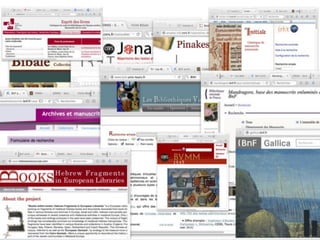
Biblissima
Connecting Manuscripts Collections
Ré gis ROBINEAU
@regisrob
Digital Catalogues. Towards Interoperability
Ecole normale supé rieure, Paris (February 5th
, 2019)
@biblissima
Biblissima?
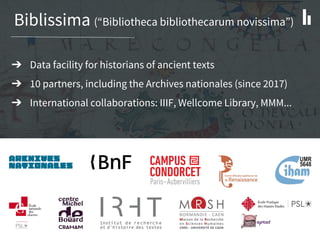
Biblissima (“Bibliotheca bibliothecarum novissima”)
➔ Data facility for historians of ancient texts
➔ 10 partners, including the Archives nationales (since 2017)
➔ International collaborations: IIIF, Wellcome Library, MMM...
The main goals of Biblissima
➔ Federate digital libraries
➔ Structure data corpora and research
communities
➔ Train researchers
➔ Facilitate access to and reuse of data (both
textual and documentary resources)
The main goals of Biblissima
➔ Federate digital libraries
➔ Structure data corpora and research
communities
➔ Train researchers
➔ Facilitate access to and reuse of data (both
textual and documentary resources)
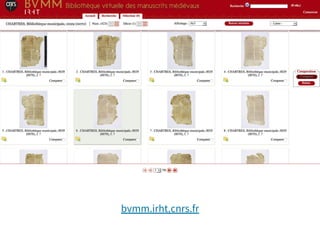
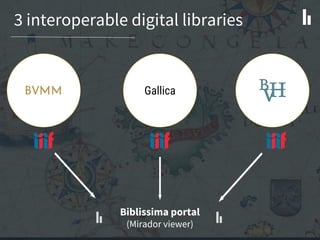
bvmm.irht.cnrs.fr
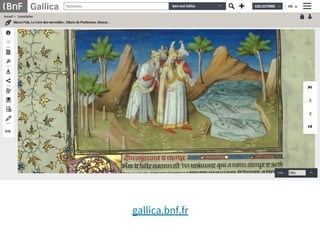
gallica.bnf.fr
www.bvh.univ-tours.fr
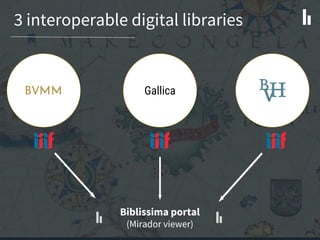
3 interoperable digital libraries
Biblissima portal
(Mirador viewer)
Gallica
The main goals of Biblissima
➔ Federate digital libraries
➔ Structure data corpora and research
communities
➔ Train researchers
➔ Facilitate access to and reuse of data (both
textual and documentary resources)
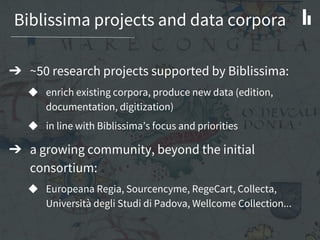
Biblissima projects and data corpora
➔ ~50 research projects supported by Biblissima:
◆ enrich existing corpora, produce new data (edition,
documentation, digitization)
◆ in line with Biblissima’s focus and priorities
➔ a growing community, beyond the initial
consortium:
◆ Europeana Regia, Sourcencyme, RegeCart, Collecta,
Università degli Studi di Padova, Wellcome Collection...
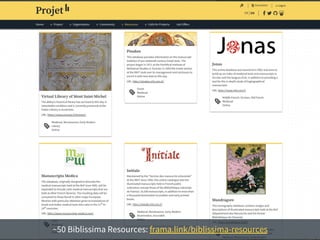
~50 Biblissima Resources: frama.link/biblissima-resources
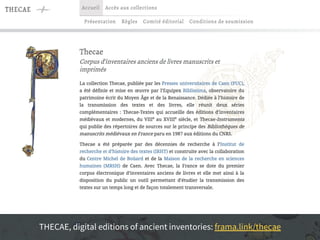
THECAE, digital editions of ancient inventories: frama.link/thecae
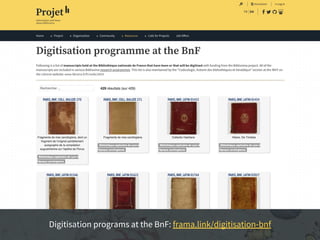
Digitisation programs at the BnF: frama.link/digitisation-bnf
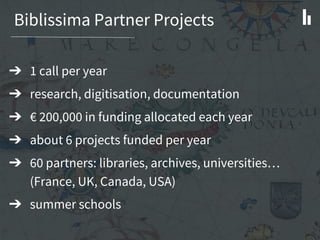
Biblissima Partner Projects
➔ 1 call per year
➔ research, digitisation, documentation
➔ € 200,000 in funding allocated each year
➔ about 6 projects funded per year
➔ 60 partners: libraries, archives, universities…
(France, UK, Canada, USA)
➔ summer schools
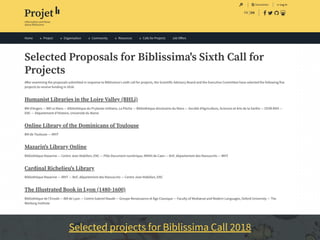
Selected projects for Biblissima Call 2018
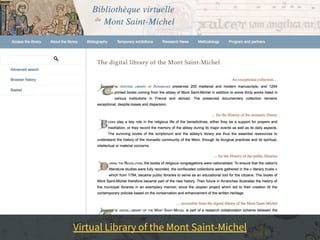
Virtual Library of the Mont Saint-Michel
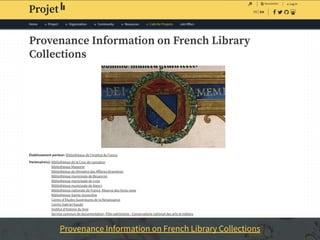
Provenance Information on French Library Collections
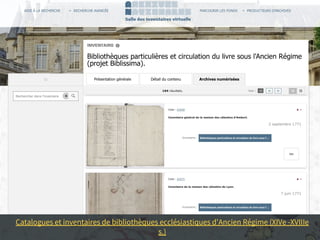
Catalogues et inventaires de bibliothèques ecclésiastiques d'Ancien Régime (XIVe -XVIIIe
s.)
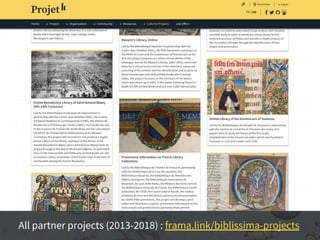
All partner projects (2013-2018) : frama.link/biblissima-projects
The main goals of Biblissima
➔ Federate digital libraries
➔ Structure data corpora and research
communities
➔ Train researchers
➔ Facilitate access to and reuse of data (both
textual and documentary resources)
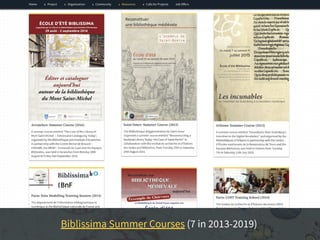
Biblissima Summer Courses
➔ 1 or 2 every year:
◆ to cultivate a pool of young researchers
◆ by combining traditional scholarship with digital
technologies and tools
➔ 5 summer schools organised since 2013
Biblissima Summer Courses
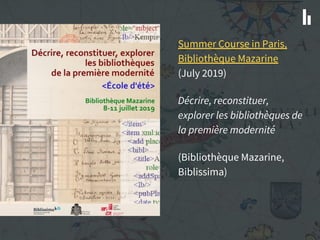
Summer Course in Paris,
Bibliothèque Mazarine
(July 2019)
Décrire, reconstituer,
explorer les bibliothèques de
la première modernité
(Bibliothèque Mazarine,
Biblissima)
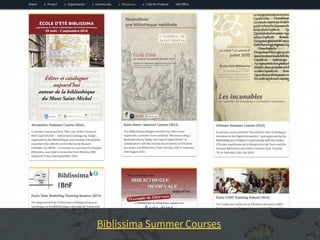
Biblissima Summer Courses (7 in 2013-2019)
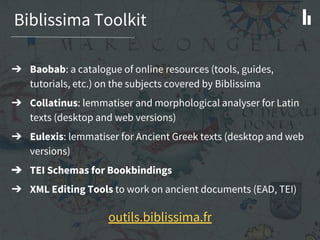
Biblissima Toolkit
outils.biblissima.fr
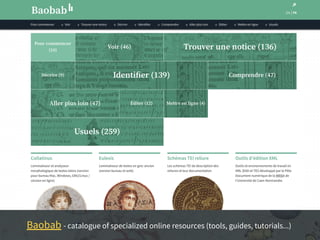
➔ Baobab: a catalogue of online resources (tools, guides,
tutorials, etc.) on the subjects covered by Biblissima
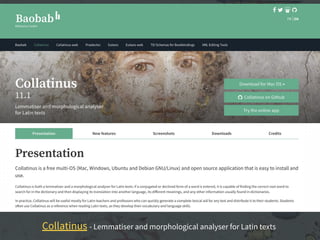
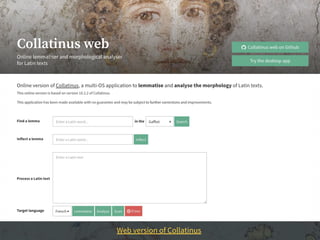
➔ Collatinus: lemmatiser and morphological analyser for Latin
texts (desktop and web versions)
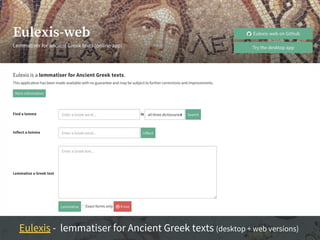
➔ Eulexis: lemmatiser for Ancient Greek texts (desktop and web
versions)
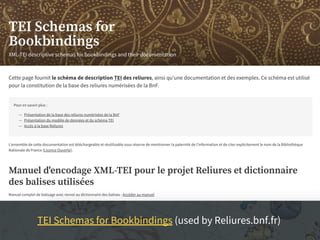
➔ TEI Schemas for Bookbindings
➔ XML Editing Tools to work on ancient documents (EAD, TEI)
Baobab - catalogue of specialized online resources (tools, guides, tutorials...)
Collatinus - Lemmatiser and morphological analyser for Latin texts
Web version of Collatinus
Eulexis - lemmatiser for Ancient Greek texts (desktop + web versions)
TEI Schemas for Bookbindings (used by Reliures.bnf.fr)
XML editing tools and environments in EAD and TEI (used by Thecae)
The main goals of Biblissima
➔ Federate digital libraries
➔ Structure data corpora and research
communities
➔ Train researchers
➔ Facilitate access to and reuse of data (both
textual and documentary resources)
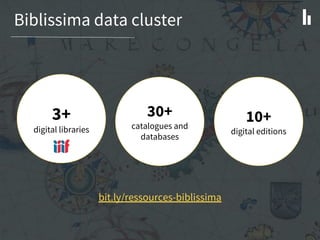
Biblissima data cluster
bit.ly/ressources-biblissima
30+
catalogues and
databases
3+
digital libraries
10+
digital editions
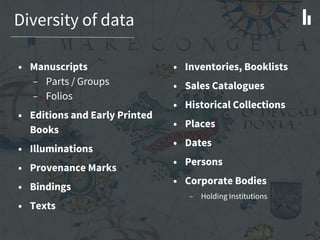
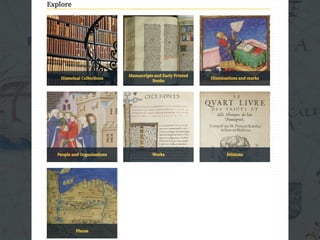
Diversity of data
• Manuscripts
– Parts / Groups
– Folios
• Editions and Early Printed
Books
• Illuminations
• Provenance Marks
• Bindings
• Texts
• Inventories, Booklists
• Sales Catalogues
• Historical Collections
• Places
• Dates
• Persons
• Corporate Bodies
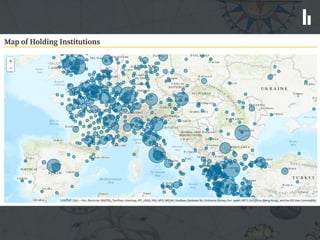
– Holding Institutions
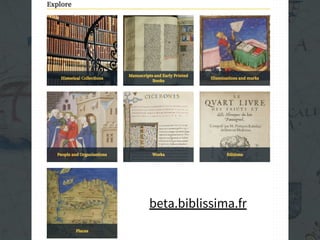
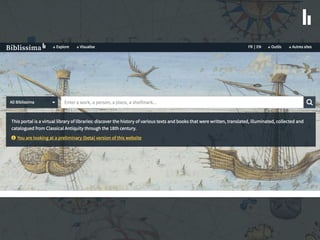
beta.biblissima.fr
The Biblissima Portal
(in a nutshell)
Main features
➔ Focus: history of collections / transmission of
texts in the Middle Ages and the Renaissance
➔ aggregates specialized data on medieval
manuscripts and early printed books
➔ search, browse, visualize
+ query and export...
Overall Development of the portal
➔ Publicly online since April 2017
➔ 6 major updates in 21 months (development log:
beta.biblissima.fr/en/dev-log)
➔ from 4 to 11 data sources, integrated and
interlinked
Current data scope: 11 sources
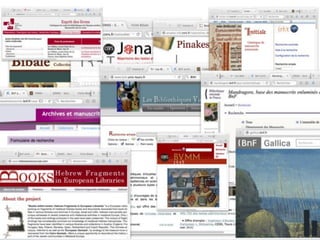
➔ Bibale
➔ CRII (Regional Catalogues of
Incunabula of the French Libraries)
➔ Europeana Regia
➔ Esprit des livres
➔ Manuscripta medica
➔ RegeCart
➔ Bibliothèques françoises
➔ BnF Archives et manuscrits
◆ Arsenal Library
◆ Mss’ department
➔ Wellcome Library (only
medieval manuscripts)
➔ Mandragore
➔ Pinakes
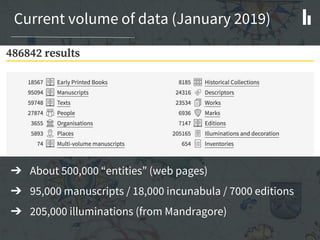
Current volume of data (January 2019)
➔ About 500,000 “entities” (web pages)
➔ 95,000 manuscripts / 18,000 incunabula / 7000 editions
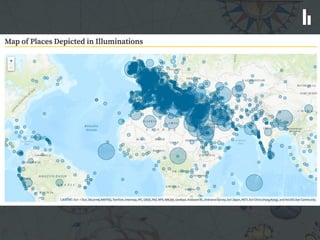
➔ 205,000 illuminations (from Mandragore)
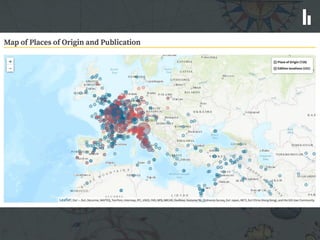
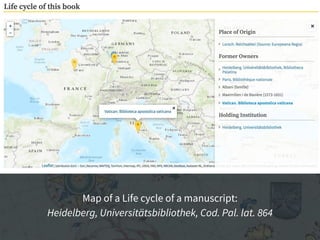
Map of a Life cycle of a manuscript:
Heidelberg, Universitätsbibliothek, Cod. Pal. lat. 864
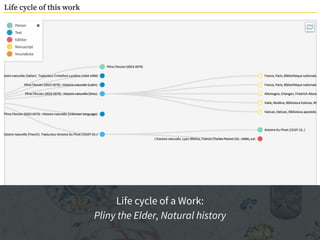
Life cycle of a Work:
Pliny the Elder, Natural history
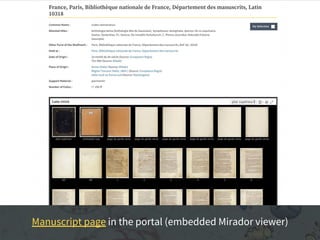
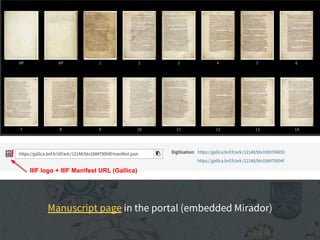
Manuscript page in the portal (embedded Mirador viewer)
Page Manuscrit (Mirador intégré)
IIIF logo + IIIF Manifest URL (Gallica)
Manuscript page in the portal (embedded Mirador)
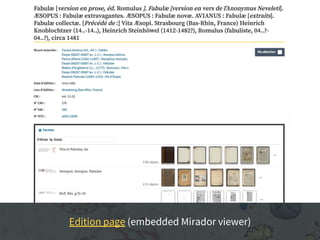
Edition page (embedded Mirador viewer)
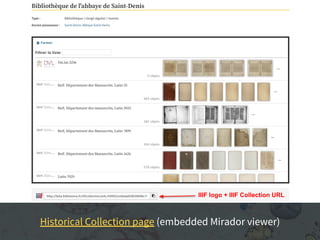
IIIF logo + IIIF Collection URL
Historical Collection page (embedded Mirador viewer)
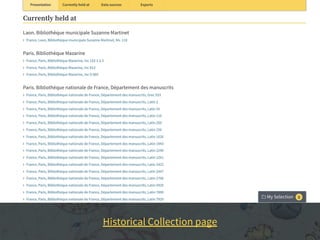
Historical Collection page
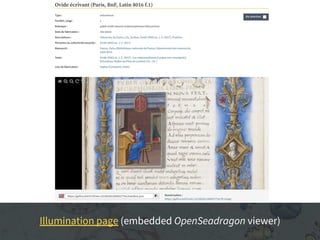
Illumination page (embedded OpenSeadragon viewer)
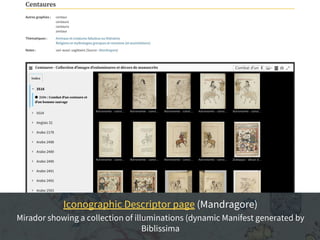
Iconographic Descriptor page (Mandragore)
Mirador showing a collection of illuminations (dynamic Manifest generated by
Biblissima
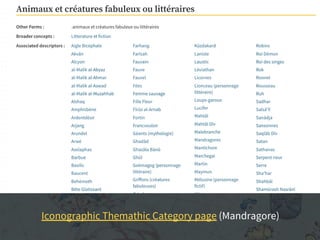
Iconographic Themathic Category page (Mandragore)
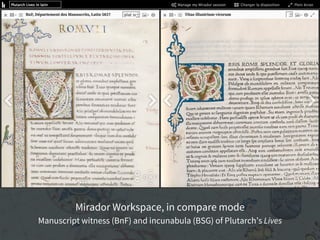
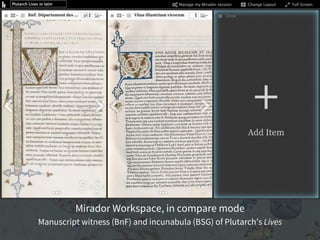
Mirador Workspace, in compare mode
Manuscript witness (BnF) and incunabula (BSG) of Plutarch’s Lives
Mirador Workspace, in compare mode
Manuscript witness (BnF) and incunabula (BSG) of Plutarch’s Lives
Mirador Workpace, in compare mode
Manuscript witness (BnF) and incunabula (BSG) of Plutarch’s Lives
Mirador Workpace, in compare mode
Manuscript witness (BnF) and incunabula (BSG) of Plutarch’s Lives
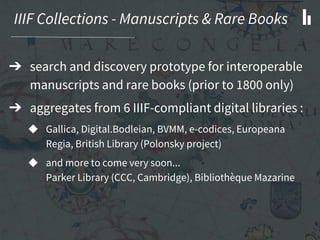
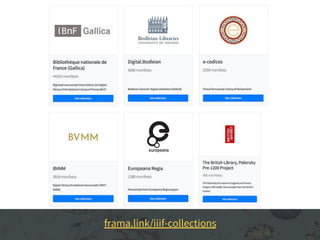
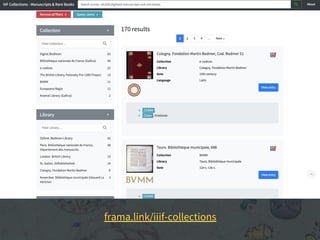
IIIF Collections - Manuscripts & Rare Books
➔ search and discovery prototype for interoperable
manuscripts and rare books (prior to 1800 only)
➔ aggregates from 6 IIIF-compliant digital libraries :
◆ Gallica, Digital.Bodleian, BVMM, e-codices, Europeana
Regia, British Library (Polonsky project)
◆ and more to come very soon...
Parker Library (CCC, Cambridge), Bibliothè que Mazarine
IIIF Collections
Biblissima IIIF Collections : frama.link/iiif-collections
frama.link/iiif-collections
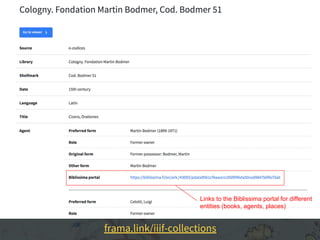
Links to the Biblissima portal for different
entities (books, agents, places)
How to build this?
What do we need?
➔ Standardized way to request and display digital
objects
➔ Consistent data model and common exchange
format
➔ Normalized data based on authority files
What do we need?
➔ Standardized way to request and display digital
objects
➔ Consistent data model and common exchange
format
➔ Normalized data based on authority files
iiif.io
IIIF?
A community,
… that develops Shared APIs,
… implements them in Software,
… and exposes interoperable digital Content
IIIF Vision
Create a global framework by which image-based resources
… can be delivered in a standard way from any
participating institution
… via any compatible image server
… for display, manipulation and annotation in
any application,
… to any user on the Web.
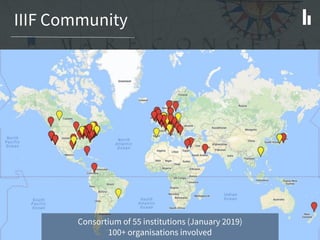
IIIF Community
Consortium of 55 institutions (January 2019)
100+ organisations involved
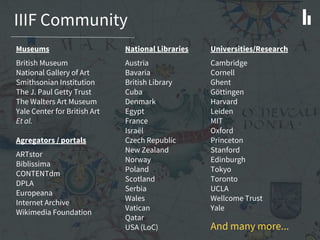
IIIF Community
Museums
British Museum
National Gallery of Art
Smithsonian Institution
The J. Paul Getty Trust
The Walters Art Museum
Yale Center for British Art
Et al.
Agregators / portals
ARTstor
Biblissima
CONTENTdm
DPLA
Europeana
Internet Archive
Wikimedia Foundation
National Libraries
Austria
Bavaria
British Library
Cuba
Denmark
Egypt
France
Israël
Czech Republic
New Zealand
Norway
Poland
Scotland
Serbia
Wales
Vatican
Qatar
USA (LoC) And many more...
Universities/Research
Cambridge
Cornell
Ghent
Göttingen
Harvard
Leiden
MIT
Oxford
Princeton
Stanford
Edinburgh
Tokyo
Toronto
UCLA
Wellcome Trust
Yale
Biblissima’s commitment to IIIF
➔ actively involved in the IIIF initiative since 2013
➔ first French-speaking IIIF outreach event (Paris,
March 15th, 2018)
➔ demos and implementation into the portal
➔ technical advisor for the 3 digital libraries in the
initial scope of Biblissima, and beyond...
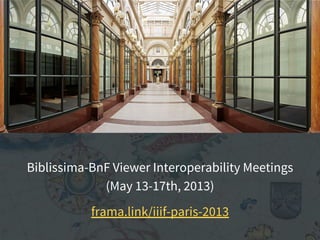
Biblissima-BnF Viewer Interoperability Meetings
(May 13-17th, 2013)
frama.link/iiif-paris-2013
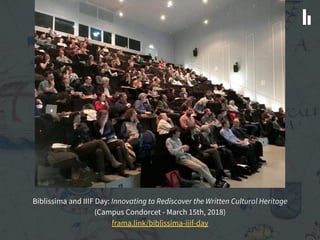
Biblissima and IIIF Day: Innovating to Rediscover the Written Cultural Heritage
(Campus Condorcet - March 15th, 2018)
frama.link/biblissima-iiif-day
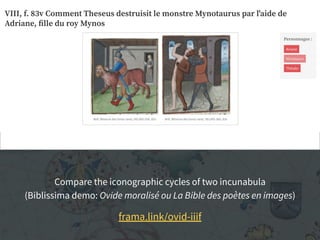
Compare the iconographic cycles of two incunabula
(Biblissima demo: Ovide moralisé ou La Bible des poètes en images)
frama.link/ovid-iiif
Annotation in Mirador:
region of the image + transcription of the caption + indexing of the
deities or characters (as oa:Tag)
frama.link/ovid-iiif
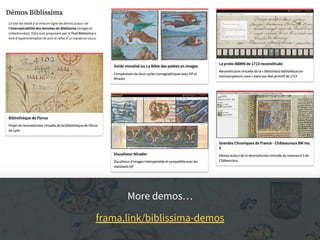
More demos…
frama.link/biblissima-demos
3 interoperable digital libraries
Biblissima portal
(Mirador viewer)
Gallica
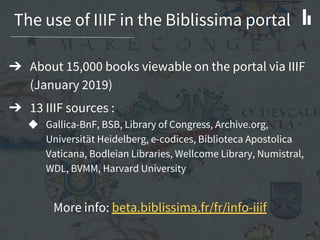
The use of IIIF in the Biblissima portal
➔ About 15,000 books viewable on the portal via IIIF
(January 2019)
➔ 13 IIIF sources :
◆ Gallica-BnF, BSB, Library of Congress, Archive.org,
Universität Heidelberg, e-codices, Biblioteca Apostolica
Vaticana, Bodleian Libraries, Wellcome Library, Numistral,
WDL, BVMM, Harvard University
More info: beta.biblissima.fr/fr/info-iiif
What do we need?
➔ Standardized way to request and display digital
objects
➔ Consistent data model and common exchange
format
➔ Normalized data based on authority files
Data modeling, mappings, transformations
➔ Background work on an ontology based on
CIDOC-CRM and FRBRoo (2013-2016)
➔ In-house XML format ("pivot") to get the data
from the different partners
◆ define custom mappings for each data source
➔ Data model of the web application behind the
portal (Cubicweb framework)
What do we need?
➔ Standardized way to request and display digital
objects
➔ Consistent data model and common exchange
format
➔ Normalized data based on authority files
Data clustering and normalisation
➔ Disambiguate and merge entities
➔ Align to linked open authority files and datasets
➔ Mint unique and stable identifiers
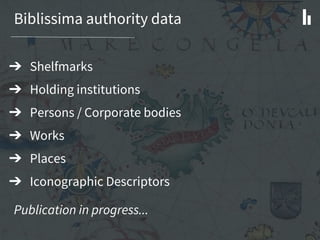
Biblissima authority data
➔ Shelfmarks
➔ Holding institutions
➔ Persons / Corporate bodies
➔ Works
➔ Places
➔ Iconographic Descriptors
Publication in progress...
Biblissima authority data
➔ To be published gradually in 2019 on an open and
collaborative platform...
◆ first dataset: persons and corporate bodies (February 2019)
➔ Central hub to manage and share the data:
◆ wiki-based technology (collaboration, versioning...)
◆ assign identifiers (URIs)
◆ natively structured as RDF
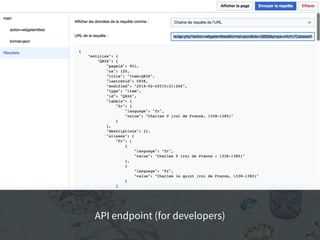
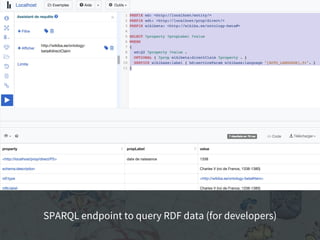
◆ Web API + SPARQL endpoint, to enable sharing and reuse
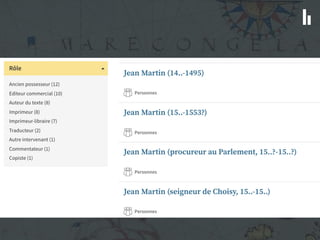
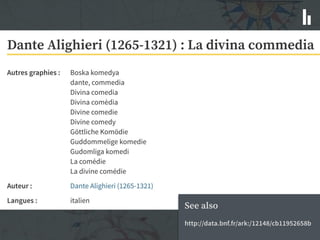
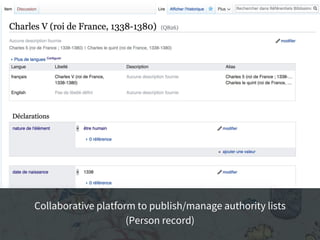
Collaborative platform to publish/manage authority lists
(Person record)
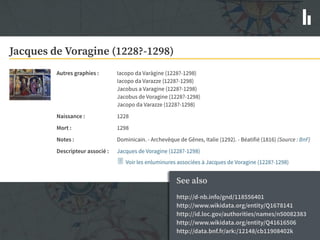
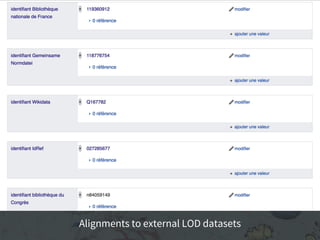
Alignments to external LOD datasets
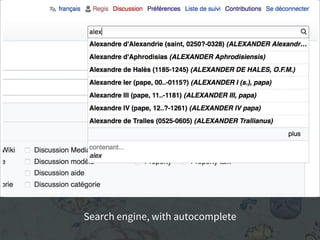
Search engine, with autocomplete
API endpoint (for developers)
SPARQL endpoint to query RDF data (for developers)
Thank you for your attention!
Régis ROBINEAU
(Biblissima - Campus Condorcet / EPHE-PSL)
Biblissima Team:
Kévin Bois
Eduard Frunzeanu
biblissima.fr

Biblissima: Connecting Manuscripts Collections

  • 1.
    Biblissima Connecting Manuscripts Collections Régis ROBINEAU @regisrob Digital Catalogues. Towards Interoperability Ecole normale supé rieure, Paris (February 5th , 2019) @biblissima
  • 3.
  • 4.
    Biblissima (“Bibliotheca bibliothecarumnovissima”) ➔ Data facility for historians of ancient texts ➔ 10 partners, including the Archives nationales (since 2017) ➔ International collaborations: IIIF, Wellcome Library, MMM...
  • 5.
    The main goalsof Biblissima ➔ Federate digital libraries ➔ Structure data corpora and research communities ➔ Train researchers ➔ Facilitate access to and reuse of data (both textual and documentary resources)
  • 6.
    The main goalsof Biblissima ➔ Federate digital libraries ➔ Structure data corpora and research communities ➔ Train researchers ➔ Facilitate access to and reuse of data (both textual and documentary resources)
  • 7.
  • 8.
  • 9.
  • 10.
    3 interoperable digitallibraries Biblissima portal (Mirador viewer) Gallica
  • 11.
    The main goalsof Biblissima ➔ Federate digital libraries ➔ Structure data corpora and research communities ➔ Train researchers ➔ Facilitate access to and reuse of data (both textual and documentary resources)
  • 12.
    Biblissima projects anddata corpora ➔ ~50 research projects supported by Biblissima: ◆ enrich existing corpora, produce new data (edition, documentation, digitization) ◆ in line with Biblissima’s focus and priorities ➔ a growing community, beyond the initial consortium: ◆ Europeana Regia, Sourcencyme, RegeCart, Collecta, Università degli Studi di Padova, Wellcome Collection...
  • 13.
    ~50 Biblissima Resources:frama.link/biblissima-resources
  • 14.
    THECAE, digital editionsof ancient inventories: frama.link/thecae
  • 15.
    Digitisation programs atthe BnF: frama.link/digitisation-bnf
  • 16.
    Biblissima Partner Projects ➔1 call per year ➔ research, digitisation, documentation ➔ € 200,000 in funding allocated each year ➔ about 6 projects funded per year ➔ 60 partners: libraries, archives, universities… (France, UK, Canada, USA) ➔ summer schools
  • 17.
    Selected projects forBiblissima Call 2018
  • 18.
    Virtual Library ofthe Mont Saint-Michel
  • 19.
    Provenance Information onFrench Library Collections
  • 20.
    Catalogues et inventairesde bibliothèques ecclésiastiques d'Ancien Régime (XIVe -XVIIIe s.)
  • 21.
    All partner projects(2013-2018) : frama.link/biblissima-projects
  • 22.
    The main goalsof Biblissima ➔ Federate digital libraries ➔ Structure data corpora and research communities ➔ Train researchers ➔ Facilitate access to and reuse of data (both textual and documentary resources)
  • 23.
    Biblissima Summer Courses ➔1 or 2 every year: ◆ to cultivate a pool of young researchers ◆ by combining traditional scholarship with digital technologies and tools ➔ 5 summer schools organised since 2013
  • 24.
  • 25.
    Summer Course inParis, Bibliothèque Mazarine (July 2019) Décrire, reconstituer, explorer les bibliothèques de la première modernité (Bibliothèque Mazarine, Biblissima)
  • 26.
    Biblissima Summer Courses(7 in 2013-2019)
  • 27.
    Biblissima Toolkit outils.biblissima.fr ➔ Baobab:a catalogue of online resources (tools, guides, tutorials, etc.) on the subjects covered by Biblissima ➔ Collatinus: lemmatiser and morphological analyser for Latin texts (desktop and web versions) ➔ Eulexis: lemmatiser for Ancient Greek texts (desktop and web versions) ➔ TEI Schemas for Bookbindings ➔ XML Editing Tools to work on ancient documents (EAD, TEI)
  • 28.
    Baobab - catalogueof specialized online resources (tools, guides, tutorials...)
  • 29.
    Collatinus - Lemmatiserand morphological analyser for Latin texts
  • 30.
    Web version ofCollatinus
  • 31.
    Eulexis - lemmatiserfor Ancient Greek texts (desktop + web versions)
  • 32.
    TEI Schemas forBookbindings (used by Reliures.bnf.fr)
  • 33.
    XML editing toolsand environments in EAD and TEI (used by Thecae)
  • 34.
    The main goalsof Biblissima ➔ Federate digital libraries ➔ Structure data corpora and research communities ➔ Train researchers ➔ Facilitate access to and reuse of data (both textual and documentary resources)
  • 35.
    Biblissima data cluster bit.ly/ressources-biblissima 30+ cataloguesand databases 3+ digital libraries 10+ digital editions
  • 37.
    Diversity of data •Manuscripts – Parts / Groups – Folios • Editions and Early Printed Books • Illuminations • Provenance Marks • Bindings • Texts • Inventories, Booklists • Sales Catalogues • Historical Collections • Places • Dates • Persons • Corporate Bodies – Holding Institutions
  • 38.
  • 39.
  • 40.
    Main features ➔ Focus:history of collections / transmission of texts in the Middle Ages and the Renaissance ➔ aggregates specialized data on medieval manuscripts and early printed books ➔ search, browse, visualize + query and export...
  • 41.
    Overall Development ofthe portal ➔ Publicly online since April 2017 ➔ 6 major updates in 21 months (development log: beta.biblissima.fr/en/dev-log) ➔ from 4 to 11 data sources, integrated and interlinked
  • 42.
    Current data scope:11 sources ➔ Bibale ➔ CRII (Regional Catalogues of Incunabula of the French Libraries) ➔ Europeana Regia ➔ Esprit des livres ➔ Manuscripta medica ➔ RegeCart ➔ Bibliothèques françoises ➔ BnF Archives et manuscrits ◆ Arsenal Library ◆ Mss’ department ➔ Wellcome Library (only medieval manuscripts) ➔ Mandragore ➔ Pinakes
  • 43.
    Current volume ofdata (January 2019) ➔ About 500,000 “entities” (web pages) ➔ 95,000 manuscripts / 18,000 incunabula / 7000 editions ➔ 205,000 illuminations (from Mandragore)
  • 49.
    Map of aLife cycle of a manuscript: Heidelberg, Universitätsbibliothek, Cod. Pal. lat. 864
  • 50.
    Life cycle ofa Work: Pliny the Elder, Natural history
  • 51.
    Manuscript page inthe portal (embedded Mirador viewer)
  • 52.
    Page Manuscrit (Miradorintégré) IIIF logo + IIIF Manifest URL (Gallica) Manuscript page in the portal (embedded Mirador)
  • 53.
    Edition page (embeddedMirador viewer)
  • 54.
    IIIF logo +IIIF Collection URL Historical Collection page (embedded Mirador viewer)
  • 55.
  • 56.
    Illumination page (embeddedOpenSeadragon viewer)
  • 57.
    Iconographic Descriptor page(Mandragore) Mirador showing a collection of illuminations (dynamic Manifest generated by Biblissima
  • 58.
  • 59.
    Mirador Workspace, incompare mode Manuscript witness (BnF) and incunabula (BSG) of Plutarch’s Lives
  • 60.
    Mirador Workspace, incompare mode Manuscript witness (BnF) and incunabula (BSG) of Plutarch’s Lives
  • 61.
    Mirador Workpace, incompare mode Manuscript witness (BnF) and incunabula (BSG) of Plutarch’s Lives
  • 62.
    Mirador Workpace, incompare mode Manuscript witness (BnF) and incunabula (BSG) of Plutarch’s Lives
  • 63.
    IIIF Collections -Manuscripts & Rare Books ➔ search and discovery prototype for interoperable manuscripts and rare books (prior to 1800 only) ➔ aggregates from 6 IIIF-compliant digital libraries : ◆ Gallica, Digital.Bodleian, BVMM, e-codices, Europeana Regia, British Library (Polonsky project) ◆ and more to come very soon... Parker Library (CCC, Cambridge), Bibliothè que Mazarine
  • 64.
    IIIF Collections Biblissima IIIFCollections : frama.link/iiif-collections
  • 65.
  • 66.
  • 67.
    frama.link/iiif-collections Links to theBiblissima portal for different entities (books, agents, places)
  • 68.
  • 69.
    What do weneed? ➔ Standardized way to request and display digital objects ➔ Consistent data model and common exchange format ➔ Normalized data based on authority files
  • 70.
    What do weneed? ➔ Standardized way to request and display digital objects ➔ Consistent data model and common exchange format ➔ Normalized data based on authority files
  • 71.
  • 72.
    IIIF? A community, … thatdevelops Shared APIs, … implements them in Software, … and exposes interoperable digital Content
  • 73.
    IIIF Vision Create aglobal framework by which image-based resources … can be delivered in a standard way from any participating institution … via any compatible image server … for display, manipulation and annotation in any application, … to any user on the Web.
  • 74.
    IIIF Community Consortium of55 institutions (January 2019) 100+ organisations involved
  • 75.
    IIIF Community Museums British Museum NationalGallery of Art Smithsonian Institution The J. Paul Getty Trust The Walters Art Museum Yale Center for British Art Et al. Agregators / portals ARTstor Biblissima CONTENTdm DPLA Europeana Internet Archive Wikimedia Foundation National Libraries Austria Bavaria British Library Cuba Denmark Egypt France Israël Czech Republic New Zealand Norway Poland Scotland Serbia Wales Vatican Qatar USA (LoC) And many more... Universities/Research Cambridge Cornell Ghent Göttingen Harvard Leiden MIT Oxford Princeton Stanford Edinburgh Tokyo Toronto UCLA Wellcome Trust Yale
  • 76.
    Biblissima’s commitment toIIIF ➔ actively involved in the IIIF initiative since 2013 ➔ first French-speaking IIIF outreach event (Paris, March 15th, 2018) ➔ demos and implementation into the portal ➔ technical advisor for the 3 digital libraries in the initial scope of Biblissima, and beyond...
  • 77.
    Biblissima-BnF Viewer InteroperabilityMeetings (May 13-17th, 2013) frama.link/iiif-paris-2013
  • 78.
    Biblissima and IIIFDay: Innovating to Rediscover the Written Cultural Heritage (Campus Condorcet - March 15th, 2018) frama.link/biblissima-iiif-day
  • 79.
    Compare the iconographiccycles of two incunabula (Biblissima demo: Ovide moralisé ou La Bible des poètes en images) frama.link/ovid-iiif
  • 80.
    Annotation in Mirador: regionof the image + transcription of the caption + indexing of the deities or characters (as oa:Tag) frama.link/ovid-iiif
  • 81.
  • 82.
    3 interoperable digitallibraries Biblissima portal (Mirador viewer) Gallica
  • 83.
    The use ofIIIF in the Biblissima portal ➔ About 15,000 books viewable on the portal via IIIF (January 2019) ➔ 13 IIIF sources : ◆ Gallica-BnF, BSB, Library of Congress, Archive.org, Universität Heidelberg, e-codices, Biblioteca Apostolica Vaticana, Bodleian Libraries, Wellcome Library, Numistral, WDL, BVMM, Harvard University More info: beta.biblissima.fr/fr/info-iiif
  • 84.
    What do weneed? ➔ Standardized way to request and display digital objects ➔ Consistent data model and common exchange format ➔ Normalized data based on authority files
  • 85.
    Data modeling, mappings,transformations ➔ Background work on an ontology based on CIDOC-CRM and FRBRoo (2013-2016) ➔ In-house XML format ("pivot") to get the data from the different partners ◆ define custom mappings for each data source ➔ Data model of the web application behind the portal (Cubicweb framework)
  • 86.
    What do weneed? ➔ Standardized way to request and display digital objects ➔ Consistent data model and common exchange format ➔ Normalized data based on authority files
  • 87.
    Data clustering andnormalisation ➔ Disambiguate and merge entities ➔ Align to linked open authority files and datasets ➔ Mint unique and stable identifiers
  • 92.
    Biblissima authority data ➔Shelfmarks ➔ Holding institutions ➔ Persons / Corporate bodies ➔ Works ➔ Places ➔ Iconographic Descriptors Publication in progress...
  • 93.
    Biblissima authority data ➔To be published gradually in 2019 on an open and collaborative platform... ◆ first dataset: persons and corporate bodies (February 2019) ➔ Central hub to manage and share the data: ◆ wiki-based technology (collaboration, versioning...) ◆ assign identifiers (URIs) ◆ natively structured as RDF ◆ Web API + SPARQL endpoint, to enable sharing and reuse
  • 94.
    Collaborative platform topublish/manage authority lists (Person record)
  • 95.
  • 96.
    Search engine, withautocomplete
  • 97.
    API endpoint (fordevelopers)
  • 98.
    SPARQL endpoint toquery RDF data (for developers)
  • 99.
    Thank you foryour attention! Régis ROBINEAU (Biblissima - Campus Condorcet / EPHE-PSL) Biblissima Team: Kévin Bois Eduard Frunzeanu biblissima.fr