India Banking & Finance Industry

                                      Benjamin Weber

                            Institute of Management Technology Nagpur


                                      October 17, 2011


Benjamin Weber                                                Institute of Management Technology Nagpur
India Banking & Finance Industry                                                                 1 / 12
Facts I
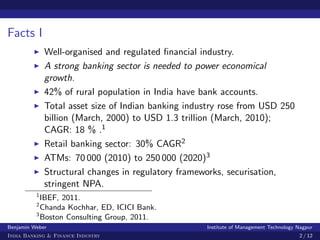
              Well-organised and regulated financial industry.
              A strong banking sector is needed to power economical
              growth.
              42% of rural population in India have bank accounts.
              Total asset size of Indian banking industry rose from USD 250
              billion (March, 2000) to USD 1.3 trillion (March, 2010);
              CAGR: 18 % .1
              Retail banking sector: 30% CAGR2
              ATMs: 70 000 (2010) to 250 000 (2020)3
              Structural changes in regulatory frameworks, securisation,
              stringent NPA.
          1
            IBEF, 2011.
          2
            Chanda Kochhar, ED, ICICI Bank.
          3
            Boston Consulting Group, 2011.
Benjamin Weber                                       Institute of Management Technology Nagpur
India Banking & Finance Industry                                                        2 / 12
Facts II
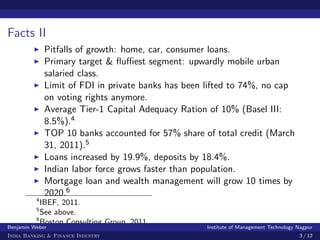
              Pitfalls of growth: home, car, consumer loans.
              Primary target & fluffiest segment: upwardly mobile urban
              salaried class.
              Limit of FDI in private banks has been lifted to 74%, no cap
              on voting rights anymore.
              Average Tier-1 Capital Adequacy Ration of 10% (Basel III:
              8.5%).4
              TOP 10 banks accounted for 57% share of total credit (March
              31, 2011).5
              Loans increased by 19.9%, deposits by 18.4%.
              Indian labor force grows faster than population.
              Mortgage loan and wealth management will grow 10 times by
              2020.6
          4
            IBEF, 2011.
          5
            See above.
          6
            Boston Consulting Group, 2011.
Benjamin Weber                                       Institute of Management Technology Nagpur
India Banking & Finance Industry                                                        3 / 12
Facts III

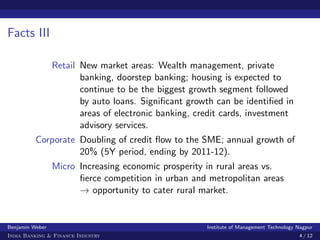
                 Retail New market areas: Wealth management, private
                        banking, doorstep banking; housing is expected to
                        continue to be the biggest growth segment followed
                        by auto loans. Significant growth can be identified in
                        areas of electronic banking, credit cards, investment
                        advisory services.
          Corporate Doubling of credit flow to the SME; annual growth of
                    20% (5Y period, ending by 2011-12).
                 Micro Increasing economic prosperity in rural areas vs.
                       fierce competition in urban and metropolitan areas
                       → opportunity to cater rural market.


Benjamin Weber                                         Institute of Management Technology Nagpur
India Banking & Finance Industry                                                          4 / 12
for  more  of  it.  Having  moved  the  needle  on  almost  all                                    Sound  performance  is  complemented  by  rapid  growth  
      performance   metrics   in   the   last   decade,   the   Indian                                   that  supports  India’s  GDP  expansion.  At  the  current  rate,  
      banking   industry   stands   out   for   its   relatively   robust                                the  Indian  banking  industry  will  be  the  world’s  third–
      balance   sheet   and   sound   performance.   As   shown   in                                     largest  by  2025,  as  shown  in  Exhibit  1b.  This  increasing  

Indian Banking Industry at a Glance
        Exhibit 1a. Indian banking: Sound health and balanced performance


                 Return on equity (%)                       Cost: Income ratio (%)                          Valuation (P–BV)                      Bad debt1 to assets ratio
                                    Return on                             Cost to                                  Price / book                                 Bad debt to
                  Country                                    Country                                     Country                                      Country
                                     equity                            income ratio                                    ratio                                    assets ratio
               Turkey                 19.6%                Indonesia       79.3%                       Indonesia        3.6                         Russia         2.4%
               Indonesia              17.8%                Germany         75.1%                       Malaysia         2.3                         Indonesia      2.0%
               Malaysia               17.4%                France          73.1%                       Canada           2.0                         Turkey         1.3%
               China                  16.7%                Canada          65.7%                       Russia           2.0                         USA            1.2%
               India                  15.3%                USA             65.4%                       Thailand         1.9                         China          0.9%
               Singapore              14.6%                Russia          59.4%                       India            1.8                         Spain          0.7%
               Australia              14.0%                Thailand        56.7%                       China            1.7                         South Korea    0.6%
               Canada                 12.4%                Australia       55.6%                       Australia        1.6                         India          0.6%
               South Korea            10.1%                Malaysia        54.6%                       Turkey           1.5                         Singapore      0.5%
               Spain                   8.2%                India           47.3%                       Singapore        1.4                         Thailand       0.4%
               Russia                  7.9%                South Korea     46.5%                       South Korea      0.9                         Malaysia       0.4%
               Thailand                6.9%                Spain           42.1%                       USA              0.8                         Germany        0.4%
               France                  4.0%                Turkey          41.9%                       Spain            0.8                         Australia      0.4%
               USA                     2.7%                China           40.4%                       France           0.5                         Canada         0.3%
               Germany                –0.8%                Singapore       40.1%                       Germany          0.3                         France         0.2%

        Sources:  OECD;  IBA  data;  Turkish  Banking  Association;  Central  Banks  of  Malaysia,  Singapore,  Thailand  and  Indonesia;  Thomson  Reuters  Datastream;  
        BCG  analysis.
        Note:  Weighted  averages  over  the  years  2007  to  2009.  Indian  data  for  a  year  corresponds  to  year  ending  in  March  (e.g.  April  2009  to  March  2010  corresponds  
        to  year  2009).  For  other  countries  the  data  corresponds  to  the  calendar  years.  The  valuation  data  is  for  the  calendar  year  2010.  
        1
         The  bad  debt  charged  to  P&L  as  a  percentage  of  assets.


      B  F  S    P:  R    E    I  B                                                                                                        

Benjamin Weber                                                                                                                     Institute of Management Technology Nagpur
India Banking & Finance Industry                                                                                                                                                                 5 / 12
Will Exhibit 1b.#3 by 2025? worlds 3rd largest by 2025
      it be Indian Banking will be


          Sources:  EIU  country  data;  OECD;  IBA  data;  BCG  analysis.


      significance  and  influence  comes  with  a  higher  level  of          reasonable  interest  margins  and  serving  high  cost,  high  
      responsibility   towards   the   real   economy.   The   global        risk  customers  that  are  on  national  priority.
Benjamin Weber
      banking  crisis  has  highlighted  the  perils  of  irresponsible                        Institute of Management Technology Nagpur
India Banking with  the  real  economy  footing  the  bill  for  banks’  
      banking,   & Finance Industry                                                                                                    6 / 12
MARKET OVERVIEW
    Banking November 2010


Structure of Banking Industry system
     Structure of the Indian banking

                                                                 Reserve Bank of India


                                     Banks                                                         Financial institutions


                       Scheduled             Cooperative
                                                                            All-India financial          State-level                Other
                      Commercial                credit
                                                                               institutions             institutions             institutions
                      Banks (SCBs)           institutions


                                                                             Regional rural               Urban             Rural cooperative
           Public sector         Private sector         Foreign banks
                                                                              banks (RRB)               cooperative         credit institutions
            banks (27)             banks (22)               (32)
                                                                                 (82)                  banks (1,674)            (96,751)


      Source:“Report on trend and trend ofand progress ofRBI website, www.rbi.org.in, accessed 30 November 2010
         Source: Report on progress banking in India 2009–10”, banking in India 200910, RBI website,

      www.rbi.org.in.
                                                                        9

Benjamin Weber                                                                                    Institute of Management Technology Nagpur
India Banking & Finance Industry                                                                                                                  7 / 12
MARKET OVERVIEW
  Banking November 2010

Structural Change
        Market analysis … (1/3)
        There has been a gradual shift in business from public to private and foreign banks.
                   Market share by assets (2002–03)                                                Market share by assets (2009–2010)


                        7%                                                                             7.2%


             17%                                    Public banks                             19.1%                                   Public banks

                                                    Private banks        Gradual
                                                                                                                                     Private banks
                                                                          shift
                                                    Foreign banks                                                      73.7%         Foreign banks
                                    76%


      Source:banking systemtrend and progress of banking in Indiabanks (SCBs) withwebsite,
       • The Report on in India is dominated by scheduled commercial 200910, RBI a pan-India
      www.rbi.org.in. March 2010, SCBs controlled most of the assets, with the rest being controlled by a large
         presence. As of
            number of small cooperative credit institutions with a very limited geographic reach.

        •   Within SCBs, public sector banks accounted for 73.7 per cent of the assets and the rest was held by
            foreign banks and private sector banks.
        Source: “Report on trend and progress of banking in India 2009–10”, RBI website, www.rbi.org.in, accessed 30 November 2010

Benjamin Weber                                                              6                          Institute of Management Technology Nagpur
India Banking & Finance Industry                                                                                                                     8 / 12
banks  to  differentiate  themselves,  to  improve  customer                                        captures  how  the  face  of  Indian  banking  will  change  during  
      service,  to  generate  new  leads  for  sales,  and  to  reduce                                   the  next  decade.  It  shows  the  percentage  composition  of  
      costs.  The  productivity  survey  revealed  that  many  banks                                     transaction   volumes   by   channel   in   2003,   2010,   and   as  
      may  not  be  ready  to  harness  this  opportunity.                                               projected  for  2020.  Cash  and  cheque,  which  dominate  the  

The Exhibit 3a. fundamental change?
     most Banking will not be the same
           Transaction  profile  of  India  is  expected  to  dramatically  change

                                                                                                                                       POS payment by mobile
                                                                                                                                       P2P remittance / transfer
                100                                                                                                                    Bill and utility payments
                                                                                             9                         13              Ticket bookings
                                                                                                                                       Mobile top-ups
                                                                                             13                                        Insurance premiums
                  80
                                                                                                                       21              Shopping on mobile
                                                                                             7
                                                                42                                                                     Government payouts
                                                                                             7
                  60                                                                                                   14              Cash management
                                                                                                                                       instructions (business)
                                                                                                                       6
                                    94                                                                                                 Mobile other
                  40                                                                         45
                                                                                                                                       Mobile POS
                                                                                                                       32              Online
                                                                49                                                                     POS (card)
                  20
                                                                                                                                       ATM cards
                                                                                             16                        13              Call centre
                   0                                                                                                                   Cash and cheque
                                2003                         2010                     2020 (base)              2020 (optimistic)
                            ~30% financial              ~45% Financial               ~65% financial            ~80% financial inclusion
                              inclusion                    inclusion                   inclusion               Adoption of Aadhar and direct credit of subsidy
                                                                                                               Regulations to encourage mobile transactions
           Sources:  FIBAC  Productivity  Survey  2011;  RBI  reports;  Central  banks  of  Germany,           Rigorous implementation of DTC1 and GST2
           US   and   South   Korea;   World   Bank   population   data;   “The   Mobile   Financial           Channel innovations by banks
           Services  Development  Report”  by  World  Economic  forum  in  collaboration  with                 Promotion of low cost NPCI interbank switch (RuPay)
           BCG;  BCG  analysis.                                                                                Adoption of smart phone technology and 3G
           1
            Direct  tax  code.
           2
            Goods  and  services  tax.


                                                                                                                                        T  B  C  G  
                                                                                                                                                                          

Benjamin Weber                                                                                                              Institute of Management Technology Nagpur
India Banking & Finance Industry                                                                                                                                            9 / 12
economies.   Unlike   many   developed   economies,   this                                   of   Indian   commercial   banks   as   on   March   31,   2011.  
      charge  has  not  increased  significantly  post  crisis.  Control                            Corporate   and   institutional   credit,   which   accounts   for  
      over  bad  debt  indeed  appears  to  be  one  of  key  successes                            more   than   50   percent   of   the   credit,   is   the   lowest   risk  
      of  the  industry  and  its  regulators.  A  disaggregated  and                              segment   followed   closely   by   home   loans.   Unsecured  

NPAExhibit 6a. NPA profile of Indiaindicator
    Ratio as quality Banking
        Category  wise  NPA


        Sources:  FICCI  IBA  Productivity  Survey  2011;  BCG  analysis.
        Note:  Asset  Finance  =  Construction  equipment,  commercial  vehicles;  Loan  against  security  =  Loan  against  jewels,  deposits,  shares,  etc.


      B  F  S    P:  R    E    I  B                                                                                  

Benjamin Weber                                                                                                            Institute of Management Technology Nagpur
India Banking & Finance Industry                                                                                                                                          10 / 12
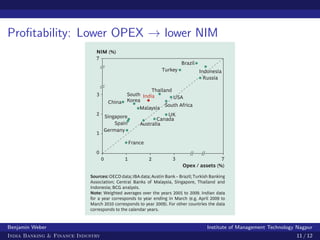
Exhibit 1e. Bank systems with lower opex                                                       ◊   Rising  interest  rates  im
                tend OPEX → lower
Profitability: Lower to operate at lower NIMs NIM                                                                                  due  to  Mark–to–Marke
                                                                                                                                  book.  Productivity  en
                                                                                                                                  for  such  loss  of  profitab
                                                                                                                                  ROE.

                                                                                                                              ◊   The  specter  of  econom
                                                                                                                                  looms   large   in   the   ba
                                                                                                                                  inevitable  in  such  an  e
                                                                                                                                  already  being  seen  in  
                                                                                                                                  management  is  crucial
                                                                                                                                  such  a  scenario.

                                                                                                                              ◊   Improving  the  efficacy
                                                                                                                                  mechanism  is  crucial  
                                                                                                                                  inflation.  As  such,  a  dis
                                                                                                                                  on   the   possibility   of   d
                                                                                                                                  (SB)   interest   rate.   It  
                                                                                                                                  deregulated,   SB   intere
                               Sources:  OECD  data;  IBA  data;  Austin  Bank  –  Brazil;  Turkish  Banking  
                               Association;   Central   Banks   of   Malaysia,   Singapore,   Thailand   and                      competition.  Exhibit  1f
                               Indonesia;  BCG  analysis.                                                                         SB  rate  increases  on  t
                               Note:  Weighted  averages  over  the  years  2005  to  2009.  Indian  data  
                               for   a   year   corresponds   to   year   ending   in   March   (e.g.   April   2009   to         percent  increase  in  SB  
                               March  2010  corresponds  to  year  2009).  For  other  countries  the  data                       the   customers,   the   RO
                               corresponds  to  the  calendar  years.
                                                                                                                                  percent.   Given   the   low

Benjamin Weber                                                                    Institute of Management Technology Nagpur
                             the  industry  to  set  high  aspirations  on  composite  metrics        Exhibit 1f. SB rate d
                           of   productivity.   Such   composite   metrics   have   to  
India Banking & Finance Industry                                                                                                                   11 / 12
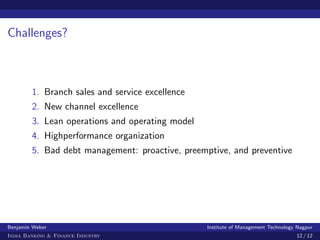
Challenges?


        1. Branch sales and service excellence
        2. New channel excellence
        3. Lean operations and operating model
        4. Highperformance organization
        5. Bad debt management: proactive, preemptive, and preventive


Benjamin Weber                                   Institute of Management Technology Nagpur
India Banking & Finance Industry                                                   12 / 12

India Banking & Finance Industry

  • 1.
    India Banking &Finance Industry Benjamin Weber Institute of Management Technology Nagpur October 17, 2011 Benjamin Weber Institute of Management Technology Nagpur India Banking & Finance Industry 1 / 12
  • 2.
    Facts I Well-organised and regulated financial industry. A strong banking sector is needed to power economical growth. 42% of rural population in India have bank accounts. Total asset size of Indian banking industry rose from USD 250 billion (March, 2000) to USD 1.3 trillion (March, 2010); CAGR: 18 % .1 Retail banking sector: 30% CAGR2 ATMs: 70 000 (2010) to 250 000 (2020)3 Structural changes in regulatory frameworks, securisation, stringent NPA. 1 IBEF, 2011. 2 Chanda Kochhar, ED, ICICI Bank. 3 Boston Consulting Group, 2011. Benjamin Weber Institute of Management Technology Nagpur India Banking & Finance Industry 2 / 12
  • 3.
    Facts II Pitfalls of growth: home, car, consumer loans. Primary target & fluffiest segment: upwardly mobile urban salaried class. Limit of FDI in private banks has been lifted to 74%, no cap on voting rights anymore. Average Tier-1 Capital Adequacy Ration of 10% (Basel III: 8.5%).4 TOP 10 banks accounted for 57% share of total credit (March 31, 2011).5 Loans increased by 19.9%, deposits by 18.4%. Indian labor force grows faster than population. Mortgage loan and wealth management will grow 10 times by 2020.6 4 IBEF, 2011. 5 See above. 6 Boston Consulting Group, 2011. Benjamin Weber Institute of Management Technology Nagpur India Banking & Finance Industry 3 / 12
  • 4.
    Facts III Retail New market areas: Wealth management, private banking, doorstep banking; housing is expected to continue to be the biggest growth segment followed by auto loans. Significant growth can be identified in areas of electronic banking, credit cards, investment advisory services. Corporate Doubling of credit flow to the SME; annual growth of 20% (5Y period, ending by 2011-12). Micro Increasing economic prosperity in rural areas vs. fierce competition in urban and metropolitan areas → opportunity to cater rural market. Benjamin Weber Institute of Management Technology Nagpur India Banking & Finance Industry 4 / 12
  • 5.
    for  more  of it.  Having  moved  the  needle  on  almost  all   Sound  performance  is  complemented  by  rapid  growth   performance   metrics   in   the   last   decade,   the   Indian   that  supports  India’s  GDP  expansion.  At  the  current  rate,   banking   industry   stands   out   for   its   relatively   robust   the  Indian  banking  industry  will  be  the  world’s  third– balance   sheet   and   sound   performance.   As   shown   in   largest  by  2025,  as  shown  in  Exhibit  1b.  This  increasing   Indian Banking Industry at a Glance Exhibit 1a. Indian banking: Sound health and balanced performance Return on equity (%) Cost: Income ratio (%) Valuation (P–BV) Bad debt1 to assets ratio Return on Cost to Price / book Bad debt to Country Country Country Country equity income ratio ratio assets ratio Turkey 19.6% Indonesia 79.3% Indonesia 3.6 Russia 2.4% Indonesia 17.8% Germany 75.1% Malaysia 2.3 Indonesia 2.0% Malaysia 17.4% France 73.1% Canada 2.0 Turkey 1.3% China 16.7% Canada 65.7% Russia 2.0 USA 1.2% India 15.3% USA 65.4% Thailand 1.9 China 0.9% Singapore 14.6% Russia 59.4% India 1.8 Spain 0.7% Australia 14.0% Thailand 56.7% China 1.7 South Korea 0.6% Canada 12.4% Australia 55.6% Australia 1.6 India 0.6% South Korea 10.1% Malaysia 54.6% Turkey 1.5 Singapore 0.5% Spain 8.2% India 47.3% Singapore 1.4 Thailand 0.4% Russia 7.9% South Korea 46.5% South Korea 0.9 Malaysia 0.4% Thailand 6.9% Spain 42.1% USA 0.8 Germany 0.4% France 4.0% Turkey 41.9% Spain 0.8 Australia 0.4% USA 2.7% China 40.4% France 0.5 Canada 0.3% Germany –0.8% Singapore 40.1% Germany 0.3 France 0.2% Sources:  OECD;  IBA  data;  Turkish  Banking  Association;  Central  Banks  of  Malaysia,  Singapore,  Thailand  and  Indonesia;  Thomson  Reuters  Datastream;   BCG  analysis. Note:  Weighted  averages  over  the  years  2007  to  2009.  Indian  data  for  a  year  corresponds  to  year  ending  in  March  (e.g.  April  2009  to  March  2010  corresponds   to  year  2009).  For  other  countries  the  data  corresponds  to  the  calendar  years.  The  valuation  data  is  for  the  calendar  year  2010.   1 The  bad  debt  charged  to  P&L  as  a  percentage  of  assets. B  F  S    P:  R    E    I  B    Benjamin Weber Institute of Management Technology Nagpur India Banking & Finance Industry 5 / 12
  • 6.
    Will Exhibit 1b.#3by 2025? worlds 3rd largest by 2025 it be Indian Banking will be Sources:  EIU  country  data;  OECD;  IBA  data;  BCG  analysis. significance  and  influence  comes  with  a  higher  level  of   reasonable  interest  margins  and  serving  high  cost,  high   responsibility   towards   the   real   economy.   The   global   risk  customers  that  are  on  national  priority. Benjamin Weber banking  crisis  has  highlighted  the  perils  of  irresponsible   Institute of Management Technology Nagpur India Banking with  the  real  economy  footing  the  bill  for  banks’   banking,   & Finance Industry 6 / 12
  • 7.
    MARKET OVERVIEW Banking November 2010 Structure of Banking Industry system Structure of the Indian banking Reserve Bank of India Banks Financial institutions Scheduled Cooperative All-India financial State-level Other Commercial credit institutions institutions institutions Banks (SCBs) institutions Regional rural Urban Rural cooperative Public sector Private sector Foreign banks banks (RRB) cooperative credit institutions banks (27) banks (22) (32) (82) banks (1,674) (96,751) Source:“Report on trend and trend ofand progress ofRBI website, www.rbi.org.in, accessed 30 November 2010 Source: Report on progress banking in India 2009–10”, banking in India 200910, RBI website, www.rbi.org.in. 9 Benjamin Weber Institute of Management Technology Nagpur India Banking & Finance Industry 7 / 12
  • 8.
    MARKET OVERVIEW Banking November 2010 Structural Change Market analysis … (1/3) There has been a gradual shift in business from public to private and foreign banks. Market share by assets (2002–03) Market share by assets (2009–2010) 7% 7.2% 17% Public banks 19.1% Public banks Private banks Gradual Private banks shift Foreign banks 73.7% Foreign banks 76% Source:banking systemtrend and progress of banking in Indiabanks (SCBs) withwebsite, • The Report on in India is dominated by scheduled commercial 200910, RBI a pan-India www.rbi.org.in. March 2010, SCBs controlled most of the assets, with the rest being controlled by a large presence. As of number of small cooperative credit institutions with a very limited geographic reach. • Within SCBs, public sector banks accounted for 73.7 per cent of the assets and the rest was held by foreign banks and private sector banks. Source: “Report on trend and progress of banking in India 2009–10”, RBI website, www.rbi.org.in, accessed 30 November 2010 Benjamin Weber 6 Institute of Management Technology Nagpur India Banking & Finance Industry 8 / 12
  • 9.
    banks  to  differentiate themselves,  to  improve  customer   captures  how  the  face  of  Indian  banking  will  change  during   service,  to  generate  new  leads  for  sales,  and  to  reduce   the  next  decade.  It  shows  the  percentage  composition  of   costs.  The  productivity  survey  revealed  that  many  banks   transaction   volumes   by   channel   in   2003,   2010,   and   as   may  not  be  ready  to  harness  this  opportunity. projected  for  2020.  Cash  and  cheque,  which  dominate  the   The Exhibit 3a. fundamental change? most Banking will not be the same Transaction  profile  of  India  is  expected  to  dramatically  change POS payment by mobile P2P remittance / transfer 100 Bill and utility payments 9 13 Ticket bookings Mobile top-ups 13 Insurance premiums 80 21 Shopping on mobile 7 42 Government payouts 7 60 14 Cash management instructions (business) 6 94 Mobile other 40 45 Mobile POS 32 Online 49 POS (card) 20 ATM cards 16 13 Call centre 0 Cash and cheque 2003 2010 2020 (base) 2020 (optimistic) ~30% financial ~45% Financial ~65% financial ~80% financial inclusion inclusion inclusion inclusion Adoption of Aadhar and direct credit of subsidy Regulations to encourage mobile transactions Sources:  FIBAC  Productivity  Survey  2011;  RBI  reports;  Central  banks  of  Germany,   Rigorous implementation of DTC1 and GST2 US   and   South   Korea;   World   Bank   population   data;   “The   Mobile   Financial   Channel innovations by banks Services  Development  Report”  by  World  Economic  forum  in  collaboration  with   Promotion of low cost NPCI interbank switch (RuPay) BCG;  BCG  analysis. Adoption of smart phone technology and 3G 1 Direct  tax  code. 2 Goods  and  services  tax.  T  B  C  G     Benjamin Weber Institute of Management Technology Nagpur India Banking & Finance Industry 9 / 12
  • 10.
    economies.   Unlike  many   developed   economies,   this   of   Indian   commercial   banks   as   on   March   31,   2011.   charge  has  not  increased  significantly  post  crisis.  Control   Corporate   and   institutional   credit,   which   accounts   for   over  bad  debt  indeed  appears  to  be  one  of  key  successes   more   than   50   percent   of   the   credit,   is   the   lowest   risk   of  the  industry  and  its  regulators.  A  disaggregated  and   segment   followed   closely   by   home   loans.   Unsecured   NPAExhibit 6a. NPA profile of Indiaindicator Ratio as quality Banking Category  wise  NPA Sources:  FICCI  IBA  Productivity  Survey  2011;  BCG  analysis. Note:  Asset  Finance  =  Construction  equipment,  commercial  vehicles;  Loan  against  security  =  Loan  against  jewels,  deposits,  shares,  etc. B  F  S    P:  R    E    I  B    Benjamin Weber Institute of Management Technology Nagpur India Banking & Finance Industry 10 / 12
  • 11.
    Exhibit 1e. Banksystems with lower opex ◊   Rising  interest  rates  im tend OPEX → lower Profitability: Lower to operate at lower NIMs NIM due  to  Mark–to–Marke book.  Productivity  en for  such  loss  of  profitab ROE. ◊   The  specter  of  econom looms   large   in   the   ba inevitable  in  such  an  e already  being  seen  in   management  is  crucial such  a  scenario. ◊   Improving  the  efficacy mechanism  is  crucial   inflation.  As  such,  a  dis on   the   possibility   of   d (SB)   interest   rate.   It   deregulated,   SB   intere Sources:  OECD  data;  IBA  data;  Austin  Bank  –  Brazil;  Turkish  Banking   Association;   Central   Banks   of   Malaysia,   Singapore,   Thailand   and   competition.  Exhibit  1f Indonesia;  BCG  analysis. SB  rate  increases  on  t Note:  Weighted  averages  over  the  years  2005  to  2009.  Indian  data   for   a   year   corresponds   to   year   ending   in   March   (e.g.   April   2009   to   percent  increase  in  SB   March  2010  corresponds  to  year  2009).  For  other  countries  the  data   the   customers,   the   RO corresponds  to  the  calendar  years. percent.   Given   the   low Benjamin Weber Institute of Management Technology Nagpur the  industry  to  set  high  aspirations  on  composite  metrics   Exhibit 1f. SB rate d of   productivity.   Such   composite   metrics   have   to   India Banking & Finance Industry 11 / 12
  • 12.
    Challenges? 1. Branch sales and service excellence 2. New channel excellence 3. Lean operations and operating model 4. Highperformance organization 5. Bad debt management: proactive, preemptive, and preventive Benjamin Weber Institute of Management Technology Nagpur India Banking & Finance Industry 12 / 12