Connect. Collaborate. Accelerate.
Towards Holistic Systems
Bryan Cantrill
CTO, Oxide Computer Company
Connect. Collaborate. Accelerate.
Holistic systems
• In the beginning, computing systems were tautologically
holistic, consisting of co-designed hardware and software
• System software was delivered with the computer, and often
had to be newly developed for a new machine
• Requiring new software for new hardware created schedule
delays, viz. OS/360 and The Mythical Man Month
• With the advent of Unix, system software became portable –
it could be ported rather than developed de novo for each
new computer…
Connect. Collaborate. Accelerate.
The PC era
• With the rise of the PC, however, the hardware became
irreconcilably divorced from the system software
• Hardware enabling-software was driven into the BIOS
• The BIOS interface became what system software bound to
– it became the definition of “compatibility”
• Worse, the software on both sides of the BIOS/OS divide
were nearly exclusively proprietary, serving to harden the
boundary
Connect. Collaborate. Accelerate.
It gets worse: SMM
• The BIOS was not content to be inert: in order to be able
implement system software functionality delivered by the
hardware, system management mode was invented
• SMM allows effectively arbitrary code execution at arbitrary
time without even allowing system software awareness
• This is the opposite of a holistic system: it is one that has
been deliberately and perniciously divided
Connect. Collaborate. Accelerate.
EFI/UEFI
• All of this might have been fine had x86 remained relegated
to personal computing…
• …but Intel and AMD out-executed the RISC vendors in the
2000s, forcing PC constructs into the server space
• Starting with (ill-fated) Itanium, Intel introduced EFI in an
attempt to modernize…
Connect. Collaborate. Accelerate.
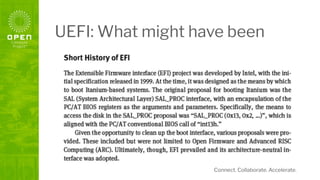
UEFI: What might have been
Connect. Collaborate. Accelerate.
UEFI: What happened instead
• While its goals were laudable, UEFI was overconstrained
• In particular, the need for legacy and Windows compatibility
required UEFI to support all past abstractions
• UEFI has become the worst of all worlds: complicated,
proprietary software that remains at once isolated from –
yet also still entirely entangled with! – system software
• UEFI is unquestionably not the way you would do it if you
could do it from scratch – especially in a post-cloud and
post-open source world!
Connect. Collaborate. Accelerate.
Oxide’s approach
• At Oxide, we are taking a from-scratch, rack-scale approach
to server-side computing
• We have AMD Milan-based compute sleds of our own design
• We do not have a traditional BMC, but rather a fit-to-purpose
service processor running our own (Rust-based, open
source) operating system
• Our approach is integrated, yet open
• Could we develop a truly holistic system on x86?
Connect. Collaborate. Accelerate.
Aside: AMD Details
• On AMD, the Platform Security Processor (PSP) is a
non-architectural core that executes proprietary software to
perform system initialization – including DRAM training
• System management controller (SP in our case) puts the
PSP payload into SPI flash and brings the CPU out of reset
• The PSP will perform its initialization and eventually vector
into host software executing on the bootstrap core (BSC)
• Historically, post-PSP initialization done by AMD’s AGESA
firmware – which makes a holistic system impossible
Connect. Collaborate. Accelerate.
Challenge #1: Initialization
• To implement holistic boot, system software must perform
the activities historically done by AGESA
• Modern CPUs are very complicated! Post-PSP initialization
includes configuring I/O interconnects, core complexes, etc.
• For AMD Milan, this specifically includes DXIO engine
configuration, NBIO PCIe strapping, hotplug configuration
• The software that has implemented this level of initialization
has historically been done by the CPU vendor; these
interfaces are not always documented thoroughly – if at all!
Connect. Collaborate. Accelerate.
Challenge #2: Boot Phasing
• Payload that boots from PSP is size-constrained to ~13MB
• Stage-based approaches (e.g., oreboot + LinuxBoot) use
Linux drivers to load (and execute) a production kernel
• This necessitates a pseudo-reset of the system – as well as
the creation or emulation of an interface (e.g., ACPI) to pass
system state to later stages
• Instead must adopt a phase-based approach whereby part
of the system is loaded from SPI NOR and is able to load the
remainder from SSDs – but the system is never discarded
Connect. Collaborate. Accelerate.
• Helios is our illumos derivative that includes the Oxide
bhyve-based hypervisor
• We have holistic Helios booting on our compute sleds!
• Importantly, this includes all necessary functionality for
platform initialization (I/O, SMP, etc.)
• Currently working on phasing – but this is much lower risk
than platform enablement
• Helios – along with all Oxide-authored software – will be
open source when we ship our first racks later this year!
Holistic booting!
Connect. Collaborate. Accelerate.
Towards Holistic Systems
• Holistic systems have clear advantages in terms of reliability,
security, observability, manageability, sustainability, etc.
• Based on our experience to date, holistic systems are
challenging to implement but emphatically attainable
• Documentation from microprocessor vendors is essential;
they have much to gain by encouraging more enablement
software on their platforms!
• Oxide may represent the first open, holistic server-side
system in the post-PC x86 era – but unlikely to be the last!

Towards Holistic Systems

  • 1.
    Connect. Collaborate. Accelerate. TowardsHolistic Systems Bryan Cantrill CTO, Oxide Computer Company
  • 2.
    Connect. Collaborate. Accelerate. Holisticsystems • In the beginning, computing systems were tautologically holistic, consisting of co-designed hardware and software • System software was delivered with the computer, and often had to be newly developed for a new machine • Requiring new software for new hardware created schedule delays, viz. OS/360 and The Mythical Man Month • With the advent of Unix, system software became portable – it could be ported rather than developed de novo for each new computer…
  • 3.
    Connect. Collaborate. Accelerate. ThePC era • With the rise of the PC, however, the hardware became irreconcilably divorced from the system software • Hardware enabling-software was driven into the BIOS • The BIOS interface became what system software bound to – it became the definition of “compatibility” • Worse, the software on both sides of the BIOS/OS divide were nearly exclusively proprietary, serving to harden the boundary
  • 4.
    Connect. Collaborate. Accelerate. Itgets worse: SMM • The BIOS was not content to be inert: in order to be able implement system software functionality delivered by the hardware, system management mode was invented • SMM allows effectively arbitrary code execution at arbitrary time without even allowing system software awareness • This is the opposite of a holistic system: it is one that has been deliberately and perniciously divided
  • 5.
    Connect. Collaborate. Accelerate. EFI/UEFI •All of this might have been fine had x86 remained relegated to personal computing… • …but Intel and AMD out-executed the RISC vendors in the 2000s, forcing PC constructs into the server space • Starting with (ill-fated) Itanium, Intel introduced EFI in an attempt to modernize…
  • 6.
  • 7.
    Connect. Collaborate. Accelerate. UEFI:What happened instead • While its goals were laudable, UEFI was overconstrained • In particular, the need for legacy and Windows compatibility required UEFI to support all past abstractions • UEFI has become the worst of all worlds: complicated, proprietary software that remains at once isolated from – yet also still entirely entangled with! – system software • UEFI is unquestionably not the way you would do it if you could do it from scratch – especially in a post-cloud and post-open source world!
  • 8.
    Connect. Collaborate. Accelerate. Oxide’sapproach • At Oxide, we are taking a from-scratch, rack-scale approach to server-side computing • We have AMD Milan-based compute sleds of our own design • We do not have a traditional BMC, but rather a fit-to-purpose service processor running our own (Rust-based, open source) operating system • Our approach is integrated, yet open • Could we develop a truly holistic system on x86?
  • 9.
    Connect. Collaborate. Accelerate. Aside:AMD Details • On AMD, the Platform Security Processor (PSP) is a non-architectural core that executes proprietary software to perform system initialization – including DRAM training • System management controller (SP in our case) puts the PSP payload into SPI flash and brings the CPU out of reset • The PSP will perform its initialization and eventually vector into host software executing on the bootstrap core (BSC) • Historically, post-PSP initialization done by AMD’s AGESA firmware – which makes a holistic system impossible
  • 10.
    Connect. Collaborate. Accelerate. Challenge#1: Initialization • To implement holistic boot, system software must perform the activities historically done by AGESA • Modern CPUs are very complicated! Post-PSP initialization includes configuring I/O interconnects, core complexes, etc. • For AMD Milan, this specifically includes DXIO engine configuration, NBIO PCIe strapping, hotplug configuration • The software that has implemented this level of initialization has historically been done by the CPU vendor; these interfaces are not always documented thoroughly – if at all!
  • 11.
    Connect. Collaborate. Accelerate. Challenge#2: Boot Phasing • Payload that boots from PSP is size-constrained to ~13MB • Stage-based approaches (e.g., oreboot + LinuxBoot) use Linux drivers to load (and execute) a production kernel • This necessitates a pseudo-reset of the system – as well as the creation or emulation of an interface (e.g., ACPI) to pass system state to later stages • Instead must adopt a phase-based approach whereby part of the system is loaded from SPI NOR and is able to load the remainder from SSDs – but the system is never discarded
  • 12.
    Connect. Collaborate. Accelerate. •Helios is our illumos derivative that includes the Oxide bhyve-based hypervisor • We have holistic Helios booting on our compute sleds! • Importantly, this includes all necessary functionality for platform initialization (I/O, SMP, etc.) • Currently working on phasing – but this is much lower risk than platform enablement • Helios – along with all Oxide-authored software – will be open source when we ship our first racks later this year! Holistic booting!
  • 13.
    Connect. Collaborate. Accelerate. TowardsHolistic Systems • Holistic systems have clear advantages in terms of reliability, security, observability, manageability, sustainability, etc. • Based on our experience to date, holistic systems are challenging to implement but emphatically attainable • Documentation from microprocessor vendors is essential; they have much to gain by encouraging more enablement software on their platforms! • Oxide may represent the first open, holistic server-side system in the post-PC x86 era – but unlikely to be the last!