Affective Image Classification
Jana Machajdik,
Vienna University of
Technology
Allan Hanbury,
Information Retrieval
Facility
using features inspired by psychology and art theory
Images & emotions
Context & Motivation
 Retrieval of „emotional“ images?
 Publications few, recent and not comparable
Critique of State of the Art Contribution
- arbitrary emotional categories + emotional categories from an
extensive psychological study (IAPS)
- Unknown image sets + Available sets
- Unclear evaluation + Unbiased correct rate
- General features with implicit
relationship to output emotions
+ Specific features designed to
express emotional aspects
How to measure affect?
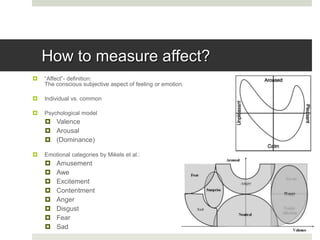
 “Affect”- definition:
The conscious subjective aspect of feeling or emotion.
 Individual vs. common
 Psychological model
 Valence
 Arousal
 (Dominance)
 Emotional categories by Mikels et al.:
 Amusement
 Awe
 Excitement
 Contentment
 Anger
 Disgust
 Fear
 Sad
System flow:
 Feature vector: 114 numbers
 K-Fold Cross-Validation
 Separates the data into training
and test sets
 Machine Learning approach
 Naive Bayes classifier
Preprocessing
 Resizing
 Cropping
 Hough transform
 Canny edge
 Color space
 RGB to IHSL
 Segmentation
 Watershed/waterfall
algorithm
Hough space main lines cropped image
original Hue Brightness Saturation S in HSV
original segmented
Feature extraction
 Color
 Texture
 Composition
 Content
Color Features
 Saturation and Brightness
statistics
 + Arousal, Pleasure, Dominance
 Hue statistics
 Vector based
 Rule of thirds
 Colorfulness
 Color Names
 Itten contrasts
 Art theory
 Affective color histogram by Wang
Wei-ning, ICSMC 2006
Arousal: ascending
Pleasure
Arousal
Dominance
Color Features
 Saturation and Brightness
statistics
 + Arousal, Pleasure, Dominance
 Hue statistics
 Vector based
 Rule of thirds
 Colorfulness
 Color Names
 Itten contrasts
 Art theory
 Affective color histogram by Wang
Wei-ning, ICSMC 2006
original Hue channel
Hue histogram
Arousal: ascending
Color Features
 Saturation and Brightness
statistics
 + Arousal, Pleasure, Dominance
 Hue statistics
 Vector based
 Rule of thirds
 Colorfulness
 Color Names
 Itten contrasts
 Art theory
 Affective color histogram by Wang
Wei-ning, ICSMC 2006
Color Features
Contrast of hue
Contrast of
saturation
Contrast of
light and dark
Contrast of
complements
Contrast of
warmth
Contrast of
extension
Simultaneous
contrast
 Saturation and Brightness
statistics
 + Arousal, Pleasure, Dominance
 Hue statistics
 Vector based
 Rule of thirds
 Colorfulness
 Color Names
 Itten contrasts
 Art theory
 Affective color histogram by Wang
Wei-ning, ICSMC 2006
Color Features
 Saturation and Brightness
statistics
 + Arousal, Pleasure, Dominance
 Hue statistics
 Vector based
 Rule of thirds
 Colorfulness
 Color Names
 Itten contrasts
 Art theory
 Affective color histogram by Wang
Wei-ning, ICSMC 2006
warm
cold
Color Features
 Saturation and Brightness
statistics
 + Arousal, Pleasure, Dominance
 Hue statistics
 Vector based
 Rule of thirds
 Colorfulness
 Color Names
 Itten contrasts
 Art theory
 Affective color histogram by Wang
Wei-ning, ICSMC 2006
Texture Features
 Wavelet-based
 Daubechies wavelet transform
 Tamura features
 Coarseness
 Contrast
 Directionality
 Gray-Level-Co-occurrence Matrix
(GLCM)
 Contrast
 Correlation
 Energy
 Homogeneity
Texture Features
 Wavelet-based
 Daubechies wavelet transform
 Tamura features
 Coarseness
 Contrast
 Directionality
 Gray-Level-Co-occurrence Matrix
(GLCM)
 Contrast
 Correlation
 Energy
 Homogeneity
Composition Features
 Level of Detail
 Low Depth of Field
 Dynamics
Level of Detail: original segmented
Low Depth of Field Indicator
Content Features
 Human Faces
 Viola-Jones frontal face
detection
 Skin
Dataset 1
 IAPS – International Affective Picture
System
 369 general, “documentary style” photos,
covering various scenes
 e.g. insects, puppies, children,
poverty, diseases, portraits, etc.
 Rated with affective words in
psychological study with 60 participants
Dataset 2
 „Art“ photos from an art-sharing web-site
 „art“ = images with intentional expression
& conscious use of design
 Artists use tricks (or follow guidelines) to
create the proper atmosphere of their
images
 Data set assembled by searching for
images with emotion words in image title
or keywords/tags
 Images are from the art-sharing web
community deviantArt.com
 807 images
Dataset 3
 Abstract paintings
 How do we perceive/rate images without
semantic context?
 Peer rated through a web-interface
 280 images rated by ~230 people
 20 images per session
 Each image rated ~14 x
Web survey
Experiments
Results
 Evaluation
 Unbiased correct rate
 Mean of the true positives per class for all categories
 Ground truth
 Results of study
 Artist‘s labels
 Web votes
 Feature selection
results in paper
 Compare resutls with
Yanulevskaya, ICIP
2008
All data sets
Classifier vs. human?
 Abstract paintings
 Humans don’t agree on category either…
Conclusions
 Emotion-specific features make sense
 Abstract paintings survey shows that even humans are unsure
about emotion without context
 www.imageemotion.org
 Future work
 look for other, better or fine-tuning of features and classification
algorithms (e.g. more context features (e.g. grin detection), saliency
based local features, etc.),..
 More (bigger) labeled image sets (ground truth)
 Other types of “classification”
 “emotion distribution”
Thank you!
Reference: Wang Wei-ning, Jiang Sheng-ming, Yu Ying-lin. Image retrieval by emotional se- mantics: A study of
emotional space and feature extraction. IEEE International Conference on Systems, Man and Cybernetics, 4(Issue
8-11):3534 – 3539, Oct. 2006.
V. Yanulevskaya, J. C. van Gemert, K. Roth, A. K. Herbold, N. Sebe, and J. M. Geusebroek. Emotional valence
categorization using holistic image features. In IEEE International Conference on Image Processing, 2008.

AffectiveImageClassification_ACMM10.pptx

  • 1.
    Affective Image Classification JanaMachajdik, Vienna University of Technology Allan Hanbury, Information Retrieval Facility using features inspired by psychology and art theory
  • 2.
  • 4.
    Context & Motivation Retrieval of „emotional“ images?  Publications few, recent and not comparable Critique of State of the Art Contribution - arbitrary emotional categories + emotional categories from an extensive psychological study (IAPS) - Unknown image sets + Available sets - Unclear evaluation + Unbiased correct rate - General features with implicit relationship to output emotions + Specific features designed to express emotional aspects
  • 5.
    How to measureaffect?  “Affect”- definition: The conscious subjective aspect of feeling or emotion.  Individual vs. common  Psychological model  Valence  Arousal  (Dominance)  Emotional categories by Mikels et al.:  Amusement  Awe  Excitement  Contentment  Anger  Disgust  Fear  Sad
  • 6.
    System flow:  Featurevector: 114 numbers  K-Fold Cross-Validation  Separates the data into training and test sets  Machine Learning approach  Naive Bayes classifier
  • 7.
    Preprocessing  Resizing  Cropping Hough transform  Canny edge  Color space  RGB to IHSL  Segmentation  Watershed/waterfall algorithm Hough space main lines cropped image original Hue Brightness Saturation S in HSV original segmented
  • 8.
    Feature extraction  Color Texture  Composition  Content
  • 9.
    Color Features  Saturationand Brightness statistics  + Arousal, Pleasure, Dominance  Hue statistics  Vector based  Rule of thirds  Colorfulness  Color Names  Itten contrasts  Art theory  Affective color histogram by Wang Wei-ning, ICSMC 2006 Arousal: ascending Pleasure Arousal Dominance
  • 10.
    Color Features  Saturationand Brightness statistics  + Arousal, Pleasure, Dominance  Hue statistics  Vector based  Rule of thirds  Colorfulness  Color Names  Itten contrasts  Art theory  Affective color histogram by Wang Wei-ning, ICSMC 2006 original Hue channel Hue histogram Arousal: ascending
  • 11.
    Color Features  Saturationand Brightness statistics  + Arousal, Pleasure, Dominance  Hue statistics  Vector based  Rule of thirds  Colorfulness  Color Names  Itten contrasts  Art theory  Affective color histogram by Wang Wei-ning, ICSMC 2006
  • 12.
    Color Features Contrast ofhue Contrast of saturation Contrast of light and dark Contrast of complements Contrast of warmth Contrast of extension Simultaneous contrast  Saturation and Brightness statistics  + Arousal, Pleasure, Dominance  Hue statistics  Vector based  Rule of thirds  Colorfulness  Color Names  Itten contrasts  Art theory  Affective color histogram by Wang Wei-ning, ICSMC 2006
  • 13.
    Color Features  Saturationand Brightness statistics  + Arousal, Pleasure, Dominance  Hue statistics  Vector based  Rule of thirds  Colorfulness  Color Names  Itten contrasts  Art theory  Affective color histogram by Wang Wei-ning, ICSMC 2006 warm cold
  • 14.
    Color Features  Saturationand Brightness statistics  + Arousal, Pleasure, Dominance  Hue statistics  Vector based  Rule of thirds  Colorfulness  Color Names  Itten contrasts  Art theory  Affective color histogram by Wang Wei-ning, ICSMC 2006
  • 15.
    Texture Features  Wavelet-based Daubechies wavelet transform  Tamura features  Coarseness  Contrast  Directionality  Gray-Level-Co-occurrence Matrix (GLCM)  Contrast  Correlation  Energy  Homogeneity
  • 16.
    Texture Features  Wavelet-based Daubechies wavelet transform  Tamura features  Coarseness  Contrast  Directionality  Gray-Level-Co-occurrence Matrix (GLCM)  Contrast  Correlation  Energy  Homogeneity
  • 17.
    Composition Features  Levelof Detail  Low Depth of Field  Dynamics Level of Detail: original segmented Low Depth of Field Indicator
  • 18.
    Content Features  HumanFaces  Viola-Jones frontal face detection  Skin
  • 19.
    Dataset 1  IAPS– International Affective Picture System  369 general, “documentary style” photos, covering various scenes  e.g. insects, puppies, children, poverty, diseases, portraits, etc.  Rated with affective words in psychological study with 60 participants
  • 20.
    Dataset 2  „Art“photos from an art-sharing web-site  „art“ = images with intentional expression & conscious use of design  Artists use tricks (or follow guidelines) to create the proper atmosphere of their images  Data set assembled by searching for images with emotion words in image title or keywords/tags  Images are from the art-sharing web community deviantArt.com  807 images
  • 21.
    Dataset 3  Abstractpaintings  How do we perceive/rate images without semantic context?  Peer rated through a web-interface  280 images rated by ~230 people  20 images per session  Each image rated ~14 x
  • 22.
  • 23.
  • 24.
    Results  Evaluation  Unbiasedcorrect rate  Mean of the true positives per class for all categories  Ground truth  Results of study  Artist‘s labels  Web votes  Feature selection results in paper  Compare resutls with Yanulevskaya, ICIP 2008
  • 25.
  • 26.
    Classifier vs. human? Abstract paintings  Humans don’t agree on category either…
  • 27.
    Conclusions  Emotion-specific featuresmake sense  Abstract paintings survey shows that even humans are unsure about emotion without context  www.imageemotion.org  Future work  look for other, better or fine-tuning of features and classification algorithms (e.g. more context features (e.g. grin detection), saliency based local features, etc.),..  More (bigger) labeled image sets (ground truth)  Other types of “classification”  “emotion distribution”
  • 29.
    Thank you! Reference: WangWei-ning, Jiang Sheng-ming, Yu Ying-lin. Image retrieval by emotional se- mantics: A study of emotional space and feature extraction. IEEE International Conference on Systems, Man and Cybernetics, 4(Issue 8-11):3534 – 3539, Oct. 2006. V. Yanulevskaya, J. C. van Gemert, K. Roth, A. K. Herbold, N. Sebe, and J. M. Geusebroek. Emotional valence categorization using holistic image features. In IEEE International Conference on Image Processing, 2008.

Editor's Notes

  • #20 IAPS - Collection of standardized emotional images
  • #21 IAPS - Collection of standardized emotional images
  • #26 Best features
  • #29 Make datasets available…