What is Decentralized Cloud Storage and its Future?
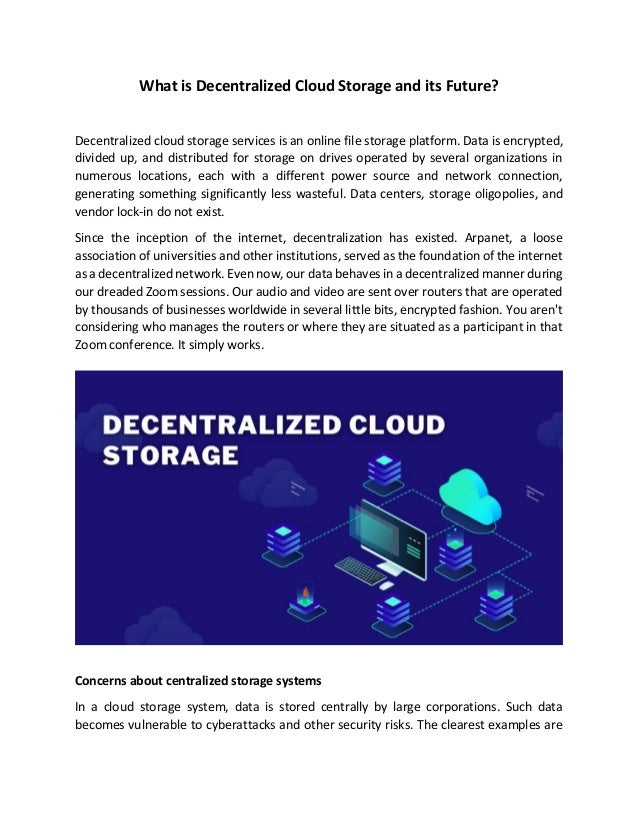
Decentralized cloud storage services is an online file storage platform. Data is encrypted,
divided up, and distributed for storage on drives operated by several organizations in
numerous locations, each with a different power source and network connection,
generating something significantly less wasteful. Data centers, storage oligopolies, and
vendor lock-in do not exist.
Since the inception of the internet, decentralization has existed. Arpanet, a loose
association of universities and other institutions, served as the foundation of the internet
as a decentralized network. Even now, our data behaves in a decentralized manner during
our dreaded Zoom sessions. Our audio and video are sent over routers that are operated
by thousands of businesses worldwide in several little bits, encrypted fashion. You aren't
considering who manages the routers or where they are situated as a participant in that
Zoom conference. It simply works.
Concerns about centralized storage systems
In a cloud storage system, data is stored centrally by large corporations. Such data
becomes vulnerable to cyberattacks and other security risks. The clearest examples are
Facebook’s data leak and breach scandals of 2018 and 2021 respectively. These incidents
brought to light the weaknesses of the centralized storage systems.
Conclusion:
The demand for safe and affordable storage technologies is rising as business data
volumes rise. Decentralized data storage services that properly balance security,
scalability, and price have gained momentum thanks to blockchain technology.
Since the technology is still relatively new, it might take some time for it to gain
widespread acceptance and enter the mainstream. As we've seen, developers are still
attempting to fix the obvious flaws. The advantages of decentralized Blockchain Cloud
Storage, however, are already recognized to outweigh those of centralized storage
systems, and this technology is only anticipated to get better in the near future.

What is Decentralized Cloud Storage and its Future

  • 1.
    What is DecentralizedCloud Storage and its Future? Decentralized cloud storage services is an online file storage platform. Data is encrypted, divided up, and distributed for storage on drives operated by several organizations in numerous locations, each with a different power source and network connection, generating something significantly less wasteful. Data centers, storage oligopolies, and vendor lock-in do not exist. Since the inception of the internet, decentralization has existed. Arpanet, a loose association of universities and other institutions, served as the foundation of the internet as a decentralized network. Even now, our data behaves in a decentralized manner during our dreaded Zoom sessions. Our audio and video are sent over routers that are operated by thousands of businesses worldwide in several little bits, encrypted fashion. You aren't considering who manages the routers or where they are situated as a participant in that Zoom conference. It simply works. Concerns about centralized storage systems In a cloud storage system, data is stored centrally by large corporations. Such data becomes vulnerable to cyberattacks and other security risks. The clearest examples are
  • 2.
    Facebook’s data leakand breach scandals of 2018 and 2021 respectively. These incidents brought to light the weaknesses of the centralized storage systems. Conclusion: The demand for safe and affordable storage technologies is rising as business data volumes rise. Decentralized data storage services that properly balance security, scalability, and price have gained momentum thanks to blockchain technology. Since the technology is still relatively new, it might take some time for it to gain widespread acceptance and enter the mainstream. As we've seen, developers are still attempting to fix the obvious flaws. The advantages of decentralized Blockchain Cloud Storage, however, are already recognized to outweigh those of centralized storage systems, and this technology is only anticipated to get better in the near future.