ON IMPACT IN SOFTWARE ENGINEERING
RESEARCH
ANDREAS ZELLER, CISPA / SAARLAND UNIVERSITY
ICSE NEW FACULTY SYMPOSIUM
GÖTEBORG, MAY 29, 2018
@AndreasZeller
@AndreasZeller
ANDREAS ZELLER: KEY FACTS
• PhD in 1997 on Configuration Management with Feature Logic
• Since 2001 professor at Saarland Informatics Campus

(Saarland University / CISPA)
• Four 10-year impact awards 2009–2017

(for papers 1999–2007)
• ACM Fellow in 2010
• ERC Advanced Grant in 2011
• SIGSOFT Outstanding Research Award on Friday
@AndreasZeller
WHAT IS IMPACT?
@AndreasZeller
WHAT IS IMPACT?
• How do your actions change the world?
• Often measured in citations, publications, funding,
people, …
• All these are indicators of impact, but not goals in
themselves
• We want to make the world a better place
• Gives meaning and purpose to our (professional) life
@AndreasZeller
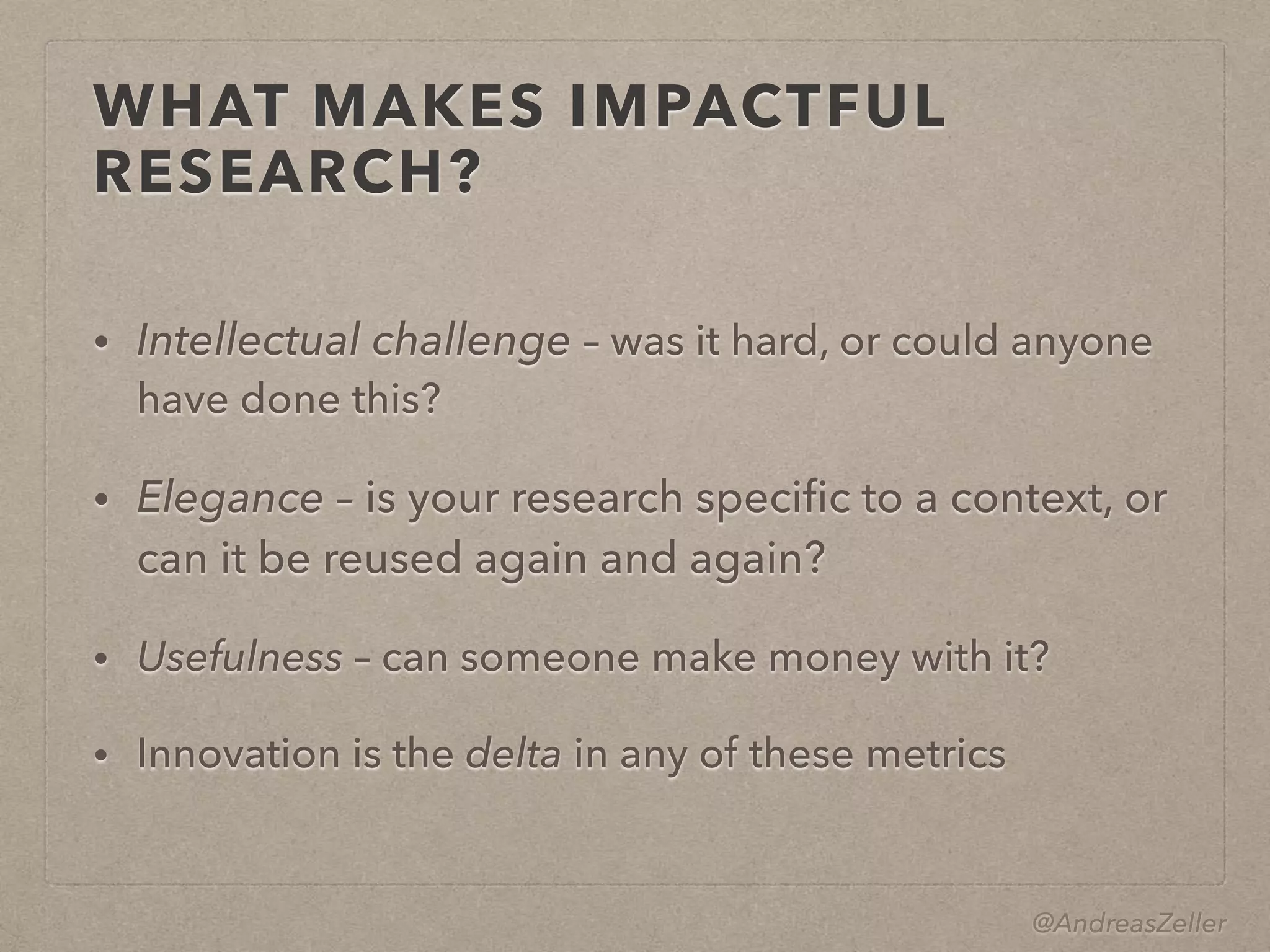
WHAT MAKES IMPACTFUL
RESEARCH?
• Intellectual challenge – was it hard, or could anyone
have done this?
• Elegance – is your research specific to a context, or
can it be reused again and again?
• Usefulness – can someone make money with it?
• Innovation is the delta in any of these metrics
@AndreasZeller
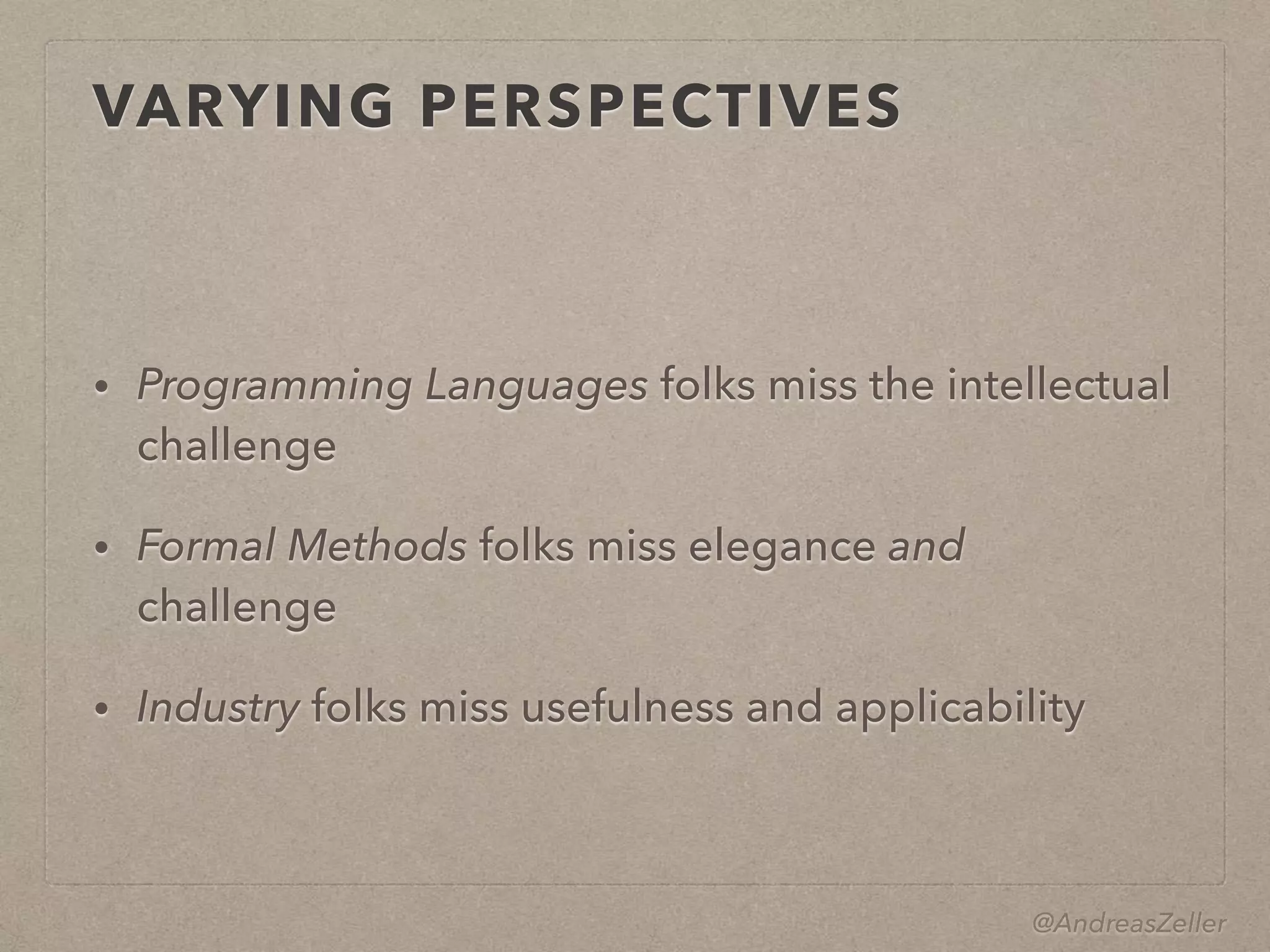
VARYING PERSPECTIVES
• Programming Languages folks miss the intellectual
challenge
• Formal Methods folks miss elegance and
challenge
• Industry folks miss usefulness and applicability
@AndreasZeller
WHAT MAKES IMPACTFUL
RESEARCH?
• How did your work make the world a better place?
@AndreasZeller
MY PATH TO IMPACT
@AndreasZeller
MY PATH TO IMPACT
• Life can only be understood backwards; 

but it must be lived forwards

(Søren Kierkegaard)
@AndreasZeller
CONFIGURATION MANAGEMENT

WITH FEATURE LOGIC (1991–1997)
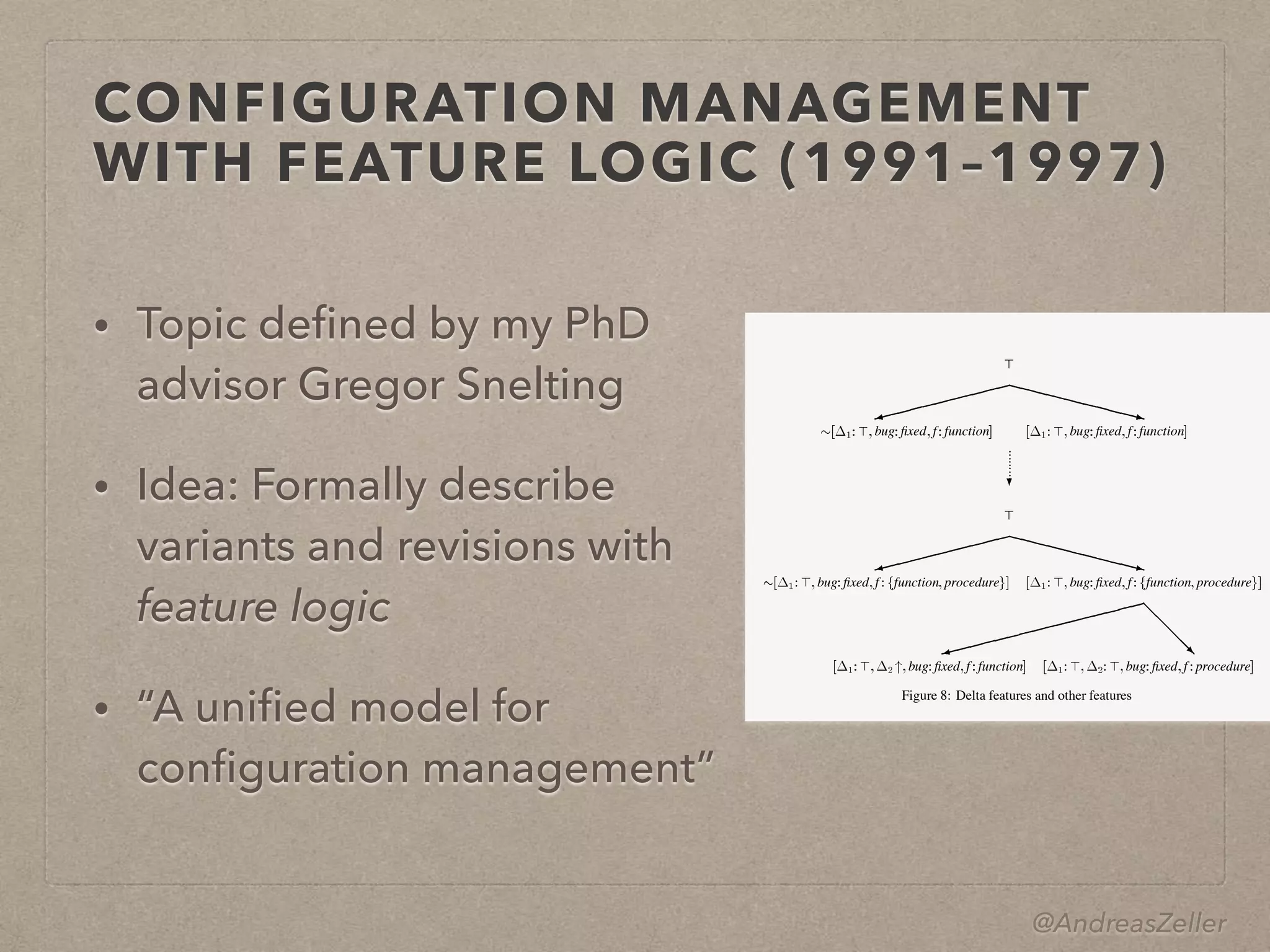
• Topic defined by my PhD
advisor Gregor Snelting
• Idea: Formally describe
variants and revisions with
feature logic
• “A unified model for
configuration management”
3.3 Combining Delta Features and other Features
..........
bug fixed f functionbug fixed f function
bug fixed f function procedurebug fixed f function procedure
bug fixed f function bug fixed f procedure
Figure 8: Delta features and other features
. This is only natural, since the change relies on the presence of the
change. Adding a new revision under implies that the revision is now tagged w
, so that the generalization property is not violated. Indeed,
.
3.3 Combining Delta Features and other Features
Besides all the delta features, other features are still allowed (and encouraged). Until now, we l
them out for clarity. However, there is no difference between the handling of delta features and oth
features, as is shown in the following example.
Example 3.3 Consider figure 8. Here, we have figure 6 revisited, but enhanced with more featur
We assume that the change named fixes a bug and introduces a new symbol f, which is a functio
@AndreasZeller
FEATURE LOGIC:

LESSONS LEARNED
• You can get plenty of papers accepted
• even if you miss the problem
• even if you do not evaluate
• “Modeling for the sake of modeling”
• Enabled much of my later work, though
@AndreasZeller
DDD (1994–1999)
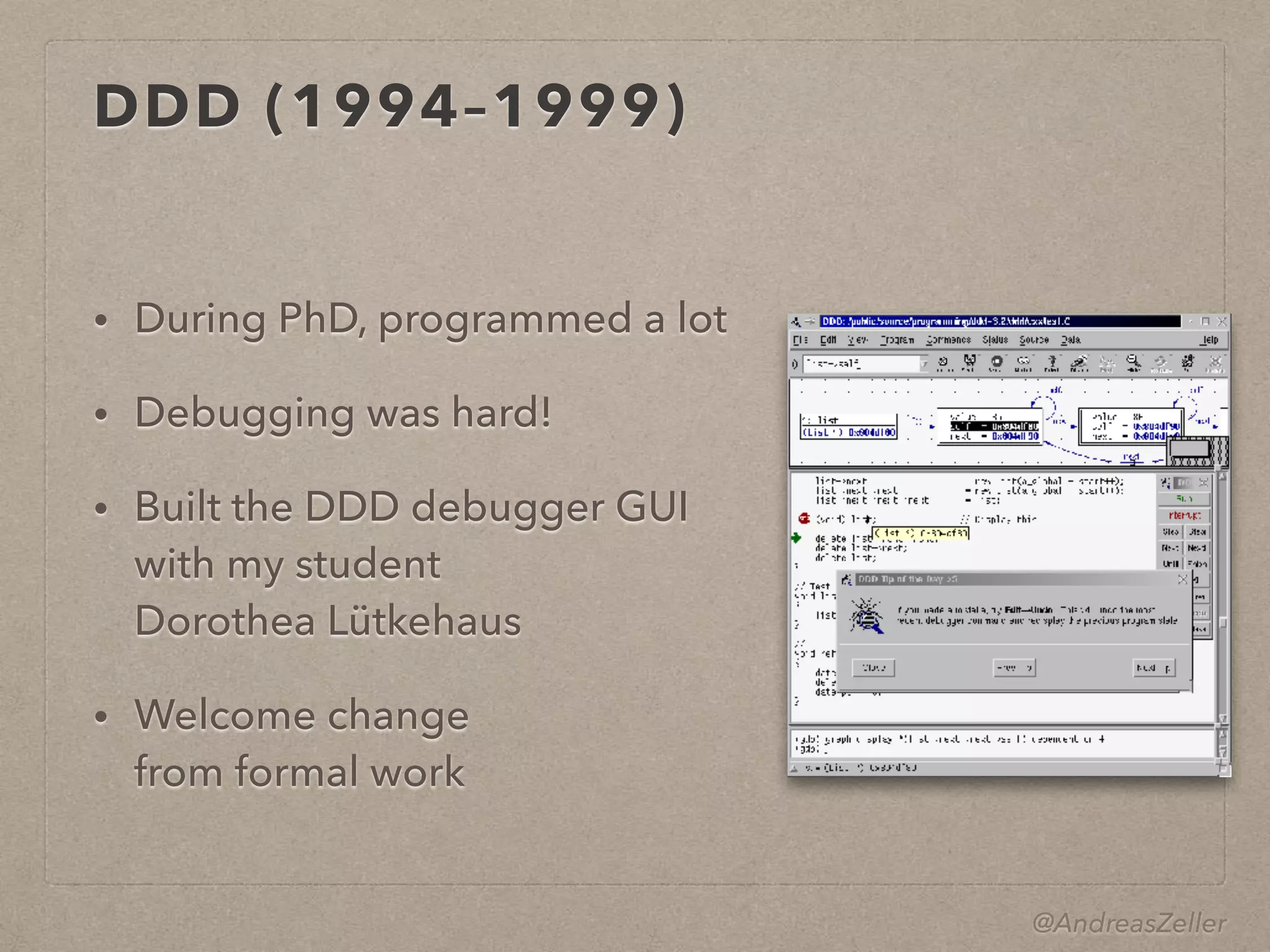
• During PhD, programmed a lot
• Debugging was hard!
• Built the DDD debugger GUI

with my student
Dorothea Lütkehaus
• Welcome change

from formal work
@AndreasZeller
DDD (1994–1999)
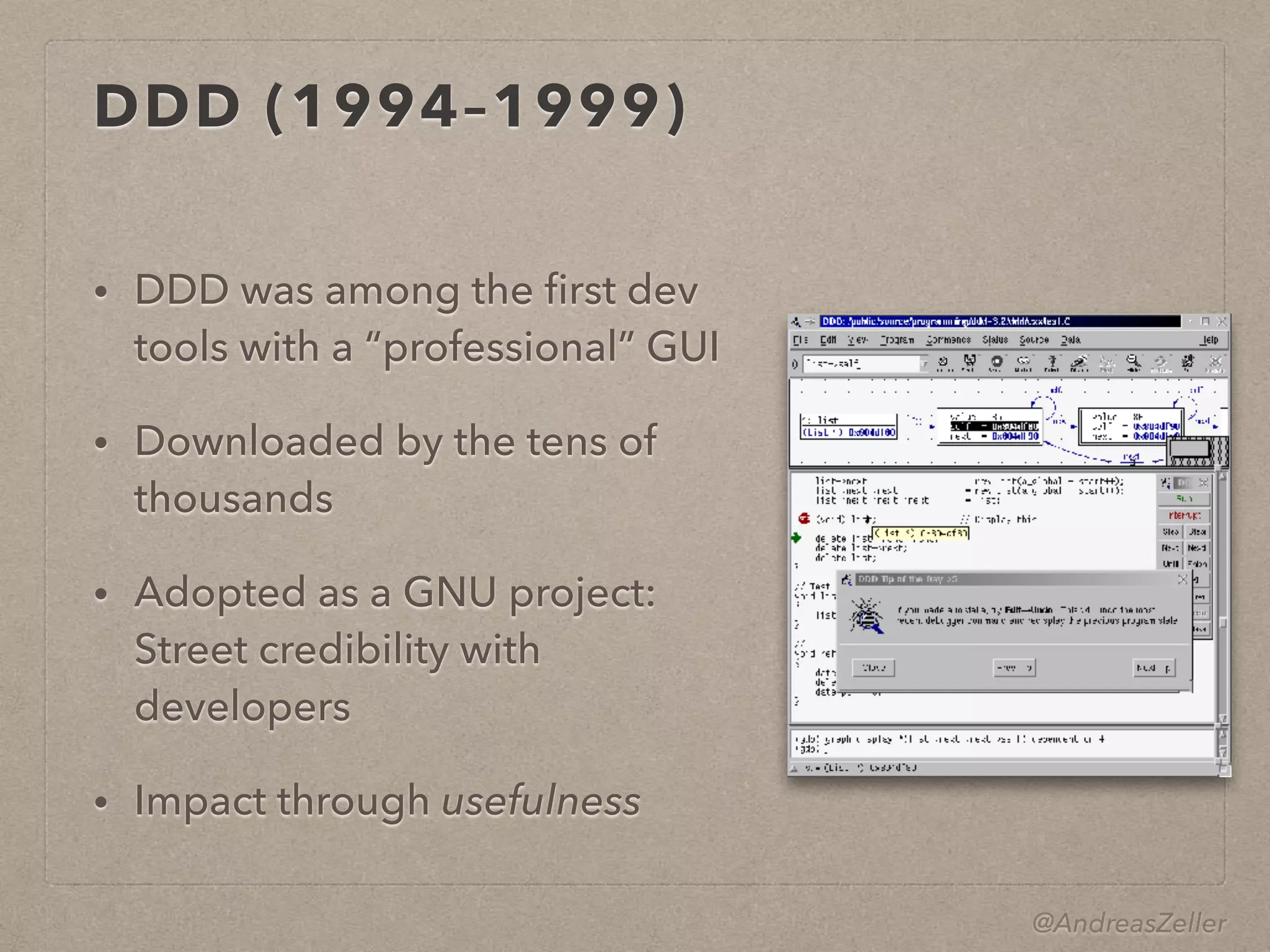
• DDD was among the first dev
tools with a “professional” GUI
• Downloaded by the tens of
thousands
• Adopted as a GNU project:

Street credibility with
developers
• Impact through usefulness
@AndreasZeller
DDD: LESSONS LEARNED
• Work on a real problem

• Assume as little as possible

• Keep things simple
–  “real” as in “real world”, not “real papers”
–  make things fit into real processes
–  complexity impresses, but prevents impact
@AndreasZeller
DELTA DEBUGGING (1999–2003)
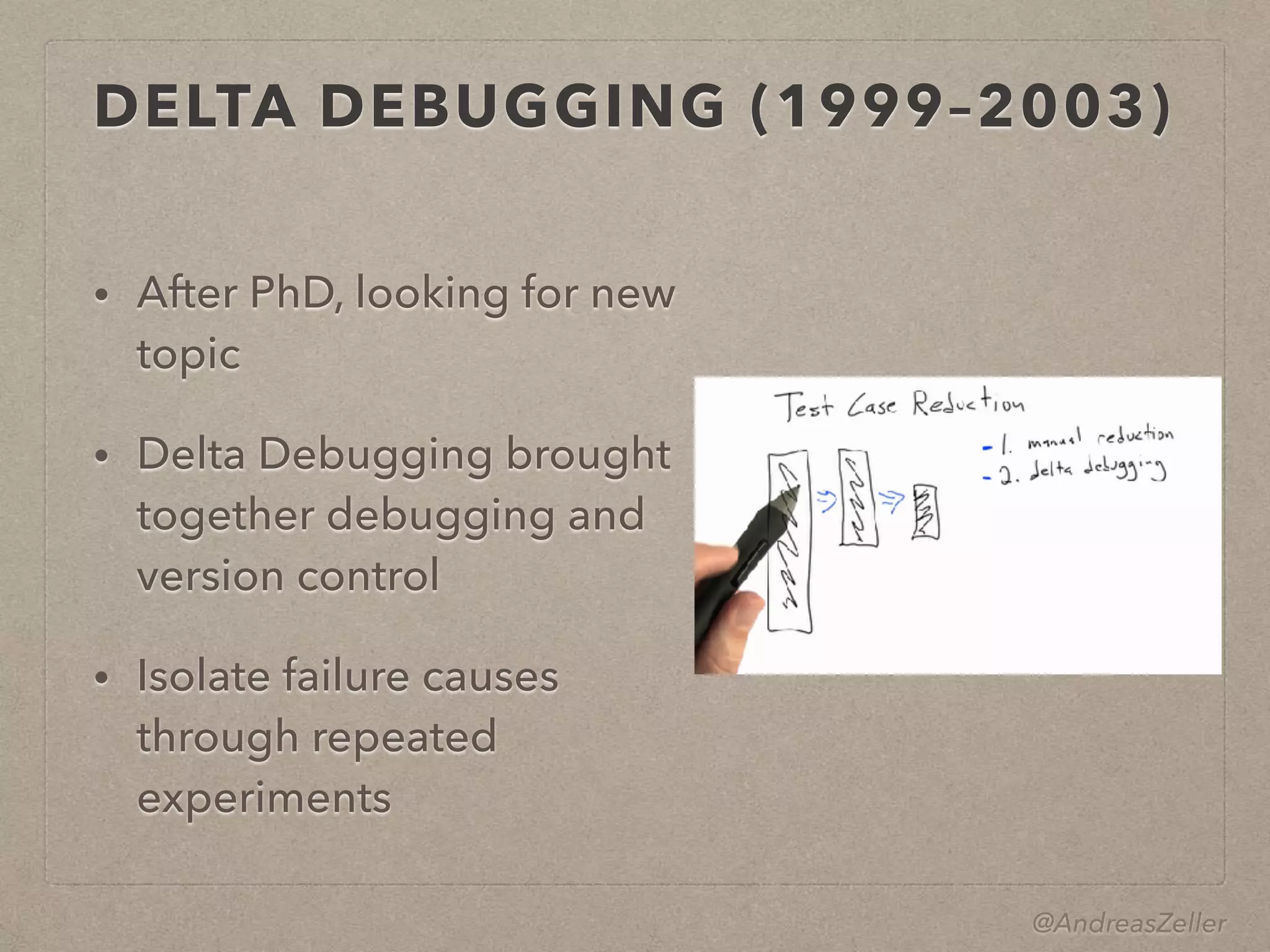
• After PhD, looking for new
topic
• Delta Debugging brought
together debugging and
version control
• Isolate failure causes
through repeated
experiments
@AndreasZeller
DELTA DEBUGGING (1999–2003)
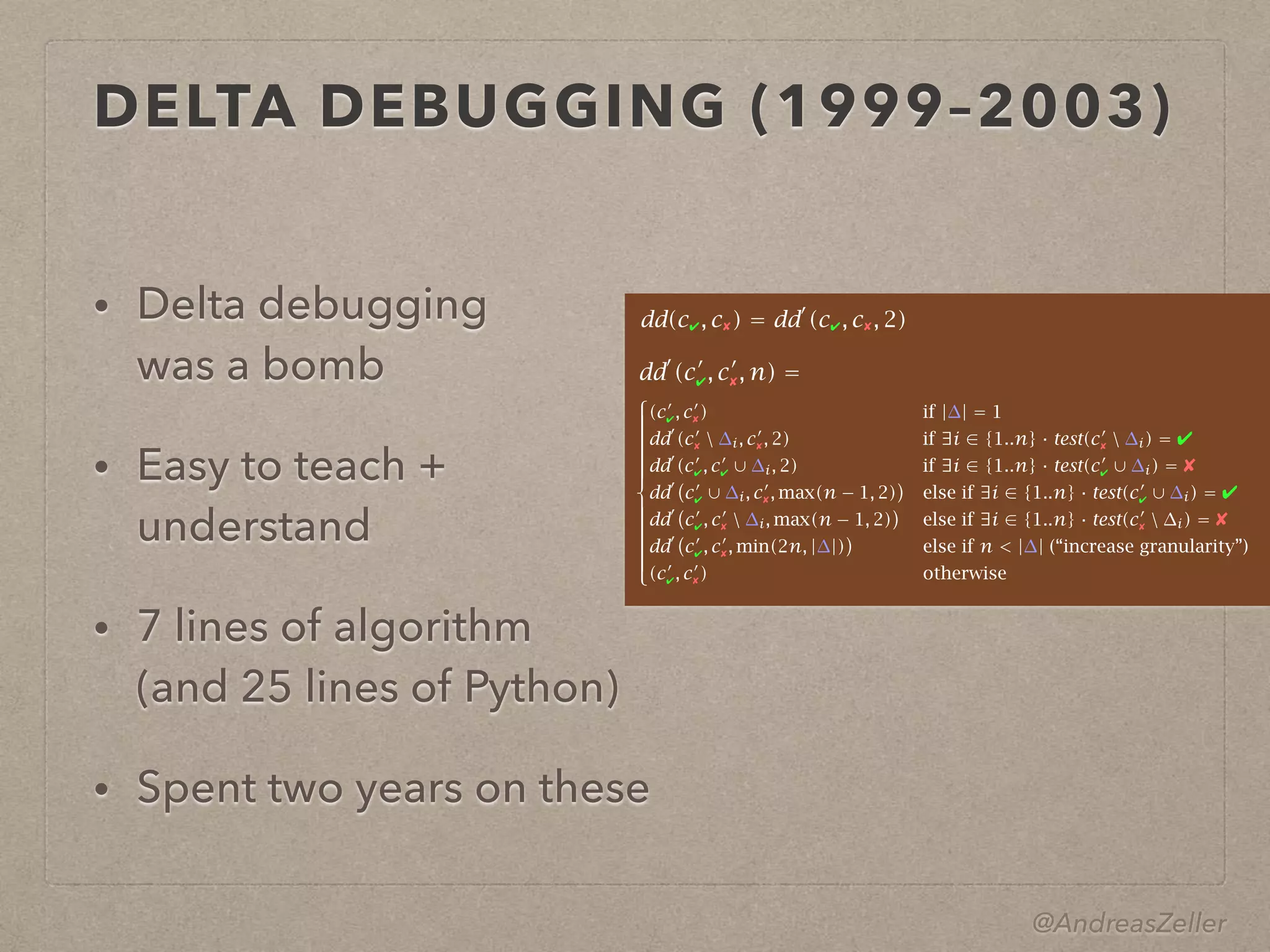
• Delta debugging

was a bomb
• Easy to teach +
understand
• 7 lines of algorithm

(and 25 lines of Python)
• Spent two years on these
⎧
⎪⎪⎪⎪⎪⎪⎪⎪⎪⎪⎪⎪⎪⎨
⎪⎪⎪⎪⎪⎪⎪⎪⎪⎪⎪⎪⎪⎩
(c′
✔, c′
✘) if |∆| = 1
dd′
(c′
✘  ∆i, c′
✘, 2) if ∃i ∈ {1..n} · test(c′
✘  ∆i) = ✔
dd′
(c′
✔, c′
✔ ∪ ∆i, 2) if ∃i ∈ {1..n} · test(c′
✔ ∪ ∆i) = ✘
dd′
c′
✔ ∪ ∆i, c′
✘, max(n − 1, 2) else if ∃i ∈ {1..n} · test(c′
✔ ∪ ∆i) = ✔
dd′
c′
✔, c′
✘  ∆i, max(n − 1, 2) else if ∃i ∈ {1..n} · test(c′
✘  ∆i) = ✘
dd′
c′
✔, c′
✘, min(2n, |∆|) else if n < |∆| (“increase granularity”)
(c′
✔, c′
✘) otherwise
dd(c✔, c✘) = dd′
(c✔, c✘, 2)
dd′
(c′
✔, c′
✘, n) =
@AndreasZeller
DELTA DEBUGGING: LESSONS
LEARNED
• Work on a real problem
• Assume as little as possible
• Keep things simple
• Have a sound model
–  Version control? tests? Never heard of it
– 25 lines of Python is probably excessive
–  DD was my version model reborn
–  Why debug? We build correct software
@AndreasZeller
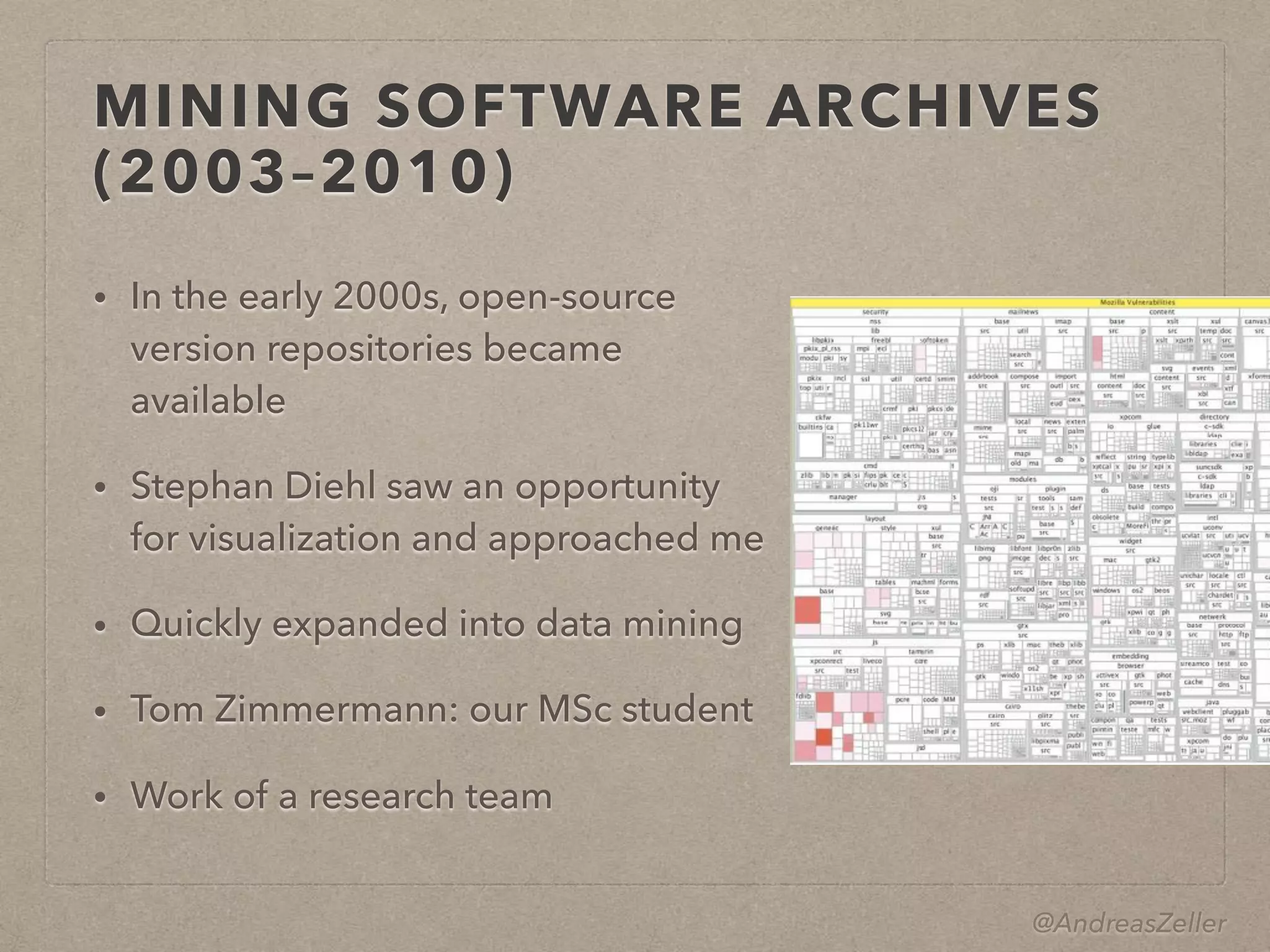
MINING SOFTWARE ARCHIVES
(2003–2010)
• In the early 2000s, open-source
version repositories became
available
• Stephan Diehl saw an opportunity
for visualization and approached me
• Quickly expanded into data mining
• Tom Zimmermann: our MSc student
• Work of a research team
@AndreasZeller
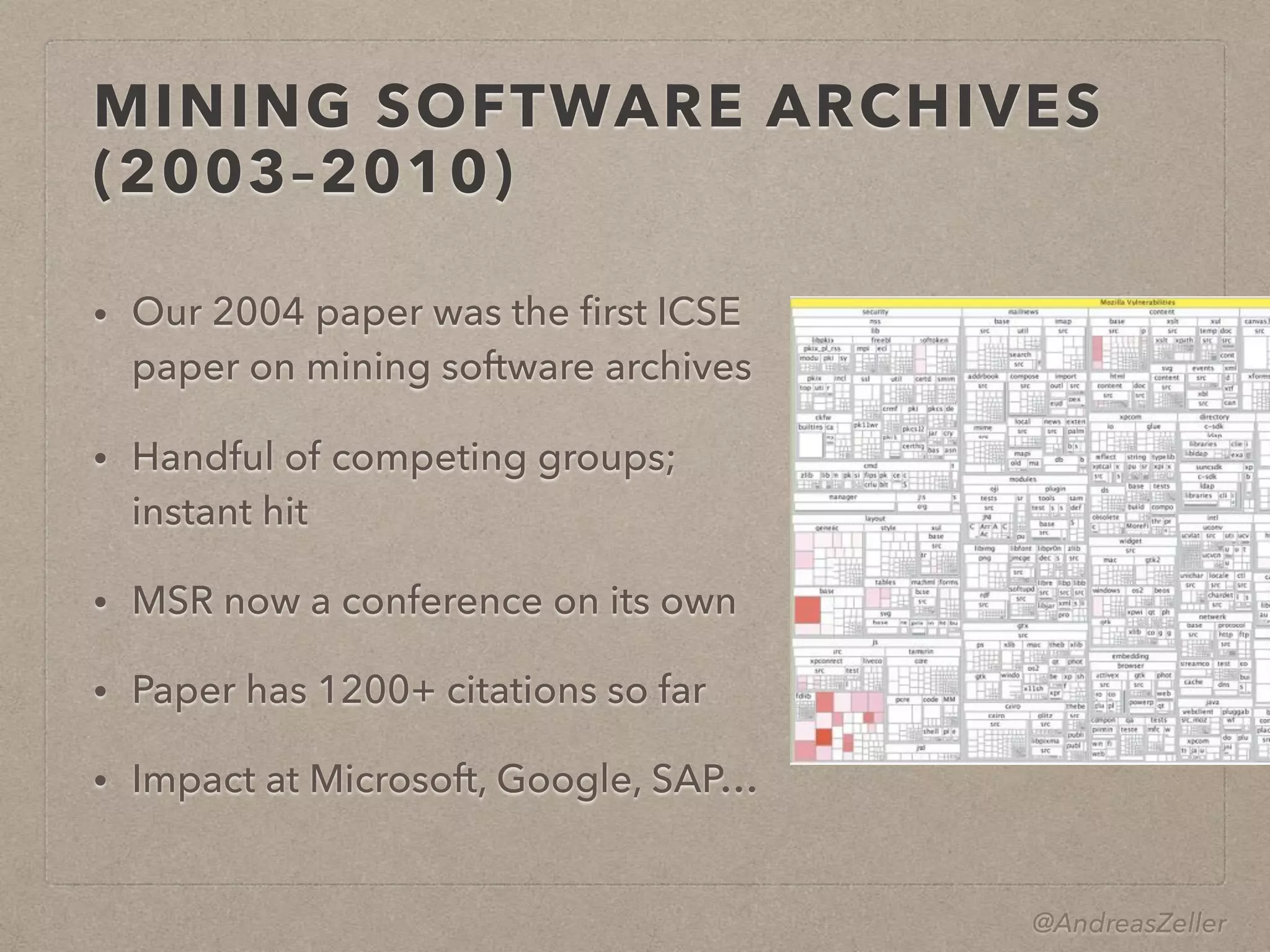
MINING SOFTWARE ARCHIVES
(2003–2010)
• Our 2004 paper was the first ICSE
paper on mining software archives
• Handful of competing groups;

instant hit
• MSR now a conference on its own
• Paper has 1200+ citations so far
• Impact at Microsoft, Google, SAP…
@AndreasZeller
MINING SOFTWARE ARCHIVES
(2003–2010)
• We are now after the gold rush
• Data still exciting (if you have some)
• Few new insights on old data
• Get out of a field when too crowded
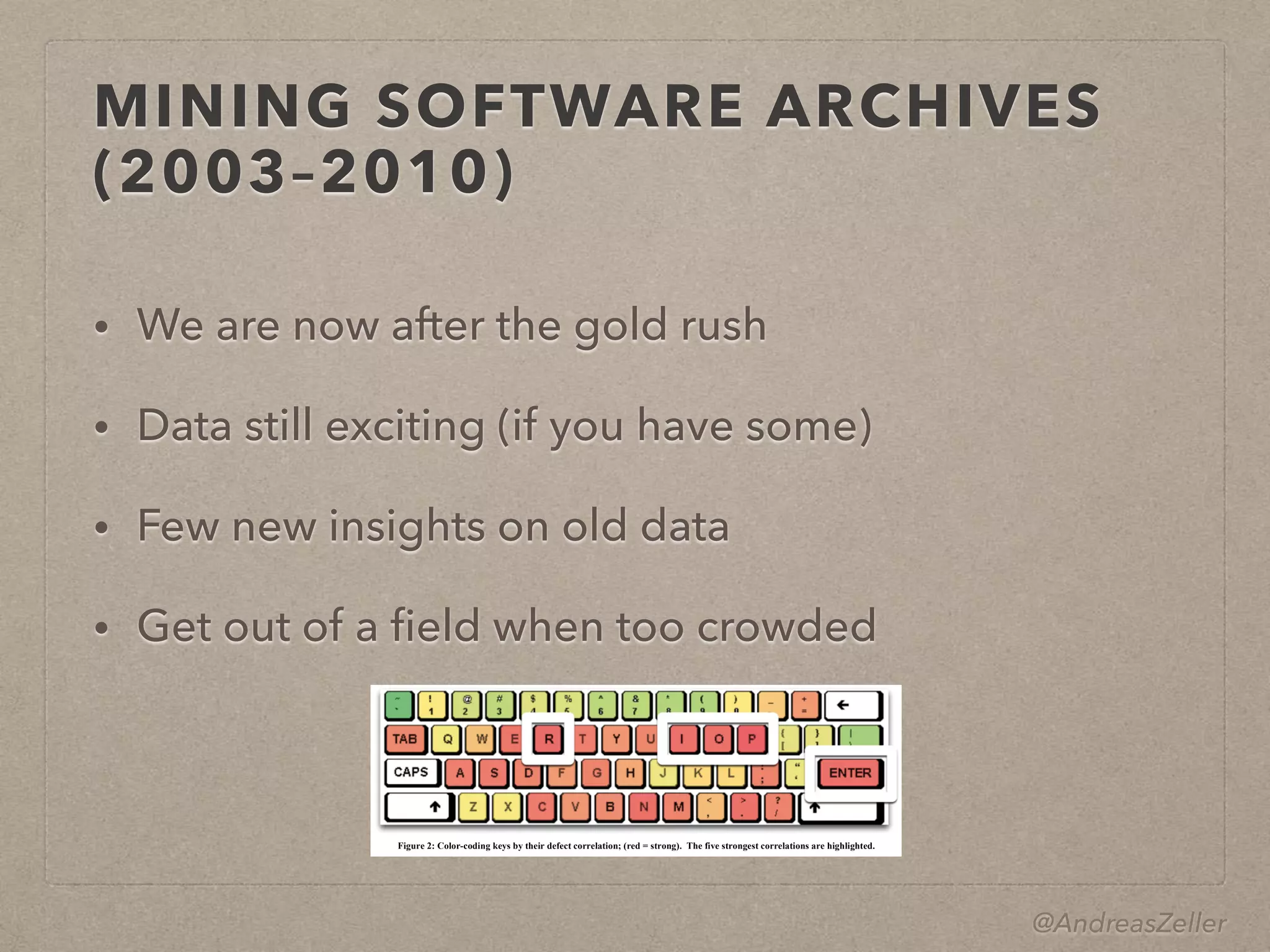
3.5 Programmer Actions and Defects
Now that we know how to predict defects, can we actually prevent
them? Of course, we could focus quality assurance on those files
predicted as most defect-prone. But are there also constructive
ways to avoid these defects? Is there a general rule to learn?
For this purpose, let us now focus on H2: Is there a correlation
Figure 2: Color-coding keys by their defect correlation; (red = strong). The five strongest correlations are highlighted.
@AndreasZeller
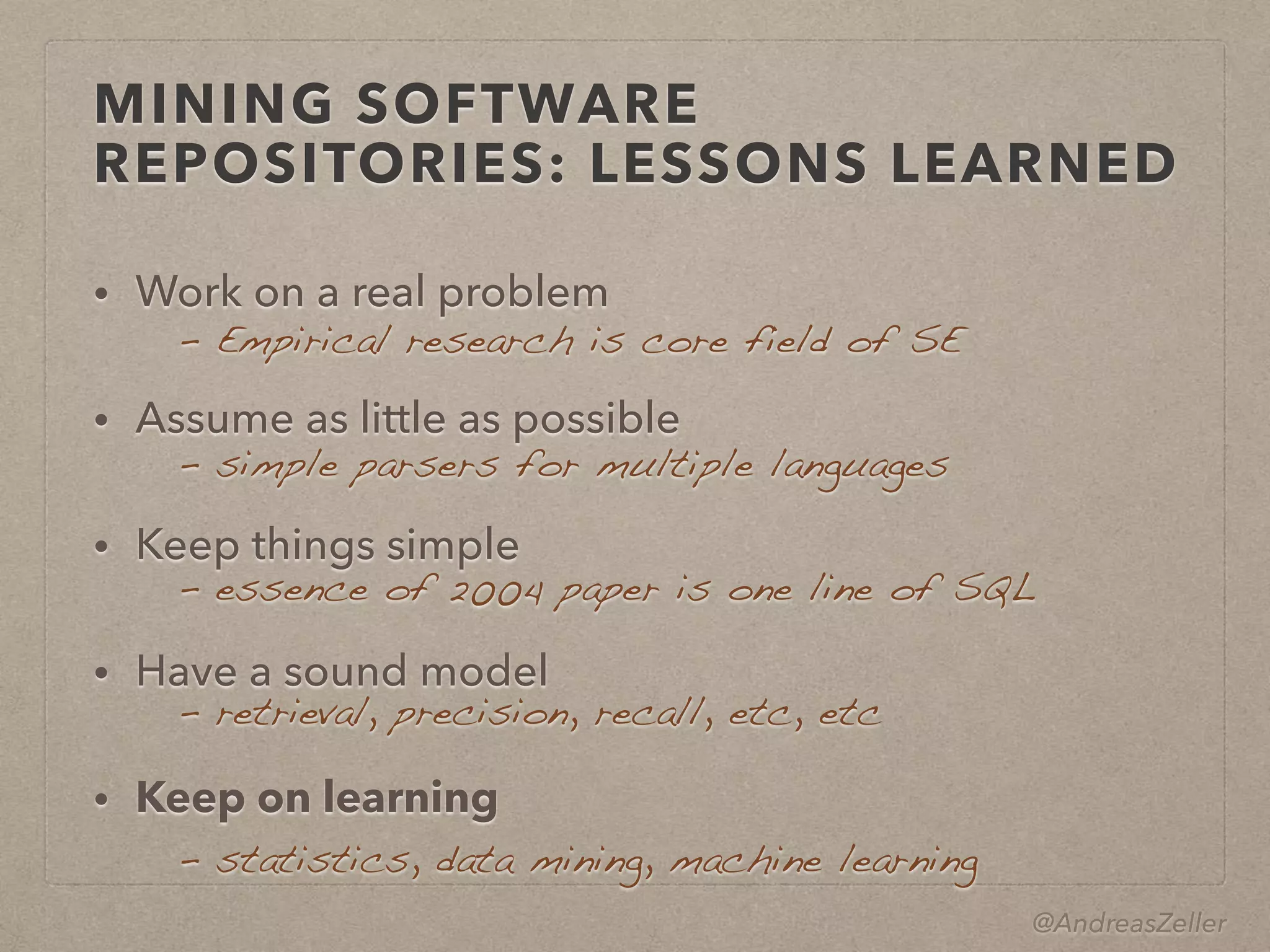
MINING SOFTWARE
REPOSITORIES: LESSONS LEARNED
• Work on a real problem
• Assume as little as possible
• Keep things simple
• Have a sound model
• Keep on learning
–  Empirical research is core field of SE
–  simple parsers for multiple languages
–  essence of 2004 paper is one line of SQL
–  retrieval, precision, recall, etc, etc
–  statistics, data mining, machine learning
@AndreasZeller
MINING APP ARCHIVES (2014–)
• How do we know an app
does what it should do?
• CHABADA checks for
mismatches between
description and behavior
• Novel usage of NLP; 

novel app store mining
Checking App Behavior Against App Descriptions
Alessandra Gorla · Ilaria Tavecchia⇤
· Florian Gross · Andreas Zeller
Saarland University
Saarbrücken, Germany
{gorla, tavecchia, fgross, zeller}@cs.uni-saarland.de
ABSTRACT
How do we know a program does what it claims to do? After clus-
tering Android apps by their description topics, we identify outliers
in each cluster with respect to their API usage. A “weather” app that
sends messages thus becomes an anomaly; likewise, a “messaging”
app would typically not be expected to access the current location.
Applied on a set of 22,500+ Android applications, our CHABADA
prototype identified several anomalies; additionally, it flagged 56%
of novel malware as such, without requiring any known malware
patterns.
Categories and Subject Descriptors
D.4.6 [Security and Protection]: Invasive software
General Terms
Security
Keywords
Android, malware detection, description analysis, clustering
1. INTRODUCTION
Checking whether a program does what it claims to do is a long-
standing problem for developers. Unfortunately, it now has become
a problem for computer users, too. Whenever we install a new app,
we run the risk of the app being “malware”—that is, to act against
1. App collection 2. Topics
"Weather",
"Map"…
"Travel",
"Map"…
"Theme"
3. Clusters
Weather
+ Travel
Themes
Access-LocationInternet Access-LocationInternet Send-SMS
4. Used APIs 5. Outliers
Weather
+ Travel
Figure 1: Detecting applications with unadvertised behavior.
Starting from a collection of “good” apps (1), we identify their
description topics (2) to form clusters of related apps (3). For
each cluster, we identify the sentitive APIs used (4), and can
then identify outliers that use APIs that are uncommon for that
cluster (5).
• An app that sends a text message to a premium number to
raise money is suspicious? Maybe, but on Android, this is a
@AndreasZeller
MINING APP ARCHIVES (2014–)
• The ICSE paper of 2014 is
among most cited
• CHABADA techniques now
adopted by Google and
Microsoft
• Most of your mobile apps
have gone through such an
analysis :-)
Checking App Behavior Against App Descriptions
Alessandra Gorla · Ilaria Tavecchia⇤
· Florian Gross · Andreas Zeller
Saarland University
Saarbrücken, Germany
{gorla, tavecchia, fgross, zeller}@cs.uni-saarland.de
ABSTRACT
How do we know a program does what it claims to do? After clus-
tering Android apps by their description topics, we identify outliers
in each cluster with respect to their API usage. A “weather” app that
sends messages thus becomes an anomaly; likewise, a “messaging”
app would typically not be expected to access the current location.
Applied on a set of 22,500+ Android applications, our CHABADA
prototype identified several anomalies; additionally, it flagged 56%
of novel malware as such, without requiring any known malware
patterns.
Categories and Subject Descriptors
D.4.6 [Security and Protection]: Invasive software
General Terms
Security
Keywords
Android, malware detection, description analysis, clustering
1. INTRODUCTION
Checking whether a program does what it claims to do is a long-
standing problem for developers. Unfortunately, it now has become
a problem for computer users, too. Whenever we install a new app,
we run the risk of the app being “malware”—that is, to act against
1. App collection 2. Topics
"Weather",
"Map"…
"Travel",
"Map"…
"Theme"
3. Clusters
Weather
+ Travel
Themes
Access-LocationInternet Access-LocationInternet Send-SMS
4. Used APIs 5. Outliers
Weather
+ Travel
Figure 1: Detecting applications with unadvertised behavior.
Starting from a collection of “good” apps (1), we identify their
description topics (2) to form clusters of related apps (3). For
each cluster, we identify the sentitive APIs used (4), and can
then identify outliers that use APIs that are uncommon for that
cluster (5).
• An app that sends a text message to a premium number to
raise money is suspicious? Maybe, but on Android, this is a
@AndreasZeller
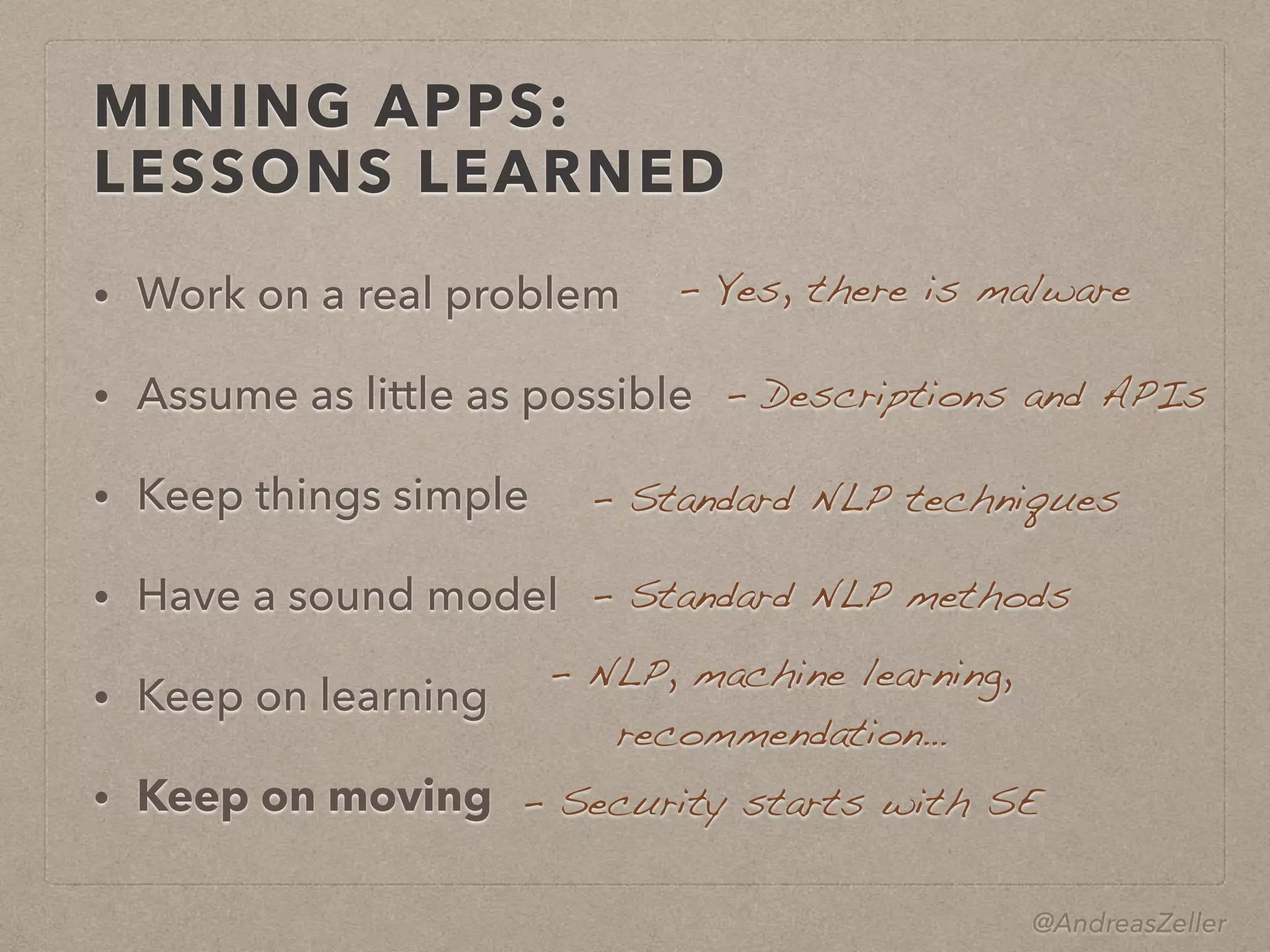
MINING APPS:

LESSONS LEARNED
• Work on a real problem
• Assume as little as possible
• Keep things simple
• Have a sound model
• Keep on learning
• Keep on moving
–  Yes, there is malware
–  Descriptions and APIs
–  Standard NLP techniques
–  Standard NLP methods
–  NLP, machine learning,

recommendation…
–  Security starts with SE
@AndreasZeller
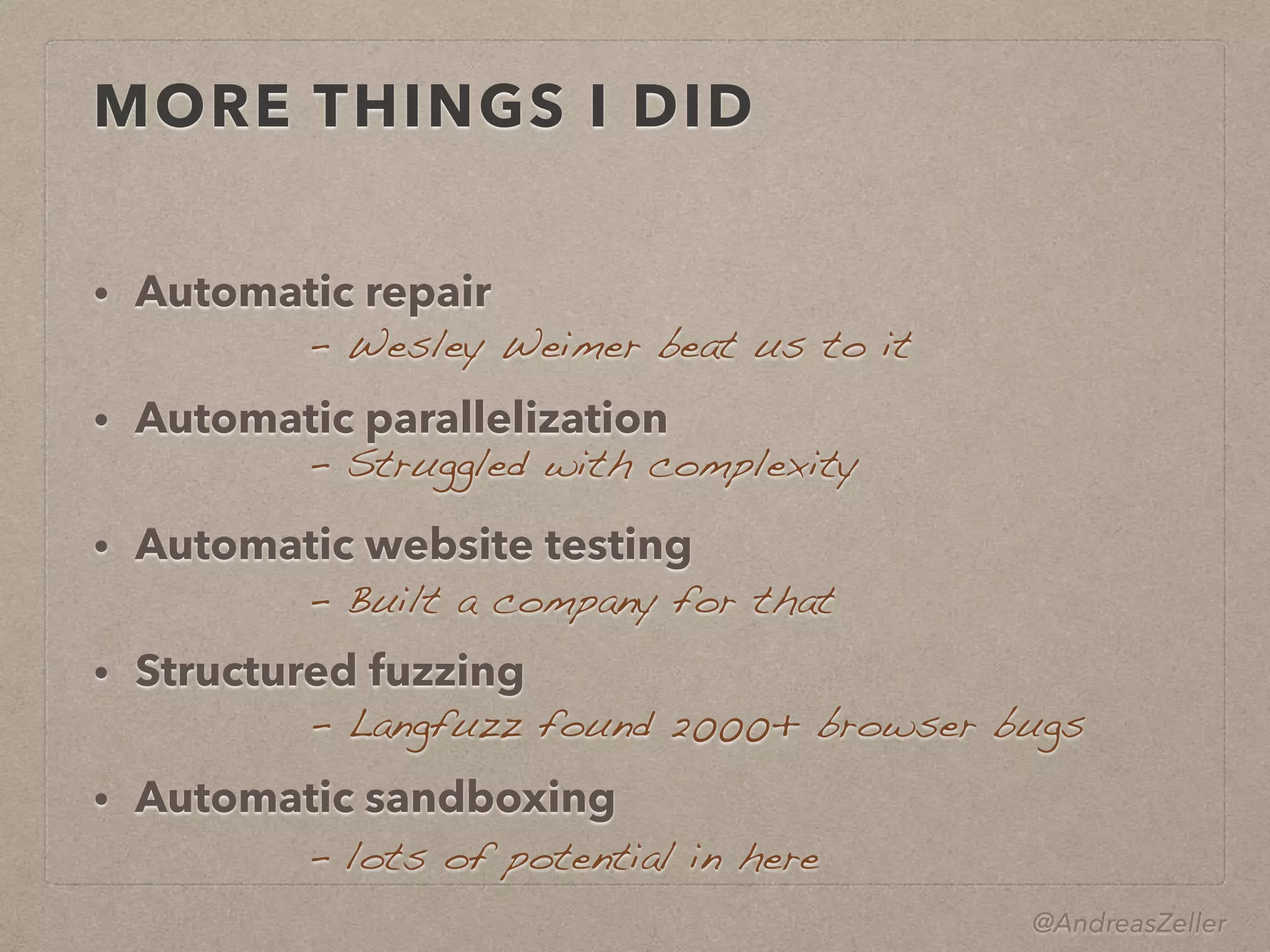
MORE THINGS I DID
• Automatic repair
• Automatic parallelization
• Automatic website testing
• Structured fuzzing
• Automatic sandboxing
–  Wesley Weimer beat us to it
–  Struggled with complexity
–  Langfuzz found 2000+ browser bugs
–  lots of potential in here
–  Built a company for that
@AndreasZeller
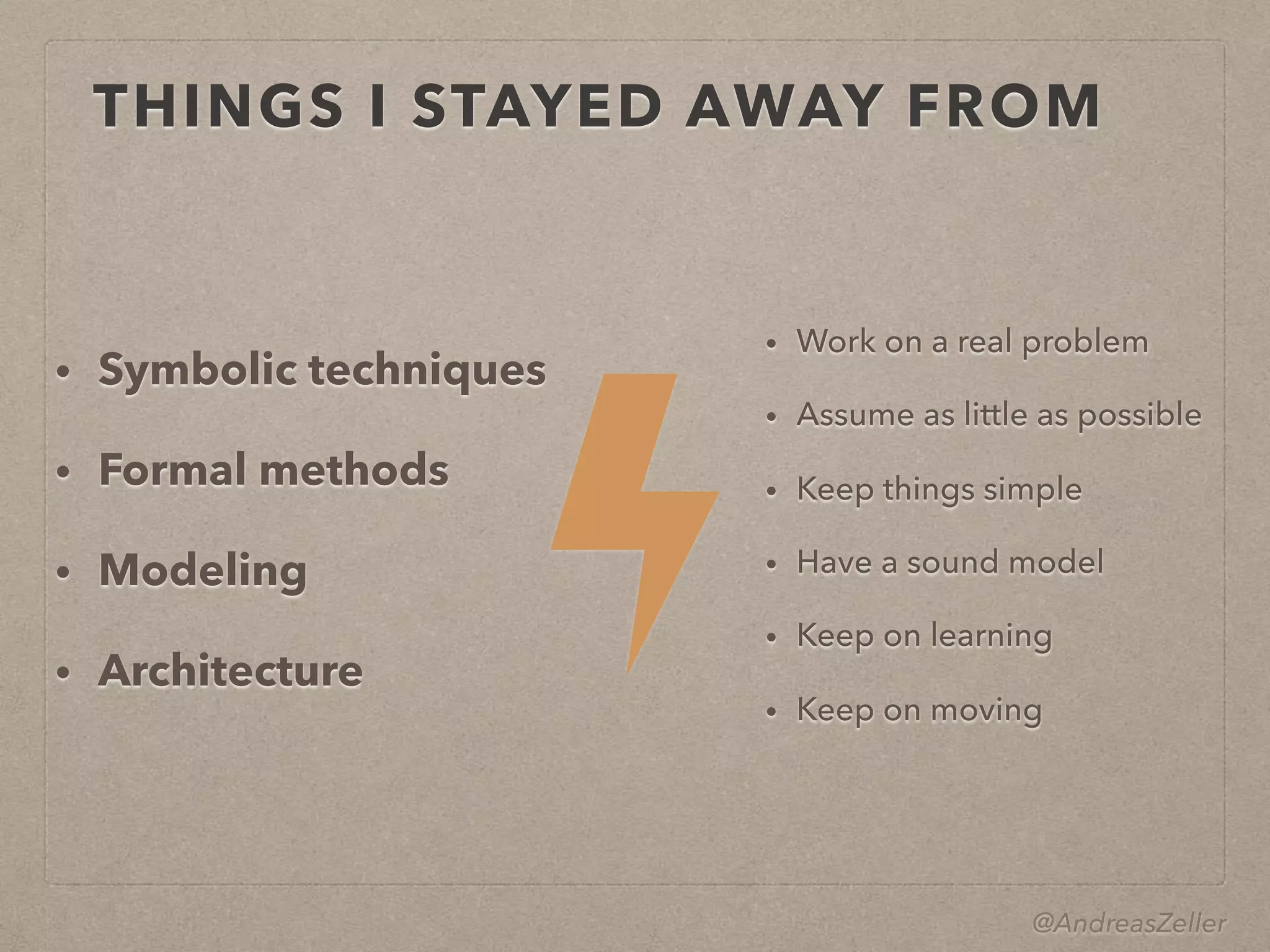
THINGS I STAYED AWAY FROM
• Symbolic techniques
• Formal methods
• Modeling
• Architecture
• Work on a real problem
• Assume as little as possible
• Keep things simple
• Have a sound model
• Keep on learning
• Keep on moving
@AndreasZeller
YOUR WAYS TO HAVE IMPACT
@AndreasZeller
IMPACT AS A RESEARCHER
• Society funds research

to take risks that no one else does
• Research is risky by construction – 

you should expect to fail, and fail again
• Tenure is meant to allow you to take arbitrarily
grand challenges – so work on the grand stuff
• If you lack resources, try smarter and harder
@AndreasZeller
IMPACT AS A TEACHER
• Teaching can be a great way to multiply your
message
• Not only focus on teaching the standards, but also
your research
• Teaching your research helps to propagate it and
make it accessible
• Engage students on topics dear to you
@AndreasZeller
IMPACT WITH INDUSTRY
• Do work with industry

to find problems and frame your work
• Do not work with industry

to solve (their) concrete problems
• Your role as researcher is more

than a cheap consulting tool
• Many “research” funding schemes

are there to subsidize industry
@AndreasZeller
IMPACT THROUGH TOOLS
• Getting your technique out as a tool is a great way
to have impact!
• Also allows to check what actual users need (and if
they exist)
• A tool can have far more impact than a paper
• Funding agencies and hiring committees begin to
realize this
@AndreasZeller
IMPACT AS FOUNDER
• Creating a company out of your research can be
great fun!
• Push your research and ideas into practice
• Again, shows you what the market wants

(and what not)
• Plenty of support available (money, consultancy)
@AndreasZeller
IMPACT AS MENTOR
• Working with advanced students can be the most
satisfying part of your job
• The variety of SE research needs universal
problem solving skills
• Find such skills besides good grades
@AndreasZeller
A GREAT ENVIRONMENT
• My institution (Saarland University) hired me

although I was the candidate with the fewest
publications
• But they liked the papers, so they hired me
• No pressure or incentives on papers, citations,
funding, etc.
• One single expectation: long-term impact
@AndreasZeller
SURVIVOR BIAS
• Researchers with great impact are the selected few
who survived academic selection
• What worked for me will not work for most
• Most of us have to struggle with plenty of bad,
misguided, short-term career incentives
• Follow incentives until tenured, then set better ones
• Get lucky!
ON IMPACT IN SOFTWARE ENGINEERING
RESEARCH
ANDREAS ZELLER, CISPA / SAARLAND UNIVERSITY
@AndreasZeller
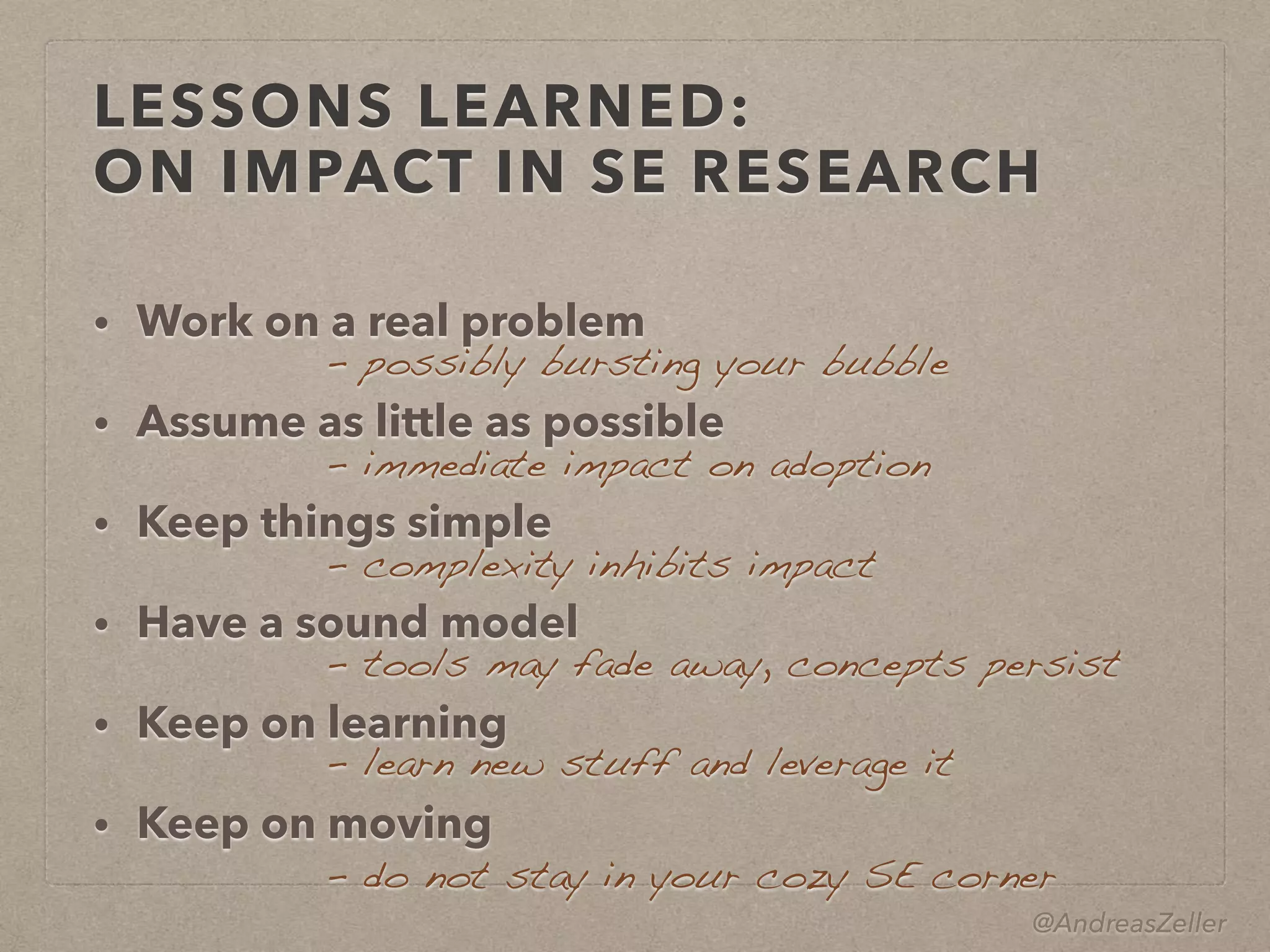
LESSONS LEARNED:

ON IMPACT IN SE RESEARCH
• Work on a real problem
• Assume as little as possible
• Keep things simple
• Have a sound model
• Keep on learning
• Keep on moving
–  possibly bursting your bubble
–  immediate impact on adoption
–  complexity inhibits impact
–  tools may fade away, concepts persist
– learn new stuff and leverage it
– do not stay in your cozy SE corner

On impact in Software Engineering Research (ICSE 2018 New Faculty Symposium)

  • 1.
    ON IMPACT INSOFTWARE ENGINEERING RESEARCH ANDREAS ZELLER, CISPA / SAARLAND UNIVERSITY ICSE NEW FACULTY SYMPOSIUM GÖTEBORG, MAY 29, 2018 @AndreasZeller
  • 2.
    @AndreasZeller ANDREAS ZELLER: KEYFACTS • PhD in 1997 on Configuration Management with Feature Logic • Since 2001 professor at Saarland Informatics Campus
 (Saarland University / CISPA) • Four 10-year impact awards 2009–2017
 (for papers 1999–2007) • ACM Fellow in 2010 • ERC Advanced Grant in 2011 • SIGSOFT Outstanding Research Award on Friday
  • 3.
  • 4.
    @AndreasZeller WHAT IS IMPACT? •How do your actions change the world? • Often measured in citations, publications, funding, people, … • All these are indicators of impact, but not goals in themselves • We want to make the world a better place • Gives meaning and purpose to our (professional) life
  • 5.
    @AndreasZeller WHAT MAKES IMPACTFUL RESEARCH? •Intellectual challenge – was it hard, or could anyone have done this? • Elegance – is your research specific to a context, or can it be reused again and again? • Usefulness – can someone make money with it? • Innovation is the delta in any of these metrics
  • 6.
    @AndreasZeller VARYING PERSPECTIVES • ProgrammingLanguages folks miss the intellectual challenge • Formal Methods folks miss elegance and challenge • Industry folks miss usefulness and applicability
  • 7.
    @AndreasZeller WHAT MAKES IMPACTFUL RESEARCH? •How did your work make the world a better place?
  • 8.
  • 9.
    @AndreasZeller MY PATH TOIMPACT • Life can only be understood backwards; 
 but it must be lived forwards
 (Søren Kierkegaard)
  • 10.
    @AndreasZeller CONFIGURATION MANAGEMENT
 WITH FEATURELOGIC (1991–1997) • Topic defined by my PhD advisor Gregor Snelting • Idea: Formally describe variants and revisions with feature logic • “A unified model for configuration management” 3.3 Combining Delta Features and other Features .......... bug fixed f functionbug fixed f function bug fixed f function procedurebug fixed f function procedure bug fixed f function bug fixed f procedure Figure 8: Delta features and other features . This is only natural, since the change relies on the presence of the change. Adding a new revision under implies that the revision is now tagged w , so that the generalization property is not violated. Indeed, . 3.3 Combining Delta Features and other Features Besides all the delta features, other features are still allowed (and encouraged). Until now, we l them out for clarity. However, there is no difference between the handling of delta features and oth features, as is shown in the following example. Example 3.3 Consider figure 8. Here, we have figure 6 revisited, but enhanced with more featur We assume that the change named fixes a bug and introduces a new symbol f, which is a functio
  • 11.
    @AndreasZeller FEATURE LOGIC:
 LESSONS LEARNED •You can get plenty of papers accepted • even if you miss the problem • even if you do not evaluate • “Modeling for the sake of modeling” • Enabled much of my later work, though
  • 12.
    @AndreasZeller DDD (1994–1999) • DuringPhD, programmed a lot • Debugging was hard! • Built the DDD debugger GUI
 with my student Dorothea Lütkehaus • Welcome change
 from formal work
  • 13.
    @AndreasZeller DDD (1994–1999) • DDDwas among the first dev tools with a “professional” GUI • Downloaded by the tens of thousands • Adopted as a GNU project:
 Street credibility with developers • Impact through usefulness
  • 14.
    @AndreasZeller DDD: LESSONS LEARNED •Work on a real problem
 • Assume as little as possible
 • Keep things simple –  “real” as in “real world”, not “real papers” –  make things fit into real processes –  complexity impresses, but prevents impact
  • 15.
    @AndreasZeller DELTA DEBUGGING (1999–2003) •After PhD, looking for new topic • Delta Debugging brought together debugging and version control • Isolate failure causes through repeated experiments
  • 16.
    @AndreasZeller DELTA DEBUGGING (1999–2003) •Delta debugging
 was a bomb • Easy to teach + understand • 7 lines of algorithm
 (and 25 lines of Python) • Spent two years on these ⎧ ⎪⎪⎪⎪⎪⎪⎪⎪⎪⎪⎪⎪⎪⎨ ⎪⎪⎪⎪⎪⎪⎪⎪⎪⎪⎪⎪⎪⎩ (c′ ✔, c′ ✘) if |∆| = 1 dd′ (c′ ✘ ∆i, c′ ✘, 2) if ∃i ∈ {1..n} · test(c′ ✘ ∆i) = ✔ dd′ (c′ ✔, c′ ✔ ∪ ∆i, 2) if ∃i ∈ {1..n} · test(c′ ✔ ∪ ∆i) = ✘ dd′ c′ ✔ ∪ ∆i, c′ ✘, max(n − 1, 2) else if ∃i ∈ {1..n} · test(c′ ✔ ∪ ∆i) = ✔ dd′ c′ ✔, c′ ✘ ∆i, max(n − 1, 2) else if ∃i ∈ {1..n} · test(c′ ✘ ∆i) = ✘ dd′ c′ ✔, c′ ✘, min(2n, |∆|) else if n < |∆| (“increase granularity”) (c′ ✔, c′ ✘) otherwise dd(c✔, c✘) = dd′ (c✔, c✘, 2) dd′ (c′ ✔, c′ ✘, n) =
  • 17.
    @AndreasZeller DELTA DEBUGGING: LESSONS LEARNED •Work on a real problem • Assume as little as possible • Keep things simple • Have a sound model –  Version control? tests? Never heard of it – 25 lines of Python is probably excessive –  DD was my version model reborn –  Why debug? We build correct software
  • 18.
    @AndreasZeller MINING SOFTWARE ARCHIVES (2003–2010) •In the early 2000s, open-source version repositories became available • Stephan Diehl saw an opportunity for visualization and approached me • Quickly expanded into data mining • Tom Zimmermann: our MSc student • Work of a research team
  • 19.
    @AndreasZeller MINING SOFTWARE ARCHIVES (2003–2010) •Our 2004 paper was the first ICSE paper on mining software archives • Handful of competing groups;
 instant hit • MSR now a conference on its own • Paper has 1200+ citations so far • Impact at Microsoft, Google, SAP…
  • 20.
    @AndreasZeller MINING SOFTWARE ARCHIVES (2003–2010) •We are now after the gold rush • Data still exciting (if you have some) • Few new insights on old data • Get out of a field when too crowded 3.5 Programmer Actions and Defects Now that we know how to predict defects, can we actually prevent them? Of course, we could focus quality assurance on those files predicted as most defect-prone. But are there also constructive ways to avoid these defects? Is there a general rule to learn? For this purpose, let us now focus on H2: Is there a correlation Figure 2: Color-coding keys by their defect correlation; (red = strong). The five strongest correlations are highlighted.
  • 21.
    @AndreasZeller MINING SOFTWARE REPOSITORIES: LESSONSLEARNED • Work on a real problem • Assume as little as possible • Keep things simple • Have a sound model • Keep on learning –  Empirical research is core field of SE –  simple parsers for multiple languages –  essence of 2004 paper is one line of SQL –  retrieval, precision, recall, etc, etc –  statistics, data mining, machine learning
  • 22.
    @AndreasZeller MINING APP ARCHIVES(2014–) • How do we know an app does what it should do? • CHABADA checks for mismatches between description and behavior • Novel usage of NLP; 
 novel app store mining Checking App Behavior Against App Descriptions Alessandra Gorla · Ilaria Tavecchia⇤ · Florian Gross · Andreas Zeller Saarland University Saarbrücken, Germany {gorla, tavecchia, fgross, zeller}@cs.uni-saarland.de ABSTRACT How do we know a program does what it claims to do? After clus- tering Android apps by their description topics, we identify outliers in each cluster with respect to their API usage. A “weather” app that sends messages thus becomes an anomaly; likewise, a “messaging” app would typically not be expected to access the current location. Applied on a set of 22,500+ Android applications, our CHABADA prototype identified several anomalies; additionally, it flagged 56% of novel malware as such, without requiring any known malware patterns. Categories and Subject Descriptors D.4.6 [Security and Protection]: Invasive software General Terms Security Keywords Android, malware detection, description analysis, clustering 1. INTRODUCTION Checking whether a program does what it claims to do is a long- standing problem for developers. Unfortunately, it now has become a problem for computer users, too. Whenever we install a new app, we run the risk of the app being “malware”—that is, to act against 1. App collection 2. Topics "Weather", "Map"… "Travel", "Map"… "Theme" 3. Clusters Weather + Travel Themes Access-LocationInternet Access-LocationInternet Send-SMS 4. Used APIs 5. Outliers Weather + Travel Figure 1: Detecting applications with unadvertised behavior. Starting from a collection of “good” apps (1), we identify their description topics (2) to form clusters of related apps (3). For each cluster, we identify the sentitive APIs used (4), and can then identify outliers that use APIs that are uncommon for that cluster (5). • An app that sends a text message to a premium number to raise money is suspicious? Maybe, but on Android, this is a
  • 23.
    @AndreasZeller MINING APP ARCHIVES(2014–) • The ICSE paper of 2014 is among most cited • CHABADA techniques now adopted by Google and Microsoft • Most of your mobile apps have gone through such an analysis :-) Checking App Behavior Against App Descriptions Alessandra Gorla · Ilaria Tavecchia⇤ · Florian Gross · Andreas Zeller Saarland University Saarbrücken, Germany {gorla, tavecchia, fgross, zeller}@cs.uni-saarland.de ABSTRACT How do we know a program does what it claims to do? After clus- tering Android apps by their description topics, we identify outliers in each cluster with respect to their API usage. A “weather” app that sends messages thus becomes an anomaly; likewise, a “messaging” app would typically not be expected to access the current location. Applied on a set of 22,500+ Android applications, our CHABADA prototype identified several anomalies; additionally, it flagged 56% of novel malware as such, without requiring any known malware patterns. Categories and Subject Descriptors D.4.6 [Security and Protection]: Invasive software General Terms Security Keywords Android, malware detection, description analysis, clustering 1. INTRODUCTION Checking whether a program does what it claims to do is a long- standing problem for developers. Unfortunately, it now has become a problem for computer users, too. Whenever we install a new app, we run the risk of the app being “malware”—that is, to act against 1. App collection 2. Topics "Weather", "Map"… "Travel", "Map"… "Theme" 3. Clusters Weather + Travel Themes Access-LocationInternet Access-LocationInternet Send-SMS 4. Used APIs 5. Outliers Weather + Travel Figure 1: Detecting applications with unadvertised behavior. Starting from a collection of “good” apps (1), we identify their description topics (2) to form clusters of related apps (3). For each cluster, we identify the sentitive APIs used (4), and can then identify outliers that use APIs that are uncommon for that cluster (5). • An app that sends a text message to a premium number to raise money is suspicious? Maybe, but on Android, this is a
  • 24.
    @AndreasZeller MINING APPS:
 LESSONS LEARNED •Work on a real problem • Assume as little as possible • Keep things simple • Have a sound model • Keep on learning • Keep on moving –  Yes, there is malware –  Descriptions and APIs –  Standard NLP techniques –  Standard NLP methods –  NLP, machine learning,
 recommendation… –  Security starts with SE
  • 25.
    @AndreasZeller MORE THINGS IDID • Automatic repair • Automatic parallelization • Automatic website testing • Structured fuzzing • Automatic sandboxing –  Wesley Weimer beat us to it –  Struggled with complexity –  Langfuzz found 2000+ browser bugs –  lots of potential in here –  Built a company for that
  • 26.
    @AndreasZeller THINGS I STAYEDAWAY FROM • Symbolic techniques • Formal methods • Modeling • Architecture • Work on a real problem • Assume as little as possible • Keep things simple • Have a sound model • Keep on learning • Keep on moving
  • 27.
  • 28.
    @AndreasZeller IMPACT AS ARESEARCHER • Society funds research
 to take risks that no one else does • Research is risky by construction – 
 you should expect to fail, and fail again • Tenure is meant to allow you to take arbitrarily grand challenges – so work on the grand stuff • If you lack resources, try smarter and harder
  • 29.
    @AndreasZeller IMPACT AS ATEACHER • Teaching can be a great way to multiply your message • Not only focus on teaching the standards, but also your research • Teaching your research helps to propagate it and make it accessible • Engage students on topics dear to you
  • 30.
    @AndreasZeller IMPACT WITH INDUSTRY •Do work with industry
 to find problems and frame your work • Do not work with industry
 to solve (their) concrete problems • Your role as researcher is more
 than a cheap consulting tool • Many “research” funding schemes
 are there to subsidize industry
  • 31.
    @AndreasZeller IMPACT THROUGH TOOLS •Getting your technique out as a tool is a great way to have impact! • Also allows to check what actual users need (and if they exist) • A tool can have far more impact than a paper • Funding agencies and hiring committees begin to realize this
  • 32.
    @AndreasZeller IMPACT AS FOUNDER •Creating a company out of your research can be great fun! • Push your research and ideas into practice • Again, shows you what the market wants
 (and what not) • Plenty of support available (money, consultancy)
  • 33.
    @AndreasZeller IMPACT AS MENTOR •Working with advanced students can be the most satisfying part of your job • The variety of SE research needs universal problem solving skills • Find such skills besides good grades
  • 34.
    @AndreasZeller A GREAT ENVIRONMENT •My institution (Saarland University) hired me
 although I was the candidate with the fewest publications • But they liked the papers, so they hired me • No pressure or incentives on papers, citations, funding, etc. • One single expectation: long-term impact
  • 35.
    @AndreasZeller SURVIVOR BIAS • Researcherswith great impact are the selected few who survived academic selection • What worked for me will not work for most • Most of us have to struggle with plenty of bad, misguided, short-term career incentives • Follow incentives until tenured, then set better ones • Get lucky!
  • 36.
    ON IMPACT INSOFTWARE ENGINEERING RESEARCH ANDREAS ZELLER, CISPA / SAARLAND UNIVERSITY
  • 37.
    @AndreasZeller LESSONS LEARNED:
 ON IMPACTIN SE RESEARCH • Work on a real problem • Assume as little as possible • Keep things simple • Have a sound model • Keep on learning • Keep on moving –  possibly bursting your bubble –  immediate impact on adoption –  complexity inhibits impact –  tools may fade away, concepts persist – learn new stuff and leverage it – do not stay in your cozy SE corner