Bihar is categorized as a "Factor Driven Economy" with per capita income less than $400. It has the lowest microeconomic competitiveness rank of all states at 1. While Bihar has low GDP growth compared to India as a whole, its growth rate is rising. Creating a clear economic strategy that engages stakeholders is important for achieving fiscal stability and enhancing the state's competitiveness during times of austerity.
In this document
Powered by AI
Introduction to the state profiles of Bihar.
Discussion on fiscal stability and enhancing state competitiveness through a clear economic strategy.
A trend analysis of GDP per capita real growth rates from 2008 to 2011, showcasing Bihar's economic trajectory.
Underlying concepts of competitiveness emphasizing productivity, innovation, and collaboration between public and private sectors.
Summary of Bihar's economic performance indicators focusing on prosperity, productivity, and labor mobilization.
Key performance indicators including GSDP, productivity growth, private wage comparisons, and employment statistics.
The GSDP growth over years highlighting the economic performance of Bihar.
Contribution of Bihar's GSDP to India's overall GDP from 2000 to 2011, with trends displayed.
Factors driving state productivity including business climate and economic stage.
Framework for analyzing Bihar's economic conditions focusing on innovation and local rivalry.
Key issues impacting state productivity with recommendations for improvement.
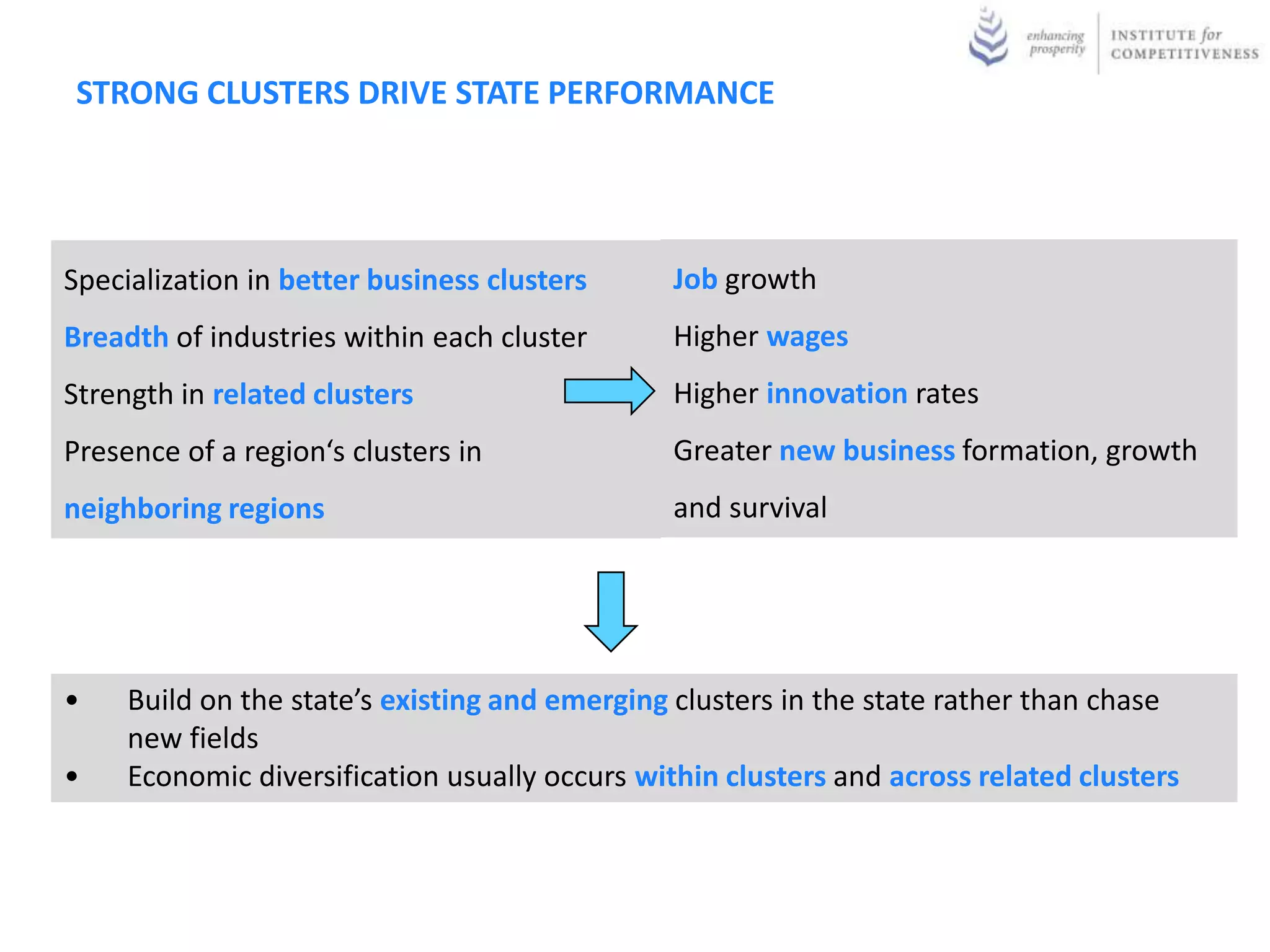
Importance of business clusters in driving job growth, innovation, and economic diversification.
The role of geography, policies, and integration with regions on state competitiveness.
Analysis of the agricultural sector's contribution to GSDP over the years.
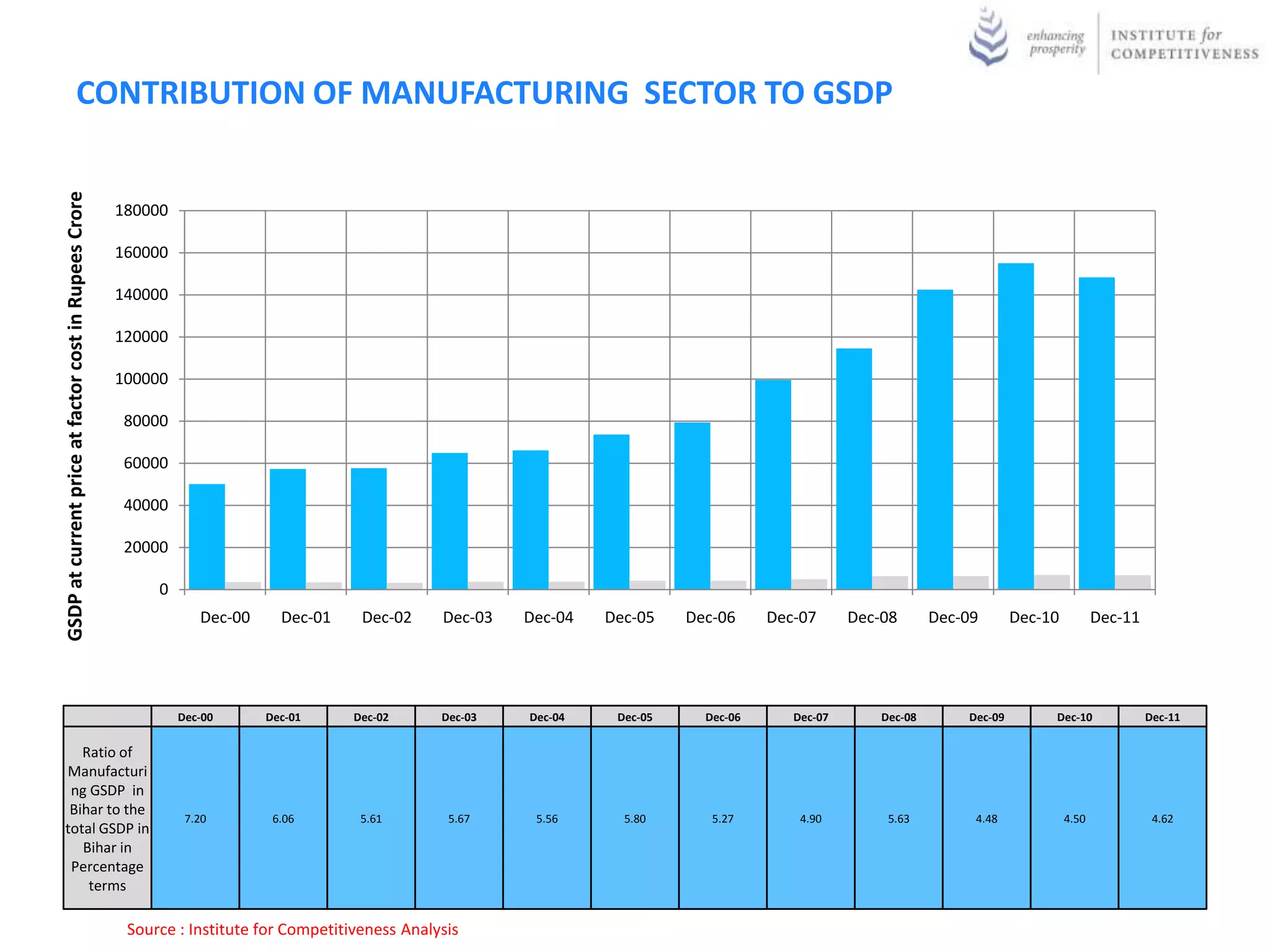
Overview of the manufacturing sector's performance and its contribution to GSDP.
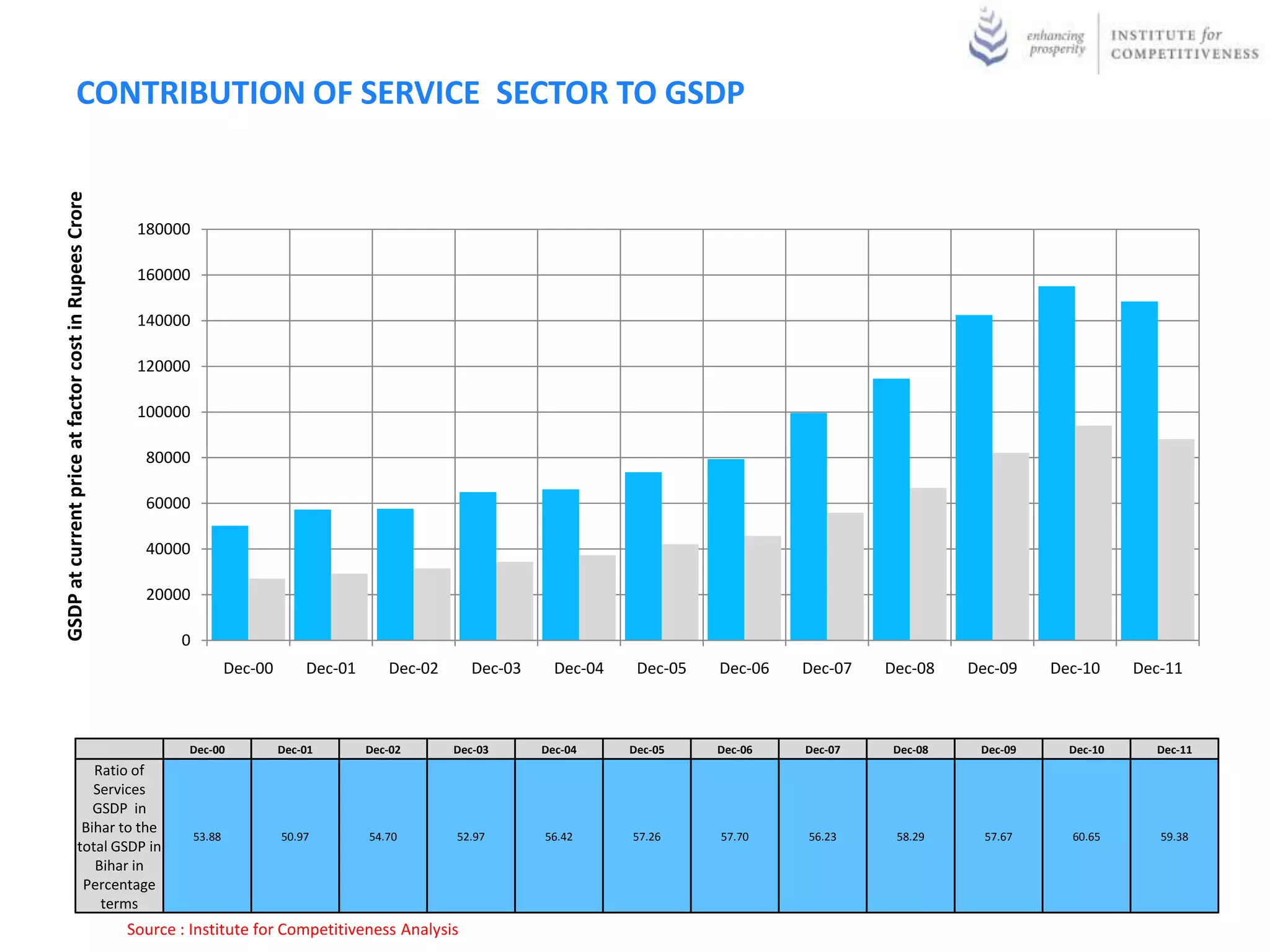
Insight into the service sector's growth and its substantial contribution to GSDP.
Breakdown of Bihar's economy showcasing the agriculture, industry, and services percentages.
Quantitative analysis of the GSDP contributions from agriculture, industry, and services.
In-depth analysis of GSDP shares and sectors like agriculture, services, and industry.
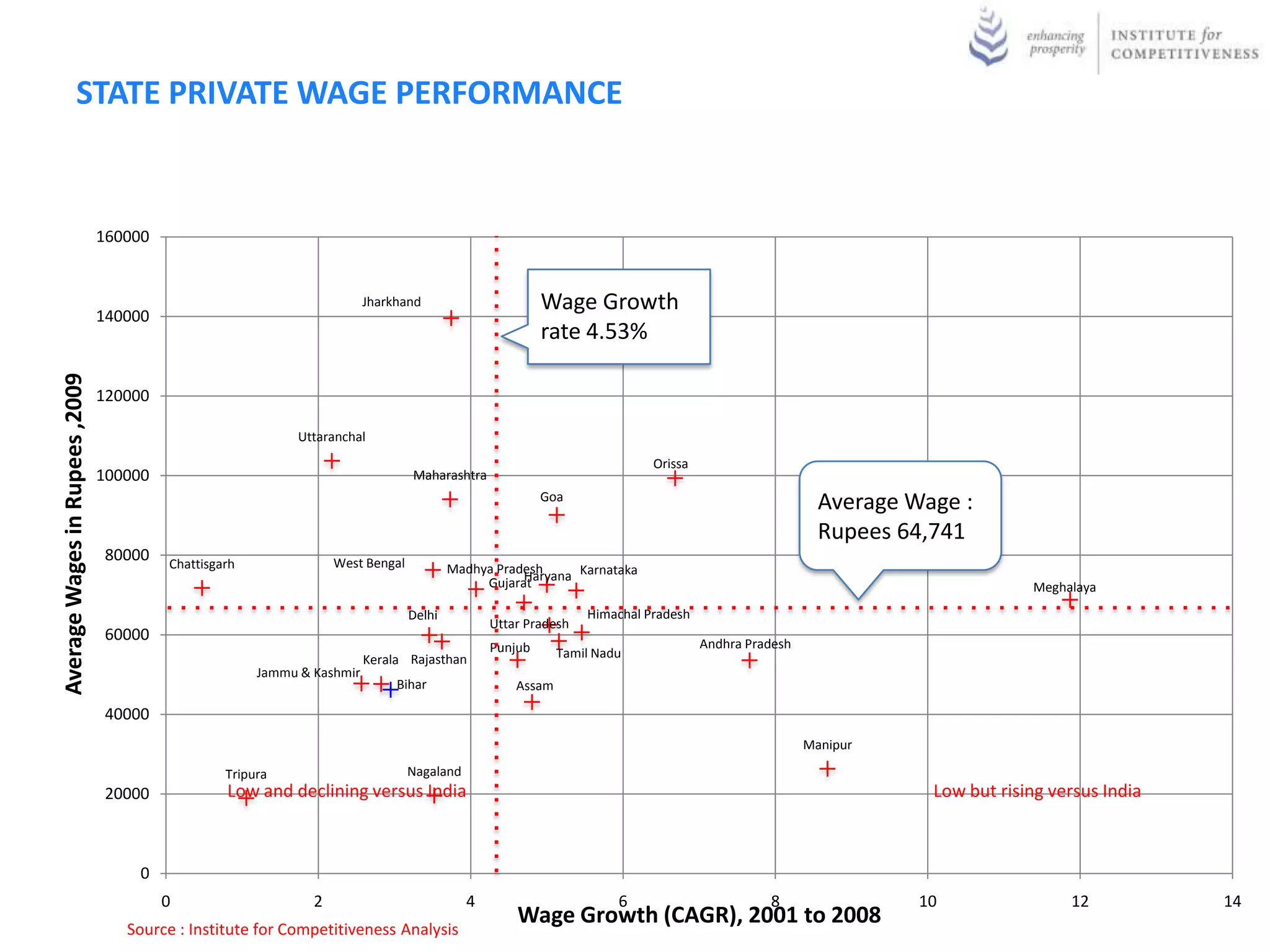
State private wage performance comparison across states revealing Bihar's standing.
Comparison of labor productivity metrics across states highlighting Bihar's position.
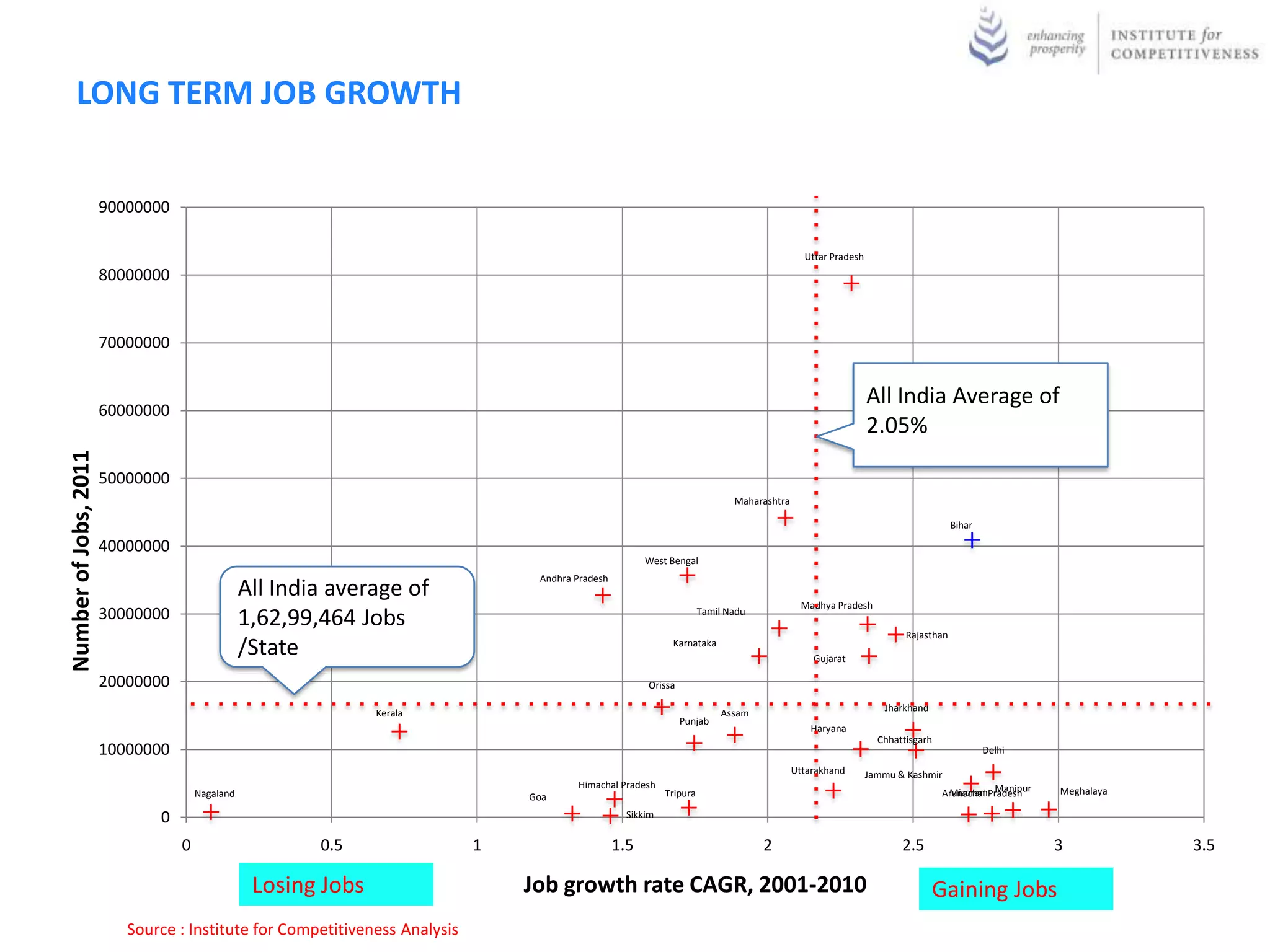
Long-term job growth insights and rates across states analyzing Bihar's employment trends.
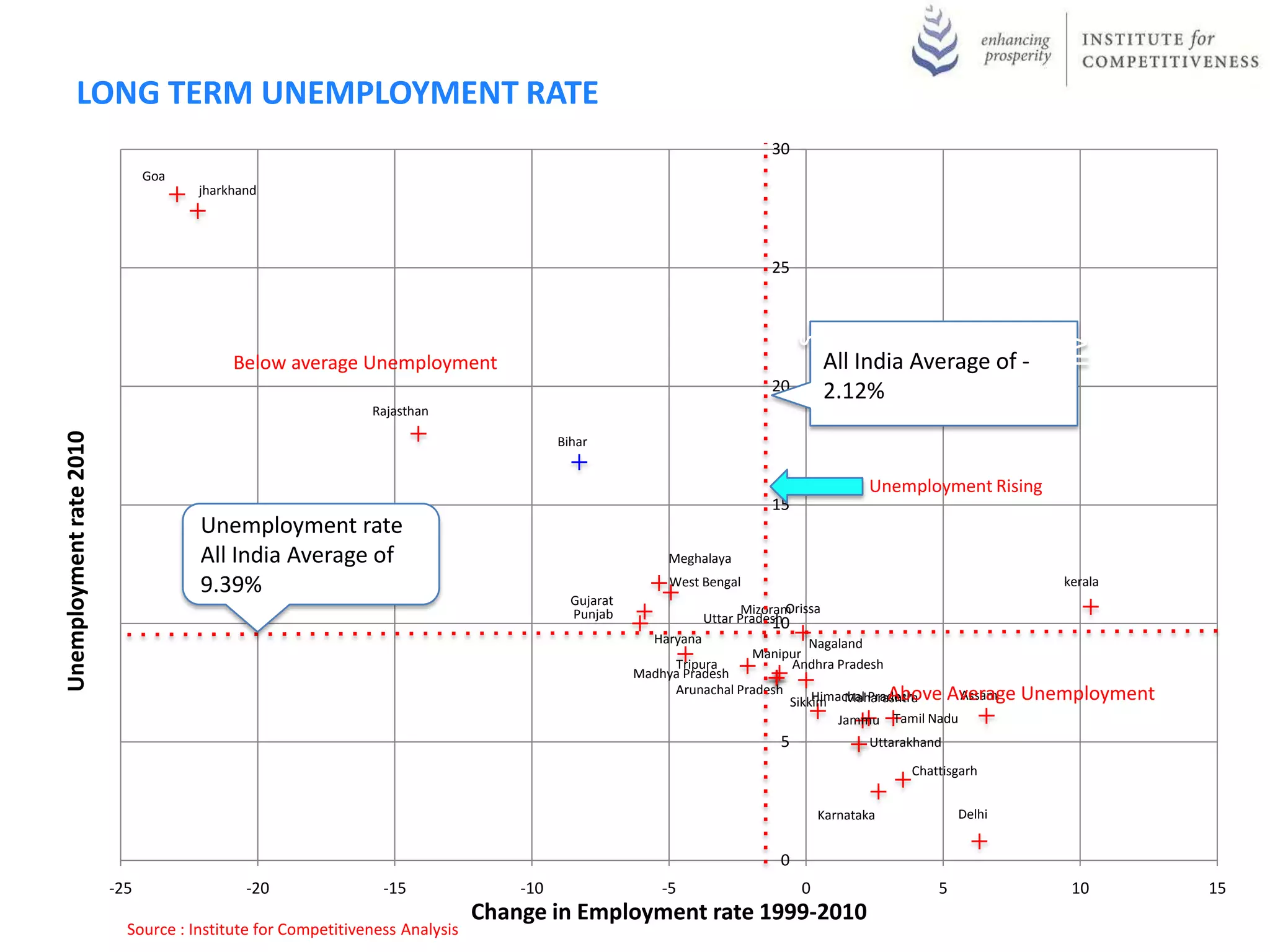
Data insights into unemployment rates over time comparing national and Bihar rates.
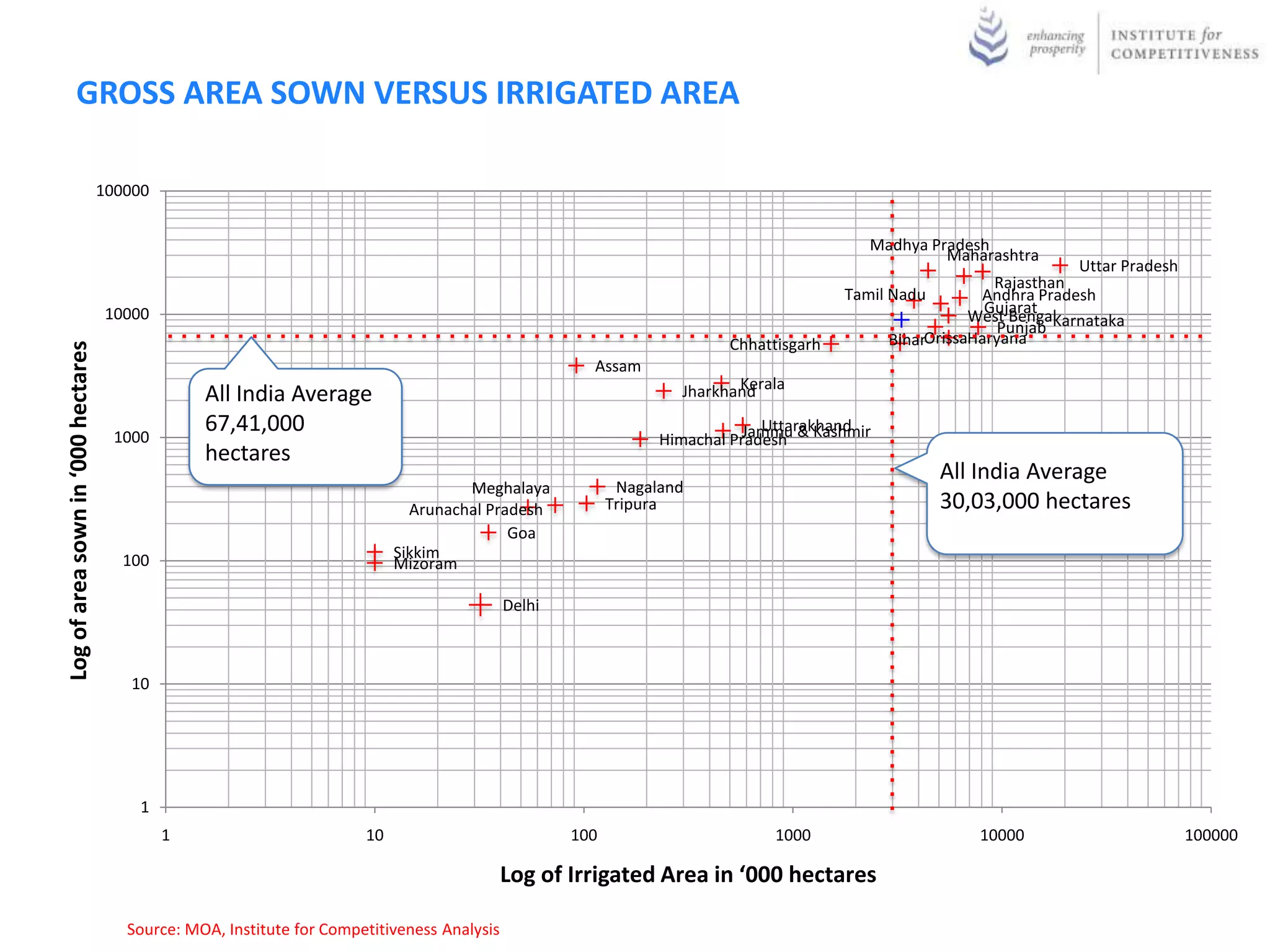
Comparison between gross area sown versus irrigated area in agricultural practices.
Analysis of government spending on healthcare and sanitation in Bihar compared to other states.
Electrification rates of villages in Bihar compared to national averages.
Analysis of teledensity across states, presenting challenges and developments.
Debt to GDP ratios of states with a focus on comparisons including Bihar.
Analysis of rural and urban population growth rates and their implications on economy.
Demographic profiles presented through age pyramids and projections for India.
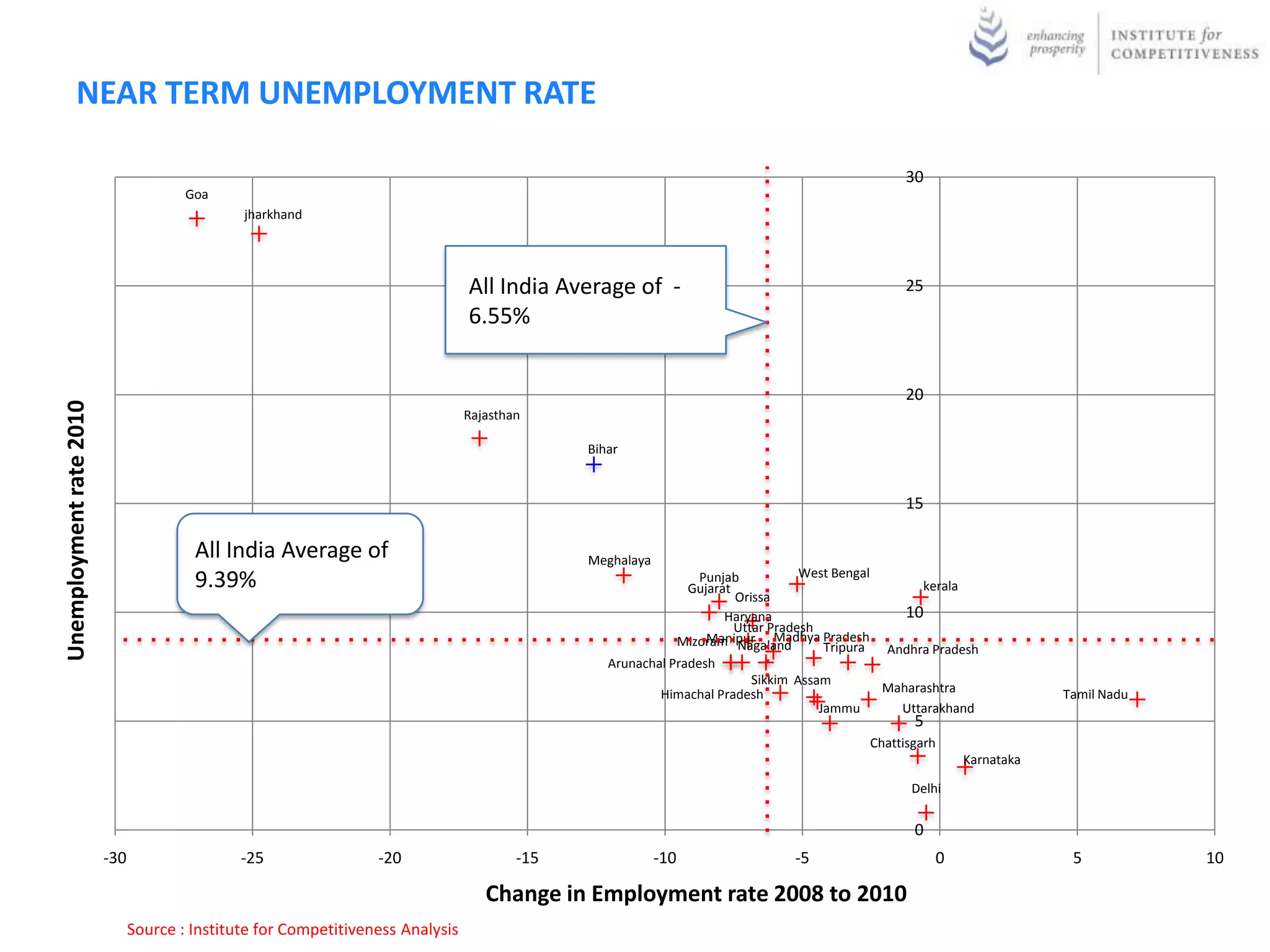
Future unemployment analysis presenting changes in job market trends.
Insights on various social factors affecting economic performance including healthcare and education.
Household and economic metrics presented in terms of infrastructure and population.
Outline of creating a state economic strategy focusing on unique strengths.
Discussion of competitive frameworks among states indicating strategic shifts.
Summary of state performance metrics across various economic measures.
Overview of cluster development across various sectors in Bihar's economy.
ECONOMIC CHALLENGE FORCHIEF MINISTERS IN 2012
Achieving Fiscal
Stability
Enhancing State
Competitiveness
• Competitiveness is the only way to achieve sustainable job growth, improving
incomes and stable public finances
• Creating a clear economic strategy for the state that engages all stakeholders is
even more important in times of budget cutting and austerity
3.
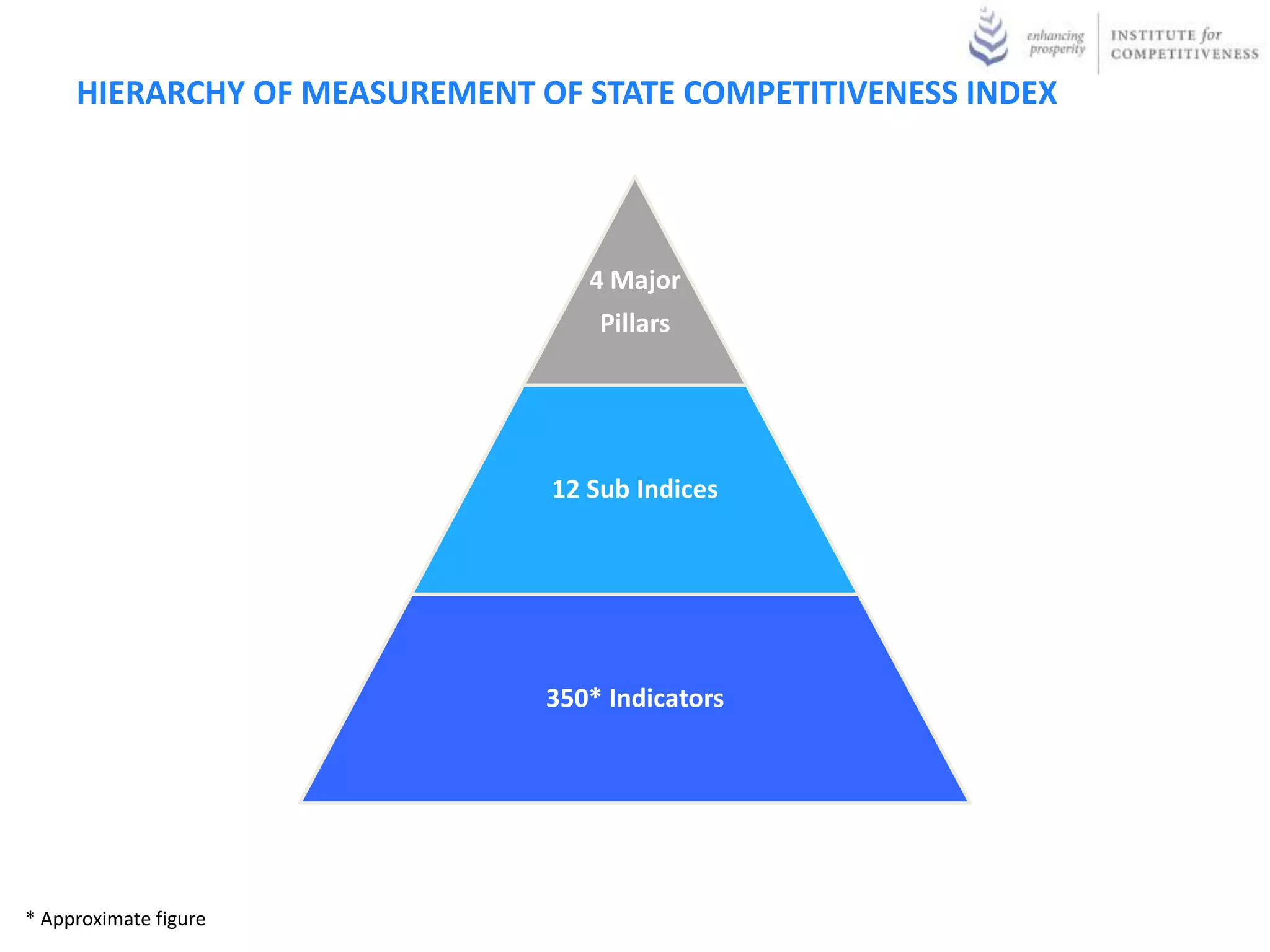
HIERARCHY OF MEASUREMENTOF STATE COMPETITIVENESS INDEX
4 Major
Pillars
12 Sub Indices
350* Indicators
* Approximate figure
4.
STAGES OF THEECONOMY
Innovation Driven Economies (Per capita GDP 900 to
City States (Per capita GDP>1300 USD) 1300 USD)
Transition Economies (Per capita GDP 800 to 900 USD)
Investment Driven Economies (Per capita GDP 500 to
800 USD)
Evolving / Changeover Economies (Per capita GDP 400
to 500 USD)
Factor Driven Economies(Per capita GDP < 400 USD)
5.
STATES ACCORDING TOCATEGORIZATION
Microeconomic Competitiveness
Categorization
Ranks
City States (Per capita Incomes >1300 USD)
Delhi 1
Goa 2
Innovation Driven Economies (Per capita Incomes 900 to1300 USD)
Haryana 1
Maharashtra 2
Gujarat 3
Kerala 4
Transition Economies (Per capita Incomes 800 to 900 USD)
Punjab 1
Tamil Nadu 2
Himachal Pradesh 3
Investment Driven Economies (Per capita Incomes 500 to 800 USD)
Andhra Pradesh 1
Karnataka 2
Uttarakhand 3
West Bengal 4
Chhattisgarh 5
Sikkim 6
Mizoram 7
Meghalaya 8
Arunachal Pradesh 9
Tripura 10
Evolving/ Changeover Economies (Per capita Incomes 400 to 500 USD)
Rajasthan 1
Jharkhand 2
Orissa 3
Jammu and Kashmir 4
Factor Driven Economies(Per capita Incomes < 500 USD)
Bihar 1
Madhya Pradesh 2
Assam 3
Uttar Pradesh 4
Manipur 5
Nagaland 6
Source: Institute for Competitiveness Analysis
6.
NEAR TERM STATEPROSPERITY PERFORMANCE
9
Gross Domestic Product per Capita real growth rate, 2008-2011
Haryana
Low but rising versus India Chhattisgarh
Highly Productive and Prosperity
Bihar Rising versus India
Maharashtra
8
Himachal Pradesh
Uttar Pradesh
Andhra Pradesh
Orissa
7 Karnataka Punjab
Sikkim
Uttarakhand
Arunachal Pradesh Kerala
Assam Gujarat
Rajasthan
Tripura
6 Tamil Nadu
West Bengal Goa
Points
Index
57.28
Average
All India
Meghalaya Delhi
All India GSDP
Jharkhand /Capita rate
Mizoram (CAGR) of 6.27 %
5
Manipur
Madhya Jammu & Kashmir
Pradesh
All India Average
4
Nagaland of 47,998
Low and declining versus India Rupees/capita
High but declining versus India
3
0 20000 40000 60000 80000 100000 120000 140000
Gross Domestic Product per Capita, 2011
7.
COMPETITIVENESS: UNDERLYING CONCEPTS
• Competitiveness is the productivity with which a state utilizes its
human, capital, and natural resources
• Productivity determines wages and the standard of living – Productivity
growth determines sustainable economic growth
• Productivity depends on how a state competes, not what industries it
competes in
• Innovation in products and processes is necessary to drive productivity
growth
• Only productive businesses can create wealth and jobs. States compete to
offer the most productive environment for business
• The public and private sectors play different but interrelated roles in creating
a productive economy
8.
BIHAR PERFORMANCE SNAPSHOT
Position Trend
Prosperity
Productivity
Labour Mobilization
State of Clusters
Type of Economy Investment Driven Top 33.33% of the
states
33.33%-66.67% of
Minerals the states
Leading Clusters Agricultural Products
Machinery and Equipment
Chemicals 66.67% to 100% of
the states
9.
BIHAR COMPETITIVENESS –OVERALL PERFORMANCE INDICATORS
Prosperity Clusters
Gross State Domestic Product per Capita, 2011 Rank: 6 Total Number of People employed in all Factory sector Rank: 4
• In Bihar Rs. 15,494 • In Bihar 86,620
• In India Rs. 47,998 • In India 1,15,06,838
• State Difference to India -67.71%. • State Employment to total
India Employment (factory sector) 0.757%
Growth in Gross State Domestic Product per Capita, 2008-11 , (CAGR) Rank: 1
• In Bihar 7.96%
• In India 6.28%
Productivity Labour Mobilization
Population, 2011 Rank: 2
Gross State Domestic Product per labour force participant, 2011 Rank: 6 • In Bihar 10,38,04,637
• In Bihar Rs 36,279. • % of India 8.67%
• In India Rs 1,21,265
• State Difference to India -70.08% Population Growth, GAGR, 2001-2011 Rank: 2
• In Bihar 2.26%
Growth in Gross State Domestic Product Rank: 3 • In India 1.61%
per Labour force participant, 2001-11
• In Bihar 10.43% Employment, 2010 Rank: 3
• In India 8.44% • In Bihar 8681800
• % India 1.20%
Average Private Wage in 2008-09, Rank: 3
• In Bihar Rs 46,191 Employment growth, annual rate, 2000-2010 Rank: 2
• In India Rs 64,741 • In Bihar 2.70%
• State Difference to India -17.25.% • In India 2.05%
Private Wage Growth, CAGR, 2000-2009 Rank:6 Unemployment, 2010 (Per hundred People) Rank: 1
• In Bihar 7.38% • In Bihar 16.80
• In India 4.53% • In India 9.39
Change in Unemployment rate, 2000-2010 Rank: 1
• In Bihar 80.65%
• In India 41.37
10.
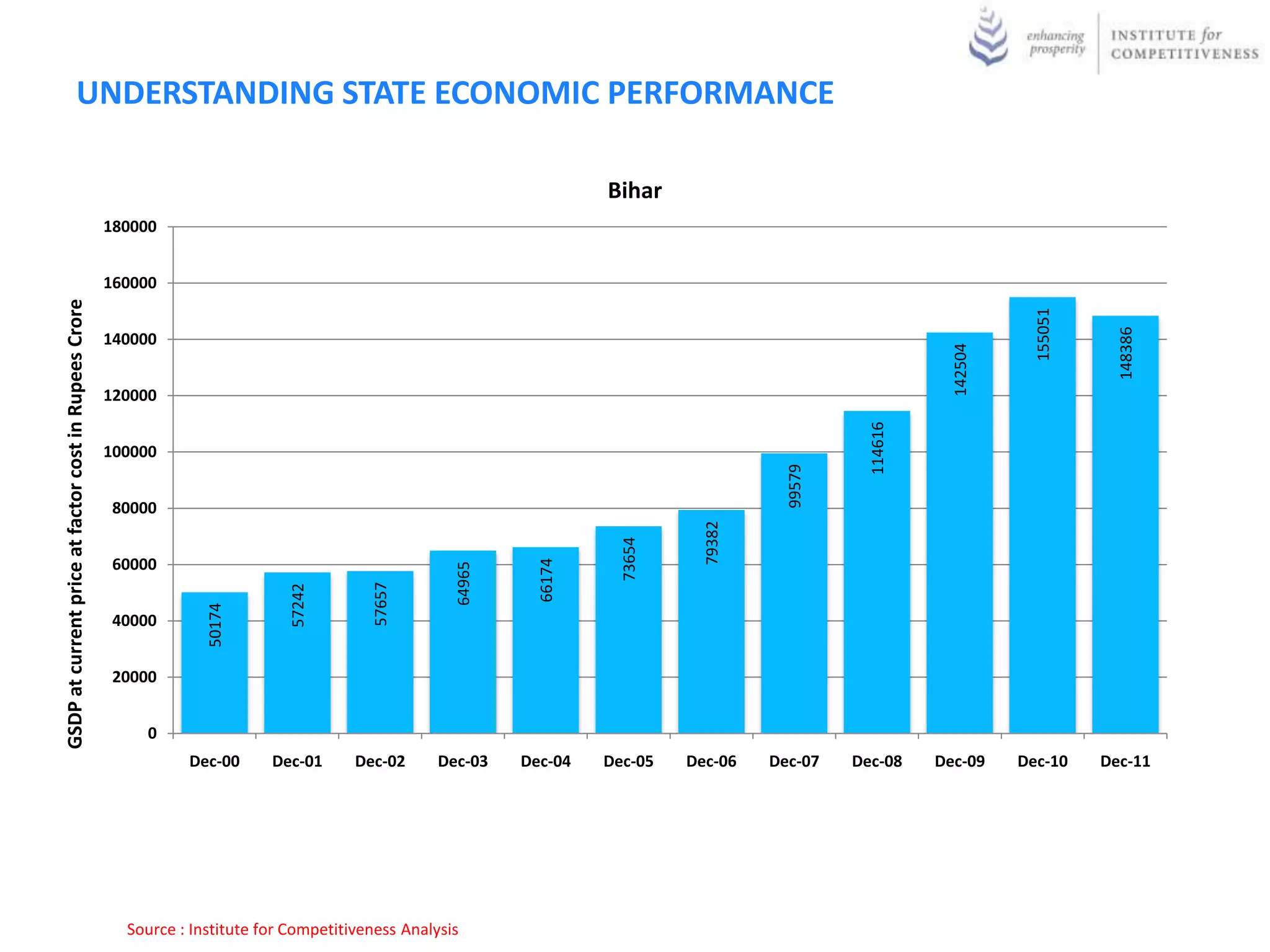
UNDERSTANDING STATE ECONOMICPERFORMANCE
Bihar
180000
160000
GSDP at current price at factor cost in Rupees Crore
155051
148386
140000
142504
120000
114616
100000
99579
80000
79382
73654
60000
66174
64965
57657
57242
50174
40000
20000
0
Dec-00 Dec-01 Dec-02 Dec-03 Dec-04 Dec-05 Dec-06 Dec-07 Dec-08 Dec-09 Dec-10 Dec-11
Source : Institute for Competitiveness Analysis
11.
CONTRIBUTION OF BIHAR’SGSDP TO INDIAN GSDP
GSDP at current price at factor cost in Rupees Crore
6000000
5000000
4000000
3000000
2000000
1000000
0
Dec-00 Dec-01 Dec-02 Dec-03 Dec-04 Dec-05 Dec-06 Dec-07 Dec-08 Dec-09 Dec-10 Dec-11
Bihar's GDP Indian GDP
Dec-00 Dec-01 Dec-02 Dec-03 Dec-04 Dec-05 Dec-06 Dec-07 Dec-08 Dec-09 Dec-10 Dec-11
Ratio of Bihar's
GSDP to Indian
GDP in 2.95 3.19 2.99 3.12 2.81 2.79 2.66 2.86 2.85 3.11 3.10 2.97
Percentage
Terms
Source : Institute for Competitiveness Analysis
12.
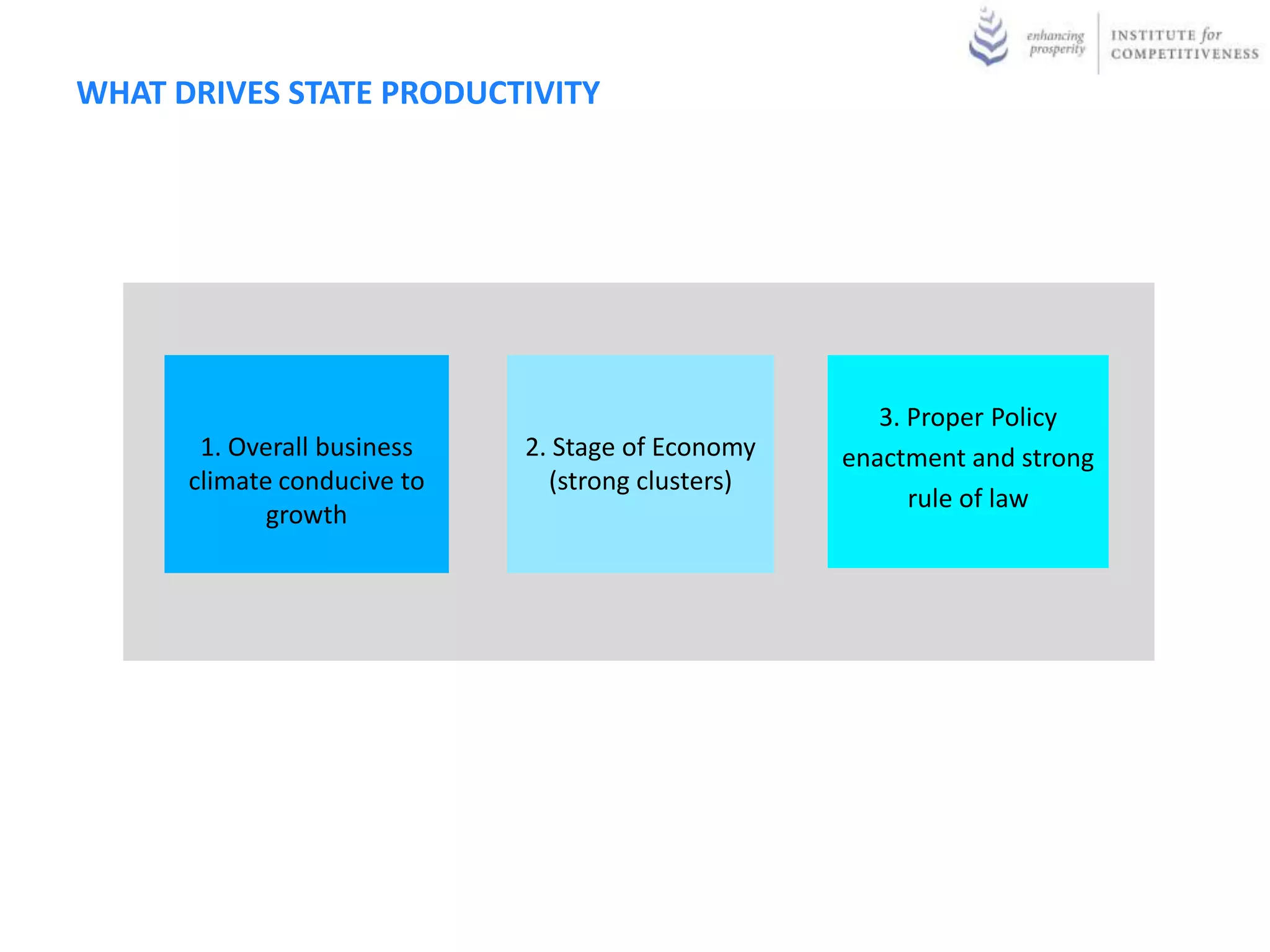
WHAT DRIVES STATEPRODUCTIVITY
3. Proper Policy
1. Overall business 2. Stage of Economy enactment and strong
climate conducive to (strong clusters)
rule of law
growth
13.
MODEL USED FORANALYSIS
Climate for
Innovation based
local rivalry
• Local rules and incentives that encourage
investment and productivity e.g.
- salaries,
Factor - incentives for capital investments, Demand
Conditions - intellectual property protection
Conditions
• Vigorous local competition i.e.,
- Openness to foreign and local competition;
- Sophistication of company operations
Access to high quality business inputs
i.e., Sophisticated and demanding local
- Natural endowments, customers and needs e.g.,
- Human resources, - Strict quality, safety, and environmental
- Capital availability, Clusters of Related standards
- Physical infrastructure, and Supporting – Consumer protection laws
- Administrative infrastructure, Industries – Government procurement of
- Information infrastructure, advanced technology
- Scientific and technological infrastructure – Early demand for products and
Local availability of suppliers and supporting industries Services.
Presence of clusters instead of isolated firms
Source: Michael E Porter
14.
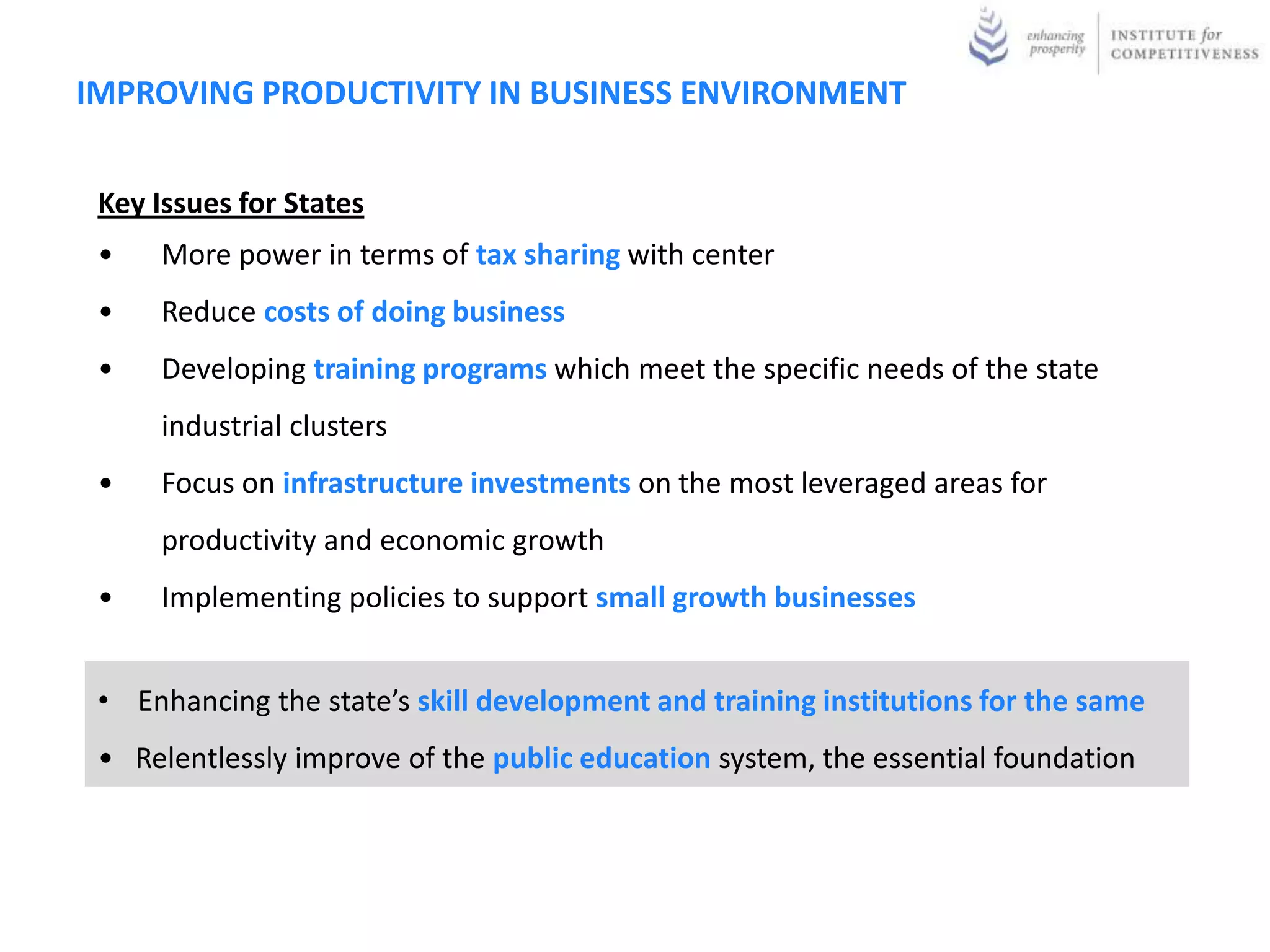
IMPROVING PRODUCTIVITY INBUSINESS ENVIRONMENT
Key Issues for States
• More power in terms of tax sharing with center
• Reduce costs of doing business
• Developing training programs which meet the specific needs of the state
industrial clusters
• Focus on infrastructure investments on the most leveraged areas for
productivity and economic growth
• Implementing policies to support small growth businesses
• Enhancing the state’s skill development and training institutions for the same
• Relentlessly improve of the public education system, the essential foundation
15.
STRONG CLUSTERS DRIVESTATE PERFORMANCE
Specialization in better business clusters Job growth
Breadth of industries within each cluster Higher wages
Strength in related clusters Higher innovation rates
Presence of a region‘s clusters in Greater new business formation, growth
neighboring regions and survival
• Build on the state’s existing and emerging clusters in the state rather than chase
new fields
• Economic diversification usually occurs within clusters and across related clusters
16.
GEOGRAPHIC INFLUENCES ONCOMPETITIVENESS
• Influence and access federal
Nation policies and programs
• Integrate policies and
Neighboring states infrastructure with
neighbors
States
• Assist each city area in
City Regions developing its own strategy
• Connect rural regions with
Rural Regions urban areas
17.
CONTRIBUTION OF AGRICULTURESECTOR TO GSDP
180000
GSDP at current price at factor cost in Rupees Crore
160000
140000
120000
100000
80000
60000
40000
20000
0
Dec-00 Dec-01 Dec-02 Dec-03 Dec-04 Dec-05 Dec-06 Dec-07 Dec-08 Dec-09 Dec-10 Dec-11
Ratio of
Agricultural
GSDP in Bihar
to the total 33.50 37.67 34.31 36.05 32.45 30.15 27.97 28.68 25.76 27.22 23.14 24.68
GSDP in Bihar
in Percentage
terms
Source : Institute for Competitiveness Analysis
18.
CONTRIBUTION OF MANUFACTURINGSECTOR TO GSDP
GSDP at current price at factor cost in Rupees Crore
180000
160000
140000
120000
100000
80000
60000
40000
20000
0
Dec-00 Dec-01 Dec-02 Dec-03 Dec-04 Dec-05 Dec-06 Dec-07 Dec-08 Dec-09 Dec-10 Dec-11
Ratio of
Manufacturi
ng GSDP in
Bihar to the
7.20 6.06 5.61 5.67 5.56 5.80 5.27 4.90 5.63 4.48 4.50 4.62
total GSDP in
Bihar in
Percentage
terms
Source : Institute for Competitiveness Analysis
19.
CONTRIBUTION OF SERVICESECTOR TO GSDP
GSDP at current price at factor cost in Rupees Crore
180000
160000
140000
120000
100000
80000
60000
40000
20000
0
Dec-00 Dec-01 Dec-02 Dec-03 Dec-04 Dec-05 Dec-06 Dec-07 Dec-08 Dec-09 Dec-10 Dec-11
Ratio of
Services
GSDP in
Bihar to the
53.88 50.97 54.70 52.97 56.42 57.26 57.70 56.23 58.29 57.67 60.65 59.38
total GSDP in
Bihar in
Percentage
terms
Source : Institute for Competitiveness Analysis
20.
COMPOSITION OF BIHAR’SECONOMY
Agriculture, forestry
and fishing
25%
Services
59% Industry
16%
Source : Institute for Competitiveness Analysis
21.
COMPOSITION OF BIHAR’SECONOMY
3000000
2549085
2500000
GSDP in Rs. Crore
2000000
1492375
1500000
1000000 924340
500000
36623 88111
23651
0
Agriculture, forestry and fishing Industry Services
Indian contribution
Bihar’s contribution
Source : Institute for Competitiveness Analysis
22.
COMPOSITION OF BIHAR’SECONOMY IN GREATER DEPTH
7
6
Railways
Fishing
Trade, hotel and restaurant
Forestry and logging
5
Bihar /National GSDP share (Percent) ,2011
Other services
Public administration and defence
4
Agricuture
Construction
3
2
Real states, ownership of dwellings and
Banking and insurance
business services
Transport by other means
Communication
Electricity,Storage water supply
gas and
1 Manufacturing
Mining and quarrying
0
-5 0 5 10 15 20 25 30
-1
Change in contribution of GSDP of Bihar to total Indian GSDP, CAGR (2000-2011)
23.
STATE PRIVATE WAGEPERFORMANCE
160000
140000
Jharkhand Wage Growth
rate 4.53%
Average Wages in Rupees ,2009
120000
Uttaranchal
Orissa
100000 Maharashtra
Goa
Average Wage :
Rupees 64,741
80000 Chattisgarh West Bengal Madhya Pradesh
Haryana Karnataka
Gujarat Meghalaya
Delhi Himachal Pradesh
Uttar Pradesh
60000 Andhra Pradesh
Punjub Tamil Nadu
Kerala Rajasthan
Jammu & Kashmir
Bihar Assam
40000
Manipur
Tripura Nagaland
20000 Low and declining versus India Low but rising versus India
0
0 2 4 6 8 10 12 14
Wage Growth (CAGR), 2001 to 2008
Source : Institute for Competitiveness Analysis, Data as of 2010
24.
LABOUR PRODUCTIVITY
400000
GSDP at Current Prices per labour force participant, 2011
Goa
350000 High but declining versus India Highly productive and Productivity
rising versus India
300000
Points
Index
57.28
e
Averag
India
All
Delhi
All India Average of
250000 8.44%
Haryana
200000
All India Average of of Punjab Maharashtra
Kerala Gujarat
1,21,265 Rupees/Labour Himachal Pradesh
150000 force participant Tamil Nadu
Karnataka Andhra Pradesh
Sikkim
West Bengal Uttarakhand Chhattisgarh
Mizoram Nagaland
100000 MeghalayaTripura Pradesh
Arunachal Orissa
Rajasthan
Jammu & Kashmir Assam
Madhya Pradesh Jharkhand
Manipur
Uttar Pradesh
50000 Bihar
Low and declining versus India Low but rising versus India
0
5.00 6.00 7.00 8.00 9.00 10.00 11.00 12.00 13.00
GSDP /Labor force participant growth rate(CAGR)
Source : Institute for Competitiveness Analysis
25.
LONG TERM JOBGROWTH
90000000
Uttar Pradesh
80000000
70000000
All India Average of
60000000
2.05%
Number of Jobs, 2011
50000000
Maharashtra
Bihar
40000000
West Bengal
Andhra Pradesh
All India average of
Madhya Pradesh
30000000 1,62,99,464 Jobs Tamil Nadu
Rajasthan
/State Karnataka
Gujarat
20000000 Orissa
Jharkhand
Kerala Assam
Punjab
Haryana
Chhattisgarh
10000000 Delhi
Uttarakhand Jammu & Kashmir
Himachal Pradesh
Nagaland Goa Tripura Mizoram Manipur
Arunachal Pradesh Meghalaya
0 Sikkim
0 0.5 1 1.5 2 2.5 3 3.5
Losing Jobs Job growth rate CAGR, 2001-2010 Gaining Jobs
Source : Institute for Competitiveness Analysis
26.
LONG TERM UNEMPLOYMENTRATE
30
Goa
jharkhand
25
s
Point
Index
57.28
ge
Avera
India
All
Below average Unemployment All India Average of -
20 2.12%
Rajasthan
Unemployment rate 2010
Bihar
Unemployment Rising
15
Unemployment rate
All India Average of Meghalaya
9.39% West Bengal kerala
Gujarat
Punjab MizoramOrissa
Uttar Pradesh
10
Haryana Nagaland
Manipur
Tripura Andhra Pradesh
Madhya Pradesh
Arunachal Pradesh Above Average
Himachal Pradesh Assam Unemployment
Sikkim Maharashtra
Jammu Tamil Nadu
5 Uttarakhand
Chattisgarh
Karnataka Delhi
0
-25 -20 -15 -10 -5 0 5 10 15
Change in Employment rate 1999-2010
Source : Institute for Competitiveness Analysis, Data as of 2010
27.
NEAR TERM UNEMPLOYMENTRATE
30
Goa
jharkhand
Points
Avera
57.28
Index
All India Average of -
India
25
6.55%
All
ge
20
Unemployment rate 2010
Rajasthan
Bihar
15
All India Average of Meghalaya
West Bengal
9.39% Punjab
Gujarat kerala
Orissa
Haryana 10
Uttar Pradesh
Manipur
Mizoram Nagaland Madhya Pradesh
Tripura Andhra Pradesh
Arunachal Pradesh
Sikkim Assam
Himachal Pradesh Maharashtra Tamil Nadu
Jammu Uttarakhand
5
Chattisgarh
Karnataka
Delhi
0
-30 -25 -20 -15 -10 -5 0 5 10
Change in Employment rate 2008 to 2010
Source : Institute for Competitiveness Analysis Data as of 2010
Analysis,
28.
GROSS AREA SOWNVERSUS IRRIGATED AREA
100000
Madhya Pradesh
Maharashtra
Uttar Pradesh
Rajasthan
Tamil Nadu Andhra Pradesh
10000 Gujarat
West Bengal
Punjab Karnataka
Chhattisgarh BiharOrissaHaryana
Log of area sown in ‘000 hectares
Assam
Kerala
All India Average Jharkhand
67,41,000 Uttarakhand
1000 Himachal Pradesh & Kashmir
Jammu
hectares
India
All
All India Average
Meghalaya Nagaland
Arunachal Pradesh Tripura 30,03,000 hectares
Goa
100 Sikkim
Mizoram
Delhi
10
1
1 10 100 1000 10000 100000
Log of Irrigated Area in ‘000 hectares
Source: MOA, Institute for Competitiveness Analysis, Data as of 2010
29.
HEALTHCARE
Percentage of Totalgovernment Expenditure on Medical, Health
10
Delhi
9
8
7
and Sanitation
6 Goa
Jammu & Kashmir
Uttarakhand
All India Average
5 Manipur
Himachal Pradesh 4.02%
AssamKerala
Meghalaya West Bengal Tamil Nadu
Tripura
Nagaland Uttar Pradesh
Mizoram Rajasthan
4 Gujarat
Sikkim Chhattisgarh Karnataka
Jharkhand Haryana Andhra Pradesh
Madhya Pradesh Maharashtra
Orissa
Punjab Bihar
3
Arunachal Pradesh
India
All
2
All India Average 1633
Crores
1
0 1000 2000 3000 4000 5000 6000
Total Government Expenditure on Medical, Health and Sanitation in Crores
Source: Institute for Competitiveness Analysis
30.
PERCENTAGE OF VILLAGESELECTRIFIED
120
100 100.0
100.099.7100.098.2 98.2 99.9100.0 100.0 100.0
All India 100 96.9 96.4 96.9 97.3
94.4
Average of 88.3
85.8
88.3
84.96 % 80.8 80.6
80
69.2
64.4 62.6
61.3
59.3
60 56.8 57.2
40
31.1
20
0
Source: Institute for Competitiveness Analysis
31.
TELEDENSITY
140000
Goa
120000
y = 429.3x + 12630
R² = 0.388
Delhi
100000
Haryana
80000
GSDP per Capita
Maharashtra
Gujarat Punjab
Kerala
Himachal Pradesh
60000 Tamil Nadu
Karnataka
Andhra Pradesh
Sikkim
Arunachal Pradesh Bengal
West
MeghalayaChhattisgarh
Mizoram
Tripura
Orissa Uttarakhand
40000
Jammu & Kashmir Rajasthan
Nagaland Jharkhand
Manipur
Madhya Pradesh
Uttar Pradesh
20000
0
50 70 90 110 130 150 170 190 210 230 250
Teledensity
Source: Ministry of telecom, Institute for Competitiveness Analysis
32.
DEBT TO GDPRATIO
West Bengal 42.8 Prescribed limit according to the
Uttaranchal 41.1 growth and stability Pact of EU
Uttar Pradesh 43.5
Tripura 42.2
Tamil Nadu 25.5
Sikkim 80.6
Rajasthan 41.1
Punjab 35.2
Orissa 30.6
Nagaland 59.4
Mizoram 109.1
Meghalya 37.3
Manipur 77.4
Maharashtra 25.1
Madhya Pradesh 34.4
Kerala 34.3
Karnataka 24.3
Jharkhand 33.6
Jammu & Kashmir 70.1
Himachal 55.7
Haryana 19
Gujarat 32.1
Goa 35.5
Delhi 13.8 Prescribed limit according
Chattisgarh 15.2 to WTO for developing
Bihar 39.7 economies
Assam 28
Arunachal 115.9
Andhra 30.1
0 20 40 60 80 100 120
Source: Institute for Competitiveness Analysis
33.
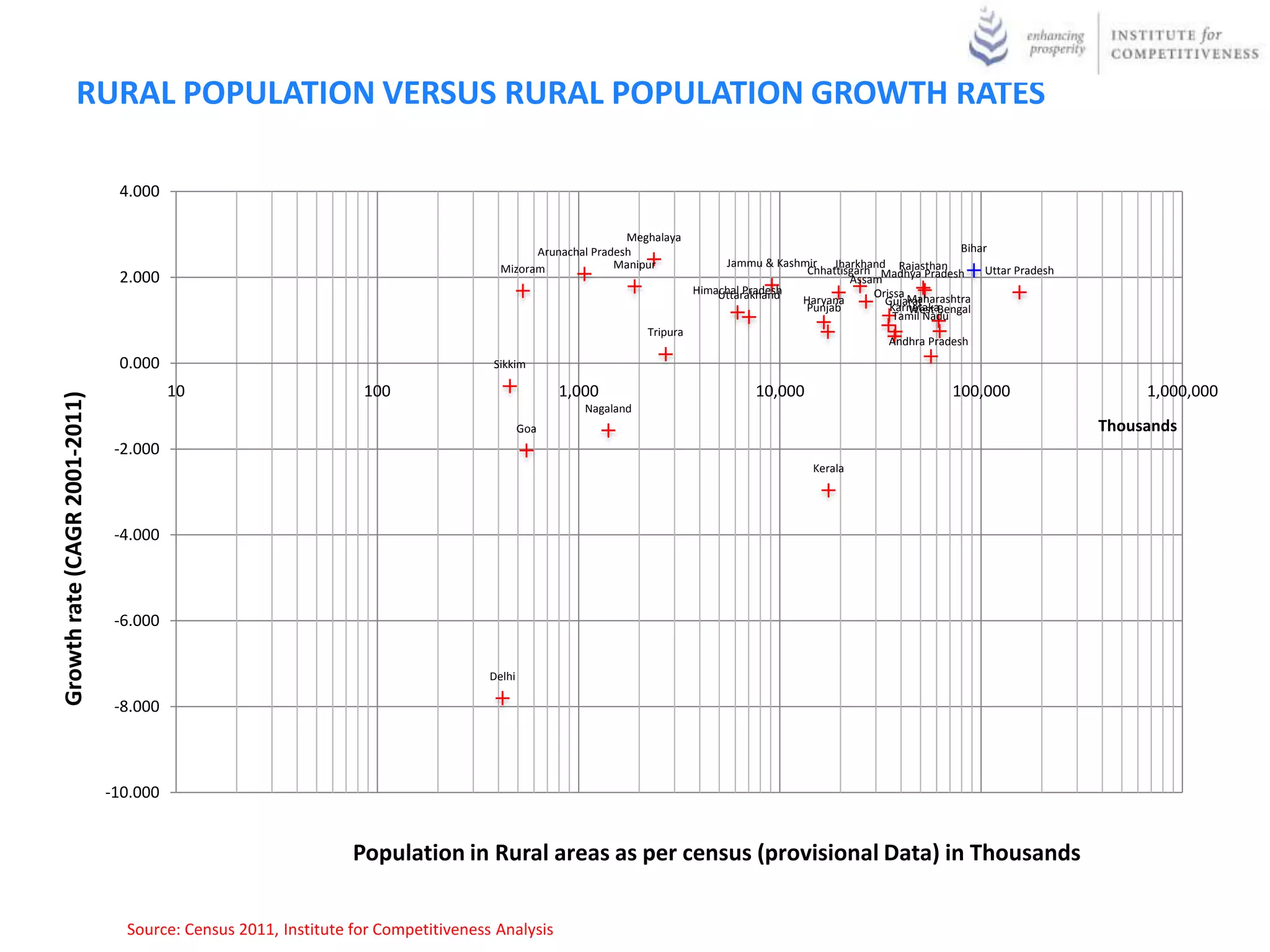
RURAL POPULATION VERSUSRURAL POPULATION GROWTH RATES
4.000
Meghalaya
Arunachal Pradesh Bihar
Mizoram Manipur Jammu & Kashmir Jharkhand Rajasthan
Chhattisgarh Madhya Pradesh Uttar Pradesh
2.000 Assam
Himachal Pradesh
Uttarakhand Orissa Maharashtra
Haryana Gujarat
Punjab KarnatakaBengal
West
Tamil Nadu
Tripura
Andhra Pradesh
0.000 Sikkim
10 100 1,000 10,000 100,000 1,000,000
Growth rate (CAGR 2001-2011)
Nagaland
Goa Thousands
-2.000
Kerala
-4.000
-6.000
Delhi
-8.000
-10.000
Population in Rural areas as per census (provisional Data) in Thousands
Source: Census 2011, Institute for Competitiveness Analysis
34.
URBAN POPULATION VERSUSURBAN POPULATION GROWTH RATES
12
Sikkim
10
Growth rate (CAGR 2001-2011)
8
Kerala
Tripura
6
Nagaland
Haryana
4 Manipur
Uttarakhand
Chhattisgarh
Arunachal Pradesh Andhra Pradesh
Jammu & Kashmir
Goa Bihar Gujarat
Meghalaya Jharkhand Karnataka
Assam Orissa Rajasthan Uttar Pradesh
Mizoram Delhi Madhya Pradesh Tamil Nadu
Punjab West Bengal
Maharashtra
2
Himachal Pradesh
0
0 10000 20000 30000 40000 50000 60000
Thousands
Population in Urban areas as per census (provisional Data) in Thousands
Source: Census 2011, Institute for Competitiveness Analysis
35.
100,000,000
120,000,000
140,000,000
160,000,000
20,000,000
40,000,000
60,000,000
80,000,000
0
151,726
455,962
561,977
529037
313,446
1069165
906,309
551414
573,741
1406861
822,132
1899624
595,036
2368971
960,981
2,710,051
688,704
6167805
3,091,169
7,025,583
3,414,106
Source: Census 2011, Institute for Competitiveness Analysis
9134820
16,333,916
419319
8,821,588
Urban Population in 2011
16531493
5,936,538
19603658
10,387,436
RURAL AND URBAN POPULATION IN INDIA
17,316,800
4,388,756
26780516
7,929,292
25,036,946
15,932,171
17455506
6,996,124
Rural Population in 2011
34,951,234
25,712,811
34670817
23,578,175
37552529
17,080,776
51,540,236
34,949,729
37,189,229
20,059,666
52537899
28,353,745
56311788
29,134,060
62,213,676
11,729,609
92075028
50,827,531
61545441
44,470,455
155,111,022
36.
DEMOGRAPHIC PROFILE INBIHAR
14000000
11929000
11494000
10695000
10567000
12000000
9919000
10000000
Population in Numbers
7379000
8000000
6054000
5618000
5270000
4718000
6000000
3943000
3143000
4000000
2381000
1810000
1397000
928000
2000000
477000
0
0-4 5-9 10-14 15-19 20-24 25-29 30-34 35-39 40-44 45-49 50-54 55-59 60-64 65-69 70-74 75-79 80+
years years years years years years years years years years years year years years years years years
Source: Institute for Competitiveness Analysis
37.
RURAL URBAN ANDTOTAL POPULATION
120
Delhi
Urban Population as a percentage of total Population
100 All India Average
India
67.02%
All
80
Goa
Tamil Nadu
Maharashtra
60 Kerala
Mizoram Gujarat
Karnataka
All India Average Punjab Pradesh
Andhra Bengal
West
Haryana
32.98% MadhyaUttar Pradesh
Pradesh
40 Rajasthan
Uttarakhand
Manipur
Jammu & Kashmir
Jharkhand
Nagaland
Chhattisgarh
Tripura
Sikkim
Orissa
Arunachal Pradesh Bihar
Meghalaya
Assam
20
Himachal Pradesh
0
-20 0 20 40 60 80 100 120
-20
Rural Population as a percentage of total Population
Source: Census 2011, Institute for Competitiveness Analysis
38.
SEX RATIO VERSUSSEX RATIO GROWTH RATES
0.8
Delhi
0.7
0.6 All India Average 940
India
females/1000 males Mizoram
All
0.5
Nagaland
0.4 Arunachal Pradesh
Goa
CAGR growth rate 2001-11
All India Average Punjab
Kerela
0.3
0.169% CAGR Haryana
Assam
0.2 Sikkim Meghalaya
Tripura
Madhya Pradesh
WestAndhra Pradesh
Bengal
Uttar Pradesh
Manipur
Himachal Pradesh
Rajasthan Tamil Nadu
Jharkhand
0.1 Maharashtra
Orissa
Karnataka
Chattisgarh
Uttarakhand
Gujarat
0
0 200 400 600 800 Bihar
1000 1200
-0.1
Jammu and Kashmir
-0.2
-0.3
Sex ratio
Source: Census 2011, Institute for Competitiveness Analysis
39.
LITERACY RATES VERSUSGDP
140000
Goa
120000
Delhi
GSDP per capita at current prices 2011
100000
Haryana y = 1576.x - 73239
R² = 0.254
80000
Maharashtra
Gujarat Punjab
Himachal Pradesh Kerala
60000 Tamil Nadu
Karnataka
Andhra Pradesh
Sikkim
Uttarakhand
Chhattisgarh West Bengal
Arunachal Pradesh Meghalaya
Orissa Tripura Mizoram
40000 Rajasthan & Kashmir
Jammu
Assam
Jharkhand Nagaland
Madhya Pradesh Manipur
Uttar Pradesh
20000 Bihar
0
60 65 70 75 80 85 90 95 100
Literacy rate 2011
Source: RBI , Census 2011, Institute for Competitiveness Analysis
40.
REVENUE EXPENDITURE VERSUSREVENUE RECEIPTS
120000
Maharashtra
Uttar Pradesh
100000
India
All
All India Average 34190
Revenue Expenditure in Rs. Crores
Andhra Pradesh
Rs. Crores
80000 Tamil Nadu
West Bengal
Gujarat
60000 Karnataka
Madhya Pradesh
Rajasthan
Bihar All India Average 34757
40000 Kerala
Punjab
Rs. Crores
Assam Orissa
Haryana
Chhattisgarh
Jharkhand
Jammu & Kashmir
20000 Delhi
Uttarakhand
Himachal Pradesh
Goa
Tripura
Nagaland
Manipur
Meghalaya
Mizoram
Sikkim
Arunachal Pradesh
0
0 20000 40000 60000 80000 100000 120000
Revenue Receipts in Rs. Crores
Source: RBI , Institute for Competitiveness Analysis
41.
LITERACY RATES VERSUSPOPULATION
25000000
Uttar Pradesh
20000000 All India Average
India
All
Literacy level of
77.12%
15000000
Maharashtra
Bihar
10000000
All India Average West Bengal
67232968 People/state Andhra Pradesh
Madhya Pradesh Tamil Nadu
Rajasthan
Karnataka
Gujarat
50000000 Orissa
Jharkhand Kerela
Assam
Punjab
Chattisgarh Haryana
Delhi
Jammu and Kashmir
Uttarakhand
Himachal Pradesh
Meghalaya Manipur
Nagaland Tripura
Arunachal Pradesh Sikkim Goa Mizoram
0
0 10 20 30 40 50 60 70 80 90 100
Literacy rates in Percentage terms
Source: Census 2011 , Institute for Competitiveness Analysis
42.
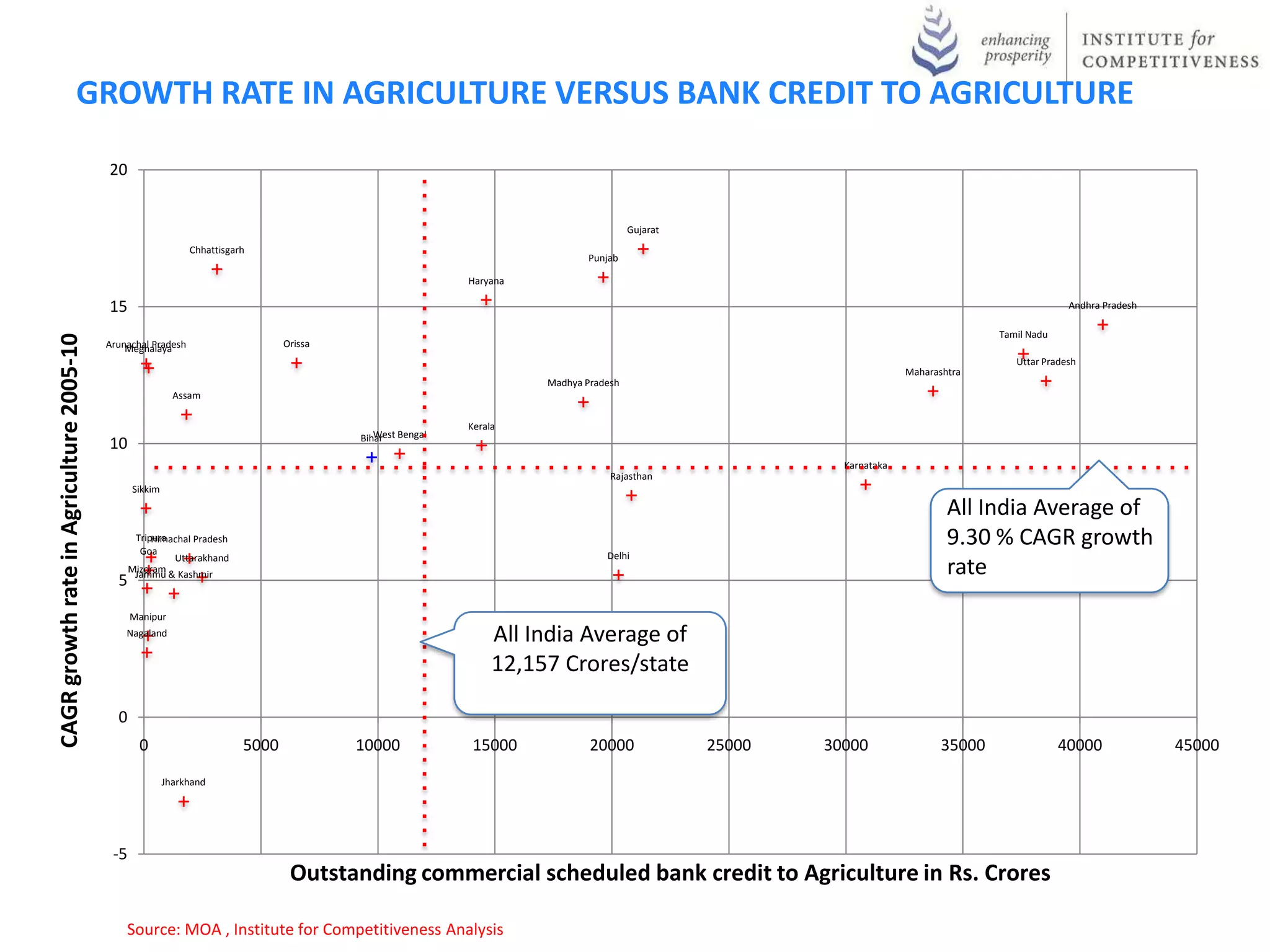
GROWTH RATE INAGRICULTURE VERSUS BANK CREDIT TO AGRICULTURE
20
Gujarat
Chhattisgarh
Punjab
Haryana
15 Andhra Pradesh
Tamil Nadu
CAGR growth rate in Agriculture 2005-10
Arunachal Pradesh
Meghalaya Orissa
Uttar Pradesh
Maharashtra
Madhya Pradesh
Assam
Kerala
Bihar Bengal
West
10
Karnataka
Rajasthan
Sikkim
All India Average of
Tripura
Goa
Himachal Pradesh 9.30 % CAGR growth
Uttarakhand Delhi
5
Mizoram
Jammu & Kashmir rate
Manipur
Nagaland All India Average of
India
All
12,157 Crores/state
0
0 5000 10000 15000 20000 25000 30000 35000 40000 45000
Jharkhand
-5
Outstanding commercial scheduled bank credit to Agriculture in Rs. Crores
Source: MOA , Institute for Competitiveness Analysis
43.
PERCENTAGE OF FACTORIESIN OPERATION VERSUS TOTAL NUMBER OF
FACTORIES
16
Bihar
Nagaland
Tripura Jharkhand
14 Manipur
Percentage of factories not in operation
12
India
All
All India Average of 6198
Factories/state
10
Kerala
Andhra Pradesh
8 Delhi
Orissa
Tamil Nadu
Assam
Chhattisgarh
All India Average of 4.1%
factories not in
6
operation/state average
Karnataka
Himachal Pradesh
Maharashtra
4 Uttarakhand
Madhya Pradesh Rajasthan
Uttar Pradesh
Jammu & Kashmir West Bengal
Gujarat
Punjab
Haryana
2
Meghalaya
Goa
0
0 5000 10000 15000 20000 25000
Total number of factories
Source: ASI , Institute for Competitiveness Analysis, Data as of 2010
44.
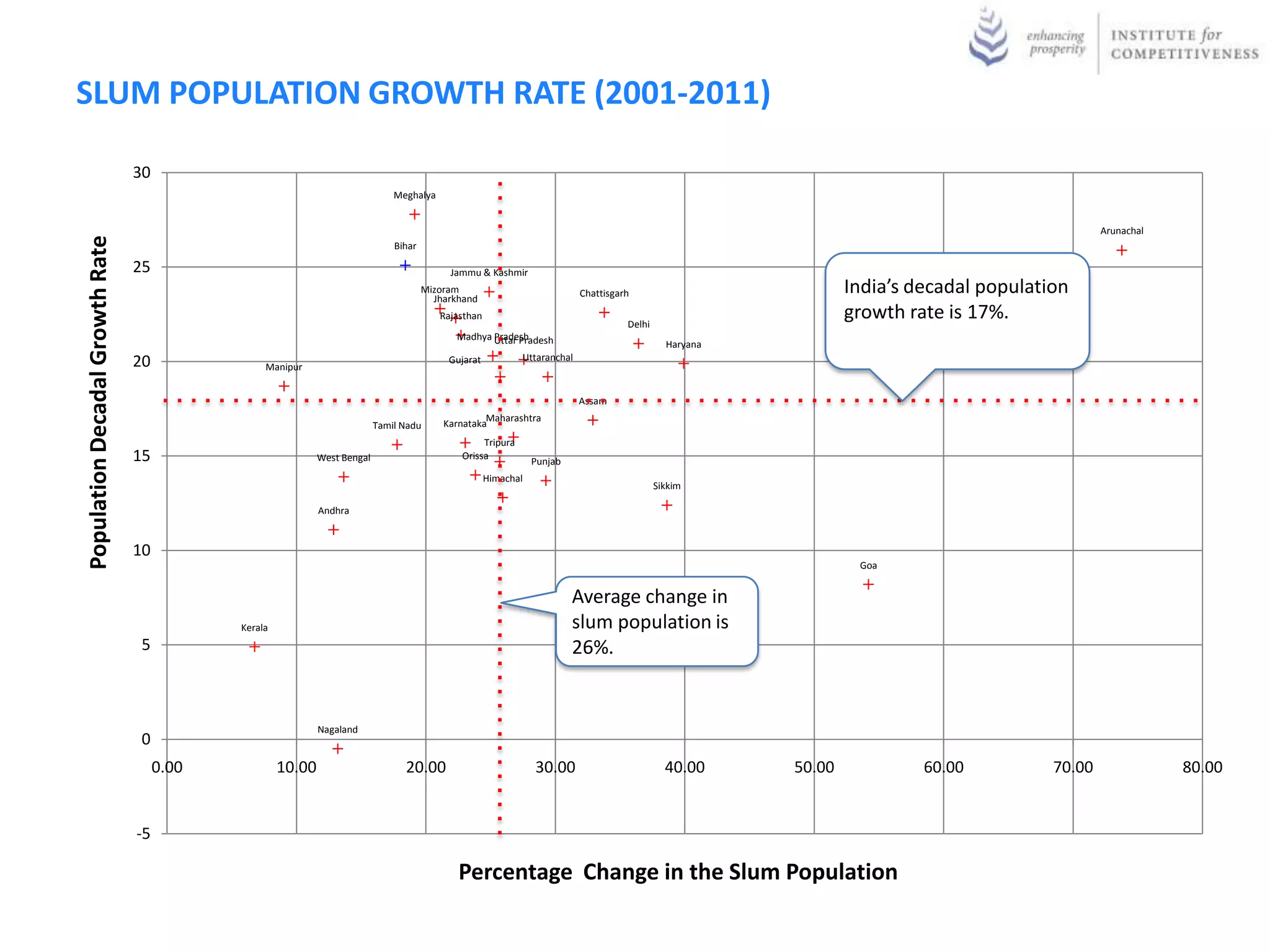
SLUM POPULATION GROWTHRATE (2001-2011)
30
Meghalya
Arunachal
Population Decadal Growth Rate
Bihar
25 Jammu & Kashmir
Mizoram
Jharkhand
Chattisgarh India’s decadal population
Rajasthan
Delhi
growth rate is 17%.
Madhya Uttar Pradesh
Pradesh
Haryana
Uttaranchal
20 Manipur
Gujarat
Assam
Maharashtra
Tamil Nadu Karnataka
Tripura
15 West Bengal Orissa
Punjab
Himachal
Sikkim
Andhra
10
Goa
Average change in
Kerala slum population is
5 26%.
Nagaland
0
0.00 10.00 20.00 30.00 40.00 50.00 60.00 70.00 80.00
-5
Percentage Change in the Slum Population
Source: MOUA, Data as of 2010
45.
POLLUTION
500
Delhi
Uttar Pradesh
450 Rajasthan
SPM Level above 400 is
considered dangerous for
400 Madhya Pradesh
industrial areas Punjab
Bihar Haryana
350 Maharashtra
SPM Level (Residential)
300 Andhra West Bengal
Orissa Gujarat
Uttaranchal
Chattisgarh
250 Himachal
Assam
SPM Level above 140 is Karnataka
200
considered dangerous for
Tamil Nadu
residential areas Jharkhand
Nagaland
150 Mizoram
Meghalya
Goa Kerala
100
50
0
0 100 200 300 400 500 600
SPM Level (Industrial Area)
SPM is Suspended Particulate matter. The above mentioned limits are are prescribed by Central Pollution Control
Board (CPCB), India.
Source: CPCB , Institute for Competitiveness Analysis
46.
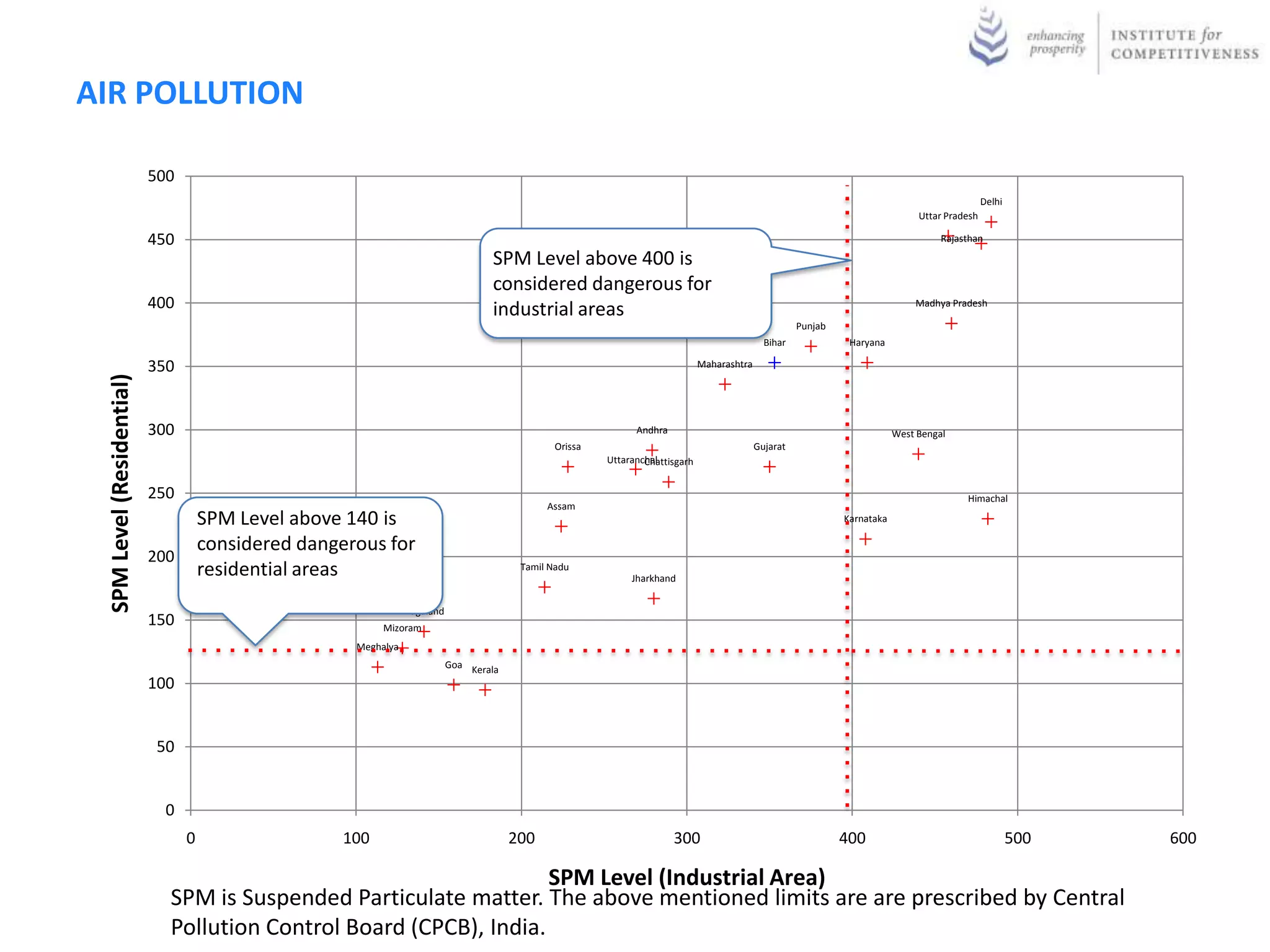
AIR POLLUTION
500
Delhi
Uttar Pradesh
450 Rajasthan
SPM Level above 400 is
considered dangerous for
400 industrial areas Madhya Pradesh
Punjab
Bihar Haryana
350 Maharashtra
SPM Level (Residential)
300 Andhra West Bengal
Orissa Gujarat
Uttaranchal
Chattisgarh
250 Himachal
Assam
SPM Level above 140 is Karnataka
considered dangerous for
200
residential areas Tamil Nadu
Jharkhand
Nagaland
150 Mizoram
Meghalya
Goa Kerala
100
50
0
0 100 200 300 400 500 600
SPM Level (Industrial Area)
SPM is Suspended Particulate matter. The above mentioned limits are are prescribed by Central
Pollution Control Board (CPCB), India.
47.
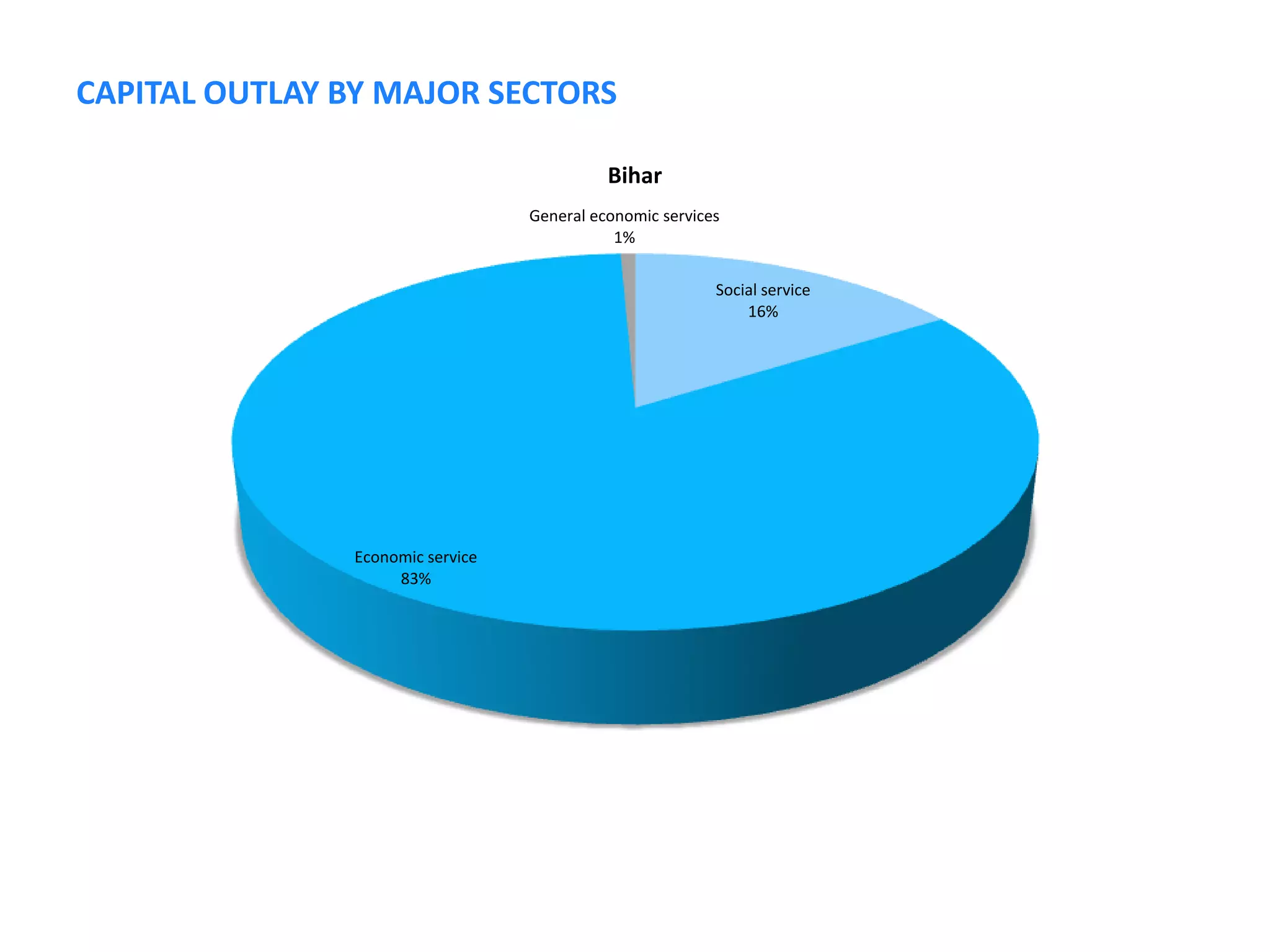
CAPITAL OUTLAY BYMAJOR SECTORS
Bihar
General economic services
1%
Social service
16%
Economic service
83%
48.
INDUSTRIES IN BIHAR
Sugarcane
Textiles/ Sericulture
Agro based Industries
Manufacturing
Petrochemical
Tourist center
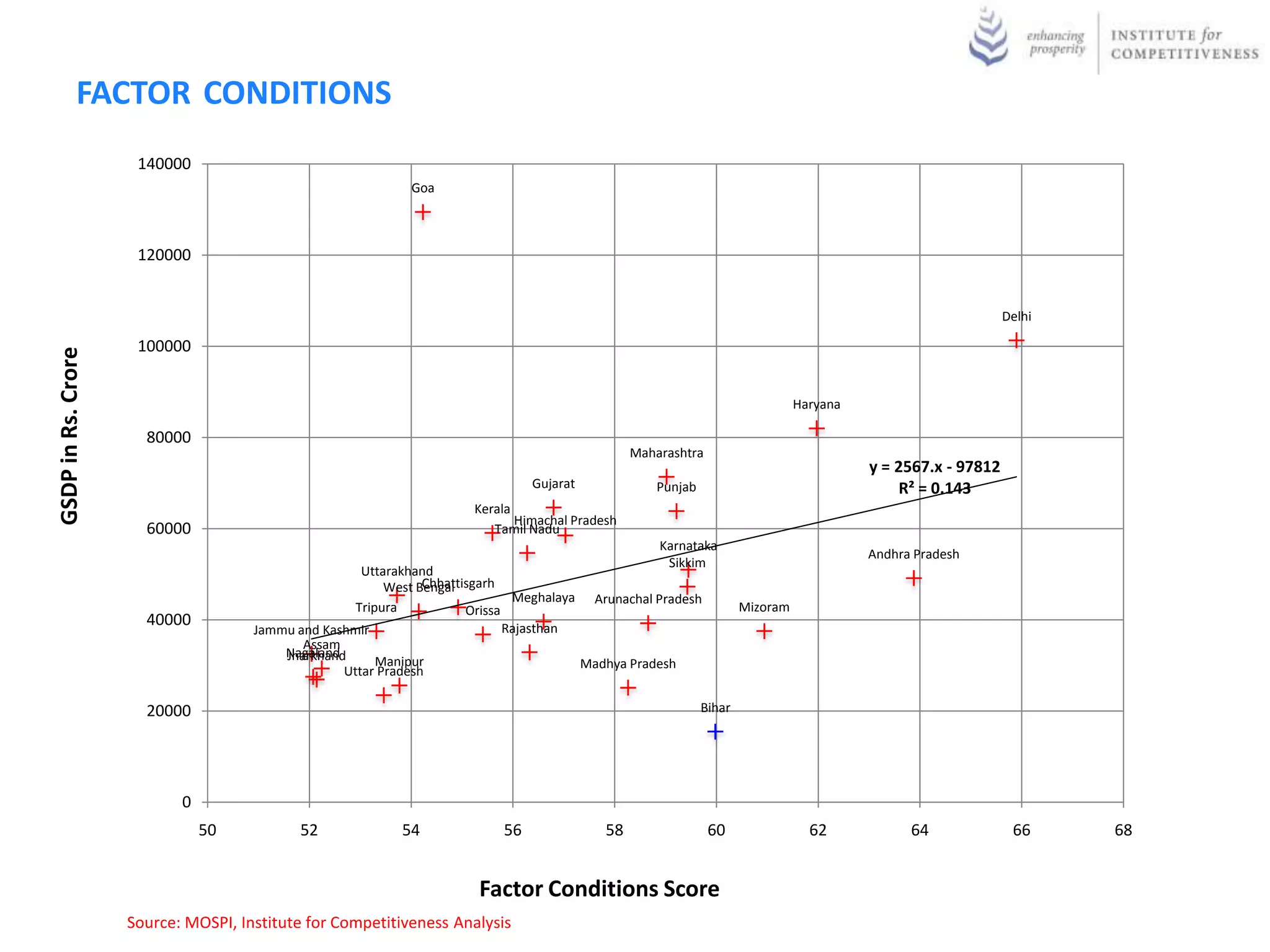
FACTOR CONDITIONS
140000
Goa
120000
Delhi
100000
GSDP in Rs. Crore
Haryana
80000
Maharashtra
y = 2567.x - 97812
Gujarat Punjab R² = 0.143
Kerala
Himachal Pradesh
60000 Tamil Nadu
Karnataka
Andhra Pradesh
Sikkim
Uttarakhand
Chhattisgarh
West Bengal
Meghalaya Arunachal Pradesh
Tripura Orissa Mizoram
40000 Rajasthan
Jammu and Kashmir
Assam
Nagaland
Jharkhand Manipur Madhya Pradesh
Uttar Pradesh
20000 Bihar
0
50 52 54 56 58 60 62 64 66 68
Factor Conditions Score
Source: MOSPI, Institute for Competitiveness Analysis
52.
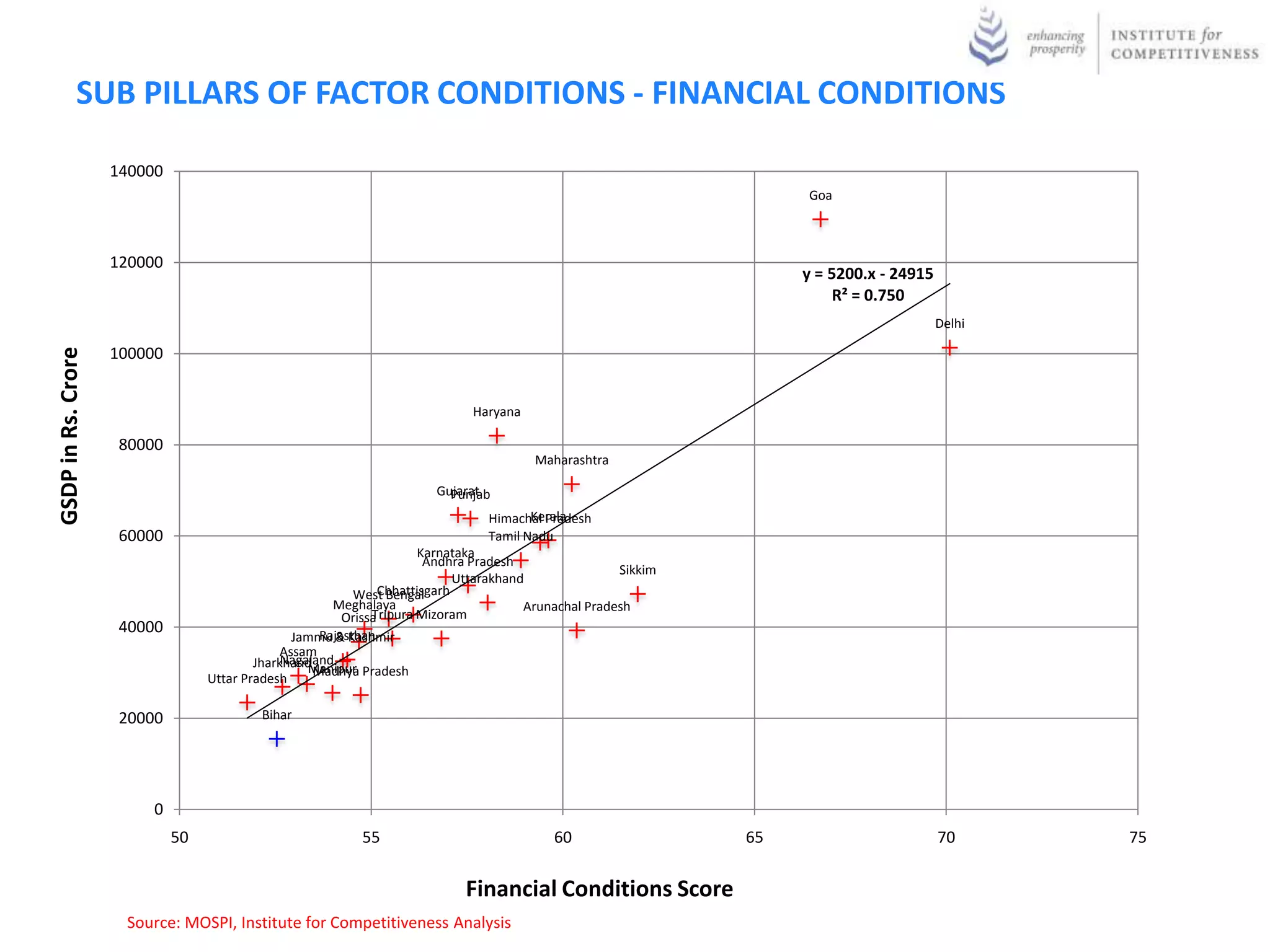
SUB PILLARS OFFACTOR CONDITIONS - FINANCIAL CONDITIONS
140000
Goa
120000
y = 5200.x - 24915
R² = 0.750
Delhi
100000
GSDP in Rs. Crore
Haryana
80000
Maharashtra
Gujarat
Punjab
Kerala
Himachal Pradesh
60000 Tamil Nadu
Karnataka
Andhra Pradesh
Sikkim
Uttarakhand
Chhattisgarh
West Bengal
Meghalaya Arunachal Pradesh
Tripura Mizoram
Orissa
40000 Rajasthan
Jammu & Kashmir
Assam
Nagaland
JharkhandManipur Pradesh
Madhya
Uttar Pradesh
20000 Bihar
0
50 55 60 65 70 75
Financial Conditions Score
Source: MOSPI, Institute for Competitiveness Analysis
53.
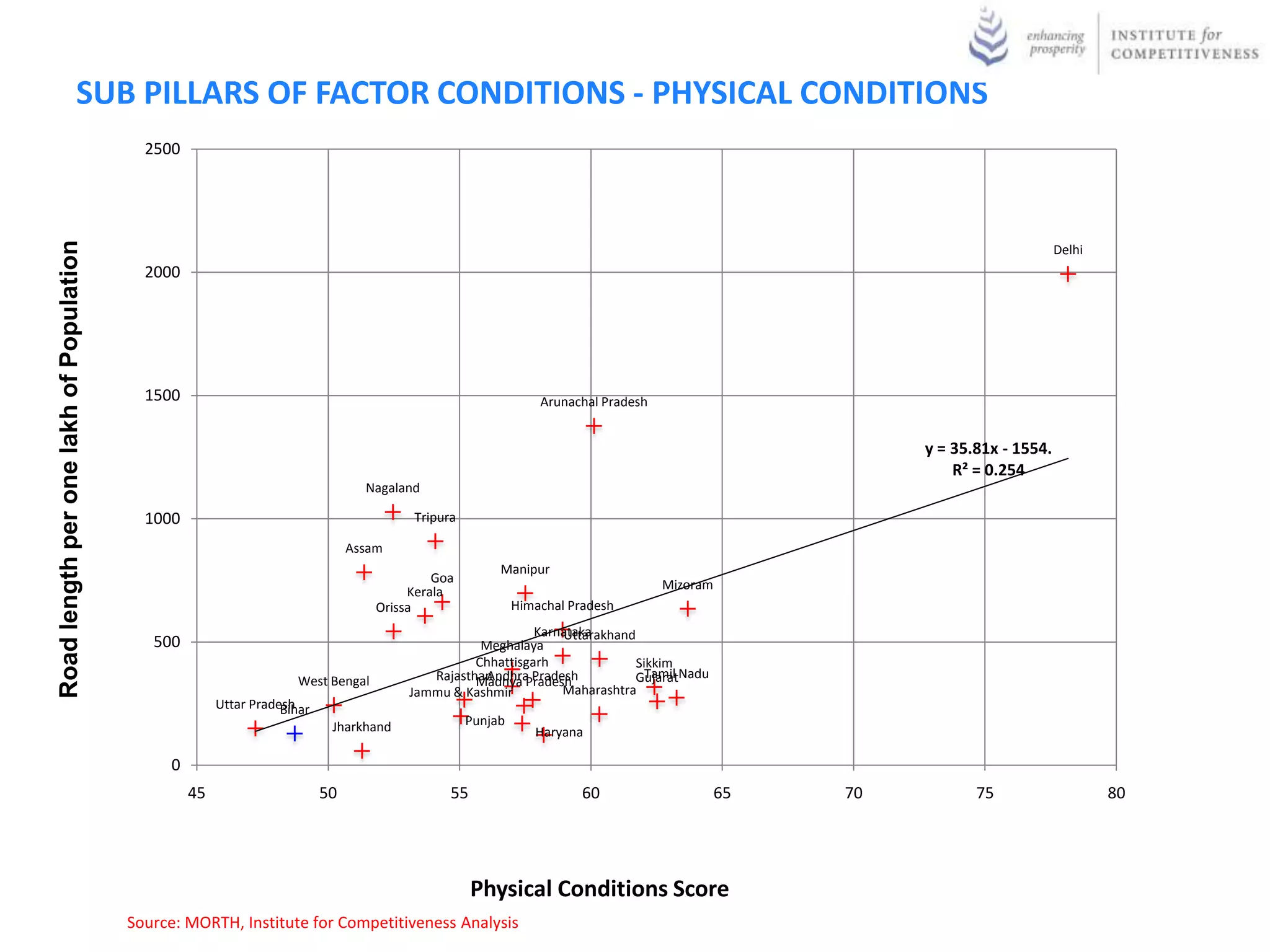
SUB PILLARS OFFACTOR CONDITIONS - PHYSICAL CONDITIONS
2500
Road length per one lakh of Population
Delhi
2000
1500 Arunachal Pradesh
y = 35.81x - 1554.
R² = 0.254
Nagaland
1000 Tripura
Assam
Manipur
Goa Mizoram
Kerala
Orissa Himachal Pradesh
Karnataka
Uttarakhand
500 Meghalaya
Chhattisgarh Sikkim
West Bengal RajasthanAndhra Pradesh
Madhya Pradesh GujaratNadu
Tamil
Jammu & Kashmir Maharashtra
Uttar Pradesh
Bihar
Jharkhand Punjab
Haryana
0
45 50 55 60 65 70 75 80
Physical Conditions Score
Source: MORTH, Institute for Competitiveness Analysis
54.
SUB PILLARS OFFACTOR CONDITIONS - COMMUNICATION CONDITIONS
250
Chhattisgarh
200
Teledensity
150
Himachal Pradesh
Punjab Tamil Nadu
Kerala y = 0.878x + 32.19
Karnataka Maharashtra
R² = 0.115
100 Haryana
Andhra Pradesh Gujarat
West Bengal Bihar Goa
Jharkhand Uttarakhand
Rajasthan
Orissa Manipur
Uttar Pradesh Tripura Meghalaya Arunachal Pradesh Mizoram
Nagaland Sikkim
Jammu & Kashmir
Madhya Pradesh
Delhi
50 Assam
0
45 55 65 75 85 95 105
Communication Conditions Score
Source: Ministry of Telecom , Institute for Competitiveness Analysis
55.
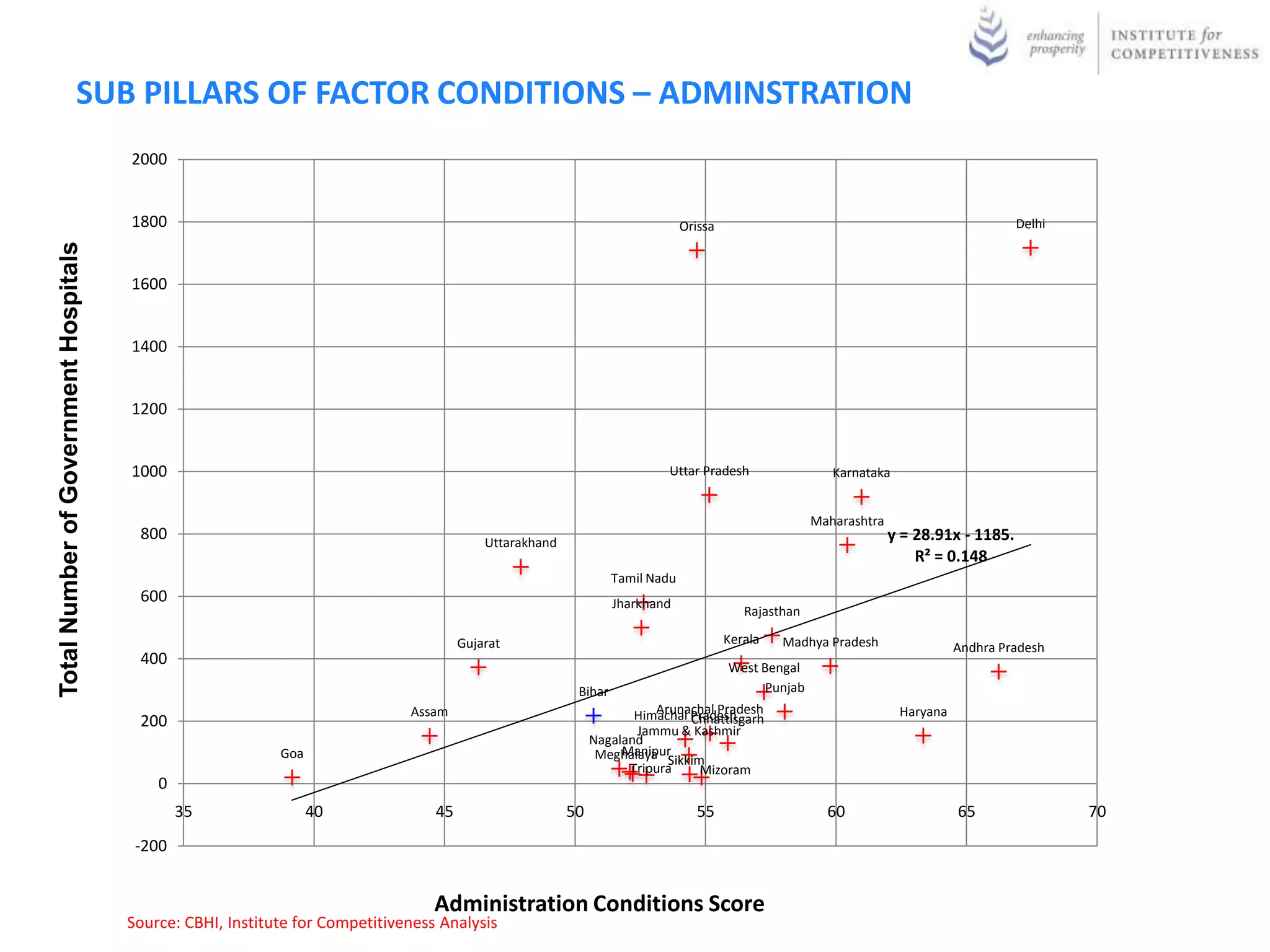
SUB PILLARS OFFACTOR CONDITIONS – ADMINSTRATION
2000
1800 Orissa Delhi
Total Number of Government Hospitals
1600
1400
1200
1000 Uttar Pradesh Karnataka
Maharashtra
800 Uttarakhand
y = 28.91x - 1185.
R² = 0.148
Tamil Nadu
600 Jharkhand
Rajasthan
Gujarat Kerala Madhya Pradesh Andhra Pradesh
400 West Bengal
Bihar Punjab
Assam Arunachal Pradesh
Himachal Pradesh Haryana
200 Chhattisgarh
Jammu & Kashmir
Nagaland
Goa Manipur
Meghalaya Sikkim
Tripura Mizoram
0
35 40 45 50 55 60 65 70
-200
Administration Conditions Score
Source: CBHI, Institute for Competitiveness Analysis
56.
SUB PILLARS OFFACTOR CONDITIONS - HUMAN CONDITIONS
14000000
Sikkim
12000000
Population in the age group 15-64 years
10000000
Delhi y = 2E+06x - 8E+07
80000000
R² = 0.429
Chhattisgarh
Andhra Pradesh Nagaland
60000000
Haryana
Tripura
Jharkhand Tamil Nadu
Bihar
40000000
Rajasthan
Goa
Uttarakhand Meghalaya
Jammu & Kashmir
Kerala
20000000 Gujarat Uttar Pradesh
West Bengal
Karnataka
Orissa
Madhya Pradesh Assam
MizoramArunachal Pradesh
Punjab Himachal Pradesh Manipur
0 Maharashtra
40 45 50 55 60 65 70 75 80 85 90
-2000000
Human Conditions Score
Source: Report on Population , Institute for Competitiveness Analysis
57.
SUB PILLAR OFFACTOR CONDITIONS- INNOVATION RATING
100
Kerala
95
Mizoram
90
Goa Tripura
Delhi
85 Himachal Pradesh
Sikkim Maharashtra
Literacy rate
Nagaland Tamil Nadu
Manipur
Uttarakhand
80
West Bengal Punjab Haryana y = 0.017x + 75.91
Meghalaya Karnataka
R² = 0.000
Gujarat
75 Assam Orissa
Chhattisgarh Pradesh
Madhya
Uttar Pradesh
70 Jammu & Kashmir
Jharkhand Andhra Pradesh
Arunachal Pradesh Rajasthan
65 Bihar
60
45 50 55 60 65 70 75 80 85 90 95
Innovation Score
Source: Census 2011, Institute for Competitiveness Analysis
58.
DEMAND CONDITIONS
140000
Goa
120000
Delhi
100000
Haryana
80000
Literacy rate
Maharashtra
Punjab Gujarat
y = 1048.x - 4544.
Kerala Himachal Pradesh R² = 0.211
60000 Tamil Nadu
Karnataka
Andhra Pradesh
Sikkim
Uttarakhand
Chhattisgarh
Meghalaya West Bengal
Arunachal Pradesh
Mizoram Tripura Orissa
40000 Rajasthan
Jammu and Kashmir
Assam
Nagaland Jharkhand
Manipur Madhya Pradesh
Uttar Pradesh
20000 Bihar
0
30 35 40 45 50 55 60 65 70
Demand Conditions
Source: Census 2011, Institute for Competitiveness Analysis
59.
SUB PILLAR OFDEMAND CONDITIONS- DEMOGRAPHY
140000
Goa
120000
Delhi
100000
Per capita GSDP at state level
Haryana
80000
Maharashtra y = 1048.x - 4544.
Punjab Gujarat R² = 0.211
Kerala Himachal Pradesh
60000 Tamil Nadu
Karnataka
Andhra Pradesh
Sikkim
Uttarakhand
Chhattisgarh
West Bengal
Arunachal Pradesh Meghalaya
Mizoram Tripura Orissa
40000
Jammu and Kashmir Rajasthan
Assam
Nagaland Jharkhand
Manipur Madhya Pradesh
Uttar Pradesh
20000 Bihar
0
30 35 40 45 50 55 60 65 70
Demography
Source: MOSPI, Institute for Competitiveness Analysis
60.
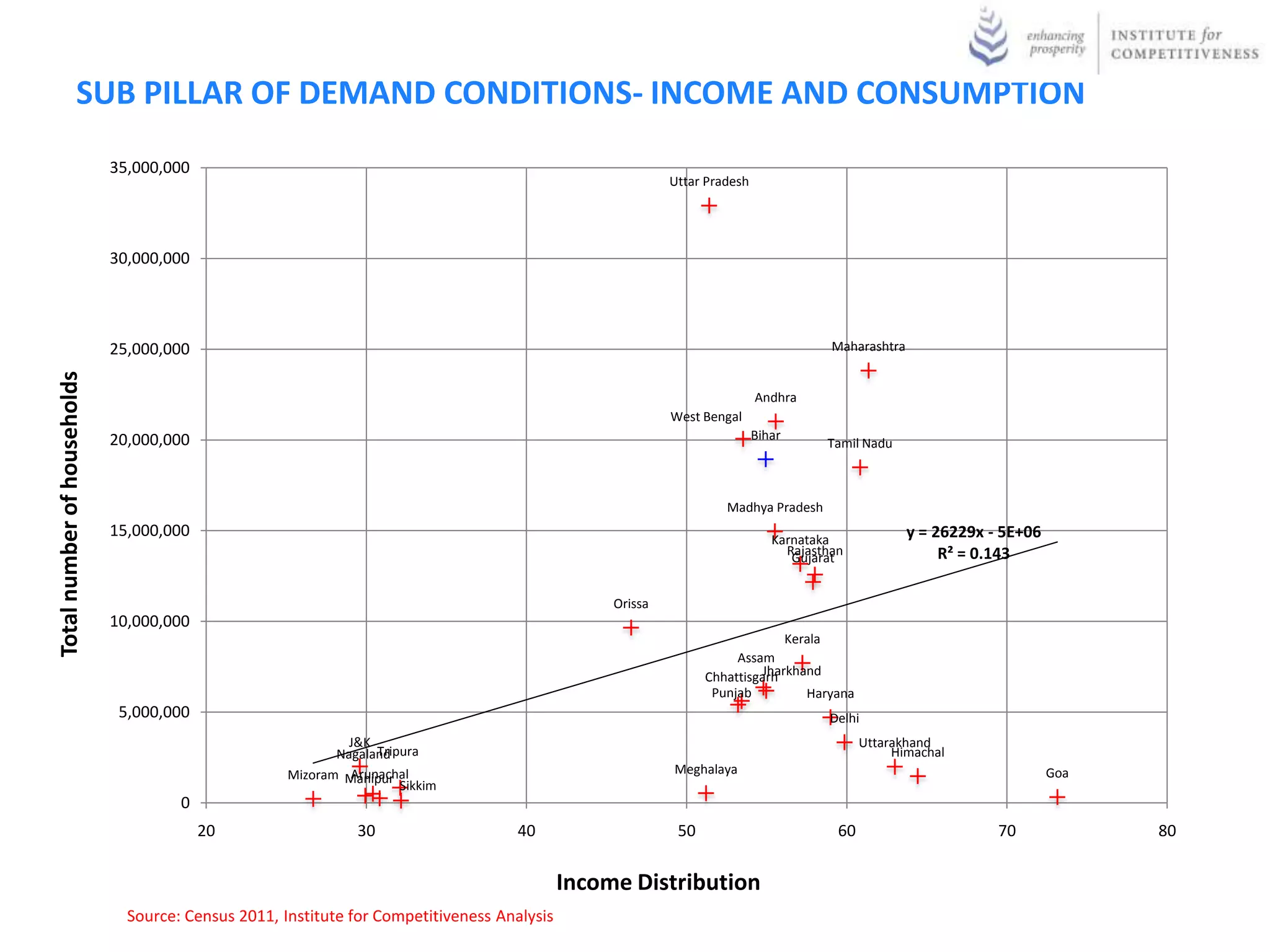
SUB PILLAR OFDEMAND CONDITIONS- INCOME AND CONSUMPTION
35,000,000
Uttar Pradesh
30,000,000
25,000,000 Maharashtra
Total number of households
Andhra
West Bengal
20,000,000 Bihar
Tamil Nadu
Madhya Pradesh
15,000,000 Karnataka y = 26229x - 5E+06
Rajasthan R² = 0.143
Gujarat
Orissa
10,000,000
Kerala
Assam
Jharkhand
Chhattisgarh
Punjab Haryana
5,000,000 Delhi
J&K Uttarakhand
Tripura
Nagaland Himachal
Arunachal
Mizoram Manipur Meghalaya Goa
Sikkim
0
20 30 40 50 60 70 80
Income Distribution
Source: Census 2011, Institute for Competitiveness Analysis
61.
SUPPORTING CONDITIONS
140000
Goa
120000
Delhi
100000
y = 2607.x - 10984
R² = 0.654
Haryana
80000
GSDP/ Capita
Maharashtra
Gujarat Punjab
Kerala
Himachal Pradesh
60000 Tamil Nadu
Karnataka
Andhra Pradesh
Sikkim
Uttarakhand
Chhattisgarh West Bengal
Meghalaya
Arunachal Pradesh
Mizoram
Orissa Tripura
40000 Rajasthan
Jammu and Kashmir
Assam
Nagaland Jharkhand
Manipur Madhya Pradesh
Uttar Pradesh
20000 Bihar
0
50 55 60 65 70 75 80
Supporting Conditions
Source: MOSPI, Institute for Competitiveness Analysis
62.
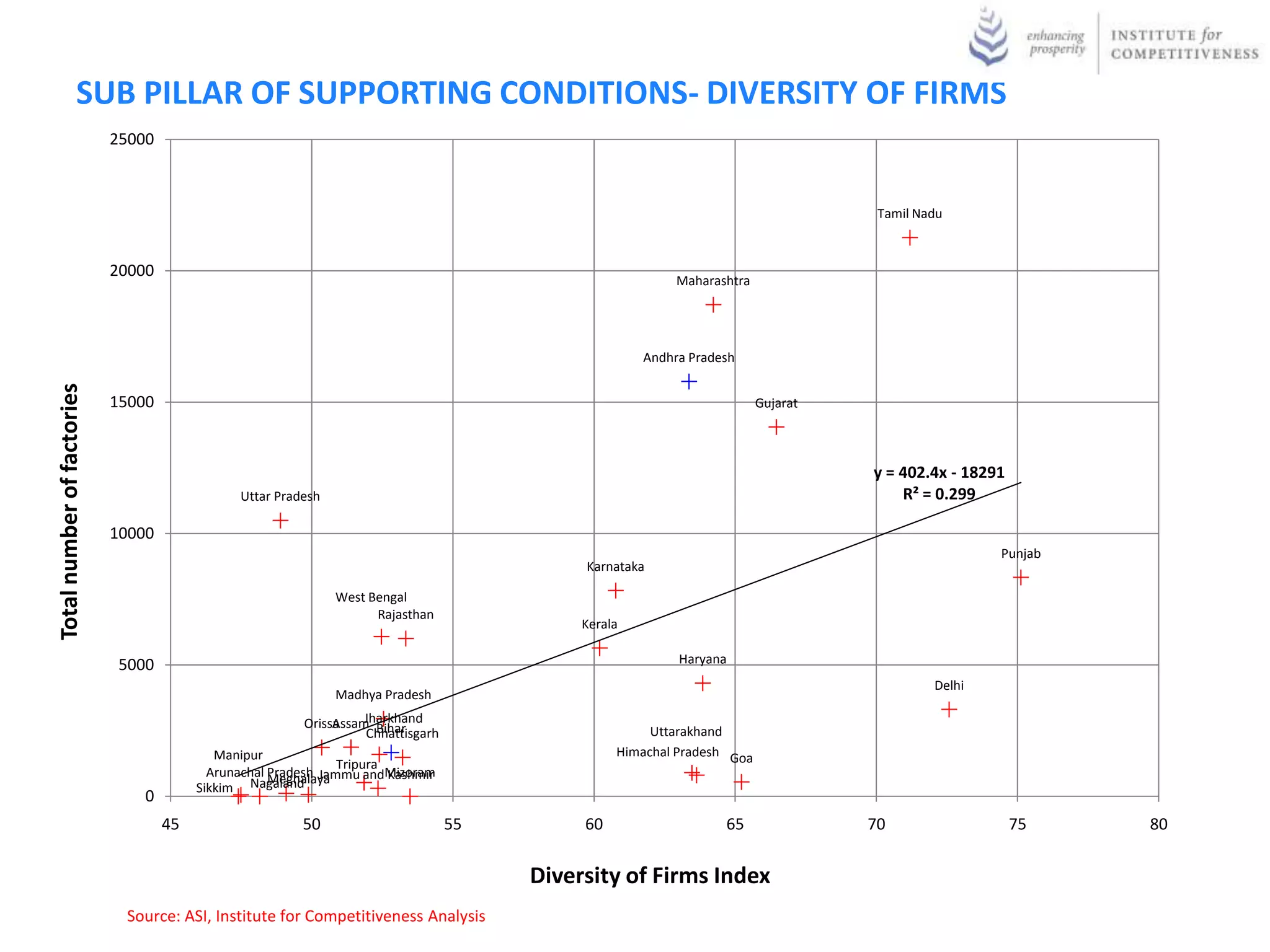
SUB PILLAR OFSUPPORTING CONDITIONS- DIVERSITY OF FIRMS
25000
Tamil Nadu
20000
Maharashtra
Andhra Pradesh
Total number of factories
15000 Gujarat
y = 402.4x - 18291
Uttar Pradesh R² = 0.299
10000
Punjab
Karnataka
West Bengal
Rajasthan
Kerala
5000 Haryana
Delhi
Madhya Pradesh
Jharkhand
Assam Bihar
Orissa
Chhattisgarh Uttarakhand
Manipur Himachal Pradesh Goa
Tripura
Arunachal Pradesh Jammu andMizoram
Meghalaya Kashmir
Sikkim Nagaland
0
45 50 55 60 65 70 75 80
Diversity of Firms Index
Source: ASI, Institute for Competitiveness Analysis
63.
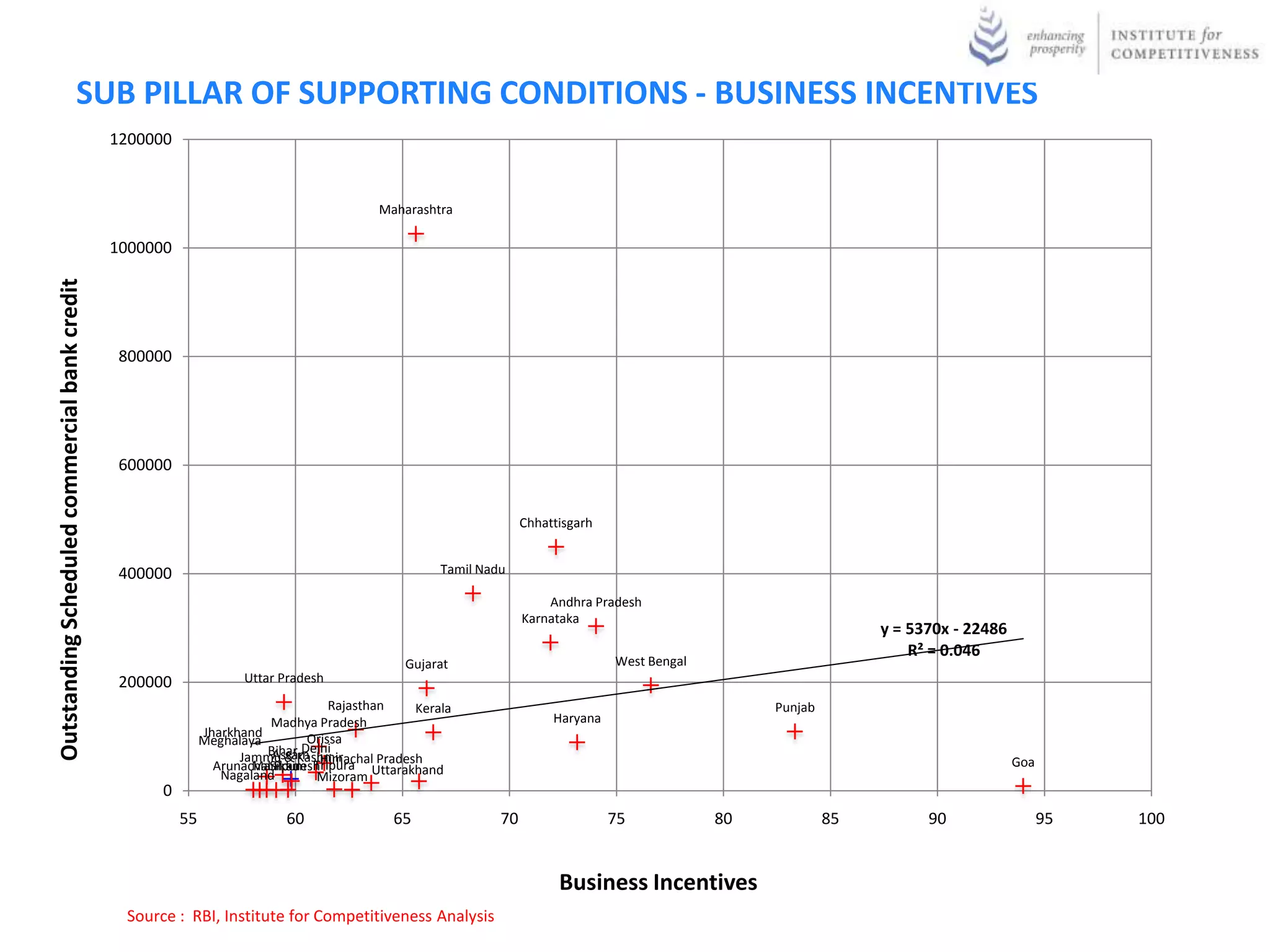
SUB PILLAR OFSUPPORTING CONDITIONS - BUSINESS INCENTIVES
1200000
Maharashtra
1000000
Outstanding Scheduled commercial bank credit
800000
600000
Chhattisgarh
400000 Tamil Nadu
Andhra Pradesh
Karnataka
y = 5370x - 22486
R² = 0.046
Gujarat West Bengal
200000 Uttar Pradesh
Rajasthan Kerala Punjab
Madhya Pradesh Haryana
Jharkhand Orissa
Meghalaya
Bihar Delhi
Assam Himachal Pradesh
Jammu & Kashmir
ArunachalSikkim Tripura Uttarakhand
Pradesh
Manipur Goa
Nagaland Mizoram
0
55 60 65 70 75 80 85 90 95 100
Business Incentives
Source : RBI, Institute for Competitiveness Analysis
64.
STRATEGIC CONTEXT
140000
Goa
120000
Delhi
100000
Haryana
80000
GSDP per capita
Maharashtra
Gujarat Punjab
Kerala
Himachal Pradesh
60000 Tamil Nadu
Karnataka
Andhra Pradesh
Sikkim
Uttarakhand
Chhattisgarh
West Bengal
Meghalaya Arunachal Pradesh
Orissa Tripura Mizoram
40000 Rajasthan
Jammu and Kashmir
Assam
Jharkhand Nagaland
Madhya Pradesh Manipur
Uttar Pradesh
20000 Bihar
0
45 50 55 60 65 70 75
Strategic context
Source: Institute for Competitiveness Analysis
65.
SUB PILLARS OFSTRATEGIC CONTEXT – SUPPLIER SOPHISTICATION
1600000
Tamil Nadu
1400000
Maharashtra
Total Number of Factory Workers
1200000
Andhra Pradesh
1000000
Gujarat
800000
y = 20093x - 80534
Uttar Pradesh Karnataka R² = 0.206
600000 West Bengal
Punjab
Haryana
400000 Arunachal Pradesh
Sikkim
Mizoram Kerala
Rajasthan
Madhya Pradesh
200000 Jharkhand
Orissa
Assam Bihar Chhattisgarh
Delhi Himachal PradeshUttarakhand
Nagaland Jammu & Kashmir
Tripura
Goa
Manipur Meghalaya
0
45 50 55 60 65 70 75 80
Supplier sophistication
Source: ASI, Institute for Competitiveness Analysis
66.
SUB PILLAR OFSTRATEGIC CONTEXT- INSTITUTIONAL SUPPORT
60
Educational Institutions – Universities per crore of population
Sikkim
50
40
y = 0.980x - 49.26
30 R² = 0.650
20
Arunachal Pradesh
Uttarakhand
Himachal Pradesh
Tamil Nadu Chhattisgarh
Jammu & Kashmir Goa Mizoram
10 Manipur
Karnataka
Rajasthan Tripura
Nagaland Haryana
Bihar MeghalayaGujarat
Orissa Kerala
Maharashtra
Punjab Andhra Pradesh
Jharkhand
Assam Delhi
Uttar Pradesh
West BengalMadhya Pradesh
0
40 45 50 55 60 65 70 75 80 85
-10
Institutional Support Index
Source: UGC, Institute for Competitiveness Analysis
67.
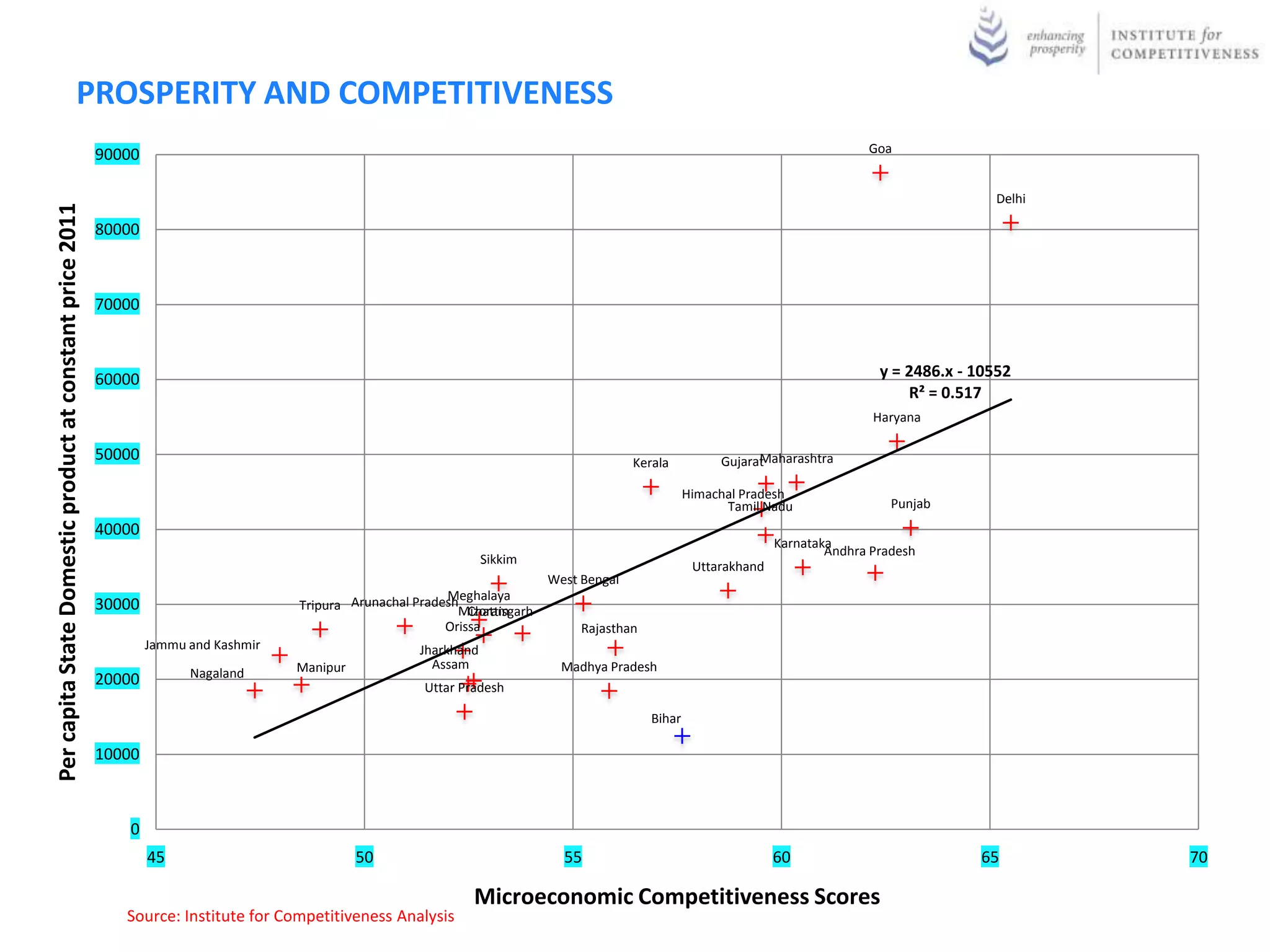
PROSPERITY AND COMPETITIVENESS
90000 Goa
Delhi
Per capita State Domestic product at constant price 2011
80000
70000
60000 y = 2486.x - 10552
R² = 0.517
Haryana
50000 Kerala Maharashtra
Gujarat
Himachal Pradesh
Tamil Nadu Punjab
40000
Karnataka
Andhra Pradesh
Sikkim
Uttarakhand
West Bengal
Meghalaya
30000 Tripura Arunachal PradeshMizoram
Chattisgarh
Orissa Rajasthan
Jammu and Kashmir Jharkhand
Manipur Assam Madhya Pradesh
20000 Nagaland
Uttar Pradesh
Bihar
10000
0
45 50 55 60 65 70
Microeconomic Competitiveness Scores
Source: Institute for Competitiveness Analysis
68.
POLICE OFFICIALS VERSUSCOMPETITIVENESS
180000
Maharashtra
160000
140000
Number of Police Officials
120000 Uttar Pradesh
100000 Andhra Pradesh
Tamil Nadu
80000
Karnataka
Jammu and Kashmir West Bengal
Rajasthan y = 2830x - 11635
60000 R² = 0.122
Madhya Pradesh Bihar Gujarat
Punjab
Kerala Haryana
40000 Jharkhand
Orissa
Assam Chattisgarh
20000 Uttarakhand
Tripura
Manipur
Nagaland Meghalaya Himachal Pradesh Goa
Arunachal Pradesh Mizoram
Sikkim
0
45 47 49 51 53 55 57 59 61 63 65
Microeconomic Competitiveness Scores
Source: Institute for Competitiveness Analysis
69.
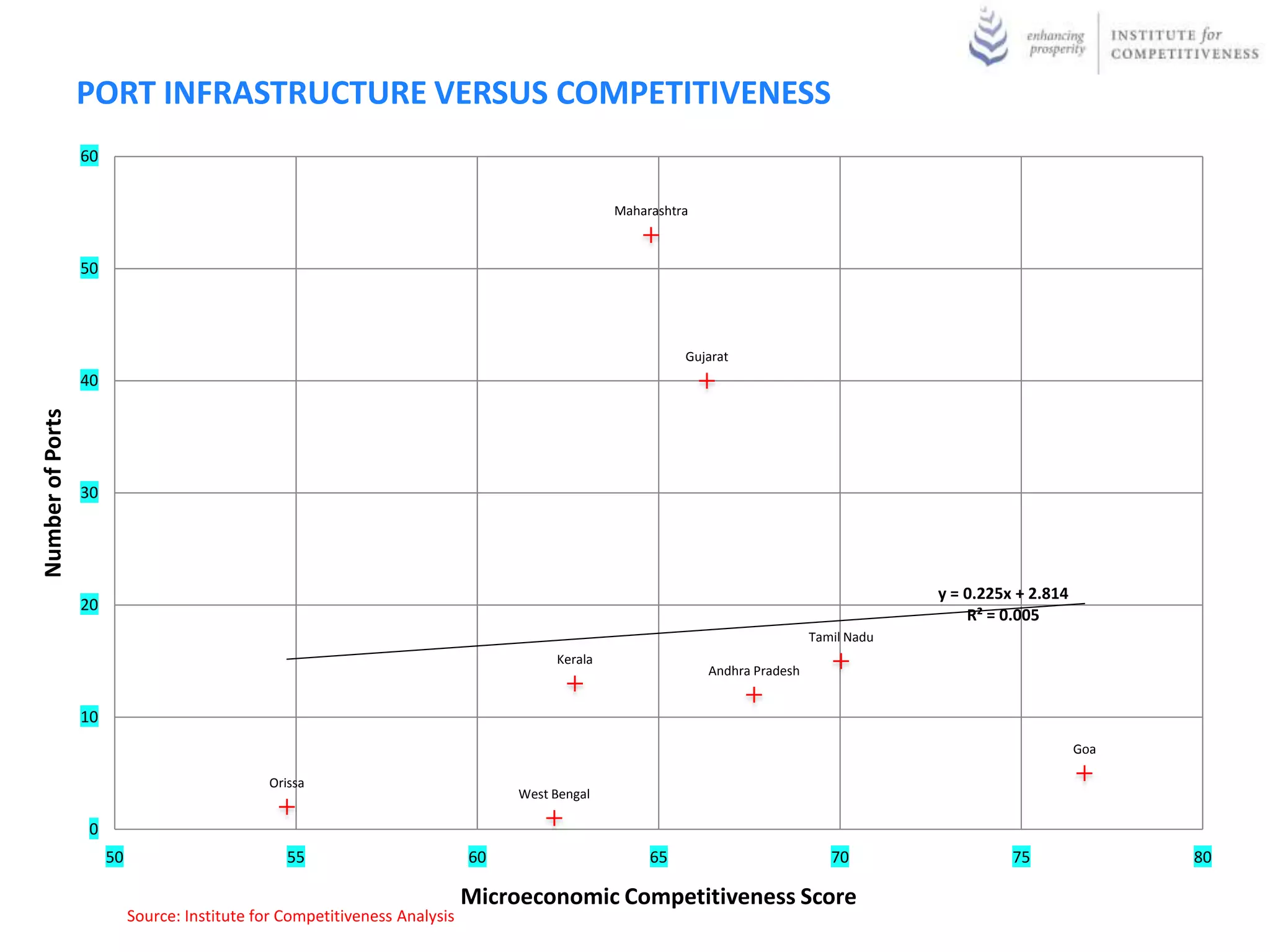
PORT INFRASTRUCTURE VERSUSCOMPETITIVENESS
60
Maharashtra
50
Gujarat
40
Number of Ports
30
y = 0.225x + 2.814
20
R² = 0.005
Tamil Nadu
Kerala
Andhra Pradesh
10
Goa
Orissa
West Bengal
0
50 55 60 65 70 75 80
Microeconomic Competitiveness Score
Source: Institute for Competitiveness Analysis
70.
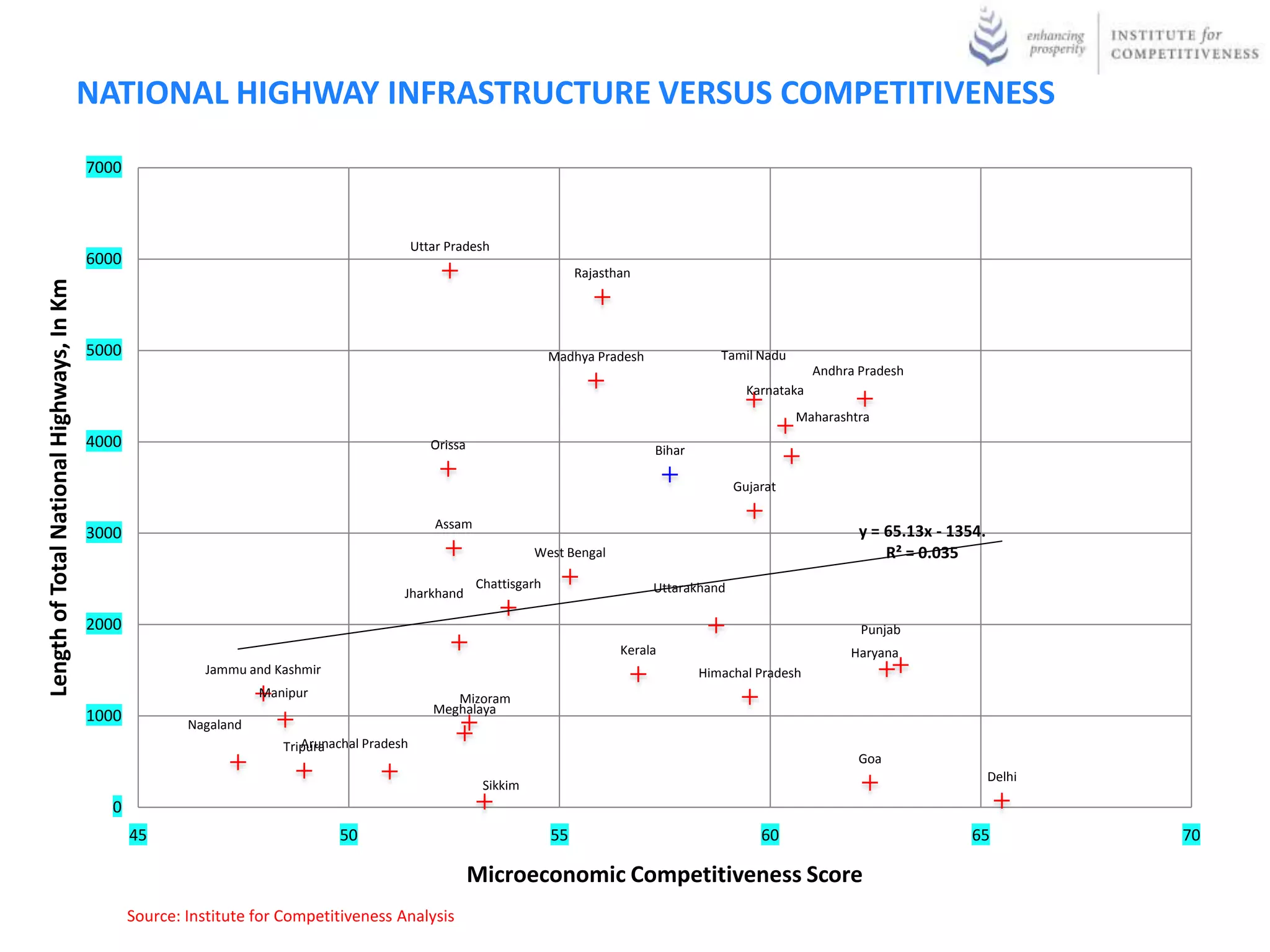
NATIONAL HIGHWAY INFRASTRUCTUREVERSUS COMPETITIVENESS
7000
Uttar Pradesh
6000
Rajasthan
Length of Total National Highways, In Km
5000 Madhya Pradesh Tamil Nadu
Andhra Pradesh
Karnataka
Maharashtra
4000 Orissa Bihar
Gujarat
Assam
3000 y = 65.13x - 1354.
West Bengal R² = 0.035
Chattisgarh Uttarakhand
Jharkhand
2000 Punjab
Kerala Haryana
Jammu and Kashmir Himachal Pradesh
Manipur Mizoram
Meghalaya
1000 Nagaland
Arunachal Pradesh
Tripura
Goa
Delhi
Sikkim
0
45 50 55 60 65 70
Microeconomic Competitiveness Score
Source: Institute for Competitiveness Analysis
71.
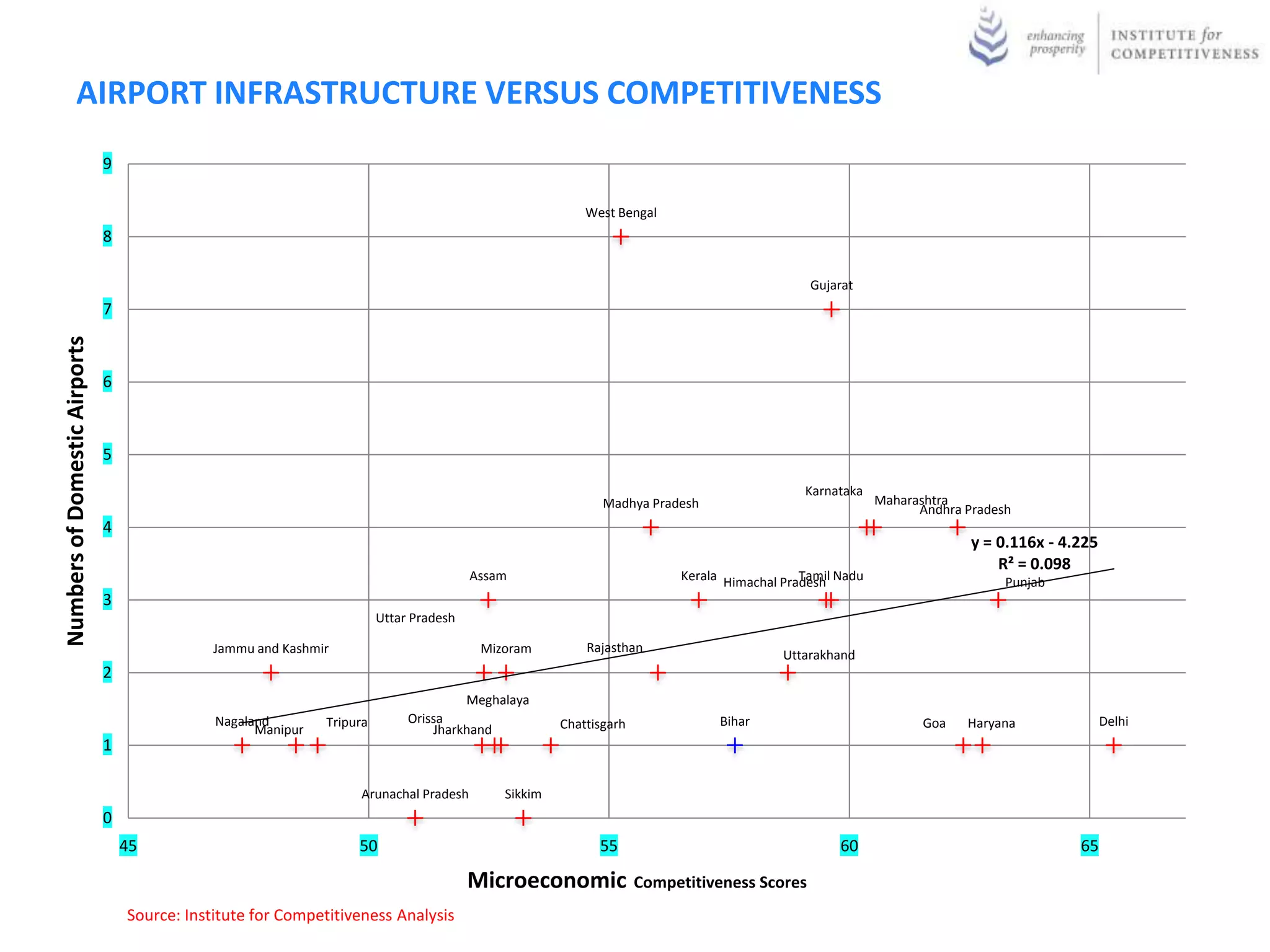
AIRPORT INFRASTRUCTURE VERSUSCOMPETITIVENESS
9
West Bengal
8
Gujarat
7
Numbers of Domestic Airports
6
5
Karnataka
Madhya Pradesh Maharashtra
Andhra Pradesh
4
y = 0.116x - 4.225
R² = 0.098
Assam Kerala Himachal Pradesh Nadu
Tamil Punjab
3
Uttar Pradesh
Jammu and Kashmir Mizoram Rajasthan
Uttarakhand
2
Meghalaya
Nagaland Tripura Orissa Chattisgarh Bihar Goa Haryana Delhi
Manipur Jharkhand
1
Arunachal Pradesh Sikkim
0
45 50 55 60 65
Microeconomic Competitiveness Scores
Source: Institute for Competitiveness Analysis
72.
TELEDENSITY VERSUS COMPETITIVENESS
Delhi
200
Teledensity , Phones per 100 people in the population
150
y = 4.650x - 210.8
R² = 0.340
Himachal Pradesh
100 Punjab
Haryana
Gujarat
Andhra Pradesh
Rajasthan Maharashtra
Madhya Pradesh
Goa
Nagaland Uttar Pradesh Bihar
50 Manipur
Tripura
Arunachal Pradesh Mizoram
Meghalaya
Assam Kerala
Orissa Karnataka
West Bengal
Sikkim Tamil Nadu
Uttarakhand
Jammu and Kashmir
Jharkhand Chattisgarh
0
45 50 55 60 65 70
Microeconomic Competitiveness Scores
Source: Institute for Competitiveness Analysis
73.
LITERACY RATES VERSUSCOMPETITIVENESS
100
95 Kerala
Mizoram
90
Tripura Goa
Delhi
85 Himachal Pradesh
Literacy Rates
Sikkim Maharashtra
Nagaland Manipur Tamil Nadu
Uttarakhand y = 0.237x + 63.62
80 R² = 0.023
West Bengal Punjab
Haryana
Meghalaya Karnataka
75 Orissa Gujarat
Assam
Chhattisgarh Madhya Pradesh
Uttar Pradesh
70 Jammu and Kashmir
Jharkhand Andhra Pradesh
Arunachal Pradesh Rajasthan
65 Bihar
60
45 50 55 60 65
Microeconomic Competitiveness Score
Source: Institute for Competitiveness Analysis
74.
EDUCATION VERSUS COMPETITIVENESS
20
Millions
Uttar Pradesh
18
16
Students enrolled in higher secondary classes
14
12
10 Andhra Pradesh
8
6 Maharashtra
Madhya Pradesh Tamil Nadu
4 West Bengal y = 89218x - 3E+06
Rajasthan Karnataka
Bihar R² = 0.014
Gujarat
2 Orissa Kerala Haryana
Jharkhand
Chattisgarh Punjab Delhi
Jammu and Kashmir Assam Uttarakhand Pradesh
Himachal
Tripura
Nagaland Manipur Mizoram
Meghalaya Goa
Arunachal Pradesh Sikkim
0
45 50 55 60 65
Microeconomic Competitiveness Score
Source: Institute for Competitiveness Analysis
75.
RURAL TO URBANLITERACY RATIO VERSUS COMPETITIVENESS
100.00
Kerala
Ratio of Urban to rural literacy rates in percentage terms
Delhi
Goa
95.00
Tripura
Himachal Pradesh
Uttarakhand
Manipur Sikkim
90.00
Uttar Pradesh y = 0.305x + 67.33
Haryana
Punjab
R² = 0.056
Mizoram Maharashtra
West Bengal
Tamil Nadu
85.00 Nagaland
Jammu and Kashmir Gujarat
Orissa
Karnataka
Assam
80.00 Chattisgarh Bihar
Meghalaya Madhya Pradesh
Rajasthan
Andhra Pradesh
Jharkhand
75.00
Arunachal Pradesh
70.00
45 50 55 60 65 70
Microeconomic Competitiveness Score
Source: Institute for Competitiveness Analysis
76.
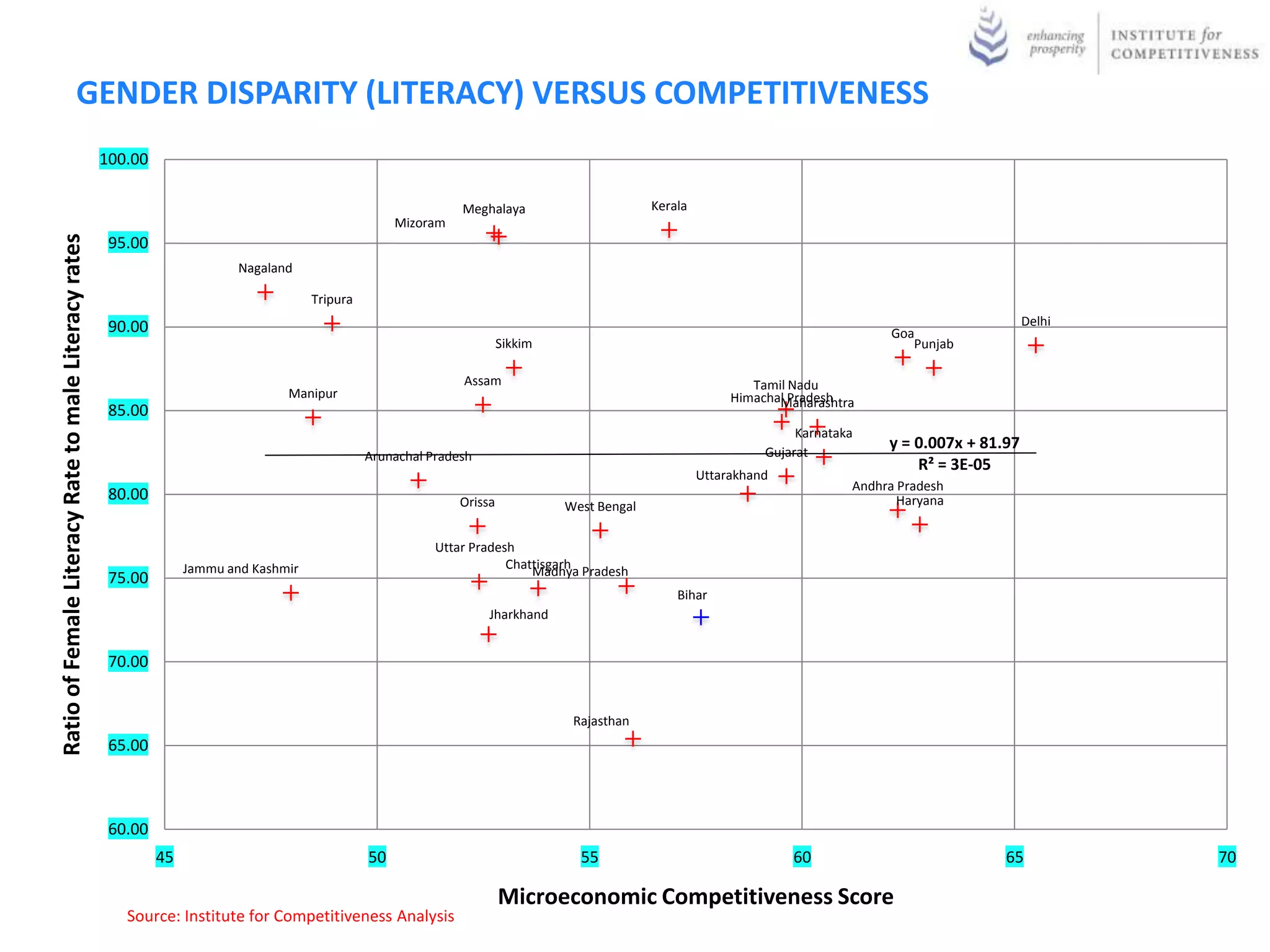
GENDER DISPARITY (LITERACY)VERSUS COMPETITIVENESS
100.00
Meghalaya Kerala
Mizoram
Ratio of Female Literacy Rate to male Literacy rates
95.00
Nagaland
Tripura
90.00 Delhi
Goa
Sikkim Punjab
Assam Tamil Nadu
Manipur Himachal Pradesh
Maharashtra
85.00
Karnataka
Gujarat
y = 0.007x + 81.97
Arunachal Pradesh
R² = 3E-05
Uttarakhand
Andhra Pradesh
80.00 Orissa Haryana
West Bengal
Uttar Pradesh
Jammu and Kashmir Chattisgarh
Madhya Pradesh
75.00
Bihar
Jharkhand
70.00
Rajasthan
65.00
60.00
45 50 55 60 65 70
Microeconomic Competitiveness Score
Source: Institute for Competitiveness Analysis
77.
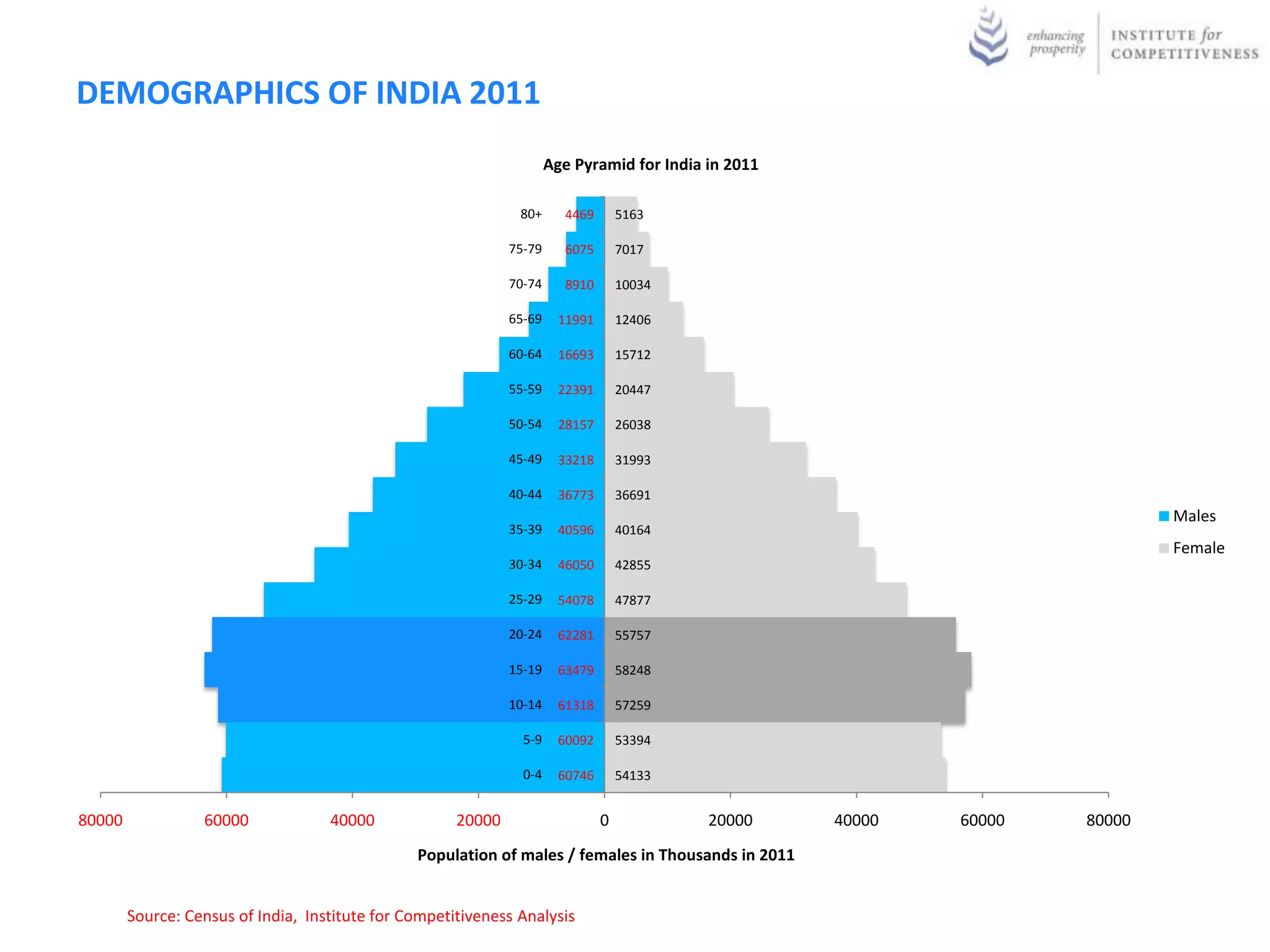
DEMOGRAPHICS OF INDIA2011
Age Pyramid for India in 2011
80+ 4469 5163
75-79 6075 7017
70-74 8910 10034
65-69 11991 12406
60-64 16693 15712
55-59 22391 20447
50-54 28157 26038
45-49 33218 31993
40-44 36773 36691
Males
35-39 40596 40164
Female
30-34 46050 42855
25-29 54078 47877
20-24 62281 55757
15-19 63479 58248
10-14 61318 57259
5-9 60092 53394
0-4 60746 54133
80000 60000 40000 20000 0 20000 40000 60000 80000
Population of males / females in Thousands in 2011
Source: Census of India, Institute for Competitiveness Analysis
78.
DEMOGRAPHICS OF INDIA2026
Age Pyramid for India in 2026
80+ 8412 11465
75-79 9937 10644
70-74 15820 15819
65-69 22185 21982
60-64 28268 28651
55-59 32968 34124
50-54 37704 38267
45-49 43702 41361
40-44 51965 46466
Male
35-39 60313 54219
Female
30-34 61859 56739
25-29 60113 55998
20-24 59176 52410
15-19 59529 52739
10-14 59500 52734
5-9 58396 51790
0-4 55328 49256
80000 60000 40000 20000 0 20000 40000 60000 80000
Projected Population of males / females in Thousands
Source: Census of India, Institute for Competitiveness Analysis
79.
OVERALL DEPENDENCE RATIOOF STATES
Dependence Ratios 2011 Dependence ratio 2026
West Bengal 44.58 42.35
Uttarakhand 56.39 47.88
Uttar Pradesh 66.11 55.02
Tamil Nadu 43.07 43.78
Rajasthan 60.51 46.67
Punjab 46.62 41.77
Orissa 48.47 43.43
NE States Excluding Assam 44.57 42.23
Maharashtra 48.85 42.72
Madhya Pradesh 60.18 48.37
Kerala 45.23 45.96
Karnataka 45.97 43.46
Jharkhand 55.35 47.13
Jammu & Kashmir 50.27 43.11
Himachal Pradesh 46.91 42.87
Haryana 51.12 41.24
Gujarat 48.40 43.16
Delhi 39.96 34.81
Chattisgarh 57.45 48.40
Bihar 49.71 47.67
Assam 51.97 45.14
Andhra Pradesh 45.05 42.49
80.0 60.0 40.0 20.0 0.0 20.0 40.0 60.0 80.0
Dependence ratio 2011 Dependence ratio 2026
Source: Census of India, Institute for Competitiveness Analysis
80.
GOVERNMENT HOSPITALS VERSUSCOMPETITIVENESS
1800 Orissa
Bihar
1600
1400
Number of government Hoispitals
1200
1000 Uttar Pradesh Karnataka
Maharashtra
800
Uttarakhand
Tamil Nadu
600
Jharkhand
Rajasthan y = 11.66x - 253.3
Kerala R² = 0.016
Madhya Pradesh Gujarat Andhra Pradesh
400
West Bengal
Punjab
Chattisgarh
Arunachal Pradesh Haryana
200 Assam Himachal Pradesh Delhi
Jammu and Kashmir
Nagaland Meghalaya
Manipur
Tripura Sikkim Goa
Mizoram
0
45 50 55 60 65
Microeconomic Competitiveness Score
Source: Institute for Competitiveness Analysis
81.
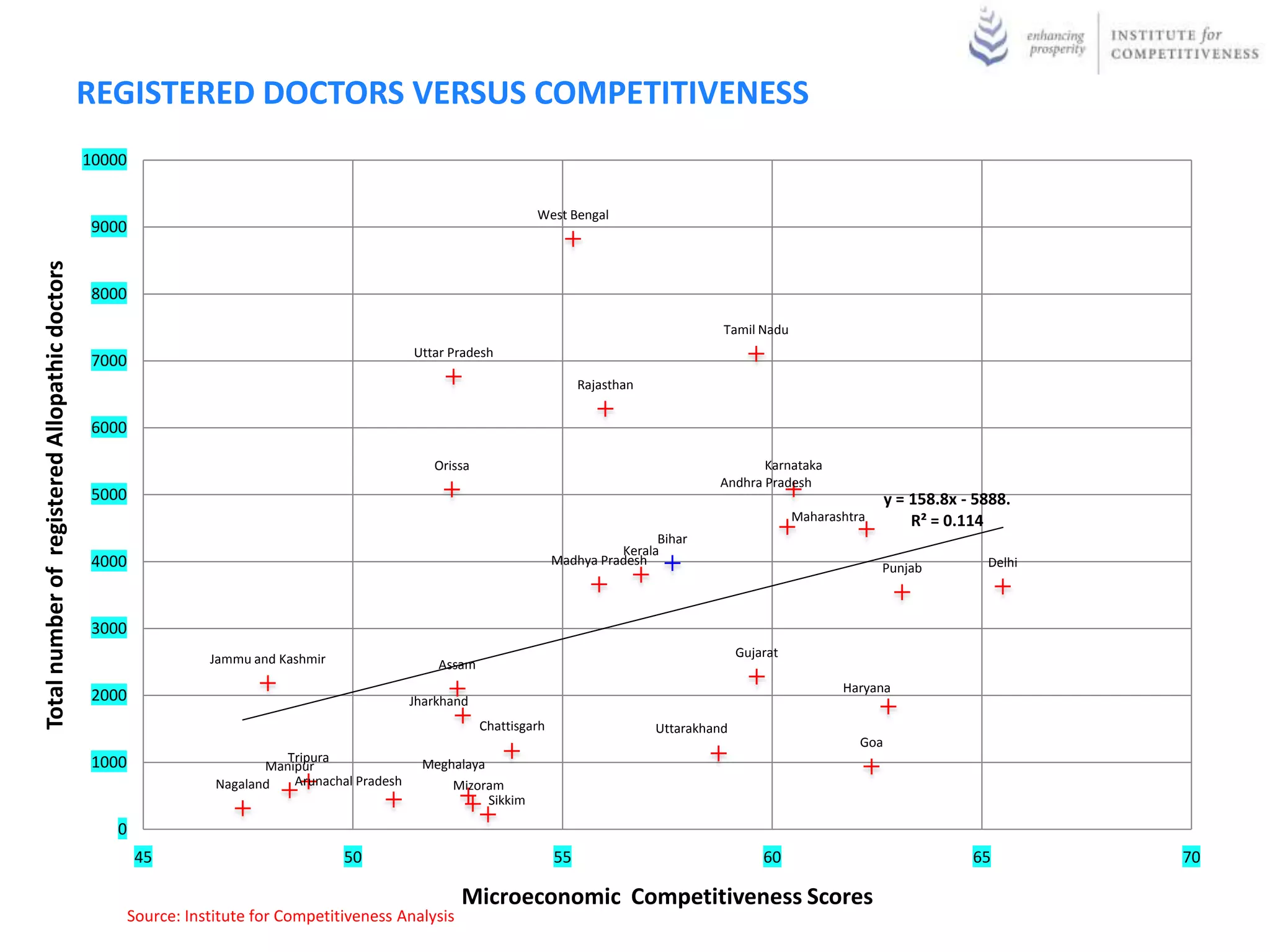
REGISTERED DOCTORS VERSUSCOMPETITIVENESS
10000
West Bengal
9000
Total number of registered Allopathic doctors
8000
Tamil Nadu
Uttar Pradesh
7000
Rajasthan
6000
Orissa Karnataka
Andhra Pradesh
5000 y = 158.8x - 5888.
Maharashtra R² = 0.114
Bihar
Kerala
4000 Madhya Pradesh
Punjab Delhi
3000
Jammu and Kashmir Gujarat
Assam
Haryana
2000 Jharkhand
Chattisgarh Uttarakhand
Goa
1000 Tripura Meghalaya
Manipur
Nagaland Arunachal Pradesh Mizoram
Sikkim
0
45 50 55 60 65 70
Microeconomic Competitiveness Scores
Source: Institute for Competitiveness Analysis
82.
PER CAPITA REVENUUEEXPENDITURE ON MEDICAL, HEALTH AND EXPENDITURE
AND COMPETITIVENESS
2500.00
Goa
Per capita revenue expeniture on medical, health and
2000.00
Sikkim
1500.00
Mizoram
sanitation
Delhi
Arunachal Pradesh
1000.00 Himachal Pradesh
Jammu and Kashmir
Manipur
y = 6.696x + 281.1
Uttarakhand R² = 0.004
Nagaland Meghalaya
Tripura
Assam Kerala Tamil Nadu
Haryana
Andhra Pradesh
Punjab
500.00 Chattisgarh Madhya Pradesh Maharashtra
Gujarat
Karnataka
Orissa West Bengal Rajasthan
Uttar Pradesh Bihar
Jharkhand
0.00
45 50 55 60 65 70
Microeconomic Competitiveness Scores
Source: Institute for Competitiveness Analysis
83.
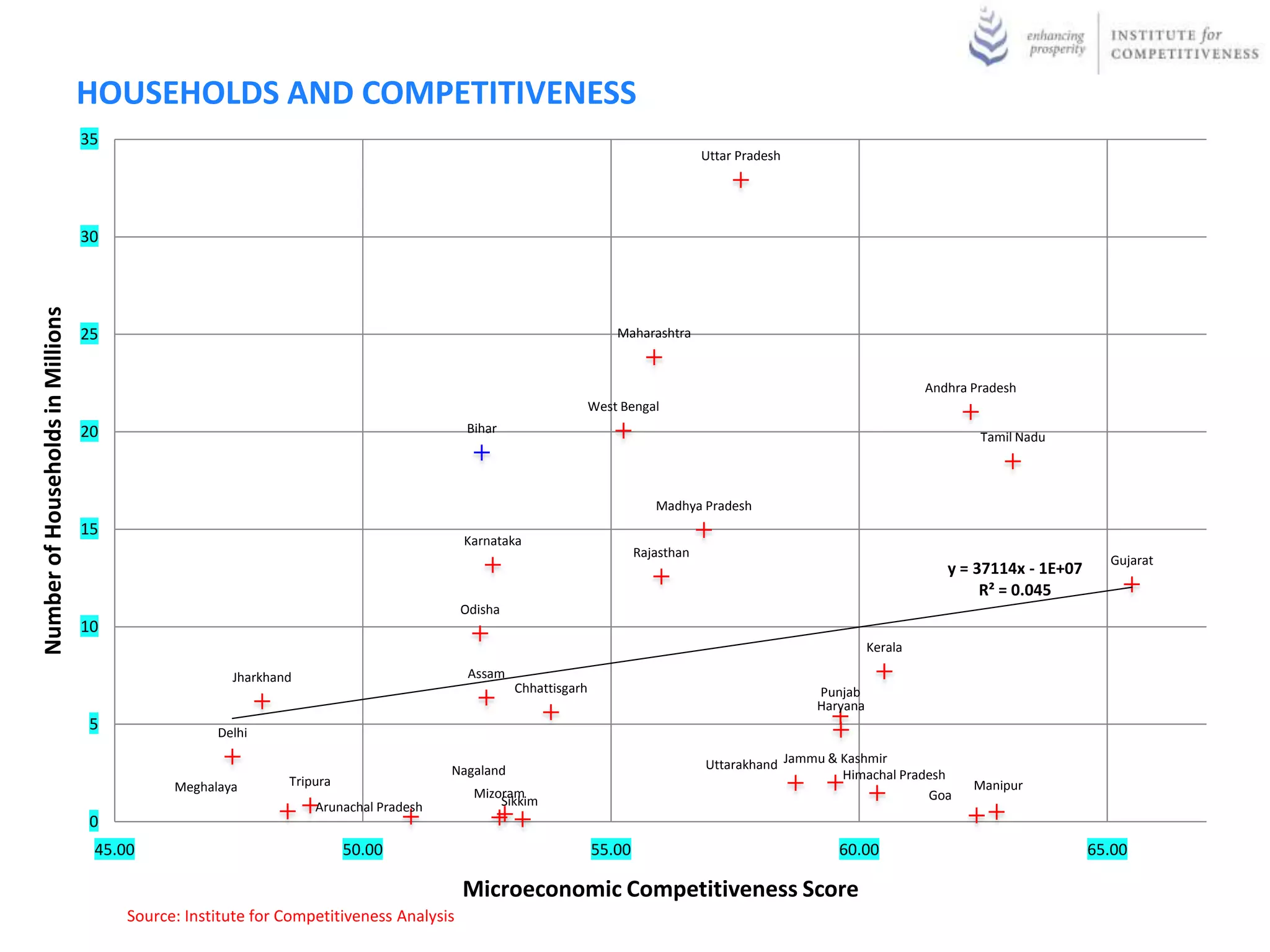
HOUSEHOLDS AND COMPETITIVENESS
35
Uttar Pradesh
30
Number of Households in Millions
25 Maharashtra
Andhra Pradesh
West Bengal
20 Bihar
Tamil Nadu
Madhya Pradesh
15
Karnataka
Rajasthan
Gujarat
y = 37114x - 1E+07
R² = 0.045
Odisha
10
Kerala
Jharkhand Assam
Chhattisgarh Punjab
Haryana
5 Delhi
Nagaland Uttarakhand Jammu & Kashmir
Tripura Himachal Pradesh
Meghalaya Manipur
Mizoram Goa
Arunachal Pradesh Sikkim
0
45.00 50.00 55.00 60.00 65.00
Microeconomic Competitiveness Score
Source: Institute for Competitiveness Analysis
84.
AGRICULTURAL GSDP PERCAPITA AND COMPETITIVENESS
Agricultural GSDP per capita in Rupees /Annum
25000.00
Punjab
20000.00
Haryana
15000.00
Nagaland
Himachal Pradesh Andhra Pradesh
y = 199.8x - 2794.
Goa R² = 0.060
Gujarat
10000.00 Orissa
West Bengal Kerala
Arunachal Pradesh Sikkim
Tripura Assam Rajasthan Maharashtra
Jammu and Kashmir
Uttarakhand Karnataka
Chattisgarh
Meghalaya Madhya Pradesh
Manipur Uttar Pradesh Tamil Nadu
Mizoram
5000.00
Bihar
Jharkhand
Delhi
0.00
45 50 55 60 65
Microeconomic Competitiveness Score
Source: Institute for Competitiveness Analysis
85.
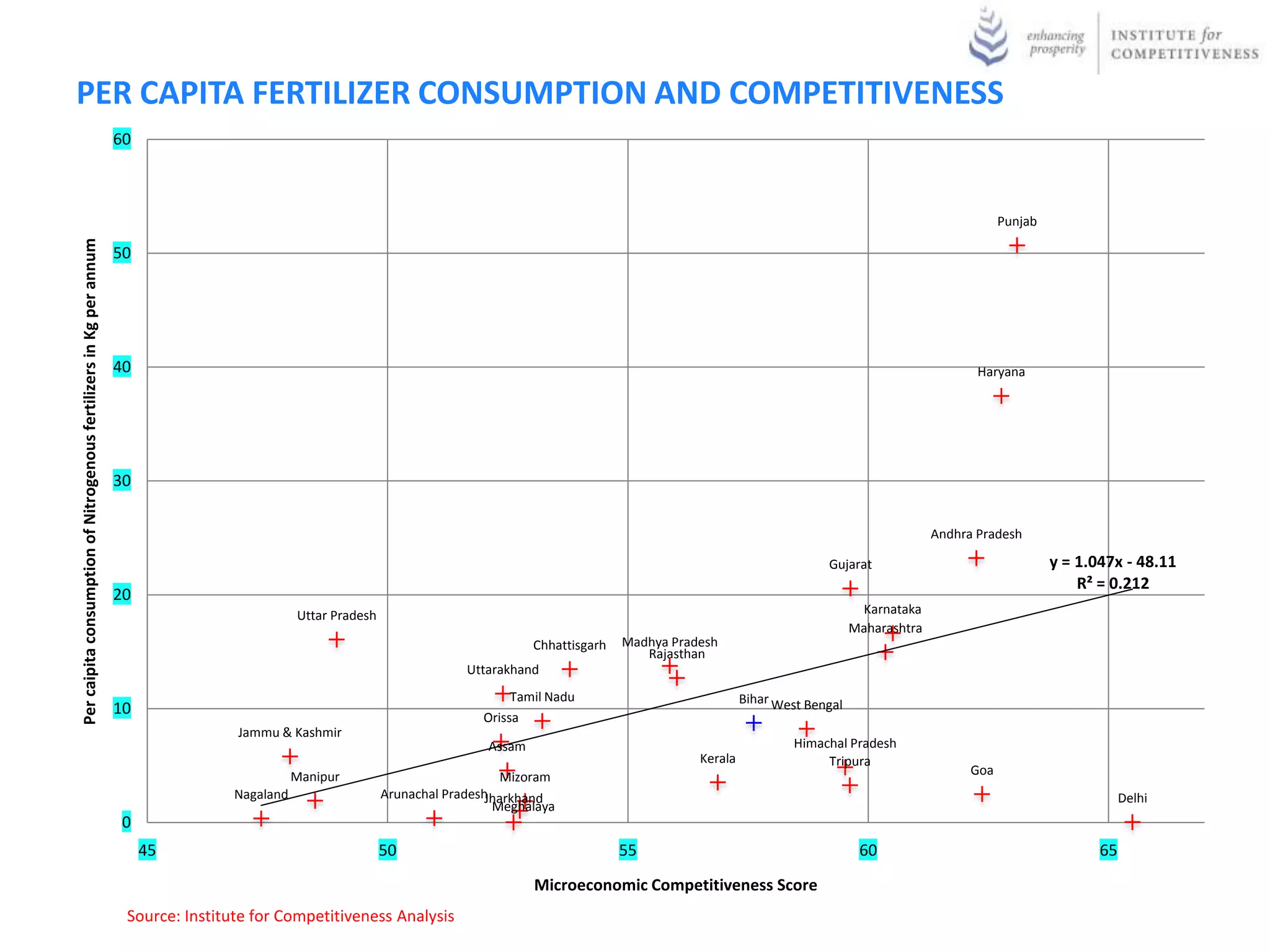
PER CAPITA FERTILIZERCONSUMPTION AND COMPETITIVENESS
60
Punjab
Per caipita consumption of Nitrogenous fertilizers in Kg per annum
50
40 Haryana
30
Andhra Pradesh
Gujarat y = 1.047x - 48.11
R² = 0.212
20
Uttar Pradesh Karnataka
Maharashtra
Chhattisgarh Madhya Pradesh
Rajasthan
Uttarakhand
Tamil Nadu Bihar West Bengal
10 Orissa
Jammu & Kashmir
Assam Himachal Pradesh
Kerala Tripura
Manipur Mizoram Goa
Nagaland Arunachal PradeshJharkhand Delhi
Meghalaya
0
45 50 55 60 65
Microeconomic Competitiveness Score
Source: Institute for Competitiveness Analysis
86.
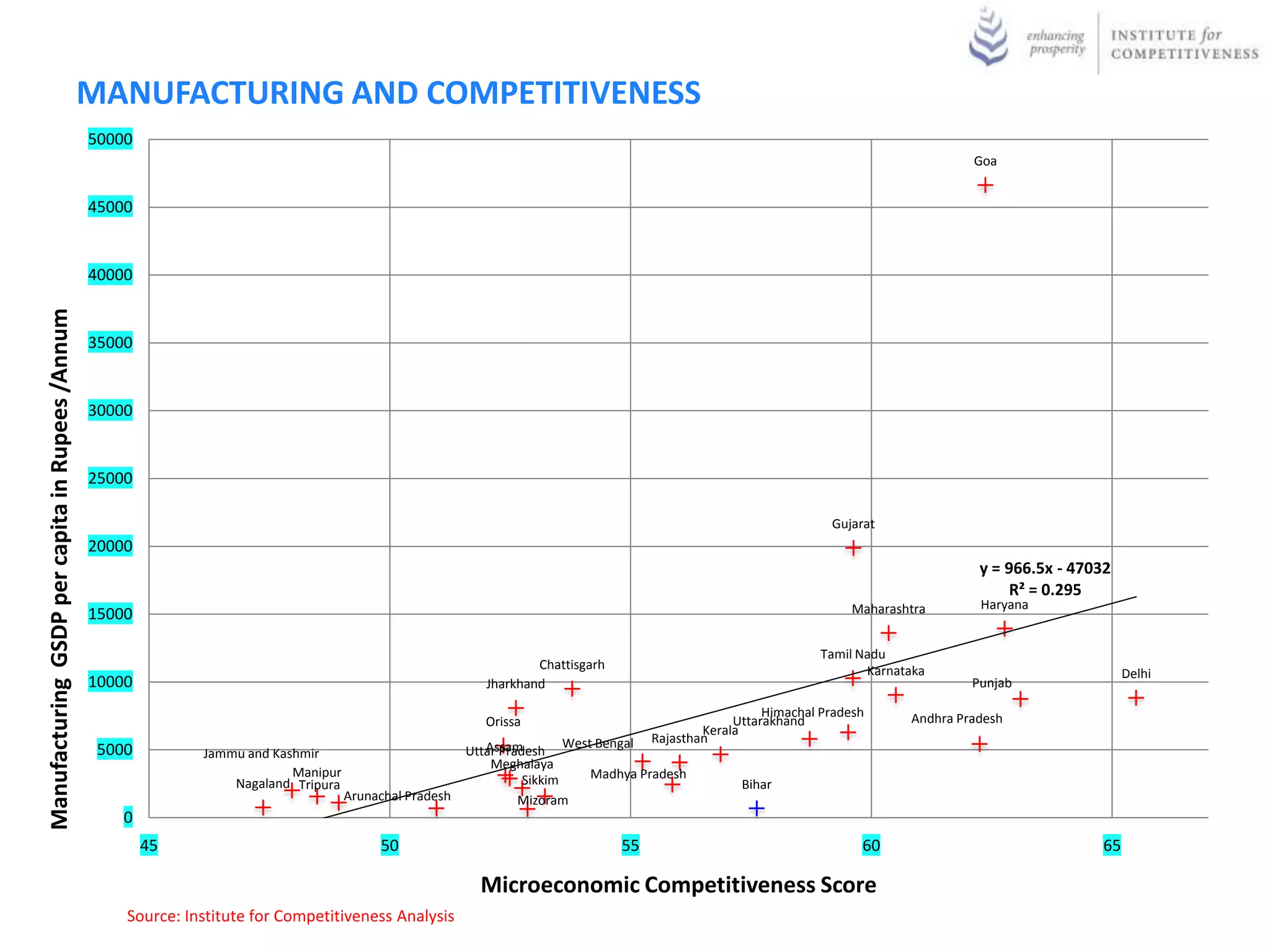
MANUFACTURING AND COMPETITIVENESS
50000
Goa
45000
40000
Manufacturing GSDP per capita in Rupees /Annum
35000
30000
25000
Gujarat
20000
y = 966.5x - 47032
R² = 0.295
Maharashtra Haryana
15000
Tamil Nadu
Chattisgarh Karnataka Delhi
10000 Jharkhand Punjab
Himachal Pradesh Andhra Pradesh
Orissa Uttarakhand
Kerala
West Bengal Rajasthan
5000 Jammu and Kashmir Assam
Uttar Pradesh
Meghalaya
Manipur Madhya Pradesh
Nagaland Tripura Sikkim Bihar
Arunachal Pradesh Mizoram
0
45 50 55 60 65
Microeconomic Competitiveness Score
Source: Institute for Competitiveness Analysis
87.
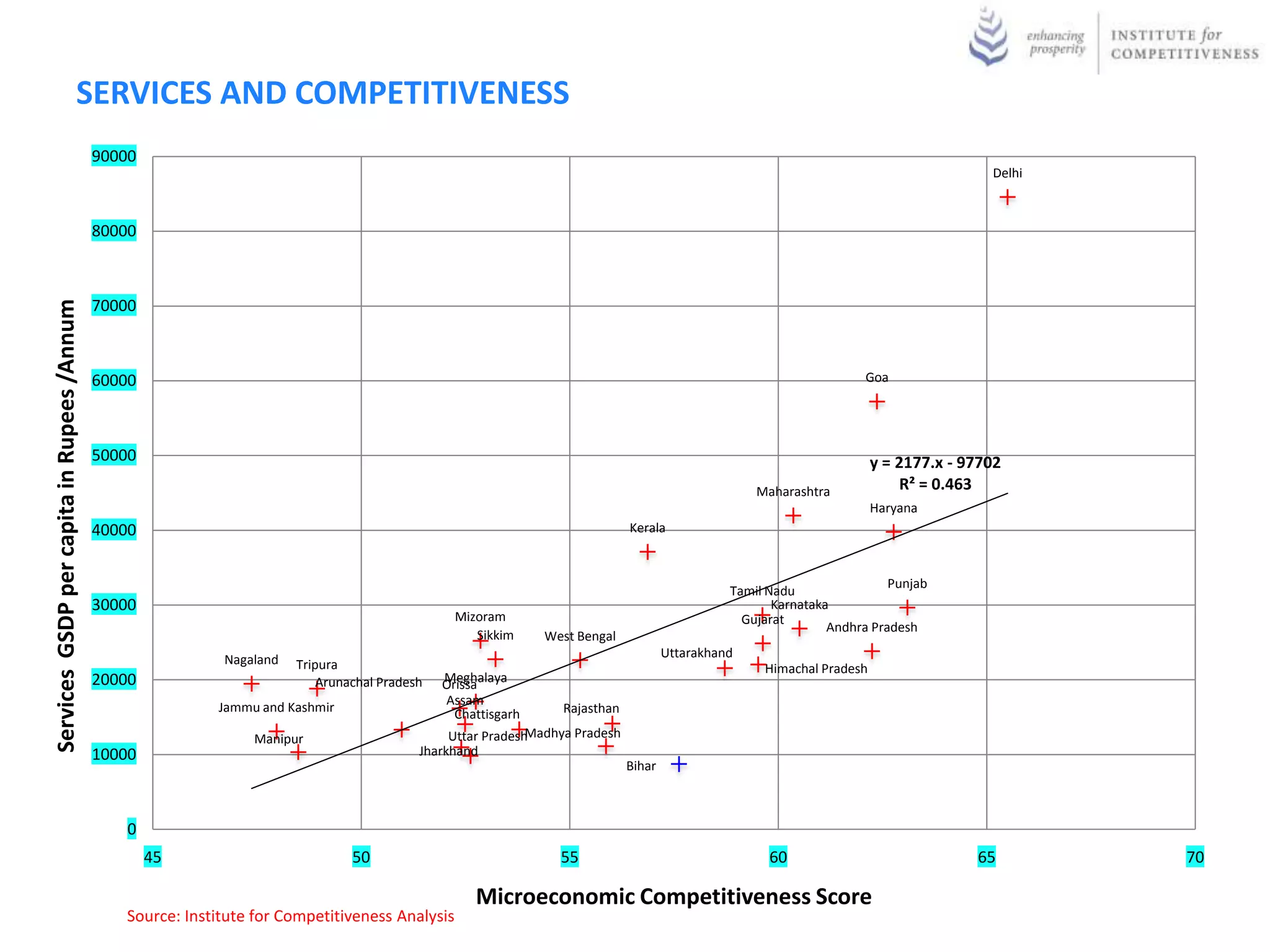
SERVICES AND COMPETITIVENESS
90000
Delhi
80000
70000
Services GSDP per capita in Rupees /Annum
60000 Goa
50000 y = 2177.x - 97702
Maharashtra R² = 0.463
Haryana
40000 Kerala
Punjab
Tamil Nadu
30000 Karnataka
Mizoram Gujarat
Andhra Pradesh
Sikkim West Bengal
Nagaland Uttarakhand
Tripura Himachal Pradesh
20000 Arunachal Pradesh Meghalaya
Orissa
Assam
Jammu and Kashmir Chattisgarh Rajasthan
Manipur Uttar PradeshMadhya Pradesh
10000 Jharkhand
Bihar
0
45 50 55 60 65 70
Microeconomic Competitiveness Score
Source: Institute for Competitiveness Analysis
88.
HOUSEHOLDS IN INDIA
Households in India (in Millions) 2001 and 2011
32.92
23.83
21.02 20.07
18.94 18.49
25.76
13.18 14.97
12.18 19.06 12.58
16.85 9.66 15.72
7.72 14.17
6.37 13.98 5.62 6.18 10.92 0.51 0.54 0.22 0.40 5.41
0.26 0.32 9.64 4.72 1.48 2.02 10.23 9.34 0.13 0.84 2.00
4.15 0.28 6.60 7.87
0.21 4.94 3.53 1.24 1.55 4.86 0.40 0.42 0.16 0.33 4.27 0.10 0.66 1.59
Percentage of Households in India 2001 and 2011 having electricity
96.9 96.8 96.6
90.4 90.5 85.1 90.6 94.4 83.9 92.5 93.4
92.2 84.2 81.6
67.1 87
65.7 75.3 68.4 67
93.6 94.8 60.9 91.9 68.4
80.4 82.9 80.7 78.6 77.8 78.2 54.5
67.2 45.8 70.2 70.0 77.5 69.6 63.6 43 36.8 60.3
54.7 37.1 53.1 60.0 54.7
16.4 42.7 41.8 37.5
24.9 10.3 26.9 31.9
24.3
Percentage of Households having electricity in India 2001 Percentage of Households having electricity in India 2011
Source: Census of India,2011 Institute for Competitiveness Analysis
EXPORT COMPETITIVENESS
160,000
Madhya Share of Exports from various states in 2010-11 Value of Exports from various states
Pradesh
1% Goa 140,000
1%
Punjab
2%
Rest of the 120,000
Rajasthan states 53788
2% 11% 61694
Delhi
Exports in Millions of Dollars
2% Gujarat 100,000
Kerala 25%
3%
Odisha
3% 80,000
West Bengal
3% 43356
60,000 38775
Uttar Pradesh Maharashtra
3% 21%
Haryana 23378
3% Tamil Nadu 40,000 44667
9% 40272
Andhra Pradesh
16085 13603 12567
5%
20,000
Karnataka 9093 8208
18540 8559 8584 7111 6990 6547
5% 5524
12296 9897 5679 4197 5843
3230
4792 7571 5583 3351 4753
0
2008-09 2009-10 2010-11
Source: Economic Survey of India 2011, Institute for Competitiveness Analysis
91.
COUNTRY EQUIVALENTS
BAHA CUBA
MAS
Source: EIU 2011, Institute for Competitiveness Analysis
92.
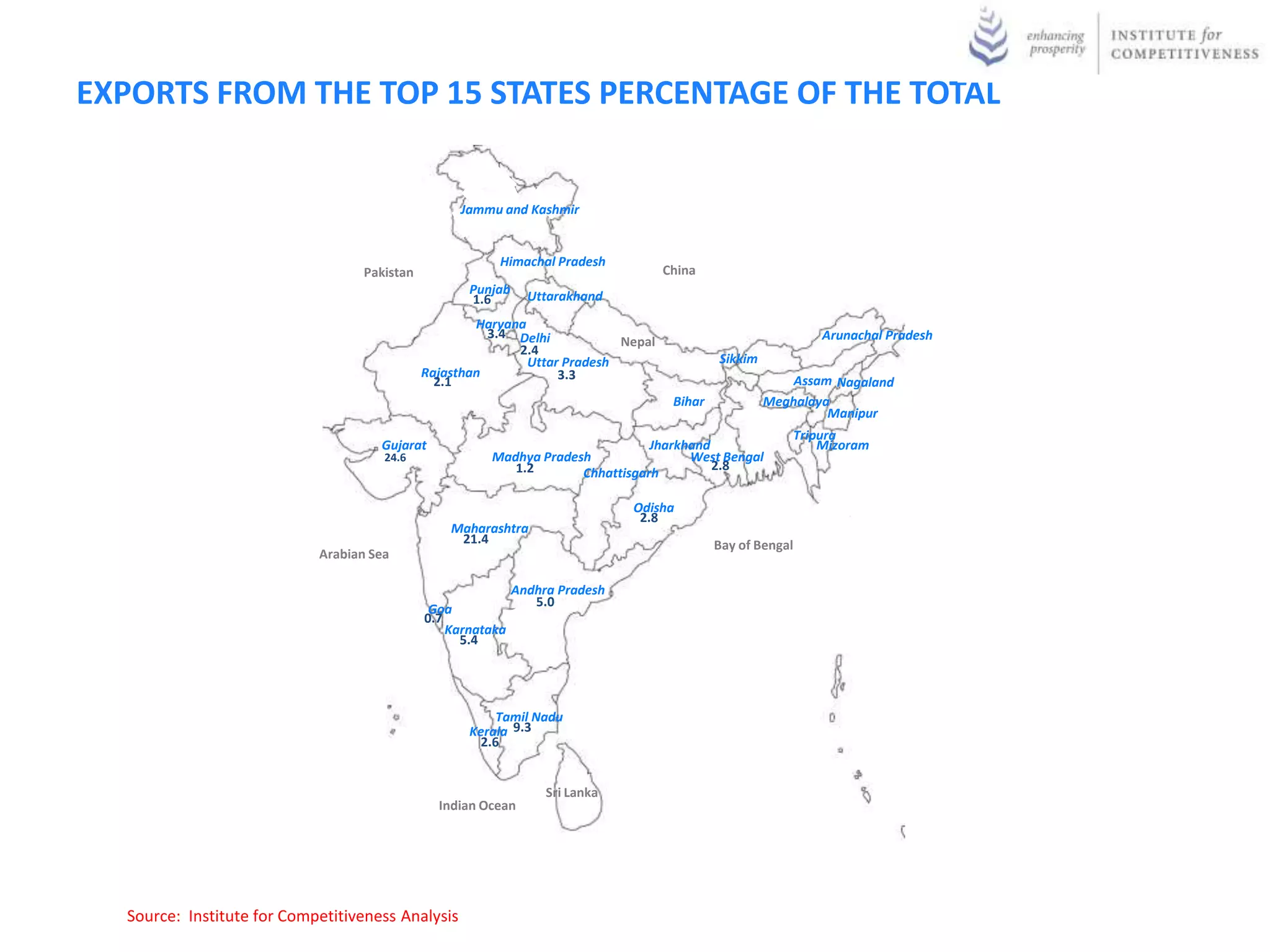
EXPORTS FROM THETOP 15 STATES PERCENTAGE OF THE TOTAL
Jammu and Kashmir
Himachal Pradesh
Pakistan China
Punjab Uttarakhand
1.6
Haryana
3.4 Delhi Arunachal Pradesh
Nepal
2.4
Uttar Pradesh Sikkim
Rajasthan 3.3
2.1 Assam Nagaland
Bihar Meghalaya
Manipur
Tripura
Gujarat Jharkhand Mizoram
24.6 Madhya Pradesh West Bengal
1.2 2.8
Chhattisgarh
Odisha
2.8
Maharashtra
21.4 Bay of Bengal
Arabian Sea
Andhra Pradesh
5.0
Goa
0.7
Karnataka
5.4
Tamil Nadu
Kerala 9.3
2.6
Sri Lanka
Indian Ocean
Source: Institute for Competitiveness Analysis
93.
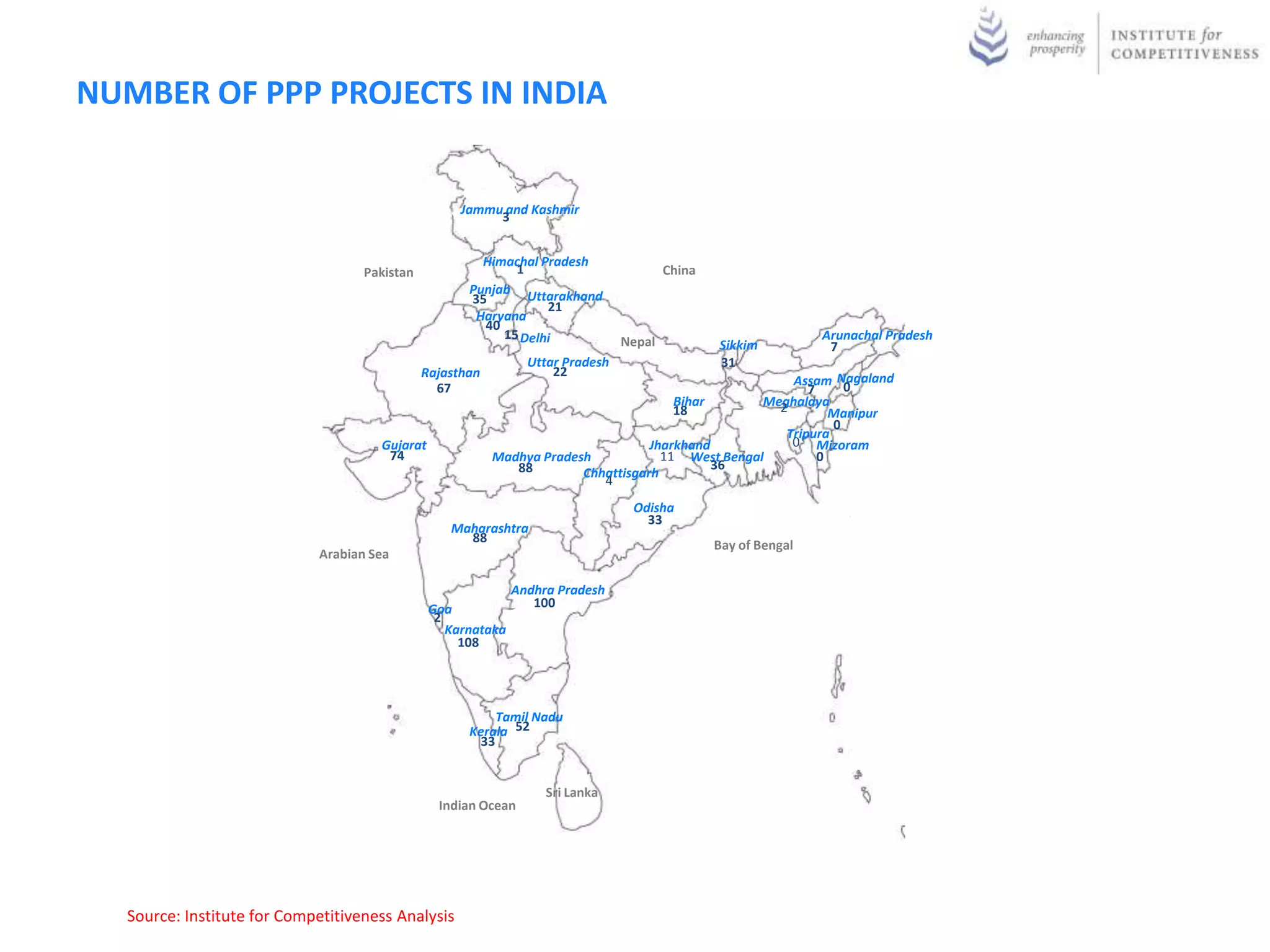
NUMBER OF PPPPROJECTS IN INDIA
Jammu and Kashmir
3
Himachal Pradesh
Pakistan 1 China
Punjab Uttarakhand
35
21
Haryana
40
15 Delhi Nepal Arunachal Pradesh
Sikkim 7
Uttar Pradesh 31
Rajasthan 22
Assam Nagaland
0
67 7
Bihar Meghalaya
2
18 Manipur
0
Tripura
Gujarat Jharkhand 0 Mizoram
74 Madhya Pradesh 11 West Bengal 0
88 36
Chhattisgarh
4
Odisha
33
Maharashtra
88
Bay of Bengal
Arabian Sea
Andhra Pradesh
Goa 100
2
Karnataka
108
Tamil Nadu
Kerala 52
33
Sri Lanka
Indian Ocean
Source: Institute for Competitiveness Analysis
94.
POPULATION PERCENTAGES INSTATES
Jammu and Kashmir
1.04
Himachal Pradesh
Pakistan 0.57 China
Punjab Uttarakhand
2.29
0.84
Haryana
2.09
Delhi Nepal Arunachal Pradesh
1.38 Sikkim 0.11
Uttar Pradesh
Rajasthan 16.49 Nagaland
5.67 Assam 0.16
2.58
Bihar Meghalaya
0.24
8.58 Manipur
0.22
Tripura
Gujarat Jharkhand 0.30 Mizoram
4.99 Madhya Pradesh 2.72 West Bengal 0.09
6.00 7.55
Chhattisgarh
2.11
Odisha
3.47
Maharashtra
9.29 Bay of Bengal
Arabian Sea
Andhra Pradesh
Goa 7.00
0.12
Karnataka
5.05
Tamil Nadu
Kerala 5.96
2.76
Sri Lanka
Indian Ocean
Source: Institute for Competitiveness Analysis
95.
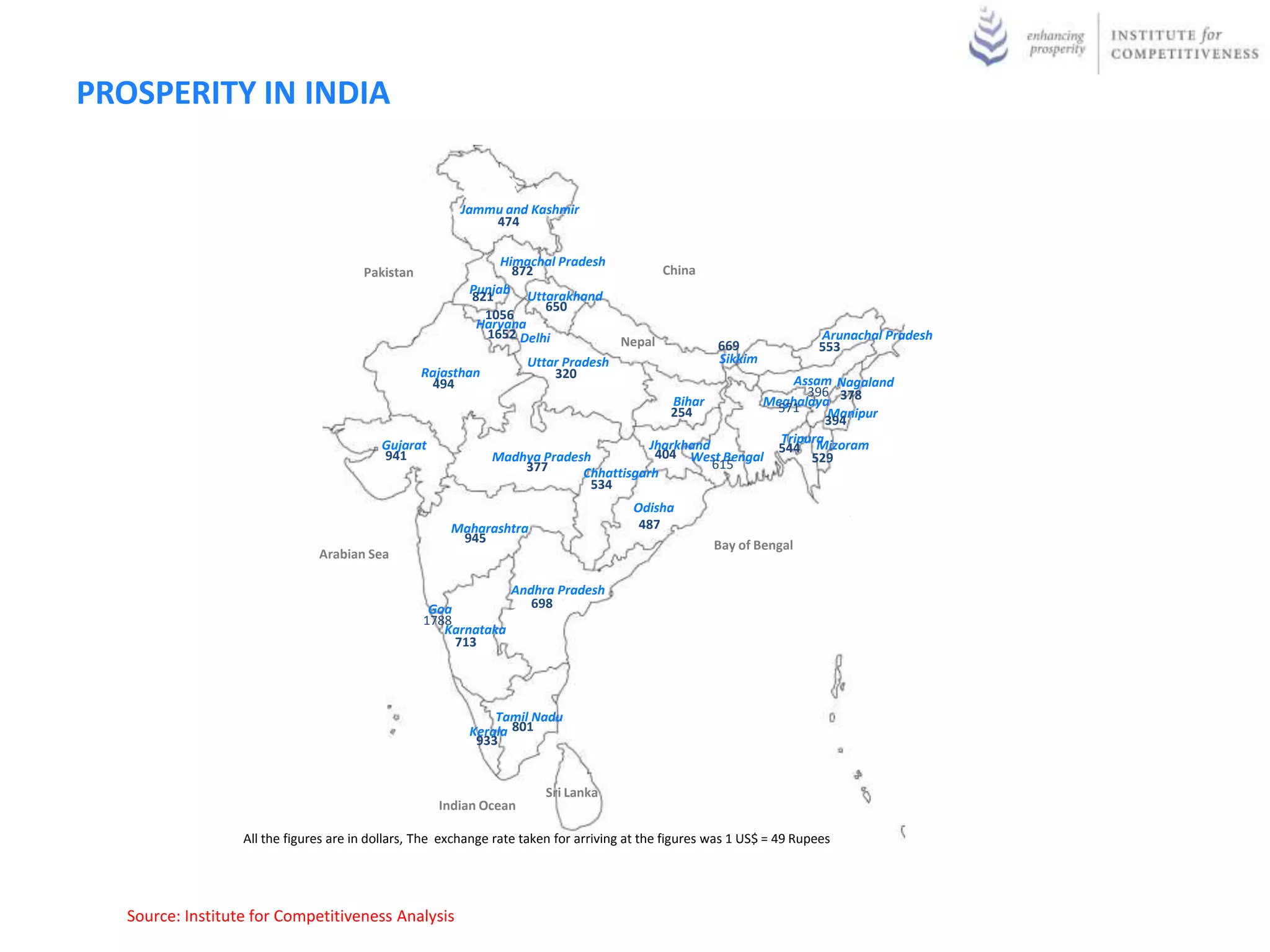
PROSPERITY IN INDIA
Jammu and Kashmir
474
Himachal Pradesh
Pakistan 872 China
Punjab Uttarakhand
821
650
1056
Haryana
1652 Delhi Arunachal Pradesh
Nepal 669 553
Uttar Pradesh Sikkim
Rajasthan 320
494 Assam Nagaland
396
Bihar Meghalaya 378
571
254 Manipur
394
Gujarat Jharkhand Tripura
Mizoram
941 Madhya Pradesh 404 West Bengal 544 529
377 615
Chhattisgarh
534
Odisha
Maharashtra 487
945
Bay of Bengal
Arabian Sea
Andhra Pradesh
Goa 698
1788
Karnataka
713
Tamil Nadu
Kerala 801
933
Sri Lanka
Indian Ocean
All the figures are in dollars, The exchange rate taken for arriving at the figures was 1 US$ = 49 Rupees
Source: Institute for Competitiveness Analysis
96.
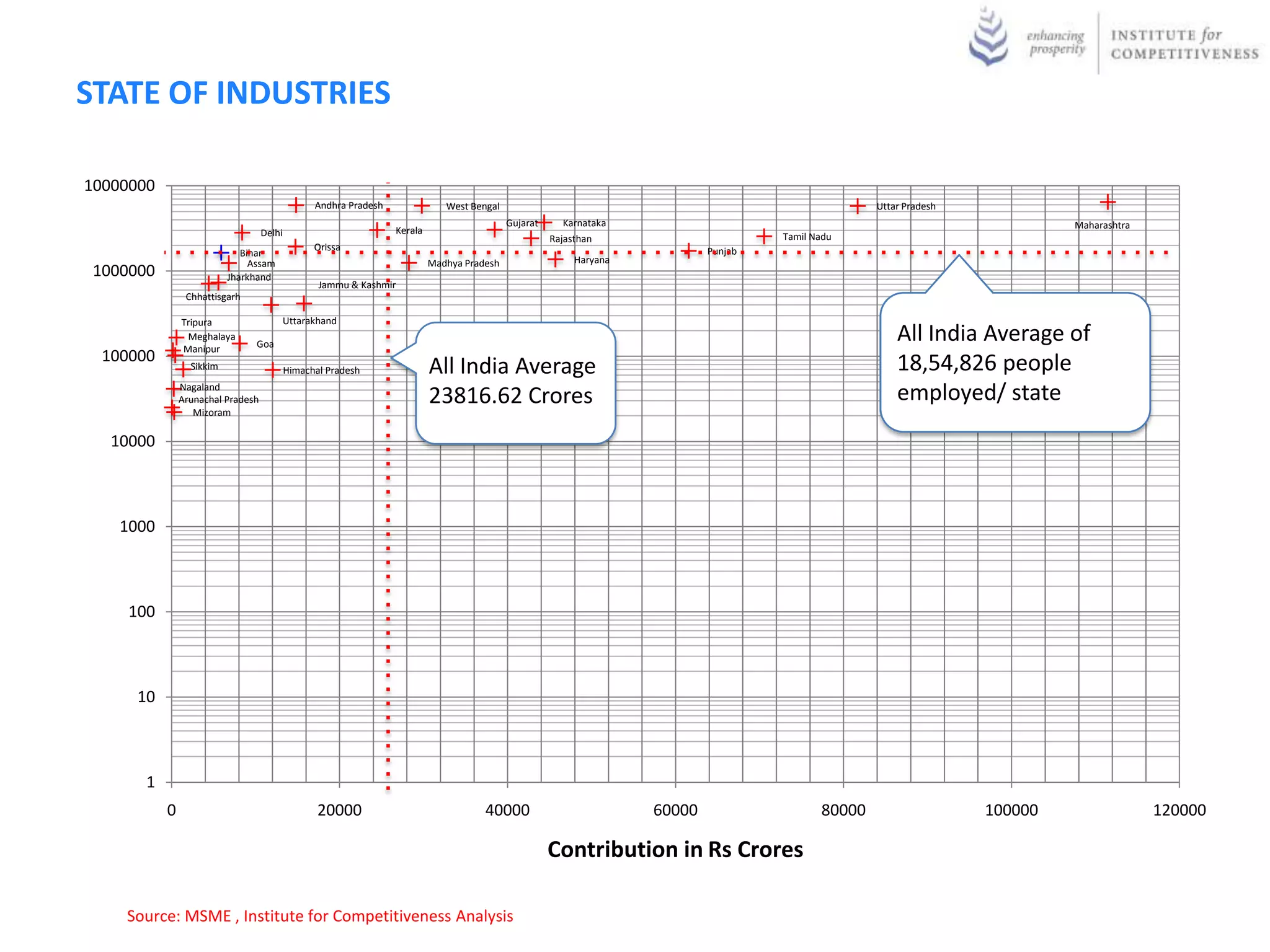
STATE OF INDUSTRIES
10000000
Andhra Pradesh West Bengal Uttar Pradesh
Gujarat Karnataka Maharashtra
Delhi Kerala
Rajasthan Tamil Nadu
Orissa Punjab
Bihar
Assam Madhya Pradesh Haryana
1000000 Jharkhand
Jammu & Kashmir
Chhattisgarh
Tripura Uttarakhand
Meghalaya
Goa
All India Average of
India
All
Manipur
100000 Sikkim Himachal Pradesh All India Average 18,54,826 people
Nagaland
Arunachal Pradesh 23816.62 Crores employed/ state
Mizoram
10000
1000
100
10
1
0 20000 40000 60000 80000 100000 120000
Contribution in Rs Crores
Source: MSME , Institute for Competitiveness Analysis
97.
CONTRIBUTION PER PERSONIN INDUSTRIES
7.00
6.00 5.75
Contribution in Lakhs of Rupees
5.00
4.00 3.79 3.88
3.56
3.34
2.96 Average
3.00 Contribution of 2.76
1.57 2.27
Lakhs/Person 1.98
2.00 1.77 1.72
1.41 1.37 1.26 1.20
1.00 0.76 0.76 0.81
0.51 0.55 0.43 0.62 0.62
0.30 0.36 0.35 0.25
0.14 0.20
0.00
Source: MSME 4th round , Institute for Competitiveness Analysis
98.
MARKET VALUE VERSUSORIGINAL VALUE OF PLANT AND EQUIPMENT
4500.00
4000.00
3500.00
3000.00
2500.00 Market value of Fixed Investments in Crores of
Rupees
2000.00
1500.00 Original value of Plant and Machinery/
Equipment in Crores of Rupees
1000.00
500.00
0.00
Manufacturing
Services
Manufacturing Services
Market value of Fixed Investments in Crores of Rupees 4136.27 586.78
Original value of Plant and Machinery/ Equipment in Crores of Rupees 462.49 137.27
No of times valued by the market 8.94 4.27
Source: MSME, Institute for Competitiveness Analysis
99.
PER UNIT EMPLOYMENTVERSUS PER UNIT GROSS OUTPUT
16.00
14.00
12.00
10.00
Per unit employment (Person)
8.00
Per unit Gross Output (in Lakhs of Rupees)
6.00
4.00
Per unit Gross Output (in Lakhs of Rupees)
2.00
0.00
Per unit employment (Person)
Manufacturing
Services
Manufacturing Services
Per unit employment (Person) 3.64 1.92
Per unit Gross Output (in Lakhs of Rupees) 14.63 3.80
Per unit revenues/ per unit employment 4.02 1.98
Source: MSME, Institute for Competitiveness Analysis
100.
STATE OF CLUSTERDEVELOPMENT: TOTAL NUMBER OF FACTORIES
Agricultural Glass and
Furniture related
services
industries
Wood and
Agricultural Domestic
Forest
Products and electric Television
Products
Industries and allied
electronic
Other industries Other
Processed Service Lighting transportat
food Industries Electric ion
Publishing equipment
and
Printing Medical Machinery
equipment and
Equipment
Automotiv
e
Pulp and
Apparels Textiles Paper
and related
industries Chemicals Production
Tobacco
Minerals
Footwear Rubber and
Leather Oil and Gas Plastic Metals
industries Industries Mining
Top 7 types of Industries in the state 15-21 types of Industries in the state
7-14 types of Industries in the state 21-28 types of Industries in state
Source: ASI 2008-09, Institute for Competitiveness Analysis
101.
STATE OF CLUSTERDEVELOPMENT: TOTAL NUMBER OF EMPLOYEES
Agricultural Glass and
Furniture related
services
industries
Wood and
Agricultural Domestic
Forest
Products and electric Television
Products
Industries and allied
electronic
Other industries Other
Processed Service Lighting transportat
food Industries Electric ion
Publishing equipment
and
Printing Medical Machinery
equipment and
Equipment
Automotiv
e
Pulp and
Apparels Textiles Paper
and related
industries
Chemicals Production
Tobacco
Minerals
Footwear Rubber and
Leather Oil and Gas Plastic Metals
industries Industries Mining
Top 7 types of Industries in the state 15-21 types of Industries in the state
7-14 types of Industries in the state 21-28 types of Industries in state
Source: ASI 2008-09, Institute for Competitiveness Analysis
102.
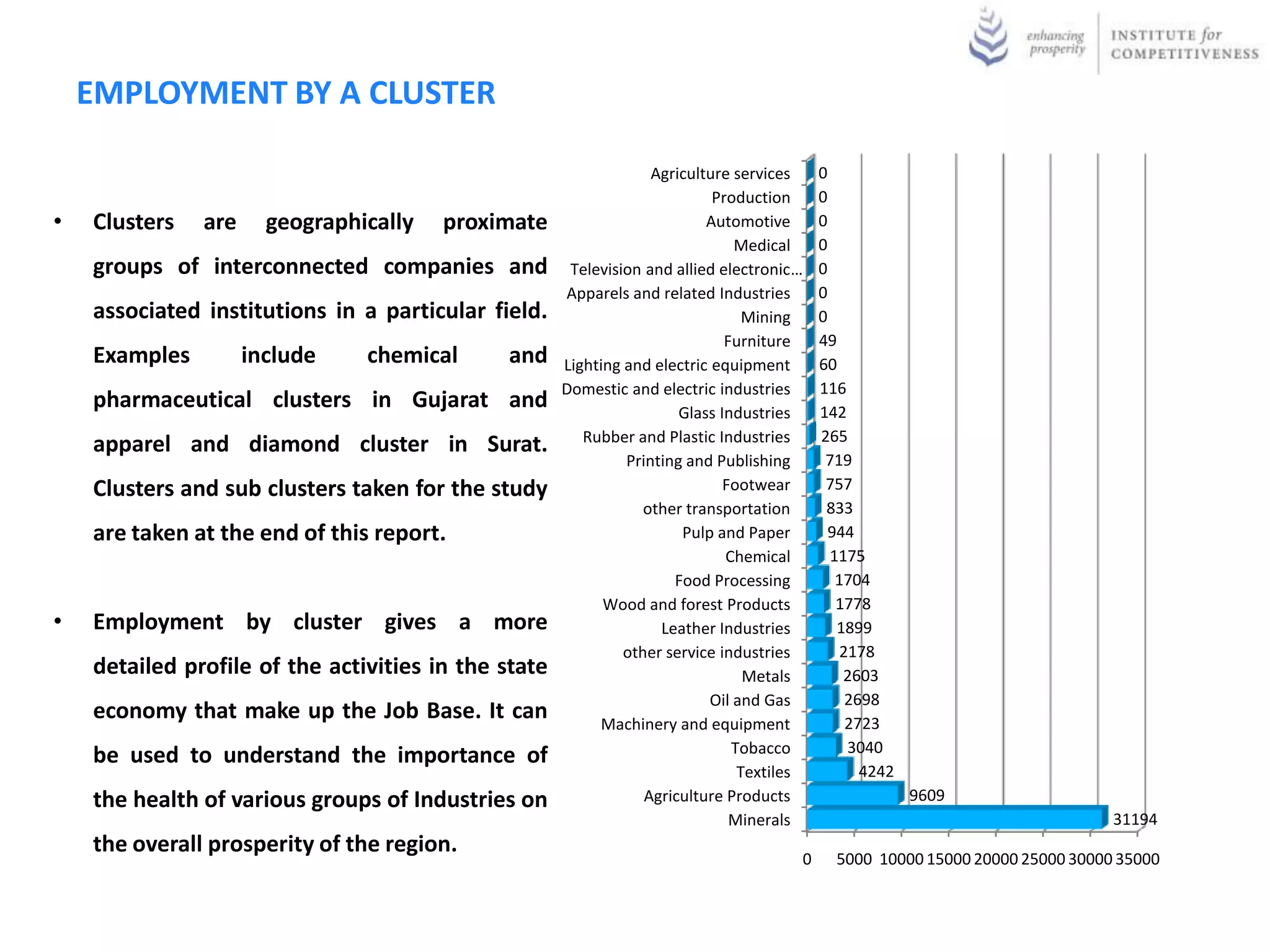
STATE OF CLUSTERDEVELOPMENT: TOTAL NUMBER OF PEOPLE
Agriculture services 0
Production 0
Automotive 0
Medical 0
Television and allied electronic industries 0
Apparels and related Industries 0
Mining 0
Furniture 49
Lighting and electric equipment 60
Domestic and electric industries 116
Glass Industries 142
Rubber and Plastic Industries 265
Printing and Publishing 719
Footwear 757
other transportation 833
Pulp and Paper 944
Chemical 1175
Food Processing 1704
Wood and forest Products 1778
Leather Industries 1899
other service industries 2178
Metals 2603
Oil and Gas 2698
Machinery and equipment 2723
Tobacco 3040
Textiles 4242
Agriculture Products 9609
Minerals 31194
0 5000 10000 15000 20000 25000 30000 35000
Source: ASI 2008-09, Institute for Competitiveness Analysis
103.
CREATING A STATEECONOMIC STRATEGY
State Value Proposition
What are the main strengths, positive attributes, location
advantage etc of the particular state in question.
Developing Unique Strengths Achieving and Maintaining parity
with peers
• How can the state leverage on its • What are the key weaknesses
unique capabilities and create new which need to be taken care of
ones? while forming maintaining parity
• Which businesses/ clusters can be with peers?
made stronger?
State economic strategy requires setting clear priorities and measuring against
predefined criteria.
104.
COMPETITION AMONG STATES
Tactical (Zero Sum Strategic (Positive
Competition) Sum Competition)
• Focus on FDI investments • Focus on domestic and existing
• Compete in every domain companies
• Compete in specialized cluster domains
• Offer tax benefits across the
• Government incentives and support for
spectrum training, infrastructure, and institutions
• Provide subsidies to lower / offset • Improve the efficiency of doing
business costs business
• Economies of scale to help benefit from
• Every city and sub-region for itself
multiple geographies
• Government is responsible for • Government and the private sector
development of cluster. collaborate to build cluster strength
Source: Michael E Porter
105.
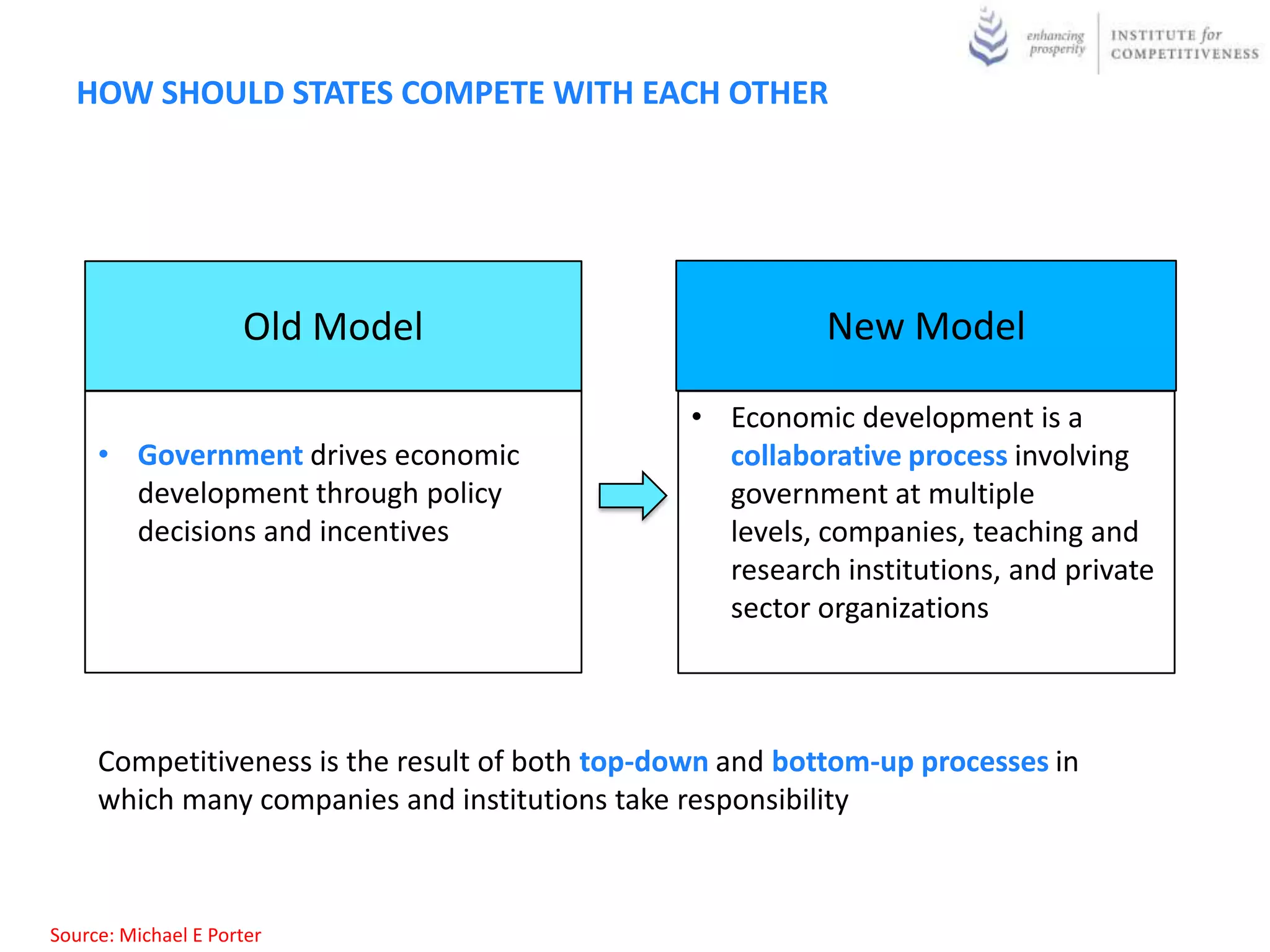
HOW SHOULD STATESCOMPETE WITH EACH OTHER
Old Model New Model
• Economic development is a
• Government drives economic collaborative process involving
development through policy government at multiple
decisions and incentives levels, companies, teaching and
research institutions, and private
sector organizations
Competitiveness is the result of both top-down and bottom-up processes in
which many companies and institutions take responsibility
Source: Michael E Porter
106.
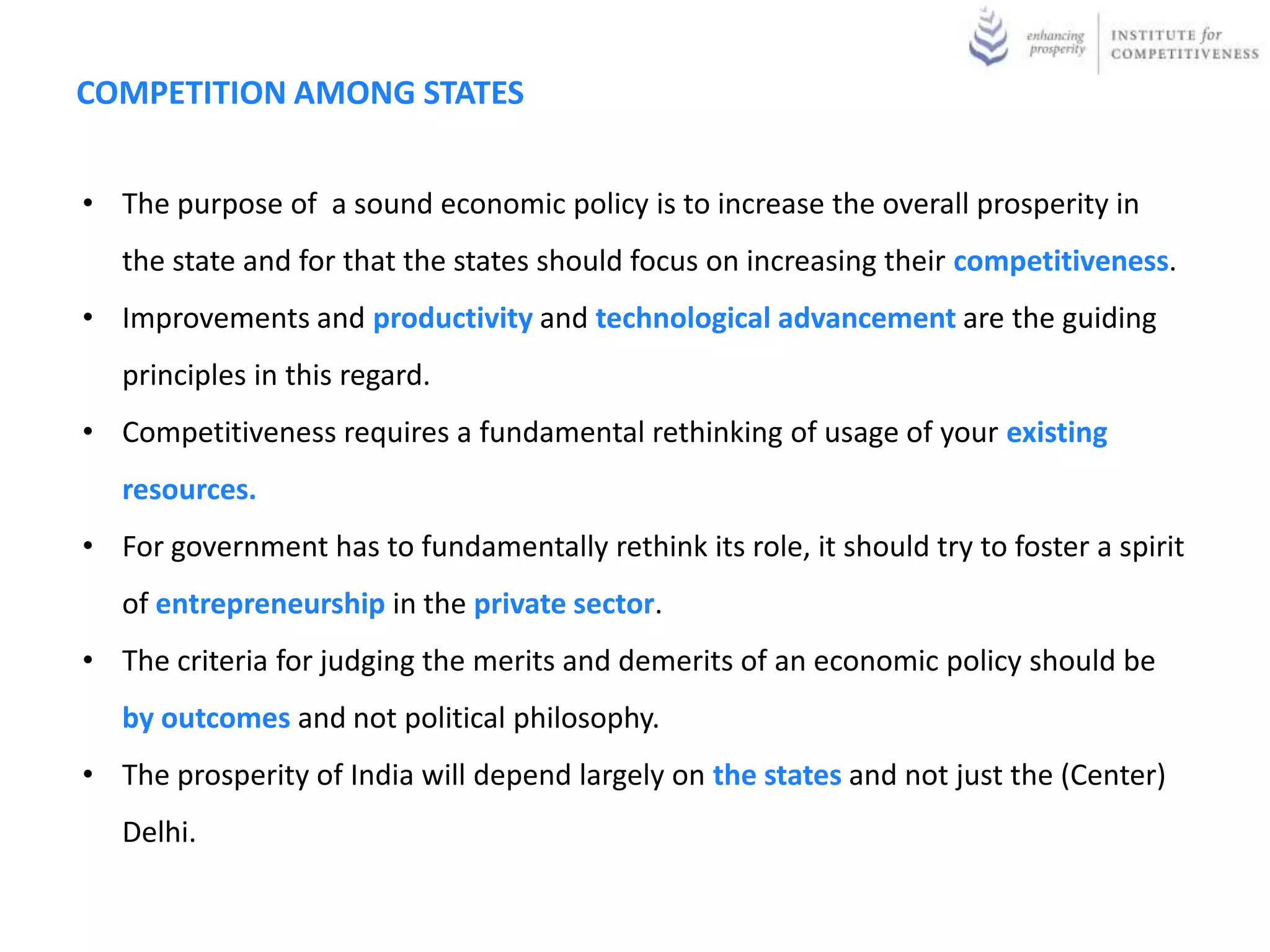
COMPETITION AMONG STATES
•The purpose of a sound economic policy is to increase the overall prosperity in
the state and for that the states should focus on increasing their competitiveness.
• Improvements and productivity and technological advancement are the guiding
principles in this regard.
• Competitiveness requires a fundamental rethinking of usage of your existing
resources.
• For government has to fundamentally rethink its role, it should try to foster a spirit
of entrepreneurship in the private sector.
• The criteria for judging the merits and demerits of an economic policy should be
by outcomes and not political philosophy.
• The prosperity of India will depend largely on the states and not just the (Center)
Delhi.
107.
INTERPRETATION CHARTS
• The snapshot chart summarizes the relative performance of a state on levels and trends in 5 key
measures. The circles in the chart show the measurement of the chart legend.
• Prosperity: State GDP per capita and 10 year trend.
• Productivity: Average Private wage and 10 year trend.
• Labour Mobilization: Total labour force as a share of civilian population and 10 year trend.
• Clusters: Total number of people employed in the cluster and total number of enterprises in the cluster.
• Type of Economy: Factor Driven economies, Changeover economies, Investment driven
economies, Transition economies, Innovation driven economies and city state economies.
Position Trend
Prosperity
Productivity
Labour Mobilization
State of Clusters
Top 33.33% of the
Type of Economy states
Investment Driven
33.33%-66.67% of
Minerals the states
Leading Clusters Agricultural Products
Machinery and Equipment 66.67% to 100% of
Chemicals the states
108.
STATE OF CLUSTERDEVELOPMENT : FACTORIES
Agricultur Glass and
Furniture related
al services
industries
Wood and Agricultur Domestic
Forest al and
Products Products electric Television
Industries and allied
The Chart represents the number electronic
industries
of factories in various types of Processed
Other
Service
Other
transporta
Lighting tion
Industries in state. food Industries
Electric
equipment
Publishing
and
The position of the various types Printing
Medical Machinery
equipment and
of factories shows relative Equipment
proximity in terms of type of Automotiv
e
Industry. Thus, Chemical is placed Pulp and
Paper
next to Oil and gas, etc. Apparels
and
Textiles
related
industries Chemicals
Production
The colour coding is done to Tobacco
show the importance of factory Minerals
sector in terms of number of Leather
Footwear Oil and Rubber
Metals
Gas and Plastic
enterprises in the state. Thus industries Industries
Mining
yellow shows the maximum
number of industries in the state.
Top 7 types of Industries in the state 15-21 types of Industries in the state
7-14 types of Industries in the state 21-28 types of Industries in the state
109.
STATE OF CLUSTERDEVELOPMENT : EMPLOYEES
Agricultu Glass and
ral Furniture related
services industries
Wood Domestic
and Agricultu and
Forest ral electric Televisio
The Chart represents the number of Products Products Industrie n and
allied
s
Employees in various types of electroni
c
Other industries
Industries in state. Processe
Service
Lighting
Other
transport
Industrie ation
d food s Electric
equipme
nt
The position of the various types of Publishin
g and
industries shows relative proximity Printing
Medical Machiner
y and
equipme
in terms of type of Industry. nt Equipme
nt
Thus, Chemical is placed next to Oil Automoti
ve
and gas. etc. Pulp and
Paper
Apparels Textiles
and
related
The colour coding is done to show industries Chemical
Productio
s
n
the importance of Industries in Tobacco
terms of number of employees in Minerals
the state. Thus yellow shows the Footwear Oil and
Rubber
and
Leather Metals
bracket of maximum number of industries
Gas Plastic
Industrie
Mining
s
employees in the state.
Top 7 ranked types of Factories in the state 15-21 ranked types of Factories in the state
7-14 ranked types of Factories in the state 21-28 ranked types of Factories in the state
110.
COMPONENTS OF REGIONALECONOMIES
• The economy has been looked at from the primary, secondary and tertiary Perspective. These sectors
are then looked in detail to find the contribution of each sub sector to the three primary sectors namely
Agriculture, Industry and Services.
• The result is a bubble chart which shows the contribution of each sub sector to the economy.
• The size of the bubble represents the size of the GSDP contribution in Rs. Crores.
7
6
Bihar/National GSDP share (Percent) ,2011
Railways
Fishing
Trade, hotel and restaurant
5 Forestry and logging
The regions share of Other services
cluster GSDP relative to Public administration and
its size 4 defence
Agricuture
Strong and Construction
Growing Position 3
2 Real states, ownership of
Banking and insurance business
dwellings and
Electricity, gas and water means services
Communicationby other
Transport
Storage
supply
1 Manufacturing
Mining and quarrying
0
Cluster is growing
faster than Indian
Average
-5 0 5 10 15 20 25 30
-1
Change in contribution of GSDP of Bihar to total Indian GSDP, CAGR (2000-2011)
111.
EMPLOYMENT BY ACLUSTER
Agriculture services 0
Production 0
• Clusters are geographically proximate Automotive 0
Medical 0
groups of interconnected companies and Television and allied electronic… 0
Apparels and related Industries 0
associated institutions in a particular field. Mining 0
Furniture 49
Examples include chemical and Lighting and electric equipment 60
Domestic and electric industries 116
pharmaceutical clusters in Gujarat and Glass Industries 142
Rubber and Plastic Industries 265
apparel and diamond cluster in Surat.
Printing and Publishing 719
Clusters and sub clusters taken for the study Footwear 757
other transportation 833
are taken at the end of this report. Pulp and Paper 944
Chemical 1175
Food Processing 1704
Wood and forest Products 1778
• Employment by cluster gives a more Leather Industries 1899
other service industries 2178
detailed profile of the activities in the state Metals 2603
Oil and Gas 2698
economy that make up the Job Base. It can Machinery and equipment 2723
Tobacco 3040
be used to understand the importance of
Textiles 4242
the health of various groups of Industries on Agriculture Products 9609
Minerals 31194
the overall prosperity of the region.
0 5000 10000 15000 20000 25000 30000 35000
112.
A BRIEF NOTEOF THE REGIONS AND OVERALL ECONOMY OF BIHAR
• The political boundaries of a state often encompass many distinct regional economies or portions of
large regional economies. A comprehensive approach to economic development should reflect both
the distinct economies within the state as well as strong linkages to the economies in the neighboring
states. In addition to this clusters should be mapped on areas of high economic growth. This will lead
to spillover effects in the long run.
• A state's or region’s economy can be divided 3000000
2549085
into 3 components namely
2500000
2000000
GSDP in Rs. Crore
1492375
1. Primary/Agriculture sector 1500000
2. Secondary/Industry sector 1000000
924340
3. Tertiary/Service sector
500000
36623 23651 88111
0
Agriculture, forestry Industry Services
and fishing
In this report we focus more on Industrial sector to bring out its components in detail.
113.
CLUSTERS AND SUBCLUSTERS IN THE INDIAN ECONOMY
Agricultural products Leather industries Other transportation
• Grain mill products, starches & starch products • Tanning & dressing of leather; luggage, handbags • Other transport equipment
and prepared animal foods • Railway and tramway locomotives and rolling stock
• Other food products Lighting electric equipment • Transport equipment
• Beverages
• Insulated wire and cable Processed food
Apparels and related industries • Accumulators, primary cells and primary batteries
• Manufacture of food products and beverages
• Knitted and crocheted fabrics and articles • Electric lamps and lighting equipment
• Meat, fish, fruit vegetables, oils and fats
• Wearing apparel; dressing and dyeing of fur • Other electrical equipment
• Dairy product
• Wearing apparel, except fur apparel
Machinery and equipment Production
• Structural metal products, tanks, reservoirs •
Agricultural services • Other fabricated metal products
Manufacturing
• Agriculture, hunting, and related services activities • Machinery and equipment
• General purpose machinery Publishing and printing
Automotive • Special purpose machinery • Publishing
• Bodies (coach work) for motor • Printing and service activities related to printing
vehicles Medical equipment
• Parts and accessories for • Medical, precision and optical Rubber and plastic industries
motor vehicles & their engines instruments, watches & clocks • Rubber products
• Plastic products
Chemicals Metals
• Basic chemicals • Basic Iron & Steel
• Basic precious and non-ferrous metals Television and allied electronic industries
• Casting of metals • Electronic valves and tubes
Domestic and electric Industries and other electronic components
• Domestic appliances Minerals • Television and radio transmitters
• Office, accounting and computing machinery and apparatus
• Minerals
• Electrical machinery and apparatus • Television and radio receivers
• Electric motors, generators and transformers
•
Mining
Electricity distribution and control apparatus
• Mining and quarrying Textiles
• Spinning, weaving and finishing of textiles
Footwear Pulp and Paper • Other textiles
• Footwear
• Pulp and Paper Industries Tobacco
• Tobacco products
Furniture Other service industries
• Furniture • Other Service Industries Wood and forest products
Oil and gas • Wood and of products
Glass and related industries • Coke oven products • Saw milling and planning of wood
• Glass and glass products • Refined petroleum products • Products of wood, cork, straw and plaiting materials