
Alexey Zimarev
Software Architect at ABAX AS, Norway
DDD Norway Meetup Organiser
@Zimareff
alex@zimarev.com
https://www.linkedin.com/in/alexeyzimarev
http://zimarev.com
Domain-Driven Design
Why, What and How
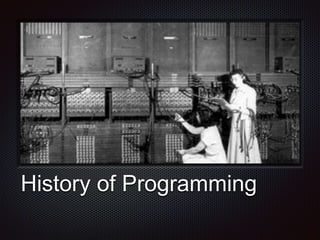
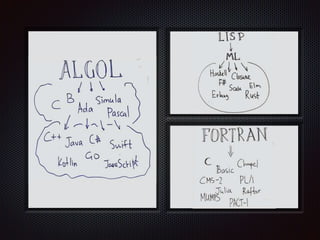
History of Programming
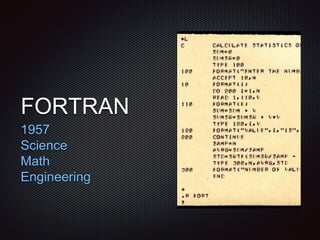
FORTRAN
1957
Science
Math
Engineering
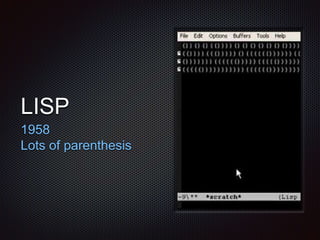
LISP
1958
Lots of parenthesis
LISP
1958
Math
AI
Lambda calculus
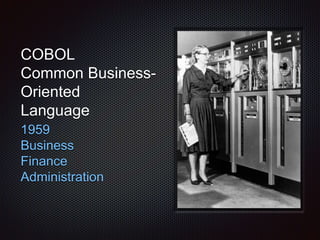
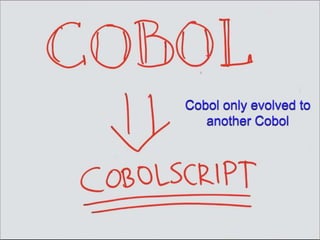
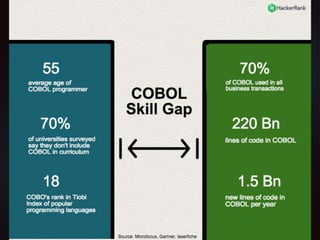
COBOL
Common Business-
Oriented
Language
1959
Business
Finance
Administration
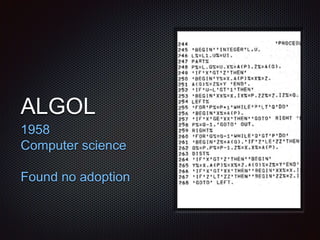
ALGOL
1958
Computer science
Found no adoption
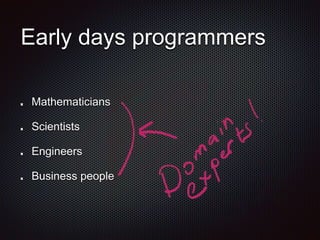
Early days programmers
Mathematicians
Scientists
Engineers
Business people
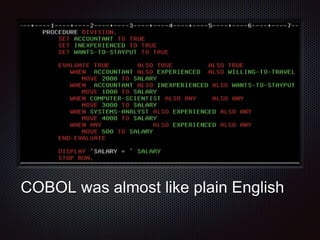
COBOL was almost like plain English
Computer people took the
language with least adoption
among domain experts
and started using it everywhere
Cobol only evolved to
another Cobol
Business
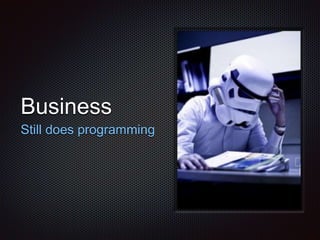
Still does programming
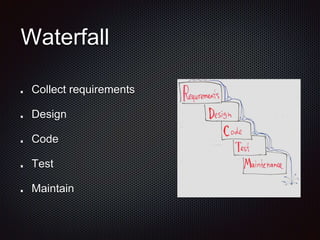
Waterfall
Collect requirements
Design
Code
Test
Maintain
Book on
Requirement
s
Customer
Gone missing
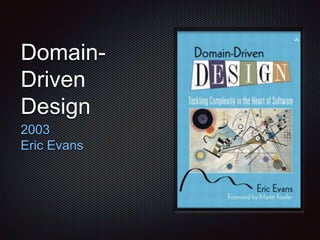
Domain-
Driven
Design
2003
Eric Evans
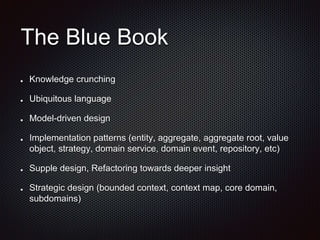
The Blue Book
Knowledge crunching
Ubiquitous language
Model-driven design
Implementation patterns (entity, aggregate, aggregate root, value
object, strategy, domain service, domain event, repository, etc)
Supple design, Refactoring towards deeper insight
Strategic design (bounded context, context map, core domain,
subdomains)
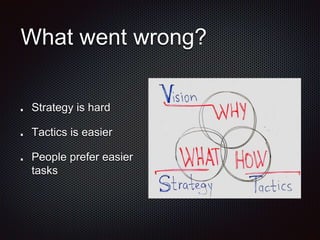
What went wrong?
Strategy is hard
Tactics is easier
People prefer easier
tasks
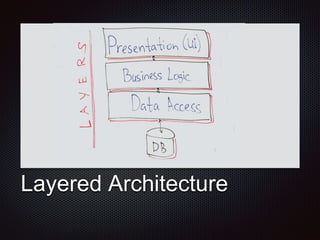
Layered Architecture
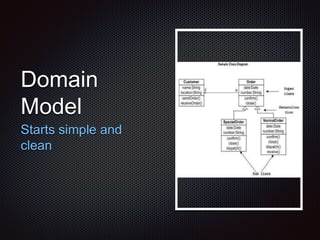
Domain
Model
Starts simple and
clean
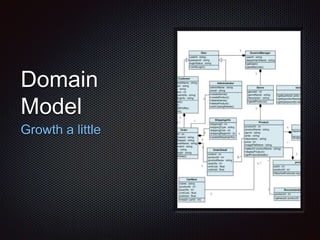
Domain
Model
Growth a little
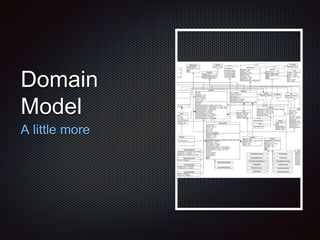
Domain
Model
A little more
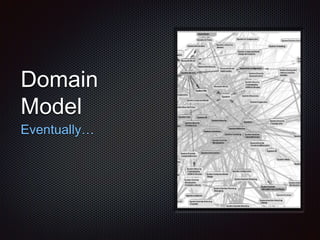
Domain
Model
Eventually…
Big Ball of Mud
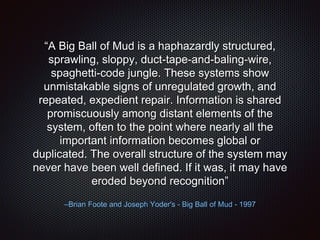
“A Big Ball of Mud is a haphazardly structured,
sprawling, sloppy, duct-tape-and-baling-wire,
spaghetti-code jungle. These systems show
unmistakable signs of unregulated growth, and
repeated, expedient repair. Information is shared
promiscuously among distant elements of the
system, often to the point where nearly all the
important information becomes global or
duplicated. The overall structure of the system may
never have been well defined. If it was, it may have
eroded beyond recognition”
–Brian Foote and Joseph Yoder's - Big Ball of Mud - 1997
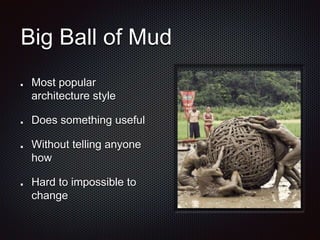
Big Ball of Mud
Most popular
architecture style
Does something useful
Without telling anyone
how
Hard to impossible to
change
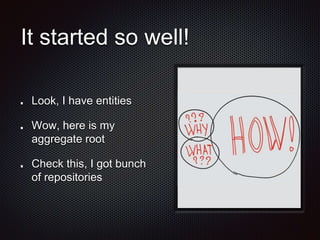
It started so well!
Look, I have entities
Wow, here is my
aggregate root
Check this, I got bunch
of repositories
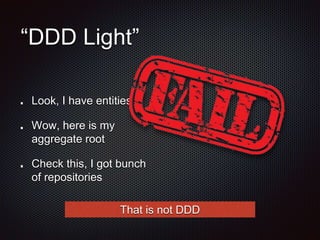
“DDD Light”
Look, I have entities
Wow, here is my
aggregate root
Check this, I got bunch
of repositories
That is not DDD
developing
Ubiquitous Language
within
Bounded Context
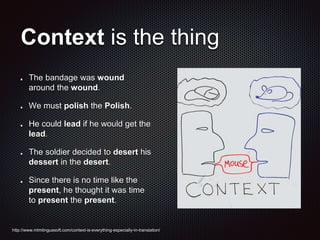
Context is the thing
The bandage was wound
around the wound.
We must polish the Polish.
He could lead if he would get the
lead.
The soldier decided to desert his
dessert in the desert.
Since there is no time like the
present, he thought it was time
to present the present.
http://www.mtmlinguasoft.com/context-is-everything-especially-in-translation/
We are linguists
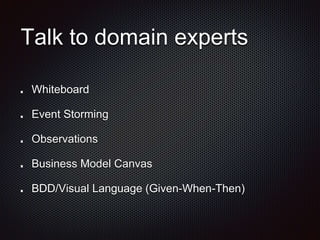
Talk to domain experts
Whiteboard
Event Storming
Observations
Business Model Canvas
BDD/Visual Language (Given-When-Then)
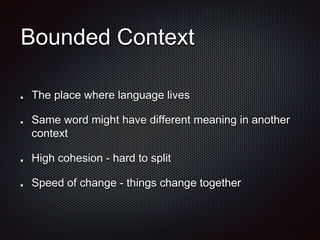
Bounded Context
The place where language lives
Same word might have different meaning in another
context
High cohesion - hard to split
Speed of change - things change together
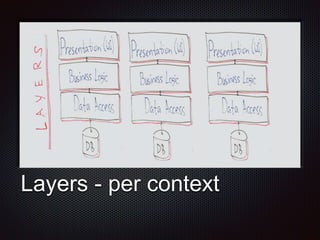
Layers - per context
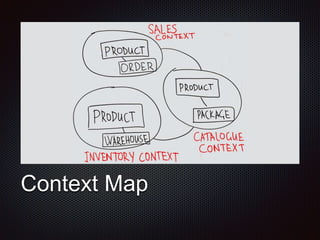
Context Map
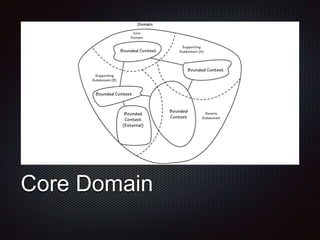
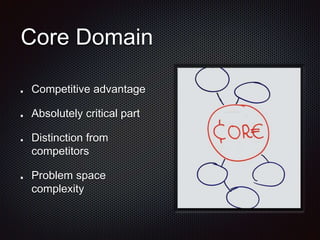
Core Domain
Core Domain
Competitive advantage
Absolutely critical part
Distinction from
competitors
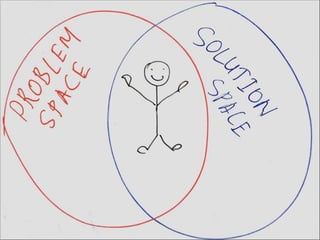
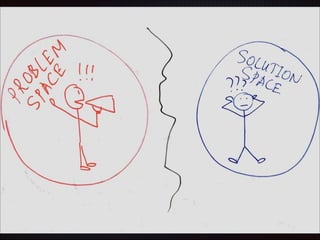
Problem space
complexity
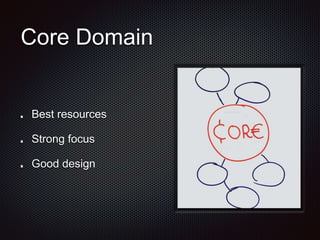
Core Domain
Best resources
Strong focus
Good design
Supportive subdomain
Candidate for off-the-shelf software
Prefer buying versus building
Candidate for CRUD
Can be outsourced
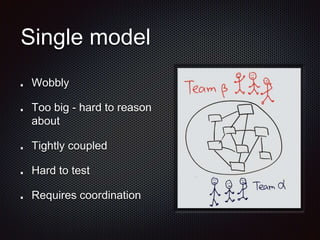
Single model
Wobbly
Too big - hard to reason
about
Tightly coupled
Hard to test
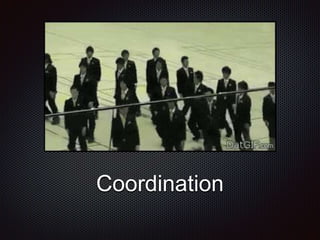
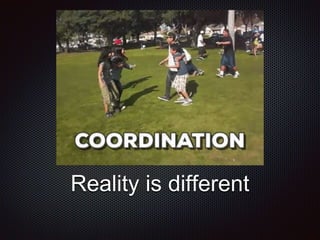
Requires coordination
Coordination
Reality is different
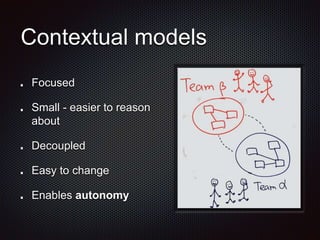
Contextual models
Focused
Small - easier to reason
about
Decoupled
Easy to change
Enables autonomy
Autonomy
Bounded context creates autonomy
Allows teams working in parallel
Little or no coordination
Independent release and feedback cycle
–Eric Evans
“DRY is inside the bounded context,
NOT the whole system.”
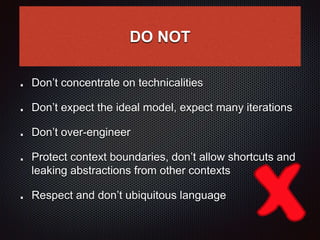
DO NOT
Don’t concentrate on technicalities
Don’t expect the ideal model, expect many iterations
Don’t over-engineer
Protect context boundaries, don’t allow shortcuts and
leaking abstractions from other contexts
Respect and don’t ubiquitous language
–Eric Evans
“Good design is imperfect design.”
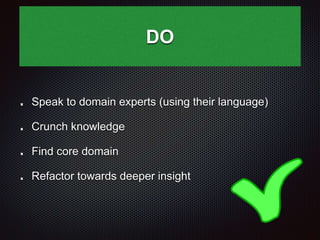
DO
Speak to domain experts (using their language)
Crunch knowledge
Find core domain
Refactor towards deeper insight
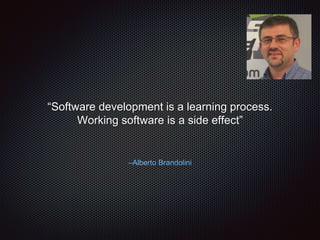
–Alberto Brandolini
“Software development is a learning process.
Working software is a side effect”
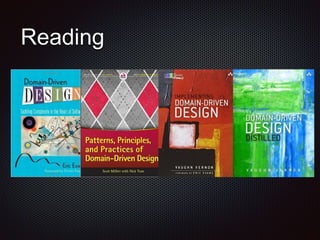
Reading

DDD - What, why, how?

Editor's Notes

  • #7 LISP is … different, some call it “alien technology” Still in use today Most functional languages are influenced by LISP
  • #8 Mother of COBOL Grace Hopper
  • #13 Algol - the least adopted language left the most used legacy
  • #21 This picture comes first when you search for “requirements software” in Google
  • #23 Babylon Tower on the cover of the book about requirements. Coincidence?
  • #27 So why people concentrate on tactics? Missing WHAT in favour of HOW (and WHY)
  • #28 Layered architecture is mentioned at the beginning of the blue book People start with “rich domain model”
  • #36 Obsession with tactics