Sufficient Reason
Alan Dix
Computational Foundry
Swansea
http://alandix.com/academic/talks/sufficient-reason-2018
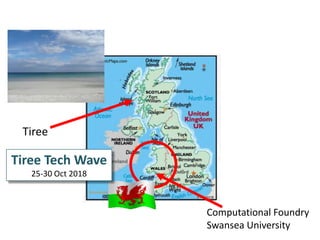
Tiree
Tiree Tech Wave
25-30 Oct 2018
Computational Foundry
Swansea University
the foundry
building
mission
community
computational foundry
opportunities
ECR programme
• emerging research leaders in the UK
• now in third year
escalator funds
• Swansea academic (not nec. computing)
• non-Swansea academic
• non-academic partner (industry, community, gov.)
today I am not talking about …
• physicality and product design
• the long tail of small data
• IT for small communities
• walking round Wales
• REF
• digital light
• digital humanities
• creativity and Bad Ideas
• virtual crackers and slow time
• modeling dreams, regret and the emergence of self
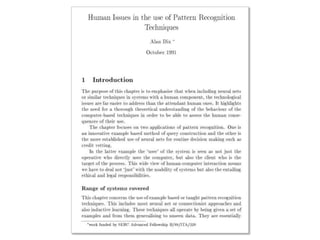
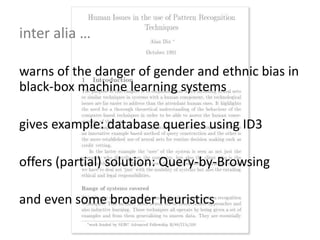
25 years back …
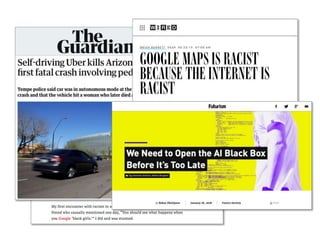
warns of the danger of gender and ethnic bias in
black-box machine learning systems

gives example: database queries using ID3
offers (partial) solution: Query-by-Browsing
and even some broader heuristics
inter alia …
yes, 25 years ago!
Query-by-Browsing
creating scructable
internal representations
Query by Browsing
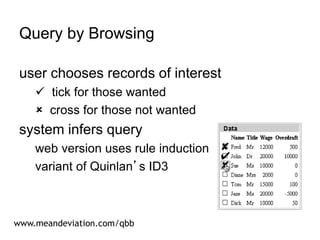
user chooses records of interest
 tick for those wanted
 cross for those not wanted
system infers query
web version uses rule induction
variant of Quinlan’s ID3
www.meandeviation.com/qbb
Query by Browsing
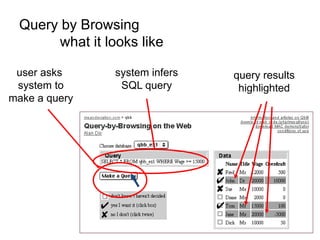
what it looks like
user asks
system to
make a query
system infers
SQL query
query results
highlighted
Query by Browsing
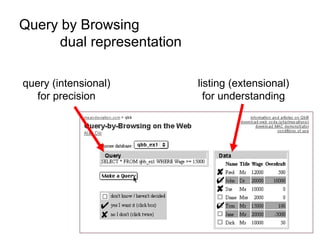
dual representation
query (intensional)
for precision
listing (extensional)
for understanding
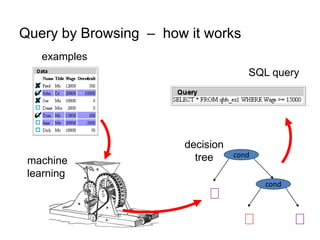
Query by Browsing – how it works
examples
machine
learning
SQL query
cond
cond
decision
tree

it is not just about
being accurate
not just right
but also upright
algorithms reflect society
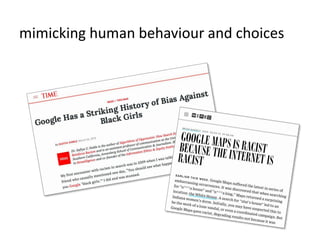
mimicking human behaviour and choices
pandering to human bias
(effective outcomes?)
• dating sites using ethnicity (CHI 2018!)
• young pretty waitresses sell more drinks
• Trump (reportedly) hiding black employees at
casino when certain rich customers arrived
• BBC (& others) paying male presenters more
because they are more popular
‘good’ business
but is it good?
reinforcing societal/cultural norms
at school
boys more likely to study STEM subjects
girls more likely to study humanities
so, on average, with no other information
gender is an (albeit poor) predictor
of communication skills
and engineering knowledge
as a society we choose
to use other (and better)
predictors
innate (but largely irrelevant) differences
men are (on average) larger and stronger
so gender is a Bayesian predictor of strength
this may explain gender differences in some jobs
but …
it does NOT justify employment discrimination
bias is not about
algorithmic correctness
it is about social choice
Note:
human reasoning is
poor at ignoring low quality cues
even when we have better ones
algorithms may be better?
however …
not sufficient to remove explicit indicators:
gender/ethnicity/disability/religion
potential correlating factors e.g. clothing
algorithms need to actively avoid discrimination
and how do we know our
algorithms are OK?
Not just bias
safety – e.g. autonomous cars
democracy – e.g. social media, fake news
health and well being – e.g. soft-drink adverts
social issues – e.g. credit ratings
we need to ask
Why?
algorithmic transparency
c.f. court judgment
an AIX Kitbag
AI explainability
how to make sense of
black-box machine-learning algorithms
crucial insight …
human–human explanations
rarely utterly precise or reproducible
but are
sufficient to inspire confidence and trust
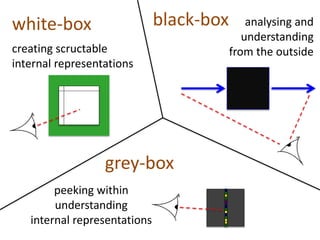
white-box black-box
grey-box
creating scructable
internal representations
analysing and
understanding
from the outside
peeking within
understanding
internal representations
but … this was all evident
25 years ago
why didn’t I do more?
if it is important
not sufficient to publish
you need to transform into
publicity and policy
white-box methods
creating scructable
internal representations
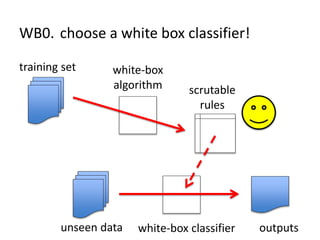
WB0. choose a white box classifier!
training set
scrutable
rules
white-box
algorithm
unseen data white-box classifier outputs
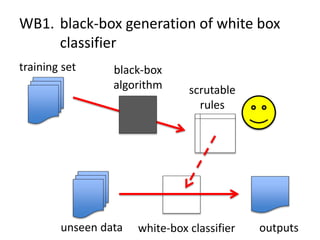
WB1. black-box generation of white box
classifier
training set
scrutable
rules
black-box
algorithm
unseen data white-box classifier outputs
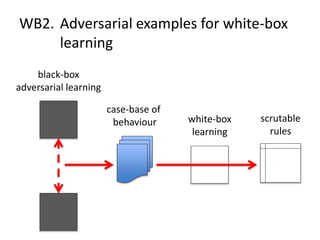
WB2. Adversarial examples for white-box
learning
case-base of
behaviour scrutable
rules
black-box
adversarial learning
white-box
learning
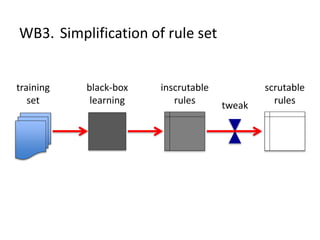
WB3. Simplification of rule set
scrutable
rules
black-box
learning
training
set
inscrutable
rules tweak
black-box methods
analysing and understanding
from the outside
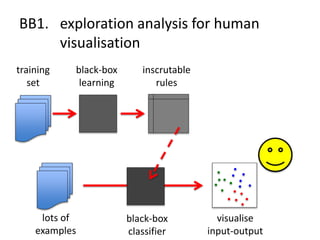
BB1. exploration analysis for human
visualisation
black-box
learning
training
set
inscrutable
rules
lots of
examples
black-box
classifier
visualise
input-output
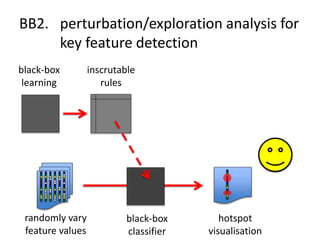
BB2. perturbation/exploration analysis for
key feature detection
black-box
learning
inscrutable
rules
randomly vary
feature values
black-box
classifier
hotspot
visualisation
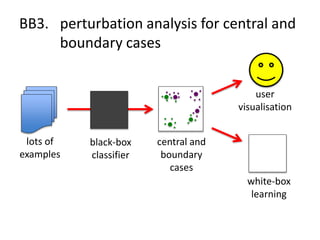
BB3. perturbation analysis for central and
boundary cases
lots of
examples
black-box
classifier
central and
boundary
cases
user
visualisation
white-box
learning
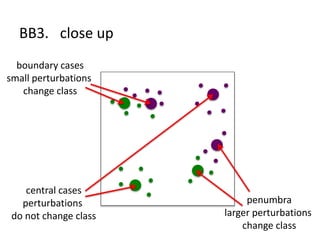
BB3. close up
central cases
perturbations
do not change class
boundary cases
small perturbations
change class
penumbra
larger perturbations
change class
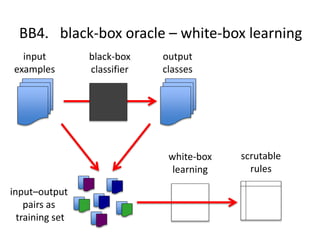
BB4. black-box oracle – white-box learning
input
examples
black-box
classifier
scrutable
rules
white-box
learning
input–output
pairs as
training set
output
classes
grey-box methods
peeking within
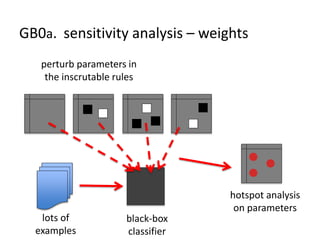
GB0a. sensitivity analysis – weights
perturb parameters in
the inscrutable rules
lots of
examples
black-box
classifier
hotspot analysis
on parameters
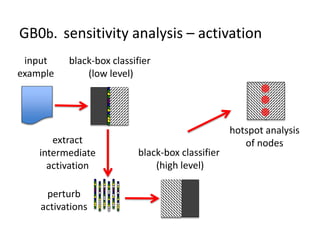
GB0b. sensitivity analysis – activation
input
example
black-box classifier
(low level)
extract
intermediate
activation
black-box classifier
(high level)
perturb
activations
hotspot analysis
of nodes
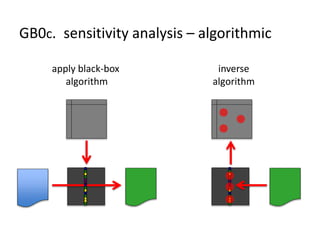
GB0c. sensitivity analysis – algorithmic
apply black-box
algorithm
inverse
algorithm
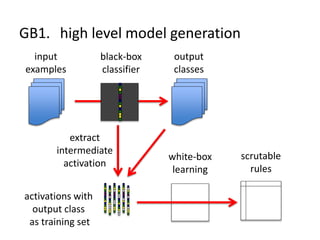
GB1. high level model generation
input
examples
black-box
classifier
extract
intermediate
activation
scrutable
rules
white-box
learning
activations with
output class
as training set
output
classes
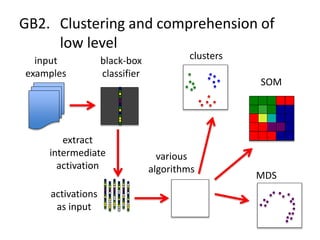
GB2. Clustering and comprehension of
low level
input
examples
black-box
classifier
extract
intermediate
activation
clusters
various
algorithms
activations
as input
MDS
SOM
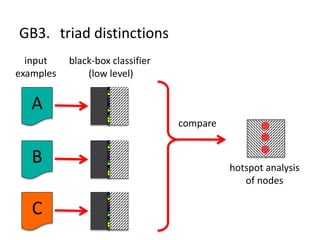
GB3. triad distinctions
input
examples
black-box classifier
(low level)
A
B
C
hotspot analysis
of nodes
compare
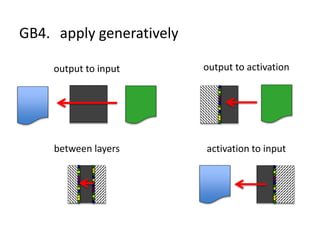
GB4. apply generatively
output to input
activation to input
output to activation
between layers

Sufficient Reason

  • 1.
    Sufficient Reason Alan Dix ComputationalFoundry Swansea http://alandix.com/academic/talks/sufficient-reason-2018
  • 2.
    Tiree Tiree Tech Wave 25-30Oct 2018 Computational Foundry Swansea University
  • 3.
  • 4.
    computational foundry opportunities ECR programme •emerging research leaders in the UK • now in third year escalator funds • Swansea academic (not nec. computing) • non-Swansea academic • non-academic partner (industry, community, gov.)
  • 5.
    today I amnot talking about … • physicality and product design • the long tail of small data • IT for small communities • walking round Wales • REF • digital light • digital humanities • creativity and Bad Ideas • virtual crackers and slow time • modeling dreams, regret and the emergence of self
  • 7.
  • 9.
    warns of thedanger of gender and ethnic bias in black-box machine learning systems gives example: database queries using ID3 offers (partial) solution: Query-by-Browsing and even some broader heuristics inter alia …
  • 10.
  • 12.
  • 13.
    Query by Browsing userchooses records of interest  tick for those wanted  cross for those not wanted system infers query web version uses rule induction variant of Quinlan’s ID3 www.meandeviation.com/qbb
  • 14.
    Query by Browsing whatit looks like user asks system to make a query system infers SQL query query results highlighted
  • 15.
    Query by Browsing dualrepresentation query (intensional) for precision listing (extensional) for understanding
  • 16.
    Query by Browsing– how it works examples machine learning SQL query cond cond decision tree
  • 18.
    it is notjust about being accurate not just right but also upright
  • 19.
  • 20.
  • 21.
    pandering to humanbias (effective outcomes?) • dating sites using ethnicity (CHI 2018!) • young pretty waitresses sell more drinks • Trump (reportedly) hiding black employees at casino when certain rich customers arrived • BBC (& others) paying male presenters more because they are more popular
  • 22.
  • 23.
    reinforcing societal/cultural norms atschool boys more likely to study STEM subjects girls more likely to study humanities so, on average, with no other information gender is an (albeit poor) predictor of communication skills and engineering knowledge
  • 24.
    as a societywe choose to use other (and better) predictors
  • 25.
    innate (but largelyirrelevant) differences men are (on average) larger and stronger so gender is a Bayesian predictor of strength this may explain gender differences in some jobs but … it does NOT justify employment discrimination
  • 26.
    bias is notabout algorithmic correctness it is about social choice
  • 27.
    Note: human reasoning is poorat ignoring low quality cues even when we have better ones
  • 28.
  • 29.
    however … not sufficientto remove explicit indicators: gender/ethnicity/disability/religion potential correlating factors e.g. clothing algorithms need to actively avoid discrimination
  • 30.
    and how dowe know our algorithms are OK?
  • 31.
    Not just bias safety– e.g. autonomous cars democracy – e.g. social media, fake news health and well being – e.g. soft-drink adverts social issues – e.g. credit ratings
  • 32.
    we need toask Why? algorithmic transparency c.f. court judgment
  • 34.
    an AIX Kitbag AIexplainability how to make sense of black-box machine-learning algorithms
  • 35.
    crucial insight … human–humanexplanations rarely utterly precise or reproducible but are sufficient to inspire confidence and trust
  • 36.
    white-box black-box grey-box creating scructable internalrepresentations analysing and understanding from the outside peeking within understanding internal representations
  • 38.
    but … thiswas all evident 25 years ago why didn’t I do more? if it is important not sufficient to publish you need to transform into publicity and policy
  • 40.
  • 41.
    WB0. choose awhite box classifier! training set scrutable rules white-box algorithm unseen data white-box classifier outputs
  • 42.
    WB1. black-box generationof white box classifier training set scrutable rules black-box algorithm unseen data white-box classifier outputs
  • 43.
    WB2. Adversarial examplesfor white-box learning case-base of behaviour scrutable rules black-box adversarial learning white-box learning
  • 44.
    WB3. Simplification ofrule set scrutable rules black-box learning training set inscrutable rules tweak
  • 45.
    black-box methods analysing andunderstanding from the outside
  • 46.
    BB1. exploration analysisfor human visualisation black-box learning training set inscrutable rules lots of examples black-box classifier visualise input-output
  • 47.
    BB2. perturbation/exploration analysisfor key feature detection black-box learning inscrutable rules randomly vary feature values black-box classifier hotspot visualisation
  • 48.
    BB3. perturbation analysisfor central and boundary cases lots of examples black-box classifier central and boundary cases user visualisation white-box learning
  • 49.
    BB3. close up centralcases perturbations do not change class boundary cases small perturbations change class penumbra larger perturbations change class
  • 50.
    BB4. black-box oracle– white-box learning input examples black-box classifier scrutable rules white-box learning input–output pairs as training set output classes
  • 51.
  • 52.
    GB0a. sensitivity analysis– weights perturb parameters in the inscrutable rules lots of examples black-box classifier hotspot analysis on parameters
  • 53.
    GB0b. sensitivity analysis– activation input example black-box classifier (low level) extract intermediate activation black-box classifier (high level) perturb activations hotspot analysis of nodes
  • 54.
    GB0c. sensitivity analysis– algorithmic apply black-box algorithm inverse algorithm
  • 55.
    GB1. high levelmodel generation input examples black-box classifier extract intermediate activation scrutable rules white-box learning activations with output class as training set output classes
  • 56.
    GB2. Clustering andcomprehension of low level input examples black-box classifier extract intermediate activation clusters various algorithms activations as input MDS SOM
  • 57.
    GB3. triad distinctions input examples black-boxclassifier (low level) A B C hotspot analysis of nodes compare
  • 58.
    GB4. apply generatively outputto input activation to input output to activation between layers