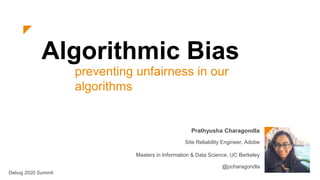
Algorithmic Bias
preventing unfairness in our
algorithms
Prathyusha Charagondla
Site Reliability Engineer, Adobe
Masters in Information & Data Science, UC Berkeley
@pcharagondla
Debug 2020 Summit
storytime
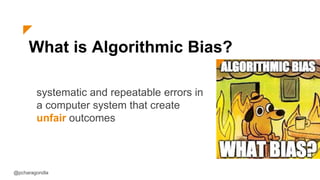
What is Algorithmic Bias?
systematic and repeatable errors in
a computer system that create
unfair outcomes
@pcharagondla
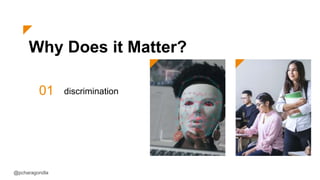
Why Does it Matter?
01 discrimination
@pcharagondla
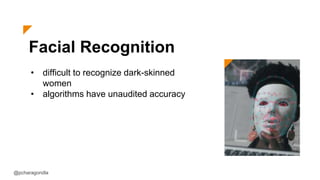
Facial Recognition
• difficult to recognize dark-skinned
women
• algorithms have unaudited accuracy
@pcharagondla
Facial Recognition
91% of South Wales Police’s automated
facial recognition matches wrongly
identified innocent people.
@pcharagondla
Exam Score Prediction
• international baccalaureate exam
• some variables:
@pcharagondla
• student’s assignment scores
• teacher’s predicted grades
• historical IB results from their
school
A-Levels & GCSE
• general certificate of secondary
education (GCSE) and A-Levels
• information from teacher:
@pcharagondla
• estimated grade
• ranking compared with other pupils
A-Levels & GCSE
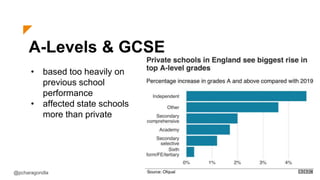
• based too heavily on
previous school
performance
• affected state schools
more than private
@pcharagondla
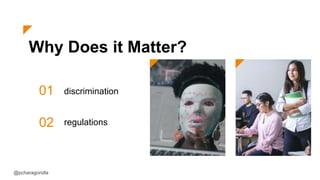
Why Does it Matter?
01
02
discrimination
regulations
@pcharagondla
How Can We Prevent It?
@pcharagondla
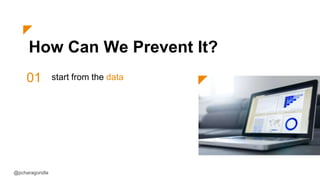
How Can We Prevent It?
01 start from the data
@pcharagondla
Start from the Data
• data source
• exploratory data analysis
for composition
@pcharagondla
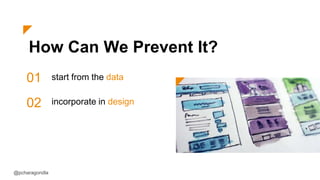
How Can We Prevent It?
01
02
start from the data
incorporate in design
@pcharagondla
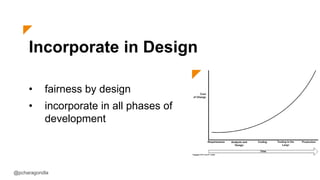
Incorporate in Design
• fairness by design
• incorporate in all phases of
development
@pcharagondla
“When automated decision-making tools are not built to
explicitly dismantle structural inequalities, their increased
speed and vast scale intensify them dramatically.”
- Virginia Eubanks, Automating Inequality
@pcharagondla
How Can We Prevent It?
01
02
03
start from the data
incorporate in design
create an ethical framework
@pcharagondla
EU’s Guidelines for Trustworthy
AI
1. respect for human autonomy
2. prevention of harm
3. fairness
4. explicability
@pcharagondla
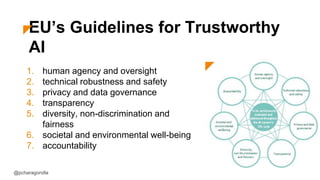
EU’s Guidelines for Trustworthy
AI
1. human agency and oversight
2. technical robustness and safety
3. privacy and data governance
4. transparency
5. diversity, non-discrimination and
fairness
6. societal and environmental well-being
7. accountability
@pcharagondla
How Can We Prevent It?
01
02
03
04
start from the data
incorporate in design
create an ethical framework
diversity in teams
@pcharagondla
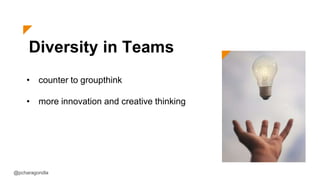
Diversity in Teams
• counter to groupthink
• more innovation and creative thinking
@pcharagondla
Recap
• bias in algorithms create unfair outcomes
• leads to discrimination
prevention:
• start from data
• incorporate in design and development
• create an ethical framework
• more diversity in teams
@pcharagondla
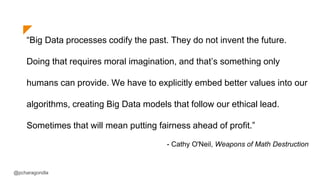
“Big Data processes codify the past. They do not invent the future.
Doing that requires moral imagination, and that’s something only
humans can provide. We have to explicitly embed better values into our
algorithms, creating Big Data models that follow our ethical lead.
Sometimes that will mean putting fairness ahead of profit.”
- Cathy O'Neil, Weapons of Math Destruction
@pcharagondla
Contact Info
twitter @pcharagondla
linkedIn pcharagondla
website prathyushasai.github.io

Algorithmic Bias: Preventing Unfairness in Our Algorithms

  • 1.
    Algorithmic Bias preventing unfairnessin our algorithms Prathyusha Charagondla Site Reliability Engineer, Adobe Masters in Information & Data Science, UC Berkeley @pcharagondla Debug 2020 Summit
  • 2.
  • 3.
    What is AlgorithmicBias? systematic and repeatable errors in a computer system that create unfair outcomes @pcharagondla
  • 4.
    Why Does itMatter? 01 discrimination @pcharagondla
  • 5.
    Facial Recognition • difficultto recognize dark-skinned women • algorithms have unaudited accuracy @pcharagondla
  • 6.
    Facial Recognition 91% ofSouth Wales Police’s automated facial recognition matches wrongly identified innocent people. @pcharagondla
  • 7.
    Exam Score Prediction •international baccalaureate exam • some variables: @pcharagondla • student’s assignment scores • teacher’s predicted grades • historical IB results from their school
  • 8.
    A-Levels & GCSE •general certificate of secondary education (GCSE) and A-Levels • information from teacher: @pcharagondla • estimated grade • ranking compared with other pupils
  • 9.
    A-Levels & GCSE •based too heavily on previous school performance • affected state schools more than private @pcharagondla
  • 10.
    Why Does itMatter? 01 02 discrimination regulations @pcharagondla
  • 11.
    How Can WePrevent It? @pcharagondla
  • 12.
    How Can WePrevent It? 01 start from the data @pcharagondla
  • 13.
    Start from theData • data source • exploratory data analysis for composition @pcharagondla
  • 14.
    How Can WePrevent It? 01 02 start from the data incorporate in design @pcharagondla
  • 15.
    Incorporate in Design •fairness by design • incorporate in all phases of development @pcharagondla
  • 16.
    “When automated decision-makingtools are not built to explicitly dismantle structural inequalities, their increased speed and vast scale intensify them dramatically.” - Virginia Eubanks, Automating Inequality @pcharagondla
  • 17.
    How Can WePrevent It? 01 02 03 start from the data incorporate in design create an ethical framework @pcharagondla
  • 18.
    EU’s Guidelines forTrustworthy AI 1. respect for human autonomy 2. prevention of harm 3. fairness 4. explicability @pcharagondla
  • 19.
    EU’s Guidelines forTrustworthy AI 1. human agency and oversight 2. technical robustness and safety 3. privacy and data governance 4. transparency 5. diversity, non-discrimination and fairness 6. societal and environmental well-being 7. accountability @pcharagondla
  • 20.
    How Can WePrevent It? 01 02 03 04 start from the data incorporate in design create an ethical framework diversity in teams @pcharagondla
  • 21.
    Diversity in Teams •counter to groupthink • more innovation and creative thinking @pcharagondla
  • 22.
    Recap • bias inalgorithms create unfair outcomes • leads to discrimination prevention: • start from data • incorporate in design and development • create an ethical framework • more diversity in teams @pcharagondla
  • 23.
    “Big Data processescodify the past. They do not invent the future. Doing that requires moral imagination, and that’s something only humans can provide. We have to explicitly embed better values into our algorithms, creating Big Data models that follow our ethical lead. Sometimes that will mean putting fairness ahead of profit.” - Cathy O'Neil, Weapons of Math Destruction @pcharagondla
  • 24.
    Contact Info twitter @pcharagondla linkedInpcharagondla website prathyushasai.github.io

Editor's Notes

  • #3 Gender Bias The existing pool of Amazon software engineers is overwhelmingly male, and the new software was fed data about those engineers’ resumes. If you simply ask software to discover other resumes that look like the resumes in a “training” data set, reproducing the demographics of the existing workforce is virtually guaranteed. Favored resumes with masculine language
  • #5 Potential Use Cases: Facial recognition Positive identification African-Americans were more likely to be singled out primarily because of their over-representation in mug-shot databases Consequently, African-American faces had more opportunities to be falsely matched, which produced a biased effect Social Media Monitoring Education Score prediction - IB https://www.nytimes.com/2020/09/08/opinion/international-baccalaureate-algorithm-grades.html  Justice System risk score - COMPAS
  • #6 Potential Use Cases: Facial recognition Positive identification African-Americans were more likely to be singled out primarily because of their over-representation in mug-shot databases Consequently, African-American faces had more opportunities to be falsely matched, which produced a biased effect Social Media Monitoring Education Score prediction - IB https://www.nytimes.com/2020/09/08/opinion/international-baccalaureate-algorithm-grades.html  Justice System risk score - COMPAS
  • #7 Potential Use Cases: Facial recognition Positive identification African-Americans were more likely to be singled out primarily because of their over-representation in mug-shot databases Consequently, African-American faces had more opportunities to be falsely matched, which produced a biased effect UK court of appeal has recently found this system unlawful
  • #8 Potential Use Cases: Facial recognition Positive identification African-Americans were more likely to be singled out primarily because of their over-representation in mug-shot databases Consequently, African-American faces had more opportunities to be falsely matched, which produced a biased effect Social Media Monitoring Education Score prediction - IB https://www.nytimes.com/2020/09/08/opinion/international-baccalaureate-algorithm-grades.html  Justice System risk score - COMPAS basing it on previous school performance, a high achieving student from an underperforming school is likely to have their results downgraded
  • #9 Gcse: marking the completion of mandatory schooling in the UK A-level: academic qualification earned upon successful completion of an exam and A-levels are subject-specific
  • #10 basing it on previous school performance, a high achieving student from an underperforming school is likely to have their results downgraded According to a BBC article, In Scotland, figures showed that the Scottish Higher pass rate for pupils from the lower income backgrounds was reduced by 15.2 percentage points, compared with only 6.9 percentage points for the wealthiest pupils. Private schools are usually selective - and better-funded - and in most years will perform well in terms of exam results. An algorithm based on past performance will put students from these schools at an advantage compared with their state-educated equivalents. Belmont Report - Ethical Principles and Guidelines for the Protection of Human Subjects of Research Respect for persons Informed consent Willingly participate Beneficience Minimmize harm Justice Who bears the burden and who bears the benefits
  • #11 GDPR
  • #12 Acknowledge bias, algorithms are not infalliable (technochauvinism)
  • #13 Check data source, think about anonymity & remove any potential variables that could bring about bias  Where it is coming form, Composition 
  • #14 Check data source, think about anonymity & remove any potential variables that could bring about bias  Where it is coming form, Composition 
  • #15 Privacy by design The later you are in the developmental process, the harder it is to change things
  • #16 Privacy by design The later you are in the developmental process, the harder it is to change things Incorporate in all phases as well - execution, evaluation Algorithm outputs should also be checked, with model features adjusted as needed to mitigate bias. Regularly audit and monitor the algorithm
  • #19 Human oversight, aid humans and give them automony Should not harm or adversely affect humans Equal and just distributions, equal opportunity Process is Transparent and openly communicateds
  • #20 Human agency and oversight Enable not hamper fundamental rights, autonomous decisions human oversight Technical robustness and safety resilience to attack and security, fall back plan Accuracy – correct judgments reliability and reproducibility Privacy and data governance Privacy and data protection  quality and integrity of data, access to data Transparency traceability, -- document data sets explainability - must be able to explain communication – inform when people are exposed to AI Diversity, non-discrimination and fairness avoidance of unfair bias, accessibility and universal design, stakeholder participation – speak with all who are impacted Societal and environmental wellbeing sustainability and environmental friendliness, social impact, -- monitor systems with social impact society and democracy – take caution Accountability auditability, minimization and reporting of negative impact trade-offs - acknowledge and consider tradeoffs Redress – allow redress, paying attention to vulnerable populations
  • #24 Belmont Report - Ethical Principles and Guidelines for the Protection of Human Subjects of Research Respect for persons Informed consent Willingly participate Beneficience Minimmize harm Justice Who bears the burden and who bears the benefits We are engineers in some way and we all want to revolutionize the world and the change it. Lets work together so that when we do, we do it in fair and equal way.