The Baltimore Award	Total Living Cities Funding$2.77 million in grants$15 million in program-related investments and commercial debtGoal:  Reconnect low-income Baltimore City residents who are predominantly African American to the regional economy, maximize the linkage between physical and human capital development, and to reinvest in targeted inner-core neighborhoods so that they become regionally competitive, economically diverse, sustainable communities of choice.
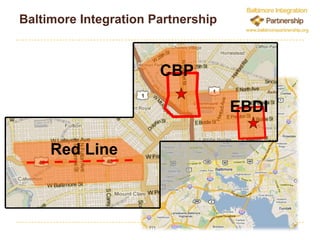
Baltimore Integration PartnershipCBPEBDIRed Line
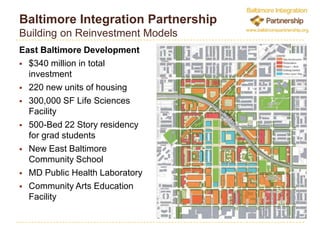
Baltimore Integration PartnershipBuilding on Reinvestment ModelsEast Baltimore Development$340 million in total investment220 new units of housing300,000 SF Life Sciences Facility500-Bed 22 Story residency for grad studentsNew East Baltimore Community SchoolMD Public Health LaboratoryCommunity Arts Education Facility
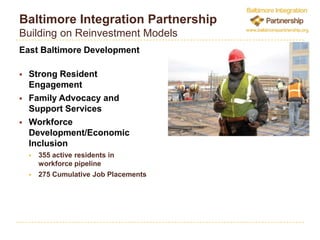
Baltimore Integration PartnershipBuilding on Reinvestment ModelsEast Baltimore DevelopmentStrong Resident EngagementFamily Advocacy and Support ServicesWorkforce Development/Economic Inclusion355 active residents in workforce pipeline275 Cumulative Job Placements
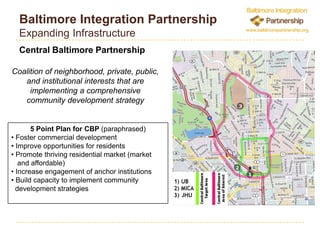
Baltimore Integration PartnershipExpanding InfrastructureCentral Baltimore PartnershipCoalition of neighborhood, private, public, and institutional interests that are implementing a comprehensive community development strategy5 Point Plan for CBP (paraphrased) Foster commercial development
 Improve opportunities for residents
 Promote thriving residential market (market 	and affordable)
 Increase engagement of anchor institutions
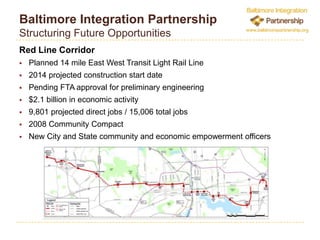
 Build capacity to implement community 	development strategiesBaltimore Integration PartnershipStructuring Future OpportunitiesRed Line CorridorPlanned 14 mile East West Transit Light Rail Line2014 projected construction start datePending FTA approval for preliminary engineering$2.1 billion in economic activity9,801 projected direct jobs / 15,006 total jobs2008 Community CompactNew City and State community and economic empowerment officers
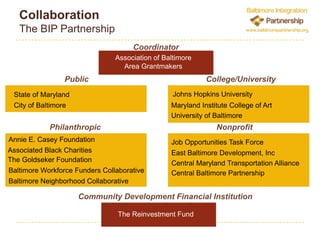
CollaborationThe BIP PartnershipCoordinatorAssociation of Baltimore Area GrantmakersPublicCollege/UniversityJohns Hopkins UniversityState of MarylandCity of BaltimoreMaryland Institute College of ArtUniversity of BaltimoreNonprofitPhilanthropic Annie E. Casey FoundationJob Opportunities Task ForceAssociated Black CharitiesEast Baltimore Development, IncThe Goldseker FoundationCentral Maryland Transportation AllianceBaltimore Workforce Funders CollaborativeCentral Baltimore PartnershipBaltimore Neighborhood CollaborativeCommunity Development Financial InstitutionThe Reinvestment Fund
TRF ProfileThe Reinvestment Fund builds wealth and opportunity for low-income people and places through the promotion of socially and environmentally responsible development.Business LinesLending & Investing  $1 billion in cumulative investments and loans throughout the mid-Atlantic
Currently manages $700 millionin capital, with nearly830 investorsPolicy & Information ServicesReal Estate DevelopmentPolicyMap
Implementing the BIPA central goal of the BIP is to facilitate, in partnership with area employers and developers, an integrated investment in both communities and residents by helping finance revitalization projects that provide employment opportunities or other benefits for low-income area residents.  The BIP seeks to build on and connect existing assets, infrastructure, and area community partners to accomplish this including:Anchor Institutions Transit Oriented Development Existing Investment/Market Strength Community Partners/Infrastructure (EBDI/CBP)BIP PartnersThe BIP can provide employers and developers:Project Development LendingConnections to Workforce Providers and Job Ready Area Residents  Co-Investment in Job Training
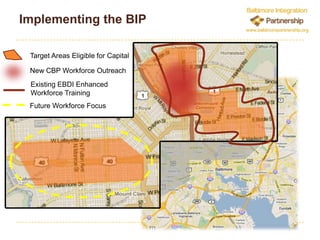
Implementing the BIPTarget Areas Eligible for CapitalNew CBP Workforce OutreachExisting EBDI Enhanced Workforce TrainingFuture Workforce Focus
TRF’s Baltimore Integration Partnership products:Pre-Development LoansAcquisition, Construction/Bridge Loans   Small Business loansSemi-Permanent Loans   New Market Tax Credit eligible loans and financingProjects must meet two of these four criteria:Create  short or long term employment opportunities for low-income area residents;Offer opportunities for low-income area residents/employees to build equityIncrease/improve neighborhood amenities and services to create opportunity and deliver tangible benefits to low-income residents;Make improvements to community conditions by addressing blight and vacant property through new construction and/or rehabilitation of existing uses based on a community plan or demonstrated community support. ImplementationProject Development Lending
Developers/borrowers must work towards a set of goals to maximize the investment’s return for area communities and residents.  These goals include: 27% of contracting must be dedicated to African American Business Enterprises.Inclusion of a local workforce as part of construction of the project.The BIP and the developer/borrower will jointly develop a Workforce Resources and Inclusion Plan identifying any planned hiring opportunities and reflecting how inclusion goals will be achieved prior to loan closing.  ImplementationProject Development Lending
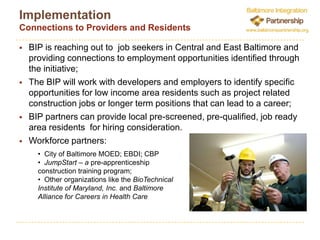
ImplementationConnections to Providers and ResidentsBIP is reaching out to  job seekers in Central and East Baltimore and providing connections to employment opportunities identified through the initiative;The BIP will work with developers and employers to identify specific opportunities for low income area residents such as project related construction jobs or longer term positions that can lead to a career;BIP partners can provide local pre-screened, pre-qualified, job ready area residents  for hiring consideration. Workforce partners:  City of Baltimore MOED; EBDI; CBP
JumpStart – a pre-apprenticeship construction training program;
  Other organizations like the BioTechnical Institute of Maryland, Inc. and Baltimore Alliance for Careers in Health CareConnect low income residents to employment opportunities via appropriate, high quality occupational training that meets the needs of employers for a skilled workforce.Fund Purposes:Hard skills/ occupational training for residents of the BIP target areas/partner communities that is tied to a specific job commitment from an employer or developer  (customized or on the job training)Pre-bridge or bridge remediation in literacy and numeracy for a particular candidate or population from partner communities, if tied to a specific job placement/commitmentCoaching for incumbent workers if leads to career advancement and increased wages.Needs co-investment and commitments from employers.ImplementationWorkforce Development Training Fund
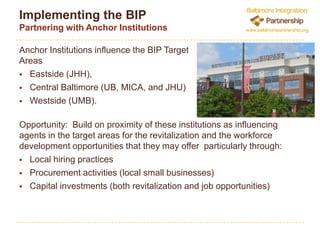
Implementing the BIPPartnering with Anchor Institutions Anchor Institutions influence the BIP Target Areas Eastside (JHH),  Central Baltimore (UB, MICA, and JHU) Westside (UMB).Opportunity:  Build on proximity of these institutions as influencing agents in the target areas for the revitalization and the workforce development opportunities that they may offer  particularly through: Local hiring practices Procurement activities (local small businesses) Capital investments (both revitalization and job opportunities)
Implementing the BIPSystems Change / New Normal Seeking to create sustainability of integration of capital and workforce.Policy shifts at Anchor InstitutionsPolicy considerations in City Hall, Annapolis and DC.Economic inclusion policies and practices that better structure local hiring opportunities within public financing of capital projects.Increased investments in worker training that lead to  real jobsA broader view of community development that includes human capital development as key to future growth/ prosperity
Appendix
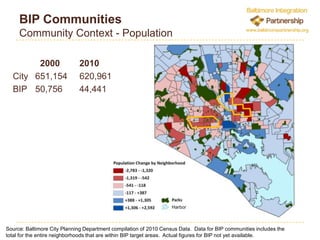
BIP CommunitiesCommunity Context - Population2000	     2010City	651,154     620,961BIP	50,756	     44,441		Source: Baltimore City Planning Department compilation of 2010 Census Data.  Data for BIP communities includes the total for the entire neighborhoods that are within BIP target areas.  Actual figures for BIP not yet available.

About the Baltimore Integration Partnership

  • 2.
    The Baltimore Award TotalLiving Cities Funding$2.77 million in grants$15 million in program-related investments and commercial debtGoal: Reconnect low-income Baltimore City residents who are predominantly African American to the regional economy, maximize the linkage between physical and human capital development, and to reinvest in targeted inner-core neighborhoods so that they become regionally competitive, economically diverse, sustainable communities of choice.
  • 3.
  • 4.
    Baltimore Integration PartnershipBuildingon Reinvestment ModelsEast Baltimore Development$340 million in total investment220 new units of housing300,000 SF Life Sciences Facility500-Bed 22 Story residency for grad studentsNew East Baltimore Community SchoolMD Public Health LaboratoryCommunity Arts Education Facility
  • 5.
    Baltimore Integration PartnershipBuildingon Reinvestment ModelsEast Baltimore DevelopmentStrong Resident EngagementFamily Advocacy and Support ServicesWorkforce Development/Economic Inclusion355 active residents in workforce pipeline275 Cumulative Job Placements
  • 6.
    Baltimore Integration PartnershipExpandingInfrastructureCentral Baltimore PartnershipCoalition of neighborhood, private, public, and institutional interests that are implementing a comprehensive community development strategy5 Point Plan for CBP (paraphrased) Foster commercial development
  • 7.
  • 8.
    Promote thrivingresidential market (market and affordable)
  • 9.
    Increase engagementof anchor institutions
  • 10.
    Build capacityto implement community development strategiesBaltimore Integration PartnershipStructuring Future OpportunitiesRed Line CorridorPlanned 14 mile East West Transit Light Rail Line2014 projected construction start datePending FTA approval for preliminary engineering$2.1 billion in economic activity9,801 projected direct jobs / 15,006 total jobs2008 Community CompactNew City and State community and economic empowerment officers
  • 11.
    CollaborationThe BIP PartnershipCoordinatorAssociationof Baltimore Area GrantmakersPublicCollege/UniversityJohns Hopkins UniversityState of MarylandCity of BaltimoreMaryland Institute College of ArtUniversity of BaltimoreNonprofitPhilanthropic Annie E. Casey FoundationJob Opportunities Task ForceAssociated Black CharitiesEast Baltimore Development, IncThe Goldseker FoundationCentral Maryland Transportation AllianceBaltimore Workforce Funders CollaborativeCentral Baltimore PartnershipBaltimore Neighborhood CollaborativeCommunity Development Financial InstitutionThe Reinvestment Fund
  • 12.
    TRF ProfileThe ReinvestmentFund builds wealth and opportunity for low-income people and places through the promotion of socially and environmentally responsible development.Business LinesLending & Investing $1 billion in cumulative investments and loans throughout the mid-Atlantic
  • 13.
    Currently manages $700millionin capital, with nearly830 investorsPolicy & Information ServicesReal Estate DevelopmentPolicyMap
  • 14.
    Implementing the BIPAcentral goal of the BIP is to facilitate, in partnership with area employers and developers, an integrated investment in both communities and residents by helping finance revitalization projects that provide employment opportunities or other benefits for low-income area residents. The BIP seeks to build on and connect existing assets, infrastructure, and area community partners to accomplish this including:Anchor Institutions Transit Oriented Development Existing Investment/Market Strength Community Partners/Infrastructure (EBDI/CBP)BIP PartnersThe BIP can provide employers and developers:Project Development LendingConnections to Workforce Providers and Job Ready Area Residents Co-Investment in Job Training
  • 15.
    Implementing the BIPTargetAreas Eligible for CapitalNew CBP Workforce OutreachExisting EBDI Enhanced Workforce TrainingFuture Workforce Focus
  • 16.
    TRF’s Baltimore IntegrationPartnership products:Pre-Development LoansAcquisition, Construction/Bridge Loans Small Business loansSemi-Permanent Loans New Market Tax Credit eligible loans and financingProjects must meet two of these four criteria:Create short or long term employment opportunities for low-income area residents;Offer opportunities for low-income area residents/employees to build equityIncrease/improve neighborhood amenities and services to create opportunity and deliver tangible benefits to low-income residents;Make improvements to community conditions by addressing blight and vacant property through new construction and/or rehabilitation of existing uses based on a community plan or demonstrated community support. ImplementationProject Development Lending
  • 17.
    Developers/borrowers must worktowards a set of goals to maximize the investment’s return for area communities and residents. These goals include: 27% of contracting must be dedicated to African American Business Enterprises.Inclusion of a local workforce as part of construction of the project.The BIP and the developer/borrower will jointly develop a Workforce Resources and Inclusion Plan identifying any planned hiring opportunities and reflecting how inclusion goals will be achieved prior to loan closing. ImplementationProject Development Lending
  • 18.
    ImplementationConnections to Providersand ResidentsBIP is reaching out to job seekers in Central and East Baltimore and providing connections to employment opportunities identified through the initiative;The BIP will work with developers and employers to identify specific opportunities for low income area residents such as project related construction jobs or longer term positions that can lead to a career;BIP partners can provide local pre-screened, pre-qualified, job ready area residents for hiring consideration. Workforce partners: City of Baltimore MOED; EBDI; CBP
  • 19.
    JumpStart – apre-apprenticeship construction training program;
  • 20.
    Otherorganizations like the BioTechnical Institute of Maryland, Inc. and Baltimore Alliance for Careers in Health CareConnect low income residents to employment opportunities via appropriate, high quality occupational training that meets the needs of employers for a skilled workforce.Fund Purposes:Hard skills/ occupational training for residents of the BIP target areas/partner communities that is tied to a specific job commitment from an employer or developer (customized or on the job training)Pre-bridge or bridge remediation in literacy and numeracy for a particular candidate or population from partner communities, if tied to a specific job placement/commitmentCoaching for incumbent workers if leads to career advancement and increased wages.Needs co-investment and commitments from employers.ImplementationWorkforce Development Training Fund
  • 21.
    Implementing the BIPPartneringwith Anchor Institutions Anchor Institutions influence the BIP Target Areas Eastside (JHH), Central Baltimore (UB, MICA, and JHU) Westside (UMB).Opportunity: Build on proximity of these institutions as influencing agents in the target areas for the revitalization and the workforce development opportunities that they may offer particularly through: Local hiring practices Procurement activities (local small businesses) Capital investments (both revitalization and job opportunities)
  • 22.
    Implementing the BIPSystemsChange / New Normal Seeking to create sustainability of integration of capital and workforce.Policy shifts at Anchor InstitutionsPolicy considerations in City Hall, Annapolis and DC.Economic inclusion policies and practices that better structure local hiring opportunities within public financing of capital projects.Increased investments in worker training that lead to real jobsA broader view of community development that includes human capital development as key to future growth/ prosperity
  • 23.
  • 24.
    BIP CommunitiesCommunity Context- Population2000 2010City 651,154 620,961BIP 50,756 44,441 Source: Baltimore City Planning Department compilation of 2010 Census Data. Data for BIP communities includes the total for the entire neighborhoods that are within BIP target areas. Actual figures for BIP not yet available.