Aligarh College of Engineering and Technology , Aligarh
Approved by AICTE New Delhi, Affiliated to AKTU Lucknow
Lightning Protection
P r e s e n t e d b y R o h i t K u m a r
B . T E C H ( E N ) 4 t h Ye a r
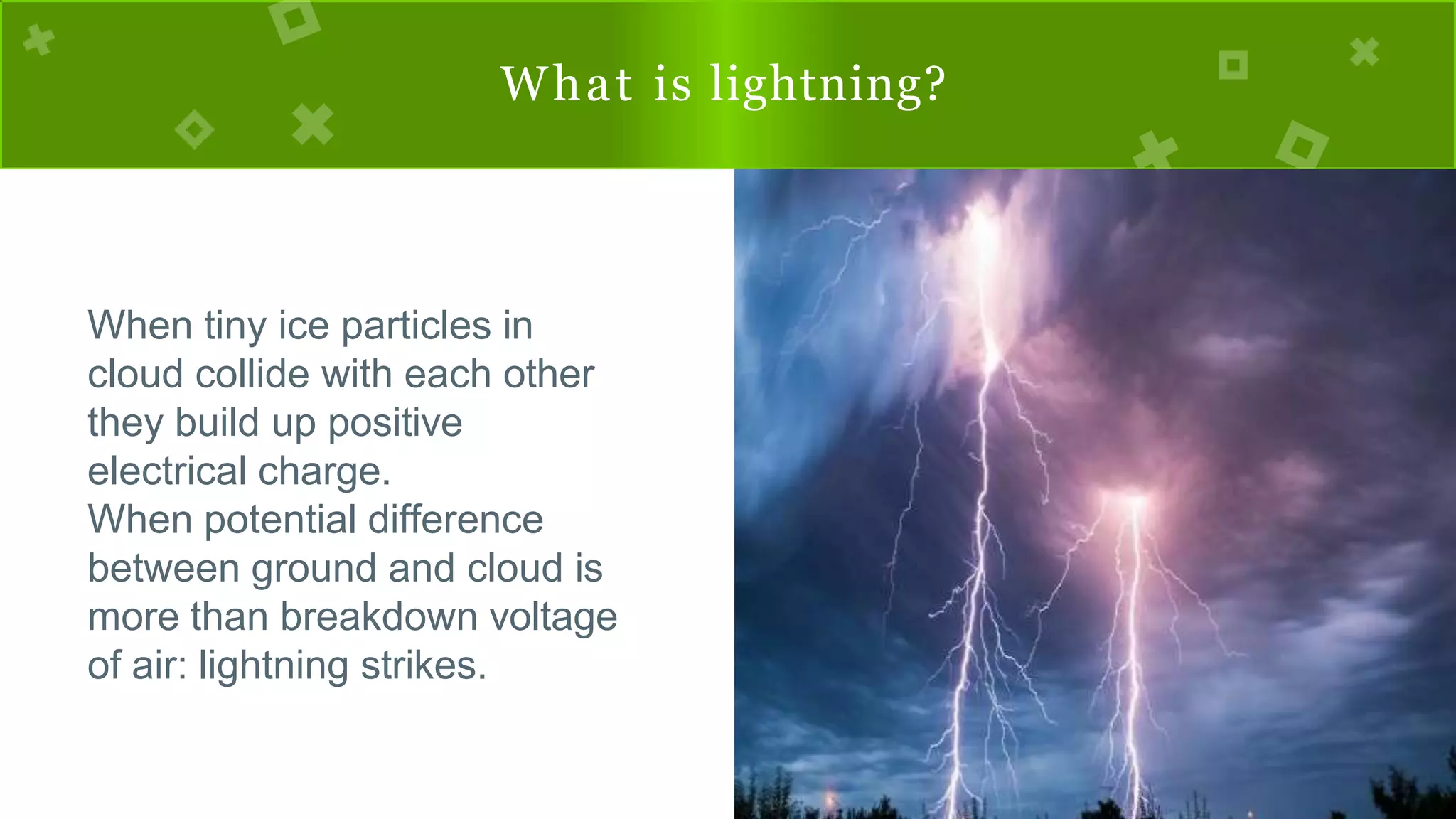
What is lightning?
When tiny ice particles in
cloud collide with each other
they build up positive
electrical charge.
When potential difference
between ground and cloud is
more than breakdown voltage
of air: lightning strikes.
Lightning facts
×Lightning heats up the surrounding air to
20,000oC
×Can hit with 500kV of voltage and more
than 10,000A of current.
×240,000 people are struck by lightning
each year and 24,000 are killed.
Lightning
Protection
A Lightning Protection System (LPS) is designed to
protect a structure or building and contents from
damage caused by the intensely high voltage
currents of a lightning strike
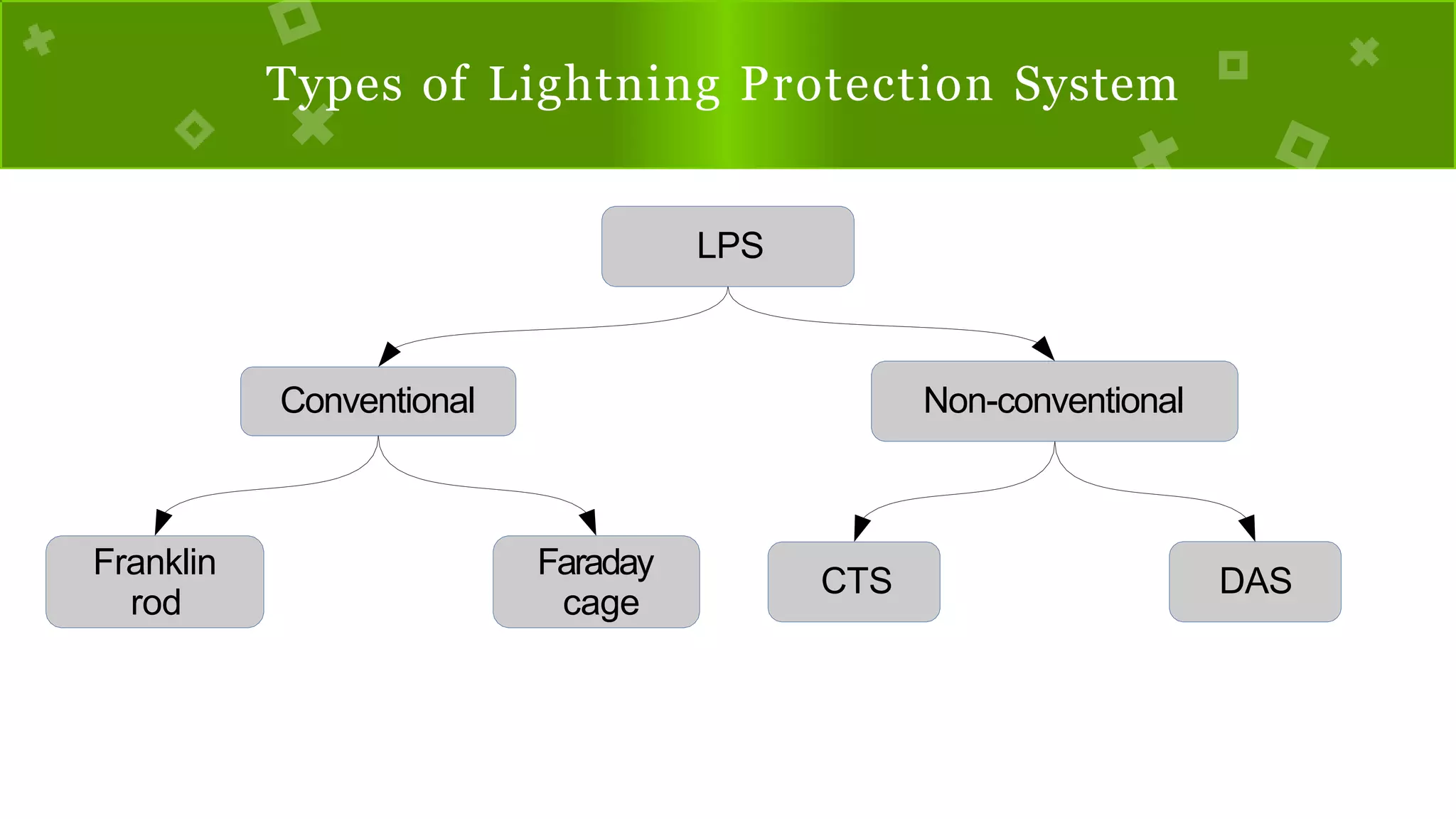
Types of Lightning Protection System
LPS
Conventional Non-conventional
Franklin
rod
Faraday
cage
CTS DAS
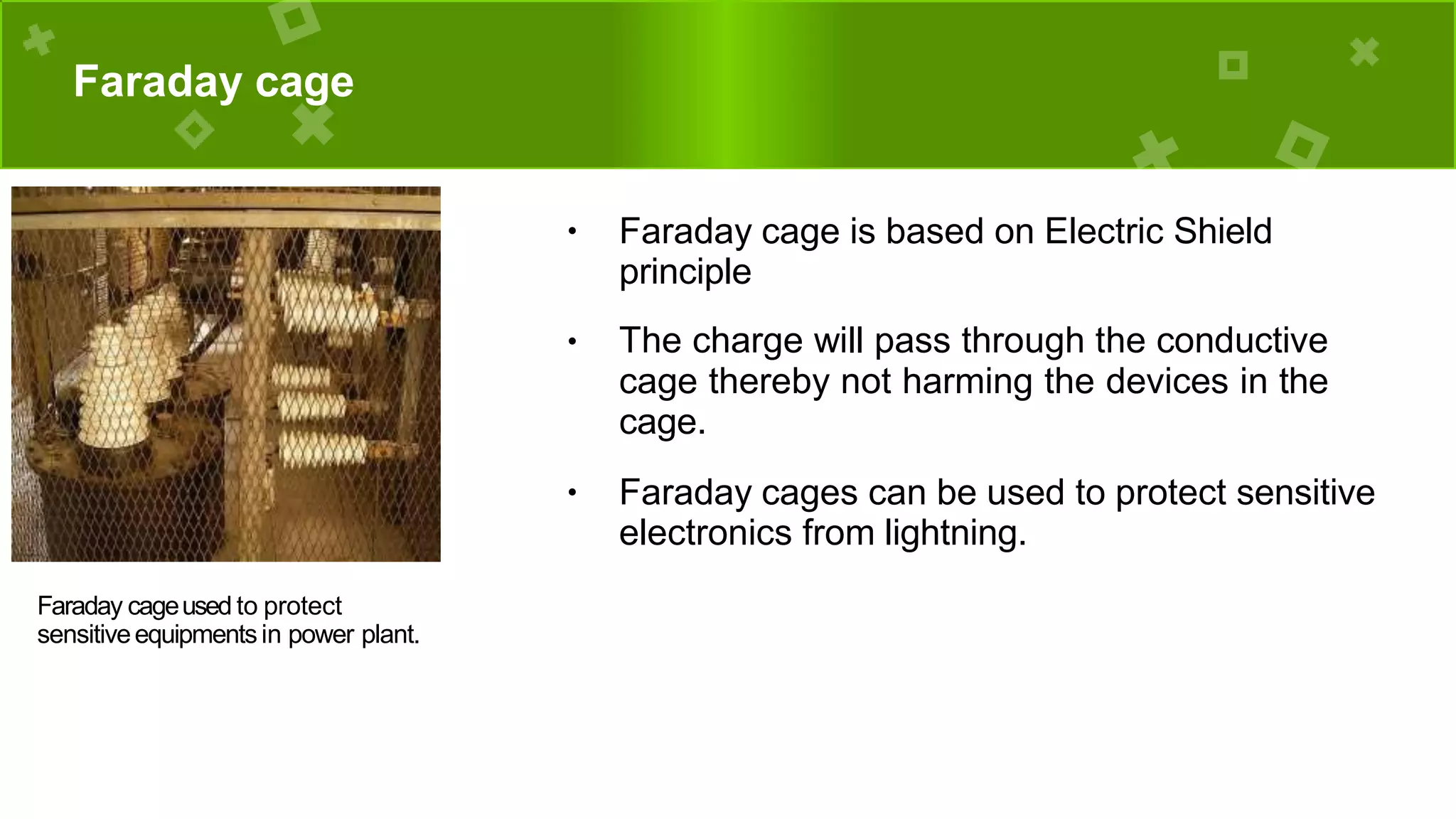
Faraday cage
● Faraday cage is based on Electric Shield
principle
● The charge will pass through the conductive
cage thereby not harming the devices in the
cage.
● Faraday cages can be used to protect sensitive
electronics from lightning.
Faraday cageused to protect
sensitiveequipmentsin power plant.
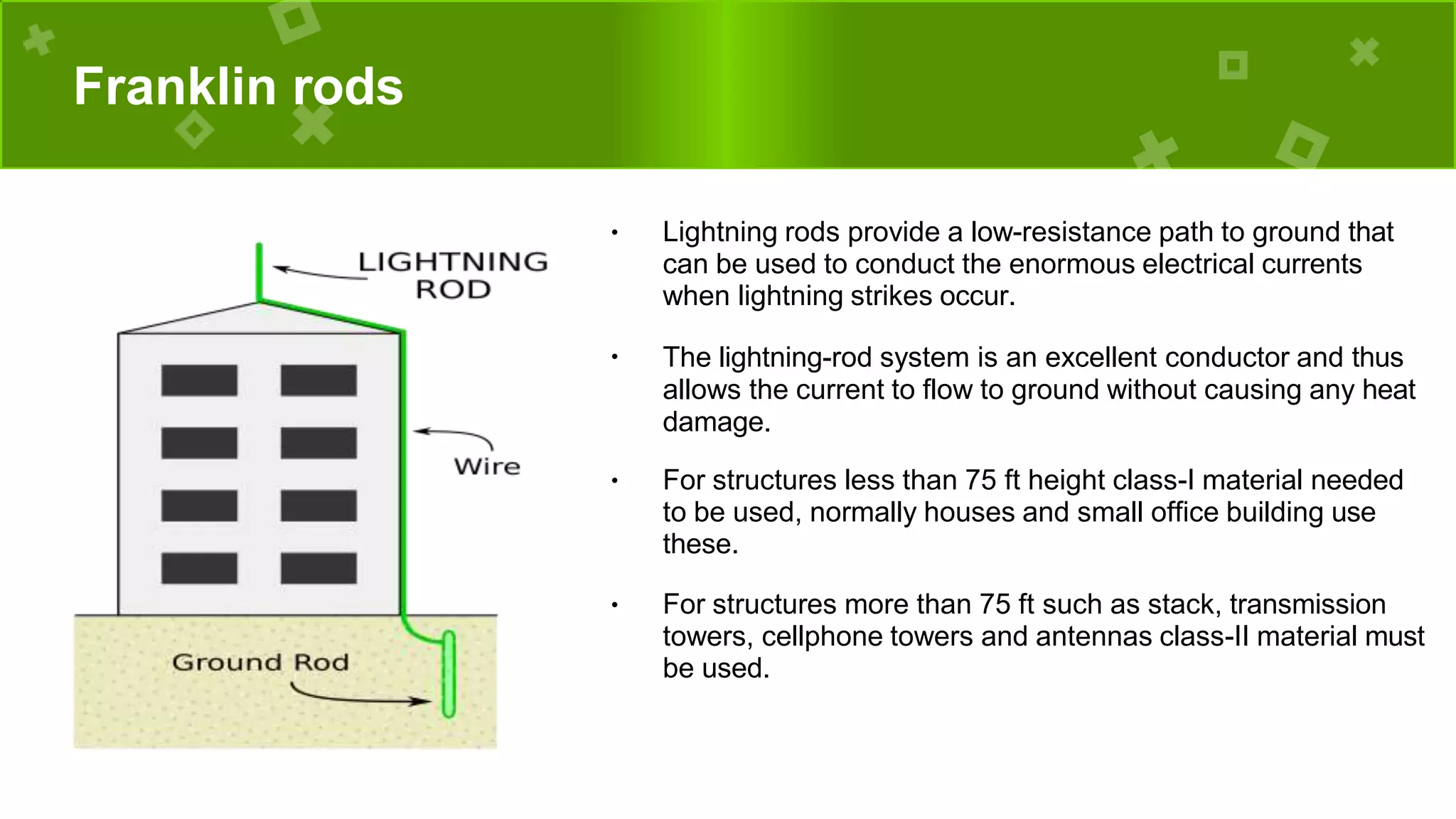
Franklin rods
● Lightning rods provide a low-resistance path to ground that
can be used to conduct the enormous electrical currents
when lightning strikes occur.
●
The lightning-rod system is an excellent conductor and thus
allows the current to flow to ground without causing any heat
damage.
● For structures less than 75 ft height class-I material needed
to be used, normally houses and small office building use
these.
● For structures more than 75 ft such as stack, transmission
towers, cellphone towers and antennas class-II material must
be used.
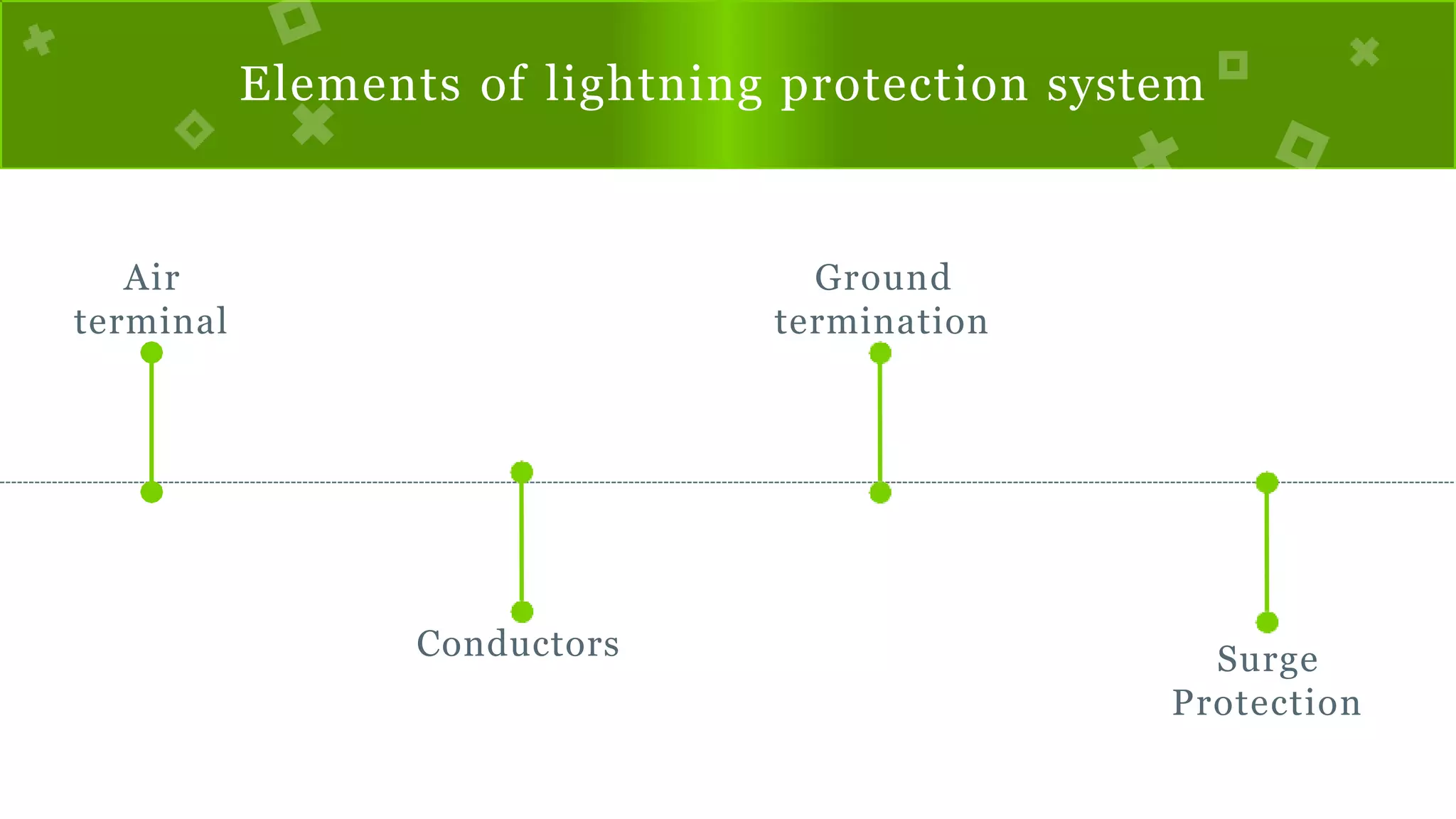
Elements of lightning protection system
Air
terminal
Conductors
Ground
termination
Surge
Protection
Air terminal
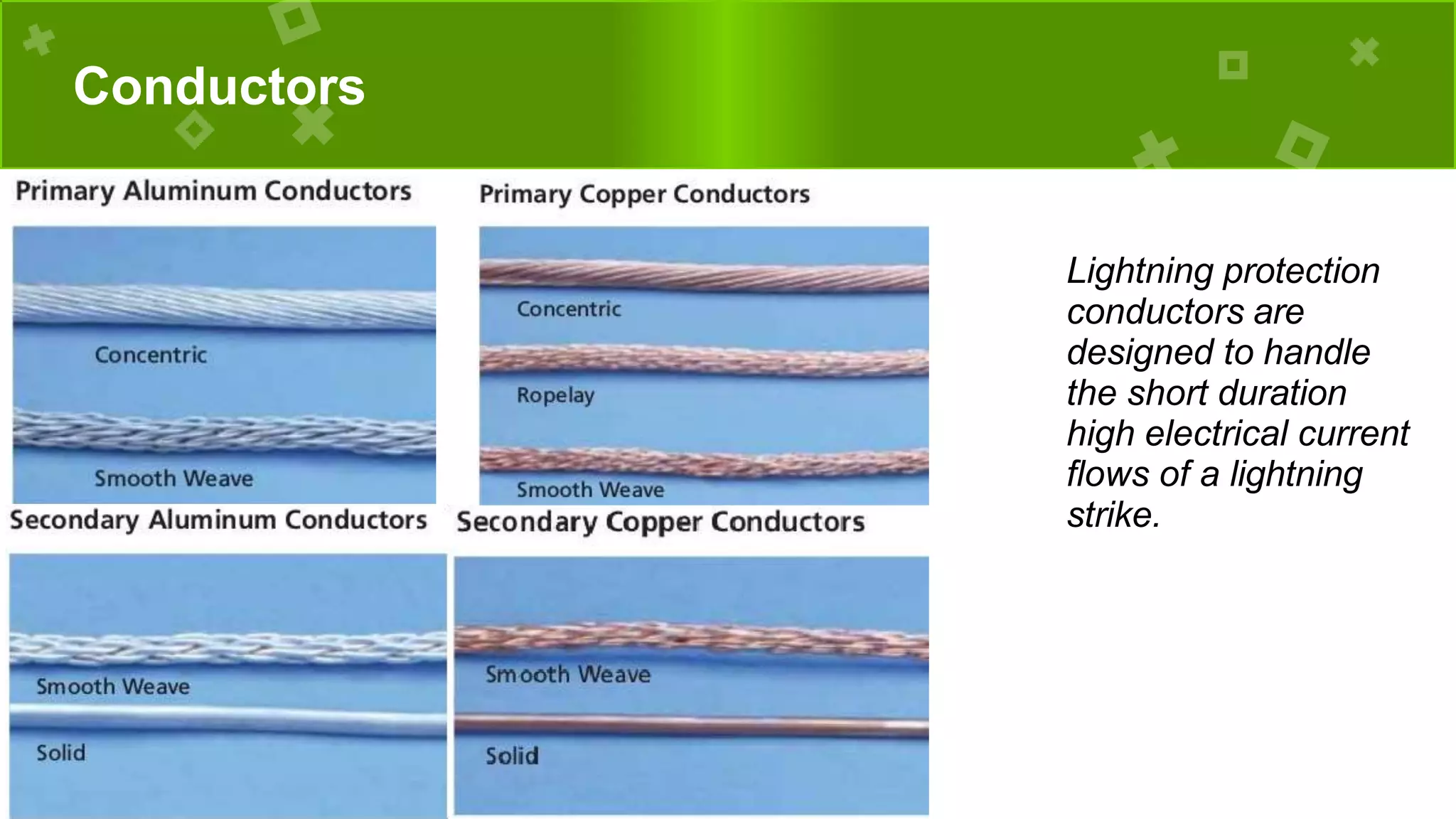
Lightning protection
conductors are
designed to handle
the short duration
high electrical current
flows of a lightning
strike.
Conductors
Choosing the conductor
Solid Round
●
●
●
Easy to install-can
be bent at any
place
Straightning tool
may be required
Less obvious to see
than wider 25x3
mm tape
Smooth Weave
●
●
●
●
Does not have
memory-directly
used from roll
Once bent stays in
shape
Doesn’t have
exapansion and
contraction problem
Difficult to make
100% straight
Concentric
●
●
●
Has memory-needs
to be uncoiled
When bent, it
untwines or frays
Not widely used in
LP application.
Heavy duty Application
● Smoke or stack vent is
considered as heavy duty if
cross-sectional area of the flue is
greater than 500cm2 and height
more than 75 ft
● The sulfur content of the flue
could corrode copper conductors
therefore lead covered or
stainless steel air terminals
should be used in upper 25 ft.
● If ladder of pipes coming down
from towers the down conductors
should be bonded with them to all
the way down.
Ground terminal
●
Ground is the termination point for all
lightning protection system
● It helps to dissipate energy
● It has three components---
–
–
–
Bus bar
Ground rod
Ground rod clamps
Ground terminal
●
Normally ground rods are vertical or horizontal depending on
the type of installation.
● Ground rods go 15-20ft underground.
Surge Protective Devices (SPD)
Surge protective device (SPD) is the IEC term given to a device
intended to limit transient voltages and divert surge current.
PURPOSE
● Eliminating potential differences to service conductors and thereby reducing the risk
of flash over and possible resulting fire (IEC 62305-3)
● Providing protection to structure electrical/electronic equipment against impulses
from direct or indirect flashes to the services (IEC 62305-4)
● Correctly located and installed protection (coordinated protection) will also reduce
the risk of equipment damage from impulses generated by switching or faults within
the electrical circuits
● They are a key part of the Lightning Electromagnetic Impulse LEMP protection
measures system which be abbreviated as LMPS.
Surge Protective Devices (SPD)
SPDs are based on
these technologies:
● Spark gaps
● Arc Gaps
●
Gas Discharge
Tubes (GDTs)
●
Metal Oxide
Varistors (MOVs)
WORKING PRINCIPLE
●
SPDs contain at least one non-linear component, which under
specific conditions transitions between a high and low
impedance state.
● At normal operating voltages the SPDs are in a high impedance
state and do not affect the system. When a transient voltage
occurs on the circuit, the SPD moves into a state of conduction
(a low impedance) and diverts the transient energy/current back
to its source or ground.
●
This limits (clamps) the voltage amplitude to a safer level. After
the transient is diverted, the SPD will automatically reset back to
its high impedance state.
Charge Transfer System (CTS)
●
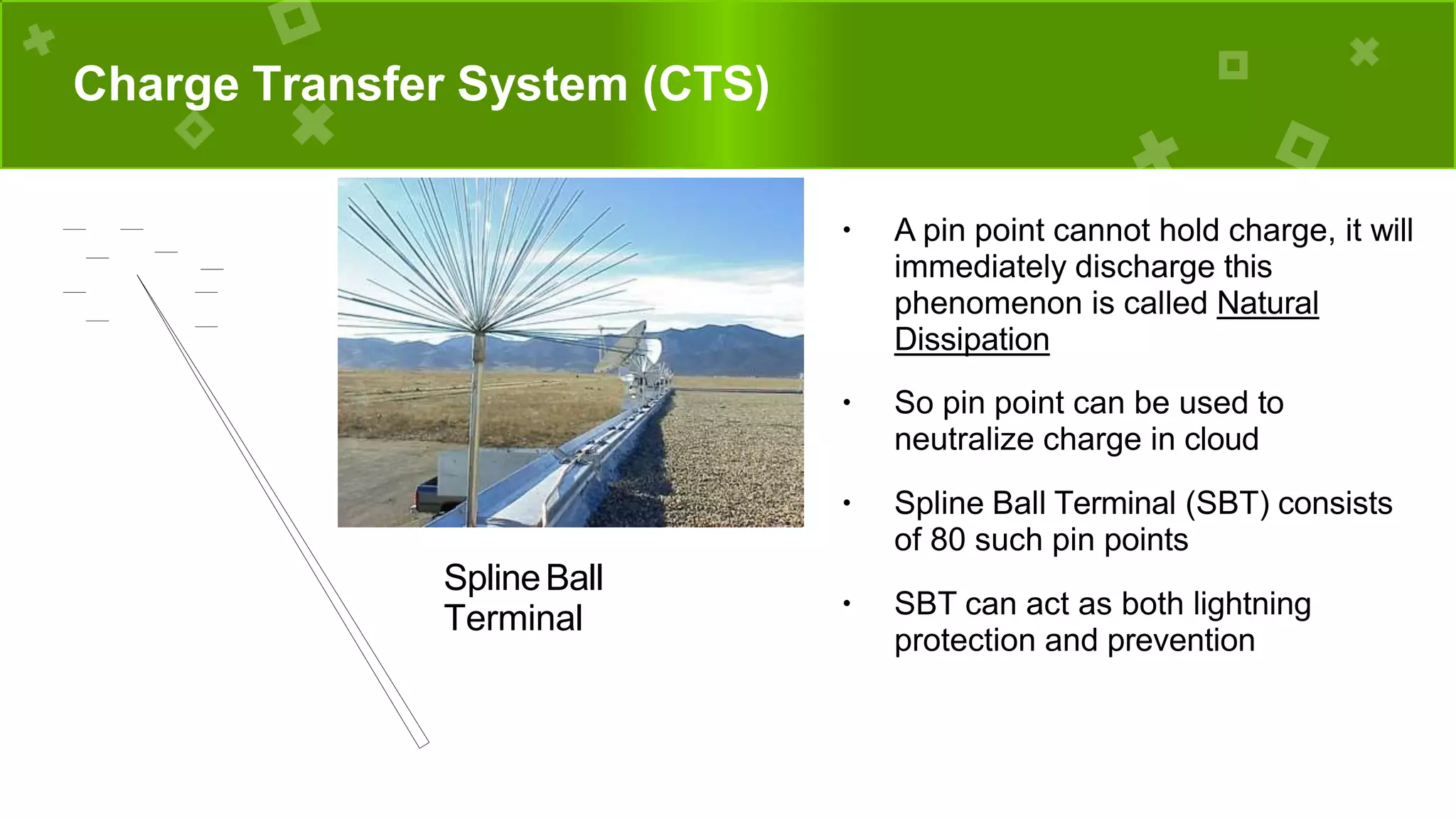
A pin point cannot hold charge, it will
immediately discharge this
phenomenon is called Natural
Dissipation
●
So pin point can be used to
neutralize charge in cloud
●
Spline Ball Terminal (SBT) consists
of 80 such pin points
●
SBT can act as both lightning
protection and prevention
SplineBall
Terminal
Dissipation Array System (DAS)
●
The conventional designs transfer the current to the ground they do
nothing to prevent lightning
●
But since large current is flowing close, the electronic circuits could
still damage
● Large magnetic field could erase data
● DAS is a advancement of CTS
A ‘storm protector’
By NicolaTesla
US Patent 1,266,175
Dissipation Array System (DAS)
Thanks!
Any questions?

Lightning protection.ppt

  • 1.
    Aligarh College ofEngineering and Technology , Aligarh Approved by AICTE New Delhi, Affiliated to AKTU Lucknow Lightning Protection P r e s e n t e d b y R o h i t K u m a r B . T E C H ( E N ) 4 t h Ye a r
  • 2.
    What is lightning? Whentiny ice particles in cloud collide with each other they build up positive electrical charge. When potential difference between ground and cloud is more than breakdown voltage of air: lightning strikes.
  • 3.
    Lightning facts ×Lightning heatsup the surrounding air to 20,000oC ×Can hit with 500kV of voltage and more than 10,000A of current. ×240,000 people are struck by lightning each year and 24,000 are killed.
  • 4.
    Lightning Protection A Lightning ProtectionSystem (LPS) is designed to protect a structure or building and contents from damage caused by the intensely high voltage currents of a lightning strike
  • 5.
    Types of LightningProtection System LPS Conventional Non-conventional Franklin rod Faraday cage CTS DAS
  • 6.
    Faraday cage ● Faradaycage is based on Electric Shield principle ● The charge will pass through the conductive cage thereby not harming the devices in the cage. ● Faraday cages can be used to protect sensitive electronics from lightning. Faraday cageused to protect sensitiveequipmentsin power plant.
  • 7.
    Franklin rods ● Lightningrods provide a low-resistance path to ground that can be used to conduct the enormous electrical currents when lightning strikes occur. ● The lightning-rod system is an excellent conductor and thus allows the current to flow to ground without causing any heat damage. ● For structures less than 75 ft height class-I material needed to be used, normally houses and small office building use these. ● For structures more than 75 ft such as stack, transmission towers, cellphone towers and antennas class-II material must be used.
  • 8.
    Elements of lightningprotection system Air terminal Conductors Ground termination Surge Protection
  • 9.
  • 10.
    Lightning protection conductors are designedto handle the short duration high electrical current flows of a lightning strike. Conductors
  • 11.
    Choosing the conductor SolidRound ● ● ● Easy to install-can be bent at any place Straightning tool may be required Less obvious to see than wider 25x3 mm tape Smooth Weave ● ● ● ● Does not have memory-directly used from roll Once bent stays in shape Doesn’t have exapansion and contraction problem Difficult to make 100% straight Concentric ● ● ● Has memory-needs to be uncoiled When bent, it untwines or frays Not widely used in LP application.
  • 12.
    Heavy duty Application ●Smoke or stack vent is considered as heavy duty if cross-sectional area of the flue is greater than 500cm2 and height more than 75 ft ● The sulfur content of the flue could corrode copper conductors therefore lead covered or stainless steel air terminals should be used in upper 25 ft. ● If ladder of pipes coming down from towers the down conductors should be bonded with them to all the way down.
  • 13.
    Ground terminal ● Ground isthe termination point for all lightning protection system ● It helps to dissipate energy ● It has three components--- – – – Bus bar Ground rod Ground rod clamps
  • 14.
    Ground terminal ● Normally groundrods are vertical or horizontal depending on the type of installation. ● Ground rods go 15-20ft underground.
  • 15.
    Surge Protective Devices(SPD) Surge protective device (SPD) is the IEC term given to a device intended to limit transient voltages and divert surge current. PURPOSE ● Eliminating potential differences to service conductors and thereby reducing the risk of flash over and possible resulting fire (IEC 62305-3) ● Providing protection to structure electrical/electronic equipment against impulses from direct or indirect flashes to the services (IEC 62305-4) ● Correctly located and installed protection (coordinated protection) will also reduce the risk of equipment damage from impulses generated by switching or faults within the electrical circuits ● They are a key part of the Lightning Electromagnetic Impulse LEMP protection measures system which be abbreviated as LMPS.
  • 16.
    Surge Protective Devices(SPD) SPDs are based on these technologies: ● Spark gaps ● Arc Gaps ● Gas Discharge Tubes (GDTs) ● Metal Oxide Varistors (MOVs) WORKING PRINCIPLE ● SPDs contain at least one non-linear component, which under specific conditions transitions between a high and low impedance state. ● At normal operating voltages the SPDs are in a high impedance state and do not affect the system. When a transient voltage occurs on the circuit, the SPD moves into a state of conduction (a low impedance) and diverts the transient energy/current back to its source or ground. ● This limits (clamps) the voltage amplitude to a safer level. After the transient is diverted, the SPD will automatically reset back to its high impedance state.
  • 17.
    Charge Transfer System(CTS) ● A pin point cannot hold charge, it will immediately discharge this phenomenon is called Natural Dissipation ● So pin point can be used to neutralize charge in cloud ● Spline Ball Terminal (SBT) consists of 80 such pin points ● SBT can act as both lightning protection and prevention SplineBall Terminal
  • 18.
    Dissipation Array System(DAS) ● The conventional designs transfer the current to the ground they do nothing to prevent lightning ● But since large current is flowing close, the electronic circuits could still damage ● Large magnetic field could erase data ● DAS is a advancement of CTS A ‘storm protector’ By NicolaTesla US Patent 1,266,175
  • 19.
  • 20.