DataScience@SMU
Yelp’s Review
Filtering Algorithm
Yao Yao1, Ivelin Angelov1, Jack Rasmus-Vorrath1,
Mooyoung Lee1, Daniel W Engels1
1Southern Methodist University, Dallas, TX, US
{yaoyao, iangelov, jrasmusvorrath,
mooyoungl, dwe}@smu.edu
1
https://www.yelp.com
DataScience@SMU
Motivation
• Algorithms can inherently have
unethical procedures when filtering out
reviews
• Yelp filters reviews to:
• Promote quality and reliable information
• Help consumers gain insight and make
decisions
2
https://www.yelp-support.com/Recommended_Reviews
DataScience@SMU
Problem
• Yelp's filtering algorithm can
misclassify:
• Credible reviews as not recommended
• Deceptive reviews as recommended
3
DataScience@SMU
Yelp’s Background
• Online third-party crowd-sourced
platform for:
• Users seeking and submitting advice
• Businesses seeking feedback
• Reviews are ratings with written text
• Recommended Reviews:
• Calculate Average Rating
• Influence consumer decisions
• Impact business revenue[1]
4
DataScience@SMU 5
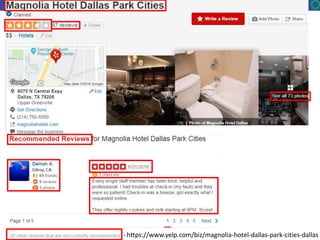
https://www.yelp.com/biz/magnolia-hotel-dallas-park-cities-dallas
DataScience@SMU
Yelp's Metrics (March 2018)
6
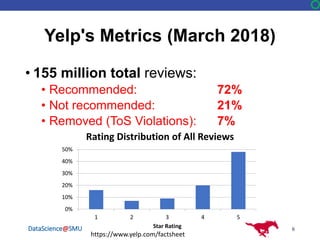
• 155 million total reviews:
• Recommended: 72%
• Not recommended: 21%
• Removed (ToS Violations): 7%
0%
10%
20%
30%
40%
50%
1 2 3 4 5
Star Rating
Rating Distribution of All Reviews
https://www.yelp.com/factsheet
DataScience@SMU
Yelp's Metrics (March 2018)
• Top reviewed businesses category:
• Shopping: 21%
• Restaurants: 17%
• Home and local services: 14%
• Top demographics of US reviewers:
• 35-54 year olds: 37%
• Finished college: 59%
• $100k+ income: 49.6%
7
https://www.yelp.com/factsheet
DataScience@SMU
Understanding Yelp
• Not recommended reviews:
• Still accessible
• Does not censor free speech[2]
• Can be recommended when algorithm
changes
• Reviews are removed by:
• Violating Terms of Service
• Defamation court rulings[3]
8
https://www.yelp-support.com/Recommended_Reviews
DataScience@SMU
Yelp’s Filtering Algorithm
• Not recommends reviews that are:
• Purchased[4]
• Bribed[5]
• Social/Political protest[6]
• Not credible
• Unrelated
• Non-understandable
• Filtering algorithm undisclosed:
• Prevent manipulating the system
9
https://www.yelp-support.com/Recommended_Reviews
DataScience@SMU
Yelp Dataset Collection
• The official Yelp dataset:
• Does not include not recommended reviews
• May inherit cleaning biases
• External audit through sampling:
• Better observational study
• Scrape using Python script
10
https://www.yelp.com/dataset/challenge
DataScience@SMU
Two-Stage Sampling Procedure
• Proportional subgroup method:
• Preserves consistency of larger dataset[7]
• 1) Cluster: Sample cities that adopt Yelp
• 2) Stratify: Sample restaurants from those cities
• Consistent participation per demographic per city
size
11
City
Restaurant
https://www.yelp.com/locations
DataScience@SMU
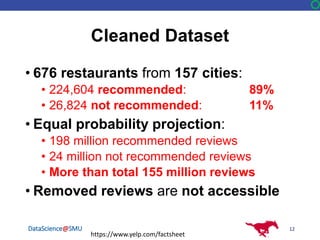
Cleaned Dataset
• 676 restaurants from 157 cities:
• 224,604 recommended: 89%
• 26,824 not recommended: 11%
• Equal probability projection:
• 198 million recommended reviews
• 24 million not recommended reviews
• More than total 155 million reviews
• Removed reviews are not accessible
12
https://www.yelp.com/factsheet
DataScience@SMU
Recommended vs Not
Recommended Prediction
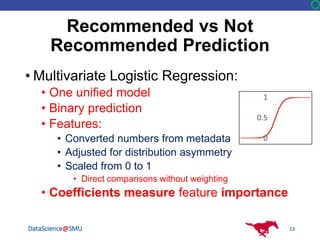
• Multivariate Logistic Regression:
• One unified model
• Binary prediction
• Features:
• Converted numbers from metadata
• Adjusted for distribution asymmetry
• Scaled from 0 to 1
• Direct comparisons without weighting
• Coefficients measure feature importance
13
DataScience@SMU
Binary Prediction Metrics
• Accurate predictions:
• True positives and true negatives
• Misclassifications:
• False positives and false negatives
• Significance by:
• p-value threshold of 0.05
• Hypothesis test statistic
• Determine probable evidence towards an observation
14
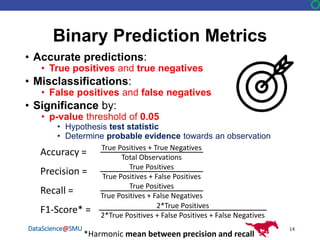
*Harmonic mean between precision and recall
2*True Positives
2*True Positives + False Positives + False Negatives
Accuracy =
Precision =
Recall =
F1-Score* =
True Positives + True Negatives
Total Observations
True Positives
True Positives + False Positives
True Positives
True Positives + False Negatives
DataScience@SMU
Restaurant Metadata
Category Data Type Description Example
Name String Restaurant name Garaje
Address String Full address 475 3rd St
San Francisco, CA 94107
City String City hub San Francisco
Average Rating Float Rounded to half-stars 4.5
Number of Reviews
Restaurant*
Integer Number of reviews 1354
Number of
Restaurants*
Integer Number of restaurants in
city hub
4829
Restaurant Link String Yelp website https://www.yelp.com/biz/gar
aje-san-francisco
Restaurant Listing
Order
Integer Yelp listing order 2
Restaurant ID Integer Bind with Reviews.csv 0
15
*Adjusted for distribution asymmetry
DataScience@SMU
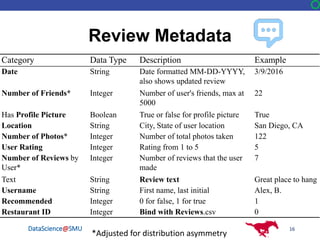
Review Metadata
16
*Adjusted for distribution asymmetry
Category Data Type Description Example
Date String Date formatted MM-DD-YYYY,
also shows updated review
3/9/2016
Number of Friends* Integer Number of user's friends, max at
5000
22
Has Profile Picture Boolean True or false for profile picture True
Location String City, State of user location San Diego, CA
Number of Photos* Integer Number of total photos taken 122
User Rating Integer Rating from 1 to 5 5
Number of Reviews by
User*
Integer Number of reviews that the user
made
7
Text String Review text Great place to hang
Username String First name, last initial Alex, B.
Recommended Integer 0 for false, 1 for true 1
Restaurant ID Integer Bind with Reviews.csv 0
DataScience@SMU
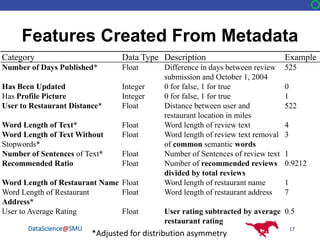
Features Created From Metadata
Category Data Type Description Example
Number of Days Published* Float Difference in days between review
submission and October 1, 2004
525
Has Been Updated Integer 0 for false, 1 for true 0
Has Profile Picture Integer 0 for false, 1 for true 1
User to Restaurant Distance* Float Distance between user and
restaurant location in miles
522
Word Length of Text* Float Word length of review text 4
Word Length of Text Without
Stopwords*
Float Word length of review text removal
of common semantic words
3
Number of Sentences of Text* Float Number of Sentences of review text 1
Recommended Ratio Float Number of recommended reviews
divided by total reviews
0.9212
Word Length of Restaurant Name Float Word length of restaurant name 1
Word Length of Restaurant
Address*
Float Word length of restaurant address 7
User to Average Rating Float User rating subtracted by average
restaurant rating
0.5
17
*Adjusted for distribution asymmetry
DataScience@SMU
Processed Text Feature Creation
• Google dictionary API[8]:
• % of words spelled correctly
• Readability indexes[9][10]:
• Statistically solve for text difficulty
18
Score* Grade Level
1 Kindergarten
2 First Grade
3 Second Grade
4 Third Grade
5 Fourth Grade
6
…
Fifth Grade
…
Automated Readability Index* = 4.71 + 0.5
Flesch–Kincaid Grade Level Formula = 0.39 + 11.8
Characters
Words
Words
Sentences
Words
Sentences
Syllables
Words
DataScience@SMU
Naïve Bayes Text Classifier
• Bag of words model:
• Does not check for grammar or word order
• Trains words with larger difference in
occurrence to classify as label
Trained Text Positive Label Word Vectors This Place Is Good The Bad
This place is good. 1 1 1 1 1 0 0
This place is bad. 0 1 1 1 0 0 1
p(label=1) 0.5 p(Word|1) 0.5 1 1 1 0 0
p(label=0) 0.5 p(Word|0) 0.5 1 1 0 0 1
19
DataScience@SMU
Naïve Bayes Equation
(True Negative)
P(Positive)
P(Negative)
P(Trained Words)
(True Positive)
P(Trained
Words)
(False
Positive)
(FN)
p(Positive|Trained Words) =
p(Trained Words|Positive)p(Positive)
P(Trained Words)
20
DataScience@SMU
Deceptive Opinion Spam
Corpus[11]
• Truthful reviews:
• Similar to Yelp:
• Opinionated contributions
• Community guidelines
• Deceptive reviews:
• Earn money:
• Alters incentives
• Submit for monetary gains[48]
21
Text Classifier Precision Recall F1-Score
Deceptive Score 0.88 0.88 0.88
Label Quality Data Origin
Truthful 800 TripAdvisor, Expedia, Hotels.com, Orbitz, Priceline
Deceptive 800 Amazon Mechanical Turk
DataScience@SMU
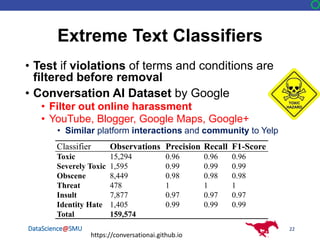
Extreme Text Classifiers
22
Classifier Observations Precision Recall F1-Score
Toxic 15,294 0.96 0.96 0.96
Severely Toxic 1,595 0.99 0.99 0.99
Obscene 8,449 0.98 0.98 0.98
Threat 478 1 1 1
Insult 7,877 0.97 0.97 0.97
Identity Hate 1,405 0.99 0.99 0.99
Total 159,574
• Test if violations of terms and conditions are
filtered before removal
• Conversation AI Dataset by Google
• Filter out online harassment
• YouTube, Blogger, Google Maps, Google+
• Similar platform interactions and community to Yelp
https://conversationai.github.io
DataScience@SMU
Sentiment: Natural Language
Processing
• Considers word order and grammar[12]
• Classify individual words
• Split by punctuation
• Identify parts of speech, proper nouns
• Link pronouns to nouns
• Find the tone of a sentence
23
Total Sentiment = (Very Negative) + 2*(Negative) + 3*(Neutral) +
4*(Positive) + 5*(Very Positive)
Average Sentiment = Total Sentiment / Total Sentences
DataScience@SMU
Recurrent Neural Tensor
Network[12]
• Recursive tree structure
• Fragments and uses grammar rules
• Find tonality of nested phrases
• Stems from individual words
24
DataScience@SMU
Features Created From
Processed Text
Category Data Type Description Example
Text Readability AR Score* Float The Automated Readability score is based
on age and grade level
6
Text Spelling Score* Float Percentage of review spelled correctly 1
Text Deceptive Score Float Probability that review is deceptive 0.2
Text Toxic Score* Float Probability that review is toxic 0.11
… …
Text Very Positive* Float Percent of sentences that are very positive 0
… Float …
Text Total Sentiment* Float Sentiment score weighted by 1 to 5 from
their respective categories
17
Text Average Sentiment Float Total sentiment divided by sentences (1-5) 2.833
Text Sentiment To User
Rating
Float Average user sentiment subtracted by
user rating
-2.167
Text Sentiment To Average
Rating
Float Average user sentiment subtracted by
average restaurant rating
-1.667
25
*Adjusted for distribution asymmetry
DataScience@SMU
Multivariate Logistic
Regression
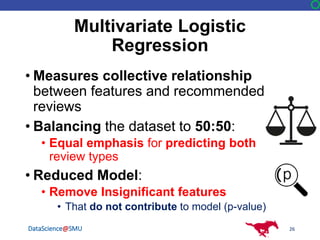
• Measures collective relationship
between features and recommended
reviews
• Balancing the dataset to 50:50:
• Equal emphasis for predicting both
review types
• Reduced Model:
• Remove Insignificant features
• That do not contribute to model (p-value)
26
p
DataScience@SMU 27
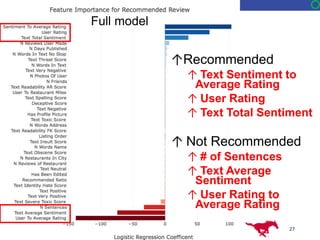
↑Recommended
↑ Text Sentiment to
Average Rating
↑ User Rating
↑ Text Total Sentiment
↑ Not Recommended
↑ # of Sentences
↑ Text Average
Sentiment
↑ User Rating to
Average Rating
Full model
DataScience@SMU 28
Reduced model
• Rate:
• Critically
• Write:
• Concise message
• Overall positive
message:
• Express variations
in sentiment
Model Precision Recall F1-Score
Full 0.80 0.74 0.77
Reduced 0.79 0.74 0.77
DataScience@SMU
Additional Guidelines For
Recommended Review
• Submit for:
• Businesses with
less reviews
• Write with:
• Mild complexity
• Less common
words
• Accumulate data:
• Friends
• Total reviews
• Total photos
• Recent reviews
• Update reviews:
• Less
29
DataScience@SMU
Insignificant Features
• Equal probability in sampling verified by[7]:
• # of words in restaurant name
• # of words in restaurant address
• Yelp listing order
• Yelp does not filter for extreme comments:
• For removing comments that violate terms of use:
• Identity hate score
• Insult score
• Threat score
• Obscene score
• Severe toxic score
• Toxic score
30
DataScience@SMU
Ethics
• When soliciting, information can be:
• Useful, important, misguided, or wrong
• Pooling information towards general
consensus:
• Makes Yelp less likely to be wrong[13]
• Justified reflection of the collective
experience
• Dependent on the end user:
• To take advice from Yelp
• To make better informed decisions
31
DataScience@SMU
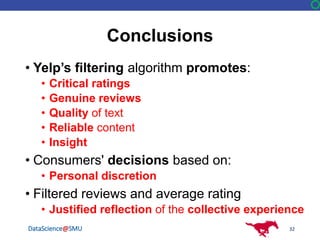
Conclusions
• Yelp’s filtering algorithm promotes:
• Critical ratings
• Genuine reviews
• Quality of text
• Reliable content
• Insight
• Consumers' decisions based on:
• Personal discretion
• Filtered reviews and average rating
• Justified reflection of the collective experience
32
DataScience@SMU 33
Citations
1. Luca, M. (2016). Reviews, Reputation, and Revenue: The Case of Yelp.com. [online] Hbs.edu. Available at:
https://www.hbs.edu/faculty/Pages/item.aspx?num=41233 [Accessed 19 May 2018].
2. O'Brien, S. (2015). Yelp: You can trust our reviews. [online] CNN Money. Available at:
http://money.cnn.com/2015/01/07/technology/ftc-yelp-reviews [Accessed 19 May 2018].
3. Zetter, K. (2010). Yelp Accused of Extortion. [online] Wired. Available at: https://www.wired.com/2010/02/yelp-sued-for-
alleged-extortion/ [Accessed 19 May 2018].
4. Streitfeld, D. (2012). Yelp Tries to Halt Deceptive Reviews. [online] NYTimes. Available at:
https://www.nytimes.com/2012/10/18/technology/yelp-tries-to-halt-deceptive-reviews.html [Accessed 19 May 2018].
5. Cotter, S. (2017). Quincy Center Jeweler Wins Suit Over Yelp Review. [online] Patriot Ledger. Available at:
http://www.patriotledger.com/news/20170405/quincy-center-jeweler-wins-suit-over-yelp-review [Accessed 19 May
2018].
6. McKeever, A. (2015). Why Yelp Emerged as a Site for Social Protest. [online] Eater. Available at:
https://www.eater.com/2015/5/19/8588185/yelp-social-protest-trolling-memories-pizza [Accessed 19 May 2018].
7. Blair, E. and Blair, J. (2015). Applied Survey Sampling. Los Angeles: Sage Publications, Inc.
8. Yee, J. (2018). Google's Dictionary API (Unofficial) in Python. [online] Available at:
http://www.lleess.com/2013/03/googles-unofficial-dictionary-api-in.html [Accessed 7 Jul. 2018].
9. Readability Formulas. (2018). The Automated Readability Index (ARI). [online] Available at:
http://www.readabilityformulas.com/automated-readability-index.php [Accessed 7 Jul. 2018].
10. Readability Formulas. (2018). The Flesch Grade Level Readability Formula. [online] Available at:
http://www.readabilityformulas.com/flesch-grade-level-readability-formula.php [Accessed 7 Jul. 2018].
11. Ott, M., Choi, Y., Cardie, C. and Hancock, J. (2011). Finding Deceptive Opinion Spam by Any Stretch of the
Imagination. In: Proceedings of the 49th Annual Meeting of the Association for Computational Linguistics. [online]
Association for Computational Linguistics. Available at: http://myleott.com/op_spamACL2011.pdf [Accessed 3 Mar.
2018].
12. Socher, R., Perelygin, A., Wu, J., Chuang, J., Manning, C., Ng, A. and Potts, C. (2013). Recursive Deep Models for
Semantic Compositionality Over a Sentiment Treebank. [online] Available at:
https://nlp.stanford.edu/~socherr/EMNLP2013_RNTN.pdf [Accessed 7 Jul. 2018].
13. CBS This Morning. (2016). Yelp CEO on site’s popularity and pitfalls. [online] Available at:
https://www.youtube.com/watch?v=1mlzdXwbtZo [Accessed 7 Jul. 2018].

Yelp's Review Filtering Algorithm Powerpoint

  • 1.
    DataScience@SMU Yelp’s Review Filtering Algorithm YaoYao1, Ivelin Angelov1, Jack Rasmus-Vorrath1, Mooyoung Lee1, Daniel W Engels1 1Southern Methodist University, Dallas, TX, US {yaoyao, iangelov, jrasmusvorrath, mooyoungl, dwe}@smu.edu 1 https://www.yelp.com
  • 2.
    DataScience@SMU Motivation • Algorithms caninherently have unethical procedures when filtering out reviews • Yelp filters reviews to: • Promote quality and reliable information • Help consumers gain insight and make decisions 2 https://www.yelp-support.com/Recommended_Reviews
  • 3.
    DataScience@SMU Problem • Yelp's filteringalgorithm can misclassify: • Credible reviews as not recommended • Deceptive reviews as recommended 3
  • 4.
    DataScience@SMU Yelp’s Background • Onlinethird-party crowd-sourced platform for: • Users seeking and submitting advice • Businesses seeking feedback • Reviews are ratings with written text • Recommended Reviews: • Calculate Average Rating • Influence consumer decisions • Impact business revenue[1] 4
  • 5.
  • 6.
    DataScience@SMU Yelp's Metrics (March2018) 6 • 155 million total reviews: • Recommended: 72% • Not recommended: 21% • Removed (ToS Violations): 7% 0% 10% 20% 30% 40% 50% 1 2 3 4 5 Star Rating Rating Distribution of All Reviews https://www.yelp.com/factsheet
  • 7.
    DataScience@SMU Yelp's Metrics (March2018) • Top reviewed businesses category: • Shopping: 21% • Restaurants: 17% • Home and local services: 14% • Top demographics of US reviewers: • 35-54 year olds: 37% • Finished college: 59% • $100k+ income: 49.6% 7 https://www.yelp.com/factsheet
  • 8.
    DataScience@SMU Understanding Yelp • Notrecommended reviews: • Still accessible • Does not censor free speech[2] • Can be recommended when algorithm changes • Reviews are removed by: • Violating Terms of Service • Defamation court rulings[3] 8 https://www.yelp-support.com/Recommended_Reviews
  • 9.
    DataScience@SMU Yelp’s Filtering Algorithm •Not recommends reviews that are: • Purchased[4] • Bribed[5] • Social/Political protest[6] • Not credible • Unrelated • Non-understandable • Filtering algorithm undisclosed: • Prevent manipulating the system 9 https://www.yelp-support.com/Recommended_Reviews
  • 10.
    DataScience@SMU Yelp Dataset Collection •The official Yelp dataset: • Does not include not recommended reviews • May inherit cleaning biases • External audit through sampling: • Better observational study • Scrape using Python script 10 https://www.yelp.com/dataset/challenge
  • 11.
    DataScience@SMU Two-Stage Sampling Procedure •Proportional subgroup method: • Preserves consistency of larger dataset[7] • 1) Cluster: Sample cities that adopt Yelp • 2) Stratify: Sample restaurants from those cities • Consistent participation per demographic per city size 11 City Restaurant https://www.yelp.com/locations
  • 12.
    DataScience@SMU Cleaned Dataset • 676restaurants from 157 cities: • 224,604 recommended: 89% • 26,824 not recommended: 11% • Equal probability projection: • 198 million recommended reviews • 24 million not recommended reviews • More than total 155 million reviews • Removed reviews are not accessible 12 https://www.yelp.com/factsheet
  • 13.
    DataScience@SMU Recommended vs Not RecommendedPrediction • Multivariate Logistic Regression: • One unified model • Binary prediction • Features: • Converted numbers from metadata • Adjusted for distribution asymmetry • Scaled from 0 to 1 • Direct comparisons without weighting • Coefficients measure feature importance 13
  • 14.
    DataScience@SMU Binary Prediction Metrics •Accurate predictions: • True positives and true negatives • Misclassifications: • False positives and false negatives • Significance by: • p-value threshold of 0.05 • Hypothesis test statistic • Determine probable evidence towards an observation 14 *Harmonic mean between precision and recall 2*True Positives 2*True Positives + False Positives + False Negatives Accuracy = Precision = Recall = F1-Score* = True Positives + True Negatives Total Observations True Positives True Positives + False Positives True Positives True Positives + False Negatives
  • 15.
    DataScience@SMU Restaurant Metadata Category DataType Description Example Name String Restaurant name Garaje Address String Full address 475 3rd St San Francisco, CA 94107 City String City hub San Francisco Average Rating Float Rounded to half-stars 4.5 Number of Reviews Restaurant* Integer Number of reviews 1354 Number of Restaurants* Integer Number of restaurants in city hub 4829 Restaurant Link String Yelp website https://www.yelp.com/biz/gar aje-san-francisco Restaurant Listing Order Integer Yelp listing order 2 Restaurant ID Integer Bind with Reviews.csv 0 15 *Adjusted for distribution asymmetry
  • 16.
    DataScience@SMU Review Metadata 16 *Adjusted fordistribution asymmetry Category Data Type Description Example Date String Date formatted MM-DD-YYYY, also shows updated review 3/9/2016 Number of Friends* Integer Number of user's friends, max at 5000 22 Has Profile Picture Boolean True or false for profile picture True Location String City, State of user location San Diego, CA Number of Photos* Integer Number of total photos taken 122 User Rating Integer Rating from 1 to 5 5 Number of Reviews by User* Integer Number of reviews that the user made 7 Text String Review text Great place to hang Username String First name, last initial Alex, B. Recommended Integer 0 for false, 1 for true 1 Restaurant ID Integer Bind with Reviews.csv 0
  • 17.
    DataScience@SMU Features Created FromMetadata Category Data Type Description Example Number of Days Published* Float Difference in days between review submission and October 1, 2004 525 Has Been Updated Integer 0 for false, 1 for true 0 Has Profile Picture Integer 0 for false, 1 for true 1 User to Restaurant Distance* Float Distance between user and restaurant location in miles 522 Word Length of Text* Float Word length of review text 4 Word Length of Text Without Stopwords* Float Word length of review text removal of common semantic words 3 Number of Sentences of Text* Float Number of Sentences of review text 1 Recommended Ratio Float Number of recommended reviews divided by total reviews 0.9212 Word Length of Restaurant Name Float Word length of restaurant name 1 Word Length of Restaurant Address* Float Word length of restaurant address 7 User to Average Rating Float User rating subtracted by average restaurant rating 0.5 17 *Adjusted for distribution asymmetry
  • 18.
    DataScience@SMU Processed Text FeatureCreation • Google dictionary API[8]: • % of words spelled correctly • Readability indexes[9][10]: • Statistically solve for text difficulty 18 Score* Grade Level 1 Kindergarten 2 First Grade 3 Second Grade 4 Third Grade 5 Fourth Grade 6 … Fifth Grade … Automated Readability Index* = 4.71 + 0.5 Flesch–Kincaid Grade Level Formula = 0.39 + 11.8 Characters Words Words Sentences Words Sentences Syllables Words
  • 19.
    DataScience@SMU Naïve Bayes TextClassifier • Bag of words model: • Does not check for grammar or word order • Trains words with larger difference in occurrence to classify as label Trained Text Positive Label Word Vectors This Place Is Good The Bad This place is good. 1 1 1 1 1 0 0 This place is bad. 0 1 1 1 0 0 1 p(label=1) 0.5 p(Word|1) 0.5 1 1 1 0 0 p(label=0) 0.5 p(Word|0) 0.5 1 1 0 0 1 19
  • 20.
    DataScience@SMU Naïve Bayes Equation (TrueNegative) P(Positive) P(Negative) P(Trained Words) (True Positive) P(Trained Words) (False Positive) (FN) p(Positive|Trained Words) = p(Trained Words|Positive)p(Positive) P(Trained Words) 20
  • 21.
    DataScience@SMU Deceptive Opinion Spam Corpus[11] •Truthful reviews: • Similar to Yelp: • Opinionated contributions • Community guidelines • Deceptive reviews: • Earn money: • Alters incentives • Submit for monetary gains[48] 21 Text Classifier Precision Recall F1-Score Deceptive Score 0.88 0.88 0.88 Label Quality Data Origin Truthful 800 TripAdvisor, Expedia, Hotels.com, Orbitz, Priceline Deceptive 800 Amazon Mechanical Turk
  • 22.
    DataScience@SMU Extreme Text Classifiers 22 ClassifierObservations Precision Recall F1-Score Toxic 15,294 0.96 0.96 0.96 Severely Toxic 1,595 0.99 0.99 0.99 Obscene 8,449 0.98 0.98 0.98 Threat 478 1 1 1 Insult 7,877 0.97 0.97 0.97 Identity Hate 1,405 0.99 0.99 0.99 Total 159,574 • Test if violations of terms and conditions are filtered before removal • Conversation AI Dataset by Google • Filter out online harassment • YouTube, Blogger, Google Maps, Google+ • Similar platform interactions and community to Yelp https://conversationai.github.io
  • 23.
    DataScience@SMU Sentiment: Natural Language Processing •Considers word order and grammar[12] • Classify individual words • Split by punctuation • Identify parts of speech, proper nouns • Link pronouns to nouns • Find the tone of a sentence 23 Total Sentiment = (Very Negative) + 2*(Negative) + 3*(Neutral) + 4*(Positive) + 5*(Very Positive) Average Sentiment = Total Sentiment / Total Sentences
  • 24.
    DataScience@SMU Recurrent Neural Tensor Network[12] •Recursive tree structure • Fragments and uses grammar rules • Find tonality of nested phrases • Stems from individual words 24
  • 25.
    DataScience@SMU Features Created From ProcessedText Category Data Type Description Example Text Readability AR Score* Float The Automated Readability score is based on age and grade level 6 Text Spelling Score* Float Percentage of review spelled correctly 1 Text Deceptive Score Float Probability that review is deceptive 0.2 Text Toxic Score* Float Probability that review is toxic 0.11 … … Text Very Positive* Float Percent of sentences that are very positive 0 … Float … Text Total Sentiment* Float Sentiment score weighted by 1 to 5 from their respective categories 17 Text Average Sentiment Float Total sentiment divided by sentences (1-5) 2.833 Text Sentiment To User Rating Float Average user sentiment subtracted by user rating -2.167 Text Sentiment To Average Rating Float Average user sentiment subtracted by average restaurant rating -1.667 25 *Adjusted for distribution asymmetry
  • 26.
    DataScience@SMU Multivariate Logistic Regression • Measurescollective relationship between features and recommended reviews • Balancing the dataset to 50:50: • Equal emphasis for predicting both review types • Reduced Model: • Remove Insignificant features • That do not contribute to model (p-value) 26 p
  • 27.
    DataScience@SMU 27 ↑Recommended ↑ TextSentiment to Average Rating ↑ User Rating ↑ Text Total Sentiment ↑ Not Recommended ↑ # of Sentences ↑ Text Average Sentiment ↑ User Rating to Average Rating Full model
  • 28.
    DataScience@SMU 28 Reduced model •Rate: • Critically • Write: • Concise message • Overall positive message: • Express variations in sentiment Model Precision Recall F1-Score Full 0.80 0.74 0.77 Reduced 0.79 0.74 0.77
  • 29.
    DataScience@SMU Additional Guidelines For RecommendedReview • Submit for: • Businesses with less reviews • Write with: • Mild complexity • Less common words • Accumulate data: • Friends • Total reviews • Total photos • Recent reviews • Update reviews: • Less 29
  • 30.
    DataScience@SMU Insignificant Features • Equalprobability in sampling verified by[7]: • # of words in restaurant name • # of words in restaurant address • Yelp listing order • Yelp does not filter for extreme comments: • For removing comments that violate terms of use: • Identity hate score • Insult score • Threat score • Obscene score • Severe toxic score • Toxic score 30
  • 31.
    DataScience@SMU Ethics • When soliciting,information can be: • Useful, important, misguided, or wrong • Pooling information towards general consensus: • Makes Yelp less likely to be wrong[13] • Justified reflection of the collective experience • Dependent on the end user: • To take advice from Yelp • To make better informed decisions 31
  • 32.
    DataScience@SMU Conclusions • Yelp’s filteringalgorithm promotes: • Critical ratings • Genuine reviews • Quality of text • Reliable content • Insight • Consumers' decisions based on: • Personal discretion • Filtered reviews and average rating • Justified reflection of the collective experience 32
  • 33.
    DataScience@SMU 33 Citations 1. Luca,M. (2016). Reviews, Reputation, and Revenue: The Case of Yelp.com. [online] Hbs.edu. Available at: https://www.hbs.edu/faculty/Pages/item.aspx?num=41233 [Accessed 19 May 2018]. 2. O'Brien, S. (2015). Yelp: You can trust our reviews. [online] CNN Money. Available at: http://money.cnn.com/2015/01/07/technology/ftc-yelp-reviews [Accessed 19 May 2018]. 3. Zetter, K. (2010). Yelp Accused of Extortion. [online] Wired. Available at: https://www.wired.com/2010/02/yelp-sued-for- alleged-extortion/ [Accessed 19 May 2018]. 4. Streitfeld, D. (2012). Yelp Tries to Halt Deceptive Reviews. [online] NYTimes. Available at: https://www.nytimes.com/2012/10/18/technology/yelp-tries-to-halt-deceptive-reviews.html [Accessed 19 May 2018]. 5. Cotter, S. (2017). Quincy Center Jeweler Wins Suit Over Yelp Review. [online] Patriot Ledger. Available at: http://www.patriotledger.com/news/20170405/quincy-center-jeweler-wins-suit-over-yelp-review [Accessed 19 May 2018]. 6. McKeever, A. (2015). Why Yelp Emerged as a Site for Social Protest. [online] Eater. Available at: https://www.eater.com/2015/5/19/8588185/yelp-social-protest-trolling-memories-pizza [Accessed 19 May 2018]. 7. Blair, E. and Blair, J. (2015). Applied Survey Sampling. Los Angeles: Sage Publications, Inc. 8. Yee, J. (2018). Google's Dictionary API (Unofficial) in Python. [online] Available at: http://www.lleess.com/2013/03/googles-unofficial-dictionary-api-in.html [Accessed 7 Jul. 2018]. 9. Readability Formulas. (2018). The Automated Readability Index (ARI). [online] Available at: http://www.readabilityformulas.com/automated-readability-index.php [Accessed 7 Jul. 2018]. 10. Readability Formulas. (2018). The Flesch Grade Level Readability Formula. [online] Available at: http://www.readabilityformulas.com/flesch-grade-level-readability-formula.php [Accessed 7 Jul. 2018]. 11. Ott, M., Choi, Y., Cardie, C. and Hancock, J. (2011). Finding Deceptive Opinion Spam by Any Stretch of the Imagination. In: Proceedings of the 49th Annual Meeting of the Association for Computational Linguistics. [online] Association for Computational Linguistics. Available at: http://myleott.com/op_spamACL2011.pdf [Accessed 3 Mar. 2018]. 12. Socher, R., Perelygin, A., Wu, J., Chuang, J., Manning, C., Ng, A. and Potts, C. (2013). Recursive Deep Models for Semantic Compositionality Over a Sentiment Treebank. [online] Available at: https://nlp.stanford.edu/~socherr/EMNLP2013_RNTN.pdf [Accessed 7 Jul. 2018]. 13. CBS This Morning. (2016). Yelp CEO on site’s popularity and pitfalls. [online] Available at: https://www.youtube.com/watch?v=1mlzdXwbtZo [Accessed 7 Jul. 2018].