Chapter 4
Nursing Care Facilities
Learning Objectives
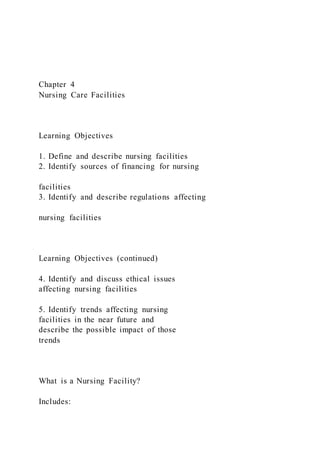
1. Define and describe nursing facilities
2. Identify sources of financing for nursing
facilities
3. Identify and describe regulations affecting
nursing facilities
Learning Objectives (continued)
4. Identify and discuss ethical issues
affecting nursing facilities
5. Identify trends affecting nursing
facilities in the near future and
describe the possible impact of those
trends
What is a Nursing Facility?
Includes:
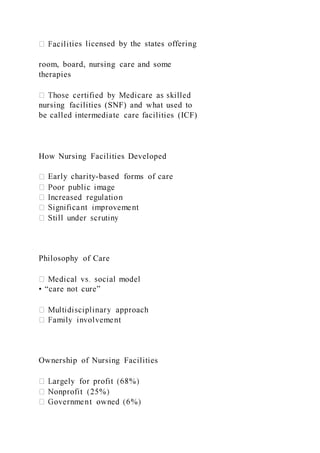
ies licensed by the states offering
room, board, nursing care and some
therapies
nursing facilities (SNF) and what used to
be called intermediate care facilities (ICF)
How Nursing Facilities Developed
Early charity-based forms of care
Philosophy of Care
• “care not cure”
Ownership of Nursing Facilities
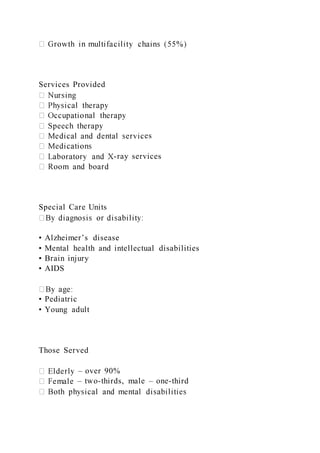
Services Provided
es
-ray services
Special Care Units
• Alzheimer’s disease
• Mental health and intellectual disabilities
• Brain injury
• AIDS
• Pediatric
• Young adult
Those Served
– over 90%
– two-thirds, male – one-third
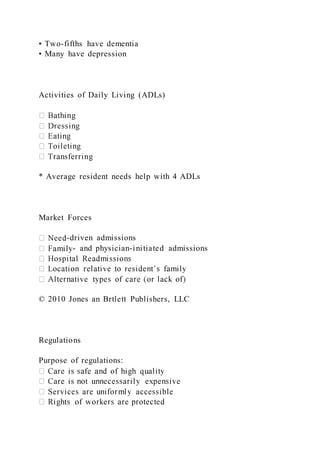
• Two-fifths have dementia
• Many have depression
Activities of Daily Living (ADLs)
* Average resident needs help with 4 ADLs
Market Forces
-driven admissions
- and physician-initiated admissions
© 2010 Jones an Brtlett Publishers, LLC
Regulations
Purpose of regulations:
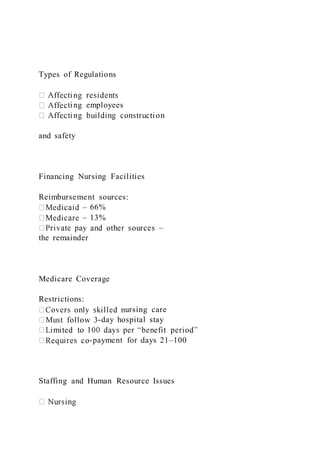
Types of Regulations
ting employees
and safety
Financing Nursing Facilities
Reimbursement sources:
– 66%
– 13%
–
the remainder
Medicare Coverage
Restrictions:
ursing care
-day hospital stay
-payment for days 21–100
Staffing and Human Resource Issues
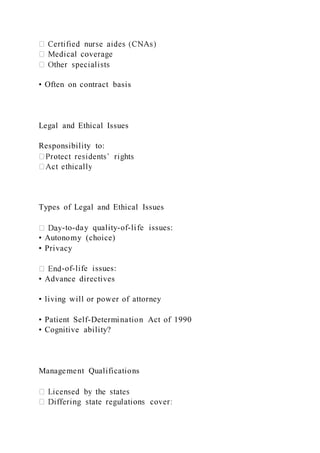
• Often on contract basis
Legal and Ethical Issues
Responsibility to:
Types of Legal and Ethical Issues
-to-day quality-of-life issues:
• Autonomy (choice)
• Privacy
-of-life issues:
• Advance directives
• living will or power of attorney
• Patient Self-Determination Act of 1990
• Cognitive ability?
Management Qualifications
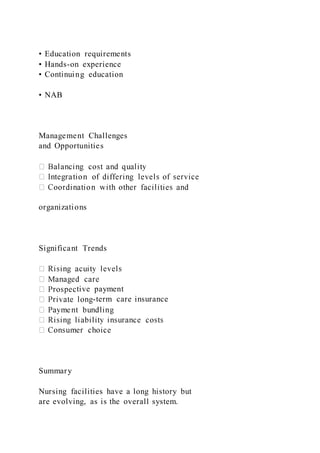
• Education requirements
• Hands-on experience
• Continuing education
• NAB
Management Challenges
and Opportunities
organizations
Significant Trends
tive payment
-term care insurance
Summary
Nursing facilities have a long history but
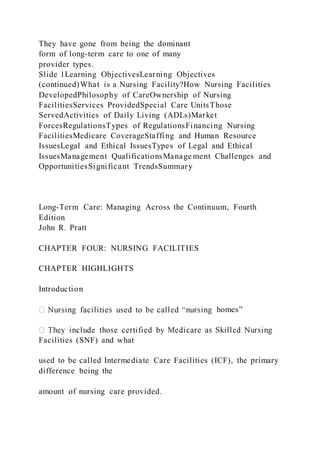
are evolving, as is the overall system.
They have gone from being the dominant
form of long-term care to one of many
provider types.
Slide 1Learning ObjectivesLearning Objectives
(continued)What is a Nursing Facility?How Nursing Facilities
DevelopedPhilosophy of CareOwnership of Nursing
FacilitiesServices ProvidedSpecial Care UnitsThose
ServedActivities of Daily Living (ADLs)Market
ForcesRegulationsTypes of RegulationsFinancing Nursing
FacilitiesMedicare CoverageStaffing and Human Resource
IssuesLegal and Ethical IssuesTypes of Legal and Ethical
IssuesManagement QualificationsManage ment Challenges and
OpportunitiesSignificant TrendsSummary
Long-Term Care: Managing Across the Continuum, Fourth
Edition
John R. Pratt
CHAPTER FOUR: NURSING FACILITIES
CHAPTER HIGHLIGHTS
Introduction
homes”
Facilities (SNF) and what
used to be called Intermediate Care Facilities (ICF), the primary
difference being the
amount of nursing care provided.
How nursing facilities developed
-based forms of care
for people without family to
care for them or other sources of help.
became involved with assisting
the needy with passage of the Social Security Act in 1935 and
the Medicare and
Medicaid amendments in 1965.
Philosophy of care
- Nursing facilities find themselves
sitting solidly astride the
line between acute care and long-term care.
- They utilize a combination of
medical, social, residential,
and other allied professionals to provide needed services,
blending those disciplinary
specialties to develop and implement care plans for individual
consumers.
Chapter 4 1
Long-Term Care: Managing Across the Continuum, Fourth
Edition
John R. Pratt
- Another distinguishing characteristic of
long-term care in general,
and nursing facilities in particular, is the degree to which
family members are involved in
the care of the primary consumer.
Ownership of Nursing Facilities
-profit than nonprofit
-facility chains
Occupancy
for nursing facilities has declined from a
high of 89.0 percent in 2007
to 86.0 percent to 2013.
-based
services.
Services Provided
-ray services as needed.
Special Care Units - many facilities created special care units to
meet the needs of a wider
variety of residents. They may be:
r Disability
Chapter 4 2
Long-Term Care: Managing Across the Continuum, Fourth
Edition
John R. Pratt
Consumers Served
number of medical or
physical conditions
-quarters women
Market Forces Impacting Nursing Facilities
-Driven Vs. Choice-Driven Admissions – most residents
do not choose to be
admitted, but must be due to their conditions.
– admission is usually
not at the request of the
resident but by family or a family physician.
Chapter 4 3
Long-Term Care: Managing Across the Continuum, Fourth
Edition
John R. Pratt
- under the Affordable Care Act's
Hospital Readmissions
Reduction Program, hospitals that readmit "excessive" numbers
of Medicare patients
within 30 days of discharge now face significant penalties.
– facilities are
often chosen so the resident
can be close to family members.
e Types of Care (or Lack of) – some are admitted to
nursing facilities because
of a lack of other alternatives (e.g., community-based care).
Regulations
There are three primary categories of regulations:
– Regulations concerning care and
quality of care
– regulations protecting employees
from unfair treatment
– regulations
assuring proper construction
and maintenance of facilities.
Financing Nursing Facilities
-thirds)
-of-pocket
Staffing/Human Resource Issues
Chapter 4 4
Long-Term Care: Managing Across the Continuum, Fourth
Edition
John R. Pratt
- nursing facilities utilize a staffing
mix that combines both
highly trained and relatively untrained staff.
-clinical care
specify the numbers of
staff on duty on each work shift and the mix of personnel
categories making up that
staff.
cialists
- the population group available to
provide care is getting
smaller due to aging
– the amount allowed by Medicaid (the
primary payment source)
is not adequate
mpetition from other sectors – staff can make more
working elsewhere, even in
fast-food restaurants
Legal/Ethical Issues
-To-Day Quality of Life Issues
Chapter 4 5
Long-Term Care: Managing Across the Continuum, Fourth
Edition
John R. Pratt
Management of Nursing Facilities
lifications:
– never enough resources
– many are part of
a multi-level facility
providing several types of care, possibly including assisted
living, home health care
and/or subacute care in addition to skilled and nursing care.
– it is no
longer possible/feasible to
stand alone.
Significant Trends and Their Impact on Nursing Facilities
– as acute care hospitals try to save
money, higher acuity patients
are sent to nursing facilities.
– has become a primary form of
reimbursement and comes with strings
attached.
Chapter 4 6
Long-Term Care: Managing Across the Continuum, Fourth
Edition
John R. Pratt
– not a large enough source of
reimbursement
- the ACA created a system of payment
bundling where a single
entity would receive a sum of money to cover the costs of an
episode of care spanning
two or more providers
– threaten the survival of
providers
- the single, most important trend today is
the demand by consumers
for more choice in their care
Chapter 4 7
CHAPTER FOUR: NURSING FACILITIESCHAPTER
HIGHLIGHTS.cIntroductionNursing facilities used to be called
“nursing homes”How nursing facilities developed.c2.Philosophy
of care.c3.Medical vs. Social Model - Nursing facilities find
themselves sitting solidly astride the line between acute care
and long-term care..c2.A Multidisciplinary Approach - They
utilize a combination of medical, social, residential, and other
allied professionals to provide needed services, blending those
disciplinary specialties to develop and implement care plans for
individual consumers..c3.Family Involvement - Another
distinguishing characteristic of long-term care in general, and
nursing facilities in particular, is the degree to which family
members are involved in the care of the primary
consumer.Ownership of Nursing FacilitiesThe occupancy rate
for nursing facilities has declined from a high of 89.0 percent in
2007 to 86.0 percent to 2013.This may be due to competition
from community-based services.Services Provided.c2.Special
Care Units - many facilities created special care units to meet
the needs of a wider variety of residents. They may
be:.c2.Consumers ServedBy age:Mostly elderly.c3.By care
Needs:AAAdmitted because of functional disabilities, resulting
from a number of medical or physical conditions.c3.;By gender
Mix:.c2.Market Forces Impacting Nursing Facilities.c3.Need-
Driven Vs. Choice-Driven Admissions – most residents do not
choose to be admitted, but must be due to their
conditions..c3.Family/Physician Initiated Admissions –
admission is usually not at the request of the resident but by
family or a family physician..c3. Hospital Readmissions - under
the Affordable Care Act's Hospital Readmissions Reduction
Program, hospitals that readmit "excessive" numbers of
Medicare patients within 30 days of discharge now face
significant penalties.Location Relative to the Resident’s Family
– facilities are often chosen so the resident can be close to
family members..c3.Alternative Types of Care (or Lack of) –
some are admitted to nursing facilities because of a lack of
other alternatives (e.g., community-based
care)..c2.Regulations.c3.There are three primary categories of
regulations:Affecting Residents – Regulations concerning care
and quality of care.c3. Affecting Employees – regulations
protecting employees from unfair treatment.c3. Affecting
Building Construction and Safety – regulations assuring proper
construction and maintenance of facilities..c2.Financing
Nursing Facilities.c2.Staffing/Human Resource Issues.c3.Nature
of the Work Force - nursing facilities utilize a staffing mix that
combines both highly trained and relatively untrained
staff..c4.Nursing.c4.Certified Nurse Aides.c4.Medical
Coverage.c4.Other Specialists.c3.Recruitment/Turnover
IssuesLegal/.c2.Ethical Issues.c3.Day-To-Day Quality of Life
Issues.c3.End of Life Issues.c2.Management of Nursing
Facilities.c3.Management Qualifications:.c3.Management
Challenges & Opportunities:.c4.Balancing Cost and Quality –
never enough resources.c4.Integration of Differing Levels of
Service – many are part of a multi-level facility providing
several types of care, possibly including assisted living, home
health care and/or subacute care in addition to skilled and
nursing care..c4.Coordination with Other Facilities,
Organizations – it is no longer possible/feasible to stand
alone..c2.Significant Trends and Their Impact on Nursing
Facilities.c3.Rising Acuity Levels – as acute care hospitals try
to save money, higher acuity patients are sent to nursing
facilities..c3.Managed Care – has become a primary form of
reimbursement and comes with strings attached..c3.Other
Reimbursement Trends:.c4.Prospective Payment.c4.Private LTC
Insurance – not a large enough source of reimbursementPayment
Bundling - the ACA created a system of payment bundling
where a single entity would receive a sum of money to cover the
costs of an episode of care spanning two or more
providersRising Liability Insurance Costs – threaten the
survival of providers.c3.Consumer Choice - the single, most
important trend today is the demand by consumers for more
choice in their care

Chapter 4Nursing Care Facilities Learning Objectives

  • 1.
    Chapter 4 Nursing CareFacilities Learning Objectives 1. Define and describe nursing facilities 2. Identify sources of financing for nursing facilities 3. Identify and describe regulations affecting nursing facilities Learning Objectives (continued) 4. Identify and discuss ethical issues affecting nursing facilities 5. Identify trends affecting nursing facilities in the near future and describe the possible impact of those trends What is a Nursing Facility? Includes:
  • 2.
    ies licensed bythe states offering room, board, nursing care and some therapies nursing facilities (SNF) and what used to be called intermediate care facilities (ICF) How Nursing Facilities Developed Early charity-based forms of care Philosophy of Care • “care not cure” Ownership of Nursing Facilities
  • 3.
    Services Provided es -ray services SpecialCare Units • Alzheimer’s disease • Mental health and intellectual disabilities • Brain injury • AIDS • Pediatric • Young adult Those Served – over 90% – two-thirds, male – one-third
  • 4.
    • Two-fifths havedementia • Many have depression Activities of Daily Living (ADLs) * Average resident needs help with 4 ADLs Market Forces -driven admissions - and physician-initiated admissions © 2010 Jones an Brtlett Publishers, LLC Regulations Purpose of regulations:
  • 5.
    Types of Regulations tingemployees and safety Financing Nursing Facilities Reimbursement sources: – 66% – 13% – the remainder Medicare Coverage Restrictions: ursing care -day hospital stay -payment for days 21–100 Staffing and Human Resource Issues
  • 6.
    • Often oncontract basis Legal and Ethical Issues Responsibility to: Types of Legal and Ethical Issues -to-day quality-of-life issues: • Autonomy (choice) • Privacy -of-life issues: • Advance directives • living will or power of attorney • Patient Self-Determination Act of 1990 • Cognitive ability? Management Qualifications
  • 7.
    • Education requirements •Hands-on experience • Continuing education • NAB Management Challenges and Opportunities organizations Significant Trends tive payment -term care insurance Summary Nursing facilities have a long history but are evolving, as is the overall system.
  • 8.
    They have gonefrom being the dominant form of long-term care to one of many provider types. Slide 1Learning ObjectivesLearning Objectives (continued)What is a Nursing Facility?How Nursing Facilities DevelopedPhilosophy of CareOwnership of Nursing FacilitiesServices ProvidedSpecial Care UnitsThose ServedActivities of Daily Living (ADLs)Market ForcesRegulationsTypes of RegulationsFinancing Nursing FacilitiesMedicare CoverageStaffing and Human Resource IssuesLegal and Ethical IssuesTypes of Legal and Ethical IssuesManagement QualificationsManage ment Challenges and OpportunitiesSignificant TrendsSummary Long-Term Care: Managing Across the Continuum, Fourth Edition John R. Pratt CHAPTER FOUR: NURSING FACILITIES CHAPTER HIGHLIGHTS Introduction homes” Facilities (SNF) and what used to be called Intermediate Care Facilities (ICF), the primary difference being the amount of nursing care provided.
  • 9.
    How nursing facilitiesdeveloped -based forms of care for people without family to care for them or other sources of help. became involved with assisting the needy with passage of the Social Security Act in 1935 and the Medicare and Medicaid amendments in 1965. Philosophy of care - Nursing facilities find themselves sitting solidly astride the line between acute care and long-term care. - They utilize a combination of medical, social, residential, and other allied professionals to provide needed services, blending those disciplinary specialties to develop and implement care plans for individual consumers. Chapter 4 1
  • 10.
    Long-Term Care: ManagingAcross the Continuum, Fourth Edition John R. Pratt - Another distinguishing characteristic of long-term care in general, and nursing facilities in particular, is the degree to which family members are involved in the care of the primary consumer. Ownership of Nursing Facilities -profit than nonprofit -facility chains Occupancy for nursing facilities has declined from a high of 89.0 percent in 2007 to 86.0 percent to 2013. -based services. Services Provided
  • 11.
    -ray services asneeded. Special Care Units - many facilities created special care units to meet the needs of a wider variety of residents. They may be: r Disability Chapter 4 2 Long-Term Care: Managing Across the Continuum, Fourth Edition John R. Pratt
  • 12.
    Consumers Served number ofmedical or physical conditions -quarters women Market Forces Impacting Nursing Facilities -Driven Vs. Choice-Driven Admissions – most residents do not choose to be admitted, but must be due to their conditions. – admission is usually not at the request of the resident but by family or a family physician. Chapter 4 3
  • 13.
    Long-Term Care: ManagingAcross the Continuum, Fourth Edition John R. Pratt - under the Affordable Care Act's Hospital Readmissions Reduction Program, hospitals that readmit "excessive" numbers of Medicare patients within 30 days of discharge now face significant penalties. – facilities are often chosen so the resident can be close to family members. e Types of Care (or Lack of) – some are admitted to nursing facilities because of a lack of other alternatives (e.g., community-based care). Regulations There are three primary categories of regulations: – Regulations concerning care and quality of care – regulations protecting employees from unfair treatment – regulations assuring proper construction
  • 14.
    and maintenance offacilities. Financing Nursing Facilities -thirds) -of-pocket Staffing/Human Resource Issues Chapter 4 4 Long-Term Care: Managing Across the Continuum, Fourth Edition John R. Pratt - nursing facilities utilize a staffing mix that combines both highly trained and relatively untrained staff. -clinical care specify the numbers of staff on duty on each work shift and the mix of personnel categories making up that
  • 15.
    staff. cialists - the populationgroup available to provide care is getting smaller due to aging – the amount allowed by Medicaid (the primary payment source) is not adequate mpetition from other sectors – staff can make more working elsewhere, even in fast-food restaurants Legal/Ethical Issues -To-Day Quality of Life Issues
  • 16.
    Chapter 4 5 Long-TermCare: Managing Across the Continuum, Fourth Edition John R. Pratt Management of Nursing Facilities lifications: – never enough resources – many are part of a multi-level facility providing several types of care, possibly including assisted living, home health care and/or subacute care in addition to skilled and nursing care. – it is no longer possible/feasible to
  • 17.
    stand alone. Significant Trendsand Their Impact on Nursing Facilities – as acute care hospitals try to save money, higher acuity patients are sent to nursing facilities. – has become a primary form of reimbursement and comes with strings attached. Chapter 4 6 Long-Term Care: Managing Across the Continuum, Fourth Edition John R. Pratt – not a large enough source of reimbursement - the ACA created a system of payment bundling where a single entity would receive a sum of money to cover the costs of an episode of care spanning
  • 18.
    two or moreproviders – threaten the survival of providers - the single, most important trend today is the demand by consumers for more choice in their care Chapter 4 7 CHAPTER FOUR: NURSING FACILITIESCHAPTER HIGHLIGHTS.cIntroductionNursing facilities used to be called “nursing homes”How nursing facilities developed.c2.Philosophy of care.c3.Medical vs. Social Model - Nursing facilities find themselves sitting solidly astride the line between acute care and long-term care..c2.A Multidisciplinary Approach - They utilize a combination of medical, social, residential, and other allied professionals to provide needed services, blending those disciplinary specialties to develop and implement care plans for individual consumers..c3.Family Involvement - Another distinguishing characteristic of long-term care in general, and nursing facilities in particular, is the degree to which family members are involved in the care of the primary consumer.Ownership of Nursing FacilitiesThe occupancy rate for nursing facilities has declined from a high of 89.0 percent in 2007 to 86.0 percent to 2013.This may be due to competition from community-based services.Services Provided.c2.Special Care Units - many facilities created special care units to meet the needs of a wider variety of residents. They may be:.c2.Consumers ServedBy age:Mostly elderly.c3.By care Needs:AAAdmitted because of functional disabilities, resulting from a number of medical or physical conditions.c3.;By gender Mix:.c2.Market Forces Impacting Nursing Facilities.c3.Need- Driven Vs. Choice-Driven Admissions – most residents do not choose to be admitted, but must be due to their
  • 19.
    conditions..c3.Family/Physician Initiated Admissions– admission is usually not at the request of the resident but by family or a family physician..c3. Hospital Readmissions - under the Affordable Care Act's Hospital Readmissions Reduction Program, hospitals that readmit "excessive" numbers of Medicare patients within 30 days of discharge now face significant penalties.Location Relative to the Resident’s Family – facilities are often chosen so the resident can be close to family members..c3.Alternative Types of Care (or Lack of) – some are admitted to nursing facilities because of a lack of other alternatives (e.g., community-based care)..c2.Regulations.c3.There are three primary categories of regulations:Affecting Residents – Regulations concerning care and quality of care.c3. Affecting Employees – regulations protecting employees from unfair treatment.c3. Affecting Building Construction and Safety – regulations assuring proper construction and maintenance of facilities..c2.Financing Nursing Facilities.c2.Staffing/Human Resource Issues.c3.Nature of the Work Force - nursing facilities utilize a staffing mix that combines both highly trained and relatively untrained staff..c4.Nursing.c4.Certified Nurse Aides.c4.Medical Coverage.c4.Other Specialists.c3.Recruitment/Turnover IssuesLegal/.c2.Ethical Issues.c3.Day-To-Day Quality of Life Issues.c3.End of Life Issues.c2.Management of Nursing Facilities.c3.Management Qualifications:.c3.Management Challenges & Opportunities:.c4.Balancing Cost and Quality – never enough resources.c4.Integration of Differing Levels of Service – many are part of a multi-level facility providing several types of care, possibly including assisted living, home health care and/or subacute care in addition to skilled and nursing care..c4.Coordination with Other Facilities, Organizations – it is no longer possible/feasible to stand alone..c2.Significant Trends and Their Impact on Nursing Facilities.c3.Rising Acuity Levels – as acute care hospitals try to save money, higher acuity patients are sent to nursing facilities..c3.Managed Care – has become a primary form of
  • 20.
    reimbursement and comeswith strings attached..c3.Other Reimbursement Trends:.c4.Prospective Payment.c4.Private LTC Insurance – not a large enough source of reimbursementPayment Bundling - the ACA created a system of payment bundling where a single entity would receive a sum of money to cover the costs of an episode of care spanning two or more providersRising Liability Insurance Costs – threaten the survival of providers.c3.Consumer Choice - the single, most important trend today is the demand by consumers for more choice in their care