








WOCNext 2022
June 5-8, 2022
Abstract Submission Process
Why do I have to view this?
• The information contained in this tutorial, when applied correctly, will
increase the chance that your abstract will be accepted.
• Not following the directions makes your abstract subject to automatic
rejection. This is very avoidable!
• We are pleased to offer ANCC Contact Hours for poster sessions but that
means for your poster to be considered for credit it must be compliant with
regulatory criteria.
• Industry sponsored posters are still allowed, but no ANCC Contact Hours
will be provided for viewing the poster
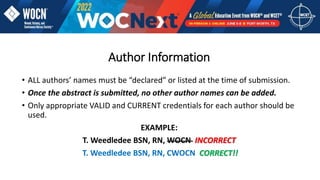
Author Information
Author Information
• ALL authors’ names must be “declared” or listed at the time of submission.
• Once the abstract is submitted, no other author names can be added.
• Only appropriate VALID and CURRENT credentials for each author should be
used.
EXAMPLE:
T. Weedledee BSN, RN, WOCN INCORRECT
T. Weedledee BSN, RN, CWOCN CORRECT!!
Author Information: Disclosures
• Every named author must complete the required financial disclosure form
• In order for the abstract to be considered ready for review, each author
must have their disclosure submitted by the abstract submission deadline,
11:00 AM EST/8:00 AM PST, WEDNESDAY, DECEMBER 1, 2021
• It is the PRIMARY author’s responsibility to inform the other authors of the
requirement to complete the disclosure. Ultimately the primary author is
responsible to ensure the other authors complete the disclosure process.
Author Information:
NO ADDITIONAL AUTHORS ALLOWED AFTER SUBMISSION
All contributing authors should be listed now.
There will NOT be any opportunity to add authors later….
THIS IS THE ONLY
OPPORTUNITY
How ANCC Contact Hours are
Determined and
Disclosure/Mitigation of Bias
How do we decide to award ANCC Contact Hours for
the posters?
• All accepted abstract submissions will be reviewed by the designated Nurse
Planner.
• The decision to award ANCC Contact Hours is based on the financial
relationships related to the content of the poster disclosed by authors and
contributors.
• A poster is not eligible for ANCC Contact Hours if there is an unmitigable
relevant relationship.
ANCC Standards for Integrity and
Independence in Accredited Education
• The WOCN Society is accredited as a provider of continuing nursing education by
the American Nurses Credentialing Center’s Commission on Accreditation.
• As such, we must ensure that the content of all accredited education adheres to
the criteria, standards, and policies dictated by the ANCC (and affiliated
accrediting entities).
• To do so, we must receive information from you to help us determine if you have
an unresolvable relationship.
• This is outlined by the ANCC in the Standards for Integrity and
Independence in Accredited Education. See:
https://accme.org/accreditation-rules/standards-for-integrity-independence-
accredited-ce
• Ineligible companies are those whose primary business is producing, marketing, selling, re-selling,
or distributing healthcare products used by or on patients. Examples of such organizations
include:
• Advertising, marketing, or communication firms whose clients are ineligible companies
• Bio-medical startups that have begun a governmental regulatory approval process
• Compounding pharmacies that manufacture proprietary compounds
• Device manufacturers or distributors
• Diagnostic labs that sell proprietary products
• Growers, distributors, manufacturers or sellers of medical foods and dietary supplements
• Manufacturers of health-related wearable products
• Pharmaceutical companies or distributors
• Pharmacy benefit managers
• Reagent manufacturers or sellers
• Note: The owners and employees of ineligible companies are considered to have unresolvable
financial relationships and must be excluded from participating as planners or faculty, and must
not be allowed to influence or control any aspect of the planning, delivery, or evaluation of
accredited continuing education, except in the limited circumstances outlined in Standard 3.2.
Definitions
• Many healthcare professionals have financial relationships with ineligible
companies.
• These relationships must not be allowed to influence accredited continuing
education.
• The accredited provider is responsible for identifying relevant financial
relationships between individuals in control of educational content and
ineligible companies and managing these to ensure they do not introduce
commercial bias into the education.
• Financial relationships of any dollar amount are defined as relevant if the
educational content is related to the business lines or products of the
ineligible company.
Guidelines
Who must disclose?
• All planners, faculty, and others in control of educational content
about all their financial relationships with ineligible companies within the
prior 24 months. There is no minimum financial threshold; individuals
must disclose all financial relationships, regardless of the amount, with
ineligible companies. Individuals must disclose regardless of their view of
the relevance of the relationship to the education. Disclosure information
must include:
a. The name of the ineligible company with which the person has a financial
relationship.
b. The nature of the financial relationship. Examples of financial relationships include
employee, researcher, consultant, advisor, speaker, independent contractor (including
contracted research), royalties or patent beneficiary, executive role, and ownership
interest. Individual stocks and stock options should be disclosed; diversified mutual
funds do not need to be disclosed. Research funding from ineligible companies should
be disclosed by the principal or named investigator even if that individual’s institution
receives the research grant and manages the funds.
What does WOCN do with the information?
• Information disclosed to the WOCN® Society is reviewed to determine if
there is the potential for bias.
• The ANCC accredited provider unit will work with the discloser to
mitigate for bias, most typically through peer review.
• The information is also used to disclose relevant relationships to the
audience.
• ANCC Contact Hour – Dos & Don’ts
We are unable to offer ANCC Contact Hours for ePosters that are not aligned
with the following Dos & Don’ts…
Further Protecting Against Bias
• Educational materials that are part of accredited education (such
as slides, abstracts, handouts, evaluation mechanisms, or
disclosure information) must not contain:
• Any marketing produced by or for an ineligible company (aka industry, see
examples here), including corporate or product logos, trade names, or
product group messages.
• Unscientific approaches to diagnosis or therapy, or recommendations,
treatment, or manners of practicing healthcare that are determined to have
risks or dangers that outweigh the benefits or are known to be ineffective in
the treatment of patients.
• Any active promotion or offers to sell products or services that serve the
presenter’s professional or financial interests during accredited education.
• Links to any ineligible company or product website
• Images or pictures that include products with trade or company names visible
ANCC Contact Hour – Don’ts
• Authors WHO SUBMITTED DISCLOSURE STATEMENTS AT THE TIME OF ABSTRACT
SUBMISSION
• At least three current references
• All recommendations for patient care in accredited continuing education must be based
on current science, evidence, and clinical reasoning, while giving a fair and balanced view
of diagnostic and therapeutic options.
• All scientific research referred to, reported, or used in accredited education in support or
justification of a patient care recommendation must conform to the generally accepted
standards of experimental design, data collection, analysis, and interpretation.
• If applicable, evolving topics are presented without advocating for, or promoting,
practices that are not, or not yet, adequately based on current science, evidence, and
clinical reasoning.
• Only the relevant relationships with ineligible companies are included in the disclosures.
ANCC Contact Hour – Dos
Copyrights/Patents & Attribution
• Please provide appropriate symbols and references and secure all permissions if
dealing with copyrighted material and/or patents.
• This is solely the author(s) responsibility to secure these permissions.
• The WOCN® Society has no responsibility whatsoever in securing these permissions.
• Please give credit to all references used in the development of the abstract/poster.
Oversight of reference may result in abstract/poster rejection.
• Statements should not be viewed as or considered representative of any
formal stance or position taken on any subject, issue, or product by the
WOCN® Society.
Poster Categories
Research Posters
• In this poster category, author(s) will present original research focusing on
wound, ostomy, continence, foot care or professional practice topics. Each
poster must be presented with the following heading:
1. Topic
2. Purpose/Aims/Research Question
3. Study Design/Method
4. Results
5. Conclusions
• Quality Improvement projects should be submitted in the practice
innovation
Practice Innovation Posters
• In this poster category, author(s) will present innovative practice
changes that demonstrate a new way to approach a problem that
pertains to wound, ostomy, continence, foot care or professional
practice. The practice innovation must be presented with the
following headings:
1. Topic/Significance to Practice
2. Purpose of the Innovation/Objectives
3. Process/Replication
4. Outcomes
• Quality improvement projects should be submitted in this category.
Case Study Posters
• In this poster category, author(s) will present THREE cases that
present a clinical challenge managed with a unique solution that
pertains to wound, ostomy, continence, or foot care. The case study
must be presented with the following headings:
1. Statement of the Clinical Problem/Challenge
2. Significance to Practice including Past Management
3. Solution/Clinical Treatment Approach
4. Outcomes and Conclusion
Poster Themes
Themes
• Each poster topic must fit into one of the following four themes
• Wellness
• Symptom Science
• Quality
• Clinical Care Innovations
Wellness
• Behaviors, actions and interventions to promote health & well
being.
• Examples include:
• Preventative practices or prevention program (pressure ulcer/injury, MASD)
• Bowel and bladder management, continence clinic
• Foot and nail care
• Quality of life aspects
Symptom Science
• Understanding pathophysiology and manifestations of acute and
chronic illness
• Examples include:
• Evidence-based treatment and management of WOC-related problems
• Ostomy-related complications
• Complications of incontinence
• Dermatological issues
Quality
• Measures of patient-centered, safe, effective, timely, efficient and
equitable care.
• Examples include:
• Clinical outcomes, standards of care, evaluation, program development
• Use of software, database programs
• Educational resources
Clinical Care Innovations
• Advancing practice through the integration of education and
research
• Examples include:
• Management of complex wounds, ostomies
• Product selection and innovation
• Professional issues (role justification, marketing strategies, satisfaction
measurement, survival in changing health care environment, WOC nurse as
educator, quality improvement issues specific to WOC role)
Required Elements
Required References
• Each abstracts must include 3-5 references
• References must be cited in APA format.
If you are unsure as to how to cite in APA format, please consult an internet
source such as:
• Apastyle.apa.org
• Owl.purdue.edu
• libguides.snhu.edu/apa
• https://www.mendeley.com/guides/apa-citation-guide
Required Abstract Text Elements
• Case Study Four (4) sections required:
Must include a minimum of three (3) cases
1. Statement of the Clinical
Problem/Challenge
2. Significance to Practice including Past
Management
3. Solution/Clinical Treatment Approach
4. Outcomes and Conclusion
• Practice Innovation Four (4) sections required
1. Topic/Significance to Practice
2. Purpose of the Innovation/Objectives
3. Process/Replication
4. Outcomes
• Research Five (5) sections required
1. Topic
2. Purpose/Aims/Research Question
3. Study Design/Method
4. Results
5. Conclusions
Poster Formats
E-Posters
• All posters will be submitted as E-posters
• All authors will have the choice to display their poster in a traditional
paper format in the poster exhibit hall
• At time of acceptance, the author must declare intent to present their
work in the traditional paper format
Tips
Tips for Writing an Abstract
Please review carefully
• Remember, the reviewers don’t know your work. Explain clearly and succinctly so its importance
and merit is understood.
• Reviewers use results or outcomes to evaluate abstracts. If your topic is more informational and
descriptive, consider submission as a journal/newsletter article or blog post.
• Abstracts should reflect COMPLETED work, not anticipated work. Missing or incomplete results
would be cause for the abstract to be rejected All work should be completed prior to abstract
submission.
• The Case Study category requires at least 3 cases, but could include more. It would be considered
RARE, to submit a one case scenario unless it is especially unique. An example would be a
condition so very rare or a solution so groundbreaking that it hasn’t been discussed before.
Tips for Writing Abstracts
• Facility/Company/Personal Names do not belong in the abstract, and
would be justification for rejection of the abstract.
• No Protected Health Information (PHI) is to appear in the abstract.
• Suggested descriptions of healthcare facilities:
“Small rural hospital in the Midwest”
“Level 1 trauma center in the Northeast USA”
“Academic hospital located in the Southwestern United States”
Tips for Writing Abstracts
• Use appropriate terms—standardization is best
• “WOC nurse” instead of “the CWOCN” or “the WOCN”
• WOCN® Society—reflects our legal name and should not be used to refer to
the nurse (see slide 3 for correct use of credentials)
• Abstracts are evaluated based on the criteria listed under “The
Review Process” section of the submission site. These criteria differ
according to the abstract category. Addressing ALL of the criteria
increases the score and the likelihood of abstract acceptance.
Tips for Writing Abstracts
• Product information should be discussed in generic terms.
• NO TRADE NAMES ALLOWED
Examples:
Moldable ostomy barrier
Silver impregnated foam dressing
Multi-layer compression system
Low Frequency Ultrasound
Negative Pressure Wound Therapy
Medications: “Ibuprofen” (appropriate) vs. “Advil”
Tips for Writing Abstracts
• Before submitting the abstract, ask someone to independently review it for
grammar, spelling, and clarity of content.
• Be concise—the abstract is an eagle’s eye overview of the work. It is the
“commercial” to make the reader understand the problem or question and it is
important. It should generate interest to learn more.
• The abstract word limit is 300 words, single spaced. This does not include title,
authors, or references.
• Do NOT wait until the last minute….anything could happen….
Computer crashes, bad weather, illness, and LIFE…..so, begin early!!
General Information
• If you are submitting an abstract, anticipate that it will be accepted, and
make arrangements for conference registration early.
• The primary author will be expected to register for the conference upon
notification of acceptance of the abstract. There is generally only 30 days
after notification to register, so be prepared to do so!!
• Registration means that the full conference fee is paid. This serves as
confirmation of your attendance to present your poster!
General Information
• E-Posters will be available for a specific period of time both before and
after the conference. Traditional posters will be displayed throughout
the conference.
• Primary authors are expected to be present at their poster during the
poster session for traditional posters.
• If you are a first time abstract presenter, please indicate that when
asked.
• If your abstract focuses on prevention, please indicate that when
asked.
• Top scoring abstracts will be considered for oral presentation at the
conference. However, even if the information is presented orally, a
poster must still be displayed.
General Information
• Specific instructions on posters, including how to cite references, how to
acknowledge your agency, how to acknowledge vendor support, how to use
logos and so on, will be sent to you if your abstract is accepted for poster
presentation.
• Oral presentations will be reviewed by the Abstract Chair or designee, or the
Education Committee/Consultant. If a podium presentation invitation is
given, instructions for the process will follow.
Need more help?
• The WOCN Society has a mentorship program.
• Send an email to abstractmentor@yahoo.com to sign up for a mentor.
Good luck with the submission process!!
If you have any questions, please reach out.
Carole Bauer, MSN, RN, ANP-BC, OCN, CWOCN
Abstract Chair
National Conference Planning Committee
abstracts@wocn.org
Email Subject: Abstract Question
National Office Contact:
Brooke Passy
bpassy@wocn.org
References
1. American Nursing Credentialing Center’s Standards for Integrity
and Independence in Accredited Continuing Education

WOCNext® 2022 Abstract Submission Instructions

  • 1.
    WOCNext 2022 June 5-8,2022 Abstract Submission Process
  • 2.
    Why do Ihave to view this? • The information contained in this tutorial, when applied correctly, will increase the chance that your abstract will be accepted. • Not following the directions makes your abstract subject to automatic rejection. This is very avoidable! • We are pleased to offer ANCC Contact Hours for poster sessions but that means for your poster to be considered for credit it must be compliant with regulatory criteria. • Industry sponsored posters are still allowed, but no ANCC Contact Hours will be provided for viewing the poster
  • 3.
  • 4.
    Author Information • ALLauthors’ names must be “declared” or listed at the time of submission. • Once the abstract is submitted, no other author names can be added. • Only appropriate VALID and CURRENT credentials for each author should be used. EXAMPLE: T. Weedledee BSN, RN, WOCN INCORRECT T. Weedledee BSN, RN, CWOCN CORRECT!!
  • 5.
    Author Information: Disclosures •Every named author must complete the required financial disclosure form • In order for the abstract to be considered ready for review, each author must have their disclosure submitted by the abstract submission deadline, 11:00 AM EST/8:00 AM PST, WEDNESDAY, DECEMBER 1, 2021 • It is the PRIMARY author’s responsibility to inform the other authors of the requirement to complete the disclosure. Ultimately the primary author is responsible to ensure the other authors complete the disclosure process.
  • 6.
    Author Information: NO ADDITIONALAUTHORS ALLOWED AFTER SUBMISSION All contributing authors should be listed now. There will NOT be any opportunity to add authors later…. THIS IS THE ONLY OPPORTUNITY
  • 7.
    How ANCC ContactHours are Determined and Disclosure/Mitigation of Bias
  • 8.
    How do wedecide to award ANCC Contact Hours for the posters? • All accepted abstract submissions will be reviewed by the designated Nurse Planner. • The decision to award ANCC Contact Hours is based on the financial relationships related to the content of the poster disclosed by authors and contributors. • A poster is not eligible for ANCC Contact Hours if there is an unmitigable relevant relationship.
  • 9.
    ANCC Standards forIntegrity and Independence in Accredited Education • The WOCN Society is accredited as a provider of continuing nursing education by the American Nurses Credentialing Center’s Commission on Accreditation. • As such, we must ensure that the content of all accredited education adheres to the criteria, standards, and policies dictated by the ANCC (and affiliated accrediting entities). • To do so, we must receive information from you to help us determine if you have an unresolvable relationship. • This is outlined by the ANCC in the Standards for Integrity and Independence in Accredited Education. See: https://accme.org/accreditation-rules/standards-for-integrity-independence- accredited-ce
  • 10.
    • Ineligible companiesare those whose primary business is producing, marketing, selling, re-selling, or distributing healthcare products used by or on patients. Examples of such organizations include: • Advertising, marketing, or communication firms whose clients are ineligible companies • Bio-medical startups that have begun a governmental regulatory approval process • Compounding pharmacies that manufacture proprietary compounds • Device manufacturers or distributors • Diagnostic labs that sell proprietary products • Growers, distributors, manufacturers or sellers of medical foods and dietary supplements • Manufacturers of health-related wearable products • Pharmaceutical companies or distributors • Pharmacy benefit managers • Reagent manufacturers or sellers • Note: The owners and employees of ineligible companies are considered to have unresolvable financial relationships and must be excluded from participating as planners or faculty, and must not be allowed to influence or control any aspect of the planning, delivery, or evaluation of accredited continuing education, except in the limited circumstances outlined in Standard 3.2. Definitions
  • 11.
    • Many healthcareprofessionals have financial relationships with ineligible companies. • These relationships must not be allowed to influence accredited continuing education. • The accredited provider is responsible for identifying relevant financial relationships between individuals in control of educational content and ineligible companies and managing these to ensure they do not introduce commercial bias into the education. • Financial relationships of any dollar amount are defined as relevant if the educational content is related to the business lines or products of the ineligible company. Guidelines
  • 12.
    Who must disclose? •All planners, faculty, and others in control of educational content about all their financial relationships with ineligible companies within the prior 24 months. There is no minimum financial threshold; individuals must disclose all financial relationships, regardless of the amount, with ineligible companies. Individuals must disclose regardless of their view of the relevance of the relationship to the education. Disclosure information must include: a. The name of the ineligible company with which the person has a financial relationship. b. The nature of the financial relationship. Examples of financial relationships include employee, researcher, consultant, advisor, speaker, independent contractor (including contracted research), royalties or patent beneficiary, executive role, and ownership interest. Individual stocks and stock options should be disclosed; diversified mutual funds do not need to be disclosed. Research funding from ineligible companies should be disclosed by the principal or named investigator even if that individual’s institution receives the research grant and manages the funds.
  • 13.
    What does WOCNdo with the information? • Information disclosed to the WOCN® Society is reviewed to determine if there is the potential for bias. • The ANCC accredited provider unit will work with the discloser to mitigate for bias, most typically through peer review. • The information is also used to disclose relevant relationships to the audience.
  • 14.
    • ANCC ContactHour – Dos & Don’ts We are unable to offer ANCC Contact Hours for ePosters that are not aligned with the following Dos & Don’ts… Further Protecting Against Bias
  • 15.
    • Educational materialsthat are part of accredited education (such as slides, abstracts, handouts, evaluation mechanisms, or disclosure information) must not contain: • Any marketing produced by or for an ineligible company (aka industry, see examples here), including corporate or product logos, trade names, or product group messages. • Unscientific approaches to diagnosis or therapy, or recommendations, treatment, or manners of practicing healthcare that are determined to have risks or dangers that outweigh the benefits or are known to be ineffective in the treatment of patients. • Any active promotion or offers to sell products or services that serve the presenter’s professional or financial interests during accredited education. • Links to any ineligible company or product website • Images or pictures that include products with trade or company names visible ANCC Contact Hour – Don’ts
  • 16.
    • Authors WHOSUBMITTED DISCLOSURE STATEMENTS AT THE TIME OF ABSTRACT SUBMISSION • At least three current references • All recommendations for patient care in accredited continuing education must be based on current science, evidence, and clinical reasoning, while giving a fair and balanced view of diagnostic and therapeutic options. • All scientific research referred to, reported, or used in accredited education in support or justification of a patient care recommendation must conform to the generally accepted standards of experimental design, data collection, analysis, and interpretation. • If applicable, evolving topics are presented without advocating for, or promoting, practices that are not, or not yet, adequately based on current science, evidence, and clinical reasoning. • Only the relevant relationships with ineligible companies are included in the disclosures. ANCC Contact Hour – Dos
  • 17.
    Copyrights/Patents & Attribution •Please provide appropriate symbols and references and secure all permissions if dealing with copyrighted material and/or patents. • This is solely the author(s) responsibility to secure these permissions. • The WOCN® Society has no responsibility whatsoever in securing these permissions. • Please give credit to all references used in the development of the abstract/poster. Oversight of reference may result in abstract/poster rejection. • Statements should not be viewed as or considered representative of any formal stance or position taken on any subject, issue, or product by the WOCN® Society.
  • 18.
  • 19.
    Research Posters • Inthis poster category, author(s) will present original research focusing on wound, ostomy, continence, foot care or professional practice topics. Each poster must be presented with the following heading: 1. Topic 2. Purpose/Aims/Research Question 3. Study Design/Method 4. Results 5. Conclusions • Quality Improvement projects should be submitted in the practice innovation
  • 20.
    Practice Innovation Posters •In this poster category, author(s) will present innovative practice changes that demonstrate a new way to approach a problem that pertains to wound, ostomy, continence, foot care or professional practice. The practice innovation must be presented with the following headings: 1. Topic/Significance to Practice 2. Purpose of the Innovation/Objectives 3. Process/Replication 4. Outcomes • Quality improvement projects should be submitted in this category.
  • 21.
    Case Study Posters •In this poster category, author(s) will present THREE cases that present a clinical challenge managed with a unique solution that pertains to wound, ostomy, continence, or foot care. The case study must be presented with the following headings: 1. Statement of the Clinical Problem/Challenge 2. Significance to Practice including Past Management 3. Solution/Clinical Treatment Approach 4. Outcomes and Conclusion
  • 22.
  • 23.
    Themes • Each postertopic must fit into one of the following four themes • Wellness • Symptom Science • Quality • Clinical Care Innovations
  • 24.
    Wellness • Behaviors, actionsand interventions to promote health & well being. • Examples include: • Preventative practices or prevention program (pressure ulcer/injury, MASD) • Bowel and bladder management, continence clinic • Foot and nail care • Quality of life aspects
  • 25.
    Symptom Science • Understandingpathophysiology and manifestations of acute and chronic illness • Examples include: • Evidence-based treatment and management of WOC-related problems • Ostomy-related complications • Complications of incontinence • Dermatological issues
  • 26.
    Quality • Measures ofpatient-centered, safe, effective, timely, efficient and equitable care. • Examples include: • Clinical outcomes, standards of care, evaluation, program development • Use of software, database programs • Educational resources
  • 27.
    Clinical Care Innovations •Advancing practice through the integration of education and research • Examples include: • Management of complex wounds, ostomies • Product selection and innovation • Professional issues (role justification, marketing strategies, satisfaction measurement, survival in changing health care environment, WOC nurse as educator, quality improvement issues specific to WOC role)
  • 28.
  • 29.
    Required References • Eachabstracts must include 3-5 references • References must be cited in APA format. If you are unsure as to how to cite in APA format, please consult an internet source such as: • Apastyle.apa.org • Owl.purdue.edu • libguides.snhu.edu/apa • https://www.mendeley.com/guides/apa-citation-guide
  • 30.
    Required Abstract TextElements • Case Study Four (4) sections required: Must include a minimum of three (3) cases 1. Statement of the Clinical Problem/Challenge 2. Significance to Practice including Past Management 3. Solution/Clinical Treatment Approach 4. Outcomes and Conclusion • Practice Innovation Four (4) sections required 1. Topic/Significance to Practice 2. Purpose of the Innovation/Objectives 3. Process/Replication 4. Outcomes • Research Five (5) sections required 1. Topic 2. Purpose/Aims/Research Question 3. Study Design/Method 4. Results 5. Conclusions
  • 31.
  • 32.
    E-Posters • All posterswill be submitted as E-posters • All authors will have the choice to display their poster in a traditional paper format in the poster exhibit hall • At time of acceptance, the author must declare intent to present their work in the traditional paper format
  • 33.
  • 34.
    Tips for Writingan Abstract Please review carefully • Remember, the reviewers don’t know your work. Explain clearly and succinctly so its importance and merit is understood. • Reviewers use results or outcomes to evaluate abstracts. If your topic is more informational and descriptive, consider submission as a journal/newsletter article or blog post. • Abstracts should reflect COMPLETED work, not anticipated work. Missing or incomplete results would be cause for the abstract to be rejected All work should be completed prior to abstract submission. • The Case Study category requires at least 3 cases, but could include more. It would be considered RARE, to submit a one case scenario unless it is especially unique. An example would be a condition so very rare or a solution so groundbreaking that it hasn’t been discussed before.
  • 35.
    Tips for WritingAbstracts • Facility/Company/Personal Names do not belong in the abstract, and would be justification for rejection of the abstract. • No Protected Health Information (PHI) is to appear in the abstract. • Suggested descriptions of healthcare facilities: “Small rural hospital in the Midwest” “Level 1 trauma center in the Northeast USA” “Academic hospital located in the Southwestern United States”
  • 36.
    Tips for WritingAbstracts • Use appropriate terms—standardization is best • “WOC nurse” instead of “the CWOCN” or “the WOCN” • WOCN® Society—reflects our legal name and should not be used to refer to the nurse (see slide 3 for correct use of credentials) • Abstracts are evaluated based on the criteria listed under “The Review Process” section of the submission site. These criteria differ according to the abstract category. Addressing ALL of the criteria increases the score and the likelihood of abstract acceptance.
  • 37.
    Tips for WritingAbstracts • Product information should be discussed in generic terms. • NO TRADE NAMES ALLOWED Examples: Moldable ostomy barrier Silver impregnated foam dressing Multi-layer compression system Low Frequency Ultrasound Negative Pressure Wound Therapy Medications: “Ibuprofen” (appropriate) vs. “Advil”
  • 38.
    Tips for WritingAbstracts • Before submitting the abstract, ask someone to independently review it for grammar, spelling, and clarity of content. • Be concise—the abstract is an eagle’s eye overview of the work. It is the “commercial” to make the reader understand the problem or question and it is important. It should generate interest to learn more. • The abstract word limit is 300 words, single spaced. This does not include title, authors, or references. • Do NOT wait until the last minute….anything could happen…. Computer crashes, bad weather, illness, and LIFE…..so, begin early!!
  • 39.
    General Information • Ifyou are submitting an abstract, anticipate that it will be accepted, and make arrangements for conference registration early. • The primary author will be expected to register for the conference upon notification of acceptance of the abstract. There is generally only 30 days after notification to register, so be prepared to do so!! • Registration means that the full conference fee is paid. This serves as confirmation of your attendance to present your poster!
  • 40.
    General Information • E-Posterswill be available for a specific period of time both before and after the conference. Traditional posters will be displayed throughout the conference. • Primary authors are expected to be present at their poster during the poster session for traditional posters. • If you are a first time abstract presenter, please indicate that when asked. • If your abstract focuses on prevention, please indicate that when asked. • Top scoring abstracts will be considered for oral presentation at the conference. However, even if the information is presented orally, a poster must still be displayed.
  • 41.
    General Information • Specificinstructions on posters, including how to cite references, how to acknowledge your agency, how to acknowledge vendor support, how to use logos and so on, will be sent to you if your abstract is accepted for poster presentation. • Oral presentations will be reviewed by the Abstract Chair or designee, or the Education Committee/Consultant. If a podium presentation invitation is given, instructions for the process will follow.
  • 42.
    Need more help? •The WOCN Society has a mentorship program. • Send an email to abstractmentor@yahoo.com to sign up for a mentor.
  • 43.
    Good luck withthe submission process!! If you have any questions, please reach out. Carole Bauer, MSN, RN, ANP-BC, OCN, CWOCN Abstract Chair National Conference Planning Committee abstracts@wocn.org Email Subject: Abstract Question National Office Contact: Brooke Passy bpassy@wocn.org
  • 44.
    References 1. American NursingCredentialing Center’s Standards for Integrity and Independence in Accredited Continuing Education