FIX IT+ Transcript
Editing
AAPB Mission
A collaboration between the Library of
Congress and public media producer GBH to
coordinate a national effort to digitally
preserve and make accessible historically
significant public radio and television
programming that has aired over the past 70+
years.
124,000+ items | more than 62,000 streaming online
Ryn Marchese AAPB Engagement and Use Manager
americanarchive.org
The Need for Preservation
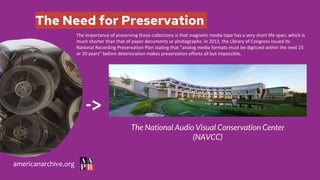
The National Audio Visual Conservation Center
(NAVCC)
americanarchive.org
The importance of preserving these collections is that magnetic media tape has a very short life span, which is
much shorter than that of paper documents or photographs. In 2012, the Library of Congress issued its
National Recording Preservation Plan stating that “analog media formats must be digitized within the next 15
or 20 years” before deterioration makes preservation efforts all but impossible.
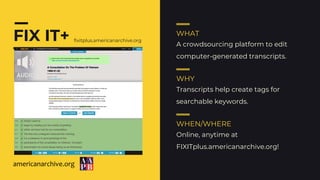
FIX IT+ WHAT
WHY
WHEN/WHERE
A crowdsourcing platform to edit
computer-generated transcripts.
Transcripts help create tags for
searchable keywords.
Online, anytime at
FIXITplus.americanarchive.org!
fixitplus.americanarchive.org
americanarchive.org
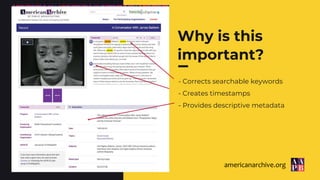
Why is this
important?
- Corrects searchable keywords
- Creates timestamps
- Provides descriptive metadata
americanarchive.org
Editing tips!
Editors should focus on editing the substance of the
interview rather than verbatim dialogue.
EDITING CONVENTIONS!
Use brackets [ ] for:
- music intros, inaudible speech, or speaker
distinctions, ex. [music] [Speaker 1] The dog
[inaudible] cute!
Use question marks for:
- unknown spelling, ex. Christina ?Mimz?
Do not transcribe:
- 'ums', 'ahs', 'you know', etc.
Tips:
- Look for names in the credits of the original
program on the AAPB website, which is linked at the
top of the transcript.
- Search the web for spelling or Wikipedia
INSTRUCTIONS RECAP
1. Open FireFox or Chrome to open visit FIX IT+:
fixitplus.americanarchive.org.
* Please let the staff know if you sign-in to FIX IT+ using your
GMAIL. This allows the staff to give your account “trained
volunteers” privileges -- which is that you do not need a second
reviewer on transcripts.
1. Filter the computer-generated transcripts by
collection and then sort by completeness (most to
least), or search a specific topic
1. “GO FOR THE GRAY” lines! Green means the
transcript has been reviewed twice and both editors
reach consensus. Gray means the line has not been
reviewed or is waiting for a second edit.
HOW TO FIX IT+ and ZOOM
1. Mute yourself while editing
2. Unmute yourself to ask a question, or chat a
question
3. OR chat AAPB staff “privately” to have your
question answered.

FIX IT+ Transcript Editing

  • 1.
  • 2.
    AAPB Mission A collaborationbetween the Library of Congress and public media producer GBH to coordinate a national effort to digitally preserve and make accessible historically significant public radio and television programming that has aired over the past 70+ years. 124,000+ items | more than 62,000 streaming online Ryn Marchese AAPB Engagement and Use Manager americanarchive.org
  • 3.
    The Need forPreservation The National Audio Visual Conservation Center (NAVCC) americanarchive.org The importance of preserving these collections is that magnetic media tape has a very short life span, which is much shorter than that of paper documents or photographs. In 2012, the Library of Congress issued its National Recording Preservation Plan stating that “analog media formats must be digitized within the next 15 or 20 years” before deterioration makes preservation efforts all but impossible.
  • 4.
    FIX IT+ WHAT WHY WHEN/WHERE Acrowdsourcing platform to edit computer-generated transcripts. Transcripts help create tags for searchable keywords. Online, anytime at FIXITplus.americanarchive.org! fixitplus.americanarchive.org americanarchive.org
  • 5.
    Why is this important? -Corrects searchable keywords - Creates timestamps - Provides descriptive metadata americanarchive.org
  • 6.
    Editing tips! Editors shouldfocus on editing the substance of the interview rather than verbatim dialogue. EDITING CONVENTIONS! Use brackets [ ] for: - music intros, inaudible speech, or speaker distinctions, ex. [music] [Speaker 1] The dog [inaudible] cute! Use question marks for: - unknown spelling, ex. Christina ?Mimz? Do not transcribe: - 'ums', 'ahs', 'you know', etc. Tips: - Look for names in the credits of the original program on the AAPB website, which is linked at the top of the transcript. - Search the web for spelling or Wikipedia INSTRUCTIONS RECAP 1. Open FireFox or Chrome to open visit FIX IT+: fixitplus.americanarchive.org. * Please let the staff know if you sign-in to FIX IT+ using your GMAIL. This allows the staff to give your account “trained volunteers” privileges -- which is that you do not need a second reviewer on transcripts. 1. Filter the computer-generated transcripts by collection and then sort by completeness (most to least), or search a specific topic 1. “GO FOR THE GRAY” lines! Green means the transcript has been reviewed twice and both editors reach consensus. Gray means the line has not been reviewed or is waiting for a second edit. HOW TO FIX IT+ and ZOOM 1. Mute yourself while editing 2. Unmute yourself to ask a question, or chat a question 3. OR chat AAPB staff “privately” to have your question answered.

Editor's Notes

  • #2 Welcome! Thank you for taking to time to join the WRVR Transcript Editathon with the American Archive of Public Broadcasting and The Riverside Church in the City of New York. My name is Ryn Marchese and I am the Engagement and Use Manager of the AAPB. Joining me today is the Riverside Archivist, Vincent Kelley. The general layout of Transcripathons are as follows – a quick background about the WRVR collection and its collaboration with the AAPB, what FIX IT+ is, followed by a live demo, and then transcribing on your own before we gather at the end to talk about the wonderful items that we’ve been transcribing. Everyone generally stays on the call the whole time while muted and with their video off. It’s up to you. If you want to sign off and hop back on 10-15 mins before the end, you are welcome to do so.
  • #3 RYN The American Archive of Public Broadcasting is a collaboration between the Library of Congress and public media producer GBH to digitally preserve and make accessible historically significant public radio and television programming aired over the past 70+ years. The Riverside Church is one among more than 140 contributing organizations, amounting to over 120,000 items preserved in the AAPB, nearly half of which are streaming online. Not all of the content that comes to the AAPB is well catalogued. We often don’t know what is on a broadcast aside from its title so we use computer-generated transcripts to help fill-in the gaps. These transcripts may not be 100% accurate, but it gives us a sense as to what the program is about and it gives us keywords that allow for better searching.
  • #4 02.07.20
  • #5 RYN In AAPB’s case, there are over 62,000 items streaming online. It would take a lot of time and resources to listen to 62,000 programs and properly catalogue these items, so FIX IT+, a crowdsourcing platform developed to edit computer-generated transcripts, helps by engaging scholars, content experts and others with interest in the subject to correct transcripts with minor errors. It also helps having local ears listening to the program to correct specific names or places that computer-programs often get incorrect. That way, if students, researchers, teachers or the general public are searching for specific names, places, or dates, on the website, those transcripts will appear in their search. You can fix transcripts online anywhere at anytime at FIXITplus.americanarchive.org and all changes are automatically saved.
  • #6 Why is this important work? Here is everything within context. This is a screenshot of the record page for a GBH interview with James Baldwin in 1963. This interview follows a now-famous meeting with United States Attorney General Robert Kennedy regarding the state of Civil Rights in this country. As mentioned, computer-transcripts help fill in the blanks when items come to the AAPB without much information. Now, anyone searching for ”James Baldwin”, 1963, civil rights, or Kennedy, etc, would get this transcript. Which is vitally important for making this content more accessible to the public.
  • #7 I sent a similar how-to guide out to everyone prior to this meeting, feel free to pull that up. I’ll also put a link to this presentation in the chat for you to reference. Are there any questions at this point? https://drive.google.com/file/d/1cmBDCpMhZh0EGgQ7qhWxe-Wd3Vz7WIx5/view?usp=sharing OKAY, To make sure multiple people are not editing the same transcript at the same time, I have a Google spreadsheet. I’ll add that link in the chat now. LINK: https://docs.google.com/spreadsheets/d/1WEvJV7Lv7W-uSxt6CSEgI8PGb_jT73Wd9uus_WLTpR8/edit#gid=0 If you end up having any questions as you edit, feel free to unmute yourself and ask, or type your question in the chat. We’ll be on the call the whole time and its likely if you have a question, someone has the same one. Otherwise, I’ll check back with everyone at 10 mins before the end of the hour to share what we’ve all been working on. Again, the How to FIX IT+ and Why: Crowdsourcing to Save Public Media informational blog is in the chat. https://blog.americanarchive.org/2020/06/05/how-to-fix-it-and-why-crowdsourcing-to-save-public-media/?preview_id=7345&preview_nonce=ad447b278f&preview=true