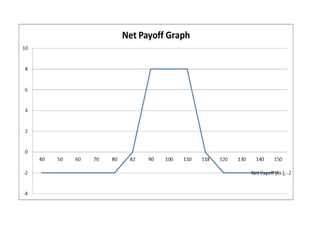
LONG CALL CONDOR
It consist of
 Buying 1 ITM Call (Lower Strike)
 Selling 1 ITM Call (Lower Middle)
 Selling 1 OTM Call (Higher Middle)
 Buying 1 OTM Call (Higher Strike)
Volatility
All other things being equal, an increase in implied volatility if the underlying is
between the two short strikes when established would have a negative impact on
this strategy. As with most strategies however, the impact of implied volatility
changes will depend on strike selection relative to the stock price when the
position is established
LONG CALL CONDOR
Maximum Loss
The maximum loss is limited to the net debit paid
Maximum gain
The maximum gain would occur if the underlying
security is between the two short call strikes
(Lowest short call strike – lowest long call strike) – Net premium paid
Breakeven
There are two breakeven points. This strategy breaks even if at expiration the
underlying security is above the lower long call strike plus the amount of
premium paid to initiate the position or if the underlying is below the highest
long call strike less the premium paid.
Downside breakeven = lowest long call strike + net debit paid
Upside breakeven = highest long call strike - net debit paid
LONG CALL CONDOR
•Assignment Risk
•Expiration Risk
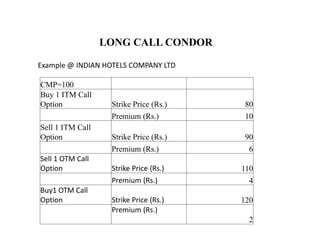
CMP=100
Buy 1 ITM Call
Option Strike Price (Rs.) 80
Premium (Rs.) 10
Sell 1 ITM Call
Option Strike Price (Rs.) 90
Premium (Rs.) 6
Sell 1 OTM Call
Option Strike Price (Rs.) 110
Premium (Rs.) 4
Buy1 OTM Call
Option Strike Price (Rs.) 120
Premium (Rs.)
2
LONG CALL CONDOR
Example @ INDIAN HOTELS COMPANY LTD
On expiry IHC
Closes at
Net Payoff from 1
ITM Call
purchased (Rs.)
Net Payoff from
1 ITM Call sold
(Rs.)
Net Payoff from
1 OTM Call
sold (Rs.)
Net Payoff
from 1 OTM
Call purchased
(Rs.)
Net
Payoff
(Rs.)
40 -10 6 4 -2 -2
50 -10 6 4 -2 -2
60 -10 6 4 -2 -2
70 -10 6 4 -2 -2
80 -10 6 4 -2 -2
82(82-80)-10=-8 6 4 -2 0
90(90-80)-10)=0 6 4 -2 8
100(100-80)-10=10 (90-100)+6=-4 4 -2 8
110 20(90-110)+6=-14 4 -2 8
118 28(90-118)+6=-22 (110-118)+4=-4 -2 0
120 30 -24(110-120)+4=-6 -2 -2
130 40 -34 -16(130-120)-2=8 -2
140 50 -44 -26(140-120)-2=18 -2
150 60 -54 -36(150-120)-2=28 -2
CMS Business School Jain University

Long Call Condor Strategy

  • 2.
    LONG CALL CONDOR Itconsist of  Buying 1 ITM Call (Lower Strike)  Selling 1 ITM Call (Lower Middle)  Selling 1 OTM Call (Higher Middle)  Buying 1 OTM Call (Higher Strike) Volatility All other things being equal, an increase in implied volatility if the underlying is between the two short strikes when established would have a negative impact on this strategy. As with most strategies however, the impact of implied volatility changes will depend on strike selection relative to the stock price when the position is established
  • 3.
    LONG CALL CONDOR MaximumLoss The maximum loss is limited to the net debit paid Maximum gain The maximum gain would occur if the underlying security is between the two short call strikes (Lowest short call strike – lowest long call strike) – Net premium paid Breakeven There are two breakeven points. This strategy breaks even if at expiration the underlying security is above the lower long call strike plus the amount of premium paid to initiate the position or if the underlying is below the highest long call strike less the premium paid. Downside breakeven = lowest long call strike + net debit paid Upside breakeven = highest long call strike - net debit paid
  • 4.
    LONG CALL CONDOR •AssignmentRisk •Expiration Risk
  • 5.
    CMP=100 Buy 1 ITMCall Option Strike Price (Rs.) 80 Premium (Rs.) 10 Sell 1 ITM Call Option Strike Price (Rs.) 90 Premium (Rs.) 6 Sell 1 OTM Call Option Strike Price (Rs.) 110 Premium (Rs.) 4 Buy1 OTM Call Option Strike Price (Rs.) 120 Premium (Rs.) 2 LONG CALL CONDOR Example @ INDIAN HOTELS COMPANY LTD
  • 6.
    On expiry IHC Closesat Net Payoff from 1 ITM Call purchased (Rs.) Net Payoff from 1 ITM Call sold (Rs.) Net Payoff from 1 OTM Call sold (Rs.) Net Payoff from 1 OTM Call purchased (Rs.) Net Payoff (Rs.) 40 -10 6 4 -2 -2 50 -10 6 4 -2 -2 60 -10 6 4 -2 -2 70 -10 6 4 -2 -2 80 -10 6 4 -2 -2 82(82-80)-10=-8 6 4 -2 0 90(90-80)-10)=0 6 4 -2 8 100(100-80)-10=10 (90-100)+6=-4 4 -2 8 110 20(90-110)+6=-14 4 -2 8 118 28(90-118)+6=-22 (110-118)+4=-4 -2 0 120 30 -24(110-120)+4=-6 -2 -2 130 40 -34 -16(130-120)-2=8 -2 140 50 -44 -26(140-120)-2=18 -2 150 60 -54 -36(150-120)-2=28 -2
  • 8.
    CMS Business SchoolJain University