LAB #3
ANTIGEN-ANTIBODY
INTERACTIONS
WINTER SEMESTER 2023
Dynabeads-anti Salmonella
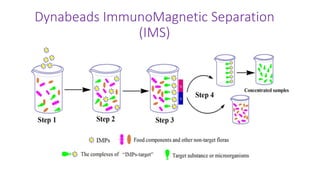
• Dynabeads-anti Salmonella is designed for rapid, selective
concentration of Salmonella directly from pre-enriched samples using
manual IMS (ImmunoMagnetic Separation)
• Dynabeads-anti Salmonella are simply incubated with an aliquot of
the pre-enriched sample, and the antibodies coated onto the beads
will specifically bind the target bacteria
• The beads-bacteria complexes are subsequently separated by using a
magnetic particle concentrator (MPC)
• After IMS, Dynabeads-anti Salmonela can be used with any standard
protocol selective-plating medium for Salmonella
Salmonella’s antigen
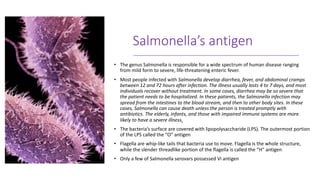
• The genus Salmonella is responsible for a wide spectrum of human disease ranging
from mild form to severe, life-threatening enteric fever.
• Most people infected with Salmonella develop diarrhea, fever, and abdominal cramps
between 12 and 72 hours after infection. The illness usually lasts 4 to 7 days, and most
individuals recover without treatment. In some cases, diarrhea may be so severe that
the patient needs to be hospitalized. In these patients, the Salmonella infection may
spread from the intestines to the blood stream, and then to other body sites. In these
cases, Salmonella can cause death unless the person is treated promptly with
antibiotics. The elderly, infants, and those with impaired immune systems are more
likely to have a severe illness.
• The bacteria’s surface are covered with lipopolysaccharide (LPS). The outermost portion
of the LPS called the “O” antigen
• Flagella are whip-like tails that bacteria use to move. Flagella is the whole structure,
while the slender threadlike portion of the flagella is called the “H” antigen
• Only a few of Salmonella serovars possessed Vi antigen
Target Microorganisms
Salmonella enterica:
- Gram negative
- Catalase positive
- Oxidase negative
- Facultatively anaerobic
- Non- spore former
- Ferments glucose
- Reduces sulfur to hydrogen sulfide
Target Microorganisms
- Isolated from water
- Isolated from foods (raw meat, poultry, milk and dairy products, eggs,
seafood , fruits and vegetables)
- Isolated from soil and stool samples
- Major cause of foodborne outbreaks in North America
- High variation in composition and structure of somatic and flagellar
antigens
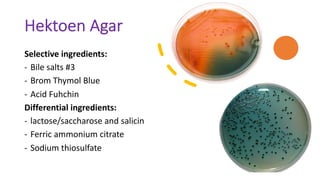
Hektoen Agar
Selective ingredients:
- Bile salts #3
- Brom Thymol Blue
- Acid Fuhchin
Differential ingredients:
- lactose/saccharose and salicin
- Ferric ammonium citrate
- Sodium thiosulfate
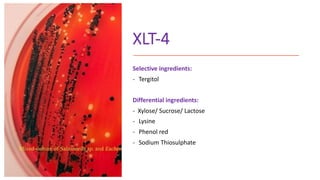
XLT-4
Selective ingredients:
- Tergitol
Differential ingredients:
- Xylose/ Sucrose/ Lactose
- Lysine
- Phenol red
- Sodium Thiosulphate
Dynabeads ImmunoMagnetic Separation
(IMS)
Main Steps of the Protocol
• Streak unknown culture on HEK and XLT-4 media
• Mix the unknown with Dynabeads
• Agitate the sample gently and continuously during the incubation period
to prevent the beads from setting
• Load MPC- invert the rack several times to concentrate the beads into a
pellet on the side of the tube
• Wash / elute according to protocol
• Resuspend the bead-bacteria in wash buffer
• Spread the bead-bacteria complexes on HEK and XLT-4
• NEGATIVE CONTROL
Important!
- If there is some foam at the top of your sample, shake the cells out
because the foam might trap some cells
- Tilt the whole magnet to make sure you do not lose any beads and
cells that might be in the cap
- Twist the tubes so the beads will form a tighter pellet
- When opening the tube, pull the cap towards you and make sure you
do not miss out on the few drops that might be caught in the cap
Important!
Efficient washing is important to get the best possible purity:
1. Twist the tube a couple of times
2. The beads and the bound cells will move through the buffer and
that’s a great way of washing them
3. It's really easy to lift the rack off and put it back on the magnet, use
one hand, or both hands
4. Make sure you get rid of all the liquid
FOLLOW PROTOCOL
WEEK 7 ( March 2nd)
1. Lab #2- Quiz- 25% MCQs and 75 % short answers
2. To be submitted individually as part of the Lab # 2 assessment:
- Lab # 2 Pre-lab Flowchart
- Completed Table 1 and 2 (all microorganisms, highlight your assigned
organisms)
- Q & A- identify and comment atypical results
3. Follow up- Lab #3
PLEASE STAPLE YOUR REPORT- REPORT TO BE SUBMITTED AT THE BEGINNING OF
THE LAB
LAB #3 Salmonella ID.pdf

LAB #3 Salmonella ID.pdf

  • 1.
  • 2.
    Dynabeads-anti Salmonella • Dynabeads-antiSalmonella is designed for rapid, selective concentration of Salmonella directly from pre-enriched samples using manual IMS (ImmunoMagnetic Separation) • Dynabeads-anti Salmonella are simply incubated with an aliquot of the pre-enriched sample, and the antibodies coated onto the beads will specifically bind the target bacteria • The beads-bacteria complexes are subsequently separated by using a magnetic particle concentrator (MPC) • After IMS, Dynabeads-anti Salmonela can be used with any standard protocol selective-plating medium for Salmonella
  • 3.
    Salmonella’s antigen • Thegenus Salmonella is responsible for a wide spectrum of human disease ranging from mild form to severe, life-threatening enteric fever. • Most people infected with Salmonella develop diarrhea, fever, and abdominal cramps between 12 and 72 hours after infection. The illness usually lasts 4 to 7 days, and most individuals recover without treatment. In some cases, diarrhea may be so severe that the patient needs to be hospitalized. In these patients, the Salmonella infection may spread from the intestines to the blood stream, and then to other body sites. In these cases, Salmonella can cause death unless the person is treated promptly with antibiotics. The elderly, infants, and those with impaired immune systems are more likely to have a severe illness. • The bacteria’s surface are covered with lipopolysaccharide (LPS). The outermost portion of the LPS called the “O” antigen • Flagella are whip-like tails that bacteria use to move. Flagella is the whole structure, while the slender threadlike portion of the flagella is called the “H” antigen • Only a few of Salmonella serovars possessed Vi antigen
  • 4.
    Target Microorganisms Salmonella enterica: -Gram negative - Catalase positive - Oxidase negative - Facultatively anaerobic - Non- spore former - Ferments glucose - Reduces sulfur to hydrogen sulfide
  • 5.
    Target Microorganisms - Isolatedfrom water - Isolated from foods (raw meat, poultry, milk and dairy products, eggs, seafood , fruits and vegetables) - Isolated from soil and stool samples - Major cause of foodborne outbreaks in North America - High variation in composition and structure of somatic and flagellar antigens
  • 6.
    Hektoen Agar Selective ingredients: -Bile salts #3 - Brom Thymol Blue - Acid Fuhchin Differential ingredients: - lactose/saccharose and salicin - Ferric ammonium citrate - Sodium thiosulfate
  • 7.
    XLT-4 Selective ingredients: - Tergitol Differentialingredients: - Xylose/ Sucrose/ Lactose - Lysine - Phenol red - Sodium Thiosulphate
  • 8.
  • 9.
    Main Steps ofthe Protocol • Streak unknown culture on HEK and XLT-4 media • Mix the unknown with Dynabeads • Agitate the sample gently and continuously during the incubation period to prevent the beads from setting • Load MPC- invert the rack several times to concentrate the beads into a pellet on the side of the tube • Wash / elute according to protocol • Resuspend the bead-bacteria in wash buffer • Spread the bead-bacteria complexes on HEK and XLT-4 • NEGATIVE CONTROL
  • 10.
    Important! - If thereis some foam at the top of your sample, shake the cells out because the foam might trap some cells - Tilt the whole magnet to make sure you do not lose any beads and cells that might be in the cap - Twist the tubes so the beads will form a tighter pellet - When opening the tube, pull the cap towards you and make sure you do not miss out on the few drops that might be caught in the cap
  • 11.
    Important! Efficient washing isimportant to get the best possible purity: 1. Twist the tube a couple of times 2. The beads and the bound cells will move through the buffer and that’s a great way of washing them 3. It's really easy to lift the rack off and put it back on the magnet, use one hand, or both hands 4. Make sure you get rid of all the liquid FOLLOW PROTOCOL
  • 12.
    WEEK 7 (March 2nd) 1. Lab #2- Quiz- 25% MCQs and 75 % short answers 2. To be submitted individually as part of the Lab # 2 assessment: - Lab # 2 Pre-lab Flowchart - Completed Table 1 and 2 (all microorganisms, highlight your assigned organisms) - Q & A- identify and comment atypical results 3. Follow up- Lab #3 PLEASE STAPLE YOUR REPORT- REPORT TO BE SUBMITTED AT THE BEGINNING OF THE LAB