Summarizing Videos using Concentrated Attention and
Considering the Uniqueness and Diversity of the Video Frames
E. Apostolidis1,2, G. Balaouras1, V. Mezaris1, I. Patras2
1 Information Technologies Institute, CERTH, Thermi - Thessaloniki, Greece
2 School of EECS, Queen Mary University of London, London, UK
2022 ACM International Conference
on Multimedia Retrieval
Outline
• Problem statement
• Related work
• Developed approach
• Experiments
• Conclusions
1
Problem statement
Current practice in Media industry for producing a video summary
Video summarization technologies can
drastically reduce the needed resources
for video summary production in terms of
both time and human effort
Image source: https://www.premiumbeat.com/
blog/3-tips-for-difficult-video-edit/
2
• An editor has to watch the entire content
and decide about the parts that should be
included in the summary
• Time-consuming task that can be significantly
accelerated by technologies for automated
video summarization
Goal of video summarization technologies
“Generate a short visual synopsis
that summarizes the video content
by selecting the most informative
and important parts of it”
Video title: “Susan Boyle's First Audition - I Dreamed a
Dream - Britain's Got Talent 2009”
Video source: OVP dataset (video also available at:
https://www.youtube.com/watch?v=deRF9oEbRso)
Static video summary
(made of selected key-frames)
Dynamic video summary
(made of selected key-fragments)
Video content
Key-fragment
Key-frame
Analysis outcomes
This synopsis can be:
• Static, composed of a set representative
video (key-)frames (a.k.a. video storyboard)
• Dynamic, formed of a set of representative
video (key-)fragments (a.k.a. video skim)
3
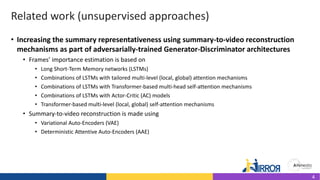
Related work (unsupervised approaches)
• Increasing the summary representativeness using summary-to-video reconstruction
mechanisms as part of adversarially-trained Generator-Discriminator architectures
• Frames’ importance estimation is based on
• Long Short-Term Memory networks (LSTMs)
• Combinations of LSTMs with tailored multi-level (local, global) attention mechanisms
• Combinations of LSTMs with Transformer-based multi-head self-attention mechanisms
• Combinations of LSTMs with Actor-Critic (AC) models
• Transformer-based multi-level (local, global) self-attention mechanisms
• Summary-to-video reconstruction is made using
• Variational Auto-Encoders (VAE)
• Deterministic Attentive Auto-Encoders (AAE)
4
Related work (unsupervised approaches)
• Targeting additional desired characteristics for a video summary
• Identify relationships among high priority entities of the visual content via spatiotemporal analysis,
and maintain these entities in the video summary
• Apply reinforcement learning (RL) using hand-crafted reward functions that reward
• Representativeness, diversity and temporal coherence of the video summary
• Preservation in the summary of the video’s main spatiotemporal patterns
• Learning a video-to-summary mapping function from unpaired data
• Summary generation is based on a Fully-Convolutional Sequence Network (FCSN) Encoder-Decoder
• Summary discrimination is based on an FCSN decoder
• Observed limitations
• Unstable training of Generator - Discriminator architectures
• Limited ability of RNNs for modeling long-range frame dependencies
• Parallelization ability of the training process of RNN-based network architectures
5
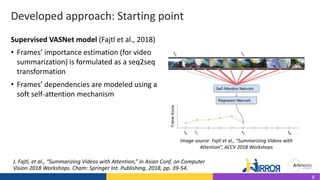
Developed approach: Starting point
• Frames’ importance estimation (for video
summarization) is formulated as a seq2seq
transformation
• Frames’ dependencies are modeled using a
soft self-attention mechanism
J. Fajtl, et al., “Summarizing Videos with Attention,” in Asian Conf. on Computer
Vision 2018 Workshops. Cham: Springer Int. Publishing, 2018, pp. 39-54.
Image source: Fajtl et al., “Summarizing Videos with
Attention”, ACCV 2018 Workshops
Supervised VASNet model (Fajtl et al., 2018)
6
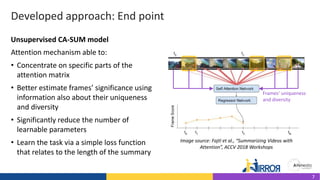
Developed approach: End point
Attention mechanism able to:
• Concentrate on specific parts of the
attention matrix
• Better estimate frames’ significance using
information also about their uniqueness
and diversity
• Significantly reduce the number of
learnable parameters
• Learn the task via a simple loss function
that relates to the length of the summary
Image source: Fajtl et al., “Summarizing Videos with
Attention”, ACCV 2018 Workshops
Unsupervised CA-SUM model
Frames’ uniqueness
and diversity
7
Developed approach: CA-SUM model
8
Developed approach: CA-SUM model
8
Deep feature extraction using
a pre-trained CNN model
Developed approach: CA-SUM model
8
Residual skip connection to
facilitate back-propagation and
assist model’s convergence
Developed approach: CA-SUM model
8
Formulation of the Query, Key
and Value matrices
Developed approach: CA-SUM model
8
Computation of the
Attention matrix
Developed approach: CA-SUM model
𝑢𝑖 =
𝑒𝑖
𝑖=1
𝑇
𝑒𝑖
, 𝑤𝑖𝑡ℎ 𝑒𝑖 = −
𝑡=1
𝑇
𝑎𝑖, 𝑡 ∙ 𝑙𝑜𝑔(𝑎𝑖, 𝑡)
𝑑𝑖 =
1
𝑙 𝐷𝑖𝑠(𝑖,𝑙) 𝑙(𝐷𝑖𝑠(𝑖, 𝑙) ∙ 𝑎𝑖, 𝑙), with 𝑙 ∉ 𝑏𝑙𝑜𝑐𝑘,
𝑎𝑛𝑑 𝐷𝑖𝑠 𝑑𝑒𝑛𝑜𝑡𝑖𝑛𝑔 𝑐𝑜𝑠𝑖𝑛𝑒 𝑑𝑖𝑠𝑡𝑎𝑛𝑐𝑒
8
Application of concentrated attention;
Computation of attentive uniqueness and
diversity values & formulation of block
diagonal sparse attention matrix
Developed approach: CA-SUM model
8
Formulation of feature vectors
at the output of the attention
mechanism
Developed approach: CA-SUM model
8
Data processing via the Regressor
Network and computation of
frame-level importance scores
Developed approach: CA-SUM model
Training time
• Compute a length regularization loss
Inference time
• Compute fragment-level importance based on a video segmentation
• Create the summary by selecting the key-fragments based on a time budget and by
solving the Knapsack problem
𝐿𝑟𝑒𝑔 =
1
𝑇 𝑡=1
𝑇
𝑦𝑡 − 𝜎
9
Experiments: Datasets
SumMe (https://gyglim.github.io/me/vsum/index.html#benchmark)
• 25 videos capturing multiple events (e.g. cooking and sports)
• Video length: 1 to 6 min
• Annotation: fragment-based video summaries (15-18 per video)
TVSum (https://github.com/yalesong/tvsum)
• 50 videos from 10 categories of TRECVid MED task
• Video length: 1 to 11 min
• Annotation: frame-level importance scores (20 per video)
10
Experiments: Evaluation approach
Approach #1
• The generated summary should not exceed 15% of the video length
• Agreement between machine-generated (M) and user-defined (U) summary is expressed
by the F-Score (%), with (P)recision and (R)ecall measuring the temporal overlap (∩) (|| ||
means duration)
• Directly applicable on SumMe videos, where annotations define videos’ key-fragments
• TVSum videos’ frame-level annotations are initially converted to define key-fragments
11
Experiments: Evaluation approach
Approach #2
• Eliminates the impact of video fragmentation and key-fragment selection mechanisms
• Alignment between machine-estimated and user-defined frame-level importance scores is
estimated using the Kendall’s τ and Spearman’s ρ rank correlation coefficients
• Applicable only on TVSum videos, where annotations define frame’s importance
Common rules
• 80% of video samples are used for training and the remaining 20% for testing
• Summarization performance is formed by averaging the experimental results on five
randomly-created splits of data
12
Experiments: Implementation details
• Videos were down-sampled to 2 fps
• Feature extraction: pool5 layer of GoogleNet trained on ImageNet (D = 1024)
• Block size M = 60
• Learning rate and L2 regularization factor: 5 x 10⁻⁴ and 10-5 respectively
• Network initialization approach: Xavier uniform (gain = 2; biases = 0.1)
• Training: in a full-batch mode using the Adam optimizer and stops after 400 epochs
• Length regularization factor = [0.5; 0.1; 0.9]
• Model selection is based on a two-step process:
• Keep one model per length regularization factor based on the minimization of the training loss
• Choose the best-performing one via transductive inference and comparison with a fully-untrained model
of the network architecture
13
Experiments: Sensitivity analysis
Tuning of block size M
• Indicates the level of granularity for estimating attention-based significance of the video
• Largest value is dictated by the shortest video in our datasets (60 sec.)
Block size SumMe TVSum TVSum
F-score Spearmans’ ρ Kendall’s τ
10 44.8 55.7 0.090 0.070
20 46.3 57.0 0.140 0.110
30 47.0 57.6 0.160 0.120
40 46.1 60.5 0.170 0.130
50 44.3 60.4 0.190 0.150
60 51.1 61.4 0.210 0.160
KTS 40.8 52.7 0.060 0.050
14
Highest performance on
both datasets, and based
on all measures
Using KTS-based video
fragment leads to poor
performance
Experiments: Performance comparisons
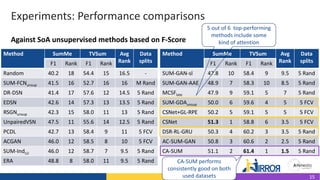
Against SoA unsupervised methods based on F-Score
Method SumMe TVSum Avg
Rank
Data
splits
F1 Rank F1 Rank
Random 40.2 18 54.4 15 16.5 -
SUM-FCNunsup 41.5 16 52.7 16 16 M Rand
DR-DSN 41.4 17 57.6 12 14.5 5 Rand
EDSN 42.6 14 57.3 13 13.5 5 Rand
RSGNunsup 42.3 15 58.0 11 13 5 Rand
UnpairedVSN 47.5 11 55.6 14 12.5 5 Rand
PCDL 42.7 13 58.4 9 11 5 FCV
ACGAN 46.0 12 58.5 8 10 5 FCV
SUM-IndLU 46.0 12 58.7 7 9.5 5 Rand
ERA 48.8 8 58.0 11 9.5 5 Rand
Method SumMe TVSum Avg
Rank
Data
splits
F1 Rank F1 Rank
SUM-GAN-sl 47.8 10 58.4 9 9.5 5 Rand
SUM-GAN-AAE 48.9 7 58.3 10 8.5 5 Rand
MCSFlate 47.9 9 59.1 5 7 5 Rand
SUM-GDAunsup 50.0 6 59.6 4 5 5 FCV
CSNet+GL-RPE 50.2 5 59.1 5 5 5 FCV
CSNet 51.3 1 58.8 6 3.5 5 FCV
DSR-RL-GRU 50.3 4 60.2 3 3.5 5 Rand
AC-SUM-GAN 50.8 3 60.6 2 2.5 5 Rand
CA-SUM 51.1 2 61.4 1 1.5 5 Rand
15
CA-SUM performs
consistently good on both
used datasets
5 out of 6 top-performing
methods include some
kind of attention
Experiments: Performance comparisons
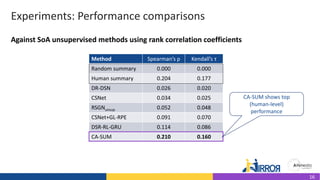
Against SoA unsupervised methods using rank correlation coefficients
Method Spearman’s ρ Kendall’s τ
Random summary 0.000 0.000
Human summary 0.204 0.177
DR-DSN 0.026 0.020
CSNet 0.034 0.025
RSGNunsup 0.052 0.048
CSNet+GL-RPE 0.091 0.070
DSR-RL-GRU 0.114 0.086
CA-SUM 0.210 0.160
16
CA-SUM shows top
(human-level)
performance
Experiments: Performance comparisons
In terms of training time and number of learnable parameters
Method Training time (sec / epoch) # Parameters
(in Millions)
SumMe TVSum
DR-DSN 0.33 0.98 2.63
SUM-IndLU 2.07 9.84 0.33
SUM-GAN-sl 11.85 38.95 23.31
SUM-GAN-AAE 16.39 54.23 24.31
CSNet 28.43 89.85 100.76
DSR-RL-GRU 0.23 0.50 13.64
AC-SUM-GAN 28.25 93.80 26.75
CA-SUM 0.06 0.13 5.25
17
CA-SUM is highly-
parallelizable and needs
the least time for training
Experiments: Performance comparisons
Ablation study
Method Block diagonal sparse
attention matrix
Attentive frame
uniqueness & diversity
SumMe TVSum TVSum
F-Score Spearman’s ρ Kendall’s τ
Variant #1 X X 45.8 58.9 NaN NaN
Variant #2 √ X 47.4 56.5 0.010 0.010
Variant #3 X √ 45.8 58.9 NaN NaN
CA-SUM √ √ 51.1 61.4 0.210 0.160
Removing the block diagonal sparse attention matrix does
not allow the network to learn anything meaningful
18
Experiments: Performance comparisons
Ablation study
Method Block diagonal sparse
attention matrix
Attentive frame
uniqueness & diversity
SumMe TVSum TVSum
F-Score Spearman’s ρ Kendall’s τ
Variant #1 X X 45.8 58.9 NaN NaN
Variant #2 √ X 47.4 56.5 0.010 0.010
Variant #3 X √ 45.8 58.9 NaN NaN
CA-SUM √ √ 51.1 61.4 0.210 0.160
Ignoring the frames’ uniqueness & diversity and using only
local attention, results in poor summarization performance
18
Experiments: Performance comparisons
Ablation study
Method Block diagonal sparse
attention matrix
Attentive frame
uniqueness & diversity
SumMe TVSum TVSum
F-Score Spearman’s ρ Kendall’s τ
Variant #1 X X 45.8 58.9 NaN NaN
Variant #2 √ X 47.4 56.5 0.010 0.010
Variant #3 X √ 45.8 58.9 NaN NaN
CA-SUM √ √ 51.1 61.4 0.210 0.160
Combining a block diagonal sparse attention matrix with attention-based
statistics about the frames’ uniqueness & diversity, allows the network to
effectively learn the video summarization task
18
Conclusions
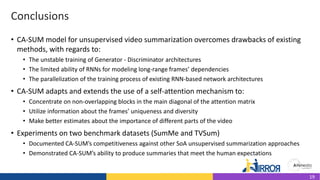
• CA-SUM model for unsupervised video summarization overcomes drawbacks of existing
methods, with regards to:
• The unstable training of Generator - Discriminator architectures
• The limited ability of RNNs for modeling long-range frames’ dependencies
• The parallelization of the training process of existing RNN-based network architectures
• CA-SUM adapts and extends the use of a self-attention mechanism to:
• Concentrate on non-overlapping blocks in the main diagonal of the attention matrix
• Utilize information about the frames’ uniqueness and diversity
• Make better estimates about the importance of different parts of the video
• Experiments on two benchmark datasets (SumMe and TVSum)
• Documented CA-SUM’s competitiveness against other SoA unsupervised summarization approaches
• Demonstrated CA-SUM’s ability to produce summaries that meet the human expectations
19
Thank you for your attention!
Questions?
Evlampios Apostolidis, apostolid@iti.gr
Code and documentation publicly available at:
https://github.com/e-apostolidis/CA-SUM
This work was supported by the EUs Horizon 2020 research and innovation programme
under grant agreements H2020-832921 MIRROR and H2020-951911 AI4Media

CA-SUM Video Summarization

  • 1.
    Summarizing Videos usingConcentrated Attention and Considering the Uniqueness and Diversity of the Video Frames E. Apostolidis1,2, G. Balaouras1, V. Mezaris1, I. Patras2 1 Information Technologies Institute, CERTH, Thermi - Thessaloniki, Greece 2 School of EECS, Queen Mary University of London, London, UK 2022 ACM International Conference on Multimedia Retrieval
  • 2.
    Outline • Problem statement •Related work • Developed approach • Experiments • Conclusions 1
  • 3.
    Problem statement Current practicein Media industry for producing a video summary Video summarization technologies can drastically reduce the needed resources for video summary production in terms of both time and human effort Image source: https://www.premiumbeat.com/ blog/3-tips-for-difficult-video-edit/ 2 • An editor has to watch the entire content and decide about the parts that should be included in the summary • Time-consuming task that can be significantly accelerated by technologies for automated video summarization
  • 4.
    Goal of videosummarization technologies “Generate a short visual synopsis that summarizes the video content by selecting the most informative and important parts of it” Video title: “Susan Boyle's First Audition - I Dreamed a Dream - Britain's Got Talent 2009” Video source: OVP dataset (video also available at: https://www.youtube.com/watch?v=deRF9oEbRso) Static video summary (made of selected key-frames) Dynamic video summary (made of selected key-fragments) Video content Key-fragment Key-frame Analysis outcomes This synopsis can be: • Static, composed of a set representative video (key-)frames (a.k.a. video storyboard) • Dynamic, formed of a set of representative video (key-)fragments (a.k.a. video skim) 3
  • 5.
    Related work (unsupervisedapproaches) • Increasing the summary representativeness using summary-to-video reconstruction mechanisms as part of adversarially-trained Generator-Discriminator architectures • Frames’ importance estimation is based on • Long Short-Term Memory networks (LSTMs) • Combinations of LSTMs with tailored multi-level (local, global) attention mechanisms • Combinations of LSTMs with Transformer-based multi-head self-attention mechanisms • Combinations of LSTMs with Actor-Critic (AC) models • Transformer-based multi-level (local, global) self-attention mechanisms • Summary-to-video reconstruction is made using • Variational Auto-Encoders (VAE) • Deterministic Attentive Auto-Encoders (AAE) 4
  • 6.
    Related work (unsupervisedapproaches) • Targeting additional desired characteristics for a video summary • Identify relationships among high priority entities of the visual content via spatiotemporal analysis, and maintain these entities in the video summary • Apply reinforcement learning (RL) using hand-crafted reward functions that reward • Representativeness, diversity and temporal coherence of the video summary • Preservation in the summary of the video’s main spatiotemporal patterns • Learning a video-to-summary mapping function from unpaired data • Summary generation is based on a Fully-Convolutional Sequence Network (FCSN) Encoder-Decoder • Summary discrimination is based on an FCSN decoder • Observed limitations • Unstable training of Generator - Discriminator architectures • Limited ability of RNNs for modeling long-range frame dependencies • Parallelization ability of the training process of RNN-based network architectures 5
  • 7.
    Developed approach: Startingpoint • Frames’ importance estimation (for video summarization) is formulated as a seq2seq transformation • Frames’ dependencies are modeled using a soft self-attention mechanism J. Fajtl, et al., “Summarizing Videos with Attention,” in Asian Conf. on Computer Vision 2018 Workshops. Cham: Springer Int. Publishing, 2018, pp. 39-54. Image source: Fajtl et al., “Summarizing Videos with Attention”, ACCV 2018 Workshops Supervised VASNet model (Fajtl et al., 2018) 6
  • 8.
    Developed approach: Endpoint Attention mechanism able to: • Concentrate on specific parts of the attention matrix • Better estimate frames’ significance using information also about their uniqueness and diversity • Significantly reduce the number of learnable parameters • Learn the task via a simple loss function that relates to the length of the summary Image source: Fajtl et al., “Summarizing Videos with Attention”, ACCV 2018 Workshops Unsupervised CA-SUM model Frames’ uniqueness and diversity 7
  • 9.
  • 10.
    Developed approach: CA-SUMmodel 8 Deep feature extraction using a pre-trained CNN model
  • 11.
    Developed approach: CA-SUMmodel 8 Residual skip connection to facilitate back-propagation and assist model’s convergence
  • 12.
    Developed approach: CA-SUMmodel 8 Formulation of the Query, Key and Value matrices
  • 13.
    Developed approach: CA-SUMmodel 8 Computation of the Attention matrix
  • 14.
    Developed approach: CA-SUMmodel 𝑢𝑖 = 𝑒𝑖 𝑖=1 𝑇 𝑒𝑖 , 𝑤𝑖𝑡ℎ 𝑒𝑖 = − 𝑡=1 𝑇 𝑎𝑖, 𝑡 ∙ 𝑙𝑜𝑔(𝑎𝑖, 𝑡) 𝑑𝑖 = 1 𝑙 𝐷𝑖𝑠(𝑖,𝑙) 𝑙(𝐷𝑖𝑠(𝑖, 𝑙) ∙ 𝑎𝑖, 𝑙), with 𝑙 ∉ 𝑏𝑙𝑜𝑐𝑘, 𝑎𝑛𝑑 𝐷𝑖𝑠 𝑑𝑒𝑛𝑜𝑡𝑖𝑛𝑔 𝑐𝑜𝑠𝑖𝑛𝑒 𝑑𝑖𝑠𝑡𝑎𝑛𝑐𝑒 8 Application of concentrated attention; Computation of attentive uniqueness and diversity values & formulation of block diagonal sparse attention matrix
  • 15.
    Developed approach: CA-SUMmodel 8 Formulation of feature vectors at the output of the attention mechanism
  • 16.
    Developed approach: CA-SUMmodel 8 Data processing via the Regressor Network and computation of frame-level importance scores
  • 17.
    Developed approach: CA-SUMmodel Training time • Compute a length regularization loss Inference time • Compute fragment-level importance based on a video segmentation • Create the summary by selecting the key-fragments based on a time budget and by solving the Knapsack problem 𝐿𝑟𝑒𝑔 = 1 𝑇 𝑡=1 𝑇 𝑦𝑡 − 𝜎 9
  • 18.
    Experiments: Datasets SumMe (https://gyglim.github.io/me/vsum/index.html#benchmark) •25 videos capturing multiple events (e.g. cooking and sports) • Video length: 1 to 6 min • Annotation: fragment-based video summaries (15-18 per video) TVSum (https://github.com/yalesong/tvsum) • 50 videos from 10 categories of TRECVid MED task • Video length: 1 to 11 min • Annotation: frame-level importance scores (20 per video) 10
  • 19.
    Experiments: Evaluation approach Approach#1 • The generated summary should not exceed 15% of the video length • Agreement between machine-generated (M) and user-defined (U) summary is expressed by the F-Score (%), with (P)recision and (R)ecall measuring the temporal overlap (∩) (|| || means duration) • Directly applicable on SumMe videos, where annotations define videos’ key-fragments • TVSum videos’ frame-level annotations are initially converted to define key-fragments 11
  • 20.
    Experiments: Evaluation approach Approach#2 • Eliminates the impact of video fragmentation and key-fragment selection mechanisms • Alignment between machine-estimated and user-defined frame-level importance scores is estimated using the Kendall’s τ and Spearman’s ρ rank correlation coefficients • Applicable only on TVSum videos, where annotations define frame’s importance Common rules • 80% of video samples are used for training and the remaining 20% for testing • Summarization performance is formed by averaging the experimental results on five randomly-created splits of data 12
  • 21.
    Experiments: Implementation details •Videos were down-sampled to 2 fps • Feature extraction: pool5 layer of GoogleNet trained on ImageNet (D = 1024) • Block size M = 60 • Learning rate and L2 regularization factor: 5 x 10⁻⁴ and 10-5 respectively • Network initialization approach: Xavier uniform (gain = 2; biases = 0.1) • Training: in a full-batch mode using the Adam optimizer and stops after 400 epochs • Length regularization factor = [0.5; 0.1; 0.9] • Model selection is based on a two-step process: • Keep one model per length regularization factor based on the minimization of the training loss • Choose the best-performing one via transductive inference and comparison with a fully-untrained model of the network architecture 13
  • 22.
    Experiments: Sensitivity analysis Tuningof block size M • Indicates the level of granularity for estimating attention-based significance of the video • Largest value is dictated by the shortest video in our datasets (60 sec.) Block size SumMe TVSum TVSum F-score Spearmans’ ρ Kendall’s τ 10 44.8 55.7 0.090 0.070 20 46.3 57.0 0.140 0.110 30 47.0 57.6 0.160 0.120 40 46.1 60.5 0.170 0.130 50 44.3 60.4 0.190 0.150 60 51.1 61.4 0.210 0.160 KTS 40.8 52.7 0.060 0.050 14 Highest performance on both datasets, and based on all measures Using KTS-based video fragment leads to poor performance
  • 23.
    Experiments: Performance comparisons AgainstSoA unsupervised methods based on F-Score Method SumMe TVSum Avg Rank Data splits F1 Rank F1 Rank Random 40.2 18 54.4 15 16.5 - SUM-FCNunsup 41.5 16 52.7 16 16 M Rand DR-DSN 41.4 17 57.6 12 14.5 5 Rand EDSN 42.6 14 57.3 13 13.5 5 Rand RSGNunsup 42.3 15 58.0 11 13 5 Rand UnpairedVSN 47.5 11 55.6 14 12.5 5 Rand PCDL 42.7 13 58.4 9 11 5 FCV ACGAN 46.0 12 58.5 8 10 5 FCV SUM-IndLU 46.0 12 58.7 7 9.5 5 Rand ERA 48.8 8 58.0 11 9.5 5 Rand Method SumMe TVSum Avg Rank Data splits F1 Rank F1 Rank SUM-GAN-sl 47.8 10 58.4 9 9.5 5 Rand SUM-GAN-AAE 48.9 7 58.3 10 8.5 5 Rand MCSFlate 47.9 9 59.1 5 7 5 Rand SUM-GDAunsup 50.0 6 59.6 4 5 5 FCV CSNet+GL-RPE 50.2 5 59.1 5 5 5 FCV CSNet 51.3 1 58.8 6 3.5 5 FCV DSR-RL-GRU 50.3 4 60.2 3 3.5 5 Rand AC-SUM-GAN 50.8 3 60.6 2 2.5 5 Rand CA-SUM 51.1 2 61.4 1 1.5 5 Rand 15 CA-SUM performs consistently good on both used datasets 5 out of 6 top-performing methods include some kind of attention
  • 24.
    Experiments: Performance comparisons AgainstSoA unsupervised methods using rank correlation coefficients Method Spearman’s ρ Kendall’s τ Random summary 0.000 0.000 Human summary 0.204 0.177 DR-DSN 0.026 0.020 CSNet 0.034 0.025 RSGNunsup 0.052 0.048 CSNet+GL-RPE 0.091 0.070 DSR-RL-GRU 0.114 0.086 CA-SUM 0.210 0.160 16 CA-SUM shows top (human-level) performance
  • 25.
    Experiments: Performance comparisons Interms of training time and number of learnable parameters Method Training time (sec / epoch) # Parameters (in Millions) SumMe TVSum DR-DSN 0.33 0.98 2.63 SUM-IndLU 2.07 9.84 0.33 SUM-GAN-sl 11.85 38.95 23.31 SUM-GAN-AAE 16.39 54.23 24.31 CSNet 28.43 89.85 100.76 DSR-RL-GRU 0.23 0.50 13.64 AC-SUM-GAN 28.25 93.80 26.75 CA-SUM 0.06 0.13 5.25 17 CA-SUM is highly- parallelizable and needs the least time for training
  • 26.
    Experiments: Performance comparisons Ablationstudy Method Block diagonal sparse attention matrix Attentive frame uniqueness & diversity SumMe TVSum TVSum F-Score Spearman’s ρ Kendall’s τ Variant #1 X X 45.8 58.9 NaN NaN Variant #2 √ X 47.4 56.5 0.010 0.010 Variant #3 X √ 45.8 58.9 NaN NaN CA-SUM √ √ 51.1 61.4 0.210 0.160 Removing the block diagonal sparse attention matrix does not allow the network to learn anything meaningful 18
  • 27.
    Experiments: Performance comparisons Ablationstudy Method Block diagonal sparse attention matrix Attentive frame uniqueness & diversity SumMe TVSum TVSum F-Score Spearman’s ρ Kendall’s τ Variant #1 X X 45.8 58.9 NaN NaN Variant #2 √ X 47.4 56.5 0.010 0.010 Variant #3 X √ 45.8 58.9 NaN NaN CA-SUM √ √ 51.1 61.4 0.210 0.160 Ignoring the frames’ uniqueness & diversity and using only local attention, results in poor summarization performance 18
  • 28.
    Experiments: Performance comparisons Ablationstudy Method Block diagonal sparse attention matrix Attentive frame uniqueness & diversity SumMe TVSum TVSum F-Score Spearman’s ρ Kendall’s τ Variant #1 X X 45.8 58.9 NaN NaN Variant #2 √ X 47.4 56.5 0.010 0.010 Variant #3 X √ 45.8 58.9 NaN NaN CA-SUM √ √ 51.1 61.4 0.210 0.160 Combining a block diagonal sparse attention matrix with attention-based statistics about the frames’ uniqueness & diversity, allows the network to effectively learn the video summarization task 18
  • 29.
    Conclusions • CA-SUM modelfor unsupervised video summarization overcomes drawbacks of existing methods, with regards to: • The unstable training of Generator - Discriminator architectures • The limited ability of RNNs for modeling long-range frames’ dependencies • The parallelization of the training process of existing RNN-based network architectures • CA-SUM adapts and extends the use of a self-attention mechanism to: • Concentrate on non-overlapping blocks in the main diagonal of the attention matrix • Utilize information about the frames’ uniqueness and diversity • Make better estimates about the importance of different parts of the video • Experiments on two benchmark datasets (SumMe and TVSum) • Documented CA-SUM’s competitiveness against other SoA unsupervised summarization approaches • Demonstrated CA-SUM’s ability to produce summaries that meet the human expectations 19
  • 30.
    Thank you foryour attention! Questions? Evlampios Apostolidis, apostolid@iti.gr Code and documentation publicly available at: https://github.com/e-apostolidis/CA-SUM This work was supported by the EUs Horizon 2020 research and innovation programme under grant agreements H2020-832921 MIRROR and H2020-951911 AI4Media

Editor's Notes

  • #10 Given a video of T frames,
  • #24 In addition, our idea to work with a self-attention mechanism seems to be right, as five out of the six top-performing approaches (including our CA-SUM model) contain some kind of attention mechanism.
  • #27 …removing the block diagonal sparse attention matrix does not allow the network to learn anything meaningful. In particular, the network sticks in a case where all the video frames are assigned with the same extremely low (≈ 0) or extremely high (≈ 1) importance scores. The generation of the summary completely depends on the choices made by the Knapsack algorithm, that are purely related to the length of the video fragments. Since there is no counted variation in the assigned importance scores, no values can be computed for the Spearman’s 𝜌 and Kendall’s 𝜏 rank correlation coefficients.
  • #28 When no estimates about the frames’ attentive uniqueness and diversity are being computed, and the block diagonal sparse attention matrix provides information about the frames’ attention only at the local-level, the network also fails to learn the summarization task. The computed F-Score, Spearman’s 𝜌 and Kendall’s 𝜏 values, indicate a random-level performing summarizer on both utilized datasets.
  • #29 The combination of a block diagonal sparse attention matrix with attention-based statistics about the frames’ uniqueness and diversity, as proposed, allows the network architecture to effectively learn the video summarization task and exhibit state-of-the-art performance on both of the utilized datasets and according to both of the adopted evaluation protocols.
  • #30 We proposed a new method for unsupervised video summarization, that aims to overcome drawbacks of existing approaches with respect to: i) unstable training of Generator – Discriminator architectures, ii) the use of RNNs for modeling long-range frames’ dependencies, and iii) the parallelization ability of the training process of existing RNN-based network architectures. The developed CA-SUM method relies on the use of a self-attention mechanism, and extends its functionality by concentrating attention on non-overlapping blocks in the main diagonal of the attention matrix and by utilizing information about the frames’ uniqueness and diversity. The proposed methodology allows the attention mechanism to make better estimates about the importance of different parts of the video. Experiments on two benchmarking datasets (SumMe and TVSum) indicated the competitiveness of our CA-SUM method against other state-of-the-art unsupervised summarization approaches, and demonstrated its ability to produce summaries that meet the human expectations.