Objective
Formulates assertions about the
content and properties of a text read
ASSERTIO
N
An assertion is a statement used to make a
declaration or to express strong belief on a
particular topic, often without evidence.
An assertion can be formulated after reading
a story or a poem, and even after watching a
play.
The Purpose of Writing an
Assertion
• It is for the writer to convey directly an
idea or feeling and to convince the
reader to accept the writer’s
interpretation of a particular literary
work.
Before Writing
• Before writing an assertion in literature, the
author must comprehensively read or watch
the literary work. He must take down the part
he is for, or he is opposed to, followed by his
explanation of it. It is also best to collect
evidence from the same or other literary
authors that have the same assertion as with
the writer.
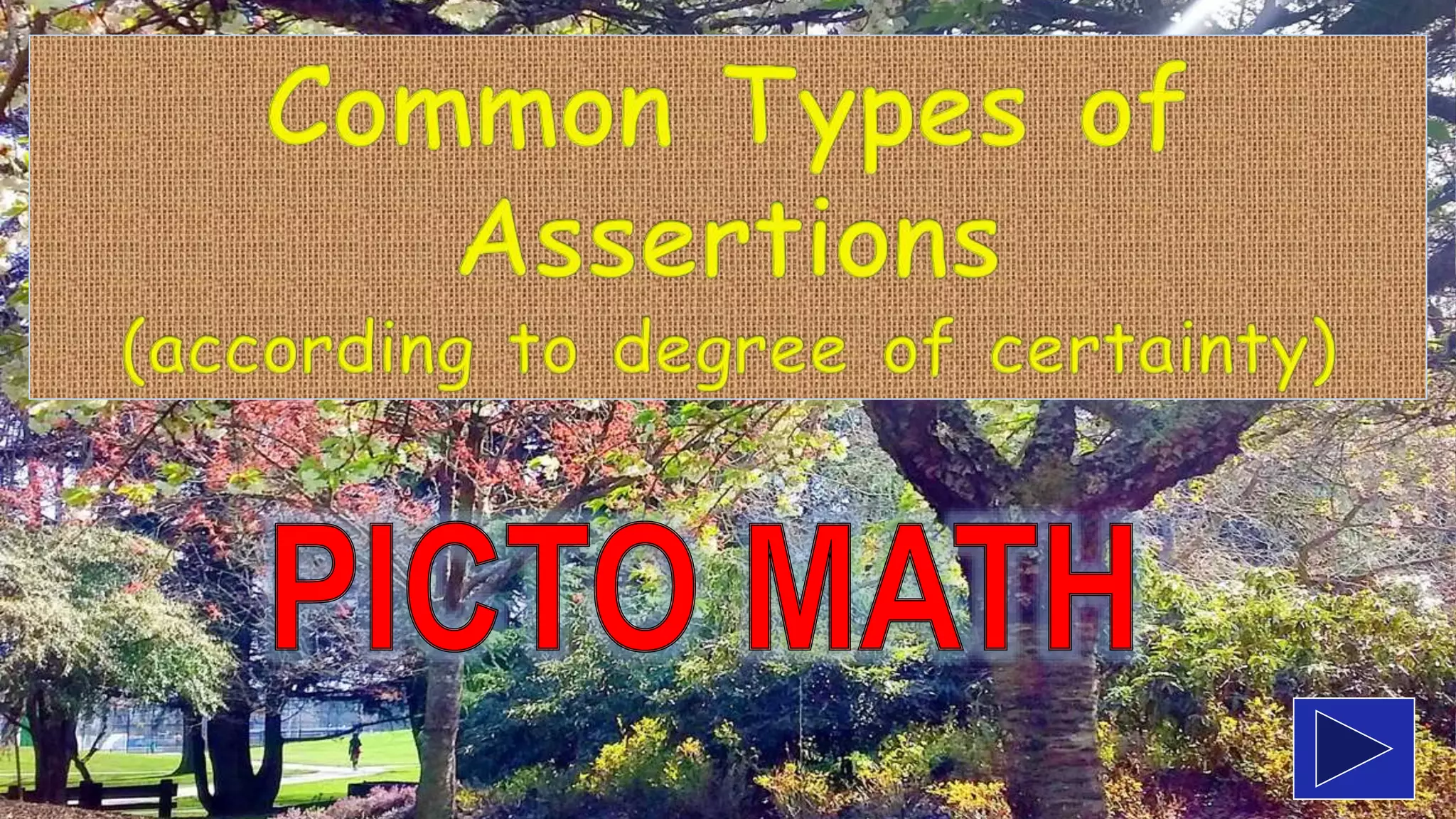
Different TYPES of ASSERTION can be used in formal or
informal writing. This includes:
Basic Assertion,
 Emphatic Assertion
 I-Language Assertion.
Let us use this short text in formulating different types of assertion.
Before the arrival of the Spaniards, the culture and
values of the Filipinos are still in tacked. Pre colonial
Philippines has their own form of government and social
structure. Every local community is composed of small
kingdom or tribe headed by a chieftain called the ‘rajah’ or
‘datu’. Social structure also exists and is composed of three
classes namely – the ‘maharlika’ or freeman, ‘timawa’ or the
middle class and the ‘alipin’ or the slaves. Judicial, legislative
and executive systems, also known as the branches of the
government, are also present during precolonialism.The
‘datu’ formulates the law, ‘village elders’ help the datu in
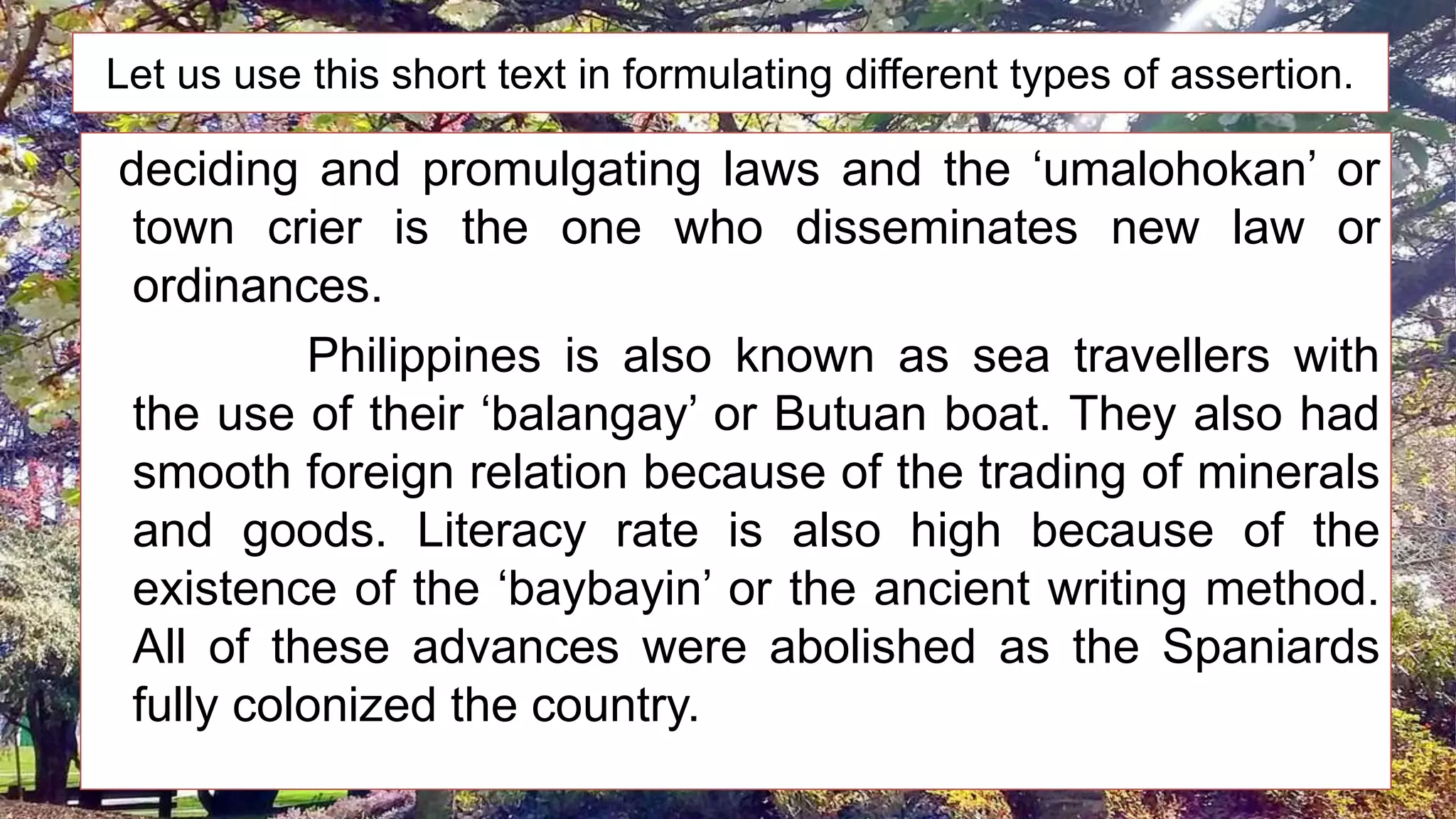
Let us use this short text in formulating different types of assertion.
deciding and promulgating laws and the ‘umalohokan’ or
town crier is the one who disseminates new law or
ordinances.
Philippines is also known as sea travellers with
the use of their ‘balangay’ or Butuan boat. They also had
smooth foreign relation because of the trading of minerals
and goods. Literacy rate is also high because of the
existence of the ‘baybayin’ or the ancient writing method.
All of these advances were abolished as the Spaniards
fully colonized the country.
1.Basic Assertion
 is a statement used to express the writer's feelings,
beliefs, and opinions directly. This type of assertion is
usually used in writing formal papers like thesis and
dissertation.
Example:
The Philippines has an advanced civilization before the
colonization of Spain. Form and branches of government,
social structure and the existence of ancient writing are
some of the evidence that proves the advancement of the
precolonial period.
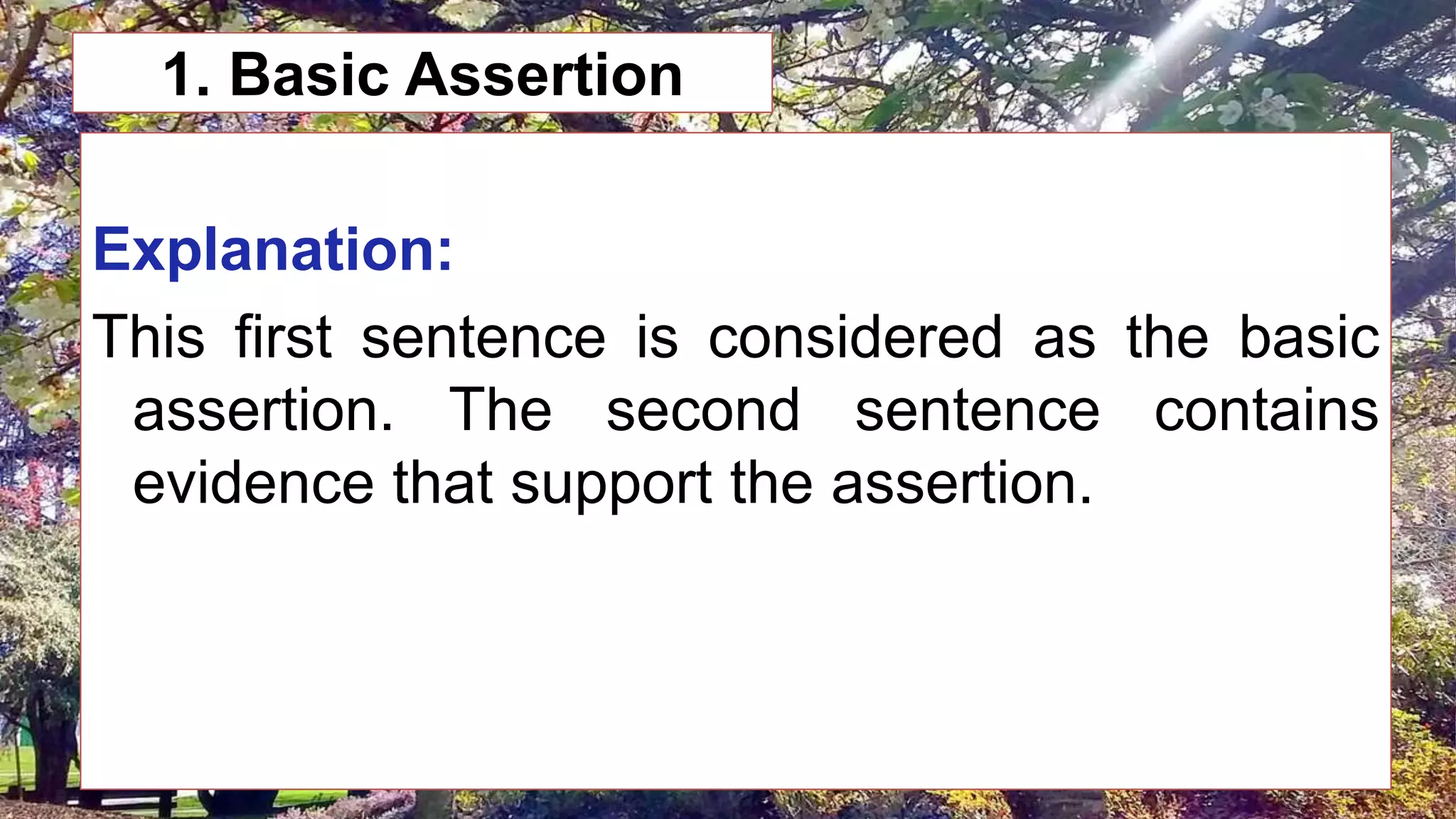
1. Basic Assertion
Explanation:
This first sentence is considered as the basic
assertion. The second sentence contains
evidence that support the assertion.
2. Emphatic Assertion
is a statement used to express empathy or on how a
person understands the feelings and emotions of the
literary author. This can be used on writing a formal or
informal paper.
It is usually composed of two parts:
1) the first part is the statement that recognizes the
situation or even the feelings of the characters on the text
being read
2.) the second statement where the writer states his
stand about the situation.
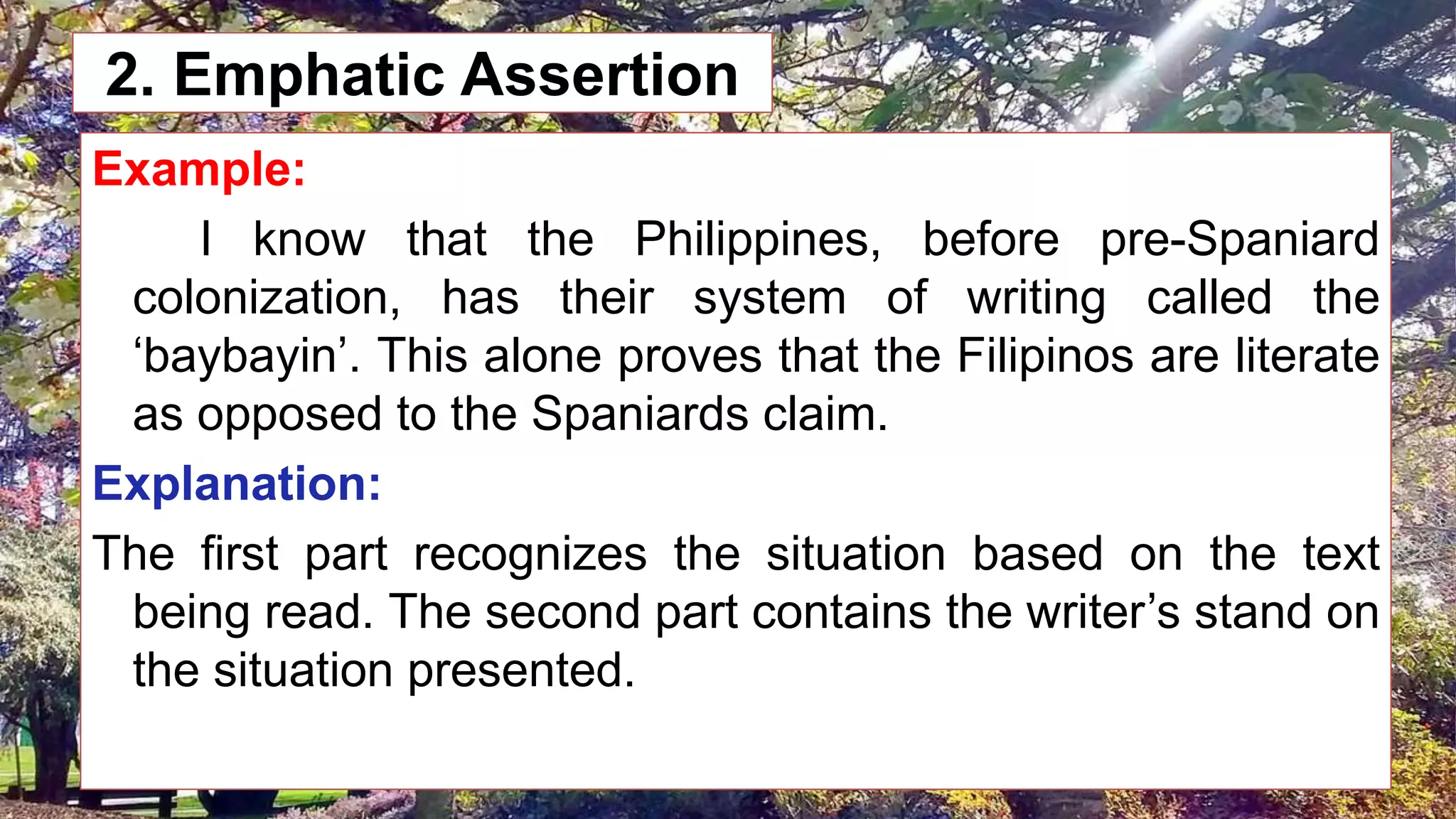
2. Emphatic Assertion
Example:
I know that the Philippines, before pre-Spaniard
colonization, has their system of writing called the
‘baybayin’. This alone proves that the Filipinos are literate
as opposed to the Spaniards claim.
Explanation:
The first part recognizes the situation based on the text
being read. The second part contains the writer’s stand on
the situation presented.
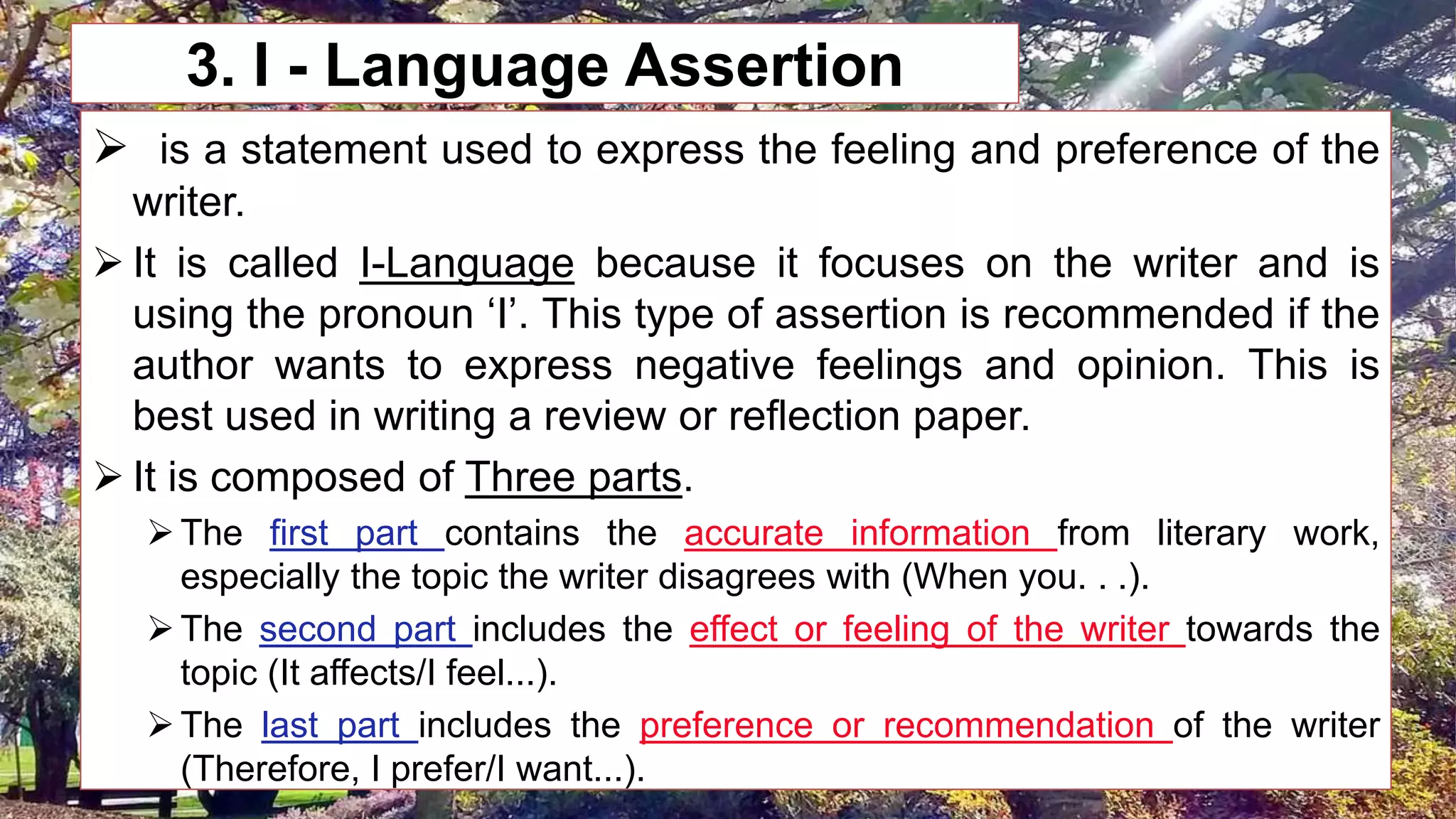
3. I - Language Assertion
 is a statement used to express the feeling and preference of the
writer.
 It is called I-Language because it focuses on the writer and is
using the pronoun ‘I’. This type of assertion is recommended if the
author wants to express negative feelings and opinion. This is
best used in writing a review or reflection paper.
 It is composed of Three parts.
The first part contains the accurate information from literary work,
especially the topic the writer disagrees with (When you. . .).
The second part includes the effect or feeling of the writer towards the
topic (It affects/I feel...).
The last part includes the preference or recommendation of the writer
(Therefore, I prefer/I want...).
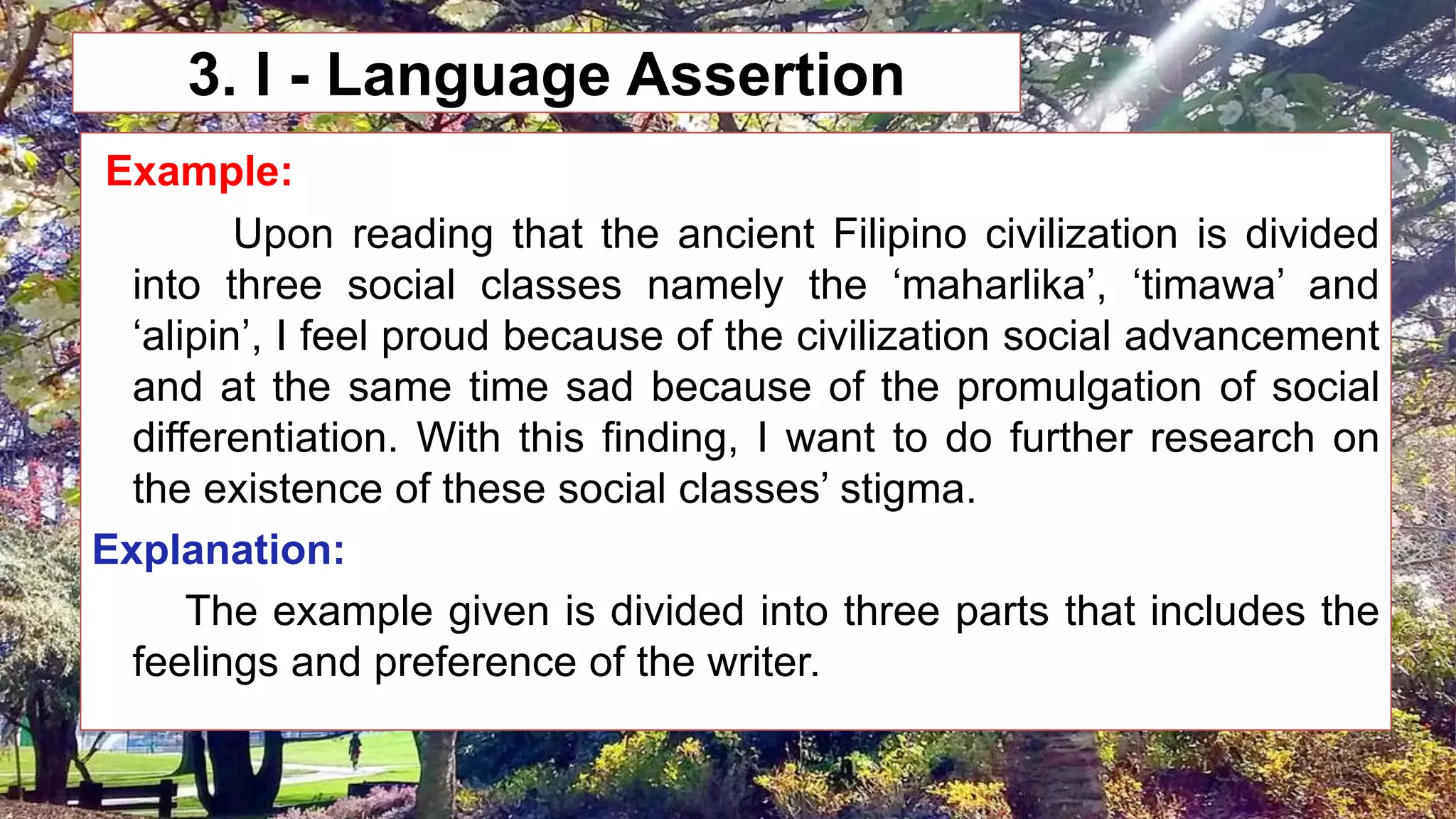
3. I - Language Assertion
Example:
Upon reading that the ancient Filipino civilization is divided
into three social classes namely the ‘maharlika’, ‘timawa’ and
‘alipin’, I feel proud because of the civilization social advancement
and at the same time sad because of the promulgation of social
differentiation. With this finding, I want to do further research on
the existence of these social classes’ stigma.
Explanation:
The example given is divided into three parts that includes the
feelings and preference of the writer.
Two (2) factors that must be considered before formulating
assertion
1. Determine the type of paper you are going to write – and can
either be formal or informal paper.
2. Determine the type of literary work you are going to examine
including novel, poem, journal article or theatre play.
It is best to include facts and evidence after every assertion.
This is done to make a strong stand on every claimed assertion.
1.A statement used to make a declaration or to
express strong belief on a certain topic is
called .
A.assertion
B.opinion
C.fact
D.affirmation
2.When is the best time to formulate literary
assertion?
A. after reading a story
B. after playing online games
C. before watching a play
D. before writing the poem
3.The following are types of assertion except :
A. I – Language Assertion
B. Emphatic Assertion
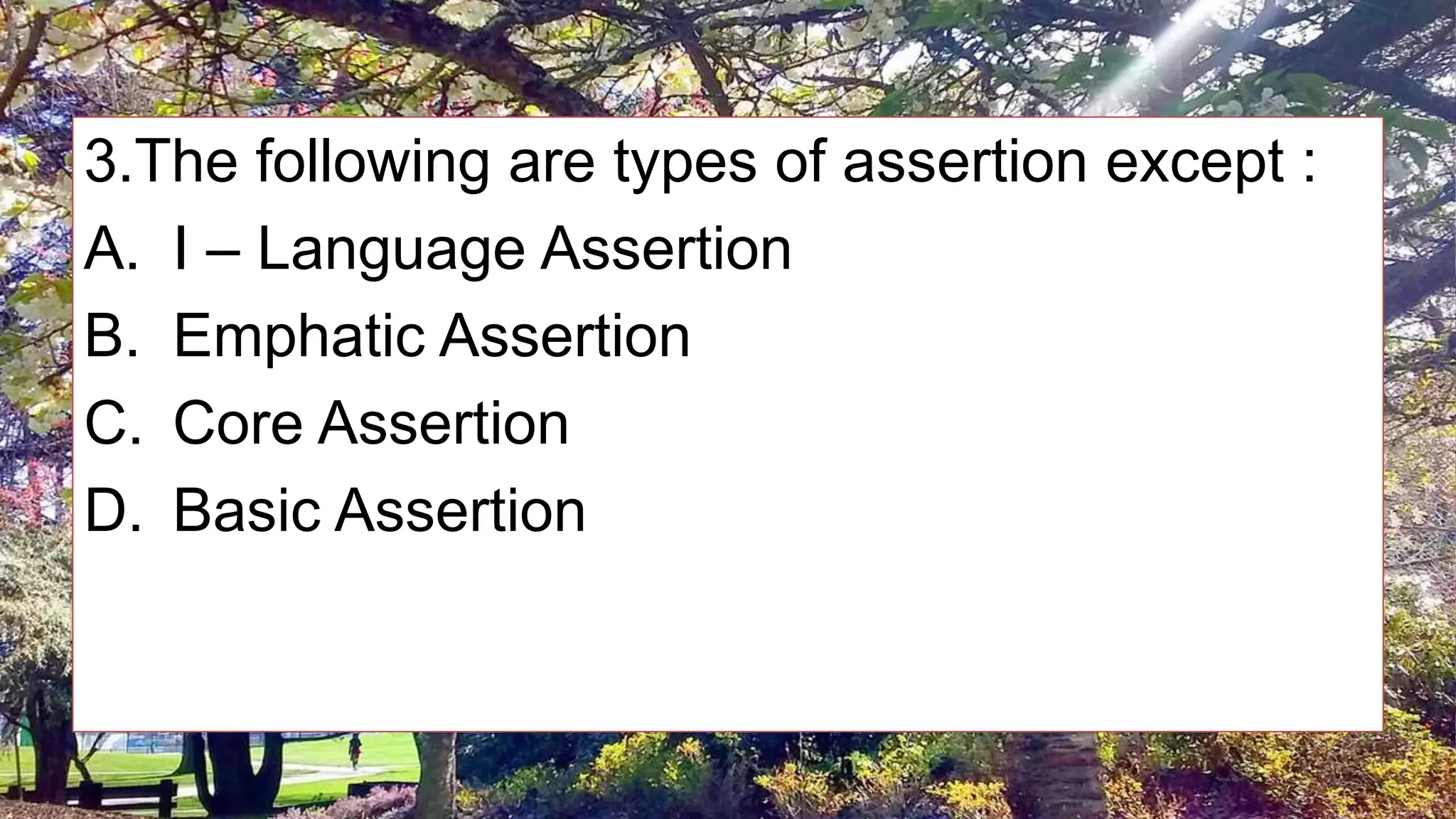
C. Core Assertion
D. Basic Assertion
5. Why do we need to formulate assertions?
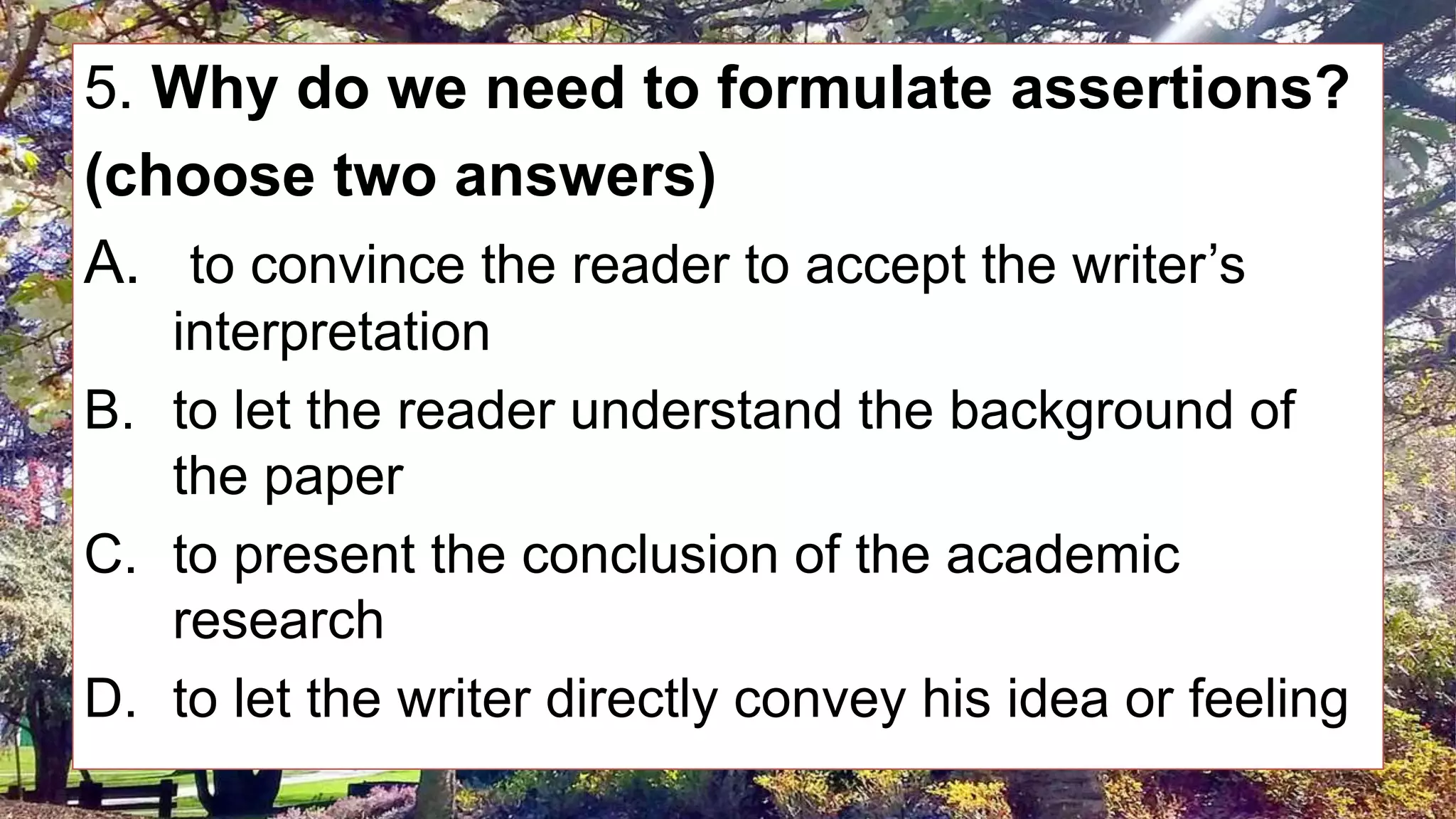
(choose two answers)
A. to convince the reader to accept the writer’s
interpretation
B. to let the reader understand the background of
the paper
C. to present the conclusion of the academic
research
D. to let the writer directly convey his idea or feeling
6. What makes a strong literary assertion?
A. Every assertion must contain hypothesis
proposed by the author.
B. Every assertion must be followed by facts and
evidence.
C. Every assertion must include observation made
by the novelist.
D. Every assertion must include the summary of
articles.
7. The following are parts of I-Language
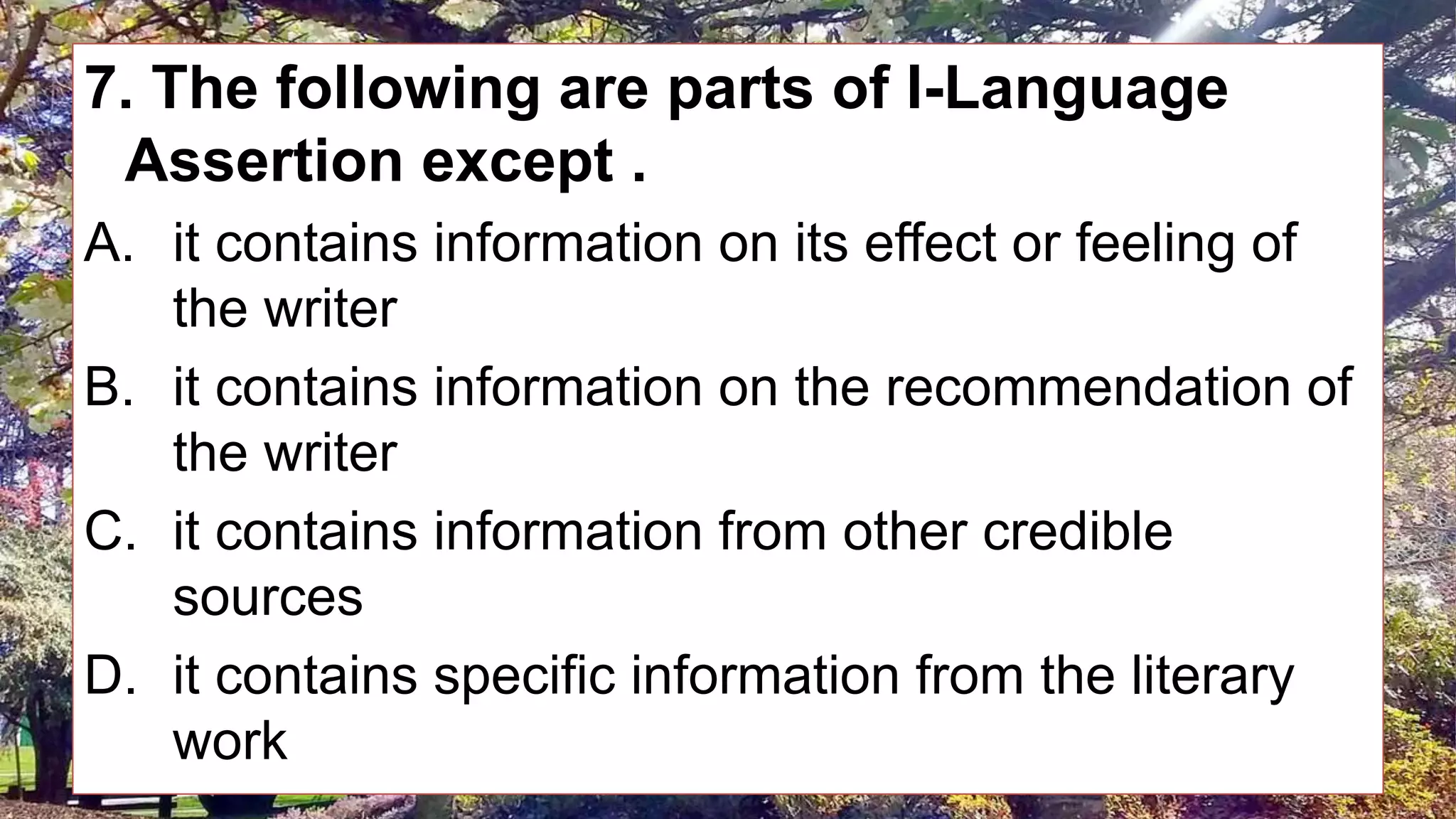
Assertion except .
A. it contains information on its effect or feeling of
the writer
B. it contains information on the recommendation of
the writer
C. it contains information from other credible
sources
D. it contains specific information from the literary
work
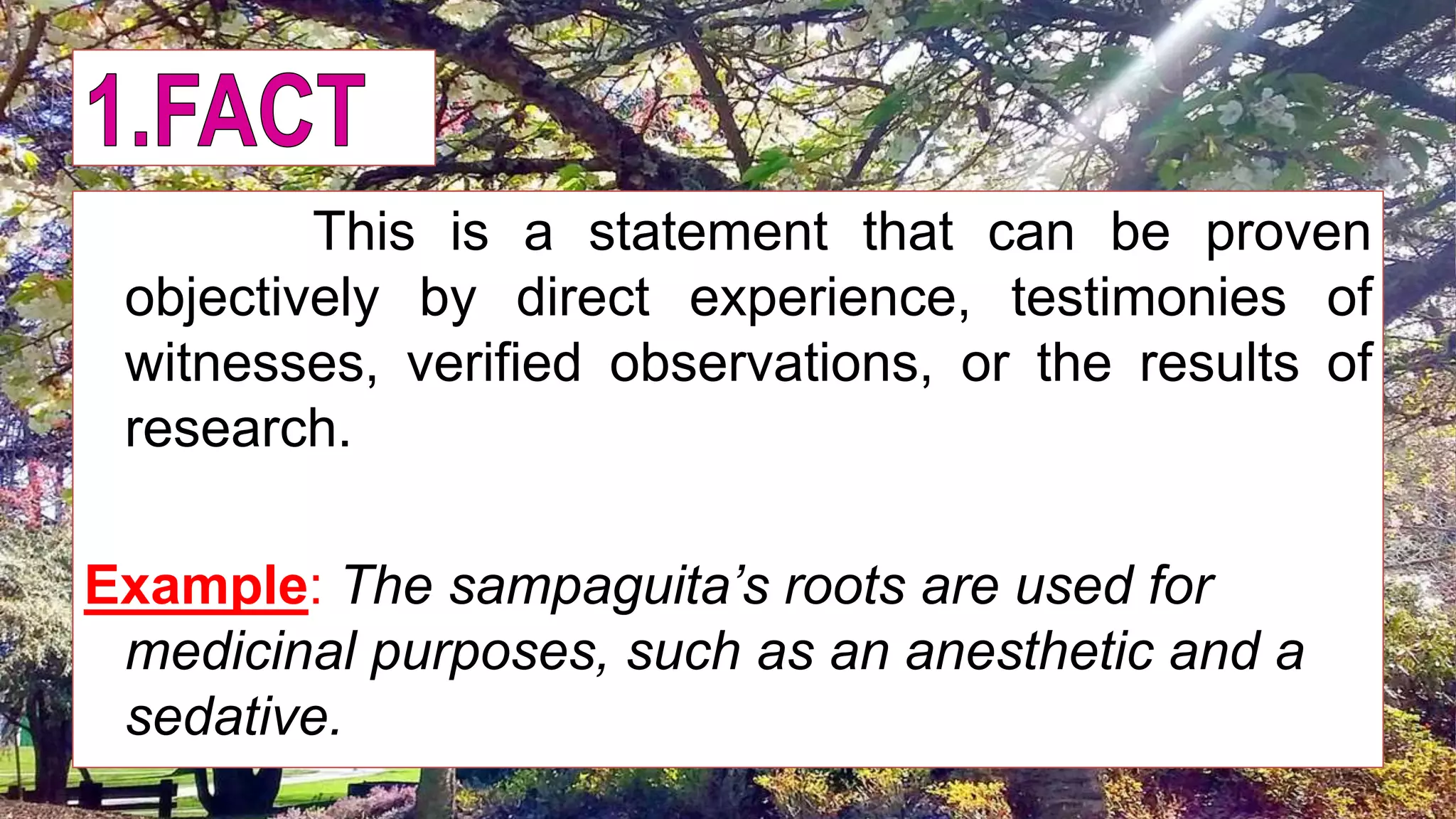
FACT
This is a statement that can be proven
objectively by direct experience, testimonies of
witnesses, verified observations, or the results of
research.
Example: The sampaguita’s roots are used for
medicinal purposes, such as an anesthetic and a
sedative.
. It is a way in which something is done,
similar to traditions and norms.
 Conventions depend on historical precedent,
laws, rules, usage, and customs.
Example: The sampaguita belongs to the genus
Jasminum of the family Oleaceae.
.
. It is based on facts, but is difficult to
objectively verify because of the uncertainty of
producing satisfactory proofs of soundness.
Example:
The popularity of sampaguita flowers is most
evident in places of worship.
.
. It is based on personal choice; therefore, they
are subjective and cannot be objectively proven or
logically attacked.
Example:
Sampaguitas are the most beautiful and most
fragrant of all flowers.
1. Social media is defined as the Internet and mobile-
based tools and devices that facilitate the integration of
technology, telecommunications, and social
interaction.
2.Facebook is a cooler social media platform than
Twitter.
3.In 2012, there were 1.4 billion users of social media
worldwide.
4.Teachers should use social media in their lessons to get
more students interested.
5.Another name for social media is “Web 2.0” because
both terms emphasize the social aspects of the
internet as avenues for communication, collaboration,
and creative expression.
6.Many teenagers’ present obsession with taking selfies
shows they are the most narcissistic generation
7. Social networks are the most distracting websites on
the Internet.
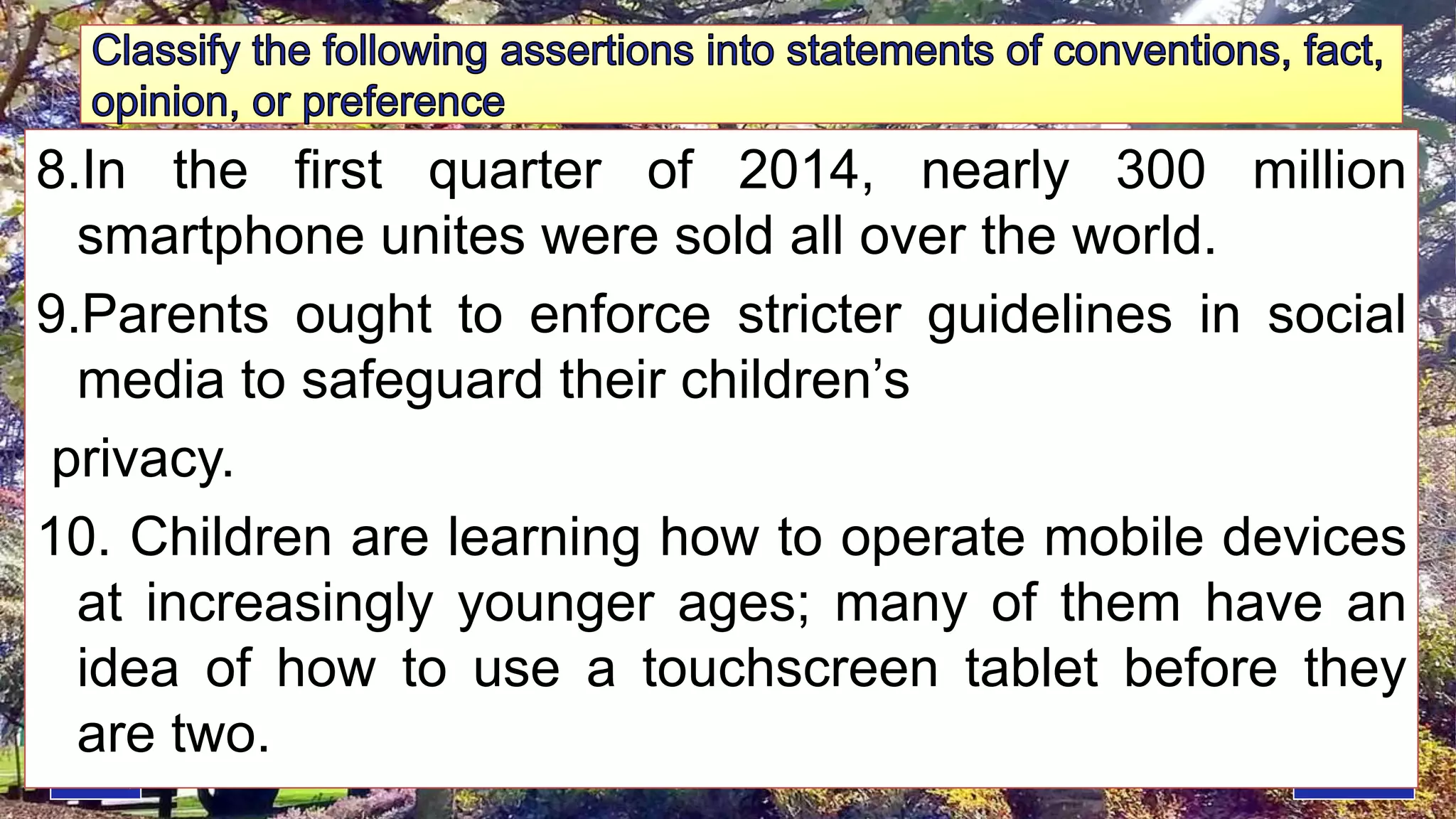
8.In the first quarter of 2014, nearly 300 million
smartphone unites were sold all over the world.
9.Parents ought to enforce stricter guidelines in social
media to safeguard their children’s
privacy.
10. Children are learning how to operate mobile devices
at increasingly younger ages; many of them have an
idea of how to use a touchscreen tablet before they
are two.
Nutrition and the Philippines: 'Nation at risk'
Fritzie Rodriguez
MANILA, Philippines — “Undernutrition is the single greatest threat to a child’s life.”
Dr Martin Parreño, National Program Officer of the World Food Programme-Philippines, called on Filipinos to
pay more attention to child malnutrition at all times — with or without disasters.
Latest statistics from the National Nutrition Council (NNC) showed that 67% of Filipino families are not eating
enough even when there are no calamities.
In the Philippines, malnutrition is seen across all age groups — from infancy to adulthood, the 2013 National
Nutrition Survey revealed.
“At the center of malnutrition’s underlying causes is inadequate childcare and feeding practices,” Parreño
added. “And we don’t have a structure curriculum addressing this,” he said during the 2014 Dr Juan Salcedo
Memorial Lecture organized by the Nutrition Foundation of the Philippines (NFP) on Thursday, October 9.
Children who grew up in homes where parents did not care or invest in proper food and hygiene will most
likely grow up to become the same kind of parents, hence perpetuating the cycle.
The Department of Education has been working on integrating health and nutrition lessons in school curricula.
More recent strategies also try to involve parents in classes and school-based supplementary feeding programs.
Such efforts, however, will remain fruitless unless more parents realize the value of nutrition and their roles as
primary caregivers.
FORMULATE ASSERTIONS ON THE FOLLOWING ARTICLE
CREDITS
www.quipperschool.com
www.slideshare.net
https://www.scribd.com/document/337662336/Critical-
Reading-as-Reasoning

FORMULATING ASSERTIONS

  • 4.
    Objective Formulates assertions aboutthe content and properties of a text read
  • 5.
    ASSERTIO N An assertion isa statement used to make a declaration or to express strong belief on a particular topic, often without evidence. An assertion can be formulated after reading a story or a poem, and even after watching a play.
  • 6.
    The Purpose ofWriting an Assertion • It is for the writer to convey directly an idea or feeling and to convince the reader to accept the writer’s interpretation of a particular literary work.
  • 7.
    Before Writing • Beforewriting an assertion in literature, the author must comprehensively read or watch the literary work. He must take down the part he is for, or he is opposed to, followed by his explanation of it. It is also best to collect evidence from the same or other literary authors that have the same assertion as with the writer.
  • 8.
    Different TYPES ofASSERTION can be used in formal or informal writing. This includes: Basic Assertion,  Emphatic Assertion  I-Language Assertion.
  • 9.
    Let us usethis short text in formulating different types of assertion. Before the arrival of the Spaniards, the culture and values of the Filipinos are still in tacked. Pre colonial Philippines has their own form of government and social structure. Every local community is composed of small kingdom or tribe headed by a chieftain called the ‘rajah’ or ‘datu’. Social structure also exists and is composed of three classes namely – the ‘maharlika’ or freeman, ‘timawa’ or the middle class and the ‘alipin’ or the slaves. Judicial, legislative and executive systems, also known as the branches of the government, are also present during precolonialism.The ‘datu’ formulates the law, ‘village elders’ help the datu in
  • 10.
    Let us usethis short text in formulating different types of assertion. deciding and promulgating laws and the ‘umalohokan’ or town crier is the one who disseminates new law or ordinances. Philippines is also known as sea travellers with the use of their ‘balangay’ or Butuan boat. They also had smooth foreign relation because of the trading of minerals and goods. Literacy rate is also high because of the existence of the ‘baybayin’ or the ancient writing method. All of these advances were abolished as the Spaniards fully colonized the country.
  • 12.
    1.Basic Assertion  isa statement used to express the writer's feelings, beliefs, and opinions directly. This type of assertion is usually used in writing formal papers like thesis and dissertation. Example: The Philippines has an advanced civilization before the colonization of Spain. Form and branches of government, social structure and the existence of ancient writing are some of the evidence that proves the advancement of the precolonial period.
  • 13.
    1. Basic Assertion Explanation: Thisfirst sentence is considered as the basic assertion. The second sentence contains evidence that support the assertion.
  • 14.
    2. Emphatic Assertion isa statement used to express empathy or on how a person understands the feelings and emotions of the literary author. This can be used on writing a formal or informal paper. It is usually composed of two parts: 1) the first part is the statement that recognizes the situation or even the feelings of the characters on the text being read 2.) the second statement where the writer states his stand about the situation.
  • 15.
    2. Emphatic Assertion Example: Iknow that the Philippines, before pre-Spaniard colonization, has their system of writing called the ‘baybayin’. This alone proves that the Filipinos are literate as opposed to the Spaniards claim. Explanation: The first part recognizes the situation based on the text being read. The second part contains the writer’s stand on the situation presented.
  • 16.
    3. I -Language Assertion  is a statement used to express the feeling and preference of the writer.  It is called I-Language because it focuses on the writer and is using the pronoun ‘I’. This type of assertion is recommended if the author wants to express negative feelings and opinion. This is best used in writing a review or reflection paper.  It is composed of Three parts. The first part contains the accurate information from literary work, especially the topic the writer disagrees with (When you. . .). The second part includes the effect or feeling of the writer towards the topic (It affects/I feel...). The last part includes the preference or recommendation of the writer (Therefore, I prefer/I want...).
  • 17.
    3. I -Language Assertion Example: Upon reading that the ancient Filipino civilization is divided into three social classes namely the ‘maharlika’, ‘timawa’ and ‘alipin’, I feel proud because of the civilization social advancement and at the same time sad because of the promulgation of social differentiation. With this finding, I want to do further research on the existence of these social classes’ stigma. Explanation: The example given is divided into three parts that includes the feelings and preference of the writer.
  • 18.
    Two (2) factorsthat must be considered before formulating assertion 1. Determine the type of paper you are going to write – and can either be formal or informal paper. 2. Determine the type of literary work you are going to examine including novel, poem, journal article or theatre play. It is best to include facts and evidence after every assertion. This is done to make a strong stand on every claimed assertion.
  • 20.
    1.A statement usedto make a declaration or to express strong belief on a certain topic is called . A.assertion B.opinion C.fact D.affirmation
  • 21.
    2.When is thebest time to formulate literary assertion? A. after reading a story B. after playing online games C. before watching a play D. before writing the poem
  • 22.
    3.The following aretypes of assertion except : A. I – Language Assertion B. Emphatic Assertion C. Core Assertion D. Basic Assertion
  • 23.
    5. Why dowe need to formulate assertions? (choose two answers) A. to convince the reader to accept the writer’s interpretation B. to let the reader understand the background of the paper C. to present the conclusion of the academic research D. to let the writer directly convey his idea or feeling
  • 24.
    6. What makesa strong literary assertion? A. Every assertion must contain hypothesis proposed by the author. B. Every assertion must be followed by facts and evidence. C. Every assertion must include observation made by the novelist. D. Every assertion must include the summary of articles.
  • 25.
    7. The followingare parts of I-Language Assertion except . A. it contains information on its effect or feeling of the writer B. it contains information on the recommendation of the writer C. it contains information from other credible sources D. it contains specific information from the literary work
  • 31.
  • 32.
    This is astatement that can be proven objectively by direct experience, testimonies of witnesses, verified observations, or the results of research. Example: The sampaguita’s roots are used for medicinal purposes, such as an anesthetic and a sedative.
  • 33.
    . It isa way in which something is done, similar to traditions and norms.  Conventions depend on historical precedent, laws, rules, usage, and customs. Example: The sampaguita belongs to the genus Jasminum of the family Oleaceae.
  • 34.
    . . It isbased on facts, but is difficult to objectively verify because of the uncertainty of producing satisfactory proofs of soundness. Example: The popularity of sampaguita flowers is most evident in places of worship.
  • 35.
    . . It isbased on personal choice; therefore, they are subjective and cannot be objectively proven or logically attacked. Example: Sampaguitas are the most beautiful and most fragrant of all flowers.
  • 37.
    1. Social mediais defined as the Internet and mobile- based tools and devices that facilitate the integration of technology, telecommunications, and social interaction. 2.Facebook is a cooler social media platform than Twitter. 3.In 2012, there were 1.4 billion users of social media worldwide. 4.Teachers should use social media in their lessons to get more students interested.
  • 38.
    5.Another name forsocial media is “Web 2.0” because both terms emphasize the social aspects of the internet as avenues for communication, collaboration, and creative expression. 6.Many teenagers’ present obsession with taking selfies shows they are the most narcissistic generation 7. Social networks are the most distracting websites on the Internet.
  • 39.
    8.In the firstquarter of 2014, nearly 300 million smartphone unites were sold all over the world. 9.Parents ought to enforce stricter guidelines in social media to safeguard their children’s privacy. 10. Children are learning how to operate mobile devices at increasingly younger ages; many of them have an idea of how to use a touchscreen tablet before they are two.
  • 40.
    Nutrition and thePhilippines: 'Nation at risk' Fritzie Rodriguez MANILA, Philippines — “Undernutrition is the single greatest threat to a child’s life.” Dr Martin Parreño, National Program Officer of the World Food Programme-Philippines, called on Filipinos to pay more attention to child malnutrition at all times — with or without disasters. Latest statistics from the National Nutrition Council (NNC) showed that 67% of Filipino families are not eating enough even when there are no calamities. In the Philippines, malnutrition is seen across all age groups — from infancy to adulthood, the 2013 National Nutrition Survey revealed. “At the center of malnutrition’s underlying causes is inadequate childcare and feeding practices,” Parreño added. “And we don’t have a structure curriculum addressing this,” he said during the 2014 Dr Juan Salcedo Memorial Lecture organized by the Nutrition Foundation of the Philippines (NFP) on Thursday, October 9. Children who grew up in homes where parents did not care or invest in proper food and hygiene will most likely grow up to become the same kind of parents, hence perpetuating the cycle. The Department of Education has been working on integrating health and nutrition lessons in school curricula. More recent strategies also try to involve parents in classes and school-based supplementary feeding programs. Such efforts, however, will remain fruitless unless more parents realize the value of nutrition and their roles as primary caregivers. FORMULATE ASSERTIONS ON THE FOLLOWING ARTICLE
  • 41.