LINGUISTIC
What is Linguistics?
• It is the scientific study of language and its
structure, including the study of morphology,
syntax, phonetics, and semantics.
• It involves analysing the many different aspects that
make up human language by
looking at its form, structure and context.
• Linguistics also looks at the interplay between
sound and meaning, and how language
varies between people and situations.
• It’s all about communication.
What is the main purpose of Linguistics?
• is to increase our knowledge and understanding of the
world. Since language is universal and fundamental to all
human interactions, the knowledge attained in linguistics has
many practical applications.
• To understand the evolution and nature of a language.
• To comprehend the theory of language and understand
other languages in the context of the same
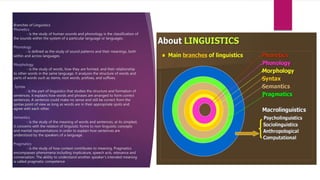
Branches of Linguistics
Phonetics
- is the study of human sounds and phonology is the classification of
the sounds within the system of a particular language or languages.
Phonology
- is defined as the study of sound patterns and their meanings, both
within and across languages.
Morphology
- is the study of words, how they are formed, and their relationship
to other words in the same language. It analyzes the structure of words and
parts of words such as stems, root words, prefixes, and suffixes.
Syntax
- is the part of linguistics that studies the structure and formation of
sentences. It explains how words and phrases are arranged to form correct
sentences. A sentence could make no sense and still be correct from the
syntax point of view as long as words are in their appropriate spots and
agree with each other.
Semantics
- is the study of the meaning of words and sentences; at its simplest,
it concerns with the relation of linguistic forms to non-linguistic concepts
and mental representations in order to explain how sentences are
understood by the speakers of a language.
Pragmatics
- is the study of how context contributes to meaning. Pragmatics
encompasses phenomena including implicature, speech acts, relevance and
conversation. The ability to understand another speaker's intended meaning
is called pragmatic competence
Linguistic.pptx

Linguistic.pptx

  • 1.
  • 2.
    What is Linguistics? •It is the scientific study of language and its structure, including the study of morphology, syntax, phonetics, and semantics. • It involves analysing the many different aspects that make up human language by looking at its form, structure and context. • Linguistics also looks at the interplay between sound and meaning, and how language varies between people and situations. • It’s all about communication.
  • 3.
    What is themain purpose of Linguistics? • is to increase our knowledge and understanding of the world. Since language is universal and fundamental to all human interactions, the knowledge attained in linguistics has many practical applications. • To understand the evolution and nature of a language. • To comprehend the theory of language and understand other languages in the context of the same
  • 4.
    Branches of Linguistics Phonetics -is the study of human sounds and phonology is the classification of the sounds within the system of a particular language or languages. Phonology - is defined as the study of sound patterns and their meanings, both within and across languages. Morphology - is the study of words, how they are formed, and their relationship to other words in the same language. It analyzes the structure of words and parts of words such as stems, root words, prefixes, and suffixes. Syntax - is the part of linguistics that studies the structure and formation of sentences. It explains how words and phrases are arranged to form correct sentences. A sentence could make no sense and still be correct from the syntax point of view as long as words are in their appropriate spots and agree with each other. Semantics - is the study of the meaning of words and sentences; at its simplest, it concerns with the relation of linguistic forms to non-linguistic concepts and mental representations in order to explain how sentences are understood by the speakers of a language. Pragmatics - is the study of how context contributes to meaning. Pragmatics encompasses phenomena including implicature, speech acts, relevance and conversation. The ability to understand another speaker's intended meaning is called pragmatic competence