Soil Texture
Soil Physics
PhD-I
Presented By: Muhammad Usman
Course Instructor: Dr. Jalil ur Rehman
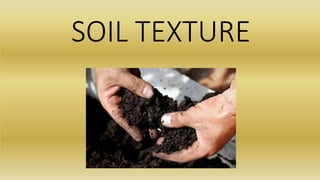
SOIL TEXTURE
• The look and the feel of a soil is referred as soil
texture which is determined by the relative proportion
of mineral particles of different sizes present in the
soil.
• Soil are composed of sand, slit and clay particles.
• Stones and gravels are excluded from the textural
classes.
Soil Texture
• Particle size is determined by the diameter of
individual soil fragments.
• According to the International system of soil
classification ,size of different particle are as
follows:
• Clay – less than 0.002 mm
• Slits – 0.002mm to 0.02mm
• Sand – 0.02mm to 2.0mm
Size of the Particles
• very fine sand – 0.02mm to 0.10mm
• Fine sand – 0.10mm to 0.25mm
• Medium sand – 0.25mm to o.50mm
• Coarse sand – 0.50mm to 1.0mm
• Very coarse sand – 1.0mm to 2.0mm
• Gravel - larger than 2.0 mm
Size of the Particles
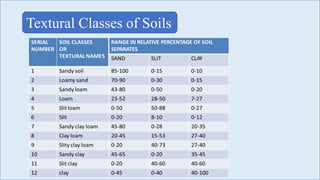
Textural Classes of Soils
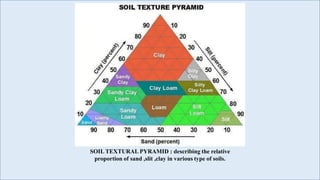
SOIL TEXTURAL PYRAMID : describing the relative
proportion of sand ,slit ,clay in various type of soils.
Properties
 Loamy soil are a balance between sand , slit and clay particles and
considered as the most desirable soils for agricultural.
 Sandy soil have coarse texture. They hold water and mineral poorly . Water
and air penetrate easily thats why, they warm readily in spring and cool
quickly in autumn.
 Clayey soil hold large volume of water and retain minerals . They are very
slow to warm in spring and cool more slowly in autumn.
 Slity soil are intermediate in characteristics and properties between sandy
and clayey soil.
• Sand and slit are generally irregular in shape, ranging from rectangular or
blocky to, spherical shapes.
• Clay particles are made up of two to three flat crystalline plates , layered or
laminated together. These particle can be hexagonal in shape with distinct
edges , or they may form irregularly shaped flakes or even rods.
• Allophane (an amorphous material ) have same tiny size as clay particle and
is prevalent in soils developed from volcanic ash.
Why different Soil Textures have the
Properties they do?
Role of Soil Texture
• Soil texture is a qualitative classification tool used in both the field and
laboratory to determine classes for agricultural soils based on their physical
texture.
• It directly influences soil-water relationship, aeration and root penetration
through its relationship with interpartical pore space.
• Soil texture is of ecological interest, for the dominant particle size present in
any area have an effect on the flora and fauna of an area.
Role of Soil Texture
• It affects the nutritional status of soil.
Thank You
Any Question?

PPT_2_ Soil Texture.pptx

  • 1.
    Soil Texture Soil Physics PhD-I PresentedBy: Muhammad Usman Course Instructor: Dr. Jalil ur Rehman
  • 2.
  • 3.
    • The lookand the feel of a soil is referred as soil texture which is determined by the relative proportion of mineral particles of different sizes present in the soil. • Soil are composed of sand, slit and clay particles. • Stones and gravels are excluded from the textural classes. Soil Texture
  • 4.
    • Particle sizeis determined by the diameter of individual soil fragments. • According to the International system of soil classification ,size of different particle are as follows: • Clay – less than 0.002 mm • Slits – 0.002mm to 0.02mm • Sand – 0.02mm to 2.0mm Size of the Particles
  • 5.
    • very finesand – 0.02mm to 0.10mm • Fine sand – 0.10mm to 0.25mm • Medium sand – 0.25mm to o.50mm • Coarse sand – 0.50mm to 1.0mm • Very coarse sand – 1.0mm to 2.0mm • Gravel - larger than 2.0 mm Size of the Particles
  • 6.
  • 7.
    SOIL TEXTURAL PYRAMID: describing the relative proportion of sand ,slit ,clay in various type of soils.
  • 8.
    Properties  Loamy soilare a balance between sand , slit and clay particles and considered as the most desirable soils for agricultural.  Sandy soil have coarse texture. They hold water and mineral poorly . Water and air penetrate easily thats why, they warm readily in spring and cool quickly in autumn.  Clayey soil hold large volume of water and retain minerals . They are very slow to warm in spring and cool more slowly in autumn.  Slity soil are intermediate in characteristics and properties between sandy and clayey soil.
  • 9.
    • Sand andslit are generally irregular in shape, ranging from rectangular or blocky to, spherical shapes. • Clay particles are made up of two to three flat crystalline plates , layered or laminated together. These particle can be hexagonal in shape with distinct edges , or they may form irregularly shaped flakes or even rods. • Allophane (an amorphous material ) have same tiny size as clay particle and is prevalent in soils developed from volcanic ash. Why different Soil Textures have the Properties they do?
  • 10.
    Role of SoilTexture • Soil texture is a qualitative classification tool used in both the field and laboratory to determine classes for agricultural soils based on their physical texture. • It directly influences soil-water relationship, aeration and root penetration through its relationship with interpartical pore space. • Soil texture is of ecological interest, for the dominant particle size present in any area have an effect on the flora and fauna of an area.
  • 11.
    Role of SoilTexture • It affects the nutritional status of soil.
  • 12.