Template: Prioritizing IT Projects
Inspired by Gartner
This template is designed to give an idea of
how TransparentChoice can be used to
select the most efficient IT portfolio. This
model is inspired by Gartner’s
recommendations for picking IT projects.
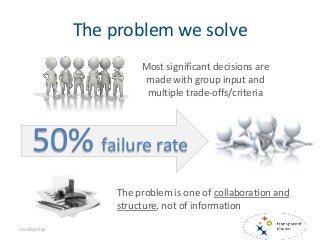
The problem we solve
The problem is one of collaboration and
structure, not of information
Confidential
50% failure rate
Most significant decisions are
made with group input and
multiple trade-offs/criteria
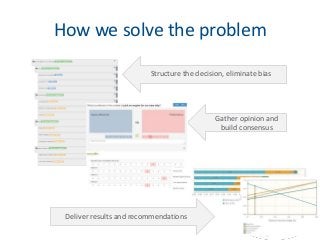
How we solve the problem
Structure the decision, eliminate bias
Gather opinion and
build consensus
Deliver results and recommendations
How Templates Help
• Provides a starting point to structure your
decision
• Shows you how other people think of this type of
decision
• Depending on the type of decision you’re making,
a template may even be “ready to go”
• Great starting point for “proof of concept”
• NOTE: You should take the time to tailor the
template to your specific requirements
Confidential
The scenario
• We are selecting the best portfolio of IT projects.
• Projects can be requested online.
• We have started with Gartner’s recommended
model for project prioritization (essentially the
top-level of the criterion hierarchy) and have then
expanded on this model as an example of how it
might be used in practice
• This model was not put together by Gartner.
Rather, it was built from publically-available
information about Gartner’s recommended
project prioritization process.
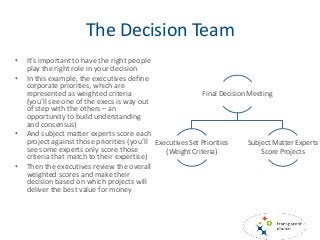
The Decision Team
• It’s important to have the right people
play the right role in your decision
• In this example, the executives define
corporate priorities, which are
represented as weighted criteria
(you’ll see one of the execs is way out
of step with the others – an
opportunity to build understanding
and consensus)
• And subject matter experts score each
project against those priorities (you’ll
see some experts only score those
criteria that match to their expertise)
• Then the executives review the overall
weighted scores and make their
decision based on which projects will
deliver the best value for money
Final Decision Meeting
Executives Set Priorities
(Weight Criteria)
Subject Matter Experts
Score Projects
Criteria
• Criteria make implicit assumptions about
priorities explicit
• They are the structure that allows us to break
down a complex decision into manageable
parts
• Criteria help build a common language and
make trade-offs visible
• Clear criteria make it difficult to “game” the
system
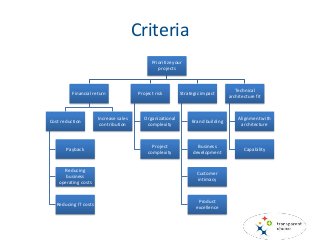
Criteria
Prioritize your
projects
Financial return
Cost reduction
Payback
Reducing
business
operating costs
Reducing IT costs
Increase sales
contribution
Project risk
Organizational
complexity
Project
complexity
Strategic impact
Brand building
Business
development
Customer
intimacy
Product
excellence
Technical
architecture fit
Alignment with
architecture
Capability
Weighting criteria
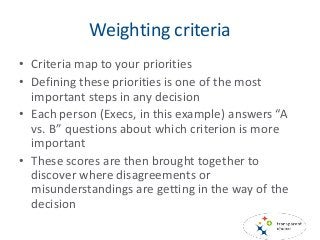
• Criteria map to your priorities
• Defining these priorities is one of the most
important steps in any decision
• Each person (Execs, in this example) answers “A
vs. B” questions about which criterion is more
important
• These scores are then brought together to
discover where disagreements or
misunderstandings are getting in the way of the
decision
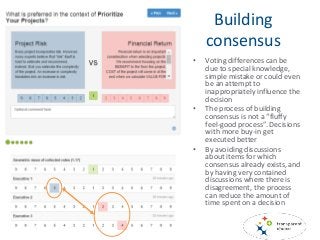
Building
consensus
• Voting differences can be
due to special knowledge,
simple mistake or could even
be an attempt to
inappropriately influence the
decision
• The process of building
consensus is not a “fluffy
feel-good process”. Decisions
with more buy-in get
executed better
• By avoiding discussions
about items for which
consensus already exists, and
by having very contained
discussions where there is
disagreement, the process
can reduce the amount of
time spent on a decision
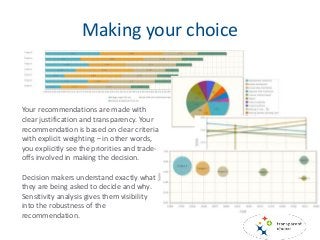
Making your choice
Your recommendations are made with
clear justification and transparency. Your
recommendation is based on clear criteria
with explicit weighting – in other words,
you explicitly see the priorities and trade-
offs involved in making the decision.
Decision makers understand exactly what
they are being asked to decide and why.
Sensitivity analysis gives them visibility
into the robustness of the
recommendation.
Download the template now!
• If you don’t have a TransparentChoice
account, head over to our website to open a
free trial account
• If you already have an account, simply click on
this link then select the workspace (folder)
into which you want to copy the template
(if you can’t open the link above, please copy and paste this link into your web browser
https://service1.transparentchoice.com/#/ticket/70e5c004-3741-4f87-9491-2eb03338f89e)
• If your trial has expired, please let us know at
contact@transparentchoice.com

Project prioritization of IT _ inspired by Gartner

  • 1.
    Template: Prioritizing ITProjects Inspired by Gartner This template is designed to give an idea of how TransparentChoice can be used to select the most efficient IT portfolio. This model is inspired by Gartner’s recommendations for picking IT projects.
  • 2.
    The problem wesolve The problem is one of collaboration and structure, not of information Confidential 50% failure rate Most significant decisions are made with group input and multiple trade-offs/criteria
  • 3.
    How we solvethe problem Structure the decision, eliminate bias Gather opinion and build consensus Deliver results and recommendations
  • 4.
    How Templates Help •Provides a starting point to structure your decision • Shows you how other people think of this type of decision • Depending on the type of decision you’re making, a template may even be “ready to go” • Great starting point for “proof of concept” • NOTE: You should take the time to tailor the template to your specific requirements Confidential
  • 5.
    The scenario • Weare selecting the best portfolio of IT projects. • Projects can be requested online. • We have started with Gartner’s recommended model for project prioritization (essentially the top-level of the criterion hierarchy) and have then expanded on this model as an example of how it might be used in practice • This model was not put together by Gartner. Rather, it was built from publically-available information about Gartner’s recommended project prioritization process.
  • 6.
    The Decision Team •It’s important to have the right people play the right role in your decision • In this example, the executives define corporate priorities, which are represented as weighted criteria (you’ll see one of the execs is way out of step with the others – an opportunity to build understanding and consensus) • And subject matter experts score each project against those priorities (you’ll see some experts only score those criteria that match to their expertise) • Then the executives review the overall weighted scores and make their decision based on which projects will deliver the best value for money Final Decision Meeting Executives Set Priorities (Weight Criteria) Subject Matter Experts Score Projects
  • 7.
    Criteria • Criteria makeimplicit assumptions about priorities explicit • They are the structure that allows us to break down a complex decision into manageable parts • Criteria help build a common language and make trade-offs visible • Clear criteria make it difficult to “game” the system
  • 8.
    Criteria Prioritize your projects Financial return Costreduction Payback Reducing business operating costs Reducing IT costs Increase sales contribution Project risk Organizational complexity Project complexity Strategic impact Brand building Business development Customer intimacy Product excellence Technical architecture fit Alignment with architecture Capability
  • 9.
    Weighting criteria • Criteriamap to your priorities • Defining these priorities is one of the most important steps in any decision • Each person (Execs, in this example) answers “A vs. B” questions about which criterion is more important • These scores are then brought together to discover where disagreements or misunderstandings are getting in the way of the decision
  • 10.
    Building consensus • Voting differencescan be due to special knowledge, simple mistake or could even be an attempt to inappropriately influence the decision • The process of building consensus is not a “fluffy feel-good process”. Decisions with more buy-in get executed better • By avoiding discussions about items for which consensus already exists, and by having very contained discussions where there is disagreement, the process can reduce the amount of time spent on a decision
  • 11.
    Making your choice Yourrecommendations are made with clear justification and transparency. Your recommendation is based on clear criteria with explicit weighting – in other words, you explicitly see the priorities and trade- offs involved in making the decision. Decision makers understand exactly what they are being asked to decide and why. Sensitivity analysis gives them visibility into the robustness of the recommendation.
  • 12.
    Download the templatenow! • If you don’t have a TransparentChoice account, head over to our website to open a free trial account • If you already have an account, simply click on this link then select the workspace (folder) into which you want to copy the template (if you can’t open the link above, please copy and paste this link into your web browser https://service1.transparentchoice.com/#/ticket/70e5c004-3741-4f87-9491-2eb03338f89e) • If your trial has expired, please let us know at contact@transparentchoice.com