ARCHITECTURAL MODEL INFERENCE
FROM CODE
FOR ROS-BASED ROBOTICS SYSTEMS
Tobias Dürschmid, Christopher S.Timperley, David Garlan, Claire Le Goues
Carnegie Mellon University
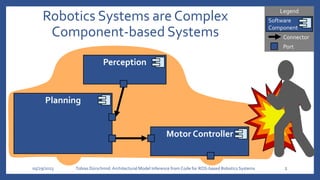
Legend
05/29/2023 Tobias Dürschmid:Architectural Model Inference from Code for ROS-based Robotics Systems
Software
Component
Connector
Planning
Perception
Motor Controller
Port
Robotics Systems are Complex
Component-based Systems
2
Legend
05/29/2023 Tobias Dürschmid:Architectural Model Inference from Code for ROS-based Robotics Systems
Software
Component
Connector
Planning
Perception
Motor Controller
Port
Some Bugs Result from Incorrect
Composition of Software Components
[ready = true]
[ready = false]
10 Hz
[ready == true]
3
component waits
indefinitely
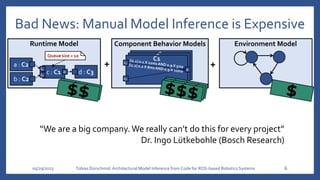
Good News: Model-BasedAnalysis can Find Bugs
05/29/2023 Tobias Dürschmid:Architectural Model Inference from Code for ROS-based Robotics Systems 4
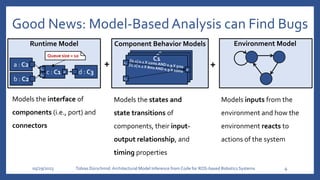
b : C2
a : C2
d : C3
c : C1
𝒊𝟏
𝒊𝟐
Runtime Model
Queue size = 10
𝒐
+ +
C3
C2
C1
𝒊𝟏
𝒊𝟐
𝒐
Component Behavior Models Environment Model
Models the interface of
components (i.e., port) and
connectors
Models the states and
state transitions of
components, their input-
output relationship, and
timing properties
Models inputs from the
environment and how the
environment reacts to
actions of the system
Good News: Model-BasedAnalysis can Find Bugs
05/29/2023 Tobias Dürschmid:Architectural Model Inference from Code for ROS-based Robotics Systems 5
Model Checking / Simulation
(large amount of existing work and tools, e.g.,TLA+, Palladio, …)
inputs
b : C2
a : C2
d : C3
c : C1
𝒊𝟏
𝒊𝟐
Runtime Model
Queue size = 10
𝒐
+ +
C3
C2
C1
𝒊𝟏
𝒊𝟐
𝒐
Component Behavior Models Environment Model
C3
C2
C1
𝒊𝟏
𝒊𝟐
𝒐
Component Behavior Models
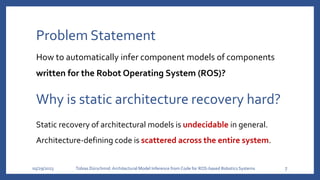
Bad News: Manual Model Inference is Expensive
05/29/2023 Tobias Dürschmid:Architectural Model Inference from Code for ROS-based Robotics Systems 6
Environment Model
b : C2
a : C2
d : C3
c : C1
𝒊𝟏
𝒊𝟐
Runtime Model
Queue size = 10
𝒐
+ +
“We are a big company.We really can’t do this for every project”
Dr. Ingo Lütkebohle (Bosch Research)
Problem Statement
05/29/2023 Tobias Dürschmid:Architectural Model Inference from Code for ROS-based Robotics Systems 7
How to automatically infer component models of components
Why is static architecture recovery hard?
Static recovery of architectural models is undecidable in general.
Architecture-defining code is scattered across the entire system.
written for the Robot Operating System (ROS)?
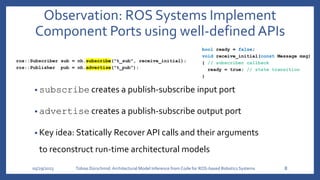
ros::Subscriber sub = nh.subscribe("t_sub", receive_initial);
ros::Publisher pub = nh.advertise("t_pub");
05/29/2023 Tobias Dürschmid:Architectural Model Inference from Code for ROS-based Robotics Systems 8
bool ready = false;
void receive_initial(const Message msg)
{ // subscriber callback
ready = true; // state transition
}
Observation: ROS Systems Implement
Component Ports using well-defined APIs
• subscribe creates a publish-subscribe input port
• advertise creates a publish-subscribe output port
• Key idea: Statically Recover API calls and their arguments
to reconstruct run-time architectural models
Our previous work ROSDiscover[1]
can Infer Run-Time Models Statically
05/29/2023 Tobias Dürschmid:Architectural Model Inference from Code for ROS-based Robotics Systems 9
Approach: Architectural recovery using static analysis of API calls +
rule checking
Tool available at GitHub: https://github.com/rosqual/rosdiscover
Results: >90% recovery of runtime architectural models
Detecting 8 of 19 of real-world bugs
[1] C. S.Timperley,T. Dürschmid, B. Schmerl, D. Garlan and C. Le Goues, "ROSDiscover: Statically
Detecting Run-TimeArchitecture Misconfigurations in Robotics Systems," ICSA 2022
Behavioral Models are Needed to Find
Many Architectural Composition Bugs
• Components waiting indefinitely for a message
• Deadlocks due to components being in incompatibles states
• Ignored inputs and message loss
• Publishing at unexpectedly high / low frequency
05/29/2023 Tobias Dürschmid:Architectural Model Inference from Code for ROS-based Robotics Systems 10
int main(int argc, char** argv)
{
ros::Subscriber sub = nh.subscribe("t_sub", receive_initial);
ros::Publisher pub = nh.advertise("t_pub");
const int local_LOOP_RATE = 10;
ros::Rate loop_rate(local_LOOP_RATE);
while (ros::ok()) // periodic loop
{
if (!ready)
{ // state condition
loop_rate.sleep();
continue;
}
pub.publish(msg); // message sending
loop_rate.sleep();
}
return 0;
}
05/29/2023 Tobias Dürschmid:Architectural Model Inference from Code for ROS-based Robotics Systems 11
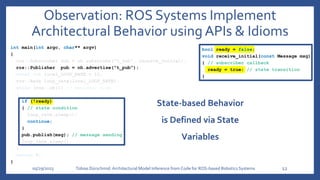
bool ready = false;
void receive_initial(const Message msg)
{ // subscriber callback
ready = true; // state transition
}
Periodic Behavior
is Defined via
Rate Objects
Observation: ROS Systems Implement
Architectural Behavior using APIs & Idioms
Planning
[ready = true]
[ready = false]
10 Hz
[ready == true]
05/29/2023 Tobias Dürschmid:Architectural Model Inference from Code for ROS-based Robotics Systems 12
int main(int argc, char** argv)
{
ros::Subscriber sub = nh.subscribe("t_sub", receive_initial);
ros::Publisher pub = nh.advertise("t_pub");
const int local_LOOP_RATE = 10;
ros::Rate loop_rate(local_LOOP_RATE);
while (ros::ok()) // periodic loop
{
if (!ready)
{ // state condition
loop_rate.sleep();
continue;
}
pub.publish(msg); // message sending
loop_rate.sleep();
}
return 0;
}
bool ready = false;
void receive_initial(const Message msg)
{ // subscriber callback
ready = true; // state transition
}
State-based Behavior
is Defined via State
Variables
Observation: ROS Systems Implement
Architectural Behavior using APIs & Idioms
Observation: ROS Systems Implement
Architectural Behavior using APIs & Idioms
05/29/2023 Tobias Dürschmid:Architectural Model Inference from Code for ROS-based Robotics Systems 13
int main(int argc, char** argv)
{
ros::Subscriber sub = nh.subscribe("t_sub", receive_initial);
ros::Publisher pub = nh.advertise("t_pub");
const int local_LOOP_RATE = 10;
ros::Rate loop_rate(local_LOOP_RATE);
while (ros::ok()) // periodic loop
{
if (!ready)
{ // state condition
loop_rate.sleep();
continue;
}
pub.publish(msg); // message sending
loop_rate.sleep();
}
return 0;
}
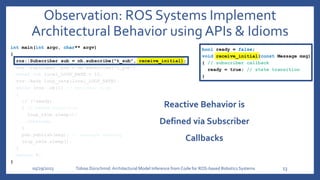
bool ready = false;
void receive_initial(const Message msg)
{ // subscriber callback
ready = true; // state transition
}
Reactive Behavior is
Defined via Subscriber
Callbacks
Case Study Evaluation on Autoware.AI
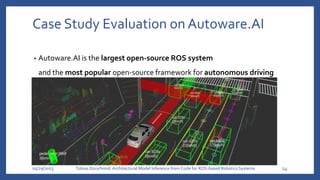
• Autoware.AI is the largest open-source ROS system
and the most popular open-source framework for autonomous driving
05/29/2023 Tobias Dürschmid:Architectural Model Inference from Code for ROS-based Robotics Systems 14
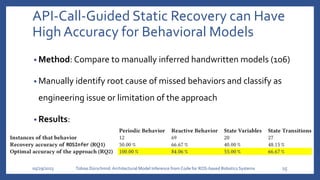
API-Call-Guided Static Recovery can Have
High Accuracy for Behavioral Models
05/29/2023 Tobias Dürschmid:Architectural Model Inference from Code for ROS-based Robotics Systems 15
• Method: Compare to manually inferred handwritten models (106)
• Manually identify root cause of missed behaviors and classify as
engineering issue or limitation of the approach
• Results:
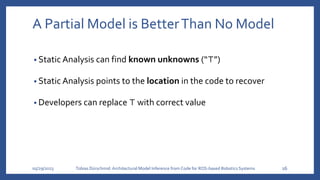
A Partial Model is BetterThan No Model
• Static Analysis can find known unknowns (“⊤”)
• Static Analysis points to the location in the code to recover
• Developers can replace ⊤ with correct value
05/29/2023 Tobias Dürschmid:Architectural Model Inference from Code for ROS-based Robotics Systems 16
State Conditions on Objects are Hard to
Infer Statically
Example of State-based Behavior ROSInfer cannot find:
lane_planner::vmap::VectorMap all_vmap;
void cache_point(const vector_map::PointArray& msg)
{
all_vmap.points = msg.data; // state change
update_values();
}
void update_values()
{
// complex state condition
if (all_vmap.points.empty() || all_vmap.lanes.empty() || all_vmap.nodes.empty())
return;
[...]
lane_planner::vmap::publish_add_marker([...]);
}
05/29/2023 Tobias Dürschmid:Architectural Model Inference from Code for ROS-based Robotics Systems 17
Summary
• Manual Model Inference is Expensive
• Assumptions about framework-specific APIs and idioms enable the
automatic inference of behavioral & structural component models for
ROS-based Robotics systems
• This work makes model-based analyses more accessible and practical
05/29/2023 Tobias Dürschmid:Architectural Model Inference from Code for ROS-based Robotics Systems 18
Planning
[ready = true]
[ready = false]
10 Hz
[ready == true]
Discussion Questions
• What other analyses are needed?
• What properties are important for roboticists?
• Do you use model-based analysis?
• If not:Why not?
• If so: How do you use it?
05/29/2023 Tobias Dürschmid:Architectural Model Inference from Code for ROS-based Robotics Systems 19
Lessons Learned
• Many components are designed to process input streams and publish processed
outputs like a pipes and filters architecture. These components are stateless and
usually produce a single output for each input that they receive.
• Components that maintain states are often components that start to publish
periodically after receiving a set of input messages that are used to initialize the
component
• Only a few components implement a complex state machine. Most explicit or implicit
state variables are booleans and only few components have more than three state
variables.
• While the state machines that model the behavior of the component might be less
complex, developers sometimes use more complex language features to express
them than would be necessary.This makes the code more extensible and easier to read
by human developers, but harder to analyze using static analysis.
05/29/2023 Tobias Dürschmid:Architectural Model Inference from Code for ROS-based Robotics Systems 20

Architectural Model Inference From Code For ROS-Based Robotics Systems

  • 1.
    ARCHITECTURAL MODEL INFERENCE FROMCODE FOR ROS-BASED ROBOTICS SYSTEMS Tobias Dürschmid, Christopher S.Timperley, David Garlan, Claire Le Goues Carnegie Mellon University
  • 2.
    Legend 05/29/2023 Tobias Dürschmid:ArchitecturalModel Inference from Code for ROS-based Robotics Systems Software Component Connector Planning Perception Motor Controller Port Robotics Systems are Complex Component-based Systems 2
  • 3.
    Legend 05/29/2023 Tobias Dürschmid:ArchitecturalModel Inference from Code for ROS-based Robotics Systems Software Component Connector Planning Perception Motor Controller Port Some Bugs Result from Incorrect Composition of Software Components [ready = true] [ready = false] 10 Hz [ready == true] 3 component waits indefinitely
  • 4.
    Good News: Model-BasedAnalysiscan Find Bugs 05/29/2023 Tobias Dürschmid:Architectural Model Inference from Code for ROS-based Robotics Systems 4 b : C2 a : C2 d : C3 c : C1 𝒊𝟏 𝒊𝟐 Runtime Model Queue size = 10 𝒐 + + C3 C2 C1 𝒊𝟏 𝒊𝟐 𝒐 Component Behavior Models Environment Model Models the interface of components (i.e., port) and connectors Models the states and state transitions of components, their input- output relationship, and timing properties Models inputs from the environment and how the environment reacts to actions of the system
  • 5.
    Good News: Model-BasedAnalysiscan Find Bugs 05/29/2023 Tobias Dürschmid:Architectural Model Inference from Code for ROS-based Robotics Systems 5 Model Checking / Simulation (large amount of existing work and tools, e.g.,TLA+, Palladio, …) inputs b : C2 a : C2 d : C3 c : C1 𝒊𝟏 𝒊𝟐 Runtime Model Queue size = 10 𝒐 + + C3 C2 C1 𝒊𝟏 𝒊𝟐 𝒐 Component Behavior Models Environment Model
  • 6.
    C3 C2 C1 𝒊𝟏 𝒊𝟐 𝒐 Component Behavior Models BadNews: Manual Model Inference is Expensive 05/29/2023 Tobias Dürschmid:Architectural Model Inference from Code for ROS-based Robotics Systems 6 Environment Model b : C2 a : C2 d : C3 c : C1 𝒊𝟏 𝒊𝟐 Runtime Model Queue size = 10 𝒐 + + “We are a big company.We really can’t do this for every project” Dr. Ingo Lütkebohle (Bosch Research)
  • 7.
    Problem Statement 05/29/2023 TobiasDürschmid:Architectural Model Inference from Code for ROS-based Robotics Systems 7 How to automatically infer component models of components Why is static architecture recovery hard? Static recovery of architectural models is undecidable in general. Architecture-defining code is scattered across the entire system. written for the Robot Operating System (ROS)?
  • 8.
    ros::Subscriber sub =nh.subscribe("t_sub", receive_initial); ros::Publisher pub = nh.advertise("t_pub"); 05/29/2023 Tobias Dürschmid:Architectural Model Inference from Code for ROS-based Robotics Systems 8 bool ready = false; void receive_initial(const Message msg) { // subscriber callback ready = true; // state transition } Observation: ROS Systems Implement Component Ports using well-defined APIs • subscribe creates a publish-subscribe input port • advertise creates a publish-subscribe output port • Key idea: Statically Recover API calls and their arguments to reconstruct run-time architectural models
  • 9.
    Our previous workROSDiscover[1] can Infer Run-Time Models Statically 05/29/2023 Tobias Dürschmid:Architectural Model Inference from Code for ROS-based Robotics Systems 9 Approach: Architectural recovery using static analysis of API calls + rule checking Tool available at GitHub: https://github.com/rosqual/rosdiscover Results: >90% recovery of runtime architectural models Detecting 8 of 19 of real-world bugs [1] C. S.Timperley,T. Dürschmid, B. Schmerl, D. Garlan and C. Le Goues, "ROSDiscover: Statically Detecting Run-TimeArchitecture Misconfigurations in Robotics Systems," ICSA 2022
  • 10.
    Behavioral Models areNeeded to Find Many Architectural Composition Bugs • Components waiting indefinitely for a message • Deadlocks due to components being in incompatibles states • Ignored inputs and message loss • Publishing at unexpectedly high / low frequency 05/29/2023 Tobias Dürschmid:Architectural Model Inference from Code for ROS-based Robotics Systems 10
  • 11.
    int main(int argc,char** argv) { ros::Subscriber sub = nh.subscribe("t_sub", receive_initial); ros::Publisher pub = nh.advertise("t_pub"); const int local_LOOP_RATE = 10; ros::Rate loop_rate(local_LOOP_RATE); while (ros::ok()) // periodic loop { if (!ready) { // state condition loop_rate.sleep(); continue; } pub.publish(msg); // message sending loop_rate.sleep(); } return 0; } 05/29/2023 Tobias Dürschmid:Architectural Model Inference from Code for ROS-based Robotics Systems 11 bool ready = false; void receive_initial(const Message msg) { // subscriber callback ready = true; // state transition } Periodic Behavior is Defined via Rate Objects Observation: ROS Systems Implement Architectural Behavior using APIs & Idioms Planning [ready = true] [ready = false] 10 Hz [ready == true]
  • 12.
    05/29/2023 Tobias Dürschmid:ArchitecturalModel Inference from Code for ROS-based Robotics Systems 12 int main(int argc, char** argv) { ros::Subscriber sub = nh.subscribe("t_sub", receive_initial); ros::Publisher pub = nh.advertise("t_pub"); const int local_LOOP_RATE = 10; ros::Rate loop_rate(local_LOOP_RATE); while (ros::ok()) // periodic loop { if (!ready) { // state condition loop_rate.sleep(); continue; } pub.publish(msg); // message sending loop_rate.sleep(); } return 0; } bool ready = false; void receive_initial(const Message msg) { // subscriber callback ready = true; // state transition } State-based Behavior is Defined via State Variables Observation: ROS Systems Implement Architectural Behavior using APIs & Idioms
  • 13.
    Observation: ROS SystemsImplement Architectural Behavior using APIs & Idioms 05/29/2023 Tobias Dürschmid:Architectural Model Inference from Code for ROS-based Robotics Systems 13 int main(int argc, char** argv) { ros::Subscriber sub = nh.subscribe("t_sub", receive_initial); ros::Publisher pub = nh.advertise("t_pub"); const int local_LOOP_RATE = 10; ros::Rate loop_rate(local_LOOP_RATE); while (ros::ok()) // periodic loop { if (!ready) { // state condition loop_rate.sleep(); continue; } pub.publish(msg); // message sending loop_rate.sleep(); } return 0; } bool ready = false; void receive_initial(const Message msg) { // subscriber callback ready = true; // state transition } Reactive Behavior is Defined via Subscriber Callbacks
  • 14.
    Case Study Evaluationon Autoware.AI • Autoware.AI is the largest open-source ROS system and the most popular open-source framework for autonomous driving 05/29/2023 Tobias Dürschmid:Architectural Model Inference from Code for ROS-based Robotics Systems 14
  • 15.
    API-Call-Guided Static Recoverycan Have High Accuracy for Behavioral Models 05/29/2023 Tobias Dürschmid:Architectural Model Inference from Code for ROS-based Robotics Systems 15 • Method: Compare to manually inferred handwritten models (106) • Manually identify root cause of missed behaviors and classify as engineering issue or limitation of the approach • Results:
  • 16.
    A Partial Modelis BetterThan No Model • Static Analysis can find known unknowns (“⊤”) • Static Analysis points to the location in the code to recover • Developers can replace ⊤ with correct value 05/29/2023 Tobias Dürschmid:Architectural Model Inference from Code for ROS-based Robotics Systems 16
  • 17.
    State Conditions onObjects are Hard to Infer Statically Example of State-based Behavior ROSInfer cannot find: lane_planner::vmap::VectorMap all_vmap; void cache_point(const vector_map::PointArray& msg) { all_vmap.points = msg.data; // state change update_values(); } void update_values() { // complex state condition if (all_vmap.points.empty() || all_vmap.lanes.empty() || all_vmap.nodes.empty()) return; [...] lane_planner::vmap::publish_add_marker([...]); } 05/29/2023 Tobias Dürschmid:Architectural Model Inference from Code for ROS-based Robotics Systems 17
  • 18.
    Summary • Manual ModelInference is Expensive • Assumptions about framework-specific APIs and idioms enable the automatic inference of behavioral & structural component models for ROS-based Robotics systems • This work makes model-based analyses more accessible and practical 05/29/2023 Tobias Dürschmid:Architectural Model Inference from Code for ROS-based Robotics Systems 18 Planning [ready = true] [ready = false] 10 Hz [ready == true]
  • 19.
    Discussion Questions • Whatother analyses are needed? • What properties are important for roboticists? • Do you use model-based analysis? • If not:Why not? • If so: How do you use it? 05/29/2023 Tobias Dürschmid:Architectural Model Inference from Code for ROS-based Robotics Systems 19
  • 20.
    Lessons Learned • Manycomponents are designed to process input streams and publish processed outputs like a pipes and filters architecture. These components are stateless and usually produce a single output for each input that they receive. • Components that maintain states are often components that start to publish periodically after receiving a set of input messages that are used to initialize the component • Only a few components implement a complex state machine. Most explicit or implicit state variables are booleans and only few components have more than three state variables. • While the state machines that model the behavior of the component might be less complex, developers sometimes use more complex language features to express them than would be necessary.This makes the code more extensible and easier to read by human developers, but harder to analyze using static analysis. 05/29/2023 Tobias Dürschmid:Architectural Model Inference from Code for ROS-based Robotics Systems 20

Editor's Notes

  • #4 Other kinds of bugs: deadlocks due to components being in incompatibles states, ignoring inputs, messages lost, wrong frequency Not a real bug Too much detail too early State change and initial state is confusing
  • #7 Dynamic approaches: Perfume, DiscoTect Env model doesn’t really have good access to ground truth Dr. Ingo Lütkebohle (Bosch Research): “We are a big company. We really can’t do this for every project”
  • #8 This problem is hard because: relationship between two unrelated ports
  • #10 Cut rosdiscover, add more on analyses
  • #14 Motivate periodic, reactive, and state=based behaviors More obviously grayed out Talk about this after state-based Move the component model to periodic
  • #15 Rq2 or claims on this slide
  • #16 Limitations of the approach are Shorten Eval and talk about ongoing work
  • #19 Croweded Increase adoption of model-based analysis
  • #23 Bugs in robotics systems such as autonomous cars, drones, or machines, can threated human life. Ensuring the safety of their behavior is critical to society9.1 crashes per million miles traveled
  • #25 Discuss the trade-off of implementing the analysis (pareto)