The key to your virtual team working
is the ability to communicate. Email is
the minimum you should provide
here. Consider using video and
instant messaging services such as
Microsoft’s Lync platform.
1. Make communication easier
Business is changing, it is no longer
necessary to have your team based
in the same office, or even based in
your office at all. The use of virtual
teams and employees is growing,
are you equipped to manage yours?
55% to 73% of virtual team leaders
feel that decision making is too slow
Between 49% and 52% of virtual
workers surveyed feel that time
differences impact the team's success
Data source - http://www.targettraining.eu/elvis-statistics-virtual-teams/
15%-28% of team members feel
that a lack of awareness
regarding other team members’
workloads is a recurring problem
Somewhere between
51% – 79% of virtual
team members feel that
the lack of personal
relationships within the
team cause problems
Not knowing how to
effectively use the
technology available
is an issue for at least
1 in 5 virtual teams
5 Tips For Managing
Your Virtual Team
66% of multinational
companies make
extensive use of
virtual teams
2. Open up data access
We rely on data daily, no
matter what role we carry
out. Make sure that you
open up access of key data
to your virtual team so that
they can carry out their
roles easily and efficiently.
3. ‘Meet’ regularly
One of the risks with virtual teams is that
they won’t feel connected to each other, or
to your organisation. Ensure that regular
video/audio, and if possible fact to face,
meetings are scheduled.
No matter which department
you work in, there will be an
element of project
management needed to ensure
that the expected activity and
output from the department is
on track. Utilising Cloud based
project management tools,
such as basecamp, can ensure
that things run smoothly.
5. Utilise Cloud based
project management tools
4. Include them in company news
Make sure that your virtual team are
included in any company news, even if
they are not full time or permanent
employees.

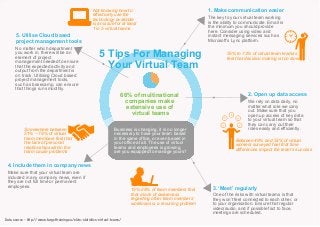
Infographic - 5 Tips For Managing Your Virtual Team

  • 1.
    The key toyour virtual team working is the ability to communicate. Email is the minimum you should provide here. Consider using video and instant messaging services such as Microsoft’s Lync platform. 1. Make communication easier Business is changing, it is no longer necessary to have your team based in the same office, or even based in your office at all. The use of virtual teams and employees is growing, are you equipped to manage yours? 55% to 73% of virtual team leaders feel that decision making is too slow Between 49% and 52% of virtual workers surveyed feel that time differences impact the team's success Data source - http://www.targettraining.eu/elvis-statistics-virtual-teams/ 15%-28% of team members feel that a lack of awareness regarding other team members’ workloads is a recurring problem Somewhere between 51% – 79% of virtual team members feel that the lack of personal relationships within the team cause problems Not knowing how to effectively use the technology available is an issue for at least 1 in 5 virtual teams 5 Tips For Managing Your Virtual Team 66% of multinational companies make extensive use of virtual teams 2. Open up data access We rely on data daily, no matter what role we carry out. Make sure that you open up access of key data to your virtual team so that they can carry out their roles easily and efficiently. 3. ‘Meet’ regularly One of the risks with virtual teams is that they won’t feel connected to each other, or to your organisation. Ensure that regular video/audio, and if possible fact to face, meetings are scheduled. No matter which department you work in, there will be an element of project management needed to ensure that the expected activity and output from the department is on track. Utilising Cloud based project management tools, such as basecamp, can ensure that things run smoothly. 5. Utilise Cloud based project management tools 4. Include them in company news Make sure that your virtual team are included in any company news, even if they are not full time or permanent employees.