NI4OS-Europe
National Initiatives for Open Science in Europe
EOSC-Hub Week 2019, Prague
Dr. Anastas Misev (UKIM), Dr. Ognjen Prnjat (GRNET), on
behalf of NI4OS-Europe consortium
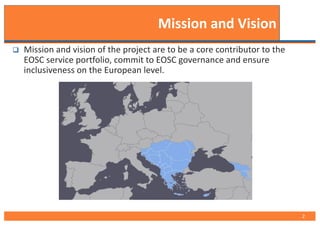
q Mission and vision of the project are to be a core contributor to the
EOSC service portfolio, commit to EOSC governance and ensure
inclusiveness on the European level.
Mission and Vision
2
Partnership
3
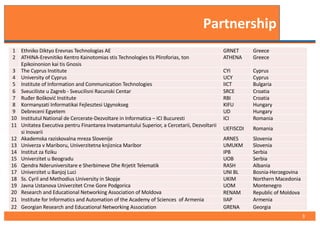
1 Ethniko Diktyo Erevnas Technologias AE GRNET Greece
2 ATHINA-Erevnitiko Kentro Kainotomias stis Technologies tis Pliroforias, ton
Epikoinonion kai tis Gnosis
ATHENA Greece
3 The Cyprus Institute CYI Cyprus
4 University of Cyprus UCY Cyprus
5 Institute of Information and Communication Technologies IICT Bulgaria
6 Sveuciliste u Zagreb - Sveucilisni Racunski Centar SRCE Croatia
7 Ruđer Bošković Institute RBI Croatia
8 Kormanyzati Informatikai Fejlesztesi Ugynokseg KIFU Hungary
9 Debreceni Egyetem UD Hungary
10 Institutul National de Cercerate-Dezvoltare in Informatica – ICI Bucuresti ICI Romania
11 Unitatea Executiva pentru Finantarea Invatamantului Superior, a Cercetarii, Dezvoltarii
si Inovarii
UEFISCDI Romania
12 Akademska raziskovalna mreza Slovenije ARNES Slovenia
13 Univerza v Mariboru, Univerzitetna knjiznica Maribor UMUKM Slovenia
14 Institut za fiziku IPB Serbia
15 Univerzitet u Beogradu UOB Serbia
16 Qendra Nderuniversitare e Sherbimeve Dhe Rrjetit Telematik RASH Albania
17 Univerzitet u Banjoj Luci UNI BL Bosnia-Herzegovina
18 Ss. Cyril and Methodius University in Skopje UKIM Northern Macedonia
19 Javna Ustanova Univerzitet Crne Gore Podgorica UOM Montenegro
20 Research and Educational Networking Association of Moldova RENAM Republic of Moldova
21 Institute for Informatics and Automation of the Academy of Sciences of Armenia IIAP Armenia
22 Georgian Research and Educational Networking Association GRENA Georgia
Overall objective
q The overall objective of the project is to support the development and
inclusion of the national Open Science Cloud initiatives in 15 Member
States and Associated Countries in the overall scheme of EOSC
governance; spread the EOSC and FAIR principles in the community and
train it; and provide technical and policy support in on-boarding of the
existing and future service providers into EOSC, including generic
services (compute, data storage, data management), thematic (domain-
specific) services, repositories and data sets – thus introducing new
services that cover the whole spectrum of services related to Open
Science, data and publications
4
O1: building national OSC initiatives
q Support EOSC governance framework by building national Open
Science Cloud (OSC) initiatives for open research data, infrastructure
and services and enabling them to support the overall EOSC governance
and the related EOSC coordination structure
q Perform a stakeholder analysis / survey
q Map the existing landscape at the national level
q Set up national OSC initiatives
q Collaboration areas:
q Align the surveys, same model for stakeholder analysis (with 5a and 5b projects)
q Align national OSC initiative models (with 5a and 5b projects) (taking into account
NRENs, NGIs, national HPC initiatives, NOADs, RDA nodes, etc.)
5
O2: Federation and on-boarding
preparation
q Facilitate the federation of existing infrastructures and state-of-the-art
services and their on-boarding to EOSC
q Operational best practices enabling the on-boarding and federation of generic and
thematic services and their connection to EOSC
q Support the national tools for federated management to be compatible with EOSC
core corresponding services
q Support harmonization of service templates
q Provide a pre-production environment for testing and validation
q Collaboration areas:
q Align operational best practices and service templates (with other 5b projects,
EOSC-Hub and eInfraCentral)
q Important to allow different levels of integration / on-boarding
6
O3: On-boarding
q Enable the EOSC-relevant, non-commercial services to be accessed
through the EOSC portal
q Provide technical support to service providers, ensuring interoperability between
national and EOSC services, for their federation and integration into EOSC
q Provide support to the integration of national repositories securing the FAIRness of
their practices
q Deliver an integrated platform, consisting of the on-boarded resources from the
region, which will be available as proof-of-concept for testing and fine-tuning with
user communities
q Collaboration areas:
q On-boarding approaches (with other 5b projects, EOSC-Hub and eInfraCentral)
q FAIRness of repositories (FAIRsFAIR, other 5b projects)
7
O4: ORDM practices
q Technical, organizational and legal guidelines, tools, mechanisms and
certification schemes, to support Open Research Data Management and
its implementation in a harmonised and coordinated fashion
q Produce specific guidelines for ORDM
q Define and adapt FAIR guidelines in the local context and ensure the FAIRness of
repositories in a standardised and interoperable fashion
q Develop and adapt easy-to-use technical and legal tools: DMP management, FAIR
assessors, licence calculators, decision trees, provision of identifiers
q Establish reliable certification schemes for open research data and service
management of data repositories, compliant with GDPR, ethics and IPR rules and
policies
q Collaboration areas:
q FAIR guidelines, certification schemes, ORDM guidelines (FAIRsFAIR, other 5b
projects)
8
O5: Community engagement
q Ensure the engagement of the targeted communities and validate the
project solutions.
q Run selected cross-country inter-disciplinary demonstrators with selected real user
communities and research infrastructures
q Provide full-blown training programme for prospective providers and users in the
area to ensure take-up of core EOSC services/functions in the community
q Provide capacity building trainings on service management, federation,
interoperability, FAIR, certification, and technical/organizational/legal aspects of
ORDM
q Promote the uptake of EOSC guidelines and FAIR principles across the widest
possible community
q Collaboration areas:
q Harmonization of training material (all other projects), FAIR uptake (5b projects,
FAIRsFAIR)
9
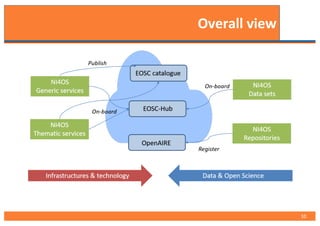
Overall view
10
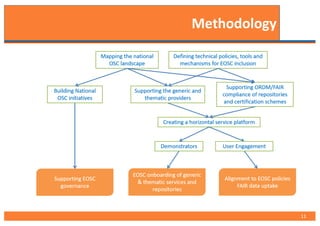
Methodology
11
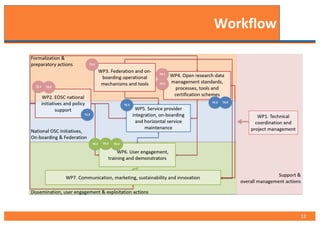
Workflow
12
Candidate services: generic, thematic,
repositories and data sets
q Generic cloud IaaS/VMs
q Generic storage services
q Data Management services (Archival, Repository, Data discovery, Hadoop
on-demand, Data analysis service, Simple storage)
q HPC on-boarding approaches to be investigated
q 15 instances in total from a large sample
q Thematic: mature, pilot, in_development
q Areas: Life Sciences, Digital Cultural Heritage, Climate
q 20 instances in total, from a sample of 70 candidates
q Repositories: 15 to be FAIRed: (from a sample of 21 national, 17
institutional, 2 digital libraries, 3 registries, 2 OERs; 32 Generic, 14 Thematic)
13
Conclusion: collaboration areas
q Align the surveys, same model for stakeholder analysis
q Align national OSC initiative models (taking into account NRENs, NGIs,
national HPC initiatives, NOADs, RDA nodes, etc.)
q Align operational best practices and service templates
q Important to allow different levels of integration / on-boarding
q On-boarding approaches (what is on-boarded, where and how?)
q FAIR guidelines, certification schemes, ORDM guidelines
q FAIR uptake approaches and incentives
q Harmonization of training material
q These points could be a baseline for collaboration agreements
14

NI4OS-Europe

  • 1.
    NI4OS-Europe National Initiatives forOpen Science in Europe EOSC-Hub Week 2019, Prague Dr. Anastas Misev (UKIM), Dr. Ognjen Prnjat (GRNET), on behalf of NI4OS-Europe consortium
  • 2.
    q Mission andvision of the project are to be a core contributor to the EOSC service portfolio, commit to EOSC governance and ensure inclusiveness on the European level. Mission and Vision 2
  • 3.
    Partnership 3 1 Ethniko DiktyoErevnas Technologias AE GRNET Greece 2 ATHINA-Erevnitiko Kentro Kainotomias stis Technologies tis Pliroforias, ton Epikoinonion kai tis Gnosis ATHENA Greece 3 The Cyprus Institute CYI Cyprus 4 University of Cyprus UCY Cyprus 5 Institute of Information and Communication Technologies IICT Bulgaria 6 Sveuciliste u Zagreb - Sveucilisni Racunski Centar SRCE Croatia 7 Ruđer Bošković Institute RBI Croatia 8 Kormanyzati Informatikai Fejlesztesi Ugynokseg KIFU Hungary 9 Debreceni Egyetem UD Hungary 10 Institutul National de Cercerate-Dezvoltare in Informatica – ICI Bucuresti ICI Romania 11 Unitatea Executiva pentru Finantarea Invatamantului Superior, a Cercetarii, Dezvoltarii si Inovarii UEFISCDI Romania 12 Akademska raziskovalna mreza Slovenije ARNES Slovenia 13 Univerza v Mariboru, Univerzitetna knjiznica Maribor UMUKM Slovenia 14 Institut za fiziku IPB Serbia 15 Univerzitet u Beogradu UOB Serbia 16 Qendra Nderuniversitare e Sherbimeve Dhe Rrjetit Telematik RASH Albania 17 Univerzitet u Banjoj Luci UNI BL Bosnia-Herzegovina 18 Ss. Cyril and Methodius University in Skopje UKIM Northern Macedonia 19 Javna Ustanova Univerzitet Crne Gore Podgorica UOM Montenegro 20 Research and Educational Networking Association of Moldova RENAM Republic of Moldova 21 Institute for Informatics and Automation of the Academy of Sciences of Armenia IIAP Armenia 22 Georgian Research and Educational Networking Association GRENA Georgia
  • 4.
    Overall objective q Theoverall objective of the project is to support the development and inclusion of the national Open Science Cloud initiatives in 15 Member States and Associated Countries in the overall scheme of EOSC governance; spread the EOSC and FAIR principles in the community and train it; and provide technical and policy support in on-boarding of the existing and future service providers into EOSC, including generic services (compute, data storage, data management), thematic (domain- specific) services, repositories and data sets – thus introducing new services that cover the whole spectrum of services related to Open Science, data and publications 4
  • 5.
    O1: building nationalOSC initiatives q Support EOSC governance framework by building national Open Science Cloud (OSC) initiatives for open research data, infrastructure and services and enabling them to support the overall EOSC governance and the related EOSC coordination structure q Perform a stakeholder analysis / survey q Map the existing landscape at the national level q Set up national OSC initiatives q Collaboration areas: q Align the surveys, same model for stakeholder analysis (with 5a and 5b projects) q Align national OSC initiative models (with 5a and 5b projects) (taking into account NRENs, NGIs, national HPC initiatives, NOADs, RDA nodes, etc.) 5
  • 6.
    O2: Federation andon-boarding preparation q Facilitate the federation of existing infrastructures and state-of-the-art services and their on-boarding to EOSC q Operational best practices enabling the on-boarding and federation of generic and thematic services and their connection to EOSC q Support the national tools for federated management to be compatible with EOSC core corresponding services q Support harmonization of service templates q Provide a pre-production environment for testing and validation q Collaboration areas: q Align operational best practices and service templates (with other 5b projects, EOSC-Hub and eInfraCentral) q Important to allow different levels of integration / on-boarding 6
  • 7.
    O3: On-boarding q Enablethe EOSC-relevant, non-commercial services to be accessed through the EOSC portal q Provide technical support to service providers, ensuring interoperability between national and EOSC services, for their federation and integration into EOSC q Provide support to the integration of national repositories securing the FAIRness of their practices q Deliver an integrated platform, consisting of the on-boarded resources from the region, which will be available as proof-of-concept for testing and fine-tuning with user communities q Collaboration areas: q On-boarding approaches (with other 5b projects, EOSC-Hub and eInfraCentral) q FAIRness of repositories (FAIRsFAIR, other 5b projects) 7
  • 8.
    O4: ORDM practices qTechnical, organizational and legal guidelines, tools, mechanisms and certification schemes, to support Open Research Data Management and its implementation in a harmonised and coordinated fashion q Produce specific guidelines for ORDM q Define and adapt FAIR guidelines in the local context and ensure the FAIRness of repositories in a standardised and interoperable fashion q Develop and adapt easy-to-use technical and legal tools: DMP management, FAIR assessors, licence calculators, decision trees, provision of identifiers q Establish reliable certification schemes for open research data and service management of data repositories, compliant with GDPR, ethics and IPR rules and policies q Collaboration areas: q FAIR guidelines, certification schemes, ORDM guidelines (FAIRsFAIR, other 5b projects) 8
  • 9.
    O5: Community engagement qEnsure the engagement of the targeted communities and validate the project solutions. q Run selected cross-country inter-disciplinary demonstrators with selected real user communities and research infrastructures q Provide full-blown training programme for prospective providers and users in the area to ensure take-up of core EOSC services/functions in the community q Provide capacity building trainings on service management, federation, interoperability, FAIR, certification, and technical/organizational/legal aspects of ORDM q Promote the uptake of EOSC guidelines and FAIR principles across the widest possible community q Collaboration areas: q Harmonization of training material (all other projects), FAIR uptake (5b projects, FAIRsFAIR) 9
  • 10.
  • 11.
  • 12.
  • 13.
    Candidate services: generic,thematic, repositories and data sets q Generic cloud IaaS/VMs q Generic storage services q Data Management services (Archival, Repository, Data discovery, Hadoop on-demand, Data analysis service, Simple storage) q HPC on-boarding approaches to be investigated q 15 instances in total from a large sample q Thematic: mature, pilot, in_development q Areas: Life Sciences, Digital Cultural Heritage, Climate q 20 instances in total, from a sample of 70 candidates q Repositories: 15 to be FAIRed: (from a sample of 21 national, 17 institutional, 2 digital libraries, 3 registries, 2 OERs; 32 Generic, 14 Thematic) 13
  • 14.
    Conclusion: collaboration areas qAlign the surveys, same model for stakeholder analysis q Align national OSC initiative models (taking into account NRENs, NGIs, national HPC initiatives, NOADs, RDA nodes, etc.) q Align operational best practices and service templates q Important to allow different levels of integration / on-boarding q On-boarding approaches (what is on-boarded, where and how?) q FAIR guidelines, certification schemes, ORDM guidelines q FAIR uptake approaches and incentives q Harmonization of training material q These points could be a baseline for collaboration agreements 14