Sustainability Report
2016
TIM
SUSTAINABILITY REPORT 2016
CHAIRMAN’S LETTER
I
Chairman’s Letter
TIM
SUSTAINABILITY REPORT 2016
CHAIRMAN’S LETTER
II [G4-1]
According to a rather popular saying:
“There are two ways to deal with change:
suffer it or embrace it”.
While encouraging people and companies to challenge themselves by pursuing innovation is
always a good thing, this motto may convey the idea that change is a kind of tidal wave that
will overwhelm everything in its path.
Change is not something that needs to be remedied, it isn’t a misfortune. Change is the
natural state of things, it has been happening constantly, relentlessly, since the beginning of
time. The best thing we can do is intercept and understand that change, so we can cultivate
it and ensure it continues to bear fruit, taking a new path towards sustainable economic
growth, one that will keep us at the centre of the new innovation economy, which is a source
of continuous improvement.
The Global Compact and the UN Sustainable Development Goals, to which we have long
been committed, can only make complete sense if viewed from this perspective. These are
not undertakings that responsible companies decide to give temporarily, but a new way
of doing business where, in the new market economy, everything is interconnected and
interdependent.
The principles of human, social and
environmental sustainability require that
profit is achieved with respect for the
interests of the various stakeholders.
TIM
SUSTAINABILITY REPORT 2016
CHAIRMAN’S LETTER
III[G4-1]
It has always been true that to make a profit we need to do something useful. Our Corporate
Shared Value system sets out to produce a certified measurement of our commitment. This
year it amounts to around 14 billion euros, including both the business and social value of our
domestic activities.
TIM’s existence and operations are again shown to be essential and supportive, responding
to the emergencies which hit the country in 2016. In emergency situations, ensuring
communication is fundamental: our relationship with the Civil Protection Department has
always been extremely close. We were on the front line of installing new lines, boosting
mobile signals, providing free Wi-Fi in the main emergency shelter sites and LTE coverage
in disaster areas, as well as boosting services in the various local coordination centres. TIM
also made available its “With You We Do” crowdfunding platform for the “Un aiuto subito”
initiative, which helped to increase fund raising for the people affected by the earthquake.
Internally, we launched a significant organisational simplification process, with renewed
attention paid to our customers, so we can continue looking to the future, without fear,
tackling the fourth industrial revolution with enthusiasm and optimism. An optimism that
stems from confidence in ourselves, our values, our abilities and our energies. Because they
are values, abilities and energies that exist in the communities we inhabit, of which we are
part, and for which we feel responsible. Every day with a little more awareness.
Every day with a little more desire to keep
growing and building the best of all possible
worlds together.
Giuseppe Recchi
TIM
SUSTAINABILITY REPORT 2016
IV
SUSTAINABLE DEVELOPMENT GOALS AND
THE MATERIAL ISSUES OF TIM
On 25 September 2015, in New York, the government leaders of the 193 UN Member States
approved the “Transforming our world: the 2030 Agenda for Sustainable Development”
resolution, a policy document that identifies 17 global objectives (Sustainable Development
Goals), broken down into 169 detailed targets to be achieved by 2030.
The Sustainable Development Goals (SDGs)
represent common objectives in key areas to ensure
the sustainable development of the planet, such
as ending hunger and poverty, the protection and
conservation of water resources, the production of
clean energy, raising awareness about responsible
and conscious consumption, promoting access to
healthcare and education, and reducing economic
and gender inequality.
“Commonobjectives”meansthatallthecountriesandallindividualsarecalledontocontribute,
joining forces with a view to collaboration and partnership. Companies are therefore asked to
play an active role; with their resources and skills they can have a fundamental impact on the
achievement of the global objectives.
The 2030 Agenda for sustainable development recognizes that “the dissemination of
information and communication technologies and global interconnections have great
potential to speed up the progress, to overcome the ‘digital divide’ and to develop a knowledge
society.” This is what emerged from the “#SystemTransformation” study published in 2016 by
Global e-Sustainability Initiative (GeSI) in partnership with Accenture.
The analysis revealed that at global level all the countries have significant gaps in the
achievement of the SDGs and the progress obtained with the current business models will
not allow the world to achieve them in the 15 years envisaged. Urgent changes are required,
with exponential development rates and people-centred development.
This is why the ICT sector and digital solutions are critical: the rate of the dissemination and
penetration of digital solutions is up to 23 times faster than traditional approaches.
The research has in fact shown that digital solutions can have a measurable positive impact,
both directly and indirectly, in all three dimensions of the development covered by the SDGs,
among which there is strong correlation: improve people’s quality of life, promote equitable
growth and protect the environment.
TIM
SUSTAINABILITY REPORT 2016
V
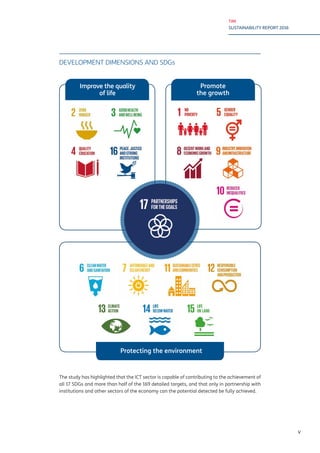
DEVELOPMENT DIMENSIONS AND SDGs
Protecting the environment
The study has highlighted that the ICT sector is capable of contributing to the achievement of
all 17 SDGs and more than half of the 169 detailed targets, and that only in partnership with
institutions and other sectors of the economy can the potential detected be fully achieved.
Improve the quality
of life
Promote
the growth
TIM
SUSTAINABILITY REPORT 2016
VI
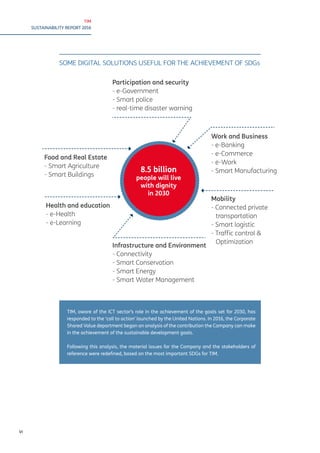
SOME DIGITAL SOLUTIONS USEFUL FOR THE ACHIEVEMENT OF SDGs
TIM, aware of the ICT sector’s role in the achievement of the goals set for 2030, has
responded to the ‘call to action’ launched by the United Nations. In 2016, the Corporate
Shared Value department began an analysis of the contribution the Company can make
in the achievement of the sustainable development goals.
Following this analysis, the material issues for the Company and the stakeholders of
reference were redefined, based on the most important SDGs for TIM.
8.5 billion
people will live
with dignity
in 2030
Participation and security
- e-Government
- Smart police
- real-time disaster warning
Food and Real Estate
- Smart Agriculture
- Smart Buildings
Health and education
- e-Health
- e-Learning
Infrastructure and Environment
- Connectivity
- Smart Conservation
- Smart Energy
- Smart Water Management
Mobility
- Connected private
transportation
- Smart logistic
- Traffic control &
Optimization
Work and Business
- e-Banking
- e-Commerce
- e-Work
- Smart Manufacturing
TIM
SUSTAINABILITY REPORT 2016
VII
As a result, the Group’s materiality matrix, in addition to highlighting TIM’s priority areas of
commitment, also reflects the SDGs to which the Company believes it can make the biggest
contribution.
Specifically, the important Goals for TIM are:
n.4: Education and quality
n.5: Gender equality
n.8: Decent work and economic growth
n.9: Industry, innovation and infrastructure
n.11: Sustainable cities and communities
n.12: Responsible consumption and production
n.16: Peace, Justice and strong Institutions
in addition to no. 3 “Good health” for positive impacts of e-health solutions and no. 13
“Combat climate change and its impacts”, for the inevitability and importance of the topic
at global level.
On the basis of this evidence, TIM has launched a series of initiatives concentrated on the
creation of shared value, focusing on three strategic areas of intervention identified as
priorities as part of its Corporate Shared Value model: Social Innovation, Environmental
Protection and the Digital Culture. Through these projects TIM creates shared value among
the Company and its stakeholders and makes a solid contribution to the achievement of the
reference SDGs.
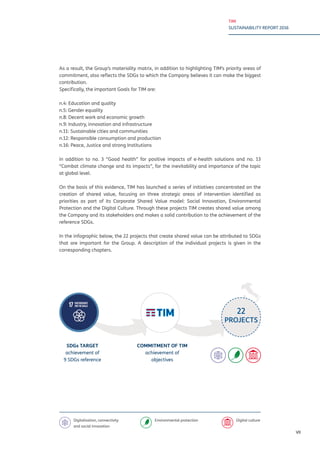
In the infographic below, the 22 projects that create shared value can be attributed to SDGs
that are important for the Group. A description of the individual projects is given in the
corresponding chapters.
SDGs TARGET
achievement of
9 SDGs reference
COMMITMENT OF TIM
achievement of
objectives
22
PROJECTS
Digitalisation, connectivity
and social innovation
Environmental protection Digital culture
TIM
SUSTAINABILITY REPORT 2016
VIII
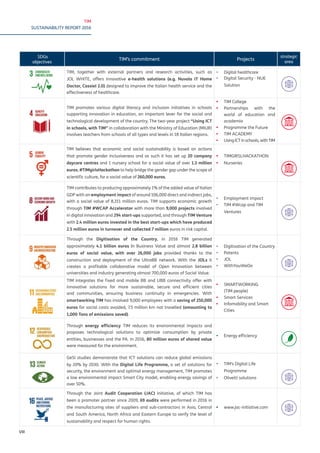
SDGs
objectives
TIM’s commitment Projects
strategic
area
TIM, together with external partners and research activities, such as
JOL WHITE, offers innovative e-health solutions (e.g. Nuvola IT Home
Doctor, Cassiel 2.0) designed to improve the Italian health service and the
effectiveness of healthcare.
▪▪ Digital healthcare
▪▪ Digital Security - NUE
Solution
TIM promotes various digital literacy and inclusion initiatives in schools
supporting innovation in education, an important lever for the social and
technological development of the country. The two-year project “Using ICT
in schools, with TIM” in collaboration with the Ministry of Education (MIUR)
involves teachers from schools of all types and levels in 18 Italian regions.
▪▪ TIM College
▪▪ Partnerships with the
world of education and
academia
▪▪ Programme the Future
▪▪ TIM ACADEMY
▪▪ UsingICTinschools,withTIM
TIM believes that economic and social sustainability is based on actions
that promote gender inclusiveness and as such it has set up 20 company
daycare centres and 1 nursery school for a social value of over 1.3 million
euros; #TIMgirlsHackathon to help bridge the gender gap under the scope of
scientific culture, for a social value of 260,000 euros.
▪▪ TIMGIRSLHACKATHON
▪▪ Nurseries
TIM contributes to producing approximately 1% of the added value of Italian
GDP with an employment impact of around 106,000 direct and indirect jobs,
with a social value of 8,311 million euros. TIM supports economic growth
through TIM #WCAP Accelerator with more than 9,000 projects involved
in digital innovation and 294 start-ups supported, and through TIM Venture
with 2.4 million euros invested in the best start-ups which have produced
2.5 million euros in turnover and collected 7 million euros in risk capital.
▪▪ Employment impact
▪▪ TIM #Wcap and TIM
Ventures
Through the Digitisation of the Country, in 2016 TIM generated
approximately 4.1 billion euros in Business Value and almost 2.8 billion
euros of social value, with over 26,000 jobs provided thanks to the
construction and deployment of the UltraBB network. With the JOLs it
creates a profitable collaborative model of Open Innovation between
universities and industry generating almost 700,000 euros of Social Value.
▪▪ Digitisation of the Country
▪▪ Patents
▪▪ JOL
▪▪ WithYouWeDo
TIM integrates the fixed and mobile BB and UBB connectivity offer with
innovative solutions for more sustainable, secure and efficient cities
and communities, ensuring business continuity in emergencies. With
smartworking TIM has involved 9,000 employees with a saving of 250,000
euros for social costs avoided, 7.5 million km not travelled (amounting to
1,000 Tons of emissions saved).
▪▪ SMARTWORKING
(TIM people)
▪▪ Smart Services
▪▪ Infomobility and Smart
Cities
Through energy efficiency TIM reduces its environmental impacts and
proposes technological solutions to optimize consumption by private
entities, businesses and the PA. In 2016, 80 million euros of shared value
were measured for the environment.
▪▪ Energy efficiency
GeSI studies demonstrate that ICT solutions can reduce global emissions
by 20% by 2030. With the Digital Life Programme, a set of solutions for
security, the environment and optimal energy management, TIM promotes
a low environmental impact Smart City model, enabling energy savings of
over 50%.
▪▪ TIM’s Digital Life
Programme
▪▪ Olivetti solutions
Through the Joint Audit Cooperation (JAC) initiative, of which TIM has
been a promoter partner since 2009, 69 audits were performed in 2016 in
the manufacturing sites of suppliers and sub-contractors in Asia, Central
and South America, North Africa and Eastern Europe to verify the level of
sustainability and respect for human rights.
▪▪ www.jac-initiative.com
TIM
SUSTAINABILITY REPORT 2016
IX
TIM CORPORATE SHARED VALUE MODEL
Companies are increasingly aware of the importance of Corporate Social Responsibility as
a strategic lever for their long-term success. In recent years, there has been a perceived
need to bring closer and integrate social responsibility with business activities, using it as an
opportunity to create value for society and the business itself.
At the same time, tools are needed to enable stakeholders, including shareholders, to perceive
the contribution that sustainability can make to the company’s operating results and to the
community in terms of social value and protection of natural resources.
In this context, best practice has in recent years highlighted a process of evolution towards
the concept of Corporate Shared Value. The culmination of this process is the integration
of the sustainability approach conventionally adopted by companies as part of their overall
corporate strategy, turning it into a vehicle for creating economic and social value.
TIM has been following this very path over the past few years, in order to guide the company’s
strategic decisions and measure its financial and non-financial performance and therefore
respond to the legitimate demands of its stakeholders.
During the past year, in order to complete the move to Shared Value undertaken in 2014,
TIM’s CSV department considered the need to verify the maturity of its measurement system,
in order to allow the Group’s stakeholders to see beyond the numerical data and assess the
reliability of the information supplied.
THE GROUP CORPORATE SHARED VALUE MODEL
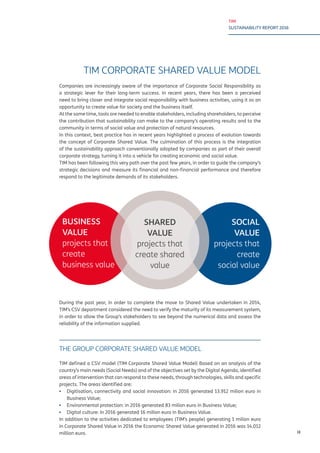
TIM defined a CSV model (TIM Corporate Shared Value Model) Based on an analysis of the
country’s main needs (Social Needs) and of the objectives set by the Digital Agenda, identified
areas of intervention that can respond to these needs, through technologies, skills and specific
projects. The areas identified are:
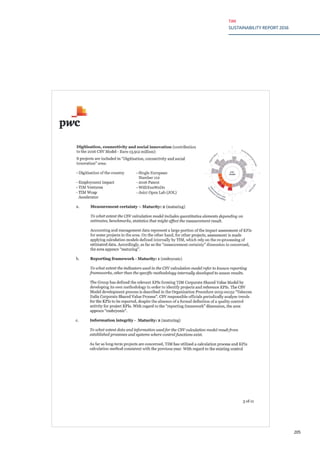
▪▪ Digitisation, connectivity and social innovation: in 2016 generated 13.912 milion euro in
Business Value;
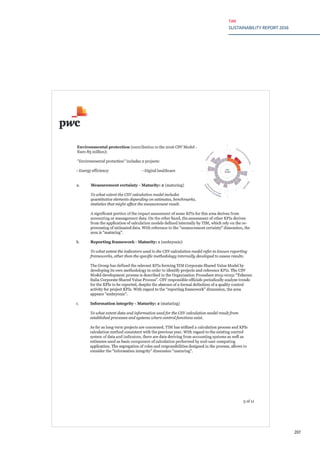
▪▪ Environmental protection: in 2016 generated 83 milion euro in Business Value;
▪▪ Digital culture: In 2016 generated 16 milion euro in Business Value.
In addition to the activities dedicated to employees (TIM’s people) generating 1 milion euro
in Corporate Shared Value in 2016 the Economic Shared Value generated in 2016 was 14.012
million euro.
SHARED
VALUE
projects that
create shared
value
SOCIAL
VALUE
projects that
create
social value
BUSINESS
VALUE
projects that
create
business value
TIM
SUSTAINABILITY REPORT 2016
X
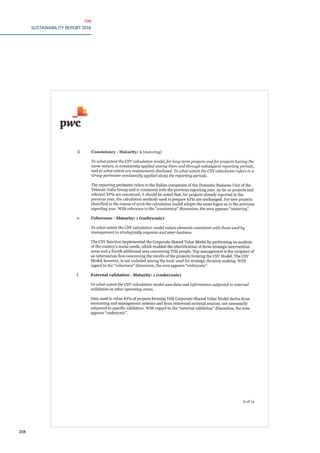
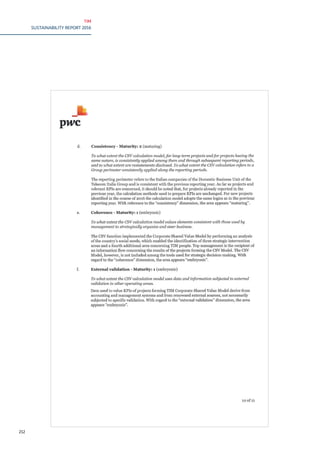
During 2016, in addition to increasing the range of indicators to measure and record the risks
and performance of the company, in order to allow more informed decisions to be taken, both
internally and externally, TIM decided to validate its CSV reporting and measurement system,
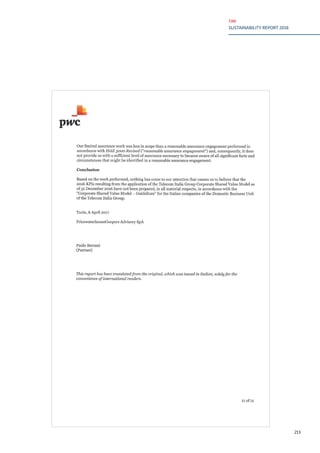
submitting the TIM Shared Value Model to validation by PricewaterhouseCooper Advisory
S.p.A. (PwC), the Group’s auditor. In order to allow PwC to carry out its assessments of the
CSV measurement model, a document was drawn up that describes the process, method and
quantitative logic underlying the measurement of CSV.
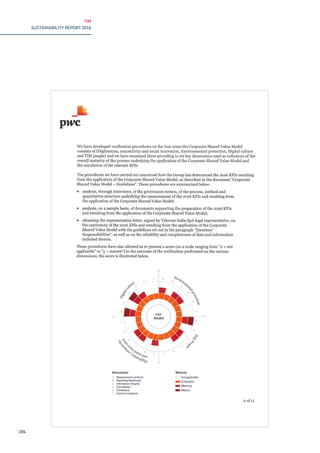
With this reference, PwC was able to perform its assessment of the 3 areas that make up the
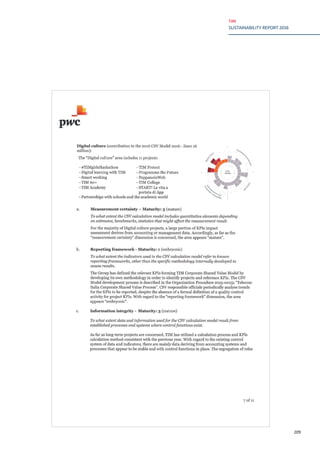
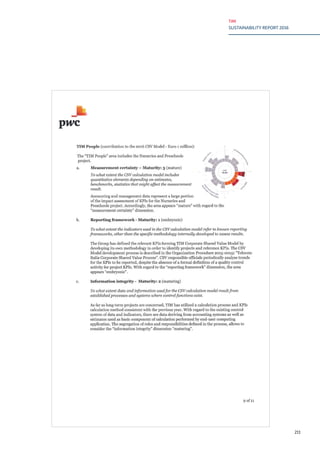
CSV template defined above, which are examined according to six key dimensions:
▪▪ certainty of measurement (the extent to which the CSV calculation model includes
quantitative elements that depend on estimates, benchmarks, statistical data that may
influence the result of the measurement);
▪▪ reporting framework (the extent to which the indicators used in the CSV model are
attributable to known reporting frameworks other than the specific methodology
developed internally for the assessment of results);
▪▪ integrity of the information (the extent to which the data and information used for the
calculation of the CSV are obtained using stable processes and systems equipped with
control tools);
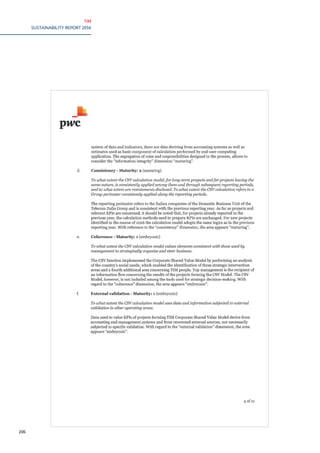
▪▪ consistency (the extent to which the CSV calculation model of multi-annual projects and
projects of the same nature is applied consistently over the years and between them and
the extent to which any changes are subject to disclosure in the restatement of results.
The extent to which the CSV calculation model is applied to a consistent Group scope over
time);
▪▪ consistency of performance indicators (the extent to which the CSV model emphasises
elements that are consistent with those used by management for managing and directing
the business);
▪▪ external validation (the extent to which the CSV model draws on data and information
which are subject to external verification of other management areas).
This innovative method allows assessments resulting from audits conducted on the various
dimensions to be graded and the results to be presented in a qualitative manner for each
of them, providing useful information to recipients for them to understand the maturity of
the reporting model and its evolution, or improvement, over time. It also provides all the
information needed to ensure that the auditor can come to a conclusion regarding the CSV
measurement model developed by TIM.
The conclusions of the audit by PwC are given in the Report issued and attached to this report.
The forms used for the measured projects are shown below.
TIM
SUSTAINABILITY REPORT 2016
DIGITISATION, CONNECTIVITY AND
SOCIAL INNOVATION
XI
Scenario
In line with the objectives established by the Digital Agenda in 2020, and the Governments
super-fast broadband Strategy, TIM’s investment plan is strongly oriented towards ensuring
access to fixed and mobile super-fast broadband to the greatest possible number of Italians,
reducing the gap that still separates them from more developed European countries, providing
ever faster connection speeds and making the most of technological evolution.
DuringtheyeartheTIMWholesaleDepartmentbecamefullyoperationalwithanorganizational
change that gave rise to the creation of the New Equivalence Model. The aim is to further
strengthen the equality of treatment guarantees among the commercial retail departments
of TIM and other operators, in a logic of efficiency, autonomy, quality and transparency in the
activities linked to the access infrastructure.
The strategy is based on an excellent network infrastructure, the creation of which will be
further accelerated over the Plan period. More specifically, around 5 billion in investments are
envisaged in Italy, dedicated to speeding up the development of ultrabroadband networks.
TIM’s investment plan does not only concern municipalities that have a secure economic
return but also the more disadvantaged regions.
By the end of 2019, TIM plans to have increased Italy’s coverage with new generation
networks to over 99% of the population with the LTE mobile network (4G), and 95% of the
population with optic fibre; in particular, by the end of the Plan, 50 major towns and cities
will have connection speeds of up to 1Gbit. TIM thus confirms its position as the undisputed
leader in infrastructure development and in the digitisation of the country, completing the
ultrabroadband coverage of Italy independently and quickly, thanks to a combination of new
fixed and wireless technologies which, with respect to the past, will permit greater efficiency
and the reduction of costs exploiting the reuse of its own infrastructure to the full.
The increased coverage will support ever greater penetration in terms of Ultrabroadband
Customers also thanks to the numerous strategic partnerships with the leading Media Players
on the domestic market (SKY, MEDIASET, NETFLIX) for the Pay-TV service.
As regards the fixed network, in addition to the expansion and acceleration of FTTx solutions,
TIM has planned for the widespread introduction of new access technologies which speed up
the connection for each client using FTTCab accesses, supporting offers of up to 300 Mbit/s
(through eVDSL technology)
In the mobile area, developments in the Three Carrier Aggregation solution are also
expected, with speeds of up to 300 Mbps, and for native voice on the LTE network, thanks to
Project: DIGITISATION OF THE COUNTRY
Social Need: Innovative, secure ICT
Business Value: over 4,000 million euros
Social Value:
▪▪ more than 2,700 million euros by way of contribution to the Italian GDP for 2016 come from
investments in the construction and deployment of the fixed and mobile ultrabroadband
network
▪▪ over 26,477 jobs could be created thanks to the construction and deployment of the
ultrabroadband fixed and mobile network
TIM
SUSTAINABILITY REPORT 2016
DIGITISATION, CONNECTIVITY AND
SOCIAL INNOVATION
XII
the implementation of “VoLTE” (Voice Over LTE). Work is being carried out on new solution
to enrich the current 4G “user Experience” which will improve the quality of the service to
manage the increased traffic and satisfy customer expectations “everywhere and anytime.”
There is also a plan to use small cells to cover areas of particular commercial interest, such as
hospitals, stadiums, tourist centres, stations, high-speed trains and tunnels.
The new 2017-2019 plan also boosts the structural transformation of the Network. The
innovative investments and those dedicated to decommissioning and network modernisation
will act on the network architectures and the operating models, making the network more
modern, more capable and more efficient in the operative management (significant savings
on energy, maintenance and delivery/assurance).
The expected increase in customer numbers will be supported by bundle offers (fixed/
mobile, voice/data/video) that will provide Internet access from a variety of devices (PC, TV,
Smartphone, Tablet) while promoting the replacement of old terminals with next generation
ones.
The new 2017-19 plan will therefore strengthen the process of improving the overall coverage
and quality of the TIM network.
TIM
SUSTAINABILITY REPORT 2016
DIGITISATION, CONNECTIVITY AND
SOCIAL INNOVATION
XIII
Scenario
The work market has entered what technicians in the sector do not hesitate to call the “fourth
industrial revolution,” that is a set of transformations which, thanks to robotics, artificial
intelligence, nanotechnologies, 3D printing, genetics and biotechnologies, are changing not
only the business model, but also the number of workers and how the work force is used.
Fewer people and more machines, machines capable of independently managing almost the
entire production chain, seems to be the path taken by the industrial world. The change in
working methods obviously brings with it the need for new skills.
There are at least three industrial sectors in which advanced manufacturing is turning out
to be a powerful lever in the relocation of jobs: the new industry of smart communication
platforms, IT technologies, robotics, biotechnologies, healthcare products, new materials,
nanotechnologies;“strategic”largemanufacturingwhichisneveroutsourced:forexample,the
defence technology or aerospace industries; innovative services, in each sector where there is
a demand for new products: from security to the environment, entertainment, marketing and
finance. These are the very sectors TIM works in, and today, above all in the Italian context, it
represents the reference operator in the journey towards innovation and digitisation since it
launched that technological transformation process and internal organization processes. This
transformation not only influences the Company but all the satellite activities that refer to it.
Counting both its own employees and its suppliers’ collaborators, the Group employs more
than 100,000 people in Italy.
Project: EMPLOYMENT IMPACT
Social Need: economic well-being
Social Value:
▪▪ 8.311 million euros
▪▪ around 106,000 direct and indirect jobs
TIM
SUSTAINABILITY REPORT 2016
DIGITISATION, CONNECTIVITY AND
SOCIAL INNOVATION
XIV
Scenario
TIM Ventures, the corporate venture capital of TIM, is one of the instruments through which
TIM carries out open innovation, a distinctive factor of digital innovation.
The business and its rules of play change at an incredible pace. The products and services
require continuous research. Talent and competences are fluid.
Therefore, innovation is increasingly a critical factor of success for a business. And in a
dynamic, digital context like that in which TIM operates, innovation must be applied using
not only internal resources, laboratories and its own in-house R&D departments, but also by
seeking assistance from the outside world, taking an “open innovation” approach, to use the
expression coined in 2003 by the US economist Henry Chesbrough, who directs the Garwood
Center for Corporate Innovation of the Berkeley University of California and who has written
several books on the matter.
The TIM innovation also involves entrepreneurial open innovation. Investment in digital start-
ups in synergy with the TIM business strategy aims to spark and promote a mutually profitable
virtuous circle, in which, on the one hand, TIM seeks to make the most of the best innovations
of product and service, optimising the time-to-market of the innovation and, on the other,
the start-up finds TIM as a subject able to support its development and act as partner and
industrial point of reference.
TIM Ventures is the corporate venture capital of TIM, which selects and supports, by investing
directly in the risk capital of the best digital start-ups operating in line with the Group’s
business strategy. TIM Ventures is currently specialised in investing in the early stages of the
start-ups’ activity and development, making minority or “seed” investments and “early stage
investments”.
TIM Ventures is part of an extensive network, represented by TIM#Wcap – the TIM business
driver – and some of the most important players in the Italian and European VC industry.
“TIM Ventures plays an important role in supporting the best start-ups, in terms of business
and social responsibility, helping innovative and making a considerable contribution towards
the country’s economic competitiveness and social development”. - TIM With TIM Ventures,
was the first in Italy to launch its 2014 corporate venture capital programme, helping boost
the ecosystem of Italian and European innovation.
Project: TIM VENTURES
Social Need: economic well-being - Digital Innovation
Business Value:
▪▪ 14 start-ups in the portfolio
▪▪ Amongst the top 40 most active investors in Corporate Venture Capital worldwide in 2015
▪▪ 7th place in the 25 European companies, the only Italian one, that best “dialogue” with
start-ups
Social Value:
▪▪ 2.4 million euros invested
▪▪ + €2.5 mln the value of production of TIM Ventures subsidiaries
▪▪ + €7 mln the total risk capital collected by TIM Ventures subsidiaries
▪▪ 87 employees of TIM Ventures subsidiaries
TIM
SUSTAINABILITY REPORT 2016
DIGITISATION, CONNECTIVITY AND
SOCIAL INNOVATION
XV
Scenario
The market and economic models change very quickly. This is the premise of Open Innovation,
an expression first coined in 2003 by the US economist Henry Chesbrough, who directs the
Center of the Open Innovation of the Haas School of Business and who has written several
books on the matter.
The paradigm prepared by the American scholar envisages that businesses innovate using
not only internal resources, laboratories, their R&D departments, but also seeking external
assistance. His vision has been widely accepted across the globe and in our country too,
major companies, as well as small and medium enterprises, instead of concentrating all their
innovative efforts internally, also look to what is considered and takes place outside their
office.
TIM was one of the first Italian companies to adopt this new approach through a series of
initiatives, including Working Capital, today TIM #Wcap Accelerator.
TIM #Wcap is indeed the business accelerator of the TIM Group that each year selects, boosts
and finances digital start-ups.
The project started out in 2009 with the aim of encouraging the country’s digital development
by financing innovative ideas. Over time, it has become structured and one of the most
important programmes in the field of Italian digital innovation. In 2013, four accelerators were
opened to welcome start-ups selected from time to time by means of a call for ideas.
The mission has progressively evolved towards identifying start-ups in line with the Group’s
industrial strategy to integrate the solutions they develop into the company value chain, with
consequent benefits both for TIM and the young businesses that, in becoming TIM suppliers,
are given the opportunity to grow and consolidate.
Today, there are more than 50 collaboration activities between startups and the company.
Project: TIM WCAP ACCELERATOR
Social Value:
▪▪ 6.6 million euros assegnati alle startup
▪▪ More than 4,000 sm dedicated to innovation with the accelerators of Milan, Bologna,
Rome and Catania.
▪▪ More than 9,000 projects collected.
▪▪ 294 start-ups supported.
▪▪ 12 start-ups boosted by TIM #Wcap were invested in by TIM Ventures.
TIM
SUSTAINABILITY REPORT 2016
DIGITISATION, CONNECTIVITY AND
SOCIAL INNOVATION
XVI
Scenario
The single emergency number 112 introduced by European Directive 2002/22/EC of 07 March
2002 is the number to contact the emergency services in the European Union. By keying in 112,
free of charge from a fixed or mobile network, the citizen is put in contact with an operative
centre that can direct the request to the relevant emergency service. The service is operative
in all 28 Member States, even if in some countries, the service does not yet cover the whole
of national territory.
In our country, in fact, testing of the single number started in Varese in 2010, before thereafter
being extended, in 2015, to the whole of Lombardy, with a user basin of almost 10 million
residents.
In 2016, to mark the Jubilee year, the NUE 112 was activated in Rome and province, with a user
basin of more than 4 million residents.
The national cover plan envisages the service being activated within the first six months of
2017 in the regions of Piedmont and Val d’Aosta, Liguria, Friuli Venezia Giulia, Trentino Alto
Adige and East Sicily.
To improve the management of the emergency services (112, 113, 115 and 118), in particular
providing the Single Response Centre with both the identify of the caller and the Network
Operator from which the call was made, so as to guarantee the geolocalisation of the caller.
TIM collaborates first and foremost with the Ministry of the Interior, the Police, the Carabinieri,
the Fire Brigade, the Regions and the Local Health Authorities, to:
▪▪ 	Creazione di specifici Call Center NUE112 su cui vengono dirette le chiamate 112-113-115-
118 del distretto di competenza;
▪▪ 	Nelle sale operative NUE112, si effettuano le operazioni di Call Taking, Geolocalizzazione
del Chiamante, Filtraggio Chiamate Improprie, Compilazione Scheda Contatto e inoltro in
fonia e dati della chiamata alla Centrale Operativa di II Livello piu’ competente (PSAP2,
Public Safety Answering Point di livello 2), per natura dell’emergenza e collocazione
geografica dell’evento.
	
I principali Benefici Attesi possono essere ricondotti a:
▪▪ Create specific NUE 112 call centres to which calls to 112-113-115-118 of the competent
district, are directed;
▪▪ In the NUE112 operating rooms, calls are taken and geolocalised, improper calls are
filtered, contact sheets filled in and operations carried out in telephony and data of the
Project: SINGLE EUROPEAN NUMBER 112
Social Need: economic well-being - Innovative and secure IT infrastructure
Business Value: 7.8 million euros
Social Value: €24.34 billion social cost of potential road accidents avoided per year1
1
source: Ministry of Infrastructure and Transport, value for 2013)
TIM
SUSTAINABILITY REPORT 2016
DIGITISATION, CONNECTIVITY AND
SOCIAL INNOVATION
XVII
call to the most competent level II operating centre (PSAP2, Public Safety Answering Point
level 2), according to the nature of the emergency and geographic location of the event.
The main expected benefits are:
▪▪ filtering of improper calls (jokes, hang-ups, mistakes, etc.) and therefore a smaller burden
of work on the specialised PSAP2 operators who are therefore able to focus on specific
emergency management;
▪▪ better coordination between the forces of public order, because the SW of NUE112 is
configured with a Coordinated Territorial Control Plan (PCCT) defined by the Prefect on each
territory, which allows the public security emergency to be sent to the most competent
response point (Carabinieri Provincial Command/Carabinieri Company Command/State
Police Station/State Police Commission) in the place and at the time (PCCT are often time-
sensitive);
▪▪ an important contribution to the objective of the PNSS 2020 (National Road Safety Plan)
to achieve the general objective of halving the number of deaths on the roads in 2020.
TIM
SUSTAINABILITY REPORT 2016
DIGITISATION, CONNECTIVITY AND
SOCIAL INNOVATION
XVIII
Scenario
The history of human progress is a succession of discoveries and inventions, the genius
of some put to the use of all. From an individual company’s point of view, patents are a
commercial tool with which to protect investments made in research and innovation and
obtain additional financial resources by managing the rights of use, after the patent has been
granted. In practice, a patent results in the effective enrichment of a company, in addition to
strengthening its market position.
However patents are also an important asset for the country as a whole. This is essentially
for two reasons:
▪▪ patenting promotes a wider dissemination of knowledge through publication;
▪▪ patenting helps companies monetise their innovations and grow.
Technical standardisation in the ICT sector is a clear synthesis of the two outcomes just
described.
The patents project is an ongoing activity for TIM and is split into numerous processes involving
various company departments, often availing of external partnerships with the best Italian
universities (206 patents deriving from partnerships with universities and research institutes
have been filed/granted), thereby stimulating the production of patents at a national level.
By the end of 2016, the Group’s portfolio of patents had grown to include 26 new patents filed
and dozens of other proposals undergoing assessment, strengthening a trend that has been
growing over the past 3 years. The patenting areas relate to the whole ICT sector, with areas
of excellence in the mobile sector.
Since 2014, a new process has been launched to enhance the patents portfolio in Standards,
in the knowledge that patenting and standardisation activities can interact in synergy,
generating value for the community, by increasing the wealth of knowledge, and for the
companies that hold the patents. Thanks to this process, 14 patents have so far become
essential components of standard technologies.
When innovating TIM uses various instruments synergically to transform innovative ideas into
reality. This is the case for example of Tim Working Capital TIM #WCAP of the Joint Open Lab
(JOL).
One of the successes deriving from the convergence of JOL, Patents, Start ups and Spinoffs
is “Spin-up” the new synergistic model for cooperation between industry and the world of
academia, thanks to an agreement between TIM and the start-up MovePlus, a spin-off of
Project: 2016 PATENT
Social Need: research and innovation for companies
Business Value: more than 5,000,000 euros
Social Value:
▪▪ approximately 140,000 euros
▪▪ 2nd telecommunications company in Europe and 6th in the world for the number of
patents developed in the mobile area.
TIM
SUSTAINABILITY REPORT 2016
DIGITISATION, CONNECTIVITY AND
SOCIAL INNOVATION
XIX
Turin Polytechnic. The agreement provides for granting MovePlus a licence to use the patent
developed and filed in 2014 by the Turin based TIM Jol Swarm, in partnership with the people
at Moveplus,in exchange for a stake in the company.
TIM
SUSTAINABILITY REPORT 2016
DIGITISATION, CONNECTIVITY AND
SOCIAL INNOVATION
XX
Scenario
WithYouWeDo (http://withyouwedo.telecomitalia.com/) is TIM’s crowdfunding platform
which provides an innovative, easy and efficient digital tool for raising funds promoted by
individuals, businesses, and institutions in the profit and non-profit world who want to develop
a digital project in the social innovation, digital culture and environmental protection areas.
It offers some tangible advantages with respect to other crowdfunding platforms already
present on the market, including no costs to use the platform and the extreme convenience of
the transaction commissions applied by the payment systems. To participate, you simply need
to register on the portal and upload your project. The WithYouWeDo team, which consists
of Company experts and crowdfunding platform specialists, checks and selects the ones
considered most suitable for each of the proposed areas (Social Innovation, Environment,
Digital Culture). The selected projects are then published online for a variable length of time
during which the funding offered by interested donors can be raised.The Company provides
strong communication support and visibility for the initiatives also through the engagement
of the various relevant communities and special dedicated initiatives.
In order to make donations, all you need to do is register on the platform supplying your email
address and a password, or using your Facebook, Google or Linkedin account. Donations can
be made of between 2 euros and 5,000 euros maximum.
In 2016, WithYouWeDo also helped to create unaiutosubito.org, the crowdfunding platform
for raising funds for victims of the earthquake that struck Central Italy several times, starting
on 24 August. Conceived in collaboration with Corriere della Sera, TgLa7 and Starteed, the
unaiutosubito.org platform has also made it possible to support earthquake victims with a
credit card in an easy, quick and secure way. The initiative has been highly successful, setting
the world record for raising funds for earthquake victims through crowdfunding, and during
the year it made it possible to deliver a new school to the population of Arquata del Tronto
and to start work on the construction of a school and town cafeteria and a food village in
Amatrice. Additional projects will be carried out in 2017.
Project: WithYouWeDo
Social Need: economic well-being
Business Value:
▪▪ Approximately 260 press reports
▪▪ Approximately 500,000 page views
Social Value: 2,150,000 euros (total funds raised: 850,000 euros + 1,300,000 euros)
TIM
SUSTAINABILITY REPORT 2016
DIGITISATION, CONNECTIVITY AND
SOCIAL INNOVATION
XXI
Scenario
Theroleofinnovationisevermorecrucialforthegrowth,performanceandsustainablerenewal
of companies, in terms of the transfer of advanced technologies to the market, systematic
product and service improvement, radical changes to business and the rules of the game.
The distinctive factors of competitiveness, particularly in periods of financial and industrial
crisis, are increasingly tied to how able a company is to innovate and invest in innovation. In
this new context, the Joint Open Labs play a key role. With the “company on campus” model,
they encourage a natural osmosis between the academic and industrial worlds, in which the
co-design and co-development of innovative solutions are not just the result of a process but
its fundamental reason for existing.
In 2013, the year the JOLs were created, TIM launched the innovative model of cooperation,
promoting the development of different JOLs distributed throughout national territory and
localised within Italian universities.
In this context, universities play an outreach role, promoting the direct application,
enhancement and use of knowledge to contribute to the social, cultural and economic
development of society.
With the JOLs, TIM has anticipated the Open Innovation paradigm, in which new ideas can
come from multiple sources, not always from within conventional organisational structures.
Direct and ongoing contamination with an expanded ecosystem of actors encourages the
openness of the value creation process, which becomes an essential vehicle for developing
entrepreneurship, and in turn generates opportunities for the Company.
The multidisciplinary nature of the partnerships has also promoted an exchange of knowledge
and approaches that create new business opportunities. Thanks to the results obtained, and
the participation and involvement in the ecosystem created, the JOL project was renewed for
2017 too. Each JOL conducts research and develops projects on specific themes.
Turin JOL: distributed intelligence and Internet of Things, namely how objects, people, data
and places interact with each other through new technologies, Visual Intelligence, how
robots exploit network functionality to interact with humans, Augmented Reality and the
development of mobile applications.
Milan JOL: Smart Space, namely the new way of interacting with the spaces around us
Trento JOL: Big Data, namely how use, in innovative services, the massive amount of digital
data generated each day.
Pisa JOL: Health and Welbeing going on to study innovative ideas which, through the latest
technologies, improve health and wellbeing and raise the quality of life.
Catania JOL: new smart devices and their interaction with the IoT and their direct application
in the region.
Project: JOINT OPEN LAB (JOL)
Social Need: Digitisation, connectivity and social innovation
Social Value: 575,000 euros
Involved:
▪▪ 5 Italian universities of excellence; 8 applied research and innovation laboratories; 100
young people made up of thesis writers, research fellows and PhD students
▪▪ Over 1.5 million euros of funding for TIM from European and national projects
▪▪ Around 200,000 euros of funding by TIM for the university ecosystem
TIM
SUSTAINABILITY REPORT 2016
DIGITISATION, CONNECTIVITY AND
SOCIAL INNOVATION
XXII
Scenario
TIM Brasil offers its customers solutions that allow processes to be made more efficient,
technological innovation to be improved and competitiveness to be boosted, while increasing
the number of jobs available.
TIM Brasil therefore has a positive influence on the development of Brazilian society. All these
factors have a positive impact on well-being and the growth of Gross Domestic Product (GDP).
An authoritative study entitled “The Mobile Economy - Latin America 2014”, conducted by the
GSM Association, revealed that throughout South America the incidence of the mobile phone
industry on the trend in overall GDP is significant and growing; more specifically:
▪▪ in 2013, the mobile sector accounted for 4.1% of overall GDP;
▪▪ by 2020, the percentage will increase to 4.5%;
▪▪ the 2013 figure includes a direct impact (1.35%) and an indirect impact (2.75%); in other
words the indirect impact is twice the direct one;
▪▪ the impact on the resulting society is considerable. In particular, the mobile sector employs
around 2.2 million people, including around 1 million direct jobs and around 1.2 million
indirect ones (ratio 1:1.27).
TIM Brasil in particular contributes to producing around 0.4% of Brazilian GDP, if only the
direct impact is considered, but if this is added to the indirect impact, its total contribution
is 1.1%. The Company’s activities generate direct employment for almost 10,000 people in
Brazil, while the indirect impact in terms of jobs generated is estimated to more than 12,500
(higher than average for South America).
In 2016, the efforts made by TIM Brasil focused on:
▪▪ expansion: increasing the capacity of existing aerials, installing new aerials and expanding
the fibre optic network;
▪▪ increment both in customers and 4G traffic;
▪▪ excellent cost control with savings goals flanked by focussed investments in technology;
▪▪ increment both in customers and the traffic they generate, particularly in 4G technology.
In the past 5 years alone, TIM has invested more than 23 billion reais in Brazil, focusing primarily
on building new generation infrastructure and actively contributing to the modernisation of
the country.
In recent years, TIM has strengthened its infrastructure further, in order to support the growth
in data, focusing in particular on 4G technology, which offers better quality of service. These
important investments have allowed TIM to strengthen its leadership in 4G, in terms of the
percentage of people reached and the number of towns and cities covered. As of the end of
2016, TIM covers 95% of the Brazilian urban population, with a presence in over 3,460 towns
and cities. In particular, 89% of the urban population is covered by 3G technology and 74% by
4G.
Project: MOBILE BROADBAND
Social Need: Innovative and secure IT infrastructure
Social Value*
▪▪ Almost 6 billion euros of direct impact on the GDP (0.4% of the Brazilian GDP)
▪▪ around 10,000 (direct) jobs generated
*This data is an initial estimate only and may change upon further examination.
Business Value: more than 1.5 billion euros in mobile broadband revenue
TIM
SUSTAINABILITY REPORT 2016
ENVIRONMENTAL PROTECTION
XXIII
Scenario
The concept of efficiency pertains to the relationship between the inputs of a production
process and the outputs sought by that process. Energy efficiency in the ICT context has
economic and environmental relevance in terms of managing the energy required. The energy
requirement and consequent consumption of the Domestic BU stands at around 2.2 TWh per
year and TIM is the second biggest electricity consumer nationally.
The topic of energy efficiency takes centre stage as regards the environmental sustainability
of our company and the related project is capable of generating economic value for the Group
(Business Value) and social value for the community (Social Value) expressed in terms of
environmental protection and the capacity to innovate.
Protecting the environment, improving energy efficiency and offering services that reduce
emissions of greenhouse gases and other pollutants are the main intervention policies adopted
by the TIM to promote sustainable development in its areas of influence. Specific actions
are therefore taken, aimed at reducing its environmental impacts and offering technological
solutions aimed at individuals, businesses and public administration for the creation of a
more inclusive and viable digital society. These are the fundamental principles that inspired
all the Group companies: optimising the use of energy sources and natural resources;
seeking to improve energy/environmental performance, minimising negative impacts and
maximising positive ones; adopting purchasing policies with suppliers that are sensitive to
environmental themes; dissemination of the correct approach to environmental issues. TIM is
equipped with an Environmental Management System (EMS) certified according to standard
ISO 14001. In some situations the EMS is integrated with the Quality Management System
based on ISO 9001 standard as well as with the Security Management System based on
OHSAS 18001 standard. For some sites certification of the Energy Management System based
on standard ISO 50001 was obtained, which establishes the requirements of organisation
and management models aimed at the continuous improvement of energy efficiency, and
promotes the best energy management practices, supporting projects and initiatives to
reduce greenhouse gas emissions. The Group measures its own energy efficiency by using an
indicator that establishes a relationship between the service offered to the customer in terms
of bits transmitted and the company’s impact on the environment represented by joules of
energy consumed. The factors taken into consideration are the amounts of data and voice
traffic of the fixed and mobile networks and energy consumption for industrial purposes,
domestic purposes and vehicles.
Energy Efficiency Certificates (EEC) were also awarded in 2016, for a total of 10 approved
projects, corresponding to an estimated financial value, over 5 years, of around 4 million
euros. The certificates, also known as white certificates, certify the achievement of energy
savings in the final use of energy through measures to increase virtuous energy efficiency as
the performance is better than the national average. Total revenues from EECs sold in 2016
came to approximately 19 million euros.
.
Project: ENERGY EFFICIENCY
Social Need: Protection of the environment and landscape; Research and innovation for
companies
Business Value: more than 60 million euros
Social Value: more than 18 million euros
TIM
SUSTAINABILITY REPORT 2016
ENVIRONMENTAL PROTECTION
XXIV
Scenario
The computerisation process within the Italian Medical-Healthcare context has undergone
huge acceleration in recent years. Hospitals, Private Clinics and Radiology Centres adopt
digital diagnostic systems, but this quite often happens in a way that is not in keeping with
current legislation.
The great advantages offered by computerized architecture with respect to the simple paper
management of workflows have a counter side, namely everything to do with ensuring the
integrity and authentication of digital documents. While in a situation where paper is king,
the signing of a document and its conservation in a simple paper archive were a guarantee
of integrity and authentication, in a fully digitised environment the need arises to identify
appropriate methods and structures.
This scenario covers the legal archiving service for health-related documents, designed with
outsourcing logic, which enables remote management of the historical archive in accordance
with the provisions set for diagnostic tests (images, reports, personal data, etc.) relieving the
organization of complex and costly operations.
The state-of-the-art in IT Radiology in Italy reveals a variety of situations in which
technologically innovative environments alternate with those in which technological
innovation is but a mere mirage. The distribution of these scenarios is not easy to classify and
it envisages great excellence above all in big cities.
The reference market for the dematerialisation of diagnostic tests and reports on the Italian
market can be valued at around 50 million diagnostic tests and just as many reports, generated
by over 1,500 public and private inpatient facilities (845 public inpatient and care facilities; 706
private facilities; 124 public outpatient clinics).
With Nuvola IT Image Archiving - Plus TIM has set itself the objective of providing public and
private healthcare facilities with a service capable of meeting the requirements deriving from
provisions on the conservation of healthcare documentation. And represents the answer to
the need for dematerialisation and conservation in accordance with diagnostic tests (digital
DICOM Tests) and documents in the healthcare context (reports, certificates…) to make them
available over time, ensuring their authenticity and integrity.
Project: DIGITAL HEALTHCARE
Social need: Protection of the environment and landscape; Research and innovation for
companies
Business Value: 264,000 euros
Social Value:
Documents processed with TIM digital solutions: 2.2 million euros
▪▪ 320,000 diagnostic images
▪▪ 1,000,000 medical reports
▪▪ 1,000,000 documents
10 tonnes of CO2
emissions avoided for a value of 2,233,000 euros
TIM
SUSTAINABILITY REPORT 2016
ENVIRONMENTAL PROTECTION
XXV
The service is provided in accordance with the SaaS (Software as a Service) model in the
Cloud, based on techniques and methods that ensure compliance with market standards in
the healthcare context (DICOM, Hl7, IHE).
Access to the documents by healthcare operators occurs through authentication and profiling,
through a simple and intuitive graphic interface.
The Digital Conservation service (Compliant Conservation) for healthcare documentation will
form part of the “Saas” services for PAs, which make up Lot 1 of the PCS Cloud Framework
Contract.
Significant and tangible economic/organizational advantages:
▪▪ Cost reduction and
▪▪ Legal fee concessions
▪▪ Complete technological management
▪▪ Logical and physical security
▪▪ Establishment of a historical/legal archive as required by current legislation
▪▪ “Externalization” of compliant conservation procedures
▪▪ Guaranteed availability and accessibility of the content of documents for document
viewing and administrative transparency purposes
▪▪ Creation of workflows to support the internal organizational processes of Entities
▪▪ Scalability of investments
TIM
SUSTAINABILITY REPORT 2016
ENVIRONMENTAL PROTECTION
XXVI
Scenario
The rapid increase in the Brazilian population has led to a growing search for spaces to install
telecommunication equipment, which has resulted in clusters of aerials springing up on roofs,
the façades of buildings and metal structures.
In order to regulate this situation, many cities have established rules which have made the
licensing process even more cumbersome. This has led to a slowdown in the expansion of the
network.
The Brazilian telecommunication association estimates that there are more than 250 different
municipal laws relating to aerial permits.
In order to circumvent these barriers, TIM Brasil has launched the Biosite, a metal pole that
supports all the equipment needed to install a Radio Base Station inside its own structure .
It is in effect a macro-site, developed and patented entirely by TIM Brasil, providing a triple
benefit:
▪▪ low TCO (Total Cost of Ownership)
▪▪ quick installation
▪▪ minimal visual impact
The Biosite is a multifunctional structure that improves the quality of data transmission and
can be used at the same time to provide public lighting and video surveillance.
Furthermore, it uses less energy and has a lower environmental impact because it uses 99%
less steel than a conventional base station and requires less physical space, avoiding the need
for external cabins or auxiliary structures.
The first Biosite was installed in June 2014 in Curitiba (Paraná). Over 500 Biosites have so far
been installed across the country. The technology can be found in Rio de Janeiro, Brasilia and
a further 92 cities.
Project: BIOSITE BRAZIL
Social Need: Protection of the environment and landscape; Research and innovation for
companies
Business Value: Reduction in costs in the amount of Reais 18,250,000 (calculated across the
100 Biosites installed to date)
Social Value:
▪▪ Less environmental impact: a Biosite supports more technologies (data transmission,
electricity and video cameras)
▪▪ Impact on the community: improvement in safety thanks to the installation of video
cameras
TIM
SUSTAINABILITY REPORT 2016
DIGITAL CULTURE
XXVII
Scenario
TIMgirlsHackathon is a wide-reaching project that can involve young women drawn to
the world of technology and who wish to see how they measure up in an area that often
tends to be reserved to their male counterparts. #TIMgirlshackathon comes as part of the
TIM digital innovation route and seeks to bring the female universe closer to coding, to help
bridge the gender gap under the scope of scientific culture and, more generally, STEM, not
to mention the fact that the unemployment rate of programmers and computer technicians
more generally, is today close to zero. A marathon lasting around 7 hours to introduce school
girls to coding. The challenge is to create a real App on a pre-established topic in one day
and without any expertise. A challenge that has been made possible thanks to TIM and the
tutors assisting the students on this adventure. A training day outside the classroom in a
stimulating and challenging environment where there is the opportunity to meet exceptional
Mentors, a tribute to female leadership that has been able to tear down prejudices and
cultural constraints.
The topic of #TIMgirlsHackathon is cyber bullying and the informed use of the web. The
challenge is therefore not only to learn to code but also to rise to the challenge and try to find
a solution to a widespread problem amongst the younger generation.
In 2016, eight events were held in the cities of Venice, Turin, Naples, Catania, Padua, Florence,
Cagliari and Bari, involving around 500 girls from secondary schools. In all events, all
participants were successfully able to complete development of an app prototype.
Project: #TIMGIRLSHACKATHON
Social Need: Access to culture, education and training. Reduction of inequalities
Social Value: 260K euros
▪▪ 8 events
▪▪ 500 girls involved
▪▪ 3.3 M reaches on Twitter
▪▪ 37 M impressions on Twitter
▪▪ 3 K tweets generated
▪▪ 100% positive sentiment on social networks
▪▪ 100% results achieved
TIM
SUSTAINABILITY REPORT 2016
DIGITAL CULTURE
XXVIII
Scenario
Continuing on with TIM’s commitment to the dissemination of the digital culture, school year
2016/2017 saw the start-up of the Digital Learning with TIM project pursued in collaboration
with the Ministry of Education, Universities and Research (MIUR).
The initiative offers teachers an overview of the new technological instruments that add value
and new opportunities to teaching. The project will last for two years - the 2016/2017 and
2017/2018 school years - and will involve around 7500 Italian teachers from schools of all
types and levels.
Digital Learning with TIM has started in Lazio, where around 500 teachers in the provinces
of Rome, Viterbo, Frosinone, Latina and Rieti had already signed up to the initiative, and will
then be rolled out to the remaining Italian regions.
The training is delivered in two stages: the first in the classroom, where teachers will be
flanked by qualified tutors for three hours, and the second on-line, via the scuoladigitale.tim.
it portal, where teachers can find further teaching material, more information and exciting
ideas by which to continue the training process.
Project: DIGITAL LEARNING WITH TIM
Social Need: Access to culture, education and permanent training - innovation and digital
transformation
Social Value: 80,000
▪▪ Approximately 500 teachers involved in Lazio
▪▪ 22 training sessions
TIM
SUSTAINABILITY REPORT 2016
DIGITAL CULTURE
XXIX
Scenario
The transition to the new ways of working is driven by the digital transformation, which is
marked by a reduction in transaction costs and an increase in flexibility, because supply
and demand for digital work meet on “platforms” at prices that compete on the service
(and, therefore, outside the logic of salary negotiation). This trend will also involve more
“traditional” working methods, which will be increasingly focused on flexibility and individual
autonomy in exchange for greater responsibility accepted regarding results (which will
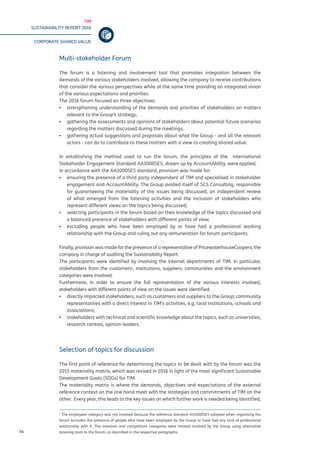
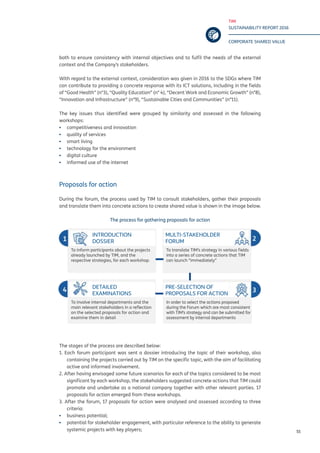
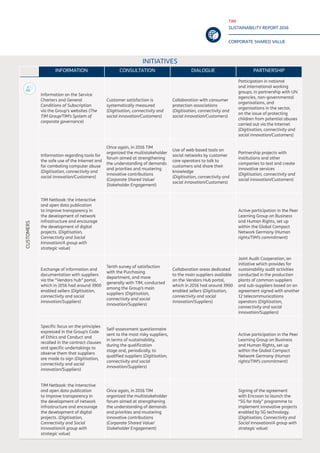
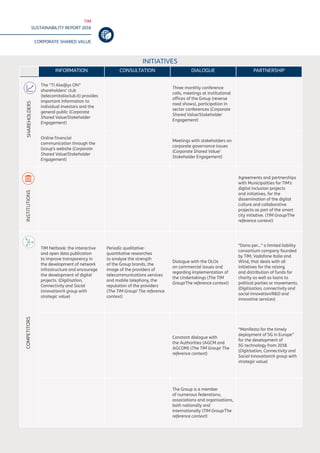
replace the mere fulfilment of tasks). Smart working offers precisely these characteristics
of flexibility, autonomy and accountability and this is probably why it is attracting growing
interest and heading outside the domain of corporate welfare instruments. In other words,
the introduction of smart working can be a factor that facilitates the digital transformation. In
this context, TIM is implementing smart working in ways set to include as many professional
figures as possible, because it intends to create the conditions that facilitate the transition
to the digital organisation so as to ensure that it takes place starting from its history and
characteristics and not neglecting them or, even worse, regardless of them. In actual fact, if
the transition to digital requires digital competences, people are the real hub of this change.
This is why in TIM, the approach taken towards the digital organisation envisages giving voice
and listening to the transformation of people working them, having the intranet evolve into
a real collaborative platform of work, facilitating, thanks to smart working, the identification
of new organisational paradigms and new management and welfare models, to be kept
constantly in line with strategies and operations.
Smart Working in TIM is, therefore, not so much a tactical choice designed to make the
most of savings on the cost of labour (which, albeit slowly, are becoming concrete aspects
of the Italian legal order), nor even merely a welfare choice in a bid to conciliate the life-work
balance; rather, it is also a lever by which to recover individual and process productivity. In
these terms, it is a “perpetual beta” change management route that increases productivity
whilst increasing welfare and accountability for results.
As regards the implementation phases, the choice was made to proceed first (September 2015)
with a survey on working methods (involving more than 30% of TIM people) and thereafter
(October and December 2015), two stress tests were carried out to measure the work-life
balance and productivity when working from home or from a company office that differs from
your own; finally, in March 2016, a pilot project was launched that allowed for working outside
the office, structured with work hours designed to improve the work-life balance.
Project: SMART WORKING
Social Value:
▪▪ 250,000 euros of social costs saved for the reduction of CO2
emissions
▪▪ approximately 9,000 professionals involved
▪▪ 170,000 days of smartworking
▪▪ approximately 250,000 hours of home-office travel avoided
▪▪ more than 1,000 tonnes of CO2
saved for 7,500,000 km not travelled
▪▪ 14 articles
▪▪ 24,600 views on TIM website
▪▪ 12 interviews/articles on national, local, on-line press and TV
TIM
SUSTAINABILITY REPORT 2016
DIGITAL CULTURE
XXX
This approach enables the generation, collection and analysis of adaptive reactions of the
corporate organisation and therefore define a smart working policy that is not only functional
to welfare and productivity but above all supports the digital transformation of corporate
processes.
This clear aim of digital transformation, moreover, allows TIM to make its choices regarding
technological equipment in such a way as to innovate the machines and services used, in
accordance with criteria in accordance with criteria consistent with the transformation itself,
ruling out anything that does not satisfy this requirement. This approach that is so closely
focused on digital transformation also enables TIM to strike synergies with the supply of
smart working services offered to its customers.
TIM
SUSTAINABILITY REPORT 2016
DIGITAL CULTURE
XXXI
Scenario
In an ageing country, as is Italy, TIM has chosen to give seniors new options, encouraging and
supporting their integration into today’s highly technological society from which they had
been partly excluded; giving them a special tariff and a series of initiatives aimed at helping
them through this transition that is not necessarily obvious to them. This has helped them
feel closer to their loved ones, using new technological tools of which they have little or no
knowledge. It has allowed TIM to look after a target that is highly receptive and hungry for
knowledge.
TIM for the over-60s ...
▪▪ 24-hour assistance with a 119 operator
▪▪ 3 months of TIM Entertainment without consuming GB
▪▪ to make best use of the GB envisaged by the offer and bring the over 60s to approach
the world of internet and social networks, we have envisaged digital training events
specifically for the over 60s who have not yet become digitally literate. Training has been
delivered at 8 chosen sales outlets in central and south Italy.
Project: TIM 60+
Social Need: Education and training. Inclusion	
Business Value: 10,4 million euros
Social Value:
▪▪ 102,922 over 60 included
▪▪ + 50% Customer base
▪▪ growth of user data from 45% to 79%
▪▪ doubling up of usage data from 198MB to 405MB
▪▪ digital training events in 8 TIM sales outlets
TIM
SUSTAINABILITY REPORT 2016
DIGITAL CULTURE
XXXII
Scenario
The TIM Academy today represents our Corporate University model (internal training school)
and works along several areas of activities: the definition of new contents for learning in
support of business strategy, the use of new formats and new digital technologies for learning
and the certification of competences and knowledge acquired.
TIM Academy also has a faculty of teachers and experts comprising both trainers of HR
Services and a great many colleagues who transfer their know-how internally through
meetings in person or social and digital solutions.
TIM Academy has a dedicated digital platform that comprises a library of on-line courses open
to everyone - many of which can also be accessed by mobile devices - videos on technological
and business scenarios, links to external contents and a social environment in which to start
discussions and exchange contents and documents with other colleagues.
TIM Academy is knowledge management; this means that it promotes a model that allows
for the use of the tacit and explicit knowledge of each individual in the company. It does so
through the involvement and collaboration of people and encouraging corporate collaboration
experiences, the creation of learning communities and team spaces, as well as the design of
initiatives to promote a collaboration- and sharing-focussed culture.
TIM Academy is also a partnership and research model, open and evolving constantly, which
involves universities and national and international training and research centres, peers and
competitors, suppliers and vendors, as well as start-ups and digital champions. In thus doing,
it fosters the contamination with different contexts and the development of co-innovation
paths.
TIM Academy represents a major step forward in the field of education and research, because
it optimises the creation, exchange and use of company know-how in all its forms, considering
it the real wealth of our company.
Its aim can be summarised in a few, essential words: taking part in knowledge.
Project: TIM ACADEMY
Social Need: Education and Training
Social Value:
Training
▪▪ Courses digitisation 30% (+ 164% on 2015)
▪▪ 138,638 hours of digital and social training
▪▪ 34,442 participants - 202,458 participations
Social Network Indicator
▪▪ 201 conversations - 542 endorsement - 6,212 enabled users
Smart Corner
▪▪ 80 events - 2300 participants - 11 cities involved
▪▪ 30 on-line knowledge objects
▪▪ Community Pioneers
▪▪ 6 new capabilities proposed
TIM
SUSTAINABILITY REPORT 2016
DIGITAL CULTURE
XXXIII
In TIM, the training activities are split into four macro-categories:
▪▪ 	management education
▪▪ development of role-based and specialized skills, and new capabilities
▪▪ development and empowerment
▪▪ institutional and corporate culture
For each category, the learning methods are increasingly characterised by models that are
coherent with our lifestyle and the existing new formats:
▪▪ 	All Digital: Web Based Training, Short Videos, Webinars, Virtual learning
▪▪ Social: interaction between participants, co-production of contents autonomously but at
the same time shared by all participants (active role)
▪▪ Blended: mixed solutions (digital + attended training)
▪▪ Gamification: methods and techniques adjusted from typical gaming scenarios
(competition, timing, score, levels).
More than 150 courses are available on TIM Academy, open to everyone, giving people the
chance to create their very own training path. Instead, on the personal page, employees can
access their learning plan directly, which contains the training activities dedicated to their
corporate role or development path.
We have also worked on a greater use of social tools and platforms, as well as the creation
and strengthening of open professional communities, which can strengthen learning paths
through the sharing of personal skills and experiences by their participants and teachers.
TIM
SUSTAINABILITY REPORT 2016
DIGITAL CULTURE
XXXIV
Scenario
The internet offers a great deal of interesting contents for our children and their education,
but it also sometimes entails some risk, particularly for those not yet able to automatically
recognise the danger signs.
Our children watch videos on-line, chat to friends and make purchases. But the more they
use devices, the more exposed they are to fraud attempts, the abuse of personal data, cyber
bullying and identity theft:
▪▪ 	between 9 and 17 years old, mobile telephones are the main device used to access the
internet.
▪▪ 8 out of 10 on line with smartphones between 9 and 17 years old
▪▪ between 9-10 years old, access to the internet is via the smartphone
▪▪ children aged 9 years old already on social networks
▪▪ one in five of those aged 9-10 years old and one in four of those aged
▪▪ 11-12 pretends to be older when signing-up with Facebook
▪▪ of the very young, 10% are victims of bullying on the internet or via APPs
▪▪ 9 in 100 have been victims of cyber bullying
The TIM Protect service offers a safe, secure and automatic way by which to respond promptly
to the threats of the web without renouncing the potential of browsing the internet. The 4
protection areas of TIM Protect:
Anti-theft and device localisation: protects your smartphone and tablet in the event of theft
or loss, allowing you to localise and easily block your device and, if you so wish, even delete
the data.
Parental Control: protects your children from undesired websites and allows you to control
their on-line life.
Banking protection and safe browsing: guarantees the protection of your on-line banking
transactions and automatically verifies the reliability of a website before accessing it.
Antivirus: guarantees complete, real-time protection for all your devices. Offers the most
cutting-edge protection from viruses, spyware, hacker attacks and identity theft, at the same
time blocking dangerous websites and on-line attacks whilst exploring the web.
Project: TIM PROTECT
Social Need: Education and training. Safety.
Business Value: 0,8 million euros
Social Value: 181.821 people made aware on the topic of internet safety
TIM
SUSTAINABILITY REPORT 2016
DIGITAL CULTURE
XXXV
Scenario
In the current “knowledge society”, knowledge has taken on a key role, both in economic
and social and political terms: research and innovation are behind the development of this
emerging type of society. A key role is played by the universities and schools in supporting and
fostering the direct application, optimisation and use of knowledge generated by training,
through constant synergy with businesses and other local stakeholders.
In 2016, TIM defined a new development model of relations with the educational ecosystem
(the academic world, schools, business schools, institutional and social entities), thereby
further enabling the optimisation of talent for the transfer of innovation. The goal is to
strengthen and accelerate the Group’s ability to innovate while at the same time contributing
to the development of young people by offering them the opportunity to gain new skills and
experiences. Partnerships were therefore activated or consolidated aimed at generating value
in the short/medium-term, making know-how available to develop and train the younger
generation.
The “TIM-Network Scuola Impresa” project, sponsored by the Italian Ministry of Education,
was set up in 2009 to transfer key skills, scenarios and evolutionary trends in the sector
to students, promoting the image of the company across the country and enhancing the
Company’s skills by promoting its dissemination externally. From 2009 to 2016, 8 editions
of the TIM Network Scuola Impresa (School Business Network) project have been held and
the 9th edition is currently in progress for school year 2016/2017, involving 24 schools and 23
teachers of TIM, the “Maestri di Mestiere” (Masters of the Profession). Moreover, in 2016, with
a view to further strengthening contact with the world of school and helping enhance the
competences of secondary school students, we chose to adhere to an experimental project
of Alternanza Scuola Lavoro (school-work alternation) with Assolombarda in 4 Milan-based
secondary schools.
Project: PARTNERSHIPS WITH SCHOOLS AND THE ACADEMIC WORLD
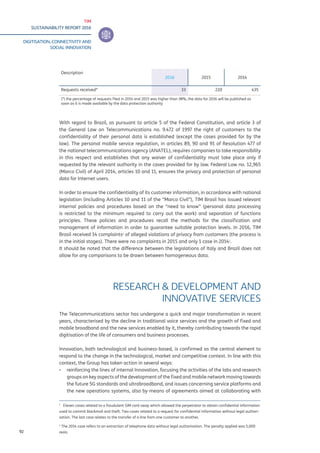
Social Need: research and innovation for companies
Social value: 3,3 million euros
TIM
SUSTAINABILITY REPORT 2016
DIGITAL CULTURE
XXXVI
Scenario
The way in which digital natives approach new technologies involves a change in learning
processes and educational paths.
New media are increasingly becoming an unavoidable dimension for young people from their
early years of life. However, ease of access, product and publication of content are not always
accompanied by cultural growth, a capacity to reflect and critical skills. Educating young
users, responsible and aware of new technologies, but also reinventing the way they study
thanks to the web, experimenting a new way of being at school that combines studying and
playing, it is essential for today’s children and teenagers.
In 2016 TIM signed up to Programme the Future, as the Founding Sponsor partner, for the
third scholastic year (2016/2017); the project is an initiative by MIUR (Ministry of Education,
Universities and Research) and CINI (National Inter-University Consortium for Information
Technology) aimed at disseminating a new digital culture in schools by introducing the basic
concepts of information technology and computational thought to give young people greater
opportunities to enter the innovative professions of the future. The initiative has involved over
one million students to date for a total of 10 million hours of training, with the participation
of around 6,000 schools.
To support the initiative TIM also brought its strengths into play through the TIM4Coding
project. In the last edition, namely scholastic year 2015/2016, over 400 employees voluntarily
led the students, mainly from primary schools, through their first hour of coding, while at
the start of this third scholastic year (2016/2017) TIM organized four events for young people
with the aim of testing the basic concepts of information technology. Around 200 students
from high schools participated at the TIM #Wcap business accelerators in the cities of Milan,
Bologna, Catania and Rome, where through the use of simple and fun tools they were involved
in a useful educational experience also to increase their opportunities to enter the innovative
professions of the future. The young people took part in coding lessons and were issued an
official certificate of participation in Programme the Future.
Project: PROGRAMME THE FUTURE
Social Need: access to Culture, Education and Lifelong Learning – Innovation and digital
transformation	
Business Value:
▪▪ 1.325.911 students envolved in the projext “Programma il Futuro
▪▪ more than 5.000 scools involved in the project
▪▪ 427 volunteers in TIM involved in the whole
▪▪ 5,873 “likes” on FB (Programme the Future page)
▪▪ 2,404 followers on Twitter (Programme the Future account)
▪▪ 72,774 impressions on Twitter for TIM4Coding (TIM account)
Social Value: 30,000 euros
TIM
SUSTAINABILITY REPORT 2016
DIGITAL CULTURE
XXXVII
Scenario
Officiallyfoundedin1585andtransformedoverthecenturiesintoamodernandinternationally
acclaimed symphonic and concert institution, the National Academy of Saint Cecilia in Rome
combines an academic body of 100 members, which includes the most illustrious exponents
of musical art and culture, with a symphony orchestra and choir among the most renowned
internationally, while preserving an immensely rich historical heritage, reflected in its
centuries-long history.
The PappanoinWeb project stems from the consolidated partnership between TIM and the
National Academy of Saint Cecilia, created to promote culture by making innovative use
of the Web, encouraging the dissemination of high quality content and the socialisation of
classic artistic experiences, involving audiences and innovative content distribution channels.
Since 2011, the TIM Group has been interacting with Internet audiences to share the cultural
values of the country, including classical music. All the concerts are streamed live and made
available on demand on the telecomitalia.com/pappanoinweb website. The project is aimed
both at young people, allowing them to approach and appreciate cultural themes like classical
music, and the not so young, who, attracted to the Internet by cultural content of interest to
them, gain familiarity with digital technologies, understanding their potential.
The 2016 edition of PappanoinWeb was structured into four appointments, with the direct
participation of the web public who, thanks to the dedicated live chat and above all the
innovative WebArena, a privileged place close to the orchestra, kitted out technologically by
TIM and reserved for a young public aged under 30, were able to attend concerts, for the first
time ever using mobile telephones and tablets during the events, with no limits to internet
connections, the sharing of photographs, selfies, video clips, emotions and real experiences.
Over its six-year programme, PappanoinWeb has been followed by 200,000 users connected
by streaming, generating considerable interaction on social media.
Since 2015, the on-line user experience has been further enhanced by new viewpoints thanks
to the potential of “360° panoramic” filming technologies offering close-ups of the orchestra
and conductor, thereby giving the web spectator the sensation of actually being present in
the room.
Project: PAPPANOINWEB
Social Need: Education and training - Participation in cultural activities	
Business Value:
▪▪ 5,77 milioni reach social
▪▪ 50 press reports
▪▪ 117.000 page views
▪▪ 11.665 video streaming
Social Value: 220,000 euros
TIM
SUSTAINABILITY REPORT 2016
DIGITAL CULTURE
XXXVIII
Scenario
The TIM College offer sets out TIM’s commitment to bring technology into Italian schools.
The offer is aimed at people under thirty, with a focus on target students aged 14-18, and is
intended to boost digital schools, providing a valid tool to help young people in their training
and studies. The pack consists of a tablet, digital content to study at home and a monthly
connectivity bundle. TIM was the first telephone operator to launch this type of offer, entirely
dedicated to students, on the Italian market in May 2014.
In addition to the tablet (the latest tablet model, a Samsung Galaxy TAB A 10.1, 2016 ed.),
the offer includes 4G connectivity with a data traffic bundle of 5 GB per month and a series
of educational contents in digital format for young people aged between 14 and 18, including
an English, French, Spanish or German De Agostini language course and a Redooc maths
course, both lasting for 30 months. The offer is completed by 21 classics of Italian literature, 3
manuals, a 50 euro voucher to buy digital school books at scuolabook.it.
In 2016 TIM expanded its digital school offer by complementing the student offer with an
exclusive dedicated to teachers, seizing the Teacher Card opportunity, a 500 euro bonus which
MIUR makes available to Italian teachers for their training and professional development. The
TIM College Pack - Teachers Special was launched in March 2016. The package on sale in TIM
shops consists of: a tablet chosen from some Android models available, digital content for
professional training (books, a sector journal and an online e-learning course which issues
training credits) and a connectivity data bundle free for 3 months.
In 2016, 944 packs in total were sold.
The Digital School offers proposed by TIM in recent years have contributed to the spread of
technology in the digital school area in an attempt to push for a new approach to study and
training using more modern methods.
The adoption of digital text books not only promotes digitisation in the schools, but has
also resulted in around 8,655 tonnes of paper being saved, with a resulting reduction in CO2
emissions from paper production, and a saving of approximately 261,000 tonnes of water.
Project: TIM COLLEGE
Social Need: Education and training - Participation in cultural activities and economic well-
being
Business Value: 754,385 euros (revenues from sales)
Social Value: 40,700 euros (in bonuses distributed for the purchase of school books)
Economic shared value: 795,085 euros
TIM
SUSTAINABILITY REPORT 2016
DIGITAL CULTURE
XXXIX
Project: START! LA VITA A PORTATA DI APP
Social Need: Innovation and digital transformation
Social Value: 369,000 euros
▪▪ 	10 episodes
▪▪ average of 644K AMR per week
▪▪ 12.2 M reaches on Twitter for the hashtag #Start16
▪▪ 6.9 M impressions on Facebook on the TIM fanpage
▪▪ 100% positive sentiment on the social networks
▪▪ +19% Brand Familiarity
▪▪ +28% Brand Trust
▪▪ +36% Intention to Buy
▪▪ 76% programme enjoyment
Scenario
A television programme that describes how digital and innovation can concretely help im-
prove people’s lives. It is a light factual entertainment programme, presented by Francesco
Mandelli and Federico Russo. During the 10 episodes, the presenters met with and inter-
viewed various start-ups, offering an original presentation of their services.
The first edition, which was broadcast on Rai Due late evening from March to June 2016
enjoyed great success amongst the public, with more than 600k television viewers per week
and an average share of 6.4%.
TIM
SUSTAINABILITY REPORT 2016
DIGITAL CULTURE
XL
Scenario
One of the priorities of the Brazilian government is to increase the availability of professional
and technological education courses. In 2011, the government launched PRONATEC - National
Programme for Access to Technical Education and Employment – on which 6 million people
are currently enrolled. One of the initiatives of PRONATEC is the e-TecBrasil Network, which
provides free technical and distance learning courses.
The TIM Institute, which shares the same ideas as PRONATEC, has created TIM Tec, a distance
learning platform that uses the MOOC (Massive Open Online Courses) concept. These courses,
which are provided and made available for free on the platform, are intended for students
attending high schools and technical colleges.
Anyone can enrol on the courses, which teach programming languages and how to create
databases, websites, games and many other things. There are also courses for primary school
teachers and others intended to improve the skills considered to be basic for the training of
any professional, such as how to write well.
The technology and content of the TIM Tec platform are share with the Federal Institutes of
Education, Science and Technology, with the support of the Department of Vocational and
Technological Education of the Ministry of Education (SETEC/MEC).
The source code of the system developed for the platform can be downloaded on GitHub, thus
allowing teaching establishments to use it free of charge and adapt it to their requirements.
The TIM Institute supports the Federal Institutes in the process of installing and using the
platform.
The first pilot course was organised for students from the Cultural Training Centre of the City
of Tiradentes in São Paulo and the Sul-Rio-Grandense Federal Institute (Ifsul).
With TIM Tec, the TIM Institute has confirmed its commitment to vocational and technological
education in the country thanks to an investment of around 10 million reais in the 2013/-2016
period for the implementation of this project.
Project: TIM TEC
Social Need: education and training
Business Value: improvement in reputation
Social Value: approximately 21 million reais, as follows:
▪▪ savings generated, thanks to the free courses, of around 19 million reais
▪▪ almost 1.7 million reais in investments made by Instituto TIM to support the project
▪▪ reduced environment impact: reduced CO2 emissions thanks to the fewer journeys made
by students
TIM
SUSTAINABILITY REPORT 2016
TIM PEOPLE
XLI
Scenario
The MioNido nurseries for children of colleagues (or living as part of their families), aged
between 3 months and 3 years, are internal facilities within the company, charging the same
fees as local nurseries, with hours to suit the various requirements, aimed at improving work-
life balance and quality of life in the Company.
9 company nurseries are currently operating in offices in Turin, Milan, Florence, Ancona, Rome
(2), Naples, Catanzaro, Palermo, with an additional 11 private nurseries operating by special
agreement in Turin, Padua (2), Trento, Bologna and Rome (5), Caltanissetta. These facilities
offer different time bands for children, in order to meet the needs of the staff, particularly
those doing shift work. The location of the nursery is chosen based on assessments of the
type of people employed by the company (average age of employees, number of children
between 0 and 3 years, presence of female workers) and the workplace location (logistical
difficulties, presence of a call centre, etc.).
The 9 company nurseries and 11 private nurseries offer any places not filled by colleagues to
external companies (Poste Italiane, Banca Intesa, Assicurazioni Generali, etc.) which, in turn,
provide TIM with places in their nurseries.
For the academic year 2016-2017, there are 20 nurseries and the company is the first in Italy
to be trying out a preschool service at its offices on Via Oriolo Romano, Rome, which already
has a nursery.
Project: NURSERIES AND PRESCHOOLS
Social Need: economic well-being, quality of work	
Business Value:
▪▪ significant reduction in absences of working mothers with children between 0-3 years in
offices with nurseries, with a consequent reduction in the costs of absenteeism
▪▪ reduction in the full use of parental leave or recourse to part-time work by parents who
have benefited from the service
Social Value: over 1,3 million euros
Results: 489 available places in 20 nurseries
TIM
SUSTAINABILITY REPORT 2016
TIM PEOPLE
XLII
Scenario
Starting from the conviction that together we can build a better world, TIM Brasil encourages
its employees to participate in volunteering and solidarity initiatives, in order to do good by
helping others.
Thanks to the “Citizen without borders” (Cidadão Sem Fronteiras) programme, employees of
TIM Brasil can personally choose the organisations to which they want to provide their service
or can take part in charitable activities promoted within the Company.
All employees can take a day off work per year to dedicate to volunteering for children, young
people, the elderly and whole families by supporting welfare organisations. This kind of work
contributes to achieving the annual volunteering objective of TIM Brasil.
In 2016, 140 employees of TIM Brasil joined in the “Citizen without Borders” programme.
Project: CITIZEN WITHOUT BORDERS
Social Need: quality of work
Business Value: improvement in relations with local authorities and brand reputation
Social Value: 36,000 reais
Contents
TIM Group 	 03
TIM Group’s profile		 	 04
Corporate Governance system	 	 06
Key economic performance data and economic value generated and distributed	 19
Reference context	 		 22
Being sustainable at TIM 	 33
Human Rights 	 34
Opportunities and socio-enviromental risks of the Group’s operations	 41
Enterprise Risk Management system 	 42
Business Continuity management system	 44
Corporate Shared Value:
TIM’s strategic approach to sustainability	 46
Sustainabilty governance	 51
Position in indexes and other awards 	 52
Stakeholder engagement 	 53
Materiality analysis	 63
Digitisation, connectivity and social innovation 	 68
TIM strategic relevance	 69
Group’s costumers				 77
Research & development and innovative services	 93
Sustainabilty throughtout the supply chain	107
Enviromental protection	 115
Climate change	 119
Enviromental performance	 125
TIM eco-friendly	 137
Digital culture 	 139
Relations with local communities	 142
TIM people 	 148
Concise figures 	 150
Gender balance 	 153
People caring	 155
New skills and development	 158
Internal communication	 168
Health and Safety	 169
Industrial relations	 172
Remuneration policy	 174
Reports received through the internal control procedure	 176
Appendix – Detailed tables	 177
TIM Foundation 	 188
Appendix	192
2015 and 2016 results 	 193
2017 Objectives and multiannual targets	 196
	
Note on methods	 199
Report of the indipendent auditors on
the Sustainability Report 	 200
Report of the indipendent auditors on
TIM Corporate Shared Value Model 	 203
GRI content index	 214
Contents
TIM Group
TIM
SUSTAINABILITY REPORT 2016
TIM GROUP
4
TIM GROUP’S PROFILE
[G4-3] The TIM Group offers fixed and mobile communication services and ICT solutions1
.
In Italy, the Group operates the biggest fixed voice and data infrastructure, covering the
whole territory and provides one of the country’s most extensive and advanced mobile
network platforms. [G4-6] In addition to its domestic leadership, the Group has a significant
international presence in South America, particularly in Brazil. [G4-17a] For the details of the
countries where TIM operates see Note 45 of the Group’s consolidated financial statements,
which also lists the Group companies, subdividing them by consolidation method. [G4-13],
[G4-22] No significant changes in operations and in the consolidation scope took place
during 2016.; For details of the changes that did take place, see Notes 1 and 3 of the Group
Consolidated Financial Statements.The main changes over the past three years include
the Sofora – Telecom Argentina Group being recorded among discontinued operations the
creation of INWIT S.p.A., listed on the Milan stock exchange, which operates in the electronic
communication infrastructure sector, specifically in those dedicated to hosting radio
transmission equipment for mobile voice networks both of TIM and the other operators.
[G4-8] [G4-9] All the Group’s activities are encompassed in the following Business Units:
▪▪ “Domestic” operates primarily in the field of domestic fixed and mobile voice and data
services for end customers (retail) and other operators (nationalwholesale), as well as
in the domestic Information Technology products and services sector. In addition to
the management of the digital multiplexes through Perdisera S.p.A.2
, the Business Unit
also includes the activities of INWIT S.p.A. and on an international note, the activities
related to the development of fibre optic networks (international wholesale) in Europe, the
Mediterranean and South America;
▪▪ “Brasile”(TIM Brasil Group) provides mobile telecommunications services. Furthermore,
as a result of the acquisition of a number of fixed line operators, it also offers fibre optic
data transmission and residential broadband services;
▪▪ the “Other Activities” include the financial companies and other minor companies not
strictly connected with the Group’s “core business.
THE GROUP’S MAIN BRANDS
[G4-4] [G4-8] The main brands market voice/data and information technology products
and services for residential and business customers, public administration, national and
international operators. The Group also provides transmission capacity and technological
solutions for TV sector operators.
TIM is the single brand for the whole Group, which operates in the domestic market offering
fixed and mobile telephony, internet, digital content and cloud services. TIM is supporting
Italy in its quest for full digitisation by building an ultrabroadband network infrastructure and
providing next generation services. In Brazil, TIM markets mobile phone, mobile internet and
fixed line services
Through the Sparkle brand, the Group offers international voice, data and internet solutions
to fixed and mobile telecommunications operators, Internet Service Providers/Application
Service Providers, content and media players and multinational companies.
1
[G4-3] For general information about the Group, see the consolidated financial statements of the TIM Group.
2
Perdisera S.p.A. stems from the joint venture stipulated between the network operators Telecom Italia Broadcasting
(TIMB) and Rete A, owned by Gruppo Editoriale L’Espresso. The company owns five national digital multiplexes and is
the supplier of reference for the most important television editors operating in Italy
TIM
SUSTAINABILITY REPORT 2016
TIM GROUP
5
The Olivetti brand markets information technology products and services for residential and
business customers.
Persidera offers terrestrial digital transmission capacity and high quality technological
solutions to leading TV networks operating in the domestic market.
Finally, INWIT is the Group’s tower company.
MAIN SHAREHOLDERS OF TELECOM ITALIA S.P.A.
[G4-7] Telecom Italia is a joint-stock company organised under the laws of the Republic of
Italy 1
, [G4-5] where the parent company has its registered office. [G4-7] As at 31 December
2016, the reference shareholder is Vivendi S.A., with 23.94% of the ordinary share capital,
[G4-13] The share ownership did not change significantly in 2016, after the 2015 entrance by
French shareholder, Vivendi.The Net Equity structure and the number of shares in circulation
are shown in Note 14 of the Group Consolidated Financial Statements. For further information
relating to reports made to Consob regarding significant shareholdings, see the Report on
Operations of the TIM Group.
The shareholding structure as of December 31, 2016 is shown below2
.
[G4-13] An examination of the share capital structure in the period 2014-2016 shows that
in 2016, in addition to the increase in the shareholding owned by Vivendi S.A. (+2.6p.p.),
compared to 2015, there was a slight increase in the shareholdings owned by foreign and
Italian institutional investors: +2.3p.p. and 0.5p.p. respectively. The shares held by foreign
legal entities, during this period, increased slightly (from 3.0% in 2014 to 3.8% in 2016) while
the shares held by Italian legal persons decreased slightly, falling from 0.8% in 2014 to 0.5%
in 2016.
Lastly, as regards the other Italian shareholders and other foreign shareholders categories, a
decrease in ownership over the three-year period (-4.8pp) continued in 2016, slight for other
foreign investors.
1
[G4-7] Also see the TIM Group Consolidated Financial Statements.
2
Source: Register of shareholders as of December 31, 2016, supplemented by communications received and by other
available information.
9.77%
Others
shareholders
Italy
 0.05%
Other
shareholders
abroad
 23.94%
Vivendi (*)
 1.08%
TIM
 4.03%
Institutional
shareholders Italy56.81%
Institutional
shareholders abroad
3.79%
Legal entities abroad
0.53%
Legal entities Italy
TIM
SUSTAINABILITY REPORT 2016
TIM GROUP
6
THE CORPORATE GOVERNANCE SYSTEM
Some aspects of the Group’s Corporate Governance which are particularly relevant (material)
to the reporting of sustainability in accordance with the GRI-G4 guidelines are briefly
illustrated below. For a more detailed and comprehensive description see the 2016 Report on
Corporate Governance (“RCG”) and Share Ownership, the Report on Remuneration (“RR”), the
Bylaws and the Group Governance Procedures, available at telecomitalia.com.
[G4-34], [G4-35], [G4-40] The Group’s Board of Directors is appointed by the Shareholders’
Meeting based on slates submitted by eligible voters who own a total of at least 0.5% of the
ordinary share capital (or any other amount that may be required by the regulations issued
by Consob). The existing Board of Directors was appointed by the Shareholders’ Meeting on
April 16, 2014. In December 2015, the number of Directors increased from 13 to 17 with the
appointment of 4 Directors at the request of the reference shareholder Vivendi S.A.. During
2016, the number of members fell by 1, due to the departure of the Group’s previous CEO.
[G4-38], [G4-40] The only stakeholders represented in the Board of Directors are the
shareholders. Directors’ powers are granted (and revoked) by the Board of Directors, which
determines the purpose, limits and methods by which they are exercised.
[G4-40] The Group’s Bylaws require the least represented gender to account for at least one
third of the total number of directors, rounded up to the next unit in the event of a fraction.
The independence of a minimum number of directors is required by the law (Consolidated Law
on Finance) based on the overall composition of the Board; the same law and the Corporate
Governance Code of Borsa Italiana also define the criteria for the independence of Directors.
An amendment made to the Bylaws of TIM in May 2015 introduced the principle that at least
half of the candidates and elected members from each slate must be independent when
the Board of Directors is renewed. Reference is made either to the legal independence
requirements or the Corporate Governance Code drawn up by the Corporate Governance
Committee of Borsa Italiana, with which TIM complies.
[G4-40] In delivering its guidance to shareholders, with a view to the Shareholders’ Meeting
called to renew the Board of Directors on April 16, 2014, the outgoing Board of Directors
expressed a few wishes regarding the new Board, including:
▪▪ the skills which were deemed to be necessary were a knowledge of the telecommunications
and/or information technology sectors (including regulations) or associated areas of
business, strategic guidance, finance, communication and organisation, risk management
and internal control. In terms of professional background, people of managerial extraction
were to be preferred (primarily: CEOs or CFOs of significantly large companies), but the
contribution of academic experts in finance and taxation, risks, law or the technical sector
in which the Group operates were also judged useful;
▪▪ International openness was desirable, with the inclusion in the slate of non-Italian
candidates, i.e. individuals who had gained professional experience overseas;
▪▪ A balanced mix of the various components was required, as the coexistence of diverse skills
and experience ensures the complementarity of professional profiles, promoting fruitful
discussion and the efficient operation of the Board, in the knowledge that specialised skills
can be contributed by internal structures or, if necessary, by external consultants, and that
the complexity of the matters to be dealt with suggest that candidates with prior experience
gained on the boards of listed companies would be appropriate.(see Resolution Proposals -
Shareholders’ Meeting of April 16, 2014, available at telecomitalia.it)
[G4-38] The Board of Directors in office consists of 16 members, including 9 independents.
6 of the Board members are women and the female gender is the only social subgroup
represented. Table 2 “Structure of the Board of Directors and Committees and other positions
held” contained in the RCG, shows for each director their term of office, the committees to
TIM
SUSTAINABILITY REPORT 2016
TIM GROUP
7
whichtheybelong,thenumberandnatureofotherpositionstheyhold(meaningthedirectoror
statutoryauditorpositionsheldbytherelevantindividualinothercompanieslistedinregulated
markets, even abroad, holding companies, banks, insurance companies or undertakings of a
significant size), the slate to which they belong (indicating “LSGR” in the case of appointment
with a slate vote and candidacy by the SGR and Institutional Investor Slate, indicating “LT”
in the case of appointment with a slate vote and candidacy by the Telco Slate or “T” in the
case of original candidacy in the Telco slate but appointment by the Shareholders’ meeting
by ordinary vote, indicating “V” in the case of appointment of candidates proposed by Vivendi
S.A. during the Shareholders’ meeting on December 15, 2015) whether they are independent,
executive or non-executive. The CVs of each director are available on the telecom italia.com
website in About us, Company Bodies/Board of Directors/Members section. The Directors’
skills in the field of economics range from university teaching to graduate and post-graduate
studies, specific training in the field of mergers and acquisitions, and experience with stock
market supervision authorities and at the top of big companies. One director also declares
that he/she has worked on sustainability-related projects. More details are available on the
telecom italia.com website in About us, Company Bodies/Board of Directors/Members section.
[G4-47] 14 meetings of the Board of Directors were held in 2016.
[G4-43] The Directors take part in specific meetings with the management or external
consultants, aimed at providing adequate knowledge of the industry in which the Company
operates, business dynamics and their evolution. Business lunches, workshops on new
technologies and educational-informative meetings are held prior to strategic meetings.
Updates regarding the relevant legislative framework are provided in specific briefing notes.
As happened in 2016, specific meetings on sustainability are planned in 2017.
[G4-34], [G4-40] Currently the committees set up within the Board of Directors are the
Strategy Committee, the Control and Risk Committee and the Nomination and Remuneration
Committee. Significant transactions with related parties are subject to scrutiny by the Control
and Risk Committee, in the case of transactions of lesser importance, or by a Committee
consisting of all the Independent Directors, in the case of transactions of greater importance.
The process of selecting and appointing members of the committee, and the independence
and competence requirements are described in the Nomination and Remuneration
Committee Regulations and in the Control and Risk Committee Regulations, both available
on the telecomitalia.com website.
[G4-44a] For the 2016 financial year, the self-assessment of the size, composition and
operation of the Board and its Committees was carried out with the support of the consultant
Egon Zehnder. The board review is carried out every year (since 2005). [G4-44b] Further
information on the assessment methods and results are illustrated in the RGS. The 2016 self-
assessment did not tackle issues of sustainability.
[G4-35], [G4-36], [G4-39], [G4-42] The Shareholders’ Meeting of April 16, 2014 appointed
Giuseppe Recchi as Chairman and the subsequent meeting of the Board of Directors of
April 18 appointed Marco Patuano as CEO. Subsequently, on March 22, 2016, Marco Patuano
resigned and, on March 30, 2016, the Board of Directors appointed director Flavio Cattaneo
as CEO. Also on March 30, 2016, the Board of Directors updated the proxies granted to the
two Executive Directors.
The proxies and powers granted to the Executive Chairman include:
▪▪ determining the guidelines for the development of the Group, in agreement with the CEO,
with powers to identify and analyse extraordinary transactions;
▪▪ supervising the strategic, industrial and financial planning process, the implementation
of these plans and their development and monitoring the implementation of board
resolutions;
TIM
SUSTAINABILITY REPORT 2016
TIM GROUP
8
▪▪ supervising the definition of organisational structures and the power to organise and
determine the size of the workforce and resources required to exercise his functions,
making direct use of the Human Resources & Organizational Development department,
which reports to the CEO;
▪▪ supervising the economic and financial performance of the companies and the Group;
▪▪ supervising the process of examining and devising the structure of the internal control
system;
▪▪ supervising security and the TISparkle company;
▪▪ representing the company and the Group in external relations with all Authorities, Italian
and international Institutions and investors (on the understanding that Investor Relations
department reports to the CEO);
▪▪ responsibility for the following departments that report directly to him:
-- Brand Strategy & Media;
-- Institutional Communication (save for the CEO’s power to make use of the Press Office
for the operational management support required in coordination with the Executive
Chairman);
-- Legal Affairs (save for the CEO’s power to make use of the Legal Affairs Department for
the operational management support required)
-- Public Affairs;
▪▪ responsibility for the Corporate Shared Value (CSV) department [G4-48] including
responsibility for drawing up the sustainability report) and governance of the Fondazione
TIM.
[G4-35], [G4-36], [G4-42] The proxies and powers assigned to the CEO include:
▪▪ responsibility for administration (which include drawing up the Financial Statements),
ordinary and extraordinary finance, taxation activities, management control and Investor
Relations;
▪▪ responsibility for devising, proposing to the Board of Directors and then implementing and
developing strategic, industrial and financial plans;
▪▪ responsibility for defining organisational structures, personnel policies and relations with
trade unions;
▪▪ all organisational responsibilities for managing and developing the business in Italy and
South America;
▪▪ responsibility for market disclosure, with reference to the company;
▪▪ “employer” responsibility for the health and safety of workers in the workplace, with
reference to the company;
▪▪ responsibility and powers regarding the handling and protection of personal data, with
reference to the company.
[G4-35], [G4-36] The system by which the executive directors (Executive Chairman and
CEO) delegate powers to the departments that report to them is the subject of a specific
company procedure that establishes the methods by which this system must be implemented
(Granting and Revocation of Powers). Powers are normally granted to those reporting directly
to the executive directors and, in particular, for matters of an economic and financial
nature, they are granted to those reporting to the Chief Executive Officer who deals with
such matters, while for sustainability the powers are delegated to those in charge of the
CSV department reporting to the Executive Chairman. Those reporting directly can in turn
assign specific powers to specific departments; [G4-37] in particular, powers are granted in
this way to consult stakeholders (customers, suppliers, government local offices, employees
etc., described in the Stakeholder Engagement paragraph of Corporate Shared Value chapter).
TIM
SUSTAINABILITY REPORT 2016
TIM GROUP
9
[G4-41]The company procedure for transactionswithrelatedparties1
,drawnupinaccordance
with Consob Regulation no. 17221 of March 12, 2010, is systematically updated (the latest
revision is dated March 17, 2016) and is illustrated in the Report on Corporate Governance
and Share Ownership, see Directors’ Interests and Transactions with Related Parties. The
disclosure of any transactions with related parties during the relevant period is included in
the “Transactions with related parties” chapter of the Annual Financial Report.
[G4-45], [G4-46], [G4-14] The internal control and risk management system consists of a set
of rules, procedures and organisational structures intended to ensure the healthy and proper
management of the company, in a way that is consistent with the established goals, through
an appropriate key risk identification, measurement, management and monitoring process.
Being responsible for the internal control and risk management system the Board of Directors
defines the system guidelines, verifying their adequacy, effectiveness and proper operation,
so as to ensure that the main risks facing the company (including operational, compliance,
economic and financial risks) are correctly identified and managed over time.
The establishment and maintenance of the internal control system are entrusted to the
Executive Directors, each in his/her own delegated area, and to the Executive responsible for
preparingtheCompany’saccountingdocumentsinhis/herareaofresponsibility,soastoensure
the overall adequacy of the system and its effectiveness, from a risk-based perspective, which
is also considered when determining the agenda of Board meetings. Coordination between
the parties involved in the internal control and risk management system is illustrated in the
Report on Corporate Governance and Share Ownership.
The internal control system is contained in the so-called “231 Organisational Model”, i.e. an
organisational and management model adopted pursuant to Legislative Decree 231/2001,
aimed at preventing offences that may result in liability for the Company.
[G4-45],[G4-46],[G4-14]TheGrouphasadoptedanEnterpriseRiskManagement(hereinafter
ERM) Model which allows risks to be identified, assessed and managed uniformly within
Group companies, highlighting potential synergies between the parties involved in assessing
the Internal Control System. Particular focus is placed on the relationship between the ERM
process and the business planning process, particularly on determining the acceptable level
for the Group (Risk Appetite) and the acceptable degrees of deviation from the main business
targets (Risk Tolerance).
The process is managed by the ERM Steering Committee, which is chaired and coordinated by
the CFO. The Steering Committee ensures the governance of the Group’s risk management,
aimed at guaranteeing the operational continuity of the business, monitoring the effectiveness
of countermeasures taken. The ERM process is designed to identify potential events that may
influence the business activity, in order to manage risk within acceptable limits and provide
a reasonable guarantee that business objectives will be achieved. For further details please
read the Enterprise Risk Management system section in Being sustainable in TIM.
[G4-49], [G4-50], [G4-58] In November 2015, TIM implemented the new Whistleblowing
procedure, which provides for the centralised management, by the Audit Department,
of all whistleblowing reports - including those that are the responsibility of the Board of
Statutory Auditors, particularly in its role as the 231 Supervisory Body - via a compute app
which whistleblowers can use to access the company intranet. Since February 2016 this
reporting channel has also been accessible via the Group’s website. Reports may be made by
any employee, collaborator, consultant, freelance worker, as well as third parties who have
1
The terms “related party” and “related parties” of TIM are understood to refer to the parties defined as such in the
Consob Regulation. Regardless of whether they can be defined as related parties according to accounting principles, the
Procedure also applies to the parties to significant shareholders’ agreements, pursuant to article 122 of the Consolidated
Law on Financial Intermediation, that govern candidacies for the position of Director of the Company, if it turns out
that the majority of Directors appointed has been drawn from the slate presented by participants in shareholders’
agreements.
TIM
SUSTAINABILITY REPORT 2016
TIM GROUP
10
business relations with the Group. The system assigns each report a unique identification
code which enables the whistleblower to check the processing status in anonymity.
[G4-57], [DMA Labor Practice Grievance Mechanisms] As stated in article 4 of the Group
Code of Ethics and Conduct, any requests for clarification regarding the appropriateness of
one’s own conduct or the conduct of other people, in order to ensure full compliance with
the Code and the values set by the Code itself, must be addressed to the Head of the Audit
Department of TIM S.p.A. or to the Head of the Audit Department of the Group’s overseas
company directly involved, in accordance with specific internal procedures.
[G4-58] Using the Whistleblowing procedure, the same entities must be promptly informed of
the following by the recipients of the Code and those who have undertaken to comply with it:
▪▪ any violations, requests or inducements to violate legal provisions or regulations, provisions
of the Code and internal procedures with regard to the activities and services of interest
to the Group;
▪▪ any irregularities or negligence in accounting procedures, keeping of relevant accounting
documentation, fulfilling reporting obligations or internal management in Group
companies.
There are no negative consequences for people who make reports in good faith.
The confidentiality of the identity of people making reports is in any case guaranteed by
appropriate internal procedures, subject to legal requirements. No recipient of the Code,
employee or third party having business relations with the Group can be subject to sanctions
or otherwise discriminated against if he/she refuses to perform actions or adopt a conduct
which are considered, in good faith, to infringe the Code, even if this refusal should result in a
loss of business or other adverse consequence for the company’s business and/or the Group.
The Brazilian subsidiary TIM Participações also uses a report reception system based on a
form, also accessible via the company’s website, that allows the report to be received at an
email address, equipped with computer security systems, for its subsequent management.
[G4-50] In 2016, the Whistleblowing procedure resulted in 219 reports made in Italy and 518
in Brazil. The Human Rights section of the Being sustainable at TIM chapter and the Reports
of the TIM people chapter illustrate the reports received concerning alleged violations of
human and employment rights1
.
[G4-50] The Board of Statutory Auditors’ Report states the number of reports received by the
Board of Statutory Auditors and provides summary of the investigations carried out by the
Board itself with the support of the Group Compliance Officer, (see 2016 Annual Report). In
2016 the Supervisory Body received only one report which did not however relate to the Code
of Ethics, Human Rights or 231 Organisational Model.
[G4-51], [G4-52] The remuneration policy for the members of the Board of Directors is
determined in accordance with legal requirements and the by-laws, according to which:
▪▪ [G4-53] the Shareholders’ Meeting determines the total gross annual remuneration of
the Board of Directors (without including directors of specific offices: Executive Chairman
and CEO); expresses an opinion on the first section of the Remuneration Report; passes
resolutions regarding remuneration plans based on the allocation of financial instruments;
▪▪ the Board of Directors passes resolutions to determine how the remuneration set by the
Shareholders’ Meeting will be distributed (when it is established as a total amount for
the Board in its entirety); determines the remuneration policy for Executive Directors and
1
In particular, the Human Rights section contains a detailed description of the procedure and the types of reports
made via the procedure.
TIM
SUSTAINABILITY REPORT 2016
TIM GROUP
11
key managers with strategic responsibilities; determines the remuneration of Directors
holding special offices.
The Board of Directors is also responsible for making proposals to the Shareholders’ Meeting
regarding remuneration plans based on the allocation of financial instruments for Directors and
employees and for drawing up the Remuneration Report.
[G4-52] In order to ensure that the choices made regarding remuneration are appropriately
investigated, in accordance with the rules on transparency and the strict regulations on
potential conflicts of interest, the Board of Directors relies on the support of the Nomination
and Remuneration Committee. In performing its duties, the Committee (the meetings of
which are attended by the Chairman of the Board of Statutory Auditors or by another Auditor
appointed by him/her) relies on the assistance provided by appropriate structures of the
Company and can also rely on the support of external consultants whose position does not
compromise their independence of judgement. Again for 2016, the Committee has relied on
the assistance and support of Mercer Italia.
[G4-51] With the exception of the Executive Chairman and the CEO, the Directors receive
fixed remunerations only. Table 1 “Remuneration paid to members of the management and
control body and Key Managers with Strategic Responsibilities” in the RR states all the types
and amounts of remuneration received by each director. Details of the fixed and variable
remuneration components (including any stock option), benefits and severance pay attributed
to the CEO, the Chairman and the key managers with strategic responsibilities, as well as the
targets for the variable component of the CEO’s remuneration are illustrated in detail in the
Remuneration Report. More specifically, for the Executive Directors, the targets assigned for
2016 are mainly financial in nature and regard the Group’s EBITDA indicators, the Group’s Net
Financial Position and the Group’s Service Revenues (with the exclusion of the first quarter
2016 for the Chief Executive Officer). In addition to these, there is a set of quality targets,
which for the Chief Executive Officer relate to the 2016 strategic initiatives (consisting of the
new domestic market turnaround, the update to the turnaround plan for Brazil, the update
to the broadband plan and the item “Rates and Authority”), whilst for the Chairman, they
include a target relating to media and another to the Board’s assessment of the effectiveness
in managing the work of the Board of Directors.
REFERENCES
The Group operates with the conviction that business activities must be conducted in a way
that considers the expectations of stakeholders, in keeping with the principles established by
internationally recognised standards. In defining and implementing its sustainability strategy
and programmes, the Group is inspired by the guidelines issued by the main global guidance
and standardisation organisations in the field of Corporate Responsibility. The System of
Sustainability Management also takes into account the principal reference regulations and
international standards:
▪▪ European Commission directives, recommendations and communications;
▪▪ the OECD guidelines directed at multinational enterprises;
▪▪ the ISO 9001 and ISO 14001 certificates governing quality and environmental management
systems;
▪▪ principles of the International Labour Organization (ILO) Conventions on respecting the
fundamental rights of workers;
▪▪ the Social AccountAbility 8000 standard (SA 8000), aimed at promoting respect for human
rights and working conditions by companies and their supply chains;
TIM
SUSTAINABILITY REPORT 2016
TIM GROUP
12
▪▪ Sustainability Reporting Guidelines of the GRI, version G4, comprehensive option;
▪▪ AA1000 AccountAbility Principles Standard (APS 2008) drawn up by Accountability, an
international organisation which promotes collaboration between stakeholders, and lays
down standards and guidelines on matters of sustainability;
▪▪ management system ISO 206000 for private and public organisations of all sizes.
[G4-15], [G4-16] TIM has always been a member of many environmental and social
organisations, both national and international, formed to disseminate universally recognised
values including respect for Human Rights, employment rights and environmental protection.
The main associations in which the Group is involved and some of the charters and codes to
which it has signed up are listed below:
▪▪ Global Compact, the main global benchmark launched in 2000 by the UN, to which TIM
has been signed up since 2002. TIM is a member of the Global Compact Network Italy;
▪▪ ITU (International Telecommunications Union) the UN’s main agency for
Telecommunications and Information, as well as a reference point for governments and
the private sector in the development of networks and services. TIM is also involved in the
Environment and Climate Change working group (Study Group 5);
▪▪ ETSI (European Telecommunications Standards Institute), the main European
standardisation organisation for telecommunications. TIM is involved in the following
technical committees and interest groups regarding the environment: TC ATTM (Access,
Terminals, Transmission and Multiplexing) and TC EE (Environmental Engineering);
▪▪ GSM Association and particularly the GSMA - Mobile Alliance against Child Sexual Abuse
Content working group for all technological and communication initiatives aimed at
protecting children in the mobile phone sector;
▪▪ ICT Coalition for Children Online and Better Internet for Kids (former CEO Coalition) for
establishing the principles and technologies required to make the Internet a safer place
for children;
▪▪ GRI, a body set up in 1997 by CERES, Coalition for Environmentally Responsible Economies,
with the aim of developing globally applicable guidelines for drawing up Sustainability
Reports;
▪▪ GeSI (the Global e-Sustainability Initiative), a global partnership of ICT companies to
promote the sustainable development of new technologies. TIM is represented in the
General Assembly and takes part in the initiative’s working groups, particularly the
Industry Responsibility Committee, which works on projects associated with monitoring
the performance of suppliers and assessing the sustainability of products and services.
From the middle of 2012 to the middle of 2014, TIM was also a member of the Board of
Directors, performing the role of treasurer;
▪▪ ETNO (European Telecommunications Network Operators’ Association), a trade
association which aims, among other things, to develop a competitive and efficient
European telecommunications market through coordination between operators and
dialogue with Institutions. TIM is a member of the Executive Board, which it chaired
between 2011 and 2014, and has signed up to Corporate Responsibility Charter of the
European Telecommunications Network Operators’ Association. Issues related to
corporate responsibility are handled by a Working Group which TIM has chaired since 1997,
the tasks of which include promoting and verifying the objectives undertaken through the
Asssociation’s Corporate Responsibility Charter. An energy task force coordinated by TIM
reports to this working group and is responsible for evaluating and pooling best practices
and the most advanced solutions in the field of energy efficiency, as well as task force on
child protection online;
▪▪ Joint Audit Cooperation, a joint initiative between telecommunication operators to perform
sustainability audits of the production plants of their respective suppliers in geographical
areas that present a high social and environmental risk. TIM is one of the three founding
members and is represented in the Leadership Assembly (which has guidance and auditing
tasks and consists of high level representatives of the Purchasing and CSR departments of
TIM
SUSTAINABILITY REPORT 2016
TIM GROUP
13
its members) and the vice-presidency of the Operational Committee, which develops the
strategies to be proposed to the Leadership Assembly, defines procedures and tools and
coordinates the auditing of suppliers;
▪▪ The European Commission’s Joint Research Centre which, with the help of
telecommunications operators, including TIM, has developed Codes for the energy
efficiency of data centres and the energy consumption of broadband appliances, both
adopted by TIM;
▪▪ FOSI, Family Online Safety Institute, an international non-profit organisation formed to
make the Internet safer for young people and their families, identifying the best strategies
while respecting the freedom of the Web. FOSI also promotes dialogue between heads of
government, the world of industry and the non-profit sector in seeking new solutions for
the safety of children in the Web 2.0 world. TIM is the first Italian company to have joined
this important institution.
TIM is also associated with ANIMA and Sodalitas (entities that deal with sustainability as
part of Italian trade associations), CSR Europe, a network of European companies for the
development of sustainability in companies and FSG (Foundation Strategy Group), through
which TIM participates in the activities of the Shared Value Initiative, a global community
that shares themes and projects that generate business value to respond to social needs.
Among the other codes relevant to sustainability to which TIM has signed up, we should
mention the Equal Opportunities Charter, the Self-regulation code for mobile services, the
Code of conduct for premium rate services and the Corporate Governance Code for commer-
cial communication (available on the telecomitalia.com, website).
CODES, POLICIES AND CHARTERS OF THE GROUP
[G4-56] The undertakings given by the Group are expressed in a system of Charters, Policies
and Codes available in the sustainability section of the telecomitalia.com website.
In the belief that the success of the company cannot be separated from business ethics,
the Code of Ethics and Conduct and the Human Rights Policy of the TIM Group set out the
objectives and values of the Company’s activities in respect of the main stakeholders with
whom the Group interacts.
The Service Charters, which are intended to simplify the relationship with customers and
make it more direct, set out the principles of conduct and undertakings given by TIM regarding
the quality of the services offered. They also provide information regarding the ongoing
improvement of quality standards and contact channels available to customers. The Service
Charters are available on the Group’s commercial websites (tim.it, impresasemplice.it.)
The General Conditions of subscription and contract, which govern relations with subscribers
and are additional to the Service Charters, are published on the following websites tim.
it, impresasemplice.it e nuvolaitaliana.it The General Conditions of subscription for fixed
telephony are also published in telephone directories.
Furthermore, in order to comply with the various resolutions of the Italian communications
authority regarding quality, the objectives set for each year for the individual services (fixed
and mobile voice services, Internet access services, call centre services for customer support)
are published on the relative websites. A selection of the objectives and their respective levels
of achievement is set out in the Appendix.
The other undertakings given by the Group are contained in the following documents, which
are available in the sustainability section of the Internet site:
▪▪ Respecting Human Rights in the TIM Group, which emphasises that the telecommunication
TIM
SUSTAINABILITY REPORT 2016
TIM GROUP
14
sector is strategic in terms of Human Rights because it affects the accessibility of
technology and services (geographical and social digital inclusion) in particular for the
most vulnerable, as well as the right to privacy, personal data protection and freedom of
expression, particularly online;
▪▪ Social responsibility in the TIM Group, on compliance with labour standards within the
Group, with particular reference to child labour, forced labour, health and safety, freedom
of association, discrimination, disciplinary procedures, working hours and pay;
▪▪ Relations with suppliers in TIM Group’s procurement process, which governs the negotiating
ethic of the Group (transparency, the separation of roles, fairness and traceability) and the
requirements that TIM demands of its suppliers in the area of working and environmental
standards;
▪▪ Green Procurement Policy, which is intended to minimise the environmental impact directly
attributable to the Company and its suppliers in the context of the procurement process;
▪▪ TIM Group Guidelines on Voluntary Contributions to the Community which govern the ways
in which the Group makes investments in favour of the communities in which it operates;
▪▪ Code of conduct for the confidentiality of OLO (Other Licensed Operator) Data which
ensures the proper handling and confidentiality of data by the departments that supply
services to other operators;
▪▪ TIM Group Guidelines for Responsible Marketing which outline the principles followed by
the Group to ensure honest, transparent and fair business practices in addition to those
contained in the Charters and Codes mentioned above.
TIM’s Code of Ethics and Conduct underlines a number of key objectives for everyone working
in the Group:
Excellence of the service
We pursue excellence towards customers, creating value for the shareholder and the
communities in which we operate.
Ethics and Compliance
We operate in compliance with the law and with universally accepted ethical principles, based
on transparency, fairness and loyalty.
Competition
We promote fair competition that serves the interests of customers and of every player in the
market.
Human resources
We value the Group’s human resources, respecting each other’s differences, within a
framework of loyalty, observance of ethical values and trust.
Communication
We ensure the transparency of our actions in our relationship with customers, the market,
investors, the community, employees and all stakeholders in general.
The Community
We contribute to the prosperity and growth of the communities in which we operate,
respecting the environment and the rights of future generations.
Health and Safety
We protect health and safety in the workplace, ensuring respect for the physical and moral
integrity, rights and dignity of workers .
FIGHT AGAINST CORRUPTION
[G4-SO3a] Corruption is widely recognised as one of the main factors threatening socio-
economic growth and the well-being of the population. Preventing corruption has always
been an important part of the TIM internal control system in all its companies. Over time,
oversight and control systems have evolved and the scope of its companies has changed.
TIM
SUSTAINABILITY REPORT 2016
TIM GROUP
15
We shall focus here on the Group’s existing scope, which consists of the Domestic Business
Unit (including all the domestic commercial and technical activities relating to the telephone
service and the media, Sparkle, INWIT and Olivetti) and Brazil (see The TIM Group/Group
profile).
[G4-DMA Anti-corruption] The Group’s system for identifying, preventing and controlling
corruption risks is the “231 Organisational Model”, a compliance programme for preventing
offences pursuant to Legislative Decree 231/2001 which can result in administrative
responsibilities being placed on the Company, pursuant to Legislative Decree 231/2001.
Also adopted since December 2012, is the Group Anti-Corruption Policy referred to in 231
Organisational Model. The Group Organisational Model and the Brazilian Organisational
Model identify the processes that are at risk of corruption offences, including: management of
relations with public entities (e.g. management of inspections and procedures, representing
the Company’s position in respect of the Authorities, requesting authorisations, managing
subsidised loans, tender notices), negotiations with customers (commercial negotiations,
calls for tenders), identification and management of counterparts in commercial relations,
partnerships, joint ventures, purchase of shareholdings, purchase of goods and services,
consulting and professional services. In 2016, due diligence was adopted as a stage in the
evaluation of counterparts in the sensitive areas identified by the Anti-Corruption Policy. As
regards Brazil due diligence was adopted as part of the procurement process (suppliers of
goods and services/consultancy and professional services).
231 Organisational Model consists of:
▪▪ the Code of Ethics and Conduct of the TIM Group, where the general principles
(transparency, fairness, loyalty) that guide the Company in the organization and conduct
of business are indicated;
▪▪ the “general principles of internal control”, as a blueprint for achieving the objectives
of operational efficiency and effectiveness, reliability of financial and management
reporting, compliance with laws and regulations, safeguarding of company assets against
possible fraud;
▪▪ the “principles of conduct”, which consist of specific rules for relations with third parties
and for all fulfilments and activities of a corporate nature;
▪▪ the “internal control check-lists” that describe business processes at risk of crime, any
predicate offences relating to them, the preventive control activities and the behavioural
indications aimed at avoiding the related risks.
The Internal control check-lists have been developed according to the following principles: (i)
the separation of roles in undertaking the principal activities involved in business processes;
(ii) the traceability of decisions, to allow for identification of the points of responsibility and the
motivations for the decisions themselves; and (iii) the objectification of the decision-making
processes, so that decisions are not made on the basis of purely subjective considerations, but
based on pre-established criteria.
[G4-SO3b] The areas identified as being at risk of corruption are:
▪▪ gifts and entertainment expenses
▪▪ events and sponsorships
▪▪ donations/membership fees/contributions to non-profit organisations
▪▪ consulting, intermediation, relations with business partners and suppliers
▪▪ joint ventures, acquisitions and transfers
and furthermore:
▪▪ sale of goods and services
▪▪ relations with Institutions/Authorities
▪▪ authorisations and concessions
TIM
SUSTAINABILITY REPORT 2016
TIM GROUP
16
▪▪ subsidised financing
▪▪ legal and arbitration proceedings
▪▪ health and safety at work obligations
▪▪ environmental protection obligations
▪▪ staff selection and recruitment
▪▪ operations carried out by the Executive Directors
[G4-DMA Anti-corruption] It is specifically prohibited to directly or indirectly receive,
demand, give, offer and authorise compensation of any kind, gifts, benefits of an economic
or other useful nature to or from a public or private subject and/or the body such subject
directly or indirectly represents that: (a) exceed a modest value and the reasonable practical
limits of courtesy and, in any event, (b) are capable of being interpreted as designed to unduly
influence the relations between the Group Companies and the aforementioned subject and/
or body it directly or indirectly represents, irrespective of the aims pursued, including exclusive
aims, in the interests or to the benefit of the individual Company or Group.
Nor are “facilitation payments” permitted. These are unofficial modest payments made to
speed up, favour or secure the execution of a routine or otherwise expected activity that
is part of the duties of the public or private subject with which the Group companies has
relations.
The aforesaid principles are stated in a specific Group Policy on the fight against corruption,
which focus in particular on donations, gifts and/or participation in charitable organisations,
foundations, non-profit organisations, providing for contributions to be made exclusively to
organisations with a proven reliability and recognised reputation, subject to due diligence, and
in accordance with the budget prepared on the basis of cost-effectiveness and reasonableness
criteria.
[G4-DMA Anti-corruption] The above areas are the criteria by which processes or activities
are judged to be at risk or not (each process/activity is at risk if it includes these areas1
).
The Organisational Model is complemented by the Supervisory Body, which is responsible for
supervising the operation of the Model, ensuring it is complied with and updating it. Pursuant
to Legislative Decree 231/01 article 6(4bis), the functions of Supervisory Body are assigned
to the Board of Statutory Auditors appointed by the Shareholders’ Meeting of May 15, 2012.
Amendments to the Model are drafted by a Group managerial committee called Steering
Committee 231, briefed by the Supervisory Body and approved by the Board of Directors when
of a significant nature. In order to support the Supervisory bodies of the Companies belonging
to the Group, the Compliance Department of TIM includes a specific structure (Compliance
231) in charge of managing violations of the Organisational Model and carrying out specific
compliance interventions also according to the evidence received via the information flows
established inside the Group.
[G4-SO3a] The 231 Organisational Model currently covers all the Group’s Business Units,
and [G4-SO4] was approved by the Board of Directors of TIM S.p.A. in 2003 (the subsequent
amendments were also approved). On 30 September 2016, the Board of Directors of TIM
S.p.A. approved the updated version of the Group Anti-Corruption Policy, which, among
other things, requires the “Facilitated Finance” process to be included among the “Sensitive
Areas” and includes new references to the validation of counterparts (anti-corruption due
diligence), disciplinary measures and the Group Whistleblowing procedure. The adoption of
the new version of the policy by the Boards of Directors of the relevant national and foreign
subsidiaries is also expected. Furthermore, in August 2014, the Board of Directors of Tim
1
Furthermore, TIM’s procedures for transactions with related parties specify all the measures to be adopted in order
to mitigate the risk associated with these transactions (the procedures are approved by the Board of Directors and are
published at http://www.telecomitalia.com/tit/en/about-us/governance-system/procedures.html).
TIM
SUSTAINABILITY REPORT 2016
TIM GROUP
17
Participações approved the Organisational Model in accordance with the local anti-corruption
law (Ley 12846/13) and the relevant provisions required at Group level. On 6 October 2016,
the Board of Directors of TIM Participações approved a new version of the Organisational
Model which includes specific references to extending the application of the Model to private
entities. Previously, Brazil had adopted corruption prevention procedures, including the Anti-
Corruption Policy of May 2013.
[G4-SO4] In the case of Italian companies, 231 Organisational Model and the anti-corruption
policy are communicated to all employees while commercial partners are required to confirm
their adherence to the principles contained therein1
. In Italy, in 2015, e-learning training on
the 231 Organisational Model and anti-corruption aspects was completed. Note also that the
on-boarding training provided to new recruits at TIM S.p.A. included specific anti-corruption
sessions. In 2016, 1,208 employees completed a digital learning model on the handling of
inside information at workstations (Market Abuse). In general, the training campaigns are
not necessarily annual but depend on changes made to the Model or other organisational
requirements.
In 2016, a digital learning model was developed on matters relating to the new version of the
Anti-Corruption and Whistleblowing Policy aimed at the employees of TIM S.p.A. and Italian
subsidiaries. The training is planned for 2017.
In Brazil, communication on anti-corruption matters, with employees and partners, was
launched in 2014 and new classroom training activities were delivered during 2015 aimed
at the departmental focal points, the people who manage relations with public bodies and
legal advisors. Finally, the awareness-building activities on anti-corruption matters included
the dissemination of the Code of Ethics. With regard to TIM Participações in particular, the
e-learning course was completed by employees (approximately 100% of the target – 10,000
employees).
[G4-DMA Anti-corruption] Employees are trained every time the Organisational Model
undergoes substantial changes TIM has made the e-learning training module on the 231
Organisational Model and anti-corruption aspects available to company bodies of all national
subsidiaries.
[G4-SO5] No incident of corruption has taken place in the Group companies in the past 3
years, nor have any legal proceedings been started on grounds of corruption against Group
companies in the same period. It follows that none of the companies in the Group have
received sanctions or concluded plea bargains in relation to incidents of corruption in the
last 3 years. With regard to suppliers, in the past 3 years TIM has never terminated a contract
for reasons related to corruption. Only on one occasion, in 2014, has TIM suspended new
activities with a supplier because it was charged with corruption.
[G4-DMA Anti-corruption] TIM is a member of the “231 and Legality” Working Group
1
Commercial partners include suppliers of orders worth over 3,000 euros, joint ventures, consultants.
E-learning training campaigns run in Italy*
2016 2015 2014
Senior Managers 211 42 718
Middle Managers 420 185 3.787
Others 577 10.828 33.877
*Unit of measurement: People
TIM
SUSTAINABILITY REPORT 2016
TIM GROUP
18
organised as part of the initiatives taken by Confindustria and participates in the working
groups set up at B20 for implementing the recommendations made at G20/B20 level on anti-
corruption matters. In this context, an international version of the Anti-Corruption Educational
Toolkit for SME’s was produced. An Italian version of the toolkit for SMEs members of
Confindustria is planned. As part of the “Legalità/231” working group, the toolkit is expected
to be adopted during 2017.
Furthermore, an anti-corruption training project for primary and secondary schools is being
planned. Contact has been made with the Ministry of Education to finalise the launch of the
pilot project in secondary schools in Piedmont.
TIM
SUSTAINABILITY REPORT 2016
TIM GROUP
19
KEY ECONOMIC PERFORMANCE DATA
AND ECONOMIC VALUE GENERATED AND
DISTRIBUTED
The TIM Group aims to achieve a balance between the three dimensions of sustainability:
▪▪ environmental: maintaining the function of ecological systems, ensuring a balance
between the use of natural resources and the company’s activities;
▪▪ social: promoting the principle of fairness between generations and within the same
generation;
▪▪ economic: maintaining and increasing capital.
[G4-9] The Group reports on what it does to achieve this objective in the Sustainability Report,
which focuses primarily on environmental and social sustainability, as well as aspects that are
both of a social and economic nature (e.g. customer care and innovation management) and
the Annual Financial Report, which discusses the Group’s economic performance in detail.
In order to give a comprehensive view of the Group’s sustainability, we have provided some
summary data of economic performance below, which are drawn from the Annual Report.
[G4-9] The distribution of revenue by product and service is shown in Note 25 of the TIM
Group’s consolidated financial statements.
TIM group – Main economic, financial and operational data by business unit
(million euros)
Revenues EBITDA Industrial investments
Headcount at year-end
(units)
2016 2015 2014 2016 2015 2014 2016 2015 2014 2016 2015 2014
Domestic 15,006 15,001 15,303 6,698 5,567 6,998 3,709 3,900 2,783 51,280 52,644 53,076
Brazil 4,047 4,637 6,245 1,325 1,451 1,773 1,167 1,289 2,195 9,849 13,042 12,841
Other activities 11 131 71 (18) (14) 13 - 8 6 100 181 108
Adjustments and
eliminations
(39) (50) (45) (3) 2 1 - - - - - -
Consolidated total 19,025 19,719 21,574 8,002 7,006 8,786 4,876 5,197 4,984 61,229 65,867 66,025
TIM group – Other economic, financial and operational data by business unit
(million euros)
31.12.2016 31.12.2015 31.12.2014
Total net equity 23,553 21,249 21,584
- attributable to Parent Company Shareholders 21,207 17,554 18,068
- attributable to non-controlling interests 2,346 3,695 3,516
Profit (loss) for the financial year attributable to Parent
Company Shareholders
1,808 (70) 1,351
Profit (loss) for the financial year attributable to non-
controlling interests
158 731 610
Net financial debt carrying amount 25,955 28,475 28,021
TIM
SUSTAINABILITY REPORT 2016
TIM GROUP
20
[G4-9] The trend in the Group’s capitalisation and debt is shown in the Report on Operations
of the TIM Group.
[G4-9] The following table shows one of the Group’s key management data figures: the trend
in fixed and mobile telephone service access lines.
[G4-EC1] The economic value generated and distributed to stakeholders is shown below.
Since 2008, the method of presentation recommended by the GRI has been adopted, with
appropriate adaptation.
TIM Group – Economic value generated and distributed
(million euros)
2016 2015* 2014*
Direct economic value generated
a) Total revenue and operating income 19,336 20,006 21,975
b) Interest payable and dividends paid 159 216 228
c) Net gains (losses) on disposals of non-current assets 14 336 29
d) Direct economic value generated (a+b+c) 19,509 20,558 22,232
Economic value distributed
e) Operating costs 8,128 9,295 9,953
f) Employee benefits expenses 3,106 3,589 3,119
g) Shareholders and providers of capital 1,729 2,291 2,259
h) Taxes and duties 949 534 854
i) Economic value distributed (e+f+g+h) 13,912 15,709 16,185
Economic value retained (d-i) 5,597 4,849 6,047
* The data relating to 2015 and 2014 was reviewed to take into account some changes made by the Brazil BU.
(million euros)
2016 2015 2014
Wages and salaries 2,116 2,296 2,202
Social security costs 770 834 801
Other expenses 220 459 116
Employee benefits expenses 3,106 3,589 3,119
TIM Group – Main economic, financial and operational data by Business Unit
(thousands)/Year-end figures
31.12.2016 31.12.2015 31.12.2014
DOMESTIC FIXED
Physical connections 18,963 19.209 19,704
Broadband connections 9,206 8.890 8,750
DOMESTIC MOBILE
Number of lines 29,617 30.007 30,350
BRAZIL
Number of lines 63,418 66.234 75,721
TIM
SUSTAINABILITY REPORT 2016
TIM GROUP
21
(million euros)
2016 2015 2014
Purchases of materials and services 7,793 8,533 9,430
Other operating costs 983 1,375 1,057
Change in inventories (9) 44 52
Internally generated assets (639) (656) (588)
Operating costs 8,128 9,296 9,951
(million euros)
2016 2015 2014
Dividends distributed 191 262 319
Interest payable 1,538 2,029 1,940
Shareholders and providers of capital 1,729 2,291 2,259
(million euros)
2016 2015 2014
Income taxes 849 418 736
Indirect taxes and duties 100 116 118
Taxes and duties 949 534 854
- regarding Domestic BU 876 381 724
- regarding Brazil BU 84 123 124
- regarding activities abroad/other (11) 30 6
TIM Group – Contribution to the community
(million euros)
2016 2015 2014
Distribution of contribution
Charity 0.1 0.3 0.9
Investments in the community 19.2 17.6 7.1
Initiatives in the community 6.1 9.4 14.5
Total 25.4 27.3 22.5
The contribution to the community is calculated according to the London Benchmarking
Group (LBG) guidelines. The calculation has been done using management data partly based
on estimates.
More than 150 major international companies subscribe to the LBG, which was founded in
1994 and is the global gold standard for the classification of voluntary contributions made by
companies in favour of the community.
In line with the LBG model, in order to measure and represent the Group’s commitment to the
community, the contributions paid out have been subdivided into three categories (donations,
investments in the community, initiatives for the community). In the first, the charitable
spirit prevails, the third includes initiatives that combine a benefit to the community with a
commercial interest on the part of the Company. For further information regarding the LBG
model and its investment classification criteria on the three levels, see the sustainability
section of the telecomitalia.com website and the lbg-online.net website.
TIM
SUSTAINABILITY REPORT 2016
TIM GROUP
22
THE REFERENCE CONTEXT
LEGAL AND COMPLIANCE FRAMEWORK
The Group’s activities are conducted in full compliance with current laws in the countries in
which it operates and with universally accepted ethical principles, based on transparency,
fairness and loyalty.
[G4-DMAPublicPolicy],[G4-DMACompliance]Themainchangesintherelevantlegislation
for the Group are regularly set out in the Report on Operations of the TIM Group (see the Main
changes in the regulatory environment chapter), while public administration engagement
activities are described in this report. Relations between the Group and its employees and
public administration are carefully regulated and controlled by the 231 Organisational Model,
briefly presented in this chapter.
[G4-SO6] In particular, the Code of Ethics explicitly bans any direct or indirect disbursements,
contributions, advantages or benefits of any kind to political parties, political movements or
trade unions or to their representatives or candidates.
[G4-DMA Grievance Mechanisms for Impacts on Society], [G4-SO11] No reports have
beenreceivedoverthepastthreeyears,viathemaincompanyreportingmechanismsdescribed
in The TIM Group/Corporate Governance System chapter, regarding alleged damage caused to
the community by TIM, including damage of an environmental nature, discrimination against
the population in terms of coverage, and corruption.
[G4-DMA Compliance], [G4-EN29] In its environmental management systems, the Group
is very careful to comply with the environmental laws of the countries in which it operates.
There have been no significant disputes of this nature over the past three years.
COMPETITORS
[G4-DMA Anti-competitive Behavior] TIM is committed to promoting fair competition,
a factor considered to be in its interests and those of all market operators, customers and
stakeholders in general, promoting and participating in initiatives and projects, together with
competitors, and in the management of technical round tables and the activities of trade
associations.
In this context our stakeholders are:
▪▪ the Alternative Operators;
▪▪ the Italian Communications Authority (AGCOM);
▪▪ the Italian Competition and Market Authority (AGCM);
▪▪ associations, federations and national and international trade associations.
TIM manages relations with associations, coordinating representation activities in respect of
Confindustria and other Trade associations
Initiatives at national and local level consist of actions and meetings about business
development and protecting the Company’s interests in the fields of economics, regulations,
trade unions and labour. These initiatives are based on dialogue and comparing respective
positions in order to identify, where possible, a common position for the sector to be presented
to national and European Community institutions.
The Group is a member of over 100 local associations, including, in particular, CD Confindustria
TIM
SUSTAINABILITY REPORT 2016
TIM GROUP
23
Digitale and Associazione delle società di TLC (Telecommunications Companies Association).
Since 2010, TIM joined Assinform, the national association of leading Information Technology
companies operating in the Italian market, which acts as a link between the main economic,
political and institutional entities for the development of Italy as a national system by recourse
to innovation and new technologies.
Together with the other operators, TIM takes part in the Ugo Bordoni Foundation (FUB), which
aims to carry out research and studies in the communication and digital technology sector for
the purpose of promoting scientific progress and technological innovation. The Foundation, in
which public administration performs management and control functions, provides advice to
Parliament, the Government and independent administrative Authorities.
TIM also participates in the Audio and ICT District, a consortium of more than 20 businesses
operating in the information technology, telecommunications, networking and media sectors.
Sponsored by the Municipality of Rome, the Union of Industrialists and the Rome Chamber
of Commerce, the objective of the District is to express and represent, within its field, the
industrial activities and services operating in the new economic area of the great convergence
or multimediality.
In order to monitor the competitive scenario, quantitative surveys are periodically carried out
on a representative sample of the adult Italian population to measure the effectiveness of
advertising for telecommunication services. These give all operators information on how well
they are known, revealing unprompted and prompted knowledge of advertising, recollection
of advertising content, enjoyment of advertising and likelihood of entering into a contract.
For many years now, the Company has had an overall reputation monitoring service
(MediaMonitor) related to all types of media (print and online, radio, TV, social web). The tool
analyses and verifies the competitive scenario, the presence of TIM and its main competitors.
MediaMonitor allows TIM to be positioned quantitatively (number of hits and visibility) and
qualitatively (positive/negative arguments, sentiment, image profile) in the competitive
context, highlighting the positive and negative areas in the individual media. An alerting
system has also be activated on subjects that may potentially have an impact on the Group’s
reputation.
As of 2014, an annual monitoring system has been launched to assess the impact of the TIM
brand, the single trading brand, on the telecommunications market. Competitive strength is
also measured by identifying the reasons for TIM’s performance compared with competitors.
Services to Alternative Operators
Wholesale Market (WM) is the TIM department, which, within the Wholesale area, operates
as the point of contact for other operators (including ISPs) regarding the provision of network
infrastructure and services for subsequent marketing by the said operators of electronic
communication services to their own customers. WM is responsible for pre- and after-sales
design, identifying requirements and drawing up offers and contracts, sales, support and
billing for products/services supplied.
Organisational and administrative separation between the retail departments of TIM and
WM, which is verified every year by an external body, ensures compliance with the principles
of equal treatment and non-discrimination established by current regulatory provisions and
in particular Resolution 152/02/CONS.
On an annual basis, WM draws up and submits the reference offers (RO) for the different
regulated wholesale services. The process of approval of each reference offer involves joint
examinations and reviews designed to provide the clarifications requested by AGCOM, which
TIM
SUSTAINABILITY REPORT 2016
TIM GROUP
24
approves its contents and monitors the work of the WM in order to ensure that competition
is safeguarded. AGCOM also acts as the guarantor and relevant authority in cases brought by
Operators/ISPs and end users on regulatory matters.
In addition to the regulated services, WM offers infrastructure and transmission capacity,
data access and transmission, TLC equipment hosting, outsourcing and all the added value
services that allow operator networks to be “virtualised”.
Each OLO has a direct relationship with its own account manager in the sales department of
WM, who receives the customer’s requests and customises the respective supply contracts in
accordance with current regulatory requirements. In particular contracts relating to regulated
services include clauses which provide for constant monitoring of the various stages of the
supply of the service, ensuring that a number of the main indicators are subject to periodic
notification to AGCOM. The interests of the client are safeguarded on a continuous basis,
formalised through a process of conference calls, video conferencing and meetings involving
all the Company departments concerned.
For further information regarding dialogue and involvement initiatives, caring initiatives and
the actions taken to measure Alternative Operators satisfaction go to the TIM Wholesale
websites wholesale.telecomitalia.com
The Italian Communications Authority (AGCOM)
TIM interacts with AGCOM in order to contribute to the administration of the regulatory
process on matters considered concrete to the growth in value of the Company. For this
purpose, TIM pursues an honest dialogue and ongoing discussion with the Authorities
and institutions with the aim of achieving a simple, effective and symmetrical regulatory
framework. Furthermore, the Group makes its own knowledge available by participating in
public consultations, institutional hearings, conventions, public meetings and by presenting
appropriate testimony and petitions. The constant discussions with AGCOM and the
institutions ensure that TIM gathers their opinions, supplying transparent, reliable responses,
and anticipates events, creating and exploiting the best opportunities for the Company. For
further information on legal provisions that regulate public consultations, market analyses,
fact-finding surveys and dispute resolution among operators see the sustainability section of
the website www.telecomitalia.com.
TIM provides the answers required (e.g. public consultations, defensive testimony, supply
of data and information of various kinds, etc.) and always ensures the completeness and
reliability of the contribution.
In the case of violation proceedings, TIM presents testimony, expert reports and other defence
documents, requesting a hearing by those responsible for the proceedings on the facts that are
the subject of the dispute. The Company is considering whether to submit a proposal, subject
to the termination of the disputed conduct, aimed at improving competitive conditions in the
sector, removing the anticompetitive consequences through suitable and stable measures.
The Italian Competition and Market Authority (AGCM)
As part of the protection of competition and the consumer, the Group interacts with the
Competition Authority both in a preventive way (requests for information or submission of
reports) and during the proceedings it launches.
TIM
SUSTAINABILITY REPORT 2016
TIM GROUP
25
In the event of dispute proceedings being launched, the Group presents its case in the
appropriate forums, in some cases presenting the Authority with undertakings that will reduce
the alleged anti-competitive aspects at the centre of the proceedings. After having assessed
these undertakings, the Authority may make them compulsory and end the proceedings
without imposing any financial penalty.
Within the Company there are preventive controls on processes with potentially significant
impacts in Antitrust terms such as, for example, the drawing-up of marketing plans, the
development of contracts, conditions for the provision of telecommunication services, the
development of the company’s information systems. The controls are aimed at ensuring
that the operational management of the processes take into consideration these potential
impacts.
In order to raise awareness and disseminate a correct approach to the subject, as a follow-
up to the online training programme launched in 2010, in 2013, management were offered
a specific classroom training course on the application of competition law. In 2014, training
activities continued for staff belonging to the National Wholesale Services function.
Between the end of 2015 and the beginning of 2016, a new edition of the online course
was published, delivered and used by about 3,000 employees selected from among several
Company departments (mainly technical and sales related).
From April to December 2016, approximately 3,000 employees who had already used the
online course were involved in antitrust training that involved 4 hours of classroom tuition
following by an assessment of the lessons learned. The classroom training was provided by
internal trainers (National Antitrust department) as well as external ones.
[G4-DMA Anti-competitive Behavior] The European Commission and a number of national
competition authorities (including AGCM) have expressed their approval of the efforts made by
companies that decide to adopt an effective compliance programme. In Italy, growing interest
in compliance programmes is confirmed by the adoption of the Linee guida sulla modalità di
applicazione dei criteri di quantificazione delle sanzioni amministrative pecuniarie irrogate
dall’Autorità in applicazione dell’articolo 15, comma 1, della legge n. 287/90 [guidelines on
the application of the quantification criteria for administrative fines imposed by the Authority
pursuant to Article 15, paragraph 1, of Law No. 287/90], in which AGCM added, as one of
the attenuating circumstances to be assessed when applying sanctions for antitrust offences
“the adoption of and compliance with a specific compliance programme that is suitable and
in line with European and national best practice”.
For this reason, TIM decided to launch a specific antitrust compliance programme to
complement the training activities already undertaken.
The activity, which began in March 2015 and ended in October 2016, involved the following stages:
▪▪ interviews with previously identified senior staff;
▪▪ checking of documents contained on the personal computers of a specific number
of employees previously selected in order to perform an objective collection of such
documents;
▪▪ competition training;
▪▪ writing of a Competition Code of Conduct;
▪▪ drafting of an internal procedure.
[G4-SO7] the Group’s main disputes in this respect are listed and described in Note 24
(Contingent liabilities, other information, commitments and guarantees) of the Consolidated
Financial Statements, particularly in the Significant disputes and pending legal actions
section.
[G4-SO8] The same Note contains a description of all the Group’s other disputes.
TIM
SUSTAINABILITY REPORT 2016
TIM GROUP
26
Regulatory initiatives regarding the access network
In December 2008, AGCOM approved the voluntary undertakings presented by TIM with
Resolution 718/08/CONS to strengthen the internal and external equality of treatment
between the TIM Retail Divisions and the other Operators.
Also in 2008, the Supervisory Body was set up with the task of verifying proper fulfilment of
the undertakings, monitoring the equality of treatment indicators and the achievement of
service quality objectives.
On November 5, 2015, the Group board approved a new equivalence model (NEM), aimed
at further strengthening the efficiency and effectiveness of the processes for activating and
maintaining the TIM fixed network wholesale access services supplied to its own commercial
divisions and Operators, in line with the most recent regulatory guidance.
This equivalence model puts the sales divisions of TIM and the other Operators on an equal
footing, ensuring full internal and external equality of treatment. On 22 December 2015,
AGCOM published Resolution 623/15/CONS containing a request to TIM to make a proposal
to further strengthen the equality of treatment guarantees and two proposals related to the
unbundling and outsourcing of services related to provisioning and assurance.
In response to this resolution, in February 2016, TIM submitted the above proposals to AGCOM
in accordance with the content of the NEM approved by the Board of Directors on 5 November
2015.
Subsequently, in May 2016, AGCom published Resolution 122/16/CONS, launching a public
consultation, which ended in mid-June 2016, on TIM’s proposals and on AGCoOM’s preliminary
assessments, which proved to be positive to a large extent.
The process of approval by AGCom of the measures to strengthen the equality of treatment
guarantees, connected both to Resolution 623/15/CONS and Resolution 122/16/CONS, will be
completed in the first few months of 2017.
In accordance with the equivalence model, since the end of 2015, the organisational
structure of the company has led to Open Access and National Wholesale Services becoming
hierarchically dependent on the same manager of the Wholesale Department, as described
in the Services to Alternative Operators section.
Relations with the regulation and competition authorities in Brazil
TIM Brasil holds a very participative and collaborative relationship with ANATEL (Agência
Nacional de Telecomunicações) and CADE (Conselho Administrativo de Defesa Econômica),
the authorities which deal respectively with regulation in the telecommunication industry and
with market and competition.
Along with ANATEL, TIM maintains a very cooperative and participative interaction, in order
to cooperate to the evolution of the dialogue on the TLC regulatory framework that better
suits the sector and the general economic growth. The main goal is to work together with
ANATEL to identify the most relevant issues and reduce development barriers for the sector,
especially by contributing to the development of the main regulatory chapters like spectrum
management, quality of service, interconnection and network sharing, rural areas coverage,
among others.
TIM Brasil also maintains a transparent and cooperative relationship with CADE. The company
is responsible fornotifying the Council about mergers, acquisitions and agreements, as well
as for providing in due time all necessary or requested information. In addition, TIM Brazil
promotes debates and studies and it works with academic institutions in order to support
research activities on competition policy in the country.
TIM
SUSTAINABILITY REPORT 2016
TIM GROUP
27
ORGANISATIONS AND INSTITUTIONS
[G4-DMA Public Policy] TIM is determined to continue its collaborative and transparent
relations with national and supranational institutions in order to facilitate dialogue on matters
of mutual interest and to ensure the Group’s viewpoint is faithfully represented.
Our target audiences in this respect are:
▪▪ central national institutions: Parliament, Government, Ministries, Public Administration;
▪▪ local institutions and their associations:
▪▪ AGCOM, AGCM, the Italian Data Protection Authority; Electricity, Gas and Water System
Authority
▪▪ European and international institutions: EC, European Council and Parliament, BEREC1
,
l’OCSE2
, l’ONU3
, Global Compact, l’UNEP4
, l’UNFCCC5
, l’ITU6
and other UN agencies.
Central and national institutions
Lobbying activities are principally conducted with the parliamentary committee members of
the upper and lower houses of the Italian Parliament concerned with issues that could impact
on the Company, including those of an economic and financial nature or concerning privacy,
telecommunications, Internet and TV. Involvement in parliamentary hearings is also a way
of examining specific issues in detail and creating opportunities for discussion about matters
being debated in Parliament.
The monitoring of law-making activity among institutions often leads to amendments to
individual measures being proposed.
Moreover, TIM provides information to Ministries (mainly the Ministry of Economic
Development) regarding the activities of the inspection body (parliamentary questions)
directed at the Group.
National legislative activity specifically monitored by TIM during 2016 mainly concerned draft
legislation being examined by the Italian Parliament and the decree laws introduced by the
government in power which might have an impact on the electronic communications sector.
The approval process of the following legislative measures was monitored in particular:
▪▪ law No. 11 of 28.01.2016 (delegated powers to the Government to implement directives
2014/23/EU, 2014/24/EU and 2014/25/EU of the European Parliament and of the Council,
of 26 February 2014, on the award of concession contracts, on public procurement and
on procurement by entities operating in the water, energy, transport and postal services
sectors, as well as the reorganisation of existing rules regarding public procurement for
works, services and supplies): the law includes a number of provisions regarding changes
to call centre contracts;
▪▪ legislative decree no. 33 of 15/02/2016 (implementation of directive 2014/61/EU of the
European Parliament and of the Council of 15 May 2014, on measures to reduce the cost
of deploying high-speed electronic communications networks): the legislation introduces
measures aimed at facilitating installation of the aforesaid networks, promoting the
shared use of existing physical infrastructure and allowing a more efficient deployment of
1
Body of European Regulators for Electronic Communication
2
Organisation for Economic Cooperation and Development
3
The United Nations Organisation
4
United Nations Environment Programme
5
United Nations Framework Convention on Climate Change
6
International Telecommunication Union
TIM
SUSTAINABILITY REPORT 2016
TIM GROUP
28
new physical infrastructure to reduce the installation costs;
▪▪ constitutional law of 12 April 2016 (provisions for overcoming equal bicameralism,
reducing the number of parliamentarians, containing the operational costs of institutions,
abolishing the CNEL and revising chapter V, part II, of the Constitution): in particular, the
reform overcomes the “concurrent legislative powers” of the State and Regions (the State
establishes the general principles and the Regions legislate based on these principles),
bringing many areas of legislation, including the regulation of communications, back
under the exclusive power of the State. This replaces the pre-existing regulatory framework
which hindered the development of electronic communication networks, both fixed and
mobile;
▪▪ ministerial decree of 11/05/2016 (establishment of SINFI - Sistema Informativo Nazionale
Federato delle Infrastrutture [national federated infrastructure information system]): the
decree introduced by the Ministry of Economic Development implements the provisions of
legislative decree no. 33 of 2016;
▪▪ legislative decree no. 185 of 24.09.2016 (provisions supplementing and correcting the
legislative decrees of 15 June 2015, no. 81, and 14 September 2015, nos. 148, 149, 150
and 151, pursuant to article 1, paragraph 13, of the law of 10 December 2014, no. 183):
the decree includes provisions supplementing and correcting the rules on employment
introduced by the “Jobs Act”;
▪▪ legislative decree no. 179 of 26/08/2016 (amendments and supplements to the Codice
dell’amministrazione digitale [digital administration code] referred to in the legislative
decree of 07/03/2005, no. 82, pursuant to article 1 of law 07/08/2015, no. 124, regarding the
reorganisation of public administration): the legislation establishes the right for users to
use their telephone credit for electronic micro-payments to public administration offices
and operators of public services.
▪▪ Preparatory activities and discussions were held with institutional representatives during
hearings with parliamentary committees, including those regarding the new shareholding
structure of TIM and the company’s position regarding the government strategy for the
development of super-fast broadband networks. Also followed and monitored were the
parliamentary information-gathering surveys on the electronic communication sector,
including the survey regarding “Industry 4.0”, launched in February 2016, aimed at
gathering useful information with which to identify the model to be applied to the Italian
industrial fabric to promote the digitisation of businesses.
Local national institutions
[G4-DMA Indirect Economic Impacts] At local level, TIM maintains constant dialogue
with institutions on subjects of a general nature regarding the electronic communications
sector, with particular reference to network development and to other issues of interest to
the company’s business. The aim is to resolve any issues encountered, to guide the local law-
making process in such a way that it respects the national reference framework, to promote
the Group’s image and represent its position regarding these issues. The dialogue takes place
both directly with local authorities and with their representative associations: ANCI and UPI.
Monitoring and constant interaction with the decision-making centres of local institutions
take place by means of hearings, including the presentation of position documents relating
to the drafting of local regulations, and involvement in workshops as well as in the work of
regional commissions and ministerial and specialist work groups. Furthermore, TIM frequently
organises communication initiatives on specific issues of local interest.
Coordination with the company departments operating at the local level is fundamental for
the purpose of acquiring information regarding the approaches and expectations of local
institutions and providing suitable solutions.
TIM
SUSTAINABILITY REPORT 2016
TIM GROUP
29
Among the main subjects of dialogue with local authorities during 2016 we would highlight
the following:
▪▪ the development of new ultrabroadband networks (NGAN - Next Generation Access
Network) and the new LTE (Long Term Evolution) standard;
▪▪ local coverage and reducing the digital divide;
▪▪ verifying the effect of the contribution, particularly on the demand side, on the profitability
of investments in broadband in industrial districts;
▪▪ the drawing-up of protocols with local authorities in order to promote the use of non-
invasive techniques (mini-trenches) during excavation work during excavation work,
particularly in order to speed up the development of new generation access network
coverage;
▪▪ proposals for regional laws and municipal regulations regarding the installation of mobile
telephony systems and electromagnetic fields (including: Implementing Guidelines
for the Umbria Law, Draft Law for the Marche Region, Genoa Municipality Protocol), in
order to represent the company’s requirements (particularly by submitting comments,
amendments and participating in hearings) allowing the fair coexistence of the various
interests involved, with a view to simplifying the rules and harmonising them with the
relevant national provisions;
▪▪ proposed excavation rules, in order to ensure the consistency of the authorisation process
and the respective regulations with the relevant national regulations also in order to
ensure increased simplification at local level;
▪▪ the removal of public telephone equipment (telephone booths), which involved public
consultation as part of a procedure agreed with AGCOM;
▪▪ promotion of TIM’s digital inclusion initiatives to facilitate the learning of new technologies
and their proper use, particularly by seeking new forms of partnership with municipalities
as well as other partnerships and sponsorships;
▪▪ dissemination of digital innovation and culture, particularly by promoting agreements/
partnerships with public administrations;
▪▪ promotion of TIM’s system of digital services for the creation of smart cities and
particularly support for the cities of Genoa, Turin, Milan, Naples, Florence, Benevento. In
this respect, we should mention: our involvement in the activities of the Genoa Smart City
association, as founding members; our involvement, as a founding member, in the Torino
Wireless Foundation (a technological ICT district involving national and local institutions,
universities and research centres, businesses and financial institutions); our cooperation
with the Municipality of Turin and the Torino Smart City Foundation for the presentation of
joint projects that can be implemented within the Smart City initiatives framework;
▪▪ the performance of digital teaching test at a number of schools in the Lombardy Region,
following the signing of a protocol with l’USR Lombardy;
▪▪ research activities in cooperation with the Bocconi University, aimed at studying urban
agendas in eight Italian municipalities: Bergamo, Cuneo, Ferrara, Belluno, Pescara,
Ancona, Taranto, Siracusa;
▪▪ verifying the feasibility of financing the cost of achieving energy savings for the company
by using new national and local instruments;
▪▪ drawing up 20 regional Policy Reports aimed at taking stock of the current situation and
the development of regional policies regarding digital services, network infrastructure, the
digitalagendaandsmartcities,particularlywithreferencetothenewEUfundsprogramming
policy for 2014-2020. Substantial additions were made to the fourth edition 2016 with the
introduction of new chapters containing information about the Piani di sviluppo regionale
di natura strategica ed economica [regional strategic and economic development plans],
Programmi operativi regionali (POR) [regional operational programmes], and Programmi
operativi nazionali (PON) [national operational programmes] on issued surrounding ICT
with an impact on local areas. The 2016 edition was completed and distributed to internal
and external stakeholders in March 2016. The information contained in the documents is
being updated - where available - to the last quarter of 2016.
TIM
SUSTAINABILITY REPORT 2016
TIM GROUP
30
European and international institutions
Relations with European and supranational institutions are both institutional (e.g.
participation in discussion platforms, public consultations, workshops, meetings of
parliamentary committees) and collaborative (meetings with the European Commission,
Permanent Representatives of EU Member States, the European Parliament, Agencies or
working groups and specialised studies under the auspices of EU institutions, including the
Centre for European Policy Studies, etc.). The Company’s position in respect of BEREC and the
European Commission is asserted through individual action and/or with the involvement of
other operators.
The themes tackled at European level, which were the subject of legislative/regulatory
measures of interest to the Group, include the review of the regulatory framework, which
involves a review of network access obligations and of consumer rules applicable to the sector,
the reform of the universal service, the institutional review of the powers of the Commission
and BEREC in the implementation of the new framework. The review consists of a complex
process of adoption involving both the Parliament and the Council in the adoption of new
rules by 2020. TIM is actively participating in numerous public consultations launched by the
European Commission and BEREC based on the Single Digital Market Strategy (and the Single
Market Strategy), particularly the consultations on the review of the telecommunication
framework, online platforms and the role of intermediaries, the role of OTTs and the regulation
of IoT services.
TIM participated in the working group set up by the European Commission to draw up the 5G
Action Plan, intended to speed up the development of the new technology and allow Europe
to keep pace with Asia and the US and enhance the European approach, focused on the
digitisation of vertical industries.
TIM is also particularly active in European and international discussions relating to the
distribution of digital content and the protection of rights, particularly on issues such as the
review of copyright in the digital scenario (the subject of future European initiatives), the
review of the European directive on satellite radio broadcasting and cable retransmission,
discussions and proposals regarding the responsibilities of operators/ISPs, particularly those
relating to actions taken by hosting providers to combat illegal activities online, the reform
of the European directive on audiovisual media services. With regard to child protection, TIM
is actively involved in a particularly important EU initiative aimed at improving safety for
children using the Internet. This is the ICT Coalition for Children Online, a working group of
European ICT companies which holds half-yearly discussions with European institutions and
the relevant stakeholders (e.g. NGOs). The activities of the “Better Internet for Kids” platform
launched by Commissioner Kroes in 2011, in which TIM is involved, will be relaunched in the
coming months at the behest of the current DGConnect DG. TIM is closely following the
development of the various trade agreements (e.g. TTIP, TiSA) that Europe is negotiating with
other countries.
As regards relations with the UN, the activities carried out as part of the Global Compact
(GC) are of particular importance, taking the form of participation in the working group on
Human Rights organised by the GC Network Germany and in the multiple activities of the
Italian Network of the same organisation. TIM and TIM Brasil, the two Group companies
which have joined the Global Compact, draw up an annual “Communication on Progress”,
which reports on progress achieved by the companies in promoting and applying the 10 core
principles of the Global Compact. The CoP drawn up by TIM in the summer of 2016, relating
to the whole of 2015, grants it “Active” status and the “Advanced” level (compliance with the
twenty-one criteria required). For further information see the Human Rights paragraph and
the telecomitalia.com website.
TIM is actively involved as a sector member in the ITU (UN international agency for
TIM
SUSTAINABILITY REPORT 2016
TIM GROUP
31
telecommunications), in the three sectors into which it is divided (ITU Radiocommunication
Sector, ITU Telecommunication Standardization Sector, ITU Telecommunication Development
Sector). It is a member of the ITU COP, the ITU child protection platform.
It also regularly attends the most significant events of the ITU.
TIM actively monitors the work of the OECD through BIAC (an association which brings
together a range of companies from OECD member states) and the Permanent Representative
of Italy to the OECD and the work of the competent Committees on matters of relevance to
the Company, including the CDEP (Committee on Digital Economy Policy) and the respective
working groups, such as the Working Party (hereinafter WP) on Communication Infrastructure
and Services, the WP for Security and Privacy, the Competitiveness Committee, the Consumer
Policy Committee, and the Governance and Anti-Corruption Committee. The issues dealt with
during 2015 related to discussions and preparatory work for the OECD Ministerial meeting held
in May 2016 in Cancun (Mexico), the review of OECD recommendations regarding electronic
commerce, the review of OECD recommendations on International Mobile Roaming, the
recommendation on digital security and risk management, digital convergence, as well as the
issue of bilateral investment agreements and, in particular, the issue of ISDS clauses.
TIM interfaces with institutions, particularly supranational ones, individually and as a member
of important associations operating on the European and international scene, such as ETNO,
GSMA, Business Europe, TABC.
Relations with institutions in Brazil
TIM Brasil has reached an excellent level of relations with the institutions, at all levels of
Government, Congress, the regulatory and antitrust authorities, the several associations of
operators and the press. The dialogue is very intense and frequent and done on the basis
of objective proposals, statements and positions designed not only to the development of
specific issues for the company, but also for the entire industry.
Governmental relations activities occur at federal level primarily with the Ministry of Science,
Technology, Innovation and Communications and also with several relevant Ministries like
Casa Civil, Development and Industry, Justice, Cities, Education, among others .
At Congress TIM has an important dialogue in particular with Deputies and Senators that are
member of the Committees involved with themes such as (but not limited to) the economic-
financial nature, privacy, telecommunications and consumer protection.
Regionally, TIM Brasil maintains a permanent agenda with local institutions and authorities
on general issues related to the telecommunications industry, with emphasis on the
development of infrastructure and network coverage and other matters of interest to the
local communities.
Addressing proposals, meetings with specific stakeholders on precise subjects, stimulating
debates, active participation in public hearings and contributions in public consultations, are
the main modalities of the daily interactions with all the above mentioned institutions.
Regarding the industry associations, the most important ones in which TIM Brasil is active,
are:
▪▪ ABR Telecom (Brazilian Association of Telecommunications Resources), which focuses on
centralized management of technology solutions in a shared environment, creating value
for telecom providers;
▪▪ TelComp (Brazilian Competitive Telecommunications Association), which represents
the interests of more than 60 operators, seeking the maintenance of the market
competitiveness;
▪▪ SINDITELEBRASIL (tlc operators National Syndicate), which works on the coordination,
defense and legal representation of the member companies, including all mobile and
fixed operators;
TIM
SUSTAINABILITY REPORT 2016
TIM GROUP
32
▪▪ GSM Association, which represents the interests of mobile operators worldwide and,
in a regional coverage, GSMA Latin America is a key partner on global discussions like
radiofrequency management and allocation, international requirements specifications
on ITU, and also related to consumer protection and activities improving the general
reputation of the industry (TIM is part of the initiative “We Care”);
▪▪ ASIET (Latin American Association of Research Centers and Telecommunication
Enterprises), which strives for a common position among associates based on various
studies regarding numerous industry challenges in Latin America, through a public-private
dialogue
Additionally, TIM Brasil institutional presence on the regional and local levels is increasingly
supported by the activity of the Instituto TIM, that aims to democratize science, technology
and innovation, enabling social progress in Brazil, and particularly, maximizing the potential
of the mobile network. Since July 2013, the Institute has implemented actions in 398 cities,
mobilizing 58 education departments, three ministries and over four thousand public schools,
benefiting 15,200 teachers and 455,000 students.
TIM
SUSTAINABILITY REPORT 2016
CORPORATE SHARED VALUE
33
Being sustainable at TIM
TIM
SUSTAINABILITY REPORT 2016
BEING SUSTAINABLE AT TIM
34
The expectations of the stakeholders of a TLC operator centre around the reliability,
innovativeness, coverage and ubiquity of the network. TIM plays a significant role in the
countries it operates in by virtue of the increasing importance of communication technologies
for people’s lives and for the economic and social development of communities. [G4-2] The
Group’s economic contribution in the countries where it operates is described in theTIM Group
chapter, while the social aspects are reported in the Digitisation, connectivity and social
innovation chapter. A sustainable company has a duty to do everything it can to reduce its
environmental footprint: TIM takes many measures described in detail in the Environmental
Protection chapter.
Finally, from a social perspective, the Group’s operations are not carried out in high risk
countries, and in any case Telecom ensures respect for social and Human Rights through the
value chain (see Human Rights Policy and People in TIM).
HUMAN RIGHTS
[G4-DMA Investment], [G4-DMA Non-discrimination], [G4-DMA Freedom of
Association and Collective Bargaining], [G4-DMA Child Labor], [G4-DMA Forced or
Compulsory Labor], [G4-DMA Security Practices], [G4-DMA Indigenous Rights],
[G4-DMA Assessment], [G4-DMA Supplier Human Rights Assessment], [G4-DMA
Human Rights Grievance Mechanisms] The materiality analysis carried out by TIM in 2016
confirmed the defence of Human Rights a theme regarded as material by stakeholders and
the Company. This result, which may seem surprising for a telecommunications operator that
works in countries considered to be at low/medium risk of Human Rights violations, is based
on two sets of reasons:
▪▪ the public outcry caused by Human Rights violation incidents, which can seriously affect
business reputation;
▪▪ the very broad meaning given to the concept of “human right” by TM. This sphere includes
not only basic Human Rights, such as the right to decent remuneration, non-discrimination,
freedom from forced labour, etc., but also rights associated with the information society,
such as the right to access information, the right to freedom of expression (in particular
online), and the right to have one’s privacy and safety protected online, are important
issues for a telecommunications company
Relevant company policies: Human Rights Policy of the Group, Code of Ethics and Conduct
of the Group, Group social responsibility Policy, Supplier Relations Policy, Internal Control
Reporting Procedure, Board of Statutory Auditors Reporting Procedure, Service Charter
and General Subscription Conditions, Self-regulation Code for mobile services and Code of
Conduct for premium services, Guidelines for responsible marketing, TIM Disclosures pursuant
to article 13 of the Privacy Code, available at www.telecomitalia.com.
Effectiveness and monitoring: the Human Rights Policy applies to every individual within the
Group. The Human Resources & Organisational Development Department is responsible for
observance of the Policy as regards the involvement of the people of TIM, the Procurement
Department is responsible for seeing it is complied with in relation to the involvement of
suppliers, the Compliance Department monitors the risk of non-compliance with the reference
legislation, and the CSV Department is responsible for updating the Policy (at least every two
years). CSV also coordinates the due diligence process with a view to continuous improvement.
Finally, TIM carefully monitors and analyses reports of any Human Rights violations received
via the reporting mechanisms made available to stakeholders. The scarcity of such reports is
an indication of how effective the company’s Human Rights protection processes are.
TIM
SUSTAINABILITY REPORT 2016
BEING SUSTAINABLE AT TIM
35
BUSINESS AND HUMAN RIGHTS: THE UN “GUIDING PRINCIPLES” AND
EUROPEAN UNION DIRECTIVE NO. 95/2014
In 2011, the United Nations Human Rights Council unanimously approved the “UN Guiding
Principles on Business and Human Rights” prepared by Prof. John Ruggie1
, considering it a
global benchmark for “Business and Human Rights”.
The “Guiding Principles” were drawn up to implement the Human Rights framework2
founded
on the following three pillars:
▪▪ the duty of countries to protect people against Human Rights abuses by third parties,
including companies (States must adopt suitable measures to prevent, investigate, punish
and compensate these abuses through effective policies, legislation, regulations and
pronouncements);
▪▪ the responsibility of companies to respect Human Rights (companies must avoid causing
or contributing to causing - through their activities - negative impacts on the Human
Rights);
▪▪ States and businesses must allow the fullest possible access to effective remedies for
victims of Human Rights abuses (States must ensure - through judiciary, administrative,
legislative or other appropriate means - that people have access to an effective remedy
when these abuses occur on their territory. Businesses must remedy the negative impacts
– or cooperate to this end – through legitimate processes when they recognize they have
caused the negative impacts or have contributed to cause them).
European Union
In order to reinforce the responsibility and transparency of large companies, at the end of
2014 the Parliament and Council of the European Union published Directive 2014/95/EU in
the Official Journal of the European Union; this Directive came into force on January 1st 2017
(after ratification by the Member States at the end of 2016), concerns the disclosure of non-
financial information, including information relating to Human Rights.
TIM COMMITMENT
[G4-DMA Assessment] Between 2008 and 2011, TIM was a member of the UN Global
Compact Human Rights Working Group set up by the Global Compact Board in 2006 with the
aim of providing a strategic Human Rights input to the Global Compact.
Since 2012 TIM has been a member of the Peer Learning Group on Business and Human
Rights, set up within the Global Compact Network Germany.
In 2016 the Peer Learning Group performed the following main activities:
▪▪ webinar in March on the topic of “observing the undertakings set out in the policy on
Human Rights through training and raising awareness”;
▪▪ meeting in June on “Human Rights due diligence in the supply chain”;
▪▪ webinar in September on the topic of “attuning the future business strategy with respect
for Human Rights”;
▪▪ meeting in November on “access to the remedy in practice - understanding and improving
the reporting mechanism (with the participation of the British, Greek, Italian, Dutch,
Spanish and German Global Compact Networks). The meeting will be held in the UN
Office of the High Commissioner for Human Rights (Geneva)”.
1
In 2005 Kofi Annan appointed Prof. Ruggie as “Special Representative of the Secretary-General on the issue of human
rights and transnational corporations and other business enterprises”.
2
Drawn up by Prof. John Ruggie and approved by the Human Rights Council in 2008.
TIM
SUSTAINABILITY REPORT 2016
BEING SUSTAINABLE AT TIM
36
Note that, given the cross-cutting nature of Human Rights with regard to the Group’s
stakeholders, this paragraph covers the [G4-HR3], [G4-HR8], [G4-HR9], [G4-HR12] KPIs of the
GRI G4 standard. The Digitisation, connectivity and social innovation chapter sets out the
[G4-HR1], [G4-HR4], [G4-HR5], [G4-HR6], [G4-HR7], [G4-HR10] and [G4-HR11] KPIs, while the
TIM people chapter sets out the [G4-HR2], [G4-HR4], [G4-HR5], [G4-HR6] and [G4-HR7] KPIs.
DUE DILIGENCE ON THE HUMAN RIGHTS OF THE TIM GROUP
[G4-DMA-Reporting due diligence on Human Rights-a] As of 2012, TIM has been involved
in the Company Coaching and Capacity Assessment on Business and Human Rights, organised
by the Global Compact Network Germany, as part of which the OCAI1
(Organisational Capacity
Assessment Instrument) for Human Rights due diligence in companies was also illustrated
(expressly required by the “Guiding Principles”). The OCAI is a self-assessment questionnaire
that reflects the content of the “UN Guiding Principles on Business and Human Rights”,
consisting of twenty-two questions concerning the main elements of corporate responsibility
for Human Rights2
. In completing the OCAI questionnaire, for each question, the company or
department must assess its own position – current and potential – on a spectrum of six levels
that range from “non-responsive” to “Human Rights promoter”3
.
The goals of the due diligence include:
▪▪ the identification and mapping of Human Rights risks resulting from the Company’s
operations 4
;
▪▪ confirmation that each topic is governed by a specific internal regulatory framework (e.g.,
policy, procedure), has a management system that regularly monitors and traces the
performances (if possible through appropriate indicators, such as those concerning health
and safety), and that the relative responsibilities have been assigned;
▪▪ the definition of a gradual improvement path which, starting with simple respect for the
local laws, guides the policies and processes of Human Rights towards sharing with the
appropriate stakeholders through appropriate involvement initiatives;
▪▪ thehighlightingofanygapsorinconsistenciesbetweenthecompany’svariousdepartments
and/or between the different companies of the Group;
▪▪ the possibility to discuss Human Rights with the other companies.
[G4-HR9] TIM carried out the first internal due diligence on Human Rights from autumn 2012
to spring 2014, on the basis of the “Guiding Principles”, the use of the OCAI questionnaire,
and the involvement of the Group’s two biggest entities in terms of workforce (the percentage
of employees covered was 98%) and investments: BU Domestic (excluding Olivetti and TIM
Sparkle) and the Brazil BU.
The entire due diligence process has been studied and coordinated by the CSV Department,
1
Created by Twentyfifty Ltd with funding from the Global Compact Germany Foundation.
2
Four questions concern the Human Rights policy that may be in place, four concern the assessment of the actual and
potential impacts on Human Rights (deriving from company activities and relations), eleven concern the integration of
respect for Human Rights in the company processes and departments, two questions concern tracing the company’s
response to the negative impacts it has caused or contributed to cause and the related communication, and finally the
reporting mechanism.
3
The two lowest levels identify a reactive approach to Human Rights (“non-responsive” and “reactive” respectively), the
third is an active approach (“efficient management”), the three higher levels represent a proactive approach to Human
Rights (rising from “proactive experimentation” to “strategic integration” and finally “Human Rights promoter”). The
tool does not operate as a compliance expert.
4
TIM’s activities include supply chain. Among the groups deemed vulnerable, in addition to children, elderly and disabled
people and local communities, TIM has identified indigenous people and the work done by migrants.
TIM
SUSTAINABILITY REPORT 2016
BEING SUSTAINABLE AT TIM
37
which invited the Departments and companies of the Group to fill in the self-assessment
questionnaire1
. CSV department examined the questionnaires that had been filled in and
conducted the related feedback with the Italian departmentsin order to further examine
the contributions provided and define the action plans for the level two and three self-
assessments (respectively 3.1% and 8.6% of all the responses2
.
In fact, if the self-assessment process reveals a potential risk situation with reference to
Human Rights, the Department concerned is required to communicate the corresponding
action plan to CSV which monitor the progress achieved in the work.
In Italy, at the end of the feedback, the following emerged:
▪▪ on a scale of one to six, the average score of all the answers was 4.4;
▪▪ the need to prepare the TIM Group’s Human Rights policy (around 2/3 of the insufficient
self-assessments regarded this aspect);
▪▪ the usefulness of organising internal Human Rights training courses.
The feedback meetings planned in Brazil were postponed until 2017 in view of the preparation
and dissemination of the online Human Rights Information and raining course, which is
expected to improve knowledge on the subject, with a positive effect on the results of the due
diligence itself.
[G4-HR10] [G4-HR11] Even the results of the audit on Human Rights carried out on the
Suppliers of the Group are reported in the Sustainability Report and in the Sustainability
section on the Group’s website.
THE GROUP’S HUMAN RIGHTS POLICY
[G4-DMA-Reporting due diligence on Human Rights-b] The purpose of the new Policy
is to make respect for Human Rights an essential requirement in the performance of the
operational activities of TIM.. In Italy as well as in foreign companies, the Group has set up
processes through which it undertakes to respect Human Rights and has identified those that
may be negatively influenced by the Company’s activities, such as:
▪▪ Essential Human Rights (e.g. working hours, equal pay, minimum age to enter the world of
work, accessibility for disabled people, maternity protection, forced/compulsory/restricted
work);
▪▪ health and safety rights;
▪▪ rights agreed with the unions and included in National Labour Agreements (in line with
the principles of the International Labour Organization).
[G4-DMA Non-discrimination] Rights concerning diversity, equality and non-discrimination
The Policy applies to every individual within the Group and the rights set out above also
concern third parties who have business dealings with TIM.
The internal processes of the Group also consider a series of individual rights affected by the
core business, including rights:
▪▪ associated with access to telecommunications services and innovation;
▪▪ associated with the privacy of the people and customers of the Group, and the protection
of their personal data;
▪▪ associated with freedom of expression, in particular online, supported by access to
telecommunications technologies;
1
TIM has not considered the question relating to “conflict-affected areas” as the Group does not operate in any such
areas
2
No level one response was supplied during the first round.
TIM
SUSTAINABILITY REPORT 2016
BEING SUSTAINABLE AT TIM
38
▪▪ deriving from the company’s zero tolerance approach to any form of corruption;
▪▪ potentially violated by added value services (for example, services with content reserved
for adults and gambling);
▪▪ of children and young people to be protected from (cyber)bullying or harassment;
▪▪ of our customers concerning responsible advertising;
▪▪ associated with environmental protection (in particular electromagnetic fields);
▪▪ of the Community in which TIM carries out business, with particular attention to vulnerable
groups of people (e.g., disabled people, minors, the elderly);
▪▪ associated with the use of armed security in accordance with the highest standards and
international practices and with the highest transparency possible.
The Policy sets out the unfiltered and anonymous reporting mechanisms in line with the
requirements of the company procedures, available on the Group’s website.
The Group Policy was approved by the Chairman of TIM.
INFORMATION AND TRAINING ON HUMAN RIGHTS
[G4-DMA-Reporting due diligence on Human Rights-b] After publication of the Policy
a classroom training course was organized and attended by representatives of the various
company departments. The course was run by an external company with expertise in
sustainability issues1
and was attended by the General Manager of Amnesty International
Italia.
Moreover, an online course was prepared for everyone in the company, available on the
e-learning platform since the end of 2015, with further invitations to participate in 2016.
Both the workshop and the online course highlighted, among other things:
▪▪ what Human Rights are and the main international Institutions that govern them;
▪▪ businesses and Human Rights, focusing on any impacts their activities may have on
Human Rights;
▪▪ the importance of businesses that operate in the telecommunications industry in the
defence of Human Rights:
▪▪ TIM and Human Rights: what can be done - in the case of doubt - by individuals of the
Group who perform sensitive activities for the defence of Human Rights;
▪▪ how and when to use the reporting mechanism.
Activities are under way to adapt this to the reality in Brazil and translate the course into
the local language in order to allow all the employees of TIM Brasil voluntarily to use the
information contained in the online course easy and direct.
REPORTS AND INCIDENTS
[G4-DMA Human Rights Grievance Mechanisms] The Group’s Code of Ethics and Conduct
requires employees, collaborators, consultants, as well as third parties who have business
relations with the Group and all the stakeholders affected by the Human Rights Policy - in
respect of activities and services of interest to the Group - to promptly inform the Head of the
TIM Audit Department, either directly or via their line manager, of any violations or collusion
to violate:
▪▪ legal or regulatory requirements,
▪▪ provisions of the Code of Ethics,
1
Avanzi Srl, further details are available on the website www.avanzi.org
TIM
SUSTAINABILITY REPORT 2016
BEING SUSTAINABLE AT TIM
39
▪▪ policy and internal procedure.
and any irregularities and/or negligence.
The handling of reports, including those for which the Head of the Audit Department is
responsible (known as “whistleblowing”), is a requirement of the Sarbanes-Oxley Act and of
the “UN Guiding Principles on Business and Human Rights”.
TheInternal Control reporting procedure(seethe TIMGroupchapter, TheCorporateGovernance
system paragraph) requires the Head of the Audit Department, who answers directly to the
Board of Directors, independently of the senior executives:
▪▪ to ensure that reports are received, logged and analysed;
▪▪ based on the results of the preliminary analysis, to launch a structured audit activity (if
required);
▪▪ to communicate the results of the analyses to the relevant departments so that they
may take the appropriate corrective actions (if required). The non-compliance is only
closed once the Audit Department has verified the effectiveness of the corrective actions
implemented by the relevant departments;
▪▪ to ensure the traceability and retention of the documentation regarding the reports
received and their analysis;
▪▪ to update the reporting procedure and disseminate it in agreement with the Human
Resources & Organisational Development department.
The procedure is available both on the company intranet and at www.telecomitalia.
comwebsite. Employees were made aware of this in a letter from the CEO and a news item
published on the company intranet.
During 2016, a total of 219 reports were received in Italy and 518 in Brazil. In the case of Italy,
of the 219 reports, 73 were anonymous and 146 non-anonymous, classified as follows:
▪▪ 110 in the context of the whistleblowing procedure;
▪▪ 89 not covered by the procedure and sent to the relevant departments for the respective
checks, informing the Audit Department of the result, including:
-- 50 customer complaints (poor service);
-- 39 other;
▪▪ 20 “irrelevant” ones in terms of the purpose of the procedure.
In the case of Brazil, of the 518 reports, 220 were anonymous and 298 non-anonymous,
classified as follows:
▪▪ 264 of a “business” nature (processes that could be improved, etc.);
▪▪ 10 of a “personal” nature (employees in difficult situations, etc.);
▪▪ 214 customer complaints (poor service);
▪▪ 30 “irrelevant” ones in terms of the purpose of the procedure.
[G4-HR12] The Human Rights-related reports received through the main tool provided by the
Company for all stakeholders to report any kind of regulatory irregularity or breach of the Code
of Ethics, the Human Rights Policy and the “UN Guiding Principles” i.e. the whistleblowing
procedure are given below. Note that the concept of Human Right used to complete the
tables is the same as the one used for the due diligence described above. the tables therefore
only show the complaints not included in the specific paragraphs (e.g., TIM people, requests
for information sent to the Agency by the Data Protection Authority, suppliers’ employees).
TIM
SUSTAINABILITY REPORT 2016
BEING SUSTAINABLE AT TIM
40
Reports received and handled in Italy regarding Human Rights
2016 substantiated 2015 substantiated 2014 substantiated
Total number of reports regarding
Human Rights received through the
main reporting mechanisms
0 0 4 2 7 3
Handled during the reporting period 0 0 4 2 7 3
Resolved during the reporting period 0 0 4 2 7 3
Total number of reports received
prior to the survey period which were
resolved during the reference period
0 0 0 0 1 1
[G4-HR12]
Reports received and handled in Brazil regarding Human Rights
2016 substantiated 2015 substantiated 2014 substantiated
Total number of reports regarding
Human Rights received through the
main reporting mechanisms
8 4 0 0 5 2
Handled during the reporting period 8 4 0 0 5 2
Resolved during the reporting period 8 4 0 0 4 2
Total number of reports received
prior to the survey period which were
resolved during the reference period
0 0 1 0 0 0
[G4-HR3],[G4-HR8] Over the past 3 years, 2 cases have been reported in the Group, 1 of
which was investigated and resolved, relating to discrimination or violations of the rights of
indigenous people1
.
1
[G4-DMA Indigenous Rights] The only geographical area with indigenous people in which TIM operates is Brazil.
However, telecommunications activities do not have negative impacts on these people. Finally, during 2016, one case
was investigated and resolved regarding ethnic discrimination.
TIM
SUSTAINABILITY REPORT 2016
BEING SUSTAINABLE AT TIM
41
OPPORTUNITIES
AND SOCIO-ENVIRONMENTAL RISKS OF THE
GROUP’S OPERATIONS
[G4-2], [G4-14] However, as we have repeatedly stressed, although telecommunications can
make a significant contribution to improving the environment and quality of life, ICT services
aimed, for example, at reducing energy consumption or tele-medicine, account for a small
percentage of the turnover of telecommunication companies. However, they are seeing
positive growth rates and are likely to be widespread in the future. TIM’s laboratories have
long been engaged in researching and developing these kinds of services, some of which are
already being tested on the market. Thus customers already have a wide range of solutions
available to them to cut energy consumption, reduce CO2
emissions, improve health services
and bureaucracy, increase security for citizens. Many of the social-environmental services
offered by TIM are discussed in the chapters Digitisation, connectivity and social innovation
(see Customers) and Safeguarding the environment (see TIM eco-friendly). Furthermore,
examples of the economic opportunities arising from sustainable management of the
company’s activities are discussed in the Social and environmental impacts of operations and
their economic aspects chapter of the Group’s Annual Financial Report.
Listed below are the most common risks associated with the telecommunications sector
which are classifiable as socio-environmental risks, accompanied by a quick summary of the
mitigation actions implemented by TIM.
SOCIAL RISKS
Beyond the risks common to any large company, associated with labour exploitation, which
are meticulously avoided, within TIM, by a management system that starts with the Group
Social Responsibility Policy available at www.telecomitalia.com and trade union agreements,
and is based on detailed monitoring procedures that required the presence of workers’
representatives), the social risks most closely connected with the telecommunications
business come from:
▪▪ breaches of network security and privacy systems, with consequent access to personal
and sensitive data, to mitigate which TIM has equipped itself with a specific organisational
structure and skills to predict and combat such breaches;
▪▪ use of telecommunications services that causes harm to the mental and physical well-
being of children or of anyone who lacks sufficient protection, which is mitigated by TIM
through a series of actions described in the Digitisation, connectivity and social innovation/
Customers chapter, under Child protection;
▪▪ discrimination of some subjects who, for geographical or social/cultural reasons, do not
have access to Internet and to the benefits it brings with it. TIM implements digital inclusion
by developing its infrastructure and spreading the digital culture (see Digital culture).
ENVIRONMENTAL RISKS
This area includes two types of risks:
▪▪ the risks that external environmental conditions can pose for business continuity (for
example, earthquakes can destroy telephone exchanges, the depletion of energy resources
can create unsustainable costs for the Company etc.). These include risks determined by
climate change, such as flooding caused by rising oceans and precipitation or increasing
TIM
SUSTAINABILITY REPORT 2016
BEING SUSTAINABLE AT TIM
42
energy costs caused by rising temperatures;
▪▪ potential damage caused to the environment by the Company’s activities.
The first type of risks, which is a threat to the operation of the company, is considered and
monitored carefully by means of appropriateBusiness Continuity strategies and procedures
(see The business continuity management system section of this chapter).
As regards the potential environmental damage caused by the Company, the delivery of
telecommunications services does not pose serious risks, other than those associated with
the supply chain:
▪▪ the indirect risks arising from energy use - as TIM is not an energy producer, the only
mitigation tools available to the Company are to optimise its energy consumption
(discussed in the chapter Safeguarding the Environment) and to select suppliers (discussed
in the Digitisation, connectivity and social innovation//Suppliers chapter);
▪▪ the “sourcing” of these technologies, i.e. the purchase of technological products, the
production of which can cause serious environmental damage, and the disposal of
technological waste (by the Company’s suppliers). These aspects are governed by
the Group Green Procurement policy available at www.telecomitalia.com and by the
sustainable supply chain management system described in the Digitisation, connectivity
and social innovation/Suppliers chapter of this report.
TIM monitors the aforementioned types of risk using the tools it considers most appropriate
for each type, briefly described in the Environmental Protection,Digitisation, connectivity and
social innovation/Suppliers, People in TIM chapters and in the Human Rights paragraph of this
chapter. Precise targets have only been set for the types of risk for which these targets may
actually be useful. In particular, targets have been set for:
▪▪ new generation network coverage;
▪▪ supplier sustainability;
▪▪ reducing energy consumption.
(see Digitisation, connectivity and social innovation/Suppliers and Appendix).
THE ENTERPRISE RISK
MANAGEMENT SYSTEM
[G4-2], [G4-14]
The Group has adopted an Enterprise Risk Management (hereinafter ERM) Model which allows
risks to be identified, assessed and managed uniformly, highlighting potential synergies
between the parties involved in assessing the Internal Control and Risk Management System.
The ERM process is designed to identify potential events that may influence the business,
in order to manage risk within acceptable limits and provide a reasonable guarantee that
business objectives will be achieved.
The process is managed by the ERM Steering Committee, which is chaired and coordinated
by the head of the Administration, Finance and Control Department. The Steering Committee
meets every three months (or when specifically required) and is intended to ensure
the governing of the Group risk management process, which is designed to guarantee
the operational continuity of the company’s business, monitoring the effectiveness of
countermeasures adopted.
The process adopted is cyclical and includes the following stages:
▪▪ definition of the Risk Appetite and of the Risk Tolerances:
-- Risk Appetite is the amount and type of Risk, overall, that a company is willing to accept
TIM
SUSTAINABILITY REPORT 2016
BEING SUSTAINABLE AT TIM
43
in the creation of value, namely in the pursuit of its strategic objectives1
. It is discussed
and defined annually by the BoD at the sessions held to approve the Business Plan.
The Risk Appetite is broken down into Risk Tolerances;
-- 	the Risk Tolerances represent the level of risk the Company is willing to assume, with
reference to the individual objective categories (strategic, operational, compliance,
reporting)2
.
Compliance with the Risk Tolerances and Risk Appetite is monitored quarterly and reported to
the BoD, after the CRC has been informed.
▪▪ Risk Assessment: this phase covers the identification, definition and assessment of
the risks. It starts with the fine-tuning of the Risk Universe, namely the document that
contains the description of the main characteristics of all the risks identified; the risks are
presented, in interviews, to the process owners who, together with Risk Management,
assess their severity and document the mitigating actions in order to position them on a
specific 3X3 matrix (Risk and Control Panel - R&CP). The matrix dimensions are:
-- the “level of inherent risk”, namely the level of variance with respect to the Business
Plan deriving from the occurrence of an event (risk);
-- “monitoring level”, based on the evaluation of the mitigating actions implemented.
This matrix allows the action priorities for the mapped risks to be set. All the risks assessed
as High in the R&CP matrix form the Corporate Risk Profile (CRP). The CRP risks that have
a partial or non-existent monitoring level are subject to a Root Cause Analysis aimed at
grouping related risks into homogeneous improvement areas. The positioning of the risk
in the matrix described above is also the result of:
-- collaboration with the Compliance department, which considers the monitoring level
with regard to non-compliance aspects and
-- synergies with the Audit Department relating to the evaluation analysis of the
suitability and efficiency of the mitigating actions identified.
▪▪ Risk Response: the aim of this phase is to identify and implement the strategic options for
responding to risk and to bring the risks back to or maintain them at acceptable levels.
1
2013 CoSO Definition
2
According to the CoSO definition
1. Risk Appetite and Risk Tolerance Definition
2. Risk
Assessment
3. Risk
Response
4. Monitoring
Controlling and
Performance
Evaluation
ERM
TIM
SUSTAINABILITY REPORT 2016
BEING SUSTAINABLE AT TIM
44
The responsibility for identifying and implementing the risk response lies with the Process
Owner, with the support of RM to overcome the monitoring gaps identified in the Risk
Assessment phase. A suitable risk response must be defined for each risk, in line with the
action priority represented by its positioning in the Risk & Control Panel. The Risk Response
is broken down into the following “sub-phases”:
-- planning;
-- execution;
-- stocktaking and measuring of the performances.
▪▪ processing of Reporting flows: when each ERM process cycle is completed, the overall
risk profile is represented, with reference also to the effects of the mitigation actions.
All this information represents an input for the new business planning and therefore the
definition of the Risk Appetite and the related Risk Tolerances.
	
A brief summary of the main types of risk identified by the ERM system is contained in the
Main Risks and Uncertainties chapter of the Annual Report.
THE BUSINESS CONTINUITY MANAGEMENT
SYSTEM
[G4-EC7], [G4-EC8] TIM pays attention to Business Continuity1
a key element for protecting
the value and reputation of the Group in delivering its services/products and in full compliance
with the terms of its contracts with customers, industry regulations and, more generally, in
accordance with the relevant international methodologies and standards.
At Group level, TIM adopts a Business Continuity Management System (BCMS) as a control and
management model for the operational continuity of the processes also through prevention
activities, considering both the technological aspects (IT systems, networks, facilities, etc.)
and the organizational ones ( Human Resources, contractual constraints, logistical aspects,
etc.).
The BCMS follows the indications contained in the international standard of reference for
Business Continuity, namely ISO 22301, which emphasises, inter alia, the importance of:
▪▪ understanding the needs of the organisation and stakeholders in terms of Business
Continuity;
▪▪ implementing and operating the controls and measures needed to manage the company’s
capacity to deal with interruptions in operation due to accidental causes;
▪▪ monitoring and reviewing the performance and effectiveness of the business continuity
management system;
▪▪ disseminating the Business Continuity culture;
▪▪ managing communications between the parties involved regarding Business Continuity
themes.
The BCMSis based on the Plan-Do-Check-Act Deming Cycle and is broken down into four
phases: Governance & Planning (Plan), Execution (Do), Performance Evaluation (Check) and
Improvement (Act).
At the Governance&Planning stage, the Group examines the relevant context, identifying the
needs of the Company and its Stakeholders, as well as the contractual/regulatory constraints
on Business Continuity. Based on these elements and the Risk Tolerance and Risk Appetite, the
Company determines the scope of the Policy and the main strategic objectives for Business
1
“Business continuity” is understood to mean the ability to ensure continuity of service, based on predefined and
acceptable levels, following a disruptive incident.
TIM
SUSTAINABILITY REPORT 2016
BEING SUSTAINABLE AT TIM
45
Continuity. This preliminary analysis goes on to identify the processes/services that are most
important for the Company and the resources supporting the ongoing availability of these
processes and services. The activities carried out at this stage allow a Business Continuity
strategy to be devised that guarantees an appropriate response for each process and service,
in terms of operating levels and acceptable recovery times during and after a damaging event.
This stage includes, inter alia:
▪▪ the Business Impact Analysis (BIA), which is an assessment of the impact on the business
where significant events occur that may affect business activities and the delivery of
services.
▪▪ the Risk Assessment (RA), according to the model adopted in the ERM and aimed
at identifying and assessing threats that may affect corporate assets, making them
unavailable for a more or less long period of time;
▪▪ identification of the Risk Profile resulting from the BIA/RA joint assessment;
▪▪ the Business Continuity strategies following the Risk Profile analysis based on the Costs/
Benefits evaluation.
The execution phase involves approving the Business Continuity strategy, and the respective
budget, allowing the executive stage to be launched, with the development of Risk Treatment
and Business Continuity Operational Plans. The respective planning is carried out by the
operational departments, each to the extent of its responsibilities, while the ERM carries out
checks to verify the consistency between the operational plans and the Business Continuity
Strategic Plan, particularly in order to standardise and correlate mitigation activities
throughout the company processes involved.
An overall analysis of the performances of the BCMS (Performance Evaluation stage) is
planned at least annually, in particular analysing:
▪▪ actual data (incident history) regarding recovery times and economic impacts of events;
▪▪ operational test data;
▪▪ internal assessments;
The Performance Evaluation is used to identify any corrective actions to be undertaken (e.g.
specific initiatives for risk prevention, procedural reviews, etc.). The Improvement phase
obtains the results of the Performance Evaluation phase and any corrective actions to be
taken are defined. These are then presented to the Company’s Executive Directors for a
periodic Management Review.
In this phase the Company’s Executive Directors:
▪▪ examine and verify the BCMS’s suitability level based on the Performance Evaluation, in
agreement with any requirement or regulatory developments;
▪▪ assess and approve any corrective actions.
The possible corrective actions to be taken, the policies and the objectives of Business
Continuity result in the continuous improvement of the BCMS.
Corporate shared value:
TIM’s strategic approach
to sustainability
TIM
SUSTAINABILITY REPORT 2016
CORPORATE SHARED VALUE
47
The new approach to sustainability adopted by TIM defines a different way to respond to the
social needs expressed by stakeholders, as well as the economic ones of the Company, and
to interpret the role of the business in society based on an awareness that there can be no
long-term economic development unless it guarantees an improvement in social welfare and
the protection of natural resources at the same time. The latter consideration is particularly
relevant for TIM and the ICT sector in general, especially where digital technologies are
concerned, as these are increasingly emerging as a key factor and enabler for the country’s
economic and social growth.
The culmination of this process implemented by TIM is the integration of the sustainability
approach conventionally adopted by the company as part of the overall corporate strategy,
turning it into a vehicle for creating economic and social value.
TIM’s activities respond to the objective of providing the country with innovative infrastructure,
IT skills, products, services and ICT solutions that meet the needs of society. Furthermore, the
Company is strengthening this commitment through its active contribution to achieving the
country’s digitisation objectives as defined in the Italian Digital Agenda, developed by the
Italian government by transposing the directives set out by the EU in the European Digital
Agenda.
A focus on innovation and investments in new infrastructures and technologies also
characterizes TIM’s activities in Brazil, through its subsidiary TIM Brasil which, by investing in
next generation infrastructure for broadband penetration, has played an important role in the
digital inclusion process, responding to a strong social need in the country.
During 2015, in order to complete the move to Shared Value undertaken in 2014, the CSV
department devised the TIM Corporate Shared Value Model, which was validated by
PricewaterhouseCooper in 2016, as described at the beginning of this report. In fact, in addition
to increasing the range of indicators to measure and record the risks and performance of the
company, in order to allow more informed decisions to be taken, both internally and externally,
the Company decided to validate its CSV reporting and measurement system, submitting
the TIM Shared Value Model to validation by PricewaterhouseCooper Advisory S.p.A. (PwC),
already the Group’s auditor.
More generally, the TIM model identified three areas of action to respond to the country’s
needs, through technologies, skills and specific projects. The three areas identified ar:
▪▪ digitisation, connectivity and social innovation;
▪▪ digital culture;
▪▪ environmental protection.
Considering in particular the close association between Corporate Shared Value and business,
reflecting the over-arching nature of the CSV model, TIM defined a new enhanced structure by
involving the company’s main departments and drawing up a CSV organisational procedure.
Stakeholder involvement, which includes listening to their requests, is one of the pillars of
TIM’s sustainability model. The multi-stakeholder approach aims to garner their contributions
for innovative activities and projects the Group could implement. This activity also takes place
during the multi-stakeholder forum. The most relevant project suggestions are shared with
the business departments and senior management and, if there is a convergence of interests,
they find a commercial outlet.
This approach allows us to achieve major benefits, including:
▪▪ better risk management;
▪▪ high level of product and process innovation;
▪▪ better knowledge of the contexts in which the Group operates;
▪▪ scouting for the best market opportunities.
TIM
SUSTAINABILITY REPORT 2016
CORPORATE SHARED VALUE
48
The development of the CSV strategy within the Company is constantly evolving and is
principally based on the following drivers:
▪▪ updating the strategic areas of intervention;
▪▪ supplementing the strategic guidelines of the CSV in the business strategy guidelines;
▪▪ using social marketing guidelines to support the development of offers and services
producing shared value;
▪▪ using CSV themes as positioning drivers in terms of both market and brand communication;
▪▪ monitoring the impact of CSV on the Group’s reputation.
MONITORING THE CORPORATE SHARED VALUE
From 2014 to 2016, Ipsos has carried out a survey for TIM, focussed on monitoring Corporate
Shared Value, with a view to measuring:
▪▪ the level of awareness and value attributed to CSV;
▪▪ the opinion on TIM and other major Italian businesses;
▪▪ the opinion on the foundations and knowledge of the link with the major Italian
businesses;
▪▪ the knowledge and assessment of the individual projects promoted by TIM and
Fondazione TIM.
The survey recorded the opinion of various stakeholders1
, reporting the following results:
▪▪ for 2016, a different, more evolved reference scenario for matters of Corporate Social
Responsibility. Both from the viewpoint of the population and the opinion leaders,
increasingly high expectations are recorded with regards to businesses, in terms of
undertakings in this specific area. It is considered, in fact, that there is growing attention
and awareness of sustainability matters by consumers, facilitated by an increasingly rapid
dissemination of information that, in turn, progressively exposes the action taken by
businesses with regards to consumers. Thus a further evolutionary dynamic is seen, which
more closely connects sustainability as a central element of reputation.
1
namely: population aged between 18 and 64 years old; teachers at primary, secondary schools and colleges; students
aged between 14 and 19 years old; managerial class (freelance professionals, managers, entrepreneurs, etc.) and opinion
leaders, i.e. representatives of the voluntary sector, the academic world, the economic-financial world and journalists.
TIM
SUSTAINABILITY REPORT 2016
CORPORATE SHARED VALUE
49
▪▪ the evolution route of the paradigm of responsibility linked to the maturation of a new
awareness on its fundamental role for the enterprise:
SUSTAINABILITY INITIATIVES BUSINESS REPUTATION
GROW OR DECLINE TOGETHER
because in a complementary fashion they are the inputs to a
circuit that may be virtuous or vicious
if the csr initiatives taken by a business are not
credible, the impact on the reputation will be null or
will have a boomerang effect
if the business reputation is not positive, the
credibility of its csr initiatives will be inconsistent or
even negative
the idea of SOCIAL RESPONSIBILITY
has been developed
the concept of
CHARITY
but we have now reached an idea of
SUSTAINABILITY
whereby a business considered and
sought to present it self as a generous
benefactor, looking to benefit in
terms of image, is now outdated
whereby the company becomes aware
of being an organism that lives in an
environment for which it is jointly
responsible and which it helps to
preserve
in which the business becomes aware
that csr is in actual fact an economic
and financial instrument and has an
impact both on business and on
long-term sustainability
TIM
SUSTAINABILITY REPORT 2016
CORPORATE SHARED VALUE
50
In the specific case of TIM, a positive opinion is confirmed on the undertaking in terms of
Corporate Shared Value: the percentage of those expressing a positive judgement grows from
38% in 2014 to 43% in 2016.
Fondazione TIM has also recorded a positive trend as expressed in the graph below.
The results achieved in 2016 are even better because they are recorded in a context where
stakeholder expectations are more challenging, in a more timely, aware, circular framework
of analysis.
2014
2015
2016
Positive Neither positive nor negative Negative
38			 32			 30
43			 27		 	 30
43			 29	 	 	 28
public
opinion
values %
Assessment of the Group’s social responsibility
+8
+13
+15
Opinion on Fondazione TIM
2014
2015
2016
61			 	 27		 12
59			 	 28		 13
69			 		 19	 12
+49
+46
+57
TIM
SUSTAINABILITY REPORT 2016
CORPORATE SHARED VALUE
51
SUSTAINABILITY GOVERNANCE
[G4-34], [G4-42] Responsibility for monitoring the Group’s socio-environmental issues and
identifying CSV projects and initiatives rests with the Corporate Shared Value department,
which:
▪▪ reports directly to the Chairman of the Board of Directors;
▪▪ periodically reports to the Control and Risk Committee.
The latter acts as a corporate sustainability overseer, ensuring the consistency of actions
carried out with the principles of the Group’s Code of Ethics and Conduct and with the values
adopted by the Group.
[G4-48] The sustainability report, including the materiality analysis, is the responsibility of the
Chairman of the Board of Directors and is submitted for approval to the Board of Directors.
[G4-47] During 2016, the Board of Directors met the representatives of the CSV department
one time.
[G4-35] Socio-environmental responsibilities are delegated, in the same way as all other
powers delegated by the company, by applying the procedure Granting and Revoking powers.
In particular [G4-36] responsibility for monitoring and communicating environmental and
social issues rests with the CSV department, which draws up the sustainability report,
manages relations with rating agencies and also oversees the implementation of particular
projects. Responsibility for managing particular socio-environmental themes remains with
the departments that directly manage operations related to these themes. For example: the
Human Resources & Organizational Development department is responsible, among other
things, for ensuring the health and safety of employees, liaising with employee representatives,
guaranteeing compliance with employment legislation, etc.; the Open Access/Wholesale
department ensure compliance with environmental legislation, etc.; the BSO Engineering and
Energy Management department plans initiatives for reducing energy consumption, etc.
[G4-42] The latter two departments, in particular, identify specific strategies and direct
targets for improving socio-environmental performance, each department operating within
its area of responsibility. The strategies, activities and socio-environmental targets of the
various departments are stated in the Sustainability Report.
[G4-37] Just as the responsibility for dealing with each socio-environmental issue is assigned
to the department that is operationally responsible for dealing with that issue, stakeholder
consultation is delegated to the departments that are operationally responsible for dealing
with the company’s stakeholders. The various involvement initiatives are listed in the
Stakeholder Engagement section of this report.
TIM
SUSTAINABILITY REPORT 2016
CORPORATE SHARED VALUE
52
POSITION IN INDEXES AND OTHER AWARDS
Sustainability indexes are stock indexes in which securities are selected on the basis of
economic-financial parameters as well as social and environmental criteria. The selection
process is carried out by specialised agencies that assess companies on the basis of publicly
available information or questionnaires, taking account of opinions expressed by the media
and stakeholders. Inclusion in these indexes is an important achievement for companies
because of the positive effects on their reputation and because, in addition to the pension
funds and ethical funds, an ever increasing number of investors favour these sustainable
companies, considering them to be less risky and more promising in the medium to long term.
Taking part in the process of evaluation is, moreover, a timely moment for reflection within
the Company on the results achieved. In fact, the suggestions of the rating agencies at the
end of the process are taken into careful consideration when planning improvement actions
in the future.
In 2016 TIM, was included for the thirteenth year running in both the sustainability index
categories of the Dow Jones (Dow Jones Sustainability Index World and Europe) and is
industry leader in its sector, the only Italian company to receive this recognition. TIM has been
included in the Financial Times Stock Exchange for Good (FTSE4Good) Global and Europe
series since its inception.
TIMis also included in the following indexes:
▪▪ Euronext Vigeo Eiris:
-- Europe 120
-- Eurozone 120
▪▪ STOXX® Global ESG Leaders Indexes:
-- ESG Leaders
-- ESG Environmental Leaders
-- ESG Governance Leaders
-- ESG Social Leaders
▪▪ Ethibel Sustainability Indexes (ESI):
-- Excellence Europe
-- Excellence Global
▪▪ ECPI Indexes:
-- ECPI Euro Ethical Equity
-- ECPI EMU Ethical Equity
-- ECPI Euro ESG Equity
-- ECPI Global Developed ESG Best in Class Equity
-- ECPI World ESG Equity
TIM, finally, is classified as “prime” in the OEKOM rating and “industry leader” by the
Sustainalytics report, and ‘qualified’ in rfurating.
Finally, TIM has for many years been among the most proactive Italian companies in the
Carbon Disclosure Project (CDP).
Tim Participações, the listed holding company of the TIM Brasil Group, has had its position
confirmed in the ISE (Índice de Sustentabilidade Empresarial) index, managed by BM&F
Bovespa (the São Paolo stock exchange) together with the Brazilian Environment Ministry
and other financial sustainability organisations.
The main awards won by TIM concerning sustainability and its communication, include the
following:
▪▪ first place in Italy and Europe, in the TLC sector, in the 2016 Webranking by Comprend,
which assesses and rewards the quality of online financial and corporate communication.
TIM
SUSTAINABILITY REPORT 2016
CORPORATE SHARED VALUE
53
The survey, carried out every year by Comprend, working with Lundquist, considered the
70 biggest Italian companies and the 500 biggest European companies by capitalisation;
▪▪ National Innovation Award 2016 assigned by the Presidency of the Council of Ministers.
TIM’s ability to innovate its portfolio of solutions and services, the innovation management
process, the innovation-driven corporate culture and the ability effectively to transform
innovation projects into services that support citizens, businesses and public organisations,
were all assessed;
▪▪ Top Employers 2016 certification (for the fourth year running), awarded annually to the
best companies in the field of HR management. The research, conducted by the Top
Employers Institute, verified and certified the excellence achieved by TIM in the field of
Human Resources based on several criteria, including talent strategy, workforce planning,
performance management, leadership development, remuneration and benefits;
▪▪ recognition of TIM as the only Italian company in the top 25 European multinationals
interested in partnerships with young businesses. The research conducted by Fondazione
Nesta and Startup Europe Partnership;
▪▪ second place for the best online section dedicated to Career/Work with us content in the
Online Talent Communication 2016 ranking by Swedish research institute Potentialpark.
The research looked at the best Employer Branding communication in Italy via four
contact channels: the site dedicated to company career opportunities; Social Media,
mobile communication, including apps; the online application system;
▪▪ Best Performer in the Best Employer of Choice 2016 ranking conducted by Cesop, which
every year assesses the most sought after companies by new graduates based on a
statistically representative sample;
▪▪ third place in the “international best online report” category for the Company Profile
2016 “Digital life and society” at the Corporate & Financial Awards 2016 organised by
Communicate Magazine
STAKEHOLDER ENGAGEMENT
TIM believes it is fundamentally important to consider the opinions and expectations of its
stakeholders, namely the parties who for various reasons have an interest in the company’s
activities.
[G4-24] The stakeholders with whom the Group comes into contact in the conduct of its
business are many and very varied. For ease of management they were grouped into eight
categories:
▪▪ customers
▪▪ institutions
▪▪ competitors
▪▪ environment
▪▪ community (including associations, universities, world of education, media, start-ups)
▪▪ suppliers
▪▪ shareholders
▪▪ human resources
For TIM, listening to its stakeholders means improving its understanding of their demands and
priorities regarding key aspects of its strategy, and gathering contributions on the potential
areas of development of the strategy itself, with a view to improving the ability to create
shared value between the Company and its stakeholders.
This is the purpose of the multi-stakeholder forum 2016, organised for the second year
running, on 18 October 2016, at the TIM Space in Milan.
TIM
SUSTAINABILITY REPORT 2016
CORPORATE SHARED VALUE
54
Multi-stakeholder Forum
The forum is a listening and involvement tool that promotes integration between the
demands of the various stakeholders involved, allowing the company to receive contributions
that consider the various perspectives while at the same time providing an integrated vision
of the various expectations and priorities.
The 2016 forum focused on three objectives:
▪▪ strengthening understanding of the demands and priorities of stakeholders on matters
relevant to the Group’s strategy;
▪▪ gathering the assessments and opinions of stakeholders about potential future scenarios
regarding the matters discussed during the meetings;
▪▪ gathering actual suggestions and proposals about what the Group - and all the relevant
actors - can do to contribute to these matters with a view to creating shared value.
In establishing the method used to run the forum, the principles of the international
Stakeholder Engagement Standard AA1000SES, drawn up by AccountAbility, were applied.
In accordance with the AA1000SES standard, provision was made for:
▪▪ ensuring the presence of a third party independent of TIM and specialised in stakeholder
engagement and AccountAbility. The Group availed itself of SCS Consulting, responsible
for guaranteeing the materiality of the issues being discussed, an independent review
of what emerged from the listening activities and the inclusion of stakeholders who
represent different views on the topics being discussed;
▪▪ selecting participants in the forum based on their knowledge of the topics discussed and
a balanced presence of stakeholders with different points of view;
▪▪ excluding people who have been employed by or have had a professional working
relationship with the Group and ruling out any remuneration for forum participants.
Finally, provision was made for the presence of a representative of PricewaterhouseCoopers, the
company in charge of auditing the Sustainability Report.
The participants were identified by involving the internal departments of TIM. In particular,
stakeholders from the customers1
, institutions, suppliers, communities and the environment
categories were involved.
Furthermore, in order to ensure the full representation of the various interests involved,
stakeholders with different points of view on the issues were identified:
▪▪ directly impacted stakeholders, such as customers and suppliers to the Group; community
representatives with a direct interest in TIM’s activities, e.g. local institutions, schools and
associations;
▪▪ stakeholders with technical and scientific knowledge about the topics, such as universities,
research centres, opinion leaders.
Selection of topics for discussion
The first point of reference for determining the topics to be dealt with by the forum was the
2015 materiality matrix, which was revised in 2016 in light of the most significant Sustainable
Development Goals (SDGs) for TIM.
The materiality matrix is where the demands, objectives and expectations of the external
reference context on the one hand meet with the strategies and commitments of TIM on the
other. Every year, this leads to the key issues on which further work is needed being identified,
1
The employees category was not involved because the reference standard AA1000SES adopted when organising the
forum excludes the presence of people who have been employed by the Group or have had any kind of professional
relationship with it. The investors and competitors categories were instead involved by the Group using alternative
listening tools to the forum, as described in the respective paragraphs.
TIM
SUSTAINABILITY REPORT 2016
CORPORATE SHARED VALUE
55
both to ensure consistency with internal objectives and to fulfil the needs of the external
context and the Company’s stakeholders.
With regard to the external context, consideration was given in 2016 to the SDGs where TIM
can contribute to providing a concrete response with its ICT solutions, including in the fields
of “Good Health” (n°3), “Quality Education” (n° 4), “Decent Work and Economic Growth” (n°8),
“Innovation and Infrastructure” (n°9), “Sustainable Cities and Communities” (n°11).
The key issues thus identified were grouped by similarity and assessed in the following
workshops:
▪▪ competitiveness and innovation
▪▪ quality of services
▪▪ smart living
▪▪ technology for the environment
▪▪ digital culture
▪▪ informed use of the internet
Proposals for action
During the forum, the process used by TIM to consult stakeholders, gather their proposals
and translate them into concrete actions to create shared value is shown in the image below.
The process for gathering proposals for action
The stages of the process are described below:
1. Each forum participant was sent a dossier introducing the topic of their workshop, also
containing the projects carried out by TIM on the specific topic, with the aim of facilitating
active and informed involvement.
2. After having envisaged some future scenarios for each of the topics considered to be most
significant by each workshop, the stakeholders suggested concrete actions that TIM could
promote and undertake as a national company together with other relevant parties. 17
proposals for action emerged from these workshops.
3. After the forum, 17 proposals for action were analysed and assessed according to three
criteria:
▪▪ business potential;
▪▪ potential for stakeholder engagement, with particular reference to the ability to generate
systemic projects with key players;
INTRODUCTION
DOSSIER
DETAILED
EXAMINATIONS
MULTI-STAKEHOLDER
FORUM
PRE-SELECTION OF
PROPOSALS FOR ACTION
To inform participants about the projects
already launched by TIM, and the
respective strategies, for each workshop.
To translate TIM’s strategy in various fields
into a series of concrete actions that TIM
can launch “immediately”
To involve internal departments and the
main relevant stakeholders in a reflection
on the selected proposals for action and
examine them in detail
In order to select the actions proposed
during the Forum which are most consistent
with TIM’s strategy and can be submitted for
assessment by internal departments
TIM
SUSTAINABILITY REPORT 2016
CORPORATE SHARED VALUE
56
▪▪ potential to create shared value.
Nine proposals were found to be most relevant for TIM, as shown in the diagram below.
4. With regard to the proposals for action judged to be most relevant, TIM undertakes to
engage in detailed analysis with the main stakeholders in order to concretely determine the
subsequent action plans.
THE SELECTED PROPOSALS FOR ACTIONS
Sensoristica IoT per le situazioni d’emergenza [IoT sensors for emergency situations] is a
research and development plan for natural disaster prevention, knowledge and management.
The aim is to “add” intelligence and connectivity wherever people live, using a widespread
system of sensors.
Modelli predittivi per le situazioni di emergenza [Predictive models for emergency
situations] is concerned with promoting a dialogue with the relevant stakeholders on the joint
development of models that are able to study and extract meaning from historic information,
acting as predictive models to manage emergency situations in advance.
Quartiere connesso [Connected district] is concerned with establishing a set of common
standards for the uniform reporting of data from each individual home, with a view to creating
“home networks”, allowing each individual user to communicate with household appliances
and other users for security, energy efficiency and reducing food waste.
Dispositivi indossabili per la salute [Wearable devices for health] is a platform for the
interconnected management and real time monitoring of people’s vital signs (e.g. body
temperature, blood pressure, respiratory rate), establishing communication between
(wearable) accessories, patients and health care facilities.
Sensoristica IoT per ottimizzare i flussi di traffico [IoT sensor systems to optimise traffic
flows] is a programme to develop a system of sensors and an integrated platform for
monitoring and checking the data collected, to be installed across cities in order to ensure
the efficient management of traffic flows based on various parameters (e.g. the behaviour of
citizens, environmental conditions, car park occupancy).
Laboratorio per la realtà aumentata [Laboratory for augmented reality] aims to test learning
(in terms of content and meta-cognition) through Augmented Reality, in order to test new
models of teaching and create a network of “ambassadors” who can transfer results to the
“more peripheral” schools.
Bottone SOS [SOS Button] aims to develop an App to allow under-18s to call a specific
“switchboard” to report events and risks including cyber-bullying, child pornography and the
sharing of intimate video images. The App will allow the information provided by the user to
be recorded and mapped (personal details, geographic area…) and sent to the relevant body.
StaySafe Community is a community of teachers and students involved in continuous
education and training on Net security.The information material is developed directly within
Italian schools, working with teachers and students, and is then published on the platform.
The families of students can access a dedicated space to find the latest information on this
subject.
TIM
SUSTAINABILITY REPORT 2016
CORPORATE SHARED VALUE
57
Accademia per lo sviluppo delle competenze digitali degli insegnanti [Academy for
developing the digital skills of teachers] is a centre of excellence for training teachers,
consisting of significant players in the Italian educational system, for testing new models of
teaching enabled by the new technologies now available, using research-action methods,
aimed at creating and testing new forms of teaching in the field.
[G4-25], [G4-26] Aside from the forum, the stakeholder engagement process takes place
regularly during implementation of the company’s projects. For each project, the affected
stakeholders are identified and priorities are assigned based on the importance of the
stakeholder for the business objectives or its relevance in specific fields which are considered
strategic by the Company (i.e. Contributing to the economic or cultural growth of the country
with projects not strictly connected with business).
Once the relevant stakeholders have been identified for the project, the most suitable
strategies for building relations are studied, which can include individual and group meetings,
information sessions, shared projects, surveys, focus groups, etc.
The feedback that the various stakeholders provide to TIM is analysed in order to identify
solutions the Company can offer to satisfy the specific requirements.
At the end of the feasibility analysis and verification process, TIM decides which solutions
to offer and which projects and initiatives to undertake. Stakeholder involvement continues
beyond this to monitor and adjust the initiatives.
TIM has drawn up general guidelines for group stakeholder engagement and a set of policies
associated with different kinds of stakeholders, including customer service charters, a policy
on relations with suppliers in purchasing processes, the code of conduct for protecting the data
of other local operators, guidelines for relations with local authorities and other organisations,
guidelines for voluntary contributions to the Community.
Lastly, the Group is aware of the importance of providing accurate information on its activities
to the financial market, investors and the community in general. Subject to the need for
confidentiality in the running of the business, communication with the financial market is
carried out in a way that ensures transparency, fairness, clarity, promptness and equality of
access to information, ensuring equality of treatment for all categories of shareholders, as
required by the Bylaws. The external communication of information is governed by specific
internal procedures, in line with the regulations in force.
The Company has set up dedicated channels of communication with shareholders,
bondholders and stakeholders interested in receiving information about the financial and
non-financial aspects of the Company.
The Investor Relations department develops and manages, on daily base, relationships with
all types of investor: both institutional and retail investors (including individual shareholders
associations), bondholders, socially responsible investors and equity and credit analysts. In
2016 TIM organized quarterly conference calls, road shows abroad, meetings at the Company’s
main offices, participation to industry-related conferences. More details are available on TIM
Group 2016 Annual Report, (see Information for Investors).
TIM financial communications activities also consider the needs of investors linked to socially
responsible investing which are interested in environmental protection, Human Rights
respect and corporate governance issues. Investor Relations supports Corporate Shared
Value department during dedicated meetings and conference calls with socially responsible
investors.
TIM
SUSTAINABILITY REPORT 2016
CORPORATE SHARED VALUE
58
As regards relations with individual (retail) shareholders - more than 480,000 holders of
ordinary shares – TIM developed specific communication strategy. In 2006, the “TI Alw@
ys ON” (www.telecomitalia.com/individuali) Shareholders’ Club was launched as a virtual
meeting place between the Company and its individual investors. Access to the Club is
completely free of charge and allow to receive financial news (weekly stock market report,
sms alert,...)
Onlinecommunicationisthemainwaytoupdatefinancialcommunity:Investorchannel(www.
telecomitalia.com/investor) is constantly updated with quarterly financial presentations,
Semi-Annual and Annual Reports, AgM documents and financial investor calendar.
[G4-26], [G4-27] The Group’s main stakeholder engagement initiatives taken in 2016 are
summarised below. In the diagram:
▪▪ the “information” column refers to one-way communications by the Company with
stakeholders;
▪▪ the “consultation” column refers to the occasions when stakeholders are asked for their
opinion through surveys or similar tools;
▪▪ the “dialogues” column refers to the discussions and ongoing and stable cooperation
between the Group and stakeholders;
▪▪ the “partnership” column refers to the specific projects that are managed together.
Each initiative mentioned in the table is accompanied by reference to the relevant chapter
and section of this report in which the initiative is discussed in detail.
TIM
SUSTAINABILITY REPORT 2016
CORPORATE SHARED VALUE
59
INFORMATION CONSULTATION DIALOGUE PARTNERSHIP
Product environmental
declarations for customers-
TIM eco-friendly (Safeguarding
the environment /TIM eco-
friendly)
Once again, in 2016 TIM
organized the multistakeholder
forum aimed at strengthening
the understanding of demands
and priorities and mustering
innovative contributions
(Corporate Shared Value/
Stakeholder Engagement)
Collaboration with other
telecommunications operators
on issues of environmental
relevance within the framework
of industry associations and
initiatives, including GeSI
and ETNO) (TIM Group/The
Corporate Governance System)
Active participation in the Peer
Learning Group on Business
and Human Rights, set up
within the Global Compact
Network Germany (Human
rights/TIM’s commitment)
In 2016 information and
training activities continued in
order to spread computational
thought in schools with the
Programme the Future project
implemented by CINI. (Digital
Culture/Digital Culture projects)
In 2016, to inform an ever
broader and heterogeneous
audience about the positive
impacts of digital innovation in
daily life, TIM produced Start!,
a television programme on
Rai 2 with 10 episodes with an
average share of 6.4% (Digital
Culture/Digital Culture projects)
Navigare Sicuri [Surf safely],
a digital platform (app and
website) to raise awareness on
the risks of the web providing
children, parents and educators
with recommendations on 3
respective macro areas. (Digital
Culture/Digital Culture projects)
Once again, in 2016 TIM
organized the multistakeholder
forum aimed at strengthening
the understanding of demands
and priorities and mustering
innovative contributions
(Corporate Shared Value/
Stakeholder Engagement)
TIM develops numerous
co-design partnerships with
the main global players,
innovative start-ups, important
universities and European
and North American research
centres, non-governmental
organizations and civil
society, many in accordance
with Open Innovation
principles. The initiatives
include: Joint Open Lab (JOL),
collaborative environments
of Open Innovation with
some Italian universities of
excellence; the URBeLOG
project funded by MIUR
relating to the Smart City; the
WithYouWeDo collaboration
with unaiutosubito.org to raise
funds for earthquake victims
(Digitisation, Connectivity and
Social Innovation/ Research and
development and innovative
services)
TIM Netbook: the interactive
and open data publication
to improve transparency in
the development of network
infrastructure and encourage
the development of digital
projects. (Digitisation,
Connectivity and Social
Innovation/A group with
strategic value)
Active participation in the Peer
Learning Group on Business
and Human Rights, set up
within the Global Compact
Network Germany (Human
rights/TIM’s commitment)
COMMUNITYENVIRONMENT
INITIATIVES
TIM
SUSTAINABILITY REPORT 2016
CORPORATE SHARED VALUE
60
INFORMATION CONSULTATION DIALOGUE PARTNERSHIP
The first half of 2016 saw the
launch of the TIM Academy, an
innovative approach to learning
and the sharing of knowledge
within the company.
2016 also saw the launch of the
video series “5 domande a” [5
questions for], video interviews
with the top managers to
disseminate the Company’s
commercial strategy; TIM
People APP, the app version
of the Intranet. (People of TIM/
Internal communication)
“Idea sharing”, the internal
crowdsourcing contest allowing
colleagues to propose projects
and win the opportunity
to implement it with new
resources and dedicated
time. (People of TIM/Internal
communication)
Mailboxes, Intranet, blogs,
virtual communities,
multimedia conventions to
communicate with employees.
2016 also saw the launch
of TIM Smart Corners to
encourage learning and
networking within the
company through informal
short meetings with expert
colleagues
(People of TIM/Internal
communication)
Selection and training
programmes implemented with
research centres, universities,
associations and foundations in
the voluntary sector, including
collaboration in post-university
study courses through 4
master’s programmes related
to TIM’s business (TIM People/
Training)
In 2016, training activities on
Respect for Human Rights
continued with the supplement
of an online course (Being
sustainable at TIM/Human
Rights and TIM People/
Training).
The Company continued with
its significant commitment to
provide safety training to all
company staff with different
programmes based on the risks
to which workers are exposed
(TIM People/Health and safety)
Initiatives to improve the
management of diversity in
the Company (People of TIM/
People Caring)
Information and discussion
sessions with trade unions on
matters of interest which have
led in some cases to the signing
of specific agreements (TIM
People /Industrial Relations).
Sponsorship of the Tim Chair
in Market Innovation at the
Bocconi University of Milan, as
part of the Master’s Degree in
Economics and Management
of Innovation and Technology
(EMIT). (TIM People/Training)
Internal communication
activities (TIM People / Internal
communication)
Counselling service for dealing
with personal difficulties or
problems at work experienced
by employees (TIM People/
People Caring)
Volunteering initiatives with
the involvement of employees
and external partners (TIM
People/ People Caring)
In 2016, an online and in the
classroom training course
was provided on Antitrust
regulations for around 3,000
employees selected from the
various company departments,
mainly technical and
commercial departments. (TIM
Group/The reference context)
“Network Scuola Impresa”
project in collaboration with
some secondary schools. In
particular, with regard to the
School-Work Alternation
theme, TIM signed up for the
Assolombarda “Alternanza
Licei – Imprese TLC”
pilot project (TIM People/
Collaboration with Universities)
Active participation in the Peer
Learning Group on Business
and Human Rights, set up
within the Global Compact
Network Germany (Human
rights/TIM’s commitment)
HUMANRESOURCES
INITIATIVES
TIM
SUSTAINABILITY REPORT 2016
CORPORATE SHARED VALUE
61
INFORMATION CONSULTATION DIALOGUE PARTNERSHIP
Information on the Service
Charters and General
Conditions of Subscription
via the Group’s websites (The
TIM Group/TIM’s System of
corporate governance)
Customer satisfaction is
systematically measured
(Digitisation, connectivity and
social innovation/Customers)
Collaboration with consumer
protection associations
(Digitisation, connectivity and
social innovation/Customers)
Participation in national
and international working
groups, in partnership with UN
agencies, non-governmental
organisations, and
organisations in the sector,
on the issue of protecting
children from potential abuses
carried out via the Internet
(Digitisation, connectivity and
social innovation/Customers)
Information regarding tools for
the safe use of the Internet and
for combating computer abuse
(Digitisation, connectivity and
social innovation/Customers)
Once again, in 2016 TIM
organized the multistakeholder
forum aimed at strengthening
the understanding of demands
and priorities and mustering
innovative contributions
(Corporate Shared Value/
Stakeholder Engagement)
Use of web-based tools on
social networks by customer
care operators to talk to
customers and share their
knowledge
(Digitisation, connectivity and
social innovation/Customers)
Partnership projects with
institutions and other
companies to test and create
innovative services
(Digitisation, connectivity and
social innovation/Customers)
TIM Netbook: the interactive
and open data publication
to improve transparency in
the development of network
infrastructure and encourage
the development of digital
projects. (Digitisation,
Connectivity and Social
Innovation/A group with
strategic value)
Active participation in the Peer
Learning Group on Business
and Human Rights, set up
within the Global Compact
Network Germany (Human
rights/TIM’s commitment)
Exchange of information and
documentation with suppliers
via the “Vendors hub” portal,
which in 2016 had around 3900
enabled sellers (Digitisation,
connectivity and social
innovation/Suppliers)
Tenth survey of satisfaction
with the Purchasing
department, and more
generally with TIM, conducted
among the Group’s main
suppliers (Digitisation,
connectivity and social
innovation/Suppliers)
Collaboration areas dedicated
to the main suppliers available
on the Vendors Hub portal,
which in 2016 had around 3900
enabled sellers (Digitisation,
connectivity and social
innovation/Suppliers)
Joint Audit Cooperation, an
initiative which provides for
sustainability audit activities
conducted in the production
plants of common suppliers
and sub-suppliers based on an
agreement signed with another
12 telecommunications
operators (Digitisation,
connectivity and social
innovation/Suppliers)
Specific focus on the principles
expressed in the Group’s Code
of Ethics and Conduct and
recalled in the contract clauses
and specific undertakings to
observe them that suppliers
are made to sign (Digitisation,
connectivity and social
innovation/Suppliers)
Self-assessment questionnaire
sent to the most risky suppliers,
in terms of sustainability,
during the qualification
stage and, periodically, to
qualified suppliers (Digitisation,
connectivity and social
innovation/Suppliers)
Active participation in the Peer
Learning Group on Business
and Human Rights, set up
within the Global Compact
Network Germany (Human
rights/TIM’s commitment)
TIM Netbook: the interactive
and open data publication
to improve transparency in
the development of network
infrastructure and encourage
the development of digital
projects. (Digitisation,
Connectivity and Social
Innovation/A group with
strategic value)
Once again, in 2016 TIM
organized the multistakeholder
forum aimed at strengthening
the understanding of demands
and priorities and mustering
innovative contributions
(Corporate Shared Value/
Stakeholder Engagement)
Signing of the agreement
with Ericsson to launch the
“5G for Italy” programme to
implement innovative projects
enabled by 5G technology.
(Digitisation, Connectivity and
Social Innovation/A group with
strategic value)
CUSTOMERS
INITIATIVES
TIM
SUSTAINABILITY REPORT 2016
CORPORATE SHARED VALUE
62
INFORMATION CONSULTATION DIALOGUE PARTNERSHIP
The “TI Alw@ys ON”
shareholders’ club
(telecomitaliaclub.it) provides
important information to
individual investors and the
general public (Corporate
Shared Value/Stakeholder
Engagement)
Three monthly conference
calls, meetings at institutional
offices of the Group (reverse
road shows), participation in
sector conferences (Corporate
Shared Value/Stakeholder
Engagement)
Online financial
communication through the
Group’s website (Corporate
Shared Value/Stakeholder
Engagement)
Meetings with stakeholders on
corporate governance issues
(Corporate Shared Value/
Stakeholder Engagement)
Agreements and partnerships
with Municipalities for TIM’s
digital inclusion projects
and initiatives, for the
dissemination of the digital
culture and collaborative
projects as part of the smart
city initiative. (TIM Group/The
reference context)
TIM Netbook: the interactive
and open data publication
to improve transparency in
the development of network
infrastructure and encourage
the development of digital
projects. (Digitisation,
Connectivity and Social
Innovation/A group with
strategic value)
Periodic qualitative-
quantitative researches
to analyse the strength
of the Group brands, the
image of the providers of
telecommunications services
and mobile telephony, the
reputation of the providers
(The TIM Group/ The reference
context)
Dialogue with the OLOs
on commercial issues and
regarding implementation of
the Undertakings (The TIM
Group/The reference context)
“Dono per...” a limited liability
consortium company founded
by TIM, Vodafone Italia and
Wind, that deals with all
initiatives for the raising
and distribution of funds for
charity as well as loans to
political parties or movements.
(Digitisation, connectivity and
social innovation/R&D and
innovative services)
Constant dialogue with
the Authorities (AGCM and
AGCOM) (The TIM Group/ The
reference context)
“Manifesto for the timely
deployment of 5G in Europe”
for the development of
5G technology from 2018.
(Digitisation, Connectivity and
Social Innovation/A group with
strategic value)
The Group is a member
of numerous federations,
associations and organisations,
both nationally and
internationally (TIM Group/The
reference context)
COMPETITORSINSTITUTIONS
INITIATIVES
SHAREHOLDERS
TIM
SUSTAINABILITY REPORT 2016
CORPORATE SHARED VALUE
63
MATERIALITY ANALYSIS
MATERIALITY MATRIX
[G4-18a], [G4-18b] In 2016 as well, the materiality analysis process was conducted according
to the GRI G4 requirements, in order to identify topics that are most relevant to the socio-
environmental and economic impacts generated by business activities both inside and
outside the organisation.
Identification of relevant topics
Asstatedinthe“GuidelinesforupdatingtheTIMmaterialityanalysis”andintheReviewsection
of 2015 Sustainability Report1
, preparatory activity was carried out regarding the validity of
the issues that emerged the previous year. This activity involved a specific comparison with
various national and international sources of information, both public and private, inside and
outside the Group2
and a comparison with sector practice benchmarks.
At the end of this initial screening, TIM was able to draw up a list of relevant topics representing
the following macro areas:
▪▪ direct and indirect economic impacts;
▪▪ business ethics and promotion of Human Rights;
▪▪ responsible management of the supply chain;
▪▪ risk management and Public Policy;
▪▪ market position and customer protection;
▪▪ responsible management of human resources, promotion of diversity, equal opportunities
and the health and safety of workers;
▪▪ compliance with national and international regulations;
▪▪ initiatives for local Communities;
▪▪ responsible management of energy resources and waste.
Assignment of priorities
The assignment of priorities among the topics emerged, led to the identification of the
material issues to be disclosed.
During this phase, TIM assessed the importance of the topics identified from an external
and internal viewpoint. The latter was provided by the main departments of the company
following a specific assessment of the topics for analysis.
[G4-26] The updated assessment of relevance from an external point of view was produced
by a specific stakeholder listening activity aimed at gathering the perceptions of authoritative
Group stakeholder representatives. At the 2016 multi-stakeholder forum, which involved
nearly 40 representatives of the main external stakeholder categories, participants were
¹ Sustainability Report 2015: “The review phase is due to take place as a preparatory stage prior to the next reporting cycle,
with the aim of submitting the results of the analyses carried out, updated in the following year, to specific stakeholder
engagement activities. The Group has drawn up the “Guidelines for updating the materiality analysis of TIM” pursuant
to the GRI G4 in order to establish a transparent structure for the analysis process. The document provides guidelines
for the activities to be carried out, establishing timetables and the roles involved in the process.”
2
For example: Digital Economy and Society Index of the European Union, the Polytechnic of Milan’s Digital Agenda
Observatory reports, the “Fair and Sustainable Welfare in Italy - 2014” report promoted by the National Council for
Economy and Labour and ISTAT. “ICT and Sustainable Development: a materiality assessment for the ICT industry”.
TIM
SUSTAINABILITY REPORT 2016
CORPORATE SHARED VALUE
64
presented with material issues for the Company’s strategy in order to identify an order of
importance 1
. The stakeholders, subdivided into theme-based working groups based on their
interests and skills, expressed their views regarding the matters discussed by their working
group. The use of parametric qualitative and quantitative scales ensured the uniformity of the
assessment.
[G4-19] The analysis of the results produced the data needed to determined the “stakeholder
relevance” dimension of the materiality matrix.
Per completezza di informazione, per l’Azienda sono materiali anche i temi:
▪▪ performance economica e finanziaria;
▪▪ gestione delle risorse energetiche.
The health and safety of workers and staff management may appear to be material issues
only for employee stakeholders. In actual fact, these issues directly involve government local
offices and the communities where the Group operates and indirectly all the stakeholders
who come into contact with the Group’s employees.
1
Each participant was provided with an information folder prior to the forum for a better understanding of the topics
discussed.
IMPORTANCE FOR STAKEHOLDERS
IMPORTANCEFORTHECOMPANY
+
-
Environmental protection Digitisation
+
Management of the workforce,
generational renewal and
promotion of talent
Economic impact at
local level and on
communities
Promotion of respect
for human rights
Social digital
inclusion
Solutions for a
low carbon &
circular economy
Privacy and
data security
protection
Management of the Health
and Safety of workers
Disaster response and
business continuity
Investments in
infrastructure
Quality of the service and
customer satisfaction
Correctness of corporate conduct
Internet safety,
particularly for minors
Solutions for the digital
evolution of the PA,
businesses and Voluntary
Sector
Digital culture People
TIM
SUSTAINABILITY REPORT 2016
CORPORATE SHARED VALUE
65
Validation
The issues and the whole materiality analysis process were validated by the CSV department,
which, as stated above, availed itself of the support of SCS Consulting to determine perceptions
by participating in the working groups and sharing the results among the forum participants.
The Governance of the CSV department is explained in the Sustainability Governance section
of this report.
Review
The review phase is due to take place as a preparatory stage prior to the next reporting cycle,
with the aim of submitting the results of the analyses carried out, updated in the following
year, to specific stakeholder engagement activities.
The Group has drawn up the “Guidelines for updating the materiality analysis of TIM”
pursuant to the GRI G4 in order to establish a transparent structure for the analysis process.
The document provides guidelines for the activities to be carried out, establishing timetables
and the roles involved in the process.
Boundaries
[G4-20], [G4-21] All the topics (and therefore aspects of the GRI G4 standard) that are judged
to be material have major implications both inside and outside the Company.
On the one hand there are cross-cutting topics that are relevant to all the companies in
the Group’s consolidation scope, wherever they may be, without exception, and which are
relevant to all external and internal stakeholders, these being:
▪▪ Correctness of corporate conduct
▪▪ Promotion of respect for Human Rights inside and outside the Company
▪▪ Quality of the service and customer satisfaction
▪▪ Solutions for a low carbon & circular economy
▪▪ Economic impact at local level and on communities
▪▪ Management of the health and safety of workers
▪▪ Management of the workforce, generational renewal and promotion of talent
On the other hand there are topics that are mainly relevant to Group companies operating as
telephone service operators, which account by far for the main part of the Group in terms of
turnover, employees and impact on external stakeholders:
▪▪ Internet safety, particularly for minors
▪▪ Solutions for the digital evolution of the PA, businesses and Voluntary Sector
▪▪ Investments in infrastructure
▪▪ Privacy and data security protection
▪▪ “Disaster response” and business continuity
▪▪ Social digital inclusion
These topics are undoubtedly more relevant to all the stakeholders who live in Italy, where TIM
is the biggest operator and therefore the Company on which stakeholders pin their greatest
expectations. In Brazil, where the Group is present with one of the country’s biggest mobile
operators, the topics are definitely relevant to stakeholders but to a lesser extent than in Italy.
TIM
SUSTAINABILITY REPORT 2016
CORPORATE SHARED VALUE
66
More generally, some ideas that emerged from the multi-stakeholder forum show how the
Group is characterised by being:
▪▪ a hub for the development of digital skills and culture; participants noted the need to
improve the digital skills of ordinary citizens, businesses and government local offices in a
structured way, identifying TIM as an active player for improvements in the home.
▪▪ a promoter of projects capable of generating shared value; Institutional and Community
representatives valued the Company’s potential role as a direct promoter of research
and development initiatives for digital solutions, while the business world proposed
support and promotion of entrepreneurial activities that can achieve digital innovation
independently, to be identified by means of an active scouting process.
The materiality matrix, in addition to highlighting TIM’s priority areas of commitment, also
reflects the SDGs to which the Company believes it can make the biggest contribution.
Specifically, the relevant Goals are:
▪▪ No. 4: Education and quality
▪▪ No. 5: Gender equality
▪▪ No. 8: Decent work and economic growth
▪▪ No. 9: Industry, innovation and infrastructure
▪▪ No. 11: Sustainable cities and communities
▪▪ No. 12: Responsible consumption and production
▪▪ No. 16: Peace, Justice and strong Institutions
In addition to No. 3 “Good health” for positive impacts and e-health solutions and No. 13
“Combat climate change and its impacts”, for the inevitability and importance of the topic at
global level.
TIM
SUSTAINABILITY REPORT 2016
CORPORATE SHARED VALUE
67
SDGs
[G4-23] No significant changes have been recorded in the scope of activities, and therefore
boundary relevance, in recent years, except as mentioned in Group Profile section of The TIM
Group chapter.
Social digital inclusion
Promotion of respect for human rights
Solutions for the digital evolution of the PA, businesses and
Voluntary Sector
Economic impact at local level and on communities
Management of the Health and Safety of workers
Management of the workforce, generational renewal and promotion
of talent
Solutions for the digital evolution of the PA, businesses and Vo-
luntary Sector
Investments in infrastructure
Solutions for a low carbon & circular economy
Disaster response and business continuity
Correctness of corporate conduct
Solutions for the digital evolution of the PA, businesses and
Voluntary Sector
Privacy and data security protection
Promotion of respect for human rights
Management of the workforce, generational renewal and promotion
of talent
Solutions for a low carbon & circular economy
TIM’S TOPICS
Digitisation, connectivity
and social innovation
TIM
SUSTAINABILITY REPORT 2016
DIGITISATION, CONNECTIVITY AND
SOCIAL INNOVATION
69
A GROUP OF STRATEGIC VALUE
The Company stands as a digital ecosystem “enabler”, connecting companies, government
bodies and local communities, so as to create positive synergies for development. The
contribution the Group makes towards growth in the sectors in which it operates doesn’t
stop at infrastructure projects but ranges from digital solutions for government local bodies
to cloud services for businesses, digital platforms for healthcare, applications for people
with disabilities to technologies for reducing energy use by cities and companies. Various
initiatives have been developed in this context, including the crowdfunding platform that
receives requests for donations and other non-profit-making financial assistance for people
intending to implement environmental protection and social projects.
The increasing development of digital infrastructure and services must be matched by an
adequate demand for connectivity to provide a return on the investments made. This
demand reflects the level of digital culture present in the country: the more consumers are
informed and aware of the benefits of using the Internet and ultrabroadband, the greater
the penetration of ultrabroadband connectivity and the rate of adoption of digital services.
In order to promote the growth and spread of digital culture, the Company is promoting and
implementing several projects, mainly through the Corporate Shared Value department: from
TV programmes (Start!) to education in schools (At Digital School with TIM), popularisation of
classical music (Pappano in Web) to online safety campaigns (Navigare Sicuri) as detailed in
the Digital Culture chapter of this report.
[G4-DMA Product and Service Labeling], [G4-DMA Marketing Communications], [G4-
DMA Customer Privacy], [G4-DMA Compliance]
Material issues in this chapter:
▪▪ network coverage
▪▪ listening and transparency towards customers
▪▪ innovation management
▪▪ sensitive data management and protection
▪▪ child protection
Relevant company policies: Service Charter and General Subscription Conditions, Self-
regulation Code for mobile services and Code of Conduct for premium services, Guidelines for
responsible marketing, TIM Disclosures pursuant to article 13 of the Privacy Code, Compliance
requirements for the processing of anonymised or pseudonymised data, Respect Human
Rights in the TIM, Whistleblowing, available at www.telecomitalia.com.
Effectiveness and monitoring: the company uses some numerical KPIs in order to monitor
the effectiveness of management processes and ensure the monitoring required by quality
management systems and internal control structures. This chapter presents the ones related
to the cover of the territory with broadband infrastructures, customer satisfaction, the
number of conciliation requests received and resolved, the number of reports received. The
KPIs regarding numerical targets are presented in an appendix to the report. In particular,
targets are listed for service activation, complaints, support and maintenance, availability and
broadband network coverage.
TIM
SUSTAINABILITY REPORT 2016
DIGITISATION, CONNECTIVITY AND
SOCIAL INNOVATION
70
ULTRABROADBAND NETWORKS: A NATIONAL TREASURE
TIM operates the biggest fixed voice and data infrastructure, covering the whole of Italy,
and provides one of the country’s most extensive and advanced mobile network platforms.
Therefore, in terms of size, ubiquity and infrastructural and technological assets, it is a “system
company”, integrated with the territory and with the social, economic and production fabric,
with a pervasive role for the whole of the country’s economy and the competitiveness of its
companies, the efficiency of its public administration and, more generally, the welfare of its
citizens.
[G4-EC7a], [G4-EC7b], [G4-EC8a], [G4-EC8b], [G4-DMA Indirect Economic Impacts]
The Group contributes to produce approximately 0.7% of the added value of the Italian
GDP1
. The Group’s business generates direct work for approximately 51 thousand people in
Italy; if indirect employees are considered, i.e. those operating on projects connected with
the business of TIM, it is estimated that approximately 106 thousand units, corresponding to
approximately 1% of employees of the entire private sector, would represent the direct and
indirect work attributable to the Group in Italy.
In recent years we have been witnessing a “digital transformation” process that involves all
players in the economic (changes in technology and ways of working) and social systems, with
significant impacts throughout the world. This process should now be considered “irreversible”
and represents the basis for the development of new business models, in turn included in
new “ecosystems,” based on enabling platforms such as information systems, customer
experience, analytics, intelligence, etc., which require rapid technological evolution also to
ensure the rapid and secure collection, processing and exchange of important quantities of
information instantly.
TIM plays a broadly strategic role in this area and is in the front line in the development of
new models, both as a leading player in the ICT sector and as an enabler in other sectors of
the economy, translating into products and services two keywords of digital transformation:
Internet of Things and Cloud.
[G4-EC7a] TIM is aware of this strategic role and works constantly to manage and update
the infrastructure and technology it makes available to the country: in 2016, the Company
invested around 1.5 billion euros in innovative infrastructure and services, primarily aimed at
the new generation networks. The Group’s three-year business plan for 2017-2019 confirms
its commitment to investing in advanced infrastructure and technologies and is focused on
next generation ultrabroadband networks in particular, a major undertaking that network
technicians and engineers are working to deliver every day.
To complete the undertaking to create a new generation access network (NGAN), the
Group has signed a joint venture (Flash Fiber S.r.l.) with Fastweb to promote the creation of
ultrabroadband infrastructure with FTTH (Fiber To The Home) technology in the main Italian
cities. Flash Fiber is 80% owned by TIM and 20% by Fastweb and its goal is to create an optic
fibre access network which plans to connect around 3 million homes in the 29 main Italian
cities by 2020 using FTTH technology, which permits connection speeds of 1 GB per second,
for a total investment of 1.2 billion euros.
The Company has confirmed its commitment to offering the most advanced and reliable
technology for mobile phones too. In 2016, the mobile network coverage of the whole country
¹ Internal valutation on 2015 Financial Report data
TIM
SUSTAINABILITY REPORT 2016
DIGITISATION, CONNECTIVITY AND
SOCIAL INNOVATION
71
with the new 4G/LTE standard was almost completed, and in order to quickly respond to the
growing demand for high speed data the Group is involved in testing 5G technology, which
allows it to respond to the growing demand for ultrabroadband while on the move linked to
the explosion of video content, social networks and digital services. The Group was one of the
signatories to the document “Manifesto for timely deployment of 5G in Europe” presented to
the European Commissioner for the digital economy, Gunther Oettinger, with which the major
mobile operators, together with important technological partners, committed to develop 5G
technology from 2018, focusing on its commercial launch by 2020. Moreover, TIM and Ericsson
have signed an agreement to launch the “5G for Italy” programme with the aim of creating
an open ecosystem for research and the implementation of innovative projects enabled by 5G
technology in order to speed up the digitisation of the country.
[G4-EC8b] TIM’s commitment is also shown by its participation over the years, as the only
operator, in the Eurosud public tenders organised by the Ministry of Economic Development
(MISE)1
, which are essential for ensuring ultrabroadband coverage in “market failure” areas
(known as “white areas”, in which there is a risk of no return being made on investments) and
therefore achieving the objective of 30 Mbit/s coverage of 100% of the population by 2020.
[G4-DMA Indirect Economic Impacts] The ambitious investment plan TIM is implementing
coincideswithaphaseinwhichtheItaliangovernmentisengagedindevisingandimplementing
the national strategic ultrabroadband plan, which aims to achieve the challenging objectives
of the European Digital Agenda in terms of a widespread supply of infrastructure and an
increase in the demand for digital services.
In this regard, in 2016 the European Commission made the digitisation targets in the member
states even more challenging: in September, when the proposal to review the “European
code for electronic communications” was made, the Commission presented three strategic
connectivity goals for 2025 (the related approval process is still ongoing), with the aim of
satisfying European citizens’ growing requirement for connectivity and strengthening the
competitiveness of Europe.
▪▪ the great socio-economic engines such as schools, universities, local administrations, etc.,
must have access to high speed connectivity (1 Gbps);
▪▪ all European families, in rural or urban areas, must have access to connectivity that offers
download speeds of at least 100 Mbps;
▪▪ all urban areas and the main roads and railways must have continuous coverage of the
5G networks.
THE ECONOMIC EFFECTS OF BROADBAND AND ULTRABROADBAND
NETWORKS ON GROWTH AND EMPLOYMENT
[G4-DMA Indirect Economic Impacts], [G4-EC7b] The spread of broadband and
ultrabroadband networks is a boost for the economic growth of countries.
Several studies have been carried out to measure the specific impact of ultrabroadband
networks on economies. TIM has decided to use the Impact of Broadband on the Economy of
2012 (ITU - International Telecommunication Union) as part of its TIM Shared Value model.
1
In 2016 two calls for tenders for the competitor pre-qualification phase were published for the creation, in the “white
areas” of most Italian regions, of ultrabroadband networks for a total of 2.6 billion euros.
TIM
SUSTAINABILITY REPORT 2016
DIGITISATION, CONNECTIVITY AND
SOCIAL INNOVATION
72
According to this study, around one euro of GDP is generated for every euro invested in
building the UBB network. According to the study, investments in new generation networks
have a major impact on employment as well, with 15,700 jobs potentially being created for
every one million euros invested in building the UBB network.
TIM NETBOOK: A WAY TO IMPROVE TRANSPARENCY IN THE
DEVELOPMENT OF NETWORK INFRASTRUCTURE AND ENCOURAGE
THE DEVELOPMENT OF DIGITAL PROJECTS
[G4-DMA Indirect Economic Impacts] In order to make the effective development of
broadband and ultrabroadband networks even more transparent, from 2012 TIM published
the TIM Netbook - http://www.telecomitalia.com/tit/it/innovazione/rete/netbook.html
-, which accurately and meticulously tracks the “progress achieved in the work”. The TIM
Netbook is a publication that shows the Country and the main stakeholders the state of the
network with extreme transparency, clarity and precision, using data and maps to illustrate
the size and structure of the TIM infrastructure, the evolution in terms of exchanges (which
are increasingly connected by fibre-optic cables and fitted with new generation equipment
for managing broadband traffic) and broadband network coverage in each individual Italian
province. From 2016, the focus was placed on the analysis of the ultrabroadband infrastructure
with the inclusion of data on the new generation networks, the extension of which represents
the goal for the years ahead. In addition to the annual edition in interactive PDF format,
quarterly monitoring in “open data” mode was added.
TIM’S COMMITMENT TO MINIMISING THE NEGATIVE IMPACTS OF
CREATING NEW NETWORKS
[G4-EC7b] The creation of fixed and mobile network infrastructure can cause disruption for
local communities (the work needed to lay fibre-optic cables can create noise and traffic). TIM
mitigates these negative aspects by using innovative excavation and cable laying techniques,
including the digging of micro-trenches instead of the normal ducts and using innovative
materials. This leads to an overall reduction in the time required to carry out the work and
in traffic disruption, as well as significantly reducing both the environmental impact (lower
emissions and less waste for disposal) and social impact (fewer accidents at work).
TIM
SUSTAINABILITY REPORT 2016
DIGITISATION, CONNECTIVITY AND
SOCIAL INNOVATION
73
NETWORK INFRASTRUCTURE AS AN ENABLING PLATFORM FOR
DEVELOPING THE DIGITAL ECONOMY AND INCREASING THE
COMPETITIVENESS OF THE COUNTRY
[G4-EC8a] The latest OECD Science, Technology and Industry Outlook1
report provides a
very clear summary of the aspects that determine the different levels of competitiveness of
countries and outlines the “recipes” that economies should implement to overcome the crisis:
▪▪ promoting innovation, particularly by offering training systems geared above all to
stimulating talent, disseminating the new skills required by production systems, extending
the segment of the population susceptible to new technologies;
▪▪ increasing the productivity of labour, which explains the different rates of growth in the
wealth of countries most open to new technologies and other economies;
▪▪ identifying new growth opportunities in solutions that address environmental protection,
the ageing population, improving quality of life in urban areas;
▪▪ increasing the effectiveness of local and national research and development systems,
connecting them to international research networks and to the main reservoirs of
knowledge, increasing opportunities for interaction between research and businesses.
As General Purpose Technologies (GPTs), i.e. enabling technologies needed to activate new
services and solutions and disseminate digital culture, the broadband and ultrabroadband
infrastructure is one of the main drivers that will enable the developments advocated by
the OECD. Since 2009, a study by Waverman in fact indicated broadband as a vehicle for
increasing the efficiency - and therefore the competitiveness - of an economic system by
improving the productivity derived from the greater use of ICT technologies. Naturally, the
more the economic system is open to using new technologies, the wider this impact will be.
1
Science, Technology and Industry Outlook, OECD
TIM
SUSTAINABILITY REPORT 2016
DIGITISATION, CONNECTIVITY AND
SOCIAL INNOVATION
74
DIGITAL INCLUSION
[G4-EC7], [G4-EC8] In order to deal with the digital divide that has arisen in the so-called
marginal areas of Italy, which would otherwise remain excluded from the mainstream plans
of telecommunications operators, owing to the low profitability of investments, between
2005 and 2016, TIM implemented a programme of extraordinary investments allowing ADSL
coverage (gross coverage1
> 70%) to be provided for approximately 7.700 municipalities in total
(4.350 more municipalities than December 2005).
In December 2016, TIM activated around 9.670 exchanges, including 8.425 optical fibre ones.
Alongside its plan to extend coverage, TIM has launched an additional plan to expand the
active network2
, where necessary, to guarantee full usability of the service by customers and
the development of digital inclusion.
The following table shows the percentages of coverage as of December of the past three years
In order to promote digital inclusion and the consequent coverage of the remaining
geographical areas of “market failure”, TIM cannot avoid engaging in joint “public-private”
initiatives.
Two types of action have been taken so far, both fully in line with European competition rules:
▪▪ the first is a “central” approach involving collaboration with Infratel Italia S.p.A.
(Infrastructure and Telecommunications for Italy)3
, the public entity that builds the passive
broadband (optic fibre cable), organic and integrated infrastructure throughout the
country, with the aim of increasing digital inclusion in lower income areas of the country;
▪▪ the second is a “local” approach, based on collaboration with regions that promote
projects aimed at increasing the digital inclusion, e.g. through forms of financing centred
1
Official TIM Coverage data refers to the technical coverage of the telephone population (in terms of 64 kbit/s equivalent
lines) gross of areas that cannot technically be served, due to the characteristics of the copper access network (presence of
digital devices such as, for example, MPX, UCR or MD48, excessive distance from the exchange, etc.).
2
The plan consists of actions to ensure full enjoyment of the service by customers by expanding the capacity of
equipment used, in terms of both user ports and bandwidth available on the Internet. The technical term for this is
desaturation of DSLAM equipment, performed either in advance or once specific broadband quality and availability
thresholds are exceed.
3
The company was set up on the initiative of the Communication Department of the Ministry of Economic Development
and Invitalia, the national inward investment and business development agency, and is the entity implementing the
Broadband Programme.
Description
2016 2015 2014
ADLS Coverage (*) 99.31 99.10 98.75
UMTS and HSDPA coverage (**) >97 96.00 96.00
LTE coverage (**) >96 88.00 77.00
Next Generation Plan (fixed telephony) cover (***) 58.9 42.00 28.10
(*) The percentage refers to fixed TIM telephone lines.
(**) The percentage refers to the residential population. Coverage values are subject to change based on ISTAT and
urbanisations updates.
(***) The percentage is determined by the ratio between the number of properties connected with “cabinets” reached
by access optical fibres (or which can be served directly from an exchange if within acceptable distances) and the
total number of properties that have or have had active telephone lines in the past.
TIM
SUSTAINABILITY REPORT 2016
DIGITISATION, CONNECTIVITY AND
SOCIAL INNOVATION
75
on public tenders using the so-called claw-back model, which provides for contributions to
be paid to offset the lack of return on investments.
Using the above forms of intervention, in some cases simultaneously, TIM has in recent
years signed cooperation agreements with several local entities, (such as: Memorandum of
Understanding with the Emilia-Romagna region and Lepida1
, with the Autonomous Province
of Bolzano), some of which are still under development in 2016). Amongst others, we note the
award of a tender in 2012 by the Marche region to complete digital inclusion (through state-
of-the-art broadband services with speeds of up to 20 Mbit/s) in the region’s market failure
areas. The project was completed during the last quarter of 2015.
As from the second half of 2013 and through to September 2015, as part of the National
Broadband plan, the Ministry of Economic Development (MISE) issued eleven regional tenders
through Infratel Italia S.p.A., identified as the implementing organisation and assignee of the
funds provided.
The funds allocated for projects to extend broadband technology to digital inclusion areas
amount to 353 million euros, including 225 million euros to be allocated to the “claw-back”
model: the contribution for each region can correspond to a maximum of 70% of the cost
of the project to widen digital inclusion. The tenders issued relate to the following twelve
regions: Abruzzo, Calabria, Campania, Emilia-Romagna, Lazio, Liguria, Marche, Molise, Sicily,
Tuscany, Umbria and Veneto.
No calls for tenders were issued in the last five regions: Basilicata, Lombardy, Piedmont,
Apulia and Sardinia.
For the remaining three regions (Friuli Venezia-Giulia, Trentino Alto-Adige and Valle d’Aosta)
no actions is planned on the part of MISE as these regions have their own independent plans.
TIM has participated in all the tenders issued to date, except for the Liguria region: it was
awarded the tenders called for the regions of Calabria, Campania, Lazio, Veneto, Tuscany
and Sicily (with total contributions assigned in the amount of around 63 million euros), whilst
those relating to Abruzzo, Emilia-Romagna, Marche, Umbria and Liguria were awarded to NGI
S.p.A.
For Molise, a first call for tenders was cancelled and a second saw no one bid.
PRESENCE OF THE GROUP IN BRAZIL
[G4-EC7a] A focus on innovation and investments in new infrastructure and technology also
characterise TIM’s action in Brazil, a country where the Group has been operating since 1997
through its subsidiary TIM Brasil and which is the Group’s second biggest market. Its presence
in Brazil has been increasing in recent years thanks to strategic acquisitions: the Intelig and
AEM Atimus fixed network infrastructure has allowed the Group to strengthen the backbones
and connecting links of the mobile network radio base stations through the use of fibre-optic
cables which, in view of the development of LTE networks, are even more important and
strategic.
1
Lepida SpA is the operating tool promoted by the Emilia-Romagna region for the unified and standardised planning,
development and management of the telecommunication infrastructure of entities connected to the network. The
company also promotes interventions in favour of digital inclusion in rural or mountain areas.
TIM
SUSTAINABILITY REPORT 2016
DIGITISATION, CONNECTIVITY AND
SOCIAL INNOVATION
76
In the past 5 years alone, TIM has invested more than 23 billion reias in Brazil, focusing primarily
on building new generation infrastructure and actively contributing to the modernisation of
the country.
In recent years, TIM has strengthened its infrastructure further, in order to support the growth
in data, focusing in particular on 4G technology, which offers better quality of service. These
important investments have allowed TIM to strengthen its leadership in 4G, in terms of the
percentage of people reached and the number of towns and cities covered. As of the end of
2016, TIM covers 95% of the Brazilian urban population, with a presence in over 3,460 towns and
cities. In particular, 89% of the urban population is covered by 3G technology and 74% by 4G.
Finally, in 2016 TIM Brasil completed the sale of the fifth tranche of the towers to American
Tower do Brasil, in order to optimise the financial resources to be directed to the development
plan.
[G4-EC7b] In Latin America, ever since it was introduced, mobile telephony has played a key
role in the process of integrating more disadvantaged people, contributing to cohesion and
to involvement in social and democratic life. TIM Brasil manages almost 63 million mobiles
lines and has always played a major role in this context. The work already done to extend
mobile network coverage to the whole country is continuing on a number of development
fronts, which include improving the quality of the network in major cities, developing Mobile
BroadBand and Fiber-To-The-Site (FTTS) in some cities, pilot small-cell and Wi-Fi projects and
developing the LT Amazonas Fiber transmission project in the Amazonian region.
[G4-EC8] TIM Brasil is notable for its social inclusion projects, such as the Transamazonica
Digital, which takes fibre optic to certain municipalities in the regions of Amazonas, Parà and
Amapà. However, the availability of infrastructure is only one of the ingredients and has to
go hand-in-hand with an overall digital growth of the population in a literacy development
process that will increase demand and stimulate investments. Part of this process is the
“National Broadband plan” for Brazil (PNBL - Programa Nacional de Banda Larga), in which
the Group has been involved from the start. It is a federal programme which has led the
Country towards the objective of encouraging and disseminating the use and distribution of
ICT goods and services, extending network coverage to the more remote areas of the country
and making services more accessible to all segments of the population, contributing to reduce
economic and social inequalities.
TIM Brasil has continued to promote commercial offers to encourage the spread of the mobile
web, bringing new flat offers to the market and low cost services which are particularly
suited to helping to widen the socio-cultural digital inclusion (for example INFINITY WEB and
LIBERTY WEB).
In 2016, the new logo was launched in Brazil, in line with what was done in Italy in 2015,
accompanied by the claim “Evoluir è fazer diferente” (Evolve and do things differently). The
claim emphasises the new market positioning aiming to highlight the quality offered, the
innovation and the utmost attention to customer needs, which are the three pillars of TIM’s
new strategy.
Moreover, the Data Connections project reaches all public schools located in rural areas within
the area of TIM coverage (data download at 256 kbps and upload at 128 kbps). In December
2016, 95% of the project had been developed.
TIM
SUSTAINABILITY REPORT 2016
DIGITISATION, CONNECTIVITY AND
SOCIAL INNOVATION
77
CUSTOMERS
The aim of the Group is to ensure an immediate and effective response to customer
requirements, modelling their conduct on business propriety, transparency in contractual
relations and undertakings, courtesy and collaboration, ensuring customer focus and in
full compliance with the principles established by company procedures. Cooperation with
consumer associations, which includes entering into specific agreements with them, is also
highly valued.
The relevant stakeholders are:
▪▪ consumer customers, particularly customers with special needs (the disabled, the elderly,
children, etc.);
▪▪ business customers and local government offices;
▪▪ consumer associations.
[G4-DMA Product and Service Labelling] In recent years the telecommunications
market has changed profoundly following digitisation and the increased capacity for choice
consumers have in an ever more dynamic market.
The experience gained in comparison with the offer of different sectors, made more accessible
to different categories of customers, also thanks to the spread of digital channels, increases
customers’ expectations and guides the construction of the perceived quality of the service,
the relationship with the brands and the resulting behaviours. This is changing the business
models and the operating procedures of telecommunications operators.
In this context an understanding of customers’ expectations and the Customer Experience
appraisal represent a strategic factor in the offer of services, making it possible to identify
which aspects need to be worked on for an improved service, to the benefit of economic
sustainability, loyalty and positive word of mouth.
In order to understand and measure customer expectations, the Company has developed
an extensive system of listening in order to detect Customer Satisfaction and the Customer
Experience at different moments of interaction with the company: web browsing, purchasing a
service, calling customer care, reporting a fault, and posts on social networks are all important
aspects of the relationship with customers monitored for continuous improvement.
[G4-PR5] Activities that involve listening to the customer, which are always evolving, are
broken down into different types of surveys to uncover the customer’s experience at different
times during the customer journey and monitor the quality indicators.
The research includes the monitoring of the Customer Satisfaction Index (CSI) - which adopts
international standards (ACSI, American Customer Satisfaction Index) - to detect the quality
perceived by customers and for competitors. The CSI result of 2016 relative to Consumer
customers recorded a slight downturn compared to 2015 (-1,9%)1
but its values were still very
high. The strong ties customers demonstrated with respect to the Group are also seen in
the high propensity to loyalty, in an increasingly competitive context where the consumer’s
experience is enriched through comparison with different markets.
Monitoring the CSI has earned certification of conformity with standard UNI 11098:2003 and
has been included in the managerial incentive system (management by objectives).
TIMhas also adopted new methods of listening with a view to Customer Experience
Management (CEM) in order to better understand the customer experience and obtain
indications to improve processes, also permitting the so-called “close the loop” with the taking
1
For the consumer customer, the CSI in 2014 amounted to 76.53 and 76.89 in 2015.
TIM
SUSTAINABILITY REPORT 2016
DIGITISATION, CONNECTIVITY AND
SOCIAL INNOVATION
78
charge of and resolution of the reports collected from customers. TIM’s ever greater focus on
“continuous improvement” to improve processes and the Customer Experience is confirmed
by the results of the Net Promoter Score (NPS)1
collected from customers who spoke with the
telephone assistance service and that are confirmed to be extremely positive (NPS above 10).
Projects developed by the Company to improve the Customer Experience and make employees
play an active part in developing innovative, effective solutions, include:
▪▪ “Customer Journey Lab”: the project aims to allow colleagues/investigators to experience
the service received by consumer customers first-hand by selecting, purchasing, activating
and using services, so as to identify the customer’s perception and the main areas requiring
attention/strengths;
▪▪ “Chi-ama TIM”: a tool used by TIM employees to channel reports received from customers,
friends or acquaintances regarding the fixed line service requirements of consumer
customers, of a commercial or technical nature. The project makes employees active
participants as the promoters of solutions in the management of customers;
▪▪ “Listening to Customer Care operators,” launched to collect the requests and problems
experienced by customers in listening to Customer Care operators, enhances the
experience of those in day-to-day contact with the customers and who have in-depth
knowledge of their needs and expectations, as a further contribution to the identification
of opportunities to improve the customer Experience in using the Group services.
Confirming its commitment to quality of service and transparency in its relations with
customers, TIM Brasil is the first Latin American company to have launched a “Portas Abertas”
(open doors) website in 2013, showing the plans for expansion of the technical network.
Among other things, the website offers customers the chance to:
▪▪ interact with the company regarding the technical network coverage map for each
individual street;
▪▪ receive notifications regarding both maintenance and any failures to achieve technical
network objectives;
▪▪ provide TIM with feedback on the perceived quality of the network..
Among the actions taken in 2016, it is worth highlighting the launch of the online chat service
(available on the Web and via the TIM mobile app for smart phones), the improvement in
several automatic and digital portal services, the humanisation of caring on digital channels
in general, the creation of an online (web chat) channel for customers with questions about
Anatel (Brazilian National Telecommunications Agency).
TIM Brasil also talks to its customers via Twitter and Facebook. @ TIMBrasil” (https://twitter.
com/TIMBrasil), which as of December 2016 had more than 736,000 followers, and Facebook
(www.facebook.com/timbrasil) with over 1,834.000 likers. . Since 2012, the company has also
activated a further channel “@ TIM_AJUDA” (https://twitter.com/TIM_AJUDA), which allows
it to communicate with customers via Twitter. As of December 2016 this channelhas almost
259,000 followers. As part of the development of customer services, a new version of the MEU
TIM (My TIM) app was launched in May 2016 for customers who want to have information
always available on their smart phone, including consumption, the latest bills, the remaining
balance and current promotions. This app has been accessed over four million times a month.
Furthermore, the “Seu de Verdade” (Really Yours) campaign launched at the end of October
2016, which ended in December 2016, was very well received, with 1.5 million unique users
1
The Net Promoter Score (NPS), an indicator founded on international standards and used in different industrial sec-
tors, is based on the likelihood of recommending the operator in relation to the experience had. On a scale of 0 to 10,
“promoters” are customers expressing votes of 9 or 10 “detractors” are those providing a score of 0 to 6, whereas the
rest of the customers are considered as “passive” and are not countered towards calculating the NPS. The indicator is
calculated as the difference between the percentages of “promoters” and “detractors.”
TIM
SUSTAINABILITY REPORT 2016
DIGITISATION, CONNECTIVITY AND
SOCIAL INNOVATION
79
and 1.2 million logins to the app in the month of December alone.
TIM Brasil carries out two types of nation-wide customer satisfaction surveys by means of
interviews:
▪▪ the TIM and competitors’ consumer customer survey, conducted twice a year (May and
November) on a “reflective” basis, measures the customer’s general perception of the
Company e.g. sales structure, call centre, network coverage and quality of the network
(also as regards the Internet connection), technical support, the price of services,
promotions, billing;
▪▪ the call centres survey, conducted once a month on a “reactive” basis, with the involvement
of TIM customers (consumer and business) who have contacted the call centre in the
previous 15 days.
Since 2012, in full compliance with privacy protection requirements, TIM has been monitoring
“conversations” on the Web regarding quality in the Telecommunications sector, relating
to both fixed and mobile communication and the consumer and business segments. This
monitoring takes place using a tool that performs a semantic search and analysis of the
subjects most frequently discussed on the Internet and analyses the “tone” (web sentiment)
of conversations about TIM and its competitors. The aim is to make a prompt assessment of
how customers perceive offers and services, gaining a greater insight into issues to support
the business.
Use of social networking in customer care
In recent years, the Customer Relationship Management of the Group has been increasingly
focused on the monitoring of new digital contexts, identifying the future of assistance, care
and loyalty of its customers in the monitoring and management of caring contacts obtained
from the social networks (Twitter and Facebook).
In 2010, the Company launched the Caring on Social Media project to make the most of the
opportunities provided by the new web communication channels. Over the years TIM has built
a new relationship with digital mobile and fixed telephony customers in order to strengthen
their trust, based on the re-engineering and reviewing of the processes, the development of
management systems, the extension of monitoring times and investments in the training of
social caring agents.	
In 2015 the Company launched the integration of the Telecom Italia and TIM Facebook pages
into the single official TIM page, which boasts two million fans, offering a single business
vision, generating positive sentiments towards the brand and creating a single point of
reference for fixed/mobile customers.
In 2016 the Company continued its work of reviewing the offer of social caring through the
definition of organizational actions and a new model for managing reports from social
networks, seeking to improve the service levels and monitor the social channel 24 hours a
day; after launch an ad hoc survey is planned designed to detect customer satisfaction.
In 2016, TIM’s social caring department handled 864K caring interactions on the Facebook
2016 20151
2014
Consumer Customer survey (*) 7,30 7,22 7,54
Consumer Mobile Telephony Call Centre Survey(**) 7,31 7,28 7,30
Business Mobile Telephony Call Centre Survey(***) 6,81 7,21 7,16
1
Some 2015 values as been reworked
(*) Average index, on a scale of 0 to 10.
(**) average mobile consumer customer satisfaction index on a Scale of 0 to 10.
(***) Average mobile business customer satisfaction index on a scale of 0 to 10.
TIM
SUSTAINABILITY REPORT 2016
DIGITISATION, CONNECTIVITY AND
SOCIAL INNOVATION
80
page and 220K on Twitter, with an upwards trend over the course of the year (in particular, in
total the customer caring requests were made up of 745K from mobile phones and 339K from
landlines); TIM continues to be the most followed in Italy in terms of the number of fans and
followers. Moreover, in the telecommunications industry rankings monitored by Socialbakers,
the official TIM page came first for customer service on Facebook in December 2016, with a
response time of eight minutes and a response rate of 99% of posts published on the page;
the parameter is calculated considering the ratio between the number of public posts handled
and the response time by the Brand over 24 hours (indicator AMUQ1
).
In 2016 TIM renewed its primary role on the social networks confirming its digital leadership
in the rankings for the third quarter of 2016, produced by Socialbaker, respectively coming in
as fourth brand worldwide and first brand in Italy. Significant results were seen in terms of
engagement and the number of new followers TIM acquired on Twitter during the #SocialParty,
an event organized by TIM to launch the new logo.
The initiatives designed to promote connectivity and social innovation also proved to be
important, such as the exclusive collaboration with the Civil Protection Department which
sees TIM in the front row engaging influencers or promoting specific education in the event of
environmental emergencies, in order to help - through the network – improve the timing and
distribution of information useful to the population. This has enabled TIM to consolidate its
leadership in the various communities that have been created in the different social networks
(facebook, twitter, google+, instagram, youtube) around its main brands: TIM, TIM Impresa
Semplice, TIMvision, TIMmusic, Working Capital, Serie A TIM, Nuvola Italiana, with more than
eight million likers and followers.
Involvement of call centre operators
In 2016 all the preparatory activities to carry out the porting of all the content from the
mini-sites of the TUO portal (acronym of Trova, Usa e Organizza [Find, Use and Organise]
an information tool available to all call centre operators to fulfil the needs of customers
as effectively as possible) to the new Drupal platform were performed in order to ensure
technological adaptation aimed at improving the efficiency of the solution, which makes the
most of the consolidated and much appreciated usability of the interface.
Moreover, the portal always provides the search engine solution of Google Search Appliance,
Google’s solution for websites which replicates, in these environments, the speed and
accuracy performances that the search engine offers on the web in order to make it simpler,
thanks to innovations made by Google, to search for the content featured on the platform
(hereby reducing the stress suffered by the operators of 187 and 119 call centres) and as a
consequence increasing the perception of competence in providing answers to customers.
Customer Satisfaction within incentives schemes
TIM’s managerial incentive systems include many targets associated with customer
satisfaction indicators, in keeping with the business plan for the current period. The targets
are made up of several aspects corresponding to different market segments.
Specific targets associated with quality parameters and consistent with the criteria established
for Customer Satisfaction indicators are also found in the collective incentive systems which
involve some of the personnel from the Customer Care and Open Access departments.
1
Answered Minus Unanswerd Questions.
TIM
SUSTAINABILITY REPORT 2016
DIGITISATION, CONNECTIVITY AND
SOCIAL INNOVATION
81
CONCILIATION PROCEDURES
The conciliation procedure between TIM and the Consumer Associations who signed the
framework agreement for the out-of-court settlement of telephone disputes, was the
first example of joint conciliation in Italy. Introduced on a trial basis in 1991 by SIP, it was
implemented throughout the country in 1993 and in 1995 the European Union recognised
it as a “Pilot project for consumer access to justice”. The model is still used today but has
been adapted over the years to fulfil new requirements, computerised and made easier to
use, while maintaining the basic values that made it such an excellent tool, contributing to
improving the transparency of the system, customer relations and a number of the Company’s
operational processes. In 2011, the joint conciliation model was brought to the attention of the
European Union and, on October 25 of the same year, the European Parliament recognised
the “Italian joint conciliation model as an example of best practice based on a protocol
drawn up and signed by the Company and consumer protection associations, under which
the Company undertakes in advance to use ADR1
to settle any disputes that may arise in
the areas covered by the protocol”. Twenty-one Consumer Associations have signed up to
the conciliation agreement to date, of which twenty are registered with the CNCU (National
Council of Consumers and Users), an organization representing consumer associations and
users at national level, chaired by the Ministry of Economic Development, with the task of
contributing to the improvement and strengthening of the Consumer/User’s position in the
market. Since February 2016, with Directorial Resolution no. 7/16/ADR, the “Equal Conciliation
Tim Telecom Italia S.p.A.- Consumer Associations” body has been registered, on a provisional
basis, in the list of ADR bodies pursuant to art. 141-octis of the Consumer Code and Annex A
of Resolution 661/15/CONS. The registration must be ratified by AGCOM as definitive by 31
June 2017, after the procedure has been adapted to the new legislation in force.
In 2009, in compliance with the voluntary undertakings given and approved by the Italian
Communications Authority in December 2008, Telecom Italia also started managing
conciliation requests submitted by customers at the offices of Co.Re.Com.2
and the Chambers
of Commerce, thus providing a “single point of contact” and replicating the organisational
model successfully applied for joint conciliations. This system allows customers who do not
wish to approach a Consumer Association to use an alternative method for resolving their
dispute through a streamlined and out-of-court procedure.
Than handling of conciliations takes customer requirements into account and, regardless of
the selected procedure, allows their relationship with the Company to be improved.
The “single point of contact” model has so far allowed the undertakings given to AGCOM to
be fulfilled and the expected qualitative and numerical results to be reached. The Co.Re.Com
channel is in fact becoming increasingly popular compared to other channels (recourse to
Chambers of Commerce is now secondary and accounts for fewer than 5% of conciliations).
The positive trend seen in the conciliation system in previous years continued in 2016 (albeit
with a significant increase in the number of cases handled); in fact:
▪▪ 98% of the requests for equal conciliation discussed (11,981 out of 12,242) were reconciled,
a percentage that is stable year on year despite the 27% increase in the cases discussed in
2016 with respect to the previous year (9,668 in 2015);
▪▪ 83.6% of the requests discussed at the Co.Re.Com. and Chambers of Commerce were
reconciled (25,053 reconciled out of 29,961 discussed). This percentage has remained high
considering the 22.6% increase in the cases discussed with respect to the previous year
(24,429 in 2015).
1
Alternative Dispute Resolution.
2
Regional Communication Committees.
TIM
SUSTAINABILITY REPORT 2016
DIGITISATION, CONNECTIVITY AND
SOCIAL INNOVATION
82
TIM supported the conciliation activity by means of:
▪▪ seminars and joint training initiatives involving dedicated personnel from TIM, AGCOM,
Co.Re.Com. and Consumer Associations;
▪▪ debates, conferences, interviews and other promotional activities involving senior
management in order to disseminate the correct cultural approach to the subject.
Conciliation is becoming increasingly widespread among customers, particularly in view of the:
▪▪ large number of Co.Re.Com., which are opening provincial offices in many regions to make
the conciliation system more easily available to people (avoiding the costs involved in
travelling to regional capitals);
▪▪ better knowledge of the procedure, which is considered to be a quick and economical way
of resolving disputes.
▪▪ economic crisis, which leads people to resort to conciliation even for small amounts (e.g.
potential inefficiencies involved in transferring from one operator to another).
In Brazil, TIM has close relations with government-run consumer rights associations, including
SENACON (National Consumer Protection Secretariat) and PROCONS (Consumer protection
and defence programme). Since 2011, the TIM Brasil Group is considered to receive the lowest
number of complaints made to PROCONS regarding the telecommunications sector.
In 2014, SENACON launched the Consumer.Gov platform, which makes it easier to resolve
customer complaints and simplifies the work done by PROCONS. TIM Brasil was one of the
first company to sign up to this platform and has undertaken to resolve the complaints
registered on it. Customers can state on the platform if the complaint has been resolved or
not and review the quality of the response given by the company. On average, the rating of
TIM Brasil was 3.34 on a scale of one to five.
In 2014, TIM Brasil founded the Users Council, one of the tasks of which is to present solutions
that improve services to users. Together with the Public Defence Department, the Council
has created a new conciliation channel aimed at avoiding complaints being lodged with the
courts, providing a free direct line for communication between public defenders and TIM.
In 2016, TIM achieved excellent results in settling claims submitted by PROCON offices: CIPs
(Preliminary Investigation Letters) 82%; justified complaints 76%1
TIM also has relationships
with consumer protection associations like ABRAREC, IDEC and PROTEST, which promote a
culture of good relations between companies and customers, improve training and ensure
excellent customer service. TIM also takes part in the conciliation forum between companies
and customer defence bodies, for the purpose of resolving conflicts proactively.
CERTIFICATION
For areas of the company which have a significant impact on the community, because of
the products and services they offer, the Group has obtained and/or confirmed certifications
to ensure that procedures and conduct are adopted in line with the expectations of the
stakeholders.
The certifications achieved for the main activities are shown below:
▪▪ quality of products and services offered: UNI EN ISO 9001:2008 standard;
▪▪ environmental protection: UNI EN ISO 14001:2004 standard;
▪▪ limit greenhouse gas emissions: standard UNI EN ISO 14064-3;
1
source: SENACON official report
TIM
SUSTAINABILITY REPORT 2016
DIGITISATION, CONNECTIVITY AND
SOCIAL INNOVATION
83
▪▪ efficient energy management: standard ISO 50001: 2011;
▪▪ protection of human capital by companies and suppliers: SA 8000 standard;
▪▪ health and safety at work: BS OHSAS 18001:2007 standard;
▪▪ general requirements for the competence of testing and calibration laboratories: ISO/IEC
17025 standard;
▪▪ Information Technology services: ISO/IEC 20000-1 standard;
▪▪ data security: ISO 27001 standard;
▪▪ protection of personal data in Public Cloud services: ISO/IEC 27018 standard;
▪▪ software and IT solution production processes: CMMI-DEV (Capability Maturity Model
Integration - Development) certifications;
▪▪ respect for principles intended to promote trust between consumers and businesses
operating on the Internet: WebTrust (Certification Authorities - SSL Baseline Requirements
Audit Criteria);
▪▪ fulfilment of the AGID (Digital Italy Agency) requirements to perform the role of:
-- 	Accredited Certifier for Qualified Signatures, the National Service Charter and
Timestamping;
-- Accredited Operator for Certified Email;
-- Accredited Custodian for storing electronic documents.
Detailed information about the certifications achieved by the various functions/companies of
the Group can be found in the sustainability section of the telecomitalia.com website.
In Brazil, as required by ANATEL (National Telecommunications Agency), the Brazilian
telecommunications authority, KPI Survey Method Quality Certificates were also achieved for
the whole country regarding:
▪▪ personal mobile service (TIM Celular);
▪▪ switched fixed telephone service (TIM Celular and Intelig);
▪▪ multimedia communications services (FIBER).
CHILD PROTECTION
[G4-PR6] Group companies have undertaken numerous initiatives to protect children from
content that may harm their psychological and physical development (for example, content
that is violent, racist, offensive to religious sentiment, etc.). Among these, precise guidelines
have been adopted for classifying and checking distributed content. These cover both the
content offered directly by Group companies and content owned by third parties offering
their own services on space purchased within Group’s portals. These guidelines are regularly
updated in keeping with regulatory and technological evolution.
For this purpose, the Group, in accordance with current regulations and self-regulatory codes
signed, implemented procedures to prevent children from accessing adult content on all the
Group’s service platforms (tablet/smart phone app, web, IPTV, TIMvision by decoder, smart
TV, Xbox, WAP services).
Specifically:
▪▪ TIMvision: is TIM’s TV on demand, with 8,000 titles available in a single monthly
subscription which includes TV series, cartoons, films and documentaries to watch on
TV with a TIMvision decoder or smart TV, web, smartphone and tablet. The adult-only
content (highest classification CS 3.1), access only available with a decoder, is pay-per-
view content and can only be viewed after entering the parental control PIN and purchase
TIM
SUSTAINABILITY REPORT 2016
DIGITISATION, CONNECTIVITY AND
SOCIAL INNOVATION
84
PIN. The parental control functions are governed by legal provisions and mentioned in the
statement sent to customers after they sign up to the service;
▪▪ WAP services: content is always moderated in advance by TIM, in order to verify compliance
with the classification guidelines, and delivered by a centralised platform. The PIN for
accessing adult content is supplied by text message, at the customer’s request, after the
person to whom the number is allocated is confirmed as being an adult;.
For fixed consumer broadband customers the Total Security software is available: a complete
suite of security services based on ZoneAlarm® technology that protects you when surfing
the Internet from viruses, hackers and spyware that may attempt to install themselves on
your computer. Furthermore, parental control ensures that children can surf the Internet
safely, only on sites suited to them, with antispam to protected them unsolicited emails. Total
Security includes the following services:
▪▪ antivirus and antispyware, to detect and remove viruses and spyware;
▪▪ parental control, to protect young people against unsuitable content;
▪▪ firewall for networks and programmes to block any attacks by hackers and harmful
programs;
▪▪ advanced download protection to analyse downloaded files before they can infect the PC
and send a report if they come from a dangerous source;
▪▪ anti-phishing and site status, in order to block unsafe websites which deceive people into
revealing their personal data;
▪▪ protection against unsolicited emails (SPAM), to block unsolicited emails automatically on
their email clients. The email protocols are: POP (Post Office Protoc) 3/IMAP (Interactive
Mail Access Protocol) incoming only, SMTP (Simple Mail Transfer Protocol) outgoing only;
▪▪ wireless PC protection to defend your PC against risks associated with connecting to
unprotected networks;
▪▪ protection from keyloggers;
▪▪ advanced computer attack prevention.
The TIM-Protect solution is the exclusive TIM option for total protection against WEB threats:
▪▪ parental control: protects young people while surfing the Net, filters WEB searches, gives
warnings in the case of behaviour that is judged to be dangerous, allows you to block
access to sites or apps or limit their use (maximum usage time setting);
▪▪ theft protection: protects the device from loss and/or theft, ensuring remote control
by sending a simple instruction (block device, find device, delete data, SIM change
notification);
▪▪ protection and privacy: protects all access to e-commerce, home banking and social media
websites. Ensures privacy by filtering unwanted calls and messages.
▪▪ antivirus: manages the device securely without affecting its operation, protecting it during
use against viruses, malware and other threats.
The Company is particularly focussing attention on parental control, with the launch of offers
dedicated to the younger generation (under 12s) with the TIM Protect service included, at
no additional cost. The Company is also implementing comarketing initiatives with certain
operating partners in the “kids” segment, which is particularly sensitive to matters of child
protection.
New Android apps have been released to improve the User Experience of customers using
the TIM Protect service. In December 2016 an IOS version of the app was released - in a test
environment - in order to extend the features of TIM Protect to Apple devices too.
For the purpose of combating online child pornography and computer crime, from an
organisational point of view and internally, TIM has identified, within its company Security
department (Security Operation Center department) the role of “Key contact for the
TIM
SUSTAINABILITY REPORT 2016
DIGITISATION, CONNECTIVITY AND
SOCIAL INNOVATION
85
Postal Police.” This person manages relations, and the flow of information, with the Postal
Police (CNCPO - National Centre for the Fight against Online Child Pornography, CNAIPIC –
National Centre against Digital Crime for the Protection of Critical Infrastructure etc.) and
the competent authorities, and has the task of coordinating, within the Group, the process
of abuse management, in accordance with the relevant legislative framework. Furthermore,
the Group has adopted the organisational model in accordance with Legislative Decree
231/2001, which defines the tools required to oversee and anticipate offences, particularly
the dissemination of child pornography, as well as to ensure the organisational/disciplinary
management of computer crimes.
For the purpose of combating online child pornography and computer crime, from an
organisational point of view and internally, TIM has identified, within its company Security
department (Security Operation Center department) the role of “Key contact for the
Postal Police.” This person manages relations, and the flow of information, with the Postal
Police (CNCPO - National Centre for the Fight against Online Child Pornography, CNAIPIC –
National Centre against Digital Crime for the Protection of Critical Infrastructure etc.) and
the competent authorities, and has the task of coordinating, within the Group, the process
of abuse management, in accordance with the relevant legislative framework. Furthermore,
the Group has adopted the organisational model in accordance with Legislative Decree
231/2001, which defines the tools required to oversee and anticipate offences, particularly
the dissemination of child pornography, as well as to ensure the organisational/disciplinary
management of computer crimes.
For this purpose, TIM has fielded resources, technologies, processes and tools to prevent
and combat “abuse”, meaning any activity committed in violation of the rules of conduct
and legislation that governs the use of network services, digital systems or means of
communication in general. The prevention initiatives undertaken by the Security Operation
Center (SEC.SOC) are detailed below:
▪▪ “abuse” topic area on the company Intranet, which informs company staff and makes
them aware of the activities conducted and the tools that exist for preventing digital
crimes and protecting children who use the Internet services provided;
▪▪ form available on the Group’s corporate and commercial portals, which can be used by
end customers, or by outsider users, to report any crimes involving child pornography
encountered while browsing the Internet. There is a guide to completion, and reports can
also be submitted anonymously;
▪▪ management of the abuse desks: operational groups who handle abuse differentiated
by type of service (consumer and business), formed in accordance with the national and
community regulations on child protection, the prevention of digital criminality and the
fight against sexual exploitation (child pornography). Their task is to receive alerts from
external users/customers regarding alleged computer crimes or the presence of child
pornography on the Group’s networks, and then direct them to the relevant department,
where necessary involving the relevant authorities through the key contact for the Postal
Police.
▪▪ filtering: in accordance with the implementing Decree of Law 38/2006 (Gentiloni Decree)
which defines the technical prerequisites of filtering tools that providers of Internet
network connections must use in order to prevent access to sites identified by the Postal
Police through the CNCPO. TIM has also introduced a filtering system for foreign websites
with child pornography content; The system is also used to block - in compliance with
Law 296/2006 (art.1 subsection 50), relating to ending tax evasion and avoidance in the
gambling sector - the resources flagged up by the Customs and Monopoly Agency;
▪▪ drafting of “Guidelines for combating child pornography on line”, which are intended to
make the identification of cases of child pornography to be notified to the Postal Police
as objective and uniform as possible. The aim is to minimise any potential interpretation
TIM
SUSTAINABILITY REPORT 2016
DIGITISATION, CONNECTIVITY AND
SOCIAL INNOVATION
86
uncertainty of the subjects concerned (chat moderators and/or community services,
developers, abuse desk operators etc.) and to ensure compliance with current regulations.
The guidelines are also modelled on those provided and implemented by the CNCPO
and the major external organisations operating in this field (Save The Children, Telefono
Arcobaleno etc.).
Moreover, the Agency participates in the following international activities:
▪▪ “GSMA - Mobile Alliance against Child Sexual Abuse Content” Work Group in the context
of the GSM Association, for technological, policy and communications initiatives aimed at
protecting children in the mobile phone sector. Amongst other aspects, the initiative deals
with awareness raising, the fight against illegal content and the classification of content,
and an important part of the programme is dedicated to Safer Internet Centres, present
in more than 30 different countries, to provide support and information for children,
parents and teachers. The scope of the activities implemented by the Alliance includes
the agreement stipulated with Child Helpline International, aimed at protecting children
and safeguarding their right to be heard. TIM has subscribed to the initiative, undertaking
to support child helplines on a national level, through the drafting of a document that
highlights the best practices for the applicable Notice and Take Down procedures. For 2017
there are plans to develop best practices, in cooperation with Interpol, on the enforcement
procedures applicable in some countries;
▪▪ ICT Coalition for Children Online, launched in 2012, which sees TIM as an active member
participating in the activities run by the coalition which promotes the safe and responsible
use of the Internet. The Company has subscribed to the principles adopted by the Coalition,
participates in the six-monthly forums and the meetings organised by the Coalition with
the important stakeholders (e.g. NGOs) and the European Commission and European
Parliament. In 2016, the Coalition updated the founding principles of its constitution,
on the basis of which a new phase of verifying their implementation will be launched.
The Coalition, moreover, participates in a series of meetings/conferences with the most
representative institutions and bodies entrusted with child protection;
▪▪ activities of the European Commission as part of the Better Internet for Kids (“BIK”)
strategy for defining and implementing the principles and technologies required to
make the Internet a safer place for children. In this context, TIM has been invited and is
participating in the “Alliance to better protect minors online” initiative proposed by the
European Commission, DG Connect. In this context, the Company has been involved in
preparing a Statement of Purpose for the Alliance (SoP), both individually and through the
ICT Coalition (signed 7th February 2017)1
. Signing the SoP commits companies to adopt a
series of measures aimed at improving child protection online;
▪▪ TIM is a member of the COP (Child Online Protection) Board of the International
Telecommunication Union (ITU) which seeks to protect children;
▪▪ it cooperates in the context of the Italian Child Abduction Alert System (ICAAS) project,
for the creation of a web portal providing an “early warning” of missing children. In
this context, in 2011, Telecom Italia signed the “Allarme Scomparsa Minore” (missing
child alert) agreement with the Ministry of the Interior’s Public Safety Department.
In this context, in 2016, the TIM Crisis Management Department - working with the
Presidency of the Council of Ministers, the Civil Defence Department and other relevant
institutional bodies - participated in five civil defence and protection drills intended to:
-- test the soundness of the emergency planning and ability to respond of the operational
structures;
-- maintain staff, structures and tools of the emergency management system in a state
1
The other companies subscribing the initiative are (in alphabetic order): ASKfm, BT Group, Deutsche Telekom, Facebook,
Google, KPN, The LEGO Group, Liberty Global, Microsoft, Orange, Rovio, Samsung Electronics, Sky, Spotify, Super RTL,,
Telefónica, Telenor, Telia Company, Twitter, Vivendi, Vodafone
TIM
SUSTAINABILITY REPORT 2016
DIGITISATION, CONNECTIVITY AND
SOCIAL INNOVATION
87
of readiness;
-- identify, where necessary, actions to improve internal company processes and the
processes used to interface with the relevant stakeholders (institutions, communities,
customers).
This involvement is necessary because TIM, as a provider of essential services, is part of
the National Civil Defence System.
The Group has also implemented appropriate filtering and abuse prevention systems for
services delivered in Brazil (video and audio content, and images). Customers can buy services
with sexy content through the main page of the WAP portal; to enter, customers must click
on “ADULT”, declare they are of age and enter a password. Tim Brasil restricts the portfolio of
adult content to level 3.2 of the international classification.
PRODUCT RESPONSIBILITY
TIMItalia is primarily an operator of telecommunications services, which do not endanger the
physical health of users1
, and it does not produce the telecommunications equipment it sells2
.
In order to verify that the products placed on the market comply with health and safety
legislation, the company has:
▪▪ appropriate internal structures that check the incoming quality of the products it markets
(telephones, modems, etc.), both in Italy and in the production centres of manufacturers
overseas;
▪▪ laboratories that test the products marketed by the Group, particularly as regards the
electromagnetic emissions of the mobile phones.
In this way, any non-conformities of products are detected prior to their market release,
ensuring that products that do not conform with the essential requirements of the European
Directives do not reach the end customer.
Services provided to customers are subject to the requirements set out in the Service Charters
and in the Terms & Conditions of Subscription, available at telecomitalia.com.
[G4-DMA Customer Health and Safety], [G4-PR1] In its laboratories, TIM validates the
satisfaction of the essential requirements envisaged by the current Directives for the release
of CE marking; conformity with these requirements is certified at source by the manufacturer.
For products sold in Italy, the reference framework is the set of standards that support
Directive 1999/5/EC, arranged by product macrofamily3
.
With regard to protection and the safety of customers in using the equipment, the Group
carries out checks on:
▪▪ levels of electromagnetic emissions (SAR) of technologically-innovative smartphones/
tablets/modems comply with Standards IEC 62209-1/2;
▪▪ the technical provisions aimed at reducing the risk of electric shock, overheating, fire and
1
Threats of a psychological nature or relating to security and privacy are dealt with in the Child Protection, E-security
and Privacy sections.
2
Olivetti, a company of the Group operating in the sector of products and solutions for information technology and the
digital hub of TIM, has hardware production systems. In the context of the Group as a whole, these activities are not
significant as the entire turnover of Olivetti amounts to 1,1% of the TIM Group.
3
For “Corded terminals”, the following standards may be applied: EN 60950, EN 55022 and EN 55024; for “Cordless
terminals” standards EN 60950-1, EN 50371, EN 62311, ITU-T P360, EN 301489 and EN 301406; for “Mobile terminals
(smartphones, data cards etc.)” standards EN 60950-1, EN 62209, EN 302291, EN 301908, EN 301893, EN 301511, EN
300440, EN 300328 and EN 301489.
TIM
SUSTAINABILITY REPORT 2016
DIGITISATION, CONNECTIVITY AND
SOCIAL INNOVATION
88
mechanical dangers, through the application of standards EN 60950-1 and EN 60065.
The following were also verified:
▪▪ the energy efficiency aspects required by the EuP (Energy-using Products) Directive:
equipment placed on the market is checked against the stand-by/off-mode power
consumption and performance limits set by European Regulations 1275/2008/EC,
801/2013/EC and 278/2009/EC, for equipment and their external power supplies (available
as accessories);
▪▪ functionality in different environmental conditions of installation and use of terminals
and accessory components for connection to the fixed network: checks are carried out
on compliance with temperature and humidity ranges established by ETSI (European
Telecommunications Standards Institute) for the specific “service condition”, on which
different “severity” levels are based. Checks are carried out on the basis of the following
standards: IEC-EN Series 60068-2-1 (cold), 2 (dry heat), 14 (temperature changes), 30
(humidity changes), 78 (continuous humidity). For the most widely available products,
with external plastic parts (e.g. AG, Access Gateway), “flame resistance” is checked in the
event of malfunctions of the internal electrical parts;
▪▪ electromagnetic compatibility aspects, regulated by Directive 2004/108/EU (in
future 2014/30/EU): every item of electronic equipment is checked for unintentional
electromagnetic signal emissions - in order to avoid interference harmful to radio
communication - and the fulfilment of certain immunity from electromagnetic interference
requirements. In TIM constant checks are carried out on terminals and network equipment
to determine whether they comply with the requirements of international ETSI, CENELEC
(European Committee for Electrotechnical Standardization) standards regarding
electromagnetic compatibility. In particular, checks are carried out on the compliance
of equipment with the limits set by standards to limit the emission of electromagnetic
disturbances which, in addition to polluting the surrounding environment, can interfere
with radio communications.
By law, telecommunications equipment sold in Brazil must be approved by the regulatory
authority ANATEL, which verifies, in its laboratories, the conformity with Brazilian legislation
on electrical and electromagnetic safety. There is specific legislation to be complied with
for each kind of equipment. TIM Brasil asks its suppliers to ensure that equipment has the
ANATEL certificate of approval.
[G4-PR2] ] Over the past three years, no non-conformities with European customer health
and safety legislation have been found in any product that has reached the final marketing
stage, neither in Italy nor in Brazil.
[G4-PR3] When contracts are drafted, for all fixed telephony products, TIM requires packaging
to include an environmental statement, a statement about the origin of the tantalum if it has
been used in the components, a user manual containing safety information, details of any
hazardous materials in the product and disposal information. In respect of the labelling of
mobile devices, as they are consumer products that TIM merely resells and that do not require
any customisation. The Company simply requires national legislation to be complied with.
In Brazil, TIM complies with national legislation but does not have the procedures concerning
the information and labels on products and services. Contracts with suppliers of mobile
devices include a ‘product packaging’ clause, which requires each supplier to include - in each
box - the instructions and warnings concerning the correct use of both the product and the
accessories assembly kit and the connection jacks that may be associated with the product
For a particular product range, TIM eco-friendly, discussed in detail in the Environmental
Protection chapter(see TIM eco-friendly), all the relevant environmental parameters are also
shown (e.g. energy consumption).
TIM
SUSTAINABILITY REPORT 2016
DIGITISATION, CONNECTIVITY AND
SOCIAL INNOVATION
89
[G4-PR4] Over the past three years, no non-conformities regarding product information and
labelling have been found in any product that has reached the final marketing stage.
There have however been a few cases in which non-conformities with regulations concerning
information about services have been found. More specifically, in Brazil in 2016, 3 incidents
occurred resulting in a total penalty of 743,749.74 Reais; in 2015, 1 incident occurred, resulting
in a total penalty of 2,897,416 Reais and in 2014, 3 incidents occurred, resulting in a total
penalty of 1,533,820 Reais1
.
In Italy, the regulatory Authority’s sanctioning procedures for non-conformities with
regulations regarding information on services are part of the system of “penalties for the
violation of regulatory legislation regarding consumer protection in the supply and use of TLC
products and services”; which means that, for Italy, non-conformities regarding information
on services have been merged with non-conformities regarding the supply and use of services
(table below)2
.
In Brazil, the only notifications relating to advertising and marketing communications
are issued by CONAR (Conselho Nacional de Autorregulamentação Publicitária), a non-
governmental self-regulation organisation for advertising which assesses non-conformities
1
50 In 2016, 2015 and 2014, in Brazil, there were no incidents of this kind, other than the cases reported, which all resulted
in financial penalties.
2
51 It has not been possible to obtain a complete picture of the non-conformities that resulted in “warnings” in Italy in
the current year because the concept of “warning” is not clear cut. The issue of whether and how to assess the various
kinds of “warnings” that arrive from the regulatory authority will be considered in detail in future. Furthermore, as
things stand at the moment, there is no system for receiving reports on the violation of self-regulatory codes concerning
customers other than the reporting mechanisms stated in Chapter Sustainability and Governance.
[G4-PR9] The number and total monetary value of the fines for non-conformities with laws
and regulations regarding the supply and use of products and services in Italy3
.
Descrizione
2016 2015 2014
Number of fines for non-conformities regarding the supply and
use of products and services
4 4 7
Total monetary value of these fines (in euros) 410,000 2,833,000 1,102,000
3
In 2016, the Italian competition authority AGCOM (Autorità Garante della Concorrenza e del Mercato - Italian
Competition Authority) launched four proceedings against TIM, two of which were filed following appeals lodged by
TIM (one regarding misleading information and aggression towards active customers and the other moral suasion in
Web sales). Of the remaining two, one ended with a penalty being imposed of EUR 410,000 (it related to changes in
the duration of options) and the other is expected to end in May 2017 with the risk of a penalty being imposed of EUR
200,000 (it relates to an alleged violation of the rules on distance contracts signed away from commercial premises).
[G4-PR7] Overall number of non-conformities with legislation and voluntary codes
regarding marketing communications in Italy.
Type of nonconformity
2016 2015 2014
Number of non-conformities with legislation resulting in a fine or
penalty
0 0 0
Number of non-conformities with legislation resulting in a war-
ning.
0 0 0
Number of non-conformities with voluntary codes2
4 0 2
2
Icasisonoregolatidall’istitutodiAutodisciplinaPubblicitaria,ilqualeoperainconformitàalcodicedellacomunicazione
commerciale ed è competente nel definire tutte le controversie in materia di pubblicità che coinvolgono i soggetti
associati, direttamente o indirettamente. Le decisioni del Giurì non sfociano mai in sanzioni pecuniarie ma, se del
caso, in un ordine di desistenza dal comunicato pubblicitario contestato.
TIM
SUSTAINABILITY REPORT 2016
DIGITISATION, CONNECTIVITY AND
SOCIAL INNOVATION
90
with the Brazilian Advertising Self-Regulation Code (“CBAP”) and can recommend that the
company change/correct or suspend the advertising (it does not impose financial penalties);
CONAR seeks to ensure that each advertisement is true, honest, compliant with the laws
of the country and the principle of fair competition. The infringement proceedings may be
closed if the parties reach a settlement, if the perpetrators cease the infringement or even if
the violation of the Code of Ethics has not been demonstrated.
ANATEL can impose fines or warnings in cases of “general marketing communications” that
are not compliant (there were none in the years 2016 and 2014, but two fines in 2015).
In 2016 TIM Brasil did not receive notification of non-conformity; in 2015 TIM Brasil received
5 notifications of non-compliance with the codes: 4 proposed by competitors and one by
CONAR; in 2014, CONAR did not report any type of non-conformity.
SAFEGUARDING PRIVACY AND PERSONAL DATA PROTECTION
[G4-DMA Customer Privacy], [G4-PR8]
In order to ensure that personal data is protected in the performance of business activities,
TIM has applied an organisational model, since 2003, which includes a Privacy Department
supervising correct application of the relevant regulations throughout the Group (according to
Legislative Decree 193/03, known as the known as the “Privacy Code”). In this context, when
it establishes or acquires new companies, the Parent Company also provides the support
required to identify and carry out the formalities required.
The adoption of legal measures and the instructions of the Privacy Guarantor for personal
data protection is assured by constantly updating the Group regulations and policies. Among
these, the “System of rules for the application of the privacy regulation in the TIM Group”
is particularly important, which defines the provisions and operating instructions for each
commitment concerned and which in 2015, was completely revised and updated, according
to the regulatory evolution and the introduction of new customer services.
An important development in the regulatory framework of reference is the publication of the
EU Regulation 2016/679, on 4 May 2016, on the protection of natural persons with regard
to the processing of personal data (known as the “General Data Protection Regulation” or
GDPR), which will come into force in Member States from 25 May 2018. This Regulation will
introduce various innovations, including:
[G4-PR9] The number and total monetary value of the fines for non-conformities with laws
and regulations regarding the supply and use of products and services in Brazil.
Description
20161
2015 2014
Number of fines for non-conformities regarding the supply and
use of products and services
2 3 5
Total monetary value of these fines (in R$) 274,698 13,592,963 13,214,257
1
These are two fines imposed following an alleged failure to comply with consumer protection legislation. Further-
more, in 2016, the Brazilian company paid five fines relating to 2011, 2012 and 2013 (mainly relating to the supply of
the fixed line service) amounting to BRL 1,893,488 in total.
TIM
SUSTAINABILITY REPORT 2016
DIGITISATION, CONNECTIVITY AND
SOCIAL INNOVATION
91
▪▪ harmonisation of legislation, with common rules directly applicable across the EU;
▪▪ applicability also to non-EU parties that process the data of people in the EU for specific
purposes;
▪▪ accountability of parties that treat the data (requirements regarding privacy impact
assessment, privacy by design, documentation of activities, etc.);
▪▪ introduction of the concept of pseudonymisation of the data and the respective rules;
▪▪ introduction of the Data Protection Officer figure;
▪▪ economic significance of the sanctions applicable in case of violation.
In the second half of 2016, TIM started planning adjustment measures in order to comply
with the new requirements and ensure conformity in the processing of personal data by the
established deadline of May 2018. In particular, there is a plan to set up an inter-department
working team to determine the adaptation measures in detail, considering the technological
and organisational context and business activities. Furthermore, TIM is actively involved in the
dedicated GSMA and Confindustria task forces.
In operational terms, during 2016, particular attention was paid to the subject of telemarketing,
which is an important tool for TIM’s business activity. TIM has always been committed to
ensuring that telemarketing is carried out in compliance with the rules: TIM has no interest in
contacting people who have stated that they do not want to receive promotional calls, given
the negative impact this can have on its relationship with customers and, more generally, its
reputation.
To this end, TIM has revised the relevant company processes, implementing a series of
improvements to the activities associated with contacting people by telephone for commercial
purposes, including:
▪▪ strengthening of controls on contact centres and the production of contact lists;
▪▪ optimisation of internal processes and procedures for recording objections to further data
processes for marketing purposes expressed by the people contacted.
Furthermore, a training plan was implemented for the internal staff and commercial partners,
in order to ensure the full understanding and application of the privacy rules, particularly with
regard to sales and marketing activities. 23 local meetings were held in total, involving around
500 people. The ongoing training activity on privacy in 2016 also included an in-depth analysis
of privacy aspects in the context of projects based on the analysis of big data.
The effective application of the regulations is monitored through a control system based on
regular self-assessment procedures by those responsible for handling the data, and on sample
checks carried out by the relevant central departments, based on established procedures and
methodologies. In consideration of these activities, a Report is envisaged on the status of
adoption of the security measurements envisaged by privacy legislation that, in a company
document, formalises the activities carried out to guarantee compliance with the provisions
on personal data processing, the results achieved and the status of plans for improvement.
Finally, also during the course of 2016, TIM continued to take the steps required to implement
provisions in its internal processes to deal with any violation of personal data security relating
to electronic communication services (so-called “data breaches”).
The following table shows:
▪▪ the information requests made to TIM, in Italy, by the Italian Data Protection Authority,
including those made following reports from customers;
▪▪ the percentage of such requests filed by the Italian Data Protection Authority based on
explanations supplied by TIM.
TIM
SUSTAINABILITY REPORT 2016
DIGITISATION, CONNECTIVITY AND
SOCIAL INNOVATION
92
With regard to Brazil, as pursuant to article 5 of the Federal Constitution, and article 3 of
the General Law on Telecommunications no. 9.472 of 1997 the right of customers to the
confidentiality of their personal data is established (except the cases provided for by the
law). The personal mobile service regulation, in articles 89, 90 and 91 of Resolution 477 of
the national telecommunications agency (ANATEL), requires companies to take responsibility
in this respect and establishes that any waiver of confidentiality must take place only if
requested by the relevant authority in the cases provided for by law. Federal Law no. 12,965
(Marco Civil) of April 2014, articles 10 and 11, ensures the privacy and protection of personal
data for Internet users.
In order to ensure the confidentiality of its customer information, in accordance with national
legislation (including Articles 10 and 11 of the “Marco Civil”), TIM Brasil has issued relevant
internal policies and procedures based on the “need to know” (personal data processing
is restricted to the minimum required to carry out the work) and separation of functions
principles. These policies and procedures recall the methods for the classification and
management of information in order to guarantee suitable protection levels. In 2016, TIM
Brasil received 14 complaints1
of alleged violations of privacy from customers (the process is
in the initial stages). There were no complaints in 2015 and only 1 case in 20142
.
It should be noted that the difference between the legislations of Italy and Brazil does not
allow for any comparisons to be drawn between homogeneous data.
RESEARCH & DEVELOPMENT AND
INNOVATIVE SERVICES
The Telecommunications sector has undergone a quick and major transformation in recent
years, characterised by the decline in traditional voice services and the growth of fixed and
mobile broadband and the new services enabled by it, thereby contributing towards the rapid
digitisation of the life of consumers and business processes.
Innovation, both technological and business-based, is confirmed as the central element to
respond to the change in the technological, market and competitive context. In line with this
context, the Group has taken action in several ways:
▪▪ reinforcing the lines of internal Innovation, focusing the activities of the labs and research
groups on key aspects of the development of the fixed and mobile network moving towards
the future 5G standards and ultrabroadband, and issues concerning service platforms and
the new operations systems, also by means of agreements aimed at collaborating with
1
Eleven cases related to a fraudulent SIM card swap which allowed the perpetrator to obtain confidential information
used to commit blackmail and theft. Two cases related to a request for confidential information without legal authori-
sation. The last case relates to the transfer of a line from one customer to another.
2
The 2014 case refers to an extraction of telephone data without legal authorisation. The penalty applied was 5,000
reais.
Description
2016 2015 2014
Requests received* 33 220 435
(*) the percentage of requests filed in 2014 and 2015 was higher than 98%, the data for 2016 will be published as
soon as it is made available by the data protection authority
TIM
SUSTAINABILITY REPORT 2016
DIGITISATION, CONNECTIVITY AND
SOCIAL INNOVATION
93
universities of excellence, developing the Joint Open Labs (JOL) with some of the main
Italian universities;
▪▪ promoting innovation and the creativity of employees launching projects to crowdsource
ideas with the Idea Sharing initiativeg1
;
▪▪ confirming the leaning towards “Open Innovation” principles in relations with the world
of start-ups, new innovative entrepreneurship. Open Innovation, in fact, enables the
innovation contributions generated within to be integrated with external sources of
innovative ideas. Consequently, the flows of ideas coming from the ecosystem are flanked
by activities of:
-- 	co-innovation, co-creation and generation of ideas and values by means of new
partnership models with the most important global players;
-- 	catalysing of the innovation capacities of start-ups through the TIM #Wcap acceleration
programme and investments in equity through TIM Venture;
-- 	simplification of the process of activating supplies made by innovative start-ups
through the so-called “Albo Veloce” (Fast Supplier List), which enables the qualification
on the list of suppliers of a start-up with a simplified, faster procedure, and “Basket
Innovazione” (Innovation Basket), a budget dedicated to encouraging the purchase of
solutions from the start-ups included on the Albo Veloce partially covering the costs.
Different innovative solutions and prototypes were transformed into business propositions
and commercial opportunities for TIM, including CitySensing (a platform for managing large
events in urban areas based on the collection of Big Data from social media and mobile
networks), Cloud Robotics and Virgil (solutions involving drones and remote presence
robots connected through the TIM 4G network), Internet of Things systems, including Smart
Agriculture (developed with Olivetti).
In addition to contributing to developments within the Company, TIM produces a significant
number of patents: in the 2015-2016 period it filed over 120 patents. In order to maximize
their value, a spin-up model was recently developed, that is the launch of start-ups that have
received assets and the rights to use patents in exchange for equity options.
These public-private partnerships have enabled the Group, in the last three years, to
obtain over 5 million euros in European funds; moreover, TIM collaborates with the most
important European and North American universities and centres of excellence. Again under
the scope of the relationship with universities, in the last four years 133 PhDs have been
financed, sponsoring first level masters’ degrees at the Scuola Superiore Sant’Anna di Pisa
(Management, Innovation and Engineering of Services and Digital Life & Smart Living) and
Tor Vergata university (Big Data in business), and the TIM Chair in Market Innovation at Milan’s
Bocconi University.
Moreover, activities to accelerate and invest in start-ups have continued. Since 2013, the TIM
#Wcap start-ups have launched over 50 go-to-market activities within TIM, thanks to which
turnover was generated. TIM #Wcap is indeed the business accelerator of the TIM Group
that each year selects, finances and accelerates digital start-ups. From 2009 to date, more
than 9,000 business ideas have been received and examined and approximately 300 projects
have been selected and supported, to which 6.6 million euros were assigned to facilitate their
development. The survival rate of the TIM #Wcap start-ups is over 90%.
Starting with TIM #Wcap, TIM débuted in venture capital in 2014 launching TIM Ventures, the
Group company created with the aim of investing in the share capital of the most innovative
start-ups in all the sectors of strategic interest for the Company. In just over two years of
business, TIM Ventures has invested in 14 start-ups (12 of which came from TIM #WCap) and
1
Idea Sharing is a competition designed to produce ideas, the purpose being to discover the talent and creativity of the
employees to “improve the customer experience of TIM services.” The competition ended in December 2016.
TIM
SUSTAINABILITY REPORT 2016
DIGITISATION, CONNECTIVITY AND
SOCIAL INNOVATION
94
was mentioned as one of the most active Corporate Venture Capital investors at global level
in 2015 by CB Insights.
Following on from the acceleration and investment activities carried out in recent years, in
June 2016, TIM was ranked by Fondazione Nesta and Startup Europe Partnership in 7th place
among the 25 European companies (it was the only Italian one) that “dialogue” best with
start-ups.
In Italy, TIM employs approximately 1,200 resources in engineering, technological innovation
and service activities. Investments in innovation and transformation amount to 1.9 billion
euros, equating to around 52% of the total investments on the domestic market.
The relevant stakeholders for research and development are:
▪▪ the areas of the company involved (e.g. marketing and purchasing);
▪▪ the suppliers, for the joint development of solutions in accordance with the technical
requirements of the TIM Group;
▪▪ the traditional (e.g. car makers) and digital (e.g. e-Commerce players) partners, for the
joint Go2market of digital services;
▪▪ research centres and universities, for cooperation and joint projects; In 2016, 11 research
contracts were formalized and came into effect, for a total value of 388,000 euros,
exclusively with Turin Polytechnic, on topics such as IoT, smart mobility, privacy protection,
new communication services and paradigms; the activities were carried out in the JOL;
▪▪ the standardisation bodies and discussion groups at national and international level,
which number over 30, and the international research and development bodies (including
NGMN, Open Networking Forum, 3GPP, ETSI, IEC, CENELEC, TM Forum, BBF, ITU) in which
TIM continues to actively participate;
▪▪ the Ministries (Ministry for Economic Development and Ministry of Education, Universities
and Research), the European Union and public authorities (e.g. CNR and local authorities)
for projects funded through participation in competitive tenders, and partnership
initiatives;
▪▪ on-governmental organisations, associations, alliances and industry forums (e.g. GSMA,
m-health) which bring together all the entities involved in the value chain of the specific
market.
This model of managing innovation saw TIM, in 2016, receive the prestigious National Prize for
Innovation, established by the Prime Minister’s Office and awarded by Confindustria, which
sought to reward: the capacity to innovate its portfolio of solutions and services in terms of
quality, the structured and efficient process of managing innovation, the company culture
geared towards innovation and, finally, the capacity to efficiently transform innovation
projects into services to support citizens, businesses and organizations.
RELEVANT ISSUES
The themes on which projects are developed are identified on the basis of the Three-Year
Technological Plan, the reference document for the Group, which provides guidelines for the
evolution of the network, platform and services. Published annually, following a wide-ranging
process involving all the areas of the company involved, the Plan identifies the main external
factors (regulations, standards, vendors, other market operators) that may influence the
company’s strategies and highlights the emerging and cross-cutting technologies in other
sectors that may be of interest to the Group.
TIM
SUSTAINABILITY REPORT 2016
DIGITISATION, CONNECTIVITY AND
SOCIAL INNOVATION
95
These guidelines also cover the patents project, which for TIM represents a continuous activity
that is structured into numerous processes, involving various corporate departments, aimed
at promoting, supporting and optimising patenting activities in the company and, thanks to
collaboration with universities, more generally in Italy.
Thanks to the collaboration with Italian universities, patenting by the Group helps the rate of
innovation of the country, helping “patent” the universities themselves to a greater extent
and making the results of the university research more tangible. The Joint Open Labs (JOL)
are part of this context. With the “company on campus” model, they encourage a natural
osmosis between the academic and industrial world. TIM has launched this innovative model
of cooperation, promoting the development of different JOLs distributed throughout national
territory and localised within the various Italian universities.
In a world in which technology facilitates contact with people, by disseminating broadband
technology and the services it enables, TIM is making a contribution to overcoming the socio-
cultural barriers that restrict the opportunity to take part in the information society and enjoy
its benefits. With reference to technological innovation, the following are the projects most
worthy of note:
▪▪ Support for the launch of numerous LTE Advanced services at 225 Mbps, 300 Mbps and the
first “in-the-field” test of LTE Advanced services at 500 Mbps, the first in Italy.
▪▪ The creation in Turin of the TIM IOT Open Lab, a distributed laboratory open to partners
and companies for the development and testing of solutions for the Internet of Things
world, in particular with LTE NB-IoT technology which, thanks to the low cost of the radio
modules, reduced energy consumption and the excellent reception of the radio signal,
means that even battery-powered objects can be connected in areas that are difficult to
reach, such as gas or drinking water meters.
▪▪ e2Call: broadband mobile communication technologies represent a platform enabling
new functions and services for road safety; in this context the real time communication
of information on the situation of the roads and localization techniques which allow the
position of vehicles to be identified with high precisions are particularly important. This
is the basis on which the e2Call project has been created, with the aim of searching for
innovative solutions on board vehicles and on the Internet. The scientific responsibility
for the study has been assigned to a joint work group guided by the Centro Ricerche Fiat
and TIMLAb of Trento, co-financed by the Autonomous Province of Trento. The project
closed on 31 May 2016 with a workshop to present the results held in Palazzo della Regione
Trentino-Alto Adige, in Trento.
▪▪ TIM Personal: the Group wants to play an increasingly important role in clients’ “trusted
digital lives”, i.e. for sensitive services for the citizen (transport, ticketing, payments, etc.)
for which it is important to have a strong user identification mechanism. The TIM Personal
service combines the solidity of a digital authentication mechanism based on the mobile
terminal and on the SIM (Digital Identity) with the possibility of making secure payments,
all via a single app.
▪▪ TIM Market Place and TIM Open: the so-called “Network APIs”1
, which allow interoperability
between modules and platforms, mean the smart network can be opened up to the
applications of external providers. The TIM Market Place is a tool which, using a coordinated
approach with the latter, combines the intelligence and functionality of the network with
external services/content, and therefore forms part of the Group’s path of transformation
into a Platform Company, based on a new “shared business” model. TIM Market Place has
allowed the development of TIM Open commercial services.
▪▪ TIM City forecast: given their pervasive nature, mobile terminals can be compared to a
1
API is the acronym for Application Programming Interface.
TIM
SUSTAINABILITY REPORT 2016
DIGITISATION, CONNECTIVITY AND
SOCIAL INNOVATION
96
capillary network of sensors able to provide accurate data in real time on the distribution
of the population over the territory and on its movements (Mobility Patterns). Mobility
Patterns enable applications linked to the monitoring and management of the territory,
related services and mobility infrastructures, all in respect of privacy legislation, by means
of a suitable anonymous, aggregated processing of data. For example, the City forecast
service predicts the real time distribution of people (by unit of area) over the territory,
even where there are specific events, for example enabling the quantification of tourist
presence. The solutions developed in the TIM City forecast project are used by the Mobility
Services Agency, a Roma Capitale company, as an analysis tool for monitoring the presence
and mobility of the population and Italian and foreign visitors, in particular in the areas of
religious and tourism interest, also in connection with the Jubilee.
PARTNERSHIPS WITH EXTERNAL PLAYERS
The partnerships with external players, which represent a business development method
based on the optimisation of the Group’s assets, are worthy of separate mention.
In this context, the Group oversees the various areas of digital services, including:
▪▪ Cognitive Computing: an important collaboration agreement has been signed with IBM,
which makes the cognitive computing platform, called “IBM Watson”, available to the
Group. Cognitive computing is a branch of computing that aims to equip machines with the
capacity to reason and interact with humans in a natural manner. Watson is the leading
technology in this sector and is currently being used in the USA in analysing imaging
diagnostics, as well as in the development of automatic agents, referred to as “chatbots”
that can dialogue with clients in caring contests on matters that the system has “learnt”
previously. The cognitive computing systems learn by reading documents and interacting
with human beings and the environment. In agreement with the Customer Care and Open
Access Departments of the Group, a study is underway to establish how to make cognitive
computing available to technical assistance and commercial customer care processes.
The operative projects aim to develop two chatbots that guide clients towards the solution
of technical problems connected with Fibre, in one case and a more suitable response to
queries on mobile offers, in the other.
▪▪ e-Commerce: in a partnership with Amazon, an innovative business model has been
developed, which optimises the “proximity” asset intended as the capacity to “reach” the
client. In this case, the collaboration is based on a shared remuneration with the partner,
reason for which this partnership is considered an important example of the Group’s
entrance into the value chain of an OTT1
.
▪▪ Participation in “The Next Nest” project2
: the Group has designed the interactive
component of the work, developing a digital abstraction of a canvas by Daniele Gallian,
on display at “The Next Nest” exhibition open from April to September 2016 as part of
the XXI International Exhibition of the Milan Triennale, which allows visitors to interact
in a gestural manner, creating new digital versions of the work that are unique and
1
Acronym for Over The Top – AGCOM defines them as businesses that provide, through the Internet, services, content
(above all video) and “rich media” applications (for example adverts that appear “over” a website page while it is
viewed and disappear after a set time). OTTs obtain revenue, for the most part, from the sale of content and services
to end users or from advertising space. As they have no own infrastructures, they act beyond the
networks, hence the term “over-the-top”.
2
www.nest.city
TIM
SUSTAINABILITY REPORT 2016
DIGITISATION, CONNECTIVITY AND
SOCIAL INNOVATION
97
unrepeatable, downloadable thereafter from the installation site. The way in which visitors
interact with the work has a great deal of affinity with the ways in which, by means of
the telecommunications services, the Group helps the people to live and share social life,
home and city, making interaction as natural and simple and helping improve the quality
of domestic, social and urban life.
▪▪ Big Data: along this route of Open Innovation and Evolution, learning to collect and
effectively analyse the huge amounts of structured and destructured data, created by its
company systems or available from external sources, has become essential to constantly
improve the quality of services and/or stay ahead of demand requirements. For data
management to have a positive influence and enable value to be extracted, a radical
transformation is necessary that is not only technological but above all organisational,
procedural, as well as cultural and of talents. In this logic, the Group has therefore
started an evolutionary path based on several design “sites”. Within these sites, various
initiatives were launched in 2015 and completed in 2016, with the development of the
first “internal” applications (aimed at improving the Customer Experience), the launch
of the first services for the Business market on anonymous data, the start-up of the
TIM Competence Center that will aim to train the internal competences and scout and
search for new Big Data technologies and applications, working in an open logic with the
industry’s main players. Moreover, in 2016, additional initiatives were alsostarted, aimed
in particular at aggregating different industry players and managers of largequantities
of data to construct data partnership models with the aim of developinginnovative
applications intended for both digital cities (LivingLab project with Turin municipality) and
to create innovative services to support private businesses in different fields (e.g. from the
insurance world to that of the connected car).
SMART SERVICES
[G4-EC7], [G4-EC8] In the context of public sector services, in accordance with the Italian
Digital Agenda¬ (ADI) and European Directives, in 2016 TIM consolidated and streamlined
its offer of Smart Services (a range of services for energy efficiency and digital services
in urban areas), Urban Security (new services dedicated to security, the environment and
optimal energy management) and the Digital School. The aim is to promote the “smart city”
(Smart City) model to improve quality of life by developing innovative digital services to ferry
communities towards a Smart Community model (as described in the Digital Agenda) that
enables new forms of cooperation between citizens and public authorities.
As regards the innovation of business, TIM aims to supplement its offer of connectivity with
new innovative services that satisfy the new digital needs of the customer.
TIM
SUSTAINABILITY REPORT 2016
DIGITISATION, CONNECTIVITY AND
SOCIAL INNOVATION
98
INFOMOBILITY AND SMART CITIES
Infomobilitysystems,usinginformationobtainedfrommobilehandsets,allowtheoptimisation
of traffic flows, reducing travel times and the emission of greenhouse gases.
URBeLOG
It is a project financed by the MIUR (Ministry for Education, University and Scientific
Research) as part of “Smart Cities”, involving Iveco, TIM, TNT and the Temporary Association
of Companies (ATI) comprised of: FIT, Italdata and TEMA, Polytechnic of Turin, Bocconi
University and Scuola Superiore Sant’Anna. The aim is the distribution of goods over the “last
mile” and the project seeks to propose new process methods and an open and integrated
ICT environment of reference that allows all stakeholders to interact efficiently, minimizing
the environmental impact. TIM is helping to develop an open and cooperative multi-sided
platform and an innovative layer of middleware capable of managing all the information
available arriving from various sources (in-the-field devices, vehicles, fleet management
systems, traffic management legacy systems, etc.). The URBeLOG solutions will be tested in
two field trials run in the municipalities of Milan and Turin.
LIGHTING SUITE SMART BUILDING NUVOLA IT
ENERGREEN
NUVOLA IT URBAN
SECURITY
NUVOLA IT SCUOLA
DIGITALE
Integrated management
of the local
infrastructural networks
and construction of the
Smart City environments.
Enabled services:
planning of electricity
consumption and
maintenance; energy
saving is estimated
within a range between
15% (light produced
by high-efficiency
lamps, e.g. LEDs) and
over 30% in the case
of light produced by
old style lamps (e.g.
sodium vapour or
incandescence).
These values come in
addition to the possibility
of modulating lighting
switching it on and/or
reducing intensity of light
of the individual lamp;
▪▪ video surveillance;
▪▪ digital
communication
with citizens and
users in general (e.g.
tourists);
▪▪ Wi-Fi hot spots
(broadband access);
Intelligent management
and automation of
buildings thanks to
specifically designed
solutions able to be
implemented on a
project basis through the
components of the
Lighting Suite and
Nuvola IT Energreen
offers.
The energy saved can be
estimated at around
10%, if only the Metering
& Reporting function
is implemented, but it
can rise to over 50%
for specific efficiency
projects.
Remote management
of energy consumption,
implemented on TIM
assets and services, for
the purpose of saving
energy.
Enabled services:
▪▪ audit energetico
on site (analisi on
site per l’efficienza
energetica);
▪▪ Metering &
Reporting;
▪▪ Efficiency strategy
(reportistica
avanzata e servizi di
consulenza di Energy
Management);
▪▪ Energy Cost
Management
Services;
▪▪ Special Project:
interventi ad hoc di
efficientamento.
Management of
participated security and
urban territory control.
Enabled services:
▪▪ computerised
management of
the penalty issuing
process for traffic
and other violations
for local public
administration;
▪▪ participated
management of
urban issues, with
reporting of safety-
related issues,
antisocial activities
and urban decay;
▪▪ real time monitoring
of the urban and
natural environment
of cities (humidity,
temperature, noise
pollution, C02,
gaseous pollutants,
etc.);
▪▪ monitoring of
available public
parking spaces.
Integrated digital
management of teaching
and school
administration.
The offer can be
configured according to
the requirements of the
schools and includes a
range of integrated,
but modular, services,
accessible via a single
portal-showcase.
Enabled services:
▪▪ enabling
infrastructure
▪▪ (fixed internet,
wi-fi & security
connectivity);
▪▪ management
services for the
school
▪▪ (administrative
management,
▪▪ cloud electronic
register);
▪▪ digital teaching
services (application
integrated with
school e-book
stores);
▪▪ devices (for users
and for classes).
TIM
SUSTAINABILITY REPORT 2016
DIGITISATION, CONNECTIVITY AND
SOCIAL INNOVATION
99
National pilot eCall - l_HeERO project
The public service for vehicle emergency calls to a single emergency number E112 (eCall) will
be operational in all European Union Member States for all new models of cars registered
and produced from March 2018; during production, the cars must be natively equipped with a
mobile network modem capable of automatically calling the emergency number in the event
of an accident. All mobile network operators must update their networks so they are capable
of correctly processing and routing the incoming eCall to the first level PSAP (Public Safety
Answering Point) identified at national level. TIM has already supported the first pilot phase
with pre-operative tests and the deployment of the first national eCall PSAP, both in Varese.
The second phase of the pilot project (2016-2017) involves the Trento area and will be the last
step before full deployment. The pilot phases are co-funded by the European project I_HeERO.
Open Air Lab (OAL): TIM’s smart city lab for more sustainable cities
The Open Air Lab, located at TiLab in Turin, represents aspects of a Smart City model, and the
transformations that ICT companies and the always-connected dimension will define for the
urban scenarios of the upcoming years.
At the OAL the various models are illustrated, like Smart Mobility, smart rest areas, the
efficient management of waste and public green areas, the service robotics, urban security,
the public lighting network, Smart Metering, gas, electricity and water distribution networks,
Digital Island services, with the loan of books and the distribution of food and drink and the
public telephone totem.
Moreover, in a garden area, there are objects fitted with sensors for data detection and
transmission, such as:
▪▪ the smart bench to facilitate social aggregation, which provides connectivity, reproduces
light games and music on-line and detects air parameters (atmospheric pressure, pollution
indicator, temperature, humidity and light);
▪▪ the control room, where, on an IoT-TiLab platform, the data is collected and saved as
detected from the disseminated sensors providing innovative services;
▪▪ the small greenhouse with weather and environmental sensors to be activated from a
remote position and according to weather conditions, sources of light/heat or pumps for
watering plants;
▪▪ the little dome, container of urban waste with sensors, to track and improve the efficiency
of sorted waste collection;
▪▪ the bus shelter with traffic and environmental sensors;
▪▪ the lamps that can be switched on and have light regulated from a remote position;
▪▪ the noise and environmental pollution sensors,
▪▪ the gas and water meters to provide customers with a service offering more information
and greater efficiency
In the visits to the OAL, attention is focussed on the technological scenarios of the Internet of
Things that will characterize the innovation of the upcoming decades; it is an evolving use of the
Internet, whereby objects will become recognizable and ‘smart’ by communicating data collected
on themselves and in the environment. Analysts believe that in the next few years we will live in
a world where tens of billions of objects will be connected to each other. Gartner believes that
objects directly connected to each other and through the mobile networks (4G, 5G and future
developments) will increase with a growth rate of 5.5 million per day reaching over 20 billion in
2020.
TIM
SUSTAINABILITY REPORT 2016
DIGITISATION, CONNECTIVITY AND
SOCIAL INNOVATION
100
INNOVATIVE E-HEALTH SERVICES
TIM is actively involved, either alone or in partnership with external partners, in devising and
developing healthcare services at national, regional and local level. Designed to improve
the Italian health service and the quality and effectiveness of healthcare, the services allow
doctors, nurses and patients to carry out many activities remotely.
The main electronic healthcare service applications available or being developed include:
▪▪ value products and services for general practice, aimed at enabling new primary care
models and proactive medical services (e.g. screening campaigns managed by general
practitioners);
▪▪ legal archiving of digital diagnostic images on the network, with a guarantee of the
authenticity and integrity of documents;
▪▪ management of both healthcare, administrative and logistical processes and a patient’s
healthcare information throughout the period of hospitalisation;
▪▪ the management and coordination of operational facilities dedicated to emergencies
(118) and continuity of assistance;
▪▪ healthcare monitoring (Nuvola IT Home Doctor).
All the solutions comply with the data privacy and transaction security requirements of
healthcare processes.
Nuvola IT Home Doctor
This allows patients suffering from chronic illnesses, or in post-hospital care, to monitor
their physiological parameters (body weight, blood pressure, heart rate, blood oxygen levels,
glycaemia, lung capacity, electrocardiogram, physical activities etc.) directly from their own
homes or in properly equipped facilities (medical centres, medical practices etc.). The system
consists of a technological platform and software configured on the patient’s mobile phone
(or alternatively a PC or tablet) and on the healthcare personnel’s PC. Based on the plans
established by the doctor, patients receive reminders on their mobile phones regarding the
measurements to be taken, they take these measurements using portable electro-medical
devices equipped with a Bluetooth interface and, using their mobile phone, they send the
measurement automatically to the online platform.
The benefits of the service are that it improves the patient’s quality of life while optimising
costs for the healthcare organisation.
Fisio@Home
This is an experimental motor telerehabilitation service which allows medical personnel
remotely to monitor the conditions of patients with orthopaedic. The prototype, tested at
the Health Authority of Viareggio, has been developed for the rehabilitation of knees, and
the application can be used for other conditions. The system allows doctors to evaluate
compliance with the established programme and the correctness of the exercises performed.
Movement data is collected by sensors worn by the patient, which measure acceleration,
angular speed and magnetic field along the reference axes. The data is sent by Bluetooth to
a tablet, where an application processes it in real time in order to extract information that can
be used to define the movements and store them.
The sensors, created by Scuola Superiore Sant’Anna, have already been engineered and are
ready for large-scale deployment.
TIM
SUSTAINABILITY REPORT 2016
DIGITISATION, CONNECTIVITY AND
SOCIAL INNOVATION
101
Cassiel 2.0
The service provides remote assistance is provided to elderly people, monitoring them and
receiving alarm signals in cases of emergency. The sensors located in dwellings process the
data collected, to perform behavioural analyses with a view to improving quality of life. The
complete solution includes a reminder service, called RicordaMI, to monitor therapies and
ensure their completion. Through the involvement of three Federfarma Pisa pharmacies in
supplying the requirements and dosages set for each patient, and Farmadati for the supply of
the medicines database, the system was successfully tested in the province of Pisa, collecting
valuable data to improve the solution. Thanks to the adoption of a simple tablet app, the
system also is usable by people with mild cognitive impairments.
The service also allows the health of the cardiovascular system to be monitored, which is
very likely to be less healthy in elderly patients, using non-invasive methods (pressure, weight
and physical activity), based on statistical models accepted by the scientific community
(Framingham risk score).
Formal and informal caregivers can check the state of health of their loved ones on a specific
website.
Tele-monitoraggio malattia di Parkinson
As part of the development of a tele-monitoring system for patients affected by Parkinson’s
disease, TIM has filed two patent applications relating to the upper and lower limbs. Based on
the data collected during the trials, machine learning techniques were applied to developing
a UPDRS2 automatic assessment algorithm to emulate the assessment provided by the
neurologist according to this standardised scale.
WebSensor is a prototype for remote monitoring of progress in Parkinson’s disease developed
with the support of neurologists. A set of sensors worn on the body monitors the exercises
performed by the patient and sends the data to a platform that processes them and supplies
parameters that can be used to assess the status of the disease. The hand sensors, which
are often uncomfortable to wear, were replaced by an appropriate stereoscopic (LeapMotion)
camera that frames the hand and automatically extracts the exact position of the fingers in
space. In collaboration with the non-profit organization Neurocare from Cascina (Pisa) data
was obtained from over 15 Parkinson’s sufferers and the same number of healthy elderly
people (controls); this data made it possible to validate the use of the Leap Motion sensor to
identify and measure the degree of advancement of the disease.
PAPI
It is a prototype tested on 30 people aged over 65, suffering from slight cognitive function
deficits, for their remote rehabilitation. The system provides a kit of interactive games for
Android tablets, designed with neuropsychologists to stimulate the patient’s various cognitive
functions. The games, tested in collaboration with NeuroCare from Cascina (Pisa), and
TrentoRise’s living lab in Trento, communicate with a remote server to send data relating
to the patient’s performance and to download their settings. The experiments have allowed
both the games to be improved, making them more interesting for users and integrating them
with other games created by third parties (that involve the rest of the family), in a kind of
game show that encourages their use (GameBus project).
TIM
SUSTAINABILITY REPORT 2016
DIGITISATION, CONNECTIVITY AND
SOCIAL INNOVATION
102
RESEARCH AND INNOVATION IN E-SECURITY
TIM is involved in research and innovation regarding cyber security and more generally the
security of information and networks.
Activities carried out in 2016 included the following:
▪▪ the definition and development of innovative enabler prototypes for the security and
privacy of future 5G networks under the scope of the participation in the 5G-ENSURE (5G
Enablers for Network and System Security and Resilience) consortium funded by the EU
with the H2020 programme. The consortium aims to study, define and test the security
and resilience measures of the future 5G networks for a 5G Security Architecture;
▪▪ the integration, for test purposes, of a system of analysis of the security of Android mobile
apps, under the scope of a project financed by EIT Digital1
;
▪▪ the pursuit of activities for the security of mobile apps and mobile devices;
▪▪ the study and development of new security analytics to be used with visual analysis tools
and security big data platforms;
▪▪ implementation of various scouting and testing campaigns on innovative security solutions;
▪▪ the pursuit of the activities overseeing and guiding mobile security with participation in
the works of the GSMA Fraud and Security Group;
▪▪ the collaboration, within the scope and 3GPP2
SA3
SECAM3
, for the definition of the security
requirements and test methods on devices for 3GPP standard networks and those for the
security of 5G infrastructures;
▪▪ pursuit of cooperation launched in 2013 with EIT Digital under the scope of the Action
Line Guide to Privacy, Security & Trust;
▪▪ participation in the works on the newborn ECSO4
to guide development of a European
ecosystem on cyber security;
▪▪ the development, in the context of ETSI5
, of the works of TC CYBER focused on cyber security;
▪▪ the study and development of models for the management of security on telco cloud
platforms for IT and network services;
▪▪ the development of IPR 6
.
PUBLIC INITIATIVES CONSISTENT WITH THE CORE BUSINESS
Here are some of the projects carried out in 2016 in response to the needs of the community
using TIM’s technologies.
Fund raising
IIn a national and international context in which crisis and conflict scenarios multiply, against
an ever-increasing number of subjects in need and emergency situations, private fund-raising
¹ European Institute of Innovation and Technology.
² The 3rd Generation Partnership Project.
³ SECurity Assurance Methodology.
4
European Cyber Security Organisation.
5
European Telecommunications Standards Institute.
6
Intellectual Property Rights.
TIM
SUSTAINABILITY REPORT 2016
DIGITISATION, CONNECTIVITY AND
SOCIAL INNOVATION
103
is a key factor in the cohesion and support “from person to person”.
For over ten years, TIM has been a key player in the solidarity chain associated with
humanitarian, scientific or environmental projects which it supports by allowing people to
make a donation of 1 or 2 euros by sending a text message and of 2, 5 or 10 euros by calling a
dedicated free number from a land line. Of the 100 numbers intended for the voluntary sector,
of which 2 are for emergencies, 60 are currently configured and available, and shared with
other operators.
The amounts collected are returned in full, with no withholdings applied by either the tax
authority or the Company for the costs incurred.
In 2016, 126 campaigns were launched (3 earthquake emergencies), 50 of which were
managed by Dono Per1
(2 earthquake emergencies) which started its work on 1 October 2016,
and around 27 million euros were raised2
: around 9 million for emergencies, around 10 million
before 1 October and around 8 million after 1 October.
Social innovation
The term Social Innovation defines the set of new ideas that respond to the needs of
society more effectively than existing alternatives, while at the same time developing new
relationships and collaborations to strengthen it.
WithYouWeDo (withyouwedo.telecomitalia.com) is TIM’s crowdfunding platform that
promotes and supports the funding of digital projects by individual citizens, businesses, and
for profit and non-profit institutions in the fields of social innovation, digital culture and
environmental protection. The Company, in addition to making the technological platform
available, undertakes to contribute 25% (up to a maximum of 10,000 euros) towards
the financing of published projects that reach their financial target, and provides strong
communication support and visibility, also through special dedicated initiatives. In 2016, a
total of around 850,000 euros was raised.
Moreover, at the end of August WithYouWeDo helped to create unaiutosubito.org, the
crowdfunding platform for raising funds for victims of the earthquake that struck central Italy
several times. The initiative was highly successful, raising over 1,300,000 euros and thereby
setting the world record for raising funds for earthquake victims through crowdfunding.
TIM also continued with its activities in the dissemination of innovative technology to schools:
as a partner of Fondazione Mecenate it participates in ‘Programme the Future’ to encourage
the introduction of computational thought and coding in schools; the commitment is broken
down into economic support, communication actions and corporate volunteering through
its employees. In 2016 TIM also launched ‘At digital school with TIM’: a two-year project in
collaboration with the Ministry of Education, Universities and Research (MIUR) to introduce
teachers to digital innovation, thereby permitting new educational opportunities, as better
described in the chapter on Digital Culture of this report:
1
In 2015, “Dono per...” was established, a limited liability consortium company founded by Telecom Italia, Vodafone
Italia and Wind to deal with initiatives for the raising and distribution of funds for charity as well as loans to political
parties or movements, as envisaged by the new legislation. The company is a non-profit organisation and, therefore,
any operating profit are used for social projects. The new legal entity guarantees a standardised, shared approach with
regards to non-profit organisations, political parties, institutions and the media. The Consortium is open to adhesion by
other telecommunications operators.
2
The amount collected by the date the 2016 Sustainability Report was presented, has been estimated; moreover, the
amount collected is not directly attributable to the campaigns run in the calendar year due to the time lag between
invoicing and payment.
TIM
SUSTAINABILITY REPORT 2016
DIGITISATION, CONNECTIVITY AND
SOCIAL INNOVATION
104
Research and development in Brazil
In the last three years, TIM Brasil has invested more than 16 billion reais, most of which
in innovative infrastructures. The business plan for the three years 2017-2019 envisages
investments of around 12 billion reais, almost entirely in the development of the country’s 3G
and 4G networks, with the aim of reaching cover of more than 92% of the urban population
by 2019.
At TIM Brasil, Research and development is carried out by the Innovation & Technology
department - headed by the Chief Technology Officer - numbering 27 telecommunications
engineers, electrics and electronics engineers, IT experts and other technicians of varying
origin, competence and experience, which cover all the network operations, pursue the
innovative needs and provide support to R&D. The main responsibilities of this department
are the definition of the network’s technological innovation, the evolutionary needs for new
technologies and devices and the architectural guidelines together with the development of
strategic partnerships, so as to exploit the new business models and guarantee the evolution
of the network infrastructures according to business strategy.
In terms of infrastructures, one important result was the constitution of the Innovation Lab,
which consists of a multi-purpose test environment based in Rio de Janeiro, which is able
to guarantee the assessment/validation of innovative services, products and technologies,
certifying their functional efficiency and performance and developing new models and
configurations, consolidating the innovation flow. The Innovation Lab plays a strategic role
in providing support for the conduct of Credibility Test, Trials and Proof of Concept, for the
validation of the services in collaboration with the main suppliers of technology and partners,
through the sharing of knowledge and the technological infrastructures for interoperability
tests, the assessment of capacity and the definition of technical requirements; in synergy with
the R&D department, it facilitates innovation and promotes collaborations with universities
and research institutes.
In 2016 206 validation and innovation projects were completed, which will tend to increase in
view of the extensive range of innovation and research and development initiatives underway.
In this sense, the latest technological plan approved (2017-2019), envisages investments
in excess of 24 million reais in this project, which also includes the construction of a new
Innovation centre (at the Corporate Executive Offices complex) in Barra da Tijuca, in the state
of Rio de Janeiro, a building with a surface area of 650 square metres able to accommodate
more than 60 people. This new office, which will operate as a national reference point for
R&D activities will host technicians and researchers and will be used as an open space of
innovation for new opportunities and the development of innovation for the Brazilian
telecommunications market.
The Innovation & Technology department has worked on projects aiming to ensure the
evolution of the business of TIM Brasil through the recommendation of sustainable, efficient
network platforms and “disruptive” models, including anticipating the availability of new
services. The main developments are set out below.
The reassignment of the 1,800 MHz spectrum from 2G to 4G is bringing about three important
competitive advantages for TIM Brasil:
1) reduction of costs for LTE deployment;
2) increased LTE coverage area;
3) improved indoor coverage.
In addition to the expansion of coverage, use of the 1,800 MHz bandwidth can increase the
capacity in cities already covered by the LTE bandwidth at 2.6 GHz, at only a small additional
TIM
SUSTAINABILITY REPORT 2016
DIGITISATION, CONNECTIVITY AND
SOCIAL INNOVATION
105
cost. Another important consideration in this scenario is that 70% of current LTE terminals are
already compatible with the bandwidths 1,800 MHz and 2,600 MHz, hence the implementation
of LTE 1,800 MHz benefits from the dissemination of devices.
The deployment of the LTE 700 MHz layer will result in significant expansion of the coverage
and indoor penetration, promoting the presence of LTE throughout the national territory and
consolidating TIM Brasil’s leadership in LTE. The actual rollout will follow the rules dictated by
the EAD (Entidade Administradora de Processo de Redistribuição e Digitalização de Canais de
TV e RTV) in order to manage the spectrum cleaning and avoid interference problems with
the analogue TV transmission service. 64% of the devices used by the current users of TIM
Brasil services are enabled for the 700 MHz bandwidth. In June 2016, TIM Brasil activated its
first commercial LTE 700 MHz network in the city of Rio Verde, which makes it one of the first
Brazilian operators to explore this frequency bandwidth.
As part of the IP Multimedia Network Evolution, thanks to tests conducted in the past at the
Innovation Lab to evaluate the IMS (IP Multimedia Subsystem, solutions focused on functional
tests, specific analyses and interoperability with the so-called “legacy system”), TIM Brasil
was able, in 2016, to set up the functional infrastructure to provide services such as Voice
over LTE (VoLTE)1
and Wi-Fi Calling, which allow calls to be made without the need to pass
through switched lines, also taking advantage of the extremely widespread presence of Wi-Fi
connections.
As regards the Network Functions Virtualization (NFV)2
and Software Defined Networks
(SDN)3
some initiatives were launched, such as the creation of the “TIM Brasil NFV Program”
developed through four working groups (established on the basis of the logical domains
and competencies of the NFV) which have a mandate to define technical requirements,
infrastructural plans, roadmaps of the virtualised network functions, “open lab” specifications
and reference architecture compliant with the ETSI standard on NFVs. In this context the first
“Virtual Network Function” made available was the “messaging/VAS Consolidation” followed
by IMS and the roaming services platform developed following the NFV approach. Other
virtual functions, such as PCRF (Policy and Charging Rules Function)4
. Preliminary studies are
also being conducted on the different approaches to the Software Defined Networking aimed
at the creation and full orchestration of the Cloud environment. The main drivers that push
the adoption of these innovative network approaches are reduction of the CAPex/OPex, faster
time to market, optimization and boosting innovation.
In the upcoming years mobile networks will have to handle an ever greater amount of traffic
due in particular to the use of video content. In order to optimize the use of the network
resources TIM Brasil has started to investigate LTE broadcast technology5
which enables
1
VoLTE is a technology that allows voice calls to be made on the LTE (4G) network, based on the IP Multimedia
Subsystem (IMS) architectural model. The quality of the calls is better with respect to the past also thanks to the wider
bandwidth spectrum reserved for the conversations.
2
The NFV benefits from the typical virtualization technologies of the IT world, in order to allow several network appli-
cations to share the same hardware and to ensure greater operational flexibility through the use of automated tools
for managing the life cycle of the infrastructure and services.
3
Software Defined Networking is a technique that transforms traditional networks into flexible and smart platforms to
respond in real time to the bandwidth requirements and the dynamic nature of the modern applications.
4
PCRF refers to the software node authorized in real time to determine the policy rules in multimedia network environ-
ments.
5
It represents an evolution of 4G that enables new generation “mobile TV.” The new technology makes high definition
video and multimedia content usable and, with a single data flow, delivers multimedia content to a potentially unlimi-
ted number of mobile users.
TIM
SUSTAINABILITY REPORT 2016
DIGITISATION, CONNECTIVITY AND
SOCIAL INNOVATION
106
highly efficient video transmission. TIM Brasil has already implemented video transmission
through the LTE mobile network in partnership with Ericsson, Samsung and Qualcomm and
with the main Brazilian television networks.
The expansion of “4G RAN sharing”1
, in partnership with other Brazilian mobile operators,
aims to define the architectural requirements, technical assumptions and specifications for
the “RAN sharing” solution, optimising the network resources and costs. TIM has assessed
RAN sharing solutions since 2007. Another powerful motivation is the need to extend the 2.6
GHz radio coverage to many cities in a short time, which requires the activation of many sites
in compliance with regulatory requirements. Initially, tests were conducted in a controlled
environment at the Innovation Lab and thereafter a pilot project was launched to assess
other technical problems.
Tests are being carried out to activate savings and energy efficiency solutions, which primarily
concern the low traffic periods for the 2G, 3G and 4G access layers. The energy savings may
be up to 10% per site, depending on the access technology and the coverage conditions.
1
Sharing of the radio access network (RAN - Radio Access Network) 4G.
TIM
SUSTAINABILITY REPORT 2016
DIGITISATION, CONNECTIVITY AND
SOCIAL INNOVATION
107
SUSTAINABILITY THROUGHOUT THE
SUPPLY CHAIN
Suppliers have a direct influence on the communities and in the areas within which they go
about their activities and, last but not least, the involvement of the organisations that monitor
the related social and environmental aspects, must be considered.
The procurement process adopted by the TIM Group is based on the competitive comparison
of the technical and economic characteristics of the offers that are presented by the suppliers
selected, based on corporate procedures based on business ethics.
The selection of the TIM Group’s suppliers involves a pre-contractual qualification stage in
which the economic/financial and technical/organisational characteristics are assessed. If
the result of this assessment - which also includes an evaluation of their business ethics and
respect for human rights, workers’ rights and the environment - is positive, the suppliers are
registered on the Group Supplier Database.
Products and services are acquired at the best market conditions possible and must meet
specific requirements of functionality, quality, safety and respect for the environment, in
complete compliance with current laws and legislation.
[G4-HR1a] In all the contracts signed, there is a specific clause which makes it mandatory
for the supplier to accept the principles expressed in the Group’s Code of Ethics and Conduct1
.
[G4-HR1a], [G4-HR1b] As regards the domestic operations, the Italian suppliers on the
database with considerable value (the threshold is 3,000 euros cumulative per year) receive2
initial screening in relation to respect for the principles of the Code of Ethics and are subject
to regular assessment. The action taken by TIM to verify suppliers varies depending on the
riskiness of the supplier and the value of the purchase, ranging from simple to complex
questionnaires and document checks to inspections at the supplier’s premises and specific
audits on sustainability matters. [G4-HR10] Specifically, in 2016 100% of new suppliers
enrolled in the Register signed a specific questionnaire in which they undertook for themselves
and for any authorised subcontractors, collaborators and employees to observe the principles
of behaviour contained in the Group’s Code of Ethics and Conduct3
.
While the supply is taking place, registered companies which have received purchase orders
1
[G4-DMA Investment] The Group Code of Ethics (CE) reads: “Compliance with the Code must also be guaranteed
by external collaborators and, where envisaged in the company procedural system, by third parties that do business
with the Group”. In particular, the internal procedures require suppliers to accept the principles laid down by the CE and
contracts for temporary consortia or corporate investments to contain clauses for safeguarding the 231 Organisational
Model (which is based on the CE). The UN Global Compact is, on the matter of human rights, the point of reference of
the Group’s CE, which reads: “Telecom Italia has signed up to the United Nations’ Global Compact on human rights, work
standards, environmental protection and the fight against corruption, and ensures that this institutional commitment
is fully implemented by undertaking regular initiatives on environmental and social issues”. Moreover, the CE contains
specific clauses on the prohibition of discrimination, intimidation, corruption and the protection of health and safety.
Moreover, the Group policy on respect for Human Rights specifies that “Fundamental Human Rights (e.g. working hours,
fair remuneration, minimum age for starting work, workplace conditions, accessibility to the disabled, protection of
maternity, prohibition of harassment, forced/compulsory/restricted labour)” and “rights regarding health and safety (we
consider the high standards of health and safety as a milestone of our success and our aim is to minimise injuries and
occupational illnesses)” must be guaranteed for both the people of the Group and the human resources of suppliers.
2
Excluding local government offices
3
In 2016, in Brazil, such percentage was 99%.
TIM
SUSTAINABILITY REPORT 2016
DIGITISATION, CONNECTIVITY AND
SOCIAL INNOVATION
108
normally undergo incoming quality control checks (a requirement for the acceptance and
use of the purchased goods) and monitoring of the vendor rating. Environmental and social
checks are also carried out1
.
The purchasing departments focus on specific sectors, so as to provide accurate responses to
the requirements of internal customers and stakeholders. These expectations are constantly
monitored through surveys of both internal customers and suppliers in order to verify the
quality of the services delivered (see Involvement initiatives).
[G4-12] Purchases by TIM take place mainly in the two geographical areas where the Group’s
major operations take place, i.e. Italy and Brazil, and are mostly directed at the following
categories of products/services:
▪▪ Telecommunications networks
▪▪ Telecommunications products
▪▪ Information Technology
▪▪ Technical and professional services
▪▪ Power systems
▪▪ Other
[G4-12] In total, in 2016 there were 5,538 suppliers which had purchase orders with the
Group, (-16% compared with 2015 and -18% compared with 2014), of which 4,125 were for
the domestic BU (+13% compared with 2015 and +18% compared with 2014), 1,419 for Brazil
(-24% compared with 2015 and -33% compared with 2014).
[G4-12] For some sectors, the Group also measures and monitors subcontracting suppliers;
in particular for network jobs; there were 884 subcontracting businesses (+8% compared with
2015 and +18% compared with 2014). In this sector, therefore, the estimated total number of
suppliers involved in the supply chain is 9102
.
[G4-13] In the last three years no significant changes have occurred in the structure of the
Group’s supply chain.
SUSTAINABILITY INITIATIVES
In 2016, the process that defines activities aimed at improving the sustainability of the supply
chain continued to be applied. These activities involve the qualification, incoming quality and
vendor rating stages.
[G4-DMA Supplier Human Rights Assessment] In particular, the suppliers were classified
according to the potential risks associated with their sustainability performance, carried out
using a specific method that considers the social-environmental and business continuity
aspects associated with the procurement markets in which they operate. For this reason, the
procurement markets (i.e. procurement categories homogeneous among themselves) have
been classified in accordance with parameters such as:
1
[G4-DMA Supplier Human Rights Assessment] In particular, checks are envisaged on health and safety and the
environment, the result of which goes towards forming the supplier rating, to which the system of penalties/incentives is
connected. [G4-DMA Employment] Checks are also envisaged in relation to respect for employment legislation.
2
In the Brazilian BU, at present there is no systematic monitoring of level two suppliers. Assessments are currently
under way on how to carry out this monitoring in future.
TIM
SUSTAINABILITY REPORT 2016
DIGITISATION, CONNECTIVITY AND
SOCIAL INNOVATION
109
▪▪ the geographical areas of reference and the risks connected with them,
▪▪ the potential impact on the environment and on society of the suppliers’ activities and of
the products/services supplied throughout their entire life cycle, including risks relating to
violations of human, employment and environmental rights,
▪▪ the impact on the reputation of TIM as a customer.
A matrix has therefore been created which, by relating the spending associated with the
specific purchase market to the risk index calculated on the basis of the parameters listed, has
allowed purchase markets to be divided into four classes, identifying those most critical from
the point of view of sustainability and economic impact. Suppliers belonging to the classes
at greatest risk are the subject of sustainability audits carried out by Company personnel or
by personnel from third party companies specialising in the sector. These audits are repeated
periodically to monitor the implementation of any corrective actions and, if the results are
positive, in order to verify that the standard of performance found is being maintained.
The tools developed and used for the Domestic BU have been explained and transferred to
the Brazil BU, which is analysing the methods of application to its suppliers.
[G4-HR4a], [G4-HR5a], [G4-HR5b], [G4-HR6a], [G4-HR11] SAll suppliers of the Domestic
BU have been assessed to consider the social/environmental risk1
; in 2016, 48 were considered
to be at greatest risk (+20% as compared with 2015 and +17% on 2014). 21 purchase markets2
and suppliers operating in the following geographical areas are considered to be at greatest
social risk: Asia, Central and South America, North Africa and Eastern Europe.
[G4-HR7] For the employees of organisations which supply security guard services in Italy,
the Consolidated Law on Public Security must be complied with, in particular article 138,
subsection 2, which specifies the professional and training requirements of sworn guards. In
Brazil Law 7102/83 lays down rules on private guards. Amongst others, it establishes that all
those intending to be hired as guards for a guard business must have attended an advance
training course, delivered by schools accredited by the Federal Police. After hiring, once every
two years the guards must attend an update course.
[G4-DMA Supplier Human Rights Assessment] Since 2014, all suppliers interested in a
qualificationprocess(new,extensionorrenewal),relatingtoareasofprocurementthatpresent
the greatest risk in terms of sustainability answer a specific self-assessment questionnaire
to determine the socio-environmental sustainability risk. Periodically updated based on the
results and evolution of the qualification process, the questionnaire was developed according
to the main requirements of the relevant responsible corporate management standards
relating to respect for ethical values and to safeguarding the environment (including SA 8000,
Global Compact dell’ONU and ISO 14001) and to the best industry practices.
1
[DMA Freedom of Association and Collective Bargaining] ]The Group policy aimed at preventing the risk of
violation of trade union rights is that relating to “Relations with Suppliers in the TIM procurement process”, which reads
“...the Group demands of its suppliers and promotes, through them, and including with regards to sub-suppliers, respect
for the following principles and provisions of law in force in the countries where these stakeholders operate. All workers
must enjoy the legal right to establish and/or subscribe to trade union organisations to protect the individual and
collective interests. The role of the workers’ trade union representatives must be acknowledged, and they must not be
subject to any form of discrimination; in order to go about their union activities, they must be guaranteed remunerated
permits and the means necessary to communicate with the workers on the workplace”. The same concepts are also
stressed in the Group’s policy on respect for Human Rights.
2
Access gateway-marketing, 3G access, access/release software - mobile, NGAN devices, infrastructural applications,
production/collaboration applications, assurance, call centre, cables, creation, data – GBE, delivery, development
software, handset, materials-cables/masts/transmissions, middleware, environmental-civil maintenance services/
facility management, service layer-vertical applications, server/storage, tablet, WAN - VOIP.
TIM
SUSTAINABILITY REPORT 2016
DIGITISATION, CONNECTIVITY AND
SOCIAL INNOVATION
110
[G4-HR10], [G4-LA14] The self-assessment sustainability questionnaire is integrated into the
application that handles the supplier qualification process, which automatically extended it to
all new suppliers operating in markets where sustainability is considered to be at risk. Refresher
campaigns were mounted for suppliers previously qualified in TIM’s Register of suppliers. The
results of the questionnaire will make it possible to refine the risk matrix described above.
In 2016, a self-assessment questionnaire was sent out in Brazil on matters of sustainability to
suppliers whose orders exceed one million reais, thereby involving 16% of the total number of
suppliers. As of the end of 2016 replies had been received from all the 236 suppliers involved. The
results will help direct future selection processes.
In October 2016, the ISO 9001:2008 certificate of conformity of the “Quality Management
System” was confirmed for the Purchasing and Service Center Logistics Departments under the
responsibility of the Business Support Office, with specific recognition for the initiatives taken in
the field of sustainability. This initiative has led to the mapping of 23 department processes with
the identification of 118 performance indicators that permit the monitoring and improvement of
the administration of services supplied to internal clients and suppliers.
The application of the green procurement policy, which contains guidelines for establishing the
environmental requirements of products/ services purchased, continues to be an integral part of
the procurement policy. The policy covers all stages of the product life: design, production, use and
end of life. Published on the “Vendors Hub” supplier portal of TIM and in the sustainability section
of the telecomitalia.com website, the document helps to orient purchasing policies towards low
environmental impact products and services.
Some questions on the annual satisfaction survey (see Involvement initiatives) relate to the
green procurement policy and to principles relating to human and employment rights, as well as
on their implementation by suppliers, with a view to increasing their involvement in matters of
sustainability.
SUSTAINABILITY CHECKS
[G4-DMA Supplier Human Rights Assessment], [G4-DMA Employment] Activities
intended to verify the sustainability performance of common suppliers and sub-suppliers
continued in 2016 in the framework of the Joint Audit Cooperation (JAC1
) initiative, in
accordance with the Memorandum of Understanding signed at the end of 2009 by TIM, Orange
and Deutsche Telekom. In 2011, Proximus, KPN, Swisscom and Vodafone Group signed up to
the memorandum, followed by Telenor and Telia Company (formerly TeliaSonera) in 2012,
Verizon in 2013 and AT&T, Telefónica and Rogers in 2016.
The purposes of the Joint Audit Cooperation initiative are:
▪▪ to verify the sustainability of the most important suppliers/sub-suppliers that are common
to the members of the JAC, with production plants located in geographical areas with a
significant degree of socio-environmental risk. The checks are carried out by means of
audits conducted by third parties using a specific method developed by the JAC members
themselves, who share the results of the verifications;
▪▪ to contribute to the increased sustainability of suppliers/sub-suppliers involved by
devising and implementing corrective actions and ongoing improvement programmes,
establishing long-lasting and mutually beneficial cooperation with them in terms of
efficiency, productivity and risk reduction in the supply chain.
1
http://jac.initiative.com
TIM
SUSTAINABILITY REPORT 2016
DIGITISATION, CONNECTIVITY AND
SOCIAL INNOVATION
111
[G4-HR4b], [G4-HR5c], [G4-HR6b], [G4-HR11c], [G4-HR11d], [G4-LA15] Between 2010
and 2016, thanks to the gradual increase in the number of members of JAC, 278 audits were
carried out – including 69 in 2016 - in production plants (suppliers and sub-suppliers) located
in Asia, Central and South America, North Africa and Eastern Europe. The checks were carried
out through international specialised companies selected by competitive tender and related to
a total of more than 743,000 workers. The suppliers included in the audit campaign belonged
to the user devices and appliances, network appliances and IT equipment production sectors.
The table below shows the non-conformities recorded during audits on Group suppliers,
including those relating to Human Rights.
For all the non-conformities encountered, specific corrective action plans were drawn up that
established resolution procedures and timetables amongst others. The implementation of
these plans is monitored on a constant basis by the JAC members1
.
On 14 January 2016, Nanjing (China) hosted the fifth annual forum with suppliers involved
in the JAC programme, on the matter of: “How Sustainability can accelerate the delivery of
business benefits”. The event was attended by over 110 delegates, representing members of
the JAC, suppliers, members of the press, entities operating in sustainability and NGOs.
INVOLVING INITIATIVES
Use of the suppliers’ portal (Vendors Hub), launched at the end of 2011 to improve
communication and optimise operational processes by applying social networking systems to
the business context, is now well established. The portal now includes around 3,900 enabled
vendors on the application platform.
The portal allows suppliers to access a private area to view important data and events
connected to their relationship with TIM and manage all their own details, thus improving the
smooth operation and transparency. The Vendors Hub also includes a public area containing
information for potential suppliers.
1
[G4-DMA Supplier Human Rights Assessment], [G4-HR11e] As the aim of the initiative is to help suppliers in the
countries at greater risk in terms of the application and respect for sustainability principles improve their performance, non-
conformities always result in corrective action and not the termination of the purchase contract.
2016 2015 2014
Environment 31 (23) 27 (22) 14 (12)
Discriminations 3 (2) 5 (3) 2 (2)
Business Ethics 67 (61) 38 (35) 18 (18)
Forced Labour 6 (4) 8 (7) 5 (4)
Child Labour 7 (6) 7 (5) 8 (8)
Freedom of association 8 (8) 2 (2) 2 (2)
Working Hours 49 (36) 33 (27) 23 (20)
Pay 17 (13) 22 (18) 6 (3)
Discipòinary proceeding 4 (4) 5 (4) 4 (3)
Healt and Safety 188 (167) 130 (115) 79 (68)
(data relating to suppliers also operating for the Brazil BU is given in brackets)
TIM
SUSTAINABILITY REPORT 2016
DIGITISATION, CONNECTIVITY AND
SOCIAL INNOVATION
112
Documentation is exchanged electronically (e.g. offers, purchase orders, contracts,
qualification documentation, surveys), thus reducing the environmental impact resulting
from the use of paper, transporting and storing documents.
For the tenth consecutive year, the Group’s main suppliers have been involved in the survey
on satisfaction with the Purchasing department and, more generally, with TIM. The online
questionnaire, consisting of 28 questions, remained active for 3 weeks. The analysis involved
1,047 active suppliers in the Vendors Hub, with a participation rate of 53,6%. The overall
assessment of the supply relationship with the Group achieved a score of 81/100 confirming
the positive satisfaction of 2015.
2016 RESULTS AND 2017 OBJECTIVES: ITALY
[G4-DMA Non-discrimination], [G4-DMA Child Labor], [G4-DMA Forced or Compulsory
Labor], [G4-DMA Security Practices], [G4-DMA Indigenous Rights], [G4-DMA Supplier
Human Rights Assessment].
2016 results and 2017 objectives: Italy
INDICATOR DETAILS 2016 OBJECTIVE 2016 TOTAL
2017
OBJECTIVE
% suppliers audited.
Total amount of high risk suppliers
who have undergone an in-depth
sustainability audit since 2010 .
80% of high risk
suppliers, as defined
in the paragraph
on “sustainability
initiatives”.
80% 80%
% of suppliers assessed.
Suppliers assessed with a basic ethics
questionnaire. Moreover, suppliers
belonging to risk sectors are assessed
with a more complex questionnaire .
100% of qualified
suppliers, as defined in
the introduction to the
section.
100% 100%
% procurement staff who
received training on ESG risks
relating to purchasing decisions.
% staff directly involved in
procurement, who participated in at
least one training session on social,
environmental and governance
matters.
90% 92% 80%
% contracts containing clauses
connected with ESG risks.
100% 100% 100%
% suppliers with ISO 14001 or
equivalent certificates.
50% of network
suppliers.
79% 50%
Integration of the ESG risk profile
in the general supplier risk
profile.
All the suppliers qualified and
registered in the register of suppliers
are assessed based on an overall “Key
Risk Indicator” which also includes
sustainability indicators.
100% of qualified
suppliers, as defined in
the introduction to the
section.
100% 100%
1
The number of high risk suppliers varies year on year, as it depends on the orders made every year and the procurement market in which the suppliers
operate. The same applies in general to the total number of suppliers belonging to the various procurement markets.
2
The KPI refers both to new suppliers and to existing suppliers in case of renewal or extension of their qualification.
TIM
SUSTAINABILITY REPORT 2016
DIGITISATION, CONNECTIVITY AND
SOCIAL INNOVATION
113
2016 results and 2017 objectives: Brazil
INDICATOR DETAILS
2016
OBJECTIVE
2016 TOTAL
2017
OBJECTIVE
Supplier
management.
Number of the main
suppliers assessed
under sustainability
criteria.
200 433 250
Environmental protection
TIM
SUSTAINABILITY REPORT 2016
ENVIRONMENTAL PROTECTION
115
ENVIRONMENTAL PROTECTION
Many of the Sustainable Development Goals are intuitively linked to the world of the
environment, energy and environmental sustainability: this is the case, for example, of the
goal to prevent and control climate change, the goals relating to terrestrial and marine life,
and those relating to the design of smart cities.
The fight against climate change in particular represents a challenging and urgent goal. On 11
November 2016, Italy ratified the Paris Agreement to contain the global warming of the planet,
which came into force internationally on 4 November 2016 when it exceeded the threshold of
55 countries signed up, representing 55% of greenhouse gas emissions worldwide.
In recent years evidence of the effects of global warming (desertification, flooding, hurricanes,
disease, ice melting) have even convinced sceptics that the problem needs to be addressed.
The Agreement commits the signatory countries to contain global warming below a 2 degree
rise above pre-industrial levels. Five-year checks on the undertakings are planned, starting in
2023. The richest countries will have to help the poorer ones financially.
Italy must comply with the targets set by the EU. Action is required in three key areas:
▪▪ renewable energy and energy savings;
▪▪ non-polluting mobility;
▪▪ building modernization, to make them less energy-intensive.
There is a clear benefit to Italy in acting rapidly and with profound steps to keep global
warming below 1.5° C, as in that case the reduced availability of water would be halved and
the duration of exceptional droughts would be reduced by 30% (with respect to warming of
2°)1
, which tend to lead to desertification2
.
TIM’s strategy promotes business in line with the aforementioned guidelines. In fact, the ICT
sector plays a key role in the reduction of CO2
and other greenhouse gas (GHG) emissions, not
only because the sector itself can contain and reduce its own CO2
emissions, but primarily
because it can contribute to the reduction of emissions in other sectors thanks to the
development of innovative services that promote more sustainable lifestyles (such as, for
example, video conferencing, telecommuting, telemedicine and, more generally, all services
that encourage the “dematerialization” of the economy). International studies3
in fact believe
that the adoption of these services could lead to a 20% reduction in global CO2
emissions by
2030, thereby maintaining them at 2015 levels.
In this scenario, TIM signed a voluntary agreement in 2012 with the Ministry of the Environment
and Protection of Land and Sea (MATTM), aimed at promoting shared projects designed to
measure, contain and neutralize the impact of the telecommunications sector on the climate.
To this end, the procedures for analysing the typical services of telecommunications activities
were defined with the aim of providing carbon footprint indicators in agreement with the
methodology described in “GHG Protocol Product Life Cycle Accounting and Reporting
Standard ICT Sector Guidance – Chapter 2” for services provided by TIM throughout the entire
country: fixed network (telephone calls), mobile network (text messages, transferred data,
calls), transferred data (including MMS).
1
According to Mauro Centritto, Director of Ivalsa-CNR (Trees and Timber Institute of the National Research Council), “in
Italy, the latest reports show that almost 21% of the national territory is at risk of desertification, 41% of which is in the
south of the country
2
Carl-Friedrich Schleussner et al. : Differential climate impacts for policy-relevant limits to global warming: the case of
1.5° C and 2° C – Earth Systems Dynamics 7, 2016.
3
#SMARTer2030 – ICT Solutions for 21st Century Challenges – published in 2015 by the Global e-Sustainability Initiative.
TIM
SUSTAINABILITY REPORT 2016
ENVIRONMENTAL PROTECTION
116
The specific actions taken by the Group are therefore aimed at reducing its environmental
impacts and offering technological solutions aimed at individuals, businesses and public
administration for the creation of a more inclusive and viable digital society.
TIM is convinced it can play a key role, together and in synergy with other sectors of the
economy, in facilitating the transition towards a low carbon emission economy.
The environment stakeholder consists of future generations and their right to live in a world
not compromised by the negative effects of development by previous generations. The
interests of this collective person are identified in the demands made by:
▪▪ national and international environmental organisations;
▪▪ national and supranational institutions;
▪▪ the community in general, particularly in the areas where TIM operates;
▪▪ industry associations and non-profit organisations dealing with issues relating to the
environment. These include the following in particular: European Telecommunications
NetworkOperators’Association(ETNO),EuropeanTelecommunicationsStandardsInstitute
(ETSI), Global e-Sustainability Initiative (GeSI), CDP, International Telecommunication
Union (ITU).
TIM is attentive to the needs expressed by stakeholders interested in environmental
protection and with them it has developed various communication channels, including a
multi-stakeholder forum organized in October 2016. This tested method of listening and
involvement reinforced the understanding of the demands and priorities of stakeholders on
environmental matters and gathered contributions on possible development areas.
The environmental strategy of the Group’s companies is founded on the following principles:
▪▪ optimising the use of energy sources and other natural resources;
▪▪ constantly seeking to improve environmental and energy performance by reducing
negative impacts and increasing positive ones;
▪▪ adopting procurement policies that take environmental issues into account;
▪▪ disseminating a culture that promotes a correct approach to environmental issues.
In order to ensure the effective and sustainable management of operational processes
which have particular environmental impacts, TIM has equipped itself with an Environmental
Management System (Sistema di Gestione Ambientale - SGA) which is ISO14001 certified. In
some organizations, the Environmental Management system has been integrated with the
Quality Management System based on the ISO 9001 standard: all of them having achieved
the respective certification. Some sites1
obtained the certification of the Energy Management
Systembased on ISO 50001 standard. As for the Data Centres, the energy efficiency of Rozzano
is testified by the PUE (Power Usage Effectiveness) value certified in 2014 amounting to 1.66,
which can be considered a good value for a data centre built between 2008 and 2010. The PUE
value of the other data centres has not yet been certified.
For further details on this subject go to the telecomitalia.com website.
The definition of fixed and mobile network architectures and the technical specifications of
equipment and components also adopted criteria that minimise environmental impacts (e.g.
consumption, excavation, obstacles, noise, use of batteries), while considering the service
requirements and costs of the various solutions. As of 2008 in particular, in performing the
financial assessments of bids, the energy costs over a period of three to five years are also
considered.
1
They are the company locations of Rome - Parco de’ Medici, Bologna - Via Stendhal, and Rozzano (MI) 1 and 2.
TIM
SUSTAINABILITY REPORT 2016
ENVIRONMENTAL PROTECTION
117
Finally, TIM actively promotes, participates and in some cases coordinates national and
international environmental projects.
To further demonstrate the commitment to contain environmental impacts, TIM invests each
year in research on innovative solutions. TIM has had many patents recognized in this area.
Research activities
As regards the adoption of ICT solutions for the Internet of Things (IoT) applied to the
smart city world, the following projects are mentioned in particular for their strong positive
environmental impact: smart grid (application of the IoT to the management of various
segments of the electricity grid), smart water (application of the IoT to water distribution
networks), smart gas (gas metering applications) and smart waste (efficient management of
the waste cycle).
With regard to smart grids, TIM is studying IoT solutions aimed at a better use of energy
resources in terms of distributed generation and remote control. In particular, work continued
on assessing the opportunity to share the telecommunication and power distribution network
infrastructure, with a view to cutting costs and reducing their environmental impact.
As for smart water management techniques, the IoT solutions analysed allow research to be
conducted and hidden water leaks to be identified more efficiently and at a lower cost. Water
will become an increasingly valuable environmental resource and losses in the distribution
network in the range of 30% will no longer be sustainable, from an environmental or economic
perspective. Multi-utility smart metering solutions, which include water, gas and if necessary
electricity based on widespread networks, are also being developed and tested in the field as
part of research on losses and distribution cost optimization.
Finally, the application of IoT techniques will allow the development of smart waste solutions
aimed at obtaining an increase in separated waste collection and a reduction in illegal
dumping. In particular, for example, the filling levels of the various waste collection sites are
measured in real time and waste collection vehicles are only sent when it is truly necessary,
thereby minimizing the costs and times and on the other hand avoiding having full waste
collection bins with the consequent overflow onto the street of waste left by citizens.
Patents for solutions with environmental relevance
Wireless top up
For some time in the international arena an efficient solution has been sought to replace
conventional wired chargers with a universal wireless charger which would simultaneously
charge mobile phones, mp3 players, notebooks, video cameras and anything else that has
now become a part of our everyday lives, which are increasingly dynamic and nomadic.
Exploiting wireless technology usually means doing without a physical connection between
the charger and the device, and exploiting a wireless charger for several devices, even if they
required different power voltages, such as a mobile phone and a notebook. This system allows
for a more efficient management of the space, number of devices, and energy, where the
energy transfer occurs in a non-radiative evanescent field with the resulting benefits in terms
of the containment of interference and the biological impact in the environment surrounding
the charger.
Automatic systems for managing domestic appliances
This patent relates to the sector of automatic systems for managing electrical appliances.
TIM
SUSTAINABILITY REPORT 2016
ENVIRONMENTAL PROTECTION
118
The system which the present invention relates to is configured to automatically manage the
activation and deactivation of electrical appliances belonging to a domestic network so as
to reduce electricity consumption and avoid exceeding the maximum total power threshold.
In particular, the central control unit of the system updates a schedule with the activation of
each electrical appliance bearing in mind energy consumption and the relative constraints.
Automatic system for managing the energy consumption of sets of electrical equipment
The patent concerns an automatic system for managing energy consumption in sets
of electrical devices, such as domestic appliances. The system invented is based on the
generation of a table which plans the on/off times of domestic appliances and the execution
of the energy phases of the operating cycles of each domestic appliance.
Patents that reduce the electricity consumption of network
Optimization of consumption in mobile phone networks
The patent concerns the method of optimising consumption in mobile phone networks,
in particular those characterised by deployment heterogeneity and, as a result, energy
consumption heterogeneity in the network nodes, where relatively frequent transition states
(on/off) can have negative impacts on the longevity of the network devices and the average
time between breakdowns. The proposed algorithm is capable of determining, based on the
maximum permitted number of state transitions for each network node as well as the current
and expected loads of the network, the on/off moments of the network nodes.
TIM
SUSTAINABILITY REPORT 2016
ENVIRONMENTAL PROTECTION
119
CLIMATE CHANGE
[G4-DMA Economic Performance] There are many signs of climate change which we
can already measure and that are summarized every 6 years by Intergovermental Panel on
Climate Change (IPCC), the UN climate committee.
Today we know a great deal about the climate change issue:
▪▪ the planet is warming and will continue to warm in the decades ahead;
▪▪ human activities – in particular the combustion of coal, gas and oil – are the main cause;
▪▪ floods, droughts, heat waves, or what experts call extreme events, are intensifying in
different parts of the world in an erratic manner and they are undermining the idea of
the stability to which we are accustomed, resulting in destroyed communities, economic
damage to people and entire production systems, as well as, unfortunately, deaths and
injuries.
According to studies conducted by the IPCC1
the planet is warming (by just under one degree
as a global average) and we are heading towards an average global temperature rise which, by
the end of the century, if we do not act decisively, may even be 4°- 5°C. Therefore, in addition
to policies aimed at reducing greenhouse gas emissions to limit future damage, mobilisation
at all levels is required, by citizens and companies, regions and national governments alike, to
put in place actions to respond to the challenge of climate change.
The Group’s approach to the fight against climate change is based on three synergistic levels
of action:
▪▪ reducing their own direct and indirect emissions of greenhouse gases;
▪▪ limitingtheemissionsofothersectorsandcustomersingeneralbysupportingvirtualisation
and the provisions of services that promote new ways of working, learning, travelling and
living;
▪▪ contributing to disseminating a culture based on a correct approach to environmental
issues inside and outside the Company.
EMISSION REDUCTION ACTIVITIES
The environmental impact of TIM in terms of CO2
emissions is essentially determined, as
shown in the following paragraphs, by direct emissions from the use of fossil fuels, indirect
emissions through the procurement of electricity and other indirect emissions due for example
to home-work commuting and air/train travel by staff.
For details of current activities aimed at reducing emissions see the Environmental
performance/Energy and Environmental performance/Emissions sections.
RISKS ASSOCIATED WITH CLIMATE CHANGE
[G4-EC2] The risks associated with climate change for the telecommunications sector have
implications of a physical, economical and regulatory nature, with major repercussions even
on the image and reputation of the company. In Italy, in particular, considerable flooding has
occurred in recent years, which has had a devastating impact on vast areas of land, cities and
infrastructure.
1
www.ipcc.ch
TIM
SUSTAINABILITY REPORT 2016
ENVIRONMENTAL PROTECTION
120
TIM’s installations, network infrastructure and Data Centres are spread across the country and
the Company believes that flooding is one of the most serious physical risks and the one most
likely to occur. The evaluated effects consist of damage ranging from reduced use to loss of
properties and, in extreme cases, total loss of the ability to provide the service to customers.
In order to prevent or limit the potential damage, TIM’s new exchanges and buildings are
built at a safe distance from rivers and bodies of water in general and, in order to ensure
continuity of service, the network is designed considering appropriate levels of resilience and
redundancy.
In Italy, the situation of the network infrastructure, particularly areas where there is a
heightened hydro-geological risk, is monitored using the company’s Ci.Pro. (Civil Protection)
system, which uses a database of information relating to the territory and infrastructure,
which is continuously updated with a view to planning the work required as quickly as possible.
Lastly, the physical risks to which company assets are in any case subject, are managed by
insurance cover that takes into account the value of the structure and equipment as well as
any effects that these catastrophic events would cause for the service.
In Brazil, changeable weather conditions increasingly give rise to extreme meteorological
conditions and TIM Brasil has developed technologies and applications for effective and
continuous monitoring, particularly in areas at greatest risk The Company has also invested
heavily in advanced infrastructure and technologies, not only to guarantee the continuity
and quality of the service offered to customers, but also to improve efficiency and reduce the
consumption associated with its operations.
At present in Brazil most electricity is generated by hydroelectric plants (64% according to
data from the Balanço Energético Nacional – 2016). Long periods of drought can lead to a
dramatic reduction in the availability of electricity, to an increase in its cost and to increasing
recourse to fossil fuels. Lower availability of water in water basins may lead to the rationing of
energy and significant fluctuations in the cost per kWh.
In Brazil, the national policy on climate change, which was defined in 2009 (law 12187) and is
governed by decrees 7390/2010 and 7643/2011 supplemented by sectoral plans for mitigation
and adaptation to climate change, confirms the country’s alignment with international
initiatives, including the agreements signed in Paris (COP21) which were also signed and
ratified by Brazil, under which the “Nationally Determined Contribution”1
amounts to a 37%
reduction in emissions by 2025 compared to 2005 levels.
In the states of São Paulo and Rio de Janeiro, which are the ones where most of the country’s
industrial and commercial activities are concentrated, specific state laws have been
introduced on climate change.
A considerable amount of TIM’s emissions are associated with electricity consumption,
particularly by the network infrastructure. Energy industry policies tend to lead to an increase
in the cost of energy and these increases are in turn transferred to users, and therefore also
to TIM, which may see an increase in the cost of the goods and services it buys from suppliers,
in particular those that produce telecommunications equipment and infrastructure.
Extreme weather conditions like highly frequent high intensity storms can damage the
network infrastructure, particularly transmission towers and pylons, thus increasing the cost
of management and insurance against risks, reducing coverage, weakening the signal and
interrupting the service. Variations in the levels of humidity and salinity in the air can reduce
the service life of equipment. Furthermore, an increase in the average temperature can lead
1
The aim is to reduce greenhouse gas emissions to the level established nationally by each signatory country to the Paris
agreements and communicated to the UNFCCC, which then includes it in a special register.
TIM
SUSTAINABILITY REPORT 2016
ENVIRONMENTAL PROTECTION
121
to a greater consumption of electricity by air conditioning and cooling systems. Potential
flooding make it difficult for staff to travel and do their work, thus reducing the efficiency of
the system.
OPPORTUNITIES ASSOCIATED WITH CLIMATE CHANGE
[G4-EC2] The ICT sector is required to play an important part in the fight against climate
change by promoting the replacement of physical products and traditional services with
digital products and processes (also see Digitisation, connectivity and social innovation/
innovative services chapters) that can promote the virtualization of the company by reducing
the need for people and goods to travel. In general:
▪▪ Audio/video conferencing services and teleworking reduce the need for people to travel;
▪▪ on line invoicing and payments, in addition to saving paper and therefore the energy
required to produce and transport it, eliminate the need for transport to make payments;
▪▪ telemedicine services reduce the need for doctors to meet patients in person;
▪▪ infomobility systems, using information obtained from mobile handsets, allow the
optimisation of traffic flows, reducing travel times and the emission of greenhouse gases;
▪▪ systems for the monitoring and analysis of consumption allow the optimisation of the
energy efficiency of offices and dwellings.
The efficiency improvements, savings achievable in economic terms and reduced
environmental impacts associated with the use of these services are an interesting business
opportunity for the Company, particularly considering the sensitivity of its stakeholders and
citizens in general to the need to achieve significant reductions in greenhouse gas emissions
to ensure a sustainable future for the planet and society. One example is illustrated in the box
and relates to the Digital Life TIM Programme.
The foregoing obviously also applies to Brazil, where the development of solutions for
mitigation and adaptation to climate change also have significant weight. One example is
the partnership agreement signed with the Ministry of Science, Technology and Innovation
(MCTI) for the installation of platforms to collect rainfall data at Radio Base Stations situated
in the proximity of areas at high risk of natural disasters.
Finally, in order to prevent situations where there is a shortage of electricity for opposite
reasons, namely a lack of rainfall, TIM Brasil is promoting initiatives aimed at reducing the
consumption of services and installations.
In Brazil too, climate change can affect the behaviour of investors, who increasingly tend
to give priority to companies that are transparent about how they manage emissions and
show that they know how to assess and anticipate potential risks and seize opportunities.
As a demonstration of its commitment, in 2016 TIM Participações S.A. was included in
BM&FBovespa’s Corporate Sustainability Index (ISE) for the ninth year running, as indicated in
the Indexes/recognitions paragraph in this report.
Moreover, TIM Brasil measures and communicates transparently since 2008; the CDP
questionnaire was completed in 2007 and the company has been involved in the national EPC
(Empresas pelo Clima) programme since 2010 and this could be a competitive advantage.
In 2013, for the first time the company formalised the voluntary acquisition of “Carbon Credits”
to offset its direct emissions (Scope 1); in 2015 others were acquired for an overall total of
6,000 tCO2
and generated by the REDD+ Jari-Amapá project1
(reduction of emissions from
deforestation and forest degradation) which was pursued through a partnership between the
1
www.biofilica.com.br/web/projeto-jari.php
TIM
SUSTAINABILITY REPORT 2016
ENVIRONMENTAL PROTECTION
122
Jari Group and Biofilica in the Jari river valley, in the state of Amapá. The direct emissions
produced in 2013 and 2014 were completely offset, while the remaining credits (amounting
to 4,374 tCO2
e) were used to offset the direct emissions produced by TIM’s vehicle fleet,
electricity generators and refrigerating gas losses in 2015, amounting to 29% of the direct
emissions (Scope 1).
TIM Digital Life Programme
The European Digital Agenda, presented by the European Commission in 2010, is an initiative
specifically developed to encourage growth in the countries of the European Union in terms of
infrastructural modernization, innovation and the efficiency of resources and services for both
the public administration as well as citizens and businesses. All Member States have signed up
to the European Digital Agenda, which aims to create smart, sustainable and inclusive growth
through the extensive and broad adoption of new IT and telecommunications technologies.
On 1 March 2012, transposing what was agreed in the European sphere, Italy defined the
Italian Digital Agenda and prepared its own domestic strategy, identifying the priorities
and methods of intervention, as well as the actions to take and measure on the basis of
specific performance indicators in line with that identified by the European Union - the DESI
(Digital Economy and Society Index) - to assess the level of digitisation of the countries of the
European Community.
In this context TIM launched the Digital Life Programme, a set of solutions which aim to
provide new services dedicated to security, the environment and optimal energy management,
providing a global response to the needs of the territory and cities and towns. The aim is to
promote the “smart city” model to improve quality of life by developing innovative digital
services.
The Digital Life solutions that have had positive benefits on the environment are:
NUVOLA IT URBAN SECURITY (2016 revenues of around €350,000): the cloud platform
providing services to optimize penalty processes carried out by the municipal police (including
positive impacts on the containment of process-related paper documentation), the integrated
management of urban security, environmental monitoring and smart mobility;
NUVOLA IT YOUR WAY: the integrated solution for managing commercial vehicle fleets and
planning movements as part of fleet management and infomobility (with positive impacts on
atmospheric pollution);
NUVOLA IT ENERGREEN (2016 revenues of around €650,000): the system that allows
companies to monitor energy consumption and its efficiency through implementation
instruments with sensors placed locally within the company. The energy saved can be
estimated at around 10%, if only the metering & reporting function is implemented, but it can
rise to over 50% for specific energy efficiency projects.
NUVOLA IT MESSAGE CUBE: the cloud platform for providing Unified Communications and
Collaboration services for companies and public administrations (with positive impacts on the
containment of process-related paper documentation and containing movement between
sites);
LIGHTING SUITE (2016 revenues of around €343,000): the public lighting management
service, which provides energy efficiency by controlling lighting units, transforming it into
an outdoor city network offering added value services in a metropolitan context (for further
information see the chapter Digitisation, connectivity and social innovation). Energy saving
TIM
SUSTAINABILITY REPORT 2016
ENVIRONMENTAL PROTECTION
123
is estimated within a range of values between 15% (light produced by high-efficiency lamps,
e.g. LEDs) and over 30% in the case of light produced by old style lamps (e.g. sodium vapour or
incandescence). Added to these values is the option of varying lighting by switching on and/or
reducing the intensity of individual lamp posts.
Assuming that average per capita energy consumption in Italy is 107 kWh1
and applying a 20%
reduction (the replacement of conventional lamps with high efficiency ones is in progress in
many towns) a town of 100,000 inhabitants would be able to achieve a total annual saving of
2,140,000 kWh, corresponding to 827 t of CO2
emissions avoided2
.
SMART BUILDING: ad hoc solutions for the smartmanagement and automation of buildings
able to be implemented on a project basis through the components of the Lighting Suite and
Nuvola IT Energreen (for details refer to the Digitisation, connectivity and social innovation
solution). The energy saved can be estimated at around 10%, if only the Metering & Reporting
function is implemented, but it can rise to over 50% for specific energy efficiency projects.
The revenues trend envisaged by TIM for the overall programme in the next three years is +
10% YoY.
OLIVETTI solutions
SMART CLEAN AIR: solutions to monitor air quality and reduce particulate matter and the
main polluting substances in indoor and outdoor environments.
The solution, integrated into the TIM cloud, is comprised of a field device located in the
territory which draws in polluted air, filters out the harmful substances and detects the
measurements of a series of environmental parameters which are then sent to the central
system; the device, integrated into Olivetti’s IoT platform, is managed remotely through a
specific Cloud application.
The device is comprised of a telemetry module that transmits the relevant data to the Cloud
application, an “electronic nose” made up of sensors to detect particulate matter, heavy
metals and other harmful substances, and lastly a scrubber which performs a clean-up
thereby reducing the polluting substances (PM 10 ~ 99%) without using filters and without
generating special waste.
Smart Clean Air requires infrequent maintenance, very limited energy consumption, and is
particularly suited for industrial environments, offices or factories, as well as highly frequented
outdoor areas such as railway and subway stations, shopping centres and bus stops.
The efficient reduction of polluting agents varies depending on the specific characteristics of
the installation site. Measurements taken in an outdoor city environment, in highly frequented
areas, show efficient reduction, that is a percentage reduction of particulate matter with
respect to the initial concentration, which ranges between 19% and 100% in relation to the
different sizes of the particles.
SMART AGRICULTURE: a cloud solution which enables the monitoring of environmental
parameters and the implementation of actions to optimize the yield and quality of the crop.
The solution permits the monitoring of parameters through a system of probes applied to
the growing medium, connected to a data acquisition and processing switchboard. A special
alerting system allows users to receive early warnings via email or text message in the event
of risks associated with the harvest (frost, heat waves, need for irrigation, ...).
1
Source: from blog of the Italian Governative Commissioner for Spending Review.
2
Using the 2009 conversion factor for Italy calculated by the GHG Protocol, which is 0.3864 kgCO2
/kWh.
TIM
SUSTAINABILITY REPORT 2016
ENVIRONMENTAL PROTECTION
124
The continuous recording of environmental data results in a series of historical records which
are useful for agronomic studies and the modelling of natural phenomenon.
The solution enables a series of benefits to be obtained, such as:
-- 	minimized use of water resources: thanks to humidity sensors distributed over the
ground and knowledge of the specific crop requirements, the water cycles can be
optimized based on the actual state of the ground, thereby avoiding unnecessary
waste.
-- reduced use of fertilizers: if the crop is watered too often, some of the fertilizer spread
over the ground is drained away together with the water; automated irrigation
optimizes the yield of fertilizers.
-- energy savings: automation of the irrigation system reduces the water use cycles and
as a result reduces the energy consumption associated with water transportation.
TIM
SUSTAINABILITY REPORT 2016
ENVIRONMENTAL PROTECTION
125
Heating systems
Group breakdown by Business Unit (%) and % variation compared to the previous 2 years
Gruppo Domestic Brasile
Energy generated by heating oil MJ 65,041,599 100% 0%
Energy generated by Natural Gas MJ 405,242,474 100% 0%
Total energy for heating MJ 470,284,073 100% 0%
2016 v. 2015 (14)% (14)% %
2016 v. 2014 (34)% (34)% %
ENVIRONMENTAL PERFORMANCE
[G4-DMA Energy] The information regarding environmental performance is drawn from
management data, some of which is estimated. The data shown below relate to energy
use (heating, transport and electricity), eco-efficiency, atmospheric emissions, use of water,
paper and waste production. The main indicators used to measure the Group’s environmental
performance in 2016 performed as follows:
ENERGY
[G4-EN3], [G4-EN6] Energy consumption by the Group is presented according to the
guidelines proposed by the Global Reporting Initiative regarding direct consumption for
heating, electricity generation and transport (Scope1, according to the GreenHouse Gas
Protocol1
) and indirect consumption for the purchase and use of electricity (Scope2).
The data in the table shows that in 2016 a significant reduction with respect to 2015 and 2014
can mainly be attributed to the review of the methods for reporting on fuel consumption,
but also the climatic conditions that occurred during the year of reference and to real estate
rationalisation and energy efficiency.
In Brazil, given the particular climate conditions throughout the year, indoor heating is not
1
The Greenhouse Gas (GHG) Protocol, developed by the World Resources Institute (WRI) and the World Business Council
for Sustainable Development (WBCSD), defines the standards of reference for measuring, managing and recording
greenhouse gas emissions.
Indicator
Trend
Total electricity procured and produced Up
Total CO2
atmospheric emissions Up
Total water consumption Down
Eco-efficiency Up
TIM
SUSTAINABILITY REPORT 2016
ENVIRONMENTAL PROTECTION
126
used. INWIT, the company of the Group that operates in Italy in the electronic communication
infrastructure sector, is much smaller than the Group and is therefore part of the Domestic
BU.
In general, energy consumption for transport and journeys is reduced. In Italy a project to
renew the operational fleet is underway.
Consumption figures for electricity used to operate telecommunications and civil/industrial
technological plants are shown below. The purchase of electricity from mixed sources
increased significantly in 2016 compared to the previous two years due to the decision not
to invest, in Italy, in acquiring guarantees of origin, which certify the electricity produced by
renewable sources, but rather in energy efficiency measures which concerned the network
infrastructure and company offices.
In recent years technological developments concerning the fixed and mobile network
infrastructure and IT solutions are resulting in a significant annual increase in energy
consumption. In Italy, developments in the fixed and mobile network were more than offset
by the savings made possible by a series of energy efficiency measures started in previous
years as well as by new measures started and completed in 2016.
Transport(*)
Group breakdown by Business Unit (%) and % variation compared to the previous 2 years
Group Domestic Brazil
Energy from unleaded petrol MJ 56,364,281 49% 51%
Energy from diesel fuel MJ 606,185,541 100% 0%
Energy from LPG MJ 3,493,183 100% 0%
Energy from natural gas MJ 250,951 100% 0%
Total energy for transport(**) MJ 666,293,956 95% 5%
2016 v. 2015 (6)% (5)% (32)%
2016 v. 2014 (5)% (3)% (39)%
Total number of vehicles n. 18,585 97% 3%
2016 v. 2015 (5)% (4)% (34)%
2016 v. 2014 (7)% (6)% (35)%
Total distance travelled km 278,114,632 97% 3%
2016 v. 2015 (10)% (9)% (37)%
2016 v. 2014 (8)% (6)% (41)%
(*) The data shown in the tables and graphs relating to transport refer to all the Group’s vehicles (industrial, commercial,
used by senior managers/middle managers/sales people), both owned and hired. The vehicles, consumption and
mileage of vehicles owned or in use by the sales force of Tim Brasil have been included only where usage is
significant and continuous.
(**) Represents conversion into MegaJoules of the consumption of unleaded petrol, diesel and LPG (expressed in litres)
and methane (expressed in kg).
TIM
SUSTAINABILITY REPORT 2016
ENVIRONMENTAL PROTECTION
127
Electricity procured and produced
Group breakdown by Business Unit (%) and % variation compared to the previous 2 years
Group Domestic Brazil
Electricity from mixed sources kWh 2,642,134,246 75% 25%
2016 v. 2015 263% 1,106% 17%
2016 v. 2014 337% 1,545% 37%
Electricity from renewable sources kWh 42,143,908 100% 0%
2016 v. 2015 (98)% (98)%
2016 v. 2014 (98)% (98)%
Total electricity kWh 2,684,278,154 75% 25%
2016 v. 2015 2% (2)% 17%
2016 v. 2014 7% 0% 37%
Deployment projects in Italy
Increases
Fixed network developments GWh 110
Mobile network developments GWh 55
Data Centres developments GWh 20
Other increases GWh 9
Total GWh 194
Savings projects in Italy
Savings
Savings on power supply and air conditioning infrastructure GWh 125
Disposal of obsolete network platforms GWh 100
Savings on offices GWh 6
Total GWh 231
The tables below specify the main areas of increased consumption and savings at TIM S.p.A..
TIM
SUSTAINABILITY REPORT 2016
ENVIRONMENTAL PROTECTION
128
In 2014 and 2015 TIM has already assessed solutions to provide increased energy efficiency
for the GSM radio base stations installed on its network. In 2016 the activity expanded to
energy efficiency solutions for 3G and 4G, for all TIM suppliers. As a whole, these solutions
enable significant savings in consumption for the mobile access network without resorting to
physically switching off the radio sites. These savings are in the range of 4-6 GWh/year for
each 2G, 3G and 4G radio access network and overall they ensure estimated savings of around
3% of the total annual consumption of the TIM mobile network.
The self-generation of electricity, through co-generation and tri-generation systems, was
essentiallystablein2016comparedto2015.In2016somelargeplantsunderwentextraordinary
maintenance works which slowed down their normal operation. In the next few years the
plan is to take greater advantage of the potential of production from tri-generation plants in
line with a goal to increase self-generation by around 20%. Cogeneration and trigeneration
systems use around 30% less energy than traditional electricity generation systems, and play
a by no means negligible role for TIM, particularly in industrial sites, in data processing centres
(DPCs), which have notable energy requirements and high heating/cooling requirements.
The energy efficiency of TIM was also recognised through the awarding of Energy Efficiency
Certificates (EEC, also known as White Certificates): at the end of 2016 the overall number of
projects approved was 41, corresponding to an estimated economic value at current prices,
over 5 years, of 44.5 million euros. The certificates, also known as white certificates, certify
the achievement of energy savings in the final use of energy through measures to increase
virtuous energy efficiency as the performance is better than the national average. In 2016,
revenues from EEC sales came to around 21 million euros.
In 2016, numerous measures were implemented; the main ones are described below.
Continuity measures in the industrial sector:
▪▪ Lighting Plan relating to the fixed network exchanges: the plan to replace conventional
neon light fittings in the fixed network exchanges with LED technology tubes was
completed. In 2016 all 108,500 tubes envisaged were installed in addition to the 100,000
replaced in 2015. The energy savings when fully operational are expected to be around 7
GWh.
▪▪ Fixed network exchanges: the equipment compactness measures were completed. The
project resulted in the virtualization and increased efficiency of the network servers. The
benefits of these measures are linked to a significant reduction of energy consumption by
the equipment estimated, when fully operational, to be around 2.5 GWh.
▪▪ Decommissioning initiatives for “obsolete” technological platforms continued, which
mainly concerned the following projects:
-- PSTN: the Project involves the migration of traditional accesses (except for
ISDN accesses) to innovative platforms (VoIP). This will result in reduced energy
consumption, occupation of space and maintenance, and in general in the overcoming
of the obsolescence of the traditional plants. As a result, in 2016 the plan to switch off
roadside equipment that is no longer necessary (around 9,400) continued.
-- The project to shift to superSGU was completed. The initiative aimed to make the fixed
network equipment more compact, concentrating the functions of some Urban Group
Stages (SGUs) on a reduced number of ‘superSGU’ with direct benefits in terms of
reducing energy consumption, estimated when fully operational to be around 3 GWh.
-- ATM: the Project involves optimizing data accesses with the gradual disposal of
ATM devices and a shift to IP technology devices. This will result in reduced energy
consumption and in general the overcoming of the obsolescence of the traditional
plants.
-- Quick-Hits: the modernization plans for obsolete company systems through
architecture simplification resulting in increased energy efficiency are part of this
category.
TIM
SUSTAINABILITY REPORT 2016
ENVIRONMENTAL PROTECTION
129
▪▪ Power supply system: the plan to fully replace the largest power stations with the lowest
performances has led to the installation of 235 new appliances; works to replace the
rectifier modules were also completed, which affected 253 power stations; this made it
possible to raise the average performance to above 90%.
▪▪ Air conditioning systems: as regards the fixed network, the plan to replace the obsolete
Cooling Units (83) and Air Conditioners (215) with new, higher-performance appliances
has been completed; as for the mobile network, in 2016, 120 power stations were replaced
and free-cooling solutions were adopted which meant 122 air conditioning systems could
be switched off.
▪▪ The set points management project was completed; this project involved the installation
of a “well-being” button which allows the engineers at work to temporarily improve the
room temperature for the duration of the work.
In total, in 2016, in order to modernise the technology and streamline systems serving the
fixed network exchanges and Radio Base Stations of the mobile network, the following was
achieved:
▪▪ 608 actions were carried out on power stations;
▪▪ 420 actions were carried out on air conditioning systems;
▪▪ 1,187 actions were carried out on batteries.
For the 2016 works on the power supply and air conditioning systems in the industrial sec-
tors an overall reduction in consumption of around 20 GWh is estimated when fully opera-
tional; where possible, the relative Energy Efficiency Certificates (white certificates) will be
requested.
Continuity measures in the office area:
▪▪ LED Lighting Project: the plan started in previous years to replace conventional neon light
fittings in the main office premises with LED technology, motion sensors and intensity
adjustment (dimmer switches) has been completed. In 2016 another 1,800 neon lights
were replaced.
▪▪ UPS replacement project: the plan to replace UPSs with an average service life of over 10-
15 years to comply with regulations, to optimize the air conditioning in offices, has been
completed.
In the trials area, the development of 4 solar-cooling plants (Apulia region) with the aim of
using solar energy to cover the entire thermal demand of the exchange, using lithium bromide
absorbers, has been completed.
New measures in the industrial area:
▪▪ Insulation Plants: measures to reduce energy consumption have been completed through
the application of reflective films on glass, total internal darkening, the insulation of boxes,
the extension of free cooling, the internal insulation of ceilings, the insulation of walls, the
closure of the holes and cable ducts used for systems, the installation of hydraulic door
closures and monitoring instruments.
▪▪ “Smart Building”: the installation of appropriate environmental sensors on 2 TIM PoPs1
(Padua and Mestre) was completed; the aim was to optimise consumption linked to air
conditioning by creating heat maps, calculating the optimal set-point temperatures and
the optimal programming of the use of different Cooling Units.
1
PoPs, or Points of Presence, are points providing access to the network along the access network.
TIM
SUSTAINABILITY REPORT 2016
ENVIRONMENTAL PROTECTION
130
ECO-EFFICIENCY INDICATOR
[G4-EN5] The Group measures its own energy efficiency by using an indicator that establishes
a relationship between the service offered to the customer in terms of bits transmitted and
the company’s impact on the environment represented by joules of energy consumed. The
factors taken into consideration are the amounts of data and voice traffic of the fixed/mobile
networks and energy consumption for industrial purposes (transmission and climate control
in exchanges), domestic purposes (electricity for office use, air conditioning and heating in
the offices) and vehicles. The diagrams show the level of the eco-efficiency indicator over the
past three years for the Domestic and Brazil BU.
Eco-efficiency
In 2016 the value of the indicator calculated for the Domestic BU was 6,531 bit/joule, up by
around 39% compared to 2015 and by 84% compared to 2014. The commitment continues
with the establishment for 2017 of an objective of 8,500 bit/Joule, an increase of +30% on the
figure for 2016 (see 2017 Objectives in the Appendix).
The eco-efficiency indicator calculated for Brazil also showed continuous improvement over
time: in 2016 it grew by approximately 7% compared to 2015 and by approximately 52%
compared to 2014. This was due to a notable increase in the data traffic over the last year
which did not lead to a corresponding increase in the electricity consumption thanks to the
efficiency of the network.
The values of the indicators calculated respectively for Italy and Brazil are not directly
comparable because the two organisations are very different in operational and environmental
terms: e.g. in Brazil the traffic is primarily mobile and, as previously mentioned, no heating
fuels are used in view of the particular climate conditions.
bit/joule
7,000
6,000
5,000
4,000
3,000
2,000
1,000
0
eco-efficiency indicator - Domestic BU
3,543
4,707
6,531
2014	 2015	 2016
bit/joule
1,000
900
800
700
600
500
400
300
200
100
0
eco-efficiency indicator - Brazil BU
585
833
888
2014	 2015	 2016
TIM
SUSTAINABILITY REPORT 2016
ENVIRONMENTAL PROTECTION
131
ATMOSPHERIC EMISSIONS
[G4-EN15], [G4-EN16], [G4-EN19] Greenhouse gas emissions by the Group consist almost
exclusively of carbon dioxide and are due to the use of fossil fuels for heating, transport,
electricity generation, purchase of electricity produced by third parties and staff travel (for
business trips and commuting between home and work). In addition to these, dispersals of
hydrochlorofluorocarbons and hydrofluorocarbons (HCFC and HFC) from air conditioning
plants are also considered and converted into kg of CO2
equivalent.
For atmospheric emissions as well, use is made of the Global Reporting Initiative - GRI Version
4 - guidelines, which refer to the definitions of the GHG Protocol, distinguishing between
direct emissions (Scope1: use of fossil fuels for transport, heating, power generation), indirect
emissions (Scope2: purchase of electricity for industrial and civil use) and other indirect
emissions (Scope3). Unless otherwise stated, the atmospheric emission figures given in this
Report have been calculated based on the updated coefficients made available by the GHG
Protocol .
TIM
SUSTAINABILITY REPORT 2016
ENVIRONMENTAL PROTECTION
132
Atmospheric emissions
Group breakdown by Business Unit (%) and % variation compared to the previous 2 years
Group Domestic Brazil
CO2
emissions from transport kg 49,673,594 96% 4%
CO2
emissions from heating kg 26,862,102 100% 0%
Emissions of CO2
equivalents for HCFC/
HFC(*) dispersals
kg 6,112,260 100% 0%
CO2
emissions from electricity generation by
cogeneration
kg 59,332,797 100% 0%
CO2
emissions from electricity generation
using diesel
kg 3,170,846 73% 27%
Total direct emissions of CO2
- under Scope1
GRI
kg 145,151,599 98% 2%
2016 v. 2015 (6)% (6)% (19)%
2016 v. 2014 3% 4% (23)%
CO2
emissions from purchases of electricity
generated by mixed sources
kg 770,216,498 93% 7%
Total indirect emissions of CO2
- under
Scope2 GRI
kg 770,216,498 93% 7%
2016 v. 2015 826% 5688% (23)%
2016 v. 2014 865% 5169% (18)%
CO2
emissions from work-home
commuting**
kg 64,755,152 92% 8%
CO2
emissions from air travel*** kg 4,999,265 56% 44%
CO2
emissions from train travel*** kg 618,298 100% 0%
Total other indirect emissions of CO2
- under
Scope3 GRI
kg 70,372,715 90% 10%
2016 v. 2015 (10)% (8)% (28)%
2016 v. 2014 (10)% (9)% (21)%
Total CO2
emissions kg 985,823,334 93% 7%
2016 v. 2015 210% 295% (23)%
2016 v. 2014 229% 317% (18)%
(*) The equivalent CO2
emissions of the hydrochlorofluorocarbons (HCFC) and hydrofluorocarbons (HFC) are
determined by reference to specific Global Warming Potential (GWP) parameters for the two gases: the index is
based on a relative scale that compares the gas considered with an equal mass of carbon dioxide with a GWP of
1. The GWP of HCFC used was 1,780 and that of HFC was 1,300.
(**) In determining the impact of home-work commuting, reference is made to statistical data produced on the
company’s personnel.
(***)Emissions due to air travel were calculated by the study and research centre of American Express (the Travel
Agency used by TIM) supported by DEFRA (Department of Environment, Food and Rural Affairs of the United
Kingdom) based on the number of journeys actually made, subdivided by the duration of each individual journey
(short, medium or long).
(****) The calculation of the emissions for train journeys relates to Italy, and for SpA only, and was taken from reports
by LifeGate (used solely to determine Rail CO2
). The emission factors refer to means of transport designed to
transport passengers and derive from two main sources: 1. Yearly Report on environmental emissions associated
with transport calculated annually by the National Institute for Environmental Protection and Research (Istituto
Superiore per la Protezione e la Ricerca Ambientale - ISPRA); 2. Ecoinvent Database version 2.2; the emission
factors were calculated using the characterization factors issued by the International Panel of Climate Change
(IPCC) in 2007.
The following table shows the total CO2
emissions of the Group.
TIM
SUSTAINABILITY REPORT 2016
ENVIRONMENTAL PROTECTION
133
The emissions produced by purchasing electricity from mixed sources (Scope 2) increased
significantly in 2016 compared to the two previous years. As already mentioned, this is a
result of the decision not to invest in Italy, in acquiring guarantees of origin, which certify
the electricity produced by renewable sources, unlike in the previous two years, but rather in
energy efficiency measures which concerned the network infrastructure and company offices.
WATER
[G4-EN8]
In general water consumption tends to reduce thanks to targeted management and
awareness-raising actions.
PAPER
Water consumption
Group breakdown by Business Unit (%) and % variation compared to the previous 2 years
Group Domestic Brazil
Consumption of water drawn from artesian wells m3
25,000 100% 0%
Consumption of water provided by water supply
companies
m3
3,875,353 96% 4%
Consumption of water drawn from other sources m3
36,823 0% 100%
Total water consumption m3
3,937,176 95% 5%
2016 v. 2015 (31)% (32)% (2)%
2016 v. 2014 (18)% (17)% (24)%
Paper for office and commercial use
Group breakdown by Business Unit (%) and % variation compared to the previous 2 years
Group Domestic Brazil
Non-recycled and non-certified paper purchased
for office use
kg 10,700 100% 0%
Recycled paper purchased for office use kg 2,017 40% 60%
FSC certified paper purchase for office use kg 167,033 87% 13%
Total paper purchased for office use kg 179,750 87% 13%
2016 v. 2015 (37)% (37)% (40)%
2016 v. 2014 (49)% (49)% (48)%
Total paper purchased for commercial use kg 2,844,702 72% 28%
2016 v. 2015 (30)% 23% (67)%
2016 v. 2014 (26)% 56% (68)%
TIM
SUSTAINABILITY REPORT 2016
ENVIRONMENTAL PROTECTION
134
Purchases of paper for office and commercial use (telephone bills) continue to be directed
at product types that meet the highest environmental standards based on the responsible
management of forests according to the Forest Stewardship Council (FSC, see fsc.org)
requirements.
The reduction in paper consumption for office use shown in the following table is in line with
a historical trend resulting from work done to raise awareness about the responsible use of
paper in the workplace and rationalisation of energy use through the “printing on demand”
project, which provides for the use of shared high performance printers and printing methods
that save energy and consumables. Moreover, towards the end of 2015, TIM was involved in
Olivetti’s Cloud Printing project to deal with the need for the technological renewal of printing
equipment, with the aim of optimizing printing processes and as a result reducing the costs.
The new printing equipment has high energy efficiency and reduced environmental impact.
Activities continued with the aim of achieving overall reductions in the use of paper for
business purposes, including the promotion among customers of electronic invoices and
statements.
WASTE
[G4-EN23] The data shown in the table refer to the quantity of waste consigned1
and recorded
by law2
1
By “waste consigned” is meant waste delivered to carriers for recycling or reclamation or disposal.
2
Slight variations compared to the situation on December 31 may occur until the following March 30, because the
source of the data is the records of waste loaded and unloaded, which are consolidated once the actual weight at de-
stination has been verified. The information is supplied to the producer of the waste within 3 months of consignment,
which is the reason for the potential variations in the data.
Waste consigned
Group breakdown by Business Unit (%) and % variation compared to the previous 2 years
Group Domestic Brazil
Hazardous waste kg 3,576,468 98% 2%
Non-hazardous waste kg 9,142,157 95% 5%
Total waste consigned(*) kg 12,718,625 96% 4%
2016 v. 2015 (26)% (25)% (31)%
2016 v. 2014 (3)% (4)% 30%
Waste sent for recycling or recovery kg 12,235,314 99% 1%
% Waste sent for recycling or recovery 96% 99% 27%
(*) The data does not include the Domestic BU telephone poles because these are not disposed of as ordinary waste
but under the framework agreement signed in 2003 with the Ministry of the Environment, the Ministry of Pro-
duction Activities and the production and recovery companies, subject to the favourable opinion of the confe-
rence of State-Regions-Autonomous Provinces. In 2016, TIM decommissioned 130,258 poles weighing a total of
10,420,640 kg.
TIM
SUSTAINABILITY REPORT 2016
ENVIRONMENTAL PROTECTION
135
Waste data varies over time according to the quantities and types delivered to the companies
contracted to treat it. The most important item of data for TIM’s purposes is the ratio between
waste produced and consigned for recycling/recovery, which reached a significant level.
Ministerial Decree No. 65 of March 8, 2010 (published in the Gazzetta Ufficiale on May 10,
2010) implemented the collection of Waste Electrical and Electronic Equipment (WEEE)
by all TIM sales channels as of June 18, 2010, resulting in the company’s registration as a
“distributor” in the national Register of environmental managers.
TIM has entered into contracts with companies specialised in handling used, faulty and end-
of-life products, with the aim of reclaiming components and raw materials and at the same
time obtaining tangible economic benefits deriving from their recovery.
In 2016 the various management activities allowed logistics and network products (58,386
items) and commercial logistics products (119,367 items) to be regenerated, components and
raw materials (458,185 items, almost exclusively of fixed telephony) to be sent for recovery
and used products (67.786 items, almost exclusively of mobile telephony) to be resold.
In Brazil TIM collects and manages mobile terminals, batteries and accessories at its shops
through the Recarregue o Planeta (Recharge the Planet) programme. In 2016, a total of 961
kg was collected and sent for recovery/recycling or disposed of in compliance with current
legislation.
This activity has a dual purpose: contributing to a reduction in WEEE produced while at the
same time generating a financial benefit resulting from the difference between the cost that
would be incurred for the purchase of new equipment and the cost of regeneration.
ELECTROMAGNETIC EMISSIONS
The actions of the TIM Group on the subject of electromagnetic emissions are essentially:
▪▪ careful management of its equipment during its entire life cycle and in compliance with
current regulations and internal standards of efficiency and safety;
▪▪ deployment of, and constant research into, the latest technological instruments for checks
and controls.
Systematic monitoring of the levels of electromagnetic emissions in installations aims to
ensure that legal limits are respected and high safety standards are maintained for workers
and the general population. According to the checks carried out in Italy, the electromagnetic
emissions generated are well within legal limits.
As part of the certification of mobile phones sold on the market under the TIM brand, TILab
performs tests on all technologically innovative products to check the SAR (Specific Absorption
Rate) declared by suppliers. This parameter estimates the quantity of electromagnetic
energy per unit of body mass absorbed by the human body in the event of exposure to the
electromagnetic field generated by telephones and other mobile devices. TIM certifies and
sells through its sales network only mobile devices with a SAR value lower than the limit set by
European legislation. In determining this conformity TIM complies with the instructions given
in the ICNIRP (International Commission on Non-Ionizing Radiation Protection) guidelines
and subsequent declarations of conformity1
. This qualification, which is carried out during the
pre-marketing stage, when TIM does not often have the SAR value declared by the supplier,
makes the test more valuable than a simple quality control check.
As part of the SAR evaluations, tests on mobile devices placed near to the human body were
1
Guidelines for Limiting Exposure to Time-Varying Electric, Magnetic, and Electromagnetic Fields (up to 300 GHz).
Health Physics 74 (4): 494-522; 1998; Statement on the “Guidelines for limiting exposure to time-varying electric, ma-
gnetic and electromagnetic fields (up to 300 GHz)”. Health Physics 97(3):257-259; 2009.
TIM
SUSTAINABILITY REPORT 2016
ENVIRONMENTAL PROTECTION
136
also carried out in 2016. SAR measurements were taken for seventeen new “smartphone”
models and five new technologically innovative 3G/WiFi/LTE tablet models.
The results confirmed compliance with the limit set in the European Regulations for all devices
subject to testing. Joint activities are also taking place with a number of ARPAs (regional
environmental protection agencies) to assess the electromagnetic fields generated by RBSs,
considering the actual power transmitted based on traffic and power control mechanisms, in
accordance with changes to the Prime Ministerial Decree of 8/7/2003 contained in the Decree
Law on Growth 179/2012. Similar attention is paid to the emissions from mobile devices using
the frequency bands operated by TIM.
In Brazil the non-ionising radiation emitted by the radio base stations of TIM Brasil are fully
within the parameters dictated by the World Health Organization and adopted by ANATEL.
All the radio base stations of TIM Brasil have a license to operate issued by ANATEL.
COMPLIANCE WITH EXISTING ENVIRONMENTAL LEGISLATION
As active and responsible members of the community, the Group’s companies are committed
to observing and ensuring the observance of the laws in force in the countries in which they
operate and adopt the organisational tools needed to prevent the violation of legal provisions1
.
During 2016, no significant financial penalties2
were imposed on the Group’s companies in Italy
for violations of environmental legislation in the areas in which they perform their activities.
This consideration is also valid for the previous two years.
In Brazil, 341 significant penalties were inflicted on TIM in 2016, all for having put radio base
stations into operation without waiting for environmental authorization from the relevant
body; TIM submitted an appeal and is waiting for the judgement from the relevant authority.
In 2015 one was inflicted for the same reason, which was resolved, while none were received
in previous years.
Seven non-financial administrative sanctions were reported for 2016; no penalty of this
type was recorded in the previous two years, while no environmental dispute resolutions via
conciliation mechanisms were reported. In Brazil, there is no arrangement for environmental
disputes to be resolved by conciliation.
ICT can influence the price, efficiency and relative convenience of products and services,
eventually affecting the demand for services and increasing the overall demand for energy.
It can also accelerate the obsolescence of products and require the resulting technological
waste to be managed. It is the responsibility of the ICT sector, and therefore also of TIM, to
consider these effects, focusing on research and development to create products with a low
environmental impact throughout their entire life cycle (see Digitisation).
In 2016, the Group centrally handled 90,177 audio conferences (-5% compared to 2015) and
45,223 video conferences (+2% compared to 2015). In addition to these is the use of “Free
Access” audio conference services assigned to authorised employees/working groups, but the
actual use is not assessed at present3
. The use of these communication systems is estimated
to have allowed a significant amount of carbon dioxide (and other pollutants) associated with
the use of means of transport () to be avoided.
1
Principles stated in the Group’s Code of Ethics and Conduct and in the Human Rights Policy
2
Significant financial penalties for the Group in Italy are considered to be those that exceed 500,000 euros; for its own
accounts, Brazil applies an amount of 100,000 reais.
3
Free Access is always active, and the number of times a single code is used is not counted but only the state of the ports
active at the same time is monitored to control the total state of occupation of the platform).
TIM
SUSTAINABILITY REPORT 2016
ENVIRONMENTAL PROTECTION
137
TIM ECO-FRIENDLY
At the end of the 1990s, TIM launched a series of internal research and development activities
to build terminals with a reduced environmental impact. In order to improve the environmental
efficiency of products offered to private and business customers alike, attention has to be
paid to their energy aspects, optimising consumption while meeting the needs of the services
deliveredandapplying“DesignForEnvironment”rulesthatreducetheirenvironmentalimpact,
particularly during the production phase and the end-of-life management of equipment.
Pursuing and expanding this logic, the Telecom Italia Green logo has been created, renamed
TIM eco-friendly in 2015, to identify both TIM’s environmental protection initiatives and
projects and eco-friendly products.
For products and initiatives that bear this logo, information is provided about the features and
specific solutions adopted, as a result of which their eco-friendliness and/or environmental
benefit can be demonstrated. In the case of products, this information appears in the
environmental statement drawn up in accordance with the UNI EN ISO 14021 standard, as
well as in the sustainability section of the telecomitalia.com website, where information can
also be found about the “eco-friendly” features of initiatives and projects.
The TIM eco-friendly range includes a number of products developed with the assistance of
suppliers and dedicated to business and consumer customers alike.
The most recent environmental declarations issued relate to 6 new products launched in
2016, i.e.:
▪▪ the Smart Modem for broadband services produced by Technicolor, which when actively
working enables electricity savings of 8% higher than the values set in the European Code
of Conduct regarding the energy consumption of Broadband Equipment;
▪▪ the Smart Modem for Broadband services produced by Sercomm, which in one year of
operation enables electricity savings of around 19% with respect to the challenging targets
set in the European Code of Conduct regarding the energy consumption of Broadband
Equipment;
▪▪ the “Sirio Classico” telephone, produced by Bertana, which is offered to TIM customers for
the landline service, the annual average use of which enables electricity savings of over
90% compared to a model with similar features powered from the mains;
▪▪ The new TIMvision decoder with Android TV™, the annual average use of which enables
electricity savings of over 64% compared to the previous generation decoder and it is
equipped with a high energy efficiency power supply, over 84%;
▪▪ The FACILE DESIGN cordless telephone produced by Motorola which, by activating the
“ECO” and “ECO Plus” mode, reduces electricity consumption by 99% compared to
previous generation products;
▪▪ the FIBRA modem for ultrabroadband services produced by ADB, which when fully
operational enables electricity savings of around 23% with respect to the already
challenging target values set by the European Code of Conduct regarding the energy
consumption of Broadband Equipment.
TIM
SUSTAINABILITY REPORT 2016
ENVIRONMENTAL PROTECTION
138
The electricity savings also translate into an equivalent reduction of greenhouse gas emissions.
It should also be pointed out that particular attention has been paid to the design and choice
of the shell and packaging materials, which are homogeneous and recyclable.
Digital culture
TIM
SUSTAINABILITY REPORT 2016
DIGITAL CULTURE
140
Alongside its infrastructure project, TIM has promoted various initiatives to improve digital
literacy, the technological equipment used by the population and the use of services that
make the most of the potential of the Internet.
For this purpose, TIM has used a variety of strategies (from conferences to field trials and
financing start-ups) in order to explore and promote the potential applications of digital
technology in many areas of social and economic interest: schools, services provided to
citizens by Public Administration, applications aimed at people with disabilities, innovative
solutions targeted at businesses, industrial areas, cities.
One example of these is sponsored initiatives aimed at increasing awareness of solutions
designed to improve the efficiency of public administration processes: from electronic
invoicing to graphometric signatures, from digital identity services to administrative and
health certification. E-Government can also cut the cost of bureaucracy. [G4-EC8b] It is not
surprising that the EC has identified the launch of E-government Services as one of the main
objectives in the implementation of the Digital Agenda.
[G4-EC8b] Digital skills have a crucial role to play in our society and have been one of the
key factors in allowing economies to achieve a competitive advantage over the past twenty
years, as shown by much of the work carried out by the OECD or promoted by the European
Commission.
[G4-DMA Indirect Economic Impacts] In this respect as well, the Digital Agenda asks
Member States to take action to broaden knowledge of digital tools and increase the number
of people with evolved digital skills, particularly by disseminating IC technologies in schools,
which become key enablers in the development of new skills. In this context, schools must
make a radical change in the way they plan and provide education, and in the way pupils,
teachers and parents relate to one another. Because of the importance of this subject, the
European Commission constantly monitors the speed with which digital technologies are
being introduced in schools and in teaching processes. A recent report prepared by the
European Commission shows that the presence of Internet-connected computers is a critical
factor at all levels of schooling in Italy.
The Group, moreover, looks favourably on and, where appropriate, supports social, cultural
and educational initiatives aimed at the advancement of the individual and the improvement
of living conditions.
[G4-DMA Local Communities]
Material issues in this chapter:
▪▪ Innovation management
▪▪ network coverage and Disaster Recovery
▪▪ anti-corruption programmes
Relevant company policies:
Code of Ethics and Conduct of the TIM Group, Human Rights Policy, Anti-Corruption Policy,
Internal Control Reporting Procedure, Board of Auditors’ Reporting Procedure, TIM Group
Guidelines for voluntary contributions to the community, Guidelines concerning the relations
between TIM and Local Administrations and other Local Entities, Guidelines concerning
stakeholder engagement in TIM, available at telecomitalia.com
Effectiveness and monitoring:
in order to monitor the effectiveness of management processes and ensure the monitoring
required by business procedures and internal control structures, the Company uses some
numerical KPIs. This chapter sets out the ones that relate to training on anti-corruption
TIM
SUSTAINABILITY REPORT 2016
DIGITAL CULTURE
141
procedures and on corruption uncovered in the Company and among its suppliers. Also
important are the KPIs that relate to local broadband infrastructure coverage, as set out in
the Digitisation, connectivity and social innovation chapter.
The following table summarises the Group’s community investment strategy, which is also
planned according to the inclusion and materiality principles of the AccountAbility 1000
standard (see Note on methods).
In the projects they implement with Communities, the Group companies interact with:
▪▪ civil society: all citizens and people with special needs (young people, elderly people,
disabled people, etc.), their representative associations and non-profit organisations in
general;
▪▪ institutions: local authorities and central, national and supranational institutions;
▪▪ university and research institutions;
▪▪ traditional media and social media.
MACRO AREAS OF
INTERVENTION
PROJECT
IDENTIFICATION
PROJECT
IMPLEMENTATION
The two main areas of
intervention as regards
investment in the community
are the following:
-- voluntary activities
consistent with
the Group’s core
business, associated
with the provision of
ICT services1
;
-- activities aimed
at the general
development of
the community
mainly including
the activities of the
Fondazione TIM.
TIM identifies the projects
to be implemented by the
following means:
-- consultation with
the stakeholders and
direct contact with civil
society organisations;
-- partnership projects
with stakeholders and
associations;
-- benchmarking against
the other European
TLC operators;
-- involvement in industry
associations;
-- sharing knowledge of
industry-related issues
with the other Group
Functions;
-- external lobbying in
response to social
emergencies (e.g.
earthquakes).
Each project is implemented in 4
stages:
-- planning: which identifies
the objectives to be
achieved, the beneficiaries
of the project, the
timescales of the individual
activities, the overall
duration of the initiative, the
methods used to monitor
the project and the budget;
selection
-- 	through public tenders;
-- by direct decision of the
Company, following the
stakeholder, consultation
process, consistent with
the guidelines for voluntary
contributions to the
Community;
management:
-- normally administered
through partnerships or
framework agreements.
Sometimes cash
disbursements are made,
leaving the management
of the activity to the
beneficiary organisation/
association;
Control:
-- takes place in different ways
according to the specific
features of the individual
projects.
1
In this chapter, only those products/services provided at no charge are reported, while those which, although they have
a significant impact on the community, are provided for payment, are included in the Digitisation, connectivity and social
innovation chapter.
2
The guidelines for voluntary contributions to the community are available on the telecomitalia.com, website,
sustainability section, under codes and policies, environmental and social policies.
TIM
SUSTAINABILITY REPORT 2016
DIGITAL CULTURE
142
RELATIONS WITH LOCAL COMMUNITIES
[G4-DMA Local Communities] TIM undertakes on a daily basis to ensure that its relations
with public administration and local government bodies are lasting and satisfactory, in the
belief that this is the only way to create the conditions for both parties to grow, allowing
local authorities to improve the quality of life of their citizens and TIM to achieve its business
objectives.
In order to achieve this, TIM prioritises respect for the rights of local communities in its
operations and offers to provide solutions suited to the needs expressed by local authorities
on issues related to communication technologies, identifying requirements that arise
spontaneously and informing local authorities about technological innovations that can
improve quality of life and the dissemination of the digital cultur.
TIM has a central department entirely dedicated to managing relations with local authorities
which, amongst other things, coordinates relations between local offices and local authorities,
particularly through the “local accounts”. Furthermore, working with other relevant sectors in
dealing with specific issues, this central department:
▪▪ determines the criteria used to select the local authorities with which to establish relations,
and the ways in which these relations are to be managed;
▪▪ assesses the risks and opportunities arising from such relations;
▪▪ establishes priorities;
▪▪ contributes to drawing up agreements with local authorities;
▪▪ listens systematically to all requests and reports from local authorities and directs them
correctly to the relevant departments within TIM;
▪▪ organises listening sessions and information meetings;
▪▪ supports the other departments of TIM if they need to implement a project that has a local
impact;
▪▪ organises sessions with local accounts to share information about relevant matters;
▪▪ performs a facilitating role for the implementation of projects.
AstheprimarymissionofTIMistosupplyICTservices,specificattentionispaidtoorganisations
that are involved in these services, in particular those dealing with:
▪▪ upgrading and developing networks;
▪▪ improving public ICT services;
▪▪ broadband coverage;
▪▪ digital inclusion of a social type;
▪▪ implementing the Digital Agenda;
▪▪ management of public funds;
▪▪ development of an urban local development agenda.
Joint projects between TIM and local authorities are managed in a way that specifies the roles
and duties of each party, formal control mechanisms and measurement tools. TIM promotes
the formation of joint control committees, i.e. committees formed of representatives of all the
parties involved. The composition and objectives of the committees are determined according
to the specific requirements of the project and provide for the presence of stakeholders
without any kind of discrimination, in particular without gender discrimination.
In full compliance with the principles of transparency and accountability, TIM responds flexibly
to requests, regardless of how they are received.
[G4-SO1] Given the ubiquity of its network, the TIM Group has relations with local authorities
in all regions and always assesses the impacts of its operations and development plans,
TIM
SUSTAINABILITY REPORT 2016
DIGITAL CULTURE
143
regardless of the type of intervention, which in any case is always carried out in full compliance
with current legislation and with the needs of local communities.
[G4-SO2] The potential negative impacts arising exclusively from excavations for installing
cable ducts or positioning radio base stations, are mitigated through the use of low
environmental impact technologies, such as mini-trenches, and thanks to prior agreements
with local authorities, e.g. regarding aerial installation sites. In Brazil, in particular,
environmental protection institutions are regularly consulted when deciding on where radio
base stations should be positioned and multifunctional structures are used which improve
the data transmission quality and can be used for public lighting and video surveillance at the
same time1
.
DIGITAL CULTURE PROJECTS
As already described, digital skills have a crucial role to play in our society and have been one
of the key factors in allowing economies to achieve a competitive advantage over the past
twenty years, as shown by much of the work carried out by the OECD or promoted by the EC.
The fundamental problem is that students today are “digital natives” who were born and
raised with the new technologies, while schools educating them are far behind in the use of
technologies and multimedia teaching tools.
The digital divide between those who effectively have access to the new information
technologies and those who are excluded unfortunately continues to be wide even in school
environments, indicating a concerning disparity between current teaching and learning
methods. The most obvious effect of this situation is that traditional teaching systems are
becoming more and more incapable of attracting young people who are used to looking
beyond textbooks and are fascinated by whatever allows them to communicate directly with
the topic in hand.
Digital teaching is offered to teachers as an active teaching strategy that can enhance the
learner’s involvement and test him in a more “real” environment, combining knowledge with
know-how in a way that has not been widely tested in the conventional schooling model.
Education that uses the new technologies, combining them with traditional methods, provides
teachers and students with the instruments that can pave the way to innovation, necessary
for social and technological development in this 21st century.
ICT companies offer instruments for work, sharing and cooperation, allowing teachers
to “provide education” in an integrated manner while enhancing the skills required for
independent learning. In this context, the support that TIM can provide towards ensuring the
evolution of Italian schools is clear and evident.
TIM is participating, as the Founding Sponsor partner, in Programme the Future, un’iniziativa
del MIUR che favorisce l’introduzione del pensiero computazionale e del coding nei programmi
didattici delle scuole di ogni ordine e grado. Il progetto è attuato dal CINI (Consorzio
Interuniversitario Nazionale per l’Informatica) e l’Azienda supporta tutte le attività attraverso
tre tipologie d’intervento: sostegno economico, comunicazione e volontariato d’impresa, con
oltre 400 dipendenti volontari che offrono collaborazione e attività di tutoraggio a docenti e
studenti. In affiancamento a questo progetto l’iniziativa TIM4Codinga MIUR initiative that
favours the introduction of computational thought and coding in the educational programmes
1
TIM Brasil has launched the Biosite, a metal pole that supports all the equipment needed to install a Radio Base Station
inside its own structure as better explained in the Environmental Protection chapter.
TIM
SUSTAINABILITY REPORT 2016
DIGITAL CULTURE
144
of schools of all levels. The project is implemented by CINI (Consorzio Interuniversitario Nazionale
per Informatica - National Inter-University Consortium for Information Technology) and the
Company supports all the activities in three ways: economic support, communication and
company volunteering, with over 400 voluntary employees offering collaboration and tutoring to
teachers and students. Alongside this project, the TIM4Coding initiative promotes the teaching
of the “Coding Hour” in schools as well as at TIM#Wcap accelerators, contributing to training the
professionals of the future, including through collaboration with TIM ambassadors Furthermore,
in 2016 TIM launched the Digital Learning with TIM project in collaboration with the Ministry
of Education, Universities and Research (MIUR) to bring teachers closer to the digital world and
its instruments, offering them an all-encompassing vision of the technological applications
that add value and new opportunities to the teaching profession. This is a two year project that
involves teachers from schools of all types and levels in 18 Italian regions. In Lazio, which was
the first region included at the beginning of the 2016-2017 school year, the initiative involved
approximately 500 teachers.
Digital education is also provided in environments and by means which are not necessarily
connected to the school system, precisely in order to attract a broader and more diverse audience.
This is why TIM produced Start! in 2016. This is a television programme that tells how digital
and innovation can make a real contribution to improving people’s lives. A factual entertainment
programme presented by Francesco Mandelli and Federico Russo over 10 shows that were
broadcast on Rai 2, allowing viewers to discover many innovative and useful startups. This first
edition of the program was very successful with the public, with more than 600k viewers per
week and an average share of 6.4%. Internet safety is promoted through participation in various
associations such as the ICT Coalition for children online, which includes 25 ICT companies for the
exchange of best practices between companies and the development of policies and solutions
to ensure that children can use internet in a secure environment. In 2016, the general principles
of the association were updated. The ICT Coalition organizes a biannual forum, attended by the
most significant European and international companies and institutions, certain NGOs and other
interest groups. In addition to the ICT coalition, the Group participates actively in the meetings
and work of the Alliance to better protect minors online, a platform launched by the European
Commission which works with the main players and representatives of the digital sector for the
compilation of a code of conduct. The initiative was launched in September and will conclude its
first phase in February 2017 with the signing of the statement of purpose, a type of declaration of
intent that will be signed by the companies that participated in the work.
Covering these same issues, the CSV Department has launched the Navigare Sicuri,[Surf safe]
project, a digital platform (app and website) which is structured along 3 macro areas: a children’s
section which aims to make the very young (ages 8 - 12) aware of digital risks while conveying
the ten rules to follow when using internet in a playful and appealing way; a section for parents,
aiming to make them aware of the dangers of the web based on the FOSI recommendations and
a section for teachers.
#TIMgirlsHackathon 1
aims to help to close the gender gap in the scientific culture. A marathon
lasting around 7 hours to introduce school girls to coding. The challenge is to create a real App on
a pre-established topic in one day and without any expertise. A training day outside the classroom
in a stimulating and challenging environment where there is the opportunity to meet exceptional
mentors, a tribute to female leadership that has been able to tear down prejudices and cultural
constraints. The topic of #TIMgirlsHackathon was cyber bullying and the informed use of the web.
The digital culture is also the scope of projects aimed at bringing high quality cultural content
1
Il The term stems from a combination of the two terms hack and marathon, starting with the IT virtuosity promoted by
hackers; it is an event attended, for various reasons, by experts of different IT sectors and the purposes, in addition to
technical objectives, may include educational and social objectives.
TIM
SUSTAINABILITY REPORT 2016
DIGITAL CULTURE
145
and digital languages together, making the most of the interaction opportunities offered by
the Web. In so doing, the Company is asserting itself as an innovative partner in the Italian
cultural and artistic world, assuming a role recognised by stakeholders who work alongside it
in the various cultural sectors in which digital dissemination initiatives are run.
The partnership with Accademia Nazionale di Santa Cecilia takes the form of the
PappanoinWeb project. Conceived for the purpose of bringing great classical music to the
Internet audiences. The initiative reached its sixth edition in 2016 and was enriched this
year by the WebArena experience, which consists of a space that has been technologically
equipped by the company inside the concert hall, dedicated to young people under the age
of 30 who are free to connect in order to share photographs, videos, emotions and actual
experiences. Over the six years of the programme, the concerts offered have been watched
by over 200,000 users in streaming on telecomitalia.com/pappanoinweb, thanks to the
listening guides, exclusive interviews and the opportunities to interact with an musicologists
at the Accademia during direct broadcasts. Two big open rehearsal also allowed over 3,000
colleagues to experience the excitement backstage, with the protagonists, and to view the
real difficulties of high level musical performances.
As part of the “storytelling & performing arts,” note the partnership with Scuola Holden of
Turin, founded by Alessandro Baricco, which tests new ways of teaching and sharing ideas,
knowledge, and creativity through digital technology. The Web becomes a vehicle for providing
lessons with great masters and special events happening in the School. The collaboration
which reached its third year in 2016 has allowed a pioneering multimedia laboratory to be
set up inside the school, and it also supports, with a working group comprised of the best
students, the communication of some of the Group’s sustainability projects.
On the Brazilian front, the social investment strategy implemented by Tim Participações
aims to promote the social inclusion of disadvantaged groups in Brazilian society, particularly
children and teenagers, by running education programmes that support the corporate
“without borders” concept even in the social sphere.
In 2013, the TIM Institute was founded with the aim of defining strategies and providing
resources for the dissemination of science and innovation to support the development of the
community in Brazil, particularly by means of mobile technology.
Four areas of activity were identified in which to develop projects:
▪▪ education/teaching
▪▪ application
▪▪ work
▪▪ social inclusion
TIM
SUSTAINABILITY REPORT 2016
DIGITAL CULTURE
146
The following is a summary of the TIM Institute’s modus operandi and some of the projects
it ran in 2016.
TOOLS STRATEGIC OBJECTIVES
PROJECT SELECTION AND
MONITORING
▪▪ Partnerships with
organisations,
institutions and
public and private
entities.
▪▪ Free software/
open source
technologies and
materials.
▪▪ Implementation of
educational projects
for the social inclusion
of young people and
teenagers.
▪▪ Implementation of
training projects to
encourage daily use of
the Internet and mobile
phones as tools for
social development and
inclusion.
▪▪ Projects are selected according to
their relevance to the company’s
strategies and requirements.
▪▪ Initiatives are monitored and a
final evaluation is carried out on
completion. A report is drawn
up for each project that provides
a detailed description of the
initiative and the results achieved,
also in quantitative terms.
O Círculo da Matemática do Brasil (Brazilian Math Circle)
One of the greatest obstacles to scientific and technological progress in Brazil is the poor
standard of maths teaching in schools. According to the Ministry of Education, only 42%
of students in the third year of primary school can do simply arithmetic like addition and
subtraction. In the Programme for International Student Assessment (PISA) 2012, based on
the results achieved in maths by its students, Brazil came 58th on a list of 65 countries.
By focusing attention on the first few years of primary school, the O Círculo da Matemática
do Brasil project, working with its founders, professors Bob and Ellen Kaplan of Harvard
University, introduces the Math Circle approach to the country, perfecting and adapting its
content to the Brazilian context. The strength of the Math Circle lies in its educational aspect,
according to which student participation and reflection are fundamentally important for
acquiring mathematical knowledge. In 2013, 7,000 lessons were held in connection with the O
Círculo da Matemática do Brasil project, involving over 6,000 students between the ages of 7
and 9 from 61 schools across the country. The project began by training 50 teachers selected
from public schools throughout the country. The teachers attended a training workshop with
Bob and Ellen Kaplan and learned to replicate the Math Circle approach in class with their
own students.
At the end of the period, an assessment of the project was carried out, which showed that in
just three months the maths skills of students had increased by 5.7%. Over 14,000 lessons
were held in 2014 at Brazilian public schools in the cities of Duque de Caxias (RJ), Porto
Velho (RO), Belém (PA), Brasilia (DF), Fortaleza (CE), Aracaju (SE), Salvador (BA), Porto
Alegre (RS), Rio de Janeiro (RJ) e São Paulo (SP), involving 8,000 students and promoting
the training of 200 teachers from the schools where the lessons were held. In July of the
same year, three teachers were selected to take part in the 7th annual training held at the
Math Circle Summer Teacher Training Institute, Notre Dame University, Indiana, United
Stated, as ambassadors of the O Círculo da Matemática do Brasil programme. The impact
assessment conducted at the end of the year showed that children who took part in the
project improved their maths skills by 7.3% on average. In 2015, 12 cities and 5,548 students
were involved in the project, and still are. Around June, 50 teachers began to take an active
TIM
SUSTAINABILITY REPORT 2016
DIGITAL CULTURE
147
part in this training process, replicating the approach and taking responsibility for training a
further 2,146 teachers. This will allow more than 75,000 students in 20 Brazilian cities to enjoy
the fruits of the teaching method. In 2016, the project continued with a further 50 teachers
who completed the training process in April, becoming responsible for a further 1,800 teachers
in another 20 cities.
TIM Faz Ciência (TIM Does Science)
The results achieved by Brazilian students in science are far from ideal. The PISA (Programme
for International Student Assessment) science test conducted in 2012 placed Brazil in 59th
place on a list of 65 countries. Out of the three areas assessed - reading, maths and science -
the last was the one in which Brazilian students achieved the least satisfying results. However,
during academic year 2014, more than 2,000 teachers in public schools across the country
were able to apply a more interesting approach in science lessons.
In the second half of 2013, Instituto TIM launched TIM Faz Ciência (TIM Does Science): an
educational activity aimed at teaches and students in the 4th and 5th years of primary school.
The project is intended to develop a set of resources aimed at providing guidance to teachers
in teaching the foundations of scientific thought to children. The content explores the notions
of definition, observation, formulating questions and assumptions, classification, verification,
application and generalisation.
Overall, in 2014, 70,000 students were invited to explore scientific notions and concepts in a
more pleasant and effective way. In 2015, the programme involved over 125,000 students and
4,000 teachers and was adopted by 6 cities as a local training project, while in 2016, student
numbers increased to 136,764 and teachers to 4,731 in 115 cities around the country.
TIM people
TIM
SUSTAINABILITY REPORT 2016
TIM PEOPLE
149
The people who work in the Group are the figures with the greatest interest in the success of
their relationship with the Company and, with them, the trade union representatives. In the
same way, the families of employees are significantly involved in this relationship and, to a
lesser extent but in any case to an important degree, the communities within which the TIM
people go about their daily lives. The Group’s size also justifies a major involvement not only
of the Public Institutions and Entities dealing with matters relating to the world of work, but
also of the Government itself.
[G4-DMA Employment], [G4-DMA Labor/Management Relations], [G4-DMA Occupational
Health and Safety], [G4-DMA Training and Education], [G4-DMA Diversity and Equal
Opportunity], [G4-DMA Equal Remuneration for Women and Men], [G4-DMA Labor
Practice Grievance Mechanisms]
Material issues in this chapter:
▪▪ management of the workforce, generational renewal and promotion of talent;
▪▪ health and safety at work.
Relevant company policies: Code of Ethics and Charter of Values; Human Rights Policy of
the Group; HRO Strategy; Social Responsibility Policy on child labour, forced labour, health
and safety, freedom of association and the right to collective bargaining, discrimination,
disciplinary procedures, working hours and pay; Equal Opportunities Charter.In this context,
the agreements reached with the trade union representatives and, in particular, the Collective
Labour Agreements, are essential.
Effectiveness and monitoring: in order to monitor the effectiveness of processes and ensure
the monitoring required by the numerous internal procedures and company-trade union
committees, the Company uses some numerical KPIs.This chapter explains those relating to
the structure and the evolution of the workforce, training, health and safety, remuneration,
non-conformities and work-related reports.The KPIs for which the Company has established
numerical targets have been given as an appendix to the Report, such as the training targets
and in particular those relating to training on health and safety, and accident-related targets.
ThenewBusinessStrategyestablishedtoredefinetheCompany’spositioninvolvesasignificant
change of course and is focused on a number of strategically important priority areas, such
as the development of next generation networks, renewal of the offer, enhancement of the
customer experience, combined with a strong focus on costs and productivity.
In keeping with the new strategic direction, in June 2016, the People Value department,
renamed Human Resources & Organizational Development, has developed an HRO Strategy,
based on four main areas:
▪▪ control of labour costs: ensuring the proper quantity and quality of personnel, according
to the Company’s economic and financial conditions;
▪▪ alignment of the rewarding model: redefining the total rewarding tools to support
the achievement of the Group’s objectives, in accordance with financial sustainability
principles;
▪▪ alignment of the organisational and process model: supporting the lean organisation by
simplifying organisational structures with a focus on the effectiveness and efficiency of
processes and a reduction of external costs;
▪▪ redefining of the skills model and alignment of the development processes: connecting
all evaluation and development processes with a new mix of professional and managerial
TIM
SUSTAINABILITY REPORT 2016
TIM PEOPLE
150
skills to support the identification and development of people that best express the
characteristics required by the current organisational and business context.
In this context, some of the HRO department’s initiatives have been refocused or readjusted
in relation to the current strategic prioritie
TIM PEOPLE: CONCISE FIGURES
1
[G4-9] A summary of the numbers relating to the Group people can be seen in the table
below:
Excluding personnel concerned with non-current assets held for sale (Telecom Argentina
Group) and agency contract workers, the Group’s workforce has decreased by 4,639 units
compared to December 31, 2015.
These changes are due to:
▪▪ entry into the scope of consolidation of the company Noverca (24 people);
▪▪ net turnover (net of changes to scope) down by 4,663 units, as detailed below by individual
Business Unit:
1
Unless otherwise stated, the data shown in the tables contained in the Our People chapter relate to all the Group
companies (see Sustainability and Governance/Reporting).
(units)
31.12.2016 31.12.2015 Changes
Italy 51,122 52,554 (1,432)
Abroad 10,103 13,310 (3,207)
Total personnel on payroll 61,225 65,864 (4,639)
Agency contract workers 4 3 1
Total personnel 61,229 65,867 (4,638)
Non-current assets held for sale - abroad - 16,228 (16,228)
Total 61,229 82,095 (20,866)
(units)
Recruited Departed Net change
Domestic 628 2,082 (1,454)
Brazil 1,920 5,113 (3,193)
Other activities 39 55 (16)
Turnover 2,587 7,250 (4,663)
TIM
SUSTAINABILITY REPORT 2016
TIM PEOPLE
151
The people in the Group, net of those relating to “Non-current assets held for sale” and agency
contract workers, can be broken down in various ways:
Turnover: detail
by BU Recruited Departed
Internal
transfers
Group +
Internal
transfers
Group -
Total change
Domestic 396 1,831 232 -251 (1,454)
Brazil 1,920 5,113 (3,193)
Other activities 1 36 38 -19 (16)
Turnover 2,317 6,980 270 -270 (4,663)
TIM Group: Distribution by professional category and academic
qualification
Office staff
91.4%
Middle
managers
7.3%
Senior
managers
1.3%
Workers
0.0%
Diplomas
65.9%
Other
5.7%
Graduates
28.4%
TIM
SUSTAINABILITY REPORT 2016
TIM PEOPLE
152
Distribution of employees and new employees by geographic area
(units)
31.12.2016 31.12.2015 Change (16/15)
Italy 51,122 52,554 (1,432)
Abroad 10,103 13,310 (3,207)
Total 61,225 65,864 (4,639)
Distribuzione delle assunzioni del Gruppo per area geografica
(units)
31.12.2016 31.12.2015 Change (16/15)
Italy 378 325 53
Abroad 1,939 3,946 (2,007)
Total 2,317 4,271 (1,954)
For more information on the characteristics of Group personnel, please refer to the appendix
to this chapter, which, in compliance with the requirements of standard GRI G4, gives the
specific KPIs [G4-10], [G4-LA1], [G4-LA3], [G4-LA6], [G4-LA13], [G4-LA9].
As detailed later, and stated in the respective KPIs, policies for hiring, training and developing
employees are implemented in the communities in which Group companies operate;
furthermore, in reading the KPIs, note that:
▪▪ [G4-10e] TIM does not use self-employed workers to go about its business activities,
although it is possible that, on an occasional basis, some consultancy type activities may
be entrusted to self-employed professionals;
▪▪ [G4-10f] The Group’s activities do not vary seasonally, hence changes in the workforce
are correctly shown by the annual trends;
▪▪ [G4-LA3a] All employees are entitled to parental leaves
TIM
SUSTAINABILITY REPORT 2016
TIM PEOPLE
153
GENDER BALANCE
[G4-DMA Equal Remuneration for Women and Men] Like all sectors whose core business
is closely linked to the research and development of new technologies, in the decades
following the wars, telecommunications continued to have a mainly male workforce in terms
of its engineering and technology maintenance staff. As women have embraced the world of
work and, in a parallel fashion, scientific and technological culture and studies, their presence
has gradually grown within companies, seeing them take on more important roles with higher
salaries. In TIM S.p.A., for example, the female workforce has grown by around 8% in 15 years,
and on a Group level, in this same period, by around 9%.
Despite this, there is still a long way to go before true gender balance can be achieved. This
is why in TIM
▪▪ the Group’s By-laws require the least represented gender in the BoD to account for at
least one third of the total number of directors, rounded up to the next unit in the event
of a fraction;
▪▪ the current development model pays close attention to ensuring that individual growth
paths, starting from the time of employment, do not contain any restrictions relating
to gender or age differences, and particular attention is paid to the female component,
where skills and performance are equal.
[G4-LA12a]
Members of the Board of Directors by gender and age
31.12.2016 31.12.2015 31.12.2014
Men < 30 0 0 0
Men 30 -50 2 2 4
Men > 50 8 9 4
Women < 30 0 0 0
Women 30-50 1 1 0
Women > 50 5 5 5
TIM
SUSTAINABILITY REPORT 2016
TIM PEOPLE
154
[G4-LA12b]
The generational imbalance is mainly due to the Italian component that, due to adverse
market conditions and in order to guarantee work for its employees, has in the past renounced
the generational renewal comprising new important hiring campaigns.
Members of the Group’s professional categories by gender and age
2016 2015 2014
Senior
Managers
Middle
Managers
Office
Staff/
Workers
Total
Senior
Managers
Middle
Managers
Office
Staff/
Workers
Total
Senior
Managers
Middle
Managers
Office
Staff/
Workers
Total
Men 647 3,391 35,355 39,393 700 3,518 35,507 41,725 733 3,459 37,616 41,808
Women 126 1,235 20,471 21,832 145 1,267 22,727 24,139 135 1,254 22,819 24,208
Total 773 4,626 55,826 61,225 845 4,785 60,234 65,864 868 4,713 60,435 66,016
Up to 32
years
0 20 6,990 7,010 0 22 9,899 9,921 0 22 10,600 10,622
From 33
to 45
61 878 15,617 16,556 87 1,081 18,016 19,184 113 1,271 19,823 21,207
Over 45 712 3,728 33,219 37,659 758 3,682 32,319 36,759 755 3,420 30,012 34,187
Total 773 4,626 55,826 61,225 845 4,785 60,234 65,864 868 4,713 60,435 66,016
TIM
SUSTAINABILITY REPORT 2016
TIM PEOPLE
155
PEOPLE CARING
TIM believes that being an inclusive company, one that is able to take care of its people, to
create solutions that put everyone in a position to give the best of themselves, is the basis
for economic and social sustainability. TIM places great importance on acquiring internal
awareness of inclusion and valuing diversity. For this reason it sets objectives, currently
relating above all to awareness and dissemination, which are measured by means of internal
surveys. In the last survey, carried out in 2016, the challenging objective of reaching over three
quarters of the company population was achieved (79.5% of overall awareness in equity &
inclusion programmes; an increase of over 300% on the previous year, +30% above the set
target). In 2016, the initiatives related to different areas of activity.
Work-life balance e Family Care
▪▪ 20 daycare centres and 1 nursery school: over 9 company daycare centres (in 8 cities) and
special agreements with 11 external daycare centres plus a new company nursery school
opened in Rome;
▪▪ time saving - official formalities, laundry/shoe repairs, newsagents, wellness areas (in the
first half of the year, currently being reviewed);
▪▪ property-related contracts, sports, trips and holidays, banks and financial institutions,
pay-TV, car rental, transport;
▪▪ 41 summer stays for employees’ children, amounting to 7,544 participants;
▪▪ mobility management to help people travel from home to work and back by car pooling,
company shuttle buses (290 trips per day to the company’s offices in 4 cities), bicycle racks
at company offices (1,782 bicycle parking spaces in 29 cities and 60 company offices);
▪▪ around 10,000 tickets and invitations to colleagues and their families to enter exclusive
areas at sports, artistic, cultural and musical events.
▪▪ 5 meetings of the “Push to open” programme: sessions were held for employees’ children
(140 young people) to introduce them to the world of work through direct and interactive
discussion with professionals and experts from companies and testimonies from young
people in online mode through webcasts and social networks;
▪▪ Smart Working in Milan, Turin, Bologna, Rome and Palermo involved around 8,800
colleagues, saving approximately 1,100 tonnes of CO2
.
Employee volunteering initiatives
▪▪ Around 80 colleagues were involved in the “Programma il Futuro” (Program the Future)
initiative of the Ministry of Education, aimed at introducing computer programming
in primary schools, implemented by CINI (Consorzio Interuniversitario Nazionale per
Informatica - National Inter-University Consortium for Information Technology);
▪▪ 1,862 employees have renewed their commitment to help CIAI (Centro Italiano Aiuti
all’Infanzia), Comunità di Sant’Egidio and Save the Children, subscribing to long-distance
adoption programmes (876 supports activated);
▪▪ 61 blood donation days were organised (around 1,400 blood donations per year);
▪▪ around 200 stands were set up in company offices to sell charity products or raise funds
for charitable organisations, with the involvement of employees;
▪▪ over 1,000 colleagues registered to take part in the “Race for the Cure” organised by the
Susan Komen Foundation to help breast cancer research.
Equity & Inclusion Management
▪▪ Around 200 colleagues worked on a research/intervention project to promote and
disseminate the Diversity Management culture in TIM, in partnership with the Humanitas
Consortium and LUMSA University;
▪▪ TIM “Equity & Inclusion Week”, a week dedicated to inclusion and valuing diversity as a
success factor for the development of skills, which was run in many offices and cities from
TIM
SUSTAINABILITY REPORT 2016
TIM PEOPLE
156
28 November to 2 December 2016 with over 50 events;
▪▪ training courses on “Human rights” and on “Valuing diversity”, available to everyone on
the TIM Academy e-learning platform;
▪▪ activation of the #TIM4inclusion community: over 200 TIM people involved in disseminating
a culture of inclusion;
▪▪ “#TIM4inclusion” social media campaign with 7 exceptional endorsers;
▪▪ inclusion of a specific reference to equity & inclusion in the main organisational identity
documents: code of ethics, human rights policy, charter of values, leadership model.
Disability management
2,134 disabled colleagues amounting to around 4% of the workforce1
.
▪▪ “Gestire la disabilità” (Managing disability) training course, aimed at giving a better
understanding of how to relate to a disabled colleague or employee, available to everyone
on the TIM Academy e-learning platform;
▪▪ “Comunico-IO” project - to increase the ability of employees with hearing impairment
to operate independently by means of advanced technological tools; this also includes
discounted tariffs for deaf colleagues who are not charged for the video communication
services, whether they use it for work or to contact their loved ones;
▪▪ procedure to make the main internal communication and training videos available to deaf
colleagues with subtitles;
▪▪ policy to ensure the automatic adaptation of fixed and mobile workstations for TIM
employees with disabilities;
▪▪ mailboxes have been set up for deaf colleagues to allow them to communicate with
the company’s main services (ASSILT, Telemaco, CRALT), in addition to supplying free
videocalling services;
▪▪ involvement in research projects, in partnership with university centres, on disability
management.
Gender
▪▪ Collaboration with Valore D, an association of over 150 companies, with which we have
worked on three research projects;
▪▪ events in the cycle of “LeadHERship al femminile” (Female leadHERship) meetings
organised with the involvement of representatives from TIM and other companies to tell
stories about the success and enhancement of managerial skills for women;
▪▪ “Nuovamente in pista” (Back on track) programme to re-introduce women to work gently
after childbirth;
▪▪ involvement of around 80 people from TIM in Skill Building courses on female leadership.
Sexual orientation and gender identity
▪▪ putting all cohabiting couples and their children (regardless of the gender of the employee’s
partner) on an equal footing in terms of time off work, leave, benefits and welfare services
▪▪ activation of the “TIM Rainbow” LGBT affinity group
▪▪ members of the board of directors of PARK, Liberi e Uguali, an association of companies
set up to promote LGBT people in the world of work.
[G4-DMA Occupational Health and Safety] Promotion and support for people and their
well-being
▪▪ Counselling service provided by the People Caring Centre (PCC) to promote mental and
physical well-being, managed by professional psychologists across the country. Since it
came into operation, the Centre has provided counselling to 378 colleagues, 49 of them
in 2016;
1
data at 31.12.2016
TIM
SUSTAINABILITY REPORT 2016
TIM PEOPLE
157
▪▪ “Wellness area” on the Intranet, gathering together all services offered by the Company
for personal health, accident prevention and physical well-being, in collaboration with
Fondazione TIM and Fondazione Veronesi;
▪▪ provision of financial assistance to support employees in particular financial difficulties;
▪▪ reimbursement of tuition fees for enrolment in the first year of University for deserving
children of 388 employees;
▪▪ provision of 120 Intercultura scholarships for visits abroad;
▪▪ participation, with the “TIM Runners” corporate team, in the 2016 Race for the Cure (the
race promoted for the fight against breast cancer). More than 1,000 TIM people registered
for the 4 Races in Rome, Brescia, Bologna and Bari. TIM was rewarded as the largest new
team;
▪▪ involvement, with 500 registered competitors, in the Bike Challenge, an inter-company
competition intended to encourage the use of bicycles to travel to and from home and
the office and for leisure, using an app that measures the km travelled and the CO2
not
emitted.
Other initiatives for employees
[G4-DMA Occupational Health and Safety] ASSILT (supplementary healthcare association
for the employees of TIM Group companies), funded by the Group companies, by employee
members and retired members, is a non-profit-making organisation providing services to its
members and beneficiaries that are supplementary to those provided by the Italian national
health service, including - together with public healthcare establishments - collective and
individual research, knowledge-gathering initiatives and health prevention activities, and the
promotion of health education initiatives to protect the health and physical well-being of its
members.
In 2016, the association disbursed refunds totalling approximately 52 million euros (around
600,000 cases). As of 31 December 2016, the Association had around 147,000 registered
members, including 49,000 employees, 33,000 pensioners and 65,000 family members.
ASSIDA reimburses executives for complementary health services to those provided by the
National Health Service. As of December 31, 2016, the Association had 3,500 members in
service or retired, in addition to family members, making a total of more than 7,600 assisted
members.
[G4-EC3] TELEMACO is the national complementary pension fund for employees in the
telecommunications industry, established in 1998 as a non-profit association and operative
since October 2000; its objective is to ensure that those subscribing are able to maintain their
standard of living when retiring, thanks to the creation of supplementary social security, over
and above the public provisions.
It is intended for workers, office staff and middle managers of companies that apply the national
telecommunications contract, for employees on permanent, apprenticeship or placement
contracts and for people who are physically supported by the workers subscribing to the Fund.
On 31 December 2016 there were 38,803 subscribing employees of Group companies, around
59,200 total subscribers, and 191 associated companies with active members.
CRALT is the recreational club for employees of the TIM Group and organises sight-seeing, sports,
cultural and recreational activities for its members, employees, pensioners and their families. By
entering into specific agreements, CRALT also allows members and their families to purchase
goods and services at particularly good prices, which can also be settled in instalments. One of
the most significant of these is the agreement and the resulting contribution provided for the
purchase of school and university books for the children of members, as a valuable contribution
to household purchasing power. As of December 31, 2016, there were 43,588 members, including
37,995 employees and 5,593 pensioners. In 2016, CRALT made an average contribution of 17% to
the cost of activities for the benefit of its members.
TIM
SUSTAINABILITY REPORT 2016
TIM PEOPLE
158
[G4-LA2], [G4-DMA Employment] All Group workers, whether full or part-time, on
permanent or fixed-term contracts, enjoy the same benefits, whilst, in Italy, the supplementary
welfare institute is extended to workers on apprenticeship or placement contracts, as well as
to employees on permanent contracts.
DEVELOPMENT
THE NEW SKILLS MODEL
Consistent with the Company’s strategic re-orientation, a new skills framework was established in the first
half of the year that applies to all development systems (Recruiting, Performance Management, Evaluation
of Potential, Job Mobility) and helps identify and reward people who best fulfil the characteristics based
on the current organizational and business context.
The Group Skills Model
Development Model
[G4-LA11] Through the integration of all the assessment processes the development model
aims to ensure accurate knowledge of people in order to create individual development plans
fine-tuned to the characteristics of each person and aimed at managerial and professional
improvement and growth. The development model is based on the skills model and takes
account of the Business Strategy objectives, in order to improve the contribution of people to
the new business needs and challenges.
The model consists of the following processes
▪▪ 	Recruiting and selection: in February 2016 the new Recruitment and Selection procedure
was issued, aimed at integrating the processes for the internal and external scouting of
professional and managerial skills. Again as part of the re-engineering of the process, in
March the Recruiting module was issued on the new HR platform, called PeoplePlace.
Over time the platform will enable the management of all the selection, development and
training processes of the People in the company.
TURNAROUND
EXECUTION
SPEED
SYSTEMIC
VISION
PROACTIVITY
Creating value for the
company, people and
customers, in the short
and medium term, at
sustainable costs
Addressing change
promptly and
dynamically, to promote
operational effectiveness
and efficiencyActing decisively to promote
exchange and integration,
obtaining the consent of
others
Contextualising situations
with a broad and transversal
perspective, identifying
interrelationships between
the different aspects and the
most effective approaches
TIM
SUSTAINABILITY REPORT 2016
TIM PEOPLE
159
-- External Recruiting: during the first few months of 2016, the skills requirement
determined by the 2015 Plan was satisfied by hiring 32 recent graduates/professional
apprentices, selected from 330 candidates.
-- Internal Recruiting: 42 professional profile searches were started and completed via
job posting, for which 780 applications were submitted.
▪▪ Onboarding programme: these programmes are intended to provide new recruits with
the tools to optimise their speed of response. In May, an onboarding training process was
launched for 76 colleagues newly hired between late 2015 and May 2016, and in October a
second modular onboarding process was launched for a further 27 colleagues.
▪▪ [G4-LA11] Performance Management: The process involves the evaluation of the goals
and behaviour of the entire workforce (managers, professionals and employees) and is
divided into four phases (assignment of objectives, evaluation, feedback, development
plans). In the first four months of 2016 the 2015 Performance Management process was
concluded which involved the entire Domestic Business Unit (around 50,000 people): [G4-
LA11] 99.8% of the people were evaluated by their manager, 99% of the people said they
had received feedback from their manager, 91.3% of the people entitled received a 2015
post-performance development plan (including the managers). On 14 September, the
2016 Performance Management process was launched with the assignment of objectives
and was completed in December.
▪▪ Individual development plans: an analysis and data processing system was designed, the
Playbook, which, based on the results of the performance management supports managers in
defining an individual development plan for each collaborator comprised of training initiatives,
in-the-field actions and job rotation. The development plant assignment process was launched
in July and completed at the end of October. In total, 32,392 plans were assigned (out of a
target of 35,552 potential recipients), including 1,057 managerial plans (out of a total of 1,387
potential managerial plan recipients).
▪▪ Managerial Development: consists of a series of processes and plans (assessment of potential;
appointment to executive grade; succession planning; managerial leadership development
plans) for identifying and rewarding the existing and future managerial assets of the Company.
These processes and plans creates a leadership growth promoting an internal scouting
rather than an external recruiting.
Furthermore, the design of two new development processes is nearing completion:
▪▪ Knowledge Review, with the dual aim of mapping the technical skills existing in the
Company and identifying the “knowledge holders”, i.e. people with critical skills. Following
this verification process, individual development plans will be drawn up to enhance
professional leadership;
▪▪ Motivation Review, which measures individual motivation based on aspects that are less
conditioned by external factors - related to the environment - and therefore more stable
over time. It is based on ad-hoc tools validated by testing within the Group.
In Brazil
In 2016 four main programmes were implemented in TIM Brasil which had a great impact on
people, in coherence with the organizational changes and the competitive positioning on the
market:
▪▪ Skills Model: after having defined the new strategic plan, TIM Brasil adopted the same
Skills Model as the Group, focused on a process of selecting the people most geared
towards meeting the company requirements. This model will guide all HR processes
▪▪ [G4-LA11] Performance Evaluation1
: in 2016, a change was made to the evaluation scale,
which now consists of 7 points, as indicated by TIM. This should bring benefits including a
standardisation of the curve and a better distribution of results (omissis)
▪▪ Career paths: the Career Workshop programme continued in 2016 to promote personal
1
In Brazil, assessment campaigns are repeated each year, involving all employees who have worked at least 149 days
in the company. In 2016 the assessment process was completed with 91% coverage. For the call centre operators,
performance is assessed by means of an ad hoc programme.
TIM
SUSTAINABILITY REPORT 2016
TIM PEOPLE
160
reflection and encourage involvement and commitment to Career Management, to raise
awareness and promote a proactive attitude in individuals, with a view to building a career
and an Individual Development Plan.
▪▪ Culture: in 2016, we undertook a number of actions with tier 2 subordinates involving
group coaching sessions to deal with management issues that are consistent with the
level of maturity of the team.
TRAINING
[G4-LA10] Since it was launched in the first half of 2016, the TIM Academy (corporate
university) has consolidated its role, developing an innovative approach to learning and
sharing know-how, supporting the digital transformation process and the changes taking
place in the company.
In summary, the TIM Academy offers programmes, courses and training, in classroom settings,
online or on-the-job; it promotes the sharing of know-how and skills through communities,
workshops, seminars and think tanks, with qualified national and international teachers and
endorsers; it designs and delivers new digital learning formats: web-based training, videos,
webinars, virtual learning, and a multidevice catalogue of training solutions that are always
available and accessible.
The training activities are split into four macro-categories:
▪▪ management education;
▪▪ development of role-based and specialized skills, and new capabilities;
▪▪ development and empowerment;
▪▪ institutional and corporate culture.
For each of the above mentioned areas the main activities carried out in 2016 are set out
below.
Management education
Managerial training is essential for determining the corporate strategy and technological and
organisational change processes. There are two strands to this training:
▪▪ “SALP - Social Action Learning Program”: a training path that targets learning,
collaboration and the generation of ideas. In 2016, it involved around 400 managers who,
subdivided into competing teams, held discussions on the challenges faced the business,
using digital and social working methods, with the aim of proposing innovative project to
implement in the Company;
▪▪ “Online library”: which allows all managers to benefit from videos, webinars and materials
from national and international speakers on business, finance, technology and leadership
topics. In 2016, around 1,400 managers made use of the training content in the online
Library.
Development of role-based and specialized skills, and new capabilities
[G4-LA10] Training to develop role-based and specialized skills as well as new capabilities is
essential for the implementation of the strategic drivers, and therefore occupies a central role
in the Group’s training investments plan.
These are the initiatives for 2016.
TIM
SUSTAINABILITY REPORT 2016
TIM PEOPLE
161
▪▪ “Single Front End”: the training accompanied the complex transformation of the Front
End in the Network context, ensuring the operating effectiveness of people also by
measuring the effectiveness of the training itself;
▪▪ “Skill improvement of Open Access On-Field Engineers”: the Skill Assessment project,
aimed at improving the effectiveness and efficiency of the work force, was launched as a
pilot in September 2015, involving the whole population of around 9,000 on-field engineers
from January to June 2016. The plan was implemented in 8 campaigns of 3 days each, at
59 sites across the whole country. Participants took a test on the technical knowledge
required for their role. The level of participation was 99.3%. In 2017, blended training will
be provided to remedy the problems identified during the evaluation;
▪▪ “Line Digital Educator”: the project, arising from Open Access’ need to train 92 line
trainers to improve the skills of the in-the-field technicians was also extended to other
departments involving Technology and Health, Safety & Environment colleagues;
▪▪ “Induction training”: induction programme for people coming from the external market
or from companies of the Group;
▪▪ “Maintenance and Development of corporate Certifications”: measures to enable
participationintendersandcontractsintheprivate,CentralandLocalPublicAdministration
sectors;
▪▪ “Fixed and Mobile Telecommunications”: 200 induction training colleagues, plus 30
from the specialised “TIM Personal Consultant” JobCenter path, benefited from an online
course on network architectures and the latest TLC technologies, provided with the help
of video, animations and exercises;
▪▪ “Evolution of mobile networks towards LTE-A and 5G”: a blended training path for
around 50 Technology colleagues, designed and implemented entirely by the TIM
Academy Faculty, with the aim of enhancing and sharing the Group’s distinctive skills in
the field of mobile radio technologies;
▪▪ “Digital BSS consumer business and caring”: commercial training plans intended to
ensure the continuous updating specialised skills needed for the post held, with a particular
focus on the technical knowledge required by the business and consumer offer, customer
management processes and evolutionary sales channel and digital marketing models.
Development and empowerment
This type of Education allows people to enhance their capacities in relation to the evolution of
the skills required by the business and by the organizational context:
▪▪ “English@TIM”: language training guidelines were revised in 2016. Digital technologies
have allowed English language courses to be made available to all employees. The online
language learning platform allows a personalised English course to be put together, using
the many items of content available: video, audio and articles about business and general
topics in English; exercises, tests and in-depth study sections for each of the items of
content used. The platform also provides opportunities to take part in virtual classes,
available 24 hours a day, 7 days a week, with teachers connected by video. For proven
business requirements, individual blended training paths have also been activated for
different levels of knowledge of the English language;
▪▪ “Leadership and Performance Management Model”: course intended for everyone in the
Group and organised into different activities aimed at developing the culture needed to
guide the behaviour of the Group’s employees. The courses have involved around 35,000
people;
▪▪ “Smart Working”: training course aimed at strengthening people’s awareness of the
change process generated by the Smart Working project as well as developing the skills
based on new cultural models and new working methods;
TIM
SUSTAINABILITY REPORT 2016
TIM PEOPLE
162
▪▪ “Talent In Action”: development and training project aimed at a specific segment of the
population of about 1,000 people, which provides for the definition of individual action
plans, based on an articulated training offer including around 80 different initiatives,
designed according to the needs of the individual.
Institutional and corporate culture
This training aims at supporting the transformation of the organization culture in line with the
evolution of the social, environmental and economic context and at disseminating knowledge
of the contents required by the legal formalities.
The training initiatives promoted by the following functions and departments are included as
part of this activity : Compliance (aimed at increasing knowledge and respect for the Group’s
value, improving the skills in processes and procedures, as well as in the methodologies
and the tools used), Health, Safety & Environment (aimed at ensuring compliance with the
reference regulations on Safety in the workplace), and Regulatory and Equivalence 1
(for topics
relating to the Antitrust and Equivalence).
Moreover, the following activities were carried out:
▪▪ “Compliance Day”: the Compliance department has organized study days on Compliance
issues for specific company departments.
▪▪ “Inside Information - Rights Management Services Training”: digital module regarding
the handling of inside information. The course explains how to use the “Microsoft - Rights
Management Services” application and illustrates the “Compliance requirements for the
processing of inside information” procedure;
▪▪ “Antitrust”: a blended course, online and in the classroom, has been created with the aim
of making employees aware of the correct application of the Antitrust regulations in the
different operational departments of the company to ensure the maximum dissemination
and awareness of the penalty and compensation risks above all for the departments that
carry out sensitive activities. As the availability of the online module ended in 2015, around
50 classroom sessions were held in 2016 involving approximately 3,100 people. Using the
mock cases2
participants gain awareness of all the parties involved in anti-trust issues, the
Code of Ethics and Conduct, and the Code of Anti-trust Conduct adopted by the Company.
At the end of the process, once the learning assessment test has been passed with 100%
of answers correct, each participant is awarded an “open badge” to certify the knowledge
gained;
▪▪ “The New Equivalence Model”: the training aims to raise awareness of the need to pay
greater attention to equal treatment, the central importance of Wholesale customers,
focus on process knowledge and on respect for operational procedures. Work has
been done in particular on the Delivery and Assurance core processes and a “digital”
training path has been implemented, aimed in particular at Open Access on-field and
online engineers, to support change, with the intention of strengthening the culture of
equivalence and testing operational conduct that is in keeping with the new processes,
with full symmetry between Wholesale and Retail;
▪▪ “Safety”: as regards the obligations involved in the implementation of company
prevention and protection measures deriving from current regulations, a series of training
paths were provided in keeping with previous years aimed at ensuring the protection of all
professionals that make use of the workplaces of the Group. All employees were involved
1
For further information about the concept of Equivalence, see the “Undertakings regarding the access network”
section under “The TIM Group”.
2
Casi ipotetici
TIM
SUSTAINABILITY REPORT 2016
TIM PEOPLE
163
in the compulsory safety modules.
The Job Centre
[G4-LA10] In accordance with the company’s decision to enhance and develop internal skills
to respond to the constant challenges imposed by business transformation, the Job Center
was created to:
▪▪ reassign people currently involved in support activities to activities with a direct impact on
the business and customers;
▪▪ professionally qualify people to be re-employed in activities previously entrusted to outside
companies and now brought back in-house, while ensuring the protection of employment;
▪▪ support people through the diversification process, involving them in specialised training
processes defined in the context of the TIM Academy 1
.
The Job Center is a professional opportunity which allows the Company to open up to the
market more effectively and efficiently, with energy, skills and professionalism, while also
allowing people to keep their professional profile constantly updated.
As of 31 December 2016, over 1,000 people were involved, around 72% of whom took part in
and completed the crossover training course dedicated to gaining digital skills.
[G4-HR2], [G4-HR4], [G4-HR5], [G4-HR6], [G4-HR7] Finally, once again in 2016, all BU
Domestic employees had access to the online course on respecting Human Rights, linked
to the publication of the Group’s Human Rights Policy; the same course is currently being
extended to employees of the Brazil BU in their local language. In 2016, in Brazil, the training
mainly concerned compliance with the Code of Ethics and 231 Organisational Model, rules
relating to health and safety at work and privacy matters.
TIM confirms its commitment to the cultural transformation process, launching training paths
on the themes of Diversity (see dedicated paragraph in the People Caring section of this
chapter). In Brazil all new recruits are required to attend training courses on company-wide
issues, such as ethics, sustainability and environmental policies.
In 2016 as well, basic training and refresher courses were also carried out dedicated to Sales
and Call Centre staff.
1
Maggiori informazioni sulla TIM Academy sono contenute nel paragrafo “Formazione” di questo capitolo
TIM
SUSTAINABILITY REPORT 2016
TIM PEOPLE
164
[G4-LA9] The tables below show Group training hours by professional category. A comparative
focus of training by gender is given in the Appendix.
2016 Hours Participation 1
Participants Coverage2
Total Per head
Total 1,823,553 29.78 505,888 57,591 94.1
Senior Managers 27,874 36.06 3,817 745 96.4
Middle Managers 87,474 18.90 23,515 4,266 92.2
Office Staff/
Workers
1,708,205 30.60 478,556 52,580 94.2
2015 Hours Participation Participants Coverage
Total Per head
Total 2,498,571 37.94 479,209 58,628 89.0
Middle Managers 22,113 26.17 3,771 811 96.0
Office Staff/
Workers
107,240 22.41 16,046 3,946 82.5
Impiegati 2,369,218 39.33 459,392 53,871 89.4
2014 Hours Participation Participants Coverage
Total Per head
Total 2,837,986 42.99 453,968 63,023 95.50%
Middle Managers 23,966 27.61 4,238 800 92.20%
Office Staff/
Workers
133,036 28.23 17,293 4,284 90.90%
Impiegati 2,680,983 44.36 432,437 57,939 95.90%
1
shows the overall number of participation in training sessions, in the various forms provided (classroom, online, training
on the job).
2
Coverage refers to the percentage of participants compared to the total, i.e. the % of human resources who took part
in at least one training session compared to the total number of human resources in each individual category (senior
managers, middle managers, office workers).
[G4-LA9] In 2016, the Group spent 15 euro million, amounting to a cost of 236.12 euro pro
capita, on training courses. As well as supporting improved future financial performance for
TIM, there is an additional personal human capital gain for those personnel receiving training.
The 15 euro million represents a lower-end estimate as it only reflects course costs rather
than the value of the training.
TIM
SUSTAINABILITY REPORT 2016
TIM PEOPLE
165
[G4-HR2] Training linked to respect for Human Rights mainly related to the dissemination of
the Group’s Human Rights Policy, compliance with the Code of Ethics and 231 Organisational
Model (see Being sustainable in TIM), and the rules relating to Health and Safety at work and
Privacy matters.
[G4-HR7] All personnel operating in the Security Department of TIM are trained and updated on
national and European Community legislation and regulations governing company safety, and
go about their duties in complete compliance with all current company procedures and policies
in force. More specifically, in order to protect the Company’s human, tangible and intangible
resources and infrastructures, Security staff analyse risks and reports of safety incidents,
preventing loss and limiting damages, interfacing with the Civil Protection Department and
the other institutional entities responsible for managing emergencies or major events involving
the various company assets. Security personnel do not perform crowd control duties nor escort
people or values, which is instead a task institutionally assigned to the police force.
KNOWLEDGE MANAGEMENT
[G4-LA10] In 2016 the deployment of Group’s Knowledge Management Model, which was
launched in the early months of 2015 was strengthened and improved. The application of
the knowledge management model during the pilot phase last year has allowed a culture of
sharing to be promoted and disseminated, internal and external relationship networks to be
created, knowledge to be exchanged and ideas to be generated, with the aim of fostering the
Group’s innovation processes.
The model guided the creation of a platform that ensures and supports:
▪▪ capitalization, the transmission and development of people knowledge,
▪▪ research and innovation,
▪▪ competitiveness on the markets.
In particular, the model consists of a learning matrix, a governance system, a support team
and a set of social and in-person cooperation tools, which make it easier to acquire new
Percentage of employees trained on Human Right1
2016 2015 2014
Domestic 20,85% 46,54% 94,12%
Brasile 110,00%* 87,89% -
*The percentage consider the number of employees at the moment and the retired ones.
Number of hours of training on Human Rights1
2016 2015 2014
Domestic 110.722 253.883 397.414
Brasile 48,036 44.940 -
1
As stated in the 2014 and 2015 Sustainability Report, the disclosure of this information in the Brazilian BU started in
2015.
TIM
SUSTAINABILITY REPORT 2016
TIM PEOPLE
166
knowledge, disseminate best practices, share experiences and learning.
Moreover, at the same time as the launch of the TIM Academy’s technological platform, a
social collaboration area was opened for training courses that allowteachers and participants
of the individual courses to share knowledge generated in the classrooms: materials, content
and conversations on the topics covered in the training. This space will include interaction
with participants external to the company who make up part of the ecosystem of business
processes (e.g. retail partners, external contact centres, PhD students, etc.).
Since June 2016, working with the Internal Identity department, TIM Smart Corners have
been launched. These short informal meetings take place in the company and allow expert
colleagues voluntarily to share their professional knowledge, with the aim of sharing and
disseminating knowledge about the business, trying new forms of learning and fostering
networking in the company.
The New Capabilities Observatory is currently being set up to identify emerging trends
and new skills with a high business potential, benefiting from the contribution of various
“observation hubs”, both within the Group and outside, such as partnerships with universities,
research organisations and internal innovation centres. Both are privileged stakeholders of
the Observatory, which acts as an integrator and point of contact within the wider knowledge
ecosystem. In this context, the Pioneers Community was set up in October 2016, consisting
of colleagues identified as knowledge “pioneers” in their field of expertise: a social media
space for discussion and in-depth analysis dedicated to scouting for new skills and updating
the specialised know-how of jobs and professions. The Community also acts as transmission
belt for new know-how within the TIM Academy, to ensure innovative training that reflects
the emerging challenges of new business activities and facilitate the constant renewal of
professional profiles.
COLLABORATIONS WITH SCHOOLS AND UNIVERSITIES
In 2016, the Company renewed its relationship model with the main stakeholders in the
academic world, schools and institutional and social organisations, with the aim of further
facilitating innovation and disseminating digital culture. Partnerships were therefore
established and consolidated to generate value in the short to medium term, making its
know-how available for the development and training of young people.
These partnerships were established through the following main initiatives:
▪▪ cooperation with secondary schools, as part of the Network Scuola Impresa project, set
up in 2009 with the aim of creating a structured relationship with secondary schools,
particularly in order to make the most of internal skills, get in touch with young people
across the country and promote the company’s image. Particularly in the context of work-
related learning, TIM has signed up to an experimental project run by Assolombarda called
Alternanza Licei – Imprese TLC, which aims to test a model that combines the objectives
of schools with those of companies;
▪▪ financing of scholarships to help young engineering and economics graduates achieve a
postgraduate qualification: from 2011 to 2016, 166 doctorate scholarships (PhD) have been
assigned for the development of specific research projects of interest to the company, the
subjects of which range from cloud computing to geomarketing, from big data to e-health,
from LTE to robotics, including issues related to web law and economics. For the three-
year period 2017-2019 a further 6 doctorate scholarships (23rd cycle) are currently being
activated;
TIM
SUSTAINABILITY REPORT 2016
TIM PEOPLE
167
▪▪ participation in the “PHD ITalents” pilot project managed by Fondazione CRUI1
on the
instructions of the Ministry of Education and in partnership with Confindustria for the
placement of research doctors in companies;
▪▪ funding of 10 scholarships for deserving engineering degree students, primarily from
southern Italy, for each of the two-year programmes delivered by CONSEL- Consorzio Elis
to develop ICT skills;
▪▪ collaboration in post-university study courses through 4 master’s programmes related to
our business;
▪▪ the sponsorship of the “TIM Chair in Market Innovation”, at Milan’s Bocconi University,
concluded in 2016;
▪▪ initiatives to disseminate sources of cutting-edge knowledge on the topic of digital
transformation with the purpose of transferring knowledge aimed at supporting digital
transformation and evolution, fostering the monitoring of new capabilities through
participation and sharing events, think tanks with other companies, meetings with experts,
and the dissemination of research on the topic. A significant agreement was reached with
the POLIMI Business School for use of the cutting-edge content on the subject of digital
transformation available on the Osservatori.net website of the MIP;
▪▪ involvement in the drafting of the “Osservatorio Università-Imprese” Report on dialogue
and cooperation between Universities and Businesses, organised by the Fondazione CRUI,
an important player in our ecosystem.
The partnerships activated act in synergy with the Employer Branding activities, contributing
to positioning the Group among the Top 20 Best Employers of Choice in Italy (14th place).
During the year, TIM also participated in 20 meetings at Universities and Schools, meeting
over 5,000 students, degree students and recent graduates and getting some of the over
200 Employer Brand Ambassadors, young colleagues, involved with the staff. 35 training
apprenticeships were launched from the beginning of 2016 onwards.
1
CRUI acronym: Conferenza dei Rettori delle Università Italiane [Conference of Italian University Rectors]
TIM
SUSTAINABILITY REPORT 2016
TIM PEOPLE
168
INTERNAL COMMUNICATION
In 2016, given the constantly changing operational context, internal communication undertook
a process guided by two fundamental principles:
▪▪ the conversion of traditional channels into more innovative, Web-centric, ways of fostering
two-way communication, promoting the exchange of ideas, dialogue and discussion
between members of the corporate community. The guiding criterion is the engagement
of people, so as to be able to count on their energy and motivation;
▪▪ the “narration” of the company’s actions and activities, supporting the dissemination of
information in a clear, direct, simple and widespread way, through ad-hoc communication
plans for each project.
Here are some examples of the initiatives undertaken:
▪▪ communication of the strategy: production of videos and publications in which the
Chairman and CEO clarify the Company’s strategic actions, inform people of future steps,
reassuring them about the strength and consistency of the actions taken. In addition to
these, there is the series of 5 domande a [5 questions for] videos of interviews with top
managers to disseminate the Company’s commercial strategy. New videos in the series
are released on a monthly basis and posted on the Web TV, which can be viewed on PCs
and using the App;
▪▪ information campaigns about cross-cutting company projects, particularly development
and smart working plans, with the aim of informing colleagues about initiatives that have
an impact on their professional lives;
▪▪ support for the rebranding process, with targeted internal communication actions for Italy
and Brazil;
▪▪ “Job Center” communication plan: video-storytelling, intranet publishing activities,
drafting of post-interview information materials, to support the Company’s professional
retraining process.
▪▪ benchmarking of internal communication with 15 companies in various industrial sectors,
with the aim of comparing ourselves to internal communication trends and best practice;
▪▪ strengthening of the positive tellers network, implemented through meetings and
targeted actions, with the aim of supporting institutional communication with actions to
disseminate shared information;
▪▪ launchof“Ideasharing”,theinternalcrowdsourcingcontestallowingcolleaguestopropose
projects and win the opportunity to implement it with new resources and dedicated time;
▪▪ launch of Web Tv, the high quality internal video channel, practical and extremely easy to
use, even with a smart phone;
▪▪ launch of the TIM People APP, the APP version of the Intranet, with the 15 most recent
news items and a number of utilities for employees (viewing of clocking-in/clocking-out
times, sickness notification)..
In Brazil
In Brazil, 2016 saw a number of important People Caring & Communication initiatives intended
to promote integration between colleagues in the workplace, promote the band and develop
attention to employees in all actions and campaigns.
During the course of this year, we also set up an internal marketing communication plan and
actions to introduce employees to the new TIM brand and its market positioning, allowing
them to fully understand their role and contribute to this new stage in the company’s
development.
Another significant moment in 2016 was the transfer of the company’s main office. This
activity required new forms of communication to be devised to notify people of the various
TIM
SUSTAINABILITY REPORT 2016
TIM PEOPLE
169
changes and the positive impact on employees in their work. The area strategy involved the
creation of a specific newsletter, written in a friendly and youthful style, to mitigate the doubts
and resistance of the parties involved.
Furthermore, 2016 also saw initiatives to disseminate news about the company, including
Flex Office and Integrated Communication.
The People Caring & Communication Department launched a campaign to increase the
company’s caring activities and flexibility, mobility and use of technology programmes, so as
to directly affect the quality of life of employees, their opinions and their perception of the
company.
HEALTH AND SAFETY
The Health and Safety at Work Management System implemented by TIM ensures that the
Company complies in full with national legislation and agreements reached with trade unions;
it also establishes numerous initiatives aimed at ensuring increasing safety for workers.
[G4-LA5] In Italy, the reference legislation is the Consolidated Law on Health and Safety at
Work, which, amongst other aspects, specifically requires participation and consultation on
the matter with the workers’ representatives. The regulation requires the workers’ safety
representative to be elected or designated by the workers from the trade unions present in
the company. [G4-LA8], [G4-LA5] The number and method of designation or election of
workers’ safety representatives, together with the salaried working hours and the tools used to
fulfil duties, are established during collective bargaining. The legislation is applied throughout
Italy and, in particular, as concerns TIM S.p.A., Health and Safety Committees have been
established. According to the agreements stipulated with the trade union organisations, these
Committees play a participatory and collaborative role aimed at guaranteeing joint analyses
and discussion by the company party and the union party of all matters relating to health
and safety at work, on a national and territorial level. To this end, the agreement establishing
the Committees states that both the Joint National Health and Safety Committee (CPSSN)
and each of the four Joint Territorial Health and Safety Committees (CPSSTs) shall number
three members appointed by the Company and three members appointed by the trade unions
signing the agreement. Apart from the specific duties assigned by the agreement to the
Committees, the CPSSN has the task of coordinating and instructing the CPSSTs, which, in
turn, act as an interface with, and support, the workers’ representatives.
[G4-LA7] ] In TIM S.p.A., working activities have been classified as low and medium risk, in
line with the definitions provided by the reference legislation, in accordance with the ATECO
classification of the National Statistics Institute. There are no high-risk activities present
in the company.
Nor indeed are there any high-risk activities carried out in the other Group associates.
[G4-DMA Occupational Health and Safety] ] In 2016, the main areas of action in the field
of health and safety at work related to planning and developing a series of information and
awareness-building initiatives to strengthen safety culture in the Company. In particular, the
contents of a communication campaign were defined that provides for initiatives to reduce
accidents, particularly by making improvements aimed at changing individual behaviour and
the work process.
The project involved the creation of digital information and updating products, aimed at all
employees, instructing them on how to correctly apply safety rules at work and focusing
TIM
SUSTAINABILITY REPORT 2016
TIM PEOPLE
170
specifically on the management of fire and first aid emergencies.
Moreover, campaigns of targeted measures related to vibrations, noise, electromagnetic
fields and micro-climates continued to ensure accurate monitoring of risk control measures.
In order to improve the risk assessment process, dedicated software was also introduced to
determine the level of risk associated with the use of chemical substances and preparations.
Also during 2016, training continued for all employees involved in safety management, which
included the continuation of safe driving courses for personnel who use company cars.
As regards strengthening awareness of health and safety matters, particularly in the supply
chain, 16 checks on principal suppliers were carried out during 2016.
The drive to reduce accidents also involved the main Network contractor companies, with
a workshop aimed at raising awareness and discussing the operational aspects of greatest
impact in accident prevention terms.
During the second half of the year, the Industrial Relations protocol between the Company
and the unions was formalised, confirming the central role of the Joint Committees (Central
and Local) in respect of health and safety at work.
Benchmarking activities promoted by TIM continued in 2016, with the involvement of the
main Italian network companies (Enel, Poste Italiane, Ferrovie dello Stato, Rai, Terna, Anas,
Autostrade per l’Italia, Vodafone, etc.), with regular meetings held to discuss matters of
health and safety and workshops, organised on a rotation basis by each company, with
the participation of sector experts and institutional entities. The topics discussed included
measures to control and reduce accidents at work, health checks and reducing the risk of
attacks in front line work.
Accidents and occupational diseases
Accidents
31.12.2016 31.12.2015 31.12.2014
Number of accidents (excluding
travel)
524 554 566
Severity index(*) 0.23 0.21 0.34
Frequency rate(*) 8.66 8.31 8.96
Average duration in hours 145.51 139.93 131.62
Unproductivity index(*) 1.52 1.42 1.39
Accidents per 100 workers 1.21 1.27 1.30
(*) The severity, frequency and unproductivity indexes are respectively:
- the number of conventional working days lost due to accident per thousand hours worked
- the number of accidents per million hours worked
- the number of hours lost due to accidents per thousand hours worked
TIM
SUSTAINABILITY REPORT 2016
TIM PEOPLE
171
The positive downward trend in the number of accidents at work continued in 2016, with a
5.4% fall compared to 2015. In particular, the analysis of accident figures shows a fall in the
number of accidents x 100 workers, while the other figures show a slight increase on 2015,
due to the increase in the average duration of the individual events.
Details on accidents, occupational diseases and absences required by standard GRI-G4 [G4-
LA6a] are given in the appendix to this chapter.
The main types of injuries recorded were, in decreasing order: falls, road accidents, sprains,
pulled muscles, handling of materials, impacts and other minor types.
As regards occupational diseases, the reports made to INAIL during the year of reference and
processed for acknowledgement, were considered.
In 2016, the occupational diseases reported by workers concerned pathologies relating
to neoplasias, musculoskeletal system and hearing/voice systems and psychological/
psychosomatic illness.
[G4-LA7] In accordance with the relevant legislation, TIM personnel were rated as being
at low/medium risk in their activities. There are no workers in the company who perform
activities/processes that expose them to a high risk of contracting specific illnesses.
[G4-LA6c] TIM has a procedure in place describing the rules and requirements of each
subject in the “genesis” process, the management and closure of reports of incidents at work
and/or while travelling involving workers for which companies are required to pay an INAIL
[Italian national institute for insurance covering accidents at work] premium. The procedure
establishes that when an injury occurs, the worker shall send an injury certificate to his
manager and to the HR management. The latter shall then submit a report of the injury to
INAIL, which, after suitable checks, shall either confirm or reject the injury. If the injury is
not recognised, the days for which the worker is absent will automatically become days of
absence for ordinary sickness.
In Brazil
[G4-DMA Occupational Health and Safety] At TIM Brasil, all newly hired employees receive
training on health and safety. Controls are also regularly run to identify the risks and related
control measures, the results of which are given in the document entitled Environmental Risk
Prevention Programme. This document, which is prepared for each TIM site, is updated once
a year, as established by the law.
Each year, the Internal Accident Prevention Week is held, during which employees are
informed on the risks relating to the workplace and the related control measures.
[G4-LA5] TIM Brasil sites with more than 50 employees set up internal committees for the
prevention of accidents at work (Cipas). There are 11 of these committees across the country.
These committees are made up of employees, 50% of whom are elected by employees in
roles of responsibility and the remaining 50% by employees without roles of responsibility. In
company sites with fewer than 50 employees, one employee is specifically trained to follow
these activities.
In TIM Brasil 27 people are involved in prevention activities.
[G4-LA8] As a rule, in Brazil the collective agreements establish that information shall also
be given on the prevention of accidents and occupational diseases, and TIM Brasil adopts this
practice.
TIM
SUSTAINABILITY REPORT 2016
TIM PEOPLE
172
INDUSTRIAL RELATIONS
[G4-HR4] [G4-DMA Employment] TIM has always entertained open, transparent relations
with the trade unions and workers’ representatives, in the belief that it is only through
continuous, constructive dialogue that the best possible balance can be struck with respect
to the expectations of all stakeholders.
[G4-11] All Group workers, both in Italy and in Brazil, are covered by Collective Labour
Agreements reached with Trade Union Organisations and all personnel are guaranteed the
possibility of attending union meetings, in terms of paid leave and company space to enable
them to be held, as well as of freely participating in consultation procedures for the election
of trade union representatives. In no Group operations is the right to union participation at
risk or disputed. Amongst other things, union agreements lay down the ways in which these
rights can be enforced and establish the bodies in charge of controlling compliance therewith.
[G4-LA4] Organisational changes with significant effect on employment levels and personnel
are discussed with the trade union representatives and, in some cases, an ad hoc agreement
is stipulated, specifying the terms and conditions of the reorganisation. [G4-HR5], [G4-HR6]
Collaboration with the workers’ representatives, together with the internal control systems
and procedures, has meant that no violation or risk has been reported with regards to the
application of the Group’s Social Responsibility policies protecting the essential rights of
employment, such as the ban on forced labour or child labour1
.
TIM S.p.A.
The first half of 2016 was characterised by numerous sessions of comparison of ideas and
information with the trade union parties, regarding various company departments.
During these meetings, the Company and the Trade Union Representatives identified agreed
solutions for the introduction of new work shifts for people working in the Fraud Operations
area, which will contribute to manning the service more intensively and fulfilling the needs of
the relevant customers.
Significant discussions with the trade union parties also regarded the company departments
in charge of supervising the network platforms and services, as well as technical service, to
establish hours of operation that were in line with the organisational changes and the desire
to offer better services and quality to customers.
More specifically, for the Network department, agreements have been stipulated relating to
the shifts of the newly-established “Single Front End”, which concentrated the activities up to
that point assured by several territorial units, in just the two poles of Rome and Milan, with the
entire baggage of competences having been recovered by means of a structured professional
reconversion manoeuvre that guaranteed the re-use of all resources.
Moreover, both nationally and locally, specific agreements have been signed to allow the staff
concerned to take a day’s paid leave as an alternative to the payment awarded under their
contract for national holidays and patron saint days falling on a Sunday in 2016.
In June, the Company and Trade Union Organisations renewed, in signing a specific Protocol,
the structure of the TIM Industrial Relations model, in order to further optimise the discussions
in the area of information, consultation and negotiation, both on a national and local level.
In line with the relations model developed over time, aimed at seeking dialogue and a
constructive comparison of ideas, the importance of the company office has been confirmed,
as the perfect place within which to identify solutions able to accompany the organisational
1
In terms of child labour, the policies allow for some, completely legal exceptions, such as, for example, training contracts
for which incentives are provided by the Brazilian government.
TIM
SUSTAINABILITY REPORT 2016
TIM PEOPLE
173
evolution processes, including through a greater involvement of local representatives.
The Unitary Trade Union Representatives, recently re-elected, are present in a capillary
fashion throughout all regions of Italy; with the new Protocol, the basis is laid to further
develop relations on a local level, seeking suitable opportunities for a decentralised discussion
in order to better grasp and combine, in respect of the reciprocal roles, the specific needs and
opportunities marking the various territorial contexts.
In full compliance with current legislation, the Company has completed the procedure with
the union representatives involved for the merger by incorporation of Information Technology
S.r.l. with Telecom Italia S.p.A., which was completed positively under an agreement between
the Parties.
The merger is intended to maximise the organisational efficiency of the TIM Group by
simplifying its structure and the related processes, with a resulting reduction of administrative
costs and development of the traditional skills of IT resources.
In July, TIM and Federmanager RSA Dirigenti signed an agreement for the management
of surplus executive staff, numbering 170, providing for them to leave the Company by 31
December 2018. The people involved are mainly those who have gained or will have gained
entitlement to any form of retirement pension by the end of 2018, or pre-retirement based on
the Fornero law.
The redundancy plan was required in order to reduce costs while achieving a generational
change as part of the radical reorganisation and simplification process launched by the
company. Within the framework outlined above, establishing the right quality and quantity
of executive staff is essential and is a precondition for future internal managerial resource
enhancement and development paths.
The parties agreed to launch a joint procedure, pursuant to law 223/1991, to ensure that all
the executives involved receive definite and uniform remuneration.
Furthermore, for the period of the agreement, as a waiver to the Employment Contract, the
Company has granted executives who have not reached retirement age, but who voluntarily
sign up to the agreement, an incentive to leave that is commensurate with their seniority.
Furthermore, if in order to gain entitlement to the retirement pensions, workers have had
to include the period of their degree course or join together different periods of pension
contribution, and have lost money in the process, the company has contributed a maximum
of 50,000 euros.
Where the executive involved in the plan has decided to start a business/freelance career, a
supplement of 20,000 euros has been added to their severance pay.
With this agreement, the intention of TIM and Federmanager RSA has been to identify
suitable measures to lessen the social impact of the necessary adjustment of the workforce.
Brazil
The Company held several meetings with the 2 national federations (Fenattel and Fittel), which
together represent 27 Italian trade unions, to negotiate the Collective Labour Agreement,
specifically the social and economic aspects, including pay increases and benefits, and to
negotiate the Profit Sharing Programme.
TIM
SUSTAINABILITY REPORT 2016
TIM PEOPLE
174
REMUNERATION POLICY
The Group remuneration policy is established in such a way as to guarantee the necessary
levels of competitiveness of the company on the employment market. Competitiveness
translates into supporting the strategic objectives, pursuing sustainability of results in the
long-term and striking a correct balance between the unitary needs of the Group and the
differentiation of the various reference markets. The result is a remuneration structure that
seeks to guarantee the correct balance between fixed and variable components, both short
and long-term, alongside benefit and welfare systems with Total Rewarding in mind.
More specifically, the fixed component reflects the breadth and strategic nature of the
position held and is dictated by performance in the reference markets.
The short term variable remuneration (MBO) on the other hand aims to establish a transparent
link between pay and the degree of fulfilment of annual targets. To this end, the targets are
fixed according to qualitative and quantitative indicators that represent and are consistent
with the strategic priorities and business plan, measured according to pre-established and
objective criteria. In 2016, the management incentives structure was simplified by reducing
the number of targets.
In 2016, an MBO target was confirmed as a “gate”, which however works differently for top
managers compared to the rest of the population receiving the incentive:
▪▪ for the CEO, a failure to achieve the minimum level of the gate objective will result in a
50% cut to the target bonus on which the remaining objective values are calculated;
▪▪ for the Chairman, as of 2016, the gate mechanism is the same as the one applied to the
CEO;
▪▪ for all other recipients, the gate will remain a condition for access to bonuses for the
company macro objectives only.
The long-term variable component aimed at achieving consistency between the interests of
management and those of shareholders, by sharing in the business risk, with positive effects
on the 2014-2016 stock option plan, which involved the Chief Executive Officer, the Top
Management and a selection of managers1
.
With a view to establishing a Total Compensation system, the conventional monetary tools
have been joined by non-monetary ones including benefits, by extending some of them to
everyone in the company.
When the current CEO, Flavio Cattaneo, was appointed on 30 March 2016, a decision was taken
to introduce a new, additional bonus aimed at pursuing the aim of corporate discontinuity and
turnaround. The Special Reward provides for the CEO and some of the executives selected by
him, based on over-performance in some defined economic and financial KPIs, to accrue a
bonus consisting of 80% shares and 20% cash.
1
In order to provide a correct indication of the relationship between remuneration paid to Top Management and the
rest of the company’s employees [G4-54], [G4-55], according to the “policy for Classifying and Managing Information in
accordance with confidentiality requirements”, TIM provides some indications for calculation purposes in the customary
tables of the Remuneration Report (page 18) of the Annual Financial Report (page 244).
TIM
SUSTAINABILITY REPORT 2016
TIM PEOPLE
175
Reference stakeholders Targets subject to incentives
% of managers (to whom
the target applies)
Customers
– Customer satisfaction
–	 Quality of the service
delivered
–	 Quality of the service
perceived by consumer
and business customers
–	 Quality of the service
perceived by other
national fixed and mobile
telephony operators
82%
41%
82%
17%
Human Resources
– Health and safety of
employees
–	 Programmes of training
and professional growth
–	 Welfare activities (People
Caring) and the wellbeing
of employees
3%
Environment
– Consumption of materials,
energy
17%
Shareholders and
Institutions
– Quality and speed of
company information
delivery
6%
The Community
– Organisation of corporate
events
–	 Quality of corporate
initiatives/projects
28%
}
}
TIM
SUSTAINABILITY REPORT 2016
TIM PEOPLE
176
REPORTS RECEIVED THROUGH THE INTERNAL
CONTROL PROCEDURE
[G4-LA16] Below are the reports received through the Internal Control Reporting Procedure
(see the Corporate Governance paragraph of The TIM Group) on work-related matters for the
three years 2016-2014 in Italy and in Brazil.
There has been a Reporting Procedure in Brazil since 2014. The increase in the number of
reports recorded in 2015 with respect to the previous year can be ascribed to the greater
accessibility of the procedure, which was reviewed in 2015. The 2016 data is in line with the
number for 2014.
Italy
2016 substantiated 2015 substantiated 2014 substantiated
Total number of reports
regarding work matters
received through the formal
mechanisms in the reference
period
7 0 1 0 7 0
Handled during the reporting
period
7 0 1 0 7 0
Resolved during the reporting
period
6 0 1 0 7 0
Total number of reports
regarding work matters
received previously, which were
resolved in the reference period
0 0 0 0 1 0
Brazil
2016 substantiated 2015 substantiated 2014
substantia-
ted
Total number of reports
regarding work matters
received through the formal
mechanisms in the reference
period
12 9 42 18 7 6
Handled during the reporting
period
12 9 42 18 7 6
Resolved during the reporting
period
12 9 35 18 6 6
Total number of reports
regarding work matters
received previously, which were
resolved in the reference period
7 3 1 1 0 0
TIM
SUSTAINABILITY REPORT 2016
TIM PEOPLE
177
APPENDIX - DETAILED TABLES
Below is the analytical data for the company workforce, broken down according to the
indications given in standard GRI G4. The Group figure includes not only the Domestic and
Brazil, but also other companies, for a total of 100 units. In accordance with the principle of
relevance, no specific column has been added for these entities.
Furthermore, none of the tables below include the Media BU, as it became part of the
Domestic BU as of 1 January 2016.
[G4-10a]
Employees by contract type and gender
2016
Permanent contract
2015
Permanent contract
2014
Permanent contract
Man Woman Man Woman Man Woman
Group 39,306 21,767 41,660 24,084 41,753 24,166
Domestic 34,379 16,746 35,521 17,001 35,793 17,180
Brazil 4,860 4,989 6,006 7,036 5,884 6,957
2016
Fixed-term contract
2015
Fixed-term contract
2014
Fixed-term contract
Man Woman Man Woman Man Woman
Group 87 65 65 55 55 42
Domestic 86 65 65 55 55 40
Brazil 0 0 0 0 0 0
TIM
SUSTAINABILITY REPORT 2016
TIM PEOPLE
178
[G4-10b] Employees on permanent and fixed-term contracts, by job type and gender
Employees on permanent contracts
2016 2015 2014
Full Time Part Time Full Time Part Time Full Time Part Time
Man Woman Man Woman Man Woman Man Woman Man Woman Man Woman
Group 37,776 14,187 1,530 7,580 39,599 15,011 2,061 9,073 39,742 15,039 2,011 9,127
Domestic 33,389 10,754 990 5,992 34,523 11,005 998 5,996 34,783 11,107 1,010 6,073
Brazil 4,320 3,403 540 1,586 4,944 3,962 1,062 3,074 4,884 3,905 1,000 3,052
Employees on fixed-term contracts
2016 2015 2014
Full Time Part Time Full Time Part Time Full Time Part Time
Man Woman Man Woman Man Woman Man Woman Man Woman Man Woman
Group 5 3 82 62 8 10 57 45 8 8 47 34
Domestic 4 3 82 62 8 10 57 45 8 6 47 34
Brazil 0 0 0 0 0 0 0 0 0 0 0 0
TIM
SUSTAINABILITY REPORT 2016
TIM PEOPLE
179
[G4-10c] Employees on the payroll and agency contract workers, by gender
Employees on payroll
2016 2015 2014
Man Woman Man Woman Man Woman
Group 39,393 21,832 41,725 24,139 41,808 24,208
Domestic 34,465 16,811 35,586 17,056 35,848 17,220
Brazil 4,860 4,989 6,006 7,036 5,884 6,957
Agency contract workers
2016 2015 2014
Man Woman Man Woman Man Woman
Group 0 4 1 2 3 6
Domestic 0 4 1 1 3 5
Brazil 0 0 0 0 0 0
[G4-10d]
Employees by geographic area and gender
2016 2015 2014
Italy Abroad Total Italy Abroad Total Italy Abroad Total
Men 34,338 5,055 39,393 35,516 6,209 41,725 35,706 6,102 41,808
Women 16,874 5,048 21,832 17,038 7,101 24,139 17,172 7,036 24,208
Total 51,122 10,103 61,225 52,554 13,310 65,864 52,878 13,138 66,016
TIM
SUSTAINABILITY REPORT 2016
TIM PEOPLE
180
[G4-10e]
Employees of suppliers working at the Group offices and whose activities are part of the
core business of TIM1
2016 2015 2014
External FTE on site 943 1.801 985
[G4-LA1a]
New employees by age and geographic area
2016 2015 2014
<30 >=30; <=50 >50 <30 >=30; <=50 >50 <30 >=30; <=50 <30
Group 1,518 736 63 2,850 1,346 75 3,917 1,779 114
Domestic 214 144 38 137 170 43 241 258 82
Brazil 1,303 592 25 2,712 1,174 32 3,675 1,511 30
New employees by gender and geographic area
2016 2015 2014
Man Woman Man Woman Man Woman
Group 1,081 1,236 1,940 2,331 2,781 3,029
Domestic 242 154 225 125 384 197
Brazil 838 1,082 1,715 2,203 2,387 2,829
[G4-LA1a]
1
The only core business operations that require a significant working contribution from the employees of suppliers at
the company offices relate to the development of IT platforms. The data in the table refers exclusively to these cases.
TIM
SUSTAINABILITY REPORT 2016
TIM PEOPLE
181
Turnover by gender and geographic area
2016 2015 2014
Man Woman Man Woman Man Woman
Group 3,436 3,539 2,029 2,411 2,350 3,058
Domestic 1,424 407 431 279 583 306
Brazil 1,985 3,128 1,593 2,124 1,763 2,752
[G4-LA1b]
[G4-LA1b]
Turnover by age and geographic area
2016 2015 2014
<30 >=30; <=50 >50 <30 >=30; <=50 >50 <30 >=30; <=50 <30
Group 3,138 2,268 1,569 2,397 1,705 338 3,283 1,682 443
Domestic 138 283 1,410 162 264 284 129 355 405
Brazil 3,000 1,979 134 2,235 1,435 47 3,151 1,326 38
Employees who benefited from parental leave, by gender
2016 2015 2014
Man Woman Man Woman Man Woman
Group 201 1,370 172 1,301 191 1,796
Domestic 68 999 61 756 81 1,244
Brazil 132 369 111 543 110 549
[G4-LA3b]
TIM
SUSTAINABILITY REPORT 2016
TIM PEOPLE
182
Employees who returned after having benefited from parental leave, by gender1
2016 2015 2014
Man Woman Man Woman Man Woman
Group * * 197 1,331 189 1,785
Domestic * * 67 988 80 1,239
Brazil * * 129 342 109 546
* The data will be available from end 2017
[G4-LA3c]
1
Please note that in the table, the year of return of employee x has not been calculated according to the year in which
x effectively returned, but according to the year in which x took leave. Therefore, if x took leave in 2015 and returned in
2016, his return is in any case reported in the 2016 column. This is why the data for the 2016 column is still partial and
not yet able to be published.
TIM
SUSTAINABILITY REPORT 2016
TIM PEOPLE
183
Employees at work after a year from the end of parental leave, by gender1
2016 2015 2014
Man Woman Man Woman Man Woman
Group * * 138 1,251 160 1,629
Domestic * * 35 945 76 1,216
Brazil * * 103 305 84 413
* The data will be available from end 2017
[G4-LA3d]
(return to work rate) Percentage of employees returned to work after parental leave out of
total employees benefiting from leave (LAc/LAb)
2016 2015 2014
Man Woman Man Woman Man Woman
Group * * 99% 99% 99% 99%
Domestic * * 99% 99% 99% 100%
Brazil * * 99% 99% 99% 99%
* The data will be available from end 2017
[G4-LA3e]
1
Please note that in the table, the year of continued work of employee x has not been calculated according to the year in
which x was at work after 12 months of leave, but according to the year in which x took leave. Therefore, if x took leave
in 2015 and after 12 months was still at work in 2016, his continuation at work is in any case reported in the 2015 column.
As we do no yet know which, of the employees who went on leave in 2016 will still be at work after 12 months, we are
unable to calculate the figure for 2016.
(retention rate) Percentage of employees at work after 12 months from the end of parental
leave out of total employees benefiting from leave (LAd/LAb)
2016 2015 2014
Man Woman Man Woman Man Woman
Group * * 99% 99% 84% 91%
Domestic * * 99% 99% 94% 98%
Brazil * * 99% 99% 76% 75%
* The data will be available from end 2017
[G4-LA3e]
TIM
SUSTAINABILITY REPORT 2016
TIM PEOPLE
184
Injury rate out of total workforce* (number of injuries over hours worked)
2016 2015 2014
Man Woman Man Woman Man Woman
Group 7.66 3.65 7.58 3.53 8.12 3.63
Domestic 9.05 4.80 8.70 4.15 9.57 4.80
Brazil 0.41 1.16 0.96 2.31 0.88 1.40
*Temporary workers are not considered in this type of record. Their incidence on a Group level is in any case very
small (4 people as at 31.12.2016)
[G4-LA6a]
Absenteeism rate out of total workforce* (total hours of absenteeism over working hours)
2016 2015 2014
Man Woman Man Woman Man Woman
Group 5.92 10.71 5.52 9.94 6.39 10.28
Domestic 6.58 12.69 5.98 11.50 7.14 11.74
Brazil 2.32 6.16 2.69 6.74 2.34 7.27
*The absenteeism rate is calculated taking into consideration the additional items with respect to those of the GRI
G4-LA6 indicator. In 2016 the absenteeism rate calculation method used in Brazil was adapted to that used in the
other Companies of the Group.
[G4-LA6a]
Occupational disease rate out of total workforce* (number of cases over workforce)
2016 2015 2014
Man Woman Man Woman Man Woman
Group 0.03 0.02 0.03 0.00 0.03 0.01
Domestic 0.04 0.02 0.04 0.01 0.04 0.02
Brazil 0.00 0.00 0.00 0.00 0.00 0.00
*Temporary workers are not considered in this type of record. Their incidence on a Group level is in any case very
small (4 people as at 31.12.2016)
[G4-LA6a]
Days lost over workforce* (days of injury over working hours)
2016 2015 2014
Man Woman Man Woman Man Woman
Group 0.20 0.10 0.18 0.12 0.29 0.07
Domestic 0.24 0.15 0.21 0.16 0.35 0.10
Brazil 0.00 0.01 0.01 0.03 0.01 0.01
*Temporary workers are not considered in this type of record. Their incidence on a Group level is in any case very
small (4 people as at 31.12.2016)
[G4-LA6a]
TIM
SUSTAINABILITY REPORT 2016
TIM PEOPLE
185
[G4-LA9]
The following tables report training carried out in TI SpA, broken down according to gender
2016 Hours
Totali Procapite Participation* Participants Coverage**
Total 1,058,193 24.80 351,897 37,732 88.4%
Senior Managers 21,632 36.73 3,161 580 98.5%
of whom women 4,139 42.67 570 101 104.1%
of whom men 17,493 35.55 2,591 479 97.4%
Middle Managers 57,544 17.97 17,242 2,828 88.3%
of whom women 16,379 18.57 4,798 800 90.7%
of whom men 41,165 17.74 12,444 2,028 87.4%
Office Staff/
Workers
979,017 25.18 331,494 34,324 88.3%
of whom women 264,911 22.85 113,811 9,848 84.9%
of whom men 714,106 26.17 217,683 24,478 89.7%
2015 Hours
Totali Procapite Participation* Participants Coverage**
Total 1,338,273 30.3 250,165 38,892 88.0%
Senior Managers 16,176 25.1 3,158 659 102.2%
of whom women 3,552 31.7 653 114 101.8%
of whom men 12,624 23.7 2,505 545 102.3%
Middle Managers 55,946 16.8 10,681 2,812 84.4%
of whom women 15,059 16.7 2,686 776 85.7%
of whom men 40,887 16.9 7,995 2,037 84.0%
Office Staff/
Workers
1,266,152 31.5 236,326 35,471 88.2%
of whom women 289,757 24.5 81,706 10,173 86.1%
of whom men 976,395 34.4 154,620 25,298 89.2%
TIM
SUSTAINABILITY REPORT 2016
TIM PEOPLE
186
2014 Hours
Totali Procapite Participation* Participants Coverage**
Total 1,458,591 33 266,328 43,388 98.2
Senior Managers 20,576 30.8 3,870 660 98.8
of whom women 4,508 42.9 834 105 100
of whom men 16,068 28.5 3,036 555 98.6
Middle Managers 63,113 19.6 12,991 3,072 95.6
of whom women 17,356 19.9 3,652 818 94
of whom men 45,757 19.5 9,339 2,254 96.2
Office Staff/
Workers
1,374,902 34.1 249,467 39,707 98.6
of whom women 263,838 22.2 80,882 11,702 98.3
of whom men 1,111,064 39.1 168,585 28,005 98.7
(*) shows the overall number of participation in training sessions, in the various forms provided (classroom, online,
training on the job)
(**) Coverage refers to the percentage of participants compared to the total, i.e. the % of human resources of
TIM S.p.A. who took part in at least one training session in each individual category (senior managers, middle
managers, office workers).
[G4-LA9] In 2016, TIM spent 10.95 million on training courses, amounting to a cost of 250.17
euro per capita.
TIM
SUSTAINABILITY REPORT 2016
TIM PEOPLE
187
[G4-LA13a]
Ratio of women/men according to basic salary and ratio of women/men according to
remuneration, broken down according to each professional category
Italia TI - S.p.A. 2016 2015 2014
Senior Managers
GAS 0.93 0.91 0.92
TAR 0.93 0.90 0.92
Middle Managers
GAS 0.95 0.95 0.95
TAR 0.93 0.94 0.94
Office Staff/Workers
GAS 0.95 0.95 0.95
TAR 0.95 0.95 0.94
Brazil 2016 2015 2014
Senior Managers
GAS 0.77 0.74 0.76
TAR 0.85 0.77 0.73
Middle Managers
GAS 0.95 0.94 0.94
TAR 0.95 0.94 0.94
Office Staff/Workers
GAS 0.67 0.63 0.61
TAR 0.67 0.62 0.62
GAS = Gross Annual Salary, comprising recurring fixed remuneration
TAR = Total Annual Remuneration, comprising the Gross Annual Remuneration + bonuses awarded during the
reference year (the bonuses may refer to individual or group incentive systems or take the form of special awards or
meritocratic policy awards).
FONDAZIONE TIM
TIM
SUSTAINABILITY REPORT 2016
FONDAZIONE TIM
189
THE COMMITMENT OF FONDAZIONE TIM
The Group is particularly attentive to the needs of the community in which it operates
and implements wide-ranging initiatives and projects aimed at the social and economic
development of the areas in which the Company has a presence. This is the purpose for which
Fondazione Telecom Italia, now Fondazione TIM (FTIM) was established in 2008, with the
mission of promoting the culture of change and digital innovation, fostering economic and
social integration, communication and growth.
FTIM’s activities, which may take place both in Italy and abroad, are guided by strategic
objectives, defined areas and specific criteria.
▪▪ Strategic objectives: FTIM works to disseminate a culture of innovation, in order to
promote solidarity and civil, cultural and economic development. FTIM operates without
discrimination based on nationality, race or religion and intends to pursue the definition,
implementation and promotion of initiatives and projects institutionally, operating in the
following sectors in particular:
-- Education: innovation in teaching and education, promoting initiatives aimed both
at updating the technology in Italian schools and introducing radical innovations in
teaching methods and tools for the benefit of teachers and students.
-- Innovation culture: to become a reference point for innovation culture by implementing
projects aimed at spreading knowledge of science and technology, particularly
to students in high schools and universities, in order to offer new academic and
professional perspectives.
-- Social empowerment: promoting the processes of change taking place in society
through new technologies for social enterprises, to help them “do good well”.
-- Historic and artistic heritage: contributing to protecting a world-famous heritage,
allowing it to be enjoyed, particularly by innovative means, to make our country ever
more competitive.
▪▪ Methods: FTIM operates with disbursements approved by the Board of Directors, which
can be paid to institutions or non-profit-making organisations. Furthermore, as of 2015,
FTIM has been devising and developing specific projects, particularly in the field of
innovation culture.
▪▪ Project selection and monitoring: FTIM gives preference to projects with a high
technological, transformative and innovative content. The selection process, which
involves a structured assessment procedure, therefore also considers the social impact
of the projects themselves. For this reason, projects must be measurable, sustainable and
replicable. The monitoring system is established according to the specific characteristics
and objectives of each project and is an eligibility requirement more than an assessment
parameter.
2016 ACTIVITIES
2016 was a very important year for FTIM, full of new initiatives.
In the Education area, a project called Curriculum Mapping came to an end. This involved the
creation of a platform to plan skills-based training, based on the interdisciplinary development
of knowledge, providing students with the tools required to examine reality in various respects,
critically review their knowledge and pursue personalised training. The new web environment
was launched during a meeting held in Bergamo on 26th May, entitled Gli Stati Generali della
TIM
SUSTAINABILITY REPORT 2016
FONDAZIONE TIM
190
Scuola Digitale [national overview of digital education ] and involving 1,500 teachers and
head teachers from across Italy. A success that had attracted 9,350 registered teachers, 3,852
learning units and 2,046 schools as of 31 December.
Another important initiative is the agreement signed between FTIM and the Academy of
La Scala, which aims to enhance and disseminate information on the work of one of Italy’s
centres of excellence, as well as to update the training methods used to hand down valuable
traditional skills, in an attempt to draw young people closer to the world of Opera through:
▪▪ the award of 127 scholarships for young student set designers, tailors, dancers, musicians,
singers and choristers of the Academy funded by the Talenti on stage fund-raising
campaign on the WithYouWeDo platform made available by TIM. The project raised over
200,000 euros, with an average donation value of 2,628 euros. FTIM also donated 1 euro to
the Academy for every euro raised, up to the target of 200,000, bringing the total available
for the scholarships to over 400,000 euros;
▪▪ the launch of the annual Innovazione on Stage project, amounting to a further 200,000
euros, with which to promote the Academy and its training for occupations in the
entertainment industry.
In the field of Innovation Culture, the Lezioni sul progresso [lessons on progress] continued
with 9 events (after the 3 previously completed in 2015). This project uses an original theatrical
format to introduce young people to scientific culture, contrasting the technical explanation
given by a scientist with the more direct one given by an individual far removed from the
world of academia who can make scientific subjects and messages more accessible to young
people.
The themes chosen for the lessons are among the most topical, delicate and hotly debated in
the scientific and technological field. In 2016 the related in particular to:
▪▪ robotics and, in particular, the interaction between humans and increasingly sophisticated
robots in cognitive and emotional terms. Lesson protagonists: Giorgio Metta, Director of
the iCub Facility at the Italian Institute of Technology in Genoa and the singer songwriter
Elio;
▪▪ genetics, in terms of identifying individual genetic susceptibilities and consequently
personalising treatments and drugs, and providing the most appropriate lifestyle advice
based on research and the potential impacts on public health. Lesson protagonists:
Giuseppe Novelli, Rector of the Tor Vergata University of Rome and geneticist, and actress
Francesca Reggiani;
▪▪ the mechanism of emotion, including those that cause obsessions, insomnia and
depression and substances that help you cope with them. Lesson protagonists: Luca
Pani, physician specialised in psychiatry, expert in pharmacology and molecular biology,
Director General of the General Medicines Agency (AIFA) and Carlo Verdone, director,
actor and screenwriter fascinated by medicine;
▪▪ the biology of morality, or the so-called “moral dilemmas”, the link between choices and
genetics and the meaning of free will. Lesson protagonists: Pietro Pietrini, Director of
the IMT School for Advanced Studies Lucca and professor of clinical biochemistry and
molecular biology and the actor Francesco Montanari;
▪▪ future means of transport, particularly to reduce road accidents. Lesson protagonists:
Paolo Santi, scientific researcher at the MIT Senseable City Lab and researcher at the CNR
Institute of Informatics and Telematics, and Vittorio Brumotti, a champion “extreme”
cyclist;
▪▪ stem cells, with particular focus on the potential evolution in the study and use of these
cells. Lesson protagonists: Elena Cattaneo, pharmacologist, biologist and senator, and
actress Virginia Raffaele.
TIM
SUSTAINABILITY REPORT 2016
FONDAZIONE TIM
191
The results were very positive, both in the conference hall, where, including both Rome and
Milan, the lessons were attended live by 4,300 people, including 2,800 students from 86
schools, and in terms of social network notoriety, where 7,3 million contacts were recorded on
Facebook and 29.6 million on Twitter, where the official hashtag #LezioniSulProgresso always
became a trending topic. Finally, an Ipsos survey both certified the satisfaction of 98% of
participating students with the Lessons and showed how, following this experience, 12% of
them considered a career as a researcher as a potential professional development.
In the Social Empowerment area, numerous projects ended that were dedicated to
communication and neurological development difficulties, but above all FTIM’s commitment
to the field of learning difficulties was confirmed. Continuing with projects which have been
running since 2009, the new Dislessia 2.0 programme was launched. Soluzione digitale
[digital solution], an initiative aimed at fulfilling priority needs to which an effective response
has not yet been found: early screening and school inclusion. The innovation in this project
lies not only in the method and tools but also in the breadth of the target to be reached, to
ensure that the technological solutions developed are used by an increasing percentage of
our population: at the moment there are about 100,000 users of the screening platform and
the percentage of Dislessia Amica certified Italian schools stands at 30%.
Finally, in the Historic and Artistic Heritage field, we have funded work to restore the
Mausoleum of Augustus, one of the most famous and visited archaeological sites in Rome,
which will be handed back to the community equipped with the latest technologies. For this
purpose, an agreement was signed with the Municipality of Rome which provides 6 million
euros of funding and an enhancement and multimedia agreement for 2 million euros, aimed
at:
▪▪ creating a large, animated and attractive urban square that includes the archaeological
site and brings the city closer to its past, reconnecting its historic spaces and routes (the
Spanish Steps, Via Condotti, San Carlo, San Rocco, San Giacomo) with the Tiber and the
recent Ara Pacis museum;
▪▪ allowing easy access to the Mausoleum and the associated archaeological finds to allow
visitors to be guided by real archaeological sensitivity.
Appendix
TIM
SUSTAINABILITY REPORT 2016
APPENDIX
193
2015 AND 2016 RESULTS
The results achieved are shown below, compared to the objectives published in the previous
sustainability Report for the year 2016 and in relation to the Customers stakeholder only, for
the year 20151
.
TIM S.p.A. – Customers2
1
The actual figures of the above mentioned objectives for 2016 will be available in July 2017 on the websites stated in
note 2.
2
The full list of mobile service quality indicators, and the respective objectives for 2014, are available at tim.it. The full
list of quality indicators for fixed network and IPTV Internet access services, and the respective objectives for 2014, are
available at telecomitalia.com.
Area of
reference
Indicator
Unit of
meas-
urement
Target
2015
Final result
2015
Target
status
2015*
Target
2016
CUSTOMERS
MOBILE
Activation time for voice service (pre-paid service)
– Percentage of valid orders completed within the
maximum period laid down in the contract
% 97 100 ● 97
CUSTOMERS
MOBILE
Activation time for voice service (post-paid service)
– Percentage of valid orders completed within the
maximum period laid down in the contract.
% 97 100 ● 97
CUSTOMERS
MOBILE
Disputed charges – Ratio between the number of
disputed charges in invoices received within the survey
period and the number of invoices issued in the same
period (post-paid service).
% 1.2 0.37 ● 1.2
CUSTOMERS
MOBILE
Disputed charges – Ratio between the number of
disputed charges on pre-paid cards within the survey
period and the average number of active SIM/USIM in
the same period (pre-paid service).
% 1.2 0.30 ● 1.2
CUSTOMERS
INTERNET
Activation time for broadband Internet access services
– Percentage of valid orders completed within the date
agreed with the customer (active telephone lines).
% 95.0 97.6 ● 95.0
CUSTOMERS
INTERNET
Activation time for broadband Internet access services
– Average time of supply (active telephone lines).
Days 9 6 ● 9
CUSTOMERS
INTERNET
Broadband Internet access service faults – Average
repair time.
Hours 26 18 ● 26
CUSTOMERS
INTERNET
Disputed charges – Ratio between the number of
disputed charges in invoices regarding all Internet
access services (received during the survey period) and
the total number of invoices issued in the same period.
% 1.40 0.42 ● 1.40
CUSTOMERS IPTV
Disputed charges – Ratio between the number of
disputed charges in invoices regarding the IPTV service
(received during the survey period) and the total
number of invoices containing charges regarding this
service (issued during the same survey period)
% 1.00 0.45 ●
No more
revable
service
CUSTOMERS IPTV
Availability of IPTV service - Average unavailability of
the service
Hours/
years
36 3 ●
No more
revable
service
(*) Status Target: ● achieved ● not achieved
TIM
SUSTAINABILITY REPORT 2016
APPENDIX
194
Area of reference Indicator
Unit of
measurement
Target
2016
Actual
figure
2016
Target
status
2016*
HUMAN RESOURCES
TRAINING
Training in health, safety and environment
issues(1) Training hours 165,000 108,309 ●
HUMAN RESOURCES
TRAINING
Training – Training hours per head(1) Training hours per
head
30 24.8 ●
HUMAN RESOURCES
TRAINING
Training - Coverage (percentage of
employees out of the entire workforce who
have taken part in at least one training
session(2)
% 80 88.4 ●
HUMAN RESOURCES
ACCIDENTS
Accidents per 100 workers Number 1.24 1.21 ●
ENVIRONMENT -
ENERGY
Eco-efficiency indicator(3)
bit/joule 5,300 6,531 ●
ENVIRONMENT -
ENERGY
Self-generation of energy from cogeneration GWh 151 125 ●
THE ENVIRONMENT
- ELECTROMAGNETIC
EMISSIONS
SAR qualification(4)
% 100 106 ●
THE ENVIRONMENT
- ELECTROMAGNETIC
EMISSIONS
SAR qualification of other technologically
innovative devices (USB memory sticks,
tablets and routers) marketed under the TIM
brand
Number 4 5 ●
(1)The data includes classroom, online and on-the-job training.
(2)The coverage data was calculated based on the average annual number for 2016.
(3)The indicator is calculated on the Domestic BU scope. For further information on the eco-efficiency indicator see The Environment/Energy.
(4)This is the percentage of mobile phones subject to the SAR (Specific Absorption Rate) qualification. The percentage is calculated on the most
widespread and technologically innovative models of mobile phone handsets. In 2016 the SAR qualification for 16 terminals was envisaged, but 17
actually qualified.
TIM S.p.A. - Other stakeholders
TIM
SUSTAINABILITY REPORT 2016
APPENDIX
195
Area of reference Indicator
Unit of
measurement
Target
2016
Actual
figure
2016
Target
status
2016*
HUMAN RESOURCES
Training (total hours: in class, online
and on the job) provided to its own
employees, outsourced employees and
interns
Training hours 820.000 692.571 ●
HUMAN RESOURCES
Sustainability training (percentage of
employees, outsourced employees and
interns out of the total workforce who
have taken part in at least one training
session on sustainability issues)
% 90 91 ●
THE ENVIRONMENT
Collection of mobile phones, batteries
and other accessories to be sent for
recycling
Tons 2 0,961 ●
THE ENVIRONMENT
Ratio between recycled waste and the
total waste generated in the offices
% 25 21 ●
SUPPLIERS
Suppliers assessed under sustainability
criteria
Number 200 433 ●
TIM Brasil
TIM
SUSTAINABILITY REPORT 2016
APPENDIX
196
2017 AND MULTIANNUAL TARGETS
The objectives for 2017 are shown below.
TIM S.p.A. - Customers
Area of reference Indicator
Unit of
measurement
Target 2017
CUSTOMERS MOBILE
Activation time for voice service (pre-paid service) – Percentage of valid
orders completed within the maximum period laid down in the contract
% 97
CUSTOMERS MOBILE
Activation time for voice service (post-paid service) – Percentage of valid
orders completed within the maximum period laid down in the contract
% 97
CUSTOMERS MOBILE
Disputed charges – Ratio between the number of disputed charges in
invoices received within the survey period and the number of invoices issued
in the same period (post-paid service)
% 1.2
CUSTOMERS MOBILE
Disputed charges – Ratio between the number of disputed charges on pre-
paid cards within the survey period and the average number of active SIM/
USIM in the same period (pre-paid service)
% 1.2
CUSTOMERS
INTERNET
Activation time for broadband Internet access services – Percentage of valid
orders completed within the date agreed with the customer (active telephone
lines)
% 95
CUSTOMERS
INTERNET
Activation time for broadband Internet access services – Average time of
supply (active telephone lines)
Days 9
CUSTOMERS
INTERNET
Activation time for broadband Internet access services – Percentage of valid
orders completed within the date agreed with the customer (telephone lines
transferred from another operator on which a broadband Internet access
service was already in operation)
% 95
CUSTOMERS
INTERNET
Activation time for broadband Internet access services - Average supply time
(telephone lines transferred from another operator on which a broadband
Internet access service was already in operation)
days 15
CUSTOMERS
INTERNET
Broadband Internet access service faults - Ratio between the number of
actual faults reported and the average number of broadband access lines
% 12
CUSTOMERS
INTERNET
Broadband Internet access service faults – Average repair time Hours 26
CUSTOMERS
INTERNET
Broadband Internet access service faults – Percentage of completed repairs
within the maximum period laid down in the contract
% 92
CUSTOMERS
INTERNET
Disputed charges - Ratio between the number of disputed charges in bills
regarding all Internet access services (received during the survey period)
and the total number of bills issued in the same period (broadband access
services)
% 1.4
TIM
SUSTAINABILITY REPORT 2016
APPENDIX
197
Area of reference Indicator
Unit of
measurement
Actual figure
2016
Target 2017
HUMAN RESOURCES
TRAINING
Training in health, safety and environment
issues(1) Training hours 108,309 90,000
HUMAN RESOURCES
TRAINING
Training – Training hours per head(1) Training hours
per head
24.8 27
HUMAN RESOURCES
TRAINING
Training – coverage (percentage of
employees out of the entire workforce
who have taken part in at least one
training session)
% 88.4 80
HUMAN RESOURCES
ACCIDENTS
Accidents per 100 workers Number 1.21 1.19
ENVIRONMENT -
ENERGY
Eco-efficiency indicator(2)
bit/joule 6,531 8,500
ENVIRONMENT -
ENERGY
Self-generation of energy from
cogeneration(3) GWh 125 125
THE ENVIRONMENT
- ELECTROMAGNETIC
EMISSIONS
SAR qualification(4)
% 106
Activity no more
available in 2017
THE ENVIRONMENT
- ELECTROMAGNETIC
EMISSIONS
SAR qualification of other technologically
innovative devices (USB memory sticks,
tablets and routers) marketed under the
TIM brand
Number 5
Activity no more
available in 2017
(1)The data includes classroom, online and on-the-job training.
(2)The eco-efficiency indicator was calculated for the Domestic BU net of the activities of the Olivetti Group.
(3)As of 2014, the target is extended to the whole Domestic BU. Note in this respect that cogeneration plants currently only exist in Telecom Italia
S.p.A. See the Multiannual Targets table.
(4)This is the percentage of mobile phones subject to the SAR (Specific Absorption Rate) qualification. The percentage is calculated on the most wide-
spread and technologically innovative models of mobile phone handsets. In 2016 the SAR qualification for 16 terminals was envisaged, but 17 actually
qualified.
TIM S.p.A. – Other stakeholders
Area of reference Indicator
Unit of
measurement
Actual figure
2016
Target 2017
HUMAN RESOURCES
Training (total hours: in class, online and
on the job) provided to its own employees,
outsourced employees and interns
Training hours 692,571 450,000
HUMAN RESOURCES
Sustainability training (percentage of
employees, outsourced employees and
interns out of the total workforce who
have taken part in at least one training
session on sustainability issues)
% 91 90
THE ENVIRONMENT
Collection of mobile phones, batteries and
other accessories to be sent for recycling
Tons 0.961 1
THE ENVIRONMENT
Ratio between recycled waste and the
total waste generated in the offices
% 21 8
SUPPLIERS
Suppliers assessed under sustainability
criteria
Number 433 250
TIM Brasil – Target 2016
TIM
SUSTAINABILITY REPORT 2016
APPENDIX
198
Domestic BU – Multiannual Targets – Digital Inclusion
Indicator of
measurement
Unit of
measurement
Actual figure
2016
Target 2017 Target 2018 Target 2019
NGN covarage (**) % 58.9 ~80 ~86 ~95
LTE coverage (*) % >96 ~98 ~99 >99
(*) The percentage refers to the residential population. Coverage values are subject to change based on ISTAT and urbanisations
updates.
(**) The percentage is determined by the ratio between the number of properties connected with “cabinets” reached by access
optical fibres (or which can be served directly from an exchange if within acceptable distances) and the total number of properties
that have or have had active telephone lines in the past.
BU Domestic – Multiannual Targets – Environment
Area of
reference
Indicator
Unit of
measurement
Target
2016
Actual
figure
2016
Status
Target
Target
2017
Target
2018
Target
2019
THE
ENVIRONMENT
ENERGY
Total electricity
procured and
produced(*)
GWh 2,015 1,998 ● 2,015 2,000 1,980
THE
ENVIRONMENT
ENERGY
Self-generation
of energy from
cogeneration
GWh 151 125 ● 125 125 125
THE
ENVIRONMENT
ENERGY
Eco-efficiency
indicator
bit/joule 5,300 6,531 ● 8,500 10,500 12,000
THE
ENVIRONMENT
ATMOSPHERIC
EMISSIONS
Reduction of CO2
emissions from
the purchase
and generation
of electricity
compared to
2013 (**)
Tons 695,000 -5,300 ● 2,900 10,700 18,400
(*) The objective set for 2016 was referred to the scope of the Domestic BU of 2015, therefore the final figure shown is calculated net of Persidera, (former Media
BU) which merged into the Domestic BU in 2016. The objectives for the subsequent three years consider the new scope.
(**) The reduction compared to 2013 is shown as negative in that the emissions produced in 2016 were higher than those produced in 2013. As explained in the
text, this was due to the decision, taken in 2016, not to purchase guarantees of origin to cover electricity requirements in Italy.
TIM
SUSTAINABILITY REPORT 2016
199
NOTE ON METHODS
SCOPE AND CRITERIA
[G4-17b] The Sustainability Report has the same consolidation scope as the Consolidated
FinancialStatements,exceptforsomeinformation(particularlyassociatedwithenvironmental
performance) highlighted in the text1
.
In accordance with the triple bottom line2
approach, the company’s economic and financial
data has to be shown together with the environmental and social results. The overall analysis
of company performance including all three dimensions provides stakeholders with complete
and comprehensive information and allows interests to be balanced in a way that guarantees
the success and survival of the company in the medium and long term. For this reason,
as of 2003, the Group has integrated the sustainability data in the Consolidated Financial
Statements, in fact preceding the application of European Directive 51/2003 of Legislative
Decree No. 32 of February 2 and the recent provisions of the Legislative Decree No. 254 of 30
December 2016, implementing the European Directive No. 95/2014 on the disclosure of non-
financial information.
[G4-28], [G4-30] The Sustainability Report3
, which is drawn up for every calendar year,
complies with the same deadlines as the Group’s Annual Financial Report and uses a multi-
stakeholder approach, involving the joint analysis of actions taken in respect of the main
stakeholders with whom the Company interacts. It is based on the Sustainability Reporting
Guidelines of the GRI, G4 version (comprehensive option) and the principles (inclusivity,
materiality, responsiveness) of the AA1000 AccountAbility Principles Standard (APS 2008),
adopted as of the 2009 Financial Statements.
TheSustainabilityReportisdrawnupaccordingtoasystemofindicators(KPI-KeyPerformance
Indicators) which measure the company’s performance and the degree of achievement of
objectives previously established for areas in which the Company has major impact.
The KPIs are defined on the basis of:
▪▪ the analysis of the Global Reporting Initiative (GRI), an international organisation which
develops universally applicable guidelines for drawing up sustainability reports;
▪▪ the demands received from stakeholders;
▪▪ the questionnaires sent out by the leading rating agencies for the purpose of admission
to the stock market sustainability indexes;
▪▪ the experience the Company has gained in the field of sustainability in 20 years.
The KPIs are managed on a dedicated application system that uses the same platform used
for financial reporting and controlling.
The TIM Sustainability Report’s compliance with the GRI G4 standard, comprehensive option,
is verified by the auditing firm PricewaterhouseCoopers (see Independent Auditor’s Report).
1
In accordance with the materiality principle, in these cases only information relating to companies with more than 40
employees and a turnover of more than 300,000 euros are included. Furthermore, for environmental data, in order to
allow a proper assessment of the trend, the scope used in previous years is redefined according to the last year.
2
This approach was defined for the first time by John Elkington in 1994 in the article “Towards the sustainable corporation:
Win-win-win business strategies for sustainable development”. California Management Review 36, no. 2: 2: 90-100.
3
[G4-29] The Group sustainability report for 2015 was approved by the Board of Directors in March 2016.
TIM
SUSTAINABILITY REPORT 2016
200
REPORT OF THE INDIPENDENT AUDITORS ON
THE SUSTAINABILITY REPORT[G4-33]
PricewaterhouseCoopers Advisory SpA
Sede legale: Milano 20149 Via Monte Rosa 91 Tel. 02667201 Fax 0266720501 Cap. Soc. Euro 3.700.000,00 i.v. - C.F. e P.IVA e Iscrizione al Reg.
Imp.Milano n° 03230150967 – Altri Uffici: Bari 70122 Via Abate Gimma 72 Tel. 0805640311 Fax 0805640349 - Bologna 40126 Via Angelo
Finelli 8 Tel. 0516186211 - Firenze 50121 Viale Gramsci 15 Tel. 0552482811 Fax 0552482899 - Genova 16121 Piazza Piccapietra 9 Tel.
01029041 - Napoli 80121 Piazza dei Martiri 58 Tel. 08136181 - Padova 35138 Via Vicenza 4 Tel. 049873431 Fax 0498734399 - Palermo 90141
Via Marchese Ugo 60 Tel. 0916256313 Fax 0917829221 - Roma 00154 Largo Fochetti 28 Tel. 06570831 Fax 06570832536 - Torino 10122 Corso
Palestro 10 Tel. 0115773211 Fax 0115773299- Treviso 31100 Viale Felissent 90 Tel. 0422315711 Fax 0422315798 –Trieste 34125 Via Cesare
Battisti 18 Tel. 0403480781 Fax 040364737 – Verona 37135 Via Francia 21/C Tel. 0458263001
Società soggetta all’attività di direzione e coordinamento della PricewaterhouseCoopers Italia Srl
www.pwc.com/it
INDEPENDENT AUDITORS’ REPORT ON THE SUSTAINABILITY REPORT AS OF 31
DECEMBER 2016
To the Shareholders of
Telecom Italia SpA
We have carried out a limited assurance engagement of the Sustainability Report (hereinafter the
“Report”) of Telecom Italia Group (hereinafter the “Group”) for the year ended 31 December 2016.
Responsibility of the Directors for the Report
The Directors are responsible for preparing the Report in compliance with the G4 Sustainability
Reporting Guidelines defined in 2013 by the GRI - Global Reporting Initiative and with the
Inclusivity, Materiality and Responsiveness principles included in AA1000 AccountAbility Principles
Standard (2008) issued by AccountAbility (Institute of Social and Ethical Accountability), as indicated
in the paragraph “Note on methods” of the Report. The Directors are responsible for that part of
internal control that they consider necessary to prepare a sustainability report that is free from
material misstatement, whether due to fraud or unintentional behaviours or events. The Directors are
also responsible for defining the sustainability performance targets of Telecom Italia Group, for
reporting the sustainability results, as well as for identifying the stakeholders and the significant
aspects to be reported.
Auditor’s responsibility
We are responsible for the preparation of this report on the basis of the work performed. We
conducted our engagement in accordance with the International Standard on Assurance
Engagements 3000 (Revised) – Assurance Engagements other than Audits or Reviews of Historical
Financial Information (“ISAE 3000”), issued by the IASSB (“International Auditing and Assurance
Standards Board”) for limited assurance engagements. The standard requires that we comply with
applicable ethical requirements, including professional independence, which was respected also in
accordance with the AA1000 AccountAbility Assurance Standard (2008), since services or activities
that could have generated an independence conflict have not been performed for the Group, and that
we plan and perform our work to obtain limited assurance that the Report is free from material
misstatement.
Our company applies the International Standard on Quality Control 1 (ISQC (Italy) 1) and, therefore,
maintains an overall quality control system that includes directives and procedures on the compliance
with the ethical principles, with the professional principles and with the applicable laws and
regulations.
TIM
SUSTAINABILITY REPORT 2016
201
2 of 3
The procedures we performed consisted in interviews, primarily of company personnel responsible for
the preparation of the information presented in the Report, analysis of documents, recalculations and
other verification procedures.
These procedures consisted in verifying its compliance with the principles for defining the content and
the quality of a sustainability report set out in the G4 Sustainability Reporting Guidelines and AA1000
AccountAbility Principles Standard (2008). Moreover, given the statement, included in the Report in
paragraph “TIM Group – Corporate Governance System – References”, in which the Group informs on
the fact that its sustainability management system takes into account the ISO 26000: 2010 standard,
we have carried out an analysis, based on the work program included in the reference document UNI
“Responsabilità sociale delle organizzazioni - Indirizzi Applicativi alla UNI ISO 26000” - UNI/PdR
18.
The procedures performed are summarised as follows:
 comparing the financial information reported in the Report with the information included in
the Group consolidated financial statements as of 31 December 2016 on which we issued our
audit opinion, in accordance with articles 14 and 16 of legislative decree n° 39 of 27 January
2010, on 31 March 2017;
 analysing, through inquiries, the governance system and the process for managing the
sustainability issues relating to the Group strategy and operations;
 analysing the process aimed at defining the significant reporting areas to be disclosed in the
Report, with regard to the methods for their identification, in terms of priority for the various
stakeholders, as well as the internal validation of the findings;
 analysing the practices and initiatives, aligned with the provisions of the UNI ISO 26000:
2010 standard, that are currently underway in the Italian companies of the Domestic Business
Unit;
 analysing the processes underlying the generation, recording and management of quantitative
data included in the Report. In detail, we carried out:
‐ meetings and interviews with management of Telecom Italia SpA, TIM Participaçoes SA
and Telecom Italia Sparkle SpA to achieve a general understanding of the information,
accounting and reporting systems in use to prepare the Report, as well as of the internal
control processes and procedures supporting the collection, aggregation, processing and
submission of the information to the function responsible for the Report preparation to
comply with the Inclusivity, Materiality and Responsiveness principles included in the
AA1000 AccountAbility Principles Standard (2008);
‐ a sample-based analysis of the documents supporting the preparation of the Report, in
order to obtain evidence of the reliability of processes in place and of the internal control
system underlying the treatment of the information relating to the objectives disclosed in
the Report;
 analysing the internal consistency of the qualitative information described in the Report and
its compliance with the guidelines identified in the preceding paragraph “Responsibility of the
Directors for the Report”;
TIM
SUSTAINABILITY REPORT 2016
202
3 of 3
 analysing the engagement of stakeholders and its results through the existing documentation
concerning the significant matters arisen during the Group dialogue initiatives;
 obtaining a representation letter, signed by the legal representative of Telecom Italia SpA, on
the compliance of the Report with the guidelines identified in the paragraph “Responsibility of
the Directors for the Report”, as well as the reliability and completeness of the disclosed
information.
Our limited assurance work was less in scope than a reasonable assurance engagement performed in
accordance with ISAE 3000 (“reasonable assurance engagement”) and, consequently, it does not
provide us with a sufficient level of assurance necessary to became aware of all significant facts and
circumstances that might be identified in a reasonable assurance engagement.
Conclusion
Based on the work performed, nothing has come to our attention that causes us to believe that the
Sustainability Report of Telecom Italia Group as of 31 December 2016 has not been prepared, in all
material respects, in compliance with the G4 Sustainability Reporting Guidelines, defined in 2013 by
the GRI - Global Reporting Initiative, and with the principles included in the AA1000 AccountAbility
Principles Standard (2008), as disclosed in the paragraph “Note on methods” of the Report.
Turin, 6 April 2017
PricewaterhouseCoopers Advisory SpA
Signed by
Paolo Bersani
(Partner)
This report has been translated from the original, which was issued in Italian, solely for the
convenience of international readers.
We have not performed any controls on the Sustainability Report 2016 translation.
TIM
SUSTAINABILITY REPORT 2016
203
REPORT OF THE INDIPENDENT AUDITORS ON
TIM CORPORATE SHARED VALUE MODEL
TIM
SUSTAINABILITY REPORT 2016
204
TIM
SUSTAINABILITY REPORT 2016
205
TIM
SUSTAINABILITY REPORT 2016
206
TIM
SUSTAINABILITY REPORT 2016
207
TIM
SUSTAINABILITY REPORT 2016
208
TIM
SUSTAINABILITY REPORT 2016
209
TIM
SUSTAINABILITY REPORT 2016
210
TIM
SUSTAINABILITY REPORT 2016
211
TIM
SUSTAINABILITY REPORT 2016
212
TIM
SUSTAINABILITY REPORT 2016
213
TIM
SUSTAINABILITY REPORT 2016
214
■■ GENERAL STANDARD DISCLOSURES
General Standard
Disclosures
Page Number Omissions
External
Assurance
STRATEGY AND ANALYSYS		
G4-1 Chairman's Letter II, III yes, page 200
G4-2 34, 41,42 yes, page 200
ORGANIZATIONAL PROFILE		
G4-3 4 yes, page 200
G4-4 4 yes, page 200
G4-5 5 yes, page 200
G4-6 4 yes, page 200
G4-7 5 yes, page 200
G4-8 4 yes, page 200
G4-9 4, 19, 20, 150 yes, page 200
G4-10 152, 177, 178 yes, page 200
G4-11 172 yes, page 200
G4-12 108 yes, page 200
G4-13 4, 5, 108 yes, page 200
G4-14 9, 41, 42 yes, page 200
G4-15 12 yes, page 200
G4-16 12 yes, page 200
IDENTIFIED MATERIAL ASPECTS AND BOUNDARIES	
G4-17 4 yes, page 200
G4-18 63 yes, page 200
G4-19 64 yes, page 200
G4-20 65 yes, page 200
G4-21 65 yes, page 200
G4-22 4 yes, page 200
G4-23 67 yes, page 200
STAKEHOLDER ENGAGEMENT	
G4-24 53 yes, page 200
G4-25 57 yes, page 200
G4-26 57, 58,63 yes, page 200
G4-27 58 yes, page 200
REPORT PROFILE		
G4-28 199 yes, page 200
G4-29 199 yes, page 200
G4-30 199 yes, page 200
G4-31 220 yes, page 200
G4-32 214 yes, page 200
G4-33 200 yes, page 200
GRI CONTENT INDEX
for “In accordance”- Comprehensive
[G4-32]
TIM
SUSTAINABILITY REPORT 2016
215
GOVERNANCE
G4-34 6, 7, 51 yes, page 200
G4-35 6, 7, 8, 51 yes, page 200
G4-36 7, 8, 51 yes, page 200
G4-37 8, 51 yes, page 200
G4-38 6 yes, page 200
G4-39 7 yes, page 200
G4-40 6, 7 yes, page 200
G4-41 9 yes, page 200
G4-42 7, 8, 51 yes, page 200
G4-43 7 yes, page 200
G4-44 7 yes, page 200
G4-45 9 yes, page 200
G4-46 9 yes, page 200
G4-47 7, 51 no
G4-48 8, 51 yes, page 200
G4-49 9 yes, page 200
G4-50 10 no
G4-51 11 yes, page 200
G4-52 11 yes, page 200
G4-53 10 yes, page 200
G4-54 174
The ratio between the
annual total compensation
of the highest paid individual
and the median annual
total compensation for
all employees was not
disclosed for confidentiality
constraints. It was judged
to fall under the category of
information subject to the
“Policy for the classification
and management of
confidentiality information”
in that the datum, once
disclosed and if not properly
understood, could cause
the company a reputational
damage.
yes, page 200
G4-55 174
The ratio between the
annual total compensation
of the highest paid individual
and the median annual
total compensation for
all employees was not
disclosed for confidentiality
constraints. It was judged
to fall under the category of
information subject to the
"Policy for the classification
and management of
confidentiality information"
in that the datum, once
disclosed and if not properly
understood, could cause
the company a reputational
damage.
yes, page 200
ETHICS AND INTEGRITY
G4-56 13 yes, page 200
G4-57 10 yes, page 200
G4-58 10 yes, page 200
TIM
SUSTAINABILITY REPORT 2016
216
■■ SPECIFIC STANDARD DISCLOSURES
DMA and Indicators Page Number Omissions
External
Assurance
CATEGORY: ECONOMIC		
INDIRECT ECONOMIC IMPACTS
G4-DMA 28, 70, 71, 72, 140 no
G4-EC7 44, 70, 71, 72, 74, 75 yes, page 200
G4-EC8 44, 70, 71, 73, 74 yes, page 200
CATEGORY: ENVIRONMENTAL
COMPLIANCE
G4-DMA 22 no
G4-EN29 22 yes, page 200
CATEGORY: SOCIAL - LABOR PRACTICES AND DECENT WORK
EMPLOYMENT
G4-DMA 108, 110, 149, 158, 172 no
G4-LA1 181 yes, page 200
G4-LA2 158 yes, page 200
G4-LA3 152, 181 yes, page 200
LABOR/MANAGEMENT RELATIONS
G4-DMA 149 no
G4-LA4 172 no
OCCUPATIONAL HEALTH AND SAFETY
G4-DMA 149, 156, 157, 169, 171 yes, page 200
G4-LA5 169, 171 yes, page 200
G4-LA6 171, 184, yes, page 200
G4-LA7 171, 169 no
G4-LA8 169, 171 no
TRAINING AND EDUCATION
G4-DMA 149 yes, page 200
G4-LA9 164, 185 yes, page 200
G4-LA10 160, 163, 165 yes, page 200
G4-LA11 158, 159 yes, page 200
DIVERSITY AND EQUAL OPPORTUNITY
G4-DMA 149 no
G4-LA12 154 yes, page 200
EQUAL REMUNERATION FOR WOMEN AND MEN
G4-DMA 149 no
G4-LA13 187 yes, page 200
CATEGORY: SOCIAL - HUMAN RIGHTS
INVESTMENT
G4-DMA 107 yes, page 200
G4-HR1 107 yes, page 200
G4-HR2 163, 165 yes, page 200
NON-DISCRIMINATION
G4-DMA 34 no
G4-HR3 40 no
TIM
SUSTAINABILITY REPORT 2016
217
FREEDOM ASSOCIATION AND COLLECTIVE BARGAINING
G4-DMA 34 no
G4-HR4 109, 111, 163, 172 yes, page 200
CHILD LABOR
G4-DMA 34 yes, page 200
G4-HR5 109, 111, 163, 172 yes, page 200
FORCED OR COMPULSORY LABOR
G4-DMA 34 no
G4-HR6 109, 111, 163, 172 yes, page 200
SECURITY PRACTICES
G4-DMA 34 no
G4-HR7 109, 163, 165 no
INDIGENOUS RIGHTS
G4-DMA 34 no
G4-HR8 40 no
ASSESSMENT
G4-DMA 34 no
G4-HR9 36 yes, page 200
SUPPLIER HUMAN RIGHTS ASSESSMENT
G4-DMA 34 no
G4-HR10 37, 107, 110 yes, page 200
G4-HR11 37, 109 yes, page 200
HUMAN RIGHTS GRIEVANCE MECHANISMS
G4-DMA 34 yes, page 200
G4-HR12 39, 40 yes, page 200
CATEGORY: SOCIAL - SOCIETY
LOCAL COMMUNITIES
G4-DMA 142 no
G4-SO1 142 yes, page 200
G4-SO2 143 yes, page 200
ANTI-CORRUPTION
G4-DMA 15, 16, 17 yes, page 200
G4-SO3 14, 15, 16 yes, page 200
G4-SO4 17 no
G4-SO5 17 yes, page 200
PUBLIC POLICY
G4-DMA 22 no
G4-SO6 22 yes, page 200
ANTI-COMPETITIVE BEHAVIOR
G4-DMA 22, 25 no
G4-SO7 25 yes, page 200
COMPLIANCE
G4-DMA 22 no
G4-SO8 25 yes, page 200
TIM
SUSTAINABILITY REPORT 2016
218
GRIEVANCE MECHANISMS FOR IMPACTS ON SOCIETY
G4-DMA 22 no
G4-SO11 22 no
CATEGORY: SOCIAL - PRODUCT RESPONSIBILITY
CUSTOMER HEALTH AND SAFETY
G4-DMA 87 no
G4-PR1 87 yes, page 200
G4-PR2 88 no
PRODUCT AND SERVICE LABELING
G4-DMA 77 no
G4-PR3 88 yes, page 200
G4-PR4 89 no
G4-PR5 77 yes, page 200
MARKETING COMMUNICATIONS
G4-DMA 69 no
G4-PR6 83 no
G4-PR7 89 no
CUSTOMER PRIVACY
G4-DMA 90 no
G4-PR8 90 yes, page 200
COMPLIANCE
G4-DMA 69 no
G4-PR9 89, 90 yes, page 200
TIM
SUSTAINABILITY REPORT 2016
219
■■ SPECIFIC STANDARD DISCLOSURES - OTHER DISCLOSURES
DMA and Indicators
Page
Number
Omissions
External
Assurance
CATEGORY: ECONOMIC
ECONOMIC PERFORMANCE
G4-DMA 20, 119 no
G4-EC1 20 yes, page 200
G4-EC2 119 yes, page 200
G4-EC3 157 yes, page 200
CATEGORY: ENVIRONMENTAL
ENERGY
G4-DMA 125 yes, page 200
G4-EN3 125 yes, page 200
G4-EN5 130 no
G4-EN6 125 yes, page 200
WATER
G4-EN8 133 yes, page 200
EMISSIONS
G4-EN15 131 yes, page 200
G4-EN16 131 yes, page 200
G4-EN17 131 yes, page 200
G4-EN19 131 yes, page 200
EFFLUENTS AND WASTE
G4-EN23 134 yes, page 200
CATEGORY: SOCIAL - LABOR PRACTICES AND DECENT WORK
SUPPLIER ASSESSMENT FOR LABOR PRACTICES
G4-LA14 110 no
G4-LA15 111 yes, page 200
LABOR PRACTICES GRIEVANCE MECHANISMS
G4-DMA 149 no
G4-LA16 176 no
TIM
SUSTAINABILITY REPORT 2016
220
[G4-31]
Contacts
Corporate Shared Value
TIM S.p.A.
Via G. Negri, 1
20123 Milano
Tel.: +39 02 8595 4824
www.telecomitalia.com
Send your suggestions to:
groupsustainability@telecomitalia.it
TIM
SUSTAINABILITY REPORT 2016
221
Sustainability Report
2016

Sustainability Report 2016

  • 1.
  • 2.
    TIM SUSTAINABILITY REPORT 2016 CHAIRMAN’SLETTER I Chairman’s Letter
  • 3.
    TIM SUSTAINABILITY REPORT 2016 CHAIRMAN’SLETTER II [G4-1] According to a rather popular saying: “There are two ways to deal with change: suffer it or embrace it”. While encouraging people and companies to challenge themselves by pursuing innovation is always a good thing, this motto may convey the idea that change is a kind of tidal wave that will overwhelm everything in its path. Change is not something that needs to be remedied, it isn’t a misfortune. Change is the natural state of things, it has been happening constantly, relentlessly, since the beginning of time. The best thing we can do is intercept and understand that change, so we can cultivate it and ensure it continues to bear fruit, taking a new path towards sustainable economic growth, one that will keep us at the centre of the new innovation economy, which is a source of continuous improvement. The Global Compact and the UN Sustainable Development Goals, to which we have long been committed, can only make complete sense if viewed from this perspective. These are not undertakings that responsible companies decide to give temporarily, but a new way of doing business where, in the new market economy, everything is interconnected and interdependent. The principles of human, social and environmental sustainability require that profit is achieved with respect for the interests of the various stakeholders.
  • 4.
    TIM SUSTAINABILITY REPORT 2016 CHAIRMAN’SLETTER III[G4-1] It has always been true that to make a profit we need to do something useful. Our Corporate Shared Value system sets out to produce a certified measurement of our commitment. This year it amounts to around 14 billion euros, including both the business and social value of our domestic activities. TIM’s existence and operations are again shown to be essential and supportive, responding to the emergencies which hit the country in 2016. In emergency situations, ensuring communication is fundamental: our relationship with the Civil Protection Department has always been extremely close. We were on the front line of installing new lines, boosting mobile signals, providing free Wi-Fi in the main emergency shelter sites and LTE coverage in disaster areas, as well as boosting services in the various local coordination centres. TIM also made available its “With You We Do” crowdfunding platform for the “Un aiuto subito” initiative, which helped to increase fund raising for the people affected by the earthquake. Internally, we launched a significant organisational simplification process, with renewed attention paid to our customers, so we can continue looking to the future, without fear, tackling the fourth industrial revolution with enthusiasm and optimism. An optimism that stems from confidence in ourselves, our values, our abilities and our energies. Because they are values, abilities and energies that exist in the communities we inhabit, of which we are part, and for which we feel responsible. Every day with a little more awareness. Every day with a little more desire to keep growing and building the best of all possible worlds together. Giuseppe Recchi
  • 5.
    TIM SUSTAINABILITY REPORT 2016 IV SUSTAINABLEDEVELOPMENT GOALS AND THE MATERIAL ISSUES OF TIM On 25 September 2015, in New York, the government leaders of the 193 UN Member States approved the “Transforming our world: the 2030 Agenda for Sustainable Development” resolution, a policy document that identifies 17 global objectives (Sustainable Development Goals), broken down into 169 detailed targets to be achieved by 2030. The Sustainable Development Goals (SDGs) represent common objectives in key areas to ensure the sustainable development of the planet, such as ending hunger and poverty, the protection and conservation of water resources, the production of clean energy, raising awareness about responsible and conscious consumption, promoting access to healthcare and education, and reducing economic and gender inequality. “Commonobjectives”meansthatallthecountriesandallindividualsarecalledontocontribute, joining forces with a view to collaboration and partnership. Companies are therefore asked to play an active role; with their resources and skills they can have a fundamental impact on the achievement of the global objectives. The 2030 Agenda for sustainable development recognizes that “the dissemination of information and communication technologies and global interconnections have great potential to speed up the progress, to overcome the ‘digital divide’ and to develop a knowledge society.” This is what emerged from the “#SystemTransformation” study published in 2016 by Global e-Sustainability Initiative (GeSI) in partnership with Accenture. The analysis revealed that at global level all the countries have significant gaps in the achievement of the SDGs and the progress obtained with the current business models will not allow the world to achieve them in the 15 years envisaged. Urgent changes are required, with exponential development rates and people-centred development. This is why the ICT sector and digital solutions are critical: the rate of the dissemination and penetration of digital solutions is up to 23 times faster than traditional approaches. The research has in fact shown that digital solutions can have a measurable positive impact, both directly and indirectly, in all three dimensions of the development covered by the SDGs, among which there is strong correlation: improve people’s quality of life, promote equitable growth and protect the environment.
  • 6.
    TIM SUSTAINABILITY REPORT 2016 V DEVELOPMENTDIMENSIONS AND SDGs Protecting the environment The study has highlighted that the ICT sector is capable of contributing to the achievement of all 17 SDGs and more than half of the 169 detailed targets, and that only in partnership with institutions and other sectors of the economy can the potential detected be fully achieved. Improve the quality of life Promote the growth
  • 7.
    TIM SUSTAINABILITY REPORT 2016 VI SOMEDIGITAL SOLUTIONS USEFUL FOR THE ACHIEVEMENT OF SDGs TIM, aware of the ICT sector’s role in the achievement of the goals set for 2030, has responded to the ‘call to action’ launched by the United Nations. In 2016, the Corporate Shared Value department began an analysis of the contribution the Company can make in the achievement of the sustainable development goals. Following this analysis, the material issues for the Company and the stakeholders of reference were redefined, based on the most important SDGs for TIM. 8.5 billion people will live with dignity in 2030 Participation and security - e-Government - Smart police - real-time disaster warning Food and Real Estate - Smart Agriculture - Smart Buildings Health and education - e-Health - e-Learning Infrastructure and Environment - Connectivity - Smart Conservation - Smart Energy - Smart Water Management Mobility - Connected private transportation - Smart logistic - Traffic control & Optimization Work and Business - e-Banking - e-Commerce - e-Work - Smart Manufacturing
  • 8.
    TIM SUSTAINABILITY REPORT 2016 VII Asa result, the Group’s materiality matrix, in addition to highlighting TIM’s priority areas of commitment, also reflects the SDGs to which the Company believes it can make the biggest contribution. Specifically, the important Goals for TIM are: n.4: Education and quality n.5: Gender equality n.8: Decent work and economic growth n.9: Industry, innovation and infrastructure n.11: Sustainable cities and communities n.12: Responsible consumption and production n.16: Peace, Justice and strong Institutions in addition to no. 3 “Good health” for positive impacts of e-health solutions and no. 13 “Combat climate change and its impacts”, for the inevitability and importance of the topic at global level. On the basis of this evidence, TIM has launched a series of initiatives concentrated on the creation of shared value, focusing on three strategic areas of intervention identified as priorities as part of its Corporate Shared Value model: Social Innovation, Environmental Protection and the Digital Culture. Through these projects TIM creates shared value among the Company and its stakeholders and makes a solid contribution to the achievement of the reference SDGs. In the infographic below, the 22 projects that create shared value can be attributed to SDGs that are important for the Group. A description of the individual projects is given in the corresponding chapters. SDGs TARGET achievement of 9 SDGs reference COMMITMENT OF TIM achievement of objectives 22 PROJECTS Digitalisation, connectivity and social innovation Environmental protection Digital culture
  • 9.
    TIM SUSTAINABILITY REPORT 2016 VIII SDGs objectives TIM’scommitment Projects strategic area TIM, together with external partners and research activities, such as JOL WHITE, offers innovative e-health solutions (e.g. Nuvola IT Home Doctor, Cassiel 2.0) designed to improve the Italian health service and the effectiveness of healthcare. ▪▪ Digital healthcare ▪▪ Digital Security - NUE Solution TIM promotes various digital literacy and inclusion initiatives in schools supporting innovation in education, an important lever for the social and technological development of the country. The two-year project “Using ICT in schools, with TIM” in collaboration with the Ministry of Education (MIUR) involves teachers from schools of all types and levels in 18 Italian regions. ▪▪ TIM College ▪▪ Partnerships with the world of education and academia ▪▪ Programme the Future ▪▪ TIM ACADEMY ▪▪ UsingICTinschools,withTIM TIM believes that economic and social sustainability is based on actions that promote gender inclusiveness and as such it has set up 20 company daycare centres and 1 nursery school for a social value of over 1.3 million euros; #TIMgirlsHackathon to help bridge the gender gap under the scope of scientific culture, for a social value of 260,000 euros. ▪▪ TIMGIRSLHACKATHON ▪▪ Nurseries TIM contributes to producing approximately 1% of the added value of Italian GDP with an employment impact of around 106,000 direct and indirect jobs, with a social value of 8,311 million euros. TIM supports economic growth through TIM #WCAP Accelerator with more than 9,000 projects involved in digital innovation and 294 start-ups supported, and through TIM Venture with 2.4 million euros invested in the best start-ups which have produced 2.5 million euros in turnover and collected 7 million euros in risk capital. ▪▪ Employment impact ▪▪ TIM #Wcap and TIM Ventures Through the Digitisation of the Country, in 2016 TIM generated approximately 4.1 billion euros in Business Value and almost 2.8 billion euros of social value, with over 26,000 jobs provided thanks to the construction and deployment of the UltraBB network. With the JOLs it creates a profitable collaborative model of Open Innovation between universities and industry generating almost 700,000 euros of Social Value. ▪▪ Digitisation of the Country ▪▪ Patents ▪▪ JOL ▪▪ WithYouWeDo TIM integrates the fixed and mobile BB and UBB connectivity offer with innovative solutions for more sustainable, secure and efficient cities and communities, ensuring business continuity in emergencies. With smartworking TIM has involved 9,000 employees with a saving of 250,000 euros for social costs avoided, 7.5 million km not travelled (amounting to 1,000 Tons of emissions saved). ▪▪ SMARTWORKING (TIM people) ▪▪ Smart Services ▪▪ Infomobility and Smart Cities Through energy efficiency TIM reduces its environmental impacts and proposes technological solutions to optimize consumption by private entities, businesses and the PA. In 2016, 80 million euros of shared value were measured for the environment. ▪▪ Energy efficiency GeSI studies demonstrate that ICT solutions can reduce global emissions by 20% by 2030. With the Digital Life Programme, a set of solutions for security, the environment and optimal energy management, TIM promotes a low environmental impact Smart City model, enabling energy savings of over 50%. ▪▪ TIM’s Digital Life Programme ▪▪ Olivetti solutions Through the Joint Audit Cooperation (JAC) initiative, of which TIM has been a promoter partner since 2009, 69 audits were performed in 2016 in the manufacturing sites of suppliers and sub-contractors in Asia, Central and South America, North Africa and Eastern Europe to verify the level of sustainability and respect for human rights. ▪▪ www.jac-initiative.com
  • 10.
    TIM SUSTAINABILITY REPORT 2016 IX TIMCORPORATE SHARED VALUE MODEL Companies are increasingly aware of the importance of Corporate Social Responsibility as a strategic lever for their long-term success. In recent years, there has been a perceived need to bring closer and integrate social responsibility with business activities, using it as an opportunity to create value for society and the business itself. At the same time, tools are needed to enable stakeholders, including shareholders, to perceive the contribution that sustainability can make to the company’s operating results and to the community in terms of social value and protection of natural resources. In this context, best practice has in recent years highlighted a process of evolution towards the concept of Corporate Shared Value. The culmination of this process is the integration of the sustainability approach conventionally adopted by companies as part of their overall corporate strategy, turning it into a vehicle for creating economic and social value. TIM has been following this very path over the past few years, in order to guide the company’s strategic decisions and measure its financial and non-financial performance and therefore respond to the legitimate demands of its stakeholders. During the past year, in order to complete the move to Shared Value undertaken in 2014, TIM’s CSV department considered the need to verify the maturity of its measurement system, in order to allow the Group’s stakeholders to see beyond the numerical data and assess the reliability of the information supplied. THE GROUP CORPORATE SHARED VALUE MODEL TIM defined a CSV model (TIM Corporate Shared Value Model) Based on an analysis of the country’s main needs (Social Needs) and of the objectives set by the Digital Agenda, identified areas of intervention that can respond to these needs, through technologies, skills and specific projects. The areas identified are: ▪▪ Digitisation, connectivity and social innovation: in 2016 generated 13.912 milion euro in Business Value; ▪▪ Environmental protection: in 2016 generated 83 milion euro in Business Value; ▪▪ Digital culture: In 2016 generated 16 milion euro in Business Value. In addition to the activities dedicated to employees (TIM’s people) generating 1 milion euro in Corporate Shared Value in 2016 the Economic Shared Value generated in 2016 was 14.012 million euro. SHARED VALUE projects that create shared value SOCIAL VALUE projects that create social value BUSINESS VALUE projects that create business value
  • 11.
    TIM SUSTAINABILITY REPORT 2016 X During2016, in addition to increasing the range of indicators to measure and record the risks and performance of the company, in order to allow more informed decisions to be taken, both internally and externally, TIM decided to validate its CSV reporting and measurement system, submitting the TIM Shared Value Model to validation by PricewaterhouseCooper Advisory S.p.A. (PwC), the Group’s auditor. In order to allow PwC to carry out its assessments of the CSV measurement model, a document was drawn up that describes the process, method and quantitative logic underlying the measurement of CSV. With this reference, PwC was able to perform its assessment of the 3 areas that make up the CSV template defined above, which are examined according to six key dimensions: ▪▪ certainty of measurement (the extent to which the CSV calculation model includes quantitative elements that depend on estimates, benchmarks, statistical data that may influence the result of the measurement); ▪▪ reporting framework (the extent to which the indicators used in the CSV model are attributable to known reporting frameworks other than the specific methodology developed internally for the assessment of results); ▪▪ integrity of the information (the extent to which the data and information used for the calculation of the CSV are obtained using stable processes and systems equipped with control tools); ▪▪ consistency (the extent to which the CSV calculation model of multi-annual projects and projects of the same nature is applied consistently over the years and between them and the extent to which any changes are subject to disclosure in the restatement of results. The extent to which the CSV calculation model is applied to a consistent Group scope over time); ▪▪ consistency of performance indicators (the extent to which the CSV model emphasises elements that are consistent with those used by management for managing and directing the business); ▪▪ external validation (the extent to which the CSV model draws on data and information which are subject to external verification of other management areas). This innovative method allows assessments resulting from audits conducted on the various dimensions to be graded and the results to be presented in a qualitative manner for each of them, providing useful information to recipients for them to understand the maturity of the reporting model and its evolution, or improvement, over time. It also provides all the information needed to ensure that the auditor can come to a conclusion regarding the CSV measurement model developed by TIM. The conclusions of the audit by PwC are given in the Report issued and attached to this report. The forms used for the measured projects are shown below.
  • 12.
    TIM SUSTAINABILITY REPORT 2016 DIGITISATION,CONNECTIVITY AND SOCIAL INNOVATION XI Scenario In line with the objectives established by the Digital Agenda in 2020, and the Governments super-fast broadband Strategy, TIM’s investment plan is strongly oriented towards ensuring access to fixed and mobile super-fast broadband to the greatest possible number of Italians, reducing the gap that still separates them from more developed European countries, providing ever faster connection speeds and making the most of technological evolution. DuringtheyeartheTIMWholesaleDepartmentbecamefullyoperationalwithanorganizational change that gave rise to the creation of the New Equivalence Model. The aim is to further strengthen the equality of treatment guarantees among the commercial retail departments of TIM and other operators, in a logic of efficiency, autonomy, quality and transparency in the activities linked to the access infrastructure. The strategy is based on an excellent network infrastructure, the creation of which will be further accelerated over the Plan period. More specifically, around 5 billion in investments are envisaged in Italy, dedicated to speeding up the development of ultrabroadband networks. TIM’s investment plan does not only concern municipalities that have a secure economic return but also the more disadvantaged regions. By the end of 2019, TIM plans to have increased Italy’s coverage with new generation networks to over 99% of the population with the LTE mobile network (4G), and 95% of the population with optic fibre; in particular, by the end of the Plan, 50 major towns and cities will have connection speeds of up to 1Gbit. TIM thus confirms its position as the undisputed leader in infrastructure development and in the digitisation of the country, completing the ultrabroadband coverage of Italy independently and quickly, thanks to a combination of new fixed and wireless technologies which, with respect to the past, will permit greater efficiency and the reduction of costs exploiting the reuse of its own infrastructure to the full. The increased coverage will support ever greater penetration in terms of Ultrabroadband Customers also thanks to the numerous strategic partnerships with the leading Media Players on the domestic market (SKY, MEDIASET, NETFLIX) for the Pay-TV service. As regards the fixed network, in addition to the expansion and acceleration of FTTx solutions, TIM has planned for the widespread introduction of new access technologies which speed up the connection for each client using FTTCab accesses, supporting offers of up to 300 Mbit/s (through eVDSL technology) In the mobile area, developments in the Three Carrier Aggregation solution are also expected, with speeds of up to 300 Mbps, and for native voice on the LTE network, thanks to Project: DIGITISATION OF THE COUNTRY Social Need: Innovative, secure ICT Business Value: over 4,000 million euros Social Value: ▪▪ more than 2,700 million euros by way of contribution to the Italian GDP for 2016 come from investments in the construction and deployment of the fixed and mobile ultrabroadband network ▪▪ over 26,477 jobs could be created thanks to the construction and deployment of the ultrabroadband fixed and mobile network
  • 13.
    TIM SUSTAINABILITY REPORT 2016 DIGITISATION,CONNECTIVITY AND SOCIAL INNOVATION XII the implementation of “VoLTE” (Voice Over LTE). Work is being carried out on new solution to enrich the current 4G “user Experience” which will improve the quality of the service to manage the increased traffic and satisfy customer expectations “everywhere and anytime.” There is also a plan to use small cells to cover areas of particular commercial interest, such as hospitals, stadiums, tourist centres, stations, high-speed trains and tunnels. The new 2017-2019 plan also boosts the structural transformation of the Network. The innovative investments and those dedicated to decommissioning and network modernisation will act on the network architectures and the operating models, making the network more modern, more capable and more efficient in the operative management (significant savings on energy, maintenance and delivery/assurance). The expected increase in customer numbers will be supported by bundle offers (fixed/ mobile, voice/data/video) that will provide Internet access from a variety of devices (PC, TV, Smartphone, Tablet) while promoting the replacement of old terminals with next generation ones. The new 2017-19 plan will therefore strengthen the process of improving the overall coverage and quality of the TIM network.
  • 14.
    TIM SUSTAINABILITY REPORT 2016 DIGITISATION,CONNECTIVITY AND SOCIAL INNOVATION XIII Scenario The work market has entered what technicians in the sector do not hesitate to call the “fourth industrial revolution,” that is a set of transformations which, thanks to robotics, artificial intelligence, nanotechnologies, 3D printing, genetics and biotechnologies, are changing not only the business model, but also the number of workers and how the work force is used. Fewer people and more machines, machines capable of independently managing almost the entire production chain, seems to be the path taken by the industrial world. The change in working methods obviously brings with it the need for new skills. There are at least three industrial sectors in which advanced manufacturing is turning out to be a powerful lever in the relocation of jobs: the new industry of smart communication platforms, IT technologies, robotics, biotechnologies, healthcare products, new materials, nanotechnologies;“strategic”largemanufacturingwhichisneveroutsourced:forexample,the defence technology or aerospace industries; innovative services, in each sector where there is a demand for new products: from security to the environment, entertainment, marketing and finance. These are the very sectors TIM works in, and today, above all in the Italian context, it represents the reference operator in the journey towards innovation and digitisation since it launched that technological transformation process and internal organization processes. This transformation not only influences the Company but all the satellite activities that refer to it. Counting both its own employees and its suppliers’ collaborators, the Group employs more than 100,000 people in Italy. Project: EMPLOYMENT IMPACT Social Need: economic well-being Social Value: ▪▪ 8.311 million euros ▪▪ around 106,000 direct and indirect jobs
  • 15.
    TIM SUSTAINABILITY REPORT 2016 DIGITISATION,CONNECTIVITY AND SOCIAL INNOVATION XIV Scenario TIM Ventures, the corporate venture capital of TIM, is one of the instruments through which TIM carries out open innovation, a distinctive factor of digital innovation. The business and its rules of play change at an incredible pace. The products and services require continuous research. Talent and competences are fluid. Therefore, innovation is increasingly a critical factor of success for a business. And in a dynamic, digital context like that in which TIM operates, innovation must be applied using not only internal resources, laboratories and its own in-house R&D departments, but also by seeking assistance from the outside world, taking an “open innovation” approach, to use the expression coined in 2003 by the US economist Henry Chesbrough, who directs the Garwood Center for Corporate Innovation of the Berkeley University of California and who has written several books on the matter. The TIM innovation also involves entrepreneurial open innovation. Investment in digital start- ups in synergy with the TIM business strategy aims to spark and promote a mutually profitable virtuous circle, in which, on the one hand, TIM seeks to make the most of the best innovations of product and service, optimising the time-to-market of the innovation and, on the other, the start-up finds TIM as a subject able to support its development and act as partner and industrial point of reference. TIM Ventures is the corporate venture capital of TIM, which selects and supports, by investing directly in the risk capital of the best digital start-ups operating in line with the Group’s business strategy. TIM Ventures is currently specialised in investing in the early stages of the start-ups’ activity and development, making minority or “seed” investments and “early stage investments”. TIM Ventures is part of an extensive network, represented by TIM#Wcap – the TIM business driver – and some of the most important players in the Italian and European VC industry. “TIM Ventures plays an important role in supporting the best start-ups, in terms of business and social responsibility, helping innovative and making a considerable contribution towards the country’s economic competitiveness and social development”. - TIM With TIM Ventures, was the first in Italy to launch its 2014 corporate venture capital programme, helping boost the ecosystem of Italian and European innovation. Project: TIM VENTURES Social Need: economic well-being - Digital Innovation Business Value: ▪▪ 14 start-ups in the portfolio ▪▪ Amongst the top 40 most active investors in Corporate Venture Capital worldwide in 2015 ▪▪ 7th place in the 25 European companies, the only Italian one, that best “dialogue” with start-ups Social Value: ▪▪ 2.4 million euros invested ▪▪ + €2.5 mln the value of production of TIM Ventures subsidiaries ▪▪ + €7 mln the total risk capital collected by TIM Ventures subsidiaries ▪▪ 87 employees of TIM Ventures subsidiaries
  • 16.
    TIM SUSTAINABILITY REPORT 2016 DIGITISATION,CONNECTIVITY AND SOCIAL INNOVATION XV Scenario The market and economic models change very quickly. This is the premise of Open Innovation, an expression first coined in 2003 by the US economist Henry Chesbrough, who directs the Center of the Open Innovation of the Haas School of Business and who has written several books on the matter. The paradigm prepared by the American scholar envisages that businesses innovate using not only internal resources, laboratories, their R&D departments, but also seeking external assistance. His vision has been widely accepted across the globe and in our country too, major companies, as well as small and medium enterprises, instead of concentrating all their innovative efforts internally, also look to what is considered and takes place outside their office. TIM was one of the first Italian companies to adopt this new approach through a series of initiatives, including Working Capital, today TIM #Wcap Accelerator. TIM #Wcap is indeed the business accelerator of the TIM Group that each year selects, boosts and finances digital start-ups. The project started out in 2009 with the aim of encouraging the country’s digital development by financing innovative ideas. Over time, it has become structured and one of the most important programmes in the field of Italian digital innovation. In 2013, four accelerators were opened to welcome start-ups selected from time to time by means of a call for ideas. The mission has progressively evolved towards identifying start-ups in line with the Group’s industrial strategy to integrate the solutions they develop into the company value chain, with consequent benefits both for TIM and the young businesses that, in becoming TIM suppliers, are given the opportunity to grow and consolidate. Today, there are more than 50 collaboration activities between startups and the company. Project: TIM WCAP ACCELERATOR Social Value: ▪▪ 6.6 million euros assegnati alle startup ▪▪ More than 4,000 sm dedicated to innovation with the accelerators of Milan, Bologna, Rome and Catania. ▪▪ More than 9,000 projects collected. ▪▪ 294 start-ups supported. ▪▪ 12 start-ups boosted by TIM #Wcap were invested in by TIM Ventures.
  • 17.
    TIM SUSTAINABILITY REPORT 2016 DIGITISATION,CONNECTIVITY AND SOCIAL INNOVATION XVI Scenario The single emergency number 112 introduced by European Directive 2002/22/EC of 07 March 2002 is the number to contact the emergency services in the European Union. By keying in 112, free of charge from a fixed or mobile network, the citizen is put in contact with an operative centre that can direct the request to the relevant emergency service. The service is operative in all 28 Member States, even if in some countries, the service does not yet cover the whole of national territory. In our country, in fact, testing of the single number started in Varese in 2010, before thereafter being extended, in 2015, to the whole of Lombardy, with a user basin of almost 10 million residents. In 2016, to mark the Jubilee year, the NUE 112 was activated in Rome and province, with a user basin of more than 4 million residents. The national cover plan envisages the service being activated within the first six months of 2017 in the regions of Piedmont and Val d’Aosta, Liguria, Friuli Venezia Giulia, Trentino Alto Adige and East Sicily. To improve the management of the emergency services (112, 113, 115 and 118), in particular providing the Single Response Centre with both the identify of the caller and the Network Operator from which the call was made, so as to guarantee the geolocalisation of the caller. TIM collaborates first and foremost with the Ministry of the Interior, the Police, the Carabinieri, the Fire Brigade, the Regions and the Local Health Authorities, to: ▪▪ Creazione di specifici Call Center NUE112 su cui vengono dirette le chiamate 112-113-115- 118 del distretto di competenza; ▪▪ Nelle sale operative NUE112, si effettuano le operazioni di Call Taking, Geolocalizzazione del Chiamante, Filtraggio Chiamate Improprie, Compilazione Scheda Contatto e inoltro in fonia e dati della chiamata alla Centrale Operativa di II Livello piu’ competente (PSAP2, Public Safety Answering Point di livello 2), per natura dell’emergenza e collocazione geografica dell’evento. I principali Benefici Attesi possono essere ricondotti a: ▪▪ Create specific NUE 112 call centres to which calls to 112-113-115-118 of the competent district, are directed; ▪▪ In the NUE112 operating rooms, calls are taken and geolocalised, improper calls are filtered, contact sheets filled in and operations carried out in telephony and data of the Project: SINGLE EUROPEAN NUMBER 112 Social Need: economic well-being - Innovative and secure IT infrastructure Business Value: 7.8 million euros Social Value: €24.34 billion social cost of potential road accidents avoided per year1 1 source: Ministry of Infrastructure and Transport, value for 2013)
  • 18.
    TIM SUSTAINABILITY REPORT 2016 DIGITISATION,CONNECTIVITY AND SOCIAL INNOVATION XVII call to the most competent level II operating centre (PSAP2, Public Safety Answering Point level 2), according to the nature of the emergency and geographic location of the event. The main expected benefits are: ▪▪ filtering of improper calls (jokes, hang-ups, mistakes, etc.) and therefore a smaller burden of work on the specialised PSAP2 operators who are therefore able to focus on specific emergency management; ▪▪ better coordination between the forces of public order, because the SW of NUE112 is configured with a Coordinated Territorial Control Plan (PCCT) defined by the Prefect on each territory, which allows the public security emergency to be sent to the most competent response point (Carabinieri Provincial Command/Carabinieri Company Command/State Police Station/State Police Commission) in the place and at the time (PCCT are often time- sensitive); ▪▪ an important contribution to the objective of the PNSS 2020 (National Road Safety Plan) to achieve the general objective of halving the number of deaths on the roads in 2020.
  • 19.
    TIM SUSTAINABILITY REPORT 2016 DIGITISATION,CONNECTIVITY AND SOCIAL INNOVATION XVIII Scenario The history of human progress is a succession of discoveries and inventions, the genius of some put to the use of all. From an individual company’s point of view, patents are a commercial tool with which to protect investments made in research and innovation and obtain additional financial resources by managing the rights of use, after the patent has been granted. In practice, a patent results in the effective enrichment of a company, in addition to strengthening its market position. However patents are also an important asset for the country as a whole. This is essentially for two reasons: ▪▪ patenting promotes a wider dissemination of knowledge through publication; ▪▪ patenting helps companies monetise their innovations and grow. Technical standardisation in the ICT sector is a clear synthesis of the two outcomes just described. The patents project is an ongoing activity for TIM and is split into numerous processes involving various company departments, often availing of external partnerships with the best Italian universities (206 patents deriving from partnerships with universities and research institutes have been filed/granted), thereby stimulating the production of patents at a national level. By the end of 2016, the Group’s portfolio of patents had grown to include 26 new patents filed and dozens of other proposals undergoing assessment, strengthening a trend that has been growing over the past 3 years. The patenting areas relate to the whole ICT sector, with areas of excellence in the mobile sector. Since 2014, a new process has been launched to enhance the patents portfolio in Standards, in the knowledge that patenting and standardisation activities can interact in synergy, generating value for the community, by increasing the wealth of knowledge, and for the companies that hold the patents. Thanks to this process, 14 patents have so far become essential components of standard technologies. When innovating TIM uses various instruments synergically to transform innovative ideas into reality. This is the case for example of Tim Working Capital TIM #WCAP of the Joint Open Lab (JOL). One of the successes deriving from the convergence of JOL, Patents, Start ups and Spinoffs is “Spin-up” the new synergistic model for cooperation between industry and the world of academia, thanks to an agreement between TIM and the start-up MovePlus, a spin-off of Project: 2016 PATENT Social Need: research and innovation for companies Business Value: more than 5,000,000 euros Social Value: ▪▪ approximately 140,000 euros ▪▪ 2nd telecommunications company in Europe and 6th in the world for the number of patents developed in the mobile area.
  • 20.
    TIM SUSTAINABILITY REPORT 2016 DIGITISATION,CONNECTIVITY AND SOCIAL INNOVATION XIX Turin Polytechnic. The agreement provides for granting MovePlus a licence to use the patent developed and filed in 2014 by the Turin based TIM Jol Swarm, in partnership with the people at Moveplus,in exchange for a stake in the company.
  • 21.
    TIM SUSTAINABILITY REPORT 2016 DIGITISATION,CONNECTIVITY AND SOCIAL INNOVATION XX Scenario WithYouWeDo (http://withyouwedo.telecomitalia.com/) is TIM’s crowdfunding platform which provides an innovative, easy and efficient digital tool for raising funds promoted by individuals, businesses, and institutions in the profit and non-profit world who want to develop a digital project in the social innovation, digital culture and environmental protection areas. It offers some tangible advantages with respect to other crowdfunding platforms already present on the market, including no costs to use the platform and the extreme convenience of the transaction commissions applied by the payment systems. To participate, you simply need to register on the portal and upload your project. The WithYouWeDo team, which consists of Company experts and crowdfunding platform specialists, checks and selects the ones considered most suitable for each of the proposed areas (Social Innovation, Environment, Digital Culture). The selected projects are then published online for a variable length of time during which the funding offered by interested donors can be raised.The Company provides strong communication support and visibility for the initiatives also through the engagement of the various relevant communities and special dedicated initiatives. In order to make donations, all you need to do is register on the platform supplying your email address and a password, or using your Facebook, Google or Linkedin account. Donations can be made of between 2 euros and 5,000 euros maximum. In 2016, WithYouWeDo also helped to create unaiutosubito.org, the crowdfunding platform for raising funds for victims of the earthquake that struck Central Italy several times, starting on 24 August. Conceived in collaboration with Corriere della Sera, TgLa7 and Starteed, the unaiutosubito.org platform has also made it possible to support earthquake victims with a credit card in an easy, quick and secure way. The initiative has been highly successful, setting the world record for raising funds for earthquake victims through crowdfunding, and during the year it made it possible to deliver a new school to the population of Arquata del Tronto and to start work on the construction of a school and town cafeteria and a food village in Amatrice. Additional projects will be carried out in 2017. Project: WithYouWeDo Social Need: economic well-being Business Value: ▪▪ Approximately 260 press reports ▪▪ Approximately 500,000 page views Social Value: 2,150,000 euros (total funds raised: 850,000 euros + 1,300,000 euros)
  • 22.
    TIM SUSTAINABILITY REPORT 2016 DIGITISATION,CONNECTIVITY AND SOCIAL INNOVATION XXI Scenario Theroleofinnovationisevermorecrucialforthegrowth,performanceandsustainablerenewal of companies, in terms of the transfer of advanced technologies to the market, systematic product and service improvement, radical changes to business and the rules of the game. The distinctive factors of competitiveness, particularly in periods of financial and industrial crisis, are increasingly tied to how able a company is to innovate and invest in innovation. In this new context, the Joint Open Labs play a key role. With the “company on campus” model, they encourage a natural osmosis between the academic and industrial worlds, in which the co-design and co-development of innovative solutions are not just the result of a process but its fundamental reason for existing. In 2013, the year the JOLs were created, TIM launched the innovative model of cooperation, promoting the development of different JOLs distributed throughout national territory and localised within Italian universities. In this context, universities play an outreach role, promoting the direct application, enhancement and use of knowledge to contribute to the social, cultural and economic development of society. With the JOLs, TIM has anticipated the Open Innovation paradigm, in which new ideas can come from multiple sources, not always from within conventional organisational structures. Direct and ongoing contamination with an expanded ecosystem of actors encourages the openness of the value creation process, which becomes an essential vehicle for developing entrepreneurship, and in turn generates opportunities for the Company. The multidisciplinary nature of the partnerships has also promoted an exchange of knowledge and approaches that create new business opportunities. Thanks to the results obtained, and the participation and involvement in the ecosystem created, the JOL project was renewed for 2017 too. Each JOL conducts research and develops projects on specific themes. Turin JOL: distributed intelligence and Internet of Things, namely how objects, people, data and places interact with each other through new technologies, Visual Intelligence, how robots exploit network functionality to interact with humans, Augmented Reality and the development of mobile applications. Milan JOL: Smart Space, namely the new way of interacting with the spaces around us Trento JOL: Big Data, namely how use, in innovative services, the massive amount of digital data generated each day. Pisa JOL: Health and Welbeing going on to study innovative ideas which, through the latest technologies, improve health and wellbeing and raise the quality of life. Catania JOL: new smart devices and their interaction with the IoT and their direct application in the region. Project: JOINT OPEN LAB (JOL) Social Need: Digitisation, connectivity and social innovation Social Value: 575,000 euros Involved: ▪▪ 5 Italian universities of excellence; 8 applied research and innovation laboratories; 100 young people made up of thesis writers, research fellows and PhD students ▪▪ Over 1.5 million euros of funding for TIM from European and national projects ▪▪ Around 200,000 euros of funding by TIM for the university ecosystem
  • 23.
    TIM SUSTAINABILITY REPORT 2016 DIGITISATION,CONNECTIVITY AND SOCIAL INNOVATION XXII Scenario TIM Brasil offers its customers solutions that allow processes to be made more efficient, technological innovation to be improved and competitiveness to be boosted, while increasing the number of jobs available. TIM Brasil therefore has a positive influence on the development of Brazilian society. All these factors have a positive impact on well-being and the growth of Gross Domestic Product (GDP). An authoritative study entitled “The Mobile Economy - Latin America 2014”, conducted by the GSM Association, revealed that throughout South America the incidence of the mobile phone industry on the trend in overall GDP is significant and growing; more specifically: ▪▪ in 2013, the mobile sector accounted for 4.1% of overall GDP; ▪▪ by 2020, the percentage will increase to 4.5%; ▪▪ the 2013 figure includes a direct impact (1.35%) and an indirect impact (2.75%); in other words the indirect impact is twice the direct one; ▪▪ the impact on the resulting society is considerable. In particular, the mobile sector employs around 2.2 million people, including around 1 million direct jobs and around 1.2 million indirect ones (ratio 1:1.27). TIM Brasil in particular contributes to producing around 0.4% of Brazilian GDP, if only the direct impact is considered, but if this is added to the indirect impact, its total contribution is 1.1%. The Company’s activities generate direct employment for almost 10,000 people in Brazil, while the indirect impact in terms of jobs generated is estimated to more than 12,500 (higher than average for South America). In 2016, the efforts made by TIM Brasil focused on: ▪▪ expansion: increasing the capacity of existing aerials, installing new aerials and expanding the fibre optic network; ▪▪ increment both in customers and 4G traffic; ▪▪ excellent cost control with savings goals flanked by focussed investments in technology; ▪▪ increment both in customers and the traffic they generate, particularly in 4G technology. In the past 5 years alone, TIM has invested more than 23 billion reais in Brazil, focusing primarily on building new generation infrastructure and actively contributing to the modernisation of the country. In recent years, TIM has strengthened its infrastructure further, in order to support the growth in data, focusing in particular on 4G technology, which offers better quality of service. These important investments have allowed TIM to strengthen its leadership in 4G, in terms of the percentage of people reached and the number of towns and cities covered. As of the end of 2016, TIM covers 95% of the Brazilian urban population, with a presence in over 3,460 towns and cities. In particular, 89% of the urban population is covered by 3G technology and 74% by 4G. Project: MOBILE BROADBAND Social Need: Innovative and secure IT infrastructure Social Value* ▪▪ Almost 6 billion euros of direct impact on the GDP (0.4% of the Brazilian GDP) ▪▪ around 10,000 (direct) jobs generated *This data is an initial estimate only and may change upon further examination. Business Value: more than 1.5 billion euros in mobile broadband revenue
  • 24.
    TIM SUSTAINABILITY REPORT 2016 ENVIRONMENTALPROTECTION XXIII Scenario The concept of efficiency pertains to the relationship between the inputs of a production process and the outputs sought by that process. Energy efficiency in the ICT context has economic and environmental relevance in terms of managing the energy required. The energy requirement and consequent consumption of the Domestic BU stands at around 2.2 TWh per year and TIM is the second biggest electricity consumer nationally. The topic of energy efficiency takes centre stage as regards the environmental sustainability of our company and the related project is capable of generating economic value for the Group (Business Value) and social value for the community (Social Value) expressed in terms of environmental protection and the capacity to innovate. Protecting the environment, improving energy efficiency and offering services that reduce emissions of greenhouse gases and other pollutants are the main intervention policies adopted by the TIM to promote sustainable development in its areas of influence. Specific actions are therefore taken, aimed at reducing its environmental impacts and offering technological solutions aimed at individuals, businesses and public administration for the creation of a more inclusive and viable digital society. These are the fundamental principles that inspired all the Group companies: optimising the use of energy sources and natural resources; seeking to improve energy/environmental performance, minimising negative impacts and maximising positive ones; adopting purchasing policies with suppliers that are sensitive to environmental themes; dissemination of the correct approach to environmental issues. TIM is equipped with an Environmental Management System (EMS) certified according to standard ISO 14001. In some situations the EMS is integrated with the Quality Management System based on ISO 9001 standard as well as with the Security Management System based on OHSAS 18001 standard. For some sites certification of the Energy Management System based on standard ISO 50001 was obtained, which establishes the requirements of organisation and management models aimed at the continuous improvement of energy efficiency, and promotes the best energy management practices, supporting projects and initiatives to reduce greenhouse gas emissions. The Group measures its own energy efficiency by using an indicator that establishes a relationship between the service offered to the customer in terms of bits transmitted and the company’s impact on the environment represented by joules of energy consumed. The factors taken into consideration are the amounts of data and voice traffic of the fixed and mobile networks and energy consumption for industrial purposes, domestic purposes and vehicles. Energy Efficiency Certificates (EEC) were also awarded in 2016, for a total of 10 approved projects, corresponding to an estimated financial value, over 5 years, of around 4 million euros. The certificates, also known as white certificates, certify the achievement of energy savings in the final use of energy through measures to increase virtuous energy efficiency as the performance is better than the national average. Total revenues from EECs sold in 2016 came to approximately 19 million euros. . Project: ENERGY EFFICIENCY Social Need: Protection of the environment and landscape; Research and innovation for companies Business Value: more than 60 million euros Social Value: more than 18 million euros
  • 25.
    TIM SUSTAINABILITY REPORT 2016 ENVIRONMENTALPROTECTION XXIV Scenario The computerisation process within the Italian Medical-Healthcare context has undergone huge acceleration in recent years. Hospitals, Private Clinics and Radiology Centres adopt digital diagnostic systems, but this quite often happens in a way that is not in keeping with current legislation. The great advantages offered by computerized architecture with respect to the simple paper management of workflows have a counter side, namely everything to do with ensuring the integrity and authentication of digital documents. While in a situation where paper is king, the signing of a document and its conservation in a simple paper archive were a guarantee of integrity and authentication, in a fully digitised environment the need arises to identify appropriate methods and structures. This scenario covers the legal archiving service for health-related documents, designed with outsourcing logic, which enables remote management of the historical archive in accordance with the provisions set for diagnostic tests (images, reports, personal data, etc.) relieving the organization of complex and costly operations. The state-of-the-art in IT Radiology in Italy reveals a variety of situations in which technologically innovative environments alternate with those in which technological innovation is but a mere mirage. The distribution of these scenarios is not easy to classify and it envisages great excellence above all in big cities. The reference market for the dematerialisation of diagnostic tests and reports on the Italian market can be valued at around 50 million diagnostic tests and just as many reports, generated by over 1,500 public and private inpatient facilities (845 public inpatient and care facilities; 706 private facilities; 124 public outpatient clinics). With Nuvola IT Image Archiving - Plus TIM has set itself the objective of providing public and private healthcare facilities with a service capable of meeting the requirements deriving from provisions on the conservation of healthcare documentation. And represents the answer to the need for dematerialisation and conservation in accordance with diagnostic tests (digital DICOM Tests) and documents in the healthcare context (reports, certificates…) to make them available over time, ensuring their authenticity and integrity. Project: DIGITAL HEALTHCARE Social need: Protection of the environment and landscape; Research and innovation for companies Business Value: 264,000 euros Social Value: Documents processed with TIM digital solutions: 2.2 million euros ▪▪ 320,000 diagnostic images ▪▪ 1,000,000 medical reports ▪▪ 1,000,000 documents 10 tonnes of CO2 emissions avoided for a value of 2,233,000 euros
  • 26.
    TIM SUSTAINABILITY REPORT 2016 ENVIRONMENTALPROTECTION XXV The service is provided in accordance with the SaaS (Software as a Service) model in the Cloud, based on techniques and methods that ensure compliance with market standards in the healthcare context (DICOM, Hl7, IHE). Access to the documents by healthcare operators occurs through authentication and profiling, through a simple and intuitive graphic interface. The Digital Conservation service (Compliant Conservation) for healthcare documentation will form part of the “Saas” services for PAs, which make up Lot 1 of the PCS Cloud Framework Contract. Significant and tangible economic/organizational advantages: ▪▪ Cost reduction and ▪▪ Legal fee concessions ▪▪ Complete technological management ▪▪ Logical and physical security ▪▪ Establishment of a historical/legal archive as required by current legislation ▪▪ “Externalization” of compliant conservation procedures ▪▪ Guaranteed availability and accessibility of the content of documents for document viewing and administrative transparency purposes ▪▪ Creation of workflows to support the internal organizational processes of Entities ▪▪ Scalability of investments
  • 27.
    TIM SUSTAINABILITY REPORT 2016 ENVIRONMENTALPROTECTION XXVI Scenario The rapid increase in the Brazilian population has led to a growing search for spaces to install telecommunication equipment, which has resulted in clusters of aerials springing up on roofs, the façades of buildings and metal structures. In order to regulate this situation, many cities have established rules which have made the licensing process even more cumbersome. This has led to a slowdown in the expansion of the network. The Brazilian telecommunication association estimates that there are more than 250 different municipal laws relating to aerial permits. In order to circumvent these barriers, TIM Brasil has launched the Biosite, a metal pole that supports all the equipment needed to install a Radio Base Station inside its own structure . It is in effect a macro-site, developed and patented entirely by TIM Brasil, providing a triple benefit: ▪▪ low TCO (Total Cost of Ownership) ▪▪ quick installation ▪▪ minimal visual impact The Biosite is a multifunctional structure that improves the quality of data transmission and can be used at the same time to provide public lighting and video surveillance. Furthermore, it uses less energy and has a lower environmental impact because it uses 99% less steel than a conventional base station and requires less physical space, avoiding the need for external cabins or auxiliary structures. The first Biosite was installed in June 2014 in Curitiba (Paraná). Over 500 Biosites have so far been installed across the country. The technology can be found in Rio de Janeiro, Brasilia and a further 92 cities. Project: BIOSITE BRAZIL Social Need: Protection of the environment and landscape; Research and innovation for companies Business Value: Reduction in costs in the amount of Reais 18,250,000 (calculated across the 100 Biosites installed to date) Social Value: ▪▪ Less environmental impact: a Biosite supports more technologies (data transmission, electricity and video cameras) ▪▪ Impact on the community: improvement in safety thanks to the installation of video cameras
  • 28.
    TIM SUSTAINABILITY REPORT 2016 DIGITALCULTURE XXVII Scenario TIMgirlsHackathon is a wide-reaching project that can involve young women drawn to the world of technology and who wish to see how they measure up in an area that often tends to be reserved to their male counterparts. #TIMgirlshackathon comes as part of the TIM digital innovation route and seeks to bring the female universe closer to coding, to help bridge the gender gap under the scope of scientific culture and, more generally, STEM, not to mention the fact that the unemployment rate of programmers and computer technicians more generally, is today close to zero. A marathon lasting around 7 hours to introduce school girls to coding. The challenge is to create a real App on a pre-established topic in one day and without any expertise. A challenge that has been made possible thanks to TIM and the tutors assisting the students on this adventure. A training day outside the classroom in a stimulating and challenging environment where there is the opportunity to meet exceptional Mentors, a tribute to female leadership that has been able to tear down prejudices and cultural constraints. The topic of #TIMgirlsHackathon is cyber bullying and the informed use of the web. The challenge is therefore not only to learn to code but also to rise to the challenge and try to find a solution to a widespread problem amongst the younger generation. In 2016, eight events were held in the cities of Venice, Turin, Naples, Catania, Padua, Florence, Cagliari and Bari, involving around 500 girls from secondary schools. In all events, all participants were successfully able to complete development of an app prototype. Project: #TIMGIRLSHACKATHON Social Need: Access to culture, education and training. Reduction of inequalities Social Value: 260K euros ▪▪ 8 events ▪▪ 500 girls involved ▪▪ 3.3 M reaches on Twitter ▪▪ 37 M impressions on Twitter ▪▪ 3 K tweets generated ▪▪ 100% positive sentiment on social networks ▪▪ 100% results achieved
  • 29.
    TIM SUSTAINABILITY REPORT 2016 DIGITALCULTURE XXVIII Scenario Continuing on with TIM’s commitment to the dissemination of the digital culture, school year 2016/2017 saw the start-up of the Digital Learning with TIM project pursued in collaboration with the Ministry of Education, Universities and Research (MIUR). The initiative offers teachers an overview of the new technological instruments that add value and new opportunities to teaching. The project will last for two years - the 2016/2017 and 2017/2018 school years - and will involve around 7500 Italian teachers from schools of all types and levels. Digital Learning with TIM has started in Lazio, where around 500 teachers in the provinces of Rome, Viterbo, Frosinone, Latina and Rieti had already signed up to the initiative, and will then be rolled out to the remaining Italian regions. The training is delivered in two stages: the first in the classroom, where teachers will be flanked by qualified tutors for three hours, and the second on-line, via the scuoladigitale.tim. it portal, where teachers can find further teaching material, more information and exciting ideas by which to continue the training process. Project: DIGITAL LEARNING WITH TIM Social Need: Access to culture, education and permanent training - innovation and digital transformation Social Value: 80,000 ▪▪ Approximately 500 teachers involved in Lazio ▪▪ 22 training sessions
  • 30.
    TIM SUSTAINABILITY REPORT 2016 DIGITALCULTURE XXIX Scenario The transition to the new ways of working is driven by the digital transformation, which is marked by a reduction in transaction costs and an increase in flexibility, because supply and demand for digital work meet on “platforms” at prices that compete on the service (and, therefore, outside the logic of salary negotiation). This trend will also involve more “traditional” working methods, which will be increasingly focused on flexibility and individual autonomy in exchange for greater responsibility accepted regarding results (which will replace the mere fulfilment of tasks). Smart working offers precisely these characteristics of flexibility, autonomy and accountability and this is probably why it is attracting growing interest and heading outside the domain of corporate welfare instruments. In other words, the introduction of smart working can be a factor that facilitates the digital transformation. In this context, TIM is implementing smart working in ways set to include as many professional figures as possible, because it intends to create the conditions that facilitate the transition to the digital organisation so as to ensure that it takes place starting from its history and characteristics and not neglecting them or, even worse, regardless of them. In actual fact, if the transition to digital requires digital competences, people are the real hub of this change. This is why in TIM, the approach taken towards the digital organisation envisages giving voice and listening to the transformation of people working them, having the intranet evolve into a real collaborative platform of work, facilitating, thanks to smart working, the identification of new organisational paradigms and new management and welfare models, to be kept constantly in line with strategies and operations. Smart Working in TIM is, therefore, not so much a tactical choice designed to make the most of savings on the cost of labour (which, albeit slowly, are becoming concrete aspects of the Italian legal order), nor even merely a welfare choice in a bid to conciliate the life-work balance; rather, it is also a lever by which to recover individual and process productivity. In these terms, it is a “perpetual beta” change management route that increases productivity whilst increasing welfare and accountability for results. As regards the implementation phases, the choice was made to proceed first (September 2015) with a survey on working methods (involving more than 30% of TIM people) and thereafter (October and December 2015), two stress tests were carried out to measure the work-life balance and productivity when working from home or from a company office that differs from your own; finally, in March 2016, a pilot project was launched that allowed for working outside the office, structured with work hours designed to improve the work-life balance. Project: SMART WORKING Social Value: ▪▪ 250,000 euros of social costs saved for the reduction of CO2 emissions ▪▪ approximately 9,000 professionals involved ▪▪ 170,000 days of smartworking ▪▪ approximately 250,000 hours of home-office travel avoided ▪▪ more than 1,000 tonnes of CO2 saved for 7,500,000 km not travelled ▪▪ 14 articles ▪▪ 24,600 views on TIM website ▪▪ 12 interviews/articles on national, local, on-line press and TV
  • 31.
    TIM SUSTAINABILITY REPORT 2016 DIGITALCULTURE XXX This approach enables the generation, collection and analysis of adaptive reactions of the corporate organisation and therefore define a smart working policy that is not only functional to welfare and productivity but above all supports the digital transformation of corporate processes. This clear aim of digital transformation, moreover, allows TIM to make its choices regarding technological equipment in such a way as to innovate the machines and services used, in accordance with criteria in accordance with criteria consistent with the transformation itself, ruling out anything that does not satisfy this requirement. This approach that is so closely focused on digital transformation also enables TIM to strike synergies with the supply of smart working services offered to its customers.
  • 32.
    TIM SUSTAINABILITY REPORT 2016 DIGITALCULTURE XXXI Scenario In an ageing country, as is Italy, TIM has chosen to give seniors new options, encouraging and supporting their integration into today’s highly technological society from which they had been partly excluded; giving them a special tariff and a series of initiatives aimed at helping them through this transition that is not necessarily obvious to them. This has helped them feel closer to their loved ones, using new technological tools of which they have little or no knowledge. It has allowed TIM to look after a target that is highly receptive and hungry for knowledge. TIM for the over-60s ... ▪▪ 24-hour assistance with a 119 operator ▪▪ 3 months of TIM Entertainment without consuming GB ▪▪ to make best use of the GB envisaged by the offer and bring the over 60s to approach the world of internet and social networks, we have envisaged digital training events specifically for the over 60s who have not yet become digitally literate. Training has been delivered at 8 chosen sales outlets in central and south Italy. Project: TIM 60+ Social Need: Education and training. Inclusion Business Value: 10,4 million euros Social Value: ▪▪ 102,922 over 60 included ▪▪ + 50% Customer base ▪▪ growth of user data from 45% to 79% ▪▪ doubling up of usage data from 198MB to 405MB ▪▪ digital training events in 8 TIM sales outlets
  • 33.
    TIM SUSTAINABILITY REPORT 2016 DIGITALCULTURE XXXII Scenario The TIM Academy today represents our Corporate University model (internal training school) and works along several areas of activities: the definition of new contents for learning in support of business strategy, the use of new formats and new digital technologies for learning and the certification of competences and knowledge acquired. TIM Academy also has a faculty of teachers and experts comprising both trainers of HR Services and a great many colleagues who transfer their know-how internally through meetings in person or social and digital solutions. TIM Academy has a dedicated digital platform that comprises a library of on-line courses open to everyone - many of which can also be accessed by mobile devices - videos on technological and business scenarios, links to external contents and a social environment in which to start discussions and exchange contents and documents with other colleagues. TIM Academy is knowledge management; this means that it promotes a model that allows for the use of the tacit and explicit knowledge of each individual in the company. It does so through the involvement and collaboration of people and encouraging corporate collaboration experiences, the creation of learning communities and team spaces, as well as the design of initiatives to promote a collaboration- and sharing-focussed culture. TIM Academy is also a partnership and research model, open and evolving constantly, which involves universities and national and international training and research centres, peers and competitors, suppliers and vendors, as well as start-ups and digital champions. In thus doing, it fosters the contamination with different contexts and the development of co-innovation paths. TIM Academy represents a major step forward in the field of education and research, because it optimises the creation, exchange and use of company know-how in all its forms, considering it the real wealth of our company. Its aim can be summarised in a few, essential words: taking part in knowledge. Project: TIM ACADEMY Social Need: Education and Training Social Value: Training ▪▪ Courses digitisation 30% (+ 164% on 2015) ▪▪ 138,638 hours of digital and social training ▪▪ 34,442 participants - 202,458 participations Social Network Indicator ▪▪ 201 conversations - 542 endorsement - 6,212 enabled users Smart Corner ▪▪ 80 events - 2300 participants - 11 cities involved ▪▪ 30 on-line knowledge objects ▪▪ Community Pioneers ▪▪ 6 new capabilities proposed
  • 34.
    TIM SUSTAINABILITY REPORT 2016 DIGITALCULTURE XXXIII In TIM, the training activities are split into four macro-categories: ▪▪ management education ▪▪ development of role-based and specialized skills, and new capabilities ▪▪ development and empowerment ▪▪ institutional and corporate culture For each category, the learning methods are increasingly characterised by models that are coherent with our lifestyle and the existing new formats: ▪▪ All Digital: Web Based Training, Short Videos, Webinars, Virtual learning ▪▪ Social: interaction between participants, co-production of contents autonomously but at the same time shared by all participants (active role) ▪▪ Blended: mixed solutions (digital + attended training) ▪▪ Gamification: methods and techniques adjusted from typical gaming scenarios (competition, timing, score, levels). More than 150 courses are available on TIM Academy, open to everyone, giving people the chance to create their very own training path. Instead, on the personal page, employees can access their learning plan directly, which contains the training activities dedicated to their corporate role or development path. We have also worked on a greater use of social tools and platforms, as well as the creation and strengthening of open professional communities, which can strengthen learning paths through the sharing of personal skills and experiences by their participants and teachers.
  • 35.
    TIM SUSTAINABILITY REPORT 2016 DIGITALCULTURE XXXIV Scenario The internet offers a great deal of interesting contents for our children and their education, but it also sometimes entails some risk, particularly for those not yet able to automatically recognise the danger signs. Our children watch videos on-line, chat to friends and make purchases. But the more they use devices, the more exposed they are to fraud attempts, the abuse of personal data, cyber bullying and identity theft: ▪▪ between 9 and 17 years old, mobile telephones are the main device used to access the internet. ▪▪ 8 out of 10 on line with smartphones between 9 and 17 years old ▪▪ between 9-10 years old, access to the internet is via the smartphone ▪▪ children aged 9 years old already on social networks ▪▪ one in five of those aged 9-10 years old and one in four of those aged ▪▪ 11-12 pretends to be older when signing-up with Facebook ▪▪ of the very young, 10% are victims of bullying on the internet or via APPs ▪▪ 9 in 100 have been victims of cyber bullying The TIM Protect service offers a safe, secure and automatic way by which to respond promptly to the threats of the web without renouncing the potential of browsing the internet. The 4 protection areas of TIM Protect: Anti-theft and device localisation: protects your smartphone and tablet in the event of theft or loss, allowing you to localise and easily block your device and, if you so wish, even delete the data. Parental Control: protects your children from undesired websites and allows you to control their on-line life. Banking protection and safe browsing: guarantees the protection of your on-line banking transactions and automatically verifies the reliability of a website before accessing it. Antivirus: guarantees complete, real-time protection for all your devices. Offers the most cutting-edge protection from viruses, spyware, hacker attacks and identity theft, at the same time blocking dangerous websites and on-line attacks whilst exploring the web. Project: TIM PROTECT Social Need: Education and training. Safety. Business Value: 0,8 million euros Social Value: 181.821 people made aware on the topic of internet safety
  • 36.
    TIM SUSTAINABILITY REPORT 2016 DIGITALCULTURE XXXV Scenario In the current “knowledge society”, knowledge has taken on a key role, both in economic and social and political terms: research and innovation are behind the development of this emerging type of society. A key role is played by the universities and schools in supporting and fostering the direct application, optimisation and use of knowledge generated by training, through constant synergy with businesses and other local stakeholders. In 2016, TIM defined a new development model of relations with the educational ecosystem (the academic world, schools, business schools, institutional and social entities), thereby further enabling the optimisation of talent for the transfer of innovation. The goal is to strengthen and accelerate the Group’s ability to innovate while at the same time contributing to the development of young people by offering them the opportunity to gain new skills and experiences. Partnerships were therefore activated or consolidated aimed at generating value in the short/medium-term, making know-how available to develop and train the younger generation. The “TIM-Network Scuola Impresa” project, sponsored by the Italian Ministry of Education, was set up in 2009 to transfer key skills, scenarios and evolutionary trends in the sector to students, promoting the image of the company across the country and enhancing the Company’s skills by promoting its dissemination externally. From 2009 to 2016, 8 editions of the TIM Network Scuola Impresa (School Business Network) project have been held and the 9th edition is currently in progress for school year 2016/2017, involving 24 schools and 23 teachers of TIM, the “Maestri di Mestiere” (Masters of the Profession). Moreover, in 2016, with a view to further strengthening contact with the world of school and helping enhance the competences of secondary school students, we chose to adhere to an experimental project of Alternanza Scuola Lavoro (school-work alternation) with Assolombarda in 4 Milan-based secondary schools. Project: PARTNERSHIPS WITH SCHOOLS AND THE ACADEMIC WORLD Social Need: research and innovation for companies Social value: 3,3 million euros
  • 37.
    TIM SUSTAINABILITY REPORT 2016 DIGITALCULTURE XXXVI Scenario The way in which digital natives approach new technologies involves a change in learning processes and educational paths. New media are increasingly becoming an unavoidable dimension for young people from their early years of life. However, ease of access, product and publication of content are not always accompanied by cultural growth, a capacity to reflect and critical skills. Educating young users, responsible and aware of new technologies, but also reinventing the way they study thanks to the web, experimenting a new way of being at school that combines studying and playing, it is essential for today’s children and teenagers. In 2016 TIM signed up to Programme the Future, as the Founding Sponsor partner, for the third scholastic year (2016/2017); the project is an initiative by MIUR (Ministry of Education, Universities and Research) and CINI (National Inter-University Consortium for Information Technology) aimed at disseminating a new digital culture in schools by introducing the basic concepts of information technology and computational thought to give young people greater opportunities to enter the innovative professions of the future. The initiative has involved over one million students to date for a total of 10 million hours of training, with the participation of around 6,000 schools. To support the initiative TIM also brought its strengths into play through the TIM4Coding project. In the last edition, namely scholastic year 2015/2016, over 400 employees voluntarily led the students, mainly from primary schools, through their first hour of coding, while at the start of this third scholastic year (2016/2017) TIM organized four events for young people with the aim of testing the basic concepts of information technology. Around 200 students from high schools participated at the TIM #Wcap business accelerators in the cities of Milan, Bologna, Catania and Rome, where through the use of simple and fun tools they were involved in a useful educational experience also to increase their opportunities to enter the innovative professions of the future. The young people took part in coding lessons and were issued an official certificate of participation in Programme the Future. Project: PROGRAMME THE FUTURE Social Need: access to Culture, Education and Lifelong Learning – Innovation and digital transformation Business Value: ▪▪ 1.325.911 students envolved in the projext “Programma il Futuro ▪▪ more than 5.000 scools involved in the project ▪▪ 427 volunteers in TIM involved in the whole ▪▪ 5,873 “likes” on FB (Programme the Future page) ▪▪ 2,404 followers on Twitter (Programme the Future account) ▪▪ 72,774 impressions on Twitter for TIM4Coding (TIM account) Social Value: 30,000 euros
  • 38.
    TIM SUSTAINABILITY REPORT 2016 DIGITALCULTURE XXXVII Scenario Officiallyfoundedin1585andtransformedoverthecenturiesintoamodernandinternationally acclaimed symphonic and concert institution, the National Academy of Saint Cecilia in Rome combines an academic body of 100 members, which includes the most illustrious exponents of musical art and culture, with a symphony orchestra and choir among the most renowned internationally, while preserving an immensely rich historical heritage, reflected in its centuries-long history. The PappanoinWeb project stems from the consolidated partnership between TIM and the National Academy of Saint Cecilia, created to promote culture by making innovative use of the Web, encouraging the dissemination of high quality content and the socialisation of classic artistic experiences, involving audiences and innovative content distribution channels. Since 2011, the TIM Group has been interacting with Internet audiences to share the cultural values of the country, including classical music. All the concerts are streamed live and made available on demand on the telecomitalia.com/pappanoinweb website. The project is aimed both at young people, allowing them to approach and appreciate cultural themes like classical music, and the not so young, who, attracted to the Internet by cultural content of interest to them, gain familiarity with digital technologies, understanding their potential. The 2016 edition of PappanoinWeb was structured into four appointments, with the direct participation of the web public who, thanks to the dedicated live chat and above all the innovative WebArena, a privileged place close to the orchestra, kitted out technologically by TIM and reserved for a young public aged under 30, were able to attend concerts, for the first time ever using mobile telephones and tablets during the events, with no limits to internet connections, the sharing of photographs, selfies, video clips, emotions and real experiences. Over its six-year programme, PappanoinWeb has been followed by 200,000 users connected by streaming, generating considerable interaction on social media. Since 2015, the on-line user experience has been further enhanced by new viewpoints thanks to the potential of “360° panoramic” filming technologies offering close-ups of the orchestra and conductor, thereby giving the web spectator the sensation of actually being present in the room. Project: PAPPANOINWEB Social Need: Education and training - Participation in cultural activities Business Value: ▪▪ 5,77 milioni reach social ▪▪ 50 press reports ▪▪ 117.000 page views ▪▪ 11.665 video streaming Social Value: 220,000 euros
  • 39.
    TIM SUSTAINABILITY REPORT 2016 DIGITALCULTURE XXXVIII Scenario The TIM College offer sets out TIM’s commitment to bring technology into Italian schools. The offer is aimed at people under thirty, with a focus on target students aged 14-18, and is intended to boost digital schools, providing a valid tool to help young people in their training and studies. The pack consists of a tablet, digital content to study at home and a monthly connectivity bundle. TIM was the first telephone operator to launch this type of offer, entirely dedicated to students, on the Italian market in May 2014. In addition to the tablet (the latest tablet model, a Samsung Galaxy TAB A 10.1, 2016 ed.), the offer includes 4G connectivity with a data traffic bundle of 5 GB per month and a series of educational contents in digital format for young people aged between 14 and 18, including an English, French, Spanish or German De Agostini language course and a Redooc maths course, both lasting for 30 months. The offer is completed by 21 classics of Italian literature, 3 manuals, a 50 euro voucher to buy digital school books at scuolabook.it. In 2016 TIM expanded its digital school offer by complementing the student offer with an exclusive dedicated to teachers, seizing the Teacher Card opportunity, a 500 euro bonus which MIUR makes available to Italian teachers for their training and professional development. The TIM College Pack - Teachers Special was launched in March 2016. The package on sale in TIM shops consists of: a tablet chosen from some Android models available, digital content for professional training (books, a sector journal and an online e-learning course which issues training credits) and a connectivity data bundle free for 3 months. In 2016, 944 packs in total were sold. The Digital School offers proposed by TIM in recent years have contributed to the spread of technology in the digital school area in an attempt to push for a new approach to study and training using more modern methods. The adoption of digital text books not only promotes digitisation in the schools, but has also resulted in around 8,655 tonnes of paper being saved, with a resulting reduction in CO2 emissions from paper production, and a saving of approximately 261,000 tonnes of water. Project: TIM COLLEGE Social Need: Education and training - Participation in cultural activities and economic well- being Business Value: 754,385 euros (revenues from sales) Social Value: 40,700 euros (in bonuses distributed for the purchase of school books) Economic shared value: 795,085 euros
  • 40.
    TIM SUSTAINABILITY REPORT 2016 DIGITALCULTURE XXXIX Project: START! LA VITA A PORTATA DI APP Social Need: Innovation and digital transformation Social Value: 369,000 euros ▪▪ 10 episodes ▪▪ average of 644K AMR per week ▪▪ 12.2 M reaches on Twitter for the hashtag #Start16 ▪▪ 6.9 M impressions on Facebook on the TIM fanpage ▪▪ 100% positive sentiment on the social networks ▪▪ +19% Brand Familiarity ▪▪ +28% Brand Trust ▪▪ +36% Intention to Buy ▪▪ 76% programme enjoyment Scenario A television programme that describes how digital and innovation can concretely help im- prove people’s lives. It is a light factual entertainment programme, presented by Francesco Mandelli and Federico Russo. During the 10 episodes, the presenters met with and inter- viewed various start-ups, offering an original presentation of their services. The first edition, which was broadcast on Rai Due late evening from March to June 2016 enjoyed great success amongst the public, with more than 600k television viewers per week and an average share of 6.4%.
  • 41.
    TIM SUSTAINABILITY REPORT 2016 DIGITALCULTURE XL Scenario One of the priorities of the Brazilian government is to increase the availability of professional and technological education courses. In 2011, the government launched PRONATEC - National Programme for Access to Technical Education and Employment – on which 6 million people are currently enrolled. One of the initiatives of PRONATEC is the e-TecBrasil Network, which provides free technical and distance learning courses. The TIM Institute, which shares the same ideas as PRONATEC, has created TIM Tec, a distance learning platform that uses the MOOC (Massive Open Online Courses) concept. These courses, which are provided and made available for free on the platform, are intended for students attending high schools and technical colleges. Anyone can enrol on the courses, which teach programming languages and how to create databases, websites, games and many other things. There are also courses for primary school teachers and others intended to improve the skills considered to be basic for the training of any professional, such as how to write well. The technology and content of the TIM Tec platform are share with the Federal Institutes of Education, Science and Technology, with the support of the Department of Vocational and Technological Education of the Ministry of Education (SETEC/MEC). The source code of the system developed for the platform can be downloaded on GitHub, thus allowing teaching establishments to use it free of charge and adapt it to their requirements. The TIM Institute supports the Federal Institutes in the process of installing and using the platform. The first pilot course was organised for students from the Cultural Training Centre of the City of Tiradentes in São Paulo and the Sul-Rio-Grandense Federal Institute (Ifsul). With TIM Tec, the TIM Institute has confirmed its commitment to vocational and technological education in the country thanks to an investment of around 10 million reais in the 2013/-2016 period for the implementation of this project. Project: TIM TEC Social Need: education and training Business Value: improvement in reputation Social Value: approximately 21 million reais, as follows: ▪▪ savings generated, thanks to the free courses, of around 19 million reais ▪▪ almost 1.7 million reais in investments made by Instituto TIM to support the project ▪▪ reduced environment impact: reduced CO2 emissions thanks to the fewer journeys made by students
  • 42.
    TIM SUSTAINABILITY REPORT 2016 TIMPEOPLE XLI Scenario The MioNido nurseries for children of colleagues (or living as part of their families), aged between 3 months and 3 years, are internal facilities within the company, charging the same fees as local nurseries, with hours to suit the various requirements, aimed at improving work- life balance and quality of life in the Company. 9 company nurseries are currently operating in offices in Turin, Milan, Florence, Ancona, Rome (2), Naples, Catanzaro, Palermo, with an additional 11 private nurseries operating by special agreement in Turin, Padua (2), Trento, Bologna and Rome (5), Caltanissetta. These facilities offer different time bands for children, in order to meet the needs of the staff, particularly those doing shift work. The location of the nursery is chosen based on assessments of the type of people employed by the company (average age of employees, number of children between 0 and 3 years, presence of female workers) and the workplace location (logistical difficulties, presence of a call centre, etc.). The 9 company nurseries and 11 private nurseries offer any places not filled by colleagues to external companies (Poste Italiane, Banca Intesa, Assicurazioni Generali, etc.) which, in turn, provide TIM with places in their nurseries. For the academic year 2016-2017, there are 20 nurseries and the company is the first in Italy to be trying out a preschool service at its offices on Via Oriolo Romano, Rome, which already has a nursery. Project: NURSERIES AND PRESCHOOLS Social Need: economic well-being, quality of work Business Value: ▪▪ significant reduction in absences of working mothers with children between 0-3 years in offices with nurseries, with a consequent reduction in the costs of absenteeism ▪▪ reduction in the full use of parental leave or recourse to part-time work by parents who have benefited from the service Social Value: over 1,3 million euros Results: 489 available places in 20 nurseries
  • 43.
    TIM SUSTAINABILITY REPORT 2016 TIMPEOPLE XLII Scenario Starting from the conviction that together we can build a better world, TIM Brasil encourages its employees to participate in volunteering and solidarity initiatives, in order to do good by helping others. Thanks to the “Citizen without borders” (Cidadão Sem Fronteiras) programme, employees of TIM Brasil can personally choose the organisations to which they want to provide their service or can take part in charitable activities promoted within the Company. All employees can take a day off work per year to dedicate to volunteering for children, young people, the elderly and whole families by supporting welfare organisations. This kind of work contributes to achieving the annual volunteering objective of TIM Brasil. In 2016, 140 employees of TIM Brasil joined in the “Citizen without Borders” programme. Project: CITIZEN WITHOUT BORDERS Social Need: quality of work Business Value: improvement in relations with local authorities and brand reputation Social Value: 36,000 reais
  • 44.
    Contents TIM Group 03 TIM Group’s profile 04 Corporate Governance system 06 Key economic performance data and economic value generated and distributed 19 Reference context 22 Being sustainable at TIM 33 Human Rights 34 Opportunities and socio-enviromental risks of the Group’s operations 41 Enterprise Risk Management system 42 Business Continuity management system 44 Corporate Shared Value: TIM’s strategic approach to sustainability 46 Sustainabilty governance 51 Position in indexes and other awards 52 Stakeholder engagement 53 Materiality analysis 63 Digitisation, connectivity and social innovation 68 TIM strategic relevance 69 Group’s costumers 77 Research & development and innovative services 93 Sustainabilty throughtout the supply chain 107 Enviromental protection 115 Climate change 119 Enviromental performance 125 TIM eco-friendly 137
  • 45.
    Digital culture 139 Relations with local communities 142 TIM people 148 Concise figures 150 Gender balance 153 People caring 155 New skills and development 158 Internal communication 168 Health and Safety 169 Industrial relations 172 Remuneration policy 174 Reports received through the internal control procedure 176 Appendix – Detailed tables 177 TIM Foundation 188 Appendix 192 2015 and 2016 results 193 2017 Objectives and multiannual targets 196 Note on methods 199 Report of the indipendent auditors on the Sustainability Report 200 Report of the indipendent auditors on TIM Corporate Shared Value Model 203 GRI content index 214 Contents
  • 46.
  • 47.
    TIM SUSTAINABILITY REPORT 2016 TIMGROUP 4 TIM GROUP’S PROFILE [G4-3] The TIM Group offers fixed and mobile communication services and ICT solutions1 . In Italy, the Group operates the biggest fixed voice and data infrastructure, covering the whole territory and provides one of the country’s most extensive and advanced mobile network platforms. [G4-6] In addition to its domestic leadership, the Group has a significant international presence in South America, particularly in Brazil. [G4-17a] For the details of the countries where TIM operates see Note 45 of the Group’s consolidated financial statements, which also lists the Group companies, subdividing them by consolidation method. [G4-13], [G4-22] No significant changes in operations and in the consolidation scope took place during 2016.; For details of the changes that did take place, see Notes 1 and 3 of the Group Consolidated Financial Statements.The main changes over the past three years include the Sofora – Telecom Argentina Group being recorded among discontinued operations the creation of INWIT S.p.A., listed on the Milan stock exchange, which operates in the electronic communication infrastructure sector, specifically in those dedicated to hosting radio transmission equipment for mobile voice networks both of TIM and the other operators. [G4-8] [G4-9] All the Group’s activities are encompassed in the following Business Units: ▪▪ “Domestic” operates primarily in the field of domestic fixed and mobile voice and data services for end customers (retail) and other operators (nationalwholesale), as well as in the domestic Information Technology products and services sector. In addition to the management of the digital multiplexes through Perdisera S.p.A.2 , the Business Unit also includes the activities of INWIT S.p.A. and on an international note, the activities related to the development of fibre optic networks (international wholesale) in Europe, the Mediterranean and South America; ▪▪ “Brasile”(TIM Brasil Group) provides mobile telecommunications services. Furthermore, as a result of the acquisition of a number of fixed line operators, it also offers fibre optic data transmission and residential broadband services; ▪▪ the “Other Activities” include the financial companies and other minor companies not strictly connected with the Group’s “core business. THE GROUP’S MAIN BRANDS [G4-4] [G4-8] The main brands market voice/data and information technology products and services for residential and business customers, public administration, national and international operators. The Group also provides transmission capacity and technological solutions for TV sector operators. TIM is the single brand for the whole Group, which operates in the domestic market offering fixed and mobile telephony, internet, digital content and cloud services. TIM is supporting Italy in its quest for full digitisation by building an ultrabroadband network infrastructure and providing next generation services. In Brazil, TIM markets mobile phone, mobile internet and fixed line services Through the Sparkle brand, the Group offers international voice, data and internet solutions to fixed and mobile telecommunications operators, Internet Service Providers/Application Service Providers, content and media players and multinational companies. 1 [G4-3] For general information about the Group, see the consolidated financial statements of the TIM Group. 2 Perdisera S.p.A. stems from the joint venture stipulated between the network operators Telecom Italia Broadcasting (TIMB) and Rete A, owned by Gruppo Editoriale L’Espresso. The company owns five national digital multiplexes and is the supplier of reference for the most important television editors operating in Italy
  • 48.
    TIM SUSTAINABILITY REPORT 2016 TIMGROUP 5 The Olivetti brand markets information technology products and services for residential and business customers. Persidera offers terrestrial digital transmission capacity and high quality technological solutions to leading TV networks operating in the domestic market. Finally, INWIT is the Group’s tower company. MAIN SHAREHOLDERS OF TELECOM ITALIA S.P.A. [G4-7] Telecom Italia is a joint-stock company organised under the laws of the Republic of Italy 1 , [G4-5] where the parent company has its registered office. [G4-7] As at 31 December 2016, the reference shareholder is Vivendi S.A., with 23.94% of the ordinary share capital, [G4-13] The share ownership did not change significantly in 2016, after the 2015 entrance by French shareholder, Vivendi.The Net Equity structure and the number of shares in circulation are shown in Note 14 of the Group Consolidated Financial Statements. For further information relating to reports made to Consob regarding significant shareholdings, see the Report on Operations of the TIM Group. The shareholding structure as of December 31, 2016 is shown below2 . [G4-13] An examination of the share capital structure in the period 2014-2016 shows that in 2016, in addition to the increase in the shareholding owned by Vivendi S.A. (+2.6p.p.), compared to 2015, there was a slight increase in the shareholdings owned by foreign and Italian institutional investors: +2.3p.p. and 0.5p.p. respectively. The shares held by foreign legal entities, during this period, increased slightly (from 3.0% in 2014 to 3.8% in 2016) while the shares held by Italian legal persons decreased slightly, falling from 0.8% in 2014 to 0.5% in 2016. Lastly, as regards the other Italian shareholders and other foreign shareholders categories, a decrease in ownership over the three-year period (-4.8pp) continued in 2016, slight for other foreign investors. 1 [G4-7] Also see the TIM Group Consolidated Financial Statements. 2 Source: Register of shareholders as of December 31, 2016, supplemented by communications received and by other available information. 9.77% Others shareholders Italy  0.05% Other shareholders abroad  23.94% Vivendi (*)  1.08% TIM  4.03% Institutional shareholders Italy56.81% Institutional shareholders abroad 3.79% Legal entities abroad 0.53% Legal entities Italy
  • 49.
    TIM SUSTAINABILITY REPORT 2016 TIMGROUP 6 THE CORPORATE GOVERNANCE SYSTEM Some aspects of the Group’s Corporate Governance which are particularly relevant (material) to the reporting of sustainability in accordance with the GRI-G4 guidelines are briefly illustrated below. For a more detailed and comprehensive description see the 2016 Report on Corporate Governance (“RCG”) and Share Ownership, the Report on Remuneration (“RR”), the Bylaws and the Group Governance Procedures, available at telecomitalia.com. [G4-34], [G4-35], [G4-40] The Group’s Board of Directors is appointed by the Shareholders’ Meeting based on slates submitted by eligible voters who own a total of at least 0.5% of the ordinary share capital (or any other amount that may be required by the regulations issued by Consob). The existing Board of Directors was appointed by the Shareholders’ Meeting on April 16, 2014. In December 2015, the number of Directors increased from 13 to 17 with the appointment of 4 Directors at the request of the reference shareholder Vivendi S.A.. During 2016, the number of members fell by 1, due to the departure of the Group’s previous CEO. [G4-38], [G4-40] The only stakeholders represented in the Board of Directors are the shareholders. Directors’ powers are granted (and revoked) by the Board of Directors, which determines the purpose, limits and methods by which they are exercised. [G4-40] The Group’s Bylaws require the least represented gender to account for at least one third of the total number of directors, rounded up to the next unit in the event of a fraction. The independence of a minimum number of directors is required by the law (Consolidated Law on Finance) based on the overall composition of the Board; the same law and the Corporate Governance Code of Borsa Italiana also define the criteria for the independence of Directors. An amendment made to the Bylaws of TIM in May 2015 introduced the principle that at least half of the candidates and elected members from each slate must be independent when the Board of Directors is renewed. Reference is made either to the legal independence requirements or the Corporate Governance Code drawn up by the Corporate Governance Committee of Borsa Italiana, with which TIM complies. [G4-40] In delivering its guidance to shareholders, with a view to the Shareholders’ Meeting called to renew the Board of Directors on April 16, 2014, the outgoing Board of Directors expressed a few wishes regarding the new Board, including: ▪▪ the skills which were deemed to be necessary were a knowledge of the telecommunications and/or information technology sectors (including regulations) or associated areas of business, strategic guidance, finance, communication and organisation, risk management and internal control. In terms of professional background, people of managerial extraction were to be preferred (primarily: CEOs or CFOs of significantly large companies), but the contribution of academic experts in finance and taxation, risks, law or the technical sector in which the Group operates were also judged useful; ▪▪ International openness was desirable, with the inclusion in the slate of non-Italian candidates, i.e. individuals who had gained professional experience overseas; ▪▪ A balanced mix of the various components was required, as the coexistence of diverse skills and experience ensures the complementarity of professional profiles, promoting fruitful discussion and the efficient operation of the Board, in the knowledge that specialised skills can be contributed by internal structures or, if necessary, by external consultants, and that the complexity of the matters to be dealt with suggest that candidates with prior experience gained on the boards of listed companies would be appropriate.(see Resolution Proposals - Shareholders’ Meeting of April 16, 2014, available at telecomitalia.it) [G4-38] The Board of Directors in office consists of 16 members, including 9 independents. 6 of the Board members are women and the female gender is the only social subgroup represented. Table 2 “Structure of the Board of Directors and Committees and other positions held” contained in the RCG, shows for each director their term of office, the committees to
  • 50.
    TIM SUSTAINABILITY REPORT 2016 TIMGROUP 7 whichtheybelong,thenumberandnatureofotherpositionstheyhold(meaningthedirectoror statutoryauditorpositionsheldbytherelevantindividualinothercompanieslistedinregulated markets, even abroad, holding companies, banks, insurance companies or undertakings of a significant size), the slate to which they belong (indicating “LSGR” in the case of appointment with a slate vote and candidacy by the SGR and Institutional Investor Slate, indicating “LT” in the case of appointment with a slate vote and candidacy by the Telco Slate or “T” in the case of original candidacy in the Telco slate but appointment by the Shareholders’ meeting by ordinary vote, indicating “V” in the case of appointment of candidates proposed by Vivendi S.A. during the Shareholders’ meeting on December 15, 2015) whether they are independent, executive or non-executive. The CVs of each director are available on the telecom italia.com website in About us, Company Bodies/Board of Directors/Members section. The Directors’ skills in the field of economics range from university teaching to graduate and post-graduate studies, specific training in the field of mergers and acquisitions, and experience with stock market supervision authorities and at the top of big companies. One director also declares that he/she has worked on sustainability-related projects. More details are available on the telecom italia.com website in About us, Company Bodies/Board of Directors/Members section. [G4-47] 14 meetings of the Board of Directors were held in 2016. [G4-43] The Directors take part in specific meetings with the management or external consultants, aimed at providing adequate knowledge of the industry in which the Company operates, business dynamics and their evolution. Business lunches, workshops on new technologies and educational-informative meetings are held prior to strategic meetings. Updates regarding the relevant legislative framework are provided in specific briefing notes. As happened in 2016, specific meetings on sustainability are planned in 2017. [G4-34], [G4-40] Currently the committees set up within the Board of Directors are the Strategy Committee, the Control and Risk Committee and the Nomination and Remuneration Committee. Significant transactions with related parties are subject to scrutiny by the Control and Risk Committee, in the case of transactions of lesser importance, or by a Committee consisting of all the Independent Directors, in the case of transactions of greater importance. The process of selecting and appointing members of the committee, and the independence and competence requirements are described in the Nomination and Remuneration Committee Regulations and in the Control and Risk Committee Regulations, both available on the telecomitalia.com website. [G4-44a] For the 2016 financial year, the self-assessment of the size, composition and operation of the Board and its Committees was carried out with the support of the consultant Egon Zehnder. The board review is carried out every year (since 2005). [G4-44b] Further information on the assessment methods and results are illustrated in the RGS. The 2016 self- assessment did not tackle issues of sustainability. [G4-35], [G4-36], [G4-39], [G4-42] The Shareholders’ Meeting of April 16, 2014 appointed Giuseppe Recchi as Chairman and the subsequent meeting of the Board of Directors of April 18 appointed Marco Patuano as CEO. Subsequently, on March 22, 2016, Marco Patuano resigned and, on March 30, 2016, the Board of Directors appointed director Flavio Cattaneo as CEO. Also on March 30, 2016, the Board of Directors updated the proxies granted to the two Executive Directors. The proxies and powers granted to the Executive Chairman include: ▪▪ determining the guidelines for the development of the Group, in agreement with the CEO, with powers to identify and analyse extraordinary transactions; ▪▪ supervising the strategic, industrial and financial planning process, the implementation of these plans and their development and monitoring the implementation of board resolutions;
  • 51.
    TIM SUSTAINABILITY REPORT 2016 TIMGROUP 8 ▪▪ supervising the definition of organisational structures and the power to organise and determine the size of the workforce and resources required to exercise his functions, making direct use of the Human Resources & Organizational Development department, which reports to the CEO; ▪▪ supervising the economic and financial performance of the companies and the Group; ▪▪ supervising the process of examining and devising the structure of the internal control system; ▪▪ supervising security and the TISparkle company; ▪▪ representing the company and the Group in external relations with all Authorities, Italian and international Institutions and investors (on the understanding that Investor Relations department reports to the CEO); ▪▪ responsibility for the following departments that report directly to him: -- Brand Strategy & Media; -- Institutional Communication (save for the CEO’s power to make use of the Press Office for the operational management support required in coordination with the Executive Chairman); -- Legal Affairs (save for the CEO’s power to make use of the Legal Affairs Department for the operational management support required) -- Public Affairs; ▪▪ responsibility for the Corporate Shared Value (CSV) department [G4-48] including responsibility for drawing up the sustainability report) and governance of the Fondazione TIM. [G4-35], [G4-36], [G4-42] The proxies and powers assigned to the CEO include: ▪▪ responsibility for administration (which include drawing up the Financial Statements), ordinary and extraordinary finance, taxation activities, management control and Investor Relations; ▪▪ responsibility for devising, proposing to the Board of Directors and then implementing and developing strategic, industrial and financial plans; ▪▪ responsibility for defining organisational structures, personnel policies and relations with trade unions; ▪▪ all organisational responsibilities for managing and developing the business in Italy and South America; ▪▪ responsibility for market disclosure, with reference to the company; ▪▪ “employer” responsibility for the health and safety of workers in the workplace, with reference to the company; ▪▪ responsibility and powers regarding the handling and protection of personal data, with reference to the company. [G4-35], [G4-36] The system by which the executive directors (Executive Chairman and CEO) delegate powers to the departments that report to them is the subject of a specific company procedure that establishes the methods by which this system must be implemented (Granting and Revocation of Powers). Powers are normally granted to those reporting directly to the executive directors and, in particular, for matters of an economic and financial nature, they are granted to those reporting to the Chief Executive Officer who deals with such matters, while for sustainability the powers are delegated to those in charge of the CSV department reporting to the Executive Chairman. Those reporting directly can in turn assign specific powers to specific departments; [G4-37] in particular, powers are granted in this way to consult stakeholders (customers, suppliers, government local offices, employees etc., described in the Stakeholder Engagement paragraph of Corporate Shared Value chapter).
  • 52.
    TIM SUSTAINABILITY REPORT 2016 TIMGROUP 9 [G4-41]The company procedure for transactionswithrelatedparties1 ,drawnupinaccordance with Consob Regulation no. 17221 of March 12, 2010, is systematically updated (the latest revision is dated March 17, 2016) and is illustrated in the Report on Corporate Governance and Share Ownership, see Directors’ Interests and Transactions with Related Parties. The disclosure of any transactions with related parties during the relevant period is included in the “Transactions with related parties” chapter of the Annual Financial Report. [G4-45], [G4-46], [G4-14] The internal control and risk management system consists of a set of rules, procedures and organisational structures intended to ensure the healthy and proper management of the company, in a way that is consistent with the established goals, through an appropriate key risk identification, measurement, management and monitoring process. Being responsible for the internal control and risk management system the Board of Directors defines the system guidelines, verifying their adequacy, effectiveness and proper operation, so as to ensure that the main risks facing the company (including operational, compliance, economic and financial risks) are correctly identified and managed over time. The establishment and maintenance of the internal control system are entrusted to the Executive Directors, each in his/her own delegated area, and to the Executive responsible for preparingtheCompany’saccountingdocumentsinhis/herareaofresponsibility,soastoensure the overall adequacy of the system and its effectiveness, from a risk-based perspective, which is also considered when determining the agenda of Board meetings. Coordination between the parties involved in the internal control and risk management system is illustrated in the Report on Corporate Governance and Share Ownership. The internal control system is contained in the so-called “231 Organisational Model”, i.e. an organisational and management model adopted pursuant to Legislative Decree 231/2001, aimed at preventing offences that may result in liability for the Company. [G4-45],[G4-46],[G4-14]TheGrouphasadoptedanEnterpriseRiskManagement(hereinafter ERM) Model which allows risks to be identified, assessed and managed uniformly within Group companies, highlighting potential synergies between the parties involved in assessing the Internal Control System. Particular focus is placed on the relationship between the ERM process and the business planning process, particularly on determining the acceptable level for the Group (Risk Appetite) and the acceptable degrees of deviation from the main business targets (Risk Tolerance). The process is managed by the ERM Steering Committee, which is chaired and coordinated by the CFO. The Steering Committee ensures the governance of the Group’s risk management, aimed at guaranteeing the operational continuity of the business, monitoring the effectiveness of countermeasures taken. The ERM process is designed to identify potential events that may influence the business activity, in order to manage risk within acceptable limits and provide a reasonable guarantee that business objectives will be achieved. For further details please read the Enterprise Risk Management system section in Being sustainable in TIM. [G4-49], [G4-50], [G4-58] In November 2015, TIM implemented the new Whistleblowing procedure, which provides for the centralised management, by the Audit Department, of all whistleblowing reports - including those that are the responsibility of the Board of Statutory Auditors, particularly in its role as the 231 Supervisory Body - via a compute app which whistleblowers can use to access the company intranet. Since February 2016 this reporting channel has also been accessible via the Group’s website. Reports may be made by any employee, collaborator, consultant, freelance worker, as well as third parties who have 1 The terms “related party” and “related parties” of TIM are understood to refer to the parties defined as such in the Consob Regulation. Regardless of whether they can be defined as related parties according to accounting principles, the Procedure also applies to the parties to significant shareholders’ agreements, pursuant to article 122 of the Consolidated Law on Financial Intermediation, that govern candidacies for the position of Director of the Company, if it turns out that the majority of Directors appointed has been drawn from the slate presented by participants in shareholders’ agreements.
  • 53.
    TIM SUSTAINABILITY REPORT 2016 TIMGROUP 10 business relations with the Group. The system assigns each report a unique identification code which enables the whistleblower to check the processing status in anonymity. [G4-57], [DMA Labor Practice Grievance Mechanisms] As stated in article 4 of the Group Code of Ethics and Conduct, any requests for clarification regarding the appropriateness of one’s own conduct or the conduct of other people, in order to ensure full compliance with the Code and the values set by the Code itself, must be addressed to the Head of the Audit Department of TIM S.p.A. or to the Head of the Audit Department of the Group’s overseas company directly involved, in accordance with specific internal procedures. [G4-58] Using the Whistleblowing procedure, the same entities must be promptly informed of the following by the recipients of the Code and those who have undertaken to comply with it: ▪▪ any violations, requests or inducements to violate legal provisions or regulations, provisions of the Code and internal procedures with regard to the activities and services of interest to the Group; ▪▪ any irregularities or negligence in accounting procedures, keeping of relevant accounting documentation, fulfilling reporting obligations or internal management in Group companies. There are no negative consequences for people who make reports in good faith. The confidentiality of the identity of people making reports is in any case guaranteed by appropriate internal procedures, subject to legal requirements. No recipient of the Code, employee or third party having business relations with the Group can be subject to sanctions or otherwise discriminated against if he/she refuses to perform actions or adopt a conduct which are considered, in good faith, to infringe the Code, even if this refusal should result in a loss of business or other adverse consequence for the company’s business and/or the Group. The Brazilian subsidiary TIM Participações also uses a report reception system based on a form, also accessible via the company’s website, that allows the report to be received at an email address, equipped with computer security systems, for its subsequent management. [G4-50] In 2016, the Whistleblowing procedure resulted in 219 reports made in Italy and 518 in Brazil. The Human Rights section of the Being sustainable at TIM chapter and the Reports of the TIM people chapter illustrate the reports received concerning alleged violations of human and employment rights1 . [G4-50] The Board of Statutory Auditors’ Report states the number of reports received by the Board of Statutory Auditors and provides summary of the investigations carried out by the Board itself with the support of the Group Compliance Officer, (see 2016 Annual Report). In 2016 the Supervisory Body received only one report which did not however relate to the Code of Ethics, Human Rights or 231 Organisational Model. [G4-51], [G4-52] The remuneration policy for the members of the Board of Directors is determined in accordance with legal requirements and the by-laws, according to which: ▪▪ [G4-53] the Shareholders’ Meeting determines the total gross annual remuneration of the Board of Directors (without including directors of specific offices: Executive Chairman and CEO); expresses an opinion on the first section of the Remuneration Report; passes resolutions regarding remuneration plans based on the allocation of financial instruments; ▪▪ the Board of Directors passes resolutions to determine how the remuneration set by the Shareholders’ Meeting will be distributed (when it is established as a total amount for the Board in its entirety); determines the remuneration policy for Executive Directors and 1 In particular, the Human Rights section contains a detailed description of the procedure and the types of reports made via the procedure.
  • 54.
    TIM SUSTAINABILITY REPORT 2016 TIMGROUP 11 key managers with strategic responsibilities; determines the remuneration of Directors holding special offices. The Board of Directors is also responsible for making proposals to the Shareholders’ Meeting regarding remuneration plans based on the allocation of financial instruments for Directors and employees and for drawing up the Remuneration Report. [G4-52] In order to ensure that the choices made regarding remuneration are appropriately investigated, in accordance with the rules on transparency and the strict regulations on potential conflicts of interest, the Board of Directors relies on the support of the Nomination and Remuneration Committee. In performing its duties, the Committee (the meetings of which are attended by the Chairman of the Board of Statutory Auditors or by another Auditor appointed by him/her) relies on the assistance provided by appropriate structures of the Company and can also rely on the support of external consultants whose position does not compromise their independence of judgement. Again for 2016, the Committee has relied on the assistance and support of Mercer Italia. [G4-51] With the exception of the Executive Chairman and the CEO, the Directors receive fixed remunerations only. Table 1 “Remuneration paid to members of the management and control body and Key Managers with Strategic Responsibilities” in the RR states all the types and amounts of remuneration received by each director. Details of the fixed and variable remuneration components (including any stock option), benefits and severance pay attributed to the CEO, the Chairman and the key managers with strategic responsibilities, as well as the targets for the variable component of the CEO’s remuneration are illustrated in detail in the Remuneration Report. More specifically, for the Executive Directors, the targets assigned for 2016 are mainly financial in nature and regard the Group’s EBITDA indicators, the Group’s Net Financial Position and the Group’s Service Revenues (with the exclusion of the first quarter 2016 for the Chief Executive Officer). In addition to these, there is a set of quality targets, which for the Chief Executive Officer relate to the 2016 strategic initiatives (consisting of the new domestic market turnaround, the update to the turnaround plan for Brazil, the update to the broadband plan and the item “Rates and Authority”), whilst for the Chairman, they include a target relating to media and another to the Board’s assessment of the effectiveness in managing the work of the Board of Directors. REFERENCES The Group operates with the conviction that business activities must be conducted in a way that considers the expectations of stakeholders, in keeping with the principles established by internationally recognised standards. In defining and implementing its sustainability strategy and programmes, the Group is inspired by the guidelines issued by the main global guidance and standardisation organisations in the field of Corporate Responsibility. The System of Sustainability Management also takes into account the principal reference regulations and international standards: ▪▪ European Commission directives, recommendations and communications; ▪▪ the OECD guidelines directed at multinational enterprises; ▪▪ the ISO 9001 and ISO 14001 certificates governing quality and environmental management systems; ▪▪ principles of the International Labour Organization (ILO) Conventions on respecting the fundamental rights of workers; ▪▪ the Social AccountAbility 8000 standard (SA 8000), aimed at promoting respect for human rights and working conditions by companies and their supply chains;
  • 55.
    TIM SUSTAINABILITY REPORT 2016 TIMGROUP 12 ▪▪ Sustainability Reporting Guidelines of the GRI, version G4, comprehensive option; ▪▪ AA1000 AccountAbility Principles Standard (APS 2008) drawn up by Accountability, an international organisation which promotes collaboration between stakeholders, and lays down standards and guidelines on matters of sustainability; ▪▪ management system ISO 206000 for private and public organisations of all sizes. [G4-15], [G4-16] TIM has always been a member of many environmental and social organisations, both national and international, formed to disseminate universally recognised values including respect for Human Rights, employment rights and environmental protection. The main associations in which the Group is involved and some of the charters and codes to which it has signed up are listed below: ▪▪ Global Compact, the main global benchmark launched in 2000 by the UN, to which TIM has been signed up since 2002. TIM is a member of the Global Compact Network Italy; ▪▪ ITU (International Telecommunications Union) the UN’s main agency for Telecommunications and Information, as well as a reference point for governments and the private sector in the development of networks and services. TIM is also involved in the Environment and Climate Change working group (Study Group 5); ▪▪ ETSI (European Telecommunications Standards Institute), the main European standardisation organisation for telecommunications. TIM is involved in the following technical committees and interest groups regarding the environment: TC ATTM (Access, Terminals, Transmission and Multiplexing) and TC EE (Environmental Engineering); ▪▪ GSM Association and particularly the GSMA - Mobile Alliance against Child Sexual Abuse Content working group for all technological and communication initiatives aimed at protecting children in the mobile phone sector; ▪▪ ICT Coalition for Children Online and Better Internet for Kids (former CEO Coalition) for establishing the principles and technologies required to make the Internet a safer place for children; ▪▪ GRI, a body set up in 1997 by CERES, Coalition for Environmentally Responsible Economies, with the aim of developing globally applicable guidelines for drawing up Sustainability Reports; ▪▪ GeSI (the Global e-Sustainability Initiative), a global partnership of ICT companies to promote the sustainable development of new technologies. TIM is represented in the General Assembly and takes part in the initiative’s working groups, particularly the Industry Responsibility Committee, which works on projects associated with monitoring the performance of suppliers and assessing the sustainability of products and services. From the middle of 2012 to the middle of 2014, TIM was also a member of the Board of Directors, performing the role of treasurer; ▪▪ ETNO (European Telecommunications Network Operators’ Association), a trade association which aims, among other things, to develop a competitive and efficient European telecommunications market through coordination between operators and dialogue with Institutions. TIM is a member of the Executive Board, which it chaired between 2011 and 2014, and has signed up to Corporate Responsibility Charter of the European Telecommunications Network Operators’ Association. Issues related to corporate responsibility are handled by a Working Group which TIM has chaired since 1997, the tasks of which include promoting and verifying the objectives undertaken through the Asssociation’s Corporate Responsibility Charter. An energy task force coordinated by TIM reports to this working group and is responsible for evaluating and pooling best practices and the most advanced solutions in the field of energy efficiency, as well as task force on child protection online; ▪▪ Joint Audit Cooperation, a joint initiative between telecommunication operators to perform sustainability audits of the production plants of their respective suppliers in geographical areas that present a high social and environmental risk. TIM is one of the three founding members and is represented in the Leadership Assembly (which has guidance and auditing tasks and consists of high level representatives of the Purchasing and CSR departments of
  • 56.
    TIM SUSTAINABILITY REPORT 2016 TIMGROUP 13 its members) and the vice-presidency of the Operational Committee, which develops the strategies to be proposed to the Leadership Assembly, defines procedures and tools and coordinates the auditing of suppliers; ▪▪ The European Commission’s Joint Research Centre which, with the help of telecommunications operators, including TIM, has developed Codes for the energy efficiency of data centres and the energy consumption of broadband appliances, both adopted by TIM; ▪▪ FOSI, Family Online Safety Institute, an international non-profit organisation formed to make the Internet safer for young people and their families, identifying the best strategies while respecting the freedom of the Web. FOSI also promotes dialogue between heads of government, the world of industry and the non-profit sector in seeking new solutions for the safety of children in the Web 2.0 world. TIM is the first Italian company to have joined this important institution. TIM is also associated with ANIMA and Sodalitas (entities that deal with sustainability as part of Italian trade associations), CSR Europe, a network of European companies for the development of sustainability in companies and FSG (Foundation Strategy Group), through which TIM participates in the activities of the Shared Value Initiative, a global community that shares themes and projects that generate business value to respond to social needs. Among the other codes relevant to sustainability to which TIM has signed up, we should mention the Equal Opportunities Charter, the Self-regulation code for mobile services, the Code of conduct for premium rate services and the Corporate Governance Code for commer- cial communication (available on the telecomitalia.com, website). CODES, POLICIES AND CHARTERS OF THE GROUP [G4-56] The undertakings given by the Group are expressed in a system of Charters, Policies and Codes available in the sustainability section of the telecomitalia.com website. In the belief that the success of the company cannot be separated from business ethics, the Code of Ethics and Conduct and the Human Rights Policy of the TIM Group set out the objectives and values of the Company’s activities in respect of the main stakeholders with whom the Group interacts. The Service Charters, which are intended to simplify the relationship with customers and make it more direct, set out the principles of conduct and undertakings given by TIM regarding the quality of the services offered. They also provide information regarding the ongoing improvement of quality standards and contact channels available to customers. The Service Charters are available on the Group’s commercial websites (tim.it, impresasemplice.it.) The General Conditions of subscription and contract, which govern relations with subscribers and are additional to the Service Charters, are published on the following websites tim. it, impresasemplice.it e nuvolaitaliana.it The General Conditions of subscription for fixed telephony are also published in telephone directories. Furthermore, in order to comply with the various resolutions of the Italian communications authority regarding quality, the objectives set for each year for the individual services (fixed and mobile voice services, Internet access services, call centre services for customer support) are published on the relative websites. A selection of the objectives and their respective levels of achievement is set out in the Appendix. The other undertakings given by the Group are contained in the following documents, which are available in the sustainability section of the Internet site: ▪▪ Respecting Human Rights in the TIM Group, which emphasises that the telecommunication
  • 57.
    TIM SUSTAINABILITY REPORT 2016 TIMGROUP 14 sector is strategic in terms of Human Rights because it affects the accessibility of technology and services (geographical and social digital inclusion) in particular for the most vulnerable, as well as the right to privacy, personal data protection and freedom of expression, particularly online; ▪▪ Social responsibility in the TIM Group, on compliance with labour standards within the Group, with particular reference to child labour, forced labour, health and safety, freedom of association, discrimination, disciplinary procedures, working hours and pay; ▪▪ Relations with suppliers in TIM Group’s procurement process, which governs the negotiating ethic of the Group (transparency, the separation of roles, fairness and traceability) and the requirements that TIM demands of its suppliers in the area of working and environmental standards; ▪▪ Green Procurement Policy, which is intended to minimise the environmental impact directly attributable to the Company and its suppliers in the context of the procurement process; ▪▪ TIM Group Guidelines on Voluntary Contributions to the Community which govern the ways in which the Group makes investments in favour of the communities in which it operates; ▪▪ Code of conduct for the confidentiality of OLO (Other Licensed Operator) Data which ensures the proper handling and confidentiality of data by the departments that supply services to other operators; ▪▪ TIM Group Guidelines for Responsible Marketing which outline the principles followed by the Group to ensure honest, transparent and fair business practices in addition to those contained in the Charters and Codes mentioned above. TIM’s Code of Ethics and Conduct underlines a number of key objectives for everyone working in the Group: Excellence of the service We pursue excellence towards customers, creating value for the shareholder and the communities in which we operate. Ethics and Compliance We operate in compliance with the law and with universally accepted ethical principles, based on transparency, fairness and loyalty. Competition We promote fair competition that serves the interests of customers and of every player in the market. Human resources We value the Group’s human resources, respecting each other’s differences, within a framework of loyalty, observance of ethical values and trust. Communication We ensure the transparency of our actions in our relationship with customers, the market, investors, the community, employees and all stakeholders in general. The Community We contribute to the prosperity and growth of the communities in which we operate, respecting the environment and the rights of future generations. Health and Safety We protect health and safety in the workplace, ensuring respect for the physical and moral integrity, rights and dignity of workers . FIGHT AGAINST CORRUPTION [G4-SO3a] Corruption is widely recognised as one of the main factors threatening socio- economic growth and the well-being of the population. Preventing corruption has always been an important part of the TIM internal control system in all its companies. Over time, oversight and control systems have evolved and the scope of its companies has changed.
  • 58.
    TIM SUSTAINABILITY REPORT 2016 TIMGROUP 15 We shall focus here on the Group’s existing scope, which consists of the Domestic Business Unit (including all the domestic commercial and technical activities relating to the telephone service and the media, Sparkle, INWIT and Olivetti) and Brazil (see The TIM Group/Group profile). [G4-DMA Anti-corruption] The Group’s system for identifying, preventing and controlling corruption risks is the “231 Organisational Model”, a compliance programme for preventing offences pursuant to Legislative Decree 231/2001 which can result in administrative responsibilities being placed on the Company, pursuant to Legislative Decree 231/2001. Also adopted since December 2012, is the Group Anti-Corruption Policy referred to in 231 Organisational Model. The Group Organisational Model and the Brazilian Organisational Model identify the processes that are at risk of corruption offences, including: management of relations with public entities (e.g. management of inspections and procedures, representing the Company’s position in respect of the Authorities, requesting authorisations, managing subsidised loans, tender notices), negotiations with customers (commercial negotiations, calls for tenders), identification and management of counterparts in commercial relations, partnerships, joint ventures, purchase of shareholdings, purchase of goods and services, consulting and professional services. In 2016, due diligence was adopted as a stage in the evaluation of counterparts in the sensitive areas identified by the Anti-Corruption Policy. As regards Brazil due diligence was adopted as part of the procurement process (suppliers of goods and services/consultancy and professional services). 231 Organisational Model consists of: ▪▪ the Code of Ethics and Conduct of the TIM Group, where the general principles (transparency, fairness, loyalty) that guide the Company in the organization and conduct of business are indicated; ▪▪ the “general principles of internal control”, as a blueprint for achieving the objectives of operational efficiency and effectiveness, reliability of financial and management reporting, compliance with laws and regulations, safeguarding of company assets against possible fraud; ▪▪ the “principles of conduct”, which consist of specific rules for relations with third parties and for all fulfilments and activities of a corporate nature; ▪▪ the “internal control check-lists” that describe business processes at risk of crime, any predicate offences relating to them, the preventive control activities and the behavioural indications aimed at avoiding the related risks. The Internal control check-lists have been developed according to the following principles: (i) the separation of roles in undertaking the principal activities involved in business processes; (ii) the traceability of decisions, to allow for identification of the points of responsibility and the motivations for the decisions themselves; and (iii) the objectification of the decision-making processes, so that decisions are not made on the basis of purely subjective considerations, but based on pre-established criteria. [G4-SO3b] The areas identified as being at risk of corruption are: ▪▪ gifts and entertainment expenses ▪▪ events and sponsorships ▪▪ donations/membership fees/contributions to non-profit organisations ▪▪ consulting, intermediation, relations with business partners and suppliers ▪▪ joint ventures, acquisitions and transfers and furthermore: ▪▪ sale of goods and services ▪▪ relations with Institutions/Authorities ▪▪ authorisations and concessions
  • 59.
    TIM SUSTAINABILITY REPORT 2016 TIMGROUP 16 ▪▪ subsidised financing ▪▪ legal and arbitration proceedings ▪▪ health and safety at work obligations ▪▪ environmental protection obligations ▪▪ staff selection and recruitment ▪▪ operations carried out by the Executive Directors [G4-DMA Anti-corruption] It is specifically prohibited to directly or indirectly receive, demand, give, offer and authorise compensation of any kind, gifts, benefits of an economic or other useful nature to or from a public or private subject and/or the body such subject directly or indirectly represents that: (a) exceed a modest value and the reasonable practical limits of courtesy and, in any event, (b) are capable of being interpreted as designed to unduly influence the relations between the Group Companies and the aforementioned subject and/ or body it directly or indirectly represents, irrespective of the aims pursued, including exclusive aims, in the interests or to the benefit of the individual Company or Group. Nor are “facilitation payments” permitted. These are unofficial modest payments made to speed up, favour or secure the execution of a routine or otherwise expected activity that is part of the duties of the public or private subject with which the Group companies has relations. The aforesaid principles are stated in a specific Group Policy on the fight against corruption, which focus in particular on donations, gifts and/or participation in charitable organisations, foundations, non-profit organisations, providing for contributions to be made exclusively to organisations with a proven reliability and recognised reputation, subject to due diligence, and in accordance with the budget prepared on the basis of cost-effectiveness and reasonableness criteria. [G4-DMA Anti-corruption] The above areas are the criteria by which processes or activities are judged to be at risk or not (each process/activity is at risk if it includes these areas1 ). The Organisational Model is complemented by the Supervisory Body, which is responsible for supervising the operation of the Model, ensuring it is complied with and updating it. Pursuant to Legislative Decree 231/01 article 6(4bis), the functions of Supervisory Body are assigned to the Board of Statutory Auditors appointed by the Shareholders’ Meeting of May 15, 2012. Amendments to the Model are drafted by a Group managerial committee called Steering Committee 231, briefed by the Supervisory Body and approved by the Board of Directors when of a significant nature. In order to support the Supervisory bodies of the Companies belonging to the Group, the Compliance Department of TIM includes a specific structure (Compliance 231) in charge of managing violations of the Organisational Model and carrying out specific compliance interventions also according to the evidence received via the information flows established inside the Group. [G4-SO3a] The 231 Organisational Model currently covers all the Group’s Business Units, and [G4-SO4] was approved by the Board of Directors of TIM S.p.A. in 2003 (the subsequent amendments were also approved). On 30 September 2016, the Board of Directors of TIM S.p.A. approved the updated version of the Group Anti-Corruption Policy, which, among other things, requires the “Facilitated Finance” process to be included among the “Sensitive Areas” and includes new references to the validation of counterparts (anti-corruption due diligence), disciplinary measures and the Group Whistleblowing procedure. The adoption of the new version of the policy by the Boards of Directors of the relevant national and foreign subsidiaries is also expected. Furthermore, in August 2014, the Board of Directors of Tim 1 Furthermore, TIM’s procedures for transactions with related parties specify all the measures to be adopted in order to mitigate the risk associated with these transactions (the procedures are approved by the Board of Directors and are published at http://www.telecomitalia.com/tit/en/about-us/governance-system/procedures.html).
  • 60.
    TIM SUSTAINABILITY REPORT 2016 TIMGROUP 17 Participações approved the Organisational Model in accordance with the local anti-corruption law (Ley 12846/13) and the relevant provisions required at Group level. On 6 October 2016, the Board of Directors of TIM Participações approved a new version of the Organisational Model which includes specific references to extending the application of the Model to private entities. Previously, Brazil had adopted corruption prevention procedures, including the Anti- Corruption Policy of May 2013. [G4-SO4] In the case of Italian companies, 231 Organisational Model and the anti-corruption policy are communicated to all employees while commercial partners are required to confirm their adherence to the principles contained therein1 . In Italy, in 2015, e-learning training on the 231 Organisational Model and anti-corruption aspects was completed. Note also that the on-boarding training provided to new recruits at TIM S.p.A. included specific anti-corruption sessions. In 2016, 1,208 employees completed a digital learning model on the handling of inside information at workstations (Market Abuse). In general, the training campaigns are not necessarily annual but depend on changes made to the Model or other organisational requirements. In 2016, a digital learning model was developed on matters relating to the new version of the Anti-Corruption and Whistleblowing Policy aimed at the employees of TIM S.p.A. and Italian subsidiaries. The training is planned for 2017. In Brazil, communication on anti-corruption matters, with employees and partners, was launched in 2014 and new classroom training activities were delivered during 2015 aimed at the departmental focal points, the people who manage relations with public bodies and legal advisors. Finally, the awareness-building activities on anti-corruption matters included the dissemination of the Code of Ethics. With regard to TIM Participações in particular, the e-learning course was completed by employees (approximately 100% of the target – 10,000 employees). [G4-DMA Anti-corruption] Employees are trained every time the Organisational Model undergoes substantial changes TIM has made the e-learning training module on the 231 Organisational Model and anti-corruption aspects available to company bodies of all national subsidiaries. [G4-SO5] No incident of corruption has taken place in the Group companies in the past 3 years, nor have any legal proceedings been started on grounds of corruption against Group companies in the same period. It follows that none of the companies in the Group have received sanctions or concluded plea bargains in relation to incidents of corruption in the last 3 years. With regard to suppliers, in the past 3 years TIM has never terminated a contract for reasons related to corruption. Only on one occasion, in 2014, has TIM suspended new activities with a supplier because it was charged with corruption. [G4-DMA Anti-corruption] TIM is a member of the “231 and Legality” Working Group 1 Commercial partners include suppliers of orders worth over 3,000 euros, joint ventures, consultants. E-learning training campaigns run in Italy* 2016 2015 2014 Senior Managers 211 42 718 Middle Managers 420 185 3.787 Others 577 10.828 33.877 *Unit of measurement: People
  • 61.
    TIM SUSTAINABILITY REPORT 2016 TIMGROUP 18 organised as part of the initiatives taken by Confindustria and participates in the working groups set up at B20 for implementing the recommendations made at G20/B20 level on anti- corruption matters. In this context, an international version of the Anti-Corruption Educational Toolkit for SME’s was produced. An Italian version of the toolkit for SMEs members of Confindustria is planned. As part of the “Legalità/231” working group, the toolkit is expected to be adopted during 2017. Furthermore, an anti-corruption training project for primary and secondary schools is being planned. Contact has been made with the Ministry of Education to finalise the launch of the pilot project in secondary schools in Piedmont.
  • 62.
    TIM SUSTAINABILITY REPORT 2016 TIMGROUP 19 KEY ECONOMIC PERFORMANCE DATA AND ECONOMIC VALUE GENERATED AND DISTRIBUTED The TIM Group aims to achieve a balance between the three dimensions of sustainability: ▪▪ environmental: maintaining the function of ecological systems, ensuring a balance between the use of natural resources and the company’s activities; ▪▪ social: promoting the principle of fairness between generations and within the same generation; ▪▪ economic: maintaining and increasing capital. [G4-9] The Group reports on what it does to achieve this objective in the Sustainability Report, which focuses primarily on environmental and social sustainability, as well as aspects that are both of a social and economic nature (e.g. customer care and innovation management) and the Annual Financial Report, which discusses the Group’s economic performance in detail. In order to give a comprehensive view of the Group’s sustainability, we have provided some summary data of economic performance below, which are drawn from the Annual Report. [G4-9] The distribution of revenue by product and service is shown in Note 25 of the TIM Group’s consolidated financial statements. TIM group – Main economic, financial and operational data by business unit (million euros) Revenues EBITDA Industrial investments Headcount at year-end (units) 2016 2015 2014 2016 2015 2014 2016 2015 2014 2016 2015 2014 Domestic 15,006 15,001 15,303 6,698 5,567 6,998 3,709 3,900 2,783 51,280 52,644 53,076 Brazil 4,047 4,637 6,245 1,325 1,451 1,773 1,167 1,289 2,195 9,849 13,042 12,841 Other activities 11 131 71 (18) (14) 13 - 8 6 100 181 108 Adjustments and eliminations (39) (50) (45) (3) 2 1 - - - - - - Consolidated total 19,025 19,719 21,574 8,002 7,006 8,786 4,876 5,197 4,984 61,229 65,867 66,025 TIM group – Other economic, financial and operational data by business unit (million euros) 31.12.2016 31.12.2015 31.12.2014 Total net equity 23,553 21,249 21,584 - attributable to Parent Company Shareholders 21,207 17,554 18,068 - attributable to non-controlling interests 2,346 3,695 3,516 Profit (loss) for the financial year attributable to Parent Company Shareholders 1,808 (70) 1,351 Profit (loss) for the financial year attributable to non- controlling interests 158 731 610 Net financial debt carrying amount 25,955 28,475 28,021
  • 63.
    TIM SUSTAINABILITY REPORT 2016 TIMGROUP 20 [G4-9] The trend in the Group’s capitalisation and debt is shown in the Report on Operations of the TIM Group. [G4-9] The following table shows one of the Group’s key management data figures: the trend in fixed and mobile telephone service access lines. [G4-EC1] The economic value generated and distributed to stakeholders is shown below. Since 2008, the method of presentation recommended by the GRI has been adopted, with appropriate adaptation. TIM Group – Economic value generated and distributed (million euros) 2016 2015* 2014* Direct economic value generated a) Total revenue and operating income 19,336 20,006 21,975 b) Interest payable and dividends paid 159 216 228 c) Net gains (losses) on disposals of non-current assets 14 336 29 d) Direct economic value generated (a+b+c) 19,509 20,558 22,232 Economic value distributed e) Operating costs 8,128 9,295 9,953 f) Employee benefits expenses 3,106 3,589 3,119 g) Shareholders and providers of capital 1,729 2,291 2,259 h) Taxes and duties 949 534 854 i) Economic value distributed (e+f+g+h) 13,912 15,709 16,185 Economic value retained (d-i) 5,597 4,849 6,047 * The data relating to 2015 and 2014 was reviewed to take into account some changes made by the Brazil BU. (million euros) 2016 2015 2014 Wages and salaries 2,116 2,296 2,202 Social security costs 770 834 801 Other expenses 220 459 116 Employee benefits expenses 3,106 3,589 3,119 TIM Group – Main economic, financial and operational data by Business Unit (thousands)/Year-end figures 31.12.2016 31.12.2015 31.12.2014 DOMESTIC FIXED Physical connections 18,963 19.209 19,704 Broadband connections 9,206 8.890 8,750 DOMESTIC MOBILE Number of lines 29,617 30.007 30,350 BRAZIL Number of lines 63,418 66.234 75,721
  • 64.
    TIM SUSTAINABILITY REPORT 2016 TIMGROUP 21 (million euros) 2016 2015 2014 Purchases of materials and services 7,793 8,533 9,430 Other operating costs 983 1,375 1,057 Change in inventories (9) 44 52 Internally generated assets (639) (656) (588) Operating costs 8,128 9,296 9,951 (million euros) 2016 2015 2014 Dividends distributed 191 262 319 Interest payable 1,538 2,029 1,940 Shareholders and providers of capital 1,729 2,291 2,259 (million euros) 2016 2015 2014 Income taxes 849 418 736 Indirect taxes and duties 100 116 118 Taxes and duties 949 534 854 - regarding Domestic BU 876 381 724 - regarding Brazil BU 84 123 124 - regarding activities abroad/other (11) 30 6 TIM Group – Contribution to the community (million euros) 2016 2015 2014 Distribution of contribution Charity 0.1 0.3 0.9 Investments in the community 19.2 17.6 7.1 Initiatives in the community 6.1 9.4 14.5 Total 25.4 27.3 22.5 The contribution to the community is calculated according to the London Benchmarking Group (LBG) guidelines. The calculation has been done using management data partly based on estimates. More than 150 major international companies subscribe to the LBG, which was founded in 1994 and is the global gold standard for the classification of voluntary contributions made by companies in favour of the community. In line with the LBG model, in order to measure and represent the Group’s commitment to the community, the contributions paid out have been subdivided into three categories (donations, investments in the community, initiatives for the community). In the first, the charitable spirit prevails, the third includes initiatives that combine a benefit to the community with a commercial interest on the part of the Company. For further information regarding the LBG model and its investment classification criteria on the three levels, see the sustainability section of the telecomitalia.com website and the lbg-online.net website.
  • 65.
    TIM SUSTAINABILITY REPORT 2016 TIMGROUP 22 THE REFERENCE CONTEXT LEGAL AND COMPLIANCE FRAMEWORK The Group’s activities are conducted in full compliance with current laws in the countries in which it operates and with universally accepted ethical principles, based on transparency, fairness and loyalty. [G4-DMAPublicPolicy],[G4-DMACompliance]Themainchangesintherelevantlegislation for the Group are regularly set out in the Report on Operations of the TIM Group (see the Main changes in the regulatory environment chapter), while public administration engagement activities are described in this report. Relations between the Group and its employees and public administration are carefully regulated and controlled by the 231 Organisational Model, briefly presented in this chapter. [G4-SO6] In particular, the Code of Ethics explicitly bans any direct or indirect disbursements, contributions, advantages or benefits of any kind to political parties, political movements or trade unions or to their representatives or candidates. [G4-DMA Grievance Mechanisms for Impacts on Society], [G4-SO11] No reports have beenreceivedoverthepastthreeyears,viathemaincompanyreportingmechanismsdescribed in The TIM Group/Corporate Governance System chapter, regarding alleged damage caused to the community by TIM, including damage of an environmental nature, discrimination against the population in terms of coverage, and corruption. [G4-DMA Compliance], [G4-EN29] In its environmental management systems, the Group is very careful to comply with the environmental laws of the countries in which it operates. There have been no significant disputes of this nature over the past three years. COMPETITORS [G4-DMA Anti-competitive Behavior] TIM is committed to promoting fair competition, a factor considered to be in its interests and those of all market operators, customers and stakeholders in general, promoting and participating in initiatives and projects, together with competitors, and in the management of technical round tables and the activities of trade associations. In this context our stakeholders are: ▪▪ the Alternative Operators; ▪▪ the Italian Communications Authority (AGCOM); ▪▪ the Italian Competition and Market Authority (AGCM); ▪▪ associations, federations and national and international trade associations. TIM manages relations with associations, coordinating representation activities in respect of Confindustria and other Trade associations Initiatives at national and local level consist of actions and meetings about business development and protecting the Company’s interests in the fields of economics, regulations, trade unions and labour. These initiatives are based on dialogue and comparing respective positions in order to identify, where possible, a common position for the sector to be presented to national and European Community institutions. The Group is a member of over 100 local associations, including, in particular, CD Confindustria
  • 66.
    TIM SUSTAINABILITY REPORT 2016 TIMGROUP 23 Digitale and Associazione delle società di TLC (Telecommunications Companies Association). Since 2010, TIM joined Assinform, the national association of leading Information Technology companies operating in the Italian market, which acts as a link between the main economic, political and institutional entities for the development of Italy as a national system by recourse to innovation and new technologies. Together with the other operators, TIM takes part in the Ugo Bordoni Foundation (FUB), which aims to carry out research and studies in the communication and digital technology sector for the purpose of promoting scientific progress and technological innovation. The Foundation, in which public administration performs management and control functions, provides advice to Parliament, the Government and independent administrative Authorities. TIM also participates in the Audio and ICT District, a consortium of more than 20 businesses operating in the information technology, telecommunications, networking and media sectors. Sponsored by the Municipality of Rome, the Union of Industrialists and the Rome Chamber of Commerce, the objective of the District is to express and represent, within its field, the industrial activities and services operating in the new economic area of the great convergence or multimediality. In order to monitor the competitive scenario, quantitative surveys are periodically carried out on a representative sample of the adult Italian population to measure the effectiveness of advertising for telecommunication services. These give all operators information on how well they are known, revealing unprompted and prompted knowledge of advertising, recollection of advertising content, enjoyment of advertising and likelihood of entering into a contract. For many years now, the Company has had an overall reputation monitoring service (MediaMonitor) related to all types of media (print and online, radio, TV, social web). The tool analyses and verifies the competitive scenario, the presence of TIM and its main competitors. MediaMonitor allows TIM to be positioned quantitatively (number of hits and visibility) and qualitatively (positive/negative arguments, sentiment, image profile) in the competitive context, highlighting the positive and negative areas in the individual media. An alerting system has also be activated on subjects that may potentially have an impact on the Group’s reputation. As of 2014, an annual monitoring system has been launched to assess the impact of the TIM brand, the single trading brand, on the telecommunications market. Competitive strength is also measured by identifying the reasons for TIM’s performance compared with competitors. Services to Alternative Operators Wholesale Market (WM) is the TIM department, which, within the Wholesale area, operates as the point of contact for other operators (including ISPs) regarding the provision of network infrastructure and services for subsequent marketing by the said operators of electronic communication services to their own customers. WM is responsible for pre- and after-sales design, identifying requirements and drawing up offers and contracts, sales, support and billing for products/services supplied. Organisational and administrative separation between the retail departments of TIM and WM, which is verified every year by an external body, ensures compliance with the principles of equal treatment and non-discrimination established by current regulatory provisions and in particular Resolution 152/02/CONS. On an annual basis, WM draws up and submits the reference offers (RO) for the different regulated wholesale services. The process of approval of each reference offer involves joint examinations and reviews designed to provide the clarifications requested by AGCOM, which
  • 67.
    TIM SUSTAINABILITY REPORT 2016 TIMGROUP 24 approves its contents and monitors the work of the WM in order to ensure that competition is safeguarded. AGCOM also acts as the guarantor and relevant authority in cases brought by Operators/ISPs and end users on regulatory matters. In addition to the regulated services, WM offers infrastructure and transmission capacity, data access and transmission, TLC equipment hosting, outsourcing and all the added value services that allow operator networks to be “virtualised”. Each OLO has a direct relationship with its own account manager in the sales department of WM, who receives the customer’s requests and customises the respective supply contracts in accordance with current regulatory requirements. In particular contracts relating to regulated services include clauses which provide for constant monitoring of the various stages of the supply of the service, ensuring that a number of the main indicators are subject to periodic notification to AGCOM. The interests of the client are safeguarded on a continuous basis, formalised through a process of conference calls, video conferencing and meetings involving all the Company departments concerned. For further information regarding dialogue and involvement initiatives, caring initiatives and the actions taken to measure Alternative Operators satisfaction go to the TIM Wholesale websites wholesale.telecomitalia.com The Italian Communications Authority (AGCOM) TIM interacts with AGCOM in order to contribute to the administration of the regulatory process on matters considered concrete to the growth in value of the Company. For this purpose, TIM pursues an honest dialogue and ongoing discussion with the Authorities and institutions with the aim of achieving a simple, effective and symmetrical regulatory framework. Furthermore, the Group makes its own knowledge available by participating in public consultations, institutional hearings, conventions, public meetings and by presenting appropriate testimony and petitions. The constant discussions with AGCOM and the institutions ensure that TIM gathers their opinions, supplying transparent, reliable responses, and anticipates events, creating and exploiting the best opportunities for the Company. For further information on legal provisions that regulate public consultations, market analyses, fact-finding surveys and dispute resolution among operators see the sustainability section of the website www.telecomitalia.com. TIM provides the answers required (e.g. public consultations, defensive testimony, supply of data and information of various kinds, etc.) and always ensures the completeness and reliability of the contribution. In the case of violation proceedings, TIM presents testimony, expert reports and other defence documents, requesting a hearing by those responsible for the proceedings on the facts that are the subject of the dispute. The Company is considering whether to submit a proposal, subject to the termination of the disputed conduct, aimed at improving competitive conditions in the sector, removing the anticompetitive consequences through suitable and stable measures. The Italian Competition and Market Authority (AGCM) As part of the protection of competition and the consumer, the Group interacts with the Competition Authority both in a preventive way (requests for information or submission of reports) and during the proceedings it launches.
  • 68.
    TIM SUSTAINABILITY REPORT 2016 TIMGROUP 25 In the event of dispute proceedings being launched, the Group presents its case in the appropriate forums, in some cases presenting the Authority with undertakings that will reduce the alleged anti-competitive aspects at the centre of the proceedings. After having assessed these undertakings, the Authority may make them compulsory and end the proceedings without imposing any financial penalty. Within the Company there are preventive controls on processes with potentially significant impacts in Antitrust terms such as, for example, the drawing-up of marketing plans, the development of contracts, conditions for the provision of telecommunication services, the development of the company’s information systems. The controls are aimed at ensuring that the operational management of the processes take into consideration these potential impacts. In order to raise awareness and disseminate a correct approach to the subject, as a follow- up to the online training programme launched in 2010, in 2013, management were offered a specific classroom training course on the application of competition law. In 2014, training activities continued for staff belonging to the National Wholesale Services function. Between the end of 2015 and the beginning of 2016, a new edition of the online course was published, delivered and used by about 3,000 employees selected from among several Company departments (mainly technical and sales related). From April to December 2016, approximately 3,000 employees who had already used the online course were involved in antitrust training that involved 4 hours of classroom tuition following by an assessment of the lessons learned. The classroom training was provided by internal trainers (National Antitrust department) as well as external ones. [G4-DMA Anti-competitive Behavior] The European Commission and a number of national competition authorities (including AGCM) have expressed their approval of the efforts made by companies that decide to adopt an effective compliance programme. In Italy, growing interest in compliance programmes is confirmed by the adoption of the Linee guida sulla modalità di applicazione dei criteri di quantificazione delle sanzioni amministrative pecuniarie irrogate dall’Autorità in applicazione dell’articolo 15, comma 1, della legge n. 287/90 [guidelines on the application of the quantification criteria for administrative fines imposed by the Authority pursuant to Article 15, paragraph 1, of Law No. 287/90], in which AGCM added, as one of the attenuating circumstances to be assessed when applying sanctions for antitrust offences “the adoption of and compliance with a specific compliance programme that is suitable and in line with European and national best practice”. For this reason, TIM decided to launch a specific antitrust compliance programme to complement the training activities already undertaken. The activity, which began in March 2015 and ended in October 2016, involved the following stages: ▪▪ interviews with previously identified senior staff; ▪▪ checking of documents contained on the personal computers of a specific number of employees previously selected in order to perform an objective collection of such documents; ▪▪ competition training; ▪▪ writing of a Competition Code of Conduct; ▪▪ drafting of an internal procedure. [G4-SO7] the Group’s main disputes in this respect are listed and described in Note 24 (Contingent liabilities, other information, commitments and guarantees) of the Consolidated Financial Statements, particularly in the Significant disputes and pending legal actions section. [G4-SO8] The same Note contains a description of all the Group’s other disputes.
  • 69.
    TIM SUSTAINABILITY REPORT 2016 TIMGROUP 26 Regulatory initiatives regarding the access network In December 2008, AGCOM approved the voluntary undertakings presented by TIM with Resolution 718/08/CONS to strengthen the internal and external equality of treatment between the TIM Retail Divisions and the other Operators. Also in 2008, the Supervisory Body was set up with the task of verifying proper fulfilment of the undertakings, monitoring the equality of treatment indicators and the achievement of service quality objectives. On November 5, 2015, the Group board approved a new equivalence model (NEM), aimed at further strengthening the efficiency and effectiveness of the processes for activating and maintaining the TIM fixed network wholesale access services supplied to its own commercial divisions and Operators, in line with the most recent regulatory guidance. This equivalence model puts the sales divisions of TIM and the other Operators on an equal footing, ensuring full internal and external equality of treatment. On 22 December 2015, AGCOM published Resolution 623/15/CONS containing a request to TIM to make a proposal to further strengthen the equality of treatment guarantees and two proposals related to the unbundling and outsourcing of services related to provisioning and assurance. In response to this resolution, in February 2016, TIM submitted the above proposals to AGCOM in accordance with the content of the NEM approved by the Board of Directors on 5 November 2015. Subsequently, in May 2016, AGCom published Resolution 122/16/CONS, launching a public consultation, which ended in mid-June 2016, on TIM’s proposals and on AGCoOM’s preliminary assessments, which proved to be positive to a large extent. The process of approval by AGCom of the measures to strengthen the equality of treatment guarantees, connected both to Resolution 623/15/CONS and Resolution 122/16/CONS, will be completed in the first few months of 2017. In accordance with the equivalence model, since the end of 2015, the organisational structure of the company has led to Open Access and National Wholesale Services becoming hierarchically dependent on the same manager of the Wholesale Department, as described in the Services to Alternative Operators section. Relations with the regulation and competition authorities in Brazil TIM Brasil holds a very participative and collaborative relationship with ANATEL (Agência Nacional de Telecomunicações) and CADE (Conselho Administrativo de Defesa Econômica), the authorities which deal respectively with regulation in the telecommunication industry and with market and competition. Along with ANATEL, TIM maintains a very cooperative and participative interaction, in order to cooperate to the evolution of the dialogue on the TLC regulatory framework that better suits the sector and the general economic growth. The main goal is to work together with ANATEL to identify the most relevant issues and reduce development barriers for the sector, especially by contributing to the development of the main regulatory chapters like spectrum management, quality of service, interconnection and network sharing, rural areas coverage, among others. TIM Brasil also maintains a transparent and cooperative relationship with CADE. The company is responsible fornotifying the Council about mergers, acquisitions and agreements, as well as for providing in due time all necessary or requested information. In addition, TIM Brazil promotes debates and studies and it works with academic institutions in order to support research activities on competition policy in the country.
  • 70.
    TIM SUSTAINABILITY REPORT 2016 TIMGROUP 27 ORGANISATIONS AND INSTITUTIONS [G4-DMA Public Policy] TIM is determined to continue its collaborative and transparent relations with national and supranational institutions in order to facilitate dialogue on matters of mutual interest and to ensure the Group’s viewpoint is faithfully represented. Our target audiences in this respect are: ▪▪ central national institutions: Parliament, Government, Ministries, Public Administration; ▪▪ local institutions and their associations: ▪▪ AGCOM, AGCM, the Italian Data Protection Authority; Electricity, Gas and Water System Authority ▪▪ European and international institutions: EC, European Council and Parliament, BEREC1 , l’OCSE2 , l’ONU3 , Global Compact, l’UNEP4 , l’UNFCCC5 , l’ITU6 and other UN agencies. Central and national institutions Lobbying activities are principally conducted with the parliamentary committee members of the upper and lower houses of the Italian Parliament concerned with issues that could impact on the Company, including those of an economic and financial nature or concerning privacy, telecommunications, Internet and TV. Involvement in parliamentary hearings is also a way of examining specific issues in detail and creating opportunities for discussion about matters being debated in Parliament. The monitoring of law-making activity among institutions often leads to amendments to individual measures being proposed. Moreover, TIM provides information to Ministries (mainly the Ministry of Economic Development) regarding the activities of the inspection body (parliamentary questions) directed at the Group. National legislative activity specifically monitored by TIM during 2016 mainly concerned draft legislation being examined by the Italian Parliament and the decree laws introduced by the government in power which might have an impact on the electronic communications sector. The approval process of the following legislative measures was monitored in particular: ▪▪ law No. 11 of 28.01.2016 (delegated powers to the Government to implement directives 2014/23/EU, 2014/24/EU and 2014/25/EU of the European Parliament and of the Council, of 26 February 2014, on the award of concession contracts, on public procurement and on procurement by entities operating in the water, energy, transport and postal services sectors, as well as the reorganisation of existing rules regarding public procurement for works, services and supplies): the law includes a number of provisions regarding changes to call centre contracts; ▪▪ legislative decree no. 33 of 15/02/2016 (implementation of directive 2014/61/EU of the European Parliament and of the Council of 15 May 2014, on measures to reduce the cost of deploying high-speed electronic communications networks): the legislation introduces measures aimed at facilitating installation of the aforesaid networks, promoting the shared use of existing physical infrastructure and allowing a more efficient deployment of 1 Body of European Regulators for Electronic Communication 2 Organisation for Economic Cooperation and Development 3 The United Nations Organisation 4 United Nations Environment Programme 5 United Nations Framework Convention on Climate Change 6 International Telecommunication Union
  • 71.
    TIM SUSTAINABILITY REPORT 2016 TIMGROUP 28 new physical infrastructure to reduce the installation costs; ▪▪ constitutional law of 12 April 2016 (provisions for overcoming equal bicameralism, reducing the number of parliamentarians, containing the operational costs of institutions, abolishing the CNEL and revising chapter V, part II, of the Constitution): in particular, the reform overcomes the “concurrent legislative powers” of the State and Regions (the State establishes the general principles and the Regions legislate based on these principles), bringing many areas of legislation, including the regulation of communications, back under the exclusive power of the State. This replaces the pre-existing regulatory framework which hindered the development of electronic communication networks, both fixed and mobile; ▪▪ ministerial decree of 11/05/2016 (establishment of SINFI - Sistema Informativo Nazionale Federato delle Infrastrutture [national federated infrastructure information system]): the decree introduced by the Ministry of Economic Development implements the provisions of legislative decree no. 33 of 2016; ▪▪ legislative decree no. 185 of 24.09.2016 (provisions supplementing and correcting the legislative decrees of 15 June 2015, no. 81, and 14 September 2015, nos. 148, 149, 150 and 151, pursuant to article 1, paragraph 13, of the law of 10 December 2014, no. 183): the decree includes provisions supplementing and correcting the rules on employment introduced by the “Jobs Act”; ▪▪ legislative decree no. 179 of 26/08/2016 (amendments and supplements to the Codice dell’amministrazione digitale [digital administration code] referred to in the legislative decree of 07/03/2005, no. 82, pursuant to article 1 of law 07/08/2015, no. 124, regarding the reorganisation of public administration): the legislation establishes the right for users to use their telephone credit for electronic micro-payments to public administration offices and operators of public services. ▪▪ Preparatory activities and discussions were held with institutional representatives during hearings with parliamentary committees, including those regarding the new shareholding structure of TIM and the company’s position regarding the government strategy for the development of super-fast broadband networks. Also followed and monitored were the parliamentary information-gathering surveys on the electronic communication sector, including the survey regarding “Industry 4.0”, launched in February 2016, aimed at gathering useful information with which to identify the model to be applied to the Italian industrial fabric to promote the digitisation of businesses. Local national institutions [G4-DMA Indirect Economic Impacts] At local level, TIM maintains constant dialogue with institutions on subjects of a general nature regarding the electronic communications sector, with particular reference to network development and to other issues of interest to the company’s business. The aim is to resolve any issues encountered, to guide the local law- making process in such a way that it respects the national reference framework, to promote the Group’s image and represent its position regarding these issues. The dialogue takes place both directly with local authorities and with their representative associations: ANCI and UPI. Monitoring and constant interaction with the decision-making centres of local institutions take place by means of hearings, including the presentation of position documents relating to the drafting of local regulations, and involvement in workshops as well as in the work of regional commissions and ministerial and specialist work groups. Furthermore, TIM frequently organises communication initiatives on specific issues of local interest. Coordination with the company departments operating at the local level is fundamental for the purpose of acquiring information regarding the approaches and expectations of local institutions and providing suitable solutions.
  • 72.
    TIM SUSTAINABILITY REPORT 2016 TIMGROUP 29 Among the main subjects of dialogue with local authorities during 2016 we would highlight the following: ▪▪ the development of new ultrabroadband networks (NGAN - Next Generation Access Network) and the new LTE (Long Term Evolution) standard; ▪▪ local coverage and reducing the digital divide; ▪▪ verifying the effect of the contribution, particularly on the demand side, on the profitability of investments in broadband in industrial districts; ▪▪ the drawing-up of protocols with local authorities in order to promote the use of non- invasive techniques (mini-trenches) during excavation work during excavation work, particularly in order to speed up the development of new generation access network coverage; ▪▪ proposals for regional laws and municipal regulations regarding the installation of mobile telephony systems and electromagnetic fields (including: Implementing Guidelines for the Umbria Law, Draft Law for the Marche Region, Genoa Municipality Protocol), in order to represent the company’s requirements (particularly by submitting comments, amendments and participating in hearings) allowing the fair coexistence of the various interests involved, with a view to simplifying the rules and harmonising them with the relevant national provisions; ▪▪ proposed excavation rules, in order to ensure the consistency of the authorisation process and the respective regulations with the relevant national regulations also in order to ensure increased simplification at local level; ▪▪ the removal of public telephone equipment (telephone booths), which involved public consultation as part of a procedure agreed with AGCOM; ▪▪ promotion of TIM’s digital inclusion initiatives to facilitate the learning of new technologies and their proper use, particularly by seeking new forms of partnership with municipalities as well as other partnerships and sponsorships; ▪▪ dissemination of digital innovation and culture, particularly by promoting agreements/ partnerships with public administrations; ▪▪ promotion of TIM’s system of digital services for the creation of smart cities and particularly support for the cities of Genoa, Turin, Milan, Naples, Florence, Benevento. In this respect, we should mention: our involvement in the activities of the Genoa Smart City association, as founding members; our involvement, as a founding member, in the Torino Wireless Foundation (a technological ICT district involving national and local institutions, universities and research centres, businesses and financial institutions); our cooperation with the Municipality of Turin and the Torino Smart City Foundation for the presentation of joint projects that can be implemented within the Smart City initiatives framework; ▪▪ the performance of digital teaching test at a number of schools in the Lombardy Region, following the signing of a protocol with l’USR Lombardy; ▪▪ research activities in cooperation with the Bocconi University, aimed at studying urban agendas in eight Italian municipalities: Bergamo, Cuneo, Ferrara, Belluno, Pescara, Ancona, Taranto, Siracusa; ▪▪ verifying the feasibility of financing the cost of achieving energy savings for the company by using new national and local instruments; ▪▪ drawing up 20 regional Policy Reports aimed at taking stock of the current situation and the development of regional policies regarding digital services, network infrastructure, the digitalagendaandsmartcities,particularlywithreferencetothenewEUfundsprogramming policy for 2014-2020. Substantial additions were made to the fourth edition 2016 with the introduction of new chapters containing information about the Piani di sviluppo regionale di natura strategica ed economica [regional strategic and economic development plans], Programmi operativi regionali (POR) [regional operational programmes], and Programmi operativi nazionali (PON) [national operational programmes] on issued surrounding ICT with an impact on local areas. The 2016 edition was completed and distributed to internal and external stakeholders in March 2016. The information contained in the documents is being updated - where available - to the last quarter of 2016.
  • 73.
    TIM SUSTAINABILITY REPORT 2016 TIMGROUP 30 European and international institutions Relations with European and supranational institutions are both institutional (e.g. participation in discussion platforms, public consultations, workshops, meetings of parliamentary committees) and collaborative (meetings with the European Commission, Permanent Representatives of EU Member States, the European Parliament, Agencies or working groups and specialised studies under the auspices of EU institutions, including the Centre for European Policy Studies, etc.). The Company’s position in respect of BEREC and the European Commission is asserted through individual action and/or with the involvement of other operators. The themes tackled at European level, which were the subject of legislative/regulatory measures of interest to the Group, include the review of the regulatory framework, which involves a review of network access obligations and of consumer rules applicable to the sector, the reform of the universal service, the institutional review of the powers of the Commission and BEREC in the implementation of the new framework. The review consists of a complex process of adoption involving both the Parliament and the Council in the adoption of new rules by 2020. TIM is actively participating in numerous public consultations launched by the European Commission and BEREC based on the Single Digital Market Strategy (and the Single Market Strategy), particularly the consultations on the review of the telecommunication framework, online platforms and the role of intermediaries, the role of OTTs and the regulation of IoT services. TIM participated in the working group set up by the European Commission to draw up the 5G Action Plan, intended to speed up the development of the new technology and allow Europe to keep pace with Asia and the US and enhance the European approach, focused on the digitisation of vertical industries. TIM is also particularly active in European and international discussions relating to the distribution of digital content and the protection of rights, particularly on issues such as the review of copyright in the digital scenario (the subject of future European initiatives), the review of the European directive on satellite radio broadcasting and cable retransmission, discussions and proposals regarding the responsibilities of operators/ISPs, particularly those relating to actions taken by hosting providers to combat illegal activities online, the reform of the European directive on audiovisual media services. With regard to child protection, TIM is actively involved in a particularly important EU initiative aimed at improving safety for children using the Internet. This is the ICT Coalition for Children Online, a working group of European ICT companies which holds half-yearly discussions with European institutions and the relevant stakeholders (e.g. NGOs). The activities of the “Better Internet for Kids” platform launched by Commissioner Kroes in 2011, in which TIM is involved, will be relaunched in the coming months at the behest of the current DGConnect DG. TIM is closely following the development of the various trade agreements (e.g. TTIP, TiSA) that Europe is negotiating with other countries. As regards relations with the UN, the activities carried out as part of the Global Compact (GC) are of particular importance, taking the form of participation in the working group on Human Rights organised by the GC Network Germany and in the multiple activities of the Italian Network of the same organisation. TIM and TIM Brasil, the two Group companies which have joined the Global Compact, draw up an annual “Communication on Progress”, which reports on progress achieved by the companies in promoting and applying the 10 core principles of the Global Compact. The CoP drawn up by TIM in the summer of 2016, relating to the whole of 2015, grants it “Active” status and the “Advanced” level (compliance with the twenty-one criteria required). For further information see the Human Rights paragraph and the telecomitalia.com website. TIM is actively involved as a sector member in the ITU (UN international agency for
  • 74.
    TIM SUSTAINABILITY REPORT 2016 TIMGROUP 31 telecommunications), in the three sectors into which it is divided (ITU Radiocommunication Sector, ITU Telecommunication Standardization Sector, ITU Telecommunication Development Sector). It is a member of the ITU COP, the ITU child protection platform. It also regularly attends the most significant events of the ITU. TIM actively monitors the work of the OECD through BIAC (an association which brings together a range of companies from OECD member states) and the Permanent Representative of Italy to the OECD and the work of the competent Committees on matters of relevance to the Company, including the CDEP (Committee on Digital Economy Policy) and the respective working groups, such as the Working Party (hereinafter WP) on Communication Infrastructure and Services, the WP for Security and Privacy, the Competitiveness Committee, the Consumer Policy Committee, and the Governance and Anti-Corruption Committee. The issues dealt with during 2015 related to discussions and preparatory work for the OECD Ministerial meeting held in May 2016 in Cancun (Mexico), the review of OECD recommendations regarding electronic commerce, the review of OECD recommendations on International Mobile Roaming, the recommendation on digital security and risk management, digital convergence, as well as the issue of bilateral investment agreements and, in particular, the issue of ISDS clauses. TIM interfaces with institutions, particularly supranational ones, individually and as a member of important associations operating on the European and international scene, such as ETNO, GSMA, Business Europe, TABC. Relations with institutions in Brazil TIM Brasil has reached an excellent level of relations with the institutions, at all levels of Government, Congress, the regulatory and antitrust authorities, the several associations of operators and the press. The dialogue is very intense and frequent and done on the basis of objective proposals, statements and positions designed not only to the development of specific issues for the company, but also for the entire industry. Governmental relations activities occur at federal level primarily with the Ministry of Science, Technology, Innovation and Communications and also with several relevant Ministries like Casa Civil, Development and Industry, Justice, Cities, Education, among others . At Congress TIM has an important dialogue in particular with Deputies and Senators that are member of the Committees involved with themes such as (but not limited to) the economic- financial nature, privacy, telecommunications and consumer protection. Regionally, TIM Brasil maintains a permanent agenda with local institutions and authorities on general issues related to the telecommunications industry, with emphasis on the development of infrastructure and network coverage and other matters of interest to the local communities. Addressing proposals, meetings with specific stakeholders on precise subjects, stimulating debates, active participation in public hearings and contributions in public consultations, are the main modalities of the daily interactions with all the above mentioned institutions. Regarding the industry associations, the most important ones in which TIM Brasil is active, are: ▪▪ ABR Telecom (Brazilian Association of Telecommunications Resources), which focuses on centralized management of technology solutions in a shared environment, creating value for telecom providers; ▪▪ TelComp (Brazilian Competitive Telecommunications Association), which represents the interests of more than 60 operators, seeking the maintenance of the market competitiveness; ▪▪ SINDITELEBRASIL (tlc operators National Syndicate), which works on the coordination, defense and legal representation of the member companies, including all mobile and fixed operators;
  • 75.
    TIM SUSTAINABILITY REPORT 2016 TIMGROUP 32 ▪▪ GSM Association, which represents the interests of mobile operators worldwide and, in a regional coverage, GSMA Latin America is a key partner on global discussions like radiofrequency management and allocation, international requirements specifications on ITU, and also related to consumer protection and activities improving the general reputation of the industry (TIM is part of the initiative “We Care”); ▪▪ ASIET (Latin American Association of Research Centers and Telecommunication Enterprises), which strives for a common position among associates based on various studies regarding numerous industry challenges in Latin America, through a public-private dialogue Additionally, TIM Brasil institutional presence on the regional and local levels is increasingly supported by the activity of the Instituto TIM, that aims to democratize science, technology and innovation, enabling social progress in Brazil, and particularly, maximizing the potential of the mobile network. Since July 2013, the Institute has implemented actions in 398 cities, mobilizing 58 education departments, three ministries and over four thousand public schools, benefiting 15,200 teachers and 455,000 students.
  • 76.
    TIM SUSTAINABILITY REPORT 2016 CORPORATESHARED VALUE 33 Being sustainable at TIM
  • 77.
    TIM SUSTAINABILITY REPORT 2016 BEINGSUSTAINABLE AT TIM 34 The expectations of the stakeholders of a TLC operator centre around the reliability, innovativeness, coverage and ubiquity of the network. TIM plays a significant role in the countries it operates in by virtue of the increasing importance of communication technologies for people’s lives and for the economic and social development of communities. [G4-2] The Group’s economic contribution in the countries where it operates is described in theTIM Group chapter, while the social aspects are reported in the Digitisation, connectivity and social innovation chapter. A sustainable company has a duty to do everything it can to reduce its environmental footprint: TIM takes many measures described in detail in the Environmental Protection chapter. Finally, from a social perspective, the Group’s operations are not carried out in high risk countries, and in any case Telecom ensures respect for social and Human Rights through the value chain (see Human Rights Policy and People in TIM). HUMAN RIGHTS [G4-DMA Investment], [G4-DMA Non-discrimination], [G4-DMA Freedom of Association and Collective Bargaining], [G4-DMA Child Labor], [G4-DMA Forced or Compulsory Labor], [G4-DMA Security Practices], [G4-DMA Indigenous Rights], [G4-DMA Assessment], [G4-DMA Supplier Human Rights Assessment], [G4-DMA Human Rights Grievance Mechanisms] The materiality analysis carried out by TIM in 2016 confirmed the defence of Human Rights a theme regarded as material by stakeholders and the Company. This result, which may seem surprising for a telecommunications operator that works in countries considered to be at low/medium risk of Human Rights violations, is based on two sets of reasons: ▪▪ the public outcry caused by Human Rights violation incidents, which can seriously affect business reputation; ▪▪ the very broad meaning given to the concept of “human right” by TM. This sphere includes not only basic Human Rights, such as the right to decent remuneration, non-discrimination, freedom from forced labour, etc., but also rights associated with the information society, such as the right to access information, the right to freedom of expression (in particular online), and the right to have one’s privacy and safety protected online, are important issues for a telecommunications company Relevant company policies: Human Rights Policy of the Group, Code of Ethics and Conduct of the Group, Group social responsibility Policy, Supplier Relations Policy, Internal Control Reporting Procedure, Board of Statutory Auditors Reporting Procedure, Service Charter and General Subscription Conditions, Self-regulation Code for mobile services and Code of Conduct for premium services, Guidelines for responsible marketing, TIM Disclosures pursuant to article 13 of the Privacy Code, available at www.telecomitalia.com. Effectiveness and monitoring: the Human Rights Policy applies to every individual within the Group. The Human Resources & Organisational Development Department is responsible for observance of the Policy as regards the involvement of the people of TIM, the Procurement Department is responsible for seeing it is complied with in relation to the involvement of suppliers, the Compliance Department monitors the risk of non-compliance with the reference legislation, and the CSV Department is responsible for updating the Policy (at least every two years). CSV also coordinates the due diligence process with a view to continuous improvement. Finally, TIM carefully monitors and analyses reports of any Human Rights violations received via the reporting mechanisms made available to stakeholders. The scarcity of such reports is an indication of how effective the company’s Human Rights protection processes are.
  • 78.
    TIM SUSTAINABILITY REPORT 2016 BEINGSUSTAINABLE AT TIM 35 BUSINESS AND HUMAN RIGHTS: THE UN “GUIDING PRINCIPLES” AND EUROPEAN UNION DIRECTIVE NO. 95/2014 In 2011, the United Nations Human Rights Council unanimously approved the “UN Guiding Principles on Business and Human Rights” prepared by Prof. John Ruggie1 , considering it a global benchmark for “Business and Human Rights”. The “Guiding Principles” were drawn up to implement the Human Rights framework2 founded on the following three pillars: ▪▪ the duty of countries to protect people against Human Rights abuses by third parties, including companies (States must adopt suitable measures to prevent, investigate, punish and compensate these abuses through effective policies, legislation, regulations and pronouncements); ▪▪ the responsibility of companies to respect Human Rights (companies must avoid causing or contributing to causing - through their activities - negative impacts on the Human Rights); ▪▪ States and businesses must allow the fullest possible access to effective remedies for victims of Human Rights abuses (States must ensure - through judiciary, administrative, legislative or other appropriate means - that people have access to an effective remedy when these abuses occur on their territory. Businesses must remedy the negative impacts – or cooperate to this end – through legitimate processes when they recognize they have caused the negative impacts or have contributed to cause them). European Union In order to reinforce the responsibility and transparency of large companies, at the end of 2014 the Parliament and Council of the European Union published Directive 2014/95/EU in the Official Journal of the European Union; this Directive came into force on January 1st 2017 (after ratification by the Member States at the end of 2016), concerns the disclosure of non- financial information, including information relating to Human Rights. TIM COMMITMENT [G4-DMA Assessment] Between 2008 and 2011, TIM was a member of the UN Global Compact Human Rights Working Group set up by the Global Compact Board in 2006 with the aim of providing a strategic Human Rights input to the Global Compact. Since 2012 TIM has been a member of the Peer Learning Group on Business and Human Rights, set up within the Global Compact Network Germany. In 2016 the Peer Learning Group performed the following main activities: ▪▪ webinar in March on the topic of “observing the undertakings set out in the policy on Human Rights through training and raising awareness”; ▪▪ meeting in June on “Human Rights due diligence in the supply chain”; ▪▪ webinar in September on the topic of “attuning the future business strategy with respect for Human Rights”; ▪▪ meeting in November on “access to the remedy in practice - understanding and improving the reporting mechanism (with the participation of the British, Greek, Italian, Dutch, Spanish and German Global Compact Networks). The meeting will be held in the UN Office of the High Commissioner for Human Rights (Geneva)”. 1 In 2005 Kofi Annan appointed Prof. Ruggie as “Special Representative of the Secretary-General on the issue of human rights and transnational corporations and other business enterprises”. 2 Drawn up by Prof. John Ruggie and approved by the Human Rights Council in 2008.
  • 79.
    TIM SUSTAINABILITY REPORT 2016 BEINGSUSTAINABLE AT TIM 36 Note that, given the cross-cutting nature of Human Rights with regard to the Group’s stakeholders, this paragraph covers the [G4-HR3], [G4-HR8], [G4-HR9], [G4-HR12] KPIs of the GRI G4 standard. The Digitisation, connectivity and social innovation chapter sets out the [G4-HR1], [G4-HR4], [G4-HR5], [G4-HR6], [G4-HR7], [G4-HR10] and [G4-HR11] KPIs, while the TIM people chapter sets out the [G4-HR2], [G4-HR4], [G4-HR5], [G4-HR6] and [G4-HR7] KPIs. DUE DILIGENCE ON THE HUMAN RIGHTS OF THE TIM GROUP [G4-DMA-Reporting due diligence on Human Rights-a] As of 2012, TIM has been involved in the Company Coaching and Capacity Assessment on Business and Human Rights, organised by the Global Compact Network Germany, as part of which the OCAI1 (Organisational Capacity Assessment Instrument) for Human Rights due diligence in companies was also illustrated (expressly required by the “Guiding Principles”). The OCAI is a self-assessment questionnaire that reflects the content of the “UN Guiding Principles on Business and Human Rights”, consisting of twenty-two questions concerning the main elements of corporate responsibility for Human Rights2 . In completing the OCAI questionnaire, for each question, the company or department must assess its own position – current and potential – on a spectrum of six levels that range from “non-responsive” to “Human Rights promoter”3 . The goals of the due diligence include: ▪▪ the identification and mapping of Human Rights risks resulting from the Company’s operations 4 ; ▪▪ confirmation that each topic is governed by a specific internal regulatory framework (e.g., policy, procedure), has a management system that regularly monitors and traces the performances (if possible through appropriate indicators, such as those concerning health and safety), and that the relative responsibilities have been assigned; ▪▪ the definition of a gradual improvement path which, starting with simple respect for the local laws, guides the policies and processes of Human Rights towards sharing with the appropriate stakeholders through appropriate involvement initiatives; ▪▪ thehighlightingofanygapsorinconsistenciesbetweenthecompany’svariousdepartments and/or between the different companies of the Group; ▪▪ the possibility to discuss Human Rights with the other companies. [G4-HR9] TIM carried out the first internal due diligence on Human Rights from autumn 2012 to spring 2014, on the basis of the “Guiding Principles”, the use of the OCAI questionnaire, and the involvement of the Group’s two biggest entities in terms of workforce (the percentage of employees covered was 98%) and investments: BU Domestic (excluding Olivetti and TIM Sparkle) and the Brazil BU. The entire due diligence process has been studied and coordinated by the CSV Department, 1 Created by Twentyfifty Ltd with funding from the Global Compact Germany Foundation. 2 Four questions concern the Human Rights policy that may be in place, four concern the assessment of the actual and potential impacts on Human Rights (deriving from company activities and relations), eleven concern the integration of respect for Human Rights in the company processes and departments, two questions concern tracing the company’s response to the negative impacts it has caused or contributed to cause and the related communication, and finally the reporting mechanism. 3 The two lowest levels identify a reactive approach to Human Rights (“non-responsive” and “reactive” respectively), the third is an active approach (“efficient management”), the three higher levels represent a proactive approach to Human Rights (rising from “proactive experimentation” to “strategic integration” and finally “Human Rights promoter”). The tool does not operate as a compliance expert. 4 TIM’s activities include supply chain. Among the groups deemed vulnerable, in addition to children, elderly and disabled people and local communities, TIM has identified indigenous people and the work done by migrants.
  • 80.
    TIM SUSTAINABILITY REPORT 2016 BEINGSUSTAINABLE AT TIM 37 which invited the Departments and companies of the Group to fill in the self-assessment questionnaire1 . CSV department examined the questionnaires that had been filled in and conducted the related feedback with the Italian departmentsin order to further examine the contributions provided and define the action plans for the level two and three self- assessments (respectively 3.1% and 8.6% of all the responses2 . In fact, if the self-assessment process reveals a potential risk situation with reference to Human Rights, the Department concerned is required to communicate the corresponding action plan to CSV which monitor the progress achieved in the work. In Italy, at the end of the feedback, the following emerged: ▪▪ on a scale of one to six, the average score of all the answers was 4.4; ▪▪ the need to prepare the TIM Group’s Human Rights policy (around 2/3 of the insufficient self-assessments regarded this aspect); ▪▪ the usefulness of organising internal Human Rights training courses. The feedback meetings planned in Brazil were postponed until 2017 in view of the preparation and dissemination of the online Human Rights Information and raining course, which is expected to improve knowledge on the subject, with a positive effect on the results of the due diligence itself. [G4-HR10] [G4-HR11] Even the results of the audit on Human Rights carried out on the Suppliers of the Group are reported in the Sustainability Report and in the Sustainability section on the Group’s website. THE GROUP’S HUMAN RIGHTS POLICY [G4-DMA-Reporting due diligence on Human Rights-b] The purpose of the new Policy is to make respect for Human Rights an essential requirement in the performance of the operational activities of TIM.. In Italy as well as in foreign companies, the Group has set up processes through which it undertakes to respect Human Rights and has identified those that may be negatively influenced by the Company’s activities, such as: ▪▪ Essential Human Rights (e.g. working hours, equal pay, minimum age to enter the world of work, accessibility for disabled people, maternity protection, forced/compulsory/restricted work); ▪▪ health and safety rights; ▪▪ rights agreed with the unions and included in National Labour Agreements (in line with the principles of the International Labour Organization). [G4-DMA Non-discrimination] Rights concerning diversity, equality and non-discrimination The Policy applies to every individual within the Group and the rights set out above also concern third parties who have business dealings with TIM. The internal processes of the Group also consider a series of individual rights affected by the core business, including rights: ▪▪ associated with access to telecommunications services and innovation; ▪▪ associated with the privacy of the people and customers of the Group, and the protection of their personal data; ▪▪ associated with freedom of expression, in particular online, supported by access to telecommunications technologies; 1 TIM has not considered the question relating to “conflict-affected areas” as the Group does not operate in any such areas 2 No level one response was supplied during the first round.
  • 81.
    TIM SUSTAINABILITY REPORT 2016 BEINGSUSTAINABLE AT TIM 38 ▪▪ deriving from the company’s zero tolerance approach to any form of corruption; ▪▪ potentially violated by added value services (for example, services with content reserved for adults and gambling); ▪▪ of children and young people to be protected from (cyber)bullying or harassment; ▪▪ of our customers concerning responsible advertising; ▪▪ associated with environmental protection (in particular electromagnetic fields); ▪▪ of the Community in which TIM carries out business, with particular attention to vulnerable groups of people (e.g., disabled people, minors, the elderly); ▪▪ associated with the use of armed security in accordance with the highest standards and international practices and with the highest transparency possible. The Policy sets out the unfiltered and anonymous reporting mechanisms in line with the requirements of the company procedures, available on the Group’s website. The Group Policy was approved by the Chairman of TIM. INFORMATION AND TRAINING ON HUMAN RIGHTS [G4-DMA-Reporting due diligence on Human Rights-b] After publication of the Policy a classroom training course was organized and attended by representatives of the various company departments. The course was run by an external company with expertise in sustainability issues1 and was attended by the General Manager of Amnesty International Italia. Moreover, an online course was prepared for everyone in the company, available on the e-learning platform since the end of 2015, with further invitations to participate in 2016. Both the workshop and the online course highlighted, among other things: ▪▪ what Human Rights are and the main international Institutions that govern them; ▪▪ businesses and Human Rights, focusing on any impacts their activities may have on Human Rights; ▪▪ the importance of businesses that operate in the telecommunications industry in the defence of Human Rights: ▪▪ TIM and Human Rights: what can be done - in the case of doubt - by individuals of the Group who perform sensitive activities for the defence of Human Rights; ▪▪ how and when to use the reporting mechanism. Activities are under way to adapt this to the reality in Brazil and translate the course into the local language in order to allow all the employees of TIM Brasil voluntarily to use the information contained in the online course easy and direct. REPORTS AND INCIDENTS [G4-DMA Human Rights Grievance Mechanisms] The Group’s Code of Ethics and Conduct requires employees, collaborators, consultants, as well as third parties who have business relations with the Group and all the stakeholders affected by the Human Rights Policy - in respect of activities and services of interest to the Group - to promptly inform the Head of the TIM Audit Department, either directly or via their line manager, of any violations or collusion to violate: ▪▪ legal or regulatory requirements, ▪▪ provisions of the Code of Ethics, 1 Avanzi Srl, further details are available on the website www.avanzi.org
  • 82.
    TIM SUSTAINABILITY REPORT 2016 BEINGSUSTAINABLE AT TIM 39 ▪▪ policy and internal procedure. and any irregularities and/or negligence. The handling of reports, including those for which the Head of the Audit Department is responsible (known as “whistleblowing”), is a requirement of the Sarbanes-Oxley Act and of the “UN Guiding Principles on Business and Human Rights”. TheInternal Control reporting procedure(seethe TIMGroupchapter, TheCorporateGovernance system paragraph) requires the Head of the Audit Department, who answers directly to the Board of Directors, independently of the senior executives: ▪▪ to ensure that reports are received, logged and analysed; ▪▪ based on the results of the preliminary analysis, to launch a structured audit activity (if required); ▪▪ to communicate the results of the analyses to the relevant departments so that they may take the appropriate corrective actions (if required). The non-compliance is only closed once the Audit Department has verified the effectiveness of the corrective actions implemented by the relevant departments; ▪▪ to ensure the traceability and retention of the documentation regarding the reports received and their analysis; ▪▪ to update the reporting procedure and disseminate it in agreement with the Human Resources & Organisational Development department. The procedure is available both on the company intranet and at www.telecomitalia. comwebsite. Employees were made aware of this in a letter from the CEO and a news item published on the company intranet. During 2016, a total of 219 reports were received in Italy and 518 in Brazil. In the case of Italy, of the 219 reports, 73 were anonymous and 146 non-anonymous, classified as follows: ▪▪ 110 in the context of the whistleblowing procedure; ▪▪ 89 not covered by the procedure and sent to the relevant departments for the respective checks, informing the Audit Department of the result, including: -- 50 customer complaints (poor service); -- 39 other; ▪▪ 20 “irrelevant” ones in terms of the purpose of the procedure. In the case of Brazil, of the 518 reports, 220 were anonymous and 298 non-anonymous, classified as follows: ▪▪ 264 of a “business” nature (processes that could be improved, etc.); ▪▪ 10 of a “personal” nature (employees in difficult situations, etc.); ▪▪ 214 customer complaints (poor service); ▪▪ 30 “irrelevant” ones in terms of the purpose of the procedure. [G4-HR12] The Human Rights-related reports received through the main tool provided by the Company for all stakeholders to report any kind of regulatory irregularity or breach of the Code of Ethics, the Human Rights Policy and the “UN Guiding Principles” i.e. the whistleblowing procedure are given below. Note that the concept of Human Right used to complete the tables is the same as the one used for the due diligence described above. the tables therefore only show the complaints not included in the specific paragraphs (e.g., TIM people, requests for information sent to the Agency by the Data Protection Authority, suppliers’ employees).
  • 83.
    TIM SUSTAINABILITY REPORT 2016 BEINGSUSTAINABLE AT TIM 40 Reports received and handled in Italy regarding Human Rights 2016 substantiated 2015 substantiated 2014 substantiated Total number of reports regarding Human Rights received through the main reporting mechanisms 0 0 4 2 7 3 Handled during the reporting period 0 0 4 2 7 3 Resolved during the reporting period 0 0 4 2 7 3 Total number of reports received prior to the survey period which were resolved during the reference period 0 0 0 0 1 1 [G4-HR12] Reports received and handled in Brazil regarding Human Rights 2016 substantiated 2015 substantiated 2014 substantiated Total number of reports regarding Human Rights received through the main reporting mechanisms 8 4 0 0 5 2 Handled during the reporting period 8 4 0 0 5 2 Resolved during the reporting period 8 4 0 0 4 2 Total number of reports received prior to the survey period which were resolved during the reference period 0 0 1 0 0 0 [G4-HR3],[G4-HR8] Over the past 3 years, 2 cases have been reported in the Group, 1 of which was investigated and resolved, relating to discrimination or violations of the rights of indigenous people1 . 1 [G4-DMA Indigenous Rights] The only geographical area with indigenous people in which TIM operates is Brazil. However, telecommunications activities do not have negative impacts on these people. Finally, during 2016, one case was investigated and resolved regarding ethnic discrimination.
  • 84.
    TIM SUSTAINABILITY REPORT 2016 BEINGSUSTAINABLE AT TIM 41 OPPORTUNITIES AND SOCIO-ENVIRONMENTAL RISKS OF THE GROUP’S OPERATIONS [G4-2], [G4-14] However, as we have repeatedly stressed, although telecommunications can make a significant contribution to improving the environment and quality of life, ICT services aimed, for example, at reducing energy consumption or tele-medicine, account for a small percentage of the turnover of telecommunication companies. However, they are seeing positive growth rates and are likely to be widespread in the future. TIM’s laboratories have long been engaged in researching and developing these kinds of services, some of which are already being tested on the market. Thus customers already have a wide range of solutions available to them to cut energy consumption, reduce CO2 emissions, improve health services and bureaucracy, increase security for citizens. Many of the social-environmental services offered by TIM are discussed in the chapters Digitisation, connectivity and social innovation (see Customers) and Safeguarding the environment (see TIM eco-friendly). Furthermore, examples of the economic opportunities arising from sustainable management of the company’s activities are discussed in the Social and environmental impacts of operations and their economic aspects chapter of the Group’s Annual Financial Report. Listed below are the most common risks associated with the telecommunications sector which are classifiable as socio-environmental risks, accompanied by a quick summary of the mitigation actions implemented by TIM. SOCIAL RISKS Beyond the risks common to any large company, associated with labour exploitation, which are meticulously avoided, within TIM, by a management system that starts with the Group Social Responsibility Policy available at www.telecomitalia.com and trade union agreements, and is based on detailed monitoring procedures that required the presence of workers’ representatives), the social risks most closely connected with the telecommunications business come from: ▪▪ breaches of network security and privacy systems, with consequent access to personal and sensitive data, to mitigate which TIM has equipped itself with a specific organisational structure and skills to predict and combat such breaches; ▪▪ use of telecommunications services that causes harm to the mental and physical well- being of children or of anyone who lacks sufficient protection, which is mitigated by TIM through a series of actions described in the Digitisation, connectivity and social innovation/ Customers chapter, under Child protection; ▪▪ discrimination of some subjects who, for geographical or social/cultural reasons, do not have access to Internet and to the benefits it brings with it. TIM implements digital inclusion by developing its infrastructure and spreading the digital culture (see Digital culture). ENVIRONMENTAL RISKS This area includes two types of risks: ▪▪ the risks that external environmental conditions can pose for business continuity (for example, earthquakes can destroy telephone exchanges, the depletion of energy resources can create unsustainable costs for the Company etc.). These include risks determined by climate change, such as flooding caused by rising oceans and precipitation or increasing
  • 85.
    TIM SUSTAINABILITY REPORT 2016 BEINGSUSTAINABLE AT TIM 42 energy costs caused by rising temperatures; ▪▪ potential damage caused to the environment by the Company’s activities. The first type of risks, which is a threat to the operation of the company, is considered and monitored carefully by means of appropriateBusiness Continuity strategies and procedures (see The business continuity management system section of this chapter). As regards the potential environmental damage caused by the Company, the delivery of telecommunications services does not pose serious risks, other than those associated with the supply chain: ▪▪ the indirect risks arising from energy use - as TIM is not an energy producer, the only mitigation tools available to the Company are to optimise its energy consumption (discussed in the chapter Safeguarding the Environment) and to select suppliers (discussed in the Digitisation, connectivity and social innovation//Suppliers chapter); ▪▪ the “sourcing” of these technologies, i.e. the purchase of technological products, the production of which can cause serious environmental damage, and the disposal of technological waste (by the Company’s suppliers). These aspects are governed by the Group Green Procurement policy available at www.telecomitalia.com and by the sustainable supply chain management system described in the Digitisation, connectivity and social innovation/Suppliers chapter of this report. TIM monitors the aforementioned types of risk using the tools it considers most appropriate for each type, briefly described in the Environmental Protection,Digitisation, connectivity and social innovation/Suppliers, People in TIM chapters and in the Human Rights paragraph of this chapter. Precise targets have only been set for the types of risk for which these targets may actually be useful. In particular, targets have been set for: ▪▪ new generation network coverage; ▪▪ supplier sustainability; ▪▪ reducing energy consumption. (see Digitisation, connectivity and social innovation/Suppliers and Appendix). THE ENTERPRISE RISK MANAGEMENT SYSTEM [G4-2], [G4-14] The Group has adopted an Enterprise Risk Management (hereinafter ERM) Model which allows risks to be identified, assessed and managed uniformly, highlighting potential synergies between the parties involved in assessing the Internal Control and Risk Management System. The ERM process is designed to identify potential events that may influence the business, in order to manage risk within acceptable limits and provide a reasonable guarantee that business objectives will be achieved. The process is managed by the ERM Steering Committee, which is chaired and coordinated by the head of the Administration, Finance and Control Department. The Steering Committee meets every three months (or when specifically required) and is intended to ensure the governing of the Group risk management process, which is designed to guarantee the operational continuity of the company’s business, monitoring the effectiveness of countermeasures adopted. The process adopted is cyclical and includes the following stages: ▪▪ definition of the Risk Appetite and of the Risk Tolerances: -- Risk Appetite is the amount and type of Risk, overall, that a company is willing to accept
  • 86.
    TIM SUSTAINABILITY REPORT 2016 BEINGSUSTAINABLE AT TIM 43 in the creation of value, namely in the pursuit of its strategic objectives1 . It is discussed and defined annually by the BoD at the sessions held to approve the Business Plan. The Risk Appetite is broken down into Risk Tolerances; -- the Risk Tolerances represent the level of risk the Company is willing to assume, with reference to the individual objective categories (strategic, operational, compliance, reporting)2 . Compliance with the Risk Tolerances and Risk Appetite is monitored quarterly and reported to the BoD, after the CRC has been informed. ▪▪ Risk Assessment: this phase covers the identification, definition and assessment of the risks. It starts with the fine-tuning of the Risk Universe, namely the document that contains the description of the main characteristics of all the risks identified; the risks are presented, in interviews, to the process owners who, together with Risk Management, assess their severity and document the mitigating actions in order to position them on a specific 3X3 matrix (Risk and Control Panel - R&CP). The matrix dimensions are: -- the “level of inherent risk”, namely the level of variance with respect to the Business Plan deriving from the occurrence of an event (risk); -- “monitoring level”, based on the evaluation of the mitigating actions implemented. This matrix allows the action priorities for the mapped risks to be set. All the risks assessed as High in the R&CP matrix form the Corporate Risk Profile (CRP). The CRP risks that have a partial or non-existent monitoring level are subject to a Root Cause Analysis aimed at grouping related risks into homogeneous improvement areas. The positioning of the risk in the matrix described above is also the result of: -- collaboration with the Compliance department, which considers the monitoring level with regard to non-compliance aspects and -- synergies with the Audit Department relating to the evaluation analysis of the suitability and efficiency of the mitigating actions identified. ▪▪ Risk Response: the aim of this phase is to identify and implement the strategic options for responding to risk and to bring the risks back to or maintain them at acceptable levels. 1 2013 CoSO Definition 2 According to the CoSO definition 1. Risk Appetite and Risk Tolerance Definition 2. Risk Assessment 3. Risk Response 4. Monitoring Controlling and Performance Evaluation ERM
  • 87.
    TIM SUSTAINABILITY REPORT 2016 BEINGSUSTAINABLE AT TIM 44 The responsibility for identifying and implementing the risk response lies with the Process Owner, with the support of RM to overcome the monitoring gaps identified in the Risk Assessment phase. A suitable risk response must be defined for each risk, in line with the action priority represented by its positioning in the Risk & Control Panel. The Risk Response is broken down into the following “sub-phases”: -- planning; -- execution; -- stocktaking and measuring of the performances. ▪▪ processing of Reporting flows: when each ERM process cycle is completed, the overall risk profile is represented, with reference also to the effects of the mitigation actions. All this information represents an input for the new business planning and therefore the definition of the Risk Appetite and the related Risk Tolerances. A brief summary of the main types of risk identified by the ERM system is contained in the Main Risks and Uncertainties chapter of the Annual Report. THE BUSINESS CONTINUITY MANAGEMENT SYSTEM [G4-EC7], [G4-EC8] TIM pays attention to Business Continuity1 a key element for protecting the value and reputation of the Group in delivering its services/products and in full compliance with the terms of its contracts with customers, industry regulations and, more generally, in accordance with the relevant international methodologies and standards. At Group level, TIM adopts a Business Continuity Management System (BCMS) as a control and management model for the operational continuity of the processes also through prevention activities, considering both the technological aspects (IT systems, networks, facilities, etc.) and the organizational ones ( Human Resources, contractual constraints, logistical aspects, etc.). The BCMS follows the indications contained in the international standard of reference for Business Continuity, namely ISO 22301, which emphasises, inter alia, the importance of: ▪▪ understanding the needs of the organisation and stakeholders in terms of Business Continuity; ▪▪ implementing and operating the controls and measures needed to manage the company’s capacity to deal with interruptions in operation due to accidental causes; ▪▪ monitoring and reviewing the performance and effectiveness of the business continuity management system; ▪▪ disseminating the Business Continuity culture; ▪▪ managing communications between the parties involved regarding Business Continuity themes. The BCMSis based on the Plan-Do-Check-Act Deming Cycle and is broken down into four phases: Governance & Planning (Plan), Execution (Do), Performance Evaluation (Check) and Improvement (Act). At the Governance&Planning stage, the Group examines the relevant context, identifying the needs of the Company and its Stakeholders, as well as the contractual/regulatory constraints on Business Continuity. Based on these elements and the Risk Tolerance and Risk Appetite, the Company determines the scope of the Policy and the main strategic objectives for Business 1 “Business continuity” is understood to mean the ability to ensure continuity of service, based on predefined and acceptable levels, following a disruptive incident.
  • 88.
    TIM SUSTAINABILITY REPORT 2016 BEINGSUSTAINABLE AT TIM 45 Continuity. This preliminary analysis goes on to identify the processes/services that are most important for the Company and the resources supporting the ongoing availability of these processes and services. The activities carried out at this stage allow a Business Continuity strategy to be devised that guarantees an appropriate response for each process and service, in terms of operating levels and acceptable recovery times during and after a damaging event. This stage includes, inter alia: ▪▪ the Business Impact Analysis (BIA), which is an assessment of the impact on the business where significant events occur that may affect business activities and the delivery of services. ▪▪ the Risk Assessment (RA), according to the model adopted in the ERM and aimed at identifying and assessing threats that may affect corporate assets, making them unavailable for a more or less long period of time; ▪▪ identification of the Risk Profile resulting from the BIA/RA joint assessment; ▪▪ the Business Continuity strategies following the Risk Profile analysis based on the Costs/ Benefits evaluation. The execution phase involves approving the Business Continuity strategy, and the respective budget, allowing the executive stage to be launched, with the development of Risk Treatment and Business Continuity Operational Plans. The respective planning is carried out by the operational departments, each to the extent of its responsibilities, while the ERM carries out checks to verify the consistency between the operational plans and the Business Continuity Strategic Plan, particularly in order to standardise and correlate mitigation activities throughout the company processes involved. An overall analysis of the performances of the BCMS (Performance Evaluation stage) is planned at least annually, in particular analysing: ▪▪ actual data (incident history) regarding recovery times and economic impacts of events; ▪▪ operational test data; ▪▪ internal assessments; The Performance Evaluation is used to identify any corrective actions to be undertaken (e.g. specific initiatives for risk prevention, procedural reviews, etc.). The Improvement phase obtains the results of the Performance Evaluation phase and any corrective actions to be taken are defined. These are then presented to the Company’s Executive Directors for a periodic Management Review. In this phase the Company’s Executive Directors: ▪▪ examine and verify the BCMS’s suitability level based on the Performance Evaluation, in agreement with any requirement or regulatory developments; ▪▪ assess and approve any corrective actions. The possible corrective actions to be taken, the policies and the objectives of Business Continuity result in the continuous improvement of the BCMS.
  • 89.
    Corporate shared value: TIM’sstrategic approach to sustainability
  • 90.
    TIM SUSTAINABILITY REPORT 2016 CORPORATESHARED VALUE 47 The new approach to sustainability adopted by TIM defines a different way to respond to the social needs expressed by stakeholders, as well as the economic ones of the Company, and to interpret the role of the business in society based on an awareness that there can be no long-term economic development unless it guarantees an improvement in social welfare and the protection of natural resources at the same time. The latter consideration is particularly relevant for TIM and the ICT sector in general, especially where digital technologies are concerned, as these are increasingly emerging as a key factor and enabler for the country’s economic and social growth. The culmination of this process implemented by TIM is the integration of the sustainability approach conventionally adopted by the company as part of the overall corporate strategy, turning it into a vehicle for creating economic and social value. TIM’s activities respond to the objective of providing the country with innovative infrastructure, IT skills, products, services and ICT solutions that meet the needs of society. Furthermore, the Company is strengthening this commitment through its active contribution to achieving the country’s digitisation objectives as defined in the Italian Digital Agenda, developed by the Italian government by transposing the directives set out by the EU in the European Digital Agenda. A focus on innovation and investments in new infrastructures and technologies also characterizes TIM’s activities in Brazil, through its subsidiary TIM Brasil which, by investing in next generation infrastructure for broadband penetration, has played an important role in the digital inclusion process, responding to a strong social need in the country. During 2015, in order to complete the move to Shared Value undertaken in 2014, the CSV department devised the TIM Corporate Shared Value Model, which was validated by PricewaterhouseCooper in 2016, as described at the beginning of this report. In fact, in addition to increasing the range of indicators to measure and record the risks and performance of the company, in order to allow more informed decisions to be taken, both internally and externally, the Company decided to validate its CSV reporting and measurement system, submitting the TIM Shared Value Model to validation by PricewaterhouseCooper Advisory S.p.A. (PwC), already the Group’s auditor. More generally, the TIM model identified three areas of action to respond to the country’s needs, through technologies, skills and specific projects. The three areas identified ar: ▪▪ digitisation, connectivity and social innovation; ▪▪ digital culture; ▪▪ environmental protection. Considering in particular the close association between Corporate Shared Value and business, reflecting the over-arching nature of the CSV model, TIM defined a new enhanced structure by involving the company’s main departments and drawing up a CSV organisational procedure. Stakeholder involvement, which includes listening to their requests, is one of the pillars of TIM’s sustainability model. The multi-stakeholder approach aims to garner their contributions for innovative activities and projects the Group could implement. This activity also takes place during the multi-stakeholder forum. The most relevant project suggestions are shared with the business departments and senior management and, if there is a convergence of interests, they find a commercial outlet. This approach allows us to achieve major benefits, including: ▪▪ better risk management; ▪▪ high level of product and process innovation; ▪▪ better knowledge of the contexts in which the Group operates; ▪▪ scouting for the best market opportunities.
  • 91.
    TIM SUSTAINABILITY REPORT 2016 CORPORATESHARED VALUE 48 The development of the CSV strategy within the Company is constantly evolving and is principally based on the following drivers: ▪▪ updating the strategic areas of intervention; ▪▪ supplementing the strategic guidelines of the CSV in the business strategy guidelines; ▪▪ using social marketing guidelines to support the development of offers and services producing shared value; ▪▪ using CSV themes as positioning drivers in terms of both market and brand communication; ▪▪ monitoring the impact of CSV on the Group’s reputation. MONITORING THE CORPORATE SHARED VALUE From 2014 to 2016, Ipsos has carried out a survey for TIM, focussed on monitoring Corporate Shared Value, with a view to measuring: ▪▪ the level of awareness and value attributed to CSV; ▪▪ the opinion on TIM and other major Italian businesses; ▪▪ the opinion on the foundations and knowledge of the link with the major Italian businesses; ▪▪ the knowledge and assessment of the individual projects promoted by TIM and Fondazione TIM. The survey recorded the opinion of various stakeholders1 , reporting the following results: ▪▪ for 2016, a different, more evolved reference scenario for matters of Corporate Social Responsibility. Both from the viewpoint of the population and the opinion leaders, increasingly high expectations are recorded with regards to businesses, in terms of undertakings in this specific area. It is considered, in fact, that there is growing attention and awareness of sustainability matters by consumers, facilitated by an increasingly rapid dissemination of information that, in turn, progressively exposes the action taken by businesses with regards to consumers. Thus a further evolutionary dynamic is seen, which more closely connects sustainability as a central element of reputation. 1 namely: population aged between 18 and 64 years old; teachers at primary, secondary schools and colleges; students aged between 14 and 19 years old; managerial class (freelance professionals, managers, entrepreneurs, etc.) and opinion leaders, i.e. representatives of the voluntary sector, the academic world, the economic-financial world and journalists.
  • 92.
    TIM SUSTAINABILITY REPORT 2016 CORPORATESHARED VALUE 49 ▪▪ the evolution route of the paradigm of responsibility linked to the maturation of a new awareness on its fundamental role for the enterprise: SUSTAINABILITY INITIATIVES BUSINESS REPUTATION GROW OR DECLINE TOGETHER because in a complementary fashion they are the inputs to a circuit that may be virtuous or vicious if the csr initiatives taken by a business are not credible, the impact on the reputation will be null or will have a boomerang effect if the business reputation is not positive, the credibility of its csr initiatives will be inconsistent or even negative the idea of SOCIAL RESPONSIBILITY has been developed the concept of CHARITY but we have now reached an idea of SUSTAINABILITY whereby a business considered and sought to present it self as a generous benefactor, looking to benefit in terms of image, is now outdated whereby the company becomes aware of being an organism that lives in an environment for which it is jointly responsible and which it helps to preserve in which the business becomes aware that csr is in actual fact an economic and financial instrument and has an impact both on business and on long-term sustainability
  • 93.
    TIM SUSTAINABILITY REPORT 2016 CORPORATESHARED VALUE 50 In the specific case of TIM, a positive opinion is confirmed on the undertaking in terms of Corporate Shared Value: the percentage of those expressing a positive judgement grows from 38% in 2014 to 43% in 2016. Fondazione TIM has also recorded a positive trend as expressed in the graph below. The results achieved in 2016 are even better because they are recorded in a context where stakeholder expectations are more challenging, in a more timely, aware, circular framework of analysis. 2014 2015 2016 Positive Neither positive nor negative Negative 38 32 30 43 27 30 43 29 28 public opinion values % Assessment of the Group’s social responsibility +8 +13 +15 Opinion on Fondazione TIM 2014 2015 2016 61 27 12 59 28 13 69 19 12 +49 +46 +57
  • 94.
    TIM SUSTAINABILITY REPORT 2016 CORPORATESHARED VALUE 51 SUSTAINABILITY GOVERNANCE [G4-34], [G4-42] Responsibility for monitoring the Group’s socio-environmental issues and identifying CSV projects and initiatives rests with the Corporate Shared Value department, which: ▪▪ reports directly to the Chairman of the Board of Directors; ▪▪ periodically reports to the Control and Risk Committee. The latter acts as a corporate sustainability overseer, ensuring the consistency of actions carried out with the principles of the Group’s Code of Ethics and Conduct and with the values adopted by the Group. [G4-48] The sustainability report, including the materiality analysis, is the responsibility of the Chairman of the Board of Directors and is submitted for approval to the Board of Directors. [G4-47] During 2016, the Board of Directors met the representatives of the CSV department one time. [G4-35] Socio-environmental responsibilities are delegated, in the same way as all other powers delegated by the company, by applying the procedure Granting and Revoking powers. In particular [G4-36] responsibility for monitoring and communicating environmental and social issues rests with the CSV department, which draws up the sustainability report, manages relations with rating agencies and also oversees the implementation of particular projects. Responsibility for managing particular socio-environmental themes remains with the departments that directly manage operations related to these themes. For example: the Human Resources & Organizational Development department is responsible, among other things, for ensuring the health and safety of employees, liaising with employee representatives, guaranteeing compliance with employment legislation, etc.; the Open Access/Wholesale department ensure compliance with environmental legislation, etc.; the BSO Engineering and Energy Management department plans initiatives for reducing energy consumption, etc. [G4-42] The latter two departments, in particular, identify specific strategies and direct targets for improving socio-environmental performance, each department operating within its area of responsibility. The strategies, activities and socio-environmental targets of the various departments are stated in the Sustainability Report. [G4-37] Just as the responsibility for dealing with each socio-environmental issue is assigned to the department that is operationally responsible for dealing with that issue, stakeholder consultation is delegated to the departments that are operationally responsible for dealing with the company’s stakeholders. The various involvement initiatives are listed in the Stakeholder Engagement section of this report.
  • 95.
    TIM SUSTAINABILITY REPORT 2016 CORPORATESHARED VALUE 52 POSITION IN INDEXES AND OTHER AWARDS Sustainability indexes are stock indexes in which securities are selected on the basis of economic-financial parameters as well as social and environmental criteria. The selection process is carried out by specialised agencies that assess companies on the basis of publicly available information or questionnaires, taking account of opinions expressed by the media and stakeholders. Inclusion in these indexes is an important achievement for companies because of the positive effects on their reputation and because, in addition to the pension funds and ethical funds, an ever increasing number of investors favour these sustainable companies, considering them to be less risky and more promising in the medium to long term. Taking part in the process of evaluation is, moreover, a timely moment for reflection within the Company on the results achieved. In fact, the suggestions of the rating agencies at the end of the process are taken into careful consideration when planning improvement actions in the future. In 2016 TIM, was included for the thirteenth year running in both the sustainability index categories of the Dow Jones (Dow Jones Sustainability Index World and Europe) and is industry leader in its sector, the only Italian company to receive this recognition. TIM has been included in the Financial Times Stock Exchange for Good (FTSE4Good) Global and Europe series since its inception. TIMis also included in the following indexes: ▪▪ Euronext Vigeo Eiris: -- Europe 120 -- Eurozone 120 ▪▪ STOXX® Global ESG Leaders Indexes: -- ESG Leaders -- ESG Environmental Leaders -- ESG Governance Leaders -- ESG Social Leaders ▪▪ Ethibel Sustainability Indexes (ESI): -- Excellence Europe -- Excellence Global ▪▪ ECPI Indexes: -- ECPI Euro Ethical Equity -- ECPI EMU Ethical Equity -- ECPI Euro ESG Equity -- ECPI Global Developed ESG Best in Class Equity -- ECPI World ESG Equity TIM, finally, is classified as “prime” in the OEKOM rating and “industry leader” by the Sustainalytics report, and ‘qualified’ in rfurating. Finally, TIM has for many years been among the most proactive Italian companies in the Carbon Disclosure Project (CDP). Tim Participações, the listed holding company of the TIM Brasil Group, has had its position confirmed in the ISE (Índice de Sustentabilidade Empresarial) index, managed by BM&F Bovespa (the São Paolo stock exchange) together with the Brazilian Environment Ministry and other financial sustainability organisations. The main awards won by TIM concerning sustainability and its communication, include the following: ▪▪ first place in Italy and Europe, in the TLC sector, in the 2016 Webranking by Comprend, which assesses and rewards the quality of online financial and corporate communication.
  • 96.
    TIM SUSTAINABILITY REPORT 2016 CORPORATESHARED VALUE 53 The survey, carried out every year by Comprend, working with Lundquist, considered the 70 biggest Italian companies and the 500 biggest European companies by capitalisation; ▪▪ National Innovation Award 2016 assigned by the Presidency of the Council of Ministers. TIM’s ability to innovate its portfolio of solutions and services, the innovation management process, the innovation-driven corporate culture and the ability effectively to transform innovation projects into services that support citizens, businesses and public organisations, were all assessed; ▪▪ Top Employers 2016 certification (for the fourth year running), awarded annually to the best companies in the field of HR management. The research, conducted by the Top Employers Institute, verified and certified the excellence achieved by TIM in the field of Human Resources based on several criteria, including talent strategy, workforce planning, performance management, leadership development, remuneration and benefits; ▪▪ recognition of TIM as the only Italian company in the top 25 European multinationals interested in partnerships with young businesses. The research conducted by Fondazione Nesta and Startup Europe Partnership; ▪▪ second place for the best online section dedicated to Career/Work with us content in the Online Talent Communication 2016 ranking by Swedish research institute Potentialpark. The research looked at the best Employer Branding communication in Italy via four contact channels: the site dedicated to company career opportunities; Social Media, mobile communication, including apps; the online application system; ▪▪ Best Performer in the Best Employer of Choice 2016 ranking conducted by Cesop, which every year assesses the most sought after companies by new graduates based on a statistically representative sample; ▪▪ third place in the “international best online report” category for the Company Profile 2016 “Digital life and society” at the Corporate & Financial Awards 2016 organised by Communicate Magazine STAKEHOLDER ENGAGEMENT TIM believes it is fundamentally important to consider the opinions and expectations of its stakeholders, namely the parties who for various reasons have an interest in the company’s activities. [G4-24] The stakeholders with whom the Group comes into contact in the conduct of its business are many and very varied. For ease of management they were grouped into eight categories: ▪▪ customers ▪▪ institutions ▪▪ competitors ▪▪ environment ▪▪ community (including associations, universities, world of education, media, start-ups) ▪▪ suppliers ▪▪ shareholders ▪▪ human resources For TIM, listening to its stakeholders means improving its understanding of their demands and priorities regarding key aspects of its strategy, and gathering contributions on the potential areas of development of the strategy itself, with a view to improving the ability to create shared value between the Company and its stakeholders. This is the purpose of the multi-stakeholder forum 2016, organised for the second year running, on 18 October 2016, at the TIM Space in Milan.
  • 97.
    TIM SUSTAINABILITY REPORT 2016 CORPORATESHARED VALUE 54 Multi-stakeholder Forum The forum is a listening and involvement tool that promotes integration between the demands of the various stakeholders involved, allowing the company to receive contributions that consider the various perspectives while at the same time providing an integrated vision of the various expectations and priorities. The 2016 forum focused on three objectives: ▪▪ strengthening understanding of the demands and priorities of stakeholders on matters relevant to the Group’s strategy; ▪▪ gathering the assessments and opinions of stakeholders about potential future scenarios regarding the matters discussed during the meetings; ▪▪ gathering actual suggestions and proposals about what the Group - and all the relevant actors - can do to contribute to these matters with a view to creating shared value. In establishing the method used to run the forum, the principles of the international Stakeholder Engagement Standard AA1000SES, drawn up by AccountAbility, were applied. In accordance with the AA1000SES standard, provision was made for: ▪▪ ensuring the presence of a third party independent of TIM and specialised in stakeholder engagement and AccountAbility. The Group availed itself of SCS Consulting, responsible for guaranteeing the materiality of the issues being discussed, an independent review of what emerged from the listening activities and the inclusion of stakeholders who represent different views on the topics being discussed; ▪▪ selecting participants in the forum based on their knowledge of the topics discussed and a balanced presence of stakeholders with different points of view; ▪▪ excluding people who have been employed by or have had a professional working relationship with the Group and ruling out any remuneration for forum participants. Finally, provision was made for the presence of a representative of PricewaterhouseCoopers, the company in charge of auditing the Sustainability Report. The participants were identified by involving the internal departments of TIM. In particular, stakeholders from the customers1 , institutions, suppliers, communities and the environment categories were involved. Furthermore, in order to ensure the full representation of the various interests involved, stakeholders with different points of view on the issues were identified: ▪▪ directly impacted stakeholders, such as customers and suppliers to the Group; community representatives with a direct interest in TIM’s activities, e.g. local institutions, schools and associations; ▪▪ stakeholders with technical and scientific knowledge about the topics, such as universities, research centres, opinion leaders. Selection of topics for discussion The first point of reference for determining the topics to be dealt with by the forum was the 2015 materiality matrix, which was revised in 2016 in light of the most significant Sustainable Development Goals (SDGs) for TIM. The materiality matrix is where the demands, objectives and expectations of the external reference context on the one hand meet with the strategies and commitments of TIM on the other. Every year, this leads to the key issues on which further work is needed being identified, 1 The employees category was not involved because the reference standard AA1000SES adopted when organising the forum excludes the presence of people who have been employed by the Group or have had any kind of professional relationship with it. The investors and competitors categories were instead involved by the Group using alternative listening tools to the forum, as described in the respective paragraphs.
  • 98.
    TIM SUSTAINABILITY REPORT 2016 CORPORATESHARED VALUE 55 both to ensure consistency with internal objectives and to fulfil the needs of the external context and the Company’s stakeholders. With regard to the external context, consideration was given in 2016 to the SDGs where TIM can contribute to providing a concrete response with its ICT solutions, including in the fields of “Good Health” (n°3), “Quality Education” (n° 4), “Decent Work and Economic Growth” (n°8), “Innovation and Infrastructure” (n°9), “Sustainable Cities and Communities” (n°11). The key issues thus identified were grouped by similarity and assessed in the following workshops: ▪▪ competitiveness and innovation ▪▪ quality of services ▪▪ smart living ▪▪ technology for the environment ▪▪ digital culture ▪▪ informed use of the internet Proposals for action During the forum, the process used by TIM to consult stakeholders, gather their proposals and translate them into concrete actions to create shared value is shown in the image below. The process for gathering proposals for action The stages of the process are described below: 1. Each forum participant was sent a dossier introducing the topic of their workshop, also containing the projects carried out by TIM on the specific topic, with the aim of facilitating active and informed involvement. 2. After having envisaged some future scenarios for each of the topics considered to be most significant by each workshop, the stakeholders suggested concrete actions that TIM could promote and undertake as a national company together with other relevant parties. 17 proposals for action emerged from these workshops. 3. After the forum, 17 proposals for action were analysed and assessed according to three criteria: ▪▪ business potential; ▪▪ potential for stakeholder engagement, with particular reference to the ability to generate systemic projects with key players; INTRODUCTION DOSSIER DETAILED EXAMINATIONS MULTI-STAKEHOLDER FORUM PRE-SELECTION OF PROPOSALS FOR ACTION To inform participants about the projects already launched by TIM, and the respective strategies, for each workshop. To translate TIM’s strategy in various fields into a series of concrete actions that TIM can launch “immediately” To involve internal departments and the main relevant stakeholders in a reflection on the selected proposals for action and examine them in detail In order to select the actions proposed during the Forum which are most consistent with TIM’s strategy and can be submitted for assessment by internal departments
  • 99.
    TIM SUSTAINABILITY REPORT 2016 CORPORATESHARED VALUE 56 ▪▪ potential to create shared value. Nine proposals were found to be most relevant for TIM, as shown in the diagram below. 4. With regard to the proposals for action judged to be most relevant, TIM undertakes to engage in detailed analysis with the main stakeholders in order to concretely determine the subsequent action plans. THE SELECTED PROPOSALS FOR ACTIONS Sensoristica IoT per le situazioni d’emergenza [IoT sensors for emergency situations] is a research and development plan for natural disaster prevention, knowledge and management. The aim is to “add” intelligence and connectivity wherever people live, using a widespread system of sensors. Modelli predittivi per le situazioni di emergenza [Predictive models for emergency situations] is concerned with promoting a dialogue with the relevant stakeholders on the joint development of models that are able to study and extract meaning from historic information, acting as predictive models to manage emergency situations in advance. Quartiere connesso [Connected district] is concerned with establishing a set of common standards for the uniform reporting of data from each individual home, with a view to creating “home networks”, allowing each individual user to communicate with household appliances and other users for security, energy efficiency and reducing food waste. Dispositivi indossabili per la salute [Wearable devices for health] is a platform for the interconnected management and real time monitoring of people’s vital signs (e.g. body temperature, blood pressure, respiratory rate), establishing communication between (wearable) accessories, patients and health care facilities. Sensoristica IoT per ottimizzare i flussi di traffico [IoT sensor systems to optimise traffic flows] is a programme to develop a system of sensors and an integrated platform for monitoring and checking the data collected, to be installed across cities in order to ensure the efficient management of traffic flows based on various parameters (e.g. the behaviour of citizens, environmental conditions, car park occupancy). Laboratorio per la realtà aumentata [Laboratory for augmented reality] aims to test learning (in terms of content and meta-cognition) through Augmented Reality, in order to test new models of teaching and create a network of “ambassadors” who can transfer results to the “more peripheral” schools. Bottone SOS [SOS Button] aims to develop an App to allow under-18s to call a specific “switchboard” to report events and risks including cyber-bullying, child pornography and the sharing of intimate video images. The App will allow the information provided by the user to be recorded and mapped (personal details, geographic area…) and sent to the relevant body. StaySafe Community is a community of teachers and students involved in continuous education and training on Net security.The information material is developed directly within Italian schools, working with teachers and students, and is then published on the platform. The families of students can access a dedicated space to find the latest information on this subject.
  • 100.
    TIM SUSTAINABILITY REPORT 2016 CORPORATESHARED VALUE 57 Accademia per lo sviluppo delle competenze digitali degli insegnanti [Academy for developing the digital skills of teachers] is a centre of excellence for training teachers, consisting of significant players in the Italian educational system, for testing new models of teaching enabled by the new technologies now available, using research-action methods, aimed at creating and testing new forms of teaching in the field. [G4-25], [G4-26] Aside from the forum, the stakeholder engagement process takes place regularly during implementation of the company’s projects. For each project, the affected stakeholders are identified and priorities are assigned based on the importance of the stakeholder for the business objectives or its relevance in specific fields which are considered strategic by the Company (i.e. Contributing to the economic or cultural growth of the country with projects not strictly connected with business). Once the relevant stakeholders have been identified for the project, the most suitable strategies for building relations are studied, which can include individual and group meetings, information sessions, shared projects, surveys, focus groups, etc. The feedback that the various stakeholders provide to TIM is analysed in order to identify solutions the Company can offer to satisfy the specific requirements. At the end of the feasibility analysis and verification process, TIM decides which solutions to offer and which projects and initiatives to undertake. Stakeholder involvement continues beyond this to monitor and adjust the initiatives. TIM has drawn up general guidelines for group stakeholder engagement and a set of policies associated with different kinds of stakeholders, including customer service charters, a policy on relations with suppliers in purchasing processes, the code of conduct for protecting the data of other local operators, guidelines for relations with local authorities and other organisations, guidelines for voluntary contributions to the Community. Lastly, the Group is aware of the importance of providing accurate information on its activities to the financial market, investors and the community in general. Subject to the need for confidentiality in the running of the business, communication with the financial market is carried out in a way that ensures transparency, fairness, clarity, promptness and equality of access to information, ensuring equality of treatment for all categories of shareholders, as required by the Bylaws. The external communication of information is governed by specific internal procedures, in line with the regulations in force. The Company has set up dedicated channels of communication with shareholders, bondholders and stakeholders interested in receiving information about the financial and non-financial aspects of the Company. The Investor Relations department develops and manages, on daily base, relationships with all types of investor: both institutional and retail investors (including individual shareholders associations), bondholders, socially responsible investors and equity and credit analysts. In 2016 TIM organized quarterly conference calls, road shows abroad, meetings at the Company’s main offices, participation to industry-related conferences. More details are available on TIM Group 2016 Annual Report, (see Information for Investors). TIM financial communications activities also consider the needs of investors linked to socially responsible investing which are interested in environmental protection, Human Rights respect and corporate governance issues. Investor Relations supports Corporate Shared Value department during dedicated meetings and conference calls with socially responsible investors.
  • 101.
    TIM SUSTAINABILITY REPORT 2016 CORPORATESHARED VALUE 58 As regards relations with individual (retail) shareholders - more than 480,000 holders of ordinary shares – TIM developed specific communication strategy. In 2006, the “TI Alw@ ys ON” (www.telecomitalia.com/individuali) Shareholders’ Club was launched as a virtual meeting place between the Company and its individual investors. Access to the Club is completely free of charge and allow to receive financial news (weekly stock market report, sms alert,...) Onlinecommunicationisthemainwaytoupdatefinancialcommunity:Investorchannel(www. telecomitalia.com/investor) is constantly updated with quarterly financial presentations, Semi-Annual and Annual Reports, AgM documents and financial investor calendar. [G4-26], [G4-27] The Group’s main stakeholder engagement initiatives taken in 2016 are summarised below. In the diagram: ▪▪ the “information” column refers to one-way communications by the Company with stakeholders; ▪▪ the “consultation” column refers to the occasions when stakeholders are asked for their opinion through surveys or similar tools; ▪▪ the “dialogues” column refers to the discussions and ongoing and stable cooperation between the Group and stakeholders; ▪▪ the “partnership” column refers to the specific projects that are managed together. Each initiative mentioned in the table is accompanied by reference to the relevant chapter and section of this report in which the initiative is discussed in detail.
  • 102.
    TIM SUSTAINABILITY REPORT 2016 CORPORATESHARED VALUE 59 INFORMATION CONSULTATION DIALOGUE PARTNERSHIP Product environmental declarations for customers- TIM eco-friendly (Safeguarding the environment /TIM eco- friendly) Once again, in 2016 TIM organized the multistakeholder forum aimed at strengthening the understanding of demands and priorities and mustering innovative contributions (Corporate Shared Value/ Stakeholder Engagement) Collaboration with other telecommunications operators on issues of environmental relevance within the framework of industry associations and initiatives, including GeSI and ETNO) (TIM Group/The Corporate Governance System) Active participation in the Peer Learning Group on Business and Human Rights, set up within the Global Compact Network Germany (Human rights/TIM’s commitment) In 2016 information and training activities continued in order to spread computational thought in schools with the Programme the Future project implemented by CINI. (Digital Culture/Digital Culture projects) In 2016, to inform an ever broader and heterogeneous audience about the positive impacts of digital innovation in daily life, TIM produced Start!, a television programme on Rai 2 with 10 episodes with an average share of 6.4% (Digital Culture/Digital Culture projects) Navigare Sicuri [Surf safely], a digital platform (app and website) to raise awareness on the risks of the web providing children, parents and educators with recommendations on 3 respective macro areas. (Digital Culture/Digital Culture projects) Once again, in 2016 TIM organized the multistakeholder forum aimed at strengthening the understanding of demands and priorities and mustering innovative contributions (Corporate Shared Value/ Stakeholder Engagement) TIM develops numerous co-design partnerships with the main global players, innovative start-ups, important universities and European and North American research centres, non-governmental organizations and civil society, many in accordance with Open Innovation principles. The initiatives include: Joint Open Lab (JOL), collaborative environments of Open Innovation with some Italian universities of excellence; the URBeLOG project funded by MIUR relating to the Smart City; the WithYouWeDo collaboration with unaiutosubito.org to raise funds for earthquake victims (Digitisation, Connectivity and Social Innovation/ Research and development and innovative services) TIM Netbook: the interactive and open data publication to improve transparency in the development of network infrastructure and encourage the development of digital projects. (Digitisation, Connectivity and Social Innovation/A group with strategic value) Active participation in the Peer Learning Group on Business and Human Rights, set up within the Global Compact Network Germany (Human rights/TIM’s commitment) COMMUNITYENVIRONMENT INITIATIVES
  • 103.
    TIM SUSTAINABILITY REPORT 2016 CORPORATESHARED VALUE 60 INFORMATION CONSULTATION DIALOGUE PARTNERSHIP The first half of 2016 saw the launch of the TIM Academy, an innovative approach to learning and the sharing of knowledge within the company. 2016 also saw the launch of the video series “5 domande a” [5 questions for], video interviews with the top managers to disseminate the Company’s commercial strategy; TIM People APP, the app version of the Intranet. (People of TIM/ Internal communication) “Idea sharing”, the internal crowdsourcing contest allowing colleagues to propose projects and win the opportunity to implement it with new resources and dedicated time. (People of TIM/Internal communication) Mailboxes, Intranet, blogs, virtual communities, multimedia conventions to communicate with employees. 2016 also saw the launch of TIM Smart Corners to encourage learning and networking within the company through informal short meetings with expert colleagues (People of TIM/Internal communication) Selection and training programmes implemented with research centres, universities, associations and foundations in the voluntary sector, including collaboration in post-university study courses through 4 master’s programmes related to TIM’s business (TIM People/ Training) In 2016, training activities on Respect for Human Rights continued with the supplement of an online course (Being sustainable at TIM/Human Rights and TIM People/ Training). The Company continued with its significant commitment to provide safety training to all company staff with different programmes based on the risks to which workers are exposed (TIM People/Health and safety) Initiatives to improve the management of diversity in the Company (People of TIM/ People Caring) Information and discussion sessions with trade unions on matters of interest which have led in some cases to the signing of specific agreements (TIM People /Industrial Relations). Sponsorship of the Tim Chair in Market Innovation at the Bocconi University of Milan, as part of the Master’s Degree in Economics and Management of Innovation and Technology (EMIT). (TIM People/Training) Internal communication activities (TIM People / Internal communication) Counselling service for dealing with personal difficulties or problems at work experienced by employees (TIM People/ People Caring) Volunteering initiatives with the involvement of employees and external partners (TIM People/ People Caring) In 2016, an online and in the classroom training course was provided on Antitrust regulations for around 3,000 employees selected from the various company departments, mainly technical and commercial departments. (TIM Group/The reference context) “Network Scuola Impresa” project in collaboration with some secondary schools. In particular, with regard to the School-Work Alternation theme, TIM signed up for the Assolombarda “Alternanza Licei – Imprese TLC” pilot project (TIM People/ Collaboration with Universities) Active participation in the Peer Learning Group on Business and Human Rights, set up within the Global Compact Network Germany (Human rights/TIM’s commitment) HUMANRESOURCES INITIATIVES
  • 104.
    TIM SUSTAINABILITY REPORT 2016 CORPORATESHARED VALUE 61 INFORMATION CONSULTATION DIALOGUE PARTNERSHIP Information on the Service Charters and General Conditions of Subscription via the Group’s websites (The TIM Group/TIM’s System of corporate governance) Customer satisfaction is systematically measured (Digitisation, connectivity and social innovation/Customers) Collaboration with consumer protection associations (Digitisation, connectivity and social innovation/Customers) Participation in national and international working groups, in partnership with UN agencies, non-governmental organisations, and organisations in the sector, on the issue of protecting children from potential abuses carried out via the Internet (Digitisation, connectivity and social innovation/Customers) Information regarding tools for the safe use of the Internet and for combating computer abuse (Digitisation, connectivity and social innovation/Customers) Once again, in 2016 TIM organized the multistakeholder forum aimed at strengthening the understanding of demands and priorities and mustering innovative contributions (Corporate Shared Value/ Stakeholder Engagement) Use of web-based tools on social networks by customer care operators to talk to customers and share their knowledge (Digitisation, connectivity and social innovation/Customers) Partnership projects with institutions and other companies to test and create innovative services (Digitisation, connectivity and social innovation/Customers) TIM Netbook: the interactive and open data publication to improve transparency in the development of network infrastructure and encourage the development of digital projects. (Digitisation, Connectivity and Social Innovation/A group with strategic value) Active participation in the Peer Learning Group on Business and Human Rights, set up within the Global Compact Network Germany (Human rights/TIM’s commitment) Exchange of information and documentation with suppliers via the “Vendors hub” portal, which in 2016 had around 3900 enabled sellers (Digitisation, connectivity and social innovation/Suppliers) Tenth survey of satisfaction with the Purchasing department, and more generally with TIM, conducted among the Group’s main suppliers (Digitisation, connectivity and social innovation/Suppliers) Collaboration areas dedicated to the main suppliers available on the Vendors Hub portal, which in 2016 had around 3900 enabled sellers (Digitisation, connectivity and social innovation/Suppliers) Joint Audit Cooperation, an initiative which provides for sustainability audit activities conducted in the production plants of common suppliers and sub-suppliers based on an agreement signed with another 12 telecommunications operators (Digitisation, connectivity and social innovation/Suppliers) Specific focus on the principles expressed in the Group’s Code of Ethics and Conduct and recalled in the contract clauses and specific undertakings to observe them that suppliers are made to sign (Digitisation, connectivity and social innovation/Suppliers) Self-assessment questionnaire sent to the most risky suppliers, in terms of sustainability, during the qualification stage and, periodically, to qualified suppliers (Digitisation, connectivity and social innovation/Suppliers) Active participation in the Peer Learning Group on Business and Human Rights, set up within the Global Compact Network Germany (Human rights/TIM’s commitment) TIM Netbook: the interactive and open data publication to improve transparency in the development of network infrastructure and encourage the development of digital projects. (Digitisation, Connectivity and Social Innovation/A group with strategic value) Once again, in 2016 TIM organized the multistakeholder forum aimed at strengthening the understanding of demands and priorities and mustering innovative contributions (Corporate Shared Value/ Stakeholder Engagement) Signing of the agreement with Ericsson to launch the “5G for Italy” programme to implement innovative projects enabled by 5G technology. (Digitisation, Connectivity and Social Innovation/A group with strategic value) CUSTOMERS INITIATIVES
  • 105.
    TIM SUSTAINABILITY REPORT 2016 CORPORATESHARED VALUE 62 INFORMATION CONSULTATION DIALOGUE PARTNERSHIP The “TI Alw@ys ON” shareholders’ club (telecomitaliaclub.it) provides important information to individual investors and the general public (Corporate Shared Value/Stakeholder Engagement) Three monthly conference calls, meetings at institutional offices of the Group (reverse road shows), participation in sector conferences (Corporate Shared Value/Stakeholder Engagement) Online financial communication through the Group’s website (Corporate Shared Value/Stakeholder Engagement) Meetings with stakeholders on corporate governance issues (Corporate Shared Value/ Stakeholder Engagement) Agreements and partnerships with Municipalities for TIM’s digital inclusion projects and initiatives, for the dissemination of the digital culture and collaborative projects as part of the smart city initiative. (TIM Group/The reference context) TIM Netbook: the interactive and open data publication to improve transparency in the development of network infrastructure and encourage the development of digital projects. (Digitisation, Connectivity and Social Innovation/A group with strategic value) Periodic qualitative- quantitative researches to analyse the strength of the Group brands, the image of the providers of telecommunications services and mobile telephony, the reputation of the providers (The TIM Group/ The reference context) Dialogue with the OLOs on commercial issues and regarding implementation of the Undertakings (The TIM Group/The reference context) “Dono per...” a limited liability consortium company founded by TIM, Vodafone Italia and Wind, that deals with all initiatives for the raising and distribution of funds for charity as well as loans to political parties or movements. (Digitisation, connectivity and social innovation/R&D and innovative services) Constant dialogue with the Authorities (AGCM and AGCOM) (The TIM Group/ The reference context) “Manifesto for the timely deployment of 5G in Europe” for the development of 5G technology from 2018. (Digitisation, Connectivity and Social Innovation/A group with strategic value) The Group is a member of numerous federations, associations and organisations, both nationally and internationally (TIM Group/The reference context) COMPETITORSINSTITUTIONS INITIATIVES SHAREHOLDERS
  • 106.
    TIM SUSTAINABILITY REPORT 2016 CORPORATESHARED VALUE 63 MATERIALITY ANALYSIS MATERIALITY MATRIX [G4-18a], [G4-18b] In 2016 as well, the materiality analysis process was conducted according to the GRI G4 requirements, in order to identify topics that are most relevant to the socio- environmental and economic impacts generated by business activities both inside and outside the organisation. Identification of relevant topics Asstatedinthe“GuidelinesforupdatingtheTIMmaterialityanalysis”andintheReviewsection of 2015 Sustainability Report1 , preparatory activity was carried out regarding the validity of the issues that emerged the previous year. This activity involved a specific comparison with various national and international sources of information, both public and private, inside and outside the Group2 and a comparison with sector practice benchmarks. At the end of this initial screening, TIM was able to draw up a list of relevant topics representing the following macro areas: ▪▪ direct and indirect economic impacts; ▪▪ business ethics and promotion of Human Rights; ▪▪ responsible management of the supply chain; ▪▪ risk management and Public Policy; ▪▪ market position and customer protection; ▪▪ responsible management of human resources, promotion of diversity, equal opportunities and the health and safety of workers; ▪▪ compliance with national and international regulations; ▪▪ initiatives for local Communities; ▪▪ responsible management of energy resources and waste. Assignment of priorities The assignment of priorities among the topics emerged, led to the identification of the material issues to be disclosed. During this phase, TIM assessed the importance of the topics identified from an external and internal viewpoint. The latter was provided by the main departments of the company following a specific assessment of the topics for analysis. [G4-26] The updated assessment of relevance from an external point of view was produced by a specific stakeholder listening activity aimed at gathering the perceptions of authoritative Group stakeholder representatives. At the 2016 multi-stakeholder forum, which involved nearly 40 representatives of the main external stakeholder categories, participants were ¹ Sustainability Report 2015: “The review phase is due to take place as a preparatory stage prior to the next reporting cycle, with the aim of submitting the results of the analyses carried out, updated in the following year, to specific stakeholder engagement activities. The Group has drawn up the “Guidelines for updating the materiality analysis of TIM” pursuant to the GRI G4 in order to establish a transparent structure for the analysis process. The document provides guidelines for the activities to be carried out, establishing timetables and the roles involved in the process.” 2 For example: Digital Economy and Society Index of the European Union, the Polytechnic of Milan’s Digital Agenda Observatory reports, the “Fair and Sustainable Welfare in Italy - 2014” report promoted by the National Council for Economy and Labour and ISTAT. “ICT and Sustainable Development: a materiality assessment for the ICT industry”.
  • 107.
    TIM SUSTAINABILITY REPORT 2016 CORPORATESHARED VALUE 64 presented with material issues for the Company’s strategy in order to identify an order of importance 1 . The stakeholders, subdivided into theme-based working groups based on their interests and skills, expressed their views regarding the matters discussed by their working group. The use of parametric qualitative and quantitative scales ensured the uniformity of the assessment. [G4-19] The analysis of the results produced the data needed to determined the “stakeholder relevance” dimension of the materiality matrix. Per completezza di informazione, per l’Azienda sono materiali anche i temi: ▪▪ performance economica e finanziaria; ▪▪ gestione delle risorse energetiche. The health and safety of workers and staff management may appear to be material issues only for employee stakeholders. In actual fact, these issues directly involve government local offices and the communities where the Group operates and indirectly all the stakeholders who come into contact with the Group’s employees. 1 Each participant was provided with an information folder prior to the forum for a better understanding of the topics discussed. IMPORTANCE FOR STAKEHOLDERS IMPORTANCEFORTHECOMPANY + - Environmental protection Digitisation + Management of the workforce, generational renewal and promotion of talent Economic impact at local level and on communities Promotion of respect for human rights Social digital inclusion Solutions for a low carbon & circular economy Privacy and data security protection Management of the Health and Safety of workers Disaster response and business continuity Investments in infrastructure Quality of the service and customer satisfaction Correctness of corporate conduct Internet safety, particularly for minors Solutions for the digital evolution of the PA, businesses and Voluntary Sector Digital culture People
  • 108.
    TIM SUSTAINABILITY REPORT 2016 CORPORATESHARED VALUE 65 Validation The issues and the whole materiality analysis process were validated by the CSV department, which, as stated above, availed itself of the support of SCS Consulting to determine perceptions by participating in the working groups and sharing the results among the forum participants. The Governance of the CSV department is explained in the Sustainability Governance section of this report. Review The review phase is due to take place as a preparatory stage prior to the next reporting cycle, with the aim of submitting the results of the analyses carried out, updated in the following year, to specific stakeholder engagement activities. The Group has drawn up the “Guidelines for updating the materiality analysis of TIM” pursuant to the GRI G4 in order to establish a transparent structure for the analysis process. The document provides guidelines for the activities to be carried out, establishing timetables and the roles involved in the process. Boundaries [G4-20], [G4-21] All the topics (and therefore aspects of the GRI G4 standard) that are judged to be material have major implications both inside and outside the Company. On the one hand there are cross-cutting topics that are relevant to all the companies in the Group’s consolidation scope, wherever they may be, without exception, and which are relevant to all external and internal stakeholders, these being: ▪▪ Correctness of corporate conduct ▪▪ Promotion of respect for Human Rights inside and outside the Company ▪▪ Quality of the service and customer satisfaction ▪▪ Solutions for a low carbon & circular economy ▪▪ Economic impact at local level and on communities ▪▪ Management of the health and safety of workers ▪▪ Management of the workforce, generational renewal and promotion of talent On the other hand there are topics that are mainly relevant to Group companies operating as telephone service operators, which account by far for the main part of the Group in terms of turnover, employees and impact on external stakeholders: ▪▪ Internet safety, particularly for minors ▪▪ Solutions for the digital evolution of the PA, businesses and Voluntary Sector ▪▪ Investments in infrastructure ▪▪ Privacy and data security protection ▪▪ “Disaster response” and business continuity ▪▪ Social digital inclusion These topics are undoubtedly more relevant to all the stakeholders who live in Italy, where TIM is the biggest operator and therefore the Company on which stakeholders pin their greatest expectations. In Brazil, where the Group is present with one of the country’s biggest mobile operators, the topics are definitely relevant to stakeholders but to a lesser extent than in Italy.
  • 109.
    TIM SUSTAINABILITY REPORT 2016 CORPORATESHARED VALUE 66 More generally, some ideas that emerged from the multi-stakeholder forum show how the Group is characterised by being: ▪▪ a hub for the development of digital skills and culture; participants noted the need to improve the digital skills of ordinary citizens, businesses and government local offices in a structured way, identifying TIM as an active player for improvements in the home. ▪▪ a promoter of projects capable of generating shared value; Institutional and Community representatives valued the Company’s potential role as a direct promoter of research and development initiatives for digital solutions, while the business world proposed support and promotion of entrepreneurial activities that can achieve digital innovation independently, to be identified by means of an active scouting process. The materiality matrix, in addition to highlighting TIM’s priority areas of commitment, also reflects the SDGs to which the Company believes it can make the biggest contribution. Specifically, the relevant Goals are: ▪▪ No. 4: Education and quality ▪▪ No. 5: Gender equality ▪▪ No. 8: Decent work and economic growth ▪▪ No. 9: Industry, innovation and infrastructure ▪▪ No. 11: Sustainable cities and communities ▪▪ No. 12: Responsible consumption and production ▪▪ No. 16: Peace, Justice and strong Institutions In addition to No. 3 “Good health” for positive impacts and e-health solutions and No. 13 “Combat climate change and its impacts”, for the inevitability and importance of the topic at global level.
  • 110.
    TIM SUSTAINABILITY REPORT 2016 CORPORATESHARED VALUE 67 SDGs [G4-23] No significant changes have been recorded in the scope of activities, and therefore boundary relevance, in recent years, except as mentioned in Group Profile section of The TIM Group chapter. Social digital inclusion Promotion of respect for human rights Solutions for the digital evolution of the PA, businesses and Voluntary Sector Economic impact at local level and on communities Management of the Health and Safety of workers Management of the workforce, generational renewal and promotion of talent Solutions for the digital evolution of the PA, businesses and Vo- luntary Sector Investments in infrastructure Solutions for a low carbon & circular economy Disaster response and business continuity Correctness of corporate conduct Solutions for the digital evolution of the PA, businesses and Voluntary Sector Privacy and data security protection Promotion of respect for human rights Management of the workforce, generational renewal and promotion of talent Solutions for a low carbon & circular economy TIM’S TOPICS
  • 111.
  • 112.
    TIM SUSTAINABILITY REPORT 2016 DIGITISATION,CONNECTIVITY AND SOCIAL INNOVATION 69 A GROUP OF STRATEGIC VALUE The Company stands as a digital ecosystem “enabler”, connecting companies, government bodies and local communities, so as to create positive synergies for development. The contribution the Group makes towards growth in the sectors in which it operates doesn’t stop at infrastructure projects but ranges from digital solutions for government local bodies to cloud services for businesses, digital platforms for healthcare, applications for people with disabilities to technologies for reducing energy use by cities and companies. Various initiatives have been developed in this context, including the crowdfunding platform that receives requests for donations and other non-profit-making financial assistance for people intending to implement environmental protection and social projects. The increasing development of digital infrastructure and services must be matched by an adequate demand for connectivity to provide a return on the investments made. This demand reflects the level of digital culture present in the country: the more consumers are informed and aware of the benefits of using the Internet and ultrabroadband, the greater the penetration of ultrabroadband connectivity and the rate of adoption of digital services. In order to promote the growth and spread of digital culture, the Company is promoting and implementing several projects, mainly through the Corporate Shared Value department: from TV programmes (Start!) to education in schools (At Digital School with TIM), popularisation of classical music (Pappano in Web) to online safety campaigns (Navigare Sicuri) as detailed in the Digital Culture chapter of this report. [G4-DMA Product and Service Labeling], [G4-DMA Marketing Communications], [G4- DMA Customer Privacy], [G4-DMA Compliance] Material issues in this chapter: ▪▪ network coverage ▪▪ listening and transparency towards customers ▪▪ innovation management ▪▪ sensitive data management and protection ▪▪ child protection Relevant company policies: Service Charter and General Subscription Conditions, Self- regulation Code for mobile services and Code of Conduct for premium services, Guidelines for responsible marketing, TIM Disclosures pursuant to article 13 of the Privacy Code, Compliance requirements for the processing of anonymised or pseudonymised data, Respect Human Rights in the TIM, Whistleblowing, available at www.telecomitalia.com. Effectiveness and monitoring: the company uses some numerical KPIs in order to monitor the effectiveness of management processes and ensure the monitoring required by quality management systems and internal control structures. This chapter presents the ones related to the cover of the territory with broadband infrastructures, customer satisfaction, the number of conciliation requests received and resolved, the number of reports received. The KPIs regarding numerical targets are presented in an appendix to the report. In particular, targets are listed for service activation, complaints, support and maintenance, availability and broadband network coverage.
  • 113.
    TIM SUSTAINABILITY REPORT 2016 DIGITISATION,CONNECTIVITY AND SOCIAL INNOVATION 70 ULTRABROADBAND NETWORKS: A NATIONAL TREASURE TIM operates the biggest fixed voice and data infrastructure, covering the whole of Italy, and provides one of the country’s most extensive and advanced mobile network platforms. Therefore, in terms of size, ubiquity and infrastructural and technological assets, it is a “system company”, integrated with the territory and with the social, economic and production fabric, with a pervasive role for the whole of the country’s economy and the competitiveness of its companies, the efficiency of its public administration and, more generally, the welfare of its citizens. [G4-EC7a], [G4-EC7b], [G4-EC8a], [G4-EC8b], [G4-DMA Indirect Economic Impacts] The Group contributes to produce approximately 0.7% of the added value of the Italian GDP1 . The Group’s business generates direct work for approximately 51 thousand people in Italy; if indirect employees are considered, i.e. those operating on projects connected with the business of TIM, it is estimated that approximately 106 thousand units, corresponding to approximately 1% of employees of the entire private sector, would represent the direct and indirect work attributable to the Group in Italy. In recent years we have been witnessing a “digital transformation” process that involves all players in the economic (changes in technology and ways of working) and social systems, with significant impacts throughout the world. This process should now be considered “irreversible” and represents the basis for the development of new business models, in turn included in new “ecosystems,” based on enabling platforms such as information systems, customer experience, analytics, intelligence, etc., which require rapid technological evolution also to ensure the rapid and secure collection, processing and exchange of important quantities of information instantly. TIM plays a broadly strategic role in this area and is in the front line in the development of new models, both as a leading player in the ICT sector and as an enabler in other sectors of the economy, translating into products and services two keywords of digital transformation: Internet of Things and Cloud. [G4-EC7a] TIM is aware of this strategic role and works constantly to manage and update the infrastructure and technology it makes available to the country: in 2016, the Company invested around 1.5 billion euros in innovative infrastructure and services, primarily aimed at the new generation networks. The Group’s three-year business plan for 2017-2019 confirms its commitment to investing in advanced infrastructure and technologies and is focused on next generation ultrabroadband networks in particular, a major undertaking that network technicians and engineers are working to deliver every day. To complete the undertaking to create a new generation access network (NGAN), the Group has signed a joint venture (Flash Fiber S.r.l.) with Fastweb to promote the creation of ultrabroadband infrastructure with FTTH (Fiber To The Home) technology in the main Italian cities. Flash Fiber is 80% owned by TIM and 20% by Fastweb and its goal is to create an optic fibre access network which plans to connect around 3 million homes in the 29 main Italian cities by 2020 using FTTH technology, which permits connection speeds of 1 GB per second, for a total investment of 1.2 billion euros. The Company has confirmed its commitment to offering the most advanced and reliable technology for mobile phones too. In 2016, the mobile network coverage of the whole country ¹ Internal valutation on 2015 Financial Report data
  • 114.
    TIM SUSTAINABILITY REPORT 2016 DIGITISATION,CONNECTIVITY AND SOCIAL INNOVATION 71 with the new 4G/LTE standard was almost completed, and in order to quickly respond to the growing demand for high speed data the Group is involved in testing 5G technology, which allows it to respond to the growing demand for ultrabroadband while on the move linked to the explosion of video content, social networks and digital services. The Group was one of the signatories to the document “Manifesto for timely deployment of 5G in Europe” presented to the European Commissioner for the digital economy, Gunther Oettinger, with which the major mobile operators, together with important technological partners, committed to develop 5G technology from 2018, focusing on its commercial launch by 2020. Moreover, TIM and Ericsson have signed an agreement to launch the “5G for Italy” programme with the aim of creating an open ecosystem for research and the implementation of innovative projects enabled by 5G technology in order to speed up the digitisation of the country. [G4-EC8b] TIM’s commitment is also shown by its participation over the years, as the only operator, in the Eurosud public tenders organised by the Ministry of Economic Development (MISE)1 , which are essential for ensuring ultrabroadband coverage in “market failure” areas (known as “white areas”, in which there is a risk of no return being made on investments) and therefore achieving the objective of 30 Mbit/s coverage of 100% of the population by 2020. [G4-DMA Indirect Economic Impacts] The ambitious investment plan TIM is implementing coincideswithaphaseinwhichtheItaliangovernmentisengagedindevisingandimplementing the national strategic ultrabroadband plan, which aims to achieve the challenging objectives of the European Digital Agenda in terms of a widespread supply of infrastructure and an increase in the demand for digital services. In this regard, in 2016 the European Commission made the digitisation targets in the member states even more challenging: in September, when the proposal to review the “European code for electronic communications” was made, the Commission presented three strategic connectivity goals for 2025 (the related approval process is still ongoing), with the aim of satisfying European citizens’ growing requirement for connectivity and strengthening the competitiveness of Europe. ▪▪ the great socio-economic engines such as schools, universities, local administrations, etc., must have access to high speed connectivity (1 Gbps); ▪▪ all European families, in rural or urban areas, must have access to connectivity that offers download speeds of at least 100 Mbps; ▪▪ all urban areas and the main roads and railways must have continuous coverage of the 5G networks. THE ECONOMIC EFFECTS OF BROADBAND AND ULTRABROADBAND NETWORKS ON GROWTH AND EMPLOYMENT [G4-DMA Indirect Economic Impacts], [G4-EC7b] The spread of broadband and ultrabroadband networks is a boost for the economic growth of countries. Several studies have been carried out to measure the specific impact of ultrabroadband networks on economies. TIM has decided to use the Impact of Broadband on the Economy of 2012 (ITU - International Telecommunication Union) as part of its TIM Shared Value model. 1 In 2016 two calls for tenders for the competitor pre-qualification phase were published for the creation, in the “white areas” of most Italian regions, of ultrabroadband networks for a total of 2.6 billion euros.
  • 115.
    TIM SUSTAINABILITY REPORT 2016 DIGITISATION,CONNECTIVITY AND SOCIAL INNOVATION 72 According to this study, around one euro of GDP is generated for every euro invested in building the UBB network. According to the study, investments in new generation networks have a major impact on employment as well, with 15,700 jobs potentially being created for every one million euros invested in building the UBB network. TIM NETBOOK: A WAY TO IMPROVE TRANSPARENCY IN THE DEVELOPMENT OF NETWORK INFRASTRUCTURE AND ENCOURAGE THE DEVELOPMENT OF DIGITAL PROJECTS [G4-DMA Indirect Economic Impacts] In order to make the effective development of broadband and ultrabroadband networks even more transparent, from 2012 TIM published the TIM Netbook - http://www.telecomitalia.com/tit/it/innovazione/rete/netbook.html -, which accurately and meticulously tracks the “progress achieved in the work”. The TIM Netbook is a publication that shows the Country and the main stakeholders the state of the network with extreme transparency, clarity and precision, using data and maps to illustrate the size and structure of the TIM infrastructure, the evolution in terms of exchanges (which are increasingly connected by fibre-optic cables and fitted with new generation equipment for managing broadband traffic) and broadband network coverage in each individual Italian province. From 2016, the focus was placed on the analysis of the ultrabroadband infrastructure with the inclusion of data on the new generation networks, the extension of which represents the goal for the years ahead. In addition to the annual edition in interactive PDF format, quarterly monitoring in “open data” mode was added. TIM’S COMMITMENT TO MINIMISING THE NEGATIVE IMPACTS OF CREATING NEW NETWORKS [G4-EC7b] The creation of fixed and mobile network infrastructure can cause disruption for local communities (the work needed to lay fibre-optic cables can create noise and traffic). TIM mitigates these negative aspects by using innovative excavation and cable laying techniques, including the digging of micro-trenches instead of the normal ducts and using innovative materials. This leads to an overall reduction in the time required to carry out the work and in traffic disruption, as well as significantly reducing both the environmental impact (lower emissions and less waste for disposal) and social impact (fewer accidents at work).
  • 116.
    TIM SUSTAINABILITY REPORT 2016 DIGITISATION,CONNECTIVITY AND SOCIAL INNOVATION 73 NETWORK INFRASTRUCTURE AS AN ENABLING PLATFORM FOR DEVELOPING THE DIGITAL ECONOMY AND INCREASING THE COMPETITIVENESS OF THE COUNTRY [G4-EC8a] The latest OECD Science, Technology and Industry Outlook1 report provides a very clear summary of the aspects that determine the different levels of competitiveness of countries and outlines the “recipes” that economies should implement to overcome the crisis: ▪▪ promoting innovation, particularly by offering training systems geared above all to stimulating talent, disseminating the new skills required by production systems, extending the segment of the population susceptible to new technologies; ▪▪ increasing the productivity of labour, which explains the different rates of growth in the wealth of countries most open to new technologies and other economies; ▪▪ identifying new growth opportunities in solutions that address environmental protection, the ageing population, improving quality of life in urban areas; ▪▪ increasing the effectiveness of local and national research and development systems, connecting them to international research networks and to the main reservoirs of knowledge, increasing opportunities for interaction between research and businesses. As General Purpose Technologies (GPTs), i.e. enabling technologies needed to activate new services and solutions and disseminate digital culture, the broadband and ultrabroadband infrastructure is one of the main drivers that will enable the developments advocated by the OECD. Since 2009, a study by Waverman in fact indicated broadband as a vehicle for increasing the efficiency - and therefore the competitiveness - of an economic system by improving the productivity derived from the greater use of ICT technologies. Naturally, the more the economic system is open to using new technologies, the wider this impact will be. 1 Science, Technology and Industry Outlook, OECD
  • 117.
    TIM SUSTAINABILITY REPORT 2016 DIGITISATION,CONNECTIVITY AND SOCIAL INNOVATION 74 DIGITAL INCLUSION [G4-EC7], [G4-EC8] In order to deal with the digital divide that has arisen in the so-called marginal areas of Italy, which would otherwise remain excluded from the mainstream plans of telecommunications operators, owing to the low profitability of investments, between 2005 and 2016, TIM implemented a programme of extraordinary investments allowing ADSL coverage (gross coverage1 > 70%) to be provided for approximately 7.700 municipalities in total (4.350 more municipalities than December 2005). In December 2016, TIM activated around 9.670 exchanges, including 8.425 optical fibre ones. Alongside its plan to extend coverage, TIM has launched an additional plan to expand the active network2 , where necessary, to guarantee full usability of the service by customers and the development of digital inclusion. The following table shows the percentages of coverage as of December of the past three years In order to promote digital inclusion and the consequent coverage of the remaining geographical areas of “market failure”, TIM cannot avoid engaging in joint “public-private” initiatives. Two types of action have been taken so far, both fully in line with European competition rules: ▪▪ the first is a “central” approach involving collaboration with Infratel Italia S.p.A. (Infrastructure and Telecommunications for Italy)3 , the public entity that builds the passive broadband (optic fibre cable), organic and integrated infrastructure throughout the country, with the aim of increasing digital inclusion in lower income areas of the country; ▪▪ the second is a “local” approach, based on collaboration with regions that promote projects aimed at increasing the digital inclusion, e.g. through forms of financing centred 1 Official TIM Coverage data refers to the technical coverage of the telephone population (in terms of 64 kbit/s equivalent lines) gross of areas that cannot technically be served, due to the characteristics of the copper access network (presence of digital devices such as, for example, MPX, UCR or MD48, excessive distance from the exchange, etc.). 2 The plan consists of actions to ensure full enjoyment of the service by customers by expanding the capacity of equipment used, in terms of both user ports and bandwidth available on the Internet. The technical term for this is desaturation of DSLAM equipment, performed either in advance or once specific broadband quality and availability thresholds are exceed. 3 The company was set up on the initiative of the Communication Department of the Ministry of Economic Development and Invitalia, the national inward investment and business development agency, and is the entity implementing the Broadband Programme. Description 2016 2015 2014 ADLS Coverage (*) 99.31 99.10 98.75 UMTS and HSDPA coverage (**) >97 96.00 96.00 LTE coverage (**) >96 88.00 77.00 Next Generation Plan (fixed telephony) cover (***) 58.9 42.00 28.10 (*) The percentage refers to fixed TIM telephone lines. (**) The percentage refers to the residential population. Coverage values are subject to change based on ISTAT and urbanisations updates. (***) The percentage is determined by the ratio between the number of properties connected with “cabinets” reached by access optical fibres (or which can be served directly from an exchange if within acceptable distances) and the total number of properties that have or have had active telephone lines in the past.
  • 118.
    TIM SUSTAINABILITY REPORT 2016 DIGITISATION,CONNECTIVITY AND SOCIAL INNOVATION 75 on public tenders using the so-called claw-back model, which provides for contributions to be paid to offset the lack of return on investments. Using the above forms of intervention, in some cases simultaneously, TIM has in recent years signed cooperation agreements with several local entities, (such as: Memorandum of Understanding with the Emilia-Romagna region and Lepida1 , with the Autonomous Province of Bolzano), some of which are still under development in 2016). Amongst others, we note the award of a tender in 2012 by the Marche region to complete digital inclusion (through state- of-the-art broadband services with speeds of up to 20 Mbit/s) in the region’s market failure areas. The project was completed during the last quarter of 2015. As from the second half of 2013 and through to September 2015, as part of the National Broadband plan, the Ministry of Economic Development (MISE) issued eleven regional tenders through Infratel Italia S.p.A., identified as the implementing organisation and assignee of the funds provided. The funds allocated for projects to extend broadband technology to digital inclusion areas amount to 353 million euros, including 225 million euros to be allocated to the “claw-back” model: the contribution for each region can correspond to a maximum of 70% of the cost of the project to widen digital inclusion. The tenders issued relate to the following twelve regions: Abruzzo, Calabria, Campania, Emilia-Romagna, Lazio, Liguria, Marche, Molise, Sicily, Tuscany, Umbria and Veneto. No calls for tenders were issued in the last five regions: Basilicata, Lombardy, Piedmont, Apulia and Sardinia. For the remaining three regions (Friuli Venezia-Giulia, Trentino Alto-Adige and Valle d’Aosta) no actions is planned on the part of MISE as these regions have their own independent plans. TIM has participated in all the tenders issued to date, except for the Liguria region: it was awarded the tenders called for the regions of Calabria, Campania, Lazio, Veneto, Tuscany and Sicily (with total contributions assigned in the amount of around 63 million euros), whilst those relating to Abruzzo, Emilia-Romagna, Marche, Umbria and Liguria were awarded to NGI S.p.A. For Molise, a first call for tenders was cancelled and a second saw no one bid. PRESENCE OF THE GROUP IN BRAZIL [G4-EC7a] A focus on innovation and investments in new infrastructure and technology also characterise TIM’s action in Brazil, a country where the Group has been operating since 1997 through its subsidiary TIM Brasil and which is the Group’s second biggest market. Its presence in Brazil has been increasing in recent years thanks to strategic acquisitions: the Intelig and AEM Atimus fixed network infrastructure has allowed the Group to strengthen the backbones and connecting links of the mobile network radio base stations through the use of fibre-optic cables which, in view of the development of LTE networks, are even more important and strategic. 1 Lepida SpA is the operating tool promoted by the Emilia-Romagna region for the unified and standardised planning, development and management of the telecommunication infrastructure of entities connected to the network. The company also promotes interventions in favour of digital inclusion in rural or mountain areas.
  • 119.
    TIM SUSTAINABILITY REPORT 2016 DIGITISATION,CONNECTIVITY AND SOCIAL INNOVATION 76 In the past 5 years alone, TIM has invested more than 23 billion reias in Brazil, focusing primarily on building new generation infrastructure and actively contributing to the modernisation of the country. In recent years, TIM has strengthened its infrastructure further, in order to support the growth in data, focusing in particular on 4G technology, which offers better quality of service. These important investments have allowed TIM to strengthen its leadership in 4G, in terms of the percentage of people reached and the number of towns and cities covered. As of the end of 2016, TIM covers 95% of the Brazilian urban population, with a presence in over 3,460 towns and cities. In particular, 89% of the urban population is covered by 3G technology and 74% by 4G. Finally, in 2016 TIM Brasil completed the sale of the fifth tranche of the towers to American Tower do Brasil, in order to optimise the financial resources to be directed to the development plan. [G4-EC7b] In Latin America, ever since it was introduced, mobile telephony has played a key role in the process of integrating more disadvantaged people, contributing to cohesion and to involvement in social and democratic life. TIM Brasil manages almost 63 million mobiles lines and has always played a major role in this context. The work already done to extend mobile network coverage to the whole country is continuing on a number of development fronts, which include improving the quality of the network in major cities, developing Mobile BroadBand and Fiber-To-The-Site (FTTS) in some cities, pilot small-cell and Wi-Fi projects and developing the LT Amazonas Fiber transmission project in the Amazonian region. [G4-EC8] TIM Brasil is notable for its social inclusion projects, such as the Transamazonica Digital, which takes fibre optic to certain municipalities in the regions of Amazonas, Parà and Amapà. However, the availability of infrastructure is only one of the ingredients and has to go hand-in-hand with an overall digital growth of the population in a literacy development process that will increase demand and stimulate investments. Part of this process is the “National Broadband plan” for Brazil (PNBL - Programa Nacional de Banda Larga), in which the Group has been involved from the start. It is a federal programme which has led the Country towards the objective of encouraging and disseminating the use and distribution of ICT goods and services, extending network coverage to the more remote areas of the country and making services more accessible to all segments of the population, contributing to reduce economic and social inequalities. TIM Brasil has continued to promote commercial offers to encourage the spread of the mobile web, bringing new flat offers to the market and low cost services which are particularly suited to helping to widen the socio-cultural digital inclusion (for example INFINITY WEB and LIBERTY WEB). In 2016, the new logo was launched in Brazil, in line with what was done in Italy in 2015, accompanied by the claim “Evoluir è fazer diferente” (Evolve and do things differently). The claim emphasises the new market positioning aiming to highlight the quality offered, the innovation and the utmost attention to customer needs, which are the three pillars of TIM’s new strategy. Moreover, the Data Connections project reaches all public schools located in rural areas within the area of TIM coverage (data download at 256 kbps and upload at 128 kbps). In December 2016, 95% of the project had been developed.
  • 120.
    TIM SUSTAINABILITY REPORT 2016 DIGITISATION,CONNECTIVITY AND SOCIAL INNOVATION 77 CUSTOMERS The aim of the Group is to ensure an immediate and effective response to customer requirements, modelling their conduct on business propriety, transparency in contractual relations and undertakings, courtesy and collaboration, ensuring customer focus and in full compliance with the principles established by company procedures. Cooperation with consumer associations, which includes entering into specific agreements with them, is also highly valued. The relevant stakeholders are: ▪▪ consumer customers, particularly customers with special needs (the disabled, the elderly, children, etc.); ▪▪ business customers and local government offices; ▪▪ consumer associations. [G4-DMA Product and Service Labelling] In recent years the telecommunications market has changed profoundly following digitisation and the increased capacity for choice consumers have in an ever more dynamic market. The experience gained in comparison with the offer of different sectors, made more accessible to different categories of customers, also thanks to the spread of digital channels, increases customers’ expectations and guides the construction of the perceived quality of the service, the relationship with the brands and the resulting behaviours. This is changing the business models and the operating procedures of telecommunications operators. In this context an understanding of customers’ expectations and the Customer Experience appraisal represent a strategic factor in the offer of services, making it possible to identify which aspects need to be worked on for an improved service, to the benefit of economic sustainability, loyalty and positive word of mouth. In order to understand and measure customer expectations, the Company has developed an extensive system of listening in order to detect Customer Satisfaction and the Customer Experience at different moments of interaction with the company: web browsing, purchasing a service, calling customer care, reporting a fault, and posts on social networks are all important aspects of the relationship with customers monitored for continuous improvement. [G4-PR5] Activities that involve listening to the customer, which are always evolving, are broken down into different types of surveys to uncover the customer’s experience at different times during the customer journey and monitor the quality indicators. The research includes the monitoring of the Customer Satisfaction Index (CSI) - which adopts international standards (ACSI, American Customer Satisfaction Index) - to detect the quality perceived by customers and for competitors. The CSI result of 2016 relative to Consumer customers recorded a slight downturn compared to 2015 (-1,9%)1 but its values were still very high. The strong ties customers demonstrated with respect to the Group are also seen in the high propensity to loyalty, in an increasingly competitive context where the consumer’s experience is enriched through comparison with different markets. Monitoring the CSI has earned certification of conformity with standard UNI 11098:2003 and has been included in the managerial incentive system (management by objectives). TIMhas also adopted new methods of listening with a view to Customer Experience Management (CEM) in order to better understand the customer experience and obtain indications to improve processes, also permitting the so-called “close the loop” with the taking 1 For the consumer customer, the CSI in 2014 amounted to 76.53 and 76.89 in 2015.
  • 121.
    TIM SUSTAINABILITY REPORT 2016 DIGITISATION,CONNECTIVITY AND SOCIAL INNOVATION 78 charge of and resolution of the reports collected from customers. TIM’s ever greater focus on “continuous improvement” to improve processes and the Customer Experience is confirmed by the results of the Net Promoter Score (NPS)1 collected from customers who spoke with the telephone assistance service and that are confirmed to be extremely positive (NPS above 10). Projects developed by the Company to improve the Customer Experience and make employees play an active part in developing innovative, effective solutions, include: ▪▪ “Customer Journey Lab”: the project aims to allow colleagues/investigators to experience the service received by consumer customers first-hand by selecting, purchasing, activating and using services, so as to identify the customer’s perception and the main areas requiring attention/strengths; ▪▪ “Chi-ama TIM”: a tool used by TIM employees to channel reports received from customers, friends or acquaintances regarding the fixed line service requirements of consumer customers, of a commercial or technical nature. The project makes employees active participants as the promoters of solutions in the management of customers; ▪▪ “Listening to Customer Care operators,” launched to collect the requests and problems experienced by customers in listening to Customer Care operators, enhances the experience of those in day-to-day contact with the customers and who have in-depth knowledge of their needs and expectations, as a further contribution to the identification of opportunities to improve the customer Experience in using the Group services. Confirming its commitment to quality of service and transparency in its relations with customers, TIM Brasil is the first Latin American company to have launched a “Portas Abertas” (open doors) website in 2013, showing the plans for expansion of the technical network. Among other things, the website offers customers the chance to: ▪▪ interact with the company regarding the technical network coverage map for each individual street; ▪▪ receive notifications regarding both maintenance and any failures to achieve technical network objectives; ▪▪ provide TIM with feedback on the perceived quality of the network.. Among the actions taken in 2016, it is worth highlighting the launch of the online chat service (available on the Web and via the TIM mobile app for smart phones), the improvement in several automatic and digital portal services, the humanisation of caring on digital channels in general, the creation of an online (web chat) channel for customers with questions about Anatel (Brazilian National Telecommunications Agency). TIM Brasil also talks to its customers via Twitter and Facebook. @ TIMBrasil” (https://twitter. com/TIMBrasil), which as of December 2016 had more than 736,000 followers, and Facebook (www.facebook.com/timbrasil) with over 1,834.000 likers. . Since 2012, the company has also activated a further channel “@ TIM_AJUDA” (https://twitter.com/TIM_AJUDA), which allows it to communicate with customers via Twitter. As of December 2016 this channelhas almost 259,000 followers. As part of the development of customer services, a new version of the MEU TIM (My TIM) app was launched in May 2016 for customers who want to have information always available on their smart phone, including consumption, the latest bills, the remaining balance and current promotions. This app has been accessed over four million times a month. Furthermore, the “Seu de Verdade” (Really Yours) campaign launched at the end of October 2016, which ended in December 2016, was very well received, with 1.5 million unique users 1 The Net Promoter Score (NPS), an indicator founded on international standards and used in different industrial sec- tors, is based on the likelihood of recommending the operator in relation to the experience had. On a scale of 0 to 10, “promoters” are customers expressing votes of 9 or 10 “detractors” are those providing a score of 0 to 6, whereas the rest of the customers are considered as “passive” and are not countered towards calculating the NPS. The indicator is calculated as the difference between the percentages of “promoters” and “detractors.”
  • 122.
    TIM SUSTAINABILITY REPORT 2016 DIGITISATION,CONNECTIVITY AND SOCIAL INNOVATION 79 and 1.2 million logins to the app in the month of December alone. TIM Brasil carries out two types of nation-wide customer satisfaction surveys by means of interviews: ▪▪ the TIM and competitors’ consumer customer survey, conducted twice a year (May and November) on a “reflective” basis, measures the customer’s general perception of the Company e.g. sales structure, call centre, network coverage and quality of the network (also as regards the Internet connection), technical support, the price of services, promotions, billing; ▪▪ the call centres survey, conducted once a month on a “reactive” basis, with the involvement of TIM customers (consumer and business) who have contacted the call centre in the previous 15 days. Since 2012, in full compliance with privacy protection requirements, TIM has been monitoring “conversations” on the Web regarding quality in the Telecommunications sector, relating to both fixed and mobile communication and the consumer and business segments. This monitoring takes place using a tool that performs a semantic search and analysis of the subjects most frequently discussed on the Internet and analyses the “tone” (web sentiment) of conversations about TIM and its competitors. The aim is to make a prompt assessment of how customers perceive offers and services, gaining a greater insight into issues to support the business. Use of social networking in customer care In recent years, the Customer Relationship Management of the Group has been increasingly focused on the monitoring of new digital contexts, identifying the future of assistance, care and loyalty of its customers in the monitoring and management of caring contacts obtained from the social networks (Twitter and Facebook). In 2010, the Company launched the Caring on Social Media project to make the most of the opportunities provided by the new web communication channels. Over the years TIM has built a new relationship with digital mobile and fixed telephony customers in order to strengthen their trust, based on the re-engineering and reviewing of the processes, the development of management systems, the extension of monitoring times and investments in the training of social caring agents. In 2015 the Company launched the integration of the Telecom Italia and TIM Facebook pages into the single official TIM page, which boasts two million fans, offering a single business vision, generating positive sentiments towards the brand and creating a single point of reference for fixed/mobile customers. In 2016 the Company continued its work of reviewing the offer of social caring through the definition of organizational actions and a new model for managing reports from social networks, seeking to improve the service levels and monitor the social channel 24 hours a day; after launch an ad hoc survey is planned designed to detect customer satisfaction. In 2016, TIM’s social caring department handled 864K caring interactions on the Facebook 2016 20151 2014 Consumer Customer survey (*) 7,30 7,22 7,54 Consumer Mobile Telephony Call Centre Survey(**) 7,31 7,28 7,30 Business Mobile Telephony Call Centre Survey(***) 6,81 7,21 7,16 1 Some 2015 values as been reworked (*) Average index, on a scale of 0 to 10. (**) average mobile consumer customer satisfaction index on a Scale of 0 to 10. (***) Average mobile business customer satisfaction index on a scale of 0 to 10.
  • 123.
    TIM SUSTAINABILITY REPORT 2016 DIGITISATION,CONNECTIVITY AND SOCIAL INNOVATION 80 page and 220K on Twitter, with an upwards trend over the course of the year (in particular, in total the customer caring requests were made up of 745K from mobile phones and 339K from landlines); TIM continues to be the most followed in Italy in terms of the number of fans and followers. Moreover, in the telecommunications industry rankings monitored by Socialbakers, the official TIM page came first for customer service on Facebook in December 2016, with a response time of eight minutes and a response rate of 99% of posts published on the page; the parameter is calculated considering the ratio between the number of public posts handled and the response time by the Brand over 24 hours (indicator AMUQ1 ). In 2016 TIM renewed its primary role on the social networks confirming its digital leadership in the rankings for the third quarter of 2016, produced by Socialbaker, respectively coming in as fourth brand worldwide and first brand in Italy. Significant results were seen in terms of engagement and the number of new followers TIM acquired on Twitter during the #SocialParty, an event organized by TIM to launch the new logo. The initiatives designed to promote connectivity and social innovation also proved to be important, such as the exclusive collaboration with the Civil Protection Department which sees TIM in the front row engaging influencers or promoting specific education in the event of environmental emergencies, in order to help - through the network – improve the timing and distribution of information useful to the population. This has enabled TIM to consolidate its leadership in the various communities that have been created in the different social networks (facebook, twitter, google+, instagram, youtube) around its main brands: TIM, TIM Impresa Semplice, TIMvision, TIMmusic, Working Capital, Serie A TIM, Nuvola Italiana, with more than eight million likers and followers. Involvement of call centre operators In 2016 all the preparatory activities to carry out the porting of all the content from the mini-sites of the TUO portal (acronym of Trova, Usa e Organizza [Find, Use and Organise] an information tool available to all call centre operators to fulfil the needs of customers as effectively as possible) to the new Drupal platform were performed in order to ensure technological adaptation aimed at improving the efficiency of the solution, which makes the most of the consolidated and much appreciated usability of the interface. Moreover, the portal always provides the search engine solution of Google Search Appliance, Google’s solution for websites which replicates, in these environments, the speed and accuracy performances that the search engine offers on the web in order to make it simpler, thanks to innovations made by Google, to search for the content featured on the platform (hereby reducing the stress suffered by the operators of 187 and 119 call centres) and as a consequence increasing the perception of competence in providing answers to customers. Customer Satisfaction within incentives schemes TIM’s managerial incentive systems include many targets associated with customer satisfaction indicators, in keeping with the business plan for the current period. The targets are made up of several aspects corresponding to different market segments. Specific targets associated with quality parameters and consistent with the criteria established for Customer Satisfaction indicators are also found in the collective incentive systems which involve some of the personnel from the Customer Care and Open Access departments. 1 Answered Minus Unanswerd Questions.
  • 124.
    TIM SUSTAINABILITY REPORT 2016 DIGITISATION,CONNECTIVITY AND SOCIAL INNOVATION 81 CONCILIATION PROCEDURES The conciliation procedure between TIM and the Consumer Associations who signed the framework agreement for the out-of-court settlement of telephone disputes, was the first example of joint conciliation in Italy. Introduced on a trial basis in 1991 by SIP, it was implemented throughout the country in 1993 and in 1995 the European Union recognised it as a “Pilot project for consumer access to justice”. The model is still used today but has been adapted over the years to fulfil new requirements, computerised and made easier to use, while maintaining the basic values that made it such an excellent tool, contributing to improving the transparency of the system, customer relations and a number of the Company’s operational processes. In 2011, the joint conciliation model was brought to the attention of the European Union and, on October 25 of the same year, the European Parliament recognised the “Italian joint conciliation model as an example of best practice based on a protocol drawn up and signed by the Company and consumer protection associations, under which the Company undertakes in advance to use ADR1 to settle any disputes that may arise in the areas covered by the protocol”. Twenty-one Consumer Associations have signed up to the conciliation agreement to date, of which twenty are registered with the CNCU (National Council of Consumers and Users), an organization representing consumer associations and users at national level, chaired by the Ministry of Economic Development, with the task of contributing to the improvement and strengthening of the Consumer/User’s position in the market. Since February 2016, with Directorial Resolution no. 7/16/ADR, the “Equal Conciliation Tim Telecom Italia S.p.A.- Consumer Associations” body has been registered, on a provisional basis, in the list of ADR bodies pursuant to art. 141-octis of the Consumer Code and Annex A of Resolution 661/15/CONS. The registration must be ratified by AGCOM as definitive by 31 June 2017, after the procedure has been adapted to the new legislation in force. In 2009, in compliance with the voluntary undertakings given and approved by the Italian Communications Authority in December 2008, Telecom Italia also started managing conciliation requests submitted by customers at the offices of Co.Re.Com.2 and the Chambers of Commerce, thus providing a “single point of contact” and replicating the organisational model successfully applied for joint conciliations. This system allows customers who do not wish to approach a Consumer Association to use an alternative method for resolving their dispute through a streamlined and out-of-court procedure. Than handling of conciliations takes customer requirements into account and, regardless of the selected procedure, allows their relationship with the Company to be improved. The “single point of contact” model has so far allowed the undertakings given to AGCOM to be fulfilled and the expected qualitative and numerical results to be reached. The Co.Re.Com channel is in fact becoming increasingly popular compared to other channels (recourse to Chambers of Commerce is now secondary and accounts for fewer than 5% of conciliations). The positive trend seen in the conciliation system in previous years continued in 2016 (albeit with a significant increase in the number of cases handled); in fact: ▪▪ 98% of the requests for equal conciliation discussed (11,981 out of 12,242) were reconciled, a percentage that is stable year on year despite the 27% increase in the cases discussed in 2016 with respect to the previous year (9,668 in 2015); ▪▪ 83.6% of the requests discussed at the Co.Re.Com. and Chambers of Commerce were reconciled (25,053 reconciled out of 29,961 discussed). This percentage has remained high considering the 22.6% increase in the cases discussed with respect to the previous year (24,429 in 2015). 1 Alternative Dispute Resolution. 2 Regional Communication Committees.
  • 125.
    TIM SUSTAINABILITY REPORT 2016 DIGITISATION,CONNECTIVITY AND SOCIAL INNOVATION 82 TIM supported the conciliation activity by means of: ▪▪ seminars and joint training initiatives involving dedicated personnel from TIM, AGCOM, Co.Re.Com. and Consumer Associations; ▪▪ debates, conferences, interviews and other promotional activities involving senior management in order to disseminate the correct cultural approach to the subject. Conciliation is becoming increasingly widespread among customers, particularly in view of the: ▪▪ large number of Co.Re.Com., which are opening provincial offices in many regions to make the conciliation system more easily available to people (avoiding the costs involved in travelling to regional capitals); ▪▪ better knowledge of the procedure, which is considered to be a quick and economical way of resolving disputes. ▪▪ economic crisis, which leads people to resort to conciliation even for small amounts (e.g. potential inefficiencies involved in transferring from one operator to another). In Brazil, TIM has close relations with government-run consumer rights associations, including SENACON (National Consumer Protection Secretariat) and PROCONS (Consumer protection and defence programme). Since 2011, the TIM Brasil Group is considered to receive the lowest number of complaints made to PROCONS regarding the telecommunications sector. In 2014, SENACON launched the Consumer.Gov platform, which makes it easier to resolve customer complaints and simplifies the work done by PROCONS. TIM Brasil was one of the first company to sign up to this platform and has undertaken to resolve the complaints registered on it. Customers can state on the platform if the complaint has been resolved or not and review the quality of the response given by the company. On average, the rating of TIM Brasil was 3.34 on a scale of one to five. In 2014, TIM Brasil founded the Users Council, one of the tasks of which is to present solutions that improve services to users. Together with the Public Defence Department, the Council has created a new conciliation channel aimed at avoiding complaints being lodged with the courts, providing a free direct line for communication between public defenders and TIM. In 2016, TIM achieved excellent results in settling claims submitted by PROCON offices: CIPs (Preliminary Investigation Letters) 82%; justified complaints 76%1 TIM also has relationships with consumer protection associations like ABRAREC, IDEC and PROTEST, which promote a culture of good relations between companies and customers, improve training and ensure excellent customer service. TIM also takes part in the conciliation forum between companies and customer defence bodies, for the purpose of resolving conflicts proactively. CERTIFICATION For areas of the company which have a significant impact on the community, because of the products and services they offer, the Group has obtained and/or confirmed certifications to ensure that procedures and conduct are adopted in line with the expectations of the stakeholders. The certifications achieved for the main activities are shown below: ▪▪ quality of products and services offered: UNI EN ISO 9001:2008 standard; ▪▪ environmental protection: UNI EN ISO 14001:2004 standard; ▪▪ limit greenhouse gas emissions: standard UNI EN ISO 14064-3; 1 source: SENACON official report
  • 126.
    TIM SUSTAINABILITY REPORT 2016 DIGITISATION,CONNECTIVITY AND SOCIAL INNOVATION 83 ▪▪ efficient energy management: standard ISO 50001: 2011; ▪▪ protection of human capital by companies and suppliers: SA 8000 standard; ▪▪ health and safety at work: BS OHSAS 18001:2007 standard; ▪▪ general requirements for the competence of testing and calibration laboratories: ISO/IEC 17025 standard; ▪▪ Information Technology services: ISO/IEC 20000-1 standard; ▪▪ data security: ISO 27001 standard; ▪▪ protection of personal data in Public Cloud services: ISO/IEC 27018 standard; ▪▪ software and IT solution production processes: CMMI-DEV (Capability Maturity Model Integration - Development) certifications; ▪▪ respect for principles intended to promote trust between consumers and businesses operating on the Internet: WebTrust (Certification Authorities - SSL Baseline Requirements Audit Criteria); ▪▪ fulfilment of the AGID (Digital Italy Agency) requirements to perform the role of: -- Accredited Certifier for Qualified Signatures, the National Service Charter and Timestamping; -- Accredited Operator for Certified Email; -- Accredited Custodian for storing electronic documents. Detailed information about the certifications achieved by the various functions/companies of the Group can be found in the sustainability section of the telecomitalia.com website. In Brazil, as required by ANATEL (National Telecommunications Agency), the Brazilian telecommunications authority, KPI Survey Method Quality Certificates were also achieved for the whole country regarding: ▪▪ personal mobile service (TIM Celular); ▪▪ switched fixed telephone service (TIM Celular and Intelig); ▪▪ multimedia communications services (FIBER). CHILD PROTECTION [G4-PR6] Group companies have undertaken numerous initiatives to protect children from content that may harm their psychological and physical development (for example, content that is violent, racist, offensive to religious sentiment, etc.). Among these, precise guidelines have been adopted for classifying and checking distributed content. These cover both the content offered directly by Group companies and content owned by third parties offering their own services on space purchased within Group’s portals. These guidelines are regularly updated in keeping with regulatory and technological evolution. For this purpose, the Group, in accordance with current regulations and self-regulatory codes signed, implemented procedures to prevent children from accessing adult content on all the Group’s service platforms (tablet/smart phone app, web, IPTV, TIMvision by decoder, smart TV, Xbox, WAP services). Specifically: ▪▪ TIMvision: is TIM’s TV on demand, with 8,000 titles available in a single monthly subscription which includes TV series, cartoons, films and documentaries to watch on TV with a TIMvision decoder or smart TV, web, smartphone and tablet. The adult-only content (highest classification CS 3.1), access only available with a decoder, is pay-per- view content and can only be viewed after entering the parental control PIN and purchase
  • 127.
    TIM SUSTAINABILITY REPORT 2016 DIGITISATION,CONNECTIVITY AND SOCIAL INNOVATION 84 PIN. The parental control functions are governed by legal provisions and mentioned in the statement sent to customers after they sign up to the service; ▪▪ WAP services: content is always moderated in advance by TIM, in order to verify compliance with the classification guidelines, and delivered by a centralised platform. The PIN for accessing adult content is supplied by text message, at the customer’s request, after the person to whom the number is allocated is confirmed as being an adult;. For fixed consumer broadband customers the Total Security software is available: a complete suite of security services based on ZoneAlarm® technology that protects you when surfing the Internet from viruses, hackers and spyware that may attempt to install themselves on your computer. Furthermore, parental control ensures that children can surf the Internet safely, only on sites suited to them, with antispam to protected them unsolicited emails. Total Security includes the following services: ▪▪ antivirus and antispyware, to detect and remove viruses and spyware; ▪▪ parental control, to protect young people against unsuitable content; ▪▪ firewall for networks and programmes to block any attacks by hackers and harmful programs; ▪▪ advanced download protection to analyse downloaded files before they can infect the PC and send a report if they come from a dangerous source; ▪▪ anti-phishing and site status, in order to block unsafe websites which deceive people into revealing their personal data; ▪▪ protection against unsolicited emails (SPAM), to block unsolicited emails automatically on their email clients. The email protocols are: POP (Post Office Protoc) 3/IMAP (Interactive Mail Access Protocol) incoming only, SMTP (Simple Mail Transfer Protocol) outgoing only; ▪▪ wireless PC protection to defend your PC against risks associated with connecting to unprotected networks; ▪▪ protection from keyloggers; ▪▪ advanced computer attack prevention. The TIM-Protect solution is the exclusive TIM option for total protection against WEB threats: ▪▪ parental control: protects young people while surfing the Net, filters WEB searches, gives warnings in the case of behaviour that is judged to be dangerous, allows you to block access to sites or apps or limit their use (maximum usage time setting); ▪▪ theft protection: protects the device from loss and/or theft, ensuring remote control by sending a simple instruction (block device, find device, delete data, SIM change notification); ▪▪ protection and privacy: protects all access to e-commerce, home banking and social media websites. Ensures privacy by filtering unwanted calls and messages. ▪▪ antivirus: manages the device securely without affecting its operation, protecting it during use against viruses, malware and other threats. The Company is particularly focussing attention on parental control, with the launch of offers dedicated to the younger generation (under 12s) with the TIM Protect service included, at no additional cost. The Company is also implementing comarketing initiatives with certain operating partners in the “kids” segment, which is particularly sensitive to matters of child protection. New Android apps have been released to improve the User Experience of customers using the TIM Protect service. In December 2016 an IOS version of the app was released - in a test environment - in order to extend the features of TIM Protect to Apple devices too. For the purpose of combating online child pornography and computer crime, from an organisational point of view and internally, TIM has identified, within its company Security department (Security Operation Center department) the role of “Key contact for the
  • 128.
    TIM SUSTAINABILITY REPORT 2016 DIGITISATION,CONNECTIVITY AND SOCIAL INNOVATION 85 Postal Police.” This person manages relations, and the flow of information, with the Postal Police (CNCPO - National Centre for the Fight against Online Child Pornography, CNAIPIC – National Centre against Digital Crime for the Protection of Critical Infrastructure etc.) and the competent authorities, and has the task of coordinating, within the Group, the process of abuse management, in accordance with the relevant legislative framework. Furthermore, the Group has adopted the organisational model in accordance with Legislative Decree 231/2001, which defines the tools required to oversee and anticipate offences, particularly the dissemination of child pornography, as well as to ensure the organisational/disciplinary management of computer crimes. For the purpose of combating online child pornography and computer crime, from an organisational point of view and internally, TIM has identified, within its company Security department (Security Operation Center department) the role of “Key contact for the Postal Police.” This person manages relations, and the flow of information, with the Postal Police (CNCPO - National Centre for the Fight against Online Child Pornography, CNAIPIC – National Centre against Digital Crime for the Protection of Critical Infrastructure etc.) and the competent authorities, and has the task of coordinating, within the Group, the process of abuse management, in accordance with the relevant legislative framework. Furthermore, the Group has adopted the organisational model in accordance with Legislative Decree 231/2001, which defines the tools required to oversee and anticipate offences, particularly the dissemination of child pornography, as well as to ensure the organisational/disciplinary management of computer crimes. For this purpose, TIM has fielded resources, technologies, processes and tools to prevent and combat “abuse”, meaning any activity committed in violation of the rules of conduct and legislation that governs the use of network services, digital systems or means of communication in general. The prevention initiatives undertaken by the Security Operation Center (SEC.SOC) are detailed below: ▪▪ “abuse” topic area on the company Intranet, which informs company staff and makes them aware of the activities conducted and the tools that exist for preventing digital crimes and protecting children who use the Internet services provided; ▪▪ form available on the Group’s corporate and commercial portals, which can be used by end customers, or by outsider users, to report any crimes involving child pornography encountered while browsing the Internet. There is a guide to completion, and reports can also be submitted anonymously; ▪▪ management of the abuse desks: operational groups who handle abuse differentiated by type of service (consumer and business), formed in accordance with the national and community regulations on child protection, the prevention of digital criminality and the fight against sexual exploitation (child pornography). Their task is to receive alerts from external users/customers regarding alleged computer crimes or the presence of child pornography on the Group’s networks, and then direct them to the relevant department, where necessary involving the relevant authorities through the key contact for the Postal Police. ▪▪ filtering: in accordance with the implementing Decree of Law 38/2006 (Gentiloni Decree) which defines the technical prerequisites of filtering tools that providers of Internet network connections must use in order to prevent access to sites identified by the Postal Police through the CNCPO. TIM has also introduced a filtering system for foreign websites with child pornography content; The system is also used to block - in compliance with Law 296/2006 (art.1 subsection 50), relating to ending tax evasion and avoidance in the gambling sector - the resources flagged up by the Customs and Monopoly Agency; ▪▪ drafting of “Guidelines for combating child pornography on line”, which are intended to make the identification of cases of child pornography to be notified to the Postal Police as objective and uniform as possible. The aim is to minimise any potential interpretation
  • 129.
    TIM SUSTAINABILITY REPORT 2016 DIGITISATION,CONNECTIVITY AND SOCIAL INNOVATION 86 uncertainty of the subjects concerned (chat moderators and/or community services, developers, abuse desk operators etc.) and to ensure compliance with current regulations. The guidelines are also modelled on those provided and implemented by the CNCPO and the major external organisations operating in this field (Save The Children, Telefono Arcobaleno etc.). Moreover, the Agency participates in the following international activities: ▪▪ “GSMA - Mobile Alliance against Child Sexual Abuse Content” Work Group in the context of the GSM Association, for technological, policy and communications initiatives aimed at protecting children in the mobile phone sector. Amongst other aspects, the initiative deals with awareness raising, the fight against illegal content and the classification of content, and an important part of the programme is dedicated to Safer Internet Centres, present in more than 30 different countries, to provide support and information for children, parents and teachers. The scope of the activities implemented by the Alliance includes the agreement stipulated with Child Helpline International, aimed at protecting children and safeguarding their right to be heard. TIM has subscribed to the initiative, undertaking to support child helplines on a national level, through the drafting of a document that highlights the best practices for the applicable Notice and Take Down procedures. For 2017 there are plans to develop best practices, in cooperation with Interpol, on the enforcement procedures applicable in some countries; ▪▪ ICT Coalition for Children Online, launched in 2012, which sees TIM as an active member participating in the activities run by the coalition which promotes the safe and responsible use of the Internet. The Company has subscribed to the principles adopted by the Coalition, participates in the six-monthly forums and the meetings organised by the Coalition with the important stakeholders (e.g. NGOs) and the European Commission and European Parliament. In 2016, the Coalition updated the founding principles of its constitution, on the basis of which a new phase of verifying their implementation will be launched. The Coalition, moreover, participates in a series of meetings/conferences with the most representative institutions and bodies entrusted with child protection; ▪▪ activities of the European Commission as part of the Better Internet for Kids (“BIK”) strategy for defining and implementing the principles and technologies required to make the Internet a safer place for children. In this context, TIM has been invited and is participating in the “Alliance to better protect minors online” initiative proposed by the European Commission, DG Connect. In this context, the Company has been involved in preparing a Statement of Purpose for the Alliance (SoP), both individually and through the ICT Coalition (signed 7th February 2017)1 . Signing the SoP commits companies to adopt a series of measures aimed at improving child protection online; ▪▪ TIM is a member of the COP (Child Online Protection) Board of the International Telecommunication Union (ITU) which seeks to protect children; ▪▪ it cooperates in the context of the Italian Child Abduction Alert System (ICAAS) project, for the creation of a web portal providing an “early warning” of missing children. In this context, in 2011, Telecom Italia signed the “Allarme Scomparsa Minore” (missing child alert) agreement with the Ministry of the Interior’s Public Safety Department. In this context, in 2016, the TIM Crisis Management Department - working with the Presidency of the Council of Ministers, the Civil Defence Department and other relevant institutional bodies - participated in five civil defence and protection drills intended to: -- test the soundness of the emergency planning and ability to respond of the operational structures; -- maintain staff, structures and tools of the emergency management system in a state 1 The other companies subscribing the initiative are (in alphabetic order): ASKfm, BT Group, Deutsche Telekom, Facebook, Google, KPN, The LEGO Group, Liberty Global, Microsoft, Orange, Rovio, Samsung Electronics, Sky, Spotify, Super RTL,, Telefónica, Telenor, Telia Company, Twitter, Vivendi, Vodafone
  • 130.
    TIM SUSTAINABILITY REPORT 2016 DIGITISATION,CONNECTIVITY AND SOCIAL INNOVATION 87 of readiness; -- identify, where necessary, actions to improve internal company processes and the processes used to interface with the relevant stakeholders (institutions, communities, customers). This involvement is necessary because TIM, as a provider of essential services, is part of the National Civil Defence System. The Group has also implemented appropriate filtering and abuse prevention systems for services delivered in Brazil (video and audio content, and images). Customers can buy services with sexy content through the main page of the WAP portal; to enter, customers must click on “ADULT”, declare they are of age and enter a password. Tim Brasil restricts the portfolio of adult content to level 3.2 of the international classification. PRODUCT RESPONSIBILITY TIMItalia is primarily an operator of telecommunications services, which do not endanger the physical health of users1 , and it does not produce the telecommunications equipment it sells2 . In order to verify that the products placed on the market comply with health and safety legislation, the company has: ▪▪ appropriate internal structures that check the incoming quality of the products it markets (telephones, modems, etc.), both in Italy and in the production centres of manufacturers overseas; ▪▪ laboratories that test the products marketed by the Group, particularly as regards the electromagnetic emissions of the mobile phones. In this way, any non-conformities of products are detected prior to their market release, ensuring that products that do not conform with the essential requirements of the European Directives do not reach the end customer. Services provided to customers are subject to the requirements set out in the Service Charters and in the Terms & Conditions of Subscription, available at telecomitalia.com. [G4-DMA Customer Health and Safety], [G4-PR1] In its laboratories, TIM validates the satisfaction of the essential requirements envisaged by the current Directives for the release of CE marking; conformity with these requirements is certified at source by the manufacturer. For products sold in Italy, the reference framework is the set of standards that support Directive 1999/5/EC, arranged by product macrofamily3 . With regard to protection and the safety of customers in using the equipment, the Group carries out checks on: ▪▪ levels of electromagnetic emissions (SAR) of technologically-innovative smartphones/ tablets/modems comply with Standards IEC 62209-1/2; ▪▪ the technical provisions aimed at reducing the risk of electric shock, overheating, fire and 1 Threats of a psychological nature or relating to security and privacy are dealt with in the Child Protection, E-security and Privacy sections. 2 Olivetti, a company of the Group operating in the sector of products and solutions for information technology and the digital hub of TIM, has hardware production systems. In the context of the Group as a whole, these activities are not significant as the entire turnover of Olivetti amounts to 1,1% of the TIM Group. 3 For “Corded terminals”, the following standards may be applied: EN 60950, EN 55022 and EN 55024; for “Cordless terminals” standards EN 60950-1, EN 50371, EN 62311, ITU-T P360, EN 301489 and EN 301406; for “Mobile terminals (smartphones, data cards etc.)” standards EN 60950-1, EN 62209, EN 302291, EN 301908, EN 301893, EN 301511, EN 300440, EN 300328 and EN 301489.
  • 131.
    TIM SUSTAINABILITY REPORT 2016 DIGITISATION,CONNECTIVITY AND SOCIAL INNOVATION 88 mechanical dangers, through the application of standards EN 60950-1 and EN 60065. The following were also verified: ▪▪ the energy efficiency aspects required by the EuP (Energy-using Products) Directive: equipment placed on the market is checked against the stand-by/off-mode power consumption and performance limits set by European Regulations 1275/2008/EC, 801/2013/EC and 278/2009/EC, for equipment and their external power supplies (available as accessories); ▪▪ functionality in different environmental conditions of installation and use of terminals and accessory components for connection to the fixed network: checks are carried out on compliance with temperature and humidity ranges established by ETSI (European Telecommunications Standards Institute) for the specific “service condition”, on which different “severity” levels are based. Checks are carried out on the basis of the following standards: IEC-EN Series 60068-2-1 (cold), 2 (dry heat), 14 (temperature changes), 30 (humidity changes), 78 (continuous humidity). For the most widely available products, with external plastic parts (e.g. AG, Access Gateway), “flame resistance” is checked in the event of malfunctions of the internal electrical parts; ▪▪ electromagnetic compatibility aspects, regulated by Directive 2004/108/EU (in future 2014/30/EU): every item of electronic equipment is checked for unintentional electromagnetic signal emissions - in order to avoid interference harmful to radio communication - and the fulfilment of certain immunity from electromagnetic interference requirements. In TIM constant checks are carried out on terminals and network equipment to determine whether they comply with the requirements of international ETSI, CENELEC (European Committee for Electrotechnical Standardization) standards regarding electromagnetic compatibility. In particular, checks are carried out on the compliance of equipment with the limits set by standards to limit the emission of electromagnetic disturbances which, in addition to polluting the surrounding environment, can interfere with radio communications. By law, telecommunications equipment sold in Brazil must be approved by the regulatory authority ANATEL, which verifies, in its laboratories, the conformity with Brazilian legislation on electrical and electromagnetic safety. There is specific legislation to be complied with for each kind of equipment. TIM Brasil asks its suppliers to ensure that equipment has the ANATEL certificate of approval. [G4-PR2] ] Over the past three years, no non-conformities with European customer health and safety legislation have been found in any product that has reached the final marketing stage, neither in Italy nor in Brazil. [G4-PR3] When contracts are drafted, for all fixed telephony products, TIM requires packaging to include an environmental statement, a statement about the origin of the tantalum if it has been used in the components, a user manual containing safety information, details of any hazardous materials in the product and disposal information. In respect of the labelling of mobile devices, as they are consumer products that TIM merely resells and that do not require any customisation. The Company simply requires national legislation to be complied with. In Brazil, TIM complies with national legislation but does not have the procedures concerning the information and labels on products and services. Contracts with suppliers of mobile devices include a ‘product packaging’ clause, which requires each supplier to include - in each box - the instructions and warnings concerning the correct use of both the product and the accessories assembly kit and the connection jacks that may be associated with the product For a particular product range, TIM eco-friendly, discussed in detail in the Environmental Protection chapter(see TIM eco-friendly), all the relevant environmental parameters are also shown (e.g. energy consumption).
  • 132.
    TIM SUSTAINABILITY REPORT 2016 DIGITISATION,CONNECTIVITY AND SOCIAL INNOVATION 89 [G4-PR4] Over the past three years, no non-conformities regarding product information and labelling have been found in any product that has reached the final marketing stage. There have however been a few cases in which non-conformities with regulations concerning information about services have been found. More specifically, in Brazil in 2016, 3 incidents occurred resulting in a total penalty of 743,749.74 Reais; in 2015, 1 incident occurred, resulting in a total penalty of 2,897,416 Reais and in 2014, 3 incidents occurred, resulting in a total penalty of 1,533,820 Reais1 . In Italy, the regulatory Authority’s sanctioning procedures for non-conformities with regulations regarding information on services are part of the system of “penalties for the violation of regulatory legislation regarding consumer protection in the supply and use of TLC products and services”; which means that, for Italy, non-conformities regarding information on services have been merged with non-conformities regarding the supply and use of services (table below)2 . In Brazil, the only notifications relating to advertising and marketing communications are issued by CONAR (Conselho Nacional de Autorregulamentação Publicitária), a non- governmental self-regulation organisation for advertising which assesses non-conformities 1 50 In 2016, 2015 and 2014, in Brazil, there were no incidents of this kind, other than the cases reported, which all resulted in financial penalties. 2 51 It has not been possible to obtain a complete picture of the non-conformities that resulted in “warnings” in Italy in the current year because the concept of “warning” is not clear cut. The issue of whether and how to assess the various kinds of “warnings” that arrive from the regulatory authority will be considered in detail in future. Furthermore, as things stand at the moment, there is no system for receiving reports on the violation of self-regulatory codes concerning customers other than the reporting mechanisms stated in Chapter Sustainability and Governance. [G4-PR9] The number and total monetary value of the fines for non-conformities with laws and regulations regarding the supply and use of products and services in Italy3 . Descrizione 2016 2015 2014 Number of fines for non-conformities regarding the supply and use of products and services 4 4 7 Total monetary value of these fines (in euros) 410,000 2,833,000 1,102,000 3 In 2016, the Italian competition authority AGCOM (Autorità Garante della Concorrenza e del Mercato - Italian Competition Authority) launched four proceedings against TIM, two of which were filed following appeals lodged by TIM (one regarding misleading information and aggression towards active customers and the other moral suasion in Web sales). Of the remaining two, one ended with a penalty being imposed of EUR 410,000 (it related to changes in the duration of options) and the other is expected to end in May 2017 with the risk of a penalty being imposed of EUR 200,000 (it relates to an alleged violation of the rules on distance contracts signed away from commercial premises). [G4-PR7] Overall number of non-conformities with legislation and voluntary codes regarding marketing communications in Italy. Type of nonconformity 2016 2015 2014 Number of non-conformities with legislation resulting in a fine or penalty 0 0 0 Number of non-conformities with legislation resulting in a war- ning. 0 0 0 Number of non-conformities with voluntary codes2 4 0 2 2 Icasisonoregolatidall’istitutodiAutodisciplinaPubblicitaria,ilqualeoperainconformitàalcodicedellacomunicazione commerciale ed è competente nel definire tutte le controversie in materia di pubblicità che coinvolgono i soggetti associati, direttamente o indirettamente. Le decisioni del Giurì non sfociano mai in sanzioni pecuniarie ma, se del caso, in un ordine di desistenza dal comunicato pubblicitario contestato.
  • 133.
    TIM SUSTAINABILITY REPORT 2016 DIGITISATION,CONNECTIVITY AND SOCIAL INNOVATION 90 with the Brazilian Advertising Self-Regulation Code (“CBAP”) and can recommend that the company change/correct or suspend the advertising (it does not impose financial penalties); CONAR seeks to ensure that each advertisement is true, honest, compliant with the laws of the country and the principle of fair competition. The infringement proceedings may be closed if the parties reach a settlement, if the perpetrators cease the infringement or even if the violation of the Code of Ethics has not been demonstrated. ANATEL can impose fines or warnings in cases of “general marketing communications” that are not compliant (there were none in the years 2016 and 2014, but two fines in 2015). In 2016 TIM Brasil did not receive notification of non-conformity; in 2015 TIM Brasil received 5 notifications of non-compliance with the codes: 4 proposed by competitors and one by CONAR; in 2014, CONAR did not report any type of non-conformity. SAFEGUARDING PRIVACY AND PERSONAL DATA PROTECTION [G4-DMA Customer Privacy], [G4-PR8] In order to ensure that personal data is protected in the performance of business activities, TIM has applied an organisational model, since 2003, which includes a Privacy Department supervising correct application of the relevant regulations throughout the Group (according to Legislative Decree 193/03, known as the known as the “Privacy Code”). In this context, when it establishes or acquires new companies, the Parent Company also provides the support required to identify and carry out the formalities required. The adoption of legal measures and the instructions of the Privacy Guarantor for personal data protection is assured by constantly updating the Group regulations and policies. Among these, the “System of rules for the application of the privacy regulation in the TIM Group” is particularly important, which defines the provisions and operating instructions for each commitment concerned and which in 2015, was completely revised and updated, according to the regulatory evolution and the introduction of new customer services. An important development in the regulatory framework of reference is the publication of the EU Regulation 2016/679, on 4 May 2016, on the protection of natural persons with regard to the processing of personal data (known as the “General Data Protection Regulation” or GDPR), which will come into force in Member States from 25 May 2018. This Regulation will introduce various innovations, including: [G4-PR9] The number and total monetary value of the fines for non-conformities with laws and regulations regarding the supply and use of products and services in Brazil. Description 20161 2015 2014 Number of fines for non-conformities regarding the supply and use of products and services 2 3 5 Total monetary value of these fines (in R$) 274,698 13,592,963 13,214,257 1 These are two fines imposed following an alleged failure to comply with consumer protection legislation. Further- more, in 2016, the Brazilian company paid five fines relating to 2011, 2012 and 2013 (mainly relating to the supply of the fixed line service) amounting to BRL 1,893,488 in total.
  • 134.
    TIM SUSTAINABILITY REPORT 2016 DIGITISATION,CONNECTIVITY AND SOCIAL INNOVATION 91 ▪▪ harmonisation of legislation, with common rules directly applicable across the EU; ▪▪ applicability also to non-EU parties that process the data of people in the EU for specific purposes; ▪▪ accountability of parties that treat the data (requirements regarding privacy impact assessment, privacy by design, documentation of activities, etc.); ▪▪ introduction of the concept of pseudonymisation of the data and the respective rules; ▪▪ introduction of the Data Protection Officer figure; ▪▪ economic significance of the sanctions applicable in case of violation. In the second half of 2016, TIM started planning adjustment measures in order to comply with the new requirements and ensure conformity in the processing of personal data by the established deadline of May 2018. In particular, there is a plan to set up an inter-department working team to determine the adaptation measures in detail, considering the technological and organisational context and business activities. Furthermore, TIM is actively involved in the dedicated GSMA and Confindustria task forces. In operational terms, during 2016, particular attention was paid to the subject of telemarketing, which is an important tool for TIM’s business activity. TIM has always been committed to ensuring that telemarketing is carried out in compliance with the rules: TIM has no interest in contacting people who have stated that they do not want to receive promotional calls, given the negative impact this can have on its relationship with customers and, more generally, its reputation. To this end, TIM has revised the relevant company processes, implementing a series of improvements to the activities associated with contacting people by telephone for commercial purposes, including: ▪▪ strengthening of controls on contact centres and the production of contact lists; ▪▪ optimisation of internal processes and procedures for recording objections to further data processes for marketing purposes expressed by the people contacted. Furthermore, a training plan was implemented for the internal staff and commercial partners, in order to ensure the full understanding and application of the privacy rules, particularly with regard to sales and marketing activities. 23 local meetings were held in total, involving around 500 people. The ongoing training activity on privacy in 2016 also included an in-depth analysis of privacy aspects in the context of projects based on the analysis of big data. The effective application of the regulations is monitored through a control system based on regular self-assessment procedures by those responsible for handling the data, and on sample checks carried out by the relevant central departments, based on established procedures and methodologies. In consideration of these activities, a Report is envisaged on the status of adoption of the security measurements envisaged by privacy legislation that, in a company document, formalises the activities carried out to guarantee compliance with the provisions on personal data processing, the results achieved and the status of plans for improvement. Finally, also during the course of 2016, TIM continued to take the steps required to implement provisions in its internal processes to deal with any violation of personal data security relating to electronic communication services (so-called “data breaches”). The following table shows: ▪▪ the information requests made to TIM, in Italy, by the Italian Data Protection Authority, including those made following reports from customers; ▪▪ the percentage of such requests filed by the Italian Data Protection Authority based on explanations supplied by TIM.
  • 135.
    TIM SUSTAINABILITY REPORT 2016 DIGITISATION,CONNECTIVITY AND SOCIAL INNOVATION 92 With regard to Brazil, as pursuant to article 5 of the Federal Constitution, and article 3 of the General Law on Telecommunications no. 9.472 of 1997 the right of customers to the confidentiality of their personal data is established (except the cases provided for by the law). The personal mobile service regulation, in articles 89, 90 and 91 of Resolution 477 of the national telecommunications agency (ANATEL), requires companies to take responsibility in this respect and establishes that any waiver of confidentiality must take place only if requested by the relevant authority in the cases provided for by law. Federal Law no. 12,965 (Marco Civil) of April 2014, articles 10 and 11, ensures the privacy and protection of personal data for Internet users. In order to ensure the confidentiality of its customer information, in accordance with national legislation (including Articles 10 and 11 of the “Marco Civil”), TIM Brasil has issued relevant internal policies and procedures based on the “need to know” (personal data processing is restricted to the minimum required to carry out the work) and separation of functions principles. These policies and procedures recall the methods for the classification and management of information in order to guarantee suitable protection levels. In 2016, TIM Brasil received 14 complaints1 of alleged violations of privacy from customers (the process is in the initial stages). There were no complaints in 2015 and only 1 case in 20142 . It should be noted that the difference between the legislations of Italy and Brazil does not allow for any comparisons to be drawn between homogeneous data. RESEARCH & DEVELOPMENT AND INNOVATIVE SERVICES The Telecommunications sector has undergone a quick and major transformation in recent years, characterised by the decline in traditional voice services and the growth of fixed and mobile broadband and the new services enabled by it, thereby contributing towards the rapid digitisation of the life of consumers and business processes. Innovation, both technological and business-based, is confirmed as the central element to respond to the change in the technological, market and competitive context. In line with this context, the Group has taken action in several ways: ▪▪ reinforcing the lines of internal Innovation, focusing the activities of the labs and research groups on key aspects of the development of the fixed and mobile network moving towards the future 5G standards and ultrabroadband, and issues concerning service platforms and the new operations systems, also by means of agreements aimed at collaborating with 1 Eleven cases related to a fraudulent SIM card swap which allowed the perpetrator to obtain confidential information used to commit blackmail and theft. Two cases related to a request for confidential information without legal authori- sation. The last case relates to the transfer of a line from one customer to another. 2 The 2014 case refers to an extraction of telephone data without legal authorisation. The penalty applied was 5,000 reais. Description 2016 2015 2014 Requests received* 33 220 435 (*) the percentage of requests filed in 2014 and 2015 was higher than 98%, the data for 2016 will be published as soon as it is made available by the data protection authority
  • 136.
    TIM SUSTAINABILITY REPORT 2016 DIGITISATION,CONNECTIVITY AND SOCIAL INNOVATION 93 universities of excellence, developing the Joint Open Labs (JOL) with some of the main Italian universities; ▪▪ promoting innovation and the creativity of employees launching projects to crowdsource ideas with the Idea Sharing initiativeg1 ; ▪▪ confirming the leaning towards “Open Innovation” principles in relations with the world of start-ups, new innovative entrepreneurship. Open Innovation, in fact, enables the innovation contributions generated within to be integrated with external sources of innovative ideas. Consequently, the flows of ideas coming from the ecosystem are flanked by activities of: -- co-innovation, co-creation and generation of ideas and values by means of new partnership models with the most important global players; -- catalysing of the innovation capacities of start-ups through the TIM #Wcap acceleration programme and investments in equity through TIM Venture; -- simplification of the process of activating supplies made by innovative start-ups through the so-called “Albo Veloce” (Fast Supplier List), which enables the qualification on the list of suppliers of a start-up with a simplified, faster procedure, and “Basket Innovazione” (Innovation Basket), a budget dedicated to encouraging the purchase of solutions from the start-ups included on the Albo Veloce partially covering the costs. Different innovative solutions and prototypes were transformed into business propositions and commercial opportunities for TIM, including CitySensing (a platform for managing large events in urban areas based on the collection of Big Data from social media and mobile networks), Cloud Robotics and Virgil (solutions involving drones and remote presence robots connected through the TIM 4G network), Internet of Things systems, including Smart Agriculture (developed with Olivetti). In addition to contributing to developments within the Company, TIM produces a significant number of patents: in the 2015-2016 period it filed over 120 patents. In order to maximize their value, a spin-up model was recently developed, that is the launch of start-ups that have received assets and the rights to use patents in exchange for equity options. These public-private partnerships have enabled the Group, in the last three years, to obtain over 5 million euros in European funds; moreover, TIM collaborates with the most important European and North American universities and centres of excellence. Again under the scope of the relationship with universities, in the last four years 133 PhDs have been financed, sponsoring first level masters’ degrees at the Scuola Superiore Sant’Anna di Pisa (Management, Innovation and Engineering of Services and Digital Life & Smart Living) and Tor Vergata university (Big Data in business), and the TIM Chair in Market Innovation at Milan’s Bocconi University. Moreover, activities to accelerate and invest in start-ups have continued. Since 2013, the TIM #Wcap start-ups have launched over 50 go-to-market activities within TIM, thanks to which turnover was generated. TIM #Wcap is indeed the business accelerator of the TIM Group that each year selects, finances and accelerates digital start-ups. From 2009 to date, more than 9,000 business ideas have been received and examined and approximately 300 projects have been selected and supported, to which 6.6 million euros were assigned to facilitate their development. The survival rate of the TIM #Wcap start-ups is over 90%. Starting with TIM #Wcap, TIM débuted in venture capital in 2014 launching TIM Ventures, the Group company created with the aim of investing in the share capital of the most innovative start-ups in all the sectors of strategic interest for the Company. In just over two years of business, TIM Ventures has invested in 14 start-ups (12 of which came from TIM #WCap) and 1 Idea Sharing is a competition designed to produce ideas, the purpose being to discover the talent and creativity of the employees to “improve the customer experience of TIM services.” The competition ended in December 2016.
  • 137.
    TIM SUSTAINABILITY REPORT 2016 DIGITISATION,CONNECTIVITY AND SOCIAL INNOVATION 94 was mentioned as one of the most active Corporate Venture Capital investors at global level in 2015 by CB Insights. Following on from the acceleration and investment activities carried out in recent years, in June 2016, TIM was ranked by Fondazione Nesta and Startup Europe Partnership in 7th place among the 25 European companies (it was the only Italian one) that “dialogue” best with start-ups. In Italy, TIM employs approximately 1,200 resources in engineering, technological innovation and service activities. Investments in innovation and transformation amount to 1.9 billion euros, equating to around 52% of the total investments on the domestic market. The relevant stakeholders for research and development are: ▪▪ the areas of the company involved (e.g. marketing and purchasing); ▪▪ the suppliers, for the joint development of solutions in accordance with the technical requirements of the TIM Group; ▪▪ the traditional (e.g. car makers) and digital (e.g. e-Commerce players) partners, for the joint Go2market of digital services; ▪▪ research centres and universities, for cooperation and joint projects; In 2016, 11 research contracts were formalized and came into effect, for a total value of 388,000 euros, exclusively with Turin Polytechnic, on topics such as IoT, smart mobility, privacy protection, new communication services and paradigms; the activities were carried out in the JOL; ▪▪ the standardisation bodies and discussion groups at national and international level, which number over 30, and the international research and development bodies (including NGMN, Open Networking Forum, 3GPP, ETSI, IEC, CENELEC, TM Forum, BBF, ITU) in which TIM continues to actively participate; ▪▪ the Ministries (Ministry for Economic Development and Ministry of Education, Universities and Research), the European Union and public authorities (e.g. CNR and local authorities) for projects funded through participation in competitive tenders, and partnership initiatives; ▪▪ on-governmental organisations, associations, alliances and industry forums (e.g. GSMA, m-health) which bring together all the entities involved in the value chain of the specific market. This model of managing innovation saw TIM, in 2016, receive the prestigious National Prize for Innovation, established by the Prime Minister’s Office and awarded by Confindustria, which sought to reward: the capacity to innovate its portfolio of solutions and services in terms of quality, the structured and efficient process of managing innovation, the company culture geared towards innovation and, finally, the capacity to efficiently transform innovation projects into services to support citizens, businesses and organizations. RELEVANT ISSUES The themes on which projects are developed are identified on the basis of the Three-Year Technological Plan, the reference document for the Group, which provides guidelines for the evolution of the network, platform and services. Published annually, following a wide-ranging process involving all the areas of the company involved, the Plan identifies the main external factors (regulations, standards, vendors, other market operators) that may influence the company’s strategies and highlights the emerging and cross-cutting technologies in other sectors that may be of interest to the Group.
  • 138.
    TIM SUSTAINABILITY REPORT 2016 DIGITISATION,CONNECTIVITY AND SOCIAL INNOVATION 95 These guidelines also cover the patents project, which for TIM represents a continuous activity that is structured into numerous processes, involving various corporate departments, aimed at promoting, supporting and optimising patenting activities in the company and, thanks to collaboration with universities, more generally in Italy. Thanks to the collaboration with Italian universities, patenting by the Group helps the rate of innovation of the country, helping “patent” the universities themselves to a greater extent and making the results of the university research more tangible. The Joint Open Labs (JOL) are part of this context. With the “company on campus” model, they encourage a natural osmosis between the academic and industrial world. TIM has launched this innovative model of cooperation, promoting the development of different JOLs distributed throughout national territory and localised within the various Italian universities. In a world in which technology facilitates contact with people, by disseminating broadband technology and the services it enables, TIM is making a contribution to overcoming the socio- cultural barriers that restrict the opportunity to take part in the information society and enjoy its benefits. With reference to technological innovation, the following are the projects most worthy of note: ▪▪ Support for the launch of numerous LTE Advanced services at 225 Mbps, 300 Mbps and the first “in-the-field” test of LTE Advanced services at 500 Mbps, the first in Italy. ▪▪ The creation in Turin of the TIM IOT Open Lab, a distributed laboratory open to partners and companies for the development and testing of solutions for the Internet of Things world, in particular with LTE NB-IoT technology which, thanks to the low cost of the radio modules, reduced energy consumption and the excellent reception of the radio signal, means that even battery-powered objects can be connected in areas that are difficult to reach, such as gas or drinking water meters. ▪▪ e2Call: broadband mobile communication technologies represent a platform enabling new functions and services for road safety; in this context the real time communication of information on the situation of the roads and localization techniques which allow the position of vehicles to be identified with high precisions are particularly important. This is the basis on which the e2Call project has been created, with the aim of searching for innovative solutions on board vehicles and on the Internet. The scientific responsibility for the study has been assigned to a joint work group guided by the Centro Ricerche Fiat and TIMLAb of Trento, co-financed by the Autonomous Province of Trento. The project closed on 31 May 2016 with a workshop to present the results held in Palazzo della Regione Trentino-Alto Adige, in Trento. ▪▪ TIM Personal: the Group wants to play an increasingly important role in clients’ “trusted digital lives”, i.e. for sensitive services for the citizen (transport, ticketing, payments, etc.) for which it is important to have a strong user identification mechanism. The TIM Personal service combines the solidity of a digital authentication mechanism based on the mobile terminal and on the SIM (Digital Identity) with the possibility of making secure payments, all via a single app. ▪▪ TIM Market Place and TIM Open: the so-called “Network APIs”1 , which allow interoperability between modules and platforms, mean the smart network can be opened up to the applications of external providers. The TIM Market Place is a tool which, using a coordinated approach with the latter, combines the intelligence and functionality of the network with external services/content, and therefore forms part of the Group’s path of transformation into a Platform Company, based on a new “shared business” model. TIM Market Place has allowed the development of TIM Open commercial services. ▪▪ TIM City forecast: given their pervasive nature, mobile terminals can be compared to a 1 API is the acronym for Application Programming Interface.
  • 139.
    TIM SUSTAINABILITY REPORT 2016 DIGITISATION,CONNECTIVITY AND SOCIAL INNOVATION 96 capillary network of sensors able to provide accurate data in real time on the distribution of the population over the territory and on its movements (Mobility Patterns). Mobility Patterns enable applications linked to the monitoring and management of the territory, related services and mobility infrastructures, all in respect of privacy legislation, by means of a suitable anonymous, aggregated processing of data. For example, the City forecast service predicts the real time distribution of people (by unit of area) over the territory, even where there are specific events, for example enabling the quantification of tourist presence. The solutions developed in the TIM City forecast project are used by the Mobility Services Agency, a Roma Capitale company, as an analysis tool for monitoring the presence and mobility of the population and Italian and foreign visitors, in particular in the areas of religious and tourism interest, also in connection with the Jubilee. PARTNERSHIPS WITH EXTERNAL PLAYERS The partnerships with external players, which represent a business development method based on the optimisation of the Group’s assets, are worthy of separate mention. In this context, the Group oversees the various areas of digital services, including: ▪▪ Cognitive Computing: an important collaboration agreement has been signed with IBM, which makes the cognitive computing platform, called “IBM Watson”, available to the Group. Cognitive computing is a branch of computing that aims to equip machines with the capacity to reason and interact with humans in a natural manner. Watson is the leading technology in this sector and is currently being used in the USA in analysing imaging diagnostics, as well as in the development of automatic agents, referred to as “chatbots” that can dialogue with clients in caring contests on matters that the system has “learnt” previously. The cognitive computing systems learn by reading documents and interacting with human beings and the environment. In agreement with the Customer Care and Open Access Departments of the Group, a study is underway to establish how to make cognitive computing available to technical assistance and commercial customer care processes. The operative projects aim to develop two chatbots that guide clients towards the solution of technical problems connected with Fibre, in one case and a more suitable response to queries on mobile offers, in the other. ▪▪ e-Commerce: in a partnership with Amazon, an innovative business model has been developed, which optimises the “proximity” asset intended as the capacity to “reach” the client. In this case, the collaboration is based on a shared remuneration with the partner, reason for which this partnership is considered an important example of the Group’s entrance into the value chain of an OTT1 . ▪▪ Participation in “The Next Nest” project2 : the Group has designed the interactive component of the work, developing a digital abstraction of a canvas by Daniele Gallian, on display at “The Next Nest” exhibition open from April to September 2016 as part of the XXI International Exhibition of the Milan Triennale, which allows visitors to interact in a gestural manner, creating new digital versions of the work that are unique and 1 Acronym for Over The Top – AGCOM defines them as businesses that provide, through the Internet, services, content (above all video) and “rich media” applications (for example adverts that appear “over” a website page while it is viewed and disappear after a set time). OTTs obtain revenue, for the most part, from the sale of content and services to end users or from advertising space. As they have no own infrastructures, they act beyond the networks, hence the term “over-the-top”. 2 www.nest.city
  • 140.
    TIM SUSTAINABILITY REPORT 2016 DIGITISATION,CONNECTIVITY AND SOCIAL INNOVATION 97 unrepeatable, downloadable thereafter from the installation site. The way in which visitors interact with the work has a great deal of affinity with the ways in which, by means of the telecommunications services, the Group helps the people to live and share social life, home and city, making interaction as natural and simple and helping improve the quality of domestic, social and urban life. ▪▪ Big Data: along this route of Open Innovation and Evolution, learning to collect and effectively analyse the huge amounts of structured and destructured data, created by its company systems or available from external sources, has become essential to constantly improve the quality of services and/or stay ahead of demand requirements. For data management to have a positive influence and enable value to be extracted, a radical transformation is necessary that is not only technological but above all organisational, procedural, as well as cultural and of talents. In this logic, the Group has therefore started an evolutionary path based on several design “sites”. Within these sites, various initiatives were launched in 2015 and completed in 2016, with the development of the first “internal” applications (aimed at improving the Customer Experience), the launch of the first services for the Business market on anonymous data, the start-up of the TIM Competence Center that will aim to train the internal competences and scout and search for new Big Data technologies and applications, working in an open logic with the industry’s main players. Moreover, in 2016, additional initiatives were alsostarted, aimed in particular at aggregating different industry players and managers of largequantities of data to construct data partnership models with the aim of developinginnovative applications intended for both digital cities (LivingLab project with Turin municipality) and to create innovative services to support private businesses in different fields (e.g. from the insurance world to that of the connected car). SMART SERVICES [G4-EC7], [G4-EC8] In the context of public sector services, in accordance with the Italian Digital Agenda¬ (ADI) and European Directives, in 2016 TIM consolidated and streamlined its offer of Smart Services (a range of services for energy efficiency and digital services in urban areas), Urban Security (new services dedicated to security, the environment and optimal energy management) and the Digital School. The aim is to promote the “smart city” (Smart City) model to improve quality of life by developing innovative digital services to ferry communities towards a Smart Community model (as described in the Digital Agenda) that enables new forms of cooperation between citizens and public authorities. As regards the innovation of business, TIM aims to supplement its offer of connectivity with new innovative services that satisfy the new digital needs of the customer.
  • 141.
    TIM SUSTAINABILITY REPORT 2016 DIGITISATION,CONNECTIVITY AND SOCIAL INNOVATION 98 INFOMOBILITY AND SMART CITIES Infomobilitysystems,usinginformationobtainedfrommobilehandsets,allowtheoptimisation of traffic flows, reducing travel times and the emission of greenhouse gases. URBeLOG It is a project financed by the MIUR (Ministry for Education, University and Scientific Research) as part of “Smart Cities”, involving Iveco, TIM, TNT and the Temporary Association of Companies (ATI) comprised of: FIT, Italdata and TEMA, Polytechnic of Turin, Bocconi University and Scuola Superiore Sant’Anna. The aim is the distribution of goods over the “last mile” and the project seeks to propose new process methods and an open and integrated ICT environment of reference that allows all stakeholders to interact efficiently, minimizing the environmental impact. TIM is helping to develop an open and cooperative multi-sided platform and an innovative layer of middleware capable of managing all the information available arriving from various sources (in-the-field devices, vehicles, fleet management systems, traffic management legacy systems, etc.). The URBeLOG solutions will be tested in two field trials run in the municipalities of Milan and Turin. LIGHTING SUITE SMART BUILDING NUVOLA IT ENERGREEN NUVOLA IT URBAN SECURITY NUVOLA IT SCUOLA DIGITALE Integrated management of the local infrastructural networks and construction of the Smart City environments. Enabled services: planning of electricity consumption and maintenance; energy saving is estimated within a range between 15% (light produced by high-efficiency lamps, e.g. LEDs) and over 30% in the case of light produced by old style lamps (e.g. sodium vapour or incandescence). These values come in addition to the possibility of modulating lighting switching it on and/or reducing intensity of light of the individual lamp; ▪▪ video surveillance; ▪▪ digital communication with citizens and users in general (e.g. tourists); ▪▪ Wi-Fi hot spots (broadband access); Intelligent management and automation of buildings thanks to specifically designed solutions able to be implemented on a project basis through the components of the Lighting Suite and Nuvola IT Energreen offers. The energy saved can be estimated at around 10%, if only the Metering & Reporting function is implemented, but it can rise to over 50% for specific efficiency projects. Remote management of energy consumption, implemented on TIM assets and services, for the purpose of saving energy. Enabled services: ▪▪ audit energetico on site (analisi on site per l’efficienza energetica); ▪▪ Metering & Reporting; ▪▪ Efficiency strategy (reportistica avanzata e servizi di consulenza di Energy Management); ▪▪ Energy Cost Management Services; ▪▪ Special Project: interventi ad hoc di efficientamento. Management of participated security and urban territory control. Enabled services: ▪▪ computerised management of the penalty issuing process for traffic and other violations for local public administration; ▪▪ participated management of urban issues, with reporting of safety- related issues, antisocial activities and urban decay; ▪▪ real time monitoring of the urban and natural environment of cities (humidity, temperature, noise pollution, C02, gaseous pollutants, etc.); ▪▪ monitoring of available public parking spaces. Integrated digital management of teaching and school administration. The offer can be configured according to the requirements of the schools and includes a range of integrated, but modular, services, accessible via a single portal-showcase. Enabled services: ▪▪ enabling infrastructure ▪▪ (fixed internet, wi-fi & security connectivity); ▪▪ management services for the school ▪▪ (administrative management, ▪▪ cloud electronic register); ▪▪ digital teaching services (application integrated with school e-book stores); ▪▪ devices (for users and for classes).
  • 142.
    TIM SUSTAINABILITY REPORT 2016 DIGITISATION,CONNECTIVITY AND SOCIAL INNOVATION 99 National pilot eCall - l_HeERO project The public service for vehicle emergency calls to a single emergency number E112 (eCall) will be operational in all European Union Member States for all new models of cars registered and produced from March 2018; during production, the cars must be natively equipped with a mobile network modem capable of automatically calling the emergency number in the event of an accident. All mobile network operators must update their networks so they are capable of correctly processing and routing the incoming eCall to the first level PSAP (Public Safety Answering Point) identified at national level. TIM has already supported the first pilot phase with pre-operative tests and the deployment of the first national eCall PSAP, both in Varese. The second phase of the pilot project (2016-2017) involves the Trento area and will be the last step before full deployment. The pilot phases are co-funded by the European project I_HeERO. Open Air Lab (OAL): TIM’s smart city lab for more sustainable cities The Open Air Lab, located at TiLab in Turin, represents aspects of a Smart City model, and the transformations that ICT companies and the always-connected dimension will define for the urban scenarios of the upcoming years. At the OAL the various models are illustrated, like Smart Mobility, smart rest areas, the efficient management of waste and public green areas, the service robotics, urban security, the public lighting network, Smart Metering, gas, electricity and water distribution networks, Digital Island services, with the loan of books and the distribution of food and drink and the public telephone totem. Moreover, in a garden area, there are objects fitted with sensors for data detection and transmission, such as: ▪▪ the smart bench to facilitate social aggregation, which provides connectivity, reproduces light games and music on-line and detects air parameters (atmospheric pressure, pollution indicator, temperature, humidity and light); ▪▪ the control room, where, on an IoT-TiLab platform, the data is collected and saved as detected from the disseminated sensors providing innovative services; ▪▪ the small greenhouse with weather and environmental sensors to be activated from a remote position and according to weather conditions, sources of light/heat or pumps for watering plants; ▪▪ the little dome, container of urban waste with sensors, to track and improve the efficiency of sorted waste collection; ▪▪ the bus shelter with traffic and environmental sensors; ▪▪ the lamps that can be switched on and have light regulated from a remote position; ▪▪ the noise and environmental pollution sensors, ▪▪ the gas and water meters to provide customers with a service offering more information and greater efficiency In the visits to the OAL, attention is focussed on the technological scenarios of the Internet of Things that will characterize the innovation of the upcoming decades; it is an evolving use of the Internet, whereby objects will become recognizable and ‘smart’ by communicating data collected on themselves and in the environment. Analysts believe that in the next few years we will live in a world where tens of billions of objects will be connected to each other. Gartner believes that objects directly connected to each other and through the mobile networks (4G, 5G and future developments) will increase with a growth rate of 5.5 million per day reaching over 20 billion in 2020.
  • 143.
    TIM SUSTAINABILITY REPORT 2016 DIGITISATION,CONNECTIVITY AND SOCIAL INNOVATION 100 INNOVATIVE E-HEALTH SERVICES TIM is actively involved, either alone or in partnership with external partners, in devising and developing healthcare services at national, regional and local level. Designed to improve the Italian health service and the quality and effectiveness of healthcare, the services allow doctors, nurses and patients to carry out many activities remotely. The main electronic healthcare service applications available or being developed include: ▪▪ value products and services for general practice, aimed at enabling new primary care models and proactive medical services (e.g. screening campaigns managed by general practitioners); ▪▪ legal archiving of digital diagnostic images on the network, with a guarantee of the authenticity and integrity of documents; ▪▪ management of both healthcare, administrative and logistical processes and a patient’s healthcare information throughout the period of hospitalisation; ▪▪ the management and coordination of operational facilities dedicated to emergencies (118) and continuity of assistance; ▪▪ healthcare monitoring (Nuvola IT Home Doctor). All the solutions comply with the data privacy and transaction security requirements of healthcare processes. Nuvola IT Home Doctor This allows patients suffering from chronic illnesses, or in post-hospital care, to monitor their physiological parameters (body weight, blood pressure, heart rate, blood oxygen levels, glycaemia, lung capacity, electrocardiogram, physical activities etc.) directly from their own homes or in properly equipped facilities (medical centres, medical practices etc.). The system consists of a technological platform and software configured on the patient’s mobile phone (or alternatively a PC or tablet) and on the healthcare personnel’s PC. Based on the plans established by the doctor, patients receive reminders on their mobile phones regarding the measurements to be taken, they take these measurements using portable electro-medical devices equipped with a Bluetooth interface and, using their mobile phone, they send the measurement automatically to the online platform. The benefits of the service are that it improves the patient’s quality of life while optimising costs for the healthcare organisation. Fisio@Home This is an experimental motor telerehabilitation service which allows medical personnel remotely to monitor the conditions of patients with orthopaedic. The prototype, tested at the Health Authority of Viareggio, has been developed for the rehabilitation of knees, and the application can be used for other conditions. The system allows doctors to evaluate compliance with the established programme and the correctness of the exercises performed. Movement data is collected by sensors worn by the patient, which measure acceleration, angular speed and magnetic field along the reference axes. The data is sent by Bluetooth to a tablet, where an application processes it in real time in order to extract information that can be used to define the movements and store them. The sensors, created by Scuola Superiore Sant’Anna, have already been engineered and are ready for large-scale deployment.
  • 144.
    TIM SUSTAINABILITY REPORT 2016 DIGITISATION,CONNECTIVITY AND SOCIAL INNOVATION 101 Cassiel 2.0 The service provides remote assistance is provided to elderly people, monitoring them and receiving alarm signals in cases of emergency. The sensors located in dwellings process the data collected, to perform behavioural analyses with a view to improving quality of life. The complete solution includes a reminder service, called RicordaMI, to monitor therapies and ensure their completion. Through the involvement of three Federfarma Pisa pharmacies in supplying the requirements and dosages set for each patient, and Farmadati for the supply of the medicines database, the system was successfully tested in the province of Pisa, collecting valuable data to improve the solution. Thanks to the adoption of a simple tablet app, the system also is usable by people with mild cognitive impairments. The service also allows the health of the cardiovascular system to be monitored, which is very likely to be less healthy in elderly patients, using non-invasive methods (pressure, weight and physical activity), based on statistical models accepted by the scientific community (Framingham risk score). Formal and informal caregivers can check the state of health of their loved ones on a specific website. Tele-monitoraggio malattia di Parkinson As part of the development of a tele-monitoring system for patients affected by Parkinson’s disease, TIM has filed two patent applications relating to the upper and lower limbs. Based on the data collected during the trials, machine learning techniques were applied to developing a UPDRS2 automatic assessment algorithm to emulate the assessment provided by the neurologist according to this standardised scale. WebSensor is a prototype for remote monitoring of progress in Parkinson’s disease developed with the support of neurologists. A set of sensors worn on the body monitors the exercises performed by the patient and sends the data to a platform that processes them and supplies parameters that can be used to assess the status of the disease. The hand sensors, which are often uncomfortable to wear, were replaced by an appropriate stereoscopic (LeapMotion) camera that frames the hand and automatically extracts the exact position of the fingers in space. In collaboration with the non-profit organization Neurocare from Cascina (Pisa) data was obtained from over 15 Parkinson’s sufferers and the same number of healthy elderly people (controls); this data made it possible to validate the use of the Leap Motion sensor to identify and measure the degree of advancement of the disease. PAPI It is a prototype tested on 30 people aged over 65, suffering from slight cognitive function deficits, for their remote rehabilitation. The system provides a kit of interactive games for Android tablets, designed with neuropsychologists to stimulate the patient’s various cognitive functions. The games, tested in collaboration with NeuroCare from Cascina (Pisa), and TrentoRise’s living lab in Trento, communicate with a remote server to send data relating to the patient’s performance and to download their settings. The experiments have allowed both the games to be improved, making them more interesting for users and integrating them with other games created by third parties (that involve the rest of the family), in a kind of game show that encourages their use (GameBus project).
  • 145.
    TIM SUSTAINABILITY REPORT 2016 DIGITISATION,CONNECTIVITY AND SOCIAL INNOVATION 102 RESEARCH AND INNOVATION IN E-SECURITY TIM is involved in research and innovation regarding cyber security and more generally the security of information and networks. Activities carried out in 2016 included the following: ▪▪ the definition and development of innovative enabler prototypes for the security and privacy of future 5G networks under the scope of the participation in the 5G-ENSURE (5G Enablers for Network and System Security and Resilience) consortium funded by the EU with the H2020 programme. The consortium aims to study, define and test the security and resilience measures of the future 5G networks for a 5G Security Architecture; ▪▪ the integration, for test purposes, of a system of analysis of the security of Android mobile apps, under the scope of a project financed by EIT Digital1 ; ▪▪ the pursuit of activities for the security of mobile apps and mobile devices; ▪▪ the study and development of new security analytics to be used with visual analysis tools and security big data platforms; ▪▪ implementation of various scouting and testing campaigns on innovative security solutions; ▪▪ the pursuit of the activities overseeing and guiding mobile security with participation in the works of the GSMA Fraud and Security Group; ▪▪ the collaboration, within the scope and 3GPP2 SA3 SECAM3 , for the definition of the security requirements and test methods on devices for 3GPP standard networks and those for the security of 5G infrastructures; ▪▪ pursuit of cooperation launched in 2013 with EIT Digital under the scope of the Action Line Guide to Privacy, Security & Trust; ▪▪ participation in the works on the newborn ECSO4 to guide development of a European ecosystem on cyber security; ▪▪ the development, in the context of ETSI5 , of the works of TC CYBER focused on cyber security; ▪▪ the study and development of models for the management of security on telco cloud platforms for IT and network services; ▪▪ the development of IPR 6 . PUBLIC INITIATIVES CONSISTENT WITH THE CORE BUSINESS Here are some of the projects carried out in 2016 in response to the needs of the community using TIM’s technologies. Fund raising IIn a national and international context in which crisis and conflict scenarios multiply, against an ever-increasing number of subjects in need and emergency situations, private fund-raising ¹ European Institute of Innovation and Technology. ² The 3rd Generation Partnership Project. ³ SECurity Assurance Methodology. 4 European Cyber Security Organisation. 5 European Telecommunications Standards Institute. 6 Intellectual Property Rights.
  • 146.
    TIM SUSTAINABILITY REPORT 2016 DIGITISATION,CONNECTIVITY AND SOCIAL INNOVATION 103 is a key factor in the cohesion and support “from person to person”. For over ten years, TIM has been a key player in the solidarity chain associated with humanitarian, scientific or environmental projects which it supports by allowing people to make a donation of 1 or 2 euros by sending a text message and of 2, 5 or 10 euros by calling a dedicated free number from a land line. Of the 100 numbers intended for the voluntary sector, of which 2 are for emergencies, 60 are currently configured and available, and shared with other operators. The amounts collected are returned in full, with no withholdings applied by either the tax authority or the Company for the costs incurred. In 2016, 126 campaigns were launched (3 earthquake emergencies), 50 of which were managed by Dono Per1 (2 earthquake emergencies) which started its work on 1 October 2016, and around 27 million euros were raised2 : around 9 million for emergencies, around 10 million before 1 October and around 8 million after 1 October. Social innovation The term Social Innovation defines the set of new ideas that respond to the needs of society more effectively than existing alternatives, while at the same time developing new relationships and collaborations to strengthen it. WithYouWeDo (withyouwedo.telecomitalia.com) is TIM’s crowdfunding platform that promotes and supports the funding of digital projects by individual citizens, businesses, and for profit and non-profit institutions in the fields of social innovation, digital culture and environmental protection. The Company, in addition to making the technological platform available, undertakes to contribute 25% (up to a maximum of 10,000 euros) towards the financing of published projects that reach their financial target, and provides strong communication support and visibility, also through special dedicated initiatives. In 2016, a total of around 850,000 euros was raised. Moreover, at the end of August WithYouWeDo helped to create unaiutosubito.org, the crowdfunding platform for raising funds for victims of the earthquake that struck central Italy several times. The initiative was highly successful, raising over 1,300,000 euros and thereby setting the world record for raising funds for earthquake victims through crowdfunding. TIM also continued with its activities in the dissemination of innovative technology to schools: as a partner of Fondazione Mecenate it participates in ‘Programme the Future’ to encourage the introduction of computational thought and coding in schools; the commitment is broken down into economic support, communication actions and corporate volunteering through its employees. In 2016 TIM also launched ‘At digital school with TIM’: a two-year project in collaboration with the Ministry of Education, Universities and Research (MIUR) to introduce teachers to digital innovation, thereby permitting new educational opportunities, as better described in the chapter on Digital Culture of this report: 1 In 2015, “Dono per...” was established, a limited liability consortium company founded by Telecom Italia, Vodafone Italia and Wind to deal with initiatives for the raising and distribution of funds for charity as well as loans to political parties or movements, as envisaged by the new legislation. The company is a non-profit organisation and, therefore, any operating profit are used for social projects. The new legal entity guarantees a standardised, shared approach with regards to non-profit organisations, political parties, institutions and the media. The Consortium is open to adhesion by other telecommunications operators. 2 The amount collected by the date the 2016 Sustainability Report was presented, has been estimated; moreover, the amount collected is not directly attributable to the campaigns run in the calendar year due to the time lag between invoicing and payment.
  • 147.
    TIM SUSTAINABILITY REPORT 2016 DIGITISATION,CONNECTIVITY AND SOCIAL INNOVATION 104 Research and development in Brazil In the last three years, TIM Brasil has invested more than 16 billion reais, most of which in innovative infrastructures. The business plan for the three years 2017-2019 envisages investments of around 12 billion reais, almost entirely in the development of the country’s 3G and 4G networks, with the aim of reaching cover of more than 92% of the urban population by 2019. At TIM Brasil, Research and development is carried out by the Innovation & Technology department - headed by the Chief Technology Officer - numbering 27 telecommunications engineers, electrics and electronics engineers, IT experts and other technicians of varying origin, competence and experience, which cover all the network operations, pursue the innovative needs and provide support to R&D. The main responsibilities of this department are the definition of the network’s technological innovation, the evolutionary needs for new technologies and devices and the architectural guidelines together with the development of strategic partnerships, so as to exploit the new business models and guarantee the evolution of the network infrastructures according to business strategy. In terms of infrastructures, one important result was the constitution of the Innovation Lab, which consists of a multi-purpose test environment based in Rio de Janeiro, which is able to guarantee the assessment/validation of innovative services, products and technologies, certifying their functional efficiency and performance and developing new models and configurations, consolidating the innovation flow. The Innovation Lab plays a strategic role in providing support for the conduct of Credibility Test, Trials and Proof of Concept, for the validation of the services in collaboration with the main suppliers of technology and partners, through the sharing of knowledge and the technological infrastructures for interoperability tests, the assessment of capacity and the definition of technical requirements; in synergy with the R&D department, it facilitates innovation and promotes collaborations with universities and research institutes. In 2016 206 validation and innovation projects were completed, which will tend to increase in view of the extensive range of innovation and research and development initiatives underway. In this sense, the latest technological plan approved (2017-2019), envisages investments in excess of 24 million reais in this project, which also includes the construction of a new Innovation centre (at the Corporate Executive Offices complex) in Barra da Tijuca, in the state of Rio de Janeiro, a building with a surface area of 650 square metres able to accommodate more than 60 people. This new office, which will operate as a national reference point for R&D activities will host technicians and researchers and will be used as an open space of innovation for new opportunities and the development of innovation for the Brazilian telecommunications market. The Innovation & Technology department has worked on projects aiming to ensure the evolution of the business of TIM Brasil through the recommendation of sustainable, efficient network platforms and “disruptive” models, including anticipating the availability of new services. The main developments are set out below. The reassignment of the 1,800 MHz spectrum from 2G to 4G is bringing about three important competitive advantages for TIM Brasil: 1) reduction of costs for LTE deployment; 2) increased LTE coverage area; 3) improved indoor coverage. In addition to the expansion of coverage, use of the 1,800 MHz bandwidth can increase the capacity in cities already covered by the LTE bandwidth at 2.6 GHz, at only a small additional
  • 148.
    TIM SUSTAINABILITY REPORT 2016 DIGITISATION,CONNECTIVITY AND SOCIAL INNOVATION 105 cost. Another important consideration in this scenario is that 70% of current LTE terminals are already compatible with the bandwidths 1,800 MHz and 2,600 MHz, hence the implementation of LTE 1,800 MHz benefits from the dissemination of devices. The deployment of the LTE 700 MHz layer will result in significant expansion of the coverage and indoor penetration, promoting the presence of LTE throughout the national territory and consolidating TIM Brasil’s leadership in LTE. The actual rollout will follow the rules dictated by the EAD (Entidade Administradora de Processo de Redistribuição e Digitalização de Canais de TV e RTV) in order to manage the spectrum cleaning and avoid interference problems with the analogue TV transmission service. 64% of the devices used by the current users of TIM Brasil services are enabled for the 700 MHz bandwidth. In June 2016, TIM Brasil activated its first commercial LTE 700 MHz network in the city of Rio Verde, which makes it one of the first Brazilian operators to explore this frequency bandwidth. As part of the IP Multimedia Network Evolution, thanks to tests conducted in the past at the Innovation Lab to evaluate the IMS (IP Multimedia Subsystem, solutions focused on functional tests, specific analyses and interoperability with the so-called “legacy system”), TIM Brasil was able, in 2016, to set up the functional infrastructure to provide services such as Voice over LTE (VoLTE)1 and Wi-Fi Calling, which allow calls to be made without the need to pass through switched lines, also taking advantage of the extremely widespread presence of Wi-Fi connections. As regards the Network Functions Virtualization (NFV)2 and Software Defined Networks (SDN)3 some initiatives were launched, such as the creation of the “TIM Brasil NFV Program” developed through four working groups (established on the basis of the logical domains and competencies of the NFV) which have a mandate to define technical requirements, infrastructural plans, roadmaps of the virtualised network functions, “open lab” specifications and reference architecture compliant with the ETSI standard on NFVs. In this context the first “Virtual Network Function” made available was the “messaging/VAS Consolidation” followed by IMS and the roaming services platform developed following the NFV approach. Other virtual functions, such as PCRF (Policy and Charging Rules Function)4 . Preliminary studies are also being conducted on the different approaches to the Software Defined Networking aimed at the creation and full orchestration of the Cloud environment. The main drivers that push the adoption of these innovative network approaches are reduction of the CAPex/OPex, faster time to market, optimization and boosting innovation. In the upcoming years mobile networks will have to handle an ever greater amount of traffic due in particular to the use of video content. In order to optimize the use of the network resources TIM Brasil has started to investigate LTE broadcast technology5 which enables 1 VoLTE is a technology that allows voice calls to be made on the LTE (4G) network, based on the IP Multimedia Subsystem (IMS) architectural model. The quality of the calls is better with respect to the past also thanks to the wider bandwidth spectrum reserved for the conversations. 2 The NFV benefits from the typical virtualization technologies of the IT world, in order to allow several network appli- cations to share the same hardware and to ensure greater operational flexibility through the use of automated tools for managing the life cycle of the infrastructure and services. 3 Software Defined Networking is a technique that transforms traditional networks into flexible and smart platforms to respond in real time to the bandwidth requirements and the dynamic nature of the modern applications. 4 PCRF refers to the software node authorized in real time to determine the policy rules in multimedia network environ- ments. 5 It represents an evolution of 4G that enables new generation “mobile TV.” The new technology makes high definition video and multimedia content usable and, with a single data flow, delivers multimedia content to a potentially unlimi- ted number of mobile users.
  • 149.
    TIM SUSTAINABILITY REPORT 2016 DIGITISATION,CONNECTIVITY AND SOCIAL INNOVATION 106 highly efficient video transmission. TIM Brasil has already implemented video transmission through the LTE mobile network in partnership with Ericsson, Samsung and Qualcomm and with the main Brazilian television networks. The expansion of “4G RAN sharing”1 , in partnership with other Brazilian mobile operators, aims to define the architectural requirements, technical assumptions and specifications for the “RAN sharing” solution, optimising the network resources and costs. TIM has assessed RAN sharing solutions since 2007. Another powerful motivation is the need to extend the 2.6 GHz radio coverage to many cities in a short time, which requires the activation of many sites in compliance with regulatory requirements. Initially, tests were conducted in a controlled environment at the Innovation Lab and thereafter a pilot project was launched to assess other technical problems. Tests are being carried out to activate savings and energy efficiency solutions, which primarily concern the low traffic periods for the 2G, 3G and 4G access layers. The energy savings may be up to 10% per site, depending on the access technology and the coverage conditions. 1 Sharing of the radio access network (RAN - Radio Access Network) 4G.
  • 150.
    TIM SUSTAINABILITY REPORT 2016 DIGITISATION,CONNECTIVITY AND SOCIAL INNOVATION 107 SUSTAINABILITY THROUGHOUT THE SUPPLY CHAIN Suppliers have a direct influence on the communities and in the areas within which they go about their activities and, last but not least, the involvement of the organisations that monitor the related social and environmental aspects, must be considered. The procurement process adopted by the TIM Group is based on the competitive comparison of the technical and economic characteristics of the offers that are presented by the suppliers selected, based on corporate procedures based on business ethics. The selection of the TIM Group’s suppliers involves a pre-contractual qualification stage in which the economic/financial and technical/organisational characteristics are assessed. If the result of this assessment - which also includes an evaluation of their business ethics and respect for human rights, workers’ rights and the environment - is positive, the suppliers are registered on the Group Supplier Database. Products and services are acquired at the best market conditions possible and must meet specific requirements of functionality, quality, safety and respect for the environment, in complete compliance with current laws and legislation. [G4-HR1a] In all the contracts signed, there is a specific clause which makes it mandatory for the supplier to accept the principles expressed in the Group’s Code of Ethics and Conduct1 . [G4-HR1a], [G4-HR1b] As regards the domestic operations, the Italian suppliers on the database with considerable value (the threshold is 3,000 euros cumulative per year) receive2 initial screening in relation to respect for the principles of the Code of Ethics and are subject to regular assessment. The action taken by TIM to verify suppliers varies depending on the riskiness of the supplier and the value of the purchase, ranging from simple to complex questionnaires and document checks to inspections at the supplier’s premises and specific audits on sustainability matters. [G4-HR10] Specifically, in 2016 100% of new suppliers enrolled in the Register signed a specific questionnaire in which they undertook for themselves and for any authorised subcontractors, collaborators and employees to observe the principles of behaviour contained in the Group’s Code of Ethics and Conduct3 . While the supply is taking place, registered companies which have received purchase orders 1 [G4-DMA Investment] The Group Code of Ethics (CE) reads: “Compliance with the Code must also be guaranteed by external collaborators and, where envisaged in the company procedural system, by third parties that do business with the Group”. In particular, the internal procedures require suppliers to accept the principles laid down by the CE and contracts for temporary consortia or corporate investments to contain clauses for safeguarding the 231 Organisational Model (which is based on the CE). The UN Global Compact is, on the matter of human rights, the point of reference of the Group’s CE, which reads: “Telecom Italia has signed up to the United Nations’ Global Compact on human rights, work standards, environmental protection and the fight against corruption, and ensures that this institutional commitment is fully implemented by undertaking regular initiatives on environmental and social issues”. Moreover, the CE contains specific clauses on the prohibition of discrimination, intimidation, corruption and the protection of health and safety. Moreover, the Group policy on respect for Human Rights specifies that “Fundamental Human Rights (e.g. working hours, fair remuneration, minimum age for starting work, workplace conditions, accessibility to the disabled, protection of maternity, prohibition of harassment, forced/compulsory/restricted labour)” and “rights regarding health and safety (we consider the high standards of health and safety as a milestone of our success and our aim is to minimise injuries and occupational illnesses)” must be guaranteed for both the people of the Group and the human resources of suppliers. 2 Excluding local government offices 3 In 2016, in Brazil, such percentage was 99%.
  • 151.
    TIM SUSTAINABILITY REPORT 2016 DIGITISATION,CONNECTIVITY AND SOCIAL INNOVATION 108 normally undergo incoming quality control checks (a requirement for the acceptance and use of the purchased goods) and monitoring of the vendor rating. Environmental and social checks are also carried out1 . The purchasing departments focus on specific sectors, so as to provide accurate responses to the requirements of internal customers and stakeholders. These expectations are constantly monitored through surveys of both internal customers and suppliers in order to verify the quality of the services delivered (see Involvement initiatives). [G4-12] Purchases by TIM take place mainly in the two geographical areas where the Group’s major operations take place, i.e. Italy and Brazil, and are mostly directed at the following categories of products/services: ▪▪ Telecommunications networks ▪▪ Telecommunications products ▪▪ Information Technology ▪▪ Technical and professional services ▪▪ Power systems ▪▪ Other [G4-12] In total, in 2016 there were 5,538 suppliers which had purchase orders with the Group, (-16% compared with 2015 and -18% compared with 2014), of which 4,125 were for the domestic BU (+13% compared with 2015 and +18% compared with 2014), 1,419 for Brazil (-24% compared with 2015 and -33% compared with 2014). [G4-12] For some sectors, the Group also measures and monitors subcontracting suppliers; in particular for network jobs; there were 884 subcontracting businesses (+8% compared with 2015 and +18% compared with 2014). In this sector, therefore, the estimated total number of suppliers involved in the supply chain is 9102 . [G4-13] In the last three years no significant changes have occurred in the structure of the Group’s supply chain. SUSTAINABILITY INITIATIVES In 2016, the process that defines activities aimed at improving the sustainability of the supply chain continued to be applied. These activities involve the qualification, incoming quality and vendor rating stages. [G4-DMA Supplier Human Rights Assessment] In particular, the suppliers were classified according to the potential risks associated with their sustainability performance, carried out using a specific method that considers the social-environmental and business continuity aspects associated with the procurement markets in which they operate. For this reason, the procurement markets (i.e. procurement categories homogeneous among themselves) have been classified in accordance with parameters such as: 1 [G4-DMA Supplier Human Rights Assessment] In particular, checks are envisaged on health and safety and the environment, the result of which goes towards forming the supplier rating, to which the system of penalties/incentives is connected. [G4-DMA Employment] Checks are also envisaged in relation to respect for employment legislation. 2 In the Brazilian BU, at present there is no systematic monitoring of level two suppliers. Assessments are currently under way on how to carry out this monitoring in future.
  • 152.
    TIM SUSTAINABILITY REPORT 2016 DIGITISATION,CONNECTIVITY AND SOCIAL INNOVATION 109 ▪▪ the geographical areas of reference and the risks connected with them, ▪▪ the potential impact on the environment and on society of the suppliers’ activities and of the products/services supplied throughout their entire life cycle, including risks relating to violations of human, employment and environmental rights, ▪▪ the impact on the reputation of TIM as a customer. A matrix has therefore been created which, by relating the spending associated with the specific purchase market to the risk index calculated on the basis of the parameters listed, has allowed purchase markets to be divided into four classes, identifying those most critical from the point of view of sustainability and economic impact. Suppliers belonging to the classes at greatest risk are the subject of sustainability audits carried out by Company personnel or by personnel from third party companies specialising in the sector. These audits are repeated periodically to monitor the implementation of any corrective actions and, if the results are positive, in order to verify that the standard of performance found is being maintained. The tools developed and used for the Domestic BU have been explained and transferred to the Brazil BU, which is analysing the methods of application to its suppliers. [G4-HR4a], [G4-HR5a], [G4-HR5b], [G4-HR6a], [G4-HR11] SAll suppliers of the Domestic BU have been assessed to consider the social/environmental risk1 ; in 2016, 48 were considered to be at greatest risk (+20% as compared with 2015 and +17% on 2014). 21 purchase markets2 and suppliers operating in the following geographical areas are considered to be at greatest social risk: Asia, Central and South America, North Africa and Eastern Europe. [G4-HR7] For the employees of organisations which supply security guard services in Italy, the Consolidated Law on Public Security must be complied with, in particular article 138, subsection 2, which specifies the professional and training requirements of sworn guards. In Brazil Law 7102/83 lays down rules on private guards. Amongst others, it establishes that all those intending to be hired as guards for a guard business must have attended an advance training course, delivered by schools accredited by the Federal Police. After hiring, once every two years the guards must attend an update course. [G4-DMA Supplier Human Rights Assessment] Since 2014, all suppliers interested in a qualificationprocess(new,extensionorrenewal),relatingtoareasofprocurementthatpresent the greatest risk in terms of sustainability answer a specific self-assessment questionnaire to determine the socio-environmental sustainability risk. Periodically updated based on the results and evolution of the qualification process, the questionnaire was developed according to the main requirements of the relevant responsible corporate management standards relating to respect for ethical values and to safeguarding the environment (including SA 8000, Global Compact dell’ONU and ISO 14001) and to the best industry practices. 1 [DMA Freedom of Association and Collective Bargaining] ]The Group policy aimed at preventing the risk of violation of trade union rights is that relating to “Relations with Suppliers in the TIM procurement process”, which reads “...the Group demands of its suppliers and promotes, through them, and including with regards to sub-suppliers, respect for the following principles and provisions of law in force in the countries where these stakeholders operate. All workers must enjoy the legal right to establish and/or subscribe to trade union organisations to protect the individual and collective interests. The role of the workers’ trade union representatives must be acknowledged, and they must not be subject to any form of discrimination; in order to go about their union activities, they must be guaranteed remunerated permits and the means necessary to communicate with the workers on the workplace”. The same concepts are also stressed in the Group’s policy on respect for Human Rights. 2 Access gateway-marketing, 3G access, access/release software - mobile, NGAN devices, infrastructural applications, production/collaboration applications, assurance, call centre, cables, creation, data – GBE, delivery, development software, handset, materials-cables/masts/transmissions, middleware, environmental-civil maintenance services/ facility management, service layer-vertical applications, server/storage, tablet, WAN - VOIP.
  • 153.
    TIM SUSTAINABILITY REPORT 2016 DIGITISATION,CONNECTIVITY AND SOCIAL INNOVATION 110 [G4-HR10], [G4-LA14] The self-assessment sustainability questionnaire is integrated into the application that handles the supplier qualification process, which automatically extended it to all new suppliers operating in markets where sustainability is considered to be at risk. Refresher campaigns were mounted for suppliers previously qualified in TIM’s Register of suppliers. The results of the questionnaire will make it possible to refine the risk matrix described above. In 2016, a self-assessment questionnaire was sent out in Brazil on matters of sustainability to suppliers whose orders exceed one million reais, thereby involving 16% of the total number of suppliers. As of the end of 2016 replies had been received from all the 236 suppliers involved. The results will help direct future selection processes. In October 2016, the ISO 9001:2008 certificate of conformity of the “Quality Management System” was confirmed for the Purchasing and Service Center Logistics Departments under the responsibility of the Business Support Office, with specific recognition for the initiatives taken in the field of sustainability. This initiative has led to the mapping of 23 department processes with the identification of 118 performance indicators that permit the monitoring and improvement of the administration of services supplied to internal clients and suppliers. The application of the green procurement policy, which contains guidelines for establishing the environmental requirements of products/ services purchased, continues to be an integral part of the procurement policy. The policy covers all stages of the product life: design, production, use and end of life. Published on the “Vendors Hub” supplier portal of TIM and in the sustainability section of the telecomitalia.com website, the document helps to orient purchasing policies towards low environmental impact products and services. Some questions on the annual satisfaction survey (see Involvement initiatives) relate to the green procurement policy and to principles relating to human and employment rights, as well as on their implementation by suppliers, with a view to increasing their involvement in matters of sustainability. SUSTAINABILITY CHECKS [G4-DMA Supplier Human Rights Assessment], [G4-DMA Employment] Activities intended to verify the sustainability performance of common suppliers and sub-suppliers continued in 2016 in the framework of the Joint Audit Cooperation (JAC1 ) initiative, in accordance with the Memorandum of Understanding signed at the end of 2009 by TIM, Orange and Deutsche Telekom. In 2011, Proximus, KPN, Swisscom and Vodafone Group signed up to the memorandum, followed by Telenor and Telia Company (formerly TeliaSonera) in 2012, Verizon in 2013 and AT&T, Telefónica and Rogers in 2016. The purposes of the Joint Audit Cooperation initiative are: ▪▪ to verify the sustainability of the most important suppliers/sub-suppliers that are common to the members of the JAC, with production plants located in geographical areas with a significant degree of socio-environmental risk. The checks are carried out by means of audits conducted by third parties using a specific method developed by the JAC members themselves, who share the results of the verifications; ▪▪ to contribute to the increased sustainability of suppliers/sub-suppliers involved by devising and implementing corrective actions and ongoing improvement programmes, establishing long-lasting and mutually beneficial cooperation with them in terms of efficiency, productivity and risk reduction in the supply chain. 1 http://jac.initiative.com
  • 154.
    TIM SUSTAINABILITY REPORT 2016 DIGITISATION,CONNECTIVITY AND SOCIAL INNOVATION 111 [G4-HR4b], [G4-HR5c], [G4-HR6b], [G4-HR11c], [G4-HR11d], [G4-LA15] Between 2010 and 2016, thanks to the gradual increase in the number of members of JAC, 278 audits were carried out – including 69 in 2016 - in production plants (suppliers and sub-suppliers) located in Asia, Central and South America, North Africa and Eastern Europe. The checks were carried out through international specialised companies selected by competitive tender and related to a total of more than 743,000 workers. The suppliers included in the audit campaign belonged to the user devices and appliances, network appliances and IT equipment production sectors. The table below shows the non-conformities recorded during audits on Group suppliers, including those relating to Human Rights. For all the non-conformities encountered, specific corrective action plans were drawn up that established resolution procedures and timetables amongst others. The implementation of these plans is monitored on a constant basis by the JAC members1 . On 14 January 2016, Nanjing (China) hosted the fifth annual forum with suppliers involved in the JAC programme, on the matter of: “How Sustainability can accelerate the delivery of business benefits”. The event was attended by over 110 delegates, representing members of the JAC, suppliers, members of the press, entities operating in sustainability and NGOs. INVOLVING INITIATIVES Use of the suppliers’ portal (Vendors Hub), launched at the end of 2011 to improve communication and optimise operational processes by applying social networking systems to the business context, is now well established. The portal now includes around 3,900 enabled vendors on the application platform. The portal allows suppliers to access a private area to view important data and events connected to their relationship with TIM and manage all their own details, thus improving the smooth operation and transparency. The Vendors Hub also includes a public area containing information for potential suppliers. 1 [G4-DMA Supplier Human Rights Assessment], [G4-HR11e] As the aim of the initiative is to help suppliers in the countries at greater risk in terms of the application and respect for sustainability principles improve their performance, non- conformities always result in corrective action and not the termination of the purchase contract. 2016 2015 2014 Environment 31 (23) 27 (22) 14 (12) Discriminations 3 (2) 5 (3) 2 (2) Business Ethics 67 (61) 38 (35) 18 (18) Forced Labour 6 (4) 8 (7) 5 (4) Child Labour 7 (6) 7 (5) 8 (8) Freedom of association 8 (8) 2 (2) 2 (2) Working Hours 49 (36) 33 (27) 23 (20) Pay 17 (13) 22 (18) 6 (3) Discipòinary proceeding 4 (4) 5 (4) 4 (3) Healt and Safety 188 (167) 130 (115) 79 (68) (data relating to suppliers also operating for the Brazil BU is given in brackets)
  • 155.
    TIM SUSTAINABILITY REPORT 2016 DIGITISATION,CONNECTIVITY AND SOCIAL INNOVATION 112 Documentation is exchanged electronically (e.g. offers, purchase orders, contracts, qualification documentation, surveys), thus reducing the environmental impact resulting from the use of paper, transporting and storing documents. For the tenth consecutive year, the Group’s main suppliers have been involved in the survey on satisfaction with the Purchasing department and, more generally, with TIM. The online questionnaire, consisting of 28 questions, remained active for 3 weeks. The analysis involved 1,047 active suppliers in the Vendors Hub, with a participation rate of 53,6%. The overall assessment of the supply relationship with the Group achieved a score of 81/100 confirming the positive satisfaction of 2015. 2016 RESULTS AND 2017 OBJECTIVES: ITALY [G4-DMA Non-discrimination], [G4-DMA Child Labor], [G4-DMA Forced or Compulsory Labor], [G4-DMA Security Practices], [G4-DMA Indigenous Rights], [G4-DMA Supplier Human Rights Assessment]. 2016 results and 2017 objectives: Italy INDICATOR DETAILS 2016 OBJECTIVE 2016 TOTAL 2017 OBJECTIVE % suppliers audited. Total amount of high risk suppliers who have undergone an in-depth sustainability audit since 2010 . 80% of high risk suppliers, as defined in the paragraph on “sustainability initiatives”. 80% 80% % of suppliers assessed. Suppliers assessed with a basic ethics questionnaire. Moreover, suppliers belonging to risk sectors are assessed with a more complex questionnaire . 100% of qualified suppliers, as defined in the introduction to the section. 100% 100% % procurement staff who received training on ESG risks relating to purchasing decisions. % staff directly involved in procurement, who participated in at least one training session on social, environmental and governance matters. 90% 92% 80% % contracts containing clauses connected with ESG risks. 100% 100% 100% % suppliers with ISO 14001 or equivalent certificates. 50% of network suppliers. 79% 50% Integration of the ESG risk profile in the general supplier risk profile. All the suppliers qualified and registered in the register of suppliers are assessed based on an overall “Key Risk Indicator” which also includes sustainability indicators. 100% of qualified suppliers, as defined in the introduction to the section. 100% 100% 1 The number of high risk suppliers varies year on year, as it depends on the orders made every year and the procurement market in which the suppliers operate. The same applies in general to the total number of suppliers belonging to the various procurement markets. 2 The KPI refers both to new suppliers and to existing suppliers in case of renewal or extension of their qualification.
  • 156.
    TIM SUSTAINABILITY REPORT 2016 DIGITISATION,CONNECTIVITY AND SOCIAL INNOVATION 113 2016 results and 2017 objectives: Brazil INDICATOR DETAILS 2016 OBJECTIVE 2016 TOTAL 2017 OBJECTIVE Supplier management. Number of the main suppliers assessed under sustainability criteria. 200 433 250
  • 157.
  • 158.
    TIM SUSTAINABILITY REPORT 2016 ENVIRONMENTALPROTECTION 115 ENVIRONMENTAL PROTECTION Many of the Sustainable Development Goals are intuitively linked to the world of the environment, energy and environmental sustainability: this is the case, for example, of the goal to prevent and control climate change, the goals relating to terrestrial and marine life, and those relating to the design of smart cities. The fight against climate change in particular represents a challenging and urgent goal. On 11 November 2016, Italy ratified the Paris Agreement to contain the global warming of the planet, which came into force internationally on 4 November 2016 when it exceeded the threshold of 55 countries signed up, representing 55% of greenhouse gas emissions worldwide. In recent years evidence of the effects of global warming (desertification, flooding, hurricanes, disease, ice melting) have even convinced sceptics that the problem needs to be addressed. The Agreement commits the signatory countries to contain global warming below a 2 degree rise above pre-industrial levels. Five-year checks on the undertakings are planned, starting in 2023. The richest countries will have to help the poorer ones financially. Italy must comply with the targets set by the EU. Action is required in three key areas: ▪▪ renewable energy and energy savings; ▪▪ non-polluting mobility; ▪▪ building modernization, to make them less energy-intensive. There is a clear benefit to Italy in acting rapidly and with profound steps to keep global warming below 1.5° C, as in that case the reduced availability of water would be halved and the duration of exceptional droughts would be reduced by 30% (with respect to warming of 2°)1 , which tend to lead to desertification2 . TIM’s strategy promotes business in line with the aforementioned guidelines. In fact, the ICT sector plays a key role in the reduction of CO2 and other greenhouse gas (GHG) emissions, not only because the sector itself can contain and reduce its own CO2 emissions, but primarily because it can contribute to the reduction of emissions in other sectors thanks to the development of innovative services that promote more sustainable lifestyles (such as, for example, video conferencing, telecommuting, telemedicine and, more generally, all services that encourage the “dematerialization” of the economy). International studies3 in fact believe that the adoption of these services could lead to a 20% reduction in global CO2 emissions by 2030, thereby maintaining them at 2015 levels. In this scenario, TIM signed a voluntary agreement in 2012 with the Ministry of the Environment and Protection of Land and Sea (MATTM), aimed at promoting shared projects designed to measure, contain and neutralize the impact of the telecommunications sector on the climate. To this end, the procedures for analysing the typical services of telecommunications activities were defined with the aim of providing carbon footprint indicators in agreement with the methodology described in “GHG Protocol Product Life Cycle Accounting and Reporting Standard ICT Sector Guidance – Chapter 2” for services provided by TIM throughout the entire country: fixed network (telephone calls), mobile network (text messages, transferred data, calls), transferred data (including MMS). 1 According to Mauro Centritto, Director of Ivalsa-CNR (Trees and Timber Institute of the National Research Council), “in Italy, the latest reports show that almost 21% of the national territory is at risk of desertification, 41% of which is in the south of the country 2 Carl-Friedrich Schleussner et al. : Differential climate impacts for policy-relevant limits to global warming: the case of 1.5° C and 2° C – Earth Systems Dynamics 7, 2016. 3 #SMARTer2030 – ICT Solutions for 21st Century Challenges – published in 2015 by the Global e-Sustainability Initiative.
  • 159.
    TIM SUSTAINABILITY REPORT 2016 ENVIRONMENTALPROTECTION 116 The specific actions taken by the Group are therefore aimed at reducing its environmental impacts and offering technological solutions aimed at individuals, businesses and public administration for the creation of a more inclusive and viable digital society. TIM is convinced it can play a key role, together and in synergy with other sectors of the economy, in facilitating the transition towards a low carbon emission economy. The environment stakeholder consists of future generations and their right to live in a world not compromised by the negative effects of development by previous generations. The interests of this collective person are identified in the demands made by: ▪▪ national and international environmental organisations; ▪▪ national and supranational institutions; ▪▪ the community in general, particularly in the areas where TIM operates; ▪▪ industry associations and non-profit organisations dealing with issues relating to the environment. These include the following in particular: European Telecommunications NetworkOperators’Association(ETNO),EuropeanTelecommunicationsStandardsInstitute (ETSI), Global e-Sustainability Initiative (GeSI), CDP, International Telecommunication Union (ITU). TIM is attentive to the needs expressed by stakeholders interested in environmental protection and with them it has developed various communication channels, including a multi-stakeholder forum organized in October 2016. This tested method of listening and involvement reinforced the understanding of the demands and priorities of stakeholders on environmental matters and gathered contributions on possible development areas. The environmental strategy of the Group’s companies is founded on the following principles: ▪▪ optimising the use of energy sources and other natural resources; ▪▪ constantly seeking to improve environmental and energy performance by reducing negative impacts and increasing positive ones; ▪▪ adopting procurement policies that take environmental issues into account; ▪▪ disseminating a culture that promotes a correct approach to environmental issues. In order to ensure the effective and sustainable management of operational processes which have particular environmental impacts, TIM has equipped itself with an Environmental Management System (Sistema di Gestione Ambientale - SGA) which is ISO14001 certified. In some organizations, the Environmental Management system has been integrated with the Quality Management System based on the ISO 9001 standard: all of them having achieved the respective certification. Some sites1 obtained the certification of the Energy Management Systembased on ISO 50001 standard. As for the Data Centres, the energy efficiency of Rozzano is testified by the PUE (Power Usage Effectiveness) value certified in 2014 amounting to 1.66, which can be considered a good value for a data centre built between 2008 and 2010. The PUE value of the other data centres has not yet been certified. For further details on this subject go to the telecomitalia.com website. The definition of fixed and mobile network architectures and the technical specifications of equipment and components also adopted criteria that minimise environmental impacts (e.g. consumption, excavation, obstacles, noise, use of batteries), while considering the service requirements and costs of the various solutions. As of 2008 in particular, in performing the financial assessments of bids, the energy costs over a period of three to five years are also considered. 1 They are the company locations of Rome - Parco de’ Medici, Bologna - Via Stendhal, and Rozzano (MI) 1 and 2.
  • 160.
    TIM SUSTAINABILITY REPORT 2016 ENVIRONMENTALPROTECTION 117 Finally, TIM actively promotes, participates and in some cases coordinates national and international environmental projects. To further demonstrate the commitment to contain environmental impacts, TIM invests each year in research on innovative solutions. TIM has had many patents recognized in this area. Research activities As regards the adoption of ICT solutions for the Internet of Things (IoT) applied to the smart city world, the following projects are mentioned in particular for their strong positive environmental impact: smart grid (application of the IoT to the management of various segments of the electricity grid), smart water (application of the IoT to water distribution networks), smart gas (gas metering applications) and smart waste (efficient management of the waste cycle). With regard to smart grids, TIM is studying IoT solutions aimed at a better use of energy resources in terms of distributed generation and remote control. In particular, work continued on assessing the opportunity to share the telecommunication and power distribution network infrastructure, with a view to cutting costs and reducing their environmental impact. As for smart water management techniques, the IoT solutions analysed allow research to be conducted and hidden water leaks to be identified more efficiently and at a lower cost. Water will become an increasingly valuable environmental resource and losses in the distribution network in the range of 30% will no longer be sustainable, from an environmental or economic perspective. Multi-utility smart metering solutions, which include water, gas and if necessary electricity based on widespread networks, are also being developed and tested in the field as part of research on losses and distribution cost optimization. Finally, the application of IoT techniques will allow the development of smart waste solutions aimed at obtaining an increase in separated waste collection and a reduction in illegal dumping. In particular, for example, the filling levels of the various waste collection sites are measured in real time and waste collection vehicles are only sent when it is truly necessary, thereby minimizing the costs and times and on the other hand avoiding having full waste collection bins with the consequent overflow onto the street of waste left by citizens. Patents for solutions with environmental relevance Wireless top up For some time in the international arena an efficient solution has been sought to replace conventional wired chargers with a universal wireless charger which would simultaneously charge mobile phones, mp3 players, notebooks, video cameras and anything else that has now become a part of our everyday lives, which are increasingly dynamic and nomadic. Exploiting wireless technology usually means doing without a physical connection between the charger and the device, and exploiting a wireless charger for several devices, even if they required different power voltages, such as a mobile phone and a notebook. This system allows for a more efficient management of the space, number of devices, and energy, where the energy transfer occurs in a non-radiative evanescent field with the resulting benefits in terms of the containment of interference and the biological impact in the environment surrounding the charger. Automatic systems for managing domestic appliances This patent relates to the sector of automatic systems for managing electrical appliances.
  • 161.
    TIM SUSTAINABILITY REPORT 2016 ENVIRONMENTALPROTECTION 118 The system which the present invention relates to is configured to automatically manage the activation and deactivation of electrical appliances belonging to a domestic network so as to reduce electricity consumption and avoid exceeding the maximum total power threshold. In particular, the central control unit of the system updates a schedule with the activation of each electrical appliance bearing in mind energy consumption and the relative constraints. Automatic system for managing the energy consumption of sets of electrical equipment The patent concerns an automatic system for managing energy consumption in sets of electrical devices, such as domestic appliances. The system invented is based on the generation of a table which plans the on/off times of domestic appliances and the execution of the energy phases of the operating cycles of each domestic appliance. Patents that reduce the electricity consumption of network Optimization of consumption in mobile phone networks The patent concerns the method of optimising consumption in mobile phone networks, in particular those characterised by deployment heterogeneity and, as a result, energy consumption heterogeneity in the network nodes, where relatively frequent transition states (on/off) can have negative impacts on the longevity of the network devices and the average time between breakdowns. The proposed algorithm is capable of determining, based on the maximum permitted number of state transitions for each network node as well as the current and expected loads of the network, the on/off moments of the network nodes.
  • 162.
    TIM SUSTAINABILITY REPORT 2016 ENVIRONMENTALPROTECTION 119 CLIMATE CHANGE [G4-DMA Economic Performance] There are many signs of climate change which we can already measure and that are summarized every 6 years by Intergovermental Panel on Climate Change (IPCC), the UN climate committee. Today we know a great deal about the climate change issue: ▪▪ the planet is warming and will continue to warm in the decades ahead; ▪▪ human activities – in particular the combustion of coal, gas and oil – are the main cause; ▪▪ floods, droughts, heat waves, or what experts call extreme events, are intensifying in different parts of the world in an erratic manner and they are undermining the idea of the stability to which we are accustomed, resulting in destroyed communities, economic damage to people and entire production systems, as well as, unfortunately, deaths and injuries. According to studies conducted by the IPCC1 the planet is warming (by just under one degree as a global average) and we are heading towards an average global temperature rise which, by the end of the century, if we do not act decisively, may even be 4°- 5°C. Therefore, in addition to policies aimed at reducing greenhouse gas emissions to limit future damage, mobilisation at all levels is required, by citizens and companies, regions and national governments alike, to put in place actions to respond to the challenge of climate change. The Group’s approach to the fight against climate change is based on three synergistic levels of action: ▪▪ reducing their own direct and indirect emissions of greenhouse gases; ▪▪ limitingtheemissionsofothersectorsandcustomersingeneralbysupportingvirtualisation and the provisions of services that promote new ways of working, learning, travelling and living; ▪▪ contributing to disseminating a culture based on a correct approach to environmental issues inside and outside the Company. EMISSION REDUCTION ACTIVITIES The environmental impact of TIM in terms of CO2 emissions is essentially determined, as shown in the following paragraphs, by direct emissions from the use of fossil fuels, indirect emissions through the procurement of electricity and other indirect emissions due for example to home-work commuting and air/train travel by staff. For details of current activities aimed at reducing emissions see the Environmental performance/Energy and Environmental performance/Emissions sections. RISKS ASSOCIATED WITH CLIMATE CHANGE [G4-EC2] The risks associated with climate change for the telecommunications sector have implications of a physical, economical and regulatory nature, with major repercussions even on the image and reputation of the company. In Italy, in particular, considerable flooding has occurred in recent years, which has had a devastating impact on vast areas of land, cities and infrastructure. 1 www.ipcc.ch
  • 163.
    TIM SUSTAINABILITY REPORT 2016 ENVIRONMENTALPROTECTION 120 TIM’s installations, network infrastructure and Data Centres are spread across the country and the Company believes that flooding is one of the most serious physical risks and the one most likely to occur. The evaluated effects consist of damage ranging from reduced use to loss of properties and, in extreme cases, total loss of the ability to provide the service to customers. In order to prevent or limit the potential damage, TIM’s new exchanges and buildings are built at a safe distance from rivers and bodies of water in general and, in order to ensure continuity of service, the network is designed considering appropriate levels of resilience and redundancy. In Italy, the situation of the network infrastructure, particularly areas where there is a heightened hydro-geological risk, is monitored using the company’s Ci.Pro. (Civil Protection) system, which uses a database of information relating to the territory and infrastructure, which is continuously updated with a view to planning the work required as quickly as possible. Lastly, the physical risks to which company assets are in any case subject, are managed by insurance cover that takes into account the value of the structure and equipment as well as any effects that these catastrophic events would cause for the service. In Brazil, changeable weather conditions increasingly give rise to extreme meteorological conditions and TIM Brasil has developed technologies and applications for effective and continuous monitoring, particularly in areas at greatest risk The Company has also invested heavily in advanced infrastructure and technologies, not only to guarantee the continuity and quality of the service offered to customers, but also to improve efficiency and reduce the consumption associated with its operations. At present in Brazil most electricity is generated by hydroelectric plants (64% according to data from the Balanço Energético Nacional – 2016). Long periods of drought can lead to a dramatic reduction in the availability of electricity, to an increase in its cost and to increasing recourse to fossil fuels. Lower availability of water in water basins may lead to the rationing of energy and significant fluctuations in the cost per kWh. In Brazil, the national policy on climate change, which was defined in 2009 (law 12187) and is governed by decrees 7390/2010 and 7643/2011 supplemented by sectoral plans for mitigation and adaptation to climate change, confirms the country’s alignment with international initiatives, including the agreements signed in Paris (COP21) which were also signed and ratified by Brazil, under which the “Nationally Determined Contribution”1 amounts to a 37% reduction in emissions by 2025 compared to 2005 levels. In the states of São Paulo and Rio de Janeiro, which are the ones where most of the country’s industrial and commercial activities are concentrated, specific state laws have been introduced on climate change. A considerable amount of TIM’s emissions are associated with electricity consumption, particularly by the network infrastructure. Energy industry policies tend to lead to an increase in the cost of energy and these increases are in turn transferred to users, and therefore also to TIM, which may see an increase in the cost of the goods and services it buys from suppliers, in particular those that produce telecommunications equipment and infrastructure. Extreme weather conditions like highly frequent high intensity storms can damage the network infrastructure, particularly transmission towers and pylons, thus increasing the cost of management and insurance against risks, reducing coverage, weakening the signal and interrupting the service. Variations in the levels of humidity and salinity in the air can reduce the service life of equipment. Furthermore, an increase in the average temperature can lead 1 The aim is to reduce greenhouse gas emissions to the level established nationally by each signatory country to the Paris agreements and communicated to the UNFCCC, which then includes it in a special register.
  • 164.
    TIM SUSTAINABILITY REPORT 2016 ENVIRONMENTALPROTECTION 121 to a greater consumption of electricity by air conditioning and cooling systems. Potential flooding make it difficult for staff to travel and do their work, thus reducing the efficiency of the system. OPPORTUNITIES ASSOCIATED WITH CLIMATE CHANGE [G4-EC2] The ICT sector is required to play an important part in the fight against climate change by promoting the replacement of physical products and traditional services with digital products and processes (also see Digitisation, connectivity and social innovation/ innovative services chapters) that can promote the virtualization of the company by reducing the need for people and goods to travel. In general: ▪▪ Audio/video conferencing services and teleworking reduce the need for people to travel; ▪▪ on line invoicing and payments, in addition to saving paper and therefore the energy required to produce and transport it, eliminate the need for transport to make payments; ▪▪ telemedicine services reduce the need for doctors to meet patients in person; ▪▪ infomobility systems, using information obtained from mobile handsets, allow the optimisation of traffic flows, reducing travel times and the emission of greenhouse gases; ▪▪ systems for the monitoring and analysis of consumption allow the optimisation of the energy efficiency of offices and dwellings. The efficiency improvements, savings achievable in economic terms and reduced environmental impacts associated with the use of these services are an interesting business opportunity for the Company, particularly considering the sensitivity of its stakeholders and citizens in general to the need to achieve significant reductions in greenhouse gas emissions to ensure a sustainable future for the planet and society. One example is illustrated in the box and relates to the Digital Life TIM Programme. The foregoing obviously also applies to Brazil, where the development of solutions for mitigation and adaptation to climate change also have significant weight. One example is the partnership agreement signed with the Ministry of Science, Technology and Innovation (MCTI) for the installation of platforms to collect rainfall data at Radio Base Stations situated in the proximity of areas at high risk of natural disasters. Finally, in order to prevent situations where there is a shortage of electricity for opposite reasons, namely a lack of rainfall, TIM Brasil is promoting initiatives aimed at reducing the consumption of services and installations. In Brazil too, climate change can affect the behaviour of investors, who increasingly tend to give priority to companies that are transparent about how they manage emissions and show that they know how to assess and anticipate potential risks and seize opportunities. As a demonstration of its commitment, in 2016 TIM Participações S.A. was included in BM&FBovespa’s Corporate Sustainability Index (ISE) for the ninth year running, as indicated in the Indexes/recognitions paragraph in this report. Moreover, TIM Brasil measures and communicates transparently since 2008; the CDP questionnaire was completed in 2007 and the company has been involved in the national EPC (Empresas pelo Clima) programme since 2010 and this could be a competitive advantage. In 2013, for the first time the company formalised the voluntary acquisition of “Carbon Credits” to offset its direct emissions (Scope 1); in 2015 others were acquired for an overall total of 6,000 tCO2 and generated by the REDD+ Jari-Amapá project1 (reduction of emissions from deforestation and forest degradation) which was pursued through a partnership between the 1 www.biofilica.com.br/web/projeto-jari.php
  • 165.
    TIM SUSTAINABILITY REPORT 2016 ENVIRONMENTALPROTECTION 122 Jari Group and Biofilica in the Jari river valley, in the state of Amapá. The direct emissions produced in 2013 and 2014 were completely offset, while the remaining credits (amounting to 4,374 tCO2 e) were used to offset the direct emissions produced by TIM’s vehicle fleet, electricity generators and refrigerating gas losses in 2015, amounting to 29% of the direct emissions (Scope 1). TIM Digital Life Programme The European Digital Agenda, presented by the European Commission in 2010, is an initiative specifically developed to encourage growth in the countries of the European Union in terms of infrastructural modernization, innovation and the efficiency of resources and services for both the public administration as well as citizens and businesses. All Member States have signed up to the European Digital Agenda, which aims to create smart, sustainable and inclusive growth through the extensive and broad adoption of new IT and telecommunications technologies. On 1 March 2012, transposing what was agreed in the European sphere, Italy defined the Italian Digital Agenda and prepared its own domestic strategy, identifying the priorities and methods of intervention, as well as the actions to take and measure on the basis of specific performance indicators in line with that identified by the European Union - the DESI (Digital Economy and Society Index) - to assess the level of digitisation of the countries of the European Community. In this context TIM launched the Digital Life Programme, a set of solutions which aim to provide new services dedicated to security, the environment and optimal energy management, providing a global response to the needs of the territory and cities and towns. The aim is to promote the “smart city” model to improve quality of life by developing innovative digital services. The Digital Life solutions that have had positive benefits on the environment are: NUVOLA IT URBAN SECURITY (2016 revenues of around €350,000): the cloud platform providing services to optimize penalty processes carried out by the municipal police (including positive impacts on the containment of process-related paper documentation), the integrated management of urban security, environmental monitoring and smart mobility; NUVOLA IT YOUR WAY: the integrated solution for managing commercial vehicle fleets and planning movements as part of fleet management and infomobility (with positive impacts on atmospheric pollution); NUVOLA IT ENERGREEN (2016 revenues of around €650,000): the system that allows companies to monitor energy consumption and its efficiency through implementation instruments with sensors placed locally within the company. The energy saved can be estimated at around 10%, if only the metering & reporting function is implemented, but it can rise to over 50% for specific energy efficiency projects. NUVOLA IT MESSAGE CUBE: the cloud platform for providing Unified Communications and Collaboration services for companies and public administrations (with positive impacts on the containment of process-related paper documentation and containing movement between sites); LIGHTING SUITE (2016 revenues of around €343,000): the public lighting management service, which provides energy efficiency by controlling lighting units, transforming it into an outdoor city network offering added value services in a metropolitan context (for further information see the chapter Digitisation, connectivity and social innovation). Energy saving
  • 166.
    TIM SUSTAINABILITY REPORT 2016 ENVIRONMENTALPROTECTION 123 is estimated within a range of values between 15% (light produced by high-efficiency lamps, e.g. LEDs) and over 30% in the case of light produced by old style lamps (e.g. sodium vapour or incandescence). Added to these values is the option of varying lighting by switching on and/or reducing the intensity of individual lamp posts. Assuming that average per capita energy consumption in Italy is 107 kWh1 and applying a 20% reduction (the replacement of conventional lamps with high efficiency ones is in progress in many towns) a town of 100,000 inhabitants would be able to achieve a total annual saving of 2,140,000 kWh, corresponding to 827 t of CO2 emissions avoided2 . SMART BUILDING: ad hoc solutions for the smartmanagement and automation of buildings able to be implemented on a project basis through the components of the Lighting Suite and Nuvola IT Energreen (for details refer to the Digitisation, connectivity and social innovation solution). The energy saved can be estimated at around 10%, if only the Metering & Reporting function is implemented, but it can rise to over 50% for specific energy efficiency projects. The revenues trend envisaged by TIM for the overall programme in the next three years is + 10% YoY. OLIVETTI solutions SMART CLEAN AIR: solutions to monitor air quality and reduce particulate matter and the main polluting substances in indoor and outdoor environments. The solution, integrated into the TIM cloud, is comprised of a field device located in the territory which draws in polluted air, filters out the harmful substances and detects the measurements of a series of environmental parameters which are then sent to the central system; the device, integrated into Olivetti’s IoT platform, is managed remotely through a specific Cloud application. The device is comprised of a telemetry module that transmits the relevant data to the Cloud application, an “electronic nose” made up of sensors to detect particulate matter, heavy metals and other harmful substances, and lastly a scrubber which performs a clean-up thereby reducing the polluting substances (PM 10 ~ 99%) without using filters and without generating special waste. Smart Clean Air requires infrequent maintenance, very limited energy consumption, and is particularly suited for industrial environments, offices or factories, as well as highly frequented outdoor areas such as railway and subway stations, shopping centres and bus stops. The efficient reduction of polluting agents varies depending on the specific characteristics of the installation site. Measurements taken in an outdoor city environment, in highly frequented areas, show efficient reduction, that is a percentage reduction of particulate matter with respect to the initial concentration, which ranges between 19% and 100% in relation to the different sizes of the particles. SMART AGRICULTURE: a cloud solution which enables the monitoring of environmental parameters and the implementation of actions to optimize the yield and quality of the crop. The solution permits the monitoring of parameters through a system of probes applied to the growing medium, connected to a data acquisition and processing switchboard. A special alerting system allows users to receive early warnings via email or text message in the event of risks associated with the harvest (frost, heat waves, need for irrigation, ...). 1 Source: from blog of the Italian Governative Commissioner for Spending Review. 2 Using the 2009 conversion factor for Italy calculated by the GHG Protocol, which is 0.3864 kgCO2 /kWh.
  • 167.
    TIM SUSTAINABILITY REPORT 2016 ENVIRONMENTALPROTECTION 124 The continuous recording of environmental data results in a series of historical records which are useful for agronomic studies and the modelling of natural phenomenon. The solution enables a series of benefits to be obtained, such as: -- minimized use of water resources: thanks to humidity sensors distributed over the ground and knowledge of the specific crop requirements, the water cycles can be optimized based on the actual state of the ground, thereby avoiding unnecessary waste. -- reduced use of fertilizers: if the crop is watered too often, some of the fertilizer spread over the ground is drained away together with the water; automated irrigation optimizes the yield of fertilizers. -- energy savings: automation of the irrigation system reduces the water use cycles and as a result reduces the energy consumption associated with water transportation.
  • 168.
    TIM SUSTAINABILITY REPORT 2016 ENVIRONMENTALPROTECTION 125 Heating systems Group breakdown by Business Unit (%) and % variation compared to the previous 2 years Gruppo Domestic Brasile Energy generated by heating oil MJ 65,041,599 100% 0% Energy generated by Natural Gas MJ 405,242,474 100% 0% Total energy for heating MJ 470,284,073 100% 0% 2016 v. 2015 (14)% (14)% % 2016 v. 2014 (34)% (34)% % ENVIRONMENTAL PERFORMANCE [G4-DMA Energy] The information regarding environmental performance is drawn from management data, some of which is estimated. The data shown below relate to energy use (heating, transport and electricity), eco-efficiency, atmospheric emissions, use of water, paper and waste production. The main indicators used to measure the Group’s environmental performance in 2016 performed as follows: ENERGY [G4-EN3], [G4-EN6] Energy consumption by the Group is presented according to the guidelines proposed by the Global Reporting Initiative regarding direct consumption for heating, electricity generation and transport (Scope1, according to the GreenHouse Gas Protocol1 ) and indirect consumption for the purchase and use of electricity (Scope2). The data in the table shows that in 2016 a significant reduction with respect to 2015 and 2014 can mainly be attributed to the review of the methods for reporting on fuel consumption, but also the climatic conditions that occurred during the year of reference and to real estate rationalisation and energy efficiency. In Brazil, given the particular climate conditions throughout the year, indoor heating is not 1 The Greenhouse Gas (GHG) Protocol, developed by the World Resources Institute (WRI) and the World Business Council for Sustainable Development (WBCSD), defines the standards of reference for measuring, managing and recording greenhouse gas emissions. Indicator Trend Total electricity procured and produced Up Total CO2 atmospheric emissions Up Total water consumption Down Eco-efficiency Up
  • 169.
    TIM SUSTAINABILITY REPORT 2016 ENVIRONMENTALPROTECTION 126 used. INWIT, the company of the Group that operates in Italy in the electronic communication infrastructure sector, is much smaller than the Group and is therefore part of the Domestic BU. In general, energy consumption for transport and journeys is reduced. In Italy a project to renew the operational fleet is underway. Consumption figures for electricity used to operate telecommunications and civil/industrial technological plants are shown below. The purchase of electricity from mixed sources increased significantly in 2016 compared to the previous two years due to the decision not to invest, in Italy, in acquiring guarantees of origin, which certify the electricity produced by renewable sources, but rather in energy efficiency measures which concerned the network infrastructure and company offices. In recent years technological developments concerning the fixed and mobile network infrastructure and IT solutions are resulting in a significant annual increase in energy consumption. In Italy, developments in the fixed and mobile network were more than offset by the savings made possible by a series of energy efficiency measures started in previous years as well as by new measures started and completed in 2016. Transport(*) Group breakdown by Business Unit (%) and % variation compared to the previous 2 years Group Domestic Brazil Energy from unleaded petrol MJ 56,364,281 49% 51% Energy from diesel fuel MJ 606,185,541 100% 0% Energy from LPG MJ 3,493,183 100% 0% Energy from natural gas MJ 250,951 100% 0% Total energy for transport(**) MJ 666,293,956 95% 5% 2016 v. 2015 (6)% (5)% (32)% 2016 v. 2014 (5)% (3)% (39)% Total number of vehicles n. 18,585 97% 3% 2016 v. 2015 (5)% (4)% (34)% 2016 v. 2014 (7)% (6)% (35)% Total distance travelled km 278,114,632 97% 3% 2016 v. 2015 (10)% (9)% (37)% 2016 v. 2014 (8)% (6)% (41)% (*) The data shown in the tables and graphs relating to transport refer to all the Group’s vehicles (industrial, commercial, used by senior managers/middle managers/sales people), both owned and hired. The vehicles, consumption and mileage of vehicles owned or in use by the sales force of Tim Brasil have been included only where usage is significant and continuous. (**) Represents conversion into MegaJoules of the consumption of unleaded petrol, diesel and LPG (expressed in litres) and methane (expressed in kg).
  • 170.
    TIM SUSTAINABILITY REPORT 2016 ENVIRONMENTALPROTECTION 127 Electricity procured and produced Group breakdown by Business Unit (%) and % variation compared to the previous 2 years Group Domestic Brazil Electricity from mixed sources kWh 2,642,134,246 75% 25% 2016 v. 2015 263% 1,106% 17% 2016 v. 2014 337% 1,545% 37% Electricity from renewable sources kWh 42,143,908 100% 0% 2016 v. 2015 (98)% (98)% 2016 v. 2014 (98)% (98)% Total electricity kWh 2,684,278,154 75% 25% 2016 v. 2015 2% (2)% 17% 2016 v. 2014 7% 0% 37% Deployment projects in Italy Increases Fixed network developments GWh 110 Mobile network developments GWh 55 Data Centres developments GWh 20 Other increases GWh 9 Total GWh 194 Savings projects in Italy Savings Savings on power supply and air conditioning infrastructure GWh 125 Disposal of obsolete network platforms GWh 100 Savings on offices GWh 6 Total GWh 231 The tables below specify the main areas of increased consumption and savings at TIM S.p.A..
  • 171.
    TIM SUSTAINABILITY REPORT 2016 ENVIRONMENTALPROTECTION 128 In 2014 and 2015 TIM has already assessed solutions to provide increased energy efficiency for the GSM radio base stations installed on its network. In 2016 the activity expanded to energy efficiency solutions for 3G and 4G, for all TIM suppliers. As a whole, these solutions enable significant savings in consumption for the mobile access network without resorting to physically switching off the radio sites. These savings are in the range of 4-6 GWh/year for each 2G, 3G and 4G radio access network and overall they ensure estimated savings of around 3% of the total annual consumption of the TIM mobile network. The self-generation of electricity, through co-generation and tri-generation systems, was essentiallystablein2016comparedto2015.In2016somelargeplantsunderwentextraordinary maintenance works which slowed down their normal operation. In the next few years the plan is to take greater advantage of the potential of production from tri-generation plants in line with a goal to increase self-generation by around 20%. Cogeneration and trigeneration systems use around 30% less energy than traditional electricity generation systems, and play a by no means negligible role for TIM, particularly in industrial sites, in data processing centres (DPCs), which have notable energy requirements and high heating/cooling requirements. The energy efficiency of TIM was also recognised through the awarding of Energy Efficiency Certificates (EEC, also known as White Certificates): at the end of 2016 the overall number of projects approved was 41, corresponding to an estimated economic value at current prices, over 5 years, of 44.5 million euros. The certificates, also known as white certificates, certify the achievement of energy savings in the final use of energy through measures to increase virtuous energy efficiency as the performance is better than the national average. In 2016, revenues from EEC sales came to around 21 million euros. In 2016, numerous measures were implemented; the main ones are described below. Continuity measures in the industrial sector: ▪▪ Lighting Plan relating to the fixed network exchanges: the plan to replace conventional neon light fittings in the fixed network exchanges with LED technology tubes was completed. In 2016 all 108,500 tubes envisaged were installed in addition to the 100,000 replaced in 2015. The energy savings when fully operational are expected to be around 7 GWh. ▪▪ Fixed network exchanges: the equipment compactness measures were completed. The project resulted in the virtualization and increased efficiency of the network servers. The benefits of these measures are linked to a significant reduction of energy consumption by the equipment estimated, when fully operational, to be around 2.5 GWh. ▪▪ Decommissioning initiatives for “obsolete” technological platforms continued, which mainly concerned the following projects: -- PSTN: the Project involves the migration of traditional accesses (except for ISDN accesses) to innovative platforms (VoIP). This will result in reduced energy consumption, occupation of space and maintenance, and in general in the overcoming of the obsolescence of the traditional plants. As a result, in 2016 the plan to switch off roadside equipment that is no longer necessary (around 9,400) continued. -- The project to shift to superSGU was completed. The initiative aimed to make the fixed network equipment more compact, concentrating the functions of some Urban Group Stages (SGUs) on a reduced number of ‘superSGU’ with direct benefits in terms of reducing energy consumption, estimated when fully operational to be around 3 GWh. -- ATM: the Project involves optimizing data accesses with the gradual disposal of ATM devices and a shift to IP technology devices. This will result in reduced energy consumption and in general the overcoming of the obsolescence of the traditional plants. -- Quick-Hits: the modernization plans for obsolete company systems through architecture simplification resulting in increased energy efficiency are part of this category.
  • 172.
    TIM SUSTAINABILITY REPORT 2016 ENVIRONMENTALPROTECTION 129 ▪▪ Power supply system: the plan to fully replace the largest power stations with the lowest performances has led to the installation of 235 new appliances; works to replace the rectifier modules were also completed, which affected 253 power stations; this made it possible to raise the average performance to above 90%. ▪▪ Air conditioning systems: as regards the fixed network, the plan to replace the obsolete Cooling Units (83) and Air Conditioners (215) with new, higher-performance appliances has been completed; as for the mobile network, in 2016, 120 power stations were replaced and free-cooling solutions were adopted which meant 122 air conditioning systems could be switched off. ▪▪ The set points management project was completed; this project involved the installation of a “well-being” button which allows the engineers at work to temporarily improve the room temperature for the duration of the work. In total, in 2016, in order to modernise the technology and streamline systems serving the fixed network exchanges and Radio Base Stations of the mobile network, the following was achieved: ▪▪ 608 actions were carried out on power stations; ▪▪ 420 actions were carried out on air conditioning systems; ▪▪ 1,187 actions were carried out on batteries. For the 2016 works on the power supply and air conditioning systems in the industrial sec- tors an overall reduction in consumption of around 20 GWh is estimated when fully opera- tional; where possible, the relative Energy Efficiency Certificates (white certificates) will be requested. Continuity measures in the office area: ▪▪ LED Lighting Project: the plan started in previous years to replace conventional neon light fittings in the main office premises with LED technology, motion sensors and intensity adjustment (dimmer switches) has been completed. In 2016 another 1,800 neon lights were replaced. ▪▪ UPS replacement project: the plan to replace UPSs with an average service life of over 10- 15 years to comply with regulations, to optimize the air conditioning in offices, has been completed. In the trials area, the development of 4 solar-cooling plants (Apulia region) with the aim of using solar energy to cover the entire thermal demand of the exchange, using lithium bromide absorbers, has been completed. New measures in the industrial area: ▪▪ Insulation Plants: measures to reduce energy consumption have been completed through the application of reflective films on glass, total internal darkening, the insulation of boxes, the extension of free cooling, the internal insulation of ceilings, the insulation of walls, the closure of the holes and cable ducts used for systems, the installation of hydraulic door closures and monitoring instruments. ▪▪ “Smart Building”: the installation of appropriate environmental sensors on 2 TIM PoPs1 (Padua and Mestre) was completed; the aim was to optimise consumption linked to air conditioning by creating heat maps, calculating the optimal set-point temperatures and the optimal programming of the use of different Cooling Units. 1 PoPs, or Points of Presence, are points providing access to the network along the access network.
  • 173.
    TIM SUSTAINABILITY REPORT 2016 ENVIRONMENTALPROTECTION 130 ECO-EFFICIENCY INDICATOR [G4-EN5] The Group measures its own energy efficiency by using an indicator that establishes a relationship between the service offered to the customer in terms of bits transmitted and the company’s impact on the environment represented by joules of energy consumed. The factors taken into consideration are the amounts of data and voice traffic of the fixed/mobile networks and energy consumption for industrial purposes (transmission and climate control in exchanges), domestic purposes (electricity for office use, air conditioning and heating in the offices) and vehicles. The diagrams show the level of the eco-efficiency indicator over the past three years for the Domestic and Brazil BU. Eco-efficiency In 2016 the value of the indicator calculated for the Domestic BU was 6,531 bit/joule, up by around 39% compared to 2015 and by 84% compared to 2014. The commitment continues with the establishment for 2017 of an objective of 8,500 bit/Joule, an increase of +30% on the figure for 2016 (see 2017 Objectives in the Appendix). The eco-efficiency indicator calculated for Brazil also showed continuous improvement over time: in 2016 it grew by approximately 7% compared to 2015 and by approximately 52% compared to 2014. This was due to a notable increase in the data traffic over the last year which did not lead to a corresponding increase in the electricity consumption thanks to the efficiency of the network. The values of the indicators calculated respectively for Italy and Brazil are not directly comparable because the two organisations are very different in operational and environmental terms: e.g. in Brazil the traffic is primarily mobile and, as previously mentioned, no heating fuels are used in view of the particular climate conditions. bit/joule 7,000 6,000 5,000 4,000 3,000 2,000 1,000 0 eco-efficiency indicator - Domestic BU 3,543 4,707 6,531 2014 2015 2016 bit/joule 1,000 900 800 700 600 500 400 300 200 100 0 eco-efficiency indicator - Brazil BU 585 833 888 2014 2015 2016
  • 174.
    TIM SUSTAINABILITY REPORT 2016 ENVIRONMENTALPROTECTION 131 ATMOSPHERIC EMISSIONS [G4-EN15], [G4-EN16], [G4-EN19] Greenhouse gas emissions by the Group consist almost exclusively of carbon dioxide and are due to the use of fossil fuels for heating, transport, electricity generation, purchase of electricity produced by third parties and staff travel (for business trips and commuting between home and work). In addition to these, dispersals of hydrochlorofluorocarbons and hydrofluorocarbons (HCFC and HFC) from air conditioning plants are also considered and converted into kg of CO2 equivalent. For atmospheric emissions as well, use is made of the Global Reporting Initiative - GRI Version 4 - guidelines, which refer to the definitions of the GHG Protocol, distinguishing between direct emissions (Scope1: use of fossil fuels for transport, heating, power generation), indirect emissions (Scope2: purchase of electricity for industrial and civil use) and other indirect emissions (Scope3). Unless otherwise stated, the atmospheric emission figures given in this Report have been calculated based on the updated coefficients made available by the GHG Protocol .
  • 175.
    TIM SUSTAINABILITY REPORT 2016 ENVIRONMENTALPROTECTION 132 Atmospheric emissions Group breakdown by Business Unit (%) and % variation compared to the previous 2 years Group Domestic Brazil CO2 emissions from transport kg 49,673,594 96% 4% CO2 emissions from heating kg 26,862,102 100% 0% Emissions of CO2 equivalents for HCFC/ HFC(*) dispersals kg 6,112,260 100% 0% CO2 emissions from electricity generation by cogeneration kg 59,332,797 100% 0% CO2 emissions from electricity generation using diesel kg 3,170,846 73% 27% Total direct emissions of CO2 - under Scope1 GRI kg 145,151,599 98% 2% 2016 v. 2015 (6)% (6)% (19)% 2016 v. 2014 3% 4% (23)% CO2 emissions from purchases of electricity generated by mixed sources kg 770,216,498 93% 7% Total indirect emissions of CO2 - under Scope2 GRI kg 770,216,498 93% 7% 2016 v. 2015 826% 5688% (23)% 2016 v. 2014 865% 5169% (18)% CO2 emissions from work-home commuting** kg 64,755,152 92% 8% CO2 emissions from air travel*** kg 4,999,265 56% 44% CO2 emissions from train travel*** kg 618,298 100% 0% Total other indirect emissions of CO2 - under Scope3 GRI kg 70,372,715 90% 10% 2016 v. 2015 (10)% (8)% (28)% 2016 v. 2014 (10)% (9)% (21)% Total CO2 emissions kg 985,823,334 93% 7% 2016 v. 2015 210% 295% (23)% 2016 v. 2014 229% 317% (18)% (*) The equivalent CO2 emissions of the hydrochlorofluorocarbons (HCFC) and hydrofluorocarbons (HFC) are determined by reference to specific Global Warming Potential (GWP) parameters for the two gases: the index is based on a relative scale that compares the gas considered with an equal mass of carbon dioxide with a GWP of 1. The GWP of HCFC used was 1,780 and that of HFC was 1,300. (**) In determining the impact of home-work commuting, reference is made to statistical data produced on the company’s personnel. (***)Emissions due to air travel were calculated by the study and research centre of American Express (the Travel Agency used by TIM) supported by DEFRA (Department of Environment, Food and Rural Affairs of the United Kingdom) based on the number of journeys actually made, subdivided by the duration of each individual journey (short, medium or long). (****) The calculation of the emissions for train journeys relates to Italy, and for SpA only, and was taken from reports by LifeGate (used solely to determine Rail CO2 ). The emission factors refer to means of transport designed to transport passengers and derive from two main sources: 1. Yearly Report on environmental emissions associated with transport calculated annually by the National Institute for Environmental Protection and Research (Istituto Superiore per la Protezione e la Ricerca Ambientale - ISPRA); 2. Ecoinvent Database version 2.2; the emission factors were calculated using the characterization factors issued by the International Panel of Climate Change (IPCC) in 2007. The following table shows the total CO2 emissions of the Group.
  • 176.
    TIM SUSTAINABILITY REPORT 2016 ENVIRONMENTALPROTECTION 133 The emissions produced by purchasing electricity from mixed sources (Scope 2) increased significantly in 2016 compared to the two previous years. As already mentioned, this is a result of the decision not to invest in Italy, in acquiring guarantees of origin, which certify the electricity produced by renewable sources, unlike in the previous two years, but rather in energy efficiency measures which concerned the network infrastructure and company offices. WATER [G4-EN8] In general water consumption tends to reduce thanks to targeted management and awareness-raising actions. PAPER Water consumption Group breakdown by Business Unit (%) and % variation compared to the previous 2 years Group Domestic Brazil Consumption of water drawn from artesian wells m3 25,000 100% 0% Consumption of water provided by water supply companies m3 3,875,353 96% 4% Consumption of water drawn from other sources m3 36,823 0% 100% Total water consumption m3 3,937,176 95% 5% 2016 v. 2015 (31)% (32)% (2)% 2016 v. 2014 (18)% (17)% (24)% Paper for office and commercial use Group breakdown by Business Unit (%) and % variation compared to the previous 2 years Group Domestic Brazil Non-recycled and non-certified paper purchased for office use kg 10,700 100% 0% Recycled paper purchased for office use kg 2,017 40% 60% FSC certified paper purchase for office use kg 167,033 87% 13% Total paper purchased for office use kg 179,750 87% 13% 2016 v. 2015 (37)% (37)% (40)% 2016 v. 2014 (49)% (49)% (48)% Total paper purchased for commercial use kg 2,844,702 72% 28% 2016 v. 2015 (30)% 23% (67)% 2016 v. 2014 (26)% 56% (68)%
  • 177.
    TIM SUSTAINABILITY REPORT 2016 ENVIRONMENTALPROTECTION 134 Purchases of paper for office and commercial use (telephone bills) continue to be directed at product types that meet the highest environmental standards based on the responsible management of forests according to the Forest Stewardship Council (FSC, see fsc.org) requirements. The reduction in paper consumption for office use shown in the following table is in line with a historical trend resulting from work done to raise awareness about the responsible use of paper in the workplace and rationalisation of energy use through the “printing on demand” project, which provides for the use of shared high performance printers and printing methods that save energy and consumables. Moreover, towards the end of 2015, TIM was involved in Olivetti’s Cloud Printing project to deal with the need for the technological renewal of printing equipment, with the aim of optimizing printing processes and as a result reducing the costs. The new printing equipment has high energy efficiency and reduced environmental impact. Activities continued with the aim of achieving overall reductions in the use of paper for business purposes, including the promotion among customers of electronic invoices and statements. WASTE [G4-EN23] The data shown in the table refer to the quantity of waste consigned1 and recorded by law2 1 By “waste consigned” is meant waste delivered to carriers for recycling or reclamation or disposal. 2 Slight variations compared to the situation on December 31 may occur until the following March 30, because the source of the data is the records of waste loaded and unloaded, which are consolidated once the actual weight at de- stination has been verified. The information is supplied to the producer of the waste within 3 months of consignment, which is the reason for the potential variations in the data. Waste consigned Group breakdown by Business Unit (%) and % variation compared to the previous 2 years Group Domestic Brazil Hazardous waste kg 3,576,468 98% 2% Non-hazardous waste kg 9,142,157 95% 5% Total waste consigned(*) kg 12,718,625 96% 4% 2016 v. 2015 (26)% (25)% (31)% 2016 v. 2014 (3)% (4)% 30% Waste sent for recycling or recovery kg 12,235,314 99% 1% % Waste sent for recycling or recovery 96% 99% 27% (*) The data does not include the Domestic BU telephone poles because these are not disposed of as ordinary waste but under the framework agreement signed in 2003 with the Ministry of the Environment, the Ministry of Pro- duction Activities and the production and recovery companies, subject to the favourable opinion of the confe- rence of State-Regions-Autonomous Provinces. In 2016, TIM decommissioned 130,258 poles weighing a total of 10,420,640 kg.
  • 178.
    TIM SUSTAINABILITY REPORT 2016 ENVIRONMENTALPROTECTION 135 Waste data varies over time according to the quantities and types delivered to the companies contracted to treat it. The most important item of data for TIM’s purposes is the ratio between waste produced and consigned for recycling/recovery, which reached a significant level. Ministerial Decree No. 65 of March 8, 2010 (published in the Gazzetta Ufficiale on May 10, 2010) implemented the collection of Waste Electrical and Electronic Equipment (WEEE) by all TIM sales channels as of June 18, 2010, resulting in the company’s registration as a “distributor” in the national Register of environmental managers. TIM has entered into contracts with companies specialised in handling used, faulty and end- of-life products, with the aim of reclaiming components and raw materials and at the same time obtaining tangible economic benefits deriving from their recovery. In 2016 the various management activities allowed logistics and network products (58,386 items) and commercial logistics products (119,367 items) to be regenerated, components and raw materials (458,185 items, almost exclusively of fixed telephony) to be sent for recovery and used products (67.786 items, almost exclusively of mobile telephony) to be resold. In Brazil TIM collects and manages mobile terminals, batteries and accessories at its shops through the Recarregue o Planeta (Recharge the Planet) programme. In 2016, a total of 961 kg was collected and sent for recovery/recycling or disposed of in compliance with current legislation. This activity has a dual purpose: contributing to a reduction in WEEE produced while at the same time generating a financial benefit resulting from the difference between the cost that would be incurred for the purchase of new equipment and the cost of regeneration. ELECTROMAGNETIC EMISSIONS The actions of the TIM Group on the subject of electromagnetic emissions are essentially: ▪▪ careful management of its equipment during its entire life cycle and in compliance with current regulations and internal standards of efficiency and safety; ▪▪ deployment of, and constant research into, the latest technological instruments for checks and controls. Systematic monitoring of the levels of electromagnetic emissions in installations aims to ensure that legal limits are respected and high safety standards are maintained for workers and the general population. According to the checks carried out in Italy, the electromagnetic emissions generated are well within legal limits. As part of the certification of mobile phones sold on the market under the TIM brand, TILab performs tests on all technologically innovative products to check the SAR (Specific Absorption Rate) declared by suppliers. This parameter estimates the quantity of electromagnetic energy per unit of body mass absorbed by the human body in the event of exposure to the electromagnetic field generated by telephones and other mobile devices. TIM certifies and sells through its sales network only mobile devices with a SAR value lower than the limit set by European legislation. In determining this conformity TIM complies with the instructions given in the ICNIRP (International Commission on Non-Ionizing Radiation Protection) guidelines and subsequent declarations of conformity1 . This qualification, which is carried out during the pre-marketing stage, when TIM does not often have the SAR value declared by the supplier, makes the test more valuable than a simple quality control check. As part of the SAR evaluations, tests on mobile devices placed near to the human body were 1 Guidelines for Limiting Exposure to Time-Varying Electric, Magnetic, and Electromagnetic Fields (up to 300 GHz). Health Physics 74 (4): 494-522; 1998; Statement on the “Guidelines for limiting exposure to time-varying electric, ma- gnetic and electromagnetic fields (up to 300 GHz)”. Health Physics 97(3):257-259; 2009.
  • 179.
    TIM SUSTAINABILITY REPORT 2016 ENVIRONMENTALPROTECTION 136 also carried out in 2016. SAR measurements were taken for seventeen new “smartphone” models and five new technologically innovative 3G/WiFi/LTE tablet models. The results confirmed compliance with the limit set in the European Regulations for all devices subject to testing. Joint activities are also taking place with a number of ARPAs (regional environmental protection agencies) to assess the electromagnetic fields generated by RBSs, considering the actual power transmitted based on traffic and power control mechanisms, in accordance with changes to the Prime Ministerial Decree of 8/7/2003 contained in the Decree Law on Growth 179/2012. Similar attention is paid to the emissions from mobile devices using the frequency bands operated by TIM. In Brazil the non-ionising radiation emitted by the radio base stations of TIM Brasil are fully within the parameters dictated by the World Health Organization and adopted by ANATEL. All the radio base stations of TIM Brasil have a license to operate issued by ANATEL. COMPLIANCE WITH EXISTING ENVIRONMENTAL LEGISLATION As active and responsible members of the community, the Group’s companies are committed to observing and ensuring the observance of the laws in force in the countries in which they operate and adopt the organisational tools needed to prevent the violation of legal provisions1 . During 2016, no significant financial penalties2 were imposed on the Group’s companies in Italy for violations of environmental legislation in the areas in which they perform their activities. This consideration is also valid for the previous two years. In Brazil, 341 significant penalties were inflicted on TIM in 2016, all for having put radio base stations into operation without waiting for environmental authorization from the relevant body; TIM submitted an appeal and is waiting for the judgement from the relevant authority. In 2015 one was inflicted for the same reason, which was resolved, while none were received in previous years. Seven non-financial administrative sanctions were reported for 2016; no penalty of this type was recorded in the previous two years, while no environmental dispute resolutions via conciliation mechanisms were reported. In Brazil, there is no arrangement for environmental disputes to be resolved by conciliation. ICT can influence the price, efficiency and relative convenience of products and services, eventually affecting the demand for services and increasing the overall demand for energy. It can also accelerate the obsolescence of products and require the resulting technological waste to be managed. It is the responsibility of the ICT sector, and therefore also of TIM, to consider these effects, focusing on research and development to create products with a low environmental impact throughout their entire life cycle (see Digitisation). In 2016, the Group centrally handled 90,177 audio conferences (-5% compared to 2015) and 45,223 video conferences (+2% compared to 2015). In addition to these is the use of “Free Access” audio conference services assigned to authorised employees/working groups, but the actual use is not assessed at present3 . The use of these communication systems is estimated to have allowed a significant amount of carbon dioxide (and other pollutants) associated with the use of means of transport () to be avoided. 1 Principles stated in the Group’s Code of Ethics and Conduct and in the Human Rights Policy 2 Significant financial penalties for the Group in Italy are considered to be those that exceed 500,000 euros; for its own accounts, Brazil applies an amount of 100,000 reais. 3 Free Access is always active, and the number of times a single code is used is not counted but only the state of the ports active at the same time is monitored to control the total state of occupation of the platform).
  • 180.
    TIM SUSTAINABILITY REPORT 2016 ENVIRONMENTALPROTECTION 137 TIM ECO-FRIENDLY At the end of the 1990s, TIM launched a series of internal research and development activities to build terminals with a reduced environmental impact. In order to improve the environmental efficiency of products offered to private and business customers alike, attention has to be paid to their energy aspects, optimising consumption while meeting the needs of the services deliveredandapplying“DesignForEnvironment”rulesthatreducetheirenvironmentalimpact, particularly during the production phase and the end-of-life management of equipment. Pursuing and expanding this logic, the Telecom Italia Green logo has been created, renamed TIM eco-friendly in 2015, to identify both TIM’s environmental protection initiatives and projects and eco-friendly products. For products and initiatives that bear this logo, information is provided about the features and specific solutions adopted, as a result of which their eco-friendliness and/or environmental benefit can be demonstrated. In the case of products, this information appears in the environmental statement drawn up in accordance with the UNI EN ISO 14021 standard, as well as in the sustainability section of the telecomitalia.com website, where information can also be found about the “eco-friendly” features of initiatives and projects. The TIM eco-friendly range includes a number of products developed with the assistance of suppliers and dedicated to business and consumer customers alike. The most recent environmental declarations issued relate to 6 new products launched in 2016, i.e.: ▪▪ the Smart Modem for broadband services produced by Technicolor, which when actively working enables electricity savings of 8% higher than the values set in the European Code of Conduct regarding the energy consumption of Broadband Equipment; ▪▪ the Smart Modem for Broadband services produced by Sercomm, which in one year of operation enables electricity savings of around 19% with respect to the challenging targets set in the European Code of Conduct regarding the energy consumption of Broadband Equipment; ▪▪ the “Sirio Classico” telephone, produced by Bertana, which is offered to TIM customers for the landline service, the annual average use of which enables electricity savings of over 90% compared to a model with similar features powered from the mains; ▪▪ The new TIMvision decoder with Android TV™, the annual average use of which enables electricity savings of over 64% compared to the previous generation decoder and it is equipped with a high energy efficiency power supply, over 84%; ▪▪ The FACILE DESIGN cordless telephone produced by Motorola which, by activating the “ECO” and “ECO Plus” mode, reduces electricity consumption by 99% compared to previous generation products; ▪▪ the FIBRA modem for ultrabroadband services produced by ADB, which when fully operational enables electricity savings of around 23% with respect to the already challenging target values set by the European Code of Conduct regarding the energy consumption of Broadband Equipment.
  • 181.
    TIM SUSTAINABILITY REPORT 2016 ENVIRONMENTALPROTECTION 138 The electricity savings also translate into an equivalent reduction of greenhouse gas emissions. It should also be pointed out that particular attention has been paid to the design and choice of the shell and packaging materials, which are homogeneous and recyclable.
  • 182.
  • 183.
    TIM SUSTAINABILITY REPORT 2016 DIGITALCULTURE 140 Alongside its infrastructure project, TIM has promoted various initiatives to improve digital literacy, the technological equipment used by the population and the use of services that make the most of the potential of the Internet. For this purpose, TIM has used a variety of strategies (from conferences to field trials and financing start-ups) in order to explore and promote the potential applications of digital technology in many areas of social and economic interest: schools, services provided to citizens by Public Administration, applications aimed at people with disabilities, innovative solutions targeted at businesses, industrial areas, cities. One example of these is sponsored initiatives aimed at increasing awareness of solutions designed to improve the efficiency of public administration processes: from electronic invoicing to graphometric signatures, from digital identity services to administrative and health certification. E-Government can also cut the cost of bureaucracy. [G4-EC8b] It is not surprising that the EC has identified the launch of E-government Services as one of the main objectives in the implementation of the Digital Agenda. [G4-EC8b] Digital skills have a crucial role to play in our society and have been one of the key factors in allowing economies to achieve a competitive advantage over the past twenty years, as shown by much of the work carried out by the OECD or promoted by the European Commission. [G4-DMA Indirect Economic Impacts] In this respect as well, the Digital Agenda asks Member States to take action to broaden knowledge of digital tools and increase the number of people with evolved digital skills, particularly by disseminating IC technologies in schools, which become key enablers in the development of new skills. In this context, schools must make a radical change in the way they plan and provide education, and in the way pupils, teachers and parents relate to one another. Because of the importance of this subject, the European Commission constantly monitors the speed with which digital technologies are being introduced in schools and in teaching processes. A recent report prepared by the European Commission shows that the presence of Internet-connected computers is a critical factor at all levels of schooling in Italy. The Group, moreover, looks favourably on and, where appropriate, supports social, cultural and educational initiatives aimed at the advancement of the individual and the improvement of living conditions. [G4-DMA Local Communities] Material issues in this chapter: ▪▪ Innovation management ▪▪ network coverage and Disaster Recovery ▪▪ anti-corruption programmes Relevant company policies: Code of Ethics and Conduct of the TIM Group, Human Rights Policy, Anti-Corruption Policy, Internal Control Reporting Procedure, Board of Auditors’ Reporting Procedure, TIM Group Guidelines for voluntary contributions to the community, Guidelines concerning the relations between TIM and Local Administrations and other Local Entities, Guidelines concerning stakeholder engagement in TIM, available at telecomitalia.com Effectiveness and monitoring: in order to monitor the effectiveness of management processes and ensure the monitoring required by business procedures and internal control structures, the Company uses some numerical KPIs. This chapter sets out the ones that relate to training on anti-corruption
  • 184.
    TIM SUSTAINABILITY REPORT 2016 DIGITALCULTURE 141 procedures and on corruption uncovered in the Company and among its suppliers. Also important are the KPIs that relate to local broadband infrastructure coverage, as set out in the Digitisation, connectivity and social innovation chapter. The following table summarises the Group’s community investment strategy, which is also planned according to the inclusion and materiality principles of the AccountAbility 1000 standard (see Note on methods). In the projects they implement with Communities, the Group companies interact with: ▪▪ civil society: all citizens and people with special needs (young people, elderly people, disabled people, etc.), their representative associations and non-profit organisations in general; ▪▪ institutions: local authorities and central, national and supranational institutions; ▪▪ university and research institutions; ▪▪ traditional media and social media. MACRO AREAS OF INTERVENTION PROJECT IDENTIFICATION PROJECT IMPLEMENTATION The two main areas of intervention as regards investment in the community are the following: -- voluntary activities consistent with the Group’s core business, associated with the provision of ICT services1 ; -- activities aimed at the general development of the community mainly including the activities of the Fondazione TIM. TIM identifies the projects to be implemented by the following means: -- consultation with the stakeholders and direct contact with civil society organisations; -- partnership projects with stakeholders and associations; -- benchmarking against the other European TLC operators; -- involvement in industry associations; -- sharing knowledge of industry-related issues with the other Group Functions; -- external lobbying in response to social emergencies (e.g. earthquakes). Each project is implemented in 4 stages: -- planning: which identifies the objectives to be achieved, the beneficiaries of the project, the timescales of the individual activities, the overall duration of the initiative, the methods used to monitor the project and the budget; selection -- through public tenders; -- by direct decision of the Company, following the stakeholder, consultation process, consistent with the guidelines for voluntary contributions to the Community; management: -- normally administered through partnerships or framework agreements. Sometimes cash disbursements are made, leaving the management of the activity to the beneficiary organisation/ association; Control: -- takes place in different ways according to the specific features of the individual projects. 1 In this chapter, only those products/services provided at no charge are reported, while those which, although they have a significant impact on the community, are provided for payment, are included in the Digitisation, connectivity and social innovation chapter. 2 The guidelines for voluntary contributions to the community are available on the telecomitalia.com, website, sustainability section, under codes and policies, environmental and social policies.
  • 185.
    TIM SUSTAINABILITY REPORT 2016 DIGITALCULTURE 142 RELATIONS WITH LOCAL COMMUNITIES [G4-DMA Local Communities] TIM undertakes on a daily basis to ensure that its relations with public administration and local government bodies are lasting and satisfactory, in the belief that this is the only way to create the conditions for both parties to grow, allowing local authorities to improve the quality of life of their citizens and TIM to achieve its business objectives. In order to achieve this, TIM prioritises respect for the rights of local communities in its operations and offers to provide solutions suited to the needs expressed by local authorities on issues related to communication technologies, identifying requirements that arise spontaneously and informing local authorities about technological innovations that can improve quality of life and the dissemination of the digital cultur. TIM has a central department entirely dedicated to managing relations with local authorities which, amongst other things, coordinates relations between local offices and local authorities, particularly through the “local accounts”. Furthermore, working with other relevant sectors in dealing with specific issues, this central department: ▪▪ determines the criteria used to select the local authorities with which to establish relations, and the ways in which these relations are to be managed; ▪▪ assesses the risks and opportunities arising from such relations; ▪▪ establishes priorities; ▪▪ contributes to drawing up agreements with local authorities; ▪▪ listens systematically to all requests and reports from local authorities and directs them correctly to the relevant departments within TIM; ▪▪ organises listening sessions and information meetings; ▪▪ supports the other departments of TIM if they need to implement a project that has a local impact; ▪▪ organises sessions with local accounts to share information about relevant matters; ▪▪ performs a facilitating role for the implementation of projects. AstheprimarymissionofTIMistosupplyICTservices,specificattentionispaidtoorganisations that are involved in these services, in particular those dealing with: ▪▪ upgrading and developing networks; ▪▪ improving public ICT services; ▪▪ broadband coverage; ▪▪ digital inclusion of a social type; ▪▪ implementing the Digital Agenda; ▪▪ management of public funds; ▪▪ development of an urban local development agenda. Joint projects between TIM and local authorities are managed in a way that specifies the roles and duties of each party, formal control mechanisms and measurement tools. TIM promotes the formation of joint control committees, i.e. committees formed of representatives of all the parties involved. The composition and objectives of the committees are determined according to the specific requirements of the project and provide for the presence of stakeholders without any kind of discrimination, in particular without gender discrimination. In full compliance with the principles of transparency and accountability, TIM responds flexibly to requests, regardless of how they are received. [G4-SO1] Given the ubiquity of its network, the TIM Group has relations with local authorities in all regions and always assesses the impacts of its operations and development plans,
  • 186.
    TIM SUSTAINABILITY REPORT 2016 DIGITALCULTURE 143 regardless of the type of intervention, which in any case is always carried out in full compliance with current legislation and with the needs of local communities. [G4-SO2] The potential negative impacts arising exclusively from excavations for installing cable ducts or positioning radio base stations, are mitigated through the use of low environmental impact technologies, such as mini-trenches, and thanks to prior agreements with local authorities, e.g. regarding aerial installation sites. In Brazil, in particular, environmental protection institutions are regularly consulted when deciding on where radio base stations should be positioned and multifunctional structures are used which improve the data transmission quality and can be used for public lighting and video surveillance at the same time1 . DIGITAL CULTURE PROJECTS As already described, digital skills have a crucial role to play in our society and have been one of the key factors in allowing economies to achieve a competitive advantage over the past twenty years, as shown by much of the work carried out by the OECD or promoted by the EC. The fundamental problem is that students today are “digital natives” who were born and raised with the new technologies, while schools educating them are far behind in the use of technologies and multimedia teaching tools. The digital divide between those who effectively have access to the new information technologies and those who are excluded unfortunately continues to be wide even in school environments, indicating a concerning disparity between current teaching and learning methods. The most obvious effect of this situation is that traditional teaching systems are becoming more and more incapable of attracting young people who are used to looking beyond textbooks and are fascinated by whatever allows them to communicate directly with the topic in hand. Digital teaching is offered to teachers as an active teaching strategy that can enhance the learner’s involvement and test him in a more “real” environment, combining knowledge with know-how in a way that has not been widely tested in the conventional schooling model. Education that uses the new technologies, combining them with traditional methods, provides teachers and students with the instruments that can pave the way to innovation, necessary for social and technological development in this 21st century. ICT companies offer instruments for work, sharing and cooperation, allowing teachers to “provide education” in an integrated manner while enhancing the skills required for independent learning. In this context, the support that TIM can provide towards ensuring the evolution of Italian schools is clear and evident. TIM is participating, as the Founding Sponsor partner, in Programme the Future, un’iniziativa del MIUR che favorisce l’introduzione del pensiero computazionale e del coding nei programmi didattici delle scuole di ogni ordine e grado. Il progetto è attuato dal CINI (Consorzio Interuniversitario Nazionale per l’Informatica) e l’Azienda supporta tutte le attività attraverso tre tipologie d’intervento: sostegno economico, comunicazione e volontariato d’impresa, con oltre 400 dipendenti volontari che offrono collaborazione e attività di tutoraggio a docenti e studenti. In affiancamento a questo progetto l’iniziativa TIM4Codinga MIUR initiative that favours the introduction of computational thought and coding in the educational programmes 1 TIM Brasil has launched the Biosite, a metal pole that supports all the equipment needed to install a Radio Base Station inside its own structure as better explained in the Environmental Protection chapter.
  • 187.
    TIM SUSTAINABILITY REPORT 2016 DIGITALCULTURE 144 of schools of all levels. The project is implemented by CINI (Consorzio Interuniversitario Nazionale per Informatica - National Inter-University Consortium for Information Technology) and the Company supports all the activities in three ways: economic support, communication and company volunteering, with over 400 voluntary employees offering collaboration and tutoring to teachers and students. Alongside this project, the TIM4Coding initiative promotes the teaching of the “Coding Hour” in schools as well as at TIM#Wcap accelerators, contributing to training the professionals of the future, including through collaboration with TIM ambassadors Furthermore, in 2016 TIM launched the Digital Learning with TIM project in collaboration with the Ministry of Education, Universities and Research (MIUR) to bring teachers closer to the digital world and its instruments, offering them an all-encompassing vision of the technological applications that add value and new opportunities to the teaching profession. This is a two year project that involves teachers from schools of all types and levels in 18 Italian regions. In Lazio, which was the first region included at the beginning of the 2016-2017 school year, the initiative involved approximately 500 teachers. Digital education is also provided in environments and by means which are not necessarily connected to the school system, precisely in order to attract a broader and more diverse audience. This is why TIM produced Start! in 2016. This is a television programme that tells how digital and innovation can make a real contribution to improving people’s lives. A factual entertainment programme presented by Francesco Mandelli and Federico Russo over 10 shows that were broadcast on Rai 2, allowing viewers to discover many innovative and useful startups. This first edition of the program was very successful with the public, with more than 600k viewers per week and an average share of 6.4%. Internet safety is promoted through participation in various associations such as the ICT Coalition for children online, which includes 25 ICT companies for the exchange of best practices between companies and the development of policies and solutions to ensure that children can use internet in a secure environment. In 2016, the general principles of the association were updated. The ICT Coalition organizes a biannual forum, attended by the most significant European and international companies and institutions, certain NGOs and other interest groups. In addition to the ICT coalition, the Group participates actively in the meetings and work of the Alliance to better protect minors online, a platform launched by the European Commission which works with the main players and representatives of the digital sector for the compilation of a code of conduct. The initiative was launched in September and will conclude its first phase in February 2017 with the signing of the statement of purpose, a type of declaration of intent that will be signed by the companies that participated in the work. Covering these same issues, the CSV Department has launched the Navigare Sicuri,[Surf safe] project, a digital platform (app and website) which is structured along 3 macro areas: a children’s section which aims to make the very young (ages 8 - 12) aware of digital risks while conveying the ten rules to follow when using internet in a playful and appealing way; a section for parents, aiming to make them aware of the dangers of the web based on the FOSI recommendations and a section for teachers. #TIMgirlsHackathon 1 aims to help to close the gender gap in the scientific culture. A marathon lasting around 7 hours to introduce school girls to coding. The challenge is to create a real App on a pre-established topic in one day and without any expertise. A training day outside the classroom in a stimulating and challenging environment where there is the opportunity to meet exceptional mentors, a tribute to female leadership that has been able to tear down prejudices and cultural constraints. The topic of #TIMgirlsHackathon was cyber bullying and the informed use of the web. The digital culture is also the scope of projects aimed at bringing high quality cultural content 1 Il The term stems from a combination of the two terms hack and marathon, starting with the IT virtuosity promoted by hackers; it is an event attended, for various reasons, by experts of different IT sectors and the purposes, in addition to technical objectives, may include educational and social objectives.
  • 188.
    TIM SUSTAINABILITY REPORT 2016 DIGITALCULTURE 145 and digital languages together, making the most of the interaction opportunities offered by the Web. In so doing, the Company is asserting itself as an innovative partner in the Italian cultural and artistic world, assuming a role recognised by stakeholders who work alongside it in the various cultural sectors in which digital dissemination initiatives are run. The partnership with Accademia Nazionale di Santa Cecilia takes the form of the PappanoinWeb project. Conceived for the purpose of bringing great classical music to the Internet audiences. The initiative reached its sixth edition in 2016 and was enriched this year by the WebArena experience, which consists of a space that has been technologically equipped by the company inside the concert hall, dedicated to young people under the age of 30 who are free to connect in order to share photographs, videos, emotions and actual experiences. Over the six years of the programme, the concerts offered have been watched by over 200,000 users in streaming on telecomitalia.com/pappanoinweb, thanks to the listening guides, exclusive interviews and the opportunities to interact with an musicologists at the Accademia during direct broadcasts. Two big open rehearsal also allowed over 3,000 colleagues to experience the excitement backstage, with the protagonists, and to view the real difficulties of high level musical performances. As part of the “storytelling & performing arts,” note the partnership with Scuola Holden of Turin, founded by Alessandro Baricco, which tests new ways of teaching and sharing ideas, knowledge, and creativity through digital technology. The Web becomes a vehicle for providing lessons with great masters and special events happening in the School. The collaboration which reached its third year in 2016 has allowed a pioneering multimedia laboratory to be set up inside the school, and it also supports, with a working group comprised of the best students, the communication of some of the Group’s sustainability projects. On the Brazilian front, the social investment strategy implemented by Tim Participações aims to promote the social inclusion of disadvantaged groups in Brazilian society, particularly children and teenagers, by running education programmes that support the corporate “without borders” concept even in the social sphere. In 2013, the TIM Institute was founded with the aim of defining strategies and providing resources for the dissemination of science and innovation to support the development of the community in Brazil, particularly by means of mobile technology. Four areas of activity were identified in which to develop projects: ▪▪ education/teaching ▪▪ application ▪▪ work ▪▪ social inclusion
  • 189.
    TIM SUSTAINABILITY REPORT 2016 DIGITALCULTURE 146 The following is a summary of the TIM Institute’s modus operandi and some of the projects it ran in 2016. TOOLS STRATEGIC OBJECTIVES PROJECT SELECTION AND MONITORING ▪▪ Partnerships with organisations, institutions and public and private entities. ▪▪ Free software/ open source technologies and materials. ▪▪ Implementation of educational projects for the social inclusion of young people and teenagers. ▪▪ Implementation of training projects to encourage daily use of the Internet and mobile phones as tools for social development and inclusion. ▪▪ Projects are selected according to their relevance to the company’s strategies and requirements. ▪▪ Initiatives are monitored and a final evaluation is carried out on completion. A report is drawn up for each project that provides a detailed description of the initiative and the results achieved, also in quantitative terms. O Círculo da Matemática do Brasil (Brazilian Math Circle) One of the greatest obstacles to scientific and technological progress in Brazil is the poor standard of maths teaching in schools. According to the Ministry of Education, only 42% of students in the third year of primary school can do simply arithmetic like addition and subtraction. In the Programme for International Student Assessment (PISA) 2012, based on the results achieved in maths by its students, Brazil came 58th on a list of 65 countries. By focusing attention on the first few years of primary school, the O Círculo da Matemática do Brasil project, working with its founders, professors Bob and Ellen Kaplan of Harvard University, introduces the Math Circle approach to the country, perfecting and adapting its content to the Brazilian context. The strength of the Math Circle lies in its educational aspect, according to which student participation and reflection are fundamentally important for acquiring mathematical knowledge. In 2013, 7,000 lessons were held in connection with the O Círculo da Matemática do Brasil project, involving over 6,000 students between the ages of 7 and 9 from 61 schools across the country. The project began by training 50 teachers selected from public schools throughout the country. The teachers attended a training workshop with Bob and Ellen Kaplan and learned to replicate the Math Circle approach in class with their own students. At the end of the period, an assessment of the project was carried out, which showed that in just three months the maths skills of students had increased by 5.7%. Over 14,000 lessons were held in 2014 at Brazilian public schools in the cities of Duque de Caxias (RJ), Porto Velho (RO), Belém (PA), Brasilia (DF), Fortaleza (CE), Aracaju (SE), Salvador (BA), Porto Alegre (RS), Rio de Janeiro (RJ) e São Paulo (SP), involving 8,000 students and promoting the training of 200 teachers from the schools where the lessons were held. In July of the same year, three teachers were selected to take part in the 7th annual training held at the Math Circle Summer Teacher Training Institute, Notre Dame University, Indiana, United Stated, as ambassadors of the O Círculo da Matemática do Brasil programme. The impact assessment conducted at the end of the year showed that children who took part in the project improved their maths skills by 7.3% on average. In 2015, 12 cities and 5,548 students were involved in the project, and still are. Around June, 50 teachers began to take an active
  • 190.
    TIM SUSTAINABILITY REPORT 2016 DIGITALCULTURE 147 part in this training process, replicating the approach and taking responsibility for training a further 2,146 teachers. This will allow more than 75,000 students in 20 Brazilian cities to enjoy the fruits of the teaching method. In 2016, the project continued with a further 50 teachers who completed the training process in April, becoming responsible for a further 1,800 teachers in another 20 cities. TIM Faz Ciência (TIM Does Science) The results achieved by Brazilian students in science are far from ideal. The PISA (Programme for International Student Assessment) science test conducted in 2012 placed Brazil in 59th place on a list of 65 countries. Out of the three areas assessed - reading, maths and science - the last was the one in which Brazilian students achieved the least satisfying results. However, during academic year 2014, more than 2,000 teachers in public schools across the country were able to apply a more interesting approach in science lessons. In the second half of 2013, Instituto TIM launched TIM Faz Ciência (TIM Does Science): an educational activity aimed at teaches and students in the 4th and 5th years of primary school. The project is intended to develop a set of resources aimed at providing guidance to teachers in teaching the foundations of scientific thought to children. The content explores the notions of definition, observation, formulating questions and assumptions, classification, verification, application and generalisation. Overall, in 2014, 70,000 students were invited to explore scientific notions and concepts in a more pleasant and effective way. In 2015, the programme involved over 125,000 students and 4,000 teachers and was adopted by 6 cities as a local training project, while in 2016, student numbers increased to 136,764 and teachers to 4,731 in 115 cities around the country.
  • 191.
  • 192.
    TIM SUSTAINABILITY REPORT 2016 TIMPEOPLE 149 The people who work in the Group are the figures with the greatest interest in the success of their relationship with the Company and, with them, the trade union representatives. In the same way, the families of employees are significantly involved in this relationship and, to a lesser extent but in any case to an important degree, the communities within which the TIM people go about their daily lives. The Group’s size also justifies a major involvement not only of the Public Institutions and Entities dealing with matters relating to the world of work, but also of the Government itself. [G4-DMA Employment], [G4-DMA Labor/Management Relations], [G4-DMA Occupational Health and Safety], [G4-DMA Training and Education], [G4-DMA Diversity and Equal Opportunity], [G4-DMA Equal Remuneration for Women and Men], [G4-DMA Labor Practice Grievance Mechanisms] Material issues in this chapter: ▪▪ management of the workforce, generational renewal and promotion of talent; ▪▪ health and safety at work. Relevant company policies: Code of Ethics and Charter of Values; Human Rights Policy of the Group; HRO Strategy; Social Responsibility Policy on child labour, forced labour, health and safety, freedom of association and the right to collective bargaining, discrimination, disciplinary procedures, working hours and pay; Equal Opportunities Charter.In this context, the agreements reached with the trade union representatives and, in particular, the Collective Labour Agreements, are essential. Effectiveness and monitoring: in order to monitor the effectiveness of processes and ensure the monitoring required by the numerous internal procedures and company-trade union committees, the Company uses some numerical KPIs.This chapter explains those relating to the structure and the evolution of the workforce, training, health and safety, remuneration, non-conformities and work-related reports.The KPIs for which the Company has established numerical targets have been given as an appendix to the Report, such as the training targets and in particular those relating to training on health and safety, and accident-related targets. ThenewBusinessStrategyestablishedtoredefinetheCompany’spositioninvolvesasignificant change of course and is focused on a number of strategically important priority areas, such as the development of next generation networks, renewal of the offer, enhancement of the customer experience, combined with a strong focus on costs and productivity. In keeping with the new strategic direction, in June 2016, the People Value department, renamed Human Resources & Organizational Development, has developed an HRO Strategy, based on four main areas: ▪▪ control of labour costs: ensuring the proper quantity and quality of personnel, according to the Company’s economic and financial conditions; ▪▪ alignment of the rewarding model: redefining the total rewarding tools to support the achievement of the Group’s objectives, in accordance with financial sustainability principles; ▪▪ alignment of the organisational and process model: supporting the lean organisation by simplifying organisational structures with a focus on the effectiveness and efficiency of processes and a reduction of external costs; ▪▪ redefining of the skills model and alignment of the development processes: connecting all evaluation and development processes with a new mix of professional and managerial
  • 193.
    TIM SUSTAINABILITY REPORT 2016 TIMPEOPLE 150 skills to support the identification and development of people that best express the characteristics required by the current organisational and business context. In this context, some of the HRO department’s initiatives have been refocused or readjusted in relation to the current strategic prioritie TIM PEOPLE: CONCISE FIGURES 1 [G4-9] A summary of the numbers relating to the Group people can be seen in the table below: Excluding personnel concerned with non-current assets held for sale (Telecom Argentina Group) and agency contract workers, the Group’s workforce has decreased by 4,639 units compared to December 31, 2015. These changes are due to: ▪▪ entry into the scope of consolidation of the company Noverca (24 people); ▪▪ net turnover (net of changes to scope) down by 4,663 units, as detailed below by individual Business Unit: 1 Unless otherwise stated, the data shown in the tables contained in the Our People chapter relate to all the Group companies (see Sustainability and Governance/Reporting). (units) 31.12.2016 31.12.2015 Changes Italy 51,122 52,554 (1,432) Abroad 10,103 13,310 (3,207) Total personnel on payroll 61,225 65,864 (4,639) Agency contract workers 4 3 1 Total personnel 61,229 65,867 (4,638) Non-current assets held for sale - abroad - 16,228 (16,228) Total 61,229 82,095 (20,866) (units) Recruited Departed Net change Domestic 628 2,082 (1,454) Brazil 1,920 5,113 (3,193) Other activities 39 55 (16) Turnover 2,587 7,250 (4,663)
  • 194.
    TIM SUSTAINABILITY REPORT 2016 TIMPEOPLE 151 The people in the Group, net of those relating to “Non-current assets held for sale” and agency contract workers, can be broken down in various ways: Turnover: detail by BU Recruited Departed Internal transfers Group + Internal transfers Group - Total change Domestic 396 1,831 232 -251 (1,454) Brazil 1,920 5,113 (3,193) Other activities 1 36 38 -19 (16) Turnover 2,317 6,980 270 -270 (4,663) TIM Group: Distribution by professional category and academic qualification Office staff 91.4% Middle managers 7.3% Senior managers 1.3% Workers 0.0% Diplomas 65.9% Other 5.7% Graduates 28.4%
  • 195.
    TIM SUSTAINABILITY REPORT 2016 TIMPEOPLE 152 Distribution of employees and new employees by geographic area (units) 31.12.2016 31.12.2015 Change (16/15) Italy 51,122 52,554 (1,432) Abroad 10,103 13,310 (3,207) Total 61,225 65,864 (4,639) Distribuzione delle assunzioni del Gruppo per area geografica (units) 31.12.2016 31.12.2015 Change (16/15) Italy 378 325 53 Abroad 1,939 3,946 (2,007) Total 2,317 4,271 (1,954) For more information on the characteristics of Group personnel, please refer to the appendix to this chapter, which, in compliance with the requirements of standard GRI G4, gives the specific KPIs [G4-10], [G4-LA1], [G4-LA3], [G4-LA6], [G4-LA13], [G4-LA9]. As detailed later, and stated in the respective KPIs, policies for hiring, training and developing employees are implemented in the communities in which Group companies operate; furthermore, in reading the KPIs, note that: ▪▪ [G4-10e] TIM does not use self-employed workers to go about its business activities, although it is possible that, on an occasional basis, some consultancy type activities may be entrusted to self-employed professionals; ▪▪ [G4-10f] The Group’s activities do not vary seasonally, hence changes in the workforce are correctly shown by the annual trends; ▪▪ [G4-LA3a] All employees are entitled to parental leaves
  • 196.
    TIM SUSTAINABILITY REPORT 2016 TIMPEOPLE 153 GENDER BALANCE [G4-DMA Equal Remuneration for Women and Men] Like all sectors whose core business is closely linked to the research and development of new technologies, in the decades following the wars, telecommunications continued to have a mainly male workforce in terms of its engineering and technology maintenance staff. As women have embraced the world of work and, in a parallel fashion, scientific and technological culture and studies, their presence has gradually grown within companies, seeing them take on more important roles with higher salaries. In TIM S.p.A., for example, the female workforce has grown by around 8% in 15 years, and on a Group level, in this same period, by around 9%. Despite this, there is still a long way to go before true gender balance can be achieved. This is why in TIM ▪▪ the Group’s By-laws require the least represented gender in the BoD to account for at least one third of the total number of directors, rounded up to the next unit in the event of a fraction; ▪▪ the current development model pays close attention to ensuring that individual growth paths, starting from the time of employment, do not contain any restrictions relating to gender or age differences, and particular attention is paid to the female component, where skills and performance are equal. [G4-LA12a] Members of the Board of Directors by gender and age 31.12.2016 31.12.2015 31.12.2014 Men < 30 0 0 0 Men 30 -50 2 2 4 Men > 50 8 9 4 Women < 30 0 0 0 Women 30-50 1 1 0 Women > 50 5 5 5
  • 197.
    TIM SUSTAINABILITY REPORT 2016 TIMPEOPLE 154 [G4-LA12b] The generational imbalance is mainly due to the Italian component that, due to adverse market conditions and in order to guarantee work for its employees, has in the past renounced the generational renewal comprising new important hiring campaigns. Members of the Group’s professional categories by gender and age 2016 2015 2014 Senior Managers Middle Managers Office Staff/ Workers Total Senior Managers Middle Managers Office Staff/ Workers Total Senior Managers Middle Managers Office Staff/ Workers Total Men 647 3,391 35,355 39,393 700 3,518 35,507 41,725 733 3,459 37,616 41,808 Women 126 1,235 20,471 21,832 145 1,267 22,727 24,139 135 1,254 22,819 24,208 Total 773 4,626 55,826 61,225 845 4,785 60,234 65,864 868 4,713 60,435 66,016 Up to 32 years 0 20 6,990 7,010 0 22 9,899 9,921 0 22 10,600 10,622 From 33 to 45 61 878 15,617 16,556 87 1,081 18,016 19,184 113 1,271 19,823 21,207 Over 45 712 3,728 33,219 37,659 758 3,682 32,319 36,759 755 3,420 30,012 34,187 Total 773 4,626 55,826 61,225 845 4,785 60,234 65,864 868 4,713 60,435 66,016
  • 198.
    TIM SUSTAINABILITY REPORT 2016 TIMPEOPLE 155 PEOPLE CARING TIM believes that being an inclusive company, one that is able to take care of its people, to create solutions that put everyone in a position to give the best of themselves, is the basis for economic and social sustainability. TIM places great importance on acquiring internal awareness of inclusion and valuing diversity. For this reason it sets objectives, currently relating above all to awareness and dissemination, which are measured by means of internal surveys. In the last survey, carried out in 2016, the challenging objective of reaching over three quarters of the company population was achieved (79.5% of overall awareness in equity & inclusion programmes; an increase of over 300% on the previous year, +30% above the set target). In 2016, the initiatives related to different areas of activity. Work-life balance e Family Care ▪▪ 20 daycare centres and 1 nursery school: over 9 company daycare centres (in 8 cities) and special agreements with 11 external daycare centres plus a new company nursery school opened in Rome; ▪▪ time saving - official formalities, laundry/shoe repairs, newsagents, wellness areas (in the first half of the year, currently being reviewed); ▪▪ property-related contracts, sports, trips and holidays, banks and financial institutions, pay-TV, car rental, transport; ▪▪ 41 summer stays for employees’ children, amounting to 7,544 participants; ▪▪ mobility management to help people travel from home to work and back by car pooling, company shuttle buses (290 trips per day to the company’s offices in 4 cities), bicycle racks at company offices (1,782 bicycle parking spaces in 29 cities and 60 company offices); ▪▪ around 10,000 tickets and invitations to colleagues and their families to enter exclusive areas at sports, artistic, cultural and musical events. ▪▪ 5 meetings of the “Push to open” programme: sessions were held for employees’ children (140 young people) to introduce them to the world of work through direct and interactive discussion with professionals and experts from companies and testimonies from young people in online mode through webcasts and social networks; ▪▪ Smart Working in Milan, Turin, Bologna, Rome and Palermo involved around 8,800 colleagues, saving approximately 1,100 tonnes of CO2 . Employee volunteering initiatives ▪▪ Around 80 colleagues were involved in the “Programma il Futuro” (Program the Future) initiative of the Ministry of Education, aimed at introducing computer programming in primary schools, implemented by CINI (Consorzio Interuniversitario Nazionale per Informatica - National Inter-University Consortium for Information Technology); ▪▪ 1,862 employees have renewed their commitment to help CIAI (Centro Italiano Aiuti all’Infanzia), Comunità di Sant’Egidio and Save the Children, subscribing to long-distance adoption programmes (876 supports activated); ▪▪ 61 blood donation days were organised (around 1,400 blood donations per year); ▪▪ around 200 stands were set up in company offices to sell charity products or raise funds for charitable organisations, with the involvement of employees; ▪▪ over 1,000 colleagues registered to take part in the “Race for the Cure” organised by the Susan Komen Foundation to help breast cancer research. Equity & Inclusion Management ▪▪ Around 200 colleagues worked on a research/intervention project to promote and disseminate the Diversity Management culture in TIM, in partnership with the Humanitas Consortium and LUMSA University; ▪▪ TIM “Equity & Inclusion Week”, a week dedicated to inclusion and valuing diversity as a success factor for the development of skills, which was run in many offices and cities from
  • 199.
    TIM SUSTAINABILITY REPORT 2016 TIMPEOPLE 156 28 November to 2 December 2016 with over 50 events; ▪▪ training courses on “Human rights” and on “Valuing diversity”, available to everyone on the TIM Academy e-learning platform; ▪▪ activation of the #TIM4inclusion community: over 200 TIM people involved in disseminating a culture of inclusion; ▪▪ “#TIM4inclusion” social media campaign with 7 exceptional endorsers; ▪▪ inclusion of a specific reference to equity & inclusion in the main organisational identity documents: code of ethics, human rights policy, charter of values, leadership model. Disability management 2,134 disabled colleagues amounting to around 4% of the workforce1 . ▪▪ “Gestire la disabilità” (Managing disability) training course, aimed at giving a better understanding of how to relate to a disabled colleague or employee, available to everyone on the TIM Academy e-learning platform; ▪▪ “Comunico-IO” project - to increase the ability of employees with hearing impairment to operate independently by means of advanced technological tools; this also includes discounted tariffs for deaf colleagues who are not charged for the video communication services, whether they use it for work or to contact their loved ones; ▪▪ procedure to make the main internal communication and training videos available to deaf colleagues with subtitles; ▪▪ policy to ensure the automatic adaptation of fixed and mobile workstations for TIM employees with disabilities; ▪▪ mailboxes have been set up for deaf colleagues to allow them to communicate with the company’s main services (ASSILT, Telemaco, CRALT), in addition to supplying free videocalling services; ▪▪ involvement in research projects, in partnership with university centres, on disability management. Gender ▪▪ Collaboration with Valore D, an association of over 150 companies, with which we have worked on three research projects; ▪▪ events in the cycle of “LeadHERship al femminile” (Female leadHERship) meetings organised with the involvement of representatives from TIM and other companies to tell stories about the success and enhancement of managerial skills for women; ▪▪ “Nuovamente in pista” (Back on track) programme to re-introduce women to work gently after childbirth; ▪▪ involvement of around 80 people from TIM in Skill Building courses on female leadership. Sexual orientation and gender identity ▪▪ putting all cohabiting couples and their children (regardless of the gender of the employee’s partner) on an equal footing in terms of time off work, leave, benefits and welfare services ▪▪ activation of the “TIM Rainbow” LGBT affinity group ▪▪ members of the board of directors of PARK, Liberi e Uguali, an association of companies set up to promote LGBT people in the world of work. [G4-DMA Occupational Health and Safety] Promotion and support for people and their well-being ▪▪ Counselling service provided by the People Caring Centre (PCC) to promote mental and physical well-being, managed by professional psychologists across the country. Since it came into operation, the Centre has provided counselling to 378 colleagues, 49 of them in 2016; 1 data at 31.12.2016
  • 200.
    TIM SUSTAINABILITY REPORT 2016 TIMPEOPLE 157 ▪▪ “Wellness area” on the Intranet, gathering together all services offered by the Company for personal health, accident prevention and physical well-being, in collaboration with Fondazione TIM and Fondazione Veronesi; ▪▪ provision of financial assistance to support employees in particular financial difficulties; ▪▪ reimbursement of tuition fees for enrolment in the first year of University for deserving children of 388 employees; ▪▪ provision of 120 Intercultura scholarships for visits abroad; ▪▪ participation, with the “TIM Runners” corporate team, in the 2016 Race for the Cure (the race promoted for the fight against breast cancer). More than 1,000 TIM people registered for the 4 Races in Rome, Brescia, Bologna and Bari. TIM was rewarded as the largest new team; ▪▪ involvement, with 500 registered competitors, in the Bike Challenge, an inter-company competition intended to encourage the use of bicycles to travel to and from home and the office and for leisure, using an app that measures the km travelled and the CO2 not emitted. Other initiatives for employees [G4-DMA Occupational Health and Safety] ASSILT (supplementary healthcare association for the employees of TIM Group companies), funded by the Group companies, by employee members and retired members, is a non-profit-making organisation providing services to its members and beneficiaries that are supplementary to those provided by the Italian national health service, including - together with public healthcare establishments - collective and individual research, knowledge-gathering initiatives and health prevention activities, and the promotion of health education initiatives to protect the health and physical well-being of its members. In 2016, the association disbursed refunds totalling approximately 52 million euros (around 600,000 cases). As of 31 December 2016, the Association had around 147,000 registered members, including 49,000 employees, 33,000 pensioners and 65,000 family members. ASSIDA reimburses executives for complementary health services to those provided by the National Health Service. As of December 31, 2016, the Association had 3,500 members in service or retired, in addition to family members, making a total of more than 7,600 assisted members. [G4-EC3] TELEMACO is the national complementary pension fund for employees in the telecommunications industry, established in 1998 as a non-profit association and operative since October 2000; its objective is to ensure that those subscribing are able to maintain their standard of living when retiring, thanks to the creation of supplementary social security, over and above the public provisions. It is intended for workers, office staff and middle managers of companies that apply the national telecommunications contract, for employees on permanent, apprenticeship or placement contracts and for people who are physically supported by the workers subscribing to the Fund. On 31 December 2016 there were 38,803 subscribing employees of Group companies, around 59,200 total subscribers, and 191 associated companies with active members. CRALT is the recreational club for employees of the TIM Group and organises sight-seeing, sports, cultural and recreational activities for its members, employees, pensioners and their families. By entering into specific agreements, CRALT also allows members and their families to purchase goods and services at particularly good prices, which can also be settled in instalments. One of the most significant of these is the agreement and the resulting contribution provided for the purchase of school and university books for the children of members, as a valuable contribution to household purchasing power. As of December 31, 2016, there were 43,588 members, including 37,995 employees and 5,593 pensioners. In 2016, CRALT made an average contribution of 17% to the cost of activities for the benefit of its members.
  • 201.
    TIM SUSTAINABILITY REPORT 2016 TIMPEOPLE 158 [G4-LA2], [G4-DMA Employment] All Group workers, whether full or part-time, on permanent or fixed-term contracts, enjoy the same benefits, whilst, in Italy, the supplementary welfare institute is extended to workers on apprenticeship or placement contracts, as well as to employees on permanent contracts. DEVELOPMENT THE NEW SKILLS MODEL Consistent with the Company’s strategic re-orientation, a new skills framework was established in the first half of the year that applies to all development systems (Recruiting, Performance Management, Evaluation of Potential, Job Mobility) and helps identify and reward people who best fulfil the characteristics based on the current organizational and business context. The Group Skills Model Development Model [G4-LA11] Through the integration of all the assessment processes the development model aims to ensure accurate knowledge of people in order to create individual development plans fine-tuned to the characteristics of each person and aimed at managerial and professional improvement and growth. The development model is based on the skills model and takes account of the Business Strategy objectives, in order to improve the contribution of people to the new business needs and challenges. The model consists of the following processes ▪▪ Recruiting and selection: in February 2016 the new Recruitment and Selection procedure was issued, aimed at integrating the processes for the internal and external scouting of professional and managerial skills. Again as part of the re-engineering of the process, in March the Recruiting module was issued on the new HR platform, called PeoplePlace. Over time the platform will enable the management of all the selection, development and training processes of the People in the company. TURNAROUND EXECUTION SPEED SYSTEMIC VISION PROACTIVITY Creating value for the company, people and customers, in the short and medium term, at sustainable costs Addressing change promptly and dynamically, to promote operational effectiveness and efficiencyActing decisively to promote exchange and integration, obtaining the consent of others Contextualising situations with a broad and transversal perspective, identifying interrelationships between the different aspects and the most effective approaches
  • 202.
    TIM SUSTAINABILITY REPORT 2016 TIMPEOPLE 159 -- External Recruiting: during the first few months of 2016, the skills requirement determined by the 2015 Plan was satisfied by hiring 32 recent graduates/professional apprentices, selected from 330 candidates. -- Internal Recruiting: 42 professional profile searches were started and completed via job posting, for which 780 applications were submitted. ▪▪ Onboarding programme: these programmes are intended to provide new recruits with the tools to optimise their speed of response. In May, an onboarding training process was launched for 76 colleagues newly hired between late 2015 and May 2016, and in October a second modular onboarding process was launched for a further 27 colleagues. ▪▪ [G4-LA11] Performance Management: The process involves the evaluation of the goals and behaviour of the entire workforce (managers, professionals and employees) and is divided into four phases (assignment of objectives, evaluation, feedback, development plans). In the first four months of 2016 the 2015 Performance Management process was concluded which involved the entire Domestic Business Unit (around 50,000 people): [G4- LA11] 99.8% of the people were evaluated by their manager, 99% of the people said they had received feedback from their manager, 91.3% of the people entitled received a 2015 post-performance development plan (including the managers). On 14 September, the 2016 Performance Management process was launched with the assignment of objectives and was completed in December. ▪▪ Individual development plans: an analysis and data processing system was designed, the Playbook, which, based on the results of the performance management supports managers in defining an individual development plan for each collaborator comprised of training initiatives, in-the-field actions and job rotation. The development plant assignment process was launched in July and completed at the end of October. In total, 32,392 plans were assigned (out of a target of 35,552 potential recipients), including 1,057 managerial plans (out of a total of 1,387 potential managerial plan recipients). ▪▪ Managerial Development: consists of a series of processes and plans (assessment of potential; appointment to executive grade; succession planning; managerial leadership development plans) for identifying and rewarding the existing and future managerial assets of the Company. These processes and plans creates a leadership growth promoting an internal scouting rather than an external recruiting. Furthermore, the design of two new development processes is nearing completion: ▪▪ Knowledge Review, with the dual aim of mapping the technical skills existing in the Company and identifying the “knowledge holders”, i.e. people with critical skills. Following this verification process, individual development plans will be drawn up to enhance professional leadership; ▪▪ Motivation Review, which measures individual motivation based on aspects that are less conditioned by external factors - related to the environment - and therefore more stable over time. It is based on ad-hoc tools validated by testing within the Group. In Brazil In 2016 four main programmes were implemented in TIM Brasil which had a great impact on people, in coherence with the organizational changes and the competitive positioning on the market: ▪▪ Skills Model: after having defined the new strategic plan, TIM Brasil adopted the same Skills Model as the Group, focused on a process of selecting the people most geared towards meeting the company requirements. This model will guide all HR processes ▪▪ [G4-LA11] Performance Evaluation1 : in 2016, a change was made to the evaluation scale, which now consists of 7 points, as indicated by TIM. This should bring benefits including a standardisation of the curve and a better distribution of results (omissis) ▪▪ Career paths: the Career Workshop programme continued in 2016 to promote personal 1 In Brazil, assessment campaigns are repeated each year, involving all employees who have worked at least 149 days in the company. In 2016 the assessment process was completed with 91% coverage. For the call centre operators, performance is assessed by means of an ad hoc programme.
  • 203.
    TIM SUSTAINABILITY REPORT 2016 TIMPEOPLE 160 reflection and encourage involvement and commitment to Career Management, to raise awareness and promote a proactive attitude in individuals, with a view to building a career and an Individual Development Plan. ▪▪ Culture: in 2016, we undertook a number of actions with tier 2 subordinates involving group coaching sessions to deal with management issues that are consistent with the level of maturity of the team. TRAINING [G4-LA10] Since it was launched in the first half of 2016, the TIM Academy (corporate university) has consolidated its role, developing an innovative approach to learning and sharing know-how, supporting the digital transformation process and the changes taking place in the company. In summary, the TIM Academy offers programmes, courses and training, in classroom settings, online or on-the-job; it promotes the sharing of know-how and skills through communities, workshops, seminars and think tanks, with qualified national and international teachers and endorsers; it designs and delivers new digital learning formats: web-based training, videos, webinars, virtual learning, and a multidevice catalogue of training solutions that are always available and accessible. The training activities are split into four macro-categories: ▪▪ management education; ▪▪ development of role-based and specialized skills, and new capabilities; ▪▪ development and empowerment; ▪▪ institutional and corporate culture. For each of the above mentioned areas the main activities carried out in 2016 are set out below. Management education Managerial training is essential for determining the corporate strategy and technological and organisational change processes. There are two strands to this training: ▪▪ “SALP - Social Action Learning Program”: a training path that targets learning, collaboration and the generation of ideas. In 2016, it involved around 400 managers who, subdivided into competing teams, held discussions on the challenges faced the business, using digital and social working methods, with the aim of proposing innovative project to implement in the Company; ▪▪ “Online library”: which allows all managers to benefit from videos, webinars and materials from national and international speakers on business, finance, technology and leadership topics. In 2016, around 1,400 managers made use of the training content in the online Library. Development of role-based and specialized skills, and new capabilities [G4-LA10] Training to develop role-based and specialized skills as well as new capabilities is essential for the implementation of the strategic drivers, and therefore occupies a central role in the Group’s training investments plan. These are the initiatives for 2016.
  • 204.
    TIM SUSTAINABILITY REPORT 2016 TIMPEOPLE 161 ▪▪ “Single Front End”: the training accompanied the complex transformation of the Front End in the Network context, ensuring the operating effectiveness of people also by measuring the effectiveness of the training itself; ▪▪ “Skill improvement of Open Access On-Field Engineers”: the Skill Assessment project, aimed at improving the effectiveness and efficiency of the work force, was launched as a pilot in September 2015, involving the whole population of around 9,000 on-field engineers from January to June 2016. The plan was implemented in 8 campaigns of 3 days each, at 59 sites across the whole country. Participants took a test on the technical knowledge required for their role. The level of participation was 99.3%. In 2017, blended training will be provided to remedy the problems identified during the evaluation; ▪▪ “Line Digital Educator”: the project, arising from Open Access’ need to train 92 line trainers to improve the skills of the in-the-field technicians was also extended to other departments involving Technology and Health, Safety & Environment colleagues; ▪▪ “Induction training”: induction programme for people coming from the external market or from companies of the Group; ▪▪ “Maintenance and Development of corporate Certifications”: measures to enable participationintendersandcontractsintheprivate,CentralandLocalPublicAdministration sectors; ▪▪ “Fixed and Mobile Telecommunications”: 200 induction training colleagues, plus 30 from the specialised “TIM Personal Consultant” JobCenter path, benefited from an online course on network architectures and the latest TLC technologies, provided with the help of video, animations and exercises; ▪▪ “Evolution of mobile networks towards LTE-A and 5G”: a blended training path for around 50 Technology colleagues, designed and implemented entirely by the TIM Academy Faculty, with the aim of enhancing and sharing the Group’s distinctive skills in the field of mobile radio technologies; ▪▪ “Digital BSS consumer business and caring”: commercial training plans intended to ensure the continuous updating specialised skills needed for the post held, with a particular focus on the technical knowledge required by the business and consumer offer, customer management processes and evolutionary sales channel and digital marketing models. Development and empowerment This type of Education allows people to enhance their capacities in relation to the evolution of the skills required by the business and by the organizational context: ▪▪ “English@TIM”: language training guidelines were revised in 2016. Digital technologies have allowed English language courses to be made available to all employees. The online language learning platform allows a personalised English course to be put together, using the many items of content available: video, audio and articles about business and general topics in English; exercises, tests and in-depth study sections for each of the items of content used. The platform also provides opportunities to take part in virtual classes, available 24 hours a day, 7 days a week, with teachers connected by video. For proven business requirements, individual blended training paths have also been activated for different levels of knowledge of the English language; ▪▪ “Leadership and Performance Management Model”: course intended for everyone in the Group and organised into different activities aimed at developing the culture needed to guide the behaviour of the Group’s employees. The courses have involved around 35,000 people; ▪▪ “Smart Working”: training course aimed at strengthening people’s awareness of the change process generated by the Smart Working project as well as developing the skills based on new cultural models and new working methods;
  • 205.
    TIM SUSTAINABILITY REPORT 2016 TIMPEOPLE 162 ▪▪ “Talent In Action”: development and training project aimed at a specific segment of the population of about 1,000 people, which provides for the definition of individual action plans, based on an articulated training offer including around 80 different initiatives, designed according to the needs of the individual. Institutional and corporate culture This training aims at supporting the transformation of the organization culture in line with the evolution of the social, environmental and economic context and at disseminating knowledge of the contents required by the legal formalities. The training initiatives promoted by the following functions and departments are included as part of this activity : Compliance (aimed at increasing knowledge and respect for the Group’s value, improving the skills in processes and procedures, as well as in the methodologies and the tools used), Health, Safety & Environment (aimed at ensuring compliance with the reference regulations on Safety in the workplace), and Regulatory and Equivalence 1 (for topics relating to the Antitrust and Equivalence). Moreover, the following activities were carried out: ▪▪ “Compliance Day”: the Compliance department has organized study days on Compliance issues for specific company departments. ▪▪ “Inside Information - Rights Management Services Training”: digital module regarding the handling of inside information. The course explains how to use the “Microsoft - Rights Management Services” application and illustrates the “Compliance requirements for the processing of inside information” procedure; ▪▪ “Antitrust”: a blended course, online and in the classroom, has been created with the aim of making employees aware of the correct application of the Antitrust regulations in the different operational departments of the company to ensure the maximum dissemination and awareness of the penalty and compensation risks above all for the departments that carry out sensitive activities. As the availability of the online module ended in 2015, around 50 classroom sessions were held in 2016 involving approximately 3,100 people. Using the mock cases2 participants gain awareness of all the parties involved in anti-trust issues, the Code of Ethics and Conduct, and the Code of Anti-trust Conduct adopted by the Company. At the end of the process, once the learning assessment test has been passed with 100% of answers correct, each participant is awarded an “open badge” to certify the knowledge gained; ▪▪ “The New Equivalence Model”: the training aims to raise awareness of the need to pay greater attention to equal treatment, the central importance of Wholesale customers, focus on process knowledge and on respect for operational procedures. Work has been done in particular on the Delivery and Assurance core processes and a “digital” training path has been implemented, aimed in particular at Open Access on-field and online engineers, to support change, with the intention of strengthening the culture of equivalence and testing operational conduct that is in keeping with the new processes, with full symmetry between Wholesale and Retail; ▪▪ “Safety”: as regards the obligations involved in the implementation of company prevention and protection measures deriving from current regulations, a series of training paths were provided in keeping with previous years aimed at ensuring the protection of all professionals that make use of the workplaces of the Group. All employees were involved 1 For further information about the concept of Equivalence, see the “Undertakings regarding the access network” section under “The TIM Group”. 2 Casi ipotetici
  • 206.
    TIM SUSTAINABILITY REPORT 2016 TIMPEOPLE 163 in the compulsory safety modules. The Job Centre [G4-LA10] In accordance with the company’s decision to enhance and develop internal skills to respond to the constant challenges imposed by business transformation, the Job Center was created to: ▪▪ reassign people currently involved in support activities to activities with a direct impact on the business and customers; ▪▪ professionally qualify people to be re-employed in activities previously entrusted to outside companies and now brought back in-house, while ensuring the protection of employment; ▪▪ support people through the diversification process, involving them in specialised training processes defined in the context of the TIM Academy 1 . The Job Center is a professional opportunity which allows the Company to open up to the market more effectively and efficiently, with energy, skills and professionalism, while also allowing people to keep their professional profile constantly updated. As of 31 December 2016, over 1,000 people were involved, around 72% of whom took part in and completed the crossover training course dedicated to gaining digital skills. [G4-HR2], [G4-HR4], [G4-HR5], [G4-HR6], [G4-HR7] Finally, once again in 2016, all BU Domestic employees had access to the online course on respecting Human Rights, linked to the publication of the Group’s Human Rights Policy; the same course is currently being extended to employees of the Brazil BU in their local language. In 2016, in Brazil, the training mainly concerned compliance with the Code of Ethics and 231 Organisational Model, rules relating to health and safety at work and privacy matters. TIM confirms its commitment to the cultural transformation process, launching training paths on the themes of Diversity (see dedicated paragraph in the People Caring section of this chapter). In Brazil all new recruits are required to attend training courses on company-wide issues, such as ethics, sustainability and environmental policies. In 2016 as well, basic training and refresher courses were also carried out dedicated to Sales and Call Centre staff. 1 Maggiori informazioni sulla TIM Academy sono contenute nel paragrafo “Formazione” di questo capitolo
  • 207.
    TIM SUSTAINABILITY REPORT 2016 TIMPEOPLE 164 [G4-LA9] The tables below show Group training hours by professional category. A comparative focus of training by gender is given in the Appendix. 2016 Hours Participation 1 Participants Coverage2 Total Per head Total 1,823,553 29.78 505,888 57,591 94.1 Senior Managers 27,874 36.06 3,817 745 96.4 Middle Managers 87,474 18.90 23,515 4,266 92.2 Office Staff/ Workers 1,708,205 30.60 478,556 52,580 94.2 2015 Hours Participation Participants Coverage Total Per head Total 2,498,571 37.94 479,209 58,628 89.0 Middle Managers 22,113 26.17 3,771 811 96.0 Office Staff/ Workers 107,240 22.41 16,046 3,946 82.5 Impiegati 2,369,218 39.33 459,392 53,871 89.4 2014 Hours Participation Participants Coverage Total Per head Total 2,837,986 42.99 453,968 63,023 95.50% Middle Managers 23,966 27.61 4,238 800 92.20% Office Staff/ Workers 133,036 28.23 17,293 4,284 90.90% Impiegati 2,680,983 44.36 432,437 57,939 95.90% 1 shows the overall number of participation in training sessions, in the various forms provided (classroom, online, training on the job). 2 Coverage refers to the percentage of participants compared to the total, i.e. the % of human resources who took part in at least one training session compared to the total number of human resources in each individual category (senior managers, middle managers, office workers). [G4-LA9] In 2016, the Group spent 15 euro million, amounting to a cost of 236.12 euro pro capita, on training courses. As well as supporting improved future financial performance for TIM, there is an additional personal human capital gain for those personnel receiving training. The 15 euro million represents a lower-end estimate as it only reflects course costs rather than the value of the training.
  • 208.
    TIM SUSTAINABILITY REPORT 2016 TIMPEOPLE 165 [G4-HR2] Training linked to respect for Human Rights mainly related to the dissemination of the Group’s Human Rights Policy, compliance with the Code of Ethics and 231 Organisational Model (see Being sustainable in TIM), and the rules relating to Health and Safety at work and Privacy matters. [G4-HR7] All personnel operating in the Security Department of TIM are trained and updated on national and European Community legislation and regulations governing company safety, and go about their duties in complete compliance with all current company procedures and policies in force. More specifically, in order to protect the Company’s human, tangible and intangible resources and infrastructures, Security staff analyse risks and reports of safety incidents, preventing loss and limiting damages, interfacing with the Civil Protection Department and the other institutional entities responsible for managing emergencies or major events involving the various company assets. Security personnel do not perform crowd control duties nor escort people or values, which is instead a task institutionally assigned to the police force. KNOWLEDGE MANAGEMENT [G4-LA10] In 2016 the deployment of Group’s Knowledge Management Model, which was launched in the early months of 2015 was strengthened and improved. The application of the knowledge management model during the pilot phase last year has allowed a culture of sharing to be promoted and disseminated, internal and external relationship networks to be created, knowledge to be exchanged and ideas to be generated, with the aim of fostering the Group’s innovation processes. The model guided the creation of a platform that ensures and supports: ▪▪ capitalization, the transmission and development of people knowledge, ▪▪ research and innovation, ▪▪ competitiveness on the markets. In particular, the model consists of a learning matrix, a governance system, a support team and a set of social and in-person cooperation tools, which make it easier to acquire new Percentage of employees trained on Human Right1 2016 2015 2014 Domestic 20,85% 46,54% 94,12% Brasile 110,00%* 87,89% - *The percentage consider the number of employees at the moment and the retired ones. Number of hours of training on Human Rights1 2016 2015 2014 Domestic 110.722 253.883 397.414 Brasile 48,036 44.940 - 1 As stated in the 2014 and 2015 Sustainability Report, the disclosure of this information in the Brazilian BU started in 2015.
  • 209.
    TIM SUSTAINABILITY REPORT 2016 TIMPEOPLE 166 knowledge, disseminate best practices, share experiences and learning. Moreover, at the same time as the launch of the TIM Academy’s technological platform, a social collaboration area was opened for training courses that allowteachers and participants of the individual courses to share knowledge generated in the classrooms: materials, content and conversations on the topics covered in the training. This space will include interaction with participants external to the company who make up part of the ecosystem of business processes (e.g. retail partners, external contact centres, PhD students, etc.). Since June 2016, working with the Internal Identity department, TIM Smart Corners have been launched. These short informal meetings take place in the company and allow expert colleagues voluntarily to share their professional knowledge, with the aim of sharing and disseminating knowledge about the business, trying new forms of learning and fostering networking in the company. The New Capabilities Observatory is currently being set up to identify emerging trends and new skills with a high business potential, benefiting from the contribution of various “observation hubs”, both within the Group and outside, such as partnerships with universities, research organisations and internal innovation centres. Both are privileged stakeholders of the Observatory, which acts as an integrator and point of contact within the wider knowledge ecosystem. In this context, the Pioneers Community was set up in October 2016, consisting of colleagues identified as knowledge “pioneers” in their field of expertise: a social media space for discussion and in-depth analysis dedicated to scouting for new skills and updating the specialised know-how of jobs and professions. The Community also acts as transmission belt for new know-how within the TIM Academy, to ensure innovative training that reflects the emerging challenges of new business activities and facilitate the constant renewal of professional profiles. COLLABORATIONS WITH SCHOOLS AND UNIVERSITIES In 2016, the Company renewed its relationship model with the main stakeholders in the academic world, schools and institutional and social organisations, with the aim of further facilitating innovation and disseminating digital culture. Partnerships were therefore established and consolidated to generate value in the short to medium term, making its know-how available for the development and training of young people. These partnerships were established through the following main initiatives: ▪▪ cooperation with secondary schools, as part of the Network Scuola Impresa project, set up in 2009 with the aim of creating a structured relationship with secondary schools, particularly in order to make the most of internal skills, get in touch with young people across the country and promote the company’s image. Particularly in the context of work- related learning, TIM has signed up to an experimental project run by Assolombarda called Alternanza Licei – Imprese TLC, which aims to test a model that combines the objectives of schools with those of companies; ▪▪ financing of scholarships to help young engineering and economics graduates achieve a postgraduate qualification: from 2011 to 2016, 166 doctorate scholarships (PhD) have been assigned for the development of specific research projects of interest to the company, the subjects of which range from cloud computing to geomarketing, from big data to e-health, from LTE to robotics, including issues related to web law and economics. For the three- year period 2017-2019 a further 6 doctorate scholarships (23rd cycle) are currently being activated;
  • 210.
    TIM SUSTAINABILITY REPORT 2016 TIMPEOPLE 167 ▪▪ participation in the “PHD ITalents” pilot project managed by Fondazione CRUI1 on the instructions of the Ministry of Education and in partnership with Confindustria for the placement of research doctors in companies; ▪▪ funding of 10 scholarships for deserving engineering degree students, primarily from southern Italy, for each of the two-year programmes delivered by CONSEL- Consorzio Elis to develop ICT skills; ▪▪ collaboration in post-university study courses through 4 master’s programmes related to our business; ▪▪ the sponsorship of the “TIM Chair in Market Innovation”, at Milan’s Bocconi University, concluded in 2016; ▪▪ initiatives to disseminate sources of cutting-edge knowledge on the topic of digital transformation with the purpose of transferring knowledge aimed at supporting digital transformation and evolution, fostering the monitoring of new capabilities through participation and sharing events, think tanks with other companies, meetings with experts, and the dissemination of research on the topic. A significant agreement was reached with the POLIMI Business School for use of the cutting-edge content on the subject of digital transformation available on the Osservatori.net website of the MIP; ▪▪ involvement in the drafting of the “Osservatorio Università-Imprese” Report on dialogue and cooperation between Universities and Businesses, organised by the Fondazione CRUI, an important player in our ecosystem. The partnerships activated act in synergy with the Employer Branding activities, contributing to positioning the Group among the Top 20 Best Employers of Choice in Italy (14th place). During the year, TIM also participated in 20 meetings at Universities and Schools, meeting over 5,000 students, degree students and recent graduates and getting some of the over 200 Employer Brand Ambassadors, young colleagues, involved with the staff. 35 training apprenticeships were launched from the beginning of 2016 onwards. 1 CRUI acronym: Conferenza dei Rettori delle Università Italiane [Conference of Italian University Rectors]
  • 211.
    TIM SUSTAINABILITY REPORT 2016 TIMPEOPLE 168 INTERNAL COMMUNICATION In 2016, given the constantly changing operational context, internal communication undertook a process guided by two fundamental principles: ▪▪ the conversion of traditional channels into more innovative, Web-centric, ways of fostering two-way communication, promoting the exchange of ideas, dialogue and discussion between members of the corporate community. The guiding criterion is the engagement of people, so as to be able to count on their energy and motivation; ▪▪ the “narration” of the company’s actions and activities, supporting the dissemination of information in a clear, direct, simple and widespread way, through ad-hoc communication plans for each project. Here are some examples of the initiatives undertaken: ▪▪ communication of the strategy: production of videos and publications in which the Chairman and CEO clarify the Company’s strategic actions, inform people of future steps, reassuring them about the strength and consistency of the actions taken. In addition to these, there is the series of 5 domande a [5 questions for] videos of interviews with top managers to disseminate the Company’s commercial strategy. New videos in the series are released on a monthly basis and posted on the Web TV, which can be viewed on PCs and using the App; ▪▪ information campaigns about cross-cutting company projects, particularly development and smart working plans, with the aim of informing colleagues about initiatives that have an impact on their professional lives; ▪▪ support for the rebranding process, with targeted internal communication actions for Italy and Brazil; ▪▪ “Job Center” communication plan: video-storytelling, intranet publishing activities, drafting of post-interview information materials, to support the Company’s professional retraining process. ▪▪ benchmarking of internal communication with 15 companies in various industrial sectors, with the aim of comparing ourselves to internal communication trends and best practice; ▪▪ strengthening of the positive tellers network, implemented through meetings and targeted actions, with the aim of supporting institutional communication with actions to disseminate shared information; ▪▪ launchof“Ideasharing”,theinternalcrowdsourcingcontestallowingcolleaguestopropose projects and win the opportunity to implement it with new resources and dedicated time; ▪▪ launch of Web Tv, the high quality internal video channel, practical and extremely easy to use, even with a smart phone; ▪▪ launch of the TIM People APP, the APP version of the Intranet, with the 15 most recent news items and a number of utilities for employees (viewing of clocking-in/clocking-out times, sickness notification).. In Brazil In Brazil, 2016 saw a number of important People Caring & Communication initiatives intended to promote integration between colleagues in the workplace, promote the band and develop attention to employees in all actions and campaigns. During the course of this year, we also set up an internal marketing communication plan and actions to introduce employees to the new TIM brand and its market positioning, allowing them to fully understand their role and contribute to this new stage in the company’s development. Another significant moment in 2016 was the transfer of the company’s main office. This activity required new forms of communication to be devised to notify people of the various
  • 212.
    TIM SUSTAINABILITY REPORT 2016 TIMPEOPLE 169 changes and the positive impact on employees in their work. The area strategy involved the creation of a specific newsletter, written in a friendly and youthful style, to mitigate the doubts and resistance of the parties involved. Furthermore, 2016 also saw initiatives to disseminate news about the company, including Flex Office and Integrated Communication. The People Caring & Communication Department launched a campaign to increase the company’s caring activities and flexibility, mobility and use of technology programmes, so as to directly affect the quality of life of employees, their opinions and their perception of the company. HEALTH AND SAFETY The Health and Safety at Work Management System implemented by TIM ensures that the Company complies in full with national legislation and agreements reached with trade unions; it also establishes numerous initiatives aimed at ensuring increasing safety for workers. [G4-LA5] In Italy, the reference legislation is the Consolidated Law on Health and Safety at Work, which, amongst other aspects, specifically requires participation and consultation on the matter with the workers’ representatives. The regulation requires the workers’ safety representative to be elected or designated by the workers from the trade unions present in the company. [G4-LA8], [G4-LA5] The number and method of designation or election of workers’ safety representatives, together with the salaried working hours and the tools used to fulfil duties, are established during collective bargaining. The legislation is applied throughout Italy and, in particular, as concerns TIM S.p.A., Health and Safety Committees have been established. According to the agreements stipulated with the trade union organisations, these Committees play a participatory and collaborative role aimed at guaranteeing joint analyses and discussion by the company party and the union party of all matters relating to health and safety at work, on a national and territorial level. To this end, the agreement establishing the Committees states that both the Joint National Health and Safety Committee (CPSSN) and each of the four Joint Territorial Health and Safety Committees (CPSSTs) shall number three members appointed by the Company and three members appointed by the trade unions signing the agreement. Apart from the specific duties assigned by the agreement to the Committees, the CPSSN has the task of coordinating and instructing the CPSSTs, which, in turn, act as an interface with, and support, the workers’ representatives. [G4-LA7] ] In TIM S.p.A., working activities have been classified as low and medium risk, in line with the definitions provided by the reference legislation, in accordance with the ATECO classification of the National Statistics Institute. There are no high-risk activities present in the company. Nor indeed are there any high-risk activities carried out in the other Group associates. [G4-DMA Occupational Health and Safety] ] In 2016, the main areas of action in the field of health and safety at work related to planning and developing a series of information and awareness-building initiatives to strengthen safety culture in the Company. In particular, the contents of a communication campaign were defined that provides for initiatives to reduce accidents, particularly by making improvements aimed at changing individual behaviour and the work process. The project involved the creation of digital information and updating products, aimed at all employees, instructing them on how to correctly apply safety rules at work and focusing
  • 213.
    TIM SUSTAINABILITY REPORT 2016 TIMPEOPLE 170 specifically on the management of fire and first aid emergencies. Moreover, campaigns of targeted measures related to vibrations, noise, electromagnetic fields and micro-climates continued to ensure accurate monitoring of risk control measures. In order to improve the risk assessment process, dedicated software was also introduced to determine the level of risk associated with the use of chemical substances and preparations. Also during 2016, training continued for all employees involved in safety management, which included the continuation of safe driving courses for personnel who use company cars. As regards strengthening awareness of health and safety matters, particularly in the supply chain, 16 checks on principal suppliers were carried out during 2016. The drive to reduce accidents also involved the main Network contractor companies, with a workshop aimed at raising awareness and discussing the operational aspects of greatest impact in accident prevention terms. During the second half of the year, the Industrial Relations protocol between the Company and the unions was formalised, confirming the central role of the Joint Committees (Central and Local) in respect of health and safety at work. Benchmarking activities promoted by TIM continued in 2016, with the involvement of the main Italian network companies (Enel, Poste Italiane, Ferrovie dello Stato, Rai, Terna, Anas, Autostrade per l’Italia, Vodafone, etc.), with regular meetings held to discuss matters of health and safety and workshops, organised on a rotation basis by each company, with the participation of sector experts and institutional entities. The topics discussed included measures to control and reduce accidents at work, health checks and reducing the risk of attacks in front line work. Accidents and occupational diseases Accidents 31.12.2016 31.12.2015 31.12.2014 Number of accidents (excluding travel) 524 554 566 Severity index(*) 0.23 0.21 0.34 Frequency rate(*) 8.66 8.31 8.96 Average duration in hours 145.51 139.93 131.62 Unproductivity index(*) 1.52 1.42 1.39 Accidents per 100 workers 1.21 1.27 1.30 (*) The severity, frequency and unproductivity indexes are respectively: - the number of conventional working days lost due to accident per thousand hours worked - the number of accidents per million hours worked - the number of hours lost due to accidents per thousand hours worked
  • 214.
    TIM SUSTAINABILITY REPORT 2016 TIMPEOPLE 171 The positive downward trend in the number of accidents at work continued in 2016, with a 5.4% fall compared to 2015. In particular, the analysis of accident figures shows a fall in the number of accidents x 100 workers, while the other figures show a slight increase on 2015, due to the increase in the average duration of the individual events. Details on accidents, occupational diseases and absences required by standard GRI-G4 [G4- LA6a] are given in the appendix to this chapter. The main types of injuries recorded were, in decreasing order: falls, road accidents, sprains, pulled muscles, handling of materials, impacts and other minor types. As regards occupational diseases, the reports made to INAIL during the year of reference and processed for acknowledgement, were considered. In 2016, the occupational diseases reported by workers concerned pathologies relating to neoplasias, musculoskeletal system and hearing/voice systems and psychological/ psychosomatic illness. [G4-LA7] In accordance with the relevant legislation, TIM personnel were rated as being at low/medium risk in their activities. There are no workers in the company who perform activities/processes that expose them to a high risk of contracting specific illnesses. [G4-LA6c] TIM has a procedure in place describing the rules and requirements of each subject in the “genesis” process, the management and closure of reports of incidents at work and/or while travelling involving workers for which companies are required to pay an INAIL [Italian national institute for insurance covering accidents at work] premium. The procedure establishes that when an injury occurs, the worker shall send an injury certificate to his manager and to the HR management. The latter shall then submit a report of the injury to INAIL, which, after suitable checks, shall either confirm or reject the injury. If the injury is not recognised, the days for which the worker is absent will automatically become days of absence for ordinary sickness. In Brazil [G4-DMA Occupational Health and Safety] At TIM Brasil, all newly hired employees receive training on health and safety. Controls are also regularly run to identify the risks and related control measures, the results of which are given in the document entitled Environmental Risk Prevention Programme. This document, which is prepared for each TIM site, is updated once a year, as established by the law. Each year, the Internal Accident Prevention Week is held, during which employees are informed on the risks relating to the workplace and the related control measures. [G4-LA5] TIM Brasil sites with more than 50 employees set up internal committees for the prevention of accidents at work (Cipas). There are 11 of these committees across the country. These committees are made up of employees, 50% of whom are elected by employees in roles of responsibility and the remaining 50% by employees without roles of responsibility. In company sites with fewer than 50 employees, one employee is specifically trained to follow these activities. In TIM Brasil 27 people are involved in prevention activities. [G4-LA8] As a rule, in Brazil the collective agreements establish that information shall also be given on the prevention of accidents and occupational diseases, and TIM Brasil adopts this practice.
  • 215.
    TIM SUSTAINABILITY REPORT 2016 TIMPEOPLE 172 INDUSTRIAL RELATIONS [G4-HR4] [G4-DMA Employment] TIM has always entertained open, transparent relations with the trade unions and workers’ representatives, in the belief that it is only through continuous, constructive dialogue that the best possible balance can be struck with respect to the expectations of all stakeholders. [G4-11] All Group workers, both in Italy and in Brazil, are covered by Collective Labour Agreements reached with Trade Union Organisations and all personnel are guaranteed the possibility of attending union meetings, in terms of paid leave and company space to enable them to be held, as well as of freely participating in consultation procedures for the election of trade union representatives. In no Group operations is the right to union participation at risk or disputed. Amongst other things, union agreements lay down the ways in which these rights can be enforced and establish the bodies in charge of controlling compliance therewith. [G4-LA4] Organisational changes with significant effect on employment levels and personnel are discussed with the trade union representatives and, in some cases, an ad hoc agreement is stipulated, specifying the terms and conditions of the reorganisation. [G4-HR5], [G4-HR6] Collaboration with the workers’ representatives, together with the internal control systems and procedures, has meant that no violation or risk has been reported with regards to the application of the Group’s Social Responsibility policies protecting the essential rights of employment, such as the ban on forced labour or child labour1 . TIM S.p.A. The first half of 2016 was characterised by numerous sessions of comparison of ideas and information with the trade union parties, regarding various company departments. During these meetings, the Company and the Trade Union Representatives identified agreed solutions for the introduction of new work shifts for people working in the Fraud Operations area, which will contribute to manning the service more intensively and fulfilling the needs of the relevant customers. Significant discussions with the trade union parties also regarded the company departments in charge of supervising the network platforms and services, as well as technical service, to establish hours of operation that were in line with the organisational changes and the desire to offer better services and quality to customers. More specifically, for the Network department, agreements have been stipulated relating to the shifts of the newly-established “Single Front End”, which concentrated the activities up to that point assured by several territorial units, in just the two poles of Rome and Milan, with the entire baggage of competences having been recovered by means of a structured professional reconversion manoeuvre that guaranteed the re-use of all resources. Moreover, both nationally and locally, specific agreements have been signed to allow the staff concerned to take a day’s paid leave as an alternative to the payment awarded under their contract for national holidays and patron saint days falling on a Sunday in 2016. In June, the Company and Trade Union Organisations renewed, in signing a specific Protocol, the structure of the TIM Industrial Relations model, in order to further optimise the discussions in the area of information, consultation and negotiation, both on a national and local level. In line with the relations model developed over time, aimed at seeking dialogue and a constructive comparison of ideas, the importance of the company office has been confirmed, as the perfect place within which to identify solutions able to accompany the organisational 1 In terms of child labour, the policies allow for some, completely legal exceptions, such as, for example, training contracts for which incentives are provided by the Brazilian government.
  • 216.
    TIM SUSTAINABILITY REPORT 2016 TIMPEOPLE 173 evolution processes, including through a greater involvement of local representatives. The Unitary Trade Union Representatives, recently re-elected, are present in a capillary fashion throughout all regions of Italy; with the new Protocol, the basis is laid to further develop relations on a local level, seeking suitable opportunities for a decentralised discussion in order to better grasp and combine, in respect of the reciprocal roles, the specific needs and opportunities marking the various territorial contexts. In full compliance with current legislation, the Company has completed the procedure with the union representatives involved for the merger by incorporation of Information Technology S.r.l. with Telecom Italia S.p.A., which was completed positively under an agreement between the Parties. The merger is intended to maximise the organisational efficiency of the TIM Group by simplifying its structure and the related processes, with a resulting reduction of administrative costs and development of the traditional skills of IT resources. In July, TIM and Federmanager RSA Dirigenti signed an agreement for the management of surplus executive staff, numbering 170, providing for them to leave the Company by 31 December 2018. The people involved are mainly those who have gained or will have gained entitlement to any form of retirement pension by the end of 2018, or pre-retirement based on the Fornero law. The redundancy plan was required in order to reduce costs while achieving a generational change as part of the radical reorganisation and simplification process launched by the company. Within the framework outlined above, establishing the right quality and quantity of executive staff is essential and is a precondition for future internal managerial resource enhancement and development paths. The parties agreed to launch a joint procedure, pursuant to law 223/1991, to ensure that all the executives involved receive definite and uniform remuneration. Furthermore, for the period of the agreement, as a waiver to the Employment Contract, the Company has granted executives who have not reached retirement age, but who voluntarily sign up to the agreement, an incentive to leave that is commensurate with their seniority. Furthermore, if in order to gain entitlement to the retirement pensions, workers have had to include the period of their degree course or join together different periods of pension contribution, and have lost money in the process, the company has contributed a maximum of 50,000 euros. Where the executive involved in the plan has decided to start a business/freelance career, a supplement of 20,000 euros has been added to their severance pay. With this agreement, the intention of TIM and Federmanager RSA has been to identify suitable measures to lessen the social impact of the necessary adjustment of the workforce. Brazil The Company held several meetings with the 2 national federations (Fenattel and Fittel), which together represent 27 Italian trade unions, to negotiate the Collective Labour Agreement, specifically the social and economic aspects, including pay increases and benefits, and to negotiate the Profit Sharing Programme.
  • 217.
    TIM SUSTAINABILITY REPORT 2016 TIMPEOPLE 174 REMUNERATION POLICY The Group remuneration policy is established in such a way as to guarantee the necessary levels of competitiveness of the company on the employment market. Competitiveness translates into supporting the strategic objectives, pursuing sustainability of results in the long-term and striking a correct balance between the unitary needs of the Group and the differentiation of the various reference markets. The result is a remuneration structure that seeks to guarantee the correct balance between fixed and variable components, both short and long-term, alongside benefit and welfare systems with Total Rewarding in mind. More specifically, the fixed component reflects the breadth and strategic nature of the position held and is dictated by performance in the reference markets. The short term variable remuneration (MBO) on the other hand aims to establish a transparent link between pay and the degree of fulfilment of annual targets. To this end, the targets are fixed according to qualitative and quantitative indicators that represent and are consistent with the strategic priorities and business plan, measured according to pre-established and objective criteria. In 2016, the management incentives structure was simplified by reducing the number of targets. In 2016, an MBO target was confirmed as a “gate”, which however works differently for top managers compared to the rest of the population receiving the incentive: ▪▪ for the CEO, a failure to achieve the minimum level of the gate objective will result in a 50% cut to the target bonus on which the remaining objective values are calculated; ▪▪ for the Chairman, as of 2016, the gate mechanism is the same as the one applied to the CEO; ▪▪ for all other recipients, the gate will remain a condition for access to bonuses for the company macro objectives only. The long-term variable component aimed at achieving consistency between the interests of management and those of shareholders, by sharing in the business risk, with positive effects on the 2014-2016 stock option plan, which involved the Chief Executive Officer, the Top Management and a selection of managers1 . With a view to establishing a Total Compensation system, the conventional monetary tools have been joined by non-monetary ones including benefits, by extending some of them to everyone in the company. When the current CEO, Flavio Cattaneo, was appointed on 30 March 2016, a decision was taken to introduce a new, additional bonus aimed at pursuing the aim of corporate discontinuity and turnaround. The Special Reward provides for the CEO and some of the executives selected by him, based on over-performance in some defined economic and financial KPIs, to accrue a bonus consisting of 80% shares and 20% cash. 1 In order to provide a correct indication of the relationship between remuneration paid to Top Management and the rest of the company’s employees [G4-54], [G4-55], according to the “policy for Classifying and Managing Information in accordance with confidentiality requirements”, TIM provides some indications for calculation purposes in the customary tables of the Remuneration Report (page 18) of the Annual Financial Report (page 244).
  • 218.
    TIM SUSTAINABILITY REPORT 2016 TIMPEOPLE 175 Reference stakeholders Targets subject to incentives % of managers (to whom the target applies) Customers – Customer satisfaction – Quality of the service delivered – Quality of the service perceived by consumer and business customers – Quality of the service perceived by other national fixed and mobile telephony operators 82% 41% 82% 17% Human Resources – Health and safety of employees – Programmes of training and professional growth – Welfare activities (People Caring) and the wellbeing of employees 3% Environment – Consumption of materials, energy 17% Shareholders and Institutions – Quality and speed of company information delivery 6% The Community – Organisation of corporate events – Quality of corporate initiatives/projects 28% } }
  • 219.
    TIM SUSTAINABILITY REPORT 2016 TIMPEOPLE 176 REPORTS RECEIVED THROUGH THE INTERNAL CONTROL PROCEDURE [G4-LA16] Below are the reports received through the Internal Control Reporting Procedure (see the Corporate Governance paragraph of The TIM Group) on work-related matters for the three years 2016-2014 in Italy and in Brazil. There has been a Reporting Procedure in Brazil since 2014. The increase in the number of reports recorded in 2015 with respect to the previous year can be ascribed to the greater accessibility of the procedure, which was reviewed in 2015. The 2016 data is in line with the number for 2014. Italy 2016 substantiated 2015 substantiated 2014 substantiated Total number of reports regarding work matters received through the formal mechanisms in the reference period 7 0 1 0 7 0 Handled during the reporting period 7 0 1 0 7 0 Resolved during the reporting period 6 0 1 0 7 0 Total number of reports regarding work matters received previously, which were resolved in the reference period 0 0 0 0 1 0 Brazil 2016 substantiated 2015 substantiated 2014 substantia- ted Total number of reports regarding work matters received through the formal mechanisms in the reference period 12 9 42 18 7 6 Handled during the reporting period 12 9 42 18 7 6 Resolved during the reporting period 12 9 35 18 6 6 Total number of reports regarding work matters received previously, which were resolved in the reference period 7 3 1 1 0 0
  • 220.
    TIM SUSTAINABILITY REPORT 2016 TIMPEOPLE 177 APPENDIX - DETAILED TABLES Below is the analytical data for the company workforce, broken down according to the indications given in standard GRI G4. The Group figure includes not only the Domestic and Brazil, but also other companies, for a total of 100 units. In accordance with the principle of relevance, no specific column has been added for these entities. Furthermore, none of the tables below include the Media BU, as it became part of the Domestic BU as of 1 January 2016. [G4-10a] Employees by contract type and gender 2016 Permanent contract 2015 Permanent contract 2014 Permanent contract Man Woman Man Woman Man Woman Group 39,306 21,767 41,660 24,084 41,753 24,166 Domestic 34,379 16,746 35,521 17,001 35,793 17,180 Brazil 4,860 4,989 6,006 7,036 5,884 6,957 2016 Fixed-term contract 2015 Fixed-term contract 2014 Fixed-term contract Man Woman Man Woman Man Woman Group 87 65 65 55 55 42 Domestic 86 65 65 55 55 40 Brazil 0 0 0 0 0 0
  • 221.
    TIM SUSTAINABILITY REPORT 2016 TIMPEOPLE 178 [G4-10b] Employees on permanent and fixed-term contracts, by job type and gender Employees on permanent contracts 2016 2015 2014 Full Time Part Time Full Time Part Time Full Time Part Time Man Woman Man Woman Man Woman Man Woman Man Woman Man Woman Group 37,776 14,187 1,530 7,580 39,599 15,011 2,061 9,073 39,742 15,039 2,011 9,127 Domestic 33,389 10,754 990 5,992 34,523 11,005 998 5,996 34,783 11,107 1,010 6,073 Brazil 4,320 3,403 540 1,586 4,944 3,962 1,062 3,074 4,884 3,905 1,000 3,052 Employees on fixed-term contracts 2016 2015 2014 Full Time Part Time Full Time Part Time Full Time Part Time Man Woman Man Woman Man Woman Man Woman Man Woman Man Woman Group 5 3 82 62 8 10 57 45 8 8 47 34 Domestic 4 3 82 62 8 10 57 45 8 6 47 34 Brazil 0 0 0 0 0 0 0 0 0 0 0 0
  • 222.
    TIM SUSTAINABILITY REPORT 2016 TIMPEOPLE 179 [G4-10c] Employees on the payroll and agency contract workers, by gender Employees on payroll 2016 2015 2014 Man Woman Man Woman Man Woman Group 39,393 21,832 41,725 24,139 41,808 24,208 Domestic 34,465 16,811 35,586 17,056 35,848 17,220 Brazil 4,860 4,989 6,006 7,036 5,884 6,957 Agency contract workers 2016 2015 2014 Man Woman Man Woman Man Woman Group 0 4 1 2 3 6 Domestic 0 4 1 1 3 5 Brazil 0 0 0 0 0 0 [G4-10d] Employees by geographic area and gender 2016 2015 2014 Italy Abroad Total Italy Abroad Total Italy Abroad Total Men 34,338 5,055 39,393 35,516 6,209 41,725 35,706 6,102 41,808 Women 16,874 5,048 21,832 17,038 7,101 24,139 17,172 7,036 24,208 Total 51,122 10,103 61,225 52,554 13,310 65,864 52,878 13,138 66,016
  • 223.
    TIM SUSTAINABILITY REPORT 2016 TIMPEOPLE 180 [G4-10e] Employees of suppliers working at the Group offices and whose activities are part of the core business of TIM1 2016 2015 2014 External FTE on site 943 1.801 985 [G4-LA1a] New employees by age and geographic area 2016 2015 2014 <30 >=30; <=50 >50 <30 >=30; <=50 >50 <30 >=30; <=50 <30 Group 1,518 736 63 2,850 1,346 75 3,917 1,779 114 Domestic 214 144 38 137 170 43 241 258 82 Brazil 1,303 592 25 2,712 1,174 32 3,675 1,511 30 New employees by gender and geographic area 2016 2015 2014 Man Woman Man Woman Man Woman Group 1,081 1,236 1,940 2,331 2,781 3,029 Domestic 242 154 225 125 384 197 Brazil 838 1,082 1,715 2,203 2,387 2,829 [G4-LA1a] 1 The only core business operations that require a significant working contribution from the employees of suppliers at the company offices relate to the development of IT platforms. The data in the table refers exclusively to these cases.
  • 224.
    TIM SUSTAINABILITY REPORT 2016 TIMPEOPLE 181 Turnover by gender and geographic area 2016 2015 2014 Man Woman Man Woman Man Woman Group 3,436 3,539 2,029 2,411 2,350 3,058 Domestic 1,424 407 431 279 583 306 Brazil 1,985 3,128 1,593 2,124 1,763 2,752 [G4-LA1b] [G4-LA1b] Turnover by age and geographic area 2016 2015 2014 <30 >=30; <=50 >50 <30 >=30; <=50 >50 <30 >=30; <=50 <30 Group 3,138 2,268 1,569 2,397 1,705 338 3,283 1,682 443 Domestic 138 283 1,410 162 264 284 129 355 405 Brazil 3,000 1,979 134 2,235 1,435 47 3,151 1,326 38 Employees who benefited from parental leave, by gender 2016 2015 2014 Man Woman Man Woman Man Woman Group 201 1,370 172 1,301 191 1,796 Domestic 68 999 61 756 81 1,244 Brazil 132 369 111 543 110 549 [G4-LA3b]
  • 225.
    TIM SUSTAINABILITY REPORT 2016 TIMPEOPLE 182 Employees who returned after having benefited from parental leave, by gender1 2016 2015 2014 Man Woman Man Woman Man Woman Group * * 197 1,331 189 1,785 Domestic * * 67 988 80 1,239 Brazil * * 129 342 109 546 * The data will be available from end 2017 [G4-LA3c] 1 Please note that in the table, the year of return of employee x has not been calculated according to the year in which x effectively returned, but according to the year in which x took leave. Therefore, if x took leave in 2015 and returned in 2016, his return is in any case reported in the 2016 column. This is why the data for the 2016 column is still partial and not yet able to be published.
  • 226.
    TIM SUSTAINABILITY REPORT 2016 TIMPEOPLE 183 Employees at work after a year from the end of parental leave, by gender1 2016 2015 2014 Man Woman Man Woman Man Woman Group * * 138 1,251 160 1,629 Domestic * * 35 945 76 1,216 Brazil * * 103 305 84 413 * The data will be available from end 2017 [G4-LA3d] (return to work rate) Percentage of employees returned to work after parental leave out of total employees benefiting from leave (LAc/LAb) 2016 2015 2014 Man Woman Man Woman Man Woman Group * * 99% 99% 99% 99% Domestic * * 99% 99% 99% 100% Brazil * * 99% 99% 99% 99% * The data will be available from end 2017 [G4-LA3e] 1 Please note that in the table, the year of continued work of employee x has not been calculated according to the year in which x was at work after 12 months of leave, but according to the year in which x took leave. Therefore, if x took leave in 2015 and after 12 months was still at work in 2016, his continuation at work is in any case reported in the 2015 column. As we do no yet know which, of the employees who went on leave in 2016 will still be at work after 12 months, we are unable to calculate the figure for 2016. (retention rate) Percentage of employees at work after 12 months from the end of parental leave out of total employees benefiting from leave (LAd/LAb) 2016 2015 2014 Man Woman Man Woman Man Woman Group * * 99% 99% 84% 91% Domestic * * 99% 99% 94% 98% Brazil * * 99% 99% 76% 75% * The data will be available from end 2017 [G4-LA3e]
  • 227.
    TIM SUSTAINABILITY REPORT 2016 TIMPEOPLE 184 Injury rate out of total workforce* (number of injuries over hours worked) 2016 2015 2014 Man Woman Man Woman Man Woman Group 7.66 3.65 7.58 3.53 8.12 3.63 Domestic 9.05 4.80 8.70 4.15 9.57 4.80 Brazil 0.41 1.16 0.96 2.31 0.88 1.40 *Temporary workers are not considered in this type of record. Their incidence on a Group level is in any case very small (4 people as at 31.12.2016) [G4-LA6a] Absenteeism rate out of total workforce* (total hours of absenteeism over working hours) 2016 2015 2014 Man Woman Man Woman Man Woman Group 5.92 10.71 5.52 9.94 6.39 10.28 Domestic 6.58 12.69 5.98 11.50 7.14 11.74 Brazil 2.32 6.16 2.69 6.74 2.34 7.27 *The absenteeism rate is calculated taking into consideration the additional items with respect to those of the GRI G4-LA6 indicator. In 2016 the absenteeism rate calculation method used in Brazil was adapted to that used in the other Companies of the Group. [G4-LA6a] Occupational disease rate out of total workforce* (number of cases over workforce) 2016 2015 2014 Man Woman Man Woman Man Woman Group 0.03 0.02 0.03 0.00 0.03 0.01 Domestic 0.04 0.02 0.04 0.01 0.04 0.02 Brazil 0.00 0.00 0.00 0.00 0.00 0.00 *Temporary workers are not considered in this type of record. Their incidence on a Group level is in any case very small (4 people as at 31.12.2016) [G4-LA6a] Days lost over workforce* (days of injury over working hours) 2016 2015 2014 Man Woman Man Woman Man Woman Group 0.20 0.10 0.18 0.12 0.29 0.07 Domestic 0.24 0.15 0.21 0.16 0.35 0.10 Brazil 0.00 0.01 0.01 0.03 0.01 0.01 *Temporary workers are not considered in this type of record. Their incidence on a Group level is in any case very small (4 people as at 31.12.2016) [G4-LA6a]
  • 228.
    TIM SUSTAINABILITY REPORT 2016 TIMPEOPLE 185 [G4-LA9] The following tables report training carried out in TI SpA, broken down according to gender 2016 Hours Totali Procapite Participation* Participants Coverage** Total 1,058,193 24.80 351,897 37,732 88.4% Senior Managers 21,632 36.73 3,161 580 98.5% of whom women 4,139 42.67 570 101 104.1% of whom men 17,493 35.55 2,591 479 97.4% Middle Managers 57,544 17.97 17,242 2,828 88.3% of whom women 16,379 18.57 4,798 800 90.7% of whom men 41,165 17.74 12,444 2,028 87.4% Office Staff/ Workers 979,017 25.18 331,494 34,324 88.3% of whom women 264,911 22.85 113,811 9,848 84.9% of whom men 714,106 26.17 217,683 24,478 89.7% 2015 Hours Totali Procapite Participation* Participants Coverage** Total 1,338,273 30.3 250,165 38,892 88.0% Senior Managers 16,176 25.1 3,158 659 102.2% of whom women 3,552 31.7 653 114 101.8% of whom men 12,624 23.7 2,505 545 102.3% Middle Managers 55,946 16.8 10,681 2,812 84.4% of whom women 15,059 16.7 2,686 776 85.7% of whom men 40,887 16.9 7,995 2,037 84.0% Office Staff/ Workers 1,266,152 31.5 236,326 35,471 88.2% of whom women 289,757 24.5 81,706 10,173 86.1% of whom men 976,395 34.4 154,620 25,298 89.2%
  • 229.
    TIM SUSTAINABILITY REPORT 2016 TIMPEOPLE 186 2014 Hours Totali Procapite Participation* Participants Coverage** Total 1,458,591 33 266,328 43,388 98.2 Senior Managers 20,576 30.8 3,870 660 98.8 of whom women 4,508 42.9 834 105 100 of whom men 16,068 28.5 3,036 555 98.6 Middle Managers 63,113 19.6 12,991 3,072 95.6 of whom women 17,356 19.9 3,652 818 94 of whom men 45,757 19.5 9,339 2,254 96.2 Office Staff/ Workers 1,374,902 34.1 249,467 39,707 98.6 of whom women 263,838 22.2 80,882 11,702 98.3 of whom men 1,111,064 39.1 168,585 28,005 98.7 (*) shows the overall number of participation in training sessions, in the various forms provided (classroom, online, training on the job) (**) Coverage refers to the percentage of participants compared to the total, i.e. the % of human resources of TIM S.p.A. who took part in at least one training session in each individual category (senior managers, middle managers, office workers). [G4-LA9] In 2016, TIM spent 10.95 million on training courses, amounting to a cost of 250.17 euro per capita.
  • 230.
    TIM SUSTAINABILITY REPORT 2016 TIMPEOPLE 187 [G4-LA13a] Ratio of women/men according to basic salary and ratio of women/men according to remuneration, broken down according to each professional category Italia TI - S.p.A. 2016 2015 2014 Senior Managers GAS 0.93 0.91 0.92 TAR 0.93 0.90 0.92 Middle Managers GAS 0.95 0.95 0.95 TAR 0.93 0.94 0.94 Office Staff/Workers GAS 0.95 0.95 0.95 TAR 0.95 0.95 0.94 Brazil 2016 2015 2014 Senior Managers GAS 0.77 0.74 0.76 TAR 0.85 0.77 0.73 Middle Managers GAS 0.95 0.94 0.94 TAR 0.95 0.94 0.94 Office Staff/Workers GAS 0.67 0.63 0.61 TAR 0.67 0.62 0.62 GAS = Gross Annual Salary, comprising recurring fixed remuneration TAR = Total Annual Remuneration, comprising the Gross Annual Remuneration + bonuses awarded during the reference year (the bonuses may refer to individual or group incentive systems or take the form of special awards or meritocratic policy awards).
  • 231.
  • 232.
    TIM SUSTAINABILITY REPORT 2016 FONDAZIONETIM 189 THE COMMITMENT OF FONDAZIONE TIM The Group is particularly attentive to the needs of the community in which it operates and implements wide-ranging initiatives and projects aimed at the social and economic development of the areas in which the Company has a presence. This is the purpose for which Fondazione Telecom Italia, now Fondazione TIM (FTIM) was established in 2008, with the mission of promoting the culture of change and digital innovation, fostering economic and social integration, communication and growth. FTIM’s activities, which may take place both in Italy and abroad, are guided by strategic objectives, defined areas and specific criteria. ▪▪ Strategic objectives: FTIM works to disseminate a culture of innovation, in order to promote solidarity and civil, cultural and economic development. FTIM operates without discrimination based on nationality, race or religion and intends to pursue the definition, implementation and promotion of initiatives and projects institutionally, operating in the following sectors in particular: -- Education: innovation in teaching and education, promoting initiatives aimed both at updating the technology in Italian schools and introducing radical innovations in teaching methods and tools for the benefit of teachers and students. -- Innovation culture: to become a reference point for innovation culture by implementing projects aimed at spreading knowledge of science and technology, particularly to students in high schools and universities, in order to offer new academic and professional perspectives. -- Social empowerment: promoting the processes of change taking place in society through new technologies for social enterprises, to help them “do good well”. -- Historic and artistic heritage: contributing to protecting a world-famous heritage, allowing it to be enjoyed, particularly by innovative means, to make our country ever more competitive. ▪▪ Methods: FTIM operates with disbursements approved by the Board of Directors, which can be paid to institutions or non-profit-making organisations. Furthermore, as of 2015, FTIM has been devising and developing specific projects, particularly in the field of innovation culture. ▪▪ Project selection and monitoring: FTIM gives preference to projects with a high technological, transformative and innovative content. The selection process, which involves a structured assessment procedure, therefore also considers the social impact of the projects themselves. For this reason, projects must be measurable, sustainable and replicable. The monitoring system is established according to the specific characteristics and objectives of each project and is an eligibility requirement more than an assessment parameter. 2016 ACTIVITIES 2016 was a very important year for FTIM, full of new initiatives. In the Education area, a project called Curriculum Mapping came to an end. This involved the creation of a platform to plan skills-based training, based on the interdisciplinary development of knowledge, providing students with the tools required to examine reality in various respects, critically review their knowledge and pursue personalised training. The new web environment was launched during a meeting held in Bergamo on 26th May, entitled Gli Stati Generali della
  • 233.
    TIM SUSTAINABILITY REPORT 2016 FONDAZIONETIM 190 Scuola Digitale [national overview of digital education ] and involving 1,500 teachers and head teachers from across Italy. A success that had attracted 9,350 registered teachers, 3,852 learning units and 2,046 schools as of 31 December. Another important initiative is the agreement signed between FTIM and the Academy of La Scala, which aims to enhance and disseminate information on the work of one of Italy’s centres of excellence, as well as to update the training methods used to hand down valuable traditional skills, in an attempt to draw young people closer to the world of Opera through: ▪▪ the award of 127 scholarships for young student set designers, tailors, dancers, musicians, singers and choristers of the Academy funded by the Talenti on stage fund-raising campaign on the WithYouWeDo platform made available by TIM. The project raised over 200,000 euros, with an average donation value of 2,628 euros. FTIM also donated 1 euro to the Academy for every euro raised, up to the target of 200,000, bringing the total available for the scholarships to over 400,000 euros; ▪▪ the launch of the annual Innovazione on Stage project, amounting to a further 200,000 euros, with which to promote the Academy and its training for occupations in the entertainment industry. In the field of Innovation Culture, the Lezioni sul progresso [lessons on progress] continued with 9 events (after the 3 previously completed in 2015). This project uses an original theatrical format to introduce young people to scientific culture, contrasting the technical explanation given by a scientist with the more direct one given by an individual far removed from the world of academia who can make scientific subjects and messages more accessible to young people. The themes chosen for the lessons are among the most topical, delicate and hotly debated in the scientific and technological field. In 2016 the related in particular to: ▪▪ robotics and, in particular, the interaction between humans and increasingly sophisticated robots in cognitive and emotional terms. Lesson protagonists: Giorgio Metta, Director of the iCub Facility at the Italian Institute of Technology in Genoa and the singer songwriter Elio; ▪▪ genetics, in terms of identifying individual genetic susceptibilities and consequently personalising treatments and drugs, and providing the most appropriate lifestyle advice based on research and the potential impacts on public health. Lesson protagonists: Giuseppe Novelli, Rector of the Tor Vergata University of Rome and geneticist, and actress Francesca Reggiani; ▪▪ the mechanism of emotion, including those that cause obsessions, insomnia and depression and substances that help you cope with them. Lesson protagonists: Luca Pani, physician specialised in psychiatry, expert in pharmacology and molecular biology, Director General of the General Medicines Agency (AIFA) and Carlo Verdone, director, actor and screenwriter fascinated by medicine; ▪▪ the biology of morality, or the so-called “moral dilemmas”, the link between choices and genetics and the meaning of free will. Lesson protagonists: Pietro Pietrini, Director of the IMT School for Advanced Studies Lucca and professor of clinical biochemistry and molecular biology and the actor Francesco Montanari; ▪▪ future means of transport, particularly to reduce road accidents. Lesson protagonists: Paolo Santi, scientific researcher at the MIT Senseable City Lab and researcher at the CNR Institute of Informatics and Telematics, and Vittorio Brumotti, a champion “extreme” cyclist; ▪▪ stem cells, with particular focus on the potential evolution in the study and use of these cells. Lesson protagonists: Elena Cattaneo, pharmacologist, biologist and senator, and actress Virginia Raffaele.
  • 234.
    TIM SUSTAINABILITY REPORT 2016 FONDAZIONETIM 191 The results were very positive, both in the conference hall, where, including both Rome and Milan, the lessons were attended live by 4,300 people, including 2,800 students from 86 schools, and in terms of social network notoriety, where 7,3 million contacts were recorded on Facebook and 29.6 million on Twitter, where the official hashtag #LezioniSulProgresso always became a trending topic. Finally, an Ipsos survey both certified the satisfaction of 98% of participating students with the Lessons and showed how, following this experience, 12% of them considered a career as a researcher as a potential professional development. In the Social Empowerment area, numerous projects ended that were dedicated to communication and neurological development difficulties, but above all FTIM’s commitment to the field of learning difficulties was confirmed. Continuing with projects which have been running since 2009, the new Dislessia 2.0 programme was launched. Soluzione digitale [digital solution], an initiative aimed at fulfilling priority needs to which an effective response has not yet been found: early screening and school inclusion. The innovation in this project lies not only in the method and tools but also in the breadth of the target to be reached, to ensure that the technological solutions developed are used by an increasing percentage of our population: at the moment there are about 100,000 users of the screening platform and the percentage of Dislessia Amica certified Italian schools stands at 30%. Finally, in the Historic and Artistic Heritage field, we have funded work to restore the Mausoleum of Augustus, one of the most famous and visited archaeological sites in Rome, which will be handed back to the community equipped with the latest technologies. For this purpose, an agreement was signed with the Municipality of Rome which provides 6 million euros of funding and an enhancement and multimedia agreement for 2 million euros, aimed at: ▪▪ creating a large, animated and attractive urban square that includes the archaeological site and brings the city closer to its past, reconnecting its historic spaces and routes (the Spanish Steps, Via Condotti, San Carlo, San Rocco, San Giacomo) with the Tiber and the recent Ara Pacis museum; ▪▪ allowing easy access to the Mausoleum and the associated archaeological finds to allow visitors to be guided by real archaeological sensitivity.
  • 235.
  • 236.
    TIM SUSTAINABILITY REPORT 2016 APPENDIX 193 2015AND 2016 RESULTS The results achieved are shown below, compared to the objectives published in the previous sustainability Report for the year 2016 and in relation to the Customers stakeholder only, for the year 20151 . TIM S.p.A. – Customers2 1 The actual figures of the above mentioned objectives for 2016 will be available in July 2017 on the websites stated in note 2. 2 The full list of mobile service quality indicators, and the respective objectives for 2014, are available at tim.it. The full list of quality indicators for fixed network and IPTV Internet access services, and the respective objectives for 2014, are available at telecomitalia.com. Area of reference Indicator Unit of meas- urement Target 2015 Final result 2015 Target status 2015* Target 2016 CUSTOMERS MOBILE Activation time for voice service (pre-paid service) – Percentage of valid orders completed within the maximum period laid down in the contract % 97 100 ● 97 CUSTOMERS MOBILE Activation time for voice service (post-paid service) – Percentage of valid orders completed within the maximum period laid down in the contract. % 97 100 ● 97 CUSTOMERS MOBILE Disputed charges – Ratio between the number of disputed charges in invoices received within the survey period and the number of invoices issued in the same period (post-paid service). % 1.2 0.37 ● 1.2 CUSTOMERS MOBILE Disputed charges – Ratio between the number of disputed charges on pre-paid cards within the survey period and the average number of active SIM/USIM in the same period (pre-paid service). % 1.2 0.30 ● 1.2 CUSTOMERS INTERNET Activation time for broadband Internet access services – Percentage of valid orders completed within the date agreed with the customer (active telephone lines). % 95.0 97.6 ● 95.0 CUSTOMERS INTERNET Activation time for broadband Internet access services – Average time of supply (active telephone lines). Days 9 6 ● 9 CUSTOMERS INTERNET Broadband Internet access service faults – Average repair time. Hours 26 18 ● 26 CUSTOMERS INTERNET Disputed charges – Ratio between the number of disputed charges in invoices regarding all Internet access services (received during the survey period) and the total number of invoices issued in the same period. % 1.40 0.42 ● 1.40 CUSTOMERS IPTV Disputed charges – Ratio between the number of disputed charges in invoices regarding the IPTV service (received during the survey period) and the total number of invoices containing charges regarding this service (issued during the same survey period) % 1.00 0.45 ● No more revable service CUSTOMERS IPTV Availability of IPTV service - Average unavailability of the service Hours/ years 36 3 ● No more revable service (*) Status Target: ● achieved ● not achieved
  • 237.
    TIM SUSTAINABILITY REPORT 2016 APPENDIX 194 Areaof reference Indicator Unit of measurement Target 2016 Actual figure 2016 Target status 2016* HUMAN RESOURCES TRAINING Training in health, safety and environment issues(1) Training hours 165,000 108,309 ● HUMAN RESOURCES TRAINING Training – Training hours per head(1) Training hours per head 30 24.8 ● HUMAN RESOURCES TRAINING Training - Coverage (percentage of employees out of the entire workforce who have taken part in at least one training session(2) % 80 88.4 ● HUMAN RESOURCES ACCIDENTS Accidents per 100 workers Number 1.24 1.21 ● ENVIRONMENT - ENERGY Eco-efficiency indicator(3) bit/joule 5,300 6,531 ● ENVIRONMENT - ENERGY Self-generation of energy from cogeneration GWh 151 125 ● THE ENVIRONMENT - ELECTROMAGNETIC EMISSIONS SAR qualification(4) % 100 106 ● THE ENVIRONMENT - ELECTROMAGNETIC EMISSIONS SAR qualification of other technologically innovative devices (USB memory sticks, tablets and routers) marketed under the TIM brand Number 4 5 ● (1)The data includes classroom, online and on-the-job training. (2)The coverage data was calculated based on the average annual number for 2016. (3)The indicator is calculated on the Domestic BU scope. For further information on the eco-efficiency indicator see The Environment/Energy. (4)This is the percentage of mobile phones subject to the SAR (Specific Absorption Rate) qualification. The percentage is calculated on the most widespread and technologically innovative models of mobile phone handsets. In 2016 the SAR qualification for 16 terminals was envisaged, but 17 actually qualified. TIM S.p.A. - Other stakeholders
  • 238.
    TIM SUSTAINABILITY REPORT 2016 APPENDIX 195 Areaof reference Indicator Unit of measurement Target 2016 Actual figure 2016 Target status 2016* HUMAN RESOURCES Training (total hours: in class, online and on the job) provided to its own employees, outsourced employees and interns Training hours 820.000 692.571 ● HUMAN RESOURCES Sustainability training (percentage of employees, outsourced employees and interns out of the total workforce who have taken part in at least one training session on sustainability issues) % 90 91 ● THE ENVIRONMENT Collection of mobile phones, batteries and other accessories to be sent for recycling Tons 2 0,961 ● THE ENVIRONMENT Ratio between recycled waste and the total waste generated in the offices % 25 21 ● SUPPLIERS Suppliers assessed under sustainability criteria Number 200 433 ● TIM Brasil
  • 239.
    TIM SUSTAINABILITY REPORT 2016 APPENDIX 196 2017AND MULTIANNUAL TARGETS The objectives for 2017 are shown below. TIM S.p.A. - Customers Area of reference Indicator Unit of measurement Target 2017 CUSTOMERS MOBILE Activation time for voice service (pre-paid service) – Percentage of valid orders completed within the maximum period laid down in the contract % 97 CUSTOMERS MOBILE Activation time for voice service (post-paid service) – Percentage of valid orders completed within the maximum period laid down in the contract % 97 CUSTOMERS MOBILE Disputed charges – Ratio between the number of disputed charges in invoices received within the survey period and the number of invoices issued in the same period (post-paid service) % 1.2 CUSTOMERS MOBILE Disputed charges – Ratio between the number of disputed charges on pre- paid cards within the survey period and the average number of active SIM/ USIM in the same period (pre-paid service) % 1.2 CUSTOMERS INTERNET Activation time for broadband Internet access services – Percentage of valid orders completed within the date agreed with the customer (active telephone lines) % 95 CUSTOMERS INTERNET Activation time for broadband Internet access services – Average time of supply (active telephone lines) Days 9 CUSTOMERS INTERNET Activation time for broadband Internet access services – Percentage of valid orders completed within the date agreed with the customer (telephone lines transferred from another operator on which a broadband Internet access service was already in operation) % 95 CUSTOMERS INTERNET Activation time for broadband Internet access services - Average supply time (telephone lines transferred from another operator on which a broadband Internet access service was already in operation) days 15 CUSTOMERS INTERNET Broadband Internet access service faults - Ratio between the number of actual faults reported and the average number of broadband access lines % 12 CUSTOMERS INTERNET Broadband Internet access service faults – Average repair time Hours 26 CUSTOMERS INTERNET Broadband Internet access service faults – Percentage of completed repairs within the maximum period laid down in the contract % 92 CUSTOMERS INTERNET Disputed charges - Ratio between the number of disputed charges in bills regarding all Internet access services (received during the survey period) and the total number of bills issued in the same period (broadband access services) % 1.4
  • 240.
    TIM SUSTAINABILITY REPORT 2016 APPENDIX 197 Areaof reference Indicator Unit of measurement Actual figure 2016 Target 2017 HUMAN RESOURCES TRAINING Training in health, safety and environment issues(1) Training hours 108,309 90,000 HUMAN RESOURCES TRAINING Training – Training hours per head(1) Training hours per head 24.8 27 HUMAN RESOURCES TRAINING Training – coverage (percentage of employees out of the entire workforce who have taken part in at least one training session) % 88.4 80 HUMAN RESOURCES ACCIDENTS Accidents per 100 workers Number 1.21 1.19 ENVIRONMENT - ENERGY Eco-efficiency indicator(2) bit/joule 6,531 8,500 ENVIRONMENT - ENERGY Self-generation of energy from cogeneration(3) GWh 125 125 THE ENVIRONMENT - ELECTROMAGNETIC EMISSIONS SAR qualification(4) % 106 Activity no more available in 2017 THE ENVIRONMENT - ELECTROMAGNETIC EMISSIONS SAR qualification of other technologically innovative devices (USB memory sticks, tablets and routers) marketed under the TIM brand Number 5 Activity no more available in 2017 (1)The data includes classroom, online and on-the-job training. (2)The eco-efficiency indicator was calculated for the Domestic BU net of the activities of the Olivetti Group. (3)As of 2014, the target is extended to the whole Domestic BU. Note in this respect that cogeneration plants currently only exist in Telecom Italia S.p.A. See the Multiannual Targets table. (4)This is the percentage of mobile phones subject to the SAR (Specific Absorption Rate) qualification. The percentage is calculated on the most wide- spread and technologically innovative models of mobile phone handsets. In 2016 the SAR qualification for 16 terminals was envisaged, but 17 actually qualified. TIM S.p.A. – Other stakeholders Area of reference Indicator Unit of measurement Actual figure 2016 Target 2017 HUMAN RESOURCES Training (total hours: in class, online and on the job) provided to its own employees, outsourced employees and interns Training hours 692,571 450,000 HUMAN RESOURCES Sustainability training (percentage of employees, outsourced employees and interns out of the total workforce who have taken part in at least one training session on sustainability issues) % 91 90 THE ENVIRONMENT Collection of mobile phones, batteries and other accessories to be sent for recycling Tons 0.961 1 THE ENVIRONMENT Ratio between recycled waste and the total waste generated in the offices % 21 8 SUPPLIERS Suppliers assessed under sustainability criteria Number 433 250 TIM Brasil – Target 2016
  • 241.
    TIM SUSTAINABILITY REPORT 2016 APPENDIX 198 DomesticBU – Multiannual Targets – Digital Inclusion Indicator of measurement Unit of measurement Actual figure 2016 Target 2017 Target 2018 Target 2019 NGN covarage (**) % 58.9 ~80 ~86 ~95 LTE coverage (*) % >96 ~98 ~99 >99 (*) The percentage refers to the residential population. Coverage values are subject to change based on ISTAT and urbanisations updates. (**) The percentage is determined by the ratio between the number of properties connected with “cabinets” reached by access optical fibres (or which can be served directly from an exchange if within acceptable distances) and the total number of properties that have or have had active telephone lines in the past. BU Domestic – Multiannual Targets – Environment Area of reference Indicator Unit of measurement Target 2016 Actual figure 2016 Status Target Target 2017 Target 2018 Target 2019 THE ENVIRONMENT ENERGY Total electricity procured and produced(*) GWh 2,015 1,998 ● 2,015 2,000 1,980 THE ENVIRONMENT ENERGY Self-generation of energy from cogeneration GWh 151 125 ● 125 125 125 THE ENVIRONMENT ENERGY Eco-efficiency indicator bit/joule 5,300 6,531 ● 8,500 10,500 12,000 THE ENVIRONMENT ATMOSPHERIC EMISSIONS Reduction of CO2 emissions from the purchase and generation of electricity compared to 2013 (**) Tons 695,000 -5,300 ● 2,900 10,700 18,400 (*) The objective set for 2016 was referred to the scope of the Domestic BU of 2015, therefore the final figure shown is calculated net of Persidera, (former Media BU) which merged into the Domestic BU in 2016. The objectives for the subsequent three years consider the new scope. (**) The reduction compared to 2013 is shown as negative in that the emissions produced in 2016 were higher than those produced in 2013. As explained in the text, this was due to the decision, taken in 2016, not to purchase guarantees of origin to cover electricity requirements in Italy.
  • 242.
    TIM SUSTAINABILITY REPORT 2016 199 NOTEON METHODS SCOPE AND CRITERIA [G4-17b] The Sustainability Report has the same consolidation scope as the Consolidated FinancialStatements,exceptforsomeinformation(particularlyassociatedwithenvironmental performance) highlighted in the text1 . In accordance with the triple bottom line2 approach, the company’s economic and financial data has to be shown together with the environmental and social results. The overall analysis of company performance including all three dimensions provides stakeholders with complete and comprehensive information and allows interests to be balanced in a way that guarantees the success and survival of the company in the medium and long term. For this reason, as of 2003, the Group has integrated the sustainability data in the Consolidated Financial Statements, in fact preceding the application of European Directive 51/2003 of Legislative Decree No. 32 of February 2 and the recent provisions of the Legislative Decree No. 254 of 30 December 2016, implementing the European Directive No. 95/2014 on the disclosure of non- financial information. [G4-28], [G4-30] The Sustainability Report3 , which is drawn up for every calendar year, complies with the same deadlines as the Group’s Annual Financial Report and uses a multi- stakeholder approach, involving the joint analysis of actions taken in respect of the main stakeholders with whom the Company interacts. It is based on the Sustainability Reporting Guidelines of the GRI, G4 version (comprehensive option) and the principles (inclusivity, materiality, responsiveness) of the AA1000 AccountAbility Principles Standard (APS 2008), adopted as of the 2009 Financial Statements. TheSustainabilityReportisdrawnupaccordingtoasystemofindicators(KPI-KeyPerformance Indicators) which measure the company’s performance and the degree of achievement of objectives previously established for areas in which the Company has major impact. The KPIs are defined on the basis of: ▪▪ the analysis of the Global Reporting Initiative (GRI), an international organisation which develops universally applicable guidelines for drawing up sustainability reports; ▪▪ the demands received from stakeholders; ▪▪ the questionnaires sent out by the leading rating agencies for the purpose of admission to the stock market sustainability indexes; ▪▪ the experience the Company has gained in the field of sustainability in 20 years. The KPIs are managed on a dedicated application system that uses the same platform used for financial reporting and controlling. The TIM Sustainability Report’s compliance with the GRI G4 standard, comprehensive option, is verified by the auditing firm PricewaterhouseCoopers (see Independent Auditor’s Report). 1 In accordance with the materiality principle, in these cases only information relating to companies with more than 40 employees and a turnover of more than 300,000 euros are included. Furthermore, for environmental data, in order to allow a proper assessment of the trend, the scope used in previous years is redefined according to the last year. 2 This approach was defined for the first time by John Elkington in 1994 in the article “Towards the sustainable corporation: Win-win-win business strategies for sustainable development”. California Management Review 36, no. 2: 2: 90-100. 3 [G4-29] The Group sustainability report for 2015 was approved by the Board of Directors in March 2016.
  • 243.
    TIM SUSTAINABILITY REPORT 2016 200 REPORTOF THE INDIPENDENT AUDITORS ON THE SUSTAINABILITY REPORT[G4-33] PricewaterhouseCoopers Advisory SpA Sede legale: Milano 20149 Via Monte Rosa 91 Tel. 02667201 Fax 0266720501 Cap. Soc. Euro 3.700.000,00 i.v. - C.F. e P.IVA e Iscrizione al Reg. Imp.Milano n° 03230150967 – Altri Uffici: Bari 70122 Via Abate Gimma 72 Tel. 0805640311 Fax 0805640349 - Bologna 40126 Via Angelo Finelli 8 Tel. 0516186211 - Firenze 50121 Viale Gramsci 15 Tel. 0552482811 Fax 0552482899 - Genova 16121 Piazza Piccapietra 9 Tel. 01029041 - Napoli 80121 Piazza dei Martiri 58 Tel. 08136181 - Padova 35138 Via Vicenza 4 Tel. 049873431 Fax 0498734399 - Palermo 90141 Via Marchese Ugo 60 Tel. 0916256313 Fax 0917829221 - Roma 00154 Largo Fochetti 28 Tel. 06570831 Fax 06570832536 - Torino 10122 Corso Palestro 10 Tel. 0115773211 Fax 0115773299- Treviso 31100 Viale Felissent 90 Tel. 0422315711 Fax 0422315798 –Trieste 34125 Via Cesare Battisti 18 Tel. 0403480781 Fax 040364737 – Verona 37135 Via Francia 21/C Tel. 0458263001 Società soggetta all’attività di direzione e coordinamento della PricewaterhouseCoopers Italia Srl www.pwc.com/it INDEPENDENT AUDITORS’ REPORT ON THE SUSTAINABILITY REPORT AS OF 31 DECEMBER 2016 To the Shareholders of Telecom Italia SpA We have carried out a limited assurance engagement of the Sustainability Report (hereinafter the “Report”) of Telecom Italia Group (hereinafter the “Group”) for the year ended 31 December 2016. Responsibility of the Directors for the Report The Directors are responsible for preparing the Report in compliance with the G4 Sustainability Reporting Guidelines defined in 2013 by the GRI - Global Reporting Initiative and with the Inclusivity, Materiality and Responsiveness principles included in AA1000 AccountAbility Principles Standard (2008) issued by AccountAbility (Institute of Social and Ethical Accountability), as indicated in the paragraph “Note on methods” of the Report. The Directors are responsible for that part of internal control that they consider necessary to prepare a sustainability report that is free from material misstatement, whether due to fraud or unintentional behaviours or events. The Directors are also responsible for defining the sustainability performance targets of Telecom Italia Group, for reporting the sustainability results, as well as for identifying the stakeholders and the significant aspects to be reported. Auditor’s responsibility We are responsible for the preparation of this report on the basis of the work performed. We conducted our engagement in accordance with the International Standard on Assurance Engagements 3000 (Revised) – Assurance Engagements other than Audits or Reviews of Historical Financial Information (“ISAE 3000”), issued by the IASSB (“International Auditing and Assurance Standards Board”) for limited assurance engagements. The standard requires that we comply with applicable ethical requirements, including professional independence, which was respected also in accordance with the AA1000 AccountAbility Assurance Standard (2008), since services or activities that could have generated an independence conflict have not been performed for the Group, and that we plan and perform our work to obtain limited assurance that the Report is free from material misstatement. Our company applies the International Standard on Quality Control 1 (ISQC (Italy) 1) and, therefore, maintains an overall quality control system that includes directives and procedures on the compliance with the ethical principles, with the professional principles and with the applicable laws and regulations.
  • 244.
    TIM SUSTAINABILITY REPORT 2016 201 2of 3 The procedures we performed consisted in interviews, primarily of company personnel responsible for the preparation of the information presented in the Report, analysis of documents, recalculations and other verification procedures. These procedures consisted in verifying its compliance with the principles for defining the content and the quality of a sustainability report set out in the G4 Sustainability Reporting Guidelines and AA1000 AccountAbility Principles Standard (2008). Moreover, given the statement, included in the Report in paragraph “TIM Group – Corporate Governance System – References”, in which the Group informs on the fact that its sustainability management system takes into account the ISO 26000: 2010 standard, we have carried out an analysis, based on the work program included in the reference document UNI “Responsabilità sociale delle organizzazioni - Indirizzi Applicativi alla UNI ISO 26000” - UNI/PdR 18. The procedures performed are summarised as follows:  comparing the financial information reported in the Report with the information included in the Group consolidated financial statements as of 31 December 2016 on which we issued our audit opinion, in accordance with articles 14 and 16 of legislative decree n° 39 of 27 January 2010, on 31 March 2017;  analysing, through inquiries, the governance system and the process for managing the sustainability issues relating to the Group strategy and operations;  analysing the process aimed at defining the significant reporting areas to be disclosed in the Report, with regard to the methods for their identification, in terms of priority for the various stakeholders, as well as the internal validation of the findings;  analysing the practices and initiatives, aligned with the provisions of the UNI ISO 26000: 2010 standard, that are currently underway in the Italian companies of the Domestic Business Unit;  analysing the processes underlying the generation, recording and management of quantitative data included in the Report. In detail, we carried out: ‐ meetings and interviews with management of Telecom Italia SpA, TIM Participaçoes SA and Telecom Italia Sparkle SpA to achieve a general understanding of the information, accounting and reporting systems in use to prepare the Report, as well as of the internal control processes and procedures supporting the collection, aggregation, processing and submission of the information to the function responsible for the Report preparation to comply with the Inclusivity, Materiality and Responsiveness principles included in the AA1000 AccountAbility Principles Standard (2008); ‐ a sample-based analysis of the documents supporting the preparation of the Report, in order to obtain evidence of the reliability of processes in place and of the internal control system underlying the treatment of the information relating to the objectives disclosed in the Report;  analysing the internal consistency of the qualitative information described in the Report and its compliance with the guidelines identified in the preceding paragraph “Responsibility of the Directors for the Report”;
  • 245.
    TIM SUSTAINABILITY REPORT 2016 202 3of 3  analysing the engagement of stakeholders and its results through the existing documentation concerning the significant matters arisen during the Group dialogue initiatives;  obtaining a representation letter, signed by the legal representative of Telecom Italia SpA, on the compliance of the Report with the guidelines identified in the paragraph “Responsibility of the Directors for the Report”, as well as the reliability and completeness of the disclosed information. Our limited assurance work was less in scope than a reasonable assurance engagement performed in accordance with ISAE 3000 (“reasonable assurance engagement”) and, consequently, it does not provide us with a sufficient level of assurance necessary to became aware of all significant facts and circumstances that might be identified in a reasonable assurance engagement. Conclusion Based on the work performed, nothing has come to our attention that causes us to believe that the Sustainability Report of Telecom Italia Group as of 31 December 2016 has not been prepared, in all material respects, in compliance with the G4 Sustainability Reporting Guidelines, defined in 2013 by the GRI - Global Reporting Initiative, and with the principles included in the AA1000 AccountAbility Principles Standard (2008), as disclosed in the paragraph “Note on methods” of the Report. Turin, 6 April 2017 PricewaterhouseCoopers Advisory SpA Signed by Paolo Bersani (Partner) This report has been translated from the original, which was issued in Italian, solely for the convenience of international readers. We have not performed any controls on the Sustainability Report 2016 translation.
  • 246.
    TIM SUSTAINABILITY REPORT 2016 203 REPORTOF THE INDIPENDENT AUDITORS ON TIM CORPORATE SHARED VALUE MODEL
  • 247.
  • 248.
  • 249.
  • 250.
  • 251.
  • 252.
  • 253.
  • 254.
  • 255.
  • 256.
  • 257.
    TIM SUSTAINABILITY REPORT 2016 214 ■■GENERAL STANDARD DISCLOSURES General Standard Disclosures Page Number Omissions External Assurance STRATEGY AND ANALYSYS G4-1 Chairman's Letter II, III yes, page 200 G4-2 34, 41,42 yes, page 200 ORGANIZATIONAL PROFILE G4-3 4 yes, page 200 G4-4 4 yes, page 200 G4-5 5 yes, page 200 G4-6 4 yes, page 200 G4-7 5 yes, page 200 G4-8 4 yes, page 200 G4-9 4, 19, 20, 150 yes, page 200 G4-10 152, 177, 178 yes, page 200 G4-11 172 yes, page 200 G4-12 108 yes, page 200 G4-13 4, 5, 108 yes, page 200 G4-14 9, 41, 42 yes, page 200 G4-15 12 yes, page 200 G4-16 12 yes, page 200 IDENTIFIED MATERIAL ASPECTS AND BOUNDARIES G4-17 4 yes, page 200 G4-18 63 yes, page 200 G4-19 64 yes, page 200 G4-20 65 yes, page 200 G4-21 65 yes, page 200 G4-22 4 yes, page 200 G4-23 67 yes, page 200 STAKEHOLDER ENGAGEMENT G4-24 53 yes, page 200 G4-25 57 yes, page 200 G4-26 57, 58,63 yes, page 200 G4-27 58 yes, page 200 REPORT PROFILE G4-28 199 yes, page 200 G4-29 199 yes, page 200 G4-30 199 yes, page 200 G4-31 220 yes, page 200 G4-32 214 yes, page 200 G4-33 200 yes, page 200 GRI CONTENT INDEX for “In accordance”- Comprehensive [G4-32]
  • 258.
    TIM SUSTAINABILITY REPORT 2016 215 GOVERNANCE G4-346, 7, 51 yes, page 200 G4-35 6, 7, 8, 51 yes, page 200 G4-36 7, 8, 51 yes, page 200 G4-37 8, 51 yes, page 200 G4-38 6 yes, page 200 G4-39 7 yes, page 200 G4-40 6, 7 yes, page 200 G4-41 9 yes, page 200 G4-42 7, 8, 51 yes, page 200 G4-43 7 yes, page 200 G4-44 7 yes, page 200 G4-45 9 yes, page 200 G4-46 9 yes, page 200 G4-47 7, 51 no G4-48 8, 51 yes, page 200 G4-49 9 yes, page 200 G4-50 10 no G4-51 11 yes, page 200 G4-52 11 yes, page 200 G4-53 10 yes, page 200 G4-54 174 The ratio between the annual total compensation of the highest paid individual and the median annual total compensation for all employees was not disclosed for confidentiality constraints. It was judged to fall under the category of information subject to the “Policy for the classification and management of confidentiality information” in that the datum, once disclosed and if not properly understood, could cause the company a reputational damage. yes, page 200 G4-55 174 The ratio between the annual total compensation of the highest paid individual and the median annual total compensation for all employees was not disclosed for confidentiality constraints. It was judged to fall under the category of information subject to the "Policy for the classification and management of confidentiality information" in that the datum, once disclosed and if not properly understood, could cause the company a reputational damage. yes, page 200 ETHICS AND INTEGRITY G4-56 13 yes, page 200 G4-57 10 yes, page 200 G4-58 10 yes, page 200
  • 259.
    TIM SUSTAINABILITY REPORT 2016 216 ■■SPECIFIC STANDARD DISCLOSURES DMA and Indicators Page Number Omissions External Assurance CATEGORY: ECONOMIC INDIRECT ECONOMIC IMPACTS G4-DMA 28, 70, 71, 72, 140 no G4-EC7 44, 70, 71, 72, 74, 75 yes, page 200 G4-EC8 44, 70, 71, 73, 74 yes, page 200 CATEGORY: ENVIRONMENTAL COMPLIANCE G4-DMA 22 no G4-EN29 22 yes, page 200 CATEGORY: SOCIAL - LABOR PRACTICES AND DECENT WORK EMPLOYMENT G4-DMA 108, 110, 149, 158, 172 no G4-LA1 181 yes, page 200 G4-LA2 158 yes, page 200 G4-LA3 152, 181 yes, page 200 LABOR/MANAGEMENT RELATIONS G4-DMA 149 no G4-LA4 172 no OCCUPATIONAL HEALTH AND SAFETY G4-DMA 149, 156, 157, 169, 171 yes, page 200 G4-LA5 169, 171 yes, page 200 G4-LA6 171, 184, yes, page 200 G4-LA7 171, 169 no G4-LA8 169, 171 no TRAINING AND EDUCATION G4-DMA 149 yes, page 200 G4-LA9 164, 185 yes, page 200 G4-LA10 160, 163, 165 yes, page 200 G4-LA11 158, 159 yes, page 200 DIVERSITY AND EQUAL OPPORTUNITY G4-DMA 149 no G4-LA12 154 yes, page 200 EQUAL REMUNERATION FOR WOMEN AND MEN G4-DMA 149 no G4-LA13 187 yes, page 200 CATEGORY: SOCIAL - HUMAN RIGHTS INVESTMENT G4-DMA 107 yes, page 200 G4-HR1 107 yes, page 200 G4-HR2 163, 165 yes, page 200 NON-DISCRIMINATION G4-DMA 34 no G4-HR3 40 no
  • 260.
    TIM SUSTAINABILITY REPORT 2016 217 FREEDOMASSOCIATION AND COLLECTIVE BARGAINING G4-DMA 34 no G4-HR4 109, 111, 163, 172 yes, page 200 CHILD LABOR G4-DMA 34 yes, page 200 G4-HR5 109, 111, 163, 172 yes, page 200 FORCED OR COMPULSORY LABOR G4-DMA 34 no G4-HR6 109, 111, 163, 172 yes, page 200 SECURITY PRACTICES G4-DMA 34 no G4-HR7 109, 163, 165 no INDIGENOUS RIGHTS G4-DMA 34 no G4-HR8 40 no ASSESSMENT G4-DMA 34 no G4-HR9 36 yes, page 200 SUPPLIER HUMAN RIGHTS ASSESSMENT G4-DMA 34 no G4-HR10 37, 107, 110 yes, page 200 G4-HR11 37, 109 yes, page 200 HUMAN RIGHTS GRIEVANCE MECHANISMS G4-DMA 34 yes, page 200 G4-HR12 39, 40 yes, page 200 CATEGORY: SOCIAL - SOCIETY LOCAL COMMUNITIES G4-DMA 142 no G4-SO1 142 yes, page 200 G4-SO2 143 yes, page 200 ANTI-CORRUPTION G4-DMA 15, 16, 17 yes, page 200 G4-SO3 14, 15, 16 yes, page 200 G4-SO4 17 no G4-SO5 17 yes, page 200 PUBLIC POLICY G4-DMA 22 no G4-SO6 22 yes, page 200 ANTI-COMPETITIVE BEHAVIOR G4-DMA 22, 25 no G4-SO7 25 yes, page 200 COMPLIANCE G4-DMA 22 no G4-SO8 25 yes, page 200
  • 261.
    TIM SUSTAINABILITY REPORT 2016 218 GRIEVANCEMECHANISMS FOR IMPACTS ON SOCIETY G4-DMA 22 no G4-SO11 22 no CATEGORY: SOCIAL - PRODUCT RESPONSIBILITY CUSTOMER HEALTH AND SAFETY G4-DMA 87 no G4-PR1 87 yes, page 200 G4-PR2 88 no PRODUCT AND SERVICE LABELING G4-DMA 77 no G4-PR3 88 yes, page 200 G4-PR4 89 no G4-PR5 77 yes, page 200 MARKETING COMMUNICATIONS G4-DMA 69 no G4-PR6 83 no G4-PR7 89 no CUSTOMER PRIVACY G4-DMA 90 no G4-PR8 90 yes, page 200 COMPLIANCE G4-DMA 69 no G4-PR9 89, 90 yes, page 200
  • 262.
    TIM SUSTAINABILITY REPORT 2016 219 ■■SPECIFIC STANDARD DISCLOSURES - OTHER DISCLOSURES DMA and Indicators Page Number Omissions External Assurance CATEGORY: ECONOMIC ECONOMIC PERFORMANCE G4-DMA 20, 119 no G4-EC1 20 yes, page 200 G4-EC2 119 yes, page 200 G4-EC3 157 yes, page 200 CATEGORY: ENVIRONMENTAL ENERGY G4-DMA 125 yes, page 200 G4-EN3 125 yes, page 200 G4-EN5 130 no G4-EN6 125 yes, page 200 WATER G4-EN8 133 yes, page 200 EMISSIONS G4-EN15 131 yes, page 200 G4-EN16 131 yes, page 200 G4-EN17 131 yes, page 200 G4-EN19 131 yes, page 200 EFFLUENTS AND WASTE G4-EN23 134 yes, page 200 CATEGORY: SOCIAL - LABOR PRACTICES AND DECENT WORK SUPPLIER ASSESSMENT FOR LABOR PRACTICES G4-LA14 110 no G4-LA15 111 yes, page 200 LABOR PRACTICES GRIEVANCE MECHANISMS G4-DMA 149 no G4-LA16 176 no
  • 263.
    TIM SUSTAINABILITY REPORT 2016 220 [G4-31] Contacts CorporateShared Value TIM S.p.A. Via G. Negri, 1 20123 Milano Tel.: +39 02 8595 4824 www.telecomitalia.com Send your suggestions to: groupsustainability@telecomitalia.it
  • 264.