Canons of Judicial Conduct for the State of Virginia
PREAMBLE
Our legal system is based on the principle that an independent, fair and competent judiciary will
interpret and apply the laws that govern us. The role of the judiciary is central to American
concepts of justice and the rule of law. Intrinsic to all sections of these Canons are the precepts
that judges, individually and collectively, must respect and honor the judicial office as a public
trust and strive to enhance and maintain confidence in our legal system. The judge is an arbiter of
facts and law for the resolution of disputes and a highly visible symbol of government under the
rule of law.
The Canons of Judicial Conduct are intended to establish standards for ethical conduct of judges.
They consist of broad statements called Canons, specific rules set forth in Sections under each
Canon and Commentary. The text of the Canons and the Sections is authoritative. Each
Commentary, by explanation and example, is advisory and provides guidance with respect to the
purpose and meaning of the Canons and Sections. Each Commentary, by explanation and
example, is advisory and provides guidance with respect to the purpose and meaning of the
Canons and Sections. The Commentary is not intended as a statement of additional rules. When
the text uses "shall" or "shall not" or "must" or "must not" it is intended to impose binding
obligations the violation of which can result in disciplinary action. When "should" or "should
not" is used, the text is intended as a statement of what is or is not appropriate conduct but not as
a binding rule under which a judge may be disciplined. When "may" is used, it denotes
permissible discretion or, depending on the context, it refers to action that is not covered by
specific proscriptions.
The Canons and Sections are rules of reason. They should be applied consistent with
constitutional requirements, statutes, other court rules and decisional law and in the context of all
relevant circumstances. The Canons are to be construed so as not to impinge on the essential
independence of judges in making judicial decisions.
The Canons are designed to provide guidance to judges and candidates for judicial office and to
provide a structure for regulating conduct through the Judicial Inquiry and Review Commission.
They are not designed or intended as a basis for civil liability or criminal prosecution.
Furthermore, the purpose of the Canons would be subverted if the Canons were invoked by
lawyers for mere tactical advantage in a proceeding.
The text of the Canons and Sections is intended to govern conduct of judges and to be binding
upon them. It is not intended, however, that every transgression will result in disciplinary action.
Whether disciplinary action is appropriate, and the degree of discipline to be imposed, should be
determined through a reasonable and reasoned application of the text and should depend on such
factors as the seriousness of the transgression, whether there is a pattern of improper activity and
the effect of the improper activity on others or on the judicial system.
These Canons apply to (1) all active Justices of the Supreme Court of Virginia, and Judges of the
Court of Appeals of Virginia, Circuit Courts, General District Courts, Juvenile and Domestic
Relations District Courts, Members of the State Corporation Commission and the Virginia
Workers' Compensation Commission; (2) retired Judges and Members eligible for recall to
judicial service; (3) substitute Judges and Special Justices; and (4) persons selected for a full-
time judgeship either by election by both houses of the General Assembly or appointment by the
appropriate authority who are not already justices, judges or retired judges, but who have not
taken the oath of office as a justice or judge; and (5) Judges pro tempore while acting as a Judge
pro tempore. Magistrates are not bound by these Canons. However, Canons of Conduct for
Virginia Magistrates were adopted by the Committee on District Courts effective January 1,
1980.
CANON 1.
A JUDGE SHALL UPHOLD THE INTEGRITY AND INDEPENDENCE OF THE
JUDICIARY.
A. An independent and honorable judiciary is indispensable to justice in our society. A
judge should participate in establishing, maintaining and enforcing high standards
of conduct, and shall personally observe those standards so that the integrity and
independence of the judiciary will be preserved. The provisions of these Canons are
to be construed and applied to further that objective.
Commentary:
Deference to the judgments and rulings of courts depends upon public confidence in the integrity
and independence of judges. The integrity and independence of judges depends in turn upon their
acting without fear or favor. Although judges should be independent, they must comply with the
law, including the provisions of these Canons. Public confidence in the impartiality of the
judiciary is maintained by the adherence of each judge to this responsibility. Conversely,
violation of this Canon diminishes public confidence in the judiciary and thereby does injury to
the system of government under law.
CANON 2.
A JUDGE SHALL AVOID IMPROPRIETY AND THE APPEARANCE OF
IMPROPRIETY IN ALL OF THE JUDGE'S ACTIVITIES.
A. A judge shall respect and comply with the law and shall act at all times in a manner
that promotes public confidence in the integrity and impartiality of the judiciary.
Commentary:
Public confidence in the judiciary is eroded by irresponsible or improper conduct by judges. A
judge must avoid all impropriety and appearance of impropriety. A judge must expect to be the
subject of constant public scrutiny. A judge must therefore accept restrictions on the judge's
conduct that might be viewed as burdensome by the ordinary citizen and should do so freely and
willingly.
The prohibition against behaving with impropriety or the appearance of impropriety applies to
both the professional and personal conduct of a judge. Because it is not practicable to list all
prohibited acts, the proscription is necessarily cast in general terms that extend to conduct by
judges that is harmful although not specifically mentioned in the Canons. Actual improprieties
under this standard include violations of law, court rules or other specific provisions of these
Canons. The test for appearance of impropriety is whether the conduct would create in
reasonable minds a perception that the judge's ability to carry out judicial responsibilities with
integrity and impartiality is impaired.
See also Commentary under Section 2C.
A judge may vote in a primary election conducted by the State Board of Elections that is open to
all registered voters qualified to vote pursuant to Code § 24.2-530. Voting in such a primary
election does not constitute an act of partiality by a judge as prohibited by subdivision A. The act
of a judge voting in a primary election is the discharge of an honorable civic duty, an obligation
of responsible citizenship, and does not give the "appearance of impropriety."
The statutory requirements for voting in a primary election reflect voting in a primary election by
a judge as an act of "impartiality" as used in subdivision A(1) (c) because there is no registration
by political affiliation, no loyalty or political party oath required to vote, and no pledge of
support for any person or political group. It is the impartial nature of such a primary election that
enables judges to avoid an "appearance of impropriety."
See also Commentary under Canon 5A.
B. A judge shall not allow family, social, political or other relationships to influence the
judge's judicial conduct or judgment. A judge shall not lend the prestige of judicial
office to advance the private interests of the judge or others; nor shall a judge
convey or permit others to convey the impression that they are in a special position
to influence the judge. A judge shall not testify as a character witness.
Commentary:
Maintaining the prestige of judicial office is essential to a system of government in which the
judiciary functions independently of the executive and legislative branches. Respect for the
judicial office facilitates the orderly conduct of legitimate judicial functions. Judges should
distinguish between proper and improper use of the prestige of office in all of their activities. For
example, it would be improper for a judge to allude to his or her judgeship to gain a personal
advantage such as deferential treatment when stopped by a police officer for a traffic offense.
Similarly, judicial letterhead must not be used for conducting a judge's personal business.
A judge must avoid lending the prestige of judicial office for the advancement of the private
interests of others. For example, a judge must not use the judge's judicial position to gain
advantage in a civil suit involving a member of the judge's family. As to the acceptance of
awards, see Section 4D(5)(a) and Commentary.
In a criminal case, a judge may not approve a plea agreement or disposition that requires or
permits the defendant to make a charitable contribution or donation, or any other monetary
payment other than a statutorily authorized fine or restitution or payment in satisfaction of an
injury pursuant to Code § 19.2-151, as a condition of a suspended sentence or the reduction or
dismissal of charges.
Although a judge should be sensitive to possible abuse of the prestige of office, a judge may,
based on the judge's personal knowledge, serve as a reference or provide a letter of
recommendation. When using court stationery for letters of reference an indication should be
made that the opinion expressed is personal and not an opinion of the court. However, a judge
must not initiate the communication of information to a sentencing judge or a probation or
corrections officer but may provide to such person information for the record in response to a
formal request.
Judges may participate in the process of judicial selection by cooperating with appointing
authorities and screening committees seeking names for consideration, and by responding to
official inquiries concerning a person being considered for a judgeship.
C. A judge shall not hold membership in any organization that practices invidious
discrimination on the basis of race, sex, religion or national origin.
Commentary:
Membership of a judge in an organization that practices invidious discrimination gives rise to
perceptions that the judge's impartiality is impaired. Section 2C refers to the current practices of
the organization. Whether an organization practices invidious discrimination is often a complex
question to which judges should be sensitive. The answer cannot be determined from a mere
examination of an organization's current membership rolls but rather depends on how the
organization selects members and other relevant factors, such as that the organization is
dedicated to the preservation of religious, ethnic or cultural values of legitimate common interest
to its members, or that it is in fact and effect an intimate, purely private organization whose
membership limitations could not be constitutionally prohibited. Absent such factors, an
organization is generally said to discriminate invidiously if it arbitrarily excludes from
membership on the basis of race, religion, sex or national origin persons who would otherwise be
admitted to membership.
Although Section 2C relates only to membership in organizations that invidiously discriminate
on the basis of race, sex, religion or national origin, a judge's membership in an organization that
engages in any discriminatory membership practices prohibited by the law of the jurisdiction
also violates Canon 2 and Section 2A and gives the appearance of impropriety. In addition, it
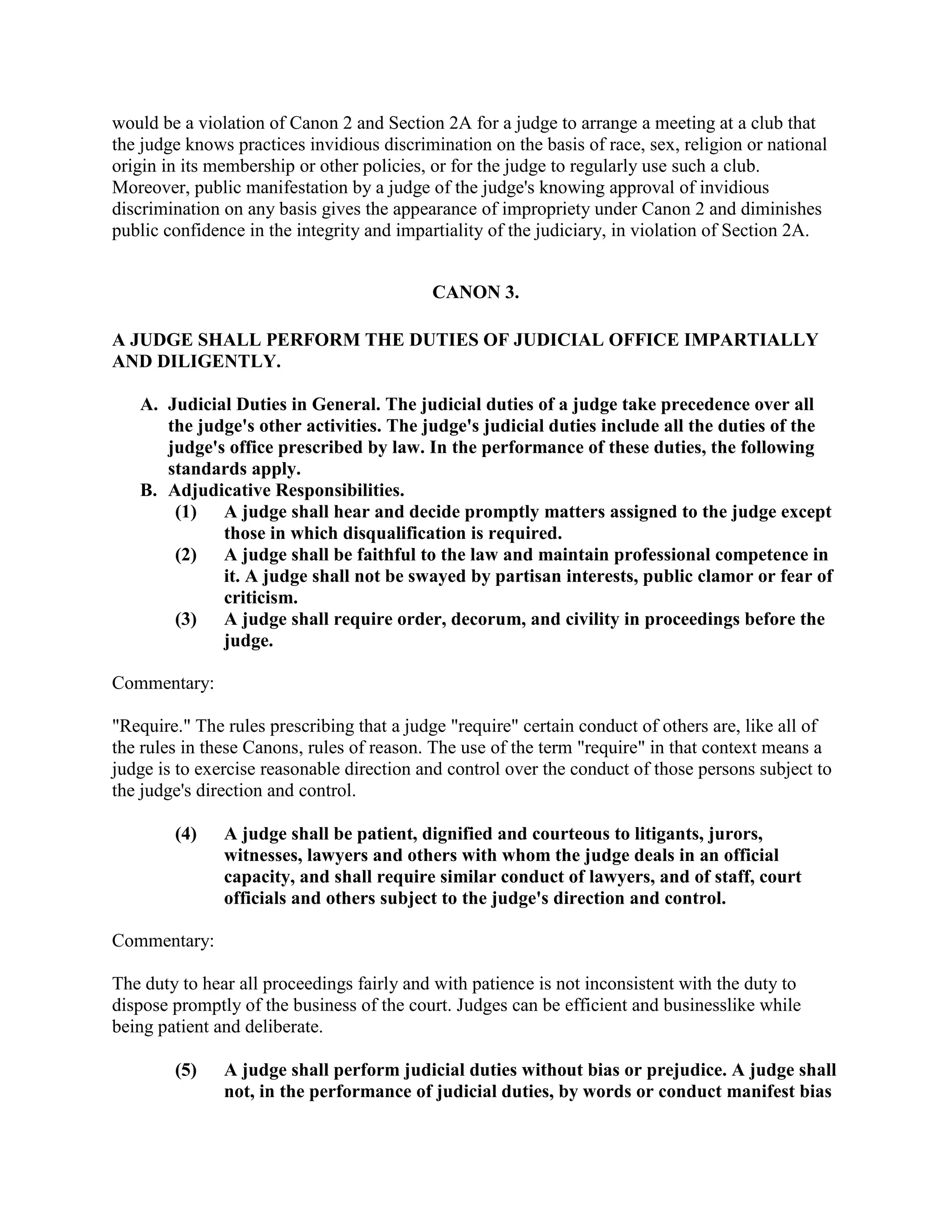
would be a violation of Canon 2 and Section 2A for a judge to arrange a meeting at a club that
the judge knows practices invidious discrimination on the basis of race, sex, religion or national
origin in its membership or other policies, or for the judge to regularly use such a club.
Moreover, public manifestation by a judge of the judge's knowing approval of invidious
discrimination on any basis gives the appearance of impropriety under Canon 2 and diminishes
public confidence in the integrity and impartiality of the judiciary, in violation of Section 2A.
CANON 3.
A JUDGE SHALL PERFORM THE DUTIES OF JUDICIAL OFFICE IMPARTIALLY
AND DILIGENTLY.
A. Judicial Duties in General. The judicial duties of a judge take precedence over all
the judge's other activities. The judge's judicial duties include all the duties of the
judge's office prescribed by law. In the performance of these duties, the following
standards apply.
B. Adjudicative Responsibilities.
(1) A judge shall hear and decide promptly matters assigned to the judge except
those in which disqualification is required.
(2) A judge shall be faithful to the law and maintain professional competence in
it. A judge shall not be swayed by partisan interests, public clamor or fear of
criticism.
(3) A judge shall require order, decorum, and civility in proceedings before the
judge.
Commentary:
"Require." The rules prescribing that a judge "require" certain conduct of others are, like all of
the rules in these Canons, rules of reason. The use of the term "require" in that context means a
judge is to exercise reasonable direction and control over the conduct of those persons subject to
the judge's direction and control.
(4) A judge shall be patient, dignified and courteous to litigants, jurors,
witnesses, lawyers and others with whom the judge deals in an official
capacity, and shall require similar conduct of lawyers, and of staff, court
officials and others subject to the judge's direction and control.
Commentary:
The duty to hear all proceedings fairly and with patience is not inconsistent with the duty to
dispose promptly of the business of the court. Judges can be efficient and businesslike while
being patient and deliberate.
(5) A judge shall perform judicial duties without bias or prejudice. A judge shall
not, in the performance of judicial duties, by words or conduct manifest bias
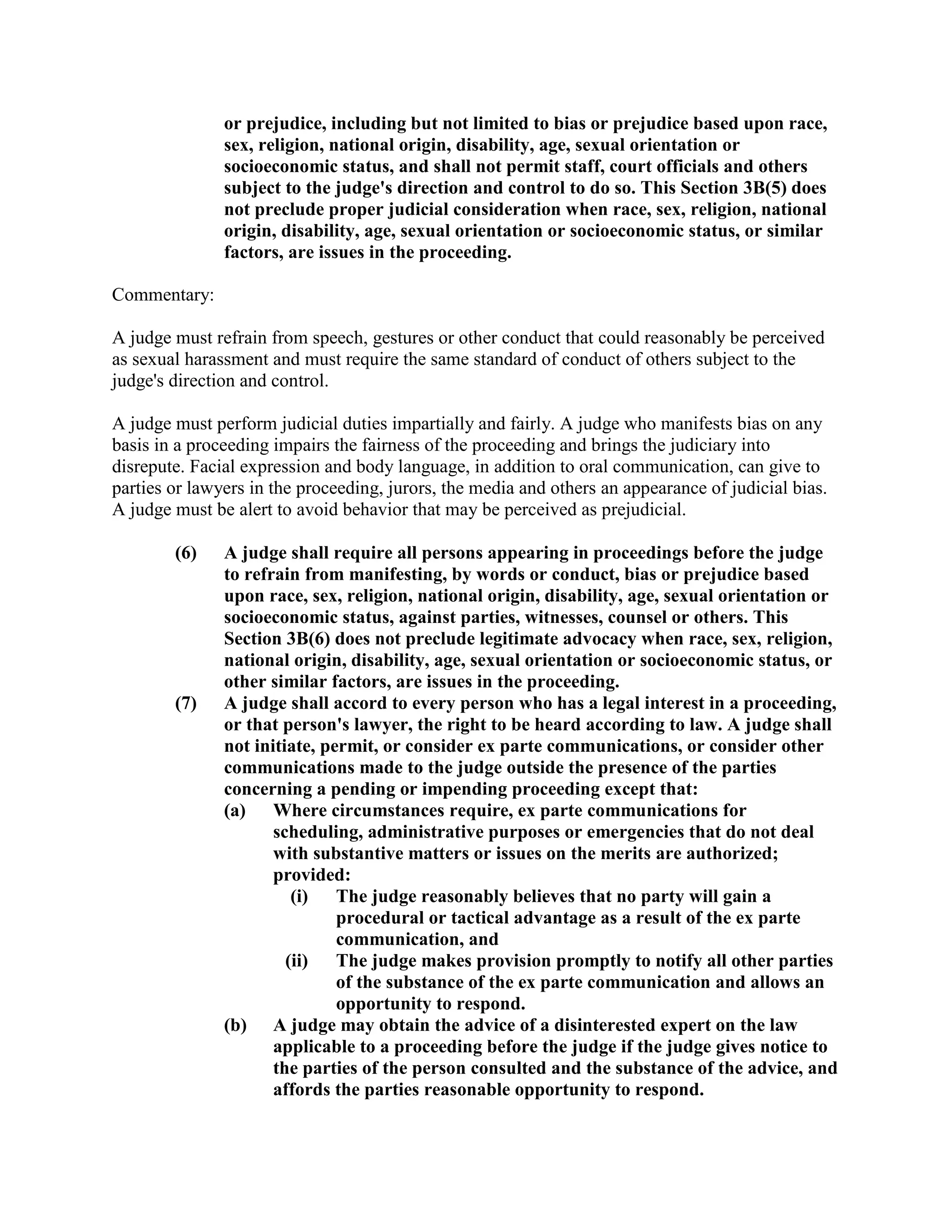
or prejudice, including but not limited to bias or prejudice based upon race,
sex, religion, national origin, disability, age, sexual orientation or
socioeconomic status, and shall not permit staff, court officials and others
subject to the judge's direction and control to do so. This Section 3B(5) does
not preclude proper judicial consideration when race, sex, religion, national
origin, disability, age, sexual orientation or socioeconomic status, or similar
factors, are issues in the proceeding.
Commentary:
A judge must refrain from speech, gestures or other conduct that could reasonably be perceived
as sexual harassment and must require the same standard of conduct of others subject to the
judge's direction and control.
A judge must perform judicial duties impartially and fairly. A judge who manifests bias on any
basis in a proceeding impairs the fairness of the proceeding and brings the judiciary into
disrepute. Facial expression and body language, in addition to oral communication, can give to
parties or lawyers in the proceeding, jurors, the media and others an appearance of judicial bias.
A judge must be alert to avoid behavior that may be perceived as prejudicial.
(6) A judge shall require all persons appearing in proceedings before the judge
to refrain from manifesting, by words or conduct, bias or prejudice based
upon race, sex, religion, national origin, disability, age, sexual orientation or
socioeconomic status, against parties, witnesses, counsel or others. This
Section 3B(6) does not preclude legitimate advocacy when race, sex, religion,
national origin, disability, age, sexual orientation or socioeconomic status, or
other similar factors, are issues in the proceeding.
(7) A judge shall accord to every person who has a legal interest in a proceeding,
or that person's lawyer, the right to be heard according to law. A judge shall
not initiate, permit, or consider ex parte communications, or consider other
communications made to the judge outside the presence of the parties
concerning a pending or impending proceeding except that:
(a) Where circumstances require, ex parte communications for
scheduling, administrative purposes or emergencies that do not deal
with substantive matters or issues on the merits are authorized;
provided:
(i) The judge reasonably believes that no party will gain a
procedural or tactical advantage as a result of the ex parte
communication, and
(ii) The judge makes provision promptly to notify all other parties
of the substance of the ex parte communication and allows an
opportunity to respond.
(b) A judge may obtain the advice of a disinterested expert on the law
applicable to a proceeding before the judge if the judge gives notice to
the parties of the person consulted and the substance of the advice, and
affords the parties reasonable opportunity to respond.
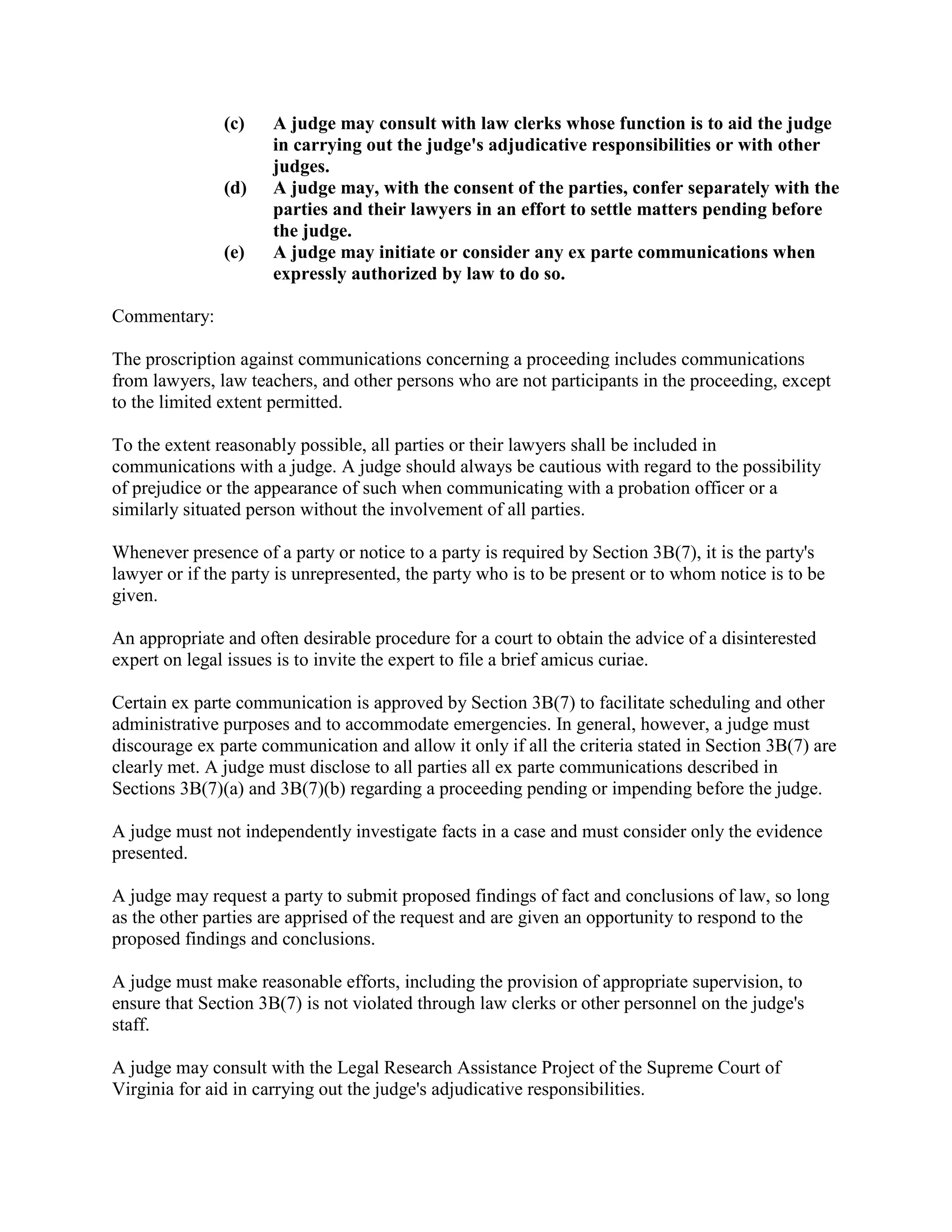
(c) A judge may consult with law clerks whose function is to aid the judge
in carrying out the judge's adjudicative responsibilities or with other
judges.
(d) A judge may, with the consent of the parties, confer separately with the
parties and their lawyers in an effort to settle matters pending before
the judge.
(e) A judge may initiate or consider any ex parte communications when
expressly authorized by law to do so.
Commentary:
The proscription against communications concerning a proceeding includes communications
from lawyers, law teachers, and other persons who are not participants in the proceeding, except
to the limited extent permitted.
To the extent reasonably possible, all parties or their lawyers shall be included in
communications with a judge. A judge should always be cautious with regard to the possibility
of prejudice or the appearance of such when communicating with a probation officer or a
similarly situated person without the involvement of all parties.
Whenever presence of a party or notice to a party is required by Section 3B(7), it is the party's
lawyer or if the party is unrepresented, the party who is to be present or to whom notice is to be
given.
An appropriate and often desirable procedure for a court to obtain the advice of a disinterested
expert on legal issues is to invite the expert to file a brief amicus curiae.
Certain ex parte communication is approved by Section 3B(7) to facilitate scheduling and other
administrative purposes and to accommodate emergencies. In general, however, a judge must
discourage ex parte communication and allow it only if all the criteria stated in Section 3B(7) are
clearly met. A judge must disclose to all parties all ex parte communications described in
Sections 3B(7)(a) and 3B(7)(b) regarding a proceeding pending or impending before the judge.
A judge must not independently investigate facts in a case and must consider only the evidence
presented.
A judge may request a party to submit proposed findings of fact and conclusions of law, so long
as the other parties are apprised of the request and are given an opportunity to respond to the
proposed findings and conclusions.
A judge must make reasonable efforts, including the provision of appropriate supervision, to
ensure that Section 3B(7) is not violated through law clerks or other personnel on the judge's
staff.
A judge may consult with the Legal Research Assistance Project of the Supreme Court of
Virginia for aid in carrying out the judge's adjudicative responsibilities.
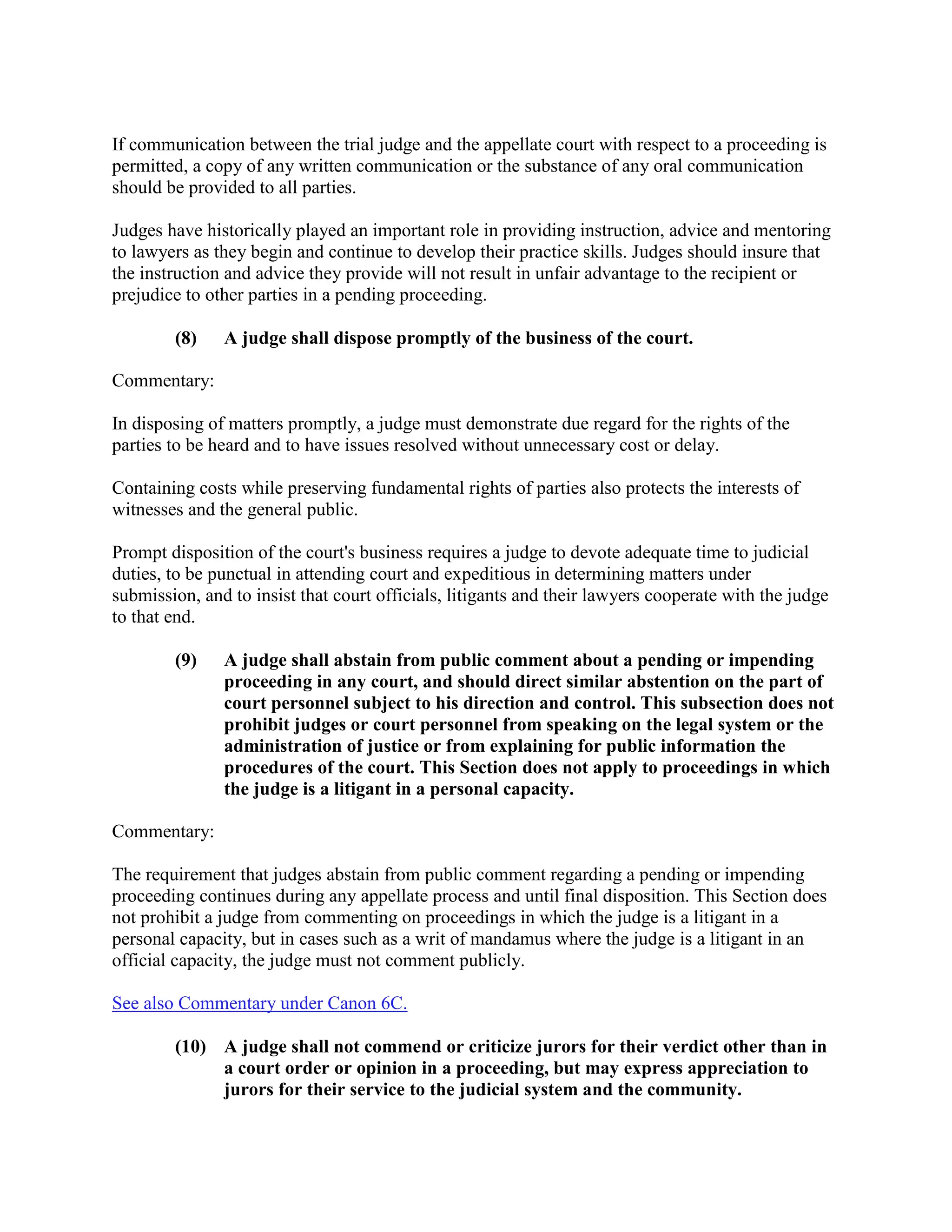
If communication between the trial judge and the appellate court with respect to a proceeding is
permitted, a copy of any written communication or the substance of any oral communication
should be provided to all parties.
Judges have historically played an important role in providing instruction, advice and mentoring
to lawyers as they begin and continue to develop their practice skills. Judges should insure that
the instruction and advice they provide will not result in unfair advantage to the recipient or
prejudice to other parties in a pending proceeding.
(8) A judge shall dispose promptly of the business of the court.
Commentary:
In disposing of matters promptly, a judge must demonstrate due regard for the rights of the
parties to be heard and to have issues resolved without unnecessary cost or delay.
Containing costs while preserving fundamental rights of parties also protects the interests of
witnesses and the general public.
Prompt disposition of the court's business requires a judge to devote adequate time to judicial
duties, to be punctual in attending court and expeditious in determining matters under
submission, and to insist that court officials, litigants and their lawyers cooperate with the judge
to that end.
(9) A judge shall abstain from public comment about a pending or impending
proceeding in any court, and should direct similar abstention on the part of
court personnel subject to his direction and control. This subsection does not
prohibit judges or court personnel from speaking on the legal system or the
administration of justice or from explaining for public information the
procedures of the court. This Section does not apply to proceedings in which
the judge is a litigant in a personal capacity.
Commentary:
The requirement that judges abstain from public comment regarding a pending or impending
proceeding continues during any appellate process and until final disposition. This Section does
not prohibit a judge from commenting on proceedings in which the judge is a litigant in a
personal capacity, but in cases such as a writ of mandamus where the judge is a litigant in an
official capacity, the judge must not comment publicly.
See also Commentary under Canon 6C.
(10) A judge shall not commend or criticize jurors for their verdict other than in
a court order or opinion in a proceeding, but may express appreciation to
jurors for their service to the judicial system and the community.
Commentary:
Commending or criticizing jurors for their verdict may imply a judicial expectation in future
cases and may impair a juror's ability to be fair and impartial in a subsequent case.
(11) A judge shall not disclose or use, for any purpose unrelated to judicial duties,
nonpublic information acquired in a judicial capacity.
C. Administrative Responsibilities.
(1) A judge shall diligently discharge the judge's administrative responsibilities
without bias or prejudice and maintain professional competence in judicial
administration, and shall cooperate with other judges and court officials in
the administration of court business.
(2) A judge shall require staff, court officials and others subject to the judge's
direction and control to observe the standards of fidelity and diligence that
apply to the judge and to refrain from manifesting bias or prejudice in the
performance of their official duties.
(3) The chief judge shall take reasonable measures to assure the prompt
disposition of matters before the court.
(4) A judge shall not make unnecessary appointments. A judge shall exercise the
power of appointment impartially and on the basis of merit. A judge shall
avoid nepotism and favoritism. A judge shall not approve compensation of
appointees beyond the fair value of services rendered.
Commentary:
Appointees of a judge include assigned counsel, officials such as commissioners, receivers and
guardians and personnel such as clerks, and secretaries. Consent by the parties to an appointment
or an award of compensation does not relieve the judge of the obligation prescribed by Section
3C(4).
D. Disciplinary Responsibilities.
(1) A judge who receives reliable information indicating a substantial likelihood
that another judge has committed a violation of these Canons should take
appropriate action. A judge having knowledge that another judge has
committed a violation of these Canons that raises a substantial question as to
the other judge's fitness for office should inform the Judicial Inquiry and
Review Commission.
(2) A judge who receives reliable information indicating a substantial likelihood
that a lawyer has committed a violation of the Code of Professional
Responsibility should take appropriate action. A judge having knowledge
that a lawyer has committed a violation of the Code of Professional
Responsibility that raises a substantial question as to the lawyer's honesty,
trustworthiness or fitness as a lawyer in other respects should inform the
Virginia State Bar.
(3) A judge shall have absolute immunity from civil action with respect to the
discharge of disciplinary responsibilities required or permitted by Sections
3D(1) and 3D(2).
Commentary: Appropriate action may include direct communication with the judge or lawyer
who has committed the violation, other direct action if available, and reporting the violation to
the appropriate authority or other agency or body.
E. Disqualification.
(1) A judge shall disqualify himself or herself in a proceeding in which the
judge's impartiality might reasonably be questioned, including but not
limited to instances where:
Under this rule, a judge is disqualified whenever the judge's impartiality might reasonably be
questioned, regardless whether any of the specific rules in Section 3E(1) apply.
A judge should disclose information that the judge believes the parties or their lawyers might
consider relevant to the question of disqualification, even if the judge believes there is no real
basis for disqualification.
By decisional law, the rule of necessity may override the rule of disqualification. For example, a
judge might be required to participate in judicial review of a judicial salary statute, or might be
the only judge available in a matter requiring immediate judicial action, such as a hearing on
probable cause or a temporary restraining order. In the latter case, the judge must disclose the
basis for possible disqualification and use reasonable efforts to transfer the matter to another
judge as soon as practicable.
(a) The judge has a personal bias or prejudice concerning a party or a
party's lawyer, or personal knowledge of disputed evidentiary facts
concerning the proceeding;
(b) The judge served as a lawyer in the matter in controversy, or a lawyer
with whom the judge previously practiced law served during such
association as a lawyer concerning the matter, or the judge has been a
material witness concerning it;
Commentary:
A lawyer in a government agency does not ordinarily have an association with other lawyers
employed by that agency within the meaning of Section 3E(1)(b); a judge formerly employed by
a government agency, however, should disqualify himself or herself in a proceeding if the
judge's impartiality might reasonably be questioned because of such association.
(c) The judge knows that he or she, individually or as a fiduciary, or the
judge's spouse, parent, or child wherever residing, or any other
member of the judge's family residing in the judge's household, has an
economic interest in the subject matter in controversy or in a party to
the proceeding or has more than a de minimis interest that could be
substantially affected by the proceeding;
(d) The judge or the judge's spouse, or a person within the third degree of
relationship to either of them, or the spouse of such a person:
Commentary:
"Third degree of relationship." The following persons are relatives within the third degree of
relationship: great-grandparent, grandparent, parent, uncle, aunt, brother, sister, child,
grandchild, great-grandchild, nephew or niece.
(i) is a party to the proceeding, or an officer,
director or trustee of a party;
(ii) is acting as a lawyer in the proceeding;
(iii) is known by the judge to have a more than de
minimis interest that could be substantially
affected by the proceeding;
(iv) is to the judge's knowledge likely to be a material
witness in the proceeding.
Commentary:
The fact that a lawyer in a proceeding is affiliated with a law firm or governmental agency with
which a relative of the judge is affiliated does not of itself disqualify the judge. Under
appropriate circumstances, the fact that "the judge's impartiality might reasonably be questioned"
under Section 3E(1), or that the relative is known by the judge to have an interest in the law firm
or governmental agency that could be "substantially affected by the outcome of the proceeding"
under Section 3E(1)(d)(iii) may require the judge's disqualification.
(2) A judge shall keep informed about the judge's personal and fiduciary
economic interests, and make a reasonable effort to keep informed about the
personal economic interests of the judge's spouse and minor children
residing in the judge's household.
Commentary:
"Economic interest" denotes ownership of a more than de minimis legal or equitable interest, or a
relationship as officer, director, advisor or other active participant in the affairs of a party, except
that:
(i) ownership of an interest in a mutual or common
investment fund that holds securities is not an
economic interest in such securities unless the
judge participates in the management of the
fund or a proceeding pending or impending
before the judge could substantially affect the
value of the interest;
(ii) service by a judge as an officer, director, advisor
or other active participant in an educational,
religious, charitable, fraternal or civic
organization, or service by a judge's spouse,
parent or child as an officer, director, advisor or
other active participant in any organization does
not create an economic interest in securities held
by that organization.
(iii) a deposit in a financial institution, the
proprietary interest of a policy holder in a
mutual insurance company, of a depositor in a
mutual savings association or of a member in a
credit union, or a similar proprietary interest, is
not an economic interest in the organization
unless a proceeding pending or impending
before the judge could substantially affect the
value of the interest;
(iv) ownership of government securities is not an
economic interest in the issuer unless a
proceeding pending or impending before the
judge could substantially affect the value of the
securities.
"Member of the judge's family residing in the judge's household" denotes any relative of a judge
by blood or marriage, or a person treated by a judge as a member of the judge's family, who
resides in the judge's household.
F. Remittal of Disqualification. A judge who may be disqualified by the terms of
Section 3E may ask, or have the clerk of court ask, the parties and their lawyers to
consider, out of the presence of the judge, whether to waive disqualification. If
following disclosure of any basis for disqualification other than personal bias or
prejudice concerning a party, the parties and lawyers, without participation by the
judge, all agree that the judge should not be disqualified, and the judge is then
willing to participate, the judge may participate in the proceeding. Written evidence
of the agreement shall be incorporated in the record of the proceeding.
Commentary:
A remittal procedure provides the parties an opportunity to proceed without delay if they wish to
waive the contemplated disqualification. To assure that consideration of the question of remittal
is made independently of the judge, a judge may ask, or have the clerk of court ask, the parties
and their lawyers to consider, out of the presence of the judge, whether to waive disqualification.
CANON 4.
A JUDGE MAY ENGAGE IN EXTRA-JUDICIAL ACTIVITIES DESIGNED TO
IMPROVE THE LAW, THE LEGAL SYSTEM, AND THE ADMINISTRATION OF
JUSTICE, AND SHALL CONDUCT ANY SUCH EXTRA-JUDICIAL ACTIVITIES IN A
MANNER THAT MINIMIZES THE RISK OF CONFLICT WITH JUDICIAL
OBLIGATIONS.
A. Extra Judicial Activities in General. A judge shall conduct all of the judge's extra
judicial activities so that they do not:
(1) cast reasonable doubt on the judge's capacity to act impartially as a judge;
(2) demean the judicial office; or
(3) interfere with the proper performance of judicial duties.
Commentary:
Complete separation of a judge from extra judicial activities is neither possible nor wise; a judge
should not become isolated from the community in which the judge lives.
Expressions of bias or prejudice by a judge, even outside the judge's judicial activities, may cast
reasonable doubt on the judge's capacity to act impartially as a judge. Expressions which may do
so include jokes or other remarks demeaning individuals on the basis of their race, sex, religion,
national origin, disability, age, sexual orientation or socioeconomic status.
See Section 2C and accompanying Commentary.
B. Avocational Activities. A judge may speak, write, lecture, teach and participate in
other extra judicial activities concerning the law, the legal system, the
administration of justice and non-legal subjects, subject to the requirements of these
Canons.
Commentary:
As a judicial officer and person specially learned in the law, a judge is in a unique position to
contribute to the improvement of the law, the legal system, and the administration of justice. To
the extent that time permits, a judge is encouraged to do so, either independently or through a bar
association, judicial conference or other organization dedicated to the improvement of the law.
Judges may participate in efforts to promote the fair administration of justice, the independence
of the judiciary and the integrity of the legal profession.
C. Governmental, Civic or Charitable Activities.
(1) A judge shall not appear at a public hearing before, or otherwise consult
with, an executive or legislative body or official except on matters concerning
the law, the legal system or the administration of justice or except when
acting pro se in a matter involving the judge or the judge's interests.
Commentary:
See Section 2B regarding the obligation to avoid improper influence.
(2) A judge shall not accept appointment to a governmental committee or
commission or other governmental position that is concerned with issues of
fact or policy on matters other than the improvement of the law, the legal
system or the administration of justice. A judge may, however, represent a
country, state or locality on ceremonial occasions or in connection with
historical, educational or cultural activities.
(3) A judge may serve as an officer, director, trustee or non legal advisor of an
organization or governmental agency devoted to the improvement of the law,
the legal system or the administration of justice or of an educational,
religious, charitable, fraternal or civic organization not conducted for profit,
subject to the following limitations and the other requirements of this Code.
(a) A judge shall not serve as an officer, director, trustee or non legal
advisor of a governmental, civic, or charitable organization if it is
likely that the organization:
(i) will be engaged in proceedings that would
ordinarily come before the judge, or
(ii) will be engaged frequently in adversary
proceedings in the court of which the judge is a
member or in any court subject to the appellate
jurisdiction of the court of which the judge is a
member.
Commentary:
Nothing contained in these Canons shall be deemed to prohibit a judge from serving in a
nonvoting capacity on the Board of Directors of Lawyers Helping Lawyers, or any committees
of Lawyers Helping Lawyers.
(b) A judge as an officer, director, trustee or non legal advisor, or as a
member or otherwise:
(i) may assist such an organization in planning fund
raising and may participate in the management
and investment of the organization's funds, but
shall not personally participate in the solicitation
of funds, except that a judge may solicit funds
from other judges over whom the judge does not
exercise supervisory or appellate authority;
(ii) may make recommendations to public and
private fund granting organizations on projects
and programs concerning the law, the legal
system or the administration of justice so long as
one organization is not favored over another;
(iii) shall not personally participate in membership
solicitation if the solicitation might reasonably be
perceived as coercive or, except as permitted in
Section 4C(3)(b)(i), if the membership
solicitation is essentially a fund raising
mechanism;
(iv) shall not use or permit the use of the prestige of
judicial office for fund raising or membership
solicitation; and
(v) shall not be a speaker or guest of honor at an
organization's fund raising events, but may
attend such events.
Commentary:
A judge may solicit membership or endorse or encourage membership efforts for an organization
devoted to the improvement of the law, the legal system or the administration of justice or a
nonprofit educational, religious, charitable, fraternal or civic organization as long as the
solicitation cannot reasonably be perceived as coercive and is not essentially a fund raising
mechanism. Solicitation of funds for an organization and solicitation of memberships similarly
involve the danger that the person solicited will feel obligated to respond favorably to the
solicitor if the solicitor is in a position of influence or control. A judge must not engage in direct,
individual solicitation of funds or memberships in person, in writing or by telephone except in
the following cases: 1) a judge may solicit funds or memberships from other judges over whom
the judge does not exercise supervisory or appellate authority, 2) a judge may solicit other
persons for membership in the organizations described above if neither those persons nor persons
with whom they are affiliated are likely ever to appear before the court on which the judge serves
and 3) a judge who is an officer of such an organization may send a general membership
solicitation mailing over the judge's signature.
This Canon is not intended to prohibit judges from participating in all charitable events. Judges
are encouraged to be involved in community activities so long as the judge does not participate
in the solicitation of funds and the prestige of the office is not used for fund raising.
Use of an organization letterhead for fund raising or membership solicitation does not violate
Section 4C(3)(b) provided the letterhead lists only the judge's name and office or other position
in the organization, and, if comparable designations are listed for other persons, the judge's
judicial designation. In addition, a judge must also make reasonable efforts to ensure that the
judge's staff, court officials and others subject to the judge's direction and control do not solicit
funds on the judge's behalf for any purpose, charitable or otherwise.
D. Financial Activities.
(1) A judge shall not engage in financial and business dealings that:
(a) may reasonably be perceived to exploit the judge's judicial position, or
(b) involve the judge in frequent transactions or continuing business
relationships with those lawyers or other persons likely to come before
the court on which the judge serves.
Commentary:
A judge must avoid financial and business dealings that involve the judge in frequent
transactions or continuing business relationships with persons likely to come either before the
judge personally or before other judges on the judge's court. In addition, a judge should
discourage members of the judge's family from engaging in dealings that would reasonably
appear to exploit the judge's judicial position. This rule is necessary to avoid creating an
appearance of exploitation of office or favoritism and to minimize the potential for
disqualification.
(2) A judge may, subject to the requirements of this Canon, hold and manage
investments of the judge and members of the judge's family, including real
estate.
Commentary:
This Section provides that, subject to the requirements of this Canon, a judge may hold and
manage investments owned solely by the judge, investments owned solely by a member or
members of the judge's family, and investments owned jointly by the judge and members of the
judge's family. A judge may own real estate or other property with others, who are not family
members, so long as the judge complies with Section 4D(1) and (2).
(3) A judge shall not serve as an officer, director, manager, general partner,
advisor or employee of any business entity except that a judge may, subject
to the requirements of this Canon, manage and participate in:
(a) a business closely held by the judge or members of the judge's family,
or
(b) a business entity primarily engaged in investment of the financial
resources of the judge or members of the judge's family.
Commentary:
Subject to the requirements of this Canon, a judge may participate in a business in which at least
fifty percent is held either by the judge alone, by members of the judge's family, or by the judge
and members of the judge's family.
Although participation by a judge in a closely held family business might otherwise be permitted
by Section 4D(3), a judge may be prohibited from participation by other provisions of these
Canons when, for example, the business entity frequently appears before the judge's court or the
participation requires significant time away from judicial duties. Similarly, a judge must avoid
participating in a closely held family business if the judge's participation would involve misuse
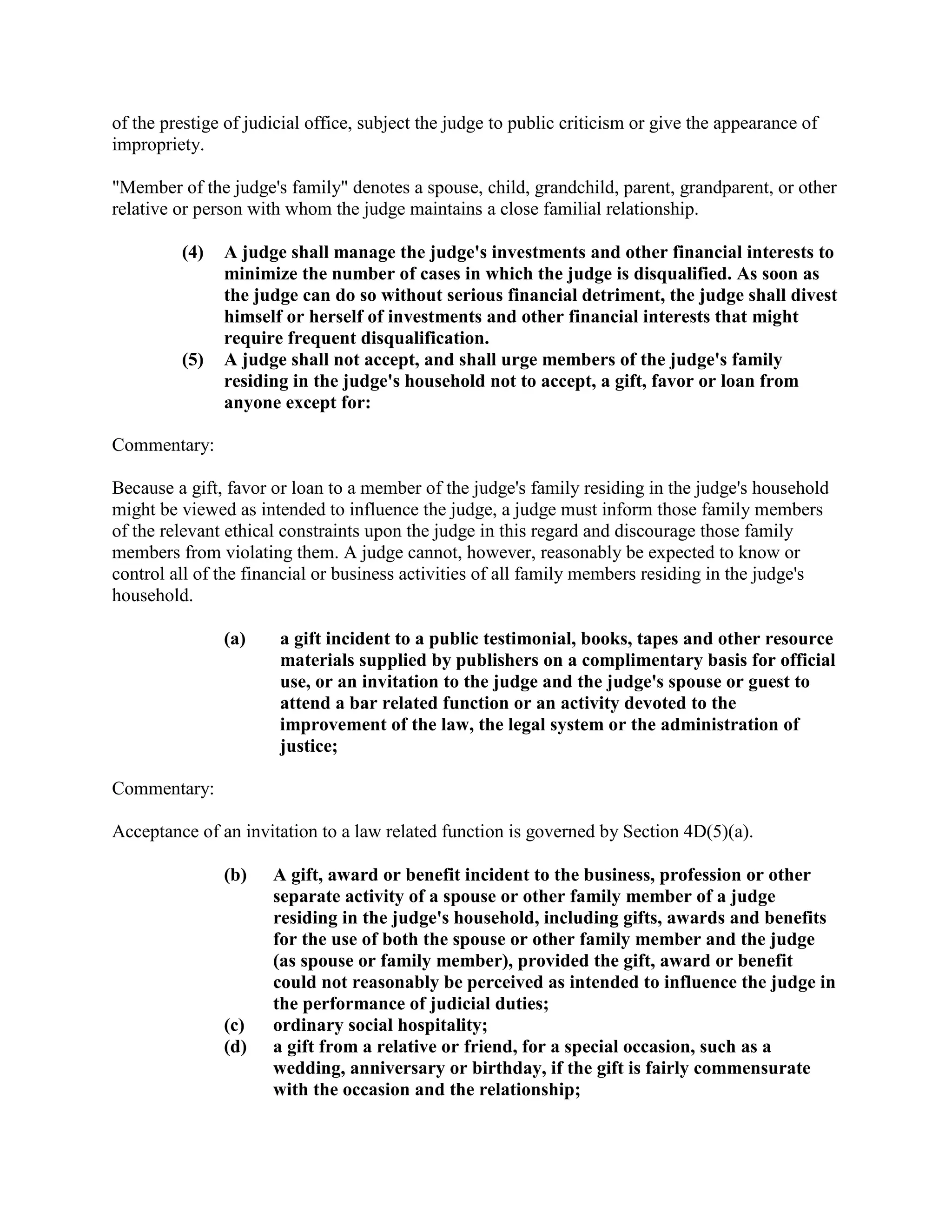
of the prestige of judicial office, subject the judge to public criticism or give the appearance of
impropriety.
"Member of the judge's family" denotes a spouse, child, grandchild, parent, grandparent, or other
relative or person with whom the judge maintains a close familial relationship.
(4) A judge shall manage the judge's investments and other financial interests to
minimize the number of cases in which the judge is disqualified. As soon as
the judge can do so without serious financial detriment, the judge shall divest
himself or herself of investments and other financial interests that might
require frequent disqualification.
(5) A judge shall not accept, and shall urge members of the judge's family
residing in the judge's household not to accept, a gift, favor or loan from
anyone except for:
Commentary:
Because a gift, favor or loan to a member of the judge's family residing in the judge's household
might be viewed as intended to influence the judge, a judge must inform those family members
of the relevant ethical constraints upon the judge in this regard and discourage those family
members from violating them. A judge cannot, however, reasonably be expected to know or
control all of the financial or business activities of all family members residing in the judge's
household.
(a) a gift incident to a public testimonial, books, tapes and other resource
materials supplied by publishers on a complimentary basis for official
use, or an invitation to the judge and the judge's spouse or guest to
attend a bar related function or an activity devoted to the
improvement of the law, the legal system or the administration of
justice;
Commentary:
Acceptance of an invitation to a law related function is governed by Section 4D(5)(a).
(b) A gift, award or benefit incident to the business, profession or other
separate activity of a spouse or other family member of a judge
residing in the judge's household, including gifts, awards and benefits
for the use of both the spouse or other family member and the judge
(as spouse or family member), provided the gift, award or benefit
could not reasonably be perceived as intended to influence the judge in
the performance of judicial duties;
(c) ordinary social hospitality;
(d) a gift from a relative or friend, for a special occasion, such as a
wedding, anniversary or birthday, if the gift is fairly commensurate
with the occasion and the relationship;
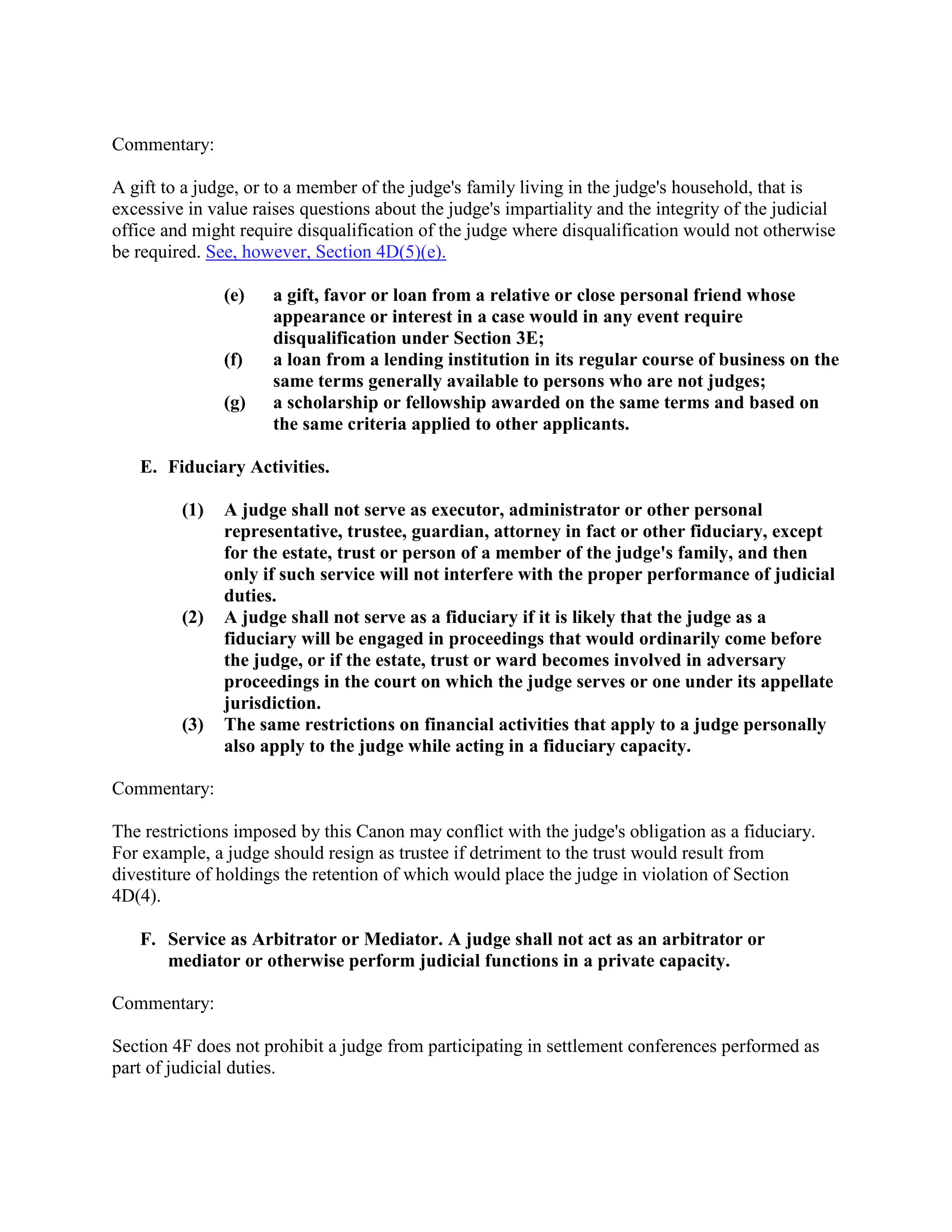
Commentary:
A gift to a judge, or to a member of the judge's family living in the judge's household, that is
excessive in value raises questions about the judge's impartiality and the integrity of the judicial
office and might require disqualification of the judge where disqualification would not otherwise
be required. See, however, Section 4D(5)(e).
(e) a gift, favor or loan from a relative or close personal friend whose
appearance or interest in a case would in any event require
disqualification under Section 3E;
(f) a loan from a lending institution in its regular course of business on the
same terms generally available to persons who are not judges;
(g) a scholarship or fellowship awarded on the same terms and based on
the same criteria applied to other applicants.
E. Fiduciary Activities.
(1) A judge shall not serve as executor, administrator or other personal
representative, trustee, guardian, attorney in fact or other fiduciary, except
for the estate, trust or person of a member of the judge's family, and then
only if such service will not interfere with the proper performance of judicial
duties.
(2) A judge shall not serve as a fiduciary if it is likely that the judge as a
fiduciary will be engaged in proceedings that would ordinarily come before
the judge, or if the estate, trust or ward becomes involved in adversary
proceedings in the court on which the judge serves or one under its appellate
jurisdiction.
(3) The same restrictions on financial activities that apply to a judge personally
also apply to the judge while acting in a fiduciary capacity.
Commentary:
The restrictions imposed by this Canon may conflict with the judge's obligation as a fiduciary.
For example, a judge should resign as trustee if detriment to the trust would result from
divestiture of holdings the retention of which would place the judge in violation of Section
4D(4).
F. Service as Arbitrator or Mediator. A judge shall not act as an arbitrator or
mediator or otherwise perform judicial functions in a private capacity.
Commentary:
Section 4F does not prohibit a judge from participating in settlement conferences performed as
part of judicial duties.
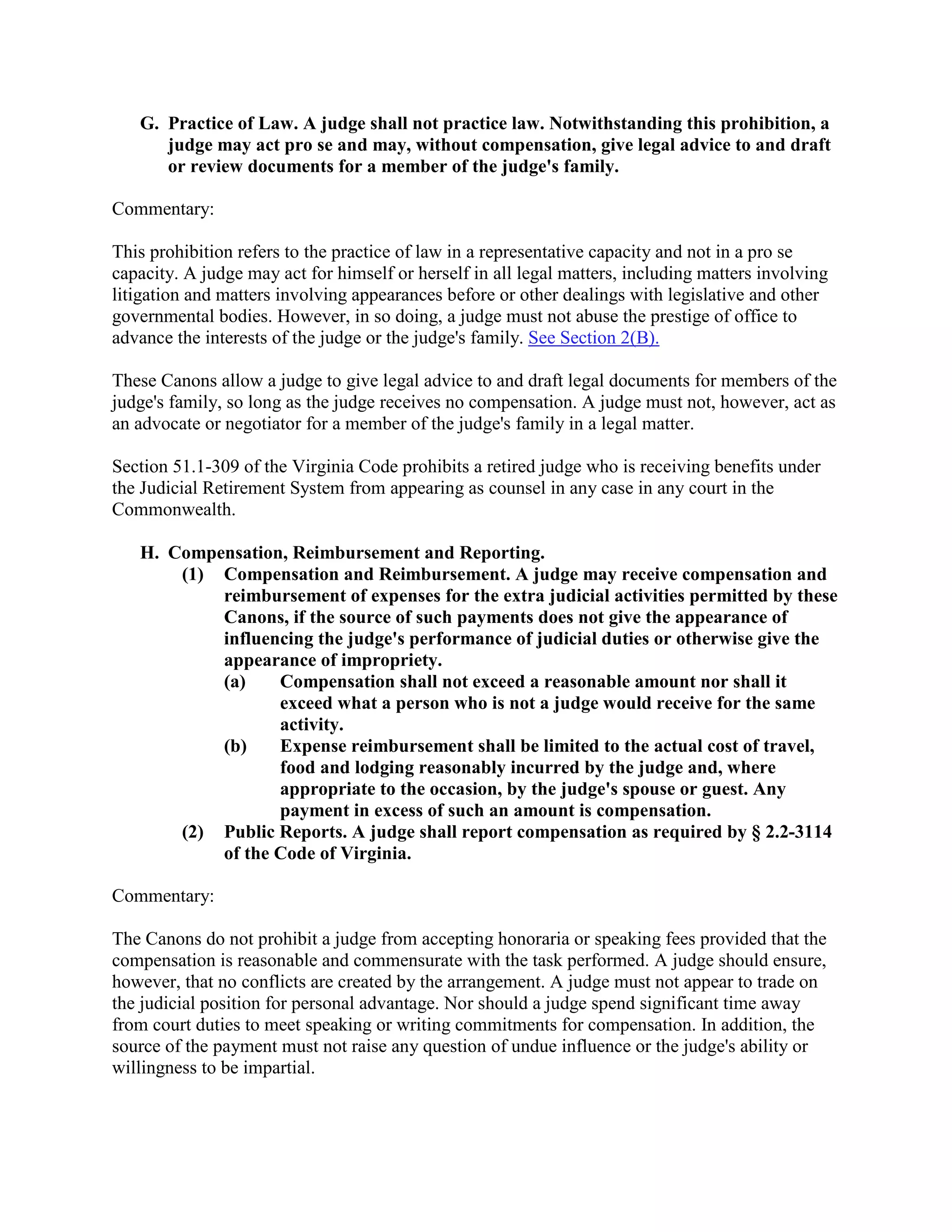
G. Practice of Law. A judge shall not practice law. Notwithstanding this prohibition, a
judge may act pro se and may, without compensation, give legal advice to and draft
or review documents for a member of the judge's family.
Commentary:
This prohibition refers to the practice of law in a representative capacity and not in a pro se
capacity. A judge may act for himself or herself in all legal matters, including matters involving
litigation and matters involving appearances before or other dealings with legislative and other
governmental bodies. However, in so doing, a judge must not abuse the prestige of office to
advance the interests of the judge or the judge's family. See Section 2(B).
These Canons allow a judge to give legal advice to and draft legal documents for members of the
judge's family, so long as the judge receives no compensation. A judge must not, however, act as
an advocate or negotiator for a member of the judge's family in a legal matter.
Section 51.1-309 of the Virginia Code prohibits a retired judge who is receiving benefits under
the Judicial Retirement System from appearing as counsel in any case in any court in the
Commonwealth.
H. Compensation, Reimbursement and Reporting.
(1) Compensation and Reimbursement. A judge may receive compensation and
reimbursement of expenses for the extra judicial activities permitted by these
Canons, if the source of such payments does not give the appearance of
influencing the judge's performance of judicial duties or otherwise give the
appearance of impropriety.
(a) Compensation shall not exceed a reasonable amount nor shall it
exceed what a person who is not a judge would receive for the same
activity.
(b) Expense reimbursement shall be limited to the actual cost of travel,
food and lodging reasonably incurred by the judge and, where
appropriate to the occasion, by the judge's spouse or guest. Any
payment in excess of such an amount is compensation.
(2) Public Reports. A judge shall report compensation as required by § 2.2-3114
of the Code of Virginia.
Commentary:
The Canons do not prohibit a judge from accepting honoraria or speaking fees provided that the
compensation is reasonable and commensurate with the task performed. A judge should ensure,
however, that no conflicts are created by the arrangement. A judge must not appear to trade on
the judicial position for personal advantage. Nor should a judge spend significant time away
from court duties to meet speaking or writing commitments for compensation. In addition, the
source of the payment must not raise any question of undue influence or the judge's ability or
willingness to be impartial.
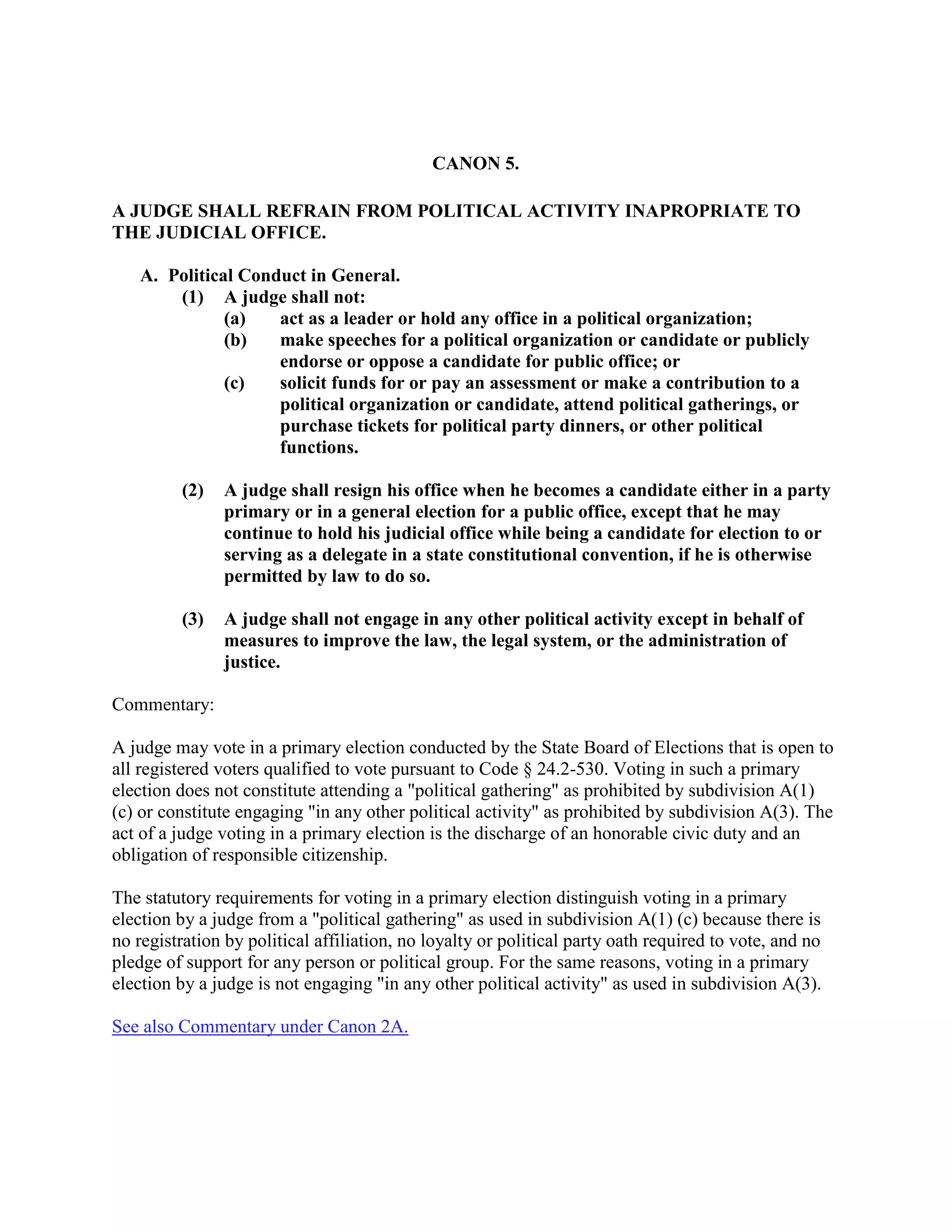
CANON 5.
A JUDGE SHALL REFRAIN FROM POLITICAL ACTIVITY INAPROPRIATE TO
THE JUDICIAL OFFICE.
A. Political Conduct in General.
(1) A judge shall not:
(a) act as a leader or hold any office in a political organization;
(b) make speeches for a political organization or candidate or publicly
endorse or oppose a candidate for public office; or
(c) solicit funds for or pay an assessment or make a contribution to a
political organization or candidate, attend political gatherings, or
purchase tickets for political party dinners, or other political
functions.
(2) A judge shall resign his office when he becomes a candidate either in a party
primary or in a general election for a public office, except that he may
continue to hold his judicial office while being a candidate for election to or
serving as a delegate in a state constitutional convention, if he is otherwise
permitted by law to do so.
(3) A judge shall not engage in any other political activity except in behalf of
measures to improve the law, the legal system, or the administration of
justice.
Commentary:
A judge may vote in a primary election conducted by the State Board of Elections that is open to
all registered voters qualified to vote pursuant to Code § 24.2-530. Voting in such a primary
election does not constitute attending a "political gathering" as prohibited by subdivision A(1)
(c) or constitute engaging "in any other political activity" as prohibited by subdivision A(3). The
act of a judge voting in a primary election is the discharge of an honorable civic duty and an
obligation of responsible citizenship.
The statutory requirements for voting in a primary election distinguish voting in a primary
election by a judge from a "political gathering" as used in subdivision A(1) (c) because there is
no registration by political affiliation, no loyalty or political party oath required to vote, and no
pledge of support for any person or political group. For the same reasons, voting in a primary
election by a judge is not engaging "in any other political activity" as used in subdivision A(3).
See also Commentary under Canon 2A.
CANON 6
JUDGES PRO TEMPORE, RETIRED JUDGES, SUBSTITUTE JUDGES AND
PERSONS SELECTED FOR JUDGESHIP ARE REQUIRED TO COMPLY WITH THE
CANONS.
A. Judge Pro Tempore. A judge pro tempore is a person who is appointed pursuant to
§§ 17.1-109, 17.1-110, and 17.1-111 of the Code of Virginia to act temporarily as a
judge.
(1) While acting as such, a judge pro tempore is required to comply with the
Canons as they apply to the case before him.
(2) A person who has been a judge pro tempore shall not act as a lawyer in a
proceeding in which he has served as a judge or in any proceeding related
thereto.
Commentary:
A judge pro tempore appointed under the provisions of Section 16.1-69.9:2 or 17-120 [17.1-509]
of the Code shall be bound by the same Canons as a full time judge.
B. Retired Judge, Senior Judge Or Justice. The provisions of § 51.1-309 of the Code of
Virginia and of these Canons shall apply to all retired judges. Such judges, however,
are not required to comply with Canon 4C(2), D(3), E, F, G, and H(2).
Commentary:
A retired judge who both receives retirement benefits and appears in Virginia courts violates Va.
Code § 51.1-309 and subdivision B of this Canon.
Retired judges may be listed as such or be referred to as “Honorable” in materials distributed by
alternative dispute resolution groups and they may list their judicial service on resumes
distributed by such organizations. When the term “Honorable” is used, however, the materials
shall make clear that the judge is a retired judge.
C. Substitute Judge Or Special Justice. A substitute judge or special justice shall not
act as a lawyer in a proceeding in which he has served as a judge or in any other
proceeding related thereto but otherwise may practice law in the court on which he
serves. A substitute judge or special justice is not required to comply with 4C(l)(2)
and (3) except that he shall not use or permit the use of the prestige of judicial office
for fund raising or membership solicitation. A substitute judge or special justice is
not required to comply with 4D(3), E, F, and G.
Commentary:
When sitting as a substitute judge or special justice, the substitute judge or special justice shall
be bound by the Canons in the same manner as a full time judge. When a substitute judge or
special justice is acting as a practicing attorney, he or she will not be precluded from those
activities otherwise authorized as a practicing attorney.
D. Person Selected for Judgeship. A person selected for a full-time position subject to
the provisions of these Canons who is not already a justice or judge, from either
election by both houses of the General Assembly or appointment by the appropriate
authority until taking the oath of office as a justice or judge, is required to comply
with Canons 1, 2, 2A, 2B, 4A, 4B, 4C(2), 4C(3)(b)(i, iii, and iv), 4D(1)(a), 4D(5),
4H(1), and 5. Such person shall arrange his or her affairs to be in compliance with
the other appropriate parts of the Canons of Judicial Conduct at the time that he or
she takes the oath of office.
Commentary:
A person who has been selected as a judge but who has not yet taken the oath of office is
perceived by the public as a person who should adhere to the high standards of conduct
applicable to a judge. However, such a person needs time to arrange his or her affairs to be in
compliance with these Canons at the time of taking the oath of office, and to wind down his or
her practice prior to taking the oath of office. This provision applies the rule of reason to this
transition process. During this period, such person should act in a manner appropriate to, and
should not take advantage of, his or her status of impending judicial position.
CANON 7.
EFFECTIVE DATE. These Canons shall become effective July 1, 1999.
[March 9, 2000, effective March 9, 2000, Canon 3B(9) was amended.]
[April 12, 2001, effective July, 1, 2001, the Preamble was amended, Canon 6C was
amended, and Canon 6D was added.]
[February 6, 2004, effective February 6, 2004, the Commentary to Canon 2B was
amended.]
[April 13, 2004, effective April 13, 2004, the Commentary to Canon 4C(3)(a) was added.]
[November 2, 2004, effective November 2, 2004, the Commentary to Canon 2A was
amended and the Commentary to 5A was added.]
[November 2, 2009, effective November 2, 2009, Canon 4H(2) was amended.]

Canons of Judicial Conduct: Virginia Commonwealth

  • 1.
    Canons of JudicialConduct for the State of Virginia PREAMBLE Our legal system is based on the principle that an independent, fair and competent judiciary will interpret and apply the laws that govern us. The role of the judiciary is central to American concepts of justice and the rule of law. Intrinsic to all sections of these Canons are the precepts that judges, individually and collectively, must respect and honor the judicial office as a public trust and strive to enhance and maintain confidence in our legal system. The judge is an arbiter of facts and law for the resolution of disputes and a highly visible symbol of government under the rule of law. The Canons of Judicial Conduct are intended to establish standards for ethical conduct of judges. They consist of broad statements called Canons, specific rules set forth in Sections under each Canon and Commentary. The text of the Canons and the Sections is authoritative. Each Commentary, by explanation and example, is advisory and provides guidance with respect to the purpose and meaning of the Canons and Sections. Each Commentary, by explanation and example, is advisory and provides guidance with respect to the purpose and meaning of the Canons and Sections. The Commentary is not intended as a statement of additional rules. When the text uses "shall" or "shall not" or "must" or "must not" it is intended to impose binding obligations the violation of which can result in disciplinary action. When "should" or "should not" is used, the text is intended as a statement of what is or is not appropriate conduct but not as a binding rule under which a judge may be disciplined. When "may" is used, it denotes permissible discretion or, depending on the context, it refers to action that is not covered by specific proscriptions. The Canons and Sections are rules of reason. They should be applied consistent with constitutional requirements, statutes, other court rules and decisional law and in the context of all relevant circumstances. The Canons are to be construed so as not to impinge on the essential independence of judges in making judicial decisions. The Canons are designed to provide guidance to judges and candidates for judicial office and to provide a structure for regulating conduct through the Judicial Inquiry and Review Commission. They are not designed or intended as a basis for civil liability or criminal prosecution. Furthermore, the purpose of the Canons would be subverted if the Canons were invoked by lawyers for mere tactical advantage in a proceeding. The text of the Canons and Sections is intended to govern conduct of judges and to be binding upon them. It is not intended, however, that every transgression will result in disciplinary action. Whether disciplinary action is appropriate, and the degree of discipline to be imposed, should be determined through a reasonable and reasoned application of the text and should depend on such factors as the seriousness of the transgression, whether there is a pattern of improper activity and the effect of the improper activity on others or on the judicial system.
  • 2.
    These Canons applyto (1) all active Justices of the Supreme Court of Virginia, and Judges of the Court of Appeals of Virginia, Circuit Courts, General District Courts, Juvenile and Domestic Relations District Courts, Members of the State Corporation Commission and the Virginia Workers' Compensation Commission; (2) retired Judges and Members eligible for recall to judicial service; (3) substitute Judges and Special Justices; and (4) persons selected for a full- time judgeship either by election by both houses of the General Assembly or appointment by the appropriate authority who are not already justices, judges or retired judges, but who have not taken the oath of office as a justice or judge; and (5) Judges pro tempore while acting as a Judge pro tempore. Magistrates are not bound by these Canons. However, Canons of Conduct for Virginia Magistrates were adopted by the Committee on District Courts effective January 1, 1980. CANON 1. A JUDGE SHALL UPHOLD THE INTEGRITY AND INDEPENDENCE OF THE JUDICIARY. A. An independent and honorable judiciary is indispensable to justice in our society. A judge should participate in establishing, maintaining and enforcing high standards of conduct, and shall personally observe those standards so that the integrity and independence of the judiciary will be preserved. The provisions of these Canons are to be construed and applied to further that objective. Commentary: Deference to the judgments and rulings of courts depends upon public confidence in the integrity and independence of judges. The integrity and independence of judges depends in turn upon their acting without fear or favor. Although judges should be independent, they must comply with the law, including the provisions of these Canons. Public confidence in the impartiality of the judiciary is maintained by the adherence of each judge to this responsibility. Conversely, violation of this Canon diminishes public confidence in the judiciary and thereby does injury to the system of government under law. CANON 2. A JUDGE SHALL AVOID IMPROPRIETY AND THE APPEARANCE OF IMPROPRIETY IN ALL OF THE JUDGE'S ACTIVITIES. A. A judge shall respect and comply with the law and shall act at all times in a manner that promotes public confidence in the integrity and impartiality of the judiciary. Commentary:
  • 3.
    Public confidence inthe judiciary is eroded by irresponsible or improper conduct by judges. A judge must avoid all impropriety and appearance of impropriety. A judge must expect to be the subject of constant public scrutiny. A judge must therefore accept restrictions on the judge's conduct that might be viewed as burdensome by the ordinary citizen and should do so freely and willingly. The prohibition against behaving with impropriety or the appearance of impropriety applies to both the professional and personal conduct of a judge. Because it is not practicable to list all prohibited acts, the proscription is necessarily cast in general terms that extend to conduct by judges that is harmful although not specifically mentioned in the Canons. Actual improprieties under this standard include violations of law, court rules or other specific provisions of these Canons. The test for appearance of impropriety is whether the conduct would create in reasonable minds a perception that the judge's ability to carry out judicial responsibilities with integrity and impartiality is impaired. See also Commentary under Section 2C. A judge may vote in a primary election conducted by the State Board of Elections that is open to all registered voters qualified to vote pursuant to Code § 24.2-530. Voting in such a primary election does not constitute an act of partiality by a judge as prohibited by subdivision A. The act of a judge voting in a primary election is the discharge of an honorable civic duty, an obligation of responsible citizenship, and does not give the "appearance of impropriety." The statutory requirements for voting in a primary election reflect voting in a primary election by a judge as an act of "impartiality" as used in subdivision A(1) (c) because there is no registration by political affiliation, no loyalty or political party oath required to vote, and no pledge of support for any person or political group. It is the impartial nature of such a primary election that enables judges to avoid an "appearance of impropriety." See also Commentary under Canon 5A. B. A judge shall not allow family, social, political or other relationships to influence the judge's judicial conduct or judgment. A judge shall not lend the prestige of judicial office to advance the private interests of the judge or others; nor shall a judge convey or permit others to convey the impression that they are in a special position to influence the judge. A judge shall not testify as a character witness. Commentary: Maintaining the prestige of judicial office is essential to a system of government in which the judiciary functions independently of the executive and legislative branches. Respect for the judicial office facilitates the orderly conduct of legitimate judicial functions. Judges should distinguish between proper and improper use of the prestige of office in all of their activities. For example, it would be improper for a judge to allude to his or her judgeship to gain a personal advantage such as deferential treatment when stopped by a police officer for a traffic offense. Similarly, judicial letterhead must not be used for conducting a judge's personal business.
  • 4.
    A judge mustavoid lending the prestige of judicial office for the advancement of the private interests of others. For example, a judge must not use the judge's judicial position to gain advantage in a civil suit involving a member of the judge's family. As to the acceptance of awards, see Section 4D(5)(a) and Commentary. In a criminal case, a judge may not approve a plea agreement or disposition that requires or permits the defendant to make a charitable contribution or donation, or any other monetary payment other than a statutorily authorized fine or restitution or payment in satisfaction of an injury pursuant to Code § 19.2-151, as a condition of a suspended sentence or the reduction or dismissal of charges. Although a judge should be sensitive to possible abuse of the prestige of office, a judge may, based on the judge's personal knowledge, serve as a reference or provide a letter of recommendation. When using court stationery for letters of reference an indication should be made that the opinion expressed is personal and not an opinion of the court. However, a judge must not initiate the communication of information to a sentencing judge or a probation or corrections officer but may provide to such person information for the record in response to a formal request. Judges may participate in the process of judicial selection by cooperating with appointing authorities and screening committees seeking names for consideration, and by responding to official inquiries concerning a person being considered for a judgeship. C. A judge shall not hold membership in any organization that practices invidious discrimination on the basis of race, sex, religion or national origin. Commentary: Membership of a judge in an organization that practices invidious discrimination gives rise to perceptions that the judge's impartiality is impaired. Section 2C refers to the current practices of the organization. Whether an organization practices invidious discrimination is often a complex question to which judges should be sensitive. The answer cannot be determined from a mere examination of an organization's current membership rolls but rather depends on how the organization selects members and other relevant factors, such as that the organization is dedicated to the preservation of religious, ethnic or cultural values of legitimate common interest to its members, or that it is in fact and effect an intimate, purely private organization whose membership limitations could not be constitutionally prohibited. Absent such factors, an organization is generally said to discriminate invidiously if it arbitrarily excludes from membership on the basis of race, religion, sex or national origin persons who would otherwise be admitted to membership. Although Section 2C relates only to membership in organizations that invidiously discriminate on the basis of race, sex, religion or national origin, a judge's membership in an organization that engages in any discriminatory membership practices prohibited by the law of the jurisdiction also violates Canon 2 and Section 2A and gives the appearance of impropriety. In addition, it
  • 5.
    would be aviolation of Canon 2 and Section 2A for a judge to arrange a meeting at a club that the judge knows practices invidious discrimination on the basis of race, sex, religion or national origin in its membership or other policies, or for the judge to regularly use such a club. Moreover, public manifestation by a judge of the judge's knowing approval of invidious discrimination on any basis gives the appearance of impropriety under Canon 2 and diminishes public confidence in the integrity and impartiality of the judiciary, in violation of Section 2A. CANON 3. A JUDGE SHALL PERFORM THE DUTIES OF JUDICIAL OFFICE IMPARTIALLY AND DILIGENTLY. A. Judicial Duties in General. The judicial duties of a judge take precedence over all the judge's other activities. The judge's judicial duties include all the duties of the judge's office prescribed by law. In the performance of these duties, the following standards apply. B. Adjudicative Responsibilities. (1) A judge shall hear and decide promptly matters assigned to the judge except those in which disqualification is required. (2) A judge shall be faithful to the law and maintain professional competence in it. A judge shall not be swayed by partisan interests, public clamor or fear of criticism. (3) A judge shall require order, decorum, and civility in proceedings before the judge. Commentary: "Require." The rules prescribing that a judge "require" certain conduct of others are, like all of the rules in these Canons, rules of reason. The use of the term "require" in that context means a judge is to exercise reasonable direction and control over the conduct of those persons subject to the judge's direction and control. (4) A judge shall be patient, dignified and courteous to litigants, jurors, witnesses, lawyers and others with whom the judge deals in an official capacity, and shall require similar conduct of lawyers, and of staff, court officials and others subject to the judge's direction and control. Commentary: The duty to hear all proceedings fairly and with patience is not inconsistent with the duty to dispose promptly of the business of the court. Judges can be efficient and businesslike while being patient and deliberate. (5) A judge shall perform judicial duties without bias or prejudice. A judge shall not, in the performance of judicial duties, by words or conduct manifest bias
  • 6.
    or prejudice, includingbut not limited to bias or prejudice based upon race, sex, religion, national origin, disability, age, sexual orientation or socioeconomic status, and shall not permit staff, court officials and others subject to the judge's direction and control to do so. This Section 3B(5) does not preclude proper judicial consideration when race, sex, religion, national origin, disability, age, sexual orientation or socioeconomic status, or similar factors, are issues in the proceeding. Commentary: A judge must refrain from speech, gestures or other conduct that could reasonably be perceived as sexual harassment and must require the same standard of conduct of others subject to the judge's direction and control. A judge must perform judicial duties impartially and fairly. A judge who manifests bias on any basis in a proceeding impairs the fairness of the proceeding and brings the judiciary into disrepute. Facial expression and body language, in addition to oral communication, can give to parties or lawyers in the proceeding, jurors, the media and others an appearance of judicial bias. A judge must be alert to avoid behavior that may be perceived as prejudicial. (6) A judge shall require all persons appearing in proceedings before the judge to refrain from manifesting, by words or conduct, bias or prejudice based upon race, sex, religion, national origin, disability, age, sexual orientation or socioeconomic status, against parties, witnesses, counsel or others. This Section 3B(6) does not preclude legitimate advocacy when race, sex, religion, national origin, disability, age, sexual orientation or socioeconomic status, or other similar factors, are issues in the proceeding. (7) A judge shall accord to every person who has a legal interest in a proceeding, or that person's lawyer, the right to be heard according to law. A judge shall not initiate, permit, or consider ex parte communications, or consider other communications made to the judge outside the presence of the parties concerning a pending or impending proceeding except that: (a) Where circumstances require, ex parte communications for scheduling, administrative purposes or emergencies that do not deal with substantive matters or issues on the merits are authorized; provided: (i) The judge reasonably believes that no party will gain a procedural or tactical advantage as a result of the ex parte communication, and (ii) The judge makes provision promptly to notify all other parties of the substance of the ex parte communication and allows an opportunity to respond. (b) A judge may obtain the advice of a disinterested expert on the law applicable to a proceeding before the judge if the judge gives notice to the parties of the person consulted and the substance of the advice, and affords the parties reasonable opportunity to respond.
  • 7.
    (c) A judgemay consult with law clerks whose function is to aid the judge in carrying out the judge's adjudicative responsibilities or with other judges. (d) A judge may, with the consent of the parties, confer separately with the parties and their lawyers in an effort to settle matters pending before the judge. (e) A judge may initiate or consider any ex parte communications when expressly authorized by law to do so. Commentary: The proscription against communications concerning a proceeding includes communications from lawyers, law teachers, and other persons who are not participants in the proceeding, except to the limited extent permitted. To the extent reasonably possible, all parties or their lawyers shall be included in communications with a judge. A judge should always be cautious with regard to the possibility of prejudice or the appearance of such when communicating with a probation officer or a similarly situated person without the involvement of all parties. Whenever presence of a party or notice to a party is required by Section 3B(7), it is the party's lawyer or if the party is unrepresented, the party who is to be present or to whom notice is to be given. An appropriate and often desirable procedure for a court to obtain the advice of a disinterested expert on legal issues is to invite the expert to file a brief amicus curiae. Certain ex parte communication is approved by Section 3B(7) to facilitate scheduling and other administrative purposes and to accommodate emergencies. In general, however, a judge must discourage ex parte communication and allow it only if all the criteria stated in Section 3B(7) are clearly met. A judge must disclose to all parties all ex parte communications described in Sections 3B(7)(a) and 3B(7)(b) regarding a proceeding pending or impending before the judge. A judge must not independently investigate facts in a case and must consider only the evidence presented. A judge may request a party to submit proposed findings of fact and conclusions of law, so long as the other parties are apprised of the request and are given an opportunity to respond to the proposed findings and conclusions. A judge must make reasonable efforts, including the provision of appropriate supervision, to ensure that Section 3B(7) is not violated through law clerks or other personnel on the judge's staff. A judge may consult with the Legal Research Assistance Project of the Supreme Court of Virginia for aid in carrying out the judge's adjudicative responsibilities.
  • 8.
    If communication betweenthe trial judge and the appellate court with respect to a proceeding is permitted, a copy of any written communication or the substance of any oral communication should be provided to all parties. Judges have historically played an important role in providing instruction, advice and mentoring to lawyers as they begin and continue to develop their practice skills. Judges should insure that the instruction and advice they provide will not result in unfair advantage to the recipient or prejudice to other parties in a pending proceeding. (8) A judge shall dispose promptly of the business of the court. Commentary: In disposing of matters promptly, a judge must demonstrate due regard for the rights of the parties to be heard and to have issues resolved without unnecessary cost or delay. Containing costs while preserving fundamental rights of parties also protects the interests of witnesses and the general public. Prompt disposition of the court's business requires a judge to devote adequate time to judicial duties, to be punctual in attending court and expeditious in determining matters under submission, and to insist that court officials, litigants and their lawyers cooperate with the judge to that end. (9) A judge shall abstain from public comment about a pending or impending proceeding in any court, and should direct similar abstention on the part of court personnel subject to his direction and control. This subsection does not prohibit judges or court personnel from speaking on the legal system or the administration of justice or from explaining for public information the procedures of the court. This Section does not apply to proceedings in which the judge is a litigant in a personal capacity. Commentary: The requirement that judges abstain from public comment regarding a pending or impending proceeding continues during any appellate process and until final disposition. This Section does not prohibit a judge from commenting on proceedings in which the judge is a litigant in a personal capacity, but in cases such as a writ of mandamus where the judge is a litigant in an official capacity, the judge must not comment publicly. See also Commentary under Canon 6C. (10) A judge shall not commend or criticize jurors for their verdict other than in a court order or opinion in a proceeding, but may express appreciation to jurors for their service to the judicial system and the community.
  • 9.
    Commentary: Commending or criticizingjurors for their verdict may imply a judicial expectation in future cases and may impair a juror's ability to be fair and impartial in a subsequent case. (11) A judge shall not disclose or use, for any purpose unrelated to judicial duties, nonpublic information acquired in a judicial capacity. C. Administrative Responsibilities. (1) A judge shall diligently discharge the judge's administrative responsibilities without bias or prejudice and maintain professional competence in judicial administration, and shall cooperate with other judges and court officials in the administration of court business. (2) A judge shall require staff, court officials and others subject to the judge's direction and control to observe the standards of fidelity and diligence that apply to the judge and to refrain from manifesting bias or prejudice in the performance of their official duties. (3) The chief judge shall take reasonable measures to assure the prompt disposition of matters before the court. (4) A judge shall not make unnecessary appointments. A judge shall exercise the power of appointment impartially and on the basis of merit. A judge shall avoid nepotism and favoritism. A judge shall not approve compensation of appointees beyond the fair value of services rendered. Commentary: Appointees of a judge include assigned counsel, officials such as commissioners, receivers and guardians and personnel such as clerks, and secretaries. Consent by the parties to an appointment or an award of compensation does not relieve the judge of the obligation prescribed by Section 3C(4). D. Disciplinary Responsibilities. (1) A judge who receives reliable information indicating a substantial likelihood that another judge has committed a violation of these Canons should take appropriate action. A judge having knowledge that another judge has committed a violation of these Canons that raises a substantial question as to the other judge's fitness for office should inform the Judicial Inquiry and Review Commission. (2) A judge who receives reliable information indicating a substantial likelihood that a lawyer has committed a violation of the Code of Professional Responsibility should take appropriate action. A judge having knowledge that a lawyer has committed a violation of the Code of Professional Responsibility that raises a substantial question as to the lawyer's honesty, trustworthiness or fitness as a lawyer in other respects should inform the Virginia State Bar.
  • 10.
    (3) A judgeshall have absolute immunity from civil action with respect to the discharge of disciplinary responsibilities required or permitted by Sections 3D(1) and 3D(2). Commentary: Appropriate action may include direct communication with the judge or lawyer who has committed the violation, other direct action if available, and reporting the violation to the appropriate authority or other agency or body. E. Disqualification. (1) A judge shall disqualify himself or herself in a proceeding in which the judge's impartiality might reasonably be questioned, including but not limited to instances where: Under this rule, a judge is disqualified whenever the judge's impartiality might reasonably be questioned, regardless whether any of the specific rules in Section 3E(1) apply. A judge should disclose information that the judge believes the parties or their lawyers might consider relevant to the question of disqualification, even if the judge believes there is no real basis for disqualification. By decisional law, the rule of necessity may override the rule of disqualification. For example, a judge might be required to participate in judicial review of a judicial salary statute, or might be the only judge available in a matter requiring immediate judicial action, such as a hearing on probable cause or a temporary restraining order. In the latter case, the judge must disclose the basis for possible disqualification and use reasonable efforts to transfer the matter to another judge as soon as practicable. (a) The judge has a personal bias or prejudice concerning a party or a party's lawyer, or personal knowledge of disputed evidentiary facts concerning the proceeding; (b) The judge served as a lawyer in the matter in controversy, or a lawyer with whom the judge previously practiced law served during such association as a lawyer concerning the matter, or the judge has been a material witness concerning it; Commentary: A lawyer in a government agency does not ordinarily have an association with other lawyers employed by that agency within the meaning of Section 3E(1)(b); a judge formerly employed by a government agency, however, should disqualify himself or herself in a proceeding if the judge's impartiality might reasonably be questioned because of such association. (c) The judge knows that he or she, individually or as a fiduciary, or the judge's spouse, parent, or child wherever residing, or any other member of the judge's family residing in the judge's household, has an economic interest in the subject matter in controversy or in a party to
  • 11.
    the proceeding orhas more than a de minimis interest that could be substantially affected by the proceeding; (d) The judge or the judge's spouse, or a person within the third degree of relationship to either of them, or the spouse of such a person: Commentary: "Third degree of relationship." The following persons are relatives within the third degree of relationship: great-grandparent, grandparent, parent, uncle, aunt, brother, sister, child, grandchild, great-grandchild, nephew or niece. (i) is a party to the proceeding, or an officer, director or trustee of a party; (ii) is acting as a lawyer in the proceeding; (iii) is known by the judge to have a more than de minimis interest that could be substantially affected by the proceeding; (iv) is to the judge's knowledge likely to be a material witness in the proceeding. Commentary: The fact that a lawyer in a proceeding is affiliated with a law firm or governmental agency with which a relative of the judge is affiliated does not of itself disqualify the judge. Under appropriate circumstances, the fact that "the judge's impartiality might reasonably be questioned" under Section 3E(1), or that the relative is known by the judge to have an interest in the law firm or governmental agency that could be "substantially affected by the outcome of the proceeding" under Section 3E(1)(d)(iii) may require the judge's disqualification. (2) A judge shall keep informed about the judge's personal and fiduciary economic interests, and make a reasonable effort to keep informed about the personal economic interests of the judge's spouse and minor children residing in the judge's household. Commentary: "Economic interest" denotes ownership of a more than de minimis legal or equitable interest, or a relationship as officer, director, advisor or other active participant in the affairs of a party, except that: (i) ownership of an interest in a mutual or common investment fund that holds securities is not an economic interest in such securities unless the judge participates in the management of the fund or a proceeding pending or impending
  • 12.
    before the judgecould substantially affect the value of the interest; (ii) service by a judge as an officer, director, advisor or other active participant in an educational, religious, charitable, fraternal or civic organization, or service by a judge's spouse, parent or child as an officer, director, advisor or other active participant in any organization does not create an economic interest in securities held by that organization. (iii) a deposit in a financial institution, the proprietary interest of a policy holder in a mutual insurance company, of a depositor in a mutual savings association or of a member in a credit union, or a similar proprietary interest, is not an economic interest in the organization unless a proceeding pending or impending before the judge could substantially affect the value of the interest; (iv) ownership of government securities is not an economic interest in the issuer unless a proceeding pending or impending before the judge could substantially affect the value of the securities. "Member of the judge's family residing in the judge's household" denotes any relative of a judge by blood or marriage, or a person treated by a judge as a member of the judge's family, who resides in the judge's household. F. Remittal of Disqualification. A judge who may be disqualified by the terms of Section 3E may ask, or have the clerk of court ask, the parties and their lawyers to consider, out of the presence of the judge, whether to waive disqualification. If following disclosure of any basis for disqualification other than personal bias or prejudice concerning a party, the parties and lawyers, without participation by the judge, all agree that the judge should not be disqualified, and the judge is then willing to participate, the judge may participate in the proceeding. Written evidence of the agreement shall be incorporated in the record of the proceeding. Commentary: A remittal procedure provides the parties an opportunity to proceed without delay if they wish to waive the contemplated disqualification. To assure that consideration of the question of remittal is made independently of the judge, a judge may ask, or have the clerk of court ask, the parties and their lawyers to consider, out of the presence of the judge, whether to waive disqualification.
  • 13.
    CANON 4. A JUDGEMAY ENGAGE IN EXTRA-JUDICIAL ACTIVITIES DESIGNED TO IMPROVE THE LAW, THE LEGAL SYSTEM, AND THE ADMINISTRATION OF JUSTICE, AND SHALL CONDUCT ANY SUCH EXTRA-JUDICIAL ACTIVITIES IN A MANNER THAT MINIMIZES THE RISK OF CONFLICT WITH JUDICIAL OBLIGATIONS. A. Extra Judicial Activities in General. A judge shall conduct all of the judge's extra judicial activities so that they do not: (1) cast reasonable doubt on the judge's capacity to act impartially as a judge; (2) demean the judicial office; or (3) interfere with the proper performance of judicial duties. Commentary: Complete separation of a judge from extra judicial activities is neither possible nor wise; a judge should not become isolated from the community in which the judge lives. Expressions of bias or prejudice by a judge, even outside the judge's judicial activities, may cast reasonable doubt on the judge's capacity to act impartially as a judge. Expressions which may do so include jokes or other remarks demeaning individuals on the basis of their race, sex, religion, national origin, disability, age, sexual orientation or socioeconomic status. See Section 2C and accompanying Commentary. B. Avocational Activities. A judge may speak, write, lecture, teach and participate in other extra judicial activities concerning the law, the legal system, the administration of justice and non-legal subjects, subject to the requirements of these Canons. Commentary: As a judicial officer and person specially learned in the law, a judge is in a unique position to contribute to the improvement of the law, the legal system, and the administration of justice. To the extent that time permits, a judge is encouraged to do so, either independently or through a bar association, judicial conference or other organization dedicated to the improvement of the law. Judges may participate in efforts to promote the fair administration of justice, the independence of the judiciary and the integrity of the legal profession. C. Governmental, Civic or Charitable Activities. (1) A judge shall not appear at a public hearing before, or otherwise consult with, an executive or legislative body or official except on matters concerning the law, the legal system or the administration of justice or except when acting pro se in a matter involving the judge or the judge's interests.
  • 14.
    Commentary: See Section 2Bregarding the obligation to avoid improper influence. (2) A judge shall not accept appointment to a governmental committee or commission or other governmental position that is concerned with issues of fact or policy on matters other than the improvement of the law, the legal system or the administration of justice. A judge may, however, represent a country, state or locality on ceremonial occasions or in connection with historical, educational or cultural activities. (3) A judge may serve as an officer, director, trustee or non legal advisor of an organization or governmental agency devoted to the improvement of the law, the legal system or the administration of justice or of an educational, religious, charitable, fraternal or civic organization not conducted for profit, subject to the following limitations and the other requirements of this Code. (a) A judge shall not serve as an officer, director, trustee or non legal advisor of a governmental, civic, or charitable organization if it is likely that the organization: (i) will be engaged in proceedings that would ordinarily come before the judge, or (ii) will be engaged frequently in adversary proceedings in the court of which the judge is a member or in any court subject to the appellate jurisdiction of the court of which the judge is a member. Commentary: Nothing contained in these Canons shall be deemed to prohibit a judge from serving in a nonvoting capacity on the Board of Directors of Lawyers Helping Lawyers, or any committees of Lawyers Helping Lawyers. (b) A judge as an officer, director, trustee or non legal advisor, or as a member or otherwise: (i) may assist such an organization in planning fund raising and may participate in the management and investment of the organization's funds, but shall not personally participate in the solicitation of funds, except that a judge may solicit funds from other judges over whom the judge does not exercise supervisory or appellate authority; (ii) may make recommendations to public and private fund granting organizations on projects and programs concerning the law, the legal system or the administration of justice so long as one organization is not favored over another;
  • 15.
    (iii) shall notpersonally participate in membership solicitation if the solicitation might reasonably be perceived as coercive or, except as permitted in Section 4C(3)(b)(i), if the membership solicitation is essentially a fund raising mechanism; (iv) shall not use or permit the use of the prestige of judicial office for fund raising or membership solicitation; and (v) shall not be a speaker or guest of honor at an organization's fund raising events, but may attend such events. Commentary: A judge may solicit membership or endorse or encourage membership efforts for an organization devoted to the improvement of the law, the legal system or the administration of justice or a nonprofit educational, religious, charitable, fraternal or civic organization as long as the solicitation cannot reasonably be perceived as coercive and is not essentially a fund raising mechanism. Solicitation of funds for an organization and solicitation of memberships similarly involve the danger that the person solicited will feel obligated to respond favorably to the solicitor if the solicitor is in a position of influence or control. A judge must not engage in direct, individual solicitation of funds or memberships in person, in writing or by telephone except in the following cases: 1) a judge may solicit funds or memberships from other judges over whom the judge does not exercise supervisory or appellate authority, 2) a judge may solicit other persons for membership in the organizations described above if neither those persons nor persons with whom they are affiliated are likely ever to appear before the court on which the judge serves and 3) a judge who is an officer of such an organization may send a general membership solicitation mailing over the judge's signature. This Canon is not intended to prohibit judges from participating in all charitable events. Judges are encouraged to be involved in community activities so long as the judge does not participate in the solicitation of funds and the prestige of the office is not used for fund raising. Use of an organization letterhead for fund raising or membership solicitation does not violate Section 4C(3)(b) provided the letterhead lists only the judge's name and office or other position in the organization, and, if comparable designations are listed for other persons, the judge's judicial designation. In addition, a judge must also make reasonable efforts to ensure that the judge's staff, court officials and others subject to the judge's direction and control do not solicit funds on the judge's behalf for any purpose, charitable or otherwise. D. Financial Activities. (1) A judge shall not engage in financial and business dealings that: (a) may reasonably be perceived to exploit the judge's judicial position, or
  • 16.
    (b) involve thejudge in frequent transactions or continuing business relationships with those lawyers or other persons likely to come before the court on which the judge serves. Commentary: A judge must avoid financial and business dealings that involve the judge in frequent transactions or continuing business relationships with persons likely to come either before the judge personally or before other judges on the judge's court. In addition, a judge should discourage members of the judge's family from engaging in dealings that would reasonably appear to exploit the judge's judicial position. This rule is necessary to avoid creating an appearance of exploitation of office or favoritism and to minimize the potential for disqualification. (2) A judge may, subject to the requirements of this Canon, hold and manage investments of the judge and members of the judge's family, including real estate. Commentary: This Section provides that, subject to the requirements of this Canon, a judge may hold and manage investments owned solely by the judge, investments owned solely by a member or members of the judge's family, and investments owned jointly by the judge and members of the judge's family. A judge may own real estate or other property with others, who are not family members, so long as the judge complies with Section 4D(1) and (2). (3) A judge shall not serve as an officer, director, manager, general partner, advisor or employee of any business entity except that a judge may, subject to the requirements of this Canon, manage and participate in: (a) a business closely held by the judge or members of the judge's family, or (b) a business entity primarily engaged in investment of the financial resources of the judge or members of the judge's family. Commentary: Subject to the requirements of this Canon, a judge may participate in a business in which at least fifty percent is held either by the judge alone, by members of the judge's family, or by the judge and members of the judge's family. Although participation by a judge in a closely held family business might otherwise be permitted by Section 4D(3), a judge may be prohibited from participation by other provisions of these Canons when, for example, the business entity frequently appears before the judge's court or the participation requires significant time away from judicial duties. Similarly, a judge must avoid participating in a closely held family business if the judge's participation would involve misuse
  • 17.
    of the prestigeof judicial office, subject the judge to public criticism or give the appearance of impropriety. "Member of the judge's family" denotes a spouse, child, grandchild, parent, grandparent, or other relative or person with whom the judge maintains a close familial relationship. (4) A judge shall manage the judge's investments and other financial interests to minimize the number of cases in which the judge is disqualified. As soon as the judge can do so without serious financial detriment, the judge shall divest himself or herself of investments and other financial interests that might require frequent disqualification. (5) A judge shall not accept, and shall urge members of the judge's family residing in the judge's household not to accept, a gift, favor or loan from anyone except for: Commentary: Because a gift, favor or loan to a member of the judge's family residing in the judge's household might be viewed as intended to influence the judge, a judge must inform those family members of the relevant ethical constraints upon the judge in this regard and discourage those family members from violating them. A judge cannot, however, reasonably be expected to know or control all of the financial or business activities of all family members residing in the judge's household. (a) a gift incident to a public testimonial, books, tapes and other resource materials supplied by publishers on a complimentary basis for official use, or an invitation to the judge and the judge's spouse or guest to attend a bar related function or an activity devoted to the improvement of the law, the legal system or the administration of justice; Commentary: Acceptance of an invitation to a law related function is governed by Section 4D(5)(a). (b) A gift, award or benefit incident to the business, profession or other separate activity of a spouse or other family member of a judge residing in the judge's household, including gifts, awards and benefits for the use of both the spouse or other family member and the judge (as spouse or family member), provided the gift, award or benefit could not reasonably be perceived as intended to influence the judge in the performance of judicial duties; (c) ordinary social hospitality; (d) a gift from a relative or friend, for a special occasion, such as a wedding, anniversary or birthday, if the gift is fairly commensurate with the occasion and the relationship;
  • 18.
    Commentary: A gift toa judge, or to a member of the judge's family living in the judge's household, that is excessive in value raises questions about the judge's impartiality and the integrity of the judicial office and might require disqualification of the judge where disqualification would not otherwise be required. See, however, Section 4D(5)(e). (e) a gift, favor or loan from a relative or close personal friend whose appearance or interest in a case would in any event require disqualification under Section 3E; (f) a loan from a lending institution in its regular course of business on the same terms generally available to persons who are not judges; (g) a scholarship or fellowship awarded on the same terms and based on the same criteria applied to other applicants. E. Fiduciary Activities. (1) A judge shall not serve as executor, administrator or other personal representative, trustee, guardian, attorney in fact or other fiduciary, except for the estate, trust or person of a member of the judge's family, and then only if such service will not interfere with the proper performance of judicial duties. (2) A judge shall not serve as a fiduciary if it is likely that the judge as a fiduciary will be engaged in proceedings that would ordinarily come before the judge, or if the estate, trust or ward becomes involved in adversary proceedings in the court on which the judge serves or one under its appellate jurisdiction. (3) The same restrictions on financial activities that apply to a judge personally also apply to the judge while acting in a fiduciary capacity. Commentary: The restrictions imposed by this Canon may conflict with the judge's obligation as a fiduciary. For example, a judge should resign as trustee if detriment to the trust would result from divestiture of holdings the retention of which would place the judge in violation of Section 4D(4). F. Service as Arbitrator or Mediator. A judge shall not act as an arbitrator or mediator or otherwise perform judicial functions in a private capacity. Commentary: Section 4F does not prohibit a judge from participating in settlement conferences performed as part of judicial duties.
  • 19.
    G. Practice ofLaw. A judge shall not practice law. Notwithstanding this prohibition, a judge may act pro se and may, without compensation, give legal advice to and draft or review documents for a member of the judge's family. Commentary: This prohibition refers to the practice of law in a representative capacity and not in a pro se capacity. A judge may act for himself or herself in all legal matters, including matters involving litigation and matters involving appearances before or other dealings with legislative and other governmental bodies. However, in so doing, a judge must not abuse the prestige of office to advance the interests of the judge or the judge's family. See Section 2(B). These Canons allow a judge to give legal advice to and draft legal documents for members of the judge's family, so long as the judge receives no compensation. A judge must not, however, act as an advocate or negotiator for a member of the judge's family in a legal matter. Section 51.1-309 of the Virginia Code prohibits a retired judge who is receiving benefits under the Judicial Retirement System from appearing as counsel in any case in any court in the Commonwealth. H. Compensation, Reimbursement and Reporting. (1) Compensation and Reimbursement. A judge may receive compensation and reimbursement of expenses for the extra judicial activities permitted by these Canons, if the source of such payments does not give the appearance of influencing the judge's performance of judicial duties or otherwise give the appearance of impropriety. (a) Compensation shall not exceed a reasonable amount nor shall it exceed what a person who is not a judge would receive for the same activity. (b) Expense reimbursement shall be limited to the actual cost of travel, food and lodging reasonably incurred by the judge and, where appropriate to the occasion, by the judge's spouse or guest. Any payment in excess of such an amount is compensation. (2) Public Reports. A judge shall report compensation as required by § 2.2-3114 of the Code of Virginia. Commentary: The Canons do not prohibit a judge from accepting honoraria or speaking fees provided that the compensation is reasonable and commensurate with the task performed. A judge should ensure, however, that no conflicts are created by the arrangement. A judge must not appear to trade on the judicial position for personal advantage. Nor should a judge spend significant time away from court duties to meet speaking or writing commitments for compensation. In addition, the source of the payment must not raise any question of undue influence or the judge's ability or willingness to be impartial.
  • 20.
    CANON 5. A JUDGESHALL REFRAIN FROM POLITICAL ACTIVITY INAPROPRIATE TO THE JUDICIAL OFFICE. A. Political Conduct in General. (1) A judge shall not: (a) act as a leader or hold any office in a political organization; (b) make speeches for a political organization or candidate or publicly endorse or oppose a candidate for public office; or (c) solicit funds for or pay an assessment or make a contribution to a political organization or candidate, attend political gatherings, or purchase tickets for political party dinners, or other political functions. (2) A judge shall resign his office when he becomes a candidate either in a party primary or in a general election for a public office, except that he may continue to hold his judicial office while being a candidate for election to or serving as a delegate in a state constitutional convention, if he is otherwise permitted by law to do so. (3) A judge shall not engage in any other political activity except in behalf of measures to improve the law, the legal system, or the administration of justice. Commentary: A judge may vote in a primary election conducted by the State Board of Elections that is open to all registered voters qualified to vote pursuant to Code § 24.2-530. Voting in such a primary election does not constitute attending a "political gathering" as prohibited by subdivision A(1) (c) or constitute engaging "in any other political activity" as prohibited by subdivision A(3). The act of a judge voting in a primary election is the discharge of an honorable civic duty and an obligation of responsible citizenship. The statutory requirements for voting in a primary election distinguish voting in a primary election by a judge from a "political gathering" as used in subdivision A(1) (c) because there is no registration by political affiliation, no loyalty or political party oath required to vote, and no pledge of support for any person or political group. For the same reasons, voting in a primary election by a judge is not engaging "in any other political activity" as used in subdivision A(3). See also Commentary under Canon 2A.
  • 21.
    CANON 6 JUDGES PROTEMPORE, RETIRED JUDGES, SUBSTITUTE JUDGES AND PERSONS SELECTED FOR JUDGESHIP ARE REQUIRED TO COMPLY WITH THE CANONS. A. Judge Pro Tempore. A judge pro tempore is a person who is appointed pursuant to §§ 17.1-109, 17.1-110, and 17.1-111 of the Code of Virginia to act temporarily as a judge. (1) While acting as such, a judge pro tempore is required to comply with the Canons as they apply to the case before him. (2) A person who has been a judge pro tempore shall not act as a lawyer in a proceeding in which he has served as a judge or in any proceeding related thereto. Commentary: A judge pro tempore appointed under the provisions of Section 16.1-69.9:2 or 17-120 [17.1-509] of the Code shall be bound by the same Canons as a full time judge. B. Retired Judge, Senior Judge Or Justice. The provisions of § 51.1-309 of the Code of Virginia and of these Canons shall apply to all retired judges. Such judges, however, are not required to comply with Canon 4C(2), D(3), E, F, G, and H(2). Commentary: A retired judge who both receives retirement benefits and appears in Virginia courts violates Va. Code § 51.1-309 and subdivision B of this Canon. Retired judges may be listed as such or be referred to as “Honorable” in materials distributed by alternative dispute resolution groups and they may list their judicial service on resumes distributed by such organizations. When the term “Honorable” is used, however, the materials shall make clear that the judge is a retired judge. C. Substitute Judge Or Special Justice. A substitute judge or special justice shall not act as a lawyer in a proceeding in which he has served as a judge or in any other proceeding related thereto but otherwise may practice law in the court on which he serves. A substitute judge or special justice is not required to comply with 4C(l)(2) and (3) except that he shall not use or permit the use of the prestige of judicial office for fund raising or membership solicitation. A substitute judge or special justice is not required to comply with 4D(3), E, F, and G. Commentary: When sitting as a substitute judge or special justice, the substitute judge or special justice shall be bound by the Canons in the same manner as a full time judge. When a substitute judge or
  • 22.
    special justice isacting as a practicing attorney, he or she will not be precluded from those activities otherwise authorized as a practicing attorney. D. Person Selected for Judgeship. A person selected for a full-time position subject to the provisions of these Canons who is not already a justice or judge, from either election by both houses of the General Assembly or appointment by the appropriate authority until taking the oath of office as a justice or judge, is required to comply with Canons 1, 2, 2A, 2B, 4A, 4B, 4C(2), 4C(3)(b)(i, iii, and iv), 4D(1)(a), 4D(5), 4H(1), and 5. Such person shall arrange his or her affairs to be in compliance with the other appropriate parts of the Canons of Judicial Conduct at the time that he or she takes the oath of office. Commentary: A person who has been selected as a judge but who has not yet taken the oath of office is perceived by the public as a person who should adhere to the high standards of conduct applicable to a judge. However, such a person needs time to arrange his or her affairs to be in compliance with these Canons at the time of taking the oath of office, and to wind down his or her practice prior to taking the oath of office. This provision applies the rule of reason to this transition process. During this period, such person should act in a manner appropriate to, and should not take advantage of, his or her status of impending judicial position. CANON 7. EFFECTIVE DATE. These Canons shall become effective July 1, 1999. [March 9, 2000, effective March 9, 2000, Canon 3B(9) was amended.] [April 12, 2001, effective July, 1, 2001, the Preamble was amended, Canon 6C was amended, and Canon 6D was added.] [February 6, 2004, effective February 6, 2004, the Commentary to Canon 2B was amended.] [April 13, 2004, effective April 13, 2004, the Commentary to Canon 4C(3)(a) was added.] [November 2, 2004, effective November 2, 2004, the Commentary to Canon 2A was amended and the Commentary to 5A was added.] [November 2, 2009, effective November 2, 2009, Canon 4H(2) was amended.]