1
Heuristic Search
(Where we try to choose smartly)
2
Best-First Search
 It exploits state description to estimate
how “good” each search node is
 An evaluation function f maps each node
N of the search tree to a real number
f(N)  0
[Traditionally, f(N) is an estimated cost; so, the smaller
f(N), the more promising N]
 Best-first search sorts the FRINGE in
increasing f
[Arbitrary order is assumed among nodes with equal f]
3
Best-First Search
 It exploits state description to estimate
how “good” each search node is
 An evaluation function f maps each node
N of the search tree to a real number
f(N)  0
[Traditionally, f(N) is an estimated cost; so, the smaller
f(N), the more promising N]
 Best-first search sorts the FRINGE in
increasing f
[Arbitrary order is assumed among nodes with equal f]
“Best” does not refer to the quality
of the generated path
Best-first search does not generate
optimal paths in general
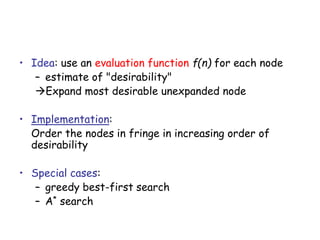
• Idea: use an evaluation function f(n) for each node
– estimate of "desirability"
Expand most desirable unexpanded node
• Implementation:
Order the nodes in fringe in increasing order of
desirability
• Special cases:
– greedy best-first search
– A* search
5
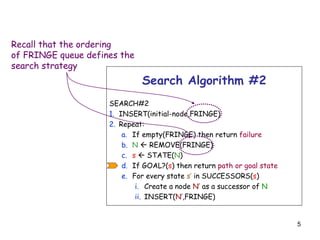
Search Algorithm #2
SEARCH#2
1. INSERT(initial-node,FRINGE)
2. Repeat:
a. If empty(FRINGE) then return failure
b. N  REMOVE(FRINGE)
c. s  STATE(N)
d. If GOAL?(s) then return path or goal state
e. For every state s’ in SUCCESSORS(s)
i. Create a node N’ as a successor of N
ii. INSERT(N’,FRINGE)
Recall that the ordering
of FRINGE queue defines the
search strategy
6
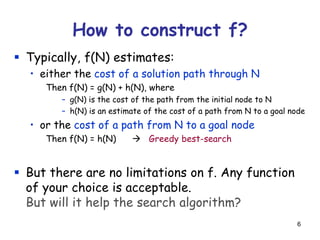
 Typically, f(N) estimates:
• either the cost of a solution path through N
Then f(N) = g(N) + h(N), where
– g(N) is the cost of the path from the initial node to N
– h(N) is an estimate of the cost of a path from N to a goal node
• or the cost of a path from N to a goal node
Then f(N) = h(N)  Greedy best-search
 But there are no limitations on f. Any function
of your choice is acceptable.
But will it help the search algorithm?
How to construct f?
7
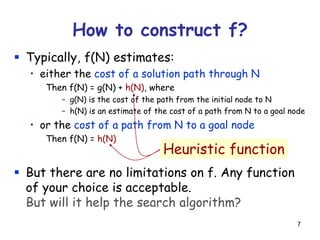
 Typically, f(N) estimates:
• either the cost of a solution path through N
Then f(N) = g(N) + h(N), where
– g(N) is the cost of the path from the initial node to N
– h(N) is an estimate of the cost of a path from N to a goal node
• or the cost of a path from N to a goal node
Then f(N) = h(N)
 But there are no limitations on f. Any function
of your choice is acceptable.
But will it help the search algorithm?
How to construct f?
Heuristic function
8
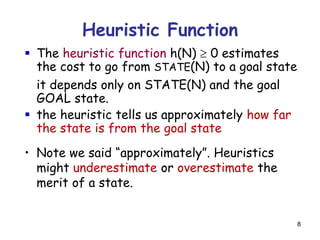
 The heuristic function h(N)  0 estimates
the cost to go from STATE(N) to a goal state
it depends only on STATE(N) and the goal
GOAL state.
 the heuristic tells us approximately how far
the state is from the goal state
• Note we said “approximately”. Heuristics
might underestimate or overestimate the
merit of a state.
Heuristic Function
9
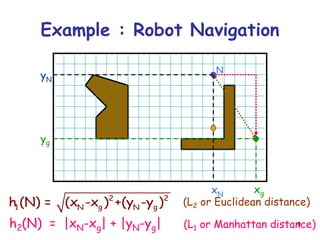
Example : Robot Navigation
xN
yN
N
xg
yg
2 2
g g1 N Nh (N) = (x -x ) +(y -y ) (L2 or Euclidean distance)
h2(N) = |xN-xg| + |yN-yg| (L1 or Manhattan distance)
10
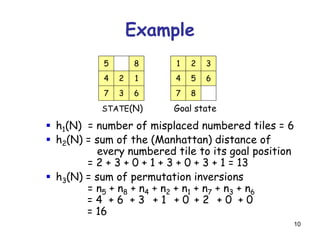
 h1(N) = number of misplaced numbered tiles = 6
 h2(N) = sum of the (Manhattan) distance of
every numbered tile to its goal position
= 2 + 3 + 0 + 1 + 3 + 0 + 3 + 1 = 13
 h3(N) = sum of permutation inversions
= n5 + n8 + n4 + n2 + n1 + n7 + n3 + n6
= 4 + 6 + 3 + 1 + 0 + 2 + 0 + 0
= 16
Example
14
7
5
2
63
8
STATE(N)
64
7
1
5
2
8
3
Goal state
11
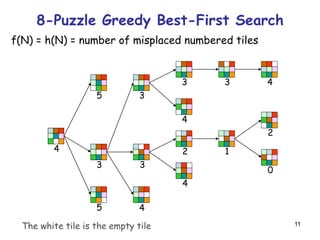
8-Puzzle Greedy Best-First Search
4
5
5
3
3
4
3 4
4
2 1
2
0
3
4
3
f(N) = h(N) = number of misplaced numbered tiles
The white tile is the empty tile
12
5
6
6
4
4
2 1
2
0
5
5
3
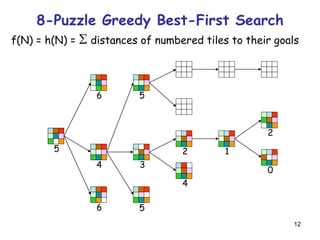
8-Puzzle Greedy Best-First Search
f(N) = h(N) = S distances of numbered tiles to their goals
13
0+4
1+5
1+5
1+3
3+3
3+4
3+4
3+2 4+1
5+2
5+0
2+3
2+4
2+3
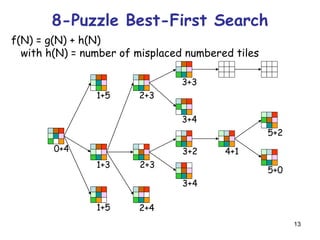
8-Puzzle Best-First Search
f(N) = g(N) + h(N)
with h(N) = number of misplaced numbered tiles
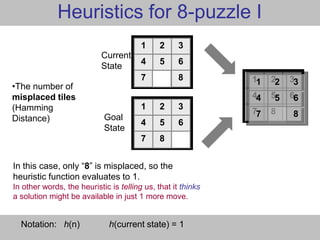
Heuristics for 8-puzzle I
•The number of
misplaced tiles
(Hamming
Distance)
1 2 3
4 5 6
7 8
1 2 3
4 5 6
7 8
1 2 3
4 5 6
7 8
1 2 3
4 5 6
7 8
In this case, only “8” is misplaced, so the
heuristic function evaluates to 1.
In other words, the heuristic is telling us, that it thinks
a solution might be available in just 1 more move.
Goal
State
Current
State
Notation: h(n) h(current state) = 1
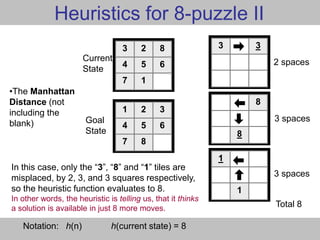
Heuristics for 8-puzzle II
•The Manhattan
Distance (not
including the
blank)
In this case, only the “3”, “8” and “1” tiles are
misplaced, by 2, 3, and 3 squares respectively,
so the heuristic function evaluates to 8.
In other words, the heuristic is telling us, that it thinks
a solution is available in just 8 more moves.
3 2 8
4 5 6
7 1
1 2 3
4 5 6
7 8
Goal
State
Current
State
3 3
8
8
1
1
2 spaces
3 spaces
3 spaces
Total 8
Notation: h(n) h(current state) = 8
Properties of greedy best-first
search
• Complete? No
• Time? O(bm), but a good heuristic can
give dramatic improvement
• Space? O(bm) -- keeps all nodes in
memory
• Optimal? No
 m is the maximum depth of the search
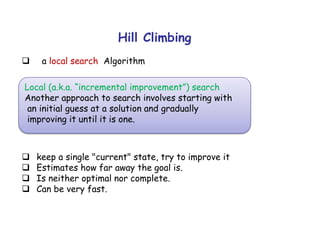
Hill Climbing
 a local search Algorithm
 keep a single "current" state, try to improve it
 Estimates how far away the goal is.
 Is neither optimal nor complete.
 Can be very fast.
Local (a.k.a. “incremental improvement”) search
Another approach to search involves starting with
an initial guess at a solution and gradually
improving it until it is one.
1 2 3
4 5
7 8 6
1 2 3
4 5
7 8 6
1 3
4 2 5
7 8 6
1 2
4 5 3
7 8 6
1 2 3
4 5 6
7 8
1 2 3
4 5
7 8 6
1 2 3
4 8 5
7 6
1 2 3
4 8 5
7 6
1 2 3
4 8 5
7 6
1 2
4 8 3
7 6 5
1 2 3
4 8
7 6 5
5
6 4
3
4 2
1 3 3
0 2
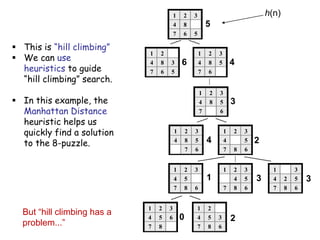
 This is “hill climbing”
 We can use
heuristics to guide
“hill climbing” search.
 In this example, the
Manhattan Distance
heuristic helps us
quickly find a solution
to the 8-puzzle.
But “hill climbing has a
problem...”
h(n)
1 2 3
4 5 8
6 7
1 2 3
4 5
6 7 8
1 2 3
4 5 8
6 7
1 2 3
4 5
6 7 8
1 2
4 5 3
6 7 8
6
7 5
6 6
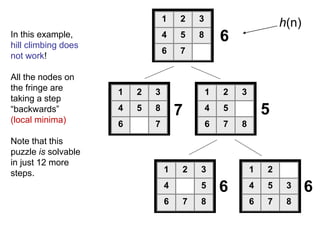
In this example,
hill climbing does
not work!
All the nodes on
the fringe are
taking a step
“backwards”
(local minima)
Note that this
puzzle is solvable
in just 12 more
steps.
h(n)
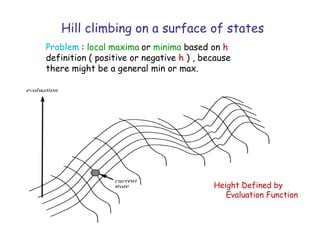
Hill climbing on a surface of states
Height Defined by
Evaluation Function
Problem : local maxima or minima based on h
definition ( positive or negative h ) , because
there might be a general min or max.
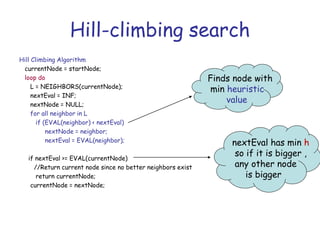
Hill-climbing search
Hill Climbing Algorithm
currentNode = startNode;
loop do
L = NEIGHBORS(currentNode);
nextEval = INF;
nextNode = NULL;
for all neighbor in L
if (EVAL(neighbor) < nextEval)
nextNode = neighbor;
nextEval = EVAL(neighbor);
if nextEval >= EVAL(currentNode)
//Return current node since no better neighbors exist
return currentNode;
currentNode = nextNode;
Finds node with
min heuristic
value
nextEval has min h
so if it is bigger ,
any other node
is bigger
22
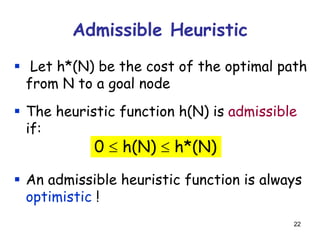
Admissible Heuristic
 Let h*(N) be the cost of the optimal path
from N to a goal node
 The heuristic function h(N) is admissible
if:
0  h(N)  h*(N)
 An admissible heuristic function is always
optimistic !
23
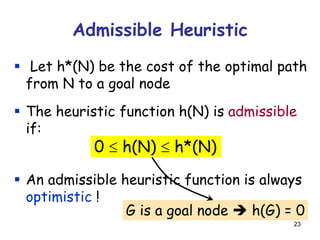
Admissible Heuristic
 Let h*(N) be the cost of the optimal path
from N to a goal node
 The heuristic function h(N) is admissible
if:
0  h(N)  h*(N)
 An admissible heuristic function is always
optimistic !
G is a goal node  h(G) = 0
24
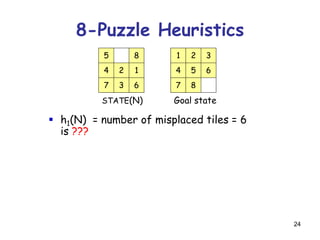
 h1(N) = number of misplaced tiles = 6
is ???
 h2(N) = sum of the (Manhattan) distances of
every tile to its goal position
= 2 + 3 + 0 + 1 + 3 + 0 + 3 + 1 = 13
is admissible
 h3(N) = sum of permutation inversions
= 4 + 6 + 3 + 1 + 0 + 2 + 0 + 0 = 16
is not admissible
8-Puzzle Heuristics
14
7
5
2
63
8
STATE(N)
64
7
1
5
2
8
3
Goal state
25
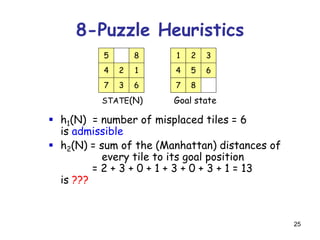
 h1(N) = number of misplaced tiles = 6
is admissible
 h2(N) = sum of the (Manhattan) distances of
every tile to its goal position
= 2 + 3 + 0 + 1 + 3 + 0 + 3 + 1 = 13
is ???
 h3(N) = sum of permutation inversions
= 4 + 6 + 3 + 1 + 0 + 2 + 0 + 0 = 16
is not admissible
8-Puzzle Heuristics
14
7
5
2
63
8
STATE(N)
64
7
1
5
2
8
3
Goal state
26
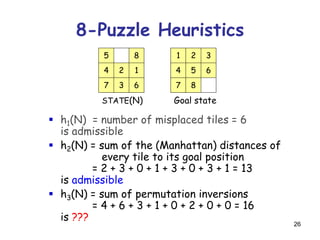
 h1(N) = number of misplaced tiles = 6
is admissible
 h2(N) = sum of the (Manhattan) distances of
every tile to its goal position
= 2 + 3 + 0 + 1 + 3 + 0 + 3 + 1 = 13
is admissible
 h3(N) = sum of permutation inversions
= 4 + 6 + 3 + 1 + 0 + 2 + 0 + 0 = 16
is ???
8-Puzzle Heuristics
14
7
5
2
63
8
STATE(N)
64
7
1
5
2
8
3
Goal state
27
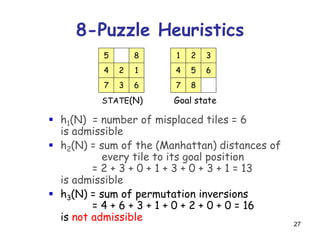
 h1(N) = number of misplaced tiles = 6
is admissible
 h2(N) = sum of the (Manhattan) distances of
every tile to its goal position
= 2 + 3 + 0 + 1 + 3 + 0 + 3 + 1 = 13
is admissible
 h3(N) = sum of permutation inversions
= 4 + 6 + 3 + 1 + 0 + 2 + 0 + 0 = 16
is not admissible
8-Puzzle Heuristics
14
7
5
2
63
8
STATE(N)
64
7
1
5
2
8
3
Goal state
28
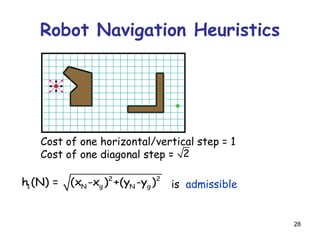
Robot Navigation Heuristics
Cost of one horizontal/vertical step = 1
Cost of one diagonal step = 2
2 2
g g1 N Nh (N) = (x -x ) +(y -y ) is admissible
29
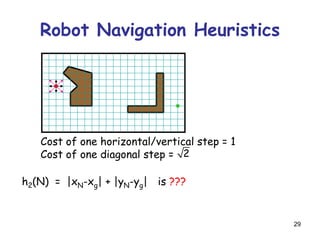
Robot Navigation Heuristics
Cost of one horizontal/vertical step = 1
Cost of one diagonal step = 2
h2(N) = |xN-xg| + |yN-yg| is ???
30
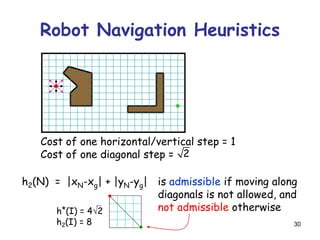
Robot Navigation Heuristics
Cost of one horizontal/vertical step = 1
Cost of one diagonal step = 2
h2(N) = |xN-xg| + |yN-yg| is admissible if moving along
diagonals is not allowed, and
not admissible otherwiseh*(I) = 42
h2(I) = 8
31
How to create an admissible h?
 An admissible heuristic can usually be seen as
the cost of an optimal solution to a relaxed
problem (one obtained by removing constraints)
 In robot navigation:
• The Manhattan distance corresponds to removing the
obstacles
• The Euclidean distance corresponds to removing both
the obstacles and the constraint that the robot
moves on a grid
 More on this topic later
32
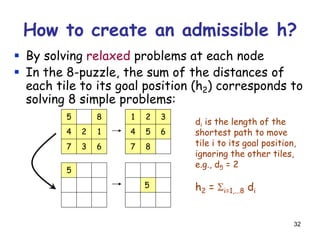
 By solving relaxed problems at each node
 In the 8-puzzle, the sum of the distances of
each tile to its goal position (h2) corresponds to
solving 8 simple problems:
How to create an admissible h?
14
7
5
2
63
8
64
7
1
5
2
8
3
5
5
di is the length of the
shortest path to move
tile i to its goal position,
ignoring the other tiles,
e.g., d5 = 2
h2 = Si=1,...8 di
33
A* Search
(most popular algorithm in AI)
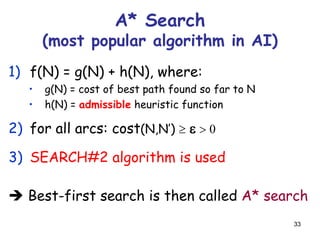
1) f(N) = g(N) + h(N), where:
• g(N) = cost of best path found so far to N
• h(N) = admissible heuristic function
2) for all arcs: cost(N,N’)   > 0
3) SEARCH#2 algorithm is used
 Best-first search is then called A* search
34
Result #1
A* is complete and optimal
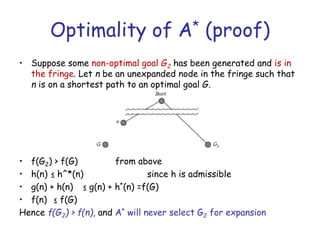
Optimality of A* (proof)
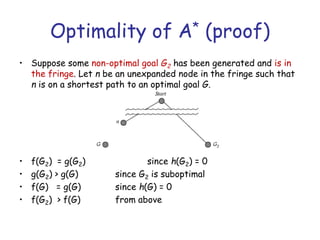
• Suppose some non-optimal goal G2 has been generated and is in
the fringe. Let n be an unexpanded node in the fringe such that
n is on a shortest path to an optimal goal G.
• f(G2) = g(G2) since h(G2) = 0
• g(G2) > g(G) since G2 is suboptimal
• f(G) = g(G) since h(G) = 0
• f(G2) > f(G) from above
Optimality of A* (proof)
• Suppose some non-optimal goal G2 has been generated and is in
the fringe. Let n be an unexpanded node in the fringe such that
n is on a shortest path to an optimal goal G.
• f(G2) > f(G) from above
• h(n) ≤ h^*(n) since h is admissible
• g(n) + h(n) ≤ g(n) + h*(n) =f(G)
• f(n) ≤ f(G)
Hence f(G2) > f(n), and A* will never select G2 for expansion
Properties of A*
• Complete? Yes (unless there are
infinitely many nodes.)
• Time? Exponential
• Space? Keeps all nodes in memory
• Optimal? Yes
38
Time Limit Issue
 When a problem has no solution, A* runs for ever if
the state space is infinite. In other cases, it may take
a huge amount of time to terminate
 So, in practice, A* is given a time limit. If it has not
found a solution within this limit, it stops. Then there
is no way to know if the problem has no solution, or if
more time was needed to find it
 When AI systems are “small” and solving a single
search problem at a time, this is not too much of a
concern.
 When AI systems become larger, they solve many
search problems concurrently, some with no solution.
What should be the time limit for each of them?
This is a complicated work.
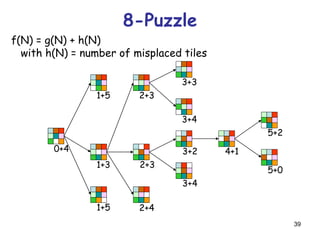
39
8-Puzzle
0+4
1+5
1+5
1+3
3+3
3+4
3+4
3+2 4+1
5+2
5+0
2+3
2+4
2+3
f(N) = g(N) + h(N)
with h(N) = number of misplaced tiles
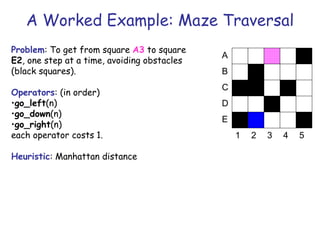
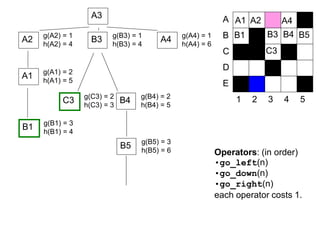
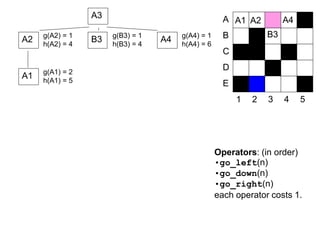
A Worked Example: Maze Traversal
1 2 3 4 5
A
B
D
C
E
Problem: To get from square A3 to square
E2, one step at a time, avoiding obstacles
(black squares).
Operators: (in order)
•go_left(n)
•go_down(n)
•go_right(n)
each operator costs 1.
Heuristic: Manhattan distance
Operators: (in order)
•go_left(n)
•go_down(n)
•go_right(n)
each operator costs 1.
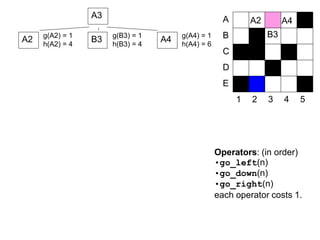
A2
A3
B3 A4g(A2) = 1
h(A2) = 4
g(B3) = 1
h(B3) = 4
g(A4) = 1
h(A4) = 6
1 2 3 4 5
A
B
D
C
E
A2
B3
A4
Operators: (in order)
•go_left(n)
•go_down(n)
•go_right(n)
each operator costs 1.
A2
A3
B3 A4g(A2) = 1
h(A2) = 4
g(B3) = 1
h(B3) = 4
g(A4) = 1
h(A4) = 6
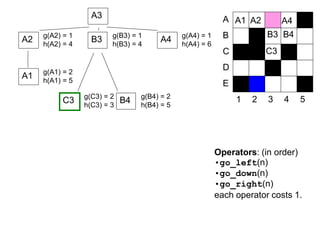
A1 g(A1) = 2
h(A1) = 5
1 2 3 4 5
A
B
D
C
E
A2
B3
A1 A4
Operators: (in order)
•go_left(n)
•go_down(n)
•go_right(n)
each operator costs 1.
A2
A3
B3 A4g(A2) = 1
h(A2) = 4
g(B3) = 1
h(B3) = 4
g(A4) = 1
h(A4) = 6
C3 B4g(C3) = 2
h(C3) = 3
g(B4) = 2
h(B4) = 5
A1 g(A1) = 2
h(A1) = 5
1 2 3 4 5
A
B
D
C
E
A2
B3
A4A1
C3
B4
Operators: (in order)
•go_left(n)
•go_down(n)
•go_right(n)
each operator costs 1.
A2
A3
B3 A4g(A2) = 1
h(A2) = 4
g(B3) = 1
h(B3) = 4
g(A4) = 1
h(A4) = 6
C3 B4g(C3) = 2
h(C3) = 3
g(B4) = 2
h(B4) = 5
A1 g(A1) = 2
h(A1) = 5
1 2 3 4 5
A
B
D
C
E
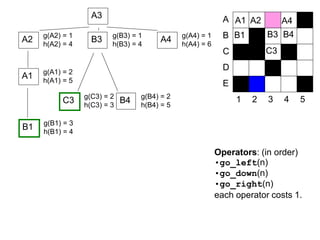
B1 g(B1) = 3
h(B1) = 4
A2
B3
A4A1
B1
C3
B4
Operators: (in order)
•go_left(n)
•go_down(n)
•go_right(n)
each operator costs 1.
A2
A3
B3 A4g(A2) = 1
h(A2) = 4
g(B3) = 1
h(B3) = 4
g(A4) = 1
h(A4) = 6
C3 B4g(C3) = 2
h(C3) = 3
g(B4) = 2
h(B4) = 5
A1 g(A1) = 2
h(A1) = 5
1 2 3 4 5
A
B
D
C
E
B1 g(B1) = 3
h(B1) = 4
B5 g(B5) = 3
h(B5) = 6
A2
B3
A4A1
B1
C3
B4 B5
46
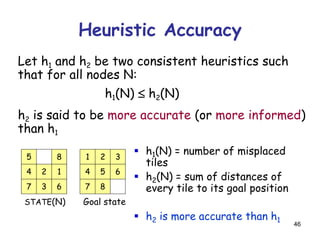
Heuristic Accuracy
Let h1 and h2 be two consistent heuristics such
that for all nodes N:
h1(N)  h2(N)
h2 is said to be more accurate (or more informed)
than h1
 h1(N) = number of misplaced
tiles
 h2(N) = sum of distances of
every tile to its goal position
 h2 is more accurate than h1
14
7
5
2
63
8
STATE(N)
64
7
1
5
2
8
3
Goal state
47
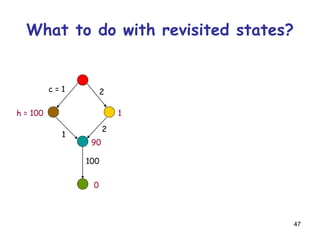
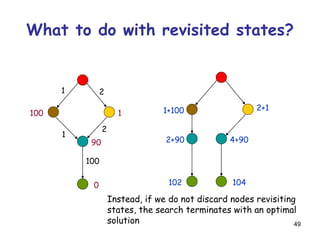
What to do with revisited states?
c = 1
100
2
1
2
h = 100
0
90
1
48
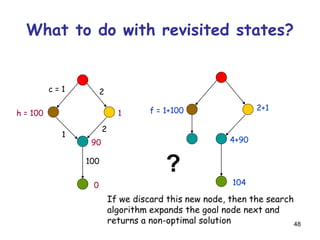
What to do with revisited states?
c = 1
100
2
1
2
h = 100
0
90
1
104
4+90
f = 1+100 2+1
?
If we discard this new node, then the search
algorithm expands the goal node next and
returns a non-optimal solution
49
1
100
2
1
2
100
0
90
1
104
4+90
1+100 2+1
2+90
102
Instead, if we do not discard nodes revisiting
states, the search terminates with an optimal
solution
What to do with revisited states?
50
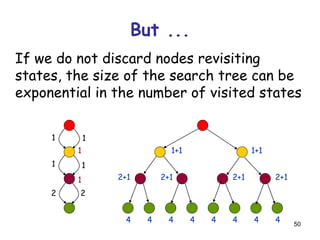
But ...
If we do not discard nodes revisiting
states, the size of the search tree can be
exponential in the number of visited states
1
2
11
1
2
1
1
1+1 1+1
2+1 2+1 2+1 2+1
4 4 4 4 4 4 4 4
51
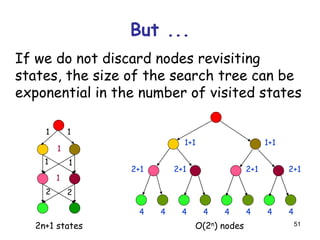
But ...
If we do not discard nodes revisiting
states, the size of the search tree can be
exponential in the number of visited states
1
2
11
1
2
1
1
2n+1 states
1+1 1+1
2+1 2+1 2+1 2+1
4 4 4 4 4 4 4 4
O(2n) nodes
52
 It is not harmful to discard a node revisiting
a state if the cost of the new path to this
state is  cost of the previous path
[so, in particular, one can discard a node if it re-visits
a state already visited by one of its ancestors]
 A* remains optimal, but states can still be re-
visited multiple times
[the size of the search tree can still be exponential in
the number of visited states]
Application
• Virus Scanning
• In virus scanning, an algorithm searches for
key pieces of code associated with particular
kinds or viruses, reducing the number of files
that need to be scanned. One of the benefits
of heuristic virus scanning is that different
viruses of the same family can be detected
without being known due to the common code
markers
53
• Virus identification is a balance between
two imperatives: the avoidance of false
negatives (the scanner fails to detect
an infection) and false positives (the
scanner detects a virus where none
exists).
• All levels of heuristic analysis add
processing overhead to scanning time,
and for some products, the slower
performance can be all too obvious.
54
THANKS FOR LISTENING
ANY QUESTIONS ?
55

Heuristic search

  • 1.
    1 Heuristic Search (Where wetry to choose smartly)
  • 2.
    2 Best-First Search  Itexploits state description to estimate how “good” each search node is  An evaluation function f maps each node N of the search tree to a real number f(N)  0 [Traditionally, f(N) is an estimated cost; so, the smaller f(N), the more promising N]  Best-first search sorts the FRINGE in increasing f [Arbitrary order is assumed among nodes with equal f]
  • 3.
    3 Best-First Search  Itexploits state description to estimate how “good” each search node is  An evaluation function f maps each node N of the search tree to a real number f(N)  0 [Traditionally, f(N) is an estimated cost; so, the smaller f(N), the more promising N]  Best-first search sorts the FRINGE in increasing f [Arbitrary order is assumed among nodes with equal f] “Best” does not refer to the quality of the generated path Best-first search does not generate optimal paths in general
  • 4.
    • Idea: usean evaluation function f(n) for each node – estimate of "desirability" Expand most desirable unexpanded node • Implementation: Order the nodes in fringe in increasing order of desirability • Special cases: – greedy best-first search – A* search
  • 5.
    5 Search Algorithm #2 SEARCH#2 1.INSERT(initial-node,FRINGE) 2. Repeat: a. If empty(FRINGE) then return failure b. N  REMOVE(FRINGE) c. s  STATE(N) d. If GOAL?(s) then return path or goal state e. For every state s’ in SUCCESSORS(s) i. Create a node N’ as a successor of N ii. INSERT(N’,FRINGE) Recall that the ordering of FRINGE queue defines the search strategy
  • 6.
    6  Typically, f(N)estimates: • either the cost of a solution path through N Then f(N) = g(N) + h(N), where – g(N) is the cost of the path from the initial node to N – h(N) is an estimate of the cost of a path from N to a goal node • or the cost of a path from N to a goal node Then f(N) = h(N)  Greedy best-search  But there are no limitations on f. Any function of your choice is acceptable. But will it help the search algorithm? How to construct f?
  • 7.
    7  Typically, f(N)estimates: • either the cost of a solution path through N Then f(N) = g(N) + h(N), where – g(N) is the cost of the path from the initial node to N – h(N) is an estimate of the cost of a path from N to a goal node • or the cost of a path from N to a goal node Then f(N) = h(N)  But there are no limitations on f. Any function of your choice is acceptable. But will it help the search algorithm? How to construct f? Heuristic function
  • 8.
    8  The heuristicfunction h(N)  0 estimates the cost to go from STATE(N) to a goal state it depends only on STATE(N) and the goal GOAL state.  the heuristic tells us approximately how far the state is from the goal state • Note we said “approximately”. Heuristics might underestimate or overestimate the merit of a state. Heuristic Function
  • 9.
    9 Example : RobotNavigation xN yN N xg yg 2 2 g g1 N Nh (N) = (x -x ) +(y -y ) (L2 or Euclidean distance) h2(N) = |xN-xg| + |yN-yg| (L1 or Manhattan distance)
  • 10.
    10  h1(N) =number of misplaced numbered tiles = 6  h2(N) = sum of the (Manhattan) distance of every numbered tile to its goal position = 2 + 3 + 0 + 1 + 3 + 0 + 3 + 1 = 13  h3(N) = sum of permutation inversions = n5 + n8 + n4 + n2 + n1 + n7 + n3 + n6 = 4 + 6 + 3 + 1 + 0 + 2 + 0 + 0 = 16 Example 14 7 5 2 63 8 STATE(N) 64 7 1 5 2 8 3 Goal state
  • 11.
    11 8-Puzzle Greedy Best-FirstSearch 4 5 5 3 3 4 3 4 4 2 1 2 0 3 4 3 f(N) = h(N) = number of misplaced numbered tiles The white tile is the empty tile
  • 12.
    12 5 6 6 4 4 2 1 2 0 5 5 3 8-Puzzle GreedyBest-First Search f(N) = h(N) = S distances of numbered tiles to their goals
  • 13.
    13 0+4 1+5 1+5 1+3 3+3 3+4 3+4 3+2 4+1 5+2 5+0 2+3 2+4 2+3 8-Puzzle Best-FirstSearch f(N) = g(N) + h(N) with h(N) = number of misplaced numbered tiles
  • 14.
    Heuristics for 8-puzzleI •The number of misplaced tiles (Hamming Distance) 1 2 3 4 5 6 7 8 1 2 3 4 5 6 7 8 1 2 3 4 5 6 7 8 1 2 3 4 5 6 7 8 In this case, only “8” is misplaced, so the heuristic function evaluates to 1. In other words, the heuristic is telling us, that it thinks a solution might be available in just 1 more move. Goal State Current State Notation: h(n) h(current state) = 1
  • 15.
    Heuristics for 8-puzzleII •The Manhattan Distance (not including the blank) In this case, only the “3”, “8” and “1” tiles are misplaced, by 2, 3, and 3 squares respectively, so the heuristic function evaluates to 8. In other words, the heuristic is telling us, that it thinks a solution is available in just 8 more moves. 3 2 8 4 5 6 7 1 1 2 3 4 5 6 7 8 Goal State Current State 3 3 8 8 1 1 2 spaces 3 spaces 3 spaces Total 8 Notation: h(n) h(current state) = 8
  • 16.
    Properties of greedybest-first search • Complete? No • Time? O(bm), but a good heuristic can give dramatic improvement • Space? O(bm) -- keeps all nodes in memory • Optimal? No  m is the maximum depth of the search
  • 17.
    Hill Climbing  alocal search Algorithm  keep a single "current" state, try to improve it  Estimates how far away the goal is.  Is neither optimal nor complete.  Can be very fast. Local (a.k.a. “incremental improvement”) search Another approach to search involves starting with an initial guess at a solution and gradually improving it until it is one.
  • 18.
    1 2 3 45 7 8 6 1 2 3 4 5 7 8 6 1 3 4 2 5 7 8 6 1 2 4 5 3 7 8 6 1 2 3 4 5 6 7 8 1 2 3 4 5 7 8 6 1 2 3 4 8 5 7 6 1 2 3 4 8 5 7 6 1 2 3 4 8 5 7 6 1 2 4 8 3 7 6 5 1 2 3 4 8 7 6 5 5 6 4 3 4 2 1 3 3 0 2  This is “hill climbing”  We can use heuristics to guide “hill climbing” search.  In this example, the Manhattan Distance heuristic helps us quickly find a solution to the 8-puzzle. But “hill climbing has a problem...” h(n)
  • 19.
    1 2 3 45 8 6 7 1 2 3 4 5 6 7 8 1 2 3 4 5 8 6 7 1 2 3 4 5 6 7 8 1 2 4 5 3 6 7 8 6 7 5 6 6 In this example, hill climbing does not work! All the nodes on the fringe are taking a step “backwards” (local minima) Note that this puzzle is solvable in just 12 more steps. h(n)
  • 20.
    Hill climbing ona surface of states Height Defined by Evaluation Function Problem : local maxima or minima based on h definition ( positive or negative h ) , because there might be a general min or max.
  • 21.
    Hill-climbing search Hill ClimbingAlgorithm currentNode = startNode; loop do L = NEIGHBORS(currentNode); nextEval = INF; nextNode = NULL; for all neighbor in L if (EVAL(neighbor) < nextEval) nextNode = neighbor; nextEval = EVAL(neighbor); if nextEval >= EVAL(currentNode) //Return current node since no better neighbors exist return currentNode; currentNode = nextNode; Finds node with min heuristic value nextEval has min h so if it is bigger , any other node is bigger
  • 22.
    22 Admissible Heuristic  Leth*(N) be the cost of the optimal path from N to a goal node  The heuristic function h(N) is admissible if: 0  h(N)  h*(N)  An admissible heuristic function is always optimistic !
  • 23.
    23 Admissible Heuristic  Leth*(N) be the cost of the optimal path from N to a goal node  The heuristic function h(N) is admissible if: 0  h(N)  h*(N)  An admissible heuristic function is always optimistic ! G is a goal node  h(G) = 0
  • 24.
    24  h1(N) =number of misplaced tiles = 6 is ???  h2(N) = sum of the (Manhattan) distances of every tile to its goal position = 2 + 3 + 0 + 1 + 3 + 0 + 3 + 1 = 13 is admissible  h3(N) = sum of permutation inversions = 4 + 6 + 3 + 1 + 0 + 2 + 0 + 0 = 16 is not admissible 8-Puzzle Heuristics 14 7 5 2 63 8 STATE(N) 64 7 1 5 2 8 3 Goal state
  • 25.
    25  h1(N) =number of misplaced tiles = 6 is admissible  h2(N) = sum of the (Manhattan) distances of every tile to its goal position = 2 + 3 + 0 + 1 + 3 + 0 + 3 + 1 = 13 is ???  h3(N) = sum of permutation inversions = 4 + 6 + 3 + 1 + 0 + 2 + 0 + 0 = 16 is not admissible 8-Puzzle Heuristics 14 7 5 2 63 8 STATE(N) 64 7 1 5 2 8 3 Goal state
  • 26.
    26  h1(N) =number of misplaced tiles = 6 is admissible  h2(N) = sum of the (Manhattan) distances of every tile to its goal position = 2 + 3 + 0 + 1 + 3 + 0 + 3 + 1 = 13 is admissible  h3(N) = sum of permutation inversions = 4 + 6 + 3 + 1 + 0 + 2 + 0 + 0 = 16 is ??? 8-Puzzle Heuristics 14 7 5 2 63 8 STATE(N) 64 7 1 5 2 8 3 Goal state
  • 27.
    27  h1(N) =number of misplaced tiles = 6 is admissible  h2(N) = sum of the (Manhattan) distances of every tile to its goal position = 2 + 3 + 0 + 1 + 3 + 0 + 3 + 1 = 13 is admissible  h3(N) = sum of permutation inversions = 4 + 6 + 3 + 1 + 0 + 2 + 0 + 0 = 16 is not admissible 8-Puzzle Heuristics 14 7 5 2 63 8 STATE(N) 64 7 1 5 2 8 3 Goal state
  • 28.
    28 Robot Navigation Heuristics Costof one horizontal/vertical step = 1 Cost of one diagonal step = 2 2 2 g g1 N Nh (N) = (x -x ) +(y -y ) is admissible
  • 29.
    29 Robot Navigation Heuristics Costof one horizontal/vertical step = 1 Cost of one diagonal step = 2 h2(N) = |xN-xg| + |yN-yg| is ???
  • 30.
    30 Robot Navigation Heuristics Costof one horizontal/vertical step = 1 Cost of one diagonal step = 2 h2(N) = |xN-xg| + |yN-yg| is admissible if moving along diagonals is not allowed, and not admissible otherwiseh*(I) = 42 h2(I) = 8
  • 31.
    31 How to createan admissible h?  An admissible heuristic can usually be seen as the cost of an optimal solution to a relaxed problem (one obtained by removing constraints)  In robot navigation: • The Manhattan distance corresponds to removing the obstacles • The Euclidean distance corresponds to removing both the obstacles and the constraint that the robot moves on a grid  More on this topic later
  • 32.
    32  By solvingrelaxed problems at each node  In the 8-puzzle, the sum of the distances of each tile to its goal position (h2) corresponds to solving 8 simple problems: How to create an admissible h? 14 7 5 2 63 8 64 7 1 5 2 8 3 5 5 di is the length of the shortest path to move tile i to its goal position, ignoring the other tiles, e.g., d5 = 2 h2 = Si=1,...8 di
  • 33.
    33 A* Search (most popularalgorithm in AI) 1) f(N) = g(N) + h(N), where: • g(N) = cost of best path found so far to N • h(N) = admissible heuristic function 2) for all arcs: cost(N,N’)   > 0 3) SEARCH#2 algorithm is used  Best-first search is then called A* search
  • 34.
    34 Result #1 A* iscomplete and optimal
  • 35.
    Optimality of A*(proof) • Suppose some non-optimal goal G2 has been generated and is in the fringe. Let n be an unexpanded node in the fringe such that n is on a shortest path to an optimal goal G. • f(G2) = g(G2) since h(G2) = 0 • g(G2) > g(G) since G2 is suboptimal • f(G) = g(G) since h(G) = 0 • f(G2) > f(G) from above
  • 36.
    Optimality of A*(proof) • Suppose some non-optimal goal G2 has been generated and is in the fringe. Let n be an unexpanded node in the fringe such that n is on a shortest path to an optimal goal G. • f(G2) > f(G) from above • h(n) ≤ h^*(n) since h is admissible • g(n) + h(n) ≤ g(n) + h*(n) =f(G) • f(n) ≤ f(G) Hence f(G2) > f(n), and A* will never select G2 for expansion
  • 37.
    Properties of A* •Complete? Yes (unless there are infinitely many nodes.) • Time? Exponential • Space? Keeps all nodes in memory • Optimal? Yes
  • 38.
    38 Time Limit Issue When a problem has no solution, A* runs for ever if the state space is infinite. In other cases, it may take a huge amount of time to terminate  So, in practice, A* is given a time limit. If it has not found a solution within this limit, it stops. Then there is no way to know if the problem has no solution, or if more time was needed to find it  When AI systems are “small” and solving a single search problem at a time, this is not too much of a concern.  When AI systems become larger, they solve many search problems concurrently, some with no solution. What should be the time limit for each of them? This is a complicated work.
  • 39.
    39 8-Puzzle 0+4 1+5 1+5 1+3 3+3 3+4 3+4 3+2 4+1 5+2 5+0 2+3 2+4 2+3 f(N) =g(N) + h(N) with h(N) = number of misplaced tiles
  • 40.
    A Worked Example:Maze Traversal 1 2 3 4 5 A B D C E Problem: To get from square A3 to square E2, one step at a time, avoiding obstacles (black squares). Operators: (in order) •go_left(n) •go_down(n) •go_right(n) each operator costs 1. Heuristic: Manhattan distance
  • 41.
    Operators: (in order) •go_left(n) •go_down(n) •go_right(n) eachoperator costs 1. A2 A3 B3 A4g(A2) = 1 h(A2) = 4 g(B3) = 1 h(B3) = 4 g(A4) = 1 h(A4) = 6 1 2 3 4 5 A B D C E A2 B3 A4
  • 42.
    Operators: (in order) •go_left(n) •go_down(n) •go_right(n) eachoperator costs 1. A2 A3 B3 A4g(A2) = 1 h(A2) = 4 g(B3) = 1 h(B3) = 4 g(A4) = 1 h(A4) = 6 A1 g(A1) = 2 h(A1) = 5 1 2 3 4 5 A B D C E A2 B3 A1 A4
  • 43.
    Operators: (in order) •go_left(n) •go_down(n) •go_right(n) eachoperator costs 1. A2 A3 B3 A4g(A2) = 1 h(A2) = 4 g(B3) = 1 h(B3) = 4 g(A4) = 1 h(A4) = 6 C3 B4g(C3) = 2 h(C3) = 3 g(B4) = 2 h(B4) = 5 A1 g(A1) = 2 h(A1) = 5 1 2 3 4 5 A B D C E A2 B3 A4A1 C3 B4
  • 44.
    Operators: (in order) •go_left(n) •go_down(n) •go_right(n) eachoperator costs 1. A2 A3 B3 A4g(A2) = 1 h(A2) = 4 g(B3) = 1 h(B3) = 4 g(A4) = 1 h(A4) = 6 C3 B4g(C3) = 2 h(C3) = 3 g(B4) = 2 h(B4) = 5 A1 g(A1) = 2 h(A1) = 5 1 2 3 4 5 A B D C E B1 g(B1) = 3 h(B1) = 4 A2 B3 A4A1 B1 C3 B4
  • 45.
    Operators: (in order) •go_left(n) •go_down(n) •go_right(n) eachoperator costs 1. A2 A3 B3 A4g(A2) = 1 h(A2) = 4 g(B3) = 1 h(B3) = 4 g(A4) = 1 h(A4) = 6 C3 B4g(C3) = 2 h(C3) = 3 g(B4) = 2 h(B4) = 5 A1 g(A1) = 2 h(A1) = 5 1 2 3 4 5 A B D C E B1 g(B1) = 3 h(B1) = 4 B5 g(B5) = 3 h(B5) = 6 A2 B3 A4A1 B1 C3 B4 B5
  • 46.
    46 Heuristic Accuracy Let h1and h2 be two consistent heuristics such that for all nodes N: h1(N)  h2(N) h2 is said to be more accurate (or more informed) than h1  h1(N) = number of misplaced tiles  h2(N) = sum of distances of every tile to its goal position  h2 is more accurate than h1 14 7 5 2 63 8 STATE(N) 64 7 1 5 2 8 3 Goal state
  • 47.
    47 What to dowith revisited states? c = 1 100 2 1 2 h = 100 0 90 1
  • 48.
    48 What to dowith revisited states? c = 1 100 2 1 2 h = 100 0 90 1 104 4+90 f = 1+100 2+1 ? If we discard this new node, then the search algorithm expands the goal node next and returns a non-optimal solution
  • 49.
    49 1 100 2 1 2 100 0 90 1 104 4+90 1+100 2+1 2+90 102 Instead, ifwe do not discard nodes revisiting states, the search terminates with an optimal solution What to do with revisited states?
  • 50.
    50 But ... If wedo not discard nodes revisiting states, the size of the search tree can be exponential in the number of visited states 1 2 11 1 2 1 1 1+1 1+1 2+1 2+1 2+1 2+1 4 4 4 4 4 4 4 4
  • 51.
    51 But ... If wedo not discard nodes revisiting states, the size of the search tree can be exponential in the number of visited states 1 2 11 1 2 1 1 2n+1 states 1+1 1+1 2+1 2+1 2+1 2+1 4 4 4 4 4 4 4 4 O(2n) nodes
  • 52.
    52  It isnot harmful to discard a node revisiting a state if the cost of the new path to this state is  cost of the previous path [so, in particular, one can discard a node if it re-visits a state already visited by one of its ancestors]  A* remains optimal, but states can still be re- visited multiple times [the size of the search tree can still be exponential in the number of visited states]
  • 53.
    Application • Virus Scanning •In virus scanning, an algorithm searches for key pieces of code associated with particular kinds or viruses, reducing the number of files that need to be scanned. One of the benefits of heuristic virus scanning is that different viruses of the same family can be detected without being known due to the common code markers 53
  • 54.
    • Virus identificationis a balance between two imperatives: the avoidance of false negatives (the scanner fails to detect an infection) and false positives (the scanner detects a virus where none exists). • All levels of heuristic analysis add processing overhead to scanning time, and for some products, the slower performance can be all too obvious. 54
  • 55.