A billion screens
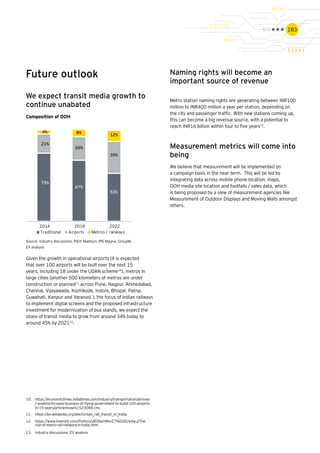
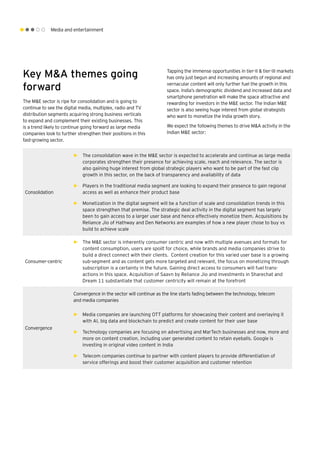
of opportunity
March 2019
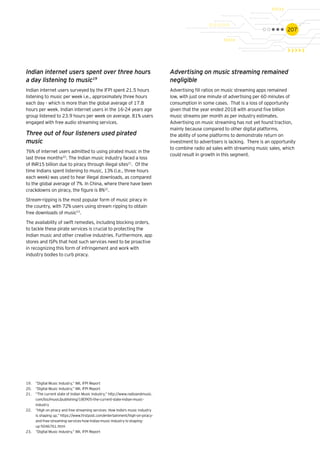
India's Media &
Entertainment sector
A heartfelt welcome to the 2019 edition of the FICCI–EY Media
& Entertainment (M&E) report.
This year’s report provides an opportunity to the industry to
better understand last year’s performance and take stock of
the emerging market dynamics. In a nutshell, last year has
proven to be a decent one for our sector as traditional sectors
like broadcast TV and films seem to have maintained a healthy
pace and performed as per expectations on the back of growing
subscription base and ticket prices respectively. Whereas, new
age digital media has created an upward trajectory of its own
and an explosion in growth seems to be on the cards. Thus,
Indian M&E continues to match up to predictions and become
ever more vibrant.
The M&E sector is poised to kickstart a new era of growth.
Technological disruptions are creating new opportunities for the
sector. India is headed towards a billion screens of opportunity
and one can hope that the sector’s incumbents shall innovate,
transform and increase their relevance to mass and individual
consumers. In doing so the Indian M&E sector shall become
the harbinger of technical and product innovation and create
content that would not only capture our imaginations but firmly
establish India’s position as a global content hub.
I’m confident that Indian M&E is headed towards becoming a
world-class media-tech sector on the back of access to global
audiences through online platforms, its large talent pool,
storytelling capabilities, post-production and VFX expertise and
policy and regulatory certainty. It is time to create global media
giants from India and this year’s FICCI Frames as it completes
its 20th
year of existence carries an appropriate tag line, “Global
Goes Indian”!!
With this thought in mind, I thank all those who have helped in
bringing this report to the fore and sincerely hope that readers
shall find it useful.
Foreword
Uday Shankar
Vice President, FICCI & Chair,
FICCI Media and Entertainment
Division
Global Goes Indian!
India is one of the largest and perhaps the most diversified
content producers in the world. At heart it aims to entertain,
while at the same time the industry has embraced diversity
and has continued to innovate. Be it our movies or any form
of content across platforms, news, sports, Indian content has
already left an indelible mark on the world.
Technological changes we are currently witnessing across
content generation, emergence of different platforms,
marketing and distribution have played a big role in Indian
content expanding its reach. While our films and television
channels were always accessible across 130 countries, the
advent of globally distributed OTT platforms will be a game
changer for India. With abundant access to dubbing and
sub-titling capabilities, Indian stories can be exported and
consumed by global audiences. This trend is expected to
immensely benefit content creation in India.
India can become a high quality and cost-efficient content
creation hub for the world. Our large talent pool, both in front of
and behind the cameras, our pre and post production facilities,
expertise in animation, VFX, back-office operational excellence
and high levels of connectivity are bound to help drive the
Indian M&E sector grow globally. India is already seen as a
hub for animation and VFX and the world has recognised its
potential.
All of this suggests that it is only a matter of time before India
establishes itself as a powerhouse and continues to entertain
the world, with the realisation that we have just begun our
journey!
Picture abhi baaki hai mere dost…
Shah Rukh Khan
Foreword
Welcome to the 2019 edition of the FICCI-EY report on the Indian
media and entertainment (M&E) sector.
The M&E product will always remain relevant for a young country
like India, thirsting for escapism and knowledge. The growth of
digital infrastructure is enabling Indians to fulfil their need for
personal content consumption, and the M&E sector has responded
by producing more content than ever before – across languages
and genre. We estimate that India produced and licensed around
750,000 hours of content in 2018, a majority of which was made
in India. We expect the amount of content being produced to keep
increasing.
This phenomenon is causing large shifts in consumer behaviour.
For a country where the lowest common denominator was catered
to on mass platforms, creators are now producing content for
well-defined audience segments. This year we have seen films
with strong storylines triumphing over those with high-power
talent. New content genres are being tried across digital. Creative
experimentation is at an all-time high!
In addition, global OTT platforms – and Indian platforms available
globally – have made it possible for people across the world to
experience Indian content, something which was out of the reach of
most Indian content creators just a few years ago. The opportunity
this provides is enormous, both to create content for the world
and support global content creators with our talent, production,
animation and VFX capabilities.
The sector has to serve a billion screens in India and globally.
Through this report, we have tried to showcase the changes
brought about by digital, data and direct-to-customer on the various
segments of the Indian M&E sector. We are certain you would find
this report to be insightful.
Is India’s M&E sector ready for a
billion screens?
Ashish Pherwani
M&E Sector Leader
Ernst & Young LLP
Cont
08M&E sector overview
10	 M&E sector 2018: Key trends
16 	 Indian economy and its impact on M&E
22	 The global perspective on Indian M&E
tents
26Segmental trends
28	Television
52	Print
72 	 Filmed entertainment
104	 Digital media
138	 Animation and VFX
152	 Live events
162	 Online gaming
178	 Out Of Home media
190 	Radio
202	Music
214	Sports
230	 Advertising landscape
240	 Blockchain in Indian M&E
244	 M&A activity
254	 Tax environment
270	 Regulatory update
284	 About this report
286	Glossary
290	Acknowledgements
292	 EY’s M&E leadership team
Media and entertainment
Image courtesy ImagesBazaar
9
M&E sector overview
2018:
Key trends
Media and entertainment
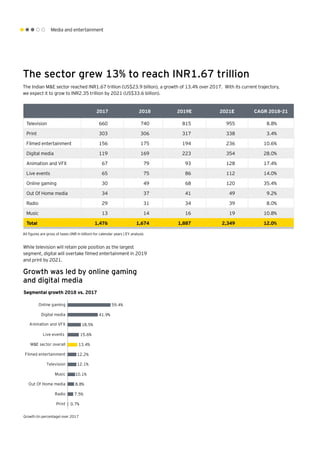
The sector grew 13% to reach INR1.67 trillion
The Indian M&E sector reached INR1.67 trillion (US$23.9 billion), a growth of 13.4% over 2017. With its current trajectory,
we expect it to grow to INR2.35 trillion by 2021 (US$33.6 billion).
2017 2018 2019E 2021E CAGR 2018-21
Television 660 740 815 955 8.8%
Print 303 306 317 338 3.4%
Filmed entertainment 156 175 194 236 10.6%
Digital media 119 169 223 354 28.0%
Animation and VFX 67 79 93 128 17.4%
Live events 65 75 86 112 14.0%
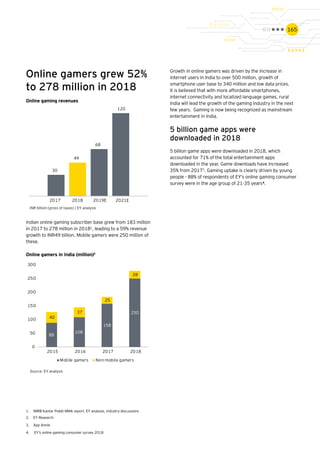
Online gaming 30 49 68 120 35.4%
Out Of Home media 34 37 41 49 9.2%
Radio 29 31 34 39 8.0%
Music 13 14 16 19 10.8%
Total 1,476 1,674 1,887 2,349 12.0%
All figures are gross of taxes (INR in billion) for calendar years | EY analysis
While television will retain pole position as the largest
segment, digital will overtake filmed entertainment in 2019
and print by 2021.
Growth was led by online gaming
and digital media
Segmental growth 2018 vs. 2017
12.1%
0.7%
7.5%
8.8%
10.1%
12.2%
13.4%
15.6%
18.5%
41.9%
59.4%
Print
Radio
Out Of Home media
Music
Television
Filmed entertainment
M&E sector overall
Live events
Animation and VFX
Digital media
Online gaming
Growth (in percentage) over 2017
11
668 753 843
1,042
646
719
796
948
-
500
1,000
1,500
2,000
2017 2018 2019E 2021E
Advertising Subscription
►► Online gaming grew across real money gaming
(including fantasy and e-Sports) as well as casual
gaming, on the back of a 52% growth in online gamers
who reached 278 million in 2018
►► Advertising budgets continued their inexorable
shift towards digital media where, despite fears of
advertising fraud, the segment grew 34% to command
21% of total advertising spends
►► Digital subscription grew by over 250% with Indians
opening their purse strings to pay for online content
►► Animation and VFX continued to grow on the back
of India’s cost-effective talent pool and growing
participation in an international film and digital
content market that is producing more content than
ever before
►► Live events continued to grow in scale and size on
the back of weddings, sports, government spends and
large format concerts and theatricals
►► The film segment crossed INR100 billion in domestic
theatrical revenues, and was further supported by the
growth in Indian film exports, particularly to China,
and increasing values for digital rights
►► Television, the largest segment, grew at the industry
average on the back of a strong performance by
regional brands, multiple sporting events and impact
properties
►► Music made a strong recovery led by digital revenues
from a host of ever-growing audio streaming
platforms whose user base grew by 50%
►► OOH benefited from operationalization of metros and
airports, and from categories like retail, consumer
services and real estate, which continued to spend
heavily on the medium
►► Radio grew from the additional inventory sold on
stations operationalized during the last 18 months
(though advertising volume drops were seen in some
large markets) and from non-advertising revenues,
led by events, activation, content production and
syndication
►► Print grew 0.7%; advertising revenues grew 0.4% in
2018 while subscription grew 1.2% on the back of
circulation drives and some cover price increases
Value was driven by direct-to-
customer (D2C) capabilities
For a while in May 2018, Netflix was valued more than Walt
Disney1
. This is a clear indication that valuation is being
driven by D2C capabilities – mainly access to deep customer
data and the ability to interact with customers accordingly
– an area where Netflix excels. Disney has focused on D2C
with the launch of its proposed OTT platform Disney+2
, as
well as the proposed acquisition of Fox’s assets like Hotstar
and Hulu.
In India, too, media buyers have started shifting budgets
to segments with more D2C capabilities and the segmental
growth rate chart is representative of this. Some advertisers
have started investing in their own D2C capabilities, to build
communities and subscription product sales. There is a
huge opportunity for media companies to assist brands in
their D2C initiatives. Traditional media companies spent
2018 building their customer data through second-screen
interactive propositions, polls, house-to-house surveys,
integration of third-party data, etc. We expect this (small)
data to lay the foundation for more (big) data initiatives in
the coming two to three years.
1.	 https://money.cnn.com/2018/05/24/investing/netflix-disney-comcast-
market-value/index.html
2.	 https://www.adweek.com/tv-video/disney-announces-the-name-of-its-
much-anticipated-ott-service/
Advertising outpaced subscription
growth
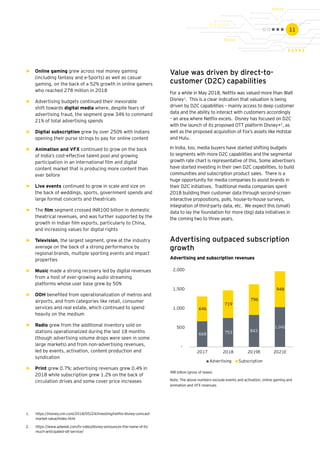
Advertising and subscription revenues
INR billion (gross of taxes)
Note: The above numbers exclude events and activation, online gaming and
animation and VFX revenues
Media and entertainment
Advertising grew 12.7% in 2018, while subscription grew
11.2%. Advertising revenues comprised 51.2% of the total
in 2018 and are expected to grow to 52.4% of the total by
2021.
Advertising got over the effects of demonetization and
caution necessitated due to the implementation of GST,
which had impacted it for more than half of 2017. Growth
was led by digital advertising (which grew 34% over 2017)
and television advertising (which grew 14% over 2017) on
the back of sporting events, more impact properties, several
state elections, and growth in regional advertising.
Subscription growth was driven mainly by international film
exhibition revenues, digitization of DAS-III and IV television
markets and digital streaming on OTT video platforms.
Clear shift towards performance
advertising was seen
Advertising is seeing a clear shift towards performance as
compared to brand, with rates reflective of the closeness
to the point of customer action. While audiences come
to platforms for content, they go to search engines when
interested in a product or service and visit e-commerce
platforms when interested in purchasing. Such platforms are
now generating more advertising interest from brands and
we can expect to see Amazon, Flipkart and others attracting
increased advertising revenues going forward.
SMEs invested in advertising
Small and medium enterprises (SMEs) have typically
advertised in the yellow pages, or used local print, OOH
and radio in limited numbers. They have now diverted a
significant spend on digital platforms. While we are unable
to size this segment accurately due to lack of verifiable data
(and have therefore excluded it from advertising sizing), our
analysis of industry discussions indicates that this segment
could be spending upwards of INR72 billion on digital
advertising and search, primarily on Google and Facebook.
This segment of advertisers can be as large as 300,000 or
more and is growing. Such advertisers spend an average of
around INR20,000 per month on advertising.
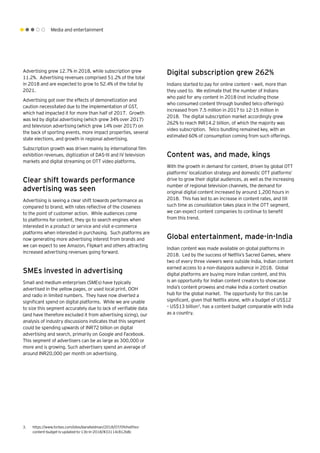
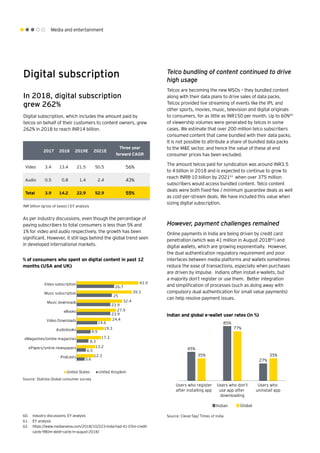
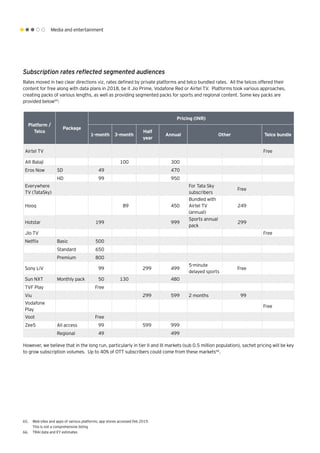
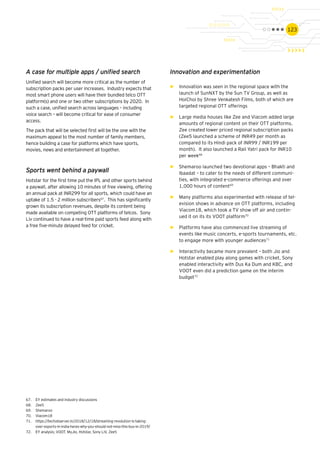
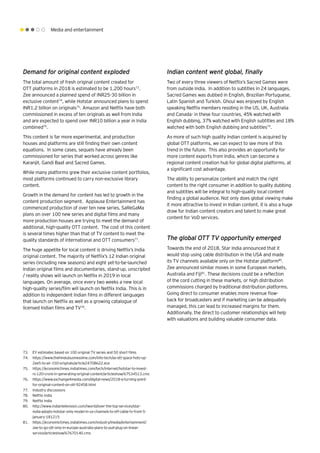
Digital subscription grew 262%
Indians started to pay for online content – well, more than
they used to. We estimate that the number of Indians
who paid for any content in 2018 (not including those
who consumed content through bundled telco offerings)
increased from 7.5 million in 2017 to 12-15 million in
2018. The digital subscription market accordingly grew
262% to reach INR14.2 billion, of which the majority was
video subscription. Telco bundling remained key, with an
estimated 60% of consumption coming from such offerings.
Content was, and made, kings
With the growth in demand for content, driven by global OTT
platforms’ localization strategy and domestic OTT platforms’
drive to grow their digital audiences, as well as the increasing
number of regional television channels, the demand for
original digital content increased by around 1,200 hours in
2018. This has led to an increase in content rates, and till
such time as consolidation takes place in the OTT segment,
we can expect content companies to continue to benefit
from this trend.
Global entertainment, made-in-India
Indian content was made available on global platforms in
2018. Led by the success of Netflix’s Sacred Games, where
two of every three viewers were outside India, Indian content
earned access to a non-diaspora audience in 2018. Global
digital platforms are buying more Indian content, and this
is an opportunity for Indian content creators to showcase
India’s content prowess and make India a content creation
hub for the global market. The opportunity for this can be
significant, given that Netflix alone, with a budget of US$12
– US$13 billion3
, has a content budget comparable with India
as a country.
3.	 https://www.forbes.com/sites/danafeldman/2018/07/09/netflixs-
content-budget-is-updated-to-13b-in-2018/#33114c812b8c
13
The customer lifetime value
equation refused to balance on
digital platforms
For most OTT platforms – video, news or audio – the cost of
content and customer acquisition continued to be higher
than the revenues earned per customer. While subscription
growth has begun, advertising rates are already at levels
much higher than those charged by traditional media.
Programmatic advertising – expected to grow from 20% in
2018 to 50% by 2021 – could further impact advertising
revenue yield. Consequently, the formula for success
will depend on massive growth in reach and more paying
subscribers. Till such time as the customer lifetime value
equation balances, we can expect to see a high amount of
content syndication by platforms to recover content costs.
Width of sports consumption
increased
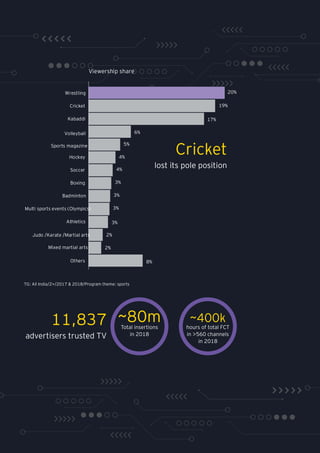
2018 saw wrestling garner 20% of time spent on sports on
television, while cricket achieved 19%. The share of time
spent on volleyball, athletics, boxing, hockey, martial arts,
badminton and soccer all increased.
M&E sector continued to outperform
the Indian economy
13.1%
10.2%10.9%
12.7%
11.8%
13.4%
2013 2014 2015 2016 2017 2018
M&E sector growth rate
Advertising growth rate
Nominal GDP growth rate
M&E growth vs. nominal GDP growth
While the Indian economy grew its nominal GDP by 10.2%4
,
the Indian M&E sector grew 13.4%. Advertising, which had
dropped below the nominal growth rate in 2017 due to
demonetization and implementation of GST, recovered and
grew 12.7%. The M&E sector is seeing the fruits of continued
economic growth and India’s rising per-capita nominal GDP,
which is estimated to have grown by 10.6% in 20185
, a five-
year high growth rate.
Sector consolidation continued
Deal value doubled to US$2.8 billion in 2018. Indian media
companies saw 41 large deals in 2018, led by PVR Cinemas
acquiring SPI Cinemas, Reliance acquiring Hathway and Den
Networks, etc. Deals were driven by scale, market share and
access to technology. Investments in technology start-ups
and content creators continued.
India became a multi-strategy
market
Many investors realized the heterogeneity of India and have
created multiple strategies to target India and Bharat and the
different strata within them. There is not going to be a single
market strategy, and companies adapted to the fact that
global strategies do not always work in India.
4.	 Growth (Basic data): First Revised Estimates, NAS dated 31 Jan 2019
and Advance Estimates, NAS dated 07 January 2019, CSO, MoSPI
5.	 IMF World Economic Outlook, October 2018
Media and entertainment
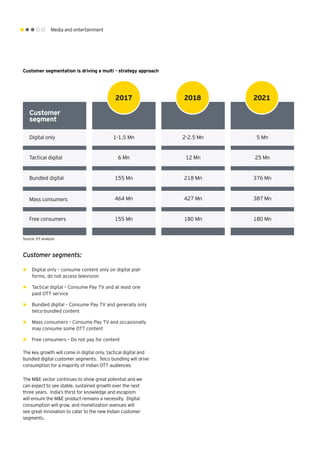
Customer segments:
►► Digital only – consume content only on digital plat-
forms, do not access television
►► Tactical digital – Consume Pay TV and at least one
paid OTT service
►► Bundled digital – Consume Pay TV and generally only
telco-bundled content
►► Mass consumers – Consume Pay TV and occasionally
may consume some OTT content
►► Free consumers – Do not pay for content
The key growth will come in digital only, tactical digital and
bundled digital customer segments. Telco bundling will drive
consumption for a majority of Indian OTT audiences.
Digital only 1-1.5 Mn 2-2.5 Mn 5 Mn
12 Mn 25 Mn
218 Mn 376 Mn
427 Mn 387 Mn
180 Mn 180 Mn
6 Mn
155 Mn
464 Mn
155 Mn
Tactical digital
Bundled digital
Mass consumers
Free consumers
2017
Customer
segment
2018 2021
Customer segmentation is driving a multi - strategy approach
Source: EY analysis
The M&E sector continues to show great potential and we
can expect to see stable, sustained growth over the next
three years. India’s thirst for knowledge and escapism
will ensure the M&E product remains a necessity. Digital
consumption will grow, and monetization avenues will
see great innovation to cater to the new Indian customer
segments.
15
Media and entertainment
Image courtesy ImagesBazaar
17
Indian economy
and its impact on
M&E
India remained the growth
leader in 2018
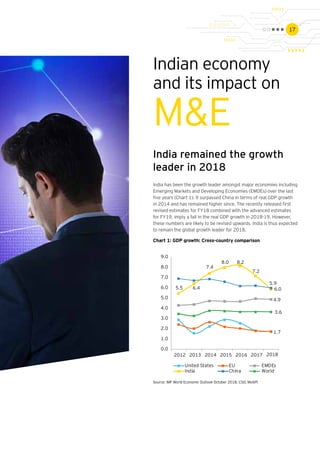
India has been the growth leader amongst major economies including
Emerging Markets and Developing Economies (EMDEs) over the last
five years (Chart 1). It surpassed China in terms of real GDP growth
in 2014 and has remained higher since. The recently released first
revised estimates for FY18 combined with the advanced estimates
for FY19, imply a fall in the real GDP growth in 2018-19. However,
these numbers are likely to be revised upwards. India is thus expected
to remain the global growth leader for 2018.
Chart 1: GDP growth: Cross-country comparison
Source: IMF World Economic Outlook October 2018; CSO, MoSPI
1.7
4.9
5.5 6.4
7.4
8.0 8.2
7.2
5.9
6.0
3.6
0.0
1.0
2.0
3.0
4.0
5.0
6.0
7.0
8.0
9.0
2012 2013 2014 2015 2016 2017 2018
United States EU EMDEs
India China World
Media and entertainment
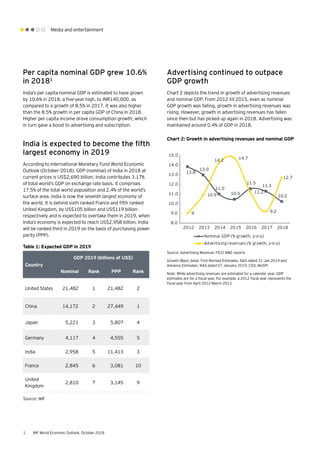
Per capita nominal GDP grew 10.6%
in 20181
India’s per capita nominal GDP is estimated to have grown
by 10.6% in 2018, a five-year high, to INR140,000, as
compared to a growth of 8.5% in 2017. It was also higher
than the 8.5% growth in per capita GDP of China in 2018.
Higher per capita income drove consumption growth, which
in turn gave a boost to advertising and subscription.
India is expected to become the fifth
largest economy in 2019
According to International Monetary Fund World Economic
Outlook (October-2018), GDP (nominal) of India in 2018 at
current prices is US$2,690 billion. India contributes 3.17%
of total world's GDP on exchange rate basis. It comprises
17.5% of the total world population and 2.4% of the world’s
surface area. India is now the seventh largest economy of
the world. It is behind sixth ranked France and fifth ranked
United Kingdom, by US$105 billion and US$119 billion
respectively and is expected to overtake them in 2019, when
India’s economy is expected to reach US$2,958 billion. India
will be ranked third in 2019 on the basis of purchasing power
parity (PPP).
Country
GDP 2019 (billions of US$)
Nominal Rank PPP Rank
United States 21,482 1 21,482 2
China 14,172 2 27,449 1
Japan 5,221 3 5,807 4
Germany 4,117 4 4,555 5
India 2,958 5 11,413 3
France 2,845 6 3,081 10
United
Kingdom
2,810 7 3,145 9
Source: IMF
1.	 IMF World Economic Outlook, October 2018
Advertising continued to outpace
GDP growth
Chart 2 depicts the trend in growth of advertising revenues
and nominal GDP. From 2012 till 2015, even as nominal
GDP growth was falling, growth in advertising revenues was
rising. However, growth in advertising revenues has fallen
since then but has picked up again in 2018. Advertising was
maintained around 0.4% of GDP in 2018.
Chart 2: Growth in advertising revenues and nominal GDP
Source: Advertising Revenue: FICCI M&E reports
Growth (Basic data): First Revised Estimates, NAS dated 31 Jan 2019 and
Advance Estimates, NAS dated 07 January 2019, CSO, MoSPI
Note: While advertising revenues are estimated for a calendar year, GDP
estimates are for a fiscal year. For example, a 2012 fiscal year represents the
fiscal year from April 2012-March 2013.
13.8
13.0
11.0
10.5
11.5
11.3
10.2
9
10.9
14.2 14.7
11.2
9.2
12.7
8.0
9.0
10.0
11.0
12.0
13.0
14.0
15.0
2012 2013 2014 2015 2016 2017 2018
Nominal GDP (% growth, y-o-y)
Advertising revenues (% growth, y-o-y)
Table 1: Expected GDP in 2019
19
4.9
2.2
76.7
56.6
40
45
50
55
60
65
70
75
80
85
1.0
1.5
2.0
2.5
3.0
3.5
4.0
4.5
5.0
5.5
CPI-based inflation% (LHS) Crude price (US$/bbl) (RHS)
Source: Pinksheet. World Bank; MoSPI
Note: Crude price represents the simple average of three spot prices; Dated Brent, West Texas Intermediate, and the Dubai Fateh
Forward estimates of growth are
positive
Interim Budget 2020: Providing a
consumption-based push
The Interim Budget 2020 of the Government of India has
given a consumption-based push to the economy. First,
in the form of direct transfers to farmers, a budgetary
commitment for INR200 billion in FY19 and INR750 billion in
FY20 has been provided. Secondly, the standard deduction
for salaried employees has been raised from INR40,000
to INR50,000, which would increase their disposable
income. Third, a tax relief has been given to the low and
middle income groups with a taxable income of less than
INR500,000 which may be claimed as a rebate.
These programs are likely to add to the private disposable
incomes of low to middle income segments in 2019 and
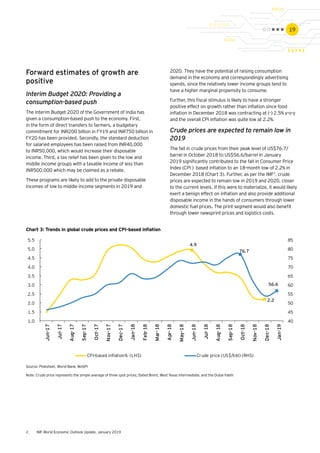
Chart 3: Trends in global crude prices and CPI-based inflation
2020. They have the potential of raising consumption
demand in the economy and correspondingly advertising
spends, since the relatively lower income groups tend to
have a higher marginal propensity to consume.
Further, this fiscal stimulus is likely to have a stronger
positive effect on growth rather than inflation since food
inflation in December 2018 was contracting at (-) 2.5% y-o-y
and the overall CPI inflation was quite low at 2.2%.
Crude prices are expected to remain low in
2019
The fall in crude prices from their peak level of US$76.7/
barrel in October 2018 to US$56.6/barrel in January
2019 significantly contributed to the fall in Consumer Price
Index (CPI ) based inflation to an 18-month low of 2.2% in
December 2018 (Chart 3). Further, as per the IMF2
, crude
prices are expected to remain low in 2019 and 2020, closer
to the current levels. If this were to materialize, it would likely
exert a benign effect on inflation and also provide additional
disposable income in the hands of consumers through lower
domestic fuel prices. The print segment would also benefit
through lower newsprint prices and logistics costs.
2.	 IMF World Economic Outlook Update, January 2019
Media and entertainment
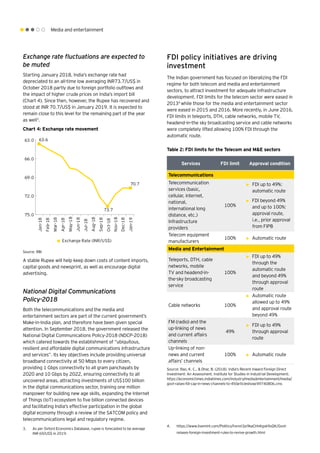
Chart 4: Exchange rate movement
Source: RBI
National Digital Communications
Policy-2018
Both the telecommunications and the media and
entertainment sectors are part of the current government’s
Make-in-India plan, and therefore have been given special
attention. In September 2018, the government released the
National Digital Communications Policy-2018 (NDCP-2018)
which catered towards the establishment of “ubiquitous,
resilient and affordable digital communications infrastructure
and services”. Its key objectives include providing universal
broadband connectivity at 50 Mbps to every citizen,
providing 1 Gbps connectivity to all gram panchayats by
2020 and 10 Gbps by 2022, ensuring connectivity to all
uncovered areas, attracting investments of US$100 billion
in the digital communications sector, training one million
manpower for building new age skills, expanding the Internet
of Things (IoT) ecosystem to five billion connected devices
and facilitating India's effective participation in the global
digital economy through a review of the SATCOM policy and
telecommunications legal and regulatory regime.
FDI policy initiatives are driving
investment
The Indian government has focused on liberalizing the FDI
regime for both telecom and media and entertainment
sectors, to attract investment for adequate infrastructure
development. FDI limits for the telecom sector were eased in
20134
while those for the media and entertainment sector
were eased in 2015 and 2016. More recently, in June 2016,
FDI limits in teleports, DTH, cable networks, mobile TV,
headend-in-the sky broadcasting service and cable networks
were completely lifted allowing 100% FDI through the
automatic route.
Table 2: FDI limits for the Telecom and M&E sectors
Services FDI limit Approval condition
Telecommunications
Telecommunication
services (basic,
cellular, internet,
national,
international long
distance, etc.)
Infrastructure
providers
100%
•	 FDI up to 49%:
automatic route
•	 ►FDI beyond 49%
and up to 100%:
approval route,
i.e., prior approval
from FIPB
Telecom equipment
manufacturers
100% •	 ►Automatic route
Media and Entertainment
Teleports, DTH, cable
networks, mobile
TV and headend-in-
the-sky broadcasting
service
100%
•	 ►FDI up to 49%
through the
automatic route
and beyond 49%
through approval
route
Cable networks 100%
•	 ►Automatic route
allowed up to 49%
and approval route
beyond 49%
FM (radio) and the
up-linking of news
and current affairs
channels
49%
•	 ►FDI up to 49%
through approval
route
Up-linking of non-
news and current
affairs’ channels
100% •	 ►Automatic route
Source: Rao, K. C., & Dhar, B. (2018). India's Recent Inward Foreign Direct
Investment: An Assessment. Institute for Studies in Industrial Development;
https://economictimes.indiatimes.com/industry/media/entertainment/media/
govt-raises-fdi-cap-in-news-channels-to-49/articleshow/49740806.cms
63.6
73.7
70.7
63.0
66.0
69.0
72.0
75.0
Jan-18
Feb-18
Mar-18
Apr-18
May-18
Jun-18
Jul-18
Aug-18
Sep-18
Oct-18
Nov-18
Dec-18
Jan-19
Exchange Rate (INR/US$)
3.	 As per Oxford Economics Database, rupee is forecasted to be average
INR 69/US$ in 2019.
Exchange rate fluctuations are expected to
be muted
Starting January 2018, India’s exchange rate had
depreciated to an all-time low averaging INR73.7/US$ in
October 2018 partly due to foreign portfolio outflows and
the impact of higher crude prices on India’s import bill
(Chart 4). Since then, however, the Rupee has recovered and
stood at INR 70.7/US$ in January 2019. It is expected to
remain close to this level for the remaining part of the year
as well3
.
A stable Rupee will help keep down costs of content imports,
capital goods and newsprint, as well as encourage digital
advertising.
4.	 https://www.livemint.com/Politics/hxnnl3jx9kaCHnKgsk9oQK/Govt-
relaxes-foreign-investment-rules-to-revive-growth.html
21
0.7
0.4 0.4
0.3
1.0
1.5
0.6
0.1
0.0
0.2
0.4
0.6
0.8
1.0
1.2
1.4
1.6
2011-12
2012-13
2013-14
2014-15
2015-16
2016-17
2017-18
Apr-Sep2018
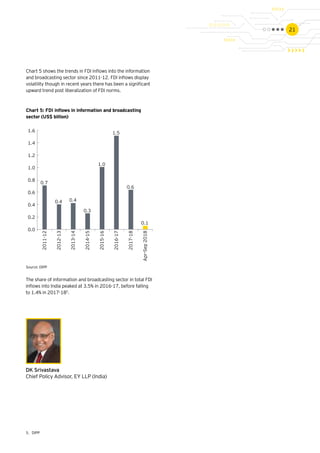
Chart 5 shows the trends in FDI inflows into the information
and broadcasting sector since 2011-12. FDI inflows display
volatility though in recent years there has been a significant
upward trend post liberalization of FDI norms.
Chart 5: FDI inflows in information and broadcasting
sector (US$ billion)
Source: DIPP
The share of information and broadcasting sector in total FDI
inflows into India peaked at 3.5% in 2016-17, before falling
to 1.4% in 2017-185
.
5.	 DIPP
DK Srivastava
Chief Policy Advisor, EY LLP (India)
Media and entertainment
23
The global
perspective
on Indian M&E
How big is the India M&E
opportunity?
India is a huge market with very positive growth fundamentals across
virtually every type of media. The market is strategically interesting to
global players seeking to monetize content and capture growth upside,
either as a participant via licensing or other commercial arrangements,
or as an outright owner through an in-bound acquisition or organic
investment approach.
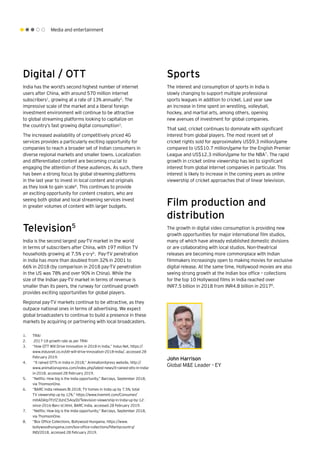
With more than 850 TV channels and over 17,000 newspapers, the
country is one of the most diverse and vibrant media markets globally.
Yet the headroom for future growth is significant. Advertising, the
lifeline of India’s M&E industry, remains amongst the lowest in terms of
spend as a percentage of GDP. The country is also at an inflection point
in wireless broadband connectivity and infrastructure that, combined
with its GDP growth and young demographics, offer new opportunities.
0.88%
0.70%
0.60% 0.60%
0.39%
Japan China Malaysia Singapore India
While there are positive growth trends across a number of M&E sub-
sectors, these are some areas which are seeing strong interest from
global players.
Ad spend as a percentage of GDP
Media and entertainment
Digital / OTT
India has the world’s second highest number of internet
users after China, with around 570 million internet
subscribers1
, growing at a rate of 13% annually2
. The
impressive scale of the market and a liberal foreign
investment environment will continue to be attractive
to global streaming platforms looking to capitalize on
the country’s fast growing digital consumption3
.
The increased availability of competitively priced 4G
services provides a particularly exciting opportunity for
companies to reach a broader set of Indian consumers in
diverse regional markets and smaller towns. Localization
and differentiated content are becoming crucial to
engaging the attention of these audiences. As such, there
has been a strong focus by global streaming platforms
in the last year to invest in local content and originals
as they look to gain scale4
. This continues to provide
an exciting opportunity for content creators, who are
seeing both global and local streaming services invest
in greater volumes of content with larger budgets.
Television5
India is the second largest pay-TV market in the world
in terms of subscribers after China, with 197 million TV
households growing at 7.5% y-o-y6
. Pay-TV penetration
in India has more than doubled from 32% in 2001 to
66% in 2018 (by comparison in 2018 pay-TV penetration
in the US was 78% and over 90% in China). While the
size of the Indian pay-TV market in terms of revenue is
smaller than its peers, the runway for continued growth
provides exciting opportunities for global players.
Regional pay-TV markets continue to be attractive, as they
outpace national ones in terms of advertising. We expect
global broadcasters to continue to build a presence in these
markets by acquiring or partnering with local broadcasters.
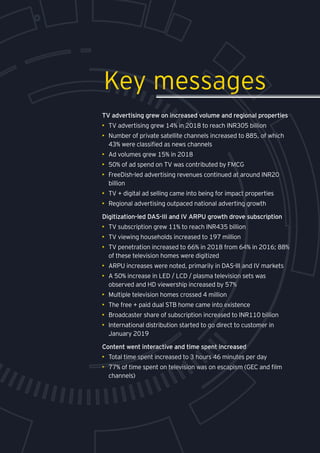
Sports
The interest and consumption of sports in India is
slowly changing to support multiple professional
sports leagues in addition to cricket. Last year saw
an increase in time spent on wrestling, volleyball,
hockey, and martial arts, among others, opening
new avenues of investment for global companies.
That said, cricket continues to dominate with significant
interest from global players. The most recent set of
cricket rights sold for approximately US$9.3 million/game
compared to US$10.7 million/game for the English Premier
League and US$12.3 million/game for the NBA7
. The rapid
growth in cricket online viewership has led to significant
interest from global internet companies in particular. This
interest is likely to increase in the coming years as online
viewership of cricket approaches that of linear television.
Film production and
distribution
The growth in digital video consumption is providing new
growth opportunities for major international film studios,
many of which have already established domestic divisions
or are collaborating with local studios. Non-theatrical
releases are becoming more commonplace with Indian
filmmakers increasingly open to making movies for exclusive
digital release. At the same time, Hollywood movies are also
seeing strong growth at the Indian box office – collections
for the top 10 Hollywood films in India reached over
INR7.5 billion in 2018 from INR4.8 billion in 20178
.
1.	 TRAI
2.	 2017-18 growth rate as per TRAI
3.	 “How OTT Will Drive Innovation in 2018 in India,” Indus Net, https://
www.indusnet.co.in/ott-will-drive-innovation-2018-india/, accessed 28
February 2019.
4.	 “It rained OTTs in India in 2018,” AnimationXpress website, http://
www.animationxpress.com/index.php/latest-news/it-rained-otts-in-india-
in-2018, accessed 28 February 2019.
5.	 “Netflix: How big is the India opportunity,” Barclays, September 2018,
via ThomsonOne.
6.	 “BARC India releases BI 2018; TV homes in India up by 7.5%; total
TV viewership up by 12%,” https://www.livemint.com/Consumer/
mHADAtpTFzfZ3UnC54oyDI/Television-viewership-in-India-up-by-12-
since-2016-Barc-st.html, BARC India, accessed 28 February 2019.
7.	 “Netflix: How big is the India opportunity,” Barclays, September 2018,
via ThomsonOne.
8.	 “Box Office Collections, Bollywood Hungama, https://www.
bollywoodhungama.com/box-office-collections/filterbycountry/
IND/2018, accessed 28 February 2019.
John Harrison
Global M&E Leader - EY
25
Digital India:
Data to unlock new opportunities
20222017
4G will be dominant technology
5G roll outs expected by 2022 – in tune with the
global launches
% of mobile broadband users
>70%
20%
Government will lay the foundation
for fiber
Step towards providing fixed broadband access to
50% households by 2022
250,000Kms
100,000 Kms
Online population to grow exponentially
Online population to rise over 60% out of
which 135M fixed Internet users by 2022
840M
446M
Mobile to outpace all networked devices
Smartphones will account for 38% (829M) of all
networked devices by 2022
Accelerating network speeds
89% of fixed broadband connections will be faster
than 10 Mbps by 2022, up from 28% today
31.2
Mbps
9.5
Mbps
Indians to consume a lot of video content
88B minutes (167,931 years) of video content will
cross the Internet each month by 2022
2.2B
1.7B
Number of networked devices
68% of networked devices mobile-connected by 2022
Average fixed broadband speed
Consumer internet video traffic (Exabyte per month)
12 EB
1.2 EB
While there are many opportunities, India faces several persistent challenges:
Increasing usage of digital media has accelerated video consumption and also
increased piracy threat. Growing piracy is likely to restrict full monetization
of content as well as large-scale acceptance of SVoD in India.
Indian market is highly price sensitive and is majorly advertising driven.
India’s Ease of doing business 2019 ranking improved 23 spots to reach #77
– its position worsened on ‘paying taxes’ and ‘resolving insolvency’.
2019; Sources: EY Analysis, eMarketer, Nokia MBiT Index 2019; Cisco VNI Index 2019; World Bank Doing Business 2019 report
2017 2022
Image courtesy ImagesBazaar
S
t
Segmental
trends
Television
Image courtesy ImagesBazaar
Media and entertainment
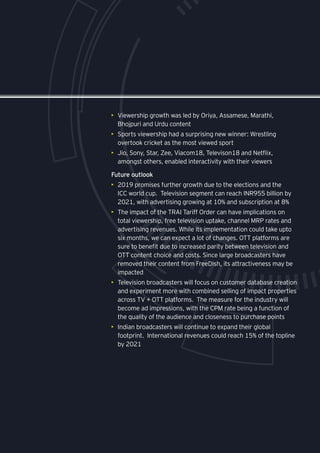
TV advertising grew on increased volume and regional properties
•	 TV advertising grew 14% in 2018 to reach INR305 billion
•	 Number of private satellite channels increased to 885, of which
43% were classified as news channels
•	 Ad volumes grew 15% in 2018
•	 50% of ad spend on TV was contributed by FMCG
•	 FreeDish-led advertising revenues continued at around INR20
billion
•	 TV + digital ad selling came into being for impact properties
•	 Regional advertising outpaced national adverting growth
Digitization-led DAS-III and IV ARPU growth drove subscription
•	 TV subscription grew 11% to reach INR435 billion
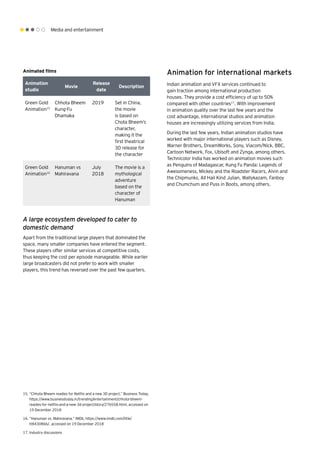
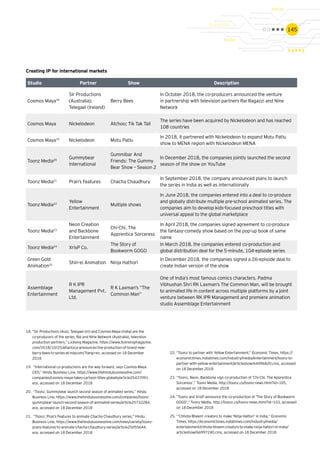
•	 TV viewing households increased to 197 million
•	 TV penetration increased to 66% in 2018 from 64% in 2016; 88%
of these television homes were digitized
•	 ARPU increases were noted, primarily in DAS-III and IV markets
•	 A 50% increase in LED / LCD / plasma television sets was
observed and HD viewership increased by 57%
•	 Multiple television homes crossed 4 million
•	 The free + paid dual STB home came into existence
•	 Broadcaster share of subscription increased to INR110 billion
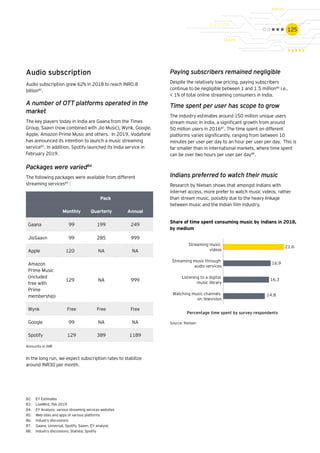
•	 International distribution started to go direct to customer in
January 2019
Content went interactive and time spent increased
•	 Total time spent increased to 3 hours 46 minutes per day
•	 77% of time spent on television was on escapism (GEC and film
channels)
Key messages
31
•	 Viewership growth was led by Oriya, Assamese, Marathi,
Bhojpuri and Urdu content
•	 Sports viewership had a surprising new winner: Wrestling
overtook cricket as the most viewed sport
•	 Jio, Sony, Star, Zee, Viacom18, Televison18 and Netflix,
amongst others, enabled interactivity with their viewers
Future outlook
•	 2019 promises further growth due to the elections and the
ICC world cup. Television segment can reach INR955 billion by
2021, with advertising growing at 10% and subscription at 8%
•	 The impact of the TRAI Tariff Order can have implications on
total viewership, free television uptake, channel MRP rates and
advertising revenues. While its implementation could take upto
six months, we can expect a lot of changes. OTT platforms are
sure to benefit due to increased parity between television and
OTT content choice and costs. Since large broadcasters have
removed their content from FreeDish, its attractiveness may be
impacted
•	 Television broadcasters will focus on customer database creation
and experiment more with combined selling of impact properties
across TV + OTT platforms. The measure for the industry will
become ad impressions, with the CPM rate being a function of
the quality of the audience and closeness to purchase points
•	 Indian broadcasters will continue to expand their global
footprint. International revenues could reach 15% of the topline
by 2021
Media and entertainment
2017 2018 2019E 2021E
Advertising 267 305 333 403
Distribution 393 435 481 551
Total 660 740 815 955
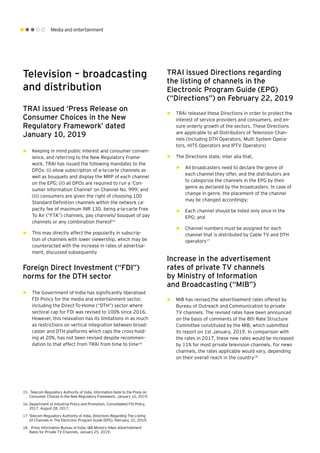
Television segment grew
12% in 2018
INR billion (gross of taxes) | EY analysis
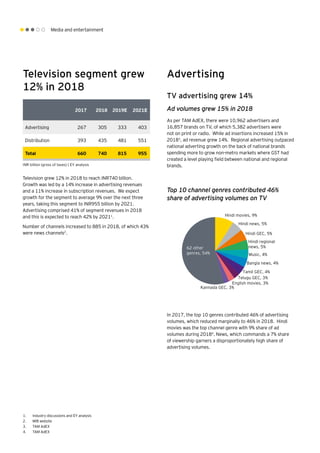
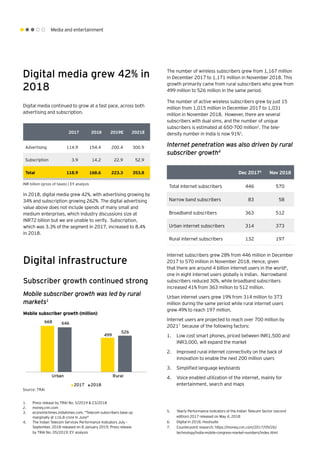
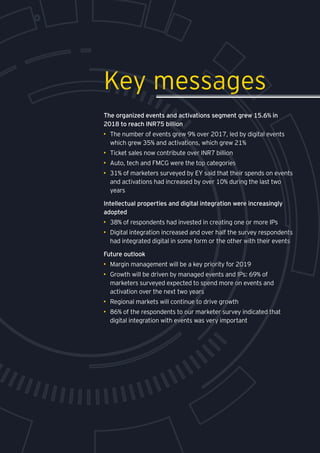
Television grew 12% in 2018 to reach INR740 billion.
Growth was led by a 14% increase in advertising revenues
and a 11% increase in subscription revenues. We expect
growth for the segment to average 9% over the next three
years, taking this segment to INR955 billion by 2021.
Advertising comprised 41% of segment revenues in 2018
and this is expected to reach 42% by 20211
.
Number of channels increased to 885 in 2018, of which 43%
were news channels2
.
Top 10 channel genres contributed 46%
share of advertising volumes on TV
In 2017, the top 10 genres contributed 46% of advertising
volumes, which reduced marginally to 46% in 2018. Hindi
movies was the top channel genre with 9% share of ad
volumes during 20184
. News, which commands a 7% share
of viewership garners a disproportionately high share of
advertising volumes.
1.	 Industry discussions and EY analysis
2.	 MIB website
3.	 TAM AdEX
4.	 TAM AdEX
Hindi movies, 9%
Hindi news, 5%
Hindi GEC, 5%
Hindi regional
news, 5%
Music, 4%
Bangla news, 4%
Tamil GEC, 4%
Telugu GEC, 3%
English movies, 3%
Kannada GEC, 3%
62 other
genres, 54%
Advertising
TV advertising grew 14%
Ad volumes grew 15% in 2018
As per TAM AdEX, there were 10,962 advertisers and
16,857 brands on TV, of which 5,382 advertisers were
not on print or radio. While ad insertions increased 15% in
20183
, ad revenue grew 14%. Regional advertising outpaced
national adverting growth on the back of national brands
spending more to grow non-metro markets where GST had
created a level playing field between national and regional
brands.
33
All the top 10 categories of 2017 grew ad
volumes in 2018
Overall insertions across the top 10 categories grew
10%. Personal care / hygiene was the sector with most
ad insertions (20%), followed by food and beverages and
services. Growth was driven by household products (27%
growth) followed by services (23% growth)5
.
Insertions by ad category
13.2
12.1
8.2
4.8
4.1
3.9
3.3
2.3
2.2
2.1
Building, industrial
& equipments
Personal accessories
Impressions (in million)
Laundry
Auto
Hair care
Household products
Personal healthcare
Services
Food & beverages
Personal care/hygiene
2018 2017
50% of ad spends were contributed by FMCG
Product category
Category
contribution
Contribution to
growth
FMCG 50% 44%
Telecom 12% 9%
Auto 8% 10%
Household durables 5% 8%
E-commerce 5% 6%
Real estate and home
improvement
3% 3%
Clothing, fashion,
jewelry
3% 4%
Banking, financial
services, insurance
2% 3%
Others 12% 13%
Total 100% 100%
	
Source: Pitch Madison Advertising Report 2019
50% of ad spends on TV were contributed by FMCG, which
also contributed to 44% of value growth. The fastest
growing categories were durables, travel and tourism and
e-commerce.
5.	 BARC, TAM AdEX
Media and entertainment
FreeDish generated INR20 billion of
advertising revenues
FreeDish generated an estimated INR20 billion of advertising
revenues6
. In February 2019, large broadcasters removed
their channels from this medium and this could impact our
ad revenue forecast by INR10-20 billion in 2019.
TV + digital ad sales began
Broadcasters have started combined selling of ads across
OTT and linear platforms. This enables better monetization
of marquee properties, and increases utilization of digital
inventory. Advertisers can provide separate messaging
to segmented audiences and also enable trial, sales and
connect with the viewer. We believe this will be the trend
going forward for flagship properties across fiction, non-
fiction and sports.
Distribution
TV owning households increased to
197 million
Mode of signal 2017 2018
Cable 98.5 103
DTH* 52 56
HITS 1.5 2
Free TV 31 36
Total 183 197
Television households in millions | BARC, EY analysis
* Net of temporarily suspended subscribers
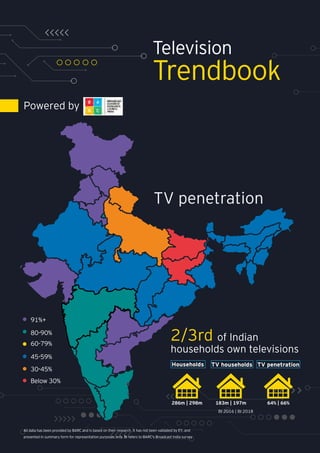
Television owning households increased to 197 million,
which is a 7.5% increase over the previous Broadcast India
survey. During the same period, total Indian households
increased 4.2% to reach 298 million. Correspondingly, TV
penetration increased to 66% in 2018 from 64% in 20167
.
Bihar and Jharkhand showed highest growth in television
households on the back of India’s drive towards
electrification.
State group Growth%
Bihar / Jharkhand 24%
Assam / North East / Sikkim 21%
Odisha 12%
AP / Telangana 11%
Karnataka 9%
	Source: BARC
6.	 Industry discussions; EY estimates
7.	 BARC Broadcast India 2016 and 2018
35
Source: Industry discussions; EY analysis
88% of TV viewing households were
digitized8
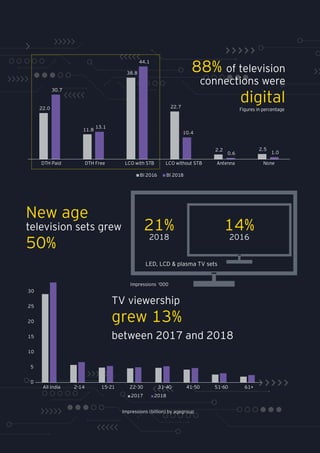
According to BARC, 31% of TV viewing households had
paid DTH, 13% had free DTH and 44% had digital cable.
This number indicates a 15% growth over 2016 and has
contributed significantly to the growth in end-subscriber
pricing.
ARPU increases were noted,
primarily in DAS-III and IV markets
Markets
2017 INR per
month
2018 INR per
month
DAS-I 250-350 250-350
DAS-II 200-325 200-325
DAS-III 150-225 175-225
DAS-IV 125-200 125-225
	
Digitization led to increased collections from end customers
in DAS-III and DAS-IV markets, with many cities crossing
the INR200 per month number. DTH ARPUs have been
affected by a change in the subscriber mix with incremental
subscribers coming at a lower price point and the movement
of subscribers to lower value regional packs.
HD viewership increased by 57%
HD channels grew from 78 in 2017 to 92 in 2018 (18%
growth). HD viewership has grown at the rate of 57% in
2018 to reach 874,000 impressions9
.
2016 2018
UP / Uttarakhand UP / Uttarakhand
TN / Pondicherry Delhi
West Bengal West Bengal
Delhi Haryana + HP + JK
Haryana + HP + JK Punjab / Chandigarh
	
50% increase in LED / LCD / plasma
television sets
High-end television sets grew from 14% of all television sets
in 2017 to 21% in 201811
. In addition, smart TV sets have
crossed 10 million, though as few as 10% of them could be
connected12
.
The free + paid dual STB home came
into existence
Many DPOs we spoke with mentioned the existence of price
sensitive customers who had adopted for a FreeDish box as
well as a paid TV service, the latter being activated during
holidays and when there were large sporting events.
8.	 Broadcast India survey 2016 and 2018
9.	 Broadcast India survey 2016 and 2018, TG: 2+
10.	 Broadcast India survey 2016 and 2018
11.	 Broadcast India survey 2016 and 2018
12.	 Industry discussion & https://economictimes.indiatimes.com/
magazines/panache/xiaomi-launches-mi-led-tv-4-in-india-for-rs-39999/
articleshow/62918726.cms
Multiple TV homes increased to 4
million10
Multiple TV homes have reached 4 million households in
2018. The states with the highest incidence of multiple TV
homes are provided in the table.
Media and entertainment
Consolidation has been seen across cable and DTH
Acquirer Acquired company Rationale
Reliance Jio DEN Networks (66% stake), Hathway
Cable (51.3% stake)
The acquisition has provided Reliance Jio with direct access to
MSOs’ broadband infrastructure and the large pool of pay cable TV
subscribers, which the company will utilize to accelerate Jio’s entry into
the fibre to the home market. Post-acquisition, Jio has direct access to
~6.5 million broadband households, which account for ~36% of India’s
total fixed broadband subscriber base of 18 million. On the other hand,
the deal also allows Jio to access 12.5 million cable TV subscribers or
~7% of total TV households who may not have broadband connectivity
yet. 13
Dish TV India Videocon D2H (merger)
The combination of these two companies created the largest DTH
operator in the country and they are expected to enjoy the benefits of
scale across content and other operating costs.14
	
Broadcaster share of subscription
revenues increased to INR110
billion15
This is around 25% of the total ground collections. However,
once the subscribers' migration from old tariff regime to
the new tariff order regime is implemented across India,
the broadcaster’s share is expected to go up significantly,
especially from cable subscribers.
International distribution went
direct to customer16
ZEE is planning to pull the plug on its linear television service
in Europe, Australia, Fiji and a few other overseas markets
and offer content only via the video OTT service, Zee5. Star
India had discontinued distribution of television channels
in Canada and the US and has been offering content only
through its video on-demand player, Hotstar. While Zee5
is not yet present in the US, due to its non-compete clause
with Dish Network which restricts Zee from launching a
direct-to-customer service in that market, the broadcaster
has shortlisted markets where it is now looking to stop
distribution of channels via cable or satellite. This indicates
a possible new trend for broadcasters in international
territories such as US where cutting the cord (i.e., consumers
moving from cable TV to OTT platforms) is gaining traction.
Their decision could deliver a huge boost to international
OTT platforms.
13.	 “RIL’s partnership with Hathway, Den to hit broadcasters, DTH
players; India Ratings explains how,” Financial Express, https://www.
financialexpress.com/industry/rils-partnership-with-hathway-den-to-
hit-broadcasters-dth-players-india-ratings-explains-how/1362351//,
accessed on 14 December 2018
14.	 “Dish TV India, Videocon d2h merger completed”, Economic
Times, https://economictimes.indiatimes.com/industry/media/
entertainment/media/dish-tv-india-videocon-d2h-merger-completed/
articleshow/63414778.cms, accessed on 22 March 2018
15.	 Industry discussions and EY analysis
16.	 “Zee to go OTT-only in Europe, Australia; plans to pull plug on linear
service”, Economic Times, https://economictimes.indiatimes.com/
industry/media/entertainment/zee-to-go-ott-only-in-europe-australia-
plans-to-pull-plug-on-linear-service/articleshow/67670140.cms,
accessed on 24 January 2019
37
Content and viewership
Average time spent watching
television increased to 3 hours 46
minutes per day17
The time spent increased marginally to 3 hours 46 minutes
per day, led by megacities, which had 4 hours 32 minutes
and south markets, at 4 hours 14 minutes. Around one
trillion man minutes were spent per week on television,
which is at an all-time high.
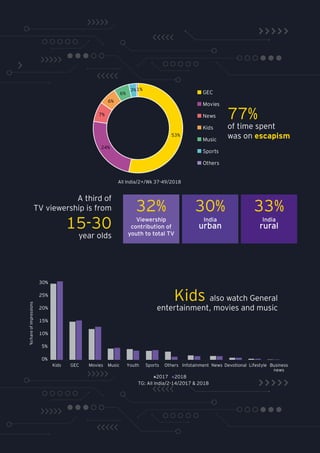
77% of content consumed was on
escapism
While 53% of total content consumed was on general
entertainment, another 24% was on films. News viewership
remained at around 7% despite 43% of TV channels in India
being classified as news channels18
.
Viewership growth was led by
regional languages
Viewership growth was led by regional channels, with the
highest growth being recorded by Oriya (34%), Assamese
(26%), Marathi (25%), Bhojpuri (22%) and Urdu (20%). That
compared to a 15% growth for Hindi and an overall growth of
13%19
.
Sports viewership had a surprising
new winner
Sport Viewership share in 2018
Wrestling 20%
Cricket 19%
Kabaddi 17%
Volleyball 6%
Sports magazine 5%
Source: BARC viewership share20
Wrestling became the most watched sport on TV, overtaking
cricket’s share of viewership. Volleyball more than doubled
its viewership. Together, wrestling, cricket and kabaddi
contribute to over 50% of all sports viewership. Football
continued to remain out of the top five sports, coming in at
number seven overall.
17.	 BARC
18.	 TRAI web-site; BARC
19.	 BARC
20.	 TG: All India/ 2+/2018/Program theme: Sports
21.	 Industry discussions; EY estimates
Second screen interactivity grew21
Star, Sony, Viacom and Jio experienced huge success in
implementing second screen interactivity for their premium
properties like IPL and KBC. Large initiatives around
consumer engagement delivered significant results to all
participants in the value chain. Broadcasters saw increased
stickiness and increase in linear viewership. OTT platforms
saw increase in app downloads and subscription numbers.
Advertisers saw innovative ways to engage with customers
and increase sampling.
We believe that the interactivity that Netflix has implemented
using fiction content is the direction that other OTT players
shall also take across various languages. Interactive
storylines can bring high interest levels and repeat value for
the same content for their viewers.
Media and entertainment
Areas amended Key matters
Revenues i.e.
Cost of providing
services and
carrying content
►► ►	The network capacity fee, per month, per set-top box, for upto 100 standard definition (SD)
channels is capped at INR130 (excluding taxes). Capacity for a high definition (HD) channel will be
equivalent to two SD channels
►► ►	Distributors can offer slabs of 25 channels (above 100 channels) at a maximum rental amount of
INR20 (excluding taxes), per month
►► ►	Carriage fee is capped INR0.20 and INR0.40 / subscriber / channel / month for SD and HD
channels, respectively
Inter-connect
agreements
►► DPOs can receive a minimum of 20% of the MRP of pay-channel or bouquet of pay channels as the
distribution fee from broadcasters. A cap of 15% has been placed on discounts offered by broad-
casters to DPOs. However, the overall sum of distribution fee and discount offered by the broad-
caster cannot exceed 35% of the MRP of the pay channel or a bouquet of pay channels
►► ►	The settlement of service charges between LCO and MSO should be on a mutually agreed basis.
In case they fail to reach an agreement, the network capacity fee amount and the distribution fee
amount is to be shared in the ratio of 55:45 between the MSO and the LCO
Channel pricing and
offerings
►► Broadcasters need to declare a Maximum Retail Price (MRP) for all their pay channels offered on
a-la-carte basis for all platforms. MRP will be uniform across all distribution platforms MSOs, DTH,
IPTV and HITS bringing all the platforms on a level playing field, resulting in same content costs
for platforms, irrespective of the type of platform
►► ►	Distributors are required to offer all channels available on their network to all subscribers on
a-la-carte basis and declare monthly Distribution Retail Price (DRP), for each pay channel. The
DRP should not exceed the monthly MRP, declared by the broadcasters for the same pay channel.
DPOs can also create bouquets with channels from different broadcasters. DPO shall offer to its
subscribers each bouquet of pay channels offered by a broadcaster, subject to subscribing the
said bouquet without altering its composition and declare the DRP for such bouquets also
►► ►	►Bouquets cannot include FTA and Pay channels both; nor can they include HD and SD versions
of the same channel; neither comprise of pay channel whose MRP as declared by broadcaster is
more than INR19
►► Every distributor of television channels is required to offer 100 SD TV channels including all the
mandatory channels as per the Government of India across defined genre for the Network
Capacity Fee (NTF) of INR130 excluding tax
►► ►	An earlier proposed linkage between a-la-carte and bouquet price (of 15%) has been removed
►► ►	DPO shall conduct audit through TRAI empanelled auditors only once in a calendar year. In case
the broadcaster is not satisfied with the audit report, then the broadcaster may audit MSO not
more than once a year, though TRAI empanelled auditors only
Average active subs Carriage fee calculation
<5% Rate of carriage fee as per agreement * Average subscriber base
>=5% and <10% Rate of carriage fee as per agreement * 0.75 * Average subscriber base
>=10% and <15% Rate of carriage fee as per agreement * 0.50 * Average subscriber base
>=15% and <20% Rate of carriage fee as per agreement * 0.25 * Average subscriber base
>=20% NIL
TRAI’s New Tariff Order (NTO)
Some important features of the NTO are listed in the table below. This is not a comprehensive list.
39
All stakeholders are looking forward to implementation of
the new Regulations. Currently, industry is going through a
transition process which hopefully should settle down in next
2-4 months. We believe the new Regulations will be beneficial
for the entire eco-system including consumers, DPOs and
broadcasters.
Atul Das
Chief Corporate Development Officer, Zee Entertainment
After years of confusion the verdict is finally out - Content is
king! With the New Tariff Order and spread of OTT - content
will lead the way. Distribution and technology are at best
critical facilitators along with marketing & branding.
Anuj Gandhi
Group CEO, Indiacast Media Distribution Pvt Ltd.
The new tariff order is set to dramatically change the
distribution landscape in India. It will bring in far greater
transparency and overall it will be good for the DPOs and
big broadcasters, as the ARPU’s are bound to go up and we
will for the first time see fair share allocation of subscription
revenues within the stake holders.
Rajesh Kaul
Chief Distribution Officer, Sony Pictures Networks India
The implementation of TRAI tariff order will lay down
new norms for the industry ushering in an era of growth,
transparency, and non-discrimination. We are building
further on this by integrating smart technology and
innovations into our offerings. All this, along with our
merger synergies, should help accelerate growth in our
subscriber base and EBITDA.
Anil Dua
Group CEO, Dish TV India Ltd.
Point of view
Media and entertainment
►► Smaller channel networks and niche channels may be
negatively impacted due to limited marketing capabili-
ty and less bouquet strength
A lot will finally depend on the cannel prices at which the
market settles – which can take six-nine months. One thing is
for sure, we can expect a lot of experimentation in 2019.
It’s time for more consumer data
Television broadcasters will focus on customer database
creation and experiment more with combined selling of
impact properties across TV + OTT platforms. The measure
for the industry will become ad impressions, with the CPM
rate being a function of the quality of the audience and
closeness to purchase points. We can expect to see data
being used to upsell channels, sell sports and niche channels,
as well as provide segmented audiences to advertisers,
which should increase advertising rates.
Global monetization is expected to increase
Indian broadcasters will continue to expand their global
footprint, either on their own platforms or through
partnerships with telcos and international OTT platforms,
to target not just Indian diaspora, but global audiences
interested in Indian content. International revenues could
reach 15% of the topline by 202123
.
Value chain automation opportunities will be
enabled
We expect to see more infrastructure sharing and
collaboration between broadcasters, to take advantage of
the global opportunity, interactivity solutions, traffic order
validation, uplinking, news gathering and content creation.
Distribution companies will increasingly become like telecom
companies with common back-end infrastructure (an area
where HITS can play a role). We can expect to see mobile
wallets and scratch cards enable payments from consumers
and LCOs. Finally, we can expect more self-serve platforms
to come into existence for advertisers (like Zee Mitra) as well
as for DPOs to buy content from broadcasters and LCOs to
buy content from DPOs.
22.	 EY estimate
23.	 EY estimate
Future outlook
Adex growth will continue strong in 2019
We believe advertising will continue to grow in 2019 by a
minimum of 9-10% on the back of the elections (which will
help both national and regional channels), the ICC cricket
world cup and overall momentum in the FMCG, durables and
services categories, which are reaping the benefits of the
GST roll-out. However, since large broadcasters have pulled
out their DD FreeDish channels, that could bring down the
estimates by INR10-20 billion.
Television segment can reach INR955 billion by 2021, with
advertising growing at 10% and subscription at 8%22
.
TRAI’s tariff order can result in several
scenarios
The TRAI tariff order can have implications on total
viewership, free television, channel MRP rates and
advertising revenues. While its implementation could take
up to six months, we can expect a lot of changes.
►► OTT platforms are sure to benefit due to increased
parity between television and OTT consumption – both
in terms of content choice and costs
►► If broadcasters subsequently continue to provide
pay content on FreeDish, it has the potential to grow
significantly and can reach upwards of 50 million, as
lower-end consumers will increasingly shift to this
platform, or use it as their second television connec-
tion
►► If, however, large broadcasters continue to keep their
content off FreeDish, television advertising revenues
would be impacted and FreeDish’s future will be deter-
mined by the number of new channels which come on
the platform. We can expect more regional, news and
niche channels – particularly those impacted nega-
tively by the TRAI order – to try building audiences
through FreeDish subject to auction base prices being
feasible
►► Given the price sensitivity of Indian consumers, the
TRAI order may result in a significant increase in
placement costs (by whatever it may be named or
through discounting of rates) as more channels fight
to be on the first and second packs of DPOs
41
Global trends
Increase in original and exclusive content
production
Significant and accelerating investment in original, exclusive
content and emerging formats to satiate the growing
appetite of consumers. In the US, the number of scripted
original series (across broadcast, cable and premium
networks) increased 10% per year between 2009 and 2018,
with the total number of series more than doubling from 211
to 49524
.
Broadcasters are forging direct to customer
relationships
Broadcasters are navigating a delicate, long-term transition
to a direct-to-consumer (D2C) delivery model, while also
protecting the existing, highly-profitable distribution
ecosystem. Not to be vanquished by rivals, broadcasters/
cable networks are forging a direct channel with audiences
while generating a new organic revenue stream along
with being carried on a growing number of virtual MVPDs.
Traditional MVPDs are also launching their own “skinny
bundles”.
Addressable, programmatic advertising is on
the rise
Broadcasters are experimenting with advanced advertising
offerings of all types (including addressable, programmatic
and OTT TV), leveraging an increasing flow of data to provide
tailored solutions to marketers. While targeting audiences
and performance measurement and reporting remain a
challenge across these TV ad offerings, it would drive more
ad revenues. The industry is trying to come up with new
measurement approaches / tools and is participating in
sector consortia to tackle the issue.
24.	 Source: FX Networks
25.	 S&P Capital IQ
Increased mergers and acquisitions – almost
US$1 trillion in four and half years
Players are propelled to turn to M&A to deal with the
paradigm shifts in content and distribution landscape.
They are looking at improving their competitive position by
gaining scale in the form of content rights / IP or through
convergence to strengthen bargaining position in the
value chain. From 2014 to the first half of 2018, US$976
billion was invested globally in media and entertainment
acquisitions25
.
Television
Trendbook
TV penetration
2/3rd of Indian
households own televisions
Households
286m | 298m
BI 2016 | BI 2018
183m | 197m 64% | 66%
TV households TV penetration
All data has been provided by BARC and is based on their research. It has not been validated by EY, and
presented in summary form for representation purposes only. BI refers to BARC's Broadcast India survey
91%+
80-90%
45-59%
60-79%
30-45%
Below 30%
Powered by
88% of television
connections were
digital
New age
television sets grew
50%
TV viewership
grew 13%
between 2017 and 2018
22.0
11.8
38.8
22.7
2.2 2.5
30.7
13.1
44.1
10.4
0.6 1.0
DTH Paid DTH Free LCO with STB LCO without STB Antenna None
BI 2016 BI 2018
0
5
10
15
20
25
30
All India 2-14 15-21 22-30 31-40 41-50 51-60 61+
Impressions '000
2017 2018
14%
2016
21%
2018
LED, LCD & plasma TV sets
Impressions (billion) by agegroup
Figures in percentage
34%
26%
25%
22%
20%
15% 15% 15% 14% 14%
10% 9%
Oriya Assamese Marathi Bhojpuri Urdu English Hindi Gujarati Tamil Kannada Bengali Telugu
South India and
mega-cities led
TV viewership
Digitization increased
the width of
consumption
Viewership growth was led by
regional languages
Avg. time
spent
Impressions
(billion)
Weekly tune-ins
(coverage)
Daily tune-ins
(reach)
All India 3:46:21 33 93.5% 72.6%
HSM 3:32:36 21 92.9% 70.5%
South India 4:14:18 12 95.0% 77.4%
Number of unique
channels viewed by a
household in a day
Number of unique
channels viewed by a
household in a week
Pre-digitization
2017
Pre-digitization
2017
Post-digitization
2018
Post-digitization
2018
TG: All India/2+
12 15 24 35
All India/2+/Channel Lang/Wk 38-50/2017 & 2018
77%
of time spent
was on escapism
A third of
TV viewership is from
15-30
year olds
0%
5%
10%
15%
20%
25%
30%
%shareofimpressions
Kids GEC Movies Music Youth Sports Others Infotainment News Devotional Lifestyle Business
news
2017 2018
TG: All India/2-14/2017 & 2018
Kids also watch General
entertainment, movies and music
53%
24%
7%
6%
6%
3%1%
GEC
Movies
News
Kids
Music
Sports
Others
India
urban
India
rural
30% 33%32%
Viewership
contribution of
youth to total TV
All India/2+/Wk 37-49/2018
Viewership share
20%
19%
17%
6%
5%
4%
4%
3%
3%
3%
3%
2%
2%
8%
Wrestling
Cricket
Kabaddi
Volleyball
Sports magazine
Hockey
Soccer
Boxing
Badminton
Multi sports events (Olympics)
Athletics
Judo /Karate /Martial arts
Mixed martial arts
Others
Cricket
lost its pole position
~80mTotal insertions
in 2018
~400k
hours of total FCT
in >560 channels
in 2018
11,837
advertisers trusted TV
TG: All India/2+/2017 & 2018/Program theme: sports
2018 has been marked by the power of the 3 C’s –
Consolidation, Convergence and Consumer. 2018 will be
remembered as the year that decidedly pivoted the focus of
India’s content industry towards direct to consumer thinking
and business models. On the broadcast side, the new TRAI
tariff order will compel the industry to develop it’s offering in
line with consumers’ choice. While on the digital side, we are
witnessing the unlocking of what can be an INR 10,000 crore
digital subscription market in a 5-year horizon.
Sudhanshu Vats
Group CEO, Viacom18 Media
We are in a stage of rapid evolution as far as news is
concerned. With a number of channels and digital platforms
causing high degree of churn, I believe credibility and
quality of news will finally prevail. On the business side,
technology and judicious selection of revenue models will be
differentiators.
Kalli Purie
Vice Chairperson, India Today Group
With the proliferation of smartphones, enhanced
connectivity and low cost data charges, the use of second
screen is thriving. However, since India is a country driven
largely by family viewing in single TV households, both TV
and OTT enjoy a symbiotic coexistence.
NP Singh
CEO, Sony Pictures Networks India
Expert
speak
OTT usage is growing and will continue to grow, possibly
faster than it is growing today. However, in India, as has
been seen in most parts of the world, it will be an ‘and’ and
not an ‘or’.
Harit Nagpal
MD & CEO, Tata Sky Ltd.
4949
Despite chaotic transition to the New Tariff Order, power of
purse has been restored to the customer
Ashok Mansukhani
MD & CEO – Hinduja Media Group
TV will continue to grow and remain the most effective
medium to reach maximum audiences, on the back of growth
of regional language viewership. 2019 is also a big year for
news, sports - cricket as well as other genres.
Partho Dasgupta
CEO, BARC
The overall media and entertainment landscape has
evolved beautifully, empowering the consumer by many
folds. While television on one hand continues to rule and
grow, OTT on the other hand has remarkably enhanced
the content consumption and creation ecosystem. It is an
era of co-opetition, wherein the convergence has blurred
the lines between media and technology companies.
With our industry’s rich potential and talent, I am most
certain that this positive time will only generate brilliant
content offerings and equally powerful and state of the art
consumption platforms.
Punit Goenka
MD & CEO, ZEEL
Boundaries between various screens on which news content
is being consumed are blurring. With increased uptake of
business news content on digital platforms such as OTT
and Trading apps, future of ‘news brands’ is in building
multi-platform presence. To achieve this, content tie-ups and
partnerships with relevant cross platform players is the way
forward for news TV brands
Megha Tata
COO, BTVi
Scan the QR code to
view videos, where
indicated with
Expert
speak
Misplaced is the conversation about which platform will win,
when the obsession should be to truly understand viewers,
and serve them content that they fall in love with. And they
will reward us by spending their most valuable thing, their
time - across platforms.
Punit Misra
CEO, Domestic Broadcast Business, ZEEL
After TRAI Tarrif order content will play big role in driving
subscription, creating unique audience base and will push
consumption on all platforms. News consumption on OTT
would be higher than cable in urban market in next two
years. Thus, a new dynamic news broadcast environment
would emerge.
Avinash Pandey
CEO, ABP News Network
Data democratization is leading the M&E industry to
a metamorphosis, the way content is rendered and the
way advertisements are sold. The TV segment will have
to reinvent itself with digital taking over every aspect of
consumption.
Amit Gupta
COO, Jupiter Capital
5151
I am bullish on News TV. With the elections round the
corner, its consumption can only go up. TV is still the best
bet for getting the least cost reach and impact. Regional and
hyper local TV would lead growth.
Ashok Venkatramani
MD, Zee Media Corporation
Scan the QR code to
view videos, where
indicated with
Print
Image courtesy ImagesBazaar
Print was static in 2018
•	 Print segment grew 0.7% in 2018 to reach INR305.5 billion
•	 Advertising revenues grew 0.4% in 2018, while circulation grew
1.2%. Circulation revenues contributed 29% of the total revenues
of the print segment
•	 Magazines contributed about 4% of total print segment revenues
Print segment's share in total advertising reduced to 29%
•	 Advertising revenues were INR217 billion in 2018
•	 Newspaper advertising revenue grew 1% while magazine
advertising fell 8%
•	 FMCG and auto were the largest contributors to print revenues,
with a contribution of 14% each, followed by education at 10%
•	 Importance of events in the revenue mix increased
•	 Ad volumes in print fell 1% in 2018 compared to 2017 as per TAM
AdEX ad volume data
•	 Hindi newspaper publications continued to lead with 37% of total
ad volumes, while the share of English publications stood at 25%
•	 English magazines dominated magazine ad volumes with a 54%
share
•	 Kannada, Assamese, Hindi, Oriya and Marathi language
publications increased ad volumes. De-growth in advertising
volumes was noted in English, Malayalam and Punjabi
Key messages
Subscription revenues grew on the back of deeper penetration
and cover price growth
•	 Subscription revenues grew marginally by 1.2% in 2018 to reach
INR88.3 billion
•	 The number of registered publications grew by 3% to 118,239 in
March 2018
•	 Circulation grew around 2% as per ABC data
•	 Hindi contributed 45% of total circulated copies, followed by
English, a distant second at 12%
•	 The top five magazines lost 7% in terms of circulated copies
•	 245 million individuals consumed news online, with page views
growing 59% in 2018
Rising newsprint prices and a depreciation in the value of the
Indian Rupee led to pressure on print sector margins in 2018
•	 The print segment will benefit from the upcoming general
elections in 2019, particularly on the back of the DAVP rate
increase, as well as stable newsprint prices
•	 Cover prices will need to increase going forward
•	 Print companies will tilt their sales pitch towards performance,
linking physical space sales with digital inventory, activations
(both physical and digital), interactive concepts, digital
couponing, etc.
Future outlook
Media and entertainment
Print was static in 20181
303.5
305.5
316.8
337.8
2017 2018 2019E 2021E
INR billion (gross of taxes) | EY analysis
Print segment grew 0.7% in 2018 to reach INR305.5 billion.
The segment is expected to reach INR338 billion by 2021,
growing at a CAGR of 3.4%.
Magazines contributed about 4% of total print segment
revenues. This number has been shrinking due to
falling advertising and subscriptions and growing digital
communities.
Advertising revenues
Advertising revenues grew 0.4%
2017 2018 2019E 2021E
Advertising 216.2 217.1 225.8 238.4
Circulation 87.3 88.3 91.0 99.4
Total 303.5 305.5 316.8 337.8
INR billion (gross of taxes) | EY analysis
Advertising revenues grew 0.4% in 2018, while circulation
grew 1.2%. Circulation revenues contributed 29% of the total
revenues of the print segment.
2017 2018 2019E 2021E
Newspapers 290.5 294.0 306.6 328.6
Magazines 13.0 11.5 10.2 9.2
Total 303.5 305.5 316.8 337.8
INR billion (gross of taxes) | EY analysis
Rank Top five categories %Share
1 Auto 17%
2 Services 17%
3 Education 13%
4 Retail 8%
5 Banking / finance / investment 5%
	
The top five ad categories comprised 60% of total advertising
volumes. Auto and services were the largest categories by
volume.
1.	 Based on industry discussions, financial statements and EY analysis
2.	 Based on industry discussions, financial statements, AdEX volume 	
analysis, secondary research and EY analysis
3.	 TAM AdEX data
4.	 TAM AdEX data
Print segment revenues
Advertising revenues grew 0.4% in 2018. Newspaper
advertising grew 1% while magazine advertising fell 8%2
.
This represents a 1.9% de-growth net of taxes. The fall in
advertising is due to both reduced ad volumes as well as
pressure on effective rates. Festival advertising uptake, a
key factor to drive advertising volumes, was not uniformly
significant across different markets and the festival
advertising period shortened in some cases.
Ad volumes fell 1% in 20183
Ad volumes in print fell 1% in 2018 compared to 2017 as per
TAM AdEX ad volume data. In 2018, there were 180,000
advertisers and 230,000 brands on print. Of these,
170,000 brands did not advertise on television or radio.
Auto and services were the largest
categories by volume4
57
In terms of volume, Hindi newspaper publications continued
to lead with 37% of total ad volumes, while the share of
English publications stood at 25%, as against 34% and 27%
respectively in 2017.
Maharashtra and UP had the highest
ad volumes5
Top five states contributed to nearly 50% of all advertising
volumes. Maharashtra and Uttar Pradesh were leading
states in newspaper advertising with 16% and 11% share
respectively, while the next three states were from south
India. This trend was different for magazines, where national
magazines contributed 55% of advertising volumes. Kerala
and Maharashtra were the largest states contributing 9%
each of magazine advertising volumes.
5.	 TAM AdEX data
6.	 TAM AdEX data
7.	 Based on TAM AdEX data
Advertising volume (magazines) by language
Advertising volume by states			
16%
11%
8%
7%
7%6%
6%
5%
4%
4%
26%
Maharashtra
Uttar Pradesh
Tamil Nadu
Karnataka
Andhra Pradesh
Rajasthan
Punjab/Chandigarh
Gujarat
Madhya Pradesh
Delhi
Others (13)
Advertising volume (newspapers) by language
Other languages,
38%
Hindi, 37%
English, 25%
Other
languages,
29%
Hindi, 8%
Malayalam,
9%
English, 54%
Hindi and English publications
contributed over 60% of newspaper
advertising volumes6
English magazines continued to dominate magazine ad
volumes with a 54% share, followed by Malayalam magazines
with 9% share7
. The four south Indian languages contributed
21% of total magazine ad volumes.
Media and entertainment
37% of ad volumes drove
performance10
37% of ad volumes had incentives, offers or promotions,
with an intent to drive sales for advertisers. This indicates
a clear tilt towards performance advertising through print.
Integrating a return path through digital or telephony could
enable better ROI demonstration to advertisers. Instances of
advertisements with QR codes or digital coupons increased
and we expect to see more such digitally-integrated ad
formats in the years ahead.
Percentage of space on
advertisements
Number of publications
60% & above 3,735
40% to 59% 1,048
Below 40% 3,418
Total 8,201
Despite the above, as of March 2018, 46% of the total
registered publications devoted 60% and above space to
advertisements9
.
Kannada, Assamese, Hindi, Oriya and Marathi language
publications increased ad volumes. Highest de-growth in
advertising volumes was noted in English and Punjabi, where
affluence rates could have resulted in migration of readers to
digital media. Reduction in Malayalam reflected the impact of
severe floods in Kerala during the festive season of Onam in
August 2018.
Advertising volume growth by language
-1%
English
Malayalam
Punjabi
Tamil
Bengali
Telugu
Gujarati
Total
Urdu
Marathi
Oriya
Hindi
Assamese
Kannada 8%
4%
2%
1%
1%
1%
-1%
-3%
-3%
-4%
-6%
-5%
-7%
Regional languages continued to
grow their ad volumes8
8.	 Pitch Madison Advertising Report 2019
9.	 “Office of the Registrar of the Newspapers for India,- Press In India
highlights-Mar 2018 (http://rni.nic.in/all_page/press_india.aspx)
10.	 TAM AdEX data
59
FMCG and auto were the largest contributors to print
revenues, with a contribution of 14% each, followed by
education at 10%. Telecom, BFSI and travel and tourism
categories have de-grown in 2018. It is significant that
despite the sluggish real estate sector and RERA related
hiccups, this category has maintained its 6% share.
While only four categories accounted for 75% of television
advertising, 13 categories contributed the same percentage
to print advertising, demonstrating that print is less
vulnerable to any single category de-growth12
. In addition,
regional print has a higher percentage of retail and local
advertisers, whose spends align with Real GDP growth.
Consequently, regional print stays more resilient to
advertising fluctuations.
Print ad revenues were driven
largely by FMCG and auto11
11.	 Pitch Madison Advertising Report 2019
12.	 Pitch Madison Advertising Report 2019
13.	 Industry discussions; EY analysis of revenues
14.	 “Office of the Registrar of the Newspapers for India,- Press In India
highlights-Mar 2018 (http://rni.nic.in/all_page/press_india.aspx);
industry discussions
15.	 https://cablequest.org/index.php/news/national-news/item/12397-govt-
not-to-advertise-its-tender-news-in-print-media-anymore
Others, 41%
FMCG 14%
Auto, 14%
Education, 10%
Retail, 6%
Real estate &
Allied
sectors, 6%
Clothing,
fashion
jewellery,
5%
BFSI,
4%
Ad spends by sector
Importance of events increased
Some of the largest event companies in India are print
companies. The print + live + digital media combination
provides a cost-effective way to reach audiences. Print
companies with defined target audiences – particularly
magazines – are able to generate a significant portion of
their revenues from events.
National publications conducted 1,000 events during the
year while regional players reached 400 events in some
states. We noted cases where events-led ad revenues
reached 15% of total ad revenues13
.
Government tender ads were no
longer mandated in print
19% of the total registered publications derived more than
75% of ad revenues from government advertisements (which
include tenders) and 45% of them derived up to 25% revenue
from government advertisements14
.
In May 2017, the Ministry of Information and Broadcasting
had issued an advisory stating that the amended General
Financial Rules 2017 had done away with the need for
publishing advertisements in newspapers for procurement
of goods and services. Thus, the government no longer
must advertise its tenders in the print media. Instead the
advertisements are placed on an e-portal. This led to a sharp
fall in tender advertising. However, many industry players
believe that the tender business will be revived in 2019 as
print tenders are more efficient15
.
Media and entertainment
Language Mar 2017 Mar 2018 Percentage
Hindi 46,587 47,989 3.01%
English 14,365 14,626 1.82%
Other
languages
53,868 55,624 3.26%
Total 114,820 118,239 2.98%
Circulation revenues
Circulation revenues grew 1.2%
Circulation revenues grew marginally by 1.2% in 2018 to
reach INR88.3 billion due to low growth in overall newspaper
paid circulation numbers, static or marginal increases in
cover prices, and a 15% fall in magazine circulation revenues.
Circulation revenues continued to contribute about 29% of
revenues of the print segment. Different companies fared
differently in 2018 with regards to circulation. For the top
players, circulation revenues formed 20-22% of their total
revenues from the print segment16
.
Registered publications in India
grew by 3%17
Number of registered publications
Source: RNI
Circulation grew marginally
Newspaper circulation grew 2% as per ABC
data18
Based on Audit Bureau of Circulations (ABC) data for the
period January to June 2018, circulation copies grew by
around 2% across languages, when compared to January to
June 2017.
Hindi publications contributed 45% of total
newspaper circulation
Hindi, 45%
Others, 13%
Malayalam, 3%
Urdu, 6%
Marathi, 6%
Telugu, 7%
Gujarati, 7%
English, 12%
Hindi led with 45% of total circulated copies, followed by
English, a distant second at 12%. Share of claimed circulation
of regional language papers increased 4% over 2017.
Publishers we met had implemented initiatives to increase
the reach of their editions into new towns and villages, many
of which continue to remain underserved.
16.	 EY analysis of listed companies and other large print media companies
17.	 “Office of the Registrar of the Newspapers for India,- Press In India
highlights-Mar 2018 (http://rni.nic.in/all_page/press_india.aspx).
18.	 EY analysis ABC data for Jan-Jun 2018 vs. Jan-Jun 2017, like to like
editions
Contribution of languages to total circulation
The number of registered publications grew to 118,239
in 2018, from 114,820 in 2017 as per RNI data for the
year ended March 31, 2018. Uttar Pradesh (17,992) and
Maharashtra (16,241) had the highest number of registered
publications.
61
Magazines were impacted in 201819
Rank Magazine
Jan to
June
2018
July to Dec
2017
Change
%
1
Vanitha
(Malayalam)
406,957 482,707 -16%
2
Annadata
(Telugu)
316,470 319,668 -1%
3
Grehlakshmi
(Hindi)
303,886 305,654 -1%
4
Malayala
Manorama
(Malayalam)
280,130 304,591 -8%
5
Saptahik
Bartaman
(Bengali)
144,814 144,113 0%
Total 1,452,257 1,556,733 -7%
Circulation copies in units
The top five magazines lost 7% in terms of circulated copies.
Overall, the magazine segment was led by general interest
magazines. B2B magazines in general continued to be
circulated at nominal cover prices, or for free, to a targeted
base of readers, forming meaningful communities for
advertisers.
19.	 ABC data (Jan-Jun2018; Jul-Dec2017)
20.	 https://qz.com/898434/time-inc-time-is-bringing-more-breaking-news-
to-print-to-keep-its-magazines-relevant-at-newsstands/
21.	 https://www.crisil.com/en/home/newsroom/press-releases/2018/09/
rise-in-newsprint-cost-to-lower-profitability-of-print-media-companies-
by-400-bps-this-fiscal.html
22.	 https://bestmediainfo.com/2018/04/in-depth-print-profitability-takes-a-
beating-as-newsprint-prices-soar/
Need to revive newsstand sales
Print media has always performed well in India, mainly as
it is delivered each morning to homes. These subscribers
are loyal and tend to continue their subscriptions due to
ease and habit. However, there is a clear need to revive
newsstand sales, where sales depend on breaking news and
we can expect to see innovation in cover design, point of sale
materials and bundling to enable this change in the next few
years.
Drew Wintemberg, president of Time’s retail division believes
that retail customers are different from subscribers, who are
generally loyal to specific titles. Newsstand shoppers, on the
other hand, are drawn to topics and individual issues. Time
is also considering how to better leverage breaking news in
print20
.
Cover prices increased
Cover prices were gradually increased by some publishers,
with mixed results. Generally, there was an impact of
circulation but the total subscription revenues increased on
an overall basis.
Given the stagnation in circulation numbers, one option for
the industry would be to increase cover prices, especially
given rising newsprint prices. Newspapers may need to
increase prices by INR1.25 per copy to offset the impact of
falling circulation and increasing newsprint prices, despite ad
growth21
.
However, a cover price increase is always a tricky option
because the acceptance of cover price increases may impact
newsstand sales and in a competitive context, unless all
newspapers raise their prices, it would harm readership and
circulation22
.
Media and entertainment
No update in readership numbers
There has been no readership survey released after the IRS
2017 data we captured in last year’s report.
245 million individuals consumed
news online23
2018 witnessed a 40% growth in digital news consumers
over 2017 when around 180 million people consumed news
online. Page views grew 59% over 2017. Average time spent
was around 8 minutes per day in 2018.
Growing online readership in regional markets led to the
launch of several regional news products:
►► Indian Express launched a Bengali news platform, in
addition to its existing news portals in Malayalam and
Tamil language24
►► News18 launched news on its platform in Bengali,
Urdu and Gujarati25
►► Financial Express launched the Hindi version of its
website; as part of its broader strategy to grow its lan-
guage portfolio, the company plans to launch websites
in Tamil, Telugu, Kannada and Bengali26
►► Newsable, the online news brand of Jupitar Capital,
launched products for South Indian audiences
Further, print media companies have begun providing
advertisements in local languages on regional web-sites in
order to better their performance27
.
However, digital news has faced issues around fake and
planted news and given this scenario, platforms providing
curated news have earned increased trust from readers
as compared to platforms without content review and
control facilities. News brands are stressing these facts
to advertisers to try and garner a higher share of their ad
revenues, because the paid online news subscription model
has not grown significant in India.
23.	 Data provided by Times Internet Limited, Television18; EY analysis
24.	 “Indian Express Group launches Bengali news website ieBangla,”
MediaNama, https://www.medianama.com/2018/04/223-indian-
express-launches-iebangla/, accessed on 14 December 2018
25.	 “Indian Express Group launches Bengali news website ieBangla,”
MediaNama, https://www.medianama.com/2018/04/223-indian-
express-launches-iebangla/, accessed on 14 December 2018
26.	 “The Financial Express launches a Hindi website,” MediaNama, https://
www.medianama.com/2018/01/223-financial-express-hindi-website/,
accessed on 14 December 2018
Print margins were
stressed in 2018
The Indian print segment imports more than 50% of its
newsprint consumption, mainly from the US, Russia and
Canada. Rising newsprint prices and a depreciation in
the value of the Indian Rupee led to pressure on print
sector margins in 2018. Operating margins of print media
companies declined by over 400 basis points during 2018
due to rise in cost of newsprint, which accounts for 35-45%
of their total costs28
. Prices have stabilized in 2019 with
petroleum prices again falling.
Many print companies focused on cost management in
2018. Some key themes included reducing pagination /
circulated copies, use of lower GSM newsprint, automation of
manual processes, reduced marketing and free copies (which
were over 5% 29
) and other initiatives. Given that newsprint
prices have reduced while cost efficiencies will continue,
margins could improve in 201930
.
27.	 “Indian Express Group launches Bengali news website ieBangla,”
MediaNama, https://www.medianama.com/2018/04/223-indian-
express-launches-iebangla/, accessed on 14 December 2018
28.	 EY analysis; industry discussions
29.	 ABC circulation data Jan-June 2018
30.	 CRISIL press release 2019, “Print media companies set to turn around
next fiscal”
63
Future outlook
2019 will be better
The print segment will benefit from the upcoming elections
in 2019, particularly on the back of the over 20% DAVP rate
increase. In addition, the stabilization of newsprint prices
will also protect margins. On the flip side, the impact may
be subdued because of advertising budgets being diverted
towards impact properties like the IPL and the ICC Cricket
World Cup. We expect print companies to create online +
offline properties around sports to attract some of these
advertising spends.
Cover prices will need to increase
Subscriptions and cover prices for newspapers will need to
be increased to sustain growth. Print companies can no
longer count on subsidizing newspaper costs through largely
advertising revenues, as they have been flat and under
pressure from other media. Any further depreciation in the
Rupee or appreciation in newsprint prices will also need to
be factored in. The only alternative will be to increase cover
prices, primarily through subscription drives.
The pitch will tilt towards
performance
Print companies will tilt their sales pitch towards
performance, linking physical space sales with digital
inventory, activations (both physical and digital), interactive
concepts, digital couponing, etc. This will provide increased
consumer data as well as a competitive plank to grow share
of print in total advertising. There is a need for the print
segment to evangelize its benefits and strengths and the to-
be-released Indian Readership Survey can be used as a good
platform for the same.
Global trends
Digital subscription is growing
For leading publishers with must-have content, digital
subscription revenue is providing some offset to lost ad
sales. They have established premium paywall models,
despite the inevitability that paywalls often shrink the overall
audience size. On the flip side, digital subscriptions also
reduce subscriber churn and allow publishers to compete
effectively on ad rates by offering targeted audiences.
Publishers are creating a portfolio
of communities
Consolidation is occurring across the landscape as publishers
seek scale to fill gaps in their portfolios, expand offerings
and enhance customer base. Portfolio approach is driving
the creation of a bouquet of monetizable communities, and
generating revenues from those communities not just across
print and digital, but across e-Commerce, events and other
transactions.
Focus on operating efficiencies is
increasing
To achieve operating efficiencies and improve margins,
publishers are rethinking every aspect of their operations.
They are strengthening their core by experimenting with AI
journalism, templatization, multi-media reporters, content
analytics, stringer platforms (like stringr.com, StringersHub,
etc.) and other technologies to enhance news production and
delivery. Publishers are also re-thinking the create-curate
news mix and streamlining current operations by divesting
non-core assets.
Print
Trendbook
Fall in ad volumes (in column
centimetres) between 2018 and 2017
-1%
On average,
12 thousand ads were
published daily in 2018
Jan-Mar ‘18 Apr-Jun ‘18 Jul-Sep ‘18 Oct-Dec ‘18
12K
13K
11K
12K
Average number of ads per day
TAM AdEX monitors 700+ Newspapers and 180+ Magazines. Only Display ads are included in this analysis.
All data has been provided by AdEX India (A division of TAM Media Research) and is based on their research. It has
not been validated by EY, and presented in summary form for representation purposes only.
Powered by AdEX India (A division of TAM Media Research)
180,000
advertisers
advertised
230,000
brands
in Print during 2018
Top 5 categories contributed
60% share of advertising volumes
3 of the Top 5 advertisers
were from the Auto category
Auto
17%
Honda Motorcycle &
Scooter India
2%
Maruti Suzuki
India
2%
Hero
Motocorp
2%
Hindustan Unilever
2%
Emami
1%
Services
17%
Education
13%
Retail
8%Banking/Finance/
Investment
5%
1 2
3
45
Top 5
categories
Auto overtook services in
2018 to become the largest
category by volume
Auto
2018 1
2017 2
Services
2018 2
2017 1
Education
2018 3
2017 3
Retail
2018 4
2017 4
Banking/Finance/
Investment
2018 5
2017 5
1 2
3
45
12
3
4 5
Top 5
advertisers
Five festivals
contributed 60%
of all advertising
that carried
festive themes
4
3
2
1
Deepavali
Navratri/
Durga Puja
Christmas
New Year
Independence
Day
5
Top 5
categories
Top 5 states contributed nearly 50% of newspaper
advertising - of which three states were from south India
16%
11%
8%
7%
7%6%
6%
5%
4%
4%
26%
Maharashtra
Uttar Pradesh
Tamil Nadu
Karnataka
Andhra Pradesh
Rajasthan
Punjab/Chandigarh
Gujarat
Madhya Pradesh
Delhi
Others (13)
English magazines
contributed 54% of total
magazine ad volumes
Hindi and English newspapers
together contributed more than 60%
of advertising volumes in 2018
Rank
Publication
Language
% Share
1 English 54%
2 Malayalam 9%
3 Hindi 8%
4 Bengali 6%
5 Tamil 6%
6 Gujarati 6%
7 Kannada 4%
8 Marathi 3%
9 Telugu 2%
10 Punjabi 2%
All data has been provided by AdEX India (A division of TAM Media Research) and is based on their research. It has
not been validated by EY, and presented in summary form for representation purposes only.
Rank
Publication
Language
% Share
1 Hindi 37%
2 English 25%
3 Marathi 9%
4 Telugu 6%
5 Tamil 5%
6 Gujarati 4%
7 Kannada 4%
8 Malayalam 3%
9 Oriya 3%
10 Bengali 2%
National magazines contributed 55% of overall
Magazine advertising volumes in 2018
55%
9%
9%
7%
6%
14%
National
Kerala
Maharashtra
West Bengal
Tamil Nadu
Others
37% of newspaper ads but just
NEWSLOREM IPSUM DOLOR SIT AMET
No.
11:12:2014
LOREM IPSUM
DOLOR SIT AMET
LOREM IPSUM DOLOR SIT AMET LOREM IPSUM DOLOR SIT AMET
LOREMT
LOREM IPSUM DOLOR SIT AMET LOREM IPSUM DOLOR SIT AMET
LOREM IPSUM DOLOR SIT AMETLOREM IPSUM DOLOR SIT AMET
LOREM IPSUM DOLOR SIT AMET LOREM IPSUM DOLOR SIT AMET
LOREM IPSUM DOLOR SIT AMET
LOREM IPSUM DOLOR SIT AMET LOREM IPSUM DOLOR SIT AMET
LOREM IPSUM DOLOR SIT AMETLOREM IPSUM DOLOR SIT AMET
LOREM IPSUM DOLOR SIT AMET LOREM IPSUM DOLOR SIT AMET
LOREM IPSUM DOLOR SIT AMET LOREM IPSUM DOLOR SIT
AMETLOREM IPSUM DOLOR SIT AMET LOREM IPSUM DOLOR SIT
AMET LOREM IPSUM DOLOR SIT AMET LOREM IPSUM DOLOR SIT
AMET
LOREM IPSUM
DOLOR SIT AMET
LOREM IPSUM DOLOR SIT AMET LOREM IPSUM DOLOR SIT AMET
LOREM IPSUM DOLOR SIT AMET
NEWSLOREM IPSUM DOLOR SIT AMET 11:03:2019
LOREM IPSUMDOLOR SIT AMETLOREM IPSUM DOLOR SIT AMET LOREM IPSUM DOLOR SIT AMET
LOREM IPSUM DOLOR SIT AMET LOREM IPSUM DOLOR SIT AMET
LOREMT
LOREM IPSUM DOLOR SIT AMET LOREM IPSUM DOLOR SIT AMET
LOREM IPSUM DOLOR SIT AMETLOREM IPSUM DOLOR SIT AMET
LOREM IPSUM DOLOR SIT AMET LOREM IPSUM DOLOR SIT AMET
LOREM IPSUM DOLOR SIT AMET
LOREM IPSUM DOLOR SIT AMET LOREM IPSUM DOLOR SIT AMET
LOREM IPSUM DOLOR SIT AMETLOREM IPSUM DOLOR SIT AMET
LOREM IPSUM DOLOR SIT AMET LOREM IPSUM DOLOR SIT AMET
LOREM IPSUM DOLOR SIT AMET LOREM IPSUM DOLOR SIT
AMETLOREM IPSUM DOLOR SIT AMET LOREM IPSUM DOLOR SIT
AMET LOREM IPSUM DOLOR SIT AMET LOREM IPSUM DOLOR SIT
AMET
LOREM IPSUMDOLOR SIT AMET
LOREM IPSUM DOLOR SIT AMET LOREM IPSUM DOLOR SIT AMET
LOREM IPSUM DOLOR SIT AMET
8% of magazine ads were linked
to promotions and performance
37%
Sales
promotion
3%
Others (5)
60%
Brand
promotion 84%
Brand promotion
8%
Sales promotion
7%
Others (4)
Newspapers Magazines
Expert
speak
Credibility and trust are unique assets of print, will continue
to be highly relevant to the consumer and the advertiser.
We continue our trajectory of growth by keeping the reader
at the core of our activities and singlemindedly winning
markets on circulation. Advertising follows.
Girish Agarwal
Promoter Director, DB Corp Ltd.(Dainik Bhaskar Group)
Print remains to be the most high impact, credible medium.
The industry must hold on to this credibility. Future proofing
is to make the print reader pay for the product rather than
subsidizing the experience with advertising. And the more
loyal our reader the more we can charge the advertiser.
Anant Goenka
Executive Director, The Indian Express Pvt. Ltd.
The ability of print to provide a physical form of brand
immersion is critical for success in the future.
Raj Jain
CEO, Bennett Coleman & Co. Ltd. (Times Group)
The print ad revenue growth decline is an opportunity for
regional print. The regional ad market was not fully tapped
since national ad revenue was growing at a healthy rate.
D. D. Purkayastha
Managing Director & CEO, ABP Pvt. Ltd.
6969
In contrast to rest of the world, India is still underserved
on the advertising front. With rising affluence levels, we
see a surge in competition for the ever-expanding market.
This would translate into increased ad spends powered by
greater innovation in Print.
Sanjay Gupta
CEO, Jagran Prakashan Ltd.
Regional Print continues to drive growth for the industry
as more and more marketers look beyond metros into Tier
2 and Tier 3 and the rural landscape. The pick up in rural
demand backed by farm loan waivers and cash subsidy
further augurs well for regional print.
Rishi Darda
Editorial & Jt. Managing Director, Lokmat 
As magazine brands evolve to take on new formats, if they
continue to adhere to robust editorial processes, they will
enjoy credibility, and therefore respect and value, amongst
readers and advertisers alike. 
Anant Nath
Director, Delhi Press
2018 was one of the most challenging years for media in
Kerala as we dealt with the unexpected floods during Onam,
the largest advertising spending month for us. However,
2019 is expected to be much better as newsprint prices
stabilise, and we expect an uptick in advertising revenues
starting with elections. Certain key digital initiatives will
reduce the dependencies on manual intermediaries. E-papers
in Kerala are already on a paid subscription model and we
hope to monetise the reader’s increasing willingness to pay
for quality editorial content. After elections we hope the
economy gets a much needed boost.
Jayant Mammen Mathew
Executive Editor & Director, Malayala
Manorama Co. Ltd.
Scan the QR code to
view videos, where
indicated with
Print is enduring, trusted and best understood. It has and
will stand the test of time with readers and advertisers alike.
I daresay fake news and digital entertainment will only
reinforce the unparalleled durability of print over other
media #PrintIsForever!!
Rajiv Lochan
Managing Director & CEO, The Hindu Group
Expert
speak
The year 2018-19 was a very tough year for the print media
industry, with simultaneous pressures on both, costs and
revenues. This year, arguably, will come to be seen as the
year in which an irreversible structural transformation of
the industry was set in motion. The Print media industry is in
the midst of a structural transformation, of the kind we have
witnessed in the West. The rules of the game are changing
significantly and this calls for newer business models. Print
will continue to exist, but in a different form - it will move
from being a mass product into several niches.
Karthik Balakrishnan
Chief Executive Officer, The Printers (Mysore) Pvt. Ltd.
7171
Scan the QR code to
view videos, where
indicated with
Filmed
entertainment
Image courtesy ImagesBazaar
Media and entertainment
Indian film segment was propelled by digital / OTT rights and
overseas theatricals
•	 It grew by 12.2% in 2018 to reach INR174.5 billion
•	 Growth was driven by Digital / OTT rights which grew 59% and
overseas theatricals which grew 20% from 2017
•	 The home video segment continued to witness a decline
Domestic theatrical revenues crossed INR100 billion
•	 Multiplexes drove the screen count up to 9,601, though single
screens continued to reduce
•	 Top studios bet on the regional cinema market for production and
distribution of films
•	 1,776 films were released; maximum films were released in
Kannada (243)
•	 With NBOC of INR35.2 billion, 2018 recorded the highest
collections ever for Hindi theatricals at the box office
•	 Thirteen films joined the INR1 billion club
•	 The NBOC of Hollywood films in India (inclusive of all their Indian
language dubbed versions) was INR9.21 billion
Overseas theatricals market grew due to more film releases in China
•	 It grew to INR30 billion from INR25 billion in 2017
•	 Highest number of film exports were to the Gulf region, though USA
and Canada generated the highest revenues (outside of China)
•	 China became the largest international market for Indian content,
with 10 films releasing during the year
Key messages
75
Broadcast rights market continued to grow as movies contributed
24% of television viewership
•	 Rights grew from INR19 billion in 2017 to INR21.2 billion in 2018
Digital rights redefined the greenlighting process
•	 They grew from INR8.5 billion to INR13.5 billion as online platforms
invested heavily in exclusive film rights and premium windowing
•	 The digital-only film market came into existence
In-cinema advertising grew to INR7.5 billion in 2018 on the back of
growing multiplex screens
India has the potential for up to a million film tourists by 2022
•	 Film tourism could generate revenues of up to US$3bn, though it
needs policy change and investment
Future outlook
•	 Global OTT platforms will help to take Indian content – dubbed and /
or subtitled – to a wider international audience
•	 Until there is consolidation in the OTT space, content production
houses will continue to benefit from the dual tail winds of increased
demand and higher rates
•	 There is a need for low-end multiplex chains to cater to growing
middle classes
Media and entertainment
Filmed entertainment
grew 12.2%
Revenues 2017 2018 2019E 2021E
Domestic
theatricals
96.3 102.1 110.0 130.0
Overseas
theatricals
25.0 30.0 35.0 45.0
Broadcast
rights
19.0 21.2 23.0 26.0
Digital / OTT
rights
8.5 13.5 17.0 24.0
In-cinema
advertising
6.4 7.5 9.0 11.0
Home video 0.3 0.2 0.2 0.1
Total 155.5 174.5 194.2 236.1
INR billion (Gross of taxes) | EY analysis
The Indian film segment grew by 12.2% in 2018 to reach
INR174.5 billion. The growth was driven by digital / OTT
rights which grew 59% and overseas theatricals which grew
20% from 2017. The home video segment continued to
witness a decline.
Domestic theatricals
Film releases declined marginally
1,776 films were released1
1,776 films were released in 2018 as compared to 1,807
films in 2017. The highest number of films were released in
Kannada (243).
238 Hindi films were released in 2018 as compared to 288
films in 2017. Despite a decline in the number of films,
the year 2018 turned out to be a successful year for the
Hindi theatricals segment in terms of the box office with
films entering the INR1 billion club almost every month.
With NBOC of INR35.2 billion, 2018 recorded the highest
collections ever for Hindi theatricals at the box office2
.
Hindi films contributed approximately 42.1% of the NBOC,
despite comprising only 13.4% of the films released. Films in
other regional languages accounted for approximately 81%
of the films released and they contributed approximately
46.9% to the annual domestic box office collections.
Hollywood and international films comprised the balance3
.
Fewer dubbed films were released
41 dubbed films were released in 2017, while just 34
dubbed films were released in 20184
. A notable dubbed film
of the year 2018 was 2.0, a Tamil language science fiction
action film which was shot entirely in 3D. The film released
worldwide in both 3D and conventional format along with
its dubbed versions in Hindi and Telugu. The film is set to
release in China in June 2019 in 10,000 theatres with
56,000 screenings, which includes 47,000 3D screenings,
reportedly the largest release ever for an Indian film in the
country. The film will be released as dubbed and subtitled in
Mandarin5
.
Film length declined marginally, again
Compared to 2017, the average film duration reduced
marginally. The average length of the 10 longest films in
2018 comes to 2.45 hours vis-à-vis 2.56 hours for 2017. In
2018, just one film crossed the 3-hour mark as compared to
five films in 20176
.
Number of screens
Screens grew to 9,6017
7,031 6,780 6,651
2,450 2,750
9,530 9,6019,481
2,950
2016 2017 2018
Single Screens Multiplexes
1.	 UFO Moviez Data
2.	 Box Office India
3.	 EY Analysis, UFO Moviez data and Box Office India
4.	 EY Analysis and Box Office India
5.	 https://www.timesnownews.com/entertainment/south-gossip/article/
rajinikanth-akshay-kumar-s-2-0-to-release-in-china-in-may-19-to-be-
widest-3d-release-for-a-foreign-film/326097 EY Analysis
6.	 EY analysis based on Industry discussions; UFO Moviez data
7.	 UFO Moviez data
77
748
546
425
350
PVR
Cinemas
Inox Leisure Carnival
Cinemas
Cinepolis
India
9,481 9,530 9,601
41,179
50,776
55,623
40,604 40,246 40,837
2016 2017 2018
India China US
Rapid urbanization has resulted in increased demand for
modern cinema screens featuring quality infrastructure,
latest audio-visual systems, multiple F&B offerings, etc.
While new age multiplexes are at the forefront of providing
such enhanced facilities to patrons, some of the single-
screen cinemas are slowly revamping themselves to stay
in the game. However, on an overall basis, the count of the
single-screen cinemas continued to reduce with its share
in total screens being 69% in 2018 vis-à-vis 71% in 2017.
Reduction in single-screen cinemas was off-set by increase in
multiplexes, with the total screen count showing a marginal
growth.
Multiplexes contributed around 55% to the domestic
box office collection8
Screen count in India, China and US
Screen count of leading multiplex chains
Multiplexes have been the key contributors to the growth
of Indian cinema. Multiplexes contributed around 55% to
the domestic box office collection in 2018 with the rest
coming from single screens9
. The top four multiplex chains
accounted for around 41% of domestic box office collection
and 22% of total screen count10
.
Multiplexes have been adding around 200-250 screens
annually over the last few years and the trend is expected
to continue going forward. New multiplex screen additions
will happen in both metros and non-metros. Expanding city
boundaries and real estate development provide impetus
to screen additions in metros. In non-metro cities, screen
expansion has been more in areas with higher population
density and large catchment areas.
Cinema exhibition dynamics are different in South India
as compared to the rest of India. With a strong content
supply in four to five languages and wider appeal across
demographics both single-screens and multiplexes
have been attracting higher footfalls resulting in better
realizations and higher operating cash flows. Some
of the single-screen operators are also investing this
additional cash flow back into the business towards
renovations or upgradation to keep up with multiplexes.
India’s screen count is still lower than large
international markets11
Despite producing amongst the most number of films in the
world, India has less than 25% of the number of screens as
compared to China or US. China has been adding cinema
screens at a CAGR of over 16% over the last two years.
8.	 FY19 Inox Leisure investors report, Industry discussion conducted by
EY, “Cinepolis India to infuse Rs 1,500 cr for 500 screens”, https://
economictimes.indiatimes.com/industry/media/entertainment/cinepolis-
india-to-infuse-rs-1500-cr-for-500-screens/articleshow/65834010.cms,
accessed on 26th February 2019
9.	 Industry discussions conducted by EY
10.	 EY Analysis
11.	 Source: “National Association of Theatre Owners”, http://www.
natoonline.org/data/us-movie-screens/, accessed on 26th February
2019; https://www.statista.com/statistics/279111/number-of-cinema-
screens-in-china/; accessed on 26th February 2019; “Chinese Cinemas
Continue Strong Growth in First Half of 2018”, https://celluloidjunkie.
com/2018/07/04/chinese-cinemas-continue-strong-growth-in-first-half-
of-2018/, accessed on 26th February 2019
Media and entertainment
Source: Inox Leisure November 2018 investor presentation
Source: Investor presentations of PVR and Inox and industry discussions
40837
8 10
16
40
60
125
India Brazil China South
Korea
UK US
40837
53 47
20
11
PVR Inox
Other screens Luxury format screens
India’s screen count remains low primarily due to
lack of cinema penetration in tier–II, tier-III and tier-
IV markets in India. This presents a large untapped
potential for the Indian film segment. Increased
governmental assistance, urbanization and higher
consumption going forward could pave the way for
exhibitors to invest more in such under-served areas.
Higher access to cinemas across the country could
attract increased investments in film content production
thereby enhancing domestic box office collections.
Exhibitors continue to focus on premium cinema
formats
Multiplex operators have moved towards offering premium
entertainment experiences from just being content providers.
In 2018, film exhibitors considerably scaled up their
premium cinema formats to offer a mix of “exhibition” and
“hospitality” experience with deep audience engagement.
Additionally, operators are retro-fitting new experiences
at existing locations to increase same-store growth. Some
operators are operating a mix of regular, luxury and kids-
focused screens in a single property to cater to a wider
audience and thus increase the property-level occupancy.
In 2018, out of 73 screens opened by PVR Cinemas,
20 screens were premium screens (Gold class, IMAX,
4DX, PXL, Playhouse). Similarly, INOX leisure opened
11 premium screens (Insignia, Onyx, IMAX, Club
Class, Kiddles) out of the 58 total new screens12
.
These luxury formats feature 4K digital projector systems,
Dolby surround sound system, premium lounges and
leather recliners and on-seat service of gourmet food
from live kitchens curated by world renowned chefs.
These screens have become an alternate celebration
place with food and entertainment in one place.
Consolidation
The industry witnessed further consolidation in 2018,
when PVR Cinemas acquired SPI Cinemas Ltd. SPI
Cinemas is a leading regional cinema player operating
over 76 screens, largely in South India, including the iconic
Sathyam Cinema, a household name in Chennai. With
this acquisition, PVR Cinemas further strengthened its
presence in South India having 35% screen portfolio13
.
Continuing its inorganic growth strategy, Carnival Cinemas
took over the operations of Maharashtra based E-square
Cinemas in June 2018. E-square Cinemas operates 37
screens across Maharashtra. The acquisition was a part
of Carnival’s asset-light model wherein they took over the
operations without outright acquisition of the company14
.
Screens per million of population New screens opened during 2018
12.	 Sources: PVR Cinemas investor report; Inox Leisure investor report
13.	 PVR Cinemas August 2018 Investor Presentation
14.	 “Carnival to manage Maharashtra-based E-Square’s theatres”, https://
economictimes.indiatimes.com/industry/media/entertainment/
carnival-to-manage-maharashtra-based-e-squares-theatres/
articleshow/64475284.cms, accessed on 26th February 2019
79
Source: Investor presentations of PVR and Inox and industry discussions
Source:Box Office India
40837
6
8
6
7
9
13
2013 2014 2015 2016 2017 2018
Numberofmovies
26 27 26 27
30
34
2013 2014 2015 2016 2017 2018
Overseas expansion
In July 2018, Carnival Cinemas signed the largest
overseas acquisition deal for any Indian multiplex. The
company entered into a definitive agreement with Elan
Group to acquire Novo Cinemas, which operates 104
screens in the UAE and Bahrain. Carnival Cinemas has
been strengthening its foothold in other markets such as
Singapore as a part of its international expansion strategy15
.
Domestic theatrical revenues
crossed INR100 billion
The domestic theatrical market grossed INR102 billion in
2018, up from INR96 billion in 2017. This amount does not
include F&B revenues which are estimated at INR20 billion
by us.
Thirteen Hindi films joined the INR1 billion club16
13 Hindi films entered the coveted INR100 crore club in
2018, which is the highest ever. There were nine such films
in 2017. The film Sanju emerged as one of India’s all-time
blockbusters earning INR3.34 billion at the box office
followed by Padmaavat, Simba, 2.0, Race 3, Baaghi 2, Thugs
of Hindustan, Badhaai Ho, Stree, Raazi, Gold and Sonu ke
Titu ki Sweety.
Apart from these, films in regional languages such as 2.0,
KGF Chapter 1, Rangasthalam, Bharat Ane Nenu, Kaala,
Arvindha Sametha Veera Raghava and Geeta Govindam
had worldwide collections exceeding INR1 billion17
.
Domestic NBOC - top 50 Hindi movies (INR billion)
The top 50 Hindi films contributed approximately 98% of the
total Hindi NBOC, while the top 10 Hindi films contributed to
52.5% of total Hindi NBOC18
.
The top 10 Hindi films of 2018 earned a revenue of INR18.5
billion, which averaged a substantial INR1.85 billion per film
and those in top 50 have a decent INR0.69 billion per film.
Other releases had a meagre average of INR4.4 million per
film19
.
Language trends
Bollywood films
The top three films did not have big stars
The year 2018 proved that unconventional and
experimental movies packed with good content and powerful
performances can achieve commercial success even without
big actors backing them. The success of films like Badhaai
Ho, Andhadhun, Stree and Raazi proved that moviegoers are
looking for a fresh plot, stories with a twist and are rejecting
content that is mediocre.
The biggest Bollywood stars did manage to pull moviegoers
to theatres but the content could not keep them engaged
for too long. It is the first time in the last 12 years that the
biggest Bollywood stars did not find a place in the top three
positions of box-office collections. Contribution of big star
cast films to box office collections of the top 25 movies
dropped to 23% in 2018, as compared to nearly 50% three
years ago. 2018 could very well be the year which sets
the trend of content films being a norm rather than an
exception20
.
Women themed films were successful
The year 2018 was also a turning point where better
characters were chalked out for women. More and more
mainstream films with strong female protagonists were
produced and were well received by moviegoers.
15.	 Carnival Group to acquire Qatar’s multiplex chain from Elan Group”,
https://economictimes.indiatimes.com/industry/media/entertainment/
media/carnival-group-to-acquire-qatars-multiplex-chain-from-elan-group/
articleshow/65058481.cms, accessed on 26th February 2019.
16.	 https://boxofficeindia.com/years.php?year=2018&pageId=4, accessed
on 17 February 2019 and Box Office India report dated 5 January 2019
17.	 https://m.imdb.com/list/ls021545487/ accessed on 25 February 2019
18.	 Source: https://boxofficeindia.com/years.
php?year=20172018&pageId=4, accessed on 17 February 2019 and
Box Office India analysis
19.	 https://boxofficeindia.com/years.php?year=2018&pageId=4 , accessed
on 17 February 2019 and Box office India report dated 5 January 2019.
20.	 Industry Analysis and https://www.timesnownews.com/entertainment/
box-office/article/for-the-first-time-in-last-12-years-no-bollywood-khan-
is-among-the-top-three-spots-of-the-box-office-ladder/342825 and
https://economictimes.indiatimes.com/industry/media/entertainment/
how-big-stars-are-dimming-in-bollywood-biz/articleshow/67698649.
cms accessed on 17 February 2019
Media and entertainment
1.6
3.4
4.8
7.5
2015 2016 2017 2018
2018’s Raazi starring Alia Bhatt was one such film.
Raazi is not the kind of film which effectively talks about
women empowerment or feminism through its narrative.
Its strength lies in how it replaces the decades-old
male hero with a heroine that is equally formidable.
Apart from Raazi, films like Hitchki, Veere Di Wedding
and Pari proved that films are being written keeping
female characters in mind for lead roles21
.
With so much conversation around gender pay gap,
Deepika Padukone reversed the wage gap with Padmaavat.
For the first time in Indian cinema, an actress was
paid more than her male co-stars in the film22
.
Small budget films made a digital debut
2018 saw Indian filmmakers releasing small budget films
first on digital platforms such as Netflix and Amazon. The
logistics of Indian film production, distribution and marketing
make a theatrical release for a small budget film an unviable
proposition. With the wide reach – and heavy marketing – of
digital platforms across all age groups, especially youth,
digital releases for a certain set of films ensures that
producers do not shell out big amounts for distribution and
marketing of the films. In 2018, Netflix released its first
original film in Hindi, Love Per Square Foot which was much
acclaimed by audiences. Apart from this, certain other films
such as Lust Stories, Once Again and Brij Mohan Amar
Rahe are some examples of movies that decided to take the
digital route instead of opting for a theatrical release23
.
Hollywood films
2018 was a blockbuster year for Hollywood films in India. A
decade ago, Hollywood films contributed about 3-4% of the
total business in the country. The figure was around 10% in
2018. Most Hollywood films release in at least three local
languages -- Hindi, Tamil and Telugu - which make up 50-60%
of Hollywood revenue in India24
.
Source: Box Office India
98 Hollywood films were released in 2018, as compared
to 105 in 201725
. Hollywood saw big franchises get bigger
at the Indian box office. The NBOC of Hollywood films
(inclusive of all the Indian language dubbed versions) in
India was INR9.21 billion. The year 2018 was exceptional
due to one big title, Avengers: Infinity War. Almost one-
fourth of the NBOC of Hollywood, INR2.22 billion, came
from the Marvel superhero film that is currently the highest
grossing Hollywood film of all time in India. A blockbuster
like Avengers was equal to two decent-sized Hollywood hits.
In contrast, the biggest Hollywood hits of 2016 and 2017,
fantasy adventure The Jungle Book and action film Fast and
Furious 8, had made INR 1.88 billion and INR 0.86 billion,
respectively.
2018 also saw some other movies which made good box
office collections. These include science fiction adventure
Jurassic World: Fallen Kingdom (INR826 million), Tom
Cruise’s action spy film Mission: Impossible-Fallout (INR802
million), X-Men series instalment Deadpool 2 (INR580
million), DC superhero film Aquaman (INR526 million)
and Marvel’s other superhero film Black Panther (INR525
million). More and more Hollywood content is being released
in India and the interest in the segment has also increased
over the years. Dubbing in multiple regional languages has
helped Hollywood movies reach a wider audience. Unlike a
decade ago, medium-sized films were released in India. Some
examples are Mamma Mia and Bohemian Rhapsody.
Hollywood films now release on the same day and date in
India as the rest of the world, if not before. The success of
recent years has established India as a very lucrative market
for global studios26
.
NBOC of top 10 Hollywood films (INR billion)
21.	 https://indianexpress.com/article/entertainment/opinion-
entertainment/veere-di-wedding-raazi-hichki-women-centric-
films-5199734/ accessed on 17 February 2019
22.	 https://www.hindustantimes.com/bollywood/with-rs-13-crore-deepika-
padukone-paid-more-than-ranveer-singh-shahid-kapoor-for-padmavati/
story-i5wbddHscOvmK5oCV8MSEM.html accessed on 25 February
2019
23.	 https://www.livemint.com/Consumer/iMAmWFcqXU0Opl1rGBNroN/
Indian-filmmakers-go-digital-for-small-movies.html accessed on 17
February 2019
24.	 https://www.livemint.com/Consumer/
OZGGbANP0wV1GwhWBBNuNK/2018-a-blockbuster-year-for-
Hollywood.html accessed on 11 February 2019
25.	 UFO Moviez data
26.	 https://www.livemint.com/Consumer/
OZGGbANP0wV1GwhWBBNuNK/2018-a-blockbuster-year-for-
Hollywood.html accessed on 11 February 2019
81
Regional films
In 2018, the top mainline studios continued to bet on the
regional cinema market for production and distribution of
films since the demand for local content is on the rise.
Zee Studios announced in March 2018 that it planned to
produce 10-12 films entailing a working capital investment
of INR1.50 billion. It planned for a mix of Hindi and regional
cinema27
. Karan Johar's Dharma Productions made a
Marathi film, Bucket List with Madhuri Dixit. Viacom18
Motion Pictures released its first Marathi film Aapla Manus
in partnership with Ajay Devgan FFilms, which marked
actor Ajay Devgan’s foray into the regional film segment
as a producer28
. Viacom18 released the Tamil film Karthi
and partnered with Vyjanthi Movies for the Telugu film
Devdas. It also released Marathi films such as Cycle and Dr
Kashinath Ghanekar and the Punjabi film Nanak Shah Fakir29
.
Apart from mainstream studios, several leading actors are
foraying into regional movies. Ritesh Deshmukh has his
production house Mumbai Film Company which released
Mauli in December 2018. Priyanka Chopra's Purple
Pebble announced production of its tenth film – Paani in
2018. Purple Pebble under its banner has produced nine
regional films in last two years. From Marathi to Assamese
to Punjabi to Bhojpuri and even Sikkimese, Purple Pebble
has given regional films a new lease of life30
. Leading
actors such as Akshay Kumar and John Abraham also
produced regional films under their banner, namely
Chumbak and Savita Damodar Paranjape respectively.
Also marking its entry in the South Indian film market,
Anil Ambani’s Reliance Entertainment entered into a joint
venture (JV) with Y Not Studios and AP International in
January 2018 for production of high-quality films for
the South Indian market. Y Not Studios, founded by S.
Sasikanth has produced 12 feature films in Tamil, Telugu,
Malayalam and Hindi, including Vikram Vedha in 201731
.
►► Gujarati
Gujarati films are under a revival phase due to improvement
in production quality, increased use of technology, increased
film marketing and new subjects that cater to the young
and urban crowd. In 2018, Gujarati comedy, Shu Thayu?
made INR65 million within four days, with a nominal screen
count of 212 in the Mumbai and Gujarat circuit. Meanwhile,
the Hindi releases of the week, Sonakshi Sinha-starrer
Happy Phirr Bhag Jayegi and action thriller Genius, made
INR130 million and INR35 million from 1,550 and 800
screens respectively from a pan-India release. Shu Thayu
registered close to 90% occupancy from the first show
itself and exhibitors increased shows subsequently as
the Hindi films did not generate impressive footfalls.
International Gujarati Film Festival marked its debut in
USA in 2018 offering a breath of fresh air to Gujarati film
makers and the Gujarati movie industry as the festival
celebrates film content without language being a hurdle32
.
►► Telugu
In 2018, 237 Telugu films were released. Telugu films are
watched by a lot of people not only in the Telugu-speaking
states but in the entire world as well. Telugu films had
several big box office releases that drew people to theatres.
Ram Charan starrer Rangasthalam was appreciated by the
audience and critics alike. It reportedly earned INR2.15
billion internationally with a budget of INR500 million33
.
►► Tamil
197 Tamil films were released in 2018. While big budget
films like 2.0 put Indian cinema in the global spotlight,
content based small budget films such as Pariyerum
Perumal, Raatchasan, 96 and Vada Chennai won critical
acclaim. The Tamil industry faced a 48-day shutdown
called by Tamil Film Producers Council resulting into
various movies stacked up for release. This ultimately
impacted the box office collections as excessive movie
supply left the exhibitors with no choice but to reduce
the screens or remove the movies altogether34
.
27.	 https://www.televisionpost.com/zee-studios-plans-to-produce-10-12-
films-a-year-with-rs-150-cr-investment/ accesses on 17 February 2019
28.	 https://www.viacom18.com/media/viacom18-motion-pictures-
announces-its-first-marathifilm-of-2018-aapla-manus
29.	 https://www.viacom18.com/media/Viacom18-studios-expands-its-
offerings-with-a-slate-of-17-upcoming-films-across-languages
30.	 https://www.indiatoday.in/movies/bollywood/story/why-indian-cinema-
needs-more-producers-like-priyanka-chopra-1239687-2018-05-23
31.	 https://www.televisionpost.com/anil-ambanis-reliance-ent-forms-jv-
with-y-not-studios-ap-int-to-produce-films-for-south-india/
32.	 https://www.livemint.com/Consumer/KkkeVL2acx42yBgsi996nL/
Regional-films-continue-to-trump-Bollywood-offerings.html
33.	 https://www.google.com/amp/s/m.timesofindia.com/entertainment/
telugu/movies/news/top-5-highest-grossing-telugu-films-of-2018/amp_
articleshow/67301018.cms#ampshare=https://timesofindia.indiatimes.
com/entertainment/telugu/movies/news/top-5-highest-grossing-telugu-
films-of-2018/articleshow/67301018.cms
34.	 https://www.thehindubusinessline.com/news/variety/a-blockbuster-
year-for-the-tamil-film-industry/article25866196.ece
Media and entertainment
than INR1 billion and first to cross a mark of INR1.5 billion at
the global box office. KGF managed to earn INR1.52 billion
at the global box office within 10 days of its release39
.
Convenience income provided a boost to profitability
Increasingly consumers are opting for online ticketing from
platforms such as BookMyShow, PayTM, etc. and cinemas’
own platforms as against buying tickets from the box office.
In recent years, over 50% of ticket sales for the top four
multiplex chains were conducted online40
.
The increasing penetration of online transactions is also
driven by offers and discounts being offered by online
ticketing aggregators that want to create a large, loyal
customer base for themselves. Multiplex chains and ticket
aggregators are offering cancellation with minimal or zero
cancellation fees to encourage customers to book more
tickets online.
Simultaneous release on OTT platforms has begun to
impact theatrical revenues for some films
Increase in content on OTT platforms has led to cancellation
of movie shows due to reduction in number of moviegoers.
This happened as these and several other films were made
available on OTT video streaming platforms simultaneously
or within days of theatrical release. OTT platforms also offer
an unmatchable convenience of consuming the content.
Consequently, multiplex owners in India are now insisting on
a longer window before films are streamed online41
.
GST relief on ticketing revenues was provided
In 2018, the government took steps to give impetus to the
Indian film industry. From 1 January 2019, the GST rate
on film tickets costing less than INR100 has been reduced
to 12% from 18% and the rate on tickets costing more than
INR100 has been reduced to 18% from 28%.
The art and cultural champion services sector was
positively recognized by the GST Council, which reclassified
entertainment services from the luxury and sin bracket of
taxation to the standard rate schedule. Industry experts
believe that lower ticket prices would attract more people
to cinemas which means more footfalls and increase in
occupancy levels. Collections would increase and overall
industry will see significant growth quantitatively and
qualitatively from 201942
.
►► Punjabi
50 Punjabi films were released in 2018, as compared to
40 in 2017. 2018 is one of the most interesting years for
Punjabi Cinema in terms of the box office figures. So much
so that Punjabi films not only gave tough competition to
Hindi Films in Punjab, but also made a dent in the theatrical
collections of many Hindi films in the overseas market.
Carry on Jatta 2 had one of the best openings of the year,
with a gross collection of INR30 million on its first day in
India alone, while worldwide it's lifetime collection has been
over INR570 million. The second biggest opener was Gippy
Grewal’s Mar Gaye Oye Loko. The box office collection of
Punjabi movies in 2018 was approximately INR3.3 billion35
.
►► Marathi
118 Marathi films were released in 2018. The Marathi
film industry is gaining recognition and acceptance
internationally, both for its content and the performances of
its actors.
Naal, directed by Sudhakar Reddy, is a film that emphasizes
the intricate nuances of a mother-son relationship. It was
well received at the box office and found critical acclaim
as well. It received the biggest opening at the box office
since Sairat, collecting INR140 million in just one week,
becoming this year’s highest grosser36
. Films such as
Naal, Pipsi, Cycle and Redu had deep village roots and
were different in content. In addition to rural themed
films, 2018 saw films which were set farther from village
life such as Aamhi Doghi, Gulabjaam and Maska37
.
►► Kannada
2018 saw wider releases of Kannada films across the
globe. 243 Kannada movies were released in 2018.
The top five Kannada movies in 2018 are Khateyondu
Shuruvagide, Aa Karaala Ratri, Nathicharami, KGF and
Bhairava Geeta. KGF was also released in Hindi38
.
KGF gained the fourth position among all South Indian
dubbed films after Prabhas's Baahubali series and
Rajinikanth's 2.0 in terms of box office collections. KGF was
released in five languages – Tamil, Hindi, Telugu, Malayalam
and Kannada. KGF is the first Kannada film to gross more
35.	 https://ghaintpunjab.com/ghaintpunjab/Article/11187/top-punjabi-
films-2018-first-day-collections) and (https://mtwiki.blogspot.
com/2016/10/punjabi-all-movie-hit-or-flop-box-office.html)
36.	 https://zeenews.india.com/regional/zee-studios-marathi-film-naal-
smashes-records-at-the-box-office-2158433.html
37.	 https://timesofindia.indiatimes.com/entertainment/marathi/movies/
photofeatures/2018-hit-releases-of-marathi-film-industry/barayan/
photostory/64172695.cms
38.	 https://timesofindia.indiatimes.com/entertainment/kannada/has-
2018-helped-widen-the-releases-of-kannada-films-across-the-globe/
articleshow/66265985.cms
39.	 https://www.businesstoday.in/trending/box-office/kgf-box-office-
collection-day-10-costliest-kannada-mvie-makes-rs-152-20-crore-
worldwide/story/305539.html
40.	 Industry discussions conducted by EY
41.	 https://www.livemint.com/Consumer/vCLS2PIssTsdNzKpuAaaIJ/
Exhibitors-struggle-as-Bollywood-leans-towards-OTT.html
42.	 https://www.news18.com/news/business/reduction-in-ticket-prices-to-
aid-cinema-industry-growth-says-mai-1981015.html
83
Key impediments remain to the growth of cinema
infrastructure
►► Poor infrastructure in tier-II and III markets
Cinema operators have been focusing on tier-II and III
markets for their growth in terms of screen additions.
However, these markets have poor infrastructure such as
limited real estate development with land parcels being
available in the off-city or non-prime areas with lower
catchment. This inhibits operators’ ability to invest in such
markets. State governments need to work with cinema
operators to provide fiscal incentives and infrastructure
support to boost cinema penetration and drive footfalls in
such markets. A model legislation which promotes ease of
doing business (easing clearances for cinema construction)
and modernisation of cinemas should be promoted at a state
level.
►► Need for a “single window clearance” for opening of
multiplexes
Cinema operators continue to face challenges when it comes
to obtaining business licenses in a timely and convenient
manner. They must obtain different licenses from different
state government departments thus delaying the opening
of new screens. Also, each state has a different set of
licenses with their validity being for a short period, ranging
from one to two years. The delay in getting the clearances
has resulted in significant time and cost overruns for the
exhibitors thus hampering the growth of screens in India.
The ease of doing business in this segment can be improved
significantly by having single authority to provide the
requisite business licenses and a uniform nation-wide license.
Measures such as self-certification or deemed approval for
grant / renewal of licenses will instill greater accountability
leading to increased investment in the segment.
►► Local body taxes hampered growth in some states
Some Indian states such as Madhya Pradesh, Tamil Nadu
and Kerala announced local body taxes (entertainment
tax) of 5-15% to be levied on cinema tickets over and
above the applicable GST. Some of these states have
been facing financial crisis post the implementation of
GST and hence the central government authorized them
to levy tax on entertainment. However, this kind of tax
structure amounts to double taxation which defeats
the basic purpose of GST to have a uniform taxation
system. This has created an additional financial burden
on the cinema exhibition segment. Also, such a move by
some states may encourage other state governments to
impose a similar tax. State governments of Maharashtra,
Gujarat and Rajasthan also indicated the imposition
of local body taxes. For healthy growth of the cinema
exhibition segment and increased investments in the
segment a stable tax structure is the need of the hour.
Local Body Taxes proposed by various states43
Bhopal (MP) 15%
Indore (MP) 5%
Kerala 10%
Tamil Nadu – Tamil films 8%
Tamil Nadu – Other language films 15%
43.	 “Over 450 cinemas in MP go on strike over local body taxes”,
https://economictimes.indiatimes.com/news/politics-and-nation/
over-450-cinemas-in-mp-go-on-strike-over-local-body-taxes/
articleshow/66095523.cms, accessed on 26th February 2019; “Kerala
introduces 10% local body tax on movie tickets”, https://www.livemint.
com/industry/media/kerala-introduces-10-local-body-tax-on-movie-
tickets-1549015822331.html, accessed on 26th February 2019;
“Tamil Nadu cuts entertainment tax on Tamil films to 8%”, https://
indianexpress.com/article/entertainment/tamil/tamil-nadu-cuts-
entertainment-tax-on-tamil-films-to-8-4893197/, accessed on 26th
February 2019.
Media and entertainment
Overseas theatricals
Overseas theatricals market grew to
INR30 billion from INR25 billion in
2017
Padmaavat was the highest grosser of 2018 with INR1.85
billion in overseas NBOC, followed by Sanju which collected
INR1.48 billion. In 2018, apart from the big banner
releases, several small and medium-sized films made
their mark in overseas markets. Films like Badhaai Ho,
Raazi, Stree, Anadhadhun, Sonu Ke Titu ki Sweety, Veere
di Wedding and Padman raked in INR490 million, INR384
million, INR141 million, INR218 million, INR192 million,
INR364 million and INR275 million respectively44
.
Indian films were exported to over
25 global territories
120-125 movies (Hindi and regional) have been
released in overseas theatrical markets in 2018. Key
theatrical markets which have day and date releases
are about 25-35 territories with the main ones being
USA, UK, Gulf, Australia, Canada and Pakistan.
Akshay Kumar fronted Gold which the first Hindi
film ever released in Saudi Arabia. It is the second
movie after Rajnikanth’s Kaala, a Tamil film to be
released in theatres in Saudi Arabia. This is due to
lifting of a decade old ban on cinemas, allowing the
first cinemas to open in Saudi Arabia in 201845
.
50
48
46
44
USA United
Kingdom
Gulf Australia
NumberofBollywoodfilmsreleasedin2018
Region
Highest number of film exports were
to the Gulf region46
44
12
35
9
USA United
Kingdom
Gulf Australia
Grossrevenueshare(%)
Region
During 2018, 50 Indian films were released in
the Gulf region followed by 48 in Australia, 46
in USA/Canada and 44 in United Kingdom.
However, USA and Canada accounted for 44% of
overseas box office collections (excluding China)
followed by Gulf region which contributed 35%47
.
44.	 EY Analysis | Industry discussions
45.	 https://www.weeklyblitz.net/entertainment/first-bollywood-film-to-
release-in-saudi-arabia/
46.	 https://boxofficeindia.com/week_report_overseas_total.
php?cityName=canada&year=2018 , etc accessed on 15 February 2019
47.	 https://boxofficeindia.com/week_report_overseas_total.
php?cityName=canada&year=2018, etc
85
2016 2017 2018
Year
NumberofHindimoviesreleasedinChina
10
1
2
China became the largest
international market for Indian film
content
Two Indian films were released in China in 2016 and
one in 2017, but 2018 saw 10 films from India being
screened in China, accounting for highest collection in
the overseas region at US$272.3 million48
. Although
Hollywood blockbusters dominate China’s box office,
Indian films have been gradually making inroads both
through the co-venture root (which films do not form
part of China's quota of foreign films) and co-production
treaties. In 2018, Akshay Kumar's Padman finished its
theatrical run in China with an average total of US$10
million in 31 days. Although the film has not performed
better than Toilet: Ek Prem Katha, which amassed INR972
million, Padman has earned more than Baahubali 2: The
Conclusion, Thugs of Hindostan, Sultan and 102 Not Out49
.
In 2019, India also initiated discussions for a revenue-
sharing agreement with China under the proposed mega
trade deal RCEP (Regional Comprehensive Economic
Partnership) to ensure that domestic film producers get
their rightful dues from revenue generated by releasing
Indian movies in China. Currently, due to absence of any
revenue-sharing agreement, domestic film producers
often do not get their due share from the profits generated
in the neighboring country from their movies50
.
48.	 https://www.boxofficemojo.com/intl/china/yearly/?yr=2018&p=.htm
49.	 https://www.firstpost.com/entertainment/thugs-of-hindostan-collapses-
in-china-with-rs-64-cr-total-from-17-days-padman-finishes-theatrical-
run-at-rs-70-5-cr-5910531.html/amp
50.	 https://www.google.com/amp/s/m.economictimes.com/industry/
media/entertainment/india-seeks-revenue-sharing-pact-with-china-
under-rcep-for-entertainment-industry/amp_articleshow/67707969.
cms#ampshare=https://economictimes.indiatimes.com/industry/media/
entertainment/india-seeks-revenue-sharing-pact-with-china-under-rcep-
for-entertainment-industry/articleshow/67707969.cms
Media and entertainment
Broadcast rights
The broadcast rights market grew from INR19 billion in 2017
to INR21.2 billion in 2018.
Digital rights increased satellite
prices of tent pole movies
The year 2018 saw digital rights driving up the cable
and satellite prices of tent pole movies. Film premier and
exclusive movie rights are being purchased by digital
platforms, which sometimes showcase the film before the
cable and satellite premier51
.
The Sanjay Leela Bhansali directorial Padmaavat became a
roaring success and its satellite rights were sold for INR800
million. Rajkumar Hirani’s Sanju fetched INR500 million from
sale of satellite rights52
.
Regional films generated higher
revenues
Apart from Bollywood films, producers of regional films
are also earning more than in previous years from sale of
satellite rights. Makers of the movie KGF have sold Kannada
and Hindi satellite rights for INR300 million53
. Hindi dubbing
and satellite rights of Mohanlal’s Odiyan were sold for a
record INR32.5 million which is highest for any Malayalam
movie till date54
.
Satellite rights remained healthy
despite limited box office success of
some films
2018 saw films generating healthy satellite rights despite
limited success at the box office. Salman Khan’s Race 3 could
not spread its magic at the box office, but the film recovered
its budget even before its release, after the satellite rights
were sold for INR1.50 billion -- said to be the highest ever
for a Bollywood film. Saif Ali Khan starrer Kalakandi made
up its money as its satellite rights were sold for INR110
million. Some other films with high satellite rights include
Padman (INR470 million), Aiyari (INR250 million), Pari
(INR100 million) and Hate Story 4 (INR100 million)55
.
51.	 EY Analysis
52.	 https://www.desimartini.com/news/martini-shots/listicles/9-bollywood-
films-of-2018-and-their-whopping-satellite-rights-costs-article80369.
htm
53.	 https://www.msn.com/en-in/entertainment/southcinema/yashs-kgf-
digital-and-satellite-rights-sold-for-astronomical-figure/ar-BBRu4zY
54.	 https://www.thenewsminute.com/article/hindi-dubbing-and-satellite-
rights-mohanlal-s-odiyan-sold-record-amount-85729
55.	 https://www.desimartini.com/news/martini-shots/listicles/9-bollywood-
films-of-2018-and-their-whopping-satellite-rights-costs-article80369.
htm
87
Direct-to-OTT films increased
One of the significant developments in the Indian film
segment this year was emergence of OTT platforms as
a feasible alternative for theatrical release and a strong
revenue stream for theatrical released films as well. Big
releases with high quantum of special effects and sensory
experience may not consider a simultaneous release on
digital platforms and theatres. However, for small budget
movies, video OTT platforms have changed the release
strategy.
This new distribution channel for small budget films
has enabled the creative community to develop content
exclusively for such platforms. Due to lack of screens (or
inability to get a reasonable number of screens), budget
constraints and content overload, small but content driven
films go unnoticed. However, these films are increasing their
footprint in digital. Such movies are relying less on theatrical
revenues with digital contributing around 70-80% of overall
collections76
. We can expect to see either simultaneous
digital and theatrical releases for such films, or they may
release only on OTT platforms.
Digital rights will continue to grow
With consumption of content on OTT platforms set to
increase in future, digital rights values of films will continue
to increase. Competition of digital rights is likely to get
more intense with Jio likely to play an aggressive role either
with partners Eros and Balaji Telefilms, or on its own60
.
In-cinema advertising
In 2018, in-cinema advertising grew at 17% and is currently
at INR7.5 billion61
. Because of their pan India presence and
wide audience base, multiplex chains have a high revenue
realization from advertisements. On the other hand, single
screen cinemas have a limited reach and poor consumer
targeting leading to lesser advertisement revenues.
As a result, advertisement for most of the single screen
cinemas and smaller multiplex operators is handled by
nation-wide in-cinema advertisement aggregators like
UFO Moviez and Qube Cinemas. These aggregators now
have access to 7,000 single screens62
cumulatively across
the country providing national and regional advertisers a
one-stop shop for in-cinema advertising. This has led to
improvement in ad revenues for single screen operators.
56.	 https://www.ndtv.com/entertainment/thugs-of-hindostan-signs-huge-
deals-ahead-of-release-report-1941390
57.	 www.businessworld.in/article/Ranbir-Kapoor-Starrer-Sanju-
Inches-Closer-To-Its-Release-All-Set-For-2018-s-Biggest-
Opening/26-06-2018-153005/
58.	 https://www.hindustantimes.com/bollywood/padmaavat-
stares-at-hurdles-but-also-has-opportunity-to-earn-big/story-
NosIWu9LErhvGu00gNtPBO.html
59.	 https://www.firstpost.com/entertainment/how-streaming-platforms-like-
netflix-amazon-are-changing-the-landscape-of-tamil-cinema-4492571.
html
60.	 https://www.rediff.com/movies/report/the-race-for-hindi-
blockbusters/20181111.htm
61.	 EY Analysis
62.	 UFO Movies
Digital / OTT rights
Digital rights grew from INR8.5
billion to INR13.5 billion
Sale of digital rights continued to be a strong contributor in
the filmed entertainment sector. Instead of bundling satellite
and internet rights for television broadcasters, producers
now see greater monetization in dealing with OTT platforms
separately for digital rights.
Video streaming service Amazon Prime is leading the race
to buy digital rights for blockbuster Bollywood films. Of the
top 25 box office grossers released between June 2017 and
June 2018, Amazon has bought 13 digital rights. Netflix
offers four of the top five biggest ever box office Hindi films.
Zee5, an Essel Group company, bought digital rights of six
films. They have bought rights of films which are not only
successful at the box office but also critically acclaimed.
Big banner movies entered
pre-release digital deals
Yash Raj Films is reported to have sold satellite and digital
rights of Thugs of Hindustan to Sony Pictures Networks
and Amazon Prime Video respectively for INR600 million –
INR700 million each56
. Although the movie did not perform
as expected at the box office, it was able to recover some
part of its production costs through pre-sale of satellite
and digital rights. Apart from this, digital rights of Sanju
were sold for INR 200 million57
and that of Padmavat were
reportedly sold for INR200 – INR250 million58
.
Apart from Bollywood films, streaming platforms are also
focusing on regional content. Tamil movie Suriya's Thaanaa
Serndha Koottam was reportedly sold to Amazon Prime even
before release for INR62.5 million, which is nearly 56% of
satellite rights of the film's Tamil version. The digital rights of
another Tamil film, Kadaikutty Singam were sold to Amazon
Prime well ahead of the film's release. Although the digital
rights for some Bollywood films are higher than satellite
rights, in case of regional films this trend is yet to emerge59
.
76. 	 Industry discussions
Media and entertainment
Home video
Due to increase in consumption of content through digital
platforms there has been a decline in home videos as most
films are released on Amazon, Netflix, iTunes and YouTube
weeks earlier than in DVD or simultaneously in digital and
DVD. Owning to above, the home video segment witnessed a
decline63
.
The film tourism oppor-
tunity
In 2018, EY had undertaken a study wherein it was analyzed
that cinema has emerged as an influential tool for the
development and promotion of destinations. India has the
potential for up to a million film tourists which could result in
revenues of up to US$3 billion by 2022.
However, to achieve the above, the following would be
required:
►► For production / shooting a film in Indian states,
simplify the administrative process for obtaining ap-
provals and permissions from various government au-
thorities by implementing a single window clearance
mechanism. This would ensure a hassle-free filming
experience for film makers. In the interim budget, the
Finance Minister announced the decision to provide
single window clearance to Indian filmmakers
►► The state government could offer incentives in the
form of cash rebates, grants, tax credit, tax holiday
break, non-monetary assistance, provision of equity
investment to film producers and talent to give a
boost to the production of films in India
►► Certain soft measures such as setting up of film-
based theme parks, organizing film festivals, award
shows, film seminars, film societies, etc. could also be
considered to promote locations as attractive filming
destinations64
Increased focus on digital
original content
India will produce 1,200 hours of original digital content in
201965
. Mainstream Bollywood studios are focusing on this
opportunity:
►► In 2018, Dharma Production launched a digital con-
tent company called Dharmatic. Dharmatic is look-
ing to bring a variety of content in formats such as
long-form, short-form, reality shows, travel, food, and
game shows for the OTT platform66
►► Entertainment conglomerate Viacom entered a mul-
ti-picture deal with Netflix. The partnership further ex-
panded upon other work it had done for the streaming
video service including TV series like “The Haunting of
Hill House” and “Maniac”
►► Eros plans to spend US$750 million over the next
three years on original digital content for Eros Now
and the studio business. Eros’s plan is to roll-out over
100 originals till mid 2020 in multiple languages. Eros
Now’s content strategy hinges on two pillars, films and
original web content67
►► Sacred Games was Netflix’s first original series from
India which was directed and co-produced by Phantom
Films’ in 201868
followed by Selection Day which was
produced by Anil Kapoor’s production house69
►► Shahrukh Khan’s production house, Red Chillies Enter-
tainment, also moved into the OTT platform producing
its series “Bard of Blood”70
►► Excel Entertainment has produced series such as
Made in Heaven, Mirzapur and Inside Edge for Ama-
zon
►► Vikram Bhatt launched his VB-Theatre on the web app
in January 2018. The app launched with an original
series Untouchables, which was followed by
Twisted 271
►► Reliance has set up Reliance Studios under the leader-
ship of Jyoti Deshpande to produce content for Jio
►► Applause Entertainment has greenlit over 10 produc-
tions for digital platforms
63.	 EY Analysis	
64.	 https://www.ey.com/Publication/vwLUAssets/ey-building-brand-india-
through-film-tourism/%24File/ey-building-brand-india-through-film-
tourism.pdf
65.	 EY estimates
66.	 https://inc42.com/buzz/karan-johars-dharma-productions-launches-
digital-content-division/
67.	 https://www.televisionpost.com/eros-looks-to-generate-850-mn-cash-
flow-over-next-three-years/
68.	 https://www.indiatoday.in/television/web-series/story/sacred-games-
anurag-kashyap-talks-about-the-massive-success-of-india-s-first-netflix-
original-1309578-2018-08-09
69.	 https://www.newsbytesapp.com/timeline/
Entertainment/19775/94029/netflix-teams-up-with-anil-kapoor-s-
banner
70.	 https://youthincmag.com/netflix-red-chillies-entertainment-announce-
new-original-series-based-bard-blood
71.	 https://www.news18.com/news/movies/karan-johar-to-zoya-akhtar-
bollywood-biggies-venturing-into-digital-space-in-2018-1629211.html
89
Changing dynamics of
movie marketing
Given the changing consumption patterns of film goers and
rapid internet and smartphone penetration, digital media has
become instrumental in determining box office results for
Hindi movies. Facebook is one of the top three mediums in
driving interest and appeal for a film campaign, achieving it
through organic methods like link shares and conversations,
apart from initiatives like Facebook Live. Interestingly,
Facebook and Instagram, combined, proved to have delivered
the highest impact with 21% contribution to a Hindi film's
first day box office sales72
.
Production houses have started to reorient their movie
promotion budget and now allocate at least 15-20% of their
budgets to digital marketing. Top studios are actively moving
from paid media plans (media buying) to owned media
(owning the discussion) plans. From where only less than
1% of the movie budget was assigned for digital with the
aim to increase YouTube views, it has changed to spending
almost 4-5% of the budget for commercial movies. For niche
movies, as they don’t have big enough budgets to promote
on mainline, they spend at least 15-20 % as they find digital
more targeted and effective73
.
Future outlook
India will become a true exporter of
content
While overseas theatricals will serve the large Indian
diaspora and China will hopefully become a huge importer of
Indian content, global OTT platforms will help to take Indian
content – dubbed and / or subtitled – to a wider international
audience. Indian content and stories will be made available
to global audiences for them to experiment with. We can
expect to see more international licensing deals in 2019.
Content creators will continue to
benefit
India’s rapidly expanding OTT industry is currently hungry
for content and consequently the demand for content has
increased significantly. Prices, naturally, have increased.
While there are over 30 reasonably sized OTT platforms
today, this segment will see consolidation in the next three
to four years, until which time content production houses
will continue to benefit from the dual tail winds of increased
demand and higher rates. In addition, India has the capability
to become the production house of the world, given its large
talent base and ready-to-use infrastructure.
72.	 https://brandequity.economictimes.indiatimes.com/news/marketing/
why-facebook-and-instagram-are-a-perfect-duo-for-hindi-film-
marketing/65331498
73.	 https://www.socialsamosa.com/2018/09/digital-movie-marketing-
expert-opinion/
Release windows will change
Indian cinema will see a parallel release of movies in theatres
as well as on pay OTT platforms in the coming years, which
will enable movies to reach a wider base and de-risk their
releases. We can also expect to see more direct-on-OTT films
and a pre-theatrical premium digital window.
Its time for the “Janta theatre”
We expect that the decline in single screen theatres will
continue due to unviability of 1,000 seats per screen, lack of
choice, etc. In addition, patrons of such theatres can easily
obtain pirated films on their mobile phones for viewing.
However, these patrons would not find it comfortable to
watch films in a multiplex environment. Accordingly, there
is a need for low-end multiplex chains to cater to these
audiences.
Media and entertainment
Global trends
The global box office continues to
grow
Global box office continues to grow with movies drawing
younger and more diverse audiences. In North America, the
box office set a record in 2018 in terms of revenue driven
by audiences’ continually growing pull towards superhero
franchises and by higher ticket prices. Of the top five highest-
grossing films in 2018, four were in the superhero genre and
three were distributed by Disney.
Theatre chains are focusing on creating immersive
experiences for audiences and investing heavily in upgrading
screens to include reclining lounge seating, expanded
food and beverage offerings, high-quality audio and visual
equipment and augmented- reality and virtual-reality
sections.
41179
0
5
10
15
20
25
2010
18.4 18.0
2011
18.1
2012
18.9
2013
17.9
2014
18.0
2015
19.5
2016
20.5
2017
Physical Digital
Consumers in the US are increasing their overall spends on home entertainment and this growth is being led by digital services.
Consumer spending on home entertainment in the US (US$ billion)
Home entertainment has gone digital
Source: Digital Entertainment Group
91
11.8610.40
58.49
37.70
2013 2014 2015 2016 2017 2018 2019
Box Office (US$ billion)
Netflix US Subscribers (million)
Traditional home entertainment continues to shift rapidly
away from physical disc purchases, rentals and even MVPD-
offered VoD. The big increase is seen in streaming services
and electronic sell-through.
Production costs are rising rapidly
While the “arms race” for scripted content powers studio
revenues, production costs are also rising rapidly. This
increased demand is further driving competition for top
class talent throughout the industry including creative and
also production and commissioning. At the same time,
the availability of a third and a fourth screen is propelling
production studios to rely more heavily on other domestic
licensing revenue, such as on-demand video and online
streaming, putting further pressure on the studio operating
model.
Film exhibition segment continued
to grow alongside digital content
platforms
The number of Netflix paid memberships in the US grew from
37.7 million to 58.5 million, a 55% growth from 2014 to
201874
. Other OTT service providers have also experienced
similar growth. However, despite this phenomenal growth
the matured US box office grew over the same period.
Number of admits have also remained steady at
approximately 1.3 billion a year75
. According to a survey
conducted by EY in the US it was observed that movie
theatre attendance and streaming consumption are
positively related, implying that those who attend movies in
theatres more frequently also tend to consume streaming
content more frequently. This drives the point that despite
increased consumption of digital content, consumers
continue to watch films on the big screen and the film
exhibition segment there continues to show robust growth.
74.	 Netflix quarterly financial statements and “National Association of
Theatre Owners”, http://www.natoonline.org/data/boxoffice/, accessed
on 26th February 2019.
75.	 “National Association of Theatre Owners”, http://www.natoonline.org/
data/admissions/, accessed on 26th February 2019
Source: EY
Media and entertainment
Ease of filming in India
The Government of India (GOI), is taking a more active role in
highlighting India’s production capabilities and positioning it
favorably in the global market as an ideal filming destination.
To this end, it has taken several initiatives recently:
Single window facilitation and
clearance
To promote the Ministry of Information and Broadcasting’s
(MIB) Film in India initiative, the Film Facilitation Office
(FFO) was set up under the operational aegis of the National
Film Development Corporation, to act as a single window
facilitation and clearance mechanism for international
filmmakers. From January 2019, further to the
announcement by Hon'ble Prime Minister of India, the FFO is
facilitating permissions for Indian filmmakers as well. Since
2016, the FFO has facilitated the filming of 89 international
productions (Feature Films, Reality TV shows and/or
Commercial TV Serials) in India from across the world.
In the Interim Budget 2019-20, the Union Finance Minister
hailed the entertainment industry as a major employment
generator and declared that the provision of single window
clearance system for ease of shooting films, hitherto
available only to foreigners, would be made available to
Indian filmmakers as well.
Ease of obtaining Film Visa (F-Visa)
The F-visa was introduced in April 2017 exclusively for film
professionals visiting India. Indian Missions/Posts abroad
grant a F-Visa to such applicants who are coming to shoot
Feature Films, Reality TV shows and commercial TV series in
India provided that Ministry of Information and Broadcasting
has approved the proposal. It permits a stay of up to one
year and facilitates multiple entries into the country. The
Ministry of External Affairs (MEA), which issues the said Visa,
has created an ecosystem, through their Nodal Officer, who
works in synergy with the Ministry of I&B and the FFO, to
ease the issuance of the same.
The Single window portal, www.ffo.
gov.in
The FFO’s web portal, www.ffo.gov.in, provides all filming
related information at the click of a button. The site
was launched by the Hon’ble Minister of State (I/C) for
Information & Broadcasting, Col. Rajyavardhan Rathore
on 20 November 2018 at the inaugural ceremony of the
49th International Film Festival of India (IFFI). The portal,
which will now enable online submission of applications
for international and domestic filmmakers, disseminates
information on India’s various shooting locations across all
States (each location having detailed information relevant
to that particular location), lists facilities available with the
Indian film industry for postproduction, animation and VFX,
enlists filming guidelines / policies across various States and
key Central Government Ministries / Agencies (such as ASI,
Railways, DGCA, Department of Forests, etc), shows India's
co-production treaties, etc.
In addition to this, the portal also showcases a database of
the talent available in the Indian film industry, its filming
hubs, and integrates with other such portals developed by
State and Central Governments. The details of empaneled
line producers competent to execute foreign film productions
would also be available on the online portal.
Ecosystem of Nodal Officers
in States/UTs and key Central
Government Departments
An ecosystem of Nodal Officers has been created across
various state governments and central government
ministries / departments (Ministry of Railways, Airports
Authority of India, Directorate General of Civil Aviation,
Central Board of Indirect Taxes and Customs, Animal Welfare
Board of India, Archaeological Survey of India, etc). 29 Nodal
Officers have also been appointed across Archeological
Society of India (ASI) circles, to ease the permission process
at various ASI sites across the country. Further, the ASI
updated its filming guidelines, to make filming easier and to
encourage filmmakers to shoot at ASI sites. This ecosystem
has enabled effective governmental collaboration at the
policy level as well at the ground level, towards the creation
of a film friendly environment.
93
Institution of the “Most Film
Friendly State Award”
This unique Award, which was included in the 63rd National
Film Awards in the year 2015, is the Ministry of I&B’s
endeavor to create a film friendly environment in the
country as well as to encourage the growth of the filmed
entertainment segment. It recognises and acknowledges the
significant strides made by a State Government towards ease
of doing business in respect of film shootings by Indian /
foreign filmmakers and for creating a conducive environment
towards promotion of Indian cinema. The States of Gujarat,
Uttar Pradesh and Madhya Pradesh have been recipients of
this Award in the last few years.
The film industry could take a rapid growth trajectory if
state governments, who are strategic stakeholders in the
film value-chain, are involved in ease of filming in and across
India. The FFO will work with States to evolve parameters
to measure the Economic Benefit derived from filming.
Integrating state governments with the marketing campaigns
of films and television shows, is also within the FFO’s
scope of work. With a view to enhance the Film Sector’s
contribution towards the GDP of the country, the FFO will
continue to engage with state and central governments to
ease filming and create film friendly policies.
Locations have always played a larger than life role in films
(Stree/Simmba/Black Panther/Green Book) and of late in
web/television shows (Sacred Games/Mirzapur/Game of
Thrones), resulting in film-induced tourism. In the last few
years, they have become a key protagonist strongly woven
into the storyline, thus forming a unique association with
the viewer and resulting in vacations to such locations. We
believe that India’s breath-taking landscapes and its iconic
monuments empower a filmmaker to unlock his or her
narrative. Little wonder then that films shot in India pulsate
with life. Coming to India, a filmmaker comes home to his
imagination, while its locations light up the screen
Vikramjit Roy
Head FFO
Film exhibition
trendbook
5 southern states accounted for
47% of screens
Number of films released
across all languages fell by
2%
Bengali and Punjabi films saw the
highest growth
in releases
1,776
2018
1,807
2017
Number of film releases (in all languages)
-30%
-20%
-10%
0%
10%
20%
30%
40%
0
50
100
150
200
250
300
350
Hindi Dubbed
in other
languages
English Punjabi Odiya Marathi Bengali Bhojpuri Gujarati Tamil Malayalam Kannada Telugu Regional
(Other
Languages)*
Film releases 2017 vs 2018
20182017 Growth (%)
47%
53%
South
Rest of India
All data has been provided by UFO Moviez and is based on their research. It has not been validated by EY, and
presented in summary form for representation purposes only.
Powered by UFO Moviez
95
Screen count
increased
marginally 9,530
9,601
2017 2018
Number of screens
Growth in total screens
by state
Andhra Pradesh
Puducherry
Andaman
and Nicobar
Islands
Kerala
Tamil Nadu
Punjab
Chandigarh
Jammu
& Kashmir
Haryana
Delhi
Madhya
Pradesh
Uttar Pradesh
Nagaland
Mizoram
West
Bengal
Manipur
Tripura
Meghalaya
Arunachal Pradesh
Sikkim
Bihar
Assam
Uttarakhand
Himachal Pradesh
Odisha
Chattisgarh
Jharkhand
Goa
Gujarat
Maharashtra
Dadra and
Nagar Haveli
Daman
and Diu
Rajasthan
Karnataka
Telangana
9%
-1%
0%
-2%
-15%
-14%
-20%
0%
6%
-2%
14%
0%
0%
-2%
-6%
-20%
-7%
-4%
1%
5%
0%
-1%
3%
5%
5%
1%
-1%
-2%
-18%
-6%
-8%
-50%
0%
7%
-1%
13 Hindi films
made it to the coveted
INR100 crore club
– the highest ever
The highest number of films
were released in Kannada
8
7 7
8
9
13
2013 2014 2015 2016 2017 2018
INR1 billion films
2%
2%
3% 4%
5%
5%
6%
6%
7%
9%11%
13%
13%
14%
Film releases
by language
Dubbed in
other Languages
Odiya
Punjabi
Gujarati
Bhojpuri
Other languages
English
Bengali
Marathi
Malayalam
Tamil
Telugu
Hindi
Kannada
97
Film
trendbook
Lesser footfalls
in 2018, but revenue grew
1.66 b
INR109 b
2017
Bollywood and Hollywood
film collections
increased
While the ATP for multiplexes fell,
it increased marginally for
single screens
Multiplexes continued to
grow their share of revenues
Global revenues generated
US$491 m
2017 2018
No. of films released
abroad
331 332
Gross box office
collections including
China
US$ 439
million
US$ 491
million
1.56 b
INR110 b
2018
48
10
40
11
49
12
39
10
Bollywood
films
Hollywood
films
South Indian
films
Other
languages
Box Office collections (INR billion)
2017 2018
48
61
51
60
Multiplex Single screen
Revenues in INR billion
2017 2018 156
46
149
49
Multiplex Single screen
Average ticket prices (INR)
2017 2018
ALL statistics are Estimates ONLY based on comScore research and extrapolations from available data with comScore. It has
not been validated by EY, and presented in summary form for representation purposes only.
Powered by
Expert
speak
2018 was an incredible year on many counts, content driven
films & their diversity drove footfalls to a 3 year high despite
three major star driven films not delivering. Government on
its part corrected GST rates, Digital & Satellite monetization
continues to be strong. These are the positives. A stronger
stance on piracy & a better value to consumer in theaters are
areas where we need to do much more.
Ajit Andhare
COO, Viacom18 Studios
2018 was a landmark year in Hindi cinema, with strong
scripts and rooted narratives trumping superstar-driven big
budget films at the box office. High-concept films without big
stars garnered significant commercial success, proving to all
stakeholders that stars and scale may be important, but at
their core, audiences most want a good story well told.
Siddharth Roy Kapur
Founder, Roy Kapur Films
2018 has been a year full of industry changes. As audiences’
tastes evolve it is important that the creatives cater to the
new needs and tastes. Large ‘blockbuster’ star cast driven
movies did not perform as expected and with the rise of OTT
original programming there will be a struggle to determine
which screen dominates the audience's lifecycle.
Kishore Lulla
Executive Chairman & Group CEO,
Eros International Plc.
Film industry’s remarkable growth in 2018 can be attributed
to the content rich films which had freshness and diversity.
It’s been a year of brilliant writing, performances and
the conviction with which film makers connected with the
audience.
Kulmeet Makkar
CEO, Producers Guild of India
9999
Greater adoption of digital video will lead to creation
of more segmented offerings thus catering to
currently underserved consumers.
Hiren Gada
CEO, Shemaroo
Our country is changing and so are our audiences. The
demarcation between commercial and parallel is slowly
vanishing. This just goes on to solidify the fact that people
will support you if you offer them content that is fresh and
intelligent but also entertaining. With so many exciting
stories coming to the big screen, its a great time to be a film
maker but an even better time to be a film viewer.
Dinesh Vijan
Director & Founder, Maddock Films
The emergence of alternate platforms such as OTT is
encouraging content creators to experiment and do different
things, that may or may not be in film form, but something
that is being consumed very strongly.
Venky Mysore
CEO, Red Chillies
The content business is going through an exciting phase
- the consumer is at the center of everyone's focus and all
screens and platforms are vying for their attention . The film
business has had a great year with solid double digit growth
and producers are pushing the envelope with a solid focus on
scripts - exciting times ahead!!
Vijay Singh
CEO, Fox Star Studios
Scan the QR code to
view videos, where
indicated with
2018 has been a very good year at the Box office, with
a huge spike in footfalls as well as revenues. While big
Hollywood blockbusters like Avengers - Infinity War,
Mission Impossible, Black Panther saw a great turnout,
there were also some welcome break-out hits like Bohemian
Rhapsody and A Star is Born. The audience has shown a
genuine interest in good content from both Hollywood and
Bollywood, where films like Raazi, Stree, Badhai Ho did
very well alongside popular entertainers such as Padmavat,
Sanju & Simmba. I am confident this positive trend will
continue into 2019 with a slate of great films lined up for
release.
Uday Singh
Managing Director, Motion Picture Association
Expert
speak
In 2018, success mostly came from relatively smaller, content
driven films scoring really big at the box office. At the same
time, the so called “mass entertainers” also did well. These
only auger well for the industry because the focus is on
backing good scripts that cater to different target audiences -
be it the high on content films or the masala movies.
Sneha Rajani
Dy. President & Head - Motion Pictures, Sony Pictures
Network
The advent of technology and growing savviness of
moviegoers have helped us build a world-class movie-
experience with multiple first-of-its-kind offerings. We
envisage to continue our expansion with diverse offerings to
engage a larger audience across India.
Siddharth Jain
Non-executive Director, Inox Leisure Ltd.
We witnessed consistent release of films with good content,
fresh story lines and powerful performances as opposed
to a few big Bollywood star films. As a result, the cinema
exhibition industry witnessed consistently higher footfalls.
Going forward, we expect the healthy growth to continue, on
the back of quality content and improvements in experiential
cinema offerings.
Javier Sotomayor
Managing Director – Cinepolis, Asia
101101
We believe the Indian film industry has significant potential
to grow and we as exhibitors have been focussed and
invested to scale up. Audiences’ desire for versatile and
relevant content will grow stronger and premium cinema
offerings will help in providing them a differentiated
experience.
Ajay Bijli
Chairman & MD, PVR Ltd.
We see immense opportunity in the under-served non-
metro cities in India to grow. Cinemas with a differentiated
business model are required for these areas. Additionally,
the cinema exhibition industry outside India is quite
pertinent with many markets offering significant growth
opportunities.
Dr Shrikant Bhasi
Founder & Chairman, Carnival Group
Indian Cinema Industry is continuously evolving, getting
organised and this will be the next big media opportunity
for advertisers. The large middle class consumer base,
is returning to theatres, with box office success being
dominated by content driven films through the past year.
Cinema, remains the most impactful large format medium,
arousing consumer emotions.
Kapil Agarwal
Joint MD, UFO Moviez India Ltd.
2018 was a water shed year for the industry, as for the
very first time, a combination of small and mid-budget
films across new and diverse genres ruled the Box Office.
Additionally, these films were helmed by young rising
stars of Indian cinema. So truly it was a year of compelling
content across a spectrum of genres.
Apoorva Mehta
CEO, Dharma Productions
Scan the QR code to
view videos, where
indicated with
Expert
speak
In 2018, multiple films of varying genres, casting
combinations and budgets delivered at the box office, once
again reiterating the age old idiom, "Content is King". We
are yet to test the full potential of our box office, hope we get
to do so in 2019 - 2020.
Udayan Bhat
Operations & Business Development Manager,
Anil Kapoor Film Co. Pvt.Ltd.
The Hindi film industry is in a remarkable, rather topsy-
turvy phase right now with many unheralded films scoring
big at the box office while some of our most pedigreed, big-
star-big-budget projects have massively under delivered.
The message from the audience is clear: content and not
past reputations count. The great positive to emerge from
this churn is that filmmakers can now choose from a far
broader roster of talents, as also an expansion in the range of
narrative themes and genres that are no longer considered
'unsafe'.
Nitin Tej Ahuja
Publisher, Box Office India
103103
Scan the QR code to
view videos, where
indicated with
Digital media
Image courtesy ImagesBazaar
In 2018, digital media grew 42% to reach INR169 billion
Infrastructure growth propelled digital consumption:
•	 Broadband subscribers increased 41% from 363 million to 512
million
•	 Rural internet users grew 49% to reach 197 million
•	 Smartphone users reached 340 million
•	 Smart / connected TVs crossed 10 million
Indians spent 30% of their phone time on M&E
•	 325 million people viewed videos online in 2018
•	 245 million people consumed news online
Digital ad spends grew 34% to INR154 billion – now contribute
around 21% of the total ad market:
•	 The share of ads in local languages has increased significantly in
2018
•	 Four categories spent over 30% of their ad spends on digital media
– BFSI, telecom, consumer durables and e-commerce
•	 Programmatic advertising increased from 10% of total digital
spends in 2017 to around 20% in 2018 and the contribution of
programmatic could continue to grow to up to 50% by 2021
•	 Large ad platforms claim that there are now over 300,000 digital
small and medium enterprise advertisers using digital media.
They expect that this number is growing and could reach 500,000
within five years
Key messages
Digital subscription grew 262% to reach INR14 billion
•	 Paid video subscribers grew from around 7 million in 2017 to
around 12-15 million in 2018
•	 However, the percentage of paying subscribers to total
consumers is less than 5% and 1% for video and audio
respectively
•	 Over 200 million people accessed digital content through telco
data bundles
•	 Up to 60% of video viewership volumes were generated by telcos
and the amount spent by them on acquiring content for their
subscribers was INR3.5-4 billion
•	 1,200 hours of fresh original content was created for OTT
platforms in 2018
•	 Audio subscription grew around 60% in 2018 to reach INR0.8
billion with around 1 - 1.5 million paying subscribers
Future outlook
•	 Digital will overtake film in 2019 and print by 2021 to reach
INR354 billion in 2021
•	 Advertising will reach INR300 billion by 2021
•	 Subscription will cross INR50 billion by 2021
•	 Telcos will become the new MSOs
•	 While watch time could grow 3 to 3.5x over the next five years,
resulting in a massive inventory growth, advertising revenues
will grow only around 2x. CPMs will correspondingly fall during
the period for non-premium inventory
•	 We expect 30-35 million paying OTT subscribers (and a further
350+ million subscribers accessing bundled OTT services from
telcos) by 2021, however consolidation will be needed for
platform profitability
Media and entertainment
Digital media grew 42% in
2018
Digital media continued to grow at a fast pace, across both
advertising and subscription.
1.	 Press release by TRAI No. 5/2019 & 23/2018
2.	 money.cnn.com
3.	 economictimes.indiatimes.com, "Telecom subscribers base up
marginally at 116.8 crore in June"
4.	 The Indian Telecom Services Performance Indicators July –
September, 2018 released on 8 January 2019; Press release
by TRAI No. 05/2019; EY analysis
2017 2018 2019E 2021E
Advertising 114.9 154.4 200.4 300.9
Subscription 3.9 14.2 22.9 52.9
Total 118.9 168.6 223.3 353.8 Dec 20175
Nov 2018
Total internet subscribers 446 570
Narrow band subscribers 83 58
Broadband subscribers 363 512
Urban internet subscribers 314 373
Rural internet subscribers 132 197
INR billion (gross of taxes) | EY analysis
Source: TRAI
Mobile subscriber growth (million)
In 2018, digital media grew 42%, with advertising growing by
34% and subscription growing 262%. The digital advertising
value above does not include spends of many small and
medium enterprises, which industry discussions size at
INR72 billion but we are unable to verify. Subscription,
which was 3.3% of the segment in 2017, increased to 8.4%
in 2018.
Digital infrastructure
Subscriber growth continued strong
Mobile subscriber growth was led by rural
markets1
The number of active wireless subscribers grew by just 15
million from 1,015 million in December 2017 to 1,031
million in November 2018. However, there are several
subscribers with dual sims, and the number of unique
subscribers is estimated at 650-700 million2
. The tele-
density number in India is now 91%3
.
Internet penetration was also driven by rural
subscriber growth4
Internet subscribers grew 28% from 446 million in December
2017 to 570 million in November 2018. Hence, given
that there are around 4 billion internet users in the world6
,
one in eight internet users globally is Indian. Narrowband
subscribers reduced 30%, while broadband subscribers
increased 41% from 363 million to 512 million.
Urban internet users grew 19% from 314 million to 373
million during the same period while rural internet users
grew 49% to reach 197 million.
Internet users are projected to reach over 700 million by
20217
because of the following factors:
1.	 Low cost smart phones, priced between INR1,500 and
INR3,000, will expand the market
2.	 Improved rural internet connectivity on the back of
innovation to enable the next 200 million users
3.	 Simplified language keyboards
4.	 Voice enabled utilization of the internet, mainly for
entertainment, search and maps
The number of wireless subscribers grew from 1,167 million
in December 2017 to 1,171 million in November 2018. This
growth primarily came from rural subscribers who grew from
499 million to 526 million in the same period.
668
499
646
526
Urban Rural
2017 2018
5.	 Yearly Performance indicators of the Indian Telecom Sector (second
edition) 2017 released on May 4, 2018
6.	 Digital in 2018, Hootsuite
7.	 Counterpoint research; https://money.cnn.com/2017/09/26/
technology/india-mobile-congress-market-numbers/index.html
109
Dec 20178
Nov 20189
Wired broadband subscribers 18 18
Wireless broadband
subscribers
345 494
Total broadband subscribers 363 512
96% of broadband subscribers were wireless
users
At over 500 million broadband subscribers, India has the
second largest broadband subscriber base in the world.
Wireless broadband comprised 96% of total broadband
subscribers in India as of Nov 2018.
54% of total mobile connections were 3G and 4G10
. 3G
and 4G networks comprised 12% and 87% of total data
consumption respectively during the quarter ended
September 2018.
Telco Broadband market share12
Jio 52.4%
Airtel 20.6%
Vodafone 10.8%
Idea 9.9%
BSNL 4.2%
	
Jio now has an over 50% broadband market share in India.
8.	 Yearly Performance indicators of the Indian Telecom Sector (second
edition) 2017 released on May 4, 2018
9.	 TRAI website
10.	 GSMA Intelligence
11.	 EY analysis
12.	 TRAI website
Data charges remained consumer friendly
India remains a country where data charges are amongst the
lowest in the world. Our analysis of some popular data plans
indicated the lowest rate to be INR3.1 per GB (or less than
US$0.05 at current exchange rates)11
.
In millions
Broadband market shares
5G and fiber will drive growth
Rollout of fiber to the home and 5G services will improve
connectivity from 2020 onwards. This could prove beneficial
for video consumption, particularly for longer form content
and sports, across cities and rural markets.
Media and entertainment
Device growth
Smartphone users reached 340 million in
2018
Smartphone penetration in India grew to 36% of total phones
in 2018, up from 33% in 2017 and is expected to further
increase to 39% in 201913
. By the end of 2018, there were
340 million smartphone users in India and this number
was expected to reach 373 million in 2019 and 442 million
by 202214
. This is around 14% of the world’s smartphone
market. Paradoxically, 35% of the country does not own any
mobile phone yet15
.
The average amount spent on smartphones in India has risen
from INR7,700 in 2015 to INR9,960 in 2017, according to
a Nielsen report on smartphone usage in India called “What
handsets say about Consumers”.
Jio’s smart feature phone, the JioPhone, continues to
enable a new bunch of consumers to access the internet and
is estimated to have sold around 40 million units since its
launch16
.
Smart / Connected TVs crossed the 10
million mark
Industry estimates indicate that there were about 10-12
million smart TVs in 2018, and this is expected to increase
to over 20 million TVs by 202017
. As the price of a smart TV
falls to INR15,000, this number could increase manifold –
leading to a growth in large screen viewing of OTT content.
Content consumption
Overall consumption trends
Average data consumption doubled in 2018
The average Indian data user doubled consumption from
four to eight GB per month between 2017 and 2018, and
is expected to consume 10 GB per month on average in
2019. This consumption is expected to increase to 15 GB
on average by 202418
. Given the large growth in base, with
many new users coming in from rural India, the consumption
growth represents a large opportunity to telcos and media
companies to serve differentiated and customized content
and grow their subscribers and audiences.
Indians spent 30% of their phone time on
entertainment
A study by the Omidyar Network indicates that Indians
spend 30% of their time on mobile phones on entertainment,
second only to social media19
. However, in terms of data,
they use upwards of 70% on entertainment20
.
Most popular activities on smartphones in India21
21%
16%
15%
4% 4%
Visit a social
network
Watch
videos
Use a
search
engine
Look for
product
information
Play
games
13.	 eMarketer; via Statista
14.	 Counterpoint research; https://www.indiatimes.com/technology/news/
smartphone-users-in-india-smartphone-penetration-is-set-to-reach-373-
million-users-in-2019_-360475.html
15.	 Pew Research
16.	 https://indianexpress.com/article/technology/mobile-tabs/nearly-40-
million-jiophones-have-been-sold-so-far-report-5152257/
17.	 Industry discussions; EY estimates
18.	 TRAI, Ericsson Mobility Report 2017 & 2018, https://economictimes.
indiatimes.com/tech/internet/data-usage-to-turn-upwardly-mobile-
in-2019/articleshow/67358232.cms; EY analysis
19.	 Innovating for the next half billion
20.	 https://timesofindia.indiatimes.com/business/india-business/
indians-spend-70-of-mobile-internet-time-on-social-entertainment/
articleshow/62125840.cms
21.	 We Are Social; Google Consumer Survey Jan 2018, age 16+
111
On apps, the most preferred activity was visiting a social
network, followed by watching videos. The creative freedom
that OTT services has offered content creators and talent,
as well as the control and choice that consumers enjoy are
a huge differentiator for the digital segment. The industry-
led self-regulation code of best practices will prove to be
a boon for content creators and a key differentiator for
VoD services in providing consumers with content they
love. Personalization and creative freedom will combine in
a unique way to allow lesser-told stories to be brought to
screen and allow more stories to succeed because they can
find their own audiences.
Indians downloaded more media apps than
ever before
India is amongst the top two to three countries in the world
today when it comes to digital consumption of services and
second only to China on an overall basis. It stands second
in the digital adoption of M&E services, having recently
overtaken the USA across users and time spent.
Share of digitally active population using the following
fintech services (2017)22
Money
transfer /
payments
Financial
planning
Savings /
investments
Borrowing Insurance
China
83%
China
22%
China
58%
China
46%
India
47%
India
72%
Brazil
21%
India
39%
India
20%
UK
43%
Brazil
60%
India
20%
Brazil
29%
Brazil
15%
China
38%
Australia
59%
US
15%
US
27%
US
13%
South
Africa
32%
UK
57%
Hong Kong
13%
Hong Kong
25%
Germany
12%
Germany
31%
	
Indians downloaded over 17 billion apps in 2018 and on
average, a smartphone had 69 apps installed23
. Indians
downloaded more media and entertainment apps in 2018
than ever before, with the highest growth rates being seen
on entertainment, music and game apps.
Time spent on M&E apps increased
Increased app downloads also resulted in more time spent on
apps, with the highest growth being seen in the top 20 music
apps – a growth of over 42% in time spent.
India: Total downloads in select app categories
Average monthly time spent in top 20 apps by category
MAU India, Android phones
3,735
899
400 261
5,048
1,295
560
243
Games Entertainment Music News &
magazines
Downloads(millions)
2017 2018
+35%
+44%
+40%
-7%
4.46
1.73
1.03
0.62
5.24
1.84
1.46
0.76
Games Entertainment Music News &
magazines
Monthlyhoursperuser
2017 2018
+42%
+22%
+17%
+7%
22.	 EY Fintech Adoption Index 2017
23.	 App Annie
Source: App Annie's analysis of iOS and Google Play stores
Source: App Annie
Media and entertainment
Online video
Video viewers grew 25% in 2018
325 million people viewed videos online in 2018, a growth of
25% from 201724
.
Overall consumption continued to increase on video
OTT platforms, with regional consumers driving growth.
However, streaming of long form content is still a challenge
beyond the top eight to 10 cities, and this led to average
time per user coming down as more growth was driven by
regional consumers. More women consumed content on
OTT platforms25
.
India has amongst the highest per capita
consumption of online video in the world26
Indian broadband internet subscribers surveyed by Limelight
Networks consumed around 8.5 hours per week of online
video, far higher than the global average of 6.75 hours per
week. However, 94% of those who consumed content online
also subscribed to linear television services. 2018 saw a lot
of improvement in data consumption efficiency. A consumer
could now watch 26 hours of Netflix in 4 GB of data, soon to
become 33 hours27
.
Consumption was led by languages28
Google claims that 97% of content consumed on its YouTube
platform is now in local languages and a similar trend was
seen across most OTT platforms in India, all of whom claimed
that over 90% of consumption on their platforms was in local
languages. Hindi accounted for between 50 and 70% of total
consumption of multi-lingual platforms. There is a huge
appetite for local content but also high interest in TV series
and films that are popular globally. Sacred Games, Ghoul and
Lust Stories are popular in India but so are Bird Box, Mowgli,
Black Mirror: Bandersnatch and Narcos: Mexico29
.
Content fragmentation will continue, as will the proliferation
of platforms which segment audiences. Digital content
consumption will mimic the growth of television – which
started with a general channel with entertainment, films,
news, etc. and then over time, each type of content across
different languages created segmented products for
segmented audiences.
Driven by the faster growing rural internet population, as
well as increased time spent by rural audiences on their
phones on entertainment as compared to urban audiences30
,
this trend will continue to be relevant in 2019 and beyond,
and is expected to lead to more money being allocated to
regional language content and marketing.
Catch-up TV remained a favorite on OTT
platforms
In 2018, catch-up TV contributed as high as 70-90% of
the total content viewed on the online platforms of large
broadcasters, primarily because this content was often not
placed behind paywalls31
.
How many total hours of video content do
you watch online each week?
France
Germany
India
Italy
Japan
Phillipines
Singapore
SouthKorea
UK
US
Global
5.45
5.04
8.46
5.87
5.17
8.77
8.21
6.29
5.85
8.38
6.75
24.	 EY estimates using TRAI data and industry discussions
25.	 http://www.indiantelevision.com/iworld/over-the-top-services/
hotstar-trends-2017-women-small-town-cross-language-consumption-
rises-180315
26.	 Limelight Network’s State of Online Video 2018, a study of consumers
who consume one hour or more of content each week, conducted in
August 2018
27.	 Netflix India
28.	 Industry discussions
29.	 Netflix analysis
30.	 https://www.socialsamosa.com/2018/11/infographic-video-
consumption-statistics-2018/
31.	 Industry discussions
113
App
Rank By downloads By MAU
1 Hotstar Hotstar
2 Jio TV Jio TV
3 Airtel TV Amazon Prime Video
4 Sony Liv Google Play Movies and TV
5 Zee5 Airtel TV
Top video apps (entertainment)
Source: App Annie's analysis of iOS and Google Play stores
Online audio
Audio streaming users grew 50%
The number of consumers across online streaming apps
grew 50% to reach around 150 million in 201832
. However,
the segment struggles with a high churn rate of over 50%
and this impacts the customer lifetime value. In addition,
around 250 million people watched music on YouTube33
.
India reached around 5 billion streams per
month34
Indian audio streaming apps reached around 5 billion
streams per month, a growth of around 50% over the prior
year. The landscape is interesting, with a mix of domestic
music apps like Jio Music and Gaana, and international
players like Apple and Google. The entry of Spotify in 2019
will only increase traction in this space. The competitive
ecosystem augurs well for innovation and the segment’s
current growth is reflective of streaming music growth in
international markets like the USA, which has reached 50
billion streams per month.
Source: Nielsen
However, consumption per day remained
low 36
Industry discussions indicate that average consumption
per user is as low as ten minutes a session and an hour in a
month. Regular subscribers account for 12-15 sessions a
month. These numbers are still far lower than international
averages, which can be between one to two hours per day
per regular subscriber.
Top audio apps
App
Rank By downloads By revenue By MAU
1 Jio Music
Sing! By
Smule
Google Play Music
2 Gaana
StarMaker
Karaoke
Wynk
3 Wynk Gaana Jio Music
4 Saavn Saavn Gaana
5 Hungama Wynk Saavn
Source: App Annie's analysis of iOS and Google Play stores
49 79 143
400
611
57
85
167
180
218
289
2013 2014 2015 2016 2017 2018
Audio Video
106
164
310
432
618
900+
252
The unstoppable rise of music streaming35
On demand music streams in US (billions)
32.	 https://musically.com/2019/01/08/how-gaana-became-indias-top-
audio-streaming-music-service/
33.	 Industry discussions; EY analysis
34.	 Industry discussions
35.	 Nielsen
36.	 Industry discussions
Note: Adjusted to align with this section's objective
Media and entertainment
Online news
Online news audience grew to 245 million
Online news subscribers grew between December 2017 and
2018, to reach 245 million, across mobile and desktop users
of news sites, portals and aggregators. This is approximately
43% of internet users at the end of 201837
. The time spent
per user per day on news is around eight minutes. Highest
growth was seen in non-English consumers of around 40%38
.
App
Rank By downloads By revenue By MAU
1 Dailyhunt Magzter Twitter
2 NewsDog
The
Economist
Dailyhunt
3 India News
The Wall
Street
Journal
Times of India
4 Twitter Medium Inshorts
5 AajTak NY Times UC News
Source: App Annie's analysis of iOS and Google Play stores
Note: Adjusted to align with this section's objective
Source: VC Media lab data interval: Jan 2018 - Sep 2018
Television news’ online syndication paid
dividends
Television news content was syndicated to online platforms
- both media OTT apps as well as non-media apps. BTVI’s
English business news content, for example, garnered
around 40,000 hours of television viewership in Jan
2019, but managed more than double that across online
platforms39
.
Consumption of content was led by
entertainment40
According to the total rate of content consumption on UC
News Feed platform in India, entertainment was the largest
category in mobile content consumption for Indian users,
accounting for 27.4%, followed by sports and lifestyle, which
accounted for 18.6% and 13.8% respectively.
Economics
Education
Tech
Humour
Offbeat
Politics
Society
Lifestyle
Sports
Entertainment 27.38%
18.64%
13.83%
10.15%
5.12%
4.12%
3.23%
2.52%
1.73%
1.62%
The report mentioned that video varied from 11-16% of
consumption, the balance being text and images.
The need for subscription products
increased
Less than 0.25% of total online news consumers were paid
subscribers. Most media houses launched subscription
products, across Times, Hindu, Mint, Television18, etc.
and all CEOs we met mentioned it was a priority for them.
Customer lifetime value equations will not balance costs and
revenues unless a viable subscription model is developed and
we believe that this will require at least 10-20% of current
subscribers to turn pay. Annual packs at heavy discounts
could be the way forward, but will only work if quality
content is kept behind paywalls. Hence, this could work
better for business news and specialty content, not as much
for general news94
.
Category wise content consumption (in page views)
37.	 EY analysis of data from online news companies
38.	 Industry discussions
39.	 BTVI data | TV Data Source: BARC India: TG: 22+ Males AB | Market:
6Metros+Guj1mn+ | Period: Jan 2019
40.	 Cheetah Lab from Cheetah Mobile and UC Media Lab from UCWeb,
Alibaba Digital Media and Entertainment Group; https://www.adgully.
com/entertainment-tops-mobile-content-consumption-in-india-cheetah-
lab-uc-report-81261.html
94	 EY analysis; industry discussions
Top news apps
115
Source: Hootsuite
Source: Priori data
Reliance on Google and Facebook remained
high
Most news platforms still relied on Google and Facebook for
a large share of their online audiences – up to 95% in some
cases95
. As more newspaper companies commence their
journey around news video creation, Google and Facebook
can play an important role in growing their reach and
revenues.
Social media
Social media penetration reached 17% in
201841
226 million Indians (16.7%) were on social media in 2018,
up from 14.6% in 2017. This massive uptake reflects India’s
median age of 28.2 years42
.
The top social media platforms were as per the table below.
TikTok became a huge success in 2018 and generated over
100 million downloads from India.
Social media users and penetration in India
% of internet users who report using each platform (survey
based)
Most active social media platforms
TikTok app downloads in 2018 (millions)
11 13 15 17 19 21 24 26
142
168
196
226
258
292
336
371
2015 2016 2017 2018* 2019* 2020* 2021* 2022*
Share of population %
Number of users in millions
Estimated*
21
23
25
33
38
48
57
69
89
93
21
28
29
43
63
82
Viber
Twitch
Tumbler
Reddit
WeChat
Hike
Snapchat
Pinterest
Skype
LinkedIn
Twitter
FB Messenger
Instagram
Whatsapp
Facebook
Youtube
Messenger/VOIP Social network
5.7
6.5
6.7
7.1
8.3
8.8
9.1
9.7
11.8
18.4
19.7
24.3
28.4
39.6
119.3
Poland
Spain
UK
Italy
Egypt
Germany
France
Saudi Arabia
Pakistan
Brazil
Mexico
Russia
Turkey
USA
India
41.	 Statista, Statista DMO
42.	 United Nations
95	 EY analysis; industry discussions
Media and entertainment
Internet users spent 40% of their time on
social media
Social media comprised 40% of time spent by internet
subscribers on their mobile phones and was the single
largest category of use43
. Correspondingly, social media
advertising grew by over 30% 44
and this resulted in many
news publishers, OTT platforms and music streaming
services using this medium to target customers.
The horizontalization of digital
media began in all earnest
Earlier, the value chain was linear and simple, with content
creators and advertisers providing content to broadcasters,
broadcasters aggregating content for DPOs and DPOs
providing it to consumers.
Today, each element of the value chain has built direct-to-
customer (D2C) processes. Now, the content house, the
advertiser, the broadcaster, the distribution platform, the
telco – all are building their D2C offerings, which will increase
competition for consumer time spent and eyeballs, fragment
audiences, increase content cost and build enormous
amounts of consumer data.
Digital advertising
Digital ad spends grew 34% to
comprise 21% of the total ad market
2017 2018 2019E 2021E
Video 38 50 68 105
Search 36 51 64 96
Display 34 46 58 85
Classifieds 7 8 10 14
Total 115 154 200 301
	
INR billion (gross of taxes) | EY analysis
The growth in ad spends on digital was on account of several
factors:
1.	 Improved demonstration of return on ad investment
through placement of ads closer to the point of
purchase
2.	 Heavy digital evangelism by ad agencies, along with the
“cool factor” of working on digital media and with India’s
burgeoning digital start-up ecosystem
3.	 A large SME base, increasingly focused on performance
advertising and less on brand building
4.	 Use of digital media by several large traditional
advertisers to experiment with niche product launches
and higher-priced variants
Today, digital platforms provide household targeting with
10% wide slabs across various parameters45
and as telcos
and e-commerce platforms build their consumer data,
individual targeting will – subject to data privacy concerns –
enable more focused targeting.
43.	 Innovating for the next half billion, Omidyar Network
44.	 EY analysis
45.	 https://instapage.com/blog/adwords-income-targeting
117
Ad volume analysis
Rank Leading web publishers (apart from YouTube)46
1 Timesofindia.indiatimes.com
2 Mapsofindia.com
3 Rediff.com
4 Firstpost.com
5 News18.com
6 Mensxp.com
7 Espncricinfo.com
8 Dailythanthi.com
9 Indiaglitz.com
10 Thehindu.com
Rank Top five sectors %Share
1 Services 51%
2
Banking / Finance /
Investment
8%
3 Education 5%
4 Auto 5%
5 Food and beverages 4%Approximately 56% of ad insertions and value were on
desktop, while 44% were on mobile. Mobile advertising share
could exceed desktop in 2019 as it is expected to grow at
over 40%47
. 83% of Indian consumers were accepting of or
neutral to pre-roll advertising if it was relevant to them48
.
Inventory utilization fell due to volume
growth
As Indian broadband subscribers increased by 41% in 2018,
ad inventory grew exponentially and resulted in a glut of
inventory in the digital ad market. Our industry interviews
and analysis indicate that while watch time could grow
3 to 3.5x over the next five years, resulting in a massive
inventory surplus, revenues will grow only around 2x. We
estimate that CPMs will correspondingly fall by up to 50% for
non-premium inventory.
The key for revenue growth will therefore be innovation
around new ad formats, voice search and transactions,
better targeting, regional language content, focus on
performance advertising, premium content, etc.
Services was the largest advertising
category49
The largest advertising category (by number of ad
insertions) was services, which comprised e-commerce,
online shopping, media and entertainment, real estate, etc.
The top five advertisers were Amazon, Girnar Software,
Google, Netflix and Flipkart. Amazon accounted for 5% of
total ad insertions.
46.	 TAM AdEX, which monitors 2,500+ websites across mobile, desktop,
laptop and tablet
47.	 TAM AdEX, DAN digital report 2019, EY analysis
48.	 Limelight Networks’ State of Online Video 2018
49.	 TAM AdEX
YouTube remained the largest platform for
digital advertising
21% of total digital ad insertions in 2018 as web monitored
by TAM AdEX were on YouTube. Other top web publishers
(by number of ad insertions) are in the table below.
Media and entertainment
Over 40% of all ad insertions were banner ads, followed by
HTML5. Video insertions were at 22%. Video insertions have
more than doubled over the last two years as they garner
higher advertising rates.
50.	 TAM AdEX
51.	 BARC, EY analysis
52.	 Discussions with OTT platforms; EY analysis
53.	 Industry discussions, EY Analysis
54.	 Mobile Ecosystem and ad-Sizing Report 2018 by MMA and GroupM
55.	 Industry discussions, EY Analysis
56.	 TAM AdEX
Share of advertising modes56
Share of local language ads increased
The share of ads in local languages has increased
significantly in 2018. While small businesses always
preferred local ads to reach local audiences, larger
advertising brands took to local language ads in a big way in
2018. As the reach of the internet continues to be fueled by
regional subscribers, we expect that the share of language
advertising will reflect that of TV, i.e., eventually, only 4-5%
of ads will be in English, around 50% in Hindi and the balance
in local languages51
. The CPM differential is limited - just
10-15% lower than English and Hindi since the primary
construct remains audience based buying52
.
44%
31%
22%
2%
Ad Network Direct
Programmatic Others (2)
41%
37%
22%
Banner HTML5 Video
Banner ads were most prevalent in 201850
Share of programmatic ads doubled
Our interviews have shown that programmatic increased
from 10% of total digital ads in 2017 to around 20% in
201853
and the contribution of programmatic could
continue to grow to around 50% by 202154
. The CPMs also
reduced by up to 20% for non-premium ad inventory during
the period, while most premium ad inventory ranged from
US$2.5 to up to US$1055
. Industry discussions indicate that
programmatic currently constitutes up to 30-40% of overall
share of revenues for some OTT platforms.
Programmatic could also move to other traditional media
over time, as the case for efficiency and performance grows.
The first signs of this have been seen in more developed
advertising markets.
119
Four ad categories spent over a quarter of
their total ad spends on digital57
Four categories spent over 30% of their ad spends on digital
media – BFSI, telecom, consumer durables and e-commerce.
Contribution wise, FMCG doubled its share of spends on
digital since 2017.
By value, FMCG was the highest spender on digital,
comprising 28% of total spends, followed by e-commerce,
consumer durables and BFSI.
Percentage spends on digital by category
Category composition of digital advertising 2018
1%
15%
16%
18%
18%
31%
34%
36%
38%
Others
Auto
FMCG
Retail
M&E
Telecom
e-Commerce
Consumer durables
BFSI
28%
17%
12%
12%
10%
8%
6%
5% 2%
FMCG e-Commerce Consumer durables
BFSI Telecom Auto
Retail M&E Others
Over 300,000 small and medium advertisers
used the digital medium
Large ad platforms claim that there are now over 300,000
small and medium enterprise digital advertisers58
i.e., those
who never or barely advertised on traditional mediums
like TV and radio, or were advertisers in local print and
classifieds. They expect that this number is growing
significantly and could reach 500,000 advertisers within five
years.
Their spends are focused on performance advertising –
predominantly search and classifieds, on platforms like
Google, Facebook, Flipkart, Amazon, Just Dial, etc. However,
we are unable to verify these ad spends, as data was not
available for review. Industry discussions indicate these
spends to be around INR72 billion59
.
Ad fraud was a serious concern
57.	 Dentsu Digital Report 2019
58.	 Industry discussions
59.	 EY analysis based on industry discussions
Our survey of marketers indicated that 34% of respondents
would spend more on digital advertising if ad fraud issues
were addressed, while 45% would increase spends despite
knowing of the risk.
The native ad dilemma
Native advertising was preferable, but the cost of
implementing it was sometimes too high for many
publishers, leading to lower uptake than it warranted. Several
publishers mentioned its appeal to advertisers, but were
unable to implement the same across devices, formats, etc.
in a real-time manner.
Source: EY marketer survey
34%
45%
21%
Percentage respondents
Yes, and its
preventing
us from spending
more on digital
Yes, but we still
increase
our spends
No
Is digital ad fraud worrisome to you?
Ad value analysis
Media and entertainment
2017 2018 2019E 2021E
Three year
forward CAGR
Video 3.4 13.4 21.5 50.5 56%
Audio 0.5 0.8 1.4 2.4 43%
Total 3.9 14.2 22.9 52.9 55%
INR billion (gross of taxes) | EY analysis
As per industry discussions, even though the percentage of
paying subscribers to total consumers is less than 5% and
1% for video and audio respectively, the growth has been
significant. However, it still lags behind the global trend seen
in developed international markets.
% of consumers who spent on digital content in past 12
months (USA and UK)
5.6
6.5
8.3
9.9
14.6
23.9
23.9
25
26.7
12.3
13.2
17.3
19.3
24.4
27.9
32.4
39.3
43.9
Podcasts
ePapers/online newspapers
eMagazines/online magazines
Audiobooks
Video Downloads
eBooks
Music downloads
Music subscription
Video subscription
United States United Kingdom
Digital subscription
In 2018, digital subscription
grew 262%
Digital subscription, which includes the amount paid by
telcos on behalf of their customers to content owners, grew
262% in 2018 to reach INR14 billion.
Telco bundling of content continued to drive
high usage
Telcos are becoming the new MSOs – they bundled content
along with their data plans to drive sales of data packs.
Telcos provided live streaming of events like the IPL and
other sports, movies, music, television and digital originals
to consumers, for as little as INR150 per month. Up to 60%60
of viewership volumes were generated by telcos in some
cases. We estimate that over 200 million telco subscribers
consumed content that came bundled with their data packs.
It is not possible to attribute a share of bundled data packs
to the M&E sector, and hence the value of these at end
consumer prices has been excluded.
The amount telcos paid for syndication was around INR3.5
to 4 billion in 2018 and is expected to continue to grow to
reach INR8-10 billion by 202161
when over 375 million
subscribers would access bundled content. Telco content
deals were both fixed-fee / minimum guarantee deals as well
as cost-per-stream deals. We have included this value when
sizing digital subscription.
However, payment challenges remained
Online payments in India are being driven by credit card
penetration (which was 41 million in August 201862
) and
digital wallets, which are growing exponentially. However,
the dual authentication regulatory requirement and poor
interfaces between media platforms and wallets sometimes
reduce the ease of transactions, especially when purchases
are driven by impulse. Indians often install e-wallets, but
a majority don’t register or use them. Better integration
and simplification of processes (such as doing away with
compulsory dual authentication for small value payments)
can help resolve payment issues.
Indian and global e-wallet user rates (in %)
45%
85%
27%
35%
77%
35%
Users who register
after installing app
Users who don’t
use app after
downloading
Users who
uninstall app
Indian Global
60.	 Industry discussions; EY analysis
61.	 EY analysis
62.	 https://www.medianama.com/2018/10/223-india-had-41-03m-credit-
cards-980m-debit-cards-in-august-2018/
Source: Statista Global consumer survey
Source: CleverTap/ Times of India
121
Video subscription
Paid video subscribers doubled in 2018
Video subscription revenues grew almost four times in 2018
to reach INR13.4 billion, on the back of new and relaunched
video streaming platforms, growth of smart phones, spread
of affordable broadband, regional language content,
exclusive content and live streaming of major sports and
other impact properties.
Traditionally, the cost of broadband and OTT was 2x to 3x
that of a TV connection. 2019 will be a very important
year, since the OTT pricing will become closer to TV pricing.
This would result in a massive increase in the number of
subscriptions, a shift which began in 2018.
Our estimates indicate that paid video subscribers grew from
around 7 million in 2017 to around 12-15 million in 2018,
net of those accessing content through telco content plus
data bundles. 50% of the consumption was in languages
other than Hindi while 40% of consumers were from tier II
and III cities63
.
We expect 30-35 million paying OTT subscribers (excluding
bundled OTT services from telcos) by 2021, or 7% of total
video viewers64
. Consumers are increasingly using multiple
VoD services and at least two SVOD services – of which one
could be bundled with telco data plans.
63.	 Industry discussions & EY analysis
64.	 EY analysis
Media and entertainment
Subscription rates reflected segmented audiences
Rates moved in two clear directions viz, rates defined by private platforms and telco bundled rates. All the telcos offered their
content for free along with data plans in 2018, be it Jio Prime, Vodafone Red or Airtel TV. Platforms took various approaches,
creating packs of various lengths, as well as providing segmented packs for sports and regional content. Some key packs are
provided below65
:
Platform /
Telco
Package
Pricing (INR)
1-month 3-month
Half
year
Annual Other Telco bundle
Airtel TV Free
Alt Balaji 100 300
Eros Now SD 49 470
HD 99 950
Everywhere
TV (TataSky)
For Tata Sky
subscribers
Free
Hooq 89 450
Bundled with
Airtel TV
(annual)
249
Hotstar 199 999
Sports annual
pack
299
Jio TV Free
Netflix Basic 500
Standard 650
Premium 800
Sony LiV 99 299 499
5-minute
delayed sports
Free
Sun NXT Monthly pack 50 130 480
TVF Play Free
Viu 299 599 2 months 99
Vodafone
Play
Free
Voot Free
Zee5 All access 99 599 999
Regional 49 499
However, we believe that in the long run, particularly in tier II and III markets (sub 0.5 million population), sachet pricing will be key
to grow subscription volumes. Up to 40% of OTT subscribers could come from these markets66
.
65.	 Web-sites and apps of various platforms; app stores accessed Feb 2019.
This is not a comprehensive listing
66.	 TRAI data and EY estimates
123
Innovation and experimentation
►► Innovation was seen in the regional space with the
launch of SunNXT by the Sun TV Group, as well as
HoiChoi by Shree Venkatesh Films, both of which are
targeted regional OTT offerings
►► Large media houses like Zee and Viacom added large
amounts of regional content on their OTT platforms.
Zee created lower priced regional subscription packs
(Zee5 launched a scheme of INR49 per month as
compared to its Hindi pack of INR99 / INR199 per
month). It also launched a Rail Yatri pack for INR10
per week68
►► Shemaroo launched two devotional apps – Bhakti and
Ibaadat – to cater to the needs of different communi-
ties, with integrated e-commerce offerings and over
1,000 hours of content69
►► Many platforms also experimented with release of tel-
evision shows in advance on OTT platforms, including
Viacom18, which took a TV show off air and contin-
ued it on its its VOOT platform70
►► Platforms have also commenced live streaming of
events like music concerts, e-sports tournaments, etc.
to engage more with younger audiences71
►► Interactivity became more prevalent – both Jio and
Hotstar enabled play along games with cricket, Sony
enabled interactivity with Dus Ka Dum and KBC, and
VOOT even did a prediction game on the interim
budget72
67.	 EY estimates and industry discussions
68.	 Zee5
69.	 Shemaroo
70.	 Viacom18
71.	 https://techobserver.in/2018/12/18/streaming-revolution-is-taking-
over-esports-in-india-heres-why-you-should-not-miss-this-bus-in-2019/
72.	 EY analysis; VOOT, MyJio, Hotstar, Sony LiV, Zee5
A case for multiple apps / unified search
Unified search will become more critical as the number of
subscription packs per user increases. Industry expects that
most smart phone users will have their bundled telco OTT
platform(s) and one or two other subscriptions by 2020. In
such a case, unified search across languages – including
voice search – will become critical for ease of consumer
access.
The pack that will be selected first will be the one with the
maximum appeal to the most number of family members,
hence building a case for platforms which have sports,
movies, news and entertainment all together.
Sports went behind a paywall
Hotstar for the first time put the IPL and other sports behind
a paywall, after allowing 10 minutes of free viewing, offering
an annual pack at INR299 for all sports, which could have an
uptake of 1.5 - 2 million subscribers67
. This has significantly
grown its subscription revenues, despite its content being
made available on competing OTT platforms of telcos. Sony
Liv continued to have a real-time paid sports feed along with
a free five-minute delayed feed for cricket.
Media and entertainment
Demand for original content exploded
The total amount of fresh original content created for
OTT platforms in 2018 is estimated to be 1,200 hours73
.
Zee announced a planned spend of INR25-30 billion in
exclusive content74
, while Hotstar announced plans to spend
INR1.2 billion on originals75
. Amazon and Netflix have both
commissioned in excess of ten originals as well from India
and are expected to spend over INR10 billion a year in India
combined76
.
This content is far more experimental, and production
houses and platforms are still finding their own content
equations. In some cases, sequels have already been
commissioned for series that worked across genres like
Karanjit, Gandi Baat and Sacred Games.
While many platforms grew their exclusive content portfolios,
most platforms continued to carry non-exclusive library
content.
Growth in the demand for content has led to growth in the
content production segment. Applause Entertainment has
commenced production of over ten new series, SaReGaMa
plans on over 100 new series and digital films and many
more production houses are trying to meet the demand of
additional, high-quality OTT content. The cost of this content
is several times higher than that of TV content to meet the
quality standards of international and OTT consumers77
.
The huge appetite for local content is driving Netflix’s India
original content. The majority of Netflix’s 12 Indian original
series (including new seasons) and eight yet-to-be-launched
Indian original films and documentaries, stand-up, unscripted
/ reality shows will launch on Netflix in 2019 in local
languages. On average, once every two weeks a new local
high-quality series/film will launch on Netflix India. This is in
addition to independent Indian films in different languages
that launch on Netflix as well as a growing catalogue of
licensed Indian films and TV78
.
Indian content went global, finally
Two of every three viewers of Netflix’s Sacred Games were
from outside India. In addition to subtitles in 24 languages,
Sacred Games was dubbed in English, Brazilian Portuguese,
Latin Spanish and Turkish. Ghoul was enjoyed by English
speaking Netflix members residing in the US, UK, Australia
and Canada- in these four countries, 45% watched with
English dubbing, 37% watched with English subtitles and 18%
watched with both English dubbing and subtitles79
.
As more of such high quality Indian content is acquired by
global OTT platforms, we can expect to see more of this
trend in the future. This also provides an opportunity for
more content exports from India, which can become a
regional content creation hub for global digital platforms, at
a significant cost advantage.
The ability to personalize content and match the right
content to the right consumer in addition to quality dubbing
and subtitles will be integral to high-quality local content
finding a global audience. Not only does global viewing make
it more attractive to invest in Indian content, it is also a huge
draw for Indian content creators and talent to make great
content for VoD services.
The global OTT TV opportunity emerged
Towards the end of 2018, Star India announced that it
would stop using cable distribution in the USA and made
its TV channels available only on the Hotstar platform80
.
Zee announced similar moves in some European markets,
Australia and Fiji81
. These decisions could be a reflection
of the cord cutting in these markets, or high distribution
commissions charged by traditional distribution platforms.
Going direct to consumer enables more revenue flow-
back for broadcasters and if marketing can be adequately
managed, this can lead to increased margins for them.
Additionally, the direct to customer relationships will help
with valuations and building valuable consumer data.
73.	 EY estimates based on 100 original TV series and 50 short films
74.	 https://www.thehindubusinessline.com/info-tech/as-ott-space-hots-up-
Zee5-to-air-150-originals/article24708622.ece
75.	 https://economictimes.indiatimes.com/tech/internet/hotstar-to-invest-
rs-120-crore-in-generating-original-content/articleshow/67534513.cms
76.	 https://www.exchange4media.com/digital-news/2018-a-turning-point-
for-original-content-on-ott-92458.html
77.	 Industry discussions
78.	 Netflix India
79.	 Netflix India
80.	 http://www.indiantelevision.com/iworld/over-the-top-services/star-
india-adopts-hotstar-only-model-in-us-channels-to-off-cable-tv-from-5-
january-181215
81.	 https://economictimes.indiatimes.com/industry/media/entertainment/
zee-to-go-ott-only-in-europe-australia-plans-to-pull-plug-on-linear-
service/articleshow/67670140.cms
125
Audio subscription
Audio subscription grew 62% in 2018 to reach INR0.8
billion82
.
Pack
Monthly Quarterly Annual
Gaana 99 199 249
JioSaavn 99 285 999
Apple 120 NA NA
Amazon
Prime Music
(included
free with
Prime
membership)
129 NA 999
Wynk Free Free Free
Google 99 NA NA
Spotify 129 389 1189
	Amounts in INR
In the long run, we expect subscription rates to stabilize
around INR30 per month.
Paying subscribers remained negligible
Despite the relatively low pricing, paying subscribers
continue to be negligible between 1 and 1.5 million86
i.e.,
< 1% of total online streaming consumers in India.
Time spent per user has scope to grow
The industry estimates around 150 million unique users
stream music in India, a significant growth from around
50 million users in 201687
. The time spent on different
platforms varies significantly, ranging from between 10
minutes per user per day to an hour per user per day. This is
far smaller than in international markets, where time spent
can be over two hours per user per day88
.
Indians preferred to watch their music
Research by Nielsen shows that amongst Indians with
internet access, more prefer to watch music videos, rather
than stream music, possibly due to the heavy linkage
between music and the Indian film industry.
16.3
14.8
16.9
21.6
Watching music channels
on television
Listening to a digital
music library
Streaming music through
audio services
Streaming music
videos
Percentage time spent by survey respondents
Share of time spent consuming music by Indians in 2018,
by medium
82.	 EY Estimates
83.	 LiveMint, Feb 2019
84.	 EY Analysis; various streaming services websites
85.	 Web-sites and apps of various platforms
86.	 Industry discussions
87.	 Gaana, Universal, Spotify, Saavn, EY analysis
88.	 Industry discussions; Statista; Spotify
Source: Nielsen
A number of OTT platforms operated in the
market
The key players today in India are Gaana from the Times
Group, Saavn (now combined with Jio Music), Wynk, Google,
Apple, Amazon Prime Music and others. In 2019, Vodafone
has announced its intention to launch a music streaming
service83
. In addition, Spotify launched its India service in
February 2019.
Packages were varied84
The following packages were available from different
streaming services85
:
Media and entertainment
It was a year of innovation
The audio streaming market has been innovating to enable
differentiation, both from radio and music TV stations, as
also between different streaming platforms. Innovations
included multiple language user interfaces, voice search,
embedded lyrics, better recommendations, auto queueing of
songs, improved buffering, etc.
Combatting piracy remained a priority
Piracy remains the ever-prevalent malaise, not just in
India, but globally. A study by the IFPI shows that globally,
38% of the 19,000 people it surveyed across 18 countries
consumed music through copyright infringement. In India,
76% of its survey’s respondents admitted to consuming
pirated music89
. There is a need for innovative methods
to combat this, using a mixture of persuasive methods
(bundling, attractive pricing, loyalty programs, etc.) as well
as penalties for platforms facilitating piracy, blacklisting by
advertisers, etc. to choke their operation.
Future outlook
Digital segment will overtake film in 2019
and print by 2021
We estimate that the segment will grow to INR354 billion by
2021, at a 28% CAGR. Advertising will grow at a 25% CAGR,
while subscription will grow at 55% CAGR, on the back of 30
to 35 million paying video subscribers and 6-7 million paying
audio subscribers.
Telcos will become the new MSOs
The propensity to consume bundled content will appeal
to the mass Indian consumer and telcos will play a more
important role in providing such bundles – and unified search
– to end consumers. Rollout of fiber to the home and 5G
networks will aid this growth, particularly in smaller towns
and for long form content. While 60% of total consumption
today is through telco bundles, we estimate that to
grow to over 75% by 2021 and cater to over 375 million
subscribers90
.
Expect to see disproportionate consumption
from e-Sports, AR/VR, online gaming and
fantasy sports
The digital segment will benefit from the growing popularity
of e-Sports, AR / VR technologies, online gaming and fantasy
sports, all of which are “Generation Z” products, and which
have been covered in relevant sections of this report. These
will provide increased impetus to telcos to sell data packs and
correspondingly, will increase time spent on M&E content.
Consolidation is needed for profitability
While several OTT platforms have launched, profitability is
difficult for most of them. One of the main reasons for this is
fragmentation of audiences and high content costs. Till such
time as consolidation does not take place, contest costs will
remain high as each platform produces or acquires content
to meet its needs. In addition, customer acquisition costs
will also remain high due to need for increased marketing
and retention.
Our industry interviews and analysis indicate that while time
spent could grow 3 to 3.5x over the next five years, resulting
in massive advertising inventory growth, revenues will grow
only around 2x. We estimate that CPMs will correspondingly
fall by up to 50% for non-premium inventory.
Percentage of consumers aged 16-64 who admit to
copyright infringement in music consumption
38%
32%
23%
17%
Consume
music
through
copyright
infringment
Download
music
through stream
ripping
Download
music
through
cyberlockers
or P2P
Use search
engines
to find
infringement
89.	 IFPI 2018 Report
90.	 EY estimates
Source: IFPI
To contain online distribution of pirated content, DPIIT has
long proposed setting up a body of industry stakeholders to
identify websites that host infringing content, in an effort
to curtail their advertising and block them. This is reflected
in the draft e-commerce policy which says that such ‘rogue’
websites will be included in the “Infringing Websites list”
after verification to help curtail their sources of revenue.
127
91.	 Source: eMarketer
92.	 Source: FX Networks
Global trends
Mobile phones drove digital video
consumption
Digital video viewing – already one of the top digital activities
worldwide – will continue to grow, driven by expanding
mobile usage and improving broadband connections.
In 2018, over 2.3 billion people watched streaming or
downloaded digital video content via any device at least
once per month. Mobile phones are a key channel for
consumption: 78% of digital video viewers worldwide
regularly used one to watchcontent91
.
Cultural shift away from content ownership
There is a clear cultural shift from content ownership
to content access encompassed with convenience and
personalization, which is further empowering consumers to
experiment more and make their own decisions for film, TV
and music content.
OTT services invested huge amounts in high-
quality original programming
OTT streaming services are competing head-on with
incumbents as they seek to build and retain audiences.
Content, especially original content, is one of the main
weapons in their arsenal - they are spending huge amounts
for high-quality, original programming and licensing deals.
In the six years since 2012, the number of scripted original
series for online services has grown by over 950%92
.
OTT sports rights drove content inflation
Globally, OTT delivery has become the main driver of sports
media rights inflation, as digital platforms are becoming
increasingly aggressive for sports content. This has opened
new opportunities for rights-holders while adding new layers
of complexity to negotiations and deals.
Digital media
Trendbook
Mobile subscriber growth was led by
rural markets
Mobile subscriber growth (mn)
668 646
2017 2018
Urban Rural
499 526
96%of broadband
subscribers were
wireless users
Average data
consumption
doubled in 2018
4GB
2017
8GB
2018
Press release by TRAI No. 05/2019 & 23/2018
Yearly Performance indicators of the Indian Telecom
Sector (second edition) 2017 released on May 4, 2018
The Indian Telecom Services Performance Indicators
July – September, 2018 released on 8 January 2019
TRAI, Ericsson Mobility Report 2017 & 2018; EY analysis
Internet penetration grew 28%
driven by rural subscriber growth
Nov 2018
58
Nov 2018
197
Total
Internet
subscribers
Urban
internet
subscribers
Nov 2018
570
Nov 2018
373
Dec 2017
446
Dec 2017
314
Broadband
subscribers
Nov 2018
512
Dec 2017
363
Dec 2017
83
Dec 2017
132
Narrowband
subscribers
Rural
internet
subscribers
33% 36% 39%
Smartphone users reached
340 million in 2018
Smartphone penetration to total phones
2017 2018 2019
eMarketer; Statista
The Indian Telecom Services Performance Indicators July – September, 2018 released on 8 January 2019; Press release by TRAI
No. 05/2019; EY analysis
Yearly Performance indicators of the Indian Telecom Sector (second edition) 2017 released on May 4, 2018
Indians spent 30%of their phone
time on entertainment
Most popular activities on smartphones in India
21%
Visit a social
network
Watch
videos
Use a search
engine
Look for project
information
Play
games
16% 15%
4% 4%
Catch-up TV contributed
as high as 70-90% of the
total content viewed on
the online platforms of
large broadcasters
Online video
viewers grew
25%
260 Million
2017
325 Million
2018
Audio streaming
users grew 50%
to reach around
150 million in
2018
Digital media
Trendbook
Innovating for the next half billion EY estimates using TRAI and industry discussions
https://musically.com/2019/01/08/how-gaana-became-
indias-top-audio-streaming-music-service/
EY analysis of data from online news companies
Industry discussions
Online
news
audience
grew to
245 million
YouTube and Facebook were the most popular
social media platforms for Indians
21
23
25
33
38
48
57
69
89
93
21
28
29
43
63
82
Viber
Twitch
Tumbler
Reddit
WeChat
Hike
Snapchat
Pinterest
Skype
LinkedIn
Twitter
FB Messenger
Instagram
Whatsapp
Facebook
Youtube
% of internet users who report using each platform
Messenger/VOIP Social Network
11 13 15 17 19 21 24 26
142
168
196
226
258
292
336
371
2015 2016 2017 2018* 2019* 2020* 2021* 2022*
Share of population % Number of users in millions
Social media
penetration reached
17%
in 2018
GlobalWebIndex (Q2 & Q3 2018)
Statista, Statista DMO
*Estimated
The Indian
app story
Indians downloaded more
entertainment apps
than ever before…
3,735
899
400 261
5,048
1,295
560
243
Games Entertainment Music News & Magazines
Downloads(millions)
Total Downloads in Select Categories
2017 2018
….and spent more time on them
4.46
1.73
1.03
0.62
5.24
1.84
1.46
0.76
Games Entertainment Music News & Magazines
Monthlyhoursperuser
Total Downloads in Select Categories
2017 2018
Entertainment and music
saw more sessions per user
0.0
10.0
20.0
30.0
40.0
50.0
60.0 56.3 54.1
38.7
46.6
38.3
44.6
24.4 25
Games Entertainment Music News & Magazines
Averagemonthlysessions
2017 2018
Powered by App Annie
All data has been provided by App Annie and is based on their research of IOS and Google Play stores/marketplace. It has not been
validated by EY, and presented in summary form for representation purposes only.
Top 10 entertainment apps of 2018
Top 10 music apps of 2018
Top 10 news apps of 2018
Top 10 gaming apps of 2018
Name MAU Downloads Revenue
Hotstar 1 1 2
BookMyShow 2 13 -
JioTV 3 2 -
Amazon Prime
Video
4 10 -
Google Play
Movies and TV
5 - -
Airtel TV 6 4 -
Sony LIV 7 5 9
Voot 8 7 -
Netflix 9 12 1
ZEE5 10 6 6
Name MAU Downloads Revenue
Google Play Music 1 19 -
Wynk 2 3 5
JioMusic 3 1 -
Gaana 4 2 3
Saavn 5 8 4
Shazam 6 - -
MP3 Video
Converter
7 11 -
Amazon Music 8 16 -
MP3 Cutter and
Ringtone Maker by
AtomicApps
9 5 -
SoundCloud 10 - -
Name MAU Downloads Revenue
Twitter 1 4 -
Dailyhunt 2 1 -
Times of India 3 6 -
Inshorts - News in 60
words
4 11 -
UC News 5 8 -
The Economic Times 6 - -
NDTV 7 - 11
Flipboard 8 - -
Google News &
Weather
9 9 -
The Hindu 10 13 -
Name MAU Downloads Revenue
Ludo King 1 1 -
Candy Crush Saga 2 4 6
PUBG MOBILE 3 8 5
Clash of Clans 4 - 7
Doodle Army 2 :
Mini Militia
5 15 -
Subway Surfers 6 2 -
8 Ball Pool 7 12 3
Temple Run 2 8 3 -
World Cricket
Championship 2
9 - -
Clash Royale 10 - 14
Expert
speak
In the next four to five years there will be more individuals
having access to streaming video than television. While the
ubiquitous mobile phone will remain the primary device
for streaming access, living room devices’ share will go
up significantly too. Localisation & Regionalisation will
help video streaming go much deeper and wider. And as
more streaming services focus on creating high quality,
differentiated & disruptive content, customers will get even
more discerning about their preferences and gravitate
further towards streaming originals.
Gaurav Gandhi
Director & Head of Business, Amazon Prime Video India
Social gamification will make the future of TV even more
addictive than it already is.
Varun Narang
CEO, Hotstar
The Indian content fraternity has eternally lived in the
shadows of Hollywood content generated from Los Angeles
in terms of narratives, story-telling, cast performances,
visual effects and all other consumer expectations. But now,
for the first time in the history of video, the prolific Indian
Content creator gets the same platform to proclaim their
prowess.
Rishika Lulla Singh
CEO, Eros Digital
The OTT space getting so crowded recently has a lot to do
with the blurring of lines between Media Houses, Technology
companies, Telcos and ISP’s. Everyone has jumped into the
fray realizing that ownership of Consumer and Content
are the real keys to the Kingdom. In a newly converged
world my sense is that winning will still rest on the core
fundamentals of great story telling and fabulous consumer
ease. In this intensely competitive space there will be only
one real winner and that’s the consumer, and that is as
it should be. So my expectation is that we are in for some
incredibly exciting times in terms of innovation both in the
realm of story-telling and product experience and I think it’s
going be a lot of fun for all of us.
Amit Goenka
CEO, International Broadcast Business, ZEEL
135135
2019 will see OTT breaking into the Indian heartland
and garnering viewership from smaller towns. In Urban
India, technological innovations like fibernet will get more
people onto the digital ecosystem thereby triggering a rise
in content consumption on mobile as well as other smart
devices like smart TV, tablets etc.
Uday Sodhi
Business Head - Digital, Sony Pictures Networks India
Millions of Indians are getting online each year owing to
increasing smart phone & internet penetration and falling
mobile data rates. We’ve just witnessed the tip of the iceberg,
the real surge will be seen in Tier II & III markets by offering
content as per the need of the market mostly regional in
languages.
Pawan Agarwal
Deputy Managing Director, DB Corp Ltd.
(Dainik Bhaskar Group)
The past year has been a vindication of the original,
exclusive local content strategy for whoever followed that
path. The ‘100 million consumers’ industry potential of the
Indian SVOD market is now established on twin pillars of
mass local original content and affordable pricing – at less
than a rupee a day. What is missing is the build up of large
original content libraries, which should happen in the next
two years.
Nachiket Pantvaidya
Group COO, Alt Balaji
India is one of the major global centers of entertainment and
you can see that today in the incredible diversity of stories
that entertain people in India and around the world with
their gripping, inventive storylines.
Swati Mohan
Director, Marketing, Netflix
Scan the QR code to
view videos, where
indicated with
The OTT industry pie has grown manifold in 2018, as have
the number of players. Content and technology that cater
to language markets will be the clear differentiator of the
wheat from the chaff in 2019.
Tarun Katial
CEO, Zee5
The explosion of private cable television in the 90s was based
on the huge latent demand-supply mismatch premise. The
current phase is not different, and raises a fundamental
question whether for a country of 1.3 Billion people these
many shows and stories is adequate to meet the consumer
content needs. Additional digital content will ultimately give
consumers a choice across potentially 500+ shows in a year,
like it is in the US today.
Rohit Jain
Managing Director, Lionsgate India
Data and trends can help define content strategy and
investment for today. But to build loyal communities for the
future, we need to be cued into the cultural conversation.
Chanpreet Arora
CEO, Vice India
Expert
speak
The Digital Media Advertising maintained a growth
trajectory of 30% Y-o-Y and is nudging towards a healthy
20% of all Ad Spends in the country this year. Audience
Data, Programmatic and Branded Content has been the
defining trends in 2018. More significantly; the role of
premium publishers has become increasingly important
in the backdrop of advertiser concerns around fake news
busting and brand safe environment. Content based
advertising has become a key domain of innovation for the
industry.
Puneet Singhvi
Head, Network18 Digital
137137
Scan the QR code to
view videos, where
indicated with
Animation
and VFX
Image courtesy ImagesBazaar
Media and entertainment
The Animation and VFX segment grew to support increased
content production
The total animation, VFX and post-production segment grew 18% in
2018 to reach INR78.9 billion
•	 By 2021, it is estimated that India’s animation, VFX and post-
production segment will reach INR127.6 billion
•	 At the start of 2018, India had around 300 animation, 40 VFX
and 250 game development studios
Animation grew 10% in 2018 to reach INR18.8 billion
•	 By 2021, the animation segment is expected to reach a size of
INR24.4 billion
•	 Animation for domestic broadcasting is growing at a healthy
rate of around 30%, and now accounts for 30-35% of revenues
generated in Indian animation segment
•	 Using production houses in India for animation can result
in savings of up to 50% vis a vis international markets. With
development of animation quality and cost-effectiveness in the
country, global media companies are increasingly utilizing services
of Indian animation studios
VFX grew 27% in 2018 to reach INR39.6 billion
•	 By 2021, the VFX segment is expected to reach a size of INR75.5
billion
•	 Several Indian companies are providing VFX services to
international clients, including larger international studios
•	 Indian producers, earlier willing to spend only 5-10% of content
budget on VFX, have now expanded their spending to 15-20% of
the budget, resulting in better visual effects for domestic content
Key messages
141
Post production grew 12% to reach INR20.5 billion
•	 By 2021, the post-production segment is expected to reach
INR27.8 billion
•	 Domestic demand from digital, film and television is driving
growth
•	 Indian companies are looking to acquire global post-
production houses to gain direct international client
relationships
Future outlook
•	 The next phase of growth for the space is expected to be
driven by the digital push – by not only OTT players but
traditional broadcasters looking to enter the digital space
•	 Government incentives and schemes (both at central and
individual state level) will be important for Indian companies
to remain competitive with international counterparts
•	 Increased investments into building talent base (skills like
storytelling for animated content) will be seen
Media and entertainment
2017 2018 2019E 2021E
Animation 17.0 18.8 20.7 24.4
Post-production 18.3 20.5 22.7 27.8
VFX 31.3 39.6 49.5 75.5
Total 66.6 78.9 93.0 127.6
INR billion (gross of taxes) | EY analysis
The animation and VFX segment grew 18% in 2018
to reach INR 78.9 billion
Animation and VFX has been one of the fastest
growing segments of the M&E sector for the past two
years, fueled by an increased demand in domestic
markets and the emergence of digital content serving
platforms across the world. India has traditionally been
a hub for outsourced animation and VFX services for
the world, but the increase in domestic demand and
improvement in skills has led to an increase in the
uptake of services provided by Indian companies.
At the start of 2018, India had around 300 animation,
40 VFX and 250 game development studios with more
than 15,000 professionals working for them1
.
TV
65%
Films
15%
Advertising
5%
Others
(including
digital)
15%
TV comprises 65% of all animation in India, followed by
film and digital. 5% of revenues come from advertising
animation3
.
1.	 “Global VFX Market Will Reach USD 19,985.64 M By 2024: Zion
Market Research,” Global NewsWire, https://globenewswire.com/news-
release/2018/09/27/1577156/0/en/Global-VFX-Market-Will-Reach-
USD-19-985-64-M-By-2024-Zion-Market-Research.html, accessed on 18
December 2018
2.	 “India, the Window of Opportunity,” EnTech India, http://www.
enttechindia.com/wp-content/themes/sepc/assets/file/India_Services_
Guide_M&E.pdf, accessed on 18 January 2019
3.	 Industry discussions, EY Analysis
Animation segment (domestic market)
Animation grew 10% in
2018 to reach INR18.8
billion
By 2021, the animation segment is
expected to reach a size of INR24.4
billion
Indian animation studios have worked on over 1,000 TV
episodes and over 100 films in recent years, domestically
as well as internationally2
. About 65-70% of revenues are
generated from work done for clients in other countries,
whereas 30-35% of revenues are generated from domestic
clients.
Animation for the domestic market
143
Broadcaster Channel Show
Launch
month
Description
Discovery
Communications11
Discovery Kids Little Singham April 2018
Discovery Kids, in collaboration with Rohit Shetty
Picturez and Reliance Animation launched the new
animation series inspired from “Singham” movie
Bandbudh Aur
Budbak
February
2018
Discovery acquired rights of the show from ZeeQ. The
show is based on school life adventures of two best
friends, Badrinath and Buddhadeb
Viacom 1812
Nickelodeon
Rudra – Boom
Chik Boom
June 2018
The broadcaster has entered a new genre of magic
comedy with this series
Sony Pictures
Networks13
Sony YAY!
KickO and
Super Speedo
May 2018
The channel is investing over INR5 million per episode
of KickO and Super Speedo. The channel is further
planning to invest in developing its original movies
Disney14
Disney
Channel
Simple Samosa May 2018
The series has been launched in four languages –
English, Hindi, Tamil and Telugu
More original animated content was
commissioned by broadcasters
Animation for domestic broadcasting is growing at a healthy
rate and now accounts for 30-35% of revenues generated by
the Indian animation segment. This number will continue to
increase in the future, with a yearly growth rate expected to
be around 30%4
. While earlier TV broadcasters would license
library content, they have now started to commission original
animated shows and build their own library5
. Budgets for
animated TV shows have doubled over the last 10 years6
.
With the increase in viewership of this genre, the focus
on animated content7
has increased considerably. Last
year, Sony launched a channel with 100% locally-produced
animated content . Nickelodeon plans to grow its original
programming to 500 hours in FY198
. Discovery Kids
has also gained a lot of traction in terms of viewership.
It launched Tamil and Telugu language feeds for its
channel as part of its regional expansion plan in the
states of Tamil Nadu, Andhra Pradesh and Telangana9
.
However, content availability for pre-school audience
and exclusive content for girls remain limited in the
country, and with the growth in smartphone penetration,
these are areas of opportunity for the segment10
.
4.	 EY analysis of industry discussions
5.	 https://www.exchange4media.com/spotlight-news/with-rise-of-localised-
content-creationkids-genre-to-grow-by-12-14in-2018-89572.html
6.	 https://www.rediff.com/getahead/report/want-a-career-in-animation-read-
this/20190128.htm
7.	 https://www.televisionpost.com/sony-yay-will-have-250-hours-of-local-
content-in-fy19/
8.	 https://brandequity.economictimes.indiatimes.com/news/media/
nickelodeon-india-plans-to-take-disney-turner-with-a-dash-of-
magic/64473403
9.	 “Discovery Kids launches Tamil, Telugu language feeds,” Exchange4Media,
https://www.exchange4media.com/media-tv-news/discovery-kids-
launches-tamiltelugu-language-feeds-89126.html, accessed on 19
December 2018
10.	 “Suspended animation,” Business Standard via
Factiva, https://global.factiva.com/redir/default.
aspx?P=sa&an=BSTN000020180914ee9f002nk&cat=a&ep=ASE,
accessed on 18 December 2018
11.	 “Discovery Kids set to disrupt kid’s genre with the launch of Little
Singham,” AdGully, https://www.adgully.com/discovery-kids-set-to-disrupt-
kid-s-genre-with-the-launch-of-little-singham-77319.html, accessed on 19
December 2018
12.	“Nick aims to up original programming to 500 hours in FY19; set to
launch fifth local IP ‘Rudra’,” Television Post, https://www.televisionpost.
com/nick-aims-to-up-original-programming-to-500-hours-in-fy19-set-to-
launch-fifth-local-ip-rudra/, accessed on 19 December 2018
13.	 “Sony Yay banks on originals with a slew of fresh content,” Indian
Television, http://www.indiantelevision.com/television/tv-channels/
kids/sony-yay-banks-on-originals-with-a-slew-of-fresh-content-180419,
accessed on 19 December 2018
14.	“Disney Channel to launch two new animated shows during summer,”
Television Post, https://www.televisionpost.com/disney-channel-to-launch-
two-new-animated-shows-during-summer/, accessed on 19 December
2018
Broadcasters investing in animated content
Media and entertainment
A large ecosystem developed to cater to
domestic demand
Apart from the traditional large players that dominated the
space, many smaller companies have entered the segment.
These players offer similar services at competitive costs,
thus keeping the cost per episode manageable. While earlier
large broadcasters did not prefer to work with smaller
players, this trend has reversed over the past few quarters.
15.	“Chhota Bheem readies for Netflix and a new 3D project,” Business Today,
https://www.businesstoday.in/trending/entertainment/chhota-bheem-
readies-for-netflix-and-a-new-3d-project/story/276558.html, accessed on
19 December 2018
16.	“Hanuman vs. Mahiravana,” IMDb, https://www.imdb.com/title/
tt8430866/, accessed on 19 December 2018
17.	Industry discussions
Animation
studio
Movie
Release
date
Description
Green Gold
Animation15
Chhota Bheem
Kung-Fu
Dhamaka
2019 Set in China,
the movie
is based on
Chota Bheem’s
character,
making it the
first theatrical
3D release for
the character
Green Gold
Animation16
Hanuman vs
Mahiravana
July
2018
The movie is a
mythological
adventure
based on the
character of
Hanuman
Animated films Animation for international markets
Indian animation and VFX services continued to
gain traction among international production
houses. They provide a cost efficiency of up to 50%
compared with other countries17
. With improvement
in animation quality over the last few years and the
cost advantage, international studios and animation
houses are increasingly utilizing services from India.
During the last few years, Indian animation studios have
worked with major international players such as Disney,
Warner Brothers, DreamWorks, Sony, Viacom/Nick, BBC,
Cartoon Network, Fox, Ubisoft and Zynga, among others.
Technicolor India has worked on animation movies such
as Penguins of Madagascar, Kung Fu Panda: Legends of
Awesomeness, Mickey and the Roadster Racers, Alvin and
the Chipmunks, All Hail Kind Julian, Wallykazam, Fanboy
and Chumchum and Puss in Boots, among others.
145
Studio Partner Show Description
Cosmos Maya18
Slr Productions
(Australia);
Telegael (Ireland)
Berry Bees
In October 2018, the co-producers announced the venture
in partnership with television partners Rai Ragazzi and Nine
Network
Cosmos Maya Nickelodeon Atchoo; Tik Tak Tail
The series have been acquired by Nickelodeon and has reached
108 countries
Cosmos Maya19
Nickelodeon Motu Patlu
In 2018, it partnered with Nickelodeon to expand Motu Patlu
show to MENA region with Nickelodeon MENA
Toonz Media20
Gummybear
International
Gummibar And
Friends: The Gummy
Bear Show – Season 2
In December 2018, the companies jointly launched the second
season of the show on YouTube
Toonz Media21
Pran’s Features Chacha Chaudhury
In September 2018, the company announced plans to launch
the series in India as well as internationally
Toonz Media22
Yellow
Entertainment
Multiple shows
In June 2018, the companies entered into a deal to co-produce
and globally distribute multiple pre-school animated series. The
companies aim to develop kids-focused preschool titles with
universal appeal to the global marketplace
Toonz Media23
Neon Creation
and Backbone
Entertainment
Chi-Chi, The
Apprentice Sorceress
In April 2018, the companies signed agreement to co-produce
the fantasy-comedy show based on the pop-up book of same
name
Toonz Media24
XrisP Co.
The Story of
Bookworm GOGO
In March 2018, the companies entered co-production and
global distribution deal for the 5-minute, 104-episode series
Green Gold
Animation25
Shin-ei Animation Ninja Hathori
In December 2018, the companies signed a 26-episode deal to
create Indian version of the show
Assemblage
Entertainment
R K IPR
Management Pvt.
Ltd.
R K Laxman’s “The
Common Man”
One of India’s most famous comics characters, Padma
Vibhushan Shri RK Laxman’s The Common Man, will be brought
to animated life in content across multiple platforms by a joint
venture between RK IPR Management and premiere animation
studio Assemblage Entertainment
18.	“Slr Productions (Aus), Telegael (Irl) and Cosmos-Maya (India) are the
co-producers of the series, Rai and Nine Network (Australia), television
production partners,” Licesing Magazine, https://www.licensingmagazine.
com/2018/10/25/atlantyca-announces-the-production-of-brand-new-
berry-bees-tv-series-at-mipcom/?lang=en, accessed on 18 December
2018
19.	 “International co-productions are the way forward, says Cosmos-Maya
CEO,” Hindu Business Line, https://www.thehindubusinessline.com/
companies/cosmos-maya-takes-cartoon-titles-globally/article25437091.
ece, accessed on 18 December 2018
20.	 “Toonz, Gummybear launch second season of animated series,” Hindu
Business Line, https://www.thehindubusinessline.com/companies/toonz-
gummybear-launch-second-season-of-animated-series/article25732284.
ece, accessed on 18 December 2018
21.	 “Toonz, Pran’s Features to animate Chacha Chaudhury series,” Hindu
Business Line, https://www.thehindubusinessline.com/news/variety/toonz-
prans-features-to-animate-chacha-chaudhury-series/article25055644.
ece, accessed on 18 December 2018
Creating IP for international markets
22.	“Toonz to partner with Yellow Entertainment,” Economic Times, https://
economictimes.indiatimes.com/industry/media/entertainment/toonz-to-
partner-with-yellow-entertainment/articleshow/64496820.cms, accessed
on 18 December 2018
23.	“Toonz, Neon, Backbone sign co-production of ‘Chi-Chi, The Apprentice
Sorceress’,” Toonz Media, http://toonz.co/toonz-news.html?id=105,
accessed on 18 December 2018
24.	“Toonz and XrisP announce the co-production of ‘The Story of Bookworm
GOGO’,” Toonz Media, http://toonz.co/toonz-news.html?id=103, accessed
on 18 December 2018
25.	“‘Chhota Bheem’ creators to make ‘Ninja Hattori’ in India,” Economic
Times, https://economictimes.indiatimes.com/industry/media/
entertainment/chhota-bheem-creators-to-make-ninja-hattori-in-india/
articleshow/66997240.cms, accessed on 18 December 2018
Media and entertainment
Animation for digital platforms
Growth of digital content consumption in India created a
significant opportunity for broadcasters and OTT platform
providers. Correspondingly, they increased investments
in original IP creation. Smartphone penetration, coupled
with more OTT platforms, enabled tier-II and tier-III cities
to access content online, both on YouTube and large OTT
platforms of broadcasters. Due to this, average content
consumption of a common Indian has gone up from 450
hours a year26
. Animation-based content had a major
share in this growth of online content consumption.
►► In April 2018, Cosmos Maya partnered with Yupp TV
to launch its digital channel Wowkidz on the OTT plat-
form. Under its brand Wowkidz, the company owns
content portfolio of over 1,000 half-hour shows27
►► In April 2018, Discovery Kids announced plans to
launch its own OTT app to ensure strong presence of
the channel in the digital space. As part of the plan, it
has also partnered with Netflix for digital distribution
of its series28
►► There are now five Indian companies in the top 100
animation companies on YouTube from companies
such as USP Studios, Chu Chu TV, Green Gold, Hoopla
Kids, CVS 3D Rhymes, etc.29
Animation in advertising
Quality and usage of animation in advertising has
improved significantly. Growth in digital advertising
is further adding to the animation revenue pie as
advertisers are creating more and language versions
of ads for digital media, with an increased focus on
video. Companies are increasingly partnering with
animation studios for creating their advertisements.
VFX grew 27% in 2018 to
reach INR39.6 billion
India’s international footprint grew30
There are several Indian companies providing VFX services
to international clients. Red Chillies Entertainment has
worked for multiple Hollywood blockbusters such as
Sin City. Prime Focus World, which merged with Double
Negative in 2014 has worked on movies such as Pacific
Rim Uprising and Avengers: Infinity War. Further, the
intricately created dragons in the series Game of Thrones
were also designed by an India-based Prana Studios.
Multiple Hollywood movies have used Indian VFX studios
including the last two Harry Potter movies, Pirates
of the Caribbean, Percy Jackson, Life of Pi, Skyfall,
Prometheus, The Jungle Book and Blade Runner. The
trend is coming to the forefront as larger studios have
expanded their pipelines and proprietary software to India.
Indian movies invested more
in VFX30
India has grown significantly in VFX space with movies
such as Bahubali and 2.0. Indian producers, earlier willing
to spend only 5-10% of the entire budget on VFX have
now increased their spending to 15-20% of the production
budget, resulting in better visual effects for audiences – a
move required to ensure Indians keep visiting cinema
halls amidst the growth of online alternatives and home-
theatre systems. Movies such as Thugs of Hindostan, 2.0,
Kedarnath, Zero and Simmba have used multiple visual
effects. For these reasons, domestic VFX is slated to
grow at a healthy rate of 40% over the next few years.
►► Randamoozham, a Mahabharata adaptation is expect-
ed to be created with a budget of INR10 billion, twice
the combined budget of Bahubali 1 and 2 (INR4.3
billion). The movie is expected to be made with world-
class VFX
►► 2.0 has spent over INR1 billion solely on the special
effects of its lead characters Chitti and the villain
played by Akshay Kumar
►► Bahubali 2 appointed 30 VFX studios from around the
world. With an overall budget of INR3 billion, INR0.8
billion was spent on VFX for the movie31
26.	http://www.indiantelevision.com/iworld/over-the-top-services/animation-
industry-anticipating-ott-revolution-by-2020-180210
27.	“Cosmos-Maya launches linear digital kids channel on YuppTV,” Cosmos
Maya, https://cosmos-maya.com/cosmos-maya-launches-linear-digital-
kids-channel-on-yupptv/, accessed on 18 December 2018
28.	“Discovery Kids to enter in OTT space,” Exchange4Media, https://
www.exchange4media.com/digital-news/discovery-kids-to-enter-in-ott-
space-89386.html, accessed on 19 December 2018
29.	 Industry discussions
30.	 Industry discussions, public news article and EY Analysis
31.	 timesnownews.com
147
Increasing global investment in India
Multiple companies are entering and investing in India
to leverage the growing animation and VFX talent and
infrastructure it provides:
►► In January 2018, Emerald Media acquired Cosmos
Maya through a combination of primary and second-
ary stake acquisition32
►► In February 2018, Framestone acquired a 50% stake
in Anibrain, an Indian VFX studio to bolster its pres-
ence in the Indian media landscape33
►► As part of Vision 2020, UAE-based Aries Group is
leading an Indywood Consortium as part of which they
plan to invest US$10 billion in India’s M&E sector. Part
of the investment is also aimed at developing anima-
tion and VFX studios and film schools in India34
Post-production grew
12% in 2018 to reach
INR20.5 billion
Domestic demand from digital, films
and television spurred growth35
In 2018, about 70% of post-production work done was for
the domestic market. This number is expected to grow at a
rate of 15% year-on-year. The boom in number of local TV
channels and digital content is primarily responsible for this
growth. Digital content budgets are higher than those for
television by up to 10x on average and the spend on quality
post-production is consequently higher.
Indian companies are looking to
acquire global post-production
houses
Margins in this business are often low and profits are
primarily driven by volumes. Many companies in the
space have either expanded their service offerings, or are
planning to grow inorganically through acquisitions, both
domestically as well as internationally. Another advantage
of international acquisitions in countries like Canada, France,
Spain, Ireland, etc. would be the tax incentives that these
countries offer their companies in order to remain globally
competitive.
32.	“Emerald Media Buys Control of Indian Animator Cosmos-Maya,” Variety,
https://variety.com/2018/biz/asia/emerald-media-buys-indian-animator-
cosmos-maya-1202661023/, accessed on 18 January 2019
33.	 “Framestore acquired stake in Anibrain,” Animation Supplement, http://
www.animationsupplement.in/index.php/honours-and-awards/481-
framestore-acquired-stake-in-anibrain, accessed on 19 December 2018
34.	“Dubai Film Entrepreneurs' $10 B project Indywood,” Khaleej Times,
https://www.khaleejtimes.com/international/india/dubai-film-
entrepreneurs-10-B-project-indywood, accessed on 25 October 2018.
35.	 EY analysis of production house budgets reviewed by it
Media and entertainment
Challenges faced by the
segment
While India has most of the ingredients to make it an
animation, VFX and post-production back-office for the
globe, there are certain aspects that could come in the way
and need to be addressed by policy intervention, regulatory
changes and innovation.
Opportunity to create original
characters with global appeal
Indian animation segment relies heavily on storylines
around mythological concepts and characters. The share of
original characters created and owned by Indian studios is
significantly lesser compared to western countries where
original characters are created such as Spiderman and
Batman, which have a global appeal and are monetized,
consequently, at a global level.
Budget limitations
Budgets for Hollywood movies using VFX are generally six
to 10 times those of Indian films, resulting in difference
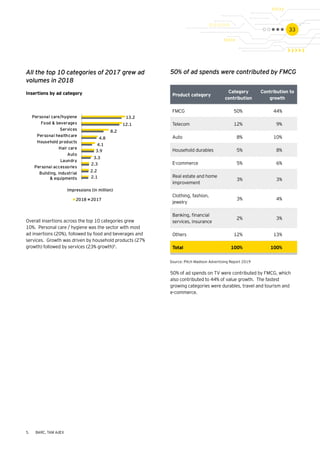
in the quality of VFX36
. In the case of animated films, too,
the budget of global studios would average 20-30 times
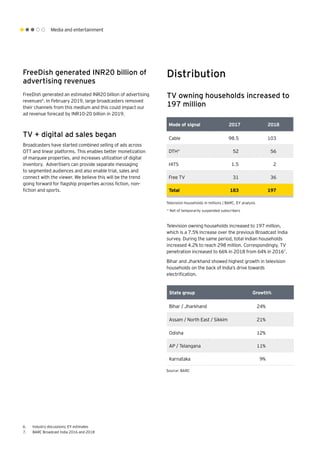
the budget for a typical Indian product. Due to this, even a
movie such as “The Jungle Book,” which is India-based, is
created by foreign animation houses as they have the budget
required for carrying out the required level of animation37
.
Higher cost compared to live action
shows38
According to research, the average cost for producing 2D
or 3D animated content is around INR1-2 million or more
for a show of 11-22 minutes. The cost further depends
on the number of characters, backgrounds, quality of
animation, etc. Shows that attain higher viewership usually
cost between INR3-5 million. If the content is produced for
international markets, the investment can go up to INR10
million. This is significantly higher compared to INR0.7-0.9
million required for one live action episode of comparable
size on a GEC channel. This prompts broadcasters to invest
more in live action content as opposed to animated content.
Need for more government
incentives
An animation content creator needs multiple government
incentives to produce a series. In India, such incentives
are often lacking. Working with foreign companies doesn’t
entail tax in India but local production is charged with GST
of 15%. In addition, there is a withholding tax on payments.
Countries such as Singapore provide incentives amounting
to 25% and Malaysia has created a fund for animation
producers. Such initiatives are also required in India to
strengthen animation and VFX sector and make it more
competitive globally38
.
Skilling the workforce to
international storytelling standards
The animation segment requires scriptwriters who can adapt
storytelling from live action to animated content. India needs
creators and writers who can create characters which have
international appeal. For this to happen, India’s writers need
to be exposed to or trained in animation specific storytelling
methods. There is need for talent in this space, and is an
area large Indian studios need to invest in.
VFX and animation segments are labor-intensive. However,
due to the complexity of jobs and lack of adequately skilled
workforce, the segment faces a significant challenge.
Although freelance talent thrives in the segment, a
dedicated pool of workers is required to have a reliable pool
of resources for stakeholders.
Some studios have initiated their own training programs
to engage and up-skill local talent in collaboration with
institutes like Whistling Woods, etc. Prime Focus Studio, in
collaboration with Media and Entertainment Skills Council
(MESC), operating under Ministry of Skill Development and
Entrepreneurship (MSDE), launched Prime Focus Academy
of Media and Entertainment Studies (PFAMES), a specialized
division providing training in areas such as rotoscopy, digital
paint and rotomation and matchmove, among others39
.
36.	“VFX: Waiting for a marvel,” Fortune, https://www.fortuneindia.com/
technology/vfx-waiting-for-a-marvel/102298, accessed on 18 December
2018
37.	“Why India’s film animation industry is still struggling,” Live Mint, https://
www.livemint.com/Consumer/srodhe895MOz60byz2e0DL/Why-Indias-
film-animation-industry-is-still-struggling.html, accessed on 18 January
2019
38.	“Animation sees an uptick despite expensive production,” Indian
Television, http://www.indiantelevision.com/television/tv-channels/kids/
animation-sees-an-uptick-despite-expensive-production-180222, accessed
on 18 January 2019
39.	“Media and Entertainment skills council together with prime focus
launches PFAMES,” Business Standard, https://www.business-standard.
com/article/news-ani/media-and-entertainment-skills-council-together-
with-prime-focus-launches-pfames-118062800515_1.html, accessed on
19 December 2018
149
Future outlook
The next phase of growth for the
segment is expected to be driven by
the global digital push
Netflix is expected to spend US$1.1 billion on
animated content worldwide in 2018 and Amazon is
projected to spend US$300 million40
. This translates
into roughly 10% of total content budget for these
companies. This number is expected to go up to about
15% of their total content budget in 202141
.
In addition to OTT platforms, traditional broadcasters are
getting into the animated content space. Most national
broadcasters like Viacom, Sony, Disney and Discovery
have increased their focus on animated content in India,
with other national and some local broadcasters also
gearing up to launch original animated content.
Government incentives and schemes
(both at central and individual state
level) will be important for Indian
companies to remain competitive
In February 2018, the Union Cabinet identified animation,
under the audio-visual category, as one of the 12 champion
sectors. As part of the champion sector categorization,
the government has allocated a dedicated fund of
INR50 billion for development of the 12 sectors42
.
40.	https://www.latimes.com/business/hollywood/la-fi-ct-animation-
streaming-20181118-story.html
41.	https://www.latimes.com/business/hollywood/la-fi-ct-animation-
streaming-20181118-story.html
42.	“Suspended animation,” Business Standard via
Factiva, https://global.factiva.com/redir/default.
aspx?P=sa&an=BSTN000020180914ee9f002nk&cat=a&ep=ASE,
accessed on 18 December 2018
43.	“Cabinet approves gaming, animation policy, eyes Rs 6,400 crore
investments in Andhra Pradesh,” Indian Express, http://www.
newindianexpress.com/states/andhra-pradesh/2018/apr/17/cabinet-
approves-gaming-animation-policy-eyes-rs-6400-crore-investments-in-
andhra-pradesh-1802581.html, accessed on 18 December 2018
44.	 “Telangana govt’s IMAGE Tower to be ready by early 2020,” Telangana
Today, https://telanganatoday.com/telangana-govt-image-tower-ready-
early, accessed on 19 December 2018
45.	 “Karnataka state to help grow Animation and Gaming industry with
a Centre of Excellence in Bangalore,” India Tech Online, https://www.
indiatechonline.com/it-happened-in-india.php?id=2867, accessed on 20
December 2018
A list of initiatives launched by state governments
recently have been listed below:
►► Andhra Pradesh – Government of AP has approved
Animation Visual Effects Gaming and Comics (AVGC)
Policy 2018-2020 with the aim to make the state a
preferred location for AVGC. The government aims
to attract an investment of INR64 billion by 2020. As
part of the plan, an animation and gaming city will
be developed in 40 acres in Vishakhapatnam. The
government has planned to provide one-time subsidy
of 25-30% on capital expenditure for hardware43
►► Telangana – Telangana Government’s IMAGE (Innova-
tion in Multimedia, Animation, Gaming and Entertain-
ment) tower, which was announced in 2017, is expect-
ed to be operational by 2020. Over 200 companies
would be able to operate from the tower. The tower
is being developed as part of government’s efforts to
boost its AVGC sector by encouraging investments44
►► Karnataka – The government has opened a new Cen-
tre of Excellence for the AVGC segment. The centre
will have digital post-production lab with technologies
for animation and VFX, along with technologies ena-
bling development of online gaming platforms45
Increased investments into building
talent base will be seen
While Indian animators and post-production artists are
technically at par with the best in the world, there are areas
of specialization where there is room for improvement.
Going forward, skills like storyboarding and storytelling
for animated content and understanding the tone and
complexities of characters for the global audience will
become an important point of differentiation. If the segment
can identify the right talent and train them appropriately,
India could become a preferred destination for a lot of
content creators. While Indian companies can continue to
acquire foreign talent for these specialized services in the
short term, institutes like Whistling Woods, etc. can design
specialized courses to address the long-term requirements.
Expert
speak
As an established and credible base for producing great
animation content, India is now healthily positioned to
explore a whole new world of possibilities. Local stories and
global storytelling is proving itself and the near term will
see many Indian properties travelling far and wide. It’s an
incredible time for animation. It’s an incredible time for
India!
A K Madhavan
Founder & Chief Executive Officer, Assemblage
Entertainment Pvt. Ltd.
India's animation and VFX segment will grow at a rapid
pace on increased content demand, both in India and on
global platforms. I expect the industry to double in the next
3-4 years.
Namit Malhotra
Founder, Executive Chairman & Global CEO of Prime
Focus Ltd.
Animation growth is driven by uptake in digital content
and increased domestic TV demand for local content. Vfx
on the other hand is witnessing growth rates upwards
of 25% due increased share of budget in domestic films /
TV  and substantial contribution to Hollywood and other
international IPs by Indian VFX talent. In the years
ahead digital platforms and AR/VR will propel animation
and visual effects to new heights both in terms of visual
experience and commercial successes.
Biren Ghose
Country Head, Technicolor India
151151
The rise in animation content consumption due to new
viewing platforms and viewing services, both in India
and abroad, is resulting in increased demand for quality
animation, and hence creating new and highly attractive
opportunities for the Indian Animation and VFX industry,
across film, television and digital outsourced projects which
represent 85% of total animation services turnover in India,
and for original content with universal appeal for the global
market, enhancing the Indian Animation Industry’s global
footprint around the world, and growing the talent pool to
service this growing demand.
P. Jayakumar
Chief Executive Officer, Toonz Media Group
Scan the QR code to
view videos, where
indicated with
Live events
Media and entertainment
The organized events and activations segment grew 15.6% in
2018 to reach INR75 billion
•	 The number of events grew 9% over 2017, led by digital events
which grew 35% and activations, which grew 21%
•	 Ticket sales now contribute over INR7 billion
•	 Auto, tech and FMCG were the top categories
•	 31% of marketers surveyed by EY said that their spends on events
and activations had increased by over 10% during the last two
years
Intellectual properties and digital integration were increasingly
adopted
•	 38% of respondents had invested in creating one or more IPs
•	 Digital integration increased and over half the survey respondents
had integrated digital in some form or the other with their events
Future outlook
•	 Margin management will be a key priority for 2019
•	 Growth will be driven by managed events and IPs: 69% of
marketers surveyed expected to spend more on events and
activation over the next two years
•	 Regional markets will continue to drive growth
•	 86% of the respondents to our marketer survey indicated that
digital integration with events was very important
Key messages
155
This section is based on the findings of primary research
conducted across more than 30 Indian events and activation
companies, over 30 marketers and industry discussions.
31% of respondents believed that ticketed events were
growing across the board, while 54% believed that only
top-end ticketed events were growing. India saw the launch
of marquee properties from Cirque du Soleil and Disney in
2018. Ticket sales now contribute over INR7 billion1
.
Ticketed events fueled growth
How well did ticketed events fare in 2018?
The organized live events
segment grew 16% in
2018
Event segment revenues
65
75
86
112
2017 2018 2019E 2021E
54%
31%
15%
Growing for
top-end events only
Growing
across the board
De-growing
Source: EY analysis based on EY survey of event
management companies
There was a 9% increase in the
number of events
The industry grew at 15.6% in 2018 led by the launch of
many large format events, intellectual properties (IPs),
weddings, sports and digital activation. The number of
events grew by 9% over 2017, led by digital events which
grew 35% and activations, which grew 21%.
This value represents the revenue of “organized” events and
activation agencies and does not include the multitude of
“unorganized” event companies spread across the country.
Survey respondents felt on average that just 52% of the
Indian events and activation segment was organized.
The size estimate also does not include the value of
telecast rights of events (unless owned by an events and
activation management company), the value of meetings,
incentives, conferencing and exhibitions (MICE) conducted
by pure travel companies, value of IPs not owned by event
companies and the value of properties managed by in-house
activation teams of advertisers.
INR billion (gross of taxes) | EY analysis
1.	 EY analysis
Media and entertainment
Revenue indexed by category
Auto, tech and FMCG were the top categories
Move towards IPs and
digital
38% of respondents had invested in
creating one or more IPs
More and more event companies were creating IPs, either
owned by them, or in partnership with brands or other event
management agencies. While IPs contributed to less than 1%
of total events, they provided around 16% of revenues.
Over half the respondents claimed to have integrated digital
aspects into their events. This was across marketing,
in-venue, audience engagement, post-event communities,
ticketing and food and beverage sales. Large format events
had commenced live streaming to build advertising revenues.
Digital integration increased
Have you integrated digital into your event offerrings?
Source: EY Analysis based on EY survey of event
management companies
52%45%
3%
For most events,
in some manner
or the other
Just for a few events
Not for most of
the events
Source: EY Analysis based on EY survey of event management companies
66
75
77
77
82
99
100
100
106
108
108
110
110
117
133
133
0 20 40 60 80 100 120 140
Tobacco
Telecom
Government (excluding PSUs)
Oil & gas
Public sector enterprises
Retail
Average
Beverage
Consumer durable
Media & entertainment
High net worth individuals
Financial services
Electronics
FMCG
Technology
Automotive
Auto, tech and FMCG were
the key spenders on events
and activations. The key
change since our last survey
two years ago has been the
relative reduction in the share
of telecom spends. 45% of
marketers surveyed by EY said
that their spends on events and
activation had increased during
the last two years.
157
2018 saw margin
pressure increase
48% of survey respondents felt that margins dropped in
2018, while 42% felt they were flat. Reasons attributed
included increased competition due to clients preferring
multiple agency pitches for each campaign and increased
sourcing pressures.
How did margins change in 2018?
Source: EY Analysis based on EY survey of event
management companies
Degrowing
Flat
Growing
10%
48%
42%
Media and entertainment
Future outlook
Survey respondents were most concerned around margin management, reflecting the increase in costs, which they are not
always able to charge clients. Respondents’ next most important priorities were to enable business expansion (primarily into new
segments and smaller towns) and IP creation.
Respondents expected maximum growth to come from managed and personal events (21%), followed by IPs (17%) over the next
two to three years. While the number of digital events and activations would grow significantly, it would not contribute to revenue
growth as much.
Margin management is expected to be the key priority for 2019
Growth will be driven by managed events and IPs
Key priorities for the next year (indexed)
Growth by type of events - next 2-3 years
Source: EY Analysis based on EY survey of event management companies
102
107
118
128
Implementing a measurement/ROI system
IP creation
International/domestic expansion
Cost reduction/margin improvement
44Any other
Source: EY Analysis based on EY survey of event management companies
Percentage respondents
0% 20% 40% 60% 80% 100%
IP
Activations / Promotional campaigns
Digital events
0-5% 5-10% 10-20% 20-30% >30%
Managed events (including personal events)
159
69% of marketers surveyed expected to spend more on
events and activation over the next two years.
Marketers will integrate digital with their events and
activation spends more aggressively in a bid to drive up RoI
and increase reach. 86% of the respondents to our marketer
survey indicated that they thought digital integration with
events very important. They will use interactive experiential
solutions on digital platforms to interact with brands and
at the same time, enable sales and customer database
creation.
Regional markets will continue to
drive growth
66% of our event survey respondents felt that events
revenues in tier-II and III cities grew at the same rate or
faster than events in larger cities. India’s GDP growth over
the next few years is expected to be higher in smaller cities2
.
This will result in increased spending on entertainment
in those cities, and a chance for Indian event companies
to create low-cost and high-volume properties for these
markets. Concerts, sports and personal events will drive this
growth.
Marketers will increase their spends
on events and activation
Digital will drive efficiencies and
higher RoI
How do you see your spends on events and activation
over the next two years?
How important is it for you to see digital integration with
your events and activation initiatives?
24%
45%
24%
7%
Will increase by over 10%
Source: EY marketer survey
Will increase by upto 10%
Will stay relatively the
same
Will reduce
86%
14%
0%
Very important Quite important Not important
Source: EY marketer survey
2.	 "The growth paradigm" ; EY report on top 50 Indian cities
The Indian Wedding Industry is getting more organized. The
business has continued to grow at 25 to 30% and the future
outlook is even better.
Samit Garg
Co-Founder & CEO, E-Factor Entertainment Pvt. Ltd.
The event and experiential industry in India is worth tens
of thousands of crores. It provides jobs, contributes to
local economies, employs millions and yet we remain in the
shadows, working under the radar, bringing in riches in a
form that isn’t recognized and cannot be tabulated.
Sanjoy Roy
Managing Director, Teamwork Arts
Expert
speak
The business of experiences is going to be fundamentally
disrupted over the next 5 years, much like most other
businesses, and I feel we should be focussed on preparing
ourselves for that change.
Atul Nath
Founder, Candid Marketing
As we enter an election year there will be fervent activity in
the first few months of 2019, but then it is a wait and watch
game. We need more infrastructure to build experiences in
India. How long will a handful of stadiums and grounds
suffice to fulfil the appetite of millennials for concerts, shows
and festivals? This generation wants to make memories and
are thirsting for more!
Roshan Abbas
Managing Director – Geometry Encompass
161161
We are living in a very interesting world, where consumer
preferences are shaped by what I call the ‘EXONOMY’ – the
experience economy. Experiential allows you to do good and
to serve, instead of merely selling goods and services. I am
excited about the disproportionate role that experiential will
play in the future of brand building.
Brian Tellis
Director, Fountainhead MKTG
Dispersal of audience over multiple media platforms and
the need for every marketing dollar to count are pushing
marketers to drive direct to consumer engagement. A
combination of experiential and digital is the perfect mix,
wherein both impact as well as engagement are direct,
consistent and economical. Direct to consumer has created a
new world: An audience of One….driving purchase, impact,
bottom line and valuation paradigms.
Sabbas Joseph
Founder & Director, Wizcraft International
Entertainment Pvt. Ltd.
Scan the QR code to
view videos, where
indicated with
Online
gaming
Image courtesy ImagesBazaar
Online gamers in India grew 52% to 278 million in 2018
•	 5 billion game apps were downloaded in 2018, which accounted
for 71% of total entertainment app downloads
•	 Time spent on gaming increased to over five hours per month on
average
•	 India is now one of the top five markets for mobile gaming globally
•	 It has over 250 game development companies
•	 Overseas online gaming companies grew their presence in India
The segment has proactively created self-regulating
industry bodies like the AIGF and IFSG
Future outlook
•	 The segment is expected to grow at 35% CAGR to reach
INR120 billion by 2021
•	 Fantasy sports can cross 100 million players within two years
•	 Multi-player gaming will continue to grow significantly, following
the uptake of PUBG in 2018, subject to the quality of the IP
created
•	 While the Chinese market is showing signs of saturation and
regulator control, India will become the next key market for
gaming companies and investors
•	 AR and VR gaming in India has the potential to drive growth of
physical gaming zones in malls and common areas, but will remain
a niche market product for now. India can become the AR / VR
and casual game development factory of the world, if talent is
nurtured and infrastructure is built
•	 2019 will see the creation of large national gaming brands
Both casual and real money gaming grew, resulting in
the segment growing 59% to reach INR49 billion
•	 Casual gaming grew 40% to reach INR22 billion
•	 Real money gaming grew 82% to reach INR26 billion
•	 80% and 95% of revenues were driven by advertisement
and subscription for casual games and real money games
respectively
•	 8-12% of gamers paid to play real money games i.e.,
subscription or in-app purchases
Key messages
165
Online gamers grew 52%
to 278 million in 2018
Indian online gaming subscriber base grew from 183 million
in 2017 to 278 million in 20181
, leading to a 59% revenue
growth to INR49 billion. Mobile gamers were 250 million of
these.
30
49
68
120
INR billion (gross of taxes) | EY analysis
2017 2018 2019E 2021E
88
108
158
250
40
37
25
28
0
50
100
150
200
250
300
2015 2016 2017 2018
Mobile gamers Non-mobile gamers
Source: EY analysis
Growth in online gamers was driven by the increase in
internet users in India to over 500 million, growth of
smartphone user base to 340 million and low data prices.
It is believed that with more affordable smartphones,
internet connectivity and localized language games, rural
India will lead the growth of the gaming industry in the next
few years. Gaming is now being recognized as mainstream
entertainment in India.
1.	 IMRB Kantar Pokkt MMA report, EY analysis, Industry discussions
2.	 EY Research
3.	 App Annie
4.	 EY’s online gaming consumer survey 2018
5 billion game apps were
downloaded in 2018
5 billion game apps were downloaded in 2018, which
accounted for 71% of the total entertainment apps
downloaded in the year. Game downloads have increased
35% from 20173
. Gaming uptake is clearly driven by young
people - 88% of respondents of EY’s online gaming consumer
survey were in the age group of 21-35 years4.
Online gamers in India (million)2
Online gaming revenues
Media and entertainment
+17%
+7%
+42%
+22%
0.00
1.00
2.00
3.00
4.00
5.00
6.00
Games Entertainment Music News &
magazines
Monthlyhoursperuser
2017 2018
1.8%
3.3%
4.9%
6.5%
2018 2019E 2020E 2021E
Time spent on gaming increased to
over 5 hours per month on average
Gamers spent 17% more time on games in 2018 when
compared to 2017, averaging over five hours per user per
month5
.
India is now one of the top five
markets for mobile gaming globally
India is now in the top five markets in the world based
on the number of users for online and mobile gaming.
Smartphones have emerged as the primary device preferred
for online gaming with more than 90%6
of millennials
preferring smartphones over gaming PCs and other devices
in India. Unlike console gaming, smartphones have brought
affordable gaming to users without the hassle of owning
expensive hardware and game titles. 89% of all game
revenues in India were generated on mobile games7
.
With the growing demand for mobile gaming, many
companies have launched dedicated gaming smartphones to
capture share in this segment. These gaming smartphones
accounted for 1.8% of overall smartphone shipments in
2018 and are expected to reach 6.5% by 20218
.
5.	 App Annie analysis of top 20 game apps
6.	 https://economictimes.indiatimes.com/tech/software/india-among-top-5-
markets-for-mobile-gaming/articleshow/65396386.cms
7.	 https://economictimes.indiatimes.com/tech/software/india-among-top-5-
markets-for-mobile-gaming/articleshow/65396386.cms
8.	 http://cmrindia.com/cmr-specview-gaming-smartphones-penetration-to-
hit-6-5-by-cy2021/
Gaming smartphone shipments (% of overall smartphone
shipments)
Average monthly time spent on Top 20 apps by category
MAU (hours) - India, Android Phone
Source: App Annie
167
2018 saw large investments in
gaming hardware and software
Hardware makers are incorporating more features to enable
a technologically enhanced experience in gaming. Acer
is witnessing 20% growth y-o-y attributable to its gaming
laptops and PCs. Asus, which currently occupies 22% share
in the gaming PC market is also working towards offering
high-tech devices to increase its market share in India9
.
Currently VR as a technology is picking up in outdoor
entertainment areas in the form of VR rides in malls and VR
lounges. It is believed that uptake of VR for mobile gaming
will grow with a reduction in hardware cost.
India now has over 250 game
development companies
Gaming companies are increasingly investing in cutting-edge
technologies such as VR, AR, AI and blockchain. AR games
such as Pokémon Go have garnered significant positive
response in India.
India has progressed from being a back-end support for
game development to developing high-quality games. The
segment is on the rise with over 250 game development
companies, up from 25 in 2010. And once again, this
provides India with the opportunity to become a key game
development center of the world, which can generate US$2
billion by 202110
, if supported with adequate incentives and
policy support.
9.	 https://economictimes.indiatimes.com/tech/hardware/asus-eyes-bigger-
share-of-indias-consumer-gaming-pc-market/articleshow/65389168.cms
10.	 EY estimates
Media and entertainment
Overseas online gaming companies grew their presence in India
India’s online gaming segment has attracted investments and new launches by several global players.
International
company
Country
Announcement
month
Description
NVIDIA11
US January 2019
The company is aiming to increase its Indian online gaming
footprint by launching 100 gaming cafes in India in 2019
AGTech Media
(Alibaba)12
China August 2018
AGTech, in JV with PayTM, has launched Gamepind, an online
gaming platform offering variety of social and casual games
with exclusive loyalty rewards to users within the PayTM app.
The companies in the venture have infused additional US$16
million in the mobile gaming JV to launch it into a separate app
to increase its reach
Yoozoo13
China July 2018
Yoozoo games, which entered India in 2017, is teaming up with
celebrities to grow its presence in tier-2 and tier-3 markets in
India. The company has recently partnered with Sunny Leone
and Gamiana Company to launch an online game in social
casino genre. The company further plans to launch three games
in the next few months, in addition to its two games operational
in India
APUS14
China June 2018
The company has launched “Go Millionaire” online game in the
quiz genre in India. The game is available on APUS browser and
plans to give away INR40 million as cash prize to the winners.
The company is also planning to increase its Indian team by
five times to 100 and set up an R&D facility to strengthen its
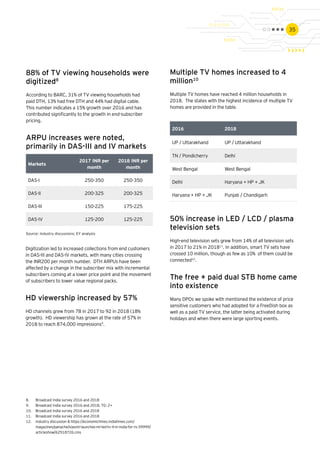
operations15
Tencent16
China March 2018
Tencent is planning to invest US$200 million (INR14 billion)
in the Indian online gaming segment with the aim to own at
least one-third of India’s gaming user base by 2020. As part
of its plan, Tencent led a US$100 million investment round in
Mumbai-based Dream11
ESL17
Germany February 2018
ESL has acquired minority stake in Nazara technologies
for INR265 million. As part of the acquisition, ESL has
also entered into an agreement with Nodwin gaming (part
of Nazara) for multi-year exclusive licensing rights of ESL
system and ESL community platform to Nodwin gaming. The
partnership and acquisition is part of ESL’s aim to expand its
footprint in India
11.	 “NVIDIA to expand gaming footprint in India, add 100 gaming cafes this
year,” Economic Times, https://economictimes.indiatimes.com/industry/
media/entertainment/media/nvidia-to-expand-gaming-footprint-in-india-
add-100-gaming-cafes-this-year/articleshow/67387395.cms, accessed on
18 January 2019
12.	 “Paytm, Alibaba’s AGTech invest $16 million in Gamepind,” LiveMint,
https://www.livemint.com/Companies/uglnASGz2Pk57ieCu4wXrM/Paytm-
Alibabas-AGTech-invest-16-million-in-Gamepind.html, accessed on 20
December 2018
13.	 “Yoozoo Games partners Sunny Leone for a mobile game that's debuting
by end of 2018,” ET Tech, https://tech.economictimes.indiatimes.com/
news/mobile/yoozoo-games-partners-sunny-leone-for-a-mobile-game-
thats-debuting-by-end-of-2018/65141104, accessed on 20 December
2018
14.	 “APUS Introduces its LIVE Quiz Mobile Game “Go Millionaire”,” PC Quest,
https://www.pcquest.com/apus-introduces-live-quiz-mobile-game-go-
millionaire/, accessed on 20 December 2018
15.	 “China’s APUS rolls up sleeves with hiring plans & R&D centre,”
ET Rise, https://economictimes.indiatimes.com/small-biz/startups/
newsbuzz/chinas-apus-rolls-up-sleeves-with-hiring-plans-rd-centre/
articleshow/65524265.cms, accessed on 20 December 2018
16.	 “How tencent, the world’s largest gaming firm, is rebuilding its India biz,
TechCircle, https://techcircle.vccircle.com/2018/03/07/how-tencent-
the-world-s-largest-gaming-firm-is-rebuilding-its-india-biz, accessed on 20
December 2018
17.	 “E-sports major ESL invests in gaming company Nazara,” The Times of
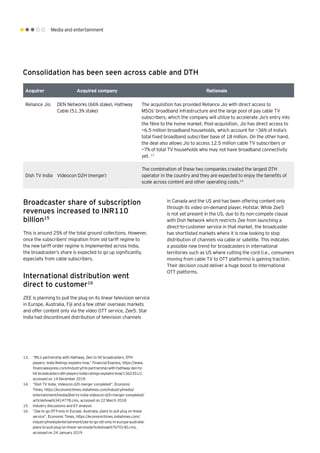
India, https://timesofindia.indiatimes.com/deals/-ma/esl-invests-in-nazara/
articleshow/62838971.cms, accessed on 20 December 2018
169
2017 2018 2019E 2021E
Total 30.4 48.5 68.2 120.3
Online gaming revenues
grew 59% to reach
INR48.5 billion in 2018
Indian online gaming segment grew to reach INR49 billion in
2018, a growth of 59% over 2017. It is estimated to reach
INR120 billion by 2021 at a CAGR of 35% with the number of
users projected to become 340 million18
by then.
Casual gaming grew 40% to reach
INR22.4 billion
There has been a huge growth for publishers who have
produced innovative games such as Ludo King. Social
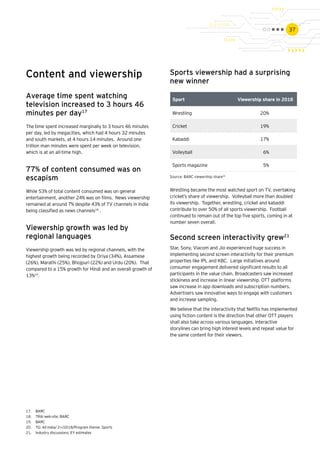
competitive multiplayer games seem to have been well
accepted and many companies are focusing on this format of
casual games. Casual games are expected to grow at 30% to
reach INR49 billion by 2021.
Real money gaming grew 82% to
reach INR26 billion
Real money games include fantasy sports, rummy, poker
and the like. The drivers for this growth are attributed to
increased penetration of smart phones, adoption of wallet-
based payment mechanisms, availability of quality gaming
content, increased venture capital investments, etc. Real
money gaming is expected to grow at 40% CAGR to reach
INR71 billion by 2021.
8-12% of gamers paid to play real
money games i.e., subscription or
in-app purchase
The growth of Indian online gaming segment might be
significant in terms of the number of subscribers and
downloads, but monetization has remained a challenge
as the Indian market is dominated by casual gamers who
are reluctant to spend on games. For these gamers, casual
games are a form of free entertainment with low perceived
value. Therefore, advertising has remained the primary
source of revenue for casual games.
80%
5%
20%
95%
Casual gaming Real money gaming
Ad revenue Subscription / commission
80% and 95% of revenues were driven by advertisement
and subscriptions for casual games and real money games
respectively19
.
On the other hand, real money games like rummy and
fantasy sports provide gamers with a chance for them to
win back more or the same amount that they paid. Further,
competitive multi-player games like PUBG have also
encouraged Indian gamers to make in-app purchases to gain
a competitive edge in the game.
Such trends have seen 8-12% of the registered active users
paying for real money games and in-app purchases. While
the number is very small, the trend of monetization and
change in the mindset of Indian players has begun.
18.	 EY research
19.	 Industry discussions and EY analysis
Revenue sources
INR billon (gross of taxes) | EY analysis
Media and entertainment
The segment has
proactively created
self-regulating industry
bodies
While the Indian government is yet to define regulations
for online gaming, the industry is proactively forming self-
regulatory bodies. Multiple gaming federations like the All
India Gaming Federation (AIGF), The Rummy Federation
(TRF) and the Indian Federation of Sports Gaming (IFSG)
were formed with the goal to protect the interests of both
operators and consumers in real money games. They provide
a platform for operators to address key issues and present a
unified front20
.
Federations have defined or are in the process of defining
self-regulatory frameworks, laying down industry specific
guidelines and adopting international best practices around
fair play, responsible gaming, ethical advertising, online
security and privacy, software integrity, user verification and
complaint redressals.
To bring more credibility to the industry, the federations
have started conducting third-party audits to ensure that
operators follow the set guidelines.
Future outlook
Fantasy sports can cross 100 million
players within two years
Sports, particularly cricket, will drive the growth of fantasy
gaming which can cross 100 million players within two years.
Fantasy wrestling and kabaddi would see increased focus as
platforms try to broad-base their appeal.
Multi-player gaming will continue to
grow
Multi-player gaming will continue to grow significantly,
following the uptake of PUBG in 2018, subject to the quality
of the IP created. Higher per-user revenues can be realized
with fiber based internet and streaming games.
Company Main investors Total funding
Dream11
Tencent, Kalaari
Capital, Multiples
Alternate Asset
Management Pvt.
Ltd.
US$100 million
Nazara
Technologies
WestBridge,
IIFL Asset
Management, Turtle
Entertainment
US$82 million
Ace2Three
Clairvest Group,
Matrix partners
US$76 million
99 Games
Ascent Capital,
Kalaari Capital,
Dream incubator
NA
MoonFrog
Labs
Tiger Global
Management
US$16 million
Investor interest in Indian gaming
will increase
While the Chinese market is showing signs of slowing down
and regulator control, India will become the next key market
for investors, given the growth factors mentioned in this
section. Indian gaming companies have already begun to
attract investments.
20.	Industry discussions and EY analysis
171
AR and VR gaming can drive growth
of physical gaming zones
AR and VR gaming in India has the potential to drive growth
of physical gaming zones in malls and common areas, but will
remain a niche market product for now. India can become
the global AR and VR game development factory of the
world, if talent and infrastructure is nurtured.
2019 will see the creation of large
national gaming brands
Gaming companies are now set to establish brands to
consolidate gamers who presently have a plethora of options
to choose from in each game format. Each company wants
to differentiate its product and market its unique selling
point. New companies are investing towards marketing
while majority of the existing online gaming companies we
interviewed expected to spend higher amounts towards
marketing.
India gaming
Trendbook
Average time spent playing
games was
30
minutes
a day; while most played
15-30 minutes
played popular
games on app stores
while 48% played games
recommended by
friends
of respondents were
OK to watch ads, so
long as they could
play for free;
only 10% were willing
to pay for in-app
purchases
55%
70%
played games on their
mobile phones,
while 31% played on their
laptops
86%
would prefer to play on
bigger screens72%
EY survey of 1,500 smartphone owning adults
played games67%
65%
only played single
player format
games
of respondents
played once and
31% played twice a day
50%
46%
Most preferred time to play was during:
entertainment
85% stress relief
73%
Top reasons for playing games were
and
were reluctant to play games where they
had to pay to play
•	 Fear of losing to a bot
or computer was
32%
•	 Poor perception about themselves was
13%
79%
work breaks
travelling
and post dinner
62%
48%
45%
Of those who played
Real Money Games
were willing to pay over
INR100 per session and
wallets were the most
preferred mode
of payment
believed they would
get addicted34%
believed gaming impacted
phone performance60%
Key issues with gaming:
Fantasy sports
in India
45-50
million
Fans who played
Fantasy Sports
in 2018
2 out of 3people are aware of fantasy sports
Average per week
6days
4.1days
More frequently
than once a week 93% 73%
Less frequently
than once a week 6% 24%
Smartphone/Tablet followed by
computers are the most frequently used devices
for playing fantasy sports
Frequency of play
Smartphone
/Tablet
Desktop
/Computers
Powered by Indian Federation of Sports Gaming
Source: Nielsen’s survey of 2,724 respondents who are Indian males aged 18-35 years across selected cities
All data has been provided by IFSG and is based on their research. It has not been validated by EY, and presented in summary form for
representation purposes only.
Audience mainly comprises of
young
independent
Indians
who have high disposable incomes
Current users
(Currently Play Fantasy
Sports)
Annual users
(played Fantasy Sports in
the last year)
Bi-annual users
(played Fantasy
Sports in the last
6 months)
Ever played
(played Fantasy Sports
at least once)
89
94
96
Age
72% 84%
51%75%
28% 16%
6%
42%
20%
5%
25-35 year olds Working
GraduateA1
18-24 year olds Student
Not graduate
Post graduate
A2/A3
AB
Occupation
NCCS Education
66%
Play on only 1 platform
34%
Play on more than 1 platform
Gamers demonstrated high levels of stickiness
100
Expert
speak
Gaming in India is growing, and if there was ever a time to
be in this space, it is NOW!
Saurabh Aggarwal
CEO & President, Octro Inc.
Online gaming is proliferating in India like never before due
to friction-less payment methods, rise of digital payment
users, growing local developer ecosystem and localized
games.
Nitesh Damani
Director, Sugal & Damani
For a sports fan, Fantasy Sports provides a platform to not
only showcase their knowledge and skill amassed overtime,
but also to receive recognition in the fantasy sports game.
Fantasy sports is rapidly changing the way fans consume
sports content, making the overall sports experience more
exciting and engaging.
Harsh Jain
CEO & Co-Founder -Dream11
The gaming industry has seen an acceleration during the
year along with overall macro economics helping growth in
revenues and online gamers. We now also see an acceptance
of gamers to pay and play leading to robust revenue growth
for the industry.
Manish Agarwal
CEO, Nazara Technologies
177177
Online Real Money Gaming (RMG) Industry stakeholders
are governed by the AIGF’s self regulation charters that are
based on best practices in legality, integrity, player rights
and responsible gaming. Our wish is for the Online RMG
Industry to be regulated centrally by a National Gaming
Commission, so that the existing uncertainties (under State
Acts) that make it difficult for businesses to invest and grow,
are eliminated.
Roland Landers
CEO, All India Gaming Federation
Online Real Money Gaming (RMG) Industry stockholders
are governed by the AIGF’s self regulation Charters that are
based on best practices in legality, Integrity, Player Rights
and Responsible Gaming. Our wish is for the Online RMG
Industry to be regulated centrally by a National Gaming
Commission, so that the existing uncertainties (under State
Acts) that make it difficult for businesses to invest and grow,
are eliminated.
Rajesh Rao
Founder & CEO, Dhruva Interactive
Fantasy Sports has a big role to play in promotion of sports
in general. We are excited to be part of the growth of the
Online Fantasy Sports Gaming industry in India.
Anand Ramachandran
Co-Founder, Fantain
The Rummy Federation (TRF) was setup to provide
guidelines around self regulation, advertising and
responsible gaming. We've onboarded a good amount
of operators and are passing down all of this knowledge
to them. The TRF is starting to conduct audits to ensure
operators are following the guidelines set forth by the
federation.
Ankush Gera
Founder/CEO, Junglee Games
Consumers now look at a e-sports and games as a serious profession, not just a hobby. The
advent of Data Science is really shaping up better decision making and personalisation of
content to consumers. The future is certain: Next unicorn will be from the gaming industry.
Hridhay Muralidharan
Co-Founder, Dotball Interactive Private Limited
Scan the QR code to
view videos, where
indicated with
Out Of
Home (OOH)
media
Image courtesy ImagesBazaar
Media and entertainment
Rapid infrastructure development drove growth
•	 OOH media reached INR37.3 billion in 2018
•	 The segment grew at 8.8%
•	 Retail, consumer services and real estate were the largest
advertiser categories
•	 Digital OOH grew to reach INR1.5 billion which is 4.7% of the total
segment
Future outlook
•	 We expect transit media growth to continue unabated - from
around 34% today to around 45% of the OOH segment by 2021
•	 Station naming rights will become a more important source of
revenue
•	 Digital OOH could reach INR5-6 billion in five years
•	 Measurement metrics linked to consumer data, profiling, maps
and footfalls will come into being
Key messages
181
OOH media grew 8.8%
in 2018
The segment reached
INR37.3 billion
Out Of Home (OOH) media grew by 8.8% in 2018 to reach
INR37.3 billion. It is expected to grow 9.5% in 2019 and
reach INR48.5 billion in 2021 at a three-year CAGR of 9.2%.
Organized retail was the largest
category in 20181
Category
Category
contribution in
2018 (in %)
Category
growth over
2017 (in %)
Organized retail 16% 14%
Hospitals,
restaurants,
education, OTT
14% 24%
Real estate and
construction
12% 14%
FMCG 9% 18%
Financial services 9% 15%
Telecom 7% -13%
Auto 7% 4%
Media 5% 15%
E-Commerce 4% 7%
Electronic durables 2% 16%
Petroleum /
Lubricants
1% -14%
Pharmacy 1% -17%
Energy 0% -18%
Others 12% -5%
Total 100% 9%
Retail, consumer services and real estate were the top
contributing sectors to the ad spend in the OOH segment.
Growth was driven by education and OTT platforms.
However, ad spend fell across telecom, petroleum, pharmacy
and energy categories.
1.	 Pitch-Madison Advertising Report 2019
INR billion (gross of taxes) | EY analysis
34.3
37.3
40.8
48.5
2017 2018 2019E 2021E
OOH segment revenues
Media and entertainment
Digital OOH grew to reach INR1.5
billion
Digital OOH market reached INR1.5 billion2
, accounting for
4.7% of overall OOH market. Digital OOH is further estimated
to grow to reach INR5-6 billion over the next five years. Its
share is expected to reach around 8% of the OOH segment by
20213
.
Growth would be driven by the following factors:
•	 4-5x or higher growth in the number of digital displays,
which are estimated to be around 70,000 today4
.
Already, 50-60% or more of advertising spaces at
airports and malls have been converted to digital OOH,
contributing approximately 20-30% of industry growth5
.
With the development of new airports, smart city projects,
malls and metro stations, among others, digital screens
are expected to grow further
•	 Digital OOH lends itself to better measurement.
Integrating site data with consumer data, profiles and
retail sales data enables better informed investment
decisions
•	 When combined with activations, digital OOH delivers
leads and consumer profiles, enabling direct to consumer
interactions for brands
2.	 “DOOH boom is coming to India,” WARC, https://www.warc.com/
newsandopinion/news/dooh_boom_is_coming_to_india/40858, accessed
on 16 December 2018
3.	 Refer 2 above
4.	 https://www.impactonnet.com/cover-story/the-impact-trends-
report-2019-6272.html
5.	 Industry discussions
6.	 “Posterscope launches India's first digital OOH Ad Exchange – ROOH,”
Afaqs, https://www.afaqs.com/news/story/54061_Posterscope-launches-
Indias-first-digital-OOH-Ad-Exchange---ROOH, accessed on 16 December
2018
7.	 30 new airports to come up in India over the next 15 months
https://www.business-standard.com/article/economy-policy/30-
new-airports-to-come-up-in-15-mths-country-s-100th-coming-up-in-
sikkim-118092000930_1.html
8.	 15 more cities will soon have metro rail in India
https://economictimes.indiatimes.com/industry/transportation/
railways/15-more-cities-will-soon-have-metro-network-union-minister-puri/
articleshow/66419131.cms
9.	 http://www.newindianexpress.com/cities/bengaluru/2018/nov/26/giant-
digital-screens-to-display-info-on-trains-at-bengaluru-stations-1903171.
html
Increasing adoption of real-time
OOH media solutions was seen in
2018
Companies are introducing tech-enabled OOH advertising
systems to achieve more efficiency and transparency. In
December 2018, Posterscope India launched ROOH (Real
Time Out of Home), a planning-buying platform for OOH
inventories. ROOH platform has over 60,000 digital screens
accessible via a single platform. The platform uses a wide
variety of data feeds to create customized and targeted
advertising, allowing advertisers to directly control the
content that is being played on screens6
.
Rapid infrastructure development
drove growth
The rapid development of infrastructure, including upcoming
airports, smart city projects, malls, metros, bus shelters,
public conveniences, coffee shops, along with increased
advertising opportunities in tier-II and tier-III cities are all
contributing to the growth of OOH media.
Airports account for a majority of digital OOH media,
attributable to the time travelers have to view ads at specific
touch-points like boarding gates. In the next three years, it is
expected that 307
new airports will get operationalized and
metros will be operationalized at Mumbai, Delhi, Bangalore,
Chennai and seven8
other cities. The Railways plan to
implement the rail display network with 100,000 digital
screens across all stations by 20229
.
Challenges remained, however
The lack of a reliable universal measurement system and
timely permissions from concerned local and regulatory
authorities are the largest challenges faced by the segment.
Several attempts at measurement have been planned,
but the need for a universal metric remains unmet.
Implementation of OOH campaigns in tier-III and rural
markets is also difficult to track, resulting in the need for
expensive audits and monitoring mechanisms.
183
We expect transit media growth to
continue unabated
Composition of OOH
Source: Industry discussions, Pitch Madison, IPG Magna, GroupM,
EY analysis
Future outlook
75%
67%
53%
21%
26%
35%
4% 8% 12%
2014 2018 2022
Traditional Airports Metros / railways
Given the growth in operational airports (it is expected
that over 100 airports will be built over the next 15
years, including 18 under the UDAN scheme10
), metros in
large cities (another 500 kilometers of metros are under
construction or planned11
across Pune, Nagpur, Ahmedabad,
Chennai, Vijayawada, Kozhikode, Indore, Bhopal, Patna,
Guwahati, Kanpur and Varanasi ), the focus of Indian railways
to implement digital screens and the proposed infrastructure
investment for modernization of bus stands, we expect the
share of transit media to grow from around 34% today to
around 45% by 202112
.
10.	 https://economictimes.indiatimes.com/industry/transportation/airlines-
/-aviation/to-ease-business-of-flying-government-to-build-100-airports-
in-15-years/articleshow/61523048.cms
11.	 https://en.wikipedia.org/wiki/Urban_rail_transit_in_India;
12.	 https://www.livemint.com/Politics/ylEObaYWxcC7lGO2E2e4wJ/The-
rise-of-metro-rail-network-in-India.html
13.	 Industry discussions; EY analysis
Naming rights will become an
important source of revenue
Metro station naming rights are generating between INR100
million to INR400 million a year per station, depending on
the city and passenger traffic. With new stations coming up,
this can become a big revenue source, with a potential to
reach INR16 billion within four to five years13
.
Measurement metrics will come into
being 
We believe that measurement will be implemented on
a campaign basis in the near term.  This will be led by
integrating data across mobile phone location, maps,
OOH media site location and footfalls / sales data, which
is being proposed by a slew of measurement agencies like
Measurement of Outdoor Displays and Moving Walls amongst
others.
Media and entertainment
Global trends
Global growth remained stable and
modest
Globally, OOH remains a durable advertising medium where
digital is an opportunity, not a threat, leading to stable
modest growth. With improved performance of out-of-home
campaigns and more organizations willing to experiment
and incorporate new digital ad experiences, the segment,
especially digital OOH is expected to drive growth.
Operators continued to invest in
digital OOH
Operators are investing in digital boards that promote
creativity, have enhanced measurability, transparency,
daypart selling and increased inventory. With growing
consumer familiarity towards digital screens, the value
these platforms offer is also bound to increase. This gives
an ability to extend hyper-local and immersive experiences
into the mix, such as weather triggering, interactive e-health
requests and other real-time variables.
The shift to programmatic ad buying
is on-going
While at present it is a small piece of the larger pie, OOH
advertising’s shift to programmatic is happening swiftly.
Programmatic buyers testing OOH for the first time must
provide high-quality ad creatives by working with ad
agencies. Brands can leverage those real-time ad placements
to capitalize on reaching high concentrations of their target
audiences at the ideal time of day. However, getting digital
audience targeting criteria into programmatic OOH is proving
slightly difficult, considering the majority of OOH placements
are not able to provide the one-to-one audience matching
digital buyers desire.
Increased M&A activity
The fragmented nature of the segment, combined with a
strong strategic and private equity interest support a robust
M&A opportunity. Large technology companies have started
to acquire OOH networks to boost their market share as
interest in OOH increases and marketers are focused on
capturing offline audiences through physical mediums.
185
Airport
advertising
Passenger
traffic
in India
102operational
airports in
2018
250planned
airports by
2030E
309m
in 2018
421m
in 2020E
All data has been provided by Times OOH and is based on their research. It has not been validated by EY, and
presented in summary form for representation purposes only.
Source: AAI, ICRA, Civil Aviation Ministry, CAPA, IBEF
INR
32bn
2025
INR
10-12bn
2018
Projected size of
Airport
advertising
in India
Powered by Times OOH
37%
Global
India
25%
Airport OOH
in 2021 will be
driven by
*Includes retail, duty-free, advertising,
car rental, parking, hospitality etc
21%
13%
Passenger traffic
growth rates
Other airports deliver
44% of traffic
JV/Privatized airports
of DEL, MUM, HYD,
BLR, COK, NGP deliver
56% of traffic
in 2018
$1.6
bn
$1.9
bn
1-3%
Duty free
spends
Duty paid + F&B
spends
of these spends
pooled towards
marketing
Non-aeronautical
airport revenues*
Expert
speak
With existing inventory base, OOH is likely to grow by at
least 8 to 9%. However, there will be incremental growth
of at least 3 to 4% in the industry with new media avenue
opening with the commencement of Metro and Smart City
projects.
Sunil Vasudeva
Chairman cum full time Director,
Pioneer Publicity Corporation
Millenials who are redefining India’s consumption story
are spending a major chunk of their waking hours outside
the home making OOH more lucrative than ever. 2019 is
the year of the Indian general elections which, along with
some state elections, will boost marketing spends and would
hopefully be a very good year for OOH.
Alok Jalan
MD, Laqshya Media Group
189189
Scan the QR code to
view videos, where
indicated with
Radio
Image courtesy ImagesBazaar
Media and entertainment
Revenue growth was led by Phase-III inventory and non-FCT initiatives
•	 Radio grew 7.5% in 2018 to reach INR31.3 billion, taking its share in
total advertising to 4.2%
•	 Radio segment’s growth in 2018 was fueled by a 3% volume growth of
Radio AdEX, inventory in Phase-III stations coming online and non-FCT
revenue growth from digital, content production, events, etc.
•	 53% of ad volumes came from the top seven cities, while Maharashtra
and Gujarat led on volumes
•	 Services, retail, food and beverage, auto and BFSI were the top five
sectors advertising on radio, with services comprising 30% of the total
volumes
Reach increased, but a common measurement system was lacking
•	 47 new radio stations were operationalized in 2018 across 35 cities,
taking the total of 386 radio stations in India
Key messages
•	 Lack of measurement continues to be major drawback for the
segment. Clients are exploring sharper segmentation via niche
channels for niche products
•	 New smartphone models do not all have FM receivers, which could
impact radio listenership
•	 Radio companies will focus on building communities to understand
consumers better and enable brands to connect directly with their
audiences
•	 There will be increased collaboration between radio players and
streaming apps to increase fill rates on streaming audio platforms and
sell segmented audiences to advertisers
Future outlook
•	 Growth in 2019 will be fueled by ad spends in the upcoming
elections, non-FCT revenues and firming of ad rates in regional
markets
193
Radio grew 7.5% in 2018
to reach INR31.3 billion1
29
31
34
39
2017 2018 2019E 2021E
Others
34%
Services
30%
Retail
10%
Food &
beverages
10%
Auto
8%
Banking/
Finance/
Investment
8%
INR billion (gross of taxes)
Radio grew 7.5% in 2018 to reach INR31.3 billion, taking its
share in total advertising to 4.2%.
Growth was driven by a 3% ad volume growth2
, inventory
growth from newly operationalized Phase-III stations and
non-FCT revenues from digital, content production, events,
etc.
Revenues
Radio AdEX grew 3% by volume
There were over 10,467 advertisers on radio comprising
13,710 brands. 4,262 advertisers were on radio, but did not
advertise on TV or print3
.
Services, retail, food and beverage, auto and BFSI were
the top five categories advertising on radio, with services
comprising 30% of the total volumes4
.
1.	 Trai Prasar Bharti, EY analysis
2.	 TAM AdEX 90 station data
3.	 TAM AdEX 90 station data
4.	 TAM AdEX 90 station data
5.	 TAM AdEX 90 station data
6.	 Industry discussions
7.	 Industry discussions
8.	 https://www.exchange4media.com/digital-news/radiocity.in-extends-
leadership-in-digital-with-programmatic-offering-for-advertisers-via-
adswizz-and-google-adwords-90453.html				
53% of ad volumes came from the
top seven cities
The skew of advertising continued towards the metros, with
the top seven cities contributing around 53% of ad volumes5
.
These cities also benefited from the operationalization of
second frequencies.
The local-national split of advertising generated was 40:60
and metro-non-metro split of advertising consumed was
60-406
. Stations in tier-II and III towns relied more on retail
/ local advertising and added “sales feet on the street” to
generate higher revenues from SME and retail advertisers.
Importance of non-FCT revenues
increased
New business offerings like concerts, activations, digital
communities, music streaming – which could collectively
constitute up to 20% of radio company revenues today
– are natural extensions for radio, given it's strength in
content creation, building audience loyalty and packaging
undifferentiated content7
. Many radio companies are now
providing more of such solutions to advertisers and we
believe this will grow in future.
Investment in digital initiatives grew
More and more radio companies are investing in digital
platforms as well as operations.
►► Radio City's digital arm, radiocity.in has strength-
ened its digital backbone by partnering with Google
AdWords Premier Small & Medium Business Partner
Program and AdsWizz, the technology provider of
advertising solutions for the digital audio industry.
Partnership with AdsWizz will enable efficient moneti-
zation of Radio City's web radio stations through pro-
grammatic buying of audio ad inventory (Jun 2018)8
Radio segment revenues
Top 5 categories on radio
Media and entertainment
►► The venture capital firm, Unicorn India Ventures,
invested in a Kerala-based start-up, Inntot Technolo-
gies, which offers software solutions for digital radio
receivers (Jun 2018)9
►► 94.3 Radio One India has launched the first online
re-broadcast of its Delhi, Mumbai and Bangalore
international format network FM radio stations. It also
launched the first audio business channel live stream
at www.1cast.in (Jan 2018)10
►► Radio Umang, India's first online radio station was
launched in February 2018. Listeners can tune in to
this online radio station through web streaming or
download the app. With 24 hours programming, it
has found listeners in India and in over 60 countries
worldwide11
►► Sports Flashes launched a first-of-its-kind, 24/7
internet-based radio channel in India, with dedicat-
ed sports content. The channel is available on the
Sports Flashes mobile app and sportsflashes.com (Jan
2018)12
Reach
India reached 386 operational
private FM stations
47 new radio stations were operationalised in 2018 across
35 cities, taking the total private FM stations count in
India to 386 India13
. The current status of the industry is
presented below.
FM Licensee
Operational
Frequencies as
on Dec 31, 2018
Entertainment Network (India)
Limited
66
KAL Radio Ltd. 60
Reliance Broadcast Network Ltd. 58
Music Broadcast Ltd. 39
DB Corp Ltd. 31
Rajasthan Patrika Pvt. Ltd. 18
HT Media Ltd. 15
Others 99
TOTAL 386
In addition, AIR’s home service comprises 420 stations
today located across the country, reaching nearly 92% of
the country’s area and 99.19 % of the total population.
AIR originates programming in 23 languages14
Many new smartphones did not
come equipped with FM receivers
Over 70% of radio is consumed on mobile phones in India15
.
In metro cities, seven out of 10 people listen to radio while
travelling. This number is six out of 10 for non-metro
cities. However, many popular new smartphones do not
now have FM receivers and this could pose an issue given
how much radio is consumed on mobile platforms.
				
9.	 https://www.vccircle.com/unicorn-india-ventures-invests-in-digital-radio-
solutions-startup-inntot-technologies/			
10.	 https://www.exchange4media.com/media-radio-news/94.3-radio-one-
india-launches-www.1cast.innew-audio-business-channel-87825.html
11.	 "“Radio Umang: India's first online radio station launched,” https://
www.outlookindia.com/newsscroll/radio-umang-indias-first-online-
radiostation-
launched/1252091"				
12.	 https://techstory.in/radio-sports-flashes-2018/		
13.	 https://main.trai.gov.in/sites/default/files/PIR08012019.pdf
14.	 http://allindiaradio.gov.in/Default.aspx				
					
15.	 http://www.indiantelevision.com/regulators/ib-ministry/76-listen-to-fm-
radio-using-mobiles-study-170703
195
Measurement of listenership
remained an issue
Listenership measurement remains a challenge- except
for the four metros where Radio Audience Measurement
(RAM) data is available, listenership measurement is the
biggest pressing challenge in other cities. At present,
the segment is using social media platforms and their
own surveys to overcome the absence of a credible
measurement system. In order to overcome issues in
measuring listenership, MRUC in association with AROI
is inviting proposals to form an independent body that
will measure listenership in the top few markets. Initially
the plan is to cover 21 markets and the methodology
for research will be similar to what IRS uses now.
16.	 http://pib.nic.in/newsite/PrintRelease.aspx?relid=187301
17.	 Industry discussions
Future outlook
Growth will accelerate in 2019
Ad spends in the upcoming general and state
elections, non-FCT revenues and firming of ad rates
in regional markets will fuel growth in 2019.
Radio brands will be leveraged more
Radio will enable more growth through brand
leverage, across concerts, branded content, digital
content and delivery, events and activations,
podcasts, etc. The industry would drive up to 20%17
of topline from non-FCT revenues by 2021.
Radio and audio streaming will
increase collaboration
Radio companies will focus on building communities on
[radio + digital] media, to understand consumers better,
end enable brands to connect with their audiences directly.
Combinations between radio players and streaming apps will
be tried to increase fill rates on streaming audio platforms
and sell segmented audiences to advertisers. There will
be an increase in multi-media offerings to advertisers.
News was finally permitted on
private FM, but with heavy caveats
Private FM was finally permitted to air news, but only in
the form or replays of news broadcasts created by Prasar
Bharti, without any modifications16
. No such restrictions
exist on other media like television, digital or print in India.
Media and entertainment
Global radio trends
Radio begins to collaborate with
online streaming
Mass medium still achieving impressive consumer reach,
although streaming services are gaining share. While
most vendors offer their services over the internet, a few
radio channels have collaborated with online streaming
portals, to serve both online radio and streamed music
services using the same platform. Internet provides
radio users curated and personalized radio channels
and playlists based on their listening habits.
Programmatic advertising makes a
beginning
Radio advertising revenue is in persistent slow decline
as marketers transition to other, largely digital,
offerings. However, the industry is optimistic about
programmatic advertising (currently nascent) and its
growing role. While radio stations look to programmatic
for workflow automation, additional revenues and
inventory protection, ad buyers prefer programmatic
to make ad campaigns more effective and efficient.
Consolidation
Financial restructurings of several major US players may be
a precursor to additional strategic activity. As companies
seek scale benefits, consolidation is on the rise among radio
stations, which generally are small operations with limited
budgets. Larger companies are at an advantage in buying/
producing programming, reaching greater audiences, and
selling air time to advertisers who want broad coverage.
Media ownership deregulation - cross-ownership of TV, radio
stations, and other media is further fueling the trend.
Focus on exclusive content
There is a stronger focus on exclusive content to survive.
Given automobiles remain the primary place for consumers
to consume radio, cars are increasingly becoming more
connected with new entertainment options - connected
car and its multiple audio offerings may be the greatest
threat to radio broadcasting in the near future. 
197
Radio
Trendbook
17%
16%
10%
10%
9%
8%
8%
7%
6%
6%
3%
Maharashtra
Gujarat
Tamil Nadu
Delhi
Karnataka
West Bengal
Andhra Pradesh
Uttar Pradesh
Madhya Pradesh
Rajasthan
Kerala
10%
9%
8%
7%
7%
6%6%
6%
6%
5%
30%
New Delhi
Bangalore
Kolkata
Chennai
Mumbai
Indore
Jaipur
Ahmedabad
Pune
Surat
Others (8)
7 citiesdrove over
50%of
ad volumes
Maharashtra and Gujarat led
radio
secondages
All data has been provided by AdEX India (A division of TAM Media Research) and is based on their research. It has not been validated by
EY, and presented in summary form for representation purposes only.
Powered by AdEX India (A division of TAM Media Research)
Radio AdEX monitors ads across 90+ stations
199
Daily ad insertions crossed
51,000in the fourth quarter
The top 5 advertising
categories contributed
27%Advertising
volumes
PayTM was the
largest
advertiseron FM radio
Services retained its position as the
highest volume spender
on radio
Properties
/Real estate
One97
Communications
(Paytm)
Cars/Jeeps
Life Insurance
Corporation
of India
Pan masala /
Zarda /Gutkha
Vishnu
Packaging
Retail outlets-
Jewellers
K P Pan Foods
Retail outlets-
Clothing/Textiles/
Fashion
Google
46 K
40 K
42 K
51 K
Jan-Mar '18 Apr-Jun '18 Jul-Sep '18 Oct-Dec '18
Avgadinsertionsperday
Top 5
categories
Top 5
Advertisers
1
1
2
2
3
3
4
4
5
5
9%
2%
5%
1%
1 1
3 4
2 3
4 5
5 2
5%
1%
4%
1%
4%
1%
Services
Retail
Food & beverages
Auto
Banking/Finance
/Investment
Top 5 sectors 2018 2017
Expert
speak
The unique ability of radio to seamlessly integrate with
emerging digital platforms has driven innovative and path
breaking programming in radio content. Brands have
recognized the potential of radio by using it along with
other mediums like TV and print. Owing to the change in
consumption patterns and growing GDP as compared to last
year, radio will certainly witness a double digit growth.
Ashit Kukian
CEO, Radio City
In 2019, the radio segment will emerge as a much stronger
medium. Radio is constantly innovating and integrating
its content with digital. The sector needs to change the way
it sells and [radio plus digital] is a potent combination for
advertisers.
Nisha Narayanan
COO & Director, Red FM
I am confident FM radio will the fastest growing traditional
media in the years to come. Radio brands will also diversify
and become multi media content producers, reaching
audiences through radio, video, SM all.
Prashant Panday
Managing Director & CEO, Entertainment Network
(India) Ltd.
M&A will be the only way to ensure double digit topline
and EBITDA growth in a tough media market overall. In
the absence of new licenses, radio players will enter digital
music streaming to improve reach.
Vineet Hukmani
MD and CEO, Radio One
201201
Radio uses access to local insights, local talent turned
influencers, to create podcasts and tell powerful brand
stories. The hyper-local reach of radio combined with the
interactivity of online audio makes radio plus digital far
more impactful than digital alone.
Abraham Thomas
CEO, Reliance Broadcast Network Ltd.
Radio is free and you don’t need data, however cheap that
may be. World over, radio has survived and it shall do so
in India as well. The growth though may come from tier 2
and tier 3 towns where the new Bharat is growing and the
local RJ is the only star in the life of the listener.  To sustain
its growth and get its due respect, radio needs to get a
measurement system in place.
Harrish M Bhatia
President, Sales & Marketing, DB Corp Ltd.
Scan the QR code to
view videos, where
indicated with
Music
Image courtesy ImagesBazaar
Key messages
Music segment grew 10% on the back of film music and audio
streaming to reach INR14 billion in 2018
•	 India was at the 19th
position in the IFPI world rankings of music
markets
•	 Film music contributed to over 80% of total revenues
•	 Audio streaming
•	 Grew 50% in 2018 to reach 150 million listeners (excluding
YouTube music viewers)
•	 However, only around 1-1.5 million listeners paid for the
services
•	 Paid audio streaming (net of telco bundling) reached INR800
million
•	 96% of music consumers consumed music on smartphones
•	 50% of listenership was outside the top eight metros
•	 75% of music pertained to music released in the last 12
months
•	 Three out of four listeners used pirated music
Labels benefitted from this growth
•	 Growth at the music label level was around 20%
•	 83% of total label revenues in 2018 came from digital music
formats
•	 Share of physical music sales fell 50%
Future outlook
•	 Music segment can reach INR19.2 billion by 2021 driven by audio
subscription growth at 43% CAGR
•	 We expect bundling of music by telcos will drive growth
205
Music segment grew 10%
in 2018
2017 2018 2019E 2021E
12.8 14.2 15.5 19.2
	
INR billion (gross of taxes) | EY analysis
Source: IFPI
The Indian music segment grew 10% to reach INR14.2 billion
in 2018. It is expected to grow 10.8% annually till 2021, on
the back of increased digital revenues, performance rights
and synchronization rights1
.
Growth at the music label level was 20%2
, led by digital
revenues, which now contribute 83% of their revenues.
YouTube accounted for 40% of the digital revenues for labels.
Physical music sales fell by 50%3
. India reached 19th position
in the IFPI world rankings of music markets1
.
According to IFPI, streaming accounted for nearly 40%
of global music revenues, making it the biggest source of
income for the music industry by a significant margin. As
market leaders Spotify and Apple Music continue to grow,
streaming will dominate music consumption going forward,
especially now that smart speakers are making music
streaming at home more convenient.
1.	 EY analysis of IMI data, IFPI music report, industry discussions
2.	 Industry discussions
3.	 EY analysis
14.1
2.7
0.2
1.2
0
5.2
2.8
6.6
2.4
0.3
Physical Digital
(excl.streaming)
Streaming Performance rights* Synchronization
revenues**
2007 2017
Total revenue
US$18.2 billion
US$17.3 billion
* revenue from the use of recorded music by broadcasters and public venues
** revenue from the use of music in advertising, film, television and games
Global recorded music industry revenues in 2007 and 2017 by format
Media and entertainment
Film music contributed over 80% of total
revenues
In India, songs related to movies have the highest share
in terms of revenue and account for over 80%4
of the
music segment’s revenues. The three most popular genres
amongst internet users in India are new Bollywood music,
older Bollywood music and Indian classical music5
.
Licensed streaming services have enabled domestic music
labels to flourish. Local artists from across the country are
securing a sizeable fan base and Punjab leads the non-film
music industry6
. Saavn has its own Artists and Repertoire
team in New York City and collaborates with independent
artists on marketing campaigns through its Artist Originals
program, while Hungama runs a similar initiative called Artist
Aloud7
. Sofar Sounds, a VC-backed music events start-up
headquartered in London, UK operates in 12 cities in India
and has played a substantial role in putting independent
Indian artists on the digital map8
.
Physical format music sales fell 50% in 2018
The contribution of physical sales to Indian music industry
reduced 50% to just 4% of label revenues in 20189
. This is
much lower than the global share of around 30%10
.
In 2017, SaReGaMa had launched Carvaan, an audio player
with pre-loaded songs and other features like USB and FM
radio. It has seen a significant uptake of more than 1 million
units since its launch11
. The revenues from these sales have
not been included in the sizing of the music segment.
Paid audio streaming (net of telco bundling)
crossed INR800 million12
The continuous growth of digital infrastructure has paved
the way for a 50% growth in audio streaming to 150
million listeners in 2018 (excluding YouTube). Smartphone
penetration in India grew to 340 million i.e., 36% of total
phones in 2018, up from 33% in 2017 and is expected to
further increase to 39% in 201913
.
However, only 1-1.5 million listeners paid for music,
generating INR800 million in revenues. The wide availability
of music on services such as YouTube (we estimate around
250 million people watched music on YouTube in 2018)
and the large consumption of pirated content present
considerable challenges in persuading users to pay for the
benefits of streaming.
Over 96% of music consumers consumed
music on smartphones
Smartphones and computers remained the universal choices
for listening to music across all age groups. 96% of users
used their smartphones to listen to music, the highest rate
worldwide, followed by computers (92%)14
.
India generated 5 billion music streams in
December 2018
Indian audio streaming apps together reached around
5 billion streams per month towards the end of 201815
,
a growth of around 50% over the prior year. 50% of
listenership was outside the top eight metros16
. 75% of music
pertained to music released in the last 12 months17
.
4.	 Industry discussions
5.	 “Vision 2022: India’s roadmap to the Top 10 Music markets in the world
by 2022,” IMI, PPL Report
6.	 “Greatest Indian Music Business Trends Of 2018,” http://loudest.
in/2018/07/09/greatest-indian-music-business-trends-of-2018/
7.	 “Greatest Indian Music Business Trends Of 2018,” http://loudest.
in/2018/07/09/greatest-indian-music-business-trends-of-2018/
8.	 “Greatest Indian Music Business Trends Of 2018,” http://loudest.
in/2018/07/09/greatest-indian-music-business-trends-of-2018/
9.	 EY estimates
10.	 IFPI 2018 report
11.	 SaReGaMa
12.	 EY analysis
13.	 eMarketer; Statista
14.	 “Digital Music Industry,” IMI, IFPI Report
15.	 Industry discussions
16.	 “IRS data released by Media Research Users Council (MRUC” http://
www.musicplus.in/irs-releases-data-radio-mirchi-tops-chart-amongst-fm-
broadcasters-india/ and EY analysis
17.	 Industry discussions
18.	 App Annie | Adjusted to align with the objective of the section Source: App Annie analysis of iOS and Google Play stores
Apps18
Rank By downloads By revenue By MAU
1 JioMusic
Sing! by
smule
Google
Play Music
2 Gaana
Stormaker
Karaoke
Wynk
3 Wynk Gaana JioMusic
4 Saavn Saavn Gaana
5 Hungama Wynk Saavn
	
Top five music apps
207
Indian internet users spent over three hours
a day listening to music19
Indian internet users surveyed by the IFPI spent 21.5 hours
listening to music per week i.e., approximately three hours
each day - which is more than the global average of 17.8
hours per week. Indian internet users in the 16-24 years age
group listened to 23.9 hours per week on average. 81% users
engaged with free audio streaming services.
Three out of four listeners used pirated
music
76% of internet users admitted to using pirated music in the
last three months20
. The Indian music industry faced a loss
of INR15 billion due to piracy through illegal sites21
. Of the
time Indians spent listening to music, 13% (i.e., three hours
each week) was used to hear illegal downloads, as compared
to the global average of 7%. In China, where there have been
crackdowns on piracy, the figure is 8%22
.
Stream-ripping is the most popular form of music piracy in
the country, with 72% users using stream ripping to obtain
free downloads of music23
.
The availability of swift remedies, including blocking orders,
to tackle these pirate services is crucial to protecting the
Indian music and other creative industries. Furthermore, app
stores and ISPs that host such services need to be proactive
in recognizing this form of infringement and work with
industry bodies to curb piracy.
Advertising on music streaming remained
negligible
Advertising fill ratios on music streaming apps remained
low, with just one minute of advertising per 60 minutes of
consumption in some cases. That is a loss of opportunity
given that the year ended 2018 with around five billion
music streams per month as per industry estimates.
Advertising on music streaming has not yet found traction,
mainly because compared to other digital platforms,
the ability of some platforms to demonstrate return on
investment to advertisers is lacking. There is an opportunity
to combine radio ad sales with streaming music sales, which
could result in growth in this segment.
19.	 “Digital Music Industry,” IMI, IFPI Report
20.	 “Digital Music Industry,” IMI, IFPI Report
21.	 “The current state of Indian Music Industry,” http://www.radioandmusic.
com/biz/music/publishing/180905-the-current-state-indian-music-
industry
22.	 “High on piracy and free streaming services: How India's music industry
is shaping up,” https://www.firstpost.com/entertainment/high-on-piracy-
and-free-streaming-services-how-indias-music-industry-is-shaping-
up-5046761.html
23.	 “Digital Music Industry,” IMI, IFPI Report
Media and entertainment
Growth in online music streaming drove
investment and innovation
2018 was a year of significant innovation in the field of
consumer engagement and experience24
:
►► Multi-language user interfaces – in up to 11 languages
- helped increase the uptake of new listeners outside
the top 10 cities of India
►► Improvement in streaming quality made a big dif-
ference in 2018, with a lot of effort being put in to
enable streaming even in poor network areas
►► Improvements in the quality of recommendations and
auto queueing helped increase time spent by over
10%
►► Amazon India’s Prime Music has integrated the voice
features of its smart assistant Alexa, which can be
used on the music app and Echo devices. This allows
users to request favorite songs and create new play-
lists using voice commands. Discussions with plat-
forms revealed that up to 20% of new audio streaming
listeners used voice search
►► Xiaomi launched the Mi Music app at Mi Pop Play,
marking Xiaomi’s move into offering value-added
Internet services for local users. The app offers an
integrated music streaming service along with the
ability to store offline music
►► Gaana introduced an innovation which integrated the
game of cricket with music through a gaming property
called “Game of Sixes”. Each user was registered to
a team playlist, based on the city chosen. To score
runs for the team, users could either play songs from
their team playlist or add songs to it. The team with
the highest cumulative runs at the end of the 15-day
campaign were declared winners
Indian music artists were signed by foreign
labels
A 23-year-old Indian DJ/Producer from India has been
signed by one of the UK's largest record labels, Virgin EMI
Records, becoming the first Indian artist to be signed by
the UK label. Virgin EMI further partnered with Universal
Music India to sign other singers to promote their music
internationally25
.
Future outlook
The music segment can reach INR19.2
billion by 202126
The music segment needs to be creative in channeling
consumers towards a paid subscription model. If the current
base of 1% of Indian music pay subscriber, can shift upwards
to 2-3%, digital revenues can propel the necessary growth
to push the Indian music market towards INR20 billion and
beyond.
Bundling of music will drive growth
Given the price sensitive nature of Indian consumers,
bundling will drive growth of audio streaming in the next few
years, and most consumers would accept the base no-frills
package offered to them by telcos and other platforms.
Bundled streaming consumption could grow to over 75% of
the total market by 202127
.
24.	 Industry discussions
25.	 https://nrinews24x7.com/dj-shaan-becomes-the-first-indian-artist-to-be-
signed-by-virgin-emi-records-uk/
26.	 EY analysis
27.	 EY estimate
209
28.	 Source: IFPI Global Music Report 2018
Global trends
Streaming services achieve significant
subscriber scale
Industry returning to growth as streaming services achieve
significant subscriber scale, creating increasingly favorable
economics for artists, labels and publishers. Driven by fans’
engagement with streaming, paid subscribers reached 176
million globally by end of 201728
. Moreover, streaming
services will soon overtake monthly music downloads given
the online users preference for accessing content rather than
owning the content.
Need to segment customers
As the market recovers and music continues to be consumed
globally, record companies continue to focus on providing
full and fair value for music - ensuring quality music is
offered to fans, while maintaining value for recording artists/
songwriters. Music companies need to find a way to develop
robust consumer segmentation to provide differentiated
products for people who are not converting to subscription.
Piracy is a global problem
Piracy continues to cripple the music industry with record
companies tackling illegal services that exploit the work of
artists and profit through large scale copyright infringement.
Stream ripping is the fastest growing form of music copyright
infringement globally. The music industry is leaving no stone
unturned - from educating consumers on copyright rules,
working with law enforcement agencies, entering litigation
against online pirate services, working with online stores
to remove infringing apps, etc. to create an environment in
which the music sector can grow.
Music
Trendbook
Powered by IMI and IFPI
India’s rank in the global
music market
India was ranked 14th in
digital revenues
Hours/week
78% of revenues for music labels came
from digital sources
78%
Digital
India
Global
Indian
youth21.5
23.9
17.8
Indians
love their
music
96%of respondents
listened to
music on their
smart phones
#
19
All data has been provided by IMI and is based on their research. It has not been validated by EY, and presented in
summary form for representation purposes only.
#
19
of respondents admitted to consuming pirated
music within the last 3 months
Most popular methods to discover
music for 15-34 years olds
76%
YouTube
Facebook
Instagram
New
bollywood
Old
bollywood
Indian
classical
A
Most popular music genres
amongst survey respondents
of survey respondents didnt pay for music
as they felt YouTube met all their needs52%
IFPI designed and ran the Music Consumer Study 2018 across 20 of the world’s major music markets. Fieldwork
was carried out by independent research agency AudienceNet, who surveyed 2,000 Internet users in India aged
between 16-64.
Expert
speak
The IMI’s goal is for India to be amongst the Top 10 music
markets the world, from its current 19th position today.
This is easily achievable as India has an underpenetrated
public performance market and a non-existent ad sync
market - the effective use of music and brands. Along with
reduction of value gap via legislation, remuneration of fair
value for all stakeholders in the music industry can enable
this goal.
Blaise Fernandes
President & CEO - Indian Music Industry
Respect for copyrighted material by internet platforms,
fair valuation of music IP through market forces and a just
distribution of value between creators and labels will be the
foundation for the growth of the music industry.
Vikram Mehra
Chairman, SaReGaMa
We will look back at 2018 as an inflection point where
music/audio streaming services started to achieve material
scale in the India market. Consumers' usage of high quality
smartphones with affordable data connections has opened
up their ears to new, personalized experiences around their
taste in music. Existing and emerging artists (and their
labels and managers) now have platforms available to
them to express and showcase their creativity to the largest
audiences excited to hear their work.
Vinodh Bhat
Co-Founder & Chief Strategy Officer, Jio Saavn
Having grown at a strong pace for the last 2 years, the
music streaming market today stands at an inflection point
in India with unprecedented momentum ahead of it.
Prashan Agarwal
CEO, Gaana
213213
There is an upsurge in domestic non-film and regional music
across traditional formats like television and radio as well
as digital platforms and stores. Future consumption of music
in India will be a healthy mix of film, non-film, regional and
international music and that makes it a great place for the
Indian music industry to be in for the foreseeable future.
Devraj Sanyal
Managing Director & CEO, Universal Music Group, India
& South Asia
There is a critical mass of people who have already adopted
streaming and the rest are in a high state of readiness
because of fast growing smartphone adoption, and cheap
data access. However, very few people pay for music (<
1%) and spend very little time on music streaming services
(average of < 1 hour a month). This will change over time
as users get exposed to streaming services that offer deep
personalisation built around their moods, moments and
listening preferences.
Amarjit Singh Batra
MD - India, Spotify
Scan the QR code to
view videos, where
indicated with
Sports
Image courtesy ImagesBazaar
Media and entertainment
India had a great year on
the field
2018 has been a watershed year for our sportspersons.
India finished third at the Commonwealth Games, had its
best Asian Games performance winning 69 medals and most
importantly, earned 13 medals at the Youth Olympics. A
majority of these athletes belong to non-metropolitan areas,
reflecting the emergence of improved sports infrastructure
across all tiers as well as our growing bench strength.
►► Mary Kom created history by becoming the first Indian
boxer to record six gold medals in the Women's World
Championships
►► The men's hockey team won a silver medal and a
bronze medal at the Asian Games, as well as a silver
medal at the Champions Trophy
►► The women's team became the first Indian women’s
team to reach the final of the Asian Games in two
decades
►► Manika Batra claimed four table tennis medals,
including two gold, in the CWG before combining with
Achanta Sharath Kamal for a historic mixed doubles
bronze at the 2018 Asian Games
►► PV Sindhu's perseverance on the badminton court
made her the first Indian to win a gold medal at the
BWF World Tour Finals tournament
►► Shubhankar Sharma won the Maybank Malaysia Golf
Open Asian Tour Order of Merit title and the European
Tour Rookie of the Year award
1.	 Indiatoday.in, business-standard.com, https://timesofindia.indiatimes.com
› Sports News › Asian Games 2018, en.wikipedia.org/wiki/Manika_Batra,
https://www.livemint.com/Politics/ELNyeDd9txmQPjBHpByJIO/ PV-
Sindhu-becomes-the-first-Indian-to-win-World-Tour-Final.html, http://www.
uniindia.com/~/22-year-old-shubhankar-sharma-clinches-2018-asian-
tour-order-of-merit-title-5th-youngest-indian/Sports/news/ 1430167.
html, https://www.indiatoday.in › Sports › Asian Games 2018, https://
timesofindia.indiatimes.com/ sports/cricket/news/india-beat-sri-lanka-by-
144-runs-to-win-u-19-asia-cup-title/articleshow/66108882.cms, https://
www.indiatoday.in/education-today/gk-current-affairs/story/india-fifa-
top-100-975299-2017-05-05, https://indianexpress.com/article/sports/
sport-others/all-sports-year-ender-king-kohli-magnificent-mary-make-
2018-their-own-india-discovers-new-stars-too-5515787/
2.	 https://www.financialexpress.com/sports/ipls-brand-value-grows-from-
5-3-bn-to-6-3-bn-in-2018-mumbai-indians-remain-most-valuable-
team/1273817/
3.	 EY analysis
4.	 http://www.bcci.tv/news/2018/press-releases/17273/star-india-private-
ltd-bags-bcci-india-international-and-domestic-media-rights
5.	 https://www.vccircle.com/tencent-leads-100-mn-investment-in-fantasy-
sport-platform-dream11/
6.	 https://www.business-standard.com/article/news-ani/jsw-sports-to-
acquire-50-stake-in-delhi-daredevils-118030901237_1.html
►► The Indian squash contingent ended with five medals
in the Asian Games making it a creditable perfor-
mance including the women’s team’s silver, men’s
team’s bronze and three bronze medals in the individ-
ual event
►► In Cricket, India won two world titles and a continental
event (Asia Cup), as well as the 2018 ACC Under-19
Asia Cup
►► The 2018 Intercontinental Cup belonged to the Indian
football team and India entered top 100 in the FIFA
football ranking for the first time in 21 years. Sunil
Chhetri made history by becoming the second highest
international goal-scorer among active players with
67 goals from 105 matches
►► Neeraj Chopra's obsessive pursuit of perfection every
time he hurled the javelin and the teenage shooting
stars who refused to take their eyes off the target,
made 2018 a year in which highs easily outnumbered
the lows for Indian sports1
All these are very healthy signs to actualize India’s much
anticipated potential for the business of sports.
Indian sports market was
valued at over INR185
billion
There are now over 16 domestic leagues in the country –
across kabaddi, football, wrestling, boxing, badminton – from
just two leagues five years ago. IPL, India’s largest league,
is valued at US$6.3 billion today2
. This has all resulted in
a steep growth in the sports industry, which has grown to
INR185 billion in just five years, including revenues from
sports rights and their monetization3
.
The year 2018 saw many positives. Some landmark
announcements included:
►► Star India acquired all the BCCI cricket media rights
for a five-year cycle (2018-2023) with a consolidated
bid of INR61.4 billion4
►► Tencent Holdings announced US$100 million in-
vestment in India's biggest fantasy sports platform
Dream115
►► JSW Sports acquired GMR Sports’ 50% equity stake
in the Delhi Daredevils team. The deal was reportedly
inked for a valuation of INR11 billion6
217
►► New sports leagues, including volleyball, Andhra
Pradesh Cricket League, Kho-Kho League, Karate, etc.
were launched
►► In a clear testament of changing times, 2018 saw
Facebook’s maiden sports content acquisition for the
Indian sub-continent territory with the acquisition of
La Liga broadcast rights
►► Hero MotoCorp renewed their corporate partnership
deal with the golf world’s biggest icon Tiger Woods for
a reported amount of INR1.5 billion for 4 years7
►► A sprint sensation also emerged in 18-year-old Hima
Das who won India’s first ever gold medal at the World
Under 20 championships. Following which, the Ger-
man footwear giant Adidas signed her as their brand
ambassador
7.	 https://www.adgully.com/ads/ESP-SportzPower-Presentation-for-Media-
Launch.pdf
8.	 EY analysis
9.	 EY estimates
2017 2018E Growth
Sports
infrastructure
65 76 16%
Media spends 47 59 24%
Ground
sponsorship
16 18 16%
Team sponsorship 10 10 9%
Franchisee 8 10 26%
Ticketing / F&B 5 6 22%
Endorsement 5 6 27%
Total 155 185 19%
INR billion (gross of taxes) | EY analysis
Media spends on sports 2018E
Indian sports segment growth
The industry grew 19% in 2018 to reach INR185 billion8
.
Growth was driven by increased media spends on sports
(2018 boasted of BCCI tournaments, IPL, Olympics and
FIFA), franchisee fees for new teams and endorsements,
where a larger non-cricketing base earned brand deals. We
have not sized the sports apparel and fitness market in the
above.
Media spend on sports increased 24%9
Source: BARC; TG: All India / 2+/ 2017 & 2018/Program Theme: SPORTS
Indian media earned INR59 billion on sports in 2018, an
increase of 24%, with television accounting for around 85%
of the spend. Media’s increasing interest in sports makes the
market more conducive to investment.
Sports broadcasting
Wrestling viewership surpassed
cricket
Wrestling
20%
Cricket
19%
Kabaddi
17%
Wrestling overtook cricket in terms of total viewership, on
the back of weekly content through the year. It garnered
a 20% share in total sports viewership with cricket a close
second at 19%. Within the category, key properties were
WWE and the Pro Wrestling League.
TV,
85%
Print,
6%
Digital,
9%
Media and entertainment
Viewership of sports widened
Source: : Source: BARC; TG: All India / 2+/ 2017 & 2018/Program Theme: SPORTS
Viewership share
Viewership share of the top three sports declined from
73.6% in 2017 to 56.7% in 2018. Growth was seen across
all sports like volleyball, athletics, boxing, hockey, martial
arts, badminton and soccer.
According to BARC, Pro Kabaddi League (PKL) has seen
a sharp fall of 31% in its viewership ratings for the first 12
matches of its sixth season, compared to the previous year.
Over 237 million viewers saw the first 24 matches of the
2018 season compared to 345 million viewers last year10
.
Volleyball was a hit among Indian fans, both in the Asian
games and the Rio Olympics held in 201611
. This prompted
Baseline Ventures and Volleyball Federation of India to
launch the Pro Volleyball League. The league plans to kick
off with the first leg in Kochi on 2 February 2019. The tickets
have been priced at INR300, while season passes will be
made available at a 30% discount12
.
10.	“Reports: Pro Kabaddi League encounters a huge drop in viewership,”
https://www.sportskeeda.com/kabaddi/viewers-tired-as-pkl-saw-a-heavy-
fall-of-viewership-ratings
11.	“Pro Volleyball League to start with 6 teams,” https://economictimes.
indiatimes.com/news/sports/pro-volleyball-league-to-start-with-6-teams/
articleshow/66819803.cms
12.	“Inaugural Pro Volleyball League to kick off in Kochi on February
2,” https://timesofindia.indiatimes.com/sports/more-sports/others/
inaugural-pro-volleyball-league-to-kick-off-in-kochi-on-february-2/
articleshow/67476414.cms
13.	https://www.insidesport.co/year-2018-top-10-sports-business-deals-and-
news-from-india/
14.	“Star Wins Cricket Broadcast Rights In India For Rs 6,138 Crore,” https://
www.bloombergquint.com/business/star-wins-cricket-broadcast-rights-in-
india-for-rs-6138-crore#gs.QP1GNAnq
15.	“Media: Sector Update Star Sports Is Home For Indian Cricket,” ICICI
Securities And Finance Company Ltd., April 2018, via Thomson
16.	 https://www.insidesport.co/dsport-to-telecast-bangladesh-premier-
league-in-india/
Media rights remain the biggest
source of revenues
The sale of broadcasting and media rights remained the
biggest source of revenue for most sports organizations.
Broadcasters earned royalties from the sale of their exclusive
footage to other media outlets which further enabled them
to invest in the organizational and technical undertaking
involved in broadcasting sports events. In the first ever live
e-auction for sports media rights by the BCCI, Star India
outbid Sony Pictures Network with its consolidated bid of
INR61.38 billion to acquire all the BCCI media rights for
a five-year cycle (2018-2023), setting a new per-match
benchmark for BCCI home games at INR602 million, up from
INR432 million13
.
Sports broadcasters invested
heavily in rights
26%
24% 23%
3% 2% 2% 2% 2% 2%
3%
2% 2%
7%
19%
17%
20%
5%
6%
3% 3% 3% 4% 4% 3% 4%
8%
2017 2018
Multisportsevents
(eg,Olympics)
Cricket
Kabaddi
Wrestling
Sportsmagazine
Volleyball
Athletics
Boxing
Hocky
Martialarts
Badminton
Soccer
Others
After the sale of Ten Sports by Zee to Sony for US$385
million in 2018, the Indian sports broadcasting landscape
in India is predominantly handled by two players, Star and
Sony. While Star acquired the IPL rights from 2018-2022
and retained the rights of domestic and international
matches in India for the same time period14
, Sony acquired
rights of Australian and English cricket boards, which were
earlier held by Star India. Along with these, Sony has rights
for cricket events of Pakistan, South Africa, Sri Lanka, West
Indies and Zimbabwe cricket boards15
. DSPORT, the third
sports broadcaster, will telecast Bangladesh Premier League
in India in 201916
.
219
Note: This is not a comprehensive listing
Sports rights
Sony Star
Cricket
Australia
Up to 202317
BCCI Up to 202318
Cricket South
Africa
Up to 202019
ICC Up to 202320
England
Cricket Board
Up to 202221
Bangladesh
Cricket
Board
Up to 2020
Pakistan
Cricket Board
Up to 202022
New
Zealand
Cricket
Up to 202023
Sri Lanka
Cricket
Up to 202024
IPL Up to 2022
West Indies
Cricket Board
Up to 202025
Karnataka
Premier
League
Up to 201826
Zimbabwe
Cricket
Association
Up to 201927
Tamil Nadu
Premier
League
Up to 202028
Big Bash
League
Up to 202329
Asian
Cricket
Council
Up to 202330
PWL Up to 201931
PKL Up to 2019
T10 Cricket
League
Up to 202032
HIL Up to 2018
Caribbean
Premier
League
Up to 201933
17.	https://www.cricket.com.au/news/sony-acquire-television-broadcast-
rights-australian-cricket-india-subcontinent-ashes-star/2017-10-10
18.	https://www.bloombergquint.com/business/star-wins-cricket-broadcast-
rights-in-india-for-rs-6138-crore
19.	https://www.televisionpost.com/sony-bounces-back-with-two-back-to-
back-cricket-rights-acquisition/
20.	https://www.hollywoodreporter.com/news/foxs-star-india-bags-indian-
cricket-rights-940-million-1100025
21.	espncricinfo.com
22.	https://www.televisionpost.com/sony-bounces-back-with-two-back-to-
back-cricket-rights-acquisition/
23.	https://www.medianama.com/2017/11/223-177487/
24.	https://www.televisionpost.com/sony-bounces-back-with-two-back-to-
back-cricket-rights-acquisition/
25.	https://www.business-standard.com/article/companies/sony-
pictures-network-star-india-stack-up-for-sports-broadcast-
rights-118040200019_1.html
26.	https://www.business-standard.com/article/companies/sony-
pictures-network-star-india-stack-up-for-sports-broadcast-
rights-118040200019_1.html
27.	https://www.business-standard.com/article/companies/sony-
pictures-network-star-india-stack-up-for-sports-broadcast-
rights-118040200019_1.html
28.	https://www.livemint.com/Consumer/aqCo5tjglYggXcLdPJ65gK/Backed-
by-N-Srinivasan-Tamil-Nadu-gets-its-own-Premier-Leag.html
29.	https://www.cricket.com.au/news/sony-acquire-television-broadcast-
rights-australian-cricket-india-subcontinent-ashes-star/2017-10-10
30.	https://www.sportskeeda.com/cricket/asia-cup-2018-star-sports-to-
broadcast-asia-cup-on-nine-channels
31.	https://www.adgully.com/we-are-adopting-multiplatform-strategy-for-pwl-
vaishali-sharma-sony-max-64232.html
32.	https://www.televisionpost.com/sony-acquires-broadcast-rights-of-t10-
league-for-3-years/
33.	http://www.indiantelevision.com/television/tv-channels/sports/star-sports-
to-broadcast-hero-caribbean-premier-league-180809
34.	http://media.hotstar.com/wp-content/uploads/2018/10/IPL_Watch_
Report_E-Book.pdf
35.	https://economictimes.indiatimes.com/news/sports/record-70-million-
viewers-watched-fifa-world-cup-on-sonyliv/articleshow/65032935.cms
Digital consumption
Online viewership grew significantly
With more than 202 million34
viewers turning to the video
streaming platform Hotstar to watch the 60-day IPL, a record
28% of STAR India’s over 700 million IPL viewers consumed
the cricket league online in 2018.
FIFA also saw massive uptake on digital, with an estimated
70 million viewers watching it on SonyLIV. It achieved a
peak concurrency of 2 million viewers. SonyLIV had 36
advertisers for the world cup35
.
Increased sports consumption drove
subscription revenues
Both Hotstar and SonyLIV created packages for real-time
sports streaming, while also in some cases permitting free
consumption of sports content with a five-minute delay. We
estimate approximately a million paid sports subscribers in
2018, across different packages.
Media and entertainment
Viewership grew not just on
broadcasters’ OTT platforms
Large tech platforms such as Amazon and Facebook are now
competing alongside the pure play sports OTT platforms.
Amazon has secured ATP World Tour Tennis and Premiere
League rights while Facebook won the La Liga rights for
India. Reliance Jio’s live TV service JioTV acquired the
exclusive India digital rights for the T20 cricket series
Nidahas Trophy.
Platform Monthly Cost Device Availability Subscribers Content
Hotstar Sports package: INR299
Apple TV, Amazon
Fire TV
150 million monthly
active users as of August
2018; 700,000 paid
subscribers as of July
2018
Cricket (Indian Premier League(IPL),
Asia Cup), Kabaddi India League,
hockey (Hockey India League,
soccer, badminton (BWF World
Championships), tennis (Wimbledon,
French Open, US Open), table tennis,
golf, swimming, esports, motorsports
SonyLIV INR99
Android TV,
Chromecast, Sony
Bravia TV
30 million total viewers
as of May 2018
Soccer (2018 FIFA World Cup, UEFA
Championship League, UEFA Europa
League, La Liga), cricket, mixed
martial arts (UFC), WWE, tennis, golf
(European and Asian Tour, Ryder Cup,
US PGA Tour), basketball, racing
Jio TV
Free app for Jio SIM
Users
Reliance Jio (includes
JioTV, JioCinema,
JioMusic and other
apps) has 177.13 million
subscribers as of Feb
2018
Cricket, football, racing, tennis,
Kabaddi, WWE, soccer (FIFA World
Cup, India vs. England 2018, Hero
Intercontinental Cup 2018), Women’s
Hockey World Cup
Airtel TV
Free Mobile ap with
additional packages
for purchase based on
location
Chromecast
25 million active users as
of July 2018
Cricket (IPL 2018)
Sports Flashes, a multi-sports app, launched Radio Sports
Flashes, India’s first 24x7 internet radio channel, solely
dedicated to sports content. The channel is available on
Sports Flashes mobile app and sportsflashes.com.36
The
app acquired the rights to broadcast, promote and distribute
audio content during the ICC World Cup 2019, globally.
One big player to watch in this space will be Formula 1’s F1
TV service, the data centric sport is ideal for customized fan
experiences.
36.	“Launch of 1st indian sports radio channel – sports flashes,” http://www.
indiantelevision.com/iworld/over-the-top-services/launch-of-1st-indian-
sports-radio-channel-sports-flashes-180116
Select digital video services for sports content in India - Jan 2019
Note: All services are available on desktop/laptop, smartphone, tablet, with iOS and Android in addition to the devices listed; (1) cost does not take into account
trial periods, introductory offers, special promotions, or pricing plans for longer than one month; (2) includes core operating systems/products only, specific device
availability may vary; (3) requires Jio SIM subscription to access content
Source: Hotstar subscriber, information as cited by Reuters and Digital TV Life, Aug 16, 2018 and Aug 15, 2018; SonyLIV subscriber information as cited in press
release, May 06, 2018; JioTV subscriber information as cited by Strategy Analytics, Sep 26, 2018; Airtel TV subscriber information as cited in annual report, July 16,
2018, Jan 07, 2019 via eMarketer
221
Facebook started streaming live
sports content in India and globally
In August 2018, Facebook bought the rights to show La
Liga, the Spanish top-flight football league, in the Indian
subcontinent (includes India, Afghanistan, Bangladesh,
Bhutan, Nepal, the Maldives, Sri Lanka and Pakistan) for the
next three years37
.
Globally, it bought the rights to stream 25 Major League
Baseball (MLB) games in 2018, entered a deal with National
Football League (NFL) to stream highlights from regular
season games, along with play-offs and the Super Bowl and
bought streaming rights to the English Premier League (EPL)
in Thailand, Vietnam, Cambodia and Laos from 2019 to
202238
.
Sports consumption was second
only to entertainment on mobile
phones
According to the total rate of content consumption on UC
News Feed platform in India, sports was the second largest
category in mobile content consumption for Indian users,
accounting for 19%, after only entertainment, which had
27% 39
.
The business of leagues
Indian Premier League cricket (IPL)
Star India is estimated to have fetched INR30 billion from
IPL 2018, 35% more than the previous season, which
had earned a total of INR22 billion. TV and digital ads
are expected to account for INR18 billion and the rest is
attributed to distribution deals and overseas rights40
.The rise
in the income from media rights, also meant that for the first
time in the history of IPL, all eight teams were set to fetch
profits from the single edition41
.
The IPL was valued at US$3.2 billion dollars in 2014 and
US$6.3 billion42
after the 11th edition. Language feeds
proved to be a game-changer, especially in markets such
as Tamil Nadu and West Bengal, where viewership is said to
have grown by close to 50%.
Pro Kabaddi League (PKL)
PKL has emerged as the most watched non-cricket Indian
sports league in India. The number of teams have increased
from eight in the inaugural edition in 2014 to 12 now. The
2018 season reached 312 million viewers. Recently, Vivo
bagged the main sponsor title rights for a sum of INR3 billion
for a period of five years43
.
Star India is estimated to earn around INR1.5 billion from ad
revenue and sponsorship in PKL 6. For season 5, PKL earned
more than INR1.2 billion44
.
Indian Super League football (ISL)
ISL stakeholders, who had collectively garnered INR2 billion
from sponsorship sales last season, were 30-40% short of
that number just before the commencement of the 2018
edition. Majority of the 10 franchisees struggled to meet
their revenue targets, with inventory being available for
half the price. Mumbai City FC and ATK (previously Atletico
de Kolkata) didn't announce their title sponsors before the
league began45
.
Star India, the official broadcaster of ISL, is expected to earn
INR2 billion in advertising revenue from the fifth season of
the league46
.
37.	“Facebook buys rights to show La Liga games in India,” https://www.
theguardian.com/technology/2018/aug/14/facebook-buys-rights-la-liga-
spanish-football-games-india-barcelona-lionel-messi
38.	“Facebook just secured Premier League rights for the next four years,”
https://www.businessinsider.com/facebook-wins-premier-league-
streaming-rights-2018-7
39.	Cheetah Lab from Cheetah Mobile and UC Media Lab from UCWeb,
Alibaba Digital Media and Entertainment Group; https://www.adgully.com/
entertainment-tops-mobile-content-consumption-in-india-cheetah-lab-uc-
report-81261.html
40.	“Star India estimated to have fetched Rs 3,000 crore from IPL 2018,”
https://bestmediainfo.com/posts.php?year=2018&month=05&title=star-
india-estimated-to-fetch-rs-3-000-crore-from-ipl-2018/
41.	“IPL 2018 set to fetch profits for all eight teams for the first time,” https://
www.hindustantimes.com/cricket/ipl-2018-set-to-earn-profits-for-all-eight-
teams-for-the-first-time/story-D0zF2F8Mt8sUYzRdujgkWJ.html
42.	https://www.financialexpress.com/sports/ipls-brand-value-grows-from-
5-3-bn-to-6-3-bn-in-2018-mumbai-indians-remain-most-valuable-
team/1273817/
43.	“Infographic: How much has the Pro Kabaddi League grown in five
seasons?,” https://www.sportskeeda.com/kabaddi/infographic-how-much-
has-the-pro-kabaddi-league-grown-in-five-seasons
44.	“2017 : Indian sports leagues’ commercial report card,” https://
www.insidesport.co/2017-indian-sports-leagues-commercial-report-
card-626122017/
45.	“Is Indian Super League running out of steam for sponsors?,” https://
www.insidesport.co/is-indian-super-league-running-out-of-steam-for-
sponsors/
46.	“Star India seen earning ₹200 crore in ad revenue from ISL,” https://
www.livemint.com/Consumer/i2BIURGI7Rvi5Z1k0sSLII/Star-India-seen-
earning-200-crore-in-ad-revenue-from-ISL.html
Media and entertainment
Five sports leagues ran into hurdles
in 2018
2018 did not see the annual editions of five sports leagues,
including the Hockey India League which was establishing
new benchmarks for growth and success. In addition, the
Super Fight League (SFL), United Basketball Alliance (UBA),
Premier Futsal and Super Boxing League (SBL) all ceased
operations. The revamped Hockey India League (HIL) will
return in 2019 in a new avatar with a more fast-paced five-a-
side format replacing the traditional 11-a-side event.
Emergence of eSports
India accounts for approximately 13% of the global online
mobile gaming population and is among the top five
countries for online and mobile gaming47
. India is home to
one-tenth of the world’s gamers and the count of gamers is
estimated to rise to 628 million by 202048
from under 200
million in 2015.
The number of game-developing companies in India has gone
from just 25 in 2010 to 250 today. By 2020, the domestic
game development industry is expected to be worth US$1.1
billion (INR77 billion), according to NASSCOM49
.Finally, 10
Indian gamers qualified for the eSports sporting event in the
2018 Asian Games Jakarta.
India has over 2 million eSports players, and this number
is expected to grow five times by 202150
. With growing
development of original game titles such as Kingdom
Hearts 2.8 and Sea of Thieves among others in India, game
development segment of the country is also expected to
grow substantially, catering to markets such as the US,
China, Japan and Europe51
.
47.	“The Man Behind Angry Birds Wants To Collaborate With The Indian
Startups,” Inc42, https://inc42.com/buzz/the-man-behind-angry-birds-
wants-to-collaborate-with-the-indian-startups/, accessed on 20 December
2018
48.	https://qz.com/india/1481814/indians-are-betting-big-on-video-games-
says-jana-survey/
49.	“Online gaming—and wagering on it—is a booming market in India,” https://
qz.com/india/1481814/indians-are-betting-big-on-video-games-says-jana-
survey/
50.	“Revealed! India is digital gaming’s best kept secret, to have over
300 million digital gamers by 2021,” Financial Express, https://www.
financialexpress.com/opinion/revealed-india-is-digital-gamings-best-kept-
secret-to-have-over-300-million-digital-gamers-by-2021/1353945/,
accessed on 20 January 2019
Ultimate Karate League (UKL)
The UKL started in January 2019 with six teams. It is
probably the only professional sports league in India that
is setting out for three seasons in its inaugural year. The
league opted for episodic telecast in India, Nepal, Bhutan,
Bangladesh, Maldives and Sri Lanka over Discovery
Channel’s DSports.
Business opportunities in
sports
Investment prospects in the sports industry are dispersed
across the entire supply chain, including the manufacturing
and retail of equipment and apparel as well as in advertising,
talent management, and training52
.
Sports goods and equipment market
in India
Almost 60%70
of all sporting goods manufactured in India are
exported, especially to international retail brands, such as
Mitre, Lotto, Umbro and Wilson. Over half a million people
are employed in the Indian sports retail and manufacturing
sector and potential for growth in employment and revenue
for firms in this sector is rising.
The Indian sports equipment market has witnessed an
exceptionally strong growth in recent years and this positive
trend looks set to continue up to 2021 as well. A growing
population and expanding middle class is resulting in an
increasing number of Indians engaging in physical activities
involving sports equipment. The Indian market is expected
to reach US$4.7 billion by the end of 2022, growing at a
CAGR of 12.3% between 2017-2022. Comparatively, the
nearby markets of South Korea and China will grow with
smaller CAGRs of 6.2% and 7.1% respectively53
.As a result,
a number of international sports equipment brands are
entering the Indian market.
Sporting goods and equipment exports (US$ Million)
Source: Ministry of commerce; Economic Times
51.	“India's gaming industry expected to touch $1.3 billion,” Money
Control, https://www.moneycontrol.com/news/business/markets/
dcb-bank-plunges-6-on-report-of-sfio-seeking-cancellation-of-banking-
licence-3413731.html, accessed on 21 January 2019
52.	“The Sports Industry in India – Investment Prospects in Manufacturing,
Retail, and Training,” https://www.india-briefing.com/news/sports-
industry-india-investment-manufacturing-retail-training-17135.html/
53.	“SPORTS EQUIPMENT IN INDIA,” MARKETLINE, March 2018, via
Thomson1
236
275 275
303
2014 2015 2016 2017
70	https://www.ibef.org/exports/sports-industry-india.aspx
223
•	 Hong Kong-based Xtep Sports has opened its first Indian
flagship store, in Bengaluru
•	 US sportswear brand Under Armor is planning to establish
brick-and-mortar outlets in India
•	 Japanese sportswear brand Asics plans to ramp up
offerings across categories such as apparels and footwear
in India as it eyes a larger presence in emerging segments
such as athleisure, besides strengthening its core vertical.
It recently opened its first store in Kolkata
•	 South Korean owned Italian sportswear brand Fila
launched its motorsport collection of footwear in
collaboration with MTV Roadies fame Rannvijay Singha in
stores across India
•	 Australian Swimwear brand Speedo plans to set up 50
stores in India by 2020. It launched its first store in
Kolkata in January 2018
•	 Health and fitness start-up Curefit may foray into online
retailing of sportswear
•	 Launched in August 2018, D:FY, a new Indian sportswear
brand, recently launched its flagship store in the Phoenix
Market City Kurla mall spanning over 4,000 sq. ft.
Training and talent acquisition
While the government has set up schemes - such as
Khelo India - for this purpose, there still exists a wide gap
in the market for talent acquisition experts and quality
trainers. Eminent Indian sportspersons have set up training
academies and centers (like Mahesh Bhupati’s Tennis
Academy or Baichung Bhutia’s Football Schools), but some
of them face financial instability due to a lack of funding.
Private players can invest through direct involvement
in the business aspect of such institutes or through an
external approach – by providing sponsorships and gaining
recognition through brand marketing for their CSR funds.
Better stadium experiences
The entire connected-fan-connected-stadium approach for
smart stadia will be an area of increasing interest as leagues
grow and fan bases are created.
e-Ticketing, interactivity, signages, F&B, modular galleries
are coming into play. An increasing number of stadiums
are transforming into multipurpose avenues so that they
can also be used for concerts, public meetings and events
round the year. Turf protection systems can enable such
transformations.
Last season, Pro Kabaddi League (PKL) introduced fan seats
(also known as “King Seats”) offering the best view of the
match54
.
Events around sporting events
Sony partnered with events destination Kasa Kai Mumbai to
organize special screenings for the final match of the FIFA
World cup 2018 at pubs in Mumbai and Delhi. Spread across
19 states and covering 36 cities, VIVO IPL Fan Park 201871
engaged fans all over the country. Each venue broadcasted
all the live action of the IPL on giant TV screens, along with
music and multiple stalls for merchandise, food, beverages
and other activations by IPL’s official sponsors. We expect
events around leagues to increase over the next few years.
AR and VR initiatives
The 2018 season of the IPL was streamed in VR on Hotstar.
This is not Hotstar’s first VR initiative. It streamed the 2017
Kabaddi World Cup games live in stereoscopic 3D virtual
reality in partnership with VOKE, a Silicon Valley-based
VR company55
. Star India, owner of Hotstar, is expected to
completely overhaul its production infrastructure to shoot
in VR. We expect to see more investments made in AR and
VR initiatives, to enable sports fans to experience being
inside their favorite games, as audience members, or even
participants.
Fan engagement management
Sports fans want to interact and communicate, and we can
expect to see several initiatives on digital media to enable
this interaction, with brands.
•	 Snapchat partnered with four IPL teams - the Mumbai
Indians, Royal Challengers Bangalore, Delhi Daredevils and
Rajasthan Royals - to share their official stories
•	 Sport Flashes launched its 24x7 internet radio channel,
Radio Sports Flashes, in January 2018, that broadcast
sports content like live chat commentaries, talk shows,
special sports programs, expert comments, sports news
and updates, audio documentaries, university sports and
other content
•	 Cricbuzz collaborated with Twitter to live stream
#CricbuzzLIVE every Saturday alongside a live curated
timeline of Tweets to a global cricket audience54.	“PRO KABADDI LEAGUE DRIVES SURGE IN INTEREST FOR INDIA’S
FASTEST-GROWING SPORT,” https://www.nielsen.com/in/en/insights/
news/2018/pro-kabaddi-league-drives-surge-in-interest-for-indias-fastest-
growing-sport.html
55.	“VOKE to Deliver VR Live Sports Events in India,” https://
virtualrealitytimes.com/2017/04/20/voke-to-deliver-vr-live-sports-events-
in-india/
71	https://www.iplt20.com/news/115146vivo-ipl-fan-park-gets-bigger-and-	
	better
Media and entertainment
Particulars
Actual
2016-17
2017-18 2018-19
Khelo India 1.6 4.4 5.8
Sports
Authority of
India
4.4 5.0 4.3
Assistance to
National Sports
Federations
3.6 3.0 3.4
Other youth
schemes/
committees
6.2 7.0 8.5
Total INR
billion
15.8 19.4 22.0
Governmental initiatives
in sports
Government’s involvement in sports
has grown
The Indian government has turned its attention to
developing the sports sector as a strategy to create jobs,
generate revenue, and attract investment into the country,
aside from nurturing sports talent. A national committee to
study sports governance was set up as well.
The Ministry of Youth Affairs and Sports (MYAS) has the
mandate of developing sports facilities and encouraging
sporting talent in India. The ministry has been allocated
INR22 billion in 2018-19. This is a 13% increase over the
revised estimates of 2017-1856
.
Several sports promotional schemes
have been implemented57
MYAS, through the Sports Authority of India (SAI), has been
implementing the following sports promotional schemes
in the age groups of 8-25 years in 27 sports disciplines to
identify and nurture sports talent across the country:
•	 National Sports Talent Contest Scheme (NSTC)
•	 Army Boys Sports Company (ABSC)
•	 SAI Training Centre (STC)
•	 Special Area Games (SAG)
•	 Extension Centre of STC/SAG
•	 Centre of Excellence (COE)
For implementation of the above schemes, SAI has
established two academic and 10 regional centers across
the country. It has also established 23 sports centers under
NSTC, STC and Extension centers of STC/SAG in Rajasthan.
Majority of sportspersons identified and nurtured under SAI
Schemes belong to rural, tribal, coastal, hilly and backward
areas of the country. At present, under SAI Schemes, a total
of 14,143 sportspersons (9,843 boys and 4,300 girls) are
provided with regular sports training on residential and non-
residential basis.
Khelo India was launched in 201858
MYAS also implemented a central sector scheme, namely
Khelo India, in January 2018. The scheme has a dedicated
vertical “Talent Identification and Development” which
provides for financial assistance to identified talented
players at various levels through different avenues and
annual financial assistance, at the rate of INR0.5 million per
annum, for a period of eight years under a long-term athlete
development program. Further, under the program, the
central government allocates 100% of the project cost for
building sports infrastructure by states or municipalities.
It is believed sports can create 4.3
million jobs by 202259
The sector skill council of FICCI suggests that there will be
4.3 million job opportunities generated by the sports sector
by 2022.
56.	https://www.prsindia.org/.../demand-grants-2018-19-analysis-youth-
affairs-and-sports
57.	Yas.nic.in
58.	https://yas.nic.in/sites/default/files/Compendium%20of%20
instructions%20on%20Khelo%20India%20National%20Programme%20
for%20Development%20of%20Sports%20Scheme.pdf
59.	“Sports Development And Youth Engagement,” FICCI, 2018, http://ficci.
in/spdocument/23041/IISM%20FICCI%20Report%20Final.pdf
Source: PRS India | FY18 and FY19 numbers are estimates
Budget allocation
225
Sports employment (2022)
Disruptors which will
shape India’s sports
consumption
Rethinking the student-
sportsperson
The journey of a sportsperson begins with school and
community participation, progresses through the zonal and
district levels and then moves onwards to representing India
at the national and international level. However, this journey,
from interest in sports to participation to potential and then
to excellence is a long and tough road and success rates are
as low as 2%, with many students dropping out from sports
to focus on their board examinations. This journey has two
distinct phases - participation and performance excellence-
and is important because it equips their youth with life skills
that help shape core elements of personality60
. The most
favorable age for an individual to start playing any form of
sports or game lies between six to eight years61
.
India is gradually beginning to re-think the journey of
student-athletes as it takes inspiration from its global
counterparts. India’s first National Sports University is set to
open in Manipur. It will be the first central university in India
focusing solely on sports education. The university aims to
fill the void in various areas such as sports science, sports
technology and high-performance training62
.
Private entities have also been trying to bridge this gap
and provide for student-sportspersons. The Reliance
Foundation Youth Sports’ (RFYS) football tournament
and athletic camps, for instance, are quickly becoming a
popular nationwide platform for the sport. For the 2017-18
season, it had over 4,000 institutions and 70,000 athletes
participating63
.
Government schemes like “Khelo India” are trying to
install sports in youth at an early age. The Central Board
of Secondary Education conducted separate exams
for six students of class 10 and 12 in 2018 as they
were representing the country in international sports
championship during the regular schedule64
.
60.	“Why India needs to focus on grassroots sports development,” https://
www.sportskeeda.com/sports/why-india-needs-to-focus-on-grassroots-
sports-development
61.	“The Longest Yard: Struggles of Student Athletes in India,” https://
thebastion.co.in/politics-and/sports/the-longest-yard-struggles-of-student-
athletes-in-india/
62.	“Manipur to Get India’s 1st National Sports University: 8 Things We
Hope It Has!,” https://www.thebetterindia.com/142850/national-sports-
university-manipur/
63.	“The Longest Yard: Struggles of Student Athletes in India – Part II,”
https://thebastion.co.in/politics-and/sports/the-longest-yard-struggles-of-
student-athletes-in-india-part-ii/,
64.	“CBSE conducts separate board exams for six student athletes
representing India,” https://www.indiatoday.in/education-today/news/
story/cbse-board-exams-six-athlete-students-india-1233997-2018-05-15
Sports science & technology
Sports management
Sports coaching
Sports medicine
Sports development
Sports facilities
Sports event management
Sports manufacturing
Sports grassroot
Sports broadcasting and media
Sports broadcasting
and media 4%
Sports grassroot 4%
Sports manufacturing
9%
Sports event
management 8%
Sports facilities
7%
Sports development
8%
Sports medicine
10%
Sports coaching
10%
Sports management
17%
Sports science &
technology 23%
Source: FICCI
Media and entertainment
Marketing to female fans /
consumers
IPL introduced women commentators, including former
Indian women’s cricket team captain Anjum Chopra, ex-
England seamer Isa Guha and the Australians Lisa Sthalekar
and Melanie Jones, in 2016 in a bid to attract more women
to watch the game65
.
BCCI is planning a women’s Indian Premier League in a few
years. As part of the build-up, an exhibition T20 game was
played at Mumbai’s Wankhede Stadium ahead of the first
playoff (men’s) of IPL 2018. The move is likely to attract
many female fans towards the sport66
.
Females have been significant contributors to growth in
sports viewership in the country, and they are expected to
drive the next phase of growth as well. One of the reasons
for growth in their viewership has been the availability of
sports on non-sports channels67
.We expect to see female
sport themed events to increase over the next few years.
Stadium of the future: The rise of
“smart arenas”
The global smart stadium market size is estimated to be
US$4.6 billion in 2018 and is expected to reach US$12.5
billion by 2023, at a CAGR of 22.1%. The major factors
driving the growth of the smart stadium market include
upcoming national and international sporting events,
stringent security regulations by sports governing bodies
and increasing adoption of IoT technologies for efficient
management of stadium infrastructure. Tech Mahindra,
AllGoVision and Infosys are some of the key Indian smart
stadium vendors68
.
65.	“Men only? Indian Premier League strategy to attract more female fans
is working,” https://www.thenational.ae/sport/men-only-indian-premier-
league-strategy-to-attract-more-female-fans-is-working-1.193831
66.	BCCI aims for women’s Indian Premier League in two-three years,” https://
www.hindustantimes.com/cricket/bcci-aims-for-women-s-indian-premier-
league-in-two-three-years/story-F6EN3u4HhHwphCnqnxUVbI.html
67.	“Sports in India,” EY, https://www.ey.com/Publication/vwLUAssets/ey-
sports-newsreel/$File/ey-sports-newsreel.pdf
68.	“The global smart stadium market size is estimated to be USD 4.60
billion in 2018 and is expected to reach USD 12.50 billion by 2023,
at a Compound Annual Growth Rate (CAGR) of 22.1%,” https://www.
prnewswire.com/news-releases/the-global-smart-stadium-market-size-
is-estimated-to-be-usd-4-60-billion-in-2018-and-is-expected-to-reach-
usd-12-50-billion-by-2023--at-a-compound-annual-growth-rate-cagr-
of-22-1-300628996.html
Global trends
Online rights are driving media
inflation
Globally, online delivery has become the main driver of
sports media rights inflation, as digital platforms are
becoming increasingly aggressive in sports media rights
acquisitions and are bidding for exclusive rights. This has
opened new opportunities for rights-holders while creating
additional layers of complexity to negotiations and deals.
Sports companies are also experimenting with their own
direct-to-consumer services for customer acquisition and
engagement.
Data is being used to engage fans
Sports leagues and teams are increasingly leveraging data,
ranging from fan engagement and ticketing to performance
improvement and digital interactions. To stay relevant and
explore different ways of reaching fans, sports companies
are experimenting with new technologies, including AI
chatbots, augmented and virtual reality applications and
voice-controlled devices. Sports broadcast programs are also
using real-time analytics and animation to play out what-if
scenarios to engage audiences, and social media analytics to
gauge their sentiment.
Upsurge in female viewership
In terms of viewership, sports is no longer dominated by
males and there has been an upsurge in female viewership
for sports events. Also, women’s sports is seeing growth
in focus for rights holders, brands and media. With gender
equality taking prominence, the growth opportunity
represented by under engaged females is being recognized,
with brands demanding a focus on women’s sports.
227
Brands invested US$694 million in
eSports
eSports continues to grow its fan base globally driven by
huge investments by celebrities, teams, and brands. Brands
invested $694 million in the eSports industry in 2018,
accounting for 77% of the total market. It is expected to
grow to $1.4 billion by 2021, representing 84% of total
eSports revenues69
. eSports will be embraced in a major
way by teams and leagues, including efforts to integrate
eSports opportunities into their existing sports experience,
ranging from developing eSports lounges to an eSports
arena. However, from a monetization perspective, the
eSports ecosystem and viewership hours primarily rely on
select globally operating game franchises/teams stressing
profitability and return on investment as a challenge.
69.	Newzoo
Expert
speak
It has become clear that attention spans are becoming
smaller and smaller. Well-packaged products are being
extremely well-received. Live content, in the form of
entertainment, is thriving - as is being reflected by the
media deals being done, in the IPL in particular. The way
in which other similar short forms of sports content is
being consumed, I think the onus is on the franchises and
sports administrators to try and understand better what
signals the fans are sending, and to re-orient their products
appropriately to be able to make it much more attractive
than it perhaps is.
Venky Mysore
CEO, Knight Rider sports
Changing consumption patterns will shape the Indian sports
landscape in the immediate future as leagues, franchises and
brands compete to grab the attention of a young country
with multiple avenues for entertainment. This would
necessitate the need for innovative and creative digital
content to stand out from the crowd.
Mustafa Ghouse
CEO, JSW Sports
One key trend that is shaping sports consumption on TV
in India is broadcasters providing local language feeds for
sports. The Hindi feed for WWE was watched by 172 million
viewers during 2018 and helped grow viewership in Urban
HSM markets by 30%. From an interactive engagement
tools perspective, second screen engagement is moving to
the forefront and we will continue with this trend as it gives
viewers deeper insights and a more immersive experience.
Rajesh Kaul
Head – Sports Business, Sony Pictures Networks India
229229
Indian sport is at an inflection point. Numerous factors
are coming together to help us become a truly sporting
nation. Infrastructure for sports has improved by leaps
and bounds in the last few years. More sports are spending
on development and grassroots than ever before. The
governments in the Center and states are lending their
support to sports properties. Our media is no longer just
covering cricket. Furthermore, brands are waking up to the
potential of using the emotional connect sports in a planned
and constructive manner. While we still have a long way to
go, the growth of the Indian sports industry in all parameters
is encouraging and commendable.
Indranil Das Blah
Founding Partner, Kwan Entertainment & Marketing
Solution
Scan the QR code to
view videos, where
indicated with
Advertising
landscape
Media and entertainment
Advertising landscape in
India
Digital content consumption, convergence of technology
platforms and direct to customer relationships are
impacting the advertising agency landscape in India,
giving birth to new revenue streams and competition
from consulting technology companies. The focus is
back on what agencies do best viz, create stories and
communicate them effectively, which is driving the
creative and media teams to work in tandem. While data
provides an insight into consumer trends, creative skills
are required to understand consumer sentiment and
transform that into high-quality, immersive story-telling.
1.	 GroupM This Year Next Year 2019 Report
Majority of marketers were
increasing their ad spends
Source: EY Marketer survey
Are your total marketing spends increasing?
Our survey of marketers indicates that 66% of respondents
increased their marketing spends in 2018 as compared to
2017, reflecting the healthy growth in India’s GDP and that
businesses have got over the impact of demonetization
(November 2016) and the roll-out of GST (July 2017).
66%
17% 17%
Yes, they are
increasing
Percentage respondents
Same as
last year
No, they
are reducing
Source: GroupM TYNY 2019 report
India became the tenth largest
advertising market in 20181
Ad Spend (US$ million)
Country 2018E 2019E Growth Rank
USA 1,94,920 1,99,223 2% 1
China 87,871 92,711 6% 2
Japan 44,049 45,391 3% 3
UK 26,305 27,562 5% 4
Germany 20,343 20,524 1% 5
Brazil 18,593 19,076 3% 6
France 13,541 13,708 1% 7
Australia 11,713 12,232 4% 8
Canada 11,044 11,648 5% 9
India 9,515 10,872 14% 10
India is ranked as the fastest growing Top-10 advertising
market in the world, with advertising spends expected
to grow 14% in 2019. Growth in 2019 will be driven by
elections, the ICC Cricket World Cup, increased consumer
spending on the back of higher per-capita income, expected
rationalization in GST tax rates and reduction in direct tax
rates for the middle classes.
233
Rank
Digital marketing
agencies
Ad agencies Media agencies
1 Ogilvy Ogilvy & Mather Mindshare
2 Dentsu Webchutney Lowe Lintas Madison Media
3 Interactive Avenues Mccann Worldgroup Dentsu X
4 Isobar India J Walter Thompson Lodestar UM
5 FoxyMoron Taproot Dentsu OMD
6 22feet Tribal FCB Ulka
Starcom Mediavest
Group
7 Digitas Leo Burnett Wavemaker
8 The Glitch DDB Mudra Mediacom
9 WATConsult Mullen Lintas Havas Media
10 SapientRazorfish
L & K Saatchi &
Saatchi
Zenith Optimedia
2.	 https://brandequity.economictimes.indiatimes.com/news/advertising/be-agency-reckoner-2017-2018/65126468
Source: Brand Equity Agency Reckoner 2017-2018
Top 10 Agency reckoner 2017-182
Media and entertainment
3.	 Industry discussions
4.	 https://digiday.com/marketing/advertisers-care-cost-transparency-
agencies/?utm_medium=email&utm_campaign=digidaydis&utm_
source=daily&utm_content=190212
Spends moved increasingly towards
media with direct consumer connect
Advertising growth was led by digital, OTT platforms, online
gaming and events – all of which are media where advertisers
have a direct connect with consumers. As our forecasts
show, we expect this trend to drive advertising investments
going forward as well.
There was a move towards project
based engagement
The agency-on-record concept has long been at risk and
this year the move to project-based procurement of services
increased further, particularly for creative agencies3
. The
retainer-model was a way to save money on an annual
budgeted spend and agencies used it to dedicate appropriate
hours, strategies and assets to specific projects.
With procurement teams getting actively involved in pitch
review and decision-making, marketing agencies are
increasingly seeing the need to present proposals to two
audiences – the brand marketing teams on effectiveness,
creativity and brand objective and procurement teams
on detailed cost break-ups, potential savings and cost
improvement. According to data from Ebiquity, out of the
100 pitches it conducted last year, 54% of clients said the top
criterion used was cost improvement, and 34% said it was
“strategic vision and expertise"4
.
Processes were centralized
Given the consolidation in ad agencies across larger groups,
2018 saw increased efforts towards centralizing processes
across group agencies – not just support processes but also
mainline media buying and monitoring processes. We expect
this trend to continue, and India can become a global back-
office for large agency groups.
The clamor for a cross-platform
measurement metric increased
Audiences, globally and in India, are consuming content
seamlessly across screens and media. While theoretically
the only relevant cross-platform measurement metric
would be ad impressions and the CPM for impressions
would be determined by the sharpness of targeting,
quality of platform, exclusivity of content, closeness to
purchase point, etc. it has not been possible to implement
cross-platform measures at an industry level yet.
Our survey with marketers showed that better measurement
– and improved RoI on their marketing spends – was the most
important priority in 2019, followed by the ability to interact
directly with consumers.
Source: EY Marketer survey
Marketers top priorities for 2019
Improved RoI on
spends / better
measurement
Direct to
customer
interaction
Simplification
of operations
Cost
reduction
Percentage of respondents
29%
36%
52%
71%
The key reasons, however, for not being able to implement a
common cross-platform metric include the preponderance of
multiple measurement agencies – no single source of truth,
lack of a consensus on what to measure and how to measure
it, implementation challenges due to platform fragmentation,
etc.
The Demand Gen 2018 Marketing Measurement and
Attribution Benchmark Survey showed that the 87% of
respondents felt that marketing measurement and reporting
were a growing priority for their organization, while 58%
stated that their current ability to measure and analyze
marketing performance needed improvement. This is an
increase of almost 10% compared to 2017.
235
5.	 https://www.geekwire.com/2019/report-shows-amazon-taking-digital-
advertising-market-share-google-facebook-duopoly/
6.	 https://www.deccanchronicle.com/nation/current-affairs/220219/india-
second-largest-market-for-facebook-says-fb-vice-president-mark.html
7.	 Digital Advertising in India Report 2018
8.	 Digital Advertising in India Report 2018
9.	 Industry discussions
Source: eMarketer.com | Advertising age, ‘Marketing Fact Pack 2019’
sponsored by Neustar, Dec 17
Top 10 ad agency networks worldwide, by company
revenues, 2017
Amazon challenges the ad duopoly
Top 5 companies by estimated share of US digital advertising
revenue*
Digital advertising
Globally, digital advertising was
led by technology and consulting
companies
Accenture Interactive and PWC Digital Services
lead the digital advertising agency business,
combining media services with consulting, as clients
demand more digital transformation services, of
which digital advertising forms a portion.
2.3
2.4
2.6
3.2
3.5
3.9
4.1
4.1
5.1
6.5
Dentsu (Japan)
DDB Worldwide
Communications Group
Dentsu Aegis Network
McCann Worldgroup
IBM iX
Cognizant Interactive
Deloitte Digital
Young & Rubicam Group
PWC Digital Services
Accenture Interactive
US$ billion
Search advertising moved to
e-commerce platforms
As per eMarketer, Amazon expects to double its US digital
ad revenues business in 2019, thereby reducing Google
and Facebook’s duopoly share. Amazon’s web services
sales increased by 46% y-o-y as compared to 14% growth
in online store sales in Q4 2018. By 2023, US digital media
spends will account for 66% of total media spends5
.
38%
21%
6%
4% 3%
37%
22%
8%
3% 2%
Google Facebook Amazon Microsoft Verizon
2018 2019
In 2017, for the first time, four consultancies featured in
Ad Age's ranking of the ten largest agency companies in
the world. With combined revenues of US$13.2 billion, the
marketing services units of Accenture, PwC, IBM iX and
Deloitte sit just below WPP, Omnicom, Publicis Groupe,
Interpublic and Dentsu. In 2016, only two consultancies—
Accenture Interactive and IBM iX—made the top 10.
We expect to see similar trends in India as well, with clients
increasing their focus on interacting with consumers
before, during and after the sales process, which requires
changes to internal processes and systems, marketing
automation, advertising, customer data management,
after sales service, loyalty programs and more.
India is Facebook’s second largest market6
. Social media
and Search advertising together make 54% of total digital
media spends7
. E-Commerce is the largest spending sector
at 19% of total digital media spends8
. Collectively Google
and Facebook constitute about 70% of Indian digital
spends9
. With access to consumer purchasing trends,
ML-led analytics and adaptive shopping experiences,
e-commerce platforms such as Amazon, Flipkart, Snapdeal,
Paytm, Myntra and others could expect to increase their
advertising revenues in India over the next 1-2 years.
Including ads appearing on desktops, laptops and other internet connected
devices, including all formats of advertising, net ad revenues after paying
traffic acquisition cost(TAC) to partner sites, including YouTube & Instagram
advertising revenues
Source: eMarketer Feb 2019
US digital ad spending in
2019
$129.3 billion
Media and entertainment
Budget allocations percentage10
Most vital marketing capabilities supporting the delivery of marketing strategies over the next 18 months
27%
25%
25%
22%
24%
23%
23%
29%
0% 5% 10% 15% 20% 25% 30%
Labour
Paid media
Agencies
MarTech
2018 2017
40%
34%
30%
27%
23%
21%
19%
19%
17%
16%
15%
14%
12%
10%
Marketing and customer analytics
Marketing technology acquisition & use
Customer experience
Digital business transformation
Marketing Innovation
Customer retention and growth
Digital commerce
Strategic planning relative to corporate strategy
Content creation and management
Customer acqusition
Marketing channel development
New product development
Sales channel development
Lead conversion
Percentage of respondants
Source: Gartner (October 2018)
Marketing technologies (MarTech)
investments increased and led to
deal volumes
As advertisers and agencies collectively strive to get
a 360-degree view of their customers, marketing
technologies lead the way in increasing marketing
reach, better segmentation, identification of trends
or patterns that earlier were not visible, faster
turnaround times and tangible efficiencies.
Among marketers worldwide surveyed in October 2018,
almost two-thirds said they were actively working on
implementing MarTech11
. A recent Gartner survey found
that MarTech contributed 29% of the CMO’s budget,
which is the largest allocation across their priorities12
.
Marketing and customer analytics and MarTech
acquisition and use were the top priorities of CMOs
as per an October 2018 Gartner survey13
.
Globally, 107 MarTech M&A deals were logged in
201814
. Adobe led through its acquisitions of Magento
(US$1.68 billion)15
and Marketo (US$4.75 billion)
. The largest network-agency led MarTech M&A was
IPG’s US$2.3 billion acquisition of Acxiom16
.
Within MarTech, prioritized activities were customer
relationship management, marketing automation, data
visualization and integration, content personalization
and engagement, conversational marketing (chatbots),
predictive analytics, event tracking, social media monitoring,
video marketing and then other AI and ML initiatives.
10.	https://chiefmartec.com/2018/11/MarTech-jumps-29-cmos-budget-
gartners-2018-2019-survey/
11.	eMarketer – Seven marketing tech trends for 2019
12.	Gartner 2018
13.	https://chiefmartec.com/2018/11/MarTech-jumps-29-cmos-budget-
gartners-2018-2019-survey/
14.	http://www.rthree.com/en/insight/detail/214KSwK/Mar-Tech-and-Data-
Dominated-M-amp-A-in-2018-as-Traditional-Agency-Acquisitions-Slowed.
html
15.	DAN Digital Report 2019
16.	http://www.rthree.com/en/insight/detail/214KSwK/Mar-Tech-and-Data-
Dominated-M-amp-A-in-2018-as-Traditional-Agency-Acquisitions-Slowed.
html
Base: All Respondents, n = 621
Q: What capabilities do you consider most vital in supporting
the delivery of your company’s marketing strategy over the
next 18 months?
Base: All respondents ,excludes don't know, 2018: n =618; 2017: n = 350;
2016: n = 375; 2015: n = 424; 2014: n = 363
Q. Please tell us how your company's fiscal year 2018 total marketing expense
budget is being allocated to or spent on people and programs
ID: 361758
237
Source: : EY Marketer survey
Is digital ad fraud worrisome to you?
Have you / are you planning to inhouse any digital agency
functions?
34%
45%
21%
Percentage respondents
Yes, but we still
increase our
spends
No
Yes, and its
preventing us
from spending
more on digital
Our survey of marketers in early 2019 indicated that
almost 80% were concerned about it while a third of them
would spend more on digital advertising if ad fraud was
appropriately managed.
The Financial Times recently warned advertisers of “jaw
dropping” levels of fraud. It found display ad space on
FT.com fraudulently offered by 300 accounts on 10 separate
ad exchanges and video ads on 15 exchanges. The publisher
claimed that it didn’t sell video ads programmatically and
only used two platforms to sell its space18
.
Programmatic advertising made it possible to buy digital
ad inventory across millions of websites with targeted
placements and pricing based on demand and supply.
eMarketer expects programmatic digital display ad spending
to reach US$45.94 billion by 201919
. However, with rising
ad fraud, use of ad-blockers and brand safety concerns,
advertisers are asking agencies to give brand safety the
utmost importance during campaign execution and are
moving to performance-based metrics to evaluate digital
campaigns20
.
In-housing the digital media buying
function has begun
The growth of digital advertising and access to advertising
platforms and the analytics they provide has prompted some
clients to start in-housing their media buying processes.
17% of marketers surveyed by EY in early 2019 had
in-housed some portion of digital media buying, while
another 31% were considering it. While in-housing can
lead to savings in agency commissions, particularly for
smaller advertisers who are more focused on performance
advertising, it may preclude access to leading practices and
volume advantages that can be provided by larger agencies.
This clearly augurs the need for agencies to redefine their
digital media strategy and approach to managing digital
spends. We expect more agencies to provide or partner to
provide a consulting layer on their service offerings, blurring
the line between advertising, consulting and technology.
According to the In-House Agency Forum (IHAF) and
Forrester Research, who co-fielded the new study, "State
of In-House Agencies” for the American market, there is
a 52% increase in penetration of internal agencies in the
past decade21
. Some of the key reasons holding ground for
continued agency engagement are:
•	 Agencies have deeper insights while in-house teams can
observe only their own brand
•	 Agencies can drive collaborations and cross-pollination of
learnings driving value exchange across their advertisers
and partners
•	 Investments in agencies’ technological capabilities and
tech platforms helps reduce advertisers’ need on buying
third-party solutions in piecemeal22
17.	https://www.forbes.com/sites/forbesagencycouncil/2018/03/09/in-a-
digital-world-struggling-with-ad-fraud-marketers-must-prioritize-brand-
safety/#6ebb89f7a7fb
18.	2018 Programmatic Ad Fraud Transparency report - QueryClick
19.	https://www.forbes.com/sites/forbesagencycouncil/2018/03/09/in-a-
digital-world-struggling-with-ad-fraud-marketers-must-prioritize-brand-
safety/#6ebb89f7a7fb
20.	Industry discussions
21.	https://www.forbes.com/sites/willburns/2018/09/12/as-in-house-
agencies-become-the-norm-the-opportunities-for-outside-agencies-
evolve/#3c84d827661c 22.	 Industry discussions
52%
31%
17%
No Not yet, but
we plan to
Percentage respondents
We already have
inhoused some
functions
Ad fraud mattered more
According to industry analyst firm Forrester,
budget lost from fraudulent online ads globally is
expected to reach US$10.9 billion by 202117
.
Common fraud types include generation of fake impressions,
ads that do not get viewed while they play or the user
scrolls, ads not viewed completely, incorrect audience
profiling, specialized click farms, bot-based traffic, etc.
Expert
speak
While the agency of the future needs to embrace data
and technology, it needs to layer it with strong creative
leadership to be able to play an important role in its client’s
marketing transformation journey. Whether clients out-
source or in-source, there are huge opportunities for those
who can adapt themselves to the changing dynamics.
Agencies need to understand their client’s business
challenges and evolve bespoke models that deliver effective
solutions.
CVL Srinivas
Country Manager, WPP India
From content processing to recognition, AI will have a
positive impact on businesses by helping them personalise
content based on user preferences or injecting algorithms
to analyse content and understand markets which are
triggered by a specific kind of content. This coupled with
targeted advertising augurs well for the sector, overall.
Apurva Purohit
President, Jagran Group
The disruption caused by the structural changes is behind
us. Consumers benefitted from low tax incidence, while
minimum support price put more money in the wallet.
This positivity helped advertisers loosen their purse strings
and India continued to be the fastest growing advertising
market.
Shashi Sinha
CEO, IPG Mediabrands India
The interplay of technology & content is making brand
communication on media platforms sink the dividing line
between advertising & brand engagement. The only guiding
light to this continuing change is 'Rich Data'. Occurrence &
behavioural data is increasingly becoming paramount from
multitudes of sources, integration of which is simplifying
not just decision making, but defining new forays of
entertainment & knowledge services to the market place.
L V Krishnan
CEO, TAM Media Research Pvt. Ltd.
239239
The Indian adex grew by 14.6% in 2018 and we project it to
grow at 16.4% in 2019. Digital and television will be the key
drivers of growth. Indeed, happy days are here again for
media barons
Sam Balsara
Chairman - Madison World
We have a massive task on our hands, are we truly
capable of helping clients bring it all together? With the
fragmentation of media, the need for specialisation and the
complexity of client structures - do we have the caliber to
make a real difference?
Aditya Kanthy
Group CEO & Managing Director - DDB Mudra Group
This is probably the best time for Indian Advertising
because we have a superb talent base and a great grasp
of digital and the new media economy. We should look at
“Make in India” for advertising because in this area we can
become a great powerhouse supplying services globally,
since we have a huge cost and talent advantage.
Ashish Bhasin
Chairman & CEO - South Asia, Dentsu Aegis Network
From a communications perspective, the first trend that we
will witness is that the old mediums as they become obsolete,
the new mediums of communication will give you the
opportunity to interact more with the narrative itself. The
second major trend is the understanding of the technology
landscape and how it will make many industries redundant.
One of the biggest issues CEOs are confronted with is around
the concept of transformation. I think this narrative will
become bigger in 2019. There will be more emphasis on
digital business transformation and that’s a big bet that
we’re going to be focused on in 2019.
Saurabh Varma
CEO, Publicis Communications, South Asia
Scan the QR code to
view videos, where
indicated with
Blockchain in
Indian M&E
Media and entertainment
Blockchain use cases in
the media value chain
Content creation, aggregation, distribution and consumption
form the milestones and touchpoints for most content
in the M&E sector across films, TV, web-based content,
music, news, etc. A multitude of stakeholders are involved
at each step, resulting in a highly complex value chain.
Key use cases for blockchain in M&E are:
►► Transparent royalty calculations
►► Automatic royalty payments
►► P2P content sharing
►► Fundraising for creative projects
►► Improvements in digital advertising, including fraud
prevention and ad effectiveness
Illustrated in the diagram is the M&E sector value chain
with some potential areas where blockchain could create
an impact. Blockchain use cases are represented by the
numbers 1-7 and have been mapped back to the key
actions and stakeholders that could be impacted.
Outlook on Blockchain in
the Indian M&E sector
Blockchain in India is poised to gain steady traction, making
India one of the leading blockchain hubs of the world, with
enterprise adoption in the next three to five-year horizon.
The highly fragmented nature of the M&E value chain
make it rife for blockchain innovation and an important
lever in the overall blockchain landscape for India.
Several factors contribute to India’s positioning
as a blockchain leader in the medium-term:
►► Impetus to blockchain technology from government
and regulators
►► Availability of a vast technical talent pool and proven
track record of managing global IT networks
►► Strong case for tax authorities to push for transac-
tional transparency
►► Entrepreneurial growth and increased access to
capital
►► Significant opportunities for realization of automa-
tion, efficiency and transparency gains
►► India Inc’s appetite for digital transformation and a
climate conducive to collaboration and exploration of
emerging technologies
243
Content creation Aggregation & distribution
Consumption &
monetization
Keyactions
Stakeholderswith
potentialimpact
Content licensing
& syndication
Trade
partnerships
Operationalization
/ ecosystem
enablement
Ad sales, pricing &
packaging
Consumer
aggregation
Consumer
payment &
transactions
Ad consumption
Subscriptions
Own/3rd party
commerce
Royalty
processing &
contract mgmt.
Digital
Broadcast
Theatrical
Live
experience
Content sharing
Fan engagement
Digital
On-ground
Social
Reputation
management
Conceptualization
& scripting
Funding &
commissioning
4
Scouting talent &
crew
2
Resource
scheduling
Ancillary content
licensing
1 2
Crew contract
management
1
1 2
1 6 7
1 2 3
1 2 3
1 3
6 7
5
4
5
3 5
► Artists
► Producers
► Directors
► Writers
► Technical crew
► Payment enablers
► Measurement agencies
5 6 7
5 6 7
Post-production
Royalty payments1 Attribution & syndication2 Micropayments3 ICOs4
P2P sharing5 Digital ad fraud prevention6 Improving ad effectiveness7
► Governing bodies/Guilds
► Record labels
► Broadcasters
► Syndication partners
► IMC agencies
► Distributors/Platform owners
► Film studios
LegendsM&Evalue
chains
► Tax authorities
Blockchain use cases in M&E
M&A activity
Media and entertainment
Overview of M&E deal
activity in 2018
The M&E sector witnessed an interesting
mix of deal activity in 2018 both on the
traditional as well as the new media front
Increasing content consumption, improved data bandwidth
and curated content creation are all rapidly enhancing the
media value chain. The usage of content is increasingly
moving towards a mobile-first medium which has sprouted
multiple digital platforms and content creators specifically
for the digital platform. On the other hand, traditional
sectors such as TV and radio are increasingly re-inventing
their offerings and platforms to retain and grow audiences.
The enhancement and expansion of the digital sector is
providing an inherent thrust on the fund raising in this space
which in turn has led to the need for the traditional players
to start consolidating their positions to compete effectively
with digital players.
Deal value more than doubled in 2018
The number of deals in M&E in 2018 remained the same
at around 40 though the deal value more than doubled to
US$2.8 billion from US$1.3 billion in 2017. The total deal
value for 2018 seems to be catching up with the 2016 deal
value level which was at US$2.9 billion1
.
Source: EY Analysis
Over 40% of deals in 2018 were in the digital
segment
Television
distribution
5%
Gaming,
20%
Films,
12%
Digital,
41%
Animation &
VFX, 2%
Advertising,
12%
Radio
5%
Music
2%
Categorisation of deals in M&E in 2018 by segment
Source: EY Analysis
2,863
1,261
2752
56
40
41
2016 2017 2018
Deal Value (US$ mn)
Number of deals
1.	 EY analysis
2.	 EY analysis
3.	 Integration of JioMusic and Saavn in a Transaction Valued at Over
US $1 Billion, https://www.saavn.com/corporate/blog/2018/03/23/
integration-of-jio-music-and-saavn-in-a-transaction-valued-at-over-us-1-
billion/, accessed on 22nd February, 2019
4.	 RIL's Hathway and Den stake buys may hit broadcasters, https://
economictimes.indiatimes.com/markets/stocks/news/rils-hathway-and-
den-stake-buys-may-hit-broadcasters/articleshow/66381765.cms,
accessed on 21st February, 2019
Categorisation of deals in M&E in 2018 by type of deal
41% of deals were in the digital segment in 2018, compared
to 30% of deals in 2017. Deals in the gaming segment came
next with 20% of the deals2
.
60% of deals were led by strategic investors
66%
Private equity Strategic
34%
Source: EY Analysis
60% of deals were driven by strategic investors, while 40%
were driven by private equity. Half of the deal activity in
2018 was credited to the trio of large deals by Reliance Jio
across traditional as well as digital space:
►► Saavn Music estimated at US$1 billion3
►► Hathway Cable for US$420 million, and
►► Den Networks for US$327 million4
247
Digital
The digital segment has been at the forefront of deal activity
as India’s demographic dividend in the form of smartphone
users, internet penetration and improving bandwidth
continues to grow exponentially. While platform deals were
larger in terms of deal sizes, digital content and digital
advertising deals were larger in volume terms within this
segment.
Digital platforms
Digital platforms have witnessed a mix of consolidation and
fund raise by leading players in the segment to expand reach
and enhance their offerings.
►► Reliance Jio merged Saavn Music with its proprietary
offering, Jio Music, to form JioSaavn in March 2018.
It was one of the largest deals of 2018 and the deal
combines the media streaming expertise of Saavn
with Jio’s digital services ecosystem5
►► Online ticketing platform Bigtree Entertainment,
which owns and operates BookMyShow, raised
US$100 million from a series of investors led by TPG
Growth in July 2018. The funding will help Book-
MyShow scale its online ticketing business against
competitors such as PayTM-Insider6
►► Mobile-based news and entertainment content aggre-
gator NewsDog, which aggregates articles in English
as well as various regional languages such as Tamil,
Telugu and Marathi, raised US$50 million in May 2018
from a series of investors led by Tencent. NewsDog
intends to utilize the funds to add more vernacular
languages and deepen its content library. It also
launched a content platform, WeMedia, which allows
users to submit content7
►► Fastfilmz Media India Pvt. Ltd., which develops and of-
fers a movie streaming application, has been acquired
by SHAREit Technologies, a content sharing platform,
for US$13 million in May 2018. The company oper-
ates an OTT platform to showcase South Indian films.
The transaction will help SHAREit to expand its con-
tent portfolio and grow its regional user base in India8
5.	 Integration of JioMusic and Saavn in a Transaction Valued at Over
US $1 Billion, https://www.saavn.com/corporate/blog/2018/03/23/
integration-of-jio-music-and-saavn-in-a-transaction-valued-at-over-us-1-
billion/, accessed on 22nd February, 2019
6.	 VCCEdge
7.	 Tencent leads $50M investment in NewsDog, an app vying to be India’s
Toutiao, https://techcrunch.com/2018/05/22/newsdog-tencent-50-
million/, accessed on 22nd February, 2019
8.	 SHAREit Acquires Fastfilmz To Increase Video Content, Regional Users,
https://inc42.com/buzz/shareit-acquires-fastfilmz-to-increase-video-
Digital content
With growth coming in from tier 2 and tier 3 cities, rise
of vernacular content and technology suited for lower
bandwidths and android phones are gaining traction. The
digital content space has seen significant interest from
overseas investors, both strategic as well as financial. This
trend is expected to continue in 2019 as the digital content
market continues to expand aggressively with a focus on
regional content and deeper internet penetration in the
country.
►► Sharechat, a social networking and content platform,
raised US$110 million from a group of investors led
by Shunwei Capital in January 2018. Sharechat app
acts as a messaging app and is available in local lan-
guages such as Marathi, Gujarati, Bengali, Tamil, and
Punjabi among others9
►► Social media app Roposo raised funding of US$10
million from its existing investor Tiger Global and
Bertelsmann India Investments in October 2018. The
platform offers a TV like interface and is available in
regional languages including Punjabi, Gujarati, Tamil,
Bengali, and Hindi among others. The company plans
to utilize the funding for product technology, talent
acquisition and further expansion of the community10
content-regional-users/, accessed on 23rd February, 2019
9.	 India’s first social network in regional languages ShareChat raises
funding led by SAIF Partners, https://yourstory.com/2016/07/
sharechat-funding, accessed on 22nd February, 2019
10.	 VCCEdge
Media and entertainment
Digital advertising
Deal activity in the digital advertising sector is inherent given
the activity in the digital space. Innovative ad-tech players
and creative content creators are at the bedrock of deal
activity in this sub-segment.
►► InMobi, a leading mobile marketing and advertising
platform, acquired California based Aerserv in Janu-
ary 2018 for a deal value of US$90 Million. Aerserv is
an inventory and audience monetization technology
platform for mobile publishers. The acquisition will
help InMobi in adding new clients and increase mone-
tization from its current customers11
►► WPP’s GroupM acquired digital creative agency The
Glitch in February 2018 to expand its portfolio of ser-
vices in India. The Glitch has delivered award winning
campaigns for client such as OYO Rooms, Tinder,
Netflix, Unilever, among others. It will operate as a
separate brand while also leveraging GroupM’s exper-
tise in data and analytics to complement its creative
and content skills12
►► Scarecrow, a creative agency to some of the leading
brands in the world, was acquired by M&C Saatchi
Worldwide to become M&C Saatchi Scarecrow in April
2018. The deal was valued at US$15 million for a 51%
stake in Scarecrow13
►► In April 2018, Punchh, a digital marketing firm for
retail brick and mortar stores, raised US$20 million
from a group of investors led by Sapphire Ventures.
The funding will help the company expand the mar-
keting cloud to new industries and roll out predictive
marketing capabilities using AI and machine learning14
►► In September 2018, Microsoft backed mobile market-
ing firm Affle, acquired Vizury Interactive Solutions’
commerce business and brand in an all-cash deal.
Vizury is a digital customer relationship management
company, its commerce division includes re-targeting
media business and push notification CRM platform
business. The customer contracts as well as the tech-
nology platform will be transferred to Affle15
►► Grey Group, owned by WPP, acquired a majority stake
Autumn Worldwide, an independent social media
and digital marketing agency, in October 2018. Its
services include digital and social media campaigns,
influencer and blogger marketing, online reputation
management, content marketing, marketing big data
and insights and command-center management ser-
vices. The deal is in line with Grey’s strategy to expand
its footprint in the region16
Television
Television was the second largest sub-segment in terms of
deal size led by the twin deals of the acquisition of Hathway
and Den Networks by Reliance Jio. These deals will provide
Reliance Jio last-mile connectivity to offer its triple-play
services - voice, data and video - seamlessly. This sector saw
most of the strategic transactions.
Television distribution
The Indian TV distribution segment is at a cusp in its
evolution post the digitization of cable TV. While most
of the homes in India underwent a switch-over to digital
addressable systems from analog cable systems, the sector
is now experiencing a consolidation phase with players
joining hands to achieve scale and profitability.
There were two major deals in the TV distribution space in
2018:
►► In October 2018, Reliance Jio announced the acqui-
sition of a 51% stake in Hathway for a deal value of
US$420 million through a preferential issue of shares.
With this acquisition, Reliance Jio will get access to
consumers directly and through its network17
►► Reliance Jio also announced the acquisition of a 66%
stake in Den Networks through a mix of preferential is-
sue and secondary purchase of shares totaling a deal
value of US$327 million18
With stakes in both Hathway and Den, Reliance Jio is getting
access to a pan-India user base across 1,100 cities. It will
also help Jio GigaFiber with last mile connectivity and offer
high speed broadband services to over 50 million homes.
11.	 InMobi Acquires Los Angeles Based AerServ for $90 Million, https://
www.inmobi.com/company/press/inmobi-acquires-los-angeles-based-
aerserv-for-90-million/, accessed on 21st February, 2019
12.	 GroupM agrees to acquire digital creative agency, The Glitch, in India,
https://www.groupm.com/news/groupm-agrees-acquire-digital-creative-
agency-glitch-india, accessed on 23rd February, 2019
13.	 VCCEdge
14.	 Marketing platform Punchh raises $20M Series B, https://techcrunch.
com/2018/04/12/marketing-platform-punchh-raises-20m-series-b-to-
give-brick-and-mortar-retailers-better-data-analytics/, accessed on 22nd
February, 2019
15.	 Times Internet, Microsoft-backed Affle acquires Vizury’s commerce
biz, https://www.vccircle.com/times-internet-microsoft-backed-affle-
acquires-vizury-s-commerce-biz/, accessed on 22nd February, 2019
16.	 VCCEdge
17.	 RIL's Hathway and Den stake buys may hit broadcasters, https://
economictimes.indiatimes.com/markets/stocks/news/rils-hathway-and-
den-stake-buys-may-hit-broadcasters/articleshow/66381765.cms,
accessed on 21st February, 2019
18.	 RIL's Hathway and Den stake buys may hit broadcasters, https://
economictimes.indiatimes.com/markets/stocks/news/rils-hathway-and-
den-stake-buys-may-hit-broadcasters/articleshow/66381765.cms,
accessed on 21st February, 2019
249
Television broadcast
The Supreme Court judgement enforcing the implementation
of the tariff order and interconnect regulations by TRAI is
a watershed judgement in the Indian television broadcast
segment As per the new tariff order, broadcasters will now
have to declare the maximum retail price and nature of all
the channels. Distribution platform operators will have to
declare network capacity fees and distribution retail prices19
.
With pricing policies clearly outlined, much needed
transparency and parity has been infused into the value
chain. This will put emphasis on broadcasters to focus on
quality content. From a financial perspective, subscription
revenues (for broadcasters) are likely to decline for weaker
channels and certain genres while carriage fees (for
distributors) are likely to rise over the next 12 months.
Marketing expenses of broadcasters are set to increase in the
short term as broadcasters vie for consumer wallet share20
.
The broadcasting segment will therefore travel towards
unchartered territory. This will set the pace for consolidation
in the broadcasting space where standalone / lesser viewed
channels will face a challenge in surviving and hence look for
larger broadcasters to be housed with.
Film
Over the last three to four years, the multiplex segment has
rapidly consolidated and is now dominated by four players.
This trend of consolidation in the Indian multiplex segment
will continue as there are still smaller independent regional
players in the industry. Indian multiplex players are also
looking for outbound deals as they target overseas markets,
such as the Middle East, to expand their base. There is also
an increasing interest from global players in the Indian
multiplex space. Ancillary businesses around the multiplex
segment, such as ticketing platforms, have also attracted
strategic as well as financial investors.
Some of the key transactions in the sector include:
►► Carnival Group signed a definitive agreement to ac-
quire a 100% stake of Elan Group in Novo Cinemas in
July 2018. The deal is estimated to be in the range of
US$75-100 million. Carnival Group along with other
Indian exhibitors are establishing presence in the Mid-
dle East region through acquisitions and partnerships.
Carnival Group also has a presence in Singapore21
►► In August 2018, PVR Ltd acquired 71.7% stake in SPI
Cinemas for US$158 million. SPI Cinemas is a leading
cinema player in South India operating 76 screens
in 10 cities. It operates the iconic Sathyam Cinema,
which is a household name in the local market. With
this acquisition, PVR became the largest player in all
the key cities of South India thereby further strength-
ening its leadership position in India22
►► Reliance acquired 5% stake in Eros International for
US$49 million in February 2018. The streaming
service Eros Now also has a platform integration deal
with Reliance Jio which aims to ensure technology
and content synergies for both23
►► PayTM acquired Alibaba-backed Orbgen Technologies,
which operates Chennai based online ticketing plat-
form TicketNew for a deal value of US$30 million in
May 2018. The platform has been expanding in South
India through partnerships with single screen theatres
and regional multiplex chains. The deal will help over
300 million of PayTM’s customers to connect with
TicketNew partner cinemas24
►► In March 2018, PictureTime Digiplex, a mobile digital
movie theatre, raised US$4 million funding from a
group of HNIs led by Ajay Relan, Founder Chairman
of CX Partners. PictureTime provides mobile movie
halls to rural areas ensuring quality entertainment
at affordable rates. It operates 10 mobile digiplex
cinema theatre units and has a presence in Telangana,
Andhra Pradesh, Madhya Pradesh and Chhattisgarh.
The funding will be used to expand to 100 operational
units25
19.	 TRAI website
20.	 EY analysis
21.	 Carnival Group to acquire Qatar’s multiplex chain from Elan Group,
https://economictimes.indiatimes.com/industry/media/entertainment/
media/carnival-group-to-acquire-qatars-multiplex-chain-from-elan-group/
articleshow/65058481.cms, accessed on 20th February, 2019
22.	 VCCEdge
23.	 Reliance is buying 5% stake in Eros International for $48.75M, https://
tech.economictimes.indiatimes.com/news/internet/reliance-is-buying-5-
stake-in-eros-international-for-48-75m/63009496, accessed on 20th
February, 2019
24.	 PayTM acquires TicketNew parent in a bid to fortify its ticketing biz,
https://economictimes.indiatimes.com/small-biz/startups/newsbuzz/
paytm-acquires-ticketnew-parent-in-a-bid-to-fortify-its-ticketing-biz/
articleshow/64282594.cms, accessed on 19th February, 2019
25.	 PictureTime digiplex, a mobile movie theatre for rural areas, raises
Rs 25 Cr in funding, https://yourstory.com/2018/03/picturetime/,
accessed on 20th February, 2019
Media and entertainment
Print
Similar to last year, the print segment did not witness any
deal activity in 201826
. The sector faces stiff competition
from digital platforms providing on-the-go and on-demand
content for users. The economics for the segment are also
facing a threat with rising costs affecting the profitability
of print media companies in 2018. However, the sector
is expected to get a boost in advertisement revenue from
the upcoming general elections and increasing regional
readership. Deal activity in this sector is expected to be
muted over the coming year.
Radio
The radio segment is riding the consolidation wave as
the segment is maturing and some of the major players
are coming together to achieve greater market share
and economies of scale. Also, regional players with very
few stations (even one or two) will need to form strategic
partnerships with larger players for expanding their reach
and growing advertisement revenues. With the lock-in
restrictions expiring, more deal activity is expected in the
coming year as the industry looks to consolidate.
There were two deals in the segment which are outlined
below:
►► In April 2018, Music Broadcast Limited (MBL) ac-
quired 100% stake in Ananda Offset Limited, which
runs Friends 91.9 FM in Kolkata27
►► HT Media acquired 51% in Next Mediaworks to expand
their offering in English and also offer a better prop-
osition to advertisers in terms of specific consumer
segments28
Gaming
Gaming has grown exponentially over the last few years.
Accordingly, there has been interest in the sector from
both financial and strategic investors. Nazara continued its
acquisition in the casual gaming sector in the first half of the
year and Tencent marked its entry into the Indian gaming
sector in 2018.
►► AGTech, owned by Alibaba, and PayTM have launched
Gamepind, an online gaming platform for social and
casual games. The platform has raised US$16 million
from the two companies to expand its business in
India29
►► In September 2018, Tencent invested US$100 million
in Dream 11 Fantasy Pvt. Ltd., which is a fantasy
sports platform. This deal provides Tencent oppor-
tunity to increase its India presence in gaming as it
faces pressure in China where government is fighting
against gaming addiction in children. Tencent plans to
invest US$200 million in India and is targeting at-least
one third user base of the country by 202030
►► Mech Mocha, a mobile gaming start-up, raised US$10
million from various investors including South Korean
and Japanese in October 2018. The transaction was
co-led by Neoplux and Accel Partners. Mech Mocha
plans to utilize the fund in developing multiple vernac-
ular gaming products31
26.	 EY analysis
27.	 Music Broadcast to acquire Ananda Offset’s Friends 91.9 FM radio,
https://www.livemint.com/Consumer/ikOu1fH0VvVrD57kJb4nxK/
Music-Broadcast-to-acquire-Ananda-Offsets-Friends-919-FM-r.html,
accessed on 19th February, 2019
28.	 Public Announcement to the shareholders of Next
Mediaworks, https://www.bseindia.com/xml-data/corpfiling/
CorpAttachment/2018/12/6DEE627B_6F21_41A9_
A171_7AAFB39FECF2_081713.pdf, accessed on 20th February, 2019
29.	 Gamepind eyes big league with Rs 110 crore from AGTech, One97,
https://economictimes.indiatimes.com/small-biz/startups/newsbuzz/
gamepind-eyes-big-league-with-rs-110-crore-from-agtech-one97/
articleshow/65381402.cms, accessed on 16th February, 2019
30.	 Tencent Leads $100 Mn Series D Funding In Dream11 To Enter Indian
Gaming Industry, https://inc42.com/buzz/tencent-leads-100-mn-series-
d-funding-in-dream11-to-enter-indian-gaming-industry/, accessed on
17th February, 2019
31.	 Korean, Japanese investors to back mobile gaming startup Mech Mocha,
https://www.vccircle.com/korean-japanese-investors-to-back-mobile-
gaming-startup-mech-mocha/, accessed on 17th February, 2019
251
32.	 Nazara rides the NextWave, buys stake in Chennai firm, https://
economictimes.indiatimes.com/small-biz/startups/newsbuzz/nazara-
rides-the-nextwave-buys-stake-in-chennai-firm/articleshow/62423966.
cms, accessed on 16th February, 2019
33.	 Nazara picks up majority stake in e-sports platform NODWIN Gaming,
https://www.vccircle.com/nazara-picks-controlling-stake-in-esports-
platform-nodwin-gaming/, accessed on 16th February, 2019
34.	 E-sports major ESL invests in gaming co Nazara, https://timesofindia.
indiatimes.com/deals/-ma/esl-invests-in-nazara/articleshow/62838971.
cms, accessed on 15th February, 2019
35.	 With 10% stake in InstaSportz, Nazara eyes on offline gaming segment,
https://www.inventiva.co.in/2018/08/16/with-10-stake-in-instasportz-
nazara-eyes-on-offline-gaming-segment/, accessed on 16th February,
2019
►► In January 2018, Nazara Technologies invested US$5
million in Nextwave Multimedia to acquire a majority
stake in the company. Nextwave has been topping the
app store chart as it published India’s most popular
cricket game, World Cricket Championship with a mas-
sive fan base of over 15 million monthly active users32
►► Nazara Technologies also marked its entry into eS-
ports by acquiring a majority stake in India’s largest
eSports company, Nodwin Gaming. Nodwin hosts
some of India’s biggest eSports events such as ESL In-
dia Premiership, The Dew Arena and KO Fight Nights33
►► In January 2018, one of the world’s largest eSports
company, Turtle Entertainment GmBH (ESL) invested
US$4 million in Nazara. As part of the investment,
ESL granted multi-year licensing rights of the ESL
system and ESL community platform. Additionally,
Nodwin will get media rights of ESL’s global content in
the Indian subcontinent34
►► Nazara Technologies acquired 10% stake in In-
stasportz Consultancy to enter the offline gaming seg-
ment. Instasportz provides VR Gaming kiosks across
the country and with this investment, Nazara aims to
become one stop shop for the gaming enthusiasts and
expand to tier 2 & tier 3 cities35
Inbound transactions in this space will continue to grow as
overseas investors look to take advantage of the booming
mobile gaming industry. Overseas gaming companies are
setting up India-based teams to boost their operations in
the country. Also, the e-sports space is expected to grow
aggressively in the next two to three years on the back of
better internet infrastructure in the country.
Media and entertainment
Consolidation
►► The consolidation wave in the M&E sector is expected to accelerate and continue as large media
corporates strengthen their presence for achieving scale, reach and relevance. The sector is
also gaining huge interest from global strategic players who want to be part of the fast clip
growth in this sector, on the back of transparency and availability of data
►► Players in the traditional media segment are looking to expand their presence to gain regional
access as well as enhance their product base
►► Monetization in the digital segment will be a function of scale and consolidation trends in this
space strengthen that premise. The strategic deal activity in the digital segment has largely
been to gain access to a larger user base and hence effectively monetize them. Acquisitions by
Reliance Jio of Hathway and Den Networks are examples of how a new player chose to buy vs
build to achieve scale
Consumer-centric
►► The M&E sector is inherently consumer centric and now with multiple avenues and formats for
content consumption, users are spoilt for choice, while brands and media companies strive to
build a direct connect with their clients. Content creation for this varied user base is a growing
sub-segment and as content gets more targeted and relevant, the focus on monetizing through
subscription is a certainty in the future. Gaining direct access to consumers will fuel trans-
actions in this space. Acquisition of Saavn by Reliance Jio and investments in Sharechat and
Dream 11 substantiate that customer centricity will remain at the forefront
Convergence
Convergence in the sector will continue as the line starts fading between the technology, telecom
and media companies
►► Media companies are launching OTT platforms for showcasing their content and overlaying it
with AI, big data and blockchain to predict and create content for their user base
►► 	Technology companies are focusing on advertising and MarTech businesses and now, more and
more on content creation, including user generated content to retain eyeballs. Google is
investing in original video content in India
►► 	Telecom companies continue to partner with content players to provide differentiation of
service offerings and boost their customer acquisition and customer retention
	
Key M&A themes going
forward
The M&E sector is ripe for consolidation and is going to
continue to see the digital media, multiplex, radio and TV
distribution segments acquiring strong business verticals
to expand and complement their existing businesses. This
is a trend likely to continue going forward as large media
companies look to further strengthen their positions in this
fast-growing sector.
Tapping the immense opportunities in tier-II & tier-III markets
has only just begun and increasing amounts of regional and
vernacular content will only further fuel the growth in this
space. India’s demographic dividend and increased data and
smartphone penetration will make the space attractive and
rewarding for investors in the M&E sector. The Indian M&E
sector is also seeing huge interest from global strategists
who want to monetize the India growth story.
We expect the following themes to drive M&A activity in the
Indian M&E sector:
253
Media and entertainment
Tax
environment
255
Media and entertainment
Direct taxes
The last few years have witnessed some ground-
breaking changes to the tax environment globally. With
technological advancements and convergence across the
industry, business models have been evolving rapidly.
This evolution has impacted the tax base of countries
where businesses operate “invisibly”. This has triggered
a need for change in the tax laws followed historically.
In the M&E sector, the impact of digital content consumption
has resulted in significant implications on taxes. The
Organization for Economic Co-operation and Development
(‘OECD’)1
has been attempting to build consensus on the
taxation of digital economy businesses, but it is still ongoing.
Parallelly, various countries are amending their domestic
laws to introduce specific provisions to tax digital businesses
and prevent revenue leakages, often meant to be protective
measures till a global consensus is reached on the subject.
The tax law in the United States has been overhauled to
attract investment and create jobs as well as incentivize
bringing back of monies available with the international
operations of the US headquartered corporations.
On the domestic front, while India is at the forefront in data
consumption and increased smartphone users, it has also
been leading the world in taxing digital economy business
with the introduction of an Equalization Levy (‘EQL’) and
Significant Economic Presence (‘SEP’), both of which are
discussed later in this section. Recently, the Indian judiciary
has also been adopting a broader view of existing tax
laws while dealing with taxation of digital businesses.
In view of these developments, this section captures
the impact of some of the changes on the M&E
sector as well as outlines key expectations.
1.	 The OECD is an intergovernmental economic organisation comprising of
36-member countries majorly from the European region. Countries such
as India and China are not members but hold a special observer status.
Key global developments
The OECD is in the process of building
consensus
After releasing its report on “Addressing the Tax Challenges
of the Digital Economy”, the OECD began follow-up
work to build a consensus-based solution for nexus
and profit allocation rules i.e., how much tax right does
each jurisdiction involved in the digital economy supply
chain possess. While the work is still ongoing, the OECD
released an interim report, which analyzed the features
commonly found in certain highly-digitalized business
models and value creation in the digitalized age.
The OECD has released the following new two-pillar
approach as a base for future discussions:
►► First pillar: Allocation of taxing rights including nexus
issues
►► Second pillar: Address remaining BEPS issues related
to profit shifting to no / low tax jurisdictions
The above may lead to an altogether fresh international
tax framework with several changes and OECD is
carrying out more work in 2019 in this context.
257
Several countries have revised their digital
tax laws
While the OECD is in discussion to build consensus, several
countries have been taking individual steps towards
establishing regulations for taxing digital transactions,
primarily to reduce tax leakages. Media and technology
companies with a global presence would need to be
nimble and evolve their global operating models keeping
in mind the changes in the global tax environment.
15%
France
It
al
y
Levy of ICMS (Value Added
Tax) on transactions with
digital goods and merchandise
(April 2018)
Brazil
Levy on access to content
including digital video content
by means of a video on
demand/ OTT online platform
BEAT and
GILTI (2018)
US UK
Canada
Levy on access to digital content
and streaming services and
digital goods (some states)
Levy on access to
digital content and
streaming services
Diverted Profits Tax (2015) and
withholding on royalties made to
related parties even where payer
does not have UK taxable
presence (2019) as an interim
measure
• Significant Economic
Presence
• 3% withholding tax on
digital B2B transactions
with electronically
supplied services (2019)
Italy
VAT on B2C digital services
(January 2018)
UAE and Saudi Arabia
Australia
Diverted Profits Tax
and additional
anti-avoidance rule
Israel
Significant Digital
Presence (2016)
Germany
Levy on access to content
(2004 and 2010)
European Union:- Corporate
tax reforms to tax digital
platforms with significant
digital presence and interim
indirect tax on certain
revenues from digital activities
Media and entertainment
With the US tax system being overhauled,
content procurement from India may take a
hit
In December 2017, the US House and Senate approved
the Tax Cuts and Jobs Act (H.R. 1) Conference Agreement
bill into law which provides for a complete overhaul of
the US international tax regime2
. While the US federal
corporate tax rate has been reduced from 35% to 21% and
sops have been given such as non-taxability of dividends
received by US corporations from non-US corporations,
accelerated depreciation for certain qualified property3
.
However, introduction of provisions such as Base Erosion
Anti-Abuse Tax (BEAT) may have a detrimental impact
on cross-border payments to affiliates. These provisions
seek to disallow for tax purposes payments (beyond
a specified threshold) to non-US related parties.
With BEAT provisions in place, US M&E companies may re-
evaluate arrangements with Indian related parties for content
procurement (including for licensing, production, etc.)
The M&E industry invests heavily in intangible rights
(such as content and brand rights), intellectual properties
dealing with various facets of its supply chain, marketing
and most importantly, understanding its target audience.
Today’s digital economy and converged world is providing
additional impetus to this process with data in focus.
FDII (Foreign Derived Intangible Income) tax provisions
incentivize income from US Corporations selling or licensing
property, including IP, or providing services internationally.
Key developments in India
Increase in cost of digital marketing for
Indian start-ups and SMEs
India has introduced an EQL of 6% to tax payments
made to non-residents by Indian residents / Indian
Permanent Establishment (PE) of non-residents in relation
to online advertising and other notified services4
.
While currently EQL is only applicable on online advertising
related services, in the future, the scope of services
covered by EQL is expected to be expanded. EQL has
generated over INR 5.5 billion in tax revenues5
.
Many start-ups and businesses that do not have a significant
market share rely on digital advertising platforms (which
are mostly owned by foreign players) to reach potential
consumers. In most cases the EQL burden may be
passed on to the ultimate customer, which raises the
cost of advertising for these companies. There is also
an additional compliance burden on these companies.
The above also coincides with a ruling by an Indian tribunal
in the case of a search engine platform6
, which held that
payments made by an Indian taxpayer to its overseas group
company for marketing and distribution of advertising
software programs of the overseas entity was in the nature of
“royalty” under the Income Tax Act as well as the provisions
of the applicable Double Taxation Avoidance Agreement
(DTAA). This is a contrary to earlier rulings, which have
regarded consideration for distribution agreements to not
be in the nature of royalties. The Tribunal held that the
distribution arrangement involved the use of patented
technology, trademarks, secrets and other confidential
information of the foreign company. The ruling raises
concerns over the tax impact on distribution arrangements
for digital services, till the matter is settled by the court.
Offshore digital players may have a business
presence in India on account of Indian users
or revenues sourced from India
India introduced the concept of SEP in the source rule.
The law now provides that SEP in India (irrespective
of the physical activities of the non-resident in India)
will also constitute a business connection i.e., a
taxable presence in India. The SEP will be triggered on
transactions of goods, services or property (including
downloading of data or software) entered into by a non-
resident in India, through digital means, exceeding a
monetary threshold (to be prescribed) or systematic
and continuous soliciting of business or interaction
with a specified number of users (to be prescribed).
While non-residents with tax treaty protection will not
be affected by the proposed changes as the expanded
definition is yet not incorporated in the bilateral tax
treaties, India is proposing to use this introduction
to re-negotiate its existing bilateral tax treaties.
With this change, apps / websites operating from
outside India may create a taxable presence in India
based on the number of Indian users or Indian sourced
revenue, irrespective of such company having any sort
of physical presence / local entity in India (a departure
from existing generally accepted principles).
2.	 https://www.ey.com/gl/en/services/tax/international-tax/alert--report-on-
recent-us-international-tax-developments---22-december-2017
3.	 including, inter alia, film and television equipment, theme and amusement
park assets, computers and peripherals etc
4.	 The draft report based on which the Government had proposed to
introduce EQL provisions initially contained 13 notified services.
5.	 http://www.pib.nic.in/PressReleaseIframePage.aspx?PRID=1564086t
6.	 Income Tax Appeal Nos. 1190/Bang/2014, 949&950/Bang/2017 before
the Bangalore Income Tax Appellate Tribunal
259
The Indian judiciary has also been broadly interpreting
the existing laws in the context of new age businesses.
Recently, the Authority for Advance Rulings (AAR) in
case of an entity engaged in providing global payment
solutions7
, held that the automated equipment (owned by
Indian support services arm) and the technology network
used for the overseas entity’s business, constituted a fixed
place PE (i.e., a taxable business presence) for the overseas
entity in India, since the same was at the disposal of the
overseas entity (relying on who is involved in upgradation
and maintenance of the equipment, who is responsible
for the work performed by the equipment, etc.).
Such a ruling would impact technology driven foreign
entities deploying dedicated networking infrastructure
in India (including mirror servers, authentication
equipment etc.) to provide services to its users in India.
Arrangements for technology infrastructure would need
to be reviewed, to understand the level of control that
overseas companies exercise over the equipment in India,
and alternative strategies may need to be adopted.
Maintenance of servers in India
Recently, the Reserve Bank of India (‘RBI’) has introduced
a requirement to store / localize India related customer
data from the perspective of data privacy. E-commerce
and social media companies have been asked to set
up local entity / servers in India. Further, the RBI has
mandated that all data related to payment systems
be locally stored in India from the perspective of
surveillance, monitoring and exclusive control of data8
.
New e-commerce rules
The Department for Promotion of Industry and Internal
Trade (‘DPIIT’), in December 2018 had introduced rules for
India's e-commerce industry on how foreign online retailers
should structure their business operations in India. The new
regulations propose a relation on conditions for eligible
borrowers, eligible lenders and end-use restrictions9
. Further,
in light of the revised e-commerce guidelines, companies
7.	 AAR No. 1573 of 2014 before the Authority for Advance Rulings
8.	 RBI notification DPSS.CO.OD No.2785/06.08.005/2017-2018 dated 6
April 2018
9.	 https://www.ey.com/gl/en/services/tax/international-tax/alert--india-
amends-foreign-investment-rules-governing-foreign-debt-investment-into-
indian-entities-and-foreign-direct-investment-into-e-commerce-sector
10.	https://dipp.gov.in/sites/default/files/DraftNational_e-commerce_
Policy_23February2019.pdft
11.	RBI notification DPSS.CO.PDNo.1431/02.14.003/2016-17 dated 6
December 2016
operating through marketplace model need to assess their
existing business model and in case of any gaps, it needs to
align its operation to comply with these new provisions.
In addition to the above, the DPIIT has issued a draft
national e-commerce policy for stakeholder comments
23 February 2019. The draft policy seeks to address
certain key issues of the e-commerce ecosystem –
data, infrastructure development, marketplace model,
regulatory issues (taxation, consumer protection,
payment, etc.), for stimulating the domestic digital
economy and export promotion through e-commerce10
.
The policy, acknowledging the increasing importance
of data aims to regulate cross-border data flow, while
enabling sharing of anonymized community data.
Further, recognizing the inter-disciplinary nature of
e-commerce, the policy recognizes the importance of
enacting regulations in the areas of taxation, law, small
enterprises and start-ups, consumer protection, payment
systems, content liability and environment in harmony with
the necessities and interests of the digital ecosystem.
The draft also recommends setting up of a registered
business entity in the India by the e-commerce sites
or apps which are available for download in India.
Relaxation of requirement of additional
authentication / validation in case of “card
not present” transactions
“Card not present” transactions are typically those,
where a card holder cannot present his or her card to
the merchant for physical examination at the time of
the payment (online, telephone transactions, etc.).
Earlier, RBI notification mandated to put in place additional
authentication / validation based on information not visible
on the cards for all online card not present transactions.
However, based on representations received from
various segments of the industry, the RBI has
issued a notification11
relaxing the additional factor
authentication for low-value online card transactions.
As per the RBI notification, customers can now opt
out of the process of two-factor authentication for
online card transactions involving payments up to
INR 2,000 across all merchant categories. However,
banks and card networks are free to facilitate their
customers setting lower per-transaction limits.
Media and entertainment
Applicability of censorship to OTT players
Recently, the Delhi High Court has dismissed a public
internet litigation filed by an Indian NGO12
seeking directions
to frame guidelines to regulate the content broadcast on
online platforms. During the proceedings, upon issue of a
notice, the Ministry of Information and Broadcasting (‘MIB’)
stated to the High Court that the online platforms are not
required to obtain any license from the MIB for displaying
their content and the same is not regulated by the MIB.
The Ministry of Electronics and Information Technology
also informed that they do not regulate internet
content and there is no provision for regulating
or licensing an organization or establishment
for putting up content on the internet.
The High Court, accordingly, dismissed the petition on the
basis that it cannot issue a direction to frame guidelines
or provisions when the Information Technology Act
already provides for stringent provisions. Some of the
leading OTT players have signed up self-regulation code
of Best Practices which establishes guiding principles for
online curated content providers to conduct themselves
in a responsible and transparent manner and also aim
to ensure that consumer interests are protected.
Holding international events in India creates
a taxable presence
The Supreme Court of India (‘SC’) in a landmark judgement13
affirmed the Delhi High court order and observed that
the international sporting event conducted in India
was a virtual projection of overseas entity on Indian
soil. The SC upheld that the overseas entity had a fixed
place of business in the form of physical location i.e.,
the place at which the event was held, which was at its
disposal through which it conducted business. Though
the access to circuit granted to the overseas entity was
not permanent or everlasting, having regard to the
commercial transactions, access for the short duration of
two weeks was sufficient for creation of a fixed place PE.
Companies proposing to host India specific events may
need to consider their roles / functions to determine if they
create a taxable presence in India. Where similar facts
exist, such as bringing various parties together in substance
to execute the overall work or project in India and each
of such entities may carry on complimentary work, and
facilitating such work amounts to carrying on the business
of taxpayer, the arrangement may need to be re-evaluated
considering the observations made in the ruling by the court.
Limited Liability Partnerships and service
companies now eligible to avail overseas
commercial borrowings
As part of the on-going efforts at rationalizing multiple
regulations framed under FEMA 1999 over time,
regulations governing all types of borrowing and lending
transactions between a person resident in India and a
person resident outside India, both in foreign currency
and Indian Rupees, have been consolidated and the
Revised Regulation FEMA 3(R)/2018 has been notified
by the Government of India on 17 December 2018.
In line with the above revised regulation, it has now been
decided, in consultation with the Government of India,
to rationalize the extant framework for ECB and Rupee
Denominated Bonds to further improve the ease of doing
business. An A.P. (DIR Series) Circular on the new ECB
policy has been issued incorporating the new framework.
Under the revised policy, all entities eligible to receive
FDI in terms of FDI Policy, including Limited Liability
Partnerships, would be eligible to raise ECB. RBI in
consultation with Government of India may specify any
other entity / sector eligible for ECB or amend the existing
eligibility norm. A negative list, for which the ECB proceeds
cannot be utilized include real estate activities, investment
in capital market, equity investment, working capital
purposes except from foreign equity holder, repayment
of Rupee loans except from foreign equity holders, etc.
Exemption to start-ups from “angel tax”14
The DPIIT has recently released a notification which has
relaxed the conditions and procedures for exemption from
“angel tax” for start-up companies from an approval-based
process to a “green channel” process. The DPIIT has laid
out certain criteria to be adhered to by start-ups to claim
such angel tax exemption by way of raising the cap on
aggregate share capital and share premium consequent
to past or proposed issue of shares from INR 100 million
to INR 250 million, dispensing with the net worth and
income criteria for resident investors (as was provided in
the earlier rules), and introducing anti-abuse provisions15
.
12.	 Appeal No. W.P.(C) 11164/2018 before the Delhi High Court
13.	Civil Appeal Nos. 3849 TO 3851 OF 2017 before the SC
14.	This refers to the tax levied under the domestic tax law on the capital /
premium invested by the investors in start-ups in excess of the start-up's
fair value and is referred to as 'angel tax'
15.	https://www.ey.com/Publication/vwLUAssets/angelTaxFeb19_2/%24FILE/
angelTaxFeb19_2.pdf
261
Sector wish list
Clarification on lower withholding tax rates
Under the law, the rate of TDS is as high as 10% on
payments for professional services, royalties and fees for
technical services (under Section 194J of the Act). This
assumes a profitability of 30 - 40% (at corporate tax rate
of 25 – 30%). However, several companies in the M&E
industry are predominantly loss making or have much
lower net profit margins and therefore, such a higher
rate of TDS leads to cash blockages for taxpayers.
In the case of media buying agencies, a rate of 2%
under Section 194C of the Act assumes a profitability
of 6 – 9%, whereas these usually range from 1 – 2%
and in some exceptional cases, profitability may be
as high as 4%. This leads to blockage of cash in the
form of TDS, and makes the model unviable.
TDS provisions need to be rationalized and it should be
clarified that the rate of 2% applicable to media buying
agencies under Section 194C of the Act applies only
on the margin / commission earned by such companies
and not on the entire cost. Furthermore, authorities
may consider reducing the rate of 10% on payments
under Section 194J of the Act to below 5%. Equally, long
standing provisions relating to non applicability of tax
withholding on revenues from exploitation of theatrical
rights is now being called in question. It is important to
take immediate measures to nip this in the bud else it may
materially impact the financial prospects of film industry.
Make in India
The “Make in India” campaign was launched in 2014
to promote local manufacture and innovation across
industries. It covers 25 sectors16
, including M&E17
.
Given the increasing demand for content globally, there is
an opportunity to make India a hub for content production
exports, on account of the low cost of production (including
equipment hire and low cost of labor), abundant talent and
adoption of a host of technological advancements such as
VFX, 3D / 4D formats, drone shooting, animation, etc.
The government should contemplate providing tax incentives
such as extending tax holiday benefits under Special
Economic Zone scheme for content production export
activities), etc. to make India a hub for content production
(similar to the benefits provided to the IT / ITeS industry).
16.	http://www.makeinindia.com/article/-/v/make-in-india-reason-vision-for-
the-initiative
17.	 http://www.makeinindia.com/sector/media-and-entertainment
18.	 Transforming Location into Vacation, EY, 2019
Given the diverse locations for shoots – different
terrains including beaches, deserts and mountain
ranges as well as world heritage sites - this would
also boost tourism. Film tourism could generate
US$3 billion by 202218
if adequately incentivized.
Tax incentives for the film exhibition
industry
The Indian film exhibition industry is largely untapped
with less than one-fifth the number of screens present
in developed markets such as the US and China19
. This is
despite India being one of the largest producer of movies
in the world20
and the second most populated country.
While there has been de-growth in screen-counts in India
over the past few years, China has recorded phenomenal
growth which can partly be attributed to a lower tax rate.
On similar lines, to increase penetration of the
exhibition industry in Tier 2 and 3 cities, government
should contemplate providing tax incentives in the
form of tax holiday period, lower rates, weighted
deductions, subsidies, etc. for the industry.
Simplified taxation regime for events
industry (including sporting events)
With a varied diaspora and a population of over 1.3
billion21
, India has a huge potential to host global events.
These events have can lead to generation jobs for locals,
not only through direct employment, but also through
development of infrastructure facilities required to support
these events, related media spends and tourism.
However, due to ambiguities in the taxation
regime, global companies have been
reconsidering hosting such events in India.
To give impetus to the events industry, the government
should consider putting in place a simplified taxation regime
along with lesser compliances for the events industry,
after carefully considering the views of the stakeholders
on their profitability. A relaxation in the taxation regime
for taxing non-resident personnel attending these events
(including for film shoots in India) will also go a long way
in making India a hub for global events and film shoots.
Further, like the single window clearance for foreign film
makers in India, the government should also provide a
single window clearance for the events industry, to give
impetus to this growing entertainment segment.
19.	http://ficci.in/spdocument/22949/FICCI-study1-frames-2018.pdf
20.	https://www.ey.com/Publication/vwLUAssets/ey-building-brand-india-
through-film-tourism/%24File/ey-building-brand-india-through-film-
tourism.pdf
21.	https://data.worldbank.org/indicator/SP.POP.TOTL?locations=IN
Media and entertainment
Goods and Services Tax
(GST)
GST was implemented with effect from 1 July 2017.
Since then the government has been consistently taking
various initiatives to stabilize the new regime. A far-
reaching tax reform like the GST is a big challenge and
requires streamlining of procedural aspects which were
earlier envisaged by the law but needed to be reviewed
due to sector representations. Further rate rationalization
has also been an equally important priority. Over the
past few months, the efforts of the government to peg
rates at 18% or lower for almost 99% of goods is brave
and laudable22
. This initiative has also led to the much-
needed rationalization of GST rates on cinema tickets.
On the procedural front the government has implemented a
partial compliance regime, keeping in abeyance compliances
related to filing and furnishing details related to credits23
.
The administration is also continuously and proactively
removing bottlenecks for granting refunds and procedural
issues are being dealt with thorough consultation driven by a
focused attention towards achieving ease in doing business.
Significant changes in the GST
regime
The M&E sector witnessed following significant changes
in the GST regime when compared with erstwhile
tax regime (pre-dominantly leviable to service tax).
The sector has undertaken a significant effort to
embrace the changes and do business in India.
Partial elimination of multiple taxes that
resulted in cascading tax impact
Prior to introduction of GST, the Indian indirect tax had a
three-tiered tax structure viz, central taxes (such as Excise
Duty, Service Tax, etc.), state taxes (such as State Value
Added Tax (‘VAT’), Central Sales Tax, State Entertainment
tax, etc.) and local body taxes (such as Octroi duty, Show
tax, etc.). 17 different taxes levied by central, state and
local body governments were subsumed under the GST.
M&E sector suffered from dual taxation of service tax
and VAT, service tax and entertainment tax, octroi and
sales tax, etc. on various transactions. Some sectors
such as copyright distribution, print advertisements,
etc. were not brought under the ambit of indirect tax
which caused cascading of taxation. With subsuming
of taxes into GST, the issues relating to dual taxation
and cascading of taxes were partially eliminated.
However, the government has allowed local bodies
to levy entertainment tax in addition to GST which is
likely to cause problems relating to dual taxation if
such taxes are chosen to be levied by local bodies.
Requirement of obtaining multiple GST
registrations
Under the erstwhile service tax legislation, the law
allowed service providers having a pan-India presence
to obtain one centralized registration whereby the
main/ head office of the service provider could be
identified as principal place of business and additional
places of business could be added/ deleted in the same
registration certificate as and when the need arose.
Under the GST legislation, the intention of the law
appears to mandate registration in every state from
where the service provider makes a supply of service.
Given this, one of the major exercises carried out by M&E
companies as part of the GST implementation process
was to determine the supplies made by the individual
regional/ state level offices before concluding on the
requirement to obtain GST registration in states.
Therefore, in the case of a pan-India supplier
making supply to multiple states, GST
registration was needed in all such states.
Further, the GST legislation does not permit granting a
centralized registration to service providers having a pan-
India presence, thereby making state-wise registration
mandatory in select cases. This can be considered as one
of the most significant changes in GST. For each state in
which suppliers were registered, they had to carry out tax
compliances and be administered by multiple tax authorities.
Increased compliances
Under the service tax legislation, while the law mandated
monthly discharge of service tax to the government for
majority of the service providers, the return filing process
was limited to filing of bi-annual service tax returns. Also,
it was a summary return based on the principals of self-
disclosure and self-compliance wherein a consolidated
number pertaining to output supply of services was to
be reported for every category under which the service
tax had been discharged. Specific disclosure pertaining
to advances received, exempted services provided,
export services provided, etc. were also required to be
made. Further, credit availment, utilization, reversals
and adjustments were all to be disclosed in the same
return as a consolidated number for the period.
22.	https://economictimes.indiatimes.com/news/economy/policy/working-
to-bring-99-items-in-sub-18-gst-slab-prime-minister-narendra-modi/
articleshow/67141101.cms
23.	Monthly GSTR2 and GSTR3 returns have been kept on hold vide
notification 30/2017 CGST dated 11 September 2017
263
With the advent of the GST legislation, another significant
change which impacted every tax payer was the increase
in the number of compliances. While the initial proposition
was to mandate filing quarterly returns for disclosing invoice
level output supplies, invoice level inward supplies and
discharging monthly liability, the government authorities
prescribed monthly returns for disclosing invoice level
output supplies and a summary return to report credit
availment and discharging the monthly GST liability.
Thus, a tax payer having offices in five states, has to
file 130 GST returns in a year as compared to two
returns for all offices under service tax regime.
Based on the output supplies details filed by the supplier,
the government generated a report of tax credits eligible
to the recipient. The due date for claiming credits for
the period FY 2017-18 which was initially September
2018 (now revised to March 2019) indicates that the
suppliers reconcile the credits reported by them in the
monthly returns with the report made available by the
government. Failure to reconcile such differences is likely
to deem the credit ineligible and liable to reversals.
In addition to ongoing monthly returns, tax payers are
required to file an annual return for each registration in each
state by 31 December of the following financial year to which
such returns pertain (extended to 30 June 2019 for FY 17-
18). In addition to the annual return, suppliers exceeding the
annual turnover threshold of INR 20 million have also been
mandatorily subjected to filing the annual audit report to be
submitted along with the annual return. Broadly, the audit
report is a reconciliation of the financial statements with
the GST returns filed by the supplier throughout the year.
The above-mentioned returns are routine returns
applicable to most suppliers. In addition to the
above, on a case to case basis, additional returns
are to be filed on a periodic basis such as:
►► Returns for distributing GST credit through input tax
distributor mechanism
►► Statement furnishing Tax Collected at Source
►► Statement furnishing Tax Deducted at Source
►► Returns reporting goods movement under job work
arrangements
►► Returns by dealers under composition scheme
Taxability of intra-company supplies
Under the erstwhile service tax legislation, given that
there was no concept of separate state wise registration,
there was no taxability on intra-company supplies. In
fact, intra-company supplies commonly referred to as
“self-supplies” were out of purview of service tax.
However, the GST legislation recognizes each state
wise registration of an entity as a “distinct person”.
Further, given that supplies between distinct person
fall under the ambit of GST even though made
without consideration, the intention of the legislation
appears to tax even intra-company transactions.
Given this, suppliers having a pan-India presence and
registered for GST in multiple states need to evaluate
the ramifications of these provisions and evaluate the
taxability of common services provided by one office to
multiple offices across states which inter-alia include
head office services and services provided by regional
/ state level offices to the head office which interalia
include sales and customer support services.
Interlinking of GST credits to GST
registration
Under the service tax legislation, applicability of
service tax was indifferent to the registration status
of the recipient since tax rate and nature of tax
leviable on the supply of services was standard.
However, under the GST legislation, the type of tax to be
levied viz, Integrated Goods and Services Tax (‘IGST’) or
Central Goods and Services Tax (‘CGST’) and State Goods
and Services Tax (‘SGST’) depends on the registration
status of the recipient. Determination of nature of supply,
i.e., inter-state supply vis-à-vis intra-state supply has been
linked to place of supply provisions which inter-alia are
based on registration status of the recipient in many cases.
Thus, under the erstwhile legislation, the recipient could
take the credit of hotel services irrespective of the fact
that the recipient was registered or not in the state where
the hotel is located. Under GST, if the recipient does
not have a registration in the state in which the hotel
is located, such credit will be lost. Such lost credit is an
additional cost incurred by companies in GST regime.
Media and entertainment
Inter-dependency of vendor compliance with
credit availment
Procedure for credit availment under the erstwhile
service tax legislation was limited to receiving the invoice
from the vendor mentioning the correct details such
as name, address of registered premises, appropriate
disclosure of taxable value, taxes and cesses, etc. The
credit availment was not linked to whether the vendor
has carried out all the compliances under the service
tax legislation such as timely filing of returns, timely
payment of liability, etc., though similar concept was
introduced under various state VAT legislations.
However, this has significantly changed under the GST
legislation. Under the GST legislation, while one may avail
the credit basis the invoice received from the vendor, its
availment can be challenged by the GST authorities if the
vendor fails to carry out the necessary GST compliances
such as filing of returns disclosing output invoices for the
month, payment of GST on such invoices raised, etc.
Changes expected and key measures to be
taken in near future
The past 18 months of GST have been an important learning
for the sector as well as the government. The dynamic
environment within which GST functions has necessitated
frequent changes to legislation and procedures. Having
learnt from the experience, this section focuses on the key
measures which could be taken by the sector going forward
to cope with the constantly-changing facets of GST.
GST credit management
One of the conditions for availing GST credit of vendor
invoices under the GST legislation is the matching of the
invoices reported by the vendor on the Goods and Service
Tax Network (‘GSTN’) portal. Assessees can claim credit
of only those invoices which the vendor has uploaded
on the GSTN portal. Though the process seems straight
forward, assessees experienced various challenges
while reconciling the vendor invoices recorded in their
internal systems with the vendor invoices appearing
on the GSTN portal for the period 2017-18. Some
of the key reasons for mismatch were as follows:
►► Non-filing of GST returns by vendors
►► Non-receipt of vendor invoices by assessees
►► Incorrect invoice details entered by vendor
►► Incorrect recording of invoices by assessee
►► Availment of credit in wrong GST registration number
It is believed that more emphasis should be laid by the
GST authorities on questioning the credits availed by the
assessee in its monthly return vis-à-vis the credit appearing
on the GSTN portal. With real time data available with
tax authorities, identifying discrepancies in credit availed
against credit available should not be a challenging activity.
Companies would need to build robust accounts
payable systems with appropriate vendor management
and reconciliation tools to take pre-emptive steps to
minimize reconciliations adjustments between the
credit availed and the credit available monthly.
GST audit
The due date for filing GST audit for the FY 2017-18 has
been extended to 30 June 2019. Given the extension,
it is imperative that the sector gears up to take on the
task of filing timely GST audit reports. GST audits are
mandatory only for classes of assessees whose annual
turnover is in excess of INR20 million on a pan-India
basis. Further, such audit reports are required to be filed
by the assessee for each registration in each state.
The challenge lies in the exercise of reconciling the
figures reported in the monthly GST returns for each
state with the financial statements prepared by the
company at a consolidated pan-India level. Manner
and methodology to be adopted for distribution of
certain items of the financial statements to each of the
GST registrations is likely to be a significant hindrance
for most of the companies subject to GST audit.
New return formats
As per the press release by the Government of India
pursuant to the 31st GST Council meeting24
, it is understood
that the government intends to introduce a new monthly
GST return filing system on a trial basis from 1 April
2019 and on mandatory basis from 1 July 2019. While
the timelines may be relaxed by a few months, the new
return formats will significantly change the compliances
undertaken going forward. If the new returns functionality is
introduced, it may even require software, business process,
commercial and financial change in each organization.
24.	Press release - Recommendations made during 31st Meeting of the GST
Council held on 22 December 2018 (New Delhi)-Rate changes
265
The key features of the said returns proposed by the GST
Council through its note released in July 2018 are as follows:
►► There would be facility for continuous uploading of
invoices by the supplier anytime during the month and
such uploaded invoice shall be continuously visible to
the recipient
►► Only uploaded invoice would be a valid document for
availing input tax credit. Invoices uploaded by the
supplier by the 10th of the subsequent month shall be
auto-populated in the liability table of the main return
of the supplier
►► After the due date for the filing of return is over, the
recipient shall also be able to see the return filing
status of the supplier and thus be aware whether
the tax liability on purchases made by him has been
discharged by the supplier or not. Viewing facility
shall also show the trade name of the supplier
►► Invoices uploaded by the supplier by 10th of the next
month shall be posted continuously in the viewing
facility of the recipient and the taxes payable thereon
which can be availed as input tax credit shall be
posted in the relevant field of the input tax credit
table of the return of the recipient by 11th of the next
month
►► Invoices uploaded after 10th of next month by the
supplier shall get posted in the relevant field of the
return of the subsequent month of the recipient
though viewing shall be continuous
►► There shall not be any automatic reversal of input tax
credit at the recipient’s end where tax has not been
paid by the supplier. In case of default in payment of
tax by the supplier, recovery shall be first made from
the supplier and in some exceptional circumstances
like missing taxpayer, closure of business by the
supplier or supplier not having adequate assets or
in cases of connivance between recipient and the
supplier, etc. recovery of input tax credit from the
recipient shall be made through a due process of
service of notice and issue of order
►► There would be a facility to file two amendment
returns for each tax period within the time period
specified in section 39(9) of the CGST Act, 2017
Sr. no. State Status
1 Maharashtra
Bills in their legislative
assemblies to impose
LBET, the law has not yet
been made effective
2 Gujarat
3 Punjab
4 Kerala
Proposal to introduce
LBET announced in 2019-
20 budget speech at 10%
on cinema tickets
5 Madhya Pradesh
Legislation released
empowering local bodies
to charge up to 20%
entertainment tax on most
entertainment platforms
6 Tamil Nadu
LBET has been
implemented at different
rates on cinema tickets
depending on language
Local body entertainment taxes
The Constitutional (One Hundred and First Amendment)
Act, 2016 as passed in the Parliament, by virtue of
clause 17(iii) substituted the entry in the State List of
the Seventh Schedule to the Constitution of India with a
new entry. The new entry retains in the State List “the
power to levy taxes on entertainments and amusements
to the extent levied and collected by a Panchayat or a
Municipality or a Regional Council or a District Council.’’
The Local Body Entertainment Tax (‘LBET’) under GST
would impose a significant burden on the entertainment
sector. Levying LBET would not only increase the
complexity and perpetuate the anomalies that arose in
the previous tax system but would also essentially negate
the relief intended and provided by the GST Council
by GST rate reduction on cinema tickets. The table
below captures the status of implementation of local
body entertainment taxes in the states across India:
Media and entertainment
It is understood that the reason behind the decision
to continue the taxes is that the local bodies would
not participate in the GST and they would need to
be protected from any financial hardships.
Across the world, M&E sector is identified as a priority
sector, apart from including entertainment in the VAT
or GST base, they provide incentives to promote the
sector. No international legislation promotes, levies or
supports a supplementary tax on filmed entertainment.
Internationally, films are subjected to VAT/ GST at
reduced rates, reduced rates or standard rates.
We have given below the various reasons why LBET
should not be introduced as a supplementary
tax over and above GST:
►► State governments are going to be compensated for
any loss of revenue arising on account of introduction
of GST in the first five years25
. The growth rate of
14% on base year 2015-16 for arriving at such
compensation is higher than the growth rate of state
entertainment tax collections
►► Entertainment tax revenues have been a miniscule
portion of the state tax collections over decades of
their existence
►► Adverse impact on people of the state as the overall
additional burden of such excess tax would be passed
on to the ultimate consumer
►► LBET would entail compliances at a local body level
which prove to be impractical and cumbersome
►► LBET on digital mediums of entertainment would be
impossible to administer given the cross-state usage
of such medium of entertainment
Areas for discussion
GST has been the biggest reform in the indirect tax
legislation in the post-independence era of India. While the
government has strived to address several issues existing
under the erstwhile legislations, there are various pending
ambiguities in the GST legislation which need to be resolved.
This section focuses on areas under the GST legislation
which affect the M&E sector and could be put forth before
the government as a representation.
GST on reverse charge on sponsorship
services
Service tax regime had introduced a concept of reverse
charge mechanism wherein service recipient was liable
to pay tax to government instead of service provider
discharging the tax liability. The same concept has been
continued in the GST regime as well. The list of services
covered under reverse charge of GST includes sponsorship
services as one of them. Since this sponsorship services
are covered in reverse charge, the service provider has to
reverse the proportionate input tax credit. This concept of
shifting the tax liability to the sponsor results in additional
cost to the service provider even if the service is fully liable
to GST. This anomaly was corrected for goods transport
agencies where an option to charge GST at 12% with
full input tax credit was given to the transport sector.
Inverted duty structure on films
Licensing of copyrights, including the theatrical and non-
theatrical rights granted by film producers, is liable to GST
at 12%. Though most of the expenses incurred are liable
to a GST at 18% or above, productions houses could end up
having more GST credits than GST liability if the revenue is
not sufficient to absorb the GST credits. Without a refund
being allowed for such inverted duty, excess GST credit is
likely to result into blockage of funds for the producer.
Local Body Entertainment Tax
As per the Constitutional (One Hundred and
First Amendment) Act, 2016, local body, i.e.,
municipality, etc. can levy and collect entertainment
tax in addition to GST levied by central and state
governments. This could resultant into cascading
effect of tax which may defeat the concept of GST.
In case such LBET is implemented, it would impact most of
the media businesses including but not limited to television
distribution, filmed entertainment, sports and other events.
25.	 GST (Compensation to States) Act, 2017 as amended from time to time
267
Restrictions on specific input tax credits
In accordance with the input tax credit provisions under
the GST legislation, input tax credit on the input supplies
of food and beverages, beauty treatment, outdoor catering
and rent-a-cab is not allowed to be claimed irrespective
of the fact they are used during furtherance of business
and are an integral expense of the M&E sector. This could
increase procurement costs for media companies.
Interest implications under customs on
import of films on media
In accordance with Customs Valuation Rules, amount of
royalty payable by the importer to the vendor outside
India is to be included in the valuation of the goods for
calculation of customs duty. However, in most cases, entire
royalty amount cannot be ascertained at the time of import
(since it is dependent upon revenue generated in India).
Consequently, importers are subject to interest implications
under the Customs Act for delayed payment of duty.
Exemptions from customs duty on royalty value on
content imported on tangible media which were
available under the erstwhile service tax legislation
should be grandfathered into GST and re-introduced.
Export of post-production services
Production studios conduct post-production activities
such as editing, dubbing, special effects, etc. for recipients
based out of India. Content (i.e., video clips, pictures, text,
etc.) received through electronic means for carrying out
said activities is received by Indian production studios
from recipients outside India. It is important to note that
content received for providing post production services are
re-exported after completion of post-production activity.
Provisions pertaining to place of supply under the GST
legislation currently create an ambiguity with respect to
eligibility of post-production services as exports under
the GST legislation and hence the same needs to be
clarified by the Government keeping in mind the larger
interest of the sector. The government vide circular
F.No. 137/26/2016 – Service Tax Part V dated 4 May
201826
, had clarified that services on software involving
testing, debugging, modification, etc., i.e., customization,
adaptation, upgradation, enhancement, implementation
of information technology software shall be treated
as exports. This principle can be extended to post
production services to avoid unnecessary litigation.
Export of advertisement services provided
to clients outside India
There is no specific place of supply for advertisement
services, except for advertisement services to government.
Thus, the place of supply for advertisement services
is determined to be the location of recipient.
In respect of outdoor advertisements, a few tax authorities
have given a contrary view by stating that advertisement
on billboard in India shall have the place of supply in
India. This interpretation could cause unnecessary
litigation and should be clarified by the government.
Place of supply for government
advertisements
As per the place of supply provisions, the value of
supplies of government advertisements to each state or
union territory (UT) shall be in proportion to the amount
attributable to services provided by way of dissemination in
the respective states or UT, as may be determined in terms
of the contract or agreement entered into in this regard.
However, in case where these terms are not
agreed in the contract or agreement, then the
value shall be determined as follows:
Media
Platform
Basis of determination of
apportionment of value 27
Television
Viewership of such channel in such
state / UT (as per figures published
by BARC)
Radio Amount payable to radio stations
Newspaper
Amount payable for publishing the ad
in all the editions of the newspaper/
publication
Hoarding
(other than
trains)
Amount payable to for hoardings
located in each state / UT
Internet
Deemed to have been provided all
over India
Trains
Ratio of length of railway track in
each state for that train
26.	CBIC portal www.cbic.gov.in
27.	 Prescribed vide Notification 12/2017 IGST dated 15th November 2017
Media and entertainment
Complying with above requirements would notified would
be a challenging task on account of the following reasons:
►► Multiple invoices are required to be raised in case of
single supply having multiple POS (e.g., advertisement
to government, etc.)
►► Moreover, such multiple invoices are generally not
accepted by government department / agencies. For
processing the payment, the government department
/ agencies require submission of one invoice and not
multiple invoice. This leads to financial burden on the
advertising agencies operating on wafer-this margins
►► At present, IT systems of companies may not be up to
the mark to meet the requirements of the notification.
Tax payers must rely on various external sources to
derive at the value on which tax must be paid. This
would increase the compliance burden on Media
companies manifold
►► One Release Order would have to be split between
multiple states and UT, which itself is highly
cumbersome (as it would involve significant amount
of time and effort for advertising agencies to arrive at
the accurate apportioned value)
As an alternative, the government may collect this tax
in a separate account and distribute it in the ratio of
distribution of revenue to states under the Constitution.
Rationalize GST rates on tickets for sporting
and other entertainment events
Rate rationalization of various goods and services
continues to be one of key pain points of the M&E sector
under GST. While the government has taken measures
to rationalize rates of various goods and services in
the past 18 months, they have only recently reduced
the GST rate on the much talked about cinema tickets.
Admission to sporting and other entertainment events
continue to remain in the 28% tax bracket under GST.
Entertainment and the sporting sector in India are one of the
most popular means of mass and affordable entertainment.
Classifying admission to sporting events in the highest tax
bracket of 28% is akin to treating sporting events in lines
with betting, gambling and luxury goods. While the sector
appreciates the GST exemption for tickets valued up to
INR500, it is imperative that the government mulls over its
decision to continue taxing sporting events in the highest
tax bracket where ticket value is more than INR 500.
269
Media and entertainment
Regulatory
update
Compiled by Cyril Amarchand Mangaldas
271
Media and entertainment
Recent major develop-
ments in the M&E sector
Privacy and Data Protection
2018 has been a watershed year for privacy and data
protection jurisprudence in India. A summary of the
recent key developments in this space is provided below.
Right to Privacy Judgement
In Justice K S Puttaswamy (Retd.) & Anr. v. Union of India &
Ors., dated August 24, 2017 (“Right to Privacy Judgment”)
a Constitution Bench comprising of nine judges of the
Supreme Court of India (“SC”) unanimously upheld the
right to privacy as a fundamental right guaranteed under
Part III of the Constitution of India (“Constitution”).
Perhaps more importantly, the SC ruled that informational
privacy forms part of the right to privacy, confirmed that it
was a horizontal right (i.e., a right capable of being applied
against private persons) and required the formulation of
comprehensive legislation to protect rights of individuals1
.
Justice Srikrishna Committee on Personal
Data Protection
The Ministry of Electronics and Information Technology
(“MEITY”) constituted a Committee of Experts on July 31,
2017 under the Chairmanship of Justice B.N. Srikrishna
(Retd.) (“Committee”) to recommend a data protection
framework in India, and propose a draft data protection
bill. Pursuant to its mandate, the Committee released the
draft of the Personal Data Protection Bill, 2018 (“PDP
Bill”) along with its corresponding report in July 2018.
The PDP Bill requires that all data fiduciaries (entities
responsible for determining the purpose of processing of
data), process personal data of individuals in a fair and
reasonable manner, respecting the privacy of the individual,
and only for lawful specific purposes. Further, personal
data is permitted to be collected and stored only to the
extent, and for the period, necessary to fulfill the purpose
of its collection. Additionally, the PDP Bill prescribes the
implementation of ‘privacy by design’ that is every data
fiduciary will have to design their information technology
architecture and processes in a manner that will anticipate
and avoid harm to the data principal. Interestingly, the
PDP Bill has defined a ‘child’ to mean any data principal
who is below the age of eighteen years. This is significant
as the PDP Bill provides for the classification of data
fiduciaries whose websites or services are directed at
children or those data fiduciaries who process large
volumes of personal data of children as ‘guardian data
fiduciaries’, and prohibits them from profiling, tracking,
monitoring of, or targeting advertising at, children.
The PDP Bill also contemplates the creation of a sector
agnostic regulator called the Data Protection Authority of
India with wide powers of monitoring and enforcement,
standard setting, grievance redressal and adjudication.
While personal data may be transferred outside India
under specific conditions, a live, mirror copy of the data
must be stored within India. Moreover, the PDP Bill also
provides that ‘critical personal data’ (to be notified by
the Central Government) must only be stored in India.
Aadhaar Judgement
The SC pronounced its judgement on the Aadhaar
(Targeted Delivery of Financial and Other Subsidies,
Benefits and Services) Act, 2016 (“Aadhaar Act”) on in
Justice K S Puttaswamy (Retd.) & Anr. v. Union of India &
Ors., dated September 26, 2018 (“Aadhaar Judgement”)2
which has a significant impact on privacy law in India.
The judgment has far reaching consequences for businesses
(especially those that are mandated to undertake KYC
under applicable law), as it read down Section 57 of the
Aadhaar Act and therefore, removed the ability of companies
and individuals to seek to authenticate the identity of
personnel on the basis of contractual provisions. However,
the Court left intact the portion of Section 57 which
enables the collection of Aadhaar information to establish
the identity of a person for a purpose backed by a law.
Intermediary Guidelines
MEITY released the draft Information Technology
[Intermediaries Guidelines (Amendment) Rules], 2018
(“Draft Rules”) on December 24, 2018, under Section 79
of the Information Technology Act, 2000 (“IT Act”) for
public consultation and feedback. The Draft Rules propose
an entity localization requirement for all intermediaries with
above five million users and entities specifically notified
by the Government. Accordingly, intermediaries who fall
within the criteria outlined above will now need to comply
with all relevant statutory obligations, such as inter alia,
regulatory compliance and filings under the Companies Act
and labour law compliances. Crucially, this will also trigger
attendant tax obligations because such incorporation will
create a ‘permanent establishment’ for the purposes of
taxation. Furthermore, the Draft Rules would also require
intermediaries to deploy technology based automated tools
or appropriate mechanisms, with appropriate controls,
for proactively identifying and removing or disabling
public access to unlawful information or content.
1.	 Justice K S Puttaswamy (Retd.) & Anr. v. Union of India & Ors., (2017) 10
SCC 1.
2.	Writ Petition (Civil) No. 494 of 2012.
273
Introduction of the Draft
E-Commerce Policy dated February
23, 2019
►► The Department for Promotion of Industry and Inter-
nal Trade has released the Draft National E-Commerce
Policy (“E-Commerce Policy”) on February 23, 2019
for stakeholder comments. The E-Commerce Policy
defines e-commerce as the “buying, selling, marketing
or distribution of (i) goods, including digital prod-
ucts and (ii) services; through electronic network.”
Consequently, a number of OTT Platforms and service
providers may be covered under this wide definition.
Some of the key features of the E-Commerce Policy
are that it (a) classifies small firms and start-ups
attempting to enter the digital sector as an ‘infant
industry’ and envisages providing data access to these
‘infant industries’; (b) suggests that the policy of not
imposing taxes on ‘electronic transmissions’ should be
reviewed; (c) suggests that measures to check the vi-
olation of intellectual property should be established;
and (d) suggests that reviews and ratings of products
and services should be authentic and reliable. Most
importantly, the E-Commerce Policy notes that data
generated in the country is a national asset and seeks
to impose restrictions on cross-border data flow. It
proposes a restriction on the transfer outside India of
certain types of data including data collected by Inter-
net-of-Things (“IoT”) devices installed in public spaces,
data generated by users in India on e-commerce plat-
forms, social media websites and search engines3
.
5G Technology in India
►► The Telecom Regulatory Authority of India (“TRAI”)
has released a White Paper on Enabling 5G in India
(“White Paper”) on February 22, 2019. The White
Paper envisages the deployment of 5G technology in
India by 2020, along with the rest of the world. The
White Paper highlights the specifications of the 5G
technology, discusses the potential use and architec-
ture of 5G network, and tries to identify regulatory
challenges that need to be addressed for the deploy-
ment of 5G in India. 5G would be a game changer
for the media and entertainment sector, particularly
Over-The-Top (“OTT”) platforms, as it would enable
high resolution and very high-speed download of
video content using 5G network. The 5G technology
is also expected to be a game changer for the fourth
industrial revolution technologies, such as Artificial
Intelligence Modelling Language, Augmented Reality /
Virtual Reality, and therefore, it will also revolutionize
online gaming in India, and put the Indian M&E sector
at par with the rest of the world4
►► TRAI has proposed that a total of 275 MHz in the
3300-3600 MHz frequency range be auctioned for 5G
enabled services5
►► In this regard, the Government driven High Level
Forum on 5G at the Department of Telecommunica-
tion (“DoT”) headed by AJ Paulraj has recommended
that the guidelines on regulatory issues relating to 5G
technology be promulgated by March 2019 to expe-
dite early 5G deployment6
New Tariff Regime for Broadcast
and Distribution
►► In 2017, TRAI released the following:
►► The Telecommunication (Broadcasting and Cable)
Services Interconnection (Addressable Systems)
Regulations in 2017 (“Interconnection Regula-
tions”)
►► The Telecommunications (Broadcasting and
Cable) Services (Eighth) (Addressable Systems)
Tariff Order in 2017 (“Tariff Order”), (collectively,
“New Regulatory Framework”)
►► The Interconnection Regulations and the Tariff Order
regulate the framework for tariffs to be charged by
broadcasters and distributors as well as govern the
arrangements between various services providers
engaged in broadcasting services
3.	 Department of Industrial Policy and Promotion, Draft National
E-Commerce Policy, February 23, 2019.
4.	 Telecom Regulatory Authority of India, A White Paper on Enabling 5G in
India, February 22, 2019.
5.	 Telecom Regulatory Authority of India, Recommendations on Auction of
Spectrum in 700 MHz, 800 MHz, 900 MHz, 1800 MHz, 2100 MHz, 2300
MHz, 2500 MHz, 3300-3400 MHz, 3400-3600 MHz Bands, dated August
1, 2018.
6.	 Department of Telecommunications, Report of the 5G High Level Forum
on Making India 5G Ready, August 23, 2018.
Media and entertainment
►► Inter alia, the New Regulatory Framework provides:
(i) the broadcasters are required to declare a monthly
maximum retail price for a-la-carte channels; (ii) for a
levy of a network capacity fee, as well as a ceiling on
the amounts chargeable by distributors as network
capacity fees; (iii) manner in which broadcasters and
distributors may charge for bouquets of channels; and
(iv) manner in which broadcasters and distributors
may apply discounts and carriage fees7
►► Star India Pvt. Ltd. had filed a writ petition before the
Madras High Court, challenging the power of TRAI to
issue tariff orders for content, which it argued that
“at a stage, anterior to the cable TV operator beaming
signals to the consumers, that broadcasters rights
are not covered by the TRAI Act, which regulates
only carriage but by the Copyright Act, 1957, which
regulates content. Further, TRAI Act is “carriage-cen-
tric”, on the other hand the Copyright Act, 1957 is
“content-centric”, and hence tariff, which relates to
content is governed by the Copyright Act, 1957 and
not the TRAI Act, where transmission and delivery to
consumer, namely carriage, pertains to TRAI juris-
diction.” The Madras High Court held against the
Petitioner, and the matter was finally heard by the SC.
Vide its judgment dated October 30, 2018, the SC
rejected the arguments of the Appellant by holding
that Section 11(2) of the TRAI Act makes it clear that
the TRAI may, from time to time, notify the rates at
which telecommunication services, including broad-
casting services, within India and outside India, shall
be provided. The SC also held in para 64 that “We do
not find on a reading of the impugned Regulation as
well as the Tariff Order made that TRAI has trans-
gressed into copyright land. This is for the reason, as
has been stated hereinabove, that regulations which
allegedly impact packaging TV channels, pricing of TV
channels and the broadcaster’s right to arrange his
business as he pleases, all have to be viewed with the
lens of a regulatory authority, which is to provide a
level playing field between broadcaster and subscrib-
er.…In this view of the matter, we are of the view that
the Copyright Act will operate within its own sphere,
the broadcaster being given full flexibility to either
individually or in the form of a society charge royal-
ty or compensation for the three kinds of copyright
mentioned hereinabove. TRAI, while exercising its
regulatory functions under the TRAI Act, does not at
all, in substance, impinge upon any of these rights,
but merely acts, as has been stated hereinabove, as
a regulator, in the public interest, of broadcasting
services provided by broadcasters and availed of by
the ultimate consumer 8
.” What was sought to be
regulated, in public interest, by the Tariff Order was
the pricing laid down in the Interconnection Regula-
tions; and Tariff Order attempts to balance the rights
of broadcasters and the interests of consumers
►► TRAI had provided a period up to January 31, 2019
to subscribers and February 1, 2019 to distribu-
tors to become compliant with the New Regulatory
Framework. However, Tata Sky, Airtel, Sun Direct and
Discovery Channel have filed a writ petition before the
Delhi High Court, challenging validity of the Intercon-
nection Regulations on merits and implementation
hurdles of the Interconnection Regulations. Some of
the issues challenged include the inability of freedom
to contract between Broadcasters and Distribution
Platform Owners (“DPOs”), the caps on discounts be-
tween broadcasters and DPOs, the price caps imposed
on DPOs, the mandatory caps on carriage fees and
queuing systems put in place for carriage of channels
resulting in a system of ‘must carry’, against consum-
er interest. These petitions are currently being heard
by the Division Bench of the Delhi High Court9
►► Ever since the New Regulatory Framework came into
effect on December 29, 2018, the broadcasters and
distribution platforms have faced several implementa-
tion challenges. To address those concerns, TRAI has
issued directions to subscribers and distributors for
facilitating easy implementation of the New Regula-
tory Framework, which included a ‘Best Fit Plan’ in
the Implementation of New Regulatory Framework for
Broadcasting and Cable Services dated February 12,
201910
. The plan, which is positioned to be designed
on consumers’ usage pattern and language prefer-
ence, would be a blended combination of various
genres. The deadline for consumers to switch to this
plan has been extended by TRAI till March 31, 2019.
The Delhi High Court has sought the rationale behind
such an extension in relation to the implementation of
the new tariffs11
7.	 Telecommunication (Broadcasting and Cable) Services Interconnection
(Addressable Systems) Regulations in 2017. See also, The
Telecommunications (Broadcasting and Cable) Services (Eighth)
(Addressable Systems) Tariff Order in 2017.
8.	 Star India Pvt. Ltd. v. Department of Industrial Policy and Promotion &
Ors., (2019) 2 SCC 104.
9.	 Vishal Mathur, TRAI’s New Rules For Cable, DTH: Will a Rollout Mired in
Legal Battles Delay Affordable TV Subscriptions? (NEWS18), January 21,
2019.
10.	Telecom Regulatory Authority of India, Information Note to the Press
(Press Release No. 11 of 2019), Implementation of New Regulatory
Framework for Broadcasting & Cable Services, February 12, 2019.
11.	TRAI Must Explain to the Delhi High Court Why Cable And DTH Users Can
Now Select Channels By 31 March, (NEWS18), February 14, 2019.
275
►► In addition to the above, TRAI released amendments
to the Telecommunications (Broadcasting and Cable)
Services Standards of Quality of Service and Con-
sumer Protection (Addressable Systems) Regulations,
2017 (“Quality Regulations”). The purpose of the
Quality Regulations is to make available a common
framework for service quality standards across vari-
ous platforms by inter alia prescribing requirements
in connection with mandatory offering of a-la-carte
channels and bouquets, maintenance of distributor
websites and connection / suspension rights for
customers
►► This amendment makes it mandatory for all the dis-
tributors of television channels to either discontinue
or modify all their existing packs, plans or bouquets
(“Products”); and as well as offer and obtain the op-
tion for subscription of new Products from subscribers
and supply services in accordance thereof, in compli-
ance with the provisions of the Quality Regulations on
or before 31st January 201912
DoT issued the National Digital
Communications Policy, 2018
(“NDCP”) dated September 26,
2018
►► The NDCP aims to “unlock the transformative power
of digital communications networks” to achieve the
goal of digital empowerment and improved well-being
of the people of India; and towards this end, attempts
to outline a set of goals, initiatives, strategies and
intended policy outcomes. The NDCP aims to accom-
plish the following objectives by 2022:
►► Establish a comprehensive data protection regime
for digital communications that safeguards the
privacy, autonomy and choice of individuals and
facilitates India’s effective participation in the
global digital economy;
►► Ensure that net neutrality principles are upheld
and aligned with service requirements, bandwidth
availability and network capabilities including next
generation access technologies;
►► Develop and deploy robust digital communication
network security frameworks;
►► Build capacity for security testing and establish
appropriate security standards;
►► Address security issues relating to encryption and
security clearances; and
►► Enforce accountability through appropriate in-
stitutional mechanisms to assure citizens of safe
and secure digital communications infrastructure
and services13
DoT issued Policy Directives on Net
Neutrality on July 31, 2018
►► Following TRAI’s ‘Recommendations on Net Neutrality’
dated November 28, 2017, the DoT issued a letter
dated July 31, 2018 wherein the Government has
committed to the fundamental principles and con-
cepts of Net Neutrality i.e., to keep the internet ac-
cessible and available to all without discrimination. To
ensure that the regulatory framework on Net Neutrali-
ty adheres to the fundamental principles and concepts
of Net Neutrality, policy directives on Net Neutrality
were issued by the DoT vide the same letter, which
inter alia, include the following:
►► Principle of non-discriminatory treatment, appli-
cation, exclusions and exceptions;
►► Non-applicability of principles of Net Neutrality to
IoT and Specialised Services; and
►► Transparency and disclosures through implemen-
tation of additional regulations governing Net
Neutrality in this regard14
12.	See, Telecommunications (Broadcasting and Cable) Services Standards
of Quality of Service and Consumer Protection (Addressable Systems)
(Amendment) Regulations, 2018 (No. 11of 2018).
13.	Department of Telecommunications, National Digital Communications
Policy, 2018, September 26, 2018.
14.	 Department of Telecommunications, Policy Directives on Net Neutrality,
July 31, 2018.
Media and entertainment
Television – broadcasting
and distribution
TRAI issued ‘Press Release on
Consumer Choices in the New
Regulatory Framework’ dated
January 10, 2019
►► Keeping in mind public interest and consumer conven-
ience, and referring to the New Regulatory Frame-
work, TRAI has issued the following mandates to the
DPOs: (i) allow subscription of a-la-carte channels as
well as bouquets and display the MRP of each channel
on the EPG; (ii) all DPOs are required to run a ‘Con-
sumer Information Channel’ on Channel No. 999; and
(iii) consumers are given the right of choosing 100
Standard Definition channels within the network ca-
pacity fee of maximum INR 130, being a-la-carte Free
To Air (“FTA”) channels, pay channels/ bouquet of pay
channels or any combination thereof15
►► This may directly affect the popularity in subscrip-
tion of channels with lower viewership, which may be
counteracted with the increase in rates of advertise-
ment, discussed subsequently
Foreign Direct Investment (“FDI”)
norms for the DTH sector
►► The Government of India has significantly liberalised
FDI Policy for the media and entertainment sector,
including the Direct-To-Home (“DTH”) sector where
sectoral cap for FDI was revised to 100% since 2016.
However, this relaxation has its limitations in as much
as restrictions on vertical integration between broad-
caster and DTH platforms which caps the cross-hold-
ing at 20%, has not been revised despite recommen-
dation to that effect from TRAI from time to time16
TRAI issued Directions regarding
the listing of channels in the
Electronic Program Guide (EPG)
(“Directions”) on February 22, 2019
►► TRAI released these Directions in order to protect the
interest of service providers and consumers, and en-
sure orderly growth of the sectors. These Directions
are applicable to all Distributors of Television Chan-
nels (including DTH Operators, Multi System Opera-
tors, HITS Operators and IPTV Operators)
►► The Directions state, inter alia that,
►► All broadcasters need to declare the genre of
each channel they offer, and the distributors are
to categorize the channels in the EPG by their
genre as declared by the broadcasters. In case of
change in genre, the placement of the channel
may be changed accordingly;
►► Each channel should be listed only once in the
EPG; and
►► Channel numbers must be assigned for each
channel that is distributed by Cable TV and DTH
operators17
Increase in the advertisement
rates of private TV channels
by Ministry of Information
and Broadcasting (“MIB”)
►► MIB has revised the advertisement rates offered by
Bureau of Outreach and Communication to private
TV channels. The revised rates have been announced
on the basis of comments of the 8th Rate Structure
Committee constituted by the MIB, which submitted
its report on 1st January, 2019. In comparison with
the rates in 2017, these new rates would be increased
by 11% for most private television channels. For news
channels, the rates applicable would vary, depending
on their overall reach in the country18
15.	 Telecom Regulatory Authority of India, Information Note to the Press on
Consumer Choices in the New Regulatory Framework, January 10, 2019.
16.	Department of Industrial Policy and Promotion, Consolidated FDI Policy,
2017, August 28, 2017.
17.	Telecom Regulatory Authority of India, Directions Regarding The Listing
Of Channels In The Electronic Program Guide (EPG), February, 22, 2019.
18.	 Press Information Bureau of India, I&B Ministry Hikes Advertisement
Rates for Private TV Channels, January 25, 2019.
277
MIB has proposed the Sports
Broadcasting Signals (Mandatory
Sharing with Prasar Bharati)
(Amendment) Bill, 2018
(“Mandatory Sharing Bill”)
►► The Mandatory Sharing Bill purports to empower
Prasar Bharati to simultaneously telecast the man-
datorily shared signals for sporting events with cable
operators and other television distribution platforms/
networks. The Mandatory Sharing Bill was proposed
with the objective of providing access to sporting
events of national importance on a FTA basis, to the
largest number of listeners and viewers, through
Doordarshan channels. The proposed amendment
to Section 3(1) of the Sports Broadcasting Signals
(Mandatory Sharing with Prasar Bharati) Act, 2007
will allow carrying of shared signals on channels that
are compulsorily carried on private cable operators
and owners of other television distributors and DTH
platforms. At this time, the MIB has sought feedback
and comments from general public/stakeholders on
the Mandatory Sharing Bill19
TRAI issued ‘Recommendations
on Ease of Doing Business in
Broadcasting Sector’ dated
February 26, 2018 (“TRAI
EODB Recommendations”)
►► In order to promote ease of doing business in the
broadcasting sector, TRAI has issued its recommenda-
tions on the same, which include recommendations on
streamlining the process of obtaining permission for
uplinking/ downlinking of television channels, by re-
moving redundant processes and re-engineering nec-
essary processes. It further recommended that chan-
nels having permission for uplinking from India should
require registration only, whereas channels being
uplinked from outside India should require permission
as well as registration. In cases where a broadcasting
company is seeking permissions for uplinking of new
satellite TV channels to the already cleared satellites,
the process of seeking fresh clearance from Depart-
ment of Space (“DoS”) should be done away with. In
keeping with the technological advancements, it was
recommended that MIB setup an integrated online
portal, and advocated for a single window clearance
process. Preferably, such a portal should be integrat-
ed with other e- Governance systems like Bharatkosh
17 portal, e-Office application etc., and should be
developed within 1 year from the date of acceptance
of these recommendations20
TRAI released ‘Recommendations
on Issues relating to Uplinking and
Downlinking of Television Channels
in India’ on June 25, 2018
►► TRAI had released its ‘Recommendations on Issues
relating to Uplinking and Downlinking of Television
Channels in India’ on June 25, 2018. TRAI, inter
alia recommended that due to the existing market
conditions and entry barriers, the satellite spectrum
auction process for grant of permission for uplinking
and downlinking TV channels is not feasible. Further,
it recommended that the existing system for grant
of such permissions should be continued, and also
streamlined. In this regard, it reiterated the need
for optimum usage of the existing system of grant-
ing permissions for uplinking and downlinking of TV
channels for encouraging ease of doing business.
One of the suggestions was to provide for an annual
increase in licence fee for uplinking and downlinking
permissions, with differential fees for uplinking from
within the Indian Territory vis-à-vis foreign soil. How-
ever, there was no change in entry fee and permission
fee for uplink/ downlink permissions. Furthermore, it
noted that FTA channels should not be mandatorily
encrypted, and broadcasters should have autonomy
in this regard. Other recommendations included: (i)
reduced timeframe for granting of security clearances
from the Ministry of Home Affairs and the DoS; and
(ii) an increase in the validity of such clearances to 10
years21
19.	Sports Broadcasting Signals (Mandatory Sharing with Prasar Bharati)
(Amendment) Bill, 2018.
20.	Telecom Regulatory Authority of India, Recommendations on Ease of
Doing Business in Broadcasting Sector, February 26, 2018.
21.	Telecom Regulatory Authority of India¸ Recommendations on Issues
relating to Uplinking and Downlinking of Television Channels in India, June
25, 2018
Media and entertainment
Ministry of Information and
Broadcasting issued an Order
relating to Changes to Permitted TV
channels on December 13, 2017
►► MIB vide its Order no. 1404/15(1)/2017 dated De-
cember 13, 2017 has provided for the imposition of a
fee of INR 100,000 per channel to ‘national channels’
and INR 50,000 for ‘regional channels’ for the follow-
ing changes:
i.	 Change of satellite;
ii.	 Change of name and logo;
iii.	 Change in language of channel;
iv.	 Change in category of channel;
v.	 Change in mode of transmission of channel;
vi.	 Change in teleport or location of teleport; and
vii.	 Temporary up-link of live event.
The broadcasting sector has raised concerns in relation to
the financial implications of the above mentioned Order
as many of these changes are routinely required by the
broadcasting sector in the ordinary course of business.
Post the imposition of such fees, it will become difficult for
the broadcasters to re-deploy permitted channels that are
finding it difficult to generate viewership interest. In such
cases, change in genre, language or logo can be a matter
of survival. A case could be made out that most large
broadcasters would be able to sail through by planning
strategically, however even then, most small regional
broadcasters in India would find it difficult to do the same.
Digital media
Popularity of OTT platforms
►► The OTT sector in India has witnessed an exponential
growth in popularity, and is posing a tremendous com-
petition to TV channels. OTT operators are increas-
ingly adopting voluntary codes of self-regulation in
relation to content shown on their platforms. Howev-
er, these platforms are subject to the Indian laws on
defamation in relation to their content. As discussed
above in Part I (Recent Major Developments in the
Media and Entertainment Sector), the introduction of
5G technology, expected to be rolled out from 2020,
could dramatically improve the download speed and
quality of resolution of online content, and therefore
be of great benefit to the OTT operators
OTT players sign a best practices
code for regulation of online content
►► In January, 2019 OTT players such as Netflix, Hotstar
and Alt Balaji, amongst others, and other Online Cu-
rated Content Providers, signed a Code of Best Prac-
tices under the aegis of the Internet and Mobile Asso-
ciation of India (“IAMAI”). According to a statement
released by these service providers, objectives of this
code are to “empower consumers to make informed
choices on age-appropriate content and protect the
interests of consumers in choosing and accessing the
content they want to watch, at their own time and
convenience”22
PIL in the Delhi High Court for the
regulation of OTT platforms
►► A PIL was filed before the Delhi High Court by Justice
for Rights Foundation seeking directions from the
Court to direct the Government of India to frame legal
provisions / guidelines to regulate OTT Platforms and
the content broadcast on the same. The MIB filed a
detailed affidavit stating that the online platforms
are not required to obtain any license from the MIB
for displaying their content, and the same is not
regulated by the MIB. The Court, vide its Order dated
February 8, 2019, held that since the content of the
OTT platforms is regulated under the IT Act, it was
not a fit case for the Court to issue any directions in
the nature of mandamus to the Government of India,
and accordingly dismissed the petition23
TRAI issued a ‘Consultation Paper
on Regulatory Framework for OTT
Communications Services’ dated
November 12, 2018
►► While the above mentioned consultation paper dealt
with OTT platforms in the telecommunications space,
it was pivotal in identifying the following:
►► Which services when provided by the OTT service
providers are to be regarded as the same or
similar to services being provided by the Telecom
Service Providers (“TSPs”);
22.	Nayanika Singhal, Netflix, Hotstar and Other OTT Platforms Say No To
Censorship, Yes To Self-Regulation, (INDIATODAY), January 17, 2019.
23.	Justice for Rights Foundation v. Union of India, W.P. (C) 11164/2018.
279
►► Whether substitutability should be treated as the
primary criterion for comparison of regulatory
or licensing norms applicable to TSPs and OTT
platforms; and
►► Whether regulatory or licensing imbalance is
impacting infusion of investments in the telecom
networks, especially required from time to time
for network capacity expansion and technology
upgradations24
Filmed entertainment
Cinematograph (Amendment) Act,
2019
►► Cinematograph (Amendment) Bill, 2019 (“2019 Bill”)
was introduced in the Rajya Sabha on February 12,
2019 to amend the Cinematograph Act, 1952 (“1952
Act”) in order to tighten the legal framework against
piracy. The 2019 Bill introduces the new Sections 6AA
and 7(1A) in the 1952 Act. The government took into
account the massive losses faced by the film segment
due to technological advancements; decline in num-
ber of moviegoers; increase in piracy and in particular,
the release of pirated version of the films on internet;
and copyright violation, which in turn causes loss to
the government exchequer25
. The 2019 Bill addresses
the above concerns in the following manner:
►► The newly inserted Section 6AA prohibits a
person from using an audio-visual recording
device in a place to knowingly make or transmit
a copy of a film or a part thereof, without written
authorisation from the producer of the film26
.
The provision also makes illegal the attempt and
abetment of the abovementioned actions. This
new provision will act as a deterrent to all from
unauthorised copying any part of a film, especial-
ly in theatres
►► Section 7(1A) provides that the contravention of
Section 6AA is punishable with imprisonment for
a term which may extend to 3 years, or with a fine
which may extend to INR 10,00,000, or both27
Single window clearance for
shooting films in India
►► The Finance Minister in his Union Budget Speech,
2019 announced that single window clearance would
be available to Indian film makers to shoot films
in India, at par with foreign filmmakers. Currently,
Indian film makers require as many as 50-60 per-
missions from the local municipal bodies, the police
department, state pollution control boards and labour
department amongst others, before the commence-
ment of a shoot28
. However, it remains to be seen how
the benefits of this announcement are implemented
on ground
Print media
FDI norms for Print Media
►► The benefit of liberalised FDI regime has not been ex-
tended to print media. The FDI cap of 26% continues
for publication of newspapers and periodicals deal-
ing with news and current affairs, as also for Indian
editions of foreign magazines dealing with the same.
The FDI in this sector is also subject to prior approval
of the Government of India29
MIB increases advertising rates for
print media
►► The MIB has revised advertisement rates for print me-
dia by increasing the same by 25% over and above the
existing rate structure. The MIB took into account the
findings of the 8th
Rate Structure Committee, which
looked at factors such as cost of newsprint, process-
ing charges, etc. These rates are valid for a period of
3 years from the date of implementation, being Janu-
ary 8, 2019. MIB had earlier increased advertisement
rates in 2013 when it had announced an increase of
19% over the rates prevalent since 2010. The decision
is expected to be of pronounced advantage to medium
and small newspapers including those in respect of
regional and vernacular languages30
24.	Telecom Regulatory Authority of India, Consultation Paper on Regulatory
Framework for OTT Communications Services, November 12, 2018.
25.	See, Cinematograph (Amendment) Bill, 2019 (No. 11 of 2019), Statement
of Objects and Reasons.
26.	Cinematograph (Amendment) Bill, 2019 (No. 11 of 2019), Section 2.
27.	Cinematograph (Amendment) Bill, 2019 (No. 11 of 2019), Section 3.
28.	Press Information Bureau, Budget Summary With Major Highlights Of The
Interim Budget 2019-20, February 1, 2019.
29.	Supra note 16.
30.	Press Information Bureau of India, I&B Ministry Hikes Advertisement Rates
for Print Media By 25%, January 8, 2019.
Media and entertainment
Radio
TRAI issued ‘Recommendations
on Issues related to Digital Radio
Broadcasting in India’ dated Febru-
ary 1, 2018
►► TRAI has issued a consultation paper titled ‘Issues
related to Digital Radio Broadcasting in India’ wherein
it recommended that a “managed introduction ap-
proach should be adopted for rolling out digital radio
broadcasting services in India,” and has also submit-
ted a roadmap for the implementation of digital radio
broadcasting
►► Other recommendations in the said report included:
►► Private sector should be permitted to provide dig-
ital radio broadcasting services within the existing
frequency band of 88-108 MHz used for FM radio
broadcasting;
►► Broadcasters should be allowed to make use of
any available digital technology, recognized by
International Telecommunication Union (“ITU”),
within the allocated/ liberalized spectrum for pro-
viding digital radio broadcasting services, subject
to adaptation, if any, recommended by MIB/ TRAI
from time to time; and
►► For the initial 3 years after declaration of the
Digital Radio Broadcasting Policy, the govern-
ment should grant fiscal incentives in the form of
lower tax rates to manufacturers of digital radio
receivers31
Prasar Bharati announced a
collaborative pilot project, ‘Sharing
of All India Radio News with Private
FM Broadcasters’
►► Under the FM Radio Phase III Policy Guidelines, a col-
laborative pilot project announced by Prasar Bharati
permits private FM radio stations to procure news
bulletins from the All India Radio (“AIR”), free of cost
for an initial period of 5 months (till May 31, 2019),
on mutually agreed terms with Prasar Bharati. The
Minister of Information and Broadcasting stated that
the objective behind such a collaboration is necessary
to ensure that the citizens of India are informed, ed-
ucated and empowered. In order to ensure legitimacy
and monitor the progress of the collaboration, private
FM radio operators will need to first register with AIR
to access the list of news bulletins of five minutes and
15 minutes in English and Hindi respectively, in addi-
tion to submitting a monthly report to Prasar Bharati
on the same32
AIR to adopt the international
Digital Radio Mondiale (“DRM”)
►► India’s public service broadcaster, the AIR, has begun
the switch from an analogue framework to the inter-
national DRM, for digital terrestrial radio transmis-
sions in the medium wave and shortwave bands, with
the objective of digitising radio broadcasting in India
and reducing receiver costs33
Music
31.	Telecom Regulatory Authority of India, Consultation Paper on Issues
related to Digital Radio Broadcasting in India, February 1, 2018.
32.	Press Information Bureau of India, In A Historic Initiative, Private FM
Channels Permitted To Carry All India Radio News, January 8, 2019.
33.	Digital Radio Mondiale, Digital Radio Broadcasting in India, June 13, 2018.
India accedes to WIPO Copyright
Treaty, 1996 and WIPO Performance
and Phonograms Treaty, 1996
►► In a decision lauded by the Indian music segment, the
DIPP’s recommendation to the Government that India
accede to the WIPO Copyright Treaty, 2002 and WIPO
Performers and Phonograms Treaty, 2002 (collec-
tively, “WIPO Treaties”), was approved by the Union
Cabinet on July 4, 2018. The WIPO Treaties extend
the coverage of copyright to the internet and digital
environment, and provide for a robust framework
for creators and right owners to use technology to
safeguard their works information. Additionally, they
recognize moral rights of performers and grant them
economic rights. This move is likely to have the follow-
ing effects on the Indian music segment:
281
►► Enable an international copyright system that
will allow holders of copyright to gain returns on
investment in creating and/ or distributing works;
►► Ensuring that domestic copyright holders are giv-
en a level playing field in the international arena
through reciprocal protection; and
►► Boosting business growth in a predominantly cre-
ative field, by balancing commercial and creative
aspects34
Online gaming
276th Law Commission Report on
‘Legal Framework: Gambling and
Sports Betting Including in Cricket
in India’ dated July 5, 2018.
►► The Law Commission, in its 276th report on gambling
and sports betting, recommended that the FDI policy
be amended to encourage FDI in the casino/online
gaming segment. Further, the Law Commission also
recommended the following:
►► Since horse-racing, being considered a game
of skill, has been exempted from the ambit of
blanket prohibition on “gambling”, both by the
legislatures and the judiciary, other skill-centric
games may also be afforded this exemption.
►► The websites advertising gambling must compul-
sorily ensure that there is no objectionable or
pornographic content on display on their portals/
platforms.
►► Information regarding the risks involved in gam-
bling / betting and how to play responsibly must
be displayed prominently on all gambling and
betting portals / platforms35
The Public Gaming Act, 1867
►► Gambling and betting in India is governed by the Pub-
lic Gaming Act, 1867, (“PGA”). While several states
have adopted the PGA, others have enacted their own
legislations governing the sector to uniformly crimi-
nalize gambling. However the PGA, and the majority
of state legislations exclude games of skill from their
ambit. Some state level gambling legislations are
even clearer about this distinction. For instance, the
Nagaland Prohibition of Gambling and Promotion and
Regulation of Online Games of Skill Act, 2015 defines
‘games of skill’ to “include all such games where there
is preponderance of skill over chance”. Judicial pro-
nouncements has evolved a fairly well settled test for
the distinction between games of skill and chance36
Cryptocurrency and Online Gaming
►► On April 6, 2018, the Reserve Bank of India (“RBI”)
issued a circular prohibiting all entities regulated by
it from dealing in Virtual Currencies (“VCs”). Thus,
all banks, NBFCs, payment system providers interme-
diaries, and other financial institutions regulated by
the RBI are prohibited from providing services to any
individuals or entities dealing with or settling VCs.
Such services include maintaining accounts, register-
ing, trading, settling, clearing, giving loans against
virtual tokens, accepting them as collateral, opening
accounts of exchanges dealing with them and transfer
/ receipt of money in accounts relating to purchase/
sale of VCs37
. IAMAI, among other stakeholders, has
challenged the prohibition before the SC by way of a
writ petition. The SC while entertaining the petition
refused to grant any interim relief to the petitioner
vide order dated July 3, 201838
. The dispute is still
pending before the SC
►► Virtual currency was earlier used as a form of elec-
tronic money in online gaming sector
►► Further, the RBI has constituted an inter-departmental
group to study and provide guidance on the desirabili-
ty and feasibility for introducing a central bank digital
currency39
►► In addition, the Ministry of Commerce and Industry
has also set up an Artificial Intelligence Task Force
which identified ten specific domains of relevance to
India, inter alia, health, manufacturing, agriculture,
etc. It provided an analysis of the challenges in each
of the domains, the international standard in this
regard, and the gaps at the Indian level vis-à-vis inter-
national peers as well concrete enablers to accelerate
the adoption of artificial intelligence based technolo-
gies in India40
34.	Press Information Bureau of India, Cabinet approves accession to WIPO
Copyright Treaty, 1996 and WIPO Performance and Phonograms Treaty,
1996, July 4, 2018.
35.	Law Commission of India, Legal Framework: Gambling and Sports Betting
Including in Cricket In India, July 5, 2018.
36.	See, Dominance Games Pvt. Ltd. & Ors. v. State of Gujarat, (2018) 1 GLR
801. See also, Varun Gumber v. UT of State of Chandigarh, 2017 CriLJ
3827.
37.	Reserve Bank of India Notification RBI/2017-18/154, DBR.No.BP.BC.104
/08.13.102/2017-18 dated April 6, 2018.
38.	Internet and Mobile Association of India v. Reserve Bank of India, W.P. (C)
No.528/2018.
39.	Reserve Bank of India, Annual Report 2017-18, August 24, 2018.
40.	Artificial Intelligence Task Force, The Report of the Artificial Intelligence
Task Force, March 21, 2018.
Media and entertainment
Animation and VFX
Initiatives in nurturing the
animation segment in various states
►► Telangana – the government has announced the
setting up of an incubation center IMAGE (Innovation
in Multimedia, Animation, Gaming and Entertainment)
in Hyderabad and the same should be functional by
202041
►► Karnataka – the government has launched the ELE-
VATE 100 program which aims to identify 100 of the
most innovative start-ups in the field of animation, IT,
Biotech etc. In 2017, the Karnataka government also
announced the Karnataka Animation, Visual Effects,
Gaming and Comics Policy. As part of the project, the
State has announced a venture capital fund of INR
50 crore, with the State contributing 26% and private
parties contributing the remaining amount42
►► West Bengal – while inaugurating the Bengal Silicon
Valley Hub in New Town, Kolkata, the West Bengal
government introduced a new Information Technology
Policy in August 2018, focusing on 3D printing, big
data analytics, animation and gaming besides, cyber
security, IoT, robotics, drones, fintech, and artificial
intelligence43
►► The Central Government has also taken steps to
cultivate the Animation segment by signing an au-
dio-visual co-production deal with Canada that would
help producers in both countries to explore technical,
creative and artistic resources for co-productions in
animation44
Other important regula-
tory changes impacting
the M&E sector
Introduction of the Insolvency and
Bankruptcy Code, 2016 (“IBC”)
►► One of the most important legislative developments in
India in the recent years has been the introduction of
the IBC. Provisions of the IBC which deal with corpo-
rate insolvency have come into effect from December,
2016. Prior to the enactment of the IBC, India did not
have a comprehensive insolvency legislation dealing
with the services sector, including media and enter-
tainment companies. Erstwhile legislations such as
the Sick Industrial Companies (Special Provisions) Act,
1985 dealt with companies engaged in the manufac-
turing sector. On the other hand, the various schemes
for debt restructuring promulgated by the Reserve
Bank of India were applicable mainly to Indian banks.
With the ‘creditor in control’ model envisaged by the
IBC, there has been a fundamental shift in the power
equation between the borrower and the lender and
also in the overall approach of dealing with corporate
insolvency. The IBC empowers both financial and
operational (trade) creditors to initiate Corporate
Insolvency Resolution Process and envisages very
strict timelines for initiating and completing the same.
Under the IBC, the National Company Law Tribunal
has been designated as the adjudicating authority
to deal with all cases of bankruptcy and corporate
insolvency. The law also affords an excellent oppor-
tunity to acquire companies using the IBC process at
attractive valuations
41.	IMAGE Tower for Animation, Gaming, (TIMES OF INDIA), November 5,
2017.
42.	Karnataka ‘Elevate 100’ Scheme For Start-Ups, (HINDU BUSINESS LINE),
January 11, 2018.
43.	IBEF, West Bengal Govt. Rolls Out New IT Policy (IBEF), August 23, 2018.
44.	Press Information Bureau of India, India and Canada Sign Audio-Visual
Co-Production Agreement, February 24, 2014.
283
Amendments to the Income Tax Act,
1961
►► Introduction of Section 56(2)(x) in the Income Tax
Act, 1961 has a profound chilling impact on M&A
transactions and corporate restructuring activities,
including capitalization of media companies by issu-
ance of fresh equity. This section provides that when
a person receives cash or property (including shares)
over INR 50,000 in a financial year, and the consider-
ation paid is lesser than the fair market value (“FMV”)
determined as per the Income Tax Rules, 1962,
then the entire difference is treated as ‘income from
other sources’ in the hands of the recipients, which is
taxable as per the applicable rate. The circular dated
January 4, 2019 issued by the Central Board of Direct
Taxes withdrawing its earlier circular dated December
31, 2018 has aggravated the problem in case of fresh
issue of shares by way of rights issue, issue of bonus
shares, and preferential allotment etc., where the
shares are issued at a price below the FMV deter-
mined as per the Income Tax Rules, 196245
Banning of Unregulated Deposit
Schemes Ordinance, 2018
(“Deposits Ordinance”)
►► On February 21, 2019, the President of India prom-
ulgated the Deposits Ordinance under Article 123
of the Constitution, to provide for a comprehensive
mechanism to ban the unregulated deposit scheme
and protect the interest of the depositors. Under the
Deposits Ordinance, all deposits other than those that
are expressly carved out in the definition of ‘deposits’
under Section 2(4) of the Deposits Ordinance are
banned with immediate effect. The Deposits Ordi-
nance could potentially impact several film finance
transactions, where the monies are borrowed from
unregulated entities, not specifically provided under
the Deposits Ordinance
►► Acceptance of monies by way of advance or loan
received from individuals or entities (other than the
deposits which are excluded under the definition of
the term ‘deposit’) will be treated as ‘deposit’ for the
purposes of the Deposits Ordinance. Such deposits
raised pursuant to regulated deposit schemes (as
listed in the Deposits Ordinance) are permissible.
Regulated deposit schemes include any scheme or
arrangement managed by Collective Investment
Management Company registered with Securities
and Exchange Board of India (“SEBI”) under SEBI
(Collective Investment Scheme) Regulations, 1999
and any scheme registered with SEBI under the SEBI
(Alternative Investment Funds) Regulations, 2012.
Any advance received under a contract for supply of
goods or services which becomes refundable will also
be treated as ‘deposit’ from the day such advance
becomes refundable. Stringent penal provisions have
been prescribed under the Deposits Ordinance for
breach of the provisions contained thereunder
Law of Defamation – SC judgment
upholds Constitutional validity of
criminal defamation
►► The media and entertainment sector is most
susceptible to reputational damage in the form of
libel and slander by print, and electronic media. The
current Indian law on defamation provides aggrieved
persons with both civil and criminal remedies.
Sections 499 and 500 of the Indian Penal Code, 1860
(“IPC”) lay down the law of criminal defamation. A
writ petition was filed before the SC under Article 32
of the Constitution, challenging the Constitutional
validity of those provisions on the grounds that they
are violative of the fundamental right to freedom of
speech and expression guaranteed by Article 19(1)
(a) of the Constitution, the SC upheld the validity
of those provisions, and held that the right to free
speech cannot mean that a citizen can defame the
other, and protection of reputation is not only a
fundamental right but also a human right. The SC
held that Sections 499 and 500 of the IPC fall within
the ambit of ‘reasonable restrictions’ permitted under
Article 19(2) of the Constitution46
. This judgment has
come as a respite to all those who have been unjustly
defamed. It is expected to bring about some amount
of discipline to journalistic freedom
Disclaimer: This section has been compiled by Cyril
Amarchand Mangaldas at the request of EY for purposes of
this report and represents their point of view and research.
45.	Central Board of Direct Taxes, Circular No. 10 of 2018 dated December
31, 2018 read with Circular No. 2 of 2019 dated January 4, 2019.
46.	 Subramanian Swamy v. Union of India & Ors., (2016) 7 SCC 221.
About this
report
Media and entertainment
Glossary
20XXE 	 Estimated value for the year 20XX
AAR	 Authority for advance rulings
ABC	 Audit Bureau of Circulation
ABP	 Ananda Bazar Patrika
ABSC	 Army Boys Sports Company
Ad 	 Advertising
AdEX	 Advertisement expenditure
AGR	 Adjusted gross revenue
AI	 Artificial intelligence
AIGF	 All India Gaming Federation
AIR	 All India Radio
AR	 Augmented reality
AROI	 Association of Radio Operators in India
ARPU 	 Average revenue per user
ATL	 Above the line, or media spends
ATP	 Average ticket price
AVGC	 Animation, visual effects, gaming and comics
AVOD	 Advertising VOD
B2C	 Business to customer
BARC 	 Broadcast Audience Research Council
bbl	 Billion barrels
BCCI	 Board of Control for Cricket in India
BCD	 Basic customs duty
BEAT	 Base erosion anti-abuse tax
BEPS	 Base erosion and profit shifting
BFSI	 Banking, financial services and insurance
BI	 Broadcast India survey
BSNL	 Bharat Sanchar Nigam Limited
BTL	 Below the line, or event spends
BWF	 Badminton World Federation
CAGR 	 Compounded annual growth rate
CEO	 Chief Executive Officer
CGST	 Central Goods and Services Tax
CIO	 Chief Information Officer
CMO	 Chief Marketing Officer
COE	 Centre of Excellence
CPI	 Consumer price index
CPM	 Cost per mille (thousand)
CPT	 Cost per thousand
CRISIL	 Credit Rating Information Services of India 		
	Limited
CRM	 Customer Relationship Management
CRORE	 Ten million
CSO	 Central Statistical Organisation
CSR	 Corporate social responsibility
CWG	 Commonwealth Games
CY	 Calendar year (January to December)
DAN	 Dentsu Aegis Network
DAS	 Digital Addressable System
DAVP	 Directorate of Advertising and Visual Publicity
DD	Doordarshan
DIPP	 Department of Industrial Policy and Promotion
DOOH	 Digital out of home
DoS	 Department of Space
DOT	 Department of Telecom
DPIIT	 Department for Promotion of Industry and 		
	 Internal Trade
DPO	 Distribution platform owners
DRHP	 Draft red herring prospectus
DRM	 Digital Radio Mondiale
DRP	 Distributor retail price
DTAA	 Double Taxation Avoidance Agreement
DTC/D2C	 Direct to consumer
Glossary
287
DTH 	 Direct to home
DVD	 Digital video disc
EBITDA	 Earnings before interest, tax, depreciation and 	
	amortization
ECB	 External commercial borrowing
EEMA	 Events & Entertainment Management Association
EMDE	 Emerging Markets and Developing Economies
EODB	 Ease of doing business
EPG	 Electronic program guide
EPL	 English Premier League
EQL	 Equalization Levy
ER	 Effective rate
ESL	 Electronic Sports League
EU	 European Union
EY 	 Ernst & Young LLP, India
F&B	 Food & beverage
FC	 Football club
FCT	 Free commercial time
FDI 	 Foreign direct investment
FEMA	 Foreign Exchange Management Act, 1999
FFO	 Film Facilitation Office
FIFA	 Fédération Internationale de Football Association
FIPB	 Foreign Investment Promotion Board
FM	 Frequency modulation
FMCG	 Fast moving consumer goods
FMV	 Fair market value
FTA	 Free to air
FY 	 Fiscal year (April to March)
GB	Gigabyte
GBO	 Gross box office
GDP 	 Gross domestic product
GDPR	 General Data Protection Regulation
GEC 	 General entertainment channel
GILTI	 Global intangible low-taxed Income
GOI	 Government of India
GSM	 Grams per square meter
GSMA	 Global System for Mobile Communications, 		
	 originally Groupe Spécial Mobile
GST 	 Goods and Services Tax
GSTR	 Goods and Services Tax Returns
HD 	 High definition
HIL	 Hockey India League
HITS 	 Headend in the sky
HNI	 High networth individual
HR	 Human resources
HSM	 Hindi speaking markets
IAMAI	 Internet and Mobile Association of India
IBC	 Insolvency and Bankruptcy Code, 2016
ICC	 International Cricket Council
ICO	 Initial coin offering
IFPI	 International Federation of the Phonographic 	
	Industry
IFSG	 Indian Federation of Sports Gaming
IHAF	 In-House Agency Forum
IIFL	 India Infoline Finance Limited
IMF	 International Monetary Fund
IMI	 Indian Music Industry
INR 	 Indian Rupees
iOS	 iPhone operating system
IoT	 Internet of Things
IPC	 Indian Penal Code, 1860
IPL	 Indian Premier League
IPR 	 Intellectual property rights (also, IP)
IPRS	 Indian Performing Rights Society
IPTV	 Internet protocol television
IRD	 Integrated receiver/decoder
IRS 	 Indian Readership Survey
ISL	 Indian Super League
ISP	 Internet service provider
IT	 Information technology
ITU	 International Telecommunication Union
JV	 Joint venture
KBC	 Kaun Banega Crorepati
KPI	 Key performance indicator
KYC	 Know your customer
LBET	 Local Body Entertainment Tax
LCD	 Liquid Crystal Display
Media and entertainment
LCO 	 Local cable operator
LED	 Light emitting diode
LHS	 Left hand side
M&A	 Mergers & acquisitions
M&E 	 Media and entertainment
MAU	 Monthly active users
MEITY	 The Ministry of Electronics and Information 		
	Technology
MENA	 Middle east and North Africa
MESC	 Media & Entertainment Skills Council
MIB 	 Ministry of Information & Broadcasting
MICE 	 Meetings, incentives, conferences and exhibitions
MIS	 Management information system
ML	 Machine learning
MLB	 Major League Baseball
MMA	 Mobile Marketing Association
MoSPI	 The Ministry of Statistics and Programme 		
	Implementation
MRP	 Maximum retail price
MRUC	 Media Research Users Council
MSDE	 Ministry of Skill Development and 			
	Entrepreneurship
MSO 	 Multi system operator
MVPD	 Multichannel video programming distributor
MYAS	 Ministry of Youth Affairs and Sports
NA	 Not applicable
NAS	 National Accounts Statistic
NASSCOM	National Association of Software and Services 	
	Companies
NBOC	 Net box-office collection
NCCS	 New consumer classification system
NDCP	 National Digital Communications Policy
NFL	 National Football League
NGO	 Non-governmental organisation
NSTC	 National Sports Talent Contest
NTO	 New Tariff Order
OECD	 The Organization for Economic Co-operation and 	
	Development
OEM	 Original equipment manufacturer
OOH 	 Out of home
OTT 	 Over the top
P2P	 Principal to principal
PAT	 Profit after tax
PC	 Personal computer
PDP	 Personal Data Protection
PE	 Permanent Establishment
PFAMES	 Prime Focus Academy of Media and 		
	 Entertainment Studies
PGA	 Public Gaming Act, 1867
POS	 Place of supply
PPL	 Phonographic Performance Limited
PSU	 Public sector undertaking
PWL	 Pro Wrestling League
QR	 Quick response
RAM	 Radio audience measurement
RBI 	 Reserve Bank of India
RCEP	 Regional Comprehensive Economic Partnership
Glossary
289
RERA	 Real Estate Regulatory Authority
RHS	 Right hand side
RMG	 Real Money Games
ROI 	 Return on investment
ROOH	 Real Time Out of Home
RPA	 Robotic process automation
SAI	 Sports Authority of India
SC	 Supreme Court of India
SD 	 Standard definition
SEBI	 Securities and Exchange Board of India
SEC	 Socio Economic Category
SEP	 Significant Economic Presence
SGST	 State Goods and Services Tax
SME	 Small and medium enterprises
STB	 Set top box
STC	 SAI Training Centre
SVOD	 Subscription video on demand
TDS	 Tax deducted at source
TDSAT 	 Telecom Disputes Settlement Appellate Tribunal
TRAI 	 Telecom Regulatory Authority of India
TRF	 The Rummy Federation
TSP	 Telecom Service Providers
TV 	 Television
UAE	 United Arab Emirates
UBA	 United Basketball Alliance
UDAN	 Ude Desh ka Aam Naagrik
UEFA	 Union of European Football Associations
UK	 United Kingdom
US/USA	 United States of America
US$ 	 United States Dollar (US$1 = INR70)
UT	 Union Territory
VAT	 Value added tax
VC	 Virtual Currency
VFX 	 Visual effects
VOD	 Video on demand
VR	 Virtual reality
WIPO	 World Intellectual Property Organization
Y-O-Y	 Year on year
Media and entertainment
Acknowledgements
Industry insights
Bharat Vasani
Cyril Amarchand Mangaldas
Rahul Namjoshi
DB Corp
Ashish Kapadia
Delta Corp
Ali Hussein
Eros Now
Ashish SK
Chairman, FICCI Animation
Rajan Anandan
Satya Raghavan
Google
Praveen Someshwar
HT
Rajan Gupta
Hathway
Thomas Cherian
Netflix
Avinash Mudaliar
Network18
Sanjay Gupta
Star India
Shridhar Subramanium
Sony Music
Maheshkumar Rajaraman
Sun
Neeraj Kalyan
T-Series
Hiyav Bajaj
TDI
Gautam Sinha
Roopam Aggarwal
Times Internet
MK Anand
Times Television
Ashish Sehgal
Zee
Industry data
Hormuzd Masani
ABC
Donny Kristianto
Jordan Krogh
App Annie
Harshita Belwal
Varun Krishnan
BARC
Rajkumar Akella
Comscore
Vinit Karnik
ESP
Vinita Shah
TAM AdEX
Aman Nanda
Sharath Chandra
Times OOH
Ashish Malushte
Ashwin Chuggani
UFO
Images
Deepak Verma
ImagesBazaar
Interactivity
Siddhartha Chandurkar
Shephertz Technologies
291
Data collation, interviews and analysis
Abhishek Tyagi
Adarsh Chheda
Aditya Fialok
Anand Chavan
Anshul Pahwa
Anu Goyal
Bhagyashree Tulpule
Bhavesh Laddha
Dipika Bhaita
Dolly Kanjani
Grishma Kanuga
Harpreet Singh
Kaushal Shah
Macneil D'Souza
Manish Madan
Meher Tavadia
Nupur Jogi
Pragya Shrivastava
Pratik Kamdar
Pratik Sampat
Prerana Dasgupta
Priyanka Minawala
Saakshi Kishnani
Salome Aggarwal
Siddharth Sharma
Sugandh Bhandari
Vidhi Tibrewala
Vipul Ubale
Quality & editorial
Jigar Bhatt
Pranjal Bhatnagar
Shobhana Iyer
Data management
Chirag Mahajan
Mohit Mittal
Vedika Makhija
Design
Tania Dutta
Vinitha Nair
Vishal Kumar
Yashaswita Gawade
Media and entertainment
EY’sM&E
leadershipteam
Sector is the cornerstone of EY’s approach to
professional services. M&E is one such significant
focus area. EY’s M&E practice has more than 300
professionals in India across 13 key segments who
focus on various issues and challenges the sector
faces. We provide services to many of the country’s
leading M&E companies as well as to global media
giants operating in the country. We have developed a
wide range of services, such as entry strategy, private
equity placement, due diligence, IT security review,
organization structure, performance improvement and
tax structuring, to name a few. This has enabled us
to establish a strong presence in each segment of the
industry.
As your advisors, we can help you respond quickly and
effectively to the challenges the entertainment sector
faces today.
Ashish Pherwani
Sector Leader
ashish.pherwani@in.ey.com
Ajay Shah
Transaction Advisory
ajay.shah@in.ey.com
Rakesh Jariwala
Direct Tax Advisory
rakesh.jariwala@in.ey.com
Amod Khare
Tax Advisory
amod.khare@in.ey.com
Govind Ahuja
Assurance
govind.ahuja@in.ey.com
Uday Pimprikar
Indirect Tax
uday.pimprikar@in.ey.com
Building a
better working world
293
Mukul Shrivastava
Forensics
mukul.shrivastava@in.ey.com
Sunil Verma
Analytics
sunil.verma@in.ey.com
Utkarsh Sanghvi
Indirect Tax
utkarsh.sanghvi@in.ey.com
Atul Mehta
Transaction Diligence
atul.mehta@in.ey.com
Mini Gupta
Cyber Security
mini.gupta@in.ey.com
Jay Sampat
Business Development
jay1.sampat@in.ey.com
Raghav Anand
Digital Media
raghav.anand@in.ey.com
Radhika Pradhan
Marketing
radhika.pradhan@in.ey.com
Rahul Shah
Internal Audit
rahul.shah@in.ey.com
Amiya Swarup
Marketing & Advertising Advisory
amiya.swarup@in.ey.com
Tenzing Niyogi
Sports
tenzing.niyogi@in.ey.com
Media and entertainment
Key assumptions used to size the segments of this report:
1.	 Sizing of various segments has been arrived at using various sources of data, primary research
and proprietary EY research. We have tried to then validate the sizing through industry
discussions.
2.	 All INR amounts are gross of taxes. Given the change in rates from July 2017 we have
considered half year’s impact when grossing up revenues for media companies. The full impact
of the revised tax rates has been factored into 2018’s gross revenue estimates.
3.	 Sales between any two segments of the M&E sector are included as revenues for the segment
providing the service.
4.	 Filmed entertainment segment does not include any revenues from food and beverage
operations, parking revenues, retail revenues or any ticketing charges billed by online booking
portals. Film gross box office is considered at end customer price, for both domestic and
international theatricals.
5.	 Gaming captures only online gaming and no other forms of gaming.
6.	 OOH does not consider the opportunities for transit media which may appear in the future.
It also does not consider the large unorganised wall-painting and retail point of sale markets.
7.	 The events segment does not consider value of broadcast rights, the large unorganized sector
and pure MICE and travel companies.
8.	 Digital subscription and TV distribution revenues are considered at end customer prices. Telco
content purchases have been valued under subscription incomes of media companies.
9.	 Animation, VFX and post production revenues include those earned from export services by
companies in India, and are correlated to averages across the content value chain.
10.	 Where alternate sources of sizing exist, we have considered the most conservative, unless
there is adequate justification not to.
11.	 No hardware sales are included where bundled with content. Value of sporting goods is not
included in the sports segment.
12.	 There are several statements in this report which refer to certain media companies. Where
sources for these statements have not been specifically mentioned, these statements have
been sourced from news articles available in the public domain.
Note: This is an abbreviated list of all assumptions used.
This report has been developed by conducting primary and secondary research, discussions with several
companies and industry stakeholders, and cross referencing of available data points. To the extent possible, the
data has been verified and validated. However, there can be no guarantee that such information is correct as
of the date it is received or that it will continue to be correct in the future. EY does not take any responsibility
for the veracity of the underlying data. Use of this report is at the discretion of the reader, and neither FICCI
nor EY take any responsibility for the same in any manner. Please obtain professional guidance prior to using
the information provided in this report for any decision making. There is no tax, operating, regulatory or other
business advice provided in this report. By reading this report, the reader shall be deemed to have accepted the
terms and conditions of use mentioned in this paragraph.
Disclaimer
295
NOTES
Media and entertainment
NOTES
297
NOTES
Media and entertainmentTen opportunities and threats for M&E companies | 2019
299
About EY
EY is a global leader in assurance, tax, transaction and
advisory services. The insights and quality services we
deliver help build trust and confidence in the capital
markets and in economies the world over. We develop
outstanding leaders who team to deliver on our
promises to all of our stakeholders. In so doing, we play
a critical role in building a better working world for our
people, for our clients and for our communities.
EY refers to the global organization, and may refer to
one or more, of the member firms of Ernst & Young
Global Limited, each of which is a separate legal entity.
Ernst & Young Global Limited, a UK company limited
by guarantee, does not provide services to clients. For
more information about our organization, please visit
ey.com.
Ernst & Young LLP is one of the Indian client serving
member firms of EYGM Limited. For more information
about our organization, please visit www.ey.com/in.
Ernst & Young LLP is a Limited Liability Partnership,
registered under the Limited Liability Partnership Act,
2008 in India, having its registered office at 22 Camac
Street, 3rd Floor, Block C, Kolkata - 700016
© 2019 Ernst & Young LLP. Published in India.
All Rights Reserved.
EYIN1903-005
ED None
This publication contains information in summary form
and is therefore intended for general guidance only. It is
not intended to be a substitute
for detailed research or the exercise of professional
judgment. Neither Ernst & Young LLP nor any other
member of the global Ernst & Young organization can
accept any responsibility for loss occasioned to any
person acting or refraining from action as a result of
any material in this publication. On any specific matter,
reference should be made to the appropriate advisor.
Ernst & Young LLP
EY | Assurance | Tax | Transactions | Advisory
About FICCI
Established in 1927, FICCI is the largest and
oldest apex business organisation in India. Its
history is closely interwoven with India's struggle
for independence, its industrialization, and its
emergence as one of the most rapidly growing
global economies.
A non-government, not-for-profit organisation,
FICCI is the voice of India's business and
industry. From influencing policy to encouraging
debate, engaging with policy makers and civil
society, FICCI articulates the views and concerns
of industry. It serves its members from the
Indian private and public corporate sectors and
multinational companies, drawing its strength
from diverse regional chambers of commerce
and industry across states, reaching out to over
2,50,000 companies.
FICCI provides a platform for networking and
consensus building within and across sectors
and is the first port of call for Indian industry,
policy makers and the international business
community.
Contact:
Leena Jaisani
Asst. Secretary General
Media & Entertainment Division
FICCI
E: leena.jaisani@ficci.com
T: +91-11-2348-7505
Radhika Pradhan
Markets
EY
E: radhika.pradhan@in.ey.com
T: +91-22-6192-3386
Image courtesy ImagesBazaar

Ey a-billion-screens-of-opportunity

  • 1.
    A billion screens ofopportunity March 2019 India's Media & Entertainment sector
  • 2.
    A heartfelt welcometo the 2019 edition of the FICCI–EY Media & Entertainment (M&E) report. This year’s report provides an opportunity to the industry to better understand last year’s performance and take stock of the emerging market dynamics. In a nutshell, last year has proven to be a decent one for our sector as traditional sectors like broadcast TV and films seem to have maintained a healthy pace and performed as per expectations on the back of growing subscription base and ticket prices respectively. Whereas, new age digital media has created an upward trajectory of its own and an explosion in growth seems to be on the cards. Thus, Indian M&E continues to match up to predictions and become ever more vibrant. The M&E sector is poised to kickstart a new era of growth. Technological disruptions are creating new opportunities for the sector. India is headed towards a billion screens of opportunity and one can hope that the sector’s incumbents shall innovate, transform and increase their relevance to mass and individual consumers. In doing so the Indian M&E sector shall become the harbinger of technical and product innovation and create content that would not only capture our imaginations but firmly establish India’s position as a global content hub. I’m confident that Indian M&E is headed towards becoming a world-class media-tech sector on the back of access to global audiences through online platforms, its large talent pool, storytelling capabilities, post-production and VFX expertise and policy and regulatory certainty. It is time to create global media giants from India and this year’s FICCI Frames as it completes its 20th year of existence carries an appropriate tag line, “Global Goes Indian”!! With this thought in mind, I thank all those who have helped in bringing this report to the fore and sincerely hope that readers shall find it useful. Foreword Uday Shankar Vice President, FICCI & Chair, FICCI Media and Entertainment Division Global Goes Indian!
  • 3.
    India is oneof the largest and perhaps the most diversified content producers in the world. At heart it aims to entertain, while at the same time the industry has embraced diversity and has continued to innovate. Be it our movies or any form of content across platforms, news, sports, Indian content has already left an indelible mark on the world. Technological changes we are currently witnessing across content generation, emergence of different platforms, marketing and distribution have played a big role in Indian content expanding its reach. While our films and television channels were always accessible across 130 countries, the advent of globally distributed OTT platforms will be a game changer for India. With abundant access to dubbing and sub-titling capabilities, Indian stories can be exported and consumed by global audiences. This trend is expected to immensely benefit content creation in India. India can become a high quality and cost-efficient content creation hub for the world. Our large talent pool, both in front of and behind the cameras, our pre and post production facilities, expertise in animation, VFX, back-office operational excellence and high levels of connectivity are bound to help drive the Indian M&E sector grow globally. India is already seen as a hub for animation and VFX and the world has recognised its potential. All of this suggests that it is only a matter of time before India establishes itself as a powerhouse and continues to entertain the world, with the realisation that we have just begun our journey! Picture abhi baaki hai mere dost… Shah Rukh Khan
  • 5.
    Foreword Welcome to the2019 edition of the FICCI-EY report on the Indian media and entertainment (M&E) sector. The M&E product will always remain relevant for a young country like India, thirsting for escapism and knowledge. The growth of digital infrastructure is enabling Indians to fulfil their need for personal content consumption, and the M&E sector has responded by producing more content than ever before – across languages and genre. We estimate that India produced and licensed around 750,000 hours of content in 2018, a majority of which was made in India. We expect the amount of content being produced to keep increasing. This phenomenon is causing large shifts in consumer behaviour. For a country where the lowest common denominator was catered to on mass platforms, creators are now producing content for well-defined audience segments. This year we have seen films with strong storylines triumphing over those with high-power talent. New content genres are being tried across digital. Creative experimentation is at an all-time high! In addition, global OTT platforms – and Indian platforms available globally – have made it possible for people across the world to experience Indian content, something which was out of the reach of most Indian content creators just a few years ago. The opportunity this provides is enormous, both to create content for the world and support global content creators with our talent, production, animation and VFX capabilities. The sector has to serve a billion screens in India and globally. Through this report, we have tried to showcase the changes brought about by digital, data and direct-to-customer on the various segments of the Indian M&E sector. We are certain you would find this report to be insightful. Is India’s M&E sector ready for a billion screens? Ashish Pherwani M&E Sector Leader Ernst & Young LLP
  • 6.
    Cont 08M&E sector overview 10 M&E sector 2018: Key trends 16 Indian economy and its impact on M&E 22 The global perspective on Indian M&E
  • 7.
    tents 26Segmental trends 28 Television 52 Print 72 Filmed entertainment 104 Digital media 138 Animation and VFX 152 Live events 162 Online gaming 178 Out Of Home media 190 Radio 202 Music 214 Sports 230 Advertising landscape 240 Blockchain in Indian M&E 244 M&A activity 254 Tax environment 270 Regulatory update 284 About this report 286 Glossary 290 Acknowledgements 292 EY’s M&E leadership team
  • 8.
    Media and entertainment Imagecourtesy ImagesBazaar
  • 9.
  • 10.
    Media and entertainment Thesector grew 13% to reach INR1.67 trillion The Indian M&E sector reached INR1.67 trillion (US$23.9 billion), a growth of 13.4% over 2017. With its current trajectory, we expect it to grow to INR2.35 trillion by 2021 (US$33.6 billion). 2017 2018 2019E 2021E CAGR 2018-21 Television 660 740 815 955 8.8% Print 303 306 317 338 3.4% Filmed entertainment 156 175 194 236 10.6% Digital media 119 169 223 354 28.0% Animation and VFX 67 79 93 128 17.4% Live events 65 75 86 112 14.0% Online gaming 30 49 68 120 35.4% Out Of Home media 34 37 41 49 9.2% Radio 29 31 34 39 8.0% Music 13 14 16 19 10.8% Total 1,476 1,674 1,887 2,349 12.0% All figures are gross of taxes (INR in billion) for calendar years | EY analysis While television will retain pole position as the largest segment, digital will overtake filmed entertainment in 2019 and print by 2021. Growth was led by online gaming and digital media Segmental growth 2018 vs. 2017 12.1% 0.7% 7.5% 8.8% 10.1% 12.2% 13.4% 15.6% 18.5% 41.9% 59.4% Print Radio Out Of Home media Music Television Filmed entertainment M&E sector overall Live events Animation and VFX Digital media Online gaming Growth (in percentage) over 2017
  • 11.
    11 668 753 843 1,042 646 719 796 948 - 500 1,000 1,500 2,000 20172018 2019E 2021E Advertising Subscription ►► Online gaming grew across real money gaming (including fantasy and e-Sports) as well as casual gaming, on the back of a 52% growth in online gamers who reached 278 million in 2018 ►► Advertising budgets continued their inexorable shift towards digital media where, despite fears of advertising fraud, the segment grew 34% to command 21% of total advertising spends ►► Digital subscription grew by over 250% with Indians opening their purse strings to pay for online content ►► Animation and VFX continued to grow on the back of India’s cost-effective talent pool and growing participation in an international film and digital content market that is producing more content than ever before ►► Live events continued to grow in scale and size on the back of weddings, sports, government spends and large format concerts and theatricals ►► The film segment crossed INR100 billion in domestic theatrical revenues, and was further supported by the growth in Indian film exports, particularly to China, and increasing values for digital rights ►► Television, the largest segment, grew at the industry average on the back of a strong performance by regional brands, multiple sporting events and impact properties ►► Music made a strong recovery led by digital revenues from a host of ever-growing audio streaming platforms whose user base grew by 50% ►► OOH benefited from operationalization of metros and airports, and from categories like retail, consumer services and real estate, which continued to spend heavily on the medium ►► Radio grew from the additional inventory sold on stations operationalized during the last 18 months (though advertising volume drops were seen in some large markets) and from non-advertising revenues, led by events, activation, content production and syndication ►► Print grew 0.7%; advertising revenues grew 0.4% in 2018 while subscription grew 1.2% on the back of circulation drives and some cover price increases Value was driven by direct-to- customer (D2C) capabilities For a while in May 2018, Netflix was valued more than Walt Disney1 . This is a clear indication that valuation is being driven by D2C capabilities – mainly access to deep customer data and the ability to interact with customers accordingly – an area where Netflix excels. Disney has focused on D2C with the launch of its proposed OTT platform Disney+2 , as well as the proposed acquisition of Fox’s assets like Hotstar and Hulu. In India, too, media buyers have started shifting budgets to segments with more D2C capabilities and the segmental growth rate chart is representative of this. Some advertisers have started investing in their own D2C capabilities, to build communities and subscription product sales. There is a huge opportunity for media companies to assist brands in their D2C initiatives. Traditional media companies spent 2018 building their customer data through second-screen interactive propositions, polls, house-to-house surveys, integration of third-party data, etc. We expect this (small) data to lay the foundation for more (big) data initiatives in the coming two to three years. 1. https://money.cnn.com/2018/05/24/investing/netflix-disney-comcast- market-value/index.html 2. https://www.adweek.com/tv-video/disney-announces-the-name-of-its- much-anticipated-ott-service/ Advertising outpaced subscription growth Advertising and subscription revenues INR billion (gross of taxes) Note: The above numbers exclude events and activation, online gaming and animation and VFX revenues
  • 12.
    Media and entertainment Advertisinggrew 12.7% in 2018, while subscription grew 11.2%. Advertising revenues comprised 51.2% of the total in 2018 and are expected to grow to 52.4% of the total by 2021. Advertising got over the effects of demonetization and caution necessitated due to the implementation of GST, which had impacted it for more than half of 2017. Growth was led by digital advertising (which grew 34% over 2017) and television advertising (which grew 14% over 2017) on the back of sporting events, more impact properties, several state elections, and growth in regional advertising. Subscription growth was driven mainly by international film exhibition revenues, digitization of DAS-III and IV television markets and digital streaming on OTT video platforms. Clear shift towards performance advertising was seen Advertising is seeing a clear shift towards performance as compared to brand, with rates reflective of the closeness to the point of customer action. While audiences come to platforms for content, they go to search engines when interested in a product or service and visit e-commerce platforms when interested in purchasing. Such platforms are now generating more advertising interest from brands and we can expect to see Amazon, Flipkart and others attracting increased advertising revenues going forward. SMEs invested in advertising Small and medium enterprises (SMEs) have typically advertised in the yellow pages, or used local print, OOH and radio in limited numbers. They have now diverted a significant spend on digital platforms. While we are unable to size this segment accurately due to lack of verifiable data (and have therefore excluded it from advertising sizing), our analysis of industry discussions indicates that this segment could be spending upwards of INR72 billion on digital advertising and search, primarily on Google and Facebook. This segment of advertisers can be as large as 300,000 or more and is growing. Such advertisers spend an average of around INR20,000 per month on advertising. Digital subscription grew 262% Indians started to pay for online content – well, more than they used to. We estimate that the number of Indians who paid for any content in 2018 (not including those who consumed content through bundled telco offerings) increased from 7.5 million in 2017 to 12-15 million in 2018. The digital subscription market accordingly grew 262% to reach INR14.2 billion, of which the majority was video subscription. Telco bundling remained key, with an estimated 60% of consumption coming from such offerings. Content was, and made, kings With the growth in demand for content, driven by global OTT platforms’ localization strategy and domestic OTT platforms’ drive to grow their digital audiences, as well as the increasing number of regional television channels, the demand for original digital content increased by around 1,200 hours in 2018. This has led to an increase in content rates, and till such time as consolidation takes place in the OTT segment, we can expect content companies to continue to benefit from this trend. Global entertainment, made-in-India Indian content was made available on global platforms in 2018. Led by the success of Netflix’s Sacred Games, where two of every three viewers were outside India, Indian content earned access to a non-diaspora audience in 2018. Global digital platforms are buying more Indian content, and this is an opportunity for Indian content creators to showcase India’s content prowess and make India a content creation hub for the global market. The opportunity for this can be significant, given that Netflix alone, with a budget of US$12 – US$13 billion3 , has a content budget comparable with India as a country. 3. https://www.forbes.com/sites/danafeldman/2018/07/09/netflixs- content-budget-is-updated-to-13b-in-2018/#33114c812b8c
  • 13.
    13 The customer lifetimevalue equation refused to balance on digital platforms For most OTT platforms – video, news or audio – the cost of content and customer acquisition continued to be higher than the revenues earned per customer. While subscription growth has begun, advertising rates are already at levels much higher than those charged by traditional media. Programmatic advertising – expected to grow from 20% in 2018 to 50% by 2021 – could further impact advertising revenue yield. Consequently, the formula for success will depend on massive growth in reach and more paying subscribers. Till such time as the customer lifetime value equation balances, we can expect to see a high amount of content syndication by platforms to recover content costs. Width of sports consumption increased 2018 saw wrestling garner 20% of time spent on sports on television, while cricket achieved 19%. The share of time spent on volleyball, athletics, boxing, hockey, martial arts, badminton and soccer all increased. M&E sector continued to outperform the Indian economy 13.1% 10.2%10.9% 12.7% 11.8% 13.4% 2013 2014 2015 2016 2017 2018 M&E sector growth rate Advertising growth rate Nominal GDP growth rate M&E growth vs. nominal GDP growth While the Indian economy grew its nominal GDP by 10.2%4 , the Indian M&E sector grew 13.4%. Advertising, which had dropped below the nominal growth rate in 2017 due to demonetization and implementation of GST, recovered and grew 12.7%. The M&E sector is seeing the fruits of continued economic growth and India’s rising per-capita nominal GDP, which is estimated to have grown by 10.6% in 20185 , a five- year high growth rate. Sector consolidation continued Deal value doubled to US$2.8 billion in 2018. Indian media companies saw 41 large deals in 2018, led by PVR Cinemas acquiring SPI Cinemas, Reliance acquiring Hathway and Den Networks, etc. Deals were driven by scale, market share and access to technology. Investments in technology start-ups and content creators continued. India became a multi-strategy market Many investors realized the heterogeneity of India and have created multiple strategies to target India and Bharat and the different strata within them. There is not going to be a single market strategy, and companies adapted to the fact that global strategies do not always work in India. 4. Growth (Basic data): First Revised Estimates, NAS dated 31 Jan 2019 and Advance Estimates, NAS dated 07 January 2019, CSO, MoSPI 5. IMF World Economic Outlook, October 2018
  • 14.
    Media and entertainment Customersegments: ►► Digital only – consume content only on digital plat- forms, do not access television ►► Tactical digital – Consume Pay TV and at least one paid OTT service ►► Bundled digital – Consume Pay TV and generally only telco-bundled content ►► Mass consumers – Consume Pay TV and occasionally may consume some OTT content ►► Free consumers – Do not pay for content The key growth will come in digital only, tactical digital and bundled digital customer segments. Telco bundling will drive consumption for a majority of Indian OTT audiences. Digital only 1-1.5 Mn 2-2.5 Mn 5 Mn 12 Mn 25 Mn 218 Mn 376 Mn 427 Mn 387 Mn 180 Mn 180 Mn 6 Mn 155 Mn 464 Mn 155 Mn Tactical digital Bundled digital Mass consumers Free consumers 2017 Customer segment 2018 2021 Customer segmentation is driving a multi - strategy approach Source: EY analysis The M&E sector continues to show great potential and we can expect to see stable, sustained growth over the next three years. India’s thirst for knowledge and escapism will ensure the M&E product remains a necessity. Digital consumption will grow, and monetization avenues will see great innovation to cater to the new Indian customer segments.
  • 15.
  • 16.
    Media and entertainment Imagecourtesy ImagesBazaar
  • 17.
    17 Indian economy and itsimpact on M&E India remained the growth leader in 2018 India has been the growth leader amongst major economies including Emerging Markets and Developing Economies (EMDEs) over the last five years (Chart 1). It surpassed China in terms of real GDP growth in 2014 and has remained higher since. The recently released first revised estimates for FY18 combined with the advanced estimates for FY19, imply a fall in the real GDP growth in 2018-19. However, these numbers are likely to be revised upwards. India is thus expected to remain the global growth leader for 2018. Chart 1: GDP growth: Cross-country comparison Source: IMF World Economic Outlook October 2018; CSO, MoSPI 1.7 4.9 5.5 6.4 7.4 8.0 8.2 7.2 5.9 6.0 3.6 0.0 1.0 2.0 3.0 4.0 5.0 6.0 7.0 8.0 9.0 2012 2013 2014 2015 2016 2017 2018 United States EU EMDEs India China World
  • 18.
    Media and entertainment Percapita nominal GDP grew 10.6% in 20181 India’s per capita nominal GDP is estimated to have grown by 10.6% in 2018, a five-year high, to INR140,000, as compared to a growth of 8.5% in 2017. It was also higher than the 8.5% growth in per capita GDP of China in 2018. Higher per capita income drove consumption growth, which in turn gave a boost to advertising and subscription. India is expected to become the fifth largest economy in 2019 According to International Monetary Fund World Economic Outlook (October-2018), GDP (nominal) of India in 2018 at current prices is US$2,690 billion. India contributes 3.17% of total world's GDP on exchange rate basis. It comprises 17.5% of the total world population and 2.4% of the world’s surface area. India is now the seventh largest economy of the world. It is behind sixth ranked France and fifth ranked United Kingdom, by US$105 billion and US$119 billion respectively and is expected to overtake them in 2019, when India’s economy is expected to reach US$2,958 billion. India will be ranked third in 2019 on the basis of purchasing power parity (PPP). Country GDP 2019 (billions of US$) Nominal Rank PPP Rank United States 21,482 1 21,482 2 China 14,172 2 27,449 1 Japan 5,221 3 5,807 4 Germany 4,117 4 4,555 5 India 2,958 5 11,413 3 France 2,845 6 3,081 10 United Kingdom 2,810 7 3,145 9 Source: IMF 1. IMF World Economic Outlook, October 2018 Advertising continued to outpace GDP growth Chart 2 depicts the trend in growth of advertising revenues and nominal GDP. From 2012 till 2015, even as nominal GDP growth was falling, growth in advertising revenues was rising. However, growth in advertising revenues has fallen since then but has picked up again in 2018. Advertising was maintained around 0.4% of GDP in 2018. Chart 2: Growth in advertising revenues and nominal GDP Source: Advertising Revenue: FICCI M&E reports Growth (Basic data): First Revised Estimates, NAS dated 31 Jan 2019 and Advance Estimates, NAS dated 07 January 2019, CSO, MoSPI Note: While advertising revenues are estimated for a calendar year, GDP estimates are for a fiscal year. For example, a 2012 fiscal year represents the fiscal year from April 2012-March 2013. 13.8 13.0 11.0 10.5 11.5 11.3 10.2 9 10.9 14.2 14.7 11.2 9.2 12.7 8.0 9.0 10.0 11.0 12.0 13.0 14.0 15.0 2012 2013 2014 2015 2016 2017 2018 Nominal GDP (% growth, y-o-y) Advertising revenues (% growth, y-o-y) Table 1: Expected GDP in 2019
  • 19.
    19 4.9 2.2 76.7 56.6 40 45 50 55 60 65 70 75 80 85 1.0 1.5 2.0 2.5 3.0 3.5 4.0 4.5 5.0 5.5 CPI-based inflation% (LHS)Crude price (US$/bbl) (RHS) Source: Pinksheet. World Bank; MoSPI Note: Crude price represents the simple average of three spot prices; Dated Brent, West Texas Intermediate, and the Dubai Fateh Forward estimates of growth are positive Interim Budget 2020: Providing a consumption-based push The Interim Budget 2020 of the Government of India has given a consumption-based push to the economy. First, in the form of direct transfers to farmers, a budgetary commitment for INR200 billion in FY19 and INR750 billion in FY20 has been provided. Secondly, the standard deduction for salaried employees has been raised from INR40,000 to INR50,000, which would increase their disposable income. Third, a tax relief has been given to the low and middle income groups with a taxable income of less than INR500,000 which may be claimed as a rebate. These programs are likely to add to the private disposable incomes of low to middle income segments in 2019 and Chart 3: Trends in global crude prices and CPI-based inflation 2020. They have the potential of raising consumption demand in the economy and correspondingly advertising spends, since the relatively lower income groups tend to have a higher marginal propensity to consume. Further, this fiscal stimulus is likely to have a stronger positive effect on growth rather than inflation since food inflation in December 2018 was contracting at (-) 2.5% y-o-y and the overall CPI inflation was quite low at 2.2%. Crude prices are expected to remain low in 2019 The fall in crude prices from their peak level of US$76.7/ barrel in October 2018 to US$56.6/barrel in January 2019 significantly contributed to the fall in Consumer Price Index (CPI ) based inflation to an 18-month low of 2.2% in December 2018 (Chart 3). Further, as per the IMF2 , crude prices are expected to remain low in 2019 and 2020, closer to the current levels. If this were to materialize, it would likely exert a benign effect on inflation and also provide additional disposable income in the hands of consumers through lower domestic fuel prices. The print segment would also benefit through lower newsprint prices and logistics costs. 2. IMF World Economic Outlook Update, January 2019
  • 20.
    Media and entertainment Chart4: Exchange rate movement Source: RBI National Digital Communications Policy-2018 Both the telecommunications and the media and entertainment sectors are part of the current government’s Make-in-India plan, and therefore have been given special attention. In September 2018, the government released the National Digital Communications Policy-2018 (NDCP-2018) which catered towards the establishment of “ubiquitous, resilient and affordable digital communications infrastructure and services”. Its key objectives include providing universal broadband connectivity at 50 Mbps to every citizen, providing 1 Gbps connectivity to all gram panchayats by 2020 and 10 Gbps by 2022, ensuring connectivity to all uncovered areas, attracting investments of US$100 billion in the digital communications sector, training one million manpower for building new age skills, expanding the Internet of Things (IoT) ecosystem to five billion connected devices and facilitating India's effective participation in the global digital economy through a review of the SATCOM policy and telecommunications legal and regulatory regime. FDI policy initiatives are driving investment The Indian government has focused on liberalizing the FDI regime for both telecom and media and entertainment sectors, to attract investment for adequate infrastructure development. FDI limits for the telecom sector were eased in 20134 while those for the media and entertainment sector were eased in 2015 and 2016. More recently, in June 2016, FDI limits in teleports, DTH, cable networks, mobile TV, headend-in-the sky broadcasting service and cable networks were completely lifted allowing 100% FDI through the automatic route. Table 2: FDI limits for the Telecom and M&E sectors Services FDI limit Approval condition Telecommunications Telecommunication services (basic, cellular, internet, national, international long distance, etc.) Infrastructure providers 100% • FDI up to 49%: automatic route • ►FDI beyond 49% and up to 100%: approval route, i.e., prior approval from FIPB Telecom equipment manufacturers 100% • ►Automatic route Media and Entertainment Teleports, DTH, cable networks, mobile TV and headend-in- the-sky broadcasting service 100% • ►FDI up to 49% through the automatic route and beyond 49% through approval route Cable networks 100% • ►Automatic route allowed up to 49% and approval route beyond 49% FM (radio) and the up-linking of news and current affairs channels 49% • ►FDI up to 49% through approval route Up-linking of non- news and current affairs’ channels 100% • ►Automatic route Source: Rao, K. C., & Dhar, B. (2018). India's Recent Inward Foreign Direct Investment: An Assessment. Institute for Studies in Industrial Development; https://economictimes.indiatimes.com/industry/media/entertainment/media/ govt-raises-fdi-cap-in-news-channels-to-49/articleshow/49740806.cms 63.6 73.7 70.7 63.0 66.0 69.0 72.0 75.0 Jan-18 Feb-18 Mar-18 Apr-18 May-18 Jun-18 Jul-18 Aug-18 Sep-18 Oct-18 Nov-18 Dec-18 Jan-19 Exchange Rate (INR/US$) 3. As per Oxford Economics Database, rupee is forecasted to be average INR 69/US$ in 2019. Exchange rate fluctuations are expected to be muted Starting January 2018, India’s exchange rate had depreciated to an all-time low averaging INR73.7/US$ in October 2018 partly due to foreign portfolio outflows and the impact of higher crude prices on India’s import bill (Chart 4). Since then, however, the Rupee has recovered and stood at INR 70.7/US$ in January 2019. It is expected to remain close to this level for the remaining part of the year as well3 . A stable Rupee will help keep down costs of content imports, capital goods and newsprint, as well as encourage digital advertising. 4. https://www.livemint.com/Politics/hxnnl3jx9kaCHnKgsk9oQK/Govt- relaxes-foreign-investment-rules-to-revive-growth.html
  • 21.
    21 0.7 0.4 0.4 0.3 1.0 1.5 0.6 0.1 0.0 0.2 0.4 0.6 0.8 1.0 1.2 1.4 1.6 2011-12 2012-13 2013-14 2014-15 2015-16 2016-17 2017-18 Apr-Sep2018 Chart 5shows the trends in FDI inflows into the information and broadcasting sector since 2011-12. FDI inflows display volatility though in recent years there has been a significant upward trend post liberalization of FDI norms. Chart 5: FDI inflows in information and broadcasting sector (US$ billion) Source: DIPP The share of information and broadcasting sector in total FDI inflows into India peaked at 3.5% in 2016-17, before falling to 1.4% in 2017-185 . 5. DIPP DK Srivastava Chief Policy Advisor, EY LLP (India)
  • 22.
  • 23.
    23 The global perspective on IndianM&E How big is the India M&E opportunity? India is a huge market with very positive growth fundamentals across virtually every type of media. The market is strategically interesting to global players seeking to monetize content and capture growth upside, either as a participant via licensing or other commercial arrangements, or as an outright owner through an in-bound acquisition or organic investment approach. With more than 850 TV channels and over 17,000 newspapers, the country is one of the most diverse and vibrant media markets globally. Yet the headroom for future growth is significant. Advertising, the lifeline of India’s M&E industry, remains amongst the lowest in terms of spend as a percentage of GDP. The country is also at an inflection point in wireless broadband connectivity and infrastructure that, combined with its GDP growth and young demographics, offer new opportunities. 0.88% 0.70% 0.60% 0.60% 0.39% Japan China Malaysia Singapore India While there are positive growth trends across a number of M&E sub- sectors, these are some areas which are seeing strong interest from global players. Ad spend as a percentage of GDP
  • 24.
    Media and entertainment Digital/ OTT India has the world’s second highest number of internet users after China, with around 570 million internet subscribers1 , growing at a rate of 13% annually2 . The impressive scale of the market and a liberal foreign investment environment will continue to be attractive to global streaming platforms looking to capitalize on the country’s fast growing digital consumption3 . The increased availability of competitively priced 4G services provides a particularly exciting opportunity for companies to reach a broader set of Indian consumers in diverse regional markets and smaller towns. Localization and differentiated content are becoming crucial to engaging the attention of these audiences. As such, there has been a strong focus by global streaming platforms in the last year to invest in local content and originals as they look to gain scale4 . This continues to provide an exciting opportunity for content creators, who are seeing both global and local streaming services invest in greater volumes of content with larger budgets. Television5 India is the second largest pay-TV market in the world in terms of subscribers after China, with 197 million TV households growing at 7.5% y-o-y6 . Pay-TV penetration in India has more than doubled from 32% in 2001 to 66% in 2018 (by comparison in 2018 pay-TV penetration in the US was 78% and over 90% in China). While the size of the Indian pay-TV market in terms of revenue is smaller than its peers, the runway for continued growth provides exciting opportunities for global players. Regional pay-TV markets continue to be attractive, as they outpace national ones in terms of advertising. We expect global broadcasters to continue to build a presence in these markets by acquiring or partnering with local broadcasters. Sports The interest and consumption of sports in India is slowly changing to support multiple professional sports leagues in addition to cricket. Last year saw an increase in time spent on wrestling, volleyball, hockey, and martial arts, among others, opening new avenues of investment for global companies. That said, cricket continues to dominate with significant interest from global players. The most recent set of cricket rights sold for approximately US$9.3 million/game compared to US$10.7 million/game for the English Premier League and US$12.3 million/game for the NBA7 . The rapid growth in cricket online viewership has led to significant interest from global internet companies in particular. This interest is likely to increase in the coming years as online viewership of cricket approaches that of linear television. Film production and distribution The growth in digital video consumption is providing new growth opportunities for major international film studios, many of which have already established domestic divisions or are collaborating with local studios. Non-theatrical releases are becoming more commonplace with Indian filmmakers increasingly open to making movies for exclusive digital release. At the same time, Hollywood movies are also seeing strong growth at the Indian box office – collections for the top 10 Hollywood films in India reached over INR7.5 billion in 2018 from INR4.8 billion in 20178 . 1. TRAI 2. 2017-18 growth rate as per TRAI 3. “How OTT Will Drive Innovation in 2018 in India,” Indus Net, https:// www.indusnet.co.in/ott-will-drive-innovation-2018-india/, accessed 28 February 2019. 4. “It rained OTTs in India in 2018,” AnimationXpress website, http:// www.animationxpress.com/index.php/latest-news/it-rained-otts-in-india- in-2018, accessed 28 February 2019. 5. “Netflix: How big is the India opportunity,” Barclays, September 2018, via ThomsonOne. 6. “BARC India releases BI 2018; TV homes in India up by 7.5%; total TV viewership up by 12%,” https://www.livemint.com/Consumer/ mHADAtpTFzfZ3UnC54oyDI/Television-viewership-in-India-up-by-12- since-2016-Barc-st.html, BARC India, accessed 28 February 2019. 7. “Netflix: How big is the India opportunity,” Barclays, September 2018, via ThomsonOne. 8. “Box Office Collections, Bollywood Hungama, https://www. bollywoodhungama.com/box-office-collections/filterbycountry/ IND/2018, accessed 28 February 2019. John Harrison Global M&E Leader - EY
  • 25.
    25 Digital India: Data tounlock new opportunities 20222017 4G will be dominant technology 5G roll outs expected by 2022 – in tune with the global launches % of mobile broadband users >70% 20% Government will lay the foundation for fiber Step towards providing fixed broadband access to 50% households by 2022 250,000Kms 100,000 Kms Online population to grow exponentially Online population to rise over 60% out of which 135M fixed Internet users by 2022 840M 446M Mobile to outpace all networked devices Smartphones will account for 38% (829M) of all networked devices by 2022 Accelerating network speeds 89% of fixed broadband connections will be faster than 10 Mbps by 2022, up from 28% today 31.2 Mbps 9.5 Mbps Indians to consume a lot of video content 88B minutes (167,931 years) of video content will cross the Internet each month by 2022 2.2B 1.7B Number of networked devices 68% of networked devices mobile-connected by 2022 Average fixed broadband speed Consumer internet video traffic (Exabyte per month) 12 EB 1.2 EB While there are many opportunities, India faces several persistent challenges: Increasing usage of digital media has accelerated video consumption and also increased piracy threat. Growing piracy is likely to restrict full monetization of content as well as large-scale acceptance of SVoD in India. Indian market is highly price sensitive and is majorly advertising driven. India’s Ease of doing business 2019 ranking improved 23 spots to reach #77 – its position worsened on ‘paying taxes’ and ‘resolving insolvency’. 2019; Sources: EY Analysis, eMarketer, Nokia MBiT Index 2019; Cisco VNI Index 2019; World Bank Doing Business 2019 report 2017 2022
  • 26.
  • 27.
  • 28.
  • 30.
    Media and entertainment TVadvertising grew on increased volume and regional properties • TV advertising grew 14% in 2018 to reach INR305 billion • Number of private satellite channels increased to 885, of which 43% were classified as news channels • Ad volumes grew 15% in 2018 • 50% of ad spend on TV was contributed by FMCG • FreeDish-led advertising revenues continued at around INR20 billion • TV + digital ad selling came into being for impact properties • Regional advertising outpaced national adverting growth Digitization-led DAS-III and IV ARPU growth drove subscription • TV subscription grew 11% to reach INR435 billion • TV viewing households increased to 197 million • TV penetration increased to 66% in 2018 from 64% in 2016; 88% of these television homes were digitized • ARPU increases were noted, primarily in DAS-III and IV markets • A 50% increase in LED / LCD / plasma television sets was observed and HD viewership increased by 57% • Multiple television homes crossed 4 million • The free + paid dual STB home came into existence • Broadcaster share of subscription increased to INR110 billion • International distribution started to go direct to customer in January 2019 Content went interactive and time spent increased • Total time spent increased to 3 hours 46 minutes per day • 77% of time spent on television was on escapism (GEC and film channels) Key messages
  • 31.
    31 • Viewership growthwas led by Oriya, Assamese, Marathi, Bhojpuri and Urdu content • Sports viewership had a surprising new winner: Wrestling overtook cricket as the most viewed sport • Jio, Sony, Star, Zee, Viacom18, Televison18 and Netflix, amongst others, enabled interactivity with their viewers Future outlook • 2019 promises further growth due to the elections and the ICC world cup. Television segment can reach INR955 billion by 2021, with advertising growing at 10% and subscription at 8% • The impact of the TRAI Tariff Order can have implications on total viewership, free television uptake, channel MRP rates and advertising revenues. While its implementation could take upto six months, we can expect a lot of changes. OTT platforms are sure to benefit due to increased parity between television and OTT content choice and costs. Since large broadcasters have removed their content from FreeDish, its attractiveness may be impacted • Television broadcasters will focus on customer database creation and experiment more with combined selling of impact properties across TV + OTT platforms. The measure for the industry will become ad impressions, with the CPM rate being a function of the quality of the audience and closeness to purchase points • Indian broadcasters will continue to expand their global footprint. International revenues could reach 15% of the topline by 2021
  • 32.
    Media and entertainment 20172018 2019E 2021E Advertising 267 305 333 403 Distribution 393 435 481 551 Total 660 740 815 955 Television segment grew 12% in 2018 INR billion (gross of taxes) | EY analysis Television grew 12% in 2018 to reach INR740 billion. Growth was led by a 14% increase in advertising revenues and a 11% increase in subscription revenues. We expect growth for the segment to average 9% over the next three years, taking this segment to INR955 billion by 2021. Advertising comprised 41% of segment revenues in 2018 and this is expected to reach 42% by 20211 . Number of channels increased to 885 in 2018, of which 43% were news channels2 . Top 10 channel genres contributed 46% share of advertising volumes on TV In 2017, the top 10 genres contributed 46% of advertising volumes, which reduced marginally to 46% in 2018. Hindi movies was the top channel genre with 9% share of ad volumes during 20184 . News, which commands a 7% share of viewership garners a disproportionately high share of advertising volumes. 1. Industry discussions and EY analysis 2. MIB website 3. TAM AdEX 4. TAM AdEX Hindi movies, 9% Hindi news, 5% Hindi GEC, 5% Hindi regional news, 5% Music, 4% Bangla news, 4% Tamil GEC, 4% Telugu GEC, 3% English movies, 3% Kannada GEC, 3% 62 other genres, 54% Advertising TV advertising grew 14% Ad volumes grew 15% in 2018 As per TAM AdEX, there were 10,962 advertisers and 16,857 brands on TV, of which 5,382 advertisers were not on print or radio. While ad insertions increased 15% in 20183 , ad revenue grew 14%. Regional advertising outpaced national adverting growth on the back of national brands spending more to grow non-metro markets where GST had created a level playing field between national and regional brands.
  • 33.
    33 All the top10 categories of 2017 grew ad volumes in 2018 Overall insertions across the top 10 categories grew 10%. Personal care / hygiene was the sector with most ad insertions (20%), followed by food and beverages and services. Growth was driven by household products (27% growth) followed by services (23% growth)5 . Insertions by ad category 13.2 12.1 8.2 4.8 4.1 3.9 3.3 2.3 2.2 2.1 Building, industrial & equipments Personal accessories Impressions (in million) Laundry Auto Hair care Household products Personal healthcare Services Food & beverages Personal care/hygiene 2018 2017 50% of ad spends were contributed by FMCG Product category Category contribution Contribution to growth FMCG 50% 44% Telecom 12% 9% Auto 8% 10% Household durables 5% 8% E-commerce 5% 6% Real estate and home improvement 3% 3% Clothing, fashion, jewelry 3% 4% Banking, financial services, insurance 2% 3% Others 12% 13% Total 100% 100% Source: Pitch Madison Advertising Report 2019 50% of ad spends on TV were contributed by FMCG, which also contributed to 44% of value growth. The fastest growing categories were durables, travel and tourism and e-commerce. 5. BARC, TAM AdEX
  • 34.
    Media and entertainment FreeDishgenerated INR20 billion of advertising revenues FreeDish generated an estimated INR20 billion of advertising revenues6 . In February 2019, large broadcasters removed their channels from this medium and this could impact our ad revenue forecast by INR10-20 billion in 2019. TV + digital ad sales began Broadcasters have started combined selling of ads across OTT and linear platforms. This enables better monetization of marquee properties, and increases utilization of digital inventory. Advertisers can provide separate messaging to segmented audiences and also enable trial, sales and connect with the viewer. We believe this will be the trend going forward for flagship properties across fiction, non- fiction and sports. Distribution TV owning households increased to 197 million Mode of signal 2017 2018 Cable 98.5 103 DTH* 52 56 HITS 1.5 2 Free TV 31 36 Total 183 197 Television households in millions | BARC, EY analysis * Net of temporarily suspended subscribers Television owning households increased to 197 million, which is a 7.5% increase over the previous Broadcast India survey. During the same period, total Indian households increased 4.2% to reach 298 million. Correspondingly, TV penetration increased to 66% in 2018 from 64% in 20167 . Bihar and Jharkhand showed highest growth in television households on the back of India’s drive towards electrification. State group Growth% Bihar / Jharkhand 24% Assam / North East / Sikkim 21% Odisha 12% AP / Telangana 11% Karnataka 9% Source: BARC 6. Industry discussions; EY estimates 7. BARC Broadcast India 2016 and 2018
  • 35.
    35 Source: Industry discussions;EY analysis 88% of TV viewing households were digitized8 According to BARC, 31% of TV viewing households had paid DTH, 13% had free DTH and 44% had digital cable. This number indicates a 15% growth over 2016 and has contributed significantly to the growth in end-subscriber pricing. ARPU increases were noted, primarily in DAS-III and IV markets Markets 2017 INR per month 2018 INR per month DAS-I 250-350 250-350 DAS-II 200-325 200-325 DAS-III 150-225 175-225 DAS-IV 125-200 125-225 Digitization led to increased collections from end customers in DAS-III and DAS-IV markets, with many cities crossing the INR200 per month number. DTH ARPUs have been affected by a change in the subscriber mix with incremental subscribers coming at a lower price point and the movement of subscribers to lower value regional packs. HD viewership increased by 57% HD channels grew from 78 in 2017 to 92 in 2018 (18% growth). HD viewership has grown at the rate of 57% in 2018 to reach 874,000 impressions9 . 2016 2018 UP / Uttarakhand UP / Uttarakhand TN / Pondicherry Delhi West Bengal West Bengal Delhi Haryana + HP + JK Haryana + HP + JK Punjab / Chandigarh 50% increase in LED / LCD / plasma television sets High-end television sets grew from 14% of all television sets in 2017 to 21% in 201811 . In addition, smart TV sets have crossed 10 million, though as few as 10% of them could be connected12 . The free + paid dual STB home came into existence Many DPOs we spoke with mentioned the existence of price sensitive customers who had adopted for a FreeDish box as well as a paid TV service, the latter being activated during holidays and when there were large sporting events. 8. Broadcast India survey 2016 and 2018 9. Broadcast India survey 2016 and 2018, TG: 2+ 10. Broadcast India survey 2016 and 2018 11. Broadcast India survey 2016 and 2018 12. Industry discussion & https://economictimes.indiatimes.com/ magazines/panache/xiaomi-launches-mi-led-tv-4-in-india-for-rs-39999/ articleshow/62918726.cms Multiple TV homes increased to 4 million10 Multiple TV homes have reached 4 million households in 2018. The states with the highest incidence of multiple TV homes are provided in the table.
  • 36.
    Media and entertainment Consolidationhas been seen across cable and DTH Acquirer Acquired company Rationale Reliance Jio DEN Networks (66% stake), Hathway Cable (51.3% stake) The acquisition has provided Reliance Jio with direct access to MSOs’ broadband infrastructure and the large pool of pay cable TV subscribers, which the company will utilize to accelerate Jio’s entry into the fibre to the home market. Post-acquisition, Jio has direct access to ~6.5 million broadband households, which account for ~36% of India’s total fixed broadband subscriber base of 18 million. On the other hand, the deal also allows Jio to access 12.5 million cable TV subscribers or ~7% of total TV households who may not have broadband connectivity yet. 13 Dish TV India Videocon D2H (merger) The combination of these two companies created the largest DTH operator in the country and they are expected to enjoy the benefits of scale across content and other operating costs.14 Broadcaster share of subscription revenues increased to INR110 billion15 This is around 25% of the total ground collections. However, once the subscribers' migration from old tariff regime to the new tariff order regime is implemented across India, the broadcaster’s share is expected to go up significantly, especially from cable subscribers. International distribution went direct to customer16 ZEE is planning to pull the plug on its linear television service in Europe, Australia, Fiji and a few other overseas markets and offer content only via the video OTT service, Zee5. Star India had discontinued distribution of television channels in Canada and the US and has been offering content only through its video on-demand player, Hotstar. While Zee5 is not yet present in the US, due to its non-compete clause with Dish Network which restricts Zee from launching a direct-to-customer service in that market, the broadcaster has shortlisted markets where it is now looking to stop distribution of channels via cable or satellite. This indicates a possible new trend for broadcasters in international territories such as US where cutting the cord (i.e., consumers moving from cable TV to OTT platforms) is gaining traction. Their decision could deliver a huge boost to international OTT platforms. 13. “RIL’s partnership with Hathway, Den to hit broadcasters, DTH players; India Ratings explains how,” Financial Express, https://www. financialexpress.com/industry/rils-partnership-with-hathway-den-to- hit-broadcasters-dth-players-india-ratings-explains-how/1362351//, accessed on 14 December 2018 14. “Dish TV India, Videocon d2h merger completed”, Economic Times, https://economictimes.indiatimes.com/industry/media/ entertainment/media/dish-tv-india-videocon-d2h-merger-completed/ articleshow/63414778.cms, accessed on 22 March 2018 15. Industry discussions and EY analysis 16. “Zee to go OTT-only in Europe, Australia; plans to pull plug on linear service”, Economic Times, https://economictimes.indiatimes.com/ industry/media/entertainment/zee-to-go-ott-only-in-europe-australia- plans-to-pull-plug-on-linear-service/articleshow/67670140.cms, accessed on 24 January 2019
  • 37.
    37 Content and viewership Averagetime spent watching television increased to 3 hours 46 minutes per day17 The time spent increased marginally to 3 hours 46 minutes per day, led by megacities, which had 4 hours 32 minutes and south markets, at 4 hours 14 minutes. Around one trillion man minutes were spent per week on television, which is at an all-time high. 77% of content consumed was on escapism While 53% of total content consumed was on general entertainment, another 24% was on films. News viewership remained at around 7% despite 43% of TV channels in India being classified as news channels18 . Viewership growth was led by regional languages Viewership growth was led by regional channels, with the highest growth being recorded by Oriya (34%), Assamese (26%), Marathi (25%), Bhojpuri (22%) and Urdu (20%). That compared to a 15% growth for Hindi and an overall growth of 13%19 . Sports viewership had a surprising new winner Sport Viewership share in 2018 Wrestling 20% Cricket 19% Kabaddi 17% Volleyball 6% Sports magazine 5% Source: BARC viewership share20 Wrestling became the most watched sport on TV, overtaking cricket’s share of viewership. Volleyball more than doubled its viewership. Together, wrestling, cricket and kabaddi contribute to over 50% of all sports viewership. Football continued to remain out of the top five sports, coming in at number seven overall. 17. BARC 18. TRAI web-site; BARC 19. BARC 20. TG: All India/ 2+/2018/Program theme: Sports 21. Industry discussions; EY estimates Second screen interactivity grew21 Star, Sony, Viacom and Jio experienced huge success in implementing second screen interactivity for their premium properties like IPL and KBC. Large initiatives around consumer engagement delivered significant results to all participants in the value chain. Broadcasters saw increased stickiness and increase in linear viewership. OTT platforms saw increase in app downloads and subscription numbers. Advertisers saw innovative ways to engage with customers and increase sampling. We believe that the interactivity that Netflix has implemented using fiction content is the direction that other OTT players shall also take across various languages. Interactive storylines can bring high interest levels and repeat value for the same content for their viewers.
  • 38.
    Media and entertainment Areasamended Key matters Revenues i.e. Cost of providing services and carrying content ►► ► The network capacity fee, per month, per set-top box, for upto 100 standard definition (SD) channels is capped at INR130 (excluding taxes). Capacity for a high definition (HD) channel will be equivalent to two SD channels ►► ► Distributors can offer slabs of 25 channels (above 100 channels) at a maximum rental amount of INR20 (excluding taxes), per month ►► ► Carriage fee is capped INR0.20 and INR0.40 / subscriber / channel / month for SD and HD channels, respectively Inter-connect agreements ►► DPOs can receive a minimum of 20% of the MRP of pay-channel or bouquet of pay channels as the distribution fee from broadcasters. A cap of 15% has been placed on discounts offered by broad- casters to DPOs. However, the overall sum of distribution fee and discount offered by the broad- caster cannot exceed 35% of the MRP of the pay channel or a bouquet of pay channels ►► ► The settlement of service charges between LCO and MSO should be on a mutually agreed basis. In case they fail to reach an agreement, the network capacity fee amount and the distribution fee amount is to be shared in the ratio of 55:45 between the MSO and the LCO Channel pricing and offerings ►► Broadcasters need to declare a Maximum Retail Price (MRP) for all their pay channels offered on a-la-carte basis for all platforms. MRP will be uniform across all distribution platforms MSOs, DTH, IPTV and HITS bringing all the platforms on a level playing field, resulting in same content costs for platforms, irrespective of the type of platform ►► ► Distributors are required to offer all channels available on their network to all subscribers on a-la-carte basis and declare monthly Distribution Retail Price (DRP), for each pay channel. The DRP should not exceed the monthly MRP, declared by the broadcasters for the same pay channel. DPOs can also create bouquets with channels from different broadcasters. DPO shall offer to its subscribers each bouquet of pay channels offered by a broadcaster, subject to subscribing the said bouquet without altering its composition and declare the DRP for such bouquets also ►► ► ►Bouquets cannot include FTA and Pay channels both; nor can they include HD and SD versions of the same channel; neither comprise of pay channel whose MRP as declared by broadcaster is more than INR19 ►► Every distributor of television channels is required to offer 100 SD TV channels including all the mandatory channels as per the Government of India across defined genre for the Network Capacity Fee (NTF) of INR130 excluding tax ►► ► An earlier proposed linkage between a-la-carte and bouquet price (of 15%) has been removed ►► ► DPO shall conduct audit through TRAI empanelled auditors only once in a calendar year. In case the broadcaster is not satisfied with the audit report, then the broadcaster may audit MSO not more than once a year, though TRAI empanelled auditors only Average active subs Carriage fee calculation <5% Rate of carriage fee as per agreement * Average subscriber base >=5% and <10% Rate of carriage fee as per agreement * 0.75 * Average subscriber base >=10% and <15% Rate of carriage fee as per agreement * 0.50 * Average subscriber base >=15% and <20% Rate of carriage fee as per agreement * 0.25 * Average subscriber base >=20% NIL TRAI’s New Tariff Order (NTO) Some important features of the NTO are listed in the table below. This is not a comprehensive list.
  • 39.
    39 All stakeholders arelooking forward to implementation of the new Regulations. Currently, industry is going through a transition process which hopefully should settle down in next 2-4 months. We believe the new Regulations will be beneficial for the entire eco-system including consumers, DPOs and broadcasters. Atul Das Chief Corporate Development Officer, Zee Entertainment After years of confusion the verdict is finally out - Content is king! With the New Tariff Order and spread of OTT - content will lead the way. Distribution and technology are at best critical facilitators along with marketing & branding. Anuj Gandhi Group CEO, Indiacast Media Distribution Pvt Ltd. The new tariff order is set to dramatically change the distribution landscape in India. It will bring in far greater transparency and overall it will be good for the DPOs and big broadcasters, as the ARPU’s are bound to go up and we will for the first time see fair share allocation of subscription revenues within the stake holders. Rajesh Kaul Chief Distribution Officer, Sony Pictures Networks India The implementation of TRAI tariff order will lay down new norms for the industry ushering in an era of growth, transparency, and non-discrimination. We are building further on this by integrating smart technology and innovations into our offerings. All this, along with our merger synergies, should help accelerate growth in our subscriber base and EBITDA. Anil Dua Group CEO, Dish TV India Ltd. Point of view
  • 40.
    Media and entertainment ►►Smaller channel networks and niche channels may be negatively impacted due to limited marketing capabili- ty and less bouquet strength A lot will finally depend on the cannel prices at which the market settles – which can take six-nine months. One thing is for sure, we can expect a lot of experimentation in 2019. It’s time for more consumer data Television broadcasters will focus on customer database creation and experiment more with combined selling of impact properties across TV + OTT platforms. The measure for the industry will become ad impressions, with the CPM rate being a function of the quality of the audience and closeness to purchase points. We can expect to see data being used to upsell channels, sell sports and niche channels, as well as provide segmented audiences to advertisers, which should increase advertising rates. Global monetization is expected to increase Indian broadcasters will continue to expand their global footprint, either on their own platforms or through partnerships with telcos and international OTT platforms, to target not just Indian diaspora, but global audiences interested in Indian content. International revenues could reach 15% of the topline by 202123 . Value chain automation opportunities will be enabled We expect to see more infrastructure sharing and collaboration between broadcasters, to take advantage of the global opportunity, interactivity solutions, traffic order validation, uplinking, news gathering and content creation. Distribution companies will increasingly become like telecom companies with common back-end infrastructure (an area where HITS can play a role). We can expect to see mobile wallets and scratch cards enable payments from consumers and LCOs. Finally, we can expect more self-serve platforms to come into existence for advertisers (like Zee Mitra) as well as for DPOs to buy content from broadcasters and LCOs to buy content from DPOs. 22. EY estimate 23. EY estimate Future outlook Adex growth will continue strong in 2019 We believe advertising will continue to grow in 2019 by a minimum of 9-10% on the back of the elections (which will help both national and regional channels), the ICC cricket world cup and overall momentum in the FMCG, durables and services categories, which are reaping the benefits of the GST roll-out. However, since large broadcasters have pulled out their DD FreeDish channels, that could bring down the estimates by INR10-20 billion. Television segment can reach INR955 billion by 2021, with advertising growing at 10% and subscription at 8%22 . TRAI’s tariff order can result in several scenarios The TRAI tariff order can have implications on total viewership, free television, channel MRP rates and advertising revenues. While its implementation could take up to six months, we can expect a lot of changes. ►► OTT platforms are sure to benefit due to increased parity between television and OTT consumption – both in terms of content choice and costs ►► If broadcasters subsequently continue to provide pay content on FreeDish, it has the potential to grow significantly and can reach upwards of 50 million, as lower-end consumers will increasingly shift to this platform, or use it as their second television connec- tion ►► If, however, large broadcasters continue to keep their content off FreeDish, television advertising revenues would be impacted and FreeDish’s future will be deter- mined by the number of new channels which come on the platform. We can expect more regional, news and niche channels – particularly those impacted nega- tively by the TRAI order – to try building audiences through FreeDish subject to auction base prices being feasible ►► Given the price sensitivity of Indian consumers, the TRAI order may result in a significant increase in placement costs (by whatever it may be named or through discounting of rates) as more channels fight to be on the first and second packs of DPOs
  • 41.
    41 Global trends Increase inoriginal and exclusive content production Significant and accelerating investment in original, exclusive content and emerging formats to satiate the growing appetite of consumers. In the US, the number of scripted original series (across broadcast, cable and premium networks) increased 10% per year between 2009 and 2018, with the total number of series more than doubling from 211 to 49524 . Broadcasters are forging direct to customer relationships Broadcasters are navigating a delicate, long-term transition to a direct-to-consumer (D2C) delivery model, while also protecting the existing, highly-profitable distribution ecosystem. Not to be vanquished by rivals, broadcasters/ cable networks are forging a direct channel with audiences while generating a new organic revenue stream along with being carried on a growing number of virtual MVPDs. Traditional MVPDs are also launching their own “skinny bundles”. Addressable, programmatic advertising is on the rise Broadcasters are experimenting with advanced advertising offerings of all types (including addressable, programmatic and OTT TV), leveraging an increasing flow of data to provide tailored solutions to marketers. While targeting audiences and performance measurement and reporting remain a challenge across these TV ad offerings, it would drive more ad revenues. The industry is trying to come up with new measurement approaches / tools and is participating in sector consortia to tackle the issue. 24. Source: FX Networks 25. S&P Capital IQ Increased mergers and acquisitions – almost US$1 trillion in four and half years Players are propelled to turn to M&A to deal with the paradigm shifts in content and distribution landscape. They are looking at improving their competitive position by gaining scale in the form of content rights / IP or through convergence to strengthen bargaining position in the value chain. From 2014 to the first half of 2018, US$976 billion was invested globally in media and entertainment acquisitions25 .
  • 42.
    Television Trendbook TV penetration 2/3rd ofIndian households own televisions Households 286m | 298m BI 2016 | BI 2018 183m | 197m 64% | 66% TV households TV penetration All data has been provided by BARC and is based on their research. It has not been validated by EY, and presented in summary form for representation purposes only. BI refers to BARC's Broadcast India survey 91%+ 80-90% 45-59% 60-79% 30-45% Below 30% Powered by
  • 43.
    88% of television connectionswere digital New age television sets grew 50% TV viewership grew 13% between 2017 and 2018 22.0 11.8 38.8 22.7 2.2 2.5 30.7 13.1 44.1 10.4 0.6 1.0 DTH Paid DTH Free LCO with STB LCO without STB Antenna None BI 2016 BI 2018 0 5 10 15 20 25 30 All India 2-14 15-21 22-30 31-40 41-50 51-60 61+ Impressions '000 2017 2018 14% 2016 21% 2018 LED, LCD & plasma TV sets Impressions (billion) by agegroup Figures in percentage
  • 44.
    34% 26% 25% 22% 20% 15% 15% 15%14% 14% 10% 9% Oriya Assamese Marathi Bhojpuri Urdu English Hindi Gujarati Tamil Kannada Bengali Telugu South India and mega-cities led TV viewership Digitization increased the width of consumption Viewership growth was led by regional languages Avg. time spent Impressions (billion) Weekly tune-ins (coverage) Daily tune-ins (reach) All India 3:46:21 33 93.5% 72.6% HSM 3:32:36 21 92.9% 70.5% South India 4:14:18 12 95.0% 77.4% Number of unique channels viewed by a household in a day Number of unique channels viewed by a household in a week Pre-digitization 2017 Pre-digitization 2017 Post-digitization 2018 Post-digitization 2018 TG: All India/2+ 12 15 24 35 All India/2+/Channel Lang/Wk 38-50/2017 & 2018
  • 45.
    77% of time spent wason escapism A third of TV viewership is from 15-30 year olds 0% 5% 10% 15% 20% 25% 30% %shareofimpressions Kids GEC Movies Music Youth Sports Others Infotainment News Devotional Lifestyle Business news 2017 2018 TG: All India/2-14/2017 & 2018 Kids also watch General entertainment, movies and music 53% 24% 7% 6% 6% 3%1% GEC Movies News Kids Music Sports Others India urban India rural 30% 33%32% Viewership contribution of youth to total TV All India/2+/Wk 37-49/2018
  • 46.
    Viewership share 20% 19% 17% 6% 5% 4% 4% 3% 3% 3% 3% 2% 2% 8% Wrestling Cricket Kabaddi Volleyball Sports magazine Hockey Soccer Boxing Badminton Multisports events (Olympics) Athletics Judo /Karate /Martial arts Mixed martial arts Others Cricket lost its pole position ~80mTotal insertions in 2018 ~400k hours of total FCT in >560 channels in 2018 11,837 advertisers trusted TV TG: All India/2+/2017 & 2018/Program theme: sports
  • 48.
    2018 has beenmarked by the power of the 3 C’s – Consolidation, Convergence and Consumer. 2018 will be remembered as the year that decidedly pivoted the focus of India’s content industry towards direct to consumer thinking and business models. On the broadcast side, the new TRAI tariff order will compel the industry to develop it’s offering in line with consumers’ choice. While on the digital side, we are witnessing the unlocking of what can be an INR 10,000 crore digital subscription market in a 5-year horizon. Sudhanshu Vats Group CEO, Viacom18 Media We are in a stage of rapid evolution as far as news is concerned. With a number of channels and digital platforms causing high degree of churn, I believe credibility and quality of news will finally prevail. On the business side, technology and judicious selection of revenue models will be differentiators. Kalli Purie Vice Chairperson, India Today Group With the proliferation of smartphones, enhanced connectivity and low cost data charges, the use of second screen is thriving. However, since India is a country driven largely by family viewing in single TV households, both TV and OTT enjoy a symbiotic coexistence. NP Singh CEO, Sony Pictures Networks India Expert speak OTT usage is growing and will continue to grow, possibly faster than it is growing today. However, in India, as has been seen in most parts of the world, it will be an ‘and’ and not an ‘or’. Harit Nagpal MD & CEO, Tata Sky Ltd.
  • 49.
    4949 Despite chaotic transitionto the New Tariff Order, power of purse has been restored to the customer Ashok Mansukhani MD & CEO – Hinduja Media Group TV will continue to grow and remain the most effective medium to reach maximum audiences, on the back of growth of regional language viewership. 2019 is also a big year for news, sports - cricket as well as other genres. Partho Dasgupta CEO, BARC The overall media and entertainment landscape has evolved beautifully, empowering the consumer by many folds. While television on one hand continues to rule and grow, OTT on the other hand has remarkably enhanced the content consumption and creation ecosystem. It is an era of co-opetition, wherein the convergence has blurred the lines between media and technology companies. With our industry’s rich potential and talent, I am most certain that this positive time will only generate brilliant content offerings and equally powerful and state of the art consumption platforms. Punit Goenka MD & CEO, ZEEL Boundaries between various screens on which news content is being consumed are blurring. With increased uptake of business news content on digital platforms such as OTT and Trading apps, future of ‘news brands’ is in building multi-platform presence. To achieve this, content tie-ups and partnerships with relevant cross platform players is the way forward for news TV brands Megha Tata COO, BTVi Scan the QR code to view videos, where indicated with
  • 50.
    Expert speak Misplaced is theconversation about which platform will win, when the obsession should be to truly understand viewers, and serve them content that they fall in love with. And they will reward us by spending their most valuable thing, their time - across platforms. Punit Misra CEO, Domestic Broadcast Business, ZEEL After TRAI Tarrif order content will play big role in driving subscription, creating unique audience base and will push consumption on all platforms. News consumption on OTT would be higher than cable in urban market in next two years. Thus, a new dynamic news broadcast environment would emerge. Avinash Pandey CEO, ABP News Network Data democratization is leading the M&E industry to a metamorphosis, the way content is rendered and the way advertisements are sold. The TV segment will have to reinvent itself with digital taking over every aspect of consumption. Amit Gupta COO, Jupiter Capital
  • 51.
    5151 I am bullishon News TV. With the elections round the corner, its consumption can only go up. TV is still the best bet for getting the least cost reach and impact. Regional and hyper local TV would lead growth. Ashok Venkatramani MD, Zee Media Corporation Scan the QR code to view videos, where indicated with
  • 52.
  • 54.
    Print was staticin 2018 • Print segment grew 0.7% in 2018 to reach INR305.5 billion • Advertising revenues grew 0.4% in 2018, while circulation grew 1.2%. Circulation revenues contributed 29% of the total revenues of the print segment • Magazines contributed about 4% of total print segment revenues Print segment's share in total advertising reduced to 29% • Advertising revenues were INR217 billion in 2018 • Newspaper advertising revenue grew 1% while magazine advertising fell 8% • FMCG and auto were the largest contributors to print revenues, with a contribution of 14% each, followed by education at 10% • Importance of events in the revenue mix increased • Ad volumes in print fell 1% in 2018 compared to 2017 as per TAM AdEX ad volume data • Hindi newspaper publications continued to lead with 37% of total ad volumes, while the share of English publications stood at 25% • English magazines dominated magazine ad volumes with a 54% share • Kannada, Assamese, Hindi, Oriya and Marathi language publications increased ad volumes. De-growth in advertising volumes was noted in English, Malayalam and Punjabi Key messages Subscription revenues grew on the back of deeper penetration and cover price growth • Subscription revenues grew marginally by 1.2% in 2018 to reach INR88.3 billion • The number of registered publications grew by 3% to 118,239 in March 2018 • Circulation grew around 2% as per ABC data • Hindi contributed 45% of total circulated copies, followed by English, a distant second at 12%
  • 55.
    • The topfive magazines lost 7% in terms of circulated copies • 245 million individuals consumed news online, with page views growing 59% in 2018 Rising newsprint prices and a depreciation in the value of the Indian Rupee led to pressure on print sector margins in 2018 • The print segment will benefit from the upcoming general elections in 2019, particularly on the back of the DAVP rate increase, as well as stable newsprint prices • Cover prices will need to increase going forward • Print companies will tilt their sales pitch towards performance, linking physical space sales with digital inventory, activations (both physical and digital), interactive concepts, digital couponing, etc. Future outlook
  • 56.
    Media and entertainment Printwas static in 20181 303.5 305.5 316.8 337.8 2017 2018 2019E 2021E INR billion (gross of taxes) | EY analysis Print segment grew 0.7% in 2018 to reach INR305.5 billion. The segment is expected to reach INR338 billion by 2021, growing at a CAGR of 3.4%. Magazines contributed about 4% of total print segment revenues. This number has been shrinking due to falling advertising and subscriptions and growing digital communities. Advertising revenues Advertising revenues grew 0.4% 2017 2018 2019E 2021E Advertising 216.2 217.1 225.8 238.4 Circulation 87.3 88.3 91.0 99.4 Total 303.5 305.5 316.8 337.8 INR billion (gross of taxes) | EY analysis Advertising revenues grew 0.4% in 2018, while circulation grew 1.2%. Circulation revenues contributed 29% of the total revenues of the print segment. 2017 2018 2019E 2021E Newspapers 290.5 294.0 306.6 328.6 Magazines 13.0 11.5 10.2 9.2 Total 303.5 305.5 316.8 337.8 INR billion (gross of taxes) | EY analysis Rank Top five categories %Share 1 Auto 17% 2 Services 17% 3 Education 13% 4 Retail 8% 5 Banking / finance / investment 5% The top five ad categories comprised 60% of total advertising volumes. Auto and services were the largest categories by volume. 1. Based on industry discussions, financial statements and EY analysis 2. Based on industry discussions, financial statements, AdEX volume analysis, secondary research and EY analysis 3. TAM AdEX data 4. TAM AdEX data Print segment revenues Advertising revenues grew 0.4% in 2018. Newspaper advertising grew 1% while magazine advertising fell 8%2 . This represents a 1.9% de-growth net of taxes. The fall in advertising is due to both reduced ad volumes as well as pressure on effective rates. Festival advertising uptake, a key factor to drive advertising volumes, was not uniformly significant across different markets and the festival advertising period shortened in some cases. Ad volumes fell 1% in 20183 Ad volumes in print fell 1% in 2018 compared to 2017 as per TAM AdEX ad volume data. In 2018, there were 180,000 advertisers and 230,000 brands on print. Of these, 170,000 brands did not advertise on television or radio. Auto and services were the largest categories by volume4
  • 57.
    57 In terms ofvolume, Hindi newspaper publications continued to lead with 37% of total ad volumes, while the share of English publications stood at 25%, as against 34% and 27% respectively in 2017. Maharashtra and UP had the highest ad volumes5 Top five states contributed to nearly 50% of all advertising volumes. Maharashtra and Uttar Pradesh were leading states in newspaper advertising with 16% and 11% share respectively, while the next three states were from south India. This trend was different for magazines, where national magazines contributed 55% of advertising volumes. Kerala and Maharashtra were the largest states contributing 9% each of magazine advertising volumes. 5. TAM AdEX data 6. TAM AdEX data 7. Based on TAM AdEX data Advertising volume (magazines) by language Advertising volume by states 16% 11% 8% 7% 7%6% 6% 5% 4% 4% 26% Maharashtra Uttar Pradesh Tamil Nadu Karnataka Andhra Pradesh Rajasthan Punjab/Chandigarh Gujarat Madhya Pradesh Delhi Others (13) Advertising volume (newspapers) by language Other languages, 38% Hindi, 37% English, 25% Other languages, 29% Hindi, 8% Malayalam, 9% English, 54% Hindi and English publications contributed over 60% of newspaper advertising volumes6 English magazines continued to dominate magazine ad volumes with a 54% share, followed by Malayalam magazines with 9% share7 . The four south Indian languages contributed 21% of total magazine ad volumes.
  • 58.
    Media and entertainment 37%of ad volumes drove performance10 37% of ad volumes had incentives, offers or promotions, with an intent to drive sales for advertisers. This indicates a clear tilt towards performance advertising through print. Integrating a return path through digital or telephony could enable better ROI demonstration to advertisers. Instances of advertisements with QR codes or digital coupons increased and we expect to see more such digitally-integrated ad formats in the years ahead. Percentage of space on advertisements Number of publications 60% & above 3,735 40% to 59% 1,048 Below 40% 3,418 Total 8,201 Despite the above, as of March 2018, 46% of the total registered publications devoted 60% and above space to advertisements9 . Kannada, Assamese, Hindi, Oriya and Marathi language publications increased ad volumes. Highest de-growth in advertising volumes was noted in English and Punjabi, where affluence rates could have resulted in migration of readers to digital media. Reduction in Malayalam reflected the impact of severe floods in Kerala during the festive season of Onam in August 2018. Advertising volume growth by language -1% English Malayalam Punjabi Tamil Bengali Telugu Gujarati Total Urdu Marathi Oriya Hindi Assamese Kannada 8% 4% 2% 1% 1% 1% -1% -3% -3% -4% -6% -5% -7% Regional languages continued to grow their ad volumes8 8. Pitch Madison Advertising Report 2019 9. “Office of the Registrar of the Newspapers for India,- Press In India highlights-Mar 2018 (http://rni.nic.in/all_page/press_india.aspx) 10. TAM AdEX data
  • 59.
    59 FMCG and autowere the largest contributors to print revenues, with a contribution of 14% each, followed by education at 10%. Telecom, BFSI and travel and tourism categories have de-grown in 2018. It is significant that despite the sluggish real estate sector and RERA related hiccups, this category has maintained its 6% share. While only four categories accounted for 75% of television advertising, 13 categories contributed the same percentage to print advertising, demonstrating that print is less vulnerable to any single category de-growth12 . In addition, regional print has a higher percentage of retail and local advertisers, whose spends align with Real GDP growth. Consequently, regional print stays more resilient to advertising fluctuations. Print ad revenues were driven largely by FMCG and auto11 11. Pitch Madison Advertising Report 2019 12. Pitch Madison Advertising Report 2019 13. Industry discussions; EY analysis of revenues 14. “Office of the Registrar of the Newspapers for India,- Press In India highlights-Mar 2018 (http://rni.nic.in/all_page/press_india.aspx); industry discussions 15. https://cablequest.org/index.php/news/national-news/item/12397-govt- not-to-advertise-its-tender-news-in-print-media-anymore Others, 41% FMCG 14% Auto, 14% Education, 10% Retail, 6% Real estate & Allied sectors, 6% Clothing, fashion jewellery, 5% BFSI, 4% Ad spends by sector Importance of events increased Some of the largest event companies in India are print companies. The print + live + digital media combination provides a cost-effective way to reach audiences. Print companies with defined target audiences – particularly magazines – are able to generate a significant portion of their revenues from events. National publications conducted 1,000 events during the year while regional players reached 400 events in some states. We noted cases where events-led ad revenues reached 15% of total ad revenues13 . Government tender ads were no longer mandated in print 19% of the total registered publications derived more than 75% of ad revenues from government advertisements (which include tenders) and 45% of them derived up to 25% revenue from government advertisements14 . In May 2017, the Ministry of Information and Broadcasting had issued an advisory stating that the amended General Financial Rules 2017 had done away with the need for publishing advertisements in newspapers for procurement of goods and services. Thus, the government no longer must advertise its tenders in the print media. Instead the advertisements are placed on an e-portal. This led to a sharp fall in tender advertising. However, many industry players believe that the tender business will be revived in 2019 as print tenders are more efficient15 .
  • 60.
    Media and entertainment LanguageMar 2017 Mar 2018 Percentage Hindi 46,587 47,989 3.01% English 14,365 14,626 1.82% Other languages 53,868 55,624 3.26% Total 114,820 118,239 2.98% Circulation revenues Circulation revenues grew 1.2% Circulation revenues grew marginally by 1.2% in 2018 to reach INR88.3 billion due to low growth in overall newspaper paid circulation numbers, static or marginal increases in cover prices, and a 15% fall in magazine circulation revenues. Circulation revenues continued to contribute about 29% of revenues of the print segment. Different companies fared differently in 2018 with regards to circulation. For the top players, circulation revenues formed 20-22% of their total revenues from the print segment16 . Registered publications in India grew by 3%17 Number of registered publications Source: RNI Circulation grew marginally Newspaper circulation grew 2% as per ABC data18 Based on Audit Bureau of Circulations (ABC) data for the period January to June 2018, circulation copies grew by around 2% across languages, when compared to January to June 2017. Hindi publications contributed 45% of total newspaper circulation Hindi, 45% Others, 13% Malayalam, 3% Urdu, 6% Marathi, 6% Telugu, 7% Gujarati, 7% English, 12% Hindi led with 45% of total circulated copies, followed by English, a distant second at 12%. Share of claimed circulation of regional language papers increased 4% over 2017. Publishers we met had implemented initiatives to increase the reach of their editions into new towns and villages, many of which continue to remain underserved. 16. EY analysis of listed companies and other large print media companies 17. “Office of the Registrar of the Newspapers for India,- Press In India highlights-Mar 2018 (http://rni.nic.in/all_page/press_india.aspx). 18. EY analysis ABC data for Jan-Jun 2018 vs. Jan-Jun 2017, like to like editions Contribution of languages to total circulation The number of registered publications grew to 118,239 in 2018, from 114,820 in 2017 as per RNI data for the year ended March 31, 2018. Uttar Pradesh (17,992) and Maharashtra (16,241) had the highest number of registered publications.
  • 61.
    61 Magazines were impactedin 201819 Rank Magazine Jan to June 2018 July to Dec 2017 Change % 1 Vanitha (Malayalam) 406,957 482,707 -16% 2 Annadata (Telugu) 316,470 319,668 -1% 3 Grehlakshmi (Hindi) 303,886 305,654 -1% 4 Malayala Manorama (Malayalam) 280,130 304,591 -8% 5 Saptahik Bartaman (Bengali) 144,814 144,113 0% Total 1,452,257 1,556,733 -7% Circulation copies in units The top five magazines lost 7% in terms of circulated copies. Overall, the magazine segment was led by general interest magazines. B2B magazines in general continued to be circulated at nominal cover prices, or for free, to a targeted base of readers, forming meaningful communities for advertisers. 19. ABC data (Jan-Jun2018; Jul-Dec2017) 20. https://qz.com/898434/time-inc-time-is-bringing-more-breaking-news- to-print-to-keep-its-magazines-relevant-at-newsstands/ 21. https://www.crisil.com/en/home/newsroom/press-releases/2018/09/ rise-in-newsprint-cost-to-lower-profitability-of-print-media-companies- by-400-bps-this-fiscal.html 22. https://bestmediainfo.com/2018/04/in-depth-print-profitability-takes-a- beating-as-newsprint-prices-soar/ Need to revive newsstand sales Print media has always performed well in India, mainly as it is delivered each morning to homes. These subscribers are loyal and tend to continue their subscriptions due to ease and habit. However, there is a clear need to revive newsstand sales, where sales depend on breaking news and we can expect to see innovation in cover design, point of sale materials and bundling to enable this change in the next few years. Drew Wintemberg, president of Time’s retail division believes that retail customers are different from subscribers, who are generally loyal to specific titles. Newsstand shoppers, on the other hand, are drawn to topics and individual issues. Time is also considering how to better leverage breaking news in print20 . Cover prices increased Cover prices were gradually increased by some publishers, with mixed results. Generally, there was an impact of circulation but the total subscription revenues increased on an overall basis. Given the stagnation in circulation numbers, one option for the industry would be to increase cover prices, especially given rising newsprint prices. Newspapers may need to increase prices by INR1.25 per copy to offset the impact of falling circulation and increasing newsprint prices, despite ad growth21 . However, a cover price increase is always a tricky option because the acceptance of cover price increases may impact newsstand sales and in a competitive context, unless all newspapers raise their prices, it would harm readership and circulation22 .
  • 62.
    Media and entertainment Noupdate in readership numbers There has been no readership survey released after the IRS 2017 data we captured in last year’s report. 245 million individuals consumed news online23 2018 witnessed a 40% growth in digital news consumers over 2017 when around 180 million people consumed news online. Page views grew 59% over 2017. Average time spent was around 8 minutes per day in 2018. Growing online readership in regional markets led to the launch of several regional news products: ►► Indian Express launched a Bengali news platform, in addition to its existing news portals in Malayalam and Tamil language24 ►► News18 launched news on its platform in Bengali, Urdu and Gujarati25 ►► Financial Express launched the Hindi version of its website; as part of its broader strategy to grow its lan- guage portfolio, the company plans to launch websites in Tamil, Telugu, Kannada and Bengali26 ►► Newsable, the online news brand of Jupitar Capital, launched products for South Indian audiences Further, print media companies have begun providing advertisements in local languages on regional web-sites in order to better their performance27 . However, digital news has faced issues around fake and planted news and given this scenario, platforms providing curated news have earned increased trust from readers as compared to platforms without content review and control facilities. News brands are stressing these facts to advertisers to try and garner a higher share of their ad revenues, because the paid online news subscription model has not grown significant in India. 23. Data provided by Times Internet Limited, Television18; EY analysis 24. “Indian Express Group launches Bengali news website ieBangla,” MediaNama, https://www.medianama.com/2018/04/223-indian- express-launches-iebangla/, accessed on 14 December 2018 25. “Indian Express Group launches Bengali news website ieBangla,” MediaNama, https://www.medianama.com/2018/04/223-indian- express-launches-iebangla/, accessed on 14 December 2018 26. “The Financial Express launches a Hindi website,” MediaNama, https:// www.medianama.com/2018/01/223-financial-express-hindi-website/, accessed on 14 December 2018 Print margins were stressed in 2018 The Indian print segment imports more than 50% of its newsprint consumption, mainly from the US, Russia and Canada. Rising newsprint prices and a depreciation in the value of the Indian Rupee led to pressure on print sector margins in 2018. Operating margins of print media companies declined by over 400 basis points during 2018 due to rise in cost of newsprint, which accounts for 35-45% of their total costs28 . Prices have stabilized in 2019 with petroleum prices again falling. Many print companies focused on cost management in 2018. Some key themes included reducing pagination / circulated copies, use of lower GSM newsprint, automation of manual processes, reduced marketing and free copies (which were over 5% 29 ) and other initiatives. Given that newsprint prices have reduced while cost efficiencies will continue, margins could improve in 201930 . 27. “Indian Express Group launches Bengali news website ieBangla,” MediaNama, https://www.medianama.com/2018/04/223-indian- express-launches-iebangla/, accessed on 14 December 2018 28. EY analysis; industry discussions 29. ABC circulation data Jan-June 2018 30. CRISIL press release 2019, “Print media companies set to turn around next fiscal”
  • 63.
    63 Future outlook 2019 willbe better The print segment will benefit from the upcoming elections in 2019, particularly on the back of the over 20% DAVP rate increase. In addition, the stabilization of newsprint prices will also protect margins. On the flip side, the impact may be subdued because of advertising budgets being diverted towards impact properties like the IPL and the ICC Cricket World Cup. We expect print companies to create online + offline properties around sports to attract some of these advertising spends. Cover prices will need to increase Subscriptions and cover prices for newspapers will need to be increased to sustain growth. Print companies can no longer count on subsidizing newspaper costs through largely advertising revenues, as they have been flat and under pressure from other media. Any further depreciation in the Rupee or appreciation in newsprint prices will also need to be factored in. The only alternative will be to increase cover prices, primarily through subscription drives. The pitch will tilt towards performance Print companies will tilt their sales pitch towards performance, linking physical space sales with digital inventory, activations (both physical and digital), interactive concepts, digital couponing, etc. This will provide increased consumer data as well as a competitive plank to grow share of print in total advertising. There is a need for the print segment to evangelize its benefits and strengths and the to- be-released Indian Readership Survey can be used as a good platform for the same. Global trends Digital subscription is growing For leading publishers with must-have content, digital subscription revenue is providing some offset to lost ad sales. They have established premium paywall models, despite the inevitability that paywalls often shrink the overall audience size. On the flip side, digital subscriptions also reduce subscriber churn and allow publishers to compete effectively on ad rates by offering targeted audiences. Publishers are creating a portfolio of communities Consolidation is occurring across the landscape as publishers seek scale to fill gaps in their portfolios, expand offerings and enhance customer base. Portfolio approach is driving the creation of a bouquet of monetizable communities, and generating revenues from those communities not just across print and digital, but across e-Commerce, events and other transactions. Focus on operating efficiencies is increasing To achieve operating efficiencies and improve margins, publishers are rethinking every aspect of their operations. They are strengthening their core by experimenting with AI journalism, templatization, multi-media reporters, content analytics, stringer platforms (like stringr.com, StringersHub, etc.) and other technologies to enhance news production and delivery. Publishers are also re-thinking the create-curate news mix and streamlining current operations by divesting non-core assets.
  • 64.
    Print Trendbook Fall in advolumes (in column centimetres) between 2018 and 2017 -1% On average, 12 thousand ads were published daily in 2018 Jan-Mar ‘18 Apr-Jun ‘18 Jul-Sep ‘18 Oct-Dec ‘18 12K 13K 11K 12K Average number of ads per day TAM AdEX monitors 700+ Newspapers and 180+ Magazines. Only Display ads are included in this analysis. All data has been provided by AdEX India (A division of TAM Media Research) and is based on their research. It has not been validated by EY, and presented in summary form for representation purposes only. Powered by AdEX India (A division of TAM Media Research) 180,000 advertisers advertised 230,000 brands in Print during 2018
  • 65.
    Top 5 categoriescontributed 60% share of advertising volumes 3 of the Top 5 advertisers were from the Auto category Auto 17% Honda Motorcycle & Scooter India 2% Maruti Suzuki India 2% Hero Motocorp 2% Hindustan Unilever 2% Emami 1% Services 17% Education 13% Retail 8%Banking/Finance/ Investment 5% 1 2 3 45 Top 5 categories Auto overtook services in 2018 to become the largest category by volume Auto 2018 1 2017 2 Services 2018 2 2017 1 Education 2018 3 2017 3 Retail 2018 4 2017 4 Banking/Finance/ Investment 2018 5 2017 5 1 2 3 45 12 3 4 5 Top 5 advertisers Five festivals contributed 60% of all advertising that carried festive themes 4 3 2 1 Deepavali Navratri/ Durga Puja Christmas New Year Independence Day 5 Top 5 categories
  • 66.
    Top 5 statescontributed nearly 50% of newspaper advertising - of which three states were from south India 16% 11% 8% 7% 7%6% 6% 5% 4% 4% 26% Maharashtra Uttar Pradesh Tamil Nadu Karnataka Andhra Pradesh Rajasthan Punjab/Chandigarh Gujarat Madhya Pradesh Delhi Others (13) English magazines contributed 54% of total magazine ad volumes Hindi and English newspapers together contributed more than 60% of advertising volumes in 2018 Rank Publication Language % Share 1 English 54% 2 Malayalam 9% 3 Hindi 8% 4 Bengali 6% 5 Tamil 6% 6 Gujarati 6% 7 Kannada 4% 8 Marathi 3% 9 Telugu 2% 10 Punjabi 2% All data has been provided by AdEX India (A division of TAM Media Research) and is based on their research. It has not been validated by EY, and presented in summary form for representation purposes only. Rank Publication Language % Share 1 Hindi 37% 2 English 25% 3 Marathi 9% 4 Telugu 6% 5 Tamil 5% 6 Gujarati 4% 7 Kannada 4% 8 Malayalam 3% 9 Oriya 3% 10 Bengali 2%
  • 67.
    National magazines contributed55% of overall Magazine advertising volumes in 2018 55% 9% 9% 7% 6% 14% National Kerala Maharashtra West Bengal Tamil Nadu Others 37% of newspaper ads but just NEWSLOREM IPSUM DOLOR SIT AMET No. 11:12:2014 LOREM IPSUM DOLOR SIT AMET LOREM IPSUM DOLOR SIT AMET LOREM IPSUM DOLOR SIT AMET LOREM IPSUM DOLOR SIT AMET LOREM IPSUM DOLOR SIT AMET LOREMT LOREM IPSUM DOLOR SIT AMET LOREM IPSUM DOLOR SIT AMET LOREM IPSUM DOLOR SIT AMET LOREM IPSUM DOLOR SIT AMET LOREM IPSUM DOLOR SIT AMET LOREM IPSUM DOLOR SIT AMET LOREM IPSUM DOLOR SIT AMET LOREM IPSUM DOLOR SIT AMET LOREM IPSUM DOLOR SIT AMETLOREM IPSUM DOLOR SIT AMET LOREM IPSUM DOLOR SIT AMET LOREM IPSUM DOLOR SIT AMET LOREM IPSUM DOLOR SIT AMET LOREM IPSUM DOLOR SIT AMET LOREM IPSUM DOLOR SIT AMET LOREM IPSUM DOLOR SIT AMET LOREM IPSUM DOLOR SIT AMET LOREM IPSUM DOLOR SIT AMET LOREM IPSUM DOLOR SIT AMET LOREM IPSUM DOLOR SIT AMET LOREM IPSUM DOLOR SIT AMET LOREM IPSUM DOLOR SIT AMET LOREM IPSUM DOLOR SIT AMET LOREM IPSUM DOLOR SIT AMET LOREM IPSUM DOLOR SIT AMET LOREM IPSUM DOLOR SIT AMET LOREM IPSUM DOLOR SIT AMET LOREM IPSUM DOLOR SIT AMET LOREM IPSUM DOLOR SIT AMET LOREM IPSUM DOLOR SIT AMET LOREM IPSUM DOLOR SIT AMET LOREM IPSUM DOLOR SIT AMET LOREM IPSUM DOLOR SIT AMET LOREM IPSUM DOLOR SIT AMET LOREM IPSUM DOLOR SIT AMET LOREM IPSUM DOLOR SIT AMET LOREM IPSUM DOLOR SIT AMET LOREM IPSUM DOLOR SIT AMET LOREM IPSUM DOLOR SIT AMET LOREM IPSUM DOLOR SIT AMET LOREM IPSUM DOLOR SIT AMET LOREM IPSUM DOLOR SIT AMETLOREM IPSUM DOLOR SIT AMET LOREM IPSUM DOLOR SIT AMET LOREM IPSUM DOLOR SIT AMET LOREM IPSUM DOLOR SIT AMET LOREM IPSUM DOLOR SIT AMET LOREM IPSUM DOLOR SIT AMET LOREM IPSUM DOLOR SIT AMET LOREM IPSUM DOLOR SIT AMET LOREM IPSUM DOLOR SIT AMETLOREM IPSUM DOLOR SIT AMET LOREM IPSUM DOLOR SIT AMET LOREM IPSUM DOLOR SIT AMET LOREM IPSUM DOLOR SIT AMET LOREM IPSUM DOLOR SIT AMET LOREM IPSUM DOLOR SIT AMET LOREM IPSUM DOLOR SIT AMET LOREM IPSUM DOLOR SIT AMET LOREM IPSUM DOLOR SIT AMET LOREM IPSUM DOLOR SIT AMET LOREM IPSUM DOLOR SIT AMET LOREM IPSUM DOLOR SIT AMET LOREM IPSUM DOLOR SIT AMET LOREM IPSUM DOLOR SIT AMET NEWSLOREM IPSUM DOLOR SIT AMET 11:03:2019 LOREM IPSUMDOLOR SIT AMETLOREM IPSUM DOLOR SIT AMET LOREM IPSUM DOLOR SIT AMET LOREM IPSUM DOLOR SIT AMET LOREM IPSUM DOLOR SIT AMET LOREMT LOREM IPSUM DOLOR SIT AMET LOREM IPSUM DOLOR SIT AMET LOREM IPSUM DOLOR SIT AMET LOREM IPSUM DOLOR SIT AMET LOREM IPSUM DOLOR SIT AMET LOREM IPSUM DOLOR SIT AMET LOREM IPSUM DOLOR SIT AMET LOREM IPSUM DOLOR SIT AMET LOREM IPSUM DOLOR SIT AMETLOREM IPSUM DOLOR SIT AMET LOREM IPSUM DOLOR SIT AMET LOREM IPSUM DOLOR SIT AMET LOREM IPSUM DOLOR SIT AMET LOREM IPSUM DOLOR SIT AMET LOREM IPSUM DOLOR SIT AMET LOREM IPSUM DOLOR SIT AMET LOREM IPSUM DOLOR SIT AMET LOREM IPSUM DOLOR SIT AMET LOREM IPSUM DOLOR SIT AMET LOREM IPSUM DOLOR SIT AMET LOREM IPSUM DOLOR SIT AMET LOREM IPSUM DOLOR SIT AMET LOREM IPSUM DOLOR SIT AMET LOREM IPSUM DOLOR SIT AMET LOREM IPSUM DOLOR SIT AMET LOREM IPSUM DOLOR SIT AMET LOREM IPSUM DOLOR SIT AMET LOREM IPSUM DOLOR SIT AMET LOREM IPSUM DOLOR SIT AMET LOREM IPSUM DOLOR SIT AMET LOREM IPSUM DOLOR SIT AMET LOREM IPSUM DOLOR SIT AMET LOREM IPSUM DOLOR SIT AMET LOREM IPSUM DOLOR SIT AMET LOREM IPSUM DOLOR SIT AMET LOREM IPSUM DOLOR SIT AMET LOREM IPSUM DOLOR SIT AMET LOREM IPSUM DOLOR SIT AMET LOREM IPSUM DOLOR SIT AMET LOREM IPSUM DOLOR SIT AMET LOREM IPSUM DOLOR SIT AMET LOREM IPSUM DOLOR SIT AMETLOREM IPSUM DOLOR SIT AMET LOREM IPSUM DOLOR SIT AMET LOREM IPSUM DOLOR SIT AMET LOREM IPSUM DOLOR SIT AMET LOREM IPSUM DOLOR SIT AMET LOREM IPSUM DOLOR SIT AMET LOREM IPSUM DOLOR SIT AMET LOREM IPSUM DOLOR SIT AMET LOREM IPSUM DOLOR SIT AMETLOREM IPSUM DOLOR SIT AMET LOREM IPSUM DOLOR SIT AMET LOREM IPSUM DOLOR SIT AMET LOREM IPSUM DOLOR SIT AMET LOREM IPSUMDOLOR SIT AMET LOREM IPSUM DOLOR SIT AMET LOREM IPSUM DOLOR SIT AMET LOREM IPSUM DOLOR SIT AMET LOREM IPSUM DOLOR SIT AMET LOREM IPSUM DOLOR SIT AMET LOREM IPSUM DOLOR SIT AMET LOREM IPSUM DOLOR SIT AMET LOREM IPSUM DOLOR SIT AMET LOREM IPSUM DOLOR SIT AMET 8% of magazine ads were linked to promotions and performance 37% Sales promotion 3% Others (5) 60% Brand promotion 84% Brand promotion 8% Sales promotion 7% Others (4) Newspapers Magazines
  • 68.
    Expert speak Credibility and trustare unique assets of print, will continue to be highly relevant to the consumer and the advertiser. We continue our trajectory of growth by keeping the reader at the core of our activities and singlemindedly winning markets on circulation. Advertising follows. Girish Agarwal Promoter Director, DB Corp Ltd.(Dainik Bhaskar Group) Print remains to be the most high impact, credible medium. The industry must hold on to this credibility. Future proofing is to make the print reader pay for the product rather than subsidizing the experience with advertising. And the more loyal our reader the more we can charge the advertiser. Anant Goenka Executive Director, The Indian Express Pvt. Ltd. The ability of print to provide a physical form of brand immersion is critical for success in the future. Raj Jain CEO, Bennett Coleman & Co. Ltd. (Times Group) The print ad revenue growth decline is an opportunity for regional print. The regional ad market was not fully tapped since national ad revenue was growing at a healthy rate. D. D. Purkayastha Managing Director & CEO, ABP Pvt. Ltd.
  • 69.
    6969 In contrast torest of the world, India is still underserved on the advertising front. With rising affluence levels, we see a surge in competition for the ever-expanding market. This would translate into increased ad spends powered by greater innovation in Print. Sanjay Gupta CEO, Jagran Prakashan Ltd. Regional Print continues to drive growth for the industry as more and more marketers look beyond metros into Tier 2 and Tier 3 and the rural landscape. The pick up in rural demand backed by farm loan waivers and cash subsidy further augurs well for regional print. Rishi Darda Editorial & Jt. Managing Director, Lokmat  As magazine brands evolve to take on new formats, if they continue to adhere to robust editorial processes, they will enjoy credibility, and therefore respect and value, amongst readers and advertisers alike.  Anant Nath Director, Delhi Press 2018 was one of the most challenging years for media in Kerala as we dealt with the unexpected floods during Onam, the largest advertising spending month for us. However, 2019 is expected to be much better as newsprint prices stabilise, and we expect an uptick in advertising revenues starting with elections. Certain key digital initiatives will reduce the dependencies on manual intermediaries. E-papers in Kerala are already on a paid subscription model and we hope to monetise the reader’s increasing willingness to pay for quality editorial content. After elections we hope the economy gets a much needed boost. Jayant Mammen Mathew Executive Editor & Director, Malayala Manorama Co. Ltd. Scan the QR code to view videos, where indicated with
  • 70.
    Print is enduring,trusted and best understood. It has and will stand the test of time with readers and advertisers alike. I daresay fake news and digital entertainment will only reinforce the unparalleled durability of print over other media #PrintIsForever!! Rajiv Lochan Managing Director & CEO, The Hindu Group Expert speak The year 2018-19 was a very tough year for the print media industry, with simultaneous pressures on both, costs and revenues. This year, arguably, will come to be seen as the year in which an irreversible structural transformation of the industry was set in motion. The Print media industry is in the midst of a structural transformation, of the kind we have witnessed in the West. The rules of the game are changing significantly and this calls for newer business models. Print will continue to exist, but in a different form - it will move from being a mass product into several niches. Karthik Balakrishnan Chief Executive Officer, The Printers (Mysore) Pvt. Ltd.
  • 71.
    7171 Scan the QRcode to view videos, where indicated with
  • 72.
  • 74.
    Media and entertainment Indianfilm segment was propelled by digital / OTT rights and overseas theatricals • It grew by 12.2% in 2018 to reach INR174.5 billion • Growth was driven by Digital / OTT rights which grew 59% and overseas theatricals which grew 20% from 2017 • The home video segment continued to witness a decline Domestic theatrical revenues crossed INR100 billion • Multiplexes drove the screen count up to 9,601, though single screens continued to reduce • Top studios bet on the regional cinema market for production and distribution of films • 1,776 films were released; maximum films were released in Kannada (243) • With NBOC of INR35.2 billion, 2018 recorded the highest collections ever for Hindi theatricals at the box office • Thirteen films joined the INR1 billion club • The NBOC of Hollywood films in India (inclusive of all their Indian language dubbed versions) was INR9.21 billion Overseas theatricals market grew due to more film releases in China • It grew to INR30 billion from INR25 billion in 2017 • Highest number of film exports were to the Gulf region, though USA and Canada generated the highest revenues (outside of China) • China became the largest international market for Indian content, with 10 films releasing during the year Key messages
  • 75.
    75 Broadcast rights marketcontinued to grow as movies contributed 24% of television viewership • Rights grew from INR19 billion in 2017 to INR21.2 billion in 2018 Digital rights redefined the greenlighting process • They grew from INR8.5 billion to INR13.5 billion as online platforms invested heavily in exclusive film rights and premium windowing • The digital-only film market came into existence In-cinema advertising grew to INR7.5 billion in 2018 on the back of growing multiplex screens India has the potential for up to a million film tourists by 2022 • Film tourism could generate revenues of up to US$3bn, though it needs policy change and investment Future outlook • Global OTT platforms will help to take Indian content – dubbed and / or subtitled – to a wider international audience • Until there is consolidation in the OTT space, content production houses will continue to benefit from the dual tail winds of increased demand and higher rates • There is a need for low-end multiplex chains to cater to growing middle classes
  • 76.
    Media and entertainment Filmedentertainment grew 12.2% Revenues 2017 2018 2019E 2021E Domestic theatricals 96.3 102.1 110.0 130.0 Overseas theatricals 25.0 30.0 35.0 45.0 Broadcast rights 19.0 21.2 23.0 26.0 Digital / OTT rights 8.5 13.5 17.0 24.0 In-cinema advertising 6.4 7.5 9.0 11.0 Home video 0.3 0.2 0.2 0.1 Total 155.5 174.5 194.2 236.1 INR billion (Gross of taxes) | EY analysis The Indian film segment grew by 12.2% in 2018 to reach INR174.5 billion. The growth was driven by digital / OTT rights which grew 59% and overseas theatricals which grew 20% from 2017. The home video segment continued to witness a decline. Domestic theatricals Film releases declined marginally 1,776 films were released1 1,776 films were released in 2018 as compared to 1,807 films in 2017. The highest number of films were released in Kannada (243). 238 Hindi films were released in 2018 as compared to 288 films in 2017. Despite a decline in the number of films, the year 2018 turned out to be a successful year for the Hindi theatricals segment in terms of the box office with films entering the INR1 billion club almost every month. With NBOC of INR35.2 billion, 2018 recorded the highest collections ever for Hindi theatricals at the box office2 . Hindi films contributed approximately 42.1% of the NBOC, despite comprising only 13.4% of the films released. Films in other regional languages accounted for approximately 81% of the films released and they contributed approximately 46.9% to the annual domestic box office collections. Hollywood and international films comprised the balance3 . Fewer dubbed films were released 41 dubbed films were released in 2017, while just 34 dubbed films were released in 20184 . A notable dubbed film of the year 2018 was 2.0, a Tamil language science fiction action film which was shot entirely in 3D. The film released worldwide in both 3D and conventional format along with its dubbed versions in Hindi and Telugu. The film is set to release in China in June 2019 in 10,000 theatres with 56,000 screenings, which includes 47,000 3D screenings, reportedly the largest release ever for an Indian film in the country. The film will be released as dubbed and subtitled in Mandarin5 . Film length declined marginally, again Compared to 2017, the average film duration reduced marginally. The average length of the 10 longest films in 2018 comes to 2.45 hours vis-à-vis 2.56 hours for 2017. In 2018, just one film crossed the 3-hour mark as compared to five films in 20176 . Number of screens Screens grew to 9,6017 7,031 6,780 6,651 2,450 2,750 9,530 9,6019,481 2,950 2016 2017 2018 Single Screens Multiplexes 1. UFO Moviez Data 2. Box Office India 3. EY Analysis, UFO Moviez data and Box Office India 4. EY Analysis and Box Office India 5. https://www.timesnownews.com/entertainment/south-gossip/article/ rajinikanth-akshay-kumar-s-2-0-to-release-in-china-in-may-19-to-be- widest-3d-release-for-a-foreign-film/326097 EY Analysis 6. EY analysis based on Industry discussions; UFO Moviez data 7. UFO Moviez data
  • 77.
    77 748 546 425 350 PVR Cinemas Inox Leisure Carnival Cinemas Cinepolis India 9,4819,530 9,601 41,179 50,776 55,623 40,604 40,246 40,837 2016 2017 2018 India China US Rapid urbanization has resulted in increased demand for modern cinema screens featuring quality infrastructure, latest audio-visual systems, multiple F&B offerings, etc. While new age multiplexes are at the forefront of providing such enhanced facilities to patrons, some of the single- screen cinemas are slowly revamping themselves to stay in the game. However, on an overall basis, the count of the single-screen cinemas continued to reduce with its share in total screens being 69% in 2018 vis-à-vis 71% in 2017. Reduction in single-screen cinemas was off-set by increase in multiplexes, with the total screen count showing a marginal growth. Multiplexes contributed around 55% to the domestic box office collection8 Screen count in India, China and US Screen count of leading multiplex chains Multiplexes have been the key contributors to the growth of Indian cinema. Multiplexes contributed around 55% to the domestic box office collection in 2018 with the rest coming from single screens9 . The top four multiplex chains accounted for around 41% of domestic box office collection and 22% of total screen count10 . Multiplexes have been adding around 200-250 screens annually over the last few years and the trend is expected to continue going forward. New multiplex screen additions will happen in both metros and non-metros. Expanding city boundaries and real estate development provide impetus to screen additions in metros. In non-metro cities, screen expansion has been more in areas with higher population density and large catchment areas. Cinema exhibition dynamics are different in South India as compared to the rest of India. With a strong content supply in four to five languages and wider appeal across demographics both single-screens and multiplexes have been attracting higher footfalls resulting in better realizations and higher operating cash flows. Some of the single-screen operators are also investing this additional cash flow back into the business towards renovations or upgradation to keep up with multiplexes. India’s screen count is still lower than large international markets11 Despite producing amongst the most number of films in the world, India has less than 25% of the number of screens as compared to China or US. China has been adding cinema screens at a CAGR of over 16% over the last two years. 8. FY19 Inox Leisure investors report, Industry discussion conducted by EY, “Cinepolis India to infuse Rs 1,500 cr for 500 screens”, https:// economictimes.indiatimes.com/industry/media/entertainment/cinepolis- india-to-infuse-rs-1500-cr-for-500-screens/articleshow/65834010.cms, accessed on 26th February 2019 9. Industry discussions conducted by EY 10. EY Analysis 11. Source: “National Association of Theatre Owners”, http://www. natoonline.org/data/us-movie-screens/, accessed on 26th February 2019; https://www.statista.com/statistics/279111/number-of-cinema- screens-in-china/; accessed on 26th February 2019; “Chinese Cinemas Continue Strong Growth in First Half of 2018”, https://celluloidjunkie. com/2018/07/04/chinese-cinemas-continue-strong-growth-in-first-half- of-2018/, accessed on 26th February 2019
  • 78.
    Media and entertainment Source:Inox Leisure November 2018 investor presentation Source: Investor presentations of PVR and Inox and industry discussions 40837 8 10 16 40 60 125 India Brazil China South Korea UK US 40837 53 47 20 11 PVR Inox Other screens Luxury format screens India’s screen count remains low primarily due to lack of cinema penetration in tier–II, tier-III and tier- IV markets in India. This presents a large untapped potential for the Indian film segment. Increased governmental assistance, urbanization and higher consumption going forward could pave the way for exhibitors to invest more in such under-served areas. Higher access to cinemas across the country could attract increased investments in film content production thereby enhancing domestic box office collections. Exhibitors continue to focus on premium cinema formats Multiplex operators have moved towards offering premium entertainment experiences from just being content providers. In 2018, film exhibitors considerably scaled up their premium cinema formats to offer a mix of “exhibition” and “hospitality” experience with deep audience engagement. Additionally, operators are retro-fitting new experiences at existing locations to increase same-store growth. Some operators are operating a mix of regular, luxury and kids- focused screens in a single property to cater to a wider audience and thus increase the property-level occupancy. In 2018, out of 73 screens opened by PVR Cinemas, 20 screens were premium screens (Gold class, IMAX, 4DX, PXL, Playhouse). Similarly, INOX leisure opened 11 premium screens (Insignia, Onyx, IMAX, Club Class, Kiddles) out of the 58 total new screens12 . These luxury formats feature 4K digital projector systems, Dolby surround sound system, premium lounges and leather recliners and on-seat service of gourmet food from live kitchens curated by world renowned chefs. These screens have become an alternate celebration place with food and entertainment in one place. Consolidation The industry witnessed further consolidation in 2018, when PVR Cinemas acquired SPI Cinemas Ltd. SPI Cinemas is a leading regional cinema player operating over 76 screens, largely in South India, including the iconic Sathyam Cinema, a household name in Chennai. With this acquisition, PVR Cinemas further strengthened its presence in South India having 35% screen portfolio13 . Continuing its inorganic growth strategy, Carnival Cinemas took over the operations of Maharashtra based E-square Cinemas in June 2018. E-square Cinemas operates 37 screens across Maharashtra. The acquisition was a part of Carnival’s asset-light model wherein they took over the operations without outright acquisition of the company14 . Screens per million of population New screens opened during 2018 12. Sources: PVR Cinemas investor report; Inox Leisure investor report 13. PVR Cinemas August 2018 Investor Presentation 14. “Carnival to manage Maharashtra-based E-Square’s theatres”, https:// economictimes.indiatimes.com/industry/media/entertainment/ carnival-to-manage-maharashtra-based-e-squares-theatres/ articleshow/64475284.cms, accessed on 26th February 2019
  • 79.
    79 Source: Investor presentationsof PVR and Inox and industry discussions Source:Box Office India 40837 6 8 6 7 9 13 2013 2014 2015 2016 2017 2018 Numberofmovies 26 27 26 27 30 34 2013 2014 2015 2016 2017 2018 Overseas expansion In July 2018, Carnival Cinemas signed the largest overseas acquisition deal for any Indian multiplex. The company entered into a definitive agreement with Elan Group to acquire Novo Cinemas, which operates 104 screens in the UAE and Bahrain. Carnival Cinemas has been strengthening its foothold in other markets such as Singapore as a part of its international expansion strategy15 . Domestic theatrical revenues crossed INR100 billion The domestic theatrical market grossed INR102 billion in 2018, up from INR96 billion in 2017. This amount does not include F&B revenues which are estimated at INR20 billion by us. Thirteen Hindi films joined the INR1 billion club16 13 Hindi films entered the coveted INR100 crore club in 2018, which is the highest ever. There were nine such films in 2017. The film Sanju emerged as one of India’s all-time blockbusters earning INR3.34 billion at the box office followed by Padmaavat, Simba, 2.0, Race 3, Baaghi 2, Thugs of Hindustan, Badhaai Ho, Stree, Raazi, Gold and Sonu ke Titu ki Sweety. Apart from these, films in regional languages such as 2.0, KGF Chapter 1, Rangasthalam, Bharat Ane Nenu, Kaala, Arvindha Sametha Veera Raghava and Geeta Govindam had worldwide collections exceeding INR1 billion17 . Domestic NBOC - top 50 Hindi movies (INR billion) The top 50 Hindi films contributed approximately 98% of the total Hindi NBOC, while the top 10 Hindi films contributed to 52.5% of total Hindi NBOC18 . The top 10 Hindi films of 2018 earned a revenue of INR18.5 billion, which averaged a substantial INR1.85 billion per film and those in top 50 have a decent INR0.69 billion per film. Other releases had a meagre average of INR4.4 million per film19 . Language trends Bollywood films The top three films did not have big stars The year 2018 proved that unconventional and experimental movies packed with good content and powerful performances can achieve commercial success even without big actors backing them. The success of films like Badhaai Ho, Andhadhun, Stree and Raazi proved that moviegoers are looking for a fresh plot, stories with a twist and are rejecting content that is mediocre. The biggest Bollywood stars did manage to pull moviegoers to theatres but the content could not keep them engaged for too long. It is the first time in the last 12 years that the biggest Bollywood stars did not find a place in the top three positions of box-office collections. Contribution of big star cast films to box office collections of the top 25 movies dropped to 23% in 2018, as compared to nearly 50% three years ago. 2018 could very well be the year which sets the trend of content films being a norm rather than an exception20 . Women themed films were successful The year 2018 was also a turning point where better characters were chalked out for women. More and more mainstream films with strong female protagonists were produced and were well received by moviegoers. 15. Carnival Group to acquire Qatar’s multiplex chain from Elan Group”, https://economictimes.indiatimes.com/industry/media/entertainment/ media/carnival-group-to-acquire-qatars-multiplex-chain-from-elan-group/ articleshow/65058481.cms, accessed on 26th February 2019. 16. https://boxofficeindia.com/years.php?year=2018&pageId=4, accessed on 17 February 2019 and Box Office India report dated 5 January 2019 17. https://m.imdb.com/list/ls021545487/ accessed on 25 February 2019 18. Source: https://boxofficeindia.com/years. php?year=20172018&pageId=4, accessed on 17 February 2019 and Box Office India analysis 19. https://boxofficeindia.com/years.php?year=2018&pageId=4 , accessed on 17 February 2019 and Box office India report dated 5 January 2019. 20. Industry Analysis and https://www.timesnownews.com/entertainment/ box-office/article/for-the-first-time-in-last-12-years-no-bollywood-khan- is-among-the-top-three-spots-of-the-box-office-ladder/342825 and https://economictimes.indiatimes.com/industry/media/entertainment/ how-big-stars-are-dimming-in-bollywood-biz/articleshow/67698649. cms accessed on 17 February 2019
  • 80.
    Media and entertainment 1.6 3.4 4.8 7.5 20152016 2017 2018 2018’s Raazi starring Alia Bhatt was one such film. Raazi is not the kind of film which effectively talks about women empowerment or feminism through its narrative. Its strength lies in how it replaces the decades-old male hero with a heroine that is equally formidable. Apart from Raazi, films like Hitchki, Veere Di Wedding and Pari proved that films are being written keeping female characters in mind for lead roles21 . With so much conversation around gender pay gap, Deepika Padukone reversed the wage gap with Padmaavat. For the first time in Indian cinema, an actress was paid more than her male co-stars in the film22 . Small budget films made a digital debut 2018 saw Indian filmmakers releasing small budget films first on digital platforms such as Netflix and Amazon. The logistics of Indian film production, distribution and marketing make a theatrical release for a small budget film an unviable proposition. With the wide reach – and heavy marketing – of digital platforms across all age groups, especially youth, digital releases for a certain set of films ensures that producers do not shell out big amounts for distribution and marketing of the films. In 2018, Netflix released its first original film in Hindi, Love Per Square Foot which was much acclaimed by audiences. Apart from this, certain other films such as Lust Stories, Once Again and Brij Mohan Amar Rahe are some examples of movies that decided to take the digital route instead of opting for a theatrical release23 . Hollywood films 2018 was a blockbuster year for Hollywood films in India. A decade ago, Hollywood films contributed about 3-4% of the total business in the country. The figure was around 10% in 2018. Most Hollywood films release in at least three local languages -- Hindi, Tamil and Telugu - which make up 50-60% of Hollywood revenue in India24 . Source: Box Office India 98 Hollywood films were released in 2018, as compared to 105 in 201725 . Hollywood saw big franchises get bigger at the Indian box office. The NBOC of Hollywood films (inclusive of all the Indian language dubbed versions) in India was INR9.21 billion. The year 2018 was exceptional due to one big title, Avengers: Infinity War. Almost one- fourth of the NBOC of Hollywood, INR2.22 billion, came from the Marvel superhero film that is currently the highest grossing Hollywood film of all time in India. A blockbuster like Avengers was equal to two decent-sized Hollywood hits. In contrast, the biggest Hollywood hits of 2016 and 2017, fantasy adventure The Jungle Book and action film Fast and Furious 8, had made INR 1.88 billion and INR 0.86 billion, respectively. 2018 also saw some other movies which made good box office collections. These include science fiction adventure Jurassic World: Fallen Kingdom (INR826 million), Tom Cruise’s action spy film Mission: Impossible-Fallout (INR802 million), X-Men series instalment Deadpool 2 (INR580 million), DC superhero film Aquaman (INR526 million) and Marvel’s other superhero film Black Panther (INR525 million). More and more Hollywood content is being released in India and the interest in the segment has also increased over the years. Dubbing in multiple regional languages has helped Hollywood movies reach a wider audience. Unlike a decade ago, medium-sized films were released in India. Some examples are Mamma Mia and Bohemian Rhapsody. Hollywood films now release on the same day and date in India as the rest of the world, if not before. The success of recent years has established India as a very lucrative market for global studios26 . NBOC of top 10 Hollywood films (INR billion) 21. https://indianexpress.com/article/entertainment/opinion- entertainment/veere-di-wedding-raazi-hichki-women-centric- films-5199734/ accessed on 17 February 2019 22. https://www.hindustantimes.com/bollywood/with-rs-13-crore-deepika- padukone-paid-more-than-ranveer-singh-shahid-kapoor-for-padmavati/ story-i5wbddHscOvmK5oCV8MSEM.html accessed on 25 February 2019 23. https://www.livemint.com/Consumer/iMAmWFcqXU0Opl1rGBNroN/ Indian-filmmakers-go-digital-for-small-movies.html accessed on 17 February 2019 24. https://www.livemint.com/Consumer/ OZGGbANP0wV1GwhWBBNuNK/2018-a-blockbuster-year-for- Hollywood.html accessed on 11 February 2019 25. UFO Moviez data 26. https://www.livemint.com/Consumer/ OZGGbANP0wV1GwhWBBNuNK/2018-a-blockbuster-year-for- Hollywood.html accessed on 11 February 2019
  • 81.
    81 Regional films In 2018,the top mainline studios continued to bet on the regional cinema market for production and distribution of films since the demand for local content is on the rise. Zee Studios announced in March 2018 that it planned to produce 10-12 films entailing a working capital investment of INR1.50 billion. It planned for a mix of Hindi and regional cinema27 . Karan Johar's Dharma Productions made a Marathi film, Bucket List with Madhuri Dixit. Viacom18 Motion Pictures released its first Marathi film Aapla Manus in partnership with Ajay Devgan FFilms, which marked actor Ajay Devgan’s foray into the regional film segment as a producer28 . Viacom18 released the Tamil film Karthi and partnered with Vyjanthi Movies for the Telugu film Devdas. It also released Marathi films such as Cycle and Dr Kashinath Ghanekar and the Punjabi film Nanak Shah Fakir29 . Apart from mainstream studios, several leading actors are foraying into regional movies. Ritesh Deshmukh has his production house Mumbai Film Company which released Mauli in December 2018. Priyanka Chopra's Purple Pebble announced production of its tenth film – Paani in 2018. Purple Pebble under its banner has produced nine regional films in last two years. From Marathi to Assamese to Punjabi to Bhojpuri and even Sikkimese, Purple Pebble has given regional films a new lease of life30 . Leading actors such as Akshay Kumar and John Abraham also produced regional films under their banner, namely Chumbak and Savita Damodar Paranjape respectively. Also marking its entry in the South Indian film market, Anil Ambani’s Reliance Entertainment entered into a joint venture (JV) with Y Not Studios and AP International in January 2018 for production of high-quality films for the South Indian market. Y Not Studios, founded by S. Sasikanth has produced 12 feature films in Tamil, Telugu, Malayalam and Hindi, including Vikram Vedha in 201731 . ►► Gujarati Gujarati films are under a revival phase due to improvement in production quality, increased use of technology, increased film marketing and new subjects that cater to the young and urban crowd. In 2018, Gujarati comedy, Shu Thayu? made INR65 million within four days, with a nominal screen count of 212 in the Mumbai and Gujarat circuit. Meanwhile, the Hindi releases of the week, Sonakshi Sinha-starrer Happy Phirr Bhag Jayegi and action thriller Genius, made INR130 million and INR35 million from 1,550 and 800 screens respectively from a pan-India release. Shu Thayu registered close to 90% occupancy from the first show itself and exhibitors increased shows subsequently as the Hindi films did not generate impressive footfalls. International Gujarati Film Festival marked its debut in USA in 2018 offering a breath of fresh air to Gujarati film makers and the Gujarati movie industry as the festival celebrates film content without language being a hurdle32 . ►► Telugu In 2018, 237 Telugu films were released. Telugu films are watched by a lot of people not only in the Telugu-speaking states but in the entire world as well. Telugu films had several big box office releases that drew people to theatres. Ram Charan starrer Rangasthalam was appreciated by the audience and critics alike. It reportedly earned INR2.15 billion internationally with a budget of INR500 million33 . ►► Tamil 197 Tamil films were released in 2018. While big budget films like 2.0 put Indian cinema in the global spotlight, content based small budget films such as Pariyerum Perumal, Raatchasan, 96 and Vada Chennai won critical acclaim. The Tamil industry faced a 48-day shutdown called by Tamil Film Producers Council resulting into various movies stacked up for release. This ultimately impacted the box office collections as excessive movie supply left the exhibitors with no choice but to reduce the screens or remove the movies altogether34 . 27. https://www.televisionpost.com/zee-studios-plans-to-produce-10-12- films-a-year-with-rs-150-cr-investment/ accesses on 17 February 2019 28. https://www.viacom18.com/media/viacom18-motion-pictures- announces-its-first-marathifilm-of-2018-aapla-manus 29. https://www.viacom18.com/media/Viacom18-studios-expands-its- offerings-with-a-slate-of-17-upcoming-films-across-languages 30. https://www.indiatoday.in/movies/bollywood/story/why-indian-cinema- needs-more-producers-like-priyanka-chopra-1239687-2018-05-23 31. https://www.televisionpost.com/anil-ambanis-reliance-ent-forms-jv- with-y-not-studios-ap-int-to-produce-films-for-south-india/ 32. https://www.livemint.com/Consumer/KkkeVL2acx42yBgsi996nL/ Regional-films-continue-to-trump-Bollywood-offerings.html 33. https://www.google.com/amp/s/m.timesofindia.com/entertainment/ telugu/movies/news/top-5-highest-grossing-telugu-films-of-2018/amp_ articleshow/67301018.cms#ampshare=https://timesofindia.indiatimes. com/entertainment/telugu/movies/news/top-5-highest-grossing-telugu- films-of-2018/articleshow/67301018.cms 34. https://www.thehindubusinessline.com/news/variety/a-blockbuster- year-for-the-tamil-film-industry/article25866196.ece
  • 82.
    Media and entertainment thanINR1 billion and first to cross a mark of INR1.5 billion at the global box office. KGF managed to earn INR1.52 billion at the global box office within 10 days of its release39 . Convenience income provided a boost to profitability Increasingly consumers are opting for online ticketing from platforms such as BookMyShow, PayTM, etc. and cinemas’ own platforms as against buying tickets from the box office. In recent years, over 50% of ticket sales for the top four multiplex chains were conducted online40 . The increasing penetration of online transactions is also driven by offers and discounts being offered by online ticketing aggregators that want to create a large, loyal customer base for themselves. Multiplex chains and ticket aggregators are offering cancellation with minimal or zero cancellation fees to encourage customers to book more tickets online. Simultaneous release on OTT platforms has begun to impact theatrical revenues for some films Increase in content on OTT platforms has led to cancellation of movie shows due to reduction in number of moviegoers. This happened as these and several other films were made available on OTT video streaming platforms simultaneously or within days of theatrical release. OTT platforms also offer an unmatchable convenience of consuming the content. Consequently, multiplex owners in India are now insisting on a longer window before films are streamed online41 . GST relief on ticketing revenues was provided In 2018, the government took steps to give impetus to the Indian film industry. From 1 January 2019, the GST rate on film tickets costing less than INR100 has been reduced to 12% from 18% and the rate on tickets costing more than INR100 has been reduced to 18% from 28%. The art and cultural champion services sector was positively recognized by the GST Council, which reclassified entertainment services from the luxury and sin bracket of taxation to the standard rate schedule. Industry experts believe that lower ticket prices would attract more people to cinemas which means more footfalls and increase in occupancy levels. Collections would increase and overall industry will see significant growth quantitatively and qualitatively from 201942 . ►► Punjabi 50 Punjabi films were released in 2018, as compared to 40 in 2017. 2018 is one of the most interesting years for Punjabi Cinema in terms of the box office figures. So much so that Punjabi films not only gave tough competition to Hindi Films in Punjab, but also made a dent in the theatrical collections of many Hindi films in the overseas market. Carry on Jatta 2 had one of the best openings of the year, with a gross collection of INR30 million on its first day in India alone, while worldwide it's lifetime collection has been over INR570 million. The second biggest opener was Gippy Grewal’s Mar Gaye Oye Loko. The box office collection of Punjabi movies in 2018 was approximately INR3.3 billion35 . ►► Marathi 118 Marathi films were released in 2018. The Marathi film industry is gaining recognition and acceptance internationally, both for its content and the performances of its actors. Naal, directed by Sudhakar Reddy, is a film that emphasizes the intricate nuances of a mother-son relationship. It was well received at the box office and found critical acclaim as well. It received the biggest opening at the box office since Sairat, collecting INR140 million in just one week, becoming this year’s highest grosser36 . Films such as Naal, Pipsi, Cycle and Redu had deep village roots and were different in content. In addition to rural themed films, 2018 saw films which were set farther from village life such as Aamhi Doghi, Gulabjaam and Maska37 . ►► Kannada 2018 saw wider releases of Kannada films across the globe. 243 Kannada movies were released in 2018. The top five Kannada movies in 2018 are Khateyondu Shuruvagide, Aa Karaala Ratri, Nathicharami, KGF and Bhairava Geeta. KGF was also released in Hindi38 . KGF gained the fourth position among all South Indian dubbed films after Prabhas's Baahubali series and Rajinikanth's 2.0 in terms of box office collections. KGF was released in five languages – Tamil, Hindi, Telugu, Malayalam and Kannada. KGF is the first Kannada film to gross more 35. https://ghaintpunjab.com/ghaintpunjab/Article/11187/top-punjabi- films-2018-first-day-collections) and (https://mtwiki.blogspot. com/2016/10/punjabi-all-movie-hit-or-flop-box-office.html) 36. https://zeenews.india.com/regional/zee-studios-marathi-film-naal- smashes-records-at-the-box-office-2158433.html 37. https://timesofindia.indiatimes.com/entertainment/marathi/movies/ photofeatures/2018-hit-releases-of-marathi-film-industry/barayan/ photostory/64172695.cms 38. https://timesofindia.indiatimes.com/entertainment/kannada/has- 2018-helped-widen-the-releases-of-kannada-films-across-the-globe/ articleshow/66265985.cms 39. https://www.businesstoday.in/trending/box-office/kgf-box-office- collection-day-10-costliest-kannada-mvie-makes-rs-152-20-crore- worldwide/story/305539.html 40. Industry discussions conducted by EY 41. https://www.livemint.com/Consumer/vCLS2PIssTsdNzKpuAaaIJ/ Exhibitors-struggle-as-Bollywood-leans-towards-OTT.html 42. https://www.news18.com/news/business/reduction-in-ticket-prices-to- aid-cinema-industry-growth-says-mai-1981015.html
  • 83.
    83 Key impediments remainto the growth of cinema infrastructure ►► Poor infrastructure in tier-II and III markets Cinema operators have been focusing on tier-II and III markets for their growth in terms of screen additions. However, these markets have poor infrastructure such as limited real estate development with land parcels being available in the off-city or non-prime areas with lower catchment. This inhibits operators’ ability to invest in such markets. State governments need to work with cinema operators to provide fiscal incentives and infrastructure support to boost cinema penetration and drive footfalls in such markets. A model legislation which promotes ease of doing business (easing clearances for cinema construction) and modernisation of cinemas should be promoted at a state level. ►► Need for a “single window clearance” for opening of multiplexes Cinema operators continue to face challenges when it comes to obtaining business licenses in a timely and convenient manner. They must obtain different licenses from different state government departments thus delaying the opening of new screens. Also, each state has a different set of licenses with their validity being for a short period, ranging from one to two years. The delay in getting the clearances has resulted in significant time and cost overruns for the exhibitors thus hampering the growth of screens in India. The ease of doing business in this segment can be improved significantly by having single authority to provide the requisite business licenses and a uniform nation-wide license. Measures such as self-certification or deemed approval for grant / renewal of licenses will instill greater accountability leading to increased investment in the segment. ►► Local body taxes hampered growth in some states Some Indian states such as Madhya Pradesh, Tamil Nadu and Kerala announced local body taxes (entertainment tax) of 5-15% to be levied on cinema tickets over and above the applicable GST. Some of these states have been facing financial crisis post the implementation of GST and hence the central government authorized them to levy tax on entertainment. However, this kind of tax structure amounts to double taxation which defeats the basic purpose of GST to have a uniform taxation system. This has created an additional financial burden on the cinema exhibition segment. Also, such a move by some states may encourage other state governments to impose a similar tax. State governments of Maharashtra, Gujarat and Rajasthan also indicated the imposition of local body taxes. For healthy growth of the cinema exhibition segment and increased investments in the segment a stable tax structure is the need of the hour. Local Body Taxes proposed by various states43 Bhopal (MP) 15% Indore (MP) 5% Kerala 10% Tamil Nadu – Tamil films 8% Tamil Nadu – Other language films 15% 43. “Over 450 cinemas in MP go on strike over local body taxes”, https://economictimes.indiatimes.com/news/politics-and-nation/ over-450-cinemas-in-mp-go-on-strike-over-local-body-taxes/ articleshow/66095523.cms, accessed on 26th February 2019; “Kerala introduces 10% local body tax on movie tickets”, https://www.livemint. com/industry/media/kerala-introduces-10-local-body-tax-on-movie- tickets-1549015822331.html, accessed on 26th February 2019; “Tamil Nadu cuts entertainment tax on Tamil films to 8%”, https:// indianexpress.com/article/entertainment/tamil/tamil-nadu-cuts- entertainment-tax-on-tamil-films-to-8-4893197/, accessed on 26th February 2019.
  • 84.
    Media and entertainment Overseastheatricals Overseas theatricals market grew to INR30 billion from INR25 billion in 2017 Padmaavat was the highest grosser of 2018 with INR1.85 billion in overseas NBOC, followed by Sanju which collected INR1.48 billion. In 2018, apart from the big banner releases, several small and medium-sized films made their mark in overseas markets. Films like Badhaai Ho, Raazi, Stree, Anadhadhun, Sonu Ke Titu ki Sweety, Veere di Wedding and Padman raked in INR490 million, INR384 million, INR141 million, INR218 million, INR192 million, INR364 million and INR275 million respectively44 . Indian films were exported to over 25 global territories 120-125 movies (Hindi and regional) have been released in overseas theatrical markets in 2018. Key theatrical markets which have day and date releases are about 25-35 territories with the main ones being USA, UK, Gulf, Australia, Canada and Pakistan. Akshay Kumar fronted Gold which the first Hindi film ever released in Saudi Arabia. It is the second movie after Rajnikanth’s Kaala, a Tamil film to be released in theatres in Saudi Arabia. This is due to lifting of a decade old ban on cinemas, allowing the first cinemas to open in Saudi Arabia in 201845 . 50 48 46 44 USA United Kingdom Gulf Australia NumberofBollywoodfilmsreleasedin2018 Region Highest number of film exports were to the Gulf region46 44 12 35 9 USA United Kingdom Gulf Australia Grossrevenueshare(%) Region During 2018, 50 Indian films were released in the Gulf region followed by 48 in Australia, 46 in USA/Canada and 44 in United Kingdom. However, USA and Canada accounted for 44% of overseas box office collections (excluding China) followed by Gulf region which contributed 35%47 . 44. EY Analysis | Industry discussions 45. https://www.weeklyblitz.net/entertainment/first-bollywood-film-to- release-in-saudi-arabia/ 46. https://boxofficeindia.com/week_report_overseas_total. php?cityName=canada&year=2018 , etc accessed on 15 February 2019 47. https://boxofficeindia.com/week_report_overseas_total. php?cityName=canada&year=2018, etc
  • 85.
    85 2016 2017 2018 Year NumberofHindimoviesreleasedinChina 10 1 2 Chinabecame the largest international market for Indian film content Two Indian films were released in China in 2016 and one in 2017, but 2018 saw 10 films from India being screened in China, accounting for highest collection in the overseas region at US$272.3 million48 . Although Hollywood blockbusters dominate China’s box office, Indian films have been gradually making inroads both through the co-venture root (which films do not form part of China's quota of foreign films) and co-production treaties. In 2018, Akshay Kumar's Padman finished its theatrical run in China with an average total of US$10 million in 31 days. Although the film has not performed better than Toilet: Ek Prem Katha, which amassed INR972 million, Padman has earned more than Baahubali 2: The Conclusion, Thugs of Hindostan, Sultan and 102 Not Out49 . In 2019, India also initiated discussions for a revenue- sharing agreement with China under the proposed mega trade deal RCEP (Regional Comprehensive Economic Partnership) to ensure that domestic film producers get their rightful dues from revenue generated by releasing Indian movies in China. Currently, due to absence of any revenue-sharing agreement, domestic film producers often do not get their due share from the profits generated in the neighboring country from their movies50 . 48. https://www.boxofficemojo.com/intl/china/yearly/?yr=2018&p=.htm 49. https://www.firstpost.com/entertainment/thugs-of-hindostan-collapses- in-china-with-rs-64-cr-total-from-17-days-padman-finishes-theatrical- run-at-rs-70-5-cr-5910531.html/amp 50. https://www.google.com/amp/s/m.economictimes.com/industry/ media/entertainment/india-seeks-revenue-sharing-pact-with-china- under-rcep-for-entertainment-industry/amp_articleshow/67707969. cms#ampshare=https://economictimes.indiatimes.com/industry/media/ entertainment/india-seeks-revenue-sharing-pact-with-china-under-rcep- for-entertainment-industry/articleshow/67707969.cms
  • 86.
    Media and entertainment Broadcastrights The broadcast rights market grew from INR19 billion in 2017 to INR21.2 billion in 2018. Digital rights increased satellite prices of tent pole movies The year 2018 saw digital rights driving up the cable and satellite prices of tent pole movies. Film premier and exclusive movie rights are being purchased by digital platforms, which sometimes showcase the film before the cable and satellite premier51 . The Sanjay Leela Bhansali directorial Padmaavat became a roaring success and its satellite rights were sold for INR800 million. Rajkumar Hirani’s Sanju fetched INR500 million from sale of satellite rights52 . Regional films generated higher revenues Apart from Bollywood films, producers of regional films are also earning more than in previous years from sale of satellite rights. Makers of the movie KGF have sold Kannada and Hindi satellite rights for INR300 million53 . Hindi dubbing and satellite rights of Mohanlal’s Odiyan were sold for a record INR32.5 million which is highest for any Malayalam movie till date54 . Satellite rights remained healthy despite limited box office success of some films 2018 saw films generating healthy satellite rights despite limited success at the box office. Salman Khan’s Race 3 could not spread its magic at the box office, but the film recovered its budget even before its release, after the satellite rights were sold for INR1.50 billion -- said to be the highest ever for a Bollywood film. Saif Ali Khan starrer Kalakandi made up its money as its satellite rights were sold for INR110 million. Some other films with high satellite rights include Padman (INR470 million), Aiyari (INR250 million), Pari (INR100 million) and Hate Story 4 (INR100 million)55 . 51. EY Analysis 52. https://www.desimartini.com/news/martini-shots/listicles/9-bollywood- films-of-2018-and-their-whopping-satellite-rights-costs-article80369. htm 53. https://www.msn.com/en-in/entertainment/southcinema/yashs-kgf- digital-and-satellite-rights-sold-for-astronomical-figure/ar-BBRu4zY 54. https://www.thenewsminute.com/article/hindi-dubbing-and-satellite- rights-mohanlal-s-odiyan-sold-record-amount-85729 55. https://www.desimartini.com/news/martini-shots/listicles/9-bollywood- films-of-2018-and-their-whopping-satellite-rights-costs-article80369. htm
  • 87.
    87 Direct-to-OTT films increased Oneof the significant developments in the Indian film segment this year was emergence of OTT platforms as a feasible alternative for theatrical release and a strong revenue stream for theatrical released films as well. Big releases with high quantum of special effects and sensory experience may not consider a simultaneous release on digital platforms and theatres. However, for small budget movies, video OTT platforms have changed the release strategy. This new distribution channel for small budget films has enabled the creative community to develop content exclusively for such platforms. Due to lack of screens (or inability to get a reasonable number of screens), budget constraints and content overload, small but content driven films go unnoticed. However, these films are increasing their footprint in digital. Such movies are relying less on theatrical revenues with digital contributing around 70-80% of overall collections76 . We can expect to see either simultaneous digital and theatrical releases for such films, or they may release only on OTT platforms. Digital rights will continue to grow With consumption of content on OTT platforms set to increase in future, digital rights values of films will continue to increase. Competition of digital rights is likely to get more intense with Jio likely to play an aggressive role either with partners Eros and Balaji Telefilms, or on its own60 . In-cinema advertising In 2018, in-cinema advertising grew at 17% and is currently at INR7.5 billion61 . Because of their pan India presence and wide audience base, multiplex chains have a high revenue realization from advertisements. On the other hand, single screen cinemas have a limited reach and poor consumer targeting leading to lesser advertisement revenues. As a result, advertisement for most of the single screen cinemas and smaller multiplex operators is handled by nation-wide in-cinema advertisement aggregators like UFO Moviez and Qube Cinemas. These aggregators now have access to 7,000 single screens62 cumulatively across the country providing national and regional advertisers a one-stop shop for in-cinema advertising. This has led to improvement in ad revenues for single screen operators. 56. https://www.ndtv.com/entertainment/thugs-of-hindostan-signs-huge- deals-ahead-of-release-report-1941390 57. www.businessworld.in/article/Ranbir-Kapoor-Starrer-Sanju- Inches-Closer-To-Its-Release-All-Set-For-2018-s-Biggest- Opening/26-06-2018-153005/ 58. https://www.hindustantimes.com/bollywood/padmaavat- stares-at-hurdles-but-also-has-opportunity-to-earn-big/story- NosIWu9LErhvGu00gNtPBO.html 59. https://www.firstpost.com/entertainment/how-streaming-platforms-like- netflix-amazon-are-changing-the-landscape-of-tamil-cinema-4492571. html 60. https://www.rediff.com/movies/report/the-race-for-hindi- blockbusters/20181111.htm 61. EY Analysis 62. UFO Movies Digital / OTT rights Digital rights grew from INR8.5 billion to INR13.5 billion Sale of digital rights continued to be a strong contributor in the filmed entertainment sector. Instead of bundling satellite and internet rights for television broadcasters, producers now see greater monetization in dealing with OTT platforms separately for digital rights. Video streaming service Amazon Prime is leading the race to buy digital rights for blockbuster Bollywood films. Of the top 25 box office grossers released between June 2017 and June 2018, Amazon has bought 13 digital rights. Netflix offers four of the top five biggest ever box office Hindi films. Zee5, an Essel Group company, bought digital rights of six films. They have bought rights of films which are not only successful at the box office but also critically acclaimed. Big banner movies entered pre-release digital deals Yash Raj Films is reported to have sold satellite and digital rights of Thugs of Hindustan to Sony Pictures Networks and Amazon Prime Video respectively for INR600 million – INR700 million each56 . Although the movie did not perform as expected at the box office, it was able to recover some part of its production costs through pre-sale of satellite and digital rights. Apart from this, digital rights of Sanju were sold for INR 200 million57 and that of Padmavat were reportedly sold for INR200 – INR250 million58 . Apart from Bollywood films, streaming platforms are also focusing on regional content. Tamil movie Suriya's Thaanaa Serndha Koottam was reportedly sold to Amazon Prime even before release for INR62.5 million, which is nearly 56% of satellite rights of the film's Tamil version. The digital rights of another Tamil film, Kadaikutty Singam were sold to Amazon Prime well ahead of the film's release. Although the digital rights for some Bollywood films are higher than satellite rights, in case of regional films this trend is yet to emerge59 . 76. Industry discussions
  • 88.
    Media and entertainment Homevideo Due to increase in consumption of content through digital platforms there has been a decline in home videos as most films are released on Amazon, Netflix, iTunes and YouTube weeks earlier than in DVD or simultaneously in digital and DVD. Owning to above, the home video segment witnessed a decline63 . The film tourism oppor- tunity In 2018, EY had undertaken a study wherein it was analyzed that cinema has emerged as an influential tool for the development and promotion of destinations. India has the potential for up to a million film tourists which could result in revenues of up to US$3 billion by 2022. However, to achieve the above, the following would be required: ►► For production / shooting a film in Indian states, simplify the administrative process for obtaining ap- provals and permissions from various government au- thorities by implementing a single window clearance mechanism. This would ensure a hassle-free filming experience for film makers. In the interim budget, the Finance Minister announced the decision to provide single window clearance to Indian filmmakers ►► The state government could offer incentives in the form of cash rebates, grants, tax credit, tax holiday break, non-monetary assistance, provision of equity investment to film producers and talent to give a boost to the production of films in India ►► Certain soft measures such as setting up of film- based theme parks, organizing film festivals, award shows, film seminars, film societies, etc. could also be considered to promote locations as attractive filming destinations64 Increased focus on digital original content India will produce 1,200 hours of original digital content in 201965 . Mainstream Bollywood studios are focusing on this opportunity: ►► In 2018, Dharma Production launched a digital con- tent company called Dharmatic. Dharmatic is look- ing to bring a variety of content in formats such as long-form, short-form, reality shows, travel, food, and game shows for the OTT platform66 ►► Entertainment conglomerate Viacom entered a mul- ti-picture deal with Netflix. The partnership further ex- panded upon other work it had done for the streaming video service including TV series like “The Haunting of Hill House” and “Maniac” ►► Eros plans to spend US$750 million over the next three years on original digital content for Eros Now and the studio business. Eros’s plan is to roll-out over 100 originals till mid 2020 in multiple languages. Eros Now’s content strategy hinges on two pillars, films and original web content67 ►► Sacred Games was Netflix’s first original series from India which was directed and co-produced by Phantom Films’ in 201868 followed by Selection Day which was produced by Anil Kapoor’s production house69 ►► Shahrukh Khan’s production house, Red Chillies Enter- tainment, also moved into the OTT platform producing its series “Bard of Blood”70 ►► Excel Entertainment has produced series such as Made in Heaven, Mirzapur and Inside Edge for Ama- zon ►► Vikram Bhatt launched his VB-Theatre on the web app in January 2018. The app launched with an original series Untouchables, which was followed by Twisted 271 ►► Reliance has set up Reliance Studios under the leader- ship of Jyoti Deshpande to produce content for Jio ►► Applause Entertainment has greenlit over 10 produc- tions for digital platforms 63. EY Analysis 64. https://www.ey.com/Publication/vwLUAssets/ey-building-brand-india- through-film-tourism/%24File/ey-building-brand-india-through-film- tourism.pdf 65. EY estimates 66. https://inc42.com/buzz/karan-johars-dharma-productions-launches- digital-content-division/ 67. https://www.televisionpost.com/eros-looks-to-generate-850-mn-cash- flow-over-next-three-years/ 68. https://www.indiatoday.in/television/web-series/story/sacred-games- anurag-kashyap-talks-about-the-massive-success-of-india-s-first-netflix- original-1309578-2018-08-09 69. https://www.newsbytesapp.com/timeline/ Entertainment/19775/94029/netflix-teams-up-with-anil-kapoor-s- banner 70. https://youthincmag.com/netflix-red-chillies-entertainment-announce- new-original-series-based-bard-blood 71. https://www.news18.com/news/movies/karan-johar-to-zoya-akhtar- bollywood-biggies-venturing-into-digital-space-in-2018-1629211.html
  • 89.
    89 Changing dynamics of moviemarketing Given the changing consumption patterns of film goers and rapid internet and smartphone penetration, digital media has become instrumental in determining box office results for Hindi movies. Facebook is one of the top three mediums in driving interest and appeal for a film campaign, achieving it through organic methods like link shares and conversations, apart from initiatives like Facebook Live. Interestingly, Facebook and Instagram, combined, proved to have delivered the highest impact with 21% contribution to a Hindi film's first day box office sales72 . Production houses have started to reorient their movie promotion budget and now allocate at least 15-20% of their budgets to digital marketing. Top studios are actively moving from paid media plans (media buying) to owned media (owning the discussion) plans. From where only less than 1% of the movie budget was assigned for digital with the aim to increase YouTube views, it has changed to spending almost 4-5% of the budget for commercial movies. For niche movies, as they don’t have big enough budgets to promote on mainline, they spend at least 15-20 % as they find digital more targeted and effective73 . Future outlook India will become a true exporter of content While overseas theatricals will serve the large Indian diaspora and China will hopefully become a huge importer of Indian content, global OTT platforms will help to take Indian content – dubbed and / or subtitled – to a wider international audience. Indian content and stories will be made available to global audiences for them to experiment with. We can expect to see more international licensing deals in 2019. Content creators will continue to benefit India’s rapidly expanding OTT industry is currently hungry for content and consequently the demand for content has increased significantly. Prices, naturally, have increased. While there are over 30 reasonably sized OTT platforms today, this segment will see consolidation in the next three to four years, until which time content production houses will continue to benefit from the dual tail winds of increased demand and higher rates. In addition, India has the capability to become the production house of the world, given its large talent base and ready-to-use infrastructure. 72. https://brandequity.economictimes.indiatimes.com/news/marketing/ why-facebook-and-instagram-are-a-perfect-duo-for-hindi-film- marketing/65331498 73. https://www.socialsamosa.com/2018/09/digital-movie-marketing- expert-opinion/ Release windows will change Indian cinema will see a parallel release of movies in theatres as well as on pay OTT platforms in the coming years, which will enable movies to reach a wider base and de-risk their releases. We can also expect to see more direct-on-OTT films and a pre-theatrical premium digital window. Its time for the “Janta theatre” We expect that the decline in single screen theatres will continue due to unviability of 1,000 seats per screen, lack of choice, etc. In addition, patrons of such theatres can easily obtain pirated films on their mobile phones for viewing. However, these patrons would not find it comfortable to watch films in a multiplex environment. Accordingly, there is a need for low-end multiplex chains to cater to these audiences.
  • 90.
    Media and entertainment Globaltrends The global box office continues to grow Global box office continues to grow with movies drawing younger and more diverse audiences. In North America, the box office set a record in 2018 in terms of revenue driven by audiences’ continually growing pull towards superhero franchises and by higher ticket prices. Of the top five highest- grossing films in 2018, four were in the superhero genre and three were distributed by Disney. Theatre chains are focusing on creating immersive experiences for audiences and investing heavily in upgrading screens to include reclining lounge seating, expanded food and beverage offerings, high-quality audio and visual equipment and augmented- reality and virtual-reality sections. 41179 0 5 10 15 20 25 2010 18.4 18.0 2011 18.1 2012 18.9 2013 17.9 2014 18.0 2015 19.5 2016 20.5 2017 Physical Digital Consumers in the US are increasing their overall spends on home entertainment and this growth is being led by digital services. Consumer spending on home entertainment in the US (US$ billion) Home entertainment has gone digital Source: Digital Entertainment Group
  • 91.
    91 11.8610.40 58.49 37.70 2013 2014 20152016 2017 2018 2019 Box Office (US$ billion) Netflix US Subscribers (million) Traditional home entertainment continues to shift rapidly away from physical disc purchases, rentals and even MVPD- offered VoD. The big increase is seen in streaming services and electronic sell-through. Production costs are rising rapidly While the “arms race” for scripted content powers studio revenues, production costs are also rising rapidly. This increased demand is further driving competition for top class talent throughout the industry including creative and also production and commissioning. At the same time, the availability of a third and a fourth screen is propelling production studios to rely more heavily on other domestic licensing revenue, such as on-demand video and online streaming, putting further pressure on the studio operating model. Film exhibition segment continued to grow alongside digital content platforms The number of Netflix paid memberships in the US grew from 37.7 million to 58.5 million, a 55% growth from 2014 to 201874 . Other OTT service providers have also experienced similar growth. However, despite this phenomenal growth the matured US box office grew over the same period. Number of admits have also remained steady at approximately 1.3 billion a year75 . According to a survey conducted by EY in the US it was observed that movie theatre attendance and streaming consumption are positively related, implying that those who attend movies in theatres more frequently also tend to consume streaming content more frequently. This drives the point that despite increased consumption of digital content, consumers continue to watch films on the big screen and the film exhibition segment there continues to show robust growth. 74. Netflix quarterly financial statements and “National Association of Theatre Owners”, http://www.natoonline.org/data/boxoffice/, accessed on 26th February 2019. 75. “National Association of Theatre Owners”, http://www.natoonline.org/ data/admissions/, accessed on 26th February 2019 Source: EY
  • 92.
    Media and entertainment Easeof filming in India The Government of India (GOI), is taking a more active role in highlighting India’s production capabilities and positioning it favorably in the global market as an ideal filming destination. To this end, it has taken several initiatives recently: Single window facilitation and clearance To promote the Ministry of Information and Broadcasting’s (MIB) Film in India initiative, the Film Facilitation Office (FFO) was set up under the operational aegis of the National Film Development Corporation, to act as a single window facilitation and clearance mechanism for international filmmakers. From January 2019, further to the announcement by Hon'ble Prime Minister of India, the FFO is facilitating permissions for Indian filmmakers as well. Since 2016, the FFO has facilitated the filming of 89 international productions (Feature Films, Reality TV shows and/or Commercial TV Serials) in India from across the world. In the Interim Budget 2019-20, the Union Finance Minister hailed the entertainment industry as a major employment generator and declared that the provision of single window clearance system for ease of shooting films, hitherto available only to foreigners, would be made available to Indian filmmakers as well. Ease of obtaining Film Visa (F-Visa) The F-visa was introduced in April 2017 exclusively for film professionals visiting India. Indian Missions/Posts abroad grant a F-Visa to such applicants who are coming to shoot Feature Films, Reality TV shows and commercial TV series in India provided that Ministry of Information and Broadcasting has approved the proposal. It permits a stay of up to one year and facilitates multiple entries into the country. The Ministry of External Affairs (MEA), which issues the said Visa, has created an ecosystem, through their Nodal Officer, who works in synergy with the Ministry of I&B and the FFO, to ease the issuance of the same. The Single window portal, www.ffo. gov.in The FFO’s web portal, www.ffo.gov.in, provides all filming related information at the click of a button. The site was launched by the Hon’ble Minister of State (I/C) for Information & Broadcasting, Col. Rajyavardhan Rathore on 20 November 2018 at the inaugural ceremony of the 49th International Film Festival of India (IFFI). The portal, which will now enable online submission of applications for international and domestic filmmakers, disseminates information on India’s various shooting locations across all States (each location having detailed information relevant to that particular location), lists facilities available with the Indian film industry for postproduction, animation and VFX, enlists filming guidelines / policies across various States and key Central Government Ministries / Agencies (such as ASI, Railways, DGCA, Department of Forests, etc), shows India's co-production treaties, etc. In addition to this, the portal also showcases a database of the talent available in the Indian film industry, its filming hubs, and integrates with other such portals developed by State and Central Governments. The details of empaneled line producers competent to execute foreign film productions would also be available on the online portal. Ecosystem of Nodal Officers in States/UTs and key Central Government Departments An ecosystem of Nodal Officers has been created across various state governments and central government ministries / departments (Ministry of Railways, Airports Authority of India, Directorate General of Civil Aviation, Central Board of Indirect Taxes and Customs, Animal Welfare Board of India, Archaeological Survey of India, etc). 29 Nodal Officers have also been appointed across Archeological Society of India (ASI) circles, to ease the permission process at various ASI sites across the country. Further, the ASI updated its filming guidelines, to make filming easier and to encourage filmmakers to shoot at ASI sites. This ecosystem has enabled effective governmental collaboration at the policy level as well at the ground level, towards the creation of a film friendly environment.
  • 93.
    93 Institution of the“Most Film Friendly State Award” This unique Award, which was included in the 63rd National Film Awards in the year 2015, is the Ministry of I&B’s endeavor to create a film friendly environment in the country as well as to encourage the growth of the filmed entertainment segment. It recognises and acknowledges the significant strides made by a State Government towards ease of doing business in respect of film shootings by Indian / foreign filmmakers and for creating a conducive environment towards promotion of Indian cinema. The States of Gujarat, Uttar Pradesh and Madhya Pradesh have been recipients of this Award in the last few years. The film industry could take a rapid growth trajectory if state governments, who are strategic stakeholders in the film value-chain, are involved in ease of filming in and across India. The FFO will work with States to evolve parameters to measure the Economic Benefit derived from filming. Integrating state governments with the marketing campaigns of films and television shows, is also within the FFO’s scope of work. With a view to enhance the Film Sector’s contribution towards the GDP of the country, the FFO will continue to engage with state and central governments to ease filming and create film friendly policies. Locations have always played a larger than life role in films (Stree/Simmba/Black Panther/Green Book) and of late in web/television shows (Sacred Games/Mirzapur/Game of Thrones), resulting in film-induced tourism. In the last few years, they have become a key protagonist strongly woven into the storyline, thus forming a unique association with the viewer and resulting in vacations to such locations. We believe that India’s breath-taking landscapes and its iconic monuments empower a filmmaker to unlock his or her narrative. Little wonder then that films shot in India pulsate with life. Coming to India, a filmmaker comes home to his imagination, while its locations light up the screen Vikramjit Roy Head FFO
  • 94.
    Film exhibition trendbook 5 southernstates accounted for 47% of screens Number of films released across all languages fell by 2% Bengali and Punjabi films saw the highest growth in releases 1,776 2018 1,807 2017 Number of film releases (in all languages) -30% -20% -10% 0% 10% 20% 30% 40% 0 50 100 150 200 250 300 350 Hindi Dubbed in other languages English Punjabi Odiya Marathi Bengali Bhojpuri Gujarati Tamil Malayalam Kannada Telugu Regional (Other Languages)* Film releases 2017 vs 2018 20182017 Growth (%) 47% 53% South Rest of India All data has been provided by UFO Moviez and is based on their research. It has not been validated by EY, and presented in summary form for representation purposes only. Powered by UFO Moviez
  • 95.
    95 Screen count increased marginally 9,530 9,601 20172018 Number of screens Growth in total screens by state Andhra Pradesh Puducherry Andaman and Nicobar Islands Kerala Tamil Nadu Punjab Chandigarh Jammu & Kashmir Haryana Delhi Madhya Pradesh Uttar Pradesh Nagaland Mizoram West Bengal Manipur Tripura Meghalaya Arunachal Pradesh Sikkim Bihar Assam Uttarakhand Himachal Pradesh Odisha Chattisgarh Jharkhand Goa Gujarat Maharashtra Dadra and Nagar Haveli Daman and Diu Rajasthan Karnataka Telangana 9% -1% 0% -2% -15% -14% -20% 0% 6% -2% 14% 0% 0% -2% -6% -20% -7% -4% 1% 5% 0% -1% 3% 5% 5% 1% -1% -2% -18% -6% -8% -50% 0% 7% -1%
  • 96.
    13 Hindi films madeit to the coveted INR100 crore club – the highest ever The highest number of films were released in Kannada 8 7 7 8 9 13 2013 2014 2015 2016 2017 2018 INR1 billion films 2% 2% 3% 4% 5% 5% 6% 6% 7% 9%11% 13% 13% 14% Film releases by language Dubbed in other Languages Odiya Punjabi Gujarati Bhojpuri Other languages English Bengali Marathi Malayalam Tamil Telugu Hindi Kannada
  • 97.
    97 Film trendbook Lesser footfalls in 2018,but revenue grew 1.66 b INR109 b 2017 Bollywood and Hollywood film collections increased While the ATP for multiplexes fell, it increased marginally for single screens Multiplexes continued to grow their share of revenues Global revenues generated US$491 m 2017 2018 No. of films released abroad 331 332 Gross box office collections including China US$ 439 million US$ 491 million 1.56 b INR110 b 2018 48 10 40 11 49 12 39 10 Bollywood films Hollywood films South Indian films Other languages Box Office collections (INR billion) 2017 2018 48 61 51 60 Multiplex Single screen Revenues in INR billion 2017 2018 156 46 149 49 Multiplex Single screen Average ticket prices (INR) 2017 2018 ALL statistics are Estimates ONLY based on comScore research and extrapolations from available data with comScore. It has not been validated by EY, and presented in summary form for representation purposes only. Powered by
  • 98.
    Expert speak 2018 was anincredible year on many counts, content driven films & their diversity drove footfalls to a 3 year high despite three major star driven films not delivering. Government on its part corrected GST rates, Digital & Satellite monetization continues to be strong. These are the positives. A stronger stance on piracy & a better value to consumer in theaters are areas where we need to do much more. Ajit Andhare COO, Viacom18 Studios 2018 was a landmark year in Hindi cinema, with strong scripts and rooted narratives trumping superstar-driven big budget films at the box office. High-concept films without big stars garnered significant commercial success, proving to all stakeholders that stars and scale may be important, but at their core, audiences most want a good story well told. Siddharth Roy Kapur Founder, Roy Kapur Films 2018 has been a year full of industry changes. As audiences’ tastes evolve it is important that the creatives cater to the new needs and tastes. Large ‘blockbuster’ star cast driven movies did not perform as expected and with the rise of OTT original programming there will be a struggle to determine which screen dominates the audience's lifecycle. Kishore Lulla Executive Chairman & Group CEO, Eros International Plc. Film industry’s remarkable growth in 2018 can be attributed to the content rich films which had freshness and diversity. It’s been a year of brilliant writing, performances and the conviction with which film makers connected with the audience. Kulmeet Makkar CEO, Producers Guild of India
  • 99.
    9999 Greater adoption ofdigital video will lead to creation of more segmented offerings thus catering to currently underserved consumers. Hiren Gada CEO, Shemaroo Our country is changing and so are our audiences. The demarcation between commercial and parallel is slowly vanishing. This just goes on to solidify the fact that people will support you if you offer them content that is fresh and intelligent but also entertaining. With so many exciting stories coming to the big screen, its a great time to be a film maker but an even better time to be a film viewer. Dinesh Vijan Director & Founder, Maddock Films The emergence of alternate platforms such as OTT is encouraging content creators to experiment and do different things, that may or may not be in film form, but something that is being consumed very strongly. Venky Mysore CEO, Red Chillies The content business is going through an exciting phase - the consumer is at the center of everyone's focus and all screens and platforms are vying for their attention . The film business has had a great year with solid double digit growth and producers are pushing the envelope with a solid focus on scripts - exciting times ahead!! Vijay Singh CEO, Fox Star Studios Scan the QR code to view videos, where indicated with
  • 100.
    2018 has beena very good year at the Box office, with a huge spike in footfalls as well as revenues. While big Hollywood blockbusters like Avengers - Infinity War, Mission Impossible, Black Panther saw a great turnout, there were also some welcome break-out hits like Bohemian Rhapsody and A Star is Born. The audience has shown a genuine interest in good content from both Hollywood and Bollywood, where films like Raazi, Stree, Badhai Ho did very well alongside popular entertainers such as Padmavat, Sanju & Simmba. I am confident this positive trend will continue into 2019 with a slate of great films lined up for release. Uday Singh Managing Director, Motion Picture Association Expert speak In 2018, success mostly came from relatively smaller, content driven films scoring really big at the box office. At the same time, the so called “mass entertainers” also did well. These only auger well for the industry because the focus is on backing good scripts that cater to different target audiences - be it the high on content films or the masala movies. Sneha Rajani Dy. President & Head - Motion Pictures, Sony Pictures Network The advent of technology and growing savviness of moviegoers have helped us build a world-class movie- experience with multiple first-of-its-kind offerings. We envisage to continue our expansion with diverse offerings to engage a larger audience across India. Siddharth Jain Non-executive Director, Inox Leisure Ltd. We witnessed consistent release of films with good content, fresh story lines and powerful performances as opposed to a few big Bollywood star films. As a result, the cinema exhibition industry witnessed consistently higher footfalls. Going forward, we expect the healthy growth to continue, on the back of quality content and improvements in experiential cinema offerings. Javier Sotomayor Managing Director – Cinepolis, Asia
  • 101.
    101101 We believe theIndian film industry has significant potential to grow and we as exhibitors have been focussed and invested to scale up. Audiences’ desire for versatile and relevant content will grow stronger and premium cinema offerings will help in providing them a differentiated experience. Ajay Bijli Chairman & MD, PVR Ltd. We see immense opportunity in the under-served non- metro cities in India to grow. Cinemas with a differentiated business model are required for these areas. Additionally, the cinema exhibition industry outside India is quite pertinent with many markets offering significant growth opportunities. Dr Shrikant Bhasi Founder & Chairman, Carnival Group Indian Cinema Industry is continuously evolving, getting organised and this will be the next big media opportunity for advertisers. The large middle class consumer base, is returning to theatres, with box office success being dominated by content driven films through the past year. Cinema, remains the most impactful large format medium, arousing consumer emotions. Kapil Agarwal Joint MD, UFO Moviez India Ltd. 2018 was a water shed year for the industry, as for the very first time, a combination of small and mid-budget films across new and diverse genres ruled the Box Office. Additionally, these films were helmed by young rising stars of Indian cinema. So truly it was a year of compelling content across a spectrum of genres. Apoorva Mehta CEO, Dharma Productions Scan the QR code to view videos, where indicated with
  • 102.
    Expert speak In 2018, multiplefilms of varying genres, casting combinations and budgets delivered at the box office, once again reiterating the age old idiom, "Content is King". We are yet to test the full potential of our box office, hope we get to do so in 2019 - 2020. Udayan Bhat Operations & Business Development Manager, Anil Kapoor Film Co. Pvt.Ltd. The Hindi film industry is in a remarkable, rather topsy- turvy phase right now with many unheralded films scoring big at the box office while some of our most pedigreed, big- star-big-budget projects have massively under delivered. The message from the audience is clear: content and not past reputations count. The great positive to emerge from this churn is that filmmakers can now choose from a far broader roster of talents, as also an expansion in the range of narrative themes and genres that are no longer considered 'unsafe'. Nitin Tej Ahuja Publisher, Box Office India
  • 103.
    103103 Scan the QRcode to view videos, where indicated with
  • 104.
  • 106.
    In 2018, digitalmedia grew 42% to reach INR169 billion Infrastructure growth propelled digital consumption: • Broadband subscribers increased 41% from 363 million to 512 million • Rural internet users grew 49% to reach 197 million • Smartphone users reached 340 million • Smart / connected TVs crossed 10 million Indians spent 30% of their phone time on M&E • 325 million people viewed videos online in 2018 • 245 million people consumed news online Digital ad spends grew 34% to INR154 billion – now contribute around 21% of the total ad market: • The share of ads in local languages has increased significantly in 2018 • Four categories spent over 30% of their ad spends on digital media – BFSI, telecom, consumer durables and e-commerce • Programmatic advertising increased from 10% of total digital spends in 2017 to around 20% in 2018 and the contribution of programmatic could continue to grow to up to 50% by 2021 • Large ad platforms claim that there are now over 300,000 digital small and medium enterprise advertisers using digital media. They expect that this number is growing and could reach 500,000 within five years Key messages
  • 107.
    Digital subscription grew262% to reach INR14 billion • Paid video subscribers grew from around 7 million in 2017 to around 12-15 million in 2018 • However, the percentage of paying subscribers to total consumers is less than 5% and 1% for video and audio respectively • Over 200 million people accessed digital content through telco data bundles • Up to 60% of video viewership volumes were generated by telcos and the amount spent by them on acquiring content for their subscribers was INR3.5-4 billion • 1,200 hours of fresh original content was created for OTT platforms in 2018 • Audio subscription grew around 60% in 2018 to reach INR0.8 billion with around 1 - 1.5 million paying subscribers Future outlook • Digital will overtake film in 2019 and print by 2021 to reach INR354 billion in 2021 • Advertising will reach INR300 billion by 2021 • Subscription will cross INR50 billion by 2021 • Telcos will become the new MSOs • While watch time could grow 3 to 3.5x over the next five years, resulting in a massive inventory growth, advertising revenues will grow only around 2x. CPMs will correspondingly fall during the period for non-premium inventory • We expect 30-35 million paying OTT subscribers (and a further 350+ million subscribers accessing bundled OTT services from telcos) by 2021, however consolidation will be needed for platform profitability
  • 108.
    Media and entertainment Digitalmedia grew 42% in 2018 Digital media continued to grow at a fast pace, across both advertising and subscription. 1. Press release by TRAI No. 5/2019 & 23/2018 2. money.cnn.com 3. economictimes.indiatimes.com, "Telecom subscribers base up marginally at 116.8 crore in June" 4. The Indian Telecom Services Performance Indicators July – September, 2018 released on 8 January 2019; Press release by TRAI No. 05/2019; EY analysis 2017 2018 2019E 2021E Advertising 114.9 154.4 200.4 300.9 Subscription 3.9 14.2 22.9 52.9 Total 118.9 168.6 223.3 353.8 Dec 20175 Nov 2018 Total internet subscribers 446 570 Narrow band subscribers 83 58 Broadband subscribers 363 512 Urban internet subscribers 314 373 Rural internet subscribers 132 197 INR billion (gross of taxes) | EY analysis Source: TRAI Mobile subscriber growth (million) In 2018, digital media grew 42%, with advertising growing by 34% and subscription growing 262%. The digital advertising value above does not include spends of many small and medium enterprises, which industry discussions size at INR72 billion but we are unable to verify. Subscription, which was 3.3% of the segment in 2017, increased to 8.4% in 2018. Digital infrastructure Subscriber growth continued strong Mobile subscriber growth was led by rural markets1 The number of active wireless subscribers grew by just 15 million from 1,015 million in December 2017 to 1,031 million in November 2018. However, there are several subscribers with dual sims, and the number of unique subscribers is estimated at 650-700 million2 . The tele- density number in India is now 91%3 . Internet penetration was also driven by rural subscriber growth4 Internet subscribers grew 28% from 446 million in December 2017 to 570 million in November 2018. Hence, given that there are around 4 billion internet users in the world6 , one in eight internet users globally is Indian. Narrowband subscribers reduced 30%, while broadband subscribers increased 41% from 363 million to 512 million. Urban internet users grew 19% from 314 million to 373 million during the same period while rural internet users grew 49% to reach 197 million. Internet users are projected to reach over 700 million by 20217 because of the following factors: 1. Low cost smart phones, priced between INR1,500 and INR3,000, will expand the market 2. Improved rural internet connectivity on the back of innovation to enable the next 200 million users 3. Simplified language keyboards 4. Voice enabled utilization of the internet, mainly for entertainment, search and maps The number of wireless subscribers grew from 1,167 million in December 2017 to 1,171 million in November 2018. This growth primarily came from rural subscribers who grew from 499 million to 526 million in the same period. 668 499 646 526 Urban Rural 2017 2018 5. Yearly Performance indicators of the Indian Telecom Sector (second edition) 2017 released on May 4, 2018 6. Digital in 2018, Hootsuite 7. Counterpoint research; https://money.cnn.com/2017/09/26/ technology/india-mobile-congress-market-numbers/index.html
  • 109.
    109 Dec 20178 Nov 20189 Wiredbroadband subscribers 18 18 Wireless broadband subscribers 345 494 Total broadband subscribers 363 512 96% of broadband subscribers were wireless users At over 500 million broadband subscribers, India has the second largest broadband subscriber base in the world. Wireless broadband comprised 96% of total broadband subscribers in India as of Nov 2018. 54% of total mobile connections were 3G and 4G10 . 3G and 4G networks comprised 12% and 87% of total data consumption respectively during the quarter ended September 2018. Telco Broadband market share12 Jio 52.4% Airtel 20.6% Vodafone 10.8% Idea 9.9% BSNL 4.2% Jio now has an over 50% broadband market share in India. 8. Yearly Performance indicators of the Indian Telecom Sector (second edition) 2017 released on May 4, 2018 9. TRAI website 10. GSMA Intelligence 11. EY analysis 12. TRAI website Data charges remained consumer friendly India remains a country where data charges are amongst the lowest in the world. Our analysis of some popular data plans indicated the lowest rate to be INR3.1 per GB (or less than US$0.05 at current exchange rates)11 . In millions Broadband market shares 5G and fiber will drive growth Rollout of fiber to the home and 5G services will improve connectivity from 2020 onwards. This could prove beneficial for video consumption, particularly for longer form content and sports, across cities and rural markets.
  • 110.
    Media and entertainment Devicegrowth Smartphone users reached 340 million in 2018 Smartphone penetration in India grew to 36% of total phones in 2018, up from 33% in 2017 and is expected to further increase to 39% in 201913 . By the end of 2018, there were 340 million smartphone users in India and this number was expected to reach 373 million in 2019 and 442 million by 202214 . This is around 14% of the world’s smartphone market. Paradoxically, 35% of the country does not own any mobile phone yet15 . The average amount spent on smartphones in India has risen from INR7,700 in 2015 to INR9,960 in 2017, according to a Nielsen report on smartphone usage in India called “What handsets say about Consumers”. Jio’s smart feature phone, the JioPhone, continues to enable a new bunch of consumers to access the internet and is estimated to have sold around 40 million units since its launch16 . Smart / Connected TVs crossed the 10 million mark Industry estimates indicate that there were about 10-12 million smart TVs in 2018, and this is expected to increase to over 20 million TVs by 202017 . As the price of a smart TV falls to INR15,000, this number could increase manifold – leading to a growth in large screen viewing of OTT content. Content consumption Overall consumption trends Average data consumption doubled in 2018 The average Indian data user doubled consumption from four to eight GB per month between 2017 and 2018, and is expected to consume 10 GB per month on average in 2019. This consumption is expected to increase to 15 GB on average by 202418 . Given the large growth in base, with many new users coming in from rural India, the consumption growth represents a large opportunity to telcos and media companies to serve differentiated and customized content and grow their subscribers and audiences. Indians spent 30% of their phone time on entertainment A study by the Omidyar Network indicates that Indians spend 30% of their time on mobile phones on entertainment, second only to social media19 . However, in terms of data, they use upwards of 70% on entertainment20 . Most popular activities on smartphones in India21 21% 16% 15% 4% 4% Visit a social network Watch videos Use a search engine Look for product information Play games 13. eMarketer; via Statista 14. Counterpoint research; https://www.indiatimes.com/technology/news/ smartphone-users-in-india-smartphone-penetration-is-set-to-reach-373- million-users-in-2019_-360475.html 15. Pew Research 16. https://indianexpress.com/article/technology/mobile-tabs/nearly-40- million-jiophones-have-been-sold-so-far-report-5152257/ 17. Industry discussions; EY estimates 18. TRAI, Ericsson Mobility Report 2017 & 2018, https://economictimes. indiatimes.com/tech/internet/data-usage-to-turn-upwardly-mobile- in-2019/articleshow/67358232.cms; EY analysis 19. Innovating for the next half billion 20. https://timesofindia.indiatimes.com/business/india-business/ indians-spend-70-of-mobile-internet-time-on-social-entertainment/ articleshow/62125840.cms 21. We Are Social; Google Consumer Survey Jan 2018, age 16+
  • 111.
    111 On apps, themost preferred activity was visiting a social network, followed by watching videos. The creative freedom that OTT services has offered content creators and talent, as well as the control and choice that consumers enjoy are a huge differentiator for the digital segment. The industry- led self-regulation code of best practices will prove to be a boon for content creators and a key differentiator for VoD services in providing consumers with content they love. Personalization and creative freedom will combine in a unique way to allow lesser-told stories to be brought to screen and allow more stories to succeed because they can find their own audiences. Indians downloaded more media apps than ever before India is amongst the top two to three countries in the world today when it comes to digital consumption of services and second only to China on an overall basis. It stands second in the digital adoption of M&E services, having recently overtaken the USA across users and time spent. Share of digitally active population using the following fintech services (2017)22 Money transfer / payments Financial planning Savings / investments Borrowing Insurance China 83% China 22% China 58% China 46% India 47% India 72% Brazil 21% India 39% India 20% UK 43% Brazil 60% India 20% Brazil 29% Brazil 15% China 38% Australia 59% US 15% US 27% US 13% South Africa 32% UK 57% Hong Kong 13% Hong Kong 25% Germany 12% Germany 31% Indians downloaded over 17 billion apps in 2018 and on average, a smartphone had 69 apps installed23 . Indians downloaded more media and entertainment apps in 2018 than ever before, with the highest growth rates being seen on entertainment, music and game apps. Time spent on M&E apps increased Increased app downloads also resulted in more time spent on apps, with the highest growth being seen in the top 20 music apps – a growth of over 42% in time spent. India: Total downloads in select app categories Average monthly time spent in top 20 apps by category MAU India, Android phones 3,735 899 400 261 5,048 1,295 560 243 Games Entertainment Music News & magazines Downloads(millions) 2017 2018 +35% +44% +40% -7% 4.46 1.73 1.03 0.62 5.24 1.84 1.46 0.76 Games Entertainment Music News & magazines Monthlyhoursperuser 2017 2018 +42% +22% +17% +7% 22. EY Fintech Adoption Index 2017 23. App Annie Source: App Annie's analysis of iOS and Google Play stores Source: App Annie
  • 112.
    Media and entertainment Onlinevideo Video viewers grew 25% in 2018 325 million people viewed videos online in 2018, a growth of 25% from 201724 . Overall consumption continued to increase on video OTT platforms, with regional consumers driving growth. However, streaming of long form content is still a challenge beyond the top eight to 10 cities, and this led to average time per user coming down as more growth was driven by regional consumers. More women consumed content on OTT platforms25 . India has amongst the highest per capita consumption of online video in the world26 Indian broadband internet subscribers surveyed by Limelight Networks consumed around 8.5 hours per week of online video, far higher than the global average of 6.75 hours per week. However, 94% of those who consumed content online also subscribed to linear television services. 2018 saw a lot of improvement in data consumption efficiency. A consumer could now watch 26 hours of Netflix in 4 GB of data, soon to become 33 hours27 . Consumption was led by languages28 Google claims that 97% of content consumed on its YouTube platform is now in local languages and a similar trend was seen across most OTT platforms in India, all of whom claimed that over 90% of consumption on their platforms was in local languages. Hindi accounted for between 50 and 70% of total consumption of multi-lingual platforms. There is a huge appetite for local content but also high interest in TV series and films that are popular globally. Sacred Games, Ghoul and Lust Stories are popular in India but so are Bird Box, Mowgli, Black Mirror: Bandersnatch and Narcos: Mexico29 . Content fragmentation will continue, as will the proliferation of platforms which segment audiences. Digital content consumption will mimic the growth of television – which started with a general channel with entertainment, films, news, etc. and then over time, each type of content across different languages created segmented products for segmented audiences. Driven by the faster growing rural internet population, as well as increased time spent by rural audiences on their phones on entertainment as compared to urban audiences30 , this trend will continue to be relevant in 2019 and beyond, and is expected to lead to more money being allocated to regional language content and marketing. Catch-up TV remained a favorite on OTT platforms In 2018, catch-up TV contributed as high as 70-90% of the total content viewed on the online platforms of large broadcasters, primarily because this content was often not placed behind paywalls31 . How many total hours of video content do you watch online each week? France Germany India Italy Japan Phillipines Singapore SouthKorea UK US Global 5.45 5.04 8.46 5.87 5.17 8.77 8.21 6.29 5.85 8.38 6.75 24. EY estimates using TRAI data and industry discussions 25. http://www.indiantelevision.com/iworld/over-the-top-services/ hotstar-trends-2017-women-small-town-cross-language-consumption- rises-180315 26. Limelight Network’s State of Online Video 2018, a study of consumers who consume one hour or more of content each week, conducted in August 2018 27. Netflix India 28. Industry discussions 29. Netflix analysis 30. https://www.socialsamosa.com/2018/11/infographic-video- consumption-statistics-2018/ 31. Industry discussions
  • 113.
    113 App Rank By downloadsBy MAU 1 Hotstar Hotstar 2 Jio TV Jio TV 3 Airtel TV Amazon Prime Video 4 Sony Liv Google Play Movies and TV 5 Zee5 Airtel TV Top video apps (entertainment) Source: App Annie's analysis of iOS and Google Play stores Online audio Audio streaming users grew 50% The number of consumers across online streaming apps grew 50% to reach around 150 million in 201832 . However, the segment struggles with a high churn rate of over 50% and this impacts the customer lifetime value. In addition, around 250 million people watched music on YouTube33 . India reached around 5 billion streams per month34 Indian audio streaming apps reached around 5 billion streams per month, a growth of around 50% over the prior year. The landscape is interesting, with a mix of domestic music apps like Jio Music and Gaana, and international players like Apple and Google. The entry of Spotify in 2019 will only increase traction in this space. The competitive ecosystem augurs well for innovation and the segment’s current growth is reflective of streaming music growth in international markets like the USA, which has reached 50 billion streams per month. Source: Nielsen However, consumption per day remained low 36 Industry discussions indicate that average consumption per user is as low as ten minutes a session and an hour in a month. Regular subscribers account for 12-15 sessions a month. These numbers are still far lower than international averages, which can be between one to two hours per day per regular subscriber. Top audio apps App Rank By downloads By revenue By MAU 1 Jio Music Sing! By Smule Google Play Music 2 Gaana StarMaker Karaoke Wynk 3 Wynk Gaana Jio Music 4 Saavn Saavn Gaana 5 Hungama Wynk Saavn Source: App Annie's analysis of iOS and Google Play stores 49 79 143 400 611 57 85 167 180 218 289 2013 2014 2015 2016 2017 2018 Audio Video 106 164 310 432 618 900+ 252 The unstoppable rise of music streaming35 On demand music streams in US (billions) 32. https://musically.com/2019/01/08/how-gaana-became-indias-top- audio-streaming-music-service/ 33. Industry discussions; EY analysis 34. Industry discussions 35. Nielsen 36. Industry discussions Note: Adjusted to align with this section's objective Note: Adjusted to align with this section's objective
  • 114.
    Media and entertainment Onlinenews Online news audience grew to 245 million Online news subscribers grew between December 2017 and 2018, to reach 245 million, across mobile and desktop users of news sites, portals and aggregators. This is approximately 43% of internet users at the end of 201837 . The time spent per user per day on news is around eight minutes. Highest growth was seen in non-English consumers of around 40%38 . App Rank By downloads By revenue By MAU 1 Dailyhunt Magzter Twitter 2 NewsDog The Economist Dailyhunt 3 India News The Wall Street Journal Times of India 4 Twitter Medium Inshorts 5 AajTak NY Times UC News Source: App Annie's analysis of iOS and Google Play stores Note: Adjusted to align with this section's objective Source: VC Media lab data interval: Jan 2018 - Sep 2018 Television news’ online syndication paid dividends Television news content was syndicated to online platforms - both media OTT apps as well as non-media apps. BTVI’s English business news content, for example, garnered around 40,000 hours of television viewership in Jan 2019, but managed more than double that across online platforms39 . Consumption of content was led by entertainment40 According to the total rate of content consumption on UC News Feed platform in India, entertainment was the largest category in mobile content consumption for Indian users, accounting for 27.4%, followed by sports and lifestyle, which accounted for 18.6% and 13.8% respectively. Economics Education Tech Humour Offbeat Politics Society Lifestyle Sports Entertainment 27.38% 18.64% 13.83% 10.15% 5.12% 4.12% 3.23% 2.52% 1.73% 1.62% The report mentioned that video varied from 11-16% of consumption, the balance being text and images. The need for subscription products increased Less than 0.25% of total online news consumers were paid subscribers. Most media houses launched subscription products, across Times, Hindu, Mint, Television18, etc. and all CEOs we met mentioned it was a priority for them. Customer lifetime value equations will not balance costs and revenues unless a viable subscription model is developed and we believe that this will require at least 10-20% of current subscribers to turn pay. Annual packs at heavy discounts could be the way forward, but will only work if quality content is kept behind paywalls. Hence, this could work better for business news and specialty content, not as much for general news94 . Category wise content consumption (in page views) 37. EY analysis of data from online news companies 38. Industry discussions 39. BTVI data | TV Data Source: BARC India: TG: 22+ Males AB | Market: 6Metros+Guj1mn+ | Period: Jan 2019 40. Cheetah Lab from Cheetah Mobile and UC Media Lab from UCWeb, Alibaba Digital Media and Entertainment Group; https://www.adgully. com/entertainment-tops-mobile-content-consumption-in-india-cheetah- lab-uc-report-81261.html 94 EY analysis; industry discussions Top news apps
  • 115.
    115 Source: Hootsuite Source: Prioridata Reliance on Google and Facebook remained high Most news platforms still relied on Google and Facebook for a large share of their online audiences – up to 95% in some cases95 . As more newspaper companies commence their journey around news video creation, Google and Facebook can play an important role in growing their reach and revenues. Social media Social media penetration reached 17% in 201841 226 million Indians (16.7%) were on social media in 2018, up from 14.6% in 2017. This massive uptake reflects India’s median age of 28.2 years42 . The top social media platforms were as per the table below. TikTok became a huge success in 2018 and generated over 100 million downloads from India. Social media users and penetration in India % of internet users who report using each platform (survey based) Most active social media platforms TikTok app downloads in 2018 (millions) 11 13 15 17 19 21 24 26 142 168 196 226 258 292 336 371 2015 2016 2017 2018* 2019* 2020* 2021* 2022* Share of population % Number of users in millions Estimated* 21 23 25 33 38 48 57 69 89 93 21 28 29 43 63 82 Viber Twitch Tumbler Reddit WeChat Hike Snapchat Pinterest Skype LinkedIn Twitter FB Messenger Instagram Whatsapp Facebook Youtube Messenger/VOIP Social network 5.7 6.5 6.7 7.1 8.3 8.8 9.1 9.7 11.8 18.4 19.7 24.3 28.4 39.6 119.3 Poland Spain UK Italy Egypt Germany France Saudi Arabia Pakistan Brazil Mexico Russia Turkey USA India 41. Statista, Statista DMO 42. United Nations 95 EY analysis; industry discussions
  • 116.
    Media and entertainment Internetusers spent 40% of their time on social media Social media comprised 40% of time spent by internet subscribers on their mobile phones and was the single largest category of use43 . Correspondingly, social media advertising grew by over 30% 44 and this resulted in many news publishers, OTT platforms and music streaming services using this medium to target customers. The horizontalization of digital media began in all earnest Earlier, the value chain was linear and simple, with content creators and advertisers providing content to broadcasters, broadcasters aggregating content for DPOs and DPOs providing it to consumers. Today, each element of the value chain has built direct-to- customer (D2C) processes. Now, the content house, the advertiser, the broadcaster, the distribution platform, the telco – all are building their D2C offerings, which will increase competition for consumer time spent and eyeballs, fragment audiences, increase content cost and build enormous amounts of consumer data. Digital advertising Digital ad spends grew 34% to comprise 21% of the total ad market 2017 2018 2019E 2021E Video 38 50 68 105 Search 36 51 64 96 Display 34 46 58 85 Classifieds 7 8 10 14 Total 115 154 200 301 INR billion (gross of taxes) | EY analysis The growth in ad spends on digital was on account of several factors: 1. Improved demonstration of return on ad investment through placement of ads closer to the point of purchase 2. Heavy digital evangelism by ad agencies, along with the “cool factor” of working on digital media and with India’s burgeoning digital start-up ecosystem 3. A large SME base, increasingly focused on performance advertising and less on brand building 4. Use of digital media by several large traditional advertisers to experiment with niche product launches and higher-priced variants Today, digital platforms provide household targeting with 10% wide slabs across various parameters45 and as telcos and e-commerce platforms build their consumer data, individual targeting will – subject to data privacy concerns – enable more focused targeting. 43. Innovating for the next half billion, Omidyar Network 44. EY analysis 45. https://instapage.com/blog/adwords-income-targeting
  • 117.
    117 Ad volume analysis RankLeading web publishers (apart from YouTube)46 1 Timesofindia.indiatimes.com 2 Mapsofindia.com 3 Rediff.com 4 Firstpost.com 5 News18.com 6 Mensxp.com 7 Espncricinfo.com 8 Dailythanthi.com 9 Indiaglitz.com 10 Thehindu.com Rank Top five sectors %Share 1 Services 51% 2 Banking / Finance / Investment 8% 3 Education 5% 4 Auto 5% 5 Food and beverages 4%Approximately 56% of ad insertions and value were on desktop, while 44% were on mobile. Mobile advertising share could exceed desktop in 2019 as it is expected to grow at over 40%47 . 83% of Indian consumers were accepting of or neutral to pre-roll advertising if it was relevant to them48 . Inventory utilization fell due to volume growth As Indian broadband subscribers increased by 41% in 2018, ad inventory grew exponentially and resulted in a glut of inventory in the digital ad market. Our industry interviews and analysis indicate that while watch time could grow 3 to 3.5x over the next five years, resulting in a massive inventory surplus, revenues will grow only around 2x. We estimate that CPMs will correspondingly fall by up to 50% for non-premium inventory. The key for revenue growth will therefore be innovation around new ad formats, voice search and transactions, better targeting, regional language content, focus on performance advertising, premium content, etc. Services was the largest advertising category49 The largest advertising category (by number of ad insertions) was services, which comprised e-commerce, online shopping, media and entertainment, real estate, etc. The top five advertisers were Amazon, Girnar Software, Google, Netflix and Flipkart. Amazon accounted for 5% of total ad insertions. 46. TAM AdEX, which monitors 2,500+ websites across mobile, desktop, laptop and tablet 47. TAM AdEX, DAN digital report 2019, EY analysis 48. Limelight Networks’ State of Online Video 2018 49. TAM AdEX YouTube remained the largest platform for digital advertising 21% of total digital ad insertions in 2018 as web monitored by TAM AdEX were on YouTube. Other top web publishers (by number of ad insertions) are in the table below.
  • 118.
    Media and entertainment Over40% of all ad insertions were banner ads, followed by HTML5. Video insertions were at 22%. Video insertions have more than doubled over the last two years as they garner higher advertising rates. 50. TAM AdEX 51. BARC, EY analysis 52. Discussions with OTT platforms; EY analysis 53. Industry discussions, EY Analysis 54. Mobile Ecosystem and ad-Sizing Report 2018 by MMA and GroupM 55. Industry discussions, EY Analysis 56. TAM AdEX Share of advertising modes56 Share of local language ads increased The share of ads in local languages has increased significantly in 2018. While small businesses always preferred local ads to reach local audiences, larger advertising brands took to local language ads in a big way in 2018. As the reach of the internet continues to be fueled by regional subscribers, we expect that the share of language advertising will reflect that of TV, i.e., eventually, only 4-5% of ads will be in English, around 50% in Hindi and the balance in local languages51 . The CPM differential is limited - just 10-15% lower than English and Hindi since the primary construct remains audience based buying52 . 44% 31% 22% 2% Ad Network Direct Programmatic Others (2) 41% 37% 22% Banner HTML5 Video Banner ads were most prevalent in 201850 Share of programmatic ads doubled Our interviews have shown that programmatic increased from 10% of total digital ads in 2017 to around 20% in 201853 and the contribution of programmatic could continue to grow to around 50% by 202154 . The CPMs also reduced by up to 20% for non-premium ad inventory during the period, while most premium ad inventory ranged from US$2.5 to up to US$1055 . Industry discussions indicate that programmatic currently constitutes up to 30-40% of overall share of revenues for some OTT platforms. Programmatic could also move to other traditional media over time, as the case for efficiency and performance grows. The first signs of this have been seen in more developed advertising markets.
  • 119.
    119 Four ad categoriesspent over a quarter of their total ad spends on digital57 Four categories spent over 30% of their ad spends on digital media – BFSI, telecom, consumer durables and e-commerce. Contribution wise, FMCG doubled its share of spends on digital since 2017. By value, FMCG was the highest spender on digital, comprising 28% of total spends, followed by e-commerce, consumer durables and BFSI. Percentage spends on digital by category Category composition of digital advertising 2018 1% 15% 16% 18% 18% 31% 34% 36% 38% Others Auto FMCG Retail M&E Telecom e-Commerce Consumer durables BFSI 28% 17% 12% 12% 10% 8% 6% 5% 2% FMCG e-Commerce Consumer durables BFSI Telecom Auto Retail M&E Others Over 300,000 small and medium advertisers used the digital medium Large ad platforms claim that there are now over 300,000 small and medium enterprise digital advertisers58 i.e., those who never or barely advertised on traditional mediums like TV and radio, or were advertisers in local print and classifieds. They expect that this number is growing significantly and could reach 500,000 advertisers within five years. Their spends are focused on performance advertising – predominantly search and classifieds, on platforms like Google, Facebook, Flipkart, Amazon, Just Dial, etc. However, we are unable to verify these ad spends, as data was not available for review. Industry discussions indicate these spends to be around INR72 billion59 . Ad fraud was a serious concern 57. Dentsu Digital Report 2019 58. Industry discussions 59. EY analysis based on industry discussions Our survey of marketers indicated that 34% of respondents would spend more on digital advertising if ad fraud issues were addressed, while 45% would increase spends despite knowing of the risk. The native ad dilemma Native advertising was preferable, but the cost of implementing it was sometimes too high for many publishers, leading to lower uptake than it warranted. Several publishers mentioned its appeal to advertisers, but were unable to implement the same across devices, formats, etc. in a real-time manner. Source: EY marketer survey 34% 45% 21% Percentage respondents Yes, and its preventing us from spending more on digital Yes, but we still increase our spends No Is digital ad fraud worrisome to you? Ad value analysis
  • 120.
    Media and entertainment 20172018 2019E 2021E Three year forward CAGR Video 3.4 13.4 21.5 50.5 56% Audio 0.5 0.8 1.4 2.4 43% Total 3.9 14.2 22.9 52.9 55% INR billion (gross of taxes) | EY analysis As per industry discussions, even though the percentage of paying subscribers to total consumers is less than 5% and 1% for video and audio respectively, the growth has been significant. However, it still lags behind the global trend seen in developed international markets. % of consumers who spent on digital content in past 12 months (USA and UK) 5.6 6.5 8.3 9.9 14.6 23.9 23.9 25 26.7 12.3 13.2 17.3 19.3 24.4 27.9 32.4 39.3 43.9 Podcasts ePapers/online newspapers eMagazines/online magazines Audiobooks Video Downloads eBooks Music downloads Music subscription Video subscription United States United Kingdom Digital subscription In 2018, digital subscription grew 262% Digital subscription, which includes the amount paid by telcos on behalf of their customers to content owners, grew 262% in 2018 to reach INR14 billion. Telco bundling of content continued to drive high usage Telcos are becoming the new MSOs – they bundled content along with their data plans to drive sales of data packs. Telcos provided live streaming of events like the IPL and other sports, movies, music, television and digital originals to consumers, for as little as INR150 per month. Up to 60%60 of viewership volumes were generated by telcos in some cases. We estimate that over 200 million telco subscribers consumed content that came bundled with their data packs. It is not possible to attribute a share of bundled data packs to the M&E sector, and hence the value of these at end consumer prices has been excluded. The amount telcos paid for syndication was around INR3.5 to 4 billion in 2018 and is expected to continue to grow to reach INR8-10 billion by 202161 when over 375 million subscribers would access bundled content. Telco content deals were both fixed-fee / minimum guarantee deals as well as cost-per-stream deals. We have included this value when sizing digital subscription. However, payment challenges remained Online payments in India are being driven by credit card penetration (which was 41 million in August 201862 ) and digital wallets, which are growing exponentially. However, the dual authentication regulatory requirement and poor interfaces between media platforms and wallets sometimes reduce the ease of transactions, especially when purchases are driven by impulse. Indians often install e-wallets, but a majority don’t register or use them. Better integration and simplification of processes (such as doing away with compulsory dual authentication for small value payments) can help resolve payment issues. Indian and global e-wallet user rates (in %) 45% 85% 27% 35% 77% 35% Users who register after installing app Users who don’t use app after downloading Users who uninstall app Indian Global 60. Industry discussions; EY analysis 61. EY analysis 62. https://www.medianama.com/2018/10/223-india-had-41-03m-credit- cards-980m-debit-cards-in-august-2018/ Source: Statista Global consumer survey Source: CleverTap/ Times of India
  • 121.
    121 Video subscription Paid videosubscribers doubled in 2018 Video subscription revenues grew almost four times in 2018 to reach INR13.4 billion, on the back of new and relaunched video streaming platforms, growth of smart phones, spread of affordable broadband, regional language content, exclusive content and live streaming of major sports and other impact properties. Traditionally, the cost of broadband and OTT was 2x to 3x that of a TV connection. 2019 will be a very important year, since the OTT pricing will become closer to TV pricing. This would result in a massive increase in the number of subscriptions, a shift which began in 2018. Our estimates indicate that paid video subscribers grew from around 7 million in 2017 to around 12-15 million in 2018, net of those accessing content through telco content plus data bundles. 50% of the consumption was in languages other than Hindi while 40% of consumers were from tier II and III cities63 . We expect 30-35 million paying OTT subscribers (excluding bundled OTT services from telcos) by 2021, or 7% of total video viewers64 . Consumers are increasingly using multiple VoD services and at least two SVOD services – of which one could be bundled with telco data plans. 63. Industry discussions & EY analysis 64. EY analysis
  • 122.
    Media and entertainment Subscriptionrates reflected segmented audiences Rates moved in two clear directions viz, rates defined by private platforms and telco bundled rates. All the telcos offered their content for free along with data plans in 2018, be it Jio Prime, Vodafone Red or Airtel TV. Platforms took various approaches, creating packs of various lengths, as well as providing segmented packs for sports and regional content. Some key packs are provided below65 : Platform / Telco Package Pricing (INR) 1-month 3-month Half year Annual Other Telco bundle Airtel TV Free Alt Balaji 100 300 Eros Now SD 49 470 HD 99 950 Everywhere TV (TataSky) For Tata Sky subscribers Free Hooq 89 450 Bundled with Airtel TV (annual) 249 Hotstar 199 999 Sports annual pack 299 Jio TV Free Netflix Basic 500 Standard 650 Premium 800 Sony LiV 99 299 499 5-minute delayed sports Free Sun NXT Monthly pack 50 130 480 TVF Play Free Viu 299 599 2 months 99 Vodafone Play Free Voot Free Zee5 All access 99 599 999 Regional 49 499 However, we believe that in the long run, particularly in tier II and III markets (sub 0.5 million population), sachet pricing will be key to grow subscription volumes. Up to 40% of OTT subscribers could come from these markets66 . 65. Web-sites and apps of various platforms; app stores accessed Feb 2019. This is not a comprehensive listing 66. TRAI data and EY estimates
  • 123.
    123 Innovation and experimentation ►►Innovation was seen in the regional space with the launch of SunNXT by the Sun TV Group, as well as HoiChoi by Shree Venkatesh Films, both of which are targeted regional OTT offerings ►► Large media houses like Zee and Viacom added large amounts of regional content on their OTT platforms. Zee created lower priced regional subscription packs (Zee5 launched a scheme of INR49 per month as compared to its Hindi pack of INR99 / INR199 per month). It also launched a Rail Yatri pack for INR10 per week68 ►► Shemaroo launched two devotional apps – Bhakti and Ibaadat – to cater to the needs of different communi- ties, with integrated e-commerce offerings and over 1,000 hours of content69 ►► Many platforms also experimented with release of tel- evision shows in advance on OTT platforms, including Viacom18, which took a TV show off air and contin- ued it on its its VOOT platform70 ►► Platforms have also commenced live streaming of events like music concerts, e-sports tournaments, etc. to engage more with younger audiences71 ►► Interactivity became more prevalent – both Jio and Hotstar enabled play along games with cricket, Sony enabled interactivity with Dus Ka Dum and KBC, and VOOT even did a prediction game on the interim budget72 67. EY estimates and industry discussions 68. Zee5 69. Shemaroo 70. Viacom18 71. https://techobserver.in/2018/12/18/streaming-revolution-is-taking- over-esports-in-india-heres-why-you-should-not-miss-this-bus-in-2019/ 72. EY analysis; VOOT, MyJio, Hotstar, Sony LiV, Zee5 A case for multiple apps / unified search Unified search will become more critical as the number of subscription packs per user increases. Industry expects that most smart phone users will have their bundled telco OTT platform(s) and one or two other subscriptions by 2020. In such a case, unified search across languages – including voice search – will become critical for ease of consumer access. The pack that will be selected first will be the one with the maximum appeal to the most number of family members, hence building a case for platforms which have sports, movies, news and entertainment all together. Sports went behind a paywall Hotstar for the first time put the IPL and other sports behind a paywall, after allowing 10 minutes of free viewing, offering an annual pack at INR299 for all sports, which could have an uptake of 1.5 - 2 million subscribers67 . This has significantly grown its subscription revenues, despite its content being made available on competing OTT platforms of telcos. Sony Liv continued to have a real-time paid sports feed along with a free five-minute delayed feed for cricket.
  • 124.
    Media and entertainment Demandfor original content exploded The total amount of fresh original content created for OTT platforms in 2018 is estimated to be 1,200 hours73 . Zee announced a planned spend of INR25-30 billion in exclusive content74 , while Hotstar announced plans to spend INR1.2 billion on originals75 . Amazon and Netflix have both commissioned in excess of ten originals as well from India and are expected to spend over INR10 billion a year in India combined76 . This content is far more experimental, and production houses and platforms are still finding their own content equations. In some cases, sequels have already been commissioned for series that worked across genres like Karanjit, Gandi Baat and Sacred Games. While many platforms grew their exclusive content portfolios, most platforms continued to carry non-exclusive library content. Growth in the demand for content has led to growth in the content production segment. Applause Entertainment has commenced production of over ten new series, SaReGaMa plans on over 100 new series and digital films and many more production houses are trying to meet the demand of additional, high-quality OTT content. The cost of this content is several times higher than that of TV content to meet the quality standards of international and OTT consumers77 . The huge appetite for local content is driving Netflix’s India original content. The majority of Netflix’s 12 Indian original series (including new seasons) and eight yet-to-be-launched Indian original films and documentaries, stand-up, unscripted / reality shows will launch on Netflix in 2019 in local languages. On average, once every two weeks a new local high-quality series/film will launch on Netflix India. This is in addition to independent Indian films in different languages that launch on Netflix as well as a growing catalogue of licensed Indian films and TV78 . Indian content went global, finally Two of every three viewers of Netflix’s Sacred Games were from outside India. In addition to subtitles in 24 languages, Sacred Games was dubbed in English, Brazilian Portuguese, Latin Spanish and Turkish. Ghoul was enjoyed by English speaking Netflix members residing in the US, UK, Australia and Canada- in these four countries, 45% watched with English dubbing, 37% watched with English subtitles and 18% watched with both English dubbing and subtitles79 . As more of such high quality Indian content is acquired by global OTT platforms, we can expect to see more of this trend in the future. This also provides an opportunity for more content exports from India, which can become a regional content creation hub for global digital platforms, at a significant cost advantage. The ability to personalize content and match the right content to the right consumer in addition to quality dubbing and subtitles will be integral to high-quality local content finding a global audience. Not only does global viewing make it more attractive to invest in Indian content, it is also a huge draw for Indian content creators and talent to make great content for VoD services. The global OTT TV opportunity emerged Towards the end of 2018, Star India announced that it would stop using cable distribution in the USA and made its TV channels available only on the Hotstar platform80 . Zee announced similar moves in some European markets, Australia and Fiji81 . These decisions could be a reflection of the cord cutting in these markets, or high distribution commissions charged by traditional distribution platforms. Going direct to consumer enables more revenue flow- back for broadcasters and if marketing can be adequately managed, this can lead to increased margins for them. Additionally, the direct to customer relationships will help with valuations and building valuable consumer data. 73. EY estimates based on 100 original TV series and 50 short films 74. https://www.thehindubusinessline.com/info-tech/as-ott-space-hots-up- Zee5-to-air-150-originals/article24708622.ece 75. https://economictimes.indiatimes.com/tech/internet/hotstar-to-invest- rs-120-crore-in-generating-original-content/articleshow/67534513.cms 76. https://www.exchange4media.com/digital-news/2018-a-turning-point- for-original-content-on-ott-92458.html 77. Industry discussions 78. Netflix India 79. Netflix India 80. http://www.indiantelevision.com/iworld/over-the-top-services/star- india-adopts-hotstar-only-model-in-us-channels-to-off-cable-tv-from-5- january-181215 81. https://economictimes.indiatimes.com/industry/media/entertainment/ zee-to-go-ott-only-in-europe-australia-plans-to-pull-plug-on-linear- service/articleshow/67670140.cms
  • 125.
    125 Audio subscription Audio subscriptiongrew 62% in 2018 to reach INR0.8 billion82 . Pack Monthly Quarterly Annual Gaana 99 199 249 JioSaavn 99 285 999 Apple 120 NA NA Amazon Prime Music (included free with Prime membership) 129 NA 999 Wynk Free Free Free Google 99 NA NA Spotify 129 389 1189 Amounts in INR In the long run, we expect subscription rates to stabilize around INR30 per month. Paying subscribers remained negligible Despite the relatively low pricing, paying subscribers continue to be negligible between 1 and 1.5 million86 i.e., < 1% of total online streaming consumers in India. Time spent per user has scope to grow The industry estimates around 150 million unique users stream music in India, a significant growth from around 50 million users in 201687 . The time spent on different platforms varies significantly, ranging from between 10 minutes per user per day to an hour per user per day. This is far smaller than in international markets, where time spent can be over two hours per user per day88 . Indians preferred to watch their music Research by Nielsen shows that amongst Indians with internet access, more prefer to watch music videos, rather than stream music, possibly due to the heavy linkage between music and the Indian film industry. 16.3 14.8 16.9 21.6 Watching music channels on television Listening to a digital music library Streaming music through audio services Streaming music videos Percentage time spent by survey respondents Share of time spent consuming music by Indians in 2018, by medium 82. EY Estimates 83. LiveMint, Feb 2019 84. EY Analysis; various streaming services websites 85. Web-sites and apps of various platforms 86. Industry discussions 87. Gaana, Universal, Spotify, Saavn, EY analysis 88. Industry discussions; Statista; Spotify Source: Nielsen A number of OTT platforms operated in the market The key players today in India are Gaana from the Times Group, Saavn (now combined with Jio Music), Wynk, Google, Apple, Amazon Prime Music and others. In 2019, Vodafone has announced its intention to launch a music streaming service83 . In addition, Spotify launched its India service in February 2019. Packages were varied84 The following packages were available from different streaming services85 :
  • 126.
    Media and entertainment Itwas a year of innovation The audio streaming market has been innovating to enable differentiation, both from radio and music TV stations, as also between different streaming platforms. Innovations included multiple language user interfaces, voice search, embedded lyrics, better recommendations, auto queueing of songs, improved buffering, etc. Combatting piracy remained a priority Piracy remains the ever-prevalent malaise, not just in India, but globally. A study by the IFPI shows that globally, 38% of the 19,000 people it surveyed across 18 countries consumed music through copyright infringement. In India, 76% of its survey’s respondents admitted to consuming pirated music89 . There is a need for innovative methods to combat this, using a mixture of persuasive methods (bundling, attractive pricing, loyalty programs, etc.) as well as penalties for platforms facilitating piracy, blacklisting by advertisers, etc. to choke their operation. Future outlook Digital segment will overtake film in 2019 and print by 2021 We estimate that the segment will grow to INR354 billion by 2021, at a 28% CAGR. Advertising will grow at a 25% CAGR, while subscription will grow at 55% CAGR, on the back of 30 to 35 million paying video subscribers and 6-7 million paying audio subscribers. Telcos will become the new MSOs The propensity to consume bundled content will appeal to the mass Indian consumer and telcos will play a more important role in providing such bundles – and unified search – to end consumers. Rollout of fiber to the home and 5G networks will aid this growth, particularly in smaller towns and for long form content. While 60% of total consumption today is through telco bundles, we estimate that to grow to over 75% by 2021 and cater to over 375 million subscribers90 . Expect to see disproportionate consumption from e-Sports, AR/VR, online gaming and fantasy sports The digital segment will benefit from the growing popularity of e-Sports, AR / VR technologies, online gaming and fantasy sports, all of which are “Generation Z” products, and which have been covered in relevant sections of this report. These will provide increased impetus to telcos to sell data packs and correspondingly, will increase time spent on M&E content. Consolidation is needed for profitability While several OTT platforms have launched, profitability is difficult for most of them. One of the main reasons for this is fragmentation of audiences and high content costs. Till such time as consolidation does not take place, contest costs will remain high as each platform produces or acquires content to meet its needs. In addition, customer acquisition costs will also remain high due to need for increased marketing and retention. Our industry interviews and analysis indicate that while time spent could grow 3 to 3.5x over the next five years, resulting in massive advertising inventory growth, revenues will grow only around 2x. We estimate that CPMs will correspondingly fall by up to 50% for non-premium inventory. Percentage of consumers aged 16-64 who admit to copyright infringement in music consumption 38% 32% 23% 17% Consume music through copyright infringment Download music through stream ripping Download music through cyberlockers or P2P Use search engines to find infringement 89. IFPI 2018 Report 90. EY estimates Source: IFPI To contain online distribution of pirated content, DPIIT has long proposed setting up a body of industry stakeholders to identify websites that host infringing content, in an effort to curtail their advertising and block them. This is reflected in the draft e-commerce policy which says that such ‘rogue’ websites will be included in the “Infringing Websites list” after verification to help curtail their sources of revenue.
  • 127.
    127 91. Source: eMarketer 92. Source: FX Networks Global trends Mobile phones drove digital video consumption Digital video viewing – already one of the top digital activities worldwide – will continue to grow, driven by expanding mobile usage and improving broadband connections. In 2018, over 2.3 billion people watched streaming or downloaded digital video content via any device at least once per month. Mobile phones are a key channel for consumption: 78% of digital video viewers worldwide regularly used one to watchcontent91 . Cultural shift away from content ownership There is a clear cultural shift from content ownership to content access encompassed with convenience and personalization, which is further empowering consumers to experiment more and make their own decisions for film, TV and music content. OTT services invested huge amounts in high- quality original programming OTT streaming services are competing head-on with incumbents as they seek to build and retain audiences. Content, especially original content, is one of the main weapons in their arsenal - they are spending huge amounts for high-quality, original programming and licensing deals. In the six years since 2012, the number of scripted original series for online services has grown by over 950%92 . OTT sports rights drove content inflation Globally, OTT delivery has become the main driver of sports media rights inflation, as digital platforms are becoming increasingly aggressive for sports content. This has opened new opportunities for rights-holders while adding new layers of complexity to negotiations and deals.
  • 128.
    Digital media Trendbook Mobile subscribergrowth was led by rural markets Mobile subscriber growth (mn) 668 646 2017 2018 Urban Rural 499 526 96%of broadband subscribers were wireless users Average data consumption doubled in 2018 4GB 2017 8GB 2018 Press release by TRAI No. 05/2019 & 23/2018 Yearly Performance indicators of the Indian Telecom Sector (second edition) 2017 released on May 4, 2018 The Indian Telecom Services Performance Indicators July – September, 2018 released on 8 January 2019 TRAI, Ericsson Mobility Report 2017 & 2018; EY analysis
  • 129.
    Internet penetration grew28% driven by rural subscriber growth Nov 2018 58 Nov 2018 197 Total Internet subscribers Urban internet subscribers Nov 2018 570 Nov 2018 373 Dec 2017 446 Dec 2017 314 Broadband subscribers Nov 2018 512 Dec 2017 363 Dec 2017 83 Dec 2017 132 Narrowband subscribers Rural internet subscribers 33% 36% 39% Smartphone users reached 340 million in 2018 Smartphone penetration to total phones 2017 2018 2019 eMarketer; Statista The Indian Telecom Services Performance Indicators July – September, 2018 released on 8 January 2019; Press release by TRAI No. 05/2019; EY analysis Yearly Performance indicators of the Indian Telecom Sector (second edition) 2017 released on May 4, 2018
  • 130.
    Indians spent 30%oftheir phone time on entertainment Most popular activities on smartphones in India 21% Visit a social network Watch videos Use a search engine Look for project information Play games 16% 15% 4% 4% Catch-up TV contributed as high as 70-90% of the total content viewed on the online platforms of large broadcasters Online video viewers grew 25% 260 Million 2017 325 Million 2018 Audio streaming users grew 50% to reach around 150 million in 2018 Digital media Trendbook Innovating for the next half billion EY estimates using TRAI and industry discussions https://musically.com/2019/01/08/how-gaana-became- indias-top-audio-streaming-music-service/ EY analysis of data from online news companies Industry discussions Online news audience grew to 245 million
  • 131.
    YouTube and Facebookwere the most popular social media platforms for Indians 21 23 25 33 38 48 57 69 89 93 21 28 29 43 63 82 Viber Twitch Tumbler Reddit WeChat Hike Snapchat Pinterest Skype LinkedIn Twitter FB Messenger Instagram Whatsapp Facebook Youtube % of internet users who report using each platform Messenger/VOIP Social Network 11 13 15 17 19 21 24 26 142 168 196 226 258 292 336 371 2015 2016 2017 2018* 2019* 2020* 2021* 2022* Share of population % Number of users in millions Social media penetration reached 17% in 2018 GlobalWebIndex (Q2 & Q3 2018) Statista, Statista DMO *Estimated
  • 132.
    The Indian app story Indiansdownloaded more entertainment apps than ever before… 3,735 899 400 261 5,048 1,295 560 243 Games Entertainment Music News & Magazines Downloads(millions) Total Downloads in Select Categories 2017 2018 ….and spent more time on them 4.46 1.73 1.03 0.62 5.24 1.84 1.46 0.76 Games Entertainment Music News & Magazines Monthlyhoursperuser Total Downloads in Select Categories 2017 2018 Entertainment and music saw more sessions per user 0.0 10.0 20.0 30.0 40.0 50.0 60.0 56.3 54.1 38.7 46.6 38.3 44.6 24.4 25 Games Entertainment Music News & Magazines Averagemonthlysessions 2017 2018 Powered by App Annie All data has been provided by App Annie and is based on their research of IOS and Google Play stores/marketplace. It has not been validated by EY, and presented in summary form for representation purposes only.
  • 133.
    Top 10 entertainmentapps of 2018 Top 10 music apps of 2018 Top 10 news apps of 2018 Top 10 gaming apps of 2018 Name MAU Downloads Revenue Hotstar 1 1 2 BookMyShow 2 13 - JioTV 3 2 - Amazon Prime Video 4 10 - Google Play Movies and TV 5 - - Airtel TV 6 4 - Sony LIV 7 5 9 Voot 8 7 - Netflix 9 12 1 ZEE5 10 6 6 Name MAU Downloads Revenue Google Play Music 1 19 - Wynk 2 3 5 JioMusic 3 1 - Gaana 4 2 3 Saavn 5 8 4 Shazam 6 - - MP3 Video Converter 7 11 - Amazon Music 8 16 - MP3 Cutter and Ringtone Maker by AtomicApps 9 5 - SoundCloud 10 - - Name MAU Downloads Revenue Twitter 1 4 - Dailyhunt 2 1 - Times of India 3 6 - Inshorts - News in 60 words 4 11 - UC News 5 8 - The Economic Times 6 - - NDTV 7 - 11 Flipboard 8 - - Google News & Weather 9 9 - The Hindu 10 13 - Name MAU Downloads Revenue Ludo King 1 1 - Candy Crush Saga 2 4 6 PUBG MOBILE 3 8 5 Clash of Clans 4 - 7 Doodle Army 2 : Mini Militia 5 15 - Subway Surfers 6 2 - 8 Ball Pool 7 12 3 Temple Run 2 8 3 - World Cricket Championship 2 9 - - Clash Royale 10 - 14
  • 134.
    Expert speak In the nextfour to five years there will be more individuals having access to streaming video than television. While the ubiquitous mobile phone will remain the primary device for streaming access, living room devices’ share will go up significantly too. Localisation & Regionalisation will help video streaming go much deeper and wider. And as more streaming services focus on creating high quality, differentiated & disruptive content, customers will get even more discerning about their preferences and gravitate further towards streaming originals. Gaurav Gandhi Director & Head of Business, Amazon Prime Video India Social gamification will make the future of TV even more addictive than it already is. Varun Narang CEO, Hotstar The Indian content fraternity has eternally lived in the shadows of Hollywood content generated from Los Angeles in terms of narratives, story-telling, cast performances, visual effects and all other consumer expectations. But now, for the first time in the history of video, the prolific Indian Content creator gets the same platform to proclaim their prowess. Rishika Lulla Singh CEO, Eros Digital The OTT space getting so crowded recently has a lot to do with the blurring of lines between Media Houses, Technology companies, Telcos and ISP’s. Everyone has jumped into the fray realizing that ownership of Consumer and Content are the real keys to the Kingdom. In a newly converged world my sense is that winning will still rest on the core fundamentals of great story telling and fabulous consumer ease. In this intensely competitive space there will be only one real winner and that’s the consumer, and that is as it should be. So my expectation is that we are in for some incredibly exciting times in terms of innovation both in the realm of story-telling and product experience and I think it’s going be a lot of fun for all of us. Amit Goenka CEO, International Broadcast Business, ZEEL
  • 135.
    135135 2019 will seeOTT breaking into the Indian heartland and garnering viewership from smaller towns. In Urban India, technological innovations like fibernet will get more people onto the digital ecosystem thereby triggering a rise in content consumption on mobile as well as other smart devices like smart TV, tablets etc. Uday Sodhi Business Head - Digital, Sony Pictures Networks India Millions of Indians are getting online each year owing to increasing smart phone & internet penetration and falling mobile data rates. We’ve just witnessed the tip of the iceberg, the real surge will be seen in Tier II & III markets by offering content as per the need of the market mostly regional in languages. Pawan Agarwal Deputy Managing Director, DB Corp Ltd. (Dainik Bhaskar Group) The past year has been a vindication of the original, exclusive local content strategy for whoever followed that path. The ‘100 million consumers’ industry potential of the Indian SVOD market is now established on twin pillars of mass local original content and affordable pricing – at less than a rupee a day. What is missing is the build up of large original content libraries, which should happen in the next two years. Nachiket Pantvaidya Group COO, Alt Balaji India is one of the major global centers of entertainment and you can see that today in the incredible diversity of stories that entertain people in India and around the world with their gripping, inventive storylines. Swati Mohan Director, Marketing, Netflix Scan the QR code to view videos, where indicated with
  • 136.
    The OTT industrypie has grown manifold in 2018, as have the number of players. Content and technology that cater to language markets will be the clear differentiator of the wheat from the chaff in 2019. Tarun Katial CEO, Zee5 The explosion of private cable television in the 90s was based on the huge latent demand-supply mismatch premise. The current phase is not different, and raises a fundamental question whether for a country of 1.3 Billion people these many shows and stories is adequate to meet the consumer content needs. Additional digital content will ultimately give consumers a choice across potentially 500+ shows in a year, like it is in the US today. Rohit Jain Managing Director, Lionsgate India Data and trends can help define content strategy and investment for today. But to build loyal communities for the future, we need to be cued into the cultural conversation. Chanpreet Arora CEO, Vice India Expert speak The Digital Media Advertising maintained a growth trajectory of 30% Y-o-Y and is nudging towards a healthy 20% of all Ad Spends in the country this year. Audience Data, Programmatic and Branded Content has been the defining trends in 2018. More significantly; the role of premium publishers has become increasingly important in the backdrop of advertiser concerns around fake news busting and brand safe environment. Content based advertising has become a key domain of innovation for the industry. Puneet Singhvi Head, Network18 Digital
  • 137.
    137137 Scan the QRcode to view videos, where indicated with
  • 138.
  • 140.
    Media and entertainment TheAnimation and VFX segment grew to support increased content production The total animation, VFX and post-production segment grew 18% in 2018 to reach INR78.9 billion • By 2021, it is estimated that India’s animation, VFX and post- production segment will reach INR127.6 billion • At the start of 2018, India had around 300 animation, 40 VFX and 250 game development studios Animation grew 10% in 2018 to reach INR18.8 billion • By 2021, the animation segment is expected to reach a size of INR24.4 billion • Animation for domestic broadcasting is growing at a healthy rate of around 30%, and now accounts for 30-35% of revenues generated in Indian animation segment • Using production houses in India for animation can result in savings of up to 50% vis a vis international markets. With development of animation quality and cost-effectiveness in the country, global media companies are increasingly utilizing services of Indian animation studios VFX grew 27% in 2018 to reach INR39.6 billion • By 2021, the VFX segment is expected to reach a size of INR75.5 billion • Several Indian companies are providing VFX services to international clients, including larger international studios • Indian producers, earlier willing to spend only 5-10% of content budget on VFX, have now expanded their spending to 15-20% of the budget, resulting in better visual effects for domestic content Key messages
  • 141.
    141 Post production grew12% to reach INR20.5 billion • By 2021, the post-production segment is expected to reach INR27.8 billion • Domestic demand from digital, film and television is driving growth • Indian companies are looking to acquire global post- production houses to gain direct international client relationships Future outlook • The next phase of growth for the space is expected to be driven by the digital push – by not only OTT players but traditional broadcasters looking to enter the digital space • Government incentives and schemes (both at central and individual state level) will be important for Indian companies to remain competitive with international counterparts • Increased investments into building talent base (skills like storytelling for animated content) will be seen
  • 142.
    Media and entertainment 20172018 2019E 2021E Animation 17.0 18.8 20.7 24.4 Post-production 18.3 20.5 22.7 27.8 VFX 31.3 39.6 49.5 75.5 Total 66.6 78.9 93.0 127.6 INR billion (gross of taxes) | EY analysis The animation and VFX segment grew 18% in 2018 to reach INR 78.9 billion Animation and VFX has been one of the fastest growing segments of the M&E sector for the past two years, fueled by an increased demand in domestic markets and the emergence of digital content serving platforms across the world. India has traditionally been a hub for outsourced animation and VFX services for the world, but the increase in domestic demand and improvement in skills has led to an increase in the uptake of services provided by Indian companies. At the start of 2018, India had around 300 animation, 40 VFX and 250 game development studios with more than 15,000 professionals working for them1 . TV 65% Films 15% Advertising 5% Others (including digital) 15% TV comprises 65% of all animation in India, followed by film and digital. 5% of revenues come from advertising animation3 . 1. “Global VFX Market Will Reach USD 19,985.64 M By 2024: Zion Market Research,” Global NewsWire, https://globenewswire.com/news- release/2018/09/27/1577156/0/en/Global-VFX-Market-Will-Reach- USD-19-985-64-M-By-2024-Zion-Market-Research.html, accessed on 18 December 2018 2. “India, the Window of Opportunity,” EnTech India, http://www. enttechindia.com/wp-content/themes/sepc/assets/file/India_Services_ Guide_M&E.pdf, accessed on 18 January 2019 3. Industry discussions, EY Analysis Animation segment (domestic market) Animation grew 10% in 2018 to reach INR18.8 billion By 2021, the animation segment is expected to reach a size of INR24.4 billion Indian animation studios have worked on over 1,000 TV episodes and over 100 films in recent years, domestically as well as internationally2 . About 65-70% of revenues are generated from work done for clients in other countries, whereas 30-35% of revenues are generated from domestic clients. Animation for the domestic market
  • 143.
    143 Broadcaster Channel Show Launch month Description Discovery Communications11 DiscoveryKids Little Singham April 2018 Discovery Kids, in collaboration with Rohit Shetty Picturez and Reliance Animation launched the new animation series inspired from “Singham” movie Bandbudh Aur Budbak February 2018 Discovery acquired rights of the show from ZeeQ. The show is based on school life adventures of two best friends, Badrinath and Buddhadeb Viacom 1812 Nickelodeon Rudra – Boom Chik Boom June 2018 The broadcaster has entered a new genre of magic comedy with this series Sony Pictures Networks13 Sony YAY! KickO and Super Speedo May 2018 The channel is investing over INR5 million per episode of KickO and Super Speedo. The channel is further planning to invest in developing its original movies Disney14 Disney Channel Simple Samosa May 2018 The series has been launched in four languages – English, Hindi, Tamil and Telugu More original animated content was commissioned by broadcasters Animation for domestic broadcasting is growing at a healthy rate and now accounts for 30-35% of revenues generated by the Indian animation segment. This number will continue to increase in the future, with a yearly growth rate expected to be around 30%4 . While earlier TV broadcasters would license library content, they have now started to commission original animated shows and build their own library5 . Budgets for animated TV shows have doubled over the last 10 years6 . With the increase in viewership of this genre, the focus on animated content7 has increased considerably. Last year, Sony launched a channel with 100% locally-produced animated content . Nickelodeon plans to grow its original programming to 500 hours in FY198 . Discovery Kids has also gained a lot of traction in terms of viewership. It launched Tamil and Telugu language feeds for its channel as part of its regional expansion plan in the states of Tamil Nadu, Andhra Pradesh and Telangana9 . However, content availability for pre-school audience and exclusive content for girls remain limited in the country, and with the growth in smartphone penetration, these are areas of opportunity for the segment10 . 4. EY analysis of industry discussions 5. https://www.exchange4media.com/spotlight-news/with-rise-of-localised- content-creationkids-genre-to-grow-by-12-14in-2018-89572.html 6. https://www.rediff.com/getahead/report/want-a-career-in-animation-read- this/20190128.htm 7. https://www.televisionpost.com/sony-yay-will-have-250-hours-of-local- content-in-fy19/ 8. https://brandequity.economictimes.indiatimes.com/news/media/ nickelodeon-india-plans-to-take-disney-turner-with-a-dash-of- magic/64473403 9. “Discovery Kids launches Tamil, Telugu language feeds,” Exchange4Media, https://www.exchange4media.com/media-tv-news/discovery-kids- launches-tamiltelugu-language-feeds-89126.html, accessed on 19 December 2018 10. “Suspended animation,” Business Standard via Factiva, https://global.factiva.com/redir/default. aspx?P=sa&an=BSTN000020180914ee9f002nk&cat=a&ep=ASE, accessed on 18 December 2018 11. “Discovery Kids set to disrupt kid’s genre with the launch of Little Singham,” AdGully, https://www.adgully.com/discovery-kids-set-to-disrupt- kid-s-genre-with-the-launch-of-little-singham-77319.html, accessed on 19 December 2018 12. “Nick aims to up original programming to 500 hours in FY19; set to launch fifth local IP ‘Rudra’,” Television Post, https://www.televisionpost. com/nick-aims-to-up-original-programming-to-500-hours-in-fy19-set-to- launch-fifth-local-ip-rudra/, accessed on 19 December 2018 13. “Sony Yay banks on originals with a slew of fresh content,” Indian Television, http://www.indiantelevision.com/television/tv-channels/ kids/sony-yay-banks-on-originals-with-a-slew-of-fresh-content-180419, accessed on 19 December 2018 14. “Disney Channel to launch two new animated shows during summer,” Television Post, https://www.televisionpost.com/disney-channel-to-launch- two-new-animated-shows-during-summer/, accessed on 19 December 2018 Broadcasters investing in animated content
  • 144.
    Media and entertainment Alarge ecosystem developed to cater to domestic demand Apart from the traditional large players that dominated the space, many smaller companies have entered the segment. These players offer similar services at competitive costs, thus keeping the cost per episode manageable. While earlier large broadcasters did not prefer to work with smaller players, this trend has reversed over the past few quarters. 15. “Chhota Bheem readies for Netflix and a new 3D project,” Business Today, https://www.businesstoday.in/trending/entertainment/chhota-bheem- readies-for-netflix-and-a-new-3d-project/story/276558.html, accessed on 19 December 2018 16. “Hanuman vs. Mahiravana,” IMDb, https://www.imdb.com/title/ tt8430866/, accessed on 19 December 2018 17. Industry discussions Animation studio Movie Release date Description Green Gold Animation15 Chhota Bheem Kung-Fu Dhamaka 2019 Set in China, the movie is based on Chota Bheem’s character, making it the first theatrical 3D release for the character Green Gold Animation16 Hanuman vs Mahiravana July 2018 The movie is a mythological adventure based on the character of Hanuman Animated films Animation for international markets Indian animation and VFX services continued to gain traction among international production houses. They provide a cost efficiency of up to 50% compared with other countries17 . With improvement in animation quality over the last few years and the cost advantage, international studios and animation houses are increasingly utilizing services from India. During the last few years, Indian animation studios have worked with major international players such as Disney, Warner Brothers, DreamWorks, Sony, Viacom/Nick, BBC, Cartoon Network, Fox, Ubisoft and Zynga, among others. Technicolor India has worked on animation movies such as Penguins of Madagascar, Kung Fu Panda: Legends of Awesomeness, Mickey and the Roadster Racers, Alvin and the Chipmunks, All Hail Kind Julian, Wallykazam, Fanboy and Chumchum and Puss in Boots, among others.
  • 145.
    145 Studio Partner ShowDescription Cosmos Maya18 Slr Productions (Australia); Telegael (Ireland) Berry Bees In October 2018, the co-producers announced the venture in partnership with television partners Rai Ragazzi and Nine Network Cosmos Maya Nickelodeon Atchoo; Tik Tak Tail The series have been acquired by Nickelodeon and has reached 108 countries Cosmos Maya19 Nickelodeon Motu Patlu In 2018, it partnered with Nickelodeon to expand Motu Patlu show to MENA region with Nickelodeon MENA Toonz Media20 Gummybear International Gummibar And Friends: The Gummy Bear Show – Season 2 In December 2018, the companies jointly launched the second season of the show on YouTube Toonz Media21 Pran’s Features Chacha Chaudhury In September 2018, the company announced plans to launch the series in India as well as internationally Toonz Media22 Yellow Entertainment Multiple shows In June 2018, the companies entered into a deal to co-produce and globally distribute multiple pre-school animated series. The companies aim to develop kids-focused preschool titles with universal appeal to the global marketplace Toonz Media23 Neon Creation and Backbone Entertainment Chi-Chi, The Apprentice Sorceress In April 2018, the companies signed agreement to co-produce the fantasy-comedy show based on the pop-up book of same name Toonz Media24 XrisP Co. The Story of Bookworm GOGO In March 2018, the companies entered co-production and global distribution deal for the 5-minute, 104-episode series Green Gold Animation25 Shin-ei Animation Ninja Hathori In December 2018, the companies signed a 26-episode deal to create Indian version of the show Assemblage Entertainment R K IPR Management Pvt. Ltd. R K Laxman’s “The Common Man” One of India’s most famous comics characters, Padma Vibhushan Shri RK Laxman’s The Common Man, will be brought to animated life in content across multiple platforms by a joint venture between RK IPR Management and premiere animation studio Assemblage Entertainment 18. “Slr Productions (Aus), Telegael (Irl) and Cosmos-Maya (India) are the co-producers of the series, Rai and Nine Network (Australia), television production partners,” Licesing Magazine, https://www.licensingmagazine. com/2018/10/25/atlantyca-announces-the-production-of-brand-new- berry-bees-tv-series-at-mipcom/?lang=en, accessed on 18 December 2018 19. “International co-productions are the way forward, says Cosmos-Maya CEO,” Hindu Business Line, https://www.thehindubusinessline.com/ companies/cosmos-maya-takes-cartoon-titles-globally/article25437091. ece, accessed on 18 December 2018 20. “Toonz, Gummybear launch second season of animated series,” Hindu Business Line, https://www.thehindubusinessline.com/companies/toonz- gummybear-launch-second-season-of-animated-series/article25732284. ece, accessed on 18 December 2018 21. “Toonz, Pran’s Features to animate Chacha Chaudhury series,” Hindu Business Line, https://www.thehindubusinessline.com/news/variety/toonz- prans-features-to-animate-chacha-chaudhury-series/article25055644. ece, accessed on 18 December 2018 Creating IP for international markets 22. “Toonz to partner with Yellow Entertainment,” Economic Times, https:// economictimes.indiatimes.com/industry/media/entertainment/toonz-to- partner-with-yellow-entertainment/articleshow/64496820.cms, accessed on 18 December 2018 23. “Toonz, Neon, Backbone sign co-production of ‘Chi-Chi, The Apprentice Sorceress’,” Toonz Media, http://toonz.co/toonz-news.html?id=105, accessed on 18 December 2018 24. “Toonz and XrisP announce the co-production of ‘The Story of Bookworm GOGO’,” Toonz Media, http://toonz.co/toonz-news.html?id=103, accessed on 18 December 2018 25. “‘Chhota Bheem’ creators to make ‘Ninja Hattori’ in India,” Economic Times, https://economictimes.indiatimes.com/industry/media/ entertainment/chhota-bheem-creators-to-make-ninja-hattori-in-india/ articleshow/66997240.cms, accessed on 18 December 2018
  • 146.
    Media and entertainment Animationfor digital platforms Growth of digital content consumption in India created a significant opportunity for broadcasters and OTT platform providers. Correspondingly, they increased investments in original IP creation. Smartphone penetration, coupled with more OTT platforms, enabled tier-II and tier-III cities to access content online, both on YouTube and large OTT platforms of broadcasters. Due to this, average content consumption of a common Indian has gone up from 450 hours a year26 . Animation-based content had a major share in this growth of online content consumption. ►► In April 2018, Cosmos Maya partnered with Yupp TV to launch its digital channel Wowkidz on the OTT plat- form. Under its brand Wowkidz, the company owns content portfolio of over 1,000 half-hour shows27 ►► In April 2018, Discovery Kids announced plans to launch its own OTT app to ensure strong presence of the channel in the digital space. As part of the plan, it has also partnered with Netflix for digital distribution of its series28 ►► There are now five Indian companies in the top 100 animation companies on YouTube from companies such as USP Studios, Chu Chu TV, Green Gold, Hoopla Kids, CVS 3D Rhymes, etc.29 Animation in advertising Quality and usage of animation in advertising has improved significantly. Growth in digital advertising is further adding to the animation revenue pie as advertisers are creating more and language versions of ads for digital media, with an increased focus on video. Companies are increasingly partnering with animation studios for creating their advertisements. VFX grew 27% in 2018 to reach INR39.6 billion India’s international footprint grew30 There are several Indian companies providing VFX services to international clients. Red Chillies Entertainment has worked for multiple Hollywood blockbusters such as Sin City. Prime Focus World, which merged with Double Negative in 2014 has worked on movies such as Pacific Rim Uprising and Avengers: Infinity War. Further, the intricately created dragons in the series Game of Thrones were also designed by an India-based Prana Studios. Multiple Hollywood movies have used Indian VFX studios including the last two Harry Potter movies, Pirates of the Caribbean, Percy Jackson, Life of Pi, Skyfall, Prometheus, The Jungle Book and Blade Runner. The trend is coming to the forefront as larger studios have expanded their pipelines and proprietary software to India. Indian movies invested more in VFX30 India has grown significantly in VFX space with movies such as Bahubali and 2.0. Indian producers, earlier willing to spend only 5-10% of the entire budget on VFX have now increased their spending to 15-20% of the production budget, resulting in better visual effects for audiences – a move required to ensure Indians keep visiting cinema halls amidst the growth of online alternatives and home- theatre systems. Movies such as Thugs of Hindostan, 2.0, Kedarnath, Zero and Simmba have used multiple visual effects. For these reasons, domestic VFX is slated to grow at a healthy rate of 40% over the next few years. ►► Randamoozham, a Mahabharata adaptation is expect- ed to be created with a budget of INR10 billion, twice the combined budget of Bahubali 1 and 2 (INR4.3 billion). The movie is expected to be made with world- class VFX ►► 2.0 has spent over INR1 billion solely on the special effects of its lead characters Chitti and the villain played by Akshay Kumar ►► Bahubali 2 appointed 30 VFX studios from around the world. With an overall budget of INR3 billion, INR0.8 billion was spent on VFX for the movie31 26. http://www.indiantelevision.com/iworld/over-the-top-services/animation- industry-anticipating-ott-revolution-by-2020-180210 27. “Cosmos-Maya launches linear digital kids channel on YuppTV,” Cosmos Maya, https://cosmos-maya.com/cosmos-maya-launches-linear-digital- kids-channel-on-yupptv/, accessed on 18 December 2018 28. “Discovery Kids to enter in OTT space,” Exchange4Media, https:// www.exchange4media.com/digital-news/discovery-kids-to-enter-in-ott- space-89386.html, accessed on 19 December 2018 29. Industry discussions 30. Industry discussions, public news article and EY Analysis 31. timesnownews.com
  • 147.
    147 Increasing global investmentin India Multiple companies are entering and investing in India to leverage the growing animation and VFX talent and infrastructure it provides: ►► In January 2018, Emerald Media acquired Cosmos Maya through a combination of primary and second- ary stake acquisition32 ►► In February 2018, Framestone acquired a 50% stake in Anibrain, an Indian VFX studio to bolster its pres- ence in the Indian media landscape33 ►► As part of Vision 2020, UAE-based Aries Group is leading an Indywood Consortium as part of which they plan to invest US$10 billion in India’s M&E sector. Part of the investment is also aimed at developing anima- tion and VFX studios and film schools in India34 Post-production grew 12% in 2018 to reach INR20.5 billion Domestic demand from digital, films and television spurred growth35 In 2018, about 70% of post-production work done was for the domestic market. This number is expected to grow at a rate of 15% year-on-year. The boom in number of local TV channels and digital content is primarily responsible for this growth. Digital content budgets are higher than those for television by up to 10x on average and the spend on quality post-production is consequently higher. Indian companies are looking to acquire global post-production houses Margins in this business are often low and profits are primarily driven by volumes. Many companies in the space have either expanded their service offerings, or are planning to grow inorganically through acquisitions, both domestically as well as internationally. Another advantage of international acquisitions in countries like Canada, France, Spain, Ireland, etc. would be the tax incentives that these countries offer their companies in order to remain globally competitive. 32. “Emerald Media Buys Control of Indian Animator Cosmos-Maya,” Variety, https://variety.com/2018/biz/asia/emerald-media-buys-indian-animator- cosmos-maya-1202661023/, accessed on 18 January 2019 33. “Framestore acquired stake in Anibrain,” Animation Supplement, http:// www.animationsupplement.in/index.php/honours-and-awards/481- framestore-acquired-stake-in-anibrain, accessed on 19 December 2018 34. “Dubai Film Entrepreneurs' $10 B project Indywood,” Khaleej Times, https://www.khaleejtimes.com/international/india/dubai-film- entrepreneurs-10-B-project-indywood, accessed on 25 October 2018. 35. EY analysis of production house budgets reviewed by it
  • 148.
    Media and entertainment Challengesfaced by the segment While India has most of the ingredients to make it an animation, VFX and post-production back-office for the globe, there are certain aspects that could come in the way and need to be addressed by policy intervention, regulatory changes and innovation. Opportunity to create original characters with global appeal Indian animation segment relies heavily on storylines around mythological concepts and characters. The share of original characters created and owned by Indian studios is significantly lesser compared to western countries where original characters are created such as Spiderman and Batman, which have a global appeal and are monetized, consequently, at a global level. Budget limitations Budgets for Hollywood movies using VFX are generally six to 10 times those of Indian films, resulting in difference in the quality of VFX36 . In the case of animated films, too, the budget of global studios would average 20-30 times the budget for a typical Indian product. Due to this, even a movie such as “The Jungle Book,” which is India-based, is created by foreign animation houses as they have the budget required for carrying out the required level of animation37 . Higher cost compared to live action shows38 According to research, the average cost for producing 2D or 3D animated content is around INR1-2 million or more for a show of 11-22 minutes. The cost further depends on the number of characters, backgrounds, quality of animation, etc. Shows that attain higher viewership usually cost between INR3-5 million. If the content is produced for international markets, the investment can go up to INR10 million. This is significantly higher compared to INR0.7-0.9 million required for one live action episode of comparable size on a GEC channel. This prompts broadcasters to invest more in live action content as opposed to animated content. Need for more government incentives An animation content creator needs multiple government incentives to produce a series. In India, such incentives are often lacking. Working with foreign companies doesn’t entail tax in India but local production is charged with GST of 15%. In addition, there is a withholding tax on payments. Countries such as Singapore provide incentives amounting to 25% and Malaysia has created a fund for animation producers. Such initiatives are also required in India to strengthen animation and VFX sector and make it more competitive globally38 . Skilling the workforce to international storytelling standards The animation segment requires scriptwriters who can adapt storytelling from live action to animated content. India needs creators and writers who can create characters which have international appeal. For this to happen, India’s writers need to be exposed to or trained in animation specific storytelling methods. There is need for talent in this space, and is an area large Indian studios need to invest in. VFX and animation segments are labor-intensive. However, due to the complexity of jobs and lack of adequately skilled workforce, the segment faces a significant challenge. Although freelance talent thrives in the segment, a dedicated pool of workers is required to have a reliable pool of resources for stakeholders. Some studios have initiated their own training programs to engage and up-skill local talent in collaboration with institutes like Whistling Woods, etc. Prime Focus Studio, in collaboration with Media and Entertainment Skills Council (MESC), operating under Ministry of Skill Development and Entrepreneurship (MSDE), launched Prime Focus Academy of Media and Entertainment Studies (PFAMES), a specialized division providing training in areas such as rotoscopy, digital paint and rotomation and matchmove, among others39 . 36. “VFX: Waiting for a marvel,” Fortune, https://www.fortuneindia.com/ technology/vfx-waiting-for-a-marvel/102298, accessed on 18 December 2018 37. “Why India’s film animation industry is still struggling,” Live Mint, https:// www.livemint.com/Consumer/srodhe895MOz60byz2e0DL/Why-Indias- film-animation-industry-is-still-struggling.html, accessed on 18 January 2019 38. “Animation sees an uptick despite expensive production,” Indian Television, http://www.indiantelevision.com/television/tv-channels/kids/ animation-sees-an-uptick-despite-expensive-production-180222, accessed on 18 January 2019 39. “Media and Entertainment skills council together with prime focus launches PFAMES,” Business Standard, https://www.business-standard. com/article/news-ani/media-and-entertainment-skills-council-together- with-prime-focus-launches-pfames-118062800515_1.html, accessed on 19 December 2018

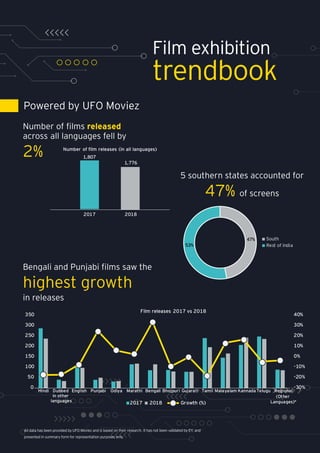
  • 149.
    149 Future outlook The nextphase of growth for the segment is expected to be driven by the global digital push Netflix is expected to spend US$1.1 billion on animated content worldwide in 2018 and Amazon is projected to spend US$300 million40 . This translates into roughly 10% of total content budget for these companies. This number is expected to go up to about 15% of their total content budget in 202141 . In addition to OTT platforms, traditional broadcasters are getting into the animated content space. Most national broadcasters like Viacom, Sony, Disney and Discovery have increased their focus on animated content in India, with other national and some local broadcasters also gearing up to launch original animated content. Government incentives and schemes (both at central and individual state level) will be important for Indian companies to remain competitive In February 2018, the Union Cabinet identified animation, under the audio-visual category, as one of the 12 champion sectors. As part of the champion sector categorization, the government has allocated a dedicated fund of INR50 billion for development of the 12 sectors42 . 40. https://www.latimes.com/business/hollywood/la-fi-ct-animation- streaming-20181118-story.html 41. https://www.latimes.com/business/hollywood/la-fi-ct-animation- streaming-20181118-story.html 42. “Suspended animation,” Business Standard via Factiva, https://global.factiva.com/redir/default. aspx?P=sa&an=BSTN000020180914ee9f002nk&cat=a&ep=ASE, accessed on 18 December 2018 43. “Cabinet approves gaming, animation policy, eyes Rs 6,400 crore investments in Andhra Pradesh,” Indian Express, http://www. newindianexpress.com/states/andhra-pradesh/2018/apr/17/cabinet- approves-gaming-animation-policy-eyes-rs-6400-crore-investments-in- andhra-pradesh-1802581.html, accessed on 18 December 2018 44. “Telangana govt’s IMAGE Tower to be ready by early 2020,” Telangana Today, https://telanganatoday.com/telangana-govt-image-tower-ready- early, accessed on 19 December 2018 45. “Karnataka state to help grow Animation and Gaming industry with a Centre of Excellence in Bangalore,” India Tech Online, https://www. indiatechonline.com/it-happened-in-india.php?id=2867, accessed on 20 December 2018 A list of initiatives launched by state governments recently have been listed below: ►► Andhra Pradesh – Government of AP has approved Animation Visual Effects Gaming and Comics (AVGC) Policy 2018-2020 with the aim to make the state a preferred location for AVGC. The government aims to attract an investment of INR64 billion by 2020. As part of the plan, an animation and gaming city will be developed in 40 acres in Vishakhapatnam. The government has planned to provide one-time subsidy of 25-30% on capital expenditure for hardware43 ►► Telangana – Telangana Government’s IMAGE (Innova- tion in Multimedia, Animation, Gaming and Entertain- ment) tower, which was announced in 2017, is expect- ed to be operational by 2020. Over 200 companies would be able to operate from the tower. The tower is being developed as part of government’s efforts to boost its AVGC sector by encouraging investments44 ►► Karnataka – The government has opened a new Cen- tre of Excellence for the AVGC segment. The centre will have digital post-production lab with technologies for animation and VFX, along with technologies ena- bling development of online gaming platforms45 Increased investments into building talent base will be seen While Indian animators and post-production artists are technically at par with the best in the world, there are areas of specialization where there is room for improvement. Going forward, skills like storyboarding and storytelling for animated content and understanding the tone and complexities of characters for the global audience will become an important point of differentiation. If the segment can identify the right talent and train them appropriately, India could become a preferred destination for a lot of content creators. While Indian companies can continue to acquire foreign talent for these specialized services in the short term, institutes like Whistling Woods, etc. can design specialized courses to address the long-term requirements.
  • 150.
    Expert speak As an establishedand credible base for producing great animation content, India is now healthily positioned to explore a whole new world of possibilities. Local stories and global storytelling is proving itself and the near term will see many Indian properties travelling far and wide. It’s an incredible time for animation. It’s an incredible time for India! A K Madhavan Founder & Chief Executive Officer, Assemblage Entertainment Pvt. Ltd. India's animation and VFX segment will grow at a rapid pace on increased content demand, both in India and on global platforms. I expect the industry to double in the next 3-4 years. Namit Malhotra Founder, Executive Chairman & Global CEO of Prime Focus Ltd. Animation growth is driven by uptake in digital content and increased domestic TV demand for local content. Vfx on the other hand is witnessing growth rates upwards of 25% due increased share of budget in domestic films / TV  and substantial contribution to Hollywood and other international IPs by Indian VFX talent. In the years ahead digital platforms and AR/VR will propel animation and visual effects to new heights both in terms of visual experience and commercial successes. Biren Ghose Country Head, Technicolor India
  • 151.
    151151 The rise inanimation content consumption due to new viewing platforms and viewing services, both in India and abroad, is resulting in increased demand for quality animation, and hence creating new and highly attractive opportunities for the Indian Animation and VFX industry, across film, television and digital outsourced projects which represent 85% of total animation services turnover in India, and for original content with universal appeal for the global market, enhancing the Indian Animation Industry’s global footprint around the world, and growing the talent pool to service this growing demand. P. Jayakumar Chief Executive Officer, Toonz Media Group Scan the QR code to view videos, where indicated with
  • 152.
  • 154.
    Media and entertainment Theorganized events and activations segment grew 15.6% in 2018 to reach INR75 billion • The number of events grew 9% over 2017, led by digital events which grew 35% and activations, which grew 21% • Ticket sales now contribute over INR7 billion • Auto, tech and FMCG were the top categories • 31% of marketers surveyed by EY said that their spends on events and activations had increased by over 10% during the last two years Intellectual properties and digital integration were increasingly adopted • 38% of respondents had invested in creating one or more IPs • Digital integration increased and over half the survey respondents had integrated digital in some form or the other with their events Future outlook • Margin management will be a key priority for 2019 • Growth will be driven by managed events and IPs: 69% of marketers surveyed expected to spend more on events and activation over the next two years • Regional markets will continue to drive growth • 86% of the respondents to our marketer survey indicated that digital integration with events was very important Key messages
  • 155.
    155 This section isbased on the findings of primary research conducted across more than 30 Indian events and activation companies, over 30 marketers and industry discussions. 31% of respondents believed that ticketed events were growing across the board, while 54% believed that only top-end ticketed events were growing. India saw the launch of marquee properties from Cirque du Soleil and Disney in 2018. Ticket sales now contribute over INR7 billion1 . Ticketed events fueled growth How well did ticketed events fare in 2018? The organized live events segment grew 16% in 2018 Event segment revenues 65 75 86 112 2017 2018 2019E 2021E 54% 31% 15% Growing for top-end events only Growing across the board De-growing Source: EY analysis based on EY survey of event management companies There was a 9% increase in the number of events The industry grew at 15.6% in 2018 led by the launch of many large format events, intellectual properties (IPs), weddings, sports and digital activation. The number of events grew by 9% over 2017, led by digital events which grew 35% and activations, which grew 21%. This value represents the revenue of “organized” events and activation agencies and does not include the multitude of “unorganized” event companies spread across the country. Survey respondents felt on average that just 52% of the Indian events and activation segment was organized. The size estimate also does not include the value of telecast rights of events (unless owned by an events and activation management company), the value of meetings, incentives, conferencing and exhibitions (MICE) conducted by pure travel companies, value of IPs not owned by event companies and the value of properties managed by in-house activation teams of advertisers. INR billion (gross of taxes) | EY analysis 1. EY analysis
  • 156.
    Media and entertainment Revenueindexed by category Auto, tech and FMCG were the top categories Move towards IPs and digital 38% of respondents had invested in creating one or more IPs More and more event companies were creating IPs, either owned by them, or in partnership with brands or other event management agencies. While IPs contributed to less than 1% of total events, they provided around 16% of revenues. Over half the respondents claimed to have integrated digital aspects into their events. This was across marketing, in-venue, audience engagement, post-event communities, ticketing and food and beverage sales. Large format events had commenced live streaming to build advertising revenues. Digital integration increased Have you integrated digital into your event offerrings? Source: EY Analysis based on EY survey of event management companies 52%45% 3% For most events, in some manner or the other Just for a few events Not for most of the events Source: EY Analysis based on EY survey of event management companies 66 75 77 77 82 99 100 100 106 108 108 110 110 117 133 133 0 20 40 60 80 100 120 140 Tobacco Telecom Government (excluding PSUs) Oil & gas Public sector enterprises Retail Average Beverage Consumer durable Media & entertainment High net worth individuals Financial services Electronics FMCG Technology Automotive Auto, tech and FMCG were the key spenders on events and activations. The key change since our last survey two years ago has been the relative reduction in the share of telecom spends. 45% of marketers surveyed by EY said that their spends on events and activation had increased during the last two years.
  • 157.
    157 2018 saw margin pressureincrease 48% of survey respondents felt that margins dropped in 2018, while 42% felt they were flat. Reasons attributed included increased competition due to clients preferring multiple agency pitches for each campaign and increased sourcing pressures. How did margins change in 2018? Source: EY Analysis based on EY survey of event management companies Degrowing Flat Growing 10% 48% 42%
  • 158.
    Media and entertainment Futureoutlook Survey respondents were most concerned around margin management, reflecting the increase in costs, which they are not always able to charge clients. Respondents’ next most important priorities were to enable business expansion (primarily into new segments and smaller towns) and IP creation. Respondents expected maximum growth to come from managed and personal events (21%), followed by IPs (17%) over the next two to three years. While the number of digital events and activations would grow significantly, it would not contribute to revenue growth as much. Margin management is expected to be the key priority for 2019 Growth will be driven by managed events and IPs Key priorities for the next year (indexed) Growth by type of events - next 2-3 years Source: EY Analysis based on EY survey of event management companies 102 107 118 128 Implementing a measurement/ROI system IP creation International/domestic expansion Cost reduction/margin improvement 44Any other Source: EY Analysis based on EY survey of event management companies Percentage respondents 0% 20% 40% 60% 80% 100% IP Activations / Promotional campaigns Digital events 0-5% 5-10% 10-20% 20-30% >30% Managed events (including personal events)
  • 159.
    159 69% of marketerssurveyed expected to spend more on events and activation over the next two years. Marketers will integrate digital with their events and activation spends more aggressively in a bid to drive up RoI and increase reach. 86% of the respondents to our marketer survey indicated that they thought digital integration with events very important. They will use interactive experiential solutions on digital platforms to interact with brands and at the same time, enable sales and customer database creation. Regional markets will continue to drive growth 66% of our event survey respondents felt that events revenues in tier-II and III cities grew at the same rate or faster than events in larger cities. India’s GDP growth over the next few years is expected to be higher in smaller cities2 . This will result in increased spending on entertainment in those cities, and a chance for Indian event companies to create low-cost and high-volume properties for these markets. Concerts, sports and personal events will drive this growth. Marketers will increase their spends on events and activation Digital will drive efficiencies and higher RoI How do you see your spends on events and activation over the next two years? How important is it for you to see digital integration with your events and activation initiatives? 24% 45% 24% 7% Will increase by over 10% Source: EY marketer survey Will increase by upto 10% Will stay relatively the same Will reduce 86% 14% 0% Very important Quite important Not important Source: EY marketer survey 2. "The growth paradigm" ; EY report on top 50 Indian cities
  • 160.
    The Indian WeddingIndustry is getting more organized. The business has continued to grow at 25 to 30% and the future outlook is even better. Samit Garg Co-Founder & CEO, E-Factor Entertainment Pvt. Ltd. The event and experiential industry in India is worth tens of thousands of crores. It provides jobs, contributes to local economies, employs millions and yet we remain in the shadows, working under the radar, bringing in riches in a form that isn’t recognized and cannot be tabulated. Sanjoy Roy Managing Director, Teamwork Arts Expert speak The business of experiences is going to be fundamentally disrupted over the next 5 years, much like most other businesses, and I feel we should be focussed on preparing ourselves for that change. Atul Nath Founder, Candid Marketing As we enter an election year there will be fervent activity in the first few months of 2019, but then it is a wait and watch game. We need more infrastructure to build experiences in India. How long will a handful of stadiums and grounds suffice to fulfil the appetite of millennials for concerts, shows and festivals? This generation wants to make memories and are thirsting for more! Roshan Abbas Managing Director – Geometry Encompass
  • 161.
    161161 We are livingin a very interesting world, where consumer preferences are shaped by what I call the ‘EXONOMY’ – the experience economy. Experiential allows you to do good and to serve, instead of merely selling goods and services. I am excited about the disproportionate role that experiential will play in the future of brand building. Brian Tellis Director, Fountainhead MKTG Dispersal of audience over multiple media platforms and the need for every marketing dollar to count are pushing marketers to drive direct to consumer engagement. A combination of experiential and digital is the perfect mix, wherein both impact as well as engagement are direct, consistent and economical. Direct to consumer has created a new world: An audience of One….driving purchase, impact, bottom line and valuation paradigms. Sabbas Joseph Founder & Director, Wizcraft International Entertainment Pvt. Ltd. Scan the QR code to view videos, where indicated with
  • 162.
  • 164.
    Online gamers inIndia grew 52% to 278 million in 2018 • 5 billion game apps were downloaded in 2018, which accounted for 71% of total entertainment app downloads • Time spent on gaming increased to over five hours per month on average • India is now one of the top five markets for mobile gaming globally • It has over 250 game development companies • Overseas online gaming companies grew their presence in India The segment has proactively created self-regulating industry bodies like the AIGF and IFSG Future outlook • The segment is expected to grow at 35% CAGR to reach INR120 billion by 2021 • Fantasy sports can cross 100 million players within two years • Multi-player gaming will continue to grow significantly, following the uptake of PUBG in 2018, subject to the quality of the IP created • While the Chinese market is showing signs of saturation and regulator control, India will become the next key market for gaming companies and investors • AR and VR gaming in India has the potential to drive growth of physical gaming zones in malls and common areas, but will remain a niche market product for now. India can become the AR / VR and casual game development factory of the world, if talent is nurtured and infrastructure is built • 2019 will see the creation of large national gaming brands Both casual and real money gaming grew, resulting in the segment growing 59% to reach INR49 billion • Casual gaming grew 40% to reach INR22 billion • Real money gaming grew 82% to reach INR26 billion • 80% and 95% of revenues were driven by advertisement and subscription for casual games and real money games respectively • 8-12% of gamers paid to play real money games i.e., subscription or in-app purchases Key messages
  • 165.
    165 Online gamers grew52% to 278 million in 2018 Indian online gaming subscriber base grew from 183 million in 2017 to 278 million in 20181 , leading to a 59% revenue growth to INR49 billion. Mobile gamers were 250 million of these. 30 49 68 120 INR billion (gross of taxes) | EY analysis 2017 2018 2019E 2021E 88 108 158 250 40 37 25 28 0 50 100 150 200 250 300 2015 2016 2017 2018 Mobile gamers Non-mobile gamers Source: EY analysis Growth in online gamers was driven by the increase in internet users in India to over 500 million, growth of smartphone user base to 340 million and low data prices. It is believed that with more affordable smartphones, internet connectivity and localized language games, rural India will lead the growth of the gaming industry in the next few years. Gaming is now being recognized as mainstream entertainment in India. 1. IMRB Kantar Pokkt MMA report, EY analysis, Industry discussions 2. EY Research 3. App Annie 4. EY’s online gaming consumer survey 2018 5 billion game apps were downloaded in 2018 5 billion game apps were downloaded in 2018, which accounted for 71% of the total entertainment apps downloaded in the year. Game downloads have increased 35% from 20173 . Gaming uptake is clearly driven by young people - 88% of respondents of EY’s online gaming consumer survey were in the age group of 21-35 years4. Online gamers in India (million)2 Online gaming revenues
  • 166.
    Media and entertainment +17% +7% +42% +22% 0.00 1.00 2.00 3.00 4.00 5.00 6.00 GamesEntertainment Music News & magazines Monthlyhoursperuser 2017 2018 1.8% 3.3% 4.9% 6.5% 2018 2019E 2020E 2021E Time spent on gaming increased to over 5 hours per month on average Gamers spent 17% more time on games in 2018 when compared to 2017, averaging over five hours per user per month5 . India is now one of the top five markets for mobile gaming globally India is now in the top five markets in the world based on the number of users for online and mobile gaming. Smartphones have emerged as the primary device preferred for online gaming with more than 90%6 of millennials preferring smartphones over gaming PCs and other devices in India. Unlike console gaming, smartphones have brought affordable gaming to users without the hassle of owning expensive hardware and game titles. 89% of all game revenues in India were generated on mobile games7 . With the growing demand for mobile gaming, many companies have launched dedicated gaming smartphones to capture share in this segment. These gaming smartphones accounted for 1.8% of overall smartphone shipments in 2018 and are expected to reach 6.5% by 20218 . 5. App Annie analysis of top 20 game apps 6. https://economictimes.indiatimes.com/tech/software/india-among-top-5- markets-for-mobile-gaming/articleshow/65396386.cms 7. https://economictimes.indiatimes.com/tech/software/india-among-top-5- markets-for-mobile-gaming/articleshow/65396386.cms 8. http://cmrindia.com/cmr-specview-gaming-smartphones-penetration-to- hit-6-5-by-cy2021/ Gaming smartphone shipments (% of overall smartphone shipments) Average monthly time spent on Top 20 apps by category MAU (hours) - India, Android Phone Source: App Annie
  • 167.
    167 2018 saw largeinvestments in gaming hardware and software Hardware makers are incorporating more features to enable a technologically enhanced experience in gaming. Acer is witnessing 20% growth y-o-y attributable to its gaming laptops and PCs. Asus, which currently occupies 22% share in the gaming PC market is also working towards offering high-tech devices to increase its market share in India9 . Currently VR as a technology is picking up in outdoor entertainment areas in the form of VR rides in malls and VR lounges. It is believed that uptake of VR for mobile gaming will grow with a reduction in hardware cost. India now has over 250 game development companies Gaming companies are increasingly investing in cutting-edge technologies such as VR, AR, AI and blockchain. AR games such as Pokémon Go have garnered significant positive response in India. India has progressed from being a back-end support for game development to developing high-quality games. The segment is on the rise with over 250 game development companies, up from 25 in 2010. And once again, this provides India with the opportunity to become a key game development center of the world, which can generate US$2 billion by 202110 , if supported with adequate incentives and policy support. 9. https://economictimes.indiatimes.com/tech/hardware/asus-eyes-bigger- share-of-indias-consumer-gaming-pc-market/articleshow/65389168.cms 10. EY estimates
  • 168.
    Media and entertainment Overseasonline gaming companies grew their presence in India India’s online gaming segment has attracted investments and new launches by several global players. International company Country Announcement month Description NVIDIA11 US January 2019 The company is aiming to increase its Indian online gaming footprint by launching 100 gaming cafes in India in 2019 AGTech Media (Alibaba)12 China August 2018 AGTech, in JV with PayTM, has launched Gamepind, an online gaming platform offering variety of social and casual games with exclusive loyalty rewards to users within the PayTM app. The companies in the venture have infused additional US$16 million in the mobile gaming JV to launch it into a separate app to increase its reach Yoozoo13 China July 2018 Yoozoo games, which entered India in 2017, is teaming up with celebrities to grow its presence in tier-2 and tier-3 markets in India. The company has recently partnered with Sunny Leone and Gamiana Company to launch an online game in social casino genre. The company further plans to launch three games in the next few months, in addition to its two games operational in India APUS14 China June 2018 The company has launched “Go Millionaire” online game in the quiz genre in India. The game is available on APUS browser and plans to give away INR40 million as cash prize to the winners. The company is also planning to increase its Indian team by five times to 100 and set up an R&D facility to strengthen its operations15 Tencent16 China March 2018 Tencent is planning to invest US$200 million (INR14 billion) in the Indian online gaming segment with the aim to own at least one-third of India’s gaming user base by 2020. As part of its plan, Tencent led a US$100 million investment round in Mumbai-based Dream11 ESL17 Germany February 2018 ESL has acquired minority stake in Nazara technologies for INR265 million. As part of the acquisition, ESL has also entered into an agreement with Nodwin gaming (part of Nazara) for multi-year exclusive licensing rights of ESL system and ESL community platform to Nodwin gaming. The partnership and acquisition is part of ESL’s aim to expand its footprint in India 11. “NVIDIA to expand gaming footprint in India, add 100 gaming cafes this year,” Economic Times, https://economictimes.indiatimes.com/industry/ media/entertainment/media/nvidia-to-expand-gaming-footprint-in-india- add-100-gaming-cafes-this-year/articleshow/67387395.cms, accessed on 18 January 2019 12. “Paytm, Alibaba’s AGTech invest $16 million in Gamepind,” LiveMint, https://www.livemint.com/Companies/uglnASGz2Pk57ieCu4wXrM/Paytm- Alibabas-AGTech-invest-16-million-in-Gamepind.html, accessed on 20 December 2018 13. “Yoozoo Games partners Sunny Leone for a mobile game that's debuting by end of 2018,” ET Tech, https://tech.economictimes.indiatimes.com/ news/mobile/yoozoo-games-partners-sunny-leone-for-a-mobile-game- thats-debuting-by-end-of-2018/65141104, accessed on 20 December 2018 14. “APUS Introduces its LIVE Quiz Mobile Game “Go Millionaire”,” PC Quest, https://www.pcquest.com/apus-introduces-live-quiz-mobile-game-go- millionaire/, accessed on 20 December 2018 15. “China’s APUS rolls up sleeves with hiring plans & R&D centre,” ET Rise, https://economictimes.indiatimes.com/small-biz/startups/ newsbuzz/chinas-apus-rolls-up-sleeves-with-hiring-plans-rd-centre/ articleshow/65524265.cms, accessed on 20 December 2018 16. “How tencent, the world’s largest gaming firm, is rebuilding its India biz, TechCircle, https://techcircle.vccircle.com/2018/03/07/how-tencent- the-world-s-largest-gaming-firm-is-rebuilding-its-india-biz, accessed on 20 December 2018 17. “E-sports major ESL invests in gaming company Nazara,” The Times of India, https://timesofindia.indiatimes.com/deals/-ma/esl-invests-in-nazara/ articleshow/62838971.cms, accessed on 20 December 2018
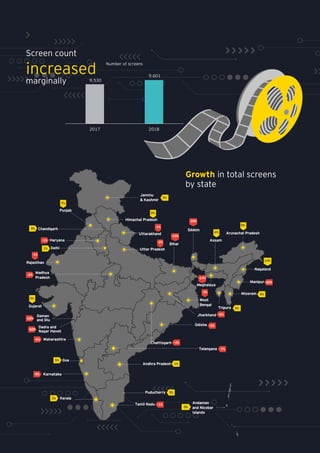
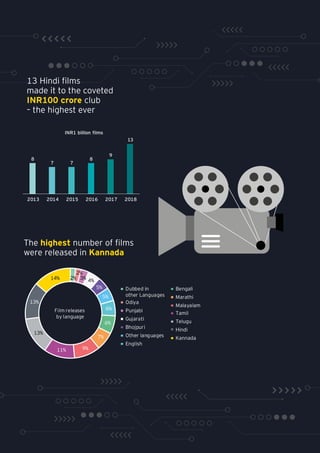
  • 169.
    169 2017 2018 2019E2021E Total 30.4 48.5 68.2 120.3 Online gaming revenues grew 59% to reach INR48.5 billion in 2018 Indian online gaming segment grew to reach INR49 billion in 2018, a growth of 59% over 2017. It is estimated to reach INR120 billion by 2021 at a CAGR of 35% with the number of users projected to become 340 million18 by then. Casual gaming grew 40% to reach INR22.4 billion There has been a huge growth for publishers who have produced innovative games such as Ludo King. Social competitive multiplayer games seem to have been well accepted and many companies are focusing on this format of casual games. Casual games are expected to grow at 30% to reach INR49 billion by 2021. Real money gaming grew 82% to reach INR26 billion Real money games include fantasy sports, rummy, poker and the like. The drivers for this growth are attributed to increased penetration of smart phones, adoption of wallet- based payment mechanisms, availability of quality gaming content, increased venture capital investments, etc. Real money gaming is expected to grow at 40% CAGR to reach INR71 billion by 2021. 8-12% of gamers paid to play real money games i.e., subscription or in-app purchase The growth of Indian online gaming segment might be significant in terms of the number of subscribers and downloads, but monetization has remained a challenge as the Indian market is dominated by casual gamers who are reluctant to spend on games. For these gamers, casual games are a form of free entertainment with low perceived value. Therefore, advertising has remained the primary source of revenue for casual games. 80% 5% 20% 95% Casual gaming Real money gaming Ad revenue Subscription / commission 80% and 95% of revenues were driven by advertisement and subscriptions for casual games and real money games respectively19 . On the other hand, real money games like rummy and fantasy sports provide gamers with a chance for them to win back more or the same amount that they paid. Further, competitive multi-player games like PUBG have also encouraged Indian gamers to make in-app purchases to gain a competitive edge in the game. Such trends have seen 8-12% of the registered active users paying for real money games and in-app purchases. While the number is very small, the trend of monetization and change in the mindset of Indian players has begun. 18. EY research 19. Industry discussions and EY analysis Revenue sources INR billon (gross of taxes) | EY analysis
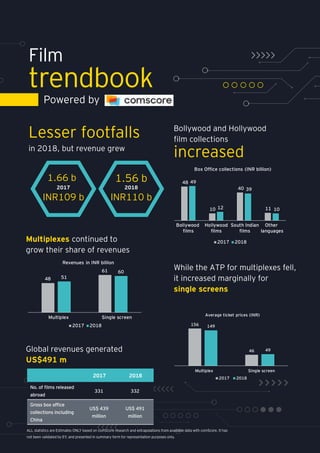


  • 170.
    Media and entertainment Thesegment has proactively created self-regulating industry bodies While the Indian government is yet to define regulations for online gaming, the industry is proactively forming self- regulatory bodies. Multiple gaming federations like the All India Gaming Federation (AIGF), The Rummy Federation (TRF) and the Indian Federation of Sports Gaming (IFSG) were formed with the goal to protect the interests of both operators and consumers in real money games. They provide a platform for operators to address key issues and present a unified front20 . Federations have defined or are in the process of defining self-regulatory frameworks, laying down industry specific guidelines and adopting international best practices around fair play, responsible gaming, ethical advertising, online security and privacy, software integrity, user verification and complaint redressals. To bring more credibility to the industry, the federations have started conducting third-party audits to ensure that operators follow the set guidelines. Future outlook Fantasy sports can cross 100 million players within two years Sports, particularly cricket, will drive the growth of fantasy gaming which can cross 100 million players within two years. Fantasy wrestling and kabaddi would see increased focus as platforms try to broad-base their appeal. Multi-player gaming will continue to grow Multi-player gaming will continue to grow significantly, following the uptake of PUBG in 2018, subject to the quality of the IP created. Higher per-user revenues can be realized with fiber based internet and streaming games. Company Main investors Total funding Dream11 Tencent, Kalaari Capital, Multiples Alternate Asset Management Pvt. Ltd. US$100 million Nazara Technologies WestBridge, IIFL Asset Management, Turtle Entertainment US$82 million Ace2Three Clairvest Group, Matrix partners US$76 million 99 Games Ascent Capital, Kalaari Capital, Dream incubator NA MoonFrog Labs Tiger Global Management US$16 million Investor interest in Indian gaming will increase While the Chinese market is showing signs of slowing down and regulator control, India will become the next key market for investors, given the growth factors mentioned in this section. Indian gaming companies have already begun to attract investments. 20. Industry discussions and EY analysis
  • 171.
    171 AR and VRgaming can drive growth of physical gaming zones AR and VR gaming in India has the potential to drive growth of physical gaming zones in malls and common areas, but will remain a niche market product for now. India can become the global AR and VR game development factory of the world, if talent and infrastructure is nurtured. 2019 will see the creation of large national gaming brands Gaming companies are now set to establish brands to consolidate gamers who presently have a plethora of options to choose from in each game format. Each company wants to differentiate its product and market its unique selling point. New companies are investing towards marketing while majority of the existing online gaming companies we interviewed expected to spend higher amounts towards marketing.
  • 172.
    India gaming Trendbook Average timespent playing games was 30 minutes a day; while most played 15-30 minutes played popular games on app stores while 48% played games recommended by friends of respondents were OK to watch ads, so long as they could play for free; only 10% were willing to pay for in-app purchases 55% 70% played games on their mobile phones, while 31% played on their laptops 86% would prefer to play on bigger screens72% EY survey of 1,500 smartphone owning adults played games67%
  • 173.
    65% only played single playerformat games of respondents played once and 31% played twice a day 50% 46% Most preferred time to play was during: entertainment 85% stress relief 73% Top reasons for playing games were and were reluctant to play games where they had to pay to play • Fear of losing to a bot or computer was 32% • Poor perception about themselves was 13% 79% work breaks travelling and post dinner 62% 48% 45% Of those who played Real Money Games were willing to pay over INR100 per session and wallets were the most preferred mode of payment believed they would get addicted34% believed gaming impacted phone performance60% Key issues with gaming:
  • 174.
    Fantasy sports in India 45-50 million Fanswho played Fantasy Sports in 2018 2 out of 3people are aware of fantasy sports Average per week 6days 4.1days More frequently than once a week 93% 73% Less frequently than once a week 6% 24% Smartphone/Tablet followed by computers are the most frequently used devices for playing fantasy sports Frequency of play Smartphone /Tablet Desktop /Computers Powered by Indian Federation of Sports Gaming Source: Nielsen’s survey of 2,724 respondents who are Indian males aged 18-35 years across selected cities All data has been provided by IFSG and is based on their research. It has not been validated by EY, and presented in summary form for representation purposes only.
  • 175.
    Audience mainly comprisesof young independent Indians who have high disposable incomes Current users (Currently Play Fantasy Sports) Annual users (played Fantasy Sports in the last year) Bi-annual users (played Fantasy Sports in the last 6 months) Ever played (played Fantasy Sports at least once) 89 94 96 Age 72% 84% 51%75% 28% 16% 6% 42% 20% 5% 25-35 year olds Working GraduateA1 18-24 year olds Student Not graduate Post graduate A2/A3 AB Occupation NCCS Education 66% Play on only 1 platform 34% Play on more than 1 platform Gamers demonstrated high levels of stickiness 100
  • 176.
    Expert speak Gaming in Indiais growing, and if there was ever a time to be in this space, it is NOW! Saurabh Aggarwal CEO & President, Octro Inc. Online gaming is proliferating in India like never before due to friction-less payment methods, rise of digital payment users, growing local developer ecosystem and localized games. Nitesh Damani Director, Sugal & Damani For a sports fan, Fantasy Sports provides a platform to not only showcase their knowledge and skill amassed overtime, but also to receive recognition in the fantasy sports game. Fantasy sports is rapidly changing the way fans consume sports content, making the overall sports experience more exciting and engaging. Harsh Jain CEO & Co-Founder -Dream11 The gaming industry has seen an acceleration during the year along with overall macro economics helping growth in revenues and online gamers. We now also see an acceptance of gamers to pay and play leading to robust revenue growth for the industry. Manish Agarwal CEO, Nazara Technologies
  • 177.
    177177 Online Real MoneyGaming (RMG) Industry stakeholders are governed by the AIGF’s self regulation charters that are based on best practices in legality, integrity, player rights and responsible gaming. Our wish is for the Online RMG Industry to be regulated centrally by a National Gaming Commission, so that the existing uncertainties (under State Acts) that make it difficult for businesses to invest and grow, are eliminated. Roland Landers CEO, All India Gaming Federation Online Real Money Gaming (RMG) Industry stockholders are governed by the AIGF’s self regulation Charters that are based on best practices in legality, Integrity, Player Rights and Responsible Gaming. Our wish is for the Online RMG Industry to be regulated centrally by a National Gaming Commission, so that the existing uncertainties (under State Acts) that make it difficult for businesses to invest and grow, are eliminated. Rajesh Rao Founder & CEO, Dhruva Interactive Fantasy Sports has a big role to play in promotion of sports in general. We are excited to be part of the growth of the Online Fantasy Sports Gaming industry in India. Anand Ramachandran Co-Founder, Fantain The Rummy Federation (TRF) was setup to provide guidelines around self regulation, advertising and responsible gaming. We've onboarded a good amount of operators and are passing down all of this knowledge to them. The TRF is starting to conduct audits to ensure operators are following the guidelines set forth by the federation. Ankush Gera Founder/CEO, Junglee Games Consumers now look at a e-sports and games as a serious profession, not just a hobby. The advent of Data Science is really shaping up better decision making and personalisation of content to consumers. The future is certain: Next unicorn will be from the gaming industry. Hridhay Muralidharan Co-Founder, Dotball Interactive Private Limited Scan the QR code to view videos, where indicated with
  • 178.
    Out Of Home (OOH) media Imagecourtesy ImagesBazaar
  • 180.
    Media and entertainment Rapidinfrastructure development drove growth • OOH media reached INR37.3 billion in 2018 • The segment grew at 8.8% • Retail, consumer services and real estate were the largest advertiser categories • Digital OOH grew to reach INR1.5 billion which is 4.7% of the total segment Future outlook • We expect transit media growth to continue unabated - from around 34% today to around 45% of the OOH segment by 2021 • Station naming rights will become a more important source of revenue • Digital OOH could reach INR5-6 billion in five years • Measurement metrics linked to consumer data, profiling, maps and footfalls will come into being Key messages
  • 181.
    181 OOH media grew8.8% in 2018 The segment reached INR37.3 billion Out Of Home (OOH) media grew by 8.8% in 2018 to reach INR37.3 billion. It is expected to grow 9.5% in 2019 and reach INR48.5 billion in 2021 at a three-year CAGR of 9.2%. Organized retail was the largest category in 20181 Category Category contribution in 2018 (in %) Category growth over 2017 (in %) Organized retail 16% 14% Hospitals, restaurants, education, OTT 14% 24% Real estate and construction 12% 14% FMCG 9% 18% Financial services 9% 15% Telecom 7% -13% Auto 7% 4% Media 5% 15% E-Commerce 4% 7% Electronic durables 2% 16% Petroleum / Lubricants 1% -14% Pharmacy 1% -17% Energy 0% -18% Others 12% -5% Total 100% 9% Retail, consumer services and real estate were the top contributing sectors to the ad spend in the OOH segment. Growth was driven by education and OTT platforms. However, ad spend fell across telecom, petroleum, pharmacy and energy categories. 1. Pitch-Madison Advertising Report 2019 INR billion (gross of taxes) | EY analysis 34.3 37.3 40.8 48.5 2017 2018 2019E 2021E OOH segment revenues
  • 182.
    Media and entertainment DigitalOOH grew to reach INR1.5 billion Digital OOH market reached INR1.5 billion2 , accounting for 4.7% of overall OOH market. Digital OOH is further estimated to grow to reach INR5-6 billion over the next five years. Its share is expected to reach around 8% of the OOH segment by 20213 . Growth would be driven by the following factors: • 4-5x or higher growth in the number of digital displays, which are estimated to be around 70,000 today4 . Already, 50-60% or more of advertising spaces at airports and malls have been converted to digital OOH, contributing approximately 20-30% of industry growth5 . With the development of new airports, smart city projects, malls and metro stations, among others, digital screens are expected to grow further • Digital OOH lends itself to better measurement. Integrating site data with consumer data, profiles and retail sales data enables better informed investment decisions • When combined with activations, digital OOH delivers leads and consumer profiles, enabling direct to consumer interactions for brands 2. “DOOH boom is coming to India,” WARC, https://www.warc.com/ newsandopinion/news/dooh_boom_is_coming_to_india/40858, accessed on 16 December 2018 3. Refer 2 above 4. https://www.impactonnet.com/cover-story/the-impact-trends- report-2019-6272.html 5. Industry discussions 6. “Posterscope launches India's first digital OOH Ad Exchange – ROOH,” Afaqs, https://www.afaqs.com/news/story/54061_Posterscope-launches- Indias-first-digital-OOH-Ad-Exchange---ROOH, accessed on 16 December 2018 7. 30 new airports to come up in India over the next 15 months https://www.business-standard.com/article/economy-policy/30- new-airports-to-come-up-in-15-mths-country-s-100th-coming-up-in- sikkim-118092000930_1.html 8. 15 more cities will soon have metro rail in India https://economictimes.indiatimes.com/industry/transportation/ railways/15-more-cities-will-soon-have-metro-network-union-minister-puri/ articleshow/66419131.cms 9. http://www.newindianexpress.com/cities/bengaluru/2018/nov/26/giant- digital-screens-to-display-info-on-trains-at-bengaluru-stations-1903171. html Increasing adoption of real-time OOH media solutions was seen in 2018 Companies are introducing tech-enabled OOH advertising systems to achieve more efficiency and transparency. In December 2018, Posterscope India launched ROOH (Real Time Out of Home), a planning-buying platform for OOH inventories. ROOH platform has over 60,000 digital screens accessible via a single platform. The platform uses a wide variety of data feeds to create customized and targeted advertising, allowing advertisers to directly control the content that is being played on screens6 . Rapid infrastructure development drove growth The rapid development of infrastructure, including upcoming airports, smart city projects, malls, metros, bus shelters, public conveniences, coffee shops, along with increased advertising opportunities in tier-II and tier-III cities are all contributing to the growth of OOH media. Airports account for a majority of digital OOH media, attributable to the time travelers have to view ads at specific touch-points like boarding gates. In the next three years, it is expected that 307 new airports will get operationalized and metros will be operationalized at Mumbai, Delhi, Bangalore, Chennai and seven8 other cities. The Railways plan to implement the rail display network with 100,000 digital screens across all stations by 20229 . Challenges remained, however The lack of a reliable universal measurement system and timely permissions from concerned local and regulatory authorities are the largest challenges faced by the segment. Several attempts at measurement have been planned, but the need for a universal metric remains unmet. Implementation of OOH campaigns in tier-III and rural markets is also difficult to track, resulting in the need for expensive audits and monitoring mechanisms.
  • 183.
    183 We expect transitmedia growth to continue unabated Composition of OOH Source: Industry discussions, Pitch Madison, IPG Magna, GroupM, EY analysis Future outlook 75% 67% 53% 21% 26% 35% 4% 8% 12% 2014 2018 2022 Traditional Airports Metros / railways Given the growth in operational airports (it is expected that over 100 airports will be built over the next 15 years, including 18 under the UDAN scheme10 ), metros in large cities (another 500 kilometers of metros are under construction or planned11 across Pune, Nagpur, Ahmedabad, Chennai, Vijayawada, Kozhikode, Indore, Bhopal, Patna, Guwahati, Kanpur and Varanasi ), the focus of Indian railways to implement digital screens and the proposed infrastructure investment for modernization of bus stands, we expect the share of transit media to grow from around 34% today to around 45% by 202112 . 10. https://economictimes.indiatimes.com/industry/transportation/airlines- /-aviation/to-ease-business-of-flying-government-to-build-100-airports- in-15-years/articleshow/61523048.cms 11. https://en.wikipedia.org/wiki/Urban_rail_transit_in_India; 12. https://www.livemint.com/Politics/ylEObaYWxcC7lGO2E2e4wJ/The- rise-of-metro-rail-network-in-India.html 13. Industry discussions; EY analysis Naming rights will become an important source of revenue Metro station naming rights are generating between INR100 million to INR400 million a year per station, depending on the city and passenger traffic. With new stations coming up, this can become a big revenue source, with a potential to reach INR16 billion within four to five years13 . Measurement metrics will come into being  We believe that measurement will be implemented on a campaign basis in the near term.  This will be led by integrating data across mobile phone location, maps, OOH media site location and footfalls / sales data, which is being proposed by a slew of measurement agencies like Measurement of Outdoor Displays and Moving Walls amongst others.
  • 184.
    Media and entertainment Globaltrends Global growth remained stable and modest Globally, OOH remains a durable advertising medium where digital is an opportunity, not a threat, leading to stable modest growth. With improved performance of out-of-home campaigns and more organizations willing to experiment and incorporate new digital ad experiences, the segment, especially digital OOH is expected to drive growth. Operators continued to invest in digital OOH Operators are investing in digital boards that promote creativity, have enhanced measurability, transparency, daypart selling and increased inventory. With growing consumer familiarity towards digital screens, the value these platforms offer is also bound to increase. This gives an ability to extend hyper-local and immersive experiences into the mix, such as weather triggering, interactive e-health requests and other real-time variables. The shift to programmatic ad buying is on-going While at present it is a small piece of the larger pie, OOH advertising’s shift to programmatic is happening swiftly. Programmatic buyers testing OOH for the first time must provide high-quality ad creatives by working with ad agencies. Brands can leverage those real-time ad placements to capitalize on reaching high concentrations of their target audiences at the ideal time of day. However, getting digital audience targeting criteria into programmatic OOH is proving slightly difficult, considering the majority of OOH placements are not able to provide the one-to-one audience matching digital buyers desire. Increased M&A activity The fragmented nature of the segment, combined with a strong strategic and private equity interest support a robust M&A opportunity. Large technology companies have started to acquire OOH networks to boost their market share as interest in OOH increases and marketers are focused on capturing offline audiences through physical mediums.
  • 185.
  • 186.
    Airport advertising Passenger traffic in India 102operational airports in 2018 250planned airportsby 2030E 309m in 2018 421m in 2020E All data has been provided by Times OOH and is based on their research. It has not been validated by EY, and presented in summary form for representation purposes only. Source: AAI, ICRA, Civil Aviation Ministry, CAPA, IBEF INR 32bn 2025 INR 10-12bn 2018 Projected size of Airport advertising in India Powered by Times OOH
  • 187.
    37% Global India 25% Airport OOH in 2021will be driven by *Includes retail, duty-free, advertising, car rental, parking, hospitality etc 21% 13% Passenger traffic growth rates Other airports deliver 44% of traffic JV/Privatized airports of DEL, MUM, HYD, BLR, COK, NGP deliver 56% of traffic in 2018 $1.6 bn $1.9 bn 1-3% Duty free spends Duty paid + F&B spends of these spends pooled towards marketing Non-aeronautical airport revenues*
  • 188.
    Expert speak With existing inventorybase, OOH is likely to grow by at least 8 to 9%. However, there will be incremental growth of at least 3 to 4% in the industry with new media avenue opening with the commencement of Metro and Smart City projects. Sunil Vasudeva Chairman cum full time Director, Pioneer Publicity Corporation Millenials who are redefining India’s consumption story are spending a major chunk of their waking hours outside the home making OOH more lucrative than ever. 2019 is the year of the Indian general elections which, along with some state elections, will boost marketing spends and would hopefully be a very good year for OOH. Alok Jalan MD, Laqshya Media Group
  • 189.
    189189 Scan the QRcode to view videos, where indicated with
  • 190.
  • 192.
    Media and entertainment Revenuegrowth was led by Phase-III inventory and non-FCT initiatives • Radio grew 7.5% in 2018 to reach INR31.3 billion, taking its share in total advertising to 4.2% • Radio segment’s growth in 2018 was fueled by a 3% volume growth of Radio AdEX, inventory in Phase-III stations coming online and non-FCT revenue growth from digital, content production, events, etc. • 53% of ad volumes came from the top seven cities, while Maharashtra and Gujarat led on volumes • Services, retail, food and beverage, auto and BFSI were the top five sectors advertising on radio, with services comprising 30% of the total volumes Reach increased, but a common measurement system was lacking • 47 new radio stations were operationalized in 2018 across 35 cities, taking the total of 386 radio stations in India Key messages • Lack of measurement continues to be major drawback for the segment. Clients are exploring sharper segmentation via niche channels for niche products • New smartphone models do not all have FM receivers, which could impact radio listenership • Radio companies will focus on building communities to understand consumers better and enable brands to connect directly with their audiences • There will be increased collaboration between radio players and streaming apps to increase fill rates on streaming audio platforms and sell segmented audiences to advertisers Future outlook • Growth in 2019 will be fueled by ad spends in the upcoming elections, non-FCT revenues and firming of ad rates in regional markets
  • 193.
    193 Radio grew 7.5%in 2018 to reach INR31.3 billion1 29 31 34 39 2017 2018 2019E 2021E Others 34% Services 30% Retail 10% Food & beverages 10% Auto 8% Banking/ Finance/ Investment 8% INR billion (gross of taxes) Radio grew 7.5% in 2018 to reach INR31.3 billion, taking its share in total advertising to 4.2%. Growth was driven by a 3% ad volume growth2 , inventory growth from newly operationalized Phase-III stations and non-FCT revenues from digital, content production, events, etc. Revenues Radio AdEX grew 3% by volume There were over 10,467 advertisers on radio comprising 13,710 brands. 4,262 advertisers were on radio, but did not advertise on TV or print3 . Services, retail, food and beverage, auto and BFSI were the top five categories advertising on radio, with services comprising 30% of the total volumes4 . 1. Trai Prasar Bharti, EY analysis 2. TAM AdEX 90 station data 3. TAM AdEX 90 station data 4. TAM AdEX 90 station data 5. TAM AdEX 90 station data 6. Industry discussions 7. Industry discussions 8. https://www.exchange4media.com/digital-news/radiocity.in-extends- leadership-in-digital-with-programmatic-offering-for-advertisers-via- adswizz-and-google-adwords-90453.html 53% of ad volumes came from the top seven cities The skew of advertising continued towards the metros, with the top seven cities contributing around 53% of ad volumes5 . These cities also benefited from the operationalization of second frequencies. The local-national split of advertising generated was 40:60 and metro-non-metro split of advertising consumed was 60-406 . Stations in tier-II and III towns relied more on retail / local advertising and added “sales feet on the street” to generate higher revenues from SME and retail advertisers. Importance of non-FCT revenues increased New business offerings like concerts, activations, digital communities, music streaming – which could collectively constitute up to 20% of radio company revenues today – are natural extensions for radio, given it's strength in content creation, building audience loyalty and packaging undifferentiated content7 . Many radio companies are now providing more of such solutions to advertisers and we believe this will grow in future. Investment in digital initiatives grew More and more radio companies are investing in digital platforms as well as operations. ►► Radio City's digital arm, radiocity.in has strength- ened its digital backbone by partnering with Google AdWords Premier Small & Medium Business Partner Program and AdsWizz, the technology provider of advertising solutions for the digital audio industry. Partnership with AdsWizz will enable efficient moneti- zation of Radio City's web radio stations through pro- grammatic buying of audio ad inventory (Jun 2018)8 Radio segment revenues Top 5 categories on radio
  • 194.
    Media and entertainment ►►The venture capital firm, Unicorn India Ventures, invested in a Kerala-based start-up, Inntot Technolo- gies, which offers software solutions for digital radio receivers (Jun 2018)9 ►► 94.3 Radio One India has launched the first online re-broadcast of its Delhi, Mumbai and Bangalore international format network FM radio stations. It also launched the first audio business channel live stream at www.1cast.in (Jan 2018)10 ►► Radio Umang, India's first online radio station was launched in February 2018. Listeners can tune in to this online radio station through web streaming or download the app. With 24 hours programming, it has found listeners in India and in over 60 countries worldwide11 ►► Sports Flashes launched a first-of-its-kind, 24/7 internet-based radio channel in India, with dedicat- ed sports content. The channel is available on the Sports Flashes mobile app and sportsflashes.com (Jan 2018)12 Reach India reached 386 operational private FM stations 47 new radio stations were operationalised in 2018 across 35 cities, taking the total private FM stations count in India to 386 India13 . The current status of the industry is presented below. FM Licensee Operational Frequencies as on Dec 31, 2018 Entertainment Network (India) Limited 66 KAL Radio Ltd. 60 Reliance Broadcast Network Ltd. 58 Music Broadcast Ltd. 39 DB Corp Ltd. 31 Rajasthan Patrika Pvt. Ltd. 18 HT Media Ltd. 15 Others 99 TOTAL 386 In addition, AIR’s home service comprises 420 stations today located across the country, reaching nearly 92% of the country’s area and 99.19 % of the total population. AIR originates programming in 23 languages14 Many new smartphones did not come equipped with FM receivers Over 70% of radio is consumed on mobile phones in India15 . In metro cities, seven out of 10 people listen to radio while travelling. This number is six out of 10 for non-metro cities. However, many popular new smartphones do not now have FM receivers and this could pose an issue given how much radio is consumed on mobile platforms. 9. https://www.vccircle.com/unicorn-india-ventures-invests-in-digital-radio- solutions-startup-inntot-technologies/ 10. https://www.exchange4media.com/media-radio-news/94.3-radio-one- india-launches-www.1cast.innew-audio-business-channel-87825.html 11. "“Radio Umang: India's first online radio station launched,” https:// www.outlookindia.com/newsscroll/radio-umang-indias-first-online- radiostation- launched/1252091" 12. https://techstory.in/radio-sports-flashes-2018/ 13. https://main.trai.gov.in/sites/default/files/PIR08012019.pdf 14. http://allindiaradio.gov.in/Default.aspx 15. http://www.indiantelevision.com/regulators/ib-ministry/76-listen-to-fm- radio-using-mobiles-study-170703
  • 195.
    195 Measurement of listenership remainedan issue Listenership measurement remains a challenge- except for the four metros where Radio Audience Measurement (RAM) data is available, listenership measurement is the biggest pressing challenge in other cities. At present, the segment is using social media platforms and their own surveys to overcome the absence of a credible measurement system. In order to overcome issues in measuring listenership, MRUC in association with AROI is inviting proposals to form an independent body that will measure listenership in the top few markets. Initially the plan is to cover 21 markets and the methodology for research will be similar to what IRS uses now. 16. http://pib.nic.in/newsite/PrintRelease.aspx?relid=187301 17. Industry discussions Future outlook Growth will accelerate in 2019 Ad spends in the upcoming general and state elections, non-FCT revenues and firming of ad rates in regional markets will fuel growth in 2019. Radio brands will be leveraged more Radio will enable more growth through brand leverage, across concerts, branded content, digital content and delivery, events and activations, podcasts, etc. The industry would drive up to 20%17 of topline from non-FCT revenues by 2021. Radio and audio streaming will increase collaboration Radio companies will focus on building communities on [radio + digital] media, to understand consumers better, end enable brands to connect with their audiences directly. Combinations between radio players and streaming apps will be tried to increase fill rates on streaming audio platforms and sell segmented audiences to advertisers. There will be an increase in multi-media offerings to advertisers. News was finally permitted on private FM, but with heavy caveats Private FM was finally permitted to air news, but only in the form or replays of news broadcasts created by Prasar Bharti, without any modifications16 . No such restrictions exist on other media like television, digital or print in India.
  • 196.
    Media and entertainment Globalradio trends Radio begins to collaborate with online streaming Mass medium still achieving impressive consumer reach, although streaming services are gaining share. While most vendors offer their services over the internet, a few radio channels have collaborated with online streaming portals, to serve both online radio and streamed music services using the same platform. Internet provides radio users curated and personalized radio channels and playlists based on their listening habits. Programmatic advertising makes a beginning Radio advertising revenue is in persistent slow decline as marketers transition to other, largely digital, offerings. However, the industry is optimistic about programmatic advertising (currently nascent) and its growing role. While radio stations look to programmatic for workflow automation, additional revenues and inventory protection, ad buyers prefer programmatic to make ad campaigns more effective and efficient. Consolidation Financial restructurings of several major US players may be a precursor to additional strategic activity. As companies seek scale benefits, consolidation is on the rise among radio stations, which generally are small operations with limited budgets. Larger companies are at an advantage in buying/ producing programming, reaching greater audiences, and selling air time to advertisers who want broad coverage. Media ownership deregulation - cross-ownership of TV, radio stations, and other media is further fueling the trend. Focus on exclusive content There is a stronger focus on exclusive content to survive. Given automobiles remain the primary place for consumers to consume radio, cars are increasingly becoming more connected with new entertainment options - connected car and its multiple audio offerings may be the greatest threat to radio broadcasting in the near future. 
  • 197.
  • 198.
    Radio Trendbook 17% 16% 10% 10% 9% 8% 8% 7% 6% 6% 3% Maharashtra Gujarat Tamil Nadu Delhi Karnataka West Bengal AndhraPradesh Uttar Pradesh Madhya Pradesh Rajasthan Kerala 10% 9% 8% 7% 7% 6%6% 6% 6% 5% 30% New Delhi Bangalore Kolkata Chennai Mumbai Indore Jaipur Ahmedabad Pune Surat Others (8) 7 citiesdrove over 50%of ad volumes Maharashtra and Gujarat led radio secondages All data has been provided by AdEX India (A division of TAM Media Research) and is based on their research. It has not been validated by EY, and presented in summary form for representation purposes only. Powered by AdEX India (A division of TAM Media Research) Radio AdEX monitors ads across 90+ stations
  • 199.
    199 Daily ad insertionscrossed 51,000in the fourth quarter The top 5 advertising categories contributed 27%Advertising volumes PayTM was the largest advertiseron FM radio Services retained its position as the highest volume spender on radio Properties /Real estate One97 Communications (Paytm) Cars/Jeeps Life Insurance Corporation of India Pan masala / Zarda /Gutkha Vishnu Packaging Retail outlets- Jewellers K P Pan Foods Retail outlets- Clothing/Textiles/ Fashion Google 46 K 40 K 42 K 51 K Jan-Mar '18 Apr-Jun '18 Jul-Sep '18 Oct-Dec '18 Avgadinsertionsperday Top 5 categories Top 5 Advertisers 1 1 2 2 3 3 4 4 5 5 9% 2% 5% 1% 1 1 3 4 2 3 4 5 5 2 5% 1% 4% 1% 4% 1% Services Retail Food & beverages Auto Banking/Finance /Investment Top 5 sectors 2018 2017
  • 200.
    Expert speak The unique abilityof radio to seamlessly integrate with emerging digital platforms has driven innovative and path breaking programming in radio content. Brands have recognized the potential of radio by using it along with other mediums like TV and print. Owing to the change in consumption patterns and growing GDP as compared to last year, radio will certainly witness a double digit growth. Ashit Kukian CEO, Radio City In 2019, the radio segment will emerge as a much stronger medium. Radio is constantly innovating and integrating its content with digital. The sector needs to change the way it sells and [radio plus digital] is a potent combination for advertisers. Nisha Narayanan COO & Director, Red FM I am confident FM radio will the fastest growing traditional media in the years to come. Radio brands will also diversify and become multi media content producers, reaching audiences through radio, video, SM all. Prashant Panday Managing Director & CEO, Entertainment Network (India) Ltd. M&A will be the only way to ensure double digit topline and EBITDA growth in a tough media market overall. In the absence of new licenses, radio players will enter digital music streaming to improve reach. Vineet Hukmani MD and CEO, Radio One
  • 201.
    201201 Radio uses accessto local insights, local talent turned influencers, to create podcasts and tell powerful brand stories. The hyper-local reach of radio combined with the interactivity of online audio makes radio plus digital far more impactful than digital alone. Abraham Thomas CEO, Reliance Broadcast Network Ltd. Radio is free and you don’t need data, however cheap that may be. World over, radio has survived and it shall do so in India as well. The growth though may come from tier 2 and tier 3 towns where the new Bharat is growing and the local RJ is the only star in the life of the listener.  To sustain its growth and get its due respect, radio needs to get a measurement system in place. Harrish M Bhatia President, Sales & Marketing, DB Corp Ltd. Scan the QR code to view videos, where indicated with
  • 202.
  • 204.
    Key messages Music segmentgrew 10% on the back of film music and audio streaming to reach INR14 billion in 2018 • India was at the 19th position in the IFPI world rankings of music markets • Film music contributed to over 80% of total revenues • Audio streaming • Grew 50% in 2018 to reach 150 million listeners (excluding YouTube music viewers) • However, only around 1-1.5 million listeners paid for the services • Paid audio streaming (net of telco bundling) reached INR800 million • 96% of music consumers consumed music on smartphones • 50% of listenership was outside the top eight metros • 75% of music pertained to music released in the last 12 months • Three out of four listeners used pirated music Labels benefitted from this growth • Growth at the music label level was around 20% • 83% of total label revenues in 2018 came from digital music formats • Share of physical music sales fell 50% Future outlook • Music segment can reach INR19.2 billion by 2021 driven by audio subscription growth at 43% CAGR • We expect bundling of music by telcos will drive growth

  • 205.
    205 Music segment grew10% in 2018 2017 2018 2019E 2021E 12.8 14.2 15.5 19.2 INR billion (gross of taxes) | EY analysis Source: IFPI The Indian music segment grew 10% to reach INR14.2 billion in 2018. It is expected to grow 10.8% annually till 2021, on the back of increased digital revenues, performance rights and synchronization rights1 . Growth at the music label level was 20%2 , led by digital revenues, which now contribute 83% of their revenues. YouTube accounted for 40% of the digital revenues for labels. Physical music sales fell by 50%3 . India reached 19th position in the IFPI world rankings of music markets1 . According to IFPI, streaming accounted for nearly 40% of global music revenues, making it the biggest source of income for the music industry by a significant margin. As market leaders Spotify and Apple Music continue to grow, streaming will dominate music consumption going forward, especially now that smart speakers are making music streaming at home more convenient. 1. EY analysis of IMI data, IFPI music report, industry discussions 2. Industry discussions 3. EY analysis 14.1 2.7 0.2 1.2 0 5.2 2.8 6.6 2.4 0.3 Physical Digital (excl.streaming) Streaming Performance rights* Synchronization revenues** 2007 2017 Total revenue US$18.2 billion US$17.3 billion * revenue from the use of recorded music by broadcasters and public venues ** revenue from the use of music in advertising, film, television and games Global recorded music industry revenues in 2007 and 2017 by format
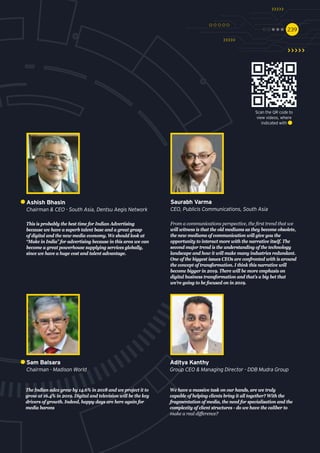
  • 206.
    Media and entertainment Filmmusic contributed over 80% of total revenues In India, songs related to movies have the highest share in terms of revenue and account for over 80%4 of the music segment’s revenues. The three most popular genres amongst internet users in India are new Bollywood music, older Bollywood music and Indian classical music5 . Licensed streaming services have enabled domestic music labels to flourish. Local artists from across the country are securing a sizeable fan base and Punjab leads the non-film music industry6 . Saavn has its own Artists and Repertoire team in New York City and collaborates with independent artists on marketing campaigns through its Artist Originals program, while Hungama runs a similar initiative called Artist Aloud7 . Sofar Sounds, a VC-backed music events start-up headquartered in London, UK operates in 12 cities in India and has played a substantial role in putting independent Indian artists on the digital map8 . Physical format music sales fell 50% in 2018 The contribution of physical sales to Indian music industry reduced 50% to just 4% of label revenues in 20189 . This is much lower than the global share of around 30%10 . In 2017, SaReGaMa had launched Carvaan, an audio player with pre-loaded songs and other features like USB and FM radio. It has seen a significant uptake of more than 1 million units since its launch11 . The revenues from these sales have not been included in the sizing of the music segment. Paid audio streaming (net of telco bundling) crossed INR800 million12 The continuous growth of digital infrastructure has paved the way for a 50% growth in audio streaming to 150 million listeners in 2018 (excluding YouTube). Smartphone penetration in India grew to 340 million i.e., 36% of total phones in 2018, up from 33% in 2017 and is expected to further increase to 39% in 201913 . However, only 1-1.5 million listeners paid for music, generating INR800 million in revenues. The wide availability of music on services such as YouTube (we estimate around 250 million people watched music on YouTube in 2018) and the large consumption of pirated content present considerable challenges in persuading users to pay for the benefits of streaming. Over 96% of music consumers consumed music on smartphones Smartphones and computers remained the universal choices for listening to music across all age groups. 96% of users used their smartphones to listen to music, the highest rate worldwide, followed by computers (92%)14 . India generated 5 billion music streams in December 2018 Indian audio streaming apps together reached around 5 billion streams per month towards the end of 201815 , a growth of around 50% over the prior year. 50% of listenership was outside the top eight metros16 . 75% of music pertained to music released in the last 12 months17 . 4. Industry discussions 5. “Vision 2022: India’s roadmap to the Top 10 Music markets in the world by 2022,” IMI, PPL Report 6. “Greatest Indian Music Business Trends Of 2018,” http://loudest. in/2018/07/09/greatest-indian-music-business-trends-of-2018/ 7. “Greatest Indian Music Business Trends Of 2018,” http://loudest. in/2018/07/09/greatest-indian-music-business-trends-of-2018/ 8. “Greatest Indian Music Business Trends Of 2018,” http://loudest. in/2018/07/09/greatest-indian-music-business-trends-of-2018/ 9. EY estimates 10. IFPI 2018 report 11. SaReGaMa 12. EY analysis 13. eMarketer; Statista 14. “Digital Music Industry,” IMI, IFPI Report 15. Industry discussions 16. “IRS data released by Media Research Users Council (MRUC” http:// www.musicplus.in/irs-releases-data-radio-mirchi-tops-chart-amongst-fm- broadcasters-india/ and EY analysis 17. Industry discussions 18. App Annie | Adjusted to align with the objective of the section Source: App Annie analysis of iOS and Google Play stores Apps18 Rank By downloads By revenue By MAU 1 JioMusic Sing! by smule Google Play Music 2 Gaana Stormaker Karaoke Wynk 3 Wynk Gaana JioMusic 4 Saavn Saavn Gaana 5 Hungama Wynk Saavn Top five music apps
  • 207.
    207 Indian internet usersspent over three hours a day listening to music19 Indian internet users surveyed by the IFPI spent 21.5 hours listening to music per week i.e., approximately three hours each day - which is more than the global average of 17.8 hours per week. Indian internet users in the 16-24 years age group listened to 23.9 hours per week on average. 81% users engaged with free audio streaming services. Three out of four listeners used pirated music 76% of internet users admitted to using pirated music in the last three months20 . The Indian music industry faced a loss of INR15 billion due to piracy through illegal sites21 . Of the time Indians spent listening to music, 13% (i.e., three hours each week) was used to hear illegal downloads, as compared to the global average of 7%. In China, where there have been crackdowns on piracy, the figure is 8%22 . Stream-ripping is the most popular form of music piracy in the country, with 72% users using stream ripping to obtain free downloads of music23 . The availability of swift remedies, including blocking orders, to tackle these pirate services is crucial to protecting the Indian music and other creative industries. Furthermore, app stores and ISPs that host such services need to be proactive in recognizing this form of infringement and work with industry bodies to curb piracy. Advertising on music streaming remained negligible Advertising fill ratios on music streaming apps remained low, with just one minute of advertising per 60 minutes of consumption in some cases. That is a loss of opportunity given that the year ended 2018 with around five billion music streams per month as per industry estimates. Advertising on music streaming has not yet found traction, mainly because compared to other digital platforms, the ability of some platforms to demonstrate return on investment to advertisers is lacking. There is an opportunity to combine radio ad sales with streaming music sales, which could result in growth in this segment. 19. “Digital Music Industry,” IMI, IFPI Report 20. “Digital Music Industry,” IMI, IFPI Report 21. “The current state of Indian Music Industry,” http://www.radioandmusic. com/biz/music/publishing/180905-the-current-state-indian-music- industry 22. “High on piracy and free streaming services: How India's music industry is shaping up,” https://www.firstpost.com/entertainment/high-on-piracy- and-free-streaming-services-how-indias-music-industry-is-shaping- up-5046761.html 23. “Digital Music Industry,” IMI, IFPI Report
  • 208.
    Media and entertainment Growthin online music streaming drove investment and innovation 2018 was a year of significant innovation in the field of consumer engagement and experience24 : ►► Multi-language user interfaces – in up to 11 languages - helped increase the uptake of new listeners outside the top 10 cities of India ►► Improvement in streaming quality made a big dif- ference in 2018, with a lot of effort being put in to enable streaming even in poor network areas ►► Improvements in the quality of recommendations and auto queueing helped increase time spent by over 10% ►► Amazon India’s Prime Music has integrated the voice features of its smart assistant Alexa, which can be used on the music app and Echo devices. This allows users to request favorite songs and create new play- lists using voice commands. Discussions with plat- forms revealed that up to 20% of new audio streaming listeners used voice search ►► Xiaomi launched the Mi Music app at Mi Pop Play, marking Xiaomi’s move into offering value-added Internet services for local users. The app offers an integrated music streaming service along with the ability to store offline music ►► Gaana introduced an innovation which integrated the game of cricket with music through a gaming property called “Game of Sixes”. Each user was registered to a team playlist, based on the city chosen. To score runs for the team, users could either play songs from their team playlist or add songs to it. The team with the highest cumulative runs at the end of the 15-day campaign were declared winners Indian music artists were signed by foreign labels A 23-year-old Indian DJ/Producer from India has been signed by one of the UK's largest record labels, Virgin EMI Records, becoming the first Indian artist to be signed by the UK label. Virgin EMI further partnered with Universal Music India to sign other singers to promote their music internationally25 . Future outlook The music segment can reach INR19.2 billion by 202126 The music segment needs to be creative in channeling consumers towards a paid subscription model. If the current base of 1% of Indian music pay subscriber, can shift upwards to 2-3%, digital revenues can propel the necessary growth to push the Indian music market towards INR20 billion and beyond. Bundling of music will drive growth Given the price sensitive nature of Indian consumers, bundling will drive growth of audio streaming in the next few years, and most consumers would accept the base no-frills package offered to them by telcos and other platforms. Bundled streaming consumption could grow to over 75% of the total market by 202127 . 24. Industry discussions 25. https://nrinews24x7.com/dj-shaan-becomes-the-first-indian-artist-to-be- signed-by-virgin-emi-records-uk/ 26. EY analysis 27. EY estimate
  • 209.
    209 28. Source: IFPIGlobal Music Report 2018 Global trends Streaming services achieve significant subscriber scale Industry returning to growth as streaming services achieve significant subscriber scale, creating increasingly favorable economics for artists, labels and publishers. Driven by fans’ engagement with streaming, paid subscribers reached 176 million globally by end of 201728 . Moreover, streaming services will soon overtake monthly music downloads given the online users preference for accessing content rather than owning the content. Need to segment customers As the market recovers and music continues to be consumed globally, record companies continue to focus on providing full and fair value for music - ensuring quality music is offered to fans, while maintaining value for recording artists/ songwriters. Music companies need to find a way to develop robust consumer segmentation to provide differentiated products for people who are not converting to subscription. Piracy is a global problem Piracy continues to cripple the music industry with record companies tackling illegal services that exploit the work of artists and profit through large scale copyright infringement. Stream ripping is the fastest growing form of music copyright infringement globally. The music industry is leaving no stone unturned - from educating consumers on copyright rules, working with law enforcement agencies, entering litigation against online pirate services, working with online stores to remove infringing apps, etc. to create an environment in which the music sector can grow.
  • 210.
    Music Trendbook Powered by IMIand IFPI India’s rank in the global music market India was ranked 14th in digital revenues Hours/week 78% of revenues for music labels came from digital sources 78% Digital India Global Indian youth21.5 23.9 17.8 Indians love their music 96%of respondents listened to music on their smart phones # 19 All data has been provided by IMI and is based on their research. It has not been validated by EY, and presented in summary form for representation purposes only. # 19
  • 211.
    of respondents admittedto consuming pirated music within the last 3 months Most popular methods to discover music for 15-34 years olds 76% YouTube Facebook Instagram New bollywood Old bollywood Indian classical A Most popular music genres amongst survey respondents of survey respondents didnt pay for music as they felt YouTube met all their needs52% IFPI designed and ran the Music Consumer Study 2018 across 20 of the world’s major music markets. Fieldwork was carried out by independent research agency AudienceNet, who surveyed 2,000 Internet users in India aged between 16-64.
  • 212.
    Expert speak The IMI’s goalis for India to be amongst the Top 10 music markets the world, from its current 19th position today. This is easily achievable as India has an underpenetrated public performance market and a non-existent ad sync market - the effective use of music and brands. Along with reduction of value gap via legislation, remuneration of fair value for all stakeholders in the music industry can enable this goal. Blaise Fernandes President & CEO - Indian Music Industry Respect for copyrighted material by internet platforms, fair valuation of music IP through market forces and a just distribution of value between creators and labels will be the foundation for the growth of the music industry. Vikram Mehra Chairman, SaReGaMa We will look back at 2018 as an inflection point where music/audio streaming services started to achieve material scale in the India market. Consumers' usage of high quality smartphones with affordable data connections has opened up their ears to new, personalized experiences around their taste in music. Existing and emerging artists (and their labels and managers) now have platforms available to them to express and showcase their creativity to the largest audiences excited to hear their work. Vinodh Bhat Co-Founder & Chief Strategy Officer, Jio Saavn Having grown at a strong pace for the last 2 years, the music streaming market today stands at an inflection point in India with unprecedented momentum ahead of it. Prashan Agarwal CEO, Gaana
  • 213.
    213213 There is anupsurge in domestic non-film and regional music across traditional formats like television and radio as well as digital platforms and stores. Future consumption of music in India will be a healthy mix of film, non-film, regional and international music and that makes it a great place for the Indian music industry to be in for the foreseeable future. Devraj Sanyal Managing Director & CEO, Universal Music Group, India & South Asia There is a critical mass of people who have already adopted streaming and the rest are in a high state of readiness because of fast growing smartphone adoption, and cheap data access. However, very few people pay for music (< 1%) and spend very little time on music streaming services (average of < 1 hour a month). This will change over time as users get exposed to streaming services that offer deep personalisation built around their moods, moments and listening preferences. Amarjit Singh Batra MD - India, Spotify Scan the QR code to view videos, where indicated with
  • 214.
  • 216.
    Media and entertainment Indiahad a great year on the field 2018 has been a watershed year for our sportspersons. India finished third at the Commonwealth Games, had its best Asian Games performance winning 69 medals and most importantly, earned 13 medals at the Youth Olympics. A majority of these athletes belong to non-metropolitan areas, reflecting the emergence of improved sports infrastructure across all tiers as well as our growing bench strength. ►► Mary Kom created history by becoming the first Indian boxer to record six gold medals in the Women's World Championships ►► The men's hockey team won a silver medal and a bronze medal at the Asian Games, as well as a silver medal at the Champions Trophy ►► The women's team became the first Indian women’s team to reach the final of the Asian Games in two decades ►► Manika Batra claimed four table tennis medals, including two gold, in the CWG before combining with Achanta Sharath Kamal for a historic mixed doubles bronze at the 2018 Asian Games ►► PV Sindhu's perseverance on the badminton court made her the first Indian to win a gold medal at the BWF World Tour Finals tournament ►► Shubhankar Sharma won the Maybank Malaysia Golf Open Asian Tour Order of Merit title and the European Tour Rookie of the Year award 1. Indiatoday.in, business-standard.com, https://timesofindia.indiatimes.com › Sports News › Asian Games 2018, en.wikipedia.org/wiki/Manika_Batra, https://www.livemint.com/Politics/ELNyeDd9txmQPjBHpByJIO/ PV- Sindhu-becomes-the-first-Indian-to-win-World-Tour-Final.html, http://www. uniindia.com/~/22-year-old-shubhankar-sharma-clinches-2018-asian- tour-order-of-merit-title-5th-youngest-indian/Sports/news/ 1430167. html, https://www.indiatoday.in › Sports › Asian Games 2018, https:// timesofindia.indiatimes.com/ sports/cricket/news/india-beat-sri-lanka-by- 144-runs-to-win-u-19-asia-cup-title/articleshow/66108882.cms, https:// www.indiatoday.in/education-today/gk-current-affairs/story/india-fifa- top-100-975299-2017-05-05, https://indianexpress.com/article/sports/ sport-others/all-sports-year-ender-king-kohli-magnificent-mary-make- 2018-their-own-india-discovers-new-stars-too-5515787/ 2. https://www.financialexpress.com/sports/ipls-brand-value-grows-from- 5-3-bn-to-6-3-bn-in-2018-mumbai-indians-remain-most-valuable- team/1273817/ 3. EY analysis 4. http://www.bcci.tv/news/2018/press-releases/17273/star-india-private- ltd-bags-bcci-india-international-and-domestic-media-rights 5. https://www.vccircle.com/tencent-leads-100-mn-investment-in-fantasy- sport-platform-dream11/ 6. https://www.business-standard.com/article/news-ani/jsw-sports-to- acquire-50-stake-in-delhi-daredevils-118030901237_1.html ►► The Indian squash contingent ended with five medals in the Asian Games making it a creditable perfor- mance including the women’s team’s silver, men’s team’s bronze and three bronze medals in the individ- ual event ►► In Cricket, India won two world titles and a continental event (Asia Cup), as well as the 2018 ACC Under-19 Asia Cup ►► The 2018 Intercontinental Cup belonged to the Indian football team and India entered top 100 in the FIFA football ranking for the first time in 21 years. Sunil Chhetri made history by becoming the second highest international goal-scorer among active players with 67 goals from 105 matches ►► Neeraj Chopra's obsessive pursuit of perfection every time he hurled the javelin and the teenage shooting stars who refused to take their eyes off the target, made 2018 a year in which highs easily outnumbered the lows for Indian sports1 All these are very healthy signs to actualize India’s much anticipated potential for the business of sports. Indian sports market was valued at over INR185 billion There are now over 16 domestic leagues in the country – across kabaddi, football, wrestling, boxing, badminton – from just two leagues five years ago. IPL, India’s largest league, is valued at US$6.3 billion today2 . This has all resulted in a steep growth in the sports industry, which has grown to INR185 billion in just five years, including revenues from sports rights and their monetization3 . The year 2018 saw many positives. Some landmark announcements included: ►► Star India acquired all the BCCI cricket media rights for a five-year cycle (2018-2023) with a consolidated bid of INR61.4 billion4 ►► Tencent Holdings announced US$100 million in- vestment in India's biggest fantasy sports platform Dream115 ►► JSW Sports acquired GMR Sports’ 50% equity stake in the Delhi Daredevils team. The deal was reportedly inked for a valuation of INR11 billion6
  • 217.
    217 ►► New sportsleagues, including volleyball, Andhra Pradesh Cricket League, Kho-Kho League, Karate, etc. were launched ►► In a clear testament of changing times, 2018 saw Facebook’s maiden sports content acquisition for the Indian sub-continent territory with the acquisition of La Liga broadcast rights ►► Hero MotoCorp renewed their corporate partnership deal with the golf world’s biggest icon Tiger Woods for a reported amount of INR1.5 billion for 4 years7 ►► A sprint sensation also emerged in 18-year-old Hima Das who won India’s first ever gold medal at the World Under 20 championships. Following which, the Ger- man footwear giant Adidas signed her as their brand ambassador 7. https://www.adgully.com/ads/ESP-SportzPower-Presentation-for-Media- Launch.pdf 8. EY analysis 9. EY estimates 2017 2018E Growth Sports infrastructure 65 76 16% Media spends 47 59 24% Ground sponsorship 16 18 16% Team sponsorship 10 10 9% Franchisee 8 10 26% Ticketing / F&B 5 6 22% Endorsement 5 6 27% Total 155 185 19% INR billion (gross of taxes) | EY analysis Media spends on sports 2018E Indian sports segment growth The industry grew 19% in 2018 to reach INR185 billion8 . Growth was driven by increased media spends on sports (2018 boasted of BCCI tournaments, IPL, Olympics and FIFA), franchisee fees for new teams and endorsements, where a larger non-cricketing base earned brand deals. We have not sized the sports apparel and fitness market in the above. Media spend on sports increased 24%9 Source: BARC; TG: All India / 2+/ 2017 & 2018/Program Theme: SPORTS Indian media earned INR59 billion on sports in 2018, an increase of 24%, with television accounting for around 85% of the spend. Media’s increasing interest in sports makes the market more conducive to investment. Sports broadcasting Wrestling viewership surpassed cricket Wrestling 20% Cricket 19% Kabaddi 17% Wrestling overtook cricket in terms of total viewership, on the back of weekly content through the year. It garnered a 20% share in total sports viewership with cricket a close second at 19%. Within the category, key properties were WWE and the Pro Wrestling League. TV, 85% Print, 6% Digital, 9%
  • 218.
    Media and entertainment Viewershipof sports widened Source: : Source: BARC; TG: All India / 2+/ 2017 & 2018/Program Theme: SPORTS Viewership share Viewership share of the top three sports declined from 73.6% in 2017 to 56.7% in 2018. Growth was seen across all sports like volleyball, athletics, boxing, hockey, martial arts, badminton and soccer. According to BARC, Pro Kabaddi League (PKL) has seen a sharp fall of 31% in its viewership ratings for the first 12 matches of its sixth season, compared to the previous year. Over 237 million viewers saw the first 24 matches of the 2018 season compared to 345 million viewers last year10 . Volleyball was a hit among Indian fans, both in the Asian games and the Rio Olympics held in 201611 . This prompted Baseline Ventures and Volleyball Federation of India to launch the Pro Volleyball League. The league plans to kick off with the first leg in Kochi on 2 February 2019. The tickets have been priced at INR300, while season passes will be made available at a 30% discount12 . 10. “Reports: Pro Kabaddi League encounters a huge drop in viewership,” https://www.sportskeeda.com/kabaddi/viewers-tired-as-pkl-saw-a-heavy- fall-of-viewership-ratings 11. “Pro Volleyball League to start with 6 teams,” https://economictimes. indiatimes.com/news/sports/pro-volleyball-league-to-start-with-6-teams/ articleshow/66819803.cms 12. “Inaugural Pro Volleyball League to kick off in Kochi on February 2,” https://timesofindia.indiatimes.com/sports/more-sports/others/ inaugural-pro-volleyball-league-to-kick-off-in-kochi-on-february-2/ articleshow/67476414.cms 13. https://www.insidesport.co/year-2018-top-10-sports-business-deals-and- news-from-india/ 14. “Star Wins Cricket Broadcast Rights In India For Rs 6,138 Crore,” https:// www.bloombergquint.com/business/star-wins-cricket-broadcast-rights-in- india-for-rs-6138-crore#gs.QP1GNAnq 15. “Media: Sector Update Star Sports Is Home For Indian Cricket,” ICICI Securities And Finance Company Ltd., April 2018, via Thomson 16. https://www.insidesport.co/dsport-to-telecast-bangladesh-premier- league-in-india/ Media rights remain the biggest source of revenues The sale of broadcasting and media rights remained the biggest source of revenue for most sports organizations. Broadcasters earned royalties from the sale of their exclusive footage to other media outlets which further enabled them to invest in the organizational and technical undertaking involved in broadcasting sports events. In the first ever live e-auction for sports media rights by the BCCI, Star India outbid Sony Pictures Network with its consolidated bid of INR61.38 billion to acquire all the BCCI media rights for a five-year cycle (2018-2023), setting a new per-match benchmark for BCCI home games at INR602 million, up from INR432 million13 . Sports broadcasters invested heavily in rights 26% 24% 23% 3% 2% 2% 2% 2% 2% 3% 2% 2% 7% 19% 17% 20% 5% 6% 3% 3% 3% 4% 4% 3% 4% 8% 2017 2018 Multisportsevents (eg,Olympics) Cricket Kabaddi Wrestling Sportsmagazine Volleyball Athletics Boxing Hocky Martialarts Badminton Soccer Others After the sale of Ten Sports by Zee to Sony for US$385 million in 2018, the Indian sports broadcasting landscape in India is predominantly handled by two players, Star and Sony. While Star acquired the IPL rights from 2018-2022 and retained the rights of domestic and international matches in India for the same time period14 , Sony acquired rights of Australian and English cricket boards, which were earlier held by Star India. Along with these, Sony has rights for cricket events of Pakistan, South Africa, Sri Lanka, West Indies and Zimbabwe cricket boards15 . DSPORT, the third sports broadcaster, will telecast Bangladesh Premier League in India in 201916 .
  • 219.
    219 Note: This isnot a comprehensive listing Sports rights Sony Star Cricket Australia Up to 202317 BCCI Up to 202318 Cricket South Africa Up to 202019 ICC Up to 202320 England Cricket Board Up to 202221 Bangladesh Cricket Board Up to 2020 Pakistan Cricket Board Up to 202022 New Zealand Cricket Up to 202023 Sri Lanka Cricket Up to 202024 IPL Up to 2022 West Indies Cricket Board Up to 202025 Karnataka Premier League Up to 201826 Zimbabwe Cricket Association Up to 201927 Tamil Nadu Premier League Up to 202028 Big Bash League Up to 202329 Asian Cricket Council Up to 202330 PWL Up to 201931 PKL Up to 2019 T10 Cricket League Up to 202032 HIL Up to 2018 Caribbean Premier League Up to 201933 17. https://www.cricket.com.au/news/sony-acquire-television-broadcast- rights-australian-cricket-india-subcontinent-ashes-star/2017-10-10 18. https://www.bloombergquint.com/business/star-wins-cricket-broadcast- rights-in-india-for-rs-6138-crore 19. https://www.televisionpost.com/sony-bounces-back-with-two-back-to- back-cricket-rights-acquisition/ 20. https://www.hollywoodreporter.com/news/foxs-star-india-bags-indian- cricket-rights-940-million-1100025 21. espncricinfo.com 22. https://www.televisionpost.com/sony-bounces-back-with-two-back-to- back-cricket-rights-acquisition/ 23. https://www.medianama.com/2017/11/223-177487/ 24. https://www.televisionpost.com/sony-bounces-back-with-two-back-to- back-cricket-rights-acquisition/ 25. https://www.business-standard.com/article/companies/sony- pictures-network-star-india-stack-up-for-sports-broadcast- rights-118040200019_1.html 26. https://www.business-standard.com/article/companies/sony- pictures-network-star-india-stack-up-for-sports-broadcast- rights-118040200019_1.html 27. https://www.business-standard.com/article/companies/sony- pictures-network-star-india-stack-up-for-sports-broadcast- rights-118040200019_1.html 28. https://www.livemint.com/Consumer/aqCo5tjglYggXcLdPJ65gK/Backed- by-N-Srinivasan-Tamil-Nadu-gets-its-own-Premier-Leag.html 29. https://www.cricket.com.au/news/sony-acquire-television-broadcast- rights-australian-cricket-india-subcontinent-ashes-star/2017-10-10 30. https://www.sportskeeda.com/cricket/asia-cup-2018-star-sports-to- broadcast-asia-cup-on-nine-channels 31. https://www.adgully.com/we-are-adopting-multiplatform-strategy-for-pwl- vaishali-sharma-sony-max-64232.html 32. https://www.televisionpost.com/sony-acquires-broadcast-rights-of-t10- league-for-3-years/ 33. http://www.indiantelevision.com/television/tv-channels/sports/star-sports- to-broadcast-hero-caribbean-premier-league-180809 34. http://media.hotstar.com/wp-content/uploads/2018/10/IPL_Watch_ Report_E-Book.pdf 35. https://economictimes.indiatimes.com/news/sports/record-70-million- viewers-watched-fifa-world-cup-on-sonyliv/articleshow/65032935.cms Digital consumption Online viewership grew significantly With more than 202 million34 viewers turning to the video streaming platform Hotstar to watch the 60-day IPL, a record 28% of STAR India’s over 700 million IPL viewers consumed the cricket league online in 2018. FIFA also saw massive uptake on digital, with an estimated 70 million viewers watching it on SonyLIV. It achieved a peak concurrency of 2 million viewers. SonyLIV had 36 advertisers for the world cup35 . Increased sports consumption drove subscription revenues Both Hotstar and SonyLIV created packages for real-time sports streaming, while also in some cases permitting free consumption of sports content with a five-minute delay. We estimate approximately a million paid sports subscribers in 2018, across different packages.
  • 220.
    Media and entertainment Viewershipgrew not just on broadcasters’ OTT platforms Large tech platforms such as Amazon and Facebook are now competing alongside the pure play sports OTT platforms. Amazon has secured ATP World Tour Tennis and Premiere League rights while Facebook won the La Liga rights for India. Reliance Jio’s live TV service JioTV acquired the exclusive India digital rights for the T20 cricket series Nidahas Trophy. Platform Monthly Cost Device Availability Subscribers Content Hotstar Sports package: INR299 Apple TV, Amazon Fire TV 150 million monthly active users as of August 2018; 700,000 paid subscribers as of July 2018 Cricket (Indian Premier League(IPL), Asia Cup), Kabaddi India League, hockey (Hockey India League, soccer, badminton (BWF World Championships), tennis (Wimbledon, French Open, US Open), table tennis, golf, swimming, esports, motorsports SonyLIV INR99 Android TV, Chromecast, Sony Bravia TV 30 million total viewers as of May 2018 Soccer (2018 FIFA World Cup, UEFA Championship League, UEFA Europa League, La Liga), cricket, mixed martial arts (UFC), WWE, tennis, golf (European and Asian Tour, Ryder Cup, US PGA Tour), basketball, racing Jio TV Free app for Jio SIM Users Reliance Jio (includes JioTV, JioCinema, JioMusic and other apps) has 177.13 million subscribers as of Feb 2018 Cricket, football, racing, tennis, Kabaddi, WWE, soccer (FIFA World Cup, India vs. England 2018, Hero Intercontinental Cup 2018), Women’s Hockey World Cup Airtel TV Free Mobile ap with additional packages for purchase based on location Chromecast 25 million active users as of July 2018 Cricket (IPL 2018) Sports Flashes, a multi-sports app, launched Radio Sports Flashes, India’s first 24x7 internet radio channel, solely dedicated to sports content. The channel is available on Sports Flashes mobile app and sportsflashes.com.36 The app acquired the rights to broadcast, promote and distribute audio content during the ICC World Cup 2019, globally. One big player to watch in this space will be Formula 1’s F1 TV service, the data centric sport is ideal for customized fan experiences. 36. “Launch of 1st indian sports radio channel – sports flashes,” http://www. indiantelevision.com/iworld/over-the-top-services/launch-of-1st-indian- sports-radio-channel-sports-flashes-180116 Select digital video services for sports content in India - Jan 2019 Note: All services are available on desktop/laptop, smartphone, tablet, with iOS and Android in addition to the devices listed; (1) cost does not take into account trial periods, introductory offers, special promotions, or pricing plans for longer than one month; (2) includes core operating systems/products only, specific device availability may vary; (3) requires Jio SIM subscription to access content Source: Hotstar subscriber, information as cited by Reuters and Digital TV Life, Aug 16, 2018 and Aug 15, 2018; SonyLIV subscriber information as cited in press release, May 06, 2018; JioTV subscriber information as cited by Strategy Analytics, Sep 26, 2018; Airtel TV subscriber information as cited in annual report, July 16, 2018, Jan 07, 2019 via eMarketer
  • 221.
    221 Facebook started streaminglive sports content in India and globally In August 2018, Facebook bought the rights to show La Liga, the Spanish top-flight football league, in the Indian subcontinent (includes India, Afghanistan, Bangladesh, Bhutan, Nepal, the Maldives, Sri Lanka and Pakistan) for the next three years37 . Globally, it bought the rights to stream 25 Major League Baseball (MLB) games in 2018, entered a deal with National Football League (NFL) to stream highlights from regular season games, along with play-offs and the Super Bowl and bought streaming rights to the English Premier League (EPL) in Thailand, Vietnam, Cambodia and Laos from 2019 to 202238 . Sports consumption was second only to entertainment on mobile phones According to the total rate of content consumption on UC News Feed platform in India, sports was the second largest category in mobile content consumption for Indian users, accounting for 19%, after only entertainment, which had 27% 39 . The business of leagues Indian Premier League cricket (IPL) Star India is estimated to have fetched INR30 billion from IPL 2018, 35% more than the previous season, which had earned a total of INR22 billion. TV and digital ads are expected to account for INR18 billion and the rest is attributed to distribution deals and overseas rights40 .The rise in the income from media rights, also meant that for the first time in the history of IPL, all eight teams were set to fetch profits from the single edition41 . The IPL was valued at US$3.2 billion dollars in 2014 and US$6.3 billion42 after the 11th edition. Language feeds proved to be a game-changer, especially in markets such as Tamil Nadu and West Bengal, where viewership is said to have grown by close to 50%. Pro Kabaddi League (PKL) PKL has emerged as the most watched non-cricket Indian sports league in India. The number of teams have increased from eight in the inaugural edition in 2014 to 12 now. The 2018 season reached 312 million viewers. Recently, Vivo bagged the main sponsor title rights for a sum of INR3 billion for a period of five years43 . Star India is estimated to earn around INR1.5 billion from ad revenue and sponsorship in PKL 6. For season 5, PKL earned more than INR1.2 billion44 . Indian Super League football (ISL) ISL stakeholders, who had collectively garnered INR2 billion from sponsorship sales last season, were 30-40% short of that number just before the commencement of the 2018 edition. Majority of the 10 franchisees struggled to meet their revenue targets, with inventory being available for half the price. Mumbai City FC and ATK (previously Atletico de Kolkata) didn't announce their title sponsors before the league began45 . Star India, the official broadcaster of ISL, is expected to earn INR2 billion in advertising revenue from the fifth season of the league46 . 37. “Facebook buys rights to show La Liga games in India,” https://www. theguardian.com/technology/2018/aug/14/facebook-buys-rights-la-liga- spanish-football-games-india-barcelona-lionel-messi 38. “Facebook just secured Premier League rights for the next four years,” https://www.businessinsider.com/facebook-wins-premier-league- streaming-rights-2018-7 39. Cheetah Lab from Cheetah Mobile and UC Media Lab from UCWeb, Alibaba Digital Media and Entertainment Group; https://www.adgully.com/ entertainment-tops-mobile-content-consumption-in-india-cheetah-lab-uc- report-81261.html 40. “Star India estimated to have fetched Rs 3,000 crore from IPL 2018,” https://bestmediainfo.com/posts.php?year=2018&month=05&title=star- india-estimated-to-fetch-rs-3-000-crore-from-ipl-2018/ 41. “IPL 2018 set to fetch profits for all eight teams for the first time,” https:// www.hindustantimes.com/cricket/ipl-2018-set-to-earn-profits-for-all-eight- teams-for-the-first-time/story-D0zF2F8Mt8sUYzRdujgkWJ.html 42. https://www.financialexpress.com/sports/ipls-brand-value-grows-from- 5-3-bn-to-6-3-bn-in-2018-mumbai-indians-remain-most-valuable- team/1273817/ 43. “Infographic: How much has the Pro Kabaddi League grown in five seasons?,” https://www.sportskeeda.com/kabaddi/infographic-how-much- has-the-pro-kabaddi-league-grown-in-five-seasons 44. “2017 : Indian sports leagues’ commercial report card,” https:// www.insidesport.co/2017-indian-sports-leagues-commercial-report- card-626122017/ 45. “Is Indian Super League running out of steam for sponsors?,” https:// www.insidesport.co/is-indian-super-league-running-out-of-steam-for- sponsors/ 46. “Star India seen earning ₹200 crore in ad revenue from ISL,” https:// www.livemint.com/Consumer/i2BIURGI7Rvi5Z1k0sSLII/Star-India-seen- earning-200-crore-in-ad-revenue-from-ISL.html
  • 222.
    Media and entertainment Fivesports leagues ran into hurdles in 2018 2018 did not see the annual editions of five sports leagues, including the Hockey India League which was establishing new benchmarks for growth and success. In addition, the Super Fight League (SFL), United Basketball Alliance (UBA), Premier Futsal and Super Boxing League (SBL) all ceased operations. The revamped Hockey India League (HIL) will return in 2019 in a new avatar with a more fast-paced five-a- side format replacing the traditional 11-a-side event. Emergence of eSports India accounts for approximately 13% of the global online mobile gaming population and is among the top five countries for online and mobile gaming47 . India is home to one-tenth of the world’s gamers and the count of gamers is estimated to rise to 628 million by 202048 from under 200 million in 2015. The number of game-developing companies in India has gone from just 25 in 2010 to 250 today. By 2020, the domestic game development industry is expected to be worth US$1.1 billion (INR77 billion), according to NASSCOM49 .Finally, 10 Indian gamers qualified for the eSports sporting event in the 2018 Asian Games Jakarta. India has over 2 million eSports players, and this number is expected to grow five times by 202150 . With growing development of original game titles such as Kingdom Hearts 2.8 and Sea of Thieves among others in India, game development segment of the country is also expected to grow substantially, catering to markets such as the US, China, Japan and Europe51 . 47. “The Man Behind Angry Birds Wants To Collaborate With The Indian Startups,” Inc42, https://inc42.com/buzz/the-man-behind-angry-birds- wants-to-collaborate-with-the-indian-startups/, accessed on 20 December 2018 48. https://qz.com/india/1481814/indians-are-betting-big-on-video-games- says-jana-survey/ 49. “Online gaming—and wagering on it—is a booming market in India,” https:// qz.com/india/1481814/indians-are-betting-big-on-video-games-says-jana- survey/ 50. “Revealed! India is digital gaming’s best kept secret, to have over 300 million digital gamers by 2021,” Financial Express, https://www. financialexpress.com/opinion/revealed-india-is-digital-gamings-best-kept- secret-to-have-over-300-million-digital-gamers-by-2021/1353945/, accessed on 20 January 2019 Ultimate Karate League (UKL) The UKL started in January 2019 with six teams. It is probably the only professional sports league in India that is setting out for three seasons in its inaugural year. The league opted for episodic telecast in India, Nepal, Bhutan, Bangladesh, Maldives and Sri Lanka over Discovery Channel’s DSports. Business opportunities in sports Investment prospects in the sports industry are dispersed across the entire supply chain, including the manufacturing and retail of equipment and apparel as well as in advertising, talent management, and training52 . Sports goods and equipment market in India Almost 60%70 of all sporting goods manufactured in India are exported, especially to international retail brands, such as Mitre, Lotto, Umbro and Wilson. Over half a million people are employed in the Indian sports retail and manufacturing sector and potential for growth in employment and revenue for firms in this sector is rising. The Indian sports equipment market has witnessed an exceptionally strong growth in recent years and this positive trend looks set to continue up to 2021 as well. A growing population and expanding middle class is resulting in an increasing number of Indians engaging in physical activities involving sports equipment. The Indian market is expected to reach US$4.7 billion by the end of 2022, growing at a CAGR of 12.3% between 2017-2022. Comparatively, the nearby markets of South Korea and China will grow with smaller CAGRs of 6.2% and 7.1% respectively53 .As a result, a number of international sports equipment brands are entering the Indian market. Sporting goods and equipment exports (US$ Million) Source: Ministry of commerce; Economic Times 51. “India's gaming industry expected to touch $1.3 billion,” Money Control, https://www.moneycontrol.com/news/business/markets/ dcb-bank-plunges-6-on-report-of-sfio-seeking-cancellation-of-banking- licence-3413731.html, accessed on 21 January 2019 52. “The Sports Industry in India – Investment Prospects in Manufacturing, Retail, and Training,” https://www.india-briefing.com/news/sports- industry-india-investment-manufacturing-retail-training-17135.html/ 53. “SPORTS EQUIPMENT IN INDIA,” MARKETLINE, March 2018, via Thomson1 236 275 275 303 2014 2015 2016 2017 70 https://www.ibef.org/exports/sports-industry-india.aspx
  • 223.
    223 • Hong Kong-basedXtep Sports has opened its first Indian flagship store, in Bengaluru • US sportswear brand Under Armor is planning to establish brick-and-mortar outlets in India • Japanese sportswear brand Asics plans to ramp up offerings across categories such as apparels and footwear in India as it eyes a larger presence in emerging segments such as athleisure, besides strengthening its core vertical. It recently opened its first store in Kolkata • South Korean owned Italian sportswear brand Fila launched its motorsport collection of footwear in collaboration with MTV Roadies fame Rannvijay Singha in stores across India • Australian Swimwear brand Speedo plans to set up 50 stores in India by 2020. It launched its first store in Kolkata in January 2018 • Health and fitness start-up Curefit may foray into online retailing of sportswear • Launched in August 2018, D:FY, a new Indian sportswear brand, recently launched its flagship store in the Phoenix Market City Kurla mall spanning over 4,000 sq. ft. Training and talent acquisition While the government has set up schemes - such as Khelo India - for this purpose, there still exists a wide gap in the market for talent acquisition experts and quality trainers. Eminent Indian sportspersons have set up training academies and centers (like Mahesh Bhupati’s Tennis Academy or Baichung Bhutia’s Football Schools), but some of them face financial instability due to a lack of funding. Private players can invest through direct involvement in the business aspect of such institutes or through an external approach – by providing sponsorships and gaining recognition through brand marketing for their CSR funds. Better stadium experiences The entire connected-fan-connected-stadium approach for smart stadia will be an area of increasing interest as leagues grow and fan bases are created. e-Ticketing, interactivity, signages, F&B, modular galleries are coming into play. An increasing number of stadiums are transforming into multipurpose avenues so that they can also be used for concerts, public meetings and events round the year. Turf protection systems can enable such transformations. Last season, Pro Kabaddi League (PKL) introduced fan seats (also known as “King Seats”) offering the best view of the match54 . Events around sporting events Sony partnered with events destination Kasa Kai Mumbai to organize special screenings for the final match of the FIFA World cup 2018 at pubs in Mumbai and Delhi. Spread across 19 states and covering 36 cities, VIVO IPL Fan Park 201871 engaged fans all over the country. Each venue broadcasted all the live action of the IPL on giant TV screens, along with music and multiple stalls for merchandise, food, beverages and other activations by IPL’s official sponsors. We expect events around leagues to increase over the next few years. AR and VR initiatives The 2018 season of the IPL was streamed in VR on Hotstar. This is not Hotstar’s first VR initiative. It streamed the 2017 Kabaddi World Cup games live in stereoscopic 3D virtual reality in partnership with VOKE, a Silicon Valley-based VR company55 . Star India, owner of Hotstar, is expected to completely overhaul its production infrastructure to shoot in VR. We expect to see more investments made in AR and VR initiatives, to enable sports fans to experience being inside their favorite games, as audience members, or even participants. Fan engagement management Sports fans want to interact and communicate, and we can expect to see several initiatives on digital media to enable this interaction, with brands. • Snapchat partnered with four IPL teams - the Mumbai Indians, Royal Challengers Bangalore, Delhi Daredevils and Rajasthan Royals - to share their official stories • Sport Flashes launched its 24x7 internet radio channel, Radio Sports Flashes, in January 2018, that broadcast sports content like live chat commentaries, talk shows, special sports programs, expert comments, sports news and updates, audio documentaries, university sports and other content • Cricbuzz collaborated with Twitter to live stream #CricbuzzLIVE every Saturday alongside a live curated timeline of Tweets to a global cricket audience54. “PRO KABADDI LEAGUE DRIVES SURGE IN INTEREST FOR INDIA’S FASTEST-GROWING SPORT,” https://www.nielsen.com/in/en/insights/ news/2018/pro-kabaddi-league-drives-surge-in-interest-for-indias-fastest- growing-sport.html 55. “VOKE to Deliver VR Live Sports Events in India,” https:// virtualrealitytimes.com/2017/04/20/voke-to-deliver-vr-live-sports-events- in-india/ 71 https://www.iplt20.com/news/115146vivo-ipl-fan-park-gets-bigger-and- better
  • 224.
    Media and entertainment Particulars Actual 2016-17 2017-182018-19 Khelo India 1.6 4.4 5.8 Sports Authority of India 4.4 5.0 4.3 Assistance to National Sports Federations 3.6 3.0 3.4 Other youth schemes/ committees 6.2 7.0 8.5 Total INR billion 15.8 19.4 22.0 Governmental initiatives in sports Government’s involvement in sports has grown The Indian government has turned its attention to developing the sports sector as a strategy to create jobs, generate revenue, and attract investment into the country, aside from nurturing sports talent. A national committee to study sports governance was set up as well. The Ministry of Youth Affairs and Sports (MYAS) has the mandate of developing sports facilities and encouraging sporting talent in India. The ministry has been allocated INR22 billion in 2018-19. This is a 13% increase over the revised estimates of 2017-1856 . Several sports promotional schemes have been implemented57 MYAS, through the Sports Authority of India (SAI), has been implementing the following sports promotional schemes in the age groups of 8-25 years in 27 sports disciplines to identify and nurture sports talent across the country: • National Sports Talent Contest Scheme (NSTC) • Army Boys Sports Company (ABSC) • SAI Training Centre (STC) • Special Area Games (SAG) • Extension Centre of STC/SAG • Centre of Excellence (COE) For implementation of the above schemes, SAI has established two academic and 10 regional centers across the country. It has also established 23 sports centers under NSTC, STC and Extension centers of STC/SAG in Rajasthan. Majority of sportspersons identified and nurtured under SAI Schemes belong to rural, tribal, coastal, hilly and backward areas of the country. At present, under SAI Schemes, a total of 14,143 sportspersons (9,843 boys and 4,300 girls) are provided with regular sports training on residential and non- residential basis. Khelo India was launched in 201858 MYAS also implemented a central sector scheme, namely Khelo India, in January 2018. The scheme has a dedicated vertical “Talent Identification and Development” which provides for financial assistance to identified talented players at various levels through different avenues and annual financial assistance, at the rate of INR0.5 million per annum, for a period of eight years under a long-term athlete development program. Further, under the program, the central government allocates 100% of the project cost for building sports infrastructure by states or municipalities. It is believed sports can create 4.3 million jobs by 202259 The sector skill council of FICCI suggests that there will be 4.3 million job opportunities generated by the sports sector by 2022. 56. https://www.prsindia.org/.../demand-grants-2018-19-analysis-youth- affairs-and-sports 57. Yas.nic.in 58. https://yas.nic.in/sites/default/files/Compendium%20of%20 instructions%20on%20Khelo%20India%20National%20Programme%20 for%20Development%20of%20Sports%20Scheme.pdf 59. “Sports Development And Youth Engagement,” FICCI, 2018, http://ficci. in/spdocument/23041/IISM%20FICCI%20Report%20Final.pdf Source: PRS India | FY18 and FY19 numbers are estimates Budget allocation
  • 225.
    225 Sports employment (2022) Disruptorswhich will shape India’s sports consumption Rethinking the student- sportsperson The journey of a sportsperson begins with school and community participation, progresses through the zonal and district levels and then moves onwards to representing India at the national and international level. However, this journey, from interest in sports to participation to potential and then to excellence is a long and tough road and success rates are as low as 2%, with many students dropping out from sports to focus on their board examinations. This journey has two distinct phases - participation and performance excellence- and is important because it equips their youth with life skills that help shape core elements of personality60 . The most favorable age for an individual to start playing any form of sports or game lies between six to eight years61 . India is gradually beginning to re-think the journey of student-athletes as it takes inspiration from its global counterparts. India’s first National Sports University is set to open in Manipur. It will be the first central university in India focusing solely on sports education. The university aims to fill the void in various areas such as sports science, sports technology and high-performance training62 . Private entities have also been trying to bridge this gap and provide for student-sportspersons. The Reliance Foundation Youth Sports’ (RFYS) football tournament and athletic camps, for instance, are quickly becoming a popular nationwide platform for the sport. For the 2017-18 season, it had over 4,000 institutions and 70,000 athletes participating63 . Government schemes like “Khelo India” are trying to install sports in youth at an early age. The Central Board of Secondary Education conducted separate exams for six students of class 10 and 12 in 2018 as they were representing the country in international sports championship during the regular schedule64 . 60. “Why India needs to focus on grassroots sports development,” https:// www.sportskeeda.com/sports/why-india-needs-to-focus-on-grassroots- sports-development 61. “The Longest Yard: Struggles of Student Athletes in India,” https:// thebastion.co.in/politics-and/sports/the-longest-yard-struggles-of-student- athletes-in-india/ 62. “Manipur to Get India’s 1st National Sports University: 8 Things We Hope It Has!,” https://www.thebetterindia.com/142850/national-sports- university-manipur/ 63. “The Longest Yard: Struggles of Student Athletes in India – Part II,” https://thebastion.co.in/politics-and/sports/the-longest-yard-struggles-of- student-athletes-in-india-part-ii/, 64. “CBSE conducts separate board exams for six student athletes representing India,” https://www.indiatoday.in/education-today/news/ story/cbse-board-exams-six-athlete-students-india-1233997-2018-05-15 Sports science & technology Sports management Sports coaching Sports medicine Sports development Sports facilities Sports event management Sports manufacturing Sports grassroot Sports broadcasting and media Sports broadcasting and media 4% Sports grassroot 4% Sports manufacturing 9% Sports event management 8% Sports facilities 7% Sports development 8% Sports medicine 10% Sports coaching 10% Sports management 17% Sports science & technology 23% Source: FICCI
  • 226.
    Media and entertainment Marketingto female fans / consumers IPL introduced women commentators, including former Indian women’s cricket team captain Anjum Chopra, ex- England seamer Isa Guha and the Australians Lisa Sthalekar and Melanie Jones, in 2016 in a bid to attract more women to watch the game65 . BCCI is planning a women’s Indian Premier League in a few years. As part of the build-up, an exhibition T20 game was played at Mumbai’s Wankhede Stadium ahead of the first playoff (men’s) of IPL 2018. The move is likely to attract many female fans towards the sport66 . Females have been significant contributors to growth in sports viewership in the country, and they are expected to drive the next phase of growth as well. One of the reasons for growth in their viewership has been the availability of sports on non-sports channels67 .We expect to see female sport themed events to increase over the next few years. Stadium of the future: The rise of “smart arenas” The global smart stadium market size is estimated to be US$4.6 billion in 2018 and is expected to reach US$12.5 billion by 2023, at a CAGR of 22.1%. The major factors driving the growth of the smart stadium market include upcoming national and international sporting events, stringent security regulations by sports governing bodies and increasing adoption of IoT technologies for efficient management of stadium infrastructure. Tech Mahindra, AllGoVision and Infosys are some of the key Indian smart stadium vendors68 . 65. “Men only? Indian Premier League strategy to attract more female fans is working,” https://www.thenational.ae/sport/men-only-indian-premier- league-strategy-to-attract-more-female-fans-is-working-1.193831 66. BCCI aims for women’s Indian Premier League in two-three years,” https:// www.hindustantimes.com/cricket/bcci-aims-for-women-s-indian-premier- league-in-two-three-years/story-F6EN3u4HhHwphCnqnxUVbI.html 67. “Sports in India,” EY, https://www.ey.com/Publication/vwLUAssets/ey- sports-newsreel/$File/ey-sports-newsreel.pdf 68. “The global smart stadium market size is estimated to be USD 4.60 billion in 2018 and is expected to reach USD 12.50 billion by 2023, at a Compound Annual Growth Rate (CAGR) of 22.1%,” https://www. prnewswire.com/news-releases/the-global-smart-stadium-market-size- is-estimated-to-be-usd-4-60-billion-in-2018-and-is-expected-to-reach- usd-12-50-billion-by-2023--at-a-compound-annual-growth-rate-cagr- of-22-1-300628996.html Global trends Online rights are driving media inflation Globally, online delivery has become the main driver of sports media rights inflation, as digital platforms are becoming increasingly aggressive in sports media rights acquisitions and are bidding for exclusive rights. This has opened new opportunities for rights-holders while creating additional layers of complexity to negotiations and deals. Sports companies are also experimenting with their own direct-to-consumer services for customer acquisition and engagement. Data is being used to engage fans Sports leagues and teams are increasingly leveraging data, ranging from fan engagement and ticketing to performance improvement and digital interactions. To stay relevant and explore different ways of reaching fans, sports companies are experimenting with new technologies, including AI chatbots, augmented and virtual reality applications and voice-controlled devices. Sports broadcast programs are also using real-time analytics and animation to play out what-if scenarios to engage audiences, and social media analytics to gauge their sentiment. Upsurge in female viewership In terms of viewership, sports is no longer dominated by males and there has been an upsurge in female viewership for sports events. Also, women’s sports is seeing growth in focus for rights holders, brands and media. With gender equality taking prominence, the growth opportunity represented by under engaged females is being recognized, with brands demanding a focus on women’s sports.
  • 227.
    227 Brands invested US$694million in eSports eSports continues to grow its fan base globally driven by huge investments by celebrities, teams, and brands. Brands invested $694 million in the eSports industry in 2018, accounting for 77% of the total market. It is expected to grow to $1.4 billion by 2021, representing 84% of total eSports revenues69 . eSports will be embraced in a major way by teams and leagues, including efforts to integrate eSports opportunities into their existing sports experience, ranging from developing eSports lounges to an eSports arena. However, from a monetization perspective, the eSports ecosystem and viewership hours primarily rely on select globally operating game franchises/teams stressing profitability and return on investment as a challenge. 69. Newzoo
  • 228.
    Expert speak It has becomeclear that attention spans are becoming smaller and smaller. Well-packaged products are being extremely well-received. Live content, in the form of entertainment, is thriving - as is being reflected by the media deals being done, in the IPL in particular. The way in which other similar short forms of sports content is being consumed, I think the onus is on the franchises and sports administrators to try and understand better what signals the fans are sending, and to re-orient their products appropriately to be able to make it much more attractive than it perhaps is. Venky Mysore CEO, Knight Rider sports Changing consumption patterns will shape the Indian sports landscape in the immediate future as leagues, franchises and brands compete to grab the attention of a young country with multiple avenues for entertainment. This would necessitate the need for innovative and creative digital content to stand out from the crowd. Mustafa Ghouse CEO, JSW Sports One key trend that is shaping sports consumption on TV in India is broadcasters providing local language feeds for sports. The Hindi feed for WWE was watched by 172 million viewers during 2018 and helped grow viewership in Urban HSM markets by 30%. From an interactive engagement tools perspective, second screen engagement is moving to the forefront and we will continue with this trend as it gives viewers deeper insights and a more immersive experience. Rajesh Kaul Head – Sports Business, Sony Pictures Networks India
  • 229.
    229229 Indian sport isat an inflection point. Numerous factors are coming together to help us become a truly sporting nation. Infrastructure for sports has improved by leaps and bounds in the last few years. More sports are spending on development and grassroots than ever before. The governments in the Center and states are lending their support to sports properties. Our media is no longer just covering cricket. Furthermore, brands are waking up to the potential of using the emotional connect sports in a planned and constructive manner. While we still have a long way to go, the growth of the Indian sports industry in all parameters is encouraging and commendable. Indranil Das Blah Founding Partner, Kwan Entertainment & Marketing Solution Scan the QR code to view videos, where indicated with
  • 230.
  • 232.
    Media and entertainment Advertisinglandscape in India Digital content consumption, convergence of technology platforms and direct to customer relationships are impacting the advertising agency landscape in India, giving birth to new revenue streams and competition from consulting technology companies. The focus is back on what agencies do best viz, create stories and communicate them effectively, which is driving the creative and media teams to work in tandem. While data provides an insight into consumer trends, creative skills are required to understand consumer sentiment and transform that into high-quality, immersive story-telling. 1. GroupM This Year Next Year 2019 Report Majority of marketers were increasing their ad spends Source: EY Marketer survey Are your total marketing spends increasing? Our survey of marketers indicates that 66% of respondents increased their marketing spends in 2018 as compared to 2017, reflecting the healthy growth in India’s GDP and that businesses have got over the impact of demonetization (November 2016) and the roll-out of GST (July 2017). 66% 17% 17% Yes, they are increasing Percentage respondents Same as last year No, they are reducing Source: GroupM TYNY 2019 report India became the tenth largest advertising market in 20181 Ad Spend (US$ million) Country 2018E 2019E Growth Rank USA 1,94,920 1,99,223 2% 1 China 87,871 92,711 6% 2 Japan 44,049 45,391 3% 3 UK 26,305 27,562 5% 4 Germany 20,343 20,524 1% 5 Brazil 18,593 19,076 3% 6 France 13,541 13,708 1% 7 Australia 11,713 12,232 4% 8 Canada 11,044 11,648 5% 9 India 9,515 10,872 14% 10 India is ranked as the fastest growing Top-10 advertising market in the world, with advertising spends expected to grow 14% in 2019. Growth in 2019 will be driven by elections, the ICC Cricket World Cup, increased consumer spending on the back of higher per-capita income, expected rationalization in GST tax rates and reduction in direct tax rates for the middle classes.
  • 233.
    233 Rank Digital marketing agencies Ad agenciesMedia agencies 1 Ogilvy Ogilvy & Mather Mindshare 2 Dentsu Webchutney Lowe Lintas Madison Media 3 Interactive Avenues Mccann Worldgroup Dentsu X 4 Isobar India J Walter Thompson Lodestar UM 5 FoxyMoron Taproot Dentsu OMD 6 22feet Tribal FCB Ulka Starcom Mediavest Group 7 Digitas Leo Burnett Wavemaker 8 The Glitch DDB Mudra Mediacom 9 WATConsult Mullen Lintas Havas Media 10 SapientRazorfish L & K Saatchi & Saatchi Zenith Optimedia 2. https://brandequity.economictimes.indiatimes.com/news/advertising/be-agency-reckoner-2017-2018/65126468 Source: Brand Equity Agency Reckoner 2017-2018 Top 10 Agency reckoner 2017-182
  • 234.
    Media and entertainment 3. Industry discussions 4. https://digiday.com/marketing/advertisers-care-cost-transparency- agencies/?utm_medium=email&utm_campaign=digidaydis&utm_ source=daily&utm_content=190212 Spends moved increasingly towards media with direct consumer connect Advertising growth was led by digital, OTT platforms, online gaming and events – all of which are media where advertisers have a direct connect with consumers. As our forecasts show, we expect this trend to drive advertising investments going forward as well. There was a move towards project based engagement The agency-on-record concept has long been at risk and this year the move to project-based procurement of services increased further, particularly for creative agencies3 . The retainer-model was a way to save money on an annual budgeted spend and agencies used it to dedicate appropriate hours, strategies and assets to specific projects. With procurement teams getting actively involved in pitch review and decision-making, marketing agencies are increasingly seeing the need to present proposals to two audiences – the brand marketing teams on effectiveness, creativity and brand objective and procurement teams on detailed cost break-ups, potential savings and cost improvement. According to data from Ebiquity, out of the 100 pitches it conducted last year, 54% of clients said the top criterion used was cost improvement, and 34% said it was “strategic vision and expertise"4 . Processes were centralized Given the consolidation in ad agencies across larger groups, 2018 saw increased efforts towards centralizing processes across group agencies – not just support processes but also mainline media buying and monitoring processes. We expect this trend to continue, and India can become a global back- office for large agency groups. The clamor for a cross-platform measurement metric increased Audiences, globally and in India, are consuming content seamlessly across screens and media. While theoretically the only relevant cross-platform measurement metric would be ad impressions and the CPM for impressions would be determined by the sharpness of targeting, quality of platform, exclusivity of content, closeness to purchase point, etc. it has not been possible to implement cross-platform measures at an industry level yet. Our survey with marketers showed that better measurement – and improved RoI on their marketing spends – was the most important priority in 2019, followed by the ability to interact directly with consumers. Source: EY Marketer survey Marketers top priorities for 2019 Improved RoI on spends / better measurement Direct to customer interaction Simplification of operations Cost reduction Percentage of respondents 29% 36% 52% 71% The key reasons, however, for not being able to implement a common cross-platform metric include the preponderance of multiple measurement agencies – no single source of truth, lack of a consensus on what to measure and how to measure it, implementation challenges due to platform fragmentation, etc. The Demand Gen 2018 Marketing Measurement and Attribution Benchmark Survey showed that the 87% of respondents felt that marketing measurement and reporting were a growing priority for their organization, while 58% stated that their current ability to measure and analyze marketing performance needed improvement. This is an increase of almost 10% compared to 2017.
  • 235.
    235 5. https://www.geekwire.com/2019/report-shows-amazon-taking-digital- advertising-market-share-google-facebook-duopoly/ 6. https://www.deccanchronicle.com/nation/current-affairs/220219/india- second-largest-market-for-facebook-says-fb-vice-president-mark.html 7. Digital Advertising in India Report 2018 8. Digital Advertising in India Report 2018 9. Industry discussions Source: eMarketer.com | Advertising age, ‘Marketing Fact Pack 2019’ sponsored by Neustar, Dec 17 Top 10 ad agency networks worldwide, by company revenues, 2017 Amazon challenges the ad duopoly Top 5 companies by estimated share of US digital advertising revenue* Digital advertising Globally, digital advertising was led by technology and consulting companies Accenture Interactive and PWC Digital Services lead the digital advertising agency business, combining media services with consulting, as clients demand more digital transformation services, of which digital advertising forms a portion. 2.3 2.4 2.6 3.2 3.5 3.9 4.1 4.1 5.1 6.5 Dentsu (Japan) DDB Worldwide Communications Group Dentsu Aegis Network McCann Worldgroup IBM iX Cognizant Interactive Deloitte Digital Young & Rubicam Group PWC Digital Services Accenture Interactive US$ billion Search advertising moved to e-commerce platforms As per eMarketer, Amazon expects to double its US digital ad revenues business in 2019, thereby reducing Google and Facebook’s duopoly share. Amazon’s web services sales increased by 46% y-o-y as compared to 14% growth in online store sales in Q4 2018. By 2023, US digital media spends will account for 66% of total media spends5 . 38% 21% 6% 4% 3% 37% 22% 8% 3% 2% Google Facebook Amazon Microsoft Verizon 2018 2019 In 2017, for the first time, four consultancies featured in Ad Age's ranking of the ten largest agency companies in the world. With combined revenues of US$13.2 billion, the marketing services units of Accenture, PwC, IBM iX and Deloitte sit just below WPP, Omnicom, Publicis Groupe, Interpublic and Dentsu. In 2016, only two consultancies— Accenture Interactive and IBM iX—made the top 10. We expect to see similar trends in India as well, with clients increasing their focus on interacting with consumers before, during and after the sales process, which requires changes to internal processes and systems, marketing automation, advertising, customer data management, after sales service, loyalty programs and more. India is Facebook’s second largest market6 . Social media and Search advertising together make 54% of total digital media spends7 . E-Commerce is the largest spending sector at 19% of total digital media spends8 . Collectively Google and Facebook constitute about 70% of Indian digital spends9 . With access to consumer purchasing trends, ML-led analytics and adaptive shopping experiences, e-commerce platforms such as Amazon, Flipkart, Snapdeal, Paytm, Myntra and others could expect to increase their advertising revenues in India over the next 1-2 years. Including ads appearing on desktops, laptops and other internet connected devices, including all formats of advertising, net ad revenues after paying traffic acquisition cost(TAC) to partner sites, including YouTube & Instagram advertising revenues Source: eMarketer Feb 2019 US digital ad spending in 2019 $129.3 billion
  • 236.
    Media and entertainment Budgetallocations percentage10 Most vital marketing capabilities supporting the delivery of marketing strategies over the next 18 months 27% 25% 25% 22% 24% 23% 23% 29% 0% 5% 10% 15% 20% 25% 30% Labour Paid media Agencies MarTech 2018 2017 40% 34% 30% 27% 23% 21% 19% 19% 17% 16% 15% 14% 12% 10% Marketing and customer analytics Marketing technology acquisition & use Customer experience Digital business transformation Marketing Innovation Customer retention and growth Digital commerce Strategic planning relative to corporate strategy Content creation and management Customer acqusition Marketing channel development New product development Sales channel development Lead conversion Percentage of respondants Source: Gartner (October 2018) Source: Gartner (October 2018) Marketing technologies (MarTech) investments increased and led to deal volumes As advertisers and agencies collectively strive to get a 360-degree view of their customers, marketing technologies lead the way in increasing marketing reach, better segmentation, identification of trends or patterns that earlier were not visible, faster turnaround times and tangible efficiencies. Among marketers worldwide surveyed in October 2018, almost two-thirds said they were actively working on implementing MarTech11 . A recent Gartner survey found that MarTech contributed 29% of the CMO’s budget, which is the largest allocation across their priorities12 . Marketing and customer analytics and MarTech acquisition and use were the top priorities of CMOs as per an October 2018 Gartner survey13 . Globally, 107 MarTech M&A deals were logged in 201814 . Adobe led through its acquisitions of Magento (US$1.68 billion)15 and Marketo (US$4.75 billion) . The largest network-agency led MarTech M&A was IPG’s US$2.3 billion acquisition of Acxiom16 . Within MarTech, prioritized activities were customer relationship management, marketing automation, data visualization and integration, content personalization and engagement, conversational marketing (chatbots), predictive analytics, event tracking, social media monitoring, video marketing and then other AI and ML initiatives. 10. https://chiefmartec.com/2018/11/MarTech-jumps-29-cmos-budget- gartners-2018-2019-survey/ 11. eMarketer – Seven marketing tech trends for 2019 12. Gartner 2018 13. https://chiefmartec.com/2018/11/MarTech-jumps-29-cmos-budget- gartners-2018-2019-survey/ 14. http://www.rthree.com/en/insight/detail/214KSwK/Mar-Tech-and-Data- Dominated-M-amp-A-in-2018-as-Traditional-Agency-Acquisitions-Slowed. html 15. DAN Digital Report 2019 16. http://www.rthree.com/en/insight/detail/214KSwK/Mar-Tech-and-Data- Dominated-M-amp-A-in-2018-as-Traditional-Agency-Acquisitions-Slowed. html Base: All Respondents, n = 621 Q: What capabilities do you consider most vital in supporting the delivery of your company’s marketing strategy over the next 18 months? Base: All respondents ,excludes don't know, 2018: n =618; 2017: n = 350; 2016: n = 375; 2015: n = 424; 2014: n = 363 Q. Please tell us how your company's fiscal year 2018 total marketing expense budget is being allocated to or spent on people and programs ID: 361758
  • 237.
    237 Source: : EYMarketer survey Source: : EY Marketer survey Is digital ad fraud worrisome to you? Have you / are you planning to inhouse any digital agency functions? 34% 45% 21% Percentage respondents Yes, but we still increase our spends No Yes, and its preventing us from spending more on digital Our survey of marketers in early 2019 indicated that almost 80% were concerned about it while a third of them would spend more on digital advertising if ad fraud was appropriately managed. The Financial Times recently warned advertisers of “jaw dropping” levels of fraud. It found display ad space on FT.com fraudulently offered by 300 accounts on 10 separate ad exchanges and video ads on 15 exchanges. The publisher claimed that it didn’t sell video ads programmatically and only used two platforms to sell its space18 . Programmatic advertising made it possible to buy digital ad inventory across millions of websites with targeted placements and pricing based on demand and supply. eMarketer expects programmatic digital display ad spending to reach US$45.94 billion by 201919 . However, with rising ad fraud, use of ad-blockers and brand safety concerns, advertisers are asking agencies to give brand safety the utmost importance during campaign execution and are moving to performance-based metrics to evaluate digital campaigns20 . In-housing the digital media buying function has begun The growth of digital advertising and access to advertising platforms and the analytics they provide has prompted some clients to start in-housing their media buying processes. 17% of marketers surveyed by EY in early 2019 had in-housed some portion of digital media buying, while another 31% were considering it. While in-housing can lead to savings in agency commissions, particularly for smaller advertisers who are more focused on performance advertising, it may preclude access to leading practices and volume advantages that can be provided by larger agencies. This clearly augurs the need for agencies to redefine their digital media strategy and approach to managing digital spends. We expect more agencies to provide or partner to provide a consulting layer on their service offerings, blurring the line between advertising, consulting and technology. According to the In-House Agency Forum (IHAF) and Forrester Research, who co-fielded the new study, "State of In-House Agencies” for the American market, there is a 52% increase in penetration of internal agencies in the past decade21 . Some of the key reasons holding ground for continued agency engagement are: • Agencies have deeper insights while in-house teams can observe only their own brand • Agencies can drive collaborations and cross-pollination of learnings driving value exchange across their advertisers and partners • Investments in agencies’ technological capabilities and tech platforms helps reduce advertisers’ need on buying third-party solutions in piecemeal22 17. https://www.forbes.com/sites/forbesagencycouncil/2018/03/09/in-a- digital-world-struggling-with-ad-fraud-marketers-must-prioritize-brand- safety/#6ebb89f7a7fb 18. 2018 Programmatic Ad Fraud Transparency report - QueryClick 19. https://www.forbes.com/sites/forbesagencycouncil/2018/03/09/in-a- digital-world-struggling-with-ad-fraud-marketers-must-prioritize-brand- safety/#6ebb89f7a7fb 20. Industry discussions 21. https://www.forbes.com/sites/willburns/2018/09/12/as-in-house- agencies-become-the-norm-the-opportunities-for-outside-agencies- evolve/#3c84d827661c 22. Industry discussions 52% 31% 17% No Not yet, but we plan to Percentage respondents We already have inhoused some functions Ad fraud mattered more According to industry analyst firm Forrester, budget lost from fraudulent online ads globally is expected to reach US$10.9 billion by 202117 . Common fraud types include generation of fake impressions, ads that do not get viewed while they play or the user scrolls, ads not viewed completely, incorrect audience profiling, specialized click farms, bot-based traffic, etc.
  • 238.
    Expert speak While the agencyof the future needs to embrace data and technology, it needs to layer it with strong creative leadership to be able to play an important role in its client’s marketing transformation journey. Whether clients out- source or in-source, there are huge opportunities for those who can adapt themselves to the changing dynamics. Agencies need to understand their client’s business challenges and evolve bespoke models that deliver effective solutions. CVL Srinivas Country Manager, WPP India From content processing to recognition, AI will have a positive impact on businesses by helping them personalise content based on user preferences or injecting algorithms to analyse content and understand markets which are triggered by a specific kind of content. This coupled with targeted advertising augurs well for the sector, overall. Apurva Purohit President, Jagran Group The disruption caused by the structural changes is behind us. Consumers benefitted from low tax incidence, while minimum support price put more money in the wallet. This positivity helped advertisers loosen their purse strings and India continued to be the fastest growing advertising market. Shashi Sinha CEO, IPG Mediabrands India The interplay of technology & content is making brand communication on media platforms sink the dividing line between advertising & brand engagement. The only guiding light to this continuing change is 'Rich Data'. Occurrence & behavioural data is increasingly becoming paramount from multitudes of sources, integration of which is simplifying not just decision making, but defining new forays of entertainment & knowledge services to the market place. L V Krishnan CEO, TAM Media Research Pvt. Ltd.
  • 239.
    239239 The Indian adexgrew by 14.6% in 2018 and we project it to grow at 16.4% in 2019. Digital and television will be the key drivers of growth. Indeed, happy days are here again for media barons Sam Balsara Chairman - Madison World We have a massive task on our hands, are we truly capable of helping clients bring it all together? With the fragmentation of media, the need for specialisation and the complexity of client structures - do we have the caliber to make a real difference? Aditya Kanthy Group CEO & Managing Director - DDB Mudra Group This is probably the best time for Indian Advertising because we have a superb talent base and a great grasp of digital and the new media economy. We should look at “Make in India” for advertising because in this area we can become a great powerhouse supplying services globally, since we have a huge cost and talent advantage. Ashish Bhasin Chairman & CEO - South Asia, Dentsu Aegis Network From a communications perspective, the first trend that we will witness is that the old mediums as they become obsolete, the new mediums of communication will give you the opportunity to interact more with the narrative itself. The second major trend is the understanding of the technology landscape and how it will make many industries redundant. One of the biggest issues CEOs are confronted with is around the concept of transformation. I think this narrative will become bigger in 2019. There will be more emphasis on digital business transformation and that’s a big bet that we’re going to be focused on in 2019. Saurabh Varma CEO, Publicis Communications, South Asia Scan the QR code to view videos, where indicated with
  • 240.
  • 242.
    Media and entertainment Blockchainuse cases in the media value chain Content creation, aggregation, distribution and consumption form the milestones and touchpoints for most content in the M&E sector across films, TV, web-based content, music, news, etc. A multitude of stakeholders are involved at each step, resulting in a highly complex value chain. Key use cases for blockchain in M&E are: ►► Transparent royalty calculations ►► Automatic royalty payments ►► P2P content sharing ►► Fundraising for creative projects ►► Improvements in digital advertising, including fraud prevention and ad effectiveness Illustrated in the diagram is the M&E sector value chain with some potential areas where blockchain could create an impact. Blockchain use cases are represented by the numbers 1-7 and have been mapped back to the key actions and stakeholders that could be impacted. Outlook on Blockchain in the Indian M&E sector Blockchain in India is poised to gain steady traction, making India one of the leading blockchain hubs of the world, with enterprise adoption in the next three to five-year horizon. The highly fragmented nature of the M&E value chain make it rife for blockchain innovation and an important lever in the overall blockchain landscape for India. Several factors contribute to India’s positioning as a blockchain leader in the medium-term: ►► Impetus to blockchain technology from government and regulators ►► Availability of a vast technical talent pool and proven track record of managing global IT networks ►► Strong case for tax authorities to push for transac- tional transparency ►► Entrepreneurial growth and increased access to capital ►► Significant opportunities for realization of automa- tion, efficiency and transparency gains ►► India Inc’s appetite for digital transformation and a climate conducive to collaboration and exploration of emerging technologies
  • 243.
    243 Content creation Aggregation& distribution Consumption & monetization Keyactions Stakeholderswith potentialimpact Content licensing & syndication Trade partnerships Operationalization / ecosystem enablement Ad sales, pricing & packaging Consumer aggregation Consumer payment & transactions Ad consumption Subscriptions Own/3rd party commerce Royalty processing & contract mgmt. Digital Broadcast Theatrical Live experience Content sharing Fan engagement Digital On-ground Social Reputation management Conceptualization & scripting Funding & commissioning 4 Scouting talent & crew 2 Resource scheduling Ancillary content licensing 1 2 Crew contract management 1 1 2 1 6 7 1 2 3 1 2 3 1 3 6 7 5 4 5 3 5 ► Artists ► Producers ► Directors ► Writers ► Technical crew ► Payment enablers ► Measurement agencies 5 6 7 5 6 7 Post-production Royalty payments1 Attribution & syndication2 Micropayments3 ICOs4 P2P sharing5 Digital ad fraud prevention6 Improving ad effectiveness7 ► Governing bodies/Guilds ► Record labels ► Broadcasters ► Syndication partners ► IMC agencies ► Distributors/Platform owners ► Film studios LegendsM&Evalue chains ► Tax authorities Blockchain use cases in M&E
  • 244.
  • 246.
    Media and entertainment Overviewof M&E deal activity in 2018 The M&E sector witnessed an interesting mix of deal activity in 2018 both on the traditional as well as the new media front Increasing content consumption, improved data bandwidth and curated content creation are all rapidly enhancing the media value chain. The usage of content is increasingly moving towards a mobile-first medium which has sprouted multiple digital platforms and content creators specifically for the digital platform. On the other hand, traditional sectors such as TV and radio are increasingly re-inventing their offerings and platforms to retain and grow audiences. The enhancement and expansion of the digital sector is providing an inherent thrust on the fund raising in this space which in turn has led to the need for the traditional players to start consolidating their positions to compete effectively with digital players. Deal value more than doubled in 2018 The number of deals in M&E in 2018 remained the same at around 40 though the deal value more than doubled to US$2.8 billion from US$1.3 billion in 2017. The total deal value for 2018 seems to be catching up with the 2016 deal value level which was at US$2.9 billion1 . Source: EY Analysis Over 40% of deals in 2018 were in the digital segment Television distribution 5% Gaming, 20% Films, 12% Digital, 41% Animation & VFX, 2% Advertising, 12% Radio 5% Music 2% Categorisation of deals in M&E in 2018 by segment Source: EY Analysis 2,863 1,261 2752 56 40 41 2016 2017 2018 Deal Value (US$ mn) Number of deals 1. EY analysis 2. EY analysis 3. Integration of JioMusic and Saavn in a Transaction Valued at Over US $1 Billion, https://www.saavn.com/corporate/blog/2018/03/23/ integration-of-jio-music-and-saavn-in-a-transaction-valued-at-over-us-1- billion/, accessed on 22nd February, 2019 4. RIL's Hathway and Den stake buys may hit broadcasters, https:// economictimes.indiatimes.com/markets/stocks/news/rils-hathway-and- den-stake-buys-may-hit-broadcasters/articleshow/66381765.cms, accessed on 21st February, 2019 Categorisation of deals in M&E in 2018 by type of deal 41% of deals were in the digital segment in 2018, compared to 30% of deals in 2017. Deals in the gaming segment came next with 20% of the deals2 . 60% of deals were led by strategic investors 66% Private equity Strategic 34% Source: EY Analysis 60% of deals were driven by strategic investors, while 40% were driven by private equity. Half of the deal activity in 2018 was credited to the trio of large deals by Reliance Jio across traditional as well as digital space: ►► Saavn Music estimated at US$1 billion3 ►► Hathway Cable for US$420 million, and ►► Den Networks for US$327 million4
  • 247.
    247 Digital The digital segmenthas been at the forefront of deal activity as India’s demographic dividend in the form of smartphone users, internet penetration and improving bandwidth continues to grow exponentially. While platform deals were larger in terms of deal sizes, digital content and digital advertising deals were larger in volume terms within this segment. Digital platforms Digital platforms have witnessed a mix of consolidation and fund raise by leading players in the segment to expand reach and enhance their offerings. ►► Reliance Jio merged Saavn Music with its proprietary offering, Jio Music, to form JioSaavn in March 2018. It was one of the largest deals of 2018 and the deal combines the media streaming expertise of Saavn with Jio’s digital services ecosystem5 ►► Online ticketing platform Bigtree Entertainment, which owns and operates BookMyShow, raised US$100 million from a series of investors led by TPG Growth in July 2018. The funding will help Book- MyShow scale its online ticketing business against competitors such as PayTM-Insider6 ►► Mobile-based news and entertainment content aggre- gator NewsDog, which aggregates articles in English as well as various regional languages such as Tamil, Telugu and Marathi, raised US$50 million in May 2018 from a series of investors led by Tencent. NewsDog intends to utilize the funds to add more vernacular languages and deepen its content library. It also launched a content platform, WeMedia, which allows users to submit content7 ►► Fastfilmz Media India Pvt. Ltd., which develops and of- fers a movie streaming application, has been acquired by SHAREit Technologies, a content sharing platform, for US$13 million in May 2018. The company oper- ates an OTT platform to showcase South Indian films. The transaction will help SHAREit to expand its con- tent portfolio and grow its regional user base in India8 5. Integration of JioMusic and Saavn in a Transaction Valued at Over US $1 Billion, https://www.saavn.com/corporate/blog/2018/03/23/ integration-of-jio-music-and-saavn-in-a-transaction-valued-at-over-us-1- billion/, accessed on 22nd February, 2019 6. VCCEdge 7. Tencent leads $50M investment in NewsDog, an app vying to be India’s Toutiao, https://techcrunch.com/2018/05/22/newsdog-tencent-50- million/, accessed on 22nd February, 2019 8. SHAREit Acquires Fastfilmz To Increase Video Content, Regional Users, https://inc42.com/buzz/shareit-acquires-fastfilmz-to-increase-video- Digital content With growth coming in from tier 2 and tier 3 cities, rise of vernacular content and technology suited for lower bandwidths and android phones are gaining traction. The digital content space has seen significant interest from overseas investors, both strategic as well as financial. This trend is expected to continue in 2019 as the digital content market continues to expand aggressively with a focus on regional content and deeper internet penetration in the country. ►► Sharechat, a social networking and content platform, raised US$110 million from a group of investors led by Shunwei Capital in January 2018. Sharechat app acts as a messaging app and is available in local lan- guages such as Marathi, Gujarati, Bengali, Tamil, and Punjabi among others9 ►► Social media app Roposo raised funding of US$10 million from its existing investor Tiger Global and Bertelsmann India Investments in October 2018. The platform offers a TV like interface and is available in regional languages including Punjabi, Gujarati, Tamil, Bengali, and Hindi among others. The company plans to utilize the funding for product technology, talent acquisition and further expansion of the community10 content-regional-users/, accessed on 23rd February, 2019 9. India’s first social network in regional languages ShareChat raises funding led by SAIF Partners, https://yourstory.com/2016/07/ sharechat-funding, accessed on 22nd February, 2019 10. VCCEdge
  • 248.
    Media and entertainment Digitaladvertising Deal activity in the digital advertising sector is inherent given the activity in the digital space. Innovative ad-tech players and creative content creators are at the bedrock of deal activity in this sub-segment. ►► InMobi, a leading mobile marketing and advertising platform, acquired California based Aerserv in Janu- ary 2018 for a deal value of US$90 Million. Aerserv is an inventory and audience monetization technology platform for mobile publishers. The acquisition will help InMobi in adding new clients and increase mone- tization from its current customers11 ►► WPP’s GroupM acquired digital creative agency The Glitch in February 2018 to expand its portfolio of ser- vices in India. The Glitch has delivered award winning campaigns for client such as OYO Rooms, Tinder, Netflix, Unilever, among others. It will operate as a separate brand while also leveraging GroupM’s exper- tise in data and analytics to complement its creative and content skills12 ►► Scarecrow, a creative agency to some of the leading brands in the world, was acquired by M&C Saatchi Worldwide to become M&C Saatchi Scarecrow in April 2018. The deal was valued at US$15 million for a 51% stake in Scarecrow13 ►► In April 2018, Punchh, a digital marketing firm for retail brick and mortar stores, raised US$20 million from a group of investors led by Sapphire Ventures. The funding will help the company expand the mar- keting cloud to new industries and roll out predictive marketing capabilities using AI and machine learning14 ►► In September 2018, Microsoft backed mobile market- ing firm Affle, acquired Vizury Interactive Solutions’ commerce business and brand in an all-cash deal. Vizury is a digital customer relationship management company, its commerce division includes re-targeting media business and push notification CRM platform business. The customer contracts as well as the tech- nology platform will be transferred to Affle15 ►► Grey Group, owned by WPP, acquired a majority stake Autumn Worldwide, an independent social media and digital marketing agency, in October 2018. Its services include digital and social media campaigns, influencer and blogger marketing, online reputation management, content marketing, marketing big data and insights and command-center management ser- vices. The deal is in line with Grey’s strategy to expand its footprint in the region16 Television Television was the second largest sub-segment in terms of deal size led by the twin deals of the acquisition of Hathway and Den Networks by Reliance Jio. These deals will provide Reliance Jio last-mile connectivity to offer its triple-play services - voice, data and video - seamlessly. This sector saw most of the strategic transactions. Television distribution The Indian TV distribution segment is at a cusp in its evolution post the digitization of cable TV. While most of the homes in India underwent a switch-over to digital addressable systems from analog cable systems, the sector is now experiencing a consolidation phase with players joining hands to achieve scale and profitability. There were two major deals in the TV distribution space in 2018: ►► In October 2018, Reliance Jio announced the acqui- sition of a 51% stake in Hathway for a deal value of US$420 million through a preferential issue of shares. With this acquisition, Reliance Jio will get access to consumers directly and through its network17 ►► Reliance Jio also announced the acquisition of a 66% stake in Den Networks through a mix of preferential is- sue and secondary purchase of shares totaling a deal value of US$327 million18 With stakes in both Hathway and Den, Reliance Jio is getting access to a pan-India user base across 1,100 cities. It will also help Jio GigaFiber with last mile connectivity and offer high speed broadband services to over 50 million homes. 11. InMobi Acquires Los Angeles Based AerServ for $90 Million, https:// www.inmobi.com/company/press/inmobi-acquires-los-angeles-based- aerserv-for-90-million/, accessed on 21st February, 2019 12. GroupM agrees to acquire digital creative agency, The Glitch, in India, https://www.groupm.com/news/groupm-agrees-acquire-digital-creative- agency-glitch-india, accessed on 23rd February, 2019 13. VCCEdge 14. Marketing platform Punchh raises $20M Series B, https://techcrunch. com/2018/04/12/marketing-platform-punchh-raises-20m-series-b-to- give-brick-and-mortar-retailers-better-data-analytics/, accessed on 22nd February, 2019 15. Times Internet, Microsoft-backed Affle acquires Vizury’s commerce biz, https://www.vccircle.com/times-internet-microsoft-backed-affle- acquires-vizury-s-commerce-biz/, accessed on 22nd February, 2019 16. VCCEdge 17. RIL's Hathway and Den stake buys may hit broadcasters, https:// economictimes.indiatimes.com/markets/stocks/news/rils-hathway-and- den-stake-buys-may-hit-broadcasters/articleshow/66381765.cms, accessed on 21st February, 2019 18. RIL's Hathway and Den stake buys may hit broadcasters, https:// economictimes.indiatimes.com/markets/stocks/news/rils-hathway-and- den-stake-buys-may-hit-broadcasters/articleshow/66381765.cms, accessed on 21st February, 2019
  • 249.
    249 Television broadcast The SupremeCourt judgement enforcing the implementation of the tariff order and interconnect regulations by TRAI is a watershed judgement in the Indian television broadcast segment As per the new tariff order, broadcasters will now have to declare the maximum retail price and nature of all the channels. Distribution platform operators will have to declare network capacity fees and distribution retail prices19 . With pricing policies clearly outlined, much needed transparency and parity has been infused into the value chain. This will put emphasis on broadcasters to focus on quality content. From a financial perspective, subscription revenues (for broadcasters) are likely to decline for weaker channels and certain genres while carriage fees (for distributors) are likely to rise over the next 12 months. Marketing expenses of broadcasters are set to increase in the short term as broadcasters vie for consumer wallet share20 . The broadcasting segment will therefore travel towards unchartered territory. This will set the pace for consolidation in the broadcasting space where standalone / lesser viewed channels will face a challenge in surviving and hence look for larger broadcasters to be housed with. Film Over the last three to four years, the multiplex segment has rapidly consolidated and is now dominated by four players. This trend of consolidation in the Indian multiplex segment will continue as there are still smaller independent regional players in the industry. Indian multiplex players are also looking for outbound deals as they target overseas markets, such as the Middle East, to expand their base. There is also an increasing interest from global players in the Indian multiplex space. Ancillary businesses around the multiplex segment, such as ticketing platforms, have also attracted strategic as well as financial investors. Some of the key transactions in the sector include: ►► Carnival Group signed a definitive agreement to ac- quire a 100% stake of Elan Group in Novo Cinemas in July 2018. The deal is estimated to be in the range of US$75-100 million. Carnival Group along with other Indian exhibitors are establishing presence in the Mid- dle East region through acquisitions and partnerships. Carnival Group also has a presence in Singapore21 ►► In August 2018, PVR Ltd acquired 71.7% stake in SPI Cinemas for US$158 million. SPI Cinemas is a leading cinema player in South India operating 76 screens in 10 cities. It operates the iconic Sathyam Cinema, which is a household name in the local market. With this acquisition, PVR became the largest player in all the key cities of South India thereby further strength- ening its leadership position in India22 ►► Reliance acquired 5% stake in Eros International for US$49 million in February 2018. The streaming service Eros Now also has a platform integration deal with Reliance Jio which aims to ensure technology and content synergies for both23 ►► PayTM acquired Alibaba-backed Orbgen Technologies, which operates Chennai based online ticketing plat- form TicketNew for a deal value of US$30 million in May 2018. The platform has been expanding in South India through partnerships with single screen theatres and regional multiplex chains. The deal will help over 300 million of PayTM’s customers to connect with TicketNew partner cinemas24 ►► In March 2018, PictureTime Digiplex, a mobile digital movie theatre, raised US$4 million funding from a group of HNIs led by Ajay Relan, Founder Chairman of CX Partners. PictureTime provides mobile movie halls to rural areas ensuring quality entertainment at affordable rates. It operates 10 mobile digiplex cinema theatre units and has a presence in Telangana, Andhra Pradesh, Madhya Pradesh and Chhattisgarh. The funding will be used to expand to 100 operational units25 19. TRAI website 20. EY analysis 21. Carnival Group to acquire Qatar’s multiplex chain from Elan Group, https://economictimes.indiatimes.com/industry/media/entertainment/ media/carnival-group-to-acquire-qatars-multiplex-chain-from-elan-group/ articleshow/65058481.cms, accessed on 20th February, 2019 22. VCCEdge 23. Reliance is buying 5% stake in Eros International for $48.75M, https:// tech.economictimes.indiatimes.com/news/internet/reliance-is-buying-5- stake-in-eros-international-for-48-75m/63009496, accessed on 20th February, 2019 24. PayTM acquires TicketNew parent in a bid to fortify its ticketing biz, https://economictimes.indiatimes.com/small-biz/startups/newsbuzz/ paytm-acquires-ticketnew-parent-in-a-bid-to-fortify-its-ticketing-biz/ articleshow/64282594.cms, accessed on 19th February, 2019 25. PictureTime digiplex, a mobile movie theatre for rural areas, raises Rs 25 Cr in funding, https://yourstory.com/2018/03/picturetime/, accessed on 20th February, 2019
  • 250.
    Media and entertainment Print Similarto last year, the print segment did not witness any deal activity in 201826 . The sector faces stiff competition from digital platforms providing on-the-go and on-demand content for users. The economics for the segment are also facing a threat with rising costs affecting the profitability of print media companies in 2018. However, the sector is expected to get a boost in advertisement revenue from the upcoming general elections and increasing regional readership. Deal activity in this sector is expected to be muted over the coming year. Radio The radio segment is riding the consolidation wave as the segment is maturing and some of the major players are coming together to achieve greater market share and economies of scale. Also, regional players with very few stations (even one or two) will need to form strategic partnerships with larger players for expanding their reach and growing advertisement revenues. With the lock-in restrictions expiring, more deal activity is expected in the coming year as the industry looks to consolidate. There were two deals in the segment which are outlined below: ►► In April 2018, Music Broadcast Limited (MBL) ac- quired 100% stake in Ananda Offset Limited, which runs Friends 91.9 FM in Kolkata27 ►► HT Media acquired 51% in Next Mediaworks to expand their offering in English and also offer a better prop- osition to advertisers in terms of specific consumer segments28 Gaming Gaming has grown exponentially over the last few years. Accordingly, there has been interest in the sector from both financial and strategic investors. Nazara continued its acquisition in the casual gaming sector in the first half of the year and Tencent marked its entry into the Indian gaming sector in 2018. ►► AGTech, owned by Alibaba, and PayTM have launched Gamepind, an online gaming platform for social and casual games. The platform has raised US$16 million from the two companies to expand its business in India29 ►► In September 2018, Tencent invested US$100 million in Dream 11 Fantasy Pvt. Ltd., which is a fantasy sports platform. This deal provides Tencent oppor- tunity to increase its India presence in gaming as it faces pressure in China where government is fighting against gaming addiction in children. Tencent plans to invest US$200 million in India and is targeting at-least one third user base of the country by 202030 ►► Mech Mocha, a mobile gaming start-up, raised US$10 million from various investors including South Korean and Japanese in October 2018. The transaction was co-led by Neoplux and Accel Partners. Mech Mocha plans to utilize the fund in developing multiple vernac- ular gaming products31 26. EY analysis 27. Music Broadcast to acquire Ananda Offset’s Friends 91.9 FM radio, https://www.livemint.com/Consumer/ikOu1fH0VvVrD57kJb4nxK/ Music-Broadcast-to-acquire-Ananda-Offsets-Friends-919-FM-r.html, accessed on 19th February, 2019 28. Public Announcement to the shareholders of Next Mediaworks, https://www.bseindia.com/xml-data/corpfiling/ CorpAttachment/2018/12/6DEE627B_6F21_41A9_ A171_7AAFB39FECF2_081713.pdf, accessed on 20th February, 2019 29. Gamepind eyes big league with Rs 110 crore from AGTech, One97, https://economictimes.indiatimes.com/small-biz/startups/newsbuzz/ gamepind-eyes-big-league-with-rs-110-crore-from-agtech-one97/ articleshow/65381402.cms, accessed on 16th February, 2019 30. Tencent Leads $100 Mn Series D Funding In Dream11 To Enter Indian Gaming Industry, https://inc42.com/buzz/tencent-leads-100-mn-series- d-funding-in-dream11-to-enter-indian-gaming-industry/, accessed on 17th February, 2019 31. Korean, Japanese investors to back mobile gaming startup Mech Mocha, https://www.vccircle.com/korean-japanese-investors-to-back-mobile- gaming-startup-mech-mocha/, accessed on 17th February, 2019
  • 251.
    251 32. Nazara ridesthe NextWave, buys stake in Chennai firm, https:// economictimes.indiatimes.com/small-biz/startups/newsbuzz/nazara- rides-the-nextwave-buys-stake-in-chennai-firm/articleshow/62423966. cms, accessed on 16th February, 2019 33. Nazara picks up majority stake in e-sports platform NODWIN Gaming, https://www.vccircle.com/nazara-picks-controlling-stake-in-esports- platform-nodwin-gaming/, accessed on 16th February, 2019 34. E-sports major ESL invests in gaming co Nazara, https://timesofindia. indiatimes.com/deals/-ma/esl-invests-in-nazara/articleshow/62838971. cms, accessed on 15th February, 2019 35. With 10% stake in InstaSportz, Nazara eyes on offline gaming segment, https://www.inventiva.co.in/2018/08/16/with-10-stake-in-instasportz- nazara-eyes-on-offline-gaming-segment/, accessed on 16th February, 2019 ►► In January 2018, Nazara Technologies invested US$5 million in Nextwave Multimedia to acquire a majority stake in the company. Nextwave has been topping the app store chart as it published India’s most popular cricket game, World Cricket Championship with a mas- sive fan base of over 15 million monthly active users32 ►► Nazara Technologies also marked its entry into eS- ports by acquiring a majority stake in India’s largest eSports company, Nodwin Gaming. Nodwin hosts some of India’s biggest eSports events such as ESL In- dia Premiership, The Dew Arena and KO Fight Nights33 ►► In January 2018, one of the world’s largest eSports company, Turtle Entertainment GmBH (ESL) invested US$4 million in Nazara. As part of the investment, ESL granted multi-year licensing rights of the ESL system and ESL community platform. Additionally, Nodwin will get media rights of ESL’s global content in the Indian subcontinent34 ►► Nazara Technologies acquired 10% stake in In- stasportz Consultancy to enter the offline gaming seg- ment. Instasportz provides VR Gaming kiosks across the country and with this investment, Nazara aims to become one stop shop for the gaming enthusiasts and expand to tier 2 & tier 3 cities35 Inbound transactions in this space will continue to grow as overseas investors look to take advantage of the booming mobile gaming industry. Overseas gaming companies are setting up India-based teams to boost their operations in the country. Also, the e-sports space is expected to grow aggressively in the next two to three years on the back of better internet infrastructure in the country.
  • 252.
    Media and entertainment Consolidation ►►The consolidation wave in the M&E sector is expected to accelerate and continue as large media corporates strengthen their presence for achieving scale, reach and relevance. The sector is also gaining huge interest from global strategic players who want to be part of the fast clip growth in this sector, on the back of transparency and availability of data ►► Players in the traditional media segment are looking to expand their presence to gain regional access as well as enhance their product base ►► Monetization in the digital segment will be a function of scale and consolidation trends in this space strengthen that premise. The strategic deal activity in the digital segment has largely been to gain access to a larger user base and hence effectively monetize them. Acquisitions by Reliance Jio of Hathway and Den Networks are examples of how a new player chose to buy vs build to achieve scale Consumer-centric ►► The M&E sector is inherently consumer centric and now with multiple avenues and formats for content consumption, users are spoilt for choice, while brands and media companies strive to build a direct connect with their clients. Content creation for this varied user base is a growing sub-segment and as content gets more targeted and relevant, the focus on monetizing through subscription is a certainty in the future. Gaining direct access to consumers will fuel trans- actions in this space. Acquisition of Saavn by Reliance Jio and investments in Sharechat and Dream 11 substantiate that customer centricity will remain at the forefront Convergence Convergence in the sector will continue as the line starts fading between the technology, telecom and media companies ►► Media companies are launching OTT platforms for showcasing their content and overlaying it with AI, big data and blockchain to predict and create content for their user base ►► Technology companies are focusing on advertising and MarTech businesses and now, more and more on content creation, including user generated content to retain eyeballs. Google is investing in original video content in India ►► Telecom companies continue to partner with content players to provide differentiation of service offerings and boost their customer acquisition and customer retention Key M&A themes going forward The M&E sector is ripe for consolidation and is going to continue to see the digital media, multiplex, radio and TV distribution segments acquiring strong business verticals to expand and complement their existing businesses. This is a trend likely to continue going forward as large media companies look to further strengthen their positions in this fast-growing sector. Tapping the immense opportunities in tier-II & tier-III markets has only just begun and increasing amounts of regional and vernacular content will only further fuel the growth in this space. India’s demographic dividend and increased data and smartphone penetration will make the space attractive and rewarding for investors in the M&E sector. The Indian M&E sector is also seeing huge interest from global strategists who want to monetize the India growth story. We expect the following themes to drive M&A activity in the Indian M&E sector:
  • 253.
  • 254.
  • 255.
  • 256.
    Media and entertainment Directtaxes The last few years have witnessed some ground- breaking changes to the tax environment globally. With technological advancements and convergence across the industry, business models have been evolving rapidly. This evolution has impacted the tax base of countries where businesses operate “invisibly”. This has triggered a need for change in the tax laws followed historically. In the M&E sector, the impact of digital content consumption has resulted in significant implications on taxes. The Organization for Economic Co-operation and Development (‘OECD’)1 has been attempting to build consensus on the taxation of digital economy businesses, but it is still ongoing. Parallelly, various countries are amending their domestic laws to introduce specific provisions to tax digital businesses and prevent revenue leakages, often meant to be protective measures till a global consensus is reached on the subject. The tax law in the United States has been overhauled to attract investment and create jobs as well as incentivize bringing back of monies available with the international operations of the US headquartered corporations. On the domestic front, while India is at the forefront in data consumption and increased smartphone users, it has also been leading the world in taxing digital economy business with the introduction of an Equalization Levy (‘EQL’) and Significant Economic Presence (‘SEP’), both of which are discussed later in this section. Recently, the Indian judiciary has also been adopting a broader view of existing tax laws while dealing with taxation of digital businesses. In view of these developments, this section captures the impact of some of the changes on the M&E sector as well as outlines key expectations. 1. The OECD is an intergovernmental economic organisation comprising of 36-member countries majorly from the European region. Countries such as India and China are not members but hold a special observer status. Key global developments The OECD is in the process of building consensus After releasing its report on “Addressing the Tax Challenges of the Digital Economy”, the OECD began follow-up work to build a consensus-based solution for nexus and profit allocation rules i.e., how much tax right does each jurisdiction involved in the digital economy supply chain possess. While the work is still ongoing, the OECD released an interim report, which analyzed the features commonly found in certain highly-digitalized business models and value creation in the digitalized age. The OECD has released the following new two-pillar approach as a base for future discussions: ►► First pillar: Allocation of taxing rights including nexus issues ►► Second pillar: Address remaining BEPS issues related to profit shifting to no / low tax jurisdictions The above may lead to an altogether fresh international tax framework with several changes and OECD is carrying out more work in 2019 in this context.
  • 257.
    257 Several countries haverevised their digital tax laws While the OECD is in discussion to build consensus, several countries have been taking individual steps towards establishing regulations for taxing digital transactions, primarily to reduce tax leakages. Media and technology companies with a global presence would need to be nimble and evolve their global operating models keeping in mind the changes in the global tax environment. 15% France It al y Levy of ICMS (Value Added Tax) on transactions with digital goods and merchandise (April 2018) Brazil Levy on access to content including digital video content by means of a video on demand/ OTT online platform BEAT and GILTI (2018) US UK Canada Levy on access to digital content and streaming services and digital goods (some states) Levy on access to digital content and streaming services Diverted Profits Tax (2015) and withholding on royalties made to related parties even where payer does not have UK taxable presence (2019) as an interim measure • Significant Economic Presence • 3% withholding tax on digital B2B transactions with electronically supplied services (2019) Italy VAT on B2C digital services (January 2018) UAE and Saudi Arabia Australia Diverted Profits Tax and additional anti-avoidance rule Israel Significant Digital Presence (2016) Germany Levy on access to content (2004 and 2010) European Union:- Corporate tax reforms to tax digital platforms with significant digital presence and interim indirect tax on certain revenues from digital activities
  • 258.
    Media and entertainment Withthe US tax system being overhauled, content procurement from India may take a hit In December 2017, the US House and Senate approved the Tax Cuts and Jobs Act (H.R. 1) Conference Agreement bill into law which provides for a complete overhaul of the US international tax regime2 . While the US federal corporate tax rate has been reduced from 35% to 21% and sops have been given such as non-taxability of dividends received by US corporations from non-US corporations, accelerated depreciation for certain qualified property3 . However, introduction of provisions such as Base Erosion Anti-Abuse Tax (BEAT) may have a detrimental impact on cross-border payments to affiliates. These provisions seek to disallow for tax purposes payments (beyond a specified threshold) to non-US related parties. With BEAT provisions in place, US M&E companies may re- evaluate arrangements with Indian related parties for content procurement (including for licensing, production, etc.) The M&E industry invests heavily in intangible rights (such as content and brand rights), intellectual properties dealing with various facets of its supply chain, marketing and most importantly, understanding its target audience. Today’s digital economy and converged world is providing additional impetus to this process with data in focus. FDII (Foreign Derived Intangible Income) tax provisions incentivize income from US Corporations selling or licensing property, including IP, or providing services internationally. Key developments in India Increase in cost of digital marketing for Indian start-ups and SMEs India has introduced an EQL of 6% to tax payments made to non-residents by Indian residents / Indian Permanent Establishment (PE) of non-residents in relation to online advertising and other notified services4 . While currently EQL is only applicable on online advertising related services, in the future, the scope of services covered by EQL is expected to be expanded. EQL has generated over INR 5.5 billion in tax revenues5 . Many start-ups and businesses that do not have a significant market share rely on digital advertising platforms (which are mostly owned by foreign players) to reach potential consumers. In most cases the EQL burden may be passed on to the ultimate customer, which raises the cost of advertising for these companies. There is also an additional compliance burden on these companies. The above also coincides with a ruling by an Indian tribunal in the case of a search engine platform6 , which held that payments made by an Indian taxpayer to its overseas group company for marketing and distribution of advertising software programs of the overseas entity was in the nature of “royalty” under the Income Tax Act as well as the provisions of the applicable Double Taxation Avoidance Agreement (DTAA). This is a contrary to earlier rulings, which have regarded consideration for distribution agreements to not be in the nature of royalties. The Tribunal held that the distribution arrangement involved the use of patented technology, trademarks, secrets and other confidential information of the foreign company. The ruling raises concerns over the tax impact on distribution arrangements for digital services, till the matter is settled by the court. Offshore digital players may have a business presence in India on account of Indian users or revenues sourced from India India introduced the concept of SEP in the source rule. The law now provides that SEP in India (irrespective of the physical activities of the non-resident in India) will also constitute a business connection i.e., a taxable presence in India. The SEP will be triggered on transactions of goods, services or property (including downloading of data or software) entered into by a non- resident in India, through digital means, exceeding a monetary threshold (to be prescribed) or systematic and continuous soliciting of business or interaction with a specified number of users (to be prescribed). While non-residents with tax treaty protection will not be affected by the proposed changes as the expanded definition is yet not incorporated in the bilateral tax treaties, India is proposing to use this introduction to re-negotiate its existing bilateral tax treaties. With this change, apps / websites operating from outside India may create a taxable presence in India based on the number of Indian users or Indian sourced revenue, irrespective of such company having any sort of physical presence / local entity in India (a departure from existing generally accepted principles). 2. https://www.ey.com/gl/en/services/tax/international-tax/alert--report-on- recent-us-international-tax-developments---22-december-2017 3. including, inter alia, film and television equipment, theme and amusement park assets, computers and peripherals etc 4. The draft report based on which the Government had proposed to introduce EQL provisions initially contained 13 notified services. 5. http://www.pib.nic.in/PressReleaseIframePage.aspx?PRID=1564086t 6. Income Tax Appeal Nos. 1190/Bang/2014, 949&950/Bang/2017 before the Bangalore Income Tax Appellate Tribunal
  • 259.
    259 The Indian judiciaryhas also been broadly interpreting the existing laws in the context of new age businesses. Recently, the Authority for Advance Rulings (AAR) in case of an entity engaged in providing global payment solutions7 , held that the automated equipment (owned by Indian support services arm) and the technology network used for the overseas entity’s business, constituted a fixed place PE (i.e., a taxable business presence) for the overseas entity in India, since the same was at the disposal of the overseas entity (relying on who is involved in upgradation and maintenance of the equipment, who is responsible for the work performed by the equipment, etc.). Such a ruling would impact technology driven foreign entities deploying dedicated networking infrastructure in India (including mirror servers, authentication equipment etc.) to provide services to its users in India. Arrangements for technology infrastructure would need to be reviewed, to understand the level of control that overseas companies exercise over the equipment in India, and alternative strategies may need to be adopted. Maintenance of servers in India Recently, the Reserve Bank of India (‘RBI’) has introduced a requirement to store / localize India related customer data from the perspective of data privacy. E-commerce and social media companies have been asked to set up local entity / servers in India. Further, the RBI has mandated that all data related to payment systems be locally stored in India from the perspective of surveillance, monitoring and exclusive control of data8 . New e-commerce rules The Department for Promotion of Industry and Internal Trade (‘DPIIT’), in December 2018 had introduced rules for India's e-commerce industry on how foreign online retailers should structure their business operations in India. The new regulations propose a relation on conditions for eligible borrowers, eligible lenders and end-use restrictions9 . Further, in light of the revised e-commerce guidelines, companies 7. AAR No. 1573 of 2014 before the Authority for Advance Rulings 8. RBI notification DPSS.CO.OD No.2785/06.08.005/2017-2018 dated 6 April 2018 9. https://www.ey.com/gl/en/services/tax/international-tax/alert--india- amends-foreign-investment-rules-governing-foreign-debt-investment-into- indian-entities-and-foreign-direct-investment-into-e-commerce-sector 10. https://dipp.gov.in/sites/default/files/DraftNational_e-commerce_ Policy_23February2019.pdft 11. RBI notification DPSS.CO.PDNo.1431/02.14.003/2016-17 dated 6 December 2016 operating through marketplace model need to assess their existing business model and in case of any gaps, it needs to align its operation to comply with these new provisions. In addition to the above, the DPIIT has issued a draft national e-commerce policy for stakeholder comments 23 February 2019. The draft policy seeks to address certain key issues of the e-commerce ecosystem – data, infrastructure development, marketplace model, regulatory issues (taxation, consumer protection, payment, etc.), for stimulating the domestic digital economy and export promotion through e-commerce10 . The policy, acknowledging the increasing importance of data aims to regulate cross-border data flow, while enabling sharing of anonymized community data. Further, recognizing the inter-disciplinary nature of e-commerce, the policy recognizes the importance of enacting regulations in the areas of taxation, law, small enterprises and start-ups, consumer protection, payment systems, content liability and environment in harmony with the necessities and interests of the digital ecosystem. The draft also recommends setting up of a registered business entity in the India by the e-commerce sites or apps which are available for download in India. Relaxation of requirement of additional authentication / validation in case of “card not present” transactions “Card not present” transactions are typically those, where a card holder cannot present his or her card to the merchant for physical examination at the time of the payment (online, telephone transactions, etc.). Earlier, RBI notification mandated to put in place additional authentication / validation based on information not visible on the cards for all online card not present transactions. However, based on representations received from various segments of the industry, the RBI has issued a notification11 relaxing the additional factor authentication for low-value online card transactions. As per the RBI notification, customers can now opt out of the process of two-factor authentication for online card transactions involving payments up to INR 2,000 across all merchant categories. However, banks and card networks are free to facilitate their customers setting lower per-transaction limits.
  • 260.
    Media and entertainment Applicabilityof censorship to OTT players Recently, the Delhi High Court has dismissed a public internet litigation filed by an Indian NGO12 seeking directions to frame guidelines to regulate the content broadcast on online platforms. During the proceedings, upon issue of a notice, the Ministry of Information and Broadcasting (‘MIB’) stated to the High Court that the online platforms are not required to obtain any license from the MIB for displaying their content and the same is not regulated by the MIB. The Ministry of Electronics and Information Technology also informed that they do not regulate internet content and there is no provision for regulating or licensing an organization or establishment for putting up content on the internet. The High Court, accordingly, dismissed the petition on the basis that it cannot issue a direction to frame guidelines or provisions when the Information Technology Act already provides for stringent provisions. Some of the leading OTT players have signed up self-regulation code of Best Practices which establishes guiding principles for online curated content providers to conduct themselves in a responsible and transparent manner and also aim to ensure that consumer interests are protected. Holding international events in India creates a taxable presence The Supreme Court of India (‘SC’) in a landmark judgement13 affirmed the Delhi High court order and observed that the international sporting event conducted in India was a virtual projection of overseas entity on Indian soil. The SC upheld that the overseas entity had a fixed place of business in the form of physical location i.e., the place at which the event was held, which was at its disposal through which it conducted business. Though the access to circuit granted to the overseas entity was not permanent or everlasting, having regard to the commercial transactions, access for the short duration of two weeks was sufficient for creation of a fixed place PE. Companies proposing to host India specific events may need to consider their roles / functions to determine if they create a taxable presence in India. Where similar facts exist, such as bringing various parties together in substance to execute the overall work or project in India and each of such entities may carry on complimentary work, and facilitating such work amounts to carrying on the business of taxpayer, the arrangement may need to be re-evaluated considering the observations made in the ruling by the court. Limited Liability Partnerships and service companies now eligible to avail overseas commercial borrowings As part of the on-going efforts at rationalizing multiple regulations framed under FEMA 1999 over time, regulations governing all types of borrowing and lending transactions between a person resident in India and a person resident outside India, both in foreign currency and Indian Rupees, have been consolidated and the Revised Regulation FEMA 3(R)/2018 has been notified by the Government of India on 17 December 2018. In line with the above revised regulation, it has now been decided, in consultation with the Government of India, to rationalize the extant framework for ECB and Rupee Denominated Bonds to further improve the ease of doing business. An A.P. (DIR Series) Circular on the new ECB policy has been issued incorporating the new framework. Under the revised policy, all entities eligible to receive FDI in terms of FDI Policy, including Limited Liability Partnerships, would be eligible to raise ECB. RBI in consultation with Government of India may specify any other entity / sector eligible for ECB or amend the existing eligibility norm. A negative list, for which the ECB proceeds cannot be utilized include real estate activities, investment in capital market, equity investment, working capital purposes except from foreign equity holder, repayment of Rupee loans except from foreign equity holders, etc. Exemption to start-ups from “angel tax”14 The DPIIT has recently released a notification which has relaxed the conditions and procedures for exemption from “angel tax” for start-up companies from an approval-based process to a “green channel” process. The DPIIT has laid out certain criteria to be adhered to by start-ups to claim such angel tax exemption by way of raising the cap on aggregate share capital and share premium consequent to past or proposed issue of shares from INR 100 million to INR 250 million, dispensing with the net worth and income criteria for resident investors (as was provided in the earlier rules), and introducing anti-abuse provisions15 . 12. Appeal No. W.P.(C) 11164/2018 before the Delhi High Court 13. Civil Appeal Nos. 3849 TO 3851 OF 2017 before the SC 14. This refers to the tax levied under the domestic tax law on the capital / premium invested by the investors in start-ups in excess of the start-up's fair value and is referred to as 'angel tax' 15. https://www.ey.com/Publication/vwLUAssets/angelTaxFeb19_2/%24FILE/ angelTaxFeb19_2.pdf
  • 261.
    261 Sector wish list Clarificationon lower withholding tax rates Under the law, the rate of TDS is as high as 10% on payments for professional services, royalties and fees for technical services (under Section 194J of the Act). This assumes a profitability of 30 - 40% (at corporate tax rate of 25 – 30%). However, several companies in the M&E industry are predominantly loss making or have much lower net profit margins and therefore, such a higher rate of TDS leads to cash blockages for taxpayers. In the case of media buying agencies, a rate of 2% under Section 194C of the Act assumes a profitability of 6 – 9%, whereas these usually range from 1 – 2% and in some exceptional cases, profitability may be as high as 4%. This leads to blockage of cash in the form of TDS, and makes the model unviable. TDS provisions need to be rationalized and it should be clarified that the rate of 2% applicable to media buying agencies under Section 194C of the Act applies only on the margin / commission earned by such companies and not on the entire cost. Furthermore, authorities may consider reducing the rate of 10% on payments under Section 194J of the Act to below 5%. Equally, long standing provisions relating to non applicability of tax withholding on revenues from exploitation of theatrical rights is now being called in question. It is important to take immediate measures to nip this in the bud else it may materially impact the financial prospects of film industry. Make in India The “Make in India” campaign was launched in 2014 to promote local manufacture and innovation across industries. It covers 25 sectors16 , including M&E17 . Given the increasing demand for content globally, there is an opportunity to make India a hub for content production exports, on account of the low cost of production (including equipment hire and low cost of labor), abundant talent and adoption of a host of technological advancements such as VFX, 3D / 4D formats, drone shooting, animation, etc. The government should contemplate providing tax incentives such as extending tax holiday benefits under Special Economic Zone scheme for content production export activities), etc. to make India a hub for content production (similar to the benefits provided to the IT / ITeS industry). 16. http://www.makeinindia.com/article/-/v/make-in-india-reason-vision-for- the-initiative 17. http://www.makeinindia.com/sector/media-and-entertainment 18. Transforming Location into Vacation, EY, 2019 Given the diverse locations for shoots – different terrains including beaches, deserts and mountain ranges as well as world heritage sites - this would also boost tourism. Film tourism could generate US$3 billion by 202218 if adequately incentivized. Tax incentives for the film exhibition industry The Indian film exhibition industry is largely untapped with less than one-fifth the number of screens present in developed markets such as the US and China19 . This is despite India being one of the largest producer of movies in the world20 and the second most populated country. While there has been de-growth in screen-counts in India over the past few years, China has recorded phenomenal growth which can partly be attributed to a lower tax rate. On similar lines, to increase penetration of the exhibition industry in Tier 2 and 3 cities, government should contemplate providing tax incentives in the form of tax holiday period, lower rates, weighted deductions, subsidies, etc. for the industry. Simplified taxation regime for events industry (including sporting events) With a varied diaspora and a population of over 1.3 billion21 , India has a huge potential to host global events. These events have can lead to generation jobs for locals, not only through direct employment, but also through development of infrastructure facilities required to support these events, related media spends and tourism. However, due to ambiguities in the taxation regime, global companies have been reconsidering hosting such events in India. To give impetus to the events industry, the government should consider putting in place a simplified taxation regime along with lesser compliances for the events industry, after carefully considering the views of the stakeholders on their profitability. A relaxation in the taxation regime for taxing non-resident personnel attending these events (including for film shoots in India) will also go a long way in making India a hub for global events and film shoots. Further, like the single window clearance for foreign film makers in India, the government should also provide a single window clearance for the events industry, to give impetus to this growing entertainment segment. 19. http://ficci.in/spdocument/22949/FICCI-study1-frames-2018.pdf 20. https://www.ey.com/Publication/vwLUAssets/ey-building-brand-india- through-film-tourism/%24File/ey-building-brand-india-through-film- tourism.pdf 21. https://data.worldbank.org/indicator/SP.POP.TOTL?locations=IN
  • 262.
    Media and entertainment Goodsand Services Tax (GST) GST was implemented with effect from 1 July 2017. Since then the government has been consistently taking various initiatives to stabilize the new regime. A far- reaching tax reform like the GST is a big challenge and requires streamlining of procedural aspects which were earlier envisaged by the law but needed to be reviewed due to sector representations. Further rate rationalization has also been an equally important priority. Over the past few months, the efforts of the government to peg rates at 18% or lower for almost 99% of goods is brave and laudable22 . This initiative has also led to the much- needed rationalization of GST rates on cinema tickets. On the procedural front the government has implemented a partial compliance regime, keeping in abeyance compliances related to filing and furnishing details related to credits23 . The administration is also continuously and proactively removing bottlenecks for granting refunds and procedural issues are being dealt with thorough consultation driven by a focused attention towards achieving ease in doing business. Significant changes in the GST regime The M&E sector witnessed following significant changes in the GST regime when compared with erstwhile tax regime (pre-dominantly leviable to service tax). The sector has undertaken a significant effort to embrace the changes and do business in India. Partial elimination of multiple taxes that resulted in cascading tax impact Prior to introduction of GST, the Indian indirect tax had a three-tiered tax structure viz, central taxes (such as Excise Duty, Service Tax, etc.), state taxes (such as State Value Added Tax (‘VAT’), Central Sales Tax, State Entertainment tax, etc.) and local body taxes (such as Octroi duty, Show tax, etc.). 17 different taxes levied by central, state and local body governments were subsumed under the GST. M&E sector suffered from dual taxation of service tax and VAT, service tax and entertainment tax, octroi and sales tax, etc. on various transactions. Some sectors such as copyright distribution, print advertisements, etc. were not brought under the ambit of indirect tax which caused cascading of taxation. With subsuming of taxes into GST, the issues relating to dual taxation and cascading of taxes were partially eliminated. However, the government has allowed local bodies to levy entertainment tax in addition to GST which is likely to cause problems relating to dual taxation if such taxes are chosen to be levied by local bodies. Requirement of obtaining multiple GST registrations Under the erstwhile service tax legislation, the law allowed service providers having a pan-India presence to obtain one centralized registration whereby the main/ head office of the service provider could be identified as principal place of business and additional places of business could be added/ deleted in the same registration certificate as and when the need arose. Under the GST legislation, the intention of the law appears to mandate registration in every state from where the service provider makes a supply of service. Given this, one of the major exercises carried out by M&E companies as part of the GST implementation process was to determine the supplies made by the individual regional/ state level offices before concluding on the requirement to obtain GST registration in states. Therefore, in the case of a pan-India supplier making supply to multiple states, GST registration was needed in all such states. Further, the GST legislation does not permit granting a centralized registration to service providers having a pan- India presence, thereby making state-wise registration mandatory in select cases. This can be considered as one of the most significant changes in GST. For each state in which suppliers were registered, they had to carry out tax compliances and be administered by multiple tax authorities. Increased compliances Under the service tax legislation, while the law mandated monthly discharge of service tax to the government for majority of the service providers, the return filing process was limited to filing of bi-annual service tax returns. Also, it was a summary return based on the principals of self- disclosure and self-compliance wherein a consolidated number pertaining to output supply of services was to be reported for every category under which the service tax had been discharged. Specific disclosure pertaining to advances received, exempted services provided, export services provided, etc. were also required to be made. Further, credit availment, utilization, reversals and adjustments were all to be disclosed in the same return as a consolidated number for the period. 22. https://economictimes.indiatimes.com/news/economy/policy/working- to-bring-99-items-in-sub-18-gst-slab-prime-minister-narendra-modi/ articleshow/67141101.cms 23. Monthly GSTR2 and GSTR3 returns have been kept on hold vide notification 30/2017 CGST dated 11 September 2017
  • 263.
    263 With the adventof the GST legislation, another significant change which impacted every tax payer was the increase in the number of compliances. While the initial proposition was to mandate filing quarterly returns for disclosing invoice level output supplies, invoice level inward supplies and discharging monthly liability, the government authorities prescribed monthly returns for disclosing invoice level output supplies and a summary return to report credit availment and discharging the monthly GST liability. Thus, a tax payer having offices in five states, has to file 130 GST returns in a year as compared to two returns for all offices under service tax regime. Based on the output supplies details filed by the supplier, the government generated a report of tax credits eligible to the recipient. The due date for claiming credits for the period FY 2017-18 which was initially September 2018 (now revised to March 2019) indicates that the suppliers reconcile the credits reported by them in the monthly returns with the report made available by the government. Failure to reconcile such differences is likely to deem the credit ineligible and liable to reversals. In addition to ongoing monthly returns, tax payers are required to file an annual return for each registration in each state by 31 December of the following financial year to which such returns pertain (extended to 30 June 2019 for FY 17- 18). In addition to the annual return, suppliers exceeding the annual turnover threshold of INR 20 million have also been mandatorily subjected to filing the annual audit report to be submitted along with the annual return. Broadly, the audit report is a reconciliation of the financial statements with the GST returns filed by the supplier throughout the year. The above-mentioned returns are routine returns applicable to most suppliers. In addition to the above, on a case to case basis, additional returns are to be filed on a periodic basis such as: ►► Returns for distributing GST credit through input tax distributor mechanism ►► Statement furnishing Tax Collected at Source ►► Statement furnishing Tax Deducted at Source ►► Returns reporting goods movement under job work arrangements ►► Returns by dealers under composition scheme Taxability of intra-company supplies Under the erstwhile service tax legislation, given that there was no concept of separate state wise registration, there was no taxability on intra-company supplies. In fact, intra-company supplies commonly referred to as “self-supplies” were out of purview of service tax. However, the GST legislation recognizes each state wise registration of an entity as a “distinct person”. Further, given that supplies between distinct person fall under the ambit of GST even though made without consideration, the intention of the legislation appears to tax even intra-company transactions. Given this, suppliers having a pan-India presence and registered for GST in multiple states need to evaluate the ramifications of these provisions and evaluate the taxability of common services provided by one office to multiple offices across states which inter-alia include head office services and services provided by regional / state level offices to the head office which interalia include sales and customer support services. Interlinking of GST credits to GST registration Under the service tax legislation, applicability of service tax was indifferent to the registration status of the recipient since tax rate and nature of tax leviable on the supply of services was standard. However, under the GST legislation, the type of tax to be levied viz, Integrated Goods and Services Tax (‘IGST’) or Central Goods and Services Tax (‘CGST’) and State Goods and Services Tax (‘SGST’) depends on the registration status of the recipient. Determination of nature of supply, i.e., inter-state supply vis-à-vis intra-state supply has been linked to place of supply provisions which inter-alia are based on registration status of the recipient in many cases. Thus, under the erstwhile legislation, the recipient could take the credit of hotel services irrespective of the fact that the recipient was registered or not in the state where the hotel is located. Under GST, if the recipient does not have a registration in the state in which the hotel is located, such credit will be lost. Such lost credit is an additional cost incurred by companies in GST regime.
  • 264.
    Media and entertainment Inter-dependencyof vendor compliance with credit availment Procedure for credit availment under the erstwhile service tax legislation was limited to receiving the invoice from the vendor mentioning the correct details such as name, address of registered premises, appropriate disclosure of taxable value, taxes and cesses, etc. The credit availment was not linked to whether the vendor has carried out all the compliances under the service tax legislation such as timely filing of returns, timely payment of liability, etc., though similar concept was introduced under various state VAT legislations. However, this has significantly changed under the GST legislation. Under the GST legislation, while one may avail the credit basis the invoice received from the vendor, its availment can be challenged by the GST authorities if the vendor fails to carry out the necessary GST compliances such as filing of returns disclosing output invoices for the month, payment of GST on such invoices raised, etc. Changes expected and key measures to be taken in near future The past 18 months of GST have been an important learning for the sector as well as the government. The dynamic environment within which GST functions has necessitated frequent changes to legislation and procedures. Having learnt from the experience, this section focuses on the key measures which could be taken by the sector going forward to cope with the constantly-changing facets of GST. GST credit management One of the conditions for availing GST credit of vendor invoices under the GST legislation is the matching of the invoices reported by the vendor on the Goods and Service Tax Network (‘GSTN’) portal. Assessees can claim credit of only those invoices which the vendor has uploaded on the GSTN portal. Though the process seems straight forward, assessees experienced various challenges while reconciling the vendor invoices recorded in their internal systems with the vendor invoices appearing on the GSTN portal for the period 2017-18. Some of the key reasons for mismatch were as follows: ►► Non-filing of GST returns by vendors ►► Non-receipt of vendor invoices by assessees ►► Incorrect invoice details entered by vendor ►► Incorrect recording of invoices by assessee ►► Availment of credit in wrong GST registration number It is believed that more emphasis should be laid by the GST authorities on questioning the credits availed by the assessee in its monthly return vis-à-vis the credit appearing on the GSTN portal. With real time data available with tax authorities, identifying discrepancies in credit availed against credit available should not be a challenging activity. Companies would need to build robust accounts payable systems with appropriate vendor management and reconciliation tools to take pre-emptive steps to minimize reconciliations adjustments between the credit availed and the credit available monthly. GST audit The due date for filing GST audit for the FY 2017-18 has been extended to 30 June 2019. Given the extension, it is imperative that the sector gears up to take on the task of filing timely GST audit reports. GST audits are mandatory only for classes of assessees whose annual turnover is in excess of INR20 million on a pan-India basis. Further, such audit reports are required to be filed by the assessee for each registration in each state. The challenge lies in the exercise of reconciling the figures reported in the monthly GST returns for each state with the financial statements prepared by the company at a consolidated pan-India level. Manner and methodology to be adopted for distribution of certain items of the financial statements to each of the GST registrations is likely to be a significant hindrance for most of the companies subject to GST audit. New return formats As per the press release by the Government of India pursuant to the 31st GST Council meeting24 , it is understood that the government intends to introduce a new monthly GST return filing system on a trial basis from 1 April 2019 and on mandatory basis from 1 July 2019. While the timelines may be relaxed by a few months, the new return formats will significantly change the compliances undertaken going forward. If the new returns functionality is introduced, it may even require software, business process, commercial and financial change in each organization. 24. Press release - Recommendations made during 31st Meeting of the GST Council held on 22 December 2018 (New Delhi)-Rate changes
  • 265.
    265 The key featuresof the said returns proposed by the GST Council through its note released in July 2018 are as follows: ►► There would be facility for continuous uploading of invoices by the supplier anytime during the month and such uploaded invoice shall be continuously visible to the recipient ►► Only uploaded invoice would be a valid document for availing input tax credit. Invoices uploaded by the supplier by the 10th of the subsequent month shall be auto-populated in the liability table of the main return of the supplier ►► After the due date for the filing of return is over, the recipient shall also be able to see the return filing status of the supplier and thus be aware whether the tax liability on purchases made by him has been discharged by the supplier or not. Viewing facility shall also show the trade name of the supplier ►► Invoices uploaded by the supplier by 10th of the next month shall be posted continuously in the viewing facility of the recipient and the taxes payable thereon which can be availed as input tax credit shall be posted in the relevant field of the input tax credit table of the return of the recipient by 11th of the next month ►► Invoices uploaded after 10th of next month by the supplier shall get posted in the relevant field of the return of the subsequent month of the recipient though viewing shall be continuous ►► There shall not be any automatic reversal of input tax credit at the recipient’s end where tax has not been paid by the supplier. In case of default in payment of tax by the supplier, recovery shall be first made from the supplier and in some exceptional circumstances like missing taxpayer, closure of business by the supplier or supplier not having adequate assets or in cases of connivance between recipient and the supplier, etc. recovery of input tax credit from the recipient shall be made through a due process of service of notice and issue of order ►► There would be a facility to file two amendment returns for each tax period within the time period specified in section 39(9) of the CGST Act, 2017 Sr. no. State Status 1 Maharashtra Bills in their legislative assemblies to impose LBET, the law has not yet been made effective 2 Gujarat 3 Punjab 4 Kerala Proposal to introduce LBET announced in 2019- 20 budget speech at 10% on cinema tickets 5 Madhya Pradesh Legislation released empowering local bodies to charge up to 20% entertainment tax on most entertainment platforms 6 Tamil Nadu LBET has been implemented at different rates on cinema tickets depending on language Local body entertainment taxes The Constitutional (One Hundred and First Amendment) Act, 2016 as passed in the Parliament, by virtue of clause 17(iii) substituted the entry in the State List of the Seventh Schedule to the Constitution of India with a new entry. The new entry retains in the State List “the power to levy taxes on entertainments and amusements to the extent levied and collected by a Panchayat or a Municipality or a Regional Council or a District Council.’’ The Local Body Entertainment Tax (‘LBET’) under GST would impose a significant burden on the entertainment sector. Levying LBET would not only increase the complexity and perpetuate the anomalies that arose in the previous tax system but would also essentially negate the relief intended and provided by the GST Council by GST rate reduction on cinema tickets. The table below captures the status of implementation of local body entertainment taxes in the states across India:
  • 266.
    Media and entertainment Itis understood that the reason behind the decision to continue the taxes is that the local bodies would not participate in the GST and they would need to be protected from any financial hardships. Across the world, M&E sector is identified as a priority sector, apart from including entertainment in the VAT or GST base, they provide incentives to promote the sector. No international legislation promotes, levies or supports a supplementary tax on filmed entertainment. Internationally, films are subjected to VAT/ GST at reduced rates, reduced rates or standard rates. We have given below the various reasons why LBET should not be introduced as a supplementary tax over and above GST: ►► State governments are going to be compensated for any loss of revenue arising on account of introduction of GST in the first five years25 . The growth rate of 14% on base year 2015-16 for arriving at such compensation is higher than the growth rate of state entertainment tax collections ►► Entertainment tax revenues have been a miniscule portion of the state tax collections over decades of their existence ►► Adverse impact on people of the state as the overall additional burden of such excess tax would be passed on to the ultimate consumer ►► LBET would entail compliances at a local body level which prove to be impractical and cumbersome ►► LBET on digital mediums of entertainment would be impossible to administer given the cross-state usage of such medium of entertainment Areas for discussion GST has been the biggest reform in the indirect tax legislation in the post-independence era of India. While the government has strived to address several issues existing under the erstwhile legislations, there are various pending ambiguities in the GST legislation which need to be resolved. This section focuses on areas under the GST legislation which affect the M&E sector and could be put forth before the government as a representation. GST on reverse charge on sponsorship services Service tax regime had introduced a concept of reverse charge mechanism wherein service recipient was liable to pay tax to government instead of service provider discharging the tax liability. The same concept has been continued in the GST regime as well. The list of services covered under reverse charge of GST includes sponsorship services as one of them. Since this sponsorship services are covered in reverse charge, the service provider has to reverse the proportionate input tax credit. This concept of shifting the tax liability to the sponsor results in additional cost to the service provider even if the service is fully liable to GST. This anomaly was corrected for goods transport agencies where an option to charge GST at 12% with full input tax credit was given to the transport sector. Inverted duty structure on films Licensing of copyrights, including the theatrical and non- theatrical rights granted by film producers, is liable to GST at 12%. Though most of the expenses incurred are liable to a GST at 18% or above, productions houses could end up having more GST credits than GST liability if the revenue is not sufficient to absorb the GST credits. Without a refund being allowed for such inverted duty, excess GST credit is likely to result into blockage of funds for the producer. Local Body Entertainment Tax As per the Constitutional (One Hundred and First Amendment) Act, 2016, local body, i.e., municipality, etc. can levy and collect entertainment tax in addition to GST levied by central and state governments. This could resultant into cascading effect of tax which may defeat the concept of GST. In case such LBET is implemented, it would impact most of the media businesses including but not limited to television distribution, filmed entertainment, sports and other events. 25. GST (Compensation to States) Act, 2017 as amended from time to time
  • 267.
    267 Restrictions on specificinput tax credits In accordance with the input tax credit provisions under the GST legislation, input tax credit on the input supplies of food and beverages, beauty treatment, outdoor catering and rent-a-cab is not allowed to be claimed irrespective of the fact they are used during furtherance of business and are an integral expense of the M&E sector. This could increase procurement costs for media companies. Interest implications under customs on import of films on media In accordance with Customs Valuation Rules, amount of royalty payable by the importer to the vendor outside India is to be included in the valuation of the goods for calculation of customs duty. However, in most cases, entire royalty amount cannot be ascertained at the time of import (since it is dependent upon revenue generated in India). Consequently, importers are subject to interest implications under the Customs Act for delayed payment of duty. Exemptions from customs duty on royalty value on content imported on tangible media which were available under the erstwhile service tax legislation should be grandfathered into GST and re-introduced. Export of post-production services Production studios conduct post-production activities such as editing, dubbing, special effects, etc. for recipients based out of India. Content (i.e., video clips, pictures, text, etc.) received through electronic means for carrying out said activities is received by Indian production studios from recipients outside India. It is important to note that content received for providing post production services are re-exported after completion of post-production activity. Provisions pertaining to place of supply under the GST legislation currently create an ambiguity with respect to eligibility of post-production services as exports under the GST legislation and hence the same needs to be clarified by the Government keeping in mind the larger interest of the sector. The government vide circular F.No. 137/26/2016 – Service Tax Part V dated 4 May 201826 , had clarified that services on software involving testing, debugging, modification, etc., i.e., customization, adaptation, upgradation, enhancement, implementation of information technology software shall be treated as exports. This principle can be extended to post production services to avoid unnecessary litigation. Export of advertisement services provided to clients outside India There is no specific place of supply for advertisement services, except for advertisement services to government. Thus, the place of supply for advertisement services is determined to be the location of recipient. In respect of outdoor advertisements, a few tax authorities have given a contrary view by stating that advertisement on billboard in India shall have the place of supply in India. This interpretation could cause unnecessary litigation and should be clarified by the government. Place of supply for government advertisements As per the place of supply provisions, the value of supplies of government advertisements to each state or union territory (UT) shall be in proportion to the amount attributable to services provided by way of dissemination in the respective states or UT, as may be determined in terms of the contract or agreement entered into in this regard. However, in case where these terms are not agreed in the contract or agreement, then the value shall be determined as follows: Media Platform Basis of determination of apportionment of value 27 Television Viewership of such channel in such state / UT (as per figures published by BARC) Radio Amount payable to radio stations Newspaper Amount payable for publishing the ad in all the editions of the newspaper/ publication Hoarding (other than trains) Amount payable to for hoardings located in each state / UT Internet Deemed to have been provided all over India Trains Ratio of length of railway track in each state for that train 26. CBIC portal www.cbic.gov.in 27. Prescribed vide Notification 12/2017 IGST dated 15th November 2017
  • 268.
    Media and entertainment Complyingwith above requirements would notified would be a challenging task on account of the following reasons: ►► Multiple invoices are required to be raised in case of single supply having multiple POS (e.g., advertisement to government, etc.) ►► Moreover, such multiple invoices are generally not accepted by government department / agencies. For processing the payment, the government department / agencies require submission of one invoice and not multiple invoice. This leads to financial burden on the advertising agencies operating on wafer-this margins ►► At present, IT systems of companies may not be up to the mark to meet the requirements of the notification. Tax payers must rely on various external sources to derive at the value on which tax must be paid. This would increase the compliance burden on Media companies manifold ►► One Release Order would have to be split between multiple states and UT, which itself is highly cumbersome (as it would involve significant amount of time and effort for advertising agencies to arrive at the accurate apportioned value) As an alternative, the government may collect this tax in a separate account and distribute it in the ratio of distribution of revenue to states under the Constitution. Rationalize GST rates on tickets for sporting and other entertainment events Rate rationalization of various goods and services continues to be one of key pain points of the M&E sector under GST. While the government has taken measures to rationalize rates of various goods and services in the past 18 months, they have only recently reduced the GST rate on the much talked about cinema tickets. Admission to sporting and other entertainment events continue to remain in the 28% tax bracket under GST. Entertainment and the sporting sector in India are one of the most popular means of mass and affordable entertainment. Classifying admission to sporting events in the highest tax bracket of 28% is akin to treating sporting events in lines with betting, gambling and luxury goods. While the sector appreciates the GST exemption for tickets valued up to INR500, it is imperative that the government mulls over its decision to continue taxing sporting events in the highest tax bracket where ticket value is more than INR 500.
  • 269.
  • 270.
  • 271.
  • 272.
    Media and entertainment Recentmajor develop- ments in the M&E sector Privacy and Data Protection 2018 has been a watershed year for privacy and data protection jurisprudence in India. A summary of the recent key developments in this space is provided below. Right to Privacy Judgement In Justice K S Puttaswamy (Retd.) & Anr. v. Union of India & Ors., dated August 24, 2017 (“Right to Privacy Judgment”) a Constitution Bench comprising of nine judges of the Supreme Court of India (“SC”) unanimously upheld the right to privacy as a fundamental right guaranteed under Part III of the Constitution of India (“Constitution”). Perhaps more importantly, the SC ruled that informational privacy forms part of the right to privacy, confirmed that it was a horizontal right (i.e., a right capable of being applied against private persons) and required the formulation of comprehensive legislation to protect rights of individuals1 . Justice Srikrishna Committee on Personal Data Protection The Ministry of Electronics and Information Technology (“MEITY”) constituted a Committee of Experts on July 31, 2017 under the Chairmanship of Justice B.N. Srikrishna (Retd.) (“Committee”) to recommend a data protection framework in India, and propose a draft data protection bill. Pursuant to its mandate, the Committee released the draft of the Personal Data Protection Bill, 2018 (“PDP Bill”) along with its corresponding report in July 2018. The PDP Bill requires that all data fiduciaries (entities responsible for determining the purpose of processing of data), process personal data of individuals in a fair and reasonable manner, respecting the privacy of the individual, and only for lawful specific purposes. Further, personal data is permitted to be collected and stored only to the extent, and for the period, necessary to fulfill the purpose of its collection. Additionally, the PDP Bill prescribes the implementation of ‘privacy by design’ that is every data fiduciary will have to design their information technology architecture and processes in a manner that will anticipate and avoid harm to the data principal. Interestingly, the PDP Bill has defined a ‘child’ to mean any data principal who is below the age of eighteen years. This is significant as the PDP Bill provides for the classification of data fiduciaries whose websites or services are directed at children or those data fiduciaries who process large volumes of personal data of children as ‘guardian data fiduciaries’, and prohibits them from profiling, tracking, monitoring of, or targeting advertising at, children. The PDP Bill also contemplates the creation of a sector agnostic regulator called the Data Protection Authority of India with wide powers of monitoring and enforcement, standard setting, grievance redressal and adjudication. While personal data may be transferred outside India under specific conditions, a live, mirror copy of the data must be stored within India. Moreover, the PDP Bill also provides that ‘critical personal data’ (to be notified by the Central Government) must only be stored in India. Aadhaar Judgement The SC pronounced its judgement on the Aadhaar (Targeted Delivery of Financial and Other Subsidies, Benefits and Services) Act, 2016 (“Aadhaar Act”) on in Justice K S Puttaswamy (Retd.) & Anr. v. Union of India & Ors., dated September 26, 2018 (“Aadhaar Judgement”)2 which has a significant impact on privacy law in India. The judgment has far reaching consequences for businesses (especially those that are mandated to undertake KYC under applicable law), as it read down Section 57 of the Aadhaar Act and therefore, removed the ability of companies and individuals to seek to authenticate the identity of personnel on the basis of contractual provisions. However, the Court left intact the portion of Section 57 which enables the collection of Aadhaar information to establish the identity of a person for a purpose backed by a law. Intermediary Guidelines MEITY released the draft Information Technology [Intermediaries Guidelines (Amendment) Rules], 2018 (“Draft Rules”) on December 24, 2018, under Section 79 of the Information Technology Act, 2000 (“IT Act”) for public consultation and feedback. The Draft Rules propose an entity localization requirement for all intermediaries with above five million users and entities specifically notified by the Government. Accordingly, intermediaries who fall within the criteria outlined above will now need to comply with all relevant statutory obligations, such as inter alia, regulatory compliance and filings under the Companies Act and labour law compliances. Crucially, this will also trigger attendant tax obligations because such incorporation will create a ‘permanent establishment’ for the purposes of taxation. Furthermore, the Draft Rules would also require intermediaries to deploy technology based automated tools or appropriate mechanisms, with appropriate controls, for proactively identifying and removing or disabling public access to unlawful information or content. 1. Justice K S Puttaswamy (Retd.) & Anr. v. Union of India & Ors., (2017) 10 SCC 1. 2. Writ Petition (Civil) No. 494 of 2012.
  • 273.
    273 Introduction of theDraft E-Commerce Policy dated February 23, 2019 ►► The Department for Promotion of Industry and Inter- nal Trade has released the Draft National E-Commerce Policy (“E-Commerce Policy”) on February 23, 2019 for stakeholder comments. The E-Commerce Policy defines e-commerce as the “buying, selling, marketing or distribution of (i) goods, including digital prod- ucts and (ii) services; through electronic network.” Consequently, a number of OTT Platforms and service providers may be covered under this wide definition. Some of the key features of the E-Commerce Policy are that it (a) classifies small firms and start-ups attempting to enter the digital sector as an ‘infant industry’ and envisages providing data access to these ‘infant industries’; (b) suggests that the policy of not imposing taxes on ‘electronic transmissions’ should be reviewed; (c) suggests that measures to check the vi- olation of intellectual property should be established; and (d) suggests that reviews and ratings of products and services should be authentic and reliable. Most importantly, the E-Commerce Policy notes that data generated in the country is a national asset and seeks to impose restrictions on cross-border data flow. It proposes a restriction on the transfer outside India of certain types of data including data collected by Inter- net-of-Things (“IoT”) devices installed in public spaces, data generated by users in India on e-commerce plat- forms, social media websites and search engines3 . 5G Technology in India ►► The Telecom Regulatory Authority of India (“TRAI”) has released a White Paper on Enabling 5G in India (“White Paper”) on February 22, 2019. The White Paper envisages the deployment of 5G technology in India by 2020, along with the rest of the world. The White Paper highlights the specifications of the 5G technology, discusses the potential use and architec- ture of 5G network, and tries to identify regulatory challenges that need to be addressed for the deploy- ment of 5G in India. 5G would be a game changer for the media and entertainment sector, particularly Over-The-Top (“OTT”) platforms, as it would enable high resolution and very high-speed download of video content using 5G network. The 5G technology is also expected to be a game changer for the fourth industrial revolution technologies, such as Artificial Intelligence Modelling Language, Augmented Reality / Virtual Reality, and therefore, it will also revolutionize online gaming in India, and put the Indian M&E sector at par with the rest of the world4 ►► TRAI has proposed that a total of 275 MHz in the 3300-3600 MHz frequency range be auctioned for 5G enabled services5 ►► In this regard, the Government driven High Level Forum on 5G at the Department of Telecommunica- tion (“DoT”) headed by AJ Paulraj has recommended that the guidelines on regulatory issues relating to 5G technology be promulgated by March 2019 to expe- dite early 5G deployment6 New Tariff Regime for Broadcast and Distribution ►► In 2017, TRAI released the following: ►► The Telecommunication (Broadcasting and Cable) Services Interconnection (Addressable Systems) Regulations in 2017 (“Interconnection Regula- tions”) ►► The Telecommunications (Broadcasting and Cable) Services (Eighth) (Addressable Systems) Tariff Order in 2017 (“Tariff Order”), (collectively, “New Regulatory Framework”) ►► The Interconnection Regulations and the Tariff Order regulate the framework for tariffs to be charged by broadcasters and distributors as well as govern the arrangements between various services providers engaged in broadcasting services 3. Department of Industrial Policy and Promotion, Draft National E-Commerce Policy, February 23, 2019. 4. Telecom Regulatory Authority of India, A White Paper on Enabling 5G in India, February 22, 2019. 5. Telecom Regulatory Authority of India, Recommendations on Auction of Spectrum in 700 MHz, 800 MHz, 900 MHz, 1800 MHz, 2100 MHz, 2300 MHz, 2500 MHz, 3300-3400 MHz, 3400-3600 MHz Bands, dated August 1, 2018. 6. Department of Telecommunications, Report of the 5G High Level Forum on Making India 5G Ready, August 23, 2018.
  • 274.
    Media and entertainment ►►Inter alia, the New Regulatory Framework provides: (i) the broadcasters are required to declare a monthly maximum retail price for a-la-carte channels; (ii) for a levy of a network capacity fee, as well as a ceiling on the amounts chargeable by distributors as network capacity fees; (iii) manner in which broadcasters and distributors may charge for bouquets of channels; and (iv) manner in which broadcasters and distributors may apply discounts and carriage fees7 ►► Star India Pvt. Ltd. had filed a writ petition before the Madras High Court, challenging the power of TRAI to issue tariff orders for content, which it argued that “at a stage, anterior to the cable TV operator beaming signals to the consumers, that broadcasters rights are not covered by the TRAI Act, which regulates only carriage but by the Copyright Act, 1957, which regulates content. Further, TRAI Act is “carriage-cen- tric”, on the other hand the Copyright Act, 1957 is “content-centric”, and hence tariff, which relates to content is governed by the Copyright Act, 1957 and not the TRAI Act, where transmission and delivery to consumer, namely carriage, pertains to TRAI juris- diction.” The Madras High Court held against the Petitioner, and the matter was finally heard by the SC. Vide its judgment dated October 30, 2018, the SC rejected the arguments of the Appellant by holding that Section 11(2) of the TRAI Act makes it clear that the TRAI may, from time to time, notify the rates at which telecommunication services, including broad- casting services, within India and outside India, shall be provided. The SC also held in para 64 that “We do not find on a reading of the impugned Regulation as well as the Tariff Order made that TRAI has trans- gressed into copyright land. This is for the reason, as has been stated hereinabove, that regulations which allegedly impact packaging TV channels, pricing of TV channels and the broadcaster’s right to arrange his business as he pleases, all have to be viewed with the lens of a regulatory authority, which is to provide a level playing field between broadcaster and subscrib- er.…In this view of the matter, we are of the view that the Copyright Act will operate within its own sphere, the broadcaster being given full flexibility to either individually or in the form of a society charge royal- ty or compensation for the three kinds of copyright mentioned hereinabove. TRAI, while exercising its regulatory functions under the TRAI Act, does not at all, in substance, impinge upon any of these rights, but merely acts, as has been stated hereinabove, as a regulator, in the public interest, of broadcasting services provided by broadcasters and availed of by the ultimate consumer 8 .” What was sought to be regulated, in public interest, by the Tariff Order was the pricing laid down in the Interconnection Regula- tions; and Tariff Order attempts to balance the rights of broadcasters and the interests of consumers ►► TRAI had provided a period up to January 31, 2019 to subscribers and February 1, 2019 to distribu- tors to become compliant with the New Regulatory Framework. However, Tata Sky, Airtel, Sun Direct and Discovery Channel have filed a writ petition before the Delhi High Court, challenging validity of the Intercon- nection Regulations on merits and implementation hurdles of the Interconnection Regulations. Some of the issues challenged include the inability of freedom to contract between Broadcasters and Distribution Platform Owners (“DPOs”), the caps on discounts be- tween broadcasters and DPOs, the price caps imposed on DPOs, the mandatory caps on carriage fees and queuing systems put in place for carriage of channels resulting in a system of ‘must carry’, against consum- er interest. These petitions are currently being heard by the Division Bench of the Delhi High Court9 ►► Ever since the New Regulatory Framework came into effect on December 29, 2018, the broadcasters and distribution platforms have faced several implementa- tion challenges. To address those concerns, TRAI has issued directions to subscribers and distributors for facilitating easy implementation of the New Regula- tory Framework, which included a ‘Best Fit Plan’ in the Implementation of New Regulatory Framework for Broadcasting and Cable Services dated February 12, 201910 . The plan, which is positioned to be designed on consumers’ usage pattern and language prefer- ence, would be a blended combination of various genres. The deadline for consumers to switch to this plan has been extended by TRAI till March 31, 2019. The Delhi High Court has sought the rationale behind such an extension in relation to the implementation of the new tariffs11 7. Telecommunication (Broadcasting and Cable) Services Interconnection (Addressable Systems) Regulations in 2017. See also, The Telecommunications (Broadcasting and Cable) Services (Eighth) (Addressable Systems) Tariff Order in 2017. 8. Star India Pvt. Ltd. v. Department of Industrial Policy and Promotion & Ors., (2019) 2 SCC 104. 9. Vishal Mathur, TRAI’s New Rules For Cable, DTH: Will a Rollout Mired in Legal Battles Delay Affordable TV Subscriptions? (NEWS18), January 21, 2019. 10. Telecom Regulatory Authority of India, Information Note to the Press (Press Release No. 11 of 2019), Implementation of New Regulatory Framework for Broadcasting & Cable Services, February 12, 2019. 11. TRAI Must Explain to the Delhi High Court Why Cable And DTH Users Can Now Select Channels By 31 March, (NEWS18), February 14, 2019.
  • 275.
    275 ►► In additionto the above, TRAI released amendments to the Telecommunications (Broadcasting and Cable) Services Standards of Quality of Service and Con- sumer Protection (Addressable Systems) Regulations, 2017 (“Quality Regulations”). The purpose of the Quality Regulations is to make available a common framework for service quality standards across vari- ous platforms by inter alia prescribing requirements in connection with mandatory offering of a-la-carte channels and bouquets, maintenance of distributor websites and connection / suspension rights for customers ►► This amendment makes it mandatory for all the dis- tributors of television channels to either discontinue or modify all their existing packs, plans or bouquets (“Products”); and as well as offer and obtain the op- tion for subscription of new Products from subscribers and supply services in accordance thereof, in compli- ance with the provisions of the Quality Regulations on or before 31st January 201912 DoT issued the National Digital Communications Policy, 2018 (“NDCP”) dated September 26, 2018 ►► The NDCP aims to “unlock the transformative power of digital communications networks” to achieve the goal of digital empowerment and improved well-being of the people of India; and towards this end, attempts to outline a set of goals, initiatives, strategies and intended policy outcomes. The NDCP aims to accom- plish the following objectives by 2022: ►► Establish a comprehensive data protection regime for digital communications that safeguards the privacy, autonomy and choice of individuals and facilitates India’s effective participation in the global digital economy; ►► Ensure that net neutrality principles are upheld and aligned with service requirements, bandwidth availability and network capabilities including next generation access technologies; ►► Develop and deploy robust digital communication network security frameworks; ►► Build capacity for security testing and establish appropriate security standards; ►► Address security issues relating to encryption and security clearances; and ►► Enforce accountability through appropriate in- stitutional mechanisms to assure citizens of safe and secure digital communications infrastructure and services13 DoT issued Policy Directives on Net Neutrality on July 31, 2018 ►► Following TRAI’s ‘Recommendations on Net Neutrality’ dated November 28, 2017, the DoT issued a letter dated July 31, 2018 wherein the Government has committed to the fundamental principles and con- cepts of Net Neutrality i.e., to keep the internet ac- cessible and available to all without discrimination. To ensure that the regulatory framework on Net Neutrali- ty adheres to the fundamental principles and concepts of Net Neutrality, policy directives on Net Neutrality were issued by the DoT vide the same letter, which inter alia, include the following: ►► Principle of non-discriminatory treatment, appli- cation, exclusions and exceptions; ►► Non-applicability of principles of Net Neutrality to IoT and Specialised Services; and ►► Transparency and disclosures through implemen- tation of additional regulations governing Net Neutrality in this regard14 12. See, Telecommunications (Broadcasting and Cable) Services Standards of Quality of Service and Consumer Protection (Addressable Systems) (Amendment) Regulations, 2018 (No. 11of 2018). 13. Department of Telecommunications, National Digital Communications Policy, 2018, September 26, 2018. 14. Department of Telecommunications, Policy Directives on Net Neutrality, July 31, 2018.
  • 276.
    Media and entertainment Television– broadcasting and distribution TRAI issued ‘Press Release on Consumer Choices in the New Regulatory Framework’ dated January 10, 2019 ►► Keeping in mind public interest and consumer conven- ience, and referring to the New Regulatory Frame- work, TRAI has issued the following mandates to the DPOs: (i) allow subscription of a-la-carte channels as well as bouquets and display the MRP of each channel on the EPG; (ii) all DPOs are required to run a ‘Con- sumer Information Channel’ on Channel No. 999; and (iii) consumers are given the right of choosing 100 Standard Definition channels within the network ca- pacity fee of maximum INR 130, being a-la-carte Free To Air (“FTA”) channels, pay channels/ bouquet of pay channels or any combination thereof15 ►► This may directly affect the popularity in subscrip- tion of channels with lower viewership, which may be counteracted with the increase in rates of advertise- ment, discussed subsequently Foreign Direct Investment (“FDI”) norms for the DTH sector ►► The Government of India has significantly liberalised FDI Policy for the media and entertainment sector, including the Direct-To-Home (“DTH”) sector where sectoral cap for FDI was revised to 100% since 2016. However, this relaxation has its limitations in as much as restrictions on vertical integration between broad- caster and DTH platforms which caps the cross-hold- ing at 20%, has not been revised despite recommen- dation to that effect from TRAI from time to time16 TRAI issued Directions regarding the listing of channels in the Electronic Program Guide (EPG) (“Directions”) on February 22, 2019 ►► TRAI released these Directions in order to protect the interest of service providers and consumers, and en- sure orderly growth of the sectors. These Directions are applicable to all Distributors of Television Chan- nels (including DTH Operators, Multi System Opera- tors, HITS Operators and IPTV Operators) ►► The Directions state, inter alia that, ►► All broadcasters need to declare the genre of each channel they offer, and the distributors are to categorize the channels in the EPG by their genre as declared by the broadcasters. In case of change in genre, the placement of the channel may be changed accordingly; ►► Each channel should be listed only once in the EPG; and ►► Channel numbers must be assigned for each channel that is distributed by Cable TV and DTH operators17 Increase in the advertisement rates of private TV channels by Ministry of Information and Broadcasting (“MIB”) ►► MIB has revised the advertisement rates offered by Bureau of Outreach and Communication to private TV channels. The revised rates have been announced on the basis of comments of the 8th Rate Structure Committee constituted by the MIB, which submitted its report on 1st January, 2019. In comparison with the rates in 2017, these new rates would be increased by 11% for most private television channels. For news channels, the rates applicable would vary, depending on their overall reach in the country18 15. Telecom Regulatory Authority of India, Information Note to the Press on Consumer Choices in the New Regulatory Framework, January 10, 2019. 16. Department of Industrial Policy and Promotion, Consolidated FDI Policy, 2017, August 28, 2017. 17. Telecom Regulatory Authority of India, Directions Regarding The Listing Of Channels In The Electronic Program Guide (EPG), February, 22, 2019. 18. Press Information Bureau of India, I&B Ministry Hikes Advertisement Rates for Private TV Channels, January 25, 2019.
  • 277.
    277 MIB has proposedthe Sports Broadcasting Signals (Mandatory Sharing with Prasar Bharati) (Amendment) Bill, 2018 (“Mandatory Sharing Bill”) ►► The Mandatory Sharing Bill purports to empower Prasar Bharati to simultaneously telecast the man- datorily shared signals for sporting events with cable operators and other television distribution platforms/ networks. The Mandatory Sharing Bill was proposed with the objective of providing access to sporting events of national importance on a FTA basis, to the largest number of listeners and viewers, through Doordarshan channels. The proposed amendment to Section 3(1) of the Sports Broadcasting Signals (Mandatory Sharing with Prasar Bharati) Act, 2007 will allow carrying of shared signals on channels that are compulsorily carried on private cable operators and owners of other television distributors and DTH platforms. At this time, the MIB has sought feedback and comments from general public/stakeholders on the Mandatory Sharing Bill19 TRAI issued ‘Recommendations on Ease of Doing Business in Broadcasting Sector’ dated February 26, 2018 (“TRAI EODB Recommendations”) ►► In order to promote ease of doing business in the broadcasting sector, TRAI has issued its recommenda- tions on the same, which include recommendations on streamlining the process of obtaining permission for uplinking/ downlinking of television channels, by re- moving redundant processes and re-engineering nec- essary processes. It further recommended that chan- nels having permission for uplinking from India should require registration only, whereas channels being uplinked from outside India should require permission as well as registration. In cases where a broadcasting company is seeking permissions for uplinking of new satellite TV channels to the already cleared satellites, the process of seeking fresh clearance from Depart- ment of Space (“DoS”) should be done away with. In keeping with the technological advancements, it was recommended that MIB setup an integrated online portal, and advocated for a single window clearance process. Preferably, such a portal should be integrat- ed with other e- Governance systems like Bharatkosh 17 portal, e-Office application etc., and should be developed within 1 year from the date of acceptance of these recommendations20 TRAI released ‘Recommendations on Issues relating to Uplinking and Downlinking of Television Channels in India’ on June 25, 2018 ►► TRAI had released its ‘Recommendations on Issues relating to Uplinking and Downlinking of Television Channels in India’ on June 25, 2018. TRAI, inter alia recommended that due to the existing market conditions and entry barriers, the satellite spectrum auction process for grant of permission for uplinking and downlinking TV channels is not feasible. Further, it recommended that the existing system for grant of such permissions should be continued, and also streamlined. In this regard, it reiterated the need for optimum usage of the existing system of grant- ing permissions for uplinking and downlinking of TV channels for encouraging ease of doing business. One of the suggestions was to provide for an annual increase in licence fee for uplinking and downlinking permissions, with differential fees for uplinking from within the Indian Territory vis-à-vis foreign soil. How- ever, there was no change in entry fee and permission fee for uplink/ downlink permissions. Furthermore, it noted that FTA channels should not be mandatorily encrypted, and broadcasters should have autonomy in this regard. Other recommendations included: (i) reduced timeframe for granting of security clearances from the Ministry of Home Affairs and the DoS; and (ii) an increase in the validity of such clearances to 10 years21 19. Sports Broadcasting Signals (Mandatory Sharing with Prasar Bharati) (Amendment) Bill, 2018. 20. Telecom Regulatory Authority of India, Recommendations on Ease of Doing Business in Broadcasting Sector, February 26, 2018. 21. Telecom Regulatory Authority of India¸ Recommendations on Issues relating to Uplinking and Downlinking of Television Channels in India, June 25, 2018
  • 278.
    Media and entertainment Ministryof Information and Broadcasting issued an Order relating to Changes to Permitted TV channels on December 13, 2017 ►► MIB vide its Order no. 1404/15(1)/2017 dated De- cember 13, 2017 has provided for the imposition of a fee of INR 100,000 per channel to ‘national channels’ and INR 50,000 for ‘regional channels’ for the follow- ing changes: i. Change of satellite; ii. Change of name and logo; iii. Change in language of channel; iv. Change in category of channel; v. Change in mode of transmission of channel; vi. Change in teleport or location of teleport; and vii. Temporary up-link of live event. The broadcasting sector has raised concerns in relation to the financial implications of the above mentioned Order as many of these changes are routinely required by the broadcasting sector in the ordinary course of business. Post the imposition of such fees, it will become difficult for the broadcasters to re-deploy permitted channels that are finding it difficult to generate viewership interest. In such cases, change in genre, language or logo can be a matter of survival. A case could be made out that most large broadcasters would be able to sail through by planning strategically, however even then, most small regional broadcasters in India would find it difficult to do the same. Digital media Popularity of OTT platforms ►► The OTT sector in India has witnessed an exponential growth in popularity, and is posing a tremendous com- petition to TV channels. OTT operators are increas- ingly adopting voluntary codes of self-regulation in relation to content shown on their platforms. Howev- er, these platforms are subject to the Indian laws on defamation in relation to their content. As discussed above in Part I (Recent Major Developments in the Media and Entertainment Sector), the introduction of 5G technology, expected to be rolled out from 2020, could dramatically improve the download speed and quality of resolution of online content, and therefore be of great benefit to the OTT operators OTT players sign a best practices code for regulation of online content ►► In January, 2019 OTT players such as Netflix, Hotstar and Alt Balaji, amongst others, and other Online Cu- rated Content Providers, signed a Code of Best Prac- tices under the aegis of the Internet and Mobile Asso- ciation of India (“IAMAI”). According to a statement released by these service providers, objectives of this code are to “empower consumers to make informed choices on age-appropriate content and protect the interests of consumers in choosing and accessing the content they want to watch, at their own time and convenience”22 PIL in the Delhi High Court for the regulation of OTT platforms ►► A PIL was filed before the Delhi High Court by Justice for Rights Foundation seeking directions from the Court to direct the Government of India to frame legal provisions / guidelines to regulate OTT Platforms and the content broadcast on the same. The MIB filed a detailed affidavit stating that the online platforms are not required to obtain any license from the MIB for displaying their content, and the same is not regulated by the MIB. The Court, vide its Order dated February 8, 2019, held that since the content of the OTT platforms is regulated under the IT Act, it was not a fit case for the Court to issue any directions in the nature of mandamus to the Government of India, and accordingly dismissed the petition23 TRAI issued a ‘Consultation Paper on Regulatory Framework for OTT Communications Services’ dated November 12, 2018 ►► While the above mentioned consultation paper dealt with OTT platforms in the telecommunications space, it was pivotal in identifying the following: ►► Which services when provided by the OTT service providers are to be regarded as the same or similar to services being provided by the Telecom Service Providers (“TSPs”); 22. Nayanika Singhal, Netflix, Hotstar and Other OTT Platforms Say No To Censorship, Yes To Self-Regulation, (INDIATODAY), January 17, 2019. 23. Justice for Rights Foundation v. Union of India, W.P. (C) 11164/2018.
  • 279.
    279 ►► Whether substitutabilityshould be treated as the primary criterion for comparison of regulatory or licensing norms applicable to TSPs and OTT platforms; and ►► Whether regulatory or licensing imbalance is impacting infusion of investments in the telecom networks, especially required from time to time for network capacity expansion and technology upgradations24 Filmed entertainment Cinematograph (Amendment) Act, 2019 ►► Cinematograph (Amendment) Bill, 2019 (“2019 Bill”) was introduced in the Rajya Sabha on February 12, 2019 to amend the Cinematograph Act, 1952 (“1952 Act”) in order to tighten the legal framework against piracy. The 2019 Bill introduces the new Sections 6AA and 7(1A) in the 1952 Act. The government took into account the massive losses faced by the film segment due to technological advancements; decline in num- ber of moviegoers; increase in piracy and in particular, the release of pirated version of the films on internet; and copyright violation, which in turn causes loss to the government exchequer25 . The 2019 Bill addresses the above concerns in the following manner: ►► The newly inserted Section 6AA prohibits a person from using an audio-visual recording device in a place to knowingly make or transmit a copy of a film or a part thereof, without written authorisation from the producer of the film26 . The provision also makes illegal the attempt and abetment of the abovementioned actions. This new provision will act as a deterrent to all from unauthorised copying any part of a film, especial- ly in theatres ►► Section 7(1A) provides that the contravention of Section 6AA is punishable with imprisonment for a term which may extend to 3 years, or with a fine which may extend to INR 10,00,000, or both27 Single window clearance for shooting films in India ►► The Finance Minister in his Union Budget Speech, 2019 announced that single window clearance would be available to Indian film makers to shoot films in India, at par with foreign filmmakers. Currently, Indian film makers require as many as 50-60 per- missions from the local municipal bodies, the police department, state pollution control boards and labour department amongst others, before the commence- ment of a shoot28 . However, it remains to be seen how the benefits of this announcement are implemented on ground Print media FDI norms for Print Media ►► The benefit of liberalised FDI regime has not been ex- tended to print media. The FDI cap of 26% continues for publication of newspapers and periodicals deal- ing with news and current affairs, as also for Indian editions of foreign magazines dealing with the same. The FDI in this sector is also subject to prior approval of the Government of India29 MIB increases advertising rates for print media ►► The MIB has revised advertisement rates for print me- dia by increasing the same by 25% over and above the existing rate structure. The MIB took into account the findings of the 8th Rate Structure Committee, which looked at factors such as cost of newsprint, process- ing charges, etc. These rates are valid for a period of 3 years from the date of implementation, being Janu- ary 8, 2019. MIB had earlier increased advertisement rates in 2013 when it had announced an increase of 19% over the rates prevalent since 2010. The decision is expected to be of pronounced advantage to medium and small newspapers including those in respect of regional and vernacular languages30 24. Telecom Regulatory Authority of India, Consultation Paper on Regulatory Framework for OTT Communications Services, November 12, 2018. 25. See, Cinematograph (Amendment) Bill, 2019 (No. 11 of 2019), Statement of Objects and Reasons. 26. Cinematograph (Amendment) Bill, 2019 (No. 11 of 2019), Section 2. 27. Cinematograph (Amendment) Bill, 2019 (No. 11 of 2019), Section 3. 28. Press Information Bureau, Budget Summary With Major Highlights Of The Interim Budget 2019-20, February 1, 2019. 29. Supra note 16. 30. Press Information Bureau of India, I&B Ministry Hikes Advertisement Rates for Print Media By 25%, January 8, 2019.
  • 280.
    Media and entertainment Radio TRAIissued ‘Recommendations on Issues related to Digital Radio Broadcasting in India’ dated Febru- ary 1, 2018 ►► TRAI has issued a consultation paper titled ‘Issues related to Digital Radio Broadcasting in India’ wherein it recommended that a “managed introduction ap- proach should be adopted for rolling out digital radio broadcasting services in India,” and has also submit- ted a roadmap for the implementation of digital radio broadcasting ►► Other recommendations in the said report included: ►► Private sector should be permitted to provide dig- ital radio broadcasting services within the existing frequency band of 88-108 MHz used for FM radio broadcasting; ►► Broadcasters should be allowed to make use of any available digital technology, recognized by International Telecommunication Union (“ITU”), within the allocated/ liberalized spectrum for pro- viding digital radio broadcasting services, subject to adaptation, if any, recommended by MIB/ TRAI from time to time; and ►► For the initial 3 years after declaration of the Digital Radio Broadcasting Policy, the govern- ment should grant fiscal incentives in the form of lower tax rates to manufacturers of digital radio receivers31 Prasar Bharati announced a collaborative pilot project, ‘Sharing of All India Radio News with Private FM Broadcasters’ ►► Under the FM Radio Phase III Policy Guidelines, a col- laborative pilot project announced by Prasar Bharati permits private FM radio stations to procure news bulletins from the All India Radio (“AIR”), free of cost for an initial period of 5 months (till May 31, 2019), on mutually agreed terms with Prasar Bharati. The Minister of Information and Broadcasting stated that the objective behind such a collaboration is necessary to ensure that the citizens of India are informed, ed- ucated and empowered. In order to ensure legitimacy and monitor the progress of the collaboration, private FM radio operators will need to first register with AIR to access the list of news bulletins of five minutes and 15 minutes in English and Hindi respectively, in addi- tion to submitting a monthly report to Prasar Bharati on the same32 AIR to adopt the international Digital Radio Mondiale (“DRM”) ►► India’s public service broadcaster, the AIR, has begun the switch from an analogue framework to the inter- national DRM, for digital terrestrial radio transmis- sions in the medium wave and shortwave bands, with the objective of digitising radio broadcasting in India and reducing receiver costs33 Music 31. Telecom Regulatory Authority of India, Consultation Paper on Issues related to Digital Radio Broadcasting in India, February 1, 2018. 32. Press Information Bureau of India, In A Historic Initiative, Private FM Channels Permitted To Carry All India Radio News, January 8, 2019. 33. Digital Radio Mondiale, Digital Radio Broadcasting in India, June 13, 2018. India accedes to WIPO Copyright Treaty, 1996 and WIPO Performance and Phonograms Treaty, 1996 ►► In a decision lauded by the Indian music segment, the DIPP’s recommendation to the Government that India accede to the WIPO Copyright Treaty, 2002 and WIPO Performers and Phonograms Treaty, 2002 (collec- tively, “WIPO Treaties”), was approved by the Union Cabinet on July 4, 2018. The WIPO Treaties extend the coverage of copyright to the internet and digital environment, and provide for a robust framework for creators and right owners to use technology to safeguard their works information. Additionally, they recognize moral rights of performers and grant them economic rights. This move is likely to have the follow- ing effects on the Indian music segment:
  • 281.
    281 ►► Enable aninternational copyright system that will allow holders of copyright to gain returns on investment in creating and/ or distributing works; ►► Ensuring that domestic copyright holders are giv- en a level playing field in the international arena through reciprocal protection; and ►► Boosting business growth in a predominantly cre- ative field, by balancing commercial and creative aspects34 Online gaming 276th Law Commission Report on ‘Legal Framework: Gambling and Sports Betting Including in Cricket in India’ dated July 5, 2018. ►► The Law Commission, in its 276th report on gambling and sports betting, recommended that the FDI policy be amended to encourage FDI in the casino/online gaming segment. Further, the Law Commission also recommended the following: ►► Since horse-racing, being considered a game of skill, has been exempted from the ambit of blanket prohibition on “gambling”, both by the legislatures and the judiciary, other skill-centric games may also be afforded this exemption. ►► The websites advertising gambling must compul- sorily ensure that there is no objectionable or pornographic content on display on their portals/ platforms. ►► Information regarding the risks involved in gam- bling / betting and how to play responsibly must be displayed prominently on all gambling and betting portals / platforms35 The Public Gaming Act, 1867 ►► Gambling and betting in India is governed by the Pub- lic Gaming Act, 1867, (“PGA”). While several states have adopted the PGA, others have enacted their own legislations governing the sector to uniformly crimi- nalize gambling. However the PGA, and the majority of state legislations exclude games of skill from their ambit. Some state level gambling legislations are even clearer about this distinction. For instance, the Nagaland Prohibition of Gambling and Promotion and Regulation of Online Games of Skill Act, 2015 defines ‘games of skill’ to “include all such games where there is preponderance of skill over chance”. Judicial pro- nouncements has evolved a fairly well settled test for the distinction between games of skill and chance36 Cryptocurrency and Online Gaming ►► On April 6, 2018, the Reserve Bank of India (“RBI”) issued a circular prohibiting all entities regulated by it from dealing in Virtual Currencies (“VCs”). Thus, all banks, NBFCs, payment system providers interme- diaries, and other financial institutions regulated by the RBI are prohibited from providing services to any individuals or entities dealing with or settling VCs. Such services include maintaining accounts, register- ing, trading, settling, clearing, giving loans against virtual tokens, accepting them as collateral, opening accounts of exchanges dealing with them and transfer / receipt of money in accounts relating to purchase/ sale of VCs37 . IAMAI, among other stakeholders, has challenged the prohibition before the SC by way of a writ petition. The SC while entertaining the petition refused to grant any interim relief to the petitioner vide order dated July 3, 201838 . The dispute is still pending before the SC ►► Virtual currency was earlier used as a form of elec- tronic money in online gaming sector ►► Further, the RBI has constituted an inter-departmental group to study and provide guidance on the desirabili- ty and feasibility for introducing a central bank digital currency39 ►► In addition, the Ministry of Commerce and Industry has also set up an Artificial Intelligence Task Force which identified ten specific domains of relevance to India, inter alia, health, manufacturing, agriculture, etc. It provided an analysis of the challenges in each of the domains, the international standard in this regard, and the gaps at the Indian level vis-à-vis inter- national peers as well concrete enablers to accelerate the adoption of artificial intelligence based technolo- gies in India40 34. Press Information Bureau of India, Cabinet approves accession to WIPO Copyright Treaty, 1996 and WIPO Performance and Phonograms Treaty, 1996, July 4, 2018. 35. Law Commission of India, Legal Framework: Gambling and Sports Betting Including in Cricket In India, July 5, 2018. 36. See, Dominance Games Pvt. Ltd. & Ors. v. State of Gujarat, (2018) 1 GLR 801. See also, Varun Gumber v. UT of State of Chandigarh, 2017 CriLJ 3827. 37. Reserve Bank of India Notification RBI/2017-18/154, DBR.No.BP.BC.104 /08.13.102/2017-18 dated April 6, 2018. 38. Internet and Mobile Association of India v. Reserve Bank of India, W.P. (C) No.528/2018. 39. Reserve Bank of India, Annual Report 2017-18, August 24, 2018. 40. Artificial Intelligence Task Force, The Report of the Artificial Intelligence Task Force, March 21, 2018.
  • 282.
    Media and entertainment Animationand VFX Initiatives in nurturing the animation segment in various states ►► Telangana – the government has announced the setting up of an incubation center IMAGE (Innovation in Multimedia, Animation, Gaming and Entertainment) in Hyderabad and the same should be functional by 202041 ►► Karnataka – the government has launched the ELE- VATE 100 program which aims to identify 100 of the most innovative start-ups in the field of animation, IT, Biotech etc. In 2017, the Karnataka government also announced the Karnataka Animation, Visual Effects, Gaming and Comics Policy. As part of the project, the State has announced a venture capital fund of INR 50 crore, with the State contributing 26% and private parties contributing the remaining amount42 ►► West Bengal – while inaugurating the Bengal Silicon Valley Hub in New Town, Kolkata, the West Bengal government introduced a new Information Technology Policy in August 2018, focusing on 3D printing, big data analytics, animation and gaming besides, cyber security, IoT, robotics, drones, fintech, and artificial intelligence43 ►► The Central Government has also taken steps to cultivate the Animation segment by signing an au- dio-visual co-production deal with Canada that would help producers in both countries to explore technical, creative and artistic resources for co-productions in animation44 Other important regula- tory changes impacting the M&E sector Introduction of the Insolvency and Bankruptcy Code, 2016 (“IBC”) ►► One of the most important legislative developments in India in the recent years has been the introduction of the IBC. Provisions of the IBC which deal with corpo- rate insolvency have come into effect from December, 2016. Prior to the enactment of the IBC, India did not have a comprehensive insolvency legislation dealing with the services sector, including media and enter- tainment companies. Erstwhile legislations such as the Sick Industrial Companies (Special Provisions) Act, 1985 dealt with companies engaged in the manufac- turing sector. On the other hand, the various schemes for debt restructuring promulgated by the Reserve Bank of India were applicable mainly to Indian banks. With the ‘creditor in control’ model envisaged by the IBC, there has been a fundamental shift in the power equation between the borrower and the lender and also in the overall approach of dealing with corporate insolvency. The IBC empowers both financial and operational (trade) creditors to initiate Corporate Insolvency Resolution Process and envisages very strict timelines for initiating and completing the same. Under the IBC, the National Company Law Tribunal has been designated as the adjudicating authority to deal with all cases of bankruptcy and corporate insolvency. The law also affords an excellent oppor- tunity to acquire companies using the IBC process at attractive valuations 41. IMAGE Tower for Animation, Gaming, (TIMES OF INDIA), November 5, 2017. 42. Karnataka ‘Elevate 100’ Scheme For Start-Ups, (HINDU BUSINESS LINE), January 11, 2018. 43. IBEF, West Bengal Govt. Rolls Out New IT Policy (IBEF), August 23, 2018. 44. Press Information Bureau of India, India and Canada Sign Audio-Visual Co-Production Agreement, February 24, 2014.
  • 283.
    283 Amendments to theIncome Tax Act, 1961 ►► Introduction of Section 56(2)(x) in the Income Tax Act, 1961 has a profound chilling impact on M&A transactions and corporate restructuring activities, including capitalization of media companies by issu- ance of fresh equity. This section provides that when a person receives cash or property (including shares) over INR 50,000 in a financial year, and the consider- ation paid is lesser than the fair market value (“FMV”) determined as per the Income Tax Rules, 1962, then the entire difference is treated as ‘income from other sources’ in the hands of the recipients, which is taxable as per the applicable rate. The circular dated January 4, 2019 issued by the Central Board of Direct Taxes withdrawing its earlier circular dated December 31, 2018 has aggravated the problem in case of fresh issue of shares by way of rights issue, issue of bonus shares, and preferential allotment etc., where the shares are issued at a price below the FMV deter- mined as per the Income Tax Rules, 196245 Banning of Unregulated Deposit Schemes Ordinance, 2018 (“Deposits Ordinance”) ►► On February 21, 2019, the President of India prom- ulgated the Deposits Ordinance under Article 123 of the Constitution, to provide for a comprehensive mechanism to ban the unregulated deposit scheme and protect the interest of the depositors. Under the Deposits Ordinance, all deposits other than those that are expressly carved out in the definition of ‘deposits’ under Section 2(4) of the Deposits Ordinance are banned with immediate effect. The Deposits Ordi- nance could potentially impact several film finance transactions, where the monies are borrowed from unregulated entities, not specifically provided under the Deposits Ordinance ►► Acceptance of monies by way of advance or loan received from individuals or entities (other than the deposits which are excluded under the definition of the term ‘deposit’) will be treated as ‘deposit’ for the purposes of the Deposits Ordinance. Such deposits raised pursuant to regulated deposit schemes (as listed in the Deposits Ordinance) are permissible. Regulated deposit schemes include any scheme or arrangement managed by Collective Investment Management Company registered with Securities and Exchange Board of India (“SEBI”) under SEBI (Collective Investment Scheme) Regulations, 1999 and any scheme registered with SEBI under the SEBI (Alternative Investment Funds) Regulations, 2012. Any advance received under a contract for supply of goods or services which becomes refundable will also be treated as ‘deposit’ from the day such advance becomes refundable. Stringent penal provisions have been prescribed under the Deposits Ordinance for breach of the provisions contained thereunder Law of Defamation – SC judgment upholds Constitutional validity of criminal defamation ►► The media and entertainment sector is most susceptible to reputational damage in the form of libel and slander by print, and electronic media. The current Indian law on defamation provides aggrieved persons with both civil and criminal remedies. Sections 499 and 500 of the Indian Penal Code, 1860 (“IPC”) lay down the law of criminal defamation. A writ petition was filed before the SC under Article 32 of the Constitution, challenging the Constitutional validity of those provisions on the grounds that they are violative of the fundamental right to freedom of speech and expression guaranteed by Article 19(1) (a) of the Constitution, the SC upheld the validity of those provisions, and held that the right to free speech cannot mean that a citizen can defame the other, and protection of reputation is not only a fundamental right but also a human right. The SC held that Sections 499 and 500 of the IPC fall within the ambit of ‘reasonable restrictions’ permitted under Article 19(2) of the Constitution46 . This judgment has come as a respite to all those who have been unjustly defamed. It is expected to bring about some amount of discipline to journalistic freedom Disclaimer: This section has been compiled by Cyril Amarchand Mangaldas at the request of EY for purposes of this report and represents their point of view and research. 45. Central Board of Direct Taxes, Circular No. 10 of 2018 dated December 31, 2018 read with Circular No. 2 of 2019 dated January 4, 2019. 46. Subramanian Swamy v. Union of India & Ors., (2016) 7 SCC 221.
  • 285.
  • 286.
    Media and entertainment Glossary 20XXE Estimated value for the year 20XX AAR Authority for advance rulings ABC Audit Bureau of Circulation ABP Ananda Bazar Patrika ABSC Army Boys Sports Company Ad Advertising AdEX Advertisement expenditure AGR Adjusted gross revenue AI Artificial intelligence AIGF All India Gaming Federation AIR All India Radio AR Augmented reality AROI Association of Radio Operators in India ARPU Average revenue per user ATL Above the line, or media spends ATP Average ticket price AVGC Animation, visual effects, gaming and comics AVOD Advertising VOD B2C Business to customer BARC Broadcast Audience Research Council bbl Billion barrels BCCI Board of Control for Cricket in India BCD Basic customs duty BEAT Base erosion anti-abuse tax BEPS Base erosion and profit shifting BFSI Banking, financial services and insurance BI Broadcast India survey BSNL Bharat Sanchar Nigam Limited BTL Below the line, or event spends BWF Badminton World Federation CAGR Compounded annual growth rate CEO Chief Executive Officer CGST Central Goods and Services Tax CIO Chief Information Officer CMO Chief Marketing Officer COE Centre of Excellence CPI Consumer price index CPM Cost per mille (thousand) CPT Cost per thousand CRISIL Credit Rating Information Services of India Limited CRM Customer Relationship Management CRORE Ten million CSO Central Statistical Organisation CSR Corporate social responsibility CWG Commonwealth Games CY Calendar year (January to December) DAN Dentsu Aegis Network DAS Digital Addressable System DAVP Directorate of Advertising and Visual Publicity DD Doordarshan DIPP Department of Industrial Policy and Promotion DOOH Digital out of home DoS Department of Space DOT Department of Telecom DPIIT Department for Promotion of Industry and Internal Trade DPO Distribution platform owners DRHP Draft red herring prospectus DRM Digital Radio Mondiale DRP Distributor retail price DTAA Double Taxation Avoidance Agreement DTC/D2C Direct to consumer Glossary
  • 287.
    287 DTH Directto home DVD Digital video disc EBITDA Earnings before interest, tax, depreciation and amortization ECB External commercial borrowing EEMA Events & Entertainment Management Association EMDE Emerging Markets and Developing Economies EODB Ease of doing business EPG Electronic program guide EPL English Premier League EQL Equalization Levy ER Effective rate ESL Electronic Sports League EU European Union EY Ernst & Young LLP, India F&B Food & beverage FC Football club FCT Free commercial time FDI Foreign direct investment FEMA Foreign Exchange Management Act, 1999 FFO Film Facilitation Office FIFA Fédération Internationale de Football Association FIPB Foreign Investment Promotion Board FM Frequency modulation FMCG Fast moving consumer goods FMV Fair market value FTA Free to air FY Fiscal year (April to March) GB Gigabyte GBO Gross box office GDP Gross domestic product GDPR General Data Protection Regulation GEC General entertainment channel GILTI Global intangible low-taxed Income GOI Government of India GSM Grams per square meter GSMA Global System for Mobile Communications, originally Groupe Spécial Mobile GST Goods and Services Tax GSTR Goods and Services Tax Returns HD High definition HIL Hockey India League HITS Headend in the sky HNI High networth individual HR Human resources HSM Hindi speaking markets IAMAI Internet and Mobile Association of India IBC Insolvency and Bankruptcy Code, 2016 ICC International Cricket Council ICO Initial coin offering IFPI International Federation of the Phonographic Industry IFSG Indian Federation of Sports Gaming IHAF In-House Agency Forum IIFL India Infoline Finance Limited IMF International Monetary Fund IMI Indian Music Industry INR Indian Rupees iOS iPhone operating system IoT Internet of Things IPC Indian Penal Code, 1860 IPL Indian Premier League IPR Intellectual property rights (also, IP) IPRS Indian Performing Rights Society IPTV Internet protocol television IRD Integrated receiver/decoder IRS Indian Readership Survey ISL Indian Super League ISP Internet service provider IT Information technology ITU International Telecommunication Union JV Joint venture KBC Kaun Banega Crorepati KPI Key performance indicator KYC Know your customer LBET Local Body Entertainment Tax LCD Liquid Crystal Display
  • 288.
    Media and entertainment LCO Local cable operator LED Light emitting diode LHS Left hand side M&A Mergers & acquisitions M&E Media and entertainment MAU Monthly active users MEITY The Ministry of Electronics and Information Technology MENA Middle east and North Africa MESC Media & Entertainment Skills Council MIB Ministry of Information & Broadcasting MICE Meetings, incentives, conferences and exhibitions MIS Management information system ML Machine learning MLB Major League Baseball MMA Mobile Marketing Association MoSPI The Ministry of Statistics and Programme Implementation MRP Maximum retail price MRUC Media Research Users Council MSDE Ministry of Skill Development and Entrepreneurship MSO Multi system operator MVPD Multichannel video programming distributor MYAS Ministry of Youth Affairs and Sports NA Not applicable NAS National Accounts Statistic NASSCOM National Association of Software and Services Companies NBOC Net box-office collection NCCS New consumer classification system NDCP National Digital Communications Policy NFL National Football League NGO Non-governmental organisation NSTC National Sports Talent Contest NTO New Tariff Order OECD The Organization for Economic Co-operation and Development OEM Original equipment manufacturer OOH Out of home OTT Over the top P2P Principal to principal PAT Profit after tax PC Personal computer PDP Personal Data Protection PE Permanent Establishment PFAMES Prime Focus Academy of Media and Entertainment Studies PGA Public Gaming Act, 1867 POS Place of supply PPL Phonographic Performance Limited PSU Public sector undertaking PWL Pro Wrestling League QR Quick response RAM Radio audience measurement RBI Reserve Bank of India RCEP Regional Comprehensive Economic Partnership Glossary
  • 289.
    289 RERA Real EstateRegulatory Authority RHS Right hand side RMG Real Money Games ROI Return on investment ROOH Real Time Out of Home RPA Robotic process automation SAI Sports Authority of India SC Supreme Court of India SD Standard definition SEBI Securities and Exchange Board of India SEC Socio Economic Category SEP Significant Economic Presence SGST State Goods and Services Tax SME Small and medium enterprises STB Set top box STC SAI Training Centre SVOD Subscription video on demand TDS Tax deducted at source TDSAT Telecom Disputes Settlement Appellate Tribunal TRAI Telecom Regulatory Authority of India TRF The Rummy Federation TSP Telecom Service Providers TV Television UAE United Arab Emirates UBA United Basketball Alliance UDAN Ude Desh ka Aam Naagrik UEFA Union of European Football Associations UK United Kingdom US/USA United States of America US$ United States Dollar (US$1 = INR70) UT Union Territory VAT Value added tax VC Virtual Currency VFX Visual effects VOD Video on demand VR Virtual reality WIPO World Intellectual Property Organization Y-O-Y Year on year
  • 290.
    Media and entertainment Acknowledgements Industryinsights Bharat Vasani Cyril Amarchand Mangaldas Rahul Namjoshi DB Corp Ashish Kapadia Delta Corp Ali Hussein Eros Now Ashish SK Chairman, FICCI Animation Rajan Anandan Satya Raghavan Google Praveen Someshwar HT Rajan Gupta Hathway Thomas Cherian Netflix Avinash Mudaliar Network18 Sanjay Gupta Star India Shridhar Subramanium Sony Music Maheshkumar Rajaraman Sun Neeraj Kalyan T-Series Hiyav Bajaj TDI Gautam Sinha Roopam Aggarwal Times Internet MK Anand Times Television Ashish Sehgal Zee Industry data Hormuzd Masani ABC Donny Kristianto Jordan Krogh App Annie Harshita Belwal Varun Krishnan BARC Rajkumar Akella Comscore Vinit Karnik ESP Vinita Shah TAM AdEX Aman Nanda Sharath Chandra Times OOH Ashish Malushte Ashwin Chuggani UFO Images Deepak Verma ImagesBazaar Interactivity Siddhartha Chandurkar Shephertz Technologies
  • 291.
    291 Data collation, interviewsand analysis Abhishek Tyagi Adarsh Chheda Aditya Fialok Anand Chavan Anshul Pahwa Anu Goyal Bhagyashree Tulpule Bhavesh Laddha Dipika Bhaita Dolly Kanjani Grishma Kanuga Harpreet Singh Kaushal Shah Macneil D'Souza Manish Madan Meher Tavadia Nupur Jogi Pragya Shrivastava Pratik Kamdar Pratik Sampat Prerana Dasgupta Priyanka Minawala Saakshi Kishnani Salome Aggarwal Siddharth Sharma Sugandh Bhandari Vidhi Tibrewala Vipul Ubale Quality & editorial Jigar Bhatt Pranjal Bhatnagar Shobhana Iyer Data management Chirag Mahajan Mohit Mittal Vedika Makhija Design Tania Dutta Vinitha Nair Vishal Kumar Yashaswita Gawade
  • 292.
    Media and entertainment EY’sM&E leadershipteam Sectoris the cornerstone of EY’s approach to professional services. M&E is one such significant focus area. EY’s M&E practice has more than 300 professionals in India across 13 key segments who focus on various issues and challenges the sector faces. We provide services to many of the country’s leading M&E companies as well as to global media giants operating in the country. We have developed a wide range of services, such as entry strategy, private equity placement, due diligence, IT security review, organization structure, performance improvement and tax structuring, to name a few. This has enabled us to establish a strong presence in each segment of the industry. As your advisors, we can help you respond quickly and effectively to the challenges the entertainment sector faces today. Ashish Pherwani Sector Leader ashish.pherwani@in.ey.com Ajay Shah Transaction Advisory ajay.shah@in.ey.com Rakesh Jariwala Direct Tax Advisory rakesh.jariwala@in.ey.com Amod Khare Tax Advisory amod.khare@in.ey.com Govind Ahuja Assurance govind.ahuja@in.ey.com Uday Pimprikar Indirect Tax uday.pimprikar@in.ey.com Building a better working world
  • 293.
    293 Mukul Shrivastava Forensics mukul.shrivastava@in.ey.com Sunil Verma Analytics sunil.verma@in.ey.com UtkarshSanghvi Indirect Tax utkarsh.sanghvi@in.ey.com Atul Mehta Transaction Diligence atul.mehta@in.ey.com Mini Gupta Cyber Security mini.gupta@in.ey.com Jay Sampat Business Development jay1.sampat@in.ey.com Raghav Anand Digital Media raghav.anand@in.ey.com Radhika Pradhan Marketing radhika.pradhan@in.ey.com Rahul Shah Internal Audit rahul.shah@in.ey.com Amiya Swarup Marketing & Advertising Advisory amiya.swarup@in.ey.com Tenzing Niyogi Sports tenzing.niyogi@in.ey.com
  • 294.
    Media and entertainment Keyassumptions used to size the segments of this report: 1. Sizing of various segments has been arrived at using various sources of data, primary research and proprietary EY research. We have tried to then validate the sizing through industry discussions. 2. All INR amounts are gross of taxes. Given the change in rates from July 2017 we have considered half year’s impact when grossing up revenues for media companies. The full impact of the revised tax rates has been factored into 2018’s gross revenue estimates. 3. Sales between any two segments of the M&E sector are included as revenues for the segment providing the service. 4. Filmed entertainment segment does not include any revenues from food and beverage operations, parking revenues, retail revenues or any ticketing charges billed by online booking portals. Film gross box office is considered at end customer price, for both domestic and international theatricals. 5. Gaming captures only online gaming and no other forms of gaming. 6. OOH does not consider the opportunities for transit media which may appear in the future. It also does not consider the large unorganised wall-painting and retail point of sale markets. 7. The events segment does not consider value of broadcast rights, the large unorganized sector and pure MICE and travel companies. 8. Digital subscription and TV distribution revenues are considered at end customer prices. Telco content purchases have been valued under subscription incomes of media companies. 9. Animation, VFX and post production revenues include those earned from export services by companies in India, and are correlated to averages across the content value chain. 10. Where alternate sources of sizing exist, we have considered the most conservative, unless there is adequate justification not to. 11. No hardware sales are included where bundled with content. Value of sporting goods is not included in the sports segment. 12. There are several statements in this report which refer to certain media companies. Where sources for these statements have not been specifically mentioned, these statements have been sourced from news articles available in the public domain. Note: This is an abbreviated list of all assumptions used. This report has been developed by conducting primary and secondary research, discussions with several companies and industry stakeholders, and cross referencing of available data points. To the extent possible, the data has been verified and validated. However, there can be no guarantee that such information is correct as of the date it is received or that it will continue to be correct in the future. EY does not take any responsibility for the veracity of the underlying data. Use of this report is at the discretion of the reader, and neither FICCI nor EY take any responsibility for the same in any manner. Please obtain professional guidance prior to using the information provided in this report for any decision making. There is no tax, operating, regulatory or other business advice provided in this report. By reading this report, the reader shall be deemed to have accepted the terms and conditions of use mentioned in this paragraph. Disclaimer
  • 295.
  • 296.
  • 297.
  • 298.
    Media and entertainmentTenopportunities and threats for M&E companies | 2019
  • 299.
  • 300.
    About EY EY isa global leader in assurance, tax, transaction and advisory services. The insights and quality services we deliver help build trust and confidence in the capital markets and in economies the world over. We develop outstanding leaders who team to deliver on our promises to all of our stakeholders. In so doing, we play a critical role in building a better working world for our people, for our clients and for our communities. EY refers to the global organization, and may refer to one or more, of the member firms of Ernst & Young Global Limited, each of which is a separate legal entity. Ernst & Young Global Limited, a UK company limited by guarantee, does not provide services to clients. For more information about our organization, please visit ey.com. Ernst & Young LLP is one of the Indian client serving member firms of EYGM Limited. For more information about our organization, please visit www.ey.com/in. Ernst & Young LLP is a Limited Liability Partnership, registered under the Limited Liability Partnership Act, 2008 in India, having its registered office at 22 Camac Street, 3rd Floor, Block C, Kolkata - 700016 © 2019 Ernst & Young LLP. Published in India. All Rights Reserved. EYIN1903-005 ED None This publication contains information in summary form and is therefore intended for general guidance only. It is not intended to be a substitute for detailed research or the exercise of professional judgment. Neither Ernst & Young LLP nor any other member of the global Ernst & Young organization can accept any responsibility for loss occasioned to any person acting or refraining from action as a result of any material in this publication. On any specific matter, reference should be made to the appropriate advisor. Ernst & Young LLP EY | Assurance | Tax | Transactions | Advisory About FICCI Established in 1927, FICCI is the largest and oldest apex business organisation in India. Its history is closely interwoven with India's struggle for independence, its industrialization, and its emergence as one of the most rapidly growing global economies. A non-government, not-for-profit organisation, FICCI is the voice of India's business and industry. From influencing policy to encouraging debate, engaging with policy makers and civil society, FICCI articulates the views and concerns of industry. It serves its members from the Indian private and public corporate sectors and multinational companies, drawing its strength from diverse regional chambers of commerce and industry across states, reaching out to over 2,50,000 companies. FICCI provides a platform for networking and consensus building within and across sectors and is the first port of call for Indian industry, policy makers and the international business community. Contact: Leena Jaisani Asst. Secretary General Media & Entertainment Division FICCI E: leena.jaisani@ficci.com T: +91-11-2348-7505 Radhika Pradhan Markets EY E: radhika.pradhan@in.ey.com T: +91-22-6192-3386 Image courtesy ImagesBazaar