



So Smart. SoFi.com
© 2015 Social Finance, Inc. Confidential Information. Do not copy or distribute.
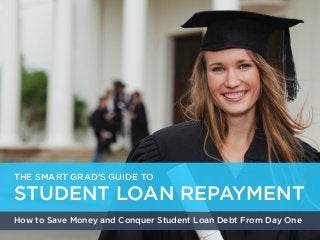
How to Save Money and Conquer Student Loan Debt From Day One
THE SMART GRAD’S GUIDE TO
STUDENT LOAN REPAYMENT
May your life after graduation be a reflection of
everything you’ve worked hard for – a fulfilling
career, stable finances, happy life and much more.
2
CONGRATULATIONS NEW GRADUATE!
3
And if you’re one of the
7 in 10 people graduating with student loan debt,
may your student loan repayment strategy set
you up for success right from the start.
Because make no mistake –
student loan repayment
does require a strategy.
3
4
. . . and can hold you back from achieving
other financial goals - like buying a home,
starting a family and traveling the world.
It may seem as simple as picking a student
loan repayment plan, but the decisions
you make today impact how much interest
you’ll end up paying in the long run . . .
5
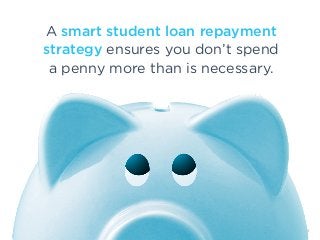
A smart student loan repayment
strategy ensures you don’t spend
a penny more than is necessary.
To start your student loan repayment
strategy on the right track, follow
these six important steps.
2
 3
6
 4
1
5
6
7
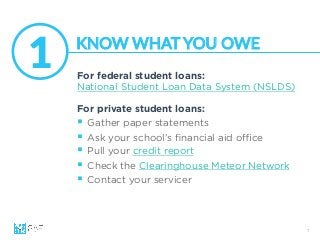
For federal student loans:
National Student Loan Data System (NSLDS)
For private student loans:
§  Gather paper statements
§  Ask your school’s financial aid office
§  Pull your credit report
§  Check the Clearinghouse Meteor Network
§  Contact your servicer
1
 KNOW  WHAT  YOU  OWE  
8
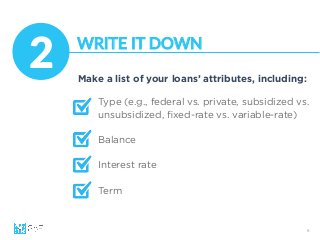
Make a list of your loans’ attributes, including:
2
 WRITE  IT  DOWN  
Type (e.g., federal vs. private, subsidized vs.
unsubsidized, fixed-rate vs. variable-rate)
Balance
Interest rate
Term
9
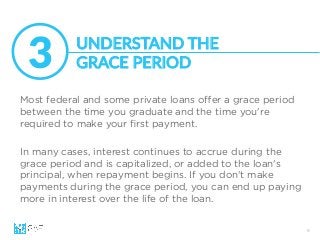
Most federal and some private loans offer a grace period
between the time you graduate and the time you're
required to make your first payment.
In many cases, interest continues to accrue during the
grace period and is capitalized, or added to the loan's
principal, when repayment begins. If you don't make
payments during the grace period, you can end up paying
more in interest over the life of the loan.
3
 UNDERSTAND  THE    
GRACE  PERIOD
10
120
110
100
104
108
112
116
120
124
No payments during grace
period
Regular payments during grace
period ($555/month)
LOAN TERM (in months)
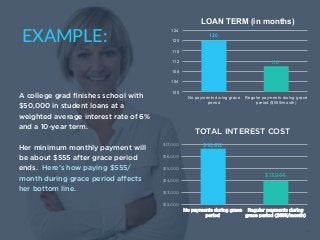
Her minimum monthly payment will
be about $555 after grace period
ends. Here’s how paying $555/
month during grace period affects
her bottom line.
EXAMPLE:
$16,612
$13,964
$12,000
$13,000
$14,000
$15,000
$16,000
$17,000
No payments during grace
period
Regular payments during
grace period ($555/month)
TOTAL INTEREST COST
A college grad finishes school with
$50,000 in student loans at a
weighted average interest rate of 6%
and a 10-year term.
11
BOTTOM  LINE:
Use the grace period if you need it, but if
not, consider making at least interest-only
payments during this timeframe in order to
minimize interest costs.
12
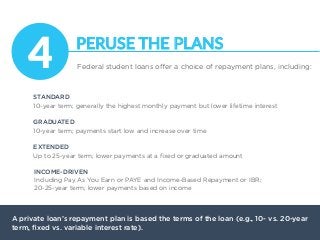
Federal student loans offer a choice of repayment plans, including:4
 PERUSE  THE  PLANS
A private loan’s repayment plan is based the terms of the loan (e.g., 10- vs. 20-year
term, fixed vs. variable interest rate).
STANDARD
10-year term; generally the highest monthly payment but lower lifetime interest
GRADUATED
10-year term; payments start low and increase over time
EXTENDED
Up to 25-year term; lower payments at a fixed or graduated amount
INCOME-DRIVEN
Including Pay As You Earn or PAYE and Income-Based Repayment or IBR;
20-25-year term; lower payments based on income
13
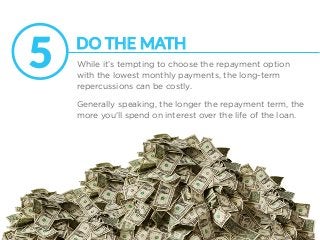
While it’s tempting to choose the repayment option
with the lowest monthly payments, the long-term
repercussions can be costly.
5
 DO  THE  MATH
Generally speaking, the longer the repayment term, the
more you'll spend on interest over the life of the loan.
14
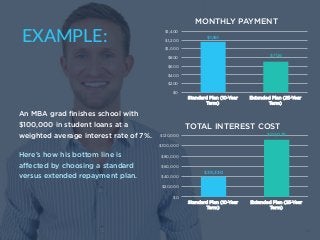
Here’s how his bottom line is
affected by choosing a standard
versus extended repayment plan.
EXAMPLE:
An MBA grad finishes school with
$100,000 in student loans at a
weighted average interest rate of 7%.
$1,161
$706
$0
$200
$400
$600
$800
$1,000
$1,200
$1,400
Standard Plan (10-Year
Term)
Extended Plan (25-Year
Term)
MONTHLY PAYMENT
$39,330
$112,035
$0
$20,000
$40,000
$60,000
$80,000
$100,000
$120,000
Standard Plan (10-Year
Term)
Extended Plan (25-Year
Term)
TOTAL INTEREST COST
15
BOTTOM  LINE:
Go for the lower payment if you need to,
but be sure to revisit your repayment plan
on at least an annual basis. The sooner you
switch to a more aggressive plan, the more
you’ll save – and the sooner you’ll be done
with your loans.
16
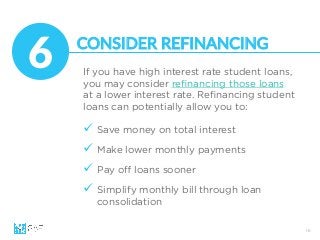
If you have high interest rate student loans,
you may consider refinancing those loans
at a lower interest rate. Refinancing student
loans can potentially allow you to:
6
 CONSIDER  REFINANCING
ü  Save money on total interest
ü  Make lower monthly payments
ü  Pay off loans sooner
ü  Simplify monthly bill through loan
consolidation
17
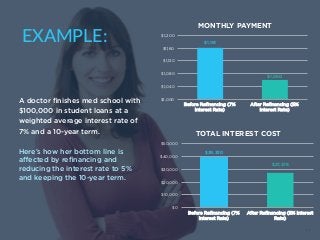
Here’s how her bottom line is
affected by refinancing and
reducing the interest rate to 5%
and keeping the 10-year term.
EXAMPLE:
A doctor finishes med school with
$100,000 in student loans at a
weighted average interest rate of
7% and a 10-year term.
$1,161
$1,060
$1,000
$1,040
$1,080
$1,120
$1,160
$1,200
Before Refinancing (7%
Interest Rate)
After Refinancing (5%
Interest Rate)
MONTHLY PAYMENT
$39,330
$27,278
$0
$10,000
$20,000
$30,000
$40,000
$50,000
Before Refinancing (7%
Interest Rate)
After Refinancing (5% Interest
Rate)
TOTAL INTEREST COST
18
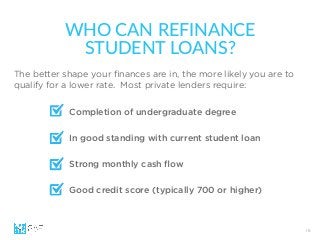
The better shape your finances are in, the more likely you are to
qualify for a lower rate. Most private lenders require:
Completion of undergraduate degree
In good standing with current student loan
Strong monthly cash flow
Good credit score (typically 700 or higher)
WHO  CAN  REFINANCE    
STUDENT  LOANS?
19
When you refinance federal student loans with a private lender,
you give up federal loan benefits such as:
§  Loan forgiveness programs (for public service, teaching and
military professions)
§  Loan deferment and forbearance (although some private
lenders do offer the latter)
§  Graduated, extended and income-driven repayment plans
BEFORE  REFINANCING  
FEDERAL  STUDENT  LOANS.  .  .
If you need these benefits, think twice before
refinancing federal student loans.
20
BOTTOM  LINE:
Refinancing can be a great way to save money
and efficiently deal with student loan debt,
and there are no fees to apply. Even if you
don’t qualify for a better rate today, make sure
to check back periodically – especially if your
credit score and income improve over time.
21
Which repayment plan will you choose?
Will you make payments during grace period?
Should you consider refinancing any of your loans?
PUTTING  IT  ALL  TOGETHER
Revisit your list of loans from step two
and decide on a plan of attack:
ü  Consider signing up for automatic payments (usually comes with a 0.25%
reduction in interest rate)
ü  Call your student loan servicer with questions
ü  Set a reminder to revisit your repayment strategy on an annual basis
FINAL  TIPS
§  Can  you  switch  to  a  more  aggressive  repayment  plan?
§  Are  you  now  eligible  to  refinance  loans  at  a  lower  rate?
23
Check out the SoFi blog
WANT  TO  LEARN  MORE?
For more information
sofi.com
This piece is intended to provide useful information on the subject of student loans, but does not purport to provide legal or tax advice.
Download the SoFi Student Loan Refinance Guide
Follow SoFi on Facebook, Twitter or LinkedIn
to get the latest student loan news
24
SoFi is a leading marketplace lender and the largest provider of
student loan refinancing with over $2.5 billion in loans issued. Our
non-traditional underwriting approach takes into account merit
and employment history, among other factors, to provide unique
financial and investment products designed to accelerate success
for ambitious professionals.
ABOUT  SOFI

The Smart Grad's Guide to Student Loan Repayment

  • 1.
    So Smart. SoFi.com ©2015 Social Finance, Inc. Confidential Information. Do not copy or distribute. How to Save Money and Conquer Student Loan Debt From Day One THE SMART GRAD’S GUIDE TO STUDENT LOAN REPAYMENT
  • 2.
    May your lifeafter graduation be a reflection of everything you’ve worked hard for – a fulfilling career, stable finances, happy life and much more. 2 CONGRATULATIONS NEW GRADUATE!
  • 3.
    3 And if you’reone of the 7 in 10 people graduating with student loan debt, may your student loan repayment strategy set you up for success right from the start. Because make no mistake – student loan repayment does require a strategy. 3
  • 4.
    4 . . .and can hold you back from achieving other financial goals - like buying a home, starting a family and traveling the world. It may seem as simple as picking a student loan repayment plan, but the decisions you make today impact how much interest you’ll end up paying in the long run . . .
  • 5.
    5 A smart studentloan repayment strategy ensures you don’t spend a penny more than is necessary.
  • 6.
    To start yourstudent loan repayment strategy on the right track, follow these six important steps. 2 3 6 4 1 5 6
  • 7.
    7 For federal studentloans: National Student Loan Data System (NSLDS) For private student loans: §  Gather paper statements §  Ask your school’s financial aid office §  Pull your credit report §  Check the Clearinghouse Meteor Network §  Contact your servicer 1 KNOW  WHAT  YOU  OWE  
  • 8.
    8 Make a listof your loans’ attributes, including: 2 WRITE  IT  DOWN   Type (e.g., federal vs. private, subsidized vs. unsubsidized, fixed-rate vs. variable-rate) Balance Interest rate Term
  • 9.
    9 Most federal andsome private loans offer a grace period between the time you graduate and the time you're required to make your first payment. In many cases, interest continues to accrue during the grace period and is capitalized, or added to the loan's principal, when repayment begins. If you don't make payments during the grace period, you can end up paying more in interest over the life of the loan. 3 UNDERSTAND  THE     GRACE  PERIOD
  • 10.
    10 120 110 100 104 108 112 116 120 124 No payments duringgrace period Regular payments during grace period ($555/month) LOAN TERM (in months) Her minimum monthly payment will be about $555 after grace period ends. Here’s how paying $555/ month during grace period affects her bottom line. EXAMPLE: $16,612 $13,964 $12,000 $13,000 $14,000 $15,000 $16,000 $17,000 No payments during grace period Regular payments during grace period ($555/month) TOTAL INTEREST COST A college grad finishes school with $50,000 in student loans at a weighted average interest rate of 6% and a 10-year term.
  • 11.
    11 BOTTOM  LINE: Use thegrace period if you need it, but if not, consider making at least interest-only payments during this timeframe in order to minimize interest costs.
  • 12.
    12 Federal student loansoffer a choice of repayment plans, including:4 PERUSE  THE  PLANS A private loan’s repayment plan is based the terms of the loan (e.g., 10- vs. 20-year term, fixed vs. variable interest rate). STANDARD 10-year term; generally the highest monthly payment but lower lifetime interest GRADUATED 10-year term; payments start low and increase over time EXTENDED Up to 25-year term; lower payments at a fixed or graduated amount INCOME-DRIVEN Including Pay As You Earn or PAYE and Income-Based Repayment or IBR; 20-25-year term; lower payments based on income
  • 13.
    13 While it’s temptingto choose the repayment option with the lowest monthly payments, the long-term repercussions can be costly. 5 DO  THE  MATH Generally speaking, the longer the repayment term, the more you'll spend on interest over the life of the loan.
  • 14.
    14 Here’s how hisbottom line is affected by choosing a standard versus extended repayment plan. EXAMPLE: An MBA grad finishes school with $100,000 in student loans at a weighted average interest rate of 7%. $1,161 $706 $0 $200 $400 $600 $800 $1,000 $1,200 $1,400 Standard Plan (10-Year Term) Extended Plan (25-Year Term) MONTHLY PAYMENT $39,330 $112,035 $0 $20,000 $40,000 $60,000 $80,000 $100,000 $120,000 Standard Plan (10-Year Term) Extended Plan (25-Year Term) TOTAL INTEREST COST
  • 15.
    15 BOTTOM  LINE: Go forthe lower payment if you need to, but be sure to revisit your repayment plan on at least an annual basis. The sooner you switch to a more aggressive plan, the more you’ll save – and the sooner you’ll be done with your loans.
  • 16.
    16 If you havehigh interest rate student loans, you may consider refinancing those loans at a lower interest rate. Refinancing student loans can potentially allow you to: 6 CONSIDER  REFINANCING ü  Save money on total interest ü  Make lower monthly payments ü  Pay off loans sooner ü  Simplify monthly bill through loan consolidation
  • 17.
    17 Here’s how herbottom line is affected by refinancing and reducing the interest rate to 5% and keeping the 10-year term. EXAMPLE: A doctor finishes med school with $100,000 in student loans at a weighted average interest rate of 7% and a 10-year term. $1,161 $1,060 $1,000 $1,040 $1,080 $1,120 $1,160 $1,200 Before Refinancing (7% Interest Rate) After Refinancing (5% Interest Rate) MONTHLY PAYMENT $39,330 $27,278 $0 $10,000 $20,000 $30,000 $40,000 $50,000 Before Refinancing (7% Interest Rate) After Refinancing (5% Interest Rate) TOTAL INTEREST COST
  • 18.
    18 The better shapeyour finances are in, the more likely you are to qualify for a lower rate. Most private lenders require: Completion of undergraduate degree In good standing with current student loan Strong monthly cash flow Good credit score (typically 700 or higher) WHO  CAN  REFINANCE     STUDENT  LOANS?
  • 19.
    19 When you refinancefederal student loans with a private lender, you give up federal loan benefits such as: §  Loan forgiveness programs (for public service, teaching and military professions) §  Loan deferment and forbearance (although some private lenders do offer the latter) §  Graduated, extended and income-driven repayment plans BEFORE  REFINANCING   FEDERAL  STUDENT  LOANS.  .  . If you need these benefits, think twice before refinancing federal student loans.
  • 20.
    20 BOTTOM  LINE: Refinancing canbe a great way to save money and efficiently deal with student loan debt, and there are no fees to apply. Even if you don’t qualify for a better rate today, make sure to check back periodically – especially if your credit score and income improve over time.
  • 21.
    21 Which repayment planwill you choose? Will you make payments during grace period? Should you consider refinancing any of your loans? PUTTING  IT  ALL  TOGETHER Revisit your list of loans from step two and decide on a plan of attack:
  • 22.
    ü  Consider signingup for automatic payments (usually comes with a 0.25% reduction in interest rate) ü  Call your student loan servicer with questions ü  Set a reminder to revisit your repayment strategy on an annual basis FINAL  TIPS §  Can  you  switch  to  a  more  aggressive  repayment  plan? §  Are  you  now  eligible  to  refinance  loans  at  a  lower  rate?
  • 23.
    23 Check out theSoFi blog WANT  TO  LEARN  MORE? For more information sofi.com This piece is intended to provide useful information on the subject of student loans, but does not purport to provide legal or tax advice. Download the SoFi Student Loan Refinance Guide Follow SoFi on Facebook, Twitter or LinkedIn to get the latest student loan news
  • 24.
    24 SoFi is aleading marketplace lender and the largest provider of student loan refinancing with over $2.5 billion in loans issued. Our non-traditional underwriting approach takes into account merit and employment history, among other factors, to provide unique financial and investment products designed to accelerate success for ambitious professionals. ABOUT  SOFI