Shannon Lewis
Early 1960s, Andy Warhol was the first representative of the
Pop Art generation to recognise “the hegemony of media
language” and to use it in series of repetition. He used images
from comic strips and advertisements he would find in
newspapers and comic books, by projecting them on canvases
and painting them without sketching first. He sometimes used
photographic material and silkscreened his drawings. He
experimented with grid-like arrangements for his compositions
in series, keeping to a repetitive pattern. To make his process
of repeating quicker he used photo-silkscreening. His first
works using this process focussed on idols like Elvis Presely.
He used this technique continuously. His most famous pieces
are the four ‘Marilyn’ prints.
“…the nearly identical soup can paintings
were displayed along a shelf, mimicking
stereotypical department store aesthetics.”
Campbell’s Soup Can (Scotch Broth) 1962
Limited colour: black, white, red
and yellow
Is less more?
Shadows and highlights
limited. Only shows signs of
light reflecting in on the
bottom and top part of the tin
Writing doesn’t seem to
curve round properly –
hand drawn quality
Small yellow embellishment at the bottom is like
the writing with how it doesn’t curve round – did
he just repeat one pattern without adjusting it to
make the tin realistic?
Simple design
but still is
kept busy
with the
different fonts
Links to how he didn’t
have preliminary sketches
– easy to make mistakes
Made by silkscreening two of his
drawings
The hair has a
loose drawn
quality to it –
faint compared to
the dark lines –
gives an
appearance of
being incomplete
One Dollar Bill-Silver Certificate 1962
Dark shadow
behind the bill –
exaggerated
shadow, very much
like the ones you
get in comic books
Showing
influences?
Subtle colours used –
only just separates the
background and bill
Coca-Cola [1] 1961
Rough textures – very
contrasting against the
polished original coke
label
Did he use pens that
were running out? Or
is it crayon
A repeated part of
the neck of the
bottle next to the
complete bottle
Meant to be a
reflection?
Wanted to draw
it there first?
Comes across as a sketch because of
the roughness. Very different to
Campbell’s soup can
Blocks of white to show
reflection of light to give a
sense of form and material
You can see
the curves of
the bottle
and that it is
made of glass
Limited colours are used
– red, gold
Block colours placed
on top of details
from the silk screen
Lavender Marilyn [2] 1962
Doesn’t even fit
it properly, for
instance on the
hair line and
slightly on the
lips.
Simplified the
amount of details to
show No subtle shadows or
much of the nose
Blocked coloured
background Brings focus just on face
Extremely dark
shadows under
chin and on
cheek.
Clearly separates neck from
chin and gives depth to face
Exaggerates
shadows like they
do in comics
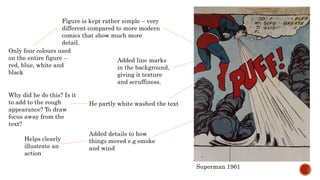
Superman 1961
Figure is kept rather simple – very
different compared to more modern
comics that show much more
detail.
Only four colours used
on the entire figure –
red, blue, white and
black
Added line marks
in the background,
giving it texture
and scruffiness.
He partly white washed the text
Why did he do this? Is it
to add to the rough
appearance? To draw
focus away from the
text?
Added details to how
things moved e.g smoke
and wind
Helps clearly
illustrate an
action
Andy Warhol Series and Singles Fondation Beyeler
From looking at Warhol’s work it has inspired me to
focus on colour even more as it helps make the image
stand out boldly. It has also influenced me to attempt
silk screen using one of my drawings. To do this I will
have to plan out layers, starting with the lightest first
and gradually building up to the shadows, then adding
details in afterwards with black pen.

Andy warhol

  • 1.
  • 2.
    Early 1960s, AndyWarhol was the first representative of the Pop Art generation to recognise “the hegemony of media language” and to use it in series of repetition. He used images from comic strips and advertisements he would find in newspapers and comic books, by projecting them on canvases and painting them without sketching first. He sometimes used photographic material and silkscreened his drawings. He experimented with grid-like arrangements for his compositions in series, keeping to a repetitive pattern. To make his process of repeating quicker he used photo-silkscreening. His first works using this process focussed on idols like Elvis Presely. He used this technique continuously. His most famous pieces are the four ‘Marilyn’ prints.
  • 3.
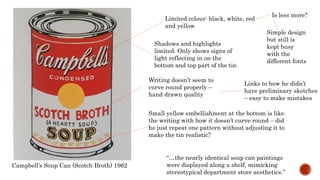
    “…the nearly identicalsoup can paintings were displayed along a shelf, mimicking stereotypical department store aesthetics.” Campbell’s Soup Can (Scotch Broth) 1962 Limited colour: black, white, red and yellow Is less more? Shadows and highlights limited. Only shows signs of light reflecting in on the bottom and top part of the tin Writing doesn’t seem to curve round properly – hand drawn quality Small yellow embellishment at the bottom is like the writing with how it doesn’t curve round – did he just repeat one pattern without adjusting it to make the tin realistic? Simple design but still is kept busy with the different fonts Links to how he didn’t have preliminary sketches – easy to make mistakes
  • 4.
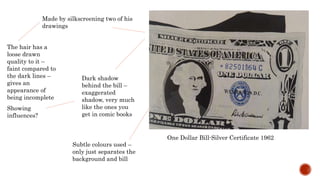
    Made by silkscreeningtwo of his drawings The hair has a loose drawn quality to it – faint compared to the dark lines – gives an appearance of being incomplete One Dollar Bill-Silver Certificate 1962 Dark shadow behind the bill – exaggerated shadow, very much like the ones you get in comic books Showing influences? Subtle colours used – only just separates the background and bill
  • 5.
    Coca-Cola [1] 1961 Roughtextures – very contrasting against the polished original coke label Did he use pens that were running out? Or is it crayon A repeated part of the neck of the bottle next to the complete bottle Meant to be a reflection? Wanted to draw it there first? Comes across as a sketch because of the roughness. Very different to Campbell’s soup can Blocks of white to show reflection of light to give a sense of form and material You can see the curves of the bottle and that it is made of glass Limited colours are used – red, gold
  • 6.
    Block colours placed ontop of details from the silk screen Lavender Marilyn [2] 1962 Doesn’t even fit it properly, for instance on the hair line and slightly on the lips. Simplified the amount of details to show No subtle shadows or much of the nose Blocked coloured background Brings focus just on face Extremely dark shadows under chin and on cheek. Clearly separates neck from chin and gives depth to face Exaggerates shadows like they do in comics
  • 7.
    Superman 1961 Figure iskept rather simple – very different compared to more modern comics that show much more detail. Only four colours used on the entire figure – red, blue, white and black Added line marks in the background, giving it texture and scruffiness. He partly white washed the text Why did he do this? Is it to add to the rough appearance? To draw focus away from the text? Added details to how things moved e.g smoke and wind Helps clearly illustrate an action
  • 8.
    Andy Warhol Seriesand Singles Fondation Beyeler From looking at Warhol’s work it has inspired me to focus on colour even more as it helps make the image stand out boldly. It has also influenced me to attempt silk screen using one of my drawings. To do this I will have to plan out layers, starting with the lightest first and gradually building up to the shadows, then adding details in afterwards with black pen.